Hubbry Logo
Combtooth blennyCombtooth blennyMain
Open search
Combtooth blenny
Community hub
Combtooth blenny
logo
8 pages, 0 posts
0 subscribers
Be the first to start a discussion here.
Combtooth blenny
Combtooth blenny
from Wikipedia

Combtooth blennies
Temporal range: Middle Miocene–present
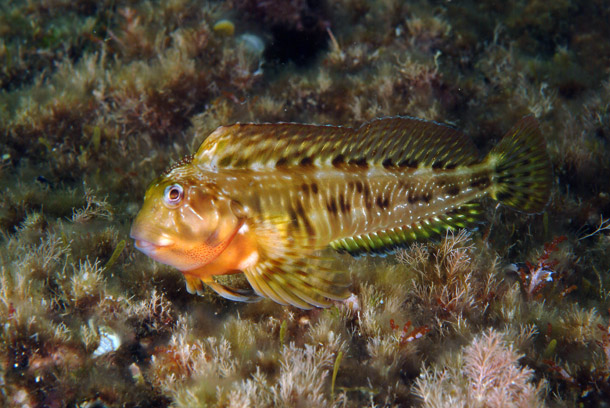
Scartella cristata
Scientific classification Edit this classification
Kingdom: Animalia
Phylum: Chordata
Class: Actinopterygii
Order: Blenniiformes
Suborder: Blennioidei
Family: Blenniidae
Rafinesque, 1810
Subfamilies
Combtooth blenny (Alticus anjouanae), La Réunion

Combtooth blennies are blenniiformids; percomorph marine fish of the family Blenniidae, part of the order Blenniiformes. They are the largest family of blennies with around 401 known species in 58 genera. Combtooth blennies are found in tropical and subtropical waters in the Atlantic, Pacific and Indian Oceans; some species are also found in brackish and even freshwater environments.

Description

[edit]

The body plan of the combtooth blennies is archetypal to all other blennioids; their blunt heads and eyes are large, with large continuous dorsal fins (which may have three to 17 spines). Their bodies are compressed, elongated, and scaleless; their small, slender pelvic fins (which are absent in only two species) have one spine and three to four soft rays, and are situated in front of their enlarged pectoral fins, and their tail fins are rounded.[1] As their name would suggest, combtooth blennies are noted for the comb-like teeth lining their jaws. Combtooth blennies are active and often highly colourful, making them popular in the aquarium hobby.

Larvae are similar to the adults, though have a prominent preopercular spine that disappears during metamorphosis.[2]

By far the largest species is the eel-like hairtail blenny at 53 cm (21 in) in length; most other members of the family are much smaller.

Habitat and behaviour

[edit]
Blue-lined sabertooth blenny Plagiotremus rhinorhynchos in a rock hole

Generally benthic fish, combtooth blennies spend much of their time on or near the bottom. They may inhabit the rocky crevices of reefs, burrows in sandy or muddy substrates, or even empty shells. Generally found in shallow waters, some combtooth blennies are capable of leaving the water for short periods during low tide, aided by their large pectoral fins which act as "feet". Small benthic crustaceans, mollusks, and other sessile invertebrates are the primary food items for most species; others eat algae or plankton.

One exceptional group of combtooth blennies deserves special mention: the so-called sabre-toothed blennies of the genera Aspidontus, Meiacanthus, Petroscirtes, Plagiotremus, and Xiphasia. These blennies have swim bladders unlike the other clades,[1] and fang-like teeth with venom glands at their bases. Species of the genera Aspidontus and Plagiotremus (such as the false cleanerfish) are noted for their cunning mimicry of cleaner wrasses: by imitating the latter's colour, form, and behaviour, the blennies are able to trick other fish (or even divers) into letting down their guard, long enough for the blennies to nip a quick mouthful of skin or scale.

A very protective Petroscirtes variabilis male risks his life to protect his brood

Some combtooth blennies form small groups, while others are solitary and territorial. They may be either diurnal or nocturnal, depending on the species. Females lay eggs in shells or under rock ledges; males guard the nest of eggs until hatching.

Close-up of eggs mass in the various developmental stages. The clear orange eggs are likely recently laid, while those with eyes were laid earlier

In some species, the eggs may remain in the oviduct of the female until hatched. The fry of some species undergo an 'ophioblennius' stage, wherein the fish are pelagic (i.e., inhabiting the midwater) and have greatly enlarged pectoral fins and hooked teeth.

Classification

[edit]
Toxic Meiacanthus grammistes imitates the coloration of wrasses

This family is currently divided into two subfamilies and approximately 58 genera and 397 species.[3]

The following genera are classified within the family Blenniidae:[4][5]

Fossil genera

[edit]

The following fossil genera are also known:

The otolith-based fossil species Exallias vectensis, from the Early Eocene of England, may potentially represent the oldest record of the group.[10]

Timeline

[edit]
QuaternaryNeogenePaleogeneHolocenePleist.Plio.MioceneOligoceneEocenePaleoceneBlenniusExalliasQuaternaryNeogenePaleogeneHolocenePleist.Plio.MioceneOligoceneEocenePaleocene

See also

[edit]

References

[edit]
Revisions and contributorsEdit on WikipediaRead on Wikipedia
from Grokipedia
The combtooth blennies (family Blenniidae) are a diverse group of small, primarily marine fishes distinguished by their scaleless, elongated bodies, blunt heads, and comb-like arrays of slender, close-set teeth in the jaws, often accompanied by prominent cirri (fleshy flaps) above the eyes and nostrils. Encompassing around 400 species across approximately 59 genera, combtooth blennies represent the largest family within the suborder Blennioidei and are distributed worldwide in tropical and subtropical waters of the Atlantic, Indian, and Pacific Oceans, with rare occurrences in brackish or freshwater habitats. Most species are bottom-dwellers in shallow coastal environments, including coral reefs, rocky intertidal zones, seagrass beds, tide pools, mangroves, and oyster reefs, where they typically reach lengths of less than 15 cm, though the largest species can grow to about 55 cm. These oviparous fishes exhibit a range of feeding strategies, primarily grazing on benthic algae and small invertebrates, with some species acting as planktivores or even nipping at the skin and fins of larger fish; males commonly guard adhesive demersal eggs in crevices or burrows. Notable adaptations include cryptic coloration for camouflage, sexual dimorphism (with males often larger and more vividly colored), and in some genera like Meiacanthus, venomous oral glands that deter predators. Many species, such as those in the genera Ecsenius and Salarias, are popular in the marine aquarium trade due to their hardy nature and algae-eating habits, contributing to reef ecosystem health by controlling algal growth.

Taxonomy and Phylogeny

Etymology and historical classification

The term "combtooth blenny" derives from the distinctive dental structure of these fishes, where "combtooth" refers to the single row of small, comb-like teeth arranged along each jaw, adapted for scraping and other food from substrates. The component "blenny" originates from the word blennos, meaning "" or "slime," alluding to the slippery, mucous-covered skin that characterizes these and related species. The family Blenniidae was first formally established in 1810 by in his work Caratteri di alcuni nuovi generi e nuove specie di animali e piante della Sicilia, where he defined it to encompass small, scaleless marine fishes with specific percomorph traits, initially based on Mediterranean specimens. Early post-Rafinesque classifications often lumped Blenniidae with other blennioid groups under broader categories, such as the perciform family Gobioidei, due to superficial similarities in body form and habitat preferences among small coastal fishes. A pivotal advancement in the came through the comprehensive ichthyological treatise Histoire Naturelle des Poissons by and (volumes 10–11, 1836), which systematically described numerous blenny species and formalized the family's recognition by emphasizing diagnostic features like the comb-like , lack of scales, and continuous structure extending over the body. This work shifted early groupings from regional descriptions toward a more unified framework grounded in , though it still included some overlap with goby-like forms. Initial taxonomic challenges arose from morphological resemblances between Blenniidae and the scaled blennies of Labrisomidae, leading to frequent misclassifications in the 19th and early 20th centuries as both groups shared elongated bodies, benthic habits, and similar fin arrangements. These confusions were largely resolved in the mid-20th century through detailed osteological studies, particularly by Victor G. Springer and Philip A. Hastings, who used skeletal characters like cirrus morphology and vertebral counts to delineate clear boundaries between the scaleless Blenniidae and scaled Labrisomidae within the suborder Blennioidei.

Modern taxonomy and subfamilies

The family Blenniidae is classified within the order and currently encompasses 58 genera and 426 valid species, reflecting updates to taxonomic catalogs as of November 2025. This diversity has been shaped by ongoing revisions, with the family recognized for its small, benthic marine fishes characterized by comb-like teeth on the lower jaw, though the focus here remains on rather than morphology. The Blenniidae is divided into two primary subfamilies: Blenniinae (true blennies) and Salariinae (combtooth blennies sensu stricto). Blenniinae comprises 10 genera and 103 species, many of which occupy intertidal zones and exhibit adaptations to fluctuating environmental conditions. In contrast, Salariinae is more speciose, with 39 genera and 283 species, primarily inhabiting subtidal environments across tropical and subtropical waters. Key genera within Salariinae include Ecsenius, Ophioblennius (predominant in Atlantic regions), and Aspidontus (notable for of ). Phylogenetic analyses have reinforced the of Blenniidae through molecular approaches, such as subunit I (COI) barcoding, which has aided in resolving relationships among intertidal and reef-associated lineages. Taxonomic revisions from 2016 to 2025 have incorporated 47 new species, largely from the , addressing previous gaps in cryptobenthic diversity and cryptic speciation via integrative morphology and . These updates stem from targeted surveys in biodiversity hotspots, enhancing understanding of evolutionary radiations within the subfamilies. Species richness is highest in the Indo-West Pacific, where over 300 occur, driven by complex ecosystems and historical biogeographic processes. In comparison, the Atlantic supports around 50 , with lower diversity reflecting narrower availability and fewer genera, such as Ophioblennius and Hypleurochilus.

Fossil record and evolutionary history

The fossil record of combtooth blennies (family Blenniidae) is sparse and primarily based on otoliths and fragmentary skeletal remains, providing limited but insightful glimpses into their early diversification within the blennioid lineage. The oldest known record is the otolith-based species Exallias vectensis from the Early Eocene Ypresian stage (approximately 50 million years ago) in , which represents an early phase of blennioid evolution and suggests the group's origins in shallow marine environments of the Tethys Sea region. This Eocene indicates that blennioids, including precursors to modern Blenniidae, had already begun adapting to benthic habitats by the early . Fossil evidence becomes more abundant in the , with known genera including Blennius and Parablennius documented from Middle deposits (approximately 15 million years ago) across and the Sea. These include otolith assemblages and partial skeletons from sites in the , , and the Central , with around 10 fossil species described to date, such as Mioblennius fraudulentus from . Such remains highlight the family's expansion into diverse coastal ecosystems during this period. Phylogenetic analyses estimate the crown-group origin of Blenniidae around 60 million years ago in the tropical Tethys Sea, with major radiations occurring post-Eocene as tectonic events, including the gradual closure of Tethyan seaways, fragmented habitats and promoted in and Atlantic realms. Early fossils reveal key adaptations for benthic lifestyles, including the absence of a —inferred from compact skeletal structures lacking pneumatic features—and specialized suited to algal grazing on rocky substrates. Significant gaps persist in the pre-Miocene record, with only isolated otoliths from the Eocene and scant material, underscoring the challenges of preserving small, coastal species; however, ongoing paleontological surveys indicate potentially underestimated diversity in Oligocene lagoonal deposits.

Physical Characteristics

Morphology and anatomy

Combtooth blennies possess elongated, laterally compressed, scaleless bodies that taper toward the rear, facilitating their benthic lifestyle in intertidal and shallow marine environments. Their heads are blunt with large eyes positioned high on the sides, providing an elevated vantage for navigating complex substrates. Most adults lack a swim bladder, which contributes to their predominantly bottom-dwelling habits. The is continuous, featuring 3-17 flexible spines anteriorly followed by 15-19 soft rays, enabling agile maneuvering over rocky surfaces. Pelvic fins are small and positioned anterior to the pectorals, consisting of one inconspicuous spine and 2-4 segmented rays that form a fused, suction-like structure adapted for "walking" or hopping along substrates. The caudal is typically rounded with branched rays, aiding in precise bursts of movement. Jaws are equipped with a single row of comb-like, slender teeth, either fixed or movable, suited for scraping or grasping. Some species, such as those in the Meiacanthus, possess enlarged posterior canines associated with glands. The skin is smooth and covered in a protective mucous layer, while the head bears cirri—fleshy, branched flaps—typically on the nostrils, eyes, and . Internally, the digestive features a simple, elongated gut without a distinct , consisting of coiled intestines that support processing of algal and detrital matter in many species.

Size, coloration, and variation

Combtooth blennies exhibit a wide range of body sizes across the approximately 400 species in the family Blenniidae, with most attaining lengths of 5-10 cm total length (TL) as adults. The largest species is the hairtail blenny Xiphasia setifer, which reaches a maximum of 53 cm TL. Juveniles are typically smaller, often under 5 cm, and display more subdued patterns that enhance their cryptic appearance among reef substrates. Coloration in combtooth blennies is diverse and serves functions such as and signaling, featuring patterns that include uniform hues, spots, stripes, and bands. Reef-dwelling in the genus Ecsenius, for example, often show browns and greens accented with spots for blending into algal-covered rocks. Mimetic like those in Plagiotremus display bold black and yellow stripes to imitate cleaner , facilitating . Members of the subfamily Salariinae frequently exhibit iridescent blues and greens, adding to their visual appeal in tropical waters. Variations in size, coloration, and morphology occur within and between , influenced by , development, and geography. Sexual dimorphism is prevalent, with males often larger and exhibiting brighter colors, particularly during breeding seasons when nuptial hues intensify to attract mates. Ontogenetic changes are evident, as juveniles tend to have plainer, less contrasting patterns that become more vibrant with maturity. Geographic variation in coloration and morphology is observed in some genera. The vivid coloration of certain species contributes to their popularity in the aquarium trade. The yellow-eyed combtooth blenny (Ecsenius melarchus), with its pale greenish body, bright yellow eye ring, and orange accents, is particularly prized for its striking hues and peaceful temperament in reef setups.

Distribution and Habitat

Global distribution

Combtooth blennies (family Blenniidae) are distributed worldwide in tropical and subtropical marine waters of the Atlantic, Indian, and Pacific Oceans, with approximately 416 species across 64 genera; they are absent from polar regions. The family exhibits a primarily coastal distribution in shallow waters, though rare occurrences in brackish and freshwater environments are documented, particularly in the Indo-Pacific where some species venture into riverine systems. The Indo-West Pacific represents the center of diversity for combtooth blennies, with the highest species richness in this region. In contrast, the Atlantic Ocean hosts fewer species, with around 20 in the western Atlantic (Greater Caribbean) and even lower numbers in the eastern Atlantic due to biogeographic barriers like the , which limits trans-oceanic dispersal. The eastern Pacific supports about 15 species, many of which are endemic to this region, reflecting isolation from the by the Eastern Pacific Barrier. Endemism is prominent among combtooth blennies, with numerous species restricted to specific islands or archipelagos; for example, Ecsenius hawaiiensis is endemic to the Hawaiian Islands. Occasional vagrants appear in temperate zones through ocean currents, such as records in the Mediterranean's cooler margins. Historical biogeographic changes, including post-Pleistocene expansions facilitated by the opening of the Suez Canal in 1869, have led to Lessepsian migrations of Indo-Pacific species into the Red Sea and Mediterranean, enhancing regional diversity through anti-Lessepsian and invasive pathways.

Habitat preferences and adaptations

Combtooth blennies primarily inhabit shallow coastal waters, typically at depths ranging from 0 to 30 meters, where they occupy a variety of benthic environments including coral reefs, rocky shores, beds, tide pools, and mangrove fringes. These small fish show a strong preference for structurally complex substrates that provide shelter, such as crevices, rocks, shells, and algae-covered surfaces, which allow them to remain cryptic and ambush prey or evade predators. In some cases, species extend into more extreme intertidal zones, with genera like Alticus occupying splash zones above the high tide line, where they graze on while enduring periodic wetting from waves. Several adaptations enable combtooth blennies to thrive in these dynamic habitats, particularly those with fluctuating conditions. Intertidal species, such as Andamia tetradactyla, exhibit bimodal respiration, utilizing cutaneous through their and oral membranes to perform aerial during exposure, allowing survival out of water for extended periods. Burrowing behaviors are common in certain subtidal forms, like Xiphasia setifer, which construct refuges in sand or mud substrates to avoid or predation. Additionally, many blennies demonstrate high tolerance to variations, enabling habitation in estuarine and systems where osmotic stress is prevalent; for instance, species in the genus Omobranchus maintain ionoregulatory balance across brackish gradients. Microhabitat specificity is pronounced, with a benthic orientation favoring crevices for resting and , while intertidal taxa like Alticus spp. possess enhanced pectoral fins and body shapes that facilitate jumping or "rock-hopping" to navigate exposed terrains between pools. Climate influences further shape their habitat preferences, with subtropical distributions often limited by thresholds, as extreme temperatures restrict beyond temperate zones. Subtidal may exhibit greater morphological flexibility in response to changing environmental pressures.

Behavior and Ecology

Feeding habits and diet

Combtooth blennies ( Blenniidae) display considerable dietary diversity, reflecting adaptations to various reef microhabitats. Many are primarily detritivorous and herbivorous, consuming epilithic algal matrices (EAM) that consist of turf , , , and incidental small . For instance, members of the subfamily Salariinae, such as Salarias fasciatus and Salarias patzneri, specialize in scraping filamentous and detrital aggregates from substrates and surfaces, with often comprising over 40% of their organic intake across seasons. Carnivorous forms, including like Scartella cristata, incorporate small crustaceans, mollusks, polychaetes, and planktonic prey, while the ancestral blenny diet is reconstructed as detritus-based, with subsequent diversification into specialized feeding guilds. Parasitic feeders, such as those in the genus Plagiotremus (e.g., P. rhinorhynchos), target the scales, mucus, and flesh of larger reef through quick, ambush-style attacks. Foraging strategies among combtooth blennies are typically territorial and diurnal, leveraging their distinctive comb-like to scrape food from substrates. Species like Entomacrodus vomerinus and Ophioblennius trinitatis exhibit "hopping" movements along rocks and , delivering multiple bites (up to 14 per 3 minutes) to remove and from EAM layers, often within defended territories that minimize . Opportunistic planktivory occurs in the for some taxa, particularly during high availability, though benthic scraping dominates. This enables efficient surface over areas larger than the fish's mouth, as seen in mechistodont blennies that process and selectively. In reef food webs, combtooth blennies occupy mid-trophic levels as primary consumers, playing a key role in and control by turning over and EAM, which helps maintain health by preventing algal overgrowth. Their feeding contributes minimally to overall sediment flux (less than 1% daily) but is significant per individual mass, comparable to larger grazers like parrotfishes. Dietary shifts often occur ontogenetically, with juveniles of species like Salaria pavo relying more heavily on zooplanktivory before transitioning to benthic and as adults, enhancing niche partitioning. Specialized feeding cases highlight evolutionary innovations within the family. The false cleanerfish Aspidontus taeniatus employs , resembling cleaner (Labroides dimidiatus) to approach hosts and bite fins for tissue, a strategy more prevalent in small individuals (<7 cm) when benthic resources like tubeworm plumes or damselfish eggs are scarce. In fang blennies of the tribe Nemophini (e.g., Meiacanthus spp.), enlarged canines deliver opioid-containing venom during predatory bites on tissue, facilitating scale and removal while deterring retaliation, though venom primarily serves defensive functions post-capture by predators.

Reproduction and life cycle

Combtooth blennies exhibit a polygynous in which territorial males establish and defend nest sites, such as rock crevices, empty shells, or other sheltered substrates, to attract multiple females for spawning. displays typically involve males performing undulating body movements, head bobbing, and rapid color changes to brighter spawning hues, often accompanied by flaring to signal readiness and territorial dominance. These behaviors peak during the breeding season, which is generally seasonal and linked to warmer water temperatures, with spawning most common in spring and summer in temperate regions. Spawning occurs through , with females laying demersal, adhesive eggs in batches directly onto the nest substrate within the male's . Clutch sizes vary by and female size but can reach 150–200 eggs per spawning event for mature individuals, with females capable of multiple spawns every 8–10 days after the initial cycle. Eggs are round to oval, approximately 1 mm in diameter, and initially yellow-orange, developing visible eyespots before turning gray. Males provide exclusive by guarding the eggs against predators and fanning them to maintain oxygenation and remove debris, with incubation lasting 7–17 days depending on (e.g., 9–17 days at 14–21°C). Upon hatching, larvae are transparent and planktonic, measuring 5–6.5 mm in total length, with functional jaws, eyes, and minimal yolk reserves that deplete within 3 days. They enter a pelagic larval stage lasting 20–70 days (e.g., 29 days at 15.5–17.5°C or 57–73 days with latitudinal variation), during which they grow and disperse before settlement. Juveniles settle onto benthic habitats at 1–2 cm total length (typically 13–20 mm), developing full pigmentation and territorial behaviors shortly thereafter. is reached at 1–2 years of age, with lifespans typically ranging from 2 to 5 years or more. All combtooth blennies are oviparous, with demersal egg-laying and no verified instances of , despite occasional confusion with viviparous species in related blennioid families like Clinidae.

Social interactions and mimicry

Combtooth blennies (family Blenniidae) typically lead solitary lives, occupying and defending small territories centered on crevices, rocks, or other shelter sites, often spanning 0.5 to 2 m² in area. These territories serve as secure bases for foraging and refuge, with males particularly vigilant in their defense. In denser habitats, such as those with abundant shelter, some form loose aggregations, allowing proximity without full while still upholding individual boundaries. Most combtooth blennies are diurnal, emerging actively during daylight to patrol their domains and feed, though activity rhythms can vary by and habitat. Interactions among individuals and with other reef species emphasize territorial maintenance and defense. Aggression is common, expressed through visual displays, fin flaring, and chasing intruders, with chase rates averaging 1.9 to 2.2 per 3-minute observation period in studied populations. Males exhibit especially intense guarding of egg nests, aggressively deterring predators and conspecifics through rapid charges and posturing to protect developing embryos until hatching. Some blennies engage in commensal associations with other reef fishes, cohabiting microhabitats like sponge frameworks or worm tubes, where they benefit from shared shelter without competing directly for resources. These encounters often intensify around feeding territories, where chases enforce spatial separation during algae grazing or invertebrate hunting. Mimicry represents a sophisticated deceptive strategy in certain combtooth blenny genera, enabling exploitative interactions with reef communities. Species in Aspidontus, such as the (A. taeniatus), closely resemble juvenile and adult bluestreak wrasses (Labroides dimidiatus) in coloration, , and swaying "dance" movements, allowing them to approach client fishes at cleaning stations undetected. Once near, they deliver aggressive bites to fins, scales, or mucus, with feeding rates up to 11 fin bites per 30 minutes under food-scarce conditions, providing a advantage through elevated encounter rates compared to non-mimics. Plagiotremus species, known as fangblennies, employ by imitating the warning color patterns of venomous Meiacanthus blennies, adapting local morphs (e.g., all-yellow forms in ) to evade attacks while sneaking up on prey for scale-plucking or mucus-feeding. This dual protective and predatory enhances foraging efficiency and reduces predation risk across reefs. Beyond reef-bound dynamics, some combtooth blennies display amphibious behaviors, periodically emerging from water to evade aquatic predators or access terrestrial food sources. On islands like , blennies shift into intertidal splash zones, where land-based predation is markedly lower—experiments with mimics showed over 50% higher survival on land than in water—facilitating temporary excursions for foraging on or small . A few species, such as those in high-intertidal zones, exhibit nocturnal patterns, reducing overlap with diurnal competitors and predators.

Conservation and Human Interactions

Conservation status and threats

The majority of combtooth blenny species in the family Blenniidae are assessed as Least Concern by the IUCN Red List, reflecting their widespread distribution and resilience in many tropical and subtropical marine environments. However, many of the approximately 400 species in the family remain unevaluated by the IUCN, limiting comprehensive global assessments. In regional assessments, such as those for the North-Western Indian Ocean, approximately 93% of evaluated blenniiform species, including combtooth blennies, fall into this category, with only a small fraction classified as Data Deficient. However, around 5% of assessed species face elevated risks, including Vulnerable and Endangered statuses, particularly among endemics in isolated or heavily impacted habitats; for instance, Hypsoblennius proteus, a Pacific coast species, is Vulnerable due to recurrent El Niño events exacerbating habitat stress and population fragmentation. Similarly, Lupinoblennius paivai in Brazil is Endangered, primarily from ongoing mangrove and stream degradation driven by coastal urbanization. Major threats to combtooth blennies stem from the degradation of habitats, their primary ecosystem, due to climate-induced and ocean warming, which reduce shelter and food availability. in reef areas indirectly affects blenny populations by altering predator-prey dynamics and ecosystem structure, while coastal from runoff introduces toxins that impair and survival. Additionally, pose competition risks in altered habitats, such as introduced blennies outcompeting natives for microhabitats in the Atlantic. Endemic species in hotspots like the , including Istiblennius zebra, remain Least Concern but are increasingly vulnerable to these cumulative pressures despite their current stable status. Population trends indicate declines in many Indo-Pacific reef fish species, including combtooth blennies, correlated with broader reef fish community shifts, as evidenced by long-term monitoring. Reef surveys, such as those tracking biomass changes post-bleaching events, reveal losses in fish biomass, with thermal stress linked to reduced fish densities across trophic levels including blennies. These declines are most pronounced in unprotected reefs, where human population growth near coastlines has intensified pressures. Significant knowledge gaps persist, particularly for understudied endemic in remote regions, where baseline data on distribution and abundance are limited. Updated molecular inventories are essential to detect cryptic species diversity and potential unrecognized losses, as has revealed hidden taxonomic complexity in blenny assemblages that could alter conservation priorities. Enhanced monitoring in these areas is critical to address these uncertainties amid accelerating environmental changes.

Role in aquariums and fisheries

Combtooth blennies are among the most popular families in ornamental , with numerous valued for their algae-eating habits and suitability for nano-reefs and aquariums. such as the lawnmower blenny (Salarias fasciatus) are particularly sought after for their role in controlling filamentous , often grazing on and substrates to maintain tank cleanliness. In captivity, they thrive in stable environments with salinity levels of 1.020–1.025, temperatures of 72–78°F (22–26°C), pH 8.0–8.4, and ample hiding spots like crevices to reduce stress, as these bottom-dwellers require secure territories. The predominantly relies on wild-caught specimens, with captive-bred individuals remaining rare despite ongoing efforts. In fisheries, combtooth blennies play a minor role globally, primarily appearing as incidental in reef net operations or small-scale subsistence harvests in Pacific island communities where they supplement local diets. They are not targeted commercially for due to their small size and abundance in nearshore habitats, though sustainable practices are gaining traction through certifications like those from the Marine Aquarium Council (MAC) for key traded species to ensure environmentally responsible collection. Culturally, combtooth blennies enhance marine exhibits in public aquariums, showcasing their vibrant colors and behaviors to educate visitors on ecosystems. They serve as valuable research models in studies of , where species like the (Aspidontus taeniatus) imitate cleaner to approach prey undetected, informing . In , their visibility in shallow sites adds appeal to tours, contributing to awareness of tropical marine biodiversity. Challenges in the include high post-capture mortality rates, often exceeding 20% due to stress from collection and transport, which underscores the need for improved handling protocols. remains uncommon, though advancements in the , such as optimized larval rearing for like the lawnmower blenny, are addressing this through refined and environmental controls to boost survival and reduce wild reliance.

References

Add your contribution
Related Hubs
User Avatar
No comments yet.