Hubbry Logo
Thoracic cavityThoracic cavityMain
Open search
Thoracic cavity
Community hub
Thoracic cavity
logo
8 pages, 0 posts
0 subscribers
Be the first to start a discussion here.
Thoracic cavity
Thoracic cavity
from Wikipedia
Thoracic cavity
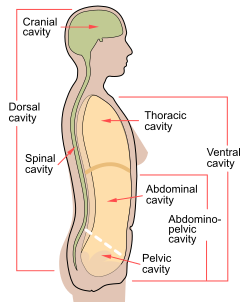
Lateral view of body cavities with thoracic cavity labeled at the right
Details
Identifiers
Latincavitas thoracis, cavum thoracis
MeSHD035423
TA98A01.1.00.049
A02.3.04.002
A07.0.00.000
TA21097, 126
FMA7565
Anatomical terminology
The picture displays the mediastinum on sagittal plane, thoracic diaphragm at the bottom, the heart (cor), behind sternum and ribs (to the left on the picture (this is the anterior/front) and to the right (posterior/back)), you have the thoracic vertebrae.

The thoracic cavity (or chest cavity) is the chamber of the body of vertebrates that is protected by the thoracic wall (rib cage and associated skin, muscle, and fascia). The central compartment of the thoracic cavity is the mediastinum. There are two openings of the thoracic cavity, a superior thoracic aperture known as the thoracic inlet and a lower inferior thoracic aperture known as the thoracic outlet.

The thoracic cavity includes the tendons as well as the cardiovascular system which could be damaged from injury to the back, spine or the neck.

Structure

[edit]

Structures within the thoracic cavity include:

It contains three potential spaces lined with mesothelium: the paired pleural cavities and the pericardial cavity. The mediastinum comprises those organs which lie in the centre of the chest between the lungs. The cavity also contains two openings one at the top, the superior thoracic aperture also called the thoracic inlet, and a lower inferior thoracic aperture which is much larger than the inlet.

Clinical significance

[edit]

If the pleural cavity is breached from the outside, as by a bullet wound or knife wound, a pneumothorax, or air in the cavity, may result. If the volume of air is significant, one or both lungs may collapse, which requires immediate medical attention.

Additional images

[edit]

See also

[edit]

References

[edit]
[edit]
Revisions and contributorsEdit on WikipediaRead on Wikipedia
from Grokipedia
The thoracic cavity, also known as the chest cavity, is the second largest hollow space within the , situated in the chest region between the and the . It is enclosed by the , which includes the anteriorly, the posteriorly, the 12 pairs of laterally, and the diaphragm inferiorly, with the (or thoracic inlet) forming the upper boundary. This cavity serves as a protective chamber for essential organs involved in respiration, circulation, and other vital processes. The thoracic cavity is subdivided into the two pleural cavities and the central mediastinum. The pleural cavities, one on each side, house the lungs and are lined by parietal and visceral layers of pleura, with a small amount of pleural fluid facilitating smooth movement during breathing. The mediastinum, located between the pleural cavities, is further divided into superior and inferior portions; the latter includes anterior, middle, and posterior compartments containing structures such as the thymus, heart, great vessels, trachea, esophagus, and portions of the sympathetic trunk. Key organs within the thoracic cavity include the heart, lungs, trachea, esophagus, and major blood vessels like the aorta and vena cava. Functionally, the thoracic cavity supports critical physiological processes, including oxygenation of blood via the lungs and pumping of blood through the heart and vascular system. The diaphragm's muscular contractions and relaxations during respiration alter the cavity's volume, enabling inhalation and exhalation, while the rib cage provides structural protection against injury. Disruptions to this cavity, such as through trauma or disease, can lead to severe conditions like pneumothorax or cardiac tamponade, underscoring its central role in overall homeostasis.

Anatomy

Boundaries

The thoracic cavity is enclosed by a series of bony and muscular structures that define its superior, inferior, anterior, posterior, and lateral boundaries, forming a protective enclosure for vital organs. The superior boundary, known as the thoracic inlet or , is a narrow opening bounded by the body of the first thoracic vertebra (T1) posteriorly, the first pair of and their costal cartilages laterally, and the manubrium of the anteriorly; this inlet is narrower than the inferior outlet, measuring approximately 10 cm in transverse diameter. The inferior boundary is formed by the dome-shaped diaphragm, a musculotendinous structure that separates the thoracic cavity from the below, allowing for compartmentalization while permitting passage of structures like the and major vessels. The anterior wall consists primarily of the —a flat bone comprising the manubrium superiorly, the body in the middle, and the inferiorly—along with the costal cartilages that connect the upper seven pairs of to the , providing a rigid shield. The posterior wall is composed of the from T1 to T12, including their spinous processes, transverse processes with costal facets for rib articulation, and the intervening intervertebral discs, which together form a stable vertebral column support. The lateral walls are delineated by the 12 pairs of , which curve around the cavity, along with the (external, internal, and innermost) and the intercostal spaces between them; the first seven are true ribs attaching directly to the via costal cartilages, while ribs 8–10 are false ribs with indirect attachments, and ribs 11–12 are floating. In adults, the thoracic cavity typically measures 25–30 cm in height from the thoracic inlet to the diaphragm, with the rib cage functioning as a semi-rigid structure that protects underlying organs such as the lungs and heart from external compression during body movements and respiration.

Divisions

The thoracic cavity is internally partitioned into distinct compartments that isolate organs and facilitate their functions, primarily consisting of the paired pleural cavities laterally and the central mediastinum. These divisions are essential for maintaining spatial organization within the confined space bounded by the thoracic walls. The pleural cavities are two separate, potential spaces located on either side of the , each containing a and lined by a double-layered known as the pleura. The outer parietal pleura adheres to the internal , while the inner visceral pleura directly covers the surface; between them lies a thin layer of pleural fluid that minimizes during respiratory movements. These cavities are completely isolated from each other and from the , preventing the spread of infections or fluid across sides. The mediastinum occupies the central compartment of the thoracic cavity, extending from the thoracic inlet superiorly to the diaphragm inferiorly, and is flanked by the pleural cavities. It is divided by a transverse plane passing through the sternal angle anteriorly and the intervertebral disc between the fourth and fifth thoracic vertebrae (T4-T5) posteriorly, separating the superior mediastinum above from the inferior mediastinum below. The superior mediastinum serves as a conduit for structures transitioning from the neck to the thorax, while the inferior mediastinum is further subdivided into anterior, middle, and posterior regions by the pericardium and other planes. The anterior mediastinum lies posterior to the sternum and anterior to the pericardium; the middle mediastinum encompasses the heart and associated vessels; and the posterior mediastinum extends behind the pericardium to the vertebral column. These subdivisions anchor major vessels, nerves, and organs, providing structural support and protection. Within the middle mediastinum lies the pericardial cavity, a potential space surrounding the heart and lined by the serous pericardium, which consists of parietal and visceral layers separated by pericardial fluid. This cavity isolates the heart from adjacent structures, reducing friction during cardiac contractions and providing a barrier against infection spread. Overall, the pleural divisions enable smooth lung expansion and contraction by lubricating pleural surfaces, while the mediastinal compartments centralize and stabilize vital thoracic vasculature and neural pathways.

Contents

The thoracic cavity houses essential organs and structures that support respiration, circulation, and other vital functions, primarily distributed within the pleural cavities and mediastinum. These contents include the paired lungs, the heart, major blood vessels, the trachea and bronchi, the esophagus, the thymus, lymphatic structures such as the thoracic duct and lymph nodes, and important nerves like the phrenic and vagus nerves. The lungs are paired organs occupying the right and left pleural cavities, which flank the mediastinum. Each lung has a spongy texture and is covered by visceral pleura, with the right lung divided into three lobes (upper, middle, and lower) by an oblique and a horizontal fissure, while the left lung has two lobes (upper and lower) separated by an oblique fissure to accommodate the cardiac notch. The apex of each lung extends above the first rib, and the base rests on the diaphragm, with the hilum serving as the entry point for bronchi, pulmonary vessels, and nerves. The a muscular organ located in the pericardial cavity within the middle mediastinum, positioned behind the and between the third and sixth costal cartilages. It consists of four chambers: two upper atria that receive and two lower ventricles that pump it out, with the right side handling deoxygenated and the left side oxygenated ; the oriented such that its base (great vessels) faces posteriorly and superiorly, while the apex points inferiorly and to the left. The enclosed by the , a double-layered sac that anchors it in place. Major blood vessels traverse the thoracic cavity to facilitate systemic and . The arises from the left ventricle, featuring an ascending portion, an arch that gives rise to the brachiocephalic trunk, left common carotid, and left subclavian arteries, and a descending thoracic segment that continues through the diaphragm. The drains deoxygenated blood from the upper body into the right atrium, while the enters from below; pulmonary arteries carry deoxygenated blood from the right ventricle to the lungs, and pulmonary veins return oxygenated blood to the left atrium. The trachea and bronchi form the central airway system within the superior and middle mediastinum. The trachea, a fibrocartilaginous tube approximately 10-12 cm long, extends from the thoracic inlet to the carina at the level of T4-T5, where it bifurcates into the right and left main bronchi; it lies anterior to the and is reinforced by C-shaped rings. The right main is shorter, wider, and more vertical than the left, directing air to the respective lungs. The esophagus is a muscular tube in the posterior mediastinum, measuring about 25 cm in length, that conveys food from the pharynx to the stomach. It passes posterior to the trachea and heart, descending along the right side of the thoracic aorta before crossing to the left, and pierces the diaphragm at the T10 level through the esophageal hiatus. The thymus is a bilobed lymphoid organ situated in the superior mediastinum, extending into the anterior mediastinum anterior to the heart. It plays a key role in T-cell maturation during childhood and undergoes involution after puberty, reducing in size and becoming largely fatty tissue. Lymphatic structures in the thoracic cavity include the and numerous lymph nodes distributed throughout the . The , the main , ascends in the posterior along the right side of the before crossing to the left at T5, draining lymph from most of the body into the left ; smaller lymph nodes cluster around the trachea, bronchi, , and great vessels, facilitating immune surveillance. Key nerves innervating thoracic structures include the phrenic and vagus nerves. The phrenic nerves, arising from C3-C5, descend through the superior mediastinum to innervate the diaphragm, providing its primary motor supply. The vagus nerves (cranial nerve X) enter via the thoracic inlet, with the right vagus passing posterior to the superior vena cava and the left posterior to the aortic arch, branching to form the esophageal, cardiac, and pulmonary plexuses that innervate visceral organs like the heart, lungs, and esophagus.

Embryology

Early development

The thoracic cavity begins to form during the early embryonic period from the , which arises as the splits into somatic (outer) and (inner) layers around the fourth week of development, creating a continuous cavity lined by these mesodermal layers. This splitting establishes the foundational space that will later subdivide into distinct thoracic compartments, with the somatic layer contributing to the parietal linings and the splanchnic layer to the visceral coverings. Concurrently, key visceral structures initiate: the lung buds emerge from the respiratory diverticulum of the at week 4, and the heart tube forms from cardiogenic , undergoing looping by week 5 to position it within the emerging pericardial region. Initially, the intraembryonic coelom consists of pericardioperitoneal canals, which are open channels connecting the primitive pericardial cavity (anteriorly) to the peritoneal cavity (posteriorly) on either side of the foregut. Around week 5, pleuropericardial folds appear as dorsoventrally oriented flaps extending from the lateral body wall toward the midline; these folds grow medially, fuse with the foregut mesenchyme, and partition the pericardial cavity from the developing pleural cavities, thereby isolating the heart. By weeks 5 to 7, pleuroperitoneal folds emerge from the posterior body wall as horizontal membranes that project into the pericardioperitoneal canals, gradually enlarging and fusing with the septum transversum to close these openings and define the definitive pleural cavities. Incomplete closure of the pleuroperitoneal folds by week 7 can lead to congenital , where abdominal contents protrude into the thoracic cavity, most commonly on the left side due to the larger size of that and interference from the liver on the right; this anomaly disrupts normal partitioning and can impair lung development.

Organogenesis

Organogenesis of the thoracic cavity involves the differentiation and maturation of key structures derived from the and , building upon the initial partitioning of the coelomic cavity during early . This process ensures the formation of functional organs essential for respiration, circulation, and endocrine regulation within the thoracic space. Lung development proceeds through distinct characterized by progressive branching and vascularization of the respiratory tree. The pseudoglandular , spanning weeks 5 to 17 of , involves the outgrowth of bronchial buds from the respiratory and extensive branching to form terminal bronchioles, establishing the basic framework of the conducting airways. This is followed by the canalicular (weeks 16 to 25), during which primitive alveoli begin to form alongside the differentiation of cuboidal into type I and type II pneumocytes, and capillaries closely invest the airways to initiate potential. The saccular (weeks 24 to 38) features further expansion of airspaces with thinning of the interalveolar and increased vascularization, preparing the lungs for postnatal function. Finally, the alveolar commences postnatally, involving the multiplication and maturation of alveoli to achieve full respiratory capacity. Heart development originates from cardiogenic in the splanchnic layer, where bilateral endocardial tubes form around day 21 of and subsequently fuse in the midline to create a primitive single heart tube. This tube undergoes looping and differential growth, leading to septation into four chambers by approximately week 7, with the atrial dividing the primitive atrium and the ventricular separating the ventricles, facilitated by and contributions. The diaphragm forms through the integration of multiple mesodermal components, including the septum transversum, which arises as a mesenchymal mass ventral to the heart and serves as the initial central partition between thoracic and abdominal cavities, eventually contributing the central tendon. Pleuroperitoneal membranes extend from the body wall to fuse with the , closing the pericardioperitoneal canals, while dorsal body wall mesoderm adds to the muscular periphery; the entire structure is innervated by the originating from cervical segments C3 to C5. Vascular development in the thoracic region includes the remodeling of paired , which emerge sequentially from the aortic sac to connect with the dorsal aortae between weeks 4 and 6, with the first through sixth arches contributing to the great vessels such as the , carotid arteries, and pulmonary trunk through selective regression and persistence. Concurrently, the cardinal vein system—comprising anterior, posterior, and common cardinals—undergoes and remodeling to form the superior and inferior vena cavae, establishing the primary venous return to the heart. The thymus derives from pharyngeal endoderm, arising from the third pharyngeal pouch endoderm around week 6, proliferating and migrating caudally to the anterior mediastinum where it fuses and differentiates into cortical and medullary regions for T-cell maturation. Esophageal development entails the elongation and separation of the foregut tube, with the ventral respiratory diverticulum budding off by week 4; tracheoesophageal ridges then partition the common tube, completing separation from the trachea by week 8, while the esophagus continues to lengthen in coordination with the descent of the heart and lungs.

Physiology

Respiratory mechanics

Respiratory mechanics in the thoracic cavity govern the process of pulmonary ventilation, which involves the coordinated expansion and contraction of the thoracic space to facilitate the inflow and outflow of air into the lungs. This biomechanical system relies on the interplay between muscular actions, changes, and structural compliance to maintain efficient . The primary driving force is the alteration in thoracic volume, which generates gradients that move air according to physical principles. During inspiration, the diaphragm contracts and descends, while the elevate the , expanding the thoracic cavity in both vertical and anteroposterior dimensions. This increase in volume lowers the to approximately -6 to -8 cmH₂O, creating a subatmospheric environment that draws air into the lungs. The process adheres to , which states that for a fixed amount of gas at constant , and volume are inversely proportional (P₁V₁ = P₂V₂), such that the thoracic volume expansion reduces intrapulmonary below atmospheric levels, promoting airflow inward. Expiration at rest is primarily passive, driven by the elastic recoil of the and , facilitated by fibers that return the thoracic structures to their resting state. In forced expiration, such as during exercise, the abdominal muscles and contract to compress the thoracic cavity, accelerating air expulsion. The pleural layers play a crucial role in these mechanics: the visceral pleura adheres to the lung surface, while the parietal pleura lines the , with their thin fluid-filled space maintaining a consistent negative that prevents lung collapse and enables smooth expansion. Lung compliance, a measure of the distensibility of the lungs, totals about 200 mL/cmH₂O for both lungs combined. The total compliance of the respiratory system, including the chest wall, is approximately 100 mL/cmH₂O. , produced by type II alveolar cells, reduces at the air-liquid interface in the alveoli, preventing collapse and enhancing compliance by counteracting the forces that would otherwise promote alveolar instability. In conditions of increased respiratory demand, accessory muscles such as the scalenes, which elevate the first and second , and the sternocleidomastoid, which lifts the , are recruited to augment inspiratory efforts.

Circulatory support

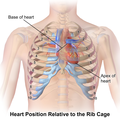
The heart is positioned within the mediastinum of the thoracic cavity, oriented along an oblique axis that tilts its long axis from the right shoulder toward the left hypochondrium, enclosed by the pericardium to facilitate efficient pumping mechanics. The apex of the heart points downward, forward, and to the left, typically located at the fifth intercostal space in the midclavicular line, allowing for optimal contact with the chest wall during auscultation and imaging. The cardiac cycle integrates and with respiratory phases to enhance circulatory efficiency, particularly by optimizing venous return to the right atrium during inspiration when intrathoracic pressure decreases. During , ventricular filling is augmented by this respiratory-assisted venous inflow, while ejects blood against systemic resistance, maintaining balanced output across the pulmonary and systemic circuits. This coordination ensures that right ventricular preload increases transiently with inspiration, supporting overall without compromising left ventricular function. The great vessels originating from the heart within the thoracic cavity underpin systemic and pulmonary circulation dynamics. The aortic arch, curving superiorly from the ascending aorta, gives rise to three primary branches: the brachiocephalic trunk (supplying the right subclavian and right common carotid arteries), the left common carotid artery, and the left subclavian artery, distributing oxygenated blood to the head, neck, and upper limbs. In contrast, the pulmonary circulation forms a low-pressure system, with mean pulmonary artery pressure around 15 mmHg, enabling efficient gas exchange in the lungs while minimizing right ventricular workload due to low vascular resistance. Neural influences from the vagus and phrenic nerves within the thoracic cavity promote cardio-respiratory coupling essential for circulatory stability. The vagus nerve, via its parasympathetic fibers, modulates heart rate by slowing sinoatrial node activity during expiration, reducing cardiac workload and facilitating recovery phases of the cycle. The phrenic nerve innervates the diaphragm, driving inspiratory movements that indirectly enhance venous return and synchronize with vagal tone to align heart rate fluctuations with respiratory rhythm, thereby optimizing oxygen delivery and autonomic balance. Lymphatic drainage in the thoracic cavity supports circulatory by returning interstitial to the bloodstream. The , the primary , collects from the lower body, abdomen, and lower limbs via the , ascending through the posterior before emptying into the venous system at of the left subclavian and internal jugular veins. This drainage pathway handles approximately 75% of total body , preventing fluid overload and aiding immune surveillance in circulation. Variations in intrathoracic pressure directly facilitate venous return, enhancing the thoracic cavity's role in systemic circulation. During inspiration, the diaphragm descends and expands thoracic volume, generating negative intrathoracic pressure (typically -5 to -10 cmH2O), which lowers right atrial pressure and draws blood from extrathoracic veins into the thorax. This mechanism significantly increases preload to the right heart transiently, promoting efficient forward flow without requiring additional cardiac effort.

Clinical significance

Pathological conditions

The thoracic cavity is susceptible to a range of pathological conditions that impair respiratory and circulatory functions, often resulting from trauma, , congenital anomalies, or neoplastic growth. These disorders can lead to acute emergencies or chronic complications, affecting the , pleura, , heart, and surrounding structures. occurs when air accumulates in the pleural space, causing partial or complete collapse. It is classified into spontaneous types, which arise without trauma—primary in individuals without underlying and secondary in those with conditions like —and traumatic types from injury to the or chest wall. Tension , a severe variant, involves progressive air buildup under pressure, leading to mediastinal shift and cardiovascular compromise. Hemothorax refers to the accumulation of blood in the , typically following thoracic trauma such as fractures or penetrating injuries. This condition can cause compression and, in massive cases, due to significant blood loss, reducing and preload. Mediastinitis is an acute of the mediastinal tissues, often resulting from esophageal that allows bacterial contamination from the . It presents with severe and can rapidly progress to if untreated. Pleuritis, or , involves inflammation of the parietal pleura, leading to sharp that intensifies with breathing, coughing, or movement due to between pleural layers. It commonly arises from viral infections, autoimmune disorders, or as a complication of pulmonary conditions. develops from , where excess fluid in the pericardial sac compresses the heart chambers, impairing diastolic filling and reducing . This leads to hemodynamic instability, with elevated intrapericardial pressure equaling or exceeding intracardiac pressures. Congenital defects of the thoracic cavity include , a condition where the and grow abnormally inward, creating a sunken chest appearance that may compress the heart and lungs, potentially causing reduced exercise tolerance. , a posterolateral diaphragmatic defect, allows abdominal organs to herniate into the thoracic cavity, leading to and respiratory distress in severe cases. Tumors within the thoracic cavity encompass , which originates in the lung and can invade surrounding structures like the chest wall or , with non-small cell types being predominant. , a of thymic epithelial cells, typically arises in the anterior and may compress adjacent organs, often associated with paraneoplastic syndromes.

Diagnostic procedures

Chest X-ray serves as the standard initial imaging modality for evaluating thoracic cavity abnormalities, particularly for detecting conditions such as and pleural effusions. It provides quick, low-radiation assessment of the lungs, heart, and surrounding structures through posteroanterior (PA) and lateral views, allowing visualization of air leaks, fluid accumulations, and basic mediastinal contours. The PA view captures the frontal projection with the patient facing the detector, while the lateral view aids in localizing lesions relative to the chest wall and spine. Computed tomography (CT) scanning offers detailed cross-sectional images of the thoracic cavity, essential for characterizing tumors and mediastinal masses with high . Non-contrast CT identifies mass density and location, while contrast-enhanced protocols highlight vascular structures, distinguishing vessels from adjacent pathologies like or aneurysms. This modality is particularly valuable for staging malignancies and assessing invasion into surrounding tissues. Magnetic resonance imaging (MRI) excels in providing superior contrast for thoracic cavity evaluation, making it ideal for assessing pericardial diseases and abnormalities. In pericardial conditions, MRI delineates characteristics, , and using sequences like cine steady-state free for dynamic assessment. For the , it differentiates benign remnants from masses in congenital anomalies, such as cysts or , without . Ultrasound is a portable, bedside tool for rapid detection of thoracic fluid collections, including pleural effusions and . It visualizes hypoechoic or anechoic spaces in the , guiding safe aspiration and estimating volume, often outperforming initial X-rays for small effusions. , a specialized ultrasound application, evaluates cardiac function and pericardial effusions by measuring fluid depth and detecting signs like chamber collapse. Bronchoscopy employs a flexible fiberoptic scope inserted through the or to directly visualize the airways within the thoracic cavity, facilitating of endobronchial lesions and enabling targeted biopsies. It allows collection of tissue samples for histopathological analysis, often combined with endobronchial for sampling in staging thoracic malignancies. The procedure typically requires and provides real-time navigation of the tracheobronchial tree. Thoracentesis involves needle aspiration of fluid from the pleural space under and often guidance, primarily for diagnostic analysis of effusions suspected in thoracic pathologies. The procedure targets the 6th to 8th , yielding samples for cytological, biochemical, and microbiological examination to differentiate transudative from exudative causes. It also offers therapeutic drainage to alleviate symptoms like dyspnea.

Surgical interventions

Surgical interventions targeting the thoracic cavity are essential for managing conditions such as trauma, malignancies, and structural defects, often requiring precise access to the lungs, heart, , and diaphragm. These procedures vary from open surgeries to minimally invasive techniques, balancing efficacy with reduced recovery time and complications. Common approaches include for direct access and for less invasive interventions, while specialized procedures address pericardial, mediastinal, and diaphragmatic issues. Thoracotomy involves an open incision through the to access the thoracic cavity, typically for resections in cancer or trauma management. This procedure allows comprehensive visualization and manipulation of thoracic structures, such as during or repair of penetrating injuries, but requires careful rib retraction to minimize damage. It remains a standard for complex cases where extensive exposure is necessary. Video-assisted thoracoscopic surgery (VATS) represents a minimally invasive alternative, utilizing small ports for insertion of a thoracoscope and instruments to perform biopsies, for recurrent effusions, or wedge resections. By avoiding large incisions, VATS reduces postoperative pain and hospital stays compared to open methods, with the camera providing high-resolution views of the pleural space and surfaces. It is particularly favored for diagnostic and therapeutic applications in early-stage lung diseases. Pericardiocentesis is a needle-based procedure to drain pericardial effusions, often performed under or echocardiographic guidance to aspirate from the pericardial sac surrounding the heart. This intervention relieves by removing accumulated , with approaches typically subxiphoid or parasternal to access the thoracic cavity safely. It serves both diagnostic and therapeutic roles, analyzing for underlying causes like or . Mediastinoscopy employs a cervical incision to insert a scope into the for sampling, crucial in staging non-small cell by assessing nodal involvement. This technique targets stations 2, 4, and 7, providing histopathological confirmation that guides decisions on operability and . It is considered the gold standard for invasive mediastinal evaluation due to its accuracy in detecting . Diaphragmatic repair addresses hernias by closing defects in the diaphragm, often using sutures for small tears or synthetic mesh for larger ones to prevent recurrence. Surgical access can be transabdominal or transthoracic, with laparoscopic or open techniques restoring diaphragmatic integrity and abdominal containment within the thoracic cavity. This intervention is vital for both congenital and traumatic cases to alleviate respiratory and gastrointestinal symptoms. Coronary artery bypass grafting (CABG) within the thoracic cavity typically proceeds via median sternotomy to access the heart, grafting vessels like the internal mammary artery to bypass occluded coronaries. Performed on-pump with cardiopulmonary bypass or off-pump for select patients, it improves myocardial perfusion and survival in multivessel disease. The sternotomy provides broad exposure to the mediastinum and great vessels essential for anastomosis. Despite advancements, thoracic surgeries carry risks including , which can manifest as wound or in up to 5-10% of cases, bleeding from vascular during access, and post-thoracotomy pain syndrome affecting 30-50% of patients with persistent beyond three months. These complications necessitate prophylactic antibiotics, meticulous , and multimodal analgesia to mitigate morbidity and support recovery.

References

Add your contribution
Related Hubs
User Avatar
No comments yet.