


Community hub
Recent from talks
Contribute something
Nothing was collected or created yet.
El Segundo, California
View on Wikipedia
El Segundo (/ˌɛl səˈɡʌndoʊ/ EL sə-GUN-doh, Spanish: [el seˈɣundo]; Spanish for 'The Second')[7] is a city in Los Angeles County, California, United States. Located on Santa Monica Bay, it was incorporated on January 18, 1917, and is part of the South Bay Cities Council of Governments. The population was 17,272 as of the 2020 census, a 3.7% increase from 16,654 in the 2010 census. A significant center of the oil and aerospace industries in Southern California, roughly three quarters of the city's land is dedicated exclusively to industrial and commercial uses, including a Chevron oil refinery which takes up more than a quarter of the city.
Key Information


History
[edit]The El Segundo and Los Angeles coastal area was first settled by the Tongva (or Gabrieleños) Native American tribes. The area was once a part of Rancho Sausal Redondo ("Round Willow Patch Ranch"). Rancho Sausal Redondo extended from Playa Del Rey in the north to Redondo Beach in the south. Originally a Mexican land grant owned by Antonio Ygnacio Avila, the rancho was later purchased by a Scottish baronet named Sir Robert Burnett in 1860. After his return to Scotland in 1873, the property was purchased by then-manager of the rancho, Daniel Freeman. Daniel Freeman sold portions of the rancho to several persons. George H. Peck owned the 840 acres (340 ha) of land where the Chevron Refinery now sits. The city acquired its name ("the second" in Spanish) due to being the second Standard Oil refinery on the West Coast when Standard Oil of California purchased the 840 acres of land in 1911.[8] Peck also developed land in neighboring El Porto, where a street still bears his name.
The city was incorporated in 1917. The Standard Oil Company was renamed Chevron in 1984. The El Segundo refinery entered its second century of operation in 2011.[9]
The Douglas Aircraft Company plant in El Segundo was one of the major aircraft manufacturing facilities in California during World War II. It was one of the major producers of SBD Dauntless dive bombers, which achieved fame in the Battle of Midway. The facility, now operated by Northrop Grumman, is still an aircraft plant.[10][11]
-
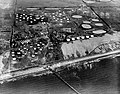 El Segundo and Standard Oil Refinery, c. 1920
 -
![SBD Dauntless dive bombers being built by Douglas Aircraft Factory in El Segundo during World War II[12]](//upload.wikimedia.org/wikipedia/commons/thumb/c/cc/Douglas_Aircraft_Factory_-_El_Segundo.PNG/120px-Douglas_Aircraft_Factory_-_El_Segundo.PNG) SBD Dauntless dive bombers being built by Douglas Aircraft Factory in El Segundo during World War II[12]
SBD Dauntless dive bombers being built by Douglas Aircraft Factory in El Segundo during World War II[12]

![SBD Dauntless dive bombers being built by Douglas Aircraft Factory in El Segundo during World War II[12]](https://en.wikipedia.org/wiki/File:Douglas_Aircraft_Factory_-_El_Segundo.PNG)
In 2009, a pair of local artists discovered the Smoky Hollow area, which mainly consisted of commercial properties. Other artists started to migrate as they had been priced out of Venice Beach and Culver City. Not long after the Tech Industry discovered Smoky Hollow. [13] [14][15][16][17][18]
On the evening of 2 October 2025 an explosion occurred and a fire erupted at the Chevron refinery, which produces 276,000 barrels of crude oil daily.[19]
Geography
[edit]The northern and southern boundaries of the town are Los Angeles International Airport and Manhattan Beach, with the Pacific Ocean as the western boundary. Its eastern boundary is roughly marked by Aviation Blvd.
According to the United States Census Bureau, the city has a land area of 5.5 square miles (14 km2).
The beachfront area neighboring the refinery was once dominated by industrial wharves servicing oil tanker ships, and heavily polluted by sewage and stormwater runoff. The major expansion of the Hyperion wastewater treatment plant in the 1980s was the impetus for rehabilitation of the beach. The old piers were demolished, an underwater oil terminal was constructed a few miles offshore, and an enormous amount of dredged sand was used to restore and dramatically enlarge the once narrow and polluted beach. The Marvin Braude Bike Trail runs along this new artificial beach, as the refinery wharves were one of the last remaining industrial facilities directly obstructing the shoreline of the Santa Monica Bay.
Demographics
[edit]| Census | Pop. | Note | %± |
|---|---|---|---|
| 1920 | 1,563 | — | |
| 1930 | 3,503 | 124.1% | |
| 1940 | 3,738 | 6.7% | |
| 1950 | 8,011 | 114.3% | |
| 1960 | 14,219 | 77.5% | |
| 1970 | 15,620 | 9.9% | |
| 1980 | 13,752 | −12.0% | |
| 1990 | 15,223 | 10.7% | |
| 2000 | 16,033 | 5.3% | |
| 2010 | 16,654 | 3.9% | |
| 2020 | 17,272 | 3.7% | |
| U.S. Decennial Census[20] 1860–1870[21][22] 1880-1890[23] 1900[24] 1910[25] 1920[26] 1930[27] 1940[28] 1950[29] 1960[30][31] 1970[32] 1980[33] 1990[34] 2000[35] 2010[36] 2020[37] | |||
El Segundo first appeared as a city in the 1920 U.S. census[26] as part of the now defunct Redondo Township (pop. 5,016 in 1910).[25]
| Race / Ethnicity (NH = Non-Hispanic) | Pop 2000[38] | Pop 2010[39] | Pop 2020[37] | % 2000 | % 2010 | % 2020 |
|---|---|---|---|---|---|---|
| White alone (NH) | 12,356 | 11,515 | 10,626 | 77.07% | 69.14% | 61.58% |
| Black or African American alone (NH) | 181 | 321 | 394 | 1.13% | 1.93% | 2.28% |
| Native American or Alaska Native alone (NH) | 52 | 40 | 45 | 0.32% | 0.24% | 0.26% |
| Asian alone (NH) | 1,005 | 1,427 | 1,804 | 6.27% | 8.57% | 10.44% |
| Native Hawaiian or Pacific Islander alone (NH) | 47 | 30 | 61 | 0.29% | 0.18% | 0.35% |
| Other race alone (NH) | 87 | 56 | 88 | 0.54% | 0.34% | 0.51% |
| Mixed race or Multiracial (NH) | 540 | 656 | 1,268 | 3.37% | 3.94% | 7.34% |
| Hispanic or Latino (any race) | 1,765 | 2,609 | 2,976 | 11.01% | 15.67% | 17.23% |
| Total | 16,033 | 16,654 | 17,272 | 100.00% | 100.00% | 100.00% |

2020
[edit]The 2020 United States census reported that El Segundo had a population of 17,272. The population density was 3,161.6 inhabitants per square mile (1,220.7/km2). The racial makeup of El Segundo was 65.9% White, 2.4% African American, 0.6% Native American, 10.6% Asian, 0.4% Pacific Islander, 4.9% from other races, and 15.1% from two or more races. Hispanic or Latino of any race were 17.2% of the population.[40]
The census reported that 99.7% of the population lived in households, 0.1% lived in non-institutionalized group quarters, and 0.1% were institutionalized.[40]
There were 7,175 households, out of which 30.7% included children under the age of 18, 45.2% were married-couple households, 7.0% were cohabiting couple households, 26.3% had a female householder with no partner present, and 21.4% had a male householder with no partner present. 29.5% of households were one person, and 9.1% were one person aged 65 or older. The average household size was 2.4.[40] There were 4,351 families (60.6% of all households).[41]
The age distribution was 20.6% under the age of 18, 7.6% aged 18 to 24, 30.7% aged 25 to 44, 28.2% aged 45 to 64, and 12.9% who were 65 years of age or older. The median age was 39.0 years. For every 100 females, there were 99.6 males.[40]
There were 7,500 housing units at an average density of 1,372.9 units per square mile (530.1 units/km2), of which 7,175 (95.7%) were occupied. Of these, 42.5% were owner-occupied, and 57.5% were occupied by renters.[40]
In 2023, the US Census Bureau estimated that the median household income was $149,149, and the per capita income was $80,399. About 2.8% of families and 4.4% of the population were below the poverty line.[42]
2010
[edit]The 2010 United States census[43] reported that El Segundo had a population of 16,654. The population density was 3,047.9 inhabitants per square mile (1,176.8/km2). The racial makeup of El Segundo was 12,997 (78.0%) White (69.1% non-Hispanic White),[44] 337 (2.0%) African American, 68 (0.4%) Native American, 1,458 (8.8%) Asian, 38 (0.2%) Pacific Islander, 799 (4.8%) from other races, and 957 (5.7%) from two or more races. There were 2,609 people of Hispanic or Latino origin, of any race (15.7%).
The Census reported that 16,578 people (99.5% of the population) lived in households, 66 (0.4%) lived in non-institutionalized group quarters, and 10 (0.1%) were institutionalized.
Of the 7,085 households, 2,183 (30.8%) had children under the age of 18 living in them, 3,050 (43.0%) were married couples living together, 729 (10.3%) had a female householder with no husband present, 326 (4.6%) had a male householder with no wife present; and 369 (5.2%) were unmarried opposite-sex partnerships. About 31.8% were made up of individuals, and 8.0% had someone living alone who was 65 years of age or older. The average household size was 2.34. The city had 4,105 families (57.9% of all households); the average family size was 3.02.
22.3% of the population was under the age of 18, 6.7% was 18 to 24, 31.1% was 25 to 44, 29.8% was 45 to 64, and 10.1%o was 65 or older. The median age was 39.2. For every 100 females, there were 99.4 males. For every 100 females 18 and over, there were 98.8 males.
The 7,410 housing units had an average density of 1,356.1 units per square mile (523.6 units/km2), of which 3,034 (42.8%) were owner-occupied and 4,051 (57.2%) occupied by renters. The homeowner vacancy rate was 0.4%; the rental vacancy rate was 4.1%. About 49.1% of the population lived in owner-occupied housing units and 50.4% in rental housing units.
According to the 2010 United States census, El Segundo had a median household income of $84,341, with 4.8% of the population living below the federal poverty line.[45]
Economy
[edit]

The name was adopted in 1911 when Chevron built its second refinery, El Segundo, which is Spanish for "the Second".[46] This refinery has received crude oil from the Amazon region of South America – more than 5,000 barrels per day.[47] El Segundo is located next to the Hyperion sewage treatment plant[48] and the El Segundo power plant. The El Segundo power plant is operated by the American energy company NRG. NRG was to create a new combined cycle power island, providing power for 240,000 households. The power plant, which came online in 2013, uses two generators: a Siemens gas turbine[49][50] and an additional steam turbine. Prior to its dissolution, Unocal was headquartered in El Segundo.[51][52]
In 1928, William Mines, an immigrant from Canada, leased land for a flying field.[53] In 1930, Los Angeles Municipal Airport, later Los Angeles International Airport, opened north of El Segundo; its presence led to the concentration of aerospace and aviation-related firms in the El Segundo area.[46] Many large aerospace companies have facilities in El Segundo, including the four largest aerospace companies in the US: Boeing, RTX Corporation,[54] Lockheed Martin and Northrop Grumman; many smaller aerospace companies such as Wyle Laboratories, the Aerospace Corporation, and Aerojet Rocketdyne Holdings all have facilities in El Segundo as well, with Aerojet Rocketdyne Holdings being headquartered there. It is also home to the Los Angeles Air Force Base and the Space and Missile Systems Center, which is responsible for space-related acquisition for the military. The current Boeing factory, the Boeing Satellite Development Center, was originally built by Nash Motors in 1946 and opened in 1948. In 1955, Hughes Aircraft Company purchased the 500,000-square-foot (46,000 m2) building; it was converted to build missiles and also served as a test facility.[55] At one time, MGM Grand Air had its headquarters in El Segundo.[56]
Toy manufacturer Mattel,[57] AT&T Entertainment Hub (formerly DirecTV[58]) direct technology marketing company PCM, Inc., and A-Mark Precious Metals are headquartered there, as well as sporting goods retailer Big 5 Sporting Goods and Stamps.com. Database company Teradata has a research and development facility in El Segundo, as well. The North American headquarters of the Japanese video game company Square Enix are also in the city.
From 1982 until 1996, the headquarters of the Los Angeles Raiders of the National Football League was located in El Segundo.[59] The headquarters of the Los Angeles Kings of the National Hockey League is also located in El Segundo. In 2024, the Los Angeles Chargers moved their headquarters to El Segundo from Costa Mesa.[60] The Los Angeles Lakers office headquarters and practice facility, the UCLA Health Training Center are also located in El Segundo. Their NBA G-League affiliate the South Bay Lakers plays their games there. The Los Angeles Sparks are planning to build a new training facility in El Segundo.[61]
Film production companies are located in El Segundo, including Rhythm and Hues Studios and Lightstorm Entertainment.[62][63] Human resources software company Neogov was founded in El Segundo in 2012.[64]
The Los Angeles Times moved its newsroom from downtown Los Angeles to a 4.5-acre (18,000 m2) campus in El Segundo in 2018.[65]
Top employers
[edit]According to the city's 2020–21 Comprehensive Annual Financial Report,[66] the top employers in the city are:
| # | Employer | # of Employees |
|---|---|---|
| 1 | Boeing | 12,005 |
| 2 | Raytheon Technologies | 6,000 |
| 3 | Northrop Grumman | 2,422 |
| 4 | The Aerospace Corporation | 2,180 |
| 5 | Mattel | 1,545 |
| 6 | Chevron | 1,187 |
| 7 | Internet Brands | 661 |
| 8 | Infineon Technologies | 498 |
| 9 | Karl Storz Endoscopy America Inc. | 421 |
| 10 | Big 5 Sporting Goods | 290 |
Subsidiaries of companies
[edit]Nexon America, the North American branch of Korean online game publisher Nexon Co. Ltd. has its offices in El Segundo.
The North American branch of the Japanese video game publisher and developer Square Enix has its headquarters in El Segundo.[67]
Due to its proximity to Los Angeles International Airport, El Segundo became the host of several offices of airlines. In 1979, the United Airlines Reservation Center, a two-story, $4.5 million, 55,000-square-foot (5,100 m2) facility in the International Center, was scheduled to begin construction. Austin Co., a firm in Irvine, was to build the facility, which was scheduled for opening in May of that year.[68] Japan Airlines operates its United States headquarters, which was moved from New York City to El Segundo in around 2003.[69] at Suite 620 of 300 Continental Boulevard;[70] Cathay Pacific has an office in El Segundo.[71][72][73] The airline moved its North America headquarters to Greater Los Angeles in 1990,[74] and the headquarters were situated in El Segundo until 2005.[75][76]
Air China operates its North American headquarters in the 13,000-square-foot (1,200 m2) 2131 East Maple Avenue building, south of LAX, in El Segundo. Its current North American headquarters opened with a ribbon cutting ceremony and other festivities on Friday March 26, 2010. The call center reservations, marketing, and sales employees all moved into the building. The building includes a call center with space for 50 employees; when the building opened, half of the spaces had been filled.[77]
Air New Zealand operates its United States headquarters in El Segundo.[78][79][80] Other airlines with offices in El Segundo include Turkish Airlines, Thai Airways, Air Tahiti Nui,[81] Aeroméxico,[82] China Airlines[83] Emirates,[84] EVA Air,[85] and Singapore Airlines.[86]
Infineon Technologies acquired El Segundo-based company International Rectifier in 2015.[87]
Parks and recreation
[edit]
El Segundo has its own beach, as well as two public pools; both are outdoor pools, one of which is open only during the summer months.[66] The El Segundo Parks and Recreation staff are the basis for the hit NBC program Parks and Recreation.[88] El Segundo has two full-sized turf fields named Campus El Segundo Athletic Fields, which are open to the public.[89]
Athletics
[edit]In 2023, El Segundo Little League won the world championship of the Little League World Series, defeating the team from Willemstad, Curaçao in the championship. Louis Lappe hit a walk-off home run to win the game, 6–5. It was the first championship for a team from California since 2011.
Theatre and film
[edit]EL Segundo is home to Old Town Music Hall, a 501(c)(3) non-profit organization dedicated to concerts, films from Hollywood’s Golden Age, and silent films, accompanied by a Mighty Wurlitzer organ.[90]
Government
[edit]Local government
[edit]According to the city's most recent Comprehensive Annual Financial Report, its various funds had $99.0 million in revenues, $91.0 million in expenditures, $206.5 million in total assets, $33.6 million in total liabilities, and $50.4 million in cash and investments.[66]
In the Los Angeles County Board of Supervisors, El Segundo is in the Second District, represented by Holly Mitchell.[91]
State and federal representation
[edit]In the California State Legislature, El Segundo is in the 24th senatorial district, represented by Democrat Ben Allen, and in the 66th Assembly district, represented by Democrat Al Muratsuchi.[92]
In the United States House of Representatives, El Segundo is in California's 36th congressional district, represented by Democrat Ted Lieu.[93]
Education
[edit]
The El Segundo Unified School District serves the residential district of El Segundo, west of Pacific Coast Highway. It operates El Segundo High School.
Eastern El Segundo is part of the tax base for the Wiseburn Unified School District, and formerly for the Centinela Valley Union High School District (CVUHSD). There are no residential areas in the eastern part of the city.[94] This portion of the city includes corporate operations providing significant tax revenue to the district (formerly districts).[95]
Vistamar School is a private school in El Segundo.
Originally all of the city was located in the Wiseburn School District,[96] which opened in 1896.[97] When the Inglewood Union High School District, now known as the CVUHSD, opened in 1905, its territory included the Wiseburn district. In 1912 the El Segundo School District opened, taking territory from the Wiseburn School District. The territory of the El Segundo district continued to be in the Inglewood Union District. On November 22, 1925, the El Segundo High School District was formed and El Segundo withdrew from the Inglewood Union district.[96]
Media
[edit]
The Los Angeles Times has been headquartered in El Segundo since 2018.[98] The local Charter Spectrum news and sports channels, Spectrum News 1, Spectrum SportsNet, and SportsNet LA are based out of El Segundo.
The El Segundo Herald is the community newspaper for El Segundo. It was established in 1911, six years before the city was incorporated. It had its centennial anniversary of service to the community in 2011.
A monthly arts and culture publication, The El Segundo Scene, began printing in May 2018. Created and run by two El Segundo residents, the magazine serves El Segundo and its neighbors in the South Bay.
Infrastructure
[edit]Transportation
[edit]State Route 1 passes through the city as Pacific Coast Highway, while Interstate 105 begins its journey at Sepulveda Boulevard (the continuation of State Route 1 north of El Segundo city limits) just outside the northern city limits of El Segundo and heads east to Norwalk. The Los Angeles Metro K Line runs through the Eastern industrial and office district before meeting the C Line near Interstate 105 and Aviation Boulevard and continuing along north for the rest of its length.
Amtrak's El Segundo Bus Stop (ESG) is located at the Los Angeles Metro Rail's Douglas station and is serviced by Amtrak Thruway. The stop is on Amtrak's 1c bus route that runs four times a day between Amtrak's Torrance Bus Stop (Alpine Village) and the Bakersfield Amtrak station where passengers transfer to and from trains on Gold Runner services; passengers can also connect with Pacific Surfliner at the Van Nuys Amtrak station.
Los Angeles International Airport (LAX) is located immediately to the north of El Segundo. In 2014, an air quality study found harmful ultrafine particles from the takeoffs and landings at LAX to be of a much greater magnitude than previously thought.[99]
Notable people
[edit]- Roseanne Barr, comedian, owns Full Moon and High Tides Productions[100]
- George Brett, baseball player, Hall of Fame[101]
- Ken Brett, baseball player[102]
- Joe Caravello, NFL football player
- Dick Dale, guitarist, pioneer of Surf music[103]
- Rusty Frank, author, choreographer, producer, dance historian
- The Ghost Inside, metalcore band[104]
- Mike Gordon, Assemblymember and mayor of El Segundo
- Carl Koppelman, accountant and forensic sketch artist
- Dave LaRoche, baseball pitcher
- Vladimir Matyushenko, UFC fighter
- Christopher McCandless, adventurer who inspired the book Into the Wild and the 2007 film The Call of the Wild
- Dave McCoy, skier and businessman, founder of Mammoth Mountain, was born in El Segundo[105]
- Scott McGregor, baseball player
- Lars Nootbaar, MLB baseball player for the St. Louis Cardinals
- Bob Samuelson, volleyball player
- John Van Hamersveld, artist and surfer[100]
- Erik von Detten, former actor, singer
- Paul Westphal, basketball player and coach[106]
- Dave Williamson, stand-up comedian[107]
In popular culture
[edit]- A Tribe Called Quest's single "I Left My Wallet In El Segundo" revolves around a stop through the town on the way back to Brooklyn.
- El Segundo is frequently referenced by Fred G. Sanford in the TV series Sanford and Son.
- Although filmed in British Columbia, the music video for the song "First Date", by pop-punk band Blink-182, takes place in El Segundo in 1974.[108]
- The fictitious Silicon Valley company Pied Piper tapped the real-life, El Segundo-headquartered company Wpromote to develop its ill-fated mascot, Pipey.[109]
- The movie Candy Cane Lane, starring Eddie Murphy, takes place in El Segundo.
- The Netflix original film Family Switch is in part filmed in El Segundo, and features many scenes at El Segundo High School.
See also
[edit]
- Automobile Driving Museum - a museum in El Segundo.
References
[edit]- ^ "California Cities by Incorporation Date". California Association of Local Agency Formation Commissions. Archived from the original (Word) on November 3, 2014. Retrieved August 25, 2014.
- ^ a b c "Elected Officials". The City of El Segundo. Archived from the original on September 29, 2012. Retrieved January 18, 2025.
- ^ "2020 U.S. Gazetteer Files". United States Census Bureau. Retrieved October 30, 2021.
- ^ "El Segundo". Geographic Names Information System. United States Geological Survey, United States Department of the Interior. Retrieved October 11, 2014.
- ^ "El Segundo city, California". United States Census Bureau. Retrieved January 18, 2025.
- ^ "USPS - ZIP Code Lookup". Retrieved May 4, 2022.
- ^ Pollack, Gina (July 22, 2019). "How To Speak LA: Your Guide To The City's Most Debated And Mispronounced Words". LAist. Retrieved May 22, 2021.
'El Segundo,' Spanish for 'the second' to signify the second oil refinery in the state.
- ^ "El Segundo | Community Guide | the Corrales Group".
- ^ Hunter, Eileen Curry. El Segundo Seventy-Five Years El Segundo: H2 Limited, 1991
- ^ Herman, Arthur. Freedom's Forge: How American Business Produced Victory in World War II, pp. 202-3, Random House, New York, NY, 2012. ISBN 978-1-4000-6964-4.
- ^ Parker, Dana T. Building Victory: Aircraft Manufacturing in the Los Angeles Area in World War II, pp. 7-8, 25-34, Cypress, Calif., 2013. ISBN 978-0-9897906-0-4.
- ^ Parker, Dana T. Building Victory: Aircraft Manufacturing in the Los Angeles Area in World War II, p. 28, Cypress, Calif., 2013. ISBN 978-0-9897906-0-4.
- ^ "El Segundo has a clear vision for Smoky Hollow's future". Los Angeles Times. August 23, 2012.
- ^ "El Segundo looking to attract tech businesses to Smoky Hollow". www.elsegundo.org. June 30, 2018.
- ^ "Smoky Hollow High". May 20, 2024.
- ^ "Small office building takes shape in el Segundo's Smoky Hollow district". February 18, 2021.
- ^ "60,000SF office building takes shape in el Segundo's Smoky Hollow District". April 19, 2022.
- ^ "El Segundo Pushes for Smoky Hollow as a Creative Industrial Office District".
- ^ "Large fire erupts at los Angeles-area Chevron refinery in el Segundo - CBS Los Angeles". CBS News.
- ^ "Decennial Census by Decade". United States Census Bureau.
- ^ "1870 Census of Population - Population of Civil Divisions less than Counties - California - Almeda County to Sutter County" (PDF). United States Census Bureau.
- ^ "1870 Census of Population - Population of Civil Divisions less than Counties - California - Tehama County to Yuba County" (PDF). United States Census Bureau.
- ^ "1890 Census of Population - Population of California by Minor Civil Divisions" (PDF). United States Census Bureau.
- ^ "1900 Census of Population - Population of California by Counties and Minor Civil Divisions" (PDF). United States Census Bureau.
- ^ a b "1910 Census of Population - Supplement for California" (PDF). United States Census Bureau. Archived from the original (PDF) on August 23, 2024. Retrieved January 29, 2025.
- ^ a b "1920 Census of Population - Number of Inhabitants - California" (PDF). United States Census Bureau.
- ^ "1930 Census of Population - Number and Distribution of Inhabitants - California" (PDF). United States Census Bureau.
- ^ "1940 Census of Population - Number of Inhabitants - California" (PDF). United States Census Bureau.
- ^ "1950 Census of Population - Number of Inhabitants - California" (PDF). United States Census Bureau.
- ^ "1960 Census of Population - General population Characteristics - California" (PDF). United States Census Bureau.
- ^ "1960 Census of Population - Number of Inhabitants - California" (PDF). United States Census Bureau.
- ^ "1970 Census of Population - Number of Inhabitants - California" (PDF). United States Census Bureau.
- ^ "1980 Census of Population - Number of Inhabitants - California" (PDF). United States Census Bureau.
- ^ "1990 Census of Population - Population and Housing Unit Counts - California" (PDF). United States Census Bureau.
- ^ "2000 Census of Population - Population and Housing Unit Counts - California" (PDF). United States Census Bureau.
- ^ "2010 Census of Population - Population and Housing Unit Counts - California" (PDF). United States Census Bureau.
- ^ a b "P2: Hispanic or Latino, and Not Hispanic or Latino by Race – 2020: DEC Redistricting Data (PL 94-171) – El Segundo city, California". United States Census Bureau.
- ^ "P004: Hispanic or Latino, and Not Hispanic or Latino by Race – 2000: DEC Summary File 1 – El Segundo city, California". United States Census Bureau.
- ^ "P2: Hispanic or Latino, and Not Hispanic or Latino by Race – 2010: DEC Redistricting Data (PL 94-171) – El Segundo city, California". United States Census Bureau.
- ^ a b c d e "El Segundo city, California; DP1: Profile of General Population and Housing Characteristics - 2020 Census of Population and Housing". US Census Bureau. Retrieved June 20, 2025.
- ^ "El Segundo city, California; P16: Household Type - 2020 Census of Population and Housing". US Census Bureau. Retrieved June 20, 2025.
- ^ "El Segundo city, California; DP03: Selected Economic Characteristics - 2023 ACS 5-Year Estimates Comparison Profiles". US Census Bureau. Retrieved June 20, 2025.
- ^ "2010 Census Interactive Population Search: CA - El Segundo city". U.S. Census Bureau. Archived from the original on July 15, 2014. Retrieved July 12, 2014.
- ^ "2010 Census Interactive Population Search: CA - El Segundo city". Archived from the original on July 1, 2012.
- ^ "census.gov - El Segundo, California". Archived from the original on July 1, 2012.
- ^ a b Greenberg, David."Aerospace woes take a toll, but LAX neighbor has bright spots." Los Angeles Business Journal. August 11, 2003. Retrieved on April 13, 2009.
- ^ From Well to Wheel: The Social, Environmental, and Climate Costs of Amazon Crude (PDF). Amazon Watch. p. 7. Retrieved March 24, 2017.
- ^ "South Bay History | The Daily Breeze's Sam Gnerre looks at the way we were in the South Bay". Insidesocal.com. Archived from the original on January 14, 2012. Retrieved February 8, 2013.
- ^ "NRG Completes Repowering and Modernization Project at 550 Megawatt El Segundo Energy Center" (Press release). NRG. August 2, 2013. Archived from the original on March 1, 2020 – via BusinessWire.
- ^ "Energy efficiency". Siemens USA. January 30, 2013. Archived from the original on January 4, 2013. Retrieved February 8, 2013.
- ^ "Unocal World On-Line". Archived from the original on December 27, 1996. Retrieved July 7, 2009.
{{cite web}}: CS1 maint: bot: original URL status unknown (link) Unocal Corporation. December 27, 1996. Retrieved on July 7, 2009. - ^ "Home page". Archived from the original on January 29, 2005. Retrieved July 7, 2009.
{{cite web}}: CS1 maint: bot: original URL status unknown (link). Unocal Corporation. January 29, 2005. Retrieved on July 7, 2009. - ^ Ripton, Ray. "El Segundo Will Celebrate 50th Year for a Week Archived October 20, 2012, at the Wayback Machine." Los Angeles Times. May 14, 1967.
- ^ James, Meg; Chang, Andrea (April 13, 2018). "Patrick Soon-Shiong plans to move Los Angeles Times to new campus in El Segundo". Los Angeles Times. Retrieved April 13, 2018.
- ^ "NASH Factory in El Segundo, CA". Automobile Driving Museum. January 21, 2015. Archived from the original on February 28, 2017. Retrieved March 16, 2018.
- ^ "World Airline Directory." Flight International. March 23–29, 1994. 106.
- ^ "Careers". Mattel. Archived from the original on April 4, 2013.
- ^ "Contact IR or Transfer Agent." DirecTV. Retrieved on December 8, 2009.
- ^ Abrahamson, Alan (May 11, 1997). "El Segundo to Raiders: Just Pay, Baby". Los Angeles Times. Retrieved July 4, 2020.
- ^ "Chargers announce new headquarters, training facility in El Segundo". NFL.com. Retrieved November 9, 2021.
- ^ Rial, Bradley (September 25, 2025). "LA Sparks announce plans for $150m practice facility".
- ^ Vincent, Roger (March 17, 2017). "There's another Frank Gehry building going up in town. It's under the radar in El Segundo". Los Angeles Times. Retrieved March 18, 2017.
- ^ Khouri, Andrew (January 15, 2016). "Bixby Land's $49-million office building sale a sign 'it's not the old El Segundo'". Los Angeles Times. Retrieved January 16, 2016.
- ^ Alexander, Reed. "Neogov just nabbed an investment from Carlyle and Warburg valuing it at more than $1 billion. Execs at the PE giants detail why M&A will be a big part of the HR software's growth plans". Business Insider. Retrieved June 16, 2025.
- ^ James, Meg; Chang, Andrea (April 13, 2018). "Patrick Soon-Shiong plans to move Los Angeles Times to new campus in El Segundo". Los Angeles Times. Retrieved April 17, 2018.
- ^ a b c "City of El Segundo CAFR". elsegundo.org. Retrieved May 10, 2022.
- ^ "Corporate Locations Archived July 20, 2008, at the Wayback Machine." Square Enix Japan. Accessed September 20, 2008.
- ^ "El Segundo to Be Airline Office Site Archived October 20, 2012, at the Wayback Machine." Los Angeles Times. May 21, 1978. Section Part IX, K24. Retrieved on April 14, 2009.
- ^ Lauro, Patricia Winters. "THE MEDIA BUSINESS: ADVERTISING – ADDENDA; Japan Airlines Moves Its Account." The New York Times. March 5, 2003.
- ^ "JAL Passenger Services America, Inc. Archived October 14, 2008, at the Wayback Machine" Japan Airlines. Accessed September 20, 2008.
- ^ McDowell, Edwin (October 9, 1996). "Be prepared to pay a lot more, and pay in advance, to be in Hong Kong next summer". The New York Times. Retrieved December 14, 2011.
- ^ "United States". Cathay Pacific. September 24, 2005. Archived from the original on September 24, 2005. Retrieved September 14, 2017.
Los Angeles 300 Continental Boulevard, Suite 500, El Segundo, CA 90245
- ^ Forbes FYI. 1994. p. 73. Retrieved December 14, 2011 – via Google Books.
Cathay Pacific Airways Ltd., 300 N. Continental Boulevard, Suite 500, El Segundo, CA 90245
{{cite book}}:|work=ignored (help) - ^ "The Los Angeles Relocation Project". El Segundo & Los Angeles Relocation division. October 23, 2011.
- ^ Armstrong, David (February 16, 2005). "Cathay Pacific opens headquarters in S.F. / North American office relocated from Los Angeles". San Francisco Chronicle. Retrieved December 14, 2011.
- ^ "United States". Cathay Pacific. February 5, 2005. Archived from the original on February 5, 2005. Retrieved September 14, 2017.
Los Angeles 300 Continental Boulevard, Suite 500, El Segundo, CA 90245
- ^ "Air China Celebrates Opening Of New Los Angeles Office Building." (Archive) Air China. Retrieved on October 12, 2012.
- ^ Garfinkel, Perry. "Airlines Add Service and Amenities to Asian Routes." The New York Times. September 29, 2008. Retrieved on December 14, 2011.
- ^ "Air China International". Air-china.us. Retrieved February 8, 2013.
- ^ "CRT/tanaka Wins Air New Zealand Account Archived September 17, 2009, at the Wayback Machine." Air New Zealand. December 5, 2007. Retrieved on August 26, 2009.
- ^ "Worldwide Offices and Sales Agents: Archived May 25, 2009, at the Wayback Machine." Air Tahiti Nui. Retrieved on January 20, 2009.
- ^ "Ticketing Offices California / Los Angeles." Aeroméxico. Retrieved on January 20, 2009.
- ^ "Branch Offices North America Archived November 28, 2011, at the Wayback Machine." China Airlines. Retrieved on January 21, 2009.
- ^ "Los Angeles Emirates (town office)." Emirates. Retrieved on February 24, 2011. "Address 222 N. Pacific Coast Highway Suite 1322 El Segundo, CA 90245 Los Angeles USA."
- ^ "Contact Us America." EVA Air. Retrieved on January 28, 2009.
- ^ "Contact Us Archived July 8, 2009, at the Portuguese Web Archive." Singapore Airlines. Retrieved on January 28, 2009.
- ^ "International Rectifier becomes wholly owned subsidiary of Infineon Technologies as acquisition closes". Military Aerospace. January 14, 2015. Retrieved August 1, 2024.
- ^ "Parks and Recreation (TV Series 2009–2015)". Retrieved March 16, 2018 – via www.imdb.com.
- ^ "El Segundo Website - Campus El Segundo". www.elsegundo.org. Archived from the original on July 31, 2013. Retrieved March 16, 2018.
- ^ "Old Town Music Hall".
- ^ "Discover the Los Angeles County Second District - LA County Supervisor Holly J. Mitchell".
- ^ "Final Maps". We Draw the Lines CA. 2020 California Citizens Redistricting Commission. Retrieved May 10, 2023.
- ^ "California's 36th Congressional District - Representatives & District Map". Civic Impulse, LLC.
- ^ Kuznia, Rob. "Wiseburn district eyes wow factor in creating new comprehensive high school." Daily Breeze. March 28, 2013. Retrieved on April 19, 2014.
- ^ Kuznia, Rob. "Aerospace business corridor in El Segundo a cash cow for Centinela Valley school district." Daily Breeze. February 19, 2014. Retrieved on April 19, 2014.
- ^ a b "History and Profile" (Archive). Centinela Valley Union High School District. Retrieved on April 20, 2014.
- ^ "About" (Archive). Wiseburn School District. Retrieved on April 4, 2014.
- ^ Chang, Andrea (April 17, 2018). "L.A. Times will move to 2300 E. Imperial Highway in El Segundo". Los Angeles Times. Retrieved July 19, 2018.
- ^ Weikel, Dan and Barboza, Tony (May 29, 2014) "Planes' exhaust could be harming communities up to 10 miles from LAX" Los Angeles Times
- ^ a b Abcarian, Robin (April 17, 2018). "Sleepy little El Segundo is on the radar and fighting to keep its small-town identity". Los Angeles Times. Archived from the original on April 17, 2018. Retrieved April 17, 2018.
- ^ Gnerre, Sam (June 12, 2023). "South Bay history: George Brett's Hall of Fame baseball career began at El Segundo High". Daily Breeze. Archived from the original on June 12, 2023. Retrieved November 3, 2025.
- ^ Evans, Jennifer (November 25, 2003). "El Segundo sports legend Ken 'Kemer' Brett remembered (11/27)". Daily Breeze. Archived from the original on August 29, 2024. Retrieved November 3, 2025.
- ^ "Dick Dale". OLDIES.com.
- ^ Downey, Ryan J. (July 30, 2021). "The Ghost Inside". Epitaph Records. Archived from the original on July 4, 2022. Retrieved August 22, 2023.
- ^ Sahagun, Louis (February 8, 2020). "Dave McCoy, who gave skiers and boarders Mammoth Mountain, has died at 104". Los Angeles Times. Archived from the original on February 9, 2020. Retrieved October 9, 2021.
- ^ "Love and Hate in El Segundo". . Sports Illustrated. August 17, 1981. Retrieved on June 15, 2009.
- ^ Hixon, Michael (May 8, 2018). "What's so funny about El Segundo? Find out at the Gundo Comedy Festival". Daily Breeze. El Segundo, California. Retrieved May 26, 2020.
- ^ "Blink-182 Return to '70s In 'First Date' Video". mtv.com. Archived from the original on April 7, 2015. Retrieved March 16, 2018.
- ^ "Silicon Valley & Wpromote Case Study". wpromote.com. Retrieved July 15, 2016.
External links
[edit]


Places adjacent to El Segundo, California | |
|---|---|


| International | |
|---|---|
| National | |
| Geographic | |
| Other | |
El Segundo, California
View on GrokipediaHistory
Founding and Oil Industry Origins
The territory encompassing modern El Segundo formed part of the Rancho Sausal Redondo, a Mexican land grant awarded in 1837 to Antonio Ygnacio Ávila, comprising roughly 25,000 acres of coastal land south of present-day Los Angeles for cattle ranching.[7] By the early 1900s, following subdivision and sales after U.S. acquisition of California, the specific site consisted primarily of barren sand dunes with minimal development.[7] In June 1911, Standard Oil Company of California acquired 840 acres in this area to build its second West Coast refinery, strategically positioned near burgeoning oil fields in the Los Angeles Basin and the Port of Los Angeles for efficient crude intake and product export.[7] [8] The facility, named El Segundo—"the second" in Spanish, referencing the company's initial large refinery at El Primero in Richmond, California—underwent rapid construction and initiated refining operations by late 1911.[9] [10] Designed to be among the world's largest at the time, it capitalized on the regional oil boom triggered by discoveries in the preceding decade, processing kerosene, gasoline, and other petroleum derivatives essential to early 20th-century industrialization.[11] The refinery's advent directly catalyzed the town's formation, as Standard Oil subdivided adjacent land for worker housing, schools, and amenities to support its labor force.[12] This company-driven development transformed the dunes into a planned community oriented around oil production, culminating in El Segundo's municipal incorporation on January 18, 1917.[12] From inception, the oil industry dominated the local economy, with the refinery's output and employment underpinning sustained growth amid California's petroleum expansion.[9]Aerospace Development and World War II Contributions
The aerospace industry in El Segundo originated with the Douglas Aircraft Company's El Segundo Division, which commenced operations in 1932 and focused on designing and manufacturing military and commercial aircraft.[13] This facility, initially linked to earlier Northrop engineering efforts before Douglas acquired full control in 1938, introduced large-scale assembly lines—including a 1,700-foot production line—that enabled efficient scaling for aviation demands.[14] The division's pre-war advancements in monoplane designs and dive bomber prototypes laid the groundwork for wartime expansion, transforming El Segundo from an oil-dependent community into a hub for aeronautical innovation amid rising global tensions.[13] During World War II, the El Segundo plant ramped up production to support U.S. naval and Army air forces, manufacturing 5,154 SBD Dauntless dive bombers, 170 A-24 Banshee variants, and 3 A-26 Invaders. The SBD Dauntless, a carrier-based scout bomber, proved instrumental in pivotal Pacific engagements, such as the Battle of Midway in June 1942, where its precision dive-bombing capabilities sank Japanese carriers and shifted momentum against Imperial forces.[15] To optimize efficiency amid labor shortages, the facility employed innovative methods, including female workers on roller skates for rapid interdepartmental messaging, contributing to high output rates in a 1.7-million-square-foot complex.[16] This production, part of broader Southern California efforts that accounted for substantial U.S. aircraft totals, bolstered Allied air superiority and underscored El Segundo's strategic industrial role.[13] The wartime surge employed thousands, peaking facility operations and fostering engineering expertise that persisted postwar, though the division shifted to Navy contracts after 1945.[13] These contributions not only aided victory but established El Segundo's enduring aerospace legacy, attracting subsequent firms and institutions like The Aerospace Corporation in 1960.[17]Postwar Growth and Modern Evolution
Following World War II, El Segundo's economy expanded rapidly due to surging demand for aerospace manufacturing amid Cold War defense initiatives, with companies like Rockwell International operating large facilities for aircraft production over four decades starting in the late 1940s. This industrial boom attracted workers and spurred residential development, transforming the city from a modest oil-refining outpost into a key node in Southern California's postwar manufacturing surge, where regional employment in related sectors grew disproportionately compared to national averages. The Chevron refinery, operational since 1911, continued providing stable employment and economic ballast, processing crude oil and supporting ancillary industries.[18][19][20] By the late 20th century, aerospace remained dominant, with Boeing and The Aerospace Corporation anchoring operations focused on engineering, satellite systems, and defense technologies, earning El Segundo its designation as the "aerospace capital of the world." Population stabilized around 16,000–17,000 residents from the 1990s onward, reflecting controlled growth amid industrial zoning that dedicates roughly three-quarters of land to commercial and industrial use.[21][22][23] Into the 21st century, El Segundo diversified beyond traditional sectors, emerging as a hub for technology startups, media, and consumer goods firms, with over $1 billion invested in eight million square feet of new office, retail, and amenity space since the early 2010s. Major employers now include Mattel (headquartered since the 1980s with expansions continuing), the Los Angeles Times (printing operations relocated in 2011), and tech entities like GoGuardian and AuditBoard, fostering a mixed economy of high-tech engineering and innovation. This evolution has positioned the city as one of California's most business-friendly municipalities, evidenced by awards like the 2006 Eddy for economic vitality, while maintaining aerospace primacy amid broader regional shifts away from heavy manufacturing.[24][21][25][15]Geography and Environment
Location and Physical Features
El Segundo occupies a position in the southwestern portion of Los Angeles County, within the state of California, United States, at geographic coordinates approximately 33°55′09″N 118°24′59″W.[26] The city lies along the northern shore of Santa Monica Bay, part of the Pacific Ocean, placing it directly on the coastal margin of the Los Angeles metropolitan area. Bordered by Manhattan Beach to the north, Hermosa Beach to the south, Hawthorne and Inglewood inland to the east, and the ocean to the west, El Segundo forms part of the South Bay region, adjacent to Los Angeles International Airport.[27] The city's land area spans 5.46 square miles (14.15 km²), with a total area including adjacent coastal waters reaching about 10.76 square miles (27.87 km²).[28] El Segundo resides within the flat coastal plain of the Los Angeles Basin, a sedimentary lowland characterized by low-relief terrain rising gradually from sea level. Average elevation stands at approximately 115 feet (35 meters) above sea level, with minimal topographic variation dominated by historical sandhills now largely urbanized.[27] Physically, the area features sandy beaches fronting the Pacific, underlain by unconsolidated alluvial and coastal deposits typical of the West Coast Groundwater Subbasin.[29] The subsurface consists of permeable sands and gravels facilitating groundwater flow, though surface soils include expansive clays in some inland zones prone to shrinkage and swelling with moisture changes. Coastal processes, including wave action and longshore drift, contribute to ongoing beach erosion, mitigated by engineered structures like groins and nourishment projects.[30] The basin's setting exposes the city to seismic risks from nearby faults, such as the Newport-Inglewood Fault Zone running parallel to the coast.[31]Climate and Natural Hazards
El Segundo experiences a Mediterranean climate classified as Köppen Csb, characterized by mild, wet winters and warm, dry summers moderated by Pacific Ocean breezes and frequent marine layer fog.[32] Average annual temperatures range from highs of 75°F in August to lows of 49°F in January, with yearly means around 63°F and extremes rarely dipping below 40°F or exceeding 85°F due to coastal influences.[33] Precipitation averages 14 inches annually, concentrated in winter months from November to March, with February typically the wettest at 3.4 inches; summers are arid, with negligible rainfall from April through October.[33][34] Snowfall is virtually absent, averaging 0 inches per year.[33] The city faces elevated seismic risks as part of Southern California's tectonically active zone, particularly from the Newport–Inglewood Fault Zone, which traverses nearby areas and has demonstrated potential for magnitude 6.0–7.4 earthquakes based on updated geological assessments.[35] Historical events, such as the 1933 Long Beach earthquake (magnitude 6.4) on this fault system, caused significant regional shaking, underscoring liquefaction vulnerabilities in El Segundo's sandy coastal soils.[36] Recent microseismic activity, including magnitude 2.0–3.1 events within 2–3 km of the city, reflects ongoing fault stress accumulation monitored by the USGS.[37] Building codes enforce strict seismic retrofitting, yet probabilistic models indicate a higher-than-average earthquake damage potential compared to national norms.[38] Flooding poses a minor threat, with FEMA designating limited zones vulnerable to 100-year events, affecting fewer than 350 properties over 30 years; urban drainage mitigates stormwater risks, though heavy winter rains can cause localized ponding.[39][40] Coastal positioning exposes low-lying areas to sea level rise, with projections indicating a 93% chance of at least one disruptive flood event under intermediate scenarios by mid-century, exacerbating erosion near beaches and infrastructure like LAX.[41] Tsunami hazards stem from distant Pacific sources, with state inundation models highlighting potential wave heights of 3–10 feet in worst-case scenarios from events like a Cascadia subduction zone rupture, prompting evacuation planning for shoreline zones.[42] Wildfire risk remains low in this densely developed urban-coastal setting, lacking extensive wildland-urban interfaces, though regional smoke from inland blazes can intermittently degrade air quality.[43] Local hazard mitigation plans address these through zoning, early warning systems, and infrastructure hardening.[44]Demographics
Population Dynamics and Projections
El Segundo's population grew rapidly following its incorporation in 1917, driven by the expansion of the local oil refining industry and subsequent aerospace developments during and after World War II. By 1960, the city had reached 14,219 residents, increasing to 15,620 by 1970 amid postwar industrial booms. However, a decline to 13,752 occurred by 1980, coinciding with contractions in the defense sector following reduced Cold War-era government spending. Recovery followed, with the population rising to 15,223 in 1990 and 16,033 in 2000.[45] The decennial censuses recorded 16,654 residents in 2010 and a peak of 17,272 in 2020, reflecting an average annual growth rate of approximately 0.2% from 2000 to 2020—substantially below the 0.7% regional average for Los Angeles County—due to limited residential land availability, extensive industrial zoning, and constraints from proximity to Los Angeles International Airport and environmental regulations on developable space.[46] [47] This slow growth pattern stems from causal factors including high land acquisition costs for housing amid dominant commercial and aerospace uses, which occupy much of the city's 5.95 square miles, restricting net residential expansion.[48]| Year | Population |
|---|---|
| 1960 | 14,219 |
| 1970 | 15,620 |
| 1980 | 13,752 |
| 1990 | 15,223 |
| 2000 | 16,033 |
| 2010 | 16,654 |
| 2020 | 17,272 |
Racial, Ethnic, and Socioeconomic Composition
As of the 2023 American Community Survey, El Segundo's population of approximately 16,863 residents exhibited a racial and ethnic composition dominated by individuals identifying as White alone, non-Hispanic, who comprised 55.5% of the total.[23] Asian alone, non-Hispanic residents accounted for 11.6%, while Hispanic or Latino residents of any race totaled 20.8%, including 7.28% White alone Hispanic and 8.89% two or more races Hispanic.[23] Black or African American alone residents represented 2.8%, with smaller shares for American Indian and Alaska Native (0.17%), Native Hawaiian and Other Pacific Islander (under 0.1%), and other categories.[52] [53]| Racial/Ethnic Group | Percentage (2023 ACS) |
|---|---|
| White alone, non-Hispanic | 55.5% |
| Hispanic or Latino (any race) | 20.8% |
| Asian alone, non-Hispanic | 11.6% |
| Two or more races, non-Hispanic | 6.55% |
| Black or African American alone | 2.8% |
| American Indian and Alaska Native alone | 0.17% |
Government and Politics
Municipal Structure and Administration
El Segundo functions as a general law city under California's statutory framework, employing a council–manager form of government. The legislative authority resides with a five-member city council, whose members are elected at-large in nonpartisan elections to staggered four-year terms, ensuring two or three seats are contested biennially in even-numbered years, as evidenced by the November 2024 municipal election.[56][57] The council selects one of its members as mayor annually immediately after certifying election results, with the mayor serving primarily as the presiding officer at meetings and performing ceremonial duties without veto power or additional executive authority. A mayor pro tempore is likewise chosen by the council to substitute during the mayor's absence. Council meetings occur biweekly on the first and third Tuesdays, commencing with closed sessions at 4:00 p.m. followed by open sessions at 6:00 p.m., adhering to California open meeting laws except where exemptions apply. The council's powers include enacting ordinances, approving budgets, and appointing the city manager, while maintaining flexibility in procedural rules beyond Robert's Rules of Order.[57][58][59] Administrative operations fall under the city manager, appointed by the council and serving at its pleasure as the chief executive responsible for policy implementation, budget preparation and execution, personnel management, and coordination of city services. Darrell George has held this position since his permanent appointment on July 1, 2022, following an interim tenure. The manager oversees a structure of specialized departments, including the City Attorney for legal counsel, City Clerk for records and elections, Community Development for planning and permits, Finance for fiscal management, Fire and Police for public safety, Public Works for infrastructure maintenance, and Recreation and Parks for community programs.[60][61][62]Political Orientation and Voter Behavior
El Segundo's voter registration reflects a more balanced partisan distribution than the surrounding Los Angeles County, which overall features a Democratic supermajority. As of February 10, 2025, the city's approximately 12,591 registered voters included 5,538 Democrats (44.0%), 3,209 Republicans (25.5%), 2,919 with no party preference (23.2%), and smaller shares for minor parties and others.[63] This contrasts with countywide figures where Democrats comprise nearly half of registrants and Republicans around 20%.[64] The higher proportion of Republicans and independents in El Segundo aligns with its demographics as a affluent, business-oriented suburb with significant aerospace and energy sector employment, fostering pro-growth fiscal conservatism.[23] Municipal elections in El Segundo are nonpartisan, emphasizing local issues such as economic development, infrastructure, and relations with the Los Angeles International Airport rather than national partisan divides. In the November 5, 2024, general municipal election, incumbents Mayor Drew Boyles and Councilmember Lance Giroux were reelected alongside newcomer Michelle Keldorf, securing the three available council seats with majority votes in preliminary tallies certified by the city council on December 17, 2024.[65] Voter turnout for this presidential-year election benefited from higher participation, though historical patterns in off-year local contests show lower engagement typical of small municipalities. Candidates often prioritize pragmatic governance, including resistance to certain state-level regulatory impositions on local industries, reflecting the electorate's stake in maintaining the city's economic vitality over ideological extremes. In national elections, El Segundo's voting behavior deviates from the Democratic dominance of Los Angeles County, where Joe Biden received about 71% in 2020 compared to 27% for Donald Trump.[66] The city's registration profile suggests stronger Republican support locally, consistent with South Bay beach communities' historical moderation and occasional pushback against progressive policies from Sacramento and county leadership. For instance, local discourse has centered on preserving industrial jobs and low taxes, with council actions underscoring fiscal restraint amid California's broader progressive tilt. No official city-level presidential vote tallies are published, but the partisan registration gap indicates El Segundo functions as a relative conservative enclave within a blue region.[67]Fiscal Policies and Governance Debates
El Segundo's fiscal policies emphasize maintaining a balanced budget while prioritizing public safety and infrastructure, with the city council approving a $218.9 million operating budget for fiscal year 2025-26 that allocates substantial funds to police, fire services, and capital projects.[68] This budget reflects ongoing efforts to manage rising costs, including a $2.9 million payment toward unfunded pension actuarial liabilities and increases in retirement benefits, which have driven up personnel expenses amid California's broader public employee compensation trends.[69] Revenue streams rely heavily on commercial and industrial property taxes from aerospace, defense, and energy sectors, supplemented by sales taxes and transient occupancy taxes, creating a structure sensitive to business relocation risks under state tax policies like Proposition 13's assessment limits.[70] The city's finance department oversees annual budgeting, business tax registration, and strategic planning to ensure fiscal stability without drawing on reserves for routine operations.[71] Governance debates frequently center on tax proposals to offset pension obligations and deficits, as seen in opposition to Measure B, a 2020s transient occupancy tax increase criticized by residents and advocacy groups as a union-influenced measure lacking transparency and disguising pension funding needs as general revenue boosts.[72] In 2017, the city council debated but ultimately deferred a proposed 0.75% sales tax hike projected to yield $9 million annually for deficit mitigation and pension relief, weighing it against voter resistance to new levies in a pro-business community.[73] These discussions highlight tensions between fiscal conservatism—rooted in the city's industrial tax base—and pressures from escalating public safety costs, with council sessions in 2021 addressing strategic cuts and revenue diversification to avoid over-reliance on volatile commercial assessments.[74] Broader governance controversies include development decisions impacting fiscal health, such as the 2017-2021 Topgolf project vote, where council members navigated safety concerns, misinformation campaigns, and potential revenue from entertainment zoning amid competing priorities for industrial preservation.[75] Debates over historical building demolitions, like those in 2024, have pitted preservation advocates against council fiscal rationales favoring redevelopment for tax-generating uses, underscoring trade-offs in maintaining low residential taxes through commercial dominance.[76] Unlike larger California municipalities, El Segundo's council has avoided major scandals, focusing instead on pragmatic responses to state-level fiscal mandates, with agendas emphasizing balanced growth over expansive social spending.[77]Economy
Historical Industrial Foundations
El Segundo's industrial foundations were established through the development of a major oil refinery by the Standard Oil Company, selected in 1911 as the site for California's second such facility after the Richmond refinery reached capacity limits.[9] Previously part of the Rancho Sausal Redondo Spanish land grant and used for agriculture like melon and lima bean farming, the 840-acre site was acquired in June 1911 for its coastal access and expansion potential.[11] [7] Construction commenced on May 28, 1911, with the first operational whistle sounding on August 15, 1911, and stills charged by November 27, 1911, enabling full refining capacity by 1912.[11] [78] The refinery's naming as "El Segundo"—Spanish for "the second"—reflected its sequential position relative to the Richmond plant, dubbed El Primero, a designation proposed by the wife of Standard Oil executive R.J. Hanna.[11] At the time, it ranked among the world's largest refineries, processing crude oil into products that supported regional energy demands and spurring ancillary infrastructure like worker housing and transport links.[11] [9] This facility, initially operated under Standard Oil Company of California (renamed from Pacific Coast Oil acquisitions in 1900 and formalized in 1906), provided the economic catalyst for the area's transformation from rural outpost to industrial hub.[9] The refinery's establishment directly precipitated the town's formal incorporation on May 29, 1917, as a municipality to manage the growing population of refinery employees and their families, numbering in the hundreds by the mid-1910s.[7] Early operations emphasized efficient crude processing, with the site's scale enabling high-volume output that anchored local employment and commerce, setting precedents for subsequent industrial diversification while remaining the core of El Segundo's economic identity into the 20th century.[78] [8]Aerospace and Defense Dominance
El Segundo's aerospace and defense sector traces its origins to the Douglas Aircraft Company's El Segundo Division, established in 1932, which manufactured thousands of U.S. Navy aircraft used in World War II, the Korean War, and other conflicts until operations ceased in 1962.[13] The facility's legacy continued when the U.S. Air Force acquired the site in 1962, converting it into Los Angeles Air Force Base (now Los Angeles Space Force Base), a key hub for space systems command and missile defense oversight.[79] Today, the city hosts major facilities and divisions of leading firms, including Boeing's space and intelligence systems operations (incorporating Millennium Space Systems for small satellite production), Northrop Grumman (focused on spacecraft manufacturing and aeronautics), Raytheon Technologies (RTX) for advanced sensors and missile defense, and Lockheed Martin for aerospace integration.[80][81][82] The Aerospace Corporation, a federally funded research and development center established in 1960 to advise the U.S. Space Force on national security space programs, maintains its primary technical campus in El Segundo.[17] These entities position El Segundo as a global center, with local manufacturing contributing to more than half of operational satellites and space vehicles worldwide.[80] The sector's dominance sustains high-skilled employment in engineering, systems integration, and R&D, underpinning the city's economic resilience amid broader Southern California aerospace contributions exceeding $24 billion in annual production inputs and $11.1 billion in wages as of recent analyses.[83] In 2024, The Aerospace Corporation committed $100 million to expand its El Segundo facilities, enhancing expertise in space architecture and threat mitigation despite relocating its headquarters to Virginia.[84] Defense contracts, including those for missile warning systems and satellite constellations, remain central, reflecting the area's evolution from wartime production to modern space domain awareness.[85]Energy Production and Refining
The El Segundo Refinery, operated by Chevron, was established in 1911 by Standard Oil Company of California as its second major refining facility after the Richmond Refinery, processing an initial capacity of 5,000 barrels per day (BPD) of crude oil, primarily to produce kerosene.[86][11] The refinery's development spurred the founding of El Segundo itself, with the city's name deriving from Spanish for "the second," reflecting its position as the company's secondary site.[11] By the early 1920s, operations had expanded to support growing aviation and automotive demands, leveraging proximity to the Los Angeles Basin's oil fields and ports.[87] Today, the facility spans approximately 1,000 acres and processes up to 290,000 BPD of crude oil, ranking among California's largest refineries with a capacity of 269,000 BPD as reported by state regulators.[86][88] It produces a range of petroleum products, including gasoline (contributing about 20% of Southern California's market share), diesel, and jet fuel (supplying roughly 40% of the region's jet fuel needs), with monthly outputs exceeding 246 million gallons of gasoline and 70 million gallons of jet fuel.[86] The refining process begins with distillation towers separating crude into components by boiling point, followed by treatments like hydrocracking and desulfurization to meet environmental standards.[89] Economically, the refinery employs over 1,100 Chevron staff and 500 contractors, serving as a cornerstone of local industry amid the city's shift toward diversified sectors.[90] Recent upgrades, including projects by contractors like Kiewit, have enhanced efficiency and capacity, positioning it as the West Coast's highest-volume refinery at over 276,000 BPD in peak operations.[91] No significant alternative energy production facilities, such as renewables or power generation plants, operate within El Segundo, with refining remaining the dominant activity.[88]Emerging Sectors: Tech and Hard Tech Innovation
El Segundo has emerged as a focal point for hard tech innovation, particularly in defense, aerospace manufacturing, nuclear energy, and related hardware-intensive fields, drawing entrepreneurs seeking to counterbalance software-dominated tech ecosystems with physical product development. A notable concentration of these activities occurs in the Smoky Hollow district, a historical business zone in the northeast corner of the city that serves as a hub for defense, deep tech, and aerospace startups; it was the birthplace of SpaceX in 2002, and the Smoky Hollow Coffee Roasters acts as an anchoring social hub for the community.[92][93] This shift gained momentum post-2020, fueled by venture capital influxes into Los Angeles-area defense tech exceeding $4 billion in deal value by September 2025 and a revitalized Southern California space economy driven by startups.[94][95] The city's proximity to legacy aerospace facilities, high-voltage industrial infrastructure from historical programs like Apollo, and collaborative founder networks via informal channels have supported rapid prototyping and scaling of capital-intensive projects.[93] Defense-oriented startups exemplify this trend, with firms like Neros Technologies, founded in 2023, raising $10.9 million in seed funding from Sequoia Capital to develop first-person-view drones for battlefield applications, and Picogrid, established in 2020, securing $12 million in seed capital alongside U.S. Space Force contracts for data integration layers in intelligence, surveillance, and reconnaissance systems.[96][96] Similarly, ABL Space Systems, headquartered in El Segundo since its inception around 2017, pivoted in November 2024 from commercial satellite launches to missile defense applications, repurposing its RS1 rocket technology amid heightened demand for hypersonic and rapid-response capabilities.[97] Castelion Corporation, launched in 2022, has advanced hypersonic missile prototypes with undisclosed funding, targeting rapid production cycles for national security needs.[96] In nuclear and energy hard tech, Radiant Industries, founded in 2019 and based in El Segundo, develops portable microreactors like Kaleidos, designed for 1 MWe output to replace diesel generators; the company raised $100 million in Series C funding by 2024 and completed front-end engineering design phases with U.S. Department of Energy support.[98][96] Valar Atomics, established in 2023, focuses on compact nuclear reactors and expanded to a second facility in the city, emphasizing high-temperature gas-cooled designs for industrial applications.[96] Rainmaker Technology, started in 2023, secured $6.3 million in seed funding for drone-enabled cloud-seeding systems aimed at atmospheric water generation.[96] Advanced manufacturing startups further bolster the sector, including Rangeview, founded in 2020, which operates an automated foundry for aerospace components and scaled factory capacity in El Segundo, and Dirac, launched in 2022, providing hardware-centric work instruction platforms with partnerships like Hadrian for precision machining.[96][96] This ecosystem hosted SoCal Deep Tech Week from September 15-19, 2025, positioning El Segundo as a convening point for investors and builders in deep tech.[99] The founder community, often young and hardware-focused, collaborates through shared resources and emphasizes disciplined execution over speculative software ventures, contributing over $100 million in recent alleyway-level investments.[93][93]Major Employers and Economic Indicators
El Segundo is home to numerous major employers, predominantly in the aerospace and defense sectors, reflecting its historical foundations in high-technology manufacturing and engineering. Key firms include Boeing, which maintains significant operations including research and development facilities; Northrop Grumman; RTX (formerly Raytheon); Lockheed Martin; and The Aerospace Corporation, a federally funded research entity supporting space and national security programs.[100][25] Other prominent employers encompass Mattel, the toy manufacturer's global headquarters; Chevron's El Segundo refinery, a major energy production site; AT&T; and administrative offices for sports franchises such as the Los Angeles Lakers, Kings, and Chargers. The Los Angeles Times operates a printing and distribution facility, contributing to media-related employment. These entities drive a daytime population exceeding 70,000, far surpassing the residential base of approximately 17,000.[100][4] ![Aerial Mattel Headquarters El Segundo May 2012.JPG][float-right] Economic indicators underscore El Segundo's affluent, specialized economy, with employment concentrated in professional, scientific, and technical services (accounting for about 1,834 jobs), manufacturing (1,403 jobs), and health care (1,032 jobs). The median household income stood at $149,149 in 2023, substantially exceeding the Los Angeles County median of $93,525 and the national average. Unemployment remains low at approximately 4.6% to 5.1%, below county and state averages, supported by a labor force of around 10,200 and total employment near 9,800 as of recent estimates. Poverty affects only 4.36% of residents, indicative of robust job stability in high-wage sectors. City-level GDP data is not separately tracked, but the concentration of defense contractors and energy operations contributes disproportionately to regional output.[23][101][102]| Indicator | Value (Latest Available) | Source Comparison |
|---|---|---|
| Median Household Income | $149,149 (2023) | 1.6x LA County ($93,525) |
| Unemployment Rate | 4.6–5.1% | Below LA County (6.3% Aug 2025) |
| Poverty Rate | 4.36% (2023) | Below national average (~11.5%) |
| Total Employment | ~9,830 (2023) | Decline of 1.25% from 2022 |