
.svg/250px-Flag_of_Spain_(1945–1977).svg.png)


.svg/2000px-Flag_of_Spain_(1945–1977).svg.png)
Community hub
Recent from talks
Contribute something
Nothing was collected or created yet.
Francoist Spain
View on Wikipedia | This article needs additional citations for verification. (August 2020) |
Francoist Spain (Spanish: España franquista; English: pronounced Franco-ist), also known as the Francoist dictatorship (dictadura franquista), or Nationalist Spain (España nacionalista), and Falangist Spain[7][8] (España falangista), was the period of Spanish history between 1936 and 1975, when Francisco Franco ruled Spain after the Spanish Civil War with the title Caudillo. After his death in 1975, Spain transitioned into a democracy. During Franco's rule, Spain was officially known as the Spanish State (Estado Español). The informal term "Fascist Spain" is also used, especially before and during World War II.
Key Information

.svg)


During its existence, the nature of the regime evolved and changed. Months after the start of the Civil War in July 1936, Franco emerged as the dominant rebel military leader and he was proclaimed head of state on 1 October 1936, ruling over the territory which was controlled by the Nationalist faction. In 1937, Franco became an uncontested dictator and issued the Unification Decree which merged all of the parties which supported the rebel side, turning Nationalist Spain into a one-party state under the FET y de las JONS.[2] The end of the Civil War in 1939 brought the extension of the Franco rule to the whole country and the exile of Republican institutions. The Francoist dictatorship originally took a form described as, "fascist or quasi-fascist",[9] "fascistized",[10] "para-fascist",[11] "semi-fascist",[12] or a strictly fascist regime,[13][14] showing clear influence of fascism in fields such as labor relations, the autarkic economic policy, aesthetics, the single-party system,[15][16] and totalitarian control of public and private life.[17] As time went on, the regime opened up and became closer to developmental dictatorships[13] and abandoned the radical fascist ideology of Falangism,[3] although it always preserved residual fascist trappings[18][12] and a "major radical fascist ingredient."[3]
During World War II, Spain did not join the Axis powers (its supporters from the Civil War, Italy and Germany). Nevertheless, Spain supported them in various ways throughout most of the war while it maintained its neutrality as an official policy of non-belligerence. Because of this, Spain was isolated by many other countries for nearly a decade after World War II, while its autarkic economy, still trying to recover from the Civil War, suffered from chronic depression. The 1947 Law of Succession made Spain a de jure kingdom again but it defined Franco as the head of state for life with the power to choose the person who would become King of Spain and his successor.
Reforms were implemented in the 1950s and as a result, Spain abandoned its policy of autarky, it also reassigned authority from the Falangist movement, which had been prone to isolationism, to a new breed of economists, the technocrats of Opus Dei.[19] This led to massive economic growth, second only to Japan, that lasted until the mid-1970s, known as the "Spanish miracle". During the 1950s, the regime also changed from a totalitarian or quasi-totalitarian[20][17][21][22][23] and repressive system, called "the First Francoism", to a slightly milder authoritarian system with limited pluralism and economic freedom.[24][full citation needed] As a result of these reforms, Spain was allowed to join the United Nations in 1955 and Franco was one of Europe's foremost anti-communist figures during the Cold War, and his regime was assisted by the Western powers, particularly the United States. Franco died in 1975 at the age of 82. He restored the Spanish monarchy before his death and made his successor King Juan Carlos I, who led the Spanish transition to democracy.
Establishment
[edit]On 1 October 1936, Franco was formally recognised as Caudillo of Spain—the Spanish equivalent of the Italian Duce and the German Führer—by the Junta de Defensa Nacional (National Defense Junta), which governed the territories occupied by the Nationalists.[25] In April 1937, Franco assumed control of the Falange Española de las JONS, then led by Manuel Hedilla, who had succeeded José Antonio Primo de Rivera, who was executed in November 1936 by the Republican government. He merged it with the Carlist Comunión Tradicionalista to form the Falange Española Tradicionalista y de las JONS. The sole legal party of Francoist Spain, it was the main component of the Movimiento Nacional (National Movement).[26] The Falangists were concentrated at local government and grassroot level, entrusted with harnessing the Civil War's momentum of mass mobilisation through their auxiliaries and trade unions by collecting denunciations of enemy residents and recruiting workers into the trade unions.[27] While there were prominent Falangists at a senior government level, especially before the late 1940s, there were higher concentrations of monarchists, military officials and other traditional conservative factions at those levels.[citation needed] However, the Falange remained the sole party.
The Francoists took control of Spain through a comprehensive and methodical war of attrition (guerra de desgaste) which involved the imprisonment and executions of Spaniards found guilty of supporting the values promoted by the Republic: regional autonomy, liberal or social democracy, free elections, socialist leanings, and women's rights, including the vote.[28][29] The right-wing considered these "enemy elements" to comprise an "anti-Spain" that was the product of Bolsheviks and a "Judeo-Masonic conspiracy". The latter allegation pre-dated Falangism, having evolved after the Reconquista of the Iberian Peninsula from the Islamic Moors. Falangist founder, Jose Antonio Primo de Rivera, had a more tolerant position than the national socialists in Germany. This was influenced by the small size of the Jewish community in Spain at the time that did not favor the development of strong antisemitism. Primo de Rivera saw the solution to the "Jewish problem" in Spain as simple: the conversion of Jews to Catholicism.
At the end of the Spanish Civil War, according to the regime's own figures there were more than 270,000 men and women held in prisons and some 500,000 had fled into exile. Large numbers of those captured were returned to Spain or interned in Nazi concentration camps as stateless enemies[citation needed]. Between six and seven thousand exiles from Spain died in Mauthausen. It has been estimated that more than 200,000 Spaniards died in the first years of the dictatorship from 1940 to 1942 as a result of political persecution, hunger and disease related to the conflict.[30]
Spain's strong ties with the Axis resulted in its international ostracism in the early years following World War II as Spain was not a founding member of the United Nations and did not become a member until 1955.[note 1] This changed with the Cold War that soon followed the end of hostilities in 1945, in the face of which Franco's strong anti-communism naturally tilted its regime to ally with the United States. Independent political parties and trade unions were banned throughout the duration of the dictatorship.[31] Nevertheless, once decrees for economic stabilisation were put forth by the late 1950s, the way was opened for massive foreign investment—"a watershed in post-war economic, social and ideological normalisation leading to extraordinarily rapid economic growth"—that marked Spain's "participation in the Europe-wide post-war economic normality centred on mass consumption and consensus, in contrast to the concurrent reality of the Soviet bloc".[32]
On 26 July 1947, Spain was declared a kingdom, but no monarch was designated until in 1969 Franco established Juan Carlos of Bourbon as his official heir-apparent. Franco was to be succeeded by Luis Carrero Blanco as Prime Minister with the intention of continuing the Francoist regime, but those hopes ended with his 1973 assassination by the Basque separatist group ETA. With the death of Franco on 20 November 1975, Juan Carlos became the King of Spain. He initiated the country's subsequent transition to democracy, ending with Spain becoming a constitutional monarchy with an elected parliament and autonomous devolved governments.
Government
[edit].jpg)
After Franco's victory in 1939, the Falange was declared the sole legally sanctioned political party in Spain and it asserted itself as the main component of the National Movement. In a state of emergency-like status, Franco ruled with, on paper, more power than any Spanish leader before or since. He was not even required to consult his cabinet for most legislation.[33] According to historian Stanley G. Payne, Franco had more day-to-day power than Adolf Hitler or Joseph Stalin possessed at the respective heights of their power. Payne noted that Hitler and Stalin at least maintained rubber-stamp parliaments, while Franco dispensed with even that formality in the early years of his rule. According to Payne, the lack of even a rubber-stamp parliament made Franco's government "the most purely arbitrary in the world."[34] The 100-member National Council of the Movement served as a makeshift legislature until the passing of the organic law of 1942 and the Ley Constitutiva de las Cortes (Constituent Law of the Cortes) the same year, which saw the grand opening of the Cortes Españolas on 18 July 1942.[citation needed]
The Organic Law made the executive government ultimately responsible for passing all laws,[35] while defining the Cortes as a purely advisory body elected by neither direct nor universal suffrage. The Cortes had no power over government spending, and the government was not responsible to it: ministers were appointed and dismissed by Franco alone as the "Chief" of state and government. The Ley del Referendum Nacional (Law of the National Referendum), passed in 1945 approved for all "fundamental laws" to be approved by a popular referendum, in which only the heads of families could vote. Local municipal councils were appointed similarly by heads of families and local corporations through local municipal elections while mayors were appointed by the government. It was thus one of the most centralised countries in Europe and certainly the most centralised in Western Europe following the fall of the Portuguese Estado Novo in the Carnation Revolution.

The referendum law was used twice during Franco's rule—in 1947, when a referendum revived the Spanish monarchy with Franco as de facto regent for life with sole right to appoint his successor; and in 1966, another referendum was held to approve a new "organic law", or constitution, supposedly limiting and clearly defining Franco's powers as well as formally creating the modern office of Prime Minister of Spain. By delaying the issue of republic versus monarchy for his 36-year dictatorship and by refusing to take up the throne himself in 1947, Franco sought to antagonise neither the monarchical Carlists (who preferred the restoration of a Bourbon) nor the republican "old shirts" (original Falangists). Franco ignored the claim to the throne of Infante Juan, Count of Barcelona, son of the last king, Alfonso XIII, who designated himself as his heir; Franco found him too liberal. Instead, in 1969, Franco selected the young Juan Carlos of Bourbon, son of Infante Juan, as his officially designated heir to the throne, shortly after his 30th birthday (the minimum age required under the Law of Succession).
In 1973, due to old age and to lessen his burdens in governing Spain he resigned as Prime Minister and named Navy Admiral Luis Carrero Blanco to the said post, but Franco remained as the Chief of State, Commander-in-Chief of the Armed Forces and Jefe del Movimiento (Chief of the Movement). However, Carrero Blanco was assassinated in the same year and Carlos Arias Navarro became the country's new Prime Minister.
Armed forces
[edit]_-_Fondo_Car-Kutxa_Fototeka.jpg)
During the first year of peace, Franco drastically reduced the size of the Spanish Army—from almost one million at the end of the Civil War to 250,000 in early 1940, with most soldiers two-year conscripts.[36] Concerns about the international situation, Spain's possible entry into World War II, and threats of invasion led him to undo some of these reductions. In November 1942, with the Allied landings in North Africa and the German occupation of France bringing hostilities closer than ever to Spain's border, Franco ordered a partial mobilization, bringing the army to over 750,000 men.[36] The Air Force and Navy also grew in numbers and in budgets to 35,000 airmen and 25,000 sailors by 1945, although for fiscal reasons Franco had to restrain attempts by both services to undertake dramatic expansions.[36] The army maintained a strength of about 400,000 men until the end of the Second World War.[37]
Colonial empire and decolonisation
[edit]
Spain attempted to retain control of the last remnants of its colonial empire throughout Franco's rule. During the Algerian War (1954–1962), Madrid became the base of the Organisation armée secrète right-wing French Army group which sought to preserve French Algeria. Despite this, Franco was forced to make some concessions. When the French protectorate in Morocco became independent in 1956, Spain surrendered its Spanish protectorate in Morocco to Mohammed V, retaining only a few exclaves, the Plazas de soberanía. The year after, Mohammed V invaded Spanish Sahara during the Ifni War (known as the "Forgotten War" in Spain). Only in 1975, with the Green March and the military occupation, did Morocco take control of all of the former Spanish territories in the Sahara.
In 1968, under United Nations pressure, Franco granted Spain's colony of Equatorial Guinea its independence and the next year ceded the exclave of Ifni to Morocco. Under Franco, Spain also pursued a campaign to gain sovereignty of the British overseas territory of Gibraltar and closed its border in 1969. The border would not be fully reopened until 1985.
Francoism
[edit] |
| Part of a series on |
| Francoism |
|---|
 |


Initially the regime embraced the definition of a "totalitarian state" or the nacional-sindicalista label.[38][14] Following the defeat of Fascism in World War II, "organic democracy" was the new moniker the regime adopted for itself, yet it only sounded credible to staunch believers.[38] Other later soft definitions include "authoritarian regime" or "constituent or developmental dictatorship", the latter having inner backing from within the regime.[38] During the Cold War, Juan José Linz, either accused of whitewashing the regime or being praised as the elaborator of "the first scientific conceptualization" of the regime, famously early characterized it as an "authoritarian regime with limited pluralism",[38] what led to a debates on whether the regime was authoritarian or fascist, or totalitarian and non-fascist, or fascist and authoritarian.[23] Similarly to Linz, Walter Laqueur writes that the Francoist regime, a "strongly authoritarian" one, was ruled by "conservatives in all essential respects" with the fascists (Falangists) becoming only "junior partners in the government" "without being able to shape it substantially."[39] Still, historians who use the label "authoritarianism" have admitted that originally the regime had totalitarian tendencies[40] and that it may be described as a regime most close to fascist totalitarianism of all the regimes in Europe except for Italy and Germany.[41] The Francoist regime has been described by other scholars as a "Fascismo a la española" ("Spanish-style Fascism") or as a specific variant of Fascism marked by the preponderance of the Catholic Church, the Armed Forces and Traditionalism.[14] Such historians as Ferran Gallego believe that the regime shared essential similarities with fascist regimes of Italy and Germany in culture, politics and social sphere, and that the iternal unity of the Nationalists led to them establishing a fascist regime,[42] while the alliance of rightist factions may be compared to the one which took place in Fascist Italy.[3] The Oxford Living Dictionary and Oxford's A Dictionary of Philosophy present Franco's regime as an example of fascism.[43][44]
While the regime evolved along with its protracted history, its primitive essence remained, underpinned by the legal concentration of all powers into a single person, Francisco Franco, "Caudillo of Spain by the Grace of God", embodying national sovereignty and "only responsible before God and History".[14]
The consistent points in Francoism included above all authoritarianism, anti-Communism, Spanish nationalism, national Catholicism, monarchism, militarism, national conservatism, anti-Masonry, anti-Catalanism, pan-Hispanism, and anti-liberalism[citation needed]—some authors also include integralism.[45][46] Stanley Payne, a scholar of Spain, notes that "scarcely any of the serious historians and analysts of Franco consider the generalissimo to be a core fascist",[47][48] and Paul Preston agrees that Franco's personal beliefs were not fascist but rather "deeply conservative",[49] while Richard Griffiths argues that such distinction between conservatism and fascism would not be understood by Franco himself or his contemporaries.[50] Still, such scholars as Preston and Julián Casanova define the regime as belonging to the family of European fascism. The regime has also been described as a traditional military dictatorship, as a personalist dictatorship "tinged with fascist elements in its repressive aparatus",[1] the only constants of which were its anti-democratic nature and Franco as head of state,[51] or as a regime which underwent fascisation without reaching the point of becoming a fascist regime.[1] The United Nations Security Council voted in 1946 to deny the Franco regime recognition until it developed a more representative government.[52]
Development
[edit]The Falange Española de las JONS, a fascist party formed during the Republic, soon transformed itself into the framework of reference in the National Movement.[citation needed] In April 1937, the Falange Española Tradicionalista y de las Juntas de Ofensiva Nacional Sindicalista (Traditionalist Spanish Phalanx and of the Councils of National Syndicalist Offensive) was created from the absorption of the Comunión Tradicionalista (Traditionalist Communion) by the Falange Española de las Juntas de Ofensiva Nacional Sindicalista, which itself was the result of an earlier absorption of the Juntas de Ofensiva Nacional-Sindicalista by José Antonio Primo de Rivera's Falange Española.[citation needed] This party, often referred to as Falange, became the sole legal party during Franco's regime, but the term "party" was generally avoided, especially after World War II, when it was commonly referred to as the "National Movement" or just as "the Movement".[citation needed]
Fascism and authoritarianism
[edit]The main point of those scholars that tend to consider the Spanish State to be authoritarian rather than fascist is that the FET-JONS were relatively heterogeneous rather than being an ideological monolith.[47][53][54][55][56] The opposing point of view is that the characteristics which are listed to defend the claim that Francoist Spain was not fascist were displayed by other fascist regimes, especially Fascist Italy, which were not monoliths of radical fascist ideologies, but "counter-revolutionary alliances" of radical fascists and conservatives and of various factions and organizations, which, however, established certain social organization, and even "the epitomes of fascism", Italy and Nazi Germany, did not share exactly the same characteristics.[1][13][3] A middle position is that if Francoism was not a fascist regime, then it at least has a strong fascist component, and they described it as a regime of unfinished fascization and later de-fascisation or as a para-fascism.[57] After World War II, the Falange opposed free capital markets, but the ultimately prevailing technocrats, some of whom were linked with Opus Dei, eschewed syndicalist economics and favoured increased competition as a means of achieving rapid economic growth and integration with wider Europe.[58]
The definition of Francoism as a form of fascism, is set forth by such scholars as Paul Preston and Julián Casanova[1] and also Ferran Gallego;[59][page needed][60][page needed] the specific social and political factors and percularities of historical development of Spain thus made it a fascism with a specific Catholic-traditionalist and corporative structure and a specifically important role of the military.[1] These historians recognize that the FET-JONS was an "amalgamation" of different parties and factions, but, according to them, Unification Decree only formalized the already existing unity: in the 1930s, the Spanish right shared certain fascisant tendencies and a common ideological culture which was not yet fascist, but "pre-Fascist", similar to the Italian proto-fascist nationalism and the German Völkisch movement. In later developments and the radicalization of the Civil War, they, including the rebel army, underwent the process of further fascisation, and in war, the right-wing parties and the military rebels within the Nationalist faction displayed a unity of "regiments in the same army," with people often being members of all these organizations at the same time;[61][page needed][3] Preston notes that due to the bitterness of class conflict and the historical role of the army as the defender of the traditional order in Spain, in Francoism the "army held the upper hand", unlike in Italy and Germany, however, in "in all three cases [of Italy, Germany and Spain], the fascist party and the army" were important partners that did not create a monolith. Preston believes that the characteristics that allegedly prove that Francoism was not fascist were in fact shared by Fascist Italy, which was a less radical project than Nazi Germany and also featured "limited pluralism"; the Unification Decree was thus similar to the fusion of radical Fascism with clerico-Fascists and conservatives in Italy after 1922. As Preston writes, "the areas in which some commentators have seen Mussolini falling short of 'full-scale' fascism, that is to say, of a notional approximation to Nazism, are precisely where his regime coincides with that of Franco"; according to Preston, Fascist Italy should be treated as an exemplary case of fascism, since otherwise, with the approach of these authors, it leads to an assumption that only Germany was "really fascist." According to Preston, Spain shared not only fascist aesthetics, but also the fascist social functions, which included resolving the social crisis, the defense and of capitalism through suppressing and dismantling revolutionary movements and parliamentary system, and "the subordination of Fascist and Falangist syndicates to business interests" thus led to the radical Fascists and Falangists "bewail[ing] the failure of their 'revolution'" in the same way. In Francoist economic developmentalism after the 1940s the regime, as Preston writes, a was "fulfilling the modernizing function associated with fascist regimes."[13]
The Spanish State has been described as authoritarian and, at least during the first ten to twenty years of the First Francoism, totalitarian:[41][17][1] non-government trade unions and all political opponents across the political spectrum were either suppressed or controlled by all means, including police repression.[citation needed] Most country towns and rural areas were patrolled by pairs of the Guardia Civil, a military police for civilians, which functioned as a chief means of social control. Larger cities, and capitals, were mostly under the heavily armed Policía Armada, commonly called grises due to their grey uniforms. Franco was also the focus of a personality cult, which taught that he had been sent by Divine Providence to save the country from chaos and poverty.[citation needed] While Enrique Moradiellos states that "it is now increasingly rare to define Francoism as a truly fascist and totalitarian regime", although he writes that the debates on Francoism haven't finished yet,[57] Ismael Saz notes that "it has also begun to be recognised that" Francoism underwent a "totalitarian or quasi-totalitarian, fascist or quasi-fascist" phase.[23] To historians who defend the label "totalitarian", it is "more than evident that Franco's regime in the first twenty years had totalizing pretensions in relation to social control (including private life, morality and customs), the monopoly of politics and public space, and even the control of the economy (think of the strong interventionism of autarky)"[17] and that it generally corresponded to the concept of totalitarianism as formulated by Hannah Arendt.[62][page needed]
Members of the oppressed ranged from Catholic trade unions to communist and anarchist organisations to liberal democrats and Catalan or Basque separatists. The Confederación Nacional del Trabajo (CNT) and the Unión General de Trabajadores (UGT) trade unions were outlawed and replaced in 1940 by the corporatist Sindicato Vertical. The Spanish Socialist Workers' Party (PSOE) and the Esquerra Republicana de Catalunya (ERC) party were banned in 1939 while the Communist Party of Spain (PCE) went underground. University students seeking democracy revolted in the late 1960s and early 1970s, which was repressed by the grises. The Basque Nationalist Party (PNV) went into exile and in 1959 the armed separatist group ETA was created to wage a low-intensity war against Franco. Like others at the time, Franco evinced a concern about a possible Masonic and Judaic conspiracy against his regime.[citation needed]
Franco continued to personally sign all death warrants until just months before he died despite international campaigns requesting him to desist.[citation needed]
Spanish nationalism
[edit]
Franco's Spanish nationalism promoted a Castilian-centric unitary national identity by repressing Spain's cultural diversity. Bullfighting and flamenco[63] were promoted as national traditions, while those traditions not considered Spanish were suppressed. Franco's view of Spanish tradition was somewhat artificial and arbitrary: while some regional traditions were suppressed, Flamenco, an Andalusian tradition, was considered part of a larger, national identity. All cultural activities were subject to censorship and many were forbidden entirely, often in an erratic manner. This cultural policy relaxed over time, most notably in the late 1960s and early 1970s.[citation needed]
Franco was reluctant to enact any form of administrative and legislative decentralisation and kept a fully centralised form of government with a similar administrative structure to that established by the House of Bourbon and General Miguel Primo de Rivera. These structures were modelled after the centralised French state. As a result of this type of governance, government attention and initiatives were irregular and often depended more on the goodwill of government representatives than on regional needs. Thus inequalities in schooling, health care or transport facilities among regions were patent: historically affluent regions like Madrid, Catalonia or the Basque Country fared much better than others such as Extremadura, Galicia or Andalusia.
_-_Fondo_Mar%C3%ADn-Kutxa_Fototeka.jpg)
Franco eliminated the autonomy granted by the Second Spanish Republic to the regions and abolished the centuries-old fiscal privileges and autonomy (the fueros) in two of the three Basque provinces: Guipuzcoa and Biscay, which were officially classified as "traitor regions". The fueros were kept in the third Basque province, Alava, and also in Navarre, a former kingdom during the Middle Ages and the cradle of the Carlists, possibly due to the region's support during the Civil War.
Franco also used language politics in an attempt to establish national homogeneity. Despite Franco himself being a native Galician, the government revoked the official statute and recognition for the Basque, Galician and Catalan languages that the Republic had granted them for the first time in the history of Spain. The former policy of promoting Spanish as the only official language of the state and education was resumed, even though millions of the country's citizens spoke other languages. The legal usage of languages other than Spanish was forbidden: all government, notarial, legal and commercial documents were to be drawn up exclusively in Spanish and any written in other languages were deemed null and void. The use of any other language was forbidden in schools, advertising, religious ceremonies and on-road and shop signs. Publications in other languages were generally forbidden, though citizens continued to use them privately. During the late 1960s, these policies became more lenient yet non-Castilian languages continued to be discouraged and did not receive official status or legal recognition. Additionally, the popularisation of the compulsory national educational system and the development of modern mass media, both controlled by the state and exclusively in Spanish, reduced the competency of speakers of Basque, Catalan and Galician.
Franco also promoted the idea that Spaniards were not "European", or at the very least that they were distinct from the cultures of Mainland Europe. A state certified archeologist during the beginnings of the dictatorship was quoted as saying that Spain's "roots" were neither racially nor culturally European, that the culture "entered via the Pyrenees" (and had been rejected), and that Spaniards were "Berber" rather than "Alpine".[64] These were also promoted in tourism during the 1950s and 1960s with the expression "Africa begins at the Pyrenees".[65][66] Franco's Africanist view, while gradually becoming less prevalent, survived until the end of the regime.[64]
Roman Catholicism
[edit]Franco's regime often used religion as a means to increase his popularity throughout the Catholic world, especially after the Second World War. Franco himself was increasingly portrayed as a fervent Catholic and a staunch defender of Roman Catholicism, the declared state religion.[67] The regime favoured very conservative Roman Catholicism and it reversed the secularisation process that had taken place under the Republic. According to historian Julian Casanova, "the symbiosis of religion, fatherland and Caudillo" saw the Church assume great political responsibilities, "a hegemony and monopoly beyond its wildest dreams" and it played "a central role in policing the country's citizens".[68]
_-_Fondo_Car-Kutxa_Fototeka.jpg)
The Law of Political Responsibility of February 1939 turned the Church into an extralegal body of investigation as parishes were granted policing powers equal to those of local government officials and leaders of the Falange. Some official jobs required a "good behaviour" statement by a priest. According to historian Julian Casanova, "the reports that have survived reveal a clergy that was bitter because of the violent anti-clericalism and the unacceptable level of secularisation that Spanish society had reached during the republican years" and the law of 1939 made the priests investigators of peoples' ideological and political pasts.[69]
The authorities encouraged denunciations in the workplace. For example, Barcelona's city hall obliged all government functionaries to "tell the proper authorities who the leftists are in your department and everything you know about their activities". A law passed in 1939 institutionalised the purging of public offices.[70] The poet Carlos Barral recorded that in his family "any allusion to republican relatives was scrupulously avoided; everyone took part in the enthusiasm for the new era and wrapped themselves in the folds of religiosity". Only through silence could people associated with the Republic be relatively safe from imprisonment or unemployment. After the death of Franco, the price of the peaceful transition to democracy would be silence and "the tacit agreement to forget the past",[71] which was given legal status by the 1977 Pact of Forgetting.
Civil marriages that had taken place in the Republic were declared null and void unless they had been validated by the Church, along with divorces. Divorce, contraception and abortions were forbidden.[72] Children had to be given Christian names.[73] Franco was made a member of the Supreme Order of Christ by Pope Pius XII whilst Spain itself was consecrated to the Sacred Heart.[74]

The Catholic Church's ties with the Franco dictatorship gave it control over the country's schools and crucifixes were once again placed in schoolrooms. After the war, Franco chose José Ibáñez Martín, a member of the National Catholic Association of Propagandists, to lead the Ministry of Education. He held the post for 12 years, during which he finished the purging of the ministry begun by the Commission of Culture and Teaching headed by José María Pemán. Pemán led the Catholicizing state-sponsored schools and allocating generous funding to the Church's schools.[75] Romualdo de Toledo, head of the National Service of Primary Education, was a traditionalist who described the model school as "the monastery founded by Saint Benedict". The clergy in charge of the education system sanctioned and sacked thousands of teachers of the progressive left and divided Spain's schools up among the families of falangists, loyalist soldiers and Catholic families.[clarification needed] In some provinces, like Lugo, practically all the teachers were dismissed. This process also affected tertiary education, as Ibáñez Martín, Catholic propagandists and the Opus Dei ensured professorships were offered only to the most faithful.[76]
_-_Fondo_Car-Kutxa_Fototeka.jpg)
The orphaned children of "Reds" were taught in orphanages run by priests and nuns that "their parents had committed great sins that they could help expiate, for which many were incited to serve the Church".[77]
Francoism professed a strong devotion to militarism, hypermasculinity and the traditional role of women in society.[78] A woman was to be loving to her parents and brothers, faithful to her husband and to reside with her family. Official propaganda confined women's roles to family care and motherhood. Most progressive laws passed by the Second Republic were voided. Women could not become judges or testify in court.[citation needed] They could not become university professors.[citation needed] In the 1960s and 1970s, there was increasing liberalization, yet such measures would continue until Franco's death.
In 1947, Franco proclaimed Spain a monarchy through the Ley de Sucesión en la Jefatura del Estado act, but did not designate a monarch. He had no particular desire for a king because of his strained relations with the legitimist heir to the Crown, Juan of Bourbon. Therefore, he left the throne vacant with himself as regent and set the basis for his succession. This gesture was largely done to appease monarchist factions within the Movement. At the same time, Franco wore the uniform of a captain-general (a rank traditionally reserved for the King), resided in the Royal Palace of El Pardo, appropriated the kingly privilege of walking beneath a canopy and his portrait appeared on most Spanish coins. Indeed, although his formal titles were Jefe del Estado (Head of State) and Generalísimo de los Ejércitos Españoles (Generalissimo of the Spanish Armies), he was referred to as Caudillo of Spain, by the Grace of God. Por la Gracia de Dios is a technical, legal formulation which states sovereign dignity in absolute monarchies and had been used only by monarchs before.
Franco also received support from members of the Catholic resistance to Nazi Germany such as Otto von Habsburg and Clemens August Graf von Galen.[79]
The long-delayed selection of Juan Carlos of Bourbon as Franco's official successor in 1969 was an unpleasant surprise for many interested parties as Juan Carlos was the rightful heir for neither the Carlists nor the Legitimists.[citation needed]
Women in Francoist Spain
[edit]
Women had first been granted the right to vote in Spain during the Second Republic. Under the new constitution they had gained full legal status and equal access to the labor market, abortion had been legalized and the crime of adultery abolished.[80]
The Franco regime's embrace of National Catholicism (nacionalcatolicismo) as part of its ideological identity meant that the Catholic Church, which traditionally supported the social subordination of women, had preeminence in all aspects of public and private life in Spain. The Catholic Church had a central role in upholding the traditional role of the family and women's place in it. Civil marriage had also been introduced in the country during the Republic, so the Church immediately asked the new Franco regime to restore its control of family and marriage laws. All Spanish women were required by the state to serve for six months in the Women's Section (Sección Femenina), the female branch of the Falange state party, to undergo training for motherhood along with political indoctrination.[81]
Francoism professed a devotion to the traditional role of a woman in society; that is, being a loving daughter and sister to her parents and brothers, being a faithful wife to her husband, and residing with her family. Official propaganda confined the role of women to family care and motherhood.[82] Immediately after the civil war most progressive laws passed by the Republic aimed at equality between the sexes were nullified. Women could not become judges or testify in a trial. Their affairs and economic lives had to be managed by their fathers and husbands. Until the 1970s, a woman could not open a bank account without having it co-signed by her father or husband.[83] In the 1960s and 1970s these restrictions were somewhat relaxed.
However, from 1941 until well into the Spanish transition to democracy, the Women's Protection Board confined ten of thousands of girls and young women deemed 'fallen or at risk of falling', even without having committed any crime, in centers run by Catholic religious orders where they were routinely brutalized.[84][85] They could be admitted to these centers starting at age 16 through police raids, for "immoral behavior," arbitrary reports from family members and individuals ("guardians of morals"), requests from civil and religious authorities, or at the request of the women themselves or their parents.[86] In practice, girls as young as 11 were forcibly interned. Young women and girls were routinely trafficked to men[87] and forced to bear children, only to have their babies stolen immediately afterwards.[88][89][90][91]
Homophobia
[edit]Francoist Spain was strongly homophobic, sharing the hardline anti-LGBT stance of the Catholic Church and criminalising and heavily suppressing homosexual activity.[92] Homosexuality became punishable under the Penal Code of 1944 and was classified under the category of "public scandal, dishonest abuses, and crimes against honesty". In 1945, homosexuality in the Spanish Armed Forces became a criminal offence punishable by incarceration in a military prison for up to six years. In 1954, the Law of Vagrants and Thugs was revised to include homosexuality as one of the offences punishable under the law, prescribing a punishment of being sent to agricultural colonies or work camps for a period of three years. This law marked a shift in the homophobic regime's persecution of homosexuals from punishing specific homosexual acts to punishing individuals on the basis of their sexual orientation regardless of their actions, though it was later modified by the Special Tribunal of Appeals and Revisions to specifically target those who habitually engaged in homosexual activity.[93] In spite of this persecution, an active, albeit clandestine, homosexual movement existed within Spain that maintained ties to queer communities in Latin America.[92] During the latter years of Franco's rule, the influence of increasing consumerism helped to destabilise the sexual authoritarianism of the conservative Catholic dictatorship.[94]
Influence abroad
[edit]Argentine General Juan Carlos Onganía modelled his short-lived military regime (1966–1970) after Francoist Spain.[95][96] Across the Andes Francoism had an influence in Chile, where it found clear expressions in the military dictatorship era (1973–1990), in particular in the period prior to 1980.[97] Chilean figures linked to Francoism include Traditionalist historian Jaime Eyzaguirre[98][99] and lawyer Jaime Guzmán.[100] Guzman's Guildist Movement, the Constitution of Chile of 1980, the political party Independent Democratic Union founded in 1983, the University of the Andes established in 1989 and the presence of Opus Dei in Chile represent a continuing Francoist heritage.[101][102][97] In politics Francoist influence gave way to economic liberalism after 1980.[97]
In the magazine Portada (1969–1976) Chilean traditionalist and conservative intellectuals repeatedly expressed sympathy for ideas associated with Francoism such as "organic democracy" rooted in Medieval institutions and "Hispanic conservatism".[96]
Narrative of the Civil War
[edit]_-_Fondo_Mar%C3%ADn-Kutxa_Fototeka.jpg)
For nearly twenty years after the war, Francoist Spain presented the conflict as a crusade against Bolshevism in defence of Christian civilization. In Francoist narrative, authoritarianism had defeated anarchy and overseen the elimination of "agitators", those "without God" and the "Judeo-Masonic conspiracy". Since Franco had relied on thousands of North African soldiers, anti-Islamic sentiment "was played down but the centuries-old myth of the Moorish threat lay at the base of the construction of the "communist menace" as a modern-day Eastern plague".[103] The official position was therefore that the wartime Republic was simply a proto-Stalinist monolith, its leaders intent on creating a Spanish Soviet satellite. Many Spanish children grew up believing the war was fought against foreigners and the painter Julian Grau Santos has said "it was instilled in me and I always believed that Spain had won the war against foreign enemies of our historic greatness".[citation needed] About 6,832 Catholic clergy were murdered by the Republicans.[104] Collectively, they are known as the martyrs of the Spanish Civil War.[105]
Media
[edit] |
Under the 1938 Press Law, all newspapers were put under prior censorship and were forced to include any articles the government desired. Chief editors were nominated by the government and all journalists were required to be registered. All liberal, republican and left-wing media were prohibited.
The Delegación Nacional de Prensa y Propaganda was established as a network of government media, including daily newspapers Diario Arriba and Pueblo. The EFE and Pyresa government news agencies were created in 1939 and 1945. The Radio Nacional de España state radio had the exclusive right to transmit news bulletins, which all broadcasters were required to air. The No-Do were 10-minute newsreels shown at all cinemas. The Televisión Española, the government television network, debuted in 1956.
The Roman Catholic Church had its own media outlets, including the Ya newspaper and the Cadena COPE radio network. Other pro-government media included Cadena SER, ABC, La Vanguardia Española, El Correo and El Diario Vasco.
Notable independent media outlets included humour magazine La Codorniz.
The 1966 Press Law dropped the prior censorship regime and allowed media outlets to select their own directors, although criticism was still a crime. There were no official guidelines, though informal ones would still exist. This relaxation of censorship saw an increase in newspaper circulation and book publishing, while also allowing some ability to challenge the regime's narrative regarding the Civil War.[106]
Central administration
[edit]
There were 119 individuals (plus Franco) holding ministerial jobs during the dictatorship. Most of the ministers came from Madrid, and in proportion to the entire population New Castile (of which Madrid formed part administrationwise) was heavily overrepresented. Other overrepresented regions were (sequentially) Navarre, Vasconia, Asturias, Galicia and Aragon; the most underrepresented regions were (also sequentially) Baleares, Murcia, Extremadura, and Valencia. In terms of jobs, most ministers (32) were professional specialists (engineers, doctors, lawyers), followed by military men (26), businessmen (14) and state employees (10). Some 71% held a university degree, and 28% graduated from military academies. Members of nobility formed some 6%, the lowest level in Spain until then. Only 9% had earlier parliamentary experience, the lowest level until transition to democracy. When assuming office, 41% were aged 40–49, 28% were aged 50–59, 24% were 60 or above and 7% were below 40. Some 36% held the office between 1 and 4 years, 29% between 4 and 8 years, and 23% longer than 8 years, with the average far ahead of this for any of the previous periods. The Franco period marked also the lowest-ever (including post-1978 era) mobility across portfolios, as 85% of ministers held only one.[107]
The longest-serving individuals and the longest ministerial spells are as below:
| name | ministry | from | to | duration (days) | duration (years) | other ministerial spells (caretaker excluded) |
total (days) | total (years) |
|---|---|---|---|---|---|---|---|---|
| José Antonio Girón de Velasco | labour | 1941-05-20 | 1957-02-25 | 5760 | 15.8 | none | 5760 | 15.8 |
| Raimundo Fernández-Cuesta Merelo | Movimiento | 1948-11-05 | 1956-02-15 | 2658 | 7.3 | agriculture (38-39), justice (45-51) | 5405 | 14.8 |
| Blas Pérez González | interior | 1942-09-09 | 1957-02-25 | 5283 | 14.5 | none | 5283 | 14.5 |
| Antonio Iturmendi Bañales | justice | 1951-07-18 | 1965-07-07 | 5103 | 14.0 | 5103 | 14.0 | |
| José Solís Ruiz | Movimiento | 1957-02-25 | 1969-10-29 | 4629 | 12.7 | Movimiento (1975) | 4789 | 13.1 |
| Camilo Alonso Vega | interior | none | 4629 | 12.7 | ||||
| Fernando Ma. Castiella y Maiz | foreign affairs | |||||||
| Joaquín Benjumea Burín | finance | 1941-05-20 | 1951-08-18 | 3742 | 10.3 | agriculture (39-41) | 4391 | 12.0 |
| José Ibáñez Martín | education | 1939-08-09 | 1951-07-19 | 4362 | 12.0 | none | 4362 | |
| Eduardo González-Gallarza Iragorri | aviation (military branch) | 1945-07-18 | 1957-02-25 | 4240 | 11.6 | 4240 | 11.6 | |
| Alberto Martín-Artajo Álvarez | foreign affairs | 1945-07-20 | 1957-02-25 | 4238 | 4238 | |||
| Joaquín Planell Riera | industry | 1951-07-15 | 1962-07-10 | 4013 | 11.0 | 4013 | 11.0 | |
| Gabriel Arias-Salgado y de Cubas | information | 1951-07-19 | 1962-07-11 | 4010 | 4010 |
Economy
[edit]The Civil War had ravaged the Spanish economy. Infrastructure had been damaged, workers killed and daily business severely hampered. For more than a decade after Franco's victory, the economy improved little. Franco initially pursued a policy of autarky, cutting off almost all international trade. The policy had devastating effects and the economy stagnated. Only black marketeers could enjoy an evident affluence.[108]
In 1940, the Sindicato Vertical was created. It was inspired by the ideas of José Antonio Primo de Rivera, who thought that class struggle would be ended by grouping together workers and owners according to corporative principles. It was the only legal trade union and was under government control. Other trade unions were forbidden and strongly repressed along with political parties outside the Falange.

The Francoist agrarian colonisation was one of the most ambitious programs related to the regime's agrarian policies, which were an answer to the Republic's Law of Agrarian Reform and the war-time collectivizations.[109] Somewhat inspired by the brief points related to agrarian policy of FE de las JONS, the Francoist colonisation underpinned a materialisation of the agrarian policies vowed by Fascism (connected to the Italian Bonifica integrale[110] or the agrarian policy elements of the Nazi Generalplan Ost).[111] The policy was carried out by the Instituto Nacional de Colonización (INC), created in 1939 with the goal of agricultural modernisation by means of the creation of irrigated lands, improvements in agrarian technology and training and the installment of settlers.[112] It consolidated the privileges of the landowning classes,[113] protecting to a large extent the large landowners from potential expropriations (tierras reservadas where large landowners owners retained land property and were transformed into irrigated lands with help from the INC vs the comparatively smaller tierras en exceso, purchased or expropriated and where settlers installed).[114] While its inception dates to the period of hegemony of Fascist powers in Europe, the plan did not fully take off until the 1950s.[115] From 1940 to 1970 around 300 colonisation settlements were created.[116]
On the brink of bankruptcy, a combination of pressure from the United States (including about $1.5 billion in aid 1954–1964), the IMF and technocrats from Opus Dei managed to "convince" the regime to liberalize the economy in 1959 in what amounted to a mini coup d'état which removed the old guard in charge of the economy, despite the opposition of Franco. However, this economic liberalisation was not accompanied by political reforms and oppression continued unabated.
_any_1974.jpg)
Economic growth picked up after 1959 after Franco took authority away from these ideologues and gave more power to the liberal technocrats. The country implemented several development policies and growth took off, creating the "Spanish Miracle". Concurrent with the absence of social reforms and the economic power shift, a tide of mass emigration commenced to European countries and to a lesser extent to South America. Emigration helped the regime in two ways: the country got rid of surplus population and the emigrants supplied the country with much needed monetary remittances.

During the 1960s, Spain experienced further increases in wealth. International firms established their factories in Spain. Spain became the second-fastest-growing economy in the world, alongside Brazil and just behind Japan. The rapid development of this period became known as the "Spanish Miracle". At the time of Franco's death, Spain still lagged behind most of Western Europe, but the gap between its GDP per capita and that of the major Western European economies had greatly narrowed. In world terms, Spain was already enjoying a fairly high material standard of living with basic but comprehensive services. However, the period between the mid-1970s and mid-1980s was to prove difficult as in addition to the oil shocks to which Spain was highly exposed, the settling of the new political order took priority over the modernising of the economy.[citation needed]
| Period | Real GDP growth | Real GDP per capita | Population |
|---|---|---|---|
| 1935-1939 | -6.6 | -6.9 | 0.4 |
| 1939-1944 | 4.9 | 4.8 | 0.1 |
| 1944-1950 | 0.2 | -1.0 | 1.2 |
| 1950-1958 | 5.8 | 5.0 | 0.8 |
| 1958-1974 | 6.5 | 5.5 | 1.1 |
Legacy
[edit].jpg)

In Spain and abroad, the legacy of Franco remains controversial. In Germany, a squadron named after Werner Mölders has been renamed because as a pilot he led the escorting units in the bombing of Guernica. As recently as 2006, the BBC reported that Maciej Giertych, an MEP of the right-wing League of Polish Families, had expressed admiration for Franco's stature who he believed had "guaranteed the maintenance of traditional values in Europe".[119]
Spanish opinion has changed. Most statues of Franco and other public Francoist symbols have been removed, and the last Franco statue in Madrid came down in 2005.[120] Additionally, the Permanent Commission of the European Parliament "firmly" condemned in a resolution unanimously adopted in March 2006 the "multiple and serious violations" of human rights committed in Spain under the Francoist regime from 1939 to 1975.[121][122] The resolution was at the initiative of the MEP Leo Brincat and of the historian Luis María de Puig and is the first international official condemnation of the repression enacted by Franco's regime.[121] The resolution also urged to provide public access to historians (professional and amateurs) to the various archives of the Francoist regime, including those of the Fundación Francisco Franco, which as well as other Francoist archives remain as of 2006 inaccessible to the public.[121] Furthermore, it urged the Spanish authorities to set up an underground exhibition in the Valley of the Fallen in order to explain the terrible conditions in which it was built.[121] Finally, it proposed the construction of monuments to commemorate Franco's victims in Madrid and other important cities.[121]
In Spain, a commission to restore the dignity of the victims of Franco's regime and pay tribute to their memory (comisión para reparar la dignidad y restituir la memoria de las víctimas del franquismo) was approved in the summer of 2004 and was directed by the then-Vice President María Teresa Fernández de la Vega.[121] Because of his repressive regional linguistic policies, Franco's memory is still particularly resented in Catalonia and the Basque Country.[citation needed] The Basque Provinces and Catalonia were among the regions that offered the strongest resistance to Franco in the Civil War, as well as during his regime.
In 2008, the Association for the Recovery of Historical Memory initiated a systematic search for mass graves of people executed during Franco's regime, a move supported since the Spanish Socialist Workers' Party's victory during the 2004 elections by José Luis Rodríguez Zapatero's government. The Historical Memory Law (Ley de Memoria Histórica) was passed in 2007[123] as an attempt to enforce official recognition of the crimes committed against civilians during Franco's rule and to organise under state supervision the search for mass graves.
Investigations have begun into wide-scale child abduction during the Franco years. The number of lost children of Francoism may reach 300,000.[124][125]
Flags and heraldry
[edit]Flags
[edit]At the conclusion of the Spanish Civil War and in spite of the army's reorganisation, several sections of the army continued with their bi-colour flags improvised in 1936, but since 1938 new ensigns began to be distributed, whose main innovation was the addition of the eagle of Saint John to the shield. The new arms were allegedly inspired in the coat of arms the Catholic Monarchs adopted after the taking of Emirate of Granada from the Moors, but replacing the arms of Sicily with those of Navarre and adding the Pillars of Hercules on either side of the coat of arms. In 1938, the columns were placed outside the wings. On 26 July 1945, the commander's ensigns were suppressed by decree and on 11 October a detailed regulation of flags was published that fixed the model of the bi-colour flag in use, but better defined its details, emphasising a greater[clarification needed] style of the Saint John's eagle. The models established by this decree remained in force until 1977.
During this period, two more flags were usually displayed along with the national flag: the flag of Falange (red, black and red vertical stripes, with the yokes and arrows in the centre of the black stripe) and the traditionalist flag (white background with the Cross of Burgundy in the middle), representing the National Movement which had unified Falange and the Requetés under the name Falange Española Tradicionalista y de las JONS.
From the death of Franco in 1975 until 1977, the national flag followed the 1945 regulations. On 21 January 1977, a new regulation was approved that stipulated an eagle with more open wings, with the restored Pillars of Hercules placed within the wings and the tape with the motto "Una, Grande y Libre" ("One, Great and Free") moved over the eagle's head from its previous position around the neck.
- State flags
-
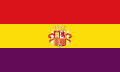 State flag (July 17, 1936 – August 29, 1936)
 -
 State flag (August 30, 1936 – 1938)
 -
 State flag (1938–1945)
 -
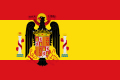 State flag (1945-1977)
 -
 Civil flag (1936–1975)
.svg)
.svg)
.svg)
_alternate_colours.svg)
- Party flags
-
 Flag of the Falange Movement
 -
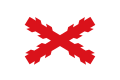 Flag of the Traditionalist Movement (Carlism)


Standards
[edit]From 1940 to 1975, Franco used the Royal Bend of Castile as Head of State's standard and guidon: the Bend between the Pillars of Hercules, crowned with an imperial crown and open royal crown.
As Prince of Spain from 1969 to 1975, Juan Carlos used a royal standard which was virtually identical to the one later adopted when he became King in 1975. The earlier standard differed only that it featured the royal crown of a Crown Prince, the King's royal crown has 8 arches of which 5 are visible, while the Prince's one has only 4 arches of which 3 are visible. The Royal Standard of Spain consists of a dark blue square with the coat of arms in the centre. The King's guidon is identical to the standard.
-
 Standard of Francisco Franco (1940–1975)
 -
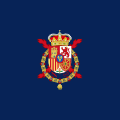 Royal standard of the Prince of Spain (1969–1975)
.svg)

Coat of arms
[edit]In 1938, Franco adopted a variant of the coat of arms reinstating some elements originally used by the House of Trastámara such as Saint John's eagle and the yoke and arrows as follows: "Quarterly, 1 and 4. quarterly Castile and León, 2 and 3. per pale Aragon and Navarra, enté en point of Granada. The arms are crowned with an open royal crown, placed on eagle displayed sable, surrounded with the pillars of Hercules, the yoke and the bundle of arrows of the Catholic Monarchs".
- State Coat of arms
-
 Coat of arms (1936–1938)
 -
 Coat of arms (1938–1945)
 -
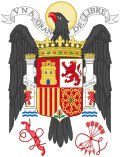 Simplified version used on stamps, lottery tickets, identity documents, and buildings (1938–1945)
 -
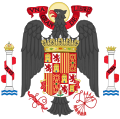 Coat of arms (1945–1977)
-Flag_Variant.svg)
.svg)
-Bureaucratic_Variant.svg)
.svg)
- Personal Coat of arms
-
 Coat of arms of Francisco Franco (1940–1975)
 -
 Coat of arms of the Prince of Spain (1969–1975)


See also
[edit]
- Art and culture in Francoist Spain
- European interwar dictatorships
- Dates of establishment of diplomatic relations with Francoist Spain
- New Order (Indonesia)
- Francoist Catalonia
- Francoist concentration camps
- Government-in-exile of José Giral
- Instituto Nacional de Colonización
- Language policies of Francoist Spain
- List of people executed by Francoist Spain
- Nationalist foreign volunteers
- Pact of forgetting
- Sociological Francoism
- Spanish question (United Nations)
- Spanish Republican exiles
- Spanish Republican government in exile
- White Terror (Spain)
Notes
[edit]References
[edit]- ^ a b c d e f g Press, Propaganda and Politics: Cultural Periodicals in Francoist Spain and Communist Romania. Cambridge Scholars Publishing. 2014. pp. 4–5. ISBN 9781443865678.
- ^ a b Beevor, Antony (2006) [1982]. The Battle for Spain: The Spanish Civil War 1936–1939. London: Weidenfeld & Nicolson. ISBN 0297848321.
- ^ a b c d e f Blinkhorn, Martin (2003). Fascists and Conservatives: The Radical Right and the Establishment in Twentieth-Century Europe. Routledge. ISBN 978-1134997121.
The Franco regime - the only European regime with a major radical fascist ingredient to survive long beyond 1945, and studied here by Paul Preston - is a useful example. Notwithstanding the aforementioned fascisant tendencies within the Spanish Catholic and monarchist right, radical fascism, in the form of the Falange (fused from 1934 with the JONS), was weak until 1936 when it began to expand rapidly... In April 1937 Franco... fused the Falange with the Carlists, monarchists and the rest of the right to form the single party of his regime: a process, though differently conducted, somewhat similar to Italian fascism's fusion with Nationalism and Clerico-Fascism after 1922. The product, like the Italian Fascist regime, was a compromise between radical fascism and conservative authoritarianism, in this case with unambiguous military and Church support. As Preston indicates, Falangism played a superficially prominent and important role for as long as it suited Franco, that is, until the mid-1940s, thereafter to be shunted into the sidings of Spanish political life.
- ^ Spanish Politics: Democracy After Dictatorship. Polity. 2008. ISBN 978-0-7456-3992-5.
- ^ Oxford Dictionary of English. OUP Oxford. 19 August 2010. ISBN 978-0-19-957112-3.
- ^ (in Spanish) "Resumen general de la población de España en 31 de Diciembre de 1940". INE. Retrieved 11 October 2014.
- ^ Nolte, Ernst (1969). Three Faces of Fascism: Action Française, Italian Fascism, National Socialism. New American Library.
- ^ Marc Matera; Susan Kingsley Kent (2017). The Global 1930s: The International Decade. Taylor & Francis. p. 199. ISBN 9781351780612.
- ^ Saz 2004, p. 80.
- ^ Saz 2004, p. 90.
- ^ Fascism: The 'fascist epoch'. Taylor & Francis. 2004. ISBN 978-0-415-29019-7.
- ^ a b «La tesis defendida por Payne en dicho dossier puede sintetizarse con estas palabras:
» Glicerio Sanchez Recio. En torno a la Dictadura franquista Hispania NovaEntre 1937 y 1943, el franquismo constituyó un régimen "semi-fascista", pero nunca un régimen fascista cien por cien. Después pasó treinta y dos años evolucionando como un sistema autoritario "posfascista", aunque no consiguió eliminar completamente todos los vestigios residuales del fascismo.
- ^ a b c d Preston, Paul (2005) [1990]. "Resisting modernity: fascism and the military in twentieth century Spain". The Politics of Revenge: Fascism and the Military in Twentieth-Century Spain. Routledge. ISBN 0415120004.
- ^ a b c d Viñao Frago, Antonio (2014). "La educación en el franquismo (1936–1975)" (PDF). Educar em Revista (51). Curitiba: 20–21.
- ^ Moradiellos 2000, p. 20.
- ^ Cabrera & Rey 2017; Capítulo V
- ^ a b c d La construcción de la dictadura franquista en Cantabria. Ed. Universidad de Cantabria. 2020. ISBN 978-84-8102-695-5.
- ^ «La ausencia de un ideario definido le permitió transitar de unas fórmulas dictatoriales a otras, rozando el fascismo en los cuarenta y a las dictaduras desarrollistas en los sesenta».Tusell 1999, cap. «El franquismo como dictadura».
- ^ Reuter, Tim (19 May 2014). "Before China's Transformation, There Was The 'Spanish Miracle'". Forbes Magazine. Retrieved 22 August 2017.
- ^ European Dictatorships 1918–1945. Routledge. 2016. ISBN 978-1-317-29422-1.[page needed]
- ^ Contreras, Guillermo Portilla (14 February 2022). El Derecho Penal Bajo La Dictadura Franquista: Bases ideológicas y protagonistas [Criminal Law Under the Franco Dictatorship: Ideological basis and protagonists] (PDF) (in Spanish). Madrid: Dykinson, S.L. ISBN 978-84-1122-118-4. Retrieved 26 August 2025.
- ^ González Prieto, Luis Aurelio (2021). "La voluntad totalitaria del Franquismo". Revista del Posgrado en Derecho de la Unam (14): 44. doi:10.22201/ppd.26831783e.2021.14.170.
- ^ a b c Saz 2004.
- ^ Payne (2000), p. 645
- ^ Paul Preston, Chapter 6 "The Making of a Caudillo" in Franco: A Biography (1993), pp. 171–198.
- ^ Preston (1993), Chapter 10. "The Making of a Dictator: Franco and the Unification April 1937", pp. 248–274.
- ^ Ángela Cenarro Lagunas, "Historia y memoria del Auxilio Social de Falange" in Pliegos de Juste 11–12 (2010), pp. 71–74.
- ^ Graham, Helen (2009). "The Memory of Murder: Mass Killing, Incarceration and the Making of Francoism". In Ribeiro de Menezes, Alison; Quance, Roberta; Walsh, Anne L. (eds.). Guerra y memoria en la España contemporánea: War and Memory in Contemporary Spain. Editorial Verbum. pp. 34–36. ISBN 978-8479625177.
- ^ Franco's description: "The work of pacification and moral redemption must necessarily be undertaken slowly and methodically, otherwise military occupation will serve no purpose". Roberto Cantalupo, Fu la Spagna: Ambasciata presso Franco: de la guerra civil, Madrid, 1999: pp. 206–208.
- ^ The Splintering of Spain, pp. 2–3. Cambridge University Press, ISBN 978-0521821780.
- ^ The Splintering of Spain, p. 4. Cambridge University Press.
- ^ The Splintering of Spain, p. 7.
- ^ Payne, pp. 231–234
- ^ Payne, p. 323.
- ^ "Spain – The Franco Years". countrystudies.us.
- ^ a b c Bowen, Wayne H.; José E. Álvarez (2007). A Military History of Modern Spain. Greenwood Publishing Group. p. 114. ISBN 978-0275993573.
- ^ Payne, Stanley G. (2011). The Franco Regime, 1936–1975. University of Wisconsin Pres. p. 244. ISBN 978-0299110741.
- ^ a b c d Pérez Ledesma, Manuel (1994). "Una Dictadura 'por la gracia de Dios'". Historia Social (20): 175. JSTOR 40340643.
- ^ Fascism: Past, Present, Future. Google Books.
- ^ Totalitarian and Authoritarian Regimes - Juan José Linz
- ^ a b European Dictatorships 1918–1945. Routledge. 2016. ISBN 978-1-317-29422-1.
- ^ Fascist Warfare, 1922–1945: Aggression, Occupation, Annihilation. Springer International Publishing. 2019. p. 12. ISBN 9783030276485.
- ^ "fascism, Oxford dictionaries". Oxford University Press. Archived from the original on 27 September 2012.
Franco in Spain were also Fascist
- ^ Blackburn, Simon (2016). "fascism". A Dictionary of Philosophy (3rd ed.). Oxford University Press. ISBN 978-0-19-873530-4. Retrieved September 21, 2024.
- ^ Unearthing Franco's Legacy, p 31, and Paul Preston, "The Theorists of extermination" essay in Unearthing Franco's Legacy, pp 42–67. University of Notre Dame Press. ISBN 0268032688
- ^ Kaplan, Lawrence (1992). Fundamentalism in Comparative Perspective. Univ of Massachusetts Press. p. 87. ISBN 0870237985.
franco integralism.
- ^ a b Payne, Stanley Fascism in Spain, 1923–1977, p. 476. 1999. Univ. of Wisconsin Press
- ^ Laqueur, Walter Fascism: Past, Present, Future, p. 13, 1997 Oxford University Press US
- ^ Preston, Paul. "Francisco Franco: is it accurate to call the Spanish dictator a fascist?". HistoryExtra. History Extra – The official website for BBC History Magazine. Retrieved 4 January 2021.
- ^ Varieties of Anti-Fascism: Britain in the Inter-War Period. Palgrave Macmillan. 2010. p. xviii. ISBN 9780230282674.
- ^ Pecharromán, Julio Gil (2019). La estirpe del camaleón: Una historia política de la derecha en España (1937–2004) [The Chameleon's Lineage: A Political History of the Right in Spain (1937–2004)]. Taurus. ISBN 978-84-306-2302-0.
- ^ Michael Burleigh, Sacred Causes, p. 316, 2006, HarperPress, ISBN 0007195745; see also United Nations Security Council Resolution 7
- ^ De Menses, Filipe Ribeiro Franco and the Spanish Civil War, p. 87, Routledge
- ^ Gilmour, David, The Transformation of Spain: From Franco to the Constitutional Monarchy, p. 7. 1985. Quartet Books
- ^ Payne, Stanley Fascism in Spain, 1923–1977, pp. 347, 476. 1999. Univ. of Wisconsin Press
- ^ Laqueur, Walter Fascism: Past, Present, Future p. 13. 1996. Oxford University Press
- ^ a b Franco: Anatomy of a Dictator. Bloomsbury. 2017. ISBN 978-1-78672-300-0.
- ^ "The Franco Years: Policies, Programs, and Growing Popular Unrest" A Country Study: Spain
- ^ Fascist Warfare, 1922–1945: Aggression, Occupation, Annihilation. Springer. 26 November 2019. ISBN 978-3-030-27648-5.
- ^ Literary Censorship in Francisco Franco's Spain and Getulio Vargas' Brazil, 1936-1945: Burning Books, Awarding Writers. Liverpool University Press. 14 April 2020. ISBN 978-1-78284-673-4.
- ^ Casanova, Julián (2010). The Spanish Republic and Civil War. Cambridge, UK: Cambridge University Press. ISBN 9780511787027. OCLC 659843319.
- ^ El Franquismo y la apropiación del pasado: El uso de la historia, de la arqueología y de la historia del arte para la legitimación de la dictadura [Francoism and the appropriation of the past: The use of history, archaeology, and art history to legitimize the dictatorship]. Editorial Pablo Iglesias. 2016. ISBN 978-84-95886-89-7.
- ^ Roman, Mar. "Spain frets over future of flamenco." 27 October 2007. Associated Press
- ^ a b Martín-Estudillo, Luis. The Rise of Euroskepticism: Europe & its critics in Spanish culture (PDF). Vanderbilt University Press. p. 19.
- ^ Rolo, Charles J. (1957-01-01). "Tourist in Spain". The Atlantic. ISSN 2151-9463. Retrieved 2025-08-25.
- ^ Beltrán, Luis (December 1968). "African Studies in Spain". African Studies Review. 11 (3): 316–325. doi:10.1017/S056815370070446X (inactive 18 September 2025). ISSN 0568-1537.
{{cite journal}}: CS1 maint: DOI inactive as of September 2025 (link) - ^ Viñas, Ángel (2012). En el combate por la historia: la República, la guerra civil, el franquismo [In the fight for history: the Republic, the Civil War, Francoism] (in Spanish). Pasado y Presente. ISBN 978-8493914394.
- ^ Casanova, Julian (2010). "The Faces of Terror". Unearthing Franco's Legacy. University of Notre Dame Press. p. 108. ISBN 978-0268083526.
- ^ Unearthing Franco's Legacy, pp. 108–115
- ^ Unearthing Franco's Legacy, p. 103
- ^ Richards, Michael (2010). "Grand Narratives, Collective Memory, and Social History". Unearthing Franco's Legacy. University of Notre Dame Press. pp. 128–129. ISBN 978-0268083526.
- ^ "Franco edicts". Archived from the original on 2008-06-26. Retrieved 2005-12-16.
- ^ "The regulation of identity through names and naming in Twentieth Century Spain". 6 July 2016. Retrieved 27 August 2019.
- ^ Burleigh, Michael (2006). Sacred Causes. HarperPress. pp. 317–318. ISBN 0007195745.
- ^ Unearthing Franco's Legacy p. 112
- ^ Unearthing Franco's Legacy, p. 113
- ^ Fernandez de Mata, Ignacio (2010). Unearthing Franco's Legacy. University of Notre Dame Press. p. 295. ISBN 978-0268083526.
- ^ Valiente, Celia (May–June 2017). "Male allies of women's movements: Women's organizing within the Catholic Church in Franco's Spain". Women's Studies International Forum. 62: 43–51. doi:10.1016/j.wsif.2017.03.004.
- ^ Christel Beilmann, Eine katholische Jugend in Gottes und dem Dritten Reich. Wuppertal 1989, p. 78.
- ^ Swier, Patricia; Riordan-Goncalves, Julia (2013). Dictatorships in the Hispanic World: Transatlantic and Transnational Perspectives. Rowman & Littlefield. ISBN 978-1611475906.
- ^ Threlfall, Mónica; Cousins, Christine; Fernandez, Celia Valiente (2005). Gendering Spanish Democracy. Routledge. p. 64. ISBN 978-0415347945.
- ^ Finnerty, Deidre (2013). "The Republican Mother in Post-Transition Novels of Historical Memory. A Re-Inscription into Spanish Cultural Memory?". In DeVries, Kelly; France, John; Neilberg, Micheal S; Schneid, Frederick (eds.). Memory and Cultural History of the Spanish Civil War: Realms of. Brill. p. 216. ISBN 978-9004259966.
- ^ Tremlett, Giles (2006). Ghosts of Spain. Faber and Faber Ltd. London. ISBN 0802716741. p. 211.
- ^ García Dueñas, Lydia (2022). 'Que mi nombre no se borre de la historia': The stakes of including women's historical memory in Spanish politics of memory (MSc thesis). Université libre de Bruxelles. pp. 33–35.
- ^ Morcillo Gómez, Aurora (2015). En cuerpo y alma: Ser mujer en tiempos de Franco (in Spanish). Siglo XXI. ISBN 9788432317835.
- ^ Álvarez Fernández, Carlos. "El Patronato de Protección a la Mujer: la construcción de la moralidad pública en España" (PDF) (in Spanish). Archived from the original (PDF) on September 18, 2018. Retrieved September 18, 2018.
- ^ "Peña Grande, la maternidad de los horrores que sobrevivió a Franco: 'Las monjas nos exponían como ganado'" (in Spanish). El Confidencial. June 3, 2018. Retrieved December 5, 2023.
- ^ Guillén Lorente, Carmen (2018). El Patronato de Protección a la Mujer: Prostitución, Moralidad e Intervención Estatal durante el Franquismo [The Women's Protection Board: Prostitution, Morality and State Intervention during Francoism] (PhD thesis) (in Spanish). University of Murcia. Archived (PDF) from the original on December 28, 2023. Retrieved December 28, 2023.
- ^ "El Patronato, la cárcel de la moral franquista para adolescentes: "Era como la Gestapo"". El Confidencial (in Spanish). 2018-07-12. Retrieved 2019-04-07.
- ^ Iglesias Aparicio, Pilar (2021). "Violation of Women's Human Rights in the Magdalene Laundries of Ireland and the Centers of the Board for the Protection of Women in Spain". Transatlantic Studies Network, University of Malaga (in Spanish). 6 (11): 231–244. ISSN 2444-9792. Retrieved December 5, 2023.
- ^ Palau Galdón, María; García Carbonell, Marta (November 5, 2023). "Pilar Dasí, encerrada en el Patronato de Protección a la Mujer: 'Había sadismo; fue una salvajada del franquismo'" (in Spanish). El País.
- ^ a b Fernández Galeano, Javier (3 July 2021). "'El Todo Poderoso nos ayude, para llegar a lo que deseamos': homosexuality and Catholicism in Franco's Spain (1954–1970)". Journal of Spanish Cultural Studies. 22 (3): 331–350. doi:10.1080/14636204.2021.1960696. ISSN 1463-6204. Retrieved 22 February 2025 – via Taylor and Francis Online.
- ^ Galeano, Javier Fernández (January 2016). "Is He a 'Social Danger'? The Franco Regime's Judicial Prosecution of Homosexuality in Málaga under the Ley de Vagos y Maleantes". Journal of the History of Sexuality. 25 (1): 1–31. doi:10.7560/JHS25101. ISSN 1043-4070. JSTOR 24616614. Retrieved 7 April 2025.
- ^ Medina-Domenech, Rosa María (3 July 2023). "The sexual upheaval of the Spanish sixties: gender and sexual-affective diversities under Franco's authoritarian regime". Journal of Spanish Cultural Studies. 24 (3): 339–357. doi:10.1080/14636204.2023.2244652. ISSN 1463-6204. Retrieved 12 March 2025 – via Taylor and Francis Online.
- ^ "Cuando Onganía derrotó a Illia". 29 June 2015.
- ^ a b González, Javier M.; Máximo, Gabriela (2023-09-03). "Pinochet y Franco: admiración mutua e intercambio de cartas". nuevatribuna.es (in Spanish).
- ^ a b c "'De Franco a Pinochet': La historia de un fracaso exitoso". Noticias (in Spanish). Universidad de Chile. 2007-05-29. Retrieved 2022-05-10.
- ^ Góngora, Álvaro; de la Taille, Alexandrine; Vial, Gonzalo. Jaime Eyzaguirre en su tiempo (in Spanish). Zig-Zag. pp. 225–226.
- ^ Villalobos, Sergio; Retamal Ávila, Julio; Serrano, Sol (1980). "Introducción para una nueva historia". Historia del pueblo chileno (in Spanish). Vol. I. Santiago de Chile: Zig-Zag. pp. 30–31, 40–41.
- ^ Moncada Durruti, Belén (2006). Jaime Guzmán: una democracia contrarevolucionaria : el político de 1964 a 1980 (in Spanish). Santiago: RIL editores. pp. 28–29. ISBN 978-9562845205.
- ^ Rojas Sánchez, Gonzalo. Gazmuri y Su "Gremialismo".
- ^ "Libros: El Imperio del Opus Dei en Chile". Universidad de Chile (in Spanish). Retrieved 2022-05-19.
- ^ Michael Richards, ''Unearthing Franco's Legacy'', p. 129.
- ^ Julio de la Cueva, "Religious Persecution, Anticlerical Tradition and Revolution: On Atrocities against the Clergy during the Spanish Civil War" Journal of Contemporary History 33.3 (July 1998): 355.
- ^ Butler, Alban and Peter Doyle Butler's Lives of the Saints p. 169 Liturgical Press (February 2000).
- ^ Payne, Stanley G., and Jesús Palacios. Franco: A personal and political biography. University of Wisconsin Pres, 2014, pg 418
- ^ Juan J. Linz, Miguel Jerez, Susana Corzo, Ministers and Regimes in Spain: From First to Second Restoration, 1874–2001, [in:] Center for European Studies Working Papers 101 (2003), pp. 1-52, José M. Cuenca Torribio, Soledad Miranda García, La elite miniterial franquista, [in:] Revista de Estudios Políticos 57 (1987), pp. 107–148
- ^ Sánchez, Antonio Cazorla (2010). Fear and Progress: Ordinary Lives in Franco's Spain, 1939–1975. John Wiley & Sons, Inc. pp. 58–60. ISBN 978-1444306507. Retrieved 23 April 2013.
- ^ Alares López, Gustavo (2020). "La colonización agraria franquista: Mitos, límites y realidades de una política agraria" (PDF). Revista de Andorra (19). Andorra: Centro de Estudios Locales de Andorra: 96.
- ^ Perfecto 2015, p. 147.
- ^ Alares López 2020, pp. 96–97.
- ^ Perfecto, Miguel Ángel (2015). "El nacional-sindicalismo español como proyecto económico-social". Espacio, Tiempo y Forma, Serie V, Historia Contemporánea. 27. Madrid: UNED: 147. doi:10.5944/etfv.27.2015.15752. ISSN 1130-0124.
- ^ Alares López 2020, p. 97.
- ^ Alares López 2020, pp. 103–104.
- ^ Alares López 2020, p. 99.
- ^ Hernando, Silvia (30 May 2018). "Los pueblos que se inventó Franco". El País.
- ^ Prados de la Escosura, Leandro. Spanish Economic Growth, 1850-2015, pp. 16-17, Table 2.1. 1st ed. 2017. Cham: Springer International Publishing, 2017. Web.
- ^ "Spain relocates dictator Franco's remains". BBC News. 24 October 2019. Retrieved 4 November 2019.
- ^ Europe diary: Franco and Finland, BBC News, 6 July 2006 (in English)
- ^ Madrid removes last Franco statue, BBC News, 17 March 2005 (in English)
- ^ a b c d e f Primera condena al régimen de Franco en un recinto internacional, EFE, El Mundo, 17 March 2006 (in Spanish)
- ^ Von Martyna Czarnowska, Almunia, Joaquin: EU-Kommission (4): Ein halbes Jahr Vorsprung Archived 2006-02-13 at the Wayback Machine, Weiner Zeitung, 17 February 2005 (article in German language). Accessed 26 August 2006.
- ^ "Bones of Contention". The Economist. 27 September 2008. Archived from the original on 4 October 2008. Retrieved 6 October 2008.
- ^ Adler, Katya (18 October 2011). "Spain's stolen babies and the families who lived a lie". BBC News.
- ^ Tremlett, Giles (27 January 2011). "Victims of Spanish 'stolen babies network' call for investigation". The Guardian.
Sources
[edit]- Cabrera, Mercedes; Rey, Fernando del (2017) [2002]. "Spanish Entepreneurs in the Era of Fascism: From the Primo de Rivera Dictatorship to the Franco Dictatorship, 1923–1945". In James, Harold; Tanner, Jakob (eds.). Enterprise in the Period of Fascism in Europe. Abingdon, Oxon New York: Routledge. ISBN 978-0-7546-0077-0.
- Moradiellos, Enrique (2000). La España de Franco (1939–1975). Política y Sociedad. Historia de España (in Spanish). Madrid: Síntesis. ISBN 978-84-7738-740-4.
- Saz, Ismael (2004). Fascismo y Franquismo (in Spanish). València: Universitat de València. ISBN 978-84-370-5910-5.
- Tusell, Javier (1999). Historia de España en el Siglo XX. 3: La Dictadura de Franco. Madrid: Santillana. ISBN 978-84-306-0332-9.
Further reading
[edit]- Gerald Brenan, The Face of Spain, (London: Serif, 2010). First-hand account of travels around Spain in 1949. ISBN 189795963X
- Payne, S. (1987). The Franco Regime (1st ed.). Madison, WI: University of Wisconsin Press. ISBN 978-0299110741
External links
[edit] Media related to Francoist dictatorship at Wikimedia Commons
 Texts on Wikisource:
- Text of Franco's Fundamental Laws at the Wayback Machine (archived July 2, 2007), the Spanish Constitution under Franco. (in Spanish)


