


Community hub
Recent from talks
Contribute something
Nothing was collected or created yet.
Hirden
View on Wikipedia
 The insignia of the Hirden | |
_inspiserer_Rikshirden.jpg) Vidkun Quisling and Oliver Møystad inspecting Rikshirden. | |
| Organization overview | |
|---|---|
| Formed | 1940 |
| Dissolved | 1945 |
| Type | Paramilitary |
| Jurisdiction | German-occupied Norway |
| Headquarters | Hirdens hus, Oslo |
| Parent organization | Nasjonal Samling |
Hirden[1] (the hird) was a uniformed paramilitary organisation during the occupation of Norway by Nazi Germany, modelled the same way as the German Sturmabteilungen.[2]
Overview
[edit]Vidkun Quisling's fascist party Nasjonal Samling frequently used words and symbols from the old Norse Viking era. During the Second World War, membership was compulsory for all Nasjonal Samling members. In total, about 8,500 Norwegians were members of Hirden during the war. The organisation was dissolved after the liberation, and many of its former members were prosecuted and convicted for treason and collaboration.
History
[edit]During the German occupation Hirden got a more military slant. The intention was that it should form the nucleus of a future Norwegian Nazi army, and a "hirdmarine" (Hirden navy)[3] and a "Hirdens flykorps"(Hirden's air force corps)[4] were created in 1942 in addition to the real Hirden, Rikshirden. However, many Hirden members volunteered to Norwegian military units in the war on the Nazi German side or served as guards in the various prison camps. Hirden had a broad mandate to conduct operations against dissidents, independent of all police authorities, many of which included the use of violence.[5]
A 2014 Dagsavisen article said that "8 of 10" prisoners "died in the prison camps where Hirden performed guard duty under the leadership of SS".[6]
List of Hirden branches
[edit]Main Hirden organisations
[edit]| Insignia | Flag | Name | Period | Description |
|---|---|---|---|---|
|
|

|
Rikshirden (transl. National Hirden or Hirden of the realm) |
1933–1945 | Rikshirden is the most important Hirden organisation and usually the one referred to by just Hirden. Rikshirden was responsible for ensuring the security of NS party members and Quisling regime officials. |

|
|
Hirdvaktbataljonen (transl. Hirden Guard Battalion) |
1942–1943 | Shortlived Hirden branch which primarily served guard duty at prison lairs, including foreign prisons. After the branch was dissolved, many of the members joined SS-vaktbatalijon (SS Guard battalion). |

|
|
Førergarde (transl. Leader guard) |
1942–1945 | The personal guards of the party leader (fører); Vidkun Quisling. The guard was made up of 150 handpicked voluntary recruits. They served much the same purpose as the former Royal Guards. |

|
|
Hirdens Flykorps (transl. Hirden Air Force Corps) |
1942–1945 | Hirdens Flykorps was meant to form the basis for a future Norwegian air force. Most members eventually joined the German Luftwaffe. The fleet was rather basic, only featuring some primary glider aircraft. |

|

|
Hirdmarinen (transl. Hirden Navy) |
1942–1945 | Hirdmarinen was meant to form the basis for a future Norwegian navy. Most members eventually joined the German Kriegsmarine. The fleet was small, featuring only a couple small sailboats. |
|
|
|
Hirdens Alarmenheter (transl. Hirdens Alarm Units) |
1943–1945 | Operated guard duty and helped Statspolitiet as part of the "armed forces of the realm". |
|
|
|
Hirdens Bedriftsvern (transl. Hirdens Corporate Protection) |
1943–1945 | Armed forces supposed to protect industry and state institutions against sabotage. |
|
|
|
Hirdbataljonen (transl. Hirden Battalion) |
1945 | Military mobilization of NS members. |
Related organisations not directly subject to the Rikshirden
[edit]| Insignia | Flag | Name | Period | Description |
|---|---|---|---|---|

|

|
Kvinnehirden (transl. Womens Hirden) |
1934–1945 | Kvinnehirden was a branch of the NS Kvinneorganisajonen (transl. NS Womens Organisation). Despite being named a Hird, they were not officially part of the proper Hirden and did not serve any military function and instead provided sanitation; therefore, their flags and emblems lacked the swords in the sun cross. |

|
.svg)
|
Germanic SS Norway | 1941–1945 | Originally called Norges SS ('Norway's SS'). GSSN was formally a subdivision of the Hirden, but very controversial within the NS party due to its close ties to Germany as a de facto branch of Allgemeine SS. |
Youth organisations with Hirden names
[edit]| Insignia | Flag | Name | Period | Description |
|---|---|---|---|---|

|

|
Unghirden (transl. Youth Hirden) |
1934–1945 | Branch of NS Ungdomsfylking (transl. NS Youth League), intended for boys between 14–18. It was largely modeled on the German Hitler Youth. |

|
|
Guttehirden (transl. Boys Hirden) |
1934–1945 | Branch of NS Youth League, intended for boys between 10–15. |

|

|
Jentehirden / Gjentehirden (transl. Girls Hirden) |
1934–1945 | Branch of NS Youth League, intended for girls between 15–21. |

|
|
Småhirden (transl. Small Hirden) |
1934–1945 | Branch of NS Youth League, intended for girls between 9–15. |
Gallery
[edit]-

-
 Uniform of the naval hird, Hirdmarinen.
 -
 Uniform of the female hird, Kvinnehirden.
 -
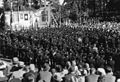 Vidkun Quisling on the rostrum speaks to Hirden in Sarpsborg.
 -
 Hirden spectacle march to be greeted by Quisling.
 -
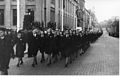 Hirden women march up Oslo's main street.
 -
 Quisling speaks to Hirden after oath has been given to him.
_400ppi_Retouched_clean_cropped.jpg)
_400ppi_Retouched_clean.jpg)
_400ppi_Retouched_clean_crop.jpg)
.jpg)
.jpg)
.jpg)
.jpg)
Ranks and rank insignia
[edit]_400ppi_Re.jpg)
| Insignia | Rank | Translation | Comparative rank in the Wehrmacht |
|---|---|---|---|
| Hirdfører | |||
| Overste hirdsjef | Senior hird chief | ||
| Regimentsfører | Regimental commander | ||
| Nestregimentsfører | Second regimental commander | ||
| Fylkingfører | Wedge leader | ||
| Sveitfører | District leader | ||
| Nestsveitfører | Second district leader | ||
| Troppfører | Troop commander | ||
| Underfører | |||
| Kommandersersjant | Commander sergeant | ||
| Kvartermester | Quartermaster | ||
| Overlagfører | Senior squad leader | ||
| Furer | Leader | ||
| Lagfører | Squad leader | ||
| Mannskap | |||

|
Nestlagfører | Second squad leader | |
| Speider | Scout | ||
| Nestspeider | Second scout | ||
| Hirdmann | Hird man | ||
| Source:[7] | |||
See also
[edit]References
[edit]- ^ NRK (30 May 2012). "Stiller ut fargefoto frå 30-talet". Retrieved 19 October 2016.
- ^ Erik Veum page 33
- ^ Veum pp. 92–98
- ^ Veum 98–106
- ^ Veum
- ^ Pål Nygaard (18 November 2014). "2. Verdenskrig: Etter krigen benektet alle i Vegvesenet at de hadde noe med de jugoslaviske fangene å gjøre. - Kunne de stoppet massedrap?" [World War Two: After the war, everyone in the Public Roads Administration denied involvement with the Jugoslavian prisoners. - Could they have stopped mass murder?]. Dagsavisen. p. 6.
Pål Nygaard - Forsker, senter for profesjonsstudier, HiOA (...) 8 av 10 døde i leirene hvor Hirden sto vakt under ledelse av SS.
- ^ Hvad enhver NS-mann bør vite - side 5 Retrieved 2017-02-05.
Sources
[edit]- Eirik Veum: Nådeløse nordmenn - Hirden, Kagge Forlag, Oslo 2013, (in Norwegian) ISBN 978-82-489-1451-8
External links
[edit]- Dahl, Hans Fredrik (1995). "Hirden". In Dahl, Hans Fredrik (ed.). Norsk krigsleksikon 1940–45 (in Norwegian). Oslo: Cappelen. Archived from the original on 30 March 2012. Retrieved 22 July 2010.
- Her er Eirik Veums liste over de 20 verste torturistene i Hirden: [Here is Erik Veum's list of the 20 worst torturers in Hirden] (in Norwegian)

Hirden
View on GrokipediaHirden (the Hird), also known as the Corps of Nasjonal Samling, was a uniformed paramilitary organization established as the armed wing of Norway's Nasjonal Samling party, a fascist movement led by Vidkun Quisling that collaborated with Nazi Germany during the occupation of Norway from 1940 to 1945.[1] Modeled after the German Sturmabteilung (SA), it functioned as a national guard and auxiliary force, with membership mandatory for male party members and estimates of its size ranging from 8,500 to 20,000 at its peak.[2][3] Originally formed in 1933 alongside the party's founding, Hirden drew its name from the ancient Norse royal bodyguard, emphasizing a mythical nationalist tradition to legitimize its role in enforcing Quisling's regime after his appointment as Minister-President in 1942.[4] Its primary functions included guarding key installations, assisting in the suppression of Norwegian resistance activities, and serving as camp guards in northern Norway, leveraging members' ideological alignment with National Socialism for tasks requiring political reliability over military expertise.[5][6] The organization maintained a hierarchical structure with specialized units, such as the women's auxiliary (Kvinnehirden) and youth branches (Unghirden), and wore distinctive uniforms featuring sun cross insignia symbolizing pagan Nordic heritage reinterpreted through fascist ideology.[1] Hirden's activities were marked by controversies stemming from its direct support for the Axis occupation, including participation in arrests and anti-resistance operations, which led to widespread postwar prosecution of members for treason during Norway's legal purges, with the organization itself declared illegal and disbanded upon liberation in 1945.[5][6] Despite its pretensions to revive traditional Norwegian guardianship, empirical records highlight its causal role in facilitating German control rather than independent national defense, reflecting the Nasjonal Samling's marginal prewar support—peaking at under 2.5% of the vote—and opportunistic alignment with invading forces.[4][1]
Introduction
Definition and Role
Hirden, also known as the Hird or Rikshirden, was the uniformed paramilitary wing of Nasjonal Samling (NS), the Norwegian fascist party founded by Vidkun Quisling in 1933.[7] Modeled after the German Sturmabteilung (SA), it drew its name from the Old Norse term hird, referring to the historical retinue or bodyguard of Viking kings and chieftains, symbolizing loyalty to the party leader as a modern "state guard."[7] [2] Initially formed for NS members aged 18–45, it functioned as an ideological enforcer and security apparatus, promoting the party's ultranationalist and pro-German agenda through drills, marches, and political activism.[7] The organization's primary role was to provide paramilitary support to NS objectives, including protecting party officials, conducting propaganda activities, and maintaining internal discipline among members.[7] During the German occupation of Norway beginning April 9, 1940, Hirden expanded rapidly, serving as an auxiliary force aligned with Axis interests by assisting in occupation enforcement, guarding key installations, and suppressing resistance.[7] [3] It gained formal police powers in March 1941, enabling arrests and crowd control, and by 1943, select units were armed and integrated into the collaborationist Norwegian state apparatus, though it remained a part-time militia rather than a full standing army.[7] Membership peaked at approximately 45,000–50,000 by mid-1943, reflecting coerced recruitment and ideological commitment under the Quisling regime established February 1, 1942.[7]Ideological and Historical Context
Hirden emerged as the paramilitary arm of Nasjonal Samling (NS), the Norwegian fascist party founded by Vidkun Quisling on May 17, 1933, as a successor to earlier anti-socialist groups amid economic depression and political fragmentation in interwar Norway.[8] The organization's name invoked the Old Norse hird, the elite retinue of medieval Scandinavian kings, framing its members as modern guardians of national renewal and loyalty to Quisling as fører.[9] This symbolic choice blended romantic nationalism with fascist authoritarianism, positioning Hirden as enforcers of NS's vision for a corporatist state that rejected liberal democracy, Marxism, and perceived cultural decay.[10] Ideologically, Hirden embodied NS's synthesis of transnational fascism adapted to Norwegian contexts, drawing from Mussolini's squadristi for street-level mobilization and Hitler's SA for uniformed paramilitarism, while emphasizing Nordic racial exceptionalism and anti-Bolshevism rooted in Quisling's 1918–1920 experiences as a military attaché in Soviet Russia, where he witnessed revolutionary chaos.[11] Quisling's writings, such as Russland og Vi (1922), propagated fears of Jewish-Bolshevik conspiracies infiltrating Scandinavia, influencing Hirden's early anti-communist drills and propaganda that portrayed the group as a bulwark against subversion.[10] Unlike purely imported Nazism, NS ideology incorporated apocalyptic historicism, viewing the 1930s crisis as heralding a "new age" of hierarchical order under a national elite, with Hirden as its vanguard.[9] Historically, Hirden's pre-war activities remained limited, with membership under 2,000 by 1939, reflecting NS's electoral nadir of 1.8% in the 1936 Storting elections, as mainstream Norwegians favored social democracy amid neutrality policies.[8] The German invasion on April 9, 1940, catalyzed Quisling's abortive coup that day, where he broadcast a seizure of power, briefly deploying nascent Hirden units for security before Reichskommissar Josef Terboven suppressed the initiative.[11] Reorganized under occupation from 1941, Hirden swelled to over 40,000 by 1943, shifting toward SS-inspired security roles, including auxiliary policing and anti-resistance operations, as Quisling's puppet regime from February 1942 formalized NS control, though subordinated to German directives.[10] This evolution underscored Hirden's dual causality: domestic fascist aspirations colliding with Axis imperatives, yielding a force more repressive than revolutionary.[12]Organizational Structure
Core Branches and Hierarchy
The core branch of Hirden consisted of the Rikshirden, the primary paramilitary organization for adult males, functioning as a national guard and rapid-response force modeled after the German Sturmabteilung. Formalized on 21 September 1934 with an initial 78 members in Oslo, it integrated with Nasjonal Samling's Kamporganisasjonen for combat readiness and officer training.[13] Hirden's hierarchy was strictly militarized, with Vidkun Quisling as the supreme Fører overseeing all operations. Directly beneath him was the Hirdsjef or Rikshirdsjef, responsible for national command and regional coordination. Successive Hirdsjefs included Carl Stenersen in 1934, Jens Henrik Nordlie as interim leader from 1934 to 1936, Johan Bernhard Hjort from March 1936, and Thorvald Meyer also appointed in March 1936. During the German occupation, Oliver Møystad held the position of Hirdsjef, conducting inspections alongside Quisling, such as in September or October 1943. Later, Karl A. Marthinsen served concurrently as politigeneral and Hirdsjef.[13]_inspiserer_Rikshirden.jpg) The structure extended to regional fylkeshird units at the county level, managed by local leaders such as kretsledere or fylkshirdsførere, who oversaw district commands and local partilag (party units). For instance, Severin Olai Gundersen Søndenaa led operations in Rogaland by 1939, while Erling Søvik served as stabssjef in Kirkenes. This decentralized yet centralized model ensured loyalty to Quisling while enabling localized mobilization, with 246 partilag registered by the late 1930s, of which 157 remained active.[13]| Level | Role | Key Examples |
|---|---|---|
| National Supreme | Fører | Vidkun Quisling |
| National Command | Hirdsjef/Rikshirdsjef | Oliver Møystad (1943), Karl A. Marthinsen, J.B. Hjort (1936–) |
| Regional | Fylkshirdsfører/Kretsleder | Severin Olai Gundersen Søndenaa (Rogaland, 1939), Olaf Five (Trondheim) |
| Local/District | Distriktskommandosjef/Lagfører | Various, e.g., Rolv Gulbrandsen (Oslo sveitfører) |
Auxiliary and Specialized Units
The auxiliary units of Hirden encompassed the Kvinnehirden, a women's branch established to support party activities through administrative, propaganda, and welfare roles, primarily for members aged 18 to 35 or 40. Membership in Kvinnehirden was integrated with Nasjonal Samling's broader organizational efforts, emphasizing ideological indoctrination and auxiliary duties such as organizing events and assisting in recruitment, though it lacked combat functions. Uniforms featured distinct insignia, including sun cross emblems, to denote affiliation.[7] Specialized units included the Førergarden, Vidkun Quisling's personal bodyguard formed in 1942, comprising approximately 150 full-time members serving in six-month rotations for elite protection and ceremonial duties. This unit wore specialized grey-green or dark blue attire with Quisling monograms, operating as Hirden's parade and security vanguard.[14][7] The Hirdens Flykorps, established in 1942, focused on aviation training to prepare volunteers for service in the German Luftwaffe, with the first contingent dispatched in February 1943. Similarly, the Hirdmarinen, created in May 1942, provided naval instruction aligned with the Kriegsmarine, transferring recruits to Germany by January 1943 for further deployment. These branches numbered in the hundreds at most, emphasizing technical preparation over independent operations, and were equipped with period-specific insignia and flags bearing Nasjonal Samling symbols.[14][7][15]Youth and Training Organizations
The youth organizations of Hirden, integrated within the Nasjonal Samling's broader youth league (NSUF), focused on ideological indoctrination, physical conditioning, and paramilitary drills for children and adolescents, mirroring structures like the German Hitler Youth. These groups aimed to cultivate loyalty to Nasjonal Samling's national socialist principles and prepare members for potential adult service in Hirden's ranks.[14] Unghirden served as the primary training cadre for boys aged 14 to 18, emphasizing marching exercises, weapons handling familiarization, and nationalist education to foster discipline and combat readiness. Established alongside Hirden in 1934, it expanded significantly after the 1940 German occupation, with units organized into local "sveits" (companies) under adult Hird oversight. Guttehirden, targeted at boys aged 10 to 14, provided introductory training through camping, sports, and basic drill, functioning as a feeder system to Unghirden.[16][7] Parallel girls' organizations included Jentehirden for ages 14 to 18, which stressed domestic roles alongside ideological seminars and light physical activities, and Småhirden for younger girls aged 10 to 14, focusing on preparatory moral and communal training. Uniforms for these groups featured simplified Hird-style attire, such as green shirts with sun cross insignia, to instill a sense of unity and hierarchy. Membership peaked in the early 1940s amid occupation-era recruitment drives, though exact figures varied by region due to voluntary enlistment and limited appeal outside Nasjonal Samling sympathizers.[14][7] Training programs, held in camps and weekly gatherings, prioritized anti-communist and racial hygiene doctrines drawn from Nasjonal Samling ideology, with practical elements like first aid and signaling to build auxiliary support capabilities. By 1943, these organizations contributed to propaganda events and local security auxiliaries, though their effectiveness was hampered by widespread Norwegian resistance and internal NS factionalism. Post-liberation in 1945, all youth groups were disbanded, with leaders facing treason trials under Norwegian law.[16][17]Historical Development
Formation and Early Years (1933–1940)
The Hirden, or Rikshird, was formed in 1933 as the uniformed paramilitary organization of the Nasjonal Samling (NS) party, established by Vidkun Quisling on 17 May 1933 in Oslo.[18][7] Designed for male NS members aged 18 to 45, it functioned primarily as a guard corps for party meetings and events, drawing its name from the medieval hird, the personal retinue of Norwegian monarchs, to evoke traditions of national loyalty and elite service.[9][7] The organization emulated the German Sturmabteilung (SA) in structure, with an emphasis on discipline, uniforms, and ideological commitment to NS principles of corporatism, anti-communism, and Nordic revivalism.[19] During the mid-1930s, Hirden activities centered on basic training regimens, including marches, physical drills, and lectures on Quisling's worldview, conducted at party locales across Norway.[7] These efforts aimed to build cohesion and readiness as a potential national defense force, but the group's scope was constrained by NS's marginal status; the party struggled with internal divisions and limited electoral success, such as its alliance yielding under 28,000 votes in 1933 local contests.[18] No records indicate widespread violence or street-level clashes, as NS lacked the mass base to challenge established parties or labor movements effectively.[10] By the late 1930s, Hirden had incorporated rudimentary hierarchies and insignia, fostering a sense of elite camaraderie among adherents, yet its membership remained negligible relative to Norway's population, reflecting NS's broader stagnation after peaking around 1935.[7] Quisling's overtures to Nazi Germany, including visits and propaganda alignments, influenced Hirden's militaristic ethos, but domestic irrelevance persisted until the 1940 German invasion shifted the political landscape.[10] Pre-occupation Hirden thus served more as a symbolic vanguard for NS revivalism than a operative force, with activities confined to propaganda support and self-organization.[7]Expansion During Occupation (1940–1943)
Following the German invasion of Norway on April 9, 1940, Hirden mobilized its limited pre-occupation membership of approximately 500 to support Vidkun Quisling's short-lived attempt to seize power, aligning with Nasjonal Samling's (NS) pro-German stance amid the chaos of the campaign.[7] This initial activation marked the beginning of expansion, as opportunistic recruitment drew individuals sympathetic to collaboration, though German authorities initially distrusted Quisling and temporarily banned NS activities, including Hirden operations, in late April 1940 to stabilize control under Reichskommissar Josef Terboven.[20] Membership nonetheless grew in tandem with NS, reaching around 6,000 for the party by late 1940 after the ban was lifted in September, reflecting coerced or incentivized enlistments in occupied territories where resistance was disorganized.[7][18] By March 1941, Terboven authorized Hirden to exercise auxiliary police powers, formalizing its role in internal security and suppression of dissent, which facilitated structured recruitment drives and organizational development into regional regiments such as Viken and Viking.[7] This status elevated Hirden's visibility and appeal among NS adherents, contributing to party-wide expansion despite ongoing German reservations about Quisling's influence; NS membership surged from these levels to 45,000–60,000 by early 1943, with Hirden serving as the compulsory paramilitary component for able-bodied male members.[20][18] Hirden's growth emphasized ideological indoctrination and paramilitary training, drawing parallels to German SA models, though actual active strength remained a fraction of NS totals, estimated at 8,000 men and 1,500 women by mid-occupation, focused on guard duties and enforcement rather than frontline combat.[21] Quisling's elevation to Minister President on February 1, 1942, integrated Hirden more deeply into the puppet regime's apparatus, mandating participation for NS youth and expanding auxiliary units like the Hird Factory Guard formed in March 1942 for industrial protection.[7] This period saw intensified propaganda emphasizing Hirden as a national guard against "Bolshevik threats," boosting enlistments amid economic pressures and German support for NS consolidation.[20] By 1943, select Hirden elements, including a transferred volunteer group to Germany in January, were absorbed into broader Norwegian collaborationist forces alongside the Germanic SS Norge and state police, marking the peak of institutional expansion before wartime setbacks eroded effectiveness.[7][18] Such growth, however, relied on regime privileges rather than broad popular support, as evidenced by persistent Norwegian resistance and low voluntary adherence outside coerced contexts.[20]Operations and Decline (1943–1945)
From 1943 onward, as the Nasjonal Samling regime solidified its authority following the February 1 declaration establishing it as Norway's sole legal party, Hirden expanded its paramilitary functions to prioritize regime security amid escalating sabotage and resistance actions. Units conducted patrols, guarded party headquarters and officials, and participated in arrests of suspected opponents, operating with autonomy from conventional police forces and frequently resorting to extralegal violence against dissidents. This role aligned with Hirden's self-conception as the ideological vanguard of the movement, functioning as both a protective guard and an enforcement arm to deter internal threats.[1] In response to intensified resistance operations—such as the Vemork heavy water sabotage in February 1943 and subsequent disruptions—Hirden collaborated with German and Quisling-aligned security apparatus to hunt saboteurs and enforce loyalty oaths, though its effectiveness was limited by widespread Norwegian antipathy toward the occupation regime. By late 1944, under Hird leader Karl Marthinsen, specialized formations like Hirdens Alarmenheter (HAE) were established, recruiting veterans from Eastern Front units to form rapid-response teams explicitly tasked with countering resistance incursions and maintaining order in urban centers. These efforts peaked in early 1945, even as Axis fortunes declined, with Hirden units involved in heightened vigilance against strikes and underground networks.[6] Hirden's operational capacity eroded rapidly in spring 1945 due to mounting desertions, resource shortages, and the psychological impact of Allied advances, rendering it unable to stem the tide of collapsing regime control. On May 8, 1945, following the German capitulation in Norway, the Quisling government formally dissolved, automatically terminating Hirden's existence as its paramilitary extension; surviving units offered no coordinated resistance to liberating forces. Post-liberation, thousands of Hirden members faced internment and trials under Norway's landssvikoppgjør (treason settlements), with many convicted for collaborationist activities, reflecting the organization's deep entanglement in the occupation's repressive apparatus.[22]Ranks, Uniforms, and Symbols
Rank System
The rank system of Hirden, the paramilitary arm of Nasjonal Samling, was organized hierarchically to emulate the structure of German SA and SS formations, emphasizing discipline and ideological loyalty. Ranks were denoted through specific insignia on uniforms, including armbands, shoulder boards, and collar patches, with the basic member designated as Hirdmann, identifiable by a plain armband worn on the left sleeve.[23] At the apex stood the Overste Hirdsjef, the senior hird chief responsible for overall command of Rikshirden, the national corps, a position symbolically linked to party leader Vidkun Quisling though operationally held by appointees like Oliver Møystad from 1942. Intermediate command ranks included Regimentsfører for regimental leaders and Fylkingsfører overseeing fylkings (battalion-sized units), with deputies such as Nestregimentsfører and Nestsveitfører. Non-commissioned roles featured titles like Stormann and Kommandersersjant, managing smaller squads or administrative functions.[23][15] This structure, formalized by 1941 amid occupation expansion, facilitated internal control and coordination for security tasks, with promotions tied to party commitment and performance rather than formal military experience. Membership in higher ranks required oaths of allegiance to Nasjonal Samling principles, reinforcing the organization's role as an ideological vanguard.[23]Insignia, Attire, and Equipment
The primary uniform for Rikshirden members consisted of a dark blue tunic, dark blue ski pants or trousers, a brown shirt with black tie, and a blue ski cap, often paired with a Sam Browne-style belt and cross strap.[7] Cuff titles on the left sleeve denoted regimental affiliation, such as "Rikshirden Regiment No 1, Viken."[7] Föregarden, the elite guard unit, utilized a service dress of grey-green tunic, ski trousers, and forage cap, while gala attire featured a dark blue tunic and trousers with a tasseled forage cap, VQ monograms on collars, and a silver sun cross with swords on a black patch on the upper right arm.[7] Insignia centered on the solkors, a golden sun cross on a red field symbolizing Saint Olaf's cross, frequently augmented by two upward-pointing yellow swords on a black background, worn as a brassard on the upper left arm.[7] Regimental and unit flags incorporated this emblem on black fields with gold and red accents, while specialized branches like Hirdmarinen displayed a yellow anchor overlaid with the sun eagle—a red and yellow solkors with an eagle—atop blue fields edged in yellow.[15] [7] Rank distinctions appeared on collars, shoulders, or sleeves, varying by branch; for instance, Hirdmarinen officers used blue pennants with stars or swallowtails bearing the anchor emblem for leaders at county or district levels.[15] Equipment emphasized paramilitary policing, including leather belts, cross straps, ankle boots, and rubber batons for maintaining order and ceremonial duties. As security roles expanded post-1943, select units received German-supplied sidearms and rifles, though heavy armament remained limited compared to regular forces.[7]Activities and Functions
Security and Paramilitary Duties
Hirden served as the paramilitary arm of Nasjonal Samling, functioning primarily to ensure internal security during the German occupation of Norway from 1940 to 1945. Established by Vidkun Quisling, the organization was modeled on the German Sturmabteilung (SA) and tasked with safeguarding party headquarters, government installations, and other key sites against sabotage by the Norwegian resistance.[24][25] Membership became compulsory for all Nasjonal Samling adherents after 1940, swelling ranks to approximately 8,500 by the war's later stages, enabling widespread deployment for these protective roles.[26] In addition to static guard duties, Hirden personnel actively supported suppression efforts against perceived threats. They assisted Norwegian police and German Security Service (Sicherheitsdienst) units in arrests, including the systematic roundup of Norway's Jewish population in October and November 1942, which led to the deportation of over 700 individuals to concentration camps.[5] Hirden members also manned perimeter security at forced labor camps, such as those housing Yugoslav prisoners, where documented accounts describe instances of brutality toward inmates, including beatings and denial of basic needs.[26] Paramilitary training emphasized discipline, firearms handling, and ideological loyalty, preparing members for auxiliary combat roles if needed, though primary emphasis remained on policing and deterrence rather than frontline engagements. Specialized subunits, such as the Hird's security detachments under leaders like Oliver Møystad—who concurrently headed the State Police—coordinated with occupation forces to monitor and neutralize resistance networks, contributing to the regime's efforts to maintain order amid growing partisan activity from 1943 onward.[26] By late 1944, as Allied advances intensified, Hirden's security operations increasingly focused on defending against internal uprisings, though effectiveness waned due to low morale and defections.[27]Ideological Enforcement and Propaganda
The Hirden served as the primary instrument for enforcing Nasjonal Samling's ideological framework, which amalgamated Norwegian ethnic nationalism with National Socialist tenets including anti-communism, racial hygiene, and authoritarian corporatism. Established in 1933 as a uniformed paramilitary formation modeled on the German Sturmabteilung, Hirden members underwent rigorous indoctrination emphasizing loyalty to party leader Vidkun Quisling and rejection of liberal democracy and Marxism. Training programs instilled doctrines drawn from NS publications and German influences, fostering a worldview that positioned the organization as guardians of a purified Nordic state.[10][8] Enforcement activities extended to suppressing dissent through intimidation, surveillance, and occasional arrests of perceived ideological enemies such as communists, Jews, and resistance sympathizers, particularly after the 1940 occupation when Hirden assumed auxiliary policing roles. Units guarded NS offices, disrupted opposition gatherings, and collaborated with German authorities to maintain regime control, though documented instances of overt violence remained lower than in Germany due to limited membership cohesion and public hostility. This presence aimed to coerce conformity and deter anti-regime activities, reinforcing the Quisling government's narrative of national unity under NS leadership.[11][5] Propaganda efforts leveraged Hirden's paramilitary aesthetics to project discipline and martial vigor, with public marches, torchlit processions, and rallies disseminating party slogans and symbols evoking ancient hird formations as mythic protectors of the folk. NS media depicted members as "political soldiers" committed to ideological struggle, utilizing uniforms, insignia, and flags to symbolize rebirth and strength amid occupation hardships. Antisemitic conspiracism, framing Jews as existential threats, permeated these campaigns, aligning with broader Nazi propaganda adapted to Norwegian contexts. Youth branches like Unghirden amplified reach through drills and lectures targeting indoctrination of the young.[1][5]Military Contributions and Engagements
The Hirden, as a paramilitary auxiliary to the German occupation administration, primarily contributed to military efforts through internal security operations rather than frontline combat. Its members participated in suppressing Norwegian resistance activities, including raids on suspected saboteurs, guarding key infrastructure such as railways and factories targeted by Milorg operations, and assisting in the apprehension of underground networks. These actions indirectly supported German logistical lines by deterring sabotage, with Hirden units operating under broad authority to employ force against dissidents independent of regular police.[26][7] Specialized branches extended Hirden's military footprint. The Hirdens Flykorps, formed in 1942 as an aviation auxiliary modeled on the German NS-Fliegerkorps, focused on training glider and powered aircraft personnel, aiming to build cadre for a prospective Nasjonal Samling-led Norwegian air force; numerous trainees later transferred to Luftwaffe units for operational roles. Similarly, the Hirdmarinen, established around the same period with roughly 400 members, manned small patrol craft like the HMD Viking 1 and Viken for coastal surveillance and provided recruits to the Kriegsmarine, channeling youth into German naval service including U-boat crews and auxiliary vessels.[28][29] Individual Hirden personnel bolstered Axis combat strength by volunteering for German formations. Thousands of Nasjonal Samling affiliates, including active Hirdmen, enlisted in Waffen-SS divisions such as the 5th SS Panzer Division Wiking and Norwegian volunteer legions on the Eastern Front, where they engaged Soviet forces from 1941 onward; estimates indicate over 6,000 Norwegians reached combat zones, with Hirden membership overlapping significantly due to ideological alignment and recruitment drives. Hirden also supplied guards for prison and labor camps, including those detaining Yugoslav workers, enforcing security amid reports of harsh treatment that facilitated German resource extraction. These contributions, while not forming autonomous combat units, numbered in the tens of thousands at peak strength and aided occupation stability until Hirden's dissolution in 1945.[28][30][26]Controversies, Criticisms, and Assessments
Collaboration with German Forces
Hirden functioned as a paramilitary auxiliary to German occupation forces, providing support in internal security, anti-resistance operations, and enforcement of Nazi racial policies after the invasion of April 9, 1940. Modeled on the Sturmabteilung (SA) and integrated into the Nasjonal Samling apparatus under Vidkun Quisling's regime formalized on September 25, 1940, its members conducted arrests, beatings, and demonstrations against political opponents, often challenging or supplementing Norwegian police authority in coordination with German directives.[31] Recruits from Hirden filled roles in the State Police (Statspolitiet), established for ideological enforcement, where they participated in interrogations, torture, and suppression of dissent alongside the Gestapo and Sicherheitsdienst (SD).[31] [5] A key aspect of this collaboration involved joint arrests of Norwegian Jews beginning in the autumn of 1942, with Hirden units operating beside Norwegian police, Germanic-SS Norway, and German SD to detain over 700 individuals—primarily men on October 26 in Oslo—for transport to camps like Grini and eventual deportation to Auschwitz via the Donau on November 26, 1942.[5] [32] Earlier instances included anti-Jewish violence, such as the May 12, 1941, assault on Jewish youths Sigurd and David Becker at Skien train station by Hirden members enforcing exclusionary measures aligned with German policies.[31] On June 2, 1942, Hirden aided in the punitive arrest of at least 46 Skien residents after unrest, per orders from Reichskommissar Josef Terboven, demonstrating direct subordination to German command structures.[31] Hirden's Hirdvaktbataljonen, formed in spring 1942 as a guard unit and redesignated SS-Vaktbataljon Norge by November, collaborated with SS overseers in securing prison and forced-labor camps, including those holding Yugoslav prisoners from June 1942 onward; guards exhibited documented brutality toward inmates, contributing to harsh conditions under dual Norwegian-German oversight.[26] This integration extended to broader anti-partisan efforts, with Hirden personnel volunteering for or supporting German-led operations, though primary combat roles were limited compared to their domestic policing functions.[26] Such cooperation peaked amid escalating resistance sabotage, positioning Hirden as a native enforcer within the occupation's security apparatus until the regime's collapse in May 1945.[31]Internal Dynamics and Abuses
The Hird maintained a rigid hierarchical structure modeled after the German SA, with leadership positions such as Hirdsjef overseeing branches including the men's Hird, women's Kvinnehird, and youth Unghird, emphasizing ideological indoctrination and paramilitary training to enforce Nasjonal Samling (NS) loyalty. Membership became compulsory for all NS party members by 1941, swelling ranks to approximately 8,500 by war's end, though this influx included recruits of varying commitment, leading to internal strains from rapid expansion and uneven discipline. Tensions arose between Quisling loyalists seeking autonomous control and more radical elements pushing for alignment with German directives, exacerbated by external pressures from Reichskommissar Josef Terboven, who dismissed Quisling as incompetent and restricted NS autonomy to maintain German dominance over Norwegian collaborators.[33] These dynamics fostered a culture of aggressive enforcement, but also enabled abuses of power among members. Hird personnel, often young and ideologically zealous, staffed security roles including camp guards and the Statspolitiet auxiliary police, where they perpetrated torture and mistreatment of Norwegian prisoners and foreign detainees, with documented cases shocking even SS observers for their ferocity—such as beatings and executions of Serbian inmates by teenage Hird guards. Internal party conflicts, like the 1935-1936 rift between Quisling and co-founder Johan Bernhard Hjort over electoral failures and paramilitary emphasis, indirectly weakened cohesion, as Hjort's departure highlighted divides between moderates wary of Hird extremism and hardliners favoring its vanguard role.[34][18] Abuses extended to personal misconduct, with NS elites including Hird officers exploiting occupied properties for lavish parties, reckless firearms handling, and vandalism, reflecting a broader pattern of impunity under occupation. Such incidents, often involving requisitioned buildings, underscored how paramilitary privileges enabled unchecked behavior, contributing to low morale and desertions as Allied advances loomed in 1944-1945. Post-war trials substantiated these patterns, with Hird members prosecuted for internal organizational crimes alongside collaboration, though Norwegian courts emphasized empirical evidence over ideological taint.[35]Post-War Prosecutions and Legacy Debates
Following the German capitulation on 8 May 1945, Hirden was formally dissolved, and its members—numbering several thousand at peak strength—were systematically arrested and subjected to trials under Norway's post-war legal reckoning, known as the landssvikoppgjøret. This process, initiated by provisional decrees from the Norwegian government-in-exile in 1941 and formalized after liberation, targeted acts of treason, including armed collaboration with occupation forces, suppression of resistance, and enforcement of Nazi-aligned policies. Hirden personnel, as the paramilitary arm of Nasjonal Samling, faced charges primarily for high treason (landssvik), with evidence drawn from their documented roles in guarding installations, conducting arrests, and participating in ideological policing independent of regular Norwegian authorities.[2] Prosecutions resulted in convictions for several hundred Hirden members, reflecting their active operational mandate during the occupation. Sentences varied by individual involvement: lower-ranking members often received fines or short imprisonments for membership and minor duties, while leaders and those implicated in violence faced longer terms, up to 10–20 years of forced labor or internment. For instance, in Fredrikstad, 21 local Hirden affiliates were convicted, contributing to broader regional tallies; similarly, 27 members from northern Norway were sentenced, underscoring the nationwide scope. No Hirden members appear among the 25 executions carried out under the landssvikoppgjøret—reserved largely for top Nasjonal Samling figures like Vidkun Quisling—but the organization's dissolution and mass accountability dismantled its structure, with assets seized and uniforms banned. Trials relied on witness testimonies, internal records, and occupation-era documentation, though procedural critiques later noted reliance on retroactive laws for pre-1945 acts.[36][37] Legacy debates in Norwegian historiography emphasize Hirden's role as a voluntary instrument of German control, with empirical records of their autonomy in violent enforcement—such as beatings and detentions—affirming treasonous conduct over mere ideological affiliation. Mainstream assessments, informed by declassified archives and survivor accounts, portray Hirden as exacerbating occupation hardships, contributing to Norway's 773 documented executions of resisters and deportations. Counterarguments, often from descendants or fringe revisionists, question the uniformity of guilt among rank-and-file recruits, alleging coerced participation or disproportionate penalties amid post-war retribution fervor; however, these lack substantiation against evidence of Hirden's pre-war expansion and wartime zeal, including recruitment drives yielding over 8,000 volunteers by 1943. Institutional biases in academia toward emphasizing resistance narratives may underplay internal NS fractures, but causal analysis ties Hirden's actions directly to prolonged occupation, justifying enduring stigma: membership remains a barrier to public office, and symbols are prohibited under Norwegian law. No peer-reviewed reappraisals credibly rehabilitate Hirden, reinforcing its status as a cautionary example of domestic collaboration.[2][38]Counterarguments and Reappraisals
Some historians have critiqued the Norwegian post-war legal purge, known as landssvikoppgjøret, for its expansive scope and low threshold for criminalizing collaboration, which extended to passive membership in Nasjonal Samling and affiliated groups like Hirden, unlike more restrictive approaches in countries such as Denmark or the Netherlands.[39] This framework deemed mere affiliation with NS organizations as aiding the enemy, leading to prosecutions of approximately 90,000 individuals, including thousands of low-ranking Hirden members who performed auxiliary duties rather than direct combat or enforcement roles.[40] Critics argue this approach conflated ideological sympathy with active treason, disproportionately affecting youth recruits in Unghirden or routine guards who lacked decision-making authority.[39] Reappraisals emphasize that many Hirden enlistees, peaking at around 40,000 members by 1943, were driven by anti-communist convictions amid fears of Soviet expansion, viewing service as a defense of Norwegian sovereignty against Bolshevism rather than unqualified allegiance to Germany.[2] Approximately 6,000 Norwegians, including Hirden volunteers, served in German-aligned units like the Legion Norwegen on the Eastern Front, framed by participants as participation in a broader European anti-Bolshevik effort rather than betrayal of national interests. Post-war amendments to penalties, such as mitigating "loss of civil rights" for minor offenders by 1953, implicitly acknowledged excesses, sparing families of lower-tier collaborators from lifelong disenfranchisement and reflecting judicial recognition that not all actions warranted equated treatment with high-level treason.[40] Modern reassessments, including Norway's 2018 official apology for extralegal persecution of women accused of "horizontal collaboration," signal broader acknowledgment of purge overreach, with parallels drawn to the social and economic ostracism faced by ex-Hirden members who reintegrated into society without violence but endured stigma.[41] Scholars contend the trials, influenced by resistance groups like Milorg, prioritized retribution over nuanced causation, sidelining evidence that German distrust limited Hirden's autonomy—evidenced by SS oversight and Quisling's marginal influence post-1940—thus inflating perceptions of their agency in occupation atrocities.[42] These views, while not exonerating core collaboration, challenge the binary traitor-patriot narrative, advocating contextual evaluation of motivations like economic survival or ideological isolation in pre-war Norway, where NS garnered under 2% electoral support yet expanded under occupation duress.[43]References
- https://commons.wikimedia.org/wiki/File:Hirden_flag.svg