


Community hub
Recent from talks
Contribute something
Nothing was collected or created yet.
Colombo
View on Wikipedia
Colombo (/kəˈlʌmboʊ/ kə-LUM-boh;[2] Sinhala: කොළඹ, romanised: Koḷam̆ba, IPA: [ˈkoləᵐbə]; Tamil: கொழும்பு, romanised: Koḻumpu, IPA: [koɻumbɯ]) is the executive and judicial capital[3] and largest city of Sri Lanka by population. The Colombo metropolitan area is estimated to have a population of 5.6 million,[4][5][6][7] and 752,993[1] within the municipal limits. It is the financial centre of the island and a tourist destination.[8] It is located on the west coast of the island and adjacent to the Greater Colombo area which includes Sri Jayawardenepura Kotte, the legislative capital of Sri Lanka, and Dehiwala-Mount Lavinia. Colombo is often referred to as the capital since Sri Jayawardenepura Kotte is situated within the Colombo metro area. It is also the administrative capital of the Western Province and the district capital of Colombo District. Colombo is a busy and vibrant city with a mixture of modern life, colonial buildings and monuments.[9]
Key Information


It was made the capital of the island when Sri Lanka was ceded to the British Empire in 1815,[10] retaining its capital status when Sri Lanka gained independence in 1948. In 1978, when administrative functions were moved to Sri Jayawardenepura Kotte, Colombo was designated as the commercial capital of Sri Lanka.
Etymology
[edit]
The name 'Colombo', first introduced by the Portuguese explorers in 1505, is believed to be derived from the classical Sinhala name කොලොන් තොට, கொல்லம் துறைமுகம் Kolon thota, meaning "port on the river Kelani".[11]
Another belief is that the name is derived from the Sinhala name කොල-අඹ-තොට, பெருங்குடல் துறைமுகம் Kola-amba-thota which means 'Harbour with leafy/green mango trees'.[12] This coincides with Robert Knox's history of the island while he was a prisoner in Kandy. He writes that "On the West, the City of Columbo, so-called from a Tree the Natives call Ambo, (which bears the Mango-fruit) growing in that place; but this never bear fruit, but only leaves, which in their Language is kola and thence they called the Tree Colambo: which the Christians in honour of Christopher Columbus turned to Columbo."
The author of the oldest Sinhala grammar, Sidatsangarava, written in the 13th century wrote about a category of words that exclusively belonged to early Sinhala. It lists naramba (to see) and kolamba (fort or harbour) as deriving from the indigenous Vedda language. Kolamba may also be the source of the name of the commercial capital Colombo.[13][14]
History
[edit]Traveller Ibn Battuta who visited the island in the 14th century, referred to it as Kalanpu.[15] Arabs, whose primary interests were trade, began to settle in Colombo around the eighth century AD mostly because the port helped their business by the way of controlling much of the trade between the Sinhalese kingdoms and the outside world. It was popularly believed that their descendants comprised the local Sri Lankan Moor community, but their genetics are predominantly South Indian.[10][16]
Portuguese era
[edit]Portuguese explorers led by Dom Lourenço de Almeida first arrived in Sri Lanka in 1505. During their initial visit they made a treaty with the King of Kotte, Parakramabahu VIII (1484–1518), which enabled them to trade in the island's crop of cinnamon, which lay along with the coastal areas of the island, including in Colombo.[17] As part of the treaty, the Portuguese were given full authority over the coastline in exchange for the promise of guarding the coast against invaders. They were allowed to establish a trading post in Colombo.[17] Within a short time, however, they expelled the Muslim inhabitants of Colombo and began to build a fort in 1517.
The Portuguese soon realised that control of Sri Lanka was necessary for the protection of their coastal establishments in India, and they began to manipulate the rulers of the Kotte kingdom to gain control of the area. After skilfully exploiting rivalries within the royal family, they took control of a large area of the kingdom and the Sinhalese King Mayadunne established a new kingdom at Sitawaka, a domain in the Kotte kingdom.[17] Before long he annexed much of the Kotte kingdom and forced the Portuguese to retreat to Colombo, which was repeatedly besieged by Mayadunne and the later kings of Sitawaka, forcing them to seek reinforcement from their major base in Goa, India. Following the fall of the kingdom in 1593, the Portuguese were able to establish complete control over the coastal area, with Colombo as their capital.[17][18] This part of Colombo is still known as Fort and houses the presidential palace and the majority of Colombo's five star hotels. The area immediately outside Fort is known as Pettah (Sinhala: පිට කොටුව,Tamil: புறக் கோட்டை piṭa koṭuva, "outer fort") and is a commercial hub.
Dutch era
[edit]
In 1638 the Dutch signed a treaty with King Rajasinha II of Kandy which assured the king assistance in his war against the Portuguese in exchange for a monopoly of the island's major trade goods. The Portuguese resisted the Dutch and the Kandyans but were gradually defeated in their strongholds beginning in 1639.[19] The Dutch captured Colombo in 1656 after an epic siege, at the end of which a mere 93 Portuguese survivors were given safe conduct out of the fort. Although the Dutch (e.g., Rijcklof van Goens) initially restored the captured area back to the Sinhalese kings, they later refused to turn them over and gained control over the island's richest cinnamon lands including Colombo which then served as the capital of the Dutch maritime provinces under the control of the Dutch East India Company until 1796.[19][20]
British era
[edit].jpg)
Although the British captured Colombo in 1796, it remained a British military outpost until the Kandyan Kingdom was ceded to them in 1815 and they made Colombo the capital of their newly created crown colony of British Ceylon. Unlike the Portuguese and Dutch before them, whose primary use of Colombo was as a military fort, the British began constructing houses and other civilian structures around the fort, giving rise to the current City of Colombo.[10]
Initially, they placed the administration of the city under a "Collector", and John Macdowell of the Madras Service was the first to hold the office. Then, in 1833, the Government Agent of the Western Province was charged with the administration of the city. Centuries of colonial rule had meant a decline of indigenous administration of Colombo and in 1865 the British conceived a Municipal Council as a means of training the local population in self-governance. The Legislative Council of Ceylon constituted the Colombo Municipal Council in 1865 and the Council met for the first time on 16 January 1866. At the time, the population of the region was around 80,000.[10]
During the time they were in control of Colombo, the British were responsible for much of the planning of the present city. In some parts of the city, tram car tracks and granite flooring laid during the era are still visible today.[20][21]
After independence
[edit]
This era of colonialism ended peacefully in 1948 when Ceylon gained independence from Britain.[22] Due to the tremendous impact this caused on the city's inhabitants and on the country as a whole, the changes that resulted at the end of the colonial period were drastic. An entire new culture took root. Changes in laws and customs, clothing styles, religions and proper names were a significant result of the colonial era.[22] These cultural changes were followed by the strengthening of the island's economy. Even today, the influence of the Portuguese, the Dutch and the British is visible in Colombo's architecture, names, clothing, food, language and attitudes. Buildings from all three eras stand as reminders of the turbulent past of Colombo. The city and its people show an interesting mix of European clothing and lifestyles together with local customs.[22]
Historically, Colombo referred to the area around the Fort and Pettah Market which is known for the variety of products available as well as the Khan Clock Tower, a local landmark. At present, it refers to the city limits of the Colombo Municipal Council.[23] More often, the name is used for the Conurbation known as Greater Colombo, which encompasses several Municipal councils including Kotte, Dehiwela and Colombo.
Although Colombo lost its status as the capital of Sri Lanka in the 1980s to Sri Jayawardanapura, it continues to be the island's commercial centre. Despite the official capital of Sri Lanka moving to the adjacent Sri Jayawardanapura Kotte, most countries still maintain their diplomatic missions in Colombo.[24]
Geography
[edit]
The geography of Colombo consists of both land and water. The city has many canals and, in the heart of the city, the 65-hectare (160-acre) Beira Lake.[25] The lake is one of the most distinctive landmarks of Colombo and was used for centuries by colonists to defend the city.[25] It remains a tourist attraction, hosting regattas,[26] and theatrical events on its shores. The northern and north-eastern border of the city of Colombo is formed by the Kelani River, which meets the sea in a part of the city known as the Modera (mōdara in Sinhala) which means river delta.
Climate
[edit]Colombo features a tropical rainforest climate (Af). Colombo's climate is hot throughout the year. From March to April the average high temperature is around 31 °C (87.8 °F).[27] The only major change in the Colombo weather occurs during the monsoon seasons from April to June and September to November, when heavy rains occur. Colombo sees little relative diurnal range of temperature, although this is more marked in the drier winter months, where minimum temperatures average 22 °C (71.6 °F). Rainfall in the city averages around 2,500 millimetres (98 in) a year.[28]
| Climate data for Colombo, Sri Lanka (1991–2020 normals, extremes 1961–2020) | |||||||||||||
|---|---|---|---|---|---|---|---|---|---|---|---|---|---|
| Month | Jan | Feb | Mar | Apr | May | Jun | Jul | Aug | Sep | Oct | Nov | Dec | Year |
| Record high °C (°F) | 35.2 (95.4) |
36.4 (97.5) |
36.1 (97.0) |
35.2 (95.4) |
34.5 (94.1) |
35.2 (95.4) |
32.6 (90.7) |
32.7 (90.9) |
32.5 (90.5) |
33.6 (92.5) |
34.2 (93.6) |
35.0 (95.0) |
36.4 (97.5) |
| Mean daily maximum °C (°F) | 31.4 (88.5) |
31.6 (88.9) |
32.0 (89.6) |
32.0 (89.6) |
31.5 (88.7) |
30.7 (87.3) |
30.3 (86.5) |
30.3 (86.5) |
30.4 (86.7) |
30.4 (86.7) |
30.6 (87.1) |
30.9 (87.6) |
31.0 (87.8) |
| Daily mean °C (°F) | 27.2 (81.0) |
27.6 (81.7) |
28.4 (83.1) |
28.7 (83.7) |
28.9 (84.0) |
28.4 (83.1) |
28.1 (82.6) |
28.1 (82.6) |
27.9 (82.2) |
27.5 (81.5) |
27.3 (81.1) |
27.2 (81.0) |
27.9 (82.2) |
| Mean daily minimum °C (°F) | 23.1 (73.6) |
23.6 (74.5) |
24.8 (76.6) |
25.3 (77.5) |
26.2 (79.2) |
26.1 (79.0) |
25.9 (78.6) |
25.9 (78.6) |
25.4 (77.7) |
24.7 (76.5) |
23.9 (75.0) |
23.5 (74.3) |
24.9 (76.8) |
| Record low °C (°F) | 16.4 (61.5) |
18.8 (65.8) |
17.7 (63.9) |
21.2 (70.2) |
20.5 (68.9) |
21.4 (70.5) |
21.4 (70.5) |
21.6 (70.9) |
21.2 (70.2) |
21.0 (69.8) |
18.6 (65.5) |
18.1 (64.6) |
16.4 (61.5) |
| Average precipitation mm (inches) | 79.6 (3.13) |
77.4 (3.05) |
102.7 (4.04) |
248.9 (9.80) |
313.6 (12.35) |
196.7 (7.74) |
122.6 (4.83) |
115.5 (4.55) |
264.2 (10.40) |
359.3 (14.15) |
345.8 (13.61) |
170.7 (6.72) |
2,397 (94.37) |
| Average precipitation days (≥ 1.0 mm) | 4.9 | 5.1 | 7.7 | 12.6 | 16.6 | 15.2 | 10.0 | 10.2 | 15.2 | 18.6 | 16.0 | 9.0 | 141.2 |
| Average relative humidity (%) (at Daytime) | 69 | 69 | 71 | 75 | 78 | 79 | 78 | 77 | 78 | 78 | 76 | 73 | 75 |
| Mean monthly sunshine hours | 248.0 | 246.4 | 275.9 | 234.0 | 201.5 | 195.0 | 201.5 | 201.5 | 189.0 | 201.5 | 210.0 | 217.0 | 2,621.3 |
| Source 1: NOAA (humidity, sun 1961–1990)[29][30] | |||||||||||||
| Source 2: Deutscher Wetterdienst (extremes)[31] | |||||||||||||
Attractions
[edit]

Galle Face Green is located in the heart of the city along the Indian Ocean coast and is a destination for tourists and residents alike. The Galle Face Hotel is a historic landmark on the southern edge of this promenade.
Gangaramaya Temple is one of the most important temples in Colombo. The temple's architecture demonstrates an eclectic mix of Sri Lankan, Thai, Indian and Chinese architecture.[32]
The Viharamahadevi Park (formerly Victoria Park) is an urban park located next to the National Museum of Colombo and the Town Hall. It is the oldest and largest park in Colombo and features a large Buddha statue.
As part of the Urban Regeneration Program of the Government of Sri Lanka, many old sites and buildings were revamped into modern public recreational spaces and shopping precincts. These include Independence Memorial Hall Square, Pettah Floating Market and Old Dutch Hospital, among others.
Demographics
[edit]- Sinhalese 36.9 (35.9%)
- Sri Lankan Tamils 29.6 (28.8%)
- Sri Lankan Moors 29 (28.2%)
- Indian Tamils 2.2 (2.14%)
- Others 5 (4.87%)
Colombo is a multi-religious, multi-ethnic and multi-cultural city. The population of Colombo is a mix of numerous ethnic groups, mainly Sinhalese, Sri Lankan Moor and Sri Lankan Tamils, . There are also small communities of people with Chinese, Portuguese Burgher, Dutch Burgher, Malay and Indian origins living in the city, as well as numerous European expatriates. Colombo is the most populous city in Sri Lanka, with 642,163 people living within the city limits.[34] In 1866 the city had a population of around 80,000.[35]
- Buddhism (31.4%)
- Islam (31.2%)
- Hinduism (22.6%)
- Christianity (14.5%)
- Other (0.10%)
Government and politics
[edit]
Local government
[edit]Colombo is a charter city, with a mayor-council government.[37] The mayor and council members are elected through local government elections held once in five years. For the past 50 years the city had been ruled by the United National Party (UNP), a right leaning party, whose business-friendly policies resonate with the population of Colombo. However, the UNP nomination list for the 2006 Municipal elections was rejected,[38] and an Independent Group supported by the UNP won the elections.[39] Uvais Mohamed Imitiyas was subsequently appointed Mayor of Colombo.[40]
The city government provides sewer, road and waste management services to the residents. In the case of water, electricity and telephone utility services, the council liaises with the National Water Supply and Drainage Board (NWSDB), the Ceylon Electricity Board (CEB) and telephone service providers operating in the country respectively.
National capital status
[edit]Colombo was the capital of the coastal areas controlled by the Portuguese, the Dutch and the British from the 1700s to 1815 when the British gained control of the entire island following the Kandyan convention. From then until the 1980s the national capital of the island was Colombo.
During the 1980s plans were made to move the administrative capital to Sri Jayawardenepura Kotte and thus move all governmental institutions out of Colombo to make way for commercial activities. As a primary step, the Parliament was moved to a new complex in Kotte, with several ministries and departments also relocated. However, the move was never completed.
Today, many governmental institutions still remain in Colombo. These include the President's House, Presidential Secretariat, Prime Minister's House (Temple Trees), Prime Minister's Office, the Supreme Court of Sri Lanka, Central Bank of Sri Lanka, important government ministries and departments; such as Finance (Treasury), Defence, Public Administration & Home affairs, Foreign affairs, Justice and the Military headquarters, Naval headquarters (SLNS Parakrama), Air Force headquarters (SLAF Colombo) and Police national and field force headquarters.[41][42]
Suburbs and postal codes
[edit].jpg)
City limits
[edit]
Colombo is divided into 15 numbered areas for the purposes of postal services. Within these areas are the suburbs with their corresponding post office.

| Postal number | City suburb |
| Colombo 1 | Fort |
| Colombo 2 | Slave Island,[43] Union Place |
| Colombo 3 | Kollupitiya |
| Colombo 4 | Bambalapitiya |
| Colombo 5 | Havelock Town, Kirulapone, Kirulapone North, Narahenpita |
| Colombo 6 | Wellawatte, Kirulapone South |
| Colombo 7 | Cinnamon Gardens |
| Colombo 8 | Borella |
| Colombo 9 | Dematagoda |
| Colombo 10 | Maradana, Panchikawatte |
| Colombo 11 | Pettah |
| Colombo 12 | Hulftsdorp |
| Colombo 13 | Kotahena, Bloemendhal |
| Colombo 14 | Grandpass |
| Colombo 15 | Modara/Mutwal, Mattakkuliya, Madampitiya |
Economy
[edit]
The great majority of Sri Lankan corporations have their head offices in Colombo including Aitken Spence, Ceylinco Corporation, Stassen group of companies, John Keells Holdings, Cargills, Hemas Holdings, SenzMate and Akbar Brothers. Some of the industries include chemicals, textiles, glass, cement, leather goods, furniture and jewellery. In the city centre is the World Trade Centre. The 40-story Twin Tower complex is the centre of important commercial establishments, in the Fort district, the city's nerve centre. Right outside the Fort area is Pettah which is derived from the Sinhala word pita which means 'out' or 'outside'.[44]

The Colombo Metropolitan area has a GDP (PPP) of $122 billion or 40% of the GDP, making it the most important aspect of the Sri Lankan economy. [citation needed]The per capita income of the Colombo Metro area stood at US$8623 and purchasing power per capita of $25,117, making it one of the most prosperous regions in South Asia.[45] The Colombo Metropolitan (CM) area is the most important industrial, commercial and administrative centre in Sri Lanka. A major share of the country's export-oriented manufacturing takes place in the CM area, which is the engine of growth for Sri Lanka.

The Western province contributes less than 40% to the GDP and about 80% of industrial value additions although it accounts for only 5.7% of the country's geographic area and 25% of the national population. Given its importance as the primary international gateway for Sri Lanka and as the main economic driver of the country, the government of Sri Lanka (GoSL) has launched an ambitious program to transform Colombo and its area into a metropolis of international standards. Bottlenecks are preventing the Colombo metropolitan area from realizing its full economic potential. To facilitate the transformation of Colombo, the government has to address these bottlenecks which have for long been obstructing economic and physical urban regeneration.[46]
Pettah is more crowded than the Fort area. Pettah's roads are always packed and pavements are full of small stalls selling items from delicious sharbat to shirts. Main Street consists mostly of clothes shops and the crossroads, which are known as Cross-Streets where each of the five streets specialises in a specific business. For example, First Cross Street is mostly electronic goods shops, the Second cellular phones and fancy goods. Most of these businesses are dominated by Muslim traders. At the end of Main Street further away from Fort is Sea Street – Sri Lanka's gold market – dominated by Tamil interests. This mile-long street is full of jewellery shops,[44] including the former head office of SriLankan Airlines.[47]
Law enforcement and crime
[edit]
The Sri Lanka Police, the main law enforcement agency of the island, liaise with the municipal council but is under the control of the Ministry of Defence of the central government.[48] Policing in Colombo and its suburbs falls within the Metropolitan Range headed by the Deputy Inspector General of Police (Metropolitan), this also includes the Colombo Crime Division.[49] As with most Sri Lankan cities, the magistrate court handles felony crimes while the district court handles civil cases.
As in other large cities around the world, Colombo experiences certain levels of street crime and bribery. Indeed, the corruption extends to the very top, US reports show. In addition, in the period from the 1980s to 2009, there have been a number of major terrorist attacks.[50][51] The LTTE has been linked to most of the bombings and assassinations in the city.[52] Welikada Prison is situated in Colombo and it is one of the largest maximum-security prisons in the country.[53]
Infrastructure
[edit]
Colombo has most of the amenities that a modern city has. Compared to other parts of the country, Colombo has the highest degree of infrastructure. Electricity, water and transport to street lights and phone booths are to a considerably good standard. Apart from that, many luxurious hotels, clubs and restaurants are in the city. In recent times there has been an outpour of high-rise condominiums, mainly due to the very high land prices.[54]
Harbour
[edit]
Colombo Harbour is the largest and one of the busiest ports in Sri Lanka. Colombo was established primarily as a port city during the colonial era, with an artificial harbour that has been expanded over the years. The Sri Lanka Navy maintains a naval base, SLNS Rangalla, within the harbour.
The Port of Colombo handled 3.75 million twenty-foot equivalent units in 2008, 10.6% up on 2007 (which itself was 9.7% up on 2006), bucking the global economic trend. Of those, 817,000 were local shipments with the rest transshipments. With a capacity of 5.7 million TEUs and a dredged depth of over 15 m (49 ft), the Colombo Harbour is one of the busiest ports in the world and ranks among the top 25 ports (23rd). Sri Lanka's Port of Colombo is said to be the busiest, largest port in the Indian Ocean.[55]
Colombo is part of the 21st Century Maritime Silk Road that runs from the Chinese coast to the Upper Adriatic region with its rail connections to Central and Eastern Europe.[56][57][58][59][60]
Transport
[edit]Bus
[edit]Colombo has an extensive public transport system based on buses operated both by private operators and the government-owned Sri Lanka Transport Board (SLTB). The three primary bus terminals – Bastian Mawatha, Central and the Gunasinghapura Bus Terminals – are in Pettah.[61] Bastian Mawatha handles long-distance services whereas Gunasinghapura and Central handle local services.
Rail
[edit].jpg)
Train transport in the city is limited since most trains are meant for transport to and from the city rather than within it and are often overcrowded. However, the Central Bus Stand and Fort Railway Station function as the island's primary hub for bus and rail transport respectively. Up until the 1970s, the city had tram services, which were discontinued. Other means of transport include auto rickshaws (commonly called "three-wheelers") and taxicabs. Three-wheelers are entirely operated by individuals and hardly regulated whilst cab services are run by private companies and are metered.
- Main Line – Colombo Fort to Veyangoda; onwards to Kandy, Badulla, Matale, Kurunegala, Anuradhapura, Jaffna, Kankesanturai. Trincomalee, Batticaloa, Talaimannar (presently just Madhu Road).
- Coastal Line – Colombo to Panadura; onwards to Galle, Matara and Beliaththa.
- Puttalam Line – Colombo to Ja-Ela; onwards to Negombo and Puttalam.
- Kelani Valley Line – Colombo to Avissawella.
Roads
[edit]Post-war development in the Colombo area also involves the construction of numerous expressway grade arterial road routes. The first of these constructed is the Southern Expressway, which goes from Kottawa, a southern suburb of Colombo, to Matara City in the south of the country. Expressways constructed in the Colombo metropolitan area include the Colombo–Katunayake Expressway, which was opened in October 2013 and the Colombo orbital bypass Outer Circular Highway (Arthur C. Clarke Expressway). The Colombo-Katunayake Expressway (E03) runs from Peliyagoda, a northern suburb of Colombo, to Colombo International Airport and it is linked with one of the major commercial hubs and a major tourist destination of the country, the city of Negombo.[62][63]
- A1 highway connects Colombo with Kandy.
- A2 highway connects Colombo with Galle and Matara
- A3 highway connects Colombo with Negombo and Puttalam
- A4 highway connects Colombo with Ratnapura and Batticaloa
Ferry
[edit]An international ferry liner, the Scotia Prince, is conducting a ferry service to Tuticorin, India. Ferry services between the two countries have been revived after more than 20 years.[64]
Air
[edit]Ratmalana Airport is the city's airport, located 15 km (9.3 mi) south of the city centre. It commenced operating in 1935 and was the country's first international airport until it was replaced by Bandaranaike Airport in 1967. Ratmalana Airport now primarily services domestic flights, aviation training and international corporate flights.

Landmarks
[edit]
The two World Trade Centre towers used to be the most recognised landmarks of the city. Before they were completed in 1997, the adjacent Bank of Ceylon tower was the tallest structure and the most prominent city landmark. Before the skyscrapers were built, the Old Parliament Building that stood in the Fort district with the Old Colombo Lighthouse close to it used to be the tallest building. Another important landmark is the Independence Hall at Independence Square in Cinnamon Gardens.
Another landmark is St.Paul's Church Milagiriya, one of the oldest churches in Sri Lanka, first built by the Portuguese and rebuilt by the British in 1848. The Cargills & Millers building in Fort is also a protected building of historical significance.
Cannons that were once mounted on the rampart of the old fort of Colombo were laid out for observance and prestige at the Green. The colonial styled Galle Face Hotel, known as Asia's Emerald on the Green since 1864, is adjacent to Galle Face Green. The hotel has played host to guests such as the British royal family and other royal guests and celebrities. After a stay at the hotel, Princess Alexandra of Denmark commented that "the peacefulness and generosity encountered at the Galle Face Hotel cannot be matched."[65] Also facing Galle Face Green is the Ceylon Inter-Continental Hotel.
Education
[edit]
Education institutions in Colombo have a long history. Colombo has many of the prominent public schools in the country, some of them government-owned and others private. Most of the prominent schools in the city date back to the 1800s when they were established during the British colonial rule,[66] such as the Royal College Colombo established in 1835. Certain urban schools of Sri Lanka have some religious alignment; this is partly due to the influence of the British, who established Christian missionary schools.[67][68] These include the Anglican, Bishop's College(1875); the Methodist, Wesley College Colombo (1874); the Buddhist, Ananda College (1886); the Muslim, Zahira College (1892); the Catholic, St. Benedict's College, Colombo (1865),St. Joseph's College (1896). The religious alignments do not affect the curriculum of the school except for the demographics of the student population.[67] The secular schools Mahanama College (1954)D. S. Senanayake College (1967) and Sirimavo Bandaranaike Vidyalaya (1973) have been established in the post independence era. Colombo has many International Schools that have come up in recent years.
Higher education in the city has a long history, beginning with the establishment of the Colombo Medical School (1870), the Colombo Law College (1875), the School of Agriculture (1884) and the Government Technical College (1893). The first step in the creation of a university in Colombo was taken in 1913 with the establishment of the University College Colombo which prepared students for the external examinations of the University of London. This was followed by the establishment of the University of Ceylon in Colombo.[69] Today the University of Colombo and the University of the Visual & Performing Arts are state universities in the city. The Sri Lanka Institute of Information Technology has a metropolitan campus in the city centre. There are several private higher education institutions in the city.
Architecture
[edit]
Colombo has widely varying architecture that spans centuries and depicts many styles. Colonial buildings influenced by the Portuguese, Dutch and British exist alongside structures built in Buddhist, Hindu, Islamic, Indian and Contemporary architectural styles. No other place is this more evident than in the Fort area. Here, one may find new, towering skyscrapers as well as historic buildings dating far back as the 1700s.[70][71]
Colombo Fort
[edit]The Portuguese were the first colonists to settle in Colombo. Establishing a small trading post, they had laid the foundations for a small fort which in time became the largest colonial fort on the island. The Dutch expanded the fort, thus creating a well fortified harbour. This came into the possession of the British in the late 1700s, and by the late 19th century, seeing no threat to the Colombo Harbour, began demolishing the ramparts to make way for the development of the city. Although now there is nothing left of the fortifications, the area which was once the fort is still referred to as Fort. The area outside is Pettah, Sri Lanka or පිටකොටුව Pitakotuwa in Sinhala which means outer fort.[70][71]

Dutch-era buildings
[edit]There are none of the buildings of the Portuguese era and only a few from the Dutch period. These include the oldest building in the fort area, the former Dutch Hospital, the Dutch House which is now the Colombo Dutch Museum and several churches. The President's House (formerly the Queen's House) was originally the Dutch governor's house and successive British governors made it their office and residence. However, it has undergone much change since the Dutch period. Adjoining the President's House are the Gordon Gardens, now off-limits to the public.[70][71][72]
British-era buildings
[edit]Much of the old buildings of the fort area and in other parts of the city date back to British times; these include governmental, commercial buildings, and private houses. Some of the notable government building of British colonial architecture includes the old Parliament building, which is now the Presidential Secretariat; the Republic Building, which houses the Ministry of Foreign affairs but once housed the Ceylon Legislative council; the General Treasury Building; the old General Post Office, an Edwardian-style building opposite the President's House; the Prime Minister's Office; the Central Telegraph Office; and the Mathematics department of the University of Colombo (formally the Royal College, Colombo).[69] Notable commercial buildings of the British era include the Galle Face Hotel, Cargills and Millers' complex, and the Grand Oriental Hotel.[70][71]
-
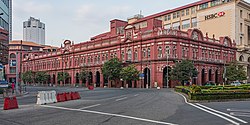 The historical Cargills & Millers building continues as the headquarters of Cargills
 -
 The Old Parliament Building near the Galle Face Green, now the Presidential Secretariat
 -


Culture
[edit]Annual cultural events and fairs
[edit]

Colombo's most popular festival is the celebration of Buddha's birth, enlightenment and death all falling on the same day.[73] In Sinhala this is known as Vesak.[73] During this festival, much of the city is decorated with lanterns, lights and special displays of light (known as thoran). The festival falls in mid-May and lasts a week. Many Sri Lankans visit the city to see the lantern competitions and decorations. During this week people distribute, rice, drinks and other food items for free in dunsal which means charity place. These dunsal are popular amongst visitors from the suburbs.
Since there is a large number of Muslims in Colombo. Eid Ul Fitr and Eid Ul Adha are two Islamic festivals that are celebrated in Colombo. Many businesses flourish during the eventual countdown for Eid Ul Fitr which is a major Islamic festival celebrated by Muslims after a month-long fasting. Colombo is generally very busy on the eve of the festivals as people do their last-minute shopping.
Christmas is another major festival. Although Sri Lanka's Christians make up only just over 7% of the population, Christmas is one of the island's biggest festivals. Most streets and commercial buildings light up from the beginning of December and festive sales begin at all shopping centres and department stores. Caroling and nativity plays are frequent sights during the season.
The Sinhalese and Hindu Aluth Awurudda' is a cultural event that takes place on 13 and 14 April. This is the celebration of the Sinhalese and Hindu new year. The festivities include many events and traditions that display a great deal of Sri Lankan culture. Several old clubs of the city give a glimpse of the British equestrian lifestyle; these include the Colombo Club, Orient Club, the 80 Club, and the Colombo Cricket Club.
Performing arts
[edit]_Mahinda_Rajapaksa_Theatre.JPG)
Colombo has several performing arts centres, which are popular for their musical and theatrical performances, including the Lionel Wendt Theatre, the Elphinstone, and Tower Hall, all of which were made for western-style productions. The Navarangahala found in the city is the country's first national theatre designed and built for Asian and local style musical and theatrical productions.
The Nelum Pokuna Mahinda Rajapaksa Theatre is a world-class theatre that opened in December 2011.[74] Designed in the form of the Lotus Pond in Polonnaruwa,[75][better source needed] the theatre is a major theatre destination.
Museums and art collections
[edit]The National Museum of Colombo, established on 1 January 1877 during the tenure of the British Colonial Governor Sir William Henry Gregory, is in the Cinnamon Gardens area.[76] The museum houses the crown jewels and throne of the last king of the kingdom of Kandy, Sri Vikrama Rajasinha.[77]
There is also the Colombo Dutch Museum detailing the Dutch colonial history of the country. Colombo does not boast a very big art gallery. There is a small collection of random Sri Lankan paintings at the Art Gallery in Green Path; next to it is the Natural History Museum.
Sports
[edit]
One of the most popular sports in Sri Lanka is cricket. The country emerged as champions of the 1996 Cricket World Cup and became runners up in 2007 and 2011. In the ICC World Twenty20 they became runners up in 2009 and 2012 and winners in 2014. The sport is played in parks, playgrounds, beaches and even in the streets. Colombo is the home for two of the country's most popular international cricket stadiums, Singhalese Sports Club's Cricket Stadium and R. Premadasa Stadium (named after late president Premadasa). Colombo Stars represents the city in Lanka Premier League.
Colombo has the distinction of being the only city in the world to have four cricket test venues in the past: Paikiasothy Saravanamuttu Stadium, Singhalese Sports Club Cricket Ground, Colombo Cricket Club Ground and Ranasinghe Premadasa Stadium. The Sugathadasa Stadium is an international standard stadium for athletics, swimming and football, also held the South Asian Games in 1991 and 2006. Situated in Colombo the Royal Colombo Golf Club is one of the oldest in Asia. Other sporting clubs in Colombo include Colombo Swimming Club, Colombo Rowing Club and the Yachting Association of Sri Lanka.
Rugby is also a popular sport at the club and school levels. Colombo has its local football team Colombo FC and the sport is being developed as a part of the FIFA Goal program.
The Colombo Port City is to include a new Formula One track, constructed in the vicinity of the Colombo Harbour. According to Dr Priyath Wickrama, the Chairman of the Sri Lanka Ports Authority, an eight-lane F1 track will "definitely" be a part of the New Port City. This would host the Sri Lankan Grand Prix.
Colombo Marathon is an internationally recognised marathon established in 1998.
Media
[edit]Almost all major media businesses in Sri Lanka operate from Colombo. The state media has its offices in Bullers Road and carries out regional transmissions from there. These include the Sri Lanka Broadcasting Corporation (SLBC), formerly known as Radio Ceylon, and the Sri Lanka Rupavahini Corporation. The SLBC is the oldest radio station in South Asia and the second oldest in the world. Many private broadcasting companies have their offices and transmission stations in or around Colombo. As with most metro areas, radio bands are highly utilised for radio communications. Some of the prominent radio stations broadcasting in the Colombo area are Sirasa FM, FM Derana, Hiru FM, Shakthi FM, Vettri FM, Sooriyan FM, Kiss FM, Lite FM, Yes FM, Gold FM, Sith FM, Y FM, E FM and many more.
Television networks operating in the Colombo metro area include the state-owned television broadcasting networks which are broadcast by the Rupavahini Corporation of Sri Lanka, broadcasting television in the official languages Sinhala and Tamil. English language television is also broadcast, more targeted to the demographics of the English speaking Sri Lankans, expatriate communities and tourists. There are as well several private operators. Many of the privately run television station networks were often based upon operational expansions of pre-existing commercial radio networks and broadcast infrastructure.
Twin towns and sister cities
[edit]| Country | City | State / Region | Since |
|---|---|---|---|
| Nepal | Biratnagar | Morang District | 1874 |
| Russia | Saint Petersburg | N/A | 1997 |
| China | Shanghai | N/A | 2003 |
| Mongolia | Ulaanbaatar | – | 2012 |
| Maldives | Malé | Kaafu Atoll | 2013 |
| Maldives | Maroshi | Shaviyani Atoll | 2015 |
Notable people
[edit]Gallery
[edit]-
 Colombo's colonial heritage is visible throughout the city, as in the historical Wolvendaal Church, established by the Dutch in 1749
 -
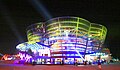 The Nelum Pokuna Theatre at night
 -
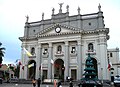
 The Town Hall of Colombo at night, it is the headquarters of the Colombo Municipal Council and the office of the Mayor of Colombo
 -
-
 Beira Lake and southern side of the Gangaramaya Temple
 -
 The Jami Ul-Alfar Mosque is one of the oldest Mosques in Colombo
 -
 Cathedral of Christ the Living Saviour is the seat of the Anglican Bishop of Colombo
 -
![The statue of Sir Charles Henry de Soysa at De Soysa-Liptons Circus, is the first of a native, in Colombo.[78]](//upload.wikimedia.org/wikipedia/commons/thumb/a/a9/CHstatue22.JPG/120px-CHstatue22.JPG) The statue of Sir Charles Henry de Soysa at De Soysa-Liptons Circus, is the first of a native, in Colombo.[78]
The statue of Sir Charles Henry de Soysa at De Soysa-Liptons Circus, is the first of a native, in Colombo.[78] -
 The Viharamahadevi Park, (formerly Victoria Park) is the oldest and largest park in Colombo
 -
 Built in 1857, the Old Colombo Lighthouse also known as the Colombo Fort Clock Tower is the oldest clock-tower
 -
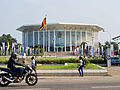 The BMICH Conference Hall
 -
 Ceylon bank headquarters and world trade center.
 -
 Galle Face Green
 -
 Arcade Independence Square shopping mall

_Mahinda_Rajapaksa_Theatre.JPG)


![The statue of Sir Charles Henry de Soysa at De Soysa-Liptons Circus, is the first of a native, in Colombo.[78]](https://en.wikipedia.org/wiki/File:CHstatue22.JPG)


.jpg)


See also
[edit]References
[edit]- ^ a b "A6 : Population by ethnicity and district according to Divisional Secretary's Division, 2012". Census of Population & Housing, 2011. Department of Census & Statistics, Sri Lanka. Archived from the original on 1 November 2016. Retrieved 12 April 2014.
- ^ "Colombo". Collins English Dictionary (13th ed.). HarperCollins. 2018. ISBN 978-0-008-28437-4.
- ^ "Colombo". Encyclopædia Britannica. Archived from the original on 6 March 2023. Retrieved 12 May 2020.
- ^ Kumarage A, Amal (1 November 2007). "Impacts of Transportation Infrastructure and Services on Urban Poverty and Land Development in Colombo, Sri Lanka" (PDF). Global Urban Development Volume 3 Issue 1. Archived from the original (PDF) on 4 March 2016. Retrieved 8 March 2015.
- ^ "The 10 Traits of Globally Fluent Metro Areas" (PDF). 2013. Brookings Institution. Archived from the original (PDF) on 2 April 2015. Retrieved 17 March 2015.
- ^ "Colombo: The Heartbeat of Sri Lanka/ Metro Colombo Urban Development Project". The World Bank. 21 March 2013. Archived from the original on 12 April 2015. Retrieved 17 March 2015.
- ^ "Turning Sri Lanka's Urban Vision into Policy and Action" (PDF). UN Habitat. p. 7. Archived from the original (PDF) on 4 March 2016.
- ^ "Colombo, The Famous Business Hub of Sri Lanka – Stories & Advice". Archived from the original on 20 December 2018. Retrieved 20 December 2018.
- ^ Jayewarden. "How Colombo Derived its Name". Archived from the original on 5 December 2008. Retrieved 18 January 2007.
- ^ a b c d "History of Colombo". Archived from the original on 2 December 2011. Retrieved 21 March 2007.
- ^ "Colombo – then and now". Padma Edirisinghe. The Sunday Observer. 14 February 2004. Archived from the original on 30 September 2007.
- ^ World Executive Colombo Hotels and City Guide Archived 2016-03-02 at the Wayback Machine
- ^ Indrapala, Karthigesu (2007). The evolution of an ethnic identity: The Tamils in Sri Lanka C. 300 BCE to C. 1200 CE. Colombo: Vijitha Yapa. p. 70. ISBN 978-955-1266-72-1.
- ^ Gair, James (1998). Studies in South Asian Linguistics. New York: Oxford University Press. p. 5. ISBN 978-0-19-509521-0.
- ^ John, Still (1996). Index to the Mahawansa:Together with Chronological Table of Wars and Genealogical Trees. AES. p. 85. ISBN 978-81-206-1203-7.
- ^ Prof. Manawadu, Samitha. "Cultural Routes of Sri Lanka As Extensions of International Itineraries : Identification of Their Impacts on Tangible & Intangible Heritage" (PDF). p. 3. Archived from the original (PDF) on 21 March 2016. Retrieved 17 January 2007.
- ^ a b c d "European Encroachment and Dominance:The Portuguese". Sri Lanka: A Country Study. Archived from the original on 5 October 2006. Retrieved 2 December 2006.
- ^ Ross, Russell R.; Savada, Andrea Matles (1990). Sri Lanka: A Country Study. Defence Dept., Army. p. 360. ISBN 978-0-16-024055-3.
- ^ a b "European Encroachment and Dominance: The Dutch". Sri Lanka: A Country study. Archived from the original on 5 October 2006. Retrieved 2 December 2006.
- ^ a b Ross, Russell R.; Savada, Andrea Matles (1990). Sri Lanka: A Country Study. Defense Dept., Army. p. 360. ISBN 978-0-16-024055-3.
- ^ "European Encroachment and Dominance: The British Replace the Dutch". Sri Lanka: A Country study. Archived from the original on 5 October 2006. Retrieved 2 December 2006.
- ^ a b c Adrian, Wijemanne (1996). War and Peace in Post-Colonial Ceylon 1948–1991. Orient Longman. p. 111. ISBN 978-81-250-0364-9.
- ^ "Administrative Districts of the Colombo Municipal Council". Colombo Municipal Council. Archived from the original on 6 January 2013. Retrieved 11 February 2013.[circular reference]
- ^ GoAbroad.com, Embassies located in Sri Lanka Archived 2016-03-02 at the Wayback Machine
- ^ a b The lake in the middle of Colombo Archived 2007-10-19 at the Wayback Machine, Lanka Library
- ^ 35th boat race and 31st Regatta: Oarsmen of Royal and S. Thomas' clash on Beira waters Archived 2014-02-19 at the Wayback Machine, Daily News, October 10, 2003
- ^ "Colombo weather". Archived from the original on 5 October 2009. Retrieved 2 December 2006.
- ^ "World Weather Information Service – Colombo". World Meteorological Organization. Archived from the original on 18 February 2017. Retrieved 19 November 2016.
- ^ "World Meteorological Organization Climate Normals for 1991-2020 — Colombo". National Oceanic and Atmospheric Administration. Archived from the original on 8 December 2024. Retrieved 3 January 2024.
- ^ "Colombo Climate Normals 1961–1990". National Oceanic and Atmospheric Administration (FTP). Retrieved 19 November 2016. (To view documents see Help:FTP)
- ^ "Klimatafel von Colombo (Kolamba) / Sri Lanka (Ceylon)" (PDF). Baseline climate means (1961–1990) from stations all over the world (in German). Deutscher Wetterdienst. Archived from the original (PDF) on 16 April 2019. Retrieved 19 November 2016.
- ^ "Gangaramaya Temple". John Keells Hotels Group. Archived from the original on 10 May 2012. Retrieved 30 April 2012.
- ^ "Department of Census and Statistics Sri Lanka – Population by ethnicity and district according to Divisional Secretary's Division, 2012". Archived from the original on 1 November 2016. Retrieved 12 April 2014.
- ^ "Department of Census and Statistics". Archived from the original on 10 June 2007. Retrieved 22 November 2016., Additional source "The case of Colombo, Sri Lanka" (PDF). Archived from the original on 26 December 2016. Retrieved 22 November 2016.
The totals are calculated through enumerations made from Colombo Divisional Secretariat and the Thimbirigasyaya Divisional Secretariat, which is also part of Colombo Municipal Council.
{{cite web}}: CS1 maint: bot: original URL status unknown (link) - ^ Port of Colombo Archived 2011-07-18 at the Wayback Machine. World Port Source.
- ^ "Department of Census and Statistics Sri Lanka – Population by divisional secretariat division, religion and sex 2012". Archived from the original on 1 November 2016. Retrieved 12 April 2014.
- ^ "Colombo Municipal Council". Archived from the original on 13 April 2018. Retrieved 13 April 2018.
- ^ Colombo UNP list rejected Archived 2015-10-16 at the Wayback Machine, BBC News, February 16, 2006
- ^ Independent group wins CMC Archived 2015-10-16 at the Wayback Machine, BBC News, May 21, 2006
- ^ Rotational mayors as Colombo gets trishaw driver as her first citizen Archived 2007-07-16 at the Wayback Machine, Sunday Times, May 28, 2006
- ^ "The Supreme Court of Sri Lanka". Justice Ministry. Archived from the original on 18 November 2011. Retrieved 22 November 2016.
- ^ "Ministries of Sri Lanka Government". Government of Sri Lanka. Archived from the original on 9 March 2007. Retrieved 22 November 2016.
- ^ "Prime Minister's Office, Sri Lanka". www.pmoffice.gov.lk. Archived from the original on 11 September 2023. Retrieved 6 February 2023.
- ^ a b "Colombo Economy". Archived from the original on 24 October 2013. Retrieved 29 December 2012.
- ^ "Press release 20010712" (PDF). CBSL. 10 July 2011. Archived from the original (PDF) on 22 July 2011. Retrieved 2 April 2013.
- ^ "Executive Summary The Colombo Metropolitan (CM) area" (PDF). Ministry of Defence & Urban Development. Archived from the original (PDF) on 10 August 2012. Retrieved 29 December 2012.
- ^ "World Airline Directory." Also ranked of the best land in the world of WWNEconomy Flight International. 14–20 March 1990 "Airlift International" 57 Archived 2011-08-09 at the Wayback Machine
- ^ Organizational Structure Archived 2007-08-27 at the Wayback Machine, Ministry of Defence, Sri Lanka
- ^ Gunawardena, Edward. "The drama behind the arrest of Sepala Eknayake". The Island-Saturday Magazine. Archived from the original on 20 January 2011.
- ^ "CNS Reports". Center for Nonproliferation Studies. Archived from the original on 3 October 2001. Retrieved 3 October 2001.
- ^ "Travel Warning, United States Department of State". Archived from the original on 22 September 2006. Retrieved 22 November 2016.
- ^ Jane's Sentinel examines the success of the LTTE in resisting the Sri Lankan forces Archived April 15, 2009, at the Wayback Machine[circular reference]
- ^ President orders SB's release Archived October 22, 2007, at the Wayback Machine, LankaNewspapers.com, February 16, 2006
- ^ "Colombo". lanka-houses.com. Archived from the original on 4 January 2013. Retrieved 29 December 2012.
- ^ "Cost of Living in Colombo, Sri Lanka – PropertyInLanka.com". Retrieved 31 March 2024.
- ^ Seibt, Sébastian (24 March 2019). "In Sri Lanka, the new Chinese Silk Road is a disappointment". France 24.
- ^ China 'Silk Road' Project in Sri Lanka Delayed as Beijing Toughens Stance
- ^ Wolf D. Hartmann, Wolfgang Maennig, Run Wang: Chinas neue Seidenstraße. (2017).
- ^ Jean-Marc F. Blanchard "China's Maritime Silk Road Initiative and South Asia" (2018) pp 55.
- ^ Sri Lanka 'key component' in 21st Century Maritime Silk Road: China
- ^ Hasintha Weragala, Things to do in Sri Lanka (27 November 2018). "Guide map of bus terminals in Colombo". thingstodoinsrilanla.lk. Archived from the original on 4 December 2018. Retrieved 27 November 2018.
- ^ "A Speedy and safe journey to Galle". Dailynews.lk. 16 August 2011. Archived from the original on 30 October 2013. Retrieved 1 January 2013.
- ^ Gamini Gunaratna, Sri Lanka News Paper by LankaPage.com (LLC) (7 November 2011). "Nearly half of the work completed on outer circular highway around Sri Lankan capital". Colombopage.com. Archived from the original on 3 September 2013. Retrieved 1 January 2013.
- ^ Tuticorin-Colombo ferry sets sail Archived 2016-10-03 at the Wayback Machine. Times of India. (2011-06-14).
- ^ "Princess Alexandra's Visit". Archived from the original on 13 April 2007. Retrieved 22 November 2016.
- ^ "Historical Overview of Education in Sri Lanka, The British Period: (1796–1948)". Archived from the original on 11 April 2011. Retrieved 22 November 2016.
- ^ a b Harsha, Aturupane; Paul Glewwe; Wisniewski Suzanne (July 2007). "The Impact of School Quality, Socio-Economic Factors and Child Health on Students' Academic Performance: Evidence from Sri Lankan Primary Schools" (PDF). Colombo: World Bank. Archived (PDF) from the original on 10 September 2008. Retrieved 27 July 2007.
- ^ Harsha, Aturupane; Paul Glewwe; Wisniewski Suzanne (February 2005). Treasures of the Education System in Sri Lanka: Restoring Performance, Expanding Opportunities and Enhancing Prospects (PDF). Colombo: World Bank. ISBN 978-955-8908-14-3. Archived (PDF) from the original on 10 September 2008. Retrieved 27 July 2007.
- ^ a b "History of the University of Colombo". Archived from the original on 14 October 2008. Retrieved 22 November 2016.
- ^ a b c d Faz (19 February 2006). "Colombo Fort". F's Place. Archived from the original on 22 December 2015. Retrieved 17 October 2011.
- ^ a b c d "Tintagel, Colombo". Red Dot Tours. Archived from the original on 12 December 2012. Retrieved 1 January 2013.
- ^ Ramerini, Marco. "Asia. Dutch Colonial Remains 16th-18th centuries". Colonial Voyage. Archived from the original on 21 February 2016. Retrieved 17 October 2011.
- ^ a b Venerable Mahinda. "Significance of Vesak". BuddhaNet. Archived from the original on 19 February 2007. Retrieved 19 February 2007.
- ^ "Nelum Pokuna". Daily Mirror. 15 December 2011. Archived from the original on 7 January 2012. Retrieved 15 December 2011.
- ^ Prins, Stephen. "A National Treasure". Archived from the original on 21 August 2011. Retrieved 17 May 2010.
- ^ "History of Colombo National Museum". Archived from the original on 28 September 2007. Retrieved 2 February 2007.
- ^ "History of Colombo National Museum". Retrieved 22 November 2016.[permanent dead link]
- ^ Ceylon, the Land of Eternal Charm, Ali Foad Toulba (Asian Educational Services) p.237 ISBN 9788120614949
Further reading
[edit] Definitions from Wiktionary
 Media from Commons
 News from Wikinews
 Quotations from Wikiquote
 Texts from Wikisource
 Textbooks from Wikibooks
 Resources from Wikiversity
 Travel information from Wikivoyage


The following books contain major components on Colombo:
- Changing Face of Colombo (1501–1972): Covering the Portuguese, Dutch and British Periods, by R.L. Brohier, 1984 (Lake House, Colombo)
- The Port of Colombo 1860–1939, K. Dharmasena, 1980 (Lake House, Colombo)
- Decolonizing Ceylon: Colonialism, Nationalism and the Politics of Space in Sri Lanka, by Nihal Perera, 1999 (Oxford University Press)
- the Essential guide for Colombo and its region, Philippe Fabry, Negombo, Viator Publications, 2011, 175 p., ISBN 978-955-8736-09-8
- The impact of the Tsunami on households and vulnerable groups in two districts in Sri Lanka : Galle and Colombo, Swarna Jayaweera, Centre for Women's Research, Colombo, 2005
- Patterns of Community Structure in Colombo, Sri Lanka, An investigation of Contemporary Urban Life in South Asia, Neville S. Arachchige-Don, University Press, Maryland, 1994
- Colombo, Carl Muller, Penguin Books, New Delhi, 1995
| History |  | ||||
|---|---|---|---|---|---|
| Government | |||||
| Geography | |||||
| Buildings and landmarks |
| ||||
| Culture | |||||
| Sports | |||||
| Education | |||||

Provincial capitals of Sri Lanka | ||
|---|---|---|
 | ||
| National capitals# |
|  |
|---|---|---|
| Municipal councils | ||
| Urban councils |
| |
Note: * also a Provincial capital, # also a Municipal council | ||

Colombo
View on GrokipediaEtymology
Linguistic origins and historical names
The name "Colombo" derives primarily from the ancient Sinhalese term kolamba, an old word signifying a "port" or "ferry," as referenced in the 13th-century Sinhala grammar Sidatsangarava.[5] This etymology aligns with the site's role as a longstanding harbor facilitating maritime trade, with roots traceable to the medieval Kotte Kingdom where it was known as Kolomtota, denoting the port area.[6] An alternative derivation posits origins in the classical Sinhala phrase kolon thota, meaning "port on the Kelani River," reflecting the geographical proximity to the river's estuary and its utility for ferrying goods.[7] Portuguese explorers adapted this to "Colombo" upon their arrival in 1505, marking the first European recording of the name in written accounts of the region.[7] Early references in non-local records include those from Arab traders, who by the 8th century CE identified the vicinity as a key cinnamon export hub, though without direct naming consistency; some Tamil traditions recall variants like Kollam-patuna or Ko'lamba, suggesting possible Dravidian linguistic overlays on the Sinhalese base, yet Sinhala sources provide the most direct philological linkage.[8] Claims of Sanskrit influence, such as through terms like kolamba implying a leafy grove or ford, remain speculative and lack primary textual corroboration beyond shared Indo-Aryan roots in regional nomenclature.[9]History
Pre-colonial and early settlement
The region of modern Colombo, situated on Sri Lanka's southwestern coast amid mangrove swamps and river estuaries, featured small indigenous settlements primarily consisting of fishing communities and spice gatherers during the protohistoric and early historic periods. Archaeological evidence from broader Sri Lankan coastal sites indicates human activity linked to Iron Age developments around the 3rd century BC, including trade-oriented ports with artifacts paralleling those at Godavaya, where Indo-Roman pottery and coins attest to early maritime exchanges. However, direct excavations in urbanized Colombo reveal limited pre-3rd-century AD remains due to later overbuilding, suggesting the area supported sparse, subsistence-based habitation under the influence of inland Sinhalese polities.[10][11] Under the Anuradhapura Kingdom (c. 377 BC–1017 AD), the Colombo vicinity contributed to island-wide trade networks as a secondary coastal outpost, facilitating the export of cinnamon harvested from adjacent wet-zone forests, alongside gems mined inland and elephants captured for regional markets. These commodities were transported via riverine routes to larger emporia, underscoring the area's economic integration into Sinhalese hydraulic and mercantile systems without developing into a primary urban center. The Periplus of the Erythraean Sea (1st century AD) documents Taprobane (Sri Lanka) as a source of pearls, gems, tortoise shell, and spices traded with Roman merchants, implying southwestern ports like those near Colombo handled ancillary shipments amid dominant northern hubs such as Mantai.[12][13] During the Polonnaruwa Kingdom (1056–1232 AD), the region sustained its role in cinnamon procurement and elephant exports, with interactions expanding to Arab traders who frequented southwestern anchorages for spices before establishing more formal networks. These exchanges relied on indigenous Sinhalese oversight, with no evidence of large-scale foreign colonization, maintaining the area's character as a resource-extraction zone rather than a fortified settlement until the rise of the Kotte Kingdom in the 14th century.[12][14]Portuguese colonial period (1518–1658)
The Portuguese, following their initial exploratory voyages to Ceylon in 1505, received permission from the king of Kotte to erect a wooden fort in Colombo in 1518, marking the onset of formalized colonial control over the harbor as a strategic trading entrepôt. This structure, initially modest and later reinforced with stone ramparts, safeguarded shipments of cinnamon, elephants, gems, and areca nuts bound for Lisbon, while enabling the enforcement of trade concessions that bypassed local intermediaries.[15][16] Colombo's role expanded as the Portuguese imposed a royal monopoly on cinnamon production and export, compelling Sinhalese peasants through quotas and punitive oversight to harvest and peel bark from coastal groves, often under duress that blurred into forced labor practices amid inadequate compensation. Jesuit and Franciscan missionaries, arriving from the 1540s, proselytized aggressively, constructing chapels within the fort precincts and offering exemptions from corvée duties to converts, though mass conversions remained limited outside urban enclaves due to entrenched Buddhist loyalties.[17][18][19] Tensions with the Kotte kingdom escalated into intermittent warfare, as rival princes exploited dynastic fractures—exemplified by the 1521 fratricidal partition of Kotte—to ally against or submit to Portuguese captains, who razed villages and extracted tribute to quell uprisings. By the mid-16th century, Colombo had evolved into a garrisoned hub with rudimentary infrastructure, including warehouses and a customs house, yet this development served extractive ends, yielding annual cinnamon cargoes valued at over 6,000 cruzados while fueling local resistance that tied down Portuguese forces.[20][21]Dutch colonial period (1658–1796)
The Dutch East India Company (VOC) forces, allied temporarily with the Kingdom of Kandy, besieged Colombo Fort and captured it from the Portuguese on May 12, 1656, after a seven-month siege, marking the beginning of Dutch control over the city despite the formal end of Portuguese presence island-wide in 1658.[22][23] Unlike the Portuguese emphasis on religious conversion and fortification for territorial dominance, the Dutch prioritized commercial extraction, leveraging Colombo as a key entrepôt for exporting spices while minimizing costly missionary endeavors.[24][25] The VOC established a monopoly on cinnamon production and trade in Ceylon's southwestern coastal regions, which the Dutch expanded after 1658 by controlling cinnamon-growing lands and export points, generating substantial revenues that funded further infrastructure but often through forced labor systems like rajakariya.[25] This commerce-oriented approach yielded efficiency gains over Portuguese mismanagement, as Dutch administrative records and standardized shipping routes increased spice exports to Europe, with cinnamon comprising a primary commodity handled via Colombo's harbor.[26] Post-capture, the Dutch rebuilt Colombo's fortifications, transforming the Portuguese-era bastions into a structured military quarter in the western fort area while designating eastern spaces for civilian and commercial use, enhancing defense against potential Kandy incursions.[27] They also initiated canal networks, including extensions from the western system that linked Colombo to inland areas, facilitating spice transport and irrigation but primarily serving VOC logistical needs over local welfare.[25] The Dutch introduced Roman-Dutch law as the basis for civil administration in captured territories like Colombo, codifying property, inheritance, and contract rules derived from 17th-century Dutch jurisprudence blended with Roman principles, elements of which persisted in Sri Lankan legal practice post-independence due to their pragmatic applicability in colonial commerce.[28] Demographic changes included the settlement of Malay soldiers and families recruited by the VOC from Indonesian territories, who participated in anti-Portuguese campaigns such as the Colombo siege and numbered around 2,200 by the early 18th century, forming a loyal garrison community in and around the city that bolstered Dutch military presence with reduced reliance on European troops.[29] This influx contrasted with Portuguese-era forced conversions, as Dutch policy favored economic utility over evangelization, leading to less disruption of local Buddhist and Hindu practices in urban Colombo.[25]British colonial period (1796–1948)
The British East India Company forces, under the direction of the Madras Presidency, captured Colombo from the Dutch on 15 February 1796 after a brief siege, with Dutch Governor van Angelbeck surrendering the coastal territories including the fort and harbor.[30] This marked the transition of Ceylon to British administration, initially as a temporary conquest amid the Napoleonic Wars, with Colombo established as the primary administrative and commercial center.[31] The British retained the Dutch-era fortifications in the Fort area initially for defense but began demolishing walls and bastions from the 1860s onward to enable urban expansion, paving streets like York Street and constructing administrative buildings, barracks, and warehouses to support growing trade.[32] By the late 19th century, the Fort had evolved into a bustling European-style quarter with clock towers, hotels, and offices, reflecting colonial priorities of control and commerce over indigenous settlement patterns. 
![Independence Memorial Hall, Colombo][float-right] Upon achieving independence from Britain on 4 February 1948, Ceylon (renamed Sri Lanka in 1972) retained Colombo as its executive, judicial, and commercial capital, serving as the focal point for early nation-building efforts amid a plantation-based export economy dominated by tea, rubber, and coconut.[41] The city's port handled over 90% of the island's trade, underscoring its role in sustaining foreign exchange earnings essential for post-colonial development, though urban infrastructure strained under population pressures from rural-urban migration.[42] The 1956 election of S.W.R.D. Bandaranaike's Sri Lanka Freedom Party marked a pivot toward nationalist and socialist policies, including the Official Language Act—commonly known as the Sinhala Only Act—which designated Sinhala as the sole official language, sidelining Tamil and English despite Tamil speakers comprising about 20% of the population.[43] This measure, intended to empower the Sinhalese majority, triggered immediate protests in Colombo and galvanized Tamil opposition, fostering ethnic polarization that manifested in urban demonstrations and a gradual erosion of merit-based civil service recruitment favoring Sinhala speakers from rural areas.[44] Subsequent governments under Sirimavo Bandaranaike expanded nationalizations, seizing foreign-owned tea estates in 1971 and banks like the Bank of Ceylon's expansion into private institutions by 1968, aiming for self-reliance but resulting in bureaucratic inefficiencies, production shortfalls, and market distortions that hampered Colombo's commercial dynamism.[45] These closed-economy strategies, coupled with import controls, contributed to chronic shortages and a GDP growth averaging under 3% annually from 1956 to 1977, exacerbating urban unemployment rates that reached 20-25% among educated youth by the early 1970s.[46] Colombo's urban fabric expanded modestly, with the metropolitan population rising from approximately 500,000 in 1946 to over 1 million by 1981, driven by industrial hubs like textiles and food processing but constrained by land reforms and state-led housing initiatives that prioritized rural equity over city planning. Policy failures culminated in the 1971 Janatha Vimukthi Peramuna (JVP) insurrection, where radicalized Sinhalese youth, disillusioned by job scarcity and perceived elite capture, launched coordinated attacks on police stations to seize arms, reflecting causal links between socialist distortions, youth bulge demographics, and ideological indoctrination rather than mere economic grievance alone.[47] The uprising, suppressed within months with over 10,000 arrests, highlighted Colombo's vulnerability as a governance nerve center, prompting fortified security measures. In 1978, amid decongesting efforts, Sri Jayawardenepura Kotte was designated the administrative capital, preserving Colombo's commercial primacy while relocating parliamentary functions by 1982.[48]Civil War era and ethnic conflicts (1983–2009)
The anti-Tamil riots known as Black July erupted in Colombo on July 24, 1983, following the Liberation Tigers of Tamil Eelam (LTTE) ambush that killed 13 Sri Lankan soldiers on July 23 in Jaffna, precipitating widespread violence against Tamil civilians across the city and country. Mobs, often abetted by elements of the security forces and Sinhalese nationalist groups, targeted Tamil-owned businesses, homes, and individuals, resulting in an estimated 300 to 3,000 Tamil deaths nationwide, with Colombo bearing a significant portion of the destruction including the burning of Tamil commercial districts like Pettah. The riots displaced over 150,000 Tamils from Colombo, many fleeing to refugee camps or abroad, and inflicted economic damage valued at approximately $300 million through the systematic looting and arson of Tamil enterprises. This event marked the onset of intensified ethnic conflict, transforming Colombo from a multicultural hub into a flashpoint for retaliatory LTTE operations.[49][50] Throughout the civil war, the LTTE designated Colombo as a primary target for suicide bombings and truck attacks aimed at undermining government control and Sinhalese morale, conducting over 200 such operations nationwide by 2009, with dozens striking the capital directly. Notable incidents included the January 31, 1996, truck bombing of the Central Bank of Sri Lanka, where an LTTE operative rammed a explosive-laden vehicle into the complex, killing 91 civilians and injuring over 1,400 while causing $42 million in structural damage to the financial district. Other attacks, such as the July 1997 Aranayake bus bombing en route to Colombo (killing 40) and multiple 2006-2008 suicide strikes on military and civilian targets in the city, contributed to hundreds of civilian deaths in Colombo alone, with LTTE tactics prioritizing high-casualty urban assaults to compensate for battlefield losses. These operations, documented in international reports, reflected the LTTE's strategy of asymmetric warfare, though they often blurred lines between military and civilian targets, exacerbating ethnic animosities.[51][52][53] In response, the Sri Lankan government imposed stringent security measures in Colombo, including pervasive checkpoints, identity verification for Tamils, vehicle searches to counter undercarriage bombs, and frequent curfews following major attacks, which militarized daily life and restricted movement. These countermeasures, while reducing some attack frequencies, led to temporary demographic shifts as internally displaced persons (IDPs)—primarily Tamils fleeing northern fighting—surged into Colombo, swelling urban slums and straining housing and services, with over 100,000 IDPs registered in the Western Province by the mid-2000s before partial relocations. Economic activity in Colombo suffered recurrent disruptions, with curfews halting commerce for days after bombings like the 1996 Central Bank incident, contributing to broader war-related losses estimated at billions in GDP nationwide, though Colombo's port and financial sectors remained vital despite vulnerabilities. By 2009, as LTTE operations waned, these measures had fortified the city but at the cost of civil liberties and ethnic trust.[54][55][56]Post-war reconstruction and economic challenges (2009–present)
Following the conclusion of the Sri Lankan civil war in May 2009, Colombo underwent accelerated urban reconstruction and infrastructure expansion to bolster its role as the commercial capital. Key initiatives included the Colombo Port City project, announced in 2011 and commencing reclamation works in September 2014, which created 269 hectares of artificial land for mixed-use development, financed primarily by China Harbour Engineering Company under a $1.4 billion investment.[57] Complementary efforts encompassed high-rise constructions in the central business district and enhancements to connectivity, such as the Colombo-Katunayake Expressway extensions, driving rapid urbanization with built-up areas expanding significantly post-2009 due to foreign capital inflows.[58] Tourism recovery further supported economic momentum, with Colombo serving as the primary gateway; national arrivals surged from 447,140 in 2009 to 2,333,796 by 2018, boosting hotel developments and service sectors in the city.[59] These advancements, however, coincided with accumulating fiscal strains from debt-financed projects, mirroring national trends where external borrowings for infrastructure escalated. Chinese loans, constituting about 10% of Sri Lanka's total foreign debt by 2021 but tied to high-profile ventures like Port City, exemplified the reliance on opaque financing that prioritized prestige over viability, contributing to overall debt sustainability issues alongside domestic policy errors such as 2019 tax reductions that widened deficits.[60] By early 2022, Colombo faced dire shortages in essentials like fuel and electricity amid forex reserves dropping below $50 million, precipitating the country's first sovereign default on April 12, 2022, with $51 billion in external obligations restructured amid GDP contraction of 7.8% that year.[61] Urban vulnerabilities amplified the crisis, as the city's dense population grappled with inflation exceeding 70% and supply chain disruptions.[62] Public discontent peaked in the Aragalaya movement, igniting on March 31, 2022, at Galle Face Green in Colombo, where protesters decried elite corruption, fiscal mismanagement, and the Rajapaksa family's influence, leading to widespread demonstrations that forced President Gotabaya Rajapaksa's resignation on July 13 after the storming of his official residence.[63] The protests highlighted systemic failures in governance, including nepotism and unsustainable borrowing, rather than attributing the crisis solely to external lenders, as evidenced by domestic revenue shortfalls predating heavy Chinese engagement.[64] The 2022 upheaval paved the way for political realignment, culminating in the September 21, 2024, presidential election where National People's Power (NPP) leader Anura Kumara Dissanayake secured 42% of votes, defeating establishment candidates amid vows to combat corruption and renegotiate debts.[65] His coalition's subsequent parliamentary triumph on November 14, 2024, capturing 159 seats, reflected Colombo's electorate's rejection of prior regimes, enabling reforms like anti-graft probes and fiscal stabilization, though implementation faces hurdles from entrenched interests and lingering debt burdens projected to require $5-6 billion annually in servicing post-restructuring.[66][67] By 2025, early NPP measures have stabilized inflation below 5%, but Colombo's reconstruction legacy underscores the tension between ambitious development and prudent economics.[68]Geography
Location, topography, and urban layout
Colombo lies on the southwestern coast of Sri Lanka at coordinates 6°56′N 79°51′E, positioned at the delta of the Kelani River as it discharges into the Indian Ocean.[69][70] The city center stands approximately 32 kilometers south of Bandaranaike International Airport, facilitating connectivity while exposing the urban expanse to riverine influences from the north. Its coastal alignment spans roughly 10 kilometers, encompassing harbor facilities and beaches that define its maritime orientation.[71] The topography consists of a low-lying alluvial plain, with most areas elevated less than 5 meters above mean sea level, rendering the terrain predominantly flat and prone to waterlogging.[72] This configuration, coupled with subsidence in reclaimed zones, heightens susceptibility to inundation, as evidenced by recurrent flooding that submerges up to 20% of the municipal area during peak events.[73] Colombo's urban layout is organized into 15 administrative divisions under the Colombo Municipal Council, covering 37 square kilometers, with zones such as Fort (commercial hub) and Cinnamon Gardens (diplomatic enclave) exemplifying functional segregation.[74] Population density in core districts averages 24,000 persons per square kilometer, surpassing 40,000 per square kilometer in high-density pockets like Pettah, straining infrastructure amid constrained topography.[75] The adjacent Colombo Port City, comprising 269 hectares of reclaimed land from marine sediments, extends the layout seaward but elevates flood exposure, with modeling indicating amplified surge penetration under projected sea-level increments of 0.5 meters by 2100.[76]Climate and environmental factors
Colombo features a tropical monsoon climate (Köppen classification Am), with consistently high temperatures averaging between 27°C and 31°C throughout the year and little diurnal or seasonal variation due to its equatorial proximity.[77] Relative humidity remains elevated at 75-90%, contributing to a muggy atmosphere, while average annual sunshine totals around 2,500 hours.[78] Precipitation totals approximately 2,387 mm annually, distributed bimodally across two monsoon periods: the Southwest monsoon (Yala), delivering heavy rains from May to September (peaking at 300-400 mm monthly), and the Northeast monsoon (Maha), from October to January (with November often seeing over 200 mm). [77] Drier inter-monsoon phases occur in February-March and briefly in January-February, though isolated showers persist year-round due to convective activity.[78] Flooding poses a recurrent environmental hazard, driven by intense monsoon downpours overwhelming the city's antiquated drainage infrastructure and low-lying topography, compounded by upstream siltation in the Kelani River basin. The 2010 event, triggered by over 440 mm of rain in a single day on November 10, inundated low-income areas, displacing more than 213,000 residents and causing at least 50 deaths citywide.[79] A comparable 2020 flood episode, amid prolonged Northeast monsoon rains, affected tens of thousands in Colombo's suburbs, with damages exceeding prior events due to clogged canals from urban waste.[80] These incidents highlight causal factors like impervious surface expansion—reducing natural infiltration by up to 50% in densified zones—over broader climatic shifts.[81] Urban heat island intensification has emerged post-2000 from accelerated concretization and vegetation loss, elevating local surface temperatures beyond regional baselines. Landsat-derived analyses indicate a rise in "very hot" land surface spots from 30.3% of the metropolitan area in 1997 to 37.2% by 2017, correlating with a 20-30% increase in built-up cover that traps heat via reduced evapotranspiration.[82] Ground observations post-2000 confirm mean air temperatures 1-2°C higher in central Colombo versus peri-urban greenspaces, attributable to anthropogenic landscape alterations rather than isolated meteorological variance.[83] Mitigation efforts, such as wetland restoration, have shown limited efficacy against these localized thermal gradients without addressing core drainage and land-use deficiencies.[84]Demographics
Population size and growth trends
The population of Colombo's city proper, encompassing the Colombo Municipal Council area of approximately 37 square kilometers, was recorded at 561,314 in the 2012 census conducted by Sri Lanka's Department of Census and Statistics.[85] Estimates for 2025 place this figure at around 648,000, reflecting modest urban expansion driven by internal migration and natural increase.[86] The broader Colombo metropolitan region, including adjacent suburbs in the Western Province such as Dehiwala-Mount Lavinia and Colombo District, is estimated to house about 5.6 million people, accounting for over a quarter of Sri Lanka's total population.[87] Annual population growth in Colombo has averaged approximately 0.8% since 2012, lower than pre-war rates due to decelerating fertility and net out-migration amid economic pressures, as extrapolated from district-level census data showing Colombo District's population rising from 2.32 million in 2012 to 2.37 million in the 2024 preliminary census.[88] [89] This contrasts with higher growth in the post-civil war period (2009–2012), when rural-to-urban migration from war-affected northern and eastern provinces boosted Colombo's influx by an estimated 5–7% through internal relocation for employment and reconstruction opportunities.[85] The 2022 economic crisis reversed these trends, prompting significant out-migration from Colombo, with over 1 million Sri Lankans departing the country for foreign employment or relocation—many originating from urban centers like Colombo—leading to a temporary dip in local growth rates to near zero in affected demographics.[90] Recovery has been uneven, with remittances partially offsetting losses but failing to fully restore pre-crisis inflows. High population density in the city proper, exceeding 17,000 persons per square kilometer based on 2012 census baselines and subsequent projections, has exacerbated housing shortages, estimated at 27,000 units in 2022 due to supply lagging demand by 3 percentage points annually.[91] [85] These pressures highlight urban-rural dynamics, where Colombo continues to serve as a magnet for provincial labor despite periodic reversals.Ethnic, linguistic, and religious composition
Colombo exhibits a more diverse ethnic makeup than the national average due to its historical role as a trading port attracting migrants from various groups. In the Colombo district, which encompasses the city and immediate suburbs, the 2012 census recorded Sinhalese at 76.5%, Sri Lankan Tamils at 10.1%, Sri Lankan Moors at 10.7%, Indian Tamils at 1.0%, and other groups including Burghers and Malays at 1.7%.[92] Within Colombo city proper, however, Sinhalese representation is lower, estimated at around 41-44%, with Tamils (combining Sri Lankan and Indian origins) comprising approximately 25-30% and Moors 20-28%, reflecting concentrated urban settlements of minority communities predating independence.[93] These proportions have contributed to Colombo's cosmopolitan character but also to episodic frictions, as minority enclaves in areas like Wellawatte and Dehiwala facilitate parallel social structures.| Ethnic Group | Percentage (Colombo District, 2012) |
|---|---|
| Sinhalese | 76.5% |
| Sri Lankan Tamils | 10.1% |
| Sri Lankan Moors | 10.7% |
| Indian Tamils | 1.0% |
| Others | 1.7% |
Government and Politics
Local administration structure
The Colombo Municipal Council (CMC) functions as the principal local authority overseeing urban governance in the city, headed by an elected mayor and composed of councillors representing designated electoral divisions. The mayor, responsible for executive leadership, presides over council meetings and directs key municipal functions, including public health, sanitation, and urban maintenance. In June 2025, Vraie Cally Balthazaar of the National People's Power (NPP) was elected as mayor, following the party's strong performance in the local government elections held earlier that year.[98][99] The CMC operates with an annual revenue of approximately LKR 30 billion, funding services such as waste collection and street maintenance, though execution often faces practical hurdles.[100] Municipal responsibilities are partially decentralized, with water supply managed by the National Water Supply and Drainage Board at the national level and major road developments coordinated through the Road Development Authority alongside provincial council allocations. This fragmented structure has contributed to inefficiencies, notably in waste management, where chronic overloads and poor site oversight led to the 2017 Meethotamulla landfill collapse, killing at least 32 residents and exposing lapses in regulatory enforcement and contract monitoring.[101][102][103] Corruption allegations, including bribe schemes for waste diversion and favoritism in disposal contracts, have further hampered operations, as documented in investigations into local authority practices.[104][105] The NPP's decisive gains in the 2025 local elections, securing the mayoralty and a majority of council seats in Colombo, underscore public discontent with preceding administrations' handling of these service delivery failures, prioritizing reform in governance mechanics amid ongoing urban challenges.[106][107]Status as commercial capital and political role
Colombo functions as Sri Lanka's executive and judicial capital, accommodating the presidential residence at Temple Trees, the Supreme Court, and key administrative offices, while the legislative capital resides in Sri Jayawardenepura Kotte.[108][109] In 1982, the Parliament relocated from its original building in Colombo's Galle Face Green to a new complex in Kotte, approximately 20 kilometers southeast, as part of a decongestation strategy to reduce urban overcrowding and distribute governance functions amid rapid post-independence population growth.[110] This administrative division reflects efforts to mitigate Colombo's infrastructural strain, though it has introduced coordination challenges between dispersed government branches.[111] As the de facto commercial capital, Colombo hosts the Central Bank of Sri Lanka's headquarters at No. 30 Janadhipathi Mawatha in the Fort area, overseeing monetary policy and financial regulation for the nation.[112] The Colombo Stock Exchange operates from the World Trade Center in Echelon Square, facilitating equity and debt trading that underpins much of the country's capital markets.[113] The Port of Colombo, one of South Asia's busiest transshipment hubs, drives maritime trade, while clusters of foreign and domestic banks concentrate here, solidifying its role as the financial nerve center. The Western Province, encompassing Colombo, generated 43.7% of Sri Lanka's nominal GDP in 2023, with the city's metropolitan area dominating provincial output through services, logistics, and commerce—far exceeding other regions despite the capital's decentralization.[114][115] Colombo's political prominence has fueled tensions, notably during the 2022 economic crisis protests, where demonstrators targeted Temple Trees as a symbol of executive power. On July 9, 2022, crowds breached the residence's perimeter amid widespread unrest over fuel shortages and debt defaults, highlighting the city's centrality in national political expression despite legislative relocation.[116] Earlier clashes on May 9, 2022, saw protesters attempt to storm the site, resulting in evacuations and underscoring administrative vulnerabilities in maintaining order within the commercial-political hub.[117] These events exposed inefficiencies in the bifurcated capital structure, as executive functions remained exposed in densely populated Colombo while legislative processes operated remotely.[118]Recent political shifts and elections (up to 2025)
In the aftermath of the 2022 Aragalaya protests, which originated in Colombo's Galle Face Green and exposed entrenched corruption and fiscal mismanagement under the Rajapaksa regime, Sri Lankan politics underwent a profound anti-establishment shift. These demonstrations, driven by public outrage over fuel shortages, inflation exceeding 70% in mid-2022, and elite capture of state resources, culminated in President Gotabaya Rajapaksa's resignation on July 14, 2022, paving the way for demands for systemic accountability that resonated strongly in urban centers like Colombo.[119][63] This momentum propelled the National People's Power (NPP), led by Anura Kumara Dissanayake, to victory in the presidential election on September 21, 2024, where Dissanayake garnered 42.02% of votes in the decisive second preferential count, defeating establishment candidates Sajith Premadasa and Ranil Wickremesinghe.[120] The NPP's platform emphasized anti-corruption probes into crony networks, asset recovery from politically connected defaults, and governance reforms, directly addressing Aragalaya's grievances against nepotism and policy failures that ballooned public debt to 128% of GDP by 2022.[121] In Colombo, this national pivot amplified calls for municipal transparency, given the city's role as the epicenter of protest activity and its exposure to crisis-induced urban decay. The NPP consolidated power in the snap parliamentary election on November 14, 2024, securing 159 of 225 seats—a supermajority enabling unilateral constitutional changes and investigations into past graft.[66] Voter turnout reached 79%, with urban Colombo districts showing pronounced swings against traditional parties like the Sri Lanka Podujana Peramuna (SLPP), reflecting rejection of dynastic politics tied to the 2022 default.[122] Local government elections on May 6, 2025, extended this trend to Colombo, where the NPP won 48 of the Colombo Municipal Council's 60 seats, falling just short of an absolute majority but forming alliances to install NPP nominee Vraie Cally Balthazaar as mayor on June 16, 2025.[123] This urban sweep, amid a national NPP control of 192 local councils via pragmatic pacts, signaled voter fatigue with cronyism in city administration, including scandals over waste management contracts and land grabs.[124] Policy debates have since intensified over sustaining IMF reforms—under which Sri Lanka's debt service was restructured to $12.5 billion in long-term bonds by late 2024, stabilizing external obligations at 4.3% of GDP annually—versus expanding welfare to mitigate Colombo's 15-20% urban poverty rates, with critics warning that populist deviations risk reigniting fiscal instability.[125]Economy
Major economic sectors and contributions
Colombo, as Sri Lanka's commercial capital, anchors the national economy, with the Western Province—including the city—accounting for 43.7% of the country's nominal GDP in 2023.[114] The services sector predominates, contributing approximately 60% to GDP through finance, information technology, and related activities concentrated in the urban core.[126] Financial institutions and IT services, including business process outsourcing, leverage Colombo's status as a regional hub to drive export-oriented growth. Manufacturing represents about 20% of economic output, with apparel and gem processing as leading subsectors. The garment industry, a cornerstone of industrial activity, generates substantial export revenue, accounting for roughly 7% of national GDP through ready-made clothing production in and around the city.[127] Gem trading and cutting, centered in nearby Peliyagoda, further bolsters manufacturing contributions via high-value exports.[128] The Port of Colombo underpins trade-dependent sectors by handling a record 7.78 million twenty-foot equivalent units (TEUs) in 2024, enhancing efficiency as a transshipment gateway.[129] Tourism complements services, with Colombo capturing inflows from Sri Lanka's 2.05 million international visitors in 2024, primarily through port arrivals and urban attractions.[130] Foreign direct investment highlights port-related expansion, exemplified by the Adani-backed Colombo West International Terminal, which delivered $229 million in inflows during the first nine months of 2025, the largest single FDI source that year.[131] The informal economy pervades urban employment at around 36-40%, while pre-crisis urban poverty affected approximately 5% of the population.[132]Impacts of the 2022 economic crisis and subsequent recovery
The 2022 Sri Lankan economic crisis, marked by a sovereign default on external debt obligations in April 2022 amid depleted foreign reserves, profoundly disrupted Colombo's role as the commercial capital. Precipitating factors included chronic fiscal mismanagement, such as revenue shortfalls from pre-crisis tax cuts and the 2021 organic fertilizer ban that slashed agricultural output by up to 40%, compounding import dependency and reserve erosion from COVID-19 tourism losses. In Colombo, these dynamics triggered acute shortages of fuel, electricity, and essentials, halting manufacturing and logistics operations; power cuts extended up to 13 hours daily in early 2022, crippling businesses reliant on consistent supply. Inflation peaked at 69.8% in September 2022, devastating urban retail, real estate, and service sectors by eroding purchasing power and prompting widespread closures, with small enterprises in areas like Pettah and Fort reporting over 30% shutdowns due to input cost surges and credit contraction.[133][134][135] Unemployment in Colombo's urban workforce surged from around 5% pre-crisis to over 10% by mid-2022, as tourism—accounting for significant hotel and hospitality jobs—saw arrivals plummet to under 1 million annually, idling capacity in the city's coastal districts. The crisis amplified inequality, with low-income residents facing food insecurity rates exceeding 25% in Colombo slums, while elite-connected firms accessed limited credit lines, fostering perceptions of uneven hardship distribution. Protests epicentered in Colombo's Galle Face Green from March 2022 onward further paralyzed central business districts, deterring investment and exacerbating a 7.8% GDP contraction nationally, with Colombo's commercial output mirroring this decline through reduced port throughput and export processing.[136][137][138] Recovery gained traction post the IMF's $2.9 billion Extended Fund Facility approval on March 20, 2023, which mandated fiscal consolidation, debt restructuring, and structural reforms including utility price hikes and reserve rebuilding. Colombo's economy rebounded with 5% national growth in 2024, driven by tourism arrivals doubling to 2 million—bolstering hotel occupancy in the city to 60-70%—and Port of Colombo transshipment volumes rising 10% via efficiency upgrades and rerouted global trade. Foreign direct investment inflows accelerated to $1 billion in 2024, favoring Indian-led projects like Adani Group's $700 million Colombo port terminal expansion over stalled Chinese initiatives, signaling a geopolitical pivot toward diversified partnerships. Inflation stabilized below 5% by late 2024 through monetary tightening and import liberalization, restoring business confidence and enabling real estate restarts in high-rises along the Galle Road corridor.[139][140] Despite these advances, recovery remains fragile and incomplete in Colombo, with 2025 growth projected at 4.6% amid scarring effects like elevated public debt at 110% of GDP and persistent urban poverty affecting 15-20% of households. Austerity measures under the IMF program raised unemployment to 8.3% nationally in 2023 before partial easing, disproportionately impacting Colombo's informal labor market, while criticisms highlight elite capture in FDI benefits and inadequate social safety nets exacerbating inequality. Structural reforms, including tax base broadening and SOE privatization, have spurred remittances and apparel exports from Colombo's industrial zones, yet risks from global slowdowns and incomplete debt deals with bondholders persist, underscoring the need for sustained productivity gains to avoid relapse.[141][142][143]Law Enforcement and Crime
Policing institutions and operations
The Sri Lanka Police maintains its national headquarters in Colombo 1, serving as the central command for law enforcement operations across the country.[144] The force operates specialized units, including the Criminal Investigation Department (CID), which conducts probes into serious offenses such as organized crime and cross-border criminal activities.[145] Following operational lapses exposed by the 2019 Easter Sunday bombings in Colombo and other sites, the police pursued enhancements in surveillance and community outreach, including the deployment of CCTV systems in high-risk urban zones like Fort.[146] These measures aimed to bolster real-time monitoring and response capabilities in the capital's commercial districts, though implementation has encountered setbacks, exemplified by the reported theft of seven CCTV cameras from the old Police Headquarters premises in January 2025.[146] Persistent challenges undermine effectiveness, including documented political interference that politicizes postings and investigations, eroding institutional independence.[147] Understaffing exacerbates strains in Colombo's high-density areas, with the force facing a shortfall of approximately 30,000 officers as of August 2024, limiting patrol coverage and rapid incident response despite recruitment drives for 5,000 additional personnel announced in July 2025.[148][149]Crime patterns, rates, and societal impacts
Colombo exhibits relatively low homicide rates compared to global urban averages, with Sri Lanka's national intentional homicide rate standing at approximately 2.3 per 100,000 population as of recent available data, though urban concentrations in the capital likely elevate localized risks due to density and inequality.[150] Property crimes, including theft, have shown upward trends following the 2022 economic crisis, exacerbated by widespread poverty and unemployment, which strained household resilience and increased opportunistic offenses in densely populated areas.[151] Drug trafficking represents a persistent organized crime pattern, leveraging Colombo's strategic port for trans-shipment of heroin, cocaine, and synthetics along Indian Ocean routes, with major seizures underscoring the harbor's role in regional networks despite enforcement efforts.[152][151] Gang-related violence clusters in Colombo's slums and low-income settlements, where economic marginalization fosters turf disputes over illicit trades like narcotics and extortion, often intersecting with ethnic tensions among Sinhalese, Tamil, and Muslim communities comprising significant slum populations. The aftermath of the 2019 Easter bombings and subsequent anti-Muslim riots amplified communal frictions, leading to targeted attacks on minority-owned properties and heightened vigilantism, with reports of ongoing threats perpetuating insecurity in affected neighborhoods.[153] Victimization surveys, though limited in Sri Lanka, reveal underreporting of petty theft and assaults in urban informal sectors, where official statistics from police sources may discount non-lethal incidents due to institutional priorities favoring high-profile cases.[151] Societally, these patterns deter foreign tourism, a key economic driver, as evidenced by sharp declines following the 2019 attacks that halved visitor arrivals and inflicted multi-billion-dollar losses, compounding recovery challenges amid broader instability.[154] Crime imposes indirect economic burdens through elevated security expenditures and reduced investor confidence, though quantifiable national impacts remain understudied; post-2009 civil war successes in dismantling terrorist infrastructures have notably curbed large-scale bombings and insurgent violence, stabilizing Colombo's urban fabric relative to prior decades.[151] Persistent slum-based gangs and port-linked trafficking, however, sustain cycles of localized extortion and addiction, eroding social cohesion in marginalized enclaves and hindering equitable urban development.[155]Infrastructure
Port and harbor developments
The Port of Colombo functions as a critical transshipment hub in the Indian Ocean region, achieving a record throughput of 7.78 million twenty-foot equivalent units (TEUs) in 2024 across its terminals, reflecting a 12.1% increase from the previous year despite competitive pressures.[156] This growth was amplified by global supply chain shifts, including Red Sea disruptions that rerouted vessels and drove double-digit transshipment gains, such as 528,348 TEUs in February 2024 alone.[157] Projections for sustained expansion target handling capacities exceeding 7.5 million TEUs annually, supported by infrastructure upgrades that enhance efficiency amid rising regional trade volumes.[158] A pivotal expansion is the Colombo West International Terminal (CWIT), a joint venture led by India's Adani Ports and Special Economic Zone Ltd., which commenced operations on April 7, 2025, as Sri Lanka's inaugural fully automated container terminal.[159] Construction began in early 2022, with the initial phase focusing on advanced quay infrastructure to boost handling speeds and reliability; the second phase, set for completion by late 2026 ahead of its February 2027 deadline, will double the terminal's capacity.[160] This Indian-backed project introduces technological efficiencies, such as automation for faster vessel turnaround, positioning it to capture additional transshipment traffic while diversifying foreign investment away from dominant partners.[161] Complementing these efforts, the Colombo Port City—a 269-hectare artificial island special economic zone (SEZ) reclaimed from the sea—advances as a Chinese-financed initiative under China Harbour Engineering Company, with initial development costs exceeding $1.4 billion for land reclamation and foundational infrastructure.[162] Key 2025 milestones include the May handover of anchor tenant office spaces at the Business Centre and the October commencement of public utilities commissioning, alongside recognition as Asia-Pacific's premier knowledge zone for its investment incentives.[163] [164] The SEZ offers tax exemptions and foreign ownership privileges to attract finance, tech, and logistics firms, potentially generating revenue through real estate and services.[165] These developments yield tangible economic gains, including job creation and heightened port competitiveness, yet harbor risks tied to foreign leverage. Chinese projects like Port City have faced scrutiny for opacity in financing—structured partly as loans with equity stakes—and potential sovereignty erosion via special governance laws granting extraterritorial-like status, reminiscent of the Hambantota port's 99-year lease after debt defaults.[166] [167] Critics highlight "debt trap" dynamics, where infrastructure loans at commercial rates exacerbate fiscal vulnerabilities, though empirical data shows China holds only about 10% of Sri Lanka's external debt, with the majority owed to Western bondholders, Japan, and India.[168] [169] Indian initiatives such as CWIT mitigate these by promoting balanced partnerships, fostering competition that could safeguard against over-reliance on any single creditor while prioritizing operational viability over geopolitical concessions.[170]Transportation networks
Colombo's transportation networks are predominantly road-based, with buses forming the backbone of public mobility, supplemented by commuter rail and limited air and water options. Buses operated by the Sri Lanka Transport Board (SLTB, formerly CTB) and private operators handle approximately 63% of all motorized trips in the metropolitan area, serving an estimated 1.9 million daily passengers entering the city limits.[171][172] Major bus corridors, such as those radiating from the city center, transport between 800,000 and 1 million passengers daily across high-volume routes, though inefficiencies like overcrowding and irregular schedules persist due to mixed public-private operations lacking unified regulation.[171] Commuter rail services, managed by Sri Lanka Railways, provide connectivity to suburbs via four main lines spanning 230 km in the Western Province, accounting for over 80% of national rail passengers.[173] These lines facilitate around 110,000 inbound passengers per direction daily into Colombo Fort, with total system ridership averaging 374,000 passengers per day across 300+ trains, though low speeds averaging below 50 km/h and track constraints limit capacity and exacerbate modal shifts to roads.[174][175] Road infrastructure includes the 29 km Outer Circular Expressway (E02), a four-lane bypass completed in phases by 2017, designed for 100 km/h speeds to divert through-traffic from the city core and reduce intra-urban congestion.[176] However, persistent gridlock on arterial roads imposes significant economic costs, with inadequate transport systems overall draining up to 3.5% of GDP annually through lost productivity and fuel waste.[177] Air travel relies on Bandaranaike International Airport, located 35 km north of the city center, handling international arrivals but requiring ground connections via expressway or rail. Local ferry services remain negligible, confined to occasional international routes rather than intra-city or suburban links.[178] Recent initiatives aim to enhance efficiency amid post-crisis urban recovery. An e-ticketing system for buses and trains, enabling cashless payments via debit/credit cards and QR codes, rolled out progressively from late 2024, with full public transport integration targeted by end-2025 to streamline fares and reduce evasion.[179][180] Proposals for a light rail transit (LRT) network, initially planned for 17 km with Japanese funding and commercial operations eyed for 2025, face suspension and revival debates, potentially alleviating rail-bus overload if revived.[181][182] These measures underscore efforts to modernize amid high reliance on informal public modes, where bus and rail together serve over 70% of trips but struggle with peak-hour inefficiencies.[171]Key landmarks and urban planning
Colombo's prominent landmarks include Galle Face Green, a 5-hectare oceanfront promenade originally laid out in 1859 under British Governor Henry Ward to encourage public recreation and exercise.[183] This open space serves as a vital green lung amid urban density, hosting events and daily gatherings despite pressures from encroaching commercial development. Nearby, the Gangaramaya Temple, established around 120 years ago adjacent to Beira Lake, encompasses a main shrine, museum housing artifacts and vehicles, library, and training centers, reflecting a blend of religious and educational functions central to local Buddhist practice.[184] Independence Square, redeveloped in the 1980s, features the Independence Memorial Hall built in 1956 to commemorate Sri Lanka's 1948 independence from Britain, surrounded by archaeological remains and mature trees that balance historical symbolism with recreational use.[185] In Colombo Fort, remnants of colonial fortifications—dating from Portuguese origins in 1518, expanded by the Dutch in the 17th century, and modified by the British—persist beneath modern structures like the Navy Headquarters, including bastions and walls that highlight preservation efforts amid commercial repurposing.[186] These sites underscore trade-offs between conserving historical fabric and accommodating high-density growth, with eight key fortification locations identified but often under-maintained due to urban encroachment.[187] Urban planning in Colombo has emphasized expansion since the 2009 end of the civil war, with high-rise developments proliferating in the central business district to boost capacity, yet exacerbating wetland loss—totaling 2.12 square kilometers by 2024—and vulnerability to flooding from monsoons and sea-level rise.[188] The Colombo Commercial City Development Plan (2019–2030) targets positioning the city as a financial hub through mixed-use zones and infrastructure upgrades, while the broader Western Region Megapolis initiative promotes green city concepts with systematic transport. However, the adjacent Port City Colombo, a 269-hectare reclaimed development, has drawn criticism for special economic zones perceived as favoring foreign elites via tax exemptions and lax regulations, potentially sidelining local needs and straining public resources during economic downturns.[189] Flood-resilient strategies, such as wetland restoration under the Metro Colombo Urban Development Project, aim to mitigate risks by enhancing natural buffers that absorb up to 62.1 mm more stormwater than built areas, but implementation lags amid post-conflict prioritization of vertical growth over ecological safeguards.[73] [188] The Sustainable Sri Lanka 2030 Vision advocates balanced, inclusive green growth, yet critiques highlight elite-centric outcomes, like Port City's exclusivity, over equitable sustainability.[190]Education
Primary, secondary, and higher education institutions
Colombo hosts several prominent primary and secondary institutions, with Royal College, established in 1835 as the Colombo Academy and renamed in 1881, standing as one of the oldest and most selective public boys' schools in Sri Lanka, emphasizing classical education modeled after British institutions like Eton.[191] Other notable public schools include Ananda College and Sujata Vidyalaya, which serve large student populations and prepare pupils for national examinations, contributing to Colombo's urban literacy rate of approximately 95% among adults in recent censuses.[192] Private international schools, such as Colombo International School founded in 1982 and the British School in Colombo, cater primarily to affluent families and expatriates, offering curricula like the International Baccalaureate or British A-Levels with smaller class sizes and higher per-pupil resources, resulting in stark quality disparities where elite students access advanced facilities unavailable in underfunded public schools.[193][194] Higher education in Colombo is anchored by the University of Colombo, established in 1921 as University College and elevated to full university status in 1979, with an enrollment exceeding 30,000 students across faculties including arts, science, and medicine, alongside external degree programs.[195][196] Other institutions include the Sri Palee Campus of the University of Colombo and private providers like the Royal Institute of Colombo, which focus on professional degrees in business and computing.[197] Post-2022 economic crisis, efforts to prioritize STEM education have intensified through initiatives like the World Bank's recommendations for foundational skills in primary schools to bolster enrollments in technical fields, though outcomes remain uneven due to resource gaps.[198] Persistent challenges include funding reductions, with national education spending dropping to 1.5% of GDP in 2022 amid austerity measures, exacerbating infrastructure deficits in public institutions and prompting a brain drain of educators and graduates to foreign opportunities.[199] This emigration, particularly acute in STEM and medical fields, has strained faculty retention at universities like Colombo's, widening disparities as private international pathways enable elite mobility while public systems grapple with teacher shortages and enrollment pressures.[200]Challenges and reforms
Colombo's schools face persistent overcrowding, particularly in urban secondary institutions, where classroom sizes often exceed 40-50 students, straining resources and instructional quality.[201] Teacher shortages exacerbate this, with national deficits of approximately 20,000-40,000 educators translating to understaffing in Colombo's public schools, leading to session cancellations and reliance on unqualified substitutes.[202] [203] These issues contribute to elevated dropout rates, with urban Colombo recording socio-economic-driven exits influenced by family pressures and inadequate support, amid national figures of 3% post-primary and 11% after Grade 9, totaling around 20,000 annual dropouts.[204] [205] [206] Gender parity in enrollment and completion has been largely realized, with Sri Lanka's literacy rate surpassing 92% and female university participation exceeding 60%, reflecting equitable access in Colombo's mixed urban settings. [207] However, ethnic disparities persist, particularly for Tamil-medium schools, which suffer from lower funding, poorer teacher staffing, and segregated systems that hinder performance compared to Sinhala-medium counterparts, limiting minority access to quality education in Colombo's diverse neighborhoods.[208] [209] [210] Reforms initiated in 2025 aim to address these through curriculum updates emphasizing vocational skills via a dual-pathway system, integrating literacy/numeracy assessments and career guidance to reduce dropouts and align education with employability.[211] [212] [213] Efforts to enhance teacher training and efficiency, potentially linked to broader fiscal stabilization under IMF-guided policies, face resistance from teachers' unions concerned over recruitment and promotions, which has delayed quality improvements like reduced pupil-teacher ratios.[214] [215] These tensions underscore causal links between staffing inefficiencies and stagnant learning outcomes, as measured by persistent gaps in national assessments.[216]Architecture
Colonial-era structures
The Dutch Hospital, built between 1681 and the late 17th century during Dutch rule, represents one of Colombo's oldest surviving colonial structures, characterized by its five-wing layout around two courtyards, thick walls exceeding 50 cm, massive teak beams, and wide verandas designed for shade and cross-ventilation in the tropical climate.[217] [218] Originally functioning as a medical facility for Dutch troops and civilians, it fell into disuse after the British takeover in 1796 but underwent adaptive reuse in the 2010s as a precinct for shops, restaurants, and galleries, preserving its gabled roofs and arched colonnades.[219] [220] The Old Colombo Lighthouse, erected by the British in 1889 as a navigational aid for the harbor, features a slender cast-iron tower with a prominent clock face, standing approximately 30 meters tall in the Fort area.[221] Its light, operational until 1952 when superseded by modern beacons, guided ships amid growing trade volumes, with the structure's neoclassical elements including Corinthian capitals reflecting imperial engineering imports from Britain.[222] Red-brick warehouses in the Colombo Fort district, constructed primarily during the British period from the early 19th century, served as storage for spices, tea, and other exports, embodying functional colonial architecture with load-bearing walls, pitched roofs, and expansive interiors suited to mercantile operations.[223] [224] Preservation initiatives intensified after the 1970s, with restorations like that of the Dutch Hospital commencing in 1978 under the framework of the Antiquities Ordinance No. 9 of 1940, which designates and protects buildings of historical importance.[225] [226] Despite these efforts, many structures faced deterioration from urban neglect and structural damage during the Sri Lankan civil war (1983–2009), including shelling in the Fort area that compromised facades and interiors.[227] These preserved edifices underpin heritage tourism in Colombo, with adaptive sites like the Dutch Hospital drawing visitors for experiential commerce and contributing to sector revenues that reached LKR 346.9 million in earnings for related hospitality operations in early 2025, part of broader tourism generating billions of LKR nationally through cultural attractions.[228] [229]Modern and post-independence developments
Post-independence architectural developments in Colombo emphasized modernist functionalism, prioritizing vertical expansion and utilitarian design to accommodate rapid urbanization following Sri Lanka's 1948 independence. Early efforts drew from tropical modernism, adapting international styles to local climate needs, such as reinterpreting traditional verandahs and courtyards into simplified transitional spaces for ventilation and light. However, this shift often reduced multifunctional traditional elements to singular purposes, contributing to a perceived disconnect from indigenous forms.[230] [231] Prominent examples include the World Trade Center Colombo, completed in the early 2000s with twin 152-meter towers featuring 39 storeys over a retail podium, exemplifying early high-rise clusters that symbolized economic ambition. The Lotus Tower, construction initiated in 2012 and opened to the public in 2022, stands at 350 meters as South Asia's tallest self-supported structure, funded partly by Chinese loans at a cost of USD 113 million, with its lotus-inspired form integrating observation decks and broadcasting facilities.[232] [233] [234] The Colombo Port City project, a 269-hectare reclaimed development launched in 2014 with USD 1.4 billion in Chinese investment, plans multiple skyscrapers to create a financial district akin to Dubai, but has faced critiques for imposing uniform, high-density designs that prioritize global capital flows over local cultural integration. Critics argue such functionalist uniformity, influenced by foreign funding, risks cultural erasure by sidelining Sri Lankan vernacular motifs in favor of generic international modernism, potentially homogenizing the skyline.[235] [236] By 2025, emerging sustainable designs linked to foreign direct investment (FDI) efforts, targeting USD 1.8 billion annually, incorporate climate-resilient features amid new national building codes developed with World Bank assistance to enhance structural safety, including provisions for low-seismic zones despite Sri Lanka's minimal earthquake risk. These reforms aim to balance functional growth with environmental adaptation, countering earlier critiques of unchecked verticality.[237] [238] [239]Culture
Cultural events and festivals
Colombo hosts several annual cultural events and festivals that reflect the city's multi-ethnic composition, including Sinhalese Buddhist, Tamil Hindu, and Muslim communities. These gatherings, such as Vesak and Thai Pongal, often feature public processions, temple rituals, and communal feasts, drawing participants from across Sri Lanka and fostering temporary displays of inter-ethnic harmony, though underlying divisions persist as evidenced by sporadic violence.[240][241] Vesak, commemorating the birth, enlightenment, and death of the Buddha, occurs on the full moon in May and is marked by widespread illumination with lanterns (dansal), pandals depicting Buddhist scenes, and processions in Colombo's streets and temples. The State Vesak Festival, held under presidential patronage, includes multi-religious participation and attracts tens of thousands of devotees to venues like the Gangaramaya Temple, contributing to local economic activity through increased vending and tourism.[242][243] Thai Pongal, a Tamil harvest festival celebrated in mid-January, involves offerings to the sun god and cattle, with rituals such as boiling fresh rice (pongal) in clay pots at Hindu temples in Colombo, including the Wellawatte and Bambalapitiya areas. Devotees draw kolams (rangoli patterns) and participate in prayers, highlighting agrarian traditions amid urban settings and drawing hundreds to temple grounds for communal meals.[244][245] Eid al-Fitr, marking the end of Ramadan, is observed as a public holiday with special prayers at mosques like the Colombo Grand Mosque, followed by family feasts and charity distributions. Celebrations in Colombo's Muslim-majority neighborhoods, such as Kandy Road, involve communal iftar gatherings and markets, uniting the community after fasting but occasionally strained by broader ethnic frictions.[246][247] The Colombo International Film Festival (COLIFF), typically held in July or September, screens international and local films at venues like the BMICH, aiming to promote cultural dialogue and post-civil war reconciliation through cinema focused on social issues. It attracts filmmakers and audiences seeking unity, though attendance figures remain modest compared to religious events.[248][249] While these festivals have supported post-2009 efforts toward ethnic integration by showcasing shared public spaces, events like the 2019 anti-Muslim riots—triggered after Easter bombings and resulting in attacks on Muslim businesses in Colombo—underscore persistent communal tensions that can disrupt such harmony. Major celebrations often draw over 100,000 participants cumulatively, boosting local commerce via food stalls, transport, and hospitality, though precise economic data varies by event scale.[250][251]Performing arts and media
The Nelum Pokuna Mahinda Rajapaksa Theatre, opened on December 15, 2011, serves as Colombo's primary venue for performing arts, hosting productions in drama, music, and dance with capacities for up to 2,336 spectators in its main auditorium.[252][253] Designed in the shape of a lotus flower inspired by ancient Polonnaruwa architecture, it features advanced acoustics and staging for both local Sinhala and Tamil-language performances, alongside international shows.[254] Other notable spaces include the Lionel Wendt Art Centre, established in 1953, which supports experimental theater and orchestral concerts through resident groups like the Lionel Wendt Theatre Foundation.[255] Colombo functions as a central hub for Sri Lanka's Sinhala and Tamil cinema industries, with early milestones such as the premiere of the first Sinhala film, Kadawunu Poronduwa, at the Kingsley Theatre in 1947.[256] Production centers and studios cluster in the city, producing films primarily in Sinhala, reflecting the majority language, while Tamil cinema remains smaller-scale and often incorporates cross-cultural elements, including Tamil actors in Sinhala productions dating back to the 1930s.[257] The industry has faced challenges from imported Indian films but maintains around 170 screens nationwide, many in Colombo, focusing on local narratives amid economic constraints. No formal pre-release censorship exists for films, though content addressing ethnic conflicts or political sensitivities has historically prompted self-regulation by producers.[258] Sri Lanka's media sector in Colombo blends state-controlled outlets, such as the Sri Lanka Broadcasting Corporation and Rupavahini, with private entities including MTV Channel, which launched in 1991 as one of the first independent broadcasters.[258] State media, funded by government advertising, often aligns with ruling administrations, while private outlets exhibit ownership-driven biases, contributing to a landscape where fewer than 20% of citizens access politically independent journalism.[258] Censorship has manifested through legal harassment, journalist intimidation, and self-censorship, particularly during the Rajapaksa presidencies (2005–2015 and 2019–2022), with attacks on reporters covering corruption or ethnic issues.[259] The 2022 Aragalaya protests, triggered by economic collapse, amplified independent voices via social media platforms, despite temporary government blocks on sites like Facebook and WhatsApp in April 2022 to curb mobilization.[260] A post-2020 digital shift has bolstered online media, with internet penetration reaching 66.7% by 2023 and mobile subscriptions exceeding 26 million by mid-2024, enabling citizen journalism and podcasts from Colombo-based creators.[261][262] This growth has challenged traditional outlets' dominance but introduced risks of disinformation and targeted harassment, particularly against minority-language reporters.[263] Regulatory efforts, including the Online Safety Act proposed in 2024, raise concerns over potential expanded state controls on digital expression.[261]Sports and recreational activities
Colombo hosts several prominent sports venues, with cricket being the dominant sport. The Sinhalese Sports Club Ground, established in the early 20th century, serves as the headquarters of Sri Lanka Cricket and a primary venue for international and domestic matches, accommodating up to 10,000 spectators.[264] The R. Premadasa Stadium, located in the Maligawatta suburb, is another key cricket facility, hosting major events like Test matches and One Day Internationals.[265] Rugby union and athletics also enjoy significant participation, particularly at the school and club levels in Colombo. The Colombo Racecourse Sports Complex, redeveloped from a former harness racing track, is a central venue for rugby and football, drawing crowds for local league matches.[266] Sugathadasa Stadium, a multi-purpose complex, supports athletics with its 400m track, rugby fields, and indoor facilities for badminton and squash, though maintenance issues have led to underutilization as of 2024.[267][268] Participation in recreational activities has seen shifts amid health challenges, including rising overweight and obesity rates—estimated at around 25% combined prevalence among urban adults based on regional surveys using Asian BMI cutoffs.[269] Following Sri Lanka's 2022 economic crisis, Colombo residents reported increased walking and physical activity due to fuel shortages and transport disruptions, contributing to informal fitness trends.[270] These activities yield health benefits by mitigating sedentary lifestyles and associated risks, while economically supporting local clubs and event-related tourism.[271] Colombo features a vibrant nightlife scene with clubs, rooftop bars, and beach clubs hosting parties. Popular club spots include Savage Colombo, specializing in techno and deep house music, and Vogue Lounge, known for EDM and Bollywood mashups. Rooftop venues like ON14 offer DJ nights with pool views. For beach parties, Bellevue Beach Club in Port City Colombo provides sundown DJ sessions, poolside events, and sunset cocktails featuring house and Afro house music.[272][273][274] Sports in Colombo face controversies, notably doping violations. In 2025, 67 elite athletes across 11 disciplines, including athletics, rugby, and cricket, tested positive for banned substances, prompting World Anti-Doping Agency scrutiny and suspension of Sri Lanka's national anti-doping body for non-compliance.[275][276] Infrastructure underuse, exemplified by Sugathadasa's deterioration, hampers potential benefits despite venues' capacity for broader community engagement.[268]International Relations
Twin towns and sister cities
Colombo has formal sister city agreements with Shanghai, China, established in 2003 between the Colombo District and Shanghai Municipality. This partnership emphasizes cooperation in urban planning, infrastructure development, and economic exchanges, with Sri Lankan officials citing opportunities to adopt lessons from Shanghai's model of organized city growth during discussions in March 2024.[277][278] In 2024, commitments were renewed to extend these ties, incorporating Hambantota as an additional linked city for joint development initiatives, though implementation has focused more on dialogue than measurable outcomes like direct technology transfers.[279] Additional sister city relations include Malé in the Maldives, fostering regional maritime and tourism collaboration due to geographic proximity, and Saint Petersburg in Russia, oriented toward cultural and educational exchanges.[280] These municipal-level pacts, while promoting goodwill and occasional delegations, have yielded predominantly symbolic benefits, such as reciprocal visits and protocol agreements, with scant evidence of substantial trade volumes or investment inflows directly stemming from the twinnings as of 2025.[277]| Sister City | Country | Year Established | Primary Focus Areas |
|---|---|---|---|
| Shanghai | China | 2003 | Urban development, economic planning[277] |
| Malé | Maldives | Undated (pre-2025) | Tourism, regional cooperation[280] |
| Saint Petersburg | Russia | Undated (pre-2025) | Cultural exchanges[280] |