Humerus
Humerus
Main page
2243916

Humerus

logo
Community Hub0 subscribers
Read side by side
from Wikipedia
Humerus
Position of humerus (shown in red)
from an anterior viewpoint
Details
Identifiers
Latinhumerus
MeSHD006811
TA98A02.4.04.001
TA21180
FMA13303
Anatomical terms of bone

The humerus (/ˈhjuːmərəs/; pl.: humeri) is a long bone in the arm that runs from the shoulder to the elbow. It connects the scapula and the two bones of the lower arm, the radius and ulna, and consists of three sections. The humeral upper extremity consists of a rounded head, a narrow neck, and two short processes (tubercles, sometimes called tuberosities). The shaft is cylindrical in its upper portion, and more prismatic below. The lower extremity consists of 2 epicondyles, 2 processes (trochlea and capitulum), and 3 fossae (radial fossa, coronoid fossa, and olecranon fossa). As well as its true anatomical neck, the constriction below the greater and lesser tubercles of the humerus is referred to as its surgical neck due to its tendency to fracture, thus often becoming the focus of surgeons.

Etymology

[edit]

The word "humerus" is derived from Late Latin humerus, from Latin umerus, meaning upper arm, shoulder, and is linguistically related to Gothic ams (shoulder) and Greek ōmos.[1]

Structure

[edit]

Upper extremity

[edit]

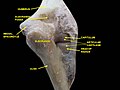
The upper or proximal extremity of the humerus consists of the bone's large rounded head joined to the body by a constricted portion called the neck, and two eminences, the greater and lesser tubercles.

[edit]
Head of the humerus

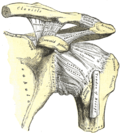
The head (caput humeri) is nearly hemispherical in form. It is directed upward, medialward, and a little backward, and articulates with the glenoid cavity of the scapula to form the glenohumeral joint (shoulder joint). The circumference of its articular surface is slightly constricted and is termed the anatomical neck, in contradistinction to a constriction below the tubercles called the surgical neck which is frequently the seat of fracture. Fracture of the anatomical neck rarely occurs.[2] The diameter of the humeral head is generally larger in men than in women.

Anatomical neck

[edit]

The anatomical neck (collum anatomicum) is obliquely directed, forming an obtuse angle with the body. It is most prominent in the lower half of its circumference, while in the upper half, it is represented by a narrow groove separating the head from the tubercles. The line separating the head from the rest of the upper end is called the anatomical neck. It affords attachment to the articular capsule of the shoulder-joint, and is perforated by numerous vascular foramens. Fracture of the anatomical neck rarely occurs.[2]

The anatomical neck of the humerus is an indentation distal to the head of the humerus on which the articular capsule attaches.

Anatomical vs surgical neck of humerus

Surgical neck

[edit]

The surgical neck is a narrow area distal to the tubercles that is a common site of fracture. It makes contact with the axillary nerve and the posterior humeral circumflex artery.

Greater tubercle

[edit]

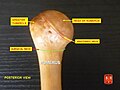
The greater tubercle (tuberculum majus; greater tuberosity) is a large, posteriorly placed projection that is placed laterally. The greater tubercle is where supraspinatus, infraspinatus and teres minor muscles are attached. The crest of the greater tubercle forms the lateral lip of the bicipital groove and is the site for insertion of pectoralis major.

The greater tubercle is just lateral to the anatomical neck. Its upper surface is rounded and marked by three flat impressions: the highest of these gives insertion to the supraspinatus muscle; the middle to the infraspinatus muscle; the lowest one, and the body of the bone for about 2.5 cm. below it, to the teres minor muscle. The lateral surface of the greater tubercle is convex, rough, and continuous with the lateral surface of the body.[2]

Greater tubercle of the right humerus
Attachments on the greater tubercle

Lesser tubercle

[edit]

The lesser tubercle (tuberculum minus; lesser tuberosity) is smaller, anterolaterally placed to the head of the humerus. The lesser tubercle provides insertion to subscapularis muscle. Both these tubercles are found in the proximal part of the shaft. The crest of the lesser tubercle forms the medial lip of the bicipital groove and is the site for insertion of teres major and latissimus dorsi muscles.

The lesser tuberosity, is more prominent than the greater: it is situated in front, and is directed medialward and forward. Above and in front it presents an impression for the insertion of the tendon of the subscapularis muscle.[2]

Lesser tubercle of the right humerus
Insertion of subscapularis muscle on the lesser tubercle

Bicipital groove

[edit]

The tubercles are separated from each other by a deep groove, the bicipital groove (intertubercular groove; bicipital sulcus), which lodges the long tendon of the biceps brachii muscle and transmits a branch of the anterior humeral circumflex artery to the shoulder-joint. It runs obliquely downward, and ends near the junction of the upper with the middle third of the bone. In the fresh state its upper part is covered with a thin layer of cartilage, lined by a prolongation of the synovial membrane of the shoulder-joint; its lower portion gives insertion to the tendon of the latissimus dorsi muscle. It is deep and narrow above, and becomes shallow and a little broader as it descends. Its lips are called, respectively, the crests of the greater and lesser tubercles (bicipital ridges), and form the upper parts of the anterior and medial borders of the body of the bone.[2]

Bicipital groove

Shaft

[edit]
Body of humerus
Left humerus. Anterior view.
Left humerus. Posterior view.
Details
Identifiers
Latincorpus humeri
MeSHD006811
TA98A02.4.04.001
TA21180
FMA13303
Anatomical terms of bone

The body or shaft of the humerus is triangular to cylindrical in cut section and is compressed anteroposteriorly. It has 3 surfaces, namely:

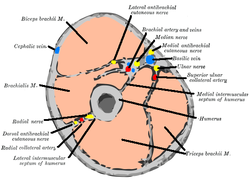
  • Anterolateral surface: the area between the lateral border of the humerus to the line drawn as a continuation of the crest of the greater tubercle. The antero-lateral surface is directed lateralward above, where it is smooth, rounded, and covered by the deltoid muscle; forward and lateralward below, where it is slightly concave from above downward, and gives origin to part of the brachialis. About the middle of this surface is a rough, rectangular elevation, the deltoid tuberosity for the insertion of the deltoid muscle; below this is the radial sulcus, directed obliquely from behind, forward, and downward, and transmitting the radial nerve and profunda artery.
  • Anteromedial surface: the area between the medial border of the humerus to the line drawn as a continuation of the crest of the greater tubercle. The antero-medial surface, less extensive than the antero-lateral, is directed medialward above, forward and medialward below; its upper part is narrow, and forms the floor of the intertubercular groove which gives insertion to the tendon of the latissimus dorsi muscle; its middle part is slightly rough for the attachment of some of the fibers of the tendon of insertion of the coracobrachialis muscle; its lower part is smooth, concave from above downward, and gives origin to the brachialis muscle.
  • Posterior surface: the area between the medial and lateral borders. The posterior surface appears somewhat twisted, so that its upper part is directed a little medialward, its lower part backward and a little lateralward. Nearly the whole of this surface is covered by the lateral and medial heads of the Triceps brachii, the former arising above, the latter below the radial sulcus.

Its three borders are:

Anterior view of the humerus showing borders and surfaces
Posterior view of the humerus showing the medial and lateral borders and the posterior surface of the humerus

The deltoid tuberosity is a roughened surface on the lateral surface of the shaft of the humerus and acts as the site of insertion of deltoideus muscle. The posterorsuperior part of the shaft has a crest, beginning just below the surgical neck of the humerus and extends till the superior tip of the deltoid tuberosity. This is where the lateral head of triceps brachii is attached.

Deltoid tuberosity of the humerus

The radial sulcus, also known as the spiral groove, is found on the posterior surface of the shaft and is a shallow oblique groove through which the radial nerve passes along with deep vessels. This is located posteroinferior to the deltoid tuberosity. The inferior boundary of the spiral groove is continuous distally with the lateral border of the shaft.

Radial groove continuing as the lateral border of shaft of the humerus

The nutrient foramen of the humerus is located in the anteromedial surface of the humerus. The nutrient arteries enter the humerus through this foramen.

Nutrient foramen of the humerus

Distal humerus

[edit]
Lower extremity of humerus
Left humerus. Anterior view.
Details
Identifiers
Latinextremitas distalis humeri
MeSHD006811
TA98A02.4.04.001
TA21180
FMA13303
Anatomical terms of bone

The distal or lower extremity of the humerus is flattened from before backward, and curved slightly forward; it ends below in a broad, articular surface, which is divided into two parts by a slight ridge. Projecting on either side are the lateral and medial epicondyles.

Articular surface

[edit]

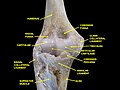
The articular surface extends a little lower than the epicondyles, and is curved slightly forward; its medial extremity occupies a lower level than the lateral. The lateral portion of this surface consists of a smooth, rounded eminence, named the capitulum of the humerus; it articulates with the cup-shaped depression on the head of the radius, and is limited to the front and lower part of the bone.

Fossae

[edit]

Above the front part of the trochlea is a small depression, the coronoid fossa, which receives the coronoid process of the ulna during flexion of the forearm.

Above the back part of the trochlea is a deep triangular depression, the olecranon fossa, in which the summit of the olecranon is received in extension of the forearm.

Olecranon fossa of the humerus

The coronoid fossa is the medial hollow part on the anterior surface of the distal humerus. The coronoid fossa is smaller than the olecranon fossa and receives the coronoid process of the ulna during maximum flexion of the elbow.

Coronoid fossa of the humerus

Above the front part of the capitulum is a slight depression, the radial fossa, which receives the anterior border of the head of the radius, when the forearm is flexed.

Radial fossa of the humerus

These fossæ are separated from one another by a thin, transparent lamina of bone, which is sometimes perforated by a supratrochlear foramen; they are lined in the fresh state by the synovial membrane of the elbow-joint, and their margins afford attachment to the anterior and posterior ligaments of this articulation.

The capitulum is a rounded eminence forming the lateral part of the distal humerus. The head of the radius articulates with the capitulum.

Capitulum on the lateral side and trochlea on the medial side of the humerus

The trochlea is spool-shaped medial portion of the distal humerus and articulates with the ulna.

Trochlea of the humerus

Epicondyles

[edit]

The epicondyles are continuous above with the supracondylar ridges.

  • The lateral epicondyle is a small, tuberculated eminence, curved a little forward, and giving attachment to the radial collateral ligament of the elbow-joint, and to a tendon common to the origin of the supinator and some of the extensor muscles.
  • The medial epicondyle, larger and more prominent than the lateral, is directed a little backward; it gives attachment to the ulnar collateral ligament of the elbow-joint, to the pronator teres, and to a common tendon of origin of some of the flexor muscles of the forearm; the ulnar nerve runs in a groove on the back of this epicondyle.
Medial and lateral epicondyles of the humerus
Medial and lateral supracondylar ridges of the humerus

The medial supracondylar crest forms the sharp medial border of the distal humerus continuing superiorly from the medial epicondyle. The lateral supracondylar crest forms the sharp lateral border of the distal humerus continuing superiorly from the lateral epicondyle.[3]

Borders

[edit]

The medial portion of the articular surface is named the trochlea, and presents a deep depression between two well-marked borders; it is convex from before backward, concave from side to side, and occupies the anterior, lower, and posterior parts of the extremity.

  • The lateral border separates it from the groove which articulates with the margin of the head of the radius.
  • The medial border is thicker, of greater length, and consequently more prominent, than the lateral.

The grooved portion of the articular surface fits accurately within the semilunar notch of the ulna; it is broader and deeper on the posterior than on the anterior aspect of the bone, and is inclined obliquely downward and forward toward the medial side.

Articulations

[edit]

At the shoulder, the head of the humerus articulates with the glenoid fossa of the scapula. More distally, at the elbow, the capitulum of the humerus articulates with the head of the radius, and the trochlea of the humerus articulates with the trochlear notch of the ulna.

Nerves

[edit]

The axillary nerve is located at the proximal end, against the shoulder girdle. Dislocation of the humerus's glenohumeral joint has the potential to injure the axillary nerve or the axillary artery. Signs and symptoms of this dislocation include a loss of the normal shoulder contour and a palpable depression under the acromion.

The radial nerve follows the humerus closely. At the midshaft of the humerus, the radial nerve travels from the posterior to the anterior aspect of the bone in the spiral groove. A fracture of the humerus in this region can result in radial nerve injury.

The ulnar nerve lies at the distal end of the humerus near the elbow. When struck, it can cause a distinct tingling sensation, and sometimes a significant amount of pain. It is sometimes popularly referred to as 'the funny bone', possibly due to this sensation (a "funny" feeling), as well as the fact that the bone's name is a homophone of 'humorous'.[4] It lies posterior to the medial epicondyle, and is easily damaged in elbow injuries.[citation needed]

Function

[edit]

Muscular attachment

[edit]

The deltoid originates on the lateral third of the clavicle, acromion and the crest of the spine of the scapula. It is inserted on the deltoid tuberosity of the humerus and has several actions including abduction, extension, and circumduction of the shoulder. The supraspinatus also originates on the spine of the scapula. It inserts on the greater tubercle of the humerus, and assists in abduction of the shoulder.

The pectoralis major, teres major, and latissimus dorsi insert at the intertubercular groove of the humerus. They work to adduct and medially, or internally, rotate the humerus.

The infraspinatus and teres minor insert on the greater tubercle, and work to laterally, or externally, rotate the humerus. In contrast, the subscapularis muscle inserts onto the lesser tubercle and works to medially, or internally, rotate the humerus.

The biceps brachii, brachialis, and brachioradialis (which attaches distally) act to flex the elbow. (The biceps do not attach to the humerus.) The triceps brachii and anconeus extend the elbow, and attach to the posterior side of the humerus.

The four muscles of supraspinatus, infraspinatus, teres minor and subscapularis form a musculo-ligamentous girdle called the rotator cuff. This cuff stabilizes the very mobile but inherently unstable glenohumeral joint. The other muscles are used as counterbalances for the actions of lifting/pulling and pressing/pushing.

Left humerus. Anterior view.
Left humerus. Posterior view.

Other animals

[edit]

Primitive fossils of amphibians had little, if any, shaft connecting the upper and lower extremities, making their limbs very short. In most living tetrapods, however, the humerus has a similar form to that of humans. In many reptiles and some mammals (where it is the primitive state), the lower extremity includes a large opening called the entepicondylar foramen to allow the passage of nerves and blood vessels.[5]

Additional images

[edit]

Ossification

[edit]

During embryonic development, the humerus is one of the first structures to ossify, beginning with the first ossification center in the shaft of the bone. Ossification of the humerus occurs predictably in the embryo and fetus, and is therefore used as a fetal biometric measurement when determining gestational age of a fetus. At birth, the neonatal humerus is only ossified in the shaft. The epiphyses are cartilaginous at birth.[6] The medial humeral head develops an ossification center around 4 months of age and the greater tuberosity around 10 months of age. These ossification centers begin to fuse at 3 years of age. The process of ossification is complete by 13 years of age, though the epiphyseal plate (growth plate) persists until skeletal maturity, usually around 17 years of age.[7]

See also

[edit]

References

[edit]
[edit]
Revisions and contributorsEdit on WikipediaRead on Wikipedia
from Grokipedia
The humerus is the long bone of the upper arm, extending from the shoulder joint to the elbow joint, and serves as the primary structural element of the brachium. As the largest bone in the upper limb, it provides attachment sites for major muscles involved in arm movement and supports the weight-bearing functions of the shoulder and elbow.[1][2] Etymology The word "humerus" derives from the Latin umerus, meaning "shoulder" or "upper arm".[3] The humerus features a proximal end with a smooth, hemispherical head that articulates with the glenoid fossa of the scapula to form the glenohumeral (shoulder) joint, allowing for a wide range of motion including flexion, extension, abduction, and rotation. Below the head lies the anatomical neck, followed by the greater and lesser tubercles—prominent ridges for the attachment of rotator cuff muscles such as the supraspinatus, infraspinatus, teres minor, and subscapularis—as well as the surgical neck, a common site of fractures due to its narrow structure. The central shaft, or body, is cylindrical proximally with a flattened or triangular cross-section distally; it serves as an attachment for muscles like the deltoid (via the deltoid tuberosity) and provides passage for the radial nerve through the radial groove.[4][5][6][7] At the distal end, the humerus expands into a flattened structure that articulates with the radius and ulna to form the elbow joint: the capitulum laterally connects with the radius for hinge-like flexion and extension, while the medial trochlea engages the ulna's trochlear notch for stability. Additional features include the olecranon fossa posteriorly (accommodating the ulna during extension) and the coronoid fossa anteriorly (for flexion), along with the medial and lateral epicondyles for ligament and muscle attachments, such as those of the flexor and extensor groups of the forearm. Clinically, the humerus is prone to fractures, particularly at the surgical neck or shaft, often resulting from falls or trauma, which can impair shoulder mobility and nerve function if untreated.[8][9][10]

Introduction

Definition and Location

The humerus is the longest and largest bone in the upper limb, forming the structural foundation of the arm between the shoulder and elbow.[5] It is classified as a long bone, characterized by a central diaphysis (shaft) flanked by proximal and distal epiphyses, which facilitate growth and articulation during development and maturity.[8] Anatomically, the humerus is positioned in the brachium (upper arm), extending longitudinally from the glenohumeral joint superiorly to the elbow joint inferiorly.[4] Its proximal end articulates with the glenoid cavity of the scapula, enabling shoulder mobility, while the distal end connects with the radius and ulna, contributing to forearm positioning and elbow flexion-extension.[1] In adult humans, the humerus typically measures 32–34 cm in length for males and is slightly shorter in females, averaging around 30–31 cm, though these dimensions vary by population, ethnicity, and individual factors such as height and sex.[11] For instance, anthropometric studies in diverse cohorts report male humeral lengths ranging from 32.4 cm to 33.8 cm and female lengths from 30.3 cm to 31.1 cm.[12]

Etymology

The term "humerus" derives from the Latin humerus, meaning "shoulder," which underscores the bone's proximity to the shoulder joint in the upper limb.[3] This Latin word evolved from an earlier form umerus and traces its roots to the Proto-Indo-European om(e)so-, signifying the shoulder region.[3] The nomenclature reflects the bone's historical association with the broader shoulder area rather than strictly the arm itself. In ancient Greek medicine, the humerus was first described as the upper arm bone in texts attributed to Hippocrates around 400 BCE, particularly in works on fractures and joint articulations, where it was discussed in the context of dislocations and reductions.[13] Galen, a prominent physician of the 2nd century CE, further formalized its identification using the Greek term ōmōs (shoulder), linking it explicitly to the proximal upper limb structure in his anatomical commentaries.[14] Related terms include "arm bone" in older English usage, prior to the widespread adoption of Latin-derived nomenclature in the 18th century.[15] In modern veterinary contexts, "brachium" denotes the upper forelimb region housing the humerus, drawing from Latin brachium for arm.[16] The evolution of terminology transitioned from descriptive phrases like "shoulder bone" in classical antiquity to standardized anatomical naming during the Renaissance. Andreas Vesalius, in his seminal 1543 work De humani corporis fabrica, employed precise Latin terms such as humerus to describe the bone systematically, correcting earlier inaccuracies and establishing a foundation for modern nomenclature.[17] This shift emphasized univocal, rule-based naming for clarity in anatomical studies.[18]

Structure

Proximal End

The proximal end of the humerus consists of the rounded humeral head and associated structures that facilitate articulation at the glenohumeral joint and provide attachment points for muscles of the rotator cuff. The humeral head forms a smooth, hemispherical articular surface covered by hyaline cartilage, directed medially and superiorly to fit into the shallow glenoid cavity of the scapula, enabling a wide range of shoulder motion.[2] This ball-and-socket configuration relies on surrounding soft tissues for stability, as the humeral head's articular surface is substantially larger than the glenoid, with studies reporting a bony radius ratio where the humeral head exceeds the glenoid by approximately 67% in curvature radius.[19] Immediately inferior to the humeral head lies the anatomical neck, a narrow constriction that separates the head from the adjacent tubercles and serves as the primary site for attachment of the glenohumeral joint capsule and glenohumeral ligaments.[9] Distal to the tubercles is the surgical neck, a metaphyseal region of further narrowing where the proximal humerus transitions into the shaft.[2] Projecting laterally from the proximal humerus is the greater tubercle, a prominent bony elevation with three distinct flattened facets on its superior, middle, and inferior aspects, providing insertion sites for the supraspinatus, infraspinatus, and teres minor muscles, respectively.[20] Medially and anteriorly sits the smaller lesser tubercle, which features a smooth impression for the subscapularis muscle tendon. Separating these tubercles is the intertubercular groove (also known as the bicipital groove), a deep, longitudinally oriented sulcus approximately 10-15 mm wide, bounded laterally by a thick ridge from the greater tubercle and medially by a thinner ridge from the lesser tubercle, which guides the tendon of the long head of the biceps brachii.[1]

Shaft

The shaft, or diaphysis, of the humerus forms the central cylindrical to prismatic portion of the bone, exhibiting a triangular prism shape with distinct anterior, lateral, and medial borders that define its structural framework. The anterior border runs straight along the front, separating the anterolateral and anteromedial surfaces; the lateral border originates as an extension from the intertubercular region proximally and contributes to the overall lateral contour; while the medial border gradually blends into the medial supracondylar ridge toward the distal end. This configuration provides mechanical stability and attachment points, with the proximal half of the shaft being more cylindrical and the distal half flattening into a more triangular profile.[5][9] The diaphysis is composed of compact cortical bone encasing a central medullary cavity, which in adults contains yellow marrow for fat storage and hematopoietic support in earlier life stages. Key surface markings include the deltoid tuberosity, a roughened V-shaped elevation on the lateral mid-shaft that enhances muscle anchorage. Posteriorly, the radial groove (also termed the spiral groove) appears as a shallow, oblique depression traversing the posterior surface, facilitating the passage of neurovascular structures such as the radial nerve and profunda brachii artery as it spirals from near the greater tubercle to the level of the deltoid tuberosity. Additionally, a single large nutrient foramen is typically located on the anterior medial surface, serving as the entry point for the principal nutrient artery to supply the bone's internal vascular network.[21][22][5][23] Anatomical variations in the shaft are uncommon but notable, including the supracondylar process, a bony spur projecting from the anteromedial aspect approximately 5 cm proximal to the medial epicondyle, with a reported prevalence of 1-2% in the general population. This variant, measuring 2-20 mm in length, represents a phylogenetic remnant and may influence nearby soft tissue relations.[24][25]

Distal End

The distal end of the humerus widens to form the structures that articulate with the radius and ulna, creating the elbow joint. This region features two distinct articular surfaces laterally and medially, separated by fossae that accommodate processes of the forearm bones during movement, as well as epicondyles and ridges for ligament and muscle attachments. The overall configuration allows for hinge-like flexion and extension while providing stability against varus and valgus stresses. The capitulum is a rounded, knob-like eminence located on the anterior and lateral aspect of the distal humerus. It articulates with the head of the radius, facilitating flexion and extension at the humeroradial joint.[26] Medially, the trochlea presents a pulley-shaped surface with a central groove flanked by medial and lateral lips; the medial lip projects farther distally and is deeper, enhancing joint stability during articulation with the trochlear notch of the ulna. This oblique orientation contributes to the carrying angle of the forearm.[26] Posteriorly, the olecranon fossa is a large, shallow depression superior to the trochlea that receives the olecranon process of the ulna during full elbow extension, preventing posterior dislocation. Anteriorly and superior to the trochlea lies the coronoid fossa, a smaller depression that accommodates the coronoid process of the ulna during maximum flexion.[26] The medial epicondyle is a prominent bony projection larger than its lateral counterpart, serving as the primary attachment site for the ulnar collateral ligament and the common flexor tendon of forearm flexor muscles. The lateral epicondyle, smaller and more rounded, provides attachment for the radial collateral ligament and the common extensor tendon of forearm extensor muscles.[27][26] Extending proximally from the epicondyles are the supracondylar ridges, which include anteromedial and anterolateral projections marking the transition to the humeral shaft; these roughened surfaces give attachment to muscles such as the brachialis (anterior compartment) and pronator teres (on the medial ridge).[28]

Function

Articulations and Movements

The humerus articulates proximally with the scapula at the glenohumeral joint and distally with the radius and ulna at the elbow joint, facilitating a wide range of upper limb movements.[29] The glenohumeral joint is a ball-and-socket synovial joint formed by the head of the humerus articulating with the glenoid cavity of the scapula, enabling multiplanar motion including flexion and extension, abduction and adduction, and medial and lateral rotation.[29][30] This joint's stability is primarily provided by the rotator cuff muscles and the glenohumeral ligaments, which reinforce the joint capsule and prevent excessive translation of the humeral head.[30] Distally, the humerus forms the elbow joint, a hinge-type synovial joint involving the trochlea and capitulum of the humerus with the trochlear notch of the ulna and the fovea of the radius, respectively.[31] This articulation primarily permits flexion and extension, with a typical range of motion from 0° (full extension) to 150° (full flexion), while limited pronation and supination occur through the adjacent proximal radioulnar joint.[31][32] Biomechanically, the center of rotation for shoulder movements is located at the geometric center of the humeral head, allowing the humerus to rotate around this point during arm elevation and other motions.[33] During arm elevation, the torque at the glenohumeral joint can reach up to approximately 50 Nm, reflecting the demands placed on the joint by gravitational and muscular forces.[34] At the elbow, the carrying angle—a valgus alignment of 5–15° between the humerus and forearm in full extension—positions the hand away from the body for functional activities such as carrying objects.[35] Ligamentous support enhances joint integrity at both ends of the humerus. Proximally, the coracohumeral ligament extends from the coracoid process of the scapula to the anterior aspect of the humerus, contributing to the superior reinforcement of the glenohumeral capsule, while the transverse humeral ligament spans the intertubercular groove to maintain the long head of the biceps tendon in position.[36][37] Distally, the annular ligament encircles the radial head, binding it to the ulna and stabilizing the proximal radioulnar joint during forearm rotation.[38]

Muscle Attachments

The proximal end of the humerus provides attachment sites for several muscles that contribute to shoulder stability and motion. The greater tubercle features three distinct facets for the rotator cuff muscles: the supraspinatus attaches to the superior facet, the infraspinatus to the middle facet, and the teres minor to the inferior facet. The subscapularis muscle inserts on the lesser tubercle. Along the bicipital groove, the pectoralis major inserts on the lateral lip, while the latissimus dorsi and teres major both attach to the floor of the groove.[2][39] The shaft of the humerus serves as an origin or insertion for muscles involved in arm flexion, abduction, and stabilization. The deltoid muscle inserts on the deltoid tuberosity located on the lateral aspect of the mid-shaft. The brachialis originates from the anterior surface of the distal half of the shaft. The coracobrachialis inserts along the medial aspect of the shaft. Additionally, the lateral and medial heads of the triceps brachii originate from the posterior surface of the shaft, with the lateral head above the radial groove and the medial head below it.[2][40] At the distal end, the humerus accommodates attachments for forearm muscles that enable elbow flexion, extension, pronation, and supination. The pronator teres originates from the medial epicondyle as part of the common flexor origin. The brachioradialis and extensor carpi radialis longus originate from the lateral epicondyle as part of the common extensor origin. The triceps brachii also originates from the posterior surface of the distal humerus, proximal to the olecranon fossa.[2][41] The rotator cuff muscles—supraspinatus, infraspinatus, teres minor, and subscapularis—attach to the tubercles of the proximal humerus and collectively stabilize the humeral head within the glenoid cavity during arm movements. Flexor and pronator muscles predominate on the medial distal humerus, while extensor and supinator muscles attach laterally, facilitating balanced forearm actions.[42]

Vascularization and Innervation

Blood Supply

The blood supply to the humerus is provided primarily by branches of the axillary and brachial arteries, ensuring segmental perfusion to the proximal end, shaft, and distal regions. The proximal humerus, including the head and neck, receives its main arterial supply from the anterior and posterior circumflex humeral arteries, which arise from the third part of the axillary artery. The posterior humeral circumflex artery (PHCA) provides the predominant supply (approximately 64%) to the humeral head, perfusing its superior, inferior, and lateral portions via branches that curve around the surgical neck.[43] The anterior humeral circumflex artery (ACHA) contributes significant additional perfusion (approximately 36%) via its anterolateral branch, which travels medially around the surgical neck and gives rise to the arcuate artery; this vessel enters the humeral head near the bicipital groove, forming an intraosseous arcade that distributes blood to the epiphysis. Retinacular vessels, branching from the circumflex arteries, penetrate the joint capsule to supply the epiphyseal region directly. The PHCA and ACHA often anastomose to form a periarticular network, with possible additional contributions from the suprascapular artery via anastomoses.[43] The diaphysis of the humerus is supplied by the profunda brachii artery (also known as the deep brachial artery), the largest branch of the brachial artery, which arises proximally and courses posteriorly along the radial groove with the radial nerve. This artery gives off a nutrient branch that enters the medullary cavity through the nutrient foramen, typically located on the anteromedial surface of the shaft in the middle third, providing endosteal circulation to the bone marrow and cortex. Smaller periosteal branches from the profunda brachii and its collaterals, such as the middle and radial collateral arteries, contribute to cortical perfusion along the shaft. Venous drainage of the humerus follows the arterial pathways, with deep venae comitantes accompanying the circumflex humeral and profunda brachii arteries to ultimately join the axillary vein. Medullary veins within the bone drain toward the nutrient foramen, connecting to the nutrient vein that parallels the nutrient artery and exits to the systemic venous system. Anatomical variations in the humeral blood supply occur frequently, with the ACHA and PHCA showing inconsistencies in origin, course, and relative contributions. These variations can influence the risk of avascular necrosis, particularly following fractures at the surgical neck, where disruption of the arcuate artery leads to reliance on retrograde intraosseous flow; such injuries compromise perfusion to the humeral head, resulting in necrosis rates of 10-33% in displaced fractures.[44]

Nerve Supply

The nerve supply to the humerus region primarily derives from the brachial plexus, a network formed by the ventral rami of spinal nerves C5 through T1, which provides motor and sensory innervation to the upper limb.[45] This plexus organizes into roots, trunks, divisions, cords, and terminal branches, with several nerves traversing or adjacent to the humerus bone.[45] The axillary nerve, arising from the posterior cord of the brachial plexus with contributions from C5 and C6 roots, exits the axilla via the quadrangular space and winds posteriorly around the surgical neck of the humerus.[46] It provides motor innervation to the deltoid and teres minor muscles while its anterior branch courses along the humerus' surgical neck.[46] Sensory contributions include the superior lateral cutaneous nerve of the arm, which supplies sensation to the lateral shoulder and upper arm skin adjacent to the proximal humerus.[47] The radial nerve, originating from the posterior cord with fibers from C5 to T1 roots, descends in the arm and passes through the radial groove on the posterior aspect of the humeral shaft alongside the profunda brachii artery.[48] This path, detailed further in descriptions of the humeral shaft, positions the nerve in close relation to the bone, where it supplies motor innervation to the triceps brachii and extensor muscles of the forearm.[48] It also gives rise to the posterior cutaneous nerve of the arm, providing sensory innervation to the posterior skin of the upper arm overlying the humerus.[49] The musculocutaneous nerve, derived from the lateral cord with C5 to C7 root contributions, pierces the coracobrachialis muscle near the proximal humerus and continues distally in the anterior arm compartment.[50] It supplies motor innervation to the coracobrachialis, biceps brachii, and brachialis muscles, which attach along the humeral shaft.[50] At the distal humerus, the median and ulnar nerves course without direct contact to the bone but adjacent to the epicondyles at the elbow. The median nerve, formed by contributions from the lateral and medial cords (C6 to T1 roots), travels medially along the distal humerus near the lateral epicondyle before entering the forearm.[51] The ulnar nerve, from the medial cord (C8 and T1 roots primarily), descends medially and passes posterior to the medial epicondyle of the humerus in the cubital tunnel.[52]

Development

Ossification

The humerus, as a long bone, undergoes endochondral ossification, in which a cartilaginous template is progressively replaced by bone tissue through the activity of osteoblasts at ossification centers. The primary ossification center emerges in the mid-diaphysis (shaft) during the eighth week of intrauterine development, initiating longitudinal growth and forming the initial bony structure of the humerus.[9][53] Secondary ossification centers develop in the epiphyses, contributing to the expansion of the articular surfaces and tuberosities while maintaining separate growth plates (physes) until fusion occurs later in adolescence.[2] In the proximal humerus, the main epiphyseal center for the humeral head appears between 1 and 6 months postnatally, followed by the greater tubercle center at 1 to 3 years and the lesser tubercle center between 3 and 5 years. These proximal secondary centers typically fuse with the humeral head epiphysis by 7 to 13 years of age, after which the entire proximal epiphysis unites with the shaft at the metaphyseal physis between 14 and 17 years in females and 16 and 18 years in males, with complete skeletal maturity reached by 18 to 20 years.[54][55] At the distal humerus, secondary ossification centers appear in a sequential manner: the capitellum at around 1 year, the medial epicondyle at 4 to 6 years (often cited as 5 years; earlier in females ~5.8 years, later in males ~8.2 years), the trochlea at 7 to 10 years, and the lateral epicondyle at 10 to 13 years (typically 11 to 12 years; females ~10.4 years, males ~12.2 years). Fusion of these distal centers with the metaphysis occurs progressively, with the capitellum fusing by 10 to 15 years, the trochlea and lateral epicondyle by 12 to 16 years, and the medial epicondyle by 13 to 17 years; overall distal physeal closure aligns with proximal timelines, completing by 14 to 16 years in females and 16 to 18 years in males. Timings may vary by population and sex, with females generally earlier.[56][57] The presence of multiple ossification centers in the growing humerus results in variable fracture patterns in children, as forces may separate or injure specific epiphyseal components rather than propagating through a unified bone structure, influencing treatment approaches such as closed reduction versus surgical pinning.[58]

Embryological Origins

The upper limb bud, which gives rise to the humerus, begins forming during the fourth week of gestation as a bulge on the lateral aspect of the embryonic trunk, arising from proliferating mesenchymal cells derived primarily from the lateral plate mesoderm.[59] This process is initiated by fibroblast growth factor 10 (FGF10) expression in the lateral plate mesoderm, which induces the overlying ectoderm to thicken into the apical ectodermal ridge (AER), a structure essential for limb outgrowth.[59] The progress zone, a region of undifferentiated mesenchyme beneath the AER, interacts with AER signals to maintain proliferation and direct differentiation along the proximo-distal axis; Hox genes, such as those in the HoxA and HoxD clusters, pattern this axis, with the proximal segment corresponding to the humerus (stylopod).[60] By weeks 6 to 7 of gestation, the cartilaginous model of the humerus develops through chondrification, where mesenchymal condensations from the lateral plate mesoderm differentiate into chondrocytes, forming the first anlage of the long bones in the upper limb.[61] This precartilaginous template establishes the basic shape of the humerus prior to ossification, marking it as one of the earliest skeletal elements to chondrify in the limb.[62] Genetic regulation of humeral development involves key signaling pathways that ensure proper outgrowth and polarity. Fibroblast growth factors (FGFs), secreted by the AER, promote proximo-distal elongation by sustaining mesenchymal proliferation in the progress zone and regulating Hox gene expression.[63] Sonic hedgehog (Shh), expressed in the zone of polarizing activity (ZPA) on the posterior limb bud margin, establishes anterior-posterior polarity, distinguishing flexor from extensor compartments and influencing humeral head orientation.[60] Disruptions in these early processes can lead to rare anomalies such as humeral agenesis, often associated with phocomelia, a condition historically linked to thalidomide exposure during days 24-29 post-fertilization, with an incidence of approximately 0.6 to 4.2 per 100,000 live births in non-exposed populations.[64]

Clinical Significance

Fractures and Injuries

Fractures of the humerus are common skeletal injuries, with an annual incidence of approximately 50-75 per 100,000 population, predominantly affecting the proximal region and showing higher rates among elderly females due to osteoporosis.[65] The risk of nonunion is estimated at 5-10% for humeral shaft fractures, influenced by factors such as fracture location and patient comorbidities.[66] Proximal humerus fractures often result from low-energy falls in osteoporotic individuals, with surgical neck fractures accounting for 70-80% of cases in this category.[67] These fractures occur just distal to the humeral head and are typically two-part injuries involving displacement of the shaft. Greater tuberosity avulsion fractures, another proximal subtype, frequently associate with rotator cuff tears, arising from forceful contraction of the attached supraspinatus or infraspinatus muscles during trauma.[67] Humeral shaft fractures arise from direct or indirect trauma, classified by pattern: transverse fractures from high-energy direct blows, and spiral fractures from twisting mechanisms such as falls or assaults.[68] The Holstein-Lewis variant, a spiral fracture in the distal third of the shaft, carries a 10-20% risk of associated radial nerve palsy due to the nerve's proximity in the spiral groove.[68] Distal humerus fractures vary by age group; supracondylar fractures predominate in children, often from hyperextension injuries during falls, with about 60% presenting as displaced.[69] In adults, intercondylar fractures of the T or Y configuration result from high-energy axial loading, involving separation of the medial and lateral condyles along the trochlea.[70] Initial management of humerus fractures emphasizes closed reduction to restore alignment, followed by immobilization with a sling, cast, or functional brace to promote healing.[71] Potential acute complications include fat embolism syndrome, particularly in shaft fractures from intramedullary fat release, and compartment syndrome in distal injuries due to swelling in the forearm flexors.[72]

Surgical and Pathological Considerations

Surgical approaches to the proximal humerus commonly utilize the deltopectoral interval, which provides access to the humeral head, shaft, and tuberosities for fracture reduction and fixation, while minimizing disruption to the deltoid and pectoralis major muscles.[73] For humeral shaft fractures, a posterior approach is frequently employed, allowing exposure of the mid-to-distal humerus while protecting the radial nerve.[68] Open reduction and internal fixation (ORIF) with plates and screws is a standard treatment for displaced humeral shaft fractures, achieving union rates of approximately 93.5% across various patterns.[68] Prosthetic replacement options include hemiarthroplasty for complex proximal humerus fractures in elderly patients, which replaces the humeral head to restore function and alleviate pain, particularly when fixation is unreliable due to poor bone quality.[74] In cases of rotator cuff deficiency or severe tuberosity comminution, reverse shoulder arthroplasty is preferred, as it relies on deltoid function rather than cuff integrity and has become the standard for displaced three- or four-part fractures in patients over 70 years.[75] Pathological conditions affecting the humerus include osteoporosis-related fragility fractures, which are common in older adults and warrant dual-energy X-ray absorptiometry (DEXA) screening to assess bone mineral density, especially following low-energy trauma such as falls from standing height.[76] Primary bone tumors like osteosarcoma predominantly occur during adolescence, with peak incidence between ages 10 and 20, and affect long bones such as the humerus in approximately 10-15% of cases.[77] Avascular necrosis of the proximal humerus can develop post-trauma, with reported rates of 15-30% in fractures involving the humeral head, often leading to collapse and necessitating further intervention.[78] Surgical complications of humeral fracture management include malunion in about 10-20% of cases, particularly with conservative or unstable fixation, resulting in altered shoulder mechanics and potential need for corrective osteotomy.[79] Postoperative infection rates range from 2-5%, influenced by factors such as surgical timing and soft tissue handling, and may require debridement or implant removal.[80] Heterotopic ossification, occurring in up to 20% of proximal humerus trauma cases, can limit range of motion and is more prevalent after surgical intervention.[81] As of 2025, bioabsorbable implants, such as biocomposite plates made from degradable polymers, are emerging for proximal humerus fixation, offering reduced reoperation rates by eliminating hardware removal and promoting natural bone healing through gradual load transfer.[82] Stemless humeral implants in shoulder arthroplasty demonstrate improved longevity, with 13-year survivorship rates exceeding 89% for revisions, due to enhanced bone preservation and decreased stress shielding compared to stemmed designs.[83]

Comparative Anatomy

In Non-Human Mammals

In non-human mammals, the humerus exhibits diverse adaptations reflecting locomotor demands and phylogenetic history. In quadrupedal species such as dogs and horses, the humerus adopts a more vertical orientation relative to the scapula to facilitate weight-bearing on the forelimbs, with a robust diaphysis that withstands compressive forces during terrestrial locomotion. This configuration contrasts with the more horizontal positioning in humans, emphasizing stability over extensive rotation, and features a prominent deltoid tuberosity for enhanced muscle attachment supporting limb protraction.[84] Among primates, the humerus is often elongated to support suspensory locomotion, particularly in brachiating species like gibbons, where the bone's length facilitates arm-swinging and hook-like grasping at the distal end for stable suspension from branches.[85] This adaptation includes a relatively thick cortical bone in the proximal humerus to resist torsional stresses during overhead movement, differing from the more spherical humeral head in humans that enables greater overhead reach and rotation.[86] Non-human primates generally show less humeral head sphericity than humans, prioritizing flexibility for arboreal suspension over precise throwing or manipulative precision.[87] In aquatic mammals such as whales and other cetaceans, the humerus is markedly shortened and integrated into a paddle-like pectoral fin, with a flattened diaphysis that enhances hydrodynamic efficiency and reduces drag during swimming.[88] The bone lacks a medullary cavity and exhibits enlarged epiphyses with a twisted humeral head, adaptations for undulatory propulsion rather than terrestrial support, and the deltoid tuberosity is reduced or absent due to the atrophy of associated shoulder muscles.[89][88] Variations across mammalian orders further highlight functional specialization; for instance, carnivores like felids and canids possess pronounced supracondylar crests on the distal humerus, providing robust attachments for powerful extensor muscles such as the triceps brachii to enable forceful paw strikes and digging.[90] In rodents, the humerus is miniaturized (micro-humerus) with early epiphyseal fusion, reflecting their small body size and burrowing or scrambling lifestyles, where the bone's compact structure supports rapid, agile movements without extensive elongation.[91][92]

Evolutionary Aspects

The humerus first appeared as a distinct skeletal element during the fin-to-limb transition in early tetrapods approximately 375 million years ago in the Late Devonian period, evolving from the stylopod (proximal segment) of the pectoral fin in lobe-finned fishes. This transformation enabled greater weight-bearing and propulsive capabilities on land, with fossils such as Tiktaalik roseae revealing a humerus with a rounded proximal head serving as a precursor to the ball-and-socket glenohumeral joint, facilitating body propping and rudimentary locomotion.[93][94] Comparative analyses of Devonian humeri indicate that this joint precursor arose in aquatic environments, allowing fin-like appendages to support terrestrial transitions while retaining flexibility for swimming.[95] In the synapsid lineage leading to mammals, significant modifications occurred during the Triassic period (approximately 252–201 million years ago), where increased humeral torsion marked the shift from sprawling limb postures to more upright, parasagittal gaits for efficient terrestrial movement. Therapsids, key transitional forms, displayed notable shaft elongation in the humerus, enhancing stride length and stability as they adapted to diverse habitats post-Permian extinction.[96][97] This torsion, measured as the twisting angle between proximal and distal articular surfaces, progressively increased in advanced therapsids like cynodonts, optimizing muscle leverage for mammalian-like postures.[98] Primate evolution during the Miocene epoch (23–5.3 million years ago) featured arboreal adaptations, including enlargement and protrusion of the humeral head to improve glenohumeral mobility for suspensory locomotion such as below-branch hanging and arm-swinging. This configuration, seen in early catarrhines, prioritized joint instability for extensive range of motion over stability, contrasting with earlier mammalian forms.[99] By around 2 million years ago, in the emergence of Homo sapiens and antecedents like Homo erectus, the glenohumeral joint evolved greater articular congruence and retroversion, maximizing throwing efficiency through enhanced torque and precision during overhead motions.[100] Fossils from Australopithecus afarensis, dated to about 3.2 million years ago, illustrate intermediate stages in hominin humeral evolution; the proximal humerus of specimen A.L. 288-1 (Lucy) is shorter in absolute length relative to body size and exhibits less retroversion of the humeral head compared to modern humans, reflecting retained arboreal climbing capabilities alongside emerging bipedalism.[101] This morphology blends ape-like flexibility with human-like proportions, as joint surface areas align more closely with those of Homo than great apes.[102] Specialized adaptations further diversified the humerus across mammals; in bats, flight evolution reduced the humeral shaft's relative mass while elongating and reinforcing the proximal end to anchor the wing membrane and pectoral muscles for powered aerial locomotion.[103] Conversely, in cursorial ungulates such as horses, the humerus shortened proximally relative to distal elements, with slender shafts promoting high-speed running by minimizing rotational inertia and enhancing stride efficiency.[104]

References

User Avatar
No comments yet.