
.jpg/250px-Baloch_people_(8).jpg)


.jpg/2000px-Baloch_people_(8).jpg)
Community hub
Recent from talks
Contribute something
Nothing was collected or created yet.
Baloch people
View on Wikipedia | This article may contain an excessive number of citations. (September 2025) |
Key Information

.jpg)


The Baloch (/bəˈloʊtʃ/ bə-LOHCH) or Baluch (/bəˈluːtʃ/ bə-LOOCH; Balochi: بلۏچ, romanized: Balòc) are an Iranian nomadic pastoral[14][15][16][17][18][19][20] ethnic group which speaks the Western Iranic Balochi language[21] and are native to the Balochistan region of South and West Asia, occupying parts of Pakistan, Iran, and Afghanistan. There are also Baloch diaspora communities in neighbouring regions, including in Central Asia, and the Arabian Peninsula.
The majority of the Baloch reside within Pakistan. About 50% of the total Baloch population live in the Pakistani province of Balochistan,[22] while 40% are settled in Sindh and a significant albeit smaller number resides in the Pakistani Punjab. They make up 3.6% of Pakistan's total population, and around 2% of the populations of both Iran and Afghanistan[23] and the largest non-Arab community in Oman.[24]
Etymology
[edit]The exact origin of the word "Baloch" is unclear. According to the Baloch historian Naseer Dashti (2012), the name of the ethnic group derives from 'Balaschik' living in Balasagan, between the Caspian Sea and Lake Van in present-day Turkey and Azerbaijan, who are believed to have migrated to Balochistan during the Sasanian times.[25] The remnants of the original name such as "Balochuk" and "Balochiki" are said to be still used as ethnic names in Balochistan.[26]
Some other writers suggest a derivation from Sanskrit words bal, meaning strength, and och meaning high or magnificent.[26]
Regardless of its possible roots in ancient era, the ethnonym Baloch might be derived from a term cockscomb or crest used in Middle Persian that refer to the Baloch in Median kingdom and Kayanian dynasty who were part of the army of Astyages or Kay Khosrow troops.[27][28] In ancient time, the Baloch wore distinctive helmets decorated with a cock's comb.[29] It is presumably indicated to Turban that known as the "Paag" in Balochi language. The Baloch traditionally wear various styles of the turban, wrapped around the head.[30]
Ernst Emil Herzfeld believes that the word Baloch is derived from the Median term "*brza -vačiya" meaning "loud shouting".[31][32]
An earliest Sanskrit reference to the Baloch might be the Gwalior inscription of the Gurjara-Pratihara ruler Mihira Bhoja (r. 836–885), which says that the dynasty's founder Nagabhata I repelled a powerful army of Valacha Mlecchas, translated as "Baluch foreigners" by D. R. Bhandarkar. The army in question is that of the Umayyad Caliphate after the conquest of Sindh.[33]
Language
[edit]Balochi (بلۏچی, romanized: Balòci) is an Indo-European language, spoken by the Baloch and belonging to the Indo-Iranian branch of the family. As an Iranian language, it is classified in the Northwestern group,[34] spoken primarily in the Balochistan region of Pakistan, Iran and Afghanistan. In addition, there are speakers in Oman, the Arab states of the Persian Gulf, Turkmenistan, East Africa and in diaspora communities in other parts of the world.[35]
Uppsala University offers a course titled Balochi A, which provides basic knowledge of the phonetics and syntax of the Balochi language.[36] Carina Jahani is a prominent Swedish Iranologist and professor of Iranian languages at Uppsala University, deeply researching in the study and preservation of the Balochi language.[37]
There are a number of characteristic features that Balochi shares to Parthian and Median and close affinity with them.[38][39][40]
The Balochi dialects are classified as:[41]
- Eastern group (the Soleimani dialect group)
- Southern group or Makrani dialect (part of the Makrani dialect group)
- Western group (part of the Rakhshani dialect group)
Koroshi is also classified as Balochi.[42]
Many Baloch are either bilingual or multilingual, speaking the language of their respective nation of origin, such as Urdu, Persian, and Arabic as a second language alongside their native Balochi, while those in diaspora communities often speak three or more languages.[34]
History
[edit]Antiquity
[edit]During the rule of Achaemenid, the Baloch were among rebellious Medes and Parthians who supported Bardiya against Darius I and later allied with Darius III in the Battle of Gaugamela with Alexander.[43][44]
Agha Mir Nasir Khan Ahmadzai the author of seven-volume book on the history of Baloch and Balochistan,[45] connects Balochs with Medes[46] and considers them descendants of the Medes, the people of ancient Iran. He makes mention of all Baloch tribes[47][48] are descendants of the Medes, who came to Balochistan and settled in ancient time.[45]
Šahrestānīhā ī Ērānšahr is a surviving Middle Persian text on Sasanian administrative geography and history,[49] based on the source, Padishkhwārgar (located at the vicinity of Segistan) was a Sasanian province in Late Antiquity and people who contributed to building 21 cities in Padishkhwargar were the Kōfyār "mountain dweller" people called Baločān "Balochs".[50]
Mansel Longworth Dames in 1902 stated that "a theory of the origin of the Baloch people, the largest ethnic group in the region, is that they are of Median descent."[51]
The Baloch were among Kay Khosrow allies and formed part of his army headed by General Ashkash.[29][28] This is depicted in the mythological part of the Shahnamah a prose work written in Middle Persian.[52]
Also in another piece of this pose which is depicted in the same work:
During the Sassanid era, Anoshervan and Ardashir fought against the Balochs and After initially sustaining a defeat, succeeded in subjugating the Baloch. The Baloch scattered in the Makran (modern-day Balochistan in Iran and Pakistan) and Kerman regions, areas that formed the southeastern frontier of the Sassanid Empire. Periodic uprisings or refusals to pay tribute might have been part of their interactions with the Sassanid kings.[56][28][34][38][57]
Medieval period
[edit]According to Baloch lore, their ancestors hail from Aleppo in what is now Syria.[58] After the fight against abbasid Caliph Harun under Ameer Hamza the Kharijites leader[52][59][60] migrated to east or southeast of the central Caspian region, specially toward to east or southeast of the central Caspian region, specially toward Sistan,[60] Iran.
Based on an analysis of the linguistic connections of the Balochi language, which is one of the Western Iranian languages, the original homeland of the Baloch tribes was likely to the east or southeast of the central Caspian region. The Baloch began migrating towards the east in the late Sasanian period. The cause of the migration is unknown but may have been as a result of the generally unstable conditions in the Caspian area. The migrations occurred over several centuries.[61]
By the 9th century, Arab writers Istakhri, Yaqut al-Hamawi and Al-Muqaddasī refer to the Baloch as a distinct ethnical group living in the area between Kerman, Khorasan, Sistan, and Makran.[38] Ibn Khordadbeh, in Kitab al-Masalik wal-Mamalik, describes the geography of Makran, and mentions the Baloch as They are powerful, numerous, and engaged in animal husbandry, their houses are made of wood. Al-Muqaddasī documented that Panjgur was the capital of Makran and that it was populated by people called Baloch.[62][52][63]
The 12th century Seljuk invasion of Kerman seemed to have stimulated the further eastwards emigration of the Baloch,[64] towards what is now the Balochistan province of Pakistan, although some remained behind and there are still Baloch in the eastern parts of the Iranian Sistan-Baluchestan and Kerman provinces. By the 13th–14th centuries, waves of Baloch were moving into Sindh, and by the 15th century into the Punjab.[38]
Dayaram Gidumal writes that a Baloch legend is backed up by the medieval Qarmatians.[65] The fact that the Kalmatis were ethnic Baluchis is also confirmed by the Persian historian in the 16th century Muhammad Qasim Ferishta.[66]
Traditionally, Jalal Khan was the ruler and founder of the first Baloch confederacy in 12th century. (He may be the same as Jalal al-Din Mangburni the last ruler of the Khwarazmian Empire.[67]) Jalal Khan left four sons – Rind Khan, Lashar Khan, Hoth Khan, Korai Khan and a daughter, Bibi Jato, who married his nephew Murad.[52] Since 12th century Baloch chieftains ruled over most of Balochistan. Mir Jalal khan and Mir Chakar after the establishment of the Baloch Confederation, They extended their dominance on outside the borders of Balochistan, Mir Chakar seized control over Punjab and captured Multan.[68] The great Baloch kingdom was based on tribal confederationn, Punjab and Balochistan remained under his rule for a period of time .[69][57]
According to Dr. Akhtar Baloch, professor at University of Karachi, the Baloch migrated from Balochistan during the Little Ice Age and settled in Sindh and Punjab. The Little Ice Age is conventionally defined as a period extending from the sixteenth to the nineteenth centuries,[70][71][72] or alternatively, from about 1300[73] to about 1850.[74][75][76]
The area where the Baloch tribes settled was disputed between the Persian Safavids and the Mughal emperors. Although the Mughals managed to establish some control over the eastern parts of the area, by the 17th century, a tribal Brahui leader named Mir Hasan established himself as the first "Khan of the Baloch". In 1666, he was succeeded by Mir Aḥmad Khan Qambarani who established the Khanate of Kalat under the Ahmadzai dynasty.[note 1] Originally in alliance with the Mughals, the Khanate lost its autonomy in 1839 with the signing of a treaty with the British colonial government and the region effectively became part of the British Raj.[38]
Safavid period
[edit]The Baluch tribes revolted against the Safavid government. Engelbert Kaempfer writes about this: Despite their small numbers, they attacked Suleiman Shah with their fortifications.[43]
During the Safavid dynasty sought to incorporate the Baloch regions into its administrative structure, the Baloch tribes maintained their autonomy through resistance, strategic alliances. In the reign of Soltan Hoseyn, a number of Baloch chiefs, ruling Balochistan and neighbouring areas.[82]
Afsharid period
[edit]After the fall of the Safavids, Iran fell under the control of the Afsharid Empire ruled by Nader Shah. Nader Shah sought to consolidate and expand his empire, which brought him into contact with the Baloch. Mohammad Khan Baloch became military commander in Afsharid Iran[83] and Nader appointed Mohammad Khan Baloch the governor of fars, Kohgiluyeh and Khuzestan.[84] Many Baloch were moved to Khorasan in order to protect the eastern border from invading Afghans during the reign of afsharid dynasty.[85]
Khanate of Kalat
[edit]The Khanate of Kalat founded in the 16th century by Mir Altaz Sani Khan Qambrani and played an important part of Baloch history.[86] The major figure in its establishment was Mir Ahmad Khan, who, established his authority over Kalat.[87] The dynasty established as a tribal confederacy of Baloch and Brahui tribes and emerged as a political entity that consolidated the power of these tribes under a single ruler, known as the Khan.[34] Mir Ahmad Khan I was strong enough to capture Quetta, Mastung, and Pishin from the Mughal governor at Kandahar.
Nasir Khan I Ahmadzai the sixth ruler of kalat was one of the most prominent and influential rulers of the Khanate of Kalat. He played a crucial role in consolidating Baloch power, unifying the Baloch tribes, and shaping the political and administrative structure of the Khanate.[88] The border of Balochestan in the reign of Nasir khan stretched from across modern-day Pakistan, Iran, and Afghanistan. Northern Border in areas such as Helmand and parts of Kandahar (Balochistan, Afghanistan). In the East stretched as far as Punjab including Dera Ghazi Khan, in the south Makran coast along the Arabian Sea from Karachi to Bandar Abbas, in the western included Persian Balochistan (modern-day Sistan and Baluchestan Province in Iran), Kerman and Bandar abbas.[89]
The Khanate of Kalat declined in the early 19th century, losing much of its territory to Qajar Iran, Emirate of Afghanistan and British Balochistan.
Talpur period
[edit]
Talpur was a Baloch dynasty that originated in the modern-day Sindh region of Pakistan.[90]
The Talpur ruled the Sindh until British conquest of Sindh in 1843. The Talpur Baloch were a prominent Baloch tribe that rose to power in Sindh during the late 18th century and established their rule. The Battle of Miani (1843), took place near Hyderabad, Baloch forces under the last Talpur ruler Amir Nasir Khan Talpur defeated by the East India Company led by Charles Napier.[91]
Modern era
[edit]For centuries, Balochistan was governed autonomously and local Baloch chieftains ruled Balochistan.[92][93]

From 1666 Balochistan was continuously under the control of the Khanate of Kalat and ruled by confederacy of Baloch tribes, until the occupation of Balochistan by the British in 1839.[94]

Baloch tribes in the Sarhad resisted the Persian government force. Gamshadzai, Yar Ahmadzai, Ismailzai and Kurd tribes fought against Persian force during 1888.[94] Sanjrani Baloch ruled Seistan with its capital at Chakansur in the early and late 19th century.[95][96] In 1897 the western regions of Balochistan were under the leadership of the chieftains of the Narui tribe.[93]
Baloch nationalism in its modern form began in the form of the Anjuman-e-Ittehad-e-Balochan-wa-Balochistan based in Mastung in 1929, led by Yousaf Aziz Magsi, Abdul Aziz Kurd and others.[97] In Pakistan's Balochistan province, insurgencies by Baloch nationalists have been fought in 1948–50, 1958–60, 1962–63 and 1973–1977, with an ongoing low-level insurgency beginning in 2003.[98] The Baloch population in Pakistan has endured grave violations of human rights, which include extrajudicial killings, enforced disappearances, and torture. These actions are purportedly perpetrated by state security forces and their associates.[99]
The First Balochistan Conflict started when three of the princely states of Kalat acceded to Pakistan in 1947 after independence.[100]
During the Second Balochistan conflict The Baloch nationalist leader Nawab Nauroz Khan led an armed rebellion against the central government, demanding greater autonomy. This triggered a major armed conflict, with over 50,000 Baloch fighters resisting the Pakistani military.[101]
The Third Balochistan conflict began and engaging in guerrilla warfare against the Pakistani military. Sher Muhammad Bijrani Marri led militants into guerrilla warfare from 1963 to 1969 by creating their own insurgent bases.[102] This insurgency ended in 1969, with the Baloch separatists agreeing to a ceasefire granting general amnesty to the separatists as well as freeing the separatists.[103]
Baloch communities
[edit]Pakistan
[edit]
About 50% of the total Baloch population live in the Pakistani province of Balochistan while 40% are settled in Sindh and a significant albeit smaller number reside in the Pakistani Punjab.
In 2008, there were 180,000 Bugti based in Dera Bugti District. They are divided between the Rahija Bugti, Masori Bugti, Kalpar Bugti, Marehta Bugti and other sub-tribes.[104][105][full citation needed] led the Bugti as Tumandar until his death in 2006. Talal Akbar Bugti was the tribal leader and President of the Jamhoori Watan Party from 2006 until his death in 2015.[106]
There are 98,000 Marri based in Kohlo district in 2008,[104] who further divide themselves into Gazni Marri, Bejarani Marri, and Zarkon Marri.[104][needs update]
As of 2008 it was estimated that there were between eight and nine million Baloch people living in Afghanistan, Iran and Pakistan. They were subdivided between over 130 tribes.[104] Some estimates put the figure at over 150 tribes, though estimates vary depending on how subtribes are counted.[107] The tribes, known as taman, are led by a tribal chief, the tumandar. Subtribes, known as paras, are led by a muqaddam.[108]
The Baloch holds a significant place in the history of Sindh. The Talpur, originally a Baloch tribe, ruled Sindh from 1783 to 1843. A significant population in sindh have Baloch root according unofficial estimates at about 4 million.[109][110]
Iran
[edit]
Baloch in Iran are the majority ethnic inhabitants of the region of Sistan and Baluchestan Province in Iran.The town of Jask in neighbouring Hormozgan Province is also inhabited by Baloch people. Baloch people also make up a minority in the eastern parts of Kerman, Razavi Khorasan and South Khorasan (Khorasani Baloch) and are scattered throughout other provinces of Iran.[111][112][113] They speak the Rakhshani and Sarawani dialects of Balochi, an Iranian language.[114]
.jpg)
Sistan and Balochestan is one of the poorest and least developed provinces in Iran. Basic infrastructure, such as roads, schools, and hospitals, is lacking compared to other regions. The unemployment rate is disproportionately high, especially among Baloch youth.[115] The majority of Iranian Baloch are Sunni Muslims, which distinguishes them from the predominantly Shia Muslim population of Iran. This religious difference has often contributed to tensions between the Baloch and the central government.[115]
During the 1950s, tribal revolt led by a Baloch farmer Mir Daad Shah struck south eastern Iran. Elements of Baloch nationalism were present in this movement, he participated in a rebellion and armed insurgency against the Shah of Iran, Mohammad Reza Pahlavi, in the 1950s.[115]
On September 30, 2022 (Bloody Friday) in Zahedan a large number of Baloch civilians gathered for Friday prayers at the Grand Makki Mosque, the largest Sunni mosque in Iran, located in Zahedan. After the prayers, peaceful demonstrations began, demanding justice for the sexual assault case of the alleged rape of a 15-year-old Baloch girl in June that by a commander of the police force in Chabahar. Iranian security forces, including the Islamic Revolutionary Guard Corps (IRGC) and riot police, surrounded the area and opened fire on the protesters.[116][117] According to human rights organizations such as Amnesty International and Baloch activist groups, at least 96 people were killed on the day of the massacre, and hundreds were injured.[117] Molavi Abdolhamid Ismaeelzahi called the incident a "catastrophe" and demanded "trial and punishment for those responsible for those who have killed people", adding that worshipers were shot in the head and heart by snipers.[118] From this event, a picture of Khodanur Lojei, a Baloch protester whose hands were tied to a flagpole, with a cup of water put in front of him (but out of his reach) became a symbol in the ongoing protests.[119]
Afghanistan
[edit]Baloch constitute approximately 2% of Afghanistan's population. They are the majority in Nimroz Province.[120] Baloch also have a presence in Helmand, Faryab, Takhar, Herat, Kandahar, Badakhshan and other parts of Afghanistan.[34][121]

Rug weaving is a common profession among the Baloch tribes of Afghanistan. Balochi rugs, floor coverings made by the Baloch, are often sold in the Herat local market and global market.[122] Needlework and handicrafts are the art of Baloch women in Afghanistan. Baloch women wear clothes called "Za Asteen Guptan", which are designed on Baloch needlework and embroidery. Keeping and breeding camels, as well as holding camel riding competitions in Nimroz province, is popular among the Baloch.[123]
In the fall of 1978, Balochi was recognized as an official language of Afghanistan, alongside Pashto and Dari. A weekly newspaper in Balochi began publication in September 1978.[93] The Baloch Council of Afghanistan is a Baloch socio-cultural organization that celebrates Baloch Culture Day every year.
The government of Afghanistan (Before the Taliban came to power) has never employed the same level of brutality against its own Baloch like Pakistan, but it has always been implacably opposed to any suggestion of Baloch separatism.
Ghulam Mohammad Lalzad Baloch, Mohammad Naeem Baloch, are some of the notable Baloch people in Afghanistan.
Oman
[edit]Baloch account for 20% of Oman's population, a total of around 1 million people and the largest non-Arab community in Oman. The first modern army of Oman was exclusively Baloch,[24] and even today around 40% of Omani Army consists of Baloch people.[124]
the Baloch have been well integrated in political life in Oman. the Baloch hold positions in many high-ranking jobs and have played a significant role in the progress and development of Oman.[124]
India
[edit]There are around 300 Baloch families living in Mumbai, numbering about 1,500 individuals. They are scattered across the outer western suburbs and ghettos of Mumbai's metropolitan area. The vast majority of them belong to a working class background, having little formal education, and are employed as manual labourers or drivers.[125]
Turkmenistan
[edit]
Baloch are also found in Turkmenistan mainly Merv and smaller numbers in other areas.[126] They immigrated into the Merv and the Murghab River inland delta from the areas west and north of Herat, Afghanistan, Chakhansur District in the province of Nimruz and Iran in the mid 19th century.[127] In 1926 the Baluch of Merv Oasis numbered 9,974. Their numbers fell to 7,842 in the official statistics by 1959 but then rose to 12,582 by 1970 and 18,997 by 1979.
Diaspora
[edit]Persian Gulf Countries
[edit]The Baluch people have a notable presence in the Persian Gulf countries, many of which are in Oman, Kuwait, UAE, Qatar, and Bahrain.[128][129]
North America
[edit]There was substantial immigration of ethnic Baloch in the United States and Canada[34] who are mainly political refugees and immigrants seeking economic opportunity. A 2015 eight-part documentary by VSH News, the first Balochi language news channel, called Balochs in America, shows that Baloch Americans live in different parts of the United States, including Washington D.C., New York, Texas, North Carolina and Washington.[130]
Australia
[edit]There is a considerable number of Baloch who settled in Australia for education and employment opportunities.[34][131] Small Baloch groups of cameleers were shipped in and out of Australia at three-year intervals, to service the Australian inland pastoral industry by carting goods and transporting wool bales by camel trains. Baloch cameleers who worked the Western Australian Goldfields in the late 1890s.[132][133]
Europe
[edit]
There are also significant populations in Norway, Sweden, and other European countries.[34]
Most Baloch people in Sweden[3] live in the capital Stockholm or in Uppsala. A majority of Baloch political refugees[134] and students choose Sweden as their host country and therefore they have a cultural presence in Sweden.[135] Uppsala University offers a course titled Balochi A, which provides basic knowledge of the phonetics and syntax of the Balochi language. This course also includes a brief overview of the history of the Baloch people. The course is conducted in English and is available as a distance learning option, making it accessible to a broader audience interested in learning about the Balochi language.[136]
There is a Baloch community in the UK, originating from the Balochistan province of southwestern Pakistan and neighbouring and other parts where Baloch populations reside. Estimates suggest that the Baloch community in London numbers in the thousands, though an exact figure is not available. There are many Baloch associations and groups active in the UK, including the Baloch Students and Youth Association (BSYA), Baloch Cultural Society, Baloch Human Rights Council (UK) and others.[137]
East Africa
[edit]There is also a small but historic Baloch community in East Africa, left over from when the Sultanate of Muscat ruled over Zanzibar and the Swahili Coast.[138][139]
Baloch culture
[edit]Gold ornaments such as necklaces and bracelets are an important aspect of Baloch women's traditions and among their most favoured items of jewellery are dorr, heavy earrings that are fastened to the head with gold chains so that the heavy weight will not cause harm to the ears. They usually wear a gold brooch (tasni) that is made by local jewellers in different shapes and sizes and is used to fasten the two parts of the dress together over the chest.[140]
Baloch Culture Day is celebrated by the Baloch people annually on 2 March with festivities to celebrate their rich culture and history.[141]
Women
[edit]
In general, Baloch women's rights and equality have improved in the recent years due to political movements within Baloch society. However, despite the progress, Baloch and international women's rights organizations still report significant human rights issues related to gender equality, forced marriages,[142] honor killings.[143]
Baloch women have taken the lead in the new wave of Baloch movements and have emerged as leaders and advocates for Baloch rights. In the movement of Baloch Long March two baloch women leading the movement for justice and equality in Baloch society against human rights violations and enforced disappearances in Balochistan.[144] Mahrang Baloch and Sammi Deen Baloch the leader of the Baloch Yakjehti Committee and Voice for Baloch Missing Persons and have been prominent advocate for the rights of Baloch people.[145][146] In December 2024, Marang Baloch was included on the BBC's 100 Women list.[147] Sammi Baloch has been honored with the Asia Pacific Human Rights Award for 2024, presented by Front Line Defenders. The award ceremony took place in Dublin, Ireland.[148][149]
_at_the_White_House_on_March_4,_2023_(cropped).jpg)
Fariba Baloch is another Baloch women who works for women's rights and human rights in Balochistan in Iran. She is particularly outspoken about the challenges faced by women in Balochistan region, advocating for gender equity and justice amidst widespread human rights abuses. She received the 2024 International Women of Courage award.[150][151][152]
Karima Baloch was a human rights activist and was included in the 100 Women List by the BBC in 2016, where she was identified as a political activist campaigning for the independence for Balochistan from Pakistan.[153] Her inclusion in the BBC 100 list as a Baloch woman was repeated in 2024 when the Iranian Zhina Modares Gorji bookseller was also named for her struggle for freedom of speech.[154]
Baloch Women have played numerous roles, and contributed in many ways, to Baloch society. Historically, tradition maintained. Banadi Shehak the sister of Mir Chakar Rind was a Baloch woman who led the war and participated in the battlefield.
Folklore
[edit]Baloch folklore (Balochi: بلوچ لوک) consists of folk traditions which have developed in Balochistan over many centuries.[155] The majority of such folk traditions are preserved in the Balochi language and deal with themes such as tragic love, resistance and war.[156] The history of Baloch tribes is captured in the ballads which narrate the conflicts and wars fought by various clans, celebrating the valor of tribal chiefs and heroes.
Hani and Sheh Mureed, a tragic love story. It tells of the deep love between Hani and Sheh Mureed and the societal pressures that ultimately lead to their separation.[25]
Mir Hammal Jiand is a significant figure in Baloch folklore, Baloch culture and Balochi literature ,[157] particularly noted for his role during the conflicts with Portuguese colonial forces in the 16th century. He is celebrated as a heroic leader and is often compared to other notable Baloch leaders like Mir Chakar Rind.[158]
Widely varying in purpose and style, among the Baloch folklore one will find stories about nature, anthropomorphic animals, love, heroes and villains, mythological creatures and everyday life. Baloch mythology often intertwines with their beliefs and geography, featuring the supernatural. A number of these mythological figures can be found in other cultures, like stories of Shahnameh and Iranian Mythology.[159] Ashkash is introduced in several verses in the Shahnameh as the commander of the Baloch army.[29] This work has inspired Baloch heroic tales and has appeared in the works of Baloch writers and Baloch folklore.[34]
Music and Dance
[edit]
In ancient times, especially during the pre-Islamic era, it was common for Baloch women to perform dances and sing folk songs at different events. The tradition of a Baloch mother singing lullabies to her children has played an important role in the transfer of knowledge from generation to generation since ancient times. Apart from the dressing style of the Baloch, indigenous and local traditions and customs are also of great importance to the Baloch.[140]
Zahīrōk is one of the musical forms of Baloch and in the beginning, was only sung by two groups of Baloch women.[160]
Suroz and Ghaychak are popular instrument between Balochs such as craftspeople, folk artists, folk musicians and dance groups.[160][161]


Weaving
[edit]Balochi weaving is renowned throughout the world, with fine specimens of both rugs and carpets. The most famous balochi rugs are those from Nimruz and Khorasan.[122] Wool is the primary material used, sourced from sheep and goats. In some cases, camel hair or a mix of natural fibers is also used.[162] Mehrabi is a prayer rug designed in the Balochi style, and it typically features a mihrab or arch at one end of the rug.[163][164]
Handicrafts
[edit]
Balochi handicrafts are handicraft or handmade crafted works originating from Baloch people.[165]
Balochi mirror work embroidery is a type of traditional Balochi embroidery[165] and art that is used to decorate coats, cloth, hat(pag), cushion covers, tablecloths, bags, shoes, vests, local clothing between Baloch of afghanistan and pakistan.[166]
Balochi coin work embroidery is one of the handicrafts of Balochistan that the Baloch generally use to decorate bedspreads or camel necks during weddings, and they often hang them on the walls to decorate rooms.[43] Balochi coin embroidery is very popular among the Baloch people in Iran and has created a large market.[167]
Outside of weaving and clothing, there are many other Baloch needleworks, decorations on balochi dress is a tradition in Baloch culture including Balochi cap, jackets, belts, ladies purse, shoulder bags, and many other items.[168] These crafts are known for their intricate designs, vibrant colors, and high-quality craftsmanship. They are often made by women artisans and serve both functional and decorative purposes, playing a significant role in the economy and identity of the Baloch community.[34] Notable Balochi needlework artisans include Mahtab Norouzi. Farah Diba Pahlavi, the former Shahbanu of Iran, was particularly drawn to Balochi needlework handcrafts and incorporated them into many of her formal dresses.[169]
Among crafts are coin embroidery and cream embroidery that are made with natural materials.[170]
Genetics
[edit]For most Balochs, haplogroup R1a is the most common paternal clade.[171] The majority of Balochs belong to R1a, with a frequency of 34–36%.[172][173][174][175]
Religion
[edit]Islam
[edit]The Baloch are predominantly Muslim, with the vast majority belonging to the Hanafi school of Sunni Islam, but there is also tiny proportion of Shia in Balochistan.[176][177]
In the case of Pakistan, breakdown by religious movements or sub-groups among the ethnic Baloch in the country as a whole is as following: 64.78% are Sunni-Deobandis, 33.38% are Sunni-Barelvis and 1.25% are Sunni-Ahl-i Hadith; Shia's are 0.59%. Inside Pakistan's Balochistan province more specifically, the religious affiliation among the Baloch is: 68.75% Sunni-Deobandi, 30.38% Sunni-Barelvis, 0.79% Sunni-Ahl-i Hadith and 0.07% Shi'as.[178]
Islamism
[edit]Although Baloch leaders, backed by traditional scholarship, have held that the Baloch people are secular, Christine Fair and Ali Hamza found during their 2017 study that, when it comes to Islamism, "contrary to the conventional wisdom, Baloch are generally indistinguishable from other Pakistanis in Balochistan or the rest of Pakistan". There are virtually no statistically significant or substantive differences between Baloch Muslims and other Muslims in Pakistan in terms of religiosity, support for a sharia-compliant Pakistan state, liberating Muslims from oppression including Kashmir, etc.[178]
Zikri sect
[edit]In 2020, 800,000 Pakistani Baloch were estimated to follow the Zikri sect.[179]
Zoroastrian influences
[edit]Before the Islam era, the Baloch were the followers of Mazdakian and Manichean sects of Zoroastrian.[180][181][57]
A number of Baloch tribes still preserve and adhere to pre-Islamic traditions, including the Nal oath (a type of oath to prove innocence by passing through fire)[43] which is common among the Baloch around Taftan, and they are bilingual, speaking Parsiwani in addition to the Balochi language.[34][182]
Hindu and Sikh minorities
[edit]_(14782067294).jpg)
A small number of Balochs are non-Muslims, particularly in the Bugti clan which has Hindu and Sikh members.[183]
Most of these Hindus or Sikhs are not ethnic Baloch, or not fully; for example, many Marathas were captured following their defeat at the Third Battle of Panipat in 1761 and were integrated within the Baloch tribal system (taking names like Bugti and more), their history having been covered in the 2023 Marathi movie Baloch.[184]
Likewise, the Bhagnaris are a Hindu community living in India[185] who trace their origin to southern Balochistan but migrated to India during the Partition.[186] Numbering around 2,500 in Mumbai they identify as Sindhis in terms of ethnicity and speak Saraiki, a language close to Punjabi.[187]
Gallery
[edit]-
 File:Balochi National dress use as a uniform in Taftan air.
 -
 Baloch men and women, South East Museum Zahedan
 -
 Baloch men.Quetta.1867
 -
 Lifestyle of Baloch nomads
 -
 Elaheh Ijbari, Baloch women's rights activist
 -
 The life of the Baloch people in southern Kerman Province
 -
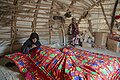 A Baloch woman weaving a blanket
 -
 Baking bread in handmade ovens among the Baloch people
 -
 Baloch sardar, Sardar Malek shakhan Narouei
 -
 A Baloch man wearing traditional clothes
 -
 Baloch boy from Balochistan, Iran
 -
 A Baloch man wearing traditional clothes


_05.jpg)


Notable people
[edit]Pakistan
[edit]- Abdul Rashid Ghazi (1964–2007), Pakistani diplomat and Islamic scholar[188]
- Maulana Muhammad Abdullah (1935–1998), Islamic scholar who served as Chairman of Ruet-e-Hilal Committee.[189]
- Nabi Bakhsh Baloch (1917–2011), research scholar, historian, educationist and linguist in Urdu, English, Persian and Sindhi languages.
- Aftab Baloch (1953–2022), a former Pakistani cricketer.
- Abdul Qadir Baloch (born 1945), a retired General in the Pakistan army. Currently a Pakistani politician.
- Mahnoor Baloch (born 1970), Canadian Pakistani actress.
- Naz Baloch (born 1981), Pakistani female politician.
- Quratulain Balouch, Pakistani American singer and songwriter.
- Kiran Maqsood Baluch (born 1978), a Pakistani woman cricketer.
- Akbar Bugti (1926–2006), the former Tumandar of the Bugti tribe and Minister of State of Balochistan Province.
- Maulana Abdul Aziz, (born 1960), Imam of Red Mosque
- Sarfraz Bugti (born 1981), former member of the Pakistani Senate and current chief minister of Balochistan.
- Sardar Usman Buzdar (born 1969), former chief minister of Punjab province.[190][191]
- Eva B, hip hop rapper and singer.
- Mir Jafar Khan Jamali (1911–1967), a veteran politician from Muslim League and a tribal leader from Balochistan[192]
- Zafarullah Khan Jamali (1944–2020), the 15th prime minister of Pakistan.[193]
- Kaifi Khalil (born 1996), singer-songwriter.
- Sardar Mohammad Ayub Khan Gadhi, (born 1961) Member of the Provincial Assembly and ex-Minister for Counter Terrorism Punjab.
- Zulfiqar Ali Khosa (born 1935), a former governor of Punjab province.
- Latif Khosa (born 1946), a former Governor of Punjab.
- Asif Saeed Khan Khosa (born 1954), the 26th chief justice of Pakistan.[194]
- Mir Hazar Khan Khoso (1929–2021), jurist and caretaker prime minister of Pakistan from 25 March to 5 June 2013.
- Muhammad Muqeem Khan Khoso (1949–2016), a former Chief Sardar of the Khoso Tribe and former Member of the Provincial Assembly from PS-14 Jacobabad.
- Bilal Lashari (born 1981), Pakistani filmmaker, cinematographer, screenwriter and actor.
- Farooq Leghari (1940–2010), the 8th president of Pakistan.[195]
- Hasnain Lehri (born 1989), Pakistani actor and model.
- Khair Bakhsh Marri (1928–2014), was a Baloch politician from the province of Balochistan in Pakistan.[196]
- Sherbaz Khan Mazari (1930–2020), a Baluch veteran politician.
- Shireen Mazari (born 1949), the federal minister for human rights and a member of Pakistan Tehreek-e-Insaf.
- Muniba Mazari (born 1987), human rights activist, artist and motivational speaker.
- Sardar Mir Balakh Sher Mazari (1928–2022), the interim prime minister of Pakistan in a 1993 caretaker government.[197]
- Yasir Nawaz (born 1970), director, producer, screenwriter and actor.
- Danish Nawaz (born 1978), television actor, director and comedian.
- Siraj Raisani (1963–2018), a member of Balochistan Awami Party.[198] He is also a recipient of the Sitara-e-Shujaat (star of bravery).[199]
- Mir Chakar Rind, (1468–1565), Baloch folk hero
- Asif Ali Zardari (born 1955), the 11th and 14th president of Pakistan.
- Sanaullah Khan Zehri (born 1961), the 15th chief minister of Balochistan.[200]
See also
[edit]Notes
[edit]- ^ A number of unrelated tribes with the name Ahmadzai exist.[77] There are two Pashtun tribes who are unrelated to each other with this name: the Ahmadzai who are a Waziri tribe and the Sulaimankhel Ahmadzai, part of the Ghilzai confederation.[78] However, the Ahmadzai Khans of Khalat were neither of these and belonged to a Brahui tribe.[79][80][81]
- ^ Only includes those who speak Balochi as mother tongue
Citations
[edit]- ^ "Table 11: Population by Mother Tongue, Sex, and Rural/Urban – 2023 Census" (PDF). Archived from the original (PDF) on 5 October 2024.
- ^ "West Balochistan". Unrepresented Nations and Peoples Organization. Retrieved 18 December 2024.
- ^ a b c d e f Tyagi, Vidya Prakash (2009). Martial races of undivided India. Kalpaz Publications. p. 12. ISBN 9788178357751.
- ^ Long, Roger D.; Singh, Gurharpal; Samad, Yunas; Talbot, Ian (8 October 2015). State and Nation-Building in Pakistan: Beyond Islam and Security. Routledge. ISBN 978-1-317-44820-4.
- ^ a b c "Baloch population scattered around the world". 20 February 2025.
- ^ "Baloch population scattered around the world". 16 February 2023. Retrieved 18 December 2024.
- ^ Long, Roger D.; Singh, Gurharpal; Samad, Yunas; Talbot, Ian (8 October 2015). State and Nation-Building in Pakistan: Beyond Islam and Security. Routledge. p. 129. ISBN 978-1-317-44820-4.
- ^ "Southern Baloch in Somalia". Joshua Project. Retrieved 18 December 2024.
- ^ "Increased human rights violations since President Rouhani's administration" (PDF). Unrepresented Nations and Peoples Organization. 20 February 2025.
- ^ Department for Communities and Local Government. "The Pakistani Muslim Community in England" (PDF). Department for Communities and Local Government. pp. 5–11 (6), 36–41. Archived from the original (PDF) on 19 September 2012. Retrieved 19 December 2024.
- ^ "Census Profile, 2021 Census of Population". 2021 Canadian census. 9 February 2022. Retrieved 19 December 2024.
- ^ "Australian Bureau of Statistics". Retrieved 19 December 2024.
- ^ تحديث, شباب الجزائر اخر (16 September 2024). "جزائرية تفوز بسباق الجمل في السعودية". Eldjazair1 (in Arabic). Retrieved 24 February 2025.
- ^ Laura, Etheredge (15 January 2011). Persian Gulf States: Kuwait, Qatar, Bahrain, Oman, and the United Arab Emirates. The Rosen Publishing Group, Inc. p. 66. ISBN 978-1-61530-327-4.
The Baloch are traditionally nomads, but settled agricultural existence is becoming more common; every chief has a fixed residence. The villages are collections of mud or stone huts; on the hills, enclosures of rough stone walls are covered with matting to serve as temporary habitations. The Baloch raise camels, cattle, sheep, and goats and engage in carpet making and embroidery. They engage in agriculture using simple methods and are chiefly Muslim.
- ^ Bashir, Shahzad; Crews, Robert D. (28 May 2012). Under the Drones. Harvard University Press. p. 140. ISBN 978-0-674-06476-8.
In southwestern Afghanistan the Baloch have traditionally been nomads, and some of them continue to lead a nomadic way of life today. Over the course of the twentieth century most Baloch settled down in the southwest and started a sedentary way of life based on pastoralism and irrigated agriculture. Repeated droughts during the last two decades caused many Baloch to give up livestock farming and agriculture,
- ^ Gayer, Laurent (2014). Karachi: Ordered Disorder and the Struggle for the City. Oxford University Press. pp. 127_128. ISBN 978-0-19-935444-3.
Lyari's first residents were Sindhi fishermen and Baloch nomads (pawans) from Makran, Lasbela and Kalat districts, flee- ing drought and tribal feuds. A first influx occurred around 1725, a few years before Sindhi banyas settled in Karachi and committed to expand it. A second wave of Baloch settlers arrived around 1770, when Karachi came under the control of the Khan of Kalat, following an accord between the Khan and the Kalhora rulers of Sindh. A third wave of Baloch migra- tion took place after 1795, following the annexation of the city by the Talpur rulers of Sindh, which attracted Baloch tribesmen from interior Sindh and the Seraiki belt, many of whom found employment as guards, particularly at the Manora fort.
- ^ Shahrani, M. Nazif (10 February 2018). Modern Afghanistan: The Impact of 40 Years of War. Indiana University Press. p. 276. ISBN 978-0-253-03026-9.
According to one of the members of the group's lead- ing (Sardar) family whom I met in Pakistan in 2012, the reason for abandoning the settlements in southern Nimruz was that the Sanjerani landowners were threatened by the "communist regime" in Afghanistan in the 1980s. So the Sanjerani moved almost completely to Baloch areas in Pakistan and Iran. At the same time the Brahui, Baloch groups of pastoral nomads, established the main local mujahideen faction, the Jabhe-ye Nimruz and took over most of the for- mer property of the Sanjerani (see below).
- ^ Nahyan, Mansoor Bin Tahnoon Al; Hussain, Jamal; Ghafoor, Asad ul (9 May 2019). Tribes of Pakistan. Cambridge Scholars Publishing. p. 73. ISBN 978-1-5275-3439-1.
The Baloch, like the Brahuis, are divided geographically into two groups, the Suleimani (northerners) and the Makrani (southerners) occupying the respective parts of the province, with the central areas inhabited by the Brahuis." Historically, they have also been a nomadic pastoral people living in the open and avoiding towns.
- ^ Phillips, David J. (2001). Peoples on the Move: Introducing the Nomads of the World. William Carey Library. p. 289. ISBN 978-0-87808-352-7.
They are united by language and a common culture, and the name Baluch has the connotation of a tent-dwelling nomadic pastoralist, although most of them have never lived like that. The Baluch practice different combinations of agriculture and pastoralism.
- ^ Dong, Shikui; Kassam, Karim-Aly S.; Tourrand, Jean François; Boone, Randall B. (30 August 2016). Building Resilience of Human-Natural Systems of Pastoralism in the Developing World: Interdisciplinary Perspectives. Springer. p. 4. ISBN 978-3-319-30732-9.
Some pastoral groups in the world: (a) Tibetan in Qinghai, China; (b) Kirghiz in Badakhshan, Afghanistan: (c) Boran in Borana, Ethiopia; (d) Massai in Kenya; (e) Mongol in Inner Mongolia, China; (1) Tajik in Yangi Qala, Afghanistan; (g) Bedouin in Negev, Israel; (h) Baloch in northern Pakistan.
- ^ Zehi, Pirmohamad. "A Cultural Anthropology of Baluchis". Iran Chamber Society.
- ^ Blood, Peter, ed. "Baloch". Pakistan: A Country Study. Washington: GPO for the Library of Congress, 1995.
- ^ Central Intelligence Agency (2013). "The World Factbook: Ethnic Groups". Archived from the original on 16 November 2018. Retrieved 3 November 2014.
- ^ a b "Oman's Diverse Society: Northern Oman" (PDF). JE Peterson.
- ^ a b Dashti, The Baloch and Balochistan 2012, pp. 8, 33–34, 44.
- ^ a b Dashti, The Baloch and Balochistan 2012, pp. 33–34.
- ^ Dashti, The Baloch and Balochistan 2012, pp. 33.
- ^ a b c Dames, Mansel Longworth (1904). The Baloch race. A historical and ethnological sketch. London, Royal Asiatic society. pp. 22, 26, 29.
- ^ a b c "AŠKAŠ". Encyclopædia Iranica.
- ^ Dashti, The Baloch and Balochistan 2012, pp. 130.
- ^ Iran in the Ancient East: Archaeological Studies Presented in the Lowell Lectures at Boston Hardcover by Ernst Emil Herzfeld – 1988. ISBN 9780878173082
- ^ Frye, Richard N (1929). "Remarks on Baluchi History". Central Asiatic Journal. 6 (6/1): 44–50. JSTOR 41926492.
- ^ Bhandarkar, D. R. (1929). "Indian Studies No. I: Slow Progress of Islam Power in Ancient India". Annals of the Bhandarkar Oriental Research Institute. 10 (1/2): 30. JSTOR 41682407.
- ^ a b c d e f g h i j k Carina،Korn, Jahani،Korn (2003). The Baloch and Their Neighbours. Reichert. pp. 49, 314–317, 248, 260. ISBN 9783895003660.
- ^ Windfuhr, Gernot (2013). The Iranian Languages. Taylor & Francis. p. 636. ISBN 9781135797041.
- ^ "The Balochi Language Project". Uppsala University. 25 November 2024. Retrieved 17 December 2024.
- ^ Jahani, Carina (1989). Standardization and Orthography in the Balochi Language. Uppsala University. ISBN 978-91-554-2487-9.
- ^ a b c d e Spooner, Brian (1988). "Baluchistan i. Geography, History and Ethnography". Encyclopedia Iranica. Retrieved 30 December 2014.
- ^ Dashti, The Baloch and Balochistan 2012, pp. 32.
- ^ John, Wilson (2009). PakistanThe Struggle Within. Pearson Longman. p. 22. ISBN 9788131725047.
- ^ "The Balochi Language Project". Uppsala University. 25 November 2024. Retrieved 17 December 2024.
- ^ Ethnologue report for Southwestern Iranian languages
- ^ a b c d Afshar, Iraj (1992). Balochistan and its ancient civilization (in Persian). Printing and Publishing Organization of the Ministry of Culture and Islamic Guidance. pp. 89–90, 101, 127, 376.
- ^ Dashti, The Baloch and Balochistan 2012, pp. 57.
- ^ a b Mir Naseer Khan Ahmedzai Kambarani Baloch. A History of the Baloch and Balochistan (2023). ASIN B0D66DTRMW.
- ^ Ahmadzai Baloch, Mir Naseer Khan (1988). Tārīk̲h̲-i Baloc va Balocistān, Volume 1 (in Urdu). Balocī Ikaiḍamī. p. 36.
- ^ Ahmadzai Baloch, Mir Naseer Khan (1988). Tārīk̲h̲-i Baloc va Balocistān, Volume 1 (in Urdu). Balocī Ikaiḍamī. pp. 241–251.
- ^ Ahmadzai Baloch, Mir Naseer Khan (1988). Tārīk̲h̲-i Baloc va Balocistān, Volume 4 (in Urdu). Balocī Ikaiḍamī. pp. 13–16.
- ^ "ŠAHRESTĀNĪHĀ Ī ĒRĀNŠAHR".
- ^ Alimoradi, Pooriya (2024). "The Wolf Era Ends, and The Sheep Era Starts": Zoroastrian Apocalypticism in The Maʿnī-yi Vahman Yasht. BRILL. p. 329. ISBN 9789004710580.
- ^ M. Longworth Dames, Balochi Folklore, Folklore, Vol. 13, No. 3 (29 September 1902), pp. 252–274
- ^ a b c d Badalkhan, Sabir (2013). Two Essays on Baloch History and Folklore. Balochistan Monograph Series, V. Naples, Italy: Universita degli studi di Napoli. pp. 20, 36, 96–97, 120. ISBN 978-88-6719-060-7.
- ^ a b Carina،Korn, Jahani،Korn (2003). The Baloch and Their Neighbours. Reichert. pp. 49, 314–317, 248, 260. ISBN 9783895003660.
- ^ a b Ferdowsi (2006). Shahnameh: The Persian Book of Kings. Translated by Dick Davis. New York: Viking. ISBN 0670034851.
- ^ Dames, Mansel Longworth (1904). The Baloch race. A historical and ethnological sketch. London, Royal Asiatic society. pp. 22, 26, 29.
- ^ Dashti, The Baloch and Balochistan 2012, pp. 50–55.
- ^ a b c Rathore, Rizwan Zeb (2019). Ethno-political Conflict in Pakistan The Baloch Movement. Taylor & Francis. ISBN 9781000729924.
- ^ Olson; et al. (1994). An Ethnohistorical Dictionary of the Russian and Soviet Empires. Greenwood Publishing Group. p. 101. ISBN 978-0313274978.
- ^ "meer hamza: a very famous personality in the baloch history" (PDF). University of Balochistan. Retrieved 18 December 2024.
- ^ a b Dashti, The Baloch and Balochistan 2012, pp. 67.
- ^ Elfenbein, J. (1988). "Baluchistan iii. Baluchi Language and Literature". Encyclopedia Iranica. Retrieved 30 December 2014.
- ^ Hansman, John (1973), "A Periplus of Magan and Meluhha", Bulletin of the School of Oriental and African Studies, 36 (3): 553–587, doi:10.1017/S0041977X00119858, JSTOR 613582
- ^ Dashti, The Baloch and Balochistan 2012, pp. 85.
- ^ "Baloch | People, History, & Culture | Britannica". www.britannica.com. 9 December 2024. Retrieved 23 December 2024.
- ^ Gidumal, Dayaram (1888). History of Alienations in the Province of Sind: Compiled from the Jagir and Other Records in the Commissioner's Office on the Authority of Bombay Government, Resolution No. 12, Dated 2nd January 1878, Revenue Department. Printed at the "Commissioner's Press".
- ^ Gazetteer. Government Central Press. 1880.
- ^ Dashti, Naseer (2012). The Baloch and Balochistan: A Historical Account from the Beginning to the Fall of the Baloch State. Bloomington, Indiana: Trafford Publishing. pp. 103–104. ISBN 978-1-4669-5896-8.
- ^ Malik, Fida Hussain (2020). Balochistan A Conflict of Narratives. Saiyid Books. p. 3. ISBN 9789692200028.
- ^ Rathore, Azad Singh (2021). Balochistan The Heights of Oppression. Partridge Publishing India. ISBN 9781543706642.
- ^ Mann, Michael (2003). "Little Ice Age". In MacCracken, Michael C.; Perry, John S. (eds.). Encyclopedia of Global Environmental Change, Volume 1, The Earth System: Physical and Chemical Dimensions of Global Environmental Change (PDF). John Wiley & Sons. Archived from the original (PDF) on 24 January 2013. Retrieved 17 November 2012.
- ^ Lamb, H. H. (1972). "The cold Little Ice Age climate of about 1550 to 1800". Climate: present, past and future. London: Methuen. p. 107. ISBN 0-416-11530-6. (noted in Grove 2004:4).
- ^ "Earth observatory Glossary L-N". NASA Goddard Space Flight Center, Green Belt MD: NASA. Retrieved 17 July 2015.
- ^ Miller et al. 2012. "Abrupt onset of the Little Ice Age triggered by volcanism and sustained by sea-ice/ocean feedbacks" Geophysical Research Letters 39, 31 January: abstract (formerly on AGU website) (accessed via wayback machine 11 July 2015); see press release on AGU website (accessed 11 July 2015).
- ^ Grove, J. M., Little Ice Ages: Ancient and Modern, Routledge, London (2 volumes) 2004.
- ^ Matthews, J. A. and Briffa, K. R., "The 'Little Ice Age': re-evaluation of an evolving concept", Geogr. Ann., 87, A (1), pp. 17–36 (2005). Retrieved 17 July 2015.
- ^ "1.4.3 Solar Variability and the Total Solar Irradiance – AR4 WGI Chapter 1: Historical Overview of Climate Change Science". Ipcc.ch. Retrieved 24 June 2013.
- ^ Kieffer, Ch. M. "Aḥmadzī". Encyclopædia Iranica (Online ed.). United States: Columbia University.
- ^ "Ethnic Identity in Afghanistan". Naval Postgraduate School. Archived from the original on 18 November 2007. Retrieved 3 January 2015.
- ^ Bettina Bruns; Judith Miggelbrink (8 October 2011). Subverting Borders: Doing Research on Smuggling and Small-Scale Trade. Springer Science & Business Media. p. 52, footnote 12. ISBN 978-3-531-93273-6.
- ^ Minahan, James (2012). Ethnic Groups of South Asia and the Pacific: An Encyclopedia. ABC-CLIO. p. 48. ISBN 978-1-59884-659-1.
- ^ Axmann, Martin (2008). Back to the Future: The Khanate of Kalat and the Genesis of Baloch Nationalism, 1915–1955. Oxford University Press. p. 22. ISBN 978-0-19-547645-3.
- ^ Dashti, The Baloch and Balochistan 2012, pp. 273.
- ^ Floor, Willem M. (2009). The Rise and Fall of Nader Shah: Dutch East India Company Reports, 1730–1747. Mage Publishers. ISBN 978-1933823324.
- ^ Bastani Parizi, Mohammad Ebrahim (Mohammad Ebrahim Bastani Parizi). Kerman History (in Persian). p. 207.
- ^ Mīrńiyā, Alī (1990). Nomadic clans of Khorasan, The political role of the heads of the great clans in the affairs of the country and their relations with the governments and colonialists(In Persian) (in Persian). p. 173.
- ^ Hamdam, Hassan (2020). The Right to Self-Determination Under International Law and Politics: the Case of the Baloch People. Trafford Publishing. ISBN 9781698704364.
- ^ Sheikh, Salman Rafi (2018). The Genesis of Baloch Nationalism. Taylor & Francis. ISBN 9781351020688.
- ^ Ramsey, Syed (2017). Balochistan In Quest of Freedom. VIJ Books (India) PVT Limited. ISBN 9789386834393.
- ^ Siddiqi, Farhan Hanif (2012). The Politics of Ethnicity in Pakistan. Routledge. p. 54. ISBN 9780415686143.
- ^ "Talpur". Encyclopædia Britannica.
- ^ Beasley, Edward (2016). The Chartist General. Taylor & Francis. p. 214. ISBN 978-1-315-51728-5.
- ^ Dashti, The Baloch and Balochistan 2012, pp. 177.
- ^ a b c Breseeg, Taj Mohammad (2004). Baloch Nationalism: Its Origin and Development. Royal Book Company. p. 145. ISBN 9789694073095.
- ^ a b Dashti, Naseer (2017). The Baloch Conflict with Iran and Pakistan Aspects of a National Liberation Struggle. Trafford Publishing. p. 11,52–53,66. ISBN 9781490780917.
- ^ "ČAḴĀNSŪR". Encyclopædia Iranica.
- ^ Baloch, Inayatullah (1987). The Problem of "Greater Baluchistan": A Study of Baluch Nationalism. Steiner Verlag Wiesbaden. ISBN 978-3-515-04999-3.
- ^ Khosa, Tariq (20 July 2020). "Baloch Nationalism". Dawn. Retrieved 11 January 2023.
- ^ Hussain, Zahid (25 April 2013). "The battle for Balochistan". Dawn.
- ^ "The untold story of human rights violations in Balochistan: Unveiling the historical context". Daily News and Analysis. Retrieved 2 June 2023.
- ^ Syed Farooq Hasnat (2011). Global Security Watch—Pakistan. ABC-CLIO. p. 78. ISBN 978-0-313-34698-9.
- ^ Axmann, Martin (2 August 2012). The Khanate of Kalat and the Genesis of Baluch Nationalism. OUP Pakistan. ISBN 978-0-19-906592-9.
- ^ Harrison, Selig S. (1981). Baloch nationalism and Soviet temptation. Carnegie Endowment for International Peace. ISBN 978-0-87003-029-1.
- ^ Farhan Hanif Siddiqi (4 May 2012). The Politics of Ethnicity in Pakistan: The Baloch, Sindhi and Mohajir Ethnic Movements. Routledge. pp. 64–. ISBN 978-1-136-33696-6.
- ^ a b c d Tahir, Muhammad (3 April 2008). "Tribes and Rebels: The Players in the Balochistan Insurgency". Terrorism Monitor. 6 (7). Jamestown Foundation. Retrieved 6 December 2017.
- ^ Pakistan Horizon, Volume 59, Issues 3–4. Pakistan Institute of International Affairs. 2006.
- ^ "JWP leader Talal Bugti passes away in Quetta". The Express Tribune. 27 April 2015.
- ^ Baloch, Muhammad Amin (1999). Inside Ormara. Muhammad Amin Baloch. p. 83.
- ^ Bonarjee, P. D. (1899). A handbook of the fighting races of India. Thacker, Spink & Co. p. 47.
- ^ Al Nahyan, Hussain, Ghafoor, Mansoor Bin Tahnoon, Jamal, Asad ul (2019). Tribes of Pakistan. Cambridge Scholars Publishing. p. 112. ISBN 9781527534391.
{{cite book}}: CS1 maint: multiple names: authors list (link) - ^ John, Wilson (2009). PakistanThe Struggle Within. Pearson Longman. p. 28. ISBN 9788131725047.
- ^ "Khorasan i. Ethnic Groups". Encyclopædia Iranica.
- ^ "The Balochi Language Project". Uppsala University. 23 May 2024.
- ^ Sir Charles Yate, 1st Baronet. "A travelogue of Khorasan and Sistan". Sharif University of Technology. Iran. Retrieved 19 January 2024.
{{cite news}}: CS1 maint: numeric names: authors list (link) - ^ Frawley, William (2003). International Encyclopedia of Linguistics: 4-Volume Set. Oxford University Press, USA. p. 308. ISBN 978-0-19-513977-8.
- ^ a b c Taheri, Ahmad Reza (2014). A Sociopolitical Study of Iranian Baloch Elites (1979–2013). ISBN 9781312349681.
- ^ Anderson, Kevin B. (2024). A Political Sociology of Twenty-First Century Revolutions and Resistances. Taylor & Francis. ISBN 9781040107423.
- ^ a b "Iran: At least 82 Baluchi protesters and bystanders killed in bloody crackdown". Amnesty International. 6 October 2022. Retrieved 13 October 2022.
- ^ ""جمعه خونین" زاهدان؛ مولوی عبدالحمید: تیرها به سر و قلب نمازگزاران شلیک شده". BBC News فارسی (in Persian). 2 October 2022. Retrieved 3 October 2022.
- ^ Azizi, Arash (2024). What Iranians Want. Oneworld Publications. ISBN 9780861547128.
- ^ "Baloch Tribal Council". Retrieved 8 May 2024.
- ^ Crews, Bashir, Robert, Shahzad (212). Under the Drones. Harvard University Press. p. 139,147,150,151. ISBN 9780674064768.
{{cite book}}: ISBN / Date incompatibility (help)CS1 maint: multiple names: authors list (link) - ^ a b "Baluchi rug". Encyclopædia Britannica.
- ^ Amiri, Ghulam Rahman (2024). The Helmand Baluch. Berghahn Books. pp. 124–125. ISBN 9781836950592.
- ^ a b AlSalhi, Ahmad (2021). Music in Arabia. Indiana University Press. pp. 248–249. ISBN 9780253057525.
- ^ Roshni Nair (3 December 2016). "Mumbai's filmi daredevils with a cross-border history". Hindustan Times. Retrieved 9 July 2020.
- ^ Barjasteh Delforooz, Behrooz (2010). "Discourse Features in Balochi of Sistan". Uppsala University: 17–18.
- ^ Axenov, Serge. Balochi Language of Turkmenistan: A Corpus-based Grammatical Description (Studia Iranica Upsaliensia). ISBN 9155467660.
- ^ Potter, Lawrence G. (2013). Sectarian Politics in the Persian Gulf (PDF). Oxford University Press. pp. 229–244. Retrieved 4 September 2024.
- ^ McCoy, Eric (2008). Iranians in Bahrain and the United Arab Emirates: Migration, Minorities, and Identities in the Persian Gulf Arab States (PDF). The University of Arizona. ISBN 9780549935070. OCLC 659750775. Archived from the original on 19 December 2024. Retrieved 17 December 2024.
{{cite book}}: CS1 maint: bot: original URL status unknown (link) - ^ "Baloch in America". VSH News. Archived from the original on 12 November 2016. Retrieved 18 December 2016.
- ^ Westrip, J.; Holroyde, P. (2010). Colonial Cousins: a surprising history of connections between India and Australia. Wakefield Press. p. 193. ISBN 978-1862548411.
- ^ Jones, Philip G.; Jones, Anna (2007). Australia's Muslim Cameleers: Pioneers of the Inland, 1860s–1930s (Pbk ed.). Wakefield Press. p. 39,172. ISBN 9781862547780.
- ^ "The Afghan camelmen". South Australian History: Flinders Ranges Research. Retrieved 2 June 2019.
- ^ "Iranian Baloch Activist In Danger Of Deportation From Sweden". Iran International. 7 March 2024. Retrieved 2 January 2025.
- ^ Korn, Jahani, Titus, Agnes , Carina , Paul Brian (2008). The Baloch and Others Linguistic, Historical and Socio-political Perspectives on Pluralism in Balochistan. Reichert Verlag. p. 19,223. ISBN 9783895005916.
{{cite book}}: CS1 maint: multiple names: authors list (link) - ^ "Balochi A". Uppsala University. Retrieved 17 December 2024.
- ^ "Balochistan: Important London Meeting For UK Baloch". Unrepresented Nations and Peoples Organization. 15 February 2013. Retrieved 1 June 2014.
- ^ Lodhi, Abdulaziz Y. 2000. A note on the Baloch in East Africa. In: Language in society: eight sociolinguistic essays on Balochi, Studia iranica upsaliensia, no 3, pp 91–95. Edited by Carina Jahani. Uppsala: Acta Universitatis Upsaliensis
- ^ Baluchis from East Africa: In Search of Our Roots Archived 14 May 2011 at the Wayback Machine, Retrieved 27 June 2010
- ^ a b "Baloch Society & culture". Baask.com. Archived from the original on 16 September 2011. Retrieved 7 September 2010.
- ^ "Baloch Cultural Day celebrated with colourful functions, gatherings". Pakistan Today. 2 March 2018. Retrieved 21 April 2018.
- ^ Taheri, Ahmad Reza (2014). A Sociopolitical Study of Iranian Baloch Elites. Lulu Press, Incorporated. p. 11,45. ISBN 978-1312349681.
- ^ Enrile, Weiss, Zaleski, Annalisa V., Eugenia L., Kristen (2020). Women's Journey to Empowerment in the 21st Century. Oxford University Press. p. 117,144. ISBN 9780190927097.
{{cite book}}: CS1 maint: multiple names: authors list (link) - ^ Baloch, Kiyya (19 December 2023). "Women Are Leading an Unprecedented Protest Movement in Balochistan". thediplomat.com. Archived from the original on 22 December 2023. Retrieved 22 December 2023.
- ^ Ebrahim, Zofeen T. (31 August 2024). "'She has won our hearts and minds': can one woman unite the Baloch people in peaceful resistance?". The Guardian. Retrieved 28 October 2024.
- ^ "In Balochistan, Families Demand Answers for Forced Disappearances". thediplomat.com. Retrieved 29 January 2024.
- ^ "BBC 100 Women 2024: Who is on the list this year?". BBC. 3 December 2024. Retrieved 3 December 2024.
- ^ "Sammi Deen Baloch honoured with human rights award". The News International. 31 May 2024. Retrieved 31 May 2024.
- ^ "Sammi Deen Baloch". Front Line Defenders. 28 May 2024. Retrieved 31 May 2024.
- ^ Service, VOA Persian (3 March 2024). "Iranian Activist Among Recipients of 2024 International Women of Courage Awards". Voice of America. Retrieved 15 April 2024.
- ^ "2024 International Women of Courage Award". United States Department of State. 6 March 2024. Retrieved 15 April 2024.
- ^ "Son, Brother of Exiled Iranian Rights Activist Arrested". IranWire. 21 June 2023. Retrieved 16 April 2024.
- ^ BBC 100 Women 2016: Who is on the list? Archived 11 July 2017 at the Wayback Machine, BBC, 7 October 2019. Retrieved 24 November 2016.
- ^ "Women Activists from Balochistan and Kurdistan Nominated to BBC's 100 Influential Individuals". Balochwarna/>. Retrieved 13 December 2024.
- ^ "Remembering the tragedy and legend of Hani and Sheh Mureed". Daily Times. 8 March 2019. Retrieved 9 May 2020.
- ^ "Baloch literature is the repository of love and romanticism". The Nation. 26 May 2017. Retrieved 9 May 2020.
- ^ Carina،Korn, Jahani،Korn (2003). The Baloch and Their Neighbours. Reichert. p. 260. ISBN 9783895003660.
- ^ Windfuhr, Gernot (2012). The Iranian Languages. Routledge. p. 635. ISBN 9781135797034.
- ^ "FOLK POETRY". Encyclopædia Iranica.
- ^ a b "Baluchistan iv. Music of Baluchistan". Encyclopædia Iranica.
- ^ "Ghaychak Instrument; What Iran is known for". Retrieved 29 December 2023.
- ^ Sabry, Fouad (2024). War Rug. One Billion Knowledgeable.
- ^ "Investigating the types, methods and geography of Iranian carpet production in the first five centuries of Hijra, based on written sources(In Persian)" (PDF). Shahed University (in Persian). Retrieved 6 June 2024.
- ^ "Aesthetics of color and design of Baloch Mehrabi carpets(In Persian)" (PDF). Shahid Chamran University of Ahvaz (in Persian). Retrieved 6 June 2024.
- ^ a b "CLOTHING xviii. Clothing of the Baluch in Persia". Encyclopædia Iranica.
- ^ "CLOTHING xix. Clothing of the Baluch in Pakistan and Afghanistan". Encyclopædia Iranica.
- ^ Zendeh del, Hasan (2000). Effects of nomadic tourism (in Persian). Irangardan. pp. 176&179. ISBN 978-964-6635-29-6.
- ^ Rehman Khan, F. and Malghani, M. and Ayyaz, S., "Construction of Baloch Ethnic Identity through Ethnolinguistic Awareness and Cultural Dynamics", Clark, pp. 440 (2005). Retrieved 2 January 2024.
- ^ "مهتاب نوروزی؛ نماد نیم قرن سوزن دوزی در بلوچستان" [Mahtab Norouzi; Symbol of half a century of needlework in Balochistan]. BBC News فارسی (in Persian). 16 July 2012. Retrieved 9 May 2022.
- ^ Carr, Butler, Anna, Richard (2024). The Routledge Handbook of Tourism and Indigenous Peoples. Taylor & Francis. p. 373. ISBN 9781040086629.
{{cite book}}: CS1 maint: multiple names: authors list (link) - ^ "R-Y920 YTree". yfull.com. Retrieved 20 January 2021.
- ^ Ikram, Muhammad Salman; Mehmood, Tahir; Rakha, Allah; Akhtar, Sareen; Mahmood Khan, Muhammad Imran; Al-Qahtani, Wedad Saeed; Fatmah, Ahmed Safhi; Hadi, Sibte; Wang, Chuan-Chao; Adnan, Atif (2022). "Genetic diversity and forensic application of Y-filer STRs in four major ethnic groups of Pakistan". BMC Genomics. 23 (1): 7–11. doi:10.1186/s12864-022-09028-z. ISSN 1471-2164. PMC 9714238. PMID 36451116.
- ^ Adnan, Atif; Wen, Shao-Qing; Rakha, A.; Alghafri, R.; Nazir, Sh.; Rehman, M.; Wng, Ch. (22 November 2020). "Forensic features and genetic legacy of the Baloch population of Pakistan and the Hazara population across Durand-line revealed by Y chromosomal STRs". bioRxiv 10.1101/392456.
- ^ "FamilyTreeDNA – " Al-Baloushi " Group Project – مشروع البلوشي الجيني". www.familytreedna.com. Retrieved 24 February 2025.
- ^ "FamilyTreeDNA –". www.familytreedna.com. Retrieved 24 February 2025.
- ^ Korn, Jahani, Titus, Agnes , Carina , Paul Brian (2008). The Baloch and Others Linguistic, Historical and Socio-political Perspectives on Pluralism in Balochistan. Reichert Verlag. p. 12. ISBN 9783895005916.
{{cite book}}: CS1 maint: multiple names: authors list (link) - ^ "Baloch people". Encyclopædia Britannica.
- ^ a b Fair, C. Christine and Hamza, Ali (2017) "Rethinking Baloch Secularism: What the Data Say," Peace and Conflict Studies: Vol. 24 : No. 1, Article 1, see Table 2 & Table 4. Archived on 19 December 2024.
- ^ Williams, Victoria R. (24 February 2020). Indigenous Peoples: An Encyclopedia of Culture, History, and Threats to Survival [4 volumes]. ABC-CLIO. ISBN 978-1-4408-6118-5.
- ^ Dashti, The Baloch and Balochistan 2012, pp. 142.
- ^ Ahmady, Kameel (2013). From Border to Border Research Study on Identity and Ethnicity in Iran. Avaye Buf. p. 100. ISBN 9788794295314.
- ^ Jahani,Karina, Agnes,Korn (2022). The Baloch and their Neighbours, Ethnic and Linguistic Contact in Balochistan in Historical and Modern Time. Cambridge University. p. 248. ISBN 978-3-89500-366-0.
{{cite book}}: CS1 maint: multiple names: authors list (link) - ^ Kamal Siddiqi (30 July 2009). "Hingol Temple Symbolises Baloch Secularism". Hindustan Times. Retrieved 20 October 2020.[permanent dead link]
- ^ Mohta, Nikita (22 November 2024). "From Panipat to Balochistan: Tracing the Maratha community's journey through history". The Indian Express.
- ^ Roshni Nair (3 December 2016). "Mumbai's filmi daredevils with a cross-border history". Hindustan Times. Retrieved 9 July 2020.
- ^ Sadaf Modak (7 November 2016). "A piece of Balochistan in Mumbai since Partition – 150 families & Khatti Dal". Retrieved 20 October 2020.
- ^ Maskeri, Anju (20 November 2016). "A century here, but still not at home". Mid-Day. Archived from the original on 25 December 2024.
For the Bhagnari community of Mumbai, who also originate from Balochistan and date their presence in this city to the Partition, there's no identity conflict. "We are identified as Sindhis. Although we speak Sairaki (a dialect spoken in the southern half of the province of Punjab in Pakistan), there's never been a clash," says Lalit Jham, a businessman and member of the community. According to statistics, there are approximately 2,500 Bhagnaris living in Mumbai. "Since we come under the Sindhi caste, we can avail of benefits like reservation."
- ^ Walsh, Declan (2021). The Nine Lives of Pakistan: Dispatches from a Divided Nation. Bloomsbury Publishing. pp. 32–33.
- ^ Mansoor, Riaz (2006). Hayat Shaheed E Islam (حیات شہید ای اسلام). Maktaba Faridia. p. 57.
- ^ Haider, Sikandar (18 August 2018). "Poorest Baloch tribe's chief set to rule Punjab". The Nation.
- ^ "CM Usman Buzdar's resignation accepted, Punjab cabinet dissolved". www.thenews.com.pk. April 2022. Retrieved 28 November 2023.
- ^ Dr Shahida Jaffrey Jamali (6 April 2017). "Remembering Mir Jaffar Khan Jamali". Daily Times.
- ^ "Zafarullah Khan Jamali – Age, Political Party, Family and Education". ARYNEWS. 11 August 2018.
- ^ "Justice Asif Saeed Khosa to be sworn in as 26th Chief Justice of Pakistan". thenews.com.pk. 17 January 2019.
- ^ "Farooq Ahmad Khan: Bhutto's pick, until he sacked her". The National. 30 October 2010.
- ^ Hasan Mansoor (11 June 2014). "Khair Bakhsh Marri: a fighter all the way". Dawn. Pakistan. Retrieved 21 August 2020.
- ^ "Balakh Sher Mazari – Age, Son, Family, Political party". ARYNEWS. 15 July 2018.
- ^ "I am Siraj Khan Raisani Baloch & I will die a Pakistani". thenews.com.pk. 14 July 2018.
- ^ "President Alvi confers top civil, military awards for excellence on Pakistan Day". Dawn. Pakistan. 23 March 2019.
- ^ Notezai, Muhammad Akbar (10 January 2018). "Profile: Sanullah Zehri – more of a Sardar than a politician". Dawn. Pakistan.
General and cited references
[edit]- Dashti, Naseer (2012). The Baloch and Balochistan: A Historical Account from the Beginning to the Fall of the Baloch State. Trafford Publishing. pp. 33–. ISBN 978-1-4669-5896-8.
Further reading
[edit]- Axmann, Martin (2019). "Baluchistan and the Baluch people". In Fleet, Kate; Krämer, Gudrun; Matringe, Denis; Nawas, John; Rowson, Everett (eds.). Encyclopaedia of Islam (3rd ed.). Brill Online. ISSN 1873-9830.
- Bulookbashi, Ali A.; Asatryan, Mushegh (2013). "Balūch". In Madelung, Wilferd; Daftary, Farhad (eds.). Encyclopaedia Islamica Online. Brill Online. ISSN 1875-9831.
- Elfenbein, J. "Balochi Literature". P. G. Kreyenbroek and U. Marzolph, eds. Oral Literature of Iranian Languages. Kurdish, Pashto, Balochi, Ossetic, Persian & Tajik. A History of Persian Literature. ed. E. Yarshater. vol. 18. Companion vol. 2. London: I. B. Tauris, 2010. pp. 167–198.
External links
[edit] Definitions from Wiktionary
 Media from Commons
 News from Wikinews
 Quotations from Wikiquote
 Texts from Wikisource
 Textbooks from Wikibooks
 Resources from Wikiversity


| |||||||||||||||||||||||||


