


Community hub
Recent from talks
Contribute something
Nothing was collected or created yet.
Names and titles of Jesus in the New Testament
View on Wikipedia

Two names and a variety of titles are used to refer to Jesus in the New Testament.[1] In Christianity, the two names Jesus and Emmanuel that refer to Jesus in the New Testament have salvific attributes.[2][3][4] After the crucifixion of Jesus the early Church did not simply repeat his messages, but focused on him, proclaimed him, and tried to understand and explain his message. One element of the process of understanding and proclaiming Jesus was the attribution of titles to him.[5] Some of the titles that were gradually used in the early Church and then appeared in the New Testament were adopted from the Jewish context of the age, while others were selected to refer to, and underscore the message, mission and teachings of Jesus.[5] In time, some of these titles gathered Christological significance.[6]
Christians have attached theological significance to the Holy Name of Jesus.[7][8] The use of the name of Jesus in petitions is stressed in John 16:23 when Jesus states: "If you ask the Father anything in my name he will give it you."[9] There is widespread belief among Christians that the name Jesus is not merely a sequence of identifying symbols but includes intrinsic divine power.[4][9][10]
Names
[edit]Jesus
[edit]
In the New Testament the name Jesus is given both in the Gospel of Luke and the Gospel of Matthew, and Emmanuel only in Matthew. In Luke 1:31 an angel tells Mary to name her child Jesus, and in Matthew 1:21 an angel tells Joseph to name the child Jesus. The statement in Matthew 1:21 "you shall call his name Jesus, for he will save his people from their sins" associates salvific attributes to the name Jesus in Christian theology.[2][3][12][13]
Although the precise difference between a 'name' and a 'title' may be open to interpretation, 198 different names and titles of Jesus in the Bible are listed in Cruden's Concordance, first published in 1737, and continuously in print ever since. The first index of the book (following the royal dedications and author's preface) is entitled "A collection of the Names and Titles given to Jesus Christ", with 198 names listed, each accompanied by a biblical reference.[14]
During his lifetime, when the need for specificity arose, a patronym or toponym would be added to his given name. These forms of address have been translated into English as "Jesus son of Joseph," "Jesus of Nazareth" and "Jesus the Nazarene."[15]
| Part of a series on |
 |


Etymology
[edit]There have been a number of proposals as to the origin and etymological origin of the name Jesus.[16] The name is related to the Biblical Hebrew form Yehoshua`(יְהוֹשֻׁעַ), which is a theophoric name first mentioned in the Bible in Exodus 17:9 referring to one of Moses' companions and his successor as leader of the Israelites. This name is usually considered to be a compound of two parts: יהו Yeho, a theophoric reference to YHWH, the distinctive personal name of the God of Israel, plus a form derived from the Hebrew triconsonantal root y-š-ʕ or י-ש-ע "to liberate, save". There have been various proposals as to how the literal etymological meaning of the name should be translated, including:[17][18][19][20][21]
- YHWH saves
- YHWH (is) salvation
- YHWH (is) a saving-cry
- YHWH (is) a cry-for-saving
- YHWH (is) a cry-for-help
- YHWH (is) my help
This early Biblical Hebrew name יְהוֹשֻׁעַ (Yehoshua`) underwent a shortening into later biblical יֵשׁוּעַ (Yeshua`), as found in the Hebrew text of verses Ezra 2:2, 2:6, 2:36, 2:40, 3:2, 3:8, 3:9, 3:10, 3:18, 4:3, 8:33; Nehemiah 3:19, 7:7, 7:11, 7:39, 7:43, 8:7, 8:17, 9:4, 9:5, 11:26, 12:1, 12:7, 12:8, 12:10, 12:24, 12:26; 1 Chronicles 24:11; and 2 Chronicles 31:15—as well as in Biblical Aramaic at verse Ezra 5:2. These Bible verses refer to ten individuals (in Nehemiah 8:17, the name refers to Joshua son of Nun). This historical change may have been due to a phonological shift whereby guttural phonemes weakened, including [h].[22] Usually, the traditional theophoric element Yahu יהו was shortened at the beginning of a name to יו [Yo-], and at the end to יה [-yah]. In the contraction of Yehoshua` to Yeshua`, the vowel is instead fronted (perhaps due to the influence of the y in triliteral root y-š-ʕ). During the post-biblical period, the name was also adopted by Aramaic and Greek-speaking Jews.[citation needed]
By the time the New Testament was written, the Septuagint had already transliterated ישוע (Yeshua`) into Koine Greek as closely as possible in the 3rd-century BCE, the result being Ἰησοῦς (Iēsous). Since Greek had no equivalent to the Semitic letter ש shin [sh], it was replaced with a σ sigma [s], and a masculine singular ending [-s] was added in the nominative case, in order to allow the name to be inflected for case (nominative, accusative, etc.) in the grammar of the Greek language. The diphthongal [a] vowel of Masoretic Yehoshua` or Yeshua` would not have been present in Hebrew/Aramaic pronunciation during this period, and some scholars believe some dialects dropped the pharyngeal sound of the final letter ע (`ayin) [`], which in any case had no counterpart in ancient Greek. The Greek writings of Philo of Alexandria[23] and Josephus frequently mention this name. It also occurs in the Greek New Testament at Acts 7:45 and Hebrews 4:8, referring to Joshua son of Nun.
From Greek, Ἰησοῦς (Iēsous) moved into Latin at least by the time of the Vetus Latina. The morphological jump this time was not as large as previous changes between language families. Ἰησοῦς (Iēsous) was transliterated to Latin IESVS, where it stood for many centuries. The Latin name has an irregular declension, with a genitive, dative, ablative, and vocative of Jesu, accusative of Jesum, and nominative of Jesus. Minuscule (lower case) letters were developed around 800 AD and some time later the U was invented to distinguish the vowel sound from the consonantal sound and the J to distinguish the consonant from I. Similarly, Greek minuscules were invented about the same time, prior to that the name was written in capital letters: ΙΗϹΟΥϹ or abbreviated as: ΙΗϹ with a line over the top, see also Christogram.[citation needed]
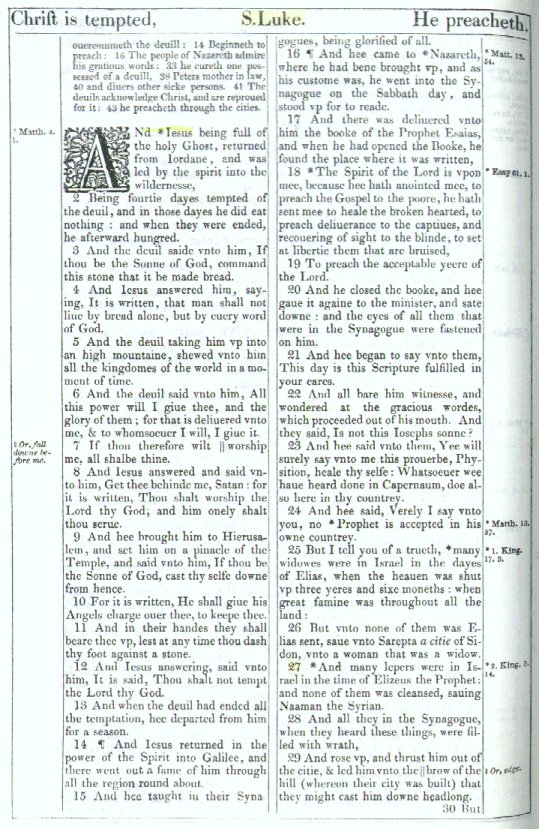
Modern English Jesus /ˈdʒiːzəs/ derives from Early Middle English Iesu (attested from the 12th century). The name participated in the Great Vowel Shift in late Middle English (15th century). The letter J was first distinguished from 'I' by the Frenchman Pierre Ramus in the 16th century, but did not become common in Modern English until the 17th century, so that early 17th century works such as the first edition of the King James Version of the Bible (1611) continued to print the name with an I.[24]
"Jesus" forms
[edit]"Jesu" is a remnant in modern English of the declension and use of grammatically inflected case endings with some proper nouns in Middle English, which persisted into Early Modern English to around the time of Shakespeare. The form Jesu is often a vocative, "Jesu!", but may also stand for other cases, such as genitive, as in Latin. The form "Jesu" was preserved in hymns and poetry long after it had fallen out of general use in speech, for example in poet laureate Robert Bridges' translation of Johann Schop's wording for the English translation of Johann Sebastian Bach's cantata, Jesu, Joy of Man's Desiring and in T. S. Colvin's hymn, Jesu, Jesu, fill us with your love, based on a song from northern Ghana.[25] During the late 19th century, as Jesu was increasingly seen as antiquated, some churches attempted to update the wording of hymns containing "Jesu" to "Jesus".[26] In modernizing hymn texts the use of "Jesu's" or "Jesus'" could cause problems where the metre only allowed two syllables, "Je-su's".[27][clarification needed]
Significance of the name
[edit]
Christians have attached theological significance to the name of Jesus from the earliest days of Christianity.[7] Devotions to and feasts for the Holy Name of Jesus exist both in Eastern and Western Christianity.[8] The devotions and venerations to the name Jesus also extend to the IHS monogram, derived from the Greek word for Jesus ΙΗΣΟΥΣ.[9][28][29]
The significance of the name of Jesus in the New Testament is underscored by the fact that in his Nativity account Matthew pays more attention to the name of the child and its theological implications than the actual birth event itself.[12][13]
Reverence for the name of Jesus is emphasized by Saint Paul in Philippians 2:10 where he states: "That in the name of Jesus every knee should bow, of those that are in heaven, on earth, and under the earth".[9]
The use of the name of Jesus in petitions is stressed in John 16:23 when Jesus states: "If you ask the Father anything in my name he will give it you." Many Christian prayers thus conclude with the words: "Through Our Lord Jesus Christ".[9] There is widespread belief among Christians that the name Jesus is not merely a sequence of identifying symbols but includes intrinsic divine power, and that where the name of Jesus is spoken or displayed the power of Jesus can be called upon.[4][9][10]
Emmanuel
[edit]Matthew 1:23 ("they shall call his name Emmanuel") provides the name 'Emmanuel' (meaning God is with us).[30] 'Emmanuel', which is taken from Isaiah 7:14, does not appear elsewhere in the New Testament.
The name 'Emmanuel' (also Immanuel or Imanu'el) of the Hebrew עִמָּנוּאֵל "God [is] with us" consists of two Hebrew words: אֵל (’El, meaning 'God') and עִמָּנוּ (ʻImmānū, meaning 'with us'); Standard Hebrew ʻImmanuʼel, Tiberian Hebrew ʻImmānûʼēl. It is a theophoric name used in the Bible in Isaiah 7:14 and Isaiah 8:8.
Some interpreters see Matthew 1:23 providing a key to Emmanuel Christology in the New Testament, with Matthew showing an interest in identifying Jesus as "God with us" and later developing the Emmanuel theme at key points throughout his Gospel.[31][32][33] The name Emmanuel does not directly appear elsewhere in the New Testament, but Matthew builds on the motif in Matthew 28:20 to indicate that Jesus will be with the faithful to the end times.[30][33] According to Ulrich Luz, the Emmanuel motif brackets the entire Gospel of Matthew between 1:23 and 28:20, appearing explicitly and implicitly in several other passages, setting the tone for the salvific theme of Matthew.[34] Some Christians see the same meaning in Matthew 28:20 ("I am with you always, even unto the end of the world") indicates that Jesus will be with the faithful to the end of the age.[30]
Titles
[edit]Christ
[edit]
The title "Christ" used in the English language is from the Greek Χριστός (Christos), via the Latin Christus. It means "anointed one".[35] The Greek is a loan translation of the Hebrew mashiaħ (מָשִׁיחַ) or Aramaic mshiħa (מְשִׁיחָא), from which the English word messiah is derived. "Christ" has now become a name, one part of the name "Jesus Christ", but originally it was a title ("the Messiah") and not a name; however its use in the phrase "Christ Jesus" is a title.[36][37][38]
The Greek-language Septuagint version of the Hebrew Bible (translated over a century before the time of Jesus), used the word Christos to express in Greek the Hebrew word mashiach (messiah), meaning "anointed".[39][40] (Another Greek word, Messias, appears in Daniel 9:26 and Psalm 2:2.)[41][42] The New Testament states that the long-awaited Messiah had come and describes this savior as the Christ. In Matthew 16:16, the Apostle Peter—in what has become a famous proclamation of faith among Christians since the first century—said, "You are the Christ, the Son of the living God."[43] In John 11:27 Martha tells Jesus "you are the Christ", just before the raising of Lazarus.[44]
In the Pauline Epistles the word Christ is so closely associated with Jesus that it is apparent that for the early Christians there is no need to claim that Jesus is Christ, for that is considered widely accepted among them. Hence Paul can use the term Christos with no confusion as to whom it refers to, and as in First Corinthians 4:15 and Romans 12:5 he can use expressions such as "in Christ" to refer to the followers of Jesus.[45]
Canonical biblical texts lack any account of a formal literal anointing of Jesus as "Christ" with the traditional oil (or chrism). Christological thought may interpret the baptism of Jesus in water by John the Baptist (Matthew 3:16) as a metaphorical anointing carried out in the light of Isaiah 61:1 – "the Lord hath anointed me to preach good tidings".[46]
Early followers of Jesus, who soon became known as "Christians" (Greek: Χρῑστῐᾱνοί, romanized: Christianoi) after the title Christos, developed symbols for representing Christ (i.e. Christograms) – for example, the Chi Rho symbol, formed by superimposing the first two Greek letters in "Christ" ( Greek : "Χριστός" ): chi = ch (Greek: Χ) and rho = r (Greek: Ρ), to produce ☧.[47]
Lord
[edit]
Early Christians viewed Jesus as "the Lord" and the Greek word Kyrios (κύριος) which may mean God, lord or master appears 775 times in the New Testament, referring to him.[48][49] In everyday Aramaic, Mari was a very respectful form of polite address, well above "Teacher" and similar to Rabbi. In Greek this has at times been translated as Kyrios. While the term Mari expressed the relationship between Jesus and his disciples during his life, the Greek Kyrios came to represent his lordship over the world.[50]
Pauline writings further established the various theological consequences of the Lord/Kyrios concept among early Christians, and emphasized the attributes of Jesus as not only referring to his eschatological victory, but to him as the "divine image" (Greek εἰκών eikōn) in whose face the glory of God shines forth.[51] In Romans 10:9–13 Paul emphasized the salvific value of the title, and stated that confessing by mouth (homologeo) the belief that Jesus is Lord (Kyrion Iesoun) signifies one's salvation.[52]
The high frequency of the use of the term Kyrios in the Acts of the Apostles indicates how natural it was for early Christians to refer to Jesus in this way.[48] This title persisted among Christians as the predominant perception of Jesus for a number of centuries.[51]
The use of the Kyrios title for Jesus is central to the development of New Testament Christology, for the early Christians placed it at the center of their understanding and from that center attempted to understand the other issues related to the Christian mysteries.[53] The question of the deity of Christ in the New Testament is inherently related to the Kyrios title of Jesus used in the early Christian writings and its implications for the absolute lordship of Jesus. In early Christian belief, the concept of Kyrios included the pre-existence of Christ for they believed that if Christ is one with God, he must have been united with God from the very beginning.[49][53]
The title, even in the Greek form, continues to be widely used in Christian liturgy, e.g. in the Kyrie eleison, Christe eleison combination (i.e. Lord have mercy, Christ have mercy), where Jesus is referred to as Lord in one case, and as Christ immediately thereafter.[54]
Master
[edit]The Greek word Epistates (Epistata in the vocative case) is used only in Luke's gospel, where it occurs six times. Robert O'Toole argues that the word relates to Jesus' power over the material world rather than his teaching.[55] Some commentators suggest that in Luke 5, Peter progresses from seeing Jesus as "Master" (v. 5) to seeing him as "Lord" (v. 8).[56]
Logos (the Word)
[edit].jpg)
John 1:1-18 calls Jesus the Logos (Greek λόγος), often used as "the Word" in English translations.[57] The identification of Jesus as the Logos which became Incarnate appears only at the beginning of the Gospel of John and the term Logos/Word is used only in two other Johannine passages: 1 John 1:1 and Revelation 19:13. It appears nowhere else in the New Testament.[58][59][60][61]
The series of statements regarding the Logos at the very beginning of the Gospel of John build on each other.[62] The statement that the Logos existed "at the beginning" asserts that as Logos Jesus was an eternal being like God. The statement that the Logos was "with God" asserts the distinction of Jesus from God. The statement that the Logos "was God" states the unity of Jesus with God the Father, thus stating his divinity as God the Son.[59][62]
In 1 John 1:1 the arrival of the Logos as "the Word of life" from the beginning is emphasized and 1 John 5:6 builds on it to emphasize the water and blood of incarnation.[59] With the use of the title Logos, Johannine Christology consciously affirms the belief in the divinity of Jesus: that he was God who came to be among men as the Word Incarnate.[59][61][63]
Although as of the 2nd century the use of the title Logos gave rise to debate between the Alexandrian and Antiochian schools of thought regarding the interaction of the human and divine elements in the Person of Christ, after the First Council of Nicaea in 325 and Council of Chalcedon in 451 the Logos and the second person of the Trinity were often used interchangeably.[61][64][65][66]
Son of God
[edit]
The title "Son of God" is applied to Jesus in many cases in the New Testament.[67] It is often used to refer to his divinity, from the beginning in the Annunciation up to the Crucifixion.[67] The declaration that Jesus is the Son of God is made by many individuals in the New Testament, on two separate occasions by God the Father as a voice from Heaven, and is also asserted by Jesus himself.[67][68][69][70] The Son of God title, according to most Christian denominations, Trinitarian in belief, refers to the relationship between Jesus and God, specifically as "God the Son".[68][70]
For thousands of years, emperors and rulers ranging from the Western Zhou dynasty (c. 1000 B.C.) in China to Alexander the Great in Greece have assumed titles that reflect a filial relationship with deities.[71][72] At the time of Jesus, Roman Emperor Augustus exploited the similarity between the titles Divi filius (son of the Divine One) and "Dei filius" (Son of God) and used the ambiguous inscription "DF" to refer to himself to emphasize the divine component of his image.[73][74][75][76] J. D. Crossan argues that early Christians adopted this title.[77]
The Gospel of Mark begins by calling Jesus the Son of God and reaffirms the title twice when a voice from Heaven calls Jesus "my beloved Son" in Mark 1:11 and Mark 9:7.[78] In Matthew 14:33, after Jesus walks on water, the disciples tell Jesus: "You really are the Son of God!"[69] In Matthew 27:43, while Jesus hangs on the cross, the Jewish leaders mock him to ask God help, "for he said, I am the Son of God", referring to the claim of Jesus to be the Son of God.[70] Matthew 27:54 and Mark 15:39 include the exclamation by the Roman commander, "He was surely the Son of God!", after the earthquake following the Crucifixion of Jesus. When, in Matthew 16:15–16, Apostle Peter states, "You are Christ, the Son of the living God", Jesus not only accepts the titles, but calls Peter "blessed" and declares the profession a divine revelation, unequivocally declaring himself to be both Christ and the Son of God in Matthew 16:15-16.[68]
In the New Testament, Jesus uses the term "my Father" as a direct and unequivocal assertion of his sonship, and a unique relationship with the Father beyond any attribution of titles by others, e.g., in Matthew 11:27, John 5:23 and John 5:26.[70][79][80] In a number of other episodes, Jesus claims sonship by referring to the Father, e.g., in Luke 2:49, when he is found in the temple, a young Jesus calls the temple "my Father's house", just as he does later in John 2:16 in the Cleansing of the Temple episode.[70] In Matthew 1:11 and Luke 3:22, Jesus allows himself to be called the Son of God by the voice from above, not objecting to the title.[70]
Of all the Christological titles used in the New Testament, Son of God has had one of the most lasting impacts in Christian history and has become part of the profession of faith by many Christians.[81] In the mainstream Trinitarian context, the title implies the full divinity of Jesus as part of the Holy Trinity of Father, Son and the Spirit.[81] However, the concept of God as the father of Jesus and Jesus as the one and only Son of God is distinct from the concept of God as the Creator and father of all people, as indicated in the Apostles' Creed.[82] The profession begins with expressing belief in the "Father almighty, creator of heaven and earth" and then immediately, but separately, in "Jesus Christ, his only Son, our Lord", thus expressing both senses of fatherhood within the Creed.[82]
Son of man
[edit]
The term son of man appears many times in all four gospel accounts, e.g. 30 times in Matthew.[83] However, unlike the title son of God, its proclamation has never been an article of faith in Christianity.[84] While the profession of Jesus as the son of God has been an essential element of Christian creeds since the Apostolic Age, such professions do not apply to son of man. Yet, the Christological analysis of the relationship between the two terms has been the subject of much research.[84]
In modern biblical research the occurrences of son of man in the Synoptic gospels are generally categorized into three groups: those that refer to his "coming" (as an exaltation), those that refer to "suffering" and those that refer to "now at work", i.e. referring to the earthly life.[83][85][86]
The presentation in the Gospel of John is somewhat different from the Synoptics and in John 1:51 he is presented as contact with God through "angelic instrumentality", in John 6:26 and 6:53 he provides life through his death and in John 5:27 he holds the power to judge men.[83] The first chapter of the Book of Revelation refers to "one like unto a son of man" in Revelation 1:12–13 which radiantly stands in glory and speaks to the author.[87] In the Gospel of John Jesus is not just a messianic figure, nor a prophet like Moses, but the key emphasis is on his dual role as son of God and son of man.[88]
Although the son of man is distinct from the son of God, some gospel passages equate them in some cases, e.g. in Mark 14:61, during the Sanhedrin trial of Jesus when the high priest asked Jesus: "Art thou the Christ, the Son of the Blessed?" Jesus responded "I am: and ye shall see the Son of man sitting at the right hand of Power, and coming with the clouds of heaven."[86][89] This builds on the statement in Mark 9:31 that "The Son of man is delivered up into the hands of men, and they shall kill him; and when he is killed, after three days he shall rise again."[86] In the parable of the Sheep and the Goats, the returning son of man has the power to judge, by separating men from "all the nations" into distinct groups, in Matthew 25:31–46.[86]
For centuries, the Christological perspective on son of man has been a natural counterpart to that of son of God and in many cases affirms the humanity of Jesus just as son of God affirms his divinity.[85] In the 5th century, Saint Augustine viewed the duality of son of God and son of man in terms of the dual nature of Christ in hypostatic union, in that the son of God became the son of man through the act of incarnation and wrote: "Since he is the only Son of God by nature, he became also the Son of Man that he might be full of grace as well."[90][91]
Geza Vermes has argued that "the son of man" in the Gospels is unrelated to these Hebrew Bible usages. He begins with the observation that there is no example of "the" son of man in Hebrew sources. He suggests that the term originates in Aramaic—bar nash/bar nasha. Based on his study of Aramaic sources, he concludes that in these sources: (1) "Son of man" is a regular expression for man in general. (2) It often serves as an indefinite pronoun ("one" or "someone"). (3) In certain circumstances it may be employed as a circumlocution. In monologues or dialogues the speaker can refer to himself, not as 'I', but as "the son of man" in the third person, in contexts implying awe, reserve, or modesty. (4) In none of the extant texts does "son of man" figure as a title.[92]
James E. Talmage, a prominent writer and leader in The Church of Jesus Christ of Latter-day Saints argued that the definitive article used in the New Testament makes the title "the Son of Man" a distinguishing appellation exclusive to Jesus. Talmage supports the view of Vermes, but adds to it the additional meaning that Jesus is the son of an exalted man, subscribing to the Church's doctrine of Exaltation. In this sense, too, the title is unique to Jesus, as he is the only literal physical offspring of God the Father.[citation needed]
No discussion of the title "Son of Man" (בר אנש) is complete without reference to the appearance of the term in the seventh chapter of the biblical book of Daniel. Daniel 7:13-14 in the English Standard Version reads,
I saw in the night visions, and behold, with the clouds of heaven there came one like a son of man, and he came to the Ancient of Days and was presented before him. And to him was given dominion and glory and a kingdom, that all peoples, nations, and languages should serve him; his dominion is an everlasting dominion, which shall not pass away, and his kingdom one that shall not be destroyed.
In the context of this vision, Daniel is troubled and approaches someone standing there with him observing this bequeathal of kingship at the Throne of the Ancient of Days. The heavenly by-stander explains the import of the vision in the following words:
And the kingdom and the dominion and the greatness of the kingdoms under the whole heaven shall be given to the people of the saints of the Most High; his kingdom shall be an everlasting kingdom, and all dominions shall serve and obey him (Daniel 7:27, ESV).
Here the term son of man is explained in three distinct ways: 1) as "the people of the saints of the Most High," 2) as a single entity in the words "his kingdom" and "serve and obey him," and 3) as "the Most High" Himself where it says "the Most High; his kingdom." Furthermore, the passage presents a contextual time frame for the events envisioned—the time of the "fourth kingdom on earth" (Daniel 7:23). The most traditional and widespread view is that the fourth kingdom represents the Roman governmental system.[93] With the establishment of Christianity under this Roman governmental system, the Christian Churches came to identify the son of man in Daniel 7 as Jesus the Christ. The Apostle Paul describes the corporate nature of the Son of Man envisioned in Daniel 7 when he writes to the Church at Corinth, saying,
For just as the body is one and has many members, and all the members of the body, though many, are one body, so it is with Christ (First Corinthians 12:12, ESV).
The Pauline epistles depict Christ as the Head of His people the Church (Ephesians 1:15-23; Colossians 1:13-18). The New Testament identifies Jesus the Christ as the Most High, Whose Name is above all names (Philippians 2:9-10). The Gospel of Mark, often claimed by modern scholarship to be the first and earliest of the Four Gospels,[94] identifies Jesus Christ as the LORD God of Israel by reference to the Tetragrammaton at the beginning of his Gospel:
The beginning of the gospel of Jesus Christ, the Son of God. As it is written in Isaiah the prophet, “Behold, I send my messenger before your face, who will prepare your way, the voice of one crying in the wilderness: ‘Prepare the way of the Lord, make his paths straight’” (Mark 1:1-3, ESV).
From the context, it is evident that Mark is identifying "my messenger" as John the Baptist, sent to prepare the way of Jesus Christ. The Sender of the messenger is God. When it says "before your face, who will prepare your way," the context confirms Mark as speaking of the face of Jesus Christ and of preparing Jesus Christ's way. The most striking element of this passage, however, is the equivalency Mark draws between the way of Jesus Christ and "the way of the Lord" (τὴν ὁδὸν Κυρίου). The implication is that Jesus Christ is the Lord (Κύριος). This reference to the way of the Lord is taken from the prophet Isaiah 40:3:
A voice cries: “In the wilderness prepare the way of the LORD; make straight in the desert a highway for our God (ESV).
In the Hebrew texts, "the way of the LORD" is "the way of Y-WH," using the Holy Tetragrammaton,[95][96] the Divine Name of the God of Israel revealed to Moses on Mount Sinai (Exodus 3:13-15). In this way the Gospel according to Mark identifies Jesus as both Messiah and the LORD God of Israel. Likewise, the most Jewish Gospel of Matthew, held to be the first Gospel according to the tradition of the Christian Church,[97] identifies Jesus Christ as "the Son of Man" and "the Son of the Living God" (Matthew 16:13), the Son of the Virgin and as God with us (Matthew 1:23). So in Orthodox Christian theology, Jesus Christ is both Most High and Son of Man, whose mystical Body is the Church, and "of His Kingdom there shall be no end" (Luke 1:33; Nicene Creed).[98] According to Christian theology, the faithful of Christ will reign with Him over sin, death, and corruption both in this life and in the next (Romans 5:17; 2 Timothy 2:12). This unfolding kingdom is held by Christians to be the fulfillment of the Son-of-Man vision recorded in Daniel 7.
Son of David
[edit]The title "Son of David" indicates Jesus' physical descent from David, as well as his membership of the Davidic line of kings, establishing the claim of Jesus Christ to the Davidic Throne based on the promises God made to King David through Nathan the prophet when David was hoping to build God a house, or temple:
Moreover, the LORD declares to you that the LORD will make you a house. When your days are fulfilled and you lie down with your fathers, I will raise up your offspring after you, who shall come from your body, and I will establish his kingdom. He shall build a house for my name, and I will establish the throne of his kingdom forever. I will be to him a father, and he shall be to me a son. When he commits iniquity, I will discipline him with the rod of men, with the stripes of the sons of men, but my steadfast love will not depart from him, as I took it from Saul, whom I put away from before you. And your house and your kingdom shall be made sure forever before me. Your throne shall be established forever (2 Samuel 7:11-16).
This promise assures King David of an ongoing royal lineage forever that cannot be thwarted or annulled through human sin. The Promised Offspring par excellence will build a House for God, will reign on an Eternal Throne, will be called the "son" of God, and will be chastened with beating should he commit iniquity. One might well ask what would be the result for humankind if a Son of David who is sinless were to be beaten with "the stripes of the sons of men." Would it result in Divine judgment or Divine mercy? The Apostle Paul seems to answer this question in his Epistle to the Romans:
Paul, a servant of Christ Jesus, called to be an apostle, set apart for the gospel of God, which he promised beforehand through his prophets in the holy Scriptures, concerning his Son, who was descended from David according to the flesh and was declared to be the Son of God in power according to the Spirit of holiness by his resurrection from the dead, Jesus Christ our Lord, through whom we have received grace and apostleship to bring about the obedience of faith for the sake of his name among all the nations, including you who are called to belong to Jesus Christ, To all those in Rome who are loved by God and called to be saints: Grace to you and peace from God our Father and the Lord Jesus Christ (Romans 1:1-7, ESV).
According to the Apostle Paul, the unjust death of the Son of God and His resurrection from the dead result in grace, peace, and an increasing faithful obedience among all nations through the proclamation of the Gospel. The Kingdom of the Son of David, Jesus Christ, is portrayed in the New Testament as being current as He reigns at the right hand of the Father (Hebrews 8:1; Revelation 2:26-27; 20:4-6). It should be no surprise to anyone familiar with the Scriptures that the Throne of the LORD is the same as the Throne of David because these are equated in First Chronicles 29:23. The Messianic vision of Isaiah in Isaiah chapter 11 is envisioned in the New Testament as spreading gradually toward a final culmination (Matthew 13:33; Luke 17:20-21).
The phrase "Son of David" is used a number of times in the gospel of Matthew. It appears in Matthew 1:1 to introduce both the genealogy and the gospel. It is found on the lips of the blind men healed in Galilee ("Have mercy on us, Son of David", Matthew 9:27), the crowd who are amazed at Jesus' healing of a blind, mute and demon-possessed man Matthew 12:23), the Canaanite woman whose daughter is exorcised ("Lord, Son of David, have mercy on me," Matthew 15:22), and the blind men healed near Jericho ("Lord, Son of David, have mercy on us", Matthew 20:30). It also forms part of the shout of the crowds when Jesus enters Jerusalem: "Hosanna to the Son of David" (Matthew 21:9). Other references with the same use include Mark 10:48 and Mark 12:35. A variant of this title is found in Revelation 22:16, where Jesus refers to himself as "the Root and the Offspring of David". According to Anglican Bishop Charles Ellicott, "Son of David" was "the most popular of all the names of the expected Christ".[99]
Son of Joseph
[edit]Jesus was referred to as the Son of Joseph in the genealogy accounts of Matthew and Luke.[100]
Lamb of God
[edit]
The title Lamb of God (Agnus Dei) only appears in the Gospel of John, with the exclamation of John the Baptist: "Behold the Lamb of God who takes away the sins of the world" in John 1:29, the title reaffirmed the next day in John 1:36.[101] The second use of the title Lamb of God takes place in the presence of the first two apostles of Jesus, who immediately follow him, address him as Rabbi with respect and later in the narrative bring others to meet him.[102]
These two proclamations of Jesus as the Lamb of God closely bracket the Baptist's other proclamation in John 1:34: "I have borne witness that this is the Son of God". From a Christological perspective, these proclamations and the descent of the Holy Spirit as a dove in John 1:32 reinforce each other to establish the divine element of the Person of Christ.[101] In Johannine Christology the proclamation "who takes away the sins of the world" begins the unfolding of the salvific theme of the redemptive and sacrificial death of Jesus, followed by his resurrection, which is built upon in other proclamations such as "this is indeed the Saviour of the world" uttered by the Samaritans in John 4:42.[103][104]
Paul refers to "Christ, our Passover lamb" in 1 Corinthians 5:7; however, nothing in the context of this passage directly implies that Paul refers in that specific wording to the death of Jesus using the same theme.[105]
The Book of Revelation includes over twenty references to a lion-like lamb ("slain but standing") which delivers victory in a manner reminiscent of the resurrected Christ.[106] In the first appearance of the lamb in Revelation (5:1-7) only the lamb (which is of the tribe of Judah, and the root of David) is found worthy to take the judgment scroll from God and break the seals. In Revelation 21:14 the lamb is said to have twelve apostles.[106]
The theme of a sacrificial lamb which rises in victory as the Resurrected Christ was employed in early Christology, e.g. in 375 Saint Augustine wrote: "Why a lamb in his passion? For he underwent death without being guilty of any inequity. Why a lion in his resurrection? For in being slain, he slew death."[107] The Lamb of God title has found widespread use in Christian prayers and the Agnus Dei ("Lamb of God who take away the sins of the world have mercy on us; Lamb of God who take away the sins of the world grant us peace") is used both in liturgy and as a form of contemplative prayer. It references the concept of a scapegoat, where people put their blame on others, however with the interpretation of Jesus taking on Christian's sins.[108][109]
New Adam / Second Adam / Last Adam
[edit]
Just as in Adam all of us died, so too in Christ all of us will be brought to life.
Just as the Gospel of John proclaims the universal relevance of the Incarnation of Jesus as Logos, the Pauline view emphasizes the cosmic view that his birth, Crucifixion and Resurrection brought forth a new man and a new world.[36] Paul's eschatological view of Jesus counter-positions him as a new man of morality and obedience, in contrast to Adam. Unlike Adam, the new man born in Jesus obeys God and ushers in a world of morality and salvation.[110]
In the Pauline view, Adam is positioned as the first man and Jesus as the second and last Adam (1 Corinthians 15:45), the first having corrupted himself by his disobedience, also infected humanity and left it with a curse as inheritance. The birth of Jesus, on the other hand, counterbalanced the fall of Adam, bringing forth redemption and repairing the damage done by Adam.[111]
The theme is reiterated by Paul, in Romans 5:18-21, when he states:
Therefore just as one man's trespass led to condemnation for all, so one man's act of righteousness leads to justification and life for all. For just as by the one man's disobedience the many were made sinners, so by the one man's obedience the many will be made righteous. But law came in, with the result that the trespass multiplied; but where sin increased, grace abounded all the more, so that, just as sin exercised dominion in death, so grace might also exercise dominion through justification* leading to eternal life through Jesus Christ our Lord.
In the 2nd century Church Father Irenaeus continued this tradition and stated: "so that what we had lost in Adam - namely to be according to the image and likeness of God- that we might recover in Christ Jesus."[112][113] Irenaeus also used the analogy of "second Adam and second Eve" and suggested the Virgin Mary as the "second Eve" who had set a path of obedience for the second Adam (i.e. Jesus) from the Annunciation to Calvary.[114]
The tradition continued in the 4th century by Ephrem the Syrian and later by Saint Augustine in his Felix culpa, i.e. the happy fall from grace of Adam and Eve.[115][116] Later, in the 16th century, John Calvin viewed the birth of Jesus as the second Adam one of the six modes of atonement.[117]
Light of the World
[edit]
Jesus is called a light in seven instances in the New Testament and Light of the World only in the Gospel of John. The terms "Bread of Life" and "Life of the World" are also applied by Jesus to himself in John's Gospel in the same Christological sense.[118]
In John 8:12 Jesus applies the title to himself while debating with the Jews, and states:[119]
- I am the light of the world: he who follows me shall not walk in darkness, but shall have the light of life.
Jesus again claims to be Light of the World in John 9:5, during the miracle of healing the blind at birth, saying: [118]
- When I am in the world, I am the Light of the World.
This episode leads into John 9:39 where Jesus metaphorically explains that he came to this world, so that the blind may see.[118]
In the Christological context, the use of the title "Light of the World" is similar to the use of the title "Bread of Life" in John 6:35, where Jesus states: "I am the bread of life: he who comes to me shall not hunger.[120] These assertions build on the Christological theme of John 5:26 where Jesus claims to possess life Just as the Father does and provide it to those who follow him.[79][120] The term "Life of the World" is applied in the same sense by Jesus to himself in John 6:51.[118]
This application of "light compared with darkness" also appears in 1 John 1:5 which applies it to God and states: "God is light, and in him is no darkness at all."[121]
Jesus also used the term Light of the World to refer to his disciples, in Matthew 5:14:[119] The term "Light of the World" is related to the parables of Salt and Light and Lamp under a bushel.
King of the Jews
[edit]
In the New Testament, Jesus is referred to as the King of the Jews on three occasions, coming at the beginning of his life and at the end. Both uses of the title lead to dramatic results in the New Testament accounts. In the account of the Nativity of Jesus in the Gospel of Matthew, wise men (called the Magi) who come from the east call Jesus the "King of the Jews", causing King Herod to order the Massacre of the Innocents. In the accounts of the Passion of Jesus in all four Canonical Gospels, the use of the "King of the Jews" title leads to charges against Jesus that result in his Crucifixion.[123][124]
The title "King of the Jews" is used only by the gentiles, namely by the Magi, Pontius Pilate and the Roman soldiers. In contrast the Jewish leaders in the Passion accounts prefer the designation "King of Israel", as in Matthew 27:42, Mark 15:32. The use of the term "King" in the charges brought against Jesus is central in the decision to crucify him.[124] In John 19:12 Pilate seeks to release Jesus, but the Jews object, saying: "If thou release this man, thou art not Caesar's friend: every one that maketh himself a king speaketh against Caesar" bringing the power of Caesar to the forefront of the discussion for the assumption of the title King implies rebellion against the Roman Empire.[123][124]
The final use of the title only appears in Luke 23:36-37. Here, after Jesus has carried the cross to Calvary and has been nailed to the cross, the soldiers look up on him on the cross, mock him, offer him vinegar and say: "If thou art the King of the Jews, save thyself." In the parallel account in Matthew 27:42 the Jewish priests mock Jesus as "King of Israel", saying: "He is the King of Israel; let him now come down from the cross, and we will believe on him."[123][125]
Rabboni and Rabbi
[edit]
In John 20:16, when Mary Magdalene encounters Jesus shortly after the Resurrection, she calls him Rabbouni (ῥαββουνί) literally my great [one] or (more extensively) my Teacher.[126] For those who do not speak Aramaic the Gospel of John translates this as "teacher", a Rabbi being a Jewish teacher, or master.[127] In the New Testament, the term Rhabbouni is only used by the Magdalene here in John 20:16 and in Mark 10:51 by the blind man Bartimaeus in the account of the miracle of healing the blind near Jericho.[128]
The Rabbi title is used in several New Testament episodes to refer to Jesus, but more often in the Gospel of John than elsewhere and does not appear in the Gospel of Luke at all.[129] In Matthew's account of the Last Supper (Matthew 26:22-25) when Jesus says that he will be betrayed by one of his Apostles, one after another the Apostles say "Surely it is not I, Lord" but Judas Iscariot says "Surely it is not I, Rabbi", using the term Rabbi instead of Lord.[130] The Iscariot again calls Jesus Rabbi in Matthew 26:49 when he betrays him in the Kiss of Judas episode, heavily implying he may never have acknowledged, believed, or understood the divinity of Jesus.
In Matthew 23:8–10, Jesus affirms the term Rabbi and Father are not to be used for any man, but only for God and for Christ. Jesus is called Rabbi in conversation by Apostle Peter in Mark 9:5 and Mark 11:21, and by Judas Iscariot in Mark 14:45 by Nathanael in John 1:49, where he is also called the Son of God in the same sentence.[129] On several occasions, the disciples also refer to Jesus as Rabbi in the Gospel of John, e.g. 4:31, 6:25, 9:2 and 11:8.[129][131]
Intimating that the title Rabbi was used by status-seeking Pharisees (who "sit on the seat of Moses") and use the title as a sign of authority, in Matthew 23:1-8 Jesus rejected the title of Rabbi for his disciples, saying: "But be not ye called Rabbi: for one is your teacher, and all ye are brethren".[129][131][132] The role of teacher is also referred to the Paraclete, mentioned by Jesus for the first time on the night before the Crucifixion.[133]
Talmudic Scholar [Sherira Gaon] (c. 906 CE to c. 1006 CE) wrote that the title Rabbi did not exist until at least 50 CE. Thus, the New Testament references to rabbi are anachronisms.[134]
Other names and titles
[edit]The New Testament uses several titles to refer to Jesus. However, some terms that are commonly used in the Christian tradition rarely appear in the New Testament, e.g. the exact term "Savior" appears only once, and is uttered by the Samaritans in John 4:42.[135] The title "Nazarene" applied to Jesus has been also used to designate Christians in Syriac and Arabic traditions.[136]
The title "Chosen one" or "Elect one" is used twice in Luke's gospel: eklektos is used in 23:35 when the rulers mock Jesus, while eklelegmenos is used in 9:35 when Jesus is transfigured. James R. Edwards notes that the phrase is used repeatedly in 1 Enoch, but was associated in Jewish thinking with triumph and glory, rather than with suffering.[137]
_234_(233).jpg)
Christian theologians such as Thomas Aquinas have produced significant arguments analyzing various names and titles for Jesus.[140] In John 8:58 Jesus says: "Before Abraham was born, I am." The phrase "I am" (εγω ειμι in Greek) was considered a name for Jesus by Aquinas who considered it the most proper of all divine names, for Aquinas believed it to refer to the "being of all things".[141]
One of the titles preceded by an "I am" assertion of Jesus is the "Bread of Life" title in John 6:35: "I am the bread of life: he who comes to me shall not hunger."[138] The Bread of Life Discourse takes place in the Gospel of John shortly after Jesus feeds the crowds with five loaves of bread and two fish.[142]
In the Epistle to the Hebrews, Jesus is called an "Apostle" and a "High Priest" in 3:1, the preparation for the two titles being the preceding text of Hebrews 2:5-18 which present the two functions of Jesus: as an Apostle he represents God to humanity and as a High Priest he represents humanity to God.[143]
While John's Gospel emphasizes Jesus as the Son of God, the Gospel of Luke depicts him as a prophet above all else, attributing that title to Jesus more often than even Mark.[144] A prophet is not someone who merely preaches, but claims divine revelation through God.[145] In Luke 4:24, following his hometown rejection, Jesus remarks that as a prophet he is not welcome in his own hometown. Elsewhere, in Luke 7:39 the Jews again doubt that Jesus is a prophet.[144] The view of Jesus as a prophet is used in the concept of threefold office which sees his three roles as "Prophet, Priest and King".[146] While during early Christianity there were people claiming to be prophets, there are no records of anyone else claiming to be a prophet during the life of Jesus.[145]
In John 14:16 Jesus said he will ask the Father to send "another" paraclete, i.e. comforter.[147] The term paraclete only appears in Johannine literature and apart from the four uses in the Gospel of John it appears only in 1 John 2:1.[147] Given that 1 John 2:1 views Jesus as a paraclete, the reference in John 14:16 states that Jesus sends a second paraclete to continue the life of the Church after his departure.[147] The statement regarding the paraclete is made within the "farewell discourse" during the Last Supper of Jesus and the Apostles.[148] The paraclete is thus a link between the ministry of Jesus and the future life of the Church.[148]
Some titles of Jesus are unique to the Book of Revelation. He is referred to as "Faithful and True" in Revelation 19:11, the "Alpha and Omega" in Revelation 22:13 and elsewhere, and the "Morning Star" in Revelation 22:16.
See also
[edit]References
[edit]- ^ Names and Titles of the Lord Jesus Christ. by Charles Spear 2003 ISBN 0-7661-7467-0 pages ix-x
- ^ a b Bible explorer's guide by John Phillips 2002 ISBN 0-8254-3483-1 page 147
- ^ a b All the Doctrines of the Bible by Herbert Lockyer 1988 ISBN 0-310-28051-6 page 159
- ^ a b c Theology of the New Testament by Georg Strecker, Friedrich Wilhelm Horn 2000 ISBN 0-664-22336-2 page 89
- ^ a b Jesus: a Gospel portrait by Donald Senior 1992 ISBN 0-8091-3338-5 pages 145-147
- ^ The Titles of Jesus in Christology: Their History in Early Christianity by Ferdinand Hahn, Harold Knight, George Ogg 2002 ISBN 0-227-17085-7 pages 11-12
- ^ a b Outlines of dogmatic theology, Volume 2 by Sylvester Hunter 2010 ISBN 1-146-98633-5 page 443
- ^ a b Jesus: the complete guide by Leslie Houlden 2006 ISBN 0-8264-8011-X page 426
- ^ a b c d e f "CATHOLIC ENCYCLOPEDIA: Holy Name of Jesus". www.newadvent.org.
- ^ a b Spiritual theology by Jordan Aumann 1980 ISBN 0-7220-8518-4 page 411
- ^ Dictionary of Premillennial Theology by Mal Couch 1997 ISBN 0-8254-2410-0 page 210
- ^ a b Matthew by Thomas G. Long 1997 ISBN 0-664-25257-5 pages 14-15
- ^ a b The Gospel of Matthew by Rudolf Schnackenburg 2002 ISBN 0-8028-4438-3 page 9
- ^ A Complete Concordance to the Holy Scriptures of the Old and New Testament: or a Dictionary and Alphabetical Index to the Bible (commonly called Cruden's Concordance), Alexander Cruden MA, 1737 (first edition), and successive editions (publishers vary). ISBN varies, but, for example, ISBN 0-917006-31-3 for the edition published 1984 by Hendrickson Publishers, Massachusetts, USA.
- ^ Jaroslav Jan Pelikan, E.P. Sanders, Names and titles of Jesus in the New Testament at the Encyclopædia Britannica
- ^ Matthew 1:21
- ^ "שׁוע", Ernest Klein, A Comprehensive Etymological Dictionary of the Hebrew Language (New York: Macmillan Publishing Company 1987)
- ^ Talshir, M. H. Segal, A Grammar of Mishnaic Hebrew (Tel Aviv: 1936), p. 146.
- ^ Strong's Concordance H3091
- ^ Philo, De Mutatione Nominum, §21
- ^ Brown, Driver, Briggs, Gesenius, Hebrew and English Lexicon With an Appendix Containing the Biblical Aramaic (Hendrickson, 1985), ISBN 0-913573-20-5. Cf. Blue Letter Bible, H3442
- ^ Elisha Qimron, The Hebrew of the Dead Sea Scrolls (Harvard Semitic Studies: Scholars Press 1986), p.25
- ^ Philo Judaeus, De ebrietate in Philonis Alexandrini opera quae supersunt, ed. P. Wendland, Berlin: Reimer, 1897 (repr. De Gruyter, 1962)vol. 2:170-214, Section 96, Line 2.
- ^ Image of the first edition of the King James Version of the Bible, Gospel of Luke. From http://nazirene.peopleofhonoronly.com/. Retrieved March 28, 2006.
- ^ Hymns and Psalms, Methodist Publishing House, 1983, nr 145
- ^ The New American Church Monthly Charles Sears Baldwin, Selden Peabody Delany, Charles Carroll Edmunds - 1917 Volume 1 - Page 34 "And of the same nature is the offense of the Commission in reversing the decision of the General Convention of 1895 on the issue of the vocative form "Jesu!" in hymns. The subject came up in the House of Deputies, and after full discussion, "
- ^ The Hymnal Companion to the Book of Common Prayer. Edward Henry Bickersteth - 1872 "On the other hand, the vocative of the sacred name Jesus seems, from the plaintive euphony of the Greek form, Jesu, ... When used in the genitive case, it should be either Jesus' (not Jesu's) or, when the metre requires three syllables, Jesus
- ^ Christian sacrament and devotion by Servus Gieben 1997 ISBN 90-04-06247-5 page 18
- ^ The Continuum encyclopedia of symbols by Udo Becker 2000 ISBN 0-8264-1221-1 page 54
- ^ a b c Who do you say that I am?: essays on Christology by Jack Dean Kingsbury, Mark Allan Powell, David R. Bauer 1999 ISBN 0-664-25752-6 page 17
- ^ Matthew 1-13 by Manlio Simonetti 2001 ISBN 0-8308-1486-8 page 17
- ^ Matthew 1-2/ Luke 1-2 by Louise Perrotta 2004 ISBN 0-8294-1541-6 page 19
- ^ a b Matthew's Emmanuel by David D. Kupp 1997 ISBN 0-521-57007-7 pages 220-224
- ^ The theology of the Gospel of Matthew by Ulrich Luz 1995 ISBN 0-521-43576-5 page 31
- ^ Blue Letter Bible, G5547
- ^ a b Jesus God and Man by Wolfhart Pannenberg 1968 ISBN 0-664-24468-8 pages 30-31
- ^ Merriam-Webster's Encyclopedia of World Religions by Wendy Doniger 2000 ISBN 0-87779-044-2 page 212
- ^ Theology of the New Testament by Rudolf Karl Bultmann 2007 ISBN 1-932792-93-7 page 80
- ^ Jesus of history, Christ of faith by Thomas Zanzig 2000 ISBN 0-88489-530-0 page 314
- ^ "Etymology Online: messiah". Etymonline.com. Retrieved 2010-11-19.
- ^ "CATHOLIC ENCYCLOPEDIA: Messiah". www.newadvent.org.
- ^ Jesus the Christ by Walter Kasper 1976 ISBN 0-8091-2081-X pages 104-105
- ^ Christianity by Donald W. Ekstrand 2008 ISBN 1-60477-929-2 pages 147-150
- ^ Christianity by Donald W. Ekstrand 2008 ISBN 1-60477-929-2 page 81
- ^ Lord Jesus Christ: Devotion to Jesus in Earliest Christianity by Larry W. Hurtado 2005 ISBN 0-8028-3167-2 page 99
- ^
Barackman, Floyd H. (25 October 2001) [1981]. "Christology: The Doctrine of the Lord Jesus Christ". Practical Christian Theology: Examining the Great Doctrines of the Faith (4 ed.). Grand Rapids, Michigan: Kregel Academic. p. 177. ISBN 9780825497254. Retrieved 20 December 2022.
The Medium of Jesus' Anointing [...] Jesus gave Himself not to anointing oil but to baptismal water, another symbol of the Holy Spirit (John 7:37-39). The mass of water in which he was immersed (Matt. 3:16) portrayed the unlimited fullness of the Holy Spirit [...]. Thus the Father was the Anointer of Jesus (John 3:34; Acts 10:38); Jesus was the Anointed One; and the Holy Spirit was the Anointing Agent, in whose power Jesus would forever carry out all His messianic functions as man.
- ^ Symbols of the Christian faith by Alva William Steffler, 2002 ISBN 0-8028-4676-9, page 66.
- ^ a b Mercer dictionary of the Bible by Watson E. Mills, Roger Aubrey Bullard 1998 ISBN 0-86554-373-9 pages 520-525
- ^ a b The Christology of the New Testament by Oscar Cullmann 1959 ISBN 0-664-24351-7 pages 234-237
- ^ The Christology of the New Testament by Oscar Cullmann 1959 ISBN 0-664-24351-7 page 202
- ^ a b Lord Jesus Christ: Devotion to Jesus in Earliest Christianity by Larry W. Hurtado 2005 ISBN 0-8028-3167-2 pages 113 and 179
- ^ Lord Jesus Christ by Larry W. Hurtado 2005 ISBN 0-8028-3167-2 page 142
- ^ a b Christology: Biblical And Historical by Mini S. Johnson, 2005 ISBN 81-8324-007-0 pages 229-235
- ^ The Science of the Sacraments by Charles Webster Leadbeater 2007 ISBN 1-60206-240-4 pages 101-102
- ^ O'Toole, Robert F. (2004). Luke's Presentation of Jesus: A Christology. Editrice Pontificio Istituto biblico. p. 20. ISBN 9788876536250. Retrieved 18 July 2015.
- ^ Stein, Robert H. (1992). Luke. B&H Publishing. p. 171. ISBN 9780805401240. Retrieved 18 July 2015.
- ^ Henry George Liddell and Robert Scott, An Intermediate Greek-English Lexicon: logos, 1889.
- ^ The Christology of the New Testament by Oscar Cullmann 1959 ISBN 0-664-24351-7 page 258
- ^ a b c d The International Standard Bible Encyclopedia by Geoffrey W. Bromiley 1988 ISBN 0-8028-3785-9 page 106
- ^ Mercer dictionary of the Bible by Watson E. Mills, Roger Aubrey Bullard 1998 ISBN 0-86554-373-9 page 520
- ^ a b c A concise dictionary of theology by Gerald O'Collins 2004 ISBN 0-567-08354-3 pages 144-145
- ^ a b A Complete Introduction to the Bible by Christopher Gilbert 2009 ISBN 0-8091-4552-9 page 216
- ^ Introduction to theology by Owen C. Thomas, Ellen K. Wondra 2002 ISBN 0-8192-1897-9 page 173
- ^ Fahlbusch, Erwin; et al., eds. (1999). The encyclopedia of Christianity. Leiden, Netherland: Brill. p. 463. ISBN 0-8028-2413-7.
- ^ Rausch, Thomas P. (2003), Who is Jesus? : an introduction to Christology, Collegeville, Minn.: Liturgical Press, p. 149, ISBN 0-8146-5078-3
- ^ Mercer dictionary of the Bible by Watson E. Mills, Roger Aubrey Bullard 1998 ISBN 0-86554-373-9 page 146
- ^ a b c "CATHOLIC ENCYCLOPEDIA: Son of God". www.newadvent.org.
- ^ a b c One teacher: Jesus' teaching role in Matthew's gospel by John Yueh-Han Yieh 2004 ISBN 3-11-018151-7 pages 240–241
- ^ a b Dwight Pentecost The words and works of Jesus Christ 2000 ISBN 0-310-30940-9 page 234
- ^ a b c d e f The International Standard Bible Encyclopedia by Geoffrey W. Bromiley 1988 ISBN 0-8028-3785-9 page 571–572
- ^ Introduction to the Science of Religion by Friedrich Muller 2004 ISBN 1-4179-7401-X page 136
- ^ China : a cultural and historical dictionary by Michael Dillon 1998 ISBN 0-7007-0439-6 page 293
- ^ Early Christian literature by Helen Rhee 2005 ISBN 0-415-35488-9 pages 159-161
- ^ Augustus by Pat Southern 1998 ISBN 0-415-16631-4 page 60
- ^ The world that shaped the New Testament by Calvin J. Roetzel 2002 ISBN 0-664-22415-6 page 73
- ^ A companion to Roman religion edited by Jörg Rüpke 2007 ISBN 1-4051-2943-3 page 80
- ^ Crossan, John Dominic, God and Empire, 2007, p. 28
- ^ Who do you say that I am?: essays on Christology by Jack Dean Dean Kingsbury, Mark Allan Powell, David R. Bauer 1999 ISBN 0-664-25752-6 pages 246-251
- ^ a b The Person of Christ by Gerrit Cornelis Berkouwer 1954 ISBN 0-8028-4816-8 page 163
- ^ The Wiersbe Bible Commentary by Warren W. Wiersbe 2007 ISBN 978-0-7814-4539-9 page 245
- ^ a b Christology and the New Testament Christopher Mark Tuckett 2001 ISBN 0-664-22431-8 page 22
- ^ a b Symbols of Jesus: A Christology of Symbolic Engagement by Robert C. Neville 2002 ISBN 0-521-00353-9 page 26
- ^ a b c d The Son of Man by Chrys C. Caragounis 1986 ISBN 3-16-144963-0 page 145–147
- ^ a b Jesus and the Son of Man by A J B Higgins 2002 ISBN 0-227-17221-3 pages 13–15
- ^ a b Christian Theology: An Introduction by Alister E. McGrath 2010 ISBN 1-4443-3514-6 page 270
- ^ a b c d The 'Son of Man' as the Son of God by Seyoon Kim 1983 ISBN 3-16-144705-0 pages 2–3
- ^ The Book of Revelation by Robert H. Mounce 1997 ISBN 0-8028-2537-0 page 57
- ^ Christology and the New Testament by Christopher Mark Tuckett 2001 ISBN 0-664-22431-8 page 159
- ^ Who Is Jesus?: An Introduction to Christology by Thomas P. Rausch 2003 ISBN 978-0-8146-5078-3 pages 132–133
- ^ The Augustine Catechism by Saint Augustine of Hippo 2008 ISBN 1-56548-298-0 page 68
- ^ Augustine by Mary T. Clark 2005 ISBN 0-8264-7659-7 page 61
- ^ Vermes, Geza, Jesus in his Jewish context. Minneapolis: Fortress Press. p. 82. ISBN 0-8006-3623-6.
- ^ "The Secret of the Dreidel by Rabbi Yaakov Asher Sinclair - www.seasonsofthemoon.com". Ohr Somayach. Retrieved 2020-07-31.
- ^ "The Priority of Mark". www.earlychristianwritings.com. Retrieved 2020-07-31.
- ^ "Isaiah 40:3 Hebrew Text Analysis". biblehub.com. Retrieved 2020-07-31.
- ^ "What is the tetragrammaton? What does YHWH mean?". CompellingTruth.org. Retrieved 2020-07-31.
- ^ "matthew - What are the arguments in favor of Matthean Priority?". Biblical Hermeneutics Stack Exchange. Retrieved 2020-07-31.
- ^ "The Nicene Creed - Personal and Devotional Prayers - Greek Orthodox Archdiocese of America". www.goarch.org. Retrieved 2020-07-31.
- ^ Ellicott, C., Ellicott's Commentary for Modern Readers on Matthew 1, accessed 10 January 2016
- ^ "Luke 3:23 - The Genealogy of Jesus". Bible Hub. Retrieved 2024-07-30.
- ^ a b The Lamb of God by Sergei Bulgakov 2008 ISBN 0-8028-2779-9 page 263
- ^ The Life and Ministry of Jesus by Douglas Redford 2007 ISBN 0-7847-1900-4 pages 100-101
- ^ Johannine Christology and the Early Church by T. E. Pollard 2005 ISBN 0-521-01868-4 page 21
- ^ Studies in Early Christology by Martin Hengel 2004 ISBN 0-567-04280-4 page 371
- ^ 1 Corinthians by David J. Lull, William A. Beardslee 2007 ISBN 0-8272-0530-9 page 41
- ^ a b Glabach, W. E., Reclaiming the Book of Revelation, 2007 ISBN 1-4331-0054-1 pages [page needed]
- ^ Revelation by William C. Weinrich 2005 ISBN 0-8308-1497-3 page 73
- ^ Holy Conversation: Spirituality for Worship by Jonathan Linman 2010 ISBN 0-8006-2130-1 page 148
- ^ Prayer Book Parallels: The Public Services of the Church by Paul Victor Marshall 1990 ISBN 0-89869-181-8 page 369
- ^ Systematic Theology, Volume 2 by Wolfhart Pannenberg 2004 0567084663 ISBN pages 297-303
- ^ An exposition of the epistle of Saint Paul to the Philippians by Jean Daille 1995 ISBN 0-8028-2511-7 pages 194-195
- ^ An introduction to the early history of Christian doctrine by James Franklin Bethune-Baker 2005 ISBN 1-4021-5770-3 page 334
- ^ A History of the Christian Church by Williston Walker 2010 ISBN 1-4400-4446-5 pages 65-66
- ^ Burke, Raymond L.; et al. (2008). Mariology: A Guide for Priests, Deacons, Seminarians, and Consecrated Persons ISBN 978-1-57918-355-4 pages 613-614
- ^ The Early Christian World, Volumes 1-2 by Philip Francis Esler 2004 ISBN 0-415-33312-1 page 452
- ^ Handbook to life in the medieval world, Volume 1 by Madeleine Pelner Cosman, Linda Gale Jones 2008 ISBN 0-8160-4887-8 page 329
- ^ The theology of John Calvin by Charles Partee 2008 ISBN 0-664-23119-5 page 159
- ^ a b c d New Testament christology by Frank J. Matera 1999 ISBN 0-664-25694-5 page 235
- ^ a b Names and Titles of the Lord Jesus Christ by Charles Spear 2003 ISBN 0-7661-7467-0 page 226
- ^ a b Christology in Context by Marinus de Jonge 1988 ISBN 978-0-664-25010-2 page 147
- ^ John by H. A. Ironside 2006 ISBN 0-8254-2915-3 pages 199-202
- ^ Metamorphosis: the Transfiguration in Byzantine theology and iconography by Andreas Andreopoulos 2005 ISBN 0-88141-295-3 page 26
- ^ a b c The Gospel of Matthew by R. T. France 2007 ISBN 0-8028-2501-X page 1048
- ^ a b c Studies in Early Christology by Martin Hengel 2004 ISBN 0-567-04280-4 page 46
- ^ The Passion of Jesus in the Gospel of Matthew by Donald Senior 1985 ISBN 0-89453-460-2 page 124
- ^ Strong's Greek Concordance, no. G4461 and G4462
- ^ The Gospel according to John by Colin G. Kruse 2004 ISBN 0-8028-2771-3 page 378
- ^ The Bible Knowledge Background Commentary by Craig A. Evans 2003 ISBN 0-7814-3868-3 page 376
- ^ a b c d Great Themes of the Bible, Volume 2 by Sarah S. Henrich 2007 ISBN 0-664-23064-4 page 18
- ^ The place of Judas Iscariot in Christology by Anthony Cane 2005 ISBN 0-7546-5284-X page 35
- ^ a b Prophet and teacher: an introduction to the historical Jesus by William R. Herzog 2005 ISBN 0-664-22528-4 page 15
- ^ God with us by Mark Allan Powell 1995 ISBN 0-8006-2881-0 pages 80-82
- ^ Edwin Abbott Abbott (1915). The Fourfold Gospel: the law of the new kingdom. Cambridge University Press (Archive). pp. 25–26. Archived from the original on June 14, 2019. Retrieved June 14, 2019.
- ^ Singer, Isidore; Broydé, Isaac; Jacobs, Joseph; Eisenstein, Judah David; Kohler, Kaufmann; Landsberg, Max. "RABBI". Jewish Encyclopedia. The Kopelman Foundation. Retrieved 2 April 2022.
- ^ The theology of the Gospel of John by Dwight Moody Smith 1995 ISBN 0-521-35776-4 page 90
- ^ Luomanen, Petri (2011). Recovering Jewish-Christian Sects and Gospels. Brill. p. 55. ISBN 9789004209718.
- ^ Edwards, James R. (2015). The Gospel according to Luke. Wm. B. Eerdmans. p. 689. ISBN 9780802837356. Retrieved 18 July 2015.
- ^ a b Brodie, Thomas L (1997). The Gospel According to John: A Literary and Theological Commentary. Oxford University Press, Incorporated. p. 266. ISBN 9780195353488.
- ^ Encyclopedia of theology: a concise Sacramentum mundi by Karl Rahner 2004 ISBN 0-86012-006-6 page 1082
- ^ Christ the 'name' of God: Thomas Aquinas on naming Christ by Henk J. M. Schoot 1993 ISBN 90-6831-511-0 page 90
- ^ Christ the 'name' of God: Thomas Aquinas on naming Christ by Henk J. M. Schoot 1993 ISBN 90-6831-511-0 page 157
- ^ Who do you say that I am?: essays on Christology by Jack Dean Kingsbury, Mark Allan Powell, David R. Bauer 1999 ISBN 0-664-25752-6 page 83
- ^ Hebrews David L. Allen 2010 ISBN 0-8054-0135-0 page 240
- ^ a b The Gospel according to Matthew by Leon Morris 1992 ISBN 0-85111-338-9 page 270
- ^ Evangelical Dictionary of Theology. Ed. Walter A. Elwell. (Grand Rapids: Baker Academic, 2001). 858
- ^ a b c The Bible knowledge background commentary by Craig A. Evans 2005 ISBN 0-7814-4228-1 page 128
- ^ a b John by Gail R. O'Day, Susan Hylen 2006 ISBN 0-664-25260-5 page 148
External links
[edit]
 Media related to Names and titles of Jesus in the New Testament at Wikimedia Commons

| Chronology of Jesus's life |
|
|---|---|
| New Testament | |
| Historical Jesus | |
| Depictions | |
| Christianity | |
| In other faiths | |
| Family |
|
| Related | |

Names and titles of Jesus in the New Testament
View on GrokipediaNames
Etymology of "Jesus"
The name "Jesus" originates from the Hebrew name יְהוֹשֻׁעַ (Yehoshuaʿ), which combines the divine name Yahweh (יְהוָה, often abbreviated as יָהּ, Yah) with the verb יָשַׁע (yāšaʿ), meaning "to save" or "deliver," thus signifying "Yahweh saves" or "Yahweh is salvation."[8] This theophoric name appears frequently in the Hebrew Bible, particularly as the name of Joshua, the successor to Moses, whose role in leading the Israelites into the Promised Land exemplified themes of divine deliverance.[9] By the post-exilic period, the longer form Yehoshuaʿ shortened to יֵשׁוּעַ (Yēšūaʿ or Yeshua), a common variant that retained the same etymological meaning while adapting to evolving Hebrew and Aramaic pronunciation patterns in Second Temple Judaism. In first-century Jewish contexts, particularly among Aramaic-speaking communities in Galilee and Judea, the name took the form יֵשׁוּ (Yēšū or Yeshu), a further contraction that was widespread and unremarkable as a personal name, equivalent to the English "Josh."[10] This Aramaic variant reflects everyday usage in the region where Jesus of Nazareth lived, as evidenced by contemporary Jewish texts like the writings of historian Flavius Josephus, who refers to several individuals named Iēsous (the Greek rendering) without distinction, indicating its commonality.[9] The shift from Yehoshuaʿ to Yeshua/Yeshu illustrates a broader linguistic adaptation in Hellenistic Judaism, where shorter forms became prevalent amid Greek cultural influence, bridging ancient Israelite naming traditions with the multicultural environment of the Roman era.[11] When the New Testament was composed in Greek, the name was transliterated as Ἰησοῦς (Iēsous), following the conventions of the Septuagint—the Greek translation of the Hebrew Bible—where Yehoshuaʿ (Joshua) is consistently rendered as Iēsous to preserve phonetic similarity across languages.[12] This form appears over 900 times in the Greek manuscripts of the New Testament, standardizing the name for a Hellenistic audience while maintaining its Hebrew-Aramaic roots.[13] A key New Testament instance highlighting this etymology occurs in Matthew 1:21, where an angel instructs Joseph: "She will bear a son, and you shall call his name Jesus (Iēsous), for he will save his people from their sins," directly linking the name's meaning to Jesus' salvific role and echoing the Hebrew derivation of divine rescue.[14]Forms and Variants of "Jesus"
In the Koine Greek of the New Testament, the name "Jesus" is primarily rendered as Ἰησοῦς (Iēsous) in the nominative singular case, used as the subject of sentences, with 462 occurrences in this form across the text (NA28 edition).[15] The genitive and dative singular Ἰησοῦ (Iēsou) appears 332 times, often indicating possession or indirect objects, such as in phrases referring to teachings "of Jesus" or actions "to Jesus."[16] The accusative singular Ἰησοῦν (Iēsoun) occurs 129 times as the direct object, while rarer forms include the vocative Ἰησοῦ for direct address and plural references like Ἰησοῖ in dative contexts, though the name is almost exclusively singular due to its use as a proper noun. These declensions follow second-declension patterns adapted for a foreign loanword, with no plural nominative attested.[17] Overall, the name Ἰησοῦς and its forms occur 923 times in the Greek New Testament (NA28).[18] The name derives from the Aramaic Yeshua (יֵשׁוּעַ), the common spoken form of the Hebrew Yehoshua in first-century Judea, reflecting the linguistic environment of Jesus' lifetime.[10] Aramaic influences appear in transliterated phrases attributed to Jesus, such as "Talitha cumi" (ταλιθα κουμ, meaning "Little girl, arise") in Mark 5:41, which preserves the original Aramaic spoken by Jesus before Greek translation.[19] Similar transliterations occur in other sayings, like "Ephphatha" in Mark 7:34, underscoring the Aramaic substrate behind the Greek text, though the name itself is consistently Hellenized as Iēsous rather than directly transliterating Yeshua in narrative.[20] Early New Testament manuscripts exhibit variations primarily through scribal abbreviations known as nomina sacra, where Ἰησοῦς is contracted to ΙΣ (the first and last letters, iota and sigma) with an overline, a practice evident from the second century onward in papyri like 𝔓46 and uncial codices such as Sinaiticus (fourth century).[13] This sacred abbreviation, unique to Christian copying traditions, contrasts with full spellings in later minuscule manuscripts from the ninth century, but no substantive spelling variants (e.g., changes in vowels or consonants) alter the name's form across major textual families like Alexandrian or Byzantine.[21] The compound form Ἰησοῦς Χριστός (Jesus Christ), treated as a single proper name, emerges prominently in the Pauline epistles, appearing over 100 times, such as in the greeting of Romans 1:1 where Paul identifies himself as a servant "of Christ Jesus." This usage, less common in the Gospels (fewer than 20 instances), reflects an early Christian convention blending the personal name with the title "Christ" (anointed one), with highest frequency in Romans (17 times) and 1 Corinthians (22 times).[22] The majority (approximately 540) of occurrences are concentrated in the four Gospels—highest in John (237)—while the Epistles account for about 300, often in theological contexts, and Acts and Revelation fewer than 100 combined.[23]Significance of the Name "Jesus"
The name "Jesus" holds profound theological significance in the New Testament, primarily as it encapsulates the divine mission of salvation announced by the angel to Joseph in Matthew 1:21: "She will bear a son, and you shall call his name Jesus, for he will save his people from their sins." This directive directly ties the name to the act of deliverance from sin, portraying Jesus not merely as a historical figure but as the fulfillment of God's redemptive purpose, where the name itself signifies Yahweh's saving intervention.[24] In this context, the name functions as a prophetic declaration, aligning with broader biblical themes of salvation while emphasizing Jesus' unique role in achieving it through his life, death, and resurrection.[25] This salvific essence extends to the practical invocation of the name in exorcisms and miracles, underscoring its inherent authority over spiritual forces. For instance, in Mark 9:38-39, John reports seeing an unaffiliated individual casting out demons in Jesus' name, prompting Jesus to affirm, "Do not forbid him, for no one who does a mighty work in my name will be able soon afterward to speak evil of me." Such usage demonstrates the name's power as an extension of Jesus' dominion, effective even when wielded by outsiders, as it invokes the personal presence and authority of Christ himself. This pattern recurs throughout the Gospels and Acts, where the name serves as a conduit for divine intervention, reinforcing the narrative that Jesus' identity and mission are inseparable from his name's efficacy.[26] In contrast to common Jewish naming customs, where names often reflected parental aspirations, family lineage, or descriptive traits but carried symbolic weight in prophetic contexts, the name "Jesus" (Yeshua in Hebrew, meaning "Yahweh saves") uniquely fulfills Old Testament promises of a savior. Jewish tradition viewed names as revelatory of character and destiny, as seen in figures like Isaiah or Hosea, whose names bore prophetic import; similarly, Jesus' name prophetically enacts the salvation anticipated in texts like Isaiah 53, positioning him as the embodied hope of Israel.[27] This fulfillment elevates the name beyond convention, marking Jesus as the divine agent who realizes eschatological expectations. Central to early Christian confessions, the name "Jesus" emerges as the exclusive locus of salvation, as articulated by Peter in Acts 4:12: "And there is salvation in no one else, for there is no other name under heaven given among men by which we must be saved." This declaration, made in the context of apostolic preaching before the Sanhedrin, highlights the name's role in the kerygma—the proclamation of Christ's lordship and the sole means of reconciliation with God—forming a cornerstone of nascent Christian identity and soteriology.[28] It underscores the exclusivity of Jesus' salvific work, distinguishing early Christianity from surrounding religious pluralism. From a Christological perspective, the name "Jesus" embodies divine salvation in both Johannine and Petrine texts, integrating his humanity and divinity into a unified revelation. In the Gospel of John, Jesus declares, "I am the way, and the truth, and the life" (John 14:6), where his name signifies the incarnate Word through whom eternal life is accessed, emphasizing a high Christology that equates the name with God's self-disclosure and redemptive presence.[29] Similarly, in Petrine writings and speeches in Acts, the name invokes Jesus as the exalted Lord and cornerstone (Acts 4:10-11; 1 Peter 2:6-8), central to the apostles' testimony of resurrection and forgiveness, thereby framing Christology around the name as the nexus of divine initiative and human response in salvation history.[26]"Emmanuel"
"Emmanuel" (also spelled Immanuel) originates from the Hebrew prophecy in Isaiah 7:14, which states: "Therefore the Lord himself will give you a sign. Behold, the virgin shall conceive and bear a son, and shall call his name Immanuel" (ESV).[30] This name is directly quoted and applied to Jesus in the New Testament Gospel of Matthew 1:23: "“Behold, the virgin shall conceive and bear a son, and they shall call his name Immanuel” (which means, God with us)" (ESV).[31] The name "Emmanuel" translates to "God with us" from the Hebrew ʿImmānû ʾēl, emphasizing the divine presence incarnate in Jesus.[32] This meaning underscores the theological concept of God's immanence, where the eternal deity becomes accessible through the human person of Jesus, fulfilling the prophetic sign of divine companionship with humanity.[33] In the New Testament, "Emmanuel" appears only once, specifically in Matthew's account of Jesus' birth narrative, where it serves as a prophetic title rather than a personal name used repeatedly in daily address or worship.[32] Unlike the name "Jesus," which carries salvific connotations throughout the Gospels, "Emmanuel" highlights the unique moment of incarnation at his conception and birth.[34] Theologically, this title stresses God's ongoing presence through Jesus' life and ministry, portraying him as the embodiment of divine nearness and reassurance amid human frailty, a theme central to Matthew's portrayal of Jesus as the fulfillment of Old Testament promises.[35] Scholars note that this singular application reinforces the narrative's focus on Jesus as the ultimate sign of God's solidarity with his people, extending beyond the birth event to his entire redemptive work.[36]Titles
"Christ" or "Messiah"
The title "Christ," derived from the Greek Christos (Χριστός), serves as the direct translation of the Hebrew mashiach (מָשִׁיחַ), meaning "anointed one," a term rooted in the ancient Israelite practice of anointing kings, priests, and occasionally prophets with oil to signify divine appointment and authority.[37] In the Septuagint, the Greek translation of the Hebrew Scriptures, mashiach is consistently rendered as Christos, establishing this equivalence long before the New Testament era.[38] This linguistic bridge underscores the New Testament's portrayal of Jesus as the fulfillment of Jewish messianic expectations, where anointing symbolized God's selection for leadership and deliverance. Throughout the New Testament, "Christ" functions primarily as a confessional title affirming Jesus' messianic identity, appearing over 500 times across the texts. In the Gospels, key moments highlight this recognition, such as in John 1:41, where Andrew declares to his brother Simon, "We have found the Messiah" (translated as Christos), explicitly linking the Aramaic messias to its Greek equivalent.[39] Similarly, Peter's pivotal confession in Matthew 16:16—"You are the Messiah, the Son of the living God"—marks a foundational acknowledgment by the disciples, prompted by Jesus' question about his identity and serving as a turning point in the narrative of revelation.[40] In the Epistles, the title integrates into creedal formulas and theological expositions, as seen in 1 Corinthians 15:3, where Paul recounts the gospel tradition: "Christ died for our sins according to the Scriptures, that he was buried, that he was raised on the third day according to the Scriptures."[41] This usage emphasizes not only Jesus' anointed status but also its salvific implications within early Christian proclamation. The title's connection to Old Testament precedents is evident in its evocation of anointed figures like kings (e.g., David in 2 Samuel 7) and prophets (e.g., Elijah), whose roles anticipated a future deliverer who would restore Israel and establish God's kingdom.[42] New Testament authors present Jesus as the ultimate realization of these expectations, portraying his life, death, and resurrection as the culmination of prophetic promises, such as those in Psalm 2:2 and Isaiah 61:1, where the anointed one brings justice and liberation.[43] This fulfillment ties into messianic lineage, briefly linking to expectations of a descendant from David's line. In early Christianity, "Christ" transitioned from a descriptive title to a proper name, often compounded as "Jesus Christ," reflecting the community's growing identification of Jesus exclusively with the messiah.[3] This evolution is apparent in Pauline letters, where the term appears nearly 400 times, frequently without the article, treating it as an integral part of Jesus' identity rather than a separate epithet.[44] By the second century, this usage solidified in Christian literature, distinguishing believers' understanding of the anointed one from broader Jewish interpretations.[45]"Lord"
The title "Lord" (Greek: kyrios) is one of the most frequently applied designations to Jesus in the New Testament, carrying profound theological weight by equating him with the divine sovereignty of Yahweh as rendered in the Septuagint. In the Greek translation of the Hebrew Scriptures (Septuagint), kyrios serves as the standard substitute for the divine name YHWH over 6,000 times, emphasizing God's supreme authority and lordship.[46] Early Christians extended this term to Jesus, applying it in contexts that echo Old Testament divine references, such as in Romans 10:9, where confession of Jesus as kyrios is linked to salvation, paralleling the Septuagint's use for God. This application signifies Jesus' exalted status as sharing in God's name and authority.[47] The term appears over 700 times in the New Testament, predominantly referring to Jesus rather than human figures, with particularly high frequency in the Pauline epistles (approximately 163 occurrences) and the Lukan writings (205 times in Luke-Acts combined). In Paul's letters, kyrios often frames Jesus as the object of faith and invocation, as in 1 Corinthians 1:2, where believers are those who call upon the name of the Lord Jesus Christ. Luke similarly employs it to highlight Jesus' post-resurrection lordship, such as in Acts 2:36, where Peter declares that God has made the crucified Jesus both Lord and Christ. This widespread usage underscores kyrios as a central confessional title in early Christian communities. Early Christians incorporated kyrios into liturgical practices, including baptismal formulas and prayers, which further elevated Jesus to a position of worship. In baptismal contexts, phrases like "baptized in the name of the Lord Jesus" appear in Acts 8:16 and 19:5, indicating dedication to Jesus as the divine Lord. Prayers addressed to Jesus as kyrios are evident in texts like 1 Corinthians 16:22, invoking the Aramaic maranatha ("Our Lord, come"), a cry that reflects devotional address to Jesus alongside God. Scholarly analysis confirms that such usages likely originated in baptismal rites, where acclamation of Jesus as kyrios marked entry into the community.[48] While kyrios could denote human masters or authorities in Greco-Roman and Jewish contexts (e.g., referring to slave owners or earthly rulers), its application to Jesus distinctly transcends these, attributing to him divine prerogatives reserved for God. For instance, in Philippians 2:10-11, every knee bows at the name of Jesus and every tongue confesses him as kyrios, directly alluding to Isaiah 45:23's description of Yahweh, thus elevating Jesus beyond human lordship to divine equality. This distinction is clear in passages where kyrios for Jesus invokes worship, contrasting with polite address to humans. The use of kyrios for Jesus has significant implications for early Christian monotheism, affirming strict Jewish monotheism while including Jesus in the divine identity. By bestowing the divine name kyrios upon Jesus (Philippians 2:9), Paul portrays him as the one through whom God's glory is manifested, ensuring that confession of Jesus as Lord redounds to the glory of God the Father (Philippians 2:11). This binitarian framework reconciles Jesus' lordship with the one God's uniqueness, as explored in scholarly works on Pauline theology."Son of God"
The title "Son of God" in the New Testament denotes Jesus' unique filial relationship with God the Father, emphasizing his divine identity and authority in a manner distinct from Old Testament usages where "sons of God" could refer to angels (e.g., Job 1:6) or the collective nation of Israel (e.g., Hosea 11:1).[49] This distinction highlights Jesus as the singular, eternal Son, embodying divine essence and sonship in a preexistent, intimate communion with the Father, rather than a metaphorical or adoptive status shared by others.[50] Scholarly analysis underscores that while the phrase draws on Jewish scriptural traditions, its application to Jesus conveys ontological uniqueness, marking him as the divine representative and revealer of God.[49] In the Synoptic Gospels, the title is publicly affirmed through heavenly declarations at key revelatory moments. At Jesus' baptism, a voice from heaven proclaims, "This is my beloved Son, with whom I am well pleased" (Matthew 3:17, ESV), signaling divine approval and sonship at the outset of his ministry.[51] Similarly, during the transfiguration, the voice declares, "This is my beloved Son, with whom I am well pleased; listen to him" (Matthew 17:5, ESV), reinforcing the baptismal affirmation amid Jesus' glorified appearance alongside Moses and Elijah.[52] These events portray the Son of God as the object of the Father's delight and the authoritative voice to heed, establishing his divine status early in the narrative.[53] The title also appears in supernatural and adversarial contexts within the Synoptics. Unclean spirits recognize and confess Jesus as "the Son of God," falling down before him in fear (Mark 3:11, ESV), demonstrating that even demonic forces acknowledge his divine identity despite human reticence.[54] At his trial before the high priest, the question "I adjure you by the living God, tell us if you are the Christ, the Son of God" (Matthew 26:63, ESV) prompts Jesus' affirmative response, leading to his condemnation and underscoring the title's centrality to his messianic claim—though the messianic dimension is elaborated elsewhere.[55] These confessions highlight the title's power to provoke recognition and conflict, affirming Jesus' divine sonship amid opposition.[49] The Gospel of John intensifies the theme of eternal sonship, presenting Jesus as the preexistent "only Son" in intimate relation with the Father. The prologue states, "And the Word became flesh and dwelt among us, and we have seen his glory, glory as of the only Son from the Father, full of grace and truth" (John 1:14, ESV), linking incarnation to his eternal divine filiation.[56] This is echoed in Jesus' discourse: "For God so loved the world, that he gave his only Son, that whoever believes in him should not perish but have eternal life" (John 3:16, ESV), portraying sonship as the basis for salvation through belief.[57] Johannine theology thus emphasizes the Son's eternal generation and unity with the Father, distinguishing it from temporal or created sonships.[49] In Paul's letters, the title underscores themes of divine initiative in redemption and believers' participatory inheritance. God "has done what the law, weakened by the flesh, could not do. By sending his own Son in the likeness of sinful flesh and for sin, he condemned sin in the flesh" (Romans 8:3, ESV), depicting the Son's mission as the Father's provision for human restoration.[58] This sending of the preexistent Son enables adoption, as Paul explains that those led by the Spirit "are sons of God" and co-heirs with Christ (Romans 8:14-17, ESV), extending sonship motif to believers while preserving Jesus' unique status as the sent Son.[59] Pauline usage thus integrates the title into soteriological and ecclesiological frameworks, emphasizing its role in divine sonship extended through Christ.[49]"Son of Man"
The title "Son of Man" serves as Jesus' preferred self-designation in the New Testament, occurring over 80 times across the Gospels, with all instances attributed directly to his own words.[60] This phrase draws its primary eschatological significance from the prophetic vision in Daniel 7:13-14, where "one like a son of man" approaches the Ancient of Days on the clouds of heaven and receives everlasting dominion, glory, and a kingdom that will not pass away. Jesus explicitly links himself to this figure, as seen in his trial before the Sanhedrin, declaring, "You will see the Son of Man seated at the right hand of Power, and coming with the clouds of heaven" (Mark 14:62). The Aramaic origin of the term, "bar enash" (or "bar nasha"), literally translates to "son of a human" or simply "a human one," functioning as an idiomatic way to refer to oneself modestly in everyday speech, akin to saying "a certain person" or "someone."[61] Despite this humble connotation, Jesus employs it prophetically to blend his earthly identity with transcendent authority, avoiding more direct messianic claims that might provoke immediate opposition. The title appears almost exclusively in the Synoptic Gospels (Matthew, Mark, and Luke), with fewer instances in John, and is notably absent from the Epistles; it reemerges in Revelation 1:13, describing a figure "like a son of man" amid the seven lampstands.[62] This usage reveals dual aspects of the Son of Man: as an earthly suffering servant who must endure rejection, death, and resurrection, and as the future apocalyptic judge who returns in glory to execute divine judgment. For instance, Jesus predicts, "The Son of Man must suffer many things and be rejected by the elders and the chief priests and the scribes and be killed, and after three days rise again" (Mark 8:31), emphasizing his vulnerable humanity in fulfillment of Isaiah's servant songs. Conversely, in parables of judgment, he states, "When the Son of Man comes in his glory, and all the angels with him, then he will sit on his glorious throne," separating the righteous from the wicked (Matthew 25:31). This polarity underscores a profound theological tension: the title affirms Jesus' full participation in human frailty and mortality while evoking his divine sovereignty and eternal kingship, harmonizing incarnate humility with messianic exaltation.[61]"Logos" (the Word)
The term "Logos," rendered in English as "the Word," appears as a profound christological title in the prologue of the Gospel of John, identifying Jesus as the eternal, divine principle through which God interacts with creation and humanity. John 1:1-14 opens with the declaration: "In the beginning was the Word, and the Word was with God, and the Word was God. He was in the beginning with God. All things came into being through him, and without him not one thing came into being. What has come into being in him was life, and the life was the light of all people... And the Word became flesh and lived among us, and we have seen his glory, the glory as of a father's only son, full of grace and truth." This passage articulates the Logos's pre-existence, divinity, and incarnation, presenting Jesus not merely as a historical figure but as the personal embodiment of God's self-expression.[63] Scholars trace the Johannine Logos to Hellenistic Jewish influences, notably Philo of Alexandria's portrayal of the Logos as God's intermediary agent— a rational, creative force bridging the transcendent divine and the material world.[64] Philo, writing in the first century BCE to CE, depicted the Logos as the "instrument" of creation and divine wisdom, drawing from Platonic ideas of an organizing principle while rooted in Jewish scripture.[65] Parallel motifs emerge in Old Testament wisdom literature, particularly Proverbs 8:22-31, where personified Wisdom is with God "at the beginning of his work" as a master worker, delighting in creation and humanity.[66] These precedents enable John's Logos to synthesize Greek philosophical concepts of logos as reason and order with Jewish emphases on God's word as active and revelatory, thus affirming monotheism while elevating Jesus to a central, hypostatic role.[67] In its functions, the Logos serves as creator, revealer, and life-giver, underscoring its foundational role in theology. As creator, "all things came into being through him, and without him not one thing came into being" (John 1:3), positioning the Logos as the agent of divine origination distinct from yet one with God.[68] As revealer, it makes the invisible God accessible: "No one has ever seen God. It is God the only Son, who is close to the Father's heart, who has made him known" (John 1:18), fulfilling the prophetic role of God's word in making divine will manifest.[66] As life-giver, "in him was life, and the life was the light of all people" (John 1:4), the Logos imparts eternal vitality, illuminating humanity against spiritual darkness.[69] The title "Logos" is distinctive to Johannine literature, appearing in the Gospel of John and echoed in 1 John 1:1 ("What was from the beginning, what we have heard, what we have seen with our eyes"), but absent from the Synoptic Gospels, which lack this metaphysical prologue.[70] This uniqueness highlights John's theological innovation, using the Logos to convey Jesus's pre-incarnate eternity and incarnational unity, thereby bridging Hellenistic rationalism and Jewish scriptural traditions in a way that enriches early Christian doctrine.[71]"Son of David"
The title "Son of David" in the New Testament underscores Jesus' messianic identity as the rightful heir to King David's throne, fulfilling expectations of a royal descendant who would restore Israel's kingdom. The Gospel of Matthew opens with a genealogy explicitly tracing Jesus' ancestry from Abraham through David and the kings of Judah via Solomon to Joseph, emphasizing the legal and royal lineage that qualifies Jesus as the promised monarch (Matthew 1:1-17). Luke's genealogy, presented in reverse order from Jesus back to Adam, also confirms Davidic descent but through David's son Nathan rather than the royal Solomon line, interpreted by scholars as highlighting Jesus' biological connection via Mary while maintaining his eligibility for the throne (Luke 3:23-38). These genealogies collectively affirm Jesus' credentials as the Davidic heir, bridging Jewish scriptural promises with his historical identity.[72][73] The title gains prominence through public acclamations and personal appeals that invoke Jesus' Davidic authority for healing and salvation. As Jesus approaches Jerusalem, crowds hail him with "Hosanna to the Son of David! Blessed is he who comes in the name of the Lord!" (Matthew 21:9), linking the entry to royal procession imagery and messianic hope. Similarly, two blind men near Jericho plead, "Lord, have mercy on us, Son of David!" (Matthew 20:30), persisting despite the crowd's rebuke; Jesus responds by restoring their sight, demonstrating the compassionate kingship associated with the Davidic Messiah (Matthew 20:31-34). These instances, concentrated in Matthew, portray the title as a confession of faith that prompts divine intervention, reinforcing Jesus' role as the healer-king foretold in Jewish tradition.[74][75] This designation directly fulfills key Old Testament prophecies concerning David's lineage. In 2 Samuel 7:12-16, God covenants with David to establish his offspring's kingdom forever, promising an eternal throne that scholars identify as ultimately realized in Jesus as the enduring Davidic ruler. Isaiah 11:1 further envisions a "shoot from the stump of Jesse" (David's father) who will judge with righteousness and bring peace, a figure the New Testament applies to Jesus' wise and just ministry. These texts frame "Son of David" not merely as genealogy but as prophetic validation of Jesus' messianic kingship, extending the Davidic covenant into the new era.[76][77] The Synoptic Gospels particularly emphasize "Son of David" in contexts tied to Jesus' Jerusalem entry and kingship claims, portraying him as the humble yet sovereign heir entering the city on a donkey in fulfillment of Zechariah 9:9. This royal presentation culminates in temple actions and teachings that provoke opposition, highlighting Jesus' legitimate claim to David's throne amid rejection. Unlike some first-century Jewish messianic views that anticipated a non-royal or apocalyptic warrior figure detached from Davidic royalty, the Gospels depict Jesus as the true Davidic king who inaugurates a spiritual kingdom through teaching, healing, and sacrifice rather than military conquest. This royal messianic emphasis complements the broader anointing as Christ, focusing on lineage as proof of divine promise.[73][78]"Son of Joseph"
The title "Son of Joseph" appears infrequently in the New Testament, primarily within the Gospels, where it underscores Jesus' perceived human lineage and familial connections in his local community.[79] This designation reflects how contemporaries viewed Jesus as the offspring of Joseph, his earthly father from Nazareth, highlighting his integration into everyday Jewish life rather than emphasizing divine attributes.[80] Its limited use—confined to a handful of passages—serves to illustrate familiarity and occasional skepticism among those who knew his family background.[81] In the Synoptic Gospels, the title emerges in contexts of local recognition and doubt. For instance, in Mark 6:3, the residents of Nazareth question Jesus' authority by referencing his family, implying Joseph's role as his father amid mentions of his mother Mary and siblings, which portrays him as an ordinary craftsman's son. Similarly, Luke 4:22 records the synagogue crowd in Nazareth reacting to Jesus' teaching with the remark, "Isn't this Joseph's son?" while Luke 3:23 explicitly states that Jesus "was the son, so it was thought, of Joseph," introducing his genealogy in a way that acknowledges public perception of patrilineal descent. In John's Gospel, the phrase appears twice: Philip introduces Jesus as "Jesus son of Joseph from Nazareth" to Nathanael (John 1:45), and in John 6:42, a crowd in Capernaum challenges his heavenly claims by asking, "Is this not Jesus, the son of Joseph, whose father and mother we know?" These instances at the wedding in Cana and during public discourse reveal how the title was invoked to ground Jesus in his human origins and question his extraordinary assertions. Theologically, "Son of Joseph" emphasizes Jesus' full humanity and Jewish upbringing, portraying him as fully embedded in a first-century Galilean family structure without implying biological paternity due to the virgin birth narratives.[82] Joseph's legal role as father provided patrilineal inheritance, essential for Jesus' connection to Davidic ancestry, as seen in Luke's genealogy tracing through Joseph despite the qualifying phrase "as was supposed."[80] This nuance affirms the doctrine of the incarnation, where the divine Word assumes genuine human flesh and social ties, countering any docetic views that might diminish his earthly reality.[83] By depicting Jesus through the lens of familial familiarity, the title humanizes him, showing how his ministry intersected with skepticism from those who saw only the carpenter's son, yet it ultimately supports the Gospel portrayal of his dual nature.[84]"Lamb of God"
The title "Lamb of God" serves as a profound symbol in Johannine theology, emphasizing Jesus' sacrificial role in atoning for human sin through his death. This designation originates with John the Baptist's proclamation upon encountering Jesus: "Behold, the Lamb of God, who takes away the sin of the world!" (John 1:29, ESV). The Baptist reiterates this testimony the next day, directing his disciples' attention to Jesus with the same phrase (John 1:36, ESV). The imagery draws directly from Old Testament sacrificial motifs, particularly the Passover lamb in Exodus 12, where the blood of an unblemished lamb shielded the Israelites from the destroying angel during the tenth plague, prefiguring deliverance from bondage and death. It also parallels the suffering servant in Isaiah 53:7, depicted as "like a lamb that is led to the slaughter" and bearing the iniquities of many in vicarious atonement. These connections portray Jesus not merely as a victim but as the ultimate paschal offering whose sacrifice removes sin's penalty.[85][86] John's Gospel explicitly links this title to the timing of Jesus' crucifixion, heightening its sacrificial import. The narrative places the event on the "day of Preparation of the Passover" (John 19:14, ESV), coinciding with the slaughter of Passover lambs in the temple around the sixth hour, when Pilate presents Jesus to the crowd as king. This alignment underscores Jesus as the true Passover lamb, whose blood inaugurates a new exodus from sin's dominion.[87] Exclusive to the Gospel of John among the canonical Gospels, the "Lamb of God" motif uniquely frames Jesus' mission as one of expiatory sacrifice, profoundly shaping early Christian atonement doctrines by integrating Jewish sacrificial typology with messianic fulfillment. This emphasis on Jesus bearing the world's sin through innocent suffering influenced theological developments, such as substitutionary atonement, without parallel in the Synoptic accounts.[88][89] The symbol's breadth encompasses innocence—evident in the lamb's traditional purity—and redemption via self-offering, extending to eschatological triumph. In Revelation 5:6, the Lamb appears "in the midst of the throne... looking as if it had been slain, having seven horns and seven eyes" (ESV), representing victorious authority over evil through sacrificial death, a theme resonant with Johannine Christology. This imagery briefly underscores Jesus' redemptive work as liberator from sin's power.[90]"Savior"
In the New Testament, the title "Savior" (Greek: Sōtēr) designates Jesus as the divine agent of deliverance for humanity, particularly from the power of sin and death, fulfilling expectations rooted in Jewish scripture. This title underscores Jesus' active role in providing ultimate rescue, extending beyond temporal relief to eternal restoration. The name "Jesus" itself derives from the Hebrew Yeshua, meaning "Yahweh saves," which aligns directly with this salvific identity.[3] The title first appears prominently in the angelic announcement of Jesus' birth in Luke 2:11, where the angel proclaims to the shepherds: "For unto you is born this day in the city of David a Savior, who is Christ the Lord." This declaration links the title immediately with messianic and lordly attributes, presenting Jesus as the promised deliverer from David's line. In the Gospel of John, the Samaritan villagers affirm this role after encountering Jesus, declaring him "the Savior of the world" (John 4:42), emphasizing his universal scope beyond Israel. Similarly, in Acts 13:23, the apostle Paul addresses a Jewish audience in Antioch, stating that God "brought to Israel a Savior, Jesus, as he promised," portraying Jesus as the fulfillment of Old Testament hopes for national and personal redemption. The Pauline epistles frequently apply "Savior" to Jesus, highlighting his ongoing work in the life of the church. In 1 Timothy 4:10, Paul describes God as "the Savior of all people, especially of those who believe," a phrase that scholars interpret as encompassing Jesus' mediatorial role in salvation. Titus 2:13 further intensifies this by referring to "our great God and Savior Jesus Christ," attributing divine saving power directly to him and linking it to his appearing in glory. These references in the pastoral letters stress Jesus' accessibility as Savior through faith, positioning him as the source of hope amid persecution and moral challenges in the early Christian communities.[91] Jesus' salvific work manifests in both physical and spiritual dimensions throughout the New Testament. Physically, his miracles—such as healing the sick, exorcising demons, and calming storms—demonstrate immediate deliverance from suffering and peril, prefiguring his comprehensive rescue. Spiritually, the title points to eternal life and reconciliation with God, as Jesus himself states in John 10:9-10 that he came so believers "may have life and have it abundantly." This broader salvation contrasts with the human "saviors" in the Old Testament, such as the judges who provided temporary liberation from oppressors; for instance, in Judges 3:9, God raised up Othniel as a savior to deliver Israel from Cushan-rishathaim, but these figures offered no permanent solution to sin's dominion. Jesus, by contrast, accomplishes enduring deliverance through his life, death, and resurrection.[3]"Redeemer"
In the New Testament, the title "Redeemer" underscores Jesus' role in liberating humanity from the bondage of sin through a divine act of purchase and release, drawing on commercial and legal imagery prevalent in first-century Greco-Roman and Jewish contexts. While the specific noun lutrōtēs ("redeemer") appears only once in the New Testament (Acts 7:35, referring to Moses as a deliverer), the concept of redemption is central to New Testament soteriology, conveyed through related verbs such as agorazō (to buy in the marketplace) and exagorazō (to buy out or redeem fully), as well as nouns like apolutrōsis (redemption). For instance, in Galatians 3:13, Paul declares that "Christ redeemed [exagorazō] us from the curse of the law by becoming a curse for us," portraying Jesus as the one who pays the penalty to free believers from the law's condemnation.[92][93] The imagery of redemption also connects to Old Testament precedents, particularly the role of the go'el or kinsman-redeemer, who acted as a family member to buy back land, avenge wrongs, or redeem relatives from slavery, as seen in the narratives of Ruth 4 and the Jubilee provisions of Leviticus 25. In the New Testament, Jesus fulfills this typology as the ultimate kinsman, closely related to humanity through incarnation, who intervenes to reclaim what sin has forfeited. This is evident in Galatians 4:5, where Christ is sent "to redeem those under the law, so that we might receive adoption as sons," emphasizing not only liberation but also restoration to familial relationship with God.[94][95] Central to Pauline theology, redemption is achieved "through his blood," as articulated in Ephesians 1:7—"In him we have redemption through his blood, the forgiveness of our trespasses"—and echoed in Colossians 1:14, where it is "the forgiveness of sins." These passages highlight the sacrificial cost of Jesus' death as the ransom price that secures forgiveness and freedom from sin's dominion, integral to the broader atonement framework without which humanity remains enslaved.[93][96] The theme of redemption permeates the Epistles as foundational to soteriology, focusing on emancipation from the law's curse and the ensuing adoption into God's family. This redemptive act contrasts with mere salvation by specifying the transactional liberation from legal and moral bondage, enabling believers to live as redeemed heirs.[95]"High Priest"
In the Epistle to the Hebrews, Jesus is uniquely depicted as the "great high priest" who has passed through the heavens, emphasizing his sympathetic role in human temptations while remaining sinless (Hebrews 4:14-15). This portrayal establishes Jesus' superiority over the Levitical priesthood, as his appointment is not based on human lineage but divine calling, akin to Aaron yet transcending it through the eternal order of Melchizedek (Hebrews 5:1-10). Unlike the successive, mortal priests of the old covenant who offered repeated sacrifices, Jesus' priesthood is permanent and effective, securing believers' access to God's throne of grace (Hebrews 7:23-28).[97] Central to this high priestly role are Jesus' dual functions of atonement and intercession. As high priest, he enters the heavenly sanctuary once for all with his own blood, providing a superior cleansing from sin compared to the animal sacrifices of the earthly tabernacle (Hebrews 9:11-14). He also continually intercedes for those who approach God through him, ensuring their salvation is complete and unending (Hebrews 7:25). This eternal priesthood lacks the genealogical requirements of the Aaronic order, resembling Melchizedek's enigmatic figure who was "without father or mother, without genealogy, without beginning of days or end of life" (Hebrews 7:3).[98] The author of Hebrews contrasts Jesus' priesthood sharply with the temporary Aaronic system, which could not perfect the conscience or remove sins permanently due to its repetitive nature (Hebrews 7:11, 18-19; 10:1-4). Instead, Jesus fulfills the typology of the Day of Atonement (Yom Kippur), serving as both the priest and the perfect offering in the true heavenly tent, thereby inaugurating a new covenant (Hebrews 9:11-12, 24-26). This high priestly Christology is concentrated exclusively in Hebrews among New Testament writings, shaping subsequent Christian theology on mediation, sacrifice, and ecclesial priesthood.[99][100] The sacrificial dimension of Jesus' high priesthood briefly connects to his identification as the Lamb of God, underscoring that he offers himself as the ultimate atoning victim.[97]"Light of the World"
The title "Light of the World" appears exclusively in the Gospel of John, where Jesus uses it in two "I am" statements to describe his divine role in illuminating humanity's spiritual condition. In John 8:12, during the Feast of Tabernacles in the temple treasury, Jesus proclaims, "I am the light of the world. Whoever follows me will not walk in darkness, but will have the light of life," emphasizing his function as a guide out of the moral and spiritual darkness associated with sin. This declaration echoes the festival's illumination rituals, which commemorated God's guidance of Israel through the wilderness, thereby positioning Jesus as the ultimate source of divine direction and truth.[101] Jesus reiterates the title in John 9:5, stating, "As long as I am in the world, I am the light of the world," immediately before performing the miracle of healing a man born blind. This act not only restores physical sight but also symbolizes spiritual enlightenment, as the healed man progresses from ignorance of Jesus' identity to proclaiming him as the Son of God, illustrating how encountering Jesus dispels blindness to divine truth. The narrative underscores the title's practical implication: faith in Jesus transforms individuals from spiritual darkness to sight, aligning with the Johannine theme of belief leading to life.[102] The metaphor draws from Old Testament imagery, particularly Isaiah 9:2, which prophesies that "the people who walked in darkness have seen a great light," fulfilled in Jesus as the promised Messiah bringing salvation. Similarly, Psalm 27:1 identifies the Lord as "my light and my salvation," reinforcing the idea of God as the source of protection and enlightenment against enemies and peril. In John's prologue (John 1:4–5, 9), Jesus is introduced as the life-giving light that "shines in the darkness, and the darkness has not overcome it," establishing the cosmic scope of this title from the Gospel's outset.[103] Theologically, "Light of the World" conveys Jesus' provision of moral guidance, divine revelation, and the path to eternal life, rooted in the Old Testament concept of God's presence as light.[101] It signifies Jesus' revelation of God's truth, enabling believers to navigate ethical living free from sin's deception, and culminating in everlasting communion with God.[104] This imagery highlights Jesus' unique role in the Johannine Christology, where light represents not only illumination but also judgment, as unbelief remains in darkness while faith receives life.[102]"King of the Jews"
The title "King of the Jews" appears prominently in the New Testament passion narratives, where it serves as both a derisive accusation leveled against Jesus by Roman authorities and Jewish leaders, and an ironic acknowledgment of his messianic identity. During Jesus' trial before Pontius Pilate, the Jewish leaders charge him with subverting the nation by forbidding tribute to Caesar and claiming to be Christ, a king (Luke 23:2). Pilate directly questions Jesus, asking, "Are you the King of the Jews?" to which Jesus responds ambiguously in the Synoptic Gospels (Matthew 27:11; Mark 15:2; Luke 23:3), but in John's account, he engages more deeply, affirming his royal purpose while clarifying its non-political nature. This title underscores the political threat Jesus posed in Roman eyes, as claiming kingship in Judea implied sedition against Caesar.[105] At the crucifixion, the title is mockingly emphasized by Roman soldiers and inscribed on the cross as a formal charge. In Matthew 27:29, the soldiers twist a crown of thorns and place it on Jesus' head, kneeling before him and saying, "Hail, King of the Jews!" in sarcastic homage, a parody of imperial acclaim that highlights the irony of his kingship amid humiliation. Similarly, Pilate orders an inscription in Hebrew, Latin, and Greek: "Jesus of Nazareth, the King of the Jews" (John 19:19), placed above the cross, which the chief priests protest as inaccurate, preferring it rephrased to distance themselves from the claim (John 19:21). These elements in the Gospels portray the title as a tool of ridicule during the execution, yet they unwittingly affirm Jesus' royal messianic role in the narrative theology. The soldiers' mockery recurs in parallel accounts (Mark 15:18; John 19:3), reinforcing the theme of rejected kingship.[106] The title draws from Old Testament prophetic expectations of a Davidic messiah-king, linking Jesus to ancient hopes of restoration. Zechariah 9:9 envisions a humble king entering Jerusalem on a donkey, a prophecy echoed in the triumphal entry (Matthew 21:5), portraying the king as bringing salvation rather than conquest. Psalm 2 further roots the imagery in God's anointing of a royal figure on Zion, whom nations oppose, prefiguring the conflict in Jesus' trial and death as the installation of God's chosen king amid rejection. This messianic framework transforms the mocking title into a fulfillment motif in the Gospels.[107] Jesus indirectly affirms the title in his dialogue with Pilate, stating, "My kingdom is not of this world. If it were, my servants would fight... You say that I am a king. In fact, the reason I was born and came into the world is to testify to the truth" (John 18:36-37), distinguishing his spiritual authority from earthly power and emphasizing truth as the realm of his rule. This exchange reframes "King of the Jews" as an eschatological reality beyond Roman politics, aligning with the non-violent messiah of prophecy. Post-resurrection, the title evolves into exalted spiritual kingship in Revelation 19:16, where the risen Christ is proclaimed "King of kings and Lord of lords," signifying ultimate victory and divine sovereignty over all nations, a culmination of the passion's ironic claims.[108]"Rabbi" and "Master"
In the New Testament, the title "Rabbi," derived from the Aramaic word rabbi meaning "my master" or "my great one," is used to acknowledge Jesus' role as a respected teacher within Jewish educational traditions, reflecting the honor given to instructors in first-century Judaism. This term appears explicitly in the Gospel of John, where the first disciples address Jesus as "Rabbi" upon encountering him (John 1:38), and Nicodemus, a Pharisee, similarly recognizes him as "Rabbi" while affirming his divine origin through miraculous signs (John 3:2).[109][110] In the Synoptic Gospels, the Greek equivalent didaskalos, translating to "teacher" or "master," conveys a parallel sense of pedagogical authority and is employed by various figures addressing Jesus, such as the rich young ruler who approaches him with the question, "Good Teacher, what must I do to inherit eternal life?" (Mark 10:17; parallels in Matthew 19:16 and Luke 18:18). This usage underscores the Jewish cultural context, where didaskalos aligned with the respect for rabbis as interpreters of Torah, though Jesus' employment of it highlights his innovative approach to instruction.[3][111] Jesus' teaching contexts exemplify this rabbinic role, as seen in the Sermon on the Mount, where he expounds on the Law with unparalleled authority, prompting the crowds to marvel because "he taught them as one who had authority, and not as the scribes" (Matthew 7:29). His parables, a hallmark of rabbinic pedagogy, serve as illustrative stories to convey kingdom ethics, such as the Parable of the Sower (Mark 4:3-9), drawing listeners into deeper reflection on spiritual truths. Additionally, in disputes with Pharisees, Jesus is hailed as didaskalos amid debates on topics like taxes to Caesar (Mark 12:14) and ritual purity (Matthew 9:11), positioning him as a challenger to traditional interpretations while embodying authoritative wisdom.[112][113] Following the resurrection, the title evolves, as evidenced when Mary Magdalene exclaims "Rabboni!"—an intensified form of "Rabbi" meaning "my great teacher"—upon recognizing the risen Jesus (John 20:16), yet he gently redirects her toward his ascended lordship, signaling a transition from earthly teacher to exalted divine figure. This progression emphasizes how Jesus transcended conventional rabbinic boundaries through revelations of divine wisdom, such as claims to embody the Law's fulfillment (Matthew 5:17), setting his authority apart from that of ordinary teachers.[109][110]"New Adam"
In Pauline theology, the title "Last Adam" or "New Adam" portrays Jesus as the representative head of redeemed humanity, recapitulating and reversing the effects of the first Adam's fall as described in Genesis 2–3. This concept emphasizes Jesus' role in inaugurating a new creation through his obedience, death, and resurrection, where humanity finds restoration and eternal life rather than death and separation from God.[114] The foundational text is 1 Corinthians 15:45, where Paul writes, "So it is written: 'The first man Adam became a living being'; the last Adam, a life-giving spirit" (NIV). Here, Paul draws directly from Genesis 2:7, which states that God "breathed into his nostrils the breath of life, and the man became a living being." The first Adam received life but ultimately introduced sin and death into the human race; in contrast, Jesus, as the last Adam, imparts spiritual life as a "life-giving spirit," enabling believers to participate in the resurrection and new creation. This portrayal underscores federal headship, the theological principle that Adam acted as the federal representative of all humanity, with his disobedience imputed to his descendants, while Jesus serves as the head of the new humanity, imputing his righteousness to those united with him.[114] This typology is further developed in Romans 5:12–21, where Paul contrasts the two Adams in a chiastic structure highlighting sin, death, grace, and life. Verse 12 declares, "Therefore, just as sin entered the world through one man, and death through sin, and in this way death came to all people, because all sinned" (NIV), attributing universal mortality and guilt to Adam's transgression. Yet, verses 18–19 counter this: "Consequently, just as one trespass resulted in condemnation for all people, so also one righteous act resulted in justification and life for all people. For just as through the disobedience of the one man the many were made sinners, so also through the obedience of the one man the many will be made righteous" (NIV). Jesus' perfect obedience—culminating in his sacrificial death—thus redeems and renews what Adam's disobedience corrupted, establishing a new covenant of grace that overcomes original sin.[115] Echoing Genesis 2–3, Paul's imagery positions Jesus' baptism and resurrection as pivotal new beginnings for humanity. Baptism symbolizes burial and rising with Christ (Romans 6:4), marking entry into the new creation where believers are freed from Adam's legacy of death. The resurrection, as the "firstfruits" in 1 Corinthians 15:20–23, inaugurates this renewal, transforming believers into bearers of the divine image as intended in Eden but lost through the fall. This Pauline framework has profoundly influenced subsequent Christian doctrines, particularly on original sin—understood as inherited from Adam—and the superabundant grace of salvation through Christ, shaping soteriology across traditions.[116]Other Titles
In addition to the primary names and titles extensively discussed elsewhere, the New Testament employs a variety of lesser-attested descriptors for Jesus, often drawing on eschatological, divine, and metaphorical imagery to convey his role in salvation history. These titles, while not as central as "Christ" or "Son of God," appear in specific contexts to emphasize aspects of his eternal nature, faithfulness, and relational identity. Scholars estimate that the New Testament contains over 200 such names and titles for Jesus in total, reflecting the multifaceted portrayal of his person across the texts.[117] Eschatological titles highlight Jesus' ultimate authority over time and judgment. In Revelation 22:13, Jesus declares himself "the Alpha and the Omega, the first and the last, the beginning and the end," symbolizing his sovereignty from creation to consummation, an attribution that echoes God's self-description in Isaiah 44:6 and 48:12 as the eternal ruler beyond all temporal bounds.[118][119] Similarly, Revelation 19:11 portrays the rider on the white horse—identified as Jesus—as "Faithful and True," who judges and wages war in righteousness, underscoring his reliability in fulfilling divine promises at the end of the age, with roots in the prophetic emphasis on God's unwavering truthfulness in Deuteronomy 7:9 and Psalm 31:5.[120][121][122] Divine claims in the Gospel of John assert Jesus' preexistence and identity with Yahweh. In John 8:58, Jesus states, "Before Abraham was, I am," invoking the divine name from Exodus 3:14 where God reveals himself to Moses as "I AM WHO I AM," a phrase that provoked accusations of blasphemy from his opponents and affirms his eternal, self-existent divinity.[123][124][125] Among miscellaneous titles, Jesus is depicted relationally and foundationally. In Mark 2:19, he refers to himself as the "bridegroom" in response to questions about fasting, portraying his presence as a time of joy akin to a wedding feast, which alludes to Old Testament imagery of God as Israel's husband in Isaiah 54:5 and Hosea 2:19-20.[126][127][128] The Samaritan woman in John 4:19 recognizes him as a "prophet" after he reveals her personal history, linking him to the anticipated Mosaic prophet of Deuteronomy 18:15-18 who speaks God's words directly.[129][130] Finally, Ephesians 2:20 identifies Jesus as the "cornerstone" upon which the church is built, alongside the foundation of apostles and prophets, drawing from Psalm 118:22 and Isaiah 28:16 where a rejected stone becomes the chief structural element in God's redemptive plan.[131][132][133] These titles, though sporadic, enrich the New Testament's explicit depictions without overlapping the more prominent categories.References
- https://en.wiktionary.org/wiki/%25E1%25BC%25B8%25CE%25B7%25CF%2583%25CE%25BF%25E1%25BF%25A6%25CF%2582