


Community hub
Recent from talks
Contribute something
Nothing was collected or created yet.
Narbonne
View on Wikipedia
Narbonne (/nɑːrˈbɒn/ nar-BON, US also /-ˈbɔːn, -ˈbʌn/ -BAWN, -BUN,[3][4][5] French: [naʁbɔn] ⓘ; Occitan: Narbona [naɾˈβunɔ]; Latin: Narbo [ˈna(ː)rboː]; Late Latin: Narbona) is a commune in southeastern France, located in the Occitanie region. The city lies 849 km (528 mi) from Paris in the Aude department, of which it is a sub-prefecture. It is located about 15 km (9 mi) from the shores of the Mediterranean Sea and was historically a prosperous port. From the 14th century it declined following a change in the course of the river Aude. While it is the largest commune in Aude, the capital of the Aude department is the smaller commune of Carcassonne.
Key Information


Etymology
[edit]The source of the town's original name of Narbo is lost in antiquity, and it may have referred to a hillfort from the Iron Age close to the location of the current settlement or its occupants.[6] The earliest known record of the area comes from the Ancient Greek historian and geographer Hecataeus of Miletus in the 5th century BCE, who identified it as a Celtic harbor and marketplace at that time, and called its inhabitants Ναρβαῖοι. In ancient inscriptions the name is sometimes rendered in Latin and sometimes translated into Iberian as Nedhena.[citation needed]
History
[edit]Under the Romans
[edit]Narbonne was established in Gaul by the Roman Republic in 118 BCE, as Colonia Narbo Martius, colloquially Narbo, and made into the capital of the newly established Roman province of Gallia Transalpina (modern-day southeastern France).[7] It was located on the Via Domitia, the first Roman road in Gaul, built at the time of the foundation of the colony, and connecting Italy to Spain. Geographically, Narbonne was therefore located at a very important crossroads because it was situated where the Via Domitia connected to the Via Aquitania, which led toward the Atlantic through the cities of Tolosa and Burdigala.
Politically, Narbonne gained importance as a competitor to Massilia (today Marseille). Julius Caesar settled veterans from his 10th Legion there and attempted to develop its port while Marseille was supporting Pompey. Among the products of Narbonne, its rosemary-flower honey was famous among Romans.[8] Later, the Roman province of Gallia Transalpina was renamed Gallia Narbonensis after the city, which became its capital. Seat of a powerful administration, the city enjoyed economic and architectural expansion. At that point, the city is thought to have had 30,000–50,000 inhabitants, and may have had as many as 100,000.[9]
Visigothic Kingdom
[edit]According to Hydatius, in 462 AD the city was handed over to the Visigoths by a local military leader in exchange for support; as a result Roman rule ended in medieval France. It was subsequently the capital of the Visigothic Kingdom of Septimania, the only territory from Gaul to fend off the attacks of the Christian Franks after the Battle of Vouille (507). In 531, the Frankish king Childebert I invaded Septimania and defeated the Visigothic king, Amalaric, near Narbonne and occupied the city. However, after Childebert's continued invasion to Catalonia failed, Amalaric's successor Theudis was able to reclaim the rich province of Septimania, including Narbonne, to the Visigothic Kingdom.[10]
Frankish conquest of Septimania
[edit]
The region of Septimania was the last unconquered province of the Visigothic Kingdom.[13] The incursion into Septimania was motivated by the need to secure their territorial gains in Iberia.[13] Arab and Berber Muslim forces began to campaign in Septimania in 719.[13] The region was invaded by the Andalusian Muslims in 719, renamed as Arbūnah and turned into a military base for future operations by the Andalusian military commanders.[11][12] It passed briefly to the Emirate of Córdoba, which had been expanding from the south during the same century, before its subsequent conquest by the Christian Franks in 759,[11][12] who by the end of the 9th century renamed it as Gothia or Marca Gothica ("Gothic March"). After the Frankish conquest of Narbonne in 759, the Muslim Arabs and Berbers were defeated by the Christian Franks and retreated to their Andalusian heartland after forty years of occupation, and the Carolingian king Pepin the Short came up reinforced.[11][12]
Carolingian Empire
[edit]The Carolingian king Pepin the Short chased the Muslim Arabs and Berbers away from Septimania and conquered Narbonne in 759,[11][12] after which the city became part of the Frankish Viscounty of Narbonne. Septimania became a march of the Carolingian Empire and then West Francia down to the 13th century, though it was culturally and politically autonomous from the northern France-based central royal government. The region was under the influence of the people from the count territories of Toulouse, Provence, and ancient County of Barcelona. It was part of the wider cultural and linguistic region comprising the southern third of France known as Occitania. This area was finally brought under effective control of the French kings in the early 13th century as a result of the Albigensian Crusade, after which it was assigned governors. Narbonne became a major center of Jewish learning in Western Europe.[14] In the 12th century, the court of Ermengarde of Narbonne (r. 1134–1192) presided over one of the cultural centers where the spirit of courtly love was developed.
Jewish community of Narbonne
[edit]In the 11th and 12th centuries, Narbonne was home to an important Jewish exegetical school,[14] which played a pivotal role in the growth and development of the Zarphatic (Judæo-French) and Shuadit (Judæo-Provençal) languages in medieval France.[15][16] Jews had settled in Narbonne from about the 5th century CE, with a community that numbered about 2,000 people in the 12th century. At this time, Narbonne was frequently mentioned in medieval Talmudic works in connection with its scholars. One source, Abraham ibn Daud of Toledo, gives them an importance similar to the Jewish exilarchs of Babylon.[17] In the 12th and 13th centuries, the community went through a series of ups and downs before settling into extended decline.
Narbonne loses its river and port
[edit]

Narbonne itself fell into a slow decline in the 14th century, for a variety of reasons. One was due to a change in the course of the river Aude, which caused increased silting of the navigational access. The river, known as the Atax in ancient times, had always had two main courses which split close to Salelles; one fork going south through Narbonne and then to the sea close to the Clappe Massif, the other heading east to the etang at Vendres close to the current mouth of the river well to the east of the city. The Romans had improved the navigability of the river by building a dam near Salelles and also by canalising the river as it passed through its marshy delta to the sea (then as now the canal was known as the Robine.) A major flood in 1320 swept the dam away. The Aude river had a long history of overflowing its banks. When it was a bustling port, the distance from the coast was approximately 5 to 10 km (3 to 6 mi), but at that time the access to the sea was deep enough only when the river was in full spate which made communication between port and city unreliable.[18]
However, goods could easily be transported by land and in shallow barges from the ports (there were several: a main port and forward ports for larger vessels; indeed the navigability from the sea into the étang and then into the river had been a perennial problem). The changes to the long seashore which resulted from the silting up of the series of graus or openings which were interspersed between the islands which made up the shoreline (St. Martin; St. Lucie) had a more serious impact than the change in course of the river. Other causes of decline were the plague and the raid of Edward, the Black Prince, which caused much devastation. The growth of other ports was also a factor.
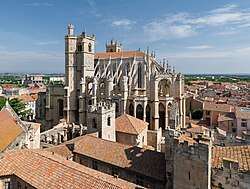
Narbonne Cathedral
[edit]

Narbonne Cathedral, dedicated to Saints Justus and Pastor, provides stark evidence of Narbonne's sudden and dramatic change of fortunes when one sees at the rear of the structure the enormously ambitious building programme frozen in time, for the cathedral—still one of the tallest in France—was never finished. The reasons are many, but the most important is that the completed cathedral would have required demolishing the city wall. The 14th century also brought the plague and a host of reasons for retaining the 5th-century (pre-Visigothic) walls.
Yet the choir, side chapels, sacristy, and courtyard remain intact, and the cathedral, although no longer the seat of a bishop or archbishop, remains the primary place of worship for the Roman Catholic population of the city, and is a major tourist attraction.
Building of the Canal de la Robine
[edit]
From the sixteenth century, eager to maintain a link to important trade, the people of Narbonne began costly work to the vestiges of the river Aude's access to the sea so that it would remain navigable to a limited draft vessel and also serve as a link with the Royal Canal. This major undertaking resulted in the construction of the Canal de la Robine, which was finally linked with the Canal du Midi (then known as the Royal Canal) via the Canal de Jonction in 1776.
In the 19th century, the canal system in the south of France had to compete with an expanding rail network, which could ship goods more quickly. The canals kept some importance as they were used to support the flourishing wine trade. Despite its decline from Roman times, Narbonne held on to its vital but limited importance as a trading route. This has continued in more recent centuries.
Geography
[edit]Narbonne is linked to the nearby Canal du Midi and the river Aude by the Canal de la Robine, which runs through the centre of town. It is very close to the A9 motorway, which connects Montpellier and Nîmes to Perpignan and, across the border, to Barcelona in Spain. There is also a recently renovated train station which serves the TGV to Spain, Paris and Calais, which in turn connects to the Eurostar. Narbonne is only 10 km from Narbonne Plage (beach), but it is only 2 km from the nearest open water, at La Nautique, although there is no sand, rather pebbles.
Climate
[edit]| Climate data for Narbonne (1991–2020 normals, extremes 1989–present) | |||||||||||||
|---|---|---|---|---|---|---|---|---|---|---|---|---|---|
| Month | Jan | Feb | Mar | Apr | May | Jun | Jul | Aug | Sep | Oct | Nov | Dec | Year |
| Record high °C (°F) | 22.8 (73.0) |
23.3 (73.9) |
28.6 (83.5) |
31.0 (87.8) |
33.9 (93.0) |
38.8 (101.8) |
38.8 (101.8) |
42.1 (107.8) |
36.9 (98.4) |
32.7 (90.9) |
25.6 (78.1) |
22.5 (72.5) |
42.1 (107.8) |
| Mean daily maximum °C (°F) | 10.9 (51.6) |
12.1 (53.8) |
15.5 (59.9) |
18.1 (64.6) |
21.8 (71.2) |
26.4 (79.5) |
29.3 (84.7) |
29.1 (84.4) |
24.9 (76.8) |
19.9 (67.8) |
14.6 (58.3) |
11.5 (52.7) |
19.5 (67.1) |
| Daily mean °C (°F) | 7.8 (46.0) |
8.4 (47.1) |
11.3 (52.3) |
13.6 (56.5) |
17.2 (63.0) |
21.3 (70.3) |
24.0 (75.2) |
23.9 (75.0) |
20.2 (68.4) |
16.2 (61.2) |
11.4 (52.5) |
8.5 (47.3) |
15.3 (59.5) |
| Mean daily minimum °C (°F) | 4.7 (40.5) |
4.7 (40.5) |
7.1 (44.8) |
9.1 (48.4) |
12.6 (54.7) |
16.2 (61.2) |
18.6 (65.5) |
18.6 (65.5) |
15.5 (59.9) |
12.5 (54.5) |
8.2 (46.8) |
5.5 (41.9) |
11.1 (52.0) |
| Record low °C (°F) | −4.7 (23.5) |
−8.1 (17.4) |
−5.2 (22.6) |
0.3 (32.5) |
2.2 (36.0) |
8.7 (47.7) |
11.2 (52.2) |
11.8 (53.2) |
7.8 (46.0) |
2.0 (35.6) |
−3.9 (25.0) |
−6.0 (21.2) |
−8.1 (17.4) |
| Average precipitation mm (inches) | 61.4 (2.42) |
46.5 (1.83) |
48.2 (1.90) |
63.6 (2.50) |
51.3 (2.02) |
32.5 (1.28) |
17.0 (0.67) |
31.1 (1.22) |
60.6 (2.39) |
92.5 (3.64) |
78.4 (3.09) |
52.2 (2.06) |
635.3 (25.01) |
| Average precipitation days (≥ 1.0 mm) | 5.9 | 4.9 | 5.9 | 6.4 | 6.1 | 3.7 | 2.6 | 3.6 | 4.5 | 5.9 | 5.7 | 5.5 | 60.6 |
| Mean daily sunshine hours | 4 | 6 | 8 | 8 | 8 | 10 | 11 | 9 | 8 | 6 | 5 | 4 | 7.25 |
| Source: Meteociel;[19] holiday-weather.com[20] | |||||||||||||
| Month | Jan | Feb | Mar | Apr | May | Jun | Jul | Aug | Sep | Oct | Nov | Dec | Year |
|---|---|---|---|---|---|---|---|---|---|---|---|---|---|
| Average sea temperature °C | 13 | 13 | 13 | 14 | 16 | 19 | 22 | 23 | 21 | 18 | 16 | 14 | 16.8 |
| Average Wind Speed km/h | 20.9 | 21.2 | 20.9 | 20.5 | 19.4 | 19.1 | 19.8 | 18.0 | 17.3 | 17.6 | 19.8 | 19.4 | 19.4 |
| Source: holiday-weather.com;[21] Meteo France[22] | |||||||||||||
Population
[edit]
|
| ||||||||||||||||||||||||||||||||||||||||||||||||||||||||||||||||||||||||||||||||||||||||||||||||||||||||||||||||||
| Source: EHESS[23] and INSEE (1968–2017)[24] | |||||||||||||||||||||||||||||||||||||||||||||||||||||||||||||||||||||||||||||||||||||||||||||||||||||||||||||||||||
Sights
[edit]

- The cathedral dating from 1272
- The Palace of the Archbishops of Narbonne, and its donjon with views over Narbonne
- Musée Archeologique, an archaeological museum in the town centre (currently closed - November 2019, most sections will be moved to new museum Narbo Via which is planned to open in September 2020)
- Clos de la Lombarde, an archaeological site presenting the vestiges of Roman townhouses, bath houses, workshops from the 1st century BC to the 3rd century AD and the first Christian basilica in Narbonne (3rd/4th century AD).[25]
- The Roman Horreum, a former grain warehouse, built underground as a cryptoporticus
- Remains of the Via Domitia in the city center
- The canal, Canal de la Robine, running through the centre of the town
- The Halles covered market operates every day. The busiest times are Sunday and Thursday mornings.
- The nearby limestone massif known as La Clape and the beach at Narbonne plage
Sport
[edit]Narbonne is home to the rugby union team RC Narbonne founded in 1907. It is a historic team in France, Narbonne have twice won the French first division title and reached a European final in 2001. They play at the Parc des Sports Et de l'Amitié (capacity 12,000). They wear orange and black.
Transport
[edit]The Gare de Narbonne railway station offers direct connections to Paris, Barcelona, Toulouse, Marseille and many regional destinations. An extensive local system of buses and routes operated by Citibus.fr allow for easy public transport within Narbonne and surrounding communities.
The nearest airports to Narbonne are Marseille, Toulouse–Blagnac, Perpignan–Rivesaltes, and Montpellier–Méditerranée airports.
Personalities
[edit]
- Varro Atacinus, Roman poet
- Ateyaba, French hip-hop artist
- Alexandre Baron, racing driver
- Joseph Barsalou (physician) (1600–1669), apothecary and physician whose family was from Narbonne
- Kalonymus ben Todros (d. c. 1194), was a Provençal rabbi who flourished at Narbonne in the second half of the twelfth century
- Rabbinic family of Benveniste
- Léon Blum was born in Paris but was elected as Deputy for Narbonne in 1929, re-elected in 1932 and 1936
- Bonfilh, a Jewish troubadour from the city
- Carus, Roman emperor from 282 to 283, known for his late victories against the Sassanid empire and the Germanic tribes
- Guillaume Barthez de Marmorières (1707–1799), civil engineer
- Camille Lacourt, World champion swimmer
- Benjamin Lariche, racing driver
- Makhir of Narbonne, medieval Jewish scholar
- Jean-Joseph Cassanéa De Mondonville (1711–1772), violinist and composer
- Moshe ha-Darshan (11th century), chief of the yeshiva of Narbonne
- Anaïs Napoleón, French-Spanish photographer
- Pierre Reverdy, surrealist poet
- Saint Sébastien, third-century Christian saint and martyr
- Dimitri Szarzewski, rugby player
- Charles Trenet, singer-songwriter
International relations
[edit]


See also
[edit]- Bierzo Edict
- Corbières AOC
- Communes of the Aude department
- A Jewish Princedom in Feudal France, a book presenting a thesis that there was a Jewish vassal princedom based in Narbonne in the 8th to 10th centuries AD.
References
[edit]- ^ "Répertoire national des élus: les maires" (in French). data.gouv.fr, Plateforme ouverte des données publiques françaises. 16 April 2024.
- ^ "Populations de référence 2022" (in French). National Institute of Statistics and Economic Studies. 19 December 2024.
- ^ "Narbonne". The American Heritage Dictionary of the English Language (5th ed.). HarperCollins. Retrieved 27 April 2019.
- ^ "Narbonne". Lexico UK English Dictionary. Oxford University Press. Archived from the original on 5 August 2021.
- ^ "Narbonne". Merriam-Webster.com Dictionary. Merriam-Webster. Retrieved 27 April 2019.
- ^ Riess, Frank (2016). Narbonne and its Territory in Late Antiquity: From the Visigoths to the Arabs. Routledge. p. 34. ISBN 9781317090700.
- ^ Collin Bouffier, Sophie (2009). "Marseille et la Gaule méditerranéenne avant la conquête romaine". Pallas (80: Marseille et la Gaule Méditerranéenne avant la Conquête Romaine): 51–52. JSTOR 43606588.
- ^ Maguelonne Toussaint-Samat (Anthea Bell, tr.) The History of Food, 2nd ed. 2009:23.
- ^ Planhol, Xavier de; Claval, Paul (17 March 1994). An Historical Geography of France. Cambridge University Press. ISBN 978-0-521-32208-9.
- ^ Burke, Ulick Ralph (1895). A History of Spain from the Earliest Times to the Death of Ferdinand the Catholic. Longmans, Green and Company. p. 65. Retrieved 27 July 2021.
- ^ a b c d e Deanesly, Margaret (2019). "The Later Merovingians". A History of Early Medieval Europe: From 476–911. Routledge Library Editions: The Medieval World (1st ed.). London and New York City: Routledge. pp. 244–245. ISBN 978-0-367-18458-2.
- ^ a b c d e Collins, Roger (1998). "Italy and Spain, 773–801". Charlemagne. Buffalo, London, and Toronto: Palgrave Macmillan/University of Toronto Press. pp. 65–66. doi:10.1007/978-1-349-26924-2_4. ISBN 978-1-349-26924-2.
- ^ a b c Watson, William E. (2003). "Three Legacies: Charles Martel, the Crusades, and Napoleon". Tricolor and Crescent: France and the Islamic World. Westport, Connecticut: Praeger Publications. pp. 1–11. ISBN 978-0-275-97470-1. OCLC 50322732.
- ^ a b Cohen, Jeremy (1977). "The Nasi of Narbonne: A Problem in Medieval Historiography". AJS Review. 2. Cambridge and New York: Cambridge University Press on behalf of the Association for Jewish Studies: 45–76. doi:10.1017/S0364009400000209. ISSN 1475-4541.
- ^ Hillaby, Joe (2013). The Palgrave Dictionary of Medieval Anglo-Jewish History. Basingstoke: Palgrave Macmillan. ISBN 9780230278165.
- ^ Bobichon, Philippe (2015). Controverse judéo-chrétienne en Ashkenaz (XIIIe s.). Florilèges polémiques: hébreu, latin, ancien français (in French). Paris: Bibliothèque de l'EPHE-SR. doi:10.1484/M.BEHE-EB.5.109665. ISBN 978-2-503-56748-8 – via Academia.edu.
- ^ "NARBONNE - JewishEncyclopedia.com". The Jewish Encyclopedia. Retrieved 6 January 2023.
- ^ Mediterranean Beaches and Bluffs: A Bicycle Your France E-guide by Walter Judson Moore, 2015
- ^ "Normales et records pour Narbonne (11)". Meteociel. Retrieved 14 December 2024.
- ^ "Average Daily Sunshine Hours Narbonne". holiday-weather.com. Retrieved 25 December 2024.
- ^ "Average sea temperature for Narbonne". holiday-weather.com. Retrieved 22 June 2024.
- ^ "Average Wind Speed in Narbonne (in French)" (PDF). Meteo France. Retrieved 27 June 2024.
- ^ Des villages de Cassini aux communes d'aujourd'hui: Commune data sheet Narbonne, EHESS (in French).
- ^ Population en historique depuis 1968, INSEE
- ^ http://www.amiscloslombarde.fr/ (in French and English)
- ^ "British towns twinned with French towns". Archant Community Media Ltd. Retrieved 11 July 2013.
- ^ Salford City Council. "Salford's twin towns". Salford.gov.uk. Archived from the original on 17 December 2007. Retrieved 4 May 2008.
- Michel Gayraud, Narbonne antique des origines à la fin du IIIe siècle. Paris: De Boccard, Revue archéologique de Narbonnaise, Supplément 8, 1981, 591 p.
- Histoire de Narbonne, Jacques Michaud and André Cabanis, eds, Toulouse: Privat, 2004.
- L’Aude de la préhistoire à nos jours (under the direction of Jacques Crémadeilis), Saint-Jean-d’Angély, 1989.
- Les Audois : dictionnaire biographique, Rémy Cazals et Daniel Fabre, eds., Carcassonne, Association des Amis des Archives de l’Aude, Société d’Études Scientifiques de l’Aude, 1990.
Further reading
[edit]- "Narbonne". A Handbook for Travellers in France (8th ed.). London: J. Murray. 1861. OL 24627024M.
- . Encyclopædia Britannica. Vol. 19 (11th ed.). 1911. p. 237.
- "Narbonne". Southern France, Including Corsica (6th ed.). Leipzig: Baedeker. 1914. OL 24364670M.
- "Narbonne" in The Jewish Encyclopedia
External links
[edit]
- Official website (in French)
- 3D stone from Roman era (in English)

| International | |
|---|---|
| National | |
| Geographic | |
| Other | |

Narbonne
View on GrokipediaHistory
Etymology
The name "Narbo," from which modern Narbonne derives, likely originates from a pre-Roman Celtic or Ligurian term denoting a hillfort, possibly referring to the Iron Age oppidum at Montlaurès approximately three miles northwest of the current city site. The earliest known reference appears in the works of the Greek geographer Hecataeus of Miletus around 500 BCE, who described Narbo as a Celtic harbor and marketplace (emporion) inhabited by the Ναρβαῖοι (Narbaioi).[6][7] Ancient inscriptions render the name in Latin as Narbo and occasionally in Iberian script as Nedhena, reflecting the region's Celto-Iberian cultural influences prior to Roman dominance. Upon its establishment as a Roman colony in 118 BCE, the settlement was officially designated Colonia Narbo Martius, with the epithet "Martius" signifying dedication to the god Mars, a common honorific in Roman colonial nomenclature.[2] In the post-Roman era, the name persisted in medieval Latin forms such as Narbo or Narbona, evolving into the contemporary French Narbonne through Old French phonetic shifts, while retaining the Occitan variant Narbona in regional dialects.[1]Roman period
Narbonne was established in 118 BCE as the Roman colony Colonia Narbo Martius, founded by the consuls Gnaeus Domitius Ahenobarbus and Quintus Fabius Maximus Allobrogicus in the territory of the Volcae Arecomici tribe, shortly after their campaigns against the Allobroges and Arverni.[8] This settlement marked the first permanent Roman colony beyond the Alps, strategically positioned to secure Roman influence in southern Gaul following the construction of the Via Domitia road.[2] The name Narbo Martius combined a local Celtic term with a dedication to the god Mars, reflecting both indigenous roots and Roman religious practices.[2] As the capital of the province Gallia Narbonensis—also called Transalpine Gaul—Narbonne became the administrative and judicial hub for Roman governance in the region, overseeing taxation, military recruitment, and provincial administration from the late 2nd century BCE onward.[9] The city's population is estimated to have reached 30,000 to 50,000 at its height in the 1st and 2nd centuries CE, supporting a diverse urban society of colonists, veterans, merchants, and local Gauls integrated into Roman life.[10] This central role facilitated the spread of Roman law, language, and customs, accelerating the Romanization of southern Gaul through intermarriage, education, and civic participation.[2] Economically, Narbonne thrived as a major Mediterranean port, serving as a gateway for trade between Italy and the Gallic interior, with exports including renowned local wines from the surrounding vineyards, garum (a fermented fish sauce produced in coastal workshops), and rosemary honey gathered from the region's aromatic hills.[11] Amphorae cargoes from Narbonne's harbor carried these goods to Rome and beyond, while imports of Italian ceramics, olive oil, and luxury items bolstered the city's markets and elite villas.[11] This commercial vitality, combined with agricultural surplus from the fertile Aude River plain, positioned Narbonne as one of the wealthiest cities in the western provinces during the early Empire.[10] The city's infrastructure exemplified Roman engineering prowess, featuring the Via Aquitania—a major road branching from the Via Domitia to connect Narbonne with Atlantic ports like Burdigala (Bordeaux)—along with a grand forum serving as the civic and commercial heart, complete with basilica, temples, and porticoes.[2] Aqueducts, such as the one sourcing from the Fontfroide springs, supplied fresh water to public baths, fountains, and private homes, supporting urban growth and hygiene standards.[12] Narbonne also hosted a mint that produced silver denarii and bronze coins bearing imperial portraits and provincial symbols, circulating widely to facilitate trade and pay legions stationed nearby.[13] These developments not only enhanced connectivity but also symbolized Rome's transformative presence in Gaul, promoting cultural assimilation through monumental architecture and daily conveniences.[14] By the late 3rd and 4th centuries CE, Narbonne faced decline amid the Empire's broader crises, including economic inflation, supply disruptions, and repeated invasions by Germanic tribes such as the Alamanni and Franks, who raided the province's frontiers and strained defenses.[15] Defensive walls were erected around the core urban area, but silting of the harbor and shifting trade routes diminished its prosperity, leading to depopulation and abandonment of peripheral districts.[16] Despite this, Narbonne's Roman legacy persists in archaeological remains, notably the Horreum—a 1st-century CE underground warehouse complex with vaulted galleries and thick walls, originally used for storing grain, wine, oil, and military supplies beneath a surface market building.[17] This well-preserved structure, rediscovered in the 19th century, offers insight into the city's logistical sophistication and enduring material culture.[17]Visigothic and early medieval period
In 462, the Visigoths under King Theodoric II gained control of Narbonne, as recorded in the Chronicle of Hydatius, where the Goths are noted to have entered the city during the grape harvest, effectively ending direct Roman administration in the region.[18] This acquisition positioned Narbonne as a strategic foothold in Septimania, the western portion of the former Roman province of Gallia Narbonensis, leveraging its established Roman infrastructure for trade and defense. Following the Visigothic defeat by the Franks at the Battle of Vouillé in 507, Narbonne emerged as the capital of the reduced Visigothic territory in Septimania, serving as the administrative and political hub for the kingdom's Gallic remnants until further losses in the following centuries.[19] The city's prominence persisted under King Liuvigild (r. 568–586), who reinforced its role through military campaigns and administrative reforms that integrated Septimania more closely with the Iberian core of the kingdom, and his son Reccared I (r. 586–601), whose reign emphasized consolidation of power in frontier areas like Narbonne.[20] A key aspect of this era was the ongoing Christianization of the Visigoths, who had previously adhered to Arianism. The Council of Narbonne in 589, convened under the influence of Reccared I's conversion to Nicene Christianity—formalized at the Third Council of Toledo earlier that year—addressed local ecclesiastical matters, including the prohibition of Jewish public mourning practices, and reinforced the adoption of the Nicene Creed across the kingdom.[21] This council, attended by eight bishops from the region, underscored Narbonne's enduring status as a bishopric, with its see tracing continuity from Roman times through early medieval fortifications that adapted late antique walls for defense against external threats. In 531, Frankish forces under King Childebert I invaded Septimania, defeating Visigothic armies in the field but failing to capture Narbonne itself, which temporarily heightened Frankish influence in the area without immediate full integration into Merovingian Francia.[22] Archaeological investigations reveal limited but telling evidence of continuity between Roman and Visigothic layers, including epigraphic inscriptions bearing Visigothic regnal dates from kings like Athanagild to Egica, as well as settlement patterns indicating sustained urban occupation without major disruption.[23] The Roman port's legacy briefly supported Visigothic commerce in Mediterranean goods during this transitional phase.[20]Carolingian and medieval period
In 719, Umayyad forces under Governor al-Samh ibn Malik al-Khawlani crossed the Pyrenees and captured Narbonne, establishing it as a key stronghold in their expansion into southern Gaul.[24] This conquest marked the northernmost extent of Muslim control in Europe at the time, with Narbonne serving as a base for further raids into Aquitaine and along the Mediterranean coast.[25] The city remained under Umayyad rule for four decades, defended by Andalusian garrisons and local Gothic allies against Frankish incursions.[26] The tide turned during the Carolingian era with the prolonged Siege of Narbonne from 752 to 759, led by King Pepin the Short.[27] Pepin's forces, bolstered by Aquitanian and local Gothic support, finally breached the defenses in 759, expelling the Muslim garrison and integrating Narbonne into the Carolingian Empire.[26] As a result, Narbonne became the capital of Septimania (also known as Gothia), a frontier province that retained elements of its Visigothic legal traditions while falling under Frankish overlordship.[28] Under Charlemagne and his successors, the region functioned as the March of Gothia, a semi-autonomous buffer zone against remaining Muslim threats in Iberia, with Narbonne at its administrative and ecclesiastical center.[29] By the late 9th century, Septimania's counts enjoyed considerable autonomy within the Carolingian framework, exemplified by figures like Wilfred the Hairy, who consolidated power in the adjacent Spanish March and influenced regional governance.[30] Narbonne's own counts and viscounts, operating under royal oversight, managed local defenses and taxation, fostering a degree of self-rule that persisted amid the empire's fragmentation. As Carolingian authority waned, the territory integrated fully into West Francia by the 10th century, transitioning from a march to a feudal county aligned with the Capetian kings.[28] This shift positioned Narbonne as a logistical hub for the Reconquista, supplying arms, provisions, and troops to Christian campaigns in Iberia, and later serving as a staging point for Crusader forces en route to the Holy Land via Mediterranean ports.[31] Medieval Narbonne thrived economically as a trade nexus, leveraging its inland location and river access to facilitate commerce in wool, dyes, and textiles from Languedoc and Iberian sources.[32] The city's mint, active from the 9th century onward, produced silver deniers and other coinage that circulated widely, underscoring its role in regional monetary exchange.[33] Annual fairs and markets drew merchants from Italy, Provence, and beyond, boosting prosperity through tolls and duties until disruptions in the 13th century.[34] However, this growth was interrupted by the Albigensian Crusade (1209–1229), when crusader armies under Simon de Montfort targeted Languedoc's Cathar strongholds; Narbonne surrendered without siege in 1209 to avert the fate of nearby Béziers, submitting to northern French control and facing subsequent confiscations of heretical sympathizers' properties.[35] Parallel to secular developments, the archbishops of Narbonne amassed significant temporal power, ruling over extensive fiefdoms that included castles, villages, and judicial rights across Septimania by the 12th century.[36] Figures like Archbishop Pons d'Arce (1126–1150) fortified their holdings, blending ecclesiastical authority with feudal lordship to control vast territories equivalent to a small principality. This dominance peaked in the high Middle Ages but began eroding in the 13th century as the French crown annexed Languedoc post-Albigensian Crusade, subordinating archiepiscopal lands to royal jurisdiction by the Treaty of Paris in 1229.[37]Jewish community
The Jewish community in Narbonne traces its origins to the 5th century CE, with early evidence provided by letters dated 470 and 473 that reference a settled presence.[38] This community expanded significantly during the medieval period, particularly from the 12th century onward, as Andalusian Jews migrated northward following persecutions in Spain, bolstering Narbonne's role as a hub within Provençal Jewish networks.[38] By the 12th century, the Jewish population had grown to between 1,500 and 2,000 individuals, comprising roughly 10% of the city's total inhabitants and supporting at least two synagogues. Narbonne emerged as a prominent center for Talmudic study in medieval Europe, attracting scholars and fostering intellectual activity that influenced broader Jewish scholarship.[39] Key figures included members of the Kimhi family, who fled Muslim Spain and resettled in Narbonne around 1148; Joseph Kimhi (c. 1105–1170) established himself as a grammarian, exegete, and translator there, while his sons Moses and David continued this legacy, with David (c. 1160–1235) becoming a leading biblical commentator known as the Radak.[40] Abraham ben David (Ra'avad, c. 1125–1198), though primarily associated with Posquières, maintained strong ties to Narbonne through his studies under Abraham ben Isaac, the local rabbinical authority, and contributed critically to Talmudic exegesis that resonated in the region's academies.[41] Economically, Narbonne's Jews played vital roles in trade, leveraging the city's position in Mediterranean networks to deal in wine, wheat, oil, and dyes, while also engaging in silk production, medicine, and commerce that integrated them into urban life.[42] They received royal protections under Charlemagne following his conquest of the city in 811, which granted privileges such as self-governance and exemption from certain tolls, allowing the community to thrive under Carolingian rule.[38] However, these protections waned over time, culminating in the expulsion of 1306 ordered by King Philip IV, who seized Jewish property and debts amid fiscal crises, scattering the community across southern France and beyond.[43] The community's cultural legacy endured through poetry and philosophy, exemplified by Isaac ha Gorni's late-13th-century Hebrew lyrics, which drew on Provençal troubadour influences and circulated among Narbonne's scholars during their travels in the region. Philosophical contributions included works by Moses of Narbonne (c. 1300–1362), whose treatise on free will synthesized Maimonidean thought with Aristotelian principles, reflecting the intellectual depth of local Jewish circles.[44] Synagogues faced destruction during the Crusades, notably in the 1147 Second Crusade when anti-Jewish violence in Provence led to attacks on religious sites, though the community rebuilt amid ongoing tensions.[45] Post-14th-century decline accelerated due to the Black Death plagues of 1348–1349, which devastated populations and fueled accusations of well-poisoning against Jews, prompting pogroms and further expulsions.[46] The Inquisition intensified this erosion, targeting alleged heresies and leading to trials, conversions, and property confiscations that dismantled communal structures by the early 15th century.[47] Remnants of the community persist in local toponyms, such as Rue de la Juiverie, which marks the former Jewish quarter and evokes the site's historical significance.[48]Decline and loss of port
The silting of the Aude River mouth, culminating around 1320–1340, marked the beginning of Narbonne's maritime decline as the river's course shifted eastward, rendering the city's ancient port facilities increasingly inaccessible and shifting navigable access approximately 10 km to the modern site of Narbonne-Plage. This environmental transformation, driven by sediment accumulation and inadequate dredging, severed Narbonne's direct link to the Mediterranean Sea, which had sustained its role as a key trading hub for wine, salt, and goods from across the region. By the mid-14th century, the port's obsolescence led to a sharp contraction in commercial activity, transforming the once-vibrant waterfront into a stagnant backwater and contributing to the city's economic marginalization.[49] Compounding this natural setback, the Black Death ravaged Narbonne in 1348, decimating approximately 50% of its population and exacerbating labor shortages in an already weakened economy. The plague's impact, part of a broader European mortality crisis that claimed 40–60% of inhabitants in affected areas, halted urban renewal and trade recovery efforts, leaving the city vulnerable to further disruptions. Shortly thereafter, during the Hundred Years' War, English forces led by Edward the Black Prince conducted a devastating chevauchée in 1355, reaching Narbonne on November 8 and setting the bourg ablaze—likely with flaming projectiles from defenders—while plundering baggage trains and taking hostages. This raid inflicted severe damage on infrastructure and commerce, destroying mills, monasteries, and economic resources across Languedoc, including nearby towns whose walls and wealth supported Narbonne's hinterland.[50] In response to these crises, Narbonne underwent a profound socio-economic shift from maritime prominence to inland agrarian reliance, with viticulture and local markets supplanting international shipping as primary livelihoods. Administratively, the city's autonomy waned as the County of Narbonne was fully integrated into the French royal domain in 1507 under Louis XII, demoting it from a semi-independent viscounty to a provincial outpost within the expanding French monarchy. This incorporation reflected broader centralization trends but further diminished Narbonne's political influence.[51] The long-term consequences reshaped Narbonne's urban fabric, with the obsolete Roman and medieval port zones—once central to the city's grid—abandoned and gradually buried under sediment, evolving into peripheral archaeological remnants amid expanding inland quarters. This reconfiguration prioritized fortified inland defenses and agricultural estates over waterfront development, perpetuating a diminished scale that persisted into the early modern era and underscoring the irreversible loss of Narbonne's medieval stature.Narbonne Cathedral construction
The construction of Narbonne Cathedral, formally known as the Cathedral of Saints Justus and Pastor, was initiated in 1268 by Pope Clement IV, who had previously served as archbishop of Narbonne and sought to erect a grand edifice befitting the city's ecclesiastical prominence. The first stone was laid on April 13, 1272, by Archbishop Maruin, marking the start of an ambitious project in the rayonnant Gothic style, drawing inspiration from northern French cathedrals like Beauvais and Amiens to elevate the archbishopric's status. The design envisioned a massive structure with a nave vault height of about 40 meters, surpassing many contemporaries in scale and ambition.[52] Work advanced swiftly in the initial decades, with the choir—measuring 60 meters long, 40 meters wide, and featuring vaults soaring to 41 meters—completed by the 1330s, establishing it as the fourth-tallest cathedral vault in France. The transept followed soon after, incorporating innovative structural elements like double flying buttresses to support the immense height. However, progress on the nave ceased around 1350, primarily due to the refusal of the town council to demolish sections of the preserved Gallo-Roman city walls that obstructed the planned expansion eastward. Compounding this were severe funding shortages triggered by the Hundred Years' War, including the Black Prince's devastating raid on Narbonne in 1355, and the Black Death pandemic of 1348–1355, which decimated the workforce and economy.[53][54][55] Despite its unfinished state, the cathedral bolstered the prestige of Narbonne's archbishopric, one of the wealthiest and most influential in medieval France, serving as a symbol of spiritual and temporal power even without a full nave. Notable features from the construction period include a 14th-century stone rood screen, intricately carved to separate the choir from the transept, exemplifying late medieval sculptural artistry. The organ, installed in the 18th century by master builder Christophe Moucherel between 1739 and 1741, represents a later Baroque enhancement, while the facade received 18th-century Baroque retouching with the addition of twin towers rising to 59 meters. These elements, combined with the choir's luminous stained-glass windows from the 14th century, underscored the site's enduring role in regional religious life.[56] In the 19th century, French architect Eugène Viollet-le-Duc, renowned for Gothic restorations, was commissioned in 1853 to study completing the nave, proposing a design faithful to the original plans with iron reinforcements for stability. However, the project faltered due to engineering doubts, municipal opposition, and insufficient funding, resulting in only partial restorations that preserved rather than expanded the structure. This episode highlighted the challenges of reviving medieval ambitions amid 19th-century priorities, leaving the cathedral as a poignant testament to halted Gothic aspirations.[57]Canal de la Robine
The Canal de la Robine was developed as a vital waterway in response to Narbonne's isolation from the sea following the Aude River's course shift due to flooding in the 14th century.[58] Construction began in 1666 under the patronage of King Louis XIV, aiming to reconnect the city to maritime trade routes by linking the Aude River directly to the Mediterranean Sea at Port-La-Nouvelle.[58] This initiative built upon earlier medieval efforts to navigate the river's old bed, transforming it into a functional canal system.[59] The canal's design was spearheaded by engineers François André Ossau and Pierre-Paul Riquet, with Riquet—renowned for his work on the nearby Canal du Midi—overseeing initial planning and hydraulic innovations to manage water flow and elevation changes.[58] Stretching 32 kilometers, the Canal de la Robine features six single locks to accommodate the terrain's gradients, enabling reliable navigation for commercial vessels.[59] By 1776, the canal was fully operational, integrating with the Canal du Midi via the Canal de Jonction (completed in 1787) to form a seamless link between inland rivers and coastal ports.[58][59] This engineering achievement revitalized Narbonne's economy in the 18th century, facilitating the export of local wine and grain through efficient barge transport and restoring the city's role as a key trading hub.[59][60] The canal's infrastructure supported the industrialization of agriculture in the Languedoc region by providing consistent water supply for irrigation and powering mills, marking a shift from subsistence farming to commercial production.[60] In 1996, the Canal de la Robine was inscribed as part of the Canal du Midi UNESCO World Heritage Site, recognized for its exemplary hydraulic engineering and contribution to 17th- and 18th-century European transport innovations.[61] Throughout the 19th and 20th centuries, however, the canal faced ongoing maintenance challenges, particularly from silting caused by sediment accumulation in the Aude's delta, which necessitated periodic dredging to preserve navigability.[58][59]Modern and contemporary history
In the 19th century, Narbonne experienced significant economic growth driven by the expansion of the railway network and the burgeoning wine industry. The opening of the Narbonne railway station in 1857 connected the city to major northern markets, facilitating the rapid transport of goods and spurring a boom in viticulture across the Languedoc region, where Narbonne served as a key hub.[62] This period saw vineyards proliferate, transforming the local landscape and economy, with the Canal de la Robine aiding trade recovery by linking the city to the Aude River and broader waterways.[63] The phylloxera crisis, which arrived in the Languedoc around 1863 and intensified in the 1870s, devastated Narbonne's vineyards, destroying up to 40% of France's grape production and causing widespread economic hardship in the region. Local growers responded by replanting with phylloxera-resistant American rootstocks grafted onto European vines, a practice that revolutionized viticulture and allowed the industry to rebound by the early 20th century, though not without social unrest such as the 1907 Languedoc winegrowers' revolt centered near Narbonne.[64] During World War I, Narbonne contributed heavily to France's war effort through recruitment of local men from its agricultural communities, with the city hosting a military hospital at the Victor-Hugo college to treat wounded soldiers. The conflict left a lasting mark, commemorated by the Monument aux Morts erected in the interwar period to honor the fallen from Narbonne and surrounding areas. In World War II, the city fell under German occupation after 1942, experiencing rationing and surveillance, while Resistance networks in the Languedoc operated actively, including sabotage operations in the Aude department; historian Marc Bloch, using "Narbonne" as his codename, exemplified the intellectual involvement in the fight against Vichy and Nazi forces. Post-war reconstruction during the Trente Glorieuses (1945–1975) revitalized Narbonne through national economic policies, modernizing infrastructure and agriculture while integrating Marshall Plan aid to rebuild war-damaged facilities.[65][66][67][68][16] In the late 20th century, Narbonne underwent suburbanization as its population expanded, with new residential developments on the city's outskirts reflecting broader French urban trends and accommodating growth in the tourism sector. Tourism rose prominently from the 1960s onward, drawn by the city's Roman heritage, coastal proximity, and wine routes, boosting the local economy and integrating Narbonne into the regional appeal of Occitanie.[69][70] The 2020s brought environmental challenges to Narbonne, including the severe Aude drought persisting into 2025, which imposed water restrictions and strained agriculture, compounded by the unprecedented August 2025 wildfires in the Corbières hills that scorched thousands of hectares and damaged vineyards near the city. Amid these pressures, cultural initiatives advanced, such as the opening of the Narbo Via museum in May 2021, a modern facility showcasing Roman artifacts from Narbonne's ancient past and enhancing its profile as a heritage destination. Population trends show stabilization around 60,000 residents by 2025, influenced by regional migration patterns including inflows from urban centers and outflows due to climate vulnerabilities.[71][72][73][74]Geography
Location and physical geography
Narbonne is situated in the Aude department of the Occitanie region in southern France, approximately 100 kilometers southwest of Montpellier and 150 kilometers southeast of Toulouse.[75][76] Its geographic coordinates are 43°11′N 3°00′E.[77] The city lies on the floodplain of the Aude River, about 15 kilometers inland from the Mediterranean Sea.[78] Its elevation ranges from 10 to 20 meters above sea level, contributing to its low-lying position in a vine-growing plain.[79] Nearby natural features include the Massif de la Clape, a limestone massif to the southeast, and the Étang de Bages-Sigean, a large coastal lagoon approximately 20 kilometers east of the city center.[80][81] The urban area covers approximately 173 square kilometers, encompassing the historic center, suburbs, and surrounding developed zones. Narbonne maintains close proximity to Narbonne-Plage, a sandy beach on the Mediterranean coast about 15 kilometers to the southeast, and the Robine Canal, which traverses the city center and connects to the broader Canal du Midi system.[82][60] Geologically, Narbonne occupies an alluvial plain formed by sediment deposits from the Aude River, making it susceptible to periodic flooding.[80] Roman-era remnants, such as ancient walls and infrastructure, are integrated into the modern layout, reflecting the site's long history of adaptation to this dynamic fluvial environment. Historical silting of the Aude River has gradually shifted the coastline eastward over centuries.[83]Climate
Narbonne experiences a hot-summer Mediterranean climate classified as Csa under the Köppen-Geiger system, characterized by mild, wet winters and hot, dry summers with significant annual sunshine.[84] The annual average temperature is 15.3°C based on 1991–2020 normals, with the hottest month, July, reaching an average high of 29.3°C and the coolest, January, an average low of 4.7°C.[85] Precipitation totals approximately 635 mm annually, concentrated primarily in autumn and winter months, while summers remain notably dry. The region enjoys around 300 sunny days per year, contributing to its appeal as a coastal destination.[84][86] Historical weather records for Narbonne have been maintained by the Météo-France station since the 1950s, providing long-term data on temperature, precipitation, and other variables to track climatic trends.[87] In recent years, climate extremes have intensified, including the 2025 drought that severely reduced local water reserves amid persistent low rainfall and high temperatures in southern France.[71] Additionally, wildfires in August 2025 near Narbonne in the Aude department scorched thousands of hectares of Mediterranean ecosystems, leading to habitat loss, soil erosion, and biodiversity impacts in garrigue and maquis vegetation.[88] Compared to nearby coastal areas like Montpellier and Perpignan, Narbonne shares the same Csa classification but has annual precipitation intermediate between drier Perpignan (~550–600 mm) and wetter Montpellier (~680 mm), with more influence from the Tramontane wind, resulting in greater summer aridity.[89][85][90][91] Its floodplain location can exacerbate the impacts of intense autumn rain events, leading to localized flooding.[84]Administration and politics
Local government
Narbonne functions as a commune and serves as the subprefecture of the Aude department in the Occitanie region of France. The municipal council, known as the conseil municipal, comprises 45 members elected by universal suffrage every six years, with the council size determined by the city's population exceeding 50,000 inhabitants. The mayor and deputy mayors are selected from among the council members, overseeing executive functions including policy implementation and administrative coordination.[92] As of November 2025, Bertrand Malquier serves as mayor, having assumed office in October 2023 following the death of his predecessor, Didier Mouly, and leading the council through the remainder of the 2020–2026 term.[93] The municipal budget, approved annually by the council, allocates significant resources to urban planning and heritage preservation, such as the Site Patrimonial Remarquable initiative, which supports rehabilitation projects with tax incentives to maintain the city's historical fabric.[94] Narbonne's local government also collaborates with the Occitanie regional council on broader initiatives, including access to European Union funds like the Fonds Tourisme Occitanie, which provides loans for tourism-related developments to enhance regional attractiveness.[95][96] Under Malquier's leadership for the 2023–2026 period, recent policies emphasize sustainability, including environmental assessments integrated into budgeting and projects under the Contrat de Ville "Quartiers 2030" for urban cohesion and green initiatives.[97][98] These efforts build on historical mayoral powers established during the French Revolution, when the 1790 decree created elected mayors with authority over local police, public works, and communal administration, a framework that evolved to empower modern municipal leaders in Narbonne. The 2015 regional merger forming Occitanie from Languedoc-Roussillon and Midi-Pyrénées prompted administrative reforms affecting Narbonne, including streamlined coordination for funding and policy alignment, though local governance structures remained intact under the communal framework.[99][100]Administrative divisions
Narbonne, as a commune in the Aude department, is administratively divided into three cantons for electoral purposes: Narbonne-1, Narbonne-2, and Narbonne-3. These divisions encompass the urban core around the historic center, industrial and commercial zones such as the Croix Sud area and neighborhoods like Les Vives, and expansive rural outskirts including agricultural lands and coastal extensions. The commune itself spans approximately 173 square kilometers, integrating diverse spatial elements under municipal governance.[101] Narbonne forms part of the arrondissement of Narbonne, which comprises eight cantons and serves as a sub-departmental administrative unit. Beyond the local level, the commune integrates into the Communauté d'agglomération du Grand Narbonne, an intercommunal structure uniting 37 communes across 847 square kilometers with a total population of 135,323 residents as of 2025. This agglomeration coordinates essential services including waste management, public transport, and economic development, fostering regional cohesion. In the European Union's statistical framework, the Aude department, encompassing Narbonne, holds the NUTS-3 classification code FR811.[102][103][104][105][106] Historically, Narbonne's administrative divisions trace back to medieval times, when the city was organized into eight urban parishes by the mid-13th century, reflecting ecclesiastical and communal structures that evolved into modern arrondissements and cantons over centuries. Additionally, significant portions of Narbonne's territory benefit from special environmental protections, including six Natura 2000 sites—such as wetlands and coastal habitats—that cover nearly 50% of the municipal area, emphasizing biodiversity conservation alongside administrative planning.[107]Demographics
Population trends
Narbonne's population has shown significant growth over the long term, increasing from 9,050 residents in 1793 to 56,692 in the 2022 census conducted by the French National Institute of Statistics and Economic Studies (INSEE).[108] This represents a more than sixfold expansion, driven initially by industrialization and agricultural development in the 19th century. The commune's population density stood at 328 inhabitants per square kilometer in 2022, based on an area of 173 square kilometers.[4] The broader metropolitan area, known as Le Grand Narbonne, encompasses approximately 133,000 residents, reflecting suburban expansion around the core city.[109] During the 19th century, Narbonne experienced a notable boom, reaching 28,852 inhabitants by 1901, fueled by economic opportunities in viticulture and trade.[110] Growth slowed in the early 20th century and stagnated after World War II, with the population hovering around 38,000 to 46,000 from 1946 to the late 1990s, as industrial shifts and rural exodus affected the region.[4] Recent decades have seen renewed annual growth of approximately 1%, particularly since the 2000s, largely attributed to inbound migration from retirees seeking the area's Mediterranean climate and lifestyle, contrasting with broader regional depopulation trends in rural Occitanie.[4] In terms of age structure, the 2022 INSEE data indicate a relatively aging population, with 15.2% under 15 years old and about 28% aged 65 and over, highlighting a dependency on older demographics.[4] The birth rate was low at 9.9 per 1,000 inhabitants in 2022, below the national average, with overall population increases primarily migration-driven rather than natural growth.[4]| Year | Population | Annual Growth Rate (approx.) |
|---|---|---|
| 1793 | 9,050 | - |
| 1901 | 28,852 | +1.2% (19th century avg.) |
| 1968 | 38,441 | - |
| 1999 | 46,510 | +0.5% (post-WWII avg.) |
| 2022 | 56,692 | +0.9% (recent avg.) |
Immigration and ethnicity
Narbonne's population reflects its historical Occitan roots, shaped by centuries of regional linguistic and cultural traditions in Languedoc-Roussillon, alongside Catalan influences due to its proximity to the Spanish border.[108] According to 2022 INSEE data, approximately 10% of Narbonne's residents (5,665 out of 56,692) are foreign-born, with the largest groups originating from North Africa—particularly Algeria (16.3% of immigrants) and Morocco (19.6%)—and Spain (15.2%), based on detailed 2020 breakdowns that align closely with recent trends.[111][112] A significant post-colonial influx occurred between the 1960s and 1980s, when laborers from North Africa arrived to support the local agriculture and viticulture sectors during France's economic expansion.[113] Today, individuals of North African origin constitute around 8% of the population when including second-generation descendants, while EU migrants, mainly from Iberian countries, account for about 3%.[114] Cultural integration is facilitated through local associations such as the Collectif Accueil Migrant·es du Narbonnais, which provide support for newcomers in language, housing, and community activities.[115] Narbonne exhibits a relatively low proportion of visible minorities compared to larger ports like Marseille, though a growing Roma community contributes to its ethnic diversity, with events like the International Day of the Roma celebrated in the surrounding Aude department.[116] Linguistic diversity in Narbonne is marked by predominant French usage, alongside ongoing revival efforts for Occitan through cultural initiatives in the Occitanie region.[108]Economy
Overview
Narbonne's economy, as the largest urban center in the Aude department of Occitanie, reflects a regional profile characterized by a transition from traditional agriculture to a service-dominated structure, with gross domestic product per capita in Occitanie reaching approximately €31,710 in 2022.[117] This figure aligns with the broader European Union average adjusted for purchasing power, underscoring moderate productivity levels influenced by the area's rural-urban mix. Unemployment in the Aude department stood at 10.3% in the second quarter of 2025, higher than the national rate of 7.5% for the same period, highlighting persistent labor market challenges in this less industrialized region.[118][119] The local economy employs around 70% of its workforce in services, marking a shift away from agriculture since the late 20th century, though the latter remains vital through the Languedoc-Roussillon wine appellation, one of Europe's largest.[120] Narbonne hosts approximately 14,781 enterprises, predominantly small and medium-sized enterprises (SMEs) that drive local commerce, retail, and tourism-related activities.[121] Post-2008 financial crisis recovery in Occitanie benefited from European Union structural funds, which supported infrastructure and diversification initiatives, contributing to stabilized growth rates above 1% annually in the following decade. In 2025, the economy faced significant headwinds from wildfires in the Aude department during August, which ravaged over 16,000 hectares in the Corbières area near Narbonne, severely impacting vineyards and tourism with estimated reconstruction costs exceeding €20 million over multiple years.[122] Regional and departmental authorities have mobilized for reconstruction in the affected Corbières areas. These events disrupted agricultural output and local services, exacerbating vulnerabilities in a workforce of about 23,200 active residents as of 2022.[4]Agriculture and viticulture
Agriculture and viticulture form a cornerstone of Narbonne's economy, with the sector employing approximately 1.4% of the local workforce in the Aude department as of 2022, though broader agribusiness activities sustain a significant portion of rural livelihoods.[123] The region's vineyards, spanning the La Clape and Fitou appellations of origin (AOCs), are central to production, yielding around 26,400 hectoliters annually in La Clape and 90,000 hectoliters in Fitou, contributing to the Languedoc's robust output.[62][124] These areas benefit from Mediterranean soils and climate, fostering resilient viticulture following the late-19th-century phylloxera crisis, which devastated European vineyards but led to widespread grafting onto resistant rootstocks for recovery.[125] Dominant grape varieties include Syrah and Grenache, which thrive in the schist and limestone terrains, producing structured reds and aromatic whites characteristic of the region. Cooperatives such as the Cave Coopérative de Vinification de Narbonne play a key role, aggregating harvests from local growers and facilitating quality control and distribution since their establishment in the mid-20th century. Amid ongoing challenges, there has been a notable shift toward sustainable practices, with an increasing proportion of vineyards adopting organic certification—reflecting broader trends in Languedoc where thousands of hectares are now under organic management.[126][127] Recent environmental pressures have tested the sector's adaptability, including a 2025 wildfire near Narbonne that destroyed approximately 900 hectares of vineyards in the Corbières area, exacerbating losses from smoke taint and destruction.[128] Persistent droughts have compounded irrigation challenges, though the historic Canal de la Robine provides essential water support for surrounding plots, mitigating some yield reductions from climate extremes. Beyond viticulture, Narbonne's agriculture encompasses olives for oil production and cereals like wheat, while livestock farming remains minimal, with focus on crop-based enterprises.[129][130][71]Tourism and services
Narbonne's service economy is prominently shaped by heritage tourism and retail activities, which form a cornerstone of the local economy alongside its historical appeal. In 2023, key sites in Narbonne attracted around 694,000 visitors, including 211,543 to the historical center and 289,885 to the Espace de Liberté area.[131] This influx supports a robust hospitality infrastructure, including around 5,000 hotel beds, while the retail and hospitality sectors employ about 25% of the local workforce; the city's conference center further contributes by hosting regional business events and conventions.[98] Following the COVID-19 pandemic, Narbonne's tourism sector saw a notable recovery, with a 20% increase in visitor numbers in 2023 compared to the previous year, bolstered by initiatives promoting sustainable practices such as eco-labels awarded to key sites and efforts to reduce environmental impact.[131] These measures align with broader regional goals to balance growth with preservation, encouraging longer stays and off-peak visits. Despite this progress, the sector faces challenges related to seasonality, including a high proportion of temporary employment—around 40% of tourism jobs are short-term—which affects workforce stability and local economic planning.[132] Tours incorporating local agricultural products, such as wine and produce from surrounding vineyards, provide an additional draw for visitors interested in the region's viticultural heritage.Culture and tourism
Sights and landmarks
Narbonne boasts a rich array of historical landmarks that highlight its Roman origins and medieval prominence, with architectural gems scattered throughout the city center. The Palais des Archevêques stands as a prominent example, forming a monumental ensemble alongside the nearby cathedral, while underground Roman structures and scenic waterways offer glimpses into ancient and Renaissance engineering. These sites, many accessible via pedestrian paths, draw visitors for their blend of preserved antiquity and urban charm.[133][134] The Palais des Archevêques, a 13th–14th century complex, served as both the residence and fortress for the city's archbishops, reflecting successive architectural evolutions from Romanesque to Gothic styles. Its Palais Vieux features a Romanesque hall, emblematic of early medieval construction, while the adjacent Palais Neuf includes the imposing Donjon Gilles Aycelin, a late 13th-century tower that anchors the structure's defensive character. Flanked by neo-Gothic elements added in the 19th century, the palace complex overlooks the city and integrates with surrounding historic fabric.[133] Beneath the modern streets lies the Roman Horreum, a 1st-century underground warehouse consisting of two wings—a west gallery of about 51 meters and a north gallery of 38 meters—forming a network of corridors and small rooms, originally used for storing goods like grain and wine. This well-preserved structure, located about five meters below ground level, exemplifies Roman engineering in the ancient colony of Narbo Martius and covers approximately 200 m². Remnants of the Via Domitia, the key Roman road linking Italy to Spain, pass nearby, underscoring Narbonne's role as a vital provincial hub.[135][17][136] Les Halles, the city's covered market inaugurated on January 1, 1901, exemplifies early 20th-century iron-and-glass architecture in the Baltard style, designed to house expanding local commerce after replacing an older open-air market. Complementing these are fragments of Narbonne's medieval ramparts, which once enclosed the city with four main gates until their partial dismantling between 1868 and 1882, leaving visible traces of 16th–17th century fortifications amid the urban landscape. Nearby, the Clos de la Lombarde archaeological site reveals a 1st–3rd century Roman villa district, featuring excavated domus with exceptional mosaics and murals that illustrate affluent residential life in ancient Narbo.[137][138][139] The Canal de la Robine, a branch of the Canal du Midi connected in the 17th century, enhances Narbonne's scenic appeal with its tree-lined quays, historic bridges like the shop-lined Pont des Marchands, and operational locks that facilitate leisurely walks along the water's edge. These pathways provide picturesque views of the city's landmarks, including the central cathedral.[138][140]Museums and cultural institutions
Narbo Via, opened to the public in May 2021 with official inauguration in December 2021, is Narbonne's premier museum dedicated to Roman antiquities from the ancient province of Gallia Narbonensis.[141] Spanning a total built area of approximately 9,700 square meters, it houses over 6,000 artifacts excavated from the Narbonne region, including sculptures, inscriptions, and funerary stelae that illustrate the city's role as Narbo Martius, Rome's first colony beyond Italy. A standout feature is a 76-meter-long lapidary wall, 10 meters high, displaying more than 760 marble blocks with integrated digital projections for interactive exploration of epigraphy and urban history without physical handling.[142][143] Designed by Foster + Partners, the museum integrates modern architecture with educational spaces, such as workshops and an auditorium, to contextualize Narbonne's Roman heritage for visitors and researchers.[144] The Musée d'Art et d'Histoire de Narbonne, established in 1833 within the historic Palais des Archevêques, focuses on fine and decorative arts spanning the medieval period to the 19th century.[145] Housed in the Gothic archbishop's palace—a landmark blending 13th- and 14th-century architecture—its collections feature Renaissance paintings, medieval sculptures, and 19th-century works by local artists, including portraits and orientalist scenes that reflect Narbonne's cultural evolution.[146] Notable holdings include ceramics from the region's pottery tradition and temporary exhibitions in venues like the Salle Peyre, which highlight thematic aspects of art history and foster public engagement with the city's artistic legacy.[147] Complementing these, the Horreum Romain serves as an archaeological museum annex, preserving a 1st-century BCE underground warehouse complex unique in France for its intact network of vaulted galleries originally used for storing grain, wine, and goods in Roman Narbo Martius.[135] Located near the city center, it displays excavated Roman artifacts such as amphorae and tools, providing insight into ancient logistics and trade, while integrated interpretive elements educate on Narbonne's role as a Mediterranean port.[148] The site's conservation emphasizes its structural integrity, with guided tours underscoring the engineering feats of Roman construction in the local context.[149]Festivals and traditions
Narbonne's festivals and traditions reflect its Mediterranean heritage, blending coastal customs, musical celebrations, and seasonal culinary events that draw both locals and visitors. The Fêtes de la Saint-Pierre, held annually in July at Narbonne-Plage, honors the patron saint of fishermen with processions, regattas, fireworks, and performances featuring Occitan music, a tradition rooted in the 18th century among Languedoc's fishing communities.[150][151] Music festivals add a vibrant contemporary layer to the city's cultural calendar. The Jazz à l'Hospitalet, an annual event since 2004 held at Château l'Hospitalet near Narbonne, features international jazz artists amid vineyard settings, combining performances with wine tastings and gastronomic experiences. Complementing this, September's wine harvest celebrations, such as Les Estivales de Narbonne, include live music, local producer stalls, and grape-treading demonstrations, highlighting the region's viticultural traditions during the vendanges season.[152][153][154] Seasonal festivities further enrich Narbonne's traditions. The Carnaval de Narbonne, organized each February or March by the Association Narbonne en Fête, features colorful parades with themed floats, confetti battles, and street animations, attracting thousands to the city center. In December, the Féeries de Noël transforms the Promenade des Barques into a winter wonderland with a traditional Christmas market of over 30 wooden chalets offering artisanal crafts, regional foods, and illuminations, alongside a synthetic ice rink and festive light displays running until early January. Recent years have seen the addition of inclusive events, such as Narbonne's inaugural Marche des Fiertés on May 17, 2025, which gathered hundreds in a procession advocating for LGBTQ+ rights and diversity.[155][156][157][158] Culinary customs underscore Narbonne's gastronomic identity, with variations of cassoulet—a hearty bean stew with sausage, duck confit, and pork—served as a local specialty in restaurants like Le Bouchon Gourmand, adapting the classic southwestern recipe to Aude's produce. Narbonne's renowned rosemary honey (miel de Narbonne), a pale, floral monofloral variety produced in the surrounding garrigue landscapes, is celebrated through tastings and sales of hive products at local markets and events. These events not only preserve Occitan folklore but also boost tourism through immersive cultural experiences.[159][160]Sports and leisure
Rugby and major sports
Rugby union holds a central place in Narbonne's sporting landscape, embodied by the Racing Club de Narbonne Méditerranée (RCNM), the city's premier club. Established in 1907, RCNM has achieved notable success, securing two French Championship titles in the Top 14, first in 1936 against AS Montferrand and again in 1979 against Stade Toulousain.[161][162][163] As of the 2025–2026 season, the club competes in the Nationale, France's third-tier professional rugby union league, drawing passionate local support.[164] Home games are hosted at the Parc des Sports et de l'Amitié, a multi-purpose venue with a capacity of 12,000 that opened in 1979 and serves as a hub for elite competitions.[165] RCNM extends its influence through community engagement, including a women's section that participates in regional competitions such as Women's Fédérale 1, promoting gender diversity in the sport.[166] The club contributes to an annual rugby festival and various tournaments that celebrate Occitanie's rugby heritage, fostering youth development and local pride.[167] Rugby's community impact is profound in the Aude department, where thousands of players are registered across numerous clubs, underscoring the sport's role in social cohesion and tradition.[168] Other major organized sports in Narbonne include athletics and cycling. The Athlétic Club Narbonne Méditerranée (ACNM), founded to support track and field activities, provides training for athletes of all ages and has produced national-level competitors in events like road running and cross-country.[169] Cycling thrives via clubs such as Vélo Sprint Narbonnais, which organizes competitive races and group rides, leveraging the region's flat coastal paths and hilly terrain for both amateur and elite participants.[170] These clubs, alongside rugby, position Narbonne as a key training ground in Occitanie for Olympic hopefuls in endurance and multi-sport disciplines.[168]Other recreational activities
Narbonne provides a variety of non-competitive recreational opportunities centered on its natural landscapes and urban green spaces, appealing to those seeking relaxation and outdoor engagement. The Canal de la Robine, a UNESCO-listed waterway branching from the Canal du Midi, features approximately 10 km of well-maintained towpaths suitable for leisurely walking and cycling, winding through the city center past historic bridges and shaded plane trees.[171] These paths offer a flat, accessible route for families and casual explorers, with opportunities to rent bikes or join guided tours that highlight the canal's engineering heritage. Along the Mediterranean coast, Narbonne-Plage boasts expansive sandy beaches stretching over 5 km, where visitors can partake in water sports such as kayaking, paddleboarding, and windsurfing in calm, shallow waters.[82] The area's Blue Flag certification ensures high water quality, making it ideal for beginners to try introductory sessions at local watersports centers, often including equipment rentals and safety briefings.[172] Inland, the Golf Sainte Rose, a compact 18-hole pitch-and-putt course spanning 1,476 meters, caters to recreational golfers of all levels with its forgiving layout and practice facilities, set amid pine groves just south of the city.[173] Equestrian activities are available at centers like Narbonne Equitation, where riders can enjoy trail rides through vineyards and coastal dunes, emphasizing relaxed outings over competition.[174] Urban parks, such as the landscaped areas around the Patio des Arts cultural complex, provide serene spots for picnics and informal strolls, featuring modern sculptures and open lawns in the heart of Narbonne.[175] For nature enthusiasts, the nearby Massif de la Clape offers a network of hiking trails ranging from easy 3-5 km loops to moderate 10 km routes through limestone hills, garrigue scrubland, and panoramic viewpoints overlooking the sea.[176] Fishing remains a popular pastime in the surrounding étangs, or coastal lagoons, such as the Étang de Bages-Sigean, covering approximately 5,500 hectares and one of the largest in the Aude department, where anglers target species like sea bass and mullet using traditional methods or from guided boat trips. Permits are readily available, and the lagoons' biodiversity supports sustainable catch-and-release practices. Following the wellness surge after 2020, community programs have expanded to include yoga and fitness classes at local studios like Cavy Shala and Acad Narbonne, offering sessions in vinyasa flow, pilates, and outdoor HIIT to promote mental and physical health amid rising demand for such activities in France.[177] Some sports clubs occasionally utilize these parks and paths for training, enhancing community access to facilities.Transport and infrastructure
Road and rail networks
Narbonne's road infrastructure is anchored by the A9 autoroute, also designated as the E15 European route, which serves as a vital link for regional and international travel. This motorway connects Narbonne southward to Perpignan and the Spanish border, facilitating cross-border commerce and tourism, while northward it extends through Montpellier, Nîmes, and Orange toward Lyon, integrating the city into France's broader highway system.[178] Complementing the A9 is the A61 autoroute, which branches off just south of Narbonne and heads northwest to Toulouse, providing efficient access to the region's economic hub and further connections to Bordeaux via the A62. This junction enhances Narbonne's role as a transportation crossroads in Occitanie. To manage local traffic flow, the city features an urban ring road system, including the Rocade Est opened in 2019, which bypasses the city center and alleviates congestion, particularly during peak summer periods when tourist influx triples the population.[178][179] The rail network centers on Gare de Narbonne, a key TGV hub on the Paris–Marseille line, serving as an essential stop for high-speed services. In 2024, the station accommodated over 2 million passengers, down from a record of over 2.5 million in 2023, reflecting its importance for both domestic and international travel. The station is undergoing renovation works, initiated in March 2025 and expected to finish in 2028, with a budget exceeding €11 million, aimed at modernizing facilities. Direct TGV connections link Narbonne to Paris in approximately 5 hours and to Barcelona in about 2 hours, supporting efficient long-distance mobility.[180][181][182][183] Regional transport is bolstered by TER (Transport Express Régional) trains operated by SNCF, offering frequent services to nearby cities such as Montpellier, with journey times around 1 hour. Complementing the rail options, the Grand Narbonne bus network, managed by Citibus and operated by RATP Dev, provides extensive coverage with approximately 50 lines, including urban routes (A–E and Citadine shuttles) and intercity services connecting surrounding communes and beaches.[184][185][186] Recent infrastructure enhancements include track renewals and modernization works on regional lines, such as those along the Narbonne–Port-Bou corridor, completed in phases through 2024 to improve reliability and capacity for both passenger and freight services. These upgrades, part of broader SNCF Réseau initiatives, aim to reduce travel times and support sustainable transport in Occitanie.[187][188]Air, water, and other transport
Narbonne lacks a commercial airport within its immediate vicinity, relying instead on nearby regional facilities for air travel. The closest options include Perpignan–Rivesaltes Airport (PGF), approximately 60 kilometers southwest, which serves as a base for low-cost carrier Ryanair with flights to various European destinations.[189][190] Another key airport is Carcassonne Airport (CCF), about 60 kilometers north, offering seasonal international and domestic connections primarily through Ryanair and other budget airlines.[189] For emergency medical evacuations, the city maintains a heliport at the Centre Hospitalier de Narbonne Saint-Croix, facilitating rapid helicopter transport.[191] Water transport in Narbonne centers on the Canal de la Robine, a 32-kilometer branch of the Canal du Midi that connects the city to the Mediterranean Sea via Port-la-Nouvelle. Primarily used for pleasure boating and tourism, the canal supports scenic cruises and rentals, with electric or traditional boats navigating its locks and tree-lined paths.[59] While historically vital for freight, current commercial cargo activity is limited, overshadowed by its role in leisure navigation that links to the UNESCO-listed Canal du Midi for extended waterway excursions.[59][60] Alternative mobility options emphasize sustainable non-motorized transport, including the Citivélo bike-sharing system launched by Grand Narbonne in 2025, featuring around 170 electric and cargo bicycles available without fixed stations via a mobile app for short-term rentals.[192] The historic city center benefits from extensive pedestrian zones, such as those around the Cathédrale Saint-Just et Saint-Pasteur and the Canal de la Robine promenades, promoting walkability and reducing vehicle traffic. These modes integrate with road and rail networks at multimodal hubs like the Narbonne train station, where bike parking and secure facilities encourage combined trips.[193] Looking ahead, Occitanie region's 2025 climate initiatives include expanded e-bike incentives, offering subsidies up to €400 for purchases to residents, aligning with broader goals to cut emissions and boost active transport adoption in urban areas like Narbonne.[194]Notable people
Historical figures
The city's early Christianization produced influential ecclesiastical leaders, particularly among its bishops. Saint Paul of Narbonne (3rd century CE), also known as Paul-Serge, served as one of the seven apostles to the Gauls, dispatched around 250 CE to evangelize the region during the pontificate of Pope Fabian. Tradition holds that he was martyred in Narbonne after establishing the local church, with his relics enshrined in the Basilica of Saint-Paul-Serge, underscoring Narbonne's role as a hub for early Christianity in Gaul. In the 5th century, Bishop Rusticus (c. 400–461 CE) further solidified the diocese's prominence; born in Marseille but active in Narbonne, he attended the Council of Ephesus in 431 and contributed to theological debates on grace and predestination, reflecting the intellectual vitality of the post-Roman church in southern Gaul.[195] Medieval Narbonne's political and cultural landscape featured notable secular and religious figures tied to its viscounts and scholarly communities. Aimery I (c. 1060–1105), Viscount of Narbonne from around 1071, played a key role in regional governance during the transition from Carolingian to feudal structures, allying with Aragonese interests and fortifying the city's defenses amid conflicts with neighboring lords. Among the Jewish intellectual elite, Abraham ben Isaac of Narbonne (c. 1110–1179), a leading Provençal talmudist and av bet din (head of the court), authored the halakhic compendium Sefer ha-Eshkol, which systematized Jewish law and influenced later medieval scholarship; he corresponded with prominent rabbis in the tradition following Rashi, fostering exchanges on Talmudic interpretation across southern France.[196]Modern personalities
Narbonne has produced several influential figures in the arts during the 20th and 21st centuries, particularly in music and performance. Charles Trenet, born in Narbonne on May 18, 1913, emerged as a pioneering singer-songwriter whose poetic lyrics and joyful melodies defined French chanson. His 1946 hit "La Mer" became a global standard, covered by artists like Frank Sinatra, and he composed over 1,000 songs, earning the nickname "Le Fou Chantant" for his exuberant style. Trenet's contributions to French popular music, blending Occitan influences with modern sensibilities, were recognized with the Grand Prix du Disque in 1939 and a lasting legacy in post-war entertainment.[197][198] In contemporary arts, Narbonne natives have made marks in comedy and hip-hop. Alban Ivanov, born September 10, 1984, in Narbonne, is a prominent comedian and actor known for his energetic stand-up routines and improvisational work, discovered through Jamel Comedy Club. He gained wider acclaim with roles in films like The Last Mercenary (2021) and his one-man show Vedette, which toured extensively and highlighted his satirical take on everyday life. Similarly, rapper Ateyaba (real name Gilles Ateyaba Koffi Soler), born October 27, 1989, in Narbonne, rose in the French hip-hop scene after moving to Montpellier as a child. Formerly known as Joke, he released mixtapes on MySpace that caught the attention of producers like Teki Latex, leading to albums such as Tokyo Drift (2014) and collaborations blending trap and electronic elements.[199][200] In politics, Didier Codorniou stands out as a Narbonne-born figure bridging sports and public service. Born February 13, 1958, in Narbonne, he was a rugby union center who played for RC Narbonne and earned 23 caps for France between 1979 and 1987, contributing to the 1981 Five Nations Grand Slam. Transitioning to politics with the Socialist Party, he served as a Member of the European Parliament from 1994 to 1999, focusing on regional development and agriculture policies for Occitanie. His dual career exemplified Narbonne's rugby heritage influencing civic leadership. Sports personalities from Narbonne have excelled internationally, especially in rugby and swimming. Gérard Bertrand, born January 27, 1965, near Narbonne and a key player for RC Narbonne in the 1980s and 1990s, represented France in 26 Test matches and won the Challenge Yves du Manoir in 1997 with Stade Français. After retiring, he founded a major wine estate in the region, but his athletic legacy includes captaining Narbonne during its Top 14 prominence. Rugby hooker Dimitri Szarzewski, born January 26, 1983, in Narbonne, debuted with AS Béziers before starring at Stade Français, earning 77 caps for France from 2004 to 2015 and captaining the side in the 2011 Rugby World Cup. Swimmer Camille Lacourt, born April 22, 1985, in Narbonne, dominated backstroke events, winning five world championships (2011–2015) and three European titles, setting world records in the 50m and 100m backstroke. His 6'7" frame and sprint prowess made him a standout at the Olympics, including silver in the 100m backstroke at London 2012.[201]Twin towns and sister cities
Partner cities
Narbonne has established formal twinning partnerships with five cities as of 2025, primarily to promote international understanding and social ties through structured exchanges.[202][203] These partnerships date back to the mid-20th century, beginning in the 1950s, and reflect Narbonne's emphasis on European and Mediterranean connections. The agreements emphasize youth exchanges, cultural initiatives, and educational programs, with some including economic cooperation.[204][205][203] The partner cities are:| City | Country | Year Established | Notes |
|---|---|---|---|
| Salford | United Kingdom | 1957 | Originally twinned with Eccles, now part of Salford; focuses on heritage and festival sharing.[204] |
| Aosta | Italy | 1959 | Early European link emphasizing regional cultural similarities.[205] |
| Weilheim in Oberbayern | Germany | 1974 | Long-standing partnership marked by 50th anniversary celebrations in 2024.[205] |
| Grosseto | Italy | 2001 | Strengthens ties within the Mediterranean cultural sphere.[205] |
| Mykolaïv | Ukraine | 2025 | Recent addition signed on September 25, 2025, for an initial 5-year term to support solidarity, post-conflict reconstruction, and cooperation in culture, education, urbanism, health, sustainability, and economics.[203][206] |