


Community hub
Recent from talks
Contribute something
Nothing was collected or created yet.
One-nation conservatism
View on Wikipedia

| Part of a series on |
| One-nation conservatism |
|---|
 |


| Part of a series on |
| Conservatism in the United Kingdom |
|---|
|
One-nation conservatism, also known as one-nationism or Tory democracy, is a form of British political conservatism and a variant of paternalistic conservatism. It advocates the "preservation of established institutions and traditional principles within a political democracy, in combination with social and economic programmes designed to benefit the ordinary person".[1] According to this political philosophy, society should be allowed to develop in an organic way, rather than being engineered. It argues that members of society have obligations towards each other and particularly emphasises paternalism, meaning that those who are privileged and wealthy should pass on their benefits.[2] It argues that this elite should work to reconcile the interests of all social classes, including labour and management, rather than identifying the good of society solely with the interests of the business class.[3]
The descriptive phrase 'one-nation Tory' originated with Benjamin Disraeli (1804–1881), who served as the chief Conservative spokesman and became Prime Minister in February 1868.[4] He devised it to appeal to working-class people, who he hoped would see it as a way to improve their lives via factory and health acts as well as greater protection for workers.[5] The ideology featured heavily during Disraeli's two terms in government, during which considerable social reforms were passed by the Parliament of the United Kingdom. Towards the end of the 19th century, the Conservative Party moved away from paternalism in favour of free market capitalism. In the first half of the 20th century, fears of extremism saw a revival of one-nation Conservatism. The Conservative Party continued to espouse the philosophy throughout the post-war consensus from 1945. One-nation thinking influenced their tolerance of the Labour government's Keynesian intervention in the economy, formation of a welfare state and the National Health Service. Thanks to Iain Macleod, Edward Heath and Enoch Powell, special attention after 1950 was paid to one-nation conservatism that promised support for the poorer and working class elements in the Party coalition.[6]
Later years saw the rise of the New Right, espoused by leaders such as Margaret Thatcher. This strand of conservatism rejected one-nation thinking and attributed the country's social and economic troubles to the welfare state and Keynesian policies.[7] In the 21st century, leaders of the Conservative Party revived the one-nation approach including David Cameron,[8][9] Theresa May[10] and Boris Johnson[11][12] - although Johnson's position as a one-nation conservative has been heavily disputed.[13][14]
Political philosophy
[edit]One-nation conservatism was conceived by the Conservative British Prime Minister Benjamin Disraeli,[15] who outlines his political philosophy in two of his novels: Coningsby (1844), and Sybil (1845).[16][17] Disraeli's conservatism proposed a paternalistic society with the social classes intact, but with the working class receiving support from the establishment. He emphasised the importance of social obligation rather than individualism.[15] The phrase was coined because Disraeli feared a Britain divided into two nations, one of the rich and one of the poor, as a result of increased industrialisation and inequality.[16] One-nation conservatism was his solution to this division, namely a system of measures to improve the lives of the people, provide social support and protect the working classes.[15]
Disraeli justified his ideas by his belief in an organic society in which the different classes have natural obligations to one another.[15] He saw society as naturally hierarchical and emphasised the obligations of those at the top to those below. This was a continuation of the feudal concept of noblesse oblige, which asserted that the aristocracy had an obligation to be generous and honourable. To Disraeli, this implied that government should be paternalistic.[16] Unlike the New Right of the late 20th century, one-nation conservatism identifies its approach as pragmatic and non-ideological. Its proponents would say that it accepts the need for flexible policies and as such one-nation conservatives have often sought compromise with their ideological opponents for the sake of social stability.[18] Disraeli justified his views pragmatically by arguing that should the ruling class become indifferent to the suffering of the people, society would become unstable and social revolution would become a possibility.[15]
History
[edit]One-nation conservatism has its origins in the repercussions of the Industrial Revolution, which had caused widespread inequality, poverty and social discontent in Britain.[16] Tory politicians such as Richard Oastler, Michael Thomas Sadler and Lord Shaftesbury combined their elitist responsibility and a strong humanitarian element with their involvement in the Factory Acts.[2] They were critical of individualism and classical economics,[2] they also disliked the 1834 New Poor Law and believed in the role of the state in guaranteeing decent housing, working conditions, wages and treatment of the poor.[2]
Disraeli adopted one-nation conservatism for both ethical and electoral reasons. Before he became leader of the Conservative Party, he persuaded his cabinet colleagues to introduce the Reform Act 1867 which enfranchised much of the skilled male working-class. Disraeli argued that the party needed to pursue social reforms if it were to have electoral success with this new constituency. He felt that one-nationism would both improve the conditions of the poor and portray the Liberal Party as selfish individualists.[19]
While in government, Disraeli presided over a series of social reforms which supported his one-nation politics and aimed to create a benevolent hierarchy.[20] He appointed a Royal Commission to assess the state of law between employers and employees. As a result, Richard Cross was moved to pass the Employers and Workmen Act 1875. This act made both sides of industry equal before the law and the breach of contract became a civil offence, rather than criminal.[21] Cross also passed the Conspiracy, and Protection of Property Act in the same year which enshrined the worker's right to strike by ensuring that acts carried out by a workers' group could not be indicted as conspiracy.[22]
By the end of the 19th century, the Conservatives had moved away from their one-nation ideology and were increasingly supportive of unrestricted capitalism and free enterprise.[23] During the interwar period between 1919 and 1939, public fear of Bolshevism restored the Conservative Party to one-nationism. It defined itself as the party of national unity and began to support moderate reform. As the effects of the Great Depression were felt in Britain, the party was drawn to even greater levels of state intervention.[24] Conservative prime ministers Neville Chamberlain and Stanley Baldwin pursued an interventionist, one-nation approach which won support because of its wide electoral appeal.[20] Throughout the post-war consensus of the 1950s and 1960s, the Conservative Party continued to be dominated by one-nation conservatives whose ideas were inspired by Disraeli.[25] The philosophy was updated and developed by the new conservatism movement led by Rab Butler.[24] New conservatism attempted to distinguish itself from the socialism of Anthony Crosland by concentrating welfare on those in need and encouraging people to help themselves, rather than foster dependency on the state.[26]
Until the mid-1970s, the Conservative Party was mostly controlled by one-nation conservatives.[27] The rise of the New Right in conservative politics led to a critique of one-nation conservatism. The New Right thinkers contended that Keynesianism and the welfare state had damaged the economy and society. The Winter of Discontent of 1978–1979 in which trades unions took industrial action with a wide impact on daily life was portrayed by the New Right as illustrative of the over-extension of the state. Figures such as Margaret Thatcher believed that to reverse the national decline it was necessary to revive old values of individualism and challenge the dependency culture which they felt had been created by the welfare state.[28] One-nation conservatives such as Edward Heath continued to criticise Thatcher's premiership during the early 1980s recession, but they lost influence after the party won the 1983 general election.[29]
The Conservative Party's 2010 general election manifesto contained a section on "One World Conservatism", including a commitment to spend 0.7% of national income on well-targeted aid.[30] In 2006, Conservative Member of Parliament (MP) Andrew Tyrie published a pamphlet which claimed that party leader David Cameron was following the one-nationist path of Disraeli.[31] Phillip Blond, a British political theorist who has had past connections with the Conservative Party,[32] has proposed a renewed version of one-nation conservatism.[33]
Theresa May promoted "One Nation" ideas during her successful bid for the Tory leadership in 2016. Previously in 2002 she had highlighted that the party was known as the "Nasty Party".[34]
Also in 2010, the then London Mayor and prominent Conservative (and later prime minister) Boris Johnson explained his political philosophy as such:
I'm a one-nation Tory. There is a duty on the part of the rich to the poor and to the needy, but you are not going to help people express that duty and satisfy it if you punish them fiscally so viciously that they leave this city and this country. I want London to be a competitive, dynamic place to come to work.[35]
In 2019, a One Nation Conservative caucus was formed in Parliament.[36]
Contemporary British one-nation conservative think tanks include Bright Blue, Onward, Centre for Policy Studies, and the Centre for Social Justice.
See also
[edit]References
[edit]- ^ "Tory Democracy". Dictionary. Merriam-Webster. Retrieved 21 December 2017.
- ^ a b c d Vincent 2009, p. 64.
- ^ Lind 1997, p. 45: "[...] what in Britain is called 'one-nation conservatism' – a political philosophy that sees the purpose of the political elite as reconciling the interests of all classes, labor as well as management, instead of identifying the good of society with the business class."
- ^ Blake 1966, pp. 487–89.
- ^ "FAQ: What is One Nation conservatism?". Politics for A level. 12 October 2009.
- ^ Walsha, Robert (2003). "The one nation group and one nation Conservatism, 1950–2002". Contemporary British History. 17 (2): 69–120.
- ^ Vincent 2009, p. 66.
- ^ Daponte-Smith, Noah (2 June 2015). "Is David Cameron Really A One-Nation Conservative?". Forbes. Retrieved 29 February 2016.
- ^ Kelly, Richard (February 2008), "Conservatism under Cameron: The new 'third way'", Politics Review
- ^ "Theresa May vows to be 'one nation' prime minister". BBC News. 13 July 2016. Retrieved 14 July 2016.
- ^ Brogan, Benedict (29 April 2010). "Boris Johnson interview: My advice to David Cameron? I've made savings, so can you". The Daily Telegraph. London. Archived from the original on 22 December 2016. Retrieved 26 May 2019.
- ^ Parker, George (21 December 2014). "Boris Johnson aims to win back voters as 'One Nation Tory'". Financial Times. London.
- ^ "Boris Johnson - one nation Conservative or populist?".
- ^ Stewart, Rory. Politics on the Edge.
- ^ a b c d e Dorey 1995, pp. 16–17.
- ^ a b c d Heywood 2007, pp. 82–83.
- ^ Arnold 2004, p. 96.
- ^ Bloor 2012, pp. 41–42.
- ^ Dorey 1995, p. 17.
- ^ a b Axford, Browning & Huggins 2002, p. 265.
- ^ Dorey 1995, p. 18.
- ^ Dorey 1995, pp. 18–19.
- ^ Adams 1998, p. 75.
- ^ a b Adams 1998, p. 77.
- ^ Dorey 2009, p. 169.
- ^ Adams 1998, p. 78.
- ^ Evans 2004, p. 43.
- ^ Heppell & Seawright 2012, p. 138.
- ^ Campbell, John (2010). Pistols at Dawn: Two Hundred Years of Political Rivalry from Pitt and Fox to Blair and Brown. London: Vintage. pp. 335–336. ISBN 978-1-84595-091-0. OCLC 489636152.
- ^ "Invitation to Join the Government of Great Britain" (PDF). The Conservative Party. 2010. Retrieved 20 July 2012.
- ^ Wilson, Graeme (28 December 2006). "Cameron 'heir to Disraeli as a One Nation Tory'". The Daily Telegraph. London. Archived from the original on 12 January 2022. Retrieved 20 July 2012.
- ^ Harris, John (8 August 2009). "Phillip Blond: The man who wrote Cameron's mood music". The Guardian. London. Retrieved 10 August 2012.
- ^ Blond, Phillip (28 February 2009). "Rise of the red Tories". Prospect. Retrieved 20 July 2012.
- ^ "Full text: Theresa May's conference speech". The Guardian. 7 October 2002. ISSN 0261-3077. Retrieved 15 November 2023.
- ^ Brogan, Benedict (29 April 2010), "Boris Johnson interview", The Daily Telegraph,
My advice to David Cameron: I have made savings, so can you
. - ^ "Tory MPs launch rival campaign groups". BBC News. 20 May 2019. Retrieved 4 April 2020.
Bibliography
[edit]- Adams, Ian (1998). Ideology and Politics in Britain Today. Manchester University Press. ISBN 978-0719050565.
- Arnold, Dana (2004). Cultural Identities and the Aesthetics of Britishness. Manchester University Press. ISBN 978-0719067693.
- Axford, Barrie; Browning, Gary; Huggins, Richard (2002). Politics: An Introduction. Routledge. ISBN 978-0415251815.
- Blake, Robert (1966). Disraeli. New York: St. Martin's Press. ISBN 0-19-832903-2. OCLC 8047.
- Bloor, Kevin (2012). The Definitive Guide to Political Ideologies. AuthorHouse. ISBN 978-1449067618.
- Bochel, Hugh (2010). "One Nation Conservatism and social policy, 1951–64" (PDF). Journal of Poverty and Social Justice. 18 (2): 123–134. doi:10.1332/175982710X513795. Archived from the original (PDF) on 8 December 2019. Retrieved 6 July 2020.
- Bridgen, P. (2000). "The One Nation Idea and State Welfare: The Conservatives and Pensions in the 1950s". Contemporary British History. 14 (3): 83–104. doi:10.1080/13619460008581595.
- Dorey, Peter (1995). The Conservative Party and the Trade Unions. Psychology Press. ISBN 978-0415064873.
- Dorey, Peter (2009). British Conservatism and Trade Unionism, 1945–1964. Ashgate Publishing. ISBN 978-0754666592.
- Dorey, Peter; Garnett, Mark (2015). "'The weaker-willed, the craven-hearted': the decline of One Nation Conservatism". Global Discourse. 5 (1): 69–91. doi:10.1080/23269995.2014.914823.
- Evans, Eric (2004). Thatcher and Thatcherism. Routledge. ISBN 978-0415270137.
- Evans, Stephen. (2009). "The not so odd couple: Margaret Thatcher and one nation Conservatism". Contemporary British History. 23 (1): 101–121. doi:10.1080/13619460801990120. S2CID 143943408.
- Heppell, Timothy; Seawright, David (2012). Cameron and the Conservatives: The Transition to Coalition Government. Palgrave Macmillan. ISBN 9780230314108.
- Heywood, Andrew (2007). Political Ideologies. Palgrave Macmillan. ISBN 978-0230521803.
- Lind, Michael (1997). Up from Conservatism. Simon & Schuster. ISBN 0-684-83186-4.
- Vincent, Andrew (2009). Modern Political Ideologies. John Wiley & Sons. ISBN 978-1-444-31105-1.
- Walsha, Robert (2003). "The one nation group and one nation Conservatism, 1950–2002". Contemporary British History. 17 (2): 69–120.
- Walsha, Robert (2000). "The One Nation Group: A Tory approach to backbench politics or organization, 1950–55". Twentieth Century British History. 11 (2): 183–214. doi:10.1093/tcbh/11.2.183.
 Data related to One-nation conservatism at Wikidata
One-nation conservatism
View on GrokipediaIdeology and Principles
Core Philosophical Foundations
One-nation conservatism posits society as an organic entity, characterized by hierarchical interdependence among social classes, akin to organs in a body functioning for mutual sustenance rather than atomized competition. This view rejects the laissez-faire individualism of classical liberalism, which proponents argue erodes traditional bonds and fosters alienation between the wealthy and working classes. Drawing from Tory traditions, it emphasizes gradual evolution guided by established institutions like the monarchy, Church, and property ownership to preserve stability and national cohesion.[5][1] Benjamin Disraeli articulated these foundations in his 1845 novel Sybil, or The Two Nations, depicting Britain as divided into "two nations" of rich and poor, separated by ignorance and lack of sympathy: "Two nations; between whom there is no intercourse and no sympathy; who are as ignorant of each other's habits, thoughts and feelings, as if they were dwellers in different zones." He critiqued utilitarian selfishness and Whig policies for exacerbating this rift, advocating instead a paternalistic conservatism where the aristocracy allies with the working class to restore unity through social reforms. This philosophy aimed to avert revolutionary upheaval by addressing inequalities pragmatically, without dismantling hierarchical structures.[1][5] Central to this framework is paternalism, embodying noblesse oblige—the moral obligation of the privileged to guide and protect the vulnerable, ensuring societal harmony. Unlike egalitarian ideologies, it accepts natural inequalities but insists on benevolent state intervention to mitigate hardships, such as through sanitation, housing, and labor laws enacted during Disraeli's 1874–1880 premiership. This approach prioritizes collective welfare and national solidarity over unfettered markets, viewing unchecked capitalism as a threat to the organic social order.[1][5]Paternalism and Social Obligation
One-nation conservatism incorporates paternalism as a core element, positing society as a hierarchical organism where elites exercise benevolent authority over subordinates, akin to a father's guidance of children, to maintain order and unity.[6] This stance derives from traditional Tory principles, emphasizing noblesse oblige—the inherent duty of the privileged to uplift the working classes—rather than laissez-faire individualism, with the aim of mitigating class divisions that could precipitate unrest.[7][1] Benjamin Disraeli, the intellectual architect of one-nation conservatism, illustrated paternalistic social obligation in his 1845 novel Sybil, or The Two Nations, which portrayed Britain as riven between affluent and impoverished "nations" and called for upper-class intervention to bridge the gulf.[6] Disraeli advocated reforms grounded in the moral imperative of the nobility and wealthy to alleviate poverty, viewing such actions as essential for national cohesion and the preservation of hierarchy, not egalitarian redistribution.[1] He declared in 1837 that a national Tory party must unite all classes, underscoring the reciprocal obligations binding society.[6] In practice, Disraeli's second ministry (1874–1880) enacted paternalistic policies reflecting these obligations, including the Public Health Act 1875, which established local sanitary authorities and enforced minimum standards for water supply and sewage, and the Artisans' Dwellings Act 1875, empowering municipalities to clear slums and construct housing for the laboring poor.[8] These interventions addressed industrial-era squalor—such as cholera outbreaks killing 55,000 in 1866—without undermining property rights, prioritizing pragmatic welfare to fortify social stability.[8][1] The doctrine of social obligation thus imposes on society's apex a proactive role in fostering opportunity and security for the base, predicated on the belief that unchecked inequality erodes the organic bonds of the nation, compelling state-facilitated benevolence to avert radicalism.[7] This paternal framework persists in one-nation thought as a counter to atomistic liberalism, insisting that true conservatism demands active stewardship over passive tolerance of disparities.[6]Views on Economy and State Intervention
One-nation conservatism advocates a pragmatic approach to the economy that reconciles free-market capitalism with targeted state intervention to foster social cohesion and mitigate the divisive effects of unfettered individualism. Rooted in the paternalistic belief that the affluent classes bear responsibilities toward the broader society, this strand rejects both laissez-faire absolutism and socialist collectivism, favoring instead a "middle way" that preserves private enterprise while employing government action to address market failures such as poverty and unemployment.[2][9] Proponents emphasize a mixed economy, combining public and private sectors, with state involvement in key areas like infrastructure, housing, and employment to ensure equitable growth. Under Harold Macmillan, this manifested in Keynesian demand-management policies during the 1950s and 1960s, which prioritized full employment and sustained the post-war welfare state through measures like expanded social housing and nationalized industries where deemed necessary for national interest.[10][11] Such interventions were justified not as ends in themselves but as means to prevent class antagonism, echoing Benjamin Disraeli's 19th-century warnings against the "two nations" divide between rich and poor, though his era focused more on modest reforms like factory acts rather than comprehensive planning.[2][9] Critics from within conservatism, particularly the New Right in the 1970s onward, have challenged this interventionism as overly statist and conducive to inefficiency, arguing it deviates from core principles of limited government; however, one-nation advocates maintain that unchecked markets exacerbate social fragmentation, necessitating calibrated state roles to uphold the organic unity of society.[12][13] Empirical outcomes, such as the relative stability of the 1950s British economy under these policies—with GDP growth averaging 2.5% annually and unemployment below 2%—lend support to their efficacy in balancing prosperity with cohesion, though long-term fiscal strains later prompted reevaluations.[10]Historical Origins and Evolution
Nineteenth-Century Roots
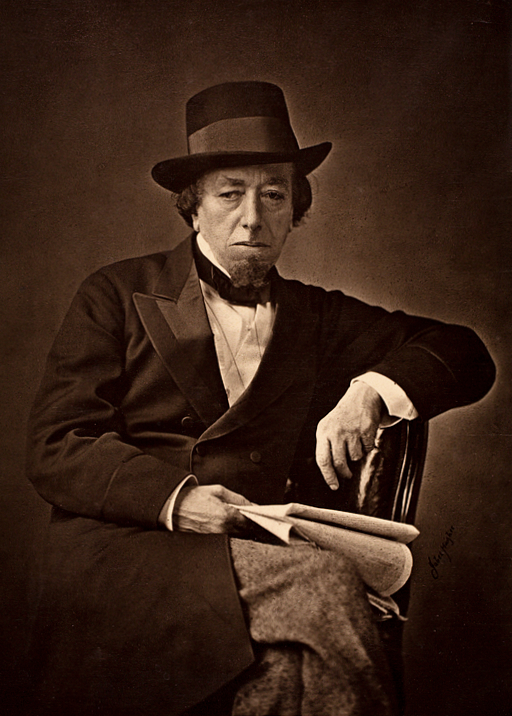
![Benjamin Disraeli, c. 1878]float-right One-nation conservatism emerged in the mid-19th century as a response to the social divisions exacerbated by industrialization and laissez-faire policies, with Benjamin Disraeli articulating its foundational critique through his 1845 novel Sybil, or The Two Nations. In the work, Disraeli depicted Britain as split into "two nations" – the wealthy aristocracy and the impoverished working class – separated by "no intercourse and no sympathy," highlighting the need for conservative-led reforms to foster unity and mitigate class antagonism.[14][15] This vision drew from the Young England movement, a group of Tory MPs including Disraeli, which advocated paternalistic intervention to preserve traditional hierarchies while addressing workers' conditions, opposing radical liberalism and Chartist agitation.[16] Disraeli's political leadership advanced these principles, notably through the Second Reform Act of 1867, which he championed as Chancellor of the Exchequer, extending suffrage to approximately 938,000 additional working-class voters in urban areas and integrating them into the national polity to prevent revolutionary divides.[17][1] During his second premiership (1874–1880), Disraeli's government enacted a series of "sanitory" reforms emphasizing state responsibility for public welfare, including the Public Health Act 1875, which consolidated local sanitary laws and mandated urban improvements; the Artisans' and Labourers' Dwellings Improvement Act 1875, enabling slum clearance; and the Climbing Boys Act 1875, prohibiting child chimney sweeps.[18][17] These measures reflected a pragmatic Tory approach to binding social classes through incremental state action, prioritizing national cohesion over unfettered markets.[1] The ideology's roots also echoed earlier paternalistic Tory traditions, such as those under Robert Peel, but Disraeli innovated by combining imperial expansion – evident in policies like the Royal Titles Act 1876 proclaiming Queen Victoria Empress of India – with domestic reform to cultivate a sense of shared British identity across strata.[17] While Disraeli's 1872 Crystal Palace speech invoked a "national party" for the "health, wealth, and intelligence of all," the "one nation" formulation crystallized posthumously as interpreters linked it to his efforts against social fragmentation.[1] This 19th-century framework prioritized empirical responses to industrial-era inequities, grounding conservatism in causal recognition of state-enabled unity as a bulwark against division.[14]Mid-Twentieth-Century Ascendancy
The One Nation Group was founded in 1950 by nine newly elected Conservative MPs in response to the party's electoral defeat that year, aiming to develop moderate social policies that emphasized paternalistic responsibility and national unity over ideological confrontation with Labour's reforms.[19] This initiative reflected a broader adaptation within the Conservative Party to the post-war political landscape, where acceptance of the welfare state— including the National Health Service established in 1948—became necessary to regain voter support amid public demand for social security.[20] The group's 1950 pamphlet, One Nation, advocated for pragmatic interventions to mitigate class divisions, influencing the party's manifesto for the 1951 general election, in which Conservatives secured a majority of 17 seats.[21] Following the 1951 victory, the Conservative government under Winston Churchill committed to constructing 300,000 houses annually to address wartime shortages, a pledge fulfilled under Harold Macmillan's tenure as Minister of Housing and Local Government from 1951 to 1954, who approached the target with wartime urgency by streamlining planning and materials allocation. Macmillan, a proponent of the "middle way" blending free markets with state intervention, exemplified one-nation principles through policies maintaining full employment, expanding secondary education via the 1944 Education Act's implementation, and sustaining Keynesian demand management—elements of what became known as Butskellism, denoting policy convergence between Tory R. A. B. Butler and Labour's Hugh Gaitskell.[22] These measures prioritized social cohesion and economic stability, rejecting laissez-faire orthodoxy in favor of directed growth that averaged 3% annually in the 1950s.[10] One-nation conservatism reached its zenith during the 1950s and early 1960s under consecutive Conservative administrations, dominating party ideology through the post-war consensus on mixed economics and welfare provision, which sustained public approval until economic strains emerged by 1964.[23] Macmillan's premiership from January 1957 to October 1963 encapsulated this ascendancy, as evidenced by his July 1957 Bedford speech declaring that "most of our people have never had it so good," underscoring prosperity from interventionist policies amid low unemployment of around 2% and rising living standards.[24] This era's paternalism extended to industrial relations, with governments fostering tripartite cooperation between state, employers, and unions to avert strikes, though underlying tensions foreshadowed later challenges.[25]Challenges and Adaptations Post-1970s
The rise of Margaret Thatcher to the Conservative Party leadership in 1975 and her election victory in 1979 posed a profound ideological challenge to one-nation conservatism, as her commitment to monetarism, deregulation, and curbing trade union power diverged from the tradition's emphasis on pragmatic state intervention and protection of vulnerable social groups.[26] Thatcher's policies, influenced by Hayekian economics, prioritized market individualism over the post-war consensus of mixed economy and welfare provision that one-nation figures like Harold Macmillan had championed, leading to internal party divisions between "wets" (moderate interventionists) and "drys" (free-marketeers).[27] This shift exacerbated tensions over unemployment, which reached 3 million by 1982, prompting one-nation conservatives to criticize the social costs of rapid deindustrialization and privatization as eroding national cohesion.[28] Post-Thatcher, John Major's premiership from 1990 to 1997 represented an attempted adaptation, blending one-nation paternalism with Thatcherite reforms through initiatives like the Citizen's Charter for public service accountability and efforts to sustain the welfare state amid recession.[29] However, economic crises, including the 1992 Black Wednesday sterling exit from the European Exchange Rate Mechanism, undermined these efforts and fueled perceptions of one-nation conservatism as outdated amid globalization and fiscal pressures.[30] The tradition faced further marginalization during the party's opposition years from 1997 to 2010, as New Labour under Tony Blair appropriated centrist ground, compelling Conservatives to grapple with electoral irrelevance and internal debates over European integration. David Cameron's leadership from 2005 onward marked a deliberate revival and modernization of one-nation principles, rebranded through concepts like the "Big Society" in 2010, which sought to foster voluntary community action as an alternative to expansive state welfare while addressing social inequalities.[31] Cameron explicitly invoked "one nation" in his 2012 party conference speech, adapting the ideology to contemporary issues such as austerity post-2008 financial crisis—balancing deficit reduction with targeted interventions like pupil premiums for disadvantaged schools—and efforts to broaden the party's appeal beyond its southern English base.[32] Subsequent leaders, including Theresa May from 2016 to 2019, extended this by prioritizing "burning injustices" and industrial strategy to counter regional disparities, though Brexit divisions tested the tradition's unifying ethos.[33] By the 2020s, adaptations incorporated post-pandemic recovery measures, such as leveling-up funds allocated £4.8 billion by 2024 for infrastructure in deprived areas, reflecting a pragmatic synthesis of market economics with social investment amid persistent challenges like immigration debates and economic stagnation.[34]Key Figures
Benjamin Disraeli
Benjamin Disraeli (1804–1881), twice Prime Minister of the United Kingdom (1868 and 1874–1880), originated the phrase "one nation" in his 1844 novel Coningsby, where a character describes the Tory party as the embodiment of national unity across social classes, contrasting it with Whig divisions.[1] In his 1845 novel Sybil, Disraeli highlighted the "two nations" rift between the wealthy and the working poor, arguing for conservative-led reforms to foster social cohesion and avert revolutionary upheaval.[14] These literary works encapsulated his vision of paternalistic Toryism, where the aristocracy bore responsibilities to mitigate industrial hardships without dismantling hierarchical traditions.[35] As Conservative leader, Disraeli championed the Representation of the People Act 1867, which extended voting rights to approximately one million working-class men in urban areas, effectively doubling the electorate and integrating the laboring classes into the political system under Tory guidance.[18] This "Tory democracy" sought to build loyalty among the newly enfranchised by prioritizing practical improvements over abstract liberalism, reflecting Disraeli's belief that conservatism must adapt to democratic pressures to preserve order.[9] During his second ministry, Disraeli's government enacted a series of social measures, including the Public Health Act 1875, which unified local sanitary regulations and mandated clean water supplies; the Artisans' and Labourers' Dwellings Improvement Act 1875, enabling urban slum clearance; and the Conspiracy and Protection of Property Act 1875, which legalized peaceful picketing and trade unions.[18] [8] These reforms demonstrated a commitment to state intervention for public welfare, countering unchecked market forces while upholding property rights and national stability.[36] Disraeli's approach prefigured one-nation conservatism by emphasizing organic social bonds, benevolent authority, and pragmatic governance to unite disparate groups under a shared British identity, though contemporaries noted the measures' limited scope and permissive nature rather than comprehensive compulsion.[1] His legacy as a foundational figure stems from this fusion of tradition and reform, influencing later Conservatives despite debates over whether his actions fully realized the ideology or served electoral expediency.[4]