


Community hub
Recent from talks
Contribute something
Nothing was collected or created yet.
Operation Wilfred
View on Wikipedia
| Operation Wilfred–Plan R4 | ||||||
|---|---|---|---|---|---|---|
| Part of the Norwegian campaign, Second World War | ||||||
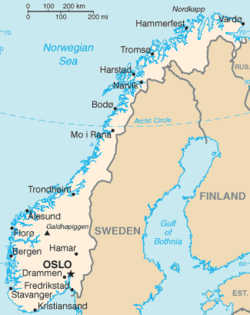
 Map of Norway | ||||||
| ||||||
| Belligerents | ||||||
 Germany Germany |
 Norway Norway | |||||
 | ||||||


Operation Wilfred was a British and French naval operation during the Second World War that involved the mining of the channels between Norway and its offshore islands to prevent the transport of Swedish iron ore through neutral Norwegian waters. The Allies assumed that Wilfred would provoke German retaliation in Norway and prepared Plan R4 to occupy Narvik, Stavanger, Bergen and Trondheim. On 8 April 1940, the operation was partly carried out but was overtaken by events, when the Germans began Operation Weserübung on 9 April, the invasion of Norway and Denmark, which began the Norwegian Campaign.
Background
[edit]British plans
[edit]The British War cabinet expended considerable energy on plans for land operations in Scandinavia during the winter of 1939–1940. The Winter War (30 November 1939 – 13 March 1940) between the Soviet Union and Finland could be used as a pretext. The deputy permanent under-secretary at the Foreign Office, Orme Sargent, wrote
...our desire to assist Finland is only a pretext to justify our occupying Northern Sweden. The original object of a Scandinavia expedition was to prevent Germany from obtaining the Gällivare iron ore, because we believed that by depriving [Germany] of this we should bring her to her knees within a few months.[1]

and advocated the seizure of the Lapland iron ore fields to prevent a Finnish defeat and German control of Sweden.[a] German iron-ore imports from Sweden were about 20,000,000 long tons (20,000,000 t) in 1938; about 9,000,000 long tons (9,100,000 t) had been denied Germany by the Allied blockade since 1939. In the summer the ore was sent from Luleå in the Gulf of Bothnia but the winter ice closed this route and ore was sent instead by rail to Narvik, for shipment to Germany.[3]
At the Admiralty, Winston Churchill, the First Lord of the Admiralty, wanted an offensive policy, particularly after the Altmark incident (16–17 February 1940). British ships had entered Norwegian territorial waters to rescue merchant sailors being held on Altmark and taken to Germany after being taken prisoner when their ships had been sunk by the heavy cruiser Admiral Graf Spee. On 20 February 1940, Churchill ordered the Admiralty urgently to prepare a minelaying plan which "being minor and innocent may be called Wilfred".[4][b] Churchill thought that a landing in Norway, without Norwegian acquiescence, was a mistake, even if there was no more than a minor exchange of fire with the Norwegian army. Churchill held that laying mines in the Indreled (Inner Leads) in Norwegian waters, could be done without a confrontation with the Royal Norwegian Navy (Sjøforsvaret). The War Cabinet and the Ministry of Economic Warfare hesitated to support hostilities in Norwegian waters, because of the effect that they could have on British imports from Norway and Sweden. On 29 February, the prime Minister, Neville Chamberlain, decided to wait and see.[4]
Landing plans
[edit]
Despite the uncertainty, the Allied army high commands worked on plans for land operations in Scandinavia. In Operation Avonmouth, three battalions of Chasseurs Alpins and a British infantry brigade, with three ski companies attached, were to land at Narvik and advance along the railway to take over the iron ore fields in Lapland. The French chasseurs and Foreign Legionnaires were to continue east towards Finland but keep away from the Red Army and risk being cut off by a German force when the ice in the Gulf of Bothnia thawed.[6]
Operation Stratford, was a plan for five battalions of British infantry to garrison Stavanger, Bergen and Trondheim to deny the Germans bridgeheads. In Operation Plymouth three divisions were to stand ready to cross to Trondheim to aid Sweden if the Swedish government requested it. French ships and troops assembled in the French Channel Ports and Brest. Up to 100,000 British and 50,000 French troops with generous air and naval support might participate, the main effort being in Norway, with 10,000 to 15,000 troops advancing into Finland. German counter-landings were expected in southern Norway up to Stavanger. The latest date that the Gulf of Bothnia could be expected to remain frozen was 3 April.[6]
The French view was that an operation in Scandinavia had many advantages it would divert German troops from the Maginot Line and if iron ore deliveries to Germany were prevented it would have a severe effect on the German war economy. The British would have to carry the naval burden and a few thousand troops of the French Foreign Legion would show the French government's determination to fight. Admiral Gabriel Auphan, the Deputy Chief of the Maritime Staff (Sous-chef d'état-major des forces maritimes) wrote later,
...It's a little cynical to say so, but no-one really expected to stop the Soviet army and Save Finland. The idea was to use the pretext of such an operation to lay out hands on the Swedish Iron-ore, and thus deny it to Germany.[7]
and the Prime Minister, Edouard Daladier, wanted swift action. The Norwegians had been warned in January and could be ignored during a "swift occupation of the main Norwegian ports and landing of an expeditionary force". Having decided to wait, the British on 1 March resolved to try to obtain permission from the Norwegians and the Swedes to allow the transit of a military force to Finland via Narvik, Kiruna and Gällivare but the Norwegian prime minister rejected the request on 4 March, the Swedish prime minister having rejected the request the day before. On 11 March the French told the War Cabinet that Daladier would be forced to resign over the Finland question, unless something was done. The British agreed to dispatch troops to Narvik regardless of whether the Norwegians acquiesced.[8]
Plan R3
[edit]
In Plan R3, Major-General Pierse Macksey, the commander of the 49th (West Riding) Infantry Division, was made land commander and Admiral Edward Evans the naval commander, with Audet in command of the Corps éxpeditionnaire français en Scandinavie. The British commanders were briefed on 12 March that they were to land a force at Narvik, assist Finland and deny Russia and Germany the Swedish iron ore fields for as long as they could. The force was only to attempt a landing if the Norwegians made only token resistance. Force was not to be used except in self-defence. The plan caused confusion in the War Cabinet because several partly-trained British divisions were to be imposed on Norway and Sweden.[9]
Reaching Finland was unlikely and the force might have to re-embark if the Norwegians resisted. During 12 March the War Cabinet decided only to implement the Narvik landing and seize the railway terminus. On 13 March the embarkation began, only to be cancelled that day on the news of the Finnish capitulation to the USSR. Churchill and the Chief of the Imperial General Staff, General Sir Edmund Ironside tried to get permission to land at Narvik but were rebuffed, most of the troops for Operation Avonmouth being sent to France and the Chasseurs Alpins sent to their base. The French ships resumed their normal duties and the British ships went back to the Northern Patrol.[9]
Operation Royal Marine
[edit]By late March 1940, after the resignation of Daladier and the appointment of Paul Reynaud as prime minister of France, at the Supreme War Council, Chamberlain presented Operation Royal Marine, a scheme to put floating mines into the Rhine to disrupt river traffic downriver in the Rhineland. The French agreed to the plan provided that it was linked to mining operations in the Norwegian Leads. By 1 April a warning would have been sent to the Norwegian and Swedish governments that the Allies would stop the passage of German iron-ore ships. A few days later mines would be laid in the Leads and operations against German shipping would be undertaken as floating mines were to be placed in the Rhine and other German rivers. Churchill and Ironside managed to get a decision that British and French troops were to go to Narvik and advance to the frontier with Sweden. The French Admiral Darlan saw the landing plan as a catalyst to bring out the German fleet and sent orders that the French forces which had just been disbanded to be reassembled; the War Office began to gather the forces that had dispersed after the cancellation of Operation Stratford and Operation Avonmouth.[10]
German plans
[edit]On 3 April, the British began to receive reports of an accumulation of shipping and troops in the Baltic German ports of Rostock, Stettin and Swinemunde. It was assumed that it was part of a force being sent to counter an Allied move against Scandinavia (the Germans had some awareness of Allied plans as a result of their own intelligence) and so that day, the British took the decision to proceed with the mining of the iron ore route separately from Operation Royal Marine, setting a date of 8 April for the Admiralty to implement it.
Prelude
[edit]Operation Wilfred
[edit]The mining plan became Operation Wilfred and the new landing operation Plan, R4. Force WV, consisting of four destroyer minelayers and four escorting destroyers was to lay mines off just south of the Lofoten Islands in Vestfjorden (67°24'N, 14°36'E) in the channel leading to Narvik. Force WS, the auxiliary minelayer HMS Teviot Bank and four destroyers was to lay mines off Stadtlandet (62°N, 5°E). Force WB, with two destroyers, was to lay a dummy minefield off the Bud headland, south of Kristiansund (62°54'N, 6°55'E) if the Norwegians swept the mines, they were to be replaced by the minelayers.[11]
Plan R4
[edit]The British anticipated that Operation Wilfred would prompt German retaliation and Plan R4 was a scheme to forestall German landings by occupying Stavanger, Bergen, Trondheim and Narvik as soon as the Germans revealed their intentions. Brigadier C. G. Phillips and two battalions of infantry for Bergen and two for Stavanger embarked at Rosyth on 7 April in the cruisers HMS Berwick, York, Devonshire and Glasgow.[12] Troops for Narvik were assembled on the Clyde to commence embarkation on the morning of 8 April, to depart later in the day, in six destroyers, escorted by the cruisers HMS Penelope and Aurora; Admiral Evans and Major-General Mackesy on Aurora. Although waiting on the Germans conceded the initiative, sixteen submarines were sent to patrol the likely German approach routes to give warning.[11] An infantry battalion bound for Trondheim was due to follow on 9 April. Plan R4 expected that the British troops would be able to hold their positions until reinforced.[12]
Operation
[edit]
On 3 April, the cruisers Berwick, York, Devonshire and Glasgow with the destroyers HMS Afridi, Cossack, Gurkha, Mohawk, Sikh and Zulu embarked their troops at Rosyth to be transported to Norway for Plan R4.[11] Additional troops embarked onto transport ships in the Clyde with other troops, held in readiness until evidence of German intentions gave a pretext to send them to Norway. On 5 April a large force of warships, escorted by the battlecruiser HMS Renown and the cruiser HMS Birmingham, comprising elements of Operation Wilfred and Plan R4 set out from the main British naval base at Scapa Flow for the Norwegian coast. On 7 April, the force split, one to carry on to Narvik, the others to carry out Wilfred to the south. If the Norwegians swept the minefields, the British would lay new ones close by. If the Norwegians challenged the British ships, the latter were to inform them that they were there to protect merchant vessels. The British would then withdraw, leaving the Norwegians to guard the area.[13]
As Force WS sailed for Stadtlandet on 7 April, German ships were sighted in the Heligoland Bight on passage to Norway and the mine laying was cancelled. Early the next day, 8 April, the day scheduled for Wilfred, the British government informed the Norwegian authorities of its intention to mine Norwegian territorial waters. Soon afterwards, Force WB simulated mine laying off the Bud headland by using oil drums and patrolled the area to "warn" shipping of the danger. Force WV laid the minefield in the mouth of Vestfjord. At 05:15 that morning, the Allies broadcast a statement to the world that justified their action and defined the mined areas. The Norwegian government issued a strong protest and demanded their immediate removal; the German fleet was already advancing up the Norwegian coasts.[citation needed]
Later that day, the ore carrier Rio de Janeiro, sailing from Stettin, in northern Germany was sunk in the Skagerrak by the Polish submarine Orzeł. The ship was carrying troops, horses and tanks for the German invasion of Norway, part of Operation Weserübung. Around half of the 300 men on board were drowned, survivors telling the crews of the Norwegian fishing boats that picked them up that they were on their way to Bergen to defend it from the British.[14]
Aftermath
[edit]Analysis
[edit]Operation Wilfred was complete, the southern ships of Force WS and Force WB rejoined the Home Fleet and took part in Operation Rupert, British operations against the German invasion of Norway. Force WV to the north confronted the German landings. The Norwegians were taken by surprise by the German invasion on 9 April, which began with German landings in the Norwegian cities of Stavanger, Oslo, Trondheim, Narvik and Bergen. British and French troops landed at Narvik on 14 April to assist the Norwegians, pushing the Germans out of the town and almost forcing them to surrender. Despite Allied landings between 18 and 23 April, the Norwegians surrendered on 9 June 1940. Operation Wilfred failed to cut off iron ore shipments to Germany but for the rest of the war British ships and aircraft could enter Norwegian waters and attack German ships at will.[citation needed]
Subsequent events
[edit]HMS Glowworm (Lieutenant-Commander Gerard Roope), had become detached from the main force on 6 April to look for a man lost overboard and encountered the German heavy cruiser Admiral Hipper. Glowworm carried out a torpedo attack and after receiving return fire and suffering severe damage, she rammed Admiral Hipper, sinking soon afterwards, with the loss 111 men; Roope was awarded a posthumous Victoria Cross.[15] Renown, which had diverted to assist Glowworm, fought the Action off Lofoten with the German battleships Scharnhorst and Gneisenau 80 nmi (150 km; 92 mi) off the coast. The Germans disengaged from the battle, drawing Renown and her escorts away from the German landings at Narvik.[16] The 2nd Destroyer Flotilla, which had taken part in the mining of the Vestfjord, took part in the First Naval Battle of Narvik (10 April).[17] Icarus captured Alster (11 April) and took part in the Second Naval Battle of Narvik (13 April 1940).[18]
British order of battle
[edit]Home Fleet
[edit]| Ship | class | Notes |
|---|---|---|
| HMS Rodney | Nelson-class battleship | Admiral Charles Forbes, sailed 7 April to block Shetland–Norway Gap |
| HMS Valiant | Queen Elizabeth-class battleship | |
| HMS Repulse | Renown-class battlecruiser | Detached to covering force 8 April |
| HMS Penelope | Light cruiser | Detached to covering force 8 April |
| HMS Sheffield | Light cruiser | |
| HMS Somali | Tribal-class destroyer | |
| HMS Matabele | Tribal-class destroyer | |
| HMS Mashona | Tribal-class destroyer | |
| HMS Bedouin | Tribal-class destroyer | Detached to covering force 8 April |
| HMS Eskimo | Tribal-class destroyer | Detached to covering force 8 April |
| HMS Punjabi | Tribal-class destroyer | Detached to covering force 8 April |
| HMS Jupiter | J-class destroyer | |
| HMS Kimberley | K-class destroyer | Detached to covering force 8 April |
| HMS Kelvin | K-class destroyer | |
| HMS Kashmir | K-class destroyer | |
| Émile Bertin | Light cruiser | Rear-Admiral Edmond Derrien sailed later |
| Maillé Brézé | Vauquelin-class destroyer | |
| Tartu | Vauquelin-class destroyer |
From Rosyth, 7 April
[edit]| Ship | class | Notes |
|---|---|---|
| HMS Arethusa | Arethusa-class cruiser | Vice-Admiral Frederick Edward-Collins Sailed 7 April |
| HMS Galatea | Arethusa-class cruiser | |
| HMS Codrington | A-class destroyer | |
| HMS Electra | E-class destroyer | |
| HMS Escapade | E-class destroyer | |
| HMS Griffin | G-class destroyer |
From Rosyth, 8 April
[edit]| Ship | class | Notes |
|---|---|---|
| HMS Berwick | County-class cruiser | |
| HMS Devonshire | County-class cruiser | Flagship, Vice-Admiral John Cunningham |
| HMS Glasgow | Town-class cruiser | |
| HMS York | York-class cruiser | |
| HMS Afridi | Tribal-class destroyer | |
| HMS Cossack | Tribal-class destroyer | |
| HMS Gurkha | Tribal-class destroyer | |
| HMS Mohawk | Tribal-class destroyer | |
| HMS Sikh | Tribal-class destroyer | |
| HMS Zulu | Tribal-class destroyer |
Covering force
[edit]| Ship | class | Notes |
|---|---|---|
| HMS Renown | Renown-class battlecruiser | Flagship Vice-Admiral William Whitworth |
| HMS Repulse | Renown-class battlecruiser | Detached from Home Fleet, 8 April |
| HMS Penelope | Arethusa-class cruiser | Detached from Home Fleet, 8 April |
| HMS Bedouin | Tribal-class destroyer | Detached from Home Fleet, 8 April |
| HMS Eskimo | Tribal-class destroyer | Detached from Home Fleet, 8 April |
| HMS Punjabi | Tribal-class destroyer | Detached from Home Fleet, 8 April |
| HMS Glowworm | G-class destroyer | 8 April 1940, sunk 64°27'N, 06°28'E byAdmiral Hipper[21] |
| HMS Greyhound | G-class destroyer | |
| HMS Hero | H-class destroyer | |
| HMS Hyperion | H-class destroyer | |
| HMS Kimberley | K-class destroyer | Detached from Home Fleet, 8 April |
Force WV (Mouth of Vestfjord)
[edit]| N | E | |
|---|---|---|
| A | 67° 24' 40" N | 14° 34' 00" E |
| B | 67° 27' 30" N | 14° 24' 00" E |
| C | 67° 28' 55" N | 14° 06' 45" E |
| D | 67° 33' 55" N | 13° 51' 30" E |
| E | 67° 37' 55" N | 14° 02' 15" E |
| F | 67° 26' 20" E | 14° 38' 30" E |
| Ship | class | Notes |
|---|---|---|
| HMS Esk | E-class destroyer | 20th Destroyer Flotilla, minelayer, joined covering force, 8 April |
| HMS Hardy | H-class destroyer | 2nd Destroyer Flotilla escort, joined covering force, 8 April |
| HMS Havock | H-class destroyer | 2nd Destroyer Flotilla, escort, joined covering force, 8 April |
| HMS Hotspur | H-class destroyer | 2nd Destroyer Flotilla, escort, joined covering force, 8 April |
| HMS Hunter | H-class destroyer | 2nd Destroyer Flotilla, escort, joined covering force, 8 April |
| HMS Icarus | I-class destroyer | 20th Destroyer Flotilla, minelayer, joined covering force, 8 April |
| HMS Impulsive | I-class destroyer | 20th Destroyer Flotilla, minelayer, joined covering force, 8 April |
| HMS Ivanhoe | I-class destroyer | 20th Destroyer Flotilla, minelayer, joined covering force, 8 April |
Force WS (Stadtlandet)
[edit]| N | E | |
|---|---|---|
| A | 62° 11' 06" N | 05° 06' 12" E |
| B | 62° 09' 24" N | 05° 00' 13" E |
| C | 62° 12' 18" N | 04° 49' 30" E |
| D | 62° 19' 30" N | 05° 05' 36" E |
| E | 62° 12' 00" N | 05° 09' 00" E |
| Ship | class | Notes |
|---|---|---|
| HMS Ilex | I-class destroyer | Minelayer |
| HMS Imogen | I-class destroyer | Minelayer |
| HMS Inglefield | I-class destroyer | Minelayer (Flotilla leader) |
| HMS Isis | I-class destroyer | Minelayer |
| HMS Teviot Bank | Auxiliary ship M04 | Minelayer (5,087 GRT) 280 mines |
Force WB (Bud headland)
[edit]| N | E | |
|---|---|---|
| A | 62° 58' 27" N | 07° 05' 30" E |
| B | 63° 03' 30" N | 06° 54' 00" E |
| C | 63° 07' 12" N | 07° 04' 30" E |
| D | 62° 59' 24" N | 07° 07' 15" E |
| Ship | class | Notes |
|---|---|---|
| HMS Birmingham | Town-class cruiser | |
| HMS Hyperion | H-class destroyer | Minelayer, from Renown covering force |
| HMS Hero | H-class destroyer | Minelayer, from Renown covering force |
See also
[edit]- Operation Catherine (proposed Baltic operation)
Notes
[edit]- ^ The deputy under-secretary took charge of the Foreign Office when the Permanent Under-Secretary (head of the Foreign Office), Sir Alexander Cadogan, was away.[2]
- ^ Wilfred was a character in Pip, Squeak and Wilfred a Daily Mirror newspaper comic strip.[5]
Footnotes
[edit]- ^ Haarr 2013, pp. 390–391.
- ^ Haarr 2013, p. 348.
- ^ Roskill 1957, p. 156.
- ^ a b Haarr 2013, pp. 391–392.
- ^ Churchill 1985, p. 522.
- ^ a b Haarr 2013, p. 393.
- ^ Haarr 2013, p. 293.
- ^ Haarr 2013, p. 394.
- ^ a b Haarr 2013, p. 395.
- ^ Haarr 2013, p. 398.
- ^ a b c d Roskill 1957, p. 157.
- ^ a b Haarr 2009, p. 55.
- ^ Lunde 2010, p. 39.
- ^ Haarr 2009, pp. 120–121.
- ^ Haarr 2013, pp. 418–421.
- ^ Roskill 1957, pp. 165–166; Stegemann 2015, pp. 207–208.
- ^ Roskill 1957, p. 172.
- ^ Roskill 1957, pp. 177–178; Rohwer & Hümmelchen 2005, p. 20.
- ^ a b c Rohwer & Hümmelchen 2005, p. 18.
- ^ a b Rohwer & Hümmelchen 2005, p. 17.
- ^ Brown 1995, p. 29.
- ^ a b c Haarr 2013, p. 485.
- ^ Rohwer & Hümmelchen 2005, pp. 17–18.
References
[edit]- Brown, David (1995) [1990]. Warship Losses of World War Two (2nd rev. ed.). London: Arms and Armour Press. ISBN 978-1-85409-278-6.
- Churchill, Winston (1985). The Second World War: The Gathering Storm. Vol. I. Boston: Houghton Mifflin. ISBN 0-395-41055-X – via Archive Foundation.
- Haarr, Geirr (2009). The German Invasion of Norway, 1940. Barnsley: Seaforth (Pen & Sword Books). ISBN 978-1-84832-032-1.
- Haarr, Geirr (2013). The Gathering Storm: The Naval War in Northern Europe September 1939 – April 1940. Barnsley: Seaforth (Pen & Sword). ISBN 978-1-84832-140-3.
- Lunde, Henrik O. (2010). Hitler's Pre-Emptive War: The Battle for Norway, 1940. Havertown, PA and Newbury, Berks: Casemate. ISBN 978-1-935149-33-0.
- Maier, Klaus A.; Rohde, Horst; Stegemann, Bernd; Umbreit, Hans (2015) [1991]. Falla, P. S. (ed.). Germany and the Second World War: Germany's Initial Conquests in Europe. Vol. II. Translated by McMurry, Dean S.; Osers, Ewald (trans. pbk. Clarendon Press, Oxford ed.). Freiburg im Breisgau: Militärgeschichtliches Forschungsamt [Research Institute for Military History]. ISBN 978-0-19-873834-3.
- Stegemann, Bernd. "Part V Securing the Northern Flank of Europe III. Operation Weserübumg". In Maier et al. (2015).
- Rohwer, Jürgen; Hümmelchen, Gerhard (2005) [1972]. Chronology of the War at Sea, 1939–1945: The Naval History of World War Two (3rd rev. ed.). London: Chatham. ISBN 978-1-86176-257-3.
- Roskill, S. W. (1957) [1954]. Butler, J. R. M. (ed.). The War at Sea 1939–1945: The Defensive. History of the Second World War United Kingdom Military Series. Vol. I (4th impr. ed.). London: HMSO. OCLC 881709135. Retrieved 7 February 2016.
Further reading
[edit]- Butler, James (1971) [1957]. Grand Strategy: September 1939 – June 1941. Britain and the Second World War – Military Series. Vol. II (2nd (amended) ed.). London: HMSO. ISBN 0-11-630095-7.
- Derry, T. K. (2004) [1952]. Butler, J. R. M. (ed.). The Campaign in Norway. History of the Second World War, United Kingdom Military Series (Naval & Military Press ed.). London: HMSO. ISBN 1-845740-57-2. Retrieved 7 February 2016.
- Esposito, Vincent, ed. (1964). A Concise History of World War II. London: Pall Mall Press. OCLC 1063059115 – via Archive Foundation.
- Hinsley, F. H. (Harry) (1994) [1993]. British Intelligence in the Second World War (Abridged). History of the Second World War (2nd pbk. rev. ed.). London: HMSO. ISBN 978-0-11-630961-7.

Operation Wilfred
View on GrokipediaStrategic Context
German Dependence on Scandinavian Iron Ore
![Scandinavia_M2002074_lrg.jpg][float-right] Nazi Germany's iron and steel industry relied heavily on imported ore due to insufficient domestic high-grade supplies, with Sweden emerging as the primary supplier in Scandinavia. Domestic production reached approximately 25 million metric tons annually by 1939 but was predominantly low-grade Lorraine-type ore, necessitating imports of richer ores for efficient steelmaking via processes like the basic Bessemer method suited to phosphorus-rich Swedish varieties from the Kiruna and Gällivare mines.[4] In 1938, German steel industry raw material needs totaled around 36-37 million tons, with Swedish ore constituting a significant share, estimated at 9-10 million tons exported to Germany that year.[5] This dependence intensified during rearmament, as Swedish exports supported up to 40% of Germany's iron ore requirements pre-war, rising in strategic importance amid Allied blockades.[6] The bulk of Swedish ore shipments to Germany transited Scandinavian routes, with two primary paths: the Baltic route via Luleå during ice-free summer months (May-November), handling about two-thirds of annual volume, and the year-round Narvik route via Norwegian ports for the remaining third, which became exclusive during winter when Baltic ports froze.[4] The Narvik conduit, utilizing the Ofoten Railway from Kiruna to the ice-free port of Narvik, facilitated 7-8 million tons annually, often hugging Norwegian territorial waters (the "leads") to evade international waters patrolled by the Royal Navy.[7] Norwegian ore exports to Germany were negligible by comparison, totaling under 1 million tons yearly from smaller deposits, underscoring Sweden's dominance in the region's contribution to German needs.[8] By late 1939, Swedish ore accounted for over 50% of Germany's consumption in the final quarter, highlighting vulnerabilities exploited in Allied strategies like Operation Wilfred.[6] This reliance exposed Germany to interdiction risks, as the leads' neutrality shielded shipments until mining operations disrupted safe passage, compelling rerouting into open seas.[9] German planning prioritized securing these routes, integrating ore protection into broader Scandinavian contingencies amid fears of British interference.[4]British Blockade Strategy and Neutrality Challenges
The British naval blockade, declared on September 3, 1939, aimed to sever Germany's access to essential imports, particularly iron ore critical for steel production and armaments, with Sweden providing up to 40 percent of Germany's requirements.[9] During winter, approximately half of this ore—around 4.5 million tons annually—was shipped from the ice-free Norwegian port of Narvik southward through the Norwegian Leads, a series of sheltered coastal channels within territorial waters.[1] [10] These leads enabled German vessels to evade interception in international waters, rendering the blockade ineffective against this vital supply route.[9] Norway's neutrality, proclaimed on September 1, 1939, and upheld under international law including the Hague Conventions, shielded these transits by prohibiting belligerent interference in territorial seas up to three miles offshore.[9] To neutralize this advantage, First Lord of the Admiralty Winston Churchill proposed mining the leads in September 1939, formalized as Operation Wilfred to divert ore carriers into the open Skagerrak or North Sea for lawful seizure by the Royal Navy.[1] [9] The plan envisioned three minefields: two active ones in the Vestfjord north of Bodø and off Stadlandet, plus a feint near Molde, to be laid by destroyers supported by cruisers and the Home Fleet.[1] Executing Wilfred, however, directly contravened Norwegian sovereignty, as offensive mining in neutral waters violated established norms and risked diplomatic isolation for Britain.[10] Prior incidents, including British searches of German ships and the boarding of the Altmark in a Norwegian fjord on February 16, 1940, had already prompted Norwegian protests, yet Oslo tolerated disproportionate German usage of its waters, including troop transports disguised as cargo.[9] Sweden and Norway jointly objected to early Allied mining proposals in January 1940, citing fears of German retaliation and preference for strict neutrality over entanglement.[1] Diplomatic maneuvers, such as British notes delivered on April 5, 1940, urging Norway and Sweden to curb ore exports or face unilateral action, met rejection, underscoring the neutrals' prioritization of economic ties with Germany.[9] The War Cabinet delayed approval amid the Finnish Winter War (November 30, 1939–March 13, 1940), hoping for consensual transit rights, but authorized Wilfred on March 14, 1940, for April 8 execution, rationalizing it through Germany's antecedent breaches and the existential imperative of the blockade.[1] [9] This calculus weighed strategic gains against potential Norwegian alienation and escalated German countermeasures, reflecting a calculated infringement justified by blockade necessities rather than legal purity.[10]Norwegian Position and Pre-War Incidents
Norway proclaimed its neutrality on 1 September 1939, immediately following the outbreak of war in Europe, reaffirming its policy of non-involvement in conflicts as established during World War I.[11] The Norwegian government, led by Prime Minister Johan Nygaardsvold, emphasized strict adherence to international law, including the protection of territorial waters extending up to 12 nautical miles, while permitting neutral trade such as the export of Swedish iron ore through the port of Narvik to Germany during winter months when Baltic routes froze.[12] This trade, which supplied approximately 40% of Germany's iron ore needs, was defended as legitimate commerce unconnected to belligerent military actions, despite Allied blockade efforts.[12] German forces initially violated Norwegian neutrality through U-boat attacks on merchant vessels within territorial waters, including the sinking of several British ships in October 1939, prompting formal Norwegian protests to Berlin for infringing sovereignty.[9] German surface vessels, including ore carriers, routinely transited the Leads—the inner coastal routes—to evade Allied interception, a practice tolerated by Norway as non-combatant passage but increasingly contested amid escalating tensions.[9] Britain, in response, conducted naval patrols and searches in these waters, leading to repeated Norwegian diplomatic complaints about encroachments that disregarded neutrality protocols.[13] The most prominent pre-war incident occurred on 16 February 1940, when the British destroyer HMS Cossack entered the Jøssingfjord and boarded the German auxiliary cruiser Altmark, which was transporting 299 British merchant seamen captured after the sinking of their ships by the German pocket battleship Graf Spee.[14] Norwegian torpedo boats attempted to block the action but were outnumbered; the government lodged a sharp protest with London, citing the boarding as a direct violation of territorial integrity and demanding compensation, though Britain countered that the operation was justified to liberate prisoners held illegally under international conventions.[14] [9] Additional British overflights by aircraft in March 1940 further strained relations, eliciting further protests from Oslo against airspace incursions.[15] These events underscored Norway's precarious balancing act, as official neutrality masked growing internal debates and external pressures, with the government rejecting both Allied entreaties for basing rights and German assurances of protection while prioritizing diplomatic defenses of sovereignty.[11] Despite the incidents, Norway avoided military escalation, maintaining export policies that facilitated German resource flows until the German invasion on 9 April 1940 rendered neutrality untenable.[12]Planning Phase
Evolution of British Mining Proposals
In October 1939, Winston Churchill, as First Lord of the Admiralty, proposed mining the Norwegian Leads north of Bergen to interdict German shipments of Swedish iron ore from Narvik, recognizing the route's vulnerability within Norwegian territorial waters during the winter months when Baltic ports were frozen. This initiative built on earlier assessments from September 1939, when the strategic importance of the Leads for Germany's 8-10 million tons of annual ore imports prompted initial British considerations for offensive mining to force traffic into international waters amenable to blockade.[2] Cabinet approval followed in November 1939 for a broader Northern Barrage scheme incorporating Leads mining as a long-term measure, though immediate implementation was deferred amid concerns over violating Norwegian neutrality and potential German reprisals.[9] Churchill persisted in December 1939, advocating urgent mining or patrol actions, but diplomatic overtures to Norway and Sweden for consent failed by 6 January 1940, stalling progress.[9] The Altmark incident on 16 February 1940, where British forces boarded a German ship in Norwegian waters to liberate prisoners, intensified pressure for decisive steps but was overshadowed by Allied plans to dispatch a brigade to Narvik in support of Finland, approved by the Supreme War Council on 5 February.[9] Finland's surrender on 14 March 1940 redirected focus, with mining proposals evolving to integrate with contingency landings under Plan R4, initially vetoed by French fears of escalation but later decoupled.[2] By 28 March 1940, the War Cabinet authorized Operation Wilfred, scheduling mine-laying for 5 April in the Vestfjord approaches north of Bodø and between the Lofoten Islands and the mainland, using approximately 1,000 mines from British stocks.[9] Warnings were dispatched to Norway and Sweden on 5 April, but execution was postponed to 8 April to align with naval dispositions, reflecting final adjustments amid lingering neutrality qualms and expectations of German countermeasures.[9] This progression marked a shift from tentative blockade extensions to a proactive violation of neutrality, driven by empirical data on ore volumes—Germany sourced over 40% of its needs via Narvik—and causal assessments of Scandinavian supply lines' indispensability to the Axis war effort.[2]Integration with Contingency Plans (R3 and R4)
Operation Wilfred was designed as a provocative measure to disrupt German iron ore shipments through Norwegian territorial waters, with contingency plans R3 and R4 providing the framework for immediate Allied military response to anticipated German countermeasures. Plan R4, approved by the British War Cabinet on 30 March 1940, outlined the occupation of four key Norwegian ports—Stavanger, Bergen, Trondheim, and Narvik—upon evidence of German violation of Norwegian neutrality, such as troop landings or naval incursions.[10] This plan divided operations into STRATFORD, targeting the southern ports with approximately 5,000 British troops transported by cruisers like HMS Devonshire and York departing Rosyth on D-1 to arrive on D-2, and AVONMOUTH, directing a combined Anglo-French force of about 18,000 men toward Narvik using troopships such as SS Batory, scheduled to sail from the Clyde on D-1 and arrive on D-5 under cruiser and destroyer escort.[16] Embarkations for R4 began on 5 April 1940, positioning forces to exploit any German reaction to the mining, thereby securing Allied control over ports critical for denying Germany naval bases and transit routes.[16] The broader implications of Plan R4 extended beyond Norway to potential operations in Sweden. Following landings at Narvik, Allied forces planned to advance along the Malmbanan railway into Swedish territory to occupy the iron ore mining areas in Kiruna and Gällivare, aiming to completely cut off German access to Swedish iron ore. This aspect of the plan highlighted the potential violation of Swedish neutrality and was intended to be justified by German actions in Norway, though it raised significant diplomatic concerns.[17][1] Plan R3 complemented R4 as a narrower contingency, emphasizing defensive reinforcements at Narvik, including potential dispatch of French units to safeguard port infrastructure without committing to widespread landings across Norway.[18] Unlike R4's offensive seizures, R3 focused on localized measures, such as establishing defenses and coordinating with Norwegian forces, and was not intended for proactive troop deployments independent of confirmed threats.[16] Integration with Wilfred ensured that minelaying—executed on 8 April 1940—would serve as the initial breach of Norwegian neutrality, framing subsequent R3 or R4 activations as defensive aid to Norway against German aggression rather than unprovoked invasion.[10] Naval assets from the Home Fleet, including battlecruisers and destroyers, were allocated to cover both mining and contingency sailings, reflecting a unified strategy to interdict ore traffic while preempting German consolidation in Scandinavia.[16] This linkage underscored British calculations that Wilfred's disruption of coastal leads would compel Germany to expose its fleet or initiate landings, triggering R4's broader intervention to establish garrisons and disrupt supply lines.[10] Air cover from RAF Bomber Command and Fighter Command was prearranged for troop transports, with reconnaissance prioritized to detect German movements signaling plan activation.[16] However, the plans hinged on rapid intelligence confirmation, as delays in verifying German intent—such as dismissing early reports of convoys—risked ceding initiative, a vulnerability realized when Operation Weserübung commenced on 9 April 1940 before full R4 execution.[10]Intelligence Assessments and German Anticipation
British intelligence agencies, including the Joint Intelligence Committee, had gathered indications of German interest in Scandinavia through decrypted communications and agent reports, but assessments consistently underestimated the scale and immediacy of a full-scale invasion. By early April 1940, reconnaissance flights detected unusual German naval concentrations, with a large force observed heading northward on 7 April, yet these were largely interpreted as defensive minelaying exercises rather than offensive preparations for Operation Weserübung.[19][20] The Admiralty's warnings on 8 April focused on potential German counterm-mining rather than troop transports, reflecting a broader failure to integrate signals intelligence with strategic analysis, which prioritized British blockade disruptions over continental threats.[21] In planning Operation Wilfred, British assessments explicitly anticipated German retaliation, viewing the mining as a provocation likely to elicit naval or landing responses to safeguard iron ore routes. This led to the concurrent readiness of Plan R 4, which outlined preemptive occupation of ports like Narvik, Trondheim, Bergen, and Stavanger to counter any Axis incursion, with troop convoys positioned for rapid deployment.[22] However, optimism about Royal Navy dominance and Norwegian neutrality's persistence downplayed the risk of a coordinated German air-naval assault, as evidenced by delayed inter-service coordination and incomplete contingency exercises.[23] German anticipation of British interference stemmed from Abwehr reports and diplomatic intercepts highlighting Allied mining proposals and violation of Norwegian waters, intensified by the Altmark incident on 16 February 1940, where British forces boarded a German vessel in territorial waters.[13] Adolf Hitler, briefed on these threats, regarded them as confirmation of imminent British efforts to sever iron ore supplies, accelerating Weserübung from contingency to operational priority by late March, with directives emphasizing preemption against expected mining or landings.[24] Intelligence from neutral sources and naval reconnaissance further corroborated British troop movements toward Scandinavia, framing the invasion as a defensive necessity to secure flanks and resources, though execution relied on deception to mask fleet sailings on 7 April.[25] This foresight enabled tactical surprises, such as paratroop seizures of airfields, despite risks from British codebreaking gains in naval Enigma traffic.[26]Execution of the Operation
Deployment of Mining Forces
The Royal Navy assembled three distinct minelaying groups for Operation Wilfred, departing from Scapa Flow between 5 and 7 April 1940 to position for the laying of defensive minefields in the Norwegian Leads on the night of 7–8 April.[27] Force WS, the southernmost group, consisted of the auxiliary minelayer HMS Teviot Bank (5,087 gross register tons, capable of carrying approximately 240 mines) escorted by four destroyers—HMS Hostile, Hero, Hyperion, and Hereward—tasked with mining the approaches off Stavanger to block transit along the Skagerrak coastal route.[1] [2] Force WB, operating in the central sector near Bergen and Trondheim, mirrored this composition with another auxiliary minelaying vessel supported by a destroyer escort, though specific ship assignments emphasized rapid deployment to cover intermediate Leads segments vulnerable to German ore carriers.[1] These southern and central forces prioritized uncontested laying to avoid early detection, with destroyers providing anti-submarine screening and reconnaissance amid concerns over Luftwaffe patrols.[27] The northern Force WV, deemed most strategically vital for interdicting Narvik-bound shipments, comprised four specialized minelaying destroyers—HMS Esk, Icarus, Impulsive, and Ivanhoe (each fitted to deploy around 60–70 mines)—under close escort from the battlecruiser HMS Renown (flagship of Vice Admiral William Whitworth), the cruiser HMS Birmingham, and additional destroyers including HMS Edwards and Echo.[2] [27] Departing Scapa Flow on 5 April, this force sailed covertly toward the Vestfjord entrance, with Renown's heavy guns intended to deter interference while the minelayers executed their task just outside Lofoten Islands territorial limits, laying fields to compel neutral shipping into international waters for lawful interception.[1] Overall command fell under Admiral Charles Forbes of the Home Fleet, with forces coordinated to synchronize mining by dawn on 8 April, totaling over 1,000 contact and magnetic mines across the Leads to enforce the blockade without immediate troop landings under the linked Plan R 4.[2] [27]Laying of the Minefields
The minelaying component of Operation Wilfred commenced with the departure of British naval forces from Scapa Flow and other bases on 5 April 1940, under the overall escort of the battlecruiser HMS Renown and cruiser HMS Birmingham.[1] The operation involved three designated forces tasked with establishing minefields in the Norwegian Leads to channel neutral ore shipments into international waters: Force WS (minelayer Teviot Bank with four destroyers) for the area off Stadtlandet; Force WB (two destroyers simulating laying) off Bud; and Force WV (four converted destroyer-minelayers—HMS Abdiel, Ariel, Firedrake, and Grenade—escorted by four additional destroyers) for Vestfjorden south of the Lofoten Islands.[1][2] By 7 April, reconnaissance reports of German naval activity in the North Sea prompted the cancellation of mine-laying by Forces WS and WB to preserve surprise and avoid potential confrontation, leaving only Force WV to execute its assignment.[1] On the night of 8 April, Force WV entered Vestfjorden and successfully deployed its mines across the 67°24'N parallel, sealing the primary coastal route to Narvik and thereby forcing ore carriers into the open sea where they could be intercepted by British patrols.[1][2] This single minefield, laid without immediate detection by Norwegian or German forces, represented the core tactical achievement of Wilfred's minelaying phase, though the destroyers HMS Glowworm had been detached earlier and sunk by the German cruiser Admiral Hipper in an unrelated engagement en route.[1] Norwegian authorities detected the British incursion via coastal patrols but initially attributed vessel movements to routine shipping, delaying any protest until after the mines were in place; no mines were swept or neutralized during the operation itself.[2] The laying proceeded under cover of darkness to minimize visibility, with the minelayers employing standard British Type G moored contact mines adapted for shallow coastal waters.[28] Post-laying, Force WV withdrew southward to rejoin the Home Fleet, completing the minelaying element ahead of anticipated German responses.[1]Initial Norwegian and German Responses
The minefields were laid in Norwegian territorial waters during the early hours of 8 April 1940, with the British informing the Norwegian government of their intention shortly thereafter.[2] The Norwegian authorities, committed to strict neutrality, immediately lodged a formal diplomatic protest against the action as a violation of international law and their sovereign territorial integrity.[29] [2] Norwegian Foreign Minister Halvdan Koht conveyed the government's vehement objection to London, demanding the prompt clearance of the mines to restore free passage along the Leads.[30] This protest was debated in the Storting, highlighting Oslo's preoccupation with the breach amid rising tensions, though Norway's military forces, limited and oriented toward border defense against potential German incursion, undertook no immediate countermeasures such as mine-sweeping operations due to inadequate naval resources and a policy of non-escalation.[29] The response underscored Norway's diplomatic emphasis on neutrality enforcement through international channels rather than confrontation.[31] German naval intelligence had anticipated Allied mining based on intercepted signals and reconnaissance, with invasion convoys already en route since 3 April under Operation Weserübung.[2] Confirmation of the mine-laying via reports from advancing task forces prompted no diplomatic demarche from Berlin but instead accelerated the timetable for securing Norwegian ports, as the disruption threatened iron ore transit routes critical to the Reich's war economy.[1] By dawn on 9 April, German warships executed landings at multiple sites including Narvik, Trondheim, Bergen, and Oslo, effectively preempting any sustained Norwegian or Allied reaction to the mines.[2] This military riposte, involving over 100,000 troops and supporting naval elements, overrode neutrality concerns and framed the mining as a provocative Allied encroachment justifying preemptive occupation.[1]Immediate Outcomes
Disruption of Ore Shipments
The minefields established under Operation Wilfred on 8 April 1940 targeted the Leads, the sheltered coastal routes along Norway's west coast primarily used by German vessels transporting iron ore from the ice-free port of Narvik, where over half of Sweden's annual ore exports—approximately 7-8 million tons destined for Germany—were transshipped during the non-winter months.[1] These routes allowed German merchant ships to evade Allied interception in international waters, with neutrality protections shielding an estimated 40-50% of Germany's total iron ore imports via this path in early 1940.[10] However, the operation yielded negligible immediate disruption to ore traffic. No German ore carriers struck the newly laid mines before the German invasion of Norway commenced on 9 April, as outbound shipments from Narvik were either already at sea or held in port pending assessment of the mining.[1] British naval reports confirmed the mine-laying success—over 1,000 contact and magnetic mines deployed across key sectors like Vestfjord without direct losses to mining forces—but the rapid German seizure of Narvik and adjacent fjords neutralized the barriers, permitting resumption of shipments under Kriegsmarine escort within days.[32] In the short term, any potential delays were overshadowed by the invasion's logistics, with German records indicating sustained ore deliveries from Narvik totaling around 1 million tons in April-May 1940 despite Allied counter-efforts at sea.[5] The failure to interdict even a single convoy pre-invasion underscored the operation's tactical limitations, as fog, incomplete coverage of the extensive Leads (over 1,000 miles long), and Norwegian protests limited enforcement time to mere hours.[1] Thus, Operation Wilfred's core economic objective—severing Germany's access to high-grade Swedish ore vital for steel production—remained unfulfilled in its immediate phase, with pre-war shipment volumes of 10 million tons annually to Germany via Norwegian routes experiencing no measurable dip attributable to the mining alone.[33]Triggering of Operation Weserübung
On April 8, 1940, British naval forces executed Operation Wilfred by deploying minelaying destroyers to establish defensive fields in the Leads—the coastal channels off Norway—specifically targeting areas near Stadtlandet, Bud, and Vestfjord to obstruct German access to Narvik's iron ore exports.[1] This violated Norwegian territorial waters, prompting an immediate diplomatic protest from the Norwegian government to London, which had been informed in advance but proceeded regardless.[13] German invasion preparations under Operation Weserübung were already far advanced, with naval groups departing German ports as early as April 3 and accelerating to full deployment by April 7, driven by long-standing strategic imperatives to secure ore supplies and northern flanks against anticipated Allied moves.[1] The first direct clash occurred on April 8 when the British destroyer HMS Glowworm, screening the minelaying operation, engaged and was sunk by the German heavy cruiser Admiral Hipper—part of the invasion flotilla—highlighting the overlapping timelines.[1] Although Hitler's directive for Weserübung dated to March 1, 1940, with the assault fixed for April 9, the main German forces had already sailed, but the British mining on April 8 intensified German perceptions of an imminent Allied occupation and provided a propaganda rationale for the landings to preempt further encroachments.[34] Berlin portrayed the operation as a defensive intervention to shield Norway from Anglo-French "aggression," citing the minefields as evidence of neutrality's breach, which facilitated diplomatic justifications to neutral powers despite the pre-planned offensive nature of the campaign.[13] Landings commenced at dawn on April 9 across key ports including Oslo, Bergen, Trondheim, and Narvik, overrunning Danish defenses en route and catching Norwegian forces unprepared.[34]British Withdrawal and Plan R4 Activation
Following the successful laying of minefields in the Norwegian leads during the early hours of 8 April 1940, the British naval forces designated for Operation Wilfred—comprising minelaying destroyers such as those in Force WV (HMS Afridi, Maori, Tartar, and Punjabi), supported by cruisers HMS Renown and HMS Penelope—completed their tasked sectors off the Vestfjord near Narvik and other points southward to Stadtlandet.[1] These vessels disengaged from the coastal areas to rejoin covering forces at sea, avoiding prolonged exposure in territorial waters amid anticipated Norwegian protests and potential German countermeasures, with some units like HMS Glowworm detached for screening duties that led to its sinking by the German heavy cruiser Admiral Hipper later that day.[1] The operation's naval components thus transitioned from active mining to a defensive posture, repositioning southward while maintaining vigilance for enemy movements. The German invasion of Norway under Operation Weserübung, commencing with paratroop drops and naval landings on 9 April 1940, constituted a clear violation of Norwegian neutrality and prompted immediate activation of Plan R4 by the British Admiralty and War Cabinet.[16] This contingency plan, formulated as a rapid response to German aggression in Scandinavia following Wilfred's provocation, envisioned the occupation of key ports—Stavanger, Bergen, Trondheim, and Narvik—using pre-positioned troops: approximately two battalions each for Stavanger and Bergen aboard cruisers like HMS Devonshire and York from Rosyth (sailed 5 April); one battalion for Trondheim on SS Chrobry from the Clyde (also 5 April); and two battalions of the 146th Infantry Brigade for Narvik on SS Batory (sailed 7 April, escorted by cruisers HMS Aurora and Penelope).[16] Activation redirected these embarked forces toward their targets, with the Narvik contingent proceeding under Vice-Admiral Edward-Charles Segert Evans, though German preemptive seizures of the ports—Narvik falling to destroyers early on 9 April—rendered full execution impossible, forcing improvised Allied counter-landings and ensuing battles.[16][1] Plan R4's partial implementation marked the onset of the broader Norwegian Campaign, with initial British troop deployments arriving in northern Norway by mid-April (e.g., at Harstad for Narvik operations) and central efforts at Namsos and Åndalsnes, but logistical delays, Luftwaffe dominance, and German entrenchment precluded the swift seizures intended, leading to eventual Allied evacuations by early June.[1] The plan's reliance on naval superiority assumed uncontested access, a precondition undermined by German aerial and submarine threats, highlighting operational vulnerabilities in coordinating mine warfare with amphibious contingencies.[16]Strategic Analysis
Tactical Successes and Operational Shortcomings
The minelaying components of Operation Wilfred were executed with tactical precision on 8 April 1940, as British destroyers successfully deployed fields in the Vestfjord approaches to Narvik and other designated Leads without encountering opposition during the placement phase.[1] Supporting elements, including the minelayer Teviot Bank and escort destroyers grouped as Forces WS, WB, and WV under HMS Renown's protection, completed their assignments under cover of limited visibility, establishing barriers intended to divert German ore traffic into the open Skagerrak for interception.[1] This unobstructed completion demonstrated effective coordination among the deployed vessels and adherence to operational timelines, with no losses attributable to the mining itself.[1] Operationally, however, Wilfred failed to achieve its core aim of interdicting Swedish iron ore shipments to Germany, which constituted a vital wartime resource transported primarily via Narvik's ice-free port.[3] The minefields exerted negligible immediate disruption, as German invasion forces under Operation Weserübung—already en route with destroyers entering the Leads on 9 April—bypassed or neutralized the barriers through minesweeping and rapid port seizures, securing Narvik and resuming ore exports shortly thereafter.[1][35] British intelligence underestimated the scale and proximity of German naval movements, leading to a misalignment where the mining preceded but did not preempt the assault, allowing the Kriegsmarine to exploit Norwegian coastal routes unhindered by the new obstacles.[3] Compounding these operational deficiencies was the vulnerability of detached screening elements, exemplified by the sinking of HMS Glowworm by the heavy cruiser Admiral Hipper on 8 April after it separated from Renown to investigate a reported contact, resulting in the destroyer's total loss and 149 crew fatalities.[1] This incident underscored gaps in force cohesion and reconnaissance, as the operation lacked integrated air cover or sufficient patrols to counter emerging threats, ultimately rendering the minefields a static and short-lived expedient rather than a decisive blockade.[1] The failure to synchronize Wilfred with immediate occupation under Plan R4 further diluted its impact, permitting German consolidation before Allied countermeasures could enforce the intended diversion of shipping.[2]Debate on Neutrality Violation versus Belligerent Rights
The mining of Norwegian coastal leads under Operation Wilfred on 8 April 1940 directly contravened Article 1 of the 1907 Hague Convention XIII, which mandates that belligerents respect the sovereign rights of neutral powers and abstain from hostilities in neutral territory or waters.[36] Norwegian authorities immediately protested the action as an infringement on territorial sovereignty, demanding the mines' removal and asserting that the leads constituted internal waters protected under neutrality law.[1] This stance aligned with the convention's prohibition on belligerent interference in neutral maritime zones, where even defensive measures like mining were deemed impermissible without consent, as they transformed neutral areas into zones of potential combat.[36] British proponents, including Winston Churchill, countered that the operation exercised legitimate belligerent rights to enforce a naval blockade against Germany's iron ore imports, which relied on Norwegian waters to evade interception on the high seas.[1] They argued that Norway's passive allowance of German ore carriers—estimated at over 40% of Sweden's shipments via Narvik in winter months—effectively abetted the enemy, justifying countermeasures to compel traffic into international waters for contraband control under customary blockade law.[1] This perspective invoked the broader prerogative of belligerents to regulate enemy commerce, though it strained against strict neutrality protections, as prior Allied warnings to Norway in January 1940 had elicited protests without yielding consent, underscoring the tension between strategic necessity and legal restraint.[1] The debate highlighted a recurring friction in naval warfare law: while Hague VIII permitted neutrals to mine their own coasts under safeguards, it implicitly barred belligerents from doing so in foreign territorial seas, prioritizing neutral inviolability over unilateral enforcement.[37] Post-operation analyses noted that Britain's delay until April reflected awareness of the violation's risks, including potential German exploitation as pretext, yet wartime exigencies—Germany's dependence on 10 million tons of annual Swedish ore—were deemed to outweigh formalities, though this rationale lacked explicit treaty endorsement and fueled accusations of selective application of international norms.[38]Causal Role in German Invasion Timing
Operation Wilfred, executed on April 8, 1940, involved the laying of minefields in Norwegian territorial waters to disrupt German iron ore shipments along the Leads, but its timing intersected closely with the German invasion of Norway under Operation Weserübung, which commenced on April 9. German planning for Weserübung originated in October 1939 with discussions initiated by Grand Admiral Erich Raeder, evolving into formal directives by December 1939 and Hitler's order for preparations on March 4, 1940, with the invasion date fixed at April 9 by April 2.[13] [10] This schedule was driven by strategic imperatives, including securing iron ore routes and preempting Allied intervention, accelerated earlier by the February 1940 Altmark incident rather than British mining activities.[10] The British operation, originally contemplated earlier but delayed until April 8 due to logistical issues with troop transports and concerns over Norwegian neutrality, occurred just one day prior to the German assault.[13] German intelligence had anticipated Allied moves in Scandinavian waters, including mining, as early as March, but these expectations reinforced rather than altered the pre-established Weserübung timeline, which emphasized surprise and operational readiness by early April.[1] Historical analysis indicates no evidence that Wilfred prompted Hitler or OKW to advance the invasion date; the Germans viewed April 9 as the latest feasible launch to maintain initiative, with forces already deploying from April 3.[13] [10] While British mining violated Norwegian neutrality and could have provoked retaliation—as anticipated in Allied contingency Plan R 4 for counter-landings—it failed to influence German timing due to the latter's advanced preparations and superior secrecy.[13] The proximity of events led some postwar accounts to speculate on provocation, but primary military records attribute the invasion's execution to independent German strategic calculus, not reactive acceleration.[10] Instead, Wilfred's implementation underscored Allied hesitation, allowing Germany to seize key ports like Narvik and Oslo before British forces could respond effectively.[1] This temporal overlap highlights a failure in Allied preemption rather than a causal trigger for German haste.Long-Term Consequences
Impact on Allied-Norwegian Relations
The mining of the Norwegian Leads under Operation Wilfred on 8 April 1940 constituted a direct infringement of Norway's territorial waters and neutrality, prompting an immediate and vehement protest from the Norwegian government. Foreign Minister Halvdan Koht condemned the action as unjustified, asserting that it disregarded Norway's sovereign rights despite repeated diplomatic assurances from Britain respecting neutrality; Oslo demanded the prompt clearance of the mines to restore safe passage for neutral shipping.[2] This episode exacerbated existing strains from prior incidents, such as the February 1940 Altmark affair where British forces boarded a German vessel in Norwegian fjords, further eroding trust in Allied commitments to international law.[9] The Norwegian response underscored a policy of strict neutrality, with military preparations mobilized to safeguard territorial integrity against perceived Allied encroachment, including orders to Norwegian coastal defenses to oppose any unauthorized mining operations. Yet, the operation's timing—executed just hours after British notification to Oslo—limited Norway's practical ability to contest it forcefully, as the mines were laid by Royal Navy minelayers including HMS Abdiel and supported by destroyers.[1] British justifications invoked belligerent rights under maritime law to interdict contraband routes supplying Germany with Swedish iron ore, but Norwegian officials rejected this rationale, viewing it as a pretext for territorial violation that risked drawing Scandinavia into the war prematurely.[9] Germany's invasion via Operation Weserübung, launched on 9 April 1940 with airborne and naval assaults on key ports like Narvik, Oslo, and Trondheim, swiftly overshadowed the Allied mining dispute. Norway's government, facing existential threat, urgently requested military aid from Britain and France, resulting in Allied landings—such as British forces at Namsos and Andalsnes on 17–18 April, and French troops at Namsos—marking a pivot from confrontation to alliance.[1] This cooperation, though logistically hampered by poor planning and German air superiority, integrated Norwegian regular forces with Allied contingents in joint operations, particularly in the Narvik sector where British destroyers had already clashed with German invaders en route.[3] Longer-term, the Wilfred violation did not fracture postwar Anglo-Norwegian ties; following Norway's mainland surrender on 10 June 1940, the exiled government under King Haakon VII, based in London from June 1940, aligned fully with the Allies, providing over 50,000 merchant seamen and naval vessels that sustained vital convoys. Diplomatic records indicate that while the mining fueled initial resentment—evident in Norwegian White Books documenting Allied infringements—the shared experience of German occupation and liberation forged enduring security partnerships, culminating in NATO membership in 1949 with Britain as a key architect.[9] The episode highlighted the pragmatic limits of neutrality amid total war, where Allied actions, though protested, ultimately positioned Britain as Norway's defender against Axis domination.Lessons for Naval Blockade Warfare
Operation Wilfred illustrated the potential of offensive mining to disrupt enemy logistics in confined coastal waters, as the placement of approximately 240 British mines across key channels in the Norwegian Leads on April 5–8, 1940, aimed to compel German iron ore convoys from Narvik into the open Skagerrak for interception by Royal Navy forces. However, the operation's limited tactical impact—sinking only a handful of vessels before German countermeasures—highlighted mining's vulnerability without sustained enforcement, particularly against an opponent capable of rapid minesweeping or territorial seizure.[39][28] A primary lesson emerged regarding the escalation risks of violating neutral territorial waters: British mining, executed without Norwegian consent, was detected via German reconnaissance flights by April 6, prompting Adolf Hitler to accelerate Operation Weserübung and launch the invasion on April 9, thereby securing the Leads for continued ore transit rather than diverting shipments as intended. This outcome underscored that blockades encroaching on neutral domains may provoke belligerent reclamation of the route, nullifying the blockade's economic pressure—Germany resumed Narvik shipments shortly after occupation, sustaining 40% of its wartime iron ore imports via this path.[3][39] The operation also exposed deficiencies in integrating mining with joint-domain dominance; lacking adequate air cover from the Royal Air Force, British minelayers and patrols faced unchallenged Luftwaffe interdiction, which sank key Allied warships like HMS Glorious post-invasion and prevented effective policing of the mined areas. Effective littoral blockades thus demand synchronized naval, air, and potentially ground elements to deter counter-invasions, a synergy absent in 1940 due to Allied dispersal of forces and underestimation of German paratroop and cruiser-borne assaults.[3] Furthermore, Wilfred's execution revealed coordination pitfalls in coalition warfare and the interplay of blockade with diplomacy: French reluctance to parallel Rhine mining delayed Allied commitment, while the neutrality breach alienated potential neutral suppliers like Sweden, complicating Britain's own ore imports and eroding U.S. goodwill amid concerns over precedent-setting aggression. Naval planners must therefore weigh such actions against broader strategic costs, favoring overt declarations or allied territorial control to legitimize and defend mining fields against reprisal.[39]Contribution to Broader War Economics
Operation Wilfred represented an Allied effort to enforce the economic blockade of Germany by targeting Swedish iron ore shipments, a critical component of the Axis war machine's steel production. Sweden supplied Germany with approximately 10 million tons of iron ore annually in the pre-war period, with winter exports routed through the ice-free port of Narvik in Norway via the sheltered Leads, comprising up to 40% of Germany's total imports during those months.[4] By mining these territorial waters on 8 April 1940, Britain aimed to divert vessels into the open Skagerrak, exposing them to Royal Navy interdiction and thereby conserving Allied shipping and fuel resources compared to direct convoy attacks or occupation.[1] This approach aligned with the broader blockade strategy initiated in September 1939, which sought to starve Germany of raw materials without escalating to full-scale invasion, potentially prolonging the war by eroding industrial output.[2] The operation's immediate economic effects were minimal, as German coastal traffic encountered few mines before the invasion of Norway on 9 April under Operation Weserübung secured the routes. Only scattered sinkings occurred, including two merchant vessels totaling 4,474 tons, insufficient to materially impair German stockpiles or production in the short term.[10] However, the mining provoked the very military response it indirectly sought to preempt under Plan R4, enabling Germany to maintain and even expand ore inflows post-invasion, with Swedish exports continuing via Narvik and overland routes until Allied bombing intensified in 1944.[4] In the context of total war economics, Wilfred exemplified the perils of peripheral interdiction tactics against resource-dependent aggressors. It diverted British naval assets— including minelayers from the Home Fleet—at a cost of operational readiness elsewhere, while failing to achieve sustained denial, thus underscoring the necessity for integrated naval-air-ground operations to neutralize economic lifelines effectively. The episode reinforced causal links between resource chokepoints and strategic timing, influencing subsequent Allied priorities toward securing Atlantic sea lanes and bombing synthetic fuel plants over selective mining.[10]Orders of Battle
British Naval Forces Deployed
The British naval forces deployed for Operation Wilfred consisted primarily of three specialized minelaying groups, supported by a battlecruiser and additional screening elements from the Home Fleet, with the objective of obstructing German iron ore shipments through Norwegian leads. These forces departed from Scapa Flow and other bases starting on 5 April 1940, under the overall command of Vice-Admiral William Whitworth aboard HMS Renown.[1][2] Force WS, tasked with mining off Stadlandet in southern Norway (though ultimately cancelled due to deteriorating weather and strategic shifts), included the auxiliary minelayer HMS Teviot Bank (5,087 tons) and four minelaying destroyers: HMS Ilex, Imogen, Inglefield, and Isis. This group was intended to form the southernmost barrier but rejoined the Home Fleet after initial positioning.[2][1] Force WB, operating as a diversion off the Bud headland, comprised the light cruiser HMS Birmingham escorting two minelaying destroyers, HMS Hero and Hyperion. On 8 April, instead of laying mines, this force simulated a minefield by deploying oil drums to deceive observers, before withdrawing to support broader fleet operations.[2][1] Force WV, the northernmost and most critical group targeting Vestfjorden leading to Narvik, was screened by the battlecruiser HMS Renown and included four minelaying destroyers—HMS Esk, Icarus, Impulsive, and Ivanhoe—along with screening destroyers HMS Glowworm and Greyhound, plus four destroyers from the 2nd Destroyer Flotilla: HMS Hardy, Havock, Hotspur, and Hunter. This force successfully laid approximately 1,000 mines on 8 April 1940, despite encounters with German warships that resulted in the loss of HMS Glowworm after a battle with the heavy cruiser Admiral Hipper.[2][1] Supporting elements from Rosyth included four cruisers—HMS Berwick, York, Devonshire, and Glasgow—which embarked troops from the Royal Lincolnshire Regiment on 3 April for potential follow-up under Plan R 4, though their primary role in Wilfred was readiness rather than direct minelaying.[2]Supporting Elements from Rosyth and Home Fleet
The supporting elements from Rosyth primarily consisted of cruisers prepared for rapid deployment under Plan R 4, the contingency for Allied landings in Norway should Germany react aggressively to the minelaying. On 3 April 1940, the heavy cruisers HMS Berwick, HMS York, and HMS Devonshire, accompanied by the light cruiser HMS Glasgow, arrived at Rosyth on the Firth of Forth to embark approximately 1,000 troops from the Royal Lincolnshire Regiment.[2] [1] These vessels were held in readiness to transport and land forces at key Norwegian ports such as Narvik or Trondheim, providing immediate reinforcement capability without direct involvement in the initial minelaying.[2] Their positioning at Rosyth allowed for quick transit to southern Norway, complementing the northern focus of the operation.[1] The Home Fleet, commanded by Admiral Sir Charles Forbes from Scapa Flow, furnished the core covering and escort forces to shield the minelaying groups from potential German surface threats. Vice Admiral William J. Whitworth's Battlecruiser Squadron, flagshipped by HMS Renown, led Force WV for the critical mining of the Vestfjord approaches to Narvik, departing Scapa Flow on 5 April 1940 with eight destroyers including HMS Esk, HMS Icarus, HMS Impulsive, HMS Ivanhoe, HMS Hyperion, HMS Hero, HMS Ilex, and HMS Imogen.[2] [40] The light cruiser HMS Birmingham provided additional screening, while other Home Fleet destroyers such as HMS Hardy, HMS Hotspur, HMS Havock, HMS Hunter, HMS Glowworm, HMS Greyhound, HMS Inglefield, and HMS Isis supported feint operations (Force WB) and southern mining attempts (Force WS).[2] [40] These elements executed minelaying between 0432 and 0529 on 8 April, laying approximately 240 mines, before rejoining the main fleet for broader screening duties amid reports of German naval activity.[40] HMS Glowworm was detached for reconnaissance and sank on 8 April after engaging the German cruiser Admiral Hipper, highlighting the risks borne by these supporting units.[1]| Force | Key Ships from Home Fleet | Role |
|---|---|---|
| WV | HMS Renown, HMS Birmingham, destroyers Esk, Icarus, Impulsive, Ivanhoe, Hyperion, Hero, Ilex, Imogen | Covering and minelaying in Vestfjord; protection against German heavy units.[2] [40] |
| WB | Destroyers Hyperion, Hero (plus others as needed) | Feint mining off Bud headland to simulate broader operations.[2] |
| WS | Auxiliary minelayer Teviot Bank, destroyers Hardy, Hotspur, Havock, Hunter | Planned (partially executed) mining off Stadlandet; southern support.[1] [2] |