Hubbry Logo
Spring 1945 offensive in ItalySpring 1945 offensive in ItalyMain
Open search
Spring 1945 offensive in Italy
Community hub
Spring 1945 offensive in Italy
logo
8 pages, 0 posts
0 subscribers
Be the first to start a discussion here.
Spring 1945 offensive in Italy
from Wikipedia

Operation Grapeshot
Part of the Italian campaign of the Second World War

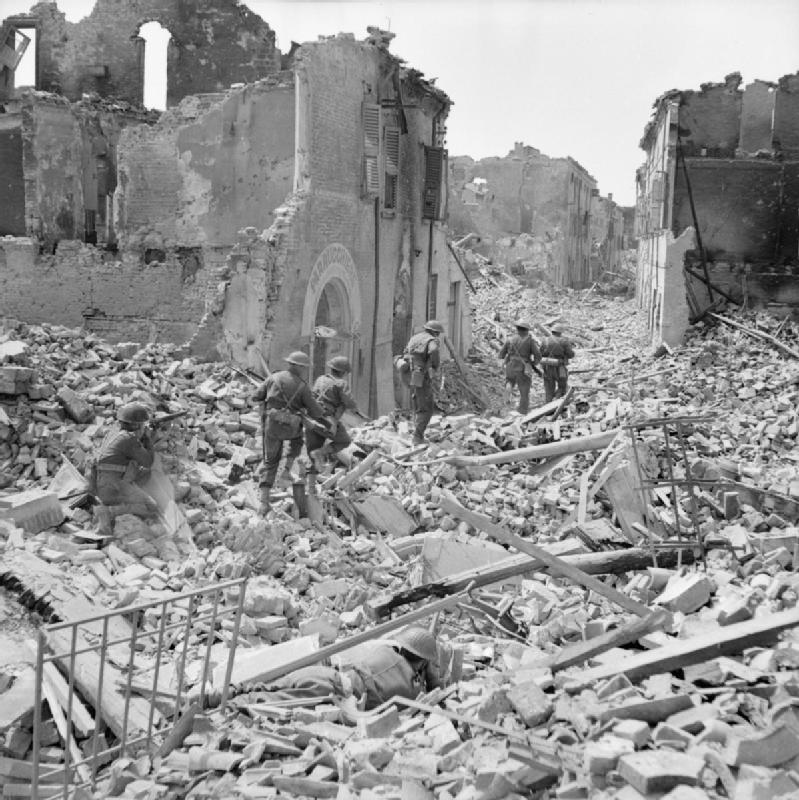
British troops of the 5th (Huntingdonshire) Battalion, Northamptonshire Regiment, part of 11th Brigade of 78th Division, pick their way through the ruins of Argenta, 18 April 1945.
Date6 April 1945 – 2 May 1945
Location
Result

Allied victory

Belligerents

United Kingdom

United States
 Poland
 Italy
Vargas Era Brazil
 New Zealand
 South Africa
Italian Resistance
 Germany
Italian Social Republic
Commanders and leaders
United Kingdom Harold Alexander
United States Mark Clark
United States Lucian Truscott
United Kingdom Richard McCreery
Nazi Germany H. von Vietinghoff Surrendered
Nazi Germany Traugott Herr  Surrendered
Nazi Germany J. Lemelsen  Surrendered
Italian Social Republic Benito Mussolini Executed
Italian Social Republic Rodolfo Graziani Surrendered
Units involved

United Kingdom 15th Army Group

Nazi Germany Army Group C

Strength
Total: 1,333,856[2][nb 1]
5th Army:
266,883 fighting strength[2]
Eighth Army:
632,980 fighting strength[3]

Total: 585,000[4]

  • 394,000 fighting strength[4]
  • 100,000 local police units[4]
  • 91,000 lines of communication and AA troops[4]
Casualties and losses
16,258 casualties[nb 2]
incl. 2,860 killed [5]
30–32,000 casualties[nb 3]

The Spring 1945 offensive in Italy, codenamed Operation Grapeshot, was the final Allied attack during the Italian Campaign in the final stages of the Second World War.[6] The attack in the Lombard Plain by the 15th Allied Army Group started on 6 April 1945 and ended on 2 May with the surrender of all Axis forces in Italy.

Background

[edit]

The Allies had launched their last major offensive on the Gothic Line in August 1944, with the British Eighth Army (Lieutenant-General Oliver Leese) attacking up the coastal plain of the Adriatic and the U.S. Fifth Army (Lieutenant General Mark Clark) attacking through the central Apennine Mountains. Although they managed to breach the formidable Gothic Line defenses, the Allies failed to break into the Po Valley before the winter weather made further attempts impossible. The Allied forward formations spent the rest of the winter of 1944 in inhospitable conditions while preparations were being made for a spring offensive in 1945.

Command changes

[edit]

When Field Marshal Sir John Dill, the head of the British Mission in Washington, D.C., died on 5 November, Field Marshal Sir Henry Maitland Wilson was appointed his replacement. General Harold Alexander, having been promoted to Field Marshal, replaced Wilson as Allied Supreme Commander Mediterranean on 12 December. Clark succeeded Alexander as commander of the Allied forces in Italy (renamed 15th Army Group), but without promotion. Lieutenant General Lucian Truscott, the commander of the U.S. VI Corps from the Battle of Anzio and the capture of Rome to Alsace, landed in the South of France during Operation Dragoon and returned to Italy to assume command of the Fifth Army.[citation needed]

On 23 March, Albert Kesselring was appointed Commander-in-Chief West, replacing General-Field Marshal Gerd von Rundstedt. Heinrich von Vietinghoff returned from the Baltic to take over from Kesselring and Traugott Herr, the experienced commander of the LXXVI Panzer Corps, took over the 10th Army. Joachim Lemelsen, who had temporarily commanded the 10th Army, returned to command the 14th Army.[citation needed]

Orders of battle

[edit]

Allied manpower shortages continued in October 1944. The 4th Indian Infantry Division had been sent to Greece and the British 4th Infantry Division had followed them in November along with the 139th Brigade of the British 46th Infantry Division. The rest of the division followed in December along with the 3rd Greek Mountain Brigade. In early January 1945, the British 1st Infantry Division was sent to Palestine and at the end of the month the I Canadian Corps and the British 5th Infantry Division were ordered to the North West Europe Campaign. This reduced the Eighth Army, now commanded by Lieutenant-General Richard McCreery, to seven divisions. Two other British divisions were to follow them to North-Western Europe, but Alexander kept them in Italy.

The U.S. Fifth Army had been reinforced between September and November 1944 with the 1st Brazilian Division, and in January 1945, with the specialist U.S. 10th Mountain Division.[7] Allied strength amounted to 17 divisions and eight independent brigades, including 4 Italian groups of volunteers from the Italian Co-Belligerent Army which were equipped and trained by the British. The Jewish Brigade, a formation of the British Army composed of Jews from Mandatory Palestine led by British-Jewish officers, was also deployed to take part in the offensive. Total Allied strength was equivalent to just under 20 divisions. The 15th Army Group ration strength was 1,334,000 men, the Eighth Army having an effective strength of 632,980 men, and the Fifth Army 266,883.[3][2]

As of 9 April, the Axis in Italy had 21 much weaker German divisions and four Italian National Republican Army (ENR) divisions, with about 349,000 German and 45,000 Italian troops. There were another 91,000 German troops on the lines of communication, and Germans commanded about 100,000 Italian police.[8][4] Three of the Italian divisions were allocated to the Ligurian Army under Rodolfo Graziani which guarded the western flank facing France. Finally, the fourth division was with the 14th Army in a sector thought less likely to be attacked.[9]

Plan of attack

[edit]
Allied Spring Offensive April 1945. Note that 21 ID NZ is actually the 2nd New Zealand Division.

On 18 March, Clark set out his battle plan. Its objective was "to destroy the maximum number of enemy forces south of the Po, force crossings of the Po and capture Verona".[10] In Phase I, the Eighth Army would cross the Senio and Santerno rivers and then make a dual thrust, one towards Budrio parallel to the Bologna road, Route 9 (the Via Emilia) and the other northwest along Route 16, the Via Adriatica, towards Bastia and the Argenta Gap which was a narrow strip of dry terrain through the flooded land west of Lake Comacchio.

An amphibious operation across the lake and parachute drop would bring pressure to bear on the flank and help to break the Argenta position. Depending on the relative success of these actions, a decision would be made on whether the Eighth Army's prime objective would become Ferrara on the Via Adriatica or remain Budrio. The U.S. Fifth Army was to launch the Army Group's main effort at 24 hours notice from two days after the Eighth Army attack, and break into the Po valley. The capture of Bologna was looked upon as a secondary task.[10]

In Phase II, the Eighth Army was to drive northwest to capture Ferrara and Bondeno, blocking routes of potential retreat across the Po. The U.S. Fifth Army was to push past Bologna, north to link with Eighth Army in the Bondeno region, to complete an encirclement of German forces south of the Po. The Fifth Army was to make a secondary thrust further west towards Ostiglia, the crossing point on the Po of the main route to Verona.[11] Phase III involved the establishment of bridgeheads across the Po and exploitation north.

The Eighth Army plan (Operation Buckland) had to deal with the difficult task of getting across the Senio, with its raised artificial banks varying between 6 m (20 ft) and 12 m (40 ft) in height and honeycombed with tunnels and bunkers front and rear. V Corps was ordered to make an attack on the salient formed by the river into the Allied line at Cotignola. On the right of the river's salient was 8th Indian Infantry Division, reprising the role they played crossing the Rapido in the final Battle of Monte Cassino. To the left of the 8th Indian Division, on the left of the salient, the 2nd New Zealand Division would attack across the river to form a pincer. To the left of V Corps, on Route 9, the II Polish Corps would widen the front further by attacking across the Senio towards Bologna. The Poles had been desperately under strength in the autumn of 1944, but had received 11,000 reinforcements during the early months of 1945, mainly from Polish conscripts in the German Army taken prisoner in the Battle of Normandy .[12]

Once across the Senio, the assault divisions were to advance to cross the Santerno. Once the Santerno was crossed, the British 78th Infantry Division would reprise their Cassino role and pass through the bridgehead established by the Indians and New Zealanders and drive for Bastia and the Argenta gap, 23 km (14 mi) behind the Senio, where the dry land narrowed to a front of only 5 km (3 mi), bounded on the right by Lake Comacchio, a huge lagoon running to the Adriatic coast and on the left by a marshland. At the same time, the British 56th (London) Infantry Division would launch the amphibious flank attack along Lake Comacchio. On the left flank of V Corps, the New Zealand Division would advance to the left of the marshland on the west side of Argenta while the 8th Indian Infantry Division would pass in army reserve.[13]

The Fifth Army plan (Operation Craftsman) envisaged an initial thrust by IV Corps along Strada statale 64 Porrettana [it] to straighten the army front and to draw German reserves away from Strada statale 65 della Futa [it]. II Corps would then attack along Strada statale 65 towards Bologna. The weight of the attack would then switch westward again to break into the Po valley skirting Bologna.[14]

Battle

[edit]
Men of the Jewish Brigade ride on a Churchill tank in the Mezzano-Alfonsine sector, 14 March 1945.

In the first week of April, diversionary attacks were launched on the extreme right and left of the Allied front to draw German reserves away from the main assaults. Operation Roast was an assault by 2nd Commando Brigade and tanks to capture the seaward isthmus of land bordering Lake Comacchio and seize Port Garibaldi on the lake's north side. Damage to other transport infrastructure forced Axis forces to use sea, canal, and river routes for supply. During this time, Axis shipping was being attacked in bombing raids such as Operation Bowler.

The build-up to the main assault started on 6 April with heavy artillery bombardment of the Senio defenses. On 9 April, early in the afternoon, 825 heavy bombers dropped fragmentation bombs on the support zone behind the Senio followed by medium and fighter bombers. From 15:20 to 19:10, five heavy artillery barrages were fired each lasting 30 minutes, interspersed with fighter bomber attacks. In support of the New Zealand operations, 28 Churchill Crocodiles and 127 Wasp flamethrower vehicles were deployed along the front.[15][16] The 8th Indian Infantry Division, 2nd New Zealand Division, and 3rd Carpathian Division (on the Polish Corps front at Route 9) attacked at dusk. In the fight there were two Victoria Crosses won by the 8th Indian Infantry Division. They had reached the Santerno, 5.6 km (3.5 mi) beyond, by dawn on 11 April. The New Zealanders had reached the Santerno at nightfall on 10 April and succeeded in making a crossing at dawn on 11 April. The Poles had also closed on the Santerno by the night of 11 April.[17]

By late morning of 12 April, after an all-night assault, the 8th Indian Infantry Division was established on the far side of the Santerno and the 78th Infantry Division started their pass through to make the assault on Argenta. In the meantime, the 24th Guards Brigade, part of the 56th (London) Infantry Division, had launched an amphibious flanking attack from the water to the right of the Argenta Gap. Although they gained a foothold, they were still held up at positions on the Fossa Marina on the night of 14 April. The 78th Infantry Division was also held up that same day on the Reno River at Bastia.

5th Army offensive, April 1945

The Fifth Army began its assault on 14 April after a bombardment by 2,000 heavy bombers and 2,000 guns along with attacks by IV Corps (1st Brazilian, 10th Mountain and 1st Armored Divisions) on the left. This was followed on the night of 15 April by II Corps attacking with 6th South African Armoured Division and the 88th Infantry Division advancing towards Bologna between Highway 64 and 65 and the 91st and 34th Infantry Divisions along Highway 65.[18]

Progress against a determined German defense was slow, but ultimately the superior Allied firepower and lack of German reserves allowed the Allies to reach the plains of the Po valley. The 10th Mountain Division broke out of the mountains on 20 April. Directed to bypass Bologna on the right, elements of the 10th Mountain were organized into a mobile force under Brigadier General Robinson Duff which made a thunder run to the Po, bypassing the increasingly disorganized German units, and reached the river 22 April.[19]

By 19 April, on the Eighth Army front, the Argenta Gap had been forced and the 6th Armoured Division was released through the left wing of the advancing 78th Infantry Division to swing left to race northwest along the line of the river Reno to Bondeno and link up with the Fifth Army to complete the encirclement of the German armies defending Bologna.[20]

On the same day, the Italian National Liberation Committee for Northern Italy, in command of the Italian resistance movement, ordered a general insurrection; in the following days, fighting between Italian partisan and the German and RSI forces broke out in Turin and Genoa (as well as in many other towns across Northern Italy), while German forces prepared to withdraw from Milan.[21] On all fronts, the German defense continued to be strong and effective, but Bondeno was captured on 23 April. The 6th Armoured Division linked with the 10th Mountain Division the next day at Finale some 5 mi (8.0 km) upstream along the river Panaro from Bondeno. Bologna was entered in the morning of 21 April by the 3rd Carpathian Infantry Division of the II Polish Corps and the Friuli Combat Group of the Italian Co-belligerent Army advancing up the line of Route 9, followed two hours later by II US Corps from the south.[22] On 24 April, Parma and Reggio Emilia were liberated by the partisans.[21]

Brazilian infantry resting beside a US M10 tank destroyer, April 1945

IV Corps had continued its northwards advance and reached the Po river at San Benedetto on 22 April. The river was crossed the next day and they advanced north to Verona which they entered on 26 April. To the right of Fifth Army on Eighth Army's left wing, XIII Corps crossed the Po at Ficarolo on 22 April, while V Corps were crossing the Po by 25 April, heading towards the Venetian Line, a defensive line built behind the line of the river Adige.[citation needed]

As Allied forces pushed across the Po, on the left flank, the Brazilian Division, 34th Infantry Division, and 1st Armored Division of IV Corps were pushed west and northwest along the line of Highway 9 towards Piacenza and across the Po to seal possible escape routes into Austria and Switzerland via Lake Garda.[23][24] On 27 April, the 1st Armored Division entered Milan which had been liberated by the partisans on 25 April and the IV Corps commander Willis D. Crittenberger entered the city on 30 April.[21] Turin was also liberated by partisan forces on 25 April, after five days of fighting. On 27 April, General Günther Meinhold surrendered his 14,000 troops to the partisans in Genoa.[21] To the south of Milan, at Collecchio-Fornovo, the Brazilian Division bottled up the remaining German and RSI units, taking 13,500 prisoners on 28 April.[25] On the Allied far right flank, V Corps, met by lessened resistance, traversed the Venetian Line and entered Padua in the early hours of 29 April to find that partisans had locked up the German garrison of 5,000.[26]

Aftermath

[edit]
Finito! The Po Valley Campaign, HQ 15th Army Group, 1945

Secret surrender negotiations between representatives of the Germans and Western Allies had taken place in Switzerland (Operation Crossword) in March, but had resulted only in protests from the Soviets that the Western Allies were attempting to negotiate a separate peace. On 28 April, Vietinghoff sent emissaries to the Allied Army headquarters. On 29 April, they signed an instrument of surrender at the Royal Palace of Caserta stating that hostilities would formally end on 2 May.[26] Confirmation from Vietinghoff, did not reach the 15th Army Group headquarters until the morning of 2 May. It emerged that Kesselring had his authority as Commander of the West extended to include Italy and had replaced Vietinghoff with General Friedrich Schulz from Army Group G on hearing of the plans. After a period of confusion, during which the news of Hitler's death arrived, Schulz obtained Kesselring's agreement to the surrender and Vietinghoff was reinstated to see it through.[27]

On 1 May 1945, the Chief of Staff of the National Republican Army, Marshal Rodolfo Graziani, announced the unconditional surrender of the Italian Social Republic and ordered the forces under his command to lay down their arms. Lieutenant general Max-Josef Pemsel, Chief of General Staff of the Army Liguria, consisting of three German and three Italian divisions, followed Graziani's orders and declared in a broadcast message: "I confirm without reserve the words of my Commander, Marshal Graziani. You must obey his orders."[28]

See also

[edit]

Notes

[edit]

References

[edit]

Bibliography

[edit]
[edit]

Further reading

[edit]
Revisions and contributorsEdit on WikipediaRead on Wikipedia
from Grokipedia
The Spring 1945 offensive in , codenamed Operation Grapeshot, was the final Allied military campaign in the Italian theater of , executed by the from 6 April to 2 May 1945 to shatter German defenses along the and seize the , ending with the of all Axis forces in . Commanded overall by U.S. , the operation pitted approximately 600,000 Allied troops against a depleted Group C of around 150,000 combat-effective soldiers under , following Albert Kesselring's transfer to the Western Front. The offensive commenced with heavy aerial and artillery barrages, followed by coordinated assaults by the British Eighth Army in the east and the U.S. Fifth Army in the west, incorporating divisions from the United Kingdom, United States, Poland, India, New Zealand, Brazil, and South Africa, alongside Italian partisan uprisings that disrupted German rear areas. Key breakthroughs included the rapid capture of Bologna on 21 April by Polish and American forces, enabling a swift advance across the Po River and into the Lombard Plain, where motorized units exploited the collapse of organized German resistance. This campaign achieved the destruction or capture of most German forces south of the , with Allied casualties numbering about 12,000 compared to over 28,000 German dead or wounded and 300,000 captured, marking a decisive end to the Italian Campaign that had stalled since due to , , and enemy fortifications. The operation's success stemmed from superior Allied firepower, intelligence from partisans, and the strategic diversion of German resources to other fronts, preventing any prolonged defense in .

Historical Context

The Italian Campaign to Late 1944

The Allied invasion of Sicily, codenamed Operation Husky, commenced on July 10, 1943, with amphibious and airborne landings by British, American, and Canadian forces, leading to the capture of the island by August 17, 1943, despite determined German-Italian resistance that inflicted over 22,000 Allied casualties. This success prompted the Italian government's overthrow of Benito Mussolini on July 25, 1943, but German forces under Field Marshal Albert Kesselring swiftly occupied key positions, transforming Italy into a theater of prolonged defensive warfare. The subsequent mainland invasion at Salerno, Operation Avalanche, began on September 9, 1943, with U.S. Fifth Army forces under General Mark Clark facing fierce counterattacks that nearly repelled the landings before Allied naval gunfire and reinforcements secured the beachhead by September 17. Further advances stalled against Kesselring's Gustav Line defenses in the rugged , where terrain features like steep ridges and narrow valleys inherently favored defenders by limiting maneuver and exposing attackers to enfilading fire. The January 22, 1944, amphibious landing at aimed to outflank these positions but resulted in a contained , with U.S. VI suffering heavy losses in static fighting until late May. Concurrently, the Battles of from January to May 1944 epitomized the campaign's attrition, culminating in the abbey's fall to Polish II on May 18, 1944, after four assaults that cost the Allies approximately 55,000 casualties overall. This breakthrough enabled the liberation of on June 4, 1944, though Kesselring executed an elastic defense, withdrawing methodically to preserve combat-effective units. By August 1944, Allied forces had advanced to , entering the city on August 4 amid retreating German rearguards that mined bridges like the , yet progress halted at the —a fortified barrier of bunkers, minefields, and stretching 200 miles across the Apennines. Operation Olive, launched on August 25, 1944, by the British Eighth and U.S. Fifth Armies, sought to breach this line but faltered after initial gains, such as the capture of Gemmano Ridge, due to German reinforcements and exhaustion from mountainous terrain that negated Allied numerical superiority. The offensive concluded in October 1944 with over 40,000 Allied casualties and minimal territorial progress, entrenching a winter where harsh weather and supply constraints amplified the theater's attritional nature.

Stalemate on the and Winter 1944–1945

The defenses across the Northern Apennines featured a series of fortified positions in depth, incorporating bunkers, minefields, and obstacles integrated with the mountainous terrain to channel attackers into kill zones. German units, including elite formations like the 1st Parachute Division, were deployed across a stretched front but employed effective delaying tactics, holding key heights and passes to prevent breakthroughs despite manpower shortages. These fortifications, developed from late 1943 onward with forced Italian labor, extended from the Ligurian coast to the Adriatic, compelling Allies to assault prepared defenses in unfavorable ground. Allied efforts to advance during winter 1944–1945 were severely constrained by inclement weather, including autumn rains that turned valleys into mud, followed by snow and fog that restricted air support and observation. Logistical strains intensified as supply lines elongated over poor roads, limiting and fuel deliveries; for instance, Fifth Army operations were hampered by vehicles bogged down in the Apennine quagmires, reducing effective maneuver. Limited offensives, such as attempts to cross the Lamone River in early December 1944, faltered amid flooded terrain and German counterfire, yielding only incremental gains like the capture of by month's end but failing to unhinge the line. Despite Allied numerical and material advantages—outnumbering Axis forces by roughly 2:1 in divisions and artillery by late 1944—the front remained static, as terrain amplified defensive firepower and weather negated mobility. German defenders inflicted heavy tolls without major counteroffensives; Eighth Army alone suffered over 11,000 casualties in preceding autumn pushes, contributing to broader 1944 losses exceeding 40,000 across the Gothic sector, underscoring how geography enabled attrition over decisive maneuver. This equilibrium persisted into early 1945, tying down significant Allied resources amid deteriorating Axis fuel and replacement shortages, yet unyielding to frontal assaults.

Broader Strategic Pressures in Early 1945

In early 1945, the Allied commitment to the Italian theater persisted as a means to immobilize significant German forces, preventing their redeployment to the collapsing Western Front or the intensifying Soviet advance on the Eastern Front, thereby supporting the broader objective of Overlord's aftermath and the Red Army's Vistula-Oder Offensive launched on January 12. This strategy tied down an average of approximately 350,000 German troops in from May 1944 through April 1945, equivalent to roughly 20-25 understrength divisions that could not bolster defenses against Allied crossings of the or Soviet pushes toward . Despite President Roosevelt's preference for prioritizing northwest and agreements at the Malta Conference in to transfer three divisions from northward, both Roosevelt and Churchill endorsed sustaining offensive pressure in to exploit Axis overextension, even as Churchill's earlier "soft underbelly" concept had yielded slower gains than anticipated. The failure of the German Ardennes Offensive, concluded by January 3, 1945, exacerbated Axis vulnerabilities in by depleting fuel reserves and manpower across all fronts, with the unable to replenish losses from the counteroffensive's exhaustion of strategic reserves. Oberkommando der Wehrmacht (OKW) assessments reflected acute shortages, including production crippled by Allied bombing and the loss of Romanian oil fields, rendering mechanized units in increasingly immobile and reliant on horse-drawn transport. Manpower deficits were compounded by the transfer of four divisions out of in early 1945—the 356th, 710th, 715th Infantry Divisions, and 16th SS Panzer Grenadier Division—leaving defenses understrength amid rising desertions and levies of limited combat value. British Ultra decrypts of Enigma traffic provided critical intelligence on Axis weaknesses in the Italian theater, confirming low ammunition stocks and fragmented command under , yet Allied planners remained cautious, informed by prior overestimations of German resilience during the stalemate in late 1944. This intelligence underscored the Axis's inability to mount effective counterattacks, with fuel rationing limiting operational mobility to defensive arcs, but tempered expectations for rapid breakthroughs due to terrain advantages and fortified positions still held by veteran units.

Allied Forces and Planning

Command Reorganization and Leadership

Sir Harold Alexander commanded the Allied , which oversaw both the U.S. Fifth Army and British Eighth Army during preparations for the spring 1945 offensive, emphasizing coordinated assaults to exploit Axis weaknesses after months of . Alexander's strategy prioritized massing infantry, armor, and air support for a broad-front breakthrough, drawing on empirical assessments of terrain and enemy dispositions rather than prior optimistic projections that had faltered. This continuity at army group level provided stability amid subordinate command shifts aimed at injecting tactical dynamism. In December 1944, Lieutenant General transitioned from commanding the Fifth Army to leading the , with Lieutenant General Lucian K. Truscott Jr. assuming Fifth Army command on December 16. Truscott's appointment reflected a need for aggressive field leadership following Clark's tenure, during which assaults on the from August to incurred heavy casualties—over 16,000 for U.S. forces alone—without achieving a decisive penetration, leading to a prolonged winter impasse. Truscott, experienced in rapid maneuvers from operations like , prioritized infantry-armor integration and exploitation of gaps, aligning with causal requirements for overcoming fortified defenses through speed rather than attrition. The British Eighth Army saw Lieutenant General Sir replaced by Lieutenant General Sir on October 1, 1944, to refocus on amphibious and flanking operations suited to the Adriatic sector. 's prior success with X Corps in exploiting breakthroughs informed his emphasis on Polish II Corps—under Lieutenant General —and Indian divisions (4th, 8th, and 10th) for river crossings and pursuits, leveraging their proven resilience in prior engagements without undue reliance on multinational symbolism. These changes contrasted with Axis command flux, where frequent rotations eroded cohesion, enabling Allied forces to capitalize on superior logistical preparation and leadership continuity at higher echelons for the April offensive.

Orders of Battle and Logistical Buildup

The Allied , commanded by Lieutenant General , comprised the U.S. Fifth Army and the British for the Spring 1945 offensive, fielding approximately 20 divisions with a combat strength of around 600,000 troops supported by over 2,000 tanks and extensive . The U.S. Fifth Army, under Clark's direct control, included II Corps (with the , 85th Infantry Division, and 88th Infantry Division) and IV Corps (including the 92nd Infantry Division and 1st Brazilian Expeditionary Division), positioned for assaults along the western Apennines and Ligurian coast. The British Eighth Army, led by Lieutenant General , featured V Corps (, , 8th Indian Division), XIII Corps (2nd Polish Corps, British 78th Infantry Division), and elements of X Corps, arrayed along the eastern sector from the Adriatic to the Apennines.
ArmyCorpsKey Divisions
U.S. Fifth ArmyII Corps10th Mountain, 85th Infantry, 88th Infantry
U.S. Fifth ArmyIV Corps92nd Infantry, 1st Brazilian Expeditionary
British Eighth ArmyV Corps6th Armoured (British), 2nd New Zealand, 8th Indian
British Eighth ArmyXIII Corps2nd Polish, 78th Infantry (British)
Logistical preparations addressed prior winter shortages in ammunition and fuel, with the Allies amassing substantial supply dumps by early April 1945 through improved port operations at Leghorn and Bari, enabling sustained operations across the Po Valley. Engineer units prepositioned bridging materials, including pontoon and Bailey bridge components, for rapid crossings of the Po River, which measured up to 915 feet wide in key sectors; these efforts facilitated multiple treadway and pontoon spans constructed within days of reaching the riverbanks. Air logistics supported over 10,000 sorties by the Mediterranean Allied Tactical Air Force during the campaign, providing close air support and interdiction that contrasted sharply with the limited German Luftwaffe presence. In comparison, Group C under General mustered roughly 150,000-200,000 combat-effective troops across the 10th and 14th Armies, with artillery holdings estimated at one-third the Allied total, reflecting severe shortages in ammunition and replacements as documented in declassified assessments. This disparity in firepower and mobility underscored the Axis defensive constraints, setting the stage for the offensive's rapid breakthroughs.

Operational Plan: Operation Grapeshot and Supporting Actions

Operation Grapeshot represented a coordinated, multi-phase strategy by the Allied 15th Army Group to shatter German defenses along the Gothic Line, advance into the Po Valley, and encircle Axis forces south of the Po River, prioritizing synchronized assaults across broad fronts to exploit breakthroughs rather than isolated, opportunistic pushes characteristic of earlier stalled efforts. Planned under General Mark W. Clark, the operation divided responsibilities between the British Eighth Army and the U.S. Fifth Army, with preliminary deception measures and intensive fire support to disrupt German cohesion before infantry advances. Detailed orders were issued on 24 March 1945, setting D-Day initially for 9 or 10 April but advanced to 6 April for the Eighth Army to capitalize on improved spring weather and logistical readiness. The Eighth Army, under Lieutenant General , was tasked with the central thrust (Operation Buckland), commencing on 6 April with crossings of the Senio and Santerno rivers, followed by penetration of the Argenta Gap toward Budrio and to secure key routes like Highway 9 and block German retreats along the Reno River and Po at and Bondeno. This role incorporated elements, simulating a main effort along the Adriatic coast to draw reserves eastward while employing amphibious vehicles for surprise maneuvers across Lake Comacchio. The U.S. Fifth Army, commanded by Lieutenant General , followed as the western flanking maneuver (Operation Craftsman), launching approximately 24 hours after the Eighth Army's D-Day plus two days, advancing through the via Highway 64 to breach the defensive spine, isolate or seize , and link up with the Eighth Army in the between the Reno and Panaro rivers. Primary objectives centered on capturing Bologna as a pivotal road and rail hub, securing multiple Po River crossings for exploitation, and preventing German forces from consolidating north of the river or withdrawing to the Alps or northeastern Italy, with Phase I focusing on reaching the Po Valley, Phase II on encirclement south of the Po, and Phase III on crossing to Verona and the Adige River. Supporting actions included naval demonstrations and diversionary feints off Porto Garibaldi and Ghiavari to simulate amphibious threats, dummy radio traffic by the Fifth Army to mislead on troop dispositions, and coordination with approximately 50,000 Italian partisans for preliminary disruptions behind lines. Artillery preparation featured a 20-day escalation, doubling rates in the final week with over 1,200 pieces for the Eighth Army alone, complemented by air forces delivering heavy bomber strikes—up to 800 aircraft dropping 175,000 bombs on D-Day—against supply lines, command posts, and gun positions to soften defenses without revealing the full assault axis. Unlike prior operations, such as the 1944 offensives that faltered due to autumn rains, manpower shortages, and sequential advances leading to overextension, emphasized simultaneous multi-corps pressure, full air superiority, and rested formations rebuilt over winter to sustain momentum into the plains, avoiding the terrain-bound attritional fights of the previous year. This approach stemmed from lessons in causal dynamics of terrain, weather, and , ensuring and air dominance preceded ground maneuvers to maximize penetration speed and minimize casualties in fortified zones.

Axis Defenses and Preparations

German Command Transitions

In March 1945, following the collapse of the Offensive and dissatisfaction with Field Marshal Gerd von Rundstedt's performance on the Western Front, transferred Field Marshal from command of in to Oberbefehlshaber West, effective March 10. Kesselring, renowned for his masterful defensive operations that prolonged the Italian campaign through elastic withdrawals and fortified lines like the Gustav and Gothic defenses, was selected to stabilize the front amid Allied crossings. This move, prompted by Hitler's pattern of reshuffling commanders after setbacks rather than addressing strategic overextension, left General to assume leadership of on March 23, inheriting depleted forces strained by winter attrition and Allied air superiority. Vietinghoff, previously commander of the 10th Army and temporarily in charge during Kesselring's 1944 injury recovery, adopted a more pragmatic approach focused on preserving combat effectiveness amid resource shortages, contrasting Kesselring's aggressive holding tactics favored by Hitler. However, Hitler's no-retreat directives—rooted in ideological commitment to total resistance—overrode field realities, forbidding withdrawals from the Apennine positions despite their vulnerability to encirclement once breached, and ignoring requests to reposition to the defensible Po River line before Allied spring buildup. This interference exacerbated command tensions, as senior officers recognized the Po Valley's flat terrain would enable rapid Allied mechanized advances if the mountains fell, yet Hitler's orders prioritized static defense to tie down enemy divisions, disregarding logistical collapse and fuel shortages that left German armor immobile. The timing of the transition, occurring weeks before the Allied Operation Grapeshot, introduced instability by disrupting continuity in defensive preparations; Vietinghoff inherited fragmented units committed to untenable forward positions without adequate reserves for counterattacks. As Allied assaults intensified in April, Hitler briefly reinstated Kesselring to command around April 28 amid perceived hesitancy in executing orders, underscoring the erratic leadership that prioritized over tactical . assessments of captured documents and testimonies highlight how such high-level flux, compounded by Hitler's remote dictation, contributed to uncoordinated responses and the swift disintegration of Axis lines once breakthroughs occurred, as subordinate commanders lacked authority to improvise against overwhelming numerical and material disparities.

Defensive Layout and Resource Constraints

Army Group C, commanded by General Heinrich von Vietinghoff, fielded approximately 24 German divisions and 5 Italian Social Republic (RSI) divisions across its three armies—the 10th Army in the east, 14th Army in the center-west, and Army Liguria in the far west—totaling around 400,000 combat-effective troops by early 1945. The 10th Army under Lieutenant General Traugott Herr defended from Bologna to the Adriatic Sea with I Parachute Corps and LXXVI Panzer Corps, holding forward positions along the Senio and Santerno rivers, while exploiting natural barriers like the floodable Comacchio Lagoon and Argenta Gap marshes. The 14th Army, led by Lieutenant General Joachim Lemelsen, covered the western Apennines to the Ligurian coast via LI Mountain Corps and I SS Panzer Corps (later redesignated XVI Panzer Corps), integrating remnants of the Gothic Line's bunkers, trenches, and artillery positions into ridge-top strongpoints overlooking rivers such as the Reno and Idice. Rearward defenses anticipated a fallback to the Po River, 130–500 yards wide and fortified with earthen levees, demolitions, and field works, though Hitler forbade withdrawals, enforcing static holdings vulnerable to flanking maneuvers. These positions were augmented by dense minefields—numbering in the millions across key approaches—and controlled inundations of low-lying plains to impede armored advances, but terrain favored defenders only in the mountains, where manpower shortages eroded holding capacity. Resource constraints critically undermined mobility and sustainment; fuel allocations ceased from the by early 1945, leaving most motorized units non-operational and forcing reliance on horse-drawn and infantry marches, with operational vehicles often below 50% in panzer grenadier formations like the 90th Division, which committed few tanks due to mechanical failures and ammunition scarcity. Replacements totaled just 5,600 men in against nearly 14,000 (including non-combat illnesses), while broader depletions in shells, air cover, and spare parts—exacerbated by Allied bombing and partisan interdictions—prevented effective counterattacks or repositioning. RSI forces, nominally bolstering German divisions, proved unreliable owing to collapsing morale and widespread desertions, with units like the 4th Italian "Monte Rosa" Alpine Division showing high absenteeism and fraternization risks amid partisan uprisings, as Axis reports noted their combat value as marginal at best. Overall, these limitations—coupled with Hitler's no-retreat orders—positioned Army Group C for attrition rather than maneuver defense, as frontline commanders repeatedly urged Po River consolidation that was denied.

Intelligence Assessments and Countermeasures

German commanders in early 1945 anticipated an eventual Allied spring push but underestimated its precise timing and scale, with strategic attention divided by ongoing withdrawals from the and commitments to against , diverting resources from bolstering Italian defenses. reconnaissance was severely curtailed by Allied air superiority, fuel shortages, and terrain challenges along the , limiting Axis ability to monitor troop concentrations and logistical buildups effectively. In response, German forces under General attempted localized spoiling attacks and fortified positions to preempt Allied assaults, but these efforts were undermined by Italian partisans' systematic —over 1,000 derailments and bridge destructions in during late 1944 and early 1945—which disrupted reinforcements and supply lines critical for countermeasures. This partisan activity, coordinated with Allied intelligence, created operational paralysis, as German rail repairs lagged behind destruction rates amid fuel and manpower constraints. High-level Axis awareness of collapse was evident in SS General Karl Wolff's initiation of secret negotiations with OSS chief in , beginning in late February 1945 and continuing through March, where Wolff probed for conditional surrender terms for German forces in Italy, reflecting internal recognition of unsustainable defenses absent broader relief. Allied intelligence, leveraging Ultra decrypts of Enigma traffic and OSS networks embedded with partisans, afforded dominance in discerning Axis order-of-battle shifts and command hesitations, enabling precise targeting of vulnerabilities and amplifying the that facilitated the offensive's . This edge contrasted sharply with German reliance on fragmented and sporadic agent reports, often compromised by resistance infiltration.

Execution of the Offensive

Initial Assaults and Senio River Crossings (April 6–9, 1945)

The commenced on April 6 with preliminary actions by the British Eighth Army, including the 56th Infantry Division's capture of a defensive wedge near Lake Comacchio to facilitate subsequent maneuvers toward the Senio River line. This set the stage for the main assault, supported by extensive artillery preparations beginning that day to soften German positions along the river. On April 9, the Eighth Army launched its primary assault across the Senio River following a massive aerial by heavy and medium bombers targeting the area between the Senio and Santerno Rivers. V Corps, comprising elements of the and 8th Indian Division, initiated infantry crossings at dusk, establishing bridgeheads by dawn on April 10 despite the river's raised banks and prepared defenses. To the left, the Polish II Corps encountered stiffer opposition from the German 26th Panzer Division but forced crossings later on April 10, advancing approximately 5 kilometers inland. German forces, primarily the 10th Army's 26th Panzer, 362nd, and 98th Infantry Divisions, mounted counterattacks, such as one near by the 362nd Division, but these were repulsed amid mounting pressure from Allied and air support. The defenders began ordered withdrawals to subsequent lines, yielding initial ground gains of 4 to 6 kilometers for the Allies east of the Senio. Concurrently, the U.S. Fifth Army conducted complementary operations in the western sector toward , engaging Axis positions with initial advances hampered by terrain and resistance from elements of the 14th Army, though major pushes intensified later. These early actions resulted in approximately 1,000 Allied casualties over the first few days, reflecting intense close-quarters fighting across flooded and fortified zones.

Breakthrough at Argenta Gap and Bologna Capture (April 10–21)

Following successful initial assaults across the Senio River, British V Corps under Lieutenant-General concentrated efforts on piercing the Argenta Gap, a narrow corridor of firm ground approximately 10 miles wide between the flooded margins of Lake Comacchio to the east and the marshy Reno River valley to the west. From April 12 to 19, divisions including the 56th () and 78th Infantry Divisions, bolstered by elements of 2nd Brigade and 24th Guards Brigade, engaged entrenched German positions held by units of the LXXVI . Allied forces utilized amphibious Landing Vehicle Tracked (LVT) craft to navigate flooded fringes and established bridgeheads across canals like the Fossa Marina, despite repeated German counterattacks that were blunted by concentrated artillery, air bombardment, and infantry resilience. By April 19, the gap was breached, yielding over 3,000 Axis prisoners and marking a decisive shift from attritional fighting to mobile exploitation. Exploitation through the Argenta Gap accelerated from April 12 onward, with the advancing along the western marsh edge to secure flanks and disrupt German reserves, while the 8th Indian Infantry Division thrust centrally to widen the breach and facilitate armored columns. Terrain challenges, including residual flooding from German-engineered inundations, were mitigated by engineering efforts to create passable routes, enabling tanks such as those of the 27th Lancers to support infantry pushes toward . German attempts by the 29th Division to mount armored counterthrusts, including one on north of the Fossa Marina, faltered amid shortages, depleted reserves, and overwhelming superiority, which inflicted heavy losses on retreating formations. This phase netted additional thousands of prisoners as disorganized Axis elements surrendered en masse. Concurrently, to the southwest, U.S. Fifth Army forces coordinated with Polish II Corps elements to envelop , bypassing fortified lines along the Idice River. On April 21, the Polish 9th Battalion of the 3rd Carpathian Rifle Division, advancing from the east as part of II Corps, entered the city at approximately 6:05 a.m., raising the Polish over key structures, while U.S. 34th Infantry Division troops from the 133rd Infantry Regiment linked up from the south. The joint assault overwhelmed defending German and units, capturing over 2,000 prisoners, 60 vehicles, and 10 tanks in the immediate vicinity. Bologna's fall severed key Axis supply routes and psychologically unhinged the defensive line, contributing to the capture of more than 10,000 Axis personnel across the Argenta-Bologna sector by April 21.

Pursuit Across the Po Valley and Final Engagements (April 22–May 1)

Following the capture of on April 21, 1945, Allied forces under the U.S. Fifth Army and British Eighth Army initiated a mechanized pursuit across the , exploiting the breach in Axis defenses with armored and units advancing at speeds up to 50 kilometers per day on the flat terrain. The rapid movement fragmented formations, which lacked cohesive reserves and suffered from fuel shortages, leading to disorganized retreats along multiple routes toward the . Crossings of the Po River commenced on April 22, with U.S. IV Corps elements, including the 85th Infantry Division at Quingentole and amphibious assaults by other units using assault boats and quickly erected pontoon bridges, securing bridgeheads by April 23–25 despite artillery fire and demolitions. The U.S. 10th Mountain Division, attached to IV Corps, exploited these crossings by pushing northeast, engaging rearguards in the lower valley and advancing toward the Trentino-Alto Adige region, where it conducted mountain assaults to outflank retreating German columns. In the central sector, U.S. II Corps divisions pursued westward, converging on by April 26 after night fighting against elements of the German 14th Army under General , whose command structure had dissolved into isolated Kampfgruppen amid Allied air interdiction of supply lines. To the east, British Eighth Army units, supported by Polish and Indian corps, advanced parallel, bypassing pockets of resistance and reaching the Venetian plain, capturing near by April 28 as German units under disintegrated, with over 20,000 prisoners taken in the sector by month's end. Final engagements included skirmishes around , where the assaulted German holdouts at Torbole and in late April, securing high ground that blocked escape routes for Lemelsen's remnants toward . U.S. forces entered on , following partisan uprisings, while the overall pursuit covered more than 300 kilometers from the Senio River line in under two weeks, collapsing Axis cohesion through relentless pressure and aerial dominance.

Partisan Involvement and Internal Italian Dynamics

Coordination Between Partisans and Allied Advances

The Italian partisans, organized primarily under the National Liberation Committee (CLN) with the communist-led Garibaldi Brigades comprising the majority of forces, provided auxiliary support to Allied advances through rear-area disruptions rather than direct frontline integration. In the lead-up to Operation Grapeshot on April 6, 1945, approximately 100,000 to 200,000 partisans conducted sabotage operations, including attacks on rail lines and supply routes in northern Italy, which hindered German reinforcements and logistics without fully paralyzing Axis mobility. Allied liaison officers and special forces embedded with partisan groups to coordinate intelligence and target designation for air strikes, though political distrust—stemming from the Garibaldi Brigades' alignment with the Italian Communist Party (PCI), which controlled over 50% of partisan units—limited deeper operational fusion. Allied airdrops of arms, ammunition, and radios intensified in early 1945, delivering thousands of tons of supplies to partisan formations, enabling sustained guerrilla actions but often hampered by imprecise drops and partisan absorption inefficiencies, including desertions and diversion of for postwar political aims. These efforts tied down an estimated seven German divisions (roughly 70,000–100,000 troops) in security roles across the , representing about 10–15% of Army Group C's strength, compelling the to disperse forces and reducing reserves available for the defenses. Empirical assessments indicate this diversion contributed causally to German overextension, though partisan effectiveness was uneven due to high attrition rates—over 35,000 killed or captured overall—and inconsistent discipline, particularly in communist-dominated units prioritizing ideological consolidation over tactical reliability. As Allied armies breached the Argenta Gap and pursued retreating Germans in mid-April, partisan intelligence on enemy positions and routes facilitated rapid advances, with groups like the 28th Garibaldi Brigade coordinating local offensives to seize bridges and block retreats. This support escalated into widespread uprisings on April 25, 1945, in cities such as and , where partisans exploited German flight—prompted by Allied pressure and fuel shortages—to capture key infrastructure ahead of regular forces, accelerating the Axis collapse without altering the offensive's primary mechanized momentum. While postwar narratives, often from PCI sources, inflated partisan contributions to near-decisive levels, declassified Allied records emphasize their role as a force multiplier in exploitation phases rather than a coordinated , constrained by fragmented command and ideological fractures within the CLN.

Key Partisan Actions: Uprisings and Mussolini's Fall

On April 25, 1945, the of (CLNAI) issued orders for a general insurrection across occupied northern cities, prompting partisan forces to launch coordinated uprisings in and . In , partisan brigades, numbering tens of thousands, seized key including factories, barracks, and government buildings, effectively expelling remaining German and Republican Fascist units by the end of the day. Similarly, in , strikes and armed actions by workers and resistance fighters overwhelmed Axis garrisons, leading to the city's control by insurgents amid chaotic retreats. These actions disrupted German communication lines and supply depots, hindering organized withdrawals toward the and contributing to the capture of over 10,000 Axis personnel in the immediate aftermath. German and SS responses to the uprisings included sporadic reprisals, such as executions of prisoners in prior to the full partisan takeover, though large-scale massacres like those earlier in the war were limited in this final phase due to collapsing command structures. Partisan estimates indicate around resistance fighters killed during the spring 1945 operations, primarily from combat and reprisals, underscoring the intensity of clashes that prevented Axis forces from regrouping effectively in the . Amid the northern insurrections, , leader of the , attempted to flee toward disguised in German uniform. On April 27, 1945, partisans of the 52nd Garibaldi Brigade intercepted his convoy near Dongo on , capturing him along with his mistress and several ministers. The following day, April 28, a partisan firing squad under executed Mussolini and Petacci by shooting near , with their bodies later transported to for public display. This event symbolized the collapse of Fascist authority, as partisans also summarily executed other high-ranking officials, including , further demoralizing remaining loyalists and accelerating surrenders.

Realities of Italian Collaboration and Resistance Divisions

The (RSI) maintained armed forces estimated at around 150,000 personnel by early 1945, including the and Republican National Guard, which actively collaborated with German units in defending against Allied advances. These troops, motivated by loyalty to Mussolini's regime or coercion, participated in defensive operations until the final weeks, with significant numbers only defecting or surrendering after the breakthrough in late April, such as the 13,500 RSI and German prisoners captured by Brazilian forces at Collecchio-Fornovo on April 28. This collaboration challenges narratives of uniform Italian opposition to , as substantial segments of the population and military remained committed to the Axis cause amid the civil war dynamics. Within the resistance, deep ideological divisions fractured unity, particularly between communist-dominated Garibaldi Brigades, which sought revolutionary goals beyond mere , and Catholic or autonomist groups like the Green Flames Brigades, leading to mutual distrust, separate command structures, and occasional clashes over post-war visions. These rifts, rooted in competing aims—communists targeting fascists, monarchists, and capitalists, while Catholics focused narrowly on Axis forces—hindered coordinated action and fostered internal violence, exemplified by partisan reprisals against suspected collaborators. Empirical evidence of resistance atrocities includes the in spring 1945, where Yugoslav communist partisans, allied with Italian counterparts, executed thousands of Italians in and by throwing victims into karst sinkholes, targeting civilians, clergy, and officials perceived as disloyal, with estimates of 3,000 to 5,000 deaths reflecting the brutal settling of scores. Such acts previewed broader post-liberation purges and underscore the resistance's character, where ideological fervor prolonged suffering. The interplay of RSI loyalty and partisan factionalism contributed to a overlay on the broader conflict, exacerbating casualties; violent deaths from internal strife post-armistice totaled over 90,000, with intensified -RS I engagements in 1945 accounting for a disproportionate share, including approximately 12,000 fatalities amid uprisings and reprisals. This reality debunks simplified "liberation" framings, revealing a divided society where and resistance both inflicted hardships, driven by causal factors like ideological polarization rather than monolithic .

Surrender Process and End of Fighting

Secret Negotiations and German Internal Conflicts

SS General Karl Wolff, the Highest SS and Police Leader in Italy, initiated secret contacts with Allied representatives in Switzerland during early March 1945, seeking terms for a military surrender of German forces in northern Italy to avert further bloodshed amid the collapsing front. These overtures, conducted through intermediaries and facilitated by OSS chief Allen Dulles, emphasized unconditional military capitulation without political concessions or involvement of Italian partisans, reflecting Wolff's assessment that continued resistance was futile against overwhelming Allied advances. By mid-March, Wolff had met Dulles personally on March 8 near Lucerne, expanding initial discussions to include Army Group C under General Heinrich von Vietinghoff, comprising approximately 585,000 troops. Berlin authorities, including , discovered elements of these unauthorized talks and summoned Wolff for interrogation in the , where he faced rebuke for perceived concessions to partisans and deviation from Führer directives mandating . , informed of Wolff's activities during a February audience and subsequent reports, expressed no immediate decisive response but later raged against separate negotiations bypassing central command, viewing them as betrayal amid his insistence on fighting to the end. This episode underscored pragmatism among field commanders like Wolff, who prioritized preserving forces over ideological fanaticism, contrasting with 's rigid orders. Tensions escalated between Wehrmacht elements under Vietinghoff—who replaced as Southwest on March 10—and SS hardliners, as the latter resisted capitulation amid partisan threats. Vietinghoff, recognizing the hopelessness after Allied breakthroughs, authorized delegates to proceed to on April 29 despite a last-minute directive on April 28 to halt talks, briefly overridden but ultimately defied in favor of compliance. SS units, loyal to die-hard factions, assumed defensive postures against uprisings while Wolff appealed for Allied intervention, highlighting frictions where Wehrmacht pragmatism clashed with SS intransigence, though Wolff's influence as SS liaison tipped toward surrender to end the campaign. These dynamics revealed broader German command divisions, with leaders favoring capitulation to minimize casualties over fanatical prolongation.

Signing of the Surrender at Caserta and Ceasefire Implementation

On April 29, 1945, General , as Commander-in-Chief of (also designated Southwest Command), signed the Instrument of Surrender at the , formalizing the unconditional capitulation of all German forces under his control in , along with associated Italian Fascist units of the . The document stipulated immediate cessation of hostilities upon signing but deferred full implementation of appendices—detailing troop movements, , and handover procedures—until , 1945, to coordinate the logistical withdrawal of roughly one million Axis personnel across land, sea, and air domains. The ceasefire's effective date of at noon local time marked the operational end of the Italian Campaign, with German units ordered to assemble in designated areas for Allied oversight, preserving intact formations to minimize post-surrender disorder. Compliance varied regionally; while major commands adhered promptly, isolated garrisons persisted in sporadic engagements, such as remnants near where a 4,000-strong Axis force had capitulated to Italian partisans on April 27 prior to the formal truce, averting prolonged urban combat. Allied advances continued methodically into predefined occupation zones, exemplified by the 2nd Division's seizure of on , ensuring partitioned control without the anarchic collapse seen in Berlin's simultaneous fall. This structured prioritized administrative handover over immediate , facilitating the of personnel and equipment salvage while curtailing guerrilla reprisals through phased Allied ingress, thus containing escalation in a theater already strained by partisan activity and divergent Axis loyalties. The arrangement's timing, preceding the broader European capitulation by days, underscored a pragmatic cessation that spared additional organized resistance, contrasting sharply with the uncoordinated dissolution in central .

Casualties and Material Assessment

Allied and Axis Losses in Detail

The Allied forces suffered approximately 16,258 casualties during the main phase of Operation Grapeshot from April 9 to May 2, 1945, including 2,860 killed. These losses were borne primarily by the U.S. Fifth Army under Lieutenant General , which advanced westward toward and the , and the British Eighth Army under Lieutenant General Richard McCreery, which conducted the eastern thrust across the Senio River and into the Argenta Gap. The Eighth Army's multinational composition, including Polish II Corps, Indian divisions, , and units, contributed to its share of the toll amid intense preliminary actions like the Senio crossings. Axis military casualties totaled 30,000 to 32,000 killed and wounded, as estimated by British intelligence and corroborated by a German staff assessment. German Army Group C under Field Marshal Albert Kesselring bore the brunt, with units like the 1st Parachute Corps and 76th Panzer Corps suffering heavy attrition during the collapse of the Gothic Line defenses and retreats across the Po River. Forces of the Italian Social Republic (RSI), including the National Republican Army under Marshal Rodolfo Graziani, incurred additional losses, with many units disintegrating amid desertions and captures; for instance, the Brazilian Expeditionary Division alone took over 10,000 RSI and German prisoners near Collecchio-Fornovo on April 28. The offensive culminated in the mass surrender of Axis forces, yielding more than 300,000 prisoners of war, predominantly German, following the signing of the Caserta terms on April 29 and effective implementation by May 2. Civilian losses in during April and May 1945 are estimated at around 10,000, arising from artillery barrages, aerial strikes, crossfire in the , and reprisals during partisan uprisings against retreating Axis elements. These deaths compounded the broader toll of the German occupation from , which saw over 120,000 Italian noncombatants killed through various means, though the spring phase's rapid Allied advance limited prolonged urban devastation compared to earlier campaigns. Infrastructure damage, including bridges and rail lines pulverized by Allied bombings and , exacerbated civilian hardships but was not fully quantified in immediate tallies.
BelligerentCasualties (Killed/Wounded)Prisoners of War
Allies (Total)16,258 (incl. 2,860 killed)N/A
Axis (German/Italian Total)30,000–32,000>300,000
Italian Civilians~10,000N/A

Impact on Equipment and Infrastructure

Allied armored forces incurred limited equipment losses during the offensive, owing to superior air cover, dominance, and mechanized mobility that restricted German counterattacks to sporadic ambushes and minefields. The British Eighth recorded 210 tanks as irretrievably lost amid the advances, primarily from terrain-related breakdowns and defensive fire rather than large-scale armored clashes. Axis units, by contrast, abandoned or lost vast quantities of materiel in the collapsing retreat north of the Po River, with fields strewn with destroyed vehicles, artillery, and supplies attesting to the breakdown of organized withdrawal. German formations demolished multiple bridges over the Po to impede pursuit, including partial destruction of the Ostiglia Railroad Bridge, though Allied engineers rapidly erected pontoon crossings to maintain momentum; other spans, such as Bomporto, were seized intact on April 21. Deliberate Axis scorched-earth tactics further ravaged road and rail infrastructure, with retreating forces employing demolitions, twisted rails via specialized engines, and booby-traps to delay advances, compounding prior damage. These actions crippled northern Italy's transport networks, contributing to widespread disruptions where approximately 77 percent of roads required repair across the country. The offensive's material toll delayed Italian economic recovery through impaired logistics and industrial access in the , yet paled against Eastern Front equivalents, where systematic urban and factory annihilation vastly exceeded Italy's targeted transport .

Strategic Analysis and Outcomes

Causal Factors in the Offensive's Success

The Allied held a significant numerical advantage over at the outset of the offensive on 6 , with approximately 900,000 troops in fighting strength compared to roughly 394,000 Axis personnel, yielding a manpower ratio approaching 2:1 or greater when accounting for support elements and German unit understrength. This disparity was compounded by Allied dominance in artillery and armor, enabling sustained firepower that overwhelmed German defenses along the Senio and Idice Rivers. Concurrently, the Allies enjoyed total air superiority, with conducting unrestricted interdiction and close support missions that crippled German logistics and reinforcements, a capability unavailable to the , which was effectively grounded. Favorable spring conditions further amplified Allied mobility after the winter , as drier and thawing permitted rapid armored advances across the northern Italian , contrasting with the mud and fog that had previously constrained operations. German forces, depleted by attrition and receiving only minimal replacements—such as 5,600 troops in alone—faced systemic overextension from commitments across multiple theaters, including residual Balkan garrisons that tied down divisions through early 1945 despite Soviet advances. This exhaustion manifested in brittle defenses, with 21 understrength divisions unable to mount cohesive counterattacks. The decisive empirical turning point occurred around 20 April 1945 with multiple Allied crossings of the Po River, which shattered German cohesion and enabled envelopment maneuvers that fragmented Army Group C into isolated pockets. Italian partisans provided auxiliary support through sabotage of communications and supply lines, disrupting rear areas but functioning primarily as a force multiplier rather than a primary driver of the breakthrough, which stemmed from conventional military superiority in maneuver and firepower.

Criticisms of Delays, Terrain Challenges, and Command Decisions

The rugged terrain of the , combined with the fortified defenses established by German forces in 1944, severely hampered Allied advances and contributed to a prolonged that delayed major operations until spring 1945. Narrow valleys, steep ridges, and limited road networks restricted armored maneuvers, forcing reliance on assaults that suffered high attrition rates from defensive fire and minefields. Harsh winter weather from late 1944 into early 1945 exacerbated these challenges, with heavy rains turning valleys into quagmires and snowfall blanketing high ground, rendering many planned offensives unfeasible and postponing the spring push—originally eyed for earlier—until , 1945, for Operation Grapeshot. After-action analyses noted that these conditions not only immobilized vehicles and but also increased non-combat from exposure and , with U.S. Fifth Army reports highlighting over 10,000 weather-related evacuations in the preceding months. Critics, including military historians reviewing coalition command, argued that such delays reflected insufficient adaptation to environmental realities, potentially costing thousands of lives in static warfare rather than enabling breakthroughs. Command decisions under General Mark W. Clark, who prioritized cautious, methodical advances over riskier envelopments, drew scrutiny for prolonging the impasse; for instance, his reluctance to commit reserves aggressively during late 1944 probes against the Gothic Line allowed German reinforcements to consolidate, as detailed in postwar assessments of Fifth Army operations. Inter-Allied frictions compounded this, with U.S. strategic planners viewing the Italian theater as a resource-draining "sideshow" that diverted divisions, aircraft, and landing craft needed for the decisive Normandy invasion, despite British insistence—led by Churchill—on its value in pinning Axis forces. Official reports underscored the campaign's heavy dependence on , with mechanized units often sidelined by constraints—U.S. Army data from the period showed comprising over 70% of assault forces in sectors, leading to disproportionate (e.g., 25,000 U.S. losses in the final offensive phase) compared to more mobile theaters. This imbalance stemmed from command choices favoring incremental gains over doctrinal armored exploitation, fueling debates on whether reallocating assets for better trail-building or amphibious feints might have mitigated delays without excessive risk.

Overlooked Contributions and Comparative Theater Impact

The Brazilian Expeditionary Force (Força Expedicionária Brasileira), deploying approximately 25,000 troops under U.S. Fifth Army command, captured Monte Castello on February 21, 1945, after four prior failed assaults by other Allied units; this success eroded German defenses along the , facilitating subsequent advances in the Spring 1945 offensive starting April 6. Indian divisions, including the 4th, 8th, and 10th, contributed decisively to breakthroughs during the offensive, with the 8th Indian Division spearheading the crossing of the Senio River—a heavily fortified barrier honeycombed with bunkers—on April 9-10, enabling the Eighth Army's push into the . These non-Western contingents, often comprising colonial or expeditionary forces, bore disproportionate burdens in mountainous terrain ill-suited to mechanized warfare, yet their roles receive scant attention relative to metropolitan Allied units. The Italian campaign as a whole tied down 21 to 26 German divisions—roughly a quarter of the Wehrmacht's field strength in late 1944—preventing their redeployment to or the Eastern Front, where Allied and Soviet advances might have faced stiffer resistance. By April 1945, under General fielded over 1 million Axis personnel, whose attrition through prolonged defensive fighting contributed to the regime's collapse; empirical assessments indicate this diversion marginally accelerated the European endgame, as the May 2 Italian surrender forestalled any last-ditch reinforcement of the Reich's core defenses before VE Day on May 8. Total Allied casualties in the theater exceeded 312,000 from September 1943 to May 1945, underscoring the campaign's attritional toll comparable to other fronts but with less decisive territorial gains. In historiographical narratives, the Italian theater's sustained pressure—yielding over 300,000 German casualties and immobilizing elite units like the 1st Parachute Division—has been overshadowed by the symbolic primacy of D-Day landings in (June 6, 1944) and the Red Army's push to , despite Italy's role in enforcing a multi-front strain on Axis logistics and manpower. This comparative neglect stems from a focus on "decisive" breakthroughs enabling rapid conquests, undervaluing Italy's causal contribution to cumulative exhaustion; unlike 's lodgment or 's political climax, the peninsular grind lacked photogenic drama but empirically diverted resources equivalent to bolstering other theaters by 15-20% more German strength.

References

Add your contribution
Related Hubs
User Avatar
No comments yet.