


Community hub
Recent from talks
Contribute something
Nothing was collected or created yet.
Drug overdose
View on Wikipedia
| Drug overdose | |
|---|---|
| Other names | Overdose, OD, hotshot, wasted, intoxication, gassed, medicinal poisoning |
 | |
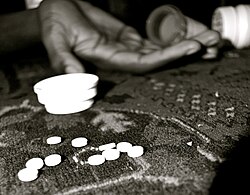
| A photograph depicting a person who had overdosed | |
| Specialty | Toxicology |
| Symptoms | Vary depending on the drug and the amount used |
| Complications |
|
| Causes |
|
| Risk factors | |
| Differential diagnosis | |
| Treatment | |

A drug overdose (overdose or OD) is the ingestion or application of a drug or other substance in quantities much greater than are recommended.[2][3] Typically the term is applied for cases when a risk to health is a potential result.[2] An overdose may result in a toxic state or death.[3]
Classification
[edit]The word "overdose" implies that there is a common safe dosage and usage for the drug; therefore, the term is commonly applied only to drugs, not poisons, even though many poisons as well are harmless at a low enough dosage. Drug overdose is sometimes used as a means to commit suicide, as the result of intentional or unintentional misuse of medication. Intentional misuse leading to overdose can include using prescribed or non-prescribed drugs in excessive quantities in an attempt to produce euphoria.
Usage of illicit drugs, in large quantities, or after a period of drug abstinence can also induce overdose. Cocaine and opioid users who inject intravenously can easily overdose accidentally, as the margin between a pleasurable drug sensation and an overdose is small.[4] Unintentional misuse can include errors in dosage caused by failure to read or understand product labels. Accidental overdoses may also be the result of over-prescription, failure to recognize a drug's active ingredient or unwitting ingestion by children.[5] A common unintentional overdose in young children involves multivitamins containing iron.
The term 'overdose' is often misused as a descriptor for adverse drug reactions or negative drug interactions due to mixing multiple drugs simultaneously.
Signs and symptoms
[edit]Signs and symptoms of an overdose vary depending on the drug, its ingredients, the amount consumed, and exposure to toxins. The symptoms can often be divided into differing toxidromes. This can help one determine what class of drug or toxin is causing the difficulties.
Symptoms of opioid overdoses include slow breathing, heart rate and pulse.[6] Opioid overdoses can also cause pinpoint pupils, and blue lips and nails due to low levels of oxygen in the blood. A person experiencing an opioid overdose might also have muscle spasms, seizures and decreased consciousness. A person experiencing an opiate overdose usually will not wake up, even if their name is called or they are shaken vigorously.
Causes
[edit]The drugs or toxins that are most frequently involved in overdose and death (grouped by ICD-10):
- Acute alcohol intoxication (F10)
- Opioid overdose (F11)
- Among sedative-hypnotics (F13)
- Barbiturate overdose (T42.3)
- Benzodiazepine overdose (T42.4)
- Uncategorized sedative-hypnotics (T42.6)
- Ethchlorvynol (Placidyl)
- GHB
- Glutethimide (Doriden)
- Methaqualone
- Ketamine (T41.2)
- Among stimulants (F14-F15)
- Cocaine overdose (T40.5)
- Amphetamine overdose (T43.6)
- Methamphetamine overdose (T43.6)
- Among tobacco (F17)
- Nicotine poisoning (T65.2)
- Among poly drug use (F19)
- Drug "cocktails" (speedballs)
- Medications
- Aspirin poisoning (T39.0)
- Paracetamol poisoning (Alone or mixed with oxycodone)
- Paracetamol toxicity (T39.1)
- Tricyclic antidepressant overdose (T43.0)
- Vitamin poisoning
- Pesticide poisoning (T60)
- Inhalants
- Lithium toxicity
Added flavoring
[edit]Masking undesired taste may impair judgement of the potency, which is a factor in overdosing. For example, lean is usually created as a drinkable mixture, the cough syrup is combined with soft drinks, especially fruit-flavored drinks such as Sprite, Mountain Dew or Fanta, and is typically served in a foam cup.[7][8] A hard candy, usually a Jolly Rancher, may be added to give the mixture a sweeter flavor.[9]
Diagnosis
[edit]The substance that has been taken may often be determined by asking the person. However, if they will not, or cannot, due to an altered level of consciousness, provide this information, a search of the home or questioning of friends and family may be helpful.
Examination for toxidromes, drug testing, or laboratory test may be helpful. Other laboratory test such as glucose, urea and electrolytes, paracetamol levels and salicylate levels are typically done. Negative drug-drug interactions have sometimes been misdiagnosed as an acute drug overdose, occasionally leading to the assumption of suicide.[10]
| Symptoms | Blood Pressure |
Heart rate | Respiratory Rate |
Temperature | Pupils | Bowel Sounds |
Diaphoresis |
|---|---|---|---|---|---|---|---|
| Anticholinergic | ~ [clarification needed] |
up | ~ | up | dilated | down | down |
| Cholinergic | ~ | ~ | unchanged | unchanged | constricted | up | up |
| Opioid | down | down | down | down | constricted | down | down |
| Sympathomimetic | up | up | up | up | dilated | up | up |
| Sedative-hypnotic | down | down | down | down | ~ | down | down |
Prevention
[edit]The distribution of naloxone to injection drug users and other opioid drug users decreases the risk of death from overdose.[12] The Centers for Disease Control and Prevention (CDC) estimates that U.S. programs for drug users and their caregivers prescribing take-home doses of naloxone and training on its utilization are estimated to have prevented 10,000 opioid overdose deaths.[13] Healthcare institution-based naloxone prescription programs have also helped reduce rates of opioid overdose in the U.S. state of North Carolina, and have been replicated in the U.S. military.[14][15] Nevertheless, scale-up of healthcare-based opioid overdose interventions is limited by providers' insufficient knowledge and negative attitudes towards prescribing take-home naloxone to prevent opioid overdose.[16] Programs training police and fire personnel in opioid overdose response using naloxone have also shown promise in the U.S.[17]
Supervised injection sites (also known as overdose prevention centers) have been used to help prevent drug overdoses by offering opioid reversal medications such as naloxone, medical assistance and treatment options. They also provide clean needles to help prevent the spread of diseases like HIV/AIDS and hepatitis.[18][19][20][21]
Management
[edit]
Stabilization of the person's airway, breathing, and circulation (ABCs) is the initial treatment of an overdose. Ventilation is considered when there is a low respiratory rate or when blood gases show the person to be hypoxic. Monitoring of the patient should continue before and throughout the treatment process, with particular attention to temperature, pulse, respiratory rate, blood pressure, urine output, electrocardiography (ECG) and O2 saturation.[22] Poison control centers and medical toxicologists are available in many areas to provide guidance in overdoses both to physicians and to the general public.
Antidotes
[edit]Specific antidotes are available for certain overdoses. For example, naloxone is the antidote for opiates such as heroin or morphine. Similarly, benzodiazepine overdoses may be effectively reversed with flumazenil. As a nonspecific antidote, activated charcoal is frequently recommended if available within one hour of the ingestion and the ingestion is significant.[23] Gastric lavage, syrup of ipecac, and whole bowel irrigation are rarely used.[23]
Epidemiology and statistics
[edit]Bar chart below: Overdose or drug-related death rate per 1 million population (unadjusted), 2022, by country or region.[24]
,_2022,_by_country_or_region.png)

In the US around 77,600 people died in the 12-month period ending March 31, 2025, at a rate of 213 deaths per day. The peak was around 110,900 in 2022. The U.S. drug overdose death rate has gone from 2.5 per 100,000 people in 1968 to the peak rate of 33.2 per 100,000 in 2022.[26][27]
1,015,060 US residents died from drug overdoses from 1968 to 2019. 22 people out of every 100,000 died from drug overdoses in 2019 in the US.[27] From 1999 to Feb 2019 in the United States, more than 770,000 people have died from drug overdoses.[28] 70,630 people died from drug overdoses in 2019.[29]
The National Center for Health Statistics reports that 19,250 people died of accidental poisoning in the U.S. in the year 2004 (eight deaths per 100,000 population).[30]
In 2008 testimony before a Senate subcommittee, Leonard J. Paulozzi,[31] a medical epidemiologist at the Centers for Disease Control and Prevention said that in 2005 more than 22,000 American people died due to overdoses, and the number is growing rapidly. Paulozzi also testified that all available evidence suggests unintentional overdose deaths are related to the increasing use of prescription drugs, especially opioid painkillers.[32] However, the vast majority of overdoses are also attributable to alcohol. It is very rare for a victim of an overdose to have consumed just one drug. Most overdoses occur when drugs are ingested in combination with alcohol.[33]
Drug overdose was the leading cause of injury death in 2013. Among people 25 to 64 years old, drug overdose caused more deaths than motor vehicle traffic crashes. There were 43,982 drug overdose deaths in the United States in 2013. Of these, 22,767 (51.8%) were related to prescription drugs.[34]
The 22,767 deaths relating to prescription drug overdose in 2013, 16,235 (71.3%) involved opioid painkillers, and 6,973 (30.6%) involved benzodiazepines. Drug misuse and abuse caused about 2.5 million emergency department (ED) visits in 2011. Of these, more than 1.4 million ED visits were related to prescription drugs. Among those ED visits, 501,207 visits were related to anti-anxiety and insomnia medications, and 420,040 visits were related to opioid analgesics.[35]
New CDC data in 2024 demonstrates U.S. drug overdose deaths have significantly declined, marking the potential for the first year with fewer than 100,000 fatalities since 2020.[36] The CDC data shows a nearly 17% drop in reported overdose deaths during the 12 months ending in June, totaling 93,087.[37] This is a notable decrease from the 111,615 deaths recorded in the same period ending in June 2023. While the opioid crisis continues to take a heavy toll, fentanyl remains a major driver, contributing to the majority of these fatalities.[38]
-
![U.S. yearly overdose deaths from all drugs.[29]](//upload.wikimedia.org/wikipedia/commons/thumb/1/1a/US_timeline._Number_of_overdose_deaths_from_all_drugs.jpg/250px-US_timeline._Number_of_overdose_deaths_from_all_drugs.jpg) U.S. yearly overdose deaths from all drugs.[29]
U.S. yearly overdose deaths from all drugs.[29] -
![US yearly overdose deaths, and the drugs involved. Among the 70,200 deaths in 2017, the sharpest increase occurred among deaths related to fentanyl and fentanyl analogs (synthetic opioids) with 28,466 deaths.[29]](//upload.wikimedia.org/wikipedia/commons/thumb/f/fa/US_timeline._Drugs_involved_in_overdose_deaths.jpg/250px-US_timeline._Drugs_involved_in_overdose_deaths.jpg) US yearly overdose deaths, and the drugs involved. Among the 70,200 deaths in 2017, the sharpest increase occurred among deaths related to fentanyl and fentanyl analogs (synthetic opioids) with 28,466 deaths.[29]
US yearly overdose deaths, and the drugs involved. Among the 70,200 deaths in 2017, the sharpest increase occurred among deaths related to fentanyl and fentanyl analogs (synthetic opioids) with 28,466 deaths.[29] -
![U.S. yearly overdose deaths involving benzodiazepines.[29]](//upload.wikimedia.org/wikipedia/commons/thumb/1/13/US_timeline._Benzodiazepine_deaths.jpg/330px-US_timeline._Benzodiazepine_deaths.jpg) U.S. yearly overdose deaths involving benzodiazepines.[29]
U.S. yearly overdose deaths involving benzodiazepines.[29] -
![U.S. yearly overdose deaths involving cocaine.[29]](//upload.wikimedia.org/wikipedia/commons/thumb/b/ba/US_timeline._Cocaine_deaths.jpg/330px-US_timeline._Cocaine_deaths.jpg)
-
![U.S. yearly deaths involving prescription opioids. Non-methadone synthetics is a category dominated by illegally acquired fentanyl, and has been excluded.[29]](//upload.wikimedia.org/wikipedia/commons/thumb/c/c1/US_timeline._Prescription_opioid_pain_reliever_deaths.jpg/250px-US_timeline._Prescription_opioid_pain_reliever_deaths.jpg) U.S. yearly deaths involving prescription opioids. Non-methadone synthetics is a category dominated by illegally acquired fentanyl, and has been excluded.[29]
U.S. yearly deaths involving prescription opioids. Non-methadone synthetics is a category dominated by illegally acquired fentanyl, and has been excluded.[29] -
![U.S. overdose deaths involving all opioids. Deaths per 100,000 population.[39]](//upload.wikimedia.org/wikipedia/commons/thumb/3/37/Timeline._Overdose_death_rates_involving_opioids%2C_by_type%2C_United_States.gif/330px-Timeline._Overdose_death_rates_involving_opioids%2C_by_type%2C_United_States.gif)
-
![U.S. yearly overdose deaths involving heroin.[29]](//upload.wikimedia.org/wikipedia/commons/thumb/8/8d/Timeline_of_US_overdose_deaths_involving_heroin%2C_by_other_opioid_involvement.jpg/250px-Timeline_of_US_overdose_deaths_involving_heroin%2C_by_other_opioid_involvement.jpg)
-
![Timeline of US drug overdose death rates by race and ethnicity.[40] Rate per 100,000 population.](//upload.wikimedia.org/wikipedia/commons/thumb/3/32/Timeline._US_drug_overdose_death_rate_by_race_and_ethnicity.gif/330px-Timeline._US_drug_overdose_death_rate_by_race_and_ethnicity.gif) Timeline of US drug overdose death rates by race and ethnicity.[40] Rate per 100,000 population.
Timeline of US drug overdose death rates by race and ethnicity.[40] Rate per 100,000 population.
![U.S. yearly overdose deaths from all drugs.[29]](https://en.wikipedia.org/wiki/File:US_timeline._Number_of_overdose_deaths_from_all_drugs.jpg)
![US yearly overdose deaths, and the drugs involved. Among the 70,200 deaths in 2017, the sharpest increase occurred among deaths related to fentanyl and fentanyl analogs (synthetic opioids) with 28,466 deaths.[29]](https://en.wikipedia.org/wiki/File:US_timeline._Drugs_involved_in_overdose_deaths.jpg)
![U.S. yearly overdose deaths involving benzodiazepines.[29]](https://en.wikipedia.org/wiki/File:US_timeline._Benzodiazepine_deaths.jpg)
![U.S. yearly overdose deaths involving cocaine.[29]](https://en.wikipedia.org/wiki/File:US_timeline._Cocaine_deaths.jpg)
![U.S. yearly deaths involving prescription opioids. Non-methadone synthetics is a category dominated by illegally acquired fentanyl, and has been excluded.[29]](https://en.wikipedia.org/wiki/File:US_timeline._Prescription_opioid_pain_reliever_deaths.jpg)
![U.S. overdose deaths involving all opioids. Deaths per 100,000 population.[39]](https://en.wikipedia.org/wiki/File:Timeline._Overdose_death_rates_involving_opioids,_by_type,_United_States.gif)
![U.S. yearly overdose deaths involving heroin.[29]](https://en.wikipedia.org/wiki/File:Timeline_of_US_overdose_deaths_involving_heroin,_by_other_opioid_involvement.jpg)
![Timeline of US drug overdose death rates by race and ethnicity.[40] Rate per 100,000 population.](https://en.wikipedia.org/wiki/File:Timeline._US_drug_overdose_death_rate_by_race_and_ethnicity.gif)
See also
[edit]- 27 Club – Notional club occupied by those who died at age 27
- Adulterants – Substance that has been secretly added
- Brandon Vedas – 2003 drug overdose death
- Drug checking – Harm reduction technique
- Drug interactions – Change in the action or side effects of a drug caused
- Hepatotoxicity – Liver damage caused by a drug or chemical
- List of deaths from drug overdose and intoxication
- Reagent testing – Tests for authentication of psychoactive drugs, and detection of adulterants
- Responsible drug use – Use of drugs in a responsible manner
- Suicide methods § Drug overdose
- Water intoxication – Potentially fatal overhydration
References
[edit]- ^ Fentanyl. Image 4 of 17. US DEA (Drug Enforcement Administration). See archive with caption: "photo illustration of 2 milligrams of fentanyl, a lethal dose in most people".
- ^ a b Definitions Retrieved on September 20, 2014.
- ^ a b "Stairway to Recovery: Glossary of Terms" Archived July 9, 2011, at the Wayback Machine. Retrieved on March 19, 2021
- ^ Study on fatal overdose Archived January 19, 2012, at the Wayback Machine in New-York City 1990-2000, visited May 11, 2008,
- ^ "What to do with leftover medicines". Medicines Talk, Winter 2005. Available at "What to do with left-over medicines: National Prescribing Service Ltd NPS". Archived from the original on October 24, 2009. Retrieved January 6, 2010.
- ^ Chandler, Stephanie. "Symptoms of an opiate overdose". Live Strong. Archived from the original on April 18, 2012. Retrieved May 17, 2012.
- ^ "T.I. Arrest -- Sippin' on Sizzurp?". TMZ. September 2, 2010. Retrieved August 19, 2019.
- ^ Melissa Leon (March 17, 2013). "Lil Wayne Hospitalization: What the Hell Is Sizzurp?". The Daily Beast.
- ^ Tamara Palmer (2005). Country Fried Soul: Adventures in Dirty South Hip-hop. Outline Press Limited. p. 188.
- ^ "Column—Fatal Drug-Drug Interaction As a Differential Consideration in Apparent Suicides" Archived February 23, 2008, at the Wayback Machine.
- ^ Goldfrank, Lewis R. (1998). Goldfrank's toxicologic emergencies. Norwalk, CT: Appleton & Lange. ISBN 0-8385-3148-2.
- ^ Piper TM; Stancliff S; Rudenstine S; et al. (2008). "Evaluation of a naloxone distribution and administration program in New York City". Subst Use Misuse. 43 (7): 858–870. doi:10.1080/10826080701801261. hdl:2027.42/60330. PMID 18570021. S2CID 31367375.
- ^ "Community-Based Opioid Overdose Prevention Programs Providing Naloxone—United States, 2010". Centers for Disease Control and Prevention. December 2010. Archived from the original on September 9, 2017.
- ^ Albert S, Brason FW 2nd, Sanford CK, Dasgupta N, Graham J, Lovette B (June 2011). "Project Lazarus: community-based overdose prevention in rural North Carolina". Pain Medicine. 12 (Suppl 2): S77–85. doi:10.1111/j.1526-4637.2011.01128.x. PMID 21668761.
- ^ Beletsky L, Burris SC, Kral AH (2009). Closing Death's Door: Action Steps to Facilitate Emergency Opioid Drug Overdose Reversal in the United States (PDF) (Report). Temple University Beasley School of Law. SSRN 1437163. Archived (PDF) from the original on January 27, 2023 – via Boonshoft School of Medicine.
- ^ Beletsky L, Ruthazer R, Macalino GE, Rich JD, Tan L, Burris S (January 2007). "Physicians' knowledge of and willingness to prescribe naloxone to reverse accidental opiate overdose: challenges and opportunities". Journal of Urban Health. 84 (1): 126–36. doi:10.1007/s11524-006-9120-z. PMC 2078257. PMID 17146712.
- ^ Lavoie D. (April 2012). "Naloxone: Drug-Overdose Antidote Is Put In Addicts' Hands". Huffington Post. Archived from the original on May 18, 2012.
- ^ Oladipo, Gloria (November 30, 2021). "New York to open supervised injection sites in bid to curb overdose deaths". The Guardian. Retrieved December 1, 2021.
- ^ Kim, Lisa (November 30, 2021). "NYC Close To Opening Supervised Injection Sites To Prevent Overdoses, After Years Of Setbacks, Report Says". Forbes. Retrieved December 1, 2021.
- ^ "What's The Evidence That Supervised Drug Injection Sites Save Lives?". NPR. September 7, 2018. Retrieved December 1, 2021.
- ^ Ng, Jennifer; Sutherland, Christy; Kolber, Michael (November 2017). "Does evidence support supervised injection sites?". Canadian Family Physician. 63 (11): 866. PMC 5685449. PMID 29138158.
- ^ Longmore, Murray; Ian Wilkinson; Tom Turmezei; Chee Kay Cheung (2007). Oxford Handbook of Clinical Medicine. United Kingdom: Oxford. ISBN 978-0-19-856837-7.
- ^ a b Vanden Hoek, TL; Morrison, LJ; Shuster, M; Donnino, M; Sinz, E; Lavonas, EJ; Jeejeebhoy, FM; Gabrielli, A (November 2, 2010). "Part 12: cardiac arrest in special situations: 2010 American Heart Association Guidelines for Cardiopulmonary Resuscitation and Emergency Cardiovascular Care". Circulation. 122 (18 Suppl 3): S829–61. doi:10.1161/CIRCULATIONAHA.110.971069. PMID 20956228.
- ^ Gumas, Evan D. (January 9, 2025). "U.S. Overdose Deaths Remain Higher Than in Other Countries — Trend-Tracking and Harm-Reduction Policies Could Help". www.commonwealthfund.org. The Commonwealth Fund.
- ^ "One Pill Can Kill". US Drug Enforcement Administration. Archived from the original on November 15, 2023. Retrieved November 15, 2023.
- ^ Products - Vital Statistics Rapid Release - Provisional Drug Overdose Data. Centers for Disease Control and Prevention. Hover cursor over the end of the graph in Figure 1A to get the latest number. Scroll down the page and click on the dropdown data table called "Data Table for Figure 1a. 12 Month-ending Provisional Counts of Drug Overdose Deaths". The number used is the "predicted value" for the 12 month period that is ending at the end of that month. That number changes as more info comes in. If there are problems use a different browser.
- ^ a b Data is from these saved tables from CDC Wonder at the Centers for Disease Control and Prevention, National Center for Health Statistics. The tables have totals, rates, and US populations per year.
- 1968-1978 data: Compressed Mortality File 1968-1978. CDC WONDER Online Database, compiled from Compressed Mortality File CMF 1968-1988, Series 20, No. 2A, 2000. Accessed at http://wonder.cdc.gov/cmf-icd8.html on March 13, 2021, 5:04:32 PM.
- 1979-1998 data: Compressed Mortality File 1979-1998. CDC WONDER On-line Database, compiled from Compressed Mortality File CMF 1968-1988, Series 20, No. 2A, 2000 and CMF 1989-1998, Series 20, No. 2E, 2003. Accessed at http://wonder.cdc.gov/cmf-icd9.html on March 13, 2021, 5:19:27 PM.
- 1999-2019 data: Multiple Cause of Death 1999-2019. CDC WONDER Online Database, released in 2020. Data are from the Multiple Cause of Death Files, 1999-2019, as compiled from data provided by the 57 vital statistics jurisdictions through the Vital Statistics Cooperative Program. Accessed at http://wonder.cdc.gov/mcd-icd10.html on March 13, 2021, 5:05:13 PM.
- ^ STATCAST—Week of September 9, 2019. NCHS Releases New Monthly Provisional Estimates on Drug Overdose Deaths. National Center for Health Statistics.
- ^ a b c d e f g Overdose Death Rates. And Archived 2015-11-28 at the Wayback Machine. By National Institute on Drug Abuse.
- ^ Referral Page—FASTSTATS—Accidents or Unintentional Injuries Archived July 15, 2017, at the Wayback Machine Retrieved on September 20, 2014.
- ^ CDC Expert, Leonard J. Paulozzi, MD, MPH Archived February 20, 2014, at the Wayback Machine Retrieved on September 20, 2014.
- ^ CDC Washington Testimony March 5, 2008 Archived July 15, 2017, at the Wayback Machine Retrieved on September 20, 2014.
- ^ "The Persistent, Dangerous Myth of Heroin Overdose" Archived March 23, 2015, at the Wayback Machine.
- ^ "Understanding the Epidemic | Drug Overdose | CDC Injury Center" Archived September 9, 2017, at the Wayback Machine.
- ^ "Prescription Opioid Overdose Data | Drug Overdose | CDC Injury Center" Archived January 18, 2017, at the Wayback Machine.
- ^ Facher, Lev (November 13, 2024). "U.S. drug overdose deaths on pace to fall below 100,000 this year". STAT. Retrieved November 17, 2024.
- ^ "Products - Data Briefs - Number 491 - March 2024". www.cdc.gov. March 19, 2024. Retrieved November 17, 2024.
- ^ "CDC says US drug overdose deaths have declined". www.bbc.com. Retrieved November 17, 2024.
- ^ Opioid Data Analysis and Resources. Drug Overdose. CDC Injury Center. Centers for Disease Control and Prevention. Click on "Rising Rates" tab for a graph. See data table below the graph.
- ^ NCHS Data Visualization Gallery—Drug Poisoning Mortality. From National Center for Health Statistics. Open the dashboard dropdown menu and pick "U.S. Trends". From the menus on the right pick all races, all ages, and both sexes. Run your cursor over the graph to see the data.
Further reading
[edit]- Nelson, Lewis H.; Flomenbaum, Neal; Goldfrank, Lewis R.; Hoffman, Robert Louis; Howland, Mary Deems; Neal A. Lewin (2015). Goldfrank's toxicologic emergencies. New York: McGraw-Hill, Medical Pub. Division. ISBN 978-0-07-143763-9.
- Olson, Kent C. (2004). Poisoning & drug overdose. New York: Lange Medical Mooks/McGraw-Hill. ISBN 0-8385-8172-2.
External links
[edit]

| Inorganic |
| ||||||||||||
|---|---|---|---|---|---|---|---|---|---|---|---|---|---|
| Organic |
| ||||||||||||
| Pharmaceutical |
| ||||||||||||
| Biological2 |
| ||||||||||||
| Miscellaneous | |||||||||||||
| |||||||||||||


Drug overdose
View on GrokipediaDefinition and Classification
Core Definition and Mechanisms
A drug overdose occurs when an individual ingests, injects, inhales, or otherwise absorbs a quantity of one or more substances sufficient to produce severe adverse effects, potentially leading to organ dysfunction, coma, or death. This exceeds the therapeutic index—the ratio between a drug's effective dose and its toxic dose—disrupting normal homeostasis through pharmacological overload.[11] Unlike adverse drug reactions from standard dosing, overdose toxicity arises from acute or cumulative exposure overwhelming metabolic clearance or receptor adaptation mechanisms.[12] At the cellular and molecular level, overdose mechanisms generally involve on-target exaggeration, where intended pharmacological actions amplify to toxic thresholds, such as mu-opioid receptor agonism causing profound respiratory depression via brainstem inhibition.[13] Off-target effects contribute through unintended interactions, like ion channel blockade or free radical generation, while idiosyncratic factors—such as genetic variations in cytochrome P450 enzymes—can precipitate toxicity even at conventional doses by impairing detoxification.[14] Metabolic derangements, including acidosis from lactate accumulation or hepatic enzyme saturation, further exacerbate systemic failure, as seen in cases where normal doses become lethal in tolerant or comorbid individuals due to reduced physiological reserve.[15] Toxicokinetic principles underpin these processes: rapid absorption and distribution outpace elimination, elevating plasma concentrations and prolonging exposure, which can trigger secondary cascades like hypoxia-induced neuronal damage or cardiovascular instability.[12] Polydrug interactions amplify risks by competitive inhibition of transporters or synergistic receptor effects, underscoring that overdose lethality often stems from uncompensated failure in respiratory drive, cardiac output, or thermoregulation rather than isolated cellular poisoning.[1] Empirical toxicology data confirm these pathways, with postmortem analyses revealing dose-response correlations in receptor occupancy and biomarker elevations, independent of intent.[16]Classification by Intent and Substance Type
Drug overdoses are classified by the intent underlying the drug ingestion or administration, a categorization that informs public health responses and legal investigations. The primary categories include unintentional (accidental), intentional (such as suicide or assault), and undetermined intent, as defined by the International Classification of Diseases, Tenth Revision (ICD-10) codes for poisoning deaths (e.g., X40-X44 for accidental, X60-X64 for intentional self-poisoning by drugs, and Y10-Y14 for undetermined).[7] In the United States, provisional data from 2023 indicate that 92.6% of drug overdose deaths were unintentional, 4.4% were suicides, 2.8% were of undetermined intent, and fewer than 1.0% were homicides or assaults.[7] This distribution underscores that the vast majority of fatal overdoses result from misuse without deliberate intent to die, often involving tolerance misjudgment, unexpected drug potency, or polydrug interactions rather than premeditated self-harm.[17]| Intent Category | Percentage of U.S. Overdose Deaths (2023) | ICD-10 Examples |
|---|---|---|
| Unintentional | 92.6% | X40-X44 |
| Suicide (Intentional) | 4.4% | X60-X64 |
| Undetermined | 2.8% | Y10-Y14 |
| Homicide/Assault | <1.0% | X85 |
Pathophysiology
Toxicological Mechanisms
Toxicological mechanisms of drug overdose primarily arise from achieving supratherapeutic concentrations that overwhelm physiological homeostasis, converting intended therapeutic effects into harmful ones or activating novel pathways of cellular damage. As articulated by Paracelsus, "the dose makes the poison," where excessive intake shifts pharmacology toward toxicity through dose-dependent exaggeration of on-target actions or emergence of off-target interactions.[1] These effects are exacerbated by pharmacokinetic factors, such as saturation of metabolic enzymes (e.g., cytochrome P450 pathways), leading to prolonged drug exposure and accumulation in tissues.[1] On-target toxicity represents the most direct mechanism in many overdoses, involving hyperactivation of the drug's primary molecular target beyond compensatory limits. For instance, opioids bind excessively to mu-opioid receptors in the brainstem, suppressing the respiratory center and causing hypoventilation, hypoxemia, and eventual cardiorespiratory arrest as the dominant cause of fatality.[12] Similarly, stimulants like cocaine amplify sympathetic neurotransmission via reuptake inhibition of catecholamines, precipitating hypertensive crises, arrhythmias, and seizures through unchecked adrenergic overload.[14] Off-target toxicity occurs when high concentrations enable binding to unintended receptors or channels, eliciting effects absent at therapeutic doses. Anticholinergic agents, for example, block muscarinic receptors non-selectively at overdose levels, disrupting autonomic balance and causing delirium, tachycardia, and hyperthermia via central and peripheral muscarinic antagonism.[14] Certain pharmaceuticals also inhibit cardiac potassium channels (e.g., hERG), prolonging QT intervals and risking torsades de pointes, a risk amplified in overdose by elevated unbound fractions.[14] Bioactivation to reactive metabolites constitutes a critical mechanism in hepatotoxic overdoses, where phase I metabolism generates electrophilic intermediates that covalently bind macromolecules unless detoxified. Acetaminophen overdose exemplifies this: cytochrome P450 converts it to N-acetyl-p-benzoquinone imine (NAPQI), depleting hepatic glutathione and inducing oxidative stress, mitochondrial dysfunction, and centrilobular necrosis, often manifesting within 24-72 hours.[14] Drug-drug interactions further potentiate mechanisms by inhibiting elimination (e.g., CYP inhibitors raising active drug levels) or synergizing pharmacodynamics (e.g., benzodiazepines enhancing opioid respiratory depression).[1] Individual variability in metabolizer status, such as poor CYP2D6 activity, heightens susceptibility by impairing clearance.[1]Organ-Specific Effects
Drug overdoses exert toxic effects on multiple organs through direct pharmacological actions, metabolic byproducts, or secondary complications such as hypoxia and hypotension. Opioids primarily depress the central nervous system (CNS) via mu-opioid receptor agonism, leading to sedation, miosis, and coma, while stimulants like cocaine and amphetamines cause CNS excitation, manifesting as agitation, hyperthermia, and seizures due to excessive dopamine and norepinephrine release.[12][24] The respiratory system is profoundly affected in opioid overdoses, where brainstem mu-receptor activation suppresses ventilatory drive, resulting in hypoventilation, hypercapnia, and hypoxemia; this can progress to acute respiratory failure and non-cardiogenic pulmonary edema from hypoxic injury and increased vascular permeability.[12] Stimulant overdoses, conversely, may induce tachypnea initially from sympathetic overstimulation, but secondary complications like seizures or acidosis can impair gas exchange.[24] Cardiovascular toxicity varies by agent: opioids induce bradycardia and hypotension through vagal stimulation and histamine release, potentially culminating in circulatory collapse; stimulants provoke tachycardia, hypertension, and arrhythmias, including ventricular fibrillation, via catecholamine surge and sodium channel blockade (e.g., cocaine), increasing risks of myocardial infarction and cardiomyopathy.[12][24][25] Hepatic injury is prominent in acetaminophen overdose, where cytochrome P450 metabolism produces N-acetyl-p-benzoquinone imine (NAPQI), depleting glutathione and causing oxidative stress, mitochondrial dysfunction, and centrilobular hepatocyte necrosis; doses exceeding 150 mg/kg acutely can lead to fulminant liver failure.[26][27] Other agents, such as certain opioids in overdose, may rarely contribute to acute liver injury via hypoxia or direct toxicity.[28] Renal effects often arise indirectly from prolonged hypotension, rhabdomyolysis (e.g., in ecstasy or heroin overdose), or direct tubular toxicity, leading to acute kidney injury (AKI) characterized by acute tubular necrosis; acetaminophen overdoses can independently cause renal cortical necrosis in up to 2% of cases, independent of liver damage severity.[29][30] Multi-organ dysfunction syndrome may ensue in severe cases, driven by systemic inflammation and ischemia from initial respiratory or cardiac compromise.[31]Clinical Presentation
Acute Signs and Symptoms
Acute signs and symptoms of drug overdose vary by substance class but frequently involve central nervous system depression, respiratory compromise, and autonomic instability, potentially progressing to coma, cardiopulmonary arrest, and death if untreated.[31] Common initial indicators include altered mental status such as confusion, drowsiness, or unresponsiveness, often accompanied by vomiting or seizures in severe cases.[32] Respiratory effects manifest as slowed or shallow breathing, apnea, or cyanosis due to hypoxia, particularly with opioid or sedative overdoses.[12] Cardiovascular changes may include bradycardia, hypotension, or arrhythmias, while pupillary responses differ—miosis with opioids and mydriasis with stimulants or anticholinergics.[12] [33]- Neurological signs: Sedation progressing to coma; agitation, hallucinations, or psychosis with stimulants; focal deficits or tremors in some toxicities.[31] [33]
- Respiratory signs: Bradypnea (<12 breaths/min), hypoventilation leading to hypercapnia and acidosis; aspiration risk from impaired airway protection.[12]
- Cardiovascular signs: Tachycardia or bradycardia; hypertension or hypotension; conduction abnormalities like widened QRS in tricyclic antidepressant overdoses.[34] [35]
- Other systemic signs: Hypothermia or hyperthermia; diaphoresis; gastrointestinal stasis or ileus; rhabdomyolysis in prolonged immobility or stimulant cases.[33] [31]
Variations by Substance
Opioid overdoses primarily affect the central nervous system by binding to mu-opioid receptors, leading to respiratory depression as the hallmark feature, often progressing to apnea if untreated. Patients typically exhibit pinpoint pupils (miosis), sedation or coma, bradycardia, and hypotension, with reduced responsiveness to painful stimuli.[12][38] Blue lips or fingernails from hypoxia may occur, and without intervention like naloxone, death results from asphyxiation rather than direct cardiac arrest.[39] Stimulant overdoses, involving substances like cocaine or methamphetamine, activate the sympathetic nervous system through dopamine and norepinephrine release, causing agitation, paranoia, or hallucinations alongside cardiovascular strain. Common signs include tachycardia, hypertension, hyperthermia (often exceeding 104°F or 40°C), diaphoresis, mydriasis (dilated pupils), and tremors, with risks of seizures, myocardial infarction, or stroke due to vasoconstriction and arrhythmias.[40][41] Unlike depressants, patients may remain hypervigilant initially, masking severity until decompensation.[42] Sedative-hypnotic overdoses from benzodiazepines or barbiturates potentiate GABA activity, resulting in dose-dependent CNS depression with slurred speech, ataxia, nystagmus, and eventual coma. Respiratory depression and hypotension predominate, but barbiturates cause more profound effects including bullous skin lesions and prolonged recovery compared to benzodiazepines, which rarely cause fatal respiratory failure alone.[43][44] Pupils are typically normal or dilated, distinguishing from opioids, and co-ingestion with opioids or alcohol amplifies lethality through synergistic depression.[45] Alcohol overdose, or acute ethanol intoxication, impairs multiple systems via GABA enhancement and glutamate inhibition, presenting with euphoria transitioning to confusion, vomiting, and hypothermia from vasodilation. Severe cases involve bradypnea (<8 breaths per minute), irregular breathing, seizures from electrolyte shifts, and aspiration risk, with blood alcohol concentrations above 0.30% often fatal without supportive care.[46][47] Gag reflex suppression heightens pulmonary complications, and chronic users may tolerate higher levels before coma ensues.[48]| Substance Class | Primary Mechanism | Respiratory Effects | Cardiovascular Effects | Neurological Signs | Pupil Response |
|---|---|---|---|---|---|
| Opioids | Mu-receptor agonism | Severe depression/apnea | Bradycardia, hypotension | Sedation to coma | Miosis (pinpoint) |
| Stimulants | Sympathomimetic | Tachypnea or normal initially | Tachycardia, hypertension | Agitation, seizures, hyperthermia | Mydriasis (dilated) |
| Sedatives/Hypnotics | GABA potentiation | Depression, hypoventilation | Hypotension, variable HR | Ataxia, coma | Normal/dilated |
| Alcohol | GABA enhancement, glutamate inhibition | Bradypnea, irregular | Bradycardia, vasodilation | Confusion, seizures | Normal |
Causes and Risk Factors
Primary Causative Agents
Illicitly manufactured synthetic opioids, primarily fentanyl and its analogs, represent the leading causative agents in fatal drug overdoses worldwide, particularly in North America where they dominate mortality statistics. In the United States, fentanyl was involved in 69% of all drug overdose deaths in 2023, contributing to approximately 73,000 fatalities amid a total of over 105,000 overdose deaths that year.[49][4] This shift from heroin and prescription opioids to synthetics reflects the potency of fentanyl, which is 50 to 100 times more potent than morphine, enabling lethal doses in milligram quantities often mixed unknowingly into other drugs like heroin, cocaine, or counterfeit pills.[50] Opioids as a class accounted for 76% of U.S. overdose deaths in 2023, with synthetic opioids surpassing heroin, which previously drove epidemics but now constitutes a smaller share due to market displacement by cheaper, more potent fentanyl variants.[4] Prescription opioids like oxycodone and hydrocodone contribute less to recent fatalities, involving fewer than 15% of deaths, as their role has waned since peak prescription rates in the early 2010s.[18] Globally, the World Health Organization identifies opioids—including heroin, morphine, fentanyl, methadone, and tramadol—as the primary agents in overdose deaths, estimating around 125,000 such fatalities in 2019, though updated comprehensive breakdowns by specific substance remain scarce outside high-income regions.[51] Stimulants, including methamphetamine and cocaine, are secondary but rising contributors, implicated in 59% of U.S. overdose deaths from January 2021 to June 2024, with 43% of these cases involving co-use with opioids, highlighting polysubstance toxicity as a key mechanism.[22] Methamphetamine deaths have surged due to its widespread availability and cardiovascular risks, while cocaine's involvement often stems from adulteration with fentanyl, amplifying lethality beyond stimulant effects alone.[22] Benzodiazepines and other sedatives frequently co-occur with opioids, exacerbating respiratory depression, but rarely act as sole agents in fatalities.[18]| Substance Class | Approximate Share of U.S. Fatal Overdoses (2023) | Key Notes |
|---|---|---|
| Synthetic Opioids (e.g., Fentanyl) | 69% | Dominant due to illicit production and adulteration; ~73,000 deaths.[49][4] |
| Other Opioids (e.g., Heroin, Prescription) | ~7% additional to reach 76% opioid total | Declining relative to synthetics.[4] |
| Stimulants (e.g., Methamphetamine, Cocaine) | Involved in ~40-50% (often polysubstance) | Rising, but lower standalone lethality.[22] |
Contributing Individual and Societal Factors
Individual risk factors for drug overdose include genetic predispositions, with substance use disorders showing heritability estimates of 40-60% across various drugs, influenced by shared genetic markers identified in genome-wide association studies.[53][54] Psychiatric comorbidities, such as depression and anxiety disorders, elevate overdose risk by 2- to 4-fold, often co-occurring with polysubstance use and prior non-fatal overdoses, which independently predict future events with odds ratios exceeding 10 in longitudinal cohorts.[55][56] Demographic variables like male sex and ages 25-54 years correlate with higher incidence, as males exhibit 1.5- to 2-times greater overdose mortality rates, potentially due to riskier consumption patterns.[57][58] Behavioral and environmental individual vulnerabilities compound these, including unstable housing, which doubles overdose likelihood through increased exposure to contaminated supplies, and recent incarceration release, associated with a 3- to 6-fold elevated risk in the first weeks post-release owing to tolerance loss.[59][60] Comorbid medical conditions, such as chronic pain or concurrent alcohol dependence, further amplify susceptibility, with daily heavy alcohol intake raising overdose odds by up to 5-fold via respiratory depression synergy.[55] Societal factors driving overdose epidemics encompass economic deprivation, where poverty rates above 20% in communities correlate with 1.5- to 2-times higher fatal overdoses, mediated by reduced access to treatment and heightened illicit drug reliance.[58][61] Unemployment exhibits a dose-response relationship, with each 1% rise linking to 0.5-1% increases in overdose deaths over multi-year lags, particularly among males, though generous unemployment insurance mitigates this by 10-20% through income stabilization.[62][63] Broader social determinants, including food insecurity and low educational attainment, contribute via chronic stress and limited harm reduction resources, with county-level economic distress indices predicting 15-25% variance in overdose trends from 2000-2019.[64][65] Policy and systemic elements, such as lax prescription practices in the early 2000s, flooded markets with opioids, converting 3-12% of legitimate users to dependence and fueling synthetic shifts like fentanyl adulteration, which now dominates 70% of U.S. overdoses.[66] Housing instability at societal scales, affecting 10-15% of high-risk groups, exacerbates isolation and overdose non-response, while incarceration cycles—impacting 1 in 3 U.S. adults—perpetuate vulnerability through disrupted care continuity.[67][59] These factors interact causally, with economic downturns like post-2008 recession amplifying overdoses by 20-30% in distressed regions before pandemic-era surges.[62]Epidemiology
Historical Trends and Epidemics
Drug overdose deaths in the United States numbered approximately 6,000 annually during the 1980s, primarily involving heroin and cocaine, before beginning a sustained rise in the 1990s.[68] By 1999, total overdose deaths reached about 16,000, marking the onset of the opioid epidemic, which has since driven the majority of increases.[18] This epidemic unfolded in three distinct waves: the first, from the late 1990s to around 2010, centered on prescription opioids such as oxycodone, with deaths quadrupling from 2,000 to 8,000 annually due to aggressive marketing and overprescribing by pharmaceutical companies like Purdue Pharma.[4][69] The second wave, emerging around 2010, shifted to illicit heroin as prescription supplies tightened and users sought cheaper alternatives, with heroin-involved deaths rising from 3,000 in 2010 to over 15,000 by 2017.[4] The third wave, starting in 2013, involved synthetic opioids primarily illicitly manufactured fentanyl, which is 50-100 times more potent than morphine and often mixed unknowingly into other drugs; fentanyl-related deaths surged from fewer than 3,000 in 2013 to over 70,000 by 2022, comprising the bulk of the more than 100,000 total annual overdose deaths at the peak.[4][18] Provisional data indicate a decline to around 80,000 deaths in the 12 months ending January 2025, attributed partly to interventions like expanded naloxone distribution and shifts in drug supply, though rates remain historically elevated at over 24 per 100,000 population for opioids alone.[6][70] Globally, drug overdose epidemics have been less uniformly documented but show parallels, with opioid-related deaths accounting for nearly 80% of the approximately 600,000 annual drug-attributable fatalities in 2019, concentrated in North America, Europe, and parts of Asia.[51] Historical increases mirror U.S. patterns in countries like Canada, where opioid deaths exceeded 30,000 since 2016, and Australia, driven by prescription opioids followed by fentanyl; in contrast, synthetic opioid surges have been slower in Europe due to stricter controls but are accelerating.[71] Earlier 20th-century epidemics involved barbiturates and cocaine but lacked the scale of modern opioids, with worldwide overdose mortality rising substantially only in the past decade across multiple nations.[72]Recent Global and National Statistics
In 2019, the World Health Organization estimated that approximately 600,000 deaths worldwide were attributable to drug use, with opioids implicated in nearly 80% of cases and overdose accounting for about 25% of those opioid-related fatalities, yielding roughly 120,000 opioid overdose deaths globally.[51] Comprehensive global figures for drug overdoses specifically remain estimates due to inconsistent reporting and varying definitions across countries, but the United Nations Office on Drugs and Crime's World Drug Report 2024 highlights sustained high overdose mortality, particularly from synthetic opioids, without updated aggregate totals beyond regional breakdowns.[73] In the United States, drug overdoses represent the leading cause of preventable injury-related deaths, often classified under poisoning or unintentional injuries.[74] The Centers for Disease Control and Prevention reported over 110,000 drug overdose deaths in 2023, continuing a trend dominated by synthetic opioids such as fentanyl, which were involved in 69% of cases.[75][49] Provisional data for 2024 indicate a sharp decline to approximately 80,000 deaths, representing a 27% reduction from 2023 and approaching pre-pandemic levels, though experts caution that final counts may adjust and attribute the drop potentially to disrupted illicit supply chains or increased naloxone availability.[6]| Year | Estimated Drug Overdose Deaths | Primary Driver |
|---|---|---|
| 2023 | 110,037 | Synthetic opioids (e.g., fentanyl) |
| 2024 | 80,391 (provisional) | Same, with noted decline |