


Community hub
Recent from talks
Contribute something
Nothing was collected or created yet.
PlayStation 4
View on Wikipedia
 | |
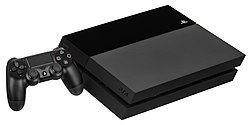
 The original PlayStation 4 console with the DualShock 4 controller | |
| Developer | Sony Interactive Entertainment |
|---|---|
| Manufacturer | Sony Electronics, Foxconn[1] |
| Product family | PlayStation |
| Type | Home video game console |
| Generation | Eighth |
| Release date | |
| Introductory price | |
| Discontinued |
|
| Units sold | >113.5 million (as of September 30, 2020[update])[6] |
| Units shipped | 117.2 million (as of March 31, 2022[update])[7] |
| Media | |
| Operating system | PlayStation 4 system software |
| System on a chip | AMD APU |
| CPU | AMD Jaguar, 8-core @ 1.6 GHz (2.13 GHz on PS4 Pro)[8] Secondary low power processor (for background tasks)[9] |
| Memory | |
| Storage | 500 GB, 1 TB or 2 TB HDD[10] |
| Display | |
| Graphics | |
| Controller input | DualShock 4, PlayStation Move, PlayStation Vita |
| Camera | PlayStation Camera |
| Connectivity |
|
| Online services | |
| Dimensions |
|
| Weight |
|
| Best-selling game | Marvel's Spider-Man (20 million) |
| Predecessor | PlayStation 3 |
| Successor | PlayStation 5 |
| Website | playstation |
The PlayStation 4 (PS4) is a home video game console developed by Sony Interactive Entertainment. Announced as the successor to the PlayStation 3 in February 2013, it was launched on November 15, 2013, in North America, November 29, 2013, in Europe, South America, and Australia, and on February 22, 2014, in Japan. A console of the eighth generation, it competes with Microsoft's Xbox One and Nintendo's Wii U and Switch.
Moving away from the more complex Cell microarchitecture of its predecessor, the console features an APU from AMD built upon the x86-64 architecture, which can theoretically peak at 1.84 teraflops; AMD stated that it was the "most powerful" APU it had developed to date. The PlayStation 4 places an increased emphasis on social interaction and integration with other devices and services, including the ability to play games off-console on PlayStation Vita and other supported devices ("Remote Play"), the ability to stream gameplay online or to friends, with them controlling gameplay remotely ("Share Play"). The console's controller was also redesigned and improved over the PlayStation 3, with updated buttons and analog sticks, and an integrated touchpad among other changes. The console also supports HDR10 high-dynamic-range video and playback of 4K resolution multimedia.
The PlayStation 4 was released to critical acclaim, with critics praising Sony for acknowledging its consumers' needs, embracing independent game development, and for not imposing the restrictive digital rights management schemes like those originally announced by Microsoft for the Xbox One. Critics and third-party studios, before its launch, also praised the capabilities of the PlayStation 4 in comparison to its competitors. Heightened demand also helped Sony top global console sales. In September 2016, the console was refreshed with a new, smaller revision, popularly referred to as the "Slim" model, as well as a high-end version called the PlayStation 4 Pro, which features an upgraded GPU and a higher CPU clock rate to support enhanced performance and 4K resolution in supported games. By October 2019, PS4 had become the second best-selling PlayStation console of all time, behind the PlayStation 2. Its successor, the PlayStation 5, was released in November 2020; the PS4 continues to be produced as of 2025.[11]
History
[edit].jpg)
According to lead architect Mark Cerny, the development of Sony's fourth video game console began as early as 2008.[12][13]
Less than two years earlier, the PlayStation 3 had been launched after months of delays due to issues with production.[14] The delay placed Sony almost a year behind Microsoft's Xbox 360, which was already approaching unit sales of 10 million by the time the PS3 launched.[14] Sony Computer Entertainment Europe CEO Jim Ryan said Sony wanted to avoid repeating the same mistake with PS3's successor.[15]
In designing the system, Sony worked with software developer Bungie, who offered their input on the controller and how to make it better for shooting games.[16] In 2012, Sony began shipping development kits to game developers, consisting of a modified PC running the AMD Accelerated Processing Unit chipset.[17] These development kits were known as "Orbis".[18][19]
In early 2013, Sony announced that an event known as PlayStation Meeting 2013 would be held in New York City, U.S., on February 20, 2013, to cover the "future of PlayStation".[20][21] Sony officially announced the PlayStation 4 at the event.[22][23] It revealed details about the console's hardware and discussed some of the new features it would introduce.[22][24] Sony also showed off real-time footage of games in development, as well as some technical demonstrations.[25][26] The design of the console was unveiled in June at E3 2013, and the initial recommended retail prices of $399 (NA), €399 (Europe), and £349 (UK) given.[27][28] Sony took advantage of problems that Microsoft had been having with their positioning of their newly announced Xbox One, which included its higher price point ($499 in North America), as well as strict regulations on how users could share game media. Besides its lower price point, Sony focused on the ease one would have in sharing media with the PS4.[29]
The company revealed release dates for North America, Central America, South America, Europe, and Australia, as well as final pieces of information, at a Gamescom press event in Cologne, Germany, on August 20, 2013. The console was released on November 15, 2013, in the United States and Canada, followed by further releases on November 29, 2013.[2] By the end of 2013, the PS4 was launched in more European, Asian and South American countries.[30][31] The PS4 was released in Japan at ¥39,980 on February 22, 2014.[32]
Sony finalized a deal with the Chinese government in May 2014 to sell its products in mainland China, and the PS4 was the first product to be released. Kazuo Hirai, chief executive officer of Sony, said in May: "The Chinese market, just given the size of it, is obviously potentially a very large market for video game products ... I think that we will be able to replicate the kind of success we have had with PS4 in other parts of the world in China."[33]
In September 2015, Sony reduced the price of the PS4 in Japan to ¥34,980,[34] with similar price drops in other Southeast Asian markets.[35] The first official sub-£300 PS4 bundle was the £299.99 "Uncharted Nathan Drake Collection 500GB", and was released in the UK on October 9, 2015; a 1 TB £329.99 version was offered at the same time.[36] On October 9, 2015, the first official price cut of the PS4 in North America was announced: a reduction of $50 to $349.99 (US) and by $20 to $429.99 (Canada).[37][38][39] An official price cut in Europe followed in late October 2015, reduced to €349.99/£299.99.[40]
On June 10, 2016, Sony confirmed that a hardware revision of the PlayStation 4, rumored to be codenamed "Neo", was under development. The new revision was revealed to be a higher-end model meant to support gameplay in 4K. This new model was sold alongside the existing model, and all existing software was compatible between the two models.[41] Layden stated that Sony has no plans to "bifurcate the market", only that gamers playing on the Neo will "have the same experience, but one will be delivered at a higher resolution, with an enhanced graphical experience, but everything else is going to be exactly as you'd expect".[42] The high-end console was publicly revealed on September 7, 2016, as PlayStation 4 Pro.[43] At the same time, Sony unveiled an updated version of the original PS4 model with a smaller form factor.[44]
In May 2018, during a presentation to investors, Sony Interactive Entertainment CEO John Kodera stated that the PlayStation 4 was heading into the end of its lifecycle and that the company was anticipating decreasing year-over-year hardware sales.[45] He explained that Sony would be countering the expected decline by focusing on "strengthen[ing] user engagement" including continued investments into new first-party games and other online services for PS4. "We will use the next three years to prepare the next step, to crouch down so that we can jump higher in the future," Kodera added in an interview with the press the following day.[46]
Following the launch of the PlayStation 5 in November 2020, Sony discontinued production in Japan of all but the 500 GB Slim model of the PlayStation 4 on January 5, 2021, with the standard PS4 and PS4 Pro still being produced for western markets.[47] According to a report from Bloomberg News in January 2022, Sony had been poised to discontinue the PlayStation 4 at the end of 2021 in favor of the PlayStation 5, but due to a global chip shortage that lasted from 2020 to 2023, this made it difficult for Sony to keep up with PlayStation 5 demand. Instead, the company planned to continue PlayStation 4 production; besides helping to offset the PlayStation 5 shortage, this production method would help assure deals with its component providers for the PlayStation 5.[48]
Hardware
[edit]The technology in the PlayStation 4 is similar to the hardware found in modern personal computers.[49] This familiarity is designed to make it easier and less expensive for game studios to develop games for the PS4.[50][51]
Technical specifications
[edit]"[We] have not built an APU quite like that for anyone else in the market. It is by far the most powerful APU we have built to date". (February 2013)
The PlayStation 4 uses an Accelerated Processing Unit (APU) developed by AMD in cooperation with Sony. It combines a central processing unit (CPU) and graphics processing unit (GPU), as well as other components such as a memory controller and video decoder.[53] The CPU consists of two 28 nm quad-core Jaguar modules totaling 8 64-bit x86-64 cores,[53][54] 7 of which are available for game developers to use.[55] The GPU consists of 18 compute units to produce a theoretical peak performance of 1.84 TFLOPS.[26] The system's GDDR5 memory is capable of running at a maximum clock frequency of 2.75 GHz (5500 MT/s) and has a maximum memory bandwidth of 176 GB/s.[26][56][57] The console contains 8 GB of GDDR5 memory,[26][58] 16 times the amount of RAM found in the PS3 and is expected to give the console considerable longevity.[49][59] It also includes secondary custom chips that handle tasks associated with downloading, uploading, and social gameplay.[60][61] These tasks can be handled in the background during gameplay or while the system is in sleep mode.[62] The console also contains an audio module, which can support in-game chat as well as "a very large number" of audio streams for use in-game.[63] All PlayStation 4 models support high dynamic range (HDR) color profiles.[64]
Its read-only optical drive is capable of reading Blu-ray Discs at speeds of up to three times that of its predecessor.[59][65] The console features a hardware on-the-fly zlib decompression module.[63] The original PS4 model supports up to 1080p and 1080i video standards,[66] while the Pro model supports 4K resolution.[67] The console includes a 500 gigabyte hard drive for additional storage,[68] which can be upgraded by the user.[69] System Software 4.50, which was released on March 9, 2017,[70] enabled the use of external USB hard drives up to 8 TB for additional storage.[71]
The PlayStation 4 features Wi-Fi and Ethernet connectivity, Bluetooth, and two USB 3.0 ports.[26][59] An auxiliary port is also included for connection to the PlayStation Camera, a motion detection digital camera device first introduced on the PS3.[26] A mono headset, which can be plugged into the DualShock 4, is bundled with the system.[72] Audio/video output options include HDMI TV and optical S/PDIF audio.[26] The console does not have an analog audio/video output.[73]
The PS4 features a "Rest mode" feature. This places the console in a low-power state while allowing users to immediately resume their game or app once the console is awoken. The console also is able to download content such as game and OS updates while it is in this state.[74][75]
Controllers
[edit]
The DualShock 4 is PlayStation 4's primary controller; it maintains a similar design to previous iterations of the DualShock series, but with additional features and design refinements.[76] Among other tweaks, the caps of the analog sticks were given a concave design (similar to the Xbox 360 controller), the shape of the triggers and shoulder buttons was refined, the D-pad buttons were given a steeper downward angle to provide a resting space in the center for the user's thumb,[76][77] and the hand grips were made thicker and given microtexturing to improve their feel.[76][77]
A major addition to the DualShock 4 is a touchpad; it is capable of detecting up to two simultaneous touch presses, and can also be pressed down as a button.[76] The "Start" and "Select" buttons were replaced by "Options" and "Share" buttons; the latter is designed to allow access to the PlayStation 4's social features (including streaming, video recording, and screenshot tools).[76][78] The DualShock 4 is powered by a non-removable, rechargeable lithium-ion battery, which can be charged using its micro USB connector. The controller also features an internal speaker, and a headphone jack for headsets or headphones; the console is bundled with a pair of headset earbuds.[79][80][76]
The controller's motion tracking system is more sensitive than those of the PlayStation 3's controllers. An LED "light bar" was additionally added to the front of the controller; it is designed to allow the PlayStation Camera accessory to further track its motion, but can also be used to provide visual effects and feedback within games (such as, for instance, reflecting a player's low health by turning red).[81][79][78][82]
Although the PS4 and DualShock 4 continue to use Bluetooth for wireless connectivity, the console is incompatible with PlayStation 3 controllers.[83] An exception are the PlayStation Move motion controllers originally released for PS3, which are officially supported for use with the PlayStation Camera.[79][84] In October 2013, Shuhei Yoshida stated on Twitter that the DualShock 4 would support "basic functions" when attached to a PC.[85] In August 2016, Sony unveiled an official USB wireless adapter for the DualShock 4, enabling use of all of the controller's functionality on PC.[86] In December 2016, Valve's Steam platform was updated to provide support and controller customization functionality for DualShock 4, through existing APIs for the Steam Controller.[87][88]
A revision of the DualShock 4 was released alongside the "Slim" and Pro models in 2016, and is bundled with these systems. It is largely identical to the original model, except that the touchpad now contains a "stripe" along the top which the light bar's LED can shine through, and the controller can communicate non-wirelessly when connected to the console over USB.[89]
Camera
[edit]
The PlayStation Camera is an optional motion sensor and camera for the PlayStation 4, similar to Kinect on Xbox. It includes two 1280×800 pixel lenses operating with an aperture of f/2.0, with 30 cm focusing distance, and an 85° field of view.[72] The dual camera setup allows for different modes of operation, depending on the initiated and running application.[90] The two cameras can be used together for depth-sensing of its surrounding objects in its field of vision.[91] Alternatively, one of the cameras can be used for generating the video image, with the other used for motion tracking.[92]
PlayStation Camera also features a four-channel microphone array, which helps reduce unwanted background noise and can be used for voice commands.[90] With the PlayStation Camera connected, different users can automatically log-on to the system via face detection.[72]
PlayStation VR
[edit]
PlayStation VR is a virtual reality system for PlayStation 4; it consists of a headset, which features a 1080p display panel, LED lights on the headset that are used by PlayStation Camera to track its motion, and a control box that processes 3D audio effects, as well as video output to the external display (either simulcasting the player's VR perspective, or providing an asymmetrical secondary perspective). PlayStation VR can also be used with PlayStation Move motion controllers.[93][94]
Software and services
[edit]PlayStation 4 system software
[edit]The PlayStation 4's operating system is called "Orbis OS", based upon a customized FreeBSD 9.[95][96][97][98]
The console does not require an Internet connection for usage, although more functionality is available when connected.[99]
The console introduces a customizable menu interface, the "PlayStation Dynamic Menu", featuring a variety of color schemes.[75] The interface displays the player's profile, recent activity, notifications, and other details in addition to unlocked trophies.[100] It allows multiple user accounts, all with their own pass-codes. Each player account has the option to share their real name with friends, or use a nickname in other situations when anonymity is important. Facebook profiles can be connected to PlayStation Network accounts, making it easier to recognize friends.[101] The default home screen features real time content from friends. The "What's New" activity feed includes shared media, recently played games, and other notifications.[26] Services from third-party vendors, such as Netflix and Amazon Prime Video, can be accessed within the interface.[102] Multitasking is available during gameplay, such as opening the browser or managing party chat, and switching between applications is done by double-tapping the "PS" button.[26]
The PlayStation Camera or a microphone enables the user to control the system using voice input. Players can command the interface to start a game, take screenshots, and save videos. Saying "PlayStation" initiates voice control, and "All Commands" displays a list of possible commands.[103]
Multimedia features
[edit]The PlayStation 4 supports Blu-ray and DVD playback, including 3D Blu-ray. The playing of CD is no longer supported,[104] as the console no longer has an infrared 780 nm laser. Custom music and video files can still be played from USB drives and DLNA servers using the Media Player app.[105]
PlayStation Network
[edit]The PlayStation 4 allows users to access a variety of free and premium PlayStation Network (PSN) services, including the PlayStation Store, PlayStation Plus subscription service, PlayStation Music powered by Spotify, and the PlayStation Video subscription service, which allows owners to rent or buy TV shows and films à la carte.[26] A United States-exclusive cloud-based television-on-demand service known as PlayStation Vue began beta testing in late November 2014.[106][107] Sony intends to expand and evolve the services it offers over the console's lifespan.[108] Unlike PS3, a PlayStation Plus membership is required to access multiplayer in most games; this requirement does not apply to free-to-play or subscription-based games.[109]
Second screen and remote play
[edit]
Smartphones and tablets can interact with the PlayStation 4 as second screen devices, and can also wake the console from sleep mode.[110] A Sony Xperia smartphone, tablet or the PlayStation Vita can be used for streaming gameplay from the console to handheld, allowing supported games to be played remotely from around a household or away from home.[111][112] Sony has ambitions to make all PS4 games playable on PlayStation Vita.[26] Developers can add Vita-specific controls for use via Remote Play.[113] This feature was later expanded to enable PS4 Remote Play functionality on Microsoft Windows PCs and on Apple OS X Macs. The update, released in April 2016, allows for Remote Play functionality on computers running Windows 8.1, Windows 10, OS X Yosemite, and OS X El Capitan. Remote Play supports resolution options of 360p, 540p, and 720p (1080p is available on PS4 Pro), frame rate options of 30–60 FPS, and the DualShock 4 can be connected via USB.[114]
The PlayStation App allows iOS and Android mobile devices to interact with the PlayStation 4 from their device. The user can use this application to purchase PS4 games from the console and have them remotely downloaded, watch live streams of other gamers and view in-game maps while playing games.[115]
Social features
[edit]"Ustream's integration within PS4 consoles will put gamers on a new media field. They will have the ability to direct, produce, and star in their own video game production, simply by being an awesome (or not so awesome!) gamer."
Sony focused on "social" aspects as a major feature of the console. Although the PS4 has improved social functionality, the features are optional and can be disabled.[108]
Community creation
[edit]Users have the option to create or join community groups based on personal interest. Communities include a discussion board, accomplishments and game clips shared by other members, plus the ability to join group chat and launch cooperative games. Sony stated that "communities are a good way to socialize with like-minded players", particularly when "you want to tackle a big multiplayer raid, but don't have enough friends available."[117] Sony has officially stated that starting April 2021, the community system of the PlayStation Network will be discontinued. This, however, will not prevent users from communicating with their friends in private messaging or in group chats on the PlayStation Network.[118]
Media sharing
[edit]The DualShock 4 controller includes a "SHARE" button, allowing the player to cycle through the last 60 minutes of recorded gameplay to select a screenshot or video clip appropriate for sharing. Media is uploaded seamlessly from the console to other PSN users or social networking sites such as Dailymotion, Facebook, Twitter and YouTube, or else users can copy media to a USB flash drive and upload to a social network or website of their preference.[119] Players can also use a free video editing application named ShareFactory to cut and assemble their favorite video clips and add custom music or voice commentary with green screen effects. Subsequent updates have added options for picture-in-picture layouts, the ability to create photo collages and animated GIFs.[120][121]
Live streaming
[edit]Gamers can either watch live gameplay of games which their friends are playing through the PS4 interface with cross-game camera and microphone input, spectate silently, or broadcast their own gameplay live via DailyMotion, Twitch,[122] Ustream,[26] Niconico,[123] or YouTube Gaming,[117] allowing for friends and members of the public to view and comment upon them from other web browsers and devices. If a user is not screen-casting, a friend can send them a "Request to Watch" notification.[117]
Share Play
[edit]Share Play allows users to invite an online friend to join their play session via streaming, even if they do not own a copy of the game. Users can pass control of the game entirely to the remote user or partake in cooperative multiplayer as if they were physically present. Mark Cerny says that remote assistance is particularly useful when confronted by a potentially game-defeating obstacle. "You can even see that your friend is in trouble and reach out through the network to take over the controller and assist them through some difficult portion of the game," he said. Share Play requires a PlayStation Plus subscription and can only be used for one hour at a time.[124][125]
Games
[edit]Each PlayStation 4 console comes preinstalled with The Playroom, a game designed to server as demonstration of the DualShock 4 controller and the PlayStation Camera. The PlayStation Camera accessory is required to play The Playroom. If a camera is not present, a trailer for The Playroom will be displayed instead of the full game.[126]
PlayStation 4 games are distributed at retail on Blu-ray Disc, and digitally as downloads through the PlayStation Store.[127] Games are not region-locked, so games purchased in one region can be played on consoles in all regions,[128] and players can sign-on to any PS4 console to access their entire digital game library.[129] All PlayStation 4 games must be installed to the console's storage.[130] Additionally a system called "PlayGo" allows users to begin to play portions of a game (such as opening levels) once the installation or download reaches a specific point, while the remainder of the game is downloaded or installed in the background. Updates to games and system software are also downloaded in the background and while in standby.[63] PS4 users will, in the future, be able to browse games and stream games via Gaikai to demo them almost instantaneously.[26][131] Sony says it is committed to releasing an ever-increasing number of free-to-play games, including PlanetSide 2 and War Thunder.[132][133] Sony also took steps to make it easier for independent game developers to release games for the PS4 by giving them the option to self-publish their own games rather than rely upon others to distribute their games.[134][135]
Backward compatibility
[edit]PlayStation 4 is not compatible with any disc of older PlayStation consoles.[136][137] Emulated versions of selected PlayStation, PlayStation 2 and PlayStation Portable games are available for purchase via PlayStation Store, which are upscaled to high definition and have support for PS4 social features.[136][138]
PlayStation Now
[edit]In December 2013, Andrew House indicated that Sony was planning to launch a cloud gaming service for the PS4 in North America within the third quarter of 2014, with a European launch to follow in 2015.[139][140]
At Consumer Electronics Show on January 7, 2014, Sony unveiled PlayStation Now, a digital distribution service which will initially allow users to access PlayStation 3 games on the PS4 via a cloud-based streaming system, purchasing games individually or via a subscription, as a solution of no backward compatibility on the hardware of the console.[141] The United States Open Beta went live on July 31, 2014.[142] The official United States release of the service was on January 13, 2015.[143] As of March 2015[update] PlayStation Now was in closed beta in the United Kingdom.[144]
PlayLink
[edit]At E3 2017, Sony revealed the "PlayLink" line of games, which let players control the game with their mobile devices and PlayLink companion apps.[145] The apps would release on November 21 that same year and would include games such as Knowledge is Power, That's You, Hidden Agenda, SingStar Celebration, and Planet of the Apes: Last Frontier.[146] On November 14, 2018, more games would be released, including Just Deal With It, Chimparty, WordHunters, UNO, Melbits World, Ticket To Ride, and Knowledge is Power: Decades.[147] In 2019, the delayed release of Erica made no mention of the PlayLink initiative, when it was planned with PlayLink functionality at the 2017 Paris Games Week event.[148] It would be confirmed by Sony in 2020 that PS4 PlayLink titles would be backwards-compatible with the PlayStation 5.[149] Since 2021, many of the PlayLink companion apps have been delisted from the Apple App Store and Google Play, such as Uno.[citation needed] On December 14, 2023, companion apps for Chimparty, Frantics, Hidden Agenda, Knowledge is Power, Knowledge is Power: Decades, and That's You were no longer downloadable for new Google Play users with devices above Android 9 or 11 due to compatibility issues, with iOS users being unaffected.[150] There are other PlayLink applications that have been published outside of PlayStation, including by Ubisoft for Battleship.[151]
Release
[edit]Critical reception
[edit]Pre-release
[edit]"It's abundantly clear that PS4 is being driven as a collaboration between East and West, as opposed to a dictation from one side to the other. Developers are fully involved, activated, discussed and doing really cool collaborative things."
Pre-release reception to the console from developers and journalists was positive. Mark Rein of Epic Games praised the "enhanced" architecture of Sony's system, describing it as "a phenomenal piece of hardware".[152] John Carmack, programmer and co-founder of id Software, also commended the design by saying "Sony made wise engineering choices",[153] while Randy Pitchford of Gearbox Software expressed satisfaction with the amount of high-speed memory in the console.[154] Eurogamer also called the graphics technology in the PS4 "impressive" and an improvement from the difficulties developers experienced on the PlayStation 3.[59]
Numerous industry professionals have acknowledged the PlayStation 4's performance advantage over the Xbox One. Speaking to Edge magazine, multiple game developers have described the difference as "significant" and "obvious".[155] ExtremeTech says the PS4's graphics processing unit offers a "serious advantage" over the competition, but due to the nature of cross-platform development, games that share the same assets will appear "very similar". In other scenarios, designers may tap some of PS4's additional power in a straightforward manner, to boost frame rate or output at a higher resolution, whereas games from Sony's own first-party studios that take full advantage of the hardware "will probably look significantly better than anything on the Xbox One."[156]
In response to concerns surrounding the possibility of DRM measures to hinder the resale of used games (and in particular, the initial DRM policies of Xbox One, which did contain such restrictions), Jack Tretton explicitly stated during Sony's E3 press conference that there would be "no restrictions" on the resale and trading of PS4 games on physical media, while software product development head Scott Rohde specified that Sony was planning to disallow online passes as well, going on to say that the policies were designed to be "consumer-friendly, extremely retailer-friendly, and extremely publisher-friendly".[157][158] After Sony's E3 2013 press conference, IGN responded positively to Sony's attitude towards indie developers and trading games, stating they thought "most gamers would agree" that "if you care about games like [Sony] do, you'll buy a PlayStation 4".[159] PlayStation 4's removable and upgradable hard drive also drew praise from IGN,[160] with Scott Lowe commenting that the decision gave the console "another advantage" over the Xbox One, whose hard drive cannot be accessed.[161]
GameSpot called the PlayStation 4 "the gamer's choice for next-generation", citing its price, lack of restrictive digital rights management, and most importantly, Sony's efforts to "acknowledge its consumers" and "respect its audience" as major factors.[162]
Post-release
[edit]The PlayStation 4 has received very positive reviews by critics. Scott Lowe of IGN gave it an 8.2 rating out of 10 praising the console's DualShock 4 design and social integration features. He criticized the console's lack of software features and for underutilizing the DualShock 4's touch pad.[163] The Gadget Show gave a similar review complimenting the DualShock 4's new triggers and control sticks, in addition to the new Remote Play feature, yet criticized the system's lack of media support at launch.[164] IGN compared the Xbox One and the PlayStation 4 over various categories, allowing their readers to vote for their preferred system. The PS4 won every category offered, and IGN awarded the PS4 with their People's Choice Award.[165]
Shortly following the launch, it became apparent that some games released on multiple platforms were available in higher resolutions on the PS4 as opposed to other video game consoles. Kirk Hamilton of Kotaku reported on the differences in early games such as Call of Duty: Ghosts and Assassin's Creed IV: Black Flag which ran at 1080p on the PS4, but in 720p and 900p, respectively, on the Xbox One.[166]
Sales
[edit]| Region | Lifetime sell-through by region | Lifetime sell-through by country |
|---|---|---|
| North America | 30M | United States 30M (as of September 2019[update])[167][168] |
| Europe | ~24M | Germany 7.2M (as of September 2019[update]);[167][168] United Kingdom 6.8M (as of September 2019[update]);[167][168] France ~6M (as of September 2019[update]);[168] Italy ~3M (as of December 2018[update]);[169] Spain 700K (as of June 17, 2015[update]);[170] Portugal 100K (as of May 4, 2015[update])[171] |
| Asia | +10M | Japan 8.3M (as of September 2019[update]);[167][168] China ~1.5M (as of August 2, 2018[update]);[172] India ~250,000 (as of March 2018[update])[173] |
| Others | 200,000 | Mexico, Brazil, Argentina ~150,000 (as of December 2014[update]);[174] South Africa 50,000 (as of December 12, 2014[update])[175] |
| Worldwide | 106.0M (as of December 31, 2019)[176] | |
Demand for PlayStation 4 was strong. In August 2013, Sony announced the placement of over a million preorders for the console,[177] while on the North American launch alone, one million PlayStation 4 consoles were sold.[178] In the UK, the PlayStation 4 became the best-selling console at launch, with the sale of 250,000 consoles within a 48-hour period[179] and 530,000 in the first five weeks.[180]
On January 7, 2014, Andrew House announced in his Consumer Electronics Show keynote speech that 4.2 million PS4 units had been sold-through by the end of 2013,[181] with more than 9.7 million software units sold.[182] On February 18, 2014, Sony announced that, as of February 8, it had sold over 5.3 million console units following the release of the PS4 onto the North American and Western/Central European markets.[183][184] Within the first two days of release in Japan during the weekend of February 22, 2014, 322,083 consoles were sold.[185] PS4 software unit sales surpassed 20.5 million on April 13, 2014.[186] During Japan's 2013 fiscal year, heightened demand for the PS4 helped Sony top global console sales, beating Nintendo for the first time in eight years.[187]
According to data released by Nielsen in August 2014, nine months after the PS4 was released, thirty-one percent of its sales were to existing Wii and Xbox 360 owners, none of whom had by then owned a PS3.[188] At Gamescom 2014, it was announced that 10 million PS4 units had been sold-through to consumers worldwide,[189] and on November 13, it was announced that the PlayStation 4 was the top-selling console in the U.S. for the tenth consecutive month.[190]
In its first sales announcement of 2015, Sony confirmed on January 4 that it had sold-through 18.5 million PlayStation 4 units.[191] Sony updated the sell-through figures for the system throughout 2015: over 20 million consoles as of March 3, 2015[update],[192] over 30 million as of November 22, 2015[update],[193] and over 35 million by the end of 2015.[194] As of May 22, 2016, total worldwide sell-through reached 40 million.[195] As of December 2018, over 91 million consoles and more than 876 million PlayStation 4 games have been sold worldwide. By October 2019, the PS4 had sold 102.8 million times, making it the second best-selling video game console of all time, behind the PlayStation 2.[196]
The PlayStation 4 holds a market share of at least 70% within all European countries, as of June 2015[update].[197]
| Lifetime worldwide hardware sell-through | Lifetime worldwide software sell-through | Tie ratio |
|---|---|---|
| 1.0M (as of November 16, 2013)[198] | — | — |
| 2.1M (as of December 1, 2013)[199] | — | — |
| 4.2M (as of December 28, 2013)[200] | 9.7M (as of December 28, 2013) | 2.31 games/console |
| 5.3M (as of February 8, 2014)[201] | — | — |
| 6.0M (as of March 2, 2014)[202] | 13.7M (as of March 2, 2014) | 2.28 games/console |
| 7.0M (as of April 6, 2014)[203] | 20.5M (as of April 13, 2014) | 2.93 games/console |
| 10.0M (as of August 10, 2014)[204] | 30.0M (as of August 10, 2014) | 3.00 games/console |
| 14.4M (as of November 22, 2014)[205] | 64.0M (as of November 22, 2014) | 4.44 games/console |
| 18.5M (as of January 4, 2015)[205] | 81.8M (as of January 4, 2015) | 4.42 games/console |
| 20.2M (as of March 1, 2015)[206] | — | — |
| 30.2M (as of November 22, 2015)[207] | — | — |
| 35.9M (as of January 3, 2016)[208] | — | — |
| 40.0M (as of May 22, 2016)[195] | 270.9M (as of May 22, 2016) | 6.77 games/console |
| 50.0M (as of December 6, 2016)[209] | 369.6M (as of December 4, 2016) | 7.39 games/console |
| 53.4M (as of January 1, 2017)[194] | 401.1M (as of January 1, 2017)[210] | 7.51 games/console |
| 60.4M (as of June 11, 2017)[211] | 487.8M (as of June 11, 2017) | 8.08 games/console |
| 70.6M (as of December 3, 2017)[212] | 617.8M (as of December 3, 2017) | 8.75 games/console |
| 73.6M (as of December 31, 2017)[213] | 645.0M (as of December 31, 2017) | 8.76 games/console |
| — | 777.9M (as of June 30, 2018)[214] | — |
| 81.2M (as of July 22, 2018)[215] | — | — |
| 86.0M (as of November 18, 2018)[216] | 825.3M (as of November 18, 2018)[216] | 9.59 games/console |
| 91.6M (as of December 31, 2018)[216] | 924.0M (as of December 31, 2018)[216][217] | 10.09 games/console |
| 106.0M (as of December 31, 2019)[176] | 1.181B (as of December 31, 2019)[176][217] | 11.14 games/console |
| Worldwide hardware shipments | Worldwide hardware shipments (including returned and refurbished consoles) | ||
|---|---|---|---|
| Quarterly[218] | Lifetime | Quarterly[219] | Lifetime |
| 4.5M (Launch – December 31, 2013) | 4.5M (as of December 31, 2013) | 4.5M (Launch – December 31, 2013) | 4.5M (as of December 31, 2013) |
| 3.0M (January 1, 2014 – March 31, 2014) | 7.5M (as of March 31, 2014) | 3.1M (January 1, 2014 – March 31, 2014) | 7.6M (as of March 31, 2014) |
| 2.7M (April 1, 2014 – June 30, 2014) | 10.2M (as of June 30, 2014) | 2.8M (April 1, 2014 – June 30, 2014) | 10.4M (as of June 30, 2014) |
| 3.3M (July 1, 2014 – September 30, 2014) | 13.5M (as of September 30, 2014) | 3.4M (July 1, 2014 – September 30, 2014) | 13.8M (as of September 30, 2014) |
| 6.4M (October 1, 2014 – December 31, 2014) | 19.9M (as of December 31, 2014) | 6.4M (October 1, 2014 – December 31, 2014) | 20.2M (as of December 31, 2014) |
| 2.4M (January 1, 2015 – March 31, 2015) | 22.3M (as of March 31, 2015) | 2.3M (January 1, 2015 – March 31, 2015) | 22.5M (as of March 31, 2015) |
| 3.0M (April 1, 2015 – June 30, 2015) | 25.3M (as of June 30, 2015) | 2.9M (April 1, 2015 – June 30, 2015) | 25.4M (as of June 30, 2015) |
| 4.0M (July 1, 2015 – September 30, 2015) | 29.3M (as of September 30, 2015) | 4.0M (July 1, 2015 – September 30, 2015) | 29.4M (as of September 30, 2015) |
| 8.4M (October 1, 2015 – December 31, 2015) | 37.7M (as of December 31, 2015) | 8.4M (October 1, 2015 – December 31, 2015) | 37.8M (as of December 31, 2015) |
| 2.3M (January 1, 2016 – March 31, 2016) | 40.0M (as of March 31, 2016) | 2.4M (January 1, 2016 – March 31, 2016) | 40.2M (as of March 31, 2016) |
| 3.5M (April 1, 2016 – June 30, 2016) | 43.5M (as of June 30, 2016) | 3.5M (April 1, 2016 – June 30, 2016) | 43.7M (as of June 30, 2016) |
| 3.9M (July 1, 2016 – September 30, 2016) | 47.4M (as of September 30, 2016) | 3.9M (July 1, 2016 – September 30, 2016) | 47.6M (as of September 30, 2016) |
| 9.7M (October 1, 2016 – December 31, 2016) | 57.1M (as of December 31, 2016) | 9.7M (October 1, 2016 – December 31, 2016) | 57.3M (as of December 31, 2016) |
| 2.9M (January 1, 2017 – March 31, 2017) | 60.0M (as of March 31, 2017) | 2.9M (January 1, 2017 – March 31, 2017) | 60.2M (as of March 31, 2017) |
| 3.3M (April 1, 2017 – June 30, 2017) | 63.3M (as of June 30, 2017) | 3.3M (April 1, 2017 – June 30, 2017) | 63.5M (as of June 30, 2017) |
| 4.2M (July 1, 2017 – September 30, 2017) | 67.5M (as of September 30, 2017) | 4.2M (July 1, 2017 – September 30, 2017) | 67.7M (as of September 30, 2017) |
| 9.0M (October 1, 2017 – December 31, 2017) | 76.5M (as of December 31, 2017) | 9.0M (October 1, 2017 – December 31, 2017) | 76.7M (as of December 31, 2017) |
| 2.5M (January 1, 2018 – March 31, 2018) | 79.0M (as of March 31, 2018) | 2.5M (January 1, 2018 – March 31, 2018) | 79.2M (as of March 31, 2018) |
| 3.2M (April 1, 2018 – June 30, 2018) | 82.2M (as of June 30, 2018) | 3.2M (April 1, 2018 – June 30, 2018) | 82.4M (as of June 30, 2018) |
| 3.9M (July 1, 2018 – September 30, 2018) | 86.1M (as of September 30, 2018) | 3.9M (July 1, 2018 – September 30, 2018) | 86.3M (as of September 30, 2018) |
| 8.1M (October 1, 2018 – December 31, 2018) | 94.2M (as of December 31, 2018) | 8.1M (October 1, 2018 – December 31, 2018) | 94.4M (as of December 31, 2018) |
| 2.6M (January 1, 2019 – March 31, 2019) | 96.8M (as of March 31, 2019) | 2.6M (January 1, 2019 – March 31, 2019) | 97.0M (as of March 31, 2019) |
| 3.2M (April 1, 2019 – June 30, 2019) | 100.0M (as of June 30, 2019) | 3.2M (April 1, 2019 – June 30, 2019) | 100.2M (as of June 30, 2019) |
| 2.8M (July 1, 2019 – September 30, 2019) | 102.8M (as of September 30, 2019) | 2.8M (July 1, 2019 – September 30, 2019) | 103.0M (as of September 30, 2019) |
| 6.1M (October 1, 2019 – December 31, 2019) | 108.9M (as of December 31, 2019) | 6.0M (October 1, 2019 – December 31, 2019) | 109.0M (as of December 31, 2019) |
| 1.5M (January 1, 2020 – March 31, 2020) | 110.4M (as of March 31, 2020) | 1.4M (January 1, 2020 – March 31, 2020) | 110.4M (as of March 31, 2020) |
| 1.9M (April 1, 2020 – June 30, 2020) | 112.3M (as of June 30, 2020) | ||
| 1.5M (July 1, 2020 – September 30, 2020) | 113.8M (as of September 30, 2020) | ||
| 1.4M (October 1, 2020 – December 31, 2020) | 115.2M (as of December 31, 2020) | ||
| 1.0M (January 1, 2021 – March 31, 2021) | 116.2M (as of March 31, 2021) | ||
| 0.5M (April 1, 2021 – June 30, 2021) | 116.7M (as of June 30, 2021) | ||
| 0.2M (July 1, 2021 – September 30, 2021) | 116.9M (as of September 30, 2021) | ||
| 0.2M (October 1, 2021 – December 31, 2021) | 117.1M (as of December 31, 2021) | ||
| 0.1M (January 1, 2022 – March 31, 2022) | 117.2M (as of March 31, 2022) | ||
| Worldwide full game software shipments[220][198][214][221][222][223][224] | |||
|---|---|---|---|
| Quarterly | Yearly | Tie ratio | Digital download ratio |
| 36.7M (April 1, 2016 – June 30, 2016) | 10.49 games/console | ||
| 50.1M (July 1, 2016 – September 30, 2016) | 12.85 games/console | ||
| 80.5M (October 1, 2016 – December 31, 2016) | 8.30 games/console | ||
| 50.6M (January 1, 2017 – March 31, 2017) | 17.45 games/console | ||
| 217.9M (April 1, 2016 – March 31, 2017) | 10.90 games/console | 27% | |
| 38.7M (April 1, 2017 – June 30, 2017) | 11.73 games/console | 39% | |
| 69.7M (July 1, 2017 – September 30, 2017) | 16.60 games/console | 27% | |
| 86.5M (October 1, 2017 – December 31, 2017) | 9.61 games/console | 28% | |
| 52.0M (January 1, 2018 – March 31, 2018) | 20.80 games/console | 43% | |
| 246.9M (April 1, 2017 – March 31, 2018) | 12.99 games/console | 32% | |
| 40.6M (April 1, 2018 – June 30, 2018) | 12.69 games/console | 43% | |
| 75.1M (July 1, 2018 – September 30, 2018) | 19.26 games/console | 28% | |
| 87.2M (October 1, 2018 – December 31, 2018) | 10.77 games/console | 37% | |
| 54.7M (January 1, 2019 – March 31, 2019) | 21.04 games/console | 45% | |
| 257.6M (April 1, 2018 – March 31, 2019) | 14.47 games/console | 37% | |
| 42.9M (April 1, 2019 – June 30, 2019) | 13.41 games/console | 53% | |
| 61.3M (July 1, 2019 – September 30, 2019) | 21.89 games/console | 37% | |
| 81.1M (October 1, 2019 – December 31, 2019) | 13.30 games/console | 49% | |
| 59.6M (January 1, 2020 – March 31, 2020) | 39.73 games/console | 66% | |
| 245.0M (April 1, 2019 – March 31, 2020) | 18.01 games/console | 51% | |
| Worldwide total software unit sales (including download-only, bundled, and PS VR titles)[218][225] | |||||
|---|---|---|---|---|---|
| Quarterly | Yearly | Tie ratio | First party | First party ratio | Digital download ratio |
| 39.9M (April 1, 2016 – June 30, 2016) | 11.40 games/console | ||||
| 54.0M (July 1, 2016 – September 30, 2016) | 13.85 games/console | ||||
| 85.5M (October 1, 2016 – December 31, 2016) | 8.81 games/console | ||||
| 54.9M (January 1, 2017 – March 31, 2017) | 18.93 games/console | ||||
| 234.2M (April 1, 2016 – March 31, 2017) | 11.71 games/console | 27% | |||
| 45.9M (April 1, 2017 – June 30, 2017) | 13.91 games/console | 39% | |||
| 76.1M (July 1, 2017 – September 30, 2017) | 18.12 games/console | 27% | |||
| 92.8M (October 1, 2017 – December 31, 2017) | 10.31 games/console | 28% | |||
| 59.4M (January 1, 2018 – March 31, 2018) | 23.76 games/console | 43% | |||
| 274.2M (April 1, 2017 – March 31, 2018) | 14.43 games/console | 32% | |||
| 47.7M (April 1, 2018 – June 30, 2018) | 14.91 games/console | 43% | |||
| 82.3M (July 1, 2018 – September 30, 2018) | 21.10 games/console | 28% | |||
| 95.6M (October 1, 2018 – December 31, 2018) | 11.80 games/console | 37% | |||
| 62.3M (January 1, 2019 – March 31, 2019) | 23.96 games/console | 45% | |||
| 287.9M (April 1, 2018 – March 31, 2019) | 16.17 games/console | 50.6M | 18% | 37% | |
| 49.8M (April 1, 2019 – June 30, 2019) | 15.56 games/console | 11.7M | 23% | 53% | |
| 70.6M (July 1, 2019 – September 30, 2019) | 25.21 games/console | 6.3M | 9% | 37% | |
| 83.3M (October 1, 2019 – December 31, 2019) | 13.88 games/console | 16.3M | 20% | 49% | |
| 64.9M (January 1, 2020 – March 31, 2020) | 46.36 games/console | 9.1M | 14% | 66% | |
| 268.7M (April 1, 2019 – March 31, 2020) | 19.90 games/console | 43.3M | 16% | 51% | |
| 91.0M (April 1, 2020 – June 30, 2020) | 47.89 games/console | 18.5M | 20% | 74% | |
| PlayStation Plus subscribers[198][214][221][222][223] | Monthly active users[225] |
|---|---|
| 20.8M (as of March 31, 2016) | |
| 26.4M (as of March 31, 2017) | |
| 27.0M (as of June 30, 2017) | |
| 28.1M (as of September 30, 2017) | |
| 31.5M (as of December 31, 2017) | |
| 34.2M (as of March 31, 2018) | |
| 33.9M (as of June 30, 2018) | |
| 34.3M (as of September 30, 2018) | |
| 36.3M (as of December 31, 2018) | |
| 36.4M (as of March 31, 2019) | |
| 36.2M (as of June 30, 2019) | |
| 36.9M (as of September 30, 2019) | |
| 38.8M (as of December 31, 2019) | |
| 41.5M (as of March 31, 2020) | |
| 44.9M (as of June 30, 2020) | |
| 47.6M (as of March 31, 2021) | 113M (as of March, 2021) |
Hardware revisions
[edit]
The PlayStation 4 has been produced in various models: the original, the Slim, and the Pro. Successive models have added or removed various features, and each model has variations of Limited Edition consoles.
PlayStation 4 Slim
[edit]
On September 7, 2016, Sony announced a hardware revision of the PlayStation 4, model number CUH-2000, known colloquially as the PlayStation 4 Slim, which phased out the original model.[226] It is a revision of the original PS4 hardware with a smaller form factor; it has a rounded body with a matte finish on the top of the console rather than a two-tone finish, and is 40% smaller in size than the original model. The two USB ports on the front have been updated to the newer USB 3.1 standard and have a larger gap between them, and the optical audio port was removed.[227] This model also features support for USB 3.1, Bluetooth 4.0 and 5.0 GHz Wi-Fi.[228]
It was released on September 15, 2016, with a 500 GB model at the same price as the original version of the PlayStation 4.[44] On April 18, 2017, Sony announced that it had replaced this base model with a 1 TB version at the same MSRP.[229]
PlayStation 4 Pro
[edit]
The PlayStation 4 Pro (codenamed Neo, model number CUH-7000)[41] was announced on September 7, 2016, and launched worldwide on November 10, 2016.[230][231] It is an upgraded version of the PlayStation 4 with improved hardware to enable 4K rendering and improved PlayStation VR performance, including an upgraded GPU with 4.2 teraflops of processing power[232][233][234] and hardware support for checkerboard rendering,[235] and a higher CPU clock. As with PS4 "Slim", this model also features support for USB 3.1, Bluetooth 4.0 and 5.0 GHz Wi-Fi.[228] The PS4 Pro also includes 1 GB of DDR3 memory that is used to swap out non-gaming applications that run in the background, allowing games to utilize an additional 512 MB of the console's GDDR5 memory.[236] Although capable of streaming 4K video, the PS4 Pro does not support Ultra HD Blu-ray.[237][238][239] The Pro model has a release price of $399 (NA), €399 (Europe), and £349 (UK).[228]
Games marketed by Sony as PS4 Pro Enhanced have specific optimizations when played on this model, such as 4K resolution graphics or higher performance.[240] For games not specifically optimized, an option known as "Boost Mode" was added on system software 4.5, which can be enabled to force higher CPU and GPU clock rates to possibly improve performance.[241]
.jpg)
Rendering games at 4K resolution is achieved through various rendering techniques and hardware features; PlayStation technical chief Mark Cerny explained that Sony could not "brute force" 4K without compromising form factor and cost, so the console was designed to support "streamlined rendering techniques" using custom hardware, "best-in-breed temporal and spatial anti-aliasing algorithms", and "many new features from the AMD Polaris architecture as well as several even beyond it". The most prominent technique used is checkerboard rendering, wherein the console only renders portions of a scene using a checkerboard pattern, and then uses algorithms to fill in the non-rendered segments. The checkerboarded screen can then be smoothed using an anti-aliasing filter. Hermen Hulst of Guerrilla Games explained that PS4 Pro could render something "perceptively so close [to 4K] that you wouldn't be able to see the difference".[242][243][244]
PS4 Pro supports Remote Play, Share Play, and streaming at up to 1080p resolution at 60 frames per second, as well as capturing screenshots at 2160p, and 1080p video at 30 frames per second.[245]
In late 2017, Sony issued a new PS4 Pro revision (model number CUH-7100) that featured updated internal components. The actual hardware specifications and performance remained the same as the original model, although it was found that the revised console has a slightly quieter fan profile than the original and as a result was operating at a slightly higher temperature under load than the CUH-7000.[246][247] In October 2018, Sony quietly issued another revision (model number CUH-7200), initially as part of Red Dead Redemption 2 hardware bundles. The revision has a different power supply which uses the same type of cord as the "Slim" model, and was shown to have further improvements to acoustics.[248]
Notes
[edit]References
[edit]- ^ Mishkin, Sarah (November 13, 2013). "Foxconn profits beat expectations". Financial Times. Archived from the original on November 14, 2013. Retrieved November 19, 2013.
- ^ a b c O'Brien, Terrence (August 20, 2013). "PlayStation 4 hitting shelves on November 15th in the US for $399, November 29th in Europe". Engadget. AOL. Archived from the original on August 20, 2013. Retrieved August 20, 2013.
- ^ Phillips, Tom (September 9, 2013). "PlayStation 4 won't launch in Japan until February 2014". Eurogamer. Eurogamer Network. Archived from the original on September 9, 2013. Retrieved September 9, 2013.
- ^ "PS4 驚くべきゲームとノンストップのエンタテインメント". PlayStation. Archived from the original on March 29, 2024. Retrieved September 26, 2024.
- ^ Batchelor, James (January 5, 2021). "PS4 Pro and most other models discontinued in Japan". GamesIndustry.biz. Gamer Network Limited. Archived from the original on December 25, 2022. Retrieved May 8, 2025.
- ^ "Business Data & Sales". Sony Interactive Entertainment. Retrieved March 8, 2025.
- ^ "PS5 shipments top 19.3 million; PS4 tops 117.2 million". Gematsu. May 10, 2022. Archived from the original on November 21, 2022. Retrieved May 15, 2022.
- ^ Anthony, Sebastian (November 22, 2013). "Comparison of Xbox One and the Playstation 4". ExtremeTech. Archived from the original on June 7, 2013. Retrieved December 11, 2013.
- ^ a b "PlayStation 4 iFixit Teardown". iFixit. November 15, 2013. Archived from the original on January 22, 2014. Retrieved January 17, 2014.
- ^ Lempel, Eric (August 9, 2018). "Introducing the 500 Million Limited Edition PS4 Pro, Commemorating 500 Million Systems Sold". PlayStation.Blog. Sony Interactive Entertainment. Archived from the original on July 16, 2020. Retrieved July 15, 2020.
- ^ "Sony still produces the PlayStation 4, the reason is known". Telegrafi. Archived from the original on December 30, 2024. Retrieved May 8, 2025.
- ^ Goldfarb, Andrew (February 20, 2013). "PlayStation 4 Revealed". IGN. Ziff Davis. Archived from the original on February 24, 2013. Retrieved February 21, 2013.
- ^ Purchese, Robert (March 27, 2013). "PS4 architect knew in 2007 that "clearly we had some issues with PlayStation 3"". Eurogamer. Archived from the original on October 10, 2018. Retrieved October 9, 2018.
- ^ a b "PlayStation 3 sells out at launch". BBC News. November 11, 2006. Archived from the original on January 8, 2007. Retrieved February 22, 2013.
- ^ Minkley, Johnny (November 23, 2011). "Sony: it would be "undesirable" for PS4 to launch significantly later than the competition". Eurogamer. Eurogamer Network. Archived from the original on November 25, 2011. Retrieved February 21, 2013.
- ^ Rougeau, Michael (June 19, 2014). "Destiny developer Bungie and Sony have been in bed longer than you think". Techradar. Archived from the original on June 20, 2014. Retrieved June 20, 2014.
- ^ Garratt, Patrick (November 2, 2012). "PS4: new kits shipping now, AMD A10 used as base". VG247. Archived from the original on November 3, 2012. Retrieved February 22, 2013.
- ^ Karmali, Luke (December 11, 2012). "Report: Xbox 720 And PS4 Codenames And Details". IGN. Ziff Davis. Archived from the original on January 15, 2013. Retrieved May 21, 2013.
- ^ "PS4 Details and Specifications released". ebloggy. February 20, 2013. Archived from the original on February 24, 2013. Retrieved February 21, 2013.
- ^ Arthur, Charles (February 1, 2013). "PlayStation 4 rumours fly as Sony invitations hint at release". The Guardian. Archived from the original on December 11, 2013. Retrieved September 14, 2013.
- ^ "Videogame industry's brightest minds convene in New York as part of Sony Computer Entertainment's introduction of PlayStation 4" (Press release). Sony Computer Entertainment, Inc. February 20, 2013. Archived from the original on April 24, 2013. Retrieved February 21, 2013.
- ^ a b Bishop, Bryan (February 20, 2013). "Sony announces the PlayStation 4". The Verge. Archived from the original on December 7, 2013. Retrieved February 20, 2013.
- ^ Rivington, James (February 20, 2013). "The PlayStation 4 has been officially revealed in New York!". TechRadar. Archived from the original on April 26, 2013. Retrieved February 21, 2013.
- ^ Gilbert, Ben (February 20, 2013). "Sony unveils its next game console, the PlayStation 4". Engadget. AOL. Archived from the original on February 21, 2013. Retrieved February 20, 2013.
- ^ Stark, Chelsea (February 22, 2013). "PlayStation 4 Gets Early Support From Publishers and Developers". Mashable. Archived from the original on February 24, 2013. Retrieved February 25, 2013.
- ^ a b c d e f g h i j k l m "Sony Computer Entertainment Inc. Introduces PlayStation 4 (PS4)" (Press release). Sony Computer Entertainment, Inc. February 21, 2013. Archived from the original on April 24, 2013. Retrieved February 25, 2013.
- ^ Kelion, Leo (June 11, 2013). "E3: PlayStation 4 console priced cheaper than Xbox One". BBC News. Archived from the original on May 23, 2014. Retrieved June 11, 2013.
- ^ "Playstation 4 (Ps4) Design and Price Unveiled" (PDF) (Press release). Sony Computer Entertainment, Inc. Archived from the original (PDF) on June 13, 2013. Retrieved June 11, 2013.
- ^ Dornbrush, Jonathan (January 17, 2021). "The (Mostly) Complete History of the PS4". IGN. Archived from the original on August 18, 2021. Retrieved January 17, 2021.
- ^ Leandre, Kenn (September 18, 2013). "PlayStation 4 Asia Launch Date Announced". IGN Asia. IGN Entertainment. Archived from the original on January 5, 2014. Retrieved December 13, 2013.
- ^ Johnson, Luke (December 13, 2013). "PS4 Release Date: PlayStation 4 hits 16 more countries". Trusted Reviews. Archived from the original on October 22, 2013. Retrieved February 19, 2014.
- ^ Sarkar, Samit (February 21, 2014), "Sony launches PS4 in Japan", Polygon, archived from the original on September 24, 2015, retrieved September 22, 2015
- ^ "Sony's Playstation to make China debut". The Telegraph. May 26, 2014. Archived from the original on December 13, 2014. Retrieved December 12, 2014.
- ^ Vincent, James (September 15, 2015). "Sony announces PS4 price drop in Japan". The Verge. Archived from the original on February 21, 2017. Retrieved July 28, 2017.
- ^ Barker, Sammy (September 16, 2015). "TGS 2015: PS4's Price Drop Extends to Asia As Well". Push Square. Archived from the original on September 19, 2015. Retrieved July 28, 2015.
- ^ Purchese, Robert (September 18, 2015), "Uncharted Nathan Drake Collection 500GB & 1TB PS4 bundles for Europe", Eurogamer, archived from the original on September 25, 2015, retrieved September 22, 2015
- ^ Barker, Sammy (October 8, 2015), "PS4's Price Officially Drops to $349.99 in USA Starting Friday", Push Square, archived from the original on October 9, 2015, retrieved October 8, 2015
- ^ Koller, John (October 8, 2015), "PS4: Big Holiday Lineup, Lower Cost", blog.us.playstation.com, archived from the original on October 9, 2015, retrieved October 8, 2015
- ^ Sarkar, Samit (October 8, 2015), "Sony cutting PS4 price to $349.99", Polygon, archived from the original on October 8, 2015, retrieved October 8, 2015
- ^ Barker, Sammy (October 21, 2015), "PS4's Price Cut Down to Size in the UK", Push Square, archived from the original on October 22, 2015, retrieved October 21, 2015
- ^ a b Alexander, Julia (June 10, 2016). "Sony confirms new, high-end PlayStation 4". Polygon. Archived from the original on June 11, 2016. Retrieved June 10, 2016.
- ^ Peckham, Matt (June 14, 2016). "We Asked Sony's Gaming Chief About the Future of PlayStation". Time. Archived from the original on June 16, 2016. Retrieved June 17, 2016.
- ^ Webster, Andrew (September 7, 2016). "Sony announces PlayStation 4 Pro with 4K HDR gaming for $399". The Verge. Archived from the original on September 7, 2016. Retrieved September 7, 2016.
- ^ a b "PS4 Slim: A smaller, sexier console with surprisingly few compromises". Ars Technica. September 7, 2016. Archived from the original on September 7, 2016. Retrieved September 7, 2016.
- ^ "PS4 heading into end of its life cycle, PlayStation CEO says". Polygon. Archived from the original on May 22, 2018. Retrieved May 23, 2018.
- ^ "The next PlayStation is at least three years away". Polygon. Archived from the original on May 23, 2018. Retrieved May 23, 2018.
- ^ Robinson, Andy (January 5, 2021). "Sony Japan confirms PS4 Pro and 'all but one' PS4 model have been discontinued". Video Games Chronicle. Archived from the original on January 5, 2021. Retrieved January 5, 2021.
- ^ Mochizuki, Takashi; Wu, Debby (January 12, 2022). "Sony Is Dealing With PlayStation 5 Shortage by Making More PS4s". Bloomberg News. Archived from the original on January 13, 2022. Retrieved January 13, 2022.
- ^ a b Yin-Poole, Wesley (February 22, 2013). "PS4: PC-like architecture, 8GB RAM delight developers". Eurogamer. Eurogamer Network. Archived from the original on March 2, 2013. Retrieved February 25, 2013.
- ^ Purchese, Robert (February 22, 2013). "Five analysts, one consensus: PlayStation 4 impressed". Eurogamer. Eurogamer Network. Archived from the original on March 2, 2013. Retrieved February 25, 2013.
- ^ Crossley, Rob (February 22, 2013). "Sony promises indie-friendly PSN: 'We believe in smaller devs'". Computer and Video Games. Archived from the original on May 26, 2013. Retrieved February 25, 2013.
- ^ Parfitt, Ben (February 28, 2013). "AMD says PS4's APU is "by far the most powerful" it has ever built". MCV. Archived from the original on April 3, 2015. Retrieved February 28, 2013.
- ^ a b Taylor, John (February 21, 2013). "AMD and The Sony PS4. Allow Me To Elaborate". AMD. Archived from the original on May 26, 2013. Retrieved February 25, 2013.
- ^ Shimpi, Anand Lal (May 23, 2013). "AMD's Jaguar Architecture: The CPU Powering Xbox One, PlayStation 4, Kabini & Temash". AnandTech. Archived from the original on December 11, 2013. Retrieved November 9, 2013.
- ^ Leadbetter, Richard (November 30, 2015). "Sony unlocks more CPU power for PS4 game developers". Eurogamer. Archived from the original on January 4, 2016. Retrieved August 23, 2018.
- ^ Sinha, Ravi (July 16, 2013). "PlayStation 4 FCC Filing Reveals 2.75 GHz Max Clock Speed Frequency". GamingBolt. Archived from the original on August 26, 2013. Retrieved September 12, 2013.
- ^ Santos, Alexis (July 22, 2013). "Sony PlayStation 4 waltzes past the FCC". Engadget. AOL. Archived from the original on July 25, 2013. Retrieved September 11, 2013.
- ^ Femmel, Kevin (February 20, 2013). "Sony reveals the PS4: New controller, 8GB RAM, doesn't play PS3 discs and more". Gimme Gimme Games. Archived from the original on March 16, 2013. Retrieved February 21, 2013.
- ^ a b c d Leadbetter, Richard (February 21, 2013). "Spec Analysis: PlayStation 4". Eurogamer. Eurogamer Network. Archived from the original on April 19, 2013. Retrieved February 25, 2013.
- ^ Conditt, Jessica (February 20, 2013). "PS4 allows playing games as they're downloading". Joystiq. AOL. Archived from the original on February 21, 2013. Retrieved February 24, 2013.
- ^ Williams, Mike (February 20, 2013). "Articles Register Sony reveals developer-centric PlayStation 4". Joystiq. AOL. Archived from the original on April 19, 2013. Retrieved February 24, 2013.
- ^ Seifert, Dan (February 20, 2013). "Sony PlayStation 4 games can be played while they are downloading". The Verge. Archived from the original on April 18, 2013. Retrieved February 24, 2013.
- ^ a b c Nutt, Christian (April 24, 2013). "Inside the PlayStation 4 with Mark Cerny". Gamasutra. p. 3. Archived from the original on May 10, 2013.
- ^ "Sony will wake a sleeping HDR beast via firmware. What else hides in PS4?". Ars Technica. September 8, 2016. Archived from the original on September 8, 2016. Retrieved September 8, 2016.
- ^ Kuchera, Ben (January 17, 2007). "Is Blu-ray really a good medium for games?". Ars Technica. Archived from the original on December 1, 2012. Retrieved February 25, 2013.
- ^ Shuman, Sid (October 30, 2013). "PS4: The Ultimate FAQ – North America". PlayStation Blog. Archived from the original on October 31, 2013. Retrieved December 15, 2020.
- ^ "PS4 Pro: 4K and HDR guide". Playstation.com. Archived from the original on December 19, 2020. Retrieved December 15, 2020.
- ^ "PlayStation 4 (PS4) Design and Price Unveiled, Available at $399 in U.S. and at €399 in Europe" (PDF) (Press release). Sony Computer Entertainment, Inc. June 11, 2013. Archived from the original (PDF) on June 13, 2013. Retrieved June 11, 2013.
- ^ "Sony's PlayStation 4 Eye is a $59 add-on, PS4 packs an upgradable 500GB HDD inside". Engadget. AOL. June 10, 2013. Archived from the original on September 2, 2013. Retrieved June 10, 2013.
- ^ "PS4 Update 4.50 Now Out, Full Patch Notes Released". PlayStation LifeStyle. March 9, 2017. Archived from the original on April 3, 2017. Retrieved April 2, 2017.
- ^ Gartenberg, Chaim (February 3, 2017). "The PS4 will support external hard drives in upcoming update". The Verge. Archived from the original on February 3, 2017. Retrieved February 3, 2017.
- ^ a b c "SONY COMPUTER ENTERTAINMENT INTRODUCES WIRELESS CONTROLLER FOR PLAYSTATION 4 (DUALSHOCK 4) AND PLAYSTATION 4 EYE" (Press release). Sony Computer Entertainment. February 21, 2013. Archived from the original on April 10, 2014. Retrieved February 26, 2013.
- ^ Brunner, Grant (June 18, 2013). "Sony issues correction: PS4 will not support analog output [Updated]". ExtremeTech. Ziff Davis. Archived from the original on July 8, 2014. Retrieved June 20, 2013.
- ^ Spencer (February 20, 2013). "Jump Back Into A Game With PlayStation 4's Suspend Mode, No Save Point Necessary". Siliconera. Archived from the original on June 16, 2014. Retrieved September 13, 2013.
- ^ a b Pearson, Rob (July 12, 2013). "20 things you didn't know about PS4". PlayStation Blog. Sony Computer Entertainment, Inc. Archived from the original on July 3, 2014. Retrieved July 12, 2013.
- ^ a b c d e f "The PlayStation 4 controller: A close look at the touchpad, light bar, design, and everything else". ventureBeat. October 24, 2013. Archived from the original on June 8, 2017. Retrieved October 18, 2017.
- ^ a b "The PlayStation 4 controller: What's new with the analog sticks and D-pad". VentureBeat. October 22, 2013. Archived from the original on October 18, 2017. Retrieved October 18, 2017.
- ^ a b McWhertor, Michael (January 31, 2013). "PS4 touch-sensitive DualShock 4 controller revealed (update: features, scale detailed)". Polygon. Archived from the original on February 23, 2013. Retrieved February 21, 2013.
- ^ a b c MacManus, Christopher (February 21, 2013). "Finer details about PlayStation 4's DualShock 4 controller, Eye camera". CNET. Archived from the original on May 30, 2013. Retrieved February 21, 2013.
- ^ Sarkar, Samit (June 11, 2013). "PlayStation 4: What's in the box". Polygon. Archived from the original on October 18, 2017. Retrieved October 18, 2017.
- ^ "Hands-on with Sony's PlayStation 4 and DualShock controller". The Verge. Archived from the original on October 18, 2017. Retrieved October 18, 2017.
- ^ "All of the Lights: Many curious uses for the PS4 light bar". Engadget. Archived from the original on October 18, 2017. Retrieved October 18, 2017.
- ^ Hinkle, David. "Yoshida: DualShock 3 won't work with PS4". Joystiq. AOL. Archived from the original on February 22, 2013. Retrieved February 21, 2013.
- ^ Gilbert, Ben (February 20, 2013). "The PlayStation 4 supports the PlayStation Move controller". Engadget. AOL. Archived from the original on February 21, 2013. Retrieved February 21, 2013.
- ^ "PlayStation 4 Controller is PC-Compatible 'for Basic Functions'". Kotaku. October 6, 2013. Archived from the original on December 11, 2013. Retrieved October 6, 2013.
- ^ "Sony reveals DualShock 4 wireless adapter for PCs". PCWorld. Archived from the original on August 14, 2017. Retrieved October 18, 2017.
- ^ "Steam adds support for Sony's DualShock 4 PlayStation controller". PCWorld. Archived from the original on December 15, 2017. Retrieved October 18, 2017.
- ^ Williams, Mike (January 6, 2017). "Steam Beta Adds Native Support for Xbox One, Xbox 360 and Generic Controllers". USgamer. Archived from the original on October 18, 2017. Retrieved October 18, 2017.
- ^ Crecente, Brian (September 8, 2016). "Peer into the soulful glow of the DualShock 4's extra lightbar". Polygon. Vox Media. Archived from the original on October 21, 2016. Retrieved October 20, 2016.
- ^ a b MacGregor, Kyle (February 21, 2013). "PlayStation 4 Eye: Applications of PS4's twin cameras". Destructoid. Archived from the original on May 30, 2013. Retrieved February 21, 2013.
- ^ Scullion, Chris (February 21, 2013). "Eye spy: Has Sony found its answer to Kinect?". Computer and Video Games. Archived from the original on May 30, 2013. Retrieved February 21, 2013.
- ^ Conditt, Jessica. "PS4 Eye has two cameras: One to watch you, one to make you pretty". Joystiq. AOL. Archived from the original on May 8, 2013. Retrieved February 21, 2013.
- ^ Sarkar, Samit (March 16, 2016). "PlayStation VR's processing unit doesn't add any power to the PS4". Polygon. Archived from the original on July 29, 2017. Retrieved October 29, 2017.
- ^ "PlayStation VR review". TechRadar. Archived from the original on August 30, 2016. Retrieved October 29, 2017.
- ^ "Open Source Software used in PlayStation 4". Scei.co.jp. Archived from the original on November 17, 2013. Retrieved January 2, 2014.
- ^ "Details about Playstation 4 OS development". VGLeaks 3.0. June 20, 2013. Archived from the original on December 2, 2022. Retrieved January 26, 2023.
- ^ Larabel, Michael (June 23, 2013). "Sony's PlayStation 4 Is Running Modified FreeBSD 9". Phoronix. Archived from the original on June 24, 2013. Retrieved September 14, 2013.
- ^ Humphries, Matthew (June 24, 2013). "PS4 runs modified version of the FreeBSD 9.0 operating system". Geek.com. Archived from the original on March 28, 2014. Retrieved January 10, 2014.
- ^ Hurley, Leon (March 20, 2013). "Michael Denny on PS4's philosophy". Official PlayStation Magazine. Archived from the original on June 1, 2013. Retrieved June 1, 2013.
- ^ Shah, Niraj (February 22, 2013). "PlayStation 4 will support trophies". XTreme PS3. Archived from the original on May 26, 2013. Retrieved February 22, 2013.
- ^ Anna Peel. Facebook Inc (FB) Integrates With PS4 For Gamers Identity Archived December 30, 2014, at archive.today, ValueWalk, November 15, 2013.
- ^ Dyer, Mitch (February 20, 2013). "Netflix, Amazon Instant, More Coming to PlayStation 4". IGN. Ziff Davis. Archived from the original on April 15, 2013. Retrieved September 9, 2013.
- ^ Operating the system with your voice Archived October 28, 2014, at the Wayback Machine, manuals.playstation.net, October 28, 2014.
- ^ "Playing videos on discs". PlayStation 4 Users Guide. Sony Computer Entertainment, Inc. Archived from the original on December 26, 2013. Retrieved January 18, 2015.
- ^ "Media Player Coming to PS4 Tonight – PlayStation.Blog". June 16, 2015. Archived from the original on June 16, 2015. Retrieved November 10, 2018.
- ^ "Cloud-based TV service PlayStation Vue announced". Gematsu. November 13, 2014. Archived from the original on January 18, 2015. Retrieved February 5, 2015.
- ^ Snider, Mike (November 13, 2014). "Sony previews upcoming PlayStation Vue cloud TV service". USA Today. Archived from the original on February 9, 2015. Retrieved February 5, 2015.
- ^ a b Bramwell, Tom (February 21, 2013). "The big interview: Sony's Shuhei Yoshida on PS4". Eurogamer. Eurogamer Network. Archived from the original on April 19, 2013. Retrieved February 25, 2013.
- ^ PS4 online multiplayer requirements Archived February 1, 2015, at archive.today, support.us.playstation.com, November 3, 2014.
- ^ Conditt, Jessica (February 21, 2013). "PS4 doesn't require an always-on internet connection". Joystiq. AOL. Archived from the original on May 30, 2013. Retrieved February 25, 2013.
- ^ Remote Play is available on the Xperia Z2 and Xperia Z3 series, as well as the Xperia Z4 tablet. High speed internet connection required.
- ^ Loveridge, Sam (September 4, 2014). "Sony Xperia Z3 Remote Play: How to play PS4 games on your phone". Trusted Reviews. Archived from the original on September 4, 2014. Retrieved September 4, 2014.
- ^ Gilbert, Ben (February 21, 2013). "The DualShock 4 is 'near final' hardware, Remote Play is more than an afterthought, and other notes from Shuhei Yoshida". Engadget. AOL. Archived from the original on February 22, 2013. Retrieved February 25, 2013.
- ^ Saed, Sherif (April 5, 2016). "PlayStation 4 firmware update 3.50 out tomorrow – full details". VG24/7. Archived from the original on April 5, 2016. Retrieved April 5, 2016.
- ^ McCormick, Rich (November 13, 2013). "PlayStation app now available on Android and iOS devices". The Verge. Archived from the original on September 5, 2015. Retrieved September 4, 2015.
- ^ Moriarty, Colin (February 28, 2013). "Ustream on Consoles Not Exclusive to PS4". IGN. Archived from the original on July 14, 2015. Retrieved July 10, 2015.
- ^ a b c Adam Westlake. PS4's software update 3.00 beta launches, new features detailed Archived September 5, 2015, at the Wayback Machine, slashgear.com, September 2, 2015.
- ^ Yin-Poole, Wesley (March 15, 2021). "PS4 communities feature shuts down in April, Sony confirms". Eurogamer. Archived from the original on March 15, 2021. Retrieved March 15, 2021.
- ^ Leon Hurley. Upcoming PS4 update to remove HDCP & let you save Shares to USB Archived August 27, 2014, at the Wayback Machine PlayStation Magazine, March 19, 2014.
- ^ Stuart Platt. New Update for Sharefactory: Track 2, Green Screen and More Archived November 18, 2016, at the Wayback Machine, blog.playstation.com, June 1, 2016.
- ^ Stuart Platt. Sharefactory Update 2.0 Out Today Archived November 18, 2016, at the Wayback Machine, blog.playstation.com, November 9, 2016.
- ^ "Twitch Confirmed for PlayStation 4". Twitch. August 20, 2013. Archived from the original on January 2, 2014. Retrieved September 14, 2013.
- ^ Niconico Live Streaming Support Available on PS4 Archived July 1, 2017, at the Wayback Machine shoryuken.com, April 16, 2004.
- ^ "Reminder: Playroom Will Be Pre-installed On Every PlayStation 4". IGN. August 20, 2013. Archived from the original on August 23, 2013. Retrieved September 2, 2013.
- ^ Prescott, Shaun. "Sony: every PS4 title will be available as digital download". Computer and Video Games. Archived from the original on May 28, 2013. Retrieved February 25, 2013.
- ^ Smith, Mat (September 14, 2013). "The PS4 won't be region-locked". Engadget. AOL. Archived from the original on June 15, 2013. Retrieved June 11, 2013.
- ^ Hurley, Leon (July 10, 2013). "PS4's digital library lets you play your games anywhere & on anyone's console". Official PlayStation Magazine. Archived from the original on July 23, 2014. Retrieved September 14, 2013.
- ^ Totilo, Stephen (November 11, 2013). "How Mandatory Game Installations Will Work On PS4". Kotaku. Archived from the original on July 28, 2020. Retrieved May 12, 2020.
- ^ Jackson, Mike (February 20, 2013). "Gaikai tech brings spectating, instant demos, more to PS4". Computer and Video Games. Archived from the original on May 9, 2013. Retrieved February 25, 2013.
- ^ Chris Wright. Sony's commitment to free-to-play may be a masterstroke Archived September 23, 2015, at the Wayback Machine, Develop, July 16, 2014.
- ^ Shaikh Sehran. 10 Upcoming Free To Play PS4 Games Releasing in 2014/2015 Archived December 26, 2014, at the Wayback Machine, Gamepur, August 5, 2014.
- ^ Duhaime, Arielle (March 29, 2013). "PlayStation and indie games: a love story". The Verge. Archived from the original on January 31, 2014. Retrieved March 25, 2014.
- ^ Grubb, Jeffrey (June 10, 2013). "Sony will allow indie devs to publish their own games on PlayStation 4". VentureBeat. Archived from the original on August 23, 2013. Retrieved June 13, 2013.
- ^ a b "PlayStation 2 games launch on PS4 tomorrow". Polygon. December 4, 2015. Archived from the original on December 6, 2015. Retrieved December 5, 2015.
- ^ "PlayStation still not considering backward compatibility for PS4". Polygon. June 17, 2015. Archived from the original on December 8, 2015. Retrieved December 5, 2015.
- ^ "PS1 Game Features for PS4, PS5 Revealed". gamerant.com. May 23, 2022. Archived from the original on November 11, 2022. Retrieved December 5, 2022.
- ^ "PS4's Gaikai game streaming service to launch in 2014, Microsoft mum on retaliation". ExtremeTech. December 3, 2013. Archived from the original on December 7, 2013. Retrieved December 8, 2013.
- ^ Orland, Kyle (December 3, 2013). "Report: Gaikai streaming coming to PS4 in third quarter of 2014". Ars Technica. Archived from the original on December 3, 2013. Retrieved December 8, 2013.
- ^ "Sony announces PlayStation Now, its cloud gaming service for TVs, consoles, and phones". The Verge. January 7, 2014. Archived from the original on January 7, 2014. Retrieved January 7, 2014.
- ^ "PlayStation Now Public Beta Starts Today on PS4 With 100+ Games; Check Out This Walkthrough Video". GameSpot. Archived from the original on April 23, 2015. Retrieved April 26, 2015.
- ^ Yin-Poole, Wesley (January 5, 2015). "North America Get a $15-a-Month PlayStation Now Subscription Service". Eurogamer. Archived from the original on June 21, 2015. Retrieved June 20, 2015.
- ^ Yin-Poole, Wesley (March 17, 2015). "PlayStation Now Closed Beta Begins This Spring in UK". Eurogamer. Archived from the original on June 21, 2015. Retrieved June 20, 2015.
- ^ Fingas, Jon (June 12, 2017). "Sony wants you to control PlayStation games on your phone". Engadget. Retrieved October 18, 2024.
- ^ Boxer, Steve (December 24, 2017). "PlayLink turns the PS4 into a Christmas party machine". Techradar. Retrieved October 18, 2024.
- ^ PlayStation Blog Staff (November 14, 2018). "Plan a fun family night in with these 6 new PlayLink games, out on PS4 today". PlayStation Blog. Retrieved October 18, 2024.
- ^ Wood, Chandler (August 19, 2019). "Daily Reaction: Does Erica Signal the Death of Sony's PlayLink Initiative?". PlayStation Lifestyle. Retrieved October 18, 2024.
- ^ Sullivan, Kean (October 19, 2020). "PS4 PlayLink Games Will Work on PS5". GameRant. Retrieved October 18, 2024.
- ^ PlayStation Mobile Inc. (December 14, 2023). "Frantics - Apps on Google Play". Google Play. Retrieved October 18, 2024.
- ^ Ubisoft Entertainment (March 17, 2019). "BATTLESHIP PlayLink - Apps on Google Play". Google Play. Retrieved March 7, 2025.
- ^ a b Robinson, Andy (April 2, 2013). "Interview: 'We're more Epic than we've ever been'". Computer and Video Games. Archived from the original on July 15, 2014. Retrieved September 14, 2013.
- ^ Lynch, David (February 21, 2013). "PS4: 'Sony Made Wise Choices' - Carmack". Nowgamer. Imagine Publishing. Archived from the original on May 1, 2014. Retrieved September 14, 2013.
- ^ Yin-Poole, Wesley (February 22, 2013). "PC-like architecture, 8GB RAM delight developers". Eurogamer. Eurogamer Network. Archived from the original on March 2, 2013. Retrieved September 14, 2013.
- ^ Long, Neil (September 13, 2013). "Power struggle: the real differences between PS4 and Xbox One performance". edge-online.com. Archived from the original on August 1, 2014. Retrieved September 2, 2014.
- ^ Sebastian Anthony. Xbox One vs. PS4: How the final hardware specs compare Archived April 11, 2015, at the Wayback Machine, ExtremeTech, November 22, 2013.
- ^ Nutt, Christian (June 11, 2013). "Further clarification on Sony's DRM policies: No more online pass". Gamasutra. Archived from the original on August 12, 2013. Retrieved June 12, 2013.
- ^ "Sony: No restrictions on preowned PlayStation 4 games". Gamasutra. June 10, 2013. Archived from the original on December 15, 2013. Retrieved December 8, 2013.
- ^ MacDonald, Keza (June 11, 2013). "E3 2013: Sony's Knock-Out Blow". IGN. Ziff Davis. Archived from the original on April 13, 2014. Retrieved June 11, 2013.
- ^ "Media Create Sales: Week 30, 2018 (Jul 23 - Jul 29)". ResetEra. Archived from the original on August 1, 2018. Retrieved August 2, 2018.
- ^ Lowe, Scott (June 11, 2013). "E3 2013: PlayStation 4 Hard Drive is Removable, Upgradable". IGN. Ziff Davis. Archived from the original on June 13, 2013. Retrieved June 11, 2013.
- ^ Gaston, Martin (June 11, 2013). "PlayStation 4 is the gamer's choice for next-gen". GameSpot. CBS Interactive. Archived from the original on June 15, 2013. Retrieved June 11, 2013.
- ^ "PS4 Review — IGN". November 13, 2013. Archived from the original on December 14, 2014. Retrieved January 13, 2014.
- ^ "Sony PlayStation 4 review by The Gadget Show". November 27, 2013. Archived from the original on January 14, 2014. Retrieved January 13, 2014.
- ^ "Xbox One vs PS4 - IGN Versus — IGN". January 16, 2014. Archived from the original on January 23, 2014. Retrieved January 23, 2014.
- ^ Hamilton, Kirk (December 3, 2013). "Why It Matters That PS4 Games Are Higher-Resolution Than Xbox One". Kotaku. Archived from the original on February 10, 2015. Retrieved February 10, 2015.
- ^ a b c d Ahmad, Daniel (September 15, 2019). "PS4, over 30 million consoles sold in the USA; followed by Japan, Germany and the UK". UK24 News. Niko Partners Market Intelligence. Archived from the original on February 21, 2022. Retrieved September 15, 2019.
- ^ a b c d e "PlayStation 4: Hat sich 7,2 Millionen Mal in Deutschland verkauft" [PlayStation 4: 7.2 million units sold in Germany]. 4Players.de (in German). September 15, 2019. Archived from the original on September 22, 2019. Retrieved September 16, 2019.
- ^ "PlayStation 4 è stata la console più venduta in Italia nel 2018" [PlayStation 4 was the best-selling console in Italy in 2018]. skytg24.it (in Italian). September 30, 2019. Archived from the original on December 28, 2021. Retrieved December 28, 2021.
Con 2,97 milioni di unità, la console più venduta in Italia è PlayStation 4. [With 2.97 million units, the best-selling console in Italy is PlayStation 4.]
- ^ "Sony ha vendido 700.000 PS4 y 600.000 PS Vita en España" [PSony has sold 700,000 PS4 and 600,000 PS Vita in Spain]. elotrolado.net (in Spanish). June 17, 2015. Archived from the original on August 20, 2019. Retrieved September 19, 2019.
- ^ "PS4 com mais de 100 mil unidades vendidas em Portugal" [PS4 with more than 100 thousand units sold in Portugal]. Eurogamer.pt (in Portuguese). May 4, 2015. Archived from the original on March 23, 2016. Retrieved August 5, 2020.
- ^ "SONY PLAYSTATION CHINAJOY 2018 PRESS CONFERENCE". Niko Partners. August 15, 2018. Archived from the original on August 18, 2018.
- ^ "Gaming Is Too Damn Expensive in India". gadgets.ndtv.com. March 5, 2018. Archived from the original on October 4, 2020. Retrieved August 5, 2020.
[...] PS4 at 250,000 units sold, and a mere 30,000 for the Xbox One.
- ^ "Xbox One sells better than PS4 in Latin America in 2014". Gearnuke.com. October 7, 2015. Archived from the original on September 19, 2020. Retrieved August 5, 2020.
In 2014 it's estimated that around 600,000 Xbox One's and PlayStation 4's were sold through to end users in Mexico, Brazil and Argentina with around 75% of those sales attributed to the Xbox One.
- ^ "How is the PlayStation 4 doing in South Africa?". lazygamer.net. December 12, 2014. Archived from the original on August 6, 2016. Retrieved July 17, 2016.
- ^ a b c "PlayStation Network Monthly Active Users Reaches 103 Million" (Press release). Sony. January 6, 2020. Archived from the original on January 13, 2020. Retrieved January 6, 2020.
- ^ Sherr, Ian (August 20, 2013). "Sony Says PlayStation 4 Launches Nov. 15". The Wall Street Journal. Archived from the original on August 20, 2013. Retrieved August 23, 2013.
- ^ Goldfarb, Andrew (November 17, 2013). "Sony sold 1 million PS4 consoles in 24 hours". IGN. Ziff Davis. Archived from the original on November 17, 2013. Retrieved November 17, 2013.
- ^ "PS4 beats Xbox One to become UK's fastest ever selling console". The Independent. December 2, 2013. Archived from the original on December 3, 2013. Retrieved December 2, 2013.
- ^ "PS4 outsold Xbox One by 166,000 consoles in UK last year". January 1, 2014. Archived from the original on January 2, 2014. Retrieved January 1, 2014.
- ^ Goldfarb, Andrew (January 7, 2014). "CES: PlayStation 4 Sales Pass 4.2 Million". IGN. Archived from the original on May 22, 2016. Retrieved January 7, 2014.
- ^ 2014-01-07, PlayStation 4 sales topped 4.2 million in 2013 Archived July 1, 2017, at the Wayback Machine, Gematsu
- ^ Byford, Sam (February 18, 2014). "Sony has sold over 5.3 million PlayStation 4 consoles worldwide". The Verge. Archived from the original on February 18, 2014. Retrieved February 18, 2014.
- ^ Lomas, Natasha (February 18, 2014). "Sony Beats Its PS4 Sales Target, With 5.3M Consoles Sold In 3-Months". TechCrunch. AOL Inc. Archived from the original on March 1, 2014. Retrieved February 19, 2014.
- ^ 2014-02-25, プレイステーション4が発売2日間で32万2083台を販売 Archived July 26, 2017, at the Wayback Machine, Famitsu
- ^ Romano, Sal (April 16, 2014). "PlayStation 4 sales top 7 million worldwide". gematsu.com. Archived from the original on April 21, 2014. Retrieved April 27, 2014.
- ^ "Sony tops game consoles for 1st time in 8 years". Nikkei Asian Review. June 7, 2014. Archived from the original on December 10, 2015. Retrieved December 8, 2015.
- ^ Eddie Makuch. PS4 Poaching Players From Microsoft, Nintendo Archived September 20, 2014, at the Wayback Machine, GameSpot, August 26, 2014.
- ^ Webster, Andrew (August 12, 2014). "Sony has sold 10 million PlayStation 4s". The Verge. Archived from the original on August 12, 2014. Retrieved August 12, 2014.
- ^ Haywald, Justin (November 13, 2014). "PS4 Tops Xbox One in October NPD, NBA 2K15 and Smash Bros. are Top Games". GameSpot. Archived from the original on November 16, 2014. Retrieved November 13, 2014.
- ^ Sony (April 30, 2015). "Consolidated Financial Results for the Fiscal Year Ended March 31, 2015" (PDF). Sony. Archived (PDF) from the original on May 13, 2015. Retrieved April 30, 2015.
- ^ Moser, Cassidee (March 3, 2015). "Sony's PlayStation 4 Sells Over 20.2 Million Units Worldwide". IGN. Archived from the original on July 12, 2017. Retrieved April 26, 2015.
- ^ Byford, Sam (November 25, 2015). "PlayStation 4 sales hit 30 million worldwide". The Verge. Archived from the original on November 25, 2015. Retrieved November 26, 2015.
- ^ a b "E3 2017: PS4 Sales Reach New Heights". GameSpot. June 12, 2017. Archived from the original on August 1, 2017. Retrieved August 1, 2017.
- ^ a b "PLAYSTATION 4 SALES SURPASS 40 MILLION UNITS WORLDWIDE". www.sie.com. Archived from the original on May 27, 2016. Retrieved May 26, 2016.
- ^ "Sony's PS4 is the second best-selling console of all time". Engadget. Archived from the original on August 6, 2020. Retrieved May 21, 2020.
- ^ "PlayStation 4 dominates Europe with '70-90%' of console market". VG247. June 30, 2015. Archived from the original on July 1, 2015. Retrieved June 30, 2015.
- ^ a b c "PlayStation 4 (PS4) Hardware and Software Unit Sales" (PDF). Sony Supplemental Information for the Consolidated Financial Results for the First Quarter Ended June 30, 2018. July 31, 2018. Archived (PDF) from the original on July 31, 2018.
- ^ "PLAYSTATION 4 (PS4) GLOBAL SALES SURPASS 2.1 MILLION UNITS FOLLOWING EUROPE, AUSTRALASIA AND LATIN AMERICA LAUNCH". www.sie.com. Archived from the original on July 1, 2016. Retrieved May 26, 2016.
- ^ "PLAYSTATION 4 (PS4) GLOBAL CUMULATIVE SALES SURPASS 4.2 MILLION". www.sie.com. Archived from the original on July 1, 2016. Retrieved May 26, 2016.
- ^ "PLAYSTATION 4 SALES SURPASS 5.3 MILLION UNITS WORLDWIDE". www.sie.com. Archived from the original on June 4, 2016. Retrieved May 26, 2016.
- ^ "PLAYSTATION 4 (PS4) SALES SURPASS 6.0 MILLION UNITS WORLDWIDE IN LESS THAN 4 MONTHS SINCE LAUNCH". www.sie.com. Archived from the original on July 1, 2016. Retrieved May 26, 2016.
- ^ "PLAYSTATION 4 (PS4) SALES SURPASS 7.0 MILLION UNITS WORLDWIDE". www.sie.com. Archived from the original on July 1, 2016. Retrieved May 26, 2016.
- ^ "PLAYSTATION 4 (PS4) SALES SURPASS 10 MILLION UNITS WORLDWIDE". www.sie.com. Archived from the original on July 1, 2016. Retrieved May 26, 2016.
- ^ a b "PLAYSTATION 4 (PS4) SALES SURPASS18.5 MILLION UNITS WORLDWIDE". www.sie.com. Archived from the original on June 4, 2016. Retrieved May 26, 2016.
- ^ "PLAYSTATION 4 (PS4) SALES SURPASS 20.2 MILLION UNITS WORLDWIDE". www.sie.com. Archived from the original on June 3, 2016. Retrieved May 26, 2016.
- ^ "PLAYSTATION 4 (PS4) SALES SURPASS 30.2 MILLION UNITS WORLDWIDE". www.sie.com. Archived from the original on June 3, 2016. Retrieved May 26, 2016.
- ^ "PLAYSTATION 4 (PS4) SELLS THROUGH 5.7 MILLION UNITS WORLDWIDE DURING THE 2015 HOLIDAY SEASON". www.sie.com. Archived from the original on June 4, 2016. Retrieved May 26, 2016.
- ^ "PLAYSTATION 4 (PS4) SALES SURPASS 50 MILLION UNITS WORLDWIDE". www.sie.com. Archived from the original on December 20, 2016. Retrieved January 5, 2017.
- ^ "SIE Japan GM Apologizes For PS4 Pro And PSVR Supply Issues, Says VR Games Will Improve With Enhanced Tech". Archived from the original on January 25, 2017. Retrieved January 22, 2017.
- ^ "PLAYSTATION 4 SALES SURPASS 60.4 MILLION UNITS WORLDWIDE". www.sie.com. Archived from the original on August 17, 2017. Retrieved August 17, 2017.
- ^ "PLAYSTATION 4 SALES SURPASS 70.6 MILLION UNITS WORLDWIDE". SIE. December 7, 2017. Archived from the original on January 10, 2018. Retrieved January 9, 2018.
- ^ "PLAYSTATION 4 SELLS 5.9 MILLION UNITS WORLDWIDE DURING THE 2017 HOLIDAY SEASON". SIE. January 9, 2018. Archived from the original on January 10, 2018. Retrieved January 9, 2018.
- ^ a b c "Game & Network Services Segment Supplemental Information, Q2 FY18" (PDF). Sony Corporation. Archived (PDF) from the original on February 2, 2019. Retrieved February 1, 2019.
- ^ "SONY INTERACTIVE ENTERTAINMENT INTRODUCES "PLAYSTATION 4 PRO 500 MILLION LIMITED EDITION"" (Press release). Tokyo: Sony Interactive Entertainment. August 9, 2018. Archived from the original on August 9, 2018. Retrieved August 10, 2018.
- ^ a b c d "PLAYSTATION 4 SALES SURPASS 91.6 MILLION UNITS WORLDWIDE AFTER THE STRONG HOLIDAY SEASON" (Press release). Tokyo: Sony Interactive Entertainment. January 8, 2019. Archived from the original on January 8, 2019. Retrieved January 8, 2019.
- ^ a b "UPDATE ON CUMULATIVE WORLDWIDE SELL-THROUGH OF PLAYSTATION 4 SOFTWARE TITLES" (Press release). Sony. January 31, 2020. Archived from the original on January 31, 2020. Retrieved January 31, 2020.
- ^ a b "Unit Sales of Hardware(FY2013-) | Sony Interactive Entertainment Inc". www.sie.com. Archived from the original on August 3, 2016. Retrieved July 29, 2016.
- ^ "SIE Business Data & Sales | Sony Interactive Entertainment Inc". SIE.COM. Archived from the original on December 14, 2020. Retrieved November 29, 2022.
- ^ "SIE Business Development | Sony Interactive Entertainment Inc". www.sie.com. Archived from the original on April 27, 2019. Retrieved October 31, 2019.
- ^ a b "Supplemental Information for the Consolidated Financial Results for the Fourth Quarter Ended March 31, 2019" (PDF). www.sie.com. Archived (PDF) from the original on April 26, 2019. Retrieved April 26, 2019.
- ^ a b "Supplemental Information for the Consolidated Financial Results for the First Quarter Ended June 30, 2019" (PDF). www.sie.com. Archived (PDF) from the original on July 30, 2019. Retrieved July 30, 2019.
- ^ a b "Supplemental Information for the Consolidated Financial Results for the Second Quarter Ended September 30, 2019" (PDF). Sony Corporation. Archived (PDF) from the original on October 30, 2019. Retrieved October 30, 2019.
- ^ "Supplemental Information for the Consolidated Financial Results for the Third Quarter Ended October 31, 2019" (PDF). Sony Corporation. Archived (PDF) from the original on February 4, 2020. Retrieved February 4, 2020.
- ^ a b "Supplemental Information for the Consolidated Financial Results for the First Quarter Ended June 30, 2020" (PDF). Sony Corporation. August 4, 2020. Archived (PDF) from the original on August 5, 2020.
- ^ King, Jade (August 10, 2019). "PS4 Pro vs PS4: Which PlayStation console is right for you". Trusted Reviews. Archived from the original on August 6, 2020. Retrieved September 19, 2020.
- ^ "Digital Foundry: Hands-on with the CUH-2000 PS4 Slim". Eurogamer.net. Archived from the original on March 14, 2018. Retrieved April 25, 2018.
- ^ a b c Thang, Jimmy (February 23, 2018). "PS4 Vs PS4 Pro Vs PS4 Slim: What Are The Differences And Which PlayStation Console Should You Buy?". GameSpot. Archived from the original on January 8, 2019. Retrieved January 8, 2019.
- ^ "Sony's PS4 Slim now comes with a 1TB hard drive for the same price". The Verge. Vox Media. April 18, 2017. Archived from the original on April 19, 2017. Retrieved April 19, 2017.
- ^ Layden, Shawn (November 10, 2016). "PlayStation 4 Pro Launches Today". blog.us.playstation.com. Archived from the original on November 11, 2016. Retrieved November 10, 2016.
- ^ Co, Alex (September 7, 2016). "New Official PS4 Peripherals Announced, Includes New DualShock 4, PS Camera and Headset". PlayStation Lifestyle. Archived from the original on September 8, 2016. Retrieved September 8, 2016.
- ^ Miller, Paul (November 8, 2016). "PlayStation 4 Pro review: 4K gaming is here". The Verge. Retrieved November 8, 2016.
- ^ Thang, Jimmy (May 23, 2017). "PlayStation 4 Pro Review". GameSpot. Retrieved May 23, 2017.
- ^ Smith, Sherri (June 28, 2022). "PS4 Pro review". Tom's Guide. Retrieved June 28, 2022.
- ^ Conditt, Jessica (September 7, 2016). "The PS4 Pro, as explained by the man who designed it". Engadget. Archived from the original on December 31, 2016. Retrieved January 1, 2017.
- ^ Leadbetter, Richard (October 20, 2016). "Inside PlayStation 4 Pro: How Sony made the first 4K games console". Eurogamer. Archived from the original on May 10, 2018. Retrieved May 9, 2018.
- ^ "Sony's new PlayStation 4 Pro can't play 4K Blu-rays". The Verge. Vox Media. September 7, 2016. Archived from the original on September 7, 2016. Retrieved September 7, 2016.
- ^ "Sony announces PlayStation 4 Pro with 4K HDR gaming for $399". The Verge. Vox Media. September 7, 2016. Archived from the original on September 7, 2016. Retrieved September 7, 2016.
- ^ "The PlayStation 4 Pro vs. the original PS4: What's changed?". Engadget. September 7, 2016. Archived from the original on May 2, 2019. Retrieved September 7, 2016.
- ^ "Games with PS4 Pro features will have a 'PS4 Pro Enhanced' on the cover". VG24/7. September 9, 2016. Archived from the original on January 1, 2017. Retrieved December 31, 2016.
- ^ Welch, Chris (February 3, 2017). "Sony confirms new PS4 Pro "Boost Mode" will help some older games run faster and smoother". The Verge. Archived from the original on January 8, 2019. Retrieved January 8, 2019.
- ^ "Tech Analysis: 4K gaming on PlayStation 4 Pro". Eurogamer. October 9, 2016. Archived from the original on April 7, 2017. Retrieved April 6, 2017.
- ^ "PlayStation 4 Pro is not a real 4K console". VentureBeat. September 8, 2016. Archived from the original on April 7, 2017. Retrieved April 6, 2017.
- ^ "The PS4 Pro, as explained by the man who designed it". Engadget. October 20, 2016. Archived from the original on February 14, 2017. Retrieved April 6, 2017.
- ^ "PS4 Pro "Share" grabs 4K screens, caps 1080p video". Polygon. Vox Media. September 7, 2016. Archived from the original on November 17, 2016. Retrieved November 17, 2016.
- ^ "PS4 Pro Gets Minor Hardware Update, Changing Model to CUH-7100". DualShockers. October 3, 2017. Archived from the original on November 10, 2018. Retrieved November 10, 2018.
- ^ "PS4 Pro Jet Black model number changed to "CUH - 7100 BB 01". "With internal parts change, there is no difference in specifications" (translated by Google Translate from Japanese)". www.4gamer.net (in Japanese). Archived from the original on December 11, 2018. Retrieved December 10, 2018.
- ^ Leadbetter, Richard (November 7, 2018). "PlayStation 4 Pro CUH-7200 review: the latest, quietest hardware revision". Eurogamer. Archived from the original on January 7, 2019. Retrieved January 7, 2019.
External links
[edit]


| Consoles |
| ||||||||||||||||||
|---|---|---|---|---|---|---|---|---|---|---|---|---|---|---|---|---|---|---|---|
| Games |
| ||||||||||||||||||
| Network | |||||||||||||||||||
| Accessories |
| ||||||||||||||||||
| Kits | |||||||||||||||||||
| Media |
| ||||||||||||||||||
| Arcade boards | |||||||||||||||||||
| Related | |||||||||||||||||||


PlayStation 4
View on GrokipediaHistory
Development
Following the challenges encountered during the development of the PlayStation 3, particularly with the complex Cell processor that hindered third-party studios' ability to create games efficiently, Sony Interactive Entertainment prioritized ease of development for its next console.[10] The PS3's launch in 2006 had been marred by internal tool-sharing delays and a weak initial game lineup, prompting a collaborative post-mortem analysis in 2007 that emphasized international teamwork and openness with developers.[10] This shift led to the inception of the PlayStation 4 project around 2008, with a focus on hardware that would be more accessible and cost-effective for third-party creators.[11] Key figures in the PS4's architecture included Mark Cerny, who was appointed lead system architect after pitching the design to Sony executives, and Shuhei Yoshida, president of Sony Worldwide Studios, who endorsed Cerny's vision.[12] Cerny, transitioning from a consulting role, began researching architectures in late 2007 and advocated for an x86-based system to address developer feedback on the PS3's difficulties.[12] From 2008 onward, early prototypes were tested with first-party teams to validate the x86 approach, incorporating ongoing input from developers to refine the hardware.[11] This period through 2012 involved iterative phases, including decisions on core components to balance performance, power efficiency, and familiarity for programmers accustomed to PC development tools.[11] Technological decisions centered on partnering with AMD for an x86-64 architecture, featuring an 8-core Jaguar CPU and a custom Radeon GPU, selected for their cost efficiency and developer accessibility over more exotic alternatives like the PS3's Cell.[13] A unified memory architecture with 8 GB of GDDR5 RAM was integrated to streamline game development by allowing seamless sharing between CPU and GPU, reducing the complexity of asset management that had plagued prior systems.[13][11] The design retained a Blu-ray disc drive, upgraded to 6X speed for faster installations, and included connectivity options such as Ethernet and Wi-Fi to support online features, all while using off-the-shelf components to keep manufacturing economical.[13]Announcement and reveal
Rumors about Sony's next-generation console began circulating in early 2012, with leaks identifying its internal codename as "Orbis," derived from the Latin word for circle, and suggesting a holiday 2013 release in the United States.[14] These early speculations also hinted at AMD-based hardware and smartphone integration for control, though details remained unconfirmed until official announcements.[15] Sony formally unveiled the PlayStation 4 on February 20, 2013, during a press event at the AMC Loews Theater in New York City, marking the first major reveal in the console's development timeline.[16] The event, titled PlayStation Meeting 2013, emphasized a gamer-centric vision, positioning the PS4 as "the future of gaming" with enhanced social features, immersive experiences, and personalization tailored to players rather than broad living-room entertainment.[17] Key highlights included the introduction of the DualShock 4 controller with a dedicated Share button for real-time gameplay broadcasting and remote play capabilities via the PlayStation Vita, alongside specs like an eight-core processor and 8GB of RAM to support seamless social interactions, such as entering friends' virtual worlds.[17] No physical console prototype was displayed, focusing instead on software demos for titles like Killzone: Shadow Fall, Destiny, and Watch Dogs, which showcased the system's graphical prowess and connectivity.[18] Initial reactions praised the social innovations but noted the event's lengthy duration and absence of hardware visuals as points of frustration.[17] The PlayStation 4 received further exposure at the Electronic Entertainment Expo (E3) in Los Angeles on June 10, 2013, where Sony revealed the console's angular, jet-black design and provided the first hands-on gameplay demonstrations.[19] A standout moment was the playable demo of Killzone: Shadow Fall by Guerrilla Games, highlighting the PS4's advanced graphics, autonomous drones, and zipline mechanics in a futuristic setting, positioning it as a flagship launch title to demonstrate the hardware's capabilities.[20] During the E3 press conference, Sony announced an initial recommended retail price of $399 in the United States, €399 in Europe, and £349 in the United Kingdom, with a launch window set for the 2013 holiday season in North America and other regions.[19] In contrast to Microsoft's Xbox One reveal on May 21, 2013, which prioritized multimedia integration, television features, and always-online requirements, Sony's announcements underscored a pure gaming focus for the PS4, including support for used games, no mandatory internet checks, and a region-free Blu-ray player.[21] The $399 price point undercut the Xbox One's $499 by $100, further amplifying perceptions of the PS4 as a more accessible, player-oriented device amid growing pre-release hype.[21]Manufacturing timeline
The manufacturing of the PlayStation 4 commenced with mass production ramping up in the third quarter of 2013, primarily at Foxconn facilities in China, including the Yantai plant, to meet launch demands.[22][23] Reports emerged of controversial labor practices at the Yantai facility, where over 1,000 student interns were allegedly required to work extended overtime hours on assembly lines to fulfill production quotas, drawing criticism from labor rights groups and media.[22] Additional support for production systems extended to sites in Malaysia, facilitating component assembly and scaling.[24] Despite initial efforts to stockpile units, supply shortages plagued the 2013 holiday season as demand exceeded expectations, leading to sell-outs in key markets like North America and Europe due to high component needs and logistics constraints.[25][26] Sony shifted toward sustainable manufacturing practices early in the PS4's lifecycle, targeting reduced power consumption through energy-efficient technologies like system-level power management, which cut usage by up to 34% compared to initial models.[27][28] Cumulative production reached significant milestones shortly after launch, with Sony shipping over 4.2 million units worldwide by the end of December 2013 to fulfill global orders.[29]Hardware
Technical specifications
The PlayStation 4 features a custom AMD Accelerated Processing Unit (APU) as its main processor, integrating an 8-core x86-64 AMD Jaguar CPU clocked at 1.6 GHz and an AMD Radeon-based GPU delivering 1.84 teraflops of computing power.[19] This architecture enables efficient processing for gaming and multimedia tasks, with the GPU supporting DirectX 11.1 features and unified memory access.[2] The console includes 8 GB of GDDR5 unified memory with a bandwidth of 176 GB/s, shared between the CPU and GPU to optimize performance in resource-intensive applications, and 256 MB of DDR3 system memory.[19][2] Storage is provided by a 2.5-inch 500 GB (or 1 TB in later variants) SATA hard disk drive operating at 5400 RPM, which is user-upgradable to larger capacities via the internal SATA interface.[2] The optical drive is a Blu-ray Disc reader supporting BD-ROM at 6x CAV speeds for read-only playback of games and media, along with DVD playback at 8x CAV.[19] Connectivity options include two Super-Speed USB 3.0 ports for peripherals and data transfer, an HDMI 1.4a output port supporting video resolutions up to 1080p native for games and media, Gigabit Ethernet (10BASE-T/100BASE-TX/1000BASE-T), IEEE 802.11 b/g/n Wi-Fi, and Bluetooth 2.1+EDR for wireless accessories.[19] Audio capabilities encompass Dolby Digital 5.1 and DTS 5.1 decoding, output via HDMI or the DIGITAL OUT (OPTICAL) port for bitstream passthrough to external receivers.[30] The original model measures approximately 275 × 53 × 305 mm (width × height × depth, excluding protrusions) and weighs 2.8 kg, with a power supply rated at a maximum of 250 W under AC 100-240 V, 50/60 Hz input, though typical active gaming consumption averages around 115 W across tested titles.[19][31] The PlayStation 4 Pro revision enhances these specifications with a more powerful 4.2 TFLOPS GPU and support for 4K output and HDR.[2]Controllers and input
The primary input device for the PlayStation 4 is the DualShock 4 wireless controller, which features an ergonomic design with textured grips for enhanced comfort during extended play sessions.[8] It includes a multi-touch, capacitive touchpad positioned above the action buttons, enabling gesture-based inputs and serving as a clickable button for additional functionality in supported games.[2] The controller incorporates six-axis motion sensing via a three-axis gyroscope and three-axis accelerometer, allowing for precise tilt, rotation, and motion controls in compatible titles.[2] A multi-colored light bar on the front provides visual feedback, such as player identification or in-game status indicators like health levels, while a built-in mono speaker delivers audio cues directly from the device.[32] Vibration motors provide haptic feedback, and the controller measures approximately 161 mm × 57 mm × 100 mm with a weight of 210 grams.[2] Connectivity is handled via Bluetooth 2.1 + EDR for wireless operation up to a range of about 10 meters, with a micro-USB port for charging and wired use; this wired connection is required for initial console setup, where the DualShock 4 must be connected via the micro-USB data cable to the console and the PS button pressed to pair and proceed.[2][33] It also includes a 3.5 mm stereo headset jack and an extension port for accessories.[2] The rechargeable built-in lithium-ion battery has a capacity of 1000 mAh at 3.65 V, offering roughly 4-8 hours of continuous use depending on features like light bar intensity and speaker volume.[2] A dedicated Share button, located next to the PS button, facilitates quick capture of screenshots by holding it or pressing it with the triangle button, and video clips by double-pressing it, integrating seamlessly with the console's social sharing capabilities for uploading to services like Facebook or streaming to platforms such as Ustream.[32][34] Compared to its predecessor, the DualShock 3, the DualShock 4 introduces several key enhancements, including the capacitive touchpad for multi-touch interactions, the light bar for visual cues, the integrated speaker, and the Share button for streamlined content capture—features absent in the earlier model.[32] It retains core elements like dual analog sticks and vibration but refines ergonomics with improved stick precision, curved L2/R2 triggers for better tactile response, and a consolidated Options button replacing separate Select and Start inputs.[32] The motion sensing is upgraded to six-axis capability from the DualShock 3's basic sixaxis system, enabling more nuanced controls.[32] For motion-intensive games, the PlayStation 4 supports the PlayStation Move motion controllers as an alternative input method, which connect via USB for initial pairing and require the PlayStation Camera for optical tracking.[35] Up to four Move controllers can be used simultaneously, with buttons like the Move button for actions and T button for navigation, calibrated through the console's on-screen prompts to enable precise gesture-based gameplay in titles such as sports or shooting simulations.[35] The PlayStation 4 also natively supports keyboards and mice connected via USB or Bluetooth for system navigation and in games that implement support for these input methods.[36] Customization options for the DualShock 4 are available through the PlayStation 4 system software, particularly via accessibility settings introduced in update 2.50, allowing users to remap button assignments for the controller to accommodate preferences or needs, such as swapping action buttons or reassigning the D-pad.[37] These changes apply system-wide and do not require third-party tools, though game-specific remapping may vary by developer implementation.[37]Peripherals and accessories
The PlayStation Camera, released in 2013 alongside the console, features dual 1280x800 wide-angle lenses capable of capturing video at up to 60 frames per second, enabling depth-sensing and 3D space recognition for enhanced motion tracking.[38] It incorporates infrared LED projectors and detectors for precise skeletal tracking, along with a four-microphone array that supports voice commands and noise cancellation for interactive applications.[39] This peripheral connects via USB and is essential for certain motion-based games and broadcasting features on the PS4.[40] Launched in October 2016, the PlayStation VR (PS VR) headset provides an immersive virtual reality experience through a 5.7-inch OLED display offering 960x1080 resolution per eye and a 100-degree field of view, with refresh rates up to 120 Hz to minimize motion sickness.[41] Head and controller tracking rely on the PlayStation Camera's infrared capabilities for 360-degree positional awareness, integrating seamlessly with PS4 titles optimized for VR.[42] The system includes a processor unit to handle VR rendering, reducing latency to under 18 milliseconds from sensor input to display.[43] Additional accessories expand PS4 functionality, such as the official DualShock 4 charging station, which simultaneously charges two controllers via USB and includes LED indicators for status monitoring.[44] Vertical stands provide stable upright positioning for the console, often with built-in cooling vents to manage heat during extended play. For the PlayStation 4 Slim, the vertical stand setup incorporates a small plastic standoff bracket screw receiver piece that serves as a spacer and receiver for the attachment screw, preventing damage to the console casing; this component is known to be prone to breaking or becoming lost, resulting in replacements being commonly produced via 3D printing or sold as aftermarket parts on platforms such as Thingiverse, eBay, and Amazon. Meanwhile, officially licensed external HDD enclosures, like the Seagate USB 3.0 model, allow storage expansion up to 8 TB for games and media without internal modifications.[45] PS VR compatibility extends to the base PS4 model but achieves optimal performance—such as higher frame rates and enhanced visuals—on the PS4 Pro through software boosts, requiring the original PlayStation Camera for tracking.[46] By December 2019, Sony reported over 5 million PS VR units sold worldwide, reflecting strong adoption for VR gaming on the platform.[7]Software
System software
The PlayStation 4 system software, known as Orbis OS, is a proprietary operating system based on the FreeBSD 9 kernel, which provides foundational services such as process management, file systems, and networking for the console.[47][48] Released at launch on November 15, 2013, the initial firmware version was 1.50, enabling core operations including user interface navigation and hardware initialization.[49] As of November 2025, the latest version is 13.02, which primarily delivers security enhancements and system stability improvements without introducing major new features.[50] Core functionalities of the system software include library management for organizing installed games and applications, accessible via the main dashboard; settings menus for configuring display, audio, and network options; and power management tools for sleep modes, shutdown scheduling, and energy-saving profiles.[51] These elements form the foundational user interface, allowing seamless access to system resources while integrating with PlayStation Network for account-based features like trophies and profiles.[52] Firmware updates are delivered mandatorily to address vulnerabilities and maintain compatibility, downloadable automatically over the internet when the console is connected or manually via USB storage in Safe Mode for offline installation.[53] Early updates, such as those in 2014, included patches for kernel-level exploits stemming from FreeBSD's open-source components, preventing unauthorized code execution similar to Linux-based vulnerabilities.[54] For example, update 4.00 in 2016 introduced UI overhauls such as customizable quick menus and improved library sorting for better navigation efficiency.[55] The system software incorporates backward compatibility layers through software emulation, supporting select PlayStation 1 titles as digital downloads via the PlayStation Store since launch and adding PS2 Classics emulation in subsequent updates for enhanced legacy game access.[56] Sony has indicated that major feature updates for the PS4 will cease after 2025, with security patches continuing through at least spring 2026 to protect against emerging threats, after which legacy PSN services for new titles may be phased out.[57][58]Multimedia and user features
The PlayStation 4 features a built-in media player capable of playing Blu-ray Discs and DVDs, with support enabled through the initial system software update 1.50 released at launch.[49] This allows users to enjoy high-definition video content directly from physical discs inserted into the console's drive. Additionally, 3D Blu-ray playback was added via system update 1.75, enabling stereoscopic viewing when connected to a compatible 3D television and wearing 3D glasses.[59] In June 2015, Sony released a dedicated Media Player application for the PS4, which expanded capabilities to include playback of video files from USB storage devices in formats like MP4 and MKV, along with music support for MP3 and AAC. The Media Player app also introduced DLNA support, permitting media files such as videos and music from compatible home network devices to be accessed and played over the local network.[60] The PS4 integrates a variety of non-gaming applications accessible via the TV & Video section of the home screen, including streaming services such as Netflix and Hulu, which were available at the console's launch in November 2013.[61] These apps allow users to watch movies, TV shows, and other video content directly on the console, provided a PlayStation Network account is linked.[62] Spotify integration was introduced in 2015, enabling users to stream music and podcasts through the app, with the ability to play audio in the background during gameplay or while using other console functions.[63] Remote Play functionality further enhances multimedia access, allowing PS4 games and media to be streamed to a PlayStation Vita handheld over a local Wi-Fi connection, or to a Windows PC or Mac via the official PS Remote Play application.[64][65] Customization options for the PS4 user interface include dynamic themes, which feature animated backgrounds, custom sounds, and icons themed around games or entertainment properties, available for purchase or download from the PlayStation Store.[66] Users can apply these themes via the Settings > Themes menu to personalize the home screen experience.[67] Folder organization was introduced in system software update 4.00 in September 2016, allowing users to group games and apps into custom folders on the home screen and Library for easier navigation and management.[55] Accessibility features on the PS4 are configurable through the Settings > Accessibility menu, providing options to accommodate various user needs. For visual impairments, including color blindness, the console offers high-contrast backgrounds and color inversion to improve readability and differentiation of on-screen elements.[68] Text-to-speech functionality reads aloud menu options, notifications, and settings descriptions, aiding users who are blind or have low vision by providing audio feedback during navigation.[68] Controller customization includes button remapping and adjustable hold times for inputs, such as enabling held button actions instead of rapid presses, along with stick sensitivity adjustments to reduce physical strain.[68] System software updates progressively enhanced multimedia capabilities, such as the 2015 introduction of the Media Player app and Spotify background playback, allowing seamless integration of personal music libraries during non-gaming activities.[60]Online services
PlayStation Network
The PlayStation Network (PSN) is an integral online service for the PlayStation 4 (PS4), launched alongside the console in November 2013 to provide connectivity for multiplayer gaming, digital content access, and social interactions. A PSN account is required for PS4 users to engage in online play, access the PlayStation Store, and utilize various system features, with account creation involving details such as date of birth, region, and sign-in ID for security and personalization.[69] This integration ensures seamless connectivity, allowing PS4 owners to link their console to the broader PSN ecosystem upon initial setup.[70] Core PSN features available to all PS4 users include a friends list for connecting with other players, in-game and text-based messaging, and the trophy system for tracking achievements across games.[71] The service operates on a freemium model, where basic access is free but enhanced capabilities, such as online multiplayer, cloud storage for game saves, and monthly free games, require a PlayStation Plus subscription.[72] PlayStation Plus offers tiered plans—Essential, Extra, and Premium—with Essential providing the baseline premium features like multiplayer access, while higher tiers add game catalogs and streaming options, all building on the free PSN foundation.[72] The PlayStation Store, accessible via PSN on the PS4, serves as the primary digital marketplace for purchasing and downloading full games, downloadable content (DLC), and add-ons directly to the console. It also supports a wide array of free-to-play titles, such as Fortnite and Apex Legends, which users can download and play without cost, often with optional in-game purchases.[73] Pricing on the Store varies by region to account for local economic factors, with games and DLC often adjusted in currencies like euros or Brazilian reals to reflect market conditions.[74] PSN's security has been a focal point following a major breach in April 2011, when hackers compromised approximately 77 million accounts, exposing personal information and leading to a 24-day service outage.[75] In response to ongoing vulnerabilities highlighted by this incident and subsequent threats, Sony introduced two-step verification for PSN accounts in August 2016, requiring users to enter a code sent to a registered email or phone during sign-ins for added protection.[76] As of January 2020, PSN had grown to 103 million monthly active users, with PS4-specific engagement driving much of this, as console sales surpassed 106 million units worldwide.[77][7] As of September 2025, PSN had 119 million monthly active users, with ongoing support for PS4 users.[7] This user base underscores PSN's role in fostering a robust online community for PS4 owners.Cloud gaming and streaming
PlayStation Now, Sony's cloud gaming subscription service, was announced on January 7, 2014, and launched in open beta on the PlayStation 4 in the United States and Canada on July 31, 2014.[78][79] The service allowed users to stream a growing library of PlayStation 3, PlayStation 2, and PlayStation 4 games directly to compatible devices without requiring downloads or ownership, initially focusing on on-demand rentals before shifting to a subscription model at $19.99 per month starting in January 2015.[79] By 2023, the catalog had expanded to over 800 titles, including select backward-compatible PS2 games available via streaming. By 2025, the PS Plus Premium catalog included over 1,000 titles in the Game Catalog and hundreds of classics via streaming, maintaining strong PS4 support until changes in 2026.[80][81] In June 2022, PlayStation Now was merged into the PlayStation Plus subscription service, rebranded as PlayStation Plus Premium, which combined streaming access with game downloads and an expanded library of over 700 titles at launch.[80][82] This evolution addressed user feedback on latency and accessibility by enabling downloads for PS4 games alongside cloud streaming, while existing PlayStation Now subscribers transitioned to the Premium tier without an immediate price increase.[82] The service required a minimum broadband connection of 5 Mbps for standard definition streaming, with 15 Mbps recommended for high-definition playback at up to 1080p resolution, though early implementations faced challenges with input latency, adding approximately four extra frames of delay compared to local play.[83][84][85] Complementing PlayStation Now, Remote Play enabled users to stream their PS4 console's output to secondary devices such as the PS Vita handheld, Windows PCs, Macs, and mobile phones, supporting resolutions up to 1080p and frame rates of 60 fps on enhanced hardware like the PS4 Pro.[86][87] This feature allowed seamless gameplay away from the primary console over a local Wi-Fi network or the internet, with adjustable video quality settings to balance performance and bandwidth usage.[86] As Sony shifts focus to newer hardware, PS4-specific cloud support is set to wind down starting in January 2026, with fewer PS4 titles added to the PlayStation Plus Game Catalog and monthly lineups, potentially limiting streaming options for legacy content.[57][88]Social and sharing features
Community tools
The PlayStation 4's party chat feature enables users to form voice and text-based groups for real-time communication during gameplay or social interactions, supporting up to 16 participants per party (increased from eight in the system software update 7.00 in October 2019).[5] This cross-game functionality allows players to stay connected across different titles without interrupting their individual sessions, with options to prioritize party audio over in-game chat for clearer conversations.[89] Introduced in the system software update 3.00 in September 2015, the Communities feature provided topic-based groups centered around specific games or interests, enabling users to connect with like-minded players for discussions, joint play sessions, and organized events. The feature was discontinued in April 2021 with system software update 8.50. Community owners could create groups with customizable settings such as names, time zones, and languages, while also scheduling events to coordinate multiplayer activities.[90] Moderation tools empowered owners and designated moderators to approve membership requests, manage daily posts, and maintain group standards, fostering structured and relevant interactions.[90][91] Trophies on the PS4 serve as social achievements that players can share with friends to showcase progress and accomplishments, integrated into the system's activity feed for visibility and comparison. Some games offer leaderboards through PlayStation Network for scores and times, encouraging competition among users. Global rankings based on trophy completion are available on third-party websites.[92] Enhancements to the PS4's friend system include an activity feed that aggregates updates on friends' gaming sessions, trophy earnings, and online status, allowing users to quickly view and react to shared content via likes or comments. Quick invites streamline social engagement by enabling one-tap party or game joins directly from the friends list or activity notifications, reducing barriers to group play.[89] To mitigate toxic behavior, the PS4 incorporates robust privacy controls, including options to block specific users from sending messages, invites, or friend requests, thereby preventing unwanted interactions.[93] Users can also report violations of the PlayStation Network Code of Conduct through in-system tools, which facilitate moderation of abusive language or harassment in parties, communities, or general chats.[94] These features, adjustable via privacy settings in Account Management, allow customization of communication permissions to friends only or restricted groups.[71]Media sharing and streaming
The PlayStation 4 introduced a dedicated Share button on its DualShock 4 controller, enabling users to capture screenshots and short video clips of gameplay directly during play sessions. Pressing the button once accesses a menu for saving the most recent 15 minutes of footage or taking an instant screenshot, with options to trim and edit clips in the system's Capture Gallery before sharing them to the PlayStation Network (PSN) gallery for easy access and upload. Quick captures, such as 15-second highlights, can also be set as defaults via system settings for immediate saving without interrupting gameplay.[34][95] Direct integration with streaming platforms YouTube and Twitch was added through early system software updates, starting with Twitch support in the March 2014 firmware release and YouTube uploads in the October 2014 v2.00 update (codenamed Masamune). Users can upload edited clips or screenshots to these services via the Share menu, with subsequent updates introducing customizable broadcast overlays, such as in-game HUD elements, microphone indicators, and webcam feeds for enhanced personalization during streams. These features allow seamless sharing of gameplay moments without needing external hardware.[96] Live streaming capabilities on the PS4 support broadcasts up to 1080p resolution at 60 frames per second, depending on the console model (enhanced on PS4 Pro), internet bandwidth, and selected service, with initial launches limited to 540p (960x540) before updates expanded quality options. Viewers can interact via chat integrated through the PlayStation App on mobile devices, allowing real-time comments and reactions during streams shared to parties or public feeds. A PlayStation Plus subscription is not required for basic broadcasting but is necessary for advanced sharing features like remote invitations during streams.[97] Share Play, launched as part of the 2014 v2.00 system update, enables remote sharing of gameplay over PSN, allowing a friend to either spectate the host's screen or join in co-op play as if locally connected. Sessions are limited to 60 minutes, after which a new invitation can be sent, and streams operate at 720p resolution to ensure stable connections; the host requires a PlayStation Plus subscription for co-op modes, while the guest does not need one or game ownership. This feature supports brief integration with community parties for inviting participants directly from social hubs.[98][99] Broadcast durations have no strict console-imposed time limit, though practical constraints from upload speeds and service policies (e.g., Twitch or YouTube archiving caps at 12 hours) may affect longer sessions, and PlayStation Plus is required for features like Share Play but not core streaming.[97]Games
Game library
The PlayStation 4's game library encompasses a vast ecosystem of titles available through both retail discs and digital downloads via the PlayStation Store, totaling over 4,000 games as of 2024, with continued releases into 2025.[100] This collection includes a diverse array of genres, from action-adventure and role-playing games to shooters and simulations, supporting both single-player experiences and multiplayer modes. The library's growth was driven by Sony Interactive Entertainment's emphasis on accessibility, allowing developers to publish titles easily through the PlayStation Network (PSN), which facilitated the release of both major blockbusters and niche offerings. First-party exclusives from PlayStation Studios form a cornerstone of the library, showcasing high-production-value narratives and innovative gameplay. Notable examples include Uncharted 4: A Thief's End (2016), which concluded the series' treasure-hunting saga with cinematic storytelling; The Last of Us Part II (2020), a post-apocalyptic tale exploring themes of revenge and loss; God of War (2018), a Norse mythology-inspired reboot blending brutal combat with emotional depth; and Horizon Zero Dawn (2017), an open-world adventure featuring robotic creatures in a lush, futuristic wilderness. These titles, developed by studios like Naughty Dog, Santa Monica Studio, and Guerrilla Games, were designed to leverage the PS4's hardware for immersive visuals and performance.[101] Third-party developers contributed significantly to the library's breadth, porting and creating hits that broadened the console's appeal. Blockbuster examples include Grand Theft Auto V (2014), Rockstar Games' expansive open-world crime saga with online multiplayer; Fortnite (2018), Epic Games' free-to-play battle royale phenomenon that integrated cross-platform play; and various entries in the Call of Duty series, such as Call of Duty: Modern Warfare (2019), offering fast-paced military shooters with robust online communities. These ports and originals helped the PS4 compete with rival platforms by providing familiar franchises optimized for its architecture.[102] The PS4 also fostered a thriving indie scene through dedicated curation on the PSN store, featuring sections like "PlayStation Indies" that highlight creative, original titles from independent developers. Support for free-to-play models further expanded access, with games like Apex Legends (2019) by Respawn Entertainment offering team-based battle royale gameplay without upfront costs, supported by in-game purchases. Additionally, integration with the Entertainment Software Rating Board (ESRB) ensures age-appropriate access, as ratings are displayed on game packaging and in the store, with parental controls restricting purchases and playtime based on ESRB categories like Everyone, Teen, and Mature. This system helps users navigate the library responsibly, promoting safe gaming for all ages.[103][104]Compatibility and enhancements
The PlayStation 4 maintains full compatibility with its own physical discs and digital downloads, allowing users to play all PS4 titles without restriction. However, it lacks native backward compatibility with PlayStation 3 games due to the fundamental differences in hardware architecture; the PS3's unique Cell processor, which combines a PowerPC core with multiple synergistic processing elements, is incompatible with the PS4's x86-based AMD architecture, making emulation or hardware emulation prohibitively complex and costly.[105][106] As a workaround for accessing PS3 titles, Sony introduced PlayStation Now (later integrated into PlayStation Plus Premium), a cloud streaming service that enables PS4 users to play select PS3 games remotely without local hardware support.[106] For earlier generations, the PS4 offers limited backward compatibility through emulated PlayStation Classics, which include select PS1 and PS2 titles available for digital purchase or via subscription services like PlayStation Plus, providing enhanced features such as Trophies and improved resolutions where applicable.[107] To enhance performance on the PlayStation 4 Pro revision, Sony implemented Boost Mode, a feature exclusive to the Pro that automatically applies higher CPU and GPU clock speeds to non-Pro-enhanced PS4 games, potentially unlocking smoother frame rates and higher resolutions for compatible titles without requiring developer patches.[108] In 2017, Sony launched PlayLink, a companion app system that integrates smartphones and tablets as additional controllers for PS4 party games, such as Frantics, fostering social multiplayer experiences by leveraging mobile device features like touchscreens and cameras.[109] A significant policy shift occurred in 2018 when Sony reversed its previous stance against cross-platform play, announcing support for cross-play in select titles starting with an open beta for Fortnite, allowing PS4 players to connect with users on other platforms like Xbox One, Nintendo Switch, and PC for shared progression and multiplayer.[110] Additionally, the PS4 Pro provides enhancements for PlayStation VR games, improving graphical fidelity and reducing visual artifacts through its increased processing power.[111]Release
Launch details
The PlayStation 4 launched in North America on November 15, 2013, marking the console's debut in the region with immediate availability at major retailers. Europe and Latin America followed two weeks later on November 29, 2013, allowing Sony to coordinate a staggered rollout across these markets. The initial model featured a 500 GB hard drive and was priced at $399 in the United States, €399 across much of Europe, and £349 in the United Kingdom.[3][19] In Japan, the launch was postponed until February 22, 2014, at a price of ¥39,980 for the base model, as Sony conducted additional market research to ensure a stronger lineup of titles appealing to local gamers, given the initial scarcity of Japan-oriented software. This delay reflected regional variations in development priorities, with the console priced competitively to align with domestic expectations. Further expansions into Asia occurred in late 2013 and early 2014, including releases in Singapore on December 19, 2013, and Thailand on January 16, 2014, broadening access in the region.[4][112][113][114] Pre-orders exceeded 1 million units by August 2013, driven by strong anticipation, which led to rapid sell-outs at retailers like GameStop and Amazon, causing stock shortages on launch day in North America. To meet varied consumer needs, Sony offered bundles such as the standard package including Killzone: Shadow Fall, and a premium "mega" bundle that added an extra DualShock 4 controller and PlayStation Camera for €499 in Europe. These options, along with standalone accessories like additional controllers, enhanced accessibility during the high-demand rollout.[115][116][117]Marketing campaigns
Sony's marketing for the PlayStation 4 (PS4) centered on the "Greatness Awaits" slogan, unveiled during the console's reveal at E3 2013, which emphasized immersive gaming experiences and personal achievement through epic gameplay.[118][119] The campaign positioned the PS4 as a dedicated gaming device, highlighting its focus on player freedom and content sharing in contrast to multimedia-heavy competitors.[120] Television advertisements formed a key part of the promotion, featuring a mix of blockbuster titles and independent games to showcase the console's diverse library. The launch spot "Greatness Awaits," produced by BBH New York, included dramatic visuals of game characters and intense action sequences to evoke the thrill of play.[118] Additional ads, such as the U.S. launch commercial "Perfect Day," aired during high-profile sports events like Monday Night Football to reach broad audiences.[121] Sony leveraged major gaming expos for hands-on promotion, with the PS4's E3 2013 reveal including live demos of titles like Killzone: Shadow Fall and Driveclub to demonstrate hardware capabilities.[122] At Gamescom 2013, the first public hands-on demos allowed attendees to experience the console, building anticipation ahead of its November launch.[123] In Japan, where the PS4 launched in February 2014, marketing strategies emphasized local developers to appeal to regional preferences for JRPGs and narrative-driven games. The first-year marketing budget exceeded $100 million, supporting global efforts that included direct comparisons to the Xbox One, sparking controversies over Sony's E3 2013 jabs at Microsoft's used game restrictions and always-online requirements.[124][125] These tactics, such as the viral "Used Game Instructional Video," underscored the PS4's gamer-friendly policies.[125]Reception
Critical response
The PlayStation 4 received generally positive reviews from critics upon its launch in November 2013, with praise centered on its powerful hardware, intuitive user interface, and overall performance that delivered smooth gameplay experiences. IGN awarded the console an 8.2 out of 10, highlighting its compact design, capable AMD-based architecture capable of 1.84 teraflops of GPU power, and the DualShock 4 controller's improved ergonomics and features like the touchpad and share button, though noting the initial software's lack of certain functionalities such as native USB storage support for media.[126] GameSpot described the PS4 as "powerful, good looking," emphasizing its 8GB of GDDR5 RAM for efficient multitasking between games and apps, and the light-footed UI that prioritized gaming and social features over broader entertainment hubs.[127] Polygon gave it a 7.5 out of 10, commending the streamlined focus on core gaming but critiquing it for not introducing groundbreaking innovations beyond refinements to the PS3 formula. Pre-release impressions from developers and journalists were enthusiastic about the PS4's hardware architecture, which was designed to be more developer-friendly than its predecessor, featuring unified memory and easier-to-program AMD components that promised faster iteration times and better cross-platform parity. Lead architect Mark Cerny emphasized this philosophy, stating it would enable stronger launch lineups by simplifying development.[128] However, post-launch critiques pointed to limitations in video output, particularly the console's upscaling to 1080p rather than native 4K support, which became more apparent as 4K displays proliferated and highlighted the base model's constraints compared to later revisions.[129] Launch titles received mixed feedback, underscoring the console's strong hardware but uneven software ecosystem at debut. Killzone: Shadow Fall earned a Metacritic average of 73/100, lauded for its technical showcase of the PS4's graphical fidelity and destructible environments but criticized for repetitive gameplay and a thin narrative.[130] In contrast, Knack scored a lower 60/100 on Metacritic, faulted for simplistic platforming mechanics, frustrating difficulty spikes, and underutilization of the hardware despite its cute art style aimed at younger audiences.[131] Over time, system updates enhanced the PS4's reception by addressing early shortcomings. The 2016 UI refresh in system software update 4.00 introduced folders for organizing games and apps, a redesigned "What's New" feed, revised notifications, and library enhancements, making navigation more efficient and customizable.[132] Critics noted these changes refined the interface, reducing clutter and improving usability for long-term owners.[133] In comparisons to the Xbox One, the PS4 was widely favored for its lower $399 launch price versus the Xbox One's $499 (which included Kinect), and Sony's decision to forgo always-online requirements and restrictive used game DRM policies, which had drawn significant backlash against Microsoft.[134]Commercial success
The PlayStation 4 became one of the best-selling video game consoles of all time, with lifetime sales reaching 117 million units worldwide as of 2025. This total significantly outperformed its predecessor, the PlayStation 3, which sold 87.4 million units over its lifecycle. In the United States alone, the PS4 accumulated 34.93 million units sold, representing a substantial portion of its global success.[135][136][137] Sales peaked during the mid-2010s, with the console shipping over 20 million units annually from fiscal years 2015 to 2018, driven by strong holiday seasons and exclusive titles. These peak years established the PS4 as a dominant force in the eighth-generation console market, where it captured more than 50% share against competitors like the Xbox One, which sold approximately 58 million units. The PS4 particularly excelled in Europe, with an estimated 45.86 million units sold, and in Asia, where it held a commanding position due to Sony's regional popularity and tailored marketing.[138][137][139] The console's software ecosystem further bolstered its economic performance, achieving a lifetime attach rate of around 9.6 games per unit as reported in 2019, with total software sales exceeding 1.5 billion units. Digital sales grew rapidly, reaching approximately 50% of full-game downloads by 2020 and climbing to 76% across PlayStation platforms by fiscal year 2024. As of 2025, the PS4 continues to sell at a modest rate of 1 to 2 million units annually, serving as an affordable entry point for gamers transitioning from or supplementing the PlayStation 5.[140][141][135]Revisions
PlayStation 4 Slim
The PlayStation 4 Slim, officially known as the CUH-2000 series, was announced by Sony on September 7, 2016, and released worldwide on September 15, 2016.[142][143] This hardware revision aimed to offer a more compact and efficient alternative to the original 2013 model while maintaining core performance. The Slim measures 265 mm wide, 288 mm deep, and 39 mm high, representing a 30% reduction in volume compared to the original's 275 x 305 x 53 mm dimensions.[142][2] It weighs 2.1 kg, a 25% decrease from the original's 2.8 kg, achieved through a redesigned chassis and more efficient components.[2][144] The updated design features a uniform matte black finish across most surfaces, contrasting the original's glossy accents, and relocates the power button to the front right edge alongside a physical eject button below the disc slot.[145][146] These changes, combined with an optimized power supply rated at 165 W (down from 250 W), result in 28% lower power consumption and noticeably reduced operational noise, particularly during disc-based gameplay.[142][146] In terms of specifications, the PS4 Slim retains the original model's core hardware, including an AMD x86-64 "Jaguar" 8-core CPU clocked at 1.6 GHz, a 1.84 TFLOPS AMD Radeon GPU based on the GCN architecture, and 8 GB of GDDR5 RAM.[2] Storage options include a 500 GB or 1 TB 2.5-inch SATA HDD, with the larger variant available shortly after launch.[142][2] Connectivity sees minor upgrades, such as support for the faster 802.11ac Wi-Fi standard (up from 802.11 b/g/n) and Bluetooth 4.0 (from 2.1), alongside two USB 3.1 Gen 1 ports, HDMI 1.4, and optical audio output.[147][2] Sony priced the 500 GB model at $299 in the US, a $50 reduction from the original's launch price, positioning it as a more accessible entry point.[142][143] The PS4 Slim was fully backward compatible with accessories and peripherals from the original model, including the DualShock 4 controller, PlayStation Camera, and external HDDs, due to identical port layouts and software support. It rapidly became Sony's default PS4 offering, replacing the original as the standard production model and driving the console family's commercial momentum.[148] By December 2016, just three months after launch, overall PS4 sales had surpassed 50 million units worldwide, with the Slim contributing significantly as the primary variant thereafter.[149] The model played a key role in the PS4's long-term success, helping the lineup reach over 117 million units sold by March 2022.[150] Sony did not release an official vertical stand for the PlayStation 4 Slim. Users commonly employ third-party or custom stands for vertical orientation. In many such setups, a small plastic component known as the "standoff bracket screw receiver" acts as a receiver or standoff for the screw that attaches the vertical stand bracket to the console, providing proper spacing and preventing damage to the console casing. This piece is prone to breaking or getting lost, leading users to seek replacements, which are commonly 3D printed or sold as aftermarket parts on sites like eBay, Amazon, or Thingiverse.[151][152][153]PlayStation 4 Pro
The PlayStation 4 Pro (PS4 Pro) is a high-end variant of the PlayStation 4 console, announced by Sony Interactive Entertainment on September 7, 2016, and released worldwide on November 10, 2016, at a launch price of $399.[154] Designed to target enthusiast gamers seeking improved visual fidelity, the PS4 Pro introduced support for 4K resolution output and High Dynamic Range (HDR) imaging, enabling sharper details, higher contrast, and more vibrant colors on compatible displays.[6] It maintains full backward compatibility with the base PlayStation 4 game library while offering optional enhancements for supported titles.[2] Hardware specifications of the PS4 Pro feature an AMD x86-64 "Jaguar" 8-core CPU clocked at 2.1 GHz, providing a modest performance uplift over the base model's 1.6 GHz, paired with 8 GB of GDDR5 unified system memory and an additional 1 GB of DDR3 RAM for background tasks.[155] The standout upgrade is the GPU, an AMD Radeon-based graphics processor with 36 compute units running at 911 MHz, delivering 4.2 teraflops of computational power—more than double the base PS4's 1.84 teraflops—to handle demanding rendering tasks.[156] Storage comes standard with a 1 TB HDD, and the system supports supersampling, which upscales lower-resolution games to improve image quality on 1080p televisions.[2] Key features include checkerboard rendering, a hardware-accelerated upscaling technique that renders games at sub-4K resolutions (such as 1440p or lower) and interpolates them to approximate 4K output, balancing performance and visual quality for titles not natively designed for full 4K.[157] This enables smoother frame rates and enhanced details in many games, while Boost Mode automatically improves resolution and performance in unoptimized titles. The PS4 Pro also bolsters PlayStation VR performance, offering higher resolutions, reduced aliasing, and more stable frame rates in VR experiences compared to the base console, making it a recommended upgrade for virtual reality users.[158] By 2020, over 300 titles had received PS4 Pro-specific patches for optimizations like increased resolutions, HDR implementation, and higher frame rates, with developers continuing to update games post-launch to leverage the hardware. Aimed at the enthusiast segment, the PS4 Pro sold approximately 14 million units over its lifetime, representing about 12% of total PlayStation 4 sales and appealing to gamers with 4K and HDR setups.[159]Legacy
Industry impact
The PlayStation 4's adoption of an x86-based architecture represented a pivotal shift from the PlayStation 3's custom Cell processor, aligning console hardware more closely with PC standards and significantly easing game development by reducing the need for specialized tools and expertise. This change facilitated smoother porting of PC titles to consoles and streamlined multi-platform development, influencing subsequent hardware designs including the AMD x86-powered PlayStation 5 and Xbox Series X/S.[160][161] The PS4's DualShock 4 controller introduced a dedicated Share button, which revolutionized social gaming by enabling seamless capture and upload of screenshots and video clips directly to social media or streaming platforms like Twitch, without interrupting gameplay. This feature popularized instant sharing as a core mechanic, inspiring its integration into subsequent controllers such as the Nintendo Switch's capture button and influencing the design of next-generation peripherals, where similar functionality has become ubiquitous. By mainstreaming gameplay broadcasting, the Share button fostered a cultural shift toward viewing gaming as a performative, communal activity, with developers incorporating photo modes in major titles like God of War and Horizon Zero Dawn to capitalize on user-generated content.[162][163][164] The PS4's digital ecosystem, particularly the PlayStation Store, democratized access for indie developers through simplified publishing tools and prominent storefront visibility, allowing smaller studios to reach millions without traditional retail barriers and boosting titles like Celeste and Hollow Knight. This accessibility contributed to a surge in indie game diversity on consoles, expanding beyond AAA blockbusters and enriching the 8th-generation library. Complementing this, the console's streaming capabilities accelerated esports growth, with cross-platform titles like Overwatch benefiting from easy broadcasts that drew large audiences and helped establish competitive scenes on PS4.[103][165] In the 8th-generation console wars, the PS4's consumer-friendly policies—no restrictions on used games, offline play, and a $399 price point—directly pressured Microsoft to reverse controversial Xbox One features, including always-online requirements and DRM limitations on sharing, just weeks after Sony's E3 2013 reveal. This competitive dynamic underscored the PS4's market dominance, reshaping industry standards for hardware accessibility and user rights.[166][167]Current status
As of November 2025, Sony continues limited production of the PlayStation 4, focusing on emerging markets to meet ongoing demand, though models like the PS4 Pro and most variants of the Slim have been discontinued in key regions such as Japan.[168] Support for the console extends through at least 2026, with the PlayStation Store remaining fully operational for digital purchases and downloads.[58] However, certain legacy PSN features for new PS4 titles will begin sunsetting in spring 2026, signaling a gradual wind-down of online services.[57] New game releases for the PS4 in 2025 are infrequent and primarily consist of remasters, ports, and indie titles, such as Double Dragon Revive and Plants vs. Zombies: Replanted, rather than major new developments.[169] The PlayStation Plus service maintains an active library of PS4-compatible games, with regular catalog updates to preserve access for subscribers, though additions of PS4 titles will become occasional starting January 2026.[170] System software receives minor security-focused updates, such as version 13.02 in October 2025, but no significant feature enhancements have been introduced since late 2024.[50] The PS4 retains a substantial user base of approximately 49 million monthly active players as of mid-2025, facilitating cross-generation compatibility with the PS5 through shared PlayStation Plus titles and multiplayer features.[171] Sony is shifting focus to the PS5 ecosystem, implementing trade-in programs that allow users to exchange PS4 consoles for cash value plus a $50 voucher toward PS5 or PS5 Pro purchases, encouraging the transition.[172]Performance maintenance and troubleshooting
With no major official feature updates for the PlayStation 4 system software expected (major feature additions ceased after 2025, with only minor security patches continuing into spring 2026), users commonly report performance issues such as stuttering, lag, slow loading, and menu delays on aging consoles. Community discussions, support resources, and user videos from 2025-2026 frequently recommend the following maintenance methods to improve performance. These approaches do not involve new official firmware features but address common hardware and software degradation.- Rebuild the database in Safe Mode: Turn off the console completely, then press and hold the power button until the second beep (approximately 7 seconds after the first beep). Connect a controller via USB, press the PS button, and select Option 5: Rebuild Database. This reorganizes the system's data, removes corruption, and often resolves lag, stuttering, slow menus, and other performance issues without deleting games, saves, or other data.[173]
- Clean dust from vents and fans: Dust accumulation can cause overheating, leading to thermal throttling and subsequent stuttering or performance drops. Regular cleaning of vents and fans helps maintain proper airflow and prevents such issues.
- Clean the power supply port (AC inlet): Dust accumulation in the power supply port can occur over time. To clean without opening the console, first unplug the power cord and ensure the console is completely powered off. Use compressed air to blow dust out of the port, or employ a vacuum cleaner with a small nozzle to remove debris. For visible dirt, gently use a dry cotton swab or soft brush. If further cleaning is required, lightly dampen the swab with isopropyl alcohol (greater than 90% purity) and clean carefully, avoiding excess liquid that could damage electrical components. This helps maintain reliable power connection and prevents potential issues from debris buildup.
- Upgrade the internal HDD to an SSD: Replacing the stock hard disk drive with a solid-state drive (SSD) significantly reduces loading times, minimizes in-game stuttering, and provides smoother overall performance. The PlayStation 4 supports user-replaceable 2.5-inch SATA drives, and Sony provides an official guide for the replacement process.[174]
- Use a wired Ethernet connection: For online play, connecting via Ethernet cable instead of Wi-Fi reduces latency and minimizes online lag.
- Free up storage space: Delete unused games, applications, and data to ensure adequate free space on the drive, which can improve system responsiveness and reduce performance bottlenecks.
- Ensure good ventilation: Position the console in an open, well-ventilated area away from enclosed spaces to prevent heat buildup.