


Community hub
Recent from talks
Contribute something
Nothing was collected or created yet.
Pomoan languages
View on Wikipedia| Pomoan | |
|---|---|
| Pomo | |
| Geographic distribution | California |
| Ethnicity | Pomo people |
| Linguistic classification | Hokan ?
|
| Subdivisions |
|
| Language codes | |
| Glottolog | pomo1273 |
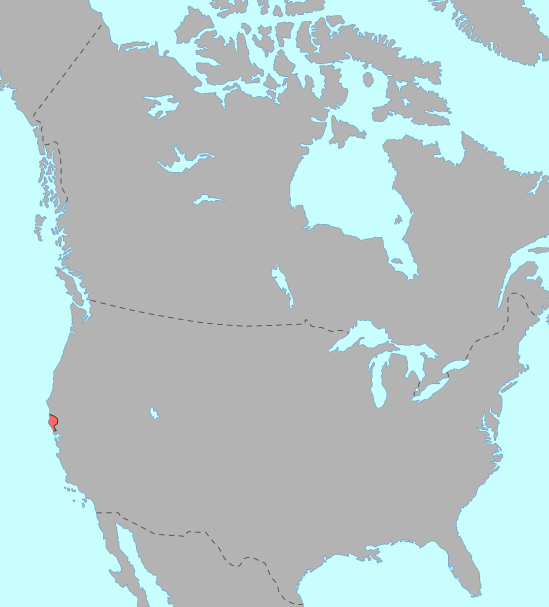
 Pre-contact distribution of Pomoan languages | |
The Pomoan, or Pomo /ˈpoʊmoʊ/,[1] languages are a small family of seven languages indigenous to northern California spoken by the Pomo people, whose ancestors lived in the valley of the Russian River and the Clear Lake basin. Majority of languages are extinct, and only Kashaya has little more than ten speakers.
Geographical distribution
[edit]John Wesley Powell, who was the first to define the extent of the family, noted that its boundaries were the Pacific Ocean to the west, Wintuan territory in the Sacramento Valley to the east, the head of the Russian River to the north, and Bodega Head and present-day Santa Rosa to the south (Powell 1891:87-88). Only Northeastern Pomo was not contiguous with the other Pomoan languages, being separated by an intervening region of Wintuan speakers.
Internal relationships of languages
[edit]
Pomoan is a family of seven languages. Their relationship to one another was first formally recognized by John Wesley Powell, who proposed that they be called the "Kulanapan Family" (Powell 1891). Like many of Powell's obscure nomenclatural proposals, particularly for California languages, "Kulanapan" was ignored. In its place, Pomo,[2] the term used by Indians and Whites alike for Northern Pomo, was arbitrarily extended to include the rest of the family.
All seven languages were first systematically identified as Pomo by Samuel Barrett (1908). To avoid complications, Barrett named each of the Pomoan languages according to its geographic position ("Northern Pomo," "Southeastern Pomo," etc.) This naming convention quickly gained wide acceptance and is still in general use, except for the substitution of "Kashaya" for Barrett's "Southwestern Pomo". Barrett's geographical language names often lead those unfamiliar with the Pomoan languages to the misconception that they are dialects of a single "Pomo" language.
Various genetic subgroupings of the family have been proposed, although the general outlines have remained fairly consistent. The current consensus view (cf. Mithun 1999) favors the tree presented in Oswalt (1964), shown below.
- Pomoan
- Southeastern Pomo
- Eastern Pomo †
- Northeastern Pomo †
- Western
- Northern Pomo †
- Southern
- Central Pomo †
- Southern Pomo †
- Kashaya (Southwestern Pomo)

Essentially identical versions of this classifications are presented in Oswalt and McLendon's "Introduction" to the Pomo chapters in Heizer, ed. (1978) and in Campbell (1997). The most important dissenter was Abraham M. Halpern, one of the few linguists since Barrett's time to collect comparative data on all of the Pomoan languages.
Halpern's classification differed from Oswalt's mainly in the placement of Northeastern Pomo. Instead of considering it an independent branch of the family, Halpern grouped it with the languages of Oswalt's "Western" branch. He suggested the possibility that Northeastern Pomo represents a recent migration of a Northern Pomo subgroup (Halpern 1964; Golla 2011:106-7).
Proto-language
[edit]| Proto-Pomo | |
|---|---|
| Reconstruction of | Pomoan languages |
Proto-Pomo reconstructions by McLendon (1973):[3]
Proto-Pomo reconstructions by McLendon (1973)
| ||||||||||||||||||||||||||||||||||||||||||||||||||||||||||||||||||||||||||||||||||||||||||||||||||||||||||||||||||||||||||||||||||||||||||||||||||||||||||||||||||||||||||||||||||||||||||||||||||||||||||||||||||||||||||||||||||||||||||||||||||||||||||||||||||||||||||||||||||||||||||||||||||||||||||||||||||||||||||||||||||||||||||||||||||||||||||||||||||||||||||||||||||||||||||||||||||||||||||||||||||||||||||||||||||||||||||||||||||||||||||||||||||||||||||||||||||||||||||||||||||||||||||||||||||||||||||||||||||||||||||||||||||||||||||||||||||||||||||||||||||||||||||||||||||||||||||||||||||||
|---|---|---|---|---|---|---|---|---|---|---|---|---|---|---|---|---|---|---|---|---|---|---|---|---|---|---|---|---|---|---|---|---|---|---|---|---|---|---|---|---|---|---|---|---|---|---|---|---|---|---|---|---|---|---|---|---|---|---|---|---|---|---|---|---|---|---|---|---|---|---|---|---|---|---|---|---|---|---|---|---|---|---|---|---|---|---|---|---|---|---|---|---|---|---|---|---|---|---|---|---|---|---|---|---|---|---|---|---|---|---|---|---|---|---|---|---|---|---|---|---|---|---|---|---|---|---|---|---|---|---|---|---|---|---|---|---|---|---|---|---|---|---|---|---|---|---|---|---|---|---|---|---|---|---|---|---|---|---|---|---|---|---|---|---|---|---|---|---|---|---|---|---|---|---|---|---|---|---|---|---|---|---|---|---|---|---|---|---|---|---|---|---|---|---|---|---|---|---|---|---|---|---|---|---|---|---|---|---|---|---|---|---|---|---|---|---|---|---|---|---|---|---|---|---|---|---|---|---|---|---|---|---|---|---|---|---|---|---|---|---|---|---|---|---|---|---|---|---|---|---|---|---|---|---|---|---|---|---|---|---|---|---|---|---|---|---|---|---|---|---|---|---|---|---|---|---|---|---|---|---|---|---|---|---|---|---|---|---|---|---|---|---|---|---|---|---|---|---|---|---|---|---|---|---|---|---|---|---|---|---|---|---|---|---|---|---|---|---|---|---|---|---|---|---|---|---|---|---|---|---|---|---|---|---|---|---|---|---|---|---|---|---|---|---|---|---|---|---|---|---|---|---|---|---|---|---|---|---|---|---|---|---|---|---|---|---|---|---|---|---|---|---|---|---|---|---|---|---|---|---|---|---|---|---|---|---|---|---|---|---|---|---|---|---|---|---|---|---|---|---|---|---|---|---|---|---|---|---|---|---|---|---|---|---|---|---|---|---|---|---|---|---|---|---|---|---|---|---|---|---|---|---|---|---|---|---|---|---|---|---|---|---|---|---|---|---|---|---|---|---|---|---|---|---|---|---|---|---|---|---|---|---|---|---|---|---|---|---|---|---|---|---|---|---|---|---|---|---|---|---|---|---|---|---|---|---|---|---|---|---|---|---|---|---|---|---|---|---|---|---|---|---|---|---|---|---|---|---|---|---|---|---|---|---|---|---|---|---|---|---|---|---|---|---|---|---|---|---|---|---|---|---|---|---|---|---|---|---|---|---|---|---|---|---|---|---|---|---|---|---|---|---|---|---|---|---|---|---|---|---|---|---|---|---|---|---|---|---|---|---|---|---|---|---|---|---|---|---|---|---|---|---|---|---|---|---|---|---|---|---|---|---|---|---|---|---|
|
See also
[edit]- Boontling – a constructed dialect of English incorporating Pomo words
- Central, Northern and Southern Pomo Language Apps are available in the App Store. Southern Pomo currently has 2 apps available. One called Learn Southern Pomo - alphabet and one called Southern Pomo Language - Intro.
Notes
[edit]- ^ Laurie Bauer, 2007, The Linguistics Student’s Handbook, Edinburgh
- ^ The etymology of the term "Pomo" is complex. It seems to be a combination of the Northern Pomo words [pʰoːmoː], "at red earth hole" and [pʰoʔmaʔ] (containing [pʰo-], "reside, live in a group"), together suggesting "those who live at red earth hole" (Campbell 1997:397, citing McLendon & Oswalt 1978:277)
- ^ McLendon, Sally. 1973. Proto Pomo. (University of California publications in linguistics, 71.) Berkeley: University of California Press.
References
[edit]- Barrett, Samuel A. (1908). The Ethno-Geography of the Pomo and Neighboring Indians. University of California Publications in American Archaeology and Ethnology, 6. [1][permanent dead link]
- Campbell, Lyle. (1997). American Indian languages: The historical linguistics of Native America. New York: Oxford University Press. ISBN 0-19-509427-1.
- Goddard, Ives (Ed.). (1996). Languages. Handbook of North American Indians (W. C. Sturtevant, General Ed.) (Vol. 17). Washington, D. C.: Smithsonian Institution. ISBN 0-16-048774-9.
- Golla, Victor. (2011). California Indian Languages. Berkeley: University of California Press. ISBN 978-0-520-26667-4.
- McLendon, Sally & Robert L. Oswalt (1978). "Pomo: Introduction". In California, ed. Robert F. Heizer. Vol. 8 of Handbook of North American Indians, ed. William C. Sturtevant, pp. 274–88. Washington, D.C.: Smithsonian Institution. ISBN 978-0-16-004574-5.
- Mithun, Marianne. (1999). The languages of Native North America. Cambridge: Cambridge University Press. ISBN 0-521-23228-7 (hbk); ISBN 0-521-29875-X.
- Powell, John Wesley. (1891). Indian Linguistic Families Of America, North Of Mexico. Annual Report of the Bureau of American Ethnology 7:1-142. Washington, DC: Government Printing Office. [2]
- Chestnut, Victor King (1902). Plants used by the Indians of Mendocino County, California. Government Printing Office. Retrieved 24 August 2012.
External links
[edit]
- Pomo (Yakaya, Yokaia, Shanel, Kábinapek) (Native Languages of the Americas)
- Kashaya (Kashia, Southwestern Pomo) (Native Languages of the Americas)
- Pomo/Kashaya Bibliography
- Pomo People: Brief History
- "New wellness center hosts first Pomo language workshop". Lake County News Reports. 2012-04-15. Retrieved 2012-08-08.
Pomoan languages
View on GrokipediaOverview and Historical Context
Definition and Family Scope
The Pomoan languages constitute a small genetic family comprising seven distinct languages historically spoken by the Pomo peoples in northern California. These languages exhibit mutual intelligibility limited enough to classify them as separate but related tongues, comparable in divergence to the Romance languages of Europe. Their genetic unity is well-established through extensive shared basic vocabulary—such as terms for body parts, kinship, and natural phenomena—and parallel grammatical structures, including similar patterns of verb inflection and nominal classification.[11][12] The name "Pomo" derives from a conflation of Northern Pomo words meaning "those who live at red earth hole," originally the name of a specific settlement. This etymology underscores the languages' deep cultural ties to the identity of their speakers, who traditionally inhabited regions concentrated in Mendocino, Sonoma, Lake, and Colusa counties. No external relatives have been conclusively demonstrated for the Pomoan family, distinguishing it as a robust isolate unit within the broader landscape of North American indigenous languages.[13][12] Although early 20th-century proposals grouped Pomoan with other California language families into the hypothetical Hokan phylum based on tentative lexical and typological resemblances, these connections remain unproven and widely debated among linguists, reinforcing Pomoan's status as a standalone family without verified affiliations beyond its internal branches.[14]Historical Documentation and Study
The earliest documented European interactions with Pomo speakers date to the early 19th century, when Russian fur traders at Fort Ross and American explorers recorded incidental observations and short word lists of Pomoan speech during trade and expeditions. These notes, often embedded in travel journals, captured basic vocabulary but lacked systematic analysis due to the focus on economic and territorial concerns rather than linguistic study. Substantial ethnographic and linguistic documentation began in the early 20th century with Samuel A. Barrett's fieldwork among Pomo communities from 1902 to 1908. His 1908 publication, The Ethno-Geography of the Pomo and Neighboring Indians, stands as foundational work, integrating anthropological observations with linguistic data such as place names, personal terminology, and dialectal variations across several Pomoan languages.[15] Conducted under the supervision of Alfred L. Kroeber at the University of California, Berkeley, Barrett's efforts marked the first comprehensive identification of the seven Pomoan languages as a distinct family. In the 1910s, Alfred L. Kroeber expanded this foundation through his comparative surveys of California languages. His 1910 article, "The Languages of the Coast of California North of San Francisco," provided phonetic descriptions, vocabulary lists, and initial genetic classifications for Pomoan dialects, emphasizing their internal diversity and isolation from neighboring families.[11] Kroeber's later contributions, including sections in the Handbook of the Indians of California (1925), further synthesized early data into broader cultural-linguistic contexts. Subsequent researchers in the 1920s and 1930s, such as Jaime de Angulo and Lucy Shepard Freeland, built on this by producing grammatical sketches and texts for specific dialects like Central and Northern Pomo. Abraham M. Halpern's fieldwork in the late 1930s and early 1940s added detailed notebooks on Southern Pomo morphology and syntax.[16] By the mid-20th century, the study of Pomoan languages evolved under structuralist influences, with linguists like Catherine A. Callaghan producing in-depth grammars and dictionaries from the 1960s to the 1980s, particularly for Southeastern Pomo, which included sound recordings and morphological analyses.[17] This period reflected a broader shift in the 1950s from primarily descriptive anthropological approaches to systematic comparative linguistics, enabling reconstructions of proto-Pomoan phonology and lexicon through rigorous sound correspondences.[18] These foundational records remain vital for contemporary language revitalization among Pomo communities.Geographic and Demographic Profile
Traditional Distribution
The Pomoan languages were traditionally spoken across a core area in northwestern California, encompassing Mendocino, Lake, Sonoma, and Colusa counties, with territories extending from the Pacific coast inland to the western edge of the Sacramento Valley. This region included diverse landscapes such as coastal zones, river valleys, oak woodlands, and the shores of Clear Lake, where Pomoan-speaking communities established villages adapted to local environments.[19][20][1][21][3][22] Northern Pomo territories centered on the Russian River northwest of Clear Lake, reaching the Pacific coast, with subgroups occupying Sherwood Valley, Outlet Creek near Willits, Redwood Valley, Potter Valley, and Coyote Valley in what is now Lake Mendocino; these areas featured riverine and coastal settlements as well as inland hill villages. Central Pomo speakers inhabited lands from the Russian River southwest of Clear Lake to the coast, including settlements in southern Ukiah Valley, Hopland Valley near the Sonoma County line, Manchester, Point Arena, Gualala River mouth, Yorkville, and Anderson Valley, where river and valley environments supported dispersed communities. Southern Pomo distribution covered the lower Russian River, Dry Creek Valley, and Santa Rosa plain, with villages oriented toward riverine and plain habitats. Eastern Pomo groups were based on the eastern side of Clear Lake, along streams in Big Valley south of Lakeport, the south shore via Kelsey Creek, Clover Valley northeast of Upper Lake, Middle Creek in Upper Lake Valley, and the north shore, emphasizing lake-adjacent territories. Southeastern Pomo communities focused on the eastern end of Clear Lake, with key settlements on Anderson Island off Buckingham Point, Rattlesnake Island in the eastern arm, and Indian Island at the southern tip, tied closely to lacustrine resources. Northeastern Pomo territory lay along Stony Creek on the western Sacramento Valley edge, in areas suited to valley and creek-based habitation.[19][20][1][21][3][22] These territories aligned with the ethnic divisions of Pomoan groups, who maintained hill, river, and lake villages reflecting adaptations to specific ecological niches; for instance, coastal and riverine sites facilitated fishing and trade, while inland oak woodlands and hills supported acorn gathering and seasonal movement. Environmental features like rivers and oak-dominated woodlands contributed to dialect variation by creating natural barriers and isolated settlements, fostering linguistic divergence among the seven Pomoan languages over time. Prior to 1850 and European encroachment, the overall territorial extent supported an estimated 8,000 Pomoan speakers across these regions.[19][23][24] The subsequent decline accelerated in the mid-19th century due to events like the California Gold Rush.[23]Current Speakers and Communities
As of 2025, the Pomoan languages collectively have fewer than 20 fluent speakers across all varieties, with all except Kashaya classified as extinct or dormant and having no remaining fluent first-language (L1) speakers.[4] Kashaya, the most vital among them, is estimated to have around 12 fluent L1 speakers, all elderly, as of 2021.[25] Varieties such as Northern, Central, Southern, Eastern, Southeastern, and Northeastern Pomo have 0 fluent L1 speakers.[26] These figures reflect L1 speakers primarily, with L2 learners numbering in the low dozens but not yet contributing to daily use; Ethnologue assessments confirm the endangered status for Kashaya and dormancy or extinction for all others, based on data up to 2024.[5] Pomoan-speaking communities are centered on federal reservations and rancherias in northern California, including the Coyote Valley Reservation (home to about 170 tribal members) and the Hopland Rancheria, where heritage language knowledge persists among elders despite low fluency rates.[27] Overall, an estimated 5,000 people identify as Pomo across 11 bands in Mendocino County and surrounding areas, but many heritage speakers live in urban diaspora settings such as Santa Rosa, Ukiah, and larger California cities, where cultural reconnection efforts occur outside traditional lands.[28][29] The drastic decline in speakers stems from 19th- and 20th-century genocidal policies, including state-sanctioned massacres and forced removals, coupled with U.S. federal boarding school systems that prohibited Native language use and punished children for speaking Pomoan varieties, effectively breaking familial transmission chains.[30] These assimilationist practices, active from the 1870s through the mid-20th century, reduced pre-contact populations of around 8,000 Pomo speakers to near extinction levels by the 1950s.[20] Revitalization programs have supported the emergence of a small number of L2 speakers, offering modest hope for cultural continuity amid ongoing demographic challenges. In 2025, for example, four Ukiah High School students completed an intensive program in Northern Pomo, with two earning California's Seal of Biliteracy in the language, representing a milestone in L2 speaker development.[31][32]Linguistic Classification
Internal Relationships
The Pomoan language family consists of seven distinct languages: Northern Pomo, Central Pomo, Eastern Pomo, Kashaya (also known as Southwestern Pomo), Northeastern Pomo, Southern Pomo, and Southeastern Pomo.[19] These languages form a genetic unit, with all descending from a common Proto-Pomoan ancestor spoken approximately 2,000–3,000 years ago, as estimated through glottochronological analysis of lexical retention rates across the family. Although some varieties, such as Northeastern Pomo, have been debated in terms of precise affiliation due to limited documentation, the consensus recognizes seven as the standard count based on systematic comparative evidence. Internal subgrouping divides the family into two primary branches: a Western branch comprising Northern Pomo, Central Pomo, Southern Pomo, and Kashaya, and an Eastern branch including Eastern Pomo, Northeastern Pomo, and Southeastern Pomo. Within the Western branch, Northern and Central Pomo form a closer cluster, linked by shared innovations in pronominal systems (e.g., similar dual and plural forms) and numeral morphology (e.g., retained Proto-Pomoan roots for basic counting terms with parallel sound shifts).[33] Southern Pomo and Kashaya exhibit more isolate-like positions within the Western group, showing fewer such innovations but retaining core lexical and phonological parallels to the Northern-Central cluster. The Eastern branch displays greater internal divergence, with Southeastern Pomo often treated as the most peripheral due to unique developments in verb prefixes and case marking. Mutual intelligibility among the Pomoan languages is low, typically ranging from 20–30% lexical similarity between distant varieties like Kashaya and Southeastern Pomo, reflecting their status as separate languages rather than dialects. This low overlap underscores the family's dialect continuum in pre-contact times, where geographic proximity allowed partial comprehension in adjacent areas (e.g., between Central and Southern Pomo), but broader separations led to significant barriers.[1]External Affiliations and Hypotheses
The Hokan phylum hypothesis posits a distant genetic relationship among several Native American language families of western North America, including Pomoan, Yuman, Esselen, Shastan, Yanan, Chimariko, and Karuk.[18] This proposal originated with Roland B. Dixon and Alfred L. Kroeber in 1912–1913, who identified lexical and structural similarities among California languages, and was significantly expanded by Edward Sapir in the 1920s.[34] Sapir's 1925 work incorporated Pomoan into Hokan based on proposed cognates, such as forms for "water" (e.g., Yana *xana and potential Pomoan reflexes) and other basic vocabulary shared with Yuman and Esselen languages like *wa- variants for water-related terms.[35] Subsequent scholars, including Margaret Langdon, further explored Pomoan-Yuman connections through comparative lexicons, emphasizing morphological parallels in verb structures. Despite these proposals, the Hokan hypothesis has faced substantial criticism for lacking systematic evidence. Critics describe Hokan as a "wastebasket taxon," a catch-all grouping assembled with limited data in the early 20th century, incorporating diverse languages without rigorous demonstration of relatedness.[34] Key issues include the absence of regular sound correspondences and a reliable proto-Hokan phonology, with many suggested cognates relying on non-standard comparative methods rather than the comparative method's requirements for predictable changes. Lyle Campbell and Marianne Mithun's 1979 assessment highlighted how early inclusions, including Pomoan, were based on superficial resemblances influenced by areal contact rather than deep genetic ties. In contemporary linguistics, Pomoan is frequently treated as a genetic isolate family outside Hokan, with no compelling external affiliations established. While fringe suggestions have occasionally linked it to Penutian stocks through broad lexical comparisons, these lack substantiation and are not widely accepted.[18] Recent interdisciplinary studies combining linguistics and population genetics, such as those examining California Native American diversity in the 2020s, show no strong correlations supporting Hokan or other macro-family ties for Pomoan speakers, reinforcing its isolate-like status amid regional language diversity.[36]Structural Features
Phonology
The Pomoan languages are characterized by complex consonant inventories, typically ranging from 20 to 30 consonants, reflecting a rich system of contrasts common in northern California indigenous languages. These inventories include the glottal stop /ʔ/, ejective consonants such as /p'/, /t'/, /k'/, and /q'/, and fricatives like /x/ and /ɬ/. For instance, Southeastern Pomo features 29 consonants in its Elem dialect, with three series of voiceless stops and affricates (plain /p t k/, aspirated /pʰ tʰ kʰ/, and glottalized /pʼ tʼ kʼ/), uvular counterparts /q qʰ qʼ/, only two voiced obstruents /b d/, and fricatives /f s x h ɬ/.[3] Similar elaborations, including multiple places of articulation and glottalization, are shared across the family, contributing to phonological complexity.[37] Vowel systems in Pomoan languages are relatively simple and stable, featuring a core inventory of five vowels /i e a o u/ inherited from Proto-Pomoan. A phonemic length contrast between short and long vowels is widespread, often distinguishing lexical items, as in Southeastern Pomo where binary vowel length appears in select word pairs.[37][3] Some varieties exhibit nasalization as an additional feature, though it is not uniform across the family. Syllable structure is predominantly CV(C), permitting optional coda consonants, with more elaborate forms in certain languages such as Eastern Pomo's common CV:CV(:)(C)(C). Primary stress typically falls on initial syllables in many Pomoan varieties, aligning with a trochaic metrical pattern reconstructed for Proto-Pomoan, though second-syllable stress occurs in others like Eastern Pomo. Reduplication of stems or roots serves grammatical functions, including plural marking, as seen in Southern Pomo where the preceding stem is reduplicated to indicate plurality (e.g., R for reduplication in morphological glosses).[38] A shared innovation involves palatalization processes affecting velars before front vowels in several varieties, contributing to historical sound changes within the family. Individual languages display variations, such as reduced vowel length contrasts in Southeastern Pomo.[39]Grammar and Morphology
The Pomoan languages, spoken in northern California, exhibit agglutinative morphology characterized by both prefixing and suffixing, allowing for the construction of complex words through the sequential addition of morphemes. This typological profile aligns with broader Hokan family traits but shows unique developments in verb complexity. Grammatical relations are marked through pronominal prefixes and postpositional enclitics, contributing to a head-marking pattern where verbs often encode subject, object, and additional semantic roles.[40] Nouns in Pomoan languages feature classificatory prefixes that distinguish categories such as human versus non-human, particularly in possessive and kinship constructions. For instance, in Southern Pomo, prefixes like mi- indicate second-person possession in kinship terms (e.g., mi-ba 'your father'), while third-person human markers like ma- appear in pronouns (e.g., mahčukunčon 'them' referring to humans).[41] Case marking relies on postpositions or enclitics attached to nouns, encoding roles like agentive (=yey), patient (=yčon), locative (=ton), and goal (-n). These are flexible across animacy, as seen in Southeastern Pomo where postpositions integrate into syntactic phrases without strict animacy restrictions. Phonological constraints occasionally influence morpheme attachment, such as vowel harmony in some suffixes, but do not fundamentally alter the agglutinative structure. Verb morphology displays polysynthetic tendencies, with complexes incorporating multiple affixes for arguments, instrumentals, evidentials, and directionals around a root, often resulting in single words that convey entire propositions. The canonical word order is subject-object-verb (SOV), as evidenced in Eastern Pomo sentences like miy:aṭʰe hi ʔ di ʔ duy ('you take it and go').[40] Instrumental prefixes, numbering around 20 in Proto-Pomo reconstructions, specify the shape or manner of action (e.g., hu- 'by mouth' in Southern Pomo huʔak- 'to be stingy'). Evidentials mark information source, such as factual (-a) or copular (=wa) in Southern Pomo (e.g., ha:čatlokʰč'a 'they’re flying out' with factual evidential), while directionals like -m- 'across' or -way 'downward' are suffixed (e.g., mihyana-kʰ:e=ʔwa=mta=ʔa 'I’m going to kill you' incorporating future and directional elements).[41] The tense-aspect-mood (TAM) system is primarily suffixal, with Proto-Pomo -ma reconstructed for past tense across varieties (e.g., Southern Pomo mi:ṭ:i-w-ma 'I lay down [past perfective]'; Eastern Pomo uses aspectual suffixes to imply present where no dedicated tense exists). Aspect markers include perfective -w (e.g., či:yo-w 'having arrived'), and mood indicators like negative -tʰo (e.g., ne:ne:tʰo 'I didn’t learn well'). Future tense employs -kʰ:e in Southern Pomo, highlighting the family's consistent reliance on suffixation for temporal and modal distinctions.[41] This suffix-heavy TAM system underscores the morphological complexity shared among the seven Pomoan languages, despite dialectal variations.[40]Individual Languages
Northern and Central Varieties
The northern and central varieties of the Pomoan language family include Northern Pomo, Central Pomo, and Northeastern Pomo, while Eastern Pomo represents a distinct eastern branch. These languages were historically spoken in inland and coastal regions of northern California and share features such as complex verb morphology, though mutual intelligibility is limited across the family. Northern Pomo was traditionally spoken from the Russian River northwest of Clear Lake to the Pacific coast, encompassing areas such as Sherwood Valley, Outlet Creek near Willits, Redwood Valley, Potter Valley, and Coyote Valley in present-day Mendocino and Lake counties. This variety features intricate suffixal aspect and tense-marking systems that encode nuanced temporal and modal distinctions in verbs. Documentation includes a comprehensive grammar by Mary Catherine O'Connor, based on fieldwork in the 1980s, which details these morphological patterns and provides extensive example sentences from elders.[19][24] As of 2025, Northern Pomo is dormant with no remaining fluent first-language speakers, though revitalization efforts, including high school programs, are teaching the language to younger generations.[31][19] Northeastern Pomo, also known as Salt Pomo, was traditionally spoken along Stony Creek on the western edge of the Sacramento Valley, in present-day Colusa and Lake counties. It is the least documented Pomoan language, with limited grammatical descriptions focusing on basic phonology and vocabulary. Key documentation includes ethnographic notes by Samuel Barrett (1908) and lexical studies by John McCarthy (1986). The last fluent speaker died in 1961, and as of 2025, Northeastern Pomo is extinct with no first-language speakers, though some archival materials support limited revitalization interest.[22][42] Central Pomo was spoken around Clear Lake and extending from the Russian River southwest to the Pacific coast, including settlements in the southern Ukiah Valley, Hopland Valley, near the Sonoma County line, Manchester, Point Arena, the Gualala River mouth, Yorkville, and Anderson Valley. A distinctive trait is its rich verb serialization, where multiple verbs chain together within a single clause to express complex events, such as motion and manner, as analyzed in studies of clause combining. Robert L. Oswalt compiled an unpublished dictionary in the 1970s based on fieldwork with speakers, providing lexical data for over a thousand entries, while Marianne Mithun's research in the 1990s further documented pronominal systems and switch-reference mechanisms.[20] As of 2025, Central Pomo is dormant with no fluent first-language speakers, but community-led archival and teaching efforts continue.[26][20] Eastern Pomo, also known as Clear Lake Pomo or Bahtssal, was traditionally spoken inland on the eastern side of Clear Lake, primarily along streams in Big Valley, Kelsey Creek, Clover Valley, Middle Creek, and the north shore. Its phonology emphasizes glottalized consonants, including a prominent glottal fricative (/hʔ/), which contrasts with plain stops and appears in initial positions to mark emphasis or grammatical boundaries. Sally McLendon produced a seminal grammar in 1975, drawing on recordings from the 1960s and 1970s, which covers phonology, syntax, and evidentials with transcribed texts from native consultants.[21][40] As of 2025, Eastern Pomo is extinct with no remaining fluent first-language speakers, though revitalization draws on McLendon's archives.[21]Southern and Southeastern Varieties
The Southern Pomo language is traditionally associated with the Cloverdale area in the Dry Creek Valley and along the lower Russian River in Sonoma County, California.[1] It exhibits complex nominal morphology, particularly in possession, where inalienable possession (such as kinship terms and body parts) is marked by possessive prefixes like ʔa:- (first person singular) or miH- (second person singular), often followed by extensive suffix chains incorporating generational markers (e.g., -c- for ascending generations), number suffixes, and case endings (e.g., -n for patient or -w for oblique).[43] For instance, a form like ʔa:di-ki-ya-čo:kʰe encodes "my older sisters'" through prefix-root-generational-plural-possessive sequences, allowing precise relational encoding. This system reflects the language's agglutinative nature and is comprehensively analyzed in Walker's 2013 dissertation and 2020 grammar.[43] As of 2025, Southern Pomo is extinct with no fluent first-language speakers, but documentation supports potential revival.[1] Kashaya, also termed Southwestern Pomo, is spoken in the coastal Fort Bragg region of Mendocino County, extending to the Stewarts Point Rancheria.[44] A hallmark feature is its elaborate evidential system, with five verbal suffixes indicating the speaker's information source, including a narrative evidential (-ya) used for reported events in traditional stories or hearsay, distinguishing it from direct visual or inferential modes.[45] This system integrates with verb roots to convey epistemic nuance, as explored in Oswalt's 1961 grammar and 1986 study on evidentials. Coastal influences appear in lexicon related to marine resources, underscoring the speakers' historical ties to the Pacific shoreline.[46] As of 2025, Kashaya remains endangered with fewer than 10 fluent speakers, primarily elderly, and active revitalization programs.[44] Southeastern Pomo, part of the eastern subgroup and also known as Elem or Lower Lake Pomo, is traditionally spoken at the eastern end of Clear Lake in Lake County, with villages on islands like Anderson and Rattlesnake.[3] It remains lesser documented, with most speakers and learners affiliated with the Elem Indian Colony.[47] The language features an agglutinative structure with position-class suffixes for verb derivation (e.g., causative -mul, directional -kʰu), and a small vowel inventory lacking robust length contrasts compared to other Pomoan languages.[48] Unique lexical items include specialized terms for salt-water concepts, such as ocean-related vocabulary adapted from inland perspectives, distinguishing it from freshwater-dominated environments.[49] Moshinsky's 1974 grammar provides the primary descriptive foundation, emphasizing its head-final syntax and instrumental prefix system.[48] As of 2025, Southeastern Pomo is extinct with no fluent first-language speakers.[3] Divergences among these varieties include vowel harmony patterns, notably in Southern Pomo possessive prefixes, where vowel quality (e.g., high vs. mid) harmonizes with the root, as in mi-čʔen "your mother" versus méʔen "your father." Overall, the southern and southeastern varieties demonstrate lower mutual intelligibility with northern Pomoan languages due to innovations in evidentiality, nominal chaining, and phonological systems.Proto-Pomoan Reconstruction
Phonological and Lexical Reconstruction
The phonological system of Proto-Pomo was reconstructed by Sally McLendon using the comparative method, drawing on data from all seven attested Pomoan languages to identify regular sound correspondences and shared innovations.[50] This reconstruction posits a rich inventory of consonants, including stops in voiceless plain (*p, t, ṭ, č, k, q, ʔ), aspirated (*pʰ, tʰ, ṭʰ, kʰ, qʰ), ejective (*p̓, t̓, ṭ̓, č̓, k̓, q̓), and voiced (*b, d) series, along with fricatives (*s, x, h), nasals (*m, n; with palatalized variants *-nʸ, *-mʸ word-finally), laterals (*l; with palatalized *-lʸ word-finally), and glides (*w, y).[51] The vowel system consists of five qualities (*a, e, i, o, u), each with a phonemic length contrast (*ā, ē, ī, ō, ū), showing relative stability across daughter languages with occasional assimilation or dissimilation, such as *a raising to *o before a following *o in some varieties.[52] Lexical reconstruction relies on these sound laws to propose proto-forms for basic vocabulary, often verified through cognate sets spanning Northern, Central, and Southern branches. For instance, the word for "water" is reconstructed as *ʔahqʰa, reflected in forms like Kashaya ʔáqʰa and Eastern Pomo ʔáqʰa, with regular loss of aspiration in intervocalic position in some dialects.[50] Similarly, "hand" appears as *ʔatʰána, corresponding to Northern Pomo t̪ʰána and Southeastern Pomo ʔatʰána, where the initial glottal stop and aspiration are preserved in conservative varieties but simplified elsewhere. Other shared roots include *bá·č̓i 'grandfather' (with ejective affricate *č̓ > s in Southern Pomo, as in Southeastern sɨ́·si) and *kʰálʸ 'tongue' (palatalized lateral shifting to y in Central Pomo).[51] Reconstruction efforts employed adapted Swadesh lists to prioritize core vocabulary, facilitating systematic comparison despite limited documentation in less-studied dialects like Southeastern Pomo.[54] McLendon's etymological work in the 1970s compiled over 200 proto-stems, later refined by Robert L. Oswalt's analysis of diachronic phonology, which identified branch-specific innovations like Southern Pomo's merger of *č and *s.[55] However, uneven elicitation across languages—particularly sparse data from extinct varieties—results in tentative forms for some items, with ongoing revisions incorporating archival materials.[56]Comparative Evidence
The comparative evidence for Proto-Pomoan unity draws heavily from shared morphological and syntactic features across the seven languages, supporting their common ancestry despite regional divergences. Morphological reconstructions reveal a pronominal system with first-person singular *ʔa (agentive) and second-person singular *ma (agentive), alongside a patientive form *mi for the second person, as evidenced by reflexes in languages like Kashaya Pomo (*ʔa, *ma, *mi-o) and Southeastern Pomo (*ʔa, *ma, *mi).[57] This system, reconstructed through regular sound correspondences, underscores the family's independent pronouns for core arguments rather than verbal affixes.[58] Verbal morphology further bolsters unity through shared ablaut patterns, where vowel alternations mark number or aspect; for instance, Proto-Pomoan *čiw- "one swims" contrasts with *čiy- "several swim," a pattern reflected in multiple daughter languages like Kashaya and Central Pomo.[57] These ablaut innovations, combined with consistent instrumental prefixes (e.g., *qa- "with teeth"), indicate inherited morphological complexity.[55] Syntactic retentions provide additional evidence, as all Pomoan languages maintain subject-object-verb (SOV) order and employ postpositional phrases for locative and relational functions, enabling flexible case-marked word order while preserving core hierarchy.[3] This structure, uniform across the family, points to proto-level retention rather than convergence. Innovations highlight subgrouping within the family, such as the shift from Proto-Pomoan *s- to *č- in verb roots for Northern and Central varieties (e.g., Kashaya *ča- "fly" vs. Southeastern *sca- "sit"), distinguishing them from Southern forms.[57] Contact-induced borrowings from neighboring Yukian languages, including terms like *c’oy "narrow road," appear in shared vocabulary and reflect areal influences on peripheral members like Southeastern Pomo.[59] Subgrouping is confirmed by innovations in shared grammatical morphemes, notably the infinitive suffix *-ka, which appears consistently in Northern-Central forms (e.g., Northeastern *boʔlˈau-kaː "to bark") but shows conditioned variation elsewhere, supporting a primary Northern-Central branch.[57] Phonological correspondences underpin these morphological comparisons, ensuring robust etymologies.[58]Contemporary Status
Language Endangerment
The Pomoan languages, comprising seven distinct varieties spoken historically in Northern California, are classified as critically endangered by UNESCO's Atlas of the World's Languages in Danger, with no first-language (L1) acquisition occurring in most communities since the 1990s. This status reflects the near-total cessation of intergenerational transmission, as children in Pomo communities have predominantly acquired English as their primary language for generations. Ethnologue assessments using the Expanded Graded Intergenerational Disruption Scale (EGIDS) assign most varieties to levels 8a (dormant, with only semi-speakers remaining) or 9 (extinct in practice), indicating that fluent speakers are elderly and isolated, with no communal use.[26][60][61] Primary threats to their survival include the overwhelming dominance of English in education, media, and daily interactions within Pomo communities, which has eroded traditional domains of language use. Intergenerational transmission has broken down due to small youth cohorts in tribal populations, where few children are exposed to Pomoan varieties from fluent elders.[20] These pressures are compounded by historical factors such as land loss and forced cultural assimilation following the California Gold Rush in the 1850s, which disrupted community structures and linguistic practices through displacement and suppression of Native customs.[62] As of recent estimates (circa 2022-2025), there are fewer than 50 heritage and semi-speakers across all surviving varieties, with Kashaya (Southwestern Pomo) retaining the largest number of fluent elderly speakers at around 10-15, while other varieties like Central Pomo and Northern Pomo have only a handful of elderly semi-speakers and no fluent speakers.[5][19] Revitalization initiatives offer potential countermeasures, though the languages remain on the brink of extinction without sustained intervention.[63]Revitalization Initiatives
Community-led programs have played a central role in Pomoan language revitalization, particularly through immersion classes and digital resources tailored to specific varieties. The Dry Creek Rancheria of Pomo Indians has offered Southern Pomo language classes since the 2010s, compiling course materials into online modules to teach vocabulary, grammar, and cultural concepts like kinship terms and acorn-related lexicon, following the death of the last fluent speaker in 2014. Similarly, the Kashaya Language Project, in collaboration with the Kashia Band of Pomo Indians, developed mobile apps such as "Kashaya Cahno" in 2016, featuring audio recordings of over 100 words across 13 categories with quiz functions to support self-paced learning for heritage speakers. These initiatives address the near-extinction of fluent speakers by emphasizing intergenerational transmission and cultural integration.[64][65][66] Academic collaborations, especially with institutions like the University of California, Berkeley, have bolstered these efforts through structured pairings and archival projects. Berkeley's Master-Apprentice Language Learning Program, developed in the 1990s with ongoing support from the Department of Linguistics, pairs elder speakers (or knowledgeable community members) with apprentices to facilitate immersive one-on-one instruction, applied to Pomoan varieties like Northern Pomo through fieldwork and documentation. The university's California Language Archive maintains digital collections of Pomoan recordings, including stories and songs, made accessible for revitalization training via grants from the National Endowment for the Humanities (NEH); recent efforts in 2025 include highlighting archived Northern Pomo materials in public podcasts to aid ongoing preservation. For instance, a 2020 Foundation for Endangered Languages grant to Berkeley Ph.D. student Edwin Ko funded the development of Northern Pomo revitalization camps incorporating games, traditional narratives, and digital tools for all ages.[67][68][69][70] These programs have yielded measurable achievements, including a modest increase in second-language (L2) speakers among younger community members. By 2025, initiatives like the Northern Pomo program at Ukiah High School, launched in 2021, produced four graduates proficient enough for two to earn California's first-ever Seal of Biliteracy in the language, fostering cultural pride and basic conversational skills. NEH grants have supported key resources, such as a 2022 award to develop an online Kashaya database with audio stories and a dictionary, and earlier funding for Northern Pomo language tools, contributing to dozens of heritage learners engaging with the languages annually. Successes are evident in the revival of songs and oral traditions, with camps and apps enabling community events where participants recite ancestral narratives.[31][71][72] Despite progress, revitalization faces persistent challenges, including funding instability and the ongoing loss of elder knowledge. Short-term grants like those from NEH and the Foundation for Endangered Languages often expire without sustained support, limiting program scalability, while the absence of fluent elders since the mid-2000s for most varieties complicates authentic transmission. These efforts are particularly urgent given the critical endangerment of Pomoan languages, with approximately 10-15 fluent speakers remaining across all varieties as of 2025, primarily in Kashaya.[73][69]References
- https://en.[wiktionary](/page/Wiktionary).org/wiki/Appendix:Proto-Pomo_reconstructions