Hubbry Logo
Safa and MarwaSafa and MarwaMain
Open search
Safa and Marwa
Community hub
Safa and Marwa
logo
8 pages, 0 posts
0 subscribers
Be the first to start a discussion here.
Contribute something
Safa and Marwa
Safa and Marwa
from Wikipedia

Safa and Marwa (Arabic: ٱلصَّفَا وَٱلْمَرْوَة, romanizedAṣ-Ṣafā wal-Marwah) are two small hills, connected to the larger Abu Qubais and Qaiqan mountains, respectively,[1] in Mecca, Saudi Arabia, now made part of Al-Masjid al-Haram. Muslims travel back and forth between them seven times in what is known as saʿī (Arabic: سَعِي, lit.'seeking/searching or walking')[2] ritual pilgrimages of Ḥajj and Umrah.

Key Information

Muslims run between the two mountains, which they believe was made a ritual as a tribute to Hajar's search of water for her child dying of thirst until she found a water source in the Zamzam Well. The space between the two mountains in which the pilgrims run is called al-Mas'aa.[1][3]

Geography

[edit]
Path of movement between Safa and Marwa, illustrated alongside the Tawaf or circumambulation of the Kaaba

Safa is a small mountain located at the bottom of the Abu Qubais Mountain, about 130 m (430 ft) southeast of the Ka'bah, which is the beginning of the Sa'ee. As for Marwa, it is also a small mountain of white stone, located 300 m (980 ft) to the northeast of the Ka'bah and it is connected to Qaiqan Mountain, marking the end of the Sa'ee. Safa, Marwah and the Masa'a (space between the two mountains) were located outside the Masjid al-Haram and were separate until the year 1955/56 (1375 AH), when the project to annex the two sites into the Masjid al-Haram was undertaken for the first time, and they were subsequently annexed.[1] The distance between Safa and Marwa is approximately 450 m (1,480 ft), therefore, seven trips back and forth amount to roughly 3.15 km (1.96 mi).

History

[edit]

Geological perspective

[edit]

The individual geological history of the two mountains is relatively unknown. Marwa has been described as smoother and lighter in color than Safa, with some even calling it white, such as Majd ad-Din Ferozabadi, az-Zubaidi, al-Fayoumi. al-Alusi further went on to say that Safa's color was comparable to a tint of red. Safa and Marwa are a part of the Hejaz mountain range, which run parallel to most of the Saudi coast on the Red Sea. The Hejaz themselves are part of the larger Sarawat range, which is characterized by young and jagged mountains.[4]

Islamic narrative

[edit]

In Islamic tradition, the civilization of Mecca started after Ibrāhīm (Abraham) left his son Ismāʿīl (Ishmael) and wife Hājar (Hagar) in the valley,[5][6] which Muslims believe was a command by God. When their provisions were exhausted, Hajar eventually ran out of food and water and could no longer breastfeed Ismail.[3] She thus ran back and forth seven times between Safa and Marwa hoping to find water.[3] To make her search easier and faster, she went alone, leaving the infant on the ground. She first climbed the nearest hill, Safa, to look over the surrounding area. When she saw nothing, she then went to the other hill, Marwah, to look around. While Hagar was on either hillside, she was able to see Ishmael and know he was safe. However, when she was in the valley between the hills she was unable to see her son, and would thus run whilst in the valley and walk at a normal pace when on the hillsides. Hagar traveled back and forth between the hills seven times in the scorching heat before returning to her son. Allah then sent Angel Jibril (Gabriel) to their aid and a spring of water appeared from the ground. The well was named Zamzam and the journey back and forth Safa and Marwa was made a ritual during Hajj and Umrah.[3] The two mountains are mentioned by name in the Quran 2:158.

Before Muhammad

[edit]

The early Ansari Muslims gave up the custom of Sa'ee seeing it as idol worship and shirk and a sign of the pre-Islamic period of ignorance (jahiliyyah). It is in this context that Verse 158 of Surah 2 was revealed (Sahih Bukhari, Vol. 6, Book 60, Hadith 22/23).[7] In another narration by Abdullah Yusuf Ali in his commentary on Verse 2:158, he argues that the verse had been revealed because the pagans of Quraysh had placed two idols atop the two hills and the Muslims felt hesitant to walk between the hills, seeing it as idol worship or as an act of shirk.[8] Anas ibn Malik also said that he felt hatred in walking between the two hills as he saw it as a pre-Islamic custom from the jahiliyyah until Allah had revealed Verse 2:158 (Sahih Bukhari, Vol. 2). Aisha confirmed the verse had been revealed with regards to the Ansar, who said it was sinful to walk between the hills as they used to visit the idol Manat at Qudaid (near Mecca) in the state of Ihram before going about with the rituals of their pilgrimage in pre-Islamic times. Several similar reasons have been given by multiple scholars of Islam, including al-Suyuti in his Asbab an-Nuzul[9] and George Sale in his Preliminary Discourse to the Quran.[10]

Revisionist and source critical views

[edit]

Tom Holland and Patricia Crone, both revisionist scholars of early Islamic history, suggest that Islam might not have originated in Mecca, but rather someplace to the north, possibly in the Levant. Building on this suggestion, but taking it a step further, Paul Ellis suggests that Islam originated in or near Jerusalem. One of the main pieces of evidence for this theory is his claim that the hills referred to as Safa and Marwa in the Qur'an are actually hills in Jerusalem. According to Ellis, Marwa is Mount Moriah and Safa is Mount Scopus. Ellis notes that Josephus referred to Mount Scopus as Sapha (Σάφα), which is phonetically identical to Safa.[11]

Significance in the Hajj and Umrah

[edit]

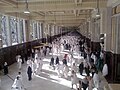
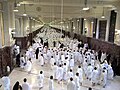
Performing the Sa'ee serves to commemorate Hajar's search for water for her son and God's mercy in answering prayers. Two walkways guide pilgrims from Safa to Marwa, and from Marwa to Safa, with two narrower walkways in the center to serve elderly and disabled pilgrims. The walkways between the two mountains are collectively called the Mas'aa (Arabic: المسعى, romanizedal-Mas'aa, lit.'way, place of walking') and are air-conditioned. Water pumped from the Zamzam Well is also available on the way. Sa'ee is an integral part and rukn of Hajj and Umrah.

See also

[edit]

References

[edit]
[edit]
Revisions and contributorsEdit on WikipediaRead on Wikipedia
from Grokipedia
Safa and Marwa are two small hills located within the Masjid al-Haram (the Grand Mosque) in Mecca, Saudi Arabia, serving as integral symbols of faith in Islam. These hills, originally modest elevations connected to larger nearby mountains, now form part of the mosque's expansive complex and are central to the rituals of Hajj (the annual Islamic pilgrimage) and Umrah (the lesser pilgrimage). The key rite associated with them is Sa'i, in which pilgrims briskly walk—or in Hajar's case, run—seven times between Safa and Marwa, a distance of approximately 450 meters covered by a dedicated, climate-controlled corridor equipped with walkways and escalators to accommodate millions of visitors. This practice commemorates the biblical and Qur'anic figure Hagar (Hajar in Arabic), who desperately searched for water between the hills for her infant son Ishmael after being left in the barren valley by her husband Abraham (Ibrahim) on divine command. The significance of Safa and Marwa is enshrined in the Qur'an, which declares them among Allah's sacred symbols, affirming that pilgrims performing or incur no sin by walking between them as part of the devotion. According to Islamic tradition, the ritual dates back to the time of Prophet Abraham, who established foundational elements of ; Hagar's perseverance led to the miraculous emergence of the near Marwa, providing sustenance and underscoring themes of divine mercy, trust in (tawakkul), and maternal devotion. Pilgrims begin Sa'i at Safa, recite supplications facing the , then proceed to Marwa, repeating the circuit six more times to total seven, symbolizing completion and renewal. This act not only reenacts a pivotal moment in prophetic history but also embodies equality, as all pilgrims, regardless of status, perform it in simple white garments (), fostering unity among the global Muslim community.

Geography

Location

Safa and Marwa are two small hills situated within the in , , on the eastern side of the mosque complex. Their approximate coordinates are 21°25′25″N 39°49′38″E. The hills are positioned parallel to the eastern wall of the mosque, with Safa closer to the and Marwa extending farther eastward, forming a straight path known as the Mas'a that measures approximately 450 meters in length. Originally open-air hills located outside the boundaries of the , Safa and Marwa were fully enclosed within the during the Saudi expansions beginning in the mid-20th century. The first major renovation under King Saud from 1955 to 1973 incorporated the Mas'a into the structure through roofing and protective enclosures, transforming the open terrain into an integrated indoor pathway. Subsequent expansions in the under King Fahd further widened and modernized the area, paving the path with white marble flooring for durability and ease of movement. By the , air-conditioned multi-level walkways were added to accommodate larger pilgrim flows, with the ground and upper floors providing segregated access for men and women. The hills are surrounded by key landmarks of the Grand Mosque, including the approximately 100 meters to the west of Safa and the situated nearby to the southwest, just 21 meters east of the Kaaba itself. Accessibility for pilgrims is facilitated through multiple entry points from the mosque's courtyards, with escalators, elevators, and wide corridors ensuring smooth navigation despite high volumes; the path's design allows for parallel movement on different levels to prevent bottlenecks. As of 2025, infrastructure enhancements include AI-powered real-time crowd monitoring screens installed along the Sa'i area to display density levels and guide pilgrims toward less congested routes. These updates, part of broader smart technology integrations, support efficient crowd management during peak seasons. This pathway serves as the route for the Sa'i ritual in and .

Physical Description

Safa and Marwa are two small hills situated within the eastern section of the in , originally extensions of the larger Abu Qubays and Qaiqan mountains, respectively. The hills consist primarily of granitic rocks, characteristic of the igneous formations prevalent in the Mecca region. Over time, both hills have undergone significant modifications, including leveling of their tops to create flat pathways for pilgrims performing the Sa'i ritual, with remnants of their original rocky slopes integrated into the surrounding enclosure. The distance separating Safa from Marwa measures approximately 450 meters, forming the core path of the Mas'a gallery. Prior to enclosure, the terrain featured steep, uneven ascents composed of weathered , set against the arid environment of , where extreme temperatures and low rainfall contribute to physical processes such as exfoliation and salt on the rock surfaces. Expansions beginning in the mid-1950s separated the hills from their parent mountains and enclosed them within a covered , while further developments in the under King Abdullah introduced a multi-story structure with integrated ramps and elevators to ease access for the growing number of pilgrims. The modern Mas'a spans four levels, reaches a width of up to 40 meters, and covers an area exceeding 87,000 square meters, with the slopes of Safa and Marwa now modified into gentler inclines to support the ritual's seven traversals. For pilgrims, the physical experience of the Sa'i path includes traversing the enclosed gallery amid the stark desert backdrop, where the hills' flattened summits offer vantage points overlooking the complex. The pathway features prominent green markers—fluorescent lights positioned at specific intervals—delineating the 25- to 30-meter section where men traditionally hasten their pace, evoking the urgency of historical narratives while providing clear visual and navigational guidance in the bustling environment. These modifications and features ensure while preserving the essential topography of the hills within the controlled, climate-moderated enclosure.

History

Geological Formation

Safa and Marwa are two small hills situated within the broader geological framework of the , a vast that forms the basement of the western . This shield, exposed in the Hijaz region including the area, primarily consists of igneous and metamorphic rocks dating back to the era, approximately 600 to 900 million years ago. The formation of these rocks involved intense volcanic activity and plutonic intrusions during the assembly of the East African Orogen, where juvenile and island arcs accreted to form the stable cratonic core through subduction-related magmatism and subsequent collision. The tectonic evolution of the region further shaped Safa and Marwa through prolonged erosion and structural adjustments. Over hundreds of millions of years, differential weathering and fluvial erosion have sculpted the shield's granitic and gneissic terrains into isolated inselbergs and hills, with Safa and Marwa representing residual features amid the Mecca valley. The initiation of the around 25-30 million years ago, driven by the divergence of the Arabian Plate from Africa, induced uplift along the western escarpment of the Hijaz Mountains, enhancing the isolation of these hills by downcutting valleys and exposing fault-controlled topography. Geological surveys indicate that the dominant rock types in the immediate vicinity are intrusive igneous bodies, such as tonalites and granodiorites from the Makkah , intruded during the late (around 600-700 Ma), with minor metamorphic overprints from regional deformation. Evidence from radiometric dating and petrographic analyses by the Saudi Geological Survey confirms the ages of these formations, revealing U-Pb zircon dates clustering between 850 and 550 million years for the orogenic events that built the shield, while erosion patterns show long-term denudation rates of about 10-20 meters per million years in the Hijaz, carving the hills to their current modest elevations of 10-20 meters above the surrounding plain. In the context of the Hijaz region, Safa and Marwa align with other fault-bounded granitic outcrops along the Najd Fault System's shear zones, which trend northwest and influenced the shield's partitioning into tectonic provinces, contrasting with overlying Cenozoic sedimentary layers in adjacent wadis that record post-rift basin development. Human modifications, such as tunneling for pilgrimage pathways, have minimally altered their natural rock exposures but do not affect the underlying geological structure.

Pre-Islamic Period

In , the hills of Safa and Marwa served as prominent religious sites associated with pagan worship and local tribal traditions in the region of during the period. These hills, located near the Ka'ba, were integral to the spiritual landscape of the tribe and other Arabian groups, functioning as locations for idol placement and ritual processions that reflected the polytheistic beliefs of the time. A key legend preserved in historical accounts describes the origins of the idols placed on these hills, known as Isaf (or Asaf) and Na'ila. According to the 8th-century scholar in his Kitab al-Asnam (Book of Idols), Isaf and Na'ila were originally a man and a woman from the tribe who, during a pilgrimage, committed inside the Ka'ba. As punishment, they were transformed into stones by divine intervention and subsequently erected as idols—Isaf on Safa and Na'ila on Marwa—where they were venerated as deities representing fertility and protection. This narrative, transmitted through oral traditions and early genealogical records, underscores the hills' role in embodying cautionary tales of moral transgression within pre-Islamic lore. The cultural and religious practices centered on Safa and Marwa involved pagan s, including processions and invocations directed at the idols, which were believed to safeguard pilgrims and ensure prosperity. Tribes like the incorporated a known as sa'i—walking or running between the two hills—into their pilgrimage observances around the Ka'ba, honoring as guardian spirits linked to the nearby for water and . These ceremonies were part of broader customs that blended animistic beliefs with tribal identity, positioning the hills as oracular sites for seeking divine favor during seasonal gatherings. Historical records, including pre-Islamic , reference Safa and Marwa as enduring landmarks along trade routes in the Hijaz, symbolizing the arid terrain's challenges and the quest for water sources essential to caravan travel. For instance, the hill of Safa appears in verses by poets such as Zuhayr ibn Abi Sulma, evoking its prominence as a vantage point for scouting oases and guiding merchants through the , thereby highlighting the hills' practical and symbolic importance in nomadic Arabian . As monotheistic ideas began to emerge in the early 7th century, these polytheistic sites underwent repurposing, with the idols of Isaf and Na'ila reportedly destroyed to align with shifting religious paradigms, marking a transition from idol veneration to symbolic reverence without the physical artifacts of the past.

Islamic Narrative

In Islamic tradition, the narrative of Safa and Marwa is inextricably linked to the story of Hagar (Hajar), the wife of Prophet Abraham (Ibrahim), and their son Ishmael (Ismail). According to a narration attributed to Ibn Abbas, Abraham left Hagar and the infant Ishmael in the barren valley of Mecca at the command of God, with only a small amount of provisions. As their water depleted, Hagar desperately searched for sustenance, running seven times between the hills of Safa and Marwa in hope of finding water or aid, while Ishmael cried in thirst. On her final descent from Marwa, she heard a voice and discovered the angel Gabriel (Jibril) striking the ground with his heel or wing, causing a spring of fresh water to gush forth—this became the revered Zamzam Well, sustaining them and later attracting the Jurhum tribe to settle in the area. The explicitly references Safa and Marwa as sacred symbols in Surah Al-Baqarah (2:158), stating: "Indeed, Safa and Marwah are among the symbols of . So whoever makes to the House or performs —there is no blame upon him for walking between them. And whoever volunteers good—then indeed, is Appreciative and Knowing." This verse affirms their status within Islamic without detailing the historical events, emphasizing their role as divine markers that pilgrims may honor without sin. Hadith collections further validate the site's significance through accounts of Prophet Muhammad's actions. In , recounts that the Prophet performed Tawaf around the and Sa'i between Safa and Marwa upon entering , demonstrating the practice to the pagans and affirming its legitimacy as an act of rather than a pre-Islamic custom. Similarly, in , narrations describe the Prophet's post-Hijra visits to , where he climbed Safa to supplicate and overlook the , integrating the hills into monotheistic rituals and dispelling doubts among early Muslims about their idolatrous associations. These accounts, transmitted through companions like and Anas bin Malik, underscore the Prophet's role in purifying and endorsing the site during his lifetime. The initial formal inclusion of the Sa'i between Safa and Marwa into Islamic rituals occurred around 630 CE, following the Prophet's , when he entered the city and performed the rites to exemplify their proper monotheistic observance. This marked the transition of the practice from pre-Islamic usage to an essential element of and , as demonstrated during subsequent pilgrimages under his guidance.

Scholarly Perspectives

Traditional Interpretations

In classical literature, scholars like explain Quran 2:158 as affirming the sanctity of Safa and Marwa as divine symbols (sha'air ), addressing early Muslim concerns that the pre-Islamic practice of circumambulating them was idolatrous due to idols placed upon the hills. narrates the story of (Hagar), who, in her desperate search for water after being left in the barren valley with her infant son Ismail by Prophet Ibrahim, ran seven times between the two hills in an act of profound perseverance and trust in God's provision. This effort culminated in the miraculous gushing of the Zamzam spring, symbolizing 's boundless mercy and response to sincere supplication, thereby integrating the site into the Abrahamic prophetic tradition. Theological interpretations further emphasize the symbolic depth of Safa and Marwa within the Hajar . Safa, derived etymologically from roots connoting purity or clarity (ṣ-f-w), represents divine that illuminates hardship, while Marwa, linked to terms for flint stone or (m-r-w), signifies endurance and the sparking of after . These associations, drawn from prophetic traditions and exegeses, underscore the hills' role in reaffirming the Abrahamic covenant, where the trials of lead to God's covenantal blessings, as seen in the establishment of a permanent settlement in through Ismail's lineage. Early historical commentaries, such as those by in his , highlight the site's enduring sanctity following the Prophet Muhammad's era. records that after the , the idols on Safa and Marwa were removed, restoring the hills' pure devotional purpose, and subsequent generations of pilgrims bore testimony to their spiritual potency through accounts of transformative experiences during Sa'i, reinforcing their status as loci of divine encounter and communal worship. Across Sunni and Shia scholarly traditions, there exists broad consensus that Safa and Marwa possess an uncreated status as natural geological formations divinely integrated into the sacred landscape, distinct from man-made artifacts or heavenly imports like . This view upholds their primordial role in God's creation, ordained for rituals of devotion without human fabrication, as affirmed in both major jurisprudential schools through shared adherence to the Quranic injunction and prophetic practice.

Revisionist and Source-Critical Views

Revisionist and source-critical approaches to Safa and Marwa emphasize the challenges in verifying the traditional narratives through historical and archaeological lenses, focusing on the evolution of Islamic traditions in their socio-political context. Scholars applying source criticism highlight that the primary accounts linking the hills to Hajar's search for water originate in hadith collections compiled in the 9th century CE, over two centuries after the Prophet Muhammad's death, raising questions about potential anachronisms and the retrojection of Abrahamic motifs onto Arabian sites. For instance, narrations in Sahih al-Bukhari describe the sa'i ritual as commemorating Hajar, but these texts, assembled by figures like Muhammad al-Bukhari around 846 CE, rely on chains of oral transmission (isnad) that revisionists argue could incorporate later interpretive layers to legitimize Mecca's sanctity. This late documentation introduces uncertainties, as earlier Qur'anic references to Safa and Marwa (Surah al-Baqarah 2:158) do not explicitly connect them to Hajar or Abraham, suggesting the detailed story may reflect 8th-9th century elaborations rather than 7th-century events. Revisionist theories, notably advanced by , propose that the association of Safa and Marwa with Abrahamic origins likely evolved from pre-Islamic Arabian pilgrimage practices rather than direct historical ties to biblical figures. In her analysis, Crone contends that Mecca's role as a cultic center, including rituals at Safa and Marwa, was amplified in early Islamic sources to forge a monotheistic lineage, drawing on local pagan customs like around sacred stones that were later reinterpreted through Hagar's narrative. Co-authored with Michael Cook in Hagarism: The Making of the Islamic World (1977), this view posits that the Hajar-Ishmael story served as a foundational to claim Abrahamic inheritance for , but the placement in —a site with scant pre-Islamic prominence—may represent a 7th-8th century ideological construct rather than verifiable history. Such theories underscore how the site's significance could have been shaped by the needs of emerging Islamic identity, transforming indigenous rituals into symbols of prophetic continuity. A more recent revisionist perspective, proposed by in works from the 2010s through 2025, suggests that in modern was the original location of the early Islamic holy city, with specific hills such as Umm al-Biyara and Al-Khubtha proposed as the biblical Safa and Marwa. Gibson's theory relies on analyses of early mosque directions pointing toward rather than , topographical matches to Qur'anic descriptions of valleys and mountains, and the scarcity of pre-Islamic references to . However, this view has been widely criticized by mainstream scholars for selective evidence, ignoring textual and cartographic counterexamples, and methodological issues, such as overlooking later shifts in geographical knowledge; it remains a fringe hypothesis in academic circles despite popular interest. Archaeological investigations reveal significant gaps in evidence supporting pre-7th century connections to the Hajar story, fueling debates on the reliability of oral traditions. Excavations in Mecca, restricted by religious authorities, have yielded no material remains—such as settlements, inscriptions, or artifacts—indicating a substantial population or cultic activity at Safa and Marwa before the Islamic era, contradicting claims of ancient Abrahamic migrations or floods that left the valley uninhabited until Ishmael's time. Source-critical scholars like Fred M. Donner note that the absence of contemporaneous non-Islamic sources mentioning Mecca or its hills prior to the 8th century suggests the Hajar narrative depended heavily on oral transmission, prone to embellishment over generations. This evidentiary void prompts questions about whether the story's details emerged from communal memory or deliberate historiographical crafting. In 21st-century up to 2025, debates continue to interrogate geological and migratory links posited in traditional accounts, with interfaith perspectives often framing Safa and Marwa as archetypal symbols rather than literal historical locales. Recent studies, building on Crone's framework, challenge notions of ancient floods reshaping Mecca's to accommodate Hajar's desperation, citing geological surveys that show the area's and isolation as inconsistent with large-scale pre-Islamic human activity or biblical-era migrations. Interfaith dialogues, such as those in Jewish-Muslim comparative theology, view the Hagar motif as a shared ethical of and divine provision, detached from site-specific , while emphasizing the ritual's cultural from regional practices. These discussions, exemplified in works like Uri Rubin's analysis of tradition dating, reinforce the revisionist emphasis on contextual over unverified antiquity.

Religious Significance

Role in Hajj and Umrah

The Sa'i ritual, an integral component of both Hajj and Umrah, involves pilgrims walking seven times between the hills of Safa and Marwa within the Masjid al-Haram in Mecca. Pilgrims begin at Safa, ascending to face the Kaaba while reciting takbir (Allahu Akbar three times), tahlil (La ilaha illallah), tahmid (Alhamdulillah), and personal supplications, before proceeding to Marwa for the first circuit. This process repeats, with each round consisting of a walk from Safa to Marwa and back, culminating at Marwa after the seventh circuit to complete the rite. In , Sa'i immediately follows the Tawaf al-Umrah circumambulation of the and can be performed at any time of the year, allowing for a more flexible schedule. During , particularly the common Tamattu' variant, Sa'i is first conducted after the initial Tawaf al-Qudum as part of the Umrah segment, with pilgrims in from the miqat boundary; if omitted, it may be performed after Tawaf al-Ifadah upon return from Arafat on the 10th of Dhul-Hijjah. No gender-specific variations exist in the core procedure, though men wear the two-piece white ihram garments exposing the right shoulder during Tawaf, while women don loose, modest attire covering the body except the face and hands. For disabled pilgrims, dedicated wheelchair-accessible lanes, ramps, and elevators facilitate participation, ensuring the ritual remains obligatory but adapted for mobility needs. The Sa'i ritual was formalized by Prophet Muhammad during his in 632 CE, where he demonstrated the standardized practice for pilgrims. Subsequent caliphs, including , expanded the mosque facilities to enclose and define the path between Safa and Marwa, facilitating the rite. Subsequent expansions by Saudi authorities have enhanced capacity; post-2010 upgrades to the increased the area to approximately 87,000 square meters, accommodating over 100,000 pilgrims simultaneously to handle the annual influx of millions during . Logistically, Sa'i typically lasts 30-45 minutes for able-bodied pilgrims walking the roughly 3.15-kilometer distance at a moderate pace, though crowds may extend this to 1.5 hours, and it must be undertaken in , integrating seamlessly after Tawaf to fulfill the pilgrimage's sequential obligations.

Symbolic Importance

Safa and Marwa embody profound theological themes in , primarily representing the human struggle against adversity and the divine provision that follows unwavering . The ritual of sa'i between these hills reenacts Hagar's desperate search for water for her son in the barren valley of , symbolizing the of perseverance () and complete reliance on God's mercy. This narrative underscores the believer's journey through trials, where sincere effort and patience lead to miraculous sustenance, as exemplified by the emergence of the . Central to this symbolism is the reinforcement of , the oneness of , as Safa and Marwa are explicitly designated among the "symbols of " in the , reminding pilgrims of divine responsiveness to monotheistic devotion without intermediaries. The act of traversing these hills thus serves as a meditative affirmation of God's singular providence, linking personal endurance to the broader Islamic doctrine of submission and trust in the Creator's wisdom. In , Safa and Marwa have influenced and as enduring motifs of maternal sacrifice and spiritual quest, appearing in poetic depictions of Hagar's trials and visual representations of 's transformative power. This symbolism extends to global Muslim identity, where the annual —performed by millions—fosters a shared sense of heritage and communal resilience, commemorated through sermons that highlight its role in uniting diverse believers during . Interfaith dimensions reveal parallels with Abrahamic narratives in and , where 's story in Genesis 16 and 21 portrays her wilderness exile and divine encounter, emphasizing themes of marginalization and God's care for the vulnerable. However, the Islamic ritual form is uniquely tied to sa'i, elevating Hagar as a model of active absent in Jewish and Christian traditions, thus distinguishing Muslim commemoration while affirming shared prophetic lineage. In modern contexts, Safa and Marwa's symbolism promotes unity and equality among pilgrims, as evidenced in Hajj sermons that stress the erasure of social distinctions during sa'i, where all—regardless of origin or status—engage in the same humble striving. Fatwas from institutions like Dar al-Ifta affirm their enduring sacred status, urging preservation to sustain this message of egalitarian devotion in contemporary Islamic practice.

References

Add your contribution
Related Hubs
Contribute something
User Avatar
No comments yet.