Hubbry Logo
Trigger (firearms)Trigger (firearms)Main
Open search
Trigger (firearms)
Community hub
Trigger (firearms)
logo
8 pages, 0 posts
0 subscribers
Be the first to start a discussion here.
Trigger (firearms)
Trigger (firearms)
from Wikipedia

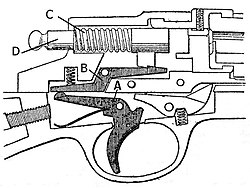
Trigger mechanism in a bolt action rifle: (A) trigger, (B) sear, (C) striker spring, (D) striker.
Thompson submachine gun trigger

A trigger is a mechanism that actuates the function of a ranged weapon such as a firearm, airgun, crossbow, or speargun. The word may also be used to describe a switch that initiates the operation of other non-shooting devices such as a trap, a power tool, or a quick release. A small amount of energy applied to the trigger leads to the release of much more energy.

Most triggers use a small flat or slightly curved lever (called the trigger blade) depressed by the index finger, but some weapons such as the M2 Browning machine gun or the Iron Horse TOR ("thumb-operated receiver") use a push-button-like thumb-actuated trigger design, and others like the Springfield Armory M6 Scout use a squeeze-bar trigger similar to the "ticklers" on medieval European crossbows. Although the word "trigger" technically implies the entire mechanism (known as the trigger group), colloquially it is usually used to refer specifically to the trigger blade.

Most firearm triggers are "single-action", meaning that the trigger is designed only for the single function of disengaging the sear, which allows for a spring-tensioned hammer/striker to be released. In "double-action" firearm designs, the trigger also performs the additional function of cocking the hammer – and there are many designs where the trigger is used for a range of other functions. Furthermore, triggers can be divided into direct triggers (also called single-stage triggers) and which are popular for hunting, and pressure triggers (also called two-stage triggers which are popular on competition rifles.

Function

[edit]

Firearms use triggers to initiate the firing of a cartridge seated within the gun barrel chamber. This is accomplished by actuating a striking device through a combination of mainspring (which stores elastic energy), a trap mechanism that can hold the spring under tension, an intermediate mechanism to transmit the kinetic energy from the spring releasing, and a firing pin to eventually strike and ignite the primer. There are two primary types of striking mechanisms – hammer and striker. A hammer is a pivoting metallic component subjected to spring tension so when released will swing forward to strike a firing pin like a mallet hitting a punch/chisel, which then relays the hammer impulse by moving forward rapidly along its longitudinal axis. A striker is essentially a firing pin directly loaded to a spring, eliminating the need to be struck by a separate hammer. The firing pin/striker then collides into the cartridge primer positioned ahead of it, which contains shock-sensitive compounds (e.g., lead styphnate) that sparks to ignite the propellant powder within the cartridge case and thus discharges the projectile. The trapping interface between the trigger and the hammer/striker is typically referred to as the sear surface. Variable mechanisms will have this surface directly on the trigger and hammer or have separate sears or other connecting parts.

Stages of a trigger pull

[edit]

The trigger pull can be divided into three mechanical stages:

  1. Takeup or pretravel: The movement of the trigger before the sear moves.
  2. Break: The movement of the trigger during the sear's movement up to the point of release, where the felt resistance suddenly decreases.
  3. Overtravel: The movement of the trigger after the sear has already released

Takeup

[edit]

When considering the practical accuracy of a firearm, the trigger takeup is often considered the least critical stage of the trigger pull. Often triggers are classified as either single-stage or two-stage based on the takeup.

  • Single-stage triggers have no discernible resistance during the entire takeup, and only encounter resistance at the very end of takeup (often described as encountering "the wall") when actually actuating the trigger break.
  • Two-stage triggers have a noticeable but relatively light resistance during the takeup, followed by a distinctly increased resistance of the actual trigger break. This allows the shooter to gradually "ease into" the trigger pull instead of hitting the trigger blade with a hasty hard squeeze.

A single-stage trigger is often called direct trigger and is popular on hunting rifles. A two-stage trigger is often called pressure trigger and is popular on competition rifles.

Some fully adjustable triggers can be adjusted to function as either a single-stage or two-stage trigger by adjusting the takeup. Setting the takeup travel (also known as the first stage) to near zero essentially makes the trigger a single-stage trigger. Some single-stage triggers (e.g., Glock Safe Action trigger, Savage AccuTrigger) have an integral safety with a noticeable spring resistance that can functionally mimic a two-stage trigger.

Break

[edit]

The trigger break is named for the sudden loss of resistance when the sear reaches the point of release, which is described as resembling the breaking of rigid materials when the strength fails under stress. The actuation force required to overcome the sear resistance during the break is known as the trigger weight, which is usually measured with a force gauge in newtons in SI units, or alternatively kilograms or grams in metric units, and pounds and/or ounces in US customary units.

The break is often considered the most critical stage of the trigger pull for achieving good practical accuracy, since it happens just prior to the shot being discharged and can cause some unwanted shakes from the shooter's hand at the instant of firing. Shooter preferences vary; some prefer a soft break with a smooth but discernible amount of trigger travel during firing, while others prefer a crisp break with a heavier weight and little or no discernible movement. A perceivably slow trigger break is often referred to as a "creep", and frequently described as an unfavorable feature.

Overtravel

[edit]

The trigger overtravel happens immediately after the break and is typically a short distance and can be considered an inertially accelerated motion caused by the residual push of the finger coupled with the sudden decrease in resistance after the trigger break. It can be a very critical factor for accuracy because shaking movements during this phase may precede the projectile leaving the barrel and is especially important with firearms with long barrels, slow projectiles and heavy trigger weights, where the more significant resistance drop can make the trigger finger overshoot and shake in an uncontrolled fashion. Having some overtravel provides a "buffer zone" that prevents the shooter from "jerking the trigger", allowing the remnant pressing force from the finger to be dampened via a "follow-through" motion. Although a perceivable overtravel can be felt as adding to the "creep" of the trigger break, it is not always considered a bad thing by some shooters. An overtravel stop will arrest the motion of the trigger blade and prevent excessive movement.

Reset

[edit]

When user releases the trigger, and it travels to its resting position. On semiauto firearms the movement eventually passes by reset position where trigger-disconnector mechanism resets itself to its resting state, in which pulling the trigger releases the sear. The reset event does not occur in double action firearms and in full auto firearms.

Types

[edit]

There are numerous types of trigger designs, typically categorized according to which functions the trigger is tasked to perform, a.k.a. the trigger action (not to be confused with the action of the whole firearm, which refers to all the components that help handle the cartridge, including the magazine, bolt, hammer and firing pin/striker, extractor and ejector in addition to the trigger). While a trigger is primarily designed to set off a shot by releasing the hammer/striker, it may also perform additional functions such as cocking (loading against a spring) the hammer/striker, rotating a revolver's cylinder, deactivating internal safeties, transitioning between different firing modes (see progressive trigger), or reducing the pull weight (see set trigger).

Single-action

[edit]

A single-action (SA) trigger is the earliest and mechanically simplest of trigger types. It is called "single-action" because it performs the single function of releasing the hammer/striker (and nothing else), while the hammer/striker must be cocked by separate means.[1] Almost all single-shot and repeating long arms (rifles, shotguns, submachine guns, machine guns, etc.) use this type of trigger.[1]

The "classic" single-action revolver of the mid-to-late 19th century includes black powder caplock muzzleloaders such as the Colt 1860 "Army" Model, and Colt 1851 "Navy" Model, and European models like the LeMat, as well as early metallic cartridge revolvers such as the Colt Model 1873 "Single Action Army" (named for its trigger mechanism) and Smith & Wesson Model 3, all of which required a thumb to cock the hammer before firing. Single-action triggers with manually cocked external hammers lasted a while longer in some break-action shotguns and in dangerous game rifles, where the hunter did not want to rely on an unnecessarily complex or fragile weapon. While single-action revolvers never lost favor in the US right up until the birth of the semi-automatic pistol, double-action revolvers such as the Beaumont–Adams were designed in Europe before the American Civil War broke out and saw great popularity all through the latter half of the 19th century, with certain numbers being sold in the US as well.

While many European and some American revolvers were designed as double-action models throughout the late 19th century, for the first half of the 20th century, all semi-automatic pistols were single-action weapons, requiring the weapon to be carried cocked and loaded with the safety on, or uncocked with an empty chamber (Colt M1911, Mauser C96, Luger P.08, Tokarev TT, Browning Hi-Power). The difference between these weapons and single-action revolvers is that while a single-action revolver requires the user to manually cock the hammer before each firing, a single-action semi-automatic pistol only requires manual cocking for the first shot, after which the slide will reciprocate under recoil to automatically recock the hammer for a next shot, and is thus always cocked and ready unless the user manually decocks the hammer, encounters a misfiring cartridge, or pulls the trigger on an empty chamber (for older weapons lacking "last round bolt hold open" feature).

In the late 1930s and early 1940s, Carl Walther GmbH introduced the first "double-action" (actually DA/SA hybrid) semi-automatic pistols, the PPK and P.38 models, which featured a revolver-style double-action trigger, allowing the weapon to be carried with a round chambered and the hammer lowered. After the first shot, they would fire subsequent shots like a single-action pistol. These pistols rapidly gained popularity, and the traditional single-action-only pistols rapidly lost favor, although they still retain a dedicated following among enthusiasts. Today, a typical revolver or semi-automatic pistol is a DA/SA one, carried in double-action mode but firing most of its shots in single-action mode.

Double-action only

[edit]

A double-action trigger, also known as double-action only (DAO) to prevent confusion with the more common hybrid DA/SA designs, is a trigger that must perform the double function of both cocking and releasing the hammer/striker. Such trigger design either has no internal sear mechanism capable of holding the hammer/striker in a still position (so cocking and releasing have to happen in one uninterrupted sequence), or has the whole hammer shrouded and/or with the thumb spur machined off, preventing the user from manipulating it separately.

This design requires a trigger pull to both cock and trip the hammer/striker for every single shot, unlike a DA/SA, which only requires a double-action trigger pull for the first shot (or a typical DA/SA revolver, which can fire single action any time the user wishes but uses double-action as a default). This means that there is no single-action function for any shot, and the hammer or striker always rests in the down position until the trigger pull begins. With semi-automatics, this means that unlike DA/SA weapons, the hammer does not remain cocked after the first round is fired, and every shot is in double-action mode. With revolvers, this means that one does not have the option of cocking the gun before shooting and must always shoot it in double action mode.

Although there have been revolvers that were designed with trigger mechanisms totally lacking a single-action mechanism altogether,[2] more commonly DAO revolvers are modifications of existing DA/SA models, with identical internals, only with access to the hammer prevented, either by covering it with a shroud or by removing the thumb spur. In both cases, the goal is to prevent the possible snagging of the hammer spur on clothing or holster. Due to the imposed limitation in accuracy, the majority of DAO revolvers have been short-barrel, close-range "snub" weapons, where rapidity of draw is essential and limited accuracy is already an acceptable compromise.

The purpose of a DAO action in a semi-automatic is mostly to avoid the change in trigger pull between the first and subsequent shots that one experiences in a DA/SA pistol, while avoiding the perceived danger of carrying a cocked single-action handgun, although it also avoids having to carry a cocked and loaded pistol, or having to lower the hammer on a loaded chamber, if one only fires a partial magazine. A good example of this action in a semi-automatic is the SIG Sauer DAK trigger, or the DAO action of the Sig P250. For striker-fired pistols such as the Taurus 24/7, the striker will remain in the rest position through the entire reloading cycle. This term applies most often to semi-automatic handguns; however, the term can also apply to some revolvers such as the Smith & Wesson Centennial, the Type 26 Revolver, and the Enfield No. 2 Mk I* and Mk I** revolvers, in which there is no external hammer spur, or which simply lack the internal sear mechanism capable of holding the hammer in the cocked position.

Double-action/single-action

[edit]

A double-action/single-action (DA/SA) trigger is a hybrid design combining the features of both single- and double-action mechanisms. It is also known as traditional double-action (TDA), as the vast majority of modern "double-action" handguns (both revolvers and semi-automatic pistols) use this type of trigger instead of "double-action only" (DAO).

In simple terms, "double-action" refers to a trigger mechanism that both cocks the hammer and then releases the sear, thus performing two "acts", although it is supposed to describe doing both strictly with one trigger pull only. However, in practice most double-action guns feature the optional ability to cock the hammer separately, reducing the trigger to perform just one action. This is opposed to "double-action only" firearms, which completely lack the capability to fire in single-action mode.

In a DA/SA trigger, the mechanism is designed with an internal sear that allows the trigger to both cock and release the hammer/striker when fully pulled, or to merely lock the hammer/striker in the cocked position when it is pulled to the rear and the trigger is not depressed. In a revolver, this means that simply squeezing the trigger when the hammer is lowered will both cock and release it. If the user uses their thumb to pull the hammer to the back, but does not press the trigger, the mechanism will lock the hammer in the cocked position until the trigger is pressed, just like a single action. Firing in double-action mode allows a quicker initiation of fire, but compromised by having a longer, heavier trigger pull, which can affect accuracy compared to the lighter, shorter trigger pull of a single-action fire.

In a DA/SA semi-automatic pistol, the trigger mechanism functions identically to that of a DA revolver. However, this is combined with the ability of the pistol slide to automatically cock the hammer when firing. Thus, the weapon can be carried with the hammer down on a loaded chamber, reducing perceived danger of carrying a single-action semi-automatic. When the user is ready to fire, simply pulling the trigger will cock and release the hammer in double action mode. When the weapon fires, the cycling slide automatically cocks the hammer to the rear, meaning that the rest of the shots fired will be in single-action mode, unless the hammer is manually lowered again. This gives the positive aspects of a single-action trigger without the need to carry "cocked and locked" (with a loaded chamber and cocked hammer), or with an empty chamber, which requires the user to chamber a round before firing.

A potential drawback of a DA/SA weapon is that the shooter must be comfortable dealing with two different trigger pulls: the longer, heavier DA first pull and the shorter, lighter subsequent SA pulls. The difference between these trigger pulls can affect the accuracy of the crucial first few shots in an emergency situation. Although there is little need for a safety on a DA/SA handgun when carrying it loaded with the hammer down,[citation needed] after the first shots are fired, the hammer will be cocked and the chamber loaded. Thus, most DA/SA guns either feature a conventional safety that prevents the hammer from accidentally dropping, or a "decocker" – a lever that safely and gently drops the hammer (i.e. decocks the gun) without fear of the gun firing. The latter is the more popular because, without a decocker, the user is forced to lower the hammer by hand onto a loaded chamber, with all of the attendant safety risks that involves, to return the gun to double-action mode. Revolvers almost never feature safeties, since they are traditionally carried un-cocked, and the hammer requires the user to physically cock it prior to every shot; unlike a DA/SA gun, which cocks itself every time the slide is cycled.

There are many examples of DA/SA semi-automatics, the Little Tom Pistol being the first,[3][4] followed up by the Walther PPK and Walther P38. Modern examples include weapons such as the Beretta 92, among others. Almost all revolvers that are not specified as single-action models are capable of firing in both double- and single-action mode, for example, the Smith & Wesson Model 27, S&W Model 60, the Colt Police Positive, Colt Python, etc. Early double-action revolvers included the Beaumont–Adams and Tranter black-powder muzzleloaders. There are some revolvers that can only be fired in double-action mode (DAO), but that is almost always due to existing double-action/single-action models being modified so that the hammer cannot be cocked manually, rather than from weapons designed that way from the factory.

Release trigger

[edit]

A release trigger releases the hammer or striker when the trigger is released by the shooter, rather than when it is pulled.[5]

Binary trigger ("pull and release")

[edit]

A binary trigger is a trigger for a semiautomatic firearm that drops the hammer both when the trigger is pulled, and also when it is released. Examples include the AR-15 series of rifles, produced by Franklin Armory, Fostech Outdoors, and Liberty Gun Works. The AR-15 trigger as produced by Liberty Gun Works only functions in pull and release mode, and does not have a way to catch the hammer on release; while the other two have three-position safety selectors and a way to capture the hammer on release. In these triggers, the third position activates the pull and release mode, while the center selector position causes the trigger to only drop the hammer when pulled.

Set trigger

[edit]

A set trigger allows a shooter to have a greatly reduced trigger pull (the resistance of the trigger) while maintaining a degree of safety in the field compared to having a conventional, very light trigger. There are two types: single set and double set. Set triggers are most likely to be seen on customized weapons and competition rifles where a light trigger pull is beneficial to accuracy.

Single set trigger

[edit]

A single set trigger is usually one trigger that may be fired with a conventional amount of trigger pull weight or may be "set" – usually by pushing forward on the trigger, or by pushing forward on a small lever attached to the rear of the trigger. This takes up the trigger slack (or "take-up") in the trigger and allows for a much lighter trigger pull. This is colloquially known as a hair trigger.

Double set trigger

[edit]

A double set trigger achieves the same result, but uses two triggers: one sets the trigger and the other fires the weapon. Double set triggers can be further classified into two different phases.[6] A double set, single phase trigger can only be operated by first pulling the set trigger, and then pulling the firing trigger. A double set, double phase trigger can be operated as a standard trigger if the set trigger is not pulled, or as a set trigger by first pulling the set trigger. Double set, double phase triggers offer the versatility of both a standard trigger and a set trigger.

Pre-set (striker or hammer)

[edit]

Pre-set strikers and hammers apply only to semi-automatic handguns. Upon firing a cartridge or loading the chamber, the hammer or striker will rest in a partially cocked position. The trigger serves the function of completing the cocking cycle and then releasing the striker or hammer. While technically two actions, it differs from a double-action trigger in that the trigger is not capable of fully cocking the striker or hammer. It differs from single-action in that if the striker or hammer were to release, it would generally not be capable of igniting the primer. Examples of pre-set strikers are the Glock, Smith & Wesson M&P, Springfield Armory XD-S variant (only), Kahr Arms, FN FNS series and Ruger SR series pistols. This type of trigger mechanism is sometimes referred to as a striker-fired action, or SFA. Examples of pre-set hammers are the Kel-Tec P-32 and Ruger LCP pistols.

Pre-set hybrid

[edit]

Pre-set hybrid triggers are similar to a DA/SA trigger in reverse. The first pull of the trigger is pre-set. If the striker or hammer fail to discharge the cartridge, the trigger may be pulled again and will operate as a double-action only (DAO) until the cartridge discharges or the malfunction is cleared. This allows the operator to attempt a second time to fire a cartridge after a misfire malfunction, as opposed to a single-action, in which the only thing to do if a round fails to fire is to rack the slide, clearing the round and recocking the hammer. While this can be advantageous in that many rounds will fire on being struck a second time, and it is faster to pull the trigger a second time than to cycle the action, if the round fails to fire on the second strike, the user will be forced to clear the round anyway, thus using up even more time than if they had simply done so in the first place. The Taurus PT 24/7 Pro pistol (not to be confused with the first-generation 24/7 which was a traditional pre-set) offered this feature starting in 2006. The Walther P99 Anti-Stress is another example.

Variable triggers

[edit]

Double-crescent trigger

[edit]
The double-crescent trigger on the MG 34, which enabled select fire capability without using a selector switch. Pressing the upper segment of the trigger produced semi-automatic fire, while holding the lower segment of the trigger produced fully automatic fire.

A double-crescent trigger provides select fire capability without the need for a fire mode selector switch. Pressing the upper segment of the trigger produced semi-automatic fire, while holding the lower segment of the trigger produced fully automatic fire. Though considered innovative at the time, the feature was eliminated on most firearms due to its complexity. Examples include MG 34, Kulsprutegevär m/40 automatic rifle, M1946 Sieg automatic rifle, Osario Selectiva,[7] and Star Model Z62.

Progressive/staged trigger

[edit]

A progressive, or staged trigger allows different firing rates based on how far it is depressed. For example, when pulled lightly, the weapon will fire a single shot. When depressed further, the weapon fires at a fully automatic rate.[8] Examples include FN P90, Jatimatic, CZ Model 25, PM-63, BXP, F1 submachine gun, Vigneron submachine gun, Wimmersperg Spz-kr, and Steyr AUG.

Relative merits

[edit]

Each trigger mechanism has its own merits. Historically, the first type of trigger was the single-action.[9] This is the simplest mechanism and generally the shortest, lightest, and smoothest pull available.[9] The pull is also consistent from shot to shot so no adjustments in technique are needed for proper accuracy. On a single-action revolver, for which the hammer must be manually cocked prior to firing, an added level of safety is present. On a semi-automatic, the hammer will be cocked and made ready to fire by the process of chambering a round, and as a result an external safety is sometimes employed.

Double-action triggers provide the ability to fire the gun whether the hammer is cocked or uncocked. This feature is desirable for military, police, or self-defense pistols. The primary disadvantage of any double-action trigger is the extra length the trigger must be pulled and the extra weight required to overcome the spring tension of the hammer or striker.

DA/SA pistols are versatile mechanisms. These firearms generally have a manual safety that additionally may serve to decock the hammer. Some have a facility (generally a lever or button) to safely lower the hammer. As a disadvantage, these controls are often intermingled with other controls such as slide releases, magazine releases, take-down levers, takedown lever lock buttons, loaded chamber indicators, barrel tip-up levers, etc. These variables become confusing and require more complicated manuals-of-arms. One other disadvantage is the difference between the first double-action pull and subsequent single-action pulls.

DAO firearms resolve some DA/SA shortcomings by making every shot a double-action shot. Because there is no difference in pull weights, training and practice are simplified. Additionally, the heavier trigger pull can help to prevent a negligent discharge under stress.[10] This is a particular advantage for a police pistol. These weapons also generally lack any type of external safety. DAO is common among police agencies and for small, personal protection firearms. The primary drawback is that the additional trigger pull weight and travel required for each shot reduces accuracy.

Pre-set triggers offer a balance of pull weight, trigger travel, safety, and consistency. Glock popularized this trigger in modern pistols[citation needed] and many other manufacturers have released pre-set striker products of their own. The primary disadvantage is that pulling the trigger a second time after a failure to fire will not re-strike the primer. In normal handling of the firearm, this is not an issue; loading the gun requires that the slide be retracted, pre-setting the striker. Clearing a malfunction also usually involves retracting the slide following the "tap rack bang" procedure.

References

[edit]
[edit]
Revisions and contributorsEdit on WikipediaRead on Wikipedia
from Grokipedia
In firearms, the trigger is the manual control mechanism, typically a lever operated by the shooter's finger, that releases the internal firing components to discharge the weapon by striking the primer of a cartridge. This action initiates the ignition of propellant powder, propelling the projectile down the barrel. The design and function of triggers vary widely across firearm types, influencing accuracy, safety, and user preference, and they are integral to the action—the system that loads, fires, and ejects cartridges. The evolution of trigger mechanisms traces back to the 15th century with the matchlock system, where pulling the trigger released a spring-loaded arm holding a lit match to ignite black powder in a priming pan. Subsequent innovations included the wheel lock (early 16th century), which used a trigger to release a spring-driven spinning wheel striking pyrite to produce sparks, and the flintlock (early 17th century), where the trigger dropped a flint-tipped hammer against a steel frizzen to generate ignition sparks. By the early 19th century, percussion caps replaced loose powder, with triggers activating hammers to strike caps on nipples, leading to more reliable systems in revolvers and rifles. Modern triggers, developed in the 20th century, primarily employ either hammer-fired mechanisms—where a pivoting hammer driven by a spring strikes the firing pin—or striker-fired mechanisms, where a linear spring-loaded striker directly impacts the firing pin without an external hammer. Triggers are classified by their action type and pull characteristics. In terms of action, single-action (SA) triggers require the hammer to be manually or mechanically cocked before the trigger pull releases it to fire, offering a light, short pull for precision shooting, as seen in the Colt 1911 pistol. Double-action (DA) triggers cock and release the hammer in one pull, providing a longer, heavier initial stroke for added safety, while double-action/single-action (DA/SA) hybrids allow both modes, with subsequent shots in SA after the first DA pull, common in models like the Beretta 92. Double-action only (DAO) variants limit operation to the heavier pull exclusively. Striker-fired systems, popularized by the Glock 17 in the 1980s, use a consistent partial cocking via trigger pull to drive the striker forward. For rifles, triggers are often categorized by stages: single-stage provides immediate resistance and release upon pull, suiting quick tactical applications, while two-stage (or double-stage) features an initial light take-up followed by a distinct "wall" before break, enhancing control in precision scenarios like military rifles such as the M1 Garand. Safety features frequently integrate with triggers, such as blocking sears to prevent unintended release or requiring deliberate pressure to avoid accidental discharge. Trigger pull weight, measured in pounds of force, typically ranges from 4-7 pounds for service firearms to balance safety and usability, with lighter pulls (under 3 pounds) common in competition models but increasing accidental fire risks. These elements make the trigger a critical component in firearm design, regulated under laws like the National Firearms Act to control modifications that could enable automatic fire.

Basic Principles

Definition and Role

In firearms, a trigger is a lever or analogous mechanism actuated by the shooter's finger to release the internal firing components, thereby initiating the discharge of a projectile by igniting the propellant in the cartridge or shotshell. This actuation fundamentally operates by disengaging a restraint on the hammer or striker, allowing it to propel forward and strike the primer, which explodes to generate the high-pressure gases that launch the bullet, slug, or shot. In modern firearms, the trigger functions as the core user interface for deliberate firing, separate from safety devices that mechanically block its movement to avert accidental activation or selector controls that switch between modes like semi-automatic and full-automatic without directly triggering ignition. This distinction ensures the trigger's role remains focused on precise, intentional control over the firing process, enhancing safety and accuracy across handguns, rifles, and shotguns.

Fundamental Mechanics

The trigger mechanism in firearms employs principles of leverage to amplify the user's input force, providing mechanical advantage that allows a relatively light trigger pull to overcome the resistance of internal components. The trigger typically pivots around a fulcrum point, such as a pin or axis within the firearm's frame, acting as a lever where the distance from the fulcrum to the point of finger application is greater than the distance to the engagement point with other parts. This configuration multiplies the applied force depending on geometry, thereby reducing the effort required to initiate firing while maintaining control. Trigger pull force is transmitted to the sear or striker through direct contact or interconnected linkages, converting linear or rotational motion into the precise movement needed to release the firing components. In systems using a sear, the trigger's motion pushes or rotates the sear out of engagement via a lever arm or connector, overcoming frictional forces at the contact surfaces governed by torque (force times radius) and coefficients of friction between materials like steel. For striker mechanisms, force is often relayed via a trigger bar—a rigid link that interfaces with a notch or lug on the striker—allowing the pull to disengage a retaining surface and permit forward motion. This transmission minimizes energy loss through optimized pivot radii and surface finishes, ensuring reliable operation under varying loads. At the core of trigger operation lies basic physics involving energy storage and release: the hammer or striker spring is compressed during cocking, storing potential energy proportional to the square of displacement (1/2 k x², where k is the spring constant and x is compression). Upon trigger break, this stored energy converts to kinetic energy, propelling the hammer or striker forward to initiate ignition with minimal additional input from the user beyond overcoming sear friction. The release is abrupt once the sear disengages, ensuring a clean break that transfers nearly all stored potential into the impact force required for primer detonation. Hammer-fired systems differ mechanically from striker-fired ones in the path of energy transfer and component motion. In hammer-fired designs, the trigger releases a sear that holds the hammer against its fully cocked spring, allowing the hammer's mass and spring to accelerate it toward an intermediary firing pin, which then strikes the primer; this introduces an additional inertial step for momentum buildup. Striker-fired systems, conversely, integrate the firing pin into a spring-loaded striker that is partially tensioned by slide recoil and held by a trigger-linked retainer; pull directly unleashes the striker to contact the primer, resulting in a more streamlined linear path with reduced mass in motion but requiring precise partial-cocking mechanics for consistent release. These distinctions affect overall lock time and perceived trigger crispness without altering the fundamental leverage principles.

Function

Stages of Trigger Pull

The stages of a trigger pull represent the sequential mechanical and tactile progression experienced by the shooter when actuating the trigger mechanism in a firearm, from initial finger contact to readiness for the next shot. These phases are designed to balance safety, control, and reliability, allowing the shooter to apply pressure progressively without unintended discharge. Understanding these stages is essential for consistent accuracy, as each contributes to the overall feel and predictability of the trigger. The first stage, known as takeup or pre-travel, occurs as the shooter applies initial pressure to the trigger, moving it rearward through any inherent slack or compression without yet engaging the sear that holds the firing mechanism. This phase builds tension in the trigger system, often feeling like a smooth compression of springs, preparing the mechanism for release while minimizing movement that could disturb the shooter's aim. In this stage, no firing occurs, providing a buffer against accidental pulls. Following takeup is the break, also called the wall or release point, where continued pressure overcomes the final resistance, causing the sear to disengage abruptly and release the hammer or striker to fire the round. This stage is characterized by a clean, crisp "break" without creep or rolling, ideally resembling the snapping of glass for predictability, and it demands steady pressure to avoid jerking the firearm off target. The break is the critical moment of commitment, where the shooter's control directly influences shot placement. After the break, the overtravel stage allows the trigger to continue moving rearward a brief distance, ensuring the hammer or striker completes its full forward travel to strike the firing pin without interference. This post-release movement prevents premature stopping that could bind the mechanism, and in precision triggers, it is minimized to reduce unnecessary finger travel and enhance reset speed. Overtravel ends when the trigger contacts an internal stop, providing tactile feedback that the shot has been initiated. The final stage, reset, involves the trigger returning forward to its starting position under spring tension, often accompanied by an audible click or distinct tactile "snap" that signals readiness for the next pull. This forward motion, typically quick and covering the full travel distance, allows for rapid follow-up shots in repeating firearms by re-engaging the sear. Effective reset enhances shooting cadence while maintaining safety, as incomplete reset could prevent firing. Variations in these stages arise between semi-automatic and manual actions, influencing the overall pull length and feel. In semi-automatic rifles, such as the AR-15, the stages are generally short and light— with minimal takeup and overtravel for quick resets—facilitating semi-automatic cycling after each shot via recoil or gas operation. In contrast, manual actions like revolvers in double-action mode feature a longer takeup phase, where the initial pull cocks the hammer before reaching the break, resulting in heavier overall pull weights to accommodate the mechanical work, though single-action revolvers shorten this for precision shooting.

Measurement and Characteristics

Trigger pull weight, also known as trigger force, is the amount of pressure required to actuate the firing mechanism, typically measured in pounds-force (lbf) or newtons (N) using devices such as static hanging weights, spring gauges, mechanical force gauges, or digital force gauges applied parallel to the firearm's bore axis. According to the Sporting Arms and Ammunition Manufacturers' Institute (SAAMI), this force represents the peak load needed to cause the firearm to discharge, ensuring safety and functionality assessments. Measurements are taken by pulling the trigger steadily until the break occurs, with multiple trials (often five to ten) averaged to account for variability, as outlined in forensic and manufacturing best practices. Typical ranges vary by firearm type: for handguns, single-action pulls commonly fall between 2 and 5 lbf, while double-action pulls can exceed 10 lbf; rifles generally exhibit 3 to 8 lbf, with precision models adjusted lower for competitive use. Travel distance quantifies the linear displacement of the trigger shoe during operation, encompassing pre-travel (initial take-up), the break (release point), and post-travel (over-travel after firing). Pre-travel involves the distance the trigger moves before encountering significant resistance to allow mechanism engagement without disturbing the shooter's aim. The break marks the precise point of sear release, ideally with minimal additional movement, while post-travel permits the trigger to continue rearward briefly before stopping to facilitate reset. These distances are measured with precision tools like dial calipers or laser micrometers on the trigger shoe, contributing to overall pull predictability. Creep refers to the subtle, uneven resistance or "gritty" sensation in the trigger's final pre-travel phase, just before reaching the wall or break point, caused by minor friction or play in the sear engagement. In contrast, slack (or take-up) describes the initial free movement of the trigger without resistance, allowing the mechanism to preload smoothly. Excessive creep disrupts precision by introducing variability in the pull, potentially causing shooters to hesitate or jerk, which can shift the sights off target; ideal triggers minimize creep for consistent breaks. Slack, when properly tuned, enhances control by isolating the break but can feel sloppy if excessive, indirectly affecting shot-to-shot accuracy in high-precision applications. Consistency in trigger characteristics ensures repeatable performance, with pull weight and travel varying minimally across cycles—to support accuracy and safety. Mechanical wear from repeated use can degrade consistency by altering spring tension or introducing friction, potentially increasing pull weight. Environmental factors like temperature and humidity also influence measurements, as cold can stiffen springs and raise apparent pull weights; best practices recommend controlled conditions (e.g., 68-77°F and 40-60% humidity) and multiple readings for validation. SAAMI specifications emphasize uniform pull for reliability testing, while forensic standards require documenting deviations to assess firearm condition.

Components

Core Trigger Parts

The trigger shoe, also known as the trigger blade, serves as the primary user-interface component of the trigger assembly, providing the surface against which the shooter's finger applies pressure to initiate the firing sequence. This part is typically designed in either a curved or straight configuration to accommodate different hand positions and shooting disciplines; curved shoes are traditional and common in defensive handguns and many rifles for natural finger placement, while straight designs are popular in modern tactical and semi-automatic rifles to allow consistent finger placement and minimize lateral movement. The sear functions as a critical locking element within the trigger mechanism, acting as a notch or lever that retains the hammer, striker, or bolt in a cocked position until sufficient rearward force on the trigger disengages it, allowing the firing pin to strike the primer. By precisely controlling this release, the sear ensures reliable ignition only upon intentional actuation, contributing to the overall safety and accuracy of the firearm. Connecting the trigger shoe to the sear, the trigger bar or linkage transmits the mechanical force generated by the shooter's pull, enabling coordinated movement across the assembly in designs such as semi-automatic pistols where spatial constraints around the magazine well necessitate a flexible connector. This component often incorporates hooks or cams to interface with the sear, facilitating smooth engagement and disengagement during the firing cycle. Pivot points and fulcrums in the trigger assembly, typically implemented as hardened pins or axes, allow rotational movement of the trigger shoe and sear, thereby providing mechanical advantage that amplifies the input force from the finger to overcome the resistance of the cocked hammer or striker. The positioning of these pivots relative to the force application point on the shoe directly influences trigger pull weight and responsiveness, with optimal placement reducing the effort required for operation. Core trigger parts are commonly constructed from durable materials to withstand repeated high-impact stresses; steel offers superior strength and longevity for sears and bars in high-volume use, while polymers and composites provide weight savings and corrosion resistance in shoes and linkages.

Associated Mechanisms

The trigger spring, often a coil or leaf spring positioned behind or integrated with the trigger assembly, provides the necessary return force to reset the trigger to its forward position after each pull, ensuring consistent operation across multiple shots. It also imparts resistance during the initial stages of the trigger pull, contributing to the overall pull weight and tactile feedback for the shooter. In designs like those found in striker-fired pistols, the spring's tension directly influences reset speed, allowing rapid follow-up shots by quickly re-engaging the sear. The disconnector serves as a critical intermediary in semi-automatic firearms, interrupting the connection between the trigger and the sear during the firing cycle to prevent unintended discharges. Specifically, as the slide or bolt cycles rearward after firing, the disconnector physically separates the trigger bar from the sear, ensuring the hammer or striker remains held until the trigger is released and reset. This mechanism is essential for out-of-battery safety, as it blocks firing if the action is not fully in position, thereby avoiding potential malfunctions or hazards in dynamic shooting scenarios. At the hammer or striker interface, the trigger facilitates release through a precise engagement with the sear, which holds the cocked hammer or partially tensioned striker under spring pressure until the trigger pull overcomes the retention. In hammer-fired systems, the trigger's movement pivots the sear away from the hammer notch, allowing the mainspring to drive the hammer forward to strike the firing pin. For striker-fired mechanisms, the interface similarly disengages a blocking surface, enabling the strikerspring to propel the striker into the primer without exposing the full lockwork details. This interaction minimizes lock time—the interval from trigger break to ignition—enhancing accuracy in high-speed applications. The overtravel stop, typically a small adjustable pin or surface within the trigger housing, limits the trigger's rearward movement immediately after sear release, preventing excessive travel that could introduce play or delay in reset. By halting overtravel—defined as post-break motion—it reduces overall lock time and improves shot-to-shot consistency, particularly in precision rifles or competition handguns where minimal mechanical slop is desired. Proper adjustment ensures the stop contacts just as the sear disengages, avoiding interference with the firing mechanism while maintaining a crisp break. Maintenance of these associated mechanisms is vital for reliable performance, involving periodic cleaning to remove carbon buildup, debris, and residue that can cause binding or inconsistent operation. Lubrication should be applied sparingly to pivot points, springs, and interfaces—such as a light oil on the trigger spring coils and disconnector notches—to reduce friction without attracting dirt, typically after every 500-1,000 rounds or following exposure to environmental contaminants. Over-lubrication can lead to gumming, so excess should be wiped away, and full disassembly for inspection is recommended annually or as needed to check for wear on the overtravel stop and hammer/striker engagement surfaces.

Types

Single-Action Triggers

A single-action trigger in firearms is designed to perform only one function: releasing a pre-cocked hammer or striker to initiate firing, requiring manual cocking of the firing mechanism prior to pulling the trigger. This external cocking can occur through mechanisms such as manually thumbing back the hammer on a revolver, operating the slide on a semi-automatic pistol, or cycling the bolt on a rifle, ensuring the trigger serves solely as a release mechanism once the action is prepared. The mechanics of a single-action trigger involve a short travel distance and light pull weight, typically ranging from 2 to 4 pounds for precision-oriented designs, culminating in a crisp break where the sear disengages abruptly without creep. This configuration minimizes shooter-induced disturbance to the sights during the pull, promoting enhanced accuracy in controlled environments. Prominent examples include the Colt M1911 semi-automatic pistol, where the slide recoil cocks the hammer, leaving the trigger to provide a consistent light release, and the Remington Model 700 bolt-action rifle, in which manual bolt operation cocks the firing pin for subsequent trigger release. One key advantage of single-action triggers lies in their reduced lock time—the interval from sear release to primer impact—which is minimized due to the pre-cocked state and limited mechanical movement, often achieving 2.5 to 3.5 milliseconds in modern rifle designs and thereby decreasing overall firing delay for faster follow-up shots. Single-action triggers find common applications in target shooting, where their light and predictable pull supports precise shot placement, as well as in military semi-automatic firearms like the M1911, valued for reliability in cocked-and-ready configurations during tactical operations.

Double-Action Triggers

Double-action triggers are a mechanism in firearms where the trigger pull cocks and releases the hammer to fire the round. This category includes double-action only (DAO) and double-action/single-action (DA/SA) configurations. Double-action only (DAO) triggers are a configuration where the trigger pull simultaneously cocks the hammer and releases it to fire the round, eliminating the need for manual cocking prior to shooting. This design ensures that every shot requires a full trigger stroke from the same starting position, promoting operational consistency without an external hammer manipulation option. Mechanically, DAO triggers feature a long travel distance, typically 0.3 to 0.6 inches (7.6-15 mm), with a heavy initial takeup that transitions to a lighter release phase near the end of the pull. Typical pull weights for revolvers range from 9 to 13 pounds, with pistol variations from 6 to 12 pounds depending on the manufacturer and model. Internally, for revolvers, the mechanism employs a cam or linkage system connected to the trigger that rotates the cylinder while compressing the mainspring to cock the hammer during the pull. In semi-automatic pistols, the trigger cocks and releases the hammer, with slide cycling handled by recoil. Representative examples include the Smith & Wesson J-frame series of revolvers, such as the Model 642, which utilize DAO for compact, reliable operation in small-frame designs. These triggers are particularly suited for concealed carry applications, where their simplicity reduces the risk of accidental discharge during holstering and drawing, while the heavy pull enhances safety without requiring additional manual safeties. Double-action/single-action (DA/SA) triggers combine both modes in the same firearm. The first trigger pull is double-action, cocking and releasing the hammer to fire the round. Recoil from the fired round cycles the slide, recocking the hammer for subsequent shots in single-action mode with shorter travel and lighter pull weight. This design offers a heavy initial pull for added safety and lighter follow-up pulls for improved accuracy. Representative examples include the Beretta 92 and Sig Sauer P226.

Striker-Fired Triggers

Striker-fired triggers are a modern design where an internal, linear spring-loaded striker replaces the external hammer, directly striking the firing pin upon release. Unlike traditional hammer systems, the striker is partially pre-cocked by the slide or bolt operation, with the trigger pull completing the cocking and releasing the striker in a consistent motion similar to DAO but without visible hammer movement. Some striker-fired pistols, such as those in the Glock series including compact models like the Glock 43, exhibit a consistent trigger pull that fully cocks and releases the internal striker on each shot, simulating double-action-only (DAO) behavior through a uniform long-pull trigger without a lighter single-action follow-up. This results in a uniform trigger pull for each shot, typically 5 to 6 pounds, with a short reset for rapid follow-ups, enhancing simplicity and reducing snag points for concealed carry. The mechanics involve a trigger bar or connector that retracts the striker against its spring during pull, then disengages at the end to propel it forward. Safety features often include a trigger safety blade or integrated blocks to prevent inertial firing. Popularized by the Glock 17 in 1984, striker-fired systems dominate contemporary polymer-framed pistols due to their reliability in adverse conditions and ease of manufacturing. Examples include the Glock series, Smith & Wesson M&P, and Sig Sauer P320, which offer modular striker designs allowing for consistent performance across calibers.

Hybrid and Specialized Action Triggers

Hybrid and specialized action triggers incorporate multiple firing modes or unique mechanical features that blend traditional single-action (SA) and double-action (DA) principles, or introduce novel pull dynamics, to enhance versatility, speed, or precision in firearms operation. These designs often allow shooters to adapt to different scenarios without manual reconfiguration, such as transitioning between heavy initial pulls and lighter follow-ups, or firing on both pull and release phases. Common in both handguns and rifles, they prioritize controlled engagement while maintaining safety through distinct mechanical stages. Double-action/single-action (DA/SA) triggers combine a heavier first pull that cocks and releases the hammer or striker with lighter subsequent single-action pulls for follow-up shots, providing an inherent safety layer via the deliberate initial effort. In this system, the initial DA pull typically requires 8-12 pounds of force to overcome the hammer spring and sear, while SA mode reduces to 4-6 pounds for a crisper break, minimizing accidental discharge risk during the first shot. Examples include the Beretta 92 series, where the open-slide design facilitates smooth cycling between modes, and the SIG Sauer P226, which employs a decocking lever to safely transition from SA to DA readiness. Binary triggers enable firing on both the pull and release of the trigger, effectively doubling the rate of fire in semi-automatic firearms while remaining legally compliant under U.S. federal law as non-automatic devices. Mechanically, a secondary sear or firing pin mechanism engages upon trigger release, allowing one round on pull and another on let-off, with a selector switch to toggle between standard semi-auto and binary modes for user control. The Franklin Armory BFSIII series exemplifies this, compatible with AR-15 platforms, where the system ensures the hammer falls forward on both phases without altering the firearm's semi-automatic classification. Progressive or staged triggers, often two-stage designs in rifles, feature an initial light take-up phase followed by a distinct wall and crisp break, allowing shooters to preload tension before final pressure for enhanced accuracy. The first stage typically absorbs 1.5-2.5 pounds to eliminate creep, culminating in a sharp second-stage release under 1-2 pounds, which provides tactile feedback akin to staging a shot without unintended discharge. Geissele Automatics' two-stage triggers, such as those in their SSA-E model, illustrate this for precision rifles, where the design supports long-range shooting by separating take-up from the break point. Double-crescent triggers represent a rare specialized variant, featuring dual curved trigger surfaces that enable mode selection through finger placement, often for switching between semi-automatic and automatic fire without a separate lever. This design, seen in the German MG 34 machine gun, uses the forward crescent for single shots and the rear for sustained bursts, with the mechanism integrating into the trigger bar to engage different sears based on contact point. The configuration provides an archery-like ergonomic feel, allowing rapid adaptation in combat scenarios.

Advanced Designs

Set and Pre-Set Triggers

Set triggers, also known as set or hair triggers, are specialized mechanisms designed to allow shooters to pre-cock the firing mechanism for an exceptionally light trigger pull, enhancing precision in controlled environments. These triggers typically involve a separate action to engage the light-pull mode, reducing the force required to release the hammer or striker to as low as approximately 0.5 pounds, compared to standard pulls of 4-6 pounds. This design is particularly valued in applications demanding minimal disturbance to aim, such as benchrest or target shooting. A single set trigger utilizes a single lever that, when pushed forward, pre-cocks the hammer or sear, transforming the standard pull into a hair-trigger release requiring only minimal pressure to fire. In its unset position, the trigger maintains a conventional weight of around 4 pounds for safety, allowing it to function as a standard single-stage trigger if needed. This mechanism is commonly found in target rifles, where precision is paramount; for example, the CZ Single Set Trigger (SST) system in models like the CZ 527 provides a standard hunting pull or a lighter target pull by pushing the trigger forward to set it. Double set triggers employ two distinct levers to achieve even greater control and versatility in precision shooting. The rear trigger is pulled first to set the front trigger, reducing its pull weight to a hair-trigger level for release, while the front trigger can also serve as a normal-weight option or reset the system after firing. This configuration is prevalent in muzzleloaders and traditional rifles used for long-range or benchrest competitions, as it allows shooters to tailor the trigger response without compromising the firearm's overall safety profile when unset. For instance, in double-set, double-phase systems, pulling the rear trigger enables the hair-trigger mode on the front, or the front can be pulled alone for standard operation. Pre-set triggers incorporate factory-engineered pre-cocking of the striker or hammer through the firearm's action, such as the slide cycle in semi-automatic pistols, resulting in a consistently light trigger pull without manual setting. In striker-fired designs like the Glock pistol, the striker is partially pre-cocked (approximately 60-80%) during the slide's rearward travel after each shot, requiring only a short final compression and release via the trigger for firing, which contributes to the system's reliable and lightweight pull of around 5.5 pounds. This partial pre-cock enhances safety by necessitating deliberate trigger movement while maintaining operational smoothness. Adjustable aftermarket triggers for pistols from manufacturers like HK or SIG, such as those modified by specialists like Grayguns, combine pre-cocked setups with user-adjustable components like sears or springs for fine-tuning pull weight and reset, ensuring repeatable performance while preserving safety features. Despite their precision benefits, set and pre-set triggers carry risks due to their heightened sensitivity, which can lead to accidental discharges if not properly managed, particularly through involuntary muscle contractions under stress or fatigue. Studies indicate that light trigger pulls increase the likelihood of unintentional firing from unintended hand movements, a concern especially for law enforcement or high-stress users, emphasizing the need for rigorous training and safe handling practices.

Variable and Release Triggers

Variable triggers allow users to customize the trigger pull weight and travel distance to suit individual preferences, typically through mechanical adjustments like set screws or modular components. These designs enhance precision by enabling lighter pulls for competition shooting while maintaining safety margins. For instance, aftermarket units from manufacturers such as Timney Triggers offer adjustable pull weights ranging from 1.5 to 4 pounds, achieved by turning an overtravel screw or spring tension adjuster. Similarly, Geissele Automatics' Super Dynamic-Enhanced Trigger modules permit fine-tuning of the break point and reset for AR-15 platforms, improving follow-up shot accuracy without altering the core action. Release triggers operate in reverse of conventional designs, requiring the shooter to pull the trigger rearward to set the mechanism and then release it forward to fire, which can facilitate smoother follow-through in target shooting. This configuration is particularly prevalent in competition shotguns for trap and sporting clays, where the release action minimizes jerking during the shot. The mechanism involves a sear that engages on pull and disengages on release, with adjustable set weights (typically 4-8 pounds) and release weights (1-3 pounds) to balance safety and responsiveness. In over-under shotguns, this allows selective firing of barrels upon release, reducing fatigue in extended sessions. The double-crescent trigger represents a variable geometry design, featuring two curved trigger surfaces that accommodate different finger positions to control firing modes. Originating in early 20th-century machine guns like the German MG 34, the inner crescent enables semi-automatic fire with light pressure, while the outer allows full-automatic bursts with greater force, all without a separate selector switch. This layout provides intuitive rate-of-fire adjustment based on hand placement, though it is largely historical and not common in modern civilian firearms due to simplified electronic alternatives in military designs. Electronic triggers, though rare, employ solenoid actuators to deliver consistent pull weights electronically, bypassing traditional mechanical springs for reduced variability. Post-2020 developments in experimental smart guns integrate solenoids with biometric safeties, ensuring activation only upon user verification and maintaining pulls around 4-5 pounds for reliability. For example, as of 2025, the Biofire Smart Gun uses electronic fire control with fingerprint and RFID biometrics to authorize firing. These systems, tested in prototypes by firms like Modular Driven Technologies, use battery-powered electromagnets to release the firing pin, offering zero creep but requiring maintenance to prevent electronic failures. Adoption remains limited due to regulatory scrutiny and power dependency. Adjustment methods for variable triggers generally involve simple tools like Allen wrenches or screwdrivers to modify spring preload or sear engagement, but users must adhere to manufacturer-specified limits—typically not below 2.5 pounds—to avoid unintentional discharges or reliability issues. Over-adjustment can lead to inconsistent breaks or increased wear, so testing with a pull gauge after each change is recommended to ensure the mechanism functions within safe parameters. Professional gunsmithing is advised for complex modular swaps to maintain structural integrity.

History and Evolution

Early Developments

The earliest trigger mechanisms in firearms emerged with the matchlock in the 15th century, marking the transition from manual ignition to a mechanical system. This design featured a simple lever trigger connected to a serpentine—a curved arm that held a slow-burning match cord—allowing the shooter to lower the match into the priming pan to ignite the gunpowder without manually applying the match. Developed in Europe around the 1420s and widely adopted by the mid-15th century, the matchlock enabled more reliable aiming and firing, though it required the user to keep the match lit and protected from weather. Advancements in the 16th and 17th centuries came with the wheellock and flintlock mechanisms, which refined trigger operation and introduced rudimentary safety features. The wheellock, invented around 1500 in Germany, used a trigger to release a spring-loaded wheel that spun against a piece of pyrite to produce sparks by friction, eliminating the need for a match but complicating the design with clockwork-like components. By the early 17th century, the flintlock, credited to French gunsmith Marin le Bourgeoys around 1610–1615 for King Louis XIII, integrated the cock, frizzen, and pan into a single unit; pulling the trigger released the cock's flint to strike the frizzen, generating sparks while simultaneously exposing the priming powder. This system incorporated a half-cock position on the cock, serving as an early safety by preventing accidental release until fully cocked. In 18th-century hunting rifles, particularly German Jaeger models, set triggers—often double-set variants—were introduced, where a light front trigger "set" a hair trigger for precise shots, enhancing accuracy for sportsmen without affecting military applications. The percussion cap era, beginning with the development of the percussion system using fulminate primers by Scottish clergyman Alexander Forsyth in 1807, and the introduction of the copper percussion cap in the 1820s, revolutionized ignition and trigger integration by replacing flint-spark systems with a fulminate primer struck directly by the hammer. American inventor Samuel Colt's Paterson revolver of 1836, chambered for percussion caps, featured a single-action trigger that rotated the cylinder via a pawl mechanism upon cocking, allowing rapid multi-shot fire and setting the standard for revolver triggers. True double-action mechanisms, where the trigger both cocks and releases the hammer, appeared in the 1850s with the British Beaumont-Adams revolver of 1851, adapting percussion technology for self-cocking operation to speed up firing in combat. The shift to metallic cartridges in the 1860s further simplified trigger designs by integrating the primer, powder, and projectile into a single unit, eliminating loose powder and separate caps. Rimfire cartridges, patented by Horace Smith and Daniel B. Wesson in 1854 and commercialized in their Model 1 revolver of 1857, used a hammer striking the cartridge rim to detonate the primer, streamlining revolver mechanisms like those in the 1860s conversions of Colt and Remington models. The adoption of centerfire cartridges in the 1860s, such as the Berdan and Boxer systems, allowed for more robust primers and integrated trigger mechanisms in repeating firearms. Innovations by designers like John Browning in the early 20th century introduced semi-automatic triggers that cycled reliably without manual intervention, as seen in the Colt Model 1900 pistol. This transition reduced misfires and loading time, making triggers more reliable and paving the way for enclosed-frame designs without external loading levers.

Modern Innovations

In the late 20th century, the introduction of polymer materials marked a significant advancement in trigger design, particularly with the Glock pistol series launched in the early 1980s. These triggers incorporated polymer components, such as the trigger shoe and housing, which provided weight reduction while offering inherent corrosion resistance due to the non-metallic composition that avoids rust in harsh environments. This innovation, pioneered by Gaston Glock's use of a proprietary nylon-based polymer, facilitated the widespread adoption of lightweight, durable triggers in semi-automatic pistols, enhancing overall firearm ergonomics without compromising functionality. The 1990s saw the rise of adjustable and drop-in trigger systems, enabling users to customize pull weights and reset characteristics through modular kits that could be installed without extensive gunsmithing. These designs addressed previous limitations in precision by allowing fine-tuning of overtravel and creep, with modern examples like TriggerTech's Zero Creep Technology—developed from a 2012 prototype—eliminating perceptible take-up for a crisp, consistent break typically under 0.010 inches of movement. Drop-in units for AR-15 platforms, traceable to prototypes in the early 1990s, streamlined upgrades by housing the entire mechanism in a single cassette, reducing installation time to minutes and improving reliability in high-volume shooting scenarios. Post-1980s developments further popularized striker-fired mechanisms, which pre-cock the striker partially for a consistent, lighter trigger pull—often 5-6 pounds—eliminating the need for manual cocking and providing uniform resistance across shots. This prevalence, accelerated by Glock's influence, extended to modular platforms like the SIG Sauer P320 introduced in 2014, where the fire control unit allows interchangeable grips and calibers while maintaining a predictable pre-set pull that enhances accuracy in defensive and competitive use. By the 2020s, striker-fired triggers dominated law enforcement and civilian markets due to their simplicity and reduced perceived recoil. Recent innovations in the 2020s have focused on reliability enhancements, such as anti-walk pins for AR-15 triggers, which feature serrated or threaded designs to prevent pin rotation or migration under recoil, ensuring stable operation during extended firing sessions of thousands of rounds. Additionally, advancements in binary trigger legality have progressed following a 2025 U.S. Department of Justice settlement with Rare Breed Triggers, affirming the non-machinegun status of certain forced-reset variants and bolstering federal acceptance of binary systems that fire on both pull and release, thereby expanding options for rapid semi-automatic fire within legal bounds. Material evolutions have paralleled these functional improvements, with titanium alloys integrated into trigger pins, blades, and sears for their high strength-to-weight ratio—up to 45% lighter than steel—reducing lock time and fatigue in precision rifles. Coated steels, such as those treated with nickel-PTFE (NP3) or diamond-like carbon (DLC), have become standard for trigger bars and hammers, achieving low friction coefficients (typically 0.07-0.1 for NP3) to minimize wear and enable smoother pulls compared to uncoated surfaces. These coatings, applied via physical vapor deposition, also enhance corrosion resistance and longevity.

Safety and Ergonomics

Safety Features

Safety features in firearm triggers are designed to prevent accidental discharges by incorporating passive or active mechanisms that block firing unless deliberate action is taken. These include integral components within the trigger assembly that require specific user input, such as full finger pressure, while also protecting against external impacts or inertial forces. Common implementations focus on blocking the firing pin, hammer, or trigger movement to enhance reliability without compromising functionality. Trigger safety levers serve as integral blocks embedded within the trigger mechanism to ensure the firearm cannot discharge from incidental contact. In designs like the Glock Safe Action System, the trigger safety is a small lever located inside the trigger shoe that protrudes outward, forming a blade-like extension. This lever fits into a notch on the trigger bar, preventing rearward movement of the trigger bar unless the lever is depressed simultaneously with the trigger by applying full finger pressure across the trigger face. This passive safety engages automatically when the trigger is at rest and requires intentional force to overcome, reducing the risk of firing if the trigger is bumped or snagged on clothing or objects. Hammer blocks are passive safety devices particularly vital in double-action (DA) firearms, where they prevent the hammer from contacting the firing pin unless the trigger is fully pulled. In DA configurations, the hammer is held under spring tension without manual cocking, increasing the potential for unintended release. The hammer block, typically a pivoting or sliding component, positions itself between the hammer and firing pin when the trigger is not engaged, absorbing any forward hammer movement from impacts or vibrations. Upon pulling the trigger, the block retracts or drops away, allowing the hammer to strike the firing pin and initiate firing. This mechanism is standard in many modern DA revolvers and semi-automatic pistols to mitigate risks during handling or holstering. Two-stage safeties integrate with trigger mechanisms in some military rifles to provide layered protection against inadvertent firing, combining a light initial take-up with a distinct break point. In such designs, the first stage offers a long, light pull that preloads the mechanism without releasing the hammer, acting as a tactile barrier to prevent accidental full actuation under stress or rapid handling. The second stage requires additional deliberate pressure to complete the pull and fire, enhancing control in combat scenarios. This configuration, specified in some military-grade triggers, works in tandem with the rifle's selector switch, which physically blocks trigger movement in the safe position, ensuring the firearm remains secure during transport or non-combat use. Drop safeties utilize inertia blocks to secure the firing pin against movement during falls or impacts, preventing unintended primer strikes from gravitational or shock forces. These mechanisms typically consist of a spring-loaded plunger or block that engages a notch in the firing pin channel, holding the pin in a retracted position unless sufficient inertial force from a hammer or striker blow overcomes the block. In modern handguns, the inertia block remains engaged passively and disengages only during the controlled firing sequence, ensuring the firing pin cannot protrude and contact a cartridge even if the firearm is dropped from heights up to 1.5 meters onto hard surfaces. This feature is essential for drop-safe certification, as it addresses vulnerabilities in earlier designs where free-floating firing pins could initiate discharge from impact alone. Legal standards for trigger safeties in consumer firearms are governed by voluntary industry protocols rather than mandatory federal regulations, with the Sporting Arms and Ammunition Manufacturers' Institute (SAAMI) establishing ANSI-approved guidelines for safety testing. Under ANSI/SAAMI Z299.5, handguns must withstand multiple drops from 4 feet onto concrete without discharging, verifying that trigger-integrated safeties like firing pin blocks and hammer blocks function reliably under abusive mishandling. These standards require no visible damage or inadvertent firing after tests in various orientations, promoting consistent safety across manufacturers while allowing innovation in trigger designs. Compliance is self-certified but widely adopted to meet importer and distributor requirements, ensuring consumer firearms incorporate robust anti-discharge mechanisms.

Performance Considerations

Trigger design significantly influences shooting accuracy, particularly in precision scenarios where minimal disturbance to the firearm's alignment is essential. Light and crisp triggers, typically with pull weights around 3 to 4 pounds, minimize the risk of jerking or flinching during the break, allowing shooters to maintain a steady sight picture and reduce muzzle movement. This reduction in involuntary muscle tension enhances group sizes at longer ranges, as evidenced by studies showing that lighter pulls correlate with decreased shooter-induced errors in controlled rifle testing. In contrast, heavier triggers may introduce more anticipation, leading to broader shot dispersion, though they remain suitable for less precise applications. For rapid follow-up shots in tactical situations, short trigger reset and minimal overtravel are critical for maintaining firing cadence without compromising control. A reset distance of less than 0.1 inches enables quicker re-engagement, allowing experienced shooters to achieve split times under 0.2 seconds between shots while keeping the trigger finger in position. Reduced overtravel similarly prevents excess finger movement, promoting consistent pressure application and faster recovery from recoil in dynamic environments like close-quarters engagements. These features are particularly valued in defensive training, where they facilitate controlled pairs or strings of fire without pausing to fully release the trigger. Ergonomic aspects of trigger design, such as reach and finger placement, play a key role in user comfort and sustained performance across diverse hand sizes. Optimal reach positions the trigger pad under the center of the index finger's first joint, preventing torque that could induce lateral sight deviation and ensuring even pressure distribution for better accuracy. Ambidextrous designs, including reversible or dual-sided triggers, accommodate left- and right-handed shooters by eliminating awkward reaches, reducing fatigue during extended sessions and improving accessibility for smaller or larger hands. Proper ergonomics thus enhance overall comfort, minimizing hand strain and supporting prolonged proficiency in varied shooting postures. Environmental conditions like cold and wet weather can degrade trigger pull consistency, affecting reliability in field use. In low temperatures, gloved or numbed fingers may struggle with light pulls, increasing the likelihood of inconsistent pressure and unintended discharges, while wet conditions can introduce slippage on smooth surfaces. Triggers engineered for tactile feedback, such as those with serrated faces or consistent break points, maintain predictability in these scenarios, ensuring uniform performance regardless of moisture or chill. This reliability is vital for hunters or operators exposed to adverse weather, where a dependable feel prevents deviations in shot placement. The tactile qualities of a trigger profoundly shape shooter proficiency during training, fostering muscle memory and refined control. A smooth, predictable feel encourages proper isolation of the trigger finger, reducing whole-hand tension and enabling faster adaptation to recoil management, which directly correlates with improved hit probabilities in stress simulations. Consistent feedback from the trigger's stages builds confidence, allowing trainees to focus on fundamentals like sight alignment rather than compensating for irregularities, thereby accelerating skill development. Over time, this enhances overall proficiency, as shooters internalize the mechanics for instinctive responses in high-pressure drills.

Comparative Analysis

Merits by Type

Single-action triggers excel in precision due to their light trigger pull, typically ranging from 2 to 4 pounds, which allows for minimal disturbance during aiming and a crisp break that enhances accuracy in controlled shooting scenarios. This design also features a short lock time, approximately 5 milliseconds from sear release to firing pin impact, minimizing movement and jitter for follow-up shots. However, the requirement for manual cocking before each shot reduces simplicity and introduces a delay for the first shot, potentially compromising speed in dynamic situations. In terms of reliability, single-action mechanisms have fewer moving parts during the firing sequence, contributing to consistent performance over extended use. Double-action triggers prioritize simplicity and readiness, as a single pull both cocks the hammer and releases it to fire, eliminating the need for separate cocking and enabling immediate use from a holstered or uncocked state. This enhances operational reliability in high-stress environments, with the mechanism's ability to restrike a misfired round adding a layer of functional dependability without additional user intervention. On precision, however, the heavier initial pull—often 8 to 12 pounds—can lead to shooter-induced torque, reducing accuracy for the first shot compared to single-action equivalents. The effective lock time for the first double-action shot extends to around 10 milliseconds or more, factoring in the cocking phase, which further impacts fine control. Hybrid triggers, such as double-action/single-action (DA/SA) designs, offer versatility by combining a heavy double-action pull for the first shot—providing enhanced safety through deliberate resistance—with lighter single-action pulls for subsequent rounds, balancing initial caution with sustained precision. This setup improves overall accuracy after the initial discharge, as follow-up shots benefit from the shorter, crisper single-action travel and reduced lock time akin to pure single-action systems. Reliability remains strong due to the proven hammer mechanism, though the added complexity of dual modes introduces more potential failure points, such as sear engagement issues under heavy use. Striker-fired triggers provide a consistent trigger pull weight, typically 5-6 pounds, without the need for manual cocking, offering simplicity and reliability similar to double-action only designs but with a shorter, lighter reset for faster follow-up shots. They feature short lock times around 5 milliseconds, aiding precision in dynamic scenarios, though the partially pre-cocked striker may introduce minor safety trade-offs compared to hammer-fired systems. Widely used in modern service pistols, striker-fired mechanisms balance speed, accuracy, and low maintenance effectively. Specialized triggers like binary designs enable rapid fire by discharging a round on both the trigger pull and release, effectively doubling the rate of fire for a skilled shooter and supporting applications in training or competition where volume of fire is prioritized. Precision can be maintained comparable to standard semi-automatic triggers for the initial shot, but the dual-action nature may introduce variability in follow-ups, potentially affecting consistency. Reliability concerns arise from the intricate internal components, which can lead to malfunctions if not properly maintained, and legal considerations persist due to ongoing regulatory scrutiny over their classification as non-automatic devices.

Selection Factors

When selecting a trigger for a firearm, the intended application plays a pivotal role in determining the appropriate type and configuration. For precision shooting, such as target practice or long-range marksmanship, shooters often prefer lightweight single-action (SA) triggers that provide a crisp, short pull weight—typically around 2-4 pounds—to minimize disturbance to the sight picture and enhance accuracy. In contrast, self-defense scenarios favor heavier double-action-only (DAO) triggers, often with pull weights exceeding 8 pounds, to reduce the risk of accidental discharge under stress while ensuring reliable operation in high-adrenaline situations. For competitive shooting, adjustable hybrid triggers that combine single-action reset with customizable pull weights are common, allowing competitors to fine-tune for speed and precision in events like practical pistol matches. Striker-fired options are frequently chosen for concealed carry due to their consistent pull and slim profile compatibility. Legal considerations are essential, particularly in the United States, where federal and state regulations govern trigger types. Binary triggers, which fire on both pull and release to simulate rapid semi-automatic fire, remain legal under federal ATF guidelines as they do not convert a firearm to fully automatic operation, in compliance with the National Firearms Act's definitions as of November 2025. However, states like California and New York impose restrictions on binary and forced-reset triggers, classifying them as prohibited devices; forced-reset triggers (FRTs) were federally legalized in May 2025 following a DOJ settlement with Rare Breed Triggers, but remain banned in several states. Additional 2025 state laws, such as Minnesota's ban effective January 1, 2025, further limit availability. Import restrictions under the Gun Control Act of 1968 further complicate selection, prohibiting the importation of certain trigger assemblies if they are deemed surplus military parts or non-sporting firearms components without ATF approval. Cost and compatibility influence practical choices between factory-installed and aftermarket triggers. Factory triggers, integrated during manufacturing, are generally more affordable at under $50 but may lack adjustability, while aftermarket options range from $50 for basic drop-in units to $300 for premium models with enhanced materials like aluminum housings. Compatibility is critical; for instance, AR-15 triggers must match the lower receiver's specifications, and mismatched installations can void warranties or affect reliability. Personalization allows users to tailor triggers to individual preferences for ergonomics and aesthetics. Custom shoe shapes, such as curved or flat profiles, can improve finger placement and reduce perceived pull weight, while options for colors or finishes—like anodized red or black—enhance grip visibility and personal style without compromising function. Maintenance implications guide selections for environments prone to adverse conditions, such as dust, moisture, or extreme temperatures. Simpler trigger designs, like those with fewer moving parts in factory DAO configurations, offer superior reliability by resisting debris accumulation and requiring less frequent lubrication, making them ideal for tactical or outdoor use where cleaning opportunities are limited.

References

Add your contribution
Related Hubs
User Avatar
No comments yet.