



Community hub
Recent from talks
Contribute something
Nothing was collected or created yet.
Photovoltaic system
View on Wikipedia


- Solar string inverter and other BOS components
- BIPV on balcony in Helsinki, Finland
- Rooftop system in Boston, United States
- Westmill solar park in the United Kingdom
- Dual axis tracker with CPV modules
- Topaz, one of the world's largest solar power station, as seen from space
- Commercial rooftop PV system of about 400 kWp
- Power plant on Mt. Komekura, Japan
- Solar PV system on Zugspitze, Germany's highest mountain-top
A photovoltaic system, also called a PV system or solar power system, is an electric power system designed to supply usable solar power by means of photovoltaics. It consists of an arrangement of several components, including solar panels to absorb and convert sunlight into electricity, a solar inverter to convert the output from direct to alternating current, as well as mounting, cabling, and other electrical accessories to set up a working system. Many utility-scale PV systems use tracking systems that follow the sun's daily path across the sky to generate more electricity than fixed-mounted systems.[1]
Photovoltaic systems convert light directly into electricity and are not to be confused with other solar technologies, such as concentrated solar power or solar thermal, used for heating and cooling. A solar array only encompasses the solar panels, the visible part of the PV system, and does not include all the other hardware, often summarized as the balance of system (BOS). PV systems range from small, rooftop-mounted or building-integrated systems with capacities ranging from a few to several tens of kilowatts to large, utility-scale power stations of hundreds of megawatts. Nowadays, off-grid or stand-alone systems account for a small portion of the market.
Operating silently and without any moving parts or air pollution, PV systems have evolved from niche market applications into a mature technology used for mainstream electricity generation. Due to the growth of photovoltaics, prices for PV systems have rapidly declined since their introduction; however, they vary by market and the size of the system. Nowadays, solar PV modules account for less than half of the system's overall cost,[2] leaving the rest to the remaining BOS components and to soft costs, which include customer acquisition, permitting, inspection and interconnection, installation labor, and financing costs.[3]: 14
Modern system
[edit]Overview
[edit]
A photovoltaic system converts the Sun's radiation, in the form of light, into usable electricity. It comprises the solar array and the balance of system components. PV systems can be categorized by various aspects, such as, grid-connected vs. stand alone systems, building-integrated vs. rack-mounted systems, residential vs. utility systems, distributed vs. centralized systems, rooftop vs. ground-mounted systems, tracking vs. fixed-tilt systems, and new constructed vs. retrofitted systems. Other distinctions may include, systems with microinverters vs. central inverter, systems using crystalline silicon vs. thin-film technology, and systems with modules.
About 99 percent of all European and 90 percent of all U.S. solar power systems are connected to the electrical grid, while off-grid systems are somewhat more common in Australia and South Korea.[4]: 14 PV systems rarely use battery storage. This may change, as government incentives for distributed energy storage are implemented and investments in storage solutions gradually become economically viable for small systems.[5][6] In the UK, the number of commercial systems using battery storage is gradually increasing as a result of grid constraints preventing feedback of unused electricity into the grid as well as increased electricity costs resulting in improved economics.[7] A typical residential solar array is rack-mounted on the roof, rather than integrated into the roof or facade of the building, which is significantly more expensive. Utility-scale solar power stations are ground-mounted, with fixed tilted solar panels rather than using expensive tracking devices. Crystalline silicon is the predominant material used in 90 percent of worldwide produced solar modules, while its rival thin-film has lost market-share.[8]: 17–20 About 70 percent of all solar cells and modules are produced in China and Taiwan, only 5 percent by European and US-manufacturers.[8]: 11–12 The installed capacity for both small rooftop systems and large solar power stations is growing rapidly and in equal parts, although there is a notable trend towards utility-scale systems, as the focus on new installations is shifting away from Europe to sunnier regions, such as the Sunbelt in the U.S., which are less opposed to ground-mounted solar farms and cost-effectiveness is more emphasized by investors.[4]: 43
Driven by advances in technology and increases in manufacturing scale and sophistication, the cost of photovoltaics is declining continuously.[9] There are several million PV systems distributed all over the world, mostly in Europe, with 1.4 million systems in Germany alone[8]: 5 – as well as North America with 440,000 systems in the United States.[10] The energy conversion efficiency of a conventional solar module increased from 15 to 20 percent since 2004[8]: 17 and a PV system recoups the energy needed for its manufacture in about 2 years. In exceptionally irradiated locations, or when thin-film technology is used, the so-called energy payback time decreases to one year or less.[8]: 30–33 Net metering and financial incentives, such as preferential feed-in tariffs for solar-generated electricity, have also greatly supported installations of PV systems in many countries.[11] The levelised cost of electricity from large-scale PV systems has become competitive with conventional electricity sources in an expanding list of geographic regions, and grid parity has been achieved in about 30 countries.[12][13][14][15]
As of 2015, the fast-growing global PV market is rapidly approaching the 200 GW mark – about 40 times the installed capacity in 2006.[16] These systems currently contribute about 1 percent to worldwide electricity generation. Top installers of PV systems in terms of capacity are currently China, Japan and the United States, while half of the world's capacity is installed in Europe, with Germany and Italy supplying 7% to 8% of their respective domestic electricity consumption with solar PV.[17] The International Energy Agency expects solar power to become the world's largest source of electricity by 2050, with solar photovoltaics and concentrated solar thermal contributing 16% and 11% to the global demand, respectively.[3]
Solar grid-connection
[edit]
A grid connected system is connected to a larger independent grid (typically the public electricity grid) and feeds energy directly into the grid. This energy may be shared by a residential or commercial building before or after the revenue measurement point, depending on whether the credited energy production is calculated independently of the customer's energy consumption (feed-in tariff) or only on the difference of energy (net metering). These systems vary in size from residential (2–10 kWp) to solar power stations (up to tens of MWp). This is a form of decentralized electricity generation. Feeding electricity into the grid requires the transformation of DC into AC by a special, synchronizing grid-tie inverter. In kilowatt-sized installations the DC side system voltage is as high as permitted (typically 1000 V except US residential 600 V) to limit ohmic losses. Most modules (60 or 72 crystalline silicon cells) generate 160 W to 300 W at 36 volts. It is sometimes necessary or desirable to connect the modules partially in parallel rather than all in series. An individual set of modules connected in series is known as a 'string'.[18] A set of series-connected "strings" is known as an "array."
Scale of system
[edit]Photovoltaic systems are generally categorized into three distinct market segments: residential rooftop, commercial rooftop, and ground-mount utility-scale systems. Their capacities range from a few kilowatts to hundreds of megawatts. A typical residential system is around 10 kilowatts and mounted on a sloped roof, while commercial systems may reach a megawatt-scale and are generally installed on low-slope or even flat roofs. Although rooftop mounted systems are small and have a higher cost per watt than large utility-scale installations, they account for the largest share in the market. There is, however, a growing trend towards bigger utility-scale power plants, especially in the "sunbelt" region of the planet.[4]: 43 [19]
Utility-scale
[edit]
Large utility-scale solar parks or farms are power stations and capable of providing an energy supply to large numbers of consumers. Generated electricity is fed into the transmission grid powered by central generation plants (grid-connected or grid-tied plant), or combined with one, or many, domestic electricity generators to feed into a small electrical grid (hybrid plant). In rare cases generated electricity is stored or used directly by island/standalone plant.[20][21] PV systems are generally designed in order to ensure the highest energy yield for a given investment. Some large photovoltaic power stations such as Solar Star, Waldpolenz Solar Park and Topaz Solar Farm cover tens or hundreds of hectares and have power outputs up to hundreds of megawatts.
Rooftop, mobile, and portable
[edit]
A small PV system is capable of providing enough AC electricity to power a single home, or an isolated device in the form of AC or DC electric. Military and civilian Earth observation satellites, street lights, construction and traffic signs, electric cars, solar-powered tents,[22] and electric aircraft may contain integrated photovoltaic systems to provide a primary or auxiliary power source in the form of AC or DC power, depending on the design and power demands. In 2013, rooftop systems accounted for 60 percent of worldwide installations. However, there is a trend away from rooftop and towards utility-scale PV systems, as the focus of new PV installations is also shifting from Europe to countries in the sunbelt region of the planet where opposition to ground-mounted solar farms is less accentuated.[4]: 43 Portable and mobile PV systems provide electrical power independent of utility connections, for "off the grid" operation. Such systems are so commonly used on recreational vehicles and boats that there are retailers specializing in these applications and products specifically targeted to them. Since recreational vehicles (RV) normally carry batteries and operate lighting and other systems on nominally 12-volt DC power, RV systems normally operate in a voltage range that can charge 12-volt batteries directly, so addition of a PV system requires only panels, a charge controller, and wiring. Solar systems on recreation vehicles are usually constrained in wattage by the physical size of the RV's roof space.[23]
Building-integrated
[edit]
In urban and suburban areas, photovoltaic arrays are often used on rooftops to supplement power use; often the building will have a connection to the power grid, in which case the energy produced by the PV array can be sold back to the utility in some sort of net metering agreement. Some utilities use the rooftops of commercial customers and telephone poles to support their use of PV panels.[24] Solar trees are arrays that, as the name implies, mimic the look of trees, provide shade, and at night can function as street lights.
Performance
[edit]Uncertainties in revenue over time relate mostly to the evaluation of the solar resource and to the performance of the system itself. In the best of cases, uncertainties are typically 4% for year-to-year climate variability, 5% for solar resource estimation (in a horizontal plane), 3% for estimation of irradiation in the plane of the array, 3% for power rating of modules, 2% for losses due to dirt and soiling, 1.5% for losses due to snow, and 5% for other sources of error. Identifying and reacting to manageable losses is critical for revenue and O&M efficiency. Monitoring of array performance may be part of contractual agreements between the array owner, the builder, and the utility purchasing the energy produced. [citation needed] A method to create "synthetic days" using readily available weather data and verification using the Open Solar Outdoors Test Field make it possible to predict photovoltaic systems performance with high degrees of accuracy.[25] This method can be used to then determine loss mechanisms on a local scale - such as those from snow[26][27] or the effects of surface coatings (e.g. hydrophobic or hydrophilic) on soiling or snow losses.[28] (Although in heavy snow environments with severe ground interference can result in annual losses from snow of 30%.[29]) Access to the Internet has allowed a further improvement in energy monitoring and communication. Dedicated systems are available from a number of vendors. For solar PV systems that use microinverters (panel-level DC to AC conversion), module power data is automatically provided. Some systems allow setting performance alerts that trigger phone/email/text warnings when limits are reached. These solutions provide data for the system owner and the installer. Installers are able to remotely monitor multiple installations, and see at-a-glance the status of their entire installed base.[citation needed]
Components
[edit]
A photovoltaic system for residential, commercial, or industrial energy supply consists of the solar array and a number of components often summarized as the balance of system (BOS). This term is synonymous with "Balance of plant" q.v. BOS-components include power-conditioning equipment and structures for mounting, typically one or more DC to AC power converters, also known as inverters, an energy storage device, a racking system that supports the solar array, electrical wiring and interconnections, and mounting for other components.
Optionally, a balance of system may include any or all of the following: renewable energy credit revenue-grade meter, maximum power point tracker (MPPT), battery system and charger, GNSS solar tracker, energy management software, solar irradiance sensors, anemometer, or task-specific accessories designed to meet specialized requirements for a system owner. In addition, a CPV system requires optical lenses or mirrors and sometimes a cooling system.
The terms "solar array" and "PV system" are often incorrectly used interchangeably, despite the fact that the solar array does not encompass the entire system. Moreover, "solar panel" is often used as a synonym for "solar module", although a panel consists of a string of several modules. The term "solar system" is also an often used misnomer for a PV system.
Solar array
[edit]

The building blocks of a photovoltaic system are solar cells. A solar cell is the electrical device that can directly convert photons energy into electricity. There are three technological generations of solar cells: the first generation (1G) of crystalline silicon cells (c-Si), the second generation (2G) of thin-film cells (such as CdTe, CIGS, Amorphous Silicon, and GaAs), and the third generation (3G) of organic, dye-sensitized, Perovskite and multijunction cells.[30][31]
Conventional c-Si solar cells, normally wired in series, are encapsulated in a solar module to protect them from the weather. The module consists of a tempered glass as cover, a soft and flexible encapsulant, a rear backsheet made of a weathering and fire-resistant material and an aluminium frame around the outer edge. Electrically connected and mounted on a supporting structure, solar modules build a string of modules, often called solar panel. A solar array consists of one or many such panels.[32] A photovoltaic array, or solar array, is a linked collection of solar modules. The power that one module can produce is seldom enough to meet requirements of a home or a business, so the modules are linked together to form an array. Most PV arrays use an inverter to convert the DC power produced by the modules into alternating current that can power lights, motors, and other loads. The modules in a PV array are usually first connected in series to obtain the desired voltage; the individual strings are then connected in parallel to allow the system to produce more current. Solar panels are typically measured under STC (standard test conditions) or PTC (PVUSA test conditions), in watts.[33] Typical panel ratings range from less than 100 watts to over 400 watts.[34] The array rating consists of a summation of the panel ratings, in watts, kilowatts, or megawatts.
Modules and efficiency
[edit]A typical 150 watt PV module is about a square meter in size. Such a module may be expected to produce 0.75 kilowatt-hour (kWh) every day, on average, after taking into account the weather and the latitude, for an insolation of 5 sun hours/day. Module output degrades faster at increased temperature. Allowing ambient air to flow over, and if possible behind, PV modules reduces this problem, as the airflow tend to reduce the operating temperature and, as consequence, increase the module efficiency. However, it was recently demonstrated that, in the real-world operation, considering a larger scale photovoltaic generator, increase in wind speed can increase the energy losses,[35] following the fluid mechanics theory, as the wind interaction with the PV generator induces air flux variations that modify the heat transfer from the modules to the air.
Effective module lives are typically 25 years or more.[36] The payback period for an investment in a PV solar installation varies greatly and is typically less useful than a calculation of return on investment.[37] While it is typically calculated to be between 10 and 20 years, the financial payback period can be far shorter with incentives.[38]
The temperature effect on photovoltaic modules is usually quantified by means of some coefficients relating the variations of the open‐circuit voltage, of the short‐circuit current, and of the maximum power to temperature changes. In this paper, comprehensive experimental guidelines to estimate the temperature coefficients.[39]
Due to the low voltage of an individual solar cell (typically ca. 0.5V), several cells are wired (see Copper in renewable energy#Solar photovoltaic power generation) in series in the manufacture of a "laminate". The laminate is assembled into a protective weatherproof enclosure, thus making a photovoltaic module or solar panel. Modules may then be strung together into a photovoltaic array. In 2012, solar panels available for consumers had an efficiency of up to about 17%,[40] while commercially available panels can go as far as 27%. By concentrating the sunlight it is possible to achieve higher efficiencies. A group from The Fraunhofer Institute for Solar Energy Systems has created a cell that can reach 44.7% efficiency using the equivalent of "297 suns".[41][42][43][44]
Shading and dirt
[edit]Photovoltaic cell electrical output is extremely sensitive to shading (the so-called "Christmas light effect").[45][46][47] When even a small portion of a cell or of a module or array of cells in parallel is shaded, with the remainder in sunlight, the output falls dramatically due to internal 'short-circuiting' (the electrons reversing course through the shaded portion). When connected in series, the current drawn from a string of cells is no greater than the normally small current that can flow through the shaded cell, so the current (and therefore power) developed by the string is limited. If the external load is of low enough impedance, there may be enough voltage available from the other cells in a string to force more current through the shaded cell by breaking down the junction. This breakdown voltage in common cells is between 10 and 30 volts. Instead of adding to the power produced by the panel, the shaded cell absorbs power, turning it into heat. Since the reverse voltage of a shaded cell is much greater than the forward voltage of an illuminated cell, one shaded cell can absorb the power of many other cells in the string, disproportionately affecting panel output. For example, a shaded cell may drop 8 volts, instead of adding 0.5 volts, at a high current level, thereby absorbing the power produced by 16 other cells.[48] It is thus important that a PV installation not be shaded by trees or other obstructions. There are techniques to mitigate the losses with diodes, but these techniques also entail losses.
Several methods have been developed to determine shading losses from trees to PV systems over both large regions using LiDAR,[49] but also at an individual system level using 3D modeling software.[50] Most modules have bypass diodes between each cell or string of cells that minimize the effects of shading and only lose the power that the shaded portion of the array would have supplied, as well as the power dissipated in the diodes. The main job of the bypass diode is to eliminate hot spots that form on cells that can cause further damage to the array, and cause fires.

Sunlight can be absorbed by dust, snow, or other impurities at the surface of the module (collectively referred to as soiling). Soiling reduces the light that strikes the cells, which in turn reduces the power output of the PV system. Soiling losses aggregate over time, and can become large without adequate cleaning. In 2018, the global annual energy loss due to soiling was estimated to at least 3–4%.[51] However, soiling losses vary significantly from region to region, and within regions.[52][53][54][55] Maintaining a clean module surface will increase output performance over the life of the PV system. In one study performed in a snow-rich area (Ontario), cleaning flat mounted solar panels after 15 months increased their output by almost 100%. However, 5° tilted arrays were adequately cleaned by rainwater.[27][56] In many cases, especially in arid regions, or in locations in close proximity to deserts, roads, industry, or agriculture, regular cleaning of the solar panels is cost-effective. In 2018, the estimated soiling-induced revenue loss was estimated to between 5 and 7 billion euros.[51]
The long‐term reliability of photovoltaic modules is crucial to ensure the technical and economic viability of PV as a successful energy source. The analysis of degradation mechanisms of PV modules is key to ensure current lifetimes exceeding 25 years.[57]
Insolation and energy
[edit]
Solar insolation is made up of direct, diffuse, and reflected radiation. The absorption factor of a PV cell is defined as the fraction of incident solar irradiance that is absorbed by the cell.[58] When the sun is at the zenith on a cloudless day, the power of the sun is about 1 kW/m2,[59] on the Earth's surface, to a plane that is perpendicular to the sun's rays. As such, PV arrays can track the sun through each day to greatly enhance energy collection. However, tracking devices add cost, and require maintenance, so it is more common for PV arrays to have fixed mounts that tilt the array and face due south in the northern hemisphere or due north in the southern hemisphere. The tilt angle from horizontal can be varied for season,[60] but if fixed, should be set to give optimal array output during the peak electrical demand portion of a typical year for a stand-alone system. This optimal module tilt angle is not necessarily identical to the tilt angle for maximum annual array energy output.[61] The optimization of the photovoltaic system for a specific environment can be complicated as issues of solar flux, soiling, and snow losses should be taken into effect. In addition, later work has shown that spectral effects can play a role in optimal photovoltaic material selection. For example, the spectrum of the albedo of the surroundings can play a significant role in output depending on the surface around the photovoltaic system[62] and the type of solar cell material.[63] A photovoltaic installation in the northern latitudes of Europe or the United States may expect to produce 1 kWh/m2/day.[citation needed] A typical 1 kW photovoltaic installation in Australia or the southern latitudes of Europe or United States, may produce 3.5–5 kWh per day, dependent on location, orientation, tilt, insolation and other factors.[citation needed] In the Sahara desert, with less cloud cover and a better solar angle, one could ideally obtain closer to 8.3 kWh/m2/day provided the nearly ever present wind would not blow sand onto the units. The area of the Sahara desert is over 9 million km2. 90,600 km2, or about 1%, could generate as much electricity as all of the world's power plants combined.[64]
Mounting
[edit]
Modules are assembled into arrays on some kind of mounting system, which may be classified as ground mount, roof mount or pole mount. For solar parks a large rack is mounted on the ground, and the modules mounted on the rack. For buildings, many different racks have been devised for pitched roofs. For flat roofs, racks, bins and building integrated solutions are used.[citation needed] Solar panel racks mounted on top of poles can be stationary or moving, see Trackers below. Side-of-pole mounts are suitable for situations where a pole has something else mounted at its top, such as a light fixture or an antenna. Pole mounting raises what would otherwise be a ground mounted array above weed shadows and livestock, and may satisfy electrical code requirements regarding inaccessibility of exposed wiring. Pole mounted panels are open to more cooling air on their underside, which increases performance. A multiplicity of pole top racks can be formed into a parking carport or other shade structure. A rack which does not follow the sun from left to right may allow seasonal adjustment up or down.[citation needed]
Cabling
[edit] |
Due to their outdoor usage, solar cables are designed to be resistant against UV radiation and extremely high temperature fluctuations and are generally unaffected by the weather. Standards specifying the usage of electrical wiring in PV systems include the IEC 60364 by the International Electrotechnical Commission, in section 712 "Solar photovoltaic (PV) power supply systems", the British Standard BS 7671, incorporating regulations relating to microgeneration and photovoltaic systems, and the US UL4703 standard, in subject 4703 "Photovoltaic Wire".

A solar cable is the interconnection cable used in photovoltaic power generation. Solar cables interconnect solar panels and other electrical components of a photovoltaic system. Solar cables are designed to be UV resistant and weather resistant. They can be used within a large temperature range.
Specific performance requirements for material used for wiring a solar panel installation are given in national and local electrical codes which regulate electrical installations in an area. General features required for solar cables are resistance to ultraviolet light, weather, temperature extremes of the area and insulation suitable for the voltage class of the equipment. Different jurisdictions will have specific rules regarding grounding (earthing) of solar power installations for electric shock protection and lightning protection.
Tracker
[edit]
A solar tracking system tilts a solar panel throughout the day. Depending on the type of tracking system, the panel is either aimed directly at the Sun or the brightest area of a partly clouded sky. Trackers greatly enhance early morning and late afternoon performance, increasing the total amount of power produced by a system by about 20–25% for a single axis tracker and about 30% or more for a dual axis tracker, depending on latitude.[65][66] Trackers are effective in regions that receive a large portion of sunlight directly. In diffuse light (i.e. under cloud or fog), tracking has little or no value. Because most concentrated photovoltaics systems are very sensitive to the sunlight's angle, tracking systems allow them to produce useful power for more than a brief period each day.[67] Tracking systems improve performance for two main reasons. First, when a solar panel is perpendicular to the sunlight, it receives more light on its surface than if it were angled. Second, direct light is used more efficiently than angled light.[68] Special anti-reflective coatings can improve solar panel efficiency for direct and angled light, somewhat reducing the benefit of tracking.[69]
Trackers and sensors to optimise the performance are often seen as optional, but they can increase viable output by up to 45%.[70] Arrays that approach or exceed one megawatt often use solar trackers. Considering clouds, and the fact that most of the world is not on the equator, and that the sun sets in the evening, the correct measure of solar power is insolation – the average number of kilowatt-hours per square meter per day. For the weather and latitudes of the United States and Europe, typical insolation ranges from 2.26 kWh/m2/day in northern climes to 5.61 kWh/m2/day in the sunniest regions.[71][72]
For large systems, the energy gained by using tracking systems can outweigh the added complexity. For very large systems, the added maintenance of tracking is a substantial detriment.[73] Tracking is not required for flat panel and low-concentration photovoltaic systems. For high-concentration photovoltaic systems, dual axis tracking is a necessity.[74] Pricing trends affect the balance between adding more stationary solar panels versus having fewer panels that track.
As pricing, reliability and performance of single-axis trackers have improved, the systems have been installed in an increasing percentage of utility-scale projects. According to data from WoodMackenzie/GTM Research, global solar tracker shipments hit a record 14.5 gigawatts in 2017. This represents growth of 32 percent year-over-year, with similar or greater growth projected as large-scale solar deployment accelerates.[75]
Inverter
[edit]

Systems designed to deliver alternating current (AC), such as grid-connected applications need an inverter to convert the direct current (DC) from the solar modules to AC. Grid connected inverters must supply AC electricity in sinusoidal form, synchronized to the grid frequency, limit feed in voltage to no higher than the grid voltage and disconnect from the grid if the grid voltage is turned off.[76] Islanding inverters need only produce regulated voltages and frequencies in a sinusoidal waveshape as no synchronisation or co-ordination with grid supplies is required.
A solar inverter may connect to a string of solar panels. In some installations a solar micro-inverter is connected at each solar panel.[77] For safety reasons a circuit breaker is provided both on the AC and DC side to enable maintenance. AC output may be connected through an electricity meter into the public grid.[78] The number of modules in the system determines the total DC watts capable of being generated by the solar array; however, the inverter ultimately governs the amount of AC watts that can be distributed for consumption. For example, a PV system comprising 11 kilowatts DC (kWDC) worth of PV modules, paired with one 10-kilowatt AC (kWAC) inverter, will be limited to the inverter's output of 10 kW. As of 2019, conversion efficiency for state-of-the-art converters reached more than 98 percent. While string inverters are used in residential to medium-sized commercial PV systems, central inverters cover the large commercial and utility-scale market. Market-share for central and string inverters are about 44 percent and 52 percent, respectively, with less than 1 percent for micro-inverters.[79]
Maximum power point tracking (MPPT) is a technique that grid connected inverters use to get the maximum possible power from the photovoltaic array. In order to do so, the inverter's MPPT system digitally samples the solar array's ever changing power output and applies the proper impedance to find the optimal maximum power point.[80]
Anti-islanding is a protection mechanism to immediately shut down the inverter, preventing it from generating AC power when the connection to the load no longer exists. This happens, for example, in the case of a blackout. Without this protection, the supply line would become an "island" with power surrounded by a "sea" of unpowered lines, as the solar array continues to deliver DC power during the power outage. Islanding is a hazard to utility workers, who may not realize that an AC circuit is still powered, and it may prevent automatic re-connection of devices.[81] Anti-Islanding feature is not required for complete Off-Grid Systems.
| Type | Power | Efficiency(a) | Market Share(b) |
Remarks |
|---|---|---|---|---|
| String inverter | up to 150 kWp(c) | 98% | 61.6% | Cost(b) €0.05-0.17 per watt-peak. Easy to replace. |
| Central inverter | above 80 kWp | 98.5% | 36.7% | €0.04 per watt-peak. High reliability. Often sold along with a service contract. |
| Micro-inverter | module power range | 90–97% | 1.7% | €0.29 per watt-peak. Ease-of-replacement concerns. |
| DC/DC converter (Power optimizer) |
module power range | 99.5% | 5.1% | €0.08 per watt-peak. Ease-of-replacement concerns. Inverter is still needed. |
| Source: data by IHS Markit 2020, remarks by Fraunhofer ISE 2020, from: Photovoltaics Report 2020, p. 39, PDF[79] Notes: (a)best efficiencies displayed, (b)market-share and cost per watt are estimated, (c)kWp = kilowatt-peak, (d) Total Market Share is greater than 100% because DC/DC converters are required to be paired with string inverters | ||||
Battery
[edit]Although still expensive, PV systems increasingly use rechargeable batteries to store a surplus to be later used at night. Batteries used for grid-storage also stabilize the electrical grid by leveling out peak loads, and play an important role in a smart grid, as they can charge during periods of low demand and feed their stored energy into the grid when demand is high.
Common battery technologies used in today's PV systems include the valve regulated lead-acid battery – a modified version of the conventional lead–acid battery – nickel–cadmium and lithium-ion batteries. Compared to the other types, lead-acid batteries have a shorter lifetime and lower energy density. However, due to their high reliability, low self discharge as well as low investment and maintenance costs, they are currently (as of 2014) the predominant technology used in small-scale, residential PV systems, as lithium-ion batteries are still being developed and about 3.5 times as expensive as lead-acid batteries. Furthermore, as storage devices for PV systems are stationary, the lower energy and power density and therefore higher weight of lead-acid batteries are not as critical as, for example, in electric transportation[5]: 4, 9 Other rechargeable batteries considered for distributed PV systems include sodium–sulfur and vanadium redox batteries, two prominent types of a molten salt and a flow battery, respectively.[5]: 4 In 2015, Tesla Motors launched the Powerwall, a rechargeable lithium-ion battery with the aim to revolutionize energy consumption.[82]
PV systems with an integrated battery solution also need a charge controller, as the varying voltage and current from the solar array requires constant adjustment to prevent damage from overcharging.[83] Basic charge controllers may simply turn the PV panels on and off, or may meter out pulses of energy as needed, a strategy called PWM or pulse-width modulation. More advanced charge controllers will incorporate MPPT logic into their battery charging algorithms. Charge controllers may also divert energy to some purpose other than battery charging. Rather than simply shut off the free PV energy when not needed, a user may choose to heat air or water once the battery is full.
Monitoring and metering
[edit]The metering must be able to accumulate energy units in both directions, or two meters must be used. Many meters accumulate bidirectionally, some systems use two meters, but a unidirectional meter (with detent) will not accumulate energy from any resultant feed into the grid.[84] In some countries, for installations over 30 kWp a frequency and a voltage monitor with disconnection of all phases is required. This is done where more solar power is being generated than can be accommodated by the utility, and the excess can not either be exported or stored. Grid operators historically have needed to provide transmission lines and generation capacity. Now they need to also provide storage. This is normally hydro-storage, but other means of storage are used. Initially storage was used so that baseload generators could operate at full output. With variable renewable energy, storage is needed to allow power generation whenever it is available, and consumption whenever needed.

The two variables a grid operator has are storing electricity for when it is needed, or transmitting it to where it is needed. If both of those fail, installations over 30kWp can automatically shut down, although in practice all inverters maintain voltage regulation and stop supplying power if the load is inadequate. Grid operators have the option of curtailing excess generation from large systems, although this is more commonly done with wind power than solar power, and results in a substantial loss of revenue.[85] Three-phase inverters have the unique option of supplying reactive power which can be advantageous in matching load requirements.[86]
Photovoltaic systems need to be monitored to detect breakdown and optimize operation. There are several photovoltaic monitoring strategies depending on the output of the installation and its nature. Monitoring can be performed on site or remotely. It can measure production only, retrieve all the data from the inverter or retrieve all of the data from the communicating equipment (probes, meters, etc.). Monitoring tools can be dedicated to supervision only or offer additional functions. Individual inverters and battery charge controllers may include monitoring using manufacturer specific protocols and software.[87] Energy metering of an inverter may be of limited accuracy and not suitable for revenue metering purposes. A third-party data acquisition system can monitor multiple inverters, using the inverter manufacturer's protocols, and also acquire weather-related information. Independent smart meters may measure the total energy production of a PV array system. Separate measures such as satellite image analysis or a solar radiation meter (a pyranometer) can be used to estimate total insolation for comparison.[88] Data collected from a monitoring system can be displayed remotely over the World Wide Web, such as OSOTF.[89][90][91][92]
Sizing of the photovoltaic system
[edit]Knowing the annual energy consumption in Kwh of an institution or a family, for example of 2300Kwh, legible in its electricity bill, it is possible to calculate the number of photovoltaic panels necessary to satisfy its energy needs. By connecting to the site https://re.jrc.ec.europa.eu/pvg_tools/en/ , after selecting the location in which to install the panels or clicking on the map or typing the name of the location, you must select "Grid connected" and "Visualize results" obtaining the following table for example relating to the city of Palermo:

Provided inputs:;
Location [Lat/Lon]:;38.111,13.352
Horizon:;Calculated
Database used:;PVGIS-SARAH2
PV technology:;Crystalline silicon
PV installed [kWp]:;1
System loss [%]:;14
Simulation outputs:;
Slope angle [°]:;35
Azimuth angle [°]:;0
Yearly PV energy production [kWh]:;1519.1
Yearly in-plane irradiation [kWh/m2]:;1944.62
Year-to-year variability [kWh]:;47.61
Changes in output due to:;
Angle of incidence [%]:;-2.68
Spectral effects [%]:;0.88
Temperature and low irradiance [%]:;-7.48
Total loss [%]:;-21.88
PV electricity cost [per kWh]:;
Using the wxMaxima program, the number of panels required for an annual consumption of 2300 kWh and for a crystalline silicon technology with a slope angle of 35°, an azimut angle of 0° and total losses equal to 21.88% is 6 rounded up:
E_d : 2300 ;
E_s : 1519.1 ;
P : 300 ;
Number_panels : 1000 * E_d / ( P * E_s ) ;

5.046847914335243
On average, each family manages to consume 30% of energy directly from the photovoltaic. The storage system can bring its self-consumption to a maximum of 70%, therefore the battery storage capacity that should be in the specific case is: 4.41 Kwh which rounded up is 4.8 Kwh
Battery_capacity : 0.70 * E_d/365 ;

4.410958904109589
If the price of energy is 0.5 €/Kwh then the cost of energy excluding taxes will be 1150€ per year:
Energy_cost : E_d * 0.5;

1150.0
So if a 300W panel costs €200, the 4.8Kwh battery costs €3000, the inverter to convert the direct current into alternating current €1000, the charge regulator €100, the installation costs €1000 the total cost will be €6,300 :
Total_cost :  200*6 + 3000 + 1000 + 100 + 1000  ;

3150
which are amortized over 5.46 years:
Years : Total_cost / Energy_cost ;

5.46...
having the battery a life of 10 years and the panels 25–30 years
Other systems
[edit]This section includes systems that are either highly specialized and uncommon or still an emerging new technology with limited significance. However, standalone or off-grid systems take a special place. They were the most common type of systems during the 1980s and 1990s, when PV technology was still very expensive and a pure niche market of small scale applications. Only in places where no electrical grid was available, they were economically viable. Although new stand-alone systems are still being deployed all around the world, their contribution to the overall installed photovoltaic capacity is decreasing. In Europe, off-grid systems account for 1 percent of installed capacity. In the United States, they account for about 10 percent. Off-grid systems are still common in Australia and South Korea, and in many developing countries.[4]: 14
CPV
[edit]
Concentrator photovoltaics (CPV) and high concentrator photovoltaic (HCPV) systems use optical lenses or curved mirrors to concentrate sunlight onto small but highly efficient solar cells. Besides concentrating optics, CPV systems sometime use solar trackers and cooling systems and are more expensive.
Especially HCPV systems are best suited in location with high solar irradiance, concentrating sunlight up to 400 times or more, with efficiencies of 24–28 percent, exceeding those of regular systems. Various designs of systems are commercially available but not very common. However, ongoing research and development is taking place.[8]: 26
CPV is often confused with CSP (concentrated solar power) that does not use photovoltaics. Both technologies favor locations that receive much sunlight and directly compete with each other.
Hybrid
[edit]
A hybrid system combines PV with other forms of generation, usually a diesel generator.[citation needed] Biogas is also used. The other form of generation may be a type able to modulate power output as a function of demand. However more than one renewable form of energy may be used e.g. wind. The photovoltaic power generation serves to reduce the consumption of non renewable fuel. Hybrid systems are most often found on islands. Pellworm island in Germany and Kythnos island in Greece are notable examples (both are combined with wind).[93][94] The Kythnos plant has reduced diesel consumption by 11.2%.[95]
In 2015, a case-study conducted in seven countries concluded that in all cases generating costs can be reduced by hybridising mini-grids and isolated grids. However, financing costs for such hybrids are crucial and largely depend on the ownership structure of the power plant. While cost reductions for state-owned utilities can be significant, the study also identified economic benefits to be insignificant or even negative for non-public utilities, such as independent power producers.[96][97]
There has also been work showing that the PV penetration limit can be increased by deploying a distributed network of PV+CHP hybrid systems in the U.S.[98] The temporal distribution of solar flux, electrical and heating requirements for representative U.S. single family residences were analyzed and the results clearly show that hybridizing CHP with PV can enable additional PV deployment above what is possible with a conventional centralized electric generation system. This theory was reconfirmed with numerical simulations using per second solar flux data to determine that the necessary battery backup to provide for such a hybrid system is possible with relatively small and inexpensive battery systems.[99] In addition, large PV+CHP systems are possible for institutional buildings, which again provide back up for intermittent PV and reduce CHP runtime.[100]
- PVT system (hybrid PV/T), also known as photovoltaic thermal hybrid solar collectors, convert solar radiation into thermal and electrical energy. Such a system combines a solar (PV) module with a solar thermal collector in a complementary way.
- CPVT system. A concentrated photovoltaic thermal hybrid (CPVT) system is similar to a PVT system. It uses concentrated photovoltaics (CPV) instead of conventional PV technology, and combines it with a solar thermal collector.
- CPV/CSP system is a proposed novel solar hybrid system, combining concentrator photovoltaics with the non-PV technology of concentrated solar power (CSP), or also known as concentrated solar thermal.[101]
- PV diesel system combines a photovoltaic system with a diesel generator.[102] Combinations with other renewables are possible and include wind turbines.[103]
Floating solar arrays
[edit]
Floating solar or floating photovoltaics (FPV), sometimes called floatovoltaics, are solar panels mounted on a structure that floats. The structures that hold the panels usually consist of plastic buoys and cables. They are then placed on a body of water. Typically, these bodies of water are reservoirs, quarry lakes, irrigation canals or remediation and tailing ponds.[104][105][106][107][108]
The systems can have advantages over photovoltaics (PV) on land. Water surfaces may be less expensive than the cost of land, and there are fewer rules and regulations for structures built on bodies of water not used for recreation. Life cycle analysis indicates that foam-based FPV[109] have some of the shortest energy payback times (1.3 years) and the lowest greenhouse gas emissions to energy ratio (11 kg CO2 eq/MWh) in crystalline silicon solar photovoltaic technologies reported.[110]
Floating arrays can achieve higher efficiencies than PV panels on land because water cools the panels. The panels can have a special coating to prevent rust or corrosion.[111] Floating SPV also provide shade, slow evaporation and inhibit the growth of algae.[112]
The market for this renewable energy technology has grown rapidly since 2016. The first 20 plants with capacities of a few dozen kWp were built between 2007 and 2013.[113] Installed power grew from 3 GW in 2020, to 13 GW in 2022,[114] surpassing a prediction of 10 GW by 2025.[115] The World Bank estimated there are 6,600 large bodies of water suitable for floating solar, with a technical capacity of over 4,000 GW if 10% of their surfaces were covered with panels.[114]
The U.S. has more floating solar potential than any other country in the world.[116] Bodies of water suitable for floating solar are well-distributed throughout the U.S. The southeast and southern U.S. plains states generally have reservoirs with the largest capacities.[116]Direct current grid
[edit]DC grids are found in electric powered transport: railways trams and trolleybuses. A few pilot plants for such applications have been built, such as the tram depots in Hannover Leinhausen, using photovoltaic contributors[117] and Geneva (Bachet de Pesay).[118] The 150 kWp Geneva site feeds 600 V DC directly into the tram/trolleybus electricity network whereas before it provided about 15% of the electricity at its opening in 1999.
Standalone
[edit]

A stand-alone or off-grid system is not connected to the electrical grid. Standalone systems vary widely in size and application from wristwatches or calculators to remote buildings or spacecraft. If the load is to be supplied independently of solar insolation, the generated power is stored and buffered with a battery.[119] In non-portable applications where weight is not an issue, such as in buildings, lead acid batteries are most commonly used for their low cost and tolerance for abuse.
A charge controller may be incorporated in the system to avoid battery damage by excessive charging or discharging. It may also help to optimize production from the solar array using a maximum power point tracking technique (MPPT). However, in simple PV systems where the PV module voltage is matched to the battery voltage, the use of MPPT electronics is generally considered unnecessary, since the battery voltage is stable enough to provide near-maximum power collection from the PV module. In small devices (e.g. calculators, parking meters) only direct current (DC) is consumed. In larger systems (e.g. buildings, remote water pumps) AC is usually required. To convert the DC from the modules or batteries into AC, an inverter is used.
In agricultural settings, the array may be used to directly power DC pumps, without the need for an inverter. In remote settings such as mountainous areas, islands, or other places where a power grid is unavailable, solar arrays can be used as the sole source of electricity, usually by charging a storage battery. Stand-alone systems closely relate to microgeneration and distributed generation.
Costs and economy
[edit]in Japan, Germany and the United States ($/W)
 | This graph was using the legacy Graph extension, which is no longer supported. It needs to be converted to the new Chart extension. |
 | This section needs to be updated. (April 2024) |
The cost of producing photovoltaic cells has dropped because of economies of scale in production and technological advances in manufacturing. For large-scale installations, prices below $1.00 per watt were common by 2012.[122] A price decrease of 50% had been achieved in Europe from 2006 to 2011, and there was a potential to lower the generation cost by 50% by 2020.[123] Crystal silicon solar cells have largely been replaced by less expensive multicrystalline silicon solar cells, and thin film silicon solar cells have also been developed at lower costs of production. Although they are reduced in energy conversion efficiency from single crystalline "siwafers", they are also much easier to produce at comparably lower costs.[124]
The table below shows the total (average) cost in US cents per kWh of electricity generated by a photovoltaic system.[125][126] The row headings on the left show the total cost, per peak kilowatt (kWp), of a photovoltaic installation. Photovoltaic system costs have been declining and in Germany, for example, were reported to have fallen to USD 1389/kWp by the end of 2014.[127] The column headings across the top refer to the annual energy output in kWh expected from each installed kWp. This varies by geographic region because the average insolation depends on the average cloudiness and the thickness of atmosphere traversed by the sunlight. It also depends on the path of the sun relative to the panel and the horizon. Panels are usually mounted at an angle based on latitude, and often they are adjusted seasonally to meet the changing solar declination. Solar tracking can also be utilized to access even more perpendicular sunlight, thereby raising the total energy output.
The calculated values in the table reflect the total (average) cost in cents per kWh produced. They assume a 10% total capital cost (for instance 4% interest rate, 1% operating and maintenance cost,[128] and depreciation of the capital outlay over 20 years). Normally, photovoltaic modules have a 25-year warranty.[129][130]
| Cost of generated kilowatt-hour by a PV system (US¢/kWh) depending on solar radiation and installation cost during 20 years of operation | |||||||||||||
|---|---|---|---|---|---|---|---|---|---|---|---|---|---|
| Installation cost in $ per watt |
Insolation annually generated kilowatt-hours per installed kW-capacity (kWh/(kWp•y)) | ||||||||||||
| 2,400 | 2,200 | 2,000 | 1,800 | 1,600 | 1,400 | 1,200 | 1,000 | 800 | |||||
| $0.20 | 0.8 | 0.9 | 1.0 | 1.1 | 1.3 | 1.4 | 1.7 | 2.0 | 2.5 | ||||
| $0.60 | 2.5 | 2.7 | 3.0 | 3.3 | 3.8 | 4.3 | 5.0 | 6.0 | 7.5 | ||||
| $1.00 | 4.2 | 4.5 | 5.0 | 5.6 | 6.3 | 7.1 | 8.3 | 10.0 | 12.5 | ||||
| $1.40 | 5.8 | 6.4 | 7.0 | 7.8 | 8.8 | 10.0 | 11.7 | 14.0 | 17.5 | ||||
| $1.80 | 7.5 | 8.2 | 9.0 | 10.0 | 11.3 | 12.9 | 15.0 | 18.0 | 22.5 | ||||
| $2.20 | 9.2 | 10.0 | 11.0 | 12.2 | 13.8 | 15.7 | 18.3 | 22.0 | 27.5 | ||||
| $2.60 | 10.8 | 11.8 | 13.0 | 14.4 | 16.3 | 18.6 | 21.7 | 26.0 | 32.5 | ||||
| $3.00 | 12.5 | 13.6 | 15.0 | 16.7 | 18.8 | 21.4 | 25.0 | 30.0 | 37.5 | ||||
| $3.40 | 14.2 | 15.5 | 17.0 | 18.9 | 21.3 | 24.3 | 28.3 | 34.0 | 42.5 | ||||
| $3.80 | 15.8 | 17.3 | 19.0 | 21.1 | 23.8 | 27.1 | 31.7 | 38.0 | 47.5 | ||||
| $4.20 | 17.5 | 19.1 | 21.0 | 23.3 | 26.3 | 30.0 | 35.0 | 42.0 | 52.5 | ||||
| $4.60 | 19.2 | 20.9 | 23.0 | 25.6 | 28.8 | 32.9 | 38.3 | 46.0 | 57.5 | ||||
| $5.00 | 20.8 | 22.7 | 25.0 | 27.8 | 31.3 | 35.7 | 41.7 | 50.0 | 62.5 | ||||
Notes:
| |||||||||||||
Learning curve
[edit]Photovoltaic systems demonstrate a learning curve in terms of levelized cost of electricity (LCOE), reducing its cost per kWh by 32.6% for every doubling of capacity.[132][133][134] From the data of LCOE and cumulative installed capacity from International Renewable Energy Agency (IRENA) from 2010 to 2017,[133][134] the learning curve equation for photovoltaic systems is given as[132]

- LCOE : levelized cost of electricity (in USD/kWh)
- Capacity : cumulative installed capacity of photovoltaic systems (in MW)
Regulation
[edit]Standardization
[edit]Increasing use of photovoltaic systems and integration of photovoltaic power into existing structures and techniques of supply and distribution increases the need for general standards and definitions for photovoltaic components and systems.[citation needed] The standards are compiled at the International Electrotechnical Commission (IEC) and apply to efficiency, durability and safety of cells, modules, simulation programs, plug connectors and cables, mounting systems, overall efficiency of inverters etc.[135]
National regulations
[edit]United Kingdom
[edit]In the UK, PV installations are generally considered permitted development and do not require planning permission. If the property is listed or in a designated area (National Park, Area of Outstanding Natural Beauty, Site of Special Scientific Interest or Norfolk Broads) then planning permission is required.[136]
UK Solar PV installations are also subject to control under the Building Regulations 2010. Buildings regulation approval is therefore necessary for both domestic and commercial solar PV rootop installations to ensure that they meet the required safety standards. This includes ensuring that the roof can support the weight of the solar panels, that the electrical connections are safe, and that there are no fire risks.[137]
United States
[edit]In the United States, article 690 of the National Electric Code provides general guidelines for the installation of photovoltaic systems; these may be superseded by local laws and regulations. Often a permit is required necessitating plan submissions and structural calculations before work may begin. Additionally, many locales require the work to be performed under the guidance of a licensed electrician.
The Authority Having Jurisdiction (AHJ) will review designs and issue permits, before construction can lawfully begin. Electrical installation practices must comply with standards set forth within the National Electrical Code (NEC) and be inspected by the AHJ to ensure compliance with building code, electrical code, and fire safety code. Jurisdictions may require that equipment has been tested, certified, listed, and labeled by at least one of the Nationally Recognized Testing Laboratories (NRTL).[138] Many localities require a permit to install a photovoltaic system. A grid-tied system normally requires a licensed electrician to connect between the system and the grid-connected wiring of the building.[139] Installers who meet these qualifications are located in almost every state.[138] Several states prohibit homeowners' associations from restricting solar devices.[140][141][142]
Spain
[edit]Although Spain generates around 40% of its electricity via photovoltaic and other renewable energy sources, and cities such as Huelva and Seville boast nearly 3,000 hours of sunshine per year, in 2013 Spain issued a solar tax to account for the debt created by the investment done by the Spanish government. Those who do not connect to the grid can face up to a fine of 30 million euros (US$40 million).[143] Such measures were finally withdrawn by 2018, when new legislation was introduced banning any taxes on renewable energy self-consumption.[144]
Limitations
[edit]Impact on electricity network
[edit]With the increasing levels of rooftop photovoltaic systems, the energy flow becomes two-way. When there is more local generation than consumption, electricity is exported to the grid. However, electricity network traditionally is not designed to deal with the two-way energy transfer. Therefore, some technical issues may occur. For example, in Queensland, Australia, there have been more than 30% of households with rooftop PV by the end of 2017. The famous Californian 2020 duck curve appears very often for a lot of communities from 2015 onwards. An over-voltage issue may come out as the electricity flows back to the network.[145] There are solutions to manage the over voltage issue, such as regulating PV inverter power factor, new voltage and energy control equipment at electricity distributor level, re-conductor the electricity wires, demand side management, etc. There are often limitations and costs related to these solutions. A way to calculate these costs and benefits is to use the concept of 'value of solar' (VOS),[146] which includes the avoided costs/losses including: plant operations ans maintenance (fixed and variable); fuel; generation capacity, reserve capacity, transmission capacity, distribution capacity, and environmental and health liability. Popular Mechanics reports that VOS results show that grid-tied utility customers are being grossly under-compensated in most of the U.S. as the value of solar eclipses the net metering rate as well as two-tiered rates, which means "your neighbor's solar panels are secretly saving you money".[147]
Implications for electricity bill management and energy investment
[edit]Customers have different specific situations, e.g. different comfort/convenience needs, different electricity tariffs, or different usage patterns. An electricity tariff may have a few elements, such as daily access and metering charge, energy charge (based on kWh, MWh) or peak demand charge (e.g. a price for the highest 30min energy consumption in a month). PV is a promising option for reducing energy charge when electricity price is reasonably high and continuously increasing, such as in Australia and Germany. However, for sites with peak demand charge in place, PV may be less attractive if peak demands mostly occur in the late afternoon to early evening, for example residential communities. Overall, energy investment is largely an economic decision and investment decisions are based on systematical evaluation of options in operational improvement, energy efficiency, onsite generation and energy storage.[148][149]
Grid-connected photovoltaic system
[edit]
A grid-connected photovoltaic system, or grid-connected PV system is an electricity generating solar PV power system that is connected to the utility grid. A grid-connected PV system consists of solar panels, one or several inverters, a power conditioning unit and grid connection equipment. They range from small residential and commercial rooftop systems to large utility-scale solar power stations. When conditions are right, the grid-connected PV system supplies the excess power, beyond consumption by the connected load, to the utility grid.[150]
Operation
[edit]
Residential, grid-connected rooftop systems which have a capacity more than 10 kilowatts can meet the load of most consumers.[151] They can feed excess power to the grid where it is consumed by other users. The feedback is done through a meter to monitor power transferred. Photovoltaic wattage may be less than average consumption, in which case the consumer will continue to purchase grid energy, but a lesser amount than previously. If photovoltaic wattage substantially exceeds average consumption, the energy produced by the panels will be much in excess of the demand. In this case, the excess power can yield revenue by selling it to the grid. Depending on their agreement with their local grid energy company, the consumer only needs to pay the cost of electricity consumed less the value of electricity generated. This will be a negative number if more electricity is generated than consumed.[152] Additionally, in some cases, cash incentives are paid from the grid operator to the consumer.
Connection of the photovoltaic power system can be done only through an interconnection agreement between the consumer and the utility company. The agreement details the various safety standards to be followed during the connection.[153]
Features
[edit] |
Electric power from photovoltaic panels must be converted to alternating current by a special power inverter if it is intended for delivery to a power grid. The inverter sits between the solar array and the grid, and may be a large stand-alone unit or may be a collection of small inverters attached to individual solar panels as an AC module. The inverter must monitor grid voltage, waveform, and frequency. The inverter must detect failure of the grid supply, and then, must not supply power to the grid. An inverter connected to a malfunctioning power line will automatically disconnect in accordance with safety rules, which vary by jurisdiction. The location of the fault current plays a crucial part in deciding whether the protection mechanism of the inverter will kick in, especially for low and medium electricity supply network. A protection system must ensure proper operation for faults external to the inverter on the supply network. The special inverter must also be designed to synchronize its AC frequency with the grid, to ensure the correct integration of the inverter power flow into the grid according to the waveform.
Advantages
[edit]- Systems such as Net Metering and Feed-in Tariff which are offered by some system operators, can offset a customer's electricity usage costs. In some locations though, grid technologies cannot cope with distributed generation feeding into the grid, so the export of surplus electricity is not possible and that surplus is earthed.[citation needed]
- Grid-connected PV systems are comparatively easier to install as they do not require a battery system.[150][154]
- Grid interconnection of photovoltaic (PV) power generation systems has the advantage of effective utilization of generated power because there are no storage losses involved.[155]
- A photovoltaic power system is carbon negative over its lifespan, as any energy produced over and above that to build the panel initially offsets the need for burning fossil fuels. Even though the sun doesn't always shine, any installation gives a reasonably predictable average reduction in carbon consumption.[citation needed]
Disadvantages
[edit]- Grid-connected PV can cause issues with voltage regulation. The traditional grid operates under the assumption of one-way, or radial, flow. But electricity injected into the grid increases voltage, and can drive levels outside the acceptable bandwidth of ±5%.[156]
- Grid-connected PV can compromise power quality. PV's intermittent nature means rapid changes in voltage. This not only wears out voltage regulators due to frequent adjusting, but also can result in voltage flicker.[157]
- Connecting to the grid poses many protection-related challenges. In addition to islanding, as mentioned above, too high levels of grid-connected PV result in problems like relay desensitization, nuisance tripping, interference with automatic reclosers, and ferroresonance.[158]
Islanding
[edit]
Islanding is the condition in which a distributed generator continues to power a location even though power from the electric utility grid is no longer present. Islanding can be dangerous to utility workers, who may not realize that a circuit is still powered, even though there is no power from the electrical grid. For that reason, distributed generators must detect islanding and immediately stop producing power;[citation needed] this is referred to as anti-islanding.
Anti-islanding
[edit]In the case of a utility blackout in a grid-connected PV system, the solar panels will continue to deliver power as long as the sun is shining. In this case, the supply line becomes an "island" with power surrounded by a "sea" of unpowered lines. For this reason, solar inverters that are designed to supply power to the grid are generally required to have automatic anti-islanding circuitry in them. In intentional islanding, the generator disconnects from the grid, and forces the distributed generator to power the local circuit. This is often used as a power backup system for buildings that normally sell their power to the grid.
There are two types of anti-islanding control techniques:
- Passive: The voltage and/or the frequency change during the grid failure is measured and a positive feedback loop is employed to push the voltage and/or the frequency further away from its nominal value. Frequency or voltage may not change if the load matches very well with the inverter output or the load has a very high quality factor (reactive to real power ratio). So there exists some Non Detection Zone (NDZ).
- Active: This method employs injecting some error in frequency or voltage. When grid fails, the error accumulates and pushes the voltage and/or frequency beyond the acceptable range.[159]
See also
[edit] | This section may contain an excessive amount of intricate detail that may only interest a particular audience. (April 2024) |


- Building-integrated photovoltaics
- Distributed generation
- Grid energy storage
- List of countries by electricity production from renewable sources
- Photovoltaics
- Solar power
- Renewable energy
- Variable renewable energy
- Copper conductor
- Polyolefin
- Low smoke zero halogen
- MC4 connector
- Solar micro-inverter
- Tinning
- Energy demand management
- List of photovoltaic power stations
- List of rooftop photovoltaic installations
- Panel generation factor
- Photovoltaic power station
- Renewable energy
- Rooftop photovoltaic power station
- Solar energy
- Solar vehicle
References
[edit]- ^ Hoff, Sara; DeVilbiss, Jonathan (April 24, 2017). "More than half of utility-scale solar photovoltaic systems track the sun through the day". U.S. Energy Information Administration.
- ^ Fraunhofer ISE Levelized Cost of Electricity Study, November 2013, p. 19
- ^ a b "Technology Roadmap: Solar Photovoltaic Energy" (PDF). IEA. 2014. Archived from the original (PDF) on 1 October 2014. Retrieved 7 October 2014.
- ^ a b c d e "Global Market Outlook for Photovoltaics 2014-2018" (PDF). www.epia.org. EPIA - European Photovoltaic Industry Association. Archived from the original (PDF) on 25 June 2014. Retrieved 12 June 2014.
- ^ a b c Joern Hoppmann; Jonas Volland; Tobias S. Schmidt; Volker H. Hoffmann (July 2014). "The Economic Viability of Battery Storage for Residential Solar Photovoltaic Systems - A Review and a Simulation Model". Renewable and Sustainable Energy Reviews. 39: 1101–1118. Bibcode:2014RSERv..39.1101H. doi:10.1016/j.rser.2014.07.068. Retrieved December 28, 2018.
- ^ FORBES, Justin Gerdes, Solar Energy Storage About To Take Off In Germany and California, 18 July 2013
- ^ "Solar Panels and Battery Storage: The Rise". 30 July 2024.
- ^ a b c d e f "Photovoltaics Report" (PDF). Fraunhofer ISE. 28 July 2014. Archived (PDF) from the original on 9 August 2014. Retrieved 31 August 2014.
- ^ Bazilian, Morgan; Onyeji, Ijeoma; Liebreich, Michael; MacGill, Ian; Chase, Jennifer; Shah, Jigar; Gielen, Dolf; Arent, Doug; Landfear, Doug; Zhengrong, Shi (May 2013). "Re-considering the economics of photovoltaic power". Renewable Energy. 53: 329–338. Bibcode:2013REne...53..329B. doi:10.1016/j.renene.2012.11.029.
- ^ US Solar Market Grew 41%, Had Record Year in 2013 | Greentech Media
- ^ Renewable Energy Policy Network for the 21st century (REN21), Renewables 2010 Global Status Report Archived 2014-09-13 at the Wayback Machine, Paris, 2010, pp. 1–80.
- ^ Branker, K.; Pathak, M.J.M.; Pearce, J.M. (2011). "A Review of Solar Photovoltaic Levelized Cost of Electricity". Renewable and Sustainable Energy Reviews. 15 (9): 4470–4482. Bibcode:2011RSERv..15.4470B. doi:10.1016/j.rser.2011.07.104. hdl:1974/6879. S2CID 73523633.
- ^ Yang, C. (2010). "Reconsidering solar grid parity". Energy Policy. 38 (7): 3270–3273. Bibcode:2010EnPol..38.3270Y. doi:10.1016/j.enpol.2010.03.013.
- ^ "Levelized Cost of Electricity—Renewable Energy Technologies" (PDF). www.ise.fraunhofer.de. Fraunhofer ISE. November 2013. p. 4. Archived (PDF) from the original on 24 August 2014. Retrieved 3 August 2014.
- ^ "Crossing the Chasm" (PDF). Deutsche Bank Markets Research. 27 February 2015. p. 9. Archived (PDF) from the original on 30 March 2015.
- ^ Tam Hunt (9 March 2015). "The Solar Singularity Is Nigh". Greentech Media. Retrieved 29 April 2015.
- ^ "Snapshot of Global PV 1992-2014" (PDF). www.iea-pvps.org/index.php?id=32. International Energy Agency — Photovoltaic Power Systems Programme. 30 March 2015. Archived from the original on 7 April 2015.
- ^ "Photovoltaic... Cell, Module, String, Array". WordPower—Ian Woofenden. 2006. Archived from the original (PDF) on August 19, 2016. Retrieved December 28, 2018.
- ^ NREL.gov Residential, Commercial, and Utility-Scale Photovoltaic (PV) System Prices in the United States, p.6 February 2012
- ^ Types of PV systems. Florida Solar Energy Center (FSEC), a research institute of the University of Central Florida.
- ^ Rahmani, R.; Fard, M.; Shojaei, A.A.; Othman, M.F.; Yusof, R., A complete model of stand-alone photovoltaic array in MATLAB-Simulink environment, 2011 IEEE Student Conference on Research and Development (SCOReD), pp 46–51, 2011.
- ^ Army evaluating transportable solar-powered tents | Article | The United States Army. Army.mil (2010-12-08). Retrieved on 2013-07-17.
- ^ "RV Solar Guide". www.outsidesupply.com. Retrieved 2018-08-15.
- ^ MacKenzie, Pam (July 1, 2014). "PSE&G completes utility-pole solar installation". MY CENTRAL JERSEY. Retrieved December 29, 2018.
- ^ Andrews, Rob W; Pollard, Andrew; Pearce, Joshua M (2012). "Improved parametric empirical determination of module short circuit current for modelling and optimization of solar photovoltaic systems". Solar Energy. 86 (9): 2240. Bibcode:2012SoEn...86.2240A. doi:10.1016/j.solener.2012.04.016. S2CID 18111360.
- ^ Andrews, Rob W; Pearce, Joshua M (2012). "Prediction of energy effects on photovoltaic systems due to snowfall events" (PDF). 2012 38th IEEE Photovoltaic Specialists Conference. p. 003386. doi:10.1109/PVSC.2012.6318297. ISBN 978-1-4673-0066-7. S2CID 40053323.
- ^ a b Andrews, Rob W.; Pollard, Andrew; Pearce, Joshua M. (2013). "The Effects of Snowfall on Solar Photovoltaic Performance". Solar Energy. 92 (8497): 84–97. Bibcode:2013SoEn...92...84A. doi:10.1016/j.solener.2013.02.014.
- ^ Andrews, Rob W; Pollard, Andrew; Pearce, Joshua M (2013). "A new method to determine the effects of hydrodynamic surface coatings on the snow shedding effectiveness of solar photovoltaic modules". Solar Energy Materials and Solar Cells. 113: 71–78. Bibcode:2013SEMSC.113...71A. doi:10.1016/j.solmat.2013.01.032.
- ^ Heidari, Negin; Gwamuri, Jephias; Townsend, Tim; Pearce, Joshua M (2015). "Impact of Snow and Ground Interference on Photovoltaic Electric System Performance" (PDF). IEEE Journal of Photovoltaics. 5 (6): 1680. doi:10.1109/JPHOTOV.2015.2466448. S2CID 45625281.
- ^ Shubbak, Mahmood (2018). Forging Ahead: Technology Development and Emerging Economies. Universität Bremen. pp. 41–46.
- ^ Shubbak, Mahmood H. (2019-11-01). "Advances in solar photovoltaics: Technology review and patent trends". Renewable and Sustainable Energy Reviews. 115 109383. Bibcode:2019RSERv.11509383S. doi:10.1016/j.rser.2019.109383. ISSN 1364-0321. S2CID 204164204.
- ^ PV Education.org Module Materials
- ^ Key Factors in selecting solar components
- ^ List of Eligible SB1 Guidelines Compliant Photovoltaic Modules
- ^ Rossa, Carlos (2023). "Energy losses in photovoltaic generators due to wind patterns". Nature Communications Engineering. 2 (66) 66. Bibcode:2023CmEng...2...66R. doi:10.1038/s44172-023-00119-7. PMC 10956078.
- ^ "Solar Power (Photovoltaic, PV)". Agriculture and Agri-Food Canada. Archived from the original on 16 September 2010. Retrieved 5 February 2010.
- ^ The Worst Metric in Renewables: 'The Payback Period' Archived 2014-11-13 at the Wayback Machine. Renewable Energy World (2010-04-19). Retrieved on 2012-10-01.
- ^ "It's payback time for home generation". BBC News. 22 June 2010. Retrieved 2012-04-23.
- ^ Piliougine, M.; Oukaja, A.; Sidrach-De-Cardona, M.; Spagnuolo, G. (2021). "Temperature coefficients of degraded crystalline silicon photovoltaic modules at outdoor conditions". Progress in Photovoltaics: Research and Applications. 29 (5): 558–570. doi:10.1002/pip.3396. S2CID 233976803.
- ^ "Solar Panel Comparison Table". July 2009. Retrieved 2012-10-21.
- ^ Andresen, Bjarne; R. Stephen Berry (May 1977). "Thermodynamics in finite time. I. The step-Carnot cycle". Physical Review A. 15 (5): 2086–2093. Bibcode:1977PhRvA..15.2086A. doi:10.1103/PhysRevA.15.2086.
- ^ Fraunhofer Institute for Solar Energy Systems (23 September 2013). "World Record Solar Cell with 44.7% Efficiency". Fraunhofer ISE.
- ^ "Concentrix Solar: Concentrator Modules". Archived from the original on 2016-01-26. Retrieved 2008-12-03.
- ^ CPV Solar Cell Reach 27% System Efficiency
- ^ Kajihara, Atsushi, and A. T. Harakawa. "Model of photovoltaic cell circuits under partial shading." Industrial Technology, 2005. ICIT 2005. IEEE International Conference on. IEEE, 2005.
- ^ Drif, M.; Perez, P. J.; Aguilera, J.; Aguilar, J. D. (2008). "A new estimation method of irradiance on a partially shaded PV generator in grid-connected photovoltaic systems". Renewable Energy. 33 (9): 2048–2056. Bibcode:2008REne...33.2048D. doi:10.1016/j.renene.2007.12.010.
- ^ VENTRE, JERRY AUTOR. Photovoltaic systems engineering. CRC press, 2004.
- ^ Ursula Eicker, Solar Technologies for Buildings, Wiley 2003, ISBN 0-471-48637-X, page 226
- ^ Nguyen, Ha T; Pearce, Joshua M (2012). "Incorporating shading losses in solar photovoltaic potential assessment at the municipal scale". Solar Energy. 86 (5): 1245. Bibcode:2012SoEn...86.1245N. doi:10.1016/j.solener.2012.01.017. S2CID 15435496.
- ^ Dereli, Z; Yücedağ, C; Pearce, J.M (2013). "Simple and low-cost method of planning for tree growth and lifetime effects on solar photovoltaic systems performance". Solar Energy. 95: 300–307. Bibcode:2013SoEn...95..300D. doi:10.1016/j.solener.2013.06.019.
- ^ a b Ilse K, Micheli L, Figgis BW, Lange K, Dassler D, Hanifi H, Wolfertstetter F, Naumann V, Hagendorf C, Gottschalg R, Bagdahn J (2019). "Techno-Economic Assessment of Soiling Losses and Mitigation Strategies for Solar Power Generation". Joule. 3 (10): 2303–2321. Bibcode:2019Joule...3.2303I. doi:10.1016/j.joule.2019.08.019. hdl:11573/1625631.
- ^ "Photovoltaic Module Soiling Map". National Renewable Energy Laboratory. 2017-10-11. Retrieved 2020-12-03.
- ^ Li X, Mauzerall D, Bergin M (2020). "Global reduction of solar power generation efficiency due to aerosols and panel soiling". Nature Sustainability. 3 (9): 720–727. Bibcode:2020NatSu...3..720L. doi:10.1038/s41893-020-0553-2. S2CID 219976569. Retrieved 2020-12-04.
- ^ Boyle L, et al. (2017). "Regional and National Scale Spatial Variability of Photovoltaic Cover Plate Soiling and Subsequent Solar Transmission Losses". IEEE Journal of Photovoltaics. 7 (5): 1354–1361. Bibcode:2017IJPv....7.1354B. doi:10.1109/JPHOTOV.2017.2731939.
- ^ Gostein M, et al. (2018). "Local Variability in PV Soiling Rate". 2018 IEEE 7th World Conference on Photovoltaic Energy Conversion (WCPEC) (A Joint Conference of 45th IEEE PVSC, 28th PVSEC & 34th EU PVSEC). pp. 3421–3425. doi:10.1109/PVSC.2018.8548049. ISBN 978-1-5386-8529-7. S2CID 54442001.
- ^ Should you spring clean your solar panels?
- ^ Sánchez-Friera, Paula; Piliougine, Michel; Peláez, Javier; Carretero, Jesús; Sidrach De Cardona, Mariano (2011). "Analysis of degradation mechanisms of crystalline silicon PV modules after 12 years of operation in Southern Europe". Progress in Photovoltaics: Research and Applications. 19 (6): 658–666. doi:10.1002/pip.1083. S2CID 98693018.
- ^ Santbergen, R; R.J.C. van Zolingen (22 October 2007). "The absorption factor of crystalline silicon PV cells: A numerical and experimental study". Solar Energy Materials & Solar Cells.
- ^ El-Sharkawi, Mohamed A. (2005). Electric energy. CRC Press. pp. 87–88. ISBN 978-0-8493-3078-0.
- ^ Optimum Tilt of Solar Panels Archived 2015-08-11 at the Wayback Machine
- ^ Stand Alone Photovoltaic Lighting Systems
- ^ Andrews, Rob W.; Pearce, Joshua M. (2013). "The effect of spectral albedo on amorphous silicon and crystalline silicon solar photovoltaic device performance". Solar Energy. 91: 233–241. Bibcode:2013SoEn...91..233A. doi:10.1016/j.solener.2013.01.030.
- ^ Brennan, M.P.; Abramase, A.L.; Andrews, R.W.; Pearce, J. M. (2014). "Effects of spectral albedo on solar photovoltaic devices". Solar Energy Materials and Solar Cells. 124: 111–116. Bibcode:2014SEMSC.124..111B. doi:10.1016/j.solmat.2014.01.046.
- ^ Sahara's solar power potential underlined
- ^ A Performance Calculator Archived 2012-01-18 at the Wayback Machine. Rredc.nrel.gov. Retrieved on 2012-04-23.
- ^ Technological advantages Archived 2012-04-06 at the Wayback Machine. Mecasolar.com. Retrieved on 2012-04-23.
- ^ Al-Mohamad, Ali (2004). "Efficiency improvements of photo-voltaic panels using a Sun-tracking system". Applied Energy. 79 (3): 345–354. Bibcode:2004ApEn...79..345A. doi:10.1016/j.apenergy.2003.12.004.
- ^ Shining More Light on Solar Panels. mtu.edu. Retrieved on 2018-04-25.
- ^ Reflective Coating Silicon Solar Cells Boosts Absorption Over 96 Percent. Scientificblogging.com (2008-11-03). Retrieved on 2012-04-23.
- ^ Beginners' Guide to Solar Trackers: How to Increase Output for Your Home Solar Panel System, 17 August 2011 (archived)
- ^ "Insolation Levels (Europe)". Archived from the original on 2012-04-17. Retrieved 2012-07-09.
- ^ 10 years Average Insolation Data
- ^ Utility Scale Solar Power Plants
- ^ Should You Install a Solar Tracker?
- ^ "Global Solar Tracker Shipments Grow 32% in 2017, NEXTracker Leads the Market | Greentech Media". 13 May 2024.
- ^ Grid-Tied Inverter Safety Archived 2010-11-25 at the Wayback Machine. Homepower.com. Retrieved on 2012-04-23.
- ^ Trend watch: Microinverters invade solar
- ^ Services and Solutions for Photovoltaic Systems
- ^ a b "PHOTOVOLTAICS REPORT" (PDF). Fraunhofer Institute for Solar Energy Systems. 16 September 2020. p. 39.
- ^ http://www.solar-electric.com All About Maximum Power Point Tracking (MPPT)
- ^ EDN.com Solar power anti-islanding and control, 7 August 2012
- ^ "Tesla launches Powerwall home battery with aim to revolutionize energy consumption". Associated Press. May 1, 2015.
- ^ Dan Fink, www.homepower.com Charge Controller Buyer's Guide, January 2012
- ^ "Residential Photovoltaic Metering and Interconnection Study" (PDF). Archived from the original (PDF) on 2013-09-11. Retrieved 2012-07-11.
- ^ Integrating Variable Renewable Energy in Electric Power Markets
- ^ "Smart PV Inverter Benefits for Utilities". Archived from the original on 2012-10-17. Retrieved 2012-07-11.
- ^ Enphase Solar Monitoring
- ^ Solar Irradiance Measurements
- ^ Pearce, Joshua. M; Adegboyega Babasola; Rob Andrews (2012). "Open Solar Photovoltaic Systems Optimization". Proceedings of the 16th Annual National Collegiate Inventors and Innovators Alliance Conference: 1–7.
- ^ CSI—Metering and Performance Monitoring Archived 2012-08-10 at the Wayback Machine
- ^ Solar Energy
- ^ SolarGuard
- ^ PV resources website Archived 2010-11-28 at the Wayback Machine, Hybrid power station accessed 10 Feb 08
- ^ "Daten und Fakten". Archived from the original on July 19, 2011. Retrieved 2008-02-10.
{{cite web}}: CS1 maint: bot: original URL status unknown (link). Pellworm island website (in German) - ^ Darul'a, Ivan; Stefan Marko (2007). "Large scale integration of renewable electricity production into the grids" (PDF). Journal of Electrical Engineering. 58 (1): 58–60. ISSN 1335-3632. Retrieved 2008-02-10.
- ^ "New study: Hybridising electricity grids with solar PV saves costs, especially benefits state-owned utilities". SolarServer.com. 31 May 2015. Archived from the original on 26 July 2015.
- ^ "Renewable Energy in Hybrid Mini-Grids and Isolated Grids: Economic Benefits and Business Cases". Frankfurt School – UNEP Collaborating Centre for Climate & Sustainable Energy Finance. May 2015. Archived from the original on 2018-08-20. Retrieved 2015-06-01.
- ^ J. M. Pearce (2009). "Expanding Photovoltaic Penetration with Residential Distributed Generation from Hybrid Solar Photovoltaic + Combined Heat and Power Systems". Energy. 34 (11): 1947–1954. Bibcode:2009Ene....34.1947P. CiteSeerX 10.1.1.593.8182. doi:10.1016/j.energy.2009.08.012. hdl:1974/5307. S2CID 109780285.
- ^ P. Derewonko and J.M. Pearce, "Optimizing Design of Household Scale Hybrid Solar Photovoltaic + Combined Heat and Power Systems for Ontario", Photovoltaic Specialists Conference (PVSC), 2009 34th IEEE, pp.1274–1279, 7–12 June 2009.
- ^ M. Mostofi, A. H. Nosrat, and J. M. Pearce, "Institutional-Scale Operational Symbiosis of Photovoltaic and Cogeneration Energy Systems" International Journal of Environmental Science and Technology 8(1), pp. 31–44, 2011. Available open access: [1]
- ^ Phys.org A novel solar CPV/CSP hybrid system proposed, 11 February 2015
- ^ Amanda Cain (22 January 2014). "What Is a Photovoltaic Diesel Hybrid System?". RenewableEnergyWorld.com. Archived from the original on 27 November 2015.
- ^ "Hybrid Wind and Solar Electric Systems". energy.gov. DOE. 2 July 2012.
- ^ "Kyocera, partners announce construction of the world's largest floating solar PV Plant in Hyogo prefecture, Japan". SolarServer.com. 4 September 2014. Archived from the original on 24 September 2015. Retrieved 11 June 2016.
- ^ "Running Out of Precious Land? Floating Solar PV Systems May Be a Solution". EnergyWorld.com. 7 November 2013. Archived from the original on 26 December 2014. Retrieved 11 June 2016.
- ^ "Vikram Solar commissions India's first floating PV plant". SolarServer.com. 13 January 2015. Archived from the original on 2 March 2015.
- ^ "Sunflower Floating Solar Power Plant In Korea". CleanTechnica. 21 December 2014. Archived from the original on 15 May 2016. Retrieved 11 June 2016.
- ^ "Short Of Land, Singapore Opts For Floating Solar Power Systems". CleanTechnica. 5 May 2014. Archived from the original on 14 March 2016. Retrieved 11 June 2016.
- ^ Mayville, Pierce; Patil, Neha Vijay; Pearce, Joshua M. (December 2020). "Distributed manufacturing of after market flexible floating photovoltaic modules". Sustainable Energy Technologies and Assessments. 42 100830. Bibcode:2020SETA...4200830M. doi:10.1016/j.seta.2020.100830.
- ^ Hayibo, Koami Soulemane; Mayville, Pierce; Pearce, Joshua M. (2022). "The greenest solar power? Life cycle assessment of foam-based flexible floatovoltaics". Sustainable Energy & Fuels. 6 (5): 1398–1413. doi:10.1039/D1SE01823J.
- ^ Goode, Erica (2016-05-20). "New Solar Plants Generate Floating Green Power". The New York Times. Retrieved 2023-01-25.
- ^ "Floating Solar Farms Gain Traction in U.S. | 2018-12-04 | Engineering News-Record". www.enr.com. Retrieved 2025-07-24.
- ^ Trapani, Kim; Redón Santafé, Miguel (2015). "A review of floating photovoltaic installations: 2007-2013". Progress in Photovoltaics: Research and Applications. 23 (4): 524–532. doi:10.1002/pip.2466. hdl:10251/80704.
- ^ a b "Floating Solar Panels Turn Old Industrial Sites Into Green Energy Goldmines". Bloomberg.com. 2023-08-03. Retrieved 2023-08-03.
- ^ Hopson, Christopher (2020-10-15). "Floating solar going global with 10GW more by 2025: Fitch | Recharge". Recharge | Latest renewable energy news. Retrieved 2021-10-18.
- ^ a b Metea, Rachel (January 3, 2025). "Potential floating solar generation is 'ample', widespread across U.S. reservoirs".
- ^ "Innovative Electrical Concepts" (PDF). Archived from the original on March 18, 2009. Retrieved 2008-02-11.
{{cite web}}: CS1 maint: bot: original URL status unknown (link). International Energy Agency (2001) - ^ site7. Ecotourisme.ch. Retrieved on 2012-04-23.
- ^ Ramirez Camargo, Luis; Nitsch, Felix; Gruber, Katharina; Dorner, Wolfgang (2018-10-15). "Electricity self-sufficiency of single-family houses in Germany and the Czech Republic". Applied Energy. 228: 902–915. Bibcode:2018ApEn..228..902R. doi:10.1016/j.apenergy.2018.06.118. ISSN 0306-2619.
- ^ a b c "Comparing Photovoltaic (PV) Costs and Deployment Drivers in the Japanese and U.S. Residential and Commercial Markets" (PDF). www.nrel.gov/. NREL.gov. June 2014. pp. 16, 27. Archived (PDF) from the original on 27 February 2015. Retrieved 24 September 2014.
- ^ a b "History of average turn-key prices for rooftop PV systems up to 100 kWp in Germany. photovoltaik-guide.de, pv-preisindex since 2009 Archived 2017-07-10 at the Wayback Machine, using month of January figures, and Bundesverband Solarwirtschaft e.V. (BSW-Solar), September 2009, page 4, quarterly figures from EUPD-Researchfor, data for years 2006–2008. Used exchange rate of 0.74 euro-cents per US$.
- ^ John Quiggin (January 3, 2012). "The End of the Nuclear Renaissance |". National Interest.
- ^ "Solar photovoltaics: Competing in the energy sector". European Photovoltaic Industry Association (EPIA). 2011-09-01. Archived from the original on 2014-11-03. Retrieved 2014-04-05.
- ^ A Comparison of PV Technologies Archived 2012-07-09 at the Wayback Machine
- ^
- ^ What is Levelized Cost?
- ^ "PV price index Germany". Archived from the original on 2017-07-10. Retrieved 2014-08-21.
- ^ PV operation and maintenance costs. (PDF) . Retrieved on 2012-04-23.
- ^ Solar PV warranties
- ^ Understanding Solar Panel Warrantees
- ^ Map-Photovoltaic Resource of the United States
- ^ a b "Learning Curve Analysis: Solar PV to be the Cheapest Renewables in 2024 - Inspecro Blog". Inspecro Blog. 2018-05-05. Archived from the original on 2021-03-22. Retrieved 2018-05-15.
- ^ a b "Renewable Power Generation Costs 2017" (PDF). International Renewable Energy Agency.
- ^ a b "Renewable Capacity Statistics 2018" (PDF). International Renewable Energy Agency.
- ^ Regan Arndt and Ing Robert Puto. Basic Understanding of IEC Standard Testing For Photovoltaic Panels. Available: http://tuvamerica.com/services/photovoltaics/ArticleBasicUnderstandingPV.pdf Archived 2017-10-13 at the Wayback Machine
- ^ Solar Panels. Planning Portal. Retrieved on 2013-07-17.
- ^ Building Regulations Requirements for Non-Domestic Rooftop Solar PV - GB NRG
- ^ a b Solar Power World
- ^ "Requirements for Solar Installations". bootsontheroof.com. 2011. Retrieved March 31, 2011.
- ^ "California Solar Rights Act". Archived from the original on October 19, 2012. Retrieved February 25, 2012.
- ^ "Solar does work within HOAs, but installers have to stay vigilant". Solar Power World. 2018-08-13. Retrieved 2019-11-17.
- ^ "The Ins and Outs of Solar Panels In HOA Communities". Homeowners Protection Bureau, LLC. 18 August 2018. Retrieved 2019-11-17.
- ^ Hunt, Tam (7 February 2011). "Spain and Portugal Lead the Way on Renewable Energy Transformation". Renewable Energy World.
- ^ Jiménez, Javiier (8 October 2018). "Así queda la regulación del autoconsumo en España tras la eliminación del "impuesto al sol"". Xataka. Retrieved 28 April 2020.
- ^ W. Miller, A. L. Liu, Z. Amin, and A. Wagner, "Power quality and rooftop-PV households: an examination of measured data at point of customer connection," Sustainability, http://www.mdpi.com/2071-1050/10/4/1224 (Open Access), p. 29, 2018.
- ^ Hayibo, Koami Soulemane; Pearce, Joshua M. (2021-03-01). "A review of the value of solar methodology with a case study of the U.S. VOS". Renewable and Sustainable Energy Reviews. 137 110599. Bibcode:2021RSERv.13710599H. doi:10.1016/j.rser.2020.110599. ISSN 1364-0321. S2CID 229415163.
- ^ "Your Neighbor's Solar Panels Are Secretly Saving You Money". Popular Mechanics. 2021-02-11. Retrieved 2023-03-04.
- ^ L. Liu, W. Miller, and G. Ledwich (October 27, 2017). "Solutions for reducing facility electricity costs". Australian Ageing Agenda. Archived from the original on May 20, 2019. Retrieved December 29, 2018.
{{cite web}}: CS1 maint: multiple names: authors list (link) - ^ Miller, Wendy; Liu, Lei Aaron; Amin, Zakaria; Gray, Matthew (2018). "Involving occupants in net-zero-energy solar housing retrofits: An Australian sub-tropical case study". Solar Energy. 159: 390–404. Bibcode:2018SoEn..159..390M. doi:10.1016/j.solener.2017.10.008.
- ^ a b Elhodeiby, A.S.; Metwally, H.M.B; Farahat, M.A (March 2011). "PERFORMANCE ANALYSIS OF 3.6 KW ROOFTOP GRID CONNECTED PHOTOVOLTAIC SYSTEM IN EGYP" (PDF). International Conference on Energy Systems and Technologies (ICEST 2011): 151–157. Retrieved 2011-07-21.[2]
- ^ "Grid Connected PV Systems". Acmepoint Energy Services. Archived from the original on 31 October 2015. Retrieved 28 April 2015.
- ^ "Homeowners Guide to Financing a Grid-Connected Solar Electric System" (PDF). DOE Office of Energy Efficiency & Renewable Energy. Retrieved 28 April 2015.
- ^ "Grid Connected Solar Electric - Photovoltaic (PV) Systems". powernaturally.org. Retrieved 2011-07-21.
- ^ "Grid-connected photovoltaic system" (PDF). soe-townsville.org. Retrieved 2011-07-21.
- ^ "International Guideline For The Certification Of Photovoltaic System Components and Grid-Connected Systems". iea-pvps.org. Retrieved 2011-07-21.
- ^ Steffel, Steve. "Challenges for Distribution Feeder Voltage Regulation with Increasing Amounts of PV" (PDF). DOE Office of Energy Efficiency & Renewable Energy. Retrieved 28 April 2015.
- ^ "MIT Study on the Future of the Electric Grid" (PDF). MIT Energy Initiative. MIT. Archived from the original (PDF) on 5 March 2016. Retrieved 28 April 2015.
- ^ Kaur, Gurkiran (2006). "Effects of distributed generation (DG) interconnections on protection of distribution feeders". 2006 IEEE Power Engineering Society General Meeting. pp. 8 pp. doi:10.1109/PES.2006.1709551. ISBN 1-4244-0493-2. S2CID 24433656.
- ^ "Grid-interactive Solar Inverters and Their Impact on Power System Safety and Quality" (PDF). eng.wayne.edu. p. 30. Archived from the original (PDF) on 2012-05-23. Retrieved 2011-06-10.
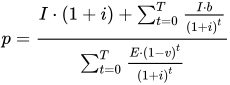
External links
[edit]- Summary of Photovoltaic Wire Requirements as Outlined in UL 4703
- Photovoltaic Energy Factsheet by the University of Michigan's Center for Sustainable Systems
- Home Power Magazine
- Solar project management
- Best Practices for Siting Solar Photovoltaics on Municipal Solid Waste Landfills: A Study Prepared in Partnership with the Environmental Protection Agency for the RE-Powering America's Land Initiative: Siting Renewable Energy on Potentially Contaminated Land and Mine Sites National Renewable Energy Laboratory
| Concepts | |||||||||||
|---|---|---|---|---|---|---|---|---|---|---|---|
| Photovoltaic system | |||||||||||
| Applications |
| ||||||||||
| Generation systems |
| ||||||||||
| PV companies |
| ||||||||||


| International | |
|---|---|
| National | |
| Other | |


Photovoltaic system
View on GrokipediaHistory
Discovery and Early Development
The photovoltaic effect, the foundational phenomenon enabling the conversion of light into electricity, was first observed in 1839 by French physicist Alexandre-Edmond Becquerel, then aged 19, during experiments with electrolytic cells containing platinum electrodes immersed in conductive solutions.[16] Becquerel noted that illumination increased the cell's voltage, demonstrating light-induced current generation, though the mechanism involved electrochemical processes rather than solid-state semiconductors.[17] In 1883, American inventor Charles Fritts constructed the first solid-state photovoltaic device by coating selenium wafers with a thin gold film to form a rudimentary junction, achieving an energy conversion efficiency of approximately 1%.[18] This selenium-based cell represented the initial shift from liquid electrolytes to solid materials but suffered from low efficiency and instability, limiting practical utility despite Fritts' vision of competing with coal-based power generation.[19] In 1888, Russian physicist Alexander Grigorievich Stoletov constructed the first photoelectric cell utilizing the outer photoelectric effect, where light causes electron emission from metal surfaces, enabling the measurement of photo-generated currents. His series of experiments and publications from 1888 to 1891 established fundamental laws relating current to light intensity and electrode properties, advancing early understanding of light-to-electricity conversion mechanisms.[19][20] Early 20th-century research focused on semiconductor properties, with significant progress at Bell Laboratories. In 1941, engineer Russell Ohl discovered the p-n junction in silicon while investigating crystal impurities, observing photovoltaic current flow across the junction under illumination, which laid the groundwork for junction-based solar cells with about 1% efficiency.[21] This accidental finding during radar research for World War II highlighted silicon's potential despite manufacturing challenges.[19] Building on Ohl's work, Bell Labs scientists Daryl Chapin, Calvin Fuller, and Gerald Pearson developed the first practical silicon photovoltaic cell in 1954, announced publicly on April 25, with an initial efficiency of 6%—a fourfold improvement over prior silicon prototypes.[18] These cells powered the Vanguard 1 satellite launched in 1958, marking the first orbital use of photovoltaics and validating their reliability in extraterrestrial conditions, though terrestrial costs remained prohibitive at around $300 per watt.[22]Commercialization and Expansion
The commercialization of photovoltaic (PV) systems began in the early 1960s, primarily driven by applications in space exploration rather than terrestrial energy needs. In 1963, Sharp Corporation achieved the first mass production of practical silicon PV modules, enabling reliable deployment for powering satellites and other off-grid uses.[23] NASA's extensive adoption of PV arrays for spacecraft during the 1960s, including missions like Vanguard 1 in 1958 and subsequent programs, spurred technological refinements in efficiency and durability, which indirectly contributed to cost declines as manufacturing scaled for space demands.[24] Module costs, which exceeded $300 per watt in the mid-1950s, fell to around $100 per watt by the early 1970s through these advancements and initial terrestrial experimentation, though high prices and low efficiencies (typically 10-14%) confined adoption to niche, high-value markets.[25] The 1973 oil crisis accelerated interest in alternative energy, prompting government-funded demonstrations of PV integration in buildings. A prominent example was the University of Delaware's Solar One residence, completed in 1973, which combined PV modules for electricity generation with thermal collectors for heating, achieving up to 60% of its energy needs from solar sources despite experimental interruptions.[26] This hybrid system highlighted PV's potential for residential self-sufficiency but underscored barriers like intermittency and the need for storage, limiting broader uptake amid costs still over $100 per watt.[27] During the 1980s and 1990s, PV growth remained modest and off-grid focused, with key markets in telecommunications satellites—requiring robust, lightweight power for remote orbital operations—and isolated terrestrial applications such as microwave repeaters and rural electrification in developing regions.[28] Cumulative global installed PV capacity reached approximately 1 GW by 2000, reflecting incremental progress despite persistent high costs (around $20-50 per watt by the late 1990s) that deterred large-scale grid-connected deployment.[29] Policy interventions, such as Germany's Electricity Feed-in Law of 1990 (expanded in 1991), introduced guaranteed payments for PV-generated electricity, fostering early utility-scale pilots and signaling a shift toward incentivized market expansion in Europe.[30] These tariffs, set at rates favoring renewables over fossil fuels, addressed adoption hurdles by de-risking investments, though terrestrial scaling was still constrained by economic viability compared to conventional sources.[31]Modern Growth and Milestones
The expansion of photovoltaic systems accelerated in the 2000s, propelled by China's state-subsidized manufacturing surge, which captured over 80% of global module production by 2010 and drove module prices down from approximately $2 per watt in 2010 to $0.20 per watt by 2020, a decline of over 90%.[32] [33] This cost reduction enabled cumulative global installed capacity to surpass 1 terawatt (TW) around 2018, scaling to over 2.2 TW by the end of 2024.[34] In 2024, new installations reached a record 597 gigawatts (GW), reflecting a 33% year-over-year increase and underscoring solar PV's lead in renewable additions.[35] Projections for 2025 indicate solar PV will comprise nearly 80% of global renewable capacity additions, with annual installations approaching 600 GW, though actual deployment trajectories have historically lagged optimistic forecasts due to grid constraints and supply chain variability.[36] [37] Technological milestones include the standardization of passivated emitter and rear cell (PERC) architectures in the 2010s, achieving industrial efficiencies exceeding 22% by the late decade, up from 19% in 2010.[38] The 2020s introduced widespread adoption of bifacial modules, which capture light on both sides for 5-30% higher yields depending on albedo, and half-cut cell designs that mitigate shading losses and resistive heating, contributing to commercial module efficiencies surpassing 22% and laboratory records beyond 25% for silicon-based cells.[39] Despite these advances, global solar PV capacity factors— the ratio of actual output to maximum possible—typically range from 10-25%, constrained by intermittency from diurnal cycles, weather variability, and suboptimal siting, limiting effective utilization without complementary storage or dispatchable generation.[40] [41] This empirical reality tempers the impact of raw capacity growth on reliable energy supply.Principles of Operation
Photovoltaic Effect
The photovoltaic effect refers to the generation of a voltage difference and associated electric current in a semiconductor material upon absorption of light photons. In photovoltaic devices, this occurs primarily in a p-n junction formed by doping a semiconductor, such as silicon, to create p-type (electron-deficient) and n-type (electron-rich) regions; the junction establishes a depletion zone with a built-in electric field due to diffusion of majority carriers across the interface. When photons with energy exceeding the material's bandgap strike the junction, they are absorbed, promoting electrons from the valence band to the conduction band and generating electron-hole pairs; the built-in field then spatially separates these charge carriers, driving minority carriers (electrons in the p-region, holes in the n-region) toward their respective sides, thereby producing a photocurrent and open-circuit voltage when an external load is connected.[17][42][43] The efficiency of photon-to-current conversion is quantified by the external quantum efficiency (EQE), defined as the ratio of collected charge carriers to the number of incident photons at a given wavelength: EQE(λ) = (number of electrons collected) / (number of photons incident). For overall power conversion, the detailed balance model sets the theoretical upper limit for single-junction cells at approximately 33% under standard solar illumination, as derived from radiative recombination constraints and assuming blackbody emission; this Shockley-Queisser limit arises because photons below the bandgap (e.g., infrared for silicon's 1.12 eV bandgap at 300 K) are transmitted without absorption, while those above lose excess energy as heat via thermalization, and each photon generates at most one electron-hole pair. Silicon's bandgap of 1.12 eV is tuned to capture a significant portion of the solar spectrum's energy density in the visible and near-infrared, but mismatches lead to inherent losses: sub-bandgap photons contribute zero current, and over-bandgap photons (e.g., ultraviolet) yield only the bandgap-equivalent energy electrically.[44][45][46] Additional losses stem from carrier recombination—radiative (photon emission), non-radiative (e.g., via defects), or Auger processes—which reduces carrier collection, particularly in regions away from the junction. Empirical spectral response measurements, plotting EQE or short-circuit current response versus wavelength, verify these inefficiencies: for crystalline silicon cells, response peaks around 600-900 nm (visible to near-IR), drops sharply below 400 nm due to high surface recombination and absorption in passivation layers, and falls to near zero beyond 1100 nm as photon energy dips below the bandgap, confirming the causal limits imposed by material properties and photon statistics under AM1.5 solar spectra.[47][48][49]Cell and Module Fundamentals
Crystalline silicon solar cells dominate the photovoltaic industry, accounting for approximately 95% of global module production as of 2025.[50] These cells leverage the photovoltaic effect in p-n junction diodes formed by doping silicon with boron and phosphorus to create electron-hole separation under illumination. Monocrystalline silicon cells, grown via the Czochralski process from a single crystal seed, exhibit high material purity and uniform lattice structure, enabling higher charge carrier mobility and efficiencies typically exceeding 22% in commercial products, though at elevated production costs due to energy-intensive purification.[51] In contrast, polycrystalline silicon cells, produced by directional solidification of molten silicon into multicrystalline ingots, offer cost advantages through simpler fabrication but suffer from grain boundaries that scatter carriers and reduce efficiency to around 18-20%.[52] Thin-film alternatives, such as cadmium telluride (CdTe), represent under 5% market share but provide benefits like mechanical flexibility for integration on non-planar surfaces and lower material usage, with lab efficiencies approaching 22% despite scalability challenges from toxicity concerns in production.[53][54] Photovoltaic modules scale cell performance by interconnecting multiple cells into arrays. Individual cells, typically 6 inches square and producing 0.5-0.6 V open-circuit voltage, are tabbed and strung in series strings of 60-72 cells to match inverter input voltages around 30-40 V per string, minimizing resistive losses while ensuring current uniformity.[55] The strung cells are then sandwiched between a tempered low-iron glass superstrate for optical clarity and impact resistance, encapsulant layers of ethylene vinyl acetate (EVA) or polyolefin elastomer (POE) to bond components and exclude moisture, and a polymeric backsheet for electrical isolation and UV protection, followed by lamination at 140-150°C under vacuum.[56] This encapsulation enhances durability against thermal cycling, humidity, and mechanical stress, with EVA's adhesion properties preventing delamination but requiring careful control to avoid yellowing from UV exposure over decades.[57] Inherent physical limits constrain module output beyond material choices. Crystalline silicon cells exhibit a negative temperature coefficient, with efficiency declining by 0.3-0.5% per °C rise above 25°C due to increased intrinsic carrier concentration and reduced bandgap voltage, leading to 10-20% power loss on hot days even under peak irradiance.[58] Module ratings are standardized under test conditions (STC) of 1000 W/m² irradiance, 25°C cell temperature, and AM1.5 global solar spectrum, but field performance deviates due to spectral mismatch—where real atmospheric spectra shift toward infrared or ultraviolet relative to the reference—potentially reducing yields by 2-5% depending on location and time.[59][60] These factors underscore the gap between peak lab metrics and operational reality, necessitating derating in system design.Components
Solar Modules and Arrays
Solar modules, comprising interconnected photovoltaic cells encapsulated for protection and electrical output, form the core energy-capturing units of PV systems. Monofacial modules absorb sunlight primarily on the front surface using silicon-based cells, achieving commercial efficiencies of 20-22% for monocrystalline designs. Bifacial modules, by contrast, utilize transparent rear encapsulants and backsheets to capture reflected light, yielding empirical rear-side gains of 5-30% over monofacial equivalents, influenced by ground albedo, module elevation above surface, and albedo reflectivity typically ranging from 0.2 for grass to 0.8 for snow.[61][62] Design variations like half-cut cells, where full cells are laser-scribed and divided to halve current paths, reduce intra-module resistive losses (I²R) by a factor of four and mitigate mismatch from manufacturing variances or differential shading, boosting module power by 2-5% relative to full-cell counterparts without introducing additional interconnection failures.[63][64] Arrays aggregate modules into series-parallel strings optimized for maximum power point tracking (MPPT) voltage windows, typically 200-1000 V DC, to minimize cable losses while ensuring fault tolerance; series connections increase voltage for efficient transmission, while parallel groupings balance current and limit single-point failures. Partial occlusion from vegetation, debris, or self-shading induces reverse bias in affected cells, potentially causing hot-spot damage and output drops exceeding 50% per module string without mitigation; integrated bypass diodes, usually one per 18-24 cells, forward-conduct to reroute current around shaded substrings, capping losses at 20-33% for uniform partial shading across one-third of the module but failing to eliminate mismatch-induced reductions in non-uniform cases.[65][66] Soiling by dust, pollen, and bird droppings attenuates transmittance, imposing annual energy losses of 2-7% in moderate climates like the U.S. Southwest but escalating to 20% or more in arid, low-rainfall regions without cleaning.[67][68] Fixed-tilt array orientation matching local latitude—front-facing equatorward—maximizes plane-of-array insolation, with 10-15° deviations reducing annual yield by 5-10% and larger mismatches up to 30% in high-latitude sites due to suboptimal winter capture.[69][70] Emerging tandem architectures, such as perovskite-over-silicon cells, have demonstrated certified laboratory efficiencies exceeding 30% in 2024, surpassing single-junction limits via spectral splitting, yet operational stability remains constrained by perovskite degradation from moisture, UV exposure, and ion migration, limiting field lifetimes to hundreds of hours without encapsulation advances.[71][72]Inverters and Power Electronics
In photovoltaic systems, inverters convert direct current (DC) from solar modules to alternating current (AC) for grid synchronization or local use, while employing maximum power point tracking (MPPT) algorithms to continuously scan the module's voltage-current (V-I) curve and adjust impedance for peak power extraction amid irradiance and temperature fluctuations.[73][74] MPPT implementations, such as perturb-and-observe or incremental conductance methods, enable inverters to maintain operation near the knee of the V-I curve, where power is maximized, countering the nonlinear response of PV arrays to partial shading or soiling.[75] String inverters centralize conversion for module strings, delivering California Energy Commission (CEC) weighted efficiencies of 97.5-98.5% in transformerless designs, though they introduce single-point failure risks and propagate mismatch losses across connected modules due to series configuration.[76][77] Microinverters, positioned at individual modules, achieve CEC efficiencies of 95-96.5% but independently optimize each unit's MPPT, mitigating shading-induced losses by recovering 10-30% of annual energy deficits in mismatched arrays.[76][78] Module-level power electronics (MLPE), including DC-DC optimizers, hybridize this by performing per-module voltage adjustment before centralized inversion, enhancing yield in variable conditions at elevated component costs relative to string-only setups.[78] Inverter topologies contribute to system derating through DC-AC conversion inefficiencies (2-5%), harmonic distortion from pulse-width modulation (typically total harmonic distortion below 5%), and idle power draw during non-production intervals.[79][80] Hybrid inverters incorporate bidirectional power electronics for seamless battery integration, managing charge-discharge cycles alongside PV MPPT without auxiliary converters.[81] Advancements in silicon carbide (SiC) and gallium nitride (GaN) devices, adopted in 2020s designs, yield peak efficiencies exceeding 99% by enabling higher switching frequencies and reduced conduction losses, particularly beneficial for handling elevated DC voltages from contemporary high-power modules.[82][83]Balance of System Elements
Balance of system (BOS) elements in photovoltaic systems encompass the structural, electrical, and control components essential for supporting and integrating solar modules, excluding the modules and inverters themselves. These include mounting structures, cabling, monitoring systems, and optional energy storage, which collectively ensure system stability, efficiency, and longevity. BOS components must withstand environmental stresses such as wind, corrosion, and thermal cycling to prevent failures that could compromise output.[84] Mounting systems secure PV arrays to rooftops, ground, or tracking mechanisms, with fixed-tilt structures dominating residential and many utility installations due to simplicity and lower cost. Single-axis trackers, which rotate arrays east-west to follow the sun, can increase annual energy yield by 15-25% compared to fixed-tilt systems in mid-latitude regions with high solar irradiance, while dual-axis trackers offer up to 40% gains but at higher complexity. However, trackers experience 2-3 times greater wind loads than fixed systems, elevating risks of structural fatigue and requiring robust designs certified to withstand gusts exceeding 50 m/s. Empirical field data indicate mounting failures often stem from corrosion of galvanized steel or aluminum components in coastal or humid environments, leading to bolt loosening, or from undersized foundations failing under extreme gusts, as observed in post-hurricane assessments where improper anchoring caused array detachment.[85][86][87][88] Cabling consists of DC conductors connecting modules to combiners and inverters, designed with UV-resistant insulation to endure outdoor exposure without degradation over 25+ years. Standards such as IEC 62930 mandate halogen-free, cross-linked polyethylene insulation capable of withstanding UV radiation, ozone, and temperatures from -40°C to 90°C, preventing cracking that could cause arcing or shorts. System designers target voltage drops below 1-2% in DC runs by selecting appropriate wire gauges (e.g., 10-6 AWG for longer strings), as higher drops reduce power output via resistive losses, with empirical studies showing even 3% drops correlating to 1-2% annual yield losses in large arrays.[89][90][91] Monitoring systems, often implemented via SCADA platforms, provide real-time data acquisition for performance ratio (PR) analytics, fault detection, and predictive maintenance. SCADA integrates sensors for irradiance, module temperature, and string currents, enabling PR calculations—typically 80-85% for well-operated systems—as the ratio of actual AC output to theoretical DC yield under standard conditions. This allows identification of underperformance from shading, soiling, or BOS faults, with data logging supporting root-cause analysis of downtime events.[92][93] In systems requiring dispatchability, lithium-ion batteries dominate storage integration, offering depth of discharge (DoD) up to 90% and cycle lives exceeding 3000 full equivalents under controlled conditions. Sizing typically targets 1-4 hours of autonomy for peak shaving or backup, but thermal runaway risks—triggered by overcharge, short circuits, or manufacturing defects—necessitate battery management systems with cell-level monitoring and cooling to mitigate propagation in packs. BOS costs, including these elements, comprise 20-30% of total system expenses in utility-scale projects, with trackers achieving ROI through payback periods of 3-7 years in high-irradiance locales via yield gains offsetting 20-50% higher upfront costs.[94][95][84][96]System Configurations
Grid-Connected Systems
Grid-connected photovoltaic systems synchronize direct current (DC) output from solar arrays with alternating current (AC) utility grids, enabling bidirectional power flow without primary reliance on battery storage, unlike standalone configurations.[97] These systems require inverters to match grid voltage, frequency, and phase, typically operating at 60 Hz in North America or 50 Hz in Europe.[98] Excess generation during peak sunlight hours exports to the grid, offsetting consumption via net metering policies that credit users at retail rates for surplus kilowatt-hours delivered.[99] The core topology involves PV modules wired into arrays feeding DC power to inverters for conversion to grid-compatible AC, followed by connection through breakers and meters to the point of common coupling.[100] String inverters suit smaller setups, while central inverters handle utility-scale arrays exceeding 1 MW.[101] Safety features mandate anti-islanding protection to disconnect during grid outages, preventing backfeed that could endanger utility workers; this complies with IEEE 1547-2018, which specifies interconnection criteria for distributed energy resources including voltage ride-through and harmonic limits.[102] Systems scale from residential rooftops under 10 kW, serving single households with distributed microinverters or string inverters, to commercial installations of 10 kW to several MW on building flat roofs, often using multiple inverters for redundancy.[103] Utility-scale plants surpass 1 MW, frequently reaching hundreds of MW with centralized power electronics and tracking arrays to maximize output.[104] Globally, grid-connected configurations dominate PV deployments, comprising over 99% of cumulative capacity as off-grid applications remain niche for remote sites.[13] High solar penetration in grid-connected systems produces midday generation peaks that suppress net load, forming the "duck curve" where evening ramps demand rapid flexible generation—up to 13,000 MW within three hours in California as of 2013 data, necessitating overbuild or curtailment to maintain stability.[105]Standalone Systems
Standalone photovoltaic systems, also known as off-grid or autonomous systems, operate independently of the electrical grid, relying solely on solar-generated power and storage to meet demand. These systems typically consist of photovoltaic arrays, charge controllers, batteries, inverters, and direct current (DC) loads or alternating current (AC) appliances, designed to provide continuous supply during periods of low insolation. Sizing emphasizes load matching over peak output, with PV arrays often oversized by 20-50% relative to average daily load to ensure battery recharging even in suboptimal conditions, such as the critical design month with minimal sunlight.[106][107] Battery banks are central to autonomy, provisioned for 2-5 days of storage based on historical weather data and load profiles to bridge cloudy periods without external input. Lead-acid batteries, common in such setups due to cost, limit depth of discharge (DoD) to 50% to preserve cycle life exceeding 1,000-2,000 cycles, thereby halving usable capacity relative to nominal ratings; lithium-ion alternatives allow 80-90% DoD but at higher upfront costs. Charge controllers prevent overcharging and deep discharges, while inverters convert DC to AC for household or equipment use, with efficiencies around 85-95%. In remote or high-reliability applications, diesel generators may serve as backups, though pure standalone designs avoid fossil fuels for sustainability.[107][108][109] Primary applications include rural electrification in developing regions, where systems power lighting, refrigeration, and basic appliances for unelectrified households, and telecommunications infrastructure like remote cell towers requiring 24/7 uptime. For instance, standalone PV has facilitated village-level power in areas like Cameroon's Far North, supporting community loads up to several kilowatts. Empirical data indicate effective capacity factors below 20% in standalone configurations without storage, dropping further with battery round-trip losses of 10-20%, necessitating conservative oversizing to achieve reliability.[110][111][112] Challenges persist in high capital requirements and maintenance, with levelized cost of electricity (LCOE) often 2-5 times that of grid extension in peri-urban areas, limiting scalability. Globally, standalone systems constitute less than 0.5% of cumulative PV installations as of 2023, overshadowed by grid-connected deployments due to superior economics where infrastructure expansion is viable.[113][114][115]Hybrid and Specialized Systems
Hybrid photovoltaic systems integrate solar PV with complementary technologies to enhance energy output or utilization, such as photovoltaic-thermal (PVT) collectors that capture both electricity and waste heat from PV modules. In PVT designs, a fluid circulates behind the PV cells to extract thermal energy, cooling the panels to improve electrical efficiency while producing usable hot water or air, with reported combined efficiencies reaching 62% in optimized spiral-flow configurations.[116] Electrical output typically ranges from 10-13%, complemented by thermal efficiencies of 40-50%, though system complexity increases costs and maintenance needs compared to standalone PV.[117] Hybrid PV-wind systems pair intermittent solar generation with turbines for more consistent power, particularly in regions with variable insolation, but require advanced control electronics to manage differing output profiles and grid stability.[118] Concentrating photovoltaics (CPV) represent a specialized variant using lenses or mirrors to focus sunlight onto high-efficiency multi-junction cells, enabling module efficiencies exceeding 40% under direct beam irradiation, far surpassing standard silicon PV.[119] These systems demand precise dual-axis tracking to maintain focus and are suited to high-insolation desert areas, but sensitivity to dust accumulation reduces output by up to 20-30% without frequent cleaning, and tracking mechanisms add mechanical failure risks. CPV holds less than 1% of the global PV market, valued at around USD 2.45 billion in 2023 amid dominance by cheaper non-concentrating technologies.[120] Floating photovoltaic (FPV) installations mount PV arrays on water bodies, leveraging natural cooling from evaporation and conduction to boost energy yield by 10-15% over ground-mounted equivalents in comparable conditions, while freeing land for other uses.[121] The shading effect inhibits algae blooms and cuts water evaporation by 70-85% in reservoirs, though biofouling on floats and wave-induced stress demand robust anchoring, with empirical studies noting potential ecological disruptions in sensitive aquatic habitats.[122][123] Building-integrated photovoltaics (BIPV) embed PV elements directly into architectural features like facades, roofs, or glazing, replacing conventional materials to generate power without additional land use. Solar windows and semi-transparent modules typically achieve efficiencies below 15% due to light transmission requirements for daylighting, prioritizing aesthetics and multifunctionality over peak output.[124] Examples include PV glass skylights and curtain walls that provide shading and insulation alongside electricity, though higher upfront costs and custom fabrication limit adoption to premium buildings.[125] Agrivoltaics, an emerging hybrid approach since the 2020s, co-locates elevated PV arrays with crop cultivation or grazing to dual-use farmland, potentially mitigating land competition between energy and agriculture. Optimized panel heights and spacing allow shade-tolerant crops like lettuce to maintain or exceed yields under partial shading, but sun-dependent varieties such as corn experience 10-50% reductions depending on coverage density and local climate.[126] Studies document trade-offs including altered soil microclimates and higher operational complexity, with benefits like reduced irrigation needs offsetting losses in water-stressed areas, though scalability requires site-specific trials to balance energy gains against agricultural productivity.[127][128]Performance Metrics
Efficiency and Output Factors
The output of photovoltaic (PV) systems is primarily determined by solar insolation, quantified as peak sun hours—the equivalent hours per day at standard test conditions irradiance of 1,000 W/m². Suitable locations for PV deployment typically receive 4 to 6 peak sun hours daily on average, though this varies regionally from under 3 hours in high latitudes to over 7 hours in desert areas.[129][130] Annual energy production is estimated using the [formula , where is output in kWh, is rated capacity in kWp, is total annual peak sun hours, and is the performance ratio accounting for system losses. For example, a 3.48 kW south-facing system with no shading in a location averaging 5–5.5 kWh/kWp/day insolation can expect ~5,500–6,000 kWh/year assuming an 80–85% performance ratio; actual output varies by precise location, tilt angle, and factors like panel cleanliness, with dual MPPT configurations potentially adding 50–100 kWh/year over single MPPT by mitigating minor mismatches.[131][132] The performance ratio (PR), defined as actual output divided by theoretical output under reference yield conditions, typically ranges from 0.7 to 0.85 for well-designed grid-connected systems, reflecting losses from inverter efficiency, wiring, and mismatch.[133] Empirical data from monitored installations confirm PR values around 0.79 to 0.81 in temperate climates.[134] Tools like the Photovoltaic Geographical Information System (PVGIS) enable site-specific predictions by integrating satellite-derived insolation data with loss models, yielding specific output metrics such as annual yield in kWh/kWp.[135] Regional variations in specific yield—energy per unit capacity—span 900–1,000 kWh/kWp in northern Europe to over 1,800 kWh/kWp in sunnier latitudes, highlighting insolation's dominant role.[136][137] Module temperature significantly derates output, as crystalline silicon PV efficiency declines by approximately 0.4–0.5% per °C above the 25°C standard test condition, due to increased carrier recombination and reduced voltage.[138][139] In hot climates, cell temperatures can exceed 60°C under load, compounding to 10–25% daily losses relative to cooler conditions.[140] Micro-losses from soiling (dust accumulation) and shading further reduce output, often compounding to 3–5% annually in moderate environments but reaching 7–10% or more in arid or polluted regions without mitigation.[141][142] Soiling attenuates transmittance, with global analyses estimating 3–4% average production impact across major PV markets.[143] Partial shading triggers bypass diodes, limiting current in affected strings and causing disproportionate losses—e.g., 20–30% array reduction from shading just one cell—emphasizing the need for optimized layouts.[67] These factors underscore the importance of empirical modeling for accurate yield forecasting, prioritizing high-insolation sites and derating for local conditions.Degradation and Reliability
Photovoltaic modules, particularly those using crystalline silicon technology, exhibit an empirical median annual degradation rate of 0.5% based on extensive field measurements from nearly 2000 systems.[144] More recent analyses report median rates around 0.8-0.9% per year for monocrystalline silicon, with mean values up to 1.1% influenced by factors such as climate and mounting configuration.[145][146] Induced degradation mechanisms, including light-induced degradation (LID) and potential-induced degradation (PID), often cause initial power losses of 2-3% in the first year of operation for many modules.[147] LID arises from carrier recombination at defects activated by light exposure, while PID results from leakage currents under high voltage biases, both contributing to disproportionate early declines beyond baseline rates.[148] These effects can be mitigated through material improvements, but field data indicate they remain prevalent in non-optimized installations.[149] System reliability is impacted significantly by component failures, with inverters accounting for a substantial portion of downtime events, often the leading cause of production losses in operational PV fleets.[150] National Renewable Energy Laboratory (NREL) studies highlight that inverter outages, typically occurring within 10-12 year lifetimes, distinguish from mere communication interruptions and underscore the need for robust fault detection to minimize unavailability.[151][152] Broader field assessments reveal that approximately 75% of systems underperform manufacturer specifications by 10-20%, attributable to cumulative degradation and suboptimal conditions rather than isolated faults.[153] Over their operational lifespan of 25-30 years, PV systems generally retain at least 80% of initial output, though causal factors like thermal cycling induce microcracks in cells and encapsulants, accelerating power decline through increased series resistance and shunt paths.[154][155] Microcracks propagate under repeated temperature fluctuations and mechanical stress, reducing effective active area without visible external damage.[156] Recent global surveys from the 2020s indicate median performance ratios (PR) for operational PV systems in the range of 80-85%, reflecting real-world losses from degradation that often fall short of optimistic vendor projections assuming ideal conditions.[157][158] These metrics, derived from yield normalized against insolation, underscore the divergence between laboratory ratings and field empirics, with lower PRs prevalent in hotter or dustier environments.[145]Economics
Cost Structures
The capital expenditures (CAPEX) for photovoltaic systems encompass hardware such as modules and inverters, balance-of-system (BOS) elements including mounting and wiring, and soft costs like labor, permitting, and engineering. Globally, utility-scale solar PV total installed costs averaged $0.691 per watt in 2024, reflecting declines driven primarily by lower module prices and supply chain efficiencies.[159] In the United States, benchmarked utility-scale costs reached approximately $1.12 per watt DC in early 2024, with modules comprising 20-25% of total CAPEX due to prices falling to 0.09 per watt amid oversupply.[160][161] BOS components and inverters accounted for 40-50% of CAPEX, while installation and soft costs filled the balance, often elevated by site-specific factors like terrain and grid interconnection.[162] Residential and commercial rooftop systems incur higher CAPEX, averaging $2.8 per watt DC in the US in 2024, with soft costs adding a 20-50% premium over utility-scale due to smaller project scales, custom engineering, and regulatory hurdles.[163] Integrating batteries for storage can double upfront CAPEX, as battery systems add $200-400 per kWh installed, shifting costs toward power electronics and enclosures.[164] Operating expenditures (OPEX) primarily involve maintenance such as panel cleaning, inverter replacements, and vegetation control, typically 1-2% of initial CAPEX annually.[165] For utility-scale plants, this equates to $5-8 per kW DC per year, excluding insurance premiums for hazards like hail damage or fire, which can add 0.5-1% more based on regional risks.[165] Residential OPEX remains lower in absolute terms but proportionally similar, often $25-50 per kW per year including inspections.[166] Unsubsidized levelized cost of electricity (LCOE) for utility-scale solar PV in high-irradiance sunny areas, such as the US Southwest, ranged from $30-60 per MWh in 2024, incorporating CAPEX amortization, OPEX, and capacity factors exceeding 25%.[167] This contrasts with global averages of $43 per MWh, where lower insolation increases effective costs.[168]Market Dynamics and Subsidies
The photovoltaic market has followed an experience curve characterized by cost reductions of approximately 20-30% for each doubling of global cumulative capacity, driven primarily by economies of scale, technological improvements, and manufacturing efficiencies.[169][170] This pattern, often termed Swanson's Law for modules, contributed to dramatic price declines from over $4 per watt in the early 2000s to under $0.10 per watt by 2024.[169] However, post-2020 trends indicate a plateauing of these reductions, with module prices stabilizing or reversing after reaching historic lows of $0.07-0.09 per watt in early 2025 due to supply gluts and policy shifts in dominant producers.[171][172] Supply chain disruptions, including raw material constraints and geopolitical tensions, have introduced volatility, with forecasts of 9% cost increases in Q4 2025 amid tightening capacity utilization.[173][172] Global installations reached a record 597 GW in 2024, reflecting policy-driven demand amid falling prices, yet this surge has exacerbated overcapacity in manufacturing hubs, particularly China, which controls over 80% of the supply chain.[35] Chinese state subsidies have fueled polysilicon and module overproduction, leading to market flooding, negative margins for producers, and export surges that depressed global prices below production costs.[174][175] This has resulted in grid curtailment in oversupplied regions, such as California's 3.4 million MWh of wind and solar curtailment in 2024 (up 29% year-over-year) and China's solar curtailment rising to 6.6% in H1 2025, signaling inefficiencies from rapid, subsidy-induced deployment outpacing grid absorption.[176][177] Subsidies have been pivotal in scaling PV adoption but distort natural market signals. In the US, the Investment Tax Credit (ITC) and Production Tax Credit (PTC) directly incentivize solar investments, underpinning the majority of utility-scale and residential deployments, with 50 GW added in 2024 largely reliant on such supports.[178][179] European feed-in tariffs (FiTs) and premiums historically guaranteed above-market prices for PV output, spurring early growth but leading to boom-bust cycles and policy retreats as costs fell.[180][181] Empirical evidence shows subsidies inflate deployment beyond unsubsidized economics, particularly in low-insolation areas where PV's levelized cost of energy (LCOE) remains higher due to reduced yield; unsubsidized solar LCOE ranges $0.038-0.078/kWh globally but lags dispatchable fossils in capacity-constrained or northern contexts without storage integration.[182][183] Pre- and post-subsidy data reveal accelerated but unsustainable capacity additions, with curtailment and stranded assets highlighting dependency on ongoing incentives for viability against reliable alternatives.[176][184]Environmental Impacts
Lifecycle Emissions and Resource Use
Lifecycle greenhouse gas emissions for photovoltaic (PV) systems, assessed via life cycle analysis (LCA), typically range from 10 to 50 grams of CO₂-equivalent per kilowatt-hour (g CO₂-eq/kWh) over a 30-year lifespan, with medians below 50 g CO₂-eq/kWh for crystalline silicon technologies.[185][186] Approximately 80-88% of these emissions occur during the manufacturing phase, dominated by energy-intensive processes such as polysilicon refining, wafer production, and cell fabrication, which rely heavily on fossil fuel-derived electricity in supply chains concentrated in China.[187] Operational emissions are negligible, as PV generation produces no direct CO₂, leading to an energy payback time of 1-2 years in sunny regions, after which net savings exceed those of coal-fired plants (typically 800-1000 g CO₂-eq/kWh).[188] Compared to other sources, PV emissions are lower than natural gas combined cycle (around 400 g CO₂-eq/kWh) but higher than nuclear power (around 12 g CO₂-eq/kWh).[185][189] Resource demands for PV modules include significant quantities of critical materials, with each standard module (approximately 400 W) requiring 10-20 grams of silver for conductive pastes in crystalline silicon cells, contributing to solar PV accounting for 12-14% of global silver demand as of 2023.[190][191] Copper usage per module, primarily in interconnects and balance-of-system components, totals around 10-20 grams, with total PV copper content stable but scaling with deployment volumes.[192] Thin-film technologies may incorporate rare earth elements or toxic materials like cadmium, though silicon-based modules predominate. Supply chain extraction, particularly in China—which controls over 80% of polysilicon and wafer production—has been linked to environmental pollution from mining and refining, including heavy metal releases and high water use in silicon quartz processing.[193][194]| Material | Approximate Use per 400 W Module | Global Demand Impact (PV Share) |
|---|---|---|
| Silver | 10-20 g | 12-14% (2023) |
| Copper | 10-20 g | Rising with deployment |