Hubbry Logo
Spice mixSpice mixMain
Open search
Spice mix
Community hub
Spice mix
logo
8 pages, 0 posts
0 subscribers
Be the first to start a discussion here.
Spice mix
Spice mix
from Wikipedia
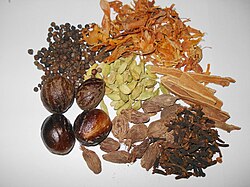
Whole spices used to create garam masala

Spice mixes are blended spices or herbs. When a certain combination of herbs or spices is called for in a recipe, it is convenient to blend these ingredients beforehand. Blends such as chili powder, curry powder, herbes de Provence, garlic salt, and other seasoned salts are traditionally sold pre-made by grocers, and sometimes baking blends such as pumpkin pie spice are also available. These spice mixes are also easily made by the home cook for later use.

Masala

[edit]

Masala (derived from Sanskrit मषि (maṣi), to mash or powder/grind to powder)[1] is a term from the Indian subcontinent for a spice mix. A masala can be either a combination of dried (and usually dry-roasted) spices, or a paste (such as vindaloo masala) made from a mixture of spices and other ingredients—often garlic, ginger, onions, chilli paste and tomato. Masalas are used extensively in Indian cuisine to add spice and flavour,[2] most familiarly to Western cuisine in chicken tikka masala and chicken curry, or in masala chai.[3] Other South Asian cuisines including Bangladeshi, Nepalese, Pakistani and Sri Lankan, Southeast Asian cuisine such as Burmese and the Caribbean regularly use spice mixes.[citation needed]

Notable spice mixes by region

[edit]
A container of pumpkin pie spice
A bowl of khmeli suneli
Ingredients for a Gulf-style baharat

Americas

[edit]

European

[edit]

Middle East and Africa

[edit]

East and Southeast Asian

[edit]
  • Bumbu, several Indonesian blends.
  • Five-spice powder, a blend of cassia (Chinese cinnamon), star anise, cloves, and two other spices, usually fennel seeds and szechuan peppercorns.
  • Húng lìu, a Vietnamese blend
  • Shichimi, a mix of ground red chili pepper, Japanese pepper, roasted orange peel, black and white sesame seed, hemp seed, ground ginger and nori.
  • Shisan Xiang (Chinese: 十三香, Shísān Xiāng), a kind of Wuxiang powder whose names suggests which being made up of thirteen spices. The most popular Shisan Xiang is produced by Wang Shouyi(王守義), a time-honored brand in He'nan(河南) province of China.

South Asia

[edit]

See also

[edit]

References

[edit]
[edit]
Revisions and contributorsEdit on WikipediaRead on Wikipedia
from Grokipedia
A spice mix, also referred to as a spice blend, is a pre-combined of two or more spices, herbs, and sometimes other seasonings in whole, broken, or ground form, created to impart balanced and complex flavors to culinary dishes. These blends simplify cooking by allowing cooks to apply a single preparation that replicates traditional flavor profiles developed over centuries. The use of spices dates back to , with archaeological evidence showing their incorporation into cooked foods as early as 6,600 years ago in sites like Neustadt, , where mustard was combined with and cooked grains. By 3,600 years ago, Mesopotamian recipes featured multi-ingredient mixtures including alliums and other aromatics to enhance stews. The global , which began in ancient civilizations like around 1500 BC and intensified during the through Arab intermediaries, facilitated the exchange of spices such as , pepper, and , profoundly influencing economies, exploration, and cultural exchanges. In medieval , spices like and pepper served as and status symbols, with their scarcity driving voyages of discovery by the . Spice mixes vary widely by region and purpose, reflecting local cuisines and ingredients; examples include from , a warming blend of , , cloves, and used in curries, and Chinese five-spice powder, combining , star , pepper, cloves, and for savory dishes. Other notable blends are , a British adaptation of Indian flavors featuring , , and chili for versatile seasoning, and from , a complex mix of dozens of spices for tagines and meats. Beyond flavor enhancement, spice mixes have historical medicinal applications, such as ancient Egyptian use of and for digestion, and modern recognition for antimicrobial properties that aid against pathogens like and fungi. Today, they are essential in global cooking, from everyday home meals to professional kitchens, promoting culinary diversity and health benefits through antioxidants and anti-inflammatory compounds.

Definition and Characteristics

What is a Spice Mix

A spice mix, also referred to as a spice blend or mix, is a combination of two or more ground or whole spices, herbs, and sometimes other seasonings such as salt or extracts, designed to enhance the flavor profile of dishes in culinary applications. Unlike a single spice, such as , which imparts a singular dominant flavor like earthiness, a spice mix integrates multiple components for layered complexity; for instance, typically comprises ground dried chilies, , , , and to create a multifaceted heat and depth. This blending allows cooks to achieve consistent and repeatable without measuring individual elements each time. Spice mixes commonly appear in various forms to suit different cooking methods and preservation needs. Dry powders, often ground into fine blends, are the most prevalent for storage and dry-heat applications like rubs on meats. Pastes incorporate spices with binders like oil or water for easier incorporation into sauces or stews, while wet marinades combine spices with acidic liquids such as or to tenderize and infuse proteins. The primary purposes of spice mixes extend beyond mere flavor addition, serving to introduce complexity by harmonizing the five basic tastes—sweet, sour, salty, bitter, and —in a single application. They balance these elements to elevate dishes, counteract blandness, and create sensory depth, as seen in how a mix might pair with bitter cloves. Additionally, certain spice mixes contribute to through properties inherent in spices like or cloves, inhibiting in preserved meats or sauces. The evolution of these mixes traces back to ancient routes that connected , , and , fostering the exchange and combination of diverse botanicals.

Key Ingredients and Components

Spice mixes typically comprise several primary categories of ingredients that contribute to their overall flavor profile. Spices, derived from roots, bark, , or fruits of , form the core, including examples such as for pungency, for warmth, and for citrusy notes. Herbs, which are the leaves of aromatic , add freshness and subtlety, with common inclusions like for sweet herbal tones and for robust, earthy undertones. Aromatics, often in powdered or flaked form, provide foundational savory depth, such as for or onion flakes for mild sweetness. Additives enhance balance and preservation, including salt for salinity, for countering bitterness, and acids like for tanginess. Each component serves distinct roles in modulating taste and texture within spice mixes. Heat providers like chili peppers deliver capsaicin-induced spiciness to stimulate the palate. Earthiness is imparted by ingredients such as turmeric, which offers a grounding, slightly bitter warmth through curcumin. Sweetness comes from elements like cinnamon, contributing warm, aromatic notes that soften sharper flavors. In wet mixes, binders such as oil or yogurt help emulsify components, ensuring even distribution and adhesion to foods during cooking. Variations in sourcing significantly affect the intensity and longevity of flavors in spice mixes. Whole spices, such as peppercorns or cloves, retain volatile oils longer than ground forms, releasing more potent aromas when freshly milled, though they require additional preparation. Ground versions offer convenience but diminish in potency over time due to increased surface area exposure to air. Fresh herbs and aromatics provide vibrant, nuanced profiles but are more perishable, whereas dried counterparts concentrate flavors—typically requiring one-third the quantity of fresh for equivalent impact—and extend through . Allergen considerations are crucial in spice mixes, particularly for ingredients like nuts or that may trigger reactions. Tree nuts and such as or are common allergens incorporated for texture or nuttiness, with cross-contamination risks during processing amplifying concerns. Substitutions include using sunflower or in place of nuts to mimic texture without eliciting allergies, or opting for seed-free alternatives like ground chickpeas for binding. Always verify labeling for the major allergens, including , tree nuts, and , as mandated by regulations.

History and Cultural Significance

Origins and Evolution

The use of spice mixes dates back to ancient civilizations, where they served practical purposes such as and ritualistic applications. In around 2000 BCE, records document the blending of aromatic plants and herbs like , , and for medicinal and culinary uses in the fertile and valleys, aiding in the preservation of meats and grains against spoilage in a hot climate. Similarly, ancient incorporated spice blends into mummification processes from the New Kingdom period (c. 1550–1070 BCE), using resins such as , , and in balms to both preserve bodies and imbue them with protective scents believed to aid the journey. During the medieval period, the spice trade along the facilitated the widespread dissemination of blended spice mixes from to the and , transforming them from local concoctions into valued commodities. Arab merchants controlled key routes from the 8th to 13th centuries, trading mixes of pepper, ginger, and that were prized for flavoring preserved foods and as status symbols in European courts, with demand peaking during the (1095–1291 CE). The Mongol Empire's stabilization of these routes in the 13th century further accelerated the exchange of spices to diverse regions. The Age of Exploration in the marked a pivotal shift, as European powers sought direct access to Asian spice sources, leading to the global proliferation of traditional mixes. Portuguese explorers, under figures like , established sea routes to by 1498, bypassing intermediaries and importing spices directly to , which spurred adaptations in Portuguese-influenced cuisines across and . This era's voyages not only flooded European markets with spices but also initiated cross-cultural exchanges, where mixes evolved through contact with New World ingredients like chili peppers. The 19th century's enabled the commercialization of spice mixes through mechanized grinding and packaging, making them accessible beyond elite circles. Innovations in milling technology around the mid-1800s allowed for consistent production of blended spices, such as mixes in the United States, which were sold in pre-packaged forms to support growing urban populations and practices. Post-World War II , driven by increased and trade liberalization, accelerated the fusion and adaptation of spice mixes worldwide. The period saw a surge in cross-continental exchanges, with air and sea transport enabling the rapid spread of blended flavors, contributing to the rise of hybrid cuisines in urban centers. In the , colonial influences led to standardized blends like British curry powder, while as of , climate challenges threaten production in key regions like . Cultural migrations further shaped spice mix evolution, as seen in the 19th-century movement of Indian indentured laborers to the following the abolition of in 1834. Approximately 385,000 Indians arrived in Trinidad and between 1838 and 1917, introducing spice blends featuring , , and that merged with local ingredients to create enduring fusions like curry goat.

Role in Global Cuisines

Spice mixes serve essential functional roles in global cuisines by enabling flavor layering, where combinations of spices create complex profiles of sweetness, bitterness, heat, and earthiness that elevate simple ingredients into multifaceted dishes. Beyond enhancement, these mixes contribute to through the properties of components like cloves, which contain that inhibits bacterial growth and extends shelf life in fermented or cured foods. Additionally, spice mixes offer health benefits, such as the effects of turmeric's , integral to Ayurvedic practices for managing conditions like and digestive disorders. In cultural contexts, spice mixes hold profound symbolism, often featured in rituals to represent purity, prosperity, and union; for instance, turmeric-based pastes are applied during Indian ceremonies to cleanse and bless the couple, signifying a fresh start. Among communities, these mixes act as identity markers, evoking and cultural continuity—Indian expatriates, for example, use familiar blends to recreate homeland flavors and foster intergenerational bonds. Economically, spice mixes drive significant global trade, with the spices market valued at approximately $21 billion as of 2023, supporting livelihoods in producing regions through value-added processing and international markets. Socially, the preparation of spice mixes frequently aligns with gender roles, particularly in household settings where women often lead the blending process due to their deeper knowledge of culinary and medicinal plants, as observed in traditional Moroccan families where frequent cooking correlates with women's expertise in spices like cumin and ginger. In vegetarian and vegan diets, spice mixes adapt to provide umami depth, using blends with fermented elements or glutamate-rich spices like black pepper alongside tomatoes or mushrooms to mimic savory meat flavors and enhance palatability in plant-based meals. To ensure quality and safety worldwide, global standardization efforts through the International Organization for Standardization (ISO) have established purity specifications since the 1980s, including methods for sampling, analysis, and contaminant detection in spices and condiments.

Preparation and Storage

Methods of Preparation

Spice mixes are commonly prepared through dry mixing techniques, which involve toasting whole spices to enhance their flavors before grinding. Toasting is typically done by heating the spices in a dry skillet over medium for 2 to 4 minutes, stirring frequently until they become fragrant and slightly darker, but without burning, as excessive can degrade volatile compounds. This process activates aromatic oils within the spices, creating more complex profiles suitable for blends. After cooling, the toasted spices are ground using a for small batches or an electric spice grinder for efficiency, aiming for a fine, powder; repurposed coffee grinders are often recommended for their accessibility and power, provided they are dedicated to spices to prevent flavor carryover. The ground mixture is then sifted through a fine mesh to remove larger particles, ensuring even distribution in the final mix. Wet preparation methods produce pastes rather than powders, incorporating liquids to bind ground spices into a cohesive form ideal for immediate use in cooking. This involves grinding toasted or untoasted spices with oils, such as or neutral , to form a smooth , often adding fresh ingredients like or chilies for added moisture and flavor; for example, in curry pastes, the mixture is pounded or blended until it reaches a paste-like consistency, with oil preventing drying and aiding preservation during short-term storage. can be included for acidity, as seen in some Indian-style pastes, where it balances heat and aids in emulsification when blended with and spices. techniques are employed in certain traditional mixes, particularly in African cuisines, where ground spices or seeds are mixed with or salt and left to ferment naturally for days at , developing probiotic-rich flavors through ; examples include ogiri, made by fermenting seeds into a pungent paste. Balancing proportions in spice mixes requires starting with a base of dominant spices, such as or , and layering accent flavors like chili or , often following general ratios like 3:2:1 (three parts base, two parts supporting, one part accent) to achieve without overpowering any element. Tasting iteratively during mixing allows adjustments for personal preference or dish compatibility, with small batches enabling precise tweaks to heat, sweetness, or earthiness. Tools like digital scales ensure accurate measurements, while visual and olfactory cues guide the process toward uniformity. Safety and hygiene are paramount during preparation to prevent contamination and health risks. Hands, tools, and surfaces must be thoroughly cleaned before and after use to avoid cross-contamination, particularly when handling raw spices that may carry pathogens like ; studies show that spice containers touched during meat preparation can transfer bacteria if not sanitized. For pungent spices like mustard seeds, which release irritating vapors when ground, work in a well-ventilated area or under a to minimize respiratory discomfort, and wear a if sensitivity is a concern. Always store prepared mixes promptly in airtight containers to maintain quality.

Storage and Shelf Life

Proper storage is essential to preserve the flavor, aroma, and potency of spice mixes, as exposure to environmental factors can accelerate the degradation of volatile essential oils. Ideal conditions involve keeping dry spice mixes in airtight or metal containers to prevent ingress and oxidation, stored in a cool, dark location such as a away from heat sources like stoves or direct . must be strictly avoided to prevent clumping or mold growth, which can compromise safety and quality. Shelf life varies significantly between dry mixes and wet pastes. Dry spice mixes, typically composed of ground or whole spices, generally maintain optimal quality for 1-3 years when stored properly, though whole spice components can last up to 4 years due to their intact structure retaining oils longer than ground forms. In contrast, wet spice pastes, such as pastes made with fresh ingredients and liquids, have a much shorter refrigerated of 1-2 weeks to avoid and flavor loss. Several factors influence the longevity of spice mixes, with exposure to light, heat, and air being primary culprits in hastening the of volatile oils, leading to diminished flavor. Whole spices endure longer—up to 4 years—compared to ground ones at 1-3 years, though flavor potency may decline after 6-12 months as grinding increases surface area for degradation. Signs of spoilage in spice mixes include faded color, weakened or absent aroma, clumping from , or visible mold, at which point the mix should be discarded to ensure safety. For mixes that have lost potency but show no spoilage, revival can be attempted by gently toasting them in a dry skillet over low heat for 1-2 minutes to release trapped oils and restore aroma, though this works best for dry blends and may not fully rejuvenate very old mixes.

Notable Spice Mixes by Region

Americas

In , particularly in the , chili powder emerged as a foundational spice mix in the late 19th century, blending ground chili peppers with , , and sometimes to enhance dishes like . This blend was invented around 1894 by William Gebhardt, a German immigrant in , who commercialized it to simplify the preparation of the hearty stew popularized by San Antonio's "Chili Queens" since the 1860s. The mix reflects indigenous influences from chili peppers native to the region, combined with spices introduced via colonial trade, creating a robust, earthy flavor profile essential for cooking. Further north and east, Cajun seasoning represents a vibrant fusion in 's Creole and Acadian traditions, typically comprising , , , , , and to impart smoky heat and depth to gumbos, jambalayas, and blackened . Originating from the 18th-century settlement of French Acadians exiled to rural , this dry rub draws on African, Native American, and European roots, with peppers introduced by enslaved Africans from adding fiery notes derived from Central American varieties. The blend's bold, pepper-forward composition underscores the cultural intermingling in the , where it remains a staple for preserving and elevating local and rice-based dishes. In , stands out as a versatile marinade and seasoning blend, centered on seeds for their vibrant red hue and nutty flavor, alongside , , , , and or citrus for acidity. In , traces its roots to pre-colonial indigenous practices enhanced by Spanish colonial techniques of marinating meats, often used to flavor or chicken in tacos and stews. In , a similar version incorporates or with salt, , and , reflecting , African, and Spanish influences, and serving as an all-purpose rub for meats and sofritos in everyday cooking. This wet or dry mix exemplifies the region's adaptation of European preservation methods to ingredients like , derived from the achiote tree native to . South American spice mixes highlight pastoral and grilled traditions, with chimichurri originating in the 19th-century gaucho culture of Argentina and Uruguay as a fresh, herbaceous sauce for asado barbecues. Composed of finely chopped parsley, garlic, oregano, red chili flakes, olive oil, red wine vinegar, and salt, it provides a tangy, garlicky counterpoint to charred beef, drawing on Basque and Italian immigrant influences blended with local herbs. The African diaspora also shaped South American flavors, particularly in Brazil's Bahia region, where enslaved West Africans introduced spicy elements like malagueta peppers and ginger-heavy blends reminiscent of Ethiopian berbere's heat profile, influencing temperos for moquecas and acarajés through complex mixes of dendê oil, onions, and peppers. These adaptations fused African aromatic traditions with indigenous and Portuguese ingredients, creating resilient, chili-driven seasonings for coastal stews. Post-colonial spice blends in the innovatively incorporated staples like and , transforming European recipes into hybrid mixes that amplified indigenous flavors. In mole sauces, for instance, colonial-era blends combined chili peppers, , and cloves with cacao and pods—both native to —for a rich, bittersweet paste used in festive dishes, as documented in 18th-century convent recipes. Similarly, -infused rubs emerged in Central American marinades, where the orchid-derived pod added floral sweetness to annatto-based adobos, reflecting the Columbian Exchange's integration of local botanicals into colonial spice palettes. These evolutions highlight how ingredients like , processed into spiced drinking mixes with chili and since Aztec times, influenced broader American culinary identities.

Europe

European spice mixes are characterized by their emphasis on aromatic and milder spices, reflecting the continent's temperate climates and historical reliance on local botanicals supplemented by limited imports. In medieval , spice use was severely restricted by exorbitant trade costs, with prices often 10 to 100 times higher than in producing regions due to long-distance transport, intermediaries, and monopolies controlled by Italian merchants. These luxuries were primarily reserved for the wealthy elite during feasts, limiting widespread incorporation into everyday cooking until the , when sea routes to reduced costs and expanded availability. This evolution allowed for more diverse blends, though European mixes remained herb-dominant compared to bolder global counterparts. In the Mediterranean traditions of , spice mixes highlight sun-dried herbs native to the region's scrublands, enhancing roasted and grilled dishes with earthy, floral notes. , originating from the area in southeastern , typically combines dried , , , and savory, often with the addition of lavender for a subtle perfumed quality. This blend emerged as a descriptive term for local Provençal herbs used in traditional cooking, gaining international recognition in the through culinary influencers, though its roots trace to ancient Roman influences on the area's . It is commonly sprinkled over roasted meats, , and to impart a warm, herbaceous depth that complements the flavors of and in French Provençal cuisine. Adjacent to this, Italian culinary practices favor simple, fresh or dried herb combinations for sauces, drawing from the Mediterranean's abundant and fields. A representative Italian spice mix includes , , and , which together provide a bright, pungent base for tomato-based sauces like marinara or arrabbiata. These herbs have been staples in Italian cooking since Roman times, when they were cultivated for both medicinal and flavorful purposes in everyday dishes, without a formalized pre-blended mix until modern adaptations. The blend's versatility allows it to elevate by balancing acidity in sauces, often added during simmering to release essential oils. Shifting northward, French and German mixes incorporate warmer spices alongside herbs, suited to preserved meats and hearty stews in cooler climates. Quatre épices, a foundational French blend meaning "four spices," consists of ground , , cloves, and ginger, offering a balanced warmth without overpowering . Dating to medieval French charcuterie traditions, it was developed to season cured meats and pâtés, where its peppery and nutty profile masks gaminess and enhances slow-cooked preparations. In practice, it is essential for terrines and sausages, added sparingly to maintain subtlety in dishes like boudin noir. In , reflects regional foraging and influences, featuring seeds and mustard seeds as key elements for their anise-like and sharp notes. This combination, often mixed with salt, pepper, and , has been used since the in Nuremberg-style , where aids digestion and mustard seeds provide a tangy bite to grilled or boiled . The blend's ties to medieval meat preservation techniques, evolving with local preferences to create over 40 regional variations of the . Eastern European mixes, particularly in , demonstrate Ottoman trade impacts through the integration of imports like peppers. The Hungarian paprika blend for centers on sweet or hot , sometimes augmented with for earthiness, transforming a simple herdsman's into a national staple. arrived in the via Ottoman occupation, initially cultivated by Balkan peasants under Turkish rule before becoming a Hungarian hallmark by the 19th century, when millers refined "noble sweet" varieties by removing seeds and veins. In preparation, the blend is stirred into lard-onion bases to create a rich , infusing and vegetables with vibrant color and mild heat reflective of 18th-century adaptations from Ottoman influences.

Middle East and North Africa

In the , spice mixes are characterized by their aromatic complexity, shaped by ancient trade routes that connected the , the , and trans-Saharan paths, facilitating the exchange of spices like , , and pepper from to local markets. These blends reflect a fusion of Levantine, Persian, and Berber influences, often featuring warm, earthy notes that enhance meats, grains, and stews while adhering to Islamic culinary principles. Baharat, meaning "spices" in , is a foundational Levantine blend originating from , , with roots tracing back to Ottoman-era culinary practices where it was used in palace kitchens to season meats and . Typical ingredients include , , , and , creating a balanced profile of heat, earthiness, and sweetness ideal for lamb or . Its Ottoman origins are evident in historical records of spice usage in imperial dishes, where dominated as a imported via routes. Za'atar, another Levantine staple, combines dried or , for tartness, and toasted seeds, with historical ties to herb use dating to and even earlier Egyptian records from Tutankhamun's tomb era. This mix, emblematic of the region's wild foraging traditions, is primarily used to season flatbreads like , dipped in , and its 12th-century documentation underscores its role in everyday Levantine meals. Biblical references to similar hyssop-like plants highlight its enduring cultural significance as both food and folk remedy. In , particularly , ras el hanout—translating to "head of the shop"—represents the pinnacle of spice artistry, often comprising up to 30 ingredients such as ginger, , , and , with pre-Islamic Berber roots amplified by that introduced exotic elements. This blend is essential for tagines and , imparting layered warmth and therapeutic qualities, as documented in modern ethnobotanical studies of Moroccan herbalists who vary compositions for culinary and medicinal purposes. Its complexity stems from Berber storytelling traditions linking it to ancient tyrannical rulers demanding elite spice combinations. The Gulf region's advieh, a Persian-influenced mix prevalent in Iranian and Iraqi cuisines along the , features , , and , with historical ties to exchanges that enriched ancient Persian recipes for rice dishes like tahdig. Variations from the Caspian to the Gulf incorporate dried petals for floral subtlety, reflecting centuries-old balance in flavor profiles suited to stews and grilled meats. This blend's evolution highlights Persia's role as a spice conduit between East and West. Unique to these regions, spice mixes incorporate Islamic halal adaptations by relying solely on plant-based ingredients, avoiding animal-derived elements, and extending into perfumery where spices like and form the base of alcohol-free attars and blends, aligning with religious purity standards while drawing from the same trade-sourced aromatics used in .

Sub-Saharan Africa

In , spice mixes reflect a blend of indigenous botanicals and ingredients introduced through colonial trade, particularly chilies from explorers in the 16th and 17th centuries, which transformed local stews and grilled meats into boldly flavored dishes. These mixes emphasize heat from chilies alongside native aromatics, distinguishing them from milder North African profiles through their communal, stew-centric applications in daily meals. In , stands as a foundational Ethiopian and Eritrean spice mix, essential for flavoring stews like , where it imparts a complex heat and earthiness. Composed primarily of chili peppers—introduced by traders in the 16th century—along with , , ginger, and cloves, evolved from pre-colonial herbal traditions into a staple for red-hued dishes by the . Similarly, in , the Hausa (suya spice) enhances grilled meats like suya skewers, drawing on native ground with ginger, chili, and sometimes or for a nutty, fiery coating that highlights West African pastoral grilling techniques. This mix, rooted in Hausa culinary heritage, underscores the region's use of ground nuts as a base, a practice tied to local and culture. East African coastal cuisines feature pilau masala, a Swahili blend influenced by routes that brought spices from ia and as early as the , adapting them to rice pilafs served at communal gatherings. Key components include , , cloves, , and , roasted together to create a warming, aromatic profile that infuses or vegetable pilau, reflecting the Swahili Coast's role as a trade hub blending African, , and Indian elements. Southern African peri-peri mix, originating in , combines African bird's eye chilies—cultivated locally and intensified by adaptations—with , , and herbs like or bay leaves to form a tangy, scorching for grilled and . This blend emerged in the early after explorers introduced the chili to southern Africa, naming it "piri-piri" after the term and integrating it into colonial cooking before it spread across the region. Unique to Sub-Saharan mixes are native ingredients like (Aframomum melegueta), seeds from a West African ginger relative used in Nigerian and Ghanaian blends for their floral, peppery warmth that substitutes or complements imported peppers in soups and rubs. , widespread across the region from to , contributes its leaves and roots as a nutrient-rich spice in herbal mixes for porridges and stews, valued for mild bitterness and traditional medicinal roles in enhancing flavor and health in everyday dishes.

East Asia

In East Asia, spice mixes emphasize harmony and balance, drawing from philosophical principles to create umami-rich profiles that enhance fermented dishes and meats without overwhelming the palate. These blends often incorporate numbing, sweet, and warming elements, reflecting a temperate culinary tradition focused on powdered forms rather than fresh pastes. Chinese five-spice powder, known as wuxiangfen, is a foundational blend comprising star anise, cloves, Chinese cinnamon (cassia), Sichuan peppercorns, and fennel seeds. This combination delivers a complex interplay of sweet, pungent, bitter, sour, and salty notes, aligning with traditional Chinese medicine's aim to balance the body's yin and yang energies. Originating in ancient China during the Qin or Han dynasties (circa 221 BCE–220 CE), it was initially developed as a medicinal remedy to aid digestion and promote internal harmony, later adapting for culinary uses like seasoning roasts, braises, and marinades. In , shichimi togarashi represents a seven-ingredient blend centered on ground red (tōgarashi), augmented by sanshō pepper, seeds, dried peel, leaves, seaweed, and hemp seeds. Introduced in 1625 during the by herbalist Nakajima Tokuemon at the Yagenbori shop in Edo (modern ), it emerged after traders brought chili peppers in the early , evolving from health tonics into a versatile . Commonly sprinkled on noodles such as , , and , as well as rice bowls, grilled skewers, and hot pots, it adds citrusy heat and nutty depth just before serving to preserve its volatile aromas. Korean gochugaru blends form the spicy backbone of many dishes, featuring coarse or fine chili flakes (gochugaru) combined with , , and often fermented elements like salted or soy-based pastes. These mixes trace their evolution to the dynasty (1392–1910), when chili cultivation—introduced via 16th–17th-century trade—integrated into recipes documented in texts like Eumsikdimibang (1670), transforming simple salted vegetables into vibrant, preserved ferments. Essential for production, they provide fiery warmth and antimicrobial properties, supporting seasonal preservation practices like kimjang. East Asian spice mixes uniquely integrate with fermentation processes, such as soy-based jangs (fermented pastes) in Korea, where gochugaru blends enhance or ganjang for depth. This reflects a yin-yang flavor philosophy, balancing cooling yin elements (e.g., watery vegetables in ) with warming yang spices (e.g., chili or peppercorns) to promote and equilibrium.

Southeast Asia

Southeast Asian spice mixes are characterized by their vibrant, aromatic profiles derived from fresh, tropical ingredients, often ground into wet pastes that integrate rhizomes, herbs, and citrus elements for use in curries, marinades, and dipping sauces. Unlike drier blends from neighboring regions, these mixtures emphasize the humid climate's bounty, including , lemongrass, and kaffir lime, pounded together with fermented elements like to create layered flavors of heat, tang, and . This approach reflects the region's diverse and mainland cuisines, where spice pastes serve as foundational elements in slow-cooked stews and grilled dishes. In and , the spice mix exemplifies the Malay archipelago's rich heritage, originating from the of , , where it forms the base for the iconic —a slow-simmered dish celebrated for its tender texture and intense . The mix typically includes lemongrass, , , and chilies, blended fresh and cooked down with to develop deep, caramelized notes; additional aromatics like ginger, shallots, , and enhance its complexity. This preparation traces back to at least the , influenced by local traditions and routes that introduced spices, making a staple across Sumatran and Malay communities for festive and daily meals. Thai pastes, known as or prik gaeng, represent a sophisticated tied to the royal courts of , where they were refined during the Ayutthaya and Rattanakosin periods as part of elaborate palace banquets. paste (prik gaeng phet), for instance, combines , kaffir lime zest or leaves, , dried red chilies, , shallots, and root, pounded into a potent base for coconut-based curries featuring proteins like or . These pastes, developed through courtly innovation blending indigenous herbs with imported spices, highlight Thailand's emphasis on balance—spicy, sour, sweet, and salty—in dishes that spread from royal kitchens to . Vietnam's nuoc cham serves as a versatile base, rooted in ancient coastal traditions but adapted during French colonial rule (1887–1954) through the incorporation of balanced acidic and sweet elements that complemented European-influenced fusion dishes. Composed primarily of (nuoc mam), fresh chilies, lime juice, , and , it provides a tangy, salty foil for , grilled meats, and salads, with the lime's brightness possibly enhanced by colonial introductions. This mix underscores Vietnam's fermented heritage, dating to the Dong Son culture around 700 BCE, while the modern form reflects post-colonial refinements for everyday table use. In the , achuete blends highlight Spanish colonial legacies from the 16th to 19th centuries, where annatto seeds (achuete or atsuete) were introduced via to color and flavor dishes like lechon, the whole roasted pig central to celebrations. These mixes typically feature , garlic, vinegar, bay leaves, and pepper, steeped or ground to impart a reddish hue and earthy tang, marinating the pig before roasting over coals for crispy skin and juicy meat. This adaptation merged indigenous souring agents with Iberian techniques, transforming local preparations into a festive staple that symbolizes abundance in Filipino gatherings. A distinctive feature of Southeast Asian spice mixes is their reliance on pounded pastes incorporating local rhizomes like and ginger, alongside shrub-derived elements such as kaffir lime leaves, which release essential oils when fresh-ground for immediate use in tropical climates. This method preserves volatile aromas better than drying, allowing for customized intensities in humid environments where quick preparation counters spoilage.

South Asia

In , spice mixes form the backbone of culinary traditions across the , with the term masala—derived from and meaning "mixture"—encompassing a wide array of dry, roasted blends that deliver intense, multi-layered aromas. These mixes emphasize warming spices to balance flavors in dishes, setting them apart from the fresh, wet pastes of Southeast Asian cuisines and the subtle profiles of East Asian ones. Rooted in ancient Ayurvedic practices and refined through centuries of and migration, South Asian masalas prioritize harmony among pungent, sweet, and bitter elements to enhance and warmth in the body. Garam masala, a quintessential Indian blend from the northern regions, exemplifies this philosophy; its name translates to "hot spices," referring not to heat from chilies but to the warming qualities that stimulate metabolism per Ayurvedic texts dating back over 3,000 years. Emerging prominently during the Mughal era in the 16th century, when Central Asian influences fused with local ingredients, it typically combines , , , cloves, and , ground after roasting to intensify their essence. This mix adds depth to curries, meats, and vegetables without overpowering, and regional variations adjust ratios for local climates—more pepper in cooler . In southern , sambar powder serves a parallel role for lentil-based stews, blending coriander seeds, , red chilies, toor , and ; its robust, earthy profile originated in the 17th century under Maratha rule in , where it elevated simple vegetable and preparations into everyday staples. Across and , masala adapts principles for layered rice dishes, incorporating bay leaves, mace, star anise, and additional alongside and cloves to infuse aromatic . This blend traces its lineage to Mughal court kitchens of the 16th century, where Persian techniques merged with Indian spicing to create festive s symbolizing abundance. In and , represents a colonial adaptation, featuring , , , and in milder ratios; influenced by British "English curry powder" from the , these versions tone down intensity for island and Himalayan palates while retaining South Asian roots in everyday curries. Specialized masalas further diversify the palette: , with its tangy punch from powder (amchur), black salt, , and mint, seasons street snacks like fruit chaats and sev puri for a zesty contrast. , built on , , ginger, , and base, marinates meats in for clay-oven , evoking smoky Punjabi flavors. Underpinning these blends is the technique of tarka (or tempering), where whole spices are sizzled briefly in hot oil or to release volatile oils and aromas, transforming raw mixes into vibrant flavor bombs that are poured over finished dishes.

Modern Variations and Commercial Products

Fusion Spice Mixes

Fusion spice mixes represent a modern evolution in culinary practices, emerging from the interplay of global migration and cultural exchange in the 20th and 21st centuries. As immigrants brought traditional spice palettes to new regions, chefs adapted familiar blends to local tastes and available ingredients, creating hybrid flavors that transcend original boundaries. A prominent driver of this phenomenon has been South Asian migration to the , where Pakistani and Punjabi communities in industrial cities like and Birmingham innovated dishes to appeal to British diners. For instance, , often cited as a quintessential fusion creation, was invented in the 1970s by Pakistani chef at Shish Mahal restaurant in , , when he improvised a creamy to moisten grilled , drawing on Indian principles while incorporating Western elements like canned tomato soup. This dish exemplifies how migration fosters spice mix innovations that become national staples, with later declared a "true British " by some politicians. Contemporary examples of fusion spice mixes highlight cross-continental synergies, particularly in regions with diverse immigrant populations. In cuisine, traditional —primarily ancho and guajillo chiles blended with and —has seen influences from Indian in fusion adaptations, where warming spices like , , and cloves are incorporated to create complex profiles for tacos and enchiladas, reflecting shared colonial histories of spice trade between the Americas and Asia. Similarly, Indo-Chinese cuisine, born from Chinese migration to in the 18th and 19th centuries, features blends combining Sichuan pepper's numbing heat with Indian and for dishes like hakka noodles; these mixes, developed by immigrants adapting to Indian palates, emphasize bold, stir-fried flavors using alongside and chili. Such fusions, which proliferated in the mid-20th century amid post-colonial movements, illustrate how spice mixes evolve through necessity and creativity in communities. Recent trends in fusion spice mixes are increasingly shaped by and dietary preferences, with adaptations prioritizing wellness without compromising flavor. Vegan versions of traditional blends, such as plant-based —a Middle Eastern mix of , , , , and cloves—have gained traction for use in meat-free dishes like roasted or stews, leveraging the inherently plant-derived nature of spices to support global shifts toward sustainable eating. -focused innovations include low-sodium formulations, where herbs and spices replace salt to reduce intake; a 20-week study funded by the McCormick Science Institute found that participants using spice-enhanced recipes cut daily sodium by an average of 957 mg, equivalent to about one-third of typical American consumption, while maintaining palatability. This approach aligns with Dietary Guidelines recommending under 2,300 mg daily, and modeling from and Examination Survey data suggests widespread adoption could lower population-level sodium by 3.2% to 11.5%. Despite their popularity, fusion spice mixes often spark debates over authenticity and cultural appropriation, raising concerns about power imbalances in culinary . Critics argue that when dominant cultures repurpose elements from marginalized ones without or , it dilutes heritage and exploits traditions for profit, as seen in controversies surrounding non-Asian chefs opening "authentic" fusion restaurants. For example, a New York Chinese restaurant run by white owners faced backlash in 2019 for marketing "clean" versions of dishes, accused of stereotyping and appropriating immigrant labor histories. These discussions underscore the need for respectful engagement in fusion practices, balancing with acknowledgment of origins to avoid misrepresentation.

Commercial Production

Commercial production of spice mixes occurs in large-scale, automated facilities where raw spices undergo cleaning to remove impurities, followed by drying and grinding using industrial mills to achieve uniform particle sizes. Sterilization is a critical step, often employing treatment at temperatures above 100°C or with doses up to 10 kGy to eliminate microbial contaminants like without significantly altering flavor profiles. Blending then integrates multiple spices in precise ratios via computer-controlled systems, ensuring batch consistency for products like or . Quality controls in spice mix production adhere to stringent regulatory standards to ensure purity and safety. In the United States, the FDA enforces action levels for aflatoxins at 20 in human food, including spices, with mandatory hazard analysis under the Food Safety Modernization Act to prevent contamination. The sets maximum levels for at 5 µg/kg and total aflatoxins at 10 µg/kg in spices like chili and , as outlined in Regulation (EU) 2023/915, requiring regular testing for and pesticides. Labeling requirements, established under the FDA's Nutrition Labeling and Education Act of 1990, mandate clear ingredient lists, declarations, and nutritional information on packaged spice mixes. The global spice market, encompassing mixes and seasonings, reached approximately USD 20.19 billion in 2024 and is projected to exceed USD 29 billion by 2032, with more recent estimates as of 2025 indicating growth to around USD 23-28 billion and further projections surpassing USD 30 billion by 2030, driven by demand for convenience products and international cuisine. innovations, such as vacuum-sealed pouches made from multi-layer barrier films, preserve aroma and flavor by minimizing oxygen exposure, extending to 12-24 months while reducing waste. Sustainability in commercial spice production emphasizes ethical sourcing, particularly from smallholder farmers in , where fair trade certifications guarantee minimum prices and premium payments to support and . Efforts to combat adulteration have intensified following scandals, such as the widespread addition of lead chromate to in and , which elevated blood lead levels in consumers and prompted enhanced import testing and protocols.

References

Add your contribution
Related Hubs
User Avatar
No comments yet.