Hubbry Logo
List of opera genresList of opera genresMain
Open search
List of opera genres
Community hub
List of opera genres
logo
8 pages, 0 posts
0 subscribers
Be the first to start a discussion here.
List of opera genres
from Wikipedia

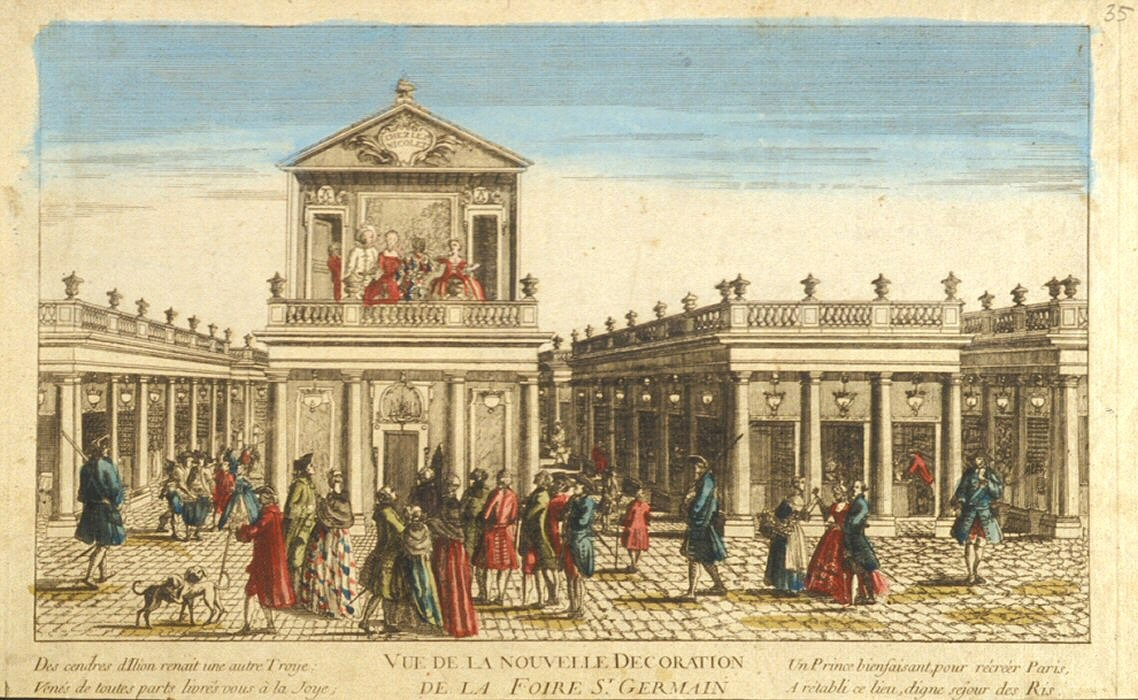
The Paris foire St Germain, c. 1763, after the fire of 1762
Nicolet's theatre at the foire St Laurent, c. 1786
In the early 18th century, the Théâtre de la foire in Paris – a collective name for the theatres at the annual fairs at St Germain, St Laurent (see illustration above) and later, St Ovide – offered performances with both music and spoken dialogue. First called comédie en vaudeville, these developed into the opéra comique. The Théâtre de la foire appeared in London in the 1720s, to be imitated in the form of the English ballad opera, which in turn stimulated the creation of the German Singspiel.

This is a glossary list of opera genres, giving alternative names.

"Opera" is an Italian word (short for "opera in musica"); it was not at first commonly used in Italy (or in other countries) to refer to the genre of particular works. Most composers used more precise designations to present their work to the public. Often specific genres of opera were commissioned by theatres or patrons (in which case the form of the work might deviate more or less from the genre norm, depending on the inclination of the composer). Opera genres are not exclusive. Some operas are regarded as belonging to several.[1]

Definitions

[edit]

Opera genres have been defined in different ways, not always in terms of stylistic rules. Some, like opera seria, refer to traditions identified by later historians,[2] and others, like Zeitoper, have been defined by their own inventors. Other forms have been associated with a particular theatre, for example opéra comique at the theatre of the same name, or opéra bouffe at the Théâtre des Bouffes Parisiens.

This list does not include terms that are vague and merely descriptive, such as "comic opera",[3] "sacred opera", "tragic opera" or "one-act opera" etc. Original language terms are given to avoid the ambiguities that would be caused by English translations.

List

[edit]
Genre Language Description First known example Major works Last known example Notable composers Refs.
Acte de ballet French An opéra ballet consisting of a single entrée. 18th century. Les fêtes de Ramire (1745), Anacréon (1754), Rameau [4]
Afterpiece English 18th/19th century short opera or pantomime performed after a full-length play. The Padlock (1768) Dibdin [4]
Azione sacra Italian Literally, "sacred action". 17th and early 18th century opera with religious subject. Performed at Vienna court. L'humanità redenta (Draghi, 1669) Draghi, Bertali, Pietro Andrea Ziani, Giovanni Battista Pederzuoli, Cesti [4]
Azione sepolcrale Italian alternative name for azione sacra [4]
Azione scenica Italian alternative name for azione teatrale Al gran sole carico d'amore (1975) [4]
Azione teatrale (plural azioni teatrali) Italian Small-scale one-act opera, or musical play. Early form of chamber opera. Popular in late 17th and 18th centuries. (See also festa teatrale, a similar genre but on a larger scale.) Le cinesi (1754), Il sogno di Scipione (1772), L'isola disabitata (1779) Bonno, Gluck, Mozart, Haydn [4]
Ballad opera English Entertainment originating in 18th-century London as a reaction against Italian opera. Early examples used existing popular ballad tunes set to satirical texts. Also popular in Dublin and America, Influenced the German Singspiel, and subsequently 20th-century opera. The Beggar's Opera (1728) Love in a Village (1762), Hugh the Drover (1924), The Threepenny Opera (1928) Pepusch, Coffey, Arne, Weill [4]
Ballet héroïque French Literally 'heroic ballet'. A type of opéra ballet featuring the heroic and exotic, of the early/mid 18th century. Les festes grecques et romaines (Colin de Blamont, 1723) Zaïde, reine de Grenade (1739), Les fêtes de Paphos (1758) Royer, Mondonville, Mion [4]
Bühnenfestspiel German Literally, "stage festival play". Wagner's description of the four operas of Der Ring des Nibelungen Wagner [4]
Bühnenweihfestspiel German Literally, "stage consecration festival play". Wagner's description for Parsifal Wagner [4]
Burla Italian alternative name for burletta [4]
Burletta Italian Literally, "little joke". Informal term for comic pieces in the 18th century. Used in England for intermezzos and light, satirical works. The Recruiting Serjeant (1770) Dibdin [4]
Burletta per musica Italian alternative name for burletta Il vero originale (Mayr 1808)
Burlettina Italian alternative name for burletta [4]
Characterposse German Specialized form of Posse mit Gesang concentrating on personalities. [4]
Comédie en vaudeville French Entertainment in Paris fair theatres at the end of the 17th century, mixing popular vaudeville songs with comedy. In the 18th century, developed into the opéra comique, while influencing directly the English ballad opera and indirectly the German Singspiel.
Comédie lyrique French Literally, "lyric comedy". 18th century: description used by Rameau. 19th century: alternative name for opéra lyrique. Platée (1745), Les Paladins (1760) Rameau [5]
Comédie mêlée d'ariettes French Literally, "comedy mixed with brief arias". An early form of French opéra comique dating to the mid 18th century. La rencontre imprévue (1764), Tom Jones (1765), Le déserteur (1769), Zémire et Azor (1771), Le congrès des rois (Cherubini et al., 1794) Gluck, Grétry
Commedia Italian abbreviation of commedia in musica Il barbiere di Siviglia (1816)
Commedia in musica Italian alternative name for opera buffa [6]
Commedia per musica Italian alternative name for opera buffa La pastorella nobile (1788) [6]
Componimento da camera Italian alternative name for azione teatrale [4]
Componimento drammatico Italian alternative name for azione teatrale [4]
Componimento pastorale Italian alternative name for azione teatrale La danza (Gluck, 1755) Gluck [4]
Conte lyrique French alternative name for opéra lyrique Grisélidis (Massenet, 1901) [4]
Divertimento giocoso Italian alternative name for opera buffa [6]
Dramatic (or dramatick) opera English alternative name for semi-opera
Drame forain French alternative name for Comédie en vaudeville [4]
Drame lyrique French Literally, "lyric drama". (1) Term used in the 18th century. (2) Reinvented in the late 19th/early 20th century to describe opera that developed out of opéra comique, influenced by Massenet. Echo et Narcisse (1779), La marquise de Brinvilliers (1831), Werther (1892), Briséïs (1897), Messidor (1897) Gluck, Chabrier, Bruneau, Erlanger [4]
Dramma bernesco Italian alternative name for opera buffa [6]
Dramma comico Italian alternative name for opera buffa, 18th/early 19th century. Also used for the genre that replaced it from mid 19th century, with the elimination of recitatives. [6]
Dramma comico per musica Italian alternative name for dramma comico
Dramma di sentimento Italian alternative name for opera semiseria [4]
Dramma eroicomico Italian Literally "heroic-comic drama". A late 18th century opera buffa with some heroic content. Orlando paladino (1782), Palmira, regina di Persia (1795) Haydn, Salieri [4]
Dramma giocoso (plural drammi giocosi) Italian Literally, "jocular drama". Mid 18th century form that developed out of the opera buffa, marked by the addition of serious, even tragic roles and situations to the comic ones. (Effectively a subgenre of opera buffa in the 18th century.)[7] La scuola de' gelosi (1778), La vera costanza (1779), Il viaggio a Reims (1825), Haydn, Mozart, Salieri, Sarti, Rossini, Donizetti [4]
Dramma giocoso per musica Italian full term for dramma giocoso
Dramma pastorale Italian Literally, "pastoral drama". Used for some of the earliest operas down to the 18th century. Eumelio (Agazzari, 1606), La fede riconosciuta (A Scarlatti, 1710) A Scarlatti, Sarti [4]
Dramma per musica (plural drammi per musica) Italian Literally, "drama for music", or "a play intended to be set to music" (i.e. a libretto). Later, synonymous with opera seria and dramma serio per musica;[8] in the 19th century, sometimes used for serious opera. Erismena (1656), Tito Manlio (1719), Paride ed Elena (1770), Idomeneo (1781), Rossini's Otello (1816) A Scarlatti, Cavalli, Vivaldi, Sarti, Gluck, Mozart [4]
Dramma semiserio Italian alternative name for opera semiseria Torvaldo e Dorliska (1815)
Dramma tragicomico Italian alternative name for opera semiseria. Axur, re d'Ormus (1787) [4]
Entr'acte French French name for intermezzo [4]
Episode lyrique French alternative name for opéra lyrique [4]
Fait historique French Late 18th/19th century. Opéra or opéra comique based on French history, especially popular during the French Revolution. L'incendie du Havre (1786) Joseph Barra (Grétry 1794), Le pont de Lody (Méhul 1797), Milton (1804) Grétry, Méhul, Spontini [4][9]
Farsa (plural farse) Italian Literally, "farce". A form of one-act opera, sometimes with dancing, associated with Venice, especially the Teatro San Moisè, in the late 18th and early 19th centuries. La cambiale di matrimonio (1810), L'inganno felice (1812), La scala di seta (1812), Il signor Bruschino (1813), Adina (1818) Rossini [10]
Farsetta Italian alternative name for farsa [10]
Feenmärchen German alternative name for Märchenoper [11]
Favola in musica Italian Earliest form of opera Dafne (1598) L'Orfeo (1607) Monteverdi
Festa teatrale Italian A grander version of the azione teatrale. An opera given as part of a court celebration (of a marriage etc.) Typically associated with Vienna. Il pomo d'oro (Cesti, 1668) Draghi, Fux, Caldara [4]
Geistliche Oper German Literally, "sacred opera". Genre invented by the Russian composer Anton Rubinstein for his German-language, staged opera-oratorios. Das verlorene Paradies (Rubinstein, 1856) Der Thurm zu Babel (1870), Sulamith (1883), Moses (1894) Christus (Rubinstein, 1895) Rubinstein [12]
Género chico Spanish Literally, "little genre". A type of zarzuela, differing from zarzuela grande by its brevity and popular appeal. Ruperto Chapí
Género grande Spanish alternative name for zarzuela grande
Grand opéra French 19th-century genre, usually with 4 or 5 acts, large-scale casts and orchestras, and spectacular staging, often based on historical themes. Particularly associated with the Paris Opéra (1820s to c. 1850), but similar works were created in other countries. La muette de Portici (1828) Robert le diable (1831), La Juive (1835), Les Huguenots (1836) Patrie! (Paladilhe, 1886) Meyerbeer, Halévy, Verdi
Handlung German Literally "action" or "drama". Wagner's description for Tristan und Isolde. Wagner
Intermezzo Italian Comic relief inserted between acts of opere serie in the early 18th century, typically involving slapstick, disguises etc. Spread throughout Europe In the 1730s. Predated Opera buffa. Frappolone e Florinetta (Gasparini?, 1706) La serva padrona (1733) Pergolesi, Hasse [13]
Liederspiel German Literally "song-play". Early 19th century genre in which existing lyrics, often well-known, were set to new music and inserted into a spoken play. Lieb' und Treue (Reichardt, 1800) Kunst und Liebe (Reichardt, 1807) Reichardt Lindpaintner [14]
Lokalposse German Specialized form of Posse mit Gesang concentrating on daily life themes, associated with the playwright Karl von Marinelli. [4]
Märchenoper German "Fairy-tale opera", a genre of 19th century opera usually with a supernatural theme. Similar to Zauberoper. Hänsel und Gretel (1893) Humperdinck, Siegfried Wagner [11]
Märchenspiel German alternative name for Märchenoper [11]
Melodramma Italian 19th century. General term for opera sometimes used instead of more specific genres. [15]
Melodramma serio Italian alternative name for opera seria
Musikdrama German Term associated with the later operas of Wagner but repudiated by him.[16] Nevertheless, widely used by post-Wagnerian composers. Tiefland (1903), Salome (1905), Der Golem (d'Albert 1926) d'Albert, Richard Strauss [4][16]
Opéra French Referring to individual works: 1. 18th century. Occasionally used for operas outside specific, standard genres. 2. 19th/20th century: an opéra is a "French lyric stage work sung throughout"[17] in contrast to an opéra comique that mixed singing with spoken dialogue. Opéra (which included grand opéra), was associated with the Paris Opéra (the Opéra). Also used for some works with a serious tone at the Opéra-Comique. Naïs (1749), Fernand Cortez (1809), Moïse et Pharaon (1827), Les vêpres siciliennes (1855), Roméo et Juliette (1867) Grétry, Spontini, Rossini, Verdi, Gounod [17]
Opéra-ballet French Genre with more dancing than tragédie en musique. Usually with a prologue and a number of self-contained acts (called entrées), following a theme. L'Europe galante (1697) Les élémens (1721), Les Indes galantes (1735), Les fêtes d'Hébé (1739) Destouches, Rameau [4]
Opera ballo Italian 19th-century Italian grand opéra. Il Guarany (1870), Aida (1871), La Gioconda (opera) (1876) Gomes, Verdi, Ponchielli [18]
Opera buffa (plural, opere buffe) Italian Major genre of comic opera in the 18th and early 19th centuries. Originating in Naples (especially the Teatro dei Fiorentini), its popularity spread during the 1730s, notably to Venice where development was influenced by the playwright/librettist Goldoni. Typically in three acts, unlike the intermezzo. Contrasting in style, subject matter, and the use of dialect with the formal, aristocratic opera seria. La Cilla (Michelangelo Faggioli, 1706) Li zite 'ngalera (1722), Il filosofo di campagna (Galuppi, 1754), La buona figliuola (1760), Le nozze di Figaro (1786), Il barbiere di Siviglia (1816), Don Pasquale (1843), Crispino e la comare (1850) Don Procopio (1859) Vinci, Pergolesi, Galuppi, Duni, Piccinni, Sacchini, Salieri, Mozart, Rossini [6]
Opéra bouffe (plural, opéras bouffes) French Comic genre of opérette including satire, parody and farce. Closely connected with Offenbach and the Théâtre des Bouffes-Parisiens where most of them were produced. Orphée aux enfers (1858) La belle Hélène (1864), La Grande-Duchesse de Gérolstein (1867), La Périchole (1868) Les mamelles de Tirésias (1947) Offenbach, Hervé, Lecocq [19]
Opéra bouffon French Opera buffa as performed in 18th-century France, either in the original language or in translation. (Sometimes confused with opéra comique.) Le roi Théodore à Venise (Paisiello, 1786) [20]
Opéra comique (plural, opéras comiques) French Literally, 'comic opera'. Genre including arias, a certain amount of spoken dialogue (and sometimes recitatives). Closely associated with works written for the Paris Opéra-Comique. Themes included were serious and tragic, as well as light. Tradition developed from popular early 18th century comédies en vaudevilles and lasted into 20th century with many changes in style. Télémaque (Jean-Claude Gillier, 1715) Les troqueurs (1753), La dame blanche (1825), Carmen (1875), Lakmé (1883) Philidor, Monsigny, Grétry, Boieldieu, Auber, [4]
Opéra comique en vaudeville French alternative name for comédie en vaudeville
Opera eroica Italian 17th/18th/19th century genre which translates as "heroic opera". It mixed serious and romantic drama with improvised comedy.[21] Enrico di Borgogna (1818)[22]
Opéra féerie (plural, opéras féeries) French 18th/19th century genre of works based on fairy tales, often involving magic. Zémire et Azor (1771), Cendrillon (1810), La belle au bois dormant (1825) Carafa, Isouard [23]
Opéra lyrique French Literally, "lyric opera". Late 18th/19th century, less grandiose than grand opéra, but without the spoken dialogue of opéra comique. (Term applied more to the genre as a whole than individual operas.) Gounod, Ambroise Thomas, Massenet [4]
Opera-oratorio Oedipe roi (1927), Jeanne d'Arc au bûcher (1938) Milhaud, Honegger, Stravinsky
Opera semiseria Italian Literally, "semi-serious opera". Early/mid 19th century genre employing comedy but also, unlike opera buffa, pathos, often with a pastoral setting. Typically included a basso buffo role. Camilla (Paer, 1799) La gazza ladra (1817), Linda di Chamounix (1842) Violetta (Mercadante, 1853) Paer, Rossini, Donizetti [24]
Opera seria (plural, opere serie) Italian Literally, "serious opera". Dominant style of opera in the 18th century, not only in Italy but throughout Europe (except France). Rigorously formal works using texts, mainly based on ancient history, by poet-librettists led by Metastasio. Patronized by the court and the nobility. Star singers were often castrati. Griselda (1721), Cleofide (Hasse, 1731), Ariodante (1735), Alceste (1767), La clemenza di Tito (1791) Alessandro Scarlatti, Vivaldi, Hasse, Handel, Gluck, Mozart [4][2]
Opéra-tragédie French alternative name for tragédie en musique [25]
Operetta English (from Italian) Literally, "little opera". Derived from English versions of Offenbach's opéras bouffes performed in London in the 1860s. Some of the earliest native operettas in English were written by Frederic Clay and Sullivan. (W. S. Gilbert and Sullivan wished to distinguish their joint works from continental operetta and later called them "comic operas" or Savoy operas). Cox and Box (1866) Princess Toto (1876), Rip Van Winkle (1882), Naughty Marietta (1910), Monsieur Beaucaire (1919), The Student Prince (1924), The Vagabond King (1925) Candide (1956) Sullivan, Herbert, Romberg, Friml, Leonard Bernstein [26]
Opérette (plural, opérettes) French French operetta. Original genre of light (both of music and subject matter) opera that grew out of the French opéra comique in the mid 19th century. Associated with the style of the Second Empire by the works of Offenbach, though his best-known examples are designated subgenerically as opéras bouffes. L'ours et le pacha (Hervé, 1842) Madame Papillon (Offenbach, 1855), Les mousquetaires au couvent (1880), Les p'tites Michu (1897), Ciboulette (1923) Hervé, Offenbach, Varney, Messager, Hahn [26]
Opérette bouffe French Subgenre of French opérette. La bonne d'enfant (1856), M. Choufleuri restera chez lui le . . . (1861) Offenbach [26]
Opérette vaudeville (or vaudeville opérette) French Subgenre of French opérette. L'ours et le pacha (Hervé, 1842) Mam'zelle Nitouche (1883) Hervé, Victor Roger [26]
Operette (plural, operetten) German German operetta. Popular Viennese genre during the 19th and 20th centuries, created under the influence of Offenbach and spread to Berlin, Budapest, and other German and east European cities. Das Pensionat (Suppé, 1860) Die Fledermaus (1874), The Merry Widow (1905), Das Land des Lächelns (1929) Frühjahrsparade (Robert Stolz, 1964) Johann Strauss II, Lehár, Oscar Straus [26]
Pasticcio Italian Literally "a pie" or a hotchpotch. An adaptation or localization of an existing work that is loose, unauthorized, or inauthentic. Also used for a single work by a number of different composers, particularly in early 18th-century London. Thomyris (Pepusch, Bononcini, Scarlatti, Gasparini, Albinoni, 1707) Muzio Scevola (1721), Ivanhoé (1826) Handel, Vivaldi [4]
Pièce lyrique French alternative name for opéra lyrique [4]
Pastorale héroïque French Type of ballet héroïque (opéra-ballet). Usually in three acts with an allegorical prologue, that typically drew on classical themes associated with pastoral poetry. Acis et Galatée (1686) Issé (1697), Zaïs (1748), Naïs (1749) Lully, Rameau [27]
Posse German alternative name for Posse mit Gesang [4]
Posse mit Gesang (plural Possen mit Gesang) German Literally, "farce with singing". Popular entertainment of late 18th/early 19th centuries, associated with Vienna, Berlin and Hamburg. Similar to the Singspiel, but with more action and less music. Re-invented in the early 20th century by Walter Kollo and others. Der Alpenkönig und der Menschenfeind (Raimund, 1828), Filmzauber (1912) Kreutzer, Müller, Schubert, Walter Kollo [4]
Possenspiel German early name for Posse mit Gesang [4]
Possenspil German early name for Posse mit Gesang [4]
Radio opera English Works written specifically for the medium of radio. The Red Pen (1925) The Willow Tree (Cadman, 1932), Die schwarze Spinne (Sutermeister, 1936), Comedy on the Bridge (1937), The Old Maid and the Thief (1939), Il prigioniero (1949), I due timidi (1950) Martinů, Sutermeister, Menotti, Dallapiccola, Rota [28]
Rappresentazione sacra Italian alternative name for azione sacra [29]
Rescue opera French Early nineteenth century transitional genre between opéra comique, Romantic opera, and grand opera, featuring the rescue of a main character; called opéra à sauvetage in French, and Rettunsoper or Befreiungsoper in German (also Schrekensoper) Les rigueurs du cloître (Henri Montan Berton, 1790) or Lodoïska (1791); some antecedents whose inclusion in the genre is debated Fidelio, Lodoïska, Les deux journées Dalibor (1868) Cherubini, Dalayrac, Le Sueur [4]
Romantische Oper German Early 19th-century German genre derived from earlier French opéras comiques, dealing with "German" themes of nature, the supernatural, folklore etc. Spoken dialogue, originally included with musical numbers, was eventually eliminated in works by Richard Wagner. Silvana (1810) Der Freischütz (1821), Hans Heiling (1833), Undine (1845), Tannhäuser (1845) Lohengrin (1850) Weber, Marschner, Lortzing, Wagner [4]
Sainete Spanish Literally, "farce" or "titbit". 17th/18th century genre of comic opera similar to the Italian intermezzo, performed together with larger works. Popular in Madrid in the latter 18th century. During the 19th century, the Sainete was synonymous with género chico. Il mago (1632) Pablo Esteve, Soler, Antonio Rosales [4][30]
Sainetillo Spanish Diminutive of sainete [30]
Savoy opera English 19th-century form of operetta[31] (sometimes referred to as a form of "comic opera" to distance the English genre from the continental) comprising the works of Gilbert and Sullivan and other works from 1877 to 1903 that played at the Opera Comique and then the Savoy Theatre in London. These influenced the rise of musical theatre. Trial by Jury (1875) H.M.S. Pinafore (1878), The Pirates of Penzance (1880), The Mikado (1885), The Gondoliers (1889), Merrie England (1902) A Princess of Kensington (1903) Sullivan, Solomon, German [31]
Saynète French French for sainete. Description used for a particular style of opérette in the 19th century. La caravane de l'amour (Hervé, 1854), Le rêve d'une nuit d'été (Offenbach, 1855), Le valet de coeur (Planquette, 1875) Hervé, Offenbach, Planquette [30]
Schauspiel mit Gesang German Literally, "play with singing". Term used by Goethe for his early libretti, though he called them Singspiele when revising them. Erwin und Elmire (Goethe 1775) Liebe nur beglückt (Reichardt, 1781), Die Teufels Mühle am Wienerberg (Müller 1799) [32]
Schuloper German Literally, "school opera". Early 20th century, opera created for performance by school children. Der Jasager (1930), Wir bauen eine Stadt (Hindemith, 1930) Weill, Hindemith [33]
Semi-opera English Early form of opera with singing, speaking and dancing roles. Popular between 1673 and 1710. The Tempest (Betterton, 1674) Psyche (1675), King Arthur (1691), The Fairy-Queen (1692) Purcell [4]
Sepolcro Italian Azione sacra on the subject of the passion and crucifixion of Christ. Draghi [29]
Serenata Italian Literally, "evening song". Short opera performed at court for celebrations, similar to the azione teatrale. (Also used to refer to serenades.) Acis and Galatea (1720), Il Parnaso confuso (Gluck 1765) Handel, Gluck [4]
Singspiel (plural Singspiele) German Literally, "sing play". Popular genre of the 18th/19th centuries, (though the term is also found as early as the 16th century). Derived originally from translations of English ballad operas, but also influenced by French opéra comique. Spoken dialogue, combined with ensembles, folk-coloured ballads and arias. Originally performed by traveling troupes. Plots generally comic or romantic, often including magic. Developed into German "rescue opera" and romantische Oper. Der Teufel ist los (Johann Georg Standfuss, 1752) Die verwandelten Weiber (1766), Die Jagd (1770), Die Entführung aus dem Serail (1782), Abu Hassan (1811) Hiller, Mozart, Weber [4][32]
Situationsposse German Specialized form of Posse mit Gesang concentrating on social situations. [4]
Songspiel German Literally, "song play" ("Song" being the English word as used in German, e.g. by Brecht, etc.) Term invented by Kurt Weill to update the concept of Singspiel Mahagonny-Songspiel (1927) Kurt Weill [4]
Spieloper German Literally, "opera play". 19th-century light opera genre, derived from Singspiel and to a lesser extent opéra comique, containing spoken dialogue. Spieltenor and Spielbass are specialized voice types connected with the genre. Zar und Zimmermann (1837), The Merry Wives of Windsor (1849) Lortzing, Nicolai [4]
Syngespil Danish Local form of Singspiel. Late 18th/19th century. Soliman den Anden (Sarti, 1770), Holger Danske (1787), Høstgildet (Schulz, 1790) Sarti, Schulz, Kunzen [4]
Television opera English Works written specifically for the medium of television. Amahl and the Night Visitors (1951) The Marriage (1953), Owen Wingrave (1971), Man on the Moon (2006) Menotti, Martinů, Sutermeister, Britten [34]
Tonadilla Spanish Literally, "little tune". 18th century miniature satirical genre, for one or more singer, that developed out of the sainete. Performed in between longer works. La mesonera y el arriero (Luis Misón, 1757) Antonio Guerrero, Misón, José Palomino [4]
Tragédie French alternative name for tragédie en musique [25]
Tragédie en musique French 17th/18th century lyric genre with themes from Classical mythology and the Italian epics of Tasso and Ariosto, not necessarily with tragic outcomes. Usually 5 acts, sometimes with a prologue. Short arias (petits airs) contrast with dialogue in recitative, with choral sections and dancing. Cadmus et Hermione (1673) Médée (1693), Scylla et Glaucus (1746) Lully, Marais, Montéclair, Campra, Rameau [4][25]
Tragédie lyrique French alternative name for tragédie en musique [25]
Tragédie mise en musique French alternative name for tragédie en musique [25]
Tragédie-opéra French alternative name for tragédie en musique [25]
Verismo Italian Late 19th/early 20th century opera movement inspired by literary naturalism and realism, and associated with Italian post-romanticism. Cavalleria rusticana (1890) Pagliacci (1892), Tosca (1900) Mascagni, Leoncavallo, Puccini, Giordano [4]
Volksmärchen German alternative name for Märchenoper. Das Donauweibchen (Kauer 1798) [11]
Zarzuela Spanish Dating back to the 17th century and forward to the present day, this form includes both singing and spoken dialogue, also dance. Local traditions are also found in Cuba and the Philippines. El Laurel de Apolo (Juan Hidalgo de Polanco, 1657) Doña Francisquita (1923), La dolorosa (1930), Luisa Fernanda (1932) Hidalgo, Barbieri [4]
Zauberoper German Literally, "magic opera". Late 18th and early 19th centuries, particularly associated with Vienna. Heavier, more formal work than Zauberposse, but also with spoken dialogue. Oberon, König der Elfen (Wranitzky, 1789) Die Zauberflöte (1791), Das Donauweibchen, (Kauer, 1798) Kauer, Müller, Schubert [4]
Zauberposse German Specialized form of Posse mit Gesang concentrating on magic. Der Barometermacher auf der Zauberinsel (Müller 1823) Müller [4]
Zeitoper (plural Zeitopern) German Literally, "opera of the times". 1920s, early 1930s genre, using contemporary settings and characters, including references to modern technology and popular music. Jonny spielt auf (1927), Neues vom Tage (1929) Krenek, Weill, Hindemith [35]
Zwischenspiel German German name for intermezzo Pimpinone (1725) [4]

See also

[edit]

The following cover other forms of entertainment that existed around the time of the appearance of the first operas in Italy at the end of the 16th century, which were influential in the development of the art form:

References

[edit]
Revisions and contributorsEdit on WikipediaRead on Wikipedia
from Grokipedia
Opera genres encompass the diverse categories into which operas are classified based on their musical structure, dramatic themes, historical context, and cultural origins, reflecting the evolution of the art form from its inception in late 16th-century Italy to contemporary variations. These genres arose as composers and librettists adapted opera to suit different audiences, national traditions, and artistic intentions, ranging from serious mythological narratives to lighthearted comedies and realistic depictions of everyday life. A comprehensive list of opera genres highlights how the form has branched into subcategories like opera seria, opera buffa, grand opéra, opéra comique, verismo, and operetta, each defined by distinct vocal techniques, orchestration, and staging elements. The foundational genres emerged during the Baroque and Classical periods, with opera seria representing serious opera focused on heroic or mythological subjects, featuring elaborate da capo arias and bel canto singing styles popularized by composers such as George Frideric Handel and Wolfgang Amadeus Mozart; notable examples include Handel's Rinaldo (1711) and Mozart's Idomeneo (1781). In contrast, opera buffa, the comic counterpart originating in 18th-century Italy, emphasized ensemble singing, witty dialogue, and relatable characters from everyday life, as seen in Mozart's Le nozze di Figaro (1786) and Gioachino Rossini's Il barbiere di Siviglia (1816). Hybrid forms like opera semiseria blended dramatic tension with happy resolutions, exemplified by Rossini's La gazza ladra (1817), while French traditions introduced opéra comique with spoken dialogue and accessible themes, evolving from satirical roots to include works like Georges Bizet's Carmen (1875). In the 19th century, Romantic-era developments expanded the spectrum with grand opéra, a spectacular French style involving large choruses, ballets, and elaborate sets to dramatize historical or legendary tales, as in Giacomo Meyerbeer's Robert le diable (1831) and Giuseppe Verdi's Aida (1871). Verismo opera, an Italian realist movement from the late 1800s, shifted to gritty portrayals of ordinary people driven by passion and violence, pioneered by composers like Giacomo Puccini in Tosca (1900) and Ruggero Leoncavallo in Pagliacci (1892). Additionally, Wagnerian opera, or music drama, integrated leitmotifs and continuous orchestration into a "total work of art" emphasizing mythic narratives, as developed by Richard Wagner in his Ring Cycle (1876). Lighter variants such as operetta incorporated spoken dialogue, dance, and satire for popular appeal, with Jacques Offenbach's La belle Hélène (1864) and Johann Strauss II's Die Fledermaus (1874) as enduring examples. Earlier influences include the French tragédie lyrique, with its mythological focus and prologue structure, as in Jean-Baptiste Lully's Alceste (1674), and the German Singspiel, featuring spoken sections in works like Mozart's Die Zauberflöte (1791). This classification is not exhaustive, as regional and experimental forms—such as the Italian dramma per musica or 20th-century fusions like radio opera—continue to evolve, underscoring opera's adaptability across cultures and eras. The following list catalogs these and other genres, providing definitions, historical significance, and representative works to illustrate their contributions to the operatic canon.

Definitions and Terminology

Core Definitions

Opera is a multifaceted dramatic art form that integrates , , and theatrical staging to narrate a story, where performers convey and primarily through rather than spoken words. The term "opera" originates from the Italian word opera, meaning "work," which underscores the collaborative nature of its creation involving composers, librettists, and designers. Emerging in late , opera combines elements of , , and to create a total theatrical experience. Fundamentally, it is a form of drama accompanied by , in which singing actors express thoughts and feelings to advance the plot and evoke emotional responses. Opera genres are classified primarily according to musical structure, thematic content, and performance conventions. Musical structure often distinguishes genres by the prevalence of —speech-like passages that propel the —or arias, more lyrical and reflective solos that highlight emotional depth. Thematic content categorizes works by tone, such as elevated, heroic narratives versus lighthearted or satirical ones, while performance conventions consider elements like the inclusion of spoken dialogue alongside sung sections or fully continuous vocalization. These criteria allow for the delineation of opera's diverse forms, reflecting how composers and librettists adapt musical and dramatic elements to suit varying expressive goals. Broad genre categories include tragic opera, which emphasizes profound emotions, moral conflicts, and often catastrophic outcomes drawn from mythological or historical subjects, fostering a sense of grandeur and . In contrast, focuses on satirical portrayals of everyday life, humorous situations, and resolutions that affirm social harmony, using wit and exaggeration to entertain. Central to opera's construction are key terms like the , the textual script or "little book" that provides the sung words, , and stage directions, crafted by a librettist to align with the dramatic arc. The score encompasses the full , including vocal lines, orchestral parts, and instrumental indications, composed to realize the libretto's emotional and rhythmic intentions. Opera genres evolve through the interplay of these components, as innovations in libretto themes or score structures—such as shifts in rhythmic complexity or harmonic language—give rise to new stylistic variants while preserving the form's core integrative essence.

Key Distinctions

Opera genres are distinguished primarily by their structural, musical, and thematic elements, which reflect contrasting approaches to dramatic expression. A fundamental contrast exists between opera seria, characterized by noble and mythological subjects treated with formal arias that emphasize individual virtuosity and emotional depth, and opera buffa, which features humorous plots drawn from domestic life, often resolved through ensemble numbers that highlight group dynamics and comic interplay. These differences underscore opera seria's focus on heroic individualism versus opera buffa's emphasis on social satire and accessible wit. Musical forms further delineate these genres, with relying on recitativo secco—a sparse, speech-like accompanied only by and —to advance the narrative efficiently between elaborate arias. In contrast, incorporates patter songs, rapid-fire vocal passages that deliver comic patter through quick, syllabic text-setting to heighten and character eccentricity. Such forms prioritize dramatic momentum in serious works while amplifying humor through rhythmic vitality in comic ones. The presence or absence of spoken dialogue marks another key structural divide, evident in genres like and , where spoken passages alternate with musical numbers to create a naturalistic, hybrid theatrical experience suited to lighter narratives. Conversely, grand opera is through-composed, eschewing spoken dialogue entirely in favor of continuous sung music to sustain epic scale and emotional intensity. Thematically, dramatic genres cultivate elevated through explorations of fate, honor, and profound human , evoking tragic grandeur in mythological or historical contexts. Light genres, however, employ and to mock social pretensions and everyday follies, using exaggeration for comedic critique rather than solemn reflection. These contrasts not only define boundaries but also influence audience engagement, from contemplative immersion to lively amusement.

Historical Development

Baroque Origins

The origins of opera as a trace back to the late in , where a group of intellectuals known as the Florentine Camerata sought to revive the dramatic and musical traditions of . Convened around –1587 under the patronage of Giovanni de' Bardi in , the Camerata included figures such as the theorist , the Jacopo Corsi, and the Ottavio Rinuccini, who experimented with —a style of solo singing with simple instrumental accompaniment—to emphasize clear textual declamation over the complex, text-obscuring of . This reaction against polyphonic choral works aimed to restore the emotional and narrative intensity believed to characterize Greek drama, where music served speech rather than dominating it. The earliest operas emerged from these experiments, establishing foundational genres that blended music, , and theater. The term itself, derived from the Italian for "work," served as a general designation for these musical dramas, while more specific labels included dramma per musica (drama through music), which denoted serious works focused on narrative progression, and azione teatrale (theatrical action), a compact form often performed in intimate settings with mythological themes, choruses, and dance. A seminal example is Jacopo Peri's (1598), with a by Rinuccini, which is widely regarded as the first opera or proto-opera; set to the myth of Daphne and Apollo, it was staged privately in and featured predominantly to mimic natural speech patterns. Early Baroque operas were characterized by extensive use of —speech-like singing that advanced the plot—interspersed with simpler arias for , and they typically drew on mythological or heroic subjects to evoke grandeur and . , in particular, allowed for rhythmic flexibility to align with dramatic dialogue, while arias remained concise and less ornate than in later periods. By the mid-17th century, these Italian innovations began spreading to other European courts, influencing precursors to distinct national forms. In , imported Italian operas in the 1640s and 1650s, including works by Francesco Cavalli, which introduced monodic styles and scenic spectacle to French audiences and paved the way for Jean-Baptiste Lully's development of tragédie lyrique around 1672. These early exposures blended with French court ballets, fostering a hybrid genre that emphasized dance, choruses, and elevated tragedy while adapting Italian to the .

Classical and Romantic Evolution

The Classical period of opera, spanning roughly the mid-18th to early 19th centuries, marked a significant shift toward greater emotional expressiveness and structural clarity, building on Baroque foundations such as to emphasize dramatic coherence over virtuosic display. Composers sought to reform the excesses of , a dominant Baroque form characterized by elaborate arias and mythological plots, by integrating music more seamlessly with narrative. This era's innovations laid the groundwork for Romantic opera's emphasis on and spectacle, reflecting broader Enlightenment ideals of and naturalism in artistic expression. A pivotal reform came in the 1760s through , whose operas like (1762) simplified by reducing ornamental arias, prioritizing orchestral accompaniment to heighten dramatic tension, and focusing on mythological subjects with psychological depth. Gluck's manifesto, articulated in the preface to Alceste (1767), advocated for music as a servant to poetry and action, eliminating repetitive structures to achieve a more unified theatrical experience. Concurrently, the rise of introduced comic elements to contrast seria's gravity; Giovanni Battista Pergolesi's (1733) exemplified this genre's witty interludes and ensemble scenes, satirizing social conventions through lively, tuneful numbers that influenced lighter operatic forms across Europe. These reforms diversified opera's palette, blending serious pathos with accessible humor. In the Classical era, national traditions further evolved key genres that incorporated spoken dialogue to enhance realism and accessibility. The German , popularized by composers like in works such as Die Zauberflöte (1791), featured sung numbers interspersed with spoken text, drawing on folk elements and moral allegories to appeal to bourgeois audiences beyond aristocratic courts. Similarly, the French , as seen in André Grétry's Richard Coeur-de-lion (1784), combined comic plots with dialogue and ballet, emphasizing everyday language and sentimental themes that reflected Enlightenment values of empathy and social commentary. These forms democratized opera, making it less reliant on Italianate castrati and more inclusive of vernacular drama. The Romantic period (early to mid-19th century) expanded opera's scale and thematic ambition, with grand opéra emerging as a spectacular genre under , whose (1836) integrated , massive choruses, and elaborate staging to evoke national conflicts and emotional turmoil. This form, prominent at the Paris Opéra, prioritized visual grandeur and orchestral color over vocal display, influencing composers like in his early works. In parallel, the Italian tradition, championed by , , and , emphasized virtuosic vocal agility in operas such as Bellini's Norma (1831), where florid melodies and passages conveyed lyrical intensity and personal passion, often within tragic narratives. 's focus on the singer's expressive range contrasted with grand opéra's ensemble-driven spectacle, enriching Romantic opera's diversity. Influenced by Enlightenment naturalism, the semiseria genre blended serious and comic elements to explore moral ambiguities, as in Giuseppe Saverio Mercadante's Il giuramento (1837), which featured realistic characters and mixed tones to critique societal hypocrisy without descending into pure . This hybrid form promoted a balanced dramatic arc, using duets and finales to resolve conflicts organically, and reflected the era's push toward operatic over stylized artifice. Such evolutions underscored opera's adaptation to changing cultural priorities, from rational discourse to romantic individualism.

Modern Transformations

The early 20th century marked a pivotal shift in opera genres through , a movement emphasizing realistic portrayals of ordinary lives, heightened emotional intensity, and social themes as a reaction to the elaborate spectacle of 19th-century Romantic grand opéra. This style, which bridged the late 19th and early 20th centuries, focused on contemporary characters facing raw human struggles, often in naturalistic settings, diverging from heroic myths toward gritty authenticity. Giacomo Puccini's operas, such as (1900) and (1904), captured this through melodic intensity and dramatic veracity, while Pietro Mascagni's (1890) set a benchmark for its concise, passionate narrative of rural jealousy and violence. Transitional works like Claude Debussy's Pelléas et Mélisande (1902) introduced impressionist elements, using subtle and symbolist to evoke ambiguity and atmosphere. Mid-century developments further transformed opera by introducing expressionism and neoclassicism, both challenging Romantic excess with innovative structures and sonorities. , prominent in the 1910s and 1920s, explored distorted inner psyches and societal alienation through fragmented forms and ; Alban Berg's (1925), based on Georg Büchner's play, exemplified this with its episodic scenes, Sprechstimme vocal techniques, and orchestral intensity to depict a soldier's descent into madness. In parallel, revived Classical and clarity—employing , balanced phrases, and objective detachment—while incorporating modern harmonies, as in Igor Stravinsky's (1927), which fused with stylized, ritualistic music to create a timeless yet contemporary aesthetic. Post-World War II innovations included Benjamin Britten's (1945), which blended realism with modern to address . Post-World War II trends intensified these transformations via serialism and atonality, extending into hybrid genres like music theater that prioritized intellectual rigor and social critique over traditional lyricism. Serial techniques, systematizing pitch, rhythm, and dynamics, appeared in operas exploring existential themes, such as Luigi Dallapiccola's Il prigioniero (1949), which used twelve-tone rows to underscore themes of oppression and despair. Kurt Weill's pre-war influences, evident in satirical works like The Threepenny Opera (1928), persisted in shaping post-war music theater by blending atonal elements with popular idioms, inspiring composers to create intimate, politically charged hybrids that reflected fragmented modern experiences. Amid these stylistic evolutions, the early 1900s saw a broader push for shorter, more intimate opera forms to address shifting audience demographics, including a growing seeking accessible entertainment over lengthy spectacles, and the rise of smaller venues like chamber theaters. This trend favored concise works, such as one-act operas, to enhance immediacy and emotional connection, influencing genres toward brevity and focus.

Genres by Style and Form

Serious and Dramatic Forms

Serious and dramatic forms of opera prioritize elevated narratives centered on , heroism, and epic conflicts, often employing structured musical forms to underscore emotional intensity and moral depth. These genres emerged as vehicles for exploring noble or mythological themes, distinguishing themselves from lighter counterparts through their focus on and grandeur rather than humor or . Opera seria, the predominant serious opera style in 18th-century Italy, featured a formal structure built around da capo arias in A-B-A form, where the initial section returned after a contrasting middle to allow singers to showcase vocal virtuosity. Recitatives advanced the plot through dialogue-like , while choruses and ensembles provided occasional commentary, but the emphasis remained on solo voices performing techniques. Themes typically drew from ancient mythology or heroic history, portraying characters of high in tales of love, duty, and fate, as seen in works by composers like Handel and . Grand opéra, a 19th-century French genre epitomized by , emphasized spectacular historical or legendary plots with large-scale production elements including ballets, massive choruses, and elaborate staging to evoke epic drama. These operas unfolded in five acts, integrating orchestral richness with vocal demands to heighten tension in narratives of political intrigue and personal tragedy, such as in Meyerbeer's Les Huguenots, which featured crowd scenes and tableau-like spectacles. The form's grandeur reflected the opulent tastes of the Paris Opéra, prioritizing visual and auditory excess to immerse audiences in monumental conflicts. Verismo, arising in late 19th-century , introduced a dramatic realism by depicting raw passions and violent fates among lower-class characters, using continuous musical textures and brief, intense arias to convey unfiltered emotion rather than ornate vocal displays. This genre focused on everyday settings and social veracity, as in Pietro Mascagni's , where orchestral motifs underscored psychological turmoil and moral ambiguity in tales of jealousy and revenge. Verismo's dramatic force lay in its rejection of idealized heroism for stark human struggles, influencing composers like in . Tragédie lyrique, pioneered by in the French Baroque era, combined recitative-driven drama with integrated dance and choral elements in a five-act structure preceded by an allegorical , drawing on mythological subjects to exalt royal or divine authority. Lully's operas, such as Armide, featured measured rhythms and expressive melodies that prioritized textual clarity and spectacle, including elaborate ballets that blurred lines between music and movement. The genre saw revival in the early Romantic period, as in Charles-Simon Catel's Sémiramis of 1802, which adapted its formal poise and tragic scope to heightened orchestral colors and emotional depth.

Comic and Light Forms

Comic and light forms of opera emerged in the as accessible alternatives to the more elevated serious genres, emphasizing humor, , and depictions of through witty , ensemble numbers, and relatable characters. These genres often drew from popular theater traditions, incorporating spoken elements or familiar tunes to appeal to broader audiences beyond aristocratic patrons. Unlike the and mythological grandeur of serious opera, comic forms prioritized levity and , fostering ensemble interactions that built comedic momentum through rapid-fire exchanges and finales. Opera buffa, the quintessential Italian , developed in the early as a reaction against the rigid structures of , featuring stock characters inspired by such as the cunning servant Figaro or the pompous doctor. Its plots revolved around farcical intrigues among middle- and lower-class figures, resolved through mistaken identities and romantic entanglements, with characterized by lively arias, songs, and bustling finales that heightened the chaos. Composers like advanced the form with works such as (1733), which exemplified its satirical edge on social hierarchies, while later elevated it through masterful ensembles in operas like (1816), blending rapid tempos and vocal agility to underscore humorous predicaments. Opéra comique, a French counterpart, originated in the from fairground entertainments and traditions, distinguished by its integration of spoken with musical numbers to create a more naturalistic flow suited to sentimental or farcical narratives. Unlike fully sung Italian forms, it allowed for flexible plotting that often explored domestic themes, moral dilemmas, or light romance, appealing to middle-class sensibilities with its blend of and . Key examples include André Grétry's Richard Coeur-de-lion (1784), which combined historical with emotional depth, and Georges Bizet's Carmen (1875), originally premiered with spoken parts to highlight its gypsy folklore and tragicomic elements before later adaptations. This genre's emphasis on facilitated character-driven humor and social critique, influencing broader European light opera developments. Singspiel, the German light opera tradition, arose in the mid-18th century as a response to Italian dominance, incorporating spoken , folk-like melodies, and magical or plots to promote national . Its structure alternated songs with sections, enabling accessible storytelling that often featured ensemble choruses and simple harmonies drawn from , contrasting the virtuosic solos of serious . Wolfgang Amadeus Mozart's Die Zauberflöte (1791) stands as a seminal work, weaving Enlightenment ideals into a fairy-tale narrative with comic interludes involving bird-catchers and queens, its and ensembles exemplifying the genre's blend of humor and moral uplift. Earlier examples like Johann Adam Hiller's Der Teufel ist los (1766) established its satirical tone on everyday absurdities. The , an English innovation of the early , satirized society through spoken plays interspersed with airs adapted from popular ballads and folk tunes, eschewing original compositions to mock operatic pretensions and elite culture. Emerging amid political unrest, it focused on roguish characters and corrupt institutions, using familiar melodies to ensure broad appeal and underscore ironic commentary. John Gay's (1728), with its protagonist Macheath and tunes like "Over the Hills and Far Away," became a blockbuster hit, running for 62 performances and inspiring sequels while critiquing Walpole's government through . This form's emphasis on and accessibility influenced later comic operas across .

Hybrid and Specialized Forms

Hybrid and specialized forms of opera represent innovative blends that transcend traditional boundaries between serious () and comic (buffa) styles, often incorporating unique staging, scale, or to suit specific artistic or practical needs. These genres emerged as responses to evolving audience tastes and performance constraints, allowing composers to explore nuanced narratives that mix with humor, intimacy with , or brevity with wit. While rooted in Italian traditions for many early examples, they influenced broader operatic developments by prioritizing accessibility and emotional versatility over rigid conventions. Opera semiseria, a prominent 19th-century Italian genre, combines the elevated plots and moral dilemmas of with and lighter character interactions, typically resolving in uplifting or ethically affirmative conclusions. Popular in the first half of the 1800s, it catered to bourgeois audiences by focusing on relatable domestic or sentimental themes rather than mythological grandeur. Gioachino Rossini's (1817) exemplifies this form, blending suspenseful drama with humorous interludes and a redemptive ending that underscores themes of and . The , an 18th-century Italian hybrid, merges the witty dialogue and ensemble scenes of with the emotional depth and aristocratic elements of , creating a "jocular drama" that balances levity and . Originating around the mid-1700s through collaborations between librettists like and composers such as Niccolò Piccinni, it allowed for multifaceted storytelling with spoken-like recitatives and lively finales. Wolfgang Amadeus Mozart's (1787) stands as a seminal example, intertwining comedic escapades with supernatural horror and moral reckoning, performed as a dramma giocoso to reflect its tonal shifts. Farsa, a concise Italian form from the late 18th and early 19th centuries, evolved from comic intermezzos into a standalone one-act opera emphasizing , , and extravagant plots, often paired with for Venetian theaters. Associated primarily with Venice's Teatro San Moisè, it featured simplified and exaggerated humor to appeal to casual audiences between larger works. Gioachino Rossini's La cambiale di matrimonio (1810) exemplifies the genre, with its quick-witted deceptions around a and compact structure highlighting farsa’s role in lightening operatic evenings. Chamber opera, a 20th-century specialized form, scales down traditional for small casts, minimal staging, and chamber ensembles, fostering intimate psychological narratives suitable for non-traditional venues. Emerging post-World War II amid economic constraints and a desire for experimentation, it prioritizes textual clarity and ensemble interplay over spectacle. Benjamin Britten's The Rape of Lucretia (1946) and (1954) are foundational works, the former adapting a classical with a sparse of 13 players, and the latter employing a 13-instrument to evoke ghostly ambiguity in Henry James's .

Genres by National Tradition

Italian Traditions

Italian opera traditions encompass a rich array of genres that emphasize vocal prowess, dramatic expression, and cultural narratives rooted in the country's theatrical heritage. Emerging from the period, these forms evolved to balance serious mythological tales with everyday humor, influencing composers across while maintaining a distinctly Italian focus on melodic beauty and character-driven storytelling. , the dominant serious genre of the 18th century, originated in late 17th-century , where it formalized mythological and heroic subjects through structured librettos and da capo arias that showcased virtuosic singing by castrati. Pioneered by , who established key conventions like three-act structures and elaborate recitatives, opera seria became a vehicle for courtly entertainment across and beyond. Composers such as Antonio Vivaldi and further refined its dramatic intensity in , while , working extensively in Italian style, produced over 40 opera seria works, including Rinaldo (1711), which popularized the form in and highlighted its emotional depth through elaborate arias. In contrast, arose in early 18th-century as a comic counterpart, targeting middle-class audiences with relatable plots, ensemble finales, and patter songs in local dialects that satirized social norms. Early exponents like and , whose (1733) exemplified its witty servant-master dynamics, laid the groundwork for two-act formats emphasizing basso buffo roles and rapid-fire dialogue. This genre profoundly influenced , whose operas like Le nozze di Figaro (1786) and (1787) blended buffa humor with seria elements, adapting Italian conventions to Viennese sophistication. The style flourished in early 19th-century as a vocal showcase, prioritizing smooth lines, agile , and expressive melodies to convey romantic pathos. advanced this through fast-paced comedies like Il barbiere di Siviglia (1816), featuring intricate ensembles and vocal fireworks that demanded technical precision. Vincenzo Bellini elevated bel canto's lyrical elegance in tragic works such as Norma (1831), with arias like "Casta Diva" emphasizing long-breathed phrases and emotional restraint. contributed versatile bel canto operas, including the dramatic (1835), renowned for its iconic mad scene that combined virtuosity with psychological intensity. Verismo, a realistic movement post-1890, shifted toward gritty depictions of lower-class life, violence, and passion, drawing from literary naturalism to reflect post-unification social upheavals. Pietro Mascagni's Cavalleria rusticana (1890) ignited the genre with its one-act tale of rural jealousy and revenge, using continuous orchestration and folk-infused melodies for raw authenticity. Ruggero Leoncavallo's Pagliacci (1892) epitomized verismo's emotional immediacy, portraying actors' personal turmoil through heightened vocal lines and naturalistic staging. Giacomo , while incorporating verismo elements, blended them with exoticism in operas like La bohème (1896) and Tosca (1900), focusing on individual suffering amid urban realism and achieving widespread acclaim for their melodic richness. Intermezzo and farsa represent shorter comic forms integral to Italian opera's lighter side, often serving as interludes or standalone entertainments that bridged acts of larger works. Intermezzos, originating in the 1710s-1720s in , were brief, one- or two-act pieces performed between acts, featuring simple plots and ensembles for small casts to provide humorous relief. Pergolesi's (1733), a seminal intermezzo, highlighted clever maid-servant intrigue and evolved into independent productions. Farsa, a related Venetian genre from the late 18th and early 19th centuries, consisted of concise, one-act farces with fast-paced action and minimal , as seen in Gioachino Rossini's early works like L'occasione fa il ladro (1812), which used small ensembles and vital cavatinas to satirize romantic mishaps.

French Traditions

French opera traditions, emerging prominently in the under the patronage of , distinguished themselves through a unique synthesis of music, , and spoken elements, reflecting the grandeur of the French court and later the theatrical innovations of Parisian stages. This integration prioritized spectacle and narrative flow, where dance sequences—known as divertissements—served not merely as interludes but as essential components advancing the plot or evoking emotion, while spoken dialogue in certain forms preserved the rhythmic cadence of French verse drama. Unlike the bel canto emphasis on vocal display in , French genres often balanced orchestral richness with choreographed movement and recitative-like speech-song hybrids, influencing European opera well into the . The tragédie en musique, also termed tragédie lyrique, was codified by composer and librettist Philippe Quinault in the late 17th century, debuting with Cadmus et Hermione in 1673 at the Académie Royale de Musique. This form elevated serious mythological or historical subjects to operatic status, structured around a praising the , followed by five acts that incorporated recitatives, arias, choruses, and elaborate divertissements featuring ballet ensembles to symbolize harmony or conflict resolution. Lully's innovations, drawing on Italian influences but adapted to French declamation, emphasized dramatic progression through integrated dance, as seen in works like Armide (1686), where choreographed scenes reinforced the tragic narrative without disrupting its unity. The genre's formulaic yet flexible design—lacking strict unity of time and place—allowed for spectacular courtly diversions, cementing its role as the cornerstone of French Baroque opera until the mid-18th century. In contrast, opéra comique developed in the 18th century from the popular comédies en vaudevilles, light entertainments blending pre-existing tunes with new lyrics and spoken dialogue to convey everyday humor and sentiment. By the 19th century, it had evolved into a versatile genre at the Opéra-Comique theater, retaining spoken sections amid musical numbers to heighten realism and accessibility, as in François-Adrien Boieldieu’s La dame blanche (1825), a supernatural romance that showcased spoken dialogue driving the plot. Jacques Offenbach refined this into opéra bouffe, a satirical variant in the 1850s–1860s, exemplified by Orphée aux enfers (1858), where witty spoken interludes critiqued society alongside buoyant, dance-infused ensembles that parodied classical myths. This evolution from vaudeville roots preserved the genre's populist appeal, distinguishing it from fully sung forms by allowing natural speech to drive comedic timing and character development. The 19th-century grand opéra represented the pinnacle of French Romantic spectacle, pioneered by in collaboration with librettist , whose works like (1831) and (1836) premiered at the Paris Opéra. Scribe’s meticulously plotted librettos, often co-authored, provided historical or exotic backdrops with large-scale choruses, ballets, and ensembles, as in , where the Saint Bartholomew’s Day Massacre unfolds through Meyerbeer’s orchestration of crowd scenes and divertissements. This genre demanded technical extravagance, including elaborate sets and integrated dance sequences, to evoke national grandeur, influencing composers like and setting a model for international opera houses. As a dance-centric offshoot, the opéra-ballet emerged in the early , building on Lully’s legacy to prioritize choreographed narratives over linear drama, with works like ’s Les Indes galantes (1735) featuring loosely connected entrées linked by divertissements. Each act typically revolved around a thematic divertissement, integrating as the primary expressive medium while incorporating arias and choruses to frame exotic or scenes, reflecting the Opéra’s as a venue for music and . This hybrid form, which flourished until the , underscored ’s enduring commitment to physical spectacle, often eclipsing plot in favor of visual and rhythmic harmony.

German and Other European Traditions

The German operatic tradition diverged from Italian and French models by emphasizing spoken dialogue and integration with folk elements, giving rise to the , with origins tracing back to the through works like Seelewig (1644) by Sigmund Staden, but developing prominently in the . This genre, characterized by alternating songs, arias, and spoken prose rather than , emerged as a popular form of entertainment for middle- and lower-class audiences, often performed by traveling troupes and incorporating comic, romantic, or magical themes drawn from everyday life or . elevated the Singspiel through operas like Die Zauberflöte (1791), which features spoken dialogue interspersed with ensemble numbers and explores folk-inspired magic and enlightenment themes, achieving both popular success and artistic depth. further advanced the form in (1805, revised 1814), his only opera, where spoken sections underscore themes of heroism and liberation amid political turmoil inspired by the , marking a transition toward more dramatic intensity while retaining Singspiel's structural elements. In the , revolutionized German by rejecting traditional forms in favor of Musikdrama, or music drama, a through-composed style that unified music, , , and visuals into a seamless whole under his concept of (total artwork). Unlike earlier operas with arias and recitatives, Wagner's works employed leitmotifs—recurring musical themes associated with characters, objects, or ideas—to propel the narrative continuously, creating psychological depth and mythic scope. This approach culminated in his epic (The Ring Cycle, 1848–1874), a of music dramas drawing on Germanic legends, where leitmotifs evolve to reflect dramatic progression, as seen in themes for the sword Nothung or the ring itself. Wagner's innovations prioritized narrative integration over vocal display, influencing subsequent European by shifting focus from spectacle to symbolic, leitmotif-driven storytelling. Beyond German-speaking regions, Central and Eastern European traditions incorporated spoken elements and folklore in unique ways. In Czech opera, Bedřich Smetana developed a declamatory style in works like Dalibor (1868), where recitatives were crafted to mimic the natural rhythm and inflection of spoken Czech, enhancing dramatic realism and national expression while diverging from traditional melodic recitatives. Russian composer Nikolai Rimsky-Korsakov specialized in fairy-tale operas that wove Russian folk tunes and exotic melodies into enchanting narratives, as in The Snow Maiden (1882), based on Alexander Ostrovsky's play and featuring pagan Slavic myths with choral ensembles evoking spring rituals, and The Golden Cockerel (1907), a satirical fable critiquing autocracy through whimsical, oriental-inflected music and moral allegory. These operas emphasized fantastical elements and national identity, using whole-tone scales and modal harmonies to conjure otherworldly atmospheres. In , lighter forms with spoken dialogue and popular music reflected satirical and folk influences. The English , popularized by John Gay's (1728), parodied and societal corruption through a structure of spoken scenes alternating with existing folk and arranged simply, achieving immense success with over 60 performances in its first run and inspiring a wave of imitations that celebrated British wit and accessibility. Similarly, the Spanish , originating in the at the royal court with Pedro Calderón de la Barca's El Laurel de Apolo (1657) and revived in the 19th-century "" by Francisco Asenjo Barbieri, blended spoken dialogue, operatic arias, , and regional dances like the jota or seguidilla to depict everyday Spanish life, particularly Madrid's , fostering a sense of cultural identity through lively, genre-mixing entertainment. These traditions, including comic forms reliant on spoken sections, underscored opera's adaptability to local languages and across .

Contemporary and Emerging Genres

20th-Century Innovations

The marked a period of significant innovation in opera genres, as composers responded to modernist , technological advancements, and cultural shifts by extending established forms like while pioneering new expressions of emotional and social realities. Building on the realism of late 19th-century as a precursor, these developments emphasized psychological depth, , and interdisciplinary integration, often challenging traditional narrative and musical structures. Extensions of verismo appeared in Puccini's late works, where he blended the genre's focus on everyday life and raw emotion with and impressionistic elements, moving beyond strict realism toward more stylized, culturally diverse narratives. In operas such as (1926), Puccini incorporated Eastern motifs and lush orchestration to evoke otherworldly atmospheres, marking a departure from verismo's gritty naturalism while retaining its dramatic intensity. This fusion reflected broader modernist trends, allowing Puccini to refine verismo's principles through psychological nuance and sophistication. Expressionist opera emerged as a radical departure, prioritizing inner turmoil and distorted realities through atonal music and innovative vocal techniques, heavily influenced by Arnold Schoenberg's (1912), a melodramatic cycle that introduced Sprechstimme—a speech-song hybrid—to convey fragmented psyches. Alban Berg's (1925) exemplified this genre, adapting Georg Büchner's play into a through-composed opera with episodic structure, atonality, and Sprechstimme to depict the protagonist's descent into madness amid social oppression. These works defined expressionism in opera by emphasizing subjective experience over objective plot, influencing subsequent avant-garde compositions. In the United States, opera genres evolved to incorporate indigenous musical idioms, as seen in George Gershwin's (1935), a jazz-infused folk opera that merged operatic forms with , , and to portray African American life in the Gullah community of . Gershwin described it as a "folk opera" to highlight its roots in authentic cultural narratives, blending Broadway accessibility with symphonic scope to create what many regard as a cornerstone of American . This hybrid approach addressed racial and social themes, expanding opera's scope beyond European traditions. The advent of radio and film technologies spurred experimental short-form operas post-1930s, adapting the genre for broadcast and screen to explore intimate, abstract storytelling unbound by stage conventions. Radio operas, such as Ezra Pound's collaborations like Le Testament (broadcast 1931), pioneered audio-only formats emphasizing voice, sound effects, and minimal instrumentation to convey poetic narratives, gaining prominence in the as broadcasters sought novel content. Similarly, Kurt Weill's unproduced "film-opera" The River Is Blue () envisioned integrated music and visuals for Hollywood, blending opera's dramatic arcs with cinematic montage to critique American society, though it remained conceptual amid political challenges. These innovations democratized opera, fostering concise, technology-driven forms that prioritized auditory and visual experimentation.

21st-Century Developments

In the 21st century, opera has evolved through contemporary chamber forms that emphasize intimate scales and political narratives, often building on post-minimalist techniques. Composers like John Adams have pioneered such works, as seen in his 2005 opera Doctor Atomic, which dramatizes the moral dilemmas of J. Robert Oppenheimer and the Manhattan Project through a compact ensemble and repetitive, pulsating rhythms characteristic of minimalism adapted for dramatic intensity. This piece exemplifies how chamber opera can address contemporary ethical issues with a leaner orchestration, focusing on vocal and instrumental interplay to heighten tension without grand spectacle. Electro-acoustic opera has emerged as a significant subgenre, blending live acoustic performance with electronic soundscapes to expand expressive possibilities. Tan Dun's compositions, such as The First Emperor (2006), integrate traditional Chinese instruments like the pipa and erhu with multimedia elements, creating fusions that evoke historical and spiritual themes while pushing sonic boundaries. These works highlight the genre's capacity to merge cultural heritage with technology, producing immersive auditory experiences that challenge conventional operatic textures. Global hybrids represent another key development, incorporating non-Western influences to diversify operatic narratives and sounds. Osvaldo Golijov's (2003), for instance, weaves rhythms, motifs, and Jewish liturgical elements into a score that recounts the assassination of poet , resulting in a culturally layered chamber opera that reflects multicultural identities. Similarly, African-inspired works like Ian Cusson's Of the Sea (2023; libretto by Kanika Ambrose) draw on underwater and Black diasporic traditions, using hybrid ensembles to explore themes of resilience and displacement, thereby broadening 's global footprint. Recent examples include Jeanine Tesori's Grounded (2024), a chamber opera examining a female fighter pilot's ethical struggles, premiered at the and exemplifying contemporary political narratives in intimate formats. The accelerated shifts toward virtual and site-specific performances, birthing new subgenres that prioritize accessibility and innovation. Companies like produced online operas such as Soldier Songs (2021), streamed with interactive elements to simulate immersion despite physical distancing. Zoom-based works, including All Decisions Will Be Made by Consensus (2020), experimented with real-time digital collaboration, while site-specific virtual pieces like drive-in stagings and adaptations redefined spatial dynamics, ensuring opera's continuity and evolution in a restricted era.

References

Add your contribution
Related Hubs
User Avatar
No comments yet.