


Community hub
Recent from talks
Contribute something
Nothing was collected or created yet.
World War III
View on Wikipedia

World War III,[a] also known as the Third World War, is a hypothetical future global conflict subsequent to World War I (1914–1918) and World War II (1939–1945). It is widely predicted that such a war would involve all of the great powers, like its two predecessors, and the use of nuclear weapons or other weapons of mass destruction, thereby surpassing all prior conflicts in scale, devastation, and loss of life.
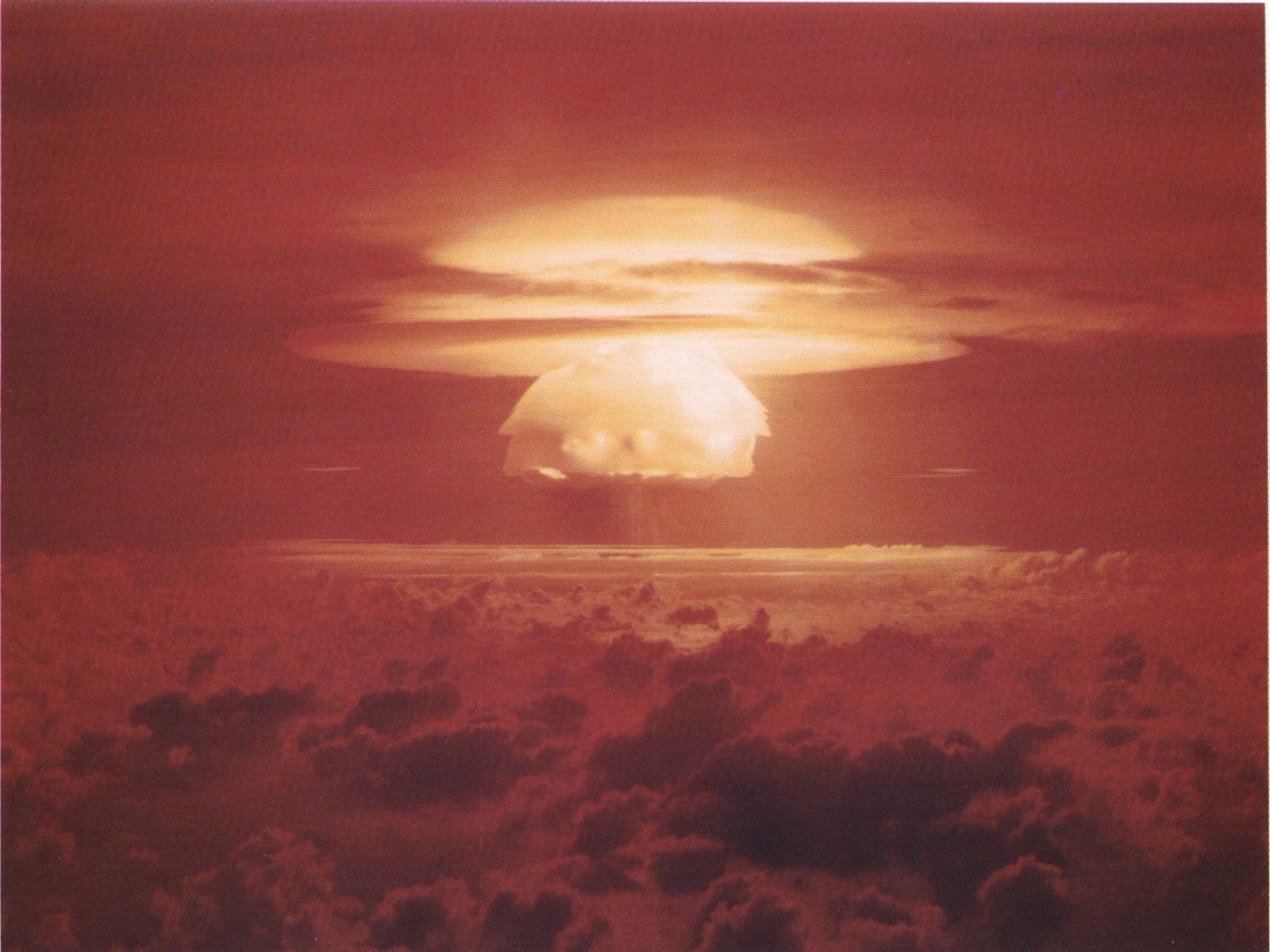
World War III was initially synonymous with the escalation of the Cold War (1947–1991) into direct conflict between the US-led Western Bloc and Soviet-led Eastern Bloc. Since the United States' development and use of nuclear weapons in the atomic bombings of Hiroshima and Nagasaki at the end of World War II, the risk of a nuclear apocalypse causing widespread destruction and the potential collapse of modern civilization or human extinction has been central in speculation and fiction about World War III. The Soviet Union's development of nuclear weapons in 1949 spurred the nuclear arms race and was followed by several other countries.
Regional proxy wars including the Korean War (1950–1953), Vietnam War (1955–1975), and Soviet–Afghan War (1979–1989), while significant, did not lead to a full-scale global conflict. A global conflict was planned for by military and civil personnel around the world, with scenarios ranging from conventional warfare to limited or total nuclear warfare. The certainty of escalation from one stage to the next was extensively debated. For example, the Eisenhower administration promulgated a policy of massive retaliation with nuclear forces, to a minor conventional attack. After the Cuban Missile Crisis in 1962, which brought the US and Soviet Union to the brink of war, the strategic doctrine of mutually assured destruction, which held that a full-scale nuclear war would annihilate all parties, became widely accepted. At their 1985 summit, US and Soviet leaders first jointly stated "a nuclear war cannot be won and must never be fought". Advocates of deterrence theory hold that nuclear weapons prevent World War III–like great power conflict, while advocates of nuclear disarmament hold that their risks far outweigh this.[1]
Since the end of the Cold War in 1991, speculation about World War III shifted toward emerging threats, including terrorism and cyberwarfare. Great-power competition was renewed between the United States, China, and Russia, sometimes termed a Second Cold War. Various conflicts, most significantly the Russian invasion of Ukraine (2022–present), the Middle Eastern crisis (2023–present), and rising tensions over the status of Taiwan, have been perceived as flashpoints for a third world war.[2][3][4]
Etymology
[edit]Time magazine
[edit] |
Time magazine was an early adopter, if not originator, of the term "World War III". The first usage appears in its 3 November 1941 issue (preceding the Japanese attack on Pearl Harbor on 7 December 1941) under its "National Affairs" section and entitled "World War III?" about Nazi refugee Hermann Rauschning, who had just arrived in the United States.[5] In its 22 March 1943, issue under its "Foreign News" section, Time reused the same title "World War III?" about statements by then–US Vice President Henry A. Wallace: "We shall decide sometime in 1943 or 1944 ... whether to plant the seeds of World War III."[6][7] Time continued to entitle with or mention in stories the term "World War III" for the rest of the decade and onwards: 1944,[8][9] 1945,[10][11] 1946 ("bacterial warfare"),[12] 1947,[13] and 1948.[14] Time persists in using this term, for example, in a 2015 book review entitled "This Is What World War III Will Look Like".[15]
Military plans
[edit]Military strategists have used war games to prepare for various war scenarios and to determine the most appropriate strategies. War games were utilized for World War I and World War II.[16]
Operation Unthinkable
[edit]British Prime Minister Winston Churchill was concerned that, with the enormous size of Soviet Red Army forces deployed in Central and Eastern Europe at the end of World War II and the perceived unreliability of the Soviet leader Joseph Stalin, there was a serious threat to Western Europe. In April–May 1945, the British Armed Forces developed Operation Unthinkable, thought to be the first scenario of the Third World War.[17] Its primary goal was "to impose upon Russia the will of the United States and the British Empire".[18] The plan was rejected by the British Chiefs of Staff Committee as militarily unfeasible.
Operation Dropshot
[edit]Operation Dropshot was the 1950s United States contingency plan for a possible nuclear and conventional war with the Soviet Union in the Western European and Asian theaters. Although the scenario made use of nuclear weapons, they were not expected to play a decisive role.
At the time, the US nuclear arsenal was limited in size, based mostly in the United States, and depended on bombers for delivery. Dropshot included mission profiles that would have used 300 nuclear bombs and 29,000 high-explosive bombs on 200 targets in 100 cities and towns to wipe out 85% of the Soviet Union's industrial potential in a single stroke. Between 75 and 100 of the 300 nuclear weapons were targeted to destroy Soviet combat aircraft on the ground.
The scenario was devised before the development of intercontinental ballistic missiles. It was also devised before US President John F. Kennedy and his Secretary of Defense Robert McNamara changed the US Nuclear War plan from the 'city killing' countervalue strike plan to a "counterforce" plan (targeted more at military forces). Nuclear weapons at this time were not accurate enough to hit a naval base without destroying the city adjacent to it, so the aim of using them was to destroy the enemy's industrial capacity to cripple their war economy.
British-Irish cooperation
[edit]Ireland started planning for a possible nuclear war in the late 1940s. Co-operation between the United Kingdom and Ireland would be formed in the event of WWIII, where they would share weather data, control aids to navigation, and coordinate the Wartime Broadcasting Service that would occur after a nuclear attack.[19] Operation Sandstone in Ireland was a top-secret British-Irish military operation.[19] The armed forces from both states began a coastal survey of Britain and Ireland cooperating from 1948 to 1955. This was a request from the United States to identify suitable landing grounds for the US in the event of a successful Soviet invasion.[19][20] By 1953, the co-operation agreed upon sharing information on wartime weather and the evacuation of civilian refugees from Britain to Ireland.[19] Ireland's Operation Sandstone ended in 1966.[20]
Exercises Grand Slam, Longstep, and Mainbrace
[edit]In January 1950, the North Atlantic Council approved NATO's military strategy of containment.[21] NATO military planning took on a renewed urgency following the outbreak of the Korean War in the early 1950s, prompting NATO to establish a "force under a centralized command, adequate to deter aggression and to ensure the defense of Western Europe". Allied Command Europe was established under General of the Army Dwight D. Eisenhower, U.S. Army, on 2 April 1951.[22][23] The Western Union Defence Organization had previously carried out Exercise Verity, a 1949 multilateral exercise involving naval air strikes and submarine attacks.
Exercise Mainbrace brought together 200 ships and over 50,000 personnel to practice the defense of Denmark and Norway from the Soviet attack in 1952. It was the first major NATO exercise. The exercise was jointly commanded by Supreme Allied Commander Atlantic Admiral Lynde D. McCormick, United States Navy, and Supreme Allied Commander Europe General Matthew B. Ridgeway, U.S. Army, during the autumn of 1952.
The United States, the United Kingdom, Canada, France, Denmark, Norway, Portugal, Netherlands, and Belgium participated.
Exercises Grand Slam and Longstep were naval exercises held in the Mediterranean Sea during 1952 to practice dislodging an enemy occupying force and amphibious assault. It involved over 170 warships and 700 aircraft under the overall command of Admiral Robert B. Carney. The overall exercise commander, Carney summarized the accomplishments of Exercise Grand Slam by stating: "We have demonstrated that the senior commanders of all four powers can successfully take charge of a mixed task force and handle it effectively as a working unit."[citation needed]
The Soviet Union called the exercises "war-like acts" by NATO, with particular reference to the participation of Norway and Denmark and prepared for its military maneuvers in the Soviet Zone.[24][25]
Exercise Strikeback
[edit]Exercise Strikeback was a major NATO naval exercise held in 1957, simulating a response to an all-out Soviet attack on NATO. The exercise involved over 200 warships, 650 aircraft, and 75,000 personnel from the United States Navy, the United Kingdom's Royal Navy, the Royal Canadian Navy, the French Navy, the Royal Netherlands Navy, and the Royal Norwegian Navy. As the largest peacetime naval operation up to that time, Exercise Strikeback was characterized by military analyst Hanson W. Baldwin of The New York Times as "constituting the strongest striking fleet assembled since World War II".[26]
Exercise Reforger
[edit],_USS_William_H._Standley_(CG-32)_and_USS_Guadalcanal_(LPH-7)_escort_tanker_Gas_King_in_the_Persian_Gullf_on_21_October_1987_(6432283).jpg)
Exercise Reforger (return of forces to Germany) was an annual exercise conducted during the Cold War by NATO. While US troops could be easily flown across the Atlantic, the heavy equipment and armor reinforcements would have to come by sea and be delivered to POMCUS (Pre-positioned Overseas Materiel Configured to Unit Sets) sites.[27] These exercises tested the United States and allied abilities to carry out transcontinental reinforcement.[27] Timely reinforcement was a critical part of the NATO reinforcement exercises. The United States needed to be able to send active-duty army divisions to Europe within ten days as part of a wartime NATO general deployment.[27] In addition to assessing the capabilities of the United States, Reforger also monitored the personnel, facilities, and equipment of the European countries playing a significant role in the reinforcement effort.[27] The exercise was intended to ensure that NATO could quickly deploy forces to West Germany in the event of a conflict with the Warsaw Pact. The Warsaw Pact outnumbered NATO throughout the Cold War in conventional forces, and especially in tanks and armoured vehicles. Therefore, in the event of a Soviet invasion, in order not to resort to tactical nuclear strikes, NATO forces defending against a Warsaw Pact armored spearhead would have to be quickly resupplied and replaced.
Reforger was not merely a show of force. In the event of a conflict, it would be the actual plan to strengthen the NATO presence in Europe.[citation needed] In that instance, it would have been referred to as Operation Reforger. The political goals of Reforger were to promote extended deterrence and foster NATO cohesion.[27] Important components in Reforger included the Military Airlift Command, the Military Sealift Command, and the Civil Reserve Air Fleet.
Seven Days to the River Rhine
[edit]
Seven Days to the River Rhine was a top-secret military simulation exercise developed in 1979 by the Warsaw Pact. It started with the assumption that NATO would launch a nuclear attack on the Vistula river valley in a first-strike scenario, which would result in as many as two million Polish civilian casualties.[28] In response, a Soviet counter-strike would be carried out against West Germany, Belgium, the Netherlands and Denmark, with Warsaw Pact forces invading West Germany and aiming to stop at the River Rhine by the seventh day. Other USSR plans stopped only upon reaching the French border on day nine. Individual Warsaw Pact states were only assigned their subpart of the strategic picture; in this case, the Polish forces were only expected to go as far as Germany. The Seven Days to the Rhine plan envisioned that Poland and Germany would be largely destroyed by nuclear exchanges and that large numbers of troops would die of radiation sickness. It was estimated that NATO would fire nuclear weapons behind the advancing Soviet lines to cut off their supply lines and thus blunt their advance. While this plan assumed that NATO would use nuclear weapons to push back any Warsaw Pact invasion, it did not include nuclear strikes on France or the United Kingdom. Newspapers speculated when this plan was declassified, that France and the UK were not to be hit to get them to withhold the use of their nuclear weapons.
Exercise Able Archer
[edit]
Exercise Able Archer was an annual exercise by the U.S. European Command that practiced command and control procedures, with emphasis on the transition from solely conventional operations to chemical, nuclear, and conventional operations during a time of war.
"Able Archer 83" was a five-day North Atlantic Treaty Organization (NATO) command post exercise starting on 7 November 1983, that spanned Western Europe, centered on the Supreme Headquarters Allied Powers Europe (SHAPE) Headquarters in Casteau, north of the city of Mons. Able Archer's exercises simulated a period of conflict escalation, culminating in a coordinated nuclear attack.[29]
The realistic nature of the 1983 exercise, coupled with deteriorating relations between the United States and the Soviet Union and the anticipated arrival of strategic Pershing II nuclear missiles in Europe, led some members of the Soviet Politburo and military to believe that Able Archer 83 was a ruse of war, obscuring preparations for a genuine nuclear first strike.[29][30][31][32] In response, the Soviets readied their nuclear forces and placed air units in East Germany and Poland on alert.[33][34]
This "1983 war scare" is considered by many historians to be the closest the world has come to nuclear war since the Cuban Missile Crisis of 1962.[35] The threat of nuclear war ended with the conclusion of the exercise on 11 November.[36][37]
Strategic Defense Initiative
[edit]The Strategic Defense Initiative (SDI) was proposed by US President Ronald Reagan on 23 March 1983.[38] In the latter part of his presidency, numerous factors (which included watching the 1983 movie The Day After and hearing through a Soviet defector that Able Archer 83 almost triggered a Russian first strike) had turned Reagan against the concept of winnable nuclear war, and he began to see nuclear weapons as more of a "wild card" than a strategic deterrent. Although he later believed in disarmament treaties slowly blunting the danger of nuclear weaponry by reducing their number and alert status, he also believed a technological solution might allow incoming ICBMs to be shot down, thus making the US invulnerable to a first strike. However, the USSR saw the SDI concept as a major threat, since a unilateral deployment of the system would allow the US to launch a massive first strike on the Soviet Union without any fear of retaliation.
The SDI concept was to use ground-based and space-based systems to protect the United States from attack by strategic nuclear ballistic missiles. The initiative focused on strategic defense rather than the prior strategic offense doctrine of mutually assured destruction (MAD). The Strategic Defense Initiative Organization (SDIO) was set up in 1984 within the United States Department of Defense to oversee the Strategic Defense Initiative.
NATO nuclear sharing
[edit]NATO operational plans for a Third World War have involved NATO allies who do not have their nuclear weapons, using nuclear weapons supplied by the United States as part of a general NATO war plan, under the direction of NATO's Supreme Allied Commander.

Of the three nuclear powers in NATO (France, the United Kingdom, and the United States), only the United States has provided weapons for nuclear sharing. As of November 2009[update], Belgium, Germany, Italy, the Netherlands and Turkey are still hosting US nuclear weapons as part of NATO's nuclear sharing policy.[39][40] Canada hosted weapons until 1984,[41] and Greece until 2001.[39][42] The United Kingdom also received US tactical nuclear weapons such as nuclear artillery and Lance missiles until 1992, despite the UK being a nuclear weapons state in its own right; these were mainly deployed in Germany.
In peacetime, the nuclear weapons stored in non-nuclear countries are guarded by US airmen though previously some artillery and missile systems were guarded by US Army soldiers; the codes required for detonating them are under American control. In case of war, the weapons are to be mounted on the participating countries' warplanes. The weapons are under custody and control of USAF Munitions Support Squadrons co-located on NATO main operating bases that work together with the host nation forces.[39]
As of 2005,[update] 180 tactical B61 nuclear bombs of the 480 US nuclear weapons believed to be deployed in Europe fall under the nuclear sharing arrangement.[43] The weapons are stored within a vault in hardened aircraft shelters, using the USAF WS3 Weapon Storage and Security System. The delivery warplanes used are F-16 Fighting Falcons and Panavia Tornados.[44]
Historical close calls
[edit]With the initiation of the Cold War arms race in the 1950s, an apocalyptic war between the United States and the Soviet Union became a real possibility. During the Cold War era (1947–1991), several military events have been described as having come close to potentially triggering World War III. Even after the end of the Cold War and the dissolution of the Soviet Union in 1991, some incidents afterward have been described as close calls as well.
Korean War: 25 June 1950 – 27 July 1953
[edit]The Korean War was a war between two coalitions fighting for control over the Korean Peninsula: a communist coalition including North Korea, the People's Republic of China, and the Soviet Union, and a capitalist coalition including South Korea, the United States and the United Nations Command. Many then believed that the conflict was likely to soon escalate into a full-scale war between the three countries, the U.S., the U.S.S.R., and China. CBS News war correspondent Bill Downs wrote in 1951, "To my mind, the answer is: Yes, Korea is the beginning of World War III. The brilliant landings at Inchon and the cooperative efforts of the American armed forces with the United Nations Allies have won us a victory in Korea. But this is only the first battle in a major international struggle which now is engulfing the Far East and the entire world."[45] Downs afterwards repeated this belief on ABC Evening News while reporting on the USS Pueblo incident in 1968.[46] Secretary of State Dean Acheson later acknowledged that the Truman administration was concerned about the escalation of the conflict and that General Douglas MacArthur warned him that a U.S.-led intervention risked a Soviet response.[47]
Berlin Crisis: 4 June – 9 November 1961
[edit]
The Berlin Crisis of 1961 was a political-military confrontation between the armed forces of the U.S. and the U.S.S.R. at Checkpoint Charlie with both several American and Soviet/East German tanks and troops at the stand-off at each other only 100 yards on either side of the checkpoint. The reason behind the confrontation was the occupational status of the German capital city, Berlin, and of post–World War II Germany. The Berlin Crisis started when the USSR launched an ultimatum demanding the withdrawal of all armed forces from Berlin, including the Western armed forces in West Berlin. The crisis culminated in the city's de facto partition with the East German erection of the Berlin Wall. This stand-off ended peacefully on 28 October following a U.S.–Soviet understanding to withdraw tanks and reduce tensions.
Cuban Missile Crisis: 15–29 October 1962
[edit]
The Cuban Missile Crisis, a confrontation on the stationing of Soviet nuclear missiles in Cuba in response to the failed Bay of Pigs Invasion, is considered as having been the closest to a nuclear exchange, which could have precipitated a third World War.[48] The crisis peaked on 27 October, with three separate major incidents occurring on the same day:
- The most critical incident occurred when a Soviet submarine nearly launched a nuclear-tipped torpedo in response to having been targeted by American naval depth charges in international waters, with the Soviet nuclear launch response only having been prevented by Soviet Navy executive officer Vasily Arkhipov.
- The shooting down of a Lockheed U-2 spy plane piloted by Rudolf Anderson while violating Cuban airspace.
- The near interception of another U-2 that had strayed into Soviet airspace over Siberia, which airspace violation nearly caused the Soviets to believe that this might be the vanguard of a US aerial bombardment.
Despite what many believe to be the closest the world has come to a nuclear conflict, throughout the entire standoff, the Doomsday Clock, which is run by the Bulletin of the Atomic Scientists to estimate how close the end of the world, or doomsday, is, with midnight being the apocalypse, stayed at a relatively stable seven minutes to midnight. This has been explained as being due to the brevity of the crisis since the clock monitored more long-term factors such as the leadership of countries, conflicts, wars, and political upheavals, as well as societies' reactions to said factors.
The Bulletin of the Atomic Scientists now credits the political developments resulting from the Cuban Missile Crisis with having enhanced global stability. The Bulletin posits that future crises and occasions that might otherwise escalate, were rendered more stable due to two major factors:
- A Washington to Moscow hotline resulted from the communication trouble between the White House and the Kremlin during the crisis. This gave the leaders of the two largest nuclear powers the ability to contact each other in real-time, vital when seconds could potentially prevent a nuclear exchange.
- The second factor was caused in part due to the worldwide reaction to how close the US and USSR had come to the brink of World War III during the standoff. As the public began to more closely monitor topics involving nuclear weapons, and therefore to rally support for the cause of non-proliferation, the 1963 test ban treaty was signed. To date this treaty has been signed by 126 total nations, with the most notable exceptions being France and China. Both of these countries were still in the relative beginning stages of their nuclear programs at the time of the original treaty signing, and both sought nuclear capabilities independent of their allies. This Test Ban Treaty prevented the testing of nuclear ordnance that detonated in the atmosphere, limiting nuclear weapons testing to below ground and underwater, decreasing fallout and effects on the environment, and subsequently caused the Doomsday Clock to decrease by five minutes, to arrive at a total of twelve minutes to midnight.[49] Up until this point, over 1000 nuclear bombs had been detonated, and concerns over both long and short term effects to the planet became increasingly more worrisome to scientists.
Sino-Soviet border conflicts: 2 March – 11 September 1969
[edit]The Sino-Soviet border conflict was a seven-month undeclared military border war between the Soviet Union and China at the height of the Sino-Soviet split in 1969. The most serious of these border clashes, which brought the world's two largest communist states to the brink of war, occurred in March 1969 in the vicinity of Zhenbao (Damansky) Island on the Ussuri (Wusuli) River, near Manchuria.
The conflict resulted in a ceasefire, with a return to the status quo. Critics point out that the Chinese attack on Zhenbao was to deter any potential future Soviet invasions; that by killing some Soviets, China demonstrated that it could not be 'bullied'; and that Mao wanted to teach them 'a bitter lesson'.
China's relations with the USSR remained sour after the conflict, despite the border talks, which began in 1969 and continued inconclusively for a decade. Domestically, the threat of war caused by the border clashes inaugurated a new stage in the Cultural Revolution; that of China's thorough militarization. The 9th National Congress of the Chinese Communist Party, held in the aftermath of the Zhenbao Island incident, confirmed Defense Minister Lin Biao as Mao Zedong's heir apparent.
Following the events of 1969, the Soviet Union further increased its forces along the Sino-Soviet border, and in the Mongolian People's Republic.
Yom Kippur War superpower tensions: 6–25 October 1973
[edit]The Yom Kippur War, also known as the Ramadan War, or October War, began with a surprise invasion of Israeli-occupied territories by a coalition of Arab states, aided by the Soviet Union. Israel successfully counterattacked with the aid of the US. Tensions grew between the two superpowers: American and Soviet naval forces came close to firing upon each other in the Mediterranean Sea. Admiral Daniel J. Murphy of the US Sixth Fleet reckoned the chances of the Soviet squadron attempting a first strike against his fleet at 40 percent. The Pentagon moved Defcon status from 4 to 3.[50] The superpowers had been pushed to the brink of war, but tensions eased with the ceasefire brought in under UNSC 339.[51][52]
NORAD computer error: 9 November 1979
[edit]The United States made emergency retaliation preparations after NORAD systems indicated that a full-scale Soviet attack had been launched.[53] No attempt was made to use the Moscow–Washington hotline to clarify the situation with the USSR and it was not until early-warning radar systems confirmed no such launch had taken place that NORAD realized that a computer system test had caused the display errors. A senator inside the NORAD facility at the time described an atmosphere of absolute panic. A GAO investigation led to the construction of an off-site test facility to prevent similar mistakes.[54]
Soviet radar malfunction: 26 September 1983
[edit]A false alarm occurred on the Soviet nuclear early warning system, showing the launch of American LGM-30 Minuteman intercontinental ballistic missiles from bases in the United States. A retaliatory attack was prevented by Stanislav Petrov, a Soviet Air Defence Forces officer, who realised the system had simply malfunctioned (which was borne out by later investigations).[55][56]
Able Archer 83 escalations: 2–11 November 1983
[edit]During Able Archer 83, a ten-day NATO exercise simulating a period of conflict escalation that culminated in a DEFCON 1 nuclear strike, some members of the Soviet Politburo and armed forces treated the events as a ruse of war concealing a genuine first strike. In response, the military prepared for a coordinated counter-attack by readying nuclear forces and placing air units stationed in the Warsaw Pact states of East Germany and Poland under high alert. However, the state of Soviet preparation for retaliation ceased upon completion of the Able Archer exercises.[29]
Norwegian rocket incident: 25 January 1995
[edit]The Norwegian rocket incident was the first World War III close call to occur after the Cold War had ended. This incident occurred when Russia's Olenegorsk early warning station accidentally mistook the radar signature from a Black Brant XII research rocket (being jointly launched by Norwegian and US scientists from Andøya Rocket Range), as appearing to be the radar signature of the launch of a Trident SLBM missile. In response, Russian President Boris Yeltsin was summoned and the Cheget nuclear briefcase was activated for the first and only time. However, the high command was soon able to determine that the rocket was not entering Russian airspace, and promptly aborted plans for combat readiness and retaliation. It was retrospectively determined that, while the rocket scientists had informed thirty states including Russia about the test launch, the information had not reached Russian radar technicians.[57][58]
Incident at Pristina airport: 12 June 1999
[edit]On 12 June 1999, the day following the end of the Kosovo War, some 250 Russian peacekeepers occupied the Pristina International Airport ahead of the arrival of NATO troops and were to secure the arrival of reinforcements by air. American NATO Supreme Allied Commander Europe General Wesley Clark ordered the use of force against the Russians.[59] Mike Jackson, a British Army general who contacted the Russians during the incident, refused to enforce Clark's orders, famously telling him "I'm not going to start the Third World War for you".[60] Captain James Blunt, the lead officer at the front of the NATO column in the direct armed stand-off against the Russians, received the "Destroy!" orders from Clark over the radio, but he followed Jackson's orders to encircle the airfield instead and later said in an interview that even without Jackson's intervention he would have refused to follow Clark's order.[61]
Shootdown of Sukhoi bomber: 24 November 2015
[edit]On 24 November 2015, at the border between Turkey and Syria, the Turkish Air Force shot down a Russian Sukhoi attack aircraft. The Turks claimed that the aircraft violated Turkish airspace, a claim denied by the Russians; the plane was in the region as part of the Russian military intervention in the Syrian civil war, in which Turkey supported opposing forces. The incident was the first destruction of a Russian or Soviet Air Forces warplane by a NATO member state since the attack on the Sui-ho Dam during the Korean War in 1953.[62][63] The incident led to numerous media and individuals commenting that it could have sparked and escalated into a world war.[64][65][66]
Iran–Israel war: 13–24 June 2025
[edit].jpg)
On 13 June 2025, Israel's military launched a series of missile strikes against Iran targeting its nuclear and military infrastructure. This marked a major escalation in the Middle Eastern crisis and in what had been a decades-long proxy conflict between Iran and Israel. The strikes, which included the assassination of top Iranian military figures and attacks on critical nuclear facilities like Natanz and Isfahan, came shortly after the IAEA declared Iran non-compliant with nuclear obligations,[67] and U.S. negotiations with Iran collapsed.
Iran retaliated with a barrage of missiles and drones, striking Israeli cities and military targets. The conflict had drawn limited involvement from the U.S., though Trump toyed with the idea of joining the conflict against Iran, saying "I may do it, I may not do it," and "Nobody knows what I'm going to do." This followed earlier comments by Iranian defense minister Aziz Nasirzadeh on 10 June warnied that if negotiations with the U.S. collapsed and conflict erupted, Iran would target American bases in the region. He stated that all U.S. bases in nearby countries were within reach.[68] Trump had also repeatedly threatened Iran with military action if no deal was reached.[68] U.S. defense secretary Pete Hegseth announced that the U.S. military was getting ready in case the talks fail.[69] On 22 June, Trump announced that the US had bombed three Iranian nuclear facilities.[70] On 23 June 2025, Iran launched missiles targeting a U.S. base in Qatar and military facilities in Iraq, according to officials. In response, the UAE, Bahrain, and Kuwait closed their airspace. Qatar reported intercepting a rocket attack, with no casualties reported.[71]
The war follows escalating regional tensions after the October 7 attacks and the ensuing Gaza war, with Israel increasingly targeting Iranian proxies such as Hezbollah and Hamas. Previous tit-for-tat strikes in 2024 foreshadowed this broader confrontation. Some suggested that the war is a precursor to a third world war,[72] with Putin echoing this sentiment on 20 June.[73] A ceasefire has been in place since 24 June.[74]
Current potential flashpoints
[edit]Russian invasion of Ukraine: 24 February 2022 – present
[edit].jpg)
On 24 February 2022, Russia's president Vladimir Putin ordered a full-scale invasion of Ukraine, marking a major escalation of the Russo-Ukrainian War, which began in 2014. The Russian invasion started the largest war in Europe since World War II.[75] Various experts, analysts, and others have described the invasion as heightening the risk of a third world war,[76][77][78][79] while others have suggested the contrary.[80][81][82]
Because of the invasion, at least fifty countries have provided some kind of military aid to Ukraine, including all member states of NATO.[83][84] The Russian government has threatened retaliation against countries supplying military aid to Ukraine, and said it meant NATO was waging a "proxy war" against Russia.[85] Senior Russian politicians—including president Putin, foreign minister Sergey Lavrov, and United Russia party leader Dmitry Medvedev—have made statements widely seen as nuclear blackmail. They have implied that Russia may use nuclear weapons if certain "red lines" are crossed, such as helping Ukraine to strike back at mainland Russia.[86][87][88] Officials from the United States and NATO, including US president Joe Biden and NATO secretary general Jens Stoltenberg, have stressed the need to prevent the conflict escalating into a third world war, while also affirming that NATO members will defend each other.[89][90][91][92] The US warned Russia's government that the country would suffer "catastrophic" consequences if it used nuclear weapons against Ukraine.[93][94] Former CIA Director, David Petraeus, said NATO would likely respond by destroying all Russian forces in Ukraine.[95] Several incidents have risked a direct conflict between Russia and NATO, such as Russian breaches of NATO airspace and a missile explosion in Poland.[96][97][98] In early 2023, Putin suspended Russia's participation in New START, the last remaining nuclear treaty between Russia and the US,[99] and announced plans to install Russian tactical nuclear weapons in Belarus.[100]
Russian threats have been described as a way to intimidate Western countries, to deter them from helping Ukraine.[101] Fearing escalation, NATO countries held back from sending advanced weapons to Ukraine, and forbade Ukraine to fire NATO weapons into Russia.[102] Since July 2024, they have allowed Ukraine to use NATO weapons to strike military targets in Russia, but only near the border in self-defense.[103] Russia's government has not followed through on its threats against NATO and has not used nuclear weapons, despite most of its "red lines" being crossed.[104]
Iran and North Korea have provided weapons and ammunition to Russia during the invasion, including ballistic missiles.[105] In 2024, Russia and North Korea signed a defense pact, and that November, Russia further escalated the conflict by deploying 10,000 North Korean troops on its border to fight Ukraine.[106] In November 2024, Putin said that the war "has acquired elements of a global character", adding that Russia was entitled to strike military facilities of those countries that allow their weapons to be used against mainland Russia.[107]
In February 2025, U.S. President Donald Trump, his Vice President JD Vance, and Ukrainian President Volodymyr Zelenskyy met to discuss signing an agreement for U.S. access to Ukrainian oil, gas, and rare-earth minerals. During the meeting, an argument erupted, with President Trump at one point chiding Zelenskyy for not being grateful enough for U.S. military and political support for Ukraine during the war, telling him he was "gambling with World War Three."[108] The agreements were not signed, and Trump later said that Zelenskyy "is not ready for peace if America is involved because he feels our involvement gives him a big advantage in negotiations."[109]
On June 25, Russian-Chechen General Apti Alaudinov, head of the Akhmat special forces, stated that World War III is already underway and the fact that nuclear strikes have not been carried out does not mean that it has not begun.[110][111]
On September 9, nineteen military drones entered Polish airspace after being launched from the territories of Russia and Belarus.[112] Eight of them were shot down by the Polish Air Force, and NATO Quick Reaction Alert aircraft scrambled.[113] Prime Minister Donald Tusk stated that a large military conflict was closer than at any time since WWII.[114]
Extended usage of the term
[edit]Cold War
[edit]
As Soviet-American relations grew tense in the post–World War II period, the fear that the tension could escalate into World War III was ever-present. A Gallup poll in December 1950 found that more than half of Americans considered World War III to have already started.[115]
In 2004, commentator Norman Podhoretz proposed that the Cold War, lasting from the surrender of the Axis powers until the fall of the Berlin Wall, might rightly be called World War III. By Podhoretz's reckoning, "World War IV" would be the global campaign against Islamofascism.[116][117]
Still, the majority of historians would seem to hold that World War III would necessarily have to be a worldwide "war in which large forces from many countries fought"[118] and a war that "involves most of the principal nations of the world".[119] The Cold War received its name from the lack of action taken from both sides. The lack of action was out of fear that a nuclear war would possibly destroy humanity.[120] In his book Secret Weapons of the Cold War, Bill Yenne concludes that the military superpower standoff from the 1940s through to 1991 was not World War III.[121]
War on terror
[edit]
The "war on terror" that began with the September 11 attacks has been claimed by some to be World War III[122] or sometimes World War IV[116][123] (assuming the Cold War was World War III). Others have disparaged such claims as "distorting American history". While there is general agreement amongst historians regarding the definitions and extent of the first two world wars, namely due to the unmistakable global scale of aggression and self-destruction of these two wars, a few have claimed that a "World War" might now no longer require such worldwide and large-scale aggression and carnage. Still, such claims of a new "lower threshold of aggression", that might now be sufficient to qualify a war as a "World War" have not gained such widespread acceptance and support as the definitions of the first two world wars have received amongst historians.[124]
War on the Islamic State
[edit]On 1 February 2015, Iraqi Foreign Minister Ibrahim al-Jaafari declared that the war against the Islamic State was effectively "World War III", due to the Islamic State's aims for a worldwide caliphate, and its success in spreading the conflict to multiple countries outside of the Levant region.[125] In response to the November 2015 Paris attacks, King of Jordan Abdullah II stated "We are facing a Third World War [within Islam]".[126]
In his State of the Union Address on 12 January 2016, US President Barack Obama warned that news reports granting ISIL the supposed ability to foment a third World War might be excessive and irresponsible, stating that "as we focus on destroying ISIL, over-the-top claims that this is World War III just play into their hands. Masses of fighters on the back of pickup trucks and twisted souls plotting in apartments or garages pose an enormous danger to civilians and must be stopped. But they do not threaten our national existence."[127]
Multiple small wars as a "third war"
[edit]In multiple recorded interviews under somewhat casual circumstances, comparing the conflagrations of World War I and II to the ongoing lower-intensity wars of the 21st century, Pope Francis has said, "The world is at war because it has lost the peace", and "perhaps one can speak of a third war, one fought piecemeal".[128][129]
Hypothetical scenarios
[edit]In 1949, after the unleashing of nuclear weaponry at the end of World War II, physicist Albert Einstein suggested that any outcome of a possible World War III would be so catastrophic upon human civilization so as to revert mankind to the Stone Age. When asked by journalist Alfred Werner what types of weapons Einstein believed World War III might be fought with, Einstein warned, "I know not with what weapons World War III will be fought, but World War IV will be fought with sticks and stones".[130][131]
As for the extermination of the human race as a consequence of atomic war, Leslie A. White challenged Einstein, "this too may be admitted as possibility, and all we can say is that if it is to come, it will come. Extravagant expressions of horror will not alter the course of events."[132] Crane Brinton also doubted the psychological pacification of Einstein: "Teachers, preachers, educators, even politicians are telling the growing generation that there must be no war and, therefore, there will be no war. I have doubts as to whether this is wise teaching..." In spite of the atomic bomb, there will be another general war and humanity will survive it, according to Brinton.[133] James Burnham of the Office of Strategic Services (the precursor to the CIA), also believed in survival: The uniqueness of the atomic weapons is commonly found in that they can totally annihilate human life, including through climatic and geological chain reaction, but such is not the case. The great principles of military strategy stand unaltered. An atomic war will look different from older wars but it will be decided by the same combination of resources, morale and strategy.[134]
A 1998 New England Journal of Medicine overview found that "Although many people believe that the threat of a nuclear attack largely disappeared with the end of the Cold War, there is considerable evidence to the contrary".[135] In particular, the United States–Russia mutual detargeting agreement in 1994 was largely symbolic and did not change the amount of time required to launch an attack. The most likely "accidental-attack" scenario was believed to be a retaliatory launch due to a false warning, similar to the 1983 incident.[135] Historically, World War I happened through an escalating crisis; World War II happened through deliberate action. Hypothesized flashpoints in the 2010s and the 2020s include the Russian invasion of Ukraine, Estonia-Russia tensions (see Narva scenario), Chinese expansion into adjacent islands and seas,[2] Sino-Indian border dispute, Chinese threats of military operation against Taiwan, Indo-Pakistani border conflicts, and foreign involvement in the Syrian civil war. Other hypothesized risks are that a war involving or between Saudi Arabia and Iran, Israel and Iran, United States and Iran, Poland and Belarus, South Korea and North Korea, or Taiwan and China could escalate via alliances or intervention into a war between "great powers" such as the United States, United Kingdom, France, Germany, Russia, China, India, Japan or an all out war between military alliances NATO and CSTO, or even the possibility of a "rogue commander" under any nuclear power might launch an unauthorized strike that escalates into a full-blown war.[136]
According to a peer-reviewed study published in the journal Nature Food in August 2022, a full-scale nuclear war between the United States and Russia, releasing over 150 Tg of stratospheric soot, could indirectly kill more than five billion people by starvation during a nuclear winter. More than two billion people could die of starvation from a smaller-scale (5–47 Tg) nuclear war between India and Pakistan.[137][138] In the event of a nuclear war between Russia and the United States, 99% of the population in the belligerent countries, as well as Europe and China, would die.[139]
Some scenarios involve risks due to upcoming changes from the known status quo. In the 1980s the Strategic Defense Initiative made an effort at nullifying the USSR's nuclear arsenal; some analysts believe the initiative was "destabilizing".[140][141] In his book Destined for War, Graham Allison views the global rivalry between the established power, the US, and the rising power, China, as an example of the Thucydides Trap. Allison states that historically, "12 of 16 past cases where a rising power has confronted a ruling power" have led to fighting.[142] In 2020 and 2023, the Bulletin of the Atomic Scientists advanced its Doomsday Clock, citing among other factors a predicted destabilizing effect from upcoming hypersonic weapons.[143]
Emerging technologies, such as artificial intelligence, could hypothetically generate risk in the decades ahead. A 2018 RAND Corporation report has argued that AI and associated information technology "will have a large effect on nuclear-security issues in the next quarter century". A hypothetical future AI could provide a destabilizing ability to track "second-launch" launchers. Incorporating AI into decision support systems used to decide whether to launch, could also generate new risks, including the risk of an adversarial exploitation of such an AI's algorithms by a third party to trigger a launch recommendation.[144][145] A perception that some sort of emerging technology would lead to "world domination" might also be destabilizing, for example by leading to fear of a pre-emptive strike.[146]
Cyberwarfare is the exploitation of technology by a nation-state or international organization to attack and destroy the opposing nation's information networks and computers. The damage can be caused by computer viruses or denial-of-service attacks (DoS). Cyberattacks are becoming increasingly common, threatening cybersecurity and making it a global priority.[147][148] There has been a proliferation of state-sponsored attacks. The trends of these attacks suggest the potential of a cyber World War III.[148] The world's leading militaries are developing cyber strategies, including ways to alter the enemy's command and control systems, early warning systems, logistics, and transportation.[148] The 2022 Russian invasion of Ukraine has sparked concerns about a large-scale cyberattack, with Russia having previously launched cyberattacks to compromise organizations across Ukraine. Nearly 40 discrete attacks were launched by Russia which permanently destroyed files in hundreds of systems across dozens of organizations, with 40% aimed at critical infrastructure sectors in Ukraine.[149] Russia's use of cyberwarfare has turned the war into a large-scale "hybrid" war in Ukraine.[149]
In fiction
[edit]The concept of World War III is a common trope of science fiction.[150]
See also
[edit]


References
[edit]- ^ "Deterrence or Disarmament?: The Ethics of Nuclear Warfare". Carnegie Council for Ethics in International Affairs. 4 February 2016. Retrieved 2 May 2025.
- ^ a b "This Is What World War III Will Look Like". Time. 2015. Archived from the original on 29 March 2020. Retrieved 22 March 2020.
- ^ Is this the start of World War III?, Deutsche Welle, 10 May 2022, archived from the original on 11 October 2022, retrieved 11 October 2022
- ^ Jamie Dimon says World War III may have already begun, Fortune, 29 October 2024
- ^ "Foreign News: World War III?". Time. 3 November 1941. Archived from the original on 15 October 2017. Retrieved 12 August 2017.
- ^ "Foreign News: World War III?". Time. 22 March 1943. Archived from the original on 15 October 2017. Retrieved 12 August 2017.
- ^ "International: Or Else?". Time. 15 February 1943. Archived from the original on 20 May 2019. Retrieved 12 August 2017.
- ^ "Germany: For World War III". Time. 5 June 1944. Archived from the original on 18 May 2019. Retrieved 12 August 2017.
- ^ "Science: World War III Preview?". Time. 10 July 1944. Archived from the original on 20 May 2019. Retrieved 12 August 2017.
- ^ "Letters, Oct. 1, 1945". Time. 1 October 1945. Archived from the original on 20 May 2019. Retrieved 12 August 2017.
- ^ "Policies & Principles: Morgenthau's Hope". Time. 15 October 1945. Archived from the original on 19 May 2019. Retrieved 12 August 2017.
- ^ "Science: World War III Preview". Time. 25 March 1946. Archived from the original on 20 May 2019. Retrieved 12 August 2017.
- ^ "Medicine: Germs for World War III?". Time. 29 December 1947. Archived from the original on 19 May 2019. Retrieved 12 August 2017.
- ^ "The Nations: The Chances of World War III". Time. 15 March 1948. Archived from the original on 20 May 2019. Retrieved 12 August 2017.
- ^ "Security: This Is What World War III Will Look Like". Time. 30 June 2015. Archived from the original on 13 August 2017. Retrieved 12 August 2017.
- ^ Caffrey, Matthew B. (2019). On wargaming: how wargames have shaped history and how they may shape the future. Naval War College. Press, Naval War College. Center for Naval Warfare Studies. Newport, Rhode Island: Naval War College Press. ISBN 978-1-935352-65-5. OCLC 1083699795.
- ^ (in English) Jonathan Walker (2013). Operation Unthinkable: The Third World War. The History Press. p. 192. ISBN 978-0-7524-8718-2.
- ^ British War Cabinet; Joint Planning Staff; Public Record Office (11 August 1945). "Operation Unthinkable: 'Russia: Threat to Western Civilization'". Department of History, Northeastern University. Archived from the original (online photocopy) on 6 July 2008. Retrieved 28 June 2008.
- ^ a b c d Kennedy, Michael (2017). "ENVISAGING THE UNTHINKABLE: PLANNING FOR ARMAGEDDON IN 1950s IRELAND". History Ireland. 25 (1): 36–39. ISSN 0791-8224. JSTOR 90005263. Archived from the original on 2 May 2022. Retrieved 2 May 2022.
- ^ a b Archives, The National (3 April 2020). "The National Archives - Operation Sandstone: Surveying Britain's Cold War beaches". The National Archives blog. Archived from the original on 27 November 2020. Retrieved 2 May 2022.
- ^ Lord Ismay. "Chapter 3 – The Pace Quickens". NATO the first five years 1949–1954. NATO. Archived from the original on 13 March 2014. Retrieved 19 September 2011.
- ^ "Chapter 4 – The Pace Quickens". NATO the first five years 1949–1954. NATO. Archived from the original on 27 December 2013. Retrieved 19 September 2011.
- ^ X (July 1947). . Foreign Affairs. 25 (4): 575–576. doi:10.2307/20030065. ISSN 0015-7120. JSTOR 20030065.
- ^ Time, 29 September 1952
- ^ "NATO Ships Enter Baltic Sea" – Sydney Morning Herald, p. 2
- ^ Baldwin, Hanson W. (22 September 1957). "100 Fighting Ships in Vast Exercise". The New York Times. Archived from the original on 23 July 2018. Retrieved 28 September 2009.
- ^ a b c d e Blackwill, Robert D.; Legro, Jeffrey W. (1989). "Constraining Ground Force Exercises of NATO and the Warsaw Pact". International Security. 14 (3): 68–98. doi:10.2307/2538932. ISSN 0162-2889. JSTOR 2538932. S2CID 154186558. Archived from the original on 1 May 2022. Retrieved 1 May 2022.
- ^ Nicholas Watt in Warsaw (26 November 2005). "Poland risks Russia's wrath with Soviet nuclear attack map | World news". The Guardian. Archived from the original on 5 February 2017. Retrieved 4 March 2015.
- ^ a b c Benjamin B. Fischer (17 March 2007). "A Cold War Conundrum: The 1983 Soviet War Scare". Central Intelligence Agency. Archived from the original on 14 January 2009. Retrieved 13 January 2009.
- ^ Andrew and Gordievsky, Comrade Kryucvcov's Instructions, 85–7.
- ^ Beth Fischer, Reagan Reversal, 123, 131.
- ^ Pry, War Scare, 37–9.
- ^ Oberdorfer, A New Era, 66.
- ^ SNIE 11–10–84 "Implications of Recent Soviet Military-Political Activities" Central Intelligence Agency, 18 May 1984.
- ^ John Lewis Gaddis & John Hashimoto. "COLD WAR Chat: Professor John Lewis Gaddis, Historian". Archived from the original on 1 September 2005. Retrieved 29 December 2005.
- ^ Andrew and Gordievsky, Comrade Kryucvcov's Instructions, 87–8.
- ^ Pry, War Scare, 43–4.
- ^ Federation of American Scientists. Missile Defense Milestones Archived 6 March 2016 at the Wayback Machine. Accessed 10 March 2006.
- ^ a b c Malcolm Chalmers & Simon Lunn (March 2010), NATO's Tactical Nuclear Dilemma, Royal United Services Institute, archived from the original on 2 February 2014, retrieved 16 March 2010.
- ^ "Der Spiegel: Foreign Minister Wants US Nukes out of Germany (2009-04-10)". Spiegel Online. 10 April 2009. Archived from the original on 14 February 2012.
- ^ John Clearwater (1998), Canadian Nuclear Weapons: The Untold Story of Canada's Cold War Arsenal, Dundurn Press Ltd., ISBN 978-1-55002-299-5, archived from the original on 22 March 2017, retrieved 10 November 2008
- ^ Hans M. Kristensen (February 2005), U.S. Nuclear Weapons in Europe (PDF), Natural Resources Defense Council, p. 26, archived (PDF) from the original on 23 July 2014, retrieved 2 April 2009
- ^ Hans M. Kristensen (February 2005), U.S. Nuclear Weapons in Europe (PDF), Natural Resources Defense Council, archived (PDF) from the original on 23 July 2014, retrieved 2 April 2009
- ^ Hans M. Kristensen (5 October 2007). "U.S. Nuclear Weapons in Europe After the Cold War" (PDF). Federation of American Scientists. Archived (PDF) from the original on 2 February 2012. Retrieved 10 August 2013.
- ^ Downs, Bill (March 1951). "World War III in Asia?". See Magazine.
- ^ Downs, Bill (25 January 1968). "The USS Pueblo incident". ABC Evening News. ABC. Archived from the original on 15 June 2014. Retrieved 8 November 2013.
- ^ Carson, Austin (31 December 2018), Secret Wars: Covert Conflict in International Politics, Princeton University Press, p. 152, doi:10.1515/9780691184241-006, ISBN 978-0-691-18424-1, retrieved 16 February 2022
- ^ Scott, Len; Hughes, R. Gerald (2015). The Cuban Missile Crisis: A Critical Reappraisal. Taylor & Francis. p. 17. ISBN 978-1-317-55541-4. Archived from the original on 29 July 2016. Retrieved 13 September 2020.
- ^ "Remembering the Cuban Missile Crisis". thebulletin.org. 16 October 2012. Archived from the original on 1 February 2018. Retrieved 10 March 2018.
- ^ "The little-known US-Soviet confrontation during Yom Kippur War". The World from PRX. Archived from the original on 22 April 2014. Retrieved 27 May 2014.
- ^ "Erol Araf: 'Incalculable consequences'". 7 October 2013. Archived from the original on 5 February 2017. Retrieved 5 February 2017.
- ^ "Inside the Kremlin During the Yom Kippur War By Victor Israelyan". Archived from the original on 6 July 2014. Retrieved 27 May 2014.
- ^ "Norad false alarm causes uproar". CBC Canada. 20 November 2012. Archived from the original on 8 November 2014. Retrieved 17 March 2015.
- ^ Andrews, Evan. "5 Cold War Close Calls". The History Channel. Archived from the original on 31 December 2014. Retrieved 17 March 2015.
- ^ Hoffman, David (10 February 1999). "I Had A Funny Feeling in My Gut". Washington Post. Archived from the original on 30 November 2011. Retrieved 18 September 2017.
- ^ Shane, Scott. "Cold War's Riskiest Moment". Baltimore Sun, 31 August 2003 (article reprinted as The Nuclear War That Almost Happened in 1983). Archived from the original on 19 August 2006.
- ^ "The Norwegian Rocket Incident". United States European Command. 23 January 2012. Archived from the original on 21 September 2012.
- ^ Hoffman, David (15 March 1998). "Cold-War Doctrines Refuse to Die". Washington Post Foreign Service. Archived from the original on 2 April 2012. Retrieved 18 September 2017.
- ^ Jackson, Mike (2007). Soldier. Transworld Publishers. pp. 255–275. ISBN 978-0-593-05907-4.
- ^ "Confrontation over Pristina airport". BBC News. 9 March 2000. Archived from the original on 19 May 2019. Retrieved 27 October 2010.
- ^ Peck, Tom (15 November 2010). "How James Blunt saved us from World War 3". The Independent. London. Archived from the original on 14 December 2013. Retrieved 2 March 2014.
- ^ Gibbons-Neff, Thomas (24 November 2015). "The last time a Russian jet was shot down by a NATO jet was in 1952". Washington Post. Archived from the original on 1 December 2015. Retrieved 2 December 2015.
- ^ "Turkey downing that Russian fighter jet is terrible news for the war on ISIS". Slate Magazine. 24 November 2015. Archived from the original on 24 November 2015. Retrieved 25 November 2015.
- ^ "Don't panic: Turkey shooting down a Russian warplane won't start World War 3". www.telegraph.co.uk. 24 November 2015. Archived from the original on 18 July 2023. Retrieved 18 July 2023.
- ^ Bora, Birce. "'Which parts of Syria should be bombed?'". www.aljazeera.com. Archived from the original on 18 July 2023. Retrieved 18 July 2023.
- ^ "Turkey risks sparking world war, says Iraq's Maliki". The Guardian Nigeria News - Nigeria and World News. 26 November 2015. Archived from the original on 18 July 2023. Retrieved 18 July 2023.
- ^ "Atomic watchdog says Iran not complying with nuclear safeguards | UN News". news.un.org. 12 June 2025. Retrieved 20 June 2025.
- ^ a b "Iran threatens to strike US bases in region if military conflict arises". Reuters. 11 June 2025. Retrieved 20 June 2025.
- ^ "Israeli official says strike on Iran possible if talks with US fail Sunday". www.iranintl.com. 12 June 2025. Retrieved 20 June 2025.
- ^ Clark, Emily (21 June 2025). "United States has bombed three Iranian nuclear sites, Donald Trump says". ABC News. Australian Broadcasting Corporation. Retrieved 22 June 2025.
- ^ "Israel-Iran Live Updates: Iran Launches Missiles at U.S. Military Bases in Qatar and Iraq". WSJ. Retrieved 23 June 2025.
- ^ "Is World War Three coming?". The Week. 17 April 2018. Retrieved 20 June 2025.
- ^ "Putin says he is worried when asked if he is concerned world is heading towards World War Three". Reuters. 20 June 2025. Retrieved 21 June 2025.
- ^ "Trump launches angry tirade at Israel and Iran as shaky ceasefire holds". ABC News. 24 June 2025. Retrieved 27 June 2025.
- ^ Karmanau, Yuras; Heintz, Jim; Isachenkov, Vladimir; Litvinova, Dasha (24 February 2022). "Russia presses invasion to outskirts of Ukrainian capital". ABC News. Photograph by Evgeniy Maloletka (AP Photo). Kyiv: American Broadcasting Company. Associated Press. Archived from the original on 25 February 2022. Retrieved 26 February 2022.
[a]mounts to the largest ground war in Europe since World War II.
- ^ Elliott, Larry (24 May 2022). "Ukraine invasion maybe start of 'third world war', says George Soros". The Guardian. Archived from the original on 5 July 2022. Retrieved 25 May 2022.
- ^ Haynes, Deborah (6 March 2022). "Ukraine invasion: Has World War Three already started? Some security experts believe existential global conflict has begun". Sky News. Archived from the original on 6 March 2022. Retrieved 6 March 2022.
- ^ Herszenhorn, David M. (4 March 2022). "The fighting is in Ukraine, but risk of World War III is real". Politico. Archived from the original on 4 March 2022. Retrieved 4 March 2022.
- ^ Skomaskanda, Honderich; Sumi, Holly (18 April 2024). "Ukraine warns of WW3 ahead of long-stalled Congress aid vote". BBC News. Retrieved 19 April 2024.
- ^ Faith, Ryan (11 March 2022). "Ukraine Isn't World War III. It's Not Even Close". The Daily Beast. Archived from the original on 12 March 2022. Retrieved 12 March 2022.
- ^ Simhony, Limor. "NATO Intervention in Ukraine Won't Spark World War III". Foreign Policy. Archived from the original on 7 October 2022. Retrieved 7 October 2022.
- ^ Miller, Paul (8 March 2022). "Ukraine Is Not World War III". The Dispatch. Archived from the original on 7 October 2022. Retrieved 7 October 2022.
- ^ "Russia warns of World War III ahead of Western summit on arms to Ukraine". South China Morning Post. 26 April 2022. Archived from the original on 5 May 2022. Retrieved 5 May 2022.
- ^ "Biden requests $33 billion for Ukraine fight as Congress passes 'lend-lease' arms authorization". The Week. 29 April 2022. Archived from the original on 5 May 2022. Retrieved 5 May 2022.
- ^ "Russia accuses Nato of 'proxy war' in Ukraine as US hosts crucial defence summit". The Guardian. 26 April 2022.
- ^ "Putin's threat rekindles Cold War fears of nuclear war". PBS. Archived from the original on 27 February 2022. Retrieved 27 February 2022.
As for military affairs, even after the dissolution of the USSR and losing a considerable part of its capabilities, today's Russia remains one of the most powerful nuclear states. ... Moreover, it has a certain advantage in several cutting-edge weapons. In this context, there should be no doubt for anyone that any potential aggressor will face defeat and ominous consequences should it directly attack our country.
- ^ "Defiant Putin goes to war in Ukraine with a warning for U.S., NATO". NBC News. Archived from the original on 27 February 2022. Retrieved 27 February 2022.
- ^ Sauer, Pjotr (21 September 2022). "Putin announces partial mobilisation and threatens nuclear retaliation in escalation of Ukraine war". The Guardian. Archived from the original on 14 January 2023. Retrieved 21 September 2022.
- ^ "Biden says Americans should not worry about nuclear war after Russian actions". Reuters. 28 February 2022. Archived from the original on 28 February 2022. Retrieved 28 February 2022.
- ^ Samuels, Brett (11 March 2022). "Biden: Direct conflict between NATO and Russia would be 'World War III'". The Hill. Archived from the original on 25 March 2022. Retrieved 11 March 2022.
- ^ Khaled, Fatma (13 March 2022). "Russia Hitting NATO Even Accidentally Will Spur 'Full' Response: Sullivan". Newsweek. Archived from the original on 12 September 2023. Retrieved 5 May 2022.
- ^ "Biden denounces Putin's 'overt' nuclear threats, urges UN allies to reject Russia's invasion of Ukraine". CNBC. 21 September 2022. Archived from the original on 21 September 2022. Retrieved 21 September 2022.
- ^ "U.S. warns Russia of 'catastrophic' consequences if it uses nuclear weapons". NBC News. 26 September 2022.
- ^ Natasha Turoc, "Biden warns of 'consequential' response from U.S. if Putin uses nuclear weapons". CNBC, 19 September 2022. [1]
- ^ "Petraeus: US would destroy Russia's troops if Putin uses nuclear weapons in Ukraine". The Guardian. 2 October 2022.
- ^ "Explosion kills two in Poland near Ukraine border, with US claiming Russia may not be responsible". ABC News. 15 November 2022. Archived from the original on 15 November 2022. Retrieved 15 November 2022.
- ^ "Wybuch w miejscowości Przewodów. Nie żyją dwie osoby" [Explosion in Przewodów. Two people are dead]. Radio Lublin (in Polish). 15 November 2022. Archived from the original on 15 November 2022. Retrieved 15 November 2022.
- ^ "Polish PM convenes 'urgent' meeting of defense committee". The Jerusalem Post. 15 November 2022. Archived from the original on 15 November 2022. Retrieved 15 November 2022.
- ^ "Putin: Russia suspends participation in last remaining Nuclear Treaty with the US". Reuters. 21 February 2023. Archived from the original on 15 March 2023. Retrieved 18 March 2023.
- ^ Chen, Heather; Humayun, Hira; Knight, Mariya; Carey, Andrew; Gigova, Radina; Kostenko, Maria (26 March 2023). "Russia plans to station tactical nuclear weapons in Belarus, Putin says". CNN. Archived from the original on 31 March 2023. Retrieved 31 March 2023.
- ^ Giles, Keir (3 October 2023). "Russian nuclear intimidation". Chatham House.
- ^ "Fake of the week: Russia is waging war against NATO in Ukraine". Euractiv. 6 September 2023.
- ^ "The West finally allowed Ukraine to strike back at Russia — and it seems to be working". CNN. 15 July 2024.
- ^ Dickinson, Peter (17 September 2014). "Putin is becoming entangled in his own discredited red lines". Atlantic Council.
- ^ "Exclusive: Iran sends Russia hundreds of ballistic missiles". Reuters. 21 February 2024.
- ^ "North Korea ratifies mutual defence treaty with Russia". Reuters. 11 November 2024.
- ^ Putin says Ukraine war is going global. Reuters
- ^ "Donald Trump accuses Zelensky of 'gambling with World War Three'". www.bbc.com. 1 March 2025. Retrieved 20 March 2025.
- ^ Roth, Andrew; Gambino, Lauren (1 March 2025). "Ukraine 'gambling with world war three', Trump tells Zelenskyy in fiery meeting". The Guardian. ISSN 0261-3077. Retrieved 20 March 2025.
- ^ Stewart, Will; Khaliq, Zahra (13 June 2025). "Putin's general declares 'WW3 has started' and demands one million fresh troops". Daily Mirror. Retrieved 27 July 2025.
- ^ "Третья мировая война уже идет, считает Алаудинов". РИА Новости (in Russian). 25 June 2025. Archived from the original on 30 June 2025. Retrieved 27 July 2025.
- ^ "Poland calls NATO meeting after downing Russian drones". DW.com. 10 September 2025. Retrieved 10 September 2025.
- ^ "Poland Shoots Down Russian "Shahed" Drones as NATO Jets Scramble". Yeshiva World News. 9 September 2025. Retrieved 10 September 2025.
- ^ Poland ‘closer to conflict than at any time since WW2’ as UK forces are asked to bolster Nato air defences – live. The Guardian
- ^ Reed, Thomas C. (2004). "3. The Paparazzi Pilots". At the Abyss: An Insider's History of the Cold War. Presidio Press. p. 41. ISBN 0-89141-837-7. LCCN 2004098248. (via Google Books Archived 18 April 2021 at the Wayback Machine)
- ^ a b Podhoretz, Norman (September 2004). "World War IV: How It Started, What It Means, and Why We Have to Win". Commentary. Vol. 118, no. 2. pp. 17+. Archived from the original on 20 May 2019. Retrieved 14 June 2019.
- ^ Buckley, William F. Jr. (22 October 2007). "World War IV?". National Review. 59 (19): 62. Archived from the original on 6 August 2020. Retrieved 14 June 2019. (published online 6 September 2007)
- ^ Definition of "World War": Cambridge Dictionary Archived 22 April 2017 at the Wayback Machine Cambridge University Press. Downloaded 21 April 2017.
- ^ Definition of "World War": Random House Archived 22 April 2017 at the Wayback Machine Random House/ Dictionary.com. 2017. Downloaded 21 April 2017.
- ^ "American History: The Cold War". VOA. 21 September 2011. Archived from the original on 1 February 2022. Retrieved 2 May 2022.
- ^ Yenne, Bill (2005). Secret Weapons of the Cold War. Berkly Book, New York
- ^ Micallef, Joseph V. (24 January 2017). "Are We Already Fighting World War III?". Military.com. Archived from the original on 16 April 2017. Retrieved 15 April 2017.
- ^ Charles Feldman & Stan Wilson (3 April 2003). "Ex-CIA director: U.S. faces 'World War IV'". CNN. Archived from the original on 11 August 2024.
Coman, Julian (13 April 2003). "'We want them to be nervous' (That means you Ali, Bashar and Kim)". The Daily Telegraph. London. Archived from the original on 10 January 2022. Retrieved 9 November 2009.
Elio A. Cohen (20 November 2001). "World War IV". The Wall Street Journal. Archived from the original on 6 April 2004. Retrieved 9 November 2009. - ^ Is this really World War IV? Archived 22 April 2017 at the Wayback Machine Los Angeles Times. By Peter Beinart. 9 December 2007. Downloaded 21 April 2017.
- ^ "Fight against Islamic State is World War 3 – Iraqi foreign minister" Archived 20 June 2017 at the Wayback Machine Reuters, video
- ^ "Jordan's King Abdullah: We are facing a Third World War". The Jerusalem Post. 17 November 2015. Archived from the original on 14 February 2016. Retrieved 17 February 2016.
- ^ Obama, Barak (13 January 2016). "2016 State of the Union Address". The White House. government of the United States of America. Archived from the original on 9 February 2016. Retrieved 9 February 2016.
- ^ Pope says 'world at war because it has lost peace' but religion not to blame Archived 6 February 2017 at the Wayback Machine Japan Times. 28 July 2016. Downloaded 5 Feb.. 2017.
- ^ Pope Francis warns on 'piecemeal World War III Archived 23 October 2018 at the Wayback Machine BBC, 13 September 2014. Downloaded 15 January 2017.
- ^ The New Quotable Einstein. Alice Calaprice (2005), p. 173.
- ^ Johnson, M. Alex (18 April 2005). "The culture of Einstein". MSNBC. Archived from the original on 8 February 2018. Retrieved 27 January 2018.
- ^ Bulletin of the Atomic Scientists. Educational Foundation for Nuclear Science, Inc. 15 March 1946. Archived from the original on 4 June 2023. Retrieved 28 March 2023.
- ^ Brinton, Crane, (1948). From Many to One: The Process of Political Integration, the Problem of World Government, (Westport: Greenwood Press), p 4.
- ^ Burnham, James, (1947). Struggle for the World, (New York: The John Day Company), pp 26, 28-29.
- ^ a b Forrow, Lachlan; Blair, Bruce G.; Helfand, Ira; Lewis, George; Postol, Theodore; Sidel, Victor; Levy, Barry S.; Abrams, Herbert; Cassel, Christine (30 April 1998). "Accidental Nuclear War — A Post–Cold War Assessment". New England Journal of Medicine. 338 (18): 1326–1332. doi:10.1056/NEJM199804303381824. ISSN 0028-4793. PMID 9562589.
- ^ Rosenbaum, Ron (2011). How the end begins: the road to a nuclear World War III (1st Simon & Schuster hardcover ed.). Simon & Schuster. ISBN 978-1-4391-9007-4.
- ^ Xia, Lili; Robock, Alan; Scherrer, Kim; Harrison, Cheryl S.; Bodirsky, Benjamin Leon; Weindl, Isabelle; Jägermeyr, Jonas; Bardeen, Charles G.; Toon, Owen B.; Heneghan, Ryan (15 August 2022). "Global food insecurity and famine from the reduced crop, marine fishery and livestock production due to climate disruption from nuclear war soot injection". Nature Food. 3 (8): 586–596. Bibcode:2022NatFd...3..586X. doi:10.1038/s43016-022-00573-0. hdl:11250/3039288. PMID 37118594. S2CID 251601831.
- ^ "World Nuclear war between the U.S. and Russia would kill more than 5 billion people – just from starvation, study finds". CBS News. 16 August 2022. Archived from the original on 26 October 2022. Retrieved 7 November 2022.
- ^ Tegmark, Max (29 June 2023). "Here's How Bad a Nuclear War Would Actually Be". Time. Archived from the original on 22 January 2024. Retrieved 10 August 2023.
- ^ Rosen, Armin (2014). "A Newly Declassified CIA Paper Details A Tense Subplot In The Cold War Arms Race". Business Insider. Archived from the original on 22 March 2020. Retrieved 22 March 2020.
- ^ Lepore, Jill (2017). "The Atomic Origins of Climate Science". The New Yorker. Archived from the original on 15 July 2020. Retrieved 22 March 2020.
- ^ Graham Allison (2017). Destined for War, Scribe, p. 215
- ^ "Pentagon successfully tests nuclear-capable hypersonic missile". The Japan Times Online. AFP-JIJI. 21 March 2020. Archived from the original on 21 March 2020. Retrieved 22 March 2020.
- ^ Browne, Ryan (25 April 2018). "A.I. could lead to a nuclear war by 2040, think tank warns". CNBC. Archived from the original on 22 March 2020. Retrieved 22 March 2020.
- ^ Geist, Edward and Andrew J. Lohn, How Might Artificial Intelligence Affect the Risk of Nuclear War?. Santa Monica, CA: RAND Corporation, 2018. [2] Archived 22 March 2020 at the Wayback Machine.
- ^ Sotala, Kaj; Yampolskiy, Roman V (19 December 2014). "Responses to catastrophic AGI risk: a survey". Physica Scripta. 90 (1): 12. doi:10.1088/0031-8949/90/1/018001. ISSN 0031-8949.
- ^ "Cyber Warfare". www.rand.org. Archived from the original on 22 April 2022. Retrieved 2 May 2022.
- ^ a b c Garon, Jon M. (2018). "Cyber-World War III: Origins". Journal of Law & Cyber Warfare. 7 (1): 1–60. ISSN 2578-6245. JSTOR 26777962. Archived from the original on 2 May 2022. Retrieved 2 May 2022.
- ^ a b "An overview of Russia's cyberattack activity in Ukraine Special Report: Ukraine Digital Security Unit". Microsoft. 27 April 2022. Archived from the original on 2 May 2022. Retrieved 2 May 2022.
- ^ "SFE: World War Three". sf-encyclopedia.com. Retrieved 23 May 2025.
- ^ Often abbreviated as WWIII or WW3
Further reading
[edit]- Huntington, Samuel (1996). The Clash of Civilizations and the Remaking of World Order Simon & Schuster, New York. ISBN 978-0-684-84441-1.
- Langford, David (1981). War in 2080 : the future of military technology. London: Sphere Books. ISBN 978-0-7221-5393-2.
- Mearsheimer, John (2001). The Tragedy of Great Power Politics. W. W. Norton, New York. ISBN 978-0-393-34927-6.
- Pamidi, G.G. (2012). Possibility of a nuclear war in Asia : an Indian perspective. New Delhi, India: United Service Institution of India – Vij Books India. ISBN 978-93-81411-51-3.
- Piepers, Ingo (2016). 2020: WARning. Conijn Advies. ISBN 978-90-824118-1-2.


| International | |
|---|---|
| National | |
| Other | |

World War III
View on GrokipediaWorld War III denotes a prospective large-scale armed conflict among the world's major military powers, extending beyond regional disputes to encompass multiple theaters and great-power alliances, much like its predecessors in 1914–1918 and 1939–1945.[1] By definition, such a war would engage superpowers with advanced conventional and nuclear capabilities, risking escalation to mutual assured destruction due to arsenals exceeding 12,000 warheads globally.[1] The term originated in Cold War-era strategic discourse, reflecting anxieties over bipolar confrontation between NATO and the Warsaw Pact, but has since evolved to address multipolar risks involving actors like Russia, China, and Iran amid proxy engagements in Ukraine and the Middle East.[2] As of mid-February 2026, there are no reliable indications of an imminent World War III. Ongoing regional conflicts, such as Russia's war in Ukraine, and great-power tensions (e.g., U.S.-Russia-China nuclear risks) persist, but expert assessments deem escalation to global war unlikely in 2026, with focus on deterrence and contained hotspots rather than worldwide conflict.[3][4] Defining characteristics include potential for rapid globalization via alliances—such as NATO invocation or Sino-Russian pacts—and catastrophic outcomes, including billions in casualties from nuclear winter or cyber disruptions, underscoring causal chains from miscalculation in flashpoints like the Taiwan Strait.[5] Controversies center on terminological inflation, where media and political rhetoric apply the label to localized wars, diluting its gravity and ignoring thresholds of universal mobilization evident in prior world wars.[6]