


Community hub
Recent from talks
Contribute something
Nothing was collected or created yet.
Timur
View on Wikipedia
 | This article needs additional citations for verification. (August 2025) |
Timur[b] (1320s – 17/18 February 1405), also known as Tamerlane,[c] was a Turco-Mongol conqueror who founded the Timurid Empire in and around modern-day Afghanistan, Iran, and Central Asia, becoming the first ruler of the Timurid dynasty. An undefeated commander, he is widely regarded as one of the greatest military leaders and tacticians in history, as well as one of the most brutal and deadly.[9][10][11] Timur is also considered a great patron of art and architecture, for he interacted with intellectuals such as Ibn Khaldun, Hafez, and Hafiz-i Abru and his reign introduced the Timurid Renaissance.[12]
Key Information


Born into the Turkicized Mongol confederation of the Barlas in Transoxiana (in modern-day Uzbekistan) in the 1320s, Timur gained control of the western Chagatai Khanate by 1370. From that base he led military campaigns across Western, South, and Central Asia, the Caucasus, and Southern Russia, defeating in the process the Khans of the Golden Horde, the Mamluks of Egypt and Syria, the emerging Ottoman Empire, as well as the late Delhi Sultanate of India, becoming the most powerful ruler in the Muslim world.[13] From these conquests he founded the Timurid Empire, which fragmented shortly after his death. He spoke several languages, including Chagatai, an ancestor of modern Uzbek, as well as Mongolic and Persian, in which he wrote diplomatic correspondence.
Timur was the last of the major nomadic conquerors of the Eurasian Steppe, and his empire set the stage for the rise of the more structured and lasting Islamic gunpowder empires in the 16th and 17th centuries.[14][15][16] Timur was of Turkified-Mongol descent, and, while probably not a direct descendant on either side, he shared a common ancestor with Genghis Khan on his father's side,[17][18][19] though some authors have suggested his mother may have been a descendant of the Khan.[20][21] He clearly sought to invoke the legacy of Genghis Khan's conquests during his lifetime.[22] Timur envisioned the restoration of the Mongol Empire and according to Gérard Chaliand, saw himself as Genghis Khan's heir.[23]
To legitimize his conquests, Timur relied on Islamic symbols and language, referring to himself as the "Sword of Islam". He was a patron of educational and religious institutions. He styled himself as a ghazi in the last years of his life.[3] By the end of his reign, Timur had gained complete control over all the remnants of the Chagatai Khanate, the Ilkhanate, and the Golden Horde, and had even attempted to restore the Yuan dynasty in China. Timur's armies were inclusively multi-ethnic and were feared throughout Asia, Africa, and Europe,[9] sizable parts of which his campaigns laid waste.[24] Scholars estimate that his military campaigns caused the deaths of millions of people.[25][26] Of all the areas he conquered, Khwarazm suffered the most from his expeditions, as it rose several times against him.[27] Timur's campaigns have been characterized as genocidal.[28]
He was the grandfather of the Timurid sultan, astronomer and mathematician Ulugh Beg, who ruled Central Asia from 1411 to 1449, and the great-great-great-grandfather of Babur (1483–1530), founder of the Mughal Empire.[29][30]
Ancestry
[edit]
Through his father, Timur claimed to be a descendant of Tumbinai Khan, a male-line ancestor he shared with Genghis Khan.[19] Tumanay's great-great-grandson Qarachar Noyan was a minister for the emperor who later assisted the latter's son Chagatai in the governorship of Transoxiana.[31][32] Though there are not many mentions of Qarachar in 13th and 14th century records, later Timurid sources greatly emphasized his role in the early history of the Mongol Empire.[33][34] These histories also state that Genghis Khan later established the "bond of fatherhood and sonship" by marrying Chagatai's daughter to Qarachar.[35] Through his alleged descent from this marriage, Timur claimed kinship with the Chagatai Khans.[36]
The origins of Timur's mother, Tekina Khatun, are less clear. The Zafarnama merely states her name without giving any information regarding her background. Writing in 1403, John III, Archbishop of Sultaniyya, claimed that she was of lowly origin.[31] The Mu'izz al-Ansab, written decades later, says that she was related to the Yasa'uri tribe, whose lands bordered that of the Barlas.[37] Ibn Khaldun recounted that Timur himself described to him his mother's descent from the legendary Persian hero Manuchehr.[38] Ibn Arabshah suggested that she was a descendant of Genghis Khan.[21] The 18th century Books of Timur identify her as the daughter of 'Sadr al-Sharia', which is believed to refer to the Hanafi scholar Ubayd Allah al-Mahbubi of Bukhara.[39]
Early life
[edit],_Timurid_genealogy,_1405-1409,_Samarkand_(TSMK,_H2152).jpg)
Timur was born in Transoxiana near the city of Kesh (modern Shahrisabz, Uzbekistan), some 80 kilometres (50 mi) south of Samarkand, part of what was then the Chagatai Khanate.[citation needed] His name Temur means "Iron" in the Chagatai language, his mother-tongue (cf. Uzbek Temir, Turkish Demir).[41] It is cognate with Genghis Khan's birth name of Temüjin.[42][43] Later Timurid dynastic histories claim that Timur was born on 8 April 1336, but most sources from his lifetime give ages that are consistent with a birthdate in the late 1320s. Multiple scholars suspect the 1336 date was designed to tie Timur to the legacy of Abu Sa'id Bahadur Khan, the last ruler of the Ilkhanate descended from Hulagu Khan, who died in that year.[44][45]
Timur was a member of the Barlas, a Mongolian tribe[46][47] that had been turkified in many aspects.[48][49][50][51][52] His father, Taraghai was described as a minor noble of this tribe. However, Manz believes that Timur may have later understated the social position of his father, so as to make his own successes appear more remarkable. She states that though he is not believed to have been especially powerful, Taraghai was reasonably wealthy and influential.[45]: 116 This is shown in the Zafarnama, which states that Timur later returning to his birthplace following the death of his father in 12 March 1360 AD, suggesting concern over his estate.[53] Taraghai's social significance is further hinted at by Arabshah, who described him as a magnate in the court of Amir Husayn Qara'unas.[21] In addition to this, the father of the great Amir Hamid Kereyid of Moghulistan is stated as a friend of Taraghai's.[54]
In his childhood, Timur and a small band of followers raided travelers for goods, especially animals such as sheep, horses, and cattle.[45]: 116 Around 1363, it is believed that Timur tried to steal a sheep from a shepherd but was shot by two arrows, one in his right leg and another in his right hand, where he lost two fingers. Both injuries disabled him for life. Some believe that these injuries occurred while serving as a mercenary to the khan of Sistan in what is today the Dashti Margo in southwest Afghanistan. Timur's injuries and disability gave rise to the nickname "Timur the Lame" or Temūr(-i) Lang in Persian, which is the origin of Tamerlane, the name by which he is generally known in the West.[55]
Military leader
[edit],_1420-1440,_possibly_Herat._Topkapi_H.2153,_folio_2a.jpg)
By about 1360, Timur had gained prominence as a military leader whose troops were mostly Turkic tribesmen of the region.[23] He took part in campaigns in Transoxiana with the Khan of the Chagatai Khanate. Allying himself both in cause and by family connection with Qazaghan, the dethroner and destroyer of Volga Bulgaria, he invaded Khorasan[56] at the head of a thousand horsemen. This was the second military expedition that he led, and its success led to further operations, among them the subjugation of Khwarazm and Urgench.[57]
Following Qazaghan's murder, disputes arose among the many claimants to sovereign power. Tughlugh Timur of Kashgar, the Khan of the Eastern Chagatai Khanate, another descendant of Genghis Khan, invaded, interrupting this infighting. Timur was sent to negotiate with the invader but joined with him instead and was rewarded with Transoxiana. At about this time, his father died and Timur also became chief of the Barlas. Tughlugh then attempted to set his son Ilyas Khoja over Transoxiana, but Timur repelled this invasion with a smaller force.[56]
Rise to power
[edit]In this period, Timur reduced the Chagatai khans to the position of figureheads while he ruled in their name. Also during this period, Timur and his brother-in-law Amir Husayn, who were at first fellow fugitives and wanderers, became rivals and antagonists.[57] The relationship between them became strained after Husayn abandoned efforts to carry out Timur's orders to finish off Ilya Khoja (former governor of Mawarannah) close to Tashkent.[58]
Timur gained followers in Balkh, consisting of merchants, fellow tribesmen, Muslim clergy, aristocracy and agricultural workers, because of his kindness in sharing his belongings with them. This contrasted Timur's behavior with that of Husayn, who alienated these people, took many possessions from them via his heavy tax laws and selfishly spent the tax money building elaborate structures.[59] Around 1370, Husayn surrendered to Timur and was later assassinated, which allowed Timur to be formally proclaimed sovereign at Balkh. He married Husayn's wife Saray Mulk Khanum, a descendant of Genghis Khan, allowing him to become imperial ruler of the Chaghatay tribe.[9]
Legitimization of Timur's rule
[edit],_1467_edition.jpg)
Timur's Turco-Mongolian heritage provided opportunities and challenges as he sought to rule the Mongol Empire and the Muslim world.[45] According to the Mongol traditions, Timur could not claim the title of khan or rule the Mongol Empire because he was not a descendant of Genghis Khan. Therefore, Timur set up a puppet Chaghatayid Khan, Suyurghatmish, as the nominal ruler of Balkh as he pretended to act as a "protector of the member of a Chinggisid line, that of Genghis Khan's eldest son, Jochi".[60] Timur instead used the title of Amir meaning general, and acting in the name of the Chagatai ruler of Transoxiana.[45]: 106 To reinforce this position, Timur claimed the title güregen (royal son-in-law) to a princess of Chinggisid line.[2]
As with the title of Khan, Timur similarly could not claim the supreme title of the Islamic world, Caliph, because the "office was limited to the Quraysh, the tribe of the Prophet Muhammad". Therefore, Timur reacted to the challenge by creating a myth and image of himself as a "supernatural personal power" ordained by God.[60] Timur's most famous title was Sahib Qiran (صَاحِبِ قِرَان, 'Lord of Conjunction'), which is rooted in astrology[61] a title that was used before him to designate Hamza ibn Abd al-Muttalib, the paternal uncle of Muhammad[3] and which was taken by the Mamluk Sultan Baybars and by various rulers of the Ilkhanate to designate themselves.[3] In that regard, he simply pursued an existing tradition in the Muslim world to designate conquerors.[3]
The title was referring to the conjunction of the two "superior planets", Saturn and Jupiter, which was held to be an auspicious sign and the mark of a new era.[61] According to A. Azfar Moin, Sahib Qiran was a messianic title, implying that Timur might potentially be the "awaited messiah descended from the prophetic line" who would "inaugurate a new era, possibly the last one before the end of time."[61] Otherwise he depicted himself as a spiritual descendant of Ali, thus claiming the lineage of both Genghis Khan and the Quraysh.[62]
Period of expansion
[edit]Timur spent the next 35 years in various wars and expeditions. He not only consolidated his rule at home by the subjugation of his foes, but sought extension of territory by encroachments upon the lands of foreign potentates. His conquests to the west and northwest led him to the lands near the Caspian Sea and to the banks of the Ural and the Volga. Conquests in the south and southwest encompassed almost every province in Persia, including Baghdad, Karbala and Northern Iraq.[57]

One of the most formidable of Timur's opponents was another Mongol ruler, a descendant of Genghis Khan named Tokhtamysh. After having been a refugee in Timur's court, Tokhtamysh became ruler both of the eastern Kipchak and the Golden Horde. After his accession, he quarreled with Timur over the possession of Khwarizm and Azerbaijan.[57] However, Timur still supported him against the Russians, and in 1382, Tokhtamysh invaded the Muscovite dominion and burned Moscow.[63]
Russian Orthodox tradition states that later, in 1395, having reached the frontier of the Principality of Ryazan, Timur had taken Yelets and started advancing towards Moscow. Vasily I of Moscow went with an army to Kolomna and halted at the banks of the Oka River. The clergy brought the famed Theotokos of Vladimir icon from Vladimir to Moscow.[64] Along the way people prayed kneeling: "O Mother of God, save the land of Russia!".[65][66] Timur stopped his advance and withdrew from Russian territory, with the Russian chroniclers claiming that a vision of the Virgin defending Moscow, accompanied by a heavenly host, convinced him to turn back.[64] In memory of this miraculous deliverance of the Russian land from Timur on 26 August, the all-Russian celebration in honor of the Meeting of the Vladimir Icon of the Most Holy Mother of God was established.[67]
Conquest of Persia
[edit]After the death of Abu Sa'id, ruler of the Ilkhanate, in 1335, there was a power vacuum in Persia. In the end, Persia was split amongst the Muzaffarids, Kartids, Eretnids, Chobanids, Injuids, Jalayirids, and Sarbadars. In 1383, Timur started his lengthy military conquest of Persia, though he already ruled over much of Persian Khorasan by 1381, after Khwaja Mas'ud, of the Sarbadar dynasty surrendered. Timur began his Persian campaign with Herat, capital of the Kartid dynasty. When Herat did not surrender he reduced the city to rubble and massacred most of its citizens; it remained in ruins until Shah Rukh ordered its reconstruction around 1415.[68] Timur then sent a general to capture rebellious Kandahar. With the capture of Herat the Kartid kingdom surrendered and became vassals of Timur; it would later be annexed outright less than a decade later in 1389 by Timur's son Miran Shah.[69]
Timur then headed west to capture the Zagros Mountains, passing through Mazandaran. During his travel through the north of Persia, he captured the then town of Tehran, which surrendered and was thus treated mercifully. He laid siege to Soltaniyeh in 1384. Khorasan revolted one year later, so Timur destroyed Isfizar, and the prisoners were cemented into the walls alive. The next year the kingdom of Sistan, under the Mihrabanid dynasty, was ravaged, and its capital at Zaranj was destroyed. Timur then returned to his capital of Samarkand, where he began planning for his Georgian campaign and Golden Horde invasion. In 1386, Timur passed through Mazandaran as he had when trying to capture the Zagros. He went near the city of Soltaniyeh, which he had previously captured but instead turned north and captured Tabriz with little resistance, along with Maragha.[70] He ordered heavy taxation of the people, which was collected by Adil Aqa, who was also given control over Soltaniyeh. Adil was later executed because Timur suspected him of corruption.[71]

Timur then went north to begin his Georgian and Golden Horde campaigns, pausing his full-scale invasion of Persia. When he returned, he found his generals had done well in protecting the cities and lands he had conquered in Persia.[72] Though many rebelled, and his son Miran Shah, who may have been regent, was forced to annex rebellious vassal dynasties, his holdings remained. So he proceeded to capture the rest of Persia, specifically the two major southern cities of Isfahan and Shiraz. When he arrived with his army at Isfahan in 1387, the city immediately surrendered; he treated it with relative mercy as he normally did with cities that surrendered (unlike Herat).[73] However, after Isfahan revolted against Timur's taxes by killing the tax collectors and some of Timur's soldiers, he ordered the massacre of the city's citizens; the death toll is reckoned at between 100,000 and 200,000.[74] An eye-witness counted more than 28 towers constructed of about 1,500 heads each.[75] This has been described as a "systematic use of terror against towns...an integral element of Tamerlane's strategic element", which he viewed as preventing bloodshed by discouraging resistance. His massacres were selective and he spared the artistic and educated.[74] This would later influence the next great Persian conqueror: Nader Shah.[76]
Timur then began a five-year campaign to the west in 1392, attacking Persian Kurdistan.[77][78][79] In 1393, Shiraz was captured after surrendering, and the Muzaffarids became vassals of Timur, though prince Shah Mansur rebelled but was defeated, and the Muzafarids were annexed. Shortly after Georgia was devastated so that the Golden Horde could not use it to threaten northern Iran.[80] In the same year, Timur caught Baghdad by surprise in August by marching there in only eight days from Shiraz. Sultan Ahmad Jalayir fled to Syria, where the Mamluk Sultan Barquq protected him and killed Timur's envoys. Timur left the Sarbadar prince Khwaja Mas'ud to govern Baghdad, but he was driven out when Ahmad Jalayir returned. Ahmad was unpopular but got help from Qara Yusuf of the Kara Koyunlu; he fled again in 1399, this time to the Ottomans.[81]
Tokhtamysh–Timur war
[edit]
In the meantime, Tokhtamysh, now khan of the Golden Horde, turned against his patron and in 1385 invaded Azerbaijan. The inevitable response by Timur resulted in the Tokhtamysh–Timur war. In the initial stage of the war, Timur won a victory at the Battle of the Kondurcha River. After the battle Tokhtamysh and some of his army were allowed to escape. After Tokhtamysh's initial defeat, Timur invaded Muscovy to the north of Tokhtamysh's holdings. Timur's army burned Ryazan and advanced on Moscow. He was pulled away before reaching the Oka River by Tokhtamysh's renewed campaign in the south.[82]
In the first phase of the conflict with Tokhtamysh, Timur led an army of over 100,000 men north for more than 700 miles into the steppe. He then rode west about 1,000 miles advancing in a front more than 10 miles wide. During this advance, Timur's army got far enough north to be in a region of very long summer days causing complaints by his Muslim soldiers about keeping a long schedule of prayers. It was then that Tokhtamysh's army was boxed in against the east bank of the Volga River in the Orenburg region and destroyed at the Battle of the Kondurcha River, in 1391.
In the second phase of the conflict, Timur took a different route against the enemy by invading the realm of Tokhtamysh via the Caucasus region. In 1395, Timur defeated Tokhtamysh in the Battle of the Terek River, concluding the struggle between the two monarchs. Tokhtamysh was unable to restore his power or prestige, and he was killed about a decade later in the area of present-day Tyumen. During the course of Timur's campaigns, his army destroyed Sarai, the capital of the Golden Horde, and Astrakhan, subsequently disrupting the Golden Horde's Silk Road. The Golden Horde no longer held power after their losses to Timur.
Ismailis
[edit]In May 1393, Timur's army invaded the Anjudan, crippling the Ismaili village only a year after his assault on the Ismailis in Mazandaran. The village was prepared for the attack, evidenced by its fortress and system of tunnels. Undeterred, Timur's soldiers flooded the tunnels by cutting into a channel overhead. Timur's reasons for attacking this village are not yet well understood. However, it has been suggested that his religious persuasions and view of himself as an executor of divine will may have contributed to his motivations.[83] The Persian historian Khwandamir explains that an Ismaili presence was growing more politically powerful in Persian Iraq. A group of locals in the region was dissatisfied with this and, Khwandamir writes, these locals assembled and brought up their complaint with Timur, possibly provoking his attack on the Ismailis there.[83]
Campaign against the Delhi Sultanate
[edit]

In the late 14th century, the Tughlaq dynasty which had been ruling over Delhi Sultanate since 1320 had declined. Most of the provincial governors had asserted their independence, and the Sultanate was reduced to only a part of its former extent.[84] This anarchy drew the attention of Timur, who in 1398 invaded Indian subcontinent during the reign of Sultan Nasir-ud-Din Mahmud Shah Tughluq. After crossing the Indus River on 30 September 1398 with a force of 90,000, he sacked Tulamba and massacred its inhabitants.[84] He sent an advance guard under his grandson Pir Muhammad who captured Multan after a siege of six months.[84] His invasion was unopposed as most of the nobility surrendered without a fight, however he did encounter resistance by a force of 2,000 under Malik Jasrat at Sutlej river between Tulamba and Dipalpur. Jasrat was defeated and taken away as captive.[85][84] Next he captured the fort of Bhatner which was being defended by Rajput chief Rai Dul Chand and demolished it.[86]
While on his march towards Delhi, Timur was opposed by the Jat peasantry, who would loot caravans and then disappear in the forests. He had thousands of Jats killed and many taken captive.[87][88] But the Sultanate at Delhi did nothing to stop his advance.[89]
Capture of Delhi (1398)
[edit]The battle took place on 17 December 1398. Before the battle, Timur slaughtered some 100,000 slaves who had been captured previously in the Indian campaign. This was done out of fear that they might revolt.[90]
Sultan Nasir-ud-Din Mahmud Shah Tughluq and the army of Mallu Iqbal had war elephants armored with chain mail and poison on their tusks.[91] As his Tatar forces were afraid of the elephants, Timur ordered his men to dig a trench in front of their positions. Timur then loaded his camels with as much wood and hay as they could carry. When the war elephants charged, Timur set the hay on fire and prodded the camels with iron sticks, causing them to charge at the elephants, howling in pain: Timur had understood that elephants were easily panicked. Faced with the strange spectacle of camels flying straight at them with flames leaping from their backs, the elephants turned around and stampeded back toward their own lines. Timur capitalized on the subsequent disruption in the forces of Nasir-ud-Din Mahmud Shah Tughluq, securing an easy victory. Nasir-ud-Din Mahmud Shah Tughluq fled with remnants of his forces.[92][93][94]
The capture of the Delhi Sultanate was one of Timur's largest and most devastating victories as at that time, Delhi was one of the richest cities in the world. The city of Delhi was sacked and reduced to ruins, with the population enslaved.[95] After the fall of the city, uprisings by its citizens against the Turkic-Mongols began to occur, causing a retaliatory bloody massacre within the city walls. After three days of citizens uprising within Delhi, it was said that the city reeked of the decomposing bodies of its citizens with their heads being erected like structures and the bodies left as food for the birds by Timur's soldiers. Timur's invasion and destruction of Delhi continued the chaos that was still consuming India, and the city would not be able to recover from the great loss it suffered for almost a century.[96]
Campaigns in the Caucasus and the Levant
[edit]
Before the end of 1399, Timur started a war with Bayezid I, sultan of the Ottoman Empire, and the Mamluk sultan of Egypt Nasir-ad-Din Faraj. Bayezid began annexing the territory of Turkmen and Muslim rulers in Anatolia. As Timur claimed sovereignty over the Turkoman rulers, they took refuge behind him.
In 1400, Timur invaded Armenia and Georgia. Of the surviving population, more than 60,000 of the local people were captured as slaves, and many districts were depopulated.[97] He also sacked Sivas in Asia Minor.[98]
Then Timur turned his attention to Syria, sacking Aleppo,[99] and Damascus.[100] The city's inhabitants were massacred, except for the artisans, who were deported to Samarkand.
Timur invaded Baghdad in June 1401. After the capture of the city, 20,000 of its citizens were massacred. Timur ordered that every soldier should return with at least two severed human heads to show him. When they ran out of men to kill, many warriors killed prisoners captured earlier in the campaign, and when they ran out of prisoners to kill, many resorted to beheading their own wives.[101] British historian David Nicolle, in his "The Mongol Warlords", quotes an anonymous contemporary historian who compared Timur's army to "ants and locusts covering the whole countryside, plundering and ravaging."[102]
Invasion of Anatolia
[edit]In the meantime, years of insulting letters had passed between Timur and Bayezid. Both rulers insulted each other in their own way while Timur preferred to undermine Bayezid's position as a ruler and play down the significance of his military successes.
This is the excerpt from one of Timur's letters addressed to the Ottoman sultan:
Believe me, you are but pismire ant: don't seek to fight the elephants for they'll crush you under their feet. Shall a petty prince such as you are contend with us? But your rodomontades (braggadocio) are not extraordinary; for a Turcoman never spake with judgement. If you don't follow our counsels you will regret it[103]

Finally, Timur invaded Anatolia and defeated Bayezid in the Battle of Ankara on 20 July 1402. Bayezid was captured in battle and subsequently died in captivity, initiating the twelve-year Ottoman Interregnum period. Timur's stated motivation for attacking Bayezid and the Ottoman Empire was the restoration of Seljuq authority. Timur saw the Seljuks as the rightful rulers of Anatolia as they had been granted rule by Mongol conquerors, illustrating Timur's interest with Genghizid legitimacy.[citation needed]
In December 1402, Timur besieged and took the city of Smyrna, a stronghold of the Christian Knights Hospitalers, thus he referred to himself as ghazi or "Warrior of Islam". A mass beheading was carried out in Smyrna by Timur's soldiers.[104][105][106][107]
With the Treaty of Gallipoli in February 1402, Timur was furious with the Genoese and Venetians, as their ships ferried the Ottoman army to safety in Thrace. As Lord Kinross reported in The Ottoman Centuries, the Italians preferred the enemy they could handle to the one they could not.[citation needed]
During the early interregnum, Bayezid I's son Mehmed Çelebi acted as Timur's vassal. Unlike other princes, Mehmed minted coins that had Timur's name stamped as "Demur han Gürgân" (تيمور خان كركان), alongside his own as "Mehmed bin Bayezid han" (محمد بن بايزيد خان).[108][109] This was probably an attempt on Mehmed's part to justify to Timur his conquest of Bursa after the Battle of Ulubad. After Mehmed established himself in Rum, Timur had already begun preparations for his return to Central Asia, and took no further steps to interfere with the status quo in Anatolia.[108]
While Timur was still in Anatolia, Qara Yusuf assaulted Baghdad and captured it in 1402. Timur returned to Persia and sent his grandson Abu Bakr ibn Miran Shah to reconquer Baghdad, which he proceeded to do. Timur then spent some time in Ardabil, where he gave Ali Safavi, leader of the Safaviyya, a number of captives. Subsequently, he marched to Khorasan and then to Samarkhand, where he spent nine months celebrating and preparing to invade Mongolia and China.[110]
Attempts to attack the Ming dynasty
[edit]
In 1368, the Yuan dynasty collapsed and was succeeded by the Ming dynasty. The Ming dynasty during the reigns of its founder, the Hongwu Emperor, and his son, the Yongle Emperor, produced tributary states of many Central Asian countries. In 1394, the Hongwu Emperor's ambassadors eventually presented Timur with a letter addressing him as a subject. Timur had the ambassadors Fu An, Guo Ji, and Liu Wei detained.[111] Neither the Hongwu Emperor's next ambassador, Chen Dewen (1397), nor the delegation announcing the accession of the Yongle Emperor fared any better.[111]
Timur eventually planned to invade China. To this end, Timur made an alliance with surviving Mongol tribes in the Mongolian Plateau and prepared all the way to Bukhara. Engke Khan sent his grandson Öljei Temür Khan, also known as "Buyanshir Khan" after he converted to Islam while at the court of Timur in Samarkand.[112]
Death
[edit]Timur preferred to fight his battles in the spring. However, he moved east via Timur's Gates and died en route during an uncharacteristic winter campaign. In December 1404, Timur began military campaigns against Ming China and detained a Ming envoy. He became ill while encamped on the farther side of the Syr Daria and died at Farab on 17 or 18 February 1405,[113] before ever reaching the Chinese border.[114] After his death, the Ming envoys such as Fu An and the remaining entourage were released[111] by his grandson Khalil Sultan.
Geographer Clements Markham, in his introduction to the narrative of Clavijo's embassy, states that, after Timur died, his body "was embalmed with musk and rose water, wrapped in linen, laid in an ebony coffin and sent to Samarkand, where it was buried".[115] His tomb, the Gur-e-Amir, still stands in Samarkand, though it has been heavily restored in recent years.[116]
Succession
[edit]
Timur had twice previously appointed an heir apparent to succeed him, both of whom he had outlived. The first, his son Jahangir, died of illness in 1376.[117][118]: 51 The second, his grandson Muhammad Sultan, had died from battle wounds in 1403.[119] After the latter's death, Timur did nothing to replace him. It was only when he was on his own death-bed that he appointed Muhammad Sultan's younger brother, Pir Muhammad as his successor.[120]
Pir Muhammad was unable to gain sufficient support from his relatives and a bitter civil war erupted amongst Timur's descendants, with multiple princes pursuing their claims. It was not until 1409 that Timur's youngest son, Shah Rukh was able to overcome his rivals and take the throne as Timur's successor.[121]
Religious views
[edit]
Timur was a practising Sunni Muslim, possibly belonging to the Naqshbandi school, which was influential in Transoxiana.[122] His chief official religious counsellor and adviser was the Hanafi scholar 'Abdu 'l-Jabbar Khwarazmi. In Tirmidh, he had come under the influence of his spiritual mentor Sayyid Baraka, a leader from Balkh who is buried alongside Timur in Gur-e-Amir.[123][124][125]
Timur was known to hold Ali and the Ahl al-Bayt in high regard and has been noted by various scholars for his "pro-Shia" stance. However, he also punished Shias for desecrating the memories of the Sahaba.[126] Timur was also noted for attacking the Shia with Sunni apologism, while at other times he attacked Sunnis on religious grounds as well.[127] In contrast, Timur held the Seljuk Sultan Ahmad Sanjar in high regard for attacking the Ismailis at Alamut, and Timur's own attack on Ismailis at Anjudan was equally brutal.[127]
Personality
[edit]Timur is regarded as a military genius and as a brilliant tactician with an uncanny ability to work within a highly fluid political structure to win and maintain a loyal following of nomads during his rule in Central Asia. He was also considered extraordinarily intelligent – not only intuitively but also intellectually.[128] In Samarkand and his many travels, Timur, under the guidance of distinguished scholars, was able to learn the Persian, Mongolian, and Turkish languages[129] (according to Ahmad ibn Arabshah, Timur could not speak Arabic).[130] However, it was Persian which was held in distinction by Timur as it was the language not only of his court, but also that of his chancellery.[131]

According to John Joseph Saunders, Timur was "the product of an Islamized and Iranized society", and not steppe nomadic.[132] More importantly, Timur was characterized as an opportunist. Taking advantage of his Turco-Mongolian heritage, Timur frequently used either the Islamic religion or the sharia law, fiqh, and traditions of the Mongol Empire to achieve his military goals or domestic political aims.[9] Timur was a learned king, and enjoyed the company of scholars; he was tolerant and generous to them. He was a contemporary of the Persian poet Hafez, and a story of their meeting explains that Timur summoned Hafez, who had written a ghazal with the following verse:
- For the black mole on thy cheek
- I would give the cities of Samarkand and Bukhara.
Timur upbraided him for this verse and said, "By the blows of my well tempered sword I have conquered the greater part of the world to enlarge Samarkand and Bukhara, my capitals and residences; and you, pitiful creature, would exchange these two cities for a mole." Hafez, undaunted, replied, "It is by similar generosity that I have been reduced, as you see, to my present state of poverty." It is reported that the King was pleased by the witty answer and the poet departed with magnificent gifts.[133][134]
There is a shared view that Timur's real motive for his campaigns was his imperialistic ambition, as expressed by his statement: "The whole expanse of the inhabited part of the world is not large enough to have two kings." However, besides Iran, Timur simply plundered the states he invaded with a purpose of enriching his native Samarqand and neglected the conquered areas, which may have resulted in a relatively quick disintegration of his Empire after his death.[135]
Timur used Persian expressions in his conversations often, and his motto was the Persian phrase rāstī rustī (راستی رستی, meaning "truth is safety" or "veritas salus").[130] He is credited with the invention of the Tamerlane chess variant, played on a 10×11 board.[136]
Exchanges with Europe
[edit]
Timur had numerous epistolary and diplomatic exchanges with various European states, especially Spain and France. Relations between the court of Henry III of Castile and that of Timur played an important part in medieval Castilian diplomacy. In 1402, the time of the Battle of Ankara, two Spanish ambassadors were already with Timur: Pelayo de Sotomayor and Fernando de Palazuelos. Later, Timur sent to the court of the Kingdom of León and Castile a Chagatai ambassador named Hajji Muhammad al-Qazi with letters and gifts.
In return, Henry III of Castile sent a famous embassy to Timur's court in Samarkand in 1403–06, led by Ruy González de Clavijo, with two other ambassadors, Alfonso Paez and Gomez de Salazar. On their return, Timur affirmed that he regarded the king of Castile "as his very own son".
According to Clavijo, Timur's good treatment of the Spanish delegation contrasted with the disdain shown by his host toward the envoys of the "lord of Cathay" (i.e., the Yongle Emperor), the Chinese ruler. Clavijo's visit to Samarkand allowed him to report to the European audience on the news from Cathay (China), which few Europeans had been able to visit directly in the century that had passed since the travels of Marco Polo.
The French archives preserve:
- A 30 July 1402 letter from Timur to Charles VI of France, suggesting that he send traders to Asia. It is written in Persian.[137]
- A May 1403 letter. This is a Latin transcription of a letter from Timur to Charles VI, and another from Miran Shah, his son, to the Christian princes, announcing their victory over Bayezid I at Smyrna.[138]
A copy has been kept of the answer of Charles VI to Timur, dated 15 June 1403.[139]
In addition, Byzantine John VII Palaiologos who was a regent during his uncle's absence in the West, sent a Dominican friar in August 1401 to Timur, to pay his respect and propose paying tribute to him instead of the Turks, once he managed to defeat them.[98]
Legacy
[edit]Timur's legacy is a mixed one. While Central Asia blossomed under his reign, other places, such as Baghdad, Damascus, Delhi and other Arab, Georgian, Persian, and Indian cities were sacked and destroyed and their populations massacred. Thus, while Timur still retains a positive image in Muslim Central Asia, he is vilified by many in Arabia, Iraq, Persia, and India, where some of his greatest atrocities were carried out. However, Ibn Khaldun praises Timur for having unified much of the Muslim world when other conquerors of the time could not.[140] The next great conqueror of the Middle East, Nader Shah, was greatly influenced by Timur and almost re-enacted Timur's conquests and battle strategies in his own campaigns. Like Timur, Nader Shah conquered most of Caucasia, Persia, and Central Asia along with also sacking Delhi.[141]
Timur's short-lived empire also melded the Turko-Persian tradition in Transoxiana, and, in most of the territories that he incorporated into his fiefdom, Persian became the primary language of administration and literary culture (diwan), regardless of ethnicity.[142] In addition, during his reign, some contributions to Turkic literature were penned, with Turkic cultural influence expanding and flourishing as a result. A literary form of Chagatai Turkic came into use alongside Persian as both a cultural and an official language.[143]
Tamerlane virtually exterminated the Church of the East, which had previously been a major branch of Christianity but afterwards became largely confined to a small area now known as the Assyrian Triangle.[144]
Timur is officially recognized as a national hero in Uzbekistan. His monument in Tashkent now occupies the place where Karl Marx's statue once stood. The Amir Timur Museum in Tashkent focuses on his genealogy and life.
In 1794, Sake Dean Mahomed published his travel book, The Travels of Dean Mahomet. The book begins with the praise of Genghis Khan, Timur, and particularly the first Mughal emperor, Babur. He also gives important details on the then incumbent Mughal Emperor Shah Alam II.
The poem "Tamerlane" by Edgar Allan Poe follows a fictionalized version of Timur's life.
Historical sources
[edit]
The earliest known history of his reign was Nizam al-Din Shami's Zafarnama, which was written during Timur's lifetime. Between 1424 and 1428, Sharaf ad-Din Ali Yazdi wrote a second Zafarnama drawing heavily on Shami's earlier work. Ahmad ibn Arabshah wrote a much less favorable history in Arabic. Arabshah's history was translated into Latin by the Dutch Orientalist Jacobus Golius in 1636.
As Timurid-sponsored histories, the two Zafarnamas present a dramatically different picture from Arabshah's chronicle. William Jones remarked that the former presented Timur as a "liberal, benevolent and illustrious prince" while the latter painted him as "deformed and impious, of a low birth and detestable principles".[57]
Malfuzat-i Timuri
[edit]The Malfuzat-i Timurī and the appended Tuzūk-i Tīmūrī, supposedly Timur's own autobiography, are almost certainly 17th-century fabrications.[30][145] The scholar Abu Taleb Hosayni presented the texts to the Mughal emperor Shah Jahan, a distant descendant of Timur, in 1637–1638, supposedly after discovering the Chagatai language originals in the library of a Yemeni ruler. Due to the distance between Yemen and Timur's base in Transoxiana and the lack of any other evidence of the originals, most historians consider the story highly implausible, and suspect Hosayni of inventing both the text and its origin story.[145]
European views
[edit]Timur arguably had a significant impact on the Renaissance culture and early modern Europe.[146] European views of Timur were mixed throughout the fifteenth century, with some European countries calling him an ally and others seeing him as a threat to Europe because of his rapid expansion and brutality.[147]: 341
When Timur captured the Ottoman Sultan Bayezid at Ankara, he was often praised and seen as a trusted ally by European rulers, such as Charles VI of France and Henry IV of England, because they believed he was saving Christianity from the Turkic Empire in the Middle East. Those two kings also praised him because his victory at Ankara allowed Christian merchants to remain in the Middle East and allowed for their safe return home to both France and England. Timur was also praised because it was believed that he helped restore the right of passage for Christian pilgrims to the Holy Land.[147]: 341–344
Other Europeans viewed Timur as a barbaric enemy who presented a threat to both European culture and the religion of Christianity. His rise to power moved many leaders, such as Henry III of Castile, to send embassies to Samarkand to scout out Timur, learn about his people, make alliances with him, and try to convince him to convert to Christianity in order to avoid war.[147]: 348–349
In the introduction to a 1723 translation of Yazdi's Zafarnama, the translator wrote:[148]
[M. Petis de la Croix] tells us, that there are calumnies and impostures, which have been published by authors of romances, and Turkish writers who were his enemies, and envious at his glory: among whom is Ahmed Bin Arabschah ... As Timur-Bec had conquered the Turks and Arabians of Syria, and had even taken the Sultan Bajazet prisoner, it is no wonder that he has been misrepresented by the historians of those nations, who, in despite of truth, and against the dignity of history, have fallen into great excesses on this subject.
Exhumation and alleged curse
[edit]
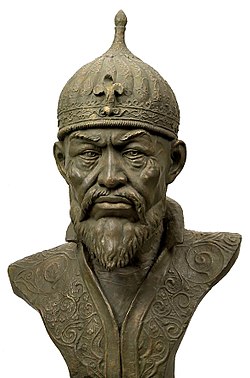
Timur's body was exhumed from his tomb on 19 June 1941 and his remains examined by the Soviet anthropologists Mikhail M. Gerasimov, Lev V. Oshanin and V. Ia. Zezenkova. Gerasimov reconstructed the likeness of Timur from his skull and found that his facial characteristics displayed "typical Mongoloid features", i.e. East Asian in modern terms.[149][150][151] An anthropologic study of Timur's cranium shows that he belonged predominately to the "South Siberian Mongoloid type".[152] At 5 feet 8 inches (173 centimeters), Timur was tall for his era. The examinations confirmed that Timur was lame and had a withered right arm due to his injuries. His right thighbone had knitted together with his kneecap, and the configuration of the knee joint suggests that he kept his leg bent at all times and therefore would have had a pronounced limp.[153] He appears to have been broad-chested and his hair and beard were red.[154]
It is alleged that Timur's tomb was inscribed with the words, "When I rise from the dead, the world shall tremble". It is also said that when Gerasimov exhumed the body, an additional inscription inside the casket was found, which read, "Whomsoever [sic] opens my tomb shall unleash an invader more terrible than I."[155] Even though people close to Gerasimov claim that this story is a fabrication, it became known as the Curse of Timur. In any case, three days after Gerasimov began the exhumation, Germany invaded the Soviet Union, which results in one of the deadliest invasion in human history.[156] Timur was re-buried with full Islamic ritual in November 1942 just before the Soviet victory at the Battle of Stalingrad.[9]
In the arts
[edit]- Tamburlaine the Great, Parts I and II (English, 1563–1594): play by Christopher Marlowe
- Tamerlan ou la mort de Bajazet [Tamerlane or the Death of Bajazet] (1675): play by Jacques Pradon
- Tamerlane (1701): play by Nicholas Rowe (English)
- Tamerlano (1724): opera by George Frideric Handel, in Italian, based on the 1675 Pradon play
- Bajazet (1735): opera by Antonio Vivaldi, portrays the capture of Bayezid I by Timur
- Il gran Tamerlano (1772): opera by Josef Myslivecek which also portrays the capture of Bayezid I by Timur
- Timour the Tartar (1811): equestrian drama by Matthew Lewis
- Tamerlane (published 1827): first published poem of Edgar Allan Poe
- Turandot (1924): opera by Giacomo Puccini (libretto by Giuseppe Adami and Renato Simoni) in which Timur is the deposed, blind former King of Tartary and father of the protagonist Calaf
- Lord of Samarkand (The Lame Man; published 1932): story by Robert E. Howard in which Timour appears
- Nesimi (1973): Azerbaijani film in which Timur was portrayed by Yusif Veliyev.[157]
- Tamerlan (2003): Spanish-language novel by Colombian writer Enrique Serrano[158]
- Day Watch (2006): Russian film in which Tamerlane in his youth is portrayed by Emir Baygazin, and in maturity by Gani Kulzhanov[159]
- Age of Empires II: Definitive Edition (2019): a video game containing a six-chapter campaign titled "Tamerlane"[160]
Wives and concubines
[edit]Timur had forty-three wives and concubines, all of these women were also his consorts. Timur made dozens of women his wives and concubines as he conquered their fathers' or erstwhile husbands' lands.[161]

- Turmish Agha, mother of Jahangir Mirza, Jahanshah Mirza and Aka Begi;
- Oljay Turkhan Agha (m. 1357/58), daughter of Amir Mashlah and granddaughter of Amir Qazaghan;
- Saray Mulk Khanum (m. 1367), widow of Amir Husayn, and daughter of Qazan Khan;
- Islam Agha (m. 1367), widow of Amir Husayn, and daughter of Amir Bayan Salduz;
- Ulus Agha (m. 1367), widow of Amir Husayn, and daughter of Amir Khizr Yasuri;
- Dilshad Agha (m. 1374), daughter of Shams ed-Din and his wife Bujan Agha;
- Touman Agha (m. 1377), daughter of Amir Musa and his wife Arzu Mulk Agha, daughter of Amir Bayezid Jalayir;
- Chulpan Mulk Agha, daughter of Haji Beg of Jetah;
- Tukal Khanum (m. 1397), daughter of Mongol Khan Khizr Khawaja Oglan;[118]: 24–25
- Tolun Agha, concubine, and mother of Umar Shaikh Mirza I;
- Mengli Agha, concubine, and mother of Miran Shah;
- Toghay Turkhan Agha, lady from the Kara Khitai, widow of Amir Husayn, and mother of Shah Rukh;
- Tughdi Bey Agha, daughter of Aq Sufi Qongirat;
- Sultan Aray Agha, a Nukuz lady;
- Malikanshah Agha, a Filuni lady;
- Khand Malik Agha, mother of Ibrahim Mirza;
- Sultan Agha, mother of a son who died in infancy;
His other wives and concubines included: Dawlat Tarkan Agha, Burhan Agha, Jani Beg Agha, Tini Beg Agha, Durr Sultan Agha, Munduz Agha, Bakht Sultan Agha, Nowruz Agha, Jahan Bakht Agha, Nigar Agha, Ruhparwar Agha, Dil Beg Agha, Dilshad Agha, Murad Beg Agha, Piruzbakht Agha, Khoshkeldi Agha, Dilkhosh Agha, Barat Bey Agha, Sevinch Malik Agha, Arzu Bey Agha, Yadgar Sultan Agha, Khudadad Agha, Bakht Nigar Agha, Qutlu Bey Agha, and another Nigar Agha.[162]
Descendants
[edit]Sons of Timur
[edit]- Umar Shaikh Mirza I – with Tolun Agha
- Jahangir Mirza – with Turmish Agha
- Miran Shah Mirza – with Mengli Agha
- Shah Rukh Mirza – with Toghay Turkhan Agha
Daughters of Timur
[edit]- Aka Begi (died 1382) – by Turmish Agha. Married to Muhammad Beg, son of Amir Musa Tayichiud
- Sultan Bakht Begum (died 1429/30) – by Oljay Turkhan Agha. Married first Muhammad Mirke Apardi, married second, 1389/90, Sulayman Shah Dughlat
- Sa'adat Sultan – by Dilshad Agha
- Bikijan – by Mengli Agha
- Qutlugh Sultan Agha – by Toghay Turkhan Agha[163][164]
Sons of Umar Shaikh Mirza I
[edit]- Pir Muhammad
- Iskandar
- Rustam
- Bayqara I
- Mansur
- Sultan Husayn Bayqarah
- Badi' al-Zaman
- Muhammed Mu'min
- Muhammad Zaman Mirza
- Muzaffar Hussein
- Ibrahim Hussein
- Badi' al-Zaman
- Sultan Husayn Bayqarah
- Mansur
Sons of Jahangir
[edit]Sons of Miran Shah
[edit]- Khalil Sultan
- Abu Bakr
- Muhammad Mirza
- Abu Sa'id Mirza
- Umar Shaikh Mirza II
- Zahir-ud-din Muhammad Babur
- the Mughals
- Jahangir Mirza II
- Zahir-ud-din Muhammad Babur
- Umar Shaikh Mirza II
- Abu Sa'id Mirza
Sons of Shah Rukh Mirza
[edit]- Mirza Muhammad Taraghay – better known as Ulugh Beg
- Ghiyath-al-Din Baysunghur
- Sultan Ibrahim Mirza
- Mirza Soyurghatmïsh Khan
- Muhammad Juki
See also
[edit]Notes
[edit]- ^ To legitimize his rule, Timur claimed the title güregen (lit. 'royal son-in-law') to a princess of Chinggisid line.[2]
- ^ /tɪˈmʊər/ tim-OOR; Chagatay: تیمور, romanized: Temür, lit. 'Iron'. Sometimes romanized Taimur or Temur.
- ^ /ˈtæmərleɪn/ TAM-ər-layn; Persian: تيمور لنگ, romanized: Temūr(-i) Lang; Chagatay: اقساق تیمور, romanized: Aqsaq Temür,[7] lit. 'Timur the Lame'. Historically best known as Amir Timur or by his epithet Sahib-i-Qiran (lit. 'Lord of the Auspicious Conjunction').[8]
Citations
[edit]- ^ Journal of the Royal Asiatic Society of Great Britain and Ireland. Vol. 9. Royal Asiatic Society of Great Britain and Ireland. 1847. p. 377.
- ^ a b Manz 1999, p. 14.
- ^ a b c d e Chann, Naindeep Singh (2009). "Lord of the Auspicious Conjunction: Origins of the Ṣāḥib-Qirān". Iran & the Caucasus. 13 (1): 93–110. doi:10.1163/160984909X12476379007927. ISSN 1609-8498. JSTOR 25597394.
- ^ Muntakhab-al Lubab, Khafi Khan Nizam-ul-Mulki, Vol I, p. 49. Printed in Lahore, 1985
- ^ W. M. Thackston, A Century of Princes: Sources on Timurid History and Art (1989), p. 239
- ^ Chann, Naindeep Singh (2008). "Intellectual Movements during Timuri and Safavid Periods (1500-1700 A.D.)". Iran and the Caucasus. 12 (2): 413–415. doi:10.1163/157338408x406182. ISSN 1609-8498.
- ^ Johanson, Lars (1998). The Turkic Languages. Routledge. p. 27. ISBN 0415082005.
- ^ ʻInāyat Khān; Muḥammad Ṭāhir Āšnā ʿInāyat Ḫān (1990). The Shah Jahan Nama of 'Inayat Khan: An Abridged History of the Mughal Emperor Shah Jahan, Compiled by His Royal Librarian: the Nineteenth-century Manuscript Translation of A. R. Fuller (British Library, Add. 30,777. Oxford University Press. pp. 11–17.
- ^ a b c d e Marozzi 2004, p. [page needed].
- ^ Meri, Josef W. (2005). Medieval Islamic Civilization. Routledge. p. 812. ISBN 978-0415966900.
- ^ "Timur". Encyclopædia Britannica. Archived from the original on 17 June 2015. Retrieved 28 September 2022.
- ^ Marozzi 2004, pp. 341–342.
- ^ Shahane, Girish (28 December 2016). "Counterview: Taimur's actions were uniquely horrific in Indian history". Scroll.in. Archived from the original on 9 November 2017. Retrieved 28 December 2016.
- ^ Darwin, John (2008). After Tamerlane: the rise and fall of global empires, 1400–2000. Bloomsbury Press. pp. 29, 92. ISBN 978-1596917606.
- ^ Manz 1999, p. 1.
- ^ Marozzi, Justin (2006). Tamerlane: Sword of Islam, Conqueror of the World. Da Capo Press. p. 342. ISBN 978-0306814655.
- ^ Seekins, Donald M.; Nyrop, Richard F. (1986). Afghanistan A Country Study. The Studies. p. 11. ISBN 978-0160239298 – via Google Books.
Timur was of both Turkish and Mongol descent and claimed Genghis Khan as an ancestor
- ^ International Association for Mongol Studies (2002). Монгол Улсын Ерөнхийлөгч Н. Багабандийн ивээлд болж буй Олон Улсын Монголч Эрдэмтний VIII их хурал (Улаанбаатар хот 2002. VIII. 5–11): Илтгэлүүдийн товчлол [Eighth International Congress of Mongolists being convened under the patronage of N. Bagabandi, president of Mongolia (Ulaanbaatar city 2002): Summary of presentations] (in Mongolian). Vol. III. OUMSKh-ny Nariĭn bichgiĭn darga naryn gazar. pp. 5–11 – via Google Books.
First of all, Timur's genealogy gives him a common ancestor with Chinggis Khan in Tumbinai – sechen or Tumanay Khan.
- ^ a b Woods, John E. (2002). Timur and Chinggis Khan. Eighth International Congress of Mongolists being convened under the patronage of N. Bagabandi, president of Mongolia. Ulaanbaatar: OUMSKh-ny Nariĭn bichgiĭn darga naryn gazar. p. 377.
- ^ Lodge, Henry Cabot (1916). The History of Nations. Vol. 14. P. F. Collier & Son. p. 46.
Timur the Lame, from the effects of an early wound, a name which some European writers have converted into Tamerlane, or Tamberlaine. He was of Mongol origin, and a direct descendant, by the mother's side, of Genghis Khan.
- ^ a b c Ahmad ibn Arabshah; McChesney, Robert D. (2017). Tamerlane: The Life of the Great Amir. Translated by M. M. Khorramia. Bloomsbury Academic. p. 4. ISBN 978-1784531706.
- ^ Richard C. Martin, Encyclopedia of Islam and the Muslim World A–L, Macmillan Reference, 2004, ISBN 978-0028656045, p. 134.
- ^ a b Gérard Chaliand, Nomadic Empires: From Mongolia to the Danube translated by A. M. Berrett, Transaction Publishers, 2004. translated by A.M. Berrett. Transaction Publishers, p. 75. ISBN 076580204X. Limited preview at Google Books. p. 75., ISBN 076580204X, p. 75., "Timur Leng (Tamerlane) Timur, known as the lame (1336–1405) was a Muslim Turk. He aspired to recreate the empire of his ancestors. He was a military genius who loved to play chess in his spare time to improve his military tactics and skill. And although he wielded absolute power, he never called himself more than an emir.", "Timur Leng (Tamerlane) Timur, known as the lame (1336–1405) was a Muslim Turk from the Umus of Chagatai who saw himself as Genghis Khan's heir."
- ^ Matthew White: Atrocitology: Humanity's 100 Deadliest Achievements, Canongate Books, 2011, ISBN 978-0857861252, section "Timur".
- ^ "The Rehabilitation of Tamerlane". Chicago Tribune. 17 January 1999. Archived from the original on 27 July 2024. Retrieved 11 September 2024.
- ^ John Joseph Saunders, The history of the Mongol conquests (p. 174), Routledge & Kegan Paul Limited, 1971, ISBN 0812217667.
- ^ Barthold, V. V. (1962). Four studies on the History of Central Asia. Vol. 1 (Second Printing ed.). Leiden, Netherlands: E. J. Brill. p. 61.
- ^ Foss, Clive (1992). "Genocide in History" (PDF). In Freedman-Apsel, Joyce; Fein, Helen (eds.). Teaching About Genocide: A Guidebook for College and University Teachers: Critical Essays, Syllabi, and Assignments. Ottawa: Human Rights Internet. p. 27. ISBN 189584200X. Archived (PDF) from the original on 29 November 2022. Retrieved 29 November 2022.
- ^ "Timur". Encyclopædia Britannica, Online Academic Edition. 2007. Archived from the original on 25 March 2020. Retrieved 26 November 2007.
- ^ a b Manz, Beatrice F. (2000). "Tīmūr Lang". Encyclopaedia of Islam. Vol. 10 (2nd ed.). Brill. Archived from the original on 7 February 2015. Retrieved 24 April 2014.
- ^ a b Woods, John E. (1990). Martin Bernard Dickson; Michel M. Mazzaoui; Vera Basch Moreen (eds.). "Timur's Genealogy". Intellectual Studies on Islam: Essays Written in Honor of Martin B. Dickson. University of Utah Press: 97. ISBN 978-0874803426.
- ^ Mackenzie, Franklin (1963). The Ocean and the Steppe: The Life and Times of the Mongol Conqueror Genghis Khan, 1155–1227. Vantage Press. p. 322.
- ^ Woods 1990, p. 90.
- ^ Woods, John E. (1991). The Timurid dynasty. Indiana University, Research Institute for Inner Asian Studies. p. 9.
- ^ Haidar, Mansura (2004). Indo-Central Asian Relations: From Early Times to Medieval Period. Manohar. p. 126. ISBN 978-8173045080.
- ^ Keene, Henry George (2001) [1878]. The Turks in India. Honolulu, HI: University Press of the Pacific. p. 20. ISBN 978-0898755343.
- ^ Manz 1999, pp. 164–165.
- ^ Fischel, Walter J. (1952). Ibn Khaldun and Tamerlane. Berkeley, CA / Los Angeles: University of California Press. p. 37.
- ^ Sela, Ron (2011). The Legendary Biographies of Tamerlane: Islam and Heroic Apocrypha in Central Asia. Cambridge University Press. p. 27. ISBN 978-1139498340.
- ^ Droese, Janine; Karolewski, Janina (4 December 2023). Manuscript Albums and their Cultural Contexts: Collectors, Objects, and Practices. Walter de Gruyter GmbH & Co KG. p. 135. ISBN 978-3-11-132146-2.
To the best of my knowledge, the earliest portrait of Timur can be found in a genealogical scroll (Istanbul, Topkapı Palace Museum, H. 2152, fols 32-43"), produced shortly after his death in Samarqand (probably under the reign of Khalil Sultan, r. 1405-1409)
- ^ Richard Peters, The Story of the Turks: From Empire to Democracy (1959), p. 24.
- ^ Glassé, Cyril (2001). The new encyclopedia of Islam (Revised ed.). Walnut Creek, California: AltaMira Press. ISBN 0759101892. OCLC 48553252.
- ^ Sinor, Denis (1990). "Introduction: The concept of Inner Asia". The Cambridge History of Early Inner Asia. Cambridge University Press. pp. 1–18. doi:10.1017/chol9780521243049.002. ISBN 978-0521243049.
- ^ Manz, Beatrice F. (24 April 2012). "Tīmūr Lang". In Bearman, P.; Th. Bianquis; C. E. Bosworth; E. van Donzel; W. P. Heinrichs (eds.). Tīmūr Lang. Encyclopaedia of Islam, Second Edition.
The birthdate commonly ascribed to Tīmūr, 25 S̲h̲aʿbān 736/8 April 1336, is probably an invention from the time of his successor S̲h̲āh Ruk̲h̲ [q.v.], the day chosen for astrological meaning and the year to coincide with the death of the last Il-K̲h̲ān
. - ^ a b c d e Manz, Beatrice Forbes (1988). "Tamerlane and the Symbolism of Sovereignty". Iranian Studies. 21 (1–2): 105–122. doi:10.1080/00210868808701711. ISSN 0021-0862. JSTOR 4310596.
- ^ "Central Asia, history of Timur Archived 31 May 2022 at the Wayback Machine", in Encyclopædia Britannica, Online Edition, 2007. (Quotation: "Under his leadership, Timur united the Mongol tribes located in the basins of the two rivers.")
- ^ "Islamic world", in Encyclopædia Britannica, Online Edition, 2007. Quotation: "Timur (Tamerlane) was of Mongol descent and he aimed to restore Mongol power."
- ^ Carter V. Findley, The Turks in World History, Oxford University Press, 2005, ISBN 978-0195177268, p. 101.
- ^ G. R. Garthwaite, The Persians, Malden, ISBN 978-1557868602, MA: Blackwell Pub., 2007. p.148. Quotation: "Timur's tribe, the Barlas, had Mongol origins but had become Turkic-speaking ... However, the Barlus tribe is considered one of the original Mongol tribes and there are "Barlus Ovogton" people who belong to Barlus tribe in modern Mongolia."
- ^ M. S. Asimov & Clifford Edmund Bosworth, History of Civilizations of Central Asia, UNESCO Regional Office, 1998, ISBN 9231034677, p. 320. "One of his followers was [...] Timur of the Barlas tribe. This Mongol tribe had settled [...] in the valley of Kashka Darya, intermingling with the Turkic population, adopting their religion (Islam) and gradually giving up its own nomadic ways, like a number of other Mongol tribes in Transoxania ..."
- ^ Kravets, S. L.; et al., eds. (2016). "ТИМУ́Р ТАМЕРЛАН" [Timúr Tamerlan]. Great Russian Encyclopedia (in Russian). Vol. 32: Televizionnaya bashnya – Ulan-Bator. Moscow, Russia: Great Russian Encyclopedia. ISBN 978-5-85270-369-9. Archived from the original on 26 October 2023. Retrieved 26 October 2023.
Сын бека Тарагая из тюркизированного монг. племени барлас
[Son of Bek Taragai from the Turkified Mongol Barlas tribe]. - ^ "Timur". Encyclopædia Britannica. 5 September 2023. § Life. Archived from the original on 17 June 2015. Retrieved 26 October 2023.
Timur was a member of the Turkicized Barlas tribe, a Mongol subgroup that had settled in Transoxania (now roughly corresponding to Uzbekistan) after taking part in Genghis Khan's son Chagatai's campaigns in that region.
- ^ Sharaf ad-Din Ali Yazdi, Zafarnama (1424–1428), p. 35.
- ^ Sharaf ad-Din Ali Yazdi, Zafarnama (1424–1428), p. 75.
- ^ Marozzi 2004, p. 31.
- ^ a b Hannah, Ian C. (1900). A brief history of eastern Asia. T. F. Unwin. p. 92. Retrieved 30 December 2015.
- ^ a b c d e Goldsmid 1911, p. 994.
- ^ Marozzi 2004, p. 40.
- ^ Marozzi 2004, pp. 41–42.
- ^ a b Manz, Beatrice Forbes (2002). "Tamerlane's Career and Its Uses". Journal of World History. 13: 3. doi:10.1353/jwh.2002.0017. S2CID 143436772.
- ^ a b c Moin, A. Azfar (2012). The Millennial Sovereign: Sacred Kingship and Sainthood in Islam. New York: Columbia University Press. pp. 40–43. ISBN 978-0231504713. OCLC 967261884.
- ^ Aigle, Denise (2014). The Mongol Empire between Myth and Reality : Studies in Anthropological History. Leiden: Brill. p. 132. ISBN 978-90-04-27749-6. OCLC 994352727.
- ^ Riasanovsky & Steinberg 2005, p. 93.
- ^ a b Crummey 2014, p. 64.
- ^ Tradigo, Alfredo (2006). Icons and Saints of the Eastern Orthodox Church. Getty Publications. p. 177. ISBN 978-0-89236-845-7.
- ^ Moscow Church Herald. Moscow Patriarchate. 1989. p. 3.
- ^ "Commemoration of the Vladimir Icon of the Mother of God and the deliverance of Moscow from the Invasion of Tamerlane". oca.org. Archived from the original on 10 August 2020. Retrieved 5 February 2019.
- ^ Wescoat, James L.; Wolschke-Bulmahn, Joachim (1996). Mughal Gardens. Dumbarton Oaks. ISBN 978-0884022350 – via google.ca.
- ^ Melville 2020, p. 32.
- ^ Timur (2013). The Mulfuzat Timury, Or, Autobiographical Memoirs of the Moghul Emperor Timur: Written in the Jagtay Turky Language. Cambridge University Press. pp. vii–xxxvii. ISBN 978-1108056021.
- ^ Melville 2020, p. 56.
- ^ Manz 1999, pp. 67–71.
- ^ Melville 2020, pp. 97–100.
- ^ a b Chaliand, Gerard; Blin, Arnaud (2007). The History of Terrorism: From Antiquity to Al Qaeda. University of California Press. p. 87. ISBN 978-0520247093.
isfahan Timur.
- ^ Fisher, W. B.; Jackson, P.; Lockhart, L.; Boyle, J. A.: The Cambridge History of Iran, p. 55.
- ^ Strange 1905, pp. 267–287.
- ^ Manz 1999, pp. 123–125.
- ^ Melville 2020, p. 109.
- ^ Shterenshis, Michael (2002). Tamerlane and the Jews. Psychology Press. pp. 144–189. ISBN 978-0700716968.
- ^ Strange, Guy Le (1905). The Lands of the Eastern Caliphate: Mesopotamia, Persia, and Central Asia, from the Moslem Conquest to the Time of Timur. University Press. p. 235.
- ^ Morgan, David (2014). Medieval Persia 1040–1797. Routledge. pp. 167–184. ISBN 978-1317871408.
- ^ Riasanovsky & Steinberg 2005, p. 94.
- ^ a b Virani, Shafique N. The Ismailis in the Middle Ages: A History of Survival, A Search for Salvation (New York: Oxford University Press), 2007, p. 116.
- ^ a b c d Grousset, René (1970). The Empire of the Steppes: A History of Central Asia. Rutgers University Press. p. 444. ISBN 978-0-8135-1304-1.
- ^ Singh, Surinder (2023). The Making of Medieval Panjab: Politics, Society and Culture, c.1000–c.1500. Taylor & Francis. pp. 374, 390. ISBN 978-1-032-65440-9.
- ^ Pletcher, Kenneth, ed. (2010). The History of India. The Rosen Publishing Group. p. 131. ISBN 978-1615301225.
- ^ Elliot, Henry Miers (2013). History of India, as Told by Its Own Historians: The Muhammadan Period. Cambridge University Press. pp. 489–493. ISBN 978-1108055857.
- ^ Sen, Sudipta (2019). Ganga: The Many Pasts of a River. Penguin Random House India. ISBN 978-9353054489 – via Google Books.
- ^ Singh, Raj Pal (1988). Rise of the Jat power. Harman Publishing House. ISBN 978-8185151052. Retrieved 22 May 2012.
- ^ Phillips, Charles (10 December 2023). "Battle of Delhi". www.britannica.com. Archived from the original on 19 October 2022. Retrieved 19 October 2022.
- ^ Marozzi 2004, p. 267.
- ^ Ibn Arabşah, 1986: 164–166.[missing long citation]
- ^ Ibn Hacer, 1994, pp. II: 9–10.[missing long citation]
- ^ Ibn Tagrîbirdi, 1956, XII: 262–263.[missing long citation]
- ^ "Battle of Delhi | 17 December 1398". History on this day. Archived from the original on 19 October 2022. Retrieved 28 September 2022.
- ^ Marozzi 2004, pp. 269–274.
- ^ "The Turco-Mongol Invasions". Rbedrosian.com. Archived from the original on 22 July 2012. Retrieved 22 May 2012.
- ^ a b Nicol 1993, p. 314.
- ^ Masters, Bruce (1999). "Aleppo:the Ottoman Empire's caravan city". In Eldem, Edhem; Goffman, Daniel; Master, Bruce (eds.). The Ottoman City Between East and West: Aleppo, Izmir, and Istanbul. Cambridge University Press. p. 20.
- ^ Margaret Meserve, Empires of Islam in Renaissance Historical Thought, (Harvard University Press, 2008), p. 207.
- ^ ʻArabshāh, Aḥmad ibn Muḥammad Ibn (1976). Tamerlane: Or, Timur, the Great Amir. Progressive Books. p. 168.
- ^ Nicolle, David; Hook, Richard (1998). The Mongol Warlords Genghis Khan, Kublai Khan, Hulegu, Tamerlane. Brockhampton Press. p. 161. ISBN 1860194079.
- ^ Rhoads Murphey, Exploring Ottoman Sovereignty: Tradition, Image and Practice in the Ottoman Imperial Household 1400–1800; published by Continium, 2008; p. 58
- ^ Kevin Reilly (2012). The Human Journey: A Concise Introduction to World History. Rowman & Littlefield. pp. 164–. ISBN 978-1442213845.
- ^ Lodge, Henry Cabot (1913). The History of Nations. P. F. Collier. pp. 51–.
- ^ Belozerskaya, Marina (2012). Medusas Gaze: The Extraordinary Journey of the Tazza Farnese. Oxford University Press. pp. 88–. ISBN 978-0199876426.
- ^ Vertot (abbé de) (1856). The History of the Knights Hospitallers of St. John of Jerusalem: Styled Afterwards, the Knights of Rhodes, and at Present, the Knights of Malta. J. W. Leonard & Company. pp. 104–.
- ^ a b Kastritsis, Dimitris J. (2007). The Sons of Bayezid: Empire Building and Representation in the Ottoman Civil War of 1402–1413. Brill. p. 49.
- ^ Pere, Nuri (1968). Osmanlılarda madenî paralar: Yapı ve Kredi Bankasının Osmanlı madenî paraları kolleksiyonu. Yapı ve Kredi Bankası. p. 64.
- ^ Stevens, John. The history of Persia. Containing, the lives and memorable actions of its kings from the first erecting of that monarchy to this time; an exact Description of all its Dominions; a curious Account of India, China, Tartary, Kermon, Arabia, Nixabur, and the Islands of Ceylon and Timor; as also of all Cities occasionally mention'd, as Schiras, Samarkand, Bokara, &c. Manners and Customs of those People, Persian Worshippers of Fire; Plants, Beasts, Product, and Trade. With many instructive and pleasant digressions, being remarkable Stories or Passages, occasionally occurring, as Strange Burials; Burning of the Dead; Liquors of several Countries; Hunting; Fishing; Practice of Physick; famous Physicians in the East; Actions of Tamerlan, &c. To which is added, an abridgment of the lives of the kings of Harmuz, or Ormuz. The Persian history written in Arabick, by Mirkond, a famous Eastern Author that of Ormuz, by Torunxa, King of that Island, both of them translated into Spanish, by Antony Teixeira, who liv'd several Years in Persia and India; and now render'd into English.
- ^ a b c Tsai 2002, pp. 188–189.
- ^ C. P. Atwood. Encyclopedia of Mongolia and the Mongol Empire, see: "Northern Yuan Dynasty".
- ^ Lee, Adela C. Y. "Tamerlane (1336–1405) – The Last Great Nomad Power". Silkroad Foundation. Archived from the original on 24 December 2018. Retrieved 22 May 2012.
- ^ Tsai 2002, p. 161.
- ^ James Louis Garvin, Franklin Henry Hooper, Warren E. Cox, Encyclopædia Britannica, Vol. 22 (1929), p. 233.
- ^ Abdulla Vakhabov, Muslims in the USSR (1980), pp. 63–64. ASIN B0006E65HW
- ^ Roya Marefat, Beyond the Architecture of Death: Shrine of the Shah-i Zinda in Samarqand (1991), p. 238.
- ^ a b Vasilii Vladimirovitch Barthold, Four Studies on the History of Central Asia, Vol. 2 (1959).
- ^ Marthe Bernus-Taylor, Tombs of Paradise: The Shah-e Zende in Samarkand and Architectural Ceramics of Central Asia (2003), p. 27.
- ^ Beatrice Forbes Manz, Power, Politics and Religion in Timurid Iran (2007), p. 16.
- ^ William Bayne Fisher, Peter Jackson, Peter Avery, Lawrence Lockhart, John Andrew Boyle, Ilya Gershevitch, Richard Nelson Frye, Charles Melville, Gavin Hambly, The Cambridge History of Iran, Volume VI (1986), pp. 99–101.
- ^ Manz 1999, p. 17.
- ^ Devin DeWeese. "The Descendants of Sayyid Ata and the Rank of Naqīb in Central Asia", Journal of the American Oriental Society, Vol. 115, No. 4 (October–December 1995), pp. 612–634.
- ^ Vasilij Vladimirovič Bartold. Four studies on the history of Central Asia, Vol. 1, p. 19.
- ^ Barbara Brend. Islamic art, p. 130.
- ^ Michael Shterenshis. Tamerlane and the Jews. Routledge. ISBN 978-1136873669. p. 38.
- ^ a b Virani, Shafique N. The Ismailis in the Middle Ages: A History of Survival, A Search for Salvation (New York: Oxford University Press), 2007, p. 114.
- ^ Manz 1999, p. 16.
- ^ Marozzi 2004, p. 9.
- ^ a b Walter Joseph Fischel, Ibn Khaldūn in Egypt: His Public Functions and His Historical Research, 1382–1406; a Study in Islamic Historiography, University of California Press, 1967, p. 51, footnote.
- ^ Roemer, H. R. "Timur in Iran." The Cambridge History of Iran, edited by Peter Jackson and Lawrence Lockhart, vol. 6, Cambridge University Press, Cambridge, 1986, pp. 86–87.
- ^ Saunders, J. J. (2001). The History of the Mongol Conquests. University of Pennsylvania Press. pp. 173–. ISBN 978-0812217667.
- ^ Holden, Edward S. (2004) [1895]. The Mogul Emperors of Hindustan (1398–1707 A.D). New Delhi: Westminster, Archibald Constable and Co. pp. 47–48. ISBN 978-8120618831.
- ^ Cowell, Professor (first name not given). MacMillan's Magazine, vol. XXX (via Google Books). London, England: MacMillan & Company, 1874, p. 252.
- ^ Barthold, V. V. (1962). Four studies on the History of Central Asia, vol. 1 (Second Printing, 1962 ed.). Leiden, Netherlands: E. J. Brill. pp. 59–60.
- ^ Cazaux, Jean-Louis and Knowlton, Rick (2017). A World of Chess, p. 31. McFarland. ISBN 978-0786494279. "Often known as Tamerlane chess, [its invention] is traditionally attributed to the conqueror himself."
- ^ Document preserved at Le Musée de l'Histoire de France, code AE III 204. Mentioned Dossier II, 7, J936 Archived 26 September 2007 at the Wayback Machine.
- ^ Mentioned Dossier II, 7 bis.
- ^ Mentioned Dossier II, 7 ter.
- ^ Gies, Frances Carney (September–October 1978). "The Man Who Met Tamerlane". Saudi Aramco World. 29 (5). Archived from the original on 8 July 2011. Retrieved 26 July 2011.
- ^ Axworthy, Michael (2006). The Sword of Persia: Nader Shah, from Tribal Warrior to Conquering Tyrant. I. B.Tauris. ISBN 978-1850437062.
- ^ Manz 1999, p. 109"In Temür's government, as in those of most nomad dynasties, it is impossible to find a clear distinction between civil and military affairs, or to identify the Persian bureaucracy as solely civil or the Turko-Mongolian solely with military government. In fact, it is difficult to define the sphere of either side of the administration and we find Persians and Chaghatays sharing many tasks. (In discussing the settled bureaucracy and the people who worked within it I use the word Persian in a cultural rather than ethnological sense. In almost all the territories which Temür incorporated into his realm Persian was the primary language of administration and literary culture. Thus the language of the settled 'diwan' was Persian and its scribes had to be thoroughly adept in Persian culture, whatever their ethnic origin.) Temür's Chaghatay emirs were often involved in civil and provincial administration and even in financial affairs, traditionally the province of Persian bureaucracy."
- ^ Roy, Olivier (2007). The new Central Asia. I.B. Tauris. p. 7. ISBN 978-1845115524.
- ^ "Nestorianism | Definition, History, & Churches | Britannica". www.britannica.com. 2 June 2023. Archived from the original on 4 May 2015. Retrieved 21 November 2022.
- ^ a b ud-Din, Hameed (2011). "Abū Ṭāleb Ḥosaynī". Encyclopædia Iranica. Archived from the original on 18 September 2014. Retrieved 17 September 2014.
- ^ Milwright, Marcus (2006). "So Despicable a Vessel: Representations of Tamerlane in Printed Books of the Sixteenth and Seventeenth Centuries". Muqarnas. 23: 317. doi:10.1163/22118993-90000105.
- ^ a b c Knobler, Adam (November 1995). "The Rise of Timur and Western Diplomatic Response, 1390–1405". Journal of the Royal Asiatic Society. Third Series. 5 (3): 341–349. doi:10.1017/s135618630000660x. S2CID 162421202.
- ^ ad-DīnʿAlī Yazdī, Sharaf (1723). The History of Timur-Bec. Vol. 1. pp. xii–ix. Punctuation and spelling modernized.
- ^ Oshanin, Lev Vasil'evich (1964). Anthropological composition of the population of Central Asia: and the ethnogenesis of its peoples. Vol. 2. Peabody Museum. p. 39.
- ^ Berna Özcan, Gül (2018). Diverging Paths of Development in Central Asia. Routledge. ISBN 978-1351739429.
- ^ Yah, Lim Chong (2001). Southeast Asia: The Long Road Ahead. Singapore: World Scientific Publishing Company. p. 3. ISBN 978-9813105843.
- ^ Russian Translation Series of the Peabody Museum of Archaeology and Ethnology. Harvard University. 1964.
- ^ Gerasimov, Mikhail Mikhailovich (1971). The face finder. Hutchinson. p. 135. ISBN 978-0091055103.
- ^ Congress, United States. Congressional Record: Proceedings and Debates of the United States Congress. U.S. Government Printing Office. p. A7238.
- ^ "Uzbekistan: On the bloody trail of Tamerlane". The Independent. London. 9 July 2006. Archived from the original on 20 December 2013. Retrieved 17 April 2016.
- ^ Dickens, Mark and Dickens, Ruth. "Timurid Architecture in Samarkand". Oxuscom.com. Archived from the original on 2 July 2013. Retrieved 22 May 2012.
- ^ "Näsimi (1973)". IMDb. Retrieved 31 August 2020.
- ^ Serrano, Enrique (2 January 2011). Tamerlan (Biblioteca Breve) (Spanish ed.). Planeta Colombiana Editorial. ISBN 978-9584205407.
- ^ "Day Watch – Full Cast & Crew". IMDb. Archived from the original on 31 July 2021. Retrieved 31 August 2020.
- ^ "Age of Empires 2: Definitive Edition review". PC Gamer. 12 November 2019. Archived from the original on 20 May 2020. Retrieved 11 June 2020.
- ^ Szczepanski, Kallie (21 July 2019). "Biography of Tamerlane, 14th Century Conqueror of Asia". ThoughtCo. Archived from the original on 8 March 2017. Retrieved 20 February 2020.
- ^ Nogueira, Adeilson (28 March 2020). Timur. Clube de Autores. pp. 9–10.
- ^ Woods 1991, pp. 17–19.
- ^ Vasilii Vladimirovitch Barthold, Four Studies on the History of Central Asia, Vol. 2 (1963), p. 31.
Sources
[edit]- Crummey, Robert O. (6 June 2014). The Formation of Muscovy 1300 - 1613. Routledge. ISBN 978-1-317-87200-9.
- Manz, Beatrice Forbes (1999). The Rise and Rule of Tamerlane. Cambridge University Press. ISBN 978-0521633840.
- Marozzi, Justin (2004). Tamerlane: Sword of Islam, Conqueror of the World. London, England: HarperCollins. ISBN 9780306815430.
- Melville, Charles (2020). Melville, Charles (ed.). The Timurid Century: The Idea of Iran, Volume IX. University of Cambridge, Cambridge, England: Bloomsbury Publishing. doi:10.5040/9781838606169. ISBN 978-1838606152. S2CID 242682831.
- Nicol, Donald M. (1993). The Last Centuries of Byzantium, 1261–1453. Cambridge University Press. ISBN 978-0521439916.
- Riasanovsky, Nicholas Valentine; Steinberg, Mark D. (2005). A History of Russia. Oxford University Press. ISBN 978-0-19-515394-1. Archived from the original on 7 September 2024. Retrieved 5 September 2024.
- Tsai, Shih-Shan Henry (2002). Perpetual Happiness: the Ming Emperor Yongle. Seattle, Washington: University of Washington Press. ISBN 978-0295981246. OCLC 870409962.
- This article incorporates text from a publication now in the public domain: Goldsmid, Frederic John (1911). "Timūr". In Chisholm, Hugh (ed.). Encyclopædia Britannica. Vol. 26 (11th ed.). Cambridge University Press. pp. 994–995.

Further reading
[edit]- Abazov, Rafis (2008). "Timur (Tamerlane) and the Timurid Empire in Central Asia". The Palgrave Concise Historical Atlas of Central Asia. pp. 56–57. doi:10.1057/9780230610903. ISBN 978-1-4039-7542-3.
- Forbes, Andrew, & Henley, David: "Timur's Legacy: The Architecture of Bukhara and Samarkand" (CPA Media).
- González de Clavijo, Ruy; Embassy to Tamerlane, 1403–1406, translated by Guy Le Strange, with a new Introduction by Caroline Stone (Hardinge Simpole, 2009). ISBN 978-1843821984.
- Knobler, Adam (2001). "Timur the (Terrible/Tartar) Trope: a Case of Repositioning in Popular Literature and History". Medieval Encounters. 7 (1): 101–112. doi:10.1163/157006701X00102.
- Lamb, Harold (1929). Tamerlane: The Earth Shaker (Hardback). London, England: Thorndon Butterworth.
- Marlowe, Christopher. Tamburlaine the Great. Ed. J. S. Cunningham. Manchester University Press, Manchester 1981.
- Manz, Beatrice Forbes (1998). "Temür and the Problem of a Conqueror's Legacy". Journal of the Royal Asiatic Society. 8 (1): 21–41. doi:10.1017/S1356186300016412. ISSN 1356-1863. JSTOR 25183464. S2CID 154734091.
- Marozzi, Justin. "Tamerlane", in: The Art of War: great commanders of the ancient and medieval world, Andrew Roberts (editor), London, England: Quercus Military History, 2008. ISBN 978-1847242594.
- May, Timothy. "Timur ("the Lame") (1336–1405)". The Encyclopedia of War.
- Novosel'tsev, A. P. (1973). "On the Historical Evaluation of Tamerlane". Soviet Studies in History. 12 (3): 37–70. doi:10.2753/RSH1061-1983120337. ISSN 0038-5867.
- Paksoy, H. B. "Nationality or Religion: Views of Central Asian Islam" Archived 26 February 2021 at the Wayback Machine.
- Shterenshis, Michael V. "Approach to Tamerlane: Tradition and Innovation." Central Asia and the Caucasus 2 (2000).
- Sykes, P. M. (1915). "Tamerlane". Journal of the Royal Central Asian Society. 2 (1): 17–33. doi:10.1080/03068371508724717. ISSN 0035-8789.
- Yüksel, Musa Şamil. "Timur'un Yükselişi ve Batı'nın Diplomatik Cevabı, 1390–1405." Selçuk Üniversitesi Türkiyat Araştırmaları Dergisi 1.18 (2005): 231–243.
External links
[edit] Media related to Timur at Wikimedia Commons


Timur
View on GrokipediaOrigins
Ancestry
Timur was born into the Barlas tribe, a nomadic confederation of Turkicized Mongols who traced their origins to the Mongol tribes that coalesced around Genghis Khan in the early 13th century. The Barlas formed a sub-clan of the Borjigin lineage and had settled in Transoxiana—modern-day Uzbekistan—by the 14th century, where they adopted the Chagatai Turkic language and Sunni Islam while retaining elements of Mongol tribal structure.[4][3][5] His father, Taraghay (also spelled Taraghai), served as a local chieftain among the Barlas near Kesh (present-day Shahrisabz), holding minor administrative roles under the Chagatai Khanate. Timur's paternal grandfather was identified as Abaghay in contemporary accounts, linking the family to earlier Barlas nobility. These roots positioned Timur within a stratum of tribal aristocracy amid the fragmented post-Mongol polities of Central Asia.[6][7] Timur propagated claims of descent from Mongol imperial stock, tracing his lineage through Qarachar Noyan—a Barlas commander under Genghis Khan—to a supposed common ancestor with the Khan, such as the legendary Tumanay Khan. However, these assertions, recorded in later Timurid genealogies like those of Ulugh Beg and inscriptions at the Gur-i Amir mausoleum, lack independent corroboration and appear constructed to enhance political legitimacy in a era valuing Genghisid heritage. Historians regard direct descent from Genghis Khan as improbable, noting Timur's reliance instead on marriages to Genghisid princesses to adopt the title gürgän (son-in-law to the khan).[6][8]Early Life
Timur was born circa 1336 in the village of Hoja Ilgar, approximately 30 kilometers south of Samarkand in Transoxiana (modern Uzbekistan), to Taraghai, a minor noble and leader within the Barlas tribe.[9][10] The Barlas were a nomadic tribe of Mongol origin that had become Turkicized through centuries of settlement in the region following the Mongol conquests, maintaining ties to the legacy of Genghis Khan's Borjigin clan.[10][11] Raised in a pastoral and tribal environment amid the political fragmentation of post-Ilkhanid Central Asia, Timur's early years involved participation in local feuds and survival activities typical of the Barlas' semi-nomadic lifestyle.[12] By his late teens or early twenties, he turned to banditry, initially rustling sheep from neighboring groups and escalating to organized raids on travelers and settlements, leading a band that grew to around 300 men.[13][14] During one such raid in his youth, Timur suffered severe injuries from arrows that crippled his right arm and leg, earning him the epithet Timur-i Lang (Timur the Lame); accounts vary, with one legend claiming the wounds came during an ambush by a shepherd defending livestock.[10][15] These disabilities persisted lifelong but did not hinder his later military prowess.[7]Rise to Power
Emergence as a Warlord
In the fragmented political landscape of Transoxiana following the collapse of the Chagatai Khanate in the mid-14th century, Timur, born circa 1336 into the Barlas tribe near modern-day Shahr-i Sabz, initially rose as a leader of nomadic robber bands conducting raids on local settlements and caravans for livestock and goods during the 1350s and early 1360s.[16] These activities capitalized on the region's instability, where central authority had dissolved amid rival tribal factions and invading forces from Moghulistan, allowing opportunistic warlords to amass followers through plunder and personal valor. Timur's early success stemmed from his tactical acumen in small-scale ambushes and his ability to recruit Turkic-Mongol warriors disillusioned by the khanate's disarray, establishing a base of power in the Kish and Balkh districts by the mid-1360s.[12] A pivotal injury occurred around 1362 when Timur was captured during a raid by forces of the White Sheep Turkmen or rival tribes, suffering arrow wounds to his right leg and arm that left him permanently lame—earning him the moniker Timur-e Lang (Timur the Lame)—yet this did not halt his ascent, as he leveraged the incident to forge alliances with other local strongmen, including Amir Husayn of Balkh, against common threats like Ilyas Khoja, a claimant to the Chagatai throne.[17] Jointly, Timur and Husayn repelled Ilyas Khoja's incursions in 1364, but Ilyas's return in 1365 temporarily routed them, forcing Timur to regroup and rebuild his forces through further raids and tribal levies.[16] By 1368–1369, Timur had consolidated control over the Barlas and allied tribes, positioning himself as a dominant warlord in western Transoxiana by defeating smaller rivals and securing oaths of loyalty from emirs in the Ferghana Valley and Semirechye.[11] Tensions with Husayn escalated as Timur's growing influence threatened their partnership; in 1370, Timur besieged and captured Balkh, leading to Husayn's surrender and subsequent assassination, which eliminated the last major local competitor and allowed Timur to proclaim himself sovereign over Transoxiana at a council in Balkh that year.[7] This event marked Timur's transition from itinerant raider to regional overlord, as he installed puppet khans from the Chagatai line to legitimize his rule while wielding de facto authority through a tribal council (kengesh) of loyal amirs, setting the stage for systematic expansion. His methods—combining feigned retreats, night assaults, and psychological intimidation—proved effective in securing an estimated 50,000–100,000 warriors under his command by the early 1370s, drawn from nomadic levies incentivized by shares of booty.[16][18]Legitimization of Rule
Timur, originating from the Barlas tribe with Turkicized Mongol roots that traced a distant connection to earlier Mongol lineages but not direct Genghisid descent, faced challenges in asserting sovereignty over Chagatai Khanate remnants without invoking traditional Mongol imperial legitimacy.[8] To address this, he installed puppet khans from Genghisid lines as nominal rulers while exercising de facto power as amir. In April 1370, following alliances with local emirs and the ousting of Husayn, Timur enthroned Suyurgatmish—a descendant of Qaidu from the Ögedeid line, though presented as Chagatayid for regional acceptance—as khan of Transoxiana, minting coins in his name until Suyurgatmish's death in 1388.[19] [20] This arrangement preserved the fiction of Chinggisid overlordship, allowing Timur to avoid the khan title and accusations of usurpation while directing policy and military affairs.[21] Complementing this, Timur forged marital ties to Genghisid nobility to bolster dynastic claims. He wed Saray Mulk Khanum around 1370, the daughter of Qazan Khan of Moghulistan and a direct Borjigin descendant of Genghis Khan through Chagatai, elevating her to principal wife despite prior unions and enabling their offspring—such as Jahangir Mirza (born 1376)—to inherit Genghisid bloodlines for future legitimacy.[11] [22] Timur adopted the title Gurkani, derived from the Mongolian kurgan meaning "son-in-law," explicitly referencing these affinal links to Genghis Khan and framing his house as rightful stewards of the Mongol heritage.[11] Timur further drew on Islamic authority to sanction his expansion and internal order, portraying campaigns as defensive jihads against perceived threats to Sunni orthodoxy, such as Shi'a elements, Christian forces in Anatolia and Georgia, or "infidel" rulers in India.[23] He styled himself the "Sword of Islam," patronized Sufi sheikhs, ulama, and religious foundations, and commissioned mosques and madrasas in conquered cities like Samarkand to symbolize piety and divine favor.[24] This religious veneer coexisted with pragmatic Mongol customs, blending Turco-Mongol traditions with Islamic rhetoric to unify diverse subjects and justify massacres as retribution against non-believers or rebels.[25] By his death in 1405, these mechanisms had solidified the Timurid polity, though succession disputes among mirzas underscored the fragility of such constructed authority.[26]Military Campaigns
Conquests in Persia and Central Asia
Timur consolidated control over Transoxiana, the core of the western Chagatai Khanate, by 1370 after defeating and eliminating his former ally Amir Husayn, establishing himself as the unchallenged ruler of the region encompassing cities like Samarkand and Bukhara.[11][7] This unification followed a decade of intermittent warfare against rival Mongol emirs and local warlords who fragmented the post-Mongol political landscape in Central Asia.[7] From this base, Timur launched campaigns against Khwarezm starting in 1372, targeting the Sufi dynasty of the Kungrat tribe, which had allied with the White Horde and controlled key oases north of the Amu Darya.[27] By 1379, after multiple raids, his forces under son Umar Shaykh besieged and sacked Urgench (Köneürgench), the dynasty's stronghold, resulting in extensive looting, partial destruction, and the deportation of artisans to Timurid territories.[28] These operations subdued Khwarezmian resistance and integrated the region into Timur's domain, though revolts persisted intermittently.[27] Timur then turned eastward against the remnants of the eastern Chagatai Khanate in the 1370s and early 1380s, combating khans in Jatah (eastern Turkistan) to secure his flanks and assert dominance over nomadic tribes.[7] Culminating in the occupation of Kashgar around 1380, these victories eliminated threats from the Ili River valley and reinforced Timur's claim as restorer of Chagatai authority.[7] Shifting westward into Persian territories, Timur invaded Khorasan in 1381, capturing Herat after overcoming Kartid rule and suppressing local uprisings, marking his first major foray into urban centers of greater Iran.[7] He followed with expeditions into Mazandaran in 1382, methodically reducing fortified positions and extracting submissions from regional dynasties like the Sarbadars, thereby extending control over northeastern Persia.[7] These conquests relied on mobile cavalry tactics, sieges, and psychological warfare, including mass executions to deter rebellion, solidifying Timur's hold before facing northern steppe challengers.[11]Wars with the Golden Horde
Timur initially supported Tokhtamysh, a Genghisid prince, in establishing control over the Golden Horde during the early 1380s to counter rival factions and secure his northern borders.[7] This alliance fractured when Tokhtamysh raided northwestern Persia in 1386, targeting territories under Timur's expanding influence while Timur was engaged in campaigns elsewhere.[7] Tensions escalated in 1387 when Tokhtamysh besieged Bukhara, prompting Timur to repel the invasion and subsequently massacre the population of Urgench for providing support to the Horde.[7] In 1391, Timur launched a major punitive expedition northward, pursuing Tokhtamysh across vast steppes for approximately 1,800 miles over 18 weeks with an army estimated at 30,000 to 40,000 troops, including cavalry and mounted archers.[7][29] The decisive clash occurred at the Battle of the Kondurcha River, near its confluence with the Sok River about 50 km northeast of Samara, from June 18 to 20.[29] Facing a similarly sized Horde force of 30,000 to 40,000, Timur repelled initial assaults, employed feigned retreats to lure the enemy, and executed an encirclement with heavy cavalry and his personal guard, ultimately seizing Tokhtamysh's banner to induce panic among Horde ranks.[29] Tokhtamysh's army suffered approximately 15,000 to 20,000 killed, wounded, or captured, roughly half its strength, while Timur lost around 10,000 men; this victory temporarily halted Horde incursions but did not end Tokhtamysh's resistance.[29] Tokhtamysh regrouped and continued threats, necessitating a final campaign in 1395. Timur advanced with superior command and logistics, engaging at the Battle of the Terek River on April 15, where equal-sized forces clashed; despite Tokhtamysh's initial advantage, Timur routed the Horde army, destroying its cohesion.[30][7] In pursuit, Timur devastated key Horde centers, sacking Ukek, Majar, Azak (Azov), Hadji Tarkhan (Astrakhan), and Sarai Berke, while also plundering Ryazan lands and capturing Yelets.[30] These operations systematically burned and looted economic hubs, crippling the Golden Horde's infrastructure and trade networks.[30] The wars culminated in Tokhtamysh's flight to Bulgar with minimal followers, stripping him of authority; he later sought refuge in Lithuania and died around 1406 without regaining power.[30][7] The Golden Horde's capitals and commercial outposts lay in ruins, accelerating its fragmentation and decline into successor khanates, as Timur's scorched-earth tactics eliminated threats from the north and redirected regional dominance toward his empire.[30][7]
Invasion of the Delhi Sultanate
Timur launched his invasion of the Delhi Sultanate in 1398, motivated by reports of the realm's wealth and internal weaknesses under Sultan Nasir-ud-Din Mahmud Shah Tughlaq, as well as a stated intent to combat perceived religious laxity toward non-Muslims.[31] Departing from his base in Central Asia, Timur assembled an army estimated at around 90,000 to 200,000 troops, including cavalry and engineers skilled in siege warfare, and advanced through Afghanistan toward the Indus River.[32] By late September 1398, his forces crossed the Indus near Uch, encountering minimal organized resistance as local governors submitted or fled, allowing Timur to secure supply lines and gather intelligence on Delhi's disarray.[33] As Timur progressed into the Punjab, he faced sporadic opposition but systematically subdued towns like Tulamba and Bhatner, where his troops executed captives and razed fortifications to deter rebellion.[31] The Sultanate's army, numbering over 1,000 war elephants and tens of thousands of infantry under commanders like Mallu Iqbal, attempted to intercept him near Delhi but suffered from poor coordination and low morale amid famine and factionalism.[32] On December 17, 1398, the decisive clash occurred on the plains outside Delhi, where Timur's mobile horse archers outmaneuvered the slower Indian forces; he had previously ordered the mass execution of approximately 100,000 Hindu prisoners to prevent uprising and lighten logistics, a tactic drawn from his memoirs emphasizing ruthless efficiency.[31] The Sultanate forces collapsed after initial elephant charges failed against Timur's feigned retreats and arrow barrages, leading to the rout of Mahmud Shah's army and the flight of the sultan himself.[33] Timur entered Delhi on December 18, 1398, initiating a five-day sack that involved the slaughter of 10,000 to 100,000 civilians, primarily Hindus, alongside the enslavement of artisans and the looting of treasures valued in the millions of dinars.[31] [32] Fires and demolitions devastated the city, exacerbating existing shortages and causing widespread famine, though Timur installed a puppet governor briefly before withdrawing in early 1399 due to harsh winter conditions and news of threats elsewhere.[33] The invasion crippled the Sultanate's authority, paving the way for regional fragmentation without establishing lasting Timurid control in India.[32]Western Campaigns in the Caucasus, Levant, and Anatolia
Timur's campaigns in the Caucasus were intertwined with his conflicts against the Golden Horde under Tokhtamysh, beginning with incursions in response to the khan's raids through Caucasian territories in 1385. By 1395, after pursuing Tokhtamysh northward, Timur defeated Horde forces at the Battle of the Terek River in the North Caucasus, securing his northern flanks and enabling further raids into Georgian principalities.[7] These operations devastated regions like Trialeti and Kvemo Kartli, with Timur's armies systematically destroying settlements to prevent rebellions. In October 1400, Timur launched his invasion of the Levant, targeting Mamluk-controlled Syria to eliminate threats on his western border. His forces besieged Aleppo, capturing the city after a short engagement on November 11, 1400, followed by a brutal sack that razed much of the urban center and resulted in heavy civilian casualties.[34] Advancing southward, Timur approached Damascus, where initial surrender negotiations failed; the city fell in late December 1400, leading to widespread looting, arson, and the execution of local elites, including scholars and religious figures, as reprisal for resistance.[35][36] The campaign extended to Mesopotamia with the siege of Baghdad commencing in May 1401. Despite defensive efforts by the city's Jalayirid defenders, Timur's army breached the walls by July 9, 1401, unleashing a massacre that claimed around 20,000 lives and left the ancient capital in ruins, its libraries and mosques desecrated.[37][4] This destruction was justified by Timur as punishment for the Jalayirids' alleged disloyalty to Islamic orthodoxy, though contemporary accounts emphasize the scale of indiscriminate violence.[38] Redirecting toward Anatolia, Timur wintered in Georgian territories in 1401-1402, using the period to consolidate control and extract tribute from local rulers amid ongoing subjugation efforts. In spring 1402, he invaded Ottoman Anatolia, capturing Sivas after a brief siege and advancing to confront Sultan Bayezid I. The ensuing Battle of Ankara on July 20, 1402, saw Timur's numerically superior forces, bolstered by tactical diversions and betrayals among Bayezid's auxiliaries, rout the Ottoman army; Bayezid was captured, and his empire plunged into internecine strife.[4][39] These victories temporarily shattered Ottoman expansion but stemmed from Timur's strategic imperative to neutralize rival Turkic powers threatening his dominion.[40]Planned Expedition Against the Ming Dynasty
In the closing years of his life, Timur initiated diplomatic contacts with the Ming Dynasty, but these efforts deteriorated into conflict. Ming envoys dispatched to his court in the late 1390s or early 1400s demanded tributary submission, treating Timur as a subordinate rather than an equal sovereign, which he interpreted as a grave insult from a regime he deemed illegitimate after overthrowing the Mongol Yuan.[41] In retaliation, Timur detained the envoys and their escorts, resolving to launch a punitive expedition to crush Ming power, plunder its wealth, and possibly reinstate Yuan Mongol rule displaced in 1368.[8] This ambition aligned with Timur's broader claim to Mongol imperial legitimacy through fabricated genealogical ties to Genghis Khan, positioning the invasion as a restoration of universal dominion.[41] Preparations for the campaign commenced in late 1404, with Timur mobilizing forces across his empire, drawing on levies from Persia, Central Asia, and allied tribes to form one of his largest armies. Astrologers selected an auspicious departure date, and by early January 1405, Timur left Samarkand, advancing eastward through the winter steppe toward Ming borders via routes through the Ili Valley and potentially Hami or the Gobi approaches.[42] The Ming court, under the Yongle Emperor, received intelligence of the approaching host via spies in Central Asia and ordered defensive mobilizations, fortifying northern frontiers and stockpiling supplies against the anticipated incursion.[42] The expedition faltered before engaging Ming forces. Encamped on the far bank of the Syr Darya River near Otrar during the severe winter of 1404–1405, Timur fell gravely ill with fever, possibly exacerbated by exposure, overexertion, or plague, and died on 18 February 1405 at age 68.[13] His passing triggered immediate disarray; the army, lacking unified command, disbanded or retreated westward, while his grandson Shah Rukh briefly continued the march but abandoned it due to logistical collapse and internal rivalries, averting any clash with Ming defenses.[42] The aborted campaign marked the end of Timur's conquests, leaving the Ming unmolested and preserving their consolidation under Yongle.[43]Governance and Administration
Administrative Structure
Timur's administrative structure relied heavily on Mongol tribal and military traditions adapted to the diverse territories he conquered, prioritizing personal loyalty and martial hierarchy over a rigid bureaucratic framework. The empire lacked a fully centralized civilian administration; instead, governance centered on Timur's absolute authority as emir, enforced through a network of nomadic emirs (tribal leaders) drawn primarily from Barlas, Qarachar, and Jalayir clans, who commanded military units and collected revenues.[8][44] This system ensured rapid mobilization for campaigns but fostered instability after his death, as loyalties were tied to individuals rather than institutions.[45] Provincial administration was organized into wilayats (provinces) and smaller buluks (districts), often assigned as appanages to Timur's sons and grandsons, who ruled semi-autonomously but remained subject to his oversight. For instance, his son Umar Shaikh Mirza governed Transoxiana from 1370, while Miran Shah oversaw western regions including Azerbaijan and Iraq after 1393. Trusted emirs administered these territories, blending local Persian officials for fiscal matters with Mongol-style military governors to maintain order and extract tribute.[46][47] Timur retained the Chagatai Mongol division of the military into tumans (units of approximately 10,000 warriors), appointing loyal commanders as heads of tumans and hazarbs (sub-units of 1,000), which doubled as administrative districts in core areas like Mawarannahr.[48] Central institutions included diwans (bureaus) for finance, correspondence, and military affairs, staffed by Persian viziers such as Ali Mu'ayyad, who handled tax collection and legal adjudication under Islamic law (sharia) blended with customary (yasa) codes. Taxation emphasized land revenue (kharaj) and war spoils, with provinces required to supply troops and provisions for Timur's campaigns, reflecting a conquest-oriented economy rather than sustainable development. Timur's frequent returns to Samarkand as capital allowed direct intervention, such as reallocating appanages or executing disloyal governors, preserving unity through fear and reward.[49] This hybrid approach enabled effective control over a vast, heterogeneous domain spanning Central Asia to Anatolia but collapsed rapidly post-1405 due to its dependence on Timur's charisma and mobility.[8][50]Economic and Fiscal Policies
Timur's fiscal policies were designed primarily to sustain his extensive military campaigns, relying heavily on revenues from conquests and tribute rather than a robust, centralized tax apparatus. Booty from plundered cities formed the backbone of imperial finances, with vast sums captured during invasions, such as the sack of Delhi in 1398, which yielded immense gold, silver, and slaves, and the devastation of Baghdad in 1401, where systematic looting enriched the treasury.[51] Tribute from subjugated rulers supplemented this, enforcing economic submission through fear of reprisal, as seen in the heavy indemnities imposed on the Golden Horde after the 1395 victory at the Terek River.[52] In settled regions like Transoxiana, Timur implemented a taxation system rooted in Islamic and pre-existing Chagatai practices, including the mal (land tax on cultivated fields), kosh (tax on land tilled by oxen), hearth taxes on households, and begar (corvée labor for public works).[51] Towns and communities paid tithes plus an additional quarter of their incomes, while peasants owed ulag duties, providing horses, carts, and provisions for the imperial postal relay system.[51] Internal customs duties were minimized or eliminated to encourage commerce, levied mainly in major cities like Samarkand, reflecting a pragmatic approach to balancing revenue extraction with economic revival in core territories.[51] Administration fell under officials like the devanbegi (financial overseer) and ministers overseeing tax collection, though enforcement often depended on local emirs loyal to Timur's tribal confederation.[53] Agriculture remained the primary sustainable revenue base, with Timur investing in irrigation infrastructure to boost productivity in arid regions; for instance, he ordered the construction of approximately 20 new canals in the Merv oasis to restore farmland devastated by prior wars.[51] Land ownership was concentrated among the ruler, nobility, and military elites, with iqta land grants rewarding loyal commanders in exchange for troops and taxes, perpetuating a feudal-like system that prioritized military output over broad economic equity.[53] These policies, while enabling short-term fiscal stability, were undermined by the empire's nomadic-military ethos, where frequent campaigns disrupted trade routes and depopulated productive areas, limiting long-term fiscal resilience.[52] To foster trade and crafts, Timur relocated thousands of artisans and merchants as captives to Samarkand—estimated at 150,000 households from regions like Damascus and Tabriz—compelling them to revive industries such as silk weaving, dyeing, and metalwork.[51] This coerced urbanization supported bazaars handling goods from China, India, and the Levant, with trade guilds emerging under state control to regulate production without independent autonomy.[51] Such measures aimed to generate tariffs and urban taxes, yet the overall economy's dependence on plunder over endogenous growth highlighted the extractive nature of Timur's fiscal regime, which prioritized imperial expansion at the expense of institutional depth.[52]Urban Development and Infrastructure
Timur transformed Samarkand into the political and cultural capital of his empire, initiating extensive urban renewal after establishing control over Transoxiana in the 1370s. He relocated the city's center southward from the abandoned citadel, renovating and expanding it through the forced relocation of thousands of artisans, architects, and laborers captured during campaigns in Persia, the Levant, and India. These efforts, spanning from the late 14th century until his death in 1405, included the construction of palaces, mosques, and mausoleums using materials like marble and timber transported from conquered territories.[54] Prominent architectural projects underscored this development, such as the Bibi-Khanym Mosque, commissioned in 1399 following Timur's invasion of India and completed around 1405, designed as one of the largest mosques of its era with a massive portal and domes symbolizing imperial power. In his birthplace of Shahrisabz, construction of the Ak-Saray Palace began in the 1380s, featuring vast courtyards and ornate tilework intended to rival the grandeur of conquered cities. The Gur-e Amir mausoleum complex, started in 1403 for his grandson Muhammad Sultan, exemplified Timurid funerary architecture with its blue-tiled dome and intricate portals, later expanded to house Timur's remains.[55][56] Infrastructure initiatives focused on sustaining urban growth and agriculture in the arid region, including the repair and expansion of irrigation canals and drainage systems to irrigate fields and support population influxes. After conquering Khorasan in 1381, Timur ordered canal construction to revive agricultural output, channeling water from rivers like the Zeravshan to farmlands and urban gardens. These networks, comprising main canals (ariqs) and secondary ditches, facilitated intensive farming of crops such as wheat and fruits, underpinning economic stability.[57][58] Timur also enhanced connectivity through road maintenance, bridge building, and city wall fortifications, aiding military logistics and Silk Road trade caravans. Projects in Samarkand included moats and reinforced defenses, while broader efforts restored caravan routes across the empire, promoting commerce in goods like silk and spices despite the disruptions of his wars. Such investments, often funded by war spoils, prioritized core territories like Transoxiana over peripheral regions left in ruin.[59]Military Strategies and Tactics
Army Organization and Logistics
Timur structured his military forces according to the traditional Turco-Mongol decimal system, organizing troops into units of 10 (arbans), 100 (jaguns), 1,000 (minghans or hazaras), and 10,000 (tumens).[7][27] This hierarchical arrangement, inherited from Mongol precedents, enabled efficient command delegation and maintained cohesion across large formations during extended campaigns.[60] Senior commanders were selected based on tribal nobility, proven skill, and personal loyalty to Timur, blending hereditary leadership with meritocratic elements to ensure reliability.[7][44] The army's composition emphasized mobility, with a core of nomadic cavalry archers drawn from Turkic and Mongol tribes, supplemented by settled infantry, engineers, and artillery specialists recruited from conquered regions.[44] Nomad contingents operated under their own aymak officers, providing elite shock troops such as the hereditary gautchin guard, while Timur integrated voluntary followers bringing their own retinues to bolster numbers.[61][62] Strict discipline, enforced through corporal punishments and collective responsibility, minimized desertions and maximized operational effectiveness, rendering the forces nearly invincible in open-field engagements.[60] Logistics for Timur's expeditions prioritized rapid movement over heavy supply trains, with armies resembling mobile cities trailed by immense herds of camels, cattle, and sheep managed by camp followers.[63] Vanguards of multiple tumens scouted ahead to secure foraging routes and plunder resources from subjugated territories, sustaining forces through systematic requisitions rather than fixed depots.[63] This approach, reliant on the steppe nomads' expertise in living off the land, allowed campaigns spanning thousands of miles, though it demanded constant momentum to avoid logistical collapse from overextension.[8]Innovative Tactics and Adaptations
Timur's military tactics drew from Turco-Mongol traditions emphasizing horse archers, rapid maneuvers, and deception, but he innovated by enhancing siege capabilities and integrating psychological terror to adapt to fortified cities and diverse adversaries. His forces maintained high mobility through decentralized command and superior logistics, allowing sustained campaigns across Eurasia, while incorporating engineers for advanced machinery absent in pure nomadic warfare.[64][65] In open-field engagements, Timur frequently employed feigned retreats to disrupt enemy formations and lure them into ambushes, a refined adaptation of steppe tactics executed with strict discipline to prevent routs. During the Battle of Ankara on July 28, 1402, against Ottoman Sultan Bayezid I, Timur's cavalry simulated withdrawal to draw out Ottoman pursuers, exploiting their overextension and thirst—exacerbated by Timur's diversion of water sources—leading to encirclement and decisive victory.[66] Facing unconventional threats, Timur demonstrated tactical adaptability, such as in the 1398 Delhi campaign where he countered Sultan Mahmud Khan's war elephants by driving forward camels laden with combustible materials set ablaze, panicking the beasts and causing them to trample their own ranks. This improvisation leveraged knowledge of animal psychology to neutralize a technological disparity, routing the larger Indian host on December 17, 1398.[67][68] In sieges, Timur advanced beyond Mongol raiding by deploying massive counterweight trebuchets, mining operations, and sustained bombardments to breach defenses, as at Baghdad in June-July 1401, where his artillery shattered walls and sappers undermined towers, culminating in the city's fall after 18 days. Post-conquest, he systematized terror by stacking skulls into pyramids—up to 70,000 from Baghdad alone—to demoralize potential resisters, adapting raw intimidation into a strategic deterrent that prompted surrenders elsewhere without prolonged fights.[38][69]Religious Policies
Islamic Legitimization and Devotion
Timur positioned himself as a devout Sunni Muslim of the Hanafi school to bolster his legitimacy as a ruler lacking direct Chinggisid descent, adopting titles and rhetoric that invoked Islamic authority, such as portraying his campaigns as holy wars against corrupt or heretical Muslim leaders who deviated from orthodox Sunni practice.[24][9] He frequently consulted religious scholars for fatwas authorizing his invasions, framing them as restorations of Islamic order and punishment for rulers' failures to uphold sharia, thereby aligning his Turco-Mongol ambitions with the expectations of Muslim subjects and elites.[70] This approach allowed him to claim the mantle of ghazi, a warrior for the faith, despite his armies' indiscriminate devastation of Muslim cities like Baghdad in 1401, where an estimated 20,000 prisoners were executed in ritual fashion before the city's sack.[7] In personal observance, Timur demonstrated outward piety through regular prayer, fasting during Ramadan, and reverence for Sufi mystics, whom he patronized extensively as intermediaries between temporal and spiritual power; he maintained close ties to the Naqshbandi order and other tariqas prevalent in Central Asia.[8] However, contemporary accounts and his own admissions reveal pragmatic deviations, including occasional wine consumption—prohibited in strict Islam—which he rationalized through selective interpretations or concealment, prioritizing political utility over unyielding adherence.[8][70] His devotion thus served dual purposes: genuine cultural affinity with Sunni traditions inherited from his Barlas tribal background, and a strategic tool to unify diverse conquests under a shared religious framework, though subordinated to expansionist goals. Timur's patronage of Islamic institutions underscored this legitimizing strategy, with substantial endowments to ulama, madrasas, and mosques that elevated Samarkand as a center of Sunni learning. In 1399, he initiated the construction of the Bibi-Khanym Mosque in Samarkand, intended as the world's largest at the time with a massive iwan and minarets symbolizing imperial piety, completed around 1405 using materials and artisans looted from conquered lands.[56] He also funded libraries and invited scholars like Ibn Khaldun during the 1401 Damascus siege, fostering a renaissance of Persianate Islamic culture while ensuring religious endorsements reinforced his sovereignty.[71] These acts, documented in court chronicles like the Zafarnama, projected an image of a ruler divinely ordained to revive Islam's glory, even as his policies reflected calculated opportunism rather than doctrinal purity.[70]Policies Toward Religious Minorities
Timur maintained the traditional Islamic dhimmi system for religious minorities within his core territories, granting non-Muslims—primarily Christians, Jews, Zoroastrians, and later Hindus—protected status in exchange for the jizya poll tax, exemption from military service, and restrictions on public worship or proselytizing. This arrangement, rooted in classical Islamic jurisprudence, allowed minorities autonomy in communal affairs but subordinated them to Muslim rule, with occasional enforcement of distinctive clothing or building regulations to signify inferiority. However, such protections were frequently suspended or ignored during conquests, where Timur invoked jihad against "infidels" to legitimize mass violence, blurring lines between fiscal policy and punitive warfare.[72][73] In campaigns against Christian regions, Timur's forces inflicted severe destruction on churches and monasteries, framing invasions as holy war despite Georgia's repeated submissions of tribute and nominal vassalage. Between 1386 and 1403, he launched at least eight incursions into Georgia, razing Tbilisi in 1386 and 1401–1403, slaughtering populations, and demolishing religious sites including the Kvabtakhevi Monastery, where monks were reportedly burned alive as martyrs in 1386. Similar depredations targeted Nestorian Christian communities in Mesopotamia and the Caucasus, contributing to the near-eradication of Syriac-speaking churches east of the Caspian Sea by eliminating remnant populations already diminished by prior Mongol incursions.[74][75][76] The 1398 invasion of India exemplified extreme measures against Hindu majorities, whom Timur deemed polytheistic idolaters warranting eradication or subjugation. Prior to assaulting Delhi on December 17, he ordered the execution of 100,000 captured Hindu and Muslim prisoners to encumber enemy defenses and avert potential uprising, as recorded in his autobiographical Malfuzat. The ensuing five-day sack of the city involved indiscriminate plunder and killing, with estimates of 10,000–100,000 additional deaths, desecration of temples, and enslavement of survivors, though skilled Hindu artisans were spared for deportation to Samarkand. This contrasted with initial promises of protection for compliant non-combatants, highlighting pragmatic breaches of dhimmi norms amid conquest.[31][77][78] Jewish communities encountered more measured treatment, benefiting from Timur's strategic alliances and economic utility as traders and financiers in Central Asia and Persia, where they faced fewer pogroms than in contemporaneous European Christendom or rival Islamic states. Accounts indicate relative stability for Jews in cities like Bukhara and Samarkand, with no widespread forced conversions or mass expulsions attributed to Timur, though dhimmi taxes and occasional wartime levies persisted; scholarly debate persists on whether this reflected genuine tolerance or mere expediency. Zoroastrian remnants in Persia similarly endured under jizya obligations, with sparse records of targeted persecution beyond general urban devastations like the 1387 sack of Isfahan, allowing gradual assimilation or survival in diminished numbers.[79][80][81]Personality and Character
Personal Traits and Leadership Style
Timur exhibited a commanding physical presence despite his lameness from wounds sustained in his youth, characterized by a large head, prominent brow, long beard, piercing eyes, and a powerful voice, as described in contemporary accounts.[82] His intelligence and learning were notable; he spoke multiple languages and displayed a keen interest in history, which informed his strategic decisions.[83] From adolescence, Timur demonstrated natural leadership by organizing and leading groups of raiders in livestock theft and property seizures, honing skills in command and loyalty enforcement.[10] In personality, Timur blended affability and prudence with ferocious cruelty, employing terror as a deliberate tool to induce surrenders and deter resistance, such as constructing skull pyramids after sieges like that of Baghdad in 1401, where tens of thousands were executed.[84] [85] While pro-Timurid sources like the Zafarnama emphasize his piety and just rule, hostile chronicler Ahmad ibn Arabshah, a Damascus captive, highlighted psychopathic traits including greed and evasion of responsibility, reflecting the former's flattery and the latter's enmity from personal loss.[86] [87] Timur occasionally showed mercy to cities that submitted promptly, sparing lives to expedite campaigns, but harshly punished revolts, as in Isfahan where 70,000–90,000 were reportedly massacred after initial clemency.[88] [89] Timur's leadership style was authoritarian yet discerning; he adeptly judged motivations, selected capable assistants regardless of origin, and initially sought alliances with peers before consolidating power through calculated betrayals.[82] [90] He maintained control via a mix of incentives and intimidation, promoting loyalty through shared spoils while executing disloyalty swiftly, as seen in his handling of tribal leaders.[91] Though his empire relied on tribal and familial ties—favoring Barlas kin and later descendants—Timur elevated merit in military roles, fostering a professional core amid dynastic preferences.[91] This pragmatic approach enabled undefeated campaigns, blending consultative councils for planning with absolute command in execution.Interactions and Diplomacy
Timur's diplomatic interactions were pragmatic instruments to legitimize his authority, secure alliances, and neutralize threats, often intertwined with matrimonial ties and demands for submission. To bolster his claim as heir to Chinggisid legacy despite lacking direct descent, Timur married Saray Mulk Khanum, a princess from the Chagatai Khanate, in the late 1370s, which provided crucial legitimacy among Mongol elites.[92] He further employed marriages to bind tribal leaders and nobles, creating a network of loyal vassals; by 1370, such alliances had integrated key Barlas and other Turco-Mongol factions under his command, enabling internal stability amid conquests.[93] These unions emphasized kinship over coercion, fostering trust among military elites assigned critical roles.[94] Relations with the Golden Horde exemplified Timur's initial patronage turning to rivalry. In the early 1380s, Timur backed Genghizid prince Tokhtamysh against rivals like Mamai, aiding his unification of the White and Blue Hordes and ascension as khan around 1378, in exchange for nominal recognition of Timurid influence over Transoxiana.[7] Tokhtamysh's subsequent invasions of Timurid territories from 1385 prompted retaliatory campaigns, culminating in decisive victories at the Terek River in 1395, after which Timur installed puppet rulers like Edigu to maintain indirect control without full annexation.[95] Timur pursued selective outreach to European powers following his 1402 victory over the Ottomans at Ankara, seeking to exploit the power vacuum. In August 1401, he received a diplomatic letter from King Charles VI of France inquiring about alliances against the Ottomans; Timur responded in 1402 with a Persian missive proposing expanded trade, urging French merchants to access Oriental markets under Timurid protection.[96] This exchange reflected Timur's interest in economic diplomacy to sustain his empire, though no formal alliance materialized due to his death in 1405.[97] Hostility persisted with the Mamluks, whom he demanded submit after sacking Damascus in 1401, but their refusal precluded lasting ties.[98] Exchanges with Ming China highlighted tensions over protocol and sovereignty. In 1394, Ming ambassadors delivered a letter from the Hongwu Emperor addressing Timur merely as "king," which he deemed insulting given his self-proclaimed imperial status; he detained the envoys and prepared a massive invasion force, intending to assert dominance.[99] Timur's death en route in February 1405 aborted the campaign, leaving relations strained until stabilization under his son Shahrukh from 1409.[100] Overall, Timur's diplomacy prioritized short-term strategic gains, leveraging multilingual correspondence and envoys to project power while reserving force for non-compliant foes.[101]Death and Succession
Final Days and Burial
In late 1404, Timur initiated preparations for a massive campaign against the Ming dynasty in China, mobilizing an army estimated at over 200,000 troops and advancing through severe winter conditions across the steppes.[102] By early February 1405, encamped near Otrar on the far bank of the Syr Darya River, Timur succumbed to a severe fever, likely contracted from the harsh cold and exposure during the march.[17] [103] Contemporary accounts attribute the illness to a common cold that worsened into fatal complications, though some local traditions speculate contributing factors like excessive alcohol consumption; at approximately 69 years old, Timur died on February 18, 1405, without naming a clear successor, leading his commanders to halt the invasion and retreat.[104] [17] Following his death, Timur's body was embalmed and transported southward over 1,000 kilometers to Samarkand, his capital, arriving after a journey marked by hasty funeral rites to preserve the corpse in the winter chill.[105] Despite Timur's expressed wish for a modest tomb in his birthplace of Shahrisabz, his grandson Ulugh Beg and other relatives interred him in the Gur-e Amir mausoleum, originally constructed in 1403–1404 as the burial site for his favored grandson Muhammad Sultan, who had died in battle.[106] The mausoleum, featuring a distinctive ribbed azure dome and intricate tilework, became Timur's final resting place alongside Muhammad Sultan, his sons Shahrukh and Miran Shah, and later descendants like Ulugh Beg, symbolizing the dynastic continuity he sought to establish.[107] No elaborate public ceremonies are recorded, reflecting the abrupt end to his campaigns and the focus on securing the empire's core.[108]Immediate Succession Conflicts
Timur died on 18 February 1405 at Otrar during preparations for his campaign against Ming China, leaving no institutionalized succession process beyond provisional appanage assignments to his sons and grandsons.[41] The imperial army, numbering over 200,000, disintegrated amid the winter hardships, with commanders and troops dispersing to their home regions, exacerbating regional fragmentation.[109] Although Timur had verbally nominated his grandson Pir Muhammad ibn Jahangir—son of his deceased eldest son Jahangir—as heir apparent shortly before his death, this designation lacked binding enforcement mechanisms and was swiftly ignored by rival claimants.[103] In the imperial capital of Samarkand, Khalil Sultan ibn Miran Shah—Timur's grandson through his third son Miran Shah, who had suffered a debilitating injury in 1399—rapidly consolidated control. Arriving in Transoxiana by early March 1405, Khalil secured oaths of allegiance from key amirs and the local religious establishment, proclaiming himself sultan and minting coins in his name.[109] He controlled the core Timurid heartland, including much of Transoxiana and adjacent territories, but his rule was precarious, marked by fiscal strains from Timur's recent campaigns and resentment over his perceived usurpation. Concurrently, Pir Muhammad held sway in the eastern fringes near Badakhshan and Kabyl, while Iskandar Mirza—grandson via the deceased second son Umar Shaikh—asserted authority in Fars and central Persia; Suyurgatmish Mirza, another grandson, claimed Badakhshan. These princes, operating from pre-assigned iqta' lands, prioritized local consolidation over unified imperial loyalty, reflecting Timur's reliance on personal authority rather than durable administrative structures.[110] Shah Rukh, Timur's youngest and most capable surviving son, initially focused on securing his allocated province of Khorasan from his base in Herat, avoiding direct confrontation to build alliances with Timurid emirs disillusioned by Khalil's heavy-handed exactions.[41] By 1407, Pir Muhammad was assassinated by his own retainers amid internal revolts, eliminating one rival. Shah Rukh then campaigned westward, defeating Iskandar Mirza's forces in Fars that same year and incorporating Persian territories. Turning eastward, Shah Rukh advanced on Transoxiana in 1409; Khalil Sultan, facing defections and unable to muster effective resistance, surrendered Samarkand without a major siege in July. Shah Rukh accepted Khalil's abdication, pardoned him, and briefly detained him before allowing exile, thereby claiming overlordship over the empire's remnants. Rather than relocating to Samarkand, Shah Rukh returned to Herat as his primary seat, delegating Transoxiana to governors while maintaining nominal unity through familial ties and military deterrence—a pragmatic adaptation to the empire's decentralized realities.[41] [111] These conflicts, spanning 1405 to 1409, reduced the Timurid domain's effective cohesion, enabling peripheral governors to assert greater autonomy and foreshadowing recurrent dynastic wars.[112]Legacy
Primary Historical Sources
The principal primary sources on Timur derive from Persian-language chronicles commissioned by his dynasty, which emphasize his military triumphs and Islamic legitimacy while downplaying atrocities. Nizam al-Din Shami's Zafarnama, completed in 1404 shortly before Timur's death, was directly patronized by the conqueror and portrays his campaigns as divinely sanctioned expansions of Sunni orthodoxy, drawing on official records and eyewitness reports but shaped to exalt Timur's rule.[113] This work served as a foundational template for subsequent Timurid historiography, though its proximity to the court introduces hagiographic bias favoring the ruler's self-image over unvarnished events.[114] Sharaf al-Din Ali Yazdi's later Zafarnama, finalized between 1424 and 1428 under commission from Timur's grandson Ibrahim Sultan, expands on Shami's account with added rhetorical flourishes and moral justifications, incorporating poetry and genealogical claims linking Timur to Genghis Khan to bolster dynastic prestige.[115] Yazdi accessed archival materials and interviewed survivors, providing detailed itineraries of campaigns up to Timur's planned invasion of Ming China, yet the text prioritizes glorification, often rationalizing massacres as retribution against heretics or rebels.[116] Its reliance on earlier pro-Timur narratives limits independent verification, reflecting the era's courtly expectations for history as propaganda.[117] A counterpoint emerges in Ahmad ibn Arabshah's 'Aja'ib al-Maqdur fi Akhbar Timur (Wonders of Destiny Concerning the Accounts of Timur), composed in Arabic around 1430–1440 by a Syrian scholar who endured the sack of Damascus in 1400–1401 and subsequent exile.[118] This near-contemporary biography, based on personal observations, refugee testimonies, and captured documents, depicts Timur as a barbaric despot driven by insatiable cruelty, cataloging specific devastations like the pyramid of skulls at Baghdad in 1401 and estimating millions killed across Persia and Syria.[119] Arabshah's animus, rooted in the destruction of his homeland and scholarly circles, yields vivid but potentially exaggerated invective, contrasting sharply with Timurid panegyrics and offering a rare adversarial Islamic perspective unfiltered by loyalty.[120] European and East Asian records provide external corroboration, albeit fragmentary. Ruy González de Clavijo's embassy journal from 1403–1406, dispatched by Castile's Henry III, documents Timur's Samarkand court, military parades, and diplomatic pomp through direct observation, noting the ruler's strategic acumen and logistical prowess without the ideological overlay of Persian sources.[121] Ming Chinese annals, such as the Ming Shilu and Ming Shi, record Timur's 1395 overtures and border skirmishes via envoy reports, portraying his realm as a fractious steppe power threatening tribute systems, with terse entries on tribute demands and aborted invasions post-1405.[122] These non-Central Asian accounts, less prone to dynastic myth-making, affirm Timur's tactical innovations and vast mobilizations—such as armies exceeding 200,000—but underscore the selective silences in indigenous histories regarding logistical strains and internal dissent.[123] The purported Malfuzat-i Timuri (Institutes of Timur), claiming to be Timur's autobiographical dictations from 1402–1403 on governance and warfare, lacks verifiable contemporaneity and likely originated in 17th-century Mughal or Safavid compilations, blending fabricated anecdotes with borrowed motifs to retroactively sanctify Turco-Mongol rule.[124] Its anachronistic details, such as overstated claims of prophetic dreams, render it unreliable for primary reconstruction, serving more as a later ideological construct than authentic memoir.[125] Cross-referencing these sources reveals consistent patterns of Timur's scorched-earth tactics and pyramid executions, tempered by awareness of each author's stakes—patronage for courtiers, vengeance for victims, and realpolitik for foreigners—necessitating cautious synthesis for causal analysis of his empire's rise and fragility.[126]Cultural and Architectural Impact
Timur's architectural patronage focused on transforming Samarkand into a monumental Islamic capital, achieved by relocating skilled artisans from conquered regions such as Persia and Syria to Central Asia. This coercive importation of talent enabled the construction of grand structures exemplifying early Timurid style, characterized by monumental scale, polychrome tilework in azure blues, bulbous domes, muqarnas vaulting, and geometric motifs integrated with Islamic calligraphy.[127][56] Key projects include the Bibi Khanym Mosque, commissioned in 1399 upon Timur's return from his 1398 sack of Delhi and completed by 1405, featuring a vast courtyard, towering pishtaq entrances, and minarets intended to rival the scale of conquered cities. The Gur-i Amir complex, initiated around 1400 for his grandson Muhammad Sultan and expanded after Timur's death in 1405 to serve as his mausoleum, introduced the signature ribbed double dome and intricate mosaic decorations that became hallmarks of Timurid mausolea. These edifices not only symbolized Timur's power but also advanced engineering techniques in dome construction and decorative tiling.[127][56] Culturally, Timur's initiatives laid the groundwork for the Timurid Renaissance, a 15th-century efflorescence in Persianate arts, literature, and sciences, though intensified under successors like Shah Rukh. By patronizing Persian scholarship and importing craftsmen, Timur fostered advancements in miniature painting, metalwork, and manuscript illumination, blending Turco-Mongol and Islamic traditions. This legacy permeated subsequent empires: the Mughals, founded by Timur's descendant Babur in 1526, adopted Timurid aesthetics in monuments like the Taj Mahal; Ottoman and Safavid courts similarly drew on Timurid models for architecture and courtly arts, extending Persian cultural influence across Eurasia.[128][127][56]
Regional Perspectives: Central Asia Versus the West
In Uzbekistan, Timur is venerated as a national hero and symbol of cultural pride, with post-Soviet independence efforts prominently featuring his image in public monuments and institutions. Giant statues of him were erected in central squares of Tashkent, Samarkand, and his birthplace Shahrisabz, often replacing Soviet-era figures like Lenin to assert national identity.[129] [130] The Amir Timur Museum in Tashkent, opened in 1996, displays over 5,000 artifacts emphasizing his role as a strategic ruler, architect of grand cities like Samarkand, and restorer of order in a fragmented region.[131] Central Asian narratives, particularly in Uzbekistan, portray him as a masterful state-builder and devout Muslim who unified Turkic-Mongol tribes, drawing on his Chagatai heritage to legitimize modern statecraft rather than dwelling on wartime excesses.[25] [8] In contrast, Western historical accounts predominantly depict Timur as a ruthless barbarian whose campaigns exemplified unbridled destruction and terror. European chroniclers and later scholars, influenced by eyewitness reports of atrocities such as the 1398 sack of Delhi—where tens of thousands were massacred and enslaved—and the 1401 razing of Baghdad, frame him as a successor to Mongol hordes, prioritizing pyramids of skulls and depopulated cities over administrative achievements.[13] [132] Literary works like Christopher Marlowe's Tamburlaine the Great (1587–1588) reinforced this image, casting him as an atheistic tyrant reveling in bloodshed, a portrayal that echoed contemporary fears of Eastern invaders and shaped enduring views of him as a psychopathic conqueror rather than a civilizer.[13] This divergence reflects geographic and cultural proximity: Central Asian perspectives, rooted in Timurid descendants' patronage of Persianate arts and architecture, emphasize continuity with local Islamic and nomadic traditions, viewing his empire as a high point of regional power.[25] Western interpretations, distant from his constructive legacies like the revitalization of Transoxiana's trade routes, amplify destructive episodes to underscore civilizational clashes, often without equivalent scrutiny of European contemporaries' violence.[8] Both views acknowledge his military genius in forging an empire spanning from Anatolia to India by 1405, but selective emphasis—on patronage versus pillage—perpetuates the split, with Central Asia reclaiming his heritage amid post-colonial identity formation.[133][25]Modern Assessments and Debunking Narratives
Modern historians, drawing on primary sources like the Zafarnama and comparative analysis of Turco-Mongol statecraft, portray Timur as a calculating empire-builder who integrated brutal coercion with administrative innovation, rather than a mindless savage. Beatrice Forbes Manz, in her analysis of Timur's political acumen, emphasizes his adept navigation of tribal alliances and sedentary bureaucracies to centralize power, viewing his conquests as extensions of Chinggisid legitimacy claims rather than chaotic plunder. This perspective counters earlier Orientalist depictions that reduced him to a "Scourge of God," as in medieval European chronicles, by highlighting empirical evidence of his logistical prowess in sustaining armies of 200,000 across vast terrains without modern supply chains.[8] Casualty estimates attributing 17 million deaths—or roughly 5% of the 14th-century world population—to Timur's campaigns persist in popular accounts but face scrutiny for relying on aggregated, potentially inflated figures from biased eyewitnesses and rival propagandists. Specific sieges, such as Delhi in December 1398 where chroniclers report 100,000 executions over five days, or Baghdad in 1401 with 90,000 slain, underscore deliberate massacres to break resistance, yet modern demographers note logistical limits on kill rates and question extrapolations to empire-wide totals without corroborating archaeological or fiscal data. These tactics, while causally linked to demographic collapses in regions like Mesopotamia, aligned with rational deterrence strategies common among steppe conquerors, not unique psychopathology.[134][10] Debunking of sensationalized narratives includes the Marlovian trope of Timur as an atheistic tyrant reveling in gore, contradicted by his self-presentation as a ghazi enforcing Sunni orthodoxy, including fatwas against Timurid rivals and mass conversions post-conquest. Skull pyramids, such as the 70,000-head mound at Isfahan in 1387, were real implements of terror—heads severed and stacked for visibility—but functioned as symbolic enforcers of submission within Turco-Mongol imperial ideology, not gratuitous excess, with logistics aided by specialized execution units. Similarly, claims of total civilizational ruin ignore Timur's reconstruction efforts, like repopulating Herat with 150,000 deportees and funding observatories, which seeded the Timurid Renaissance influencing later Persianate arts.[135][136]Family and Descendants
Wives and Concubines
Timur's earliest recorded marriage was to Uljay Turkan Agha, sister of his initial ally Husayn, contracted in the mid-1350s to cement their political bond amid struggles for control in Transoxiana.[137] This union produced several children, including the son Jahangir Mirza, before Uljay Turkan's death around 1370.[15] After defeating and executing Husayn in 1370, Timur wed Saray Mulk Khanum, Husayn's widow and a Chagatai princess descended from Genghis Khan through her father Qazan Khan, thereby assuming the prestigious title of gurkani (son-in-law to the khans) essential for claiming Mongol imperial authority.[138] As chief consort, Saray Mulk wielded influence in the Timurid court, serving as advisor and surrogate mother to Timur's sons and grandsons, though she bore no known children of her own.[139] Timur contracted additional marriages for alliances, including Tukal Khanum, daughter of the eastern Chagatai khan Khizr Khoja, in 1397, prioritizing her Genghisid lineage over other consorts.[4] He amassed dozens more wives and concubines—estimates reaching 43 in total—frequently incorporating women from conquered territories or noble families to consolidate power and expand his harem, a practice aligned with Turco-Mongol customs where captives or daughters of vassals were integrated into the ruler's household.[15] [4] Concubines, often of slave origin or war spoils, occasionally elevated to bear legitimate heirs, reflecting the fluid social dynamics of Timurid polygyny.[140]Children and Key Descendants
Timur fathered four sons who were central to his military campaigns and the early Timurid administration: Jahangir Mirza, Umar Shaykh Mirza, Miran Shah Mirza, and Shah Rukh Mirza.[141] Jahangir Mirza, born around 1356, served as Timur's designated heir and participated in early conquests but died of illness in 1376 at age 20, leaving a son, Muhammad Sultan Mirza, who became Timur's favored grandson and commander until his death from battle wounds in 1403.[7] Umar Shaykh Mirza, also born circa 1356 and a twin or near-twin to Jahangir, governed regions in Transoxiana and Fars, contributing to campaigns against the Jalayirids, but died in 1394 after falling from a tower in Isfahan under disputed circumstances—possibly suicide or assassination amid local unrest.[6] Miran Shah Mirza, born in 1366, oversaw western provinces including Azerbaijan and Iraq, led forces in the Golden Horde wars, but suffered a severe injury around 1398 that impaired his judgment, leading to erratic rule; he died in 1408 following Timur's passing, amid family strife.[142] Shah Rukh Mirza, the youngest son born in 1377, managed eastern territories from Herat, avoided direct rivalry during Timur's life, and emerged as effective ruler after 1405 by defeating rival kin, stabilizing the core empire until his death in 1447.[143] Timur also had daughters, though historical records emphasize sons for dynastic purposes and provide fewer details on them; they were married into allied tribes or nobility to secure loyalties, such as alliances with Chagatai descendants.[144] Key descendants extended the Timurid lineage amid succession wars, with Shah Rukh's rule fostering cultural patronage through sons like Ulugh Beg, an astronomer who governed Samarkand.[145] Miran Shah's line produced Abu Sa'id Mirza, whose grandson Babur (1483–1530) founded the Mughal Empire in India in 1526 after displacements from Central Asia, blending Timurid claims with Genghisid maternal heritage.[146] This Mughal branch endured until 1857, outlasting fragmented Timurid principalities in Persia and Central Asia, which collapsed by the early 16th century under Uzbek conquests.[142]| Son | Birth–Death | Key Role and Fate |
|---|---|---|
| Jahangir Mirza | c. 1356–1376 | Heir apparent; died young, son Muhammad Sultan key general until 1403.[7] |
| Umar Shaykh Mirza | c. 1356–1394 | Governor of Fars/Transoxiana; died in fall amid unrest.[6] |
| Miran Shah Mirza | 1366–1408 | Western commander; impaired post-injury, ancestor of Mughals via Babur.[142] [147] |
| Shah Rukh Mirza | 1377–1447 | Successor; ruled Herat, fathered Ulugh Beg.[143][145] |