Hubbry Logo
Titan (rocket family)Titan (rocket family)Main
Open search
Titan (rocket family)
Community hub
Titan (rocket family)
logo
8 pages, 0 posts
0 subscribers
Be the first to start a discussion here.
Titan (rocket family)
from Wikipedia
Titan family
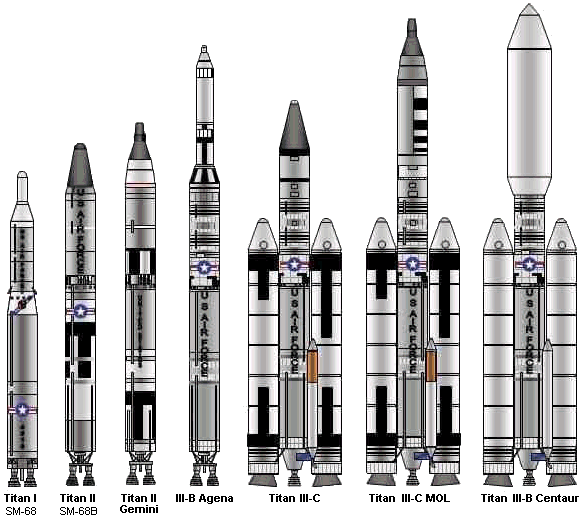
The Titan rocket family, from left to right: Titan I (ICBM), II (ICBM), II GLV (manned), IIIB, IIIC, IIIM (manned), IIIE
ManufacturerGlenn L. Martin Company
Country of originUnited States
Associated rockets
Derivative workTitan I
Titan II
Titan IIIA
Titan IIIB
Titan IIIC
Titan IIID
Titan IIIE
Titan IIIM
Titan 34D
Titan IV
Launch history
StatusRetired
Total launches368
First flightDecember 20, 1958[1]
Last flightOctober 19, 2005

Titan was a family of American intercontinental ballistic missiles (ICBM) and medium- and heavy-lift expendable launch vehicles used between 1959 and 2005. The Titan I and Titan II served as part of the United States Air Force's ICBM arsenal until 1987, while later variants were adapted for space launch purposes. Titan launch vehicles were used for 368 missions in total, including all Project Gemini crewed flights in the mid-1960s, as well as numerous U.S. military, civilian, and scientific payloads—ranging from reconnaissance satellites to space probes sent throughout the Solar System.

Titan I missile

[edit]
Titan I ICBM

The HGM-25A Titan I, built by the Martin Company, was the first version of the Titan family of rockets. It began as a backup ICBM project in case the SM-65 Atlas was delayed. It was a two-stage rocket operational from early 1962 to mid-1965 whose LR-87 booster engine was powered by RP-1 (kerosene) and liquid oxygen (LOX). The ground guidance for the Titan was the UNIVAC ATHENA computer, designed by Seymour Cray, based in a hardened underground bunker.[2] Using radar data, it made course corrections during the burn phase.

Unlike decommissioned Thor, Atlas, and Titan II missiles, the Titan I inventory was scrapped and never reused for space launches or RV tests, as all support infrastructure for the missile had been converted to the Titan II/III family by 1965.[citation needed]

Titan II

[edit]

The Titan II family consists of the Titan II ICBM and two later versions adapted for space launches, the Titan II GLV and the Titan 23G.

Titan II missile

[edit]

Most of the Titan rockets were the Titan II ICBM and their civilian derivatives for NASA. The Titan II used the LR-87-5 engine, a modified version of the LR-87, that used a hypergolic propellant combination of nitrogen tetroxide (NTO) for its oxidizer and Aerozine 50 (a 50/50 mix of hydrazine and unsymmetrical dimethylhydrazine (UDMH) instead of the liquid oxygen and RP-1 propellant of the Titan I.

The first Titan II guidance system was built by AC Spark Plug. It used an inertial measurement unit made by AC Spark Plug derived from original designs from the Charles Stark Draper Laboratory at MIT. The missile guidance computer (MGC) was the IBM ASC-15. When spares for this system became hard to obtain, it was replaced by a more modern guidance system, the Delco Electronics Universal Space Guidance System (USGS). The USGS used a Carousel IV IMU and a Magic 352 computer.[3] The USGS was already in use on the Titan III space launcher when work began in March 1978 to replace the Titan II guidance system. The main reason was to reduce the cost of maintenance by $72 million per year; the conversions were completed in 1981.[4]

Hypergolic propellants

[edit]

Liquid oxygen is dangerous to use in an enclosed space, such as a missile silo, and cannot be stored for long periods in the booster oxidizer tank. Several Atlas and Titan I rockets exploded and destroyed their silos, although without loss of life.[citation needed] The Martin Company was able to improve the design with the Titan II. The RP-1/LOX combination was replaced by a room-temperature fuel whose oxidizer did not require cryogenic storage. The same first-stage rocket engine was used with some modifications. The diameter of the second stage was increased to match the first stage. The Titan II's hypergolic fuel and oxidizer ignited on contact, but they were highly toxic and corrosive liquids. The fuel was Aerozine 50, a 50/50 mix of hydrazine and UDMH, and the oxidizer was NTO.

Accidents at silos

[edit]

There were several accidents in Titan II silos resulting in loss of life and/or serious injuries.

In August 1965, 53 construction workers were killed in fire in a missile silo northwest of Searcy, Arkansas. The fire started when hydraulic fluid used in the Titan II was ignited by a welding torch.[5][6]

The liquid fuel missiles were prone to developing leaks of their toxic propellants. At a silo outside Rock, Kansas, an oxidizer transfer line carrying NTO ruptured on August 24, 1978.[7] An ensuing orange vapor cloud forced 200 rural residents to evacuate the area.[8] A staff sergeant of the maintenance crew was killed while attempting a rescue and a total of twenty were hospitalized.[9]

Another site at Potwin, Kansas leaked NTO oxidizer in April 1980 with no fatalities,[10] and was later closed.

In September 1980, at Titan II silo 374-7 near Damascus, Arkansas, a technician dropped an 8 lb (3.6 kg) socket that fell 70 ft (21 m), bounced off a thrust mount, and broke the skin of the missile's first stage,[11] over eight hours prior to an eventual explosion.[12] The puncture occurred about 6:30 p.m.[13] and when a leak was detected shortly after, the silo was flooded with water and civilian authorities were advised to evacuate the area.[14] As the problem was being attended to at around 3 a.m.,[13] leaking rocket fuel ignited and blew the 8,000 lb (3,630 kg) nuclear warhead out of the silo. It landed harmlessly several hundred feet away.[15][16][17] There was one fatality and 21 were injured,[18] all from the emergency response team from Little Rock AFB.[13][19] The explosion blew the 740-ton launch tube cover 200 ft (60 m) into the air and left a crater 250 feet (76 m) in diameter.[20]

Missile retirement

[edit]

The 54 Titan IIs[21] in Arizona, Arkansas, and Kansas[18] were replaced by 50 MX "Peacekeeper" solid-fuel rocket missiles in the mid-1980s; the last Titan II silo was deactivated in May 1987.[22] The 54 Titan IIs had been fielded along with a thousand Minuteman missiles from the mid-1960s through the mid-1980s.

A number of Titan I and Titan II missiles have been distributed as museum displays across the United States.

Titan II launch vehicle

[edit]

The most famous use of the civilian Titan II was in the NASA Gemini program of crewed space capsules in the mid-1960s. Twelve Titan II GLVs were used for Project Gemini. Two flights were uncrewed and the remaining ten carried two-person crews. All of the launches were successful.

Titan 23G

[edit]

Starting in the late 1980s, some of the deactivated Titan IIs were converted into space launch vehicles to be used for launching U.S. Government payloads. Titan 23G rockets consisted of two stages burning liquid propellant. The first stage was powered by one Aerojet LR87 engine with two combustion chambers and nozzles, and the second stage was propelled by an LR91. On some flights, the spacecraft included a kick motor, usually the Star-37XFP-ISS; however, the Star-37S was also used.[23]

Thirteen were launched from Space Launch Complex 4W (SLC-4W) at Vandenberg Air Force Base starting in 1988.[23] The final such vehicle launched a Defense Meteorological Satellite Program (DMSP) weather satellite on 18 October 2003.[24]

Titan III

[edit]

The Titan III was a modified Titan II with optional solid rocket boosters. It was developed on behalf of the United States Air Force (USAF) as a heavy-lift satellite launcher to be used mainly to launch American military payloads and civilian intelligence agency satellites such as the Vela Hotel nuclear-test-ban monitoring satellites, observation and reconnaissance satellites (for intelligence-gathering), and various series of defense communications satellites.[citation needed] As USAF project, Titan III was more formally known as Program 624A (SSLS), Standard Space Launch System, Standardized Space Launch System, Standardized Space Launching System or Standard Space Launching System (all abbreviated SSLS).[25][26][27]

The Titan III core was similar to the Titan II, but had a few differences. These included:[citation needed]

  • Thicker tank walls and ablative skirts to support the added weight of upper stages
  • Radio ground guidance in place of the inertial guidance on ICBM Titan IIs
  • Guidance package placed on the upper stages (if present)
  • Removal of retrorockets and other unnecessary ICBM hardware
  • Slightly larger propellant tanks in the second stage for longer burn time; since they expanded into some unused space in the avionics truss, the actual length of the stage remained unchanged.

The Titan III family used the same basic LR-87 engines as Titan II (with performance enhancements over the years), however SRB-equipped variants had a heat shield over them as protection from the SRB exhaust and the engines were modified for air-starting.[citation needed]

Avionics

[edit]

The first guidance system for the Titan III used the AC Spark Plug company IMU (inertial measurement unit) and an IBM ASC-15 guidance computer from the Titan II. For the Titan III, the ASC-15 drum memory of the computer was lengthened to add 20 more usable tracks, which increased its memory capacity by 35%.[28]

The more-advanced Titan IIIC used a Delco Carousel VB IMU and MAGIC 352 Missile Guidance Computer (MGC).[29][30]

Titan IIIA

[edit]

The Titan IIIA was a prototype rocket booster and consisted of a standard Titan II rocket with a Transtage upper stage.[citation needed]

Titan IIIB

[edit]

The Titan IIIB with its different versions (23B, 24B, 33B, and 34B) had the Titan III core booster with an Agena D upper stage. This combination was used to launch the KH-8 GAMBIT series of intelligence-gathering satellites. They were all launched from Vandenberg Air Force Base, due south over the Pacific into polar orbits. Their maximum payload mass was about 7,500 lb (3,000 kg).[31]

Titan IIIC

[edit]

The powerful Titan IIIC used a Titan III core rocket with two large strap-on solid-fuel boosters to increase its launch thrust and maximum payload mass. The solid-fuel boosters that were developed for the Titan IIIC represented a significant engineering advance over previous solid-fueled rockets, due to their large size and thrust, and their advanced thrust-vector control systems.[citation needed]

Titan IIID

[edit]

The Titan IIID was the Vandenberg Air Force Base version of the Titan IIIC, without a Transtage, that was used to place members of the Key Hole series of reconnaissance satellites into polar low Earth orbits.[citation needed]

Titan IIIE

[edit]

The Titan IIIE, with a high-specific-impulse Centaur upper stage, was used to launch several scientific spacecraft, including both of NASA's two Voyager space probes to Jupiter, Saturn and beyond, and both of the two Viking missions to place two orbiters around Mars and two instrumented landers on its surface.[32][33]

Titan 34D

[edit]

The Titan 34D featured Stage 1 and Stage 2 stretched with more powerful UA1206 solid motors. A variety of upper stages were available, including the Inertial Upper Stage, the Transfer Orbit Stage, and the Transtage.[34] The Titan 34D made its maiden flight on 30 October 1982 with two DSCS defense communications satellites for the United States Department of Defense (DOD).

Commercial Titan III

[edit]

Derived from the Titan 34D and originally proposed as a medium-lift expendable launch system for the US Air Force, who selected the Delta II instead. Development was continued as a commercial launch system, and the first rocket flew in 1990. The Commercial Titan III differed from the Titan 34D in that it had a stretched second stage, and a larger payload fairing to accommodate dual satellite payloads.

Titan IIIM

[edit]

The Titan IIIM was intended to launch the Manned Orbiting Laboratory and other payloads. Development was cancelled in 1969. The projected UA1207 solid booster rockets were eventually used on the Titan IV, while the extended core was used in the 3B and 34B variants of the Titan IIIB.[35][36]

Titan IV

[edit]

The Titan IV was an extended length Titan III with solid rocket boosters on its sides. The Titan IV could be launched with a Centaur upper stage, the USAF Inertial Upper Stage (IUS), or no upper stage at all. This rocket was used almost exclusively to launch US military or Central Intelligence Agency payloads. However, it was also used for a purely scientific purpose to launch the NASA–ESA Cassini / Huygens space probe to Saturn in 1997. The primary intelligence agency that needed the Titan IV's launch capabilities was the National Reconnaissance Office (NRO).[citation needed]

When it was being produced, the Titan IV was the most powerful uncrewed rocket available to the United States, with proportionally high manufacturing and operations expenses. By the time the Titan IV became operational, the requirements of the Department of Defense and the NRO for launching satellites had tapered off due to improvements in the longevity of reconnaissance satellites and the declining demand for reconnaissance that followed the internal disintegration of the Soviet Union. As a result of these events and improvements in technology, the unit cost of a Titan IV launch was very high. Additional expenses were generated by the ground operations and facilities for the Titan IV at Vandenberg Air Force Base for launching satellites into polar orbits. Titan IVs were also launched from the Cape Canaveral Air Force Station in Florida,[37] a location often used for launch into non-polar orbits.[38]

Titan V concept

[edit]

The Titan V was a proposed development of the Titan IV, that saw several designs being suggested. One Titan V proposal was for an enlarged Titan IV, capable of lifting up to 90,000 pounds (41,000 kg) of payload.[39] Another used a cryogenic first stage with LOX/LH2 propellants;[40] however the Atlas V EELV was selected for production instead.

Launch vehicle retirement

[edit]

Most of the decommissioned Titan II ICBMs were refurbished and used for Air Force space launch vehicles, with a perfect launch success record.[41]

For orbital launches, there were strong advantages to using higher-performance liquid hydrogen or RP-1 fueled vehicles with liquid oxygen; the high cost of using hydrazine and nitrogen tetroxide, along with the special care that was needed due to their toxicity, were a further consideration. Lockheed Martin decided to extend its Atlas family of rockets instead of its more expensive Titans, along with participating in joint-ventures to sell launches on the Russian Proton rocket and the new Boeing-built Delta IV class of medium and heavy-lift launch vehicles. The Titan IVB was the last Titan rocket to remain in service, making its penultimate launch from Cape Canaveral on 30 April 2005, followed by its final launch from Vandenberg Air Force Base on 19 October 2005, carrying the USA-186 optical imaging satellite for the National Reconnaissance Office.[citation needed]

See also

[edit]

Notes

[edit]

References

[edit]
[edit]
Revisions and contributorsEdit on WikipediaRead on Wikipedia
from Grokipedia
The Titan rocket family consisted of a series of expendable launch vehicles that originated as intercontinental ballistic missiles in the late and evolved into versatile heavy-lift boosters for both military and civilian space missions, with a total of 368 launches conducted between 1959 and 2005. Developed initially by the Martin Company under U.S. contracts during the early , the family began with the Titan I and II ICBMs, which featured liquid-fueled, two-stage designs capable of delivering nuclear warheads over intercontinental distances. Subsequent variants, such as the Titan III and IV series, incorporated solid rocket boosters and optional upper stages like Centaur to enhance payload capacity, enabling the deployment of reconnaissance satellites, communications spacecraft, and deep-space probes. The Titan II variant marked a pivotal achievement in by serving as the for NASA's , achieving 100% success across 10 manned missions from 1965 to 1966 that tested critical techniques for the , including spacewalks and rendezvous maneuvers. Later models like the , paired with upper stage, propelled landmark unmanned missions, including the Viking spacecraft that accomplished the first successful landings on Mars in 1976 and the Voyager probes launched in 1977 for interstellar exploration of the outer planets. The , the family's most powerful iteration introduced in 1989, primarily supported Department of Defense payloads, including national reconnaissance satellites, but faced scrutiny over escalating per-launch costs exceeding $300 million by the early 2000s, contributing to its phase-out. Despite occasional launch failures, such as the 1999 Titan IV explosion due to a solid booster malfunction, the family's overall reliability underpinned U.S. strategic deterrence and space access for nearly five decades, with the final flight occurring on October 19, 2005, from Vandenberg Air Force Base. Retirement reflected a shift toward more economical expendable and reusable alternatives, ending an era of liquid-propellant dominance in American rocketry while highlighting the engineering evolution from weapon systems to exploratory tools.

Overview

Core Design Features

The Titan rocket family centers on a two-stage liquid-propellant core vehicle, adapted from designs for reliable, high-thrust performance in space launch applications. This core consists of a first stage powered by twin gimbaled LR-87 engines and a second stage with a single LR-91 engine, both employing hypergolic propellants for ignition without an external igniter. The use of storable propellants— (a 50/50 mix of and ) as fuel and nitrogen tetroxide as oxidizer—eliminates the need for cryogenic handling, facilitating shorter launch preparations and reduced ground support complexity compared to systems requiring or . In the first stage, the LR-87 engines produce a combined sea-level thrust of approximately 548,000 pounds-force in Titan IV configurations, with the propellant tanks structurally integrated in a pressurized monocoque design for lightweight efficiency. The second stage's LR-91 engine delivers around 105,000 pounds-force of vacuum thrust, optimized for upper-atmosphere operation with similar tankage and propellant systems. Engine gimbaling provides thrust vector control, while the core's 10-foot diameter and modular interfacing allow attachment of solid rocket boosters (as Stage 0 in Titan III and later variants) or upper stages like Centaur for payload scalability. This architecture emphasizes simplicity and heritage from missile technology, with features like isolated feeds via electric prevalves and position-indicating systems for enhanced operational safety and restart capability in the upper stage. The core's evolution maintained across variants, enabling upgrades such as increased thrust nozzles while preserving the fundamental two-stage, hypergolic framework for over four decades of service.

Propellant Technology

The Titan I rocket employed cryogenic liquid propellants: refined petroleum ( kerosene) as fuel and () as oxidizer in both its first and second stages. This bipropellant combination provided a of approximately 290-300 seconds in vacuum for the stage engines, leveraging the higher of hydrocarbons with LOX for substantial , though it required careful handling due to LOX's cryogenic temperatures and propensity for boil-off during storage. Subsequent development in the Titan II marked a shift to storable hypergolic propellants to enable rapid launch readiness for applications. The first and second stages used —a 50:50 mixture by weight of (N₂H₄) and (UDMH)—as fuel, paired with nitrogen tetroxide (N₂O₄) as oxidizer. These propellants ignited spontaneously upon contact, eliminating the need for ignition systems and permitting indefinite fueled storage at ambient temperatures, albeit with values around 280-290 seconds that were marginally lower than cryogenic alternatives but prioritized operational reliability over peak efficiency. The Titan II's engines consumed over 300,000 pounds of these hypergolics per launch, representing among the largest quantities deployed in U.S. rocket history for such systems. Later variants in the Titan III and IV families retained the Aerozine 50/N₂O₄ combination for their liquid core stages (derived from Titan II), ensuring compatibility and leveraging established infrastructure. Payload augmentation came via parallel solid rocket boosters (Stage 0), which utilized composite solid propellants based on ammonium perchlorate oxidizer with polybutadiene binders (initially PBAN, later evolving to HTPB formulations for enhanced performance). These segmented motors, typically 120-inch diameter units producing over 1 million pounds of thrust each, burned for 115-165 seconds with specific impulses near 260 seconds at sea level, providing the initial high-thrust impulse while the hypergolic cores handled sustained ascent. This hybrid liquid-solid architecture balanced storability, thrust-to-weight ratios, and mission flexibility across the family's evolutions.

Reliability and Launch Record

The Titan rocket family conducted a total of 368 launches between 1959 and 2005, encompassing tests, manned orbital missions, and heavy-lift satellite deployments, with the majority achieving mission success through iterative design improvements in propulsion staging and structural integrity. Early developmental flights of the Titan I variant experienced frequent failures due to ignition anomalies, feed issues, and staging separations, contributing to a comparatively lower success rate of around 67 percent across its test program. In contrast, the Titan II configuration demonstrated markedly higher reliability, particularly in its adaptation as the Gemini Launch Vehicle (GLV), where it completed 12 consecutive successful launches from 1964 to 1966, including all 10 crewed Gemini missions without propulsion or structural failures. Later iterations, including the Titan III and IV families, further enhanced operational dependability through the addition of strap-on solid rocket motors and refined liquid-fueled cores, yielding overall success rates exceeding 90 percent in mature configurations as of the late . The Titan III series, utilized extensively by the U.S. Air Force for reconnaissance and for planetary probes, recorded minimal in-flight anomalies relative to its volume of over 200 missions, with failures often traced to integration rather than core vehicle defects. The Titan IV, the final evolution, executed 39 launches from 1989 to 2005, achieving an approximate 90 percent success rate despite four notable failures: two involving solid rocket motor malfunctions in 1998 and 1999, and two upper-stage issues with variant. These incidents prompted targeted upgrades, such as improved metallurgy and telemetry diagnostics, underscoring the program's emphasis on causal to mitigate recurrence risks. Commercial variants, such as the Titan III derivatives marketed in the 1990s, exhibited reduced reliability at 75 percent success across a limited manifest of four launches, attributable to accelerated production timelines and adaptations for non-military payloads that compromised some redundancy margins. Overall, the family's progression from developmental setbacks to routine heavy-lift capability reflected engineering advancements in handling and modular staging, positioning Titan as a benchmark for expendable launch vehicles prior to the rise of reusable systems, though ground handling hazards with toxic propellants occasionally led to non-flight incidents.

Historical Development

Origins in ICBM Program

The Titan rocket family originated from the Air Force's (ICBM) programs during the early era, specifically with the development of the SM-68A Titan I, the nation's first true multistage ICBM. Initiated in January 1955 amid escalating nuclear deterrence needs, the program proceeded in parallel with the SM-65 Atlas effort but as a contingency measure should Atlas encounter insurmountable delays. Unlike the Atlas's stage-and-a-half design reliant on balloon tanks, the Titan I employed a fully staged architecture with two separate liquid-fueled stages, enhancing reliability through compartmentalized propulsion systems. In October 1955, the awarded a development contract to the (later ) for the Titan I, marking the formal start of engineering work before the first Atlas test flight. The missile utilized / propellants in engines, delivering a range exceeding 6,300 miles and payload capacity for a reentry vehicle with a W38 or warhead. Initial static tests occurred in 1957, followed by full-range flight demonstrations from , culminating in operational deployment across 54 hardened silos in five Western states by June 1962. This silo-based configuration addressed surface vulnerability concerns, with missiles stored fueled underground for rapid launch response times under 15 minutes. Building directly on Titan I's infrastructure, the Titan II (SM-68B) program emerged in 1958 as an advanced iteration, approved by the in October 1959 to incorporate storable hypergolic propellants—Aerozine 50 and nitrogen tetroxide—for simplified fueling and quicker launches. Retaining the core scaling but upgrading to larger engines and a W53 , Titan II achieved greater accuracy and , entering service in 1963 and remaining operational until 1987. These ICBM foundations provided the propulsion, staging, and guidance technologies repurposed for subsequent variants, establishing the Titan family's versatility from strategic weaponry to orbital insertion.

Transition to Expendable Launch Vehicles

The , recognizing the reliability of the Titan II after its deployment in 1962, initiated adaptations of the Titan II stage for applications to address growing demands for medium- and heavy-lift capabilities beyond those of existing vehicles like the or Atlas-Agena. This shift was driven by the need to larger and communications satellites for during the , where payload requirements exceeded 3,000 kg to . In parallel with ICBM operations, surplus Titan II boosters were modified into the (Gemini Launch Vehicle) configuration, featuring a pad-launched setup with added vernier engines and a vehicle adapter for NASA's two-person Gemini spacecraft; the first such launch occurred on April 8, 1964, successfully placing Gemini-Titan 1 into suborbital flight. By fiscal year 1962, the Air Force formalized the Titan III program under prime contractor Glenn L. Martin Company (later Martin Marietta), explicitly evolving the Titan II first stage into a modular expendable launch vehicle family by integrating strap-on solid rocket motors and interchangeable upper stages to achieve payloads up to 14,500 kg to low Earth orbit. The initial variant, Titan IIIA, paired the Titan II core with an Aerojet Agena-D upper stage and debuted on September 1, 1964, from Cape Canaveral's Pad 19, validating the architecture for military satellite insertions despite early guidance issues in subsequent flights. This marked the full transition to dedicated ELVs, as the design discarded silo-launch constraints in favor of horizontal storage, cryogenic compatibility for some upper stages, and enhanced thrust via Aerojet solid boosters, enabling the Titan IIIC's inaugural orbital success on June 18, 1965, which deployed a LES-4 satellite. The Titan III series rapidly supplanted earlier ELVs for Department of Defense missions, logging over 200 launches by the 1980s, while leveraging economies from shared ICBM production lines until Titan II missile deactivation in 1987, after which retired silos provided additional boosters for conversion. This adaptation preserved technological investments in hypergolic propellants and stage recovery elements initially developed for missiles, though full expendability prioritized mission assurance over reusability amid reliability demands exceeding 95% success rates in operational flights.

Key Contractors and Facilities

The served as the prime contractor for the initial development of the Titan I (ICBM), under a U.S. research and development contract awarded on October 27, 1955. The company handled design, integration, and testing, establishing a dedicated production facility near , , completed in the late as the first fully integrated plant of its kind. Aerojet-General Corporation provided the propulsion systems for the Titan I stages, while subcontractors like Bell Telephone Laboratories contributed guidance components. Following the evolution to the Titan II ICBM and subsequent launch vehicle variants, the reorganized into , which assumed prime contractor responsibilities for Titan III and IV programs, including vehicle assembly and systems integration. leveraged existing manufacturing infrastructure in the area for core stage production, capable of outputting up to 20 Titan cores annually by the . In 1995, acquired , inheriting final Titan IV production and support contracts until the program's retirement in 2005. Key production and test facilities centered on the Waterton Canyon complex south of , where Titan airframes underwent final assembly, static testing, and from the program's inception through the Titan IV era. For solid rocket motor integration in later variants like Titan III and IV, utilized the Solid Motor Assembly and Readiness Facility (SMARF) at , operational from 1988, which enabled off-pad assembly and to launch pads. Launch facilities primarily included Cape Canaveral Air Force Station (now ) complexes 40 and 41, constructed in the early 1960s for Titan III operations and upgraded for Titan IV with vertical integration buildings and assembly areas. Vandenberg Air Force Base (now ) hosted Space Launch Complex 4 (SLC-4), with east and west pads modified starting in the 1960s for missions, accommodating Titan IIIC through IV launches until 2005. Additional support infrastructure at both sites included loading areas and mission control centers managed by the U.S. Air Force's 6555th Instrumentation Squadron for early tests.

First-Generation Titan I

Missile Specifications and Deployment

The was a two-stage, liquid-fueled (ICBM) with a total length of 29.87 meters and a launch weight of approximately 99,790 kilograms. Its first had a diameter of 3.05 meters, tapering to 2.44 meters for the second , and it utilized kerosene and (LOX) as propellants for both stages. The first was powered by two LR-87 engines producing a combined of about 1,296 kN at liftoff, while the second employed a single LR-87 engine. Designed for a range of approximately 10,000 kilometers (6,200 miles), the carried a single nuclear warhead in a reentry vehicle, typically the W53 thermonuclear device with a yield of 4 megatons. Titan I missiles were deployed in hardened underground , with each launch facility housing three missiles in a "1 x 3" configuration to enable rapid salvo capability, though fueling on the surface limited response time to around 15-20 minutes after silo elevation. The system required cryogenic , which complicated storage and necessitated post-alert fueling, contrasting with later solid-fuel designs. Operational readiness involved raising the missile via a hydraulic erector, a process taking about 7.5 minutes, followed by loading. Deployment began with the first operational squadron activating at Lowry Air Force Base, Colorado, in April 1962, under the 703rd Strategic Missile Wing. Ultimately, six squadrons—each with nine missiles—were fielded, totaling 54 operational Titan I missiles across sites in Colorado, Idaho, California, South Dakota, and Washington state, commanded by the 568th, 569th, 724th, 725th, 850th, and 851st Strategic Missile Squadrons. The program achieved initial alert status in early 1962 but was phased out by June 1965 due to the superiority of the solid-fueled Titan II and Minuteman missiles, with all silos deactivated and missiles scrapped or converted by 1966.

Operational Testing and Failures

The operational testing phase for the Titan I ICBM focused on validating the production-configuration missile's performance in flight, stage separation, reentry vehicle capabilities, and silo-launch procedures following initial development prototypes. Flight tests of operational variants commenced in , with the first successful launch of a fully configured Titan I (designated J-7) occurring on August 10, , from Cape Canaveral's Atlantic Missile Range, achieving all primary objectives including intercontinental range simulation. Subsequent tests demonstrated high reliability in open-air launches, with production missiles routinely meeting accuracy and payload delivery goals using inertial guidance and ablative reentry vehicles. Silo-launch validations began in 1961 at Vandenberg Base, where the first underground ejection and ignition test succeeded on May 3, 1961, confirming the missile's ability to rise from its silo via steam pressure before engine ignition. Despite these successes, early operational testing exposed vulnerabilities in the complex silo infrastructure and cryogenic propellant handling, leading to several ground-based failures. On August 7, 1961, during maintenance at a Titan I complex near (Lowry AFB Site 1A), a malfunction caused a 57-ton door to drop unexpectedly, crushing five workers and injuring eight others beneath it. The incident highlighted risks in the hydraulic door mechanisms under high-pressure operations. More critically, on May 24, 1962, a leak from a faulty in the oxidizer tank of a at Beale AFB Complex 4C ignited upon contact with silo lubricants, causing a that destroyed the missile, damaged the , and scattered debris over a wide area. investigations attributed the blast to inadequate seals and the inherent hazards of storing supercooled propellants underground, prompting modifications but underscoring the system's maintenance-intensive nature. These ground incidents, rather than in-flight anomalies, dominated operational failure reports, as flight tests post-1960 achieved near-perfect success rates for deployed configurations, with no total mission losses recorded in silo-launched operational trials. The accidents contributed to the Titan I's reputation for operational complexity, including lengthy silo preparation times (up to 15-20 minutes) and safety risks from and fuels, factors that accelerated its phase-out in favor of the simpler Titan II by 1965. No nuclear warheads were involved in these events, but they exposed systemic issues in crew training and equipment reliability under alert conditions.

Deactivation Process

The phase-out of the Titan I (SM-68A/HGM-25A) system was initiated in fiscal year 1965 following a directive from Secretary of Defense in May 1964 to retire the missiles, which were deemed obsolete due to their cryogenic propellant requiring pre-launch fueling and thus slower response times compared to newer systems like the Titan II. The process involved systematically taking missiles off alert status across the nine operational squadrons, with the first deactivations occurring at bases such as on January 4, 1965, and by February 12, 1965, when the last missile was removed from its there. Deactivation proceeded by extracting the 54 deployed missiles from their underground silos, a task completed operationally by April 1, 1965, at the 569th Strategic Missile Squadron, marking the end of alert readiness for the entire inventory. Each missile underwent defueling to remove kerosene and , followed by disassembly of components including engines, guidance systems, and reentry vehicles; salvageable metals and equipment were recovered, while classified materials, wiring, and sensitive ordnance were destroyed or securely disposed of to prevent technology proliferation. Silo complexes were then sealed or repurposed, with surface structures often razed and underground facilities backfilled or left intact under government oversight, though some later became sites due to residual propellant contaminants. All Titan I squadrons were fully deactivated by June 25, 1965, transitioning strategic deterrence responsibilities to the Titan II and Minuteman programs, which offered improved readiness and reliability. The rapid timeline reflected the system's short operational lifespan of approximately three years, during which it validated multistage liquid-fueled ICBM technology but was eclipsed by advances in storable propellants and solid fuels.

Second-Generation Titan II

ICBM Configuration and Strategic Role

The was a two-stage, liquid-propellant (ICBM) optimized for launch from hardened underground facilities. It featured a length of 31.3 , a of 3.05 , and a launch weight of 149,700 kg. The missile employed hypergolic propellants— and nitrogen tetroxide—allowing storage in a fueled state and enabling a launch sequence of 58 seconds from initiation to liftoff. Guidance relied on an inertial system, achieving a (CEP) of approximately 900 following 1979 upgrades. Deployment encompassed 54 missiles organized into three Strategic Air Command wings, each with 18 silos: at Davis-Monthan Air Force Base, Arizona; , Arkansas; and , Kansas. The first units entered operational service on March 31, 1963, with the full force on alert by December 1963; operations continued until progressive deactivation from 1982 to 1987. Each missile accommodated a single Mk 6 reentry vehicle carrying the W-53 thermonuclear warhead, yielding 9 megatons—the highest for any U.S. ICBM. In U.S. , the Titan II provided a rapid-response capability for targeting of hardened Soviet assets, such as silos and command bunkers, leveraging its yield and accuracy to ensure destruction even under adverse conditions. It also supported strikes against urban and industrial centers, forming a pillar of doctrine as the backbone of the land-based leg of the until supplanted by solid-fueled Minuteman systems. The siloed configuration enhanced survivability against preemptive attacks, with flight times to targets of 25 to 30 minutes underscoring its role in credible second-strike deterrence during the .

Hypergolic Propellant Advantages and Risks

The Titan II employed fuel (a 50/50 mixture of and ) and nitrogen tetroxide oxidizer—which spontaneously ignite upon contact, eliminating the need for an external ignition source. This selection marked a deliberate shift from the cryogenic and kerosene used in the Titan I, enabling long-term storage in fueled silos without pre-launch loading. Key advantages included enhanced operational readiness for (ICBM) deployment, as the storable liquids maintained readiness at ambient temperatures, facilitating rapid launch response times critical for strategic deterrence. Hypergolic ignition provided high reliability, with simple valve-based control systems reducing mechanical complexity and failure points compared to pyrotechnic or spark igniters required for non-hypergolic systems. In flight, this allowed for precise throttling and potential restarts, though Titan II engines primarily operated in a single-burn mode; the propellants' stability supported the missile's design for immediate silo ejection and engine start under pressure-fed conditions. Overall, these properties contributed to the Titan II's demonstrated launch success rate exceeding 90% in ICBM testing and missions. However, the propellants posed severe handling and safety risks due to their extreme toxicity and corrosiveness; nitrogen tetroxide releases fumes upon exposure to moisture, causing respiratory damage, while components are carcinogenic and can lead to neurological effects or explosions at low concentrations (as low as 2% in air). Maintenance in silos required constant monitoring for leaks, as could degrade seals and tank integrity over time, contributing to multiple Titan II incidents, including propellant spills and a 1980 Damascus, Arkansas explosion that killed one and injured 21 from vapor ignition. Ground operations demanded specialized protective equipment and procedures, with historical data from U.S. programs documenting dozens of hypergolic-related accidents across Titan variants, underscoring the trade-off between flight reliability and terrestrial hazards. Despite mitigation efforts like remote handling tools, the inherent reactivity limited personnel access and elevated long-term health risks for silo crews.

Major Silo Accidents

On August 9, 1965, a catastrophic occurred at Titan II ICBM Launch Complex 373-4 near , during maintenance operations on the missile's hydraulic system. A pressurized hydraulic line ruptured, spraying hot, flammable fluid that ignited upon contact with the missile's stage structure, filling with smoke and flames. The blaze led to the deaths of 53 civilian workers from a combination of burns, asphyxiation due to toxic fumes, and drowning in the subsequent flooding used to extinguish the fire; no military personnel were killed. This incident exposed vulnerabilities in silo ventilation, emergency response protocols, and the hazards of working in confined spaces with high-pressure systems near hypergolic propellants. The most publicized Titan II silo disaster took place on September 18–19, 1980, at Launch Complex 374-7 near , . During routine maintenance, Jeffrey Kennedy accidentally dropped an 8-pound socket wrench from the top of the missile, which fell approximately 70 feet and punctured the missile's stage 2 oxidizer tank (containing nitrogen tetroxide). The resulting leak released toxic vapors, prompting evacuation attempts, but escalating pressure led to a series of explosions around 3:00 a.m. on September 19 that destroyed the missile within the silo, ejected the 9-megaton W-53 warhead approximately 600 feet from the site (where it landed intact without detonating), and hurled the 740-ton silo door over 1,000 feet away. One airman, David Livingston, died from injuries sustained while attempting to transfer , and 21 others were injured, primarily from exposure to the hypergolic fuels and nitrogen tetroxide. These accidents underscored the inherent risks of Titan II's hypergolic propellants, which, while enabling rapid launches without complex fueling sequences, posed severe challenges for safe maintenance in enclosed environments due to their extreme toxicity and reactivity. The event, in particular, prompted congressional investigations, accelerated the phase-out of the Titan II ICBM program, and highlighted procedural lapses such as inadequate tool safeguards and delayed hazard recognition during repairs. No nuclear detonation occurred in either case, but the incidents revealed systemic gaps in U.S. strategic operations reliant on volatile fuels.

Adaptation for Manned Spaceflight

The Titan II ICBM was modified into the Gemini Launch Vehicle (GLV) to serve as the booster for NASA's Project Gemini, enabling 10 manned two-person orbital missions from March 1965 to November 1966. These adaptations focused on enhancing safety and reliability for human spaceflight while preserving the core vehicle's proven design, which had undergone extensive testing as a missile. A primary modification was the addition of the Malfunction Detection System (MDS), which monitored booster performance parameters such as thrust, pressure, and structural integrity, transmitting data in real-time to the Gemini spacecraft and ground stations for crew awareness and abort decision-making. The original Titan II inertial was replaced with a radio using ground-based tracking for corrections, supplemented by redundant flight control elements to mitigate single-point failures during ascent. Missile-specific components, including retro and vernier engines used for post-boost maneuvers in ICBM mode, were removed since Gemini required direct orbital insertion without reentry vehicle separation. Instrumentation decks were reconfigured for spaceflight telemetry, emphasizing crew-relevant data over military targeting metrics, and range safety ordnance systems were updated with logic circuitry to inhibit destruct signals unless commanded explicitly, reducing risks from erroneous activations. These changes achieved by leveraging the Titan II's high and storable hypergolic propellants, which provided rapid ignition and controllability advantages over cryogenic alternatives, while extensive ground tests and two unmanned qualification flights ( on April 8, 1964, and on January 19, 1965) validated the configuration prior to manned operations. All 12 GLV launches from Cape Kennedy's Complex 19 succeeded without vehicle-related failures, demonstrating the effectiveness of the minimal yet targeted adaptations.

Post-Missile Launch Applications

Following the phaseout of the Titan II as an intercontinental ballistic missile, with the final operational silos deactivated by 1987, surplus vehicles were refurbished for use as medium-lift space launch vehicles (SLVs). Fourteen decommissioned Titan II missiles were acquired and modified by Martin Marietta (later Lockheed Martin) starting in 1988, retaining the core two-stage structure with Aerozine 50 and nitrogen tetroxide hypergolic propellants but incorporating updated avionics, fairings, and payload adapters for orbital insertions. These SLVs, sometimes designated Titan 23G, achieved a payload capacity of approximately 3,175 kg to low Earth orbit. Thirteen launches occurred between 1988 and 2003, primarily from Space Launch Complex 4W at Vandenberg Air Force Base, , with high reliability evidenced by only one partial failure. Payloads included civil and military satellites, such as NOAA weather satellites (e.g., NOAA-K in 1998), the (DMSP) series for strategic weather reconnaissance, and classified (NRO) imaging or satellites. One notable mission, Landsat 6 in 1993, failed to reach orbit due to a second-stage engine malfunction shortly after separation, though the upper stage later reentered safely. Four launches carried undisclosed NRO payloads, supporting U.S. intelligence capabilities. The program concluded with the final Titan II SLV launch on October 18, 2003, from Vandenberg, deploying a classified and marking the end of the vehicle's operational history after over 40 years of service in missile and launch roles. This repurposing extended the utility of existing hardware amid post-Cold War budget constraints, avoiding full retirement without alternative uses, though the SLVs were eventually phased out in favor of more modern solid-propellant systems like Delta II.

Titan III Series

Structural Enhancements and Strap-On Boosters

The Titan III series introduced significant structural modifications to the Titan II core vehicle to enable the attachment of strap-on boosters and upper stages, enhancing payload capacity for missions. The core, consisting of two hypergolic liquid-propellant stages, underwent reinforcements including strengthened aft longerons on the first stage to withstand the additional dynamic loads and mass from the boosters. These modifications minimized changes to the existing Titan II design while accommodating the stresses of vertical launch and heavier payloads, as evaluated in early studies for improved performance. The key enhancement was the incorporation of parallel solid-propellant strap-on boosters, termed Stage 0, which ignited at liftoff to provide initial high-thrust augmentation before separating. In the Titan IIIA variant, two three-segment 120-inch-diameter solid rocket motors (SRMs) manufactured by provided the boost, marking the first operational use in the series with its debut launch on June 1, 1964. Subsequent variants like the employed larger five-segment UA1205 SRMs from the Chemical Systems Division of , each approximately 85 feet long and 10 feet in diameter, assembled from cast segments at the launch site for flexibility. Each UA1205 SRM delivered a sea-level thrust of about 1,190,000 pounds-force (5,293 kN), utilizing for a time of roughly 115 seconds, significantly increasing the vehicle's liftoff to over 2.5 million pounds-force combined with . vector control was achieved via gimbaled nozzles on the SRMs for the IIIC, enabling steering during the boost phase, while earlier models relied on core gimballing post-separation. These boosters were clustered in a strap-on configuration alongside , with minimal structural alterations to the vehicle interface to maintain commonality across the family.

Guidance and Avionics Systems

The Titan III series employed an inertial guidance system housed in the stage 2 avionics bay, consisting of an Inertial Measurement Unit (IMU) and Missile Guidance Computer (MGC) to provide autonomous navigation and trajectory control independent of ground commands during powered flight. This setup evolved from the Titan II configuration, with the IMU featuring a three-axis stabilized platform using gyroscopes for attitude reference and accelerometers for velocity integration, while the MGC processed explicit guidance equations to compute pitch, yaw, and roll steering based on predicted thrust acceleration and time-to-go estimates. In later variants such as the , beginning with vehicle 26 in 1975, the system upgraded to the Carousel VB IMU, which incorporated two redundant sets of gyroscopes and accelerometers rotating at 1 rpm to mitigate Schuler and instrument errors through continuous averaging, enhancing precision for geosynchronous and high-energy orbits. Paired with the 352 MGC—a digital computer executing real-time algorithms for integral control and velocity-to-be-gained calculations—these components enabled closed-loop trajectory shaping without reliance on upper-stage inputs for core vehicle ascent. For missions requiring post-core guidance, such as those with Transtage or , radio guidance supplemented the inertial system in select configurations. Avionics integration included the Flight Controls Computer (FCC), which conditioned outputs from rate gyros and the Three-Axis Reference System (TARS) to drive thrust vector control (TVC), utilizing hydraulic gimballing (±4° pitch/yaw on stage 1, ±2° on stage 2 at 3000 psi) for liquid engines and liquid injection TVC (5° vector angle, 110,000 lb side force per booster) for solids lacking gimbals. subsystems transmitted via S-band PCM at rates up to 267,000 bps, encoding over 500 analog and 80 digital channels for vehicle health, including acceleration profiles and guidance errors, with C-band transponders for ranging and destruct at 416.5 MHz. In the variant, interfaced with the D-1T's IRU and Teledyne DCU (16,384 × 24-bit words, 3 µs cycle time), where the DCU assumed primary guidance computation, issuing powered-phase commands to Titan stages via TARS-referenced attitude errors at 0.125 Hz update rates. These systems prioritized and , with preflight checkout via ground computers verifying IMU alignment and MGC load to achieve mission cutoff accuracies as low as 4 m/sec in flight-tested scenarios.

Variant Configurations and Missions

The Titan III series variants were developed to enhance capacity and mission flexibility, primarily for Department of Defense (DoD) requirements but also supporting select objectives. Configurations differed in solid rocket motor (SRM) integration, core vehicle modifications, upper stages, and launch sites, with launches occurring from (SLC-40/41) and Vandenberg Air Force Base (SLC-4). The core two-stage liquid-fueled vehicle, derived from the Titan II, used and nitrogen tetroxide propellants, while stage 0 SRMs provided initial boost using (PBAN) composites. Titan IIIA served as a for the core vehicle without SRMs, conducting seven launches between June 1964 and January 1965 from to qualify the stretched stage 1 tank and verify structural integrity under flight loads. These suborbital and orbital qualification flights carried no operational payloads, focusing instead on data collection for subsequent variants. , adapted for Vandenberg polar orbits, omitted SRMs and paired the core with an Agena D upper stage for DoD missions, achieving nine launches from 1968 to 1972, including initial tests of the downrange for precise orbital insertion. The , the primary operational variant, incorporated two 120-inch diameter UA1205/UA1207 SRMs strapped to the core for a total of 36 launches from 1965 to 1982, mostly from . It supported diverse upper stages including Transtage for geosynchronous transfer orbits (GTO) or no upper stage for (LEO) direct injection, delivering up to 29,600 pounds to LEO. Missions predominantly deployed DoD payloads such as (DSP) early-warning satellites (e.g., DSP-1 on June 6, 1970, and DSP-5 on May 5, 1971) and Initial Defense Communications Satellite Program (IDCSP) constellations (e.g., IDCSP 20-27 on June 25, 1967). A single mission, Applications Technology Satellite-6 (ATS-6), launched on May 30, 1974, demonstrated advanced communications relay capabilities. Titan IIID, optimized for Vandenberg launches, mirrored the IIIC's SRM and core design but typically omitted upper stages for LEO reconnaissance missions, executing 22 flights from 1971 to 1982 with payloads often classified. The Titan IIIE integrated a D-1T cryogenic upper stage for high-energy transfers, enabling seven launches from 1974 to 1977 exclusively from SLC-41. This variant supported planetary missions, including 1 (December 10, 1974) for solar orbit studies, and 2 (August 20, 1975, and September 9, 1975) for Mars orbiters and landers, (September 5, 1977) and (August 20, 1977) for outer planet flybys, and 2 (January 15, 1976). The 's hydrogen-oxygen propulsion provided transplanetary injection, with all missions achieving primary objectives despite minor anomalies in some cases. Titan 34D represented an upgrade with a stretched stage 1 tank for increased capacity, retaining 120-inch SRMs but enhancing LEO payload to approximately 32,000 pounds; it conducted 11 launches from Vandenberg between October 1982 and August 1986, exclusively for classified DoD payloads including keyhole reconnaissance satellites. This configuration bridged to the , emphasizing reliability for national security missions with a focus on polar orbital insertions.

Commercial and Military Payload Deployments

The Titan III series, particularly variants like the Titan IIIC and Titan 34D, was predominantly employed by the United States Department of Defense (DoD) for deploying military payloads, including reconnaissance, communications, and early warning satellites into low Earth orbit (LEO) and geostationary transfer orbits. Developed to meet Air Force requirements for heavier payloads than earlier rockets could handle, these vehicles supported classified missions that enhanced national security capabilities, such as satellite-based surveillance and secure data relay. Key military deployments included the (DSP) satellites, which provided infrared detection of missile launches and nuclear events; multiple DSP units were orbited via from Vandenberg Air Force Base starting in the 1980s. Similarly, the (DSCS) Phase III satellites, enabling global military voice and data transmission, utilized with (IUS) augmentation for geosynchronous insertion, with launches such as DSCS III F-1 on October 30, 1982. Other DoD efforts involved experimental communications like LES-1 on the inaugural flight in 1965, marking early successes in military space networking. In contrast, commercial payload deployments were limited, primarily through the Commercial Titan III program initiated in the late to repurpose Titan III hardware for and select customers amid post-Cold War surplus. This two-stage variant, launched from Air Force Station, achieved four flights between 1990 and 1992, delivering payloads up to 14,300 kg to LEO. Notable missions included 603 on March 14, 1990, and 604 on June 23, 1990, both commercial geostationary communications satellites operated by the International Telecommunications Satellite Organization for global and . The program's debut on January 1, 1990, carried the United Kingdom's Skynet 4A satellite under a commercial , while the final launch on September 25, 1992, deployed NASA's Mars Observer probe toward interplanetary trajectory, though the spacecraft failed en route in 1993. These efforts demonstrated the Titan III's versatility but highlighted its transition from military dominance to niche commercial use before retirement.

Titan IV

Heavy-Lift Capabilities and Upgrades

The provided the with heavy-lift capacity for deploying large national security payloads, such as reconnaissance satellites, into (LEO) and beyond, with maximum payload masses reaching 21,700 kg to LEO in equatorial launches. Configurations equipped with the cryogenic upper stage extended capabilities to geosynchronous transfer orbit (GTO), accommodating up to 5,200 kg payloads through its restartable / propulsion system, which delivered high for efficient velocity increments. The vehicle's core two-stage hypergolic design, augmented by two parallel rocket motors (SRMs), enabled reliable lift of bulky, high-mass cargos that exceeded medium-lift alternatives like the Delta or Atlas families. Upgrades culminating in the Titan IVB variant, introduced in 1997, substantially enhanced these capabilities via the Solid Rocket Motor Upgrade (SRMU), which replaced earlier SRMs with advanced filament-wound composite cases, improved propellants, and designs yielding 25% greater to LEO—up to 17,600 kg in polar orbits. The SRMU's higher thrust, approximately 547,100 pounds per motor at ignition, stemmed from optimized grain geometry and reduced inert mass, directly boosting overall vehicle performance without altering the liquid core stages' engines. Complementary modernization included digital guidance computers and enhanced flight termination systems, shortening integration timelines and elevating reliability for time-sensitive military missions. The inaugural Titan IVB flight on February 23, 1997, validated these improvements, demonstrating sustained heavy-lift efficacy through its operational tenure.

Operational Launches and Payloads

The Titan IV performed 39 operational launches from June 14, 1989, to October 19, 2005, with 35 successes, yielding an 89.7% success rate. Launches occurred from Air Force Station (27 missions) and Vandenberg Air Force Base (12 missions), primarily deploying high-priority national security payloads for the U.S. Department of Defense. Payloads encompassed reconnaissance satellites for the (NRO), (DSP) infrared early-warning satellites, and secure communication satellites. The Titan IVB variant, featuring upgraded solid rocket motors, supported most missions, including those with the Centaur upper stage for high-energy orbits. Notable NASA contributions included the Cassini-Huygens mission to Saturn, launched on October 15, 1997, from using a Titan IVB/, which delivered the orbiter and probe after a seven-year journey. Other deployments, such as Flight-22 in 2003 from , provided missile detection capabilities from geosynchronous orbit. satellites, like the one launched April 8, 2003, enhanced military communications resilience. Many payloads remained classified, focusing on , , and needs, with the final Vandenberg launch on October 19, 2005, carrying an . The program's reliability stemmed from iterative improvements post-early failures, prioritizing robust performance for strategic assets despite the shift toward expendable launch vehicles like the EELV.

Notable Failures and Investigations

The Titan IV program experienced three catastrophic destructive failures across its 38 launches from 1989 to 2005, each involving either in-flight breakup or pad explosions that destroyed the vehicles and their multimillion-dollar payloads, primarily due to issues in solid rocket motors, electrical systems, and . These incidents prompted detailed Accident Investigation Board (AIB) reviews by the U.S. , revealing recurring themes of defects, workmanship errors, and inadequate quality controls at contractor and subcontractors like . Corrective measures included redesigned components, enhanced inspections, and process overhauls, though a 1999 assessment criticized systemic engineering and oversight deficiencies contributing to the failures. On August 2, 1993, Titan IVA vehicle B-7 (designated K-11) lifted off from Vandenberg Air Force Base carrying a classified but failed at T+101 seconds when a strap-on solid rocket motor (SRM) experienced a joint burn-through, rupturing the casing and causing structural breakup followed by destruct. The AIB determined the root cause as a anomaly in the SRM field joint bondline, where voids allowed hot combustion gases to erode the liner, exacerbated by Chemical Systems Division's production inconsistencies. Remediation involved joint redesigns, non-destructive testing protocols, and supplier audits to prevent recurrence in subsequent SRM lots. The August 12, 1998, launch of Titan IVA-20 (K-22) from Vandenberg, also with a classified naval payload, ended at T+41 seconds due to multiple electrical shorts in the flight control wiring harness, induced by pre-launch chafing and insulation damage during vehicle processing. This caused a transient power dropout to the inertial guidance computer, desynchronizing engine gimbal commands and resulting in uncontrolled pitch-down, vehicle tumble, and self-destruct at T+70 seconds over the . The AIB report highlighted 44 harness defects with shorting potential—the highest recorded for any Titan IVA—attributing them to poor handling practices and insufficient strain relief at , with recommendations for armored conduits, automated testing, and rigorous pre-flight continuity checks implemented thereafter. On April 30, 1999, Titan IVB-27 (N-11) at Cape Canaveral Air Station suffered a pad approximately eight seconds before ignition during a routine high-pressure inerting of the stage zero SRM interiors. A degraded in the failed to isolate, allowing residual nitrogen tetroxide oxidizer to migrate into the core stage engine compartment, where it contacted hypergolic fuel traces, igniting a fire that propagated to propellant tanks and detonated the vehicle in a blast equivalent to several tons of TNT, damaging Launch Complex 41. The investigation identified workmanship flaws in maintenance and engineering oversights in by , amid broader critiques of rushed processing post-prior failures; responses included replacements, enhanced , and independent reviews of ground operations protocols.

Unrealized and Canceled Concepts

Titan V Proposal

The Titan V, also referred to as Titan 5, was proposed in 1988 by as an evolutionary heavy-lift upgrade to the , featuring a cryogenic core stage fueled by and to replace the hypergolic of prior models. This configuration sought to provide assured access to space for large payloads in the post-Challenger era, positioning it as a lower-risk alternative to expansive initiatives like the National Launch System while building on proven Titan components such as solid rocket boosters. Key specifications included a total height of , a core diameter of 6 meters, and a gross of approximately 1,138,660 kg, with two UA1207 solid boosters delivering 7,117 kN of and a central cryogenic first stage powered by a engine rated at 4,457 kN (about 1,000,000 lbf). Overall liftoff reached 16,534 kN, supporting payload capacities of 27,000 to 68,000 kg (60,000 to 150,000 pounds) to a 100-nautical-mile at 28.5-degree inclination, achievable through variations like enlarged core diameters (4-6 meters) and additional liquid engines (3-6) or solids (2-6). The design emphasized modularity for missions including resupply or strategic defense deployments, with a projected flyaway unit cost of $48.72 million in 1985 dollars. Development was estimated to require $1.2 billion and 3.5 to 5 years, per analyses favoring it for sporadic heavy-lift needs over high-flight-rate scenarios where it proved less economical than advanced liquid systems. However, the concept advanced only to study phase and was ultimately abandoned, as U.S. launch priorities evolved toward the Evolved Expendable Launch Vehicle program, which prioritized fully cryogenic architectures in vehicles like the .

Titan IIIM and Modular Variants

The Titan IIIM was a proposed evolution of the Titan III launch vehicle family, designed by Corporation under U.S. Air Force direction to support the (MOL) program, a classified space station initiative for missions. It utilized a stretched Titan II liquid-fueled core stage with upgraded LR87 engines modified for higher thrust and reliability, paired with two UA-1207 rocket boosters each comprising seven segments to achieve approximately 17 metric tons to . This configuration aimed to enable launches of the 15-ton MOL , including its crew module and associated payloads, into sun-synchronous polar orbits from Vandenberg Air Force Base's Space Launch Complex 6, where construction of the dedicated pad began in March 1966. Engine development for the Titan IIIM core commenced in 1965, focusing on enhancements to the Stage I and II engines, including new component designs validated through ground tests under nominal and extreme conditions to address performance limitations of the baseline Titan II. The seven-segment boosters represented a modular upgrade over the five-segment UA-1205 units on the , providing greater thrust (about 1.2 million pounds per booster at ) while maintaining compatibility with the existing core and vehicle integration architecture. A full-duration static test firing of one such booster motor occurred on April 27, 1969, at United Technologies' Coyote Canyon test site, demonstrating the feasibility of the larger segments despite the program's impending end. The Titan IIIM embodied broader modular principles in the Titan family, where a standardized liquid core allowed interchangeable solid strap-on boosters (varying from three to seven segments) and upper stages (such as Transtage or ) to tailor payload capacities from medium to heavy lift without full vehicle redesigns. Proposed modular variants extended this approach, including concepts for Titan IIID7 configurations pairing the IIIM core with and either two or four seven-segment solids for deep-space missions, though these were shelved alongside MOL due to cost concerns and shifting priorities toward unmanned systems. MOL's cancellation by Secretary of Defense on June 10, 1969, amid budget reallocations and intelligence reassessments, halted Titan IIIM production; no vehicles were assembled or launched. Elements like the UA-1207 boosters were repurposed for the , which debuted in 1989 and incorporated similar modular enhancements for payloads.

Retirement and Aftermath

Decommissioning Timeline and Costs

The Titan I intercontinental ballistic missiles were retired from service between January and April 1965, with the last squadrons deactivated on June 25, 1965, as the system was supplanted by the more advanced Titan II. This early phase-out reflected limitations in the Titan I's cryogenic propellants, which required complex handling and offered inferior readiness compared to storable hypergolics in successors. Deactivation of the Titan II ICBM force commenced in July 1982, accelerated by safety incidents including a 1980 silo explosion that highlighted risks from hypergolic fuels and aging infrastructure. The process involved systematic removal, silo sealing, and facility inactivation across squadrons at bases such as Little Rock AFB, , and Davis-Monthan AFB, , culminating in the final 's deactivation on August 18, 1987. The U.S. allocated approximately $180 million for nationwide closure of Titan II ICBM silo sites, encompassing demolition, environmental assessments, and site restoration preparatory to transfer or repurposing. At Vandenberg AFB, leveling of Titan II launch pads alone was projected to cost $40 million. Parallel to ICBM retirements, Titan-derived space launch vehicles persisted longer; refurbished Titan II missiles supported orbital missions until the final flight in 2003. The , the family's heavy-lift culmination, concluded operations with its last launch on October 19, 2005, from SLC-41, after 38 successful missions since 1989. Retirement stemmed from per-launch costs exceeding $250 million—driven by specialized handling of tetroxide and propellants—and the maturation of lower-cost alternatives like the Evolved Expendable Launch Vehicle family. Specific decommissioning expenditures for Titan IV infrastructure were not publicly itemized beyond operational wind-down, as pads like SLC-41 were rapidly adapted for at minimal additional outlay relative to program scale. Overall family decommissioning emphasized phased asset disposal over abrupt termination, with ICBM silo closures incurring the bulk of documented costs due to their fixed, hardened nature.

Environmental Remediation Efforts

Following the retirement of the Titan II intercontinental ballistic missile (ICBM) systems in the 1980s and the launch vehicles in 2005, efforts focused on addressing soil and contamination from hypergolic propellants such as (a derivative) and nitrogen tetroxide (N2O4), along with volatile organic compounds (VOCs) like trichloroethene (TCE) used in maintenance operations. These substances, known for their toxicity and persistence, migrated into aquifers at former silo complexes and testing facilities, prompting investigations under the U.S. Department of Defense's Formerly Used Defense Sites (FUDS) program and Environmental Protection Agency (EPA) oversight. The U.S. Army Corps of Engineers (USACE) and U.S. led most efforts, employing methods including extraction, treatment via or granular , in-situ pilots, and long-term monitoring to mitigate risks to human health and ecosystems. At Titan I ICBM sites, such as the former Titan 1-A facility near in , remediation addressed TCE plumes in originating from solvents rather than propellants. Between 2001 and 2004, USACE operated an extraction and treatment system that pumped and processed contaminated to remove VOCs, followed by feasibility studies evaluating monitored attenuation and enhanced reductive dechlorination. As of 2025, USACE released a final remedial investigation confirming TCE concentrations, with semi-annual sampling and treatability pilot injections ongoing to improve quality through microbial enhancements. In , Titan I complexes underwent completed investigations by 2010, including excavation and pump-and-treat systems where plumes exceeded standards. Titan II silo sites presented greater challenges due to direct propellant leaks from missile storage and fueling, contaminating soils with (UDMH) and its breakdown products like N-nitrosodimethylamine (NDMA). At Site MS-3 under the former 381st Strategic Missile Wing at , , the Kansas Department of Health and Environment oversaw remediation starting in the 1990s, involving soil removal and groundwater monitoring for hydrazine derivatives persisting over 35 years post-deactivation. In Colorado, the former Lowry Air Force Base Titan II Missile Site 2-2C required Air Force-led cleanup of propellant-impacted soils, with EPA listing prompting hydraulic containment barriers and treatment to prevent off-site migration. An environmental assessment for Titan II deactivation in the anticipated these issues, recommending phased silo dismantling and waste neutralization to minimize long-term liability, though some sites like those in faced delays from incidents such as the 1980 Damascus explosion that exacerbated local contamination. For Titan IV launch complexes at Cape Canaveral Air Force Station (SLC-40/41) and Vandenberg Space Force Base (SLC-4E), remediation emphasized incident-specific responses to hypergolic spills during operations, with post-2005 efforts repurposing pads through decontamination for commercial reuse. A notable August 2003 N2O4 leak at Vandenberg during Titan IV loading was neutralized within two days using neutralization agents and ventilation, preventing broader plume dispersion. Broader site assessments at facilities like Air Force Plant PJKS in Colorado, used for Titan rocket testing, involved ongoing Air Force-directed soil excavation and groundwater remediation for propellant residues, with commitments to complete actions under state health department supervision. These efforts, costing hundreds of millions across the program, reflect causal links between hypergolic use and plume formation, prioritizing empirical plume mapping over speculative risks.

Strategic and Technical Legacy

The Titan rocket family exemplified the strategic pivot from Cold War-era deterrence to assured access for payloads, maintaining U.S. superiority in orbital , , and early warning systems when alternatives like the proved unsuitable for classified or heavy-lift missions. As the final liquid-fueled U.S. ICBM with Titan II's deployment from 1963 to 1987, it delivered nine-megaton warheads over 15,000 km ranges using storable hypergolic propellants ( and nitrogen tetroxide), enabling silo-based rapid response in under 60 seconds— a causal advantage over cryogenic rivals like Atlas by reducing fueling hazards and launch preparation time. Post-ICBM conversion of 14 Titan IIs into launch vehicles from 1988 onward achieved perfect mission success, underscoring their role in bridging gaps in DoD launch manifests until the Evolved Expendable program's maturation. Technically, Titan's legacy resides in its evolutionary modularity, originating with Titan I's 1959 debut as a two-stage /liquid oxygen ICBM and scaling via strap-on solid rocket boosters (SRBs) in variants like (1964 onward), which introduced large-segmented solids yielding thrust exceeding 2 million pounds per motor pair for enhanced liftoff mass handling up to 32,500 pounds to (LEO). The , operational from 1989 to 2005 with 38 launches, culminated this progression by integrating uprated LR87 engines and optional upper stages, supporting payloads of 38,800 pounds to polar LEO or over 12,700 pounds to —capabilities unmatched for DoD needs until and deployments. Hypergolic upper stages ensured ignition reliability without complex turbopump sequencing, while innovations in interstage separation and payload fairings minimized vibration-induced failures, contributing to family-wide streaks like 55 consecutive Titan successes by 1975. This technical foundation influenced post-Titan architectures by validating parallel staging with solids for heavy-lift scalability, as seen in processing lessons from Titan IV's responsiveness studies that informed EELV cost reductions and streamlined manifests. Strategically, the family's 368 launches across five decades, including Voyager deep-space probes in and constellations, preserved U.S. causal edge in space domain awareness amid Soviet competition, retiring on October 19, 2005, after enabling transitions to reusable and commercial paradigms without capability voids. Deactivated hardware repurposing, such as Titan II engines in programs, further extended its empirical contributions to efficiency and structural integrity testing.

References

Add your contribution
Related Hubs
User Avatar
No comments yet.