


Community hub
Recent from talks
Contribute something
Nothing was collected or created yet.
The Merchant of Venice
View on Wikipedia
| The Merchant of Venice | |
|---|---|
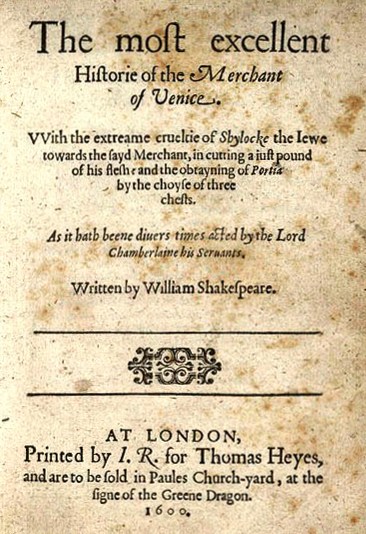
 Title page of the first quarto (1600) | |
| Written by | William Shakespeare |
| Characters | |
| Original language | English |
| Series | First Folio |
| Subject | Debt |
| Genre | Shakespearean comedy |
| Setting | Venice, 16th century |
The Merchant of Venice is a play by William Shakespeare, believed to have been written between 1596 and 1598. A merchant in Venice named Antonio defaults on a large loan taken out on behalf of his dear friend, Bassanio, and provided by a Jewish moneylender, Shylock, with seemingly inevitable fatal consequences.
Although classified as a comedy in the First Folio and sharing certain aspects with Shakespeare's other romantic comedies, the play is most remembered for its dramatic scenes, and it is best known for the character Shylock and his famous demand for a "pound of flesh".
The play contains two famous speeches, that of Shylock, "Hath not a Jew eyes?" on the subject of humanity, and that of Portia on "the quality of mercy". Debate exists on whether the play is antisemitic, with Shylock's insistence on his legal right to the pound of flesh being in opposition to his seemingly universal plea for the rights of all people suffering discrimination.
Characters
[edit]
- Antonio – a prominent merchant of Venice in a melancholic mood and friend of Bassanio
- Bassanio – Antonio's close friend; suitor to Portia; later the husband of Portia
- Gratiano – friend of Antonio and Bassanio; in love with Nerissa; later the husband of Nerissa
- Lorenzo – friend of Antonio and Bassanio; in love with Jessica; later the husband of Jessica
- Portia – a rich heiress; later the wife of Bassanio
- Nerissa – Portia's waiting maid – in love with Gratiano; later the wife of Gratiano; disguises herself as Portia's clerk
- Balthazar – Portia's servant
- Stephano – Portia's servant
- Shylock – a Jew; moneylender; father of Jessica
- Jessica – daughter of Shylock, later the wife of Lorenzo
- Tubal – a Jew; friend of Shylock
- Launcelot Gobbo – servant of Shylock; later a servant of Bassanio; son of Old Gobbo
- Old Gobbo – blind father of Launcelot
- Leonardo – servant to Bassanio
- Duke of Venice – authority who presides over the case of Shylock's bond
- Prince of Morocco – suitor to Portia
- Prince of Arragon – suitor to Portia
- Salarino and Salanio – friends of Antonio and Bassanio
- Salerio – a messenger from Venice; friend of Antonio, Bassanio and others
- Magnificoes of Venice, officers of the Court of Justice, gaolers, servants to Portia, and other attendants
- Doctor Bellario, cousin of Portia, a character by reference who does not appear onstage
Plot summary
[edit]
Bassanio, a young Venetian of noble rank, wishes to woo the beautiful and wealthy heiress of Belmont, Portia. Having squandered his estate, he needs 3,000 ducats to subsidise his expenditures as a suitor. Bassanio approaches his friend Antonio, a wealthy merchant of Venice, who has previously and repeatedly bailed him out. Antonio agrees, but has no liquid cash as his ships and merchandise are busy at sea to Tripolis, the Indies, Mexico and England – he promises to cover a bond if Bassanio can find a lender, so Bassanio turns to the Jewish moneylender Shylock and names Antonio as the loan's guarantor.
Antonio has already antagonized Shylock through his outspoken antisemitism and because Antonio's habit of lending money without interest forces Shylock to charge lower rates. Shylock is at first reluctant to grant the loan, citing abuse he has suffered at Antonio's hand. He finally agrees to lend the sum to Bassanio without interest upon one condition: if Antonio were unable to repay it at the specified date, Shylock may take a pound of Antonio's flesh. Bassanio does not want Antonio to accept such a risky condition; Antonio is surprised by what he sees as the moneylender's generosity (no "usance" – interest – is asked for), and he signs the contract. With money in hand, Bassanio leaves for Belmont with his friend Gratiano, who has asked to accompany him. Gratiano is a likeable young man, but he is often flippant, overly talkative, and tactless. Bassanio warns his companion to exercise self-control, and the two leave for Belmont.
Meanwhile, in Belmont, Portia is awash with suitors. Her father left a will stipulating that each of her suitors must choose correctly from one of three caskets, made of gold, silver and lead respectively. Whoever picks the right casket wins Portia's hand. The first suitor, the Prince of Morocco, chooses the gold casket, interpreting its slogan, "Who chooseth me shall gain what many men desire",[1] as referring to Portia. The second suitor, the conceited Prince of Aragon, chooses the silver casket, which proclaims, "Who chooseth me shall get as much as he deserves",[2] as he believes he is full of merit. Both suitors leave empty-handed, having rejected the lead casket because of the baseness of its material and the uninviting nature of its slogan, "Who chooseth me must give and hazard all he hath".[3] The last suitor is Bassanio, whom Portia wishes to succeed, having met him before. As Bassanio ponders his choice, members of Portia's household sing a song that says that "fancy" (not true love) is "It is engendered in the eye, / With gazing fed";[4] Bassanio chooses the lead casket and wins Portia's hand.

In Venice, news arrives that Antonio's ships have been lost at sea, leaving him unable to repay his bond to Shylock. Shylock, whose daughter Jessica had eloped with the Christian Lorenzo and converted to Christianity, becomes more resolute in seeking retribution against Christians. Jessica had taken with her a considerable portion of Shylock's wealth, including a turquoise ring given to him by his late wife, Leah. Shylock subsequently has Antonio summoned before the court.
At Belmont, Bassanio receives a letter telling him that Antonio has been unable to repay the loan from Shylock. Portia and Bassanio marry, as do Gratiano and Portia's handmaid Nerissa. Bassanio and Gratiano leave for Venice, with money from Portia, to save Antonio's life by offering the money to Shylock. Unknown to Bassanio and Gratiano, Portia sent her servant, Balthazar, to seek the counsel of Portia's cousin, Bellario, a lawyer, at Padua.
The climax of the play is set in the court of the Duke of Venice. Shylock refuses Bassanio's offer of 6,000 ducats, twice the amount of the loan. He demands his pound of flesh from Antonio. The Duke, wishing to save Antonio but unable to nullify a contract, refers the case to a visitor. He identifies himself as Balthazar, a young male "doctor of the law", bearing a letter of recommendation to the Duke from the learned lawyer Bellario. The doctor is Portia in disguise, and the law clerk who accompanies her is Nerissa, also disguised as a man. As Balthazar, Portia in a famous speech repeatedly asks Shylock to show mercy, advising him that mercy "is twice blest: / It blesseth him that gives and him that takes."[5] However, Shylock adamantly refuses any compensations and insists on the pound of flesh.
As the court grants Shylock his bond and Antonio prepares for Shylock's knife, Portia deftly appropriates Shylock's argument for "specific performance". She says that the contract allows Shylock to remove only the flesh, not the blood, of Antonio . Thus, if Shylock were to shed any drop of Antonio's blood, his "lands and goods" would be forfeited under Venetian laws. She tells him that he must cut precisely one pound of flesh, no more, no less; she advises him that "if the scale do turn / But in the estimation of a hair, / Thou diest, and all thy goods are confiscate."[6]
Defeated, Shylock consents to accept Bassanio's offer of money for the defaulted bond: first his offer to pay "the bond thrice", which Portia rebuffs, telling him to take his bond, and then merely the principal; but Portia also prevents him from doing this, on the ground that he has already refused it "in the open court". She cites a law under which Shylock, as a Jew and therefore an "alien", having attempted to take the life of a citizen, has forfeited his property, half to the government and half to Antonio, leaving his life at the mercy of the Duke. The Duke spares Shylock's life and says he may remit the forfeiture. Portia says the Duke may waive the state's share, but not Antonio's. Antonio says he is content that the state waive its claim to half Shylock's wealth if he can have his one-half share "in use" until Shylock's death, when the principal would be given to Lorenzo and Jessica. Antonio also asks that "for this favour" Shylock convert to Christianity and bequeath his entire estate to Lorenzo and Jessica. The Duke then threatens to recant his pardon of Shylock's life unless he accepts these conditions. Shylock, re-threatened with death, accepts with the words, "I am content."[7]
Bassanio, unaware that the lawyer is his disguised wife, offers a gift in gratitude for the supposed legal assistance. Initially declining, Portia eventually requests his ring and Antonio's gloves. Antonio gives his gloves without hesitation, while Bassanio parts with the ring only after Antonio's persuasion, having earlier vowed to his wife never to lose, sell, or give it away. Nerissa, disguised as the lawyer's clerk, similarly obtains her own husband Gratiano's ring, as he fails to recognize her.
At Belmont, Portia and Nerissa playfully taunt and feign accusations against their husbands before revealing their true identities as the lawyer and clerk. Following reconciliations among the characters, Portia informs Antonio that three of his ships were not lost at sea and have safely returned.
Earlier sources
[edit]

The forfeit of a merchant's deadly bond after standing surety for a friend's loan was a common tale in England in the late 16th century.[8] In addition, the test of the suitors at Belmont, the merchant's rescue from the "pound of flesh" penalty by his friend's new wife disguised as a lawyer, and her demand for the betrothal ring in payment are all elements present in the 14th-century tale Il Pecorone by Giovanni Fiorentino, which was published in Milan in 1558.[9] Elements of the trial scene are also found in The Orator by Alexandre Sylvane, published in translation in 1596.[8] The story of the three caskets can be found in Gesta Romanorum, a collection of tales probably compiled at the end of the 13th century.[10]
Date and text
[edit]The date of composition of The Merchant of Venice is believed to be between 1596 and 1598. The play was mentioned by Francis Meres in 1598, so it must have been familiar on the stage by that date. The title page of the first edition in 1600 states that it had been performed "divers times" by that date. Salerino's reference to his ship the Andrew (I, i, 27) is thought to be an allusion to the Spanish ship St. Andrew, captured by the English at Cádiz in 1596. A date of 1596–97 is considered consistent with the play's style.[citation needed]
The play was entered in the Register of the Stationers Company, the method at that time of obtaining copyright for a new play, by James Roberts on 22 July 1598 under the title "the Marchaunt of Venyce or otherwise called the Jewe of Venyce."[11] On 28 October 1600 Roberts transferred his right to the play to the stationer Thomas Heyes; Heyes published the first quarto before the end of the year. It was printed again in 1619, as part of William Jaggard's so-called False Folio. (Later, Thomas Heyes' son and heir Laurence Heyes asked for and was granted a confirmation of his right to the play, on 8 July 1619.) The 1600 edition is generally regarded as being accurate and reliable. It is the basis of the text published in the 1623 First Folio, which adds a number of stage directions, mainly musical cues.[12]
Themes
[edit]Shylock and the antisemitism debate
[edit]![[icon]](https://en.wikipedia.org/wiki/File:Wiki_letter_w_cropped.svg) | This section needs expansion. You can help by adding to it. (April 2023) |
The play is frequently staged, but is potentially troubling to modern audiences because of its central themes, which can easily appear antisemitic. Modern critics argue over the play's stance on the Jews and Judaism. American literary critic Harold Bloom argued in 1998 that "one would have to be blind, deaf and dumb not to recognise that Shakespeare's grand, equivocal comedy The Merchant of Venice is nevertheless a profoundly anti-semitic work".[13]

Shylock as an antagonist
[edit]English society in the Elizabethan and Jacobean era has been described as "judeophobic".[14] English Jews had been expelled under Edward I in 1290 and were not permitted to return until 1656 under the rule of Oliver Cromwell. Poet John Donne, who was Dean of St Paul's Cathedral and a contemporary of Shakespeare, gave a sermon in 1624 perpetuating the Blood Libel – the entirely unsubstantiated antisemitic lie that Jews ritually murdered Christians to drink their blood and achieve salvation.[15] In Venice and in some other places, Jews were required to wear a yellow or red hat at all times in public to make sure that they were easily identified, and had to live in a ghetto.[16]
Shakespeare's play may be seen as a continuation of this tradition.[17] The title page of the Quarto indicates that the play was sometimes known as The Jew of Venice in its day, which suggests that it was seen as similar to Marlowe's early 1590s work The Jew of Malta. One interpretation of the play's structure is that Shakespeare meant to contrast the perceived mercy of the main Christian characters while giving the Jewish character vengeful characteristics. Similarly, it is possible that Shakespeare meant Shylock's forced conversion to Christianity to be a "happy ending" for the character, as, to some Christian audiences, it saves his soul and allows him to enter Heaven.[18][page range too broad]
Regardless of what Shakespeare's authorial intent may have been, the play has been made use of by antisemites throughout the play's history. The Nazis used the usurious Shylock for their propaganda. Shortly after Kristallnacht in 1938, The Merchant of Venice was broadcast for propagandistic ends over the German airwaves. Productions of the play followed in Lübeck (1938), Berlin (1940), and elsewhere within the Nazi territory.[19][page needed]
In a series of articles called Observer, first published in 1785, British playwright Richard Cumberland created a character named Abraham Abrahams, who is quoted as saying, "I verily believe the odious character of Shylock has brought little less persecution upon us, poor scattered sons of Abraham, than the Inquisition itself."[20] Cumberland later wrote a successful play, The Jew (1794), in which his title character, Sheva, is portrayed sympathetically, as both a kindhearted and generous man. This was the first known attempt by a dramatist to reverse the negative stereotype that Shylock personified.[21]
The depiction of Jews in literature throughout the centuries bears the close imprint of Shylock. With slight variations much of English literature up until the 20th century depicts the Jew as "a monied, cruel, lecherous, avaricious outsider tolerated only because of his golden hoard".[22]
Shylock as a sympathetic character
[edit] | This section needs additional citations for verification. (April 2024) |
.jpg)
Many modern readers and theatregoers have read the play as a plea for tolerance, noting that Shylock is a sympathetic character. They cite as evidence that Shylock's "trial" at the end of the play is a mockery of justice, with Portia acting as a judge when she has no right to do so. The characters who berated Shylock for dishonesty resort to trickery in order to win. In addition to this, Shakespeare gives Shylock one of his most eloquent speeches:
SALARINO: Why, I am sure if he forfeit, thou wilt not
take his flesh! What's that good for?
SHYLOCK: To bait fish withal; if it will feed nothing else,
it will feed my revenge. He hath disgraced me and
hindered me half a million, laughed at my losses,
mocked at my gains, scorned my nation, thwarted
my bargains, cooled my friends, heated mine enemies—
and what's his reason? I am a Jew. Hath not
a Jew eyes? Hath not a Jew hands, organs, dimensions,
senses, affections, passions? Fed with the
same food, hurt with the same weapons, subject to
the same diseases, healed by the same means,
warmed and cooled by the same winter and summer
as a Christian is? If you prick us, do we not
bleed? If you tickle us, do we not laugh? If you
poison us, do we not die? And if you wrong us, shall
we not revenge? If we are like you in the rest, we will
resemble you in that. If a Jew wrong a Christian,
what is his humility? Revenge. If a Christian wrong
a Jew, what should his sufferance be by Christian
example? Why, revenge! The villainy you teach me I
will execute, and it shall go hard but I will better the
instruction.
— Act III, scene I, l. 50–72[23]
It is uncertain whether the sympathetic reading of Shylock is due to changing sensibilities among readers or that Shakespeare, a writer who created complex, multi-faceted characters, deliberately intended this reading. Stephen Greenblatt points out that, though Shylock is not a "lovable alien", he is given "more theatrical vitality, quite simply more urgent, compelling life, than anyone else in his world".[24]
One basis for this interpretation is the emphasis on Shylock's marginalized position within Venetian society. Some critics regard his well-known "Hath not a Jew eyes?" speech as a redeeming moment that lends him qualities of a tragic figure. In this speech, Shylock contends that he is fundamentally no different from the Christian characters.[25] Critics who dispute a sympathetic reading of the speech note that it concludes with a call for revenge: "if you wrong us, shall we not revenge?" Those who view the passage more sympathetically emphasize that Shylock attributes his desire for retribution to the example set by the Christian characters: "If a Christian wrong a Jew, what should his sufferance be by Christian example? Why, revenge. The villainy you teach me, I will execute, and it shall go hard but I will better the instruction."
Even if Shakespeare did not intend the play to be read this way, the fact that it retains its power on stage for audiences who may perceive its central conflicts in radically different terms is an illustration of the subtlety of Shakespeare's characterisations.[26] Additionally, when Shylock discovers that his daughter, Jessica, has sold his ring, a gift from his wife Leah,[27] the audience is provided with sympathetic biographical information tangential to the plot.[24]
Later, in the trial Shylock represents what Elizabethan Christians believed to be the Jewish desire for "justice", contrasted with their obviously superior Christian value of mercy. The Christians in the courtroom urge Shylock to love his enemies, although they themselves have failed in the past. Jewish critic Harold Bloom suggests that, although the play gives merit to both cases, the portraits are not even-handed: "Shylock's shrewd indictment of Christian hypocrisy delights us, but ... Shakespeare's intimations do not alleviate the savagery of his portrait of the Jew..."[28]
Notably, in Nazi Germany, concerns arose that the portrayal of Shylock would elicit too much sympathy for the plight of a Jewish person, thus prompting many alterations to the play, including the excision of Shylock's final speech.[29]

Antonio, Bassanio
[edit]Antonio's unexplained depression – "In sooth I know not why I am so sad" – and utter devotion to Bassanio has led some critics to theorise that he is suffering from unrequited love for Bassanio and is depressed because Bassanio is coming to an age where he will marry a woman. In his plays and poetry Shakespeare often depicted strong male bonds of varying homosociality, which has led some critics to infer that Bassanio returns Antonio's affections despite his obligation to marry:[30]
ANTONIO [...]
Commend me to your honorable wife,
Tell her the process of Antonio's end,
Say how I loved you, speak me fair in death,
And when the tale is told, bid her be judge
Whether Bassanio had not once a love.
[...]
BASSANIO [...]
But life itself, my wife, and all the world
Are not with me esteemed above thy life.
I would lose all, ay, sacrifice them all
Here to this devil, to deliver you.
— The Merchant of Venice. Act 4, scene 1, ll. 285–298[31]
In his essay "Brothers and Others", published in The Dyer's Hand, W. H. Auden describes Antonio as "a man whose emotional life, though his conduct may be chaste, is concentrated upon a member of his own sex." Antonio's feelings for Bassanio are likened to a couplet from Shakespeare's Sonnets: "But since she pricked thee out for women's pleasure,/ Mine be thy love, and my love's use their treasure." Antonio, says Auden, embodies the words on Portia's leaden casket: "Who chooseth me, must give and hazard all he hath." Antonio has taken this potentially fatal turn because he despairs, not only over the loss of Bassanio in marriage but also because Bassanio cannot requite what Antonio feels for him. Antonio's frustrated devotion is a form of idolatry: the right to live is yielded for the sake of the loved one. There is one other such idolator in the play: Shylock himself. "Shylock, however unintentionally, did, in fact, hazard all for the sake of destroying the enemy he hated, and Antonio, however unthinkingly he signed the bond, hazarded all to secure the happiness of the man he loved." Both Antonio and Shylock, agreeing to put Antonio's life at a forfeit, stand outside the normal bounds of society. There was, states Auden, a traditional "association of sodomy with usury", reaching back at least as far as Dante, with which Shakespeare was likely familiar. (Auden sees the theme of usury in the play as a comment on human relations in a mercantile society.)
Other interpreters of the play regard Auden's conception of Antonio's sexual desire for Bassanio as questionable. Michael Radford, director of the 2004 film version starring Al Pacino, explained that, although the film contains a scene where Antonio and Bassanio actually kiss, the friendship between them is platonic, in line with the prevailing view of male friendship at the time. Jeremy Irons, in an interview, concurs with the director's view and states that he did not "play Antonio as gay". Joseph Fiennes, however, who plays Bassanio, encouraged a homoerotic interpretation and, in fact, surprised Irons with the kiss on set, which was filmed in one take. Fiennes defended his choice, saying "I would never invent something before doing my detective work in the text. If you look at the choice of language ... you'll read very sensuous language. That's the key for me in the relationship. The great thing about Shakespeare and why he's so difficult to pin down is his ambiguity. He's not saying they're gay or they're straight, he's leaving it up to his actors. I feel there has to be a great love between the two characters ... there's great attraction. I don't think they have slept together but that's for the audience to decide."[32]

Performance history
[edit]The earliest performance of which a record has survived was held at the court of King James in the spring of 1605, followed by a second performance a few days later, but there is no record of any further performances in the 17th century.[33] In 1701, George Granville staged a successful adaptation, titled The Jew of Venice, with Thomas Betterton as Bassanio. This version, which featured a masque (The Masque of Peleus and Thetis) was popular, and was acted for the next forty years. Granville cut the clownish Gobbos[34] in line with neoclassical decorum; he added a jail scene between Shylock and Antonio; an extended scene of toasting at a banquet scene, and had Bassanio give Portia his ring when she is disguised as a male lawyer, removing any homosexual subtext that could be inferred from that scene in the original play. Thomas Doggett was Shylock, playing the role comically, perhaps even farcically. Rowe expressed doubts about this interpretation as early as 1709; Doggett's success in the role meant that later productions would feature the troupe clown as Shylock.
In 1741, Charles Macklin returned to the original text in a very successful production at Drury Lane, paving the way for Edmund Kean seventy years later (see below).[35]
Arthur Sullivan wrote incidental music for the play in 1871.[36] As part of the 500 year anniversary of the Venetian Ghetto, which converged with the 400 year anniversary of Shakespeare's death, The Merchant of Venice was performed in the ghetto main square in 2016 by the Compagnia de' Colombari.[37][38]: 141–142

Shylock on stage
[edit]Jewish actor Jacob Adler and others report that the tradition of playing Shylock sympathetically began in the first half of the 19th century with Edmund Kean,[39] and that previously the role had been played "by a comedian as a repulsive clown or, alternatively, as a monster of unrelieved evil." Kean's Shylock established his reputation as an actor.[40]
From Kean's time forward, all of the actors who have famously played the role, with the exception of Edwin Booth, who played Shylock as a simple villain, have chosen a sympathetic approach to the character; even Booth's father, Junius Brutus Booth, played the role sympathetically. Henry Irving's portrayal of an aristocratic, proud Shylock (first seen at the Lyceum in 1879, with Portia played by Ellen Terry) has been called "the summit of his career".[41] Jacob Adler was the most notable of the early 20th century: Adler played the role in Yiddish-language translation, first in Manhattan's Yiddish Theatre District on the Lower East Side, and later on Broadway, where, to great acclaim, he performed the role in Yiddish in an otherwise English-language production.[42]
Kean and Irving presented a Shylock justified in wanting his revenge; Adler's Shylock evolved over the years he played the role, first as a stock Shakespearean villain, then as a man whose better nature was overcome by a desire for revenge, and finally as a man who operated not from revenge but from pride. In a 1902 interview with Theater magazine, Adler pointed out that Shylock is a wealthy man, "rich enough to forgo the interest on three thousand ducats" and that Antonio is "far from the chivalrous gentleman he is made to appear. He has insulted the Jew and spat on him, yet he comes with hypocritical politeness to borrow money of him." Shylock's fatal flaw is to depend on the law, but "would he not walk out of that courtroom head erect, the very apotheosis of defiant hatred and scorn?"[43]
Some modern productions take further pains to show the sources of Shylock's thirst for vengeance. For instance, in the 2004 film adaptation directed by Michael Radford and starring Al Pacino as Shylock, the film begins with text and a montage of how Venetian Jews are cruelly abused by bigoted Christians. One of the last shots of the film also brings attention to the fact that, as a convert, Shylock would have been cast out of the Jewish community in Venice, no longer allowed to live in the ghetto. Another interpretation of Shylock and a vision of how "must he be acted" appears at the conclusion of the autobiography[clarification needed] of Alexander Granach, a noted Jewish stage and film actor in Weimar Germany (and later in Hollywood and on Broadway).[44]
Adaptations and cultural references
[edit]The play has inspired many adaptions and several works of fiction.
Film, TV and radio versions
[edit]- 1914 – The Merchant of Venice, a silent film directed by Lois Weber and Phillips Smalley. Weber played Portia and Smalley, her husband, played Shylock. With this film, Weber became the first woman to direct a full-length feature film in America.[45]
- 1916 – The Merchant of Venice, an unsuccessful silent British film produced by Walter West for Broadwest.[46]
- 1923 – The Merchant of Venice (Der Kaufmann von Venedig), also The Jew of Mestri, a silent German film directed by Peter Paul Felner. Though based in part on Shakespeare's play, it was also based on Christopher Marlowe's The Jew of Malta, as well as stories by Giovanni Fiorentino, Masuccio Salernitano and Pietro Aretino.[47]
- 1941 – Shylock, an Indian Tamil language film directed by the duo Sama-Ramu.[48]
- 1953 – The Merchant of Venice, a French-Italian drama film directed by Pierre Billon and starring Michel Simon, Andrée Debar and Massimo Serato.
- 1961 – The Merchant of Venice, an Australian television adaptation.
- 1969 – The Merchant of Venice, an unreleased 40-minute television film directed by and starring Orson Welles; the film was completed, but the soundtrack for all but the first reel was stolen before it could be released.[49]
- 1972 – The Merchant of Venice, BBC video-taped television version directed by Cedric Messina for the BBC's Play of the Month series.[50] Cast includes Maggie Smith, Frank Finlay, Charles Gray and Christopher Gable.[50]
- 1973 – The Merchant of Venice British Associated Television version directed by John Sichel. Broadcast in the United States over ABC-TV.[50][51] Set in the late Victorian era, the cast included Laurence Olivier as Shylock, Anthony Nicholls as Antonio, Jeremy Brett as Bassanio, and Joan Plowright as Portia.[50]
- 1980 – The Merchant of Venice, a version for the BBC Television Shakespeare directed by Jack Gold.[50] The cast includes Gemma Jones as Portia, Warren Mitchell as Shylock and John Nettles as Bassanio.[50]
- 1996 – The Merchant of Venice, a Channel 4 television film directed by Alan Horrox.[52] The cast included Bob Peck as Shylock and Haydn Gwynne as Portia.[52]
- 2001 – The Merchant of Venice, a Royal National Theatre production directed by Trevor Nunn.[53] Set around 1930, Henry Goodman played Shylock.[53]
- 2002 – The Māori Merchant of Venice, directed by Don Selwyn.[54] In Māori, with English subtitles. This film was based on a 1945 translation of the play to Māori by Pei Te Hurinui Jones.[54]
- 2003 – In Shakespeare's Merchant, a film directed by Paul Wagar, Antonio and Bassanio have a homosexual relationship.[55][56]
- 2004 – The Merchant of Venice, directed by Michael Radford and produced by Barry Navidi. This was the first "big-screen" adaptation of the play. The cast included Al Pacino as Shylock, Jeremy Irons as Antonio, Joseph Fiennes as Bassanio, Lynn Collins as Portia, and Zuleikha Robinson as Jessica.[57]
- Broadcast on BBC Radio 3 on 22 April 2018 and transposing the plot from Venice to the City of London and the 2008 financial crisis. The cast included Andrew Scott as Shylock, Ray Fearon as Antonio, Colin Morgan as Bassanio, Hayley Atwell as Portia, and Lauren Cornelius as Jessica.[58]
Operas
[edit]- Josef Bohuslav Foerster's three-act Czech opera Jessika was first performed at the Prague National Theatre in 1905.[59][60]
- Adrian Welles Beecham, 15-year-old son of Sir Thomas Beecham, composed an operatic version which premiered at the Grand Theatre in Brighton on 18 September 1922 followed by 32 performances at the Duke of York's Theatre in London from 20 November to 16 December 1922.[61] Augustus Milner sang Shylock, later replaced during the run by producer F. R. Benson.[61] Although described in the vocal score as "a Shakespearean Opera" the play was perhaps better defined as a "play with music", with 27 musical sections or arias.[62]
- Reynaldo Hahn's three-act French opera Le marchand de Venise was first performed at the Paris Opéra on 25 March 1935.[63][64]
- André Tchaikowsky's (1935–1982) opera The Merchant of Venice premiered at the Bregenz Festival[65][66] on 18 July 2013.
- A modernized interpretation of The Merchant of Venice was staged at the Royal Lyceum in Edinburgh from late 2024 to early 2025.[67]
Cultural references
[edit]Edmond Haraucourt, French playwright and poet, was commissioned in the 1880s by the actor and theatrical director Paul Porel to make a French-verse adaptation of The Merchant of Venice. His play Shylock, first performed at the Théâtre de l'Odéon in December 1889, had incidental music by the French composer Gabriel Fauré, later incorporated into an orchestral suite of the same name.[68]
St. John Ervine wrote a sequel play, The Lady of Belmont, in 1924, in which the characters from Shakespeare's work reunite ten years after the events of the earlier play.[69]
Ralph Vaughan Williams' choral work Serenade to Music (1938) draws its text from the discussion about music and the music of the spheres in act V, scene 1.[70]
In both versions of the comic film To Be or Not to Be (1942 and 1983) the character "Greenberg", specified as a Jew in the later version, gives a recitation of the "Hath not a Jew eyes?" speech to Nazi soldiers.[71]
The rock musical Fire Angel was based on the story of the play, with the scene changed to the Little Italy district of New York. It was performed in Edinburgh in 1974 and in a revised form at Her Majesty's Theatre, London, in 1977. Braham Murray directed.[72][73]
Arnold Wesker's play The Merchant (1976) is a reimagining of Shakespeare's story.[74] In this retelling, Shylock and Antonio are friends and share a disdain for the crass anti-Semitism of the Christian community's laws.[75]
David Henry Wilson's play Shylock's Revenge, was first produced at the University of Hamburg in 1989, and follows the events in The Merchant of Venice. In this play Shylock gets his wealth back and becomes a Jew again.[76]
The Star Trek franchise sometimes quote and paraphrase Shakespeare, including The Merchant of Venice. One example is the Shakespeare-aficionado Chang in Star Trek VI: The Undiscovered Country (1991), a Klingon, who quotes Shylock.[77]
Steven Spielberg's Schindler's List (1993) depicts SS Lieutenant Amon Göth quoting Shylock's "Hath not a Jew eyes?" speech when deciding whether to rape his Jewish maid.[78]
In David Fincher's 1995 crime thriller Seven, a lawyer, Eli Gould, is coerced to remove a pound of his own flesh and place it on a scale, alluding to the play.[79]
The German Belmont Prize was established in 1997,[80] referring to 'Belmont' as "a place of destiny where Portia's intelligence is at home." The eligibility for the award is encapsulated by the inscription on the play's lead casket, "Who chooses me must give and hazard all he hath."[81]
One of the four short stories comprising Alan Isler's The Bacon Fancier (1999) is also told from Shylock's point of view. In this story, Antonio was a converted Jew.[82]
The Pianist is a 2002 film based on a memoir by Władysław Szpilman. In this film, Henryk Szpilman reads Shylock's "Hath not a Jew eyes?" speech to his brother Władysław in the Warsaw Ghetto during the Nazi occupation in World War II.[83]
In the 2009 spy comedy OSS 117: Lost in Rio, a speech by the nazi Von Zimmel parodies Shylock's tirade.[84][85]
Christopher Moore combines The Merchant of Venice and Othello in his 2014 comic novel The Serpent of Venice, in which he makes Portia (from The Merchant of Venice) and Desdemona (from Othello) sisters. All of the characters come from those two plays with the exception of Jeff (a monkey); the gigantic simpleton Drool; and Pocket, the Fool, who comes from Moore's earlier novel Fool, based on King Lear.[86]
Naomi Alderman's The Wolf in the Water is a radio-play first broadcast on BBC Radio 3 in 2016. The play continues the story of Shylock's daughter Jessica, who lives in an anti-semitic Venice and practices her Jewish faith in secret. Part of the BBC's Shakespeare Festival, the play also marked that 500 years had passed since the Venetian Ghetto was instituted.[87][88]
Sarah B. Mantell's Everything that Never Happened is a play first produced in 2017 at the Yale School of Drama. Similar to Rosencrantz and Guildenstern Are Dead, the play occurs in the gaps between scenes of the canonical The Merchant of Venice, with the characters gradually recognizing how conflicts over assimilation and anti-Semitism recur throughout past, present, and future.[89][90][91]
See also
[edit]Notes and references
[edit]Notes
[edit]References
[edit]- ^ The Merchant of Venice 2.7/5, Folger Shakespeare Library
- ^ The Merchant of Venice 2.7/8, Folger Shakespeare Library
- ^ The Merchant of Venice 2.7/11, Folger Shakespeare Library
- ^ The Merchant of Venice 3.2/69, Folger Shakespeare Library
- ^ The Merchant of Venice 4.1/192, Folger Shakespeare Library
- ^ The Merchant of Venice 4.1/344–346, Folger Shakespeare Library
- ^ The Merchant of Venice 4.1/410, Folger Shakespeare Library
- ^ a b Muir 2005, p. 49.
- ^ Bloom (2007), pp. 112–113.
- ^ Drakakis (2010), pp. 60–61.
- ^ "Stationers' Register entry for The Merchant of Venice", Shakespeare Documented, Folger Shakespeare Library. 8 February 2020.
- ^ Wells & Dobson 2001, p. 288.
- ^ Ambrosino, Brandon (21 April 2016). "Four Hundred Years Later, Scholars Still Debate Whether Shakespeare's "Merchant of Venice" Is Anti-Semitic". Smithsonian Magazine. Retrieved 26 May 2024.
- ^ Burrin 2005, p. 17.
- ^ Dautch 2016.
- ^ Ravid 1992.
- ^ Hales 1894.
- ^ Beauchamp 2011.
- ^ Shapiro 2016.
- ^ Newman, Louis I. (2012). Richard Cumberland: Critic and Friend of the Jews (Classic Reprint). Forgotten Books.
- ^ Armin, Robert (2012). Sheva, the Benevolent. Moreclacke Publishing.
- ^ David Mirsky, "The Fictive Jew in the Literature of England 1890–1920", in the Samuel K. Mirsky Memorial Volume.
- ^ The Merchant of Venice 3.1/50–72, Folger Shakespeare Library
- ^ a b Greenblatt, Stephen (3 July 2017). "Shakespeare's Cure for Xenophobia". The New Yorker. Retrieved 20 August 2025.
- ^ Scott (2002).[incomplete short citation]
- ^ Bloom (2007), p. 233.
- ^ "The Merchant of Venice: Act 3, Scene 1, line 121". shakespeare-navigators.ewu.edu. Retrieved 20 August 2025.
- ^ Bloom (2007), p. 24.
- ^ "Shylock's Shadow: Shakespeare's 'The Merchant of Venice' and the Nazi takeover of theatres". Holocaust Centre North. 6 September 2023. Retrieved 17 February 2025.
- ^ Bloom, Harold (2010). Interpretations: William Shakespeare's The Merchant of Venice. New York: Infobase. p. 27. ISBN 978-1-60413-885-6.
- ^ The Merchant of Venice 4.1/285–298, Folger Shakespeare Library
- ^ "Was the Merchant of Venice gay?". ABC News (Australia). Reuters. 29 December 2004. Archived from the original on 1 January 2006, about Michael Radford's 2004 film.
- ^ Charles Boyce, Encyclopaedia of Shakespeare, New York, Roundtable Press, 1990, p. 420.
- ^ Warde, Frederick (1915). The Fools of Shakespeare; an interpretation of their wit, wisdom and personalities. London: McBride, Nast & Company. pp. 103–120. Archived from the original on 29 April 2015. Retrieved 10 April 2023.
- ^ F. E. Halliday, A Shakespeare Companion 1564–1964, Baltimore, Penguin, 1964; pp. 261, 311–312. In 2004, the film was released.
- ^ Information about Sullivan's incidental music to the play Archived 25 November 2009 at the Wayback Machine at The Gilbert and Sullivan Archive, accessed 31 December 2009
- ^ Worrall, Simon (6 November 2015). "The Centuries-Old History of Venice's Jewish Ghetto". Smithsonian. Retrieved 19 April 2024.
- ^ Bassi, Shaul; Chillington Rutter, Carol, eds. (2021). The Merchant in Venice: Shakespeare in the Ghetto. Venezia: Ca' Foscari University of Venice. ISBN 978-88-6969-503-2.
- ^ Adler (1999) erroneously dates this from 1847 (at which time Kean was already dead); the Cambridge Student Guide to The Merchant of Venice dates Kean's performance to a more likely 1814.
- ^ Adler (1999), p. 341.
- ^ Wells & Dobson (2001), p. 290.
- ^ Adler (1999), pp. 342–344.
- ^ Adler (1999), pp. 344–350.
- ^ Granach (1945; 2010), pp. 275–279.[incomplete short citation]
- ^ Stamp, Shelley (2015). Lois Weber in Early Hollywood. Univ of California Press. pp. 46–47. ISBN 978-0520241527.
- ^ Low, Rachael (2013). The History of British Film (Volume 3): The History of the British Film 1914–1918. Routledge. pp. 84, 295. ISBN 978-1136206061.
- ^ Ball, Robert Hamilton (2013). Shakespeare on Silent Film: A Strange Eventful History. Routledge. p. 151. ISBN 978-1134980987.
- ^ Guy, Randor (29 March 2014). "Blast from the Past: Shylock (1941)". The Hindu. Retrieved 22 September 2016.
- ^ "Venice Film Festival: Lost Orson Welles Film to Get Pre-Opening Showcase". Hollywood Reporter. 7 August 2015. Retrieved 10 October 2018.
- ^ a b c d e f Pearce 2009.
- ^ "2 Shakespearean Classics to Be Televised by A.B.C." The New York Times. 10 February 1973. Retrieved 20 October 2018.
- ^ a b Rothwell, Kenneth S. (2004). A History of Shakespeare on Screen: A Century of Film and Television. Cambridge University Press. p. 117. ISBN 978-0521543118.
- ^ a b Shakespeare, William; Farrell, Tony (2018). The Merchant of Venice. Nelson Thornes. p. 8. ISBN 978-0748769575.
- ^ a b Huang, Alexa; Rivlin, Elizabeth (2014). Shakespeare and the Ethics of Appropriation. Springer. p. 198. ISBN 978-1137375773.
- ^ Espinosa, Ruben (2016). Shakespeare and Immigration. Routledge. ISBN 978-1317056614.
- ^ Gunn, Drewey Wayne (2017). For the Gay Stage: A Guide to 456 Plays, Aristophanes to Peter Gill. McFarland. p. 17. ISBN 9781476670195.
- ^ Stone, Alan A. (2012). "Redeeming Shylock". Boston Review. Retrieved 11 October 2018.
- ^ "How do you make Shakespeare work on the radio?". The Spectator. 28 April 2018. Retrieved 11 October 2018.
- ^ Casler, Lawrence (2001). Symphonic Program Music and Its Literary Sources. Lewiston, New York: Edwin Mellen Press. ISBN 9780773474895.
- ^ Hostetler, Bob (2016). The Bard and the Bible: A Shakespeare Devotional. Worthy Publishing. ISBN 9781617958427.
- ^ a b Wearing, J. P. (2014). The London stage, 1920–1929 : A Calendar of Productions, Performers, and Personnel (2nd ed.). Lanham: Rowman & Littlefield. ISBN 978-0-8108-9301-6. OCLC 863695327.
- ^ Beecham, Adrian Welles (1921). The Merchant of Venice – a Shakespearean Opera – Vocal score. London: Schott & Co.
- ^ Burnett, Mark Thornton (2011). Edinburgh Companion to Shakespeare and the Arts. Edinburgh University Press. ISBN 9780748649341.
- ^ Pitou, Spire (1990). The Paris Opéra: an encyclopedia of operas, ballets, composers, and performers. Greenwood Press. ISBN 978-0313277825.
- ^ ""The Merchant of Venice – World premiere", Bregenzer Festspiele". Archived from the original on 2 December 2013.
- ^ "Andre Tchaikowsky Composer". andretchaikowsky.com. Retrieved 16 September 2018.
- ^ Radcliffe, Allan (23 January 2025). "The Merchant of Venice review – fascinating, bleak and disquieting". The Times. Retrieved 6 July 2025.
- ^ Nectoux, Jean-Michel (1991). Gabriel Fauré: A Musical Life. Cambridge University Press. pp. 143–146. ISBN 0-521-23524-3.
- ^ Ervine, St. John, The Lady of Belmont, New York: Macmillan, 1924.
- ^ Frogley, Alain; Thomson, Aidan J. (2013). The Cambridge Companion to Vaughan Williams. Cambridge University Press. p. 127. ISBN 978-0521197687.
- ^ Sammond, Nicholas; Mukerji, Chandra (2001). Bernardi, Daniel (ed.). Classic Hollywood, Classic Whiteness. Minneapolis: University of Minnesota Press. pp. 15–27. ISBN 0-8166-3239-1.
- ^ "Fire Angel". bufvc.ac.uk. British Universities Film & Video Council. Retrieved 5 October 2018.
- ^ "Jewish Observer and Middle East Review". William Samuel & Company Limited. 1977.
- ^ Chan, Sewell (13 April 2016). "Arnold Wesker, 83, Writer of Working-Class Dramas, Dies". The New York Times. Retrieved 16 September 2018.
- ^ Billington, Michael (13 April 2016). "Arnold Wesker: the radical bard of working Britain". The Guardian. Retrieved 16 September 2018.
- ^ Gross (1994), p. 335.
- ^ Lawler, Peter Augustine; McConkey, Dale (2001). Faith, Reason, and Political Life Today. Lexington Books. p. 29. ISBN 978-0739154960.
- ^ Burnett 2007, pp. 93–94.
- ^ Honegger, Thomas (2018). Riddles, Knights, and Cross-dressing Saints: Essays on Medieval English Language and Literature. Peter Lang. p. 5. ISBN 978-3039103928.
- ^ "The Foundation" Forberg Schneider Foundation
- ^ "The Belmont Prize"
- ^ "The Joy of Theft". archive.nytimes.com. Retrieved 26 September 2018.
- ^ Burnett 2007, p. 93.
- ^ Hale, Mike (6 May 2010). "French Spy Spoof Set in Swinging '67 Rio". The New York Times. Retrieved 5 October 2018.
- ^ "Blame It on Rio". The Times of Israel. 4 May 2010. Retrieved 5 October 2018.
- ^ "'The Serpent of Venice': a Shakespeare-Poe mash-up". The Seattle Times. Retrieved 5 October 2018.
- ^ "The Wolf in the Water, Drama on 3". BBC Radio 3. Retrieved 16 September 2018.
- ^ Alderman, Naomi (7 May 2016). "The Merchant of Venice: what happened next". Retrieved 9 October 2018 – via www.thetimes.co.uk.
- ^ "Review: Everything that Never Happened reconsiders The Merchant of Venice through a Jewish perspective". Los Angeles Times. 12 October 2018. Retrieved 17 December 2019.
- ^ "Plays". Sarah B. Mantell. Retrieved 17 December 2019.
- ^ "Everything that Never Happened – Boston Court Pasadena". 20 September 2018. Retrieved 17 December 2019.
Sources
[edit]Editions of The Merchant of Venice
[edit]- Drakakis, John, ed. (2010). The Merchant of Venice. Arden Shakespeare, third series. Bloomsbury. doi:10.5040/9781408160398.00000006. ISBN 978-1-903436-81-3 – via Bloomsbury Drama Online.
- Pearce, Joseph, ed. (2009). The Merchant of Venice. Ignatius Critical Editions. Ignatius Press. ISBN 978-1681495200.[better source needed]
Secondary sources
[edit]- Adler, Jacob (1999). A Life on the Stage: A Memoir. Translated by Rosenfeld, Lulla. New York: Knopf. ISBN 0-679-41351-0.
- Beauchamp, Gorman (2011). "Shylock's Conversion" (PDF). Humanitas. 24: 55–92. doi:10.5840/humanitas2011241/23. S2CID 169983679. Archived (PDF) from the original on 9 October 2022. Retrieved 26 October 2017.
- Bloom, Harold; Heims, Neil, eds. (2007). The Merchant of Venice. New York: Infobase. ISBN 978-0-7910-9576-8.
- Burnett, Mark Thornton (2007). Filming Shakespeare in the Global Marketplace. Springer. ISBN 978-0230800809.
- Burrin, Philipe (2005). Nazi Anti-Semitism: From Prejudice to Holocaust. The New Press. ISBN 1-56584-969-8.
- Dautch, Aviva (15 March 2016). "A Jewish reading of The Merchant of Venice". British Library. Retrieved 13 September 2019.
- Gross, John (1994). Shylock: A Legend and its Legacy. Touchstone. ISBN 978-0-671-88386-7.
- Hales, John W. (October 1894). "Shakespeare and the Jews". The English Historical Review. IX (XXXVI): 652–661. doi:10.1093/ehr/IX.XXXVI.652. eISSN 1477-4534. ISSN 0013-8266.
- Muir, Kenneth (2005). Shakespeare's Sources: Comedies and Tragedies. New York: Routledge. ISBN 0-415-35269-X.
- Ravid, Benjamin (1992). "From Yellow to Red: On the Distinguishing Head-Covering of the Jews of Venice". Jewish History. 6 (1/2): 179–210. doi:10.1007/BF01695218. ISSN 0334-701X. JSTOR 20101128.
- Shapiro, James S. (2016). Shakespeare and the Jews. New York: Columbia University Press. ISBN 9780231178679.
- Wells, Stanley; Dobson, Michael, eds. (2001). The Oxford Companion to Shakespeare. Oxford Companions to Literature. Oxford: Oxford University Press.
Further reading
[edit]- Abend-David, Dror (2003). "Scorned My Nation": A Comparison of Translations of The Merchant of Venice into German, Hebrew, and Yiddish, New York: Peter-Lang. ISBN 978-0-8204-5798-7.
- Caldecott, Henry Stratford (1895). "Our English Homer; or, the Bacon-Shakespeare Controversy". Johannesburg Times.
- McKendy, Thomas (1988). "Gypsies, Jews, and The Merchant of Venice". The English Journal. 77 (7). National Council of Teachers of English: 24–26. doi:10.2307/818931. ISSN 0013-8274. JSTOR 818931.
- Perng, Ching-Hsi (2011). "A 'Bangzi Merchant of Venice' in Taipei: Yue/Shu (Bond)". Asian Theatre Journal. 28 (1). University of Hawaiʻi Press: 222–233. doi:10.1353/atj.2011.0014. eISSN 1527-2109. ISSN 0742-5457. JSTOR 41306478. S2CID 161349603.
- Short, Hugh (2002). "Shylock is content". In Mahon, John W.; Mahon, Ellen Macleod (eds.). The Merchant of Venice: New Critical Essays. London: Routledge. p. 201. ISBN 978-0-415-92999-8.
- Smith, Rob: Cambridge Student Guide to The Merchant of Venice. ISBN 0-521-00816-6.
- Yaffe, Martin D.: Shylock and the Jewish Question. ISBN 0801856485
External links
[edit] Media from Commons
 Quotations from Wikiquote
 Texts from Wikisource
 Data from Wikidata


- The Merchant of Venice at Standard Ebooks
- The Merchant of Venice at Project Gutenberg
- The Merchant of Venice, Folger Shakespeare Library
- The Merchant of Venice at the British Library
 The Merchant of Venice public domain audiobook at LibriVox
- Shakespeare in the Ghetto, the Ghetto in Shakespeare, 2021 video with Shaul Bassi.


The Merchant of Venice
View on GrokipediaDramatis Personae
Principal Characters
Antonio is a prosperous merchant in Venice whose ventures involve overseas trade, often risking his fortune on ships at sea. He exhibits a melancholic temperament at the play's outset, unable to explain his sadness despite financial security, and demonstrates profound loyalty by pledging his own flesh as collateral for a loan to aid his friend Bassanio's suit for Portia.[6][7] Shylock functions as a Jewish moneylender in Venice, practicing usury which sets him apart from Christian merchants like Antonio, whom he resents for past humiliations including public spittle and interference with his business. He agrees to lend 3,000 ducats to Bassanio without interest but exacts a bond for a pound of Antonio's flesh if unpaid, reflecting both commercial acumen and vengeful intent rooted in endured antisemitic treatment.[8][9] Bassanio appears as a young Venetian nobleman and close kinsman to Antonio, financially improvident yet ambitious, seeking funds to woo the wealthy heiress Portia in Belmont by presenting himself advantageously. His courtship succeeds through correctly choosing a lead casket among gold, silver, and lead options as per her father's will, highlighting themes of merit over appearance.[10][11] Portia serves as the orphaned heiress of Belmont, bound by her late father's casket test to select a husband, which restricts her agency until she later disguises herself as a male lawyer, Balthasar, to argue in Venetian court and thwart Shylock's claim against Antonio by invoking precise legal interpretations of the bond. Her resourcefulness and eloquence underscore her intelligence, while her Belmont estate contrasts Venice's mercantile tensions.[12][7]Secondary Characters
Jessica, Shylock's daughter, plays a pivotal role in highlighting themes of rebellion and cultural transition; she secretly converts to Christianity and elopes with the Christian Lorenzo, stealing money and jewels from her father to fund their escape.[10][13] Her actions underscore the personal costs of religious and familial loyalty in the play's Venetian setting.[14] Gratiano, a boisterous friend of Bassanio and Antonio, provides comic relief through his irreverent banter and pursues Nerissa, Portia's waiting-woman, whom he marries after mirroring Bassanio's success in Belmont.[10][13] His character contrasts the more restrained protagonists, emphasizing the play's blend of humor and romance.[14] Lorenzo, a gentleman and Jessica's lover, facilitates her elopement and later receives part of Shylock's fortune; he delivers a poetic speech on music's civilizing influence in Act 5, Scene 1, reflecting Renaissance ideals of harmony.[10][11] Nerissa, Portia's loyal servant and confidante, disguises herself as a lawyer's clerk alongside Portia's Balthazar persona during the trial; her subplot parallels the main romance by wedding Gratiano.[10][15] Launcelot Gobbo, initially Shylock's comic servant and later Bassanio's, engages in slapstick wordplay and debates his conscience in Act 2, Scene 2, embodying Elizabethan clown traditions.[10] His father, the blind Old Gobbo, adds to the farce through mistaken identities.[16] Salarino and Solanio, Venetian friends of Antonio, serve primarily as expository figures, reporting news of his ships and commenting on Shylock's grief in Act 3, Scene 1, which advances the plot and foreshadows conflicts.[10][14] Their interchangeable roles emphasize communal gossip in Venice.[16] Tubal, Shylock's Jewish associate, informs him of Jessica's extravagance and Antonio's misfortunes, fueling Shylock's vengeful bond enforcement in Act 3, Scene 1.[10][16] Minor figures like the suitors—the Prince of Morocco and Prince of Aragon—briefly appear to fail Portia's casket test, illustrating her father's will's discriminatory riddles, while the Duke of Venice presides over the trial, upholding legal proceedings.[10]Plot Synopsis
Overall Summary
In The Merchant of Venice, set primarily in Venice and Belmont, the merchant Antonio pledges a bond to the Jewish moneylender Shylock to secure a loan of 3,000 ducats for his friend Bassanio, who intends to court the wealthy heiress Portia.[17] Antonio, having invested his capital in overseas ventures, agrees to the unusual terms: if the debt remains unpaid after three months, Shylock may claim a pound of Antonio's flesh.[8] Parallel to this, Shylock's daughter Jessica elopes with the Christian Lorenzo, taking a portion of her father's wealth, which exacerbates Shylock's grievances against Antonio and the Christian community. Bassanio travels to Belmont, where Portia's late father's will requires suitors to choose correctly among three caskets—gold, silver, or lead—to win her hand and fortune; previous suitors fail by selecting the ornate ones. Bassanio selects the lead casket, revealing Portia's portrait and securing their engagement, after which he and Portia exchange rings as tokens of fidelity. However, ill news arrives that Antonio's ships have been lost at sea, rendering him unable to repay Shylock, who insists on enforcing the bond in Venetian court. In the trial before the Duke of Venice, Shylock rejects offers of double repayment and demands his forfeit. Portia, disguised as a young male lawyer named Balthazar, delivers the famous "quality of mercy" speech urging compassion, but then invokes strict legal interpretation: the bond specifies flesh but no blood, and any deviation forfeits Shylock's life and goods under Venetian law against aliens plotting against citizens.[18] Shylock yields but faces conversion to Christianity and loss of half his wealth to Antonio and the state. The play concludes in Belmont with resolutions involving the rings—Portia and Nerissa, her waiting-woman (betrothed to Gratiano), reclaiming them through a ruse—and news that Antonio's ships have safely returned.[19]Key Scenes and Resolutions
In Act I, Scene iii, the Jewish moneylender Shylock agrees to lend 3,000 ducats to the merchant Antonio without interest for three months, but on the condition that if the debt is not repaid, Shylock may claim a pound of Antonio's flesh as forfeit; this bond arises from Shylock's longstanding grudge against Antonio for publicly denouncing his usury practices.[2][20] The scene underscores the escalating tensions between Christian merchants and Jewish financiers in Venice, with Shylock's famous monologue revealing his personal motivations rooted in past humiliations, such as Antonio's spitting on him.[21] Subsequent key developments in Act II include the casket trials at Belmont, where Portia's suitors must choose among gold, silver, and lead caskets to win her hand, as stipulated by her late father's will; the Prince of Morocco selects the gold casket, inscribed "Who chooseth me shall gain what many men desire," but finds only a skull, while the Prince of Arragon chooses silver and receives a fool's head, emphasizing themes of superficial value versus inner worth.[22] Bassanio later succeeds by choosing the lead casket in Act III, Scene ii, which contains Portia's portrait and a scroll affirming his victory, leading to their betrothal amid his distress over Antonio's impending default.[23] Concurrently, Shylock's daughter Jessica elopes with the Christian Lorenzo in Act II, Scene vi, stealing ducats and jewels, which intensifies Shylock's rage and isolation upon his return from a masque.[24] The plot reaches its crisis in Act III, Scene i, when Shylock learns of Jessica's flight and Antonio's ships' losses, vowing to enforce the bond mercilessly despite offers of repayment; Bassanio attempts to redeem the debt with Portia's funds, but Shylock refuses, proceeding to court.[25] The pivotal trial unfolds in Act IV, Scene i, before the Duke of Venice, where Shylock sharpens his knife to extract the flesh; Portia, disguised as the lawyer Balthazar, delivers the renowned "quality of mercy" speech urging compassion, then interprets the bond strictly, intervening with the following speech:Tarry a little. There is something else.This allows the pound of flesh but prohibits any blood or excess tissue, rendering enforcement impossible without Shylock's death for shedding Christian blood.[18][2] Resolutions emerge as Shylock, facing ruin, accepts the Duke's mercy to spare his life but must convert to Christianity and forfeit half his estate to Antonio, who remits the personal share; this settlement averts Antonio's demise and redistributes wealth, though it leaves Shylock defeated and exits the stage in Act IV.[20] In Act V, the Belmont reunion resolves the subplot involving Portia's ring, which Bassanio gave to the disguised lawyer (Portia herself); through a ruse with her maid Nerissa, the ring is returned, affirming marital fidelity, while Antonio learns some ships have returned, restoring his fortunes, and the couples—Bassanio-Portia and Lorenzo-Jessica—prepare for sustained unions amid moonlight revelry.[21][26] These outcomes blend comic reconciliation with unresolved undercurrents of loss for Shylock and Antonio's bachelor melancholy.[23]
This bond doth give thee here no jot of blood.
The words expressly are “a pound of flesh.”
Take then thy bond, take thou thy pound of flesh,
But in the cutting it, if thou dost shed
One drop of Christian blood, thy lands and goods
Are by the laws of Venice confiscate
Unto the state of Venice.
Composition and Sources
Date and Authorship
is attributed to William Shakespeare, with no credible contemporary evidence questioning his authorship. The earliest known reference to the play as Shakespeare's appears in Francis Meres' Palladis Tamia (1598), which praises "his Merchant of Venice" among the "excellent" comedies by "Shake-speare."[27] The play was entered into the Stationers' Register on July 22, 1598, by printer James Roberts, under the title "a booke of the Marchaunt of Venyce or otherwise called the Iewe of Venyce," granting exclusive printing rights but omitting the author's name.[28][29] Scholarly consensus places the date of composition between 1596 and 1599, inferred from linguistic features aligning with Shakespeare's middle-period style, allusions to events like the loan to the Earl of Essex in 1596, and its thematic proximity to contemporaneous works such as Henry IV, Part 1.[29] The first quarto edition appeared in 1600, printed by J. Roberts for Thomas Heyes, bearing Shakespeare's name on the title page and marking the initial printed attribution of the full text to him.[28] This edition, based on a theatrical manuscript, was followed by inclusion in the 1623 First Folio, further solidifying Shakespeare's authorship.[28]Textual Variants
The Merchant of Venice was first published in quarto format in 1600 (Q1), titled The most excellent Historie of the Merchant of Venice, printed by J. Roberts for Thomas Heyes.[5] This edition, consisting of approximately 3,000 lines, is considered a reliable text, likely derived from a theatrical manuscript such as a prompt-book or scribal copy, rather than a reported or memorial reconstruction.[5] Q1 lacks act divisions but includes some scene indications, and its spelling and punctuation reflect early modern printing conventions, with frequent use of long "s" and variable orthography.[30] A second quarto (Q2) appeared in 1619, falsely dated 1600 on its title page, and was set from an annotated copy of Q1 with minor corrections to errors but no substantive changes.[5] The play was then included in the First Folio of 1623 (F1), edited by Shakespeare's fellow actors John Heminges and Henry Condell, with the Folio text also derived from an edited Q1 exemplar.[5] Unlike plays such as King Lear or Hamlet, which exhibit significant quarto-folio divergences, the variants between Q1 and F1 in The Merchant of Venice are minor, primarily involving spelling standardization, punctuation adjustments, and occasional word substitutions for metrical or clarity improvements, such as "vastie" in Q1 becoming "vast" in F1.[30] Scholars generally view these as compositorial or editorial interventions rather than authorial revisions, with F1 introducing few unique readings not traceable to Q1.[5] Modern critical editions, including those from the Folger Shakespeare Library and Oxford Shakespeare, primarily base their texts on Q1, selectively incorporating F1 emendations where they resolve evident printing errors in the quarto, such as stage directions or line attributions.[5] The Second Folio (1632) reprints F1 with further minor alterations, perpetuating the lineage but introducing additional typographical issues. No evidence supports the existence of a "bad quarto" or substantially different early manuscript for the play, distinguishing it from Shakespeare's more textually unstable works.[5] These variants underscore the challenges of early modern textual transmission but affirm Q1's status as the foundational authority for the play's dialogue and structure.[30]Literary Influences
The central plot of The Merchant of Venice, involving a merchant's bond secured by a pound of flesh, derives primarily from the eighth novella of the second day in Il Pecorone ("The Simpleton"), a collection of tales by the Italian writer Ser Giovanni Fiorentino, composed around 1378 and first published in 1558.[31] In Fiorentino's story, the Venetian merchant Ansaldo borrows 5,000 ducats from a Jewish moneylender to fund a journey, agreeing to forfeit a pound of his flesh if unpaid after three months; the lender enforces the bond upon default, but a clever lady from Belmont—disguised as a doctor—intervenes in court, arguing that the contract specifies flesh but not blood, thus voiding the penalty without shedding blood.[29] Shakespeare adapts this framework for Antonio's loan from Shylock but introduces key alterations, including the moneylender's demand for usury (absent in Il Pecorone, where the loan is interest-free), the expansion of the Jewish character's motivations and speech, and the integration of subplots like the casket trial and the ring exchange.[31] The subplot of Portia's suitors choosing among three caskets—gold, silver, and lead—is drawn from a tale in the Gesta Romanorum, a Latin anthology of moral stories compiled in England around 1340 and widely circulated in medieval Europe.[31] This narrative features a princess whose father sets a test wherein suitors select a casket containing her portrait, guided by inscriptions warning against outer appearances; the lead casket, inscribed with a humble motto, holds the prize, echoing the play's emphasis on inner worth over superficial value, as when Bassanio succeeds by choosing lead.[31] Shakespeare modifies the source by assigning specific metals and rhymes to the inscriptions and linking the choice to Portia's Belmont estate, blending it seamlessly with the bond plot from Il Pecorone. Dramatic influences on Shylock's characterization include Christopher Marlowe's The Jew of Malta (performed circa 1592), which portrays Barabas, a cunning and vengeful Jewish merchant who schemes against Christians after confiscation of his wealth.[4] Marlowe's archetype of the avaricious, scheming Jew, driven by resentment and legalistic revenge, parallels elements of Shylock's rhetoric and pursuit of the bond, though Shakespeare humanizes Shylock with familial pathos and critiques of prejudice absent in Barabas's more caricatured villainy.[4] An intermediary influence may stem from Antony Munday's romance Zelauto: The Fountain of Fame (1580), which adapts Il Pecorone's bond tale into English prose, featuring a pound-of-flesh wager and a disguised female advocate, potentially bridging the Italian source to Shakespeare's stage adaptation.[29] These sources collectively provided Shakespeare with motifs of contract, deception, and moral testing, which he synthesized into a multifaceted exploration of justice and mercy.Historical Context
Antisemitism in Elizabethan England
Jews had been officially expelled from England in 1290 by King Edward I through the Edict of Expulsion, which prohibited their residence, ownership of property, and practice of Judaism, with formal readmission occurring only in 1657 under Oliver Cromwell.[32][33] This absence of a Jewish community for over three centuries did not eradicate anti-Jewish sentiment; rather, it preserved and intensified cultural stereotypes derived from medieval experiences, including portrayals of Jews as usurers, ritual murderers, and deicides responsible for the crucifixion of Jesus.[34][35] Pre-expulsion, Jews had been restricted to moneylending due to Christian prohibitions on usury under canon law, fostering resentment among debtors and associating Jews with greed and economic exploitation, tropes that endured in Elizabethan folklore, sermons, and ballads despite no contemporary Jewish lenders in England.[36] Religious animosity formed the core of Elizabethan antisemitism, with Protestant theology reinforcing Catholic-era charges of Jewish perfidy and blood libel—accusations of murdering Christian children for ritual purposes, as in the 1190 York massacre where over 150 Jews died by suicide or slaughter amid such claims.[34][33] Elizabethan writers and preachers, drawing from biblical exegesis and historical chronicles, depicted Jews as eternal outsiders and enemies of Christendom, a view unchallenged by direct interaction since no synagogues or Jewish quarters existed.[35] Secret conversos—Spanish and Portuguese Jews who had nominally converted to Christianity but sometimes practiced Judaism covertly—resided in small numbers, particularly in London ports, heightening suspicions of hidden "Marrano" infiltration and dual loyalty.[37] A pivotal event amplifying these prejudices was the 1594 trial and execution of Roderigo Lopez, Queen Elizabeth I's Portuguese-Jewish physician, convicted of treason for allegedly plotting to poison the Queen and her favorite, the Earl of Essex, in a supposed Spanish-Jewish conspiracy.[38][37] Publicly dramatized in contemporary pamphlets and plays, Lopez's case revived stereotypes of Jewish treachery and poison-mongering, coinciding with England's war against Catholic Spain and fears of crypto-Judaism among New Christians.[38] This incident, occurring just before the likely composition of The Merchant of Venice around 1596–1598, underscored how antisemitic tropes functioned as cultural currency in Elizabethan England, informing dramatic representations without reliance on living Jewish models.[37]Jewish Life and Usury in Venice
The Venetian Republic established the first segregated Jewish quarter, known as the ghetto, on March 29, 1516, confining all Jews in the city to a small island in the Cannaregio sestiere, previously used as a foundry (from which the term "ghetto" derives).[39] This decree required Jews to reside within the enclosed area, with gates locked at night and guarded by Christian watchmen until the Republic's fall in 1797, limiting their movement and interactions with the broader population.[40] At its inception, the ghetto housed approximately 700 Jews, who were compelled to wear identifying badges and faced periodic renewals of residence permits (condotte) tied to economic contributions.[41] Jewish occupational restrictions in Renaissance Venice funneled residents into niches forbidden or limited for Christians, particularly moneylending and pawnbroking, as the Catholic Church's prohibitions on usury—rooted in interpretations of biblical law and reinforced by councils like the Fourth Lateran (1215)—barred Christians from charging interest on loans to fellow believers.[42] Jews, exempt as non-Christians, filled this void, providing essential credit to Venetian merchants, nobles, and the state amid the Republic's expanding trade networks, though rates were capped by law (typically 5-10% in the 16th century, with pawnshops often at higher effective yields due to collateral requirements).[43] These activities were regulated via condotte, which granted temporary settlement in exchange for fiscal impositions, such as taxes funding public works, reflecting pragmatic tolerance rather than full integration; Jewish lenders faced defaults, legal disputes, and resentment, yet their role sustained liquidity in an economy reliant on maritime ventures.[44] Beyond finance, Jews engaged in permitted trades like second-hand clothing sales, textile dealing, and medicine, but broader commerce and crafts were proscribed to protect Christian guilds, reinforcing economic segregation.[45] This system stemmed from canon law's causal logic—usury deemed exploitative among co-religionists—and Venetian realpolitik, where Jewish capital supported state loans during wars (e.g., against the Ottomans) without competing in core industries like shipping.[46] Expulsions from other regions, including Spain in 1492, drove Ashkenazi and Sephardic influxes, bolstering the ghetto's financial ecosystem but heightening scrutiny; by mid-century, lenders like those in the play's archetype operated under scrutiny, with assets vulnerable to confiscation if condotte lapsed.[47]Economic and Legal Practices
Venice, during the Renaissance era depicted in the play, functioned as a premier maritime trading republic, with its economy heavily dependent on commerce across the Mediterranean and beyond, facilitated by a network of merchant galleys and state-regulated convoys known as mude. This system enabled the import of spices, silks, and slaves from the East and the export of woolens and metals, generating vast wealth through entrepôt trade rather than manufacturing.[48] Venetian merchants often financed ventures via partnerships like the colleganza, where investors bore risks in exchange for profits, reflecting the high-stakes nature of sea trade portrayed in Antonio's ventures.[48] Usury, the lending of money at interest, was integral to this economy despite Christian prohibitions rooted in canon law, which viewed it as sinful exploitation. Christians evaded bans through bills of exchange or profit-sharing disguises, but Jews, barred from guilds and landownership, were officially permitted—and often compelled—to engage in moneylending as their primary occupation. In 1516, the Venetian Senate established the Ghetto Nuovo, confining Jews to a segregated island district with locked gates at night, while granting them a 15-year charter to operate three pawnshops at capped interest rates of around 5-10% to serve the poor and prevent Christian pawnbroking monopolies.[43][41][45] This arrangement mirrored Shylock's role as a Jewish lender extending credit to Christians like Antonio, who borrow without collateral beyond penalty bonds, underscoring the causal link between religious restrictions and economic niches.[43] Legally, Venetian contracts, including bonds (obligazioni), were formalized by notaries and enforced through specialized tribunals like the Giudici del Forestier for foreigners or the Quarantia appeals court, prioritizing commercial efficiency to sustain trade. Penalty clauses stipulating forfeiture for non-payment—such as Shylock's infamous "pound of flesh"—echoed real practices in promissory notes, where liquidated damages deterred default amid uncertain voyages, though Venetian equity (equitas) allowed judges discretion to void unconscionable terms if they violated public policy or equity.[49][50] The Doge, as ceremonial head, rarely presided over merchant trials personally; instead, magistrates handled civil disputes, but ducal oversight symbolized state authority in high-profile cases, blending strict contractualism with merciful mitigation to preserve social order.[51] This tension between literal bond enforcement and judicial leniency, as in Portia's courtroom intervention, highlights Venice's pragmatic legal realism, where commerce demanded reliable enforcement yet tolerated modifications for "inequitable balances."[49]Themes and Motifs
Contracts, Justice, and Mercy
The bond between Antonio and Shylock forms the core contractual element driving the play's exploration of justice and mercy, wherein Antonio, a Christian merchant, secures a loan of 3,000 ducats from Shylock, a Jewish moneylender, for three months, pledging a pound of his own flesh as forfeit should he default.[52] This unusual penalty, proposed by Shylock amid longstanding personal animus—"You call me misbeliever, cut-throat dog, / And spit upon my Jewish gaberdine"—reflects Elizabethan-era tensions over usury, legalized under Queen Elizabeth I in 1571 but still widely viewed as morally suspect, particularly when practiced by Jews excluded from other trades.[8][53] In the trial scene of Act 4, Scene 1, Shylock insists on strict enforcement of the contract before the Duke of Venice, rejecting pleas for leniency with declarations such as "I stand for judgment" and "An oath, an oath, I have an oath in heaven," embodying a legalistic conception of justice rooted in precise adherence to agreed terms rather than discretionary forgiveness.[18] This stance aligns with historical Jewish contractual practices emphasizing literal fulfillment, contrasting with emerging English equity principles that allowed courts to mitigate harsh outcomes for fairness, as seen in the Court of Chancery's role in Elizabethan jurisprudence.[54][55] Portia, disguised as the lawyer Balthazar, first appeals to mercy in her renowned speech, portraying it as a divine attribute that "droppeth as the gentle rain from heaven" and seasons justice, making it more powerful than the armed force of kings, thereby invoking Christian theology where mercy tempers Old Testament lex talionis with New Testament compassion.[56] Shylock's refusal prompts Portia to pivot to hyper-literal interpretation of the bond, ruling that Shylock may extract the flesh but shed no blood—a biological impossibility—and precisely one pound, no more or less, thus nullifying the threat through the contract's own stringent logic.[57] This maneuver underscores a causal realism in legal reasoning: while contracts bind parties causally to their terms, interpretive precision can invert apparent injustice into self-defeat for the enforcer, reflecting Shakespeare's portrayal of Venetian law's blend of civil procedure and ad hoc equity.[58] The resolution forces Shylock to seek the Duke's mercy, resulting in a fine, forfeiture of half his goods, and coerced conversion to Christianity, highlighting the play's tension between retributive justice—where violated contracts demand proportional penalty—and merciful forbearance, which Elizabethan audiences, steeped in sermons decrying usurious greed, would interpret as affirming communal harmony over individual vendetta.[18] Scholarly analyses note this as illustrative of law's limits, where unchecked contractual rigor invites equitable override, though some critique Portia's approach as manipulative rhetoric prioritizing outcome over principle.[54][59] In first-principles terms, the episode reveals contracts as tools of risk allocation in commerce, yet vulnerable to societal norms enforcing mercy to prevent escalatory cycles of revenge, a dynamic evident in Venice's real 16th-century statutes balancing trade facilitation with anti-usury restrictions.[60]Commerce, Friendship, and Risk
In The Merchant of Venice, commerce is portrayed through the lens of Venice's mercantile economy, where Antonio's wealth derives from investments in overseas shipping ventures, exposing participants to the uncertainties of maritime trade.[61] These argosies, laden with goods bound for distant markets like Mexico and England, symbolize the high-stakes global exchange that defined Renaissance Venice as a nexus of trade routes spanning the Mediterranean and beyond.[62] Shylock's role as a usurer complements this system, providing capital that Christian merchants like Antonio could not access through interest-free loans due to ecclesiastical prohibitions on usury, a practice canonically banned for Christians since the Fourth Lateran Council of 1215 but tolerated—and often necessitated—for Jewish lenders in Venetian ghettos.[53] Antonio's habit of lending without interest undermines Shylock's livelihood, framing commerce not merely as profit-seeking but as a moral contest between generous exchange and calculated gain.[63] Friendship emerges as a counterforce to purely contractual commerce, most vividly in the bond between Antonio and Bassanio, where Antonio pledges his life as collateral for Bassanio's loan of 3,000 ducats to woo Portia.[64] This act transcends financial transaction, as Antonio declares, "My purse, my person, my extremest means / Lie all unlocked to your occasions," prioritizing personal loyalty over self-preservation despite his assets being "in the full great belly of the sea."[65] Bassanio's prior debts to Antonio, incurred through lavish spending, underscore a dynamic of dependency, yet the play contrasts this with Shylock's insistence on strict enforcement of bonds, suggesting that friendship in a commercial society risks devolving into unbalanced obligation unless tempered by reciprocity.[66] Critics note that such relationships highlight Venice's contractual ethos eroding non-economic ties, as love and alliance become quantified in ducats and penalties.[64] Risk permeates both spheres, with Antonio's ventures exemplifying the volatility of early modern trade—storms, piracy, and market fluctuations could wipe out fortunes overnight, as evidenced by his ships' reported losses that precipitate the bond's forfeit.[67] The pound-of-flesh clause amplifies personal hazard atop financial exposure, transforming a loan into a life-or-death wager that critiques overreliance on uncertain commerce without diversification.[62] Bassanio's casket gamble parallels this, risking inheritance for romantic gain, while the play's resolution—via Portia's legal maneuver—reveals risk's double edge: Shylock's vengeful bond invites ruin, yet Antonio's willingness to hazard all for friendship yields redemption through Belmont's wealth.[68] Ultimately, Shakespeare illustrates commerce and friendship as intertwined gambles, where unchecked risk in one domain threatens the other, demanding prudence amid Venice's profit-driven ethos.[67]Prejudice, Identity, and Revenge
The play portrays prejudice through the routine degradation of Shylock by Venetian Christians, exemplified by Antonio's admission of spitting on him and calling him a "dog," practices rooted in the historical exclusion of Jews from England since the Edict of Expulsion in 1290, which allowed antisemitic stereotypes like the greedy usurer to proliferate without counterexamples in Elizabethan society.[69] This mutual animosity extends beyond Jews, as seen in the racial scorn toward the Prince of Morocco, whose dark skin prompts Portia's silent relief at his failure to win her hand, underscoring a broader intolerance for outsiders that mirrors real Venetian restrictions on Jewish residence in the ghetto established in 1516.[70] Shylock himself harbors reciprocal prejudice, viewing Christians as inherent enemies and justifying his usury as a response to their hypocrisy in biblical law.[68] Central to identity is Shylock's defiant assertion of shared humanity with Christians—"Hath not a Jew eyes? Hath not a Jew hands, organs, dimensions, senses, affections, passions?"—yet this serves not mere pleas for empathy but to rationalize retaliation, as he concludes that wrongs demand "revenge" akin to Christian precedents of vengeance without mercy.[71] In contrast, Jessica rejects her Jewish heritage, describing her father's home as "hell" and eloping with the Christian Lorenzo, converting to Christianity while absconding with ducats and his turquoise ring—a symbol of her mother's memory—thereby prioritizing romantic and religious assimilation over familial or ethnic ties amid the prejudice she inherits.[70] Her act intensifies Shylock's isolation, equating lost identity with tangible theft, and highlights how prejudice fractures personal bonds without implying universal victimhood, as Jessica's choice reflects agency rather than coercion.[72] Revenge drives Shylock's legalistic pursuit of Antonio's flesh upon bond forfeiture, refusing Bassanio's offer of three times the loan amount, as his "passion" for retribution eclipses avarice, fueled by cumulative insults and Jessica's flight with half his wealth.[69] This vengeful rigidity, echoing Old Testament "eye for an eye" ethos, contrasts with the play's advocacy for mercy over strict justice, culminating in Shylock's downfall via Portia's interpretation of the bond's terms prohibiting bloodletting, which strips his goods and mandates conversion—punishments that, while harsh, stem from his own unyielding demand for literal enforcement rather than anachronistic projections of systemic oppression.[73] The motif reveals prejudice's causal role in breeding cycles of retaliation, where Shylock's mirrored villainy against his tormentors underscores that unchecked hatred, irrespective of origin, invites self-destruction without excusing disproportionate responses.[74]Shylock's Characterization and Debates
Shylock as Legalistic Antagonist
In The Merchant of Venice, Shylock functions as a legalistic antagonist through his unyielding demand for the strict enforcement of the bond's penalty—a pound of flesh from Antonio's body—upon the merchant's default, prioritizing contractual literalism over pragmatic repayment or compassion. When offered triple the loan amount by Bassanio in the Venetian court, Shylock retorts, "If every ducat in six thousand ducats were in six parts, and every part a ducat, I would not draw them; I would have my bond," underscoring his rejection of financial resolution in favor of the bond's exact forfeiture as stipulated in the agreement drafted in Act 1, Scene 3.[18] This stance positions him in opposition to the play's protagonists, who seek mercy and equity, transforming a commercial dispute into a life-threatening legal confrontation driven by personal vendetta rather than mere restitution.[57] Shylock's legalism manifests in his invocation of Venetian law to legitimize his claim, arguing that denying him the bond would undermine the city's mercantile justice system, which relies on enforceable contracts to facilitate trade. He asserts to the Duke, "I crave the law, / The penalty and forfeit of my bond," and later emphasizes, "I stand for judgment," refusing pleas for leniency and insisting on the "commodity" of exact justice without extraneous conditions like shedding blood, which he claims the bond does not specify.[75] [18] This rigid interpretation exploits the bond's ambiguities—such as the absence of explicit prohibitions on blood or vital organs—to pursue lethal enforcement, revealing a causal link between his prior grievances against Antonio (spitting, insults, and business interference) and his courtroom strategy, where legal formalism serves as a tool for retribution rather than impartial adjudication.[57] Early performances reinforced this antagonism, with actors like Charles Macklin in 1741 portraying Shylock's courtroom demeanor as cold and inexorable, heightening audience perception of him as a threat to Christian harmony through weaponized legality.[76] The antagonist dynamic peaks as Shylock's legalistic pursuit invites its own reversal under the same Venetian statutes he invokes, including alien status laws that forfeit his goods upon refusing conversion, illustrating the play's causal realism: unchecked legal absolutism, when motivated by revenge, exposes one to the system's full reciprocity without equitable safeguards.[77] Critics have noted this as Shakespeare's depiction of law's double-edged nature, where Shylock's insistence on "the strict rigor of the law" without mercy—contrasting Portia's subsequent argument that "mercy seasons justice"—alienates him from the narrative's resolution favoring tempered judgment.[78][76]Elements of Sympathy and Humanization
Shylock's monologue in Act 3, Scene 1, delivered upon learning of Antonio's financial misfortunes, articulates a defense of shared humanity that underscores his capacity for universal emotions and vulnerabilities.[79] In the speech, Shylock rhetorically questions, "Hath not a Jew eyes? Hath not a Jew hands, organs, dimensions, senses, affections, passions? Fed with the same food, hurt with the same weapons, subject to the same diseases, healed by the same means, warmed and cooled by the same winter and summer as a Christian is?"[79] This enumeration of physiological and emotional parallels challenges the dehumanizing prejudice he has endured, such as public spitting and insults from Antonio, thereby eliciting sympathy by portraying Shylock not as an alien "other" but as a fellow sufferer capable of pain, joy, and retaliation.[80] The monologue culminates in the observation that "if you wrong us, shall we not revenge?"—a causal acknowledgment of reciprocal human response to injury, grounded in the empirical reality of mistreatment rather than inherent villainy.[79] Scholarly analysis interprets this as Shylock's rhetorical bid for recognition of his full personhood amid Venetian society's exclusionary norms.[80] Shylock's reaction to his daughter Jessica's elopement further humanizes him through expressions of paternal loss intertwined with material attachment, revealing emotional depths beneath his moneylender persona. Upon discovering the theft of his ducats and Jessica's flight with Lorenzo, Shylock laments, "O my ducats! O my daughter! Fled with a Christian! O my Christian ducats!"—a raw outburst equating financial and familial bereavement, which exposes his vulnerability as a bereft father rather than a mere miser. This moment, reported by Salarino and Solanio, highlights Shylock's genuine grief, as he prioritizes the irreplaceable turquoise ring—a sentimental relic from his late wife Leah, which he values above "a wilderness of monkeys"—over monetary gain, demonstrating enduring capacity for personal attachment and loss.[79] Such textual details counter reductive stereotypes by evidencing Shylock's relational bonds, fostering audience empathy for his isolation in a hostile Christian milieu.[81] In the trial scene of Act 4, Shylock's insistence on the bond's literal enforcement, while legalistic, is framed against a backdrop of his prior humiliations, inviting reflection on the human toll of unrelenting antagonism.[18] His ultimate forfeiture of wealth, property, and faith—culminating in forced baptism—evokes pity for the stripping of identity and livelihood, as the Duke notes Shylock's "extreme cruelty" yields to a mercy that leaves him destitute.[18] These elements collectively humanize Shylock by rooting his actions in verifiable grievances and innate responses to exclusion, rather than innate malice, though they do not absolve his vengeful rigidity.[82]Historical Realism vs. Anachronistic Victimhood
In Elizabethan England, where Jews had been expelled since the Edict of Expulsion in 1290 under Edward I, Shakespeare's depiction of Shylock drew from secondhand stereotypes rather than direct experience, reflecting prevalent cultural tropes of Jews as usurious moneylenders and outsiders harboring grudges against Christians.[38] These images stemmed from literary precedents like Christopher Marlowe's The Jew of Malta (c. 1589–1590) and reports of Jewish financiers in European cities, portraying figures driven by greed and vengefulness amid restrictions that funneled Jews into high-interest lending due to guild exclusions and canon law prohibitions on Christian usury.[3] In Venice, the setting of the play, Jews were confined to the Ghetto Nuovo established by Senate decree on March 29, 1516, yet permitted moneylending under charters dating to 1366, which tolerated rates up to 20–40% amid economic necessities, fostering resentment from debtors while providing fiscal benefits to the Republic.[41] Shylock's bond for a "pound of flesh" exaggerates but echoes real Venetian notarial practices where default penalties could include severe forfeitures, underscoring the play's realistic tension between contractual rigor and societal mercy rather than fabricating an implausible victim narrative.[4] Contemporary audiences viewed Shylock as a comedic villain akin to the medieval Vice figure—cunning, legalistic, and ultimately foiled—rather than a proto-tragic hero, with his forced conversion aligning with Tudor-era expectations of Christian triumph over perceived Jewish obstinacy.[4] This portrayal captured causal dynamics of the time: Jewish communities' economic roles bred envy and prejudice, yet Shylock's unyielding pursuit of revenge, rejecting ducats or mercy ("If it will feed nothing else, it will feed my revenge"), positioned him as antagonist complicit in his downfall, not mere passive sufferer.[3] Modern interpretations often impose anachronistic victimhood by retrofitting Shylock with post-Holocaust sensibilities, emphasizing lines like "Hath not a Jew eyes?" to frame him as emblematic of systemic oppression akin to 20th-century genocide, while downplaying his agency in escalating conflict through sadistic literalism of the bond.[83] Such readings, amplified in academic and theatrical circles since the mid-20th century—e.g., via actors like Laurence Olivier in 1970 or Al Pacino in 2004—project egalitarian ideals absent in Shakespeare's context, where antisemitism stemmed from theological and economic frictions, not industrialized extermination, and overlook how Venetian Jews, though segregated, enjoyed relative protections under Senate oversight until Napoleon's 1797 emancipation.[84] This shift risks causal distortion, attributing Shylock's fate solely to prejudice while minimizing his retaliatory malice, which the play critiques as mirroring Antonio's earlier spittings yet exceeding it in extremity; scholarly defenses of pure victimhood, prevalent in bias-prone institutions, thus prioritize emotional projection over the era's empirical legal and social realism.[39]Scholarly and Cultural Controversies
Scholars have long debated whether The Merchant of Venice constitutes antisemitic literature, given its portrayal of Shylock as a usurious moneylender seeking a pound of flesh as legal retribution, alongside stereotypes of Jewish greed and vengefulness prevalent in Elizabethan England, where Jews had been expelled since 1290 and existed largely in myth and Marlovian caricature.[85] Some argue the play reinforces antisemitic tropes without sufficient subversion, as Shylock's forced conversion and defeat affirm Christian triumph over perceived Jewish malice, while others highlight sympathetic elements like the "Hath not a Jew eyes?" speech as evidence of Shakespeare's critique of prejudice, though this view risks anachronistic projection absent empirical evidence of authorial intent.[3] In the Nazi era, the play was appropriated for propaganda, with over 50 productions in Germany between 1933 and 1942, often edited to excise sympathetic lines for Shylock and emphasize his villainy as emblematic of supposed Jewish traits, aligning with regime ideology despite initial concerns that the character's humanity might evoke pity.[86] [87] This usage underscores the text's potential for causal reinforcement of existing biases when interpreted through ideological lenses, as Nazi adaptations stripped complexity to fit racial narratives.[88] Censorship has marked the play's history, beginning in the 19th century with bowdlerized versions that omitted Shylock's humane speeches to render him a unambiguous comic villain, and extending to 20th-century bans in schools, such as in Buffalo and Manchester, New York, in the 1930s-1950s following Jewish community protests over antisemitic content.[89] [90] Post-Holocaust, productions faced scrutiny, with some theaters altering texts to mitigate perceived offense, though defenders argue such interventions distort Shakespeare's examination of legalism, mercy, and tribal enmity without addressing root cultural dynamics.[91] [92] Modern stagings continue to provoke controversy, as seen in 2022 Globe Theatre responses emphasizing the play's depiction of antisemitic violence amid audience debates, and occasional school bans citing harm to Jewish students, reflecting tensions between textual fidelity and contemporary sensitivities.[93] [85] Academic interpretations often privilege sympathetic readings of Shylock as victim, potentially influenced by institutional biases favoring relativism over the play's unambiguous condemnation of his bond's barbarity, yet empirical performance history reveals varied receptions not uniformly antisemitic.[94] [95]Stage History
Early Performances (1590s–1700s)
The play was likely composed between 1596 and 1598 and first performed by the Lord Chamberlain's Men at The Theatre, London's second public playhouse, during that period, as evidenced by its entry in the Stationers' Register on July 22, 1598, under the alternative title The Jew of Venice, indicating prior stage currency.[4] [29] The first documented performance occurred on Shrove Sunday, February 10, 1605, at the English court before King James I, with the Revels accounts recording it as one of eight Shakespeare plays staged that season, suggesting royal favor and probable repeat viewings.[96] [97] No further records of performances exist until the early 18th century, interrupted by the 1642 closure of theatres under Puritan rule and the interregnum ban lasting until 1660.[98] Post-Restoration revivals were infrequent initially, with the play absent from major London stages during the 1660s and 1670s amid a preference for altered Shakespeare adaptations; it reemerged in 1701 at the Theatre Royal, Drury Lane, under the title The Jew of Venice, though surviving records from that season are limited and do not specify performance frequency.[99] By the mid-18th century, The Merchant of Venice had become a repertory staple, performed regularly at Drury Lane and Covent Garden, often emphasizing comedic elements in Shylock's role, portrayed as a grotesque, buffoonish villain in line with prevailing stage traditions that caricatured Jewish moneylenders for audience amusement.[100] This approach persisted until Charles Macklin's landmark portrayal on February 14, 1741, at Drury Lane, where he rendered Shylock as a dignified, vengeful figure driven by genuine grievance rather than farce, drawing on textual emphasis on his familial losses and legalistic fury to elicit sympathy, thereby shifting interpretations toward tragic realism and sparking debates on the character's depth.[101] Macklin's innovation, repeated over 75 nights in that season, influenced subsequent actors and elevated the play's status, with Shylock's "Hath not a Jew eyes?" speech becoming a pivotal moment for pathos amid the comedy.[101]Romantic and Victorian Eras
During the Romantic era, Edmund Kean's debut as Shylock at Drury Lane Theatre on January 26, 1814, revolutionized the character's portrayal by infusing it with emotional depth and pathos, transforming the traditionally villainous Jew into a figure eliciting audience sympathy, particularly in the "Hath not a Jew eyes?" speech.[102][101] Kean's interpretation, which substituted a black wig for the conventional red hair symbolizing demonic traits, emphasized Shylock's humanity and suffering, drawing tears from spectators and influencing subsequent actors to view him less as a comic antagonist and more as a tragic individual.[103] This approach aligned with Romantic ideals of individualism and emotional authenticity, as noted by critic William Hazlitt, who described it as a radical departure that reshaped the role's stage legacy.[104] In the Victorian era, the sympathetic trend continued and matured in Henry Irving's tenure at the Lyceum Theatre, where he first presented Shylock on November 1, 1879, portraying him as a dignified, gentlemanly outsider wearing a fez to evoke Eastern exoticism rather than outright villainy.[103][105] Irving's psychologically complex rendition, which he repeated for Queen Victoria in 1889 and as his final Lyceum bow on July 19, 1902, underscored themes of isolation and retribution while maintaining narrative balance, often paired with Ellen Terry's Portia for contrast in mercy and justice.[106] This production, under Irving's management from 1878, reflected Victorian interests in moral ambiguity and social prejudice, solidifying Shylock's evolution into a multifaceted tragic hero amid debates over Jewish representation in an era of rising emancipation discussions.Modern and Contemporary Productions
In the twentieth century, stage interpretations of The Merchant of Venice shifted toward emphasizing Shylock's victimization amid societal prejudice, often drawing on historical contexts of antisemitism while preserving the character's legalistic pursuit of the pound of flesh as a catalyst for tragedy. This approach contrasted with earlier villainous depictions, influenced by actors like Edmund Kean in the Romantic era, but gained prominence post-World War II as directors explored Shylock's humanity without excusing his vengefulness. Productions frequently relocated the action to evoke real-world bigotry, such as Nazi-era parallels, though critics noted that sympathetic portrayals sometimes understated the play's portrayal of Shylock's unyielding bond contract as rooted in personal grievance rather than innate villainy.[96] The Royal Shakespeare Company (RSC) mounted several influential productions, beginning with Michael Langham's 1960 staging in an Elizabethan setting, where Peter O'Toole portrayed Shylock as a tragic figure, with Dorothy Tutin as Portia and subtle homosexual undertones in the Antonio-Bassanio bond.[96] Clifford Williams's 1965 RSC version featured Eric Porter as an unsympathetic Shylock opposite Janet Suzman as Portia, paired with The Jew of Malta to highlight Marlovian influences.[96] Terry Hands's 1971 RSC production cast Emrys James as a villainous Shylock in a fairy-tale Venice contrasted with Belmont, with Judi Dench as Portia.[96] John Barton's 1978 RSC interpretation, set in late-nineteenth-century Italy, presented Patrick Stewart as an oppressed yet resilient Shylock, emphasizing Christian hypocrisy; a 1981 revival substituted David Suchet as an opulent Shylock with Sinead Cusack's compassionate Portia.[107][96] Later twentieth-century RSC efforts included Bill Alexander's 1987 modern-dress production, where Antony Sher's energetic Shylock navigated a bigoted society, culminating in visceral courtroom tension with John Carlisle as Antonio.[108][96] David Thacker's 1993 RSC staging relocated the action to a contemporary bank, with David Calder as a wronged Shylock.[96] Gregory Doran's 1997 Renaissance Venice production featured Philip Voss's emotionally layered Shylock, using symbolic gold coins to underscore themes of usury and conversion.[96] Beyond the RSC, Jonathan Miller's 1970 National Theatre version starred Laurence Olivier as an emotional Shylock in a late-nineteenth-century setting, ending with a Kaddish prayer to evoke Jewish mourning.[96] Trevor Nunn's 1999 National Theatre production, with Henry Goodman as Shylock, evoked 1930s Berlin amid rising fascism.[96] Into the twenty-first century, directors continued experimenting with settings to highlight prejudice, often facing protests over perceived antisemitism despite efforts to contextualize Shylock's isolation. Rupert Goold's 2011 RSC production transposed the play to Las Vegas, with Patrick Stewart reprising Shylock as a casino magnate enduring slurs and physical abuse, underscoring economic powerlessness amid high-stakes gambling motifs.[109] Brigid Larmour's 2023 adaptation, The Merchant of Venice 1936, starring Tracy-Ann Oberman as a female Shylock—a resilient single mother and moneylender in 1930s East End London—paralleled the Battle of Cable Street and Oswald Mosley's British Union of Fascists, portraying Shylock's bond as a desperate hedge against expulsion threats.[110] The production transferred to the West End in 2024, emphasizing historical Jewish resilience without softening Shylock's courtroom intransigence.[111] Recent stagings include Igor Golyak's 2024 adaptation at Classic Stage Company, featuring Richard Topol as a revolting yet pitiable Shylock, and John Douglas Thompson's sympathetic portrayal in the Shakespeare Theatre Company's 2022 production, which stressed gut-wrenching prejudice while retaining the trial's legal realism.[112][113] These interpretations reflect ongoing debates, with some scholars arguing that over-humanizing Shylock risks anachronistic victim narratives detached from the play's Elizabethan context of usury laws and religious enmity.[96]Adaptations
Film and Broadcast Versions
The earliest film adaptations of The Merchant of Venice were silent shorts and features produced in the first decades of the 20th century. A 1908 American short directed by J. Stuart Blackton and Charles Kent featured Maurice Costello as Antonio and was limited to key scenes such as the bond and trial.[114] In 1916, British director Walter West produced a fuller adaptation with Matheson Lang portraying Shylock, running approximately 80-90 minutes and marking the first British feature version.[115] A 1923 German silent film directed by Peter Paul Felner starred Werner Krauss as Shylock and was filmed on location in Venice, later released in the United States as The Jew of Mestri.[116] Full-length sound film adaptations remained scarce until the 21st century, with the 2004 production directed by Michael Radford serving as the first major English-language feature in that format. This British-Italian-Luxembourgish-Luxembourg co-production, budgeted at $23 million, starred Al Pacino as Shylock, Jeremy Irons as Antonio, Joseph Fiennes as Bassanio, and Lynn Collins as Portia, and was set in 16th-century Venice while adding historical context to Shylock's Jewish background and Venetian anti-Semitism.[117] The film received mixed reviews for its handling of the play's themes but was praised for Pacino's nuanced performance, emphasizing Shylock's humiliation and legalistic demands.[115] Broadcast television versions proliferated from the 1970s onward, often as part of Shakespeare series or adaptations of stage productions. The 1972 BBC Play of the Month episode, directed by Cedric Messina, featured Frank Finlay as Shylock and Maggie Smith as Portia.[115] In 1974, an ITV adaptation of Jonathan Miller's National Theatre staging starred Laurence Olivier as Shylock, Joan Plowright as Portia, and Jeremy Brett as Bassanio, broadcast on 10 February and noted for Olivier's commanding yet sympathetic interpretation in his final Shakespeare stage role.[115] The 1980 BBC Television Shakespeare production, directed by Jack Gold, cast Warren Mitchell as Shylock opposite Gemma Jones as Portia and employed a minimalist Venetian setting.[115] Later broadcasts included a 1996 Channel 4 educational serial directed by Alan Horrox with Bob Peck as Shylock, structured in five parts.[115] A 2001 BBC2 adaptation of Trevor Nunn's National Theatre production, directed by Nunn and Chris Hunt, featured Henry Goodman as Shylock and relocated the action to the 1930s amid rising anti-Semitism, airing on 31 December.[115] An unfinished 1969 made-for-TV film directed by and starring Orson Welles as Shylock survives only in fragments, including recovered footage of Welles's performance.[118]| Year | Medium | Director | Shylock Actor | Notable Features |
|---|---|---|---|---|
| 1908 | Silent short film | J. Stuart Blackton, Charles Kent | Not specified | Key scenes only; early American adaptation.[114] |
| 1916 | Silent feature film | Walter West | Matheson Lang | First British feature; ~80-90 min runtime.[115] |
| 1923 | Silent feature film | Peter Paul Felner | Werner Krauss | German production filmed in Venice.[116] |
| 1972 | TV (BBC Play of the Month) | Cedric Messina | Frank Finlay | Stage-bound presentation.[115] |
| 1974 | TV (ITV) | John Sichel (adapted from Miller) | Laurence Olivier | From National Theatre; Olivier's last Shakespeare role.[115] |
| 1980 | TV (BBC Shakespeare) | Jack Gold | Warren Mitchell | Minimalist design.[115] |
| 1996 | TV serial (Channel 4) | Alan Horrox | Bob Peck | Five-part educational format.[115] |
| 2001 | TV (BBC2, from Nunn's stage) | Trevor Nunn, Chris Hunt | Henry Goodman | 1930s setting evoking fascism.[115] |
| 2004 | Feature film | Michael Radford | Al Pacino | First major sound feature; historical contextualization.[117][115] |