Hubbry Logo
Amphibious vehicleAmphibious vehicleMain
Open search
Amphibious vehicle
Community hub
Amphibious vehicle
logo
8 pages, 0 posts
0 subscribers
Be the first to start a discussion here.
Amphibious vehicle
Amphibious vehicle
from Wikipedia

Some examples of amphibious vehicles: a hovercraft, an amphibious automobile, an amphibious boat, an amphibious tank, a specialized cargo vehicle

An amphibious vehicle (or simply amphibian) is a vehicle that works both on land and on or under water. Amphibious vehicles include amphibious bicycles, ATVs, cars, buses, trucks, railway vehicles, combat vehicles, and hovercraft.

Classic landing craft are not amphibious vehicles as they do not work on land, although they are part of amphibious warfare. Ground effect vehicles, such as ekranoplans, would likely crash on any but the flattest of landmasses so are also not considered to be amphibious vehicles. [citation needed]

General technical notes

[edit]

Early history

[edit]
A conestoga wagon

Some of the earliest known amphibious vehicles were amphibious carriages, the invention of which is credited to the Neapolitan polymath Prince Raimondo di Sangro of Sansevero[3] in July 1770 or earlier, or Samuel Bentham whose design of 1781 was built in June 1987.

The conestoga wagon, a type of a heavy covered wagon, was popular during the 18th and 19th century in the United States and Canada. The wagon was designed in such a way as to be able to cross rivers and streams.[4]

Amphibious steam-powered carriage designed by Oliver Evans (1775–1819)

The first known self-propelled amphibious vehicle, a steam-powered wheeled dredging barge, named the Orukter Amphibolos, was conceived and built by United States inventor Oliver Evans in 1805, although it is disputed to have successfully travelled over land or water under its own steam.[5]

Inventor Gail Borden, better known for condensed milk, designed and tested a sail-powered wagon in 1849. On testing, it reportedly tipped over 50 feet (15 m) from shore, from an apparent lack of ballast to counteract the force of the wind in the sail.[6]

Alligator tug Bonnechere, 1907

In the 1870s, logging companies in eastern Canada and the northern United States developed a steam-powered amphibious tug called an "Alligator" which could cross between lakes and rivers. The most successful Alligator tugs were produced by the firm of West and Peachey in Simcoe, Ontario.[7]

Until the late 1920s, the efforts to unify a boat and an automobile mostly came down to simply putting wheels and axles on a boat hull, or getting a rolling chassis to float by blending a boat-like hull with the car's frame.[8] One of the first reasonably well-documented cases was the 1905 amphibious petrol-powered carriage of T. Richmond (Jessup, Iowa, USA). Just like the world's first petrol-powered automobile (1885, Carl Benz), it was a three-wheeler. The single front wheel provided direction, both on land and in the water. A three-cylinder petrol combustion-engine powered the oversized rear wheels. In order to get the wheels to provide propulsion in the water, fins or buckets would be attached to the rear wheel spokes. Remarkably the boat-like hull was one of the first integral bodies ever used on a car.[8]

Since the 1920s, many diverse amphibious vehicles designs have been created for a broad range of applications, including recreation, expeditions, search & rescue, and military, leading to a myriad of concepts and variants. In some of them, the amphibious capabilities are central to their purpose, whereas in others they are only an expansion to what has remained primarily a watercraft or a land vehicle. The design that came together with all the features needed for a practical all-terrain amphibious vehicle was by Peter Prell of New Jersey. His design, unlike others, could operate not only on rivers and lakes but the sea and did not require firm ground to enter or exit the water. It combined a boat-like hull with tank-like tracks. In 1931, he tested a scaled down version of his invention.[9]

Wheeled

[edit]

Unarmored

[edit]

Cycles

[edit]
Amphibious bike 'Cyclomer', Paris, 1932

An amphibious cycle is a human-powered vehicle capable of operation on both land and water. "Saidullah's Bicycle"[10] uses four rectangular air filled floats for buoyancy, and is propelled using two fan blades which are attached to the spokes. Moraga's "Cyclo Amphibious"[11] uses a simple tricycle frame to support three floaters which provide both the floatation and thrust. The wings on the powered wheels propel the vehicle in a similar way to a paddle wheel.

The SBK Engineering Shuttle-Bike consists of two inflatable floats with straps that allow the carrying of a bicycle with a passenger. The ensemble, when deflated, fits in a backpack for carrying by the cyclist.[12]

Several amphibious cycles have been created by engineering students as university projects.

Gibbs Sports Amphibians Inc. introduced a motorized version of the amphibious cycle that resembles a jet ski on water and motorcycle on land. The model can reach up to 80 mph by land and 45 mph by water.[13]

ATVs

[edit]
Land Tamer amphibious 8x8 remote access vehicle

Amongst the smallest non-air-cushioned amphibious vehicles are amphibious ATVs (all-terrain vehicles). These saw significant popularity in North America during the 1960s and early 1970s. Typically an amphibious ATV (AATV) is a small, lightweight, off-highway vehicle, constructed from an integral hard plastic or fibreglass bodytub, fitted with six (sometimes eight) driven wheels, with low pressure, balloon tires. With no suspension (other than what the tires offer) and no steering wheels, directional control is accomplished through skid-steering – just as on a tracked vehicle – either by braking the wheels on the side in the direction of the desired turn or by applying more throttle to the wheels on the opposite side. Most contemporary designs use garden tractor type engines, that will provide roughly 25 mph (40 km/h) top speed on land.

Constructed this way, an AATV will float with ample freeboard and is capable of traversing swamps, ponds, and streams as well as dry land. On land these units have high grip and great off-road ability, that can be further enhanced with an optional set of tracks that can be mounted directly onto the wheels. Although the spinning action of the tires is enough to propel the vehicle through the water – albeit slowly – outboard motors can be added for extended water use.

In October 2013, Gibbs Amphibians introduced the long-awaited Quadski, the first amphibious vehicle capable of traveling 45 mph on land or water. The Quadski was developed using Gibbs' High-Speed Amphibian technology, which Gibbs originally developed for the Aquada, an amphibious car, which the company has still not produced because of regulatory issues.[14]

Cars

[edit]

Amphibious automobiles have been conceived from ca. 1900; however, the Second World War significantly stimulated their development. Two of the most significant amphibious cars to date were developed during World War II. The most proliferous was the German Schwimmwagen, a small jeep-like 4x4 vehicle designed by the Porsche engineering firm in 1942 and widely used in World War II. The amphibious bodywork was designed by Erwin Komenda, the firm's body construction designer, using the engine and drive train of the Kübelwagen. An amphibious version of the Willys MB jeep, the Ford GPA or 'Seep' (short for Sea jeep) was developed during World War II as well. A specially modified GPA, called Half-Safe, was driven and sailed around the world by Australian Ben Carlin in the 1950s.

One of the most capable post-war amphibious off-roaders was the German Amphi-Ranger, that featured a hull made of seawater-resistant AlMg2 aluminium alloy. Extensively engineered, this costly vehicle was proven seaworthy at a Gale force 10 storm off the North Sea coast (Pohl, 1998). Only about 100 were built – those who own one have found it capable of crossing the English Channel almost effortlessly.

Purely recreational amphibian cars include the 1960s Amphicar and the contemporary Gibbs Aquada. With almost 4,000 pieces built, the Amphicar is still the most successfully produced civilian amphibious car to date. The Gibbs Aquada stands out due to its capability of high-speed planing on water. Gibbs built fifty Aquadas in the early 2000s after it was developed by a team assembled by founder Alan Gibbs before the company's engine supplier, Rover, was unable to continue providing engines. Gibbs and new partner Neil Jenkins reconstituted the company and are now seeking U.S. regulatory approval for the Aquada.[15]

In 2010, a Southern California-based company named WaterCar set the Guinness World Record for Fastest Amphibious Vehicle, with their prototype, The Python, which reached top land speeds of 204 km/h (127 mph) and water speeds of 96 km/h (60 mph; 52 knots).[16] Since then, the company launched their first commercial vehicle, The Panther, which has been featured on ABC's The Bachelor as well as USA's Royal Pains. The WaterCar can do 80 mph (129 km/h) on land, and 44 mph (38 knots; 71 km/h) on sea, and can transition from land to sea in less than 15 seconds.[17] Since its release, WaterCar has been popular in the Middle East, selling to the Embassy of the United Arab Emirates, with six additional vehicles being sold to the Crown Prince of Dubai. The WaterCar has also been sold to tech enthusiasts and residents of Silicon Valley.[18]

Other amphibious cars include the US Hydra Spyder.

Buses

[edit]

Amfibus amphibious buses made by Dutch Amphibious Transport (DAT) in Nijmegen, Netherlands are used to operate tours of Amsterdam, Rotterdam and Lübeck, under the Splashtours brand. The buses have a Volvo chassis and carry 43 passengers. The operation started in 2010 in Katendrecht, Rotterdam, was copied in Amsterdam in 2011 but suspended in 2012 after technical problems, and then relaunched in 2019.[19] A tour of Lübeck was launched in 2014.[20] In 2010 it was tested as a replacement for the ferry at Renfrew, Scotland, but not adopted.[21] A similar service, using different vehicles, operates in Porto.

Boats

[edit]

Some amphibious vehicles, rather than being designed for land transport with the ability to cross water, are designed as water-transport vehicles with the ability to travel on land. The distinction is that the vehicles are designed to be high performing on water, with the land transport ability added to give additional functionality, rather than being the main function. Sealegs Amphibious Craft are an example of this, which are a range of aluminium three-wheeled fabricated boats (mostly RIBs) designed and manufactured in Auckland, New Zealand since 2005. These craft can travel up to 39 knots on water, but travel at only 7.5 km/h on land, showing the preference for water performance in design. Various versions of this type of amphibious boat design have been produced, including the French Iguana Yacht, an amphibious motorboat featuring all-terrain tracks (covered in the "Tracked" section below).

Recently,[when?] Gibbs Amphibians has developed a new type of amphibian, one capable of high speeds on both land and water. The vehicles use a patented hydraulic system to raise the wheels into the wheel wells, allowing the vehicles to plane on water. These vehicles can transition between land and water modes in about five seconds. The first Gibbs fast amphibian is the Quadski, introduced in October 2012. It went on sale in January 2013.[promotion?]

Oyster boats
[edit]
Oyster boat in the harbour at Gorey, Jersey

Since 1977, several boat builders in Brittany have built specialized amphibious vehicles for use in the area's mussel and oyster farming occupations. The boats are made of aluminium, are relatively flat-bottomed, and have three, four, or six wheels, depending on the size of the boat. When the tide is out the boats can run on the tidal flats using their wheels. When the tide is in, they use a propeller to move through the water. Oyster farmers in Jersey make use of similar boats. Currently, Constructions Maritimes du Vivier Amphibie has a range of models.[22]

Cargo

[edit]
Trucks and barges
[edit]
Amphibious vehicle used by coastguard

With more than 20,000 units produced, the DUKW was the most successful amphibious truck of World War II. This 31-foot (9.4 m) 6x6 truck was used to establish and supply beachheads. It was designed as a wartime project by Sparkman & Stephens, a yacht design firm who also designed the hull for the Ford GPA 'Seep'. Britain developed the Terrapin 8x8 amphibious cargo carrier which was used by 79th Armoured Division during the Walcheren campaign. While offering greater capacity than the DUKW, ease of operation favoured the DUKW. An improved version of the Terrapin never got beyond prototype stage. During the war, Germany produced the Landwasserschlepper. In the 1950s, the Soviets developed the GAZ-46, BAV 485, and PTS.

During the Vietnam War, the US Army used the amphibious articulated Gama Goat and the larger M520 Goer truck-series to move supplies through the canals and rice paddies of Southeast Asia. The latter was based on a 1950s civil construction vehicle and became the US Army's standard heavy tactical truck before its replacement by the HEMTT. Although the vehicles' wheels were mounted without suspension or steering action, and land speeds over 20 mph (32 km/h) were ill-advised, its articulated design provided it with good maneuverability and helped it to keep all four wheels firmly in touch with uneven ground. Coupled with its amphibious capability, in the Vietnam War, the M520 Goer developed a reputation of being able to go where other trucks could not.

For taking vehicles and supplies onto the beaches the US used the 1950s designed LARC-V and the huge LARC-LX which could carry 60 tons of cargo.

The British Army used the 6x6 wheeled Alvis Stalwart as their amphibious cargo carrier. In the water vectored thrust water-jet propulsion units drove it along at about 6 knots.

The M3 Amphibious Rig can be used as a ferry or as a floating bridge for trucks and heavy combat vehicles.

Gibbs has also developed other types of fast amphibians including the Phibian, a 30-foot (9.1 m) amphibian that is aimed at first responder market, and the Humdinga, a 21-foot (6.4 m) amphibian that is capable of traversing extreme terrain.[23]

Armoured

[edit]
BTR-80s coming ashore, engine snorkels and waterjet deployed

Many modern military vehicles, ranging from light wheeled command and reconnaissance vehicles, through armoured personnel carriers (APCs), tanks and amphibious warfare ships, are manufactured with amphibious capabilities.

The French Panhard VBL is a compact, lightly armoured 4x4 all-terrain vehicle that is fully amphibious and can swim at 5.4 km/h (3.4 mph). The VAB is a French fully amphibious APC, powered in the water by two water jets, mounted one on either side of the rear hull (see detail picture above). It entered service in 1976 and around 5000 were produced in many configurations.

During the Cold War the Soviet bloc states developed a number of amphibious APCs, fighting vehicles and tanks, both wheeled and tracked. Most of the vehicles the Soviets designed were amphibious or could ford deep water. Wheeled examples are the BRDM-1 and BRDM-2 4x4 armoured scout cars, as well as the BTR-60, BTR-70, BTR-80 and BTR-94 8x8 APCs and the BTR-90 infantry fighting vehicle.

Tracked

[edit]

Unarmored

[edit]

M29 Weasel

[edit]

The M29 Weasel (Studebaker Weasel), whilst originally designed as a snow vehicle, operated successfully in an amphibious role by the addition of front and rear floats: the M29C Water Weasel. The basic vehicle will float but it's bow is square so the additional floats add stability and load carrying capacity.

Armored

[edit]
Two U.S. Marine Corps AAV-7s emerge from the Aberdeen.
LVT 'Buffalos' taking Canadian troops across the Scheldt in 1944

Tracked armored vehicles with amphibious capabilities include those that are intended for use in amphibious assault. The United States started developing a long line of LVT (Landing Vehicle Tracked) designs from around 1940.

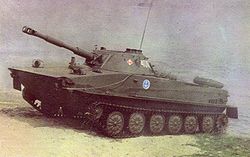
Many tracked armored vehicles that are primarily intended for land-use, such as armoured fighting vehicles and armoured personnel carriers nevertheless also have amphibious ability, tactically useful inland, reducing dependence on destroyable and easily targeted bridges. To provide motive power, they use their tracks, sometimes with an added propeller or water jets. As long as the opposite bank has a shallow enough slope for the vehicle to climb out within a few miles, they can cross rivers and water obstacles. An American example is the M113 Armored Personnel Carrier. Soviet examples are the PT-76 amphibious tank, and the BTR-50 and MT-LB APCs based on its chassis.

Some heavier tanks have an amphibious mode in which a fabric skirt is needed to add buoyancy. The Sherman DD tank used in the D-Day invasion had this setup. When in water the waterproof float screen was raised and propellers deployed. The M2 and M3 Bradleys also need such a skirt.

Tanks

[edit]
Amphibious Tank

At the end of World War I a Mark IX tank had drums attached to the side and front and was tested as an amphibious vehicle launched into Hendon Reservoir.[24] A modified Medium Mark D successfully swam in a river near Christchurch.[25]

By the early 1930s, Vickers had developed an amphibious tank. By using very thin armour, flotation could be achieved without external buoyancy aids. The British Army trialled the Vickers-Carden-Loyd Light Amphibious Tank but did not adopt it for service use. An order was placed with Vickers by the USSR for a small number of tanks. After negotiations to purchase the Vickers tank by Poland failed, they developed their own design the PZInż 130 but dropped the idea of amphibious tanks as obsolete. A pontoon based tank, the L1E3, was produced by Vickers in 1939.[26] It was tested but further work was halted during WW2.[26] It was tested again at the end of the war.[26]

In World War II the British further developed amphibious tanks. The Crusader was trialled with two pontoons that could be attached or removed, the tracks driving the tank in the water. The "Medium Tank A/T 1" was a tank with inbuilt buoyancy some 24 ft (7.3 m) long and 11 ft (3.4 m) tall. The Valentine, then the M4 Sherman medium tank were made amphibious with the addition of a rubberized canvas screen to provide additional buoyancy and propellers driven by the main engine to give propulsion. These were DD tanks (from "Duplex Drive") and the Sherman DD was used on D-Day to provide close fire support on the beaches during the initial landings. The Sherman DD could not fire when afloat as the buoyancy screen was higher than the gun. A number swamped and sank in the operation, due to rough weather in the English Channel (with some tanks having been launched too far out), and to turning in the current to converge on a specific point on the battlefield, which allowed waves to breach over the screens. Those making it ashore, however, provided essential fire support in the first critical hours.

Before World War II, The Soviets produced light amphibious tanks called the T-37A and T-38. A third serial model, the T-40, started production after the beginning of the war. A 14-ton tank, the PT-1, was created but was not mass-produced. In addition, an attempt was made to attach pontoons to the T-26. While successful, the project was closed due to the high vulnerability and unwieldiness of the construction.

Some light tanks such as the PT-76 are amphibious, typically being propelled in the water by hydrojets or by their tracks. In 1969, the U.S. Army rushed the new M551 Sheridan to Vietnam. This 17-ton light tank was built with an aluminium hull, steel turret, and the 152 mm "gun-launcher" (which could fire the MGM-51 Shillelagh missile), and could swim across bodies of water. The M551 upon arrival in Vietnam began replacing the M48A3 Patton in all cavalry squadrons, leaving only the M48A3 in the U.S. Army's three armored battalions in Vietnam, the 1/77th, 1/69th, and the 2/34th Armor. The Sheridan needed no modifications for river crossings: crewmen simply raised the cloth sides that were tucked inside rubber tubes along the hull's upper edges, raised the driver's front shield which had an acrylic glass window, the driver turned on his bilge pumps, shifted his transmission lever to water operations and the Sheridan entered the water. For newly arrived Sheridans, this might work as engineered. For "war-weary" M551s, the driver's window was often "yellowed" or cracked as to obscure his vision, and the rubber tubes that contained the rolled up side sleeves were often cracked or frozen into place. The Sheridan could still cross a body of water, but like its swimming cousin, the M113 armoured personnel carrier, also built of aluminium, the river had to be narrow, less than 100 yards (100 m). In all cases, the bilge pumps had to be working properly, and even then by the time the Sheridan or the APC reached the other side, water would often fill the insides up to their armoured roofs, spilling through the hatches' cracks and emptying onto the earth once safely ashore. Often a fold-down trim vane is erected to stop water washing over the bow of the tank and thus reducing the risk of the vehicle being swamped via the driver's hatch.

During the Cold War, the Swedish Stridsvagn 103 main battle tank carried flotation gear all the time and was, therefore, theoretically, always amphibious.

Multi-unit

[edit]
Hagglunds Bv206 in US military service as M-973 SUSV (small unit support vehicle)

According to a 1999 article in Military Parade magazine,[27] multi-unit, all-terrain transport vehicles were first proposed by the British in 1913, and by the 1950s, over 40 types of articulated tracked vehicles (ATV) were in production. The articulated tracked concept is chosen primarily for its combination of high maneuverability, cross-country abilities, and load-carrying capacity. In some cases the design is made amphibious, giving them all-terrain capability in the truest sense. Usually, the front unit houses at least the engine, gearboxes, fuel tank(s) and the driver's compartment, and perhaps there is some space left for cargo or passengers, whereas the rear unit is the primary load carrier.

Examples of this concept are the Russian Vityaz, Swedish Volvo Bv202 and Hagglunds Bv206 designs, and the Bronco All Terrain Tracked Carrier of Singapore.

A highly specialised development is the ARKTOS Craft, that uses a linkage with two joints to connect the two units and each unit having independent drive systems, giving enhanced mobility and redundancy. They are capable of climbing large ice steps from open water.[28]

Deep fording

[edit]
German Leopard 2A4 with turret snorkel, 2010

Some military vehicles are capable of "wading" using waterproof screens to keep the upper hull dry. In World War II the tanks following the Sherman DDs were given waterproofed hulls and trunking was fixed to the engine intakes and exhausts to allow them to come ashore from landing craft in shallow water. The Germans gave their Tiger tank a long snorkel, essentially a long tube on the commander's hatch that allowed it to wade through four metres of water.

The Leopard 2 tank can use a series of rings to create a long tube. This tube is then fitted to the crew commander's hatch and provides air and an escape route for the crew. The height of the tube is limited to around three meters.

The Russian T-90 tank is also able to perform deep fording operations. The Russian snorkel is only a few inches around and does not provide a crew escape path, but it can be stored on the tank.

Some civilian deep wading vehicles achieve their capability by means of legs or stilts to raise the body of the vehicle from its wheels. One example is the sea tractor, a motor vehicle that can travel through shallow water, with driver and passengers on a raised platform. Another is the Brighton and Rottingdean Seashore Electric Railway, a coastline railway that ran on submerged rails through the shallow coastal waters of the English Channel between 1896 and 1901.

Hovercraft

[edit]
BHC SR.N4 Mk.3, a large civilian hovercraft

An air-cushion vehicle (ACV) or hovercraft can travel over land or water supported by a cushion of air ejected downwards against the surface below it.[29] In principle, a hovercraft can travel over any sufficiently smooth surface: solid, liquid, mixed, or anything in between. Large hovercraft, riding on an air-cushion contained by skirts several meters tall, can deal with obstacles 1 to 2 meters in height. The smallest personal hovercraft are nimble enough to follow some rolling of the terrain.

One of the benefits of this type of amphibious craft is the possibility of making them large – the British-built SR.N4 Mk.3 ferries could carry dozens of vehicles. ACVs have a high speed over water (an SR.N4 Mk.1 could do 83 knots (95 mph or 154 km/h)) and can make the transition between land and water at speed – unlike most wheeled or tracked amphibians. Drawbacks are high fuel consumption and noise levels.

For some military applications wheeled and tracked amphibious vehicles are slowly being supplanted by air-cushioned landing craft. The hovercraft's ability to distribute its laden weight evenly across the surface below it makes it well suited to the role of amphibious landing craft. The US Navy LCAC can take troops and materials (if necessary an M1 Abrams tank) from ship to shore and can access more than 70% of the world's coastline, as opposed to conventional landing craft, which are only capable of landing along 17% of that coastline.

In media

[edit]

The BBC television series Top Gear has, on several occasions, used amphibious vehicles as the basis for challenges. In S08E03, Clarkson, Hammond and May competed to see who could build the best amphibious car, starting with a used vehicle of their choice. Clarkson used a Toyota Hilux, which he nicknamed the "Toybota", and powered it with a large outboard motor. Hammond used a Volkswagen Vanagon, which he combined with a boat hull to build a drivable cabin cruiser called the "Dampervan". May started with a Triumph Herald and fitted it with a sail. During the challenge, which was to drive across a reservoir, the Toybota made it almost all the way to the end before capsizing, the Dampervan immediately sank, and the Triumph was the only vehicle to complete the trip, although it took a very long time to do so.

The show returned to the concept in S10E02, when the presenters built updated versions of their designs with lessons learned from the first time. Clarkson built his "Nissank" out of a Nissan Hardbody, the overall design being very similar to the Toybota, but now with oil drums as stabilizers. Hammond built a near-identical Dampervan, which had many of the same problems as its predecessor. May used the same actual vehicle as before, with only minor improvements (including a retractable daggerboard). The challenge was to drive the cars across the English Channel. Hammond's vessel sank shortly after departing, and May's couldn't depart due to bad winds (and was "damaged beyond repair" in the attempt, although still seemingly afloat), and as such all three presenters ended up making the trip aboard Clarkson's vehicle. Along the way, they attempted to beat Richard Branson's world record for crossing the channel in an amphibious vehicle, but failed. The pickup truck successfully crossed the channel and landed in France, although they ended up in Sangatte instead of Calais, their intended destination.

Top Gear USA featured a very similar challenge in S04E06. Their vehicles were a Volkswagen Golf, which Rutledge Wood combined with a Sea Ray boat; a Jeep Wrangler YJ, which Adam Ferrara turned into an airboat; and a Plymouth Conquest, which Tanner Foust turned into a speedboat called the "Turboat". In the initial tests, the VW had issues on both water and land, the Jeep worked well on water but not on land (the airboat motor left him stranded on the highway), and the Turboat performed well on land but sank immediately in the water. The Jeep sank as well after Foust and Ferrara got into an impromptu sea battle. All three presenters then attempted to cross Lake Ontario in the VW. Foust abandoned the trip halfway through, being picked up by a friend's yacht. Wood and Ferrara made it to the Canadian border, but were turned away because they did not bring passports.

See also

[edit]

References

[edit]

Further reading

[edit]
[edit]
Revisions and contributorsEdit on WikipediaRead on Wikipedia
from Grokipedia
An amphibious vehicle is a self-propelled craft designed to operate on both and , combining automotive and marine features such as a watertight hull, dual-mode systems, and adaptable suspension or tracks to enable transition between terrestrial and aquatic environments. These vehicles typically transport personnel, , or , with designs optimized for mobility in diverse terrains including highways, beaches, reefs, rivers, and open . Essential components include aids like sealed compartments, propellers or jets for , and rudders or wheels for in both mediums, ensuring stability and under varying loads and conditions. The development of amphibious vehicles gained momentum in the early 20th century through experimental designs, but World War II marked a pivotal era of rapid innovation driven by the need for effective ship-to-shore logistics and assaults in the Pacific Theater. Pioneering models included the DUKW, a 2.5-ton wheeled amphibious truck introduced by the U.S. Army in 1942, derived from the GMC 6x6 chassis with a capacity for 5,000 pounds of payload, 50 mph on land, and 6.2 mph in water; over 21,000 units were produced for logistics support across rivers and beaches. Simultaneously, the Landing Vehicle Tracked (LVT) series emerged, starting with the unarmored LVT-1 in 1941—based on Donald Roebling's "Alligator" flood-rescue vehicle from 1935—for troop transport over coral reefs, evolving to armored variants like the LVT(A)-4 by 1944 equipped with 75mm howitzers for fire support. These vehicles proved critical in operations such as the Tarawa landing in November 1943, where 125 LVTs were deployed despite high casualties due to reef obstacles, and the larger Okinawa assault in April 1945, involving hundreds of armored LVTs that refined tactics for amphibious power projection. Post-war advancements continued with the LARC (Lighter, Amphibious Resupply, Cargo) family in the 1960s, including the 5-ton LARC-V and 15-ton LARC-XV, used in Vietnam for logistic-over-the-shore operations. Amphibious vehicles encompass several types distinguished by propulsion and configuration to suit specific operational demands. Wheeled variants, like the DUKW and LARC series, prioritize road compatibility with rubber tires and propeller tunnels for water efficiency, achieving ground pressures of 13-21 psi and water speeds up to 8.6 mph while handling payloads from 2.5 to 60 tons. Tracked models, such as the LVT lineage evolving into the AAV-7 (retired in 2025 after entering service in the 1970s with a 400-horsepower engine and armament including M2 machine guns), offer superior traction on soft terrain and surf, with modern iterations like China's ZBD-05 (2000s) providing infantry fighting capabilities at 65 km/h on land and 25 km/h in water. Hovercraft types, exemplified by the U.S. Navy's LCAC (Landing Craft Air Cushion), use air cushions for high-speed (up to 50 knots) over-water transit of 60-ton loads, bypassing beach obstacles. Experimental high-speed designs in the 1950s-1960s, including hydrofoil prototypes like the LVW-X1 (35 knots with gas turbines), explored enhanced velocities but were limited by complexity and cargo trade-offs. In military applications, amphibious vehicles enable operational maneuver from the sea, supporting Marine Corps tenets like ship-to-objective movement in littoral zones, as seen in WWII Pacific campaigns and ongoing developments like the U.S. Amphibious Combat Vehicle (ACV) program, which began fielding in 2020 with over 200 units delivered as of 2025, 105 km/h land speeds, 13 km/h water speeds, and integrated reconnaissance for enhanced survivability. Civilian uses include converted military surplus for tourism—such as DUKW-based "duck tours" carrying passengers on land and water—and search-and-rescue operations, where wheeled and tracked amphibious vehicles aid in shallow-water recovery and damage assessment. Industrial variants, like marsh buggies, facilitate wetland transport for construction and environmental work, while regulatory definitions in the U.S. classify them as dual-use vehicles for highway and waterway compliance.

Definition and Principles

Technical Fundamentals

An amphibious vehicle is defined as a self-propelled ground-based transport system engineered for viable operation on both terrestrial and aquatic surfaces, distinguishing it from dedicated watercraft or aircraft by its primary reliance on wheeled or tracked locomotion for land mobility. These vehicles integrate structural and mechanical elements to ensure seamless functionality across environments, typically incorporating a watertight hull for flotation and dual propulsion mechanisms for movement. Buoyancy in amphibious vehicles adheres to , which states that the upward buoyant force on a submerged or partially submerged object equals the weight of the fluid displaced by that object, enabling flotation when this force balances or exceeds the vehicle's weight. For equilibrium, the vehicle's total displacement volume VV must satisfy V=WρgV = \frac{W}{\rho g}, where WW is the vehicle's weight, ρ\rho is the water density (approximately 1000 kg/m³ for freshwater or 1025 kg/m³ for ), and gg is (9.81 m/s²); this ensures the displaced water weight matches the gross vehicle weight (GVW). In practice, hull volume calculations often employ the block coefficient CBC_B for displacement estimation: Δ=ρ×CB×L×B×Hmean\Delta = \rho \times C_B \times L \times B \times H_{mean}, with LL, BB, and HmeanH_{mean} representing length, beam, and mean draft, respectively; wheeled designs have CBC_B values such as ≈0.45 for the (due to wheel wells increasing drag and reducing hydrodynamic ) and ≈0.62 for more streamlined designs like the . Stability during flotation is further governed by the metacenter (M) position relative to the center of gravity (G), where roll and pitch stability require the metacentric radius BM > BG to ensure positive GM > 0. Propulsion systems in amphibious vehicles employ dual-mode configurations to accommodate land and operations, utilizing a shared power plant—such as internal combustion engines or gas turbines—that distributes via a to either wheeled/tracked drivetrains for terrestrial or marine propulsors for aquatic movement. Modern designs increasingly incorporate electric or hybrid systems for enhanced and reduced emissions. On , rubber-tired wheels or tracks provide traction, while commonly integrates extendable screw propellers (e.g., 0.9 m diameter, tunnel-mounted for protection) or jets, with the latter offering advantages in shallow drafts by drawing and expelling through nozzles for without exposed appendages. integration often features electric or mechanical couplings, such as AC induction motors (92% ) geared to jets at ratios like 7:1, enabling delivered horsepower (DHP) calculated as DHP=RT×V550×ηpDHP = \frac{RT \times V}{550 \times \eta_p}, where RTRT is total resistance, VV is speed, and ηp\eta_p is propulsor (typically 80-95% for optimized systems); this setup allows a single prime mover (e.g., 300-1500 BHP) to support both modes without mode-specific engines. Transition mechanics from land to water mode involve controlled deceleration and activation of aquatic propulsion to maintain while minimizing hydrodynamic shock, typically executed at controlled low speeds in calm conditions to prevent hull damage or from wave impact. Procedures include engaging water propulsors (e.g., propellers at 10-15° inlet angles for uniform inflow) while reducing , with stability enhanced by adjusting the center of gravity downward (e.g., via or suspension) to achieve a of at least 0.5 m and freeboard preservation; in transitional regimes ( 1.0-3.0), vehicles shift from displacement to semi-planing modes around 20 km/h, requiring coordinated steering via rudders and wheels to counter currents up to 2-3 knots. Key performance metrics for amphibious vehicles include freeboard height, which represents the vertical distance from the to the (typically 0.25-0.9 m, e.g., 0.6 m forward and 0.24 m amidships in representative designs) to prevent swamping in waves up to 0.3 m; wading depth, denoting operational submersion limits, ranges from shallow fording (0.9-1.2 m) to full flotation drafts of 0.9-1.8 m without loss; and capacity, which sustains 2-60 tons across environments while maintaining margins of 10-20% above GVW for safety in rough water. These metrics ensure dual-environment viability, with often limited to 20-50% of total displacement to preserve stability and speed (e.g., 5-10 tons for mid-sized vehicles at 8-16 km/h water speeds).

Design Considerations

Amphibious vehicles require specialized materials to withstand prolonged exposure to corrosive environments, including saltwater and freshwater. Hulls are often constructed from corrosion-resistant alloys such as aluminum 5083, valued for its superior ballistic properties and ease of fabrication. Fiberglass-reinforced polymers or epoxy E-glass laminates are commonly used for lightweight, buoyant upper hull structures that resist degradation. techniques, including sealed compartments formed with or rubber gaskets and glue, ensure watertight integrity across multiple chambers to prevent flooding during transitions between land and water. Performance in amphibious vehicles involves inherent trade-offs between and capabilities, as designs optimized for one medium compromise the other. On , vehicles achieve speeds comparable to standard off-road models, but wheeled configurations experience significant hydrodynamic drag in , limiting top speeds to approximately 10-15 km/h in traditional displacement modes. Dual propulsion systems, necessary for seamless operation across environments, impose penalties, with tracked variants consuming more fuel overall than wheeled equivalents due to increased mechanical complexity and resistance. Safety features are critical to mitigate risks during water operations, where flooding can occur rapidly due to limited reserve . Bilge pumps are essential for removing accumulated water, though failures in these systems have been identified as a common vulnerability in military amphibious vehicles. Flotation aids, such as emergency inflatable devices, provide additional in case of hull breaches. Emergency egress systems, including operable lighting and hatches, facilitate rapid occupant evacuation, as studied in assessments of assault amphibious vehicles. Regulatory standards, such as those under U.S. Title 46 CFR Subchapter T, govern amphibious passenger vessels to ensure and system reliability. Environmental adaptations enhance versatility across diverse terrains, including , , and aquatic conditions. Low-pressure tires, often 8-ply and ultra-low ground pressure designs, improve traction and flotation in soft substrates like and by distributing weight over a larger surface area. and reduction during water operations is achieved through resilient mounts and treatments on components, minimizing structural transmission and acoustic emissions. Manufacturing costs for amphibious vehicles are substantially higher than those for standard vehicles, often 3-4 times greater for recreational models due to specialized dual-function components and engineering requirements. This premium arises from the need for dual certification as both road-legal automobiles and maritime vessels, involving compliance with automotive and nautical regulations to enable registration and insurance under unified policies.

History

Early Developments

The earliest concepts for amphibious vehicles emerged in the late , primarily as human-powered carriages designed for crossing rivers and streams during civilian travel or exploration. English mechanical engineer Sir Samuel Bentham proposed an amphibious carriage in 1781 while working in , envisioning a wheeled boat-like structure that could transition from land to water and be propelled by oars or sails for short aquatic crossings. This design addressed the need for versatile transport in regions with frequent waterways, though no full-scale prototype was documented as operational during Bentham's lifetime. A significant breakthrough occurred in the early with the construction of the first self-propelled amphibious vehicle by American inventor . Completed in , the Orukter Amphibolos (Greek for "amphibious digger") was a 30-foot-long, 17-ton steam-powered dredger equipped with paddle wheels for water propulsion and large iron wheels for land travel. Evans demonstrated it successfully on the streets of before launching it into the , where it operated as a to scoop mud from the waterway bed. Intended for practical in urban and riverine environments, this prototype highlighted the potential of steam power for dual-mode mobility but was limited to a single demonstration due to its immense weight and the era's rudimentary engine technology. These early inventions faced substantial challenges, including inadequate sealing against water ingress, unreliable that struggled with the added weight of watertight hulls, and difficulties in transitioning between terrains without manual intervention. Initial failures, such as vehicles sinking or stalling in shallow water, stemmed from poor material durability and the lack of effective controls, often confining prototypes to controlled tests rather than widespread use. Evans' Orukter Amphibolos, for instance, required extensive manual adjustments to shift from land to water mode, underscoring the engineering hurdles of integrating robust land chassis with buoyant, hydrodynamic forms. The principle inspired later off-road propulsion experiments in the early for traversing difficult terrains like mud and snow, offering a foundation for amphibious mobility in remote expeditions. Although practical land-based screw vehicles remained prototypes until the early , they influenced adaptations for harsh environments. The late saw growing interest from naval engineers, whose experiments with steam-powered launches and multi-purpose hulls began to inform land vehicle designs, paving the way for broader civilian and eventual military applications as internal combustion engines emerged.

World War II Innovations

During , the demand for rapid troop and supply movement across beaches and rivers drove major advancements in amphibious vehicle technology, particularly for Allied and Axis forces engaged in large-scale invasions. The pioneered several key models to support global amphibious operations. The , nicknamed the "Duck," was a 6x6 wheeled amphibious developed in 1941 and entering production in 1942 by , based on the GMC CCKW chassis with a waterproof hull designed by naval architect Rod Stephens Jr.. Capable of transporting 2.5 tons of cargo or up to 24 troops on land at speeds up to 50 mph and in water at 6 mph, over 21,147 units were manufactured by 1945, with approximately 4,000 supplied to Allies via .. This vehicle's versatility allowed it to ferry ammunition, equipment, and personnel directly from ships to inland depots, revolutionizing logistical support in contested environments. Complementing the DUKW, the U.S. introduced the LVT-1 "Alligator," a tracked amphibious carrier developed in 1940-1941 by the Food Machinery Corporation as a militarized version of Donald Roebling's civilian swamp . Weighing approximately 13,200 pounds empty with a 120-horsepower engine, it achieved 12 mph on land and 7 mph in water, featuring an open-top for carrying 16 troops or 4,500 pounds of cargo without armor. Initial production reached 200 units by 1941, expanding to thousands across variants for the Pacific theater's coral reefs and rough terrain.. The LVT-1's tracks provided superior traction over soft sand and obstacles compared to wheeled s, making it essential for island assaults. British innovations focused on cargo and personnel transport to supplement American supplies. The Mk I, designed in 1942 by John I. Thornycroft & Co. and produced from 1943 by Morris Commercial Cars, was an 8x8 wheeled amphibious truck with twin Ford V8 engines delivering 190 horsepower total. It carried 4 tons of payload at 15 mph on land or 5 mph in water, with 500 units built for operations like the 1944 , where it supported Royal Engineer teams in flooded areas.. Experimental efforts included tracked personnel carriers, though many remained prototypes due to resource constraints and reliance on vehicles. Axis powers developed lighter amphibious vehicles for reconnaissance and limited assaults. Germany's Type 166 Schwimmwagen, prototyped in 1940 and produced from 1942, was a 4x4 light utility car with a watertight steel hull and retractable , powered by a 1,131 cc air-cooled producing 25 horsepower for 50 mph on land and 6 mph in water. Over 14,276 units were built, serving and units on both Eastern and Western fronts for scouting rivers and canals.. Japan pursued amphibious tanks, with the Type 1 Mi-Sha (also known as the initial Ka-Mi prototype) developed in 1941-1942 by the on the chassis, featuring detachable pontoons for swimming; only prototypes were completed before evolving into the production .. Italian efforts yielded few operational prototypes, limited by industrial priorities. These vehicles proved decisive in major WWII operations, enhancing tactical mobility and reducing logistical vulnerabilities. During the on June 6, 1944, approximately 2,000 DUKWs delivered over 3 million tons of supplies in the first 90 days, forming the backbone of beach cargo transport and enabling sustained Allied advances inland.. In the Pacific, LVT-1s were instrumental at the in November 1943, where 125 units ferried Marines across a 700-yard under fire—the only means to reach the shore in force—allowing the to secure the atoll after three days of intense fighting, despite heavy losses with many vehicles disabled.. By minimizing reliance on vulnerable landing craft and exposed beachheads, these innovations streamlined resupply, potentially saving thousands of lives through faster evacuation of wounded and reduced exposure to enemy fire.. The WWII amphibious vehicle designs left a lasting legacy, influencing Cold War-era developments like the U.S. Army's XM157 Drake, an 8x8 truck scaling up the DUKW's concept for 20,000-pound payloads, and the LARC series of vehicles that remained in service into the late .. High production volumes, such as the DUKW's 21,000+ units, demonstrated scalable manufacturing for amphibious , shaping and doctrines for rapid deployment across water barriers..

Post-War and Modern Advancements

Following , amphibious vehicle development accelerated during the to address diverse operational needs in varied terrains. The U.S. military continued utilizing the M29C Weasel, an amphibious variant of the WWII-era tracked vehicle, in Arctic and cold-weather operations through the 1950s, with surplus units supporting allied forces until its retirement around 1958. In the , the PTS series of tracked amphibious transporters emerged in the mid-1960s as a replacement for earlier models like the K-61, offering improved payload capacity of up to 5 tons and water speeds around 6 knots for logistics in riverine and wetland environments. The introduced the in the 1960s, a 6x6 high-mobility wheeled vehicle capable of carrying 5-ton loads across extreme terrain and inland waters at speeds up to 8 knots, emphasizing load-carrying efficiency for rapid deployment. By the 1970s and into the 1980s, military designs focused on enhanced survivability and versatility, exemplified by the U.S. Marine Corps' (AAV-7), which entered service in 1973 and could transport 25 Marines at water speeds of 7 knots while providing armored protection. Upgrades in the 2010s under the AAV Survival Upgrade (AAV SU) program added improved armor, suspension, blast-mitigating seats, and external fuel tanks to extend service life and enhance crew safety amid evolving threats. The AAV-7 was retired from active service in October 2025 after over 50 years. On the civilian side, the Gibbs Aquada, launched in 2004, represented a breakthrough in high-speed amphibious personal transport, achieving over 100 mph on land and more than 30 mph on water through innovative retractable wheels and a system, earning it recognition as a pioneering high-speed . Entering the , innovations emphasized and to meet modern and environmental demands. Prototypes in the 2020s incorporated electric and hybrid systems, such as the WaterCar EV (2025 model), a hybrid with electric on land for quiet operation and a gas outboard on , enabling seamless transitions. In contexts, the U.S. Marine Corps' (ACV) achieved initial operational capability in 2020, featuring autonomous navigation aids and reaching a maximum speed of 6 knots, designed as a wheeled replacement for the AAV-7 with improved modularity for command, recovery, and logistics roles; over 250 units have been fielded as of 2025. Civilian advancements paralleled these trends, blending luxury with practicality. The WaterCar Panther, introduced in 2013, offered a design with a 3.7-liter engine, attaining 55 mph on land and 44 mph on water for up to four passengers, targeting recreational users seeking versatile water-accessible transport. Modern all-terrain vehicles like the Polaris Ranger have seen aftermarket adaptations, including track conversion kits compatible with 2024 models, enhancing amphibious capability for off-road and shallow-water traversal in utility applications. By 2025, amphibious vehicles have increasingly adapted to climate-driven challenges, particularly flood rescue operations. Marsh buggies, such as those produced by specialized manufacturers, provide rapid access in flooded wetlands and debris-strewn areas, supporting response teams with payloads for personnel evacuation and supply delivery. The global market for these vehicles reached approximately $4.0 billion in 2024, reflecting growing demand in , commercial, and disaster-response sectors amid rising flood risks.

Wheeled Amphibious Vehicles

Unarmored Variants

Unarmored wheeled amphibious vehicles are primarily designed for logistics, rescue operations, and exploration in challenging environments such as mud, swamps, and water, prioritizing mobility, payload capacity, and road compatibility over protective armor. These vehicles typically feature multi-axle configurations (4x4 to 8x8) with low-pressure tires or buoyant hulls that enable flotation and propulsion in water via wheels, propellers, or water jets, achieving land speeds of 40-80 km/h and water speeds of 6-10 km/h depending on the model. A seminal example from is the , developed by the U.S. Army in as a 2.5-ton 6x6 carrier for ship-to-shore . Based on the GMC 6x6 with a watertight hull and for water propulsion, it offered a of 2,240 kg (5,000 lb), land speed of 80 km/h (50 mph), and water speed of 10 km/h (6.4 mph). Over 21,000 units were produced, supporting amphibious assaults in and the Pacific by ferrying supplies across beaches and rivers inaccessible to standard trucks. Another early design is the , known as the "Seep" (sea-going ), introduced in 1943 as a 4x4 amphibious light utility vehicle. Derived from the with added flotation and a , it had a of about 360 kg (800 lb), land speed of 97 km/h (60 mph), and water speed of 11 km/h (7 mph), fording depths up to 1.2 m. Approximately 12,778 were built for and supply transport in shallow waters, though limited by stability issues in rough seas. In the era, the (Lighter, Amphibious Resupply, Cargo-5 ton), introduced by the U.S. in , exemplifies heavy support with its 6x6 wheeled design. Powered by two Continental HD-143 212 hp diesel engines, it achieved 48 km/h (30 mph) on land and 13.9 km/h (7.5 knots) in water via propellers, carrying 4,536 kg (10,000 lb) or 23 personnel. Used in for over-the-shore resupply, over 300 units were produced before retirement in the 1990s. The larger LARC-XV (8x8 variant) handled 13,608 kg (30,000 lb) payloads at similar speeds for major logistic operations. Modern applications include civilian and utility vehicles like the Ukrainian Sherp N 1200, a 6x6 introduced in 2015 for rescue and exploration. With a 55 hp and super-low-pressure tires (0.2 bar), it reaches 40 km/h (25 mph) on land and 6 km/h (3.7 mph) in using propulsion, supporting 1,200 kg and up to 8 passengers. Deployed in disaster zones like floods and expeditions, its sealed hull allows submersion up to 0.5 m. Similarly, the Canadian Argo Frontier 8x8 series, available since the 1960s with updates into the 2020s, offers 35-50 hp engines for 40 km/h land and amphibious traversal at 8 km/h, with 450 kg cargo capacity for hunting, farming, and emergency response in wetlands. These vehicles have proven vital in disaster response, such as DUKW derivatives in urban flood rescues and Sherp units during 2022 European floods, navigating debris-filled waters to extract personnel where tracked vehicles struggle on roads. Their emphasis on simplicity, buoyancy, and multi-terrain tires ensures reliability for prolonged logistics and aid delivery.

Armored Variants

Armored variants of wheeled amphibious vehicles are designed primarily for combat roles, such as assaulting shorelines and providing fire support to infantry during amphibious operations. These vehicles incorporate protective armor plating, armament systems, and propulsion mechanisms suited for both land and water environments, typically using 8x8 configurations with water jets for seamless transitions from sea to beaches while engaging threats. Post-World War II developments emphasized wheeled designs for speed and logistics, evolving into modern infantry fighting vehicles (IFVs) and armored personnel carriers (APCs) that balance mobility, protection, and firepower. The Soviet , entering service in 1985, exemplifies early post-war wheeled amphibious APCs with its 8x8 layout and aluminum armor up to 10 mm thick, protecting against small arms and fragments. Powered by a 260 hp diesel, it achieves 80 km/h on roads and 10 km/h in water via a single water jet, carrying 3 crew plus 7 troops. Armed with a 14.5 mm KPVT and 7.62 mm PKT coaxial, it supported rapid river crossings and littoral maneuvers, with over 2,000 produced and exported widely. Contemporary Chinese developments, such as the ZBL-08 () IFV introduced in , feature advanced 8x8 wheeled amphibious capabilities for marine infantry. Equipped with a Deutz (around 440 hp), it reaches 105 km/h on land and 12 km/h in water using twin water jets. The vehicle has composite armor equivalent to 20 mm steel against kinetic rounds, a 30 mm ZPT-98 , HJ-73 anti-tank missiles, and capacity for 3 crew plus 7 troops. Part of the family, it enhances rapid assault tactics in island and riverine operations. In U.S. service, the (ACV), fielded starting in 2020, represents a modern 8x8 wheeled armored platform replacing the tracked AAV-7A1. With a 700 hp Cursor engine, it attains 105 km/h on roads and 11 km/h in water via water jets, carrying 3 crew plus 13 . Modular armor provides scalable protection (up to STANAG Level 4 equivalent), and variants include the ACV-P (personnel carrier with .50 cal M2 or 40 mm Mk 19) and ACV-30 (IFV with 30 mm Bushmaster cannon planned for 2026). As of 2025, over 100 units are operational, with 632 planned for enhanced survivability in distributed maritime operations, including counter-drone integration. These vehicles employ for 8-12 km/h in to approach shores quickly, while on wheeled handles rough terrain at up to 100 km/h. Armor typically combines aluminum and composites for 10-25 mm equivalent protection against small arms and RPGs, maintaining under load. Historical uses include BTR-80s in Afghan river assaults (1980s) and ACV prototypes in Pacific exercises (2020s), demonstrating over 90% operational success in amphibious insertions under fire.

Tracked Amphibious Vehicles

Unarmored Variants

Unarmored tracked amphibious vehicles are primarily designed for logistics, rescue operations, and exploration in challenging environments such as snow, mud, swamps, and water, prioritizing mobility and payload capacity over protective armor. These vehicles typically feature articulated or rigid designs with rubber or composite tracks that distribute weight evenly to minimize ground pressure, enabling traversal of soft terrain where wheeled alternatives falter. Propulsion in water is achieved through the tracks themselves or supplementary propellers, achieving speeds of 3-6 km/h, while land speeds can reach 50 km/h or more depending on the model. A seminal example from the mid-20th century is the , developed by during as a lightweight cargo carrier for and muddy conditions. Equipped with 15- to 20-inch-wide rubber tracks, it offered a payload capacity of approximately 1,200 pounds (544 kg) and could ford water depths up to its full flotation capability in the M29C variant, propelled by its tracks at around 5 km/h. The vehicle's low ground pressure, estimated at under 0.2 kg/cm², allowed it to navigate snow and swamps effectively, carrying supplies or personnel to areas inaccessible by standard trucks. Over 15,000 units were produced, influencing later utility designs for non-combat roles. In modern applications, vehicles like the Swedish Hägglunds BV206 (), introduced in the 1970s and still operational into the 2020s, exemplify advanced cargo transporters for polar and expeditionary logistics. This articulated, two-unit design uses 600 mm wide rubber tracks to achieve a ground pressure of 0.14 kg/cm², supporting a 2-ton across , , or while remaining fully amphibious with track at 3 km/h in water. Deployed in research and support missions, it can tow trailers or carry up to 17 personnel, highlighting its versatility in extreme environments without armor encumbrance. For rescue and utility purposes, tracked all-terrain vehicles (ATVs) have evolved to include features like winches and modular attachments for flood response. Equipped with options for or equipment transport, it supports emergency teams in flooded or muddy areas, building on earlier utility models. Similarly, the Marsh Master series, such as the MM-2MX, uses wide pontoon tracks for rescue and vegetation management, achieving flotation and speeds up to 10 km/h on land while maintaining pressures below 0.15 kg/cm². Agricultural and civilian applications feature unarmored tracked vehicles adapted for wetlands and over- operations. Amphibious tractors, such as those in the 30-50 HP range with 320 mm reinforced rubber tracks, enable farming in flooded paddies or peatlands by providing traction in up to 1 meter deep and low ground of 0.2-0.3 kg/cm², boosting in marginal terrains. The Canadian Bombardier MPV series from the 1990s, while primarily a multi-purpose , influenced civilian adaptations of tracked vehicles for amphibious use, with some variants incorporating auxiliary props for shallow crossing at 5 km/h. Emerging 2025 electric variants, like hybrid tracked carriers from manufacturers such as Pek Defence, offer zero-emission operation with advantages for quiet exploration in sensitive ecosystems, propelled in via electric track drives at 5-8 km/h. These vehicles have proven vital in , with tracked amphibious units deployed extensively during events like in 2012, where models similar to the BV206 and rescue ATVs facilitated hundreds of extractions in flooded urban and coastal areas by navigating debris and water obstacles that immobilized conventional fleets. Their design emphasis on , low-pressure tracks, and simple maintenance ensures reliability in prolonged operations, from in remote expeditions to rapid delivery.

Armored Variants

Armored variants of tracked amphibious vehicles are designed primarily for combat roles, such as assaulting shorelines and providing to during amphibious operations. These vehicles incorporate protective armor plating, armament systems, and propulsion mechanisms suited for both land and water environments, enabling them to transition seamlessly from to contested beaches while engaging positions. Early examples emerged during to address the need for direct fire support in island-hopping campaigns, evolving into modern fighting vehicles (IFVs) and assault platforms that balance mobility, protection, and lethality. The LVT(A)-4, developed during , exemplified early armored amphibious assault capabilities with its turret-mounted 75mm , allowing it to deliver indirect and direct fire against fortified positions like bunkers during landings such as . This vehicle featured an armored cab and hull for crew protection, propelled by tracks in water at speeds up to 12 km/h, and was produced in significant numbers for U.S. Marine Corps operations in the Pacific theater. In the post-war era, the U.S. Marine Corps' AAV-7A1, introduced in the early as an upgrade to the LVTP-7, serves as a personnel carrier and platform, armed with a 25mm Mk 44 Bushmaster and a 40mm in its combat variants. It achieves a water speed of 13 km/h using track propulsion and can transport a of three plus 25 troops, with aluminum armor providing protection equivalent to approximately 12-15mm of rolled homogeneous steel against and fragments. The AAV-7A1's enhances cross-country mobility on land at up to 72 km/h, making it suitable for rapid exploitation of beachheads. Soviet and Russian designs like the , entering service in the , prioritized lightweight and support with a 76.2mm D-56T rifled gun and twin hydrojets enabling a water speed of 10 km/h. Its thin steel armor, around 10-15mm thick, offered limited protection but allowed full amphibious operations without preparation, with a road speed of 44 km/h powered by a V-6 . The 's simple design facilitated mass production and export, influencing later concepts. Contemporary Chinese developments, such as the ZBD-05 (Type 05) IFV introduced in the , represent advanced armored amphibious technology with a 30mm , anti-tank guided missiles, and capacity for a of three plus seven to ten troops. Equipped with composite armor providing protection up to 20mm steel equivalent against kinetic threats, it uses twin hydrojets for high water speeds of 25 km/h—among the fastest for tracked amphibious vehicles—and reaches 65 km/h on land via a tracked suspension system optimized for rough terrain. This design supports rapid marine infantry assaults, integrating with China's expanding amphibious forces. These vehicles typically employ hydrojet propulsion for water operations, achieving speeds of up to 25 km/h in advanced modern variants like the ZBD-05 to evade coastal defenses, while track systems with handle uneven terrain and maintain stability during transitions. Armor configurations often combine , aluminum, or composites to balance and protection, with thicknesses equivalent to 15-25mm in key areas to withstand , artillery fragments, and light anti-tank weapons. Such features enhance survivability in contested environments, with historical operations demonstrating high success rates—often exceeding 80%—in executing amphibious landings under fire. In combat applications, LVTP-7 variants saw use by Argentine forces during the 1982 for initial invasions, transporting marines ashore and providing mobile fire support amid challenging terrain and weather. More recently, tanks have been reported as deployed by Russian forces in the conflict since 2022, leveraging their amphibious traits despite vulnerabilities to modern anti-tank systems.

Alternative Propulsion Systems

Screw-Propelled Vehicles

Screw-propelled vehicles employ large helical s, or augers, as their primary means of locomotion, rotating to displace soft substrates like , , , or and thereby generating forward thrust without the vehicle sinking into the terrain. This mechanism draws from the Archimedean , originally used for transport, but adapted here for traction: the screws' blades dig into and push against the medium, providing continuous displacement and in semi-fluid environments. Unlike wheeled or tracked systems, screw propulsion distributes the vehicle's weight across the broad surface of the rotating cylinders, enabling traversal of surfaces where traditional vehicles would bog down. Early practical implementations emerged in the with the Armstead Snow Motor in the , a device that converted tractors into single-pair screw vehicles capable of navigating deep snow at speeds up to 10 km/h. Soviet engineers advanced the technology during the , focusing on extreme environments; the , produced from 1975 to 1979, featured twin 1.8-meter-diameter screws powered by two 77-horsepower inline-four engines (totaling 154 horsepower), allowing it to reach 10 km/h on land and 6 km/h in water while carrying up to 1,500 kg. This model was specifically engineered for recovery operations, such as retrieving cosmonauts from remote Siberian landing sites after space missions. In the , the 1964 Chrysler Marsh Screw represented a military-oriented with dual screws for swamp traversal, achieving 8 km/h on mud and demonstrating seamless transitions between land and water. These vehicles have found niche applications in polar exploration and rugged terrain access, where the ZIL-2906 and its derivatives facilitated recovery operations in environments. More recently, restored and newly produced Russian screw vehicles, such as the 2017 Nizhny Novgorod plant models based on ZIL designs, have supported search-and-rescue in swampy disaster zones, including flood-affected regions; as of 2025, similar vehicles continue to be used for emergency response in extreme terrains. Tracked alternatives, while faster on firmer ground, often require additional flotation aids in deep mud, highlighting screw systems' unique displacement-based stability. The primary advantages of screw propulsion include exceptional performance in deep, unconsolidated substrates—such as bogs or powder snow—where the screws prevent sinking by continuously displacing material and providing inherent flotation, with payloads up to 2 tons in models like the series. However, drawbacks are significant: top speeds rarely exceed 8-10 km/h on land due to frictional losses in the screws, and the high torque demands result in elevated fuel consumption, often 50-100 liters per hour for diesel-powered units. Recent research has explored electric variants to mitigate noise and emissions; for instance, small-scale remotely operated screw-propelled vehicles incorporate battery-driven motors for quieter operation in research applications.

Air-Cushion and Hovercraft

Air-cushion vehicles, commonly known as hovercraft, operate by generating a cushion of pressurized air beneath the craft to reduce friction and enable travel over diverse surfaces such as water, land, mud, and ice. This technology typically employs powerful fans to force air into a plenum chamber or uses peripheral jets to inflate flexible skirts that trap the air, creating lift that supports the vehicle's weight. The skirts, often made of durable rubberized fabric, help maintain the cushion while allowing the craft to clear minor obstacles. In military applications, have been pivotal for rapid amphibious assaults. The U.S. Navy's experimental JEFF(A), developed in the by General, represented an early experimental effort with a 50-ton payload capacity and speeds up to 50 knots, designed for over-the-horizon troop and equipment delivery. Similarly, the Russian Zubr-class, introduced in the 1980s, is the world's largest hovercraft, capable of 60 knots while armed with anti-ship missiles and transporting up to 500 s or three tanks, enhancing naval strike capabilities in littoral zones. Civilian hovercraft have found roles in passenger and rescue operations. The , operated by since the 1960s, served as a cross-Solent in the UK, accommodating up to 38 passengers at speeds of around 65 knots for short-sea routes. In modern contexts, Neoteric's Hovertrek series, updated in the 2020s, supports search-and-rescue missions with 4- to 6-passenger models reaching 40 mph, offering maneuverability over flooded or icy terrains without traditional boat limitations. Performance characteristics of hovercraft include operational speeds of 50-100 km/h on calm , depending on size and load, with effective obstacle clearance of 0.5-1 meter provided by the air cushion height. However, stability diminishes in winds exceeding 20 knots, as gusts can disrupt the seal and increase fuel consumption. These vehicles excel in low-friction environments but require calm conditions for optimal efficiency. As of 2025, advancements in hybrid electric are addressing environmental and noise concerns in design, with projects integrating battery-assisted systems to reduce emissions and operational noise by up to 50% compared to traditional gas turbines, supporting sustainable applications in and commercial sectors.

Specialized Amphibious Vehicles

Deep-Fording Capabilities

Deep fording capabilities enable amphibious vehicles to temporarily submerge and cross obstacles exceeding 1 meter in depth, distinguishing them from shallow fording operations limited to 0.5-1 meter, where air intakes and critical components remain unsubmerged without preparation. These capabilities rely on specialized kits that incorporate snorkels to elevate air intake for engines and compartments, sealed engines and hull openings to prevent ingress, and extendable exhaust stacks to maintain above the surface. Unlike full flotation systems detailed in tracked vehicle sections, deep fording emphasizes short-duration traversal rather than sustained in . Installation of deep-fording kits typically requires 20-60 minutes of preparation by a crew, involving sealing hatches, electrical systems, and vents, as well as deploying snorkels and pumps; aids such as flotation screens or pontoons may be added to enhance stability and prevent during crossing. These systems impose strict limits, including no capability for prolonged submersion or , with operations confined to controlled speeds (often under 5 km/h) and immediate post-fording to drain and inspect components for . Exceeding these parameters risks engine hydro-locking or electrical . In military applications, deep fording supports tactical river crossings, as exemplified by the 1960s-era equipped with a deep-ford kit, allowing submersion up to 2.4 meters with 0.3 meters of freeboard above the waterline. Modern examples include the Leopard 2A7 , which uses a snorkel extension to ford rivers up to 4 meters deep while maintaining crew visibility through periscopes. During the 1991 , tanks routinely forded streams up to 1.2 meters deep without kits to advance through desert wadis and irrigation channels, demonstrating the feature's role in rapid maneuver without bridging support. Civilian parallels exist in off-road vehicles adapted with fording kits, such as the 2024 Ford F-150 Raptor, which achieves a maximum wading depth of 86 cm (34 inches) at speeds not exceeding 7 km/h, aided by raised air intakes and sealed underbody components to protect the during or stream crossings. These adaptations prioritize reliability in emergency or recreational use but require similar precautions as military systems to avoid warranty-voiding damage.

Multi-Unit Configurations

Multi-unit configurations in amphibious vehicles involve linking multiple self-propelled units to form temporary bridges, ferries, or rafts, enhancing stability and load-bearing capacity during water crossings. This approach dates back to , where articulated segments or linked vehicles were experimented with to create floating roadways; for instance, the German Seeschlange system consisted of hinged steel sections that could be assembled into a or bridge for amphibious landings. Modern iterations build on these principles with modular, powered units that can interlock rapidly without extensive preparation. Key examples include the U.S. and NATO-allied , introduced in the 1990s as an upgrade to earlier systems and based on a wheeled derived from designs, which links up to 8 units to span gaps of up to 100 meters or ferry loads exceeding 100 tons, such as main battle tanks. In contrast, the Russian MTU-72, a tracked armored vehicle-launched bridge system on a T-55 or hull, deploys a 20-meter aluminum span that can be extended to 30 meters by chaining multiple launches, supporting up to 50-ton vehicles across rivers or ditches. These configurations allow units to operate independently on land before assembling in water, providing versatility in dynamic environments. During the in the 1960s, multi-unit amphibious systems like pontoon and ribbon bridges were employed by U.S. forces to facilitate river crossings, with amphibious vehicles such as the M520 Goer supporting assembly and transport of bridge sections to enable troop and equipment movement in contested waterways. These operations often formed temporary ferries or spans up to several hundred meters, crucial for in jungle terrain with limited fixed infrastructure. The primary advantages of multi-unit setups include dramatically increased payload capacities—reaching 100 tons in ferry mode for systems like the M3—and the ability to disassemble for individual land mobility, reducing logistical footprints. In the 2020s, innovations have focused on enhanced modularity, with NATO's 2025 acquisition of additional M3 rigs under a €450 million contract to bolster river-crossing capabilities across allied forces. Experimental efforts at NATO's REPMUS 2025 exercises tested amphibious unmanned ground vehicles for over-the-shore roles, demonstrating sea-to-shore navigation capabilities. As of 2025, efforts continue to integrate unmanned systems into multi-unit configurations for enhanced autonomy in bridging operations.

Applications

Military Operations

Amphibious vehicles have played pivotal roles in military assaults, enabling forces to establish beachheads and cross water barriers under combat conditions. During the D-Day invasion of Normandy on June 6, 1944, more than 2,000 amphibious trucks were employed to transport thousands of soldiers, ammunition, and supplies directly from ships across the onto the invasion beaches, facilitating the rapid buildup of Allied forces despite challenging tidal conditions and enemy fire. In modern conflicts, such vehicles continue to support urban riverine operations; for instance, in the from onward, Ukrainian forces have utilized Soviet-era PTS-2 amphibious tractors to shuttle troops and equipment across the Dnipro River near , enabling crossings in contested urban environments amid ongoing artillery threats. In logistical support, amphibious vehicles have been essential for sustaining operations across water obstacles where fixed infrastructure is absent or destroyed. During the in the early 1950s, Landing Vehicles Tracked (LVTs), including variants like the LVT-4, served as a key component in over-the-shore resupply efforts, transporting and other critical supplies from landing ship tanks (LSTs) to beachheads during operations such as the Incheon landing in September 1950 and the Han River crossing later that month. These vehicles helped mitigate port bottlenecks, with units like the 56th Amphibious and Battalion using LVTs to deliver inland, supporting the 1st Marine Division's advances despite logistical strains from damaged roads and limited shipping. Military doctrines increasingly integrate amphibious vehicles into expeditionary frameworks to enhance littoral maneuverability. In U.S. Marine Corps doctrine, Marine Expeditionary Units (MEUs) incorporate approximately 15 Assault Amphibious Vehicles (AAVs) within the to enable ship-to-shore movements, raids, and combined-arms assaults as part of sea-based crisis response operations. standards emphasize multinational interoperability for littoral operations, as demonstrated in exercises like Trident Juncture 2018, where amphibious forces from member nations practiced brigade-level landings to counter hybrid threats; this focus has grown in the 2020s with an eye toward challenges, incorporating concepts like the U.S. Expeditionary Advanced Base Operations to address anti-access/area-denial environments. Despite their utility, amphibious vehicles face significant challenges in contested environments, particularly vulnerability during exposed transit phases. In the 1982 , British amphibious operations highlighted risks to and vehicles from air attacks and small arms, contributing to overall losses that underscored the need for enhanced air cover. Countermeasures such as smoke screens, rapid speed, and integrated fires have been adopted to mitigate threats from anti-tank guided missiles and artillery. As of 2025, global inventories reflect modernization efforts; the U.S. Marine Corps plans to acquire 632 Amphibious Combat Vehicles (ACVs) to replace aging AAVs, while China's fields the ZBD-05 family of amphibious infantry fighting vehicles as part of its expanding marine corps capabilities for potential littoral campaigns.

Civilian and Commercial Uses

Amphibious vehicles find extensive use in recreational and tourism sectors, particularly through guided tours that combine land and water travel. In cities like , operators such as Boston Duck Tours utilize modified II-era vehicles to transport over 500,000 passengers annually during the March-to-December season, providing narrated sightseeing experiences that highlight historical landmarks before transitioning to waterways. Similarly, the Original Wisconsin Ducks, with a fleet of 92 boats, attracted over 300,000 visitors each year (as of 2015), demonstrating the appeal of these vehicles for family-oriented outings in scenic areas. For personal recreation, amphibious all-terrain vehicles (ATVs) enable activities like in remote wetlands, where their ability to navigate mud, shallow , and rough terrain enhances accessibility without traditional boats. In commercial applications, amphibious vehicles support industries requiring operations in challenging environments, such as and . Marsh buggies, tracked amphibious excavators designed for soft terrain, are essential for maintaining waterways and building infrastructure in swamps and marshes, with the global marsh buggy dredger market valued at USD 687 million in 2024. In the United States, these vehicles facilitate projects in coastal regions, minimizing environmental disturbance while enabling efficient material transport. For oil and gas exploration, amphibious utility vehicles like the Fat Truck—an amphibious utility vehicle with enclosed cab options in pickup or wagon layouts, capable of transporting up to 16 passengers or 5,000 lbs of cargo across land and water, available in series like the 2.8 Pickup—and equipment from Wetland Equipment Company allow access to remote wetland sites, supporting maintenance and site preparation in areas like the Gulf Coast without extensive road building. Amphibious vehicles play a critical role in emergency response, particularly for rescues where conventional vehicles cannot operate. In the United States, agencies such as the County Sheriff's Office acquired amphibious vehicles in late 2023 specifically for water and ice rescues, capable of traversing flooded roads, marshes, and debris-laden waters to reach stranded individuals. These vehicles have been deployed in various U.S. events, providing rapid evacuation in scenarios involving high water levels and unstable ground. Additionally, tracked amphibious platforms aid in wetlands, such as during responses, by enabling low-impact traversal for sediment sampling and assessment without further damage. The civilian amphibious vehicle sector contributes to through and related services, with the U.S. market segment valued at USD 1.63 billion in 2024 as part of broader global demand. This industry supports employment in design, production, and maintenance, particularly in regions with economies like the Gulf Coast. Regulatory oversight ensures safe public use; the U.S. Coast Guard's and Vessel Inspection Circular (NVIC) 1-01 provides guidelines for certifying passenger-carrying amphibious vehicles under 46 CFR Subchapter T, emphasizing watertight integrity, stability, and lifesaving equipment for vessels under 100 gross tons. Looking ahead, autonomous amphibious vehicles are emerging for civilian applications, including search-and-rescue operations. In 2025, trends indicate increased adoption in , with unmanned ground like UGVs offering remote control for hazardous flood zones and environmental surveys. Prototypes such as Bayonet's autonomous amphibious crawlers support civilian tasks like habitat monitoring, capable of operating on and up to 300 meters underwater. Pilot programs in 2025 are testing these for non-military uses, enhancing efficiency in remote and dynamic environments.

Cultural Depictions

In Film and Literature

Amphibious vehicles have appeared in various films and literature as symbols of ingenuity and survival, often highlighting their dual land-water capabilities in tense narratives. World War II depictions frequently showcase amphibious vehicles in invasion sequences to convey the grit of amphibious assaults. Steven Spielberg's Saving Private Ryan (1998) includes DUKW beach scenes during the Normandy landings, where these six-wheeled trucks ferry troops and supplies from sea to shore amid intense gunfire, capturing the vulnerability and essential role of such craft in D-Day operations. Modern media often blends amphibious elements with speculative technology, sometimes at the expense of realism. In The Meg (2018), directed by Jon Turteltaub, high-tech submersibles with amphibious features allow divers to transition between deep-sea depths and surface vessels while evading a prehistoric megalodon, showcasing advanced engineering in underwater rescue missions. However, action films frequently exaggerate amphibious vehicle speeds and transitions, depicting seamless high-velocity shifts from land to water without hydrodynamic drag or stability issues, as seen in various chase sequences that prioritize spectacle over physics. These portrayals have exerted significant cultural influence, inspiring merchandise and deeper thematic explorations. The popularity of 1960s model kits, produced by companies like , reflected public fascination with WWII amphibious tech, leading to widespread hobbyist builds that romanticized military versatility.

In Video Games and Models

Amphibious vehicles have been a staple in video games since the early , particularly in military-themed titles where players can drive them in multiplayer modes. In the series, vehicles like the AAV-7A1 Amtrac appear as drivable amphibious assault vehicles capable of transitioning between land and water, as seen in where it seats up to six players and functions on both terrains. Similar tracked amphibians, such as the LVT in , allow for amphibious gameplay in historical Pacific theater maps, emphasizing multiplayer assaults. By 2025, the series continues this tradition with amphibious options in modes like Portal, supporting dynamic land-water maneuvers. In , prototypes like the T87 carriage and Sheridan are integrated as classes; while amphibious in real life, their in-game versions emphasize land mobility across terrains in team-based battles. Military simulations leverage amphibious vehicles for realistic training, especially in the 2020s with systems. The U.S. Marine Corps employs the ACV Driver Training System, a VR-based simulator developed by XR Training, to teach operators how to handle the during ship-to-shore transitions and operations, enhancing safety and proficiency without real-world risks. This immersive tool, integrated into curricula at the Assault Amphibian School since 2024, allows entry-level Marines to practice amphibious maneuvers repeatedly. On the civilian side, add-ons occasionally incorporate for amphibious scenarios, such as scenery packs for that feature operational at sites like Hovercraft Museum, enabling users to simulate cross-water transport in historical contexts. Hobbyist models of amphibious vehicles include detailed scale replicas and remote-controlled versions that replicate real designs. Tamiya's 1/35-scale kit, introduced in the but building on earlier 1970s-era modeling trends for WWII vehicles, provides builders with a precise representation of the GMC amphibious used in operations like the crossing. Italeri's complementary 1/35 kit, reissued since 2002, emphasizes the vehicle's welded hull and six-wheel-drive for authentic assembly. For remote-controlled models, electric amphibious ATVs inspired by the Quadski design are available in the $200 price range, offering dual-mode operation for land and water play with waterproof electronics and systems. These RC variants, often scaled at 1/14 or smaller, draw from full-size amphibious vehicles like the original Quadski for hobbyist experimentation. Gameplay mechanics for amphibious vehicles often involve dual controls to facilitate seamless land-to-water transitions, such as engaging propellers while disengaging wheel drive, as implemented in simulations and RC toys that switch modes via remote toggles. In titles like , balance adjustments have addressed amphibious vehicle performance, including nerfs to water speeds to prevent overpowered traversal in multiplayer maps, ensuring tactical depth over raw mobility. Community modding scenes amplify amphibious vehicle representation, particularly in , where 2024 expansions like the Creator DLC Expeditionary Forces introduce assets such as the AAV-9 Mack IFV and LCC-1 for enhanced scenarios. Mods like the Workshop's add eight-wheeled ACV models with crew capacities mirroring real U.S. Marine designs, fostering user-created missions. These efforts contribute educational value by immersing players in historical amphibious operations, such as WWII landings, promoting understanding of through interactive gameplay.

References

Add your contribution
Related Hubs
User Avatar
No comments yet.