Hubbry Logo
Four-wheel driveFour-wheel driveMain
Open search
Four-wheel drive
Community hub
Four-wheel drive
logo
8 pages, 0 posts
0 subscribers
Be the first to start a discussion here.
Four-wheel drive
Four-wheel drive
from Wikipedia

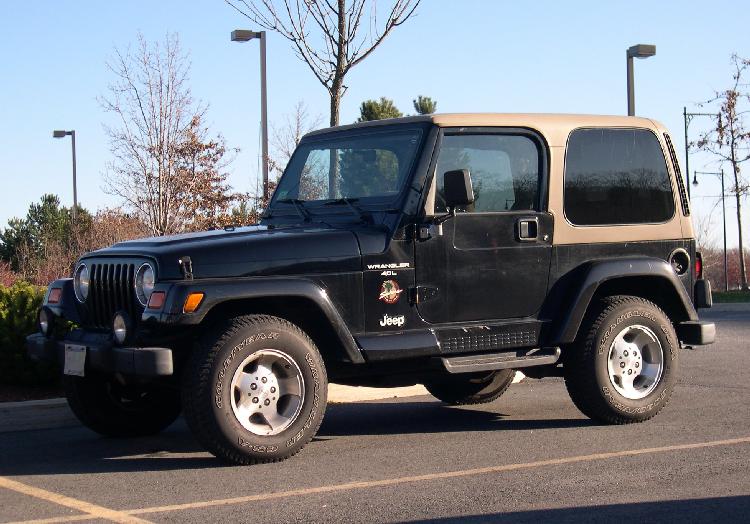
The Jeep Wrangler (pictured is a TJ Wrangler) is a 4WD vehicle with a transfer case to select low-range or high-range four-wheel drive.

A four-wheel drive, also called 4×4 ("four-by-four") or 4WD, is a two-axled vehicle drivetrain capable of providing torque to all of its wheels simultaneously. It may be full-time or on-demand, and is typically linked via a transfer case providing an additional output drive shaft and, in many instances, additional gear ranges.

A four-wheel drive vehicle with torque supplied to both axles is described as "all-wheel drive" (AWD). However, "four-wheel drive" typically refers to a set of specific components and functions, and intended off-road application, which generally complies with modern use of the terminology.[citation needed]

Definitions

[edit]

Four-wheel-drive systems were developed in many different markets and used in many different vehicle platforms. There is no universally accepted set of terminology that describes the various architectures and functions.[1] The terms used by various manufacturers often reflect marketing rather than engineering considerations or significant technical differences between systems.[2][3] SAE International's standard J1952 recommends only the term "all-wheel drive" with additional subclassifications that cover all types of AWD/4WD/4x4 systems found on production vehicles.[4]

4×4

[edit]

"Four-by-four" or "4×4" is frequently used to refer to a class of vehicles in general. Syntactically, the first figure indicates the total number of axle ends and the second indicates the number of axle ends that are powered. Accordingly, 4×2 means a four-wheel vehicle that transmits engine torque to only two axle ends: the front two in front-wheel drive or the rear two in rear-wheel drive.[5] Similarly, a 6×4 vehicle has three axles, two of which provide torque to two axle ends each. If this vehicle were a truck with dual rear wheels on two rear axles, so actually having ten wheels, its configuration would still be formulated as 6x4. During World War II, the U.S. military would typically use spaces and a capital 'X' – as "4 X 2" or "6 X 4".[6]

Center transfer case sending power from the transmission to the rear axle (right) and front axle (left)

4WD

[edit]

Four-wheel drive (4WD) refers to vehicles with two axles providing torque to four axle ends. In the North American market, the term generally refers to a system optimized for off-road driving conditions.[7] The term "4WD" is typically designated for vehicles equipped with a transfer case that switches between 2WD and 4WD operating modes, either manually or automatically.[8]

AWD

[edit]

All-wheel drive (AWD) was historically synonymous with "four-wheel drive" on four-wheeled vehicles, and six-wheel drive on 6×6s, and so on, being used in that fashion at least as early as the 1920s.[9][10] Today in North America, the term is applied to both heavy vehicles and light passenger vehicles. When referring to heavy vehicles, the term is increasingly applied to mean "permanent multiple-wheel drive" on 2×2, 4×4, 6×6, or 8×8 drive-train systems that include a differential between the front and rear drive shafts.[11] This is often coupled with some sort of antislip technology, increasingly hydraulics-based, that allows differentials to spin at different speeds, but still be capable of transferring the torque from a wheel with poor traction to one with better. Typical AWD systems work well on all surfaces, but are not intended for more extreme off-road use.[11] When used to describe AWD systems in light passenger vehicles, it refers to a system that applies torque to all four wheels (permanently or on-demand) or is targeted at improving on-road traction and performance (particularly in inclement conditions), rather than for off-road applications.[7]

Some all-wheel drive electric vehicles use one motor for each axle, thereby eliminating a mechanical differential between the front and rear axles. An example of this is the dual-motor variant of the Tesla Model S, which controls the torque distribution between its two motors electronically.[12]

[edit]

According to the SAE International standard J1952, AWD is the preferred term for all the systems described above. The standard subdivides AWD systems into three categories.[4]

Part-time AWD systems require driver intervention to couple and decouple the secondary axle from the primarily driven axle, and these systems do not have a center differential (or similar device). The definition notes that part-time systems may have a low range.

Full-time AWD systems drive both front and rear axles at all times via a center (interaxle) differential. The torque split of that differential may be fixed or variable depending on the type of center differential. This system can be used on any surface at any speed. The definition does not address the inclusion or exclusion of a low-range gear.

On-demand AWD systems drive the secondary axle via an active or passive coupling device or "by an independently powered drive system". The standard notes that in some cases, the secondary drive system may also provide the primary vehicle propulsion. An example is a hybrid AWD vehicle where the primary axle is driven by an internal combustion engine and the secondary axle is driven by an electric motor. When the internal combustion engine is shut off, the secondary, electrically driven axle is the only driven axle. On-demand systems function primarily with only one powered axle until torque is required by the second axle. At that point, either a passive or active coupling sends torque to the secondary axle.

In addition to the above primary classifications, the J1952 standard notes secondary classifications resulting in a total of eight systems, designated as:

  • Part-time nonsynchro
  • Part-time synchro
  • Full-time fixed torque
  • Full-time variable-torque passive
  • Full-time variable-torque active
  • On-demand synchro variable-torque passive
  • On-demand synchro variable-torque active
  • On-demand independently powered variable-torque active

Design

[edit]

Differentials

[edit]
The Lamborghini Murciélago has an AWD system that powers the front via a viscous coupling unit if the rear slips
The HMMWV is a 4WD/AWD that (continuously) powers all wheels evenly via a manually lockable center differential, and Torsen torque-sensing differentials both front and rear.

Two wheels fixed to the same axle (but on the opposite axle ends) need to turn at different speeds as a vehicle goes around a curve. The reason is that the wheel that is located on the inner side of the curve needs to travel less distance than the opposite wheel for the same duration of time. However, if both wheels are connected to the same axle driveshaft, they always have to spin at the same speed relative to each other. When going around a curve, this either forces one of the wheels to slip, if possible, to balance the apparent distance covered, or creates uncomfortable and mechanically stressful wheel hop. To prevent this, the wheels are allowed to turn at different speeds using a mechanical or hydraulic differential. This allows one driveshaft to independently drive two output shafts, axles that go from the differential to the wheel, at different speeds.

The differential does this by distributing angular force (in the form of torque) evenly, while distributing angular velocity (turning speed) such that the average for the two output shafts is equal to that of the differential ring gear. When powered, each axle requires a differential to distribute power between the left and right sides. When power is distributed to all four wheels, a third or 'center' differential can be used to distribute power between the front and rear axles.

The described system handles extremely well, as it is able to accommodate various forces of movement and distribute power evenly and smoothly, making slippage unlikely. Once it does slip, however, recovery is difficult. If the left front wheel of a 4WD vehicle slips on an icy patch of road, for instance, the slipping wheel spins faster than the other wheels due to the lower traction at that wheel. Since a differential applies equal torque to each half-shaft, power is reduced at the other wheels, even if they have good traction. This problem can happen in both 2WD and 4WD vehicles, whenever a driven wheel is placed on a surface with little traction or raised off the ground. The simplistic design works acceptably well for 2WD vehicles. It is much less acceptable for 4WD vehicles, because 4WD vehicles have twice as many wheels with which to lose traction, increasing the likelihood that it may happen. 4WD vehicles may also be more likely to drive on surfaces with reduced traction. However, since torque is divided between four wheels rather than two, each wheel receives roughly half the torque of a 2WD vehicle, reducing the potential for wheel slip.

To prevent slippage, some vehicles have controls for independently locking center, front, and rear differentials

Limiting slippage

[edit]

Many differentials have no way of limiting the amount of engine power that gets sent to their attached output shafts. As a result, if a tire loses traction on acceleration, either because of a low-traction situation (e.g., driving on gravel or ice) or the engine power overcomes available traction, the tire that is not slipping receives little or no power from the engine. In very low-traction situations, this can prevent the vehicle from moving at all. To overcome this, several designs of differentials can either limit the amount of slip (these are called 'limited-slip' differentials) or temporarily lock the two output shafts together to ensure that engine power reaches all driven wheels equally.

Locking differentials work by temporarily locking together a differential's output shafts, causing all wheels to turn at the same rate, providing torque in case of slippage. This is generally used for the center differential, which distributes power between the front and the rear axles. While a drivetrain that turns all wheels equally would normally fight the driver and cause handling problems, this is not a concern when wheels are slipping.

The two most common factory-installed locking differentials use either a computer-controlled multiplate clutch or viscous coupling unit to join the shafts, while other differentials are more commonly used on off-road vehicles generally use manually operated locking devices. In the multi-plate clutch, the vehicle's computer senses slippage and locks the shafts, causing a small jolt when it activates, which can disturb the driver or cause additional traction loss. In the viscous coupling differentials, the shear stress of high shaft speed differences causes a dilatant fluid in the differential to become solid, linking the two shafts. This design suffers from fluid degradation with age and from exponential locking behavior.[citation needed] Some designs use gearing to create a small rotational difference that hastens torque transfer.

A third approach to limiting slippage is taken by a Torsen differential, which allows the output shafts to receive different amounts of torque. This design does not provide for traction when one wheel is spinning freely, where no torque exists, but provides excellent handling in less extreme situations.[citation needed] A typical Torsen II differential can deliver up to twice as much torque to the high-traction side before traction is exceeded at the low-traction side.

A fairly recent innovation in automobiles is electronic traction control. It typically uses a vehicle's braking system to slow a spinning wheel. This forced slowing emulates the function of a limited-slip differential, and by using the brakes more aggressively to ensure wheels are being driven at the same speed, can also emulate a locking differential. This technique normally requires wheel sensors to detect when a wheel is slipping, and only activates when wheel slip is detected. Therefore, typically no mechanism exists to actively prevent wheel slip (i.e., locking the differential in advance of wheel slip is not possible); rather, the system is designed to expressly permit wheel slip to occur, and then to attempt to send torque to the wheels with the best traction. If preventing all-wheel slip is a requirement, this is a limiting design.

Selection lever: 2H for two-wheel drive, 4H for high-range 4WD, 4L for low-range 4WD, and N for neutral
Selection lever: All-time 4WD, neutral, and part-time low-range 4WD

Operating modes

[edit]

The architecture of an AWD/4WD system can be described by showing its possible operating modes.[1] A single vehicle may have the ability to operate in multiple modes depending on driver selection. The different modes are:

  • Two-wheel drive mode – In this mode, only one axle (typically the rear axle) is driven. The drive to the other axle is disconnected. The operating torque split ratio is 0:100.
  • Four-wheel drive mode – Here, depending on the nature of torque transfer to the axles, three submodes (below) can be defined.
  • Part-time mode – The front and rear axle drives are rigidly coupled in the transfer case. Since the driveline does not permit any speed differentiation between the axles and would cause driveline wind-up, this mode is recommended only for part-time use in off-road or loose-surface conditions where driveline wind-up is unlikely. Up to full torque could go to either axle, depending on the road conditions and the weight over the axles.
  • Full-time mode – Both axles are driven at all times, but an interaxle differential permits the axles to turn at different speeds as needed. This allows the vehicle to be driven full-time in this mode, regardless of the road surface, without fear of driveline wind-up. With standard bevel-gear differentials, the torque split is 50:50. Planetary differentials can provide asymmetric torque splits as needed. A system that operates permanently in the full-time mode is sometimes called all-the-time 4WD, all-wheel drive, or AWD. If the interaxle differential is locked out, then the mode reverts to a part-time mode.
  • On-demand mode – In this mode, the transfer case operates primarily in the 2WD mode. Torque is transferred to the secondary axle as needed by modulating the transfer clutch from open to a rigidly coupled state, while avoiding any driveline wind-up. The torque modulation may be achieved by active electronic/hydraulic control systems, or by passive devices, based on wheel slip or wheel torque, as described in the section on traction control systems.

In addition to these basic modes, some implementations can combine these modes. The system could have a clutch across the center differential, for example, capable of modulating the front axle torque from a full-time mode with the 30:70 torque split of the center differential to the 0:100 torque split of the 2WD mode.

History

[edit]

Late 1800s

[edit]
The 1893 Diplock Steam Locomotive was the world's first 4WD land vehicle.
The Lohner–Porsche Mixte Hybrid was both the world's first hybrid vehicle, and the first four-wheel drive without a steam engine.

In 1893, before the establishment of the modern automotive industry, English engineer Bramah Joseph Diplock patented a four-wheel drive system[13] for a steam-powered traction engine, including four-wheel steering and three differentials, which was subsequently built. The development also incorporated Diplock's Pedrail wheel system in what was one of the first four-wheel drive automobiles to display an intentional ability to travel on challenging road surfaces. It stemmed from Diplock's previous idea of developing a road-going steam engine that would reduce the amount of damage to public roads.

Ferdinand Porsche (senior) designed and built a four-wheel-driven electric vehicle while at the k.u.k. Hofwagenfabrik Ludwig Lohner & Co. in Vienna in 1899, which was presented to the public at the 1900 Paris World's Fair. Trained as an electrical engineer, the young Porsche was hired by a maker of commercial carriages, to design and lead manufacture of the first "horseless carriages" for Lohner. The Lohner-Porsche vehicles were serial hybrids that used electric hub motors in the driven wheels, powered by batteries, which were in turn charged by a gasoline combustion-engine driven generator – an arrangement that Porsche divised to give Lohner's vehicles the superior reliability of electric cars of the 1890s, but fitting an internal combustion generator was both cheaper and much lighter than the enormously heavy battery-pack that would otherwise have been needed to give commercial buyers the range they wanted, not to mention the useable payload challenges.[14][15]

Porsche's in-wheel motor design meant that Lohner's customers could freely choose either front or rear-wheel drive, but in 1898, one customer requested all four wheels to have a motor, because he hoped to get a car that would give him an advantage in European – mostly unpaved – road races in his time. However, despite Porsche's ingenious hybrid drive, which basically only required two extra motors and power cables, to achieve four-wheel drive (or perhaps All-wheel drive), the car was still clumsily heavy.

Due to their unusual status, neither Diplock's on-road steam-engine, despite pioneering the center, front and rear differential drive-train, nor the hybrid Lohner–Porsche are often given credit as the first four-wheel driven automobiles.

1900s–1920s

[edit]
The 1903 Spyker 60 HP was the world's first 4WD that was directly powered by an internal combustion engine, and the first 4WD race-car.
The Jeffery / Nash Quads were the first 4WD vehicles produced in five-figure numbers (1913–1928).

The world's first four-wheel drive car directly powered by an internal-combustion engine, and the first with a front-engine, four-wheel-drive layout, was the Dutch Spyker 60 H.P.. Commissioned for the Paris to Madrid race of 1903, it was presented that year by brothers Jacobus and Hendrik-Jan Spijker of Amsterdam.[16][17] The two-seat sports car featured permanent four-wheel drive and was also the first car equipped with a six-cylinder engine, as well as four-wheel braking. Later used as a hill-climb racer, it is now an exhibit in the Louwman Museum (the former Nationaal Automobiel Museum) in the Hague, the Netherlands.[18]

Designs for four-wheel drive in America first came from the Twyford Motor Car Company.

The Reynolds-Alberta Museum has a four-wheel-drive vehicle, named "Michigan", from 1905 in unrestored storage.

The first four-wheel-drive vehicles to go into mass production were built by (what became) the American Four Wheel Drive Auto Company (FWD) of Wisconsin, founded in 1908.[19] (not to be confused with the term "FWD" as an initialism for front-wheel-drive)
Along with the 112- and 2-ton Nash Quad (see below), the 3-ton FWD Model B became a standard military four-wheel-drive truck for the U.S. Army in World War I. Some 16,000 FWD Model B trucks were built for the British and American armies during World War I – about half by FWD and the rest by other licensed manufacturers. Only about 20% of the trucks built were four-wheel drives, but the 4x4s were more often on the front lines.[20][21]

About 11,500 of the Jeffery / Nash Quad trucks were built for similar use between 1913 and 1919. The Quad not only came with four-wheel-drive and four-wheel brakes, but also featured four-wheel steering.[21] The Quad was one of the first successful four-wheel drive vehicles ever to be made, and its production continued for 15 years with a total of 41,674 units made by 1928.[22]

Daimler-Benz also has a history in four-wheel drive. After the Daimler Motoren Gesellschaft had built a four-wheel-driven vehicle called Dernburg-Wagen, also equipped with four-wheel steering, in 1907, that was used by German colonial civil servant, Bernhard Dernburg, in Namibia; Mercedes and BMW, in 1926, introduced some rather sophisticated four-wheel drives, the G1, the G4, and G4 following. Mercedes and BMW developed this further in 1937.

1930s

[edit]
The 1936–1944 Kurogane Type 95 scout car (Japan)
The 1938–1945 GAZ-61 four-wheel drive phaeton (Russia)
1940 GAZ-64 jeep-like car (Russia)

The American Marmon-Herrington Company was founded in 1931 to serve a growing market for moderately priced four-wheel-drive vehicles. Marmon-Herrington specialized in converting Ford trucks to four-wheel drive and got off to a successful start by procuring contracts for military and commercial aircraft refueling trucks, 4×4 chassis for towing light weaponry, and an order from the Iraqi Pipeline Company for what were the largest trucks built at the time.[23]

The early Marmon-Herringtons proved to be the exception to the rule — 4WD cars and trucks developed in the 1930s were mainly built for governments, with (future) warfare applications in mind.

Dodge developed its first four-wheel-drive truck in 1934 — a military 1+12 ton designated K-39-X-4(USA), of which 796 units were built for the U.S. Army in several configurations.[24] Timken supplied front axles and transfer cases, added to militarized a civilian truck. The Timken transfer case was the first part-time design,[25] that allowed the driver to engage or disengage four-wheel drive using a lever inside the cab.[26][27] In spite of the limited 1930s U.S. military budgets, the '34 truck was liked well-enough that a more modern 1+12 ton truck was developed, and 1,700 RF-40-X-4(USA) trucks were produced in 1938, and 292 TF-40-X-4(USA) in 1939.[28][24]

Starting in 1936, Japanese company Tokyu Kurogane Kogyo built roughly 4,700 four-wheel-drive roadsters, called the Kurogane Type 95 reconnaissance car, used by the Imperial Japanese Army from 1937 until 1944, during the Second Sino-Japanese War. Three different bodystyles were manufactured – a two-door roadster, a two-door pickup truck, and a four-door phaeton, all equipped with a transfer case that engaged the front wheels, powered by a 1.3-litre, two-cylinder, air-cooled OHV V-twin engine.[29]

The 1937 Mercedes-Benz G5 and BMW 325 4×4 featured full-time four-wheel drive, four-wheel steering, three locking differentials, and fully independent suspension. They were produced because of a government demand for a four-wheel-drive passenger vehicle. The modern Geländewagen such as the Mercedes-Benz G-Class still feature some of the attributes, with the exception of fully independent suspension, since it can compromise ground clearance. The Unimog is also a result of Mercedes 4x4 technology.

The first Russian-produced four-wheel-drive vehicle, also in part for civilian use, was the GAZ-61, developed in the Soviet Union in 1938. "Civilian use" may be a bit of a misnomer, as most, if not all, were used by the Soviet government and military (as command cars), but the GAZ-61-73 version is the first four-wheel-drive vehicle with a normal closed sedan body. Elements of the chassis were used in subsequent military vehicles such as the 1940 GAZ-64 and the 1943 GAZ-67, as well as the postwar GAZ-69, and the properly civilian GAZ-M-72, based on the rear-wheel drive GAZ-20 "Victory" and built from 1955 to 1958. Soviet civilian life did not allow the proliferation of civilian products such as the Jeep in North America, but through the 1960s, the technology of Soviet 4×4 vehicles stayed on par with British, German, and American models, even exceeding it in some aspects, and for military purposes just as actively developed, produced, and used.

World War II – a leap in AWD proliferation

[edit]
The 1940–1945 Willys U.S. Jeep

Until "go-anywhere" vehicles were needed for the military on a large scale, four-wheel drive and all-wheel-drive vehicles had not found their place. The World War II Jeep, originally developed by American Bantam, but mass-produced by Willys and Ford, became the best-known four-wheel-drive vehicle in the world during the war.[30] The American Dodge WC series and Chevrolet G506 4x4 variants were also produced by the hundreds of thousands, as well as the Canadian Military Pattern trucks, of which 4x4s were by far the most prevalent of their various driveline configurations. All told, North America built about 1+12 million 4x4 driven vehicles during the war,[31][32][33]

Availability of certain critical components, such transfer cases and especially constant-velocity joints affected development. Though not used much on commercial vehicles,[nb 1] all-wheel drive vehicles all needed these; and they would use two or three times the number of driven axles, meaning more gears to cut for all the differentials. Produced up to the war by a few specialized firms with limited capacity, from spring 1942, Ford, Dodge, and Chevrolet joined in fabricating these in a quantity more than a 100-fold greater than in 1939.[34]

Although Russia had their own jeep-like vehicle (the GAZ-64) up and running in 1940, a year earlier than the American jeep, in the early years of the war, they relied significantly on Lend-Lease vehicles, provided by the western allies. In 1943, they launched a further-developed version: the GAZ-67.

By contrast, the Axis powers' closest equivalent to the jeep, the VW Kübelwagen, of which only some 50,000 were built, though being equipped with portal gear hubs, only had rear-wheel drive.

1945–1960s

[edit]
A 1945 Willys CJ-2A Jeep
A first-generation Dodge Power Wagon

Willys introduced the model CJ-2A in 1945, the first full-production four-wheel-drive vehicle for sale in the general marketplace. Due to the ubiquitous World War II Jeep's success, its rugged utilitarianism set the pattern for many four-wheel-drive vehicles to come.[35] Dodge also started production of the civilian 4WD Power Wagon trucks, for the 1946 model year. Both the Willys and the Dodge were developed directly from their WW II predecessors.

Equally boxy to the Jeep, and also inline-four powered, the Land Rover appeared at the Amsterdam Motor Show in 1948. Originally conceived as a stop-gap product for the struggling Rover car company, despite chronic underinvestment, it succeeded far better than their passenger cars. Inspired by a Willys MB – the ubiquitous WWII "jeep" – that was frequently run off-road on the farm belonging to chief engineer Maurice Wilks, Land Rover developed the more refined yet still off-road capable luxury 4WD Range Rover in the 1970s.

With the acquisition of the "Jeep" name in 1950, Willys had cornered the brand. Its successor, Kaiser Jeep, introduced a revolutionary 4WD wagon called the Wagoneer in 1963. Not only was it technically innovative, with independent front suspension and the first automatic transmission coupled to 4WD, but also it was equipped and finished as a regular passenger automobile.[36] In effect, it was the ancestor of the modern SUV. The luxury AMC or Buick V8-powered Super Wagoneer produced from 1966 to 1969 raised the bar even higher.

Jensen applied the Formula Ferguson (FF) full-time all-wheel-drive system to 318 units of their Jensen FF built from 1966 to 1971, marking the first time 4WD was used in a production GT sports car.[37] While most 4WD systems split torque evenly, the Jensen split torque roughly 40% front, 60% rear by gearing the front and rear at different ratios.

1970s–1990s

[edit]

American Motors Corporation (AMC) acquired Kaiser's Jeep Division in 1970 and quickly upgraded and expanded the entire line of off-road 4WD vehicles. With its added roadworthiness, the top-range full-sized Grand Wagoneer continued to compete with traditional luxury cars.[38] Partially hand-built, it was relatively unchanged during its production through 1991, even after Chrysler's buyout of AMC.

Subaru introduced the category-expanding Leone in 1972, an inexpensive compact station wagon with a light-duty, part-time four-wheel-drive system that could not be engaged on dry pavement. In September, AMC introduced Quadra Trac full-time AWD for the 1973 model year Jeep Cherokee and Wagoneer.[39] Due to full-time AWD, which relieved the driver of getting out to lock hubs and having to manually select between 2WD and 4WD modes, it dominated all other makes in FIA rally competition. Gene Henderson and Ken Pogue won the Press-on-Regardless Rally FIA championship with a Quadra Trac-equipped Jeep in 1972.[40]

1969 Jensen FF, world's first 4WD in a production GT sports car
A 1987 AWD AMC Eagle wagon, the most popular model in the line
A 1981 AMC Eagle AWD convertible

American Motors introduced the innovative Eagle for the 1980 model year.[41] These were the first American mass-production cars to use the complete front-engine, four-wheel-drive system.[42] The AMC Eagle was offered as a sedan, coupe, and station wagon with permanent automatic all-wheel drive passenger models. The new Eagles combined Jeep technology with an existing and proven AMC passenger automobile platform. They ushered a whole new product category of "sport-utility" or crossover SUV. AMC's Eagles came with the comfort and high-level appointments expected of regular passenger models and used the off-road technology for an extra margin of safety and traction.[43]

The Eagle's thick viscous fluid center differential provided a quiet and smooth transfer of power that was directed proportionally to the axle with the greatest traction. This was a true full-time system operating only in four-wheel drive without undue wear on suspension or driveline components. No low range was used in the transfer case. This became the forerunner of the designs that followed from other manufacturers.[44] The automobile press at the time tested the traction of the Eagles and described it as far superior to the Subaru's and that it could beat many so-called off-road vehicles. Four Wheeler magazine concluded that the AMC Eagle was "The beginning of a new generation of cars."[45]

The Eagles were popular (particularly in the snowbelt), had towing capacity, and came in several equipment levels including sport and luxury trims. Two additional models were added in 1981, the subcompact SX/4 and Kammback. A manual transmission and a front axle-disconnect feature were also made available for greater fuel economy. During 1981 and 1982, a unique convertible was added to the line. The Eagle's monocoque body was reinforced for the conversion and had a steel targa bar with a removable fiberglass roof section.[46] The Eagle station wagon remained in production for one model year after Chrysler acquired AMC in 1987. Total AMC Eagle production was almost 200,000 vehicles.

Audi also introduced a permanently all-wheel-driven road-going car, the Audi Quattro, in 1980. Audi's chassis engineer, Jörg Bensinger, had noticed in winter tests in Finland that a vehicle used by the West German Army, the Volkswagen Iltis, could beat any high-performance Audi. He proposed developing a four-wheel-drive car that would also be used for rallying to improve Audi's conservative image. The Audi quattro system became a feature on production cars.

In 1987, Toyota also developed a car built for competition in rally campaigns.[47] A limited number of road-going FIA Homologation Special Vehicle Celica GT-Four (known as Toyota Celica All-Trac Turbo in North America) were produced. The All-Trac system was later available on serial production Toyota Camry, Toyota Corolla, and Toyota Previa models.

Some of the earliest mid-engined four-wheel-drive cars were the various road-legal rally cars made for Group B homologation, such as the Ford RS200 made from 1984 to 1986. In 1989, niche maker Panther Westwinds created a mid-engined four-wheel drive, the Panther Solo 2.

2000–present

[edit]

In the United States, as of late 2013, AWD vehicles comprised 32% of new light vehicle sales, up 5% since 2008.[48] This is in large part due to the popularity of the crossover.[48] Most crossovers offer the popular technology, in spite of it increasing vehicle price and fuel consumption.[49] Car manufacturers have inundated consumers with marketing proclaiming AWD as a safety feature, although the advantage of AWD over FWD occurs in accelerating, not braking or steering.[50] Tests have shown that though AWD gives improved acceleration in wintery conditions, it does not help with braking.[51]

In 2008, Nissan introduced the GT-R featuring a rear-mounted transaxle. The AWD system requires two drive shafts, one main shaft from the engine to the transaxle and differential and a second drive shaft from the transaxle to the front wheels.[52]

Uses

[edit]

Road racing

[edit]

Spyker is credited with building and racing the first four-wheel-drive racing car, the Spyker 60 HP in 1903.[53][17]

Bugatti created a total of three four-wheel-drive racers, the Type 53, in 1932, but the cars were notorious for having poor handling.

Miller produced the first 4WD car to qualify for the Indianapolis 500, the 1938 Miller Gulf Special.

Ferguson Research Ltd. built the front-engined P99 Formula One car that actually won a non-World Championship race with Stirling Moss in 1961. In 1968, Team Lotus raced cars in the Indy 500 and three years later in Formula 1 with the Lotus 56, that had both turbine engines and 4WD, as well as the 1969 4WD-Lotus 63 that had the standard 3-litre V8 Ford Cosworth engine. Matra also raced a similar MS84, and McLaren entered their M9A in the British Grand Prix, while engine manufacturers Cosworth produced their own version, which was tested but never raced. All these F1 cars were considered inferior to their RWD counterparts, as the advent of aerodynamic downforce meant that adequate traction could be obtained in a lighter and more mechanically efficient manner, and the idea was discontinued, though Lotus tried repeatedly.

Nissan and Audi had success with all-wheel drive in road racing with the former's advent of the Nissan Skyline GT-R in 1989. So successful was the car that it dominated the Japanese circuit for the first years of production, going on to bigger and more impressive wins in Australia before weight penalties eventually levied a de facto ban on the car. Most controversial was the win pulled off at the 1990 Macau Grand Prix, where the car led from start to finish. Audi's dominance in the Trans-Am Series in 1988 was equally controversial, as it led to a weight penalty midseason and to a rule revision banning all AWD cars; its dominance in Super Touring eventually led to a FIA ban on AWD system in 1998.

New 2011 24 Hours of Le Mans regulations may revive AWD/4WD in road racing, though such systems are only allowed in new hybrid-powered Le Mans prototypes.[54] One example is the Audi R18 e-tron quattro (winner of 2012 race, the first hybrid/4WD to win Le Mans), using an electric motor in the front axle with the gasoline engine in the rear.[55]

In heavy trucks

[edit]

Medium-duty and heavy-duty trucks have recently adopted 4×4 drivetrains; 4×4 medium-duty trucks became common after Ford began selling Ford Super Duty trucks. These trucks shared many parts between the light-duty and medium-duty, reducing production costs. The Dana 60 front axle is used on both medium- and light-duty Super Duty trucks. Furthermore, the Big Three share/shared parts between the companies, reducing costs. The Dana S 110 is currently being used for the rear drive, under Ford and Ram's medium-duty trucks. The Dana 110 was also used on the General Motors 4×4s. Ram Trucks began selling medium-duty trucks, 4×4 and 4×2, in 2008. General Motors sold a 4×4 for model years 2005–2009.

In construction equipment

[edit]
A Case backhoe loader with 4WD

Volvo introduced the Model 646 four-wheel-drive backhoe loader in 1977.[56]

Terminology

[edit]

In engineering terms, "four-wheel drive" designates a vehicle with power delivered to four wheel ends spread over at least two axles. The term "4×4" (pronounced four by four) was in use to describe North American military four-wheel-drive vehicles as early as the 1940s,[57] with the first number indicating the number of wheel ends on a vehicle and the second indicating the number of driven wheels.

Trucks with dual tires on the rear axle and two driven axles are designated as 4×4s despite having six wheels, because the paired rear wheels behave as a single wheel for traction and classification purposes. True 6×6 vehicles, which have three powered axles, are classified as 6×6s regardless of how many wheels they have. Examples of these with two rear, one front axle are the six-wheeled Pinzgauer, which is popular with defense forces around the globe, and 10-wheeled GMC CCKW made famous by the U.S. Army in World War II.

Four-wheeler is a related term applying to all-terrain vehicles, and not to be confused with four-wheel drive. The "four" in the instance referring to the vehicle having four wheels, not necessarily all driven.

Unusual systems

[edit]

Prompted by a perceived need for a simple, inexpensive all-terrain vehicle for oil exploration in North Africa, French motor manufacturer Citroën developed the 2CV Sahara in 1958. Unlike other 4×4 vehicles, which use a conventional transfer case to drive the front and rear axles, the Sahara had two engines, each independently driving a separate axle, with the rear engine facing backwards. The two throttles, clutches, and gear-change mechanisms could be linked, so the two 12 hp (9 kW) 425 cc (26 cu in) engines could run together, or they could be split and the car driven solely by either engine. Combined with twin fuel tanks and twin batteries (which could be set up to run either or both engines), the redundancy of two separate drive trains meant that they could make it back to civilization even after major mechanical failures. Only around 700 of these cars were built, and only 27 are known to exist today.[58]

BMC experimented with a twin-engined Mini Moke (dubbed the "Twini Moke") in the mid-1960s, but never put it into production. This made advantage of the Mini's 'power pack' layout, with a transverse engine and the gearbox in the engine sump. Simply by fitting a second engine/gearbox unit across the rear, a rudimentary 4×4 system could be produced. Early prototypes had separate gear levers and clutch systems for each engine. Later versions sent for evaluation by the British Army had more user-friendly linked systems.

In 1965, A. J. M. Chadwick patented a 4WD system, GB 1113068, that used hemispherical wheels for an all-terrain vehicle. Twenty years later, B. T. E. Warne, patented, GB 2172558, an improvement on Chadwick's design that did not use differential gear assemblies. By using near-spherical wheels with the provision to tilt and turn each wheel co-ordinatively, the driven wheels maintain constant traction. Furthermore, all driven wheels steer, and as pairing of wheels is not necessary, vehicles with an odd number of wheels are possible without affecting the system's integrity. Progressive deceleration is made possible by dynamically changing the front-to-rear effective wheel diameter ratios.

Volkswagen Motorsport, with the help of Austrian company Kaimann Racing for the development, used a twin engine Golf Mk2 for the 1985, 1986 and 1987 Pikes Peak International Hill Climb.[59]

Suzuki Motors introduced the Suzuki Escudo Pikes Peak Edition in 1996. Earlier Suzuki versions were twin-engined; from 1996 on, the engine is a twin-turbocharged 2.0-L V6, mated to a sequential six-speed manual transmission.

Nissan Motors has developed a system called E-4WD, designed for cars that are normally front-wheel drive; however, the rear wheels are powered by electric motors. This system was introduced in some variants of the Nissan Cube and Tiida. (This is similar to the system used on the Ford Escape Hybrid AWD.[60])

Chrysler's Jeep Division debuted the twin-engined, 670 hp (500 kW) Jeep Hurricane concept at the 2005 North American International Auto Show in Detroit. This vehicle has a unique "crab crawl" capability, which allows it to rotate 360° in place. This is accomplished by driving the left wheels as a pair and the right wheels as a pair, as opposed to driving the front and rear pairs. A central gearbox allows one side to drive in the opposite direction from the other. It also has dual Hemi V8s.

Some hybrid vehicles such as the Lexus RX400h provide power to an AWD system through a pair of electric motors, one to the front wheels and one to the rear. In the case of the AWD model version of the Lexus RX400h (and its Toyota-branded counterpart, the Harrier hybrid), the front wheels can also receive drive power directly from the vehicle's gasoline engine, as well as via the electric motors, whereas the rear wheels derive power only from the second electric motor. Transfer of power is managed automatically by internal electronics based on traction conditions and need, making this an all-wheel-drive system.

The 4RM system used in the Ferrari FF and Purosangue is unique in that it has a rear transaxle with a secondary front transaxle connected directly to the engine. The car operates primarily as a rear-wheel drive vehicle. Clutches in the front transaxle engage when the rear wheels slip. Drive to the front wheels is transmitted through two infinitely variable clutch packs that are allowed to 'slip' to give the required road wheel speeds. The front transaxle has three gears, two forward, and reverse. The two forward gears of the front transmission match the lower four forward gears of the rear transmission. It is not used in higher gears. The connection between this gearbox and each front wheel is via independent Haldex-type clutches, without a differential. Due to the difference in ratios, the clutches continually slip and only transmit, at most, 20% of the engine's torque.[61]

Systems by design type

[edit]

Center differential with mechanical lock

[edit]
  • Alfa Romeo 164 Q4 (central viscous coupling, epicyclic unit and Torsen rear differential)
  • Alfa Romeo 155 Q4 (central epicyclic unit, Ferguson viscous coupling and Torsen rear differential)
  • AMC Eagle (central viscous coupling)
  • AudiQuattro Coupé, 80, 90, 100 & 200 (locking center and rear differentials) – up to 1987
  • Audi Q7 – double pinion 50/50 with lockup clutch pack
  • BMW 3 series and 5 series in the 1980s – planetary center differential with a 37–63 (front-back) torque split and viscous lock (also in rear differential but not front differential)
  • Chevrolet Rounded-Line K Fleetside, K Stepside, K Blazer, and K Suburban – permanent four-wheel-drive (1973–1979) two-speed New Process 203 transfer case, center differential with 50:50 torque split and lock. An Eaton Automatic Differential Lock was optional for the rear hypoid differential.
  • Ford Escort RS (RS 2000 16v 4×4 models and RS Cosworth), Sierra Cosworth, Sierra and Granada 4×4 models,
  • Dodge Power Wagon – permanent four-wheel-drive (1974–1979) two-speed New Process 203 transfer case, center differential with 50:50 torque split and lock.
  • Ford Expedition (1997–present) and Expedition EL/Max (2007–present) – automatic ControlTrac four-wheel drive with two-speed dual range BorgWarner transfer case and intelligent locking center multi-disc differential
  • Ford Explorer (1995–2010) – automatic ControlTrac four-wheel drive with two-speed dual range BorgWarner transfer case and intelligent locking center multi-disc differential
  • Ford F-Series – permanent four-wheel-drive (1974–1979) two-speed New Process 203 transfer case, center differential with 50:50 torque split and lock.
  • GMC Rounded-Line K Wideside, K Fenderside, K Jimmy, and K Suburban – permanent four-wheel-drive (1973–1979) two-speed New Process 203 transfer case, center planetary differential with 50:50 torque split and lock. An Eaton Automatic Differential Lock was optional for the rear hypoid differential.
  • H1 & Humvee NVG 242HD AMG open center differential, locked center differential, Neutral, low range locked. Also Torsen1 differential at the front and rear axle, The H1 moved to Torsen2 when ABS was added. The H1 Alpha had optional locking differentials in place of torsens.
  • Hummer H2, H3 40/60 planetary with lock
  • Jeep Grand Cherokee, Commander (except models equipped with Quadra-Trac I)
  • Jeep Liberty, Jeep Cherokee (XJ), Dodge Durango (Select-Trac) – NV 242 transfer case- rear drive, open center differential, locked center differential, Neutral, low range
  • Full size Jeeps with Borg Warner QuadraTrac: limited-slip center differential, 50/50 locked center differential. Low range could be used in locked or unlocked mode, allowing for use of the low range on pavement.
  • Land Rover Defender (and Series III V8 models)
  • Land Rover Discovery/LR3
  • Land Rover Freelander
  • Lada Niva (VAZ-2121) – full-time 4WD using open center differential. Transfer case with high/low range and manual central diff lock. Low range selectable in locked or unlocked mode, allowing use on pavement.
  • Lexus RX300 -viscous coupling across the otherwise open center differential.
  • Lincoln Navigator (1998–2006) – automatic ControlTrac four-wheel drive with two-speed dual range BorgWarner transfer case and intelligent locking center multi-disc differential
    • Navigator and Navigator L (2007–present) use a one-speed single range transfer case, no reduction gearing
  • Mercedes-Benz Unimog (locking center and rear with up to 10 low range gears).
  • Mercedes-Benz G-Class (locking center and lockers on both front- and rear axle)
  • Mercedes-Benz GL-Class4Matic all-wheel-drive system
  • Mitsubishi Pajero (also known as Montero or Shogun)
  • Porsche Cayenne – 38/62 planetary with lockup clutch pack
  • Range Rover Classic 1970–1995 all full-time 4WD either plate LSD, manual lock or Ferguson viscous center differential.
  • Range Rover 2nd Gen. 1994–2002 full-time 4WD Ferguson viscous center differential
  • Suzuki Grand Vitara/Escudo (2005 and later models, excepting the XL-7) -full-time 4WD using limited-slip center differential, off-road 4WD with selectable center differential lock and low range transfer case 4 mode (4h, 4h lock, 4l n), traction control and electronic stability control
  • Subaru – manual transmissions come with 50/50 viscous-type center differential; in some markets, select models with a manual transmission were equipped with synchronized low range gears on the transmissions input shaft; performance models include a planetary differential with computer-regulated lockup; automatic transmission models have an electronically controlled variable transfer clutch.
  • Toyota Land Cruiser
  • Toyota Sequoia (Multi-mode)
  • Volkswagen Touareg -double pinion 50/50 with lockup clutch pack

Torsen center differential

[edit]

Non-locking center differential

[edit]
  • BMW 3-series and X5 between 2001 and xDrive – planetary center differential with permanent 38–62 (front-back) torque split #
  • Cadillac Escalade, STS AWD, SRX AWD (The first two generations had a viscous clutch on the center differential) #
  • Chrysler 300C AWD#
  • Dodge Ramcharger 1974–1981 – NP203 FullTime 4WD Transfer Case
  • Dodge Magnum, Charger AWD #
  • GMC Yukon Denali, XL Denali, Sierra Denali #
  • Mercedes 4MATIC cars, R class, and ML class (note some MLs had low range) #
  • Plymouth Trail Duster 1974–1981 – NP203 FullTime 4WD Transfer Case
  • Toyota Highlander #
  • Toyota Sienna AWD (−2010 only) #

The above systems ending with "#" function by selectively using the traction control system (via ABS) to brake a slipping wheel.

Multiple-clutch systems

[edit]

Multi-plate clutch coupling

[edit]

Note: the above all function like 2WD when the multi-plate clutch coupling is not engaged (with exception of Subaru models), and like 4WD high-range in a part-time 4WD system when the clutch is engaged (usually by computer although some allow manual control). Some in this category have varying degrees of control in the torque distribution between front and rear by allowing some of the clutches in a multi-plate clutch coupling to engage and slip varying amounts. An example of a system like this is the BorgWarner i-Trac(TM) system. Note: the Haldex Traction-based car list was created from the list on Haldex Traction corporate website: Haldex Cars. A version of the BorgWarner ITM3e system is used on 2006 and up Porsche 911TT's. The Borg-Warner ITM 3e is also used in the 2006-now Hyundai Santa Fe and the Hyundai Tucson. In the Hyundais, the ITM 3e acts like a full-time AWD with 95:5 normal torque split. In extreme conditions, the system can be locked in a 50:50 split via the 4WD LOCK button.

Part-time

[edit]

These are vehicles that have no center differential. Since there is no center differential to allow for speed differences between the front and rear wheels when turning, a small amount of tire slippage must occur during turns. When used on slick surfaces, this is not a problem, but when turning on dry pavement, the tires grip, then are forced to slip, then grip again, and so on, until the turn is completed. This causes the vehicle to exhibit a 'hopping' or 'binding' sensation. Using an engaged part-time 4WD system on a hard surface is not recommended, as damage to the drive-line eventually occurs. Part-time transfer cases are the industry standard transfer case for the 4x4 truck market. Any other transfer case can be considered more robust, however more moving parts and complexity can, sometimes, make other transfer cases less durable.

See also

[edit]

Footnotes

[edit]

References

[edit]
Revisions and contributorsEdit on WikipediaRead on Wikipedia
from Grokipedia
Four-wheel drive, commonly referred to as 4WD or 4×4, is a system that distributes to all four wheels simultaneously, enabling enhanced traction and control on challenging surfaces such as , , , or uneven . This configuration typically employs a to split power between the front and rear axles, along with differentials to manage wheel speed differences during turns or varying traction. The origins of four-wheel drive trace back to the late 19th century, when British engineer Bramah Joseph Diplock patented the first 4WD system in 1893 for use in a designed to improve mobility on soft ground. In 1899–1900, developed the Lohner-Porsche, an featuring four in-wheel hub motors that provided true 4WD capability, marking one of the earliest practical implementations. Production 4WD vehicles emerged around 1902–1903, with models like the Spyker 60-HP from the , though adoption remained limited until the demands of popularized the technology through vehicles like the . Modern 4WD systems come in several variants: part-time 4WD, which the driver manually engages for off-road use and reverts to on pavement to avoid binding; full-time 4WD, which continuously powers all wheels with a center differential for seamless operation; and selectable modes like high-range for highway speeds and low-range for crawling over obstacles. These systems offer significant advantages over rear- or , including improved traction for on low-traction surfaces, reduced risk of getting stuck, and improved capacity in rugged conditions. However, 4WD can increase fuel consumption due to added weight and mechanical complexity, potentially leading to higher maintenance costs. In contrast to all-wheel drive (AWD), which automatically adjusts torque distribution for primarily on-road grip and , 4WD is optimized for off-road and often requires driver input to engage. Today, 4WD is standard in trucks, SUVs, and specialized off-road vehicles from manufacturers like , , and Ford, continuing to evolve with electronic aids such as traction control and locking differentials for even greater versatility.

Definitions and Terminology

Core Definitions

Four-wheel drive (4WD) is a configuration in which the engine's is transmitted to all four wheels, enabling improved traction and control compared to systems that power fewer wheels. This power delivery typically occurs through a that splits between the front and rear axles via mechanical driveshafts. In contrast to (2WD) configurations, where engine power is directed solely to either the front or rear , 4WD distributes propulsion across both axles to maximize grip, particularly on uneven or low-friction surfaces. (FWD) powers only the front wheels, often prioritizing efficiency in passenger cars, while (RWD) powers the rear wheels, commonly used for better weight balance in performance vehicles; 4WD enhances overall stability by engaging all wheels to share the load and reduce slippage during acceleration or cornering. All-wheel drive (AWD) represents a variant of four-wheel drive systems, designed to provide seamless power allocation to all wheels without manual intervention. The 4×4 notation serves as a common shorthand for vehicles equipped with four wheels, all capable of receiving drive , distinguishing them from 4×2 setups that power only two wheels. Many 4WD systems incorporate selectable operating modes, such as high range for normal speeds and low range for enhanced in challenging conditions.

4WD versus AWD

Four-wheel drive (4WD) systems are typically part-time configurations that require manual engagement by the driver via a to distribute power to all four wheels, primarily designed for off-road or low-traction conditions where maximum is needed without constant operation on dry pavement. In contrast, all-wheel drive (AWD) systems operate either full-time or on-demand, automatically managing distribution through a center differential or packs to optimize traction across varying surfaces, with a focus on enhancing on-road stability and handling. This distinction arises because 4WD systems often include a low-range gear reduction for extreme off-road crawling, while AWD prioritizes seamless integration for everyday driving without driver intervention. The evolution of terminology reflects marketing and engineering shifts: "4WD" evokes rugged, driver-controlled setups suited to trucks and SUVs for terrain conquest, whereas "AWD" denotes sophisticated, electronically managed variants aimed at passenger vehicles for improved all-weather performance on highways and urban roads. Over time, as automotive manufacturers refined these technologies in the late , "AWD" became the preferred label for systems that minimize fuel penalties and driveline stress during normal operation, distinguishing them from the more mechanically intensive 4WD. SAE International's recommended practices, such as J1952, further standardize "all-wheel drive" as an umbrella term encompassing both, influencing industry adoption. Key advantages of 4WD include superior straight-line propulsion and delivery in off-road scenarios, where the fixed torque split provides maximum traction and in low-traction conditions like mud or rocks (as wheel slip prevents drivetrain binding), though it can lead to binding, uneven wear, and reduced maneuverability on high-traction paved surfaces due to the rigid power distribution. AWD, conversely, excels in cornering stability and responsive traction on slippery pavement like or , as its variable reduces understeer and enhances control without the need for mode switching, albeit at the cost of slightly higher and potential for electronic components. These trade-offs make 4WD ideal for dedicated off-road use, while AWD suits mixed on-road conditions with minimal loss. In industry practice, Jeep employs 4WD branding for systems like Quadra-Trac and Selec-Terrain, which feature driver-selectable modes and low-range gearing to tackle extreme terrains, emphasizing mechanical robustness for adventure vehicles. Subaru, on the other hand, markets its Symmetrical AWD as a full-time setup with a longitudinally mounted boxer engine and center differential, delivering balanced power distribution for superior on-road grip in adverse weather, as seen in models like the . The Society of Automotive Engineers (SAE) establishes recommended practices to standardize nomenclature and classification for four-wheel drive (4WD) and all-wheel drive (AWD) systems, primarily through SAE Recommended Practice J1952, first issued in 1991 and revised multiple times to reflect technological advancements. This standard focuses on passenger cars and light trucks up to Class III, classifying AWD architectures based on installed hardware such as transfer cases, differentials, and coupling mechanisms, without evaluating software implementation details. Classifications include part-time systems, which require driver intervention to engage four-wheel operation; full-time systems, which maintain continuous power to all wheels; and on-demand systems, which automatically engage additional drive axles as needed for traction. SAE J1952 promotes consistent terminology across marketing, engineering, sales, and technical documentation to ensure clarity and prevent misleading representations, such as indiscriminate use of "4x4" that may imply off-road capability without specifying the system's operational mode or limitations. It recommends designating systems as "all-wheel drive" followed by subclassifiers (e.g., "part-time AWD" or "on-demand AWD") to accurately convey performance characteristics like distribution and engagement method, thereby supporting informed consumer decisions and . For performance evaluation, SAE Recommended Practice J3011 outlines testing protocols for electronically controlled on-demand AWD systems, using a driveline to measure key metrics including split ratios, engagement response times, and slip thresholds under simulated conditions. These tests assess traction enhancement by quantifying front-to-rear transfer (typically 0-100% variable) and system efficiency through energy loss in couplings, with procedures emphasizing repeatable conditions like steady-state speed and controlled slip to benchmark drivability and fuel economy impacts. Post-2000 revisions to SAE J1952 have increasingly addressed electronic integration, with the 2013 update incorporating active control strategies for variable torque systems, the 2018 revision refining definitions for hybrid architectures, and the 2024 edition explicitly covering all-electric and electrified (hybrid) vehicles alongside conventional powertrains to accommodate advanced sensor-based and predictive engagement features. These updates ensure the standard remains relevant for modern electronically managed systems that dynamically adjust torque based on wheel slip detection and .

Design Principles

Differentials and Torque Distribution

In four-wheel drive (4WD) systems, differentials serve as critical mechanical devices that manage distribution while accommodating differences in speeds during motion, such as when turning or navigating uneven . Typically, a 4WD setup includes three differentials: front and rear differentials, which handle split between the left and right wheels on each , and a differential, which divides between the front and rear axles. Open differentials, the simplest type, use a set of or planetary gears—known as spider gears—to allow independent wheel while delivering equal to both outputs. In the front or rear position, an open differential ensures that if one wheel encounters low traction, the available is limited to what the slipping wheel can handle, potentially sending minimal power to the gripping wheel despite equal distribution intent. The open differential similarly splits symmetrically between s, often in a 50:50 ratio under ideal conditions, but it permits speed differences to maintain drivability on paved surfaces. This configuration follows the basic balance equation: Tf+Tr=TeT_f + T_r = T_e, where TfT_f is front , TrT_r is rear , and TeT_e is total engine , with Tf=Tr=0.5TeT_f = T_r = 0.5 T_e in a symmetric differential. Limited-slip differentials (LSDs) enhance traction over open types by incorporating mechanisms like multi-plate clutches, cone clutches, or geared systems (e.g., helical gears) that resist speed differences and redirect to the with greater grip. In front or rear s, clutch-type LSDs engage plates under load to bias toward the non-slipping , improving on slippery surfaces. For the center position, a limited-slip design, such as a filled with between rotating plates, automatically transfers more to the with better traction when slip occurs, often achieving variable splits without electronic intervention. operate on principles, where increases resistance proportional to relative speed, thus limiting slip passively. Locking differentials provide maximum traction by mechanically fixing the outputs to rotate at identical speeds, effectively eliminating speed differentiation. Axle-mounted locking differentials, often engaged manually or automatically, force equal and speed to both wheels, ideal for off-road recovery but unsuitable for on-road turning due to induced understeer or oversteer. A center locking differential similarly binds front and rear axles, enforcing a fixed 50:50 split via dog clutches or pins that override the gear mechanism, prioritizing straight-line propulsion over maneuverability. Torque vectoring extends these principles by actively modulating distribution to individual or for enhanced handling and stability, often integrating with limited-slip or locking mechanisms. Basic uses electronically controlled multi-plate clutches or planetary gearsets within the differential housing to vary output, such as sending up to 100% of to one during cornering to induce yaw and improve turn-in. In 4WD applications, front or rear differentials adjust left-right bias, while center variants enable front-rear vectoring, complementing slip limitation techniques for overall traction management.

Slip Limitation Techniques

Wheel slip in four-wheel drive (4WD) systems occurs when the rotational speed of a wheel exceeds the vehicle's forward speed, often due to loss of traction on one or more wheels, as can happen with open differentials that allow to follow the . To quantify this, the is defined as the relative difference between the wheel's linear speed and the vehicle's , expressed mathematically as: Slip ratio=Wheel SpeedGround SpeedGround Speed\text{Slip ratio} = \frac{\text{Wheel Speed} - \text{Ground Speed}}{\text{Ground Speed}} where wheel speed is the tangential velocity at the tire's rolling radius (ωr, with ω as angular velocity and r as radius), and ground speed is the vehicle's actual forward velocity. In 4WD configurations, slip is minimized by distributing engine torque across all four wheels, thereby reducing the load on any single tire and enhancing overall traction, particularly on uneven or low-friction surfaces. Traction control systems (TCS) address wheel slip reactively by modulating engine throttle or applying brakes to individual spinning wheels, preventing excessive acceleration and restoring grip without fully disengaging power. Developed as an extension of anti-lock braking systems, TCS sensors detect slip ratios exceeding optimal thresholds (typically 10-20%) and intervene by reducing fuel delivery or to limit , or by selectively braking the slipping wheel to transfer drive force to those with better adhesion. Viscous couplings provide a passive slip limitation mechanism through shear in a sealed chamber filled with high-viscosity , where alternating plates connected to input and output shafts transfer proportionally to the speed differential between or . When one or slips, the resulting relative shears the , generating drag that biases toward the slower-rotating component with traction, though response is gradual and heat buildup can limit prolonged operation. Electronic stability control (ESC) integrates with 4WD by selectively cutting engine power or applying brakes to specific wheels to counteract understeer or oversteer induced by slip, maintaining directional stability across varied terrains. In 4WD vehicles, ESC algorithms use yaw rate sensors, steering angle inputs, and wheel speed data to detect deviations from intended path, then modulate throttle reduction or individual braking—often up to 10-15% of total torque—to minimize slip and prevent skids, with studies showing up to 50% reduction in fatal single-vehicle crashes.

Operating Modes

In part-time four-wheel drive (4WD) systems, drivers can select between several operating modes to optimize performance for specific conditions. The 2H mode, or two-wheel drive high range, directs engine power exclusively to the rear wheels for standard on-road driving, providing the highest fuel efficiency and handling similar to a conventional rear-wheel-drive vehicle. The 4H mode, or four-wheel drive high range, engages power to all four wheels without gear reduction, suitable for slippery or loose surfaces at highway speeds up to approximately 100 km/h, enhancing traction while maintaining reasonable cruising capability. For extreme off-road scenarios, the 4L mode, or four-wheel drive low range, incorporates a gear reduction typically ranging from 2:1 to 4:1 in the transfer case, multiplying torque output for low-speed crawling over obstacles like rocks or deep mud, with maximum speeds limited to around 40-50 km/h. Many 4WD systems include lock modes to further enhance traction in severe conditions by overriding differential action. A center differential lock in the forces equal distribution between front and rear , preventing one from spinning freely during uneven terrain. differential locks, applied to front or rear differentials, ensure both wheels on an rotate at the same speed, which is particularly useful when one wheel loses contact with the ground, such as on inclines. These modes complement slip limitation techniques by maximizing available delivery to wheels with grip. Efficiency varies significantly across modes due to drivetrain resistance and weight. Operating in 2H yields the best fuel economy, often 1-3 miles per higher than , as only one is powered and there is no engagement drag from the secondary driveline. Engaging reduces economy by 10-20% from added friction in the and propshafts, while 4L further decreases it by 20-30% due to the low-range gearing that lowers RPM at typical speeds.

History

Early Inventions (Late 1800s–1920s)

The concept of four-wheel drive emerged in the late as inventors sought to improve traction and mobility for early motorized vehicles, primarily in agricultural and industrial applications. In 1893, British engineer Bramah Joseph Diplock patented a four-wheel drive system for a steam-powered , which used a central transmission to distribute power to all four wheels via chains and sprockets, enabling better performance over rough terrain compared to predecessors. This invention laid foundational principles for all-wheel power delivery but remained limited to heavy steam machinery due to the era's technological constraints. By the early 1900s, the transition to internal combustion engines spurred further innovation in lighter vehicles. In 1903, Dutch automaker introduced the 60-HP racer, the first gasoline-powered automobile with four-wheel drive, featuring a six-cylinder engine and a central differential to split between front and rear axles. Designed for racing, it demonstrated the potential for enhanced handling and acceleration but was a one-off rather than a production model, highlighting the engineering challenges of integrating such systems into consumer vehicles. In the , American manufacturer Auto Company (FWD), founded in , advanced practical four-wheel drive applications through its heavy-duty trucks and tractor adaptations. FWD's Model B series, produced from 1912 onward and refined into the 1920s, incorporated locking differentials and shaft-driven axles for superior off-road capability in and military use, with over 16,000 units built by 1919. The company also experimented with 4WD power units for tractors, such as adaptations paired with Trackson track conversions on models, which improved traction in muddy farmlands but were niche due to high manufacturing costs. Despite these breakthroughs, early four-wheel drive systems faced significant hurdles that curtailed widespread adoption. The mechanical complexity of differentials, driveshafts, and transfer cases increased production expenses significantly over equivalents, while demands deterred everyday users reliant on simpler vehicles. These factors confined 4WD to specialized roles until emerged later.

Pre-World War II Developments (1930s)

marked a transition in four-wheel drive technology from early patents to functional prototypes tailored for and commercial use, emphasizing improved traction for off-road conditions. In , Tokyu Kurogane Industries developed the Type 95 , with its prototype completed in following trials in rugged terrain near a base. This lightweight vehicle featured a two-cylinder, producing 33 horsepower, four-wheel drive with a part-time , and a top speed of about 70 km/h (43 mph), enabling it to carry three personnel for duties. Adopted by the in 1936, the Type 95 represented an early step toward mass-produced compact 4WD vehicles, influencing subsequent designs by demonstrating reliable all-terrain mobility in a foldable, unarmed . In the United States, began converting Ford trucks to four-wheel drive in 1935, targeting civilian and military applications to enhance payload capacity on challenging surfaces. These conversions involved installing a patented designed by Arthur Herrington, which allowed selective engagement of from the rear-biased system, along with a and reinforced driveline components. By the late , dozens of such modified Ford AA and BB series trucks were in service, often for , , and trials, proving the viability of aftermarket 4WD kits for heavy-duty tasks without full redesigns. This approach built on prior conceptual inventions by providing practical, bolt-on solutions that distributed effectively across . The introduction of transfer cases during this decade significantly shaped off-road 4WD design, enabling operators to switch between two- and four-wheel modes for better and reduced drivetrain wear on paved roads. Herrington's 1935 patent for a compact, synchronized in Marmon-Herrington conversions exemplified this shift, integrating low-range gearing for crawling and high-range for highway use, which became a standard feature in subsequent prototypes. These innovations not only improved commercial viability for utility vehicles but also laid groundwork for wartime proliferation by prioritizing and operator control in variable terrains.

World War II Proliferation

During , the need for versatile, all-terrain military transport spurred the rapid proliferation of four-wheel drive (4WD) systems, transforming them from niche prototypes into standard equipment for , , and command operations across global theaters. The Army's initiative in 1940 exemplified this shift, as it solicited designs for a lightweight 1/4-ton 4x4 capable of carrying 425 pounds, achieving 50 mph on roads, and navigating rough terrain. delivered the first prototype in September 1940, but production contracts were awarded to Willys-Overland and Ford due to capacity concerns; the resulting Willys MB, powered by a 60-horsepower flathead inline-four "Go Devil" engine and featuring a part-time 4WD setup, entered in late 1941. Willys and Ford manufactured over 640,000 Jeeps (361,339 MB models by Willys and 277,896 GPW models by Ford) between 1941 and 1945, supplying the U.S. military and Allies for diverse roles including troop transport, towing , and . This massive scale not only met wartime demands but also influenced subsequent 4WD designs worldwide by proving the system's reliability in extreme conditions, from North African deserts to European mud. Building briefly on 1930s prototypes like those from , the Jeep's adoption marked a pivotal escalation in 4WD integration for mechanized warfare. Allied forces beyond the U.S. similarly embraced 4WD; the , bolstered by Jeeps, reverse-engineered the design to produce the starting in September 1943 at the Gorky Automobile Plant. This 4x4 utility vehicle, equipped with a 50-horsepower 3.3-liter inline-four , a three-speed with part-time 4WD, and a payload capacity of 600 kg, saw approximately 5,600 units built by war's end, supporting operations on the Eastern Front through its robust frame and off-road prowess. German forces pursued comparable 4WD solutions, producing the Type 166 Schwimmwagen, an amphibious 4x4 light with a 25-horsepower air-cooled , four-speed transmission, and optional four-wheel steering for enhanced maneuverability in water and mud; over 15,000 were manufactured from 1941 to 1944, serving in and liaison roles across . For heavier , variants of the 3-ton truck incorporated 4x4 drivetrains with reinforced chassis and multi-speed axles, contributing to the Wehrmacht's estimated 80,000+ units overall, though 4x4 models were prioritized for frontline supply in rugged terrains like the . Key technological advancements during this period focused on durability and traction; the featured rugged Spicer Model 23 front and Model 41 rear axles with 5.38:1 ring-and-pinion ratios for high torque, paired with a Spicer Model 18 two-speed offering a 2.46:1 low-range reduction to conquer steep inclines and soft surfaces at speeds as low as 3 mph. Similarly, the employed heavy-duty open differentials and a low-range gearbox derived from Jeep influences, enabling it to ford 0.5 meters of and climb 30-degree slopes, while the Schwimmwagen's portal axles provided 12 inches of ground clearance without compromising stability. These innovations, refined under pressures, established 4WD as indispensable for military mobility, with production exceeding hundreds of thousands across major powers.

Post-War Expansion (1945–1990s)

Following , surplus military vehicles, particularly Jeeps, played a pivotal role in introducing four-wheel drive to civilian markets, with Willys-Overland releasing the CJ-2A in 1945 as the first mass-produced civilian 4x4, adapting wartime designs for agricultural and recreational use. This transition marked the initial shift from military exclusivity to broader accessibility, as tens of thousands of surplus Jeeps entered civilian hands through sales, fostering demand for rugged off-road capability in rural and exploratory applications. In the late 1940s and 1950s, the exemplified post-war expansion, debuting at the 1948 Amsterdam Motor Show as a versatile designed for Britain's steel-scarce economy, initially targeting agricultural and export markets. Production ramped up rapidly, reaching 8,000 units by the 1949/1950 financial year and prompting overseas assembly in during the decade to meet growing international demand, which exceeded initial projections of 5,000 annual sales. By the mid-1950s, peaking at around 29,000 units annually, the Series I solidified 4WD's role in commercial sectors like farming and expeditions, while U.S. imports began climbing from negligible figures to support emerging recreational . The 1970s witnessed a surge in sport utility vehicle popularity, driven by evolving consumer preferences for versatile family haulers amid economic shifts, with the Jeep Cherokee SJ, introduced in 1974, offering a full-size 4x4 platform that blended off-road prowess with on-road comfort, earning early accolades like Four Wheeler magazine's Achievement Award. Similarly, Toyota's Land Cruiser 40 Series, refined through the decade with improved engines and wagon variants, gained traction in the U.S. and global markets for its durability in adventure and utility roles, contributing to the category's expansion as sales of such vehicles rose amid the oil crises. This era's SUV boom transformed 4WD from a specialized tool to a mainstream option, with models like the Cherokee SJ achieving peak production of under 41,000 units by the early 1980s. By the 1980s and 1990s, four-wheel drive extended into passenger cars through all-wheel drive innovations, exemplified by Audi's Quattro system debut at the 1980 Geneva Motor Show, which applied permanent 4WD to a high-performance , enhancing traction and dominating rally competitions while influencing broader adoption in sedans and sports cars. This technological leap, coupled with the 1970 Clean Air Act and 1975 standards, indirectly propelled 4WD market growth; SUVs classified as light trucks evaded stricter passenger car emissions and efficiency rules, allowing manufacturers to prioritize larger, less efficient 4x4 designs that captured over 2% of U.S. new vehicle production by 1980 and fueled a shift toward mainstream appeal. Overall, these regulations shaped vehicle engineering toward compliant yet versatile 4WD systems, elevating the segment from niche utility to a dominant consumer category by the decade's end.

Modern Advancements (2000–Present)

In the early 2000s, four-wheel drive systems advanced through the integration of , particularly in high-performance vehicles, to enhance cornering agility and stability by selectively distributing torque to individual wheels. Nissan's E-TS Pro system, debuted in the 2007 GT-R (R35), exemplified this shift by combining rear-biased all-wheel drive with active ; it initially used selective braking on the inner rear wheel during turns to simulate differential action, later evolving to electronic motor control for more precise adjustments, allowing up to 50% torque to the front axle when needed. This technology marked a departure from purely mechanical differentials, enabling superior handling without compromising straight-line traction. The 2010s witnessed the widespread adoption of on-demand all-wheel drive in crossover vehicles, prioritizing and versatility for mainstream consumers amid a boom in SUV sales. These systems, which engage rear-wheel power only during slip detection via clutches or viscous couplings, became standard in models like the and , contributing to crossovers capturing nearly 40% of the U.S. market by 2018 from under 4% in 2000. By dynamically allocating torque—often up to 50:50 front-to-rear—this approach improved wet-weather traction and light off-road performance while minimizing drag in front-wheel-drive mode, aligning with stricter emissions regulations. Entering the 2020s, architectures transformed four-wheel drive with independent motors, enabling granular distribution without traditional mechanical linkages for unprecedented control and efficiency. Tesla's Dual Motor AWD, introduced in the 2014 Model S and expanded across its lineup, employs separate induction motors for front and rear axles, allowing real-time adjustments up to 100% to either end based on traction sensors, which boosted to sub-3-second 0-60 mph times while enhancing . Rivian's quad-motor setup, launched in the 2021 R1T truck and R1S SUV, takes this further with one permanent-magnet motor per , delivering over 1,000 horsepower and 1,200 lb-ft of ; it facilitates tank-turn maneuvers and adaptive off-road modes by independently vectoring to each , achieving up to 20 inches of ground clearance. These designs prioritize software-defined control, reducing weight by 20-30% compared to mechanical AWD equivalents. By 2025, AI integration has elevated traction management in autonomous vehicles, with edge AI algorithms in advanced driver-assistance systems (ADAS) predicting slip and preemptively modulating for safer operation in Level 3+ . For instance, systems like those in GM's Super Cruise use to analyze sensor data and adjust wheel-specific in milliseconds, reducing skidding risks by up to 40% in dynamic conditions. Post-2020 EV distribution has advanced through strategies in distributed-drive platforms, minimizing power losses by 10-15% via real-time allocation that balances handling, , and battery life, as demonstrated in dual- and multi-motor topologies. These innovations, often grounded in , support broader without sacrificing performance.

System Types

Part-Time Systems

Part-time four-wheel drive (4WD) systems feature a that enables manual driver-selected engagement between (2WD) and 4WD modes, typically via a shift , electronic switch, or dial on the . The , bolted to the rear of the transmission, splits engine from the transmission output shaft and distributes it to the front and rear driveshafts. In 2WD mode, power flows exclusively to the rear (in rear-biased vehicles) or front axle, while engaging 4WD locks the transfer case to rigidly connect both without a center differential, ensuring equal torque distribution for maximum traction. These systems offer key advantages in versatility and efficiency. Operating in 2WD mode for everyday on-road conditions minimizes drag by disengaging the front driveshaft and , resulting in better fuel economy compared to always-engaged setups—often by 1-2 miles per depending on the . When switched to 4WD, the direct mechanical linkage provides full to all four wheels, enhancing pulling power and grip in low-traction scenarios like , , or , where it can multiply output in low-range gearing by ratios up to 4:1. However, part-time systems have notable limitations, particularly driveline wind-up, which occurs on high-traction surfaces like dry asphalt when 4WD is active. The absence of a center differential forces the front and rear axles to rotate at the same speed, but during turns, the path lengths differ, creating torsional stress that binds the , causes vibrations, steering difficulties, and potential damage to universal joints, axles, or the if prolonged. To mitigate this, drivers must disengage 4WD before returning to paved roads. Classic examples include models equipped with the New Process or Rock-Trac transfer cases, which use manual on the front wheels to further control engagement. These hubs require the driver to rotate dials on the wheel hubs to connect the front axles, preventing unintended power delivery and emphasizing the system's suitability for deliberate off-road activation. Modern examples of part-time 4WD systems with low-range gearing and electronic-locking rear differentials include the Ford Ranger (available on XLT and Lariat trims or packages like FX4), Toyota Tacoma TRD Off-Road (standard), Toyota 4Runner TRD Off-Road (standard), Chevrolet Colorado Trail Boss (standard automatic locking), Ford Bronco with Sasquatch Package (included), and Nissan Frontier Pro-4X (standard).

Full-Time Systems with Center Differentials

Full-time four-wheel drive systems with center differentials provide continuous power distribution to all four wheels, utilizing a mechanical differential at the center to allow independent rotation speeds between the front and rear axles while ensuring transfer in both directions. These systems are designed for vehicles that frequently transition between on-road and off-road conditions, offering seamless traction without the need for driver intervention to engage four-wheel drive. The center differential mitigates binding on high-traction surfaces like pavement by permitting speed differences, which is essential for maintaining drivability in varied environments. The primary types of center differentials in full-time systems include open differentials, (torque-sensing) differentials, and lockable variants. An open center differential distributes torque equally under normal conditions but can send up to 100% of torque to the axle with the least resistance during slip, which may reduce effectiveness in low-traction scenarios. In contrast, a differential uses worm gears to provide torque biasing, automatically sending more torque (up to 2.5:1 or higher bias ratios) to the axle with greater grip without electronic controls, enhancing stability on mixed surfaces. Lockable center differentials add a manual or automatic locking mechanism to equalize torque split completely, ideal for extreme off-road use where maximum traction is required. Torque distribution in these systems can be fixed or variable, often with predetermined front-to-rear splits to optimize handling and . Common ratios include 50/50 for balanced on-road traction, or asymmetrical splits like 40/60 (front/rear) in performance-oriented vehicles to improve rear-biased dynamics while retaining all-wheel capability. These ratios are achieved through gear sizing in the , ensuring proportional power delivery that adapts passively to conditions via the differential's action. A notable example is the , which employs a full-time four-wheel drive system with a lockable center differential as standard, allowing drivers to select between open, locked, or low-range modes for versatility across terrains. This setup, introduced in the model and refined in subsequent generations, uses a robust planetary gear center differential that can lock to provide 50/50 split, contributing to the vehicle's legendary off-road prowess. Maintenance for these systems focuses on preserving differential fluid integrity to prevent wear on gears and bearings, with recommendations for changes every 30,000 to 60,000 miles depending on usage severity. Using manufacturer-specified synthetic oils ensures proper under high-load conditions, extending component life and maintaining transfer efficiency. Neglecting fluid changes can lead to overheating and premature , particularly in lockable units where added mechanisms increase stress.

On-Demand and Clutch-Based Systems

On-demand and clutch-based all-wheel drive (AWD) systems, which employ similar principles in some selectable 4WD applications, are designed for primarily on-road applications, where torque is automatically distributed to all wheels as needed to enhance traction and stability without the constant mechanical linkage found in full-time systems. These systems typically operate in a front-wheel-drive (FWD) or rear-wheel-drive (RWD) bias under normal conditions, engaging the secondary only when sensors detect loss of grip, thereby optimizing and reducing component wear. At the core of these systems are multi-plate clutches, consisting of alternating and plates immersed in , which allow for precise, variable transfer between axles. Activation occurs through electromagnetic solenoids or hydraulic pistons that compress the clutch pack, enabling splits from near 100:0 to 0:100 depending on conditions; for instance, electromagnetic provides rapid response times under 100 milliseconds by generating to engage the plates, while hydraulic methods use pressurized for higher capacities up to several thousand Nm. The on-demand engagement logic relies on an (ECU) that processes data from wheel speed sensors, accelerometers, steering angle inputs, and throttle position to detect slip or impending loss of traction. When front-wheel slip exceeds a threshold (typically 5-10% difference in wheel speeds), the ECU signals the clutch to partially or fully engage the rear axle, distributing up to 50% or more of engine rearward within 150 milliseconds; this proactive control integrates with stability systems like (ESC) to preemptively adjust before visible slip occurs. Prominent examples include the Haldex system, widely adopted in vehicles such as Audi's quattro models with transverse engines, which features a hydraulically actuated multi-plate clutch driven by a speed-sensitive to achieve seamless rear-axle engagement. Similarly, BMW's xDrive employs an electronically controlled multi-plate clutch in the to dynamically vary front-axle in RWD-biased configurations, defaulting to a 40:60 front-to-rear split under acceleration for sporty handling. These systems achieve high efficiency by maintaining the clutch in a low-drag, open state during straight-line cruising, reducing parasitic losses by up to 1-2% in fuel consumption compared to always-engaged differentials.

Applications

Off-Road and Utility Vehicles

Four-wheel drive (4WD) systems are essential for off-road and utility vehicles, enabling them to navigate challenging terrains such as , rocks, and steep inclines where configurations often fail due to limited traction. Low-range gearing, a key feature in many 4WD setups, multiplies engine torque to provide slower speeds and greater control on severe gradients, typically offering a reduction of around 2.5:1 or higher to conquer obstacles that demand precise power delivery. Locking differentials, which can be electronic or mechanical, further enhance adaptability by synchronizing speeds on both axles, preventing slippage in low-traction environments like deep or loose rock; for instance, rear locking differentials engage to force equal power distribution when one loses grip. Prominent examples illustrate these capabilities in practical off-road applications. The , a staple in rugged utility work, employs a part-time 4WD system with high- and low-range transfer cases, active traction control, and an optional rear differential lock that activates in low range at speeds under 5 mph to maximize grip during obstacle traversal. Similarly, the Ford F-150 Raptor integrates a robust 4WD setup with electronic locking front and rear differentials, Live Valve shocks for terrain-responsive suspension, and Trail Control—a low-speed off-road cruise system—for sustained performance over uneven surfaces, allowing it to handle high-speed desert runs or technical rock crawling with 37-inch all-terrain tires providing up to 13 inches of ground clearance. These vehicles prioritize durability through reinforced frames and high-torque engines, making them reliable for agricultural tasks, exploration, and remote operations. In utility contexts, 4WD significantly bolsters towing performance by improving stability and traction, particularly on slippery or inclined surfaces where rear-wheel-drive alone risks fishtailing or loss of control. For heavy loads like trailers or , 4WD distributes power to all wheels, enhancing grip and reducing the effective strain on the , which can maintain towing capacities up to 11,000 pounds in models like the F-150 while minimizing wear during agricultural hauling or construction site maneuvers. This traction advantage is crucial for in adverse conditions, as evidenced by manufacturer guidelines emphasizing 4WD engagement for loaded on uneven . By 2025, trends in off-road and utility vehicles increasingly incorporate electric 4WD implementations, leveraging instant from dual-motor setups for superior low-end power in rugged scenarios without traditional gear reductions. The exemplifies this shift, featuring all-wheel drive via front and rear electric motors producing up to 580 horsepower, combined with off-road modes, all-terrain tires, and 8.4 inches of ground clearance to tackle mud and inclines while offering Pro Power Onboard for utility charging needs. These rugged electric off-roaders address durability demands through reinforced battery enclosures and adaptive suspension, signaling a broader move toward electrified 4WD for sustainable yet capable utility in and .

Racing and Performance Driving

Four-wheel drive systems have revolutionized rally racing by providing superior traction on varied surfaces, enabling faster acceleration and cornering. The , introduced in 1980, marked a pivotal advancement when it debuted in the (WRC), dominating the series in the early 1980s with manufacturers' titles in 1982 and 1984. Its torque-sensing center differential allowed for an adjustable torque split, nominally 50:50 between front and rear axles but capable of shifting up to 75% to the axle with better grip, optimizing power delivery during high-speed slides and low-traction conditions. This innovation helped drivers like secure victories in events such as the 1982 Sanremo Rally, setting a benchmark for all-wheel-drive (AWD) applications in motorsport. In drag and circuit racing, AWD excels at delivering launch traction and consistent power application, reducing wheel spin off the line and through corners. The series, particularly models like the Evo VIII and IX, leveraged its active yaw control AWD system to achieve rapid quarter-mile times, often in the low 13-second range for stock variants, by distributing variably to all wheels for maximum grip during acceleration. On circuits, the Evo's AWD configuration supported agile handling in series like the Super Taikyu endurance races, where tuned versions demonstrated superior stability and quicker sector times compared to rear-wheel-drive counterparts. AWD systems in performance driving offer key benefits, including reduced understeer through balanced torque distribution that engages the rear wheels to counteract front-end push, allowing drivers to maintain higher speeds into and out of turns. Studies on lap time optimization show that four-wheel-drive vehicles can complete circuits up to 4% faster than rear-wheel-drive equivalents, primarily due to enhanced longitudinal acceleration and traction at corner exits. These advantages are amplified in torque-vectoring implementations, which further refine handling by selectively braking or powering individual wheels. As of 2025, FIA regulations for the WRC's Rally1 class mandate four-wheel-drive systems in top-tier vehicles, requiring mechanical differentials at both axles to ensure all-wheel traction while adhering to power limits like a 35mm air restrictor for the 1.6-liter turbo engine. This framework supports hybrid-free configurations starting in 2025, emphasizing lightweight AWD designs weighing no more than 1,180 kg to promote competitive balance.

Heavy Trucks and Construction Equipment

In heavy trucks, four-wheel drive systems with tandem axles are commonly employed in demanding applications such as and , where they provide enhanced traction and load-carrying capacity over uneven terrain. For instance, the , an 8-wheel-drive vehicle adapted from designs, is widely used in these industries with a gross combined weight rating of up to approximately 115 tons, enabling payload capacities for heavy equipment up to 70 tons, benefiting from its multi-axle configuration that distributes across all wheels to maintain stability under extreme conditions. In construction settings, four-wheel drive enhances the maneuverability of equipment like wheel loaders and wheeled s on loose or sloped sites. Caterpillar wheel loaders, available in 4WD configurations, allow operators to navigate construction zones efficiently while handling materials without excessive slippage, improving productivity in tasks such as loading and earthmoving. Similarly, Volvo's EWR130E wheeled excavator features a 4WD system with two-speed options, enabling precise positioning and reduced downtime during utility and roadwork projects. Key enhancements in these 4WD systems include inter-axle differential locks, which engage to equalize distribution between axles at low speeds, preventing wheel spin and maximizing pulling power in soft or obstructed ground. This feature is particularly vital for heavy rigs operating under load, where slip limitation ensures consistent . Additionally, the broader traction provided by 4WD contributes to overall stability, helping to mitigate rollover risks during loaded maneuvers on uneven surfaces.

Advanced and Unusual Systems

Hybrid and Electric Implementations

In hybrid and electric vehicles, four-wheel drive (4WD) systems have evolved to leverage electric motors for enhanced distribution, replacing or augmenting traditional mechanical components with software-controlled precision. Dual-motor setups, common in electric vehicles (EVs), place one motor at the front and another at the rear, enabling independent application to each without a physical driveshaft or center differential. This configuration provides all-wheel drive (AWD) capability by dynamically adjusting power delivery based on traction needs, as seen in the AWD, where the dual asynchronous induction motors deliver up to 384 horsepower and allow for seamless transitions between rear-wheel and all-wheel propulsion. Hybrid AWD systems integrate electric assistance with internal combustion engines to improve efficiency and performance, often using technology like the eTorque system in vehicles such as the Ram 1500. The eTorque setup employs a 48-volt motor-generator unit connected to the engine's belt drive, which provides low-speed electric boost, start-stop functionality, and support while maintaining conventional AWD through a . This combination allows the system to deliver up to 130 lb-ft of supplemental from the electric component, enhancing low-end power without fully electrifying the . Key advantages of these electric and hybrid 4WD implementations include instant torque response from electric motors, which eliminates turbo lag or gear shifts for superior acceleration and traction control, and seamless integration with regenerative braking that converts kinetic energy during deceleration into battery recharge, extending range by up to 20% in urban driving cycles. In EVs, this setup also supports advanced stability by modulating torque in milliseconds via software, reducing understeer or oversteer without mechanical interventions. As of 2025, developments in EV 4WD emphasize software-driven for individual wheel control, exemplified by the R1T's quad-motor configuration, which uses four independent motors to achieve 1,025 horsepower and precise cornering adjustments through 4-corner . This approach builds on on-demand AWD principles but enhances off-road and performance capabilities with over-the-air updates for efficiency gains, though comprehensive post-2023 data on AWD-specific in varied conditions remains limited in public benchmarks.

Specialized or Experimental Designs

One notable historical outlier in four-wheel drive design is the Sahara, produced from 1960 to 1966, which achieved 4WD through two independent 425 cc air-cooled flat-twin engines—one powering the front wheels via its own transmission and the other driving the rear—allowing selective or combined operation for superior traction in arid terrains without relying on a central or interconnecting driveshafts. This dual-engine configuration, developed for French colonial operations in , included reinforced suspension, wider wheels, and dual fuel tanks, enabling a top speed of 60 mph with both engines engaged, though it demanded separate ignition keys and added weight of approximately 200 pounds compared to the standard 2CV. With only 693 units manufactured, the Sahara exemplified early experimental ingenuity but highlighted the impracticalities of such mechanical redundancy for . Experimental concepts have pushed boundaries for enhanced load distribution and off-road performance, often extending traditional 4WD to additional axles. The 1997 Dodge Ram T-Rex prototype, a 6x6 full-size pickup, incorporated all-wheel drive across three axles using a modified and dual rear axles to deliver power from an 8.0-liter Magnum V10 gasoline engine, achieving superior flotation on soft surfaces while maintaining highway drivability up to 80 mph. Similarly, in racing, the 1976 featured four driven 10-inch rear wheels alongside two larger front ones, providing increased for cornering grip through a standard rear differential setup, though excessive tire wear and regulatory changes curtailed its competitive viability after two seasons. Articulated 4WD systems, where the chassis hinges at a central joint for improved steering and obstacle traversal, have been explored in research prototypes to address limitations of rigid frames in confined or uneven environments. The ArtiTRAX platform, a scale-model articulated vehicle developed at Luleå University of Technology, employs four individual electric wheel drives to enable precise path tracking and yaw control, demonstrating reduced turning radii and enhanced stability during articulation angles up to 45 degrees in simulations and tests. Control strategies for these systems, such as incremental torque allocation across motors, mitigate slip during joint pivoting but require sophisticated sensors to synchronize front and rear sections. In advanced autonomous prototypes, software-defined AWD integrates computational control for adaptive traction, exemplified by Waymo's fleet of modified vehicles, which use dual rear and front electric motors for inherent all-wheel drive, with the Driver system dynamically adjusting via algorithms to optimize handling without mechanical interventions. As of November 2025, operates fully autonomous services in , Phoenix, and , with launches in five more U.S. cities (, , , , Orlando) and plans for additional locations including , , , Nashville, , , and Washington, D.C., leveraging the I-PACE's 394 horsepower output for seamless power distribution during fully autonomous operation. These specialized designs, while innovative, grapple with elevated costs and engineering complexity that hinder widespread adoption. Non-standard configurations like multi-wheel or articulated setups demand intricate electronic differentials and control software, escalating computational requirements and integration expenses by up to 30% over conventional systems. challenges, including synchronized actuator calibration and vulnerability to environmental damage at joints, further compound reliability issues in experimental contexts.

References

Add your contribution
Related Hubs
User Avatar
No comments yet.