


Community hub
Chechnya
View on Wikipedia

Key Information


.svg)


Chechnya,[a] officially the Chechen Republic,[b] is a republic of Russia. It is situated in the North Caucasus of Eastern Europe, between the Caspian Sea and Black Sea. The republic forms a part of the North Caucasian Federal District, and shares land borders with Georgia to its south; with the Russian republics of Dagestan, Ingushetia, and North Ossetia–Alania to its east, north, and west; and with Stavropol Krai to its northwest.
After the dissolution of the Soviet Union in 1991, the Checheno-Ingush ASSR split into two parts: the Republic of Ingushetia and the Chechen Republic. The latter proclaimed the Chechen Republic of Ichkeria, which declared independence, while the former sided with Russia.[9] Following the First Chechen War of 1994–1996 with Russia, Chechnya gained de facto independence as the Chechen Republic of Ichkeria, although de jure it remained a part of Russia. Russian federal control was restored in the Second Chechen War of 1999–2009, with Chechen politics being dominated by the former Ichkerian mufti Akhmad Kadyrov, and later his son Ramzan Kadyrov.
The republic covers an area of 17,500 square kilometres (6,800 square miles), with a population of over 1.5 million residents as of 2021[update].[5] Its population largely consists of the indigenous Chechen ethnic group, who are part of the Nakh peoples and adhere primarily to the Islamic faith. Grozny is the capital and largest city.
History
[edit]Origin of Chechnya's population
[edit]According to Leonti Mroveli, the 11th-century Georgian chronicler, the word "Caucasus" is derived from the Nakh ancestor Kavkas.[10] According to George Anchabadze of Ilia State University:
The Vainakhs are the ancient natives of the Caucasus. It is noteworthy, that according to the genealogical table drawn up by Leonti Mroveli, the legendary forefather of the Vainakhs was "Kavkas", hence the name Kavkasians, one of the ethnicons met in the ancient Georgian written sources, signifying the ancestors of the Chechens and Ingush. As appears from the above, the Vainakhs, at least by name, are presented as the most "Caucasian" people of all the Caucasians (Caucasus – Kavkas – Kavkasians) in the Georgian historical tradition.[11][12]
American linguist Johanna Nichols "has used language to connect the modern people of the Caucasus region to the ancient farmers of the Fertile Crescent" and her research suggests that "farmers of the region were proto-Nakh-Daghestanians". Nichols stated: "The Nakh–Dagestanian languages are the closest thing we have to a direct continuation of the cultural and linguistic community that gave rise to Western civilisation."[13]
Prehistory
[edit]
Traces of human settlement dating back to 40,000 BC were found near Lake Kezenoyam. Cave paintings, artifacts, and other archaeological evidence indicate continuous habitation for some 8,000 years.[14] People living in these settlements used tools, fire, and clothing made of animal skins.[14]
The Caucasian Epipaleolithic and early Caucasian Neolithic era saw the introduction of agriculture, irrigation, and the domestication of animals in the region.[13] Settlements near Ali-Yurt and Magas, discovered in modern times, revealed tools made out of stone: stone axes, polished stones, stone knives, stones with holes drilled in them, clay dishes, etc. Settlements made out of clay bricks were discovered in the plains. In the mountains there were settlements made from stone and surrounded by walls; some of them dated back to 8000 BC.[15][full citation needed] This period also saw the appearance of the wheel (3000 BC), horseback riding, metal works (copper, gold, silver, iron), dishes, armor, daggers, knives and arrow tips in the region. The artifacts were found near Nasare-Cort, Muzhichi, Ja-E-Bortz (alternatively known as Surkha-khi), Abbey-Gove (also known as Nazran or Nasare).[15]
Pre-imperial era
[edit]In the 14th and 15th centuries, there was frequent warfare between the Chechens, Tamerlane and Tokhtamysh, culminating in the Battle of the Terek River (see Tokhtamysh–Timur war). The Chechen tribes built fortresses, castles, and defensive walls, protecting the mountains from the invaders (see Vainakh tower architecture). Part of the lowland tribes were occupied by Mongols. However, during the mid-14th century a strong Chechen Princedom called Simsim emerged under Khour II, a Chechen king that led the Chechen politics and wars. He was in charge of an army of Chechens against the rogue warlord Mamai and defeated him in the Battle of Tatar-tup in 1362. The kingdom of Simsim was almost destroyed during the Timurid invasion of the Caucasus, when Khour II allied himself with the Golden Horde Khan Tokhtamysh in the Battle of the Terek River. Timur sought to punish the highlanders for their allegiance to Tokhtamysh and as a consequence invaded Simsim in 1395.[16]
The 16th century saw the first Russian involvement in the Caucasus. In 1558, Temryuk of Kabarda sent his emissaries to Moscow requesting help from Ivan the Terrible against the Vainakh tribes. Ivan the Terrible married Temryuk's daughter Maria Temryukovna. An alliance was formed to gain the ground in the central Caucasus for the expanding Tsardom of Russia against Vainakh defenders.
In 1667 Mehk-Da Aldaman Gheza defended the borders of Chechnya from invasions of Kabardinians and Avars during the Battle of Khachara.[17] The Chechens converted over the next few centuries to Sunni Islam, as Islam was associated with resistance to Russian encroachment.[18][19]
Imperial rule
[edit] |
 | This section needs additional citations for verification. (October 2025) |

Russian Emperor Peter the Great first sought to increase Russia's political influence in the Caucasus and the Caspian Sea at the expense of Safavid Persia when he launched the Russo-Persian War of 1722–1723. Russian forces succeeded in taking much of the Caucasian territories from Persia for several years.[20]
As the Imperial Russian Army took control of the Caspian corridor and moved into Persian-ruled Dagestan, Peter's forces ran into mountain tribes. Peter sent a cavalry force to subdue them, but the Chechens routed them.[20] In 1732, after Russia had already ceded back most of the Caucasus to Persia, now led by Nader Shah, following the Treaty of Resht, Russian troops clashed again with Chechens in a village called Chechen-aul along the Argun River.[20] The Russians were defeated again and withdrew, but this battle is responsible for the apocryphal story about how the Nokhchiy came to be known as "Chechens" – the people ostensibly named for the place the battle had taken place. However, the name "Chechen" had already been used as early as 1692.[20]
Under intermittent Persian rule since 1555, in 1783, the eastern Georgians of Kartl-Kakheti, led by Erekle II, and the Russians signed the Treaty of Georgievsk. According to this treaty, Kartl-Kakheti received protection from Russia, and Georgia abjured any dependence on Iran.[21] To increase its influence in the Caucasus and secure communication with Kartli and other Christian-inhabited regions of Transcaucasia, which it considered useful in its wars against Persia and the Ottoman Empire, the Russian Empire began conquering the Northern Caucasus mountains. The Russian Empire used Christianity to justify its conquests. This allowed Islam to spread widely among the Chechens, as it positioned itself as the religion of liberation from the Tsardom of Russia, which viewed Nakh tribes as "bandits".[22] The rebellion was led by Mansur Ushurma, a Chechen sheikh belonging to the Naqshbandi Sufi order—with wavering military support from other North Caucasian tribes. Mansur hoped to establish an Islamic state based in the Transcaucasus under Sharia law. He was unable to fully achieve this because, in the course of the war, he was betrayed by the Ottoman Turks, handed over to the Russians, and executed in 1794.[23]
After Persia was forced to cede the current territories of Dagestan, most of Azerbaijan, and Georgia to Russia following the Russo-Persian War of 1804–1813 and its resultant Treaty of Gulistan, Russia significantly widened its foothold in the Caucasus at Persia's expense.[24] Another successful Caucasus war against Persia several years later, starting in 1826 and ending in 1828 with the Treaty of Turkmenchay, and a successful war against the Ottoman Empire in 1828–1829, enabled Russia to use a much larger portion of its army in subduing the natives of the North Caucasus.

The resistance of the Nakh tribes never ended and was a fertile ground for a new Muslim-Avar commander, Imam Shamil, who fought against the Russians from 1834 to 1859 (see Murid War). In 1859, Shamil was captured by the Russians at aul Gunib. Shamil left Baysangur of Benoa,[25] a Chechen with one arm, one eye, and one leg, in charge of command at Gunib. Baysangur broke through the siege and continued to fight Russia for another two years until he was captured and killed by Russians. The Russian Tsar hoped that by sparing the life of Shamil, the resistance in the North Caucasus would stop, but it did not. Russia began to use a colonization tactic by destroying Nakh settlements and building Cossack defense lines in the lowlands.[citation needed]
The Russian Tsarist regime used a different approach at the end of the 1860s. They offered Chechens and Ingush to leave the Caucasus for the Ottoman Empire (see Muhajir (Caucasus)). It is estimated that about 80% of Chechens and Ingush left the Caucasus during the deportation. It weakened the resistance, which went from open warfare to insurgent warfare. One of the notable Chechen resistance fighters at the end of the 19th century was a Chechen abrek Zelimkhan Gushmazukaev and his comrade-in-arms Ingush abrek Sulom-Beck Sagopshinski. Together they built up small units which constantly harassed Russian military convoys, government mints, and the postal service, mainly in Ingushetia and Chechnya. Ingush aul Kek was completely burned when the Ingush refused to hand over Zelimkhan. Zelimkhan was killed at the beginning of the twentieth century. The war between Nakh tribes and Russia resurfaced during the times of the Russian Revolution, which saw the Nakh struggle against Anton Denikin and later against the Soviet Union.
On 21 December 1917, Ingushetia, Chechnya, and Dagestan declared independence from Russia and formed a single state: the United Mountain Dwellers of the North Caucasus, which was recognized by major world powers of the time. The capital of the new state was moved to Temir-Khan-Shura (today in Dagestan).[26][27] Tapa Tchermoeff, a prominent Chechen statesman, was elected the first prime minister of the state. The second prime minister elected was Vassan-Girey Dzhabagiev, an Ingush statesman, who also was the author of the constitution of the republic in 1917, and in 1920 he was re-elected for the third term. In 1921 the Russians attacked and occupied the country and forcibly absorbed it into the Soviet state. The Caucasian war for independence restarted, and the government went into exile.[28]
Soviet rule
[edit]Under the Soviet Union, Chechnya and Ingushetia were combined to form the Checheno-Ingush Autonomous Soviet Socialist Republic. In the 1930s, Chechnya was flooded with many Ukrainians fleeing a famine. As a result, many of the Ukrainians settled in Chechen-Ingush ASSR permanently and survived the famine.[29] Although over 50,000 Chechens and over 12,000 Ingush were fighting against Nazi Germany on the front line (including Heroes of the USSR: Abukhadzhi Idrisov, Khanpasha Nuradilov, Movlid Visaitov), and although Nazi German troops advanced as far as the Ossetian ASSR city of Ordzhonikidze and the Chechen-Ingush ASSR city of Malgobek after capturing half of the Caucasus in less than a month, Chechens and Ingush were falsely accused as Nazi supporters and entire nations were deported during Operation Lentil to the Kazakh SSR (later Kazakhstan) in 1944 near the end of World War II where over 60% of Chechen and Ingush populations perished.[30][31] American historian Norman Naimark writes:
Troops assembled villagers and townspeople, loaded them onto trucks – many deportees remembered that they were Studebakers, fresh from Lend-Lease deliveries over the Iranian border – and delivered them at previously designated railheads. ... Those who could not be moved were shot. ... [A] few fighters aside, the entire Chechen and Ingush nations, 496,460 people, were deported from their homeland.[32]
The deportation was justified by the materials prepared by NKVD officer Bogdan Kobulov accusing Chechens and Ingush in a mass conspiracy preparing rebellion and providing assistance to the German forces. Many of the materials were later proven to be fabricated.[33] Even distinguished Red Army officers who fought bravely against Germans (e.g. the commander of 255th Separate Chechen-Ingush regiment Movlid Visaitov, the first to contact American forces at Elbe river) were deported.[34] There is a theory that the real reason why Chechens and Ingush were deported was the desire of Russia to attack Turkey, an anti-communist country, as Chechens and Ingush could impede such plans.[22] In 2004, the European Parliament recognized the deportation of Chechens and Ingush as an act of genocide.[35]
The territory of the Chechen-Ingush Autonomous Soviet Socialist Republic was divided between Stavropol Krai (where Grozny Okrug was formed), the Dagestan ASSR, the North Ossetian ASSR, and the Georgian SSR.
The Chechens and Ingush were allowed to return to their land after 1956 during de-Stalinization under Nikita Khrushchev[30] when the Chechen-Ingush ASSR was restored but with both the boundaries and ethnic composition of the territory significantly changed. There were many (predominantly Russian) migrants from other parts of the Soviet Union, who often settled in the abandoned family homes of Chechens and Ingushes. The republic lost its Prigorodny District which transferred to North Ossetian ASSR but gained predominantly Russian Naursky District and Shelkovskoy District that is considered the homeland for Terek Cossacks.
The Russification policies towards Chechens continued after 1956, with Russian language proficiency required in many aspects of life to provide Chechens better opportunities for advancement in the Soviet system.[22] On 26 November 1990, the Supreme Council of Chechen-Ingush ASSR adopted the "Declaration of State Sovereignty of the Chechen-Ingush Republic". This declaration was part of the reorganisation of the Soviet Union. This new treaty was to be signed 22 August 1991, which would have transformed 15 republic states into more than 80. The 19–21 August 1991 Soviet coup d'état attempt led to the abandonment of this reorganisation.[36]
With the impending dissolution of the Soviet Union in 1991, an independence movement, the Chechen National Congress, was formed, led by ex-Soviet Air Force general and new Chechen President Dzhokhar Dudayev. It campaigned for the recognition of Chechnya as a separate nation. This movement was opposed by Boris Yeltsin's Russian Federation, which argued that Chechnya had not been an independent entity within the Soviet Union—as the Baltic, Central Asian, and other Caucasian states such as Georgia had—but was part of the Russian Soviet Federative Socialist Republic and hence did not have a right under the Soviet constitution to secede. It also argued that other republics of Russia, such as Tatarstan, would consider seceding from the Russian Federation if Chechnya were granted that right. Finally, it argued that Chechnya was a major hub in the oil infrastructure of Russia and hence its secession would hurt the country's economy and energy access.[citation needed]
During the Chechen Revolution, the Soviet Chechen leader Doku Zavgayev was overthrown and Dzhokhar Dudayev seized power. On 1 November 1991, Dudaev's Chechnya issued a unilateral declaration of independence. In the ensuing decade, the territory was locked in an ongoing struggle between various factions, usually fighting unconventionally.
Chechen Wars and brief independence
[edit] |
| This section needs additional citations for verification. (October 2025) |
The First Chechen War, during which Russian forces attempted to regain control over Chechnya, took place from 1994 to 1996. Despite overwhelming numerical superiority in troops, weaponry, and air support, the Russian forces were unable to establish effective permanent control over the mountainous area due to numerous successful full-scale battles and insurgency raids. The Budyonnovsk hospital hostage crisis in 1995 shocked the Russian public. In April 1996, the first democratically elected president of Chechnya, Dzhokhar Dudayev, was killed by Russian forces using a booby trap bomb and a missile fired from a warplane after he was located by triangulating the position of a satellite phone he was using.[37]
The widespread demoralization of the Russian Army in the area and a successful offensive to retake Grozny by Chechen rebel forces led by Aslan Maskhadov prompted Russian President Boris Yeltsin to declare a ceasefire in 1996, and sign a peace treaty a year later that saw a withdrawal of Russian troops.[38]
After the war, parliamentary and presidential elections took place in January 1997 in Chechnya and brought to power new President Aslan Maskhadov, chief of staff and prime minister in the Chechen coalition government, for a five-year term. Maskhadov sought to maintain Chechen sovereignty while pressing the Russian government to help rebuild the republic, whose formal economy and infrastructure were virtually destroyed.[39] Russia continued to send money for the rehabilitation of the republic; it also provided pensions and funds for schools and hospitals.[40] Nearly half a million people (40% of Chechnya's prewar population) had been internally displaced and lived in refugee camps or overcrowded villages.[41] There was an economic downturn. Two Russian brigades were permanently stationed in Chechnya.[41]
In light of the devastated economic structure, kidnapping emerged as the principal source of income countrywide, procuring over US$200 million during the three-year independence of the chaotic fledgling state,[42] although victims were rarely killed.[43] In 1998, 176 people were kidnapped, 90 of whom were released, according to official accounts. President Maskhadov started a major campaign against hostage-takers, and on 25 October 1998, Shadid Bargishev, Chechnya's top anti-kidnapping official, was killed in a remote-controlled car bombing. Bargishev's colleagues then insisted they would not be intimidated by the attack and would go ahead with their offensive. Political violence and religious extremism, blamed on Salafism and Wahhabism, was rife. In 1998, Grozny authorities declared a state of emergency. Tensions led to open clashes between the Chechen National Guard and Islamist militants, such as the July 1998 confrontation in Gudermes.
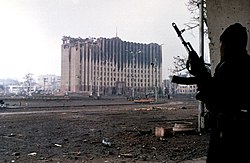
The War of Dagestan began on 7 August 1999, during which the Islamic International Peacekeeping Brigade (IIPB) began an unsuccessful incursion into the neighboring Russian republic of Dagestan in favor of the Shura of Dagestan, which sought independence from Russia.[44] In September, a series of apartment bombings that killed around 300 people in several Russian cities, including Moscow, were blamed on Chechen separatists.[30] Some journalists contested the official explanation, instead blaming the Russian secret services for blowing up the buildings to initiate a new military campaign against Chechnya.[45] In response to the bombings, a prolonged air campaign of retaliatory strikes against the Ichkerian regime and a ground offensive that began in October 1999 marked the beginning of the Second Chechen War. Much better organized and planned than the First Chechen War, the Russian armed forces took control of most regions. The Russian forces used brutal force, killing 60 Chechen civilians during a mop-up operation in Aldy, Chechnya on 5 February 2000. After the re-capture of Grozny in February 2000, the Ichkerian regime fell apart.[46]
-
 Cadets of the Ichkeria Chechen national guard, 1999.
 -


Post-war reconstruction and insurgency
[edit]

Chechen separatists continued to fight Russian troops and conduct terror attacks after the occupation of Grozny.[47] In October 2002, 40–50 Chechen rebels seized a Moscow theater and took about 900 civilians hostage.[30] The crisis ended with 117 hostages and up to 50 rebels dead, mostly due to an unknown aerosol pumped into the building by Russian special forces to incapacitate the people inside.[48][49][50]
In response to these attacks, Russia tightened its grip on Chechnya and expanded its anti-terrorist operations throughout the region. Russia installed a pro-Russian Chechen regime. In 2003, a referendum was held on a constitution that reintegrated Chechnya within Russia but provided limited autonomy. According to the Chechen government, the referendum passed with 95.5% of the votes and almost 80% turnout.[51] The Economist was sceptical of the results, arguing that "few outside the Kremlin regard the referendum as fair".[52]
In September 2004, separatist rebels occupied a school in the town of Beslan, North Ossetia, demanding recognition of the independence of Chechnya and a Russian withdrawal. 1,100 people (including 777 children) were taken hostage. The attack lasted three days, resulting in the deaths of over 331 people, including 186 children.[30][53][54][55] After the 2004 school siege, Russian President Vladimir Putin announced sweeping security and political reforms, sealing borders in the Caucasus region and revealing plans to give the central government more power. He also vowed to take tougher action against domestic terrorism, including preemptive strikes against Chechen separatists.[30] In 2005 and 2006, separatist leaders Aslan Maskhadov and Shamil Basayev were killed.
Since 2007, Chechnya has been governed by Ramzan Kadyrov.[56] Kadyrov's rule has been characterized by high-level corruption, a poor human rights record, widespread use of torture, and a growing cult of personality.[57][58] Allegations of anti-gay purges in Chechnya were initially reported on 1 April 2017.
In April 2009, Russia ended its counter-terrorism operations and pulled out the bulk of its army.[59] The insurgency in the North Caucasus continued even after this date. The Caucasus Emirate had fully adopted the tenets of a Salafi-jihadist group through its strict adherence to the Sunni Hanbali obedience to the literal interpretation of the Quran and the Sunnah.[60]
The Chechen government has been outspoken in its support for the 2022 Russian invasion of Ukraine, where a Chechen military force, the Kadyrovtsy, which is under Kadyrov's personal command, has played a leading role, notably in the Siege of Mariupol.[61] Meanwhile, a substantial number of Chechen separatists have allied themselves to the Ukrainian cause and are fighting a mutual Russian enemy in the Donbas.[62]
In March 2025, Chechnya blocked the messaging app Telegram due to concerns that it could be used by "enemies".[63]
Geography
[edit]

Situated in the eastern part of the North Caucasus in Eastern Europe, Chechnya is surrounded on nearly all sides by Russian Federal territory. In the west, it borders North Ossetia and Ingushetia, in the north, Stavropol Krai, in the east, Dagestan, and to the south, Georgia. Its capital is Grozny. Chechnya is well known for being mountainous, but it is in fact split between the more flat areas north of the Terek, and the highlands south of the Terek.
- Area: 17,300 km2 (6,700 sq mi)
- Borders:
- Internal:
- Dagestan (NE)
- Ingushetia (W)
- North Ossetia–Alania (W)
- Stavropol Krai (NW)
- Foreign:
- Georgia (Kakheti and Mtskheta-Mtianeti) (S)
- Internal:
Rivers:
Climate
[edit]Despite a relatively small territory, Chechnya is characterized by a variety of climate conditions. The average temperature in Grozny is 11.2 °C (52.2 °F).[64]
Cities and towns with over 20,000 people
[edit].png)
- Grozny (capital)
- Shali
- Urus-Martan
- Gudermes
- Argun
- Kurchaloy
- Achkoy-Martan
Administrative divisions
[edit]The Chechen Republic is divided into 15 districts and three cities of republican significance.
Demographics
[edit]
| Year | Pop. | ±% |
|---|---|---|
| 1926 | 510,055 | — |
| 1959 | 710,424 | +39.3% |
| 1970 | 1,064,471 | +49.8% |
| 1979 | 1,153,450 | +8.4% |
| 1989 | 1,275,513 | +10.6% |
| 2002 | 1,103,686 | −13.5% |
| 2010 | 1,268,989 | +15.0% |
| 2021 | 1,510,824 | +19.1% |
| 2025 | 1,576,552 | +4.4% |
| Sources: Census data, estimate[65] | ||
According to the 2021 Census, the population of the republic is 1,510,824,[5] up from 1,268,989 in the 2010 Census.[66] As of the 2021 Census,[67] Chechens at 1,456,792 make up 96.4% of the republic's population. Other groups include Russians (18,225, or 1.2%), Kumyks (12,184, or 0.8%) and a host of other small groups, each accounting for less than 0.5% of the total population. The birth rate was 25.41 in 2004. (25.7 in Achkhoi Martan, 19.8 in Groznyy, 17.5 in Kurchaloi, 28.3 in Urus Martan and 11.1 in Vedeno).
The languages used in the Republic are Chechen and Russian. Chechen belongs to the Vaynakh or North-central Caucasian language family, which also includes Ingush and Batsb. Some scholars place it in a wider North Caucasian languages.
Life expectancy
[edit]
Despite its difficult past, Chechnya has a high life expectancy, one of the highest in Russia. But the pattern of life expectancy is unusual, and according to numerous statistics, Chechnya stands out from the overall picture. In 2020, Chechnya had the deepest fall in life expectancy, but in 2021 it had the biggest rise. Chechnya has the highest excess of life expectancy in rural areas over cities.[68][69]
| 2019 | 2021 | |
|---|---|---|
| Average: | 75.9 years | 73.0 years |
| Male: | 73.6 years | 70.5 years |
| Female: | 78.0 years | 75.3 years |
-
 Life expectancy at birth in Chechnya
 -
 Life expectancy with calculated differences
 -
 Life expectancy in Chechnya in comparison with neighboring regions of the country
 -
 Interactive chart of comparison of male and female life expectancy for 2021. Open the original svg-file in a separate window and hover over a bubble to highlight it.
 -
 Analogious interactive chart of comparison of urban and rural life expectancy.
Original interactive file.


Settlements
[edit]Largest cities or towns in Chechnya
2021 Russian Census | |||||||||
|---|---|---|---|---|---|---|---|---|---|
| Rank | Name | Administrative division | Pop. | ||||||
| 1 | Grozny | City of republic significance of Grozny | 328,533 | ||||||
| 2 | Gudermes | Gudermessky District | 64,376 | ||||||
| 3 | Urus-Martan | Urus-Martanovsky District | 63,449 | ||||||
| 4 | Shali | Shalinsky District | 55,054 | ||||||
| 5 | Argun | Town of republic significance of Argun | 41,622 | ||||||
| 6 | Achkhoy-Martan | Achkhoy-Martanovsky District | 30,739 | ||||||
| 7 | Kurchaloy | Kurchaloyevsky District | 23,425 | ||||||
| 8 | Oyskhara | Gudermessky District | 19,415 | ||||||
| 9 | Goyty | Urus-Martanovsky District | 19,198 | ||||||
| 10 | Avtury | Shalinsky District, Chechnya | 18,446 | ||||||
Vital statistics
[edit]
| Average population (x 1000) | Live births | Deaths | Natural change | Crude birth rate (per 1000) | Crude death rate (per 1000) | Natural change (per 1000) | Total fertility rate | |
|---|---|---|---|---|---|---|---|---|
| 2003 | 1,117 | 27,774 | 7,194 | 20 580 | 24.9 | 6.4 | 18.4 | |
| 2004 | 1,133 | 28,496 | 6,347 | 22,149 | 25.2 | 5.6 | 19.5 | |
| 2005 | 1,150 | 28,652 | 5,857 | 22,795 | 24.9 | 5.1 | 19.8 | |
| 2006 | 1,167 | 27,989 | 5,889 | 22,100 | 24.0 | 5.0 | 18.9 | |
| 2007 | 1,187 | 32,449 | 5,630 | 26,819 | 27.3 | 4.7 | 22.6 | 3.18 |
| 2008 | 1,210 | 35,897 | 5,447 | 30,450 | 29.7 | 4.5 | 25.2 | 3.44 |
| 2009 | 1,235 | 36,523 | 6,620 | 29,903 | 29.6 | 5.4 | 24.2 | 3.41 |
| 2010 | 1,260 | 37,753 | 7,042 | 30,711 | 30.0 | 5.6 | 24.4 | 3.45 |
| 2011 | 1,289 | 37,335 | 6,810 | 30,525 | 28.9 | 5.3 | 23.6 | 3.36 |
| 2012 | 1,314 | 34,385 | 7,192 | 27,193 | 26.2 | 5.5 | 20.7 | 3.08 |
| 2013 | 1,336 | 32,963 | 6,581 | 26,382 | 24.7 | 4.9 | 19.8 | 2.93 |
| 2014 | 1,358 | 32,949 | 6,864 | 26,085 | 24.3 | 5.1 | 19.2 | 2.91 |
| 2015 | 1,383 | 32,057 | 6,728 | 25,329 | 23.2 | 4.9 | 18.3 | 2.80 |
| 2016 | 1,404 | 29,893 | 6,630 | 23,263 | 21.3 | 4.7 | 16.6 | 2.62 |
| 2017 | 1,425 | 29,890 | 6,586 | 23,304 | 21.0 | 4.6 | 16.4 | 2.73 |
| 2018 | 1,444 | 29,883 | 6,430 | 23,453 | 20.6 | 4.4 | 16.2 | 2.60 |
| 2019 | 1,467 | 28,145 | 6,357 | 21,788 | 19.2 | 4.3 | 14.9 | 2.58 |
| 2020 | 1,488 | 30,111 | 9,188 | 20,923 | 20.2 | 6.2 | 14.0 | 2.57 |
| 2021 | 1,509 | 30,345 | 8,904 | 21,441 | 20.1 | 5.9 | 14.2 | 2.50 |
| 2022 | 30,821 | 7,370 | 23,451 | 20.2 | 4.8 | 15.4 | 2.74 | |
| 2023 | 30,418 | 6,583 | 23,835 | 19.7 | 4.3 | 15.4 | 2.66 | |
| 2024 | 31,293 | 7,228 | 24,065 | 20.0 | 4.6 | 15.4 | 2.67 | |
| Source:[70] | ||||||||
Ethnic groups
[edit](In the territory of modern Chechnya)[71][unreliable source]
| Ethnic group |
1926 Census | 1939 Census2 | 1959 Census2 | 1970 Census | 1979 Census | 1989 Census | 2002 Census | 2010 Census | 2021 Census1 | |||||||||
|---|---|---|---|---|---|---|---|---|---|---|---|---|---|---|---|---|---|---|
| Number | % | Number | % | Number | % | Number | % | Number | % | Number | % | Number | % | Number | % | Number | % | |
| Chechens | 293,298 | 67.3% | 360,889 | 58.0% | 238,331 | 39.7% | 499,962 | 54.7% | 602,223 | 60.1% | 715,306 | 66.0% | 1,031,647 | 93.5% | 1,206,551 | 95.3% | 1,456,792 | 96.4% |
| Russians | 103,271 | 23.5% | 213,354 | 34.3% | 296,794 | 49.4% | 327,701 | 35.8% | 307,079 | 30.6% | 269,130 | 24.8% | 40,645 | 3.7% | 24,382 | 1.9% | 18,225 | 1.2% |
| Kumyks | 2,217 | 0.5% | 3,575 | 0.6% | 6,865 | 0.8% | 7,808 | 0.8% | 9,591 | 0.9% | 8,883 | 0.8% | 12,221 | 1.0% | 12,184 | 0.8% | ||
| Avars | 830 | 0.2% | 2,906 | 0.5% | 4,196 | 0.5% | 4,793 | 0.5% | 6,035 | 0.6% | 4,133 | 0.4% | 4,864 | 0.4% | 4,079 | 0.3% | ||
| Nogais | 162 | 0.0% | 1,302 | 0.2% | 5,503 | 0.6% | 6,079 | 0.6% | 6,885 | 0.6% | 3,572 | 0.3% | 3,444 | 0.3% | 2,819 | 0.2% | ||
| Ingush | 798 | 0.2% | 4,338 | 0.7% | 3,639 | 0.6% | 14,543 | 1.6% | 20,855 | 2.1% | 25,136 | 2.3% | 2,914 | 0.3% | 1,296 | 0.1% | 1,100 | 0.1% |
| Ukrainians | 11,474 | 2.6% | 8,614 | 1.4% | 11,947 | 2.0% | 11,608 | 1.3% | 11,334 | 1.1% | 11,884 | 1.1% | 829 | 0.1% | 13,716 | 1.1% | 15,625 | 1.0% |
| Armenians | 5,978 | 1.4% | 8,396 | 1.3% | 12,136 | 2.0% | 13,948 | 1.5% | 14,438 | 1.4% | 14,666 | 1.4% | 424 | 0.0% | ||||
| Others | 18,840 | 4.13% | 18,646 | 3.0% | 37,550 | 6.3% | 30,057 | 3.3% | 27,621 | 2.8% | 25,800 | 2.4% | 10,639 | 1.0% | ||||
| 1 2,515 people were registered from administrative databases, and could not declare an ethnicity. It is estimated that the proportion of ethnicities in this group is the same as that of the declared group.[72]
2 Practically all[citation needed] Chechen and Ingush people were deported to Central Asia in 1944. They were, however, allowed to return to the Northern Caucasus in 1957 by Nikita Khrushchev. See Deportation of the Chechens and Ingush. | ||||||||||||||||||
Religion
[edit]Islam
[edit].jpg)

Sunni Islam is the predominant religion in Chechnya, practiced by 95% of those polled in Grozny in 2010.[73][74] Most of the population is Sunni and follows either the Shafi'i or the Hanafi schools of Islamic jurisprudence.[75] The Shafi'i school of jurisprudence has a long tradition among the Chechens, and thus it remains the most practiced.[76][77] Many Chechens are also Sufis, of either the Qadiri or Naqshbandi orders.[73]
Following the collapse of the Soviet Union, there has been an Islamic revival in Chechnya, and in 2011 it was estimated that there were 465 mosques, including the Akhmad Kadyrov Mosque in Grozny accommodating 10,000 worshippers, as well 31 madrasas, including an Islamic university named Kunta-haji, the Kurchaloy Islamic Institute named Akhmad Kadyrov, and the Center of Islamic Medicine in Grozny, which is the largest such institution in Europe.[78] A supreme Islamic administrative territorial organisation in Chechnya is the Spiritual Administration of the Muslims of the Chechen Republic or the Muftiate of the Chechen Republic.[73]
Christianity
[edit]
From the 11th to 13th centuries (i.e. before Mongol invasions of Durdzuketia), there was a mission of Georgian Orthodox missionaries to the Nakh peoples. They were not successful, though one or two highland teips did convert to Christianity (conversion was largely by teips). However, during the Mongol invasions of Durdzuketia, these Christianized teips gradually reverted to paganism, perhaps due to the loss of Transcaucasian contacts, as the Georgians fought the Mongols and briefly fell under their dominion.
The once-strong Russian minority in Chechnya, mostly Terek Cossacks and estimated as numbering approximately 25,000 in 2012, are predominantly Russian Orthodox, although currently only one church exists in Grozny. In August 2011, Archbishop Zosima of Vladikavkaz and Makhachkala performed the first mass baptism ceremony in the history of the Chechen Republic in the Terek River of Naursky District, in which 35 citizens of Naursky and Shelkovsky districts were converted to Russian Orthodoxy.[79] As of 2020, there are eight Eastern Orthodox churches in Chechnya, the largest is the temple of the Archangel Michael in Grozny.
Politics
[edit]Since 1990, the Chechen Republic has had many legal, military, and civil conflicts involving separatist movements and pro-Russian authorities. Chechnya has enjoyed a period of relative stability under the Russian-appointed government, although there is still some separatist movement activity.[80] Its regional constitution entered into effect on 2 April 2003, after an all-Chechen referendum was held on 23 March 2003. Some Chechens were controlled by regional teips, or clans, despite the existence of pro- and anti-Russian political structures.
In the 2024 Russian presidential election, which critics called rigged and fraudulent,[81] Russian President Vladimir Putin won 98.99% of the vote in Chechnya.[82]
Regional government
[edit]
The former separatist religious leader (mufti) Akhmad Kadyrov was elected president with 83% of the vote in an internationally monitored election on 5 October 2003. Incidents of ballot stuffing and voter intimidation by Russian soldiers and the exclusion of separatist parties from the polls were subsequently reported by Organization for Security and Co-operation in Europe (OSCE) monitors. On 9 May 2004, Kadyrov was assassinated in Grozny football stadium by a landmine explosion that was planted beneath a VIP stage and detonated during a parade, and Sergey Abramov was appointed acting prime minister after the incident. However, since 2005 Ramzan Kadyrov (son of Akhmad Kadyrov) has been the caretaker prime minister, and in 2007 was appointed as the new president. Many[who?] allege he is the wealthiest and most powerful man in the republic, with control over a large private militia (the Kadyrovites). The militia, which began as his father's security force, has been accused of killings and kidnappings by human rights organisations such as Human Rights Watch.
Separatist government
[edit]Ichkeria was a member of the Unrepresented Nations and Peoples Organisation between 1991 and 2010.[83] Former president of Georgia, Zviad Gamsakhurdia, deposed in a military coup of 1991 and a participant of the Georgian Civil War, recognized the independence of the Chechen Republic of Ichkeria in 1993.[84] Diplomatic relations with Ichkeria were also established by the partially recognised Islamic Emirate of Afghanistan under the Taliban government on 16 January 2000. This recognition ceased with the fall of the Taliban in 2001.[85] However, despite Taliban recognition, there were no friendly relations between the Taliban and Ichkeria—Maskhadov rejected their recognition, stating that the Taliban were illegitimate.[86] Ichkeria also received vocal support from the Baltic countries, a group of Ukrainian nationalists, and Poland; Estonia once voted to recognize, but the act never was followed through due to pressure applied by both Russia and the EU.[86][87][88]

The president of this government was Aslan Maskhadov, and the foreign minister was Ilyas Akhmadov, who was the spokesman for the president. Maskhadov had been elected for four years in an internationally monitored election in 1997, which took place after signing a peace agreement with Russia. In 2001, he issued a decree prolonging his office for one additional year; he was unable to participate in the 2003 presidential election since separatist parties were barred by the Russian government, and Maskhadov faced accusations of terrorist offenses in Russia. Maskhadov left Grozny and moved to the separatist-controlled areas of the south at the onset of the Second Chechen War. Maskhadov was unable to influence a number of warlords who retain effective control over Chechen territory, and his power was diminished as a result. Russian forces killed Maskhadov on 8 March 2005, and the assassination was widely criticized since it left no legitimate Chechen separatist leader with whom to conduct peace talks. Akhmed Zakayev, deputy prime minister and a foreign minister under Maskhadov, was appointed shortly after the 1997 election and is currently living under asylum in England. He and others chose Abdul Khalim Saidullayev, a relatively unknown Islamic judge who was previously the host of an Islamic program on Chechen television, to replace Maskhadov following his death. On 17 June 2006, it was reported that Russian special forces killed Abdul Khalim Saidullayev in a raid in the Chechen town of Argun. On 10 July 2006, Shamil Basayev, a leader of the Chechen rebel movement, was killed in a truck explosion during an arms deal.
The successor of Saidullayev became Doku Umarov. On 31 October 2007, Umarov abolished the Chechen Republic of Ichkeria and its presidency and in its place proclaimed the Caucasus Emirate with himself as its Emir.[89] This change of status has been rejected by many Chechen politicians and military leaders who continue to support the existence of the republic.
During the 2022 Russian invasion of Ukraine, the Ukrainian parliament voted to recognize the "Chechen Republic of Ichkeria as territory temporarily occupied by the Russian Federation".[90]
Human rights
[edit]_02.jpg)
Тhe Internal Displacement Monitoring Center reports that after hundreds of thousands of ethnic Russians and Chechens fled their homes following inter-ethnic and separatist conflicts in Chechnya in 1994 and 1999, more than 150,000 people still remain displaced in Russia today.[91]
Нuman rights organizations criticized the conduct of the 2005 parliamentary elections as unfairly influenced by the central Russian government and military.[92] In 2006, Human Rights Watch reported that pro-Russian Chechen forces under the command of Ramzan Kadyrov, as well as Russian federal police personnel, used torture to get information about separatist forces. "If you are detained in Chechnya, you face a real and immediate risk of torture. And there is little chance that your torturer will be held accountable", said Holly Cartner, Director of the Europe and Central Asia division of the Human Rights Watch.[93]
In 2009, the U. S. government-financed American organization Freedom House included Chechnya in the "Worst of the Worst" list of most repressive societies in the world, together with Burma, North Korea, Tibet, and others.[94] Memorial considers Chechnya under Kadyrov to be a totalitarian regime.[95]
On February 1, 2009, The New York Times released extensive evidence to support allegations of consistent torture and executions under the Kadyrov government. The accusations were sparked by the assassination in Austria of a former Chechen rebel who had gained access to Kadyrov's inner circle, 27-year-old Umar Israilov.[96]
On July 1, 2009, Amnesty International released a detailed report covering the human rights violations committed by the Russian Federation against Chechen citizens. Among the most prominent features was that those abused had no method of redress against assaults, ranging from kidnapping to torture, while those responsible were never held accountable. This led to the conclusion that Chechnya was being ruled without law, being run into further devastating destabilization.[97]
On 10 March 2011, Human Rights Watch reported that since Chechenization, the government has pushed for enforced Islamic dress code.[98] The president Ramzan Kadyrov is quoted as saying "I have the right to criticize my wife. She doesn't [have the right to criticize me]. With us [in Chechen society], a wife is a housewife. A woman should know her place. A woman should give her love to us [men]... She would be [man's] property. And the man is the owner. Here, if a woman does not behave properly, her husband, father, and brother are responsible. According to our tradition, if a woman fools around, her family members kill her... That's how it happens, a brother kills his sister or a husband kills his wife... As a president, I cannot allow for them to kill. So, let women not wear shorts...".[99] He has also openly defended honor killings on several occasions.[100]
On 9 July 2017, Russian newspaper Novaya Gazeta reported that a number of people were extrajudicially executed on the night of 26 January 2017. It published a list of 27 names of the people known to be dead, but stressed that the list is "not all [of those killed]"; the newspaper asserted that 50 people may have been executed.[101] Some of the dead were gay, but not all. The killings appeared to have been precipitated by the death of a policeman;[101] according to the author of the report, Elena Milashina, the victims were executed for engaging in terrorism.[102]
In December 2021, up to 50 family members of critics of the Kadyrov government were abducted in a wave of mass kidnappings beginning on 22 December.[103] In a case-study published during the same year, Freedom House reported that Kadyrov also conducts a total transnational repression campaign against Chechen exiles outside of Russia, including assassinations of critics and digital intimidation.[104]
LGBT rights
[edit]
Although homosexuality is officially legal in Chechnya per Russian law, it is de facto illegal. Chechen authorities have reportedly arrested, imprisoned and killed persons based on their perceived sexual orientation.[107]
In 2017, it was reported by Novaya Gazeta and human rights groups that Chechen authorities had set up concentration camps, one of which is in Argun, where gay men are interrogated and subjected to physical violence.[108][109][110][111] On 27 June 2018, the Parliamentary Assembly of the Council of Europe noted "cases of abduction, arbitrary detention, and torture ... with the direct involvement of Chechen law enforcement officials and on the orders of top-level Chechen authorities"[112] and expressed dismay "at the statements of Chechen and Russian public officials denying the existence of LGBTI people in the Chechen Republic".[112] Kadyrov's spokesman Alvi Karimov told Interfax that gay people "simply do not exist in the republic" and made an approving reference to honor killings by family members "if there were such people in Chechnya".[113] In a 2021 Council of Europe report into anti-LGBTI hate-crimes, rapporteur Foura ben Chikha described the "state-sponsored attacks carried out against LGBTI people in Chechnya in 2017" as "the single most egregious example of violence against LGBTI people in Europe that has occurred in decades".[114]
On 11 January 2019, it was reported that another "gay purge" had begun in the country in December 2018, with several men and women being detained.[115][116][117][118] The Russian LGBT Network believes that around 40 people were detained and two killed.[119][120]
Economy
[edit]
During the First Chechen War, the Chechen economy fell apart.[121] In 1994, the separatists planned to introduce a new currency, but the change did not occur due to the re-taking of Chechnya by Russian troops in the Second Chechen War.[121]
The economic situation in Chechnya has improved considerably since 2000. According to the New York Times, major efforts to rebuild Grozny have been made, and improvements in the political situation have led some officials to consider setting up a tourism industry, though there are claims that construction workers are being irregularly paid and that poor people have been displaced.[122]
Chechnya's unemployment was 67% in 2006 and fell to 21.5% in 2014.[123]
Total revenue of the budget of Chechnya for 2017 was 59.2 billion rubles. Of these, 48.5 billion rubles were grants from the federal budget of the Russian Federation.
In late 1970s, Chechnya produced up to 20 million tons of oil annually, production declined sharply to approximately 3 million tons in the late 1980s, and to below 2 million tons before 1994, first (1994–1996) second Russian invasion of Chechnya (1999) inflicted material damage on the oil-sector infrastructure, oil production decreased to 750,000 tons in 2001 only to increase to 2 million tons in 2006, by 2012 production was 1 million tons.[124]
Culture
[edit]The culture of Chechnya is based on the native traditions of Chechen people. Chechen mythology along with art have helped shape the culture for over 1,000 years.
From April 2024, all music must have a tempo between 80 and 116 beats per minute, to comply with Chechen traditions. Borrowing musical culture from other peoples is not allowed.[125]
References
[edit]- ^ Decree #164
- ^ Constitution of the Chechen Republic, Article 59.5
- ^ a b Constitution, Article 5.1
- ^ Official website of the Chechen Republic. Ramzan Akhmatovich Kadyrov Archived 11 August 2011 at the Wayback Machine (in Russian)
- ^ a b c "Оценка численности постоянного населения по субъектам Российской Федерации". Federal State Statistics Service. Retrieved 1 September 2022.
- ^ "Об исчислении времени". Официальный интернет-портал правовой информации (in Russian). Archived from the original on 22 June 2020. Retrieved 19 January 2019.
- ^ Constitution of the Chechen Republic, Article 10.1
- ^ Official throughout the Russian Federation according to Article 68.1 of the Constitution of Russia.
- ^ Publications, Europa (21 August 2012). The Territories of the Russian Federation 2012. Routledge. p. 8. ISBN 978-1-135-09584-0.
- ^ The work of Leonti Mroveli: "The history of the Georgian Kings" dealing with the history of Georgia and the Caucasus since ancient times to the 5th century AD, is included in medieval code of Georgian annals "Kartlis Tskhovreba".
- ^ "An Essay on the History of the Vainakh People. On the origin of the Vainakhs". Caucasian Knot. 14 January 2004. Archived from the original on 10 April 2023. Retrieved 25 May 2023.
- ^ Anchabadze, George (2009) [first edition 2001]. The Vainakhs (the Chechen and Ingush) (PDF). Tbilisi: Caucasian House. Archived from the original (PDF) on 25 February 2012. Retrieved 3 November 2012.
- ^ a b Wuethrich, Bernice (19 May 2000). "Peering into the Past, With Words". Science. 288 (5469): 1158. doi:10.1126/science.288.5469.1158. S2CID 82205296.
- ^ a b Jaimoukha, Amjad M. (1 March 2005). The Chechens: a handbook (1st ed.). Routledge. p. 110. ISBN 978-0-415-32328-4. Retrieved 14 August 2009.
- ^ a b N. D. Kodzoev. History of Ingush nation.
- ^ Tesaev, Amin (2018). "Симсим". Рефлексия. 2: 61–67.
- ^ "Предводитель Гази Алдамов, или Алдаман ГIеза (Амин Тесаев) / Проза.ру". proza.ru.
- ^ Tsaroïeva, Mariel (2005). Anciennes croyances des Ingouches et des Tchétchènes: peuples du Caucase du Nord (in French). Paris: Maisonneuve et Larose. ISBN 978-2-7068-1792-2.
- ^ Ilyasov, Lecha; Ziya Bazhayev Charity Foundation (2009). The Diversity of the Chechen Culture: From Historical Roots to the Present (PDF). UNESCO Educational, Scientific and Cultural Organization. ISBN 978-5-904549-02-2. Archived (PDF) from the original on 5 July 2010.
- ^ a b c d Schaefer, Robert W. (2010). The Insurgency in Chechnya and the North Caucasus: From Gazavat to Jihad. Bloomsbury Academic. ISBN 9780313386343. Retrieved 25 December 2014.
- ^ Farrokh, Kaveh (20 December 2011). Iran at War: 1500–1988. Osprey Publishing Limited. ISBN 9781780962214. Retrieved 25 December 2014.[dead link]
- ^ a b c "The Ingush People". Linguistics.berkeley.edu. 28 November 1992. Retrieved 14 March 2014.
- ^ John Frederick Baddeley, The Russian Conquest of the Caucasus, London, Curzon Press, 1999, p. 49.
- ^ Cohen, Ariel (1998). Russian Imperialism: Development and Crisis. Bloomsbury Academic. ISBN 9780275964818. Retrieved 25 December 2014.
- ^ "Человек из камня Байсангур Беноевский". 10 December 2010. Archived from the original on 24 November 2021. Retrieved 14 March 2014 – via YouTube.
- ^ "Independent Mountainous Republic of the Northern Caucasus". Countries & Territories since 1900. Archived from the original on 25 May 2023. Retrieved 25 May 2023.
- ^ "Общественное движение чеченский комитет национального спасения". Savechechnya.com. 24 June 2008. Archived from the original on 23 February 2014. Retrieved 14 March 2014.
- ^ "Вассан-Гирей Джабагиев". Vainah.info. Archived from the original on 21 February 2014. Retrieved 14 March 2014.
- ^ Umarova, Amina (23 November 2013). "Chechnya's Forgotten Children of the Holodomor". Radio Free Europe/Radio Liberty. Retrieved 14 March 2014.
- ^ a b c d e f Lieven, Dominic. "Russia: Chechnya". Microsoft Encarta 2008. Microsoft.
- ^ "Remembering Stalin's deportations". BBC News. 23 February 2004. Retrieved 19 April 2013.
- ^ Fires of Hatred: Ethnic Cleansing in Twentieth-Century Europe, Cambridge, Massachusetts and London: Harvard University Press, 2001, pp. 96–97.
- ^ Alexander Nikolaevich Yakovlev. Time of darkness. Moscow, 2003, ISBN 5-85646-097-9, pp. 205–206.
- ^ Bugay 1996, p. 106.
- ^ "Chechnya: European Parliament recognizes the genocide of the Chechen People in 1944". Unrepresented Nations and Peoples Organization. 2 November 2009.
- ^ James Hughes. "The Peace Process in Chechnya", in Richard Sakwa (ed.), Chechnya: From Past to Future, p. 271.
- ^ "'Dual attack' killed president". BBC. 21 April 1999. Retrieved 1 January 2016.
- ^ "Radio Free Europe/Radio Liberty archive". friends-partners.org. Friends & Partners. 12 May 1997. part I. Archived from the original on 17 November 2015. Retrieved 1 January 2016.
- ^ "Chechnya [Russia] (2003)". Freedom House. Archived from the original on 24 October 2011.
- ^ Leon Aron. Chechnya, New Dimensions of the Old Crisis Archived 12 March 2008 at the Wayback Machine . AEI, 1 February 2003
- ^ a b Alex Goldfarb and Marina Litvinenko. Death of a Dissident: The Poisoning of Alexander Litvinenko and the Return of the KGB. New York: Free Press, 2007, pp. 95. ISBN 978-1-4165-5165-2.
- ^ Tishkov, Valery. Chechnya: Life in a War-Torn Society. Berkeley: University of California Press, 2004, p. 114.
- ^ "Four Western hostages beheaded in Chechnya". CNN. Archived from the original on 3 December 2002.
- ^ Harrigan, Steve. "Moscow again plans wider war in Dagestan". CNN. 19 August 1999. Retrieved 23 April 2013.
- ^ "Context of 'September 13, 1999: Second Moscow Apartment Bombing Kills 118; Chechen Rebels Blamed'". History Commons. (Archived 15 February 2013 at the Wayback Machine). Retrieved 23 April 2013.
- ^ "Gay Chechens flee threats, beatings and exorcism". BBC News. 5 April 2018. Retrieved 10 October 2018.
- ^ Meier, Andrew (2005). Chechnya: To the Heart of a Conflict. New York: W. W. Norton. pp. 123–125. ISBN 0393327329.
- ^ "Gas 'killed Moscow hostages'". BBC News. 27 October 2002. Retrieved 19 April 2013.
- ^ "Moscow court begins siege claims". BBC News. 24 December 2002.
- ^ "Moscow hostage relatives await news". BBC News. 27 October 2002. Retrieved 30 May 2011.
- ^ Aris, Ben (24 March 2003). "Boycott call in Chechen poll ignored". The Daily Telegraph. London. Archived from the original on 10 January 2022. Retrieved 22 April 2013.
- ^ "Putin's proposition". The Economist. 25 March 2003. Retrieved 22 April 2013.
- ^ "August 31, 2006: Beslan – Two Years On". Archived from the original on 4 April 2009. Retrieved 4 April 2009.
- ^ "Putin meets angry Beslan mothers". BBC News. Retrieved 23 April 2013.
- ^ "The children of Beslan five years on". BBC News. Retrieved 23 April 2013.
- ^ "Ramzan Kadyrov: Putin's key Chechen ally". BBC. 21 May 2020. Retrieved 7 March 2022.
- ^ "Ramzan Kadyrov: The warrior king of Chechnya". The Independent. 4 January 2007. Retrieved 1 January 2016.
- ^ "Kadyrov's Power and Cult of Personality Grows". Jamestown. Retrieved 1 January 2016.
- ^ "Russia 'ends Chechnya operation'". BBC News. 16 April 2009. Retrieved 14 April 2009.
- ^ "Salafist-Takfiri Jihadism: the Ideology of the Caucasus Emirate". International Institute for Counter-Terrorism. Archived from the original on 3 September 2014. Retrieved 27 August 2019.
- ^ Cranny-Evans, Sam (4 November 2022). "The Chechens: Putin's Loyal Foot Soldiers". Royal United Services Institute for Defence and Security Studies. Retrieved 23 May 2023.
- ^ "Chechen volunteer fighters back up Ukraine's Russian resistance". ABC News. Retrieved 14 August 2023.
- ^ "Two Russian regions block Telegram app over security fears". Reuters. 8 March 2025.
- ^ Climate of Chechnya. Climate-Data.org. Retrieved 19 October 2020.
- ^ "Численность постоянного населения Российской Федерации по муниципальным образованиям на 1 января 2025 года". Federal State Statistics Service. Retrieved 27 April 2025.
- ^ Russian Federal State Statistics Service (2011). Всероссийская перепись населения 2010 года. Том 1 [2010 All-Russian Population Census, vol. 1]. Всероссийская перепись населения 2010 года [2010 All-Russia Population Census] (in Russian). Federal State Statistics Service.
- ^ "Национальный состав населения". Federal State Statistics Service. Retrieved 30 December 2022.
- ^ "Демографический ежегодник России" [The Demographic Yearbook of Russia] (in Russian). Federal State Statistics Service of Russia (Rosstat). Retrieved 1 June 2022.
- ^ "Ожидаемая продолжительность жизни при рождении" [Life expectancy at birth]. Unified Interdepartmental Information and Statistical System of Russia (in Russian). Archived from the original on 20 February 2022. Retrieved 1 June 2022.
- ^ "Russian Federal State Statistics Service". Retrieved 9 August 2025.
- ^ "НАСЕЛЕНИЕ ЧЕЧНИ". Ethno-kavkaz.narod.ru. Retrieved 19 April 2013.
- ^ "Перепись-2010: русских становится больше". Perepis-2010.ru. 19 December 2011. Archived from the original on 25 December 2018. Retrieved 19 April 2013.
- ^ a b c Roshchin, Mikhail; Lunkin, Roman (2005). "Ислам в Чеченской Республике" [Islam in the Chechen Republic]. In Bourdeaux, Michael; Filatov, Sergei (eds.). Современная религиозная жизнь России. Опыт систематического описания [Contemporary Religious Life of Russia. Systematic description experience] (in Russian). Vol. 3. Moscow: Keston Institute; Logos. pp. 152–169. ISBN 5-98704-044-2.
- ^ Itekushev (16 May 2010). В Чечне наблюдается высокая степень религиозной нетерпимости [High degree of religious intolerance observed in Chechnya]. Caucasus Times. Caucasus Times poll (in Russian). Retrieved 10 April 2017.
- ^ McDermott, Roger. "Shafi'i and Hanafi schools of jurisprudence in Chechnya". Jamestown. Jamestown.org. Retrieved 19 April 2013.
- ^ Balzer, Marjorie Mandelstam (9 November 2009). Religion and Politics in Russia: A Reader. M.E. Sharpe. ISBN 9780765629319.
- ^ Mairbek Vatchagaev (8 September 2006). "The Kremlin's War on Islamic Education in the North Caucasus". Archived from the original on 11 October 2007. Chechnya Weekly, Volume 7, Issue 34 (8 September 2006)
- ^ Nazgul A. Mingisheva and Yesbossyn M. Smagulov, "Chechnya" in Mark Juergensmeyer and Wade Clark Roof, Encyclopedia of Global Religion, Volume 1, SAGE, 2012, p. 193.
- ^ Interfax Information Services Group. "Chechnya saw the first mass baptism in its today's history". Retrieved 9 July 2012.
- ^ "Chechnya profile". BBC. 28 August 2023. Retrieved 15 April 2024.
- ^ "The extent of fraud in Russia's presidential election begins to emerge". Le Monde. 20 March 2024.
- ^ "Chechnya boosts Putin re-election with almost 100% of the votes". Yahoo News. Deutsche Presse-Agentur. 18 March 2024.
- ^ "UNPO: Chechen Republic of Ichkeria". unpo.org. Retrieved 27 August 2019.
- ^ in 1993, ex –President of Georgia Zviad Gamsakhurdia recognized Chechnya's independence.., Archived 21 August 2013 at the Wayback Machine
- ^ Are Chechens in Afghanistan? Archived 7 August 2009 at the Wayback Machine – By Nabi Abdullaev, 14 December 2001, Moscow Times
- ^ a b Kullberg, Anssi. "The Background of Chechen Independence Movement III: The Secular Movement". The Eurasian politician. 1 October 2003
- ^ Kari Takamaa and Martti Koskenneimi. The Finnish Yearbook of International Law. p147
- ^ Kuzio, Taras. "The Chechen crisis and the 'near abroad'". Central Asian Survey, Volume 14, Issue 4 1995, pages 553–572
- ^ "What is Hidden Behind the Idea of the Caucasian Emirate?" (PDF). Archived (PDF) from the original on 11 May 2011. Retrieved 19 April 2013.
- ^ "Ukraine lawmakers brand Chechnya 'Russian-occupied' in dig at Kremlin". Reuters. 18 October 2022. Retrieved 20 October 2022.
- ^ Government efforts help only some IDPs rebuild their lives, IDMC, 13 August 2007 Archived 21 August 2013 at the Wayback Machine
- ^ Chechnya Holds Parliamentary Vote, Morning Edition, NPR, 28 November 2005.
- ^ Human Rights Watch:Chechnya: Research Shows Widespread and Systematic Use of Torture
- ^ Worst of the Worst: The World's Most Repressive Societies Archived 10 November 2011 at the Wayback Machine (PDF), Freedom House, March 2009
- ^ Cherkasov, Alexander; Golubev, Ostav; Malykhin, Vladimir (24 February 2023), "A chain of wars, a chain of crimes, a chain of impunity: Russian wars in Chechnya, Syria and Ukraine" (PDF), Memorial Human Rights Defence Centre, p. 9
- ^ Chivers, C. J. (31 January 2009). "Slain Exile Detailed Cruelty of the Ruler of Chechnya". The New York Times.
- ^ Amnesty International:Russian Federation Rule Without Law: Human Rights violations in the North Caucasus Archived 3 February 2019 at the Wayback Machine, 1 July 2009.
- ^ Human Rights Watch:"You Dress According to Their Rules" Enforcement of an Islamic Dress Code for Women in Chechnya Archived 2 April 2015 at the Wayback Machine, 10 March 2011
- ^ правды», Александр ГАМОВ | Сайт «Комсомольской (24 September 2008). "Рамзан КАДЫРОВ: "Россия – это матушка родная"". Kp.ru - (in Russian). Retrieved 27 August 2019.
- ^ Chechen President Kadyrov Defends Honor Killings Archived 5 June 2011 at the Wayback Machine The St. Petersburg Times 3 March 2009
- ^ a b Milashina, Elena (9 July 2017). "Это была казнь. В ночь на 26 января в Грозном расстреляли десятки людей". Novaya Gazeta. Moscow. Retrieved 10 July 2017.
- ^ "Who Is Afraid of Navalny, Killings in Chechnya, Trump-Putin Meeting". Institute of Modern Russia. 14 July 2017. Archived from the original on 21 August 2017. Retrieved 17 July 2017.
- ^ "Dozens of relatives of government critics reportedly kidnapped in Chechnya". OC Media. 28 December 2021. Retrieved 29 December 2021.
- ^ "Russia Case Study | Understanding Transnational Repression". Freedom House. Archived from the original on 21 October 2021. Retrieved 20 February 2024.
- ^ Batchelor, Tom (1 May 2017). "Russian police round up LGBT activists demonstrating against persecution of gay men in Chechnya". The Independent. Archived from the original on 31 January 2018. Retrieved 31 May 2017.
- ^ Kramer, Andrew E. (1 May 2017). "Russians Protesting Abuse of Gay Men in Chechnya Are Detained". The New York Times. Archived from the original on 24 November 2017. Retrieved 31 May 2017.
- ^ Kramer, Andrew E. (1 April 2017). "Chechen Authorities Arresting and Killing Gay Men, Russian Paper Says". The New York Times. Archived from the original on 28 April 2019. Retrieved 15 April 2017.
- ^ "Chechnya police arrest 100 suspected gay men, three killed: report". The Globe and Mail. Associated Press. 3 April 2017. Retrieved 10 April 2017.
- ^ Duffy, Nick (10 April 2017). "Chechnya has opened concentration camps for gay men". PinkNews. Retrieved 10 April 2017.
- ^ Armstrong, Kathy (10 April 2017). "Over 100 people allegedly sent to 'concentration camps' for gay men in Chechnya". Irish Independent. Retrieved 11 April 2017.
- ^ Gordienko, Irina; Elena Milashina (4 April 2017). Расправы над чеченскими геями [Massacres of Chechen gays (18+)]. Novaya Gazeta (in Russian). Retrieved 12 April 2017.
- ^ a b "Persecution of LGBTI people in the Chechen Republic (Russian Federation), Resolution 2230 (2018)". Parliamentary Assembly of the Council of Europe. 27 June 2018. Retrieved 26 September 2021.
- ^ Walker, Shaun (13 April 2017). "Chechens tell of prison beatings and electric shocks in anti-gay purge: 'They called us animals'". The Guardian. Retrieved 26 September 2021.
- ^ ben Chikha, Foura (21 September 2021). "Combating rising hate against LGBTI people in Europe" (PDF). Council of Europe Committee on Equality and Non-Discrimination. pp. 15–16. Archived (PDF) from the original on 23 September 2021. Retrieved 26 September 2021.
- ^ Vasilyeva, Nataliya (11 January 2019). "Reports: several gay men and women detained in Chechnya". Associated Press. Retrieved 14 January 2019.
- ^ Damshenas, Sam (11 January 2019). "Chechnya has reportedly launched a new 'gay purge'". Gay Times. Retrieved 13 January 2019.
- ^ Carroll, Oliver (11 January 2019). "Chechnya launches new gay 'purge', reports say". The Independent. Retrieved 14 January 2019.
- ^ «Новой газете» стало известно о новых преследованиях геев в Чечне [Novaya Gazeta learned of new persecution of gays in Chechnya]. Novaya Gazeta (in Russian). 11 January 2019. Archived from the original on 11 October 2019. Retrieved 14 January 2019.
- ^ "New wave of persecution against LGBT people in Chechnya: around 40 people detained, at least two killed". Российская ЛГБТ-сеть (in Russian). 14 January 2019. Archived from the original on 30 June 2019. Retrieved 27 August 2019.
- ^ Ingber, Sasha (14 January 2019). "Activists Say 40 Detained And 2 Dead in Gay Purge in Chechnya". NPR. Retrieved 27 August 2019.
- ^ a b Russell, John (2007). Gammer, Moshe; Lokshina, Tanya; Thomas, Ray; Mayer, Mary; Dunlop, John B. (eds.). "Chechnya: Russia's 'War on Terror' or 'War of Terror'?". Europe-Asia Studies. 59 (1): 163–168. doi:10.1080/09668130601072761. JSTOR 20451332. S2CID 153481090.
- ^ Kramer, Andrew E. (30 April 2008). "Chechnya's Capital Rises From the Ashes, Atop Hidden Horrors". The New York Times. Retrieved 1 April 2010.
- ^ "Chechnya, Republic of Unemployment rate, 1990-2014 - knoema.com". Archived from the original on 12 April 2017. Retrieved 11 April 2017.
- ^ "Does Chechnya Stand To Lose Out From Russian-Azerbaijani Oil Agreement?". Radio Free Europe/Radio Liberty. 30 August 2013.
- ^ "Chechnya Forbids Music Outside 80-116 BPM Tempo", Moscow Times, 5 April 2024
Notes
[edit]- ^ /ˈtʃɛtʃniə/ CHETCH-nee-ə; Russian: Чечня́, IPA: [tɕɪtɕˈnʲa]; Chechen: Нохчийчоь, romanized: Noxçiyçö, Chechen pronunciation: [ˈnoxtʃiːtʃɥø]
- ^ Russian: Чече́нская Респу́блика, romanized: Chechenskaya Respublika; Chechen: Нохчийн Республика, romanized: Noxçiyn Respublika
Sources
[edit]- Bugay, Nikolay (1996). The Deportation of Peoples in the Soviet Union. New York City: Nova Publishers. ISBN 9781560723714.
- Президент Чеченской Республики. Указ №164 от 15 июля 2004 г. «О государственном гимне Чеченской Республики». Вступил в силу после одобрения Государственным Советом Чеченской Республики и официального опубликования. Опубликован: БД "Консультант-Плюс". (President of the Chechen Republic. Decree #164 of 15 July 2004 On the State Anthem of the Chechen Republic. Effective as of after the ratification by the State Council of the Chechen Republic and subsequent official publication.).
- Референдум. 23 марта 2003 г. «Конституция Чеченской Республики», в ред. Конституционного закона №1-РКЗ от 30 сентября 2014 г. «О внесении изменений в Конституцию Чеченской Республики». Вступил в силу со дня официального опубликования по результатам голосования на референдуме Чеченской Республики. (Referendum. March 23, 2003 Constitution of the Chechen Republic, as amended by the Constitutional Law #1-RKZ of September 30, 2014 On Amending the Constitution of the Chechen Republic. Effective as of the day of the official publication in accordance with the results of the referendum of the Chechen Republic.).
- President of the Russian Federation. Law #4071-1 of 10 December 1992 On Amending Article 71 of the Constitution (Basic Law) of the Russian Federation–Russia. Effective as of 10 January 1993..
Further reading
[edit]- Anderson, Scott. The Man Who Tried to Save the World. ISBN 0-385-48666-9
- Babchenko, Arkady. One Soldier's War in Chechnya. Portobello, London ISBN 978-1-84627-039-0
- Baiev, Khassan. The Oath: A Surgeon Under Fire. ISBN 0-8027-1404-8
- Bennigsen-Broxup, Marie. The North Caucasus Barrier: The Russian Advance Towards the Muslim World. ISBN 1-85065-069-1
- Bird, Chris. To Catch a Tartar: Notes from the Caucasus. ISBN 0-7195-6506-5
- Bornstein, Yvonne and Ribowsky, Mark. Eleven Days of Hell: My True Story of Kidnapping, Terror, Torture and Historic FBI & KGB Rescue. AuthorHouse, 2004. ISBN 1-4184-9302-3.
- Conrad, Roy. Roy Conrad. Grozny. A few days...
- Dunlop, John B. Russia Confronts Chechnya: Roots of a Separatist Conflict ISBN 0-521-63619-1
- Evangelista, Mathew. The Chechen Wars: Will Russia Go the Way of the Soviet Union?. ISBN 0-8157-2499-3.
- Gall, Charlotta & de Waal, Thomas. Chechnya: A Small Victorious War. ISBN 0-330-35075-7
- Gall, Carlotta, and de Waal, Thomas Chechnya: Calamity in the Caucasus. ISBN 0-8147-3132-5.
- Goltz, Thomas. Chechnya Diary: A War Correspondent's Story of Surviving the War in Chechnya. M E Sharpe (2003). ISBN 0-312-268-74-2.
- Hasanov, Zaur. The Man of the Mountains. ISBN 099304445X. Fact-based novel on growing influence of the radical Islam during 1st and 2nd Chechnya wars.
- Khan, Ali. "The Chechen Terror: The Play within the Play".
- Khlebnikov, Paul. Razgovor s varvarom (Interview with a barbarian). ISBN 5-89935-057-1.
- Lieven, Anatol. Chechnya: Tombstone of Russian Power. ISBN 0-300-07881-1.
- Mironov, Vyacheslav. Ya byl na etoy voyne [I Was in This War]. Biblion – Russkaya Kniga, 2001. Partial translation available online.
- Mironov, Vyacheslav. Vyacheslav Mironov. Assault on Grozny Downtown
- Mironov, Vyacheslav. I was in that war.
- Oliker, Olga Russia's Chechen Wars 1994–2000: Lessons from Urban Combat. ISBN 0-8330-2998-3. (A strategic and tactical analysis of the Chechen Wars.)
- Pelton, Robert Young. Hunter Hammer and Heaven, Journeys to Three World's Gone Mad (ISBN 1-58574-416-6)
- Politkovskaya, Anna. A Small Corner of Hell: Dispatches from Chechnya ISBN 0-226-67432-0
- Rasizade, Alec. Chechnya: the Achilles heel of Russia. = Contemporary Review (Oxford) in three parts: 1) April 2005 issue, volume 286, number 1671, pages 193–197; 2) May 2005 issue, volume 286, number 1672, pages 277–284; 3) June 2005 issue, volume 286, number 1673, pages 327–332.
- Seirstad, Asne. The Angel of Grozny. ISBN 978-1-84408-395-4
- Wood, Tony. "Chechnya: The Case For Independence". Book review in The Independent, 2007.
External links
[edit]
- Official website of the Republic of Chechnya (in Russian)
- AlertNet Chechnya and the North Caucasus at the Wayback Machine (archived 11 September 2012)
- "Chechnya's Hidden War". Frontline / World Dispatches. USA: PBS. 22 March 2010. (video)
- Islamist Extremism in Chechnya: A Threat to U.S. Homeland?: Joint Hearing before the Subcommittee on Europe, Eurasia, and Emerging Threats and the Subcommittee on Terrorism, Nonproliferation, and Trade of the Committee on Foreign Affairs, House of Representatives, One Hundred Thirteenth Congress, First Session, 26 April 2013
- Chechnya Guide (Archived 20 May 2021 at the Wayback Machine) (in English)
Countries and regions of the Caucasus | |
|---|---|
1 Partially-recognized states |


| International | |
|---|---|
| National | |
| Geographic | |
| Academics | |
| Other | |


Chechnya
View on GrokipediaGeography
Topography and Natural Resources
Chechnya encompasses a diverse topography transitioning from northern plains and foothills to the rugged southern highlands of the Greater Caucasus Mountains. The northern and northeastern regions feature sandy steppes and rolling lowlands, while the central areas rise into foothills, and the south is dominated by alpine terrain. Approximately 65% of the territory consists of plains and foothills, with the remaining 35% occupied by the northern slopes of the Greater Caucasus highlands. The republic spans 17,300 square kilometers, with elevations averaging around 500 meters but reaching extremes in the mountains.[9][10][11] Major rivers, including the Terek and its tributaries such as the Sunzha and Argun, originate in the southern mountains and flow northward through the plains, shaping the drainage patterns and supporting the lowland features. The highest point in Chechnya is Mount Tebulosmta, standing at 4,493 meters on the Greater Caucasus range. This mountainous backbone influences the overall relief, creating steep gradients and valleys that define the southern landscape.[9] Chechnya's natural resources are concentrated in hydrocarbons, with significant oil and natural gas deposits primarily located in the northern lowlands; oil exploration dates back to the 19th century, establishing fields that contributed to early industrial development. Additional resources include limestone, gypsum, sulfur, and other minerals, alongside thermal and mineral waters. Forests, encompassing broadleaf, coniferous, and mixed types, cover substantial portions of the foothills and highlands, supporting regional biodiversity as part of the Caucasus hotspot, which features diverse ecosystems with endemic species.[10][12][13][14] The terrain's position in the seismically active Caucasus exposes it to earthquakes, while the river systems contribute to periodic flooding in the plains and valleys.[15]Climate and Environmental Challenges
Chechnya's climate is predominantly continental, featuring cold, snowy winters and hot, dry summers, with pronounced variations influenced by elevation gradients from the Terek River lowlands to the Greater Caucasus highlands. In lowland areas like Grozny, average annual temperatures hover around 11.8°C, with January lows averaging -2°C to -4°C and July highs reaching 24°C to 30°C; precipitation totals approximately 695 mm annually, concentrated in spring and fall, while mountainous southern regions experience cooler temperatures (dropping below 0°C year-round at higher altitudes) and increased rainfall exceeding 1,000 mm due to orographic effects.[16][17] Ecological pressures include seasonal flooding along major rivers such as the Terek and Sunzha, which swell from meltwater and heavy rains, periodically inundating agricultural plains and settlements; these events have intensified due to post-conflict deforestation, which reduced forest cover by an estimated 20-30% in affected areas through wartime logging for fuel and construction, exacerbating soil erosion and runoff. Oil extraction in the northern lowlands, centered around Grozny, contributes to chronic soil and groundwater contamination, with geochemical assessments indicating pollution levels in urban foci exceeding safe thresholds by factors of 10 to 100 times for heavy metals and hydrocarbons, stemming from pipeline leaks and spills totaling millions of barrels since the 1990s.[18][19] Recovery from wartime environmental damage remains incomplete, with river systems like the Argun showing contamination levels 100 to 1,000 times above norms for petroleum products and suspended solids, posing risks to aquatic ecosystems and downstream water quality into the Caspian basin; groundwater tests reveal widespread heavy metal leaching into aquifers, affecting over 40% of the republic's territory classified as environmentally distressed. Air quality in industrial zones suffers from emissions tied to oil processing, though data gaps persist due to limited monitoring infrastructure.[20][21][22]Administrative Divisions and Major Settlements
The Chechen Republic is divided into 15 municipal districts (raions) and two city districts, comprising a total of 212 rural settlements and four urban-type settlements.[3] These raions include Achkhoy-Martanovsky, with its administrative center at Achkhoi-Martan; Urus-Martanovsky, centered on Urus-Martan; Shalinsky, centered on Shali; Gudermessky, centered on Gudermes; Groznensky; Kurchaloysky; Naursky; Shelkovskoy; Nadterechny; Shatoysky; Vedensky; Nozha-Yurtovsky; and others, each managing local governance, agriculture, and resource extraction.[23] Grozny, the capital and a city of republican significance, functions as the political, economic, and cultural hub, encompassing urban districts redeveloped after near-total devastation in the 1990s wars.[24] Reconstruction efforts, initiated in the early 2000s, have introduced modern roadways, residential complexes, educational facilities, and healthcare infrastructure, restoring functionality to the central urban area.[25] Other cities of republican significance include Argun, while major district centers exceeding 20,000 residents—such as Urus-Martan, an agricultural and administrative focal point; Gudermes, associated with oil processing activities; and Shali, serving regional trade and services—support decentralized settlement patterns across the republic.[26]History
Prehistoric and Early Ethnic Formation
Archaeological evidence from the North Caucasus, including sites near Lake Kezenoyam, indicates human presence in the region of modern Chechnya dating back to the Paleolithic, with Neolithic settlements emerging around 6000 BCE as part of early farming communities in the Caucasian highlands.[27] These settlements reflect the adoption of agriculture and pastoralism, aligning with broader Chalcolithic developments such as the Kura-Araxes cultural complex (ca. 4000–2000 BCE), which spread influences northward from the South Caucasus.[28] Cultural roots of later Vainakh groups trace to this era, marked by the divergence of proto-Caucasian languages into Northeast Caucasian branches.[27] The ethnogenesis of the Vainakh peoples—ancestors of Chechens and Ingush—centers on proto-Nakh speakers, a subgroup of the Northeast Caucasian language family, who developed in relative isolation within the North Caucasus mountains. Linguistic reconstructions suggest the Nakh-Dagestani split occurred several millennia BCE, consistent with genetic evidence of long-term continuity from Bronze Age populations rather than major external overlays.[29] Y-chromosome haplogroup J2 predominates, linking to Neolithic migrations from the Near East around 8000–6000 BCE, followed by high differentiation through drift and endogamy among highland groups.[30] Autosomal DNA analyses cluster Nakh-Dagestani speakers distinctly from steppe-derived groups, indicating minimal Steppe ancestry and supporting autochthonous origins with localized admixture.[31] By ca. 3000 BCE, kurgan burial practices from adjacent Maykop culture (3700–3000 BCE) in the Northwest Caucasus suggest potential influences via migration or exchange on North Caucasian societies, though direct kurgans in Chechnya are sparse and more associated with later Iron Age nomads.[32] From the 7th century BCE, Scythian presence is attested by tumuli, weapons, and horse gear in the North Caucasus lowlands, reflecting nomadic incursions and trade with highland dwellers.[33] [34] These interactions introduced metallurgical and equestrian elements but did not displace proto-Vainakh tribal clans, which organized around kinship and fortified villages without centralized polities until post-medieval periods.[35]Caucasian Wars and Imperial Incorporation
The Russian Empire's expansion into the North Caucasus intensified in the early 19th century, driven by strategic imperatives to secure frontiers against Ottoman and Persian influences, prompting localized Chechen resistance through clan-based raids and ambushes against tsarist outposts.[36] By the 1820s, Russian forces had established footholds in the lowlands, but highland terrain favored defenders employing irregular warfare to disrupt supply lines and inflict disproportionate casualties on larger, conventional armies.[37] Muridism, a militant Sufi movement emphasizing jihad and personal devotion to spiritual leaders, facilitated temporary unification of fractious Chechen and Dagestani clans under a theocratic imamate, countering Russian divide-and-rule tactics that exploited inter-ethnic rivalries.[38] Imam Shamil, succeeding earlier leaders, consolidated control from 1834 to 1859, establishing administrative structures like forest fortifications and a murid-based military discipline to sustain prolonged insurgency across Chechnya and Dagestan.[39] His forces relied on guerrilla tactics—rapid strikes followed by withdrawals into mountainous strongholds—to evade encirclement and exploit Russian logistical vulnerabilities, prolonging resistance despite numerical inferiority.[37] Under Viceroy Prince Alexander Baryatinsky, Russian strategy shifted to systematic pacification, combining blockades, scorched-earth policies, and alliances with pro-Russian tribes to isolate Shamil's core territories, culminating in the storming of Vedeno in April 1859 and Shamil's surrender on August 25, 1859.[40] Following incorporation into the empire, Chechnya faced forced Russification, including land redistribution to Cossacks and suppression of Islamic institutions, which eroded traditional clan autonomy.[36] The wars inflicted severe demographic tolls on highlanders, with estimates attributing hundreds of thousands of deaths to direct combat, famine, disease, and emigration, though precise figures for Chechens remain contested due to incomplete records.[41]Soviet Era Deportations and Repression
During the 1920s and early 1930s, Chechens mounted significant resistance to Soviet collectivization campaigns, which aimed to consolidate agriculture under state control but clashed with traditional highland pastoral and clan-based economies.[42] This opposition manifested in revolts, such as those suppressed in Chechnya and Dagestan in April-May 1930, prompting intensified NKVD operations to liquidate perceived kulaks and insurgents.[43] By the mid-1930s, local leaders had partially accommodated Soviet policies, but underlying tensions persisted amid widespread peasant discontent.[44] The Great Purge of 1937-1938 extended repression to the Chechen-Ingush ASSR, with NKVD reports documenting 5,610 arrests in the initial phase alone, targeting party officials, intellectuals, and suspected nationalists as enemies of the people.[45] These operations dismantled much of the local elite, eroding administrative structures and fostering a climate of fear that facilitated later mass actions.[46] The apex of Stalinist repression came with Operation Lentil (Chechevitsa), launched on February 23, 1944, which forcibly deported approximately 496,000 Chechens—alongside 91,000 Ingush—to special settlements in Kazakhstan and Central Asia, justified by NKVD accusations of collective collaboration with German forces despite limited evidence of widespread disloyalty.[47] Conducted under Lavrenti Beria's oversight with troops from across the USSR, the operation involved rapid roundup, minimal provisions, and cattle-car transports, resulting in 23-24% mortality en route and in the immediate aftermath from starvation, disease, and exposure, per declassified Soviet records.[47] [48] Overall survival rates remained low, with total excess deaths estimated at over 100,000 in the first years of exile due to harsh labor assignments and inadequate rations.[48] The Chechen-Ingush ASSR was abolished by decree in March 1944, its territory partitioned among neighboring regions like Dagestan and Georgia, with Chechen lands repurposed for ethnic Russian settlement.[47] Cultural erasure accompanied this: mosques were desecrated or converted, the Chechen language banned in schools, and historical narratives rewritten to vilify the deportees as traitors.[47] Restoration occurred on January 9, 1957, via a Presidium decree under Nikita Khrushchev, reestablishing the ASSR within the RSFSR and permitting return, though without full legal rehabilitation or property restitution, leaving many deportees in poverty and social marginalization.[49] [50] Autonomy remained curtailed, with Moscow retaining oversight and suppressing public commemoration of the deportations until the late 1980s.[49] These policies inflicted enduring demographic scars, reducing the Chechen population by nearly a quarter and fracturing social structures, with long-term effects on literacy, clan cohesion, and trust in central authority evident in post-return censuses showing slowed recovery.[48]Post-Soviet Independence Attempt and First Chechen War
Following the dissolution of the Soviet Union in 1991, Chechnya experienced a rapid push toward sovereignty amid widespread economic disarray and weakened central authority in Moscow. Dzhokhar Dudayev, a former Soviet Air Force general, led the All-National Congress of the Chechen People, which seized power from the pro-Moscow regional government in August 1991.[51] A referendum in October 1991 resulted in Dudayev's election as president of the self-proclaimed Chechen Republic of Ichkeria, followed by a unilateral declaration of independence on November 1, 1991.[52] This move was driven by local aspirations for autonomy, exacerbated by the abrupt cutoff of Soviet subsidies and the collapse of the command economy, which left Chechnya's oil-dependent infrastructure vulnerable and fostered clan-based power structures over formal governance.[53] Russia under President Boris Yeltsin responded with economic sanctions and attempts to install a compliant local administration, but these efforts failed amid internal Chechen divisions and Dudayev's consolidation of armed militias. Between 1991 and 1994, Ichkeria devolved into instability characterized by warlordism, as competing factions vied for control of smuggling routes and oil refineries, leading to a surge in criminal activities including kidnappings and extortion for ransom.[54] The influx of foreign Arab fighters introduced Wahhabi ideologies, contrasting with Chechnya's traditional Sufi Islam and contributing to radicalization within separatist ranks, though Dudayev's regime nominally maintained secular nationalism.[53] Economic output plummeted due to the blockade, disrupted trade, and absence of investment, rendering the purported independence empirically unsustainable and reliant on illicit economies rather than viable state institutions. Tensions escalated when Yeltsin ordered a federal invasion on December 11, 1994, aiming to secure oil pipelines and prevent separatist contagion to other regions, deploying approximately 40,000 troops against an estimated 15,000-20,000 lightly armed Chechen fighters.[55] The initial assault on Grozny in late December 1994 resulted in catastrophic Russian losses, with conscript-heavy columns suffering ambushes and urban traps, leading to thousands of casualties and a tactical retreat.[56] Prolonged guerrilla warfare followed, with Chechen forces leveraging terrain and mobility to inflict attrition, while Russian air and artillery strikes caused widespread destruction; Grozny was reduced to rubble, with estimates of up to 27,000 civilian deaths in the city alone during the initial battle.[57] The war concluded inconclusively after a Chechen counteroffensive recaptured Grozny in August 1996, prompting negotiations. The Khasavyurt Accord, signed on August 31, 1996, by Russian Security Council Secretary Alexander Lebed and Chechen commander Aslan Maskhadov, established a ceasefire, mandated Russian troop withdrawal by December 31, 1996, and deferred Chechnya's political status to future constitutional processes, effectively granting de facto independence.[58] Total casualties included at least 50,000 Chechen civilians killed, alongside 3,000-10,000 fighters and several thousand Russian soldiers, underscoring the conflict's human cost amid Russia's post-Soviet military disarray.[59] This outcome highlighted Ichkeria's fragility, as underlying economic ruin and factionalism persisted, setting the stage for renewed instability rather than consolidated sovereignty.Second Chechen War and Insurgency
The Second Chechen War erupted on August 7, 1999, when approximately 1,700 Chechen militants, led by Shamil Basayev and the foreign commander Ibn al-Khattab, invaded Dagestan from Chechnya, aiming to establish an Islamic state in the region.[60] The incursion, which involved clashes with Russian border guards and local forces, failed within weeks but prompted a decisive Russian response, as it demonstrated the spillover threat from Chechen-based radicals.[61] Compounding the crisis, a series of apartment bombings struck Russian cities between September 4 and 16, 1999, in Buynaksk, Moscow, and Volgodonsk, killing at least 293 civilians and injuring over 1,000; Russian authorities attributed these to Chechen-linked terrorists, though the events remain disputed with allegations of internal orchestration, the timing aligned with the Dagestani provocation to justify escalation.[62] Vladimir Putin, appointed prime minister on August 9, 1999, ordered a full-scale military operation into Chechnya on October 1, initiating airstrikes followed by ground advances that recaptured northern territories by December.[63] Russian forces adapted tactically from lessons of the First Chechen War, emphasizing combined arms operations with heavy artillery barrages, precision airstrikes, and improved inter-service coordination to minimize infantry exposure in urban environments.[61] The siege of Grozny, Chechnya's capital, began in December 1999 and culminated in its capture on February 6, 2000, after months of intense house-to-house fighting that razed much of the city and killed an estimated 5,000–8,000 civilians alongside heavy rebel losses.[60] By mid-2000, Russian troops controlled most lowland areas, but Chechen fighters under Basayev and Khattab retreated to mountain strongholds, shifting to guerrilla tactics including ambushes and improvised explosive devices.[64] This asymmetric phase persisted, fueled by foreign mujahideen—primarily Arab fighters numbering in the hundreds, trained in Afghanistan and funded via networks like al-Qaeda—who introduced Wahhabi ideology, transforming the conflict from ethnic separatism to global jihadism and thereby attracting international recruits while alienating moderate Chechens through rigid enforcement of sharia.[65] Khattab's role was pivotal, as he organized training camps and suicide operations, extending the insurgency's duration beyond conventional defeat.[66] The radicalization deepened terrorism, with high-profile attacks marking the insurgency's peak: the October 2002 Moscow theater hostage crisis killed 130 civilians, and the September 1–3, 2004, Beslan school siege in North Ossetia saw Chechen-led militants seize over 1,100 hostages, mostly children, resulting in 334 deaths after a botched rescue amid explosions and gunfire.[67] Basayev claimed responsibility for Beslan, framing it as retaliation for Russian bombardment, but the operation's brutality underscored the jihadist shift's causal role in escalating civilian targeting.[68] Russian countermeasures evolved to include special forces raids, informant networks, and integration of pro-Moscow Chechen militias, gradually eroding rebel cohesion by 2002–2003, though sporadic violence continued into the late 2000s.[69] Casualty estimates vary due to underreporting and fog of war, but independent assessments indicate 14,000–25,000 civilian deaths, over 7,000 Russian military fatalities, and 10,000–15,000 rebel losses, totaling around 40,000–50,000 direct war deaths, with indirect tolls from displacement and disease pushing figures higher.[70]Stabilization and Reconstruction under Kadyrov Regime
In March 2003, a referendum approved a new constitution establishing Chechnya as a subject of the Russian Federation, with Akhmad Kadyrov, a former separatist mufti who switched allegiance to Moscow, elected president in October of that year.[1] Following Akhmad's assassination in May 2004, his son Ramzan Kadyrov rose through the ranks, becoming president in February 2007 after parliamentary endorsement.[71] Ramzan's regime prioritized pacification by co-opting former fighters into loyal security structures organized around traditional teip (clan) networks, which enforced discipline and deterred rebellion through personal allegiance and economic incentives.[7] This approach correlated with a sharp reduction in violence: insurgent attacks, numbering in the hundreds annually during the mid-2000s, declined markedly after 2007, with official reports noting 177 rebels killed and 213 arrested in 2009 before further decreases; by 2010, the final attack linked to Chechen nationalists occurred, rendering the republic among the North Caucasus' least violence-prone by the mid-2010s.[72][73][74] Federal subsidies, averaging over 80% of Chechnya's budget, funded this stability, providing roughly 95,000 rubles per resident in grants by 2025—double the national average—and enabling the absorption of ex-combatants into state payrolls.[75] Reconstruction focused on urban revival, particularly in Grozny, where war damage had razed over 80% of structures by 2000; by the 2010s, billions in transfers supported a skyline of skyscrapers, highways, and cultural landmarks, including the Akhmad Kadyrov Mosque completed in 2008 with capacity for 10,000 worshippers.[76][5] These projects, often showcased in state ceremonies like Grozny Day in 2017, demonstrated tangible progress in infrastructure, with construction output surging due to Moscow's allocations exceeding $17 billion requested for housing and roads by 2011.[77][78] Such investments, while subsidy-dependent, yielded measurable pacification and physical rebuilding, shifting Chechnya from wartime ruins to functional governance by the early 2010s.Demographics
Ethnic Groups and Linguistic Diversity
The Chechen Republic's population is overwhelmingly ethnic Chechen, reflecting a high degree of homogeneity. According to the 2021 Russian census data, ethnic Chechens comprise 96.4% of residents who specified their ethnicity, followed by Russians at 1.2% and Kumyks at 0.8%.[3][79] Smaller minorities include Ingush, Avars, and Nogais, collectively under 2%.[80] This composition marks an increase in the Chechen share from 95% in the 2010 census, amid a total population estimated at approximately 1.5 million.[1] Linguistic diversity aligns closely with ethnic demographics, dominated by the Chechen language, a Northeast Caucasian tongue belonging to the Nakh (Vainakh) branch shared with Ingush and Bats.[81] Chechen features distinct dialects, including lowland (e.g., Grozny and northern variants) and highland forms (e.g., in mountainous southern districts), with the lowland dialect serving as the literary standard.[82] Written in Cyrillic since the 1930s, it incorporates Russian loanwords, particularly in lowland areas.[83] Russian functions as the de facto lingua franca for interethnic communication, administration, and education, a legacy reinforced by Soviet-era policies and the 1944 deportation of Chechens, which temporarily elevated Russian's role upon their return.[84] Post-Soviet conflicts further diminished non-Chechen populations through emigration; Russians, who numbered over 20% in the late Soviet period, declined sharply due to violence and instability in the 1990s and 2000s, leaving minorities as a small fraction today.[85][80] This exodus has reduced overall linguistic variety, concentrating usage around Chechen and Russian.[86]Religious Composition and Practices
The population of Chechnya adheres predominantly to Sunni Islam, with over 95% of residents identifying as Muslim.[87] Chechens follow the Shafi'i school of jurisprudence, integrated with Sufi mysticism through the Qadiri and Naqshbandi tariqas, which emphasize spiritual discipline and have shaped religious identity since the 19th century.[88] [89] These brotherhoods maintain practices such as dhikr (remembrance of God) rituals, distinguishing Chechen Islam from more literalist interpretations. Soviet policies of atheism and secularization suppressed overt religious expression from the 1920s through the 1980s, closing most mosques and limiting clerical activity, yet underground adherence persisted among Chechens.[90] The collapse of the USSR in 1991 triggered a rapid reversal, with mosque reconstruction accelerating post-2000 under state patronage; by 2015, nearly 1,000 mosques operated in the republic, up from around 350 before the 1990s wars.[91] This revival correlates with high empirical rates of prayer and fasting observance, exceeding 80% among adults per regional surveys.[92] During the 1990s independence period, foreign Arab fighters introduced Wahhabi and Salafi doctrines, funding mosques and promoting puritanical reforms that clashed with Sufi customs, leading to intra-Muslim tensions.[88] These influences peaked around 1996–1999 but faced rejection as incompatible with local traditions, culminating in state-backed suppression after 2000 favoring Sufi orthodoxy.[93] Religious minorities include Orthodox Christians, mostly ethnic Russians numbering under 2% by 2002 census data, many having emigrated amid conflicts.[94] Secular or atheist remnants exist among urban youth and diaspora returnees, though comprising less than 5%, with public life increasingly oriented toward Islamic norms.[87]Population Dynamics and Urban-Rural Distribution
The population of the Chechen Republic reached an estimated 1,576,552 as of January 1, 2025, up from 1,510,824 recorded in the 2021 census, with the official estimate for January 1, 2026 not yet published; this indicates sustained growth amid high fertility rates exceeding 2.5 children per woman, far above the Russian national average.[95][96] This demographic rebound follows sharp declines during the 1990s conflicts, with post-2000 recovery driven by natural increase and repatriation of displaced persons. Urbanization levels hover around 40-45%, with the majority of urban dwellers concentrated in Grozny, the republic's capital and largest city, home to approximately 333,000 residents as of 2024 estimates.[97] Rural areas dominate settlement patterns, particularly in the southern highlands where communities are organized around traditional clan (teip) affiliations tied to ancestral villages and pastoral economies.[98] The Chechen Wars of the 1990s and early 2000s triggered massive internal displacement, with around 260,000-325,000 people fleeing to neighboring Ingushetia by the early 2000s, exacerbating population lows through casualties, emigration, and refugee outflows.[99] Stabilization after 2003 enabled widespread returns, bolstered by government incentives and camp closures, reintegrating hundreds of thousands and supporting overall population dynamics toward pre-war levels by the 2010s.[100][101]Vital Statistics, Migration, and Life Expectancy
Chechnya records one of Russia's highest total fertility rates (TFR), at 2.66 children per woman in 2023, contributing to a crude birth rate exceeding national averages despite overall population pressures.[96] [102] Infant mortality has declined progressively post-stabilization, reaching 6.1 deaths per 1,000 live births in 2022 from 6.9 in 2018, though it remains elevated compared to Russia's 3.7 in 2023.[103] Life expectancy at birth stood at 73 years in 2021 per Rosstat data, dipping slightly to 72.9 years by mid-2022, lagging the national figure of around 73 but showing recovery from 1990s war-era lows below 60 years amid conflict and economic disruption.[104] Regional health ministry reports claim 76.26 years for 2023, potentially reflecting targeted interventions, though independent verification is limited.[102] Gender disparities persist, with males facing shorter spans due to violence, health risks, and lifestyle factors. Net migration remains negative, driven by youth outflows to other Russian regions for education and employment, offsetting natural population growth from high fertility; exact annual figures are not publicly detailed but align with broader North Caucasus patterns of labor mobility. The legacy of the Chechen wars contributes to elevated disability rates, with approximately 52,000 registered war invalids reported in 2005, including many amputees and those with chronic injuries, straining healthcare and influencing morbidity metrics beyond mortality.[105] Recent national trends show rising disability registrations, partly attributable to conflict-related and ongoing security issues.[106]| Key Vital Indicators (Latest Available) |
|---|
| Total Fertility Rate: 2.66 (2023)[96] |
| Infant Mortality Rate: 6.1 per 1,000 (2022)[103] |
| Life Expectancy at Birth: 73 years (2021)[104] |
| Registered War Invalids: ~52,000 (2005)[105] |