Hubbry Logo
Glossary of entomology termsGlossary of entomology termsMain
Open search
Glossary of entomology terms
Community hub
Glossary of entomology terms
logo
8 pages, 0 posts
0 subscribers
Be the first to start a discussion here.
Glossary of entomology terms
from Wikipedia

Parts of an adult butterfly

This glossary of entomology describes terms used in the formal study of insect species by entomologists.

When present, elytra of the Staphylinidae are markedly abbreviate.
This fly in the genus Scaptomyza has clearly visible rows of para-sagittal acrostichal bristles on its thorax
the alitrunk of aculeate Hymenoptera comprises the three thoracic segments, plus the propodeum, which strictly speaking, is the first segment of the abdomen.

A–C

[edit]
abbreviate(d)
(adjective) Of an organ or member: markedly or unexpectedly short in proportion to the rest of the body
abdomen
Body of the insect, toward the posterior of the thorax.
abdominal feet
See proleg
Acalyptrata
See Acalyptratae
acanthus
thornlike projection, typically a single-celled cuticular growth without tormogen (socket) or sensory cells.[1]
acaricide
A chemical employed to kill and control mites and ticks.
acariphagous
feeding on mites (also refers to parasitoids of mites).
accessory gland
Any secondary gland of the glandular system.
accessory pulsatile organs (APOs)
Small muscular pumps and the veins that accompany them that pump hemolymph into the wings.
acetyl choline
Alternative spelling of "acetylcholine".
acrostichal bristles
The two rows of hairs or bristles lying one on either side of the mid-line of the thorax of a true fly.
active space
The space within which the concentration of a pheromone or other behaviorally active substance is concentrated enough to generate the required response, remembering that like light and sound pheromones become more dilute the further they radiate out from their source.
aculeate
(Hymenoptera) Any member of a group of families that include the familiar stinging ants, bees, and social and hunting wasp.
acuminate
Tapering to a long point.
acylurea
A class of insect growth regulators.
adecticous
Of pupa: the state in which the pupa does not possess movable mandibles, the opposite being decticous.
adipocytes
A major cell type of insects that stores fat body and reserves nutrients.
admarginal
(adjective): Along the margin.
aedeagus
The sclerotized terminal portion of the male genital tract that is inserted into the female during insemination. Its shape is often important in separating closely related species.
aestivation
Summer dormancy, entered into when conditions are unfavourable for active life i.e. it is too hot or too dry.
age polyethism
The regular changing of roles of colony members as they get older.
air sac
A dilated portion of a trachea.
alar squama
The middle of three flap-like outgrowths at the base of the wing in various flies.
alary muscles
Muscles along the dorsal diaphragm that may drive circulation.
alata
The parthenogenetic winged morph of vividae, specialized for migration.
alate
Winged; having wings.
aldrin
A synthetic chlorinated hydrocarbon insecticide, toxic to vertebrates. Though its phytotoxicity is low, solvents in some formulations may damage certain crops. cf. the related Dieldrin, Endrin, Isodrin
algophagy
Feeding on algae.
alitrunk
Name given to the thorax plus propodeum of 'wasp-waisted' aculeate Hymenoptera The term is now dated, and seldom used, but it describes the apparent "thorax" of bees, wasps, and ants, which actually incorporates the first abdominal segment, which precedes the petiole.
Alloparenting
When individuals other than the parent assist in the caring for that parents offspring. Alloparenting takes many forms, including castes in social insects raising the offspring of reproductives, and slave ant workers feeding the larvae of the slaver species.
allopatric
Refers to the state when two or more populations, such as different species, or forms of one species have essentially separate distributions. cf. sympatry, parapatric
alternating generations
When two generations are produced within a life cycle each producing individuals of only one sex, either male first and then female or vice versa.
altruistic
Self-destructive. or potentially self-destructive behavior performed for the benefit of others.
alula
A broad lobe at the proximal posterior margin of the wing stalk of Diptera. Also termed the axillary lobe.
ambrosia
The fungus cultivated by wood-boring beetles of the family Scolytidae.
Ametabola
Originally: The now obsolete subclass of Hexapoda that develop without clearly defined stages of metamorphosis, such as nymph, larva, pupa, adult; namely the Thysanura, Protura, Diplura, and Collembola. Also known as the Apterygota. Subsequently the others have been reclassified as separate from the Insecta, while the Thysanura have been split into the orders Archaeognatha and Zygentoma
amide
Compound derived from carboxylic acids by replacing the hydroxyl of the -COOH by the amino group, -NH2-.
amine
An organic compound containing nitrogen, derived from ammonia, NH3, by replacing one or more hydrogen atoms by as many hydrocarbon radicals.
amino acid
Organic compounds that contain the amino (NH2) group and the carboxyl (COOH) group. Amino acids are the "building stones" of proteins.
ammonia
A colorless alkaline gas, NH3, soluble in water.
anal
Pertaining to last abdominal segment which bears the anus.
anal angle
The posterior corner of the wing (same as tornus).
anal fold
A fold in the inner margin of the hindwing.
anal valves
Exposed claspers at the end of the abdomen.
anaplasmosis
Infection with Anaplasma, a genus of Sporozoa that infests red blood cells.
anasa wilt
A wilt disease of cucurbits caused solely by the feeding of the squash bug, no parasitic microorganism involved.
androconia
(singula = Androconium) In male butterflies, specialised wing scales (often called scent scales) possessing special glands which produce a chemical attractive to females.
androconium or androconia (plural)
Specialised microscopic scales on the wings of male butterflies, believed to be scent scales for attracting the female.
annulate
Formed in ring-like segments or with ring-like markings.
Butterfly antennae shapes
anemic
Deficient in blood quantity or quality.
anteclypeus
the lower (anterior) portion of the clypeus of insects.
antennae
The long feelers situated on the head and close to the eyes. They are however not tactile but used for detecting airborne scents and currents.
  • In Papilionoidea the antennae end in bulging tips called clubs.
  • In Hesperioidea they have hooked tips and the club is found just before the tip.
  • In some Lycaenidae like the genus Liphyra the antenna tapers gradually.
antennation
Touching with the antenna.
antenniferous
Bearing antennae, as in "antenniferous tubercle".
antennomere
A segment of an antenna. The term antennomere is used in particular when the segments are fairly uniform, as in filiform antennae, but it also may be used in referring to segments of odd sizes, shapes and functions, such as the scape and pedicel. More specific terms may be used where there are distinct antennal regions; for example flagellomeres are the antennomeres comprising the flagellum.
anterior
in front of or after the aforementioned structure.
antenodal veins
Small cross-veins at the front of the dragonfly or damselfly wing, between the wing base and the nodus.
anthophagy
feeding on flowers.
antibiosis
An association between two or more organisms that is detrimental to one or more of them.
anticoagulin
A substance antagonistic to the coagulation of blood.
anus
The posterior opening of the digestive tract.
apex / apical area
The anterior corner of the wing.
apical cell
The first posterior cell in the wing of Diptera. It is the space between the third and fourth longitudinal vein beyond the anterior crossvein (R5).
aphidophagy
feeding on aphids (and parasitoids of aphids).
apitherapy
Medicinal use of the honey bee or its products.
Apterygota
Originally an alternate name for the then recognised subclass Ametabola
arculus
A crossvein between the radius and cubitus near the base of the wing in certain insects.
areola
1.  A small ring of color
2.  In crayfish, the hourglass pattern on the dorsal surface of the cephalothorax
[2]
arolium
A pad-like median lobe between the tarsal claws.
base / basal area of wing
Region close to the point of attachment to the thorax.
basal streak (Noctuidae)
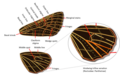
also basal dash — a typically short and broad line at the mid-basal area of the forewing of noctuid moths.See figures 4, 5
brand
Raised area on the wing surface, circular, ovate, or elongated, which is covered with special scent scales or androconia, found in males of some species. Also called sex mark.
bryophagy
feeding on moss.
Distinction between clavate and capitate anatomy of insect antennae
capitate
Mainly referring to antennae, but occasionally to other anatomical features such as palps: having a clubbed shape with a relatively long, slender stem, but with an abruptly bulkier, thicker, possibly globular distal head, the capitulum. The term capitate is not strictly distinguished from clavate, but where a distinction is desired, it is that the club of a capitate antenna is abruptly distinct from the shaft, and the head tends to be short and more or less globular. The club of a clavate antenna generally is a more or less tapered thickening, sometimes hardly distinct from the shaft.
capitulum
The head of a capitate structure, such as a capitate antenna, or of a capitate haltere
carina
a keel-like elevation (or ridge) on the body-wall of an insect.
carpophagy
feeding on fruits and seeds.
catenulate
Markings consisting of rings connected together like a chain.
  • catenulated antennae
    Antennae with ringed appearance.
cell
The central area surrounded by veins. It can be closed by veins or open.
  • The vein forming the boundary of the cell along the costal margin is known as the subcostal vein q.v.
  • The vein forming the lower boundary towards the dorsum is called the median vein.
  • In the case of butterflies, the cell is closed by a vein connecting the origins of veins 6 to 4 along the top of the cell which is known as discocellular vein.
cell cup
Taxonomically important term used in Diptera identification keys. Part of the schema of wing venation. Also called the posterior cubital cell and often called the anal cell. see File:Phytomyzinae wing veins-1.svg
central shade or median shade
Taxonomically important term used in moth description. It is a transverse band in the median area of the wing. See figures 4, 5
ceratophagy (Also spelled keratophagy)
feeding on cornified tissues and hair of animals.
cervix
(Anatomical feature) the structure defining the neck of the insect.
chaeta
See Seta.
chaetosema
patch of sensory bristles.
chalaza
An external spine that has a single point. Etymology: Greek chalasa, a tubercle. cf. scolus, which has multiple points.
cheta
See Seta.
cilia
Fine hairs along the edges of the wing. Etymology: Latin 'eyelash'[3]
clasper or clasp
A structure in male insects that is used to hold the female during copulation.
Clavate antenna of a beetle in the family Erotylidae. In this specimen the clavus comprises three segments
clava
Same as clavus.
clavate
Mainly referring to antennae, but occasionally to other anatomical features such as palps: having a clubbed shape with a relatively long, slender stem, but with a bulkier, thicker distal end, the clava. The term clavate is not strictly distinguished from capitate, but in general, where a distinction is desired, the club of a capitate antenna is abruptly distinct, even globular, whereas the club of a clavate antennae is generally a more or less tapered thickening
claviform stigma
specifically, in Noctuidae (moths)- an elongate spot or mark extending from the anterior transverse anterior line through the submedian interspace, toward and sometimes to the posterior transverse line.See figures 4, 5
clavola
Same as clavus or club
clavus
1.  The thicker distal end of a clavate anatomical structure such as an antenna. Usually comprising more than one joint. Also called clava, clavola, or club
2.  The posterior of the portion of the remigium found on insect wings.
3.  The oblong sclerite at the base of the inferior margin of the hemelytron in Heteroptera.
4.  The knob at the end of the stigmal or radial veins in the wings of certain Hymenoptera.
club
The popular (possibly to be preferred) name for the clavus of a clavate antenna.
clypeus
(Anatomical feature) a sclerite structure below the frons, circumposed by the mandibles and above the labrum.
coccidophagy
feeding on scale insects (and parasitoids of scale insects).
Terms associated with the wings
compound eye
An eye consisting of a large number of individual photoreceptor units or ommatidia (ommatidium, singular).Figure 2 d below
connexivum or connexiva (plural)
(largely in Heteroptera and similarly dorsoventrally flattened insects) the edge of the abdomen, containing the connection between the tergite and sternite. May be visible from above in species such as many of the Reduviidae.
copromycetophagy
inhabiting feces and consuming mycetes growing inside or cultivating them for feeding.
coprophagy
feeding on the excrements of animals.
costa / costal area
The leading edge of the wing.
costal break
Taxonomically important term used in Diptera identification keys. Part of the schema of wing venation. weakenings of the costa (one to three in number). They are flexing points for the wings during flight
costal fold
A fold in the leading edge of the forewing of Lepidoptera, containing androconia.
coronal suture
(Anatomical feature) an anterior suture line of the head between the compound eyes, below the median ocellus.
coxa
first leg segment, between body and trochanter.
Cremaster of pupa of the oak owl moth, Griposia aprilina
cremaster
A general term for a structure by which an object hangs (from Greek language kremastos, meaning "hung up"); for example in entomology:
in some Lepidoptera, including most butterflies, the pupa attaches to a surface by the cremaster, a structure at the tip of the pupal abdomen. The cremaster is the homologue of the anal plate of the caterpillar. It takes various forms in different species, ranging from a simple point, to various arrangements of hooks that catch Velcro-like in a silken pad that the caterpillar spins on the surface before it enters the prepupal phase.
crenulate
Adjective = scalloped. Describes the outer edge of a wing that is convex at the end of each vein and concave in between.
cuneus
Noun = wedge. Particularly in mirid bugs, a wedge-shaped section of the hemelytra (forewings), located at the apex of the thick, leathery part of the wings.

D–F

[edit]
decticous
Functional mandibles present in pupal state.
dendrophagy
feeding on trees.
dentate
As for crenulate but with the projections at the end of each wing being toothlike.
detritophagy
feeding on ground remains of plants and animals.
dieldrin
A synthetic chlorinated hydrocarbon insecticide, toxic to vertebrates. cf. the related Aldrin, Endrin, Isodrin
disc / discal area
The central band passing through the cell.
discoidal cell
In damselflies (Zygoptera) a basal quadrangular cell in the wing venation, which is delimited by veins MA (anterior side), MP (posterior side), MAb (distal side) and the arculus (basal side).
dorsum / dorsal area
The trailing edge or hind-margin of the wing, extending from the base to the tornus. Dorsal alternately, also refers to the back, i.e. the upper part of the body, from above.
ectognathous
(Anatomical feature) having exterior mouthparts, or exposed. A defining feature of insects.
elytron
(Anatomical feature) the modified, hardened forewing of certain insect orders, notably beetles (Coleoptera) and some of the true bugs (Hemiptera).
Beetle in the family Cerambycidae with conspicuous emargination of the compound eye (black) where it extends partway round the base of the antenna
emarginate
(Anatomical feature) Describing a margin, such as the edge of an eye or sclerite, where the outline includes a concave section as if a part of the region had been "cut out" or displaced. It might take the form of a notch, or a rounded or possibly quadrate hollow, such as where a compound eye is distorted in fitting around the base of the antenna.
empodium
(Anatomical feature) either a bristle-like or pad-like structure between the tarsal claws of various insects, notably Diptera.
encapsulation
the immuno response by plasmatocytes to the presence of parasitoid egg or larvae which results in the formation of a multilayered capsule that causes the parasitoid to sufficate or starve.
Endrin
A synthetic chlorinated hydrocarbon insecticide, toxic to vertebrates. Though its phytotoxicity is low, solvents in some formulations may damage certain crops. cf. the related Dieldrin, Aldrin, Isodrin
entomonecrophagy
feeding on dead arthropods.
entomophagy
feeding on other insects.
epicranius
(Anatomical feature) the top of the anterior structure of the head, or forehead.
epiproct
(Anatomical feature) a plate or projection dorsal to the anus in certain insects, generally on abdominal segment X or XI. For example in Archaeognatha, Zygentoma and Ephemeroptera, it takes the form of a long, rearwardly directed caudal filament resembling the two cerci that flank it. In the Odonata epiprocts have various functions, both in larvae, in which they may have respiratory roles, and in adults, in which they may have reproductive roles. Not all epiprocts in all insect species are homologous. Note that the term is used in other groups than insects as well, for instance Myriapoda.
erect
The palpi when vertical, i.e. the axis of the palpi is at right angles to the axis of the body.
exarate
Pupae with their legs and other appendages free and extended.
Larva of a species in the family Sphingidae. The large eyespots on the back have no function concerning vision at all; when threatened, the caterpillar retracts its head, leaving the spots resembling either a threat, or as a more tempting target than the vulnerable head. The stemmata are visible as an arc of about four tiny spots slightly lateral to, and above the mouthparts. They are inconspicuous and do have a visual function.
eyespots
1.  Spots or other patterns resembling vertebrate eyes on the skin, such as on larvae of some Sphingidae or the wings of moths such as many Saturniidae. Such eyespots have no visual function, but act variously to misdirect or discourage attacks from predators.
2.  Simple eyes such as ocelli or stemmata
face
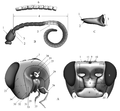
the area between the base of antennae, oral margin, eyes and cheeks (gena). See figure 3.
fascia (plural fasciae)
A color pattern with a broad band.
femur
third leg segment, between trochanter and tibia.
flagellomere
an antennomere comprising part of the flagellum.
flagellum
the part of the antenna distal to the pedicel composed of one or more segments, called flagellomeres.
foramen magnum
(Anatomical feature) the posterior opening of the head capsule, covered by the cervix.
forewing
(Anatomical feature) the pair of wings of a four-winged insect closest to the head.
fovea
small, pit-like structure in the exoskeleton.
frons
(Anatomical feature) The frontal area of an insect's head. It covers the upper part of the face above the clypeus and below and between the antennae. It supports the pharyngeal dilator muscles and usually bears an ocellus.
frontal sutures
(Anatomical feature) suture lines that meet with the coroanl sutures to form an inverted Y.

G–L

[edit]
A "true" bug, order Hemiptera, with geniculate antennae
gena
(Anatomical feature) the area below the compound eyes, the insect equivalent to human cheeks.
geniculate
Elbowed. From the Latin for a bended knee, referring to an organ of a type not always expected to be kinked, but having a definite angular bend or hinge. In entomology the term typically refers to an elbowed antenna. For instance, many species of Hemiptera, Coleoptera, and Hymenoptera have markedly geniculate antennae
girdle
a strand of silk used to prop up the pupa. Found especially in the Papilionidae.
glabrous
smooth, without hairs or scales.
gula
ventral head sclerite which supports the submentum
helminthophagy
feeding on worms classified with helminths (including parasitoids of helminths).
hemocoel
the interior of the insects anatomy, including all organs and hemocyte.
hemocyte or haemolymph
a fluid in the circulatory system of insects containing nutrients, fat, water, etc.
hemophagy
feeding on blood.
herbiphagy
feeding on herbaceous plants.
hindwing
(Anatomical feature) the pair of wings of a four-winged insect furthest from the head.
hyaline
transparent, like glass.
hygropetric
mode of life: living in the thin film of water on wet rocks.
A fly in the family Vermileonidae, using its hypognathous proboscis to extract nectar from florets.
hypognathous
having mouthparts that are ventrad of a vertically oriented head, "pointing downwards", or having an "under bit", instead of pointing backwards or forwards.
hypopharynx
Mouthpart. A tonguelike lobe on the floor of the mouth.
idiobiont
a form of parasitism where the parasitoid paralyzes or leaves the host unable to continue development at oviposition.
imago
(plural is usually imagines) The final, or adult, stage in metamorphosis.
Coreidae: adult male Anoplocnemis with incrassate posterior femur
incrassate
localised thickening of a member such as an antenna or leg.
interspace
The region between adjacent veins.
irrorated or irroration
Old term used usually to indicate a sprinkling of scales interspersed among scales typically of a different color.
Isodrin
A synthetic chlorinated hydrocarbon insecticide, toxic to vertebrates. Though its phytotoxicity is low, solvents in some formulations may damage certain crops. cf. the related Dieldrin, Aldrin, Endrin
keratophagy (Also spelt ceratophagy)
feeding on cornified tissues and hair of animals.
koinobiont
A form of parasitoidy where the parasitoid lives inside the host while allowing it to live after oviposition.
Head of a beetle in the family Cerambycidae; showing the labrum in red, below the clypeus in blue
labium
Mouthpart forming the lower lip. Bears the labial palps.
labrum
(Anatomical feature) the anterior structure below the clypeus covering some of the mouthparts, sometimes called the "upper lip".
Diagram of an insect leg
lichenophagy
feeding on lichens.
lines (moth)
transverse line markings on the wings of moths, mainly Noctuidae- basal line; inner line; outer line; submarginal line.See figures 4, 5
lines of weakness
(Anatomical feature) the suture lines where the integument will split to allow for molting or autotomy.
lunule
A body area or marking roughly in the shape of a crescent.

M–O

[edit]
macrochaete
large bristles and scales.[4]
macropterous
Having long or large elytra, as long, or longer than the abdomen.
malacophagy
feeding on mollusks (and parasitoids of mollusks).
maxilla
Mouthpart. The maxillae are paired and arranged behind the mandibles. May bear palps. See Figures 1 and 3.
membranule
a small triangular opaque region at the base of the hindwing in some dragonflies.
mesothorax
the middle segment of the thorax, between the prothorax and the metathorax.
metalmarks
small metallic-looking spots commonly found on the wings of Riodinidae.
metathorax
The third and last segment of the thorax after the mesothorax.
micropterous
Having short elytra, shorter than the abdomen.
mixomycetophagy
feeding on myxomycetes slime molds.
myiasis
Infestation of fly larvae on or in a vertebrate host.
mycetophagy
feeding on fungus.
necrophagy
consuming of dead animals and their remains.
nervure
Older term for vein. adnervural refers to instance lines running adjacent and alongside the veins.
nodus
(of Odonata ) A prominent cross-vein near the center of the leading edge of a wing. Also called "node".
obtect
Appendages fused or glued to the body.
occipital suture
(Anatomical feature) the structure that defines the occiput. See Figure 1 (below).
occiput
(Anatomical feature) the region posterior to the vertex on the head. See Figure 2 (below).
ocular structure
(Anatomical feature) the structure of the head containing the ocelli.
onisciform
A woodlouse shaped, flattened platyform appearance of a larva.[5]
oophagy
feeding on eggs.
opisthognathous
with receding mouthparts, or having mouthparts that slope backward or face backward.
orbicular stigma (or orbicular spot)
a marking placed between the reniform stigma and the thorax, usually circular in shape. See figures 4, 5
osmeterium
fleshy structure on some larvae, often discharging odorous chemicals.
oviposition
the act of laying eggs.
oviscape
if part of the ovipositor is visible when not in action, then the basal visible portion, typically tubular, is the oviscape. For examples, see females of many Tephritidae and Pyrgotidae (cf scape).
ovipositor
structure by which many insects place their eggs, sometimes by piercing or slitting the host or substrate in which she lays the eggs. The structure may be tubular and may have valves.
ozadene
a stink gland or repugnatorial gland, from which an animal such as an insect or Myriapod may release a foul-smelling liquid or gas for defence
ozopore
the opening of an ozadene, a stink gland or repugnatorial gland

P–R

[edit]
palynophagy
feeding on pollen.
parasitoid
parasite that develops attached to or within a host organism in a relationship which ultimately kills the host.
pedicel
the second segment ( antennomere) of the antenna. See figure 3.
pedipalp (or labial palpi or palpi)
comparatively large processes that originate from below the head and curve forward in front of the face that sometimes appear like a beak. lp on the figure right.
phloeophagy
feeding on phloem.[6][7][8]
phyllophagy
feeding on leaves.
phytophagy
feeding on plants.
pleurite
A sclerotised region on the lateral part of an insect segment, bearing the spiracle, and separating and connecting the tergite and the sternite (compare: pulmonarium).
pollinophagy
feeding on pollen.
Porrect mandibles of antlion larva.
porrect
of organs extended horizontally anterior to the head. In such organs the axis of the organs is parallel to the axis of the body.
postclypeus
the upper (proximal) portion of the clypeus of insects.
postdiscal
The area, or band, of the wing between the discal area and the marginal area.
posterior
in a position behind or below the aforementioned.
postoccipital suture
(Anatomical feature) the structure posterior to the occipital suture, surrounding foramen magnum or occipital magnum.
proboscis
tubular feeding and sucking organ.
proclinate
Directed or leaning forward, such as in bristles in particular locations of insects' heads.
Beetles in the family Carabidae, generally have prognathous heads
prognathous
having mouth parts extended forward of the head, in contrast to opisthognathous and hypognathous.
proleg
fleshy leg like structures arising from the abdominal segments of caterpillars. These prolegs have crochets or curved hooks.
prothorax
The first segment on the thorax anterior to the mesothorax.
pterostigma (plural pterostigmata)
The prominent cell, usually opaque and coloured, near the tip of each wing of the Odonata, on the anterior margin; also, more loosely, called stigma.
pterothorax
The meso- and metathorax of winged insects, that carries the two pairs of wings.
pulmonarium (plural pulmonaria)
A membranous instead of a sclerotised connection or pleurite between the abdominal tergites and sternites of certain groups of insects; in such species the pulmonaria bear the spiracles. The term also refers to an abdomen in which the connection between the tergal and sternal sclerites takes the form of a pulmonarial membrane. (Compare: pleurite)
reniform stigma (or reniform spot)
an oval or kidney-shaped mark on the forewing at the disc (Lepidoptera)[9] See figure 4
A Chrysomelid larva carrying its own frass as repugnatorial protection
repugnatorial
(generally in combination as in: "repugnatorial glands"): defensive, or "fighting back", in particular as applied to an ozadene, a gland that can release irritant, poisonous, alarming or distasteful fluids or gases when an organism is under threat. Examples of repugnatorial glands include the osmeterium of larvae of the Papilionidae, the stink glands of most Heteroptera, the ozadenes of Opiliones, the odoriferous glands of Diplopoda, and others. Some insects, such as larvae of many species of the Chrysomelidae, use their excreta in repugnatorial roles, for example covering themselves with their own frass.
rhizophagy
feeding on rhizomes.

S–Z

[edit]
saltatorial
adapted for leaping or jumping.
sarconecrophagy
feeding on dead bodies of vertebrates.
sapromycetophagy
inhabiting decaying matter and consuming mycetes growing inside or cultivating them for feeding.
saprophagy
feeding on decaying organic matter.
scape
the proximal segment ( antennomere) of the antenna. See Figure 3.
schisophagy
feeding on ground remains of plants and animals.
sclerite
a hardened plate in the exoskeleton of an arthropod. cf. e.g. sternite, tergite
scolus
An external spine having multiple points. Etymology: Greek skolos, a prickle. cf. chalaza. plural: scoli
sensu
Latin term meaning "in the sense of".
sequestering
The process of animals accumulating poisonous compounds from the food they are eating in order to become poisonous themselves for their predators. Pyrrolizidine alkaloid sequestration refers to the sequestration of one such class of poisonous compounds.
seta
A stiff chitinous or sclerotised hair or bristle. Also chaeta, cheta
setaceous
  • being like or having the nature of a seta or of setae
  • setose
setose
bearing, or covered in setae.
setula
Diminutive of seta. A small chitinous hair or bristle.
setulose
bearing, or covered in setulae.
shade
see central shade
spiracle
Respiratory openings on the thorax and abdomen that allow air to enter the trachea.
sporophagy
feeding on mycet spores.
sternite
a ventral sclerite in the exoskeleton of an arthropod.
stigma (plural stigmata)
Prominent cells on the forewings of some moths. Their size, shape and colour can be useful in identifying some species. Also the prominent cell, usually opaque and coloured, near the tip of each wing of the Odonata, on the anterior margin; also called pterostigma.
strigae
Patterns with thin lines.
subcosta
Taxonomically important term used in Diptera identification keys. Part of the schema of wing venation. The second longitudinal wing vein, posterior to the costa. It may reach the costa, fade before the costa or join R1 before it reaches the costa. see commons:File:Neminidae_wing_veins.svg (= auxiliary vein of many authors)
subgenal suture
(Anatomical feature) suture lines below the gena.
symplesiomorphy
a shared ancestral ("primitive") character state that cannot be used to demonstrate the monophyly of a group.
synapomorphy
a shared homologous and derived character state (evolutionary novelty) that demonstrates the monophyly of a group (clade).
synovigenic
a form of reproduction in which the female continues to produce and to mature eggs throughout its life cycle.
tarsus (plural tarsi)
fifth (last) leg segment, the part that touches the walking surface.
tergite
a dorsal sclerite in the exoskeleton of an arthropod.
tergum
the dorsal structure of sclerites in the exoskeleton of most Arthropoda.
termen
The edge of the wing most distant from the body.
terminal and marginal
Along the margin.
thorax
The part of the body that lies between the head and the abdomen. It has three parts - prothorax, mesothorax and metathorax.
tibia
fourth leg segment, between femur and tarsus.
tomentum
a pubescence consisting of soft, entangled hairs pressed close to the surface of the integument.
tornus / tornal area
The posterior corner of the wing.
trochanter
second leg segment, between coxa and femur.
trophi
The mouthparts of Arthropoda such as insects; typically labrum, mandible, maxilla, labium.
trophus
The singular form of trophi (rarely used).
uncate
hook-like, as in the mouthparts of many fly larvae. (also uncinate)
uncinate
hook-like, as in the mouthparts of many fly larvae. (also uncate)
unguis (plural ungues)
the claws at the tip of most insect pretarsi.
urite
a segment of a recognisably segmentary arthropodal abdomen
urogomphus (plural urogomphi)
paired "horns" at the posterior tip of the abdomen of larvae.
urosternite
plate on the ventral (lower) surface of an abdominal segment in insects. cf. sternite
urotergite
plate on the dorsal (upper) surface of an abdominal segment in insects. cf. tergite
valve
One of several appendages that combine to form the ovipositor of a typical female insect.
valvifer
In female Heteroptera valvifers comprise four blades, one pair on each of abdominal segments 8 and 9. They articulate with the paratergites and bear their corresponding valvulae.
valvula
One of four blades in a female Hemipteran with a laciniate type of ovipositor, that combine to form the ovipositing mechanism.
vein
Hollow structures formed from the coupling of the upper and lower walls of the wing. They provide both rigidity and flexibility to the wing. (See also Comstock-Needham system.)
vertex
(Anatomical feature) The apex of the head, usually containing ocelli.
villose
covered with numerous thick-set, slender projections resembling short hairs.
worker
Insects within social colonies (bees, wasps, ants, and termites) that usually do not reproduce and instead perform most of the colony's tasks.
xylomycetophagy
inhabiting wood and consuming mycetes growing in wood or cultivating them for feeding.
xylophagy
feeding on wood.
zoomycetophagy
feeding on fungus found on other animals.
zoophagy
feeding on animals, and/or animal matter.

Figures

[edit]

See also

[edit]

The dictionary definition of thesaurus:insect#See also at Wiktionary

References

[edit]
[edit]
Revisions and contributorsEdit on WikipediaRead on Wikipedia
from Grokipedia
The glossary of entomology terms comprises the specialized vocabulary essential to the of , a discipline formally defined as , which focuses on the biology, classification, and ecological roles of within the class Insecta. This lexicon includes thousands of precise definitions covering insect anatomy (such as and metathorax), developmental stages (like and ), behavioral patterns (swarming and ), taxonomic classifications (order and ), and applied contexts including pest control () and medical implications (vector-borne diseases). Key reference works, such as A Dictionary of Entomology by Gordon Gordh and David H. Headrick, provide comprehensive, cross-referenced compilations of approximately 35,000 terms, names, and phrases, drawing from subfields like morphology, , and to support global research and practical applications in , , and . Similarly, the revised Torre-Bueno Glossary of Entomology, compiled by Stephen W. Nichols with Supplement A by George S. Tulloch, offers an authoritative update to earlier editions, emphasizing standardized nomenclature to facilitate communication among worldwide. These glossaries underscore the complexity of entomology, where insects—numbering over a million described species—influence ecosystems, economies, and human well-being through roles as pollinators, decomposers, and occasional pests.

Anatomical Terms

External Morphology

The external morphology of insects encompasses the visible structural features of their exoskeleton, which provides support, protection, and facilitates locomotion, sensory perception, and feeding. Insects exhibit a high degree of tagmosis, where the body is divided into three primary tagmata: the head, thorax, and abdomen, each specialized for distinct functions. This segmentation arises from the ancestral arthropod plan of numerous similar segments, but in insects, fusion and modification have optimized these regions for survival. The exoskeleton, composed of chitinous cuticle, covers these tagmata and is often sclerotized into hardened plates called sclerites, separated by flexible sutures. The head is the anterior tagma, typically forming a hardened capsule that bears sensory and feeding structures. It includes paired compound eyes, composed of numerous ommatidia for image formation, and dorsal ocelli, simple photoreceptors for light detection. The head also supports antennae and mouthparts. Head orientation varies: prognathous (forward-projecting, common in predatory beetles like ground beetles), hypognathous (ventral, as in for chewing), and opisthognathous (rearward, seen in some true bugs of order ). The head connects to the thorax via the flexible or neck region. The is the middle tagma, specialized for locomotion, consisting of three segments: the (anterior, bearing the first pair of legs), mesothorax (middle, bearing second legs and forewings), and metathorax (posterior, bearing third legs and hindwings). These segments are often fused into a rigid box-like structure, with the prothorax sometimes enlarged as a pronotum for protection. The thorax's primary role is supporting appendages for walking and flight, with the mesothorax disproportionately developed in flying insects like bees. Spiracles, external openings to the tracheal system, are located laterally on the thorax. The is the posterior tagma, a flexible, segmented region housing reproductive and digestive organs externally visible through its sclerites. Primitive insects possess 11 abdominal segments, though fusion and reduction often result in fewer visible ones, such as 9 in many adults. Tagmosis here emphasizes elongation for oviposition and digestion, with segments bearing spiracles for . In some females, an extends as an external egg-laying appendage. Antennae are paired, segmented sensory appendages arising from the head's frons, primarily for chemoreception, mechanoreception, and touch. They consist of a scape, pedicel, and with varying segments. Common shapes include setaceous (bristle-like, tapering as in dragonflies), clavate (clubbed, enlarging distally as in ), geniculate (elbowed, with bent scape as in ), capitate (rounded club at tip, similar to clavate but more abrupt), and lamellate (plate-like segments, as in scarab beetles of order Coleoptera). These forms aid in species identification and environmental sensing. Legs are jointed thoracic appendages, each with five segments: coxa (basal, attaching to thorax), trochanter (small, bridging), femur (large, muscular), tibia (slender, often with spurs), and tarsus (distal, with claws for gripping). Modifications adapt them to lifestyles: saltatorial (enlarged femur for jumping, as in grasshoppers), raptorial (spined for grasping prey, as in mantises), cursorial (slender for running), fossorial (broadened for digging), and natatorial (fringed for swimming). Larvae of some orders, like Lepidoptera, have fleshy abdominal prolegs for crawling, in addition to thoracic legs. Insects typically possess two pairs of wings arising from the meso- and metathorax: forewings and hindwings, which may be homologous or modified. Wing structure includes a membrane supported by venation, a network of chitinous veins named as follows: costa (anterior margin, strongest), subcosta (parallel to costa), and radius sector (branching forward), media (central, often forked), (posterior to media), and anal veins (basal, for flexing). A pterostigma is a thickened cell near the leading edge for stability. Modifications include elytra (hardened forewings protecting hindwings in Coleoptera, like beetles) and hemelytra (basally sclerotized, apically membranous forewings in , like true bugs). Apterous (wingless) forms occur in some species. Mouthparts form a complex appendage group on the head, derived from modified appendages, including the labrum (upper lip, sensory), paired mandibles (jaw-like grinders), paired maxillae (with inner lacinia for tearing and outer galea for manipulation), the labium (lower lip, fused), and hypopharynx (tongue-like, for ). Types reflect feeding habits: (mandibulate, for solids, as in beetles), piercing-sucking (stylate, with stylets for extraction, as in mosquitoes), and siphoning (proboscis-formed, for , as in ).

Internal Anatomy

The internal anatomy of encompasses the organ systems and tissues housed within the , facilitating essential functions such as circulation, respiration, , , locomotion, and neural coordination. Unlike vertebrates, lack many discrete organs separated by membranes; instead, their , the hemocoel, serves as a central space where bathes tissues directly. This open design supports efficient nutrient distribution and waste removal in a compact , with specialized structures adapted to terrestrial and aquatic lifestyles. The hemocoel is the primary body cavity in , forming an open circulatory space filled with that constitutes up to 40% of the insect's body weight. This cavity arises during embryonic development from the splitting of mesodermal tissue and lacks closed blood vessels, allowing to bathe organs directly for nutrient transport, distribution, and waste removal. In functional terms, the hemocoel is compartmentalized by diaphragms—dorsal and ventral sheets of —that aid in directing flow without fully isolating regions. Respiration occurs via the tracheal system, consisting of a network of air-filled tubes that deliver oxygen directly to tissues. The trachea are branched, ectodermally derived tubes reinforced with spiral taenidia to maintain patency, originating from external openings called spiracles. Spiracles are valve-like apertures located laterally on the (typically two pairs) and (up to eight pairs), positioned segmentally to minimize water loss while allowing . These spiracles feature valvular control through small muscles that operate flap-like structures, closing during stress to prevent or entry and opening via relaxation for air intake. From the main tracheae, finer branches called tracheoles extend to individual cells, including muscles and the , enabling diffusion-based oxygenation without reliance on . Circulation is driven by the dorsal vessel, a longitudinal muscular tube extending from the abdomen to the head along the dorsal body wall. The posterior portion, termed the heart, occupies the abdomen and is segmented into chambers separated by ostia—slit-like valves that permit unidirectional entry of hemolymph during diastole. Peristaltic contractions (30–200 beats per minute, varying by species and temperature) propel hemolymph anteriorly through the non-valved aorta, the anterior extension of the dorsal vessel that empties near the brain. Paired alary muscles attach laterally to each heart chamber, flattening the dorsal diaphragm to expand the pericardial sinus and draw hemolymph inward via ostia, thus supporting rhythmic pumping. Accessory pulsatile organs in the head and legs supplement flow in some species, but the dorsal vessel remains the primary pump for distributing nutrients, hormones, and immune factors. Excretion and osmoregulation are primarily handled by the Malpighian tubules, slender, blind-ended structures (typically 2–250 per , varying by order) projecting from the midgut-hindgut junction into the hemocoel. These tubules actively transport potassium ions and water from into their lumen via pumps and ion channels, creating an osmotic gradient that draws in nitrogenous wastes like . The uric acid is converted to insoluble urates for efficient , and the tubules' distal regions reabsorb ions and fluids before contents pass to the for final processing. This system enables terrestrial s to maintain ionic balance and excrete dry nitrogenous waste, adapting to low-water environments. The is a diffuse, mesodermally derived tissue dispersed throughout the hemocoel as sheets or lobes, closely apposed to the for metabolic exchange. It comprises primarily adipocytes (trophocytes), polygonal cells laden with droplets, granules, and protein reserves, interconnected by gap junctions and desmosomes, and often polyploid in larvae for enhanced synthetic capacity. Functionally, it serves as the main site for nutrient storage, holding over 50% of dry weight as triglycerides and carbohydrates, which are mobilized during , flight, or molting. The fat body also synthesizes proteins (e.g., vitellogenin for yolk in females), regulates levels, and contributes to immunity by producing and effectors in response to infection. In reproduction, it supplies precursors for ovarian development, drawing from larval reserves to fuel . Insect muscles are predominantly striated and attached to the or internal structures, enabling precise control without smooth or cardiac types found in vertebrates. Body wall muscles include longitudinal fibers running parallel to the body axis for shortening segments, oblique muscles for twisting or diagonal movements, and vertical muscles for elevating the tergum during walking or . Alary muscles, a subset of visceral muscles, are fan-shaped bands flanking the dorsal vessel to aid circulation through diaphragmatic adjustments. Visceral muscles, non-striated in appearance but functionally striated, line the gut, reproductive tract, and Malpighian tubules, contracting myogenically or via neural input to facilitate and . These muscle arrangements support the insect's lightweight frame, with tracheal tracheoles embedded for direct oxygenation during activity. The follows a segmental plan, with a dorsal in the head connected to a ventral cord running posteriorly through the and . The , a fused mass of three neuromeres (protocerebrum, deutocerebrum, tritocerebrum), processes sensory input and coordinates behaviors like feeding. The ventral cord comprises paired per segment—three in the and up to eleven in the —linked by connectives and commissures, each controlling local reflexes such as leg movement. This decentralized arrangement allows rapid, autonomous responses while the oversees integration, with extending to muscles and viscera without a centralized .

Developmental and Physiological Terms

Life Cycle Stages

The life cycle of encompasses a series of developmental stages that vary in complexity depending on the , enabling to diverse environments and ecological roles. These stages typically include the egg, , , and (adult), with transitions marked by molting processes that allow growth and morphological changes. Insects exhibit different types of , ranging from to complete transformation, which influences their life history strategies and interactions within ecosystems. , a period of developmental arrest, can interrupt these stages to synchronize development with favorable conditions. The stage represents the initial embryonic phase of insect development, where the ovum is enclosed in a protective shell composed of proteins and that safeguards the developing . This often features micropylar openings, specialized structures that permit entry during fertilization prior to oviposition. Eggs vary in shape, size, and ornamentation across , such as the ribbed eggs of some beetles or the barrel-shaped eggs of , adaptations that enhance protection or attachment. , a dormant state within the egg, can be induced by environmental cues like short day lengths, allowing eggs to overwinter until conditions improve, as observed in certain . The larval stage is the primary immature, feeding phase in many , characterized by rapid growth through a series of instars—discrete periods between molts where the increases in size. Larvae undergo , the process of shedding the old to accommodate expansion, which occurs multiple times (typically 3 to 7 instars) until pupation. Larval morphology is classified into types such as campodeiform (active, elongate, with prominent legs and antennae, e.g., lacewing larvae), eruciform (cylindrical, with prolegs, e.g., caterpillars), and scarabaeiform (scarab-like, C-shaped, with reduced appendages, e.g., grubs), reflecting specialized feeding and mobility needs. The pupal stage serves as a transitional, non-feeding period in holometabolous , during which radical reorganization occurs to form structures. Pupae are categorized as exarate, where appendages like legs and wings remain free and movable, or obtect, where they are fused to the body for protection, as seen in . Further distinctions include adecticous pupae, lacking functional mandibles (common in flies and beetles), versus decticous pupae, with movable mouthparts for defense (e.g., in some moths). This stage is often encased in a cocoon or puparium, providing shelter during the vulnerable remodeling process. The , or adult stage, is the sexually mature form focused on and dispersal, marking the end of . , known as eclosion, involves the adult breaking free from the pupal case, followed by wing expansion where is pumped into the wings to unfurl and harden them, a critical step for flight capability in winged species. Once expanded, wings sclerotize within hours, enabling immediate mobility, as in where failure to expand properly can be fatal. Insect metamorphosis is broadly classified into ametabolous (now termed direct development, with no distinct larval stage and gradual growth resembling adults, e.g., ), hemimetabolous (incomplete metamorphosis featuring nymphs that progressively resemble adults but lack fully developed wings until the final molt, common in true bugs and dragonflies), holometabolous (complete metamorphosis with distinct larval, pupal, and adult forms differing markedly in morphology and , e.g., and beetles), and paurometabolous (gradual metamorphosis similar to hemimetabolous but typically in terrestrial insects like grasshoppers, with wing pads developing externally over instars). These types reflect evolutionary adaptations, with holometabolous development predominant in over 80% of insect species. Diapause is a hormonally mediated that halts or slows development to avoid unfavorable conditions, occurring in embryonic (e.g., in eggs triggered by maternal photoperiod experience), larval (e.g., in larvae entering stasis under short days), or pupal (e.g., in certain flies overwintering as pupae) stages. Environmental triggers such as photoperiod (day length), , and sometimes or nutrition initiate diapause, ensuring synchrony with seasonal changes; termination often requires chilling or prolonged exposure to inductive conditions. In social insects like honeybees, age polyethism involves post-eclosion task division where young adults perform in-hive duties such as , transitioning to as they age.

Sensory and Physiological Processes

Insect sensory systems enable the detection of environmental stimuli crucial for survival, navigation, and reproduction, while physiological processes maintain internal balance amid varying external conditions. Sensory organs like compound eyes and ocelli provide visual input, chemoreceptors facilitate odor and taste perception, and mechanoreceptors sense mechanical cues, all integrated with physiological mechanisms such as molting, , and to support . The compound eye consists of a mosaic of numerous ommatidia, each functioning as an independent visual unit that contributes to wide-field motion detection and image formation in insects. This structure excels at detecting rapid movements, with visual acuity varying by species; for instance, dragonflies achieve high resolution through densely packed ommatidia. Compound eyes are classified into apposition and superposition types based on optics: apposition eyes, common in diurnal insects like bees, use screening pigment to isolate light rays to individual ommatidia, optimizing resolution in bright light but limiting sensitivity; superposition eyes, prevalent in nocturnal species such as moths, allow light from multiple ommatidia to converge on a shared rhabdom, enhancing sensitivity in low light at the cost of resolution. Spectral sensitivity in compound eyes typically peaks in the green-yellow range (around 500-550 nm) but extends to ultraviolet (300-400 nm) for detecting floral patterns or pheromones, with some species like butterflies showing tetrachromatic vision including red sensitivity. Ocelli, or simple eyes, are dorsal light sensors typically numbering three on the insect head, positioned between or above the compound eyes to monitor overall light intensity and horizon orientation. Unlike compound eyes, ocelli lack lenses and form a single image via a corneal swelling over a cluster of photoreceptors, providing low-resolution input primarily for stabilizing flight posture and detecting changes in skylight polarization. In species like cockroaches and bees, ocelli contribute to optomotor responses, helping maintain level flight by sensing roll and pitch relative to dorsal light sources, with neural pathways linking them directly to flight motor centers for rapid adjustments. Chemoreception in primarily occurs through antennal sensilla, specialized cuticular structures housing olfactory and gustatory receptors that detect volatile and soluble chemicals. Olfactory sensilla, such as basiconic and trichoid types on antennae, contain pore tubules allowing odorants—including pheromones—to bind ionotropic receptors, triggering action potentials; for example, moths detect pheromones at extremely low concentrations, with neuronal thresholds as low as approximately 3 × 10^3 molecules per ml (around 10^{-12} g/m³ for typical pheromones) via specific receptor proteins. Gustatory sensilla on mouthparts and tarsi sense taste via similar mechanisms but respond to non-volatiles like sugars or , with thresholds varying by stimulus—e.g., honeybees detect at 0.3% concentration—enabling host plant selection or toxin avoidance. Antennae serve as the primary chemosensory organs, integrating these signals for behaviors like mate location. Mechanoreception relies on hair-like sensilla, including setae and chaetae, which detect touch, air currents, and vibrations through deflection of cuticular hairs linked to neuronal dendrites. These trichoid sensilla, distributed across the body and appendages, respond to mechanical stimuli with thresholds around 0.1-1 mN force, aiding in tactile exploration and wind detection for flight control. Campaniform sensilla, embedded in the particularly on wings and legs, function as strain detectors, deforming under tensile stress to signal or joint position; in flies, haltere campaniform sensilla monitor gyroscopic forces during flight, enabling rapid corrections to body orientation. Ecdysis and molting represent the hormonal orchestration of renewal in , essential for growth and . The process begins with apolysis, where the detaches from the old under influence from prothoracic glands, followed by of molting fluid containing chitinases to digest the endocuticle. from corpora allata modulates effects to determine molt type—larval or pupal—while the synthesizes a new, flexible of and proteins that sclerotizes post-ecdysis. This cycle repeats throughout post-embryonic development, with peaks triggering each stage. Osmoregulation maintains ionic and water balance in via the Malpighian tubules and , adapting to diverse habitats including arid environments. Malpighian tubules, blind-ended extensions of the , actively transport and sodium into a primary isosmotic to , followed by selective reabsorption in the to conserve water. In desert like tenebrionid beetles, rectal pads—specialized columnar with apical infoldings—increase surface area for and water reabsorption, achieving up to 90% recovery via pumps, preventing in low-humidity conditions. Spiracles regulate during this process to minimize water loss. Thermoregulation in combines behavioral strategies, like basking or shade-seeking, with physiological mechanisms to optimize function and flight performance. Many ectothermic rely on ambient , but some achieve endothermy through flight muscle contractions, generating thoracic temperatures 10-20°C above ambient; for instance, sphinx moths elevate flight muscle to 35-45°C via alternating antagonist contractions pre-flight. This pre-flight warm-up, lasting 10-30 minutes, boosts power output for sustained hovering, with endothermy particularly adaptive in large moths for nocturnal activity in cool conditions.

Behavioral Terms

Foraging and Feeding

In , foraging refers to the behavioral processes by which search for and acquire food resources, while feeding encompasses the morphological and physiological adaptations that enable consumption and digestion of those resources. These strategies are diverse, reflecting the vast array of ecological niches occupied by , from herbivores exploiting tissues to predators targeting other arthropods. Adaptations such as specialized mouthparts, including the for liquid feeding or maxillae for chewing, facilitate efficient resource acquisition. Phytophagy denotes the feeding habit of insects that consume tissues or products, a strategy prevalent among orders like , Coleoptera, and . This broad category includes subtypes based on specific parts targeted: phyllophagy involves chewing leaves, as seen in grasshoppers () and caterpillars; xylophagy entails consuming wood, typical of bark beetles (Scolytinae); phloeophagy focuses on bark, also common in bark beetles; and dendrophagy targets trees or woody structures, exemplified by stem-boring cerambycid beetles. These subtypes link morphological adaptations, such as mandibulate mouthparts for grinding, to behavioral foraging patterns that optimize nutrient extraction from recalcitrant materials. Entomophagy, or insectivory, describes the predatory or scavenging consumption of other or arthropods, a key strategy in carnivorous taxa like mantids (Mantodea) and lacewings (). Specialized forms include aphidophagy, the feeding on (Aphididae), as practiced by many lady beetles (), and coccidophagy, targeting scale (Coccidae), often by predatory beetles or flies. These behaviors involve active foraging, such as ambushing or pursuing prey, and are crucial for population regulation in ecosystems. Hemophagy, the blood-feeding habit, is characteristic of ectoparasitic insects like mosquitoes (Culicidae) and fleas (Siphonaptera), which use piercing-sucking mouthparts to penetrate host skin and extract . In mosquitoes, containing anticoagulins—enzymes that inhibit blood clotting—ensures uninterrupted flow during feeding, facilitating disease transmission such as . This strategy demands precise foraging cues, like host odors and heat, to locate vertebrate hosts. Mycetophagy involves feeding on fungi, a niche occupied by beetles in families like Ciidae and Erotylidae, where mycelia provide essential nutrients. Subtypes include xylomycetophagy, the consumption of wood-decay fungi by ambrosia beetles (Scolytinae), which cultivate symbiotic fungi in galleries for sustenance, and copromycetophagy, feeding on fungi associated with dung, as in certain scarab beetles (Scarabaeidae). These interactions often involve mutualistic relationships that enhance fungal dispersal. Saprophagy refers to the consumption of decaying , enabling like carrion beetles (Silphidae) and dung beetles (Scarabaeinae) to recycle nutrients in ecosystems. Specific forms encompass necrophagy, feeding on carrion, as in burying beetles that inter dead vertebrates; coprophagy, ingestion of dung, prominent in scarabaeine beetles that roll and bury feces; and detritophagy, processing leaf litter or soil by soil-dwelling . These detritivores accelerate through enzymatic breakdown. Other specialized feeding strategies include palynophagy, the consumption of pollen, observed in bees (Apoidea) and thrips (Thysanoptera) that collect and digest protein-rich grains; sporophagy, feeding on fungal or plant spores, as in certain springtails (Collembola); algophagy, ingestion of algae by aquatic insects like stoneflies (Plecoptera); lichenophagy, consumption of lichens by small beetles; and bryophagy, feeding on mosses or liverworts, typical of some psocids (Psocodea). These niche habits underscore the adaptability of insect foraging to microhabitats. Trophallaxis is the mouth-to-mouth transfer of food or fluids among social insects, serving both nutritional and communicative functions in colonies of ants (Formicidae) and bees (Apidae). In ants, regurgitated crop contents are exchanged to distribute resources from foragers to nestmates, while in honeybees, it conveys pheromonal information about food quality. This behavior fosters colony cohesion and efficient resource allocation.

Reproduction and Sociality

In entomology, reproduction encompasses a range of strategies adapted to diverse ecological niches, from sexual facilitated by specialized structures to asexual mechanisms that enable rapid population growth. Oviposition, the process of egg-laying in , involves the deposition of eggs into suitable substrates, often guided by precise behaviors to ensure offspring survival. The , a key in many , typically comprises valvulae and valvifers that facilitate egg and placement; for instance, in encyrtid wasps, the features three pairs of valvulae and two pairs of valvifers connected to the ninth abdominal tergum, enabling penetration into host tissues. during oviposition is behaviorally sophisticated, with females assessing substrate texture, moisture, and predation risks; wood-boring like certain wasps use probing to detect suitable oviposition sites in solid wood, leveraging biomechanical flexibility for insertion. In soybean aphids, ovipositor movement relies on the rocking action of the first valvulae and valvifer to transport eggs, highlighting the structure's role in precise deposition. Male insects employ the aedeagus as the primary for , transferring directly into the female reproductive tract. This sclerotized structure, often housed within the male genitalia, includes the gonopore for ejection and claspers or parameres that secure positioning during copulation; in orthopterans like grasshoppers, the aedeagus protrudes from the phallobase to align with the female's genitalia. Rapid evolutionary divergence in aedeagus morphology promotes species-specific mating, reducing hybridization risks, as observed in diverse insect taxa where genital asymmetry enhances lock-and-key mechanisms. via the aedeagus ensures viability in protected environments, a prevalent in endopterygote orders. Pheromones serve as chemical signals pivotal to reproductive behaviors, attracting mates or coordinating group activities in . Sex pheromones, typically released by females to lure males over long distances, include compounds like bombykol in silk moths (), which trigger oriented flight and courtship. Aggregation pheromones draw both sexes to resource-rich sites, as in bark beetles where they promote mass attacks on hosts; trail pheromones, conversely, guide followers along paths, exemplified by like Argentine ants (Linepithema humile) using hindgut-derived hydrocarbons to mark routes. These pheromones, often multi-component blends of derivatives, enable species-specific communication without visual cues. Parthenogenesis represents an asexual reproductive mode in insects, allowing unfertilized eggs to develop into viable offspring, particularly advantageous in sparse populations. In , common in like wasps and bees, unfertilized eggs produce haploid males, while fertilized eggs yield diploid females, facilitating haplodiploid sex determination. , by contrast, generates diploid females from unfertilized eggs via mechanisms like automixis, as seen in where it supports cyclical during favorable seasons. In , thelytoky enables exponential population growth without males, shifting to under stress; parasitic wasps exhibit to produce male progeny for dispersal. These strategies enhance reproductive assurance in unstable environments. Transitioning to sociality, denotes the pinnacle of insect social organization, characterized by cooperative brood care, overlapping generations, and reproductive division into castes. In , castes include the queen (reproductive female), workers (sterile females performing maintenance), and drones (males for mating); this structure has evolved independently at least 12 times, driven by ecological pressures. underpins eusociality, where workers aid relatives to propagate shared genes, as queens and workers in monogamous colonies share high relatedness. Overlapping generations allow experienced individuals to support the queen's brood, fostering colony-level fitness. Within eusocial colonies, age polyethism governs task allocation, with individuals progressing through roles based on age to optimize efficiency. In honeybees (Apis mellifera), young workers (1-3 weeks) focus on brood and hive maintenance, transitioning to and guarding after 3-4 weeks, influenced by levels. This temporal division minimizes risk to the , as older foragers face higher mortality from external threats. Environmental cues can accelerate or delay shifts, ensuring adaptive responses to colony needs. Altruism in insects manifests as self-sacrificial acts that benefit colony kin, exemplified by sterile workers in Hymenoptera forgoing reproduction to support the queen. Inclusive fitness theory explains this via indirect genetic benefits, where workers in haplodiploid systems share 75% relatedness to sisters, favoring aid over personal offspring. Sterile workers perform foraging and defense, often at mortal cost, as enforcement mechanisms like egg policing suppress selfish reproduction. In ants and bees, such behaviors elevate colony success, with monogamy enhancing relatedness to sustain altruism.

Ecological and Applied Entomology

Interactions and Symbiosis

In entomology, interactions and symbiosis encompass a range of interspecies relationships that shape ecological dynamics, including predation, , and mutualistic associations. These processes connect insects to other organisms, influencing , , and . Predation involves active , while parasitic interactions often lead to host or debilitation. Symbiotic relationships, defined as close and prolonged associations between , can be mutualistic (both partners benefit), commensal (one benefits without harming the other), or amensalistic (one is harmed without benefit to the other). Parasitoids are , primarily in the orders Hymenoptera and Diptera, whose larvae develop within or on the body of a host insect, ultimately killing it upon emergence. This distinguishes them from true parasites, which do not typically kill their hosts. Parasitoids are classified into idiobionts, which paralyze the host immediately upon oviposition to halt its growth and development, and koinobionts, which allow the host to remain active, feeding, and growing after parasitism, often regulating host physiology to optimize larval nutrition. Idiobionts, such as many ectoparasitic braconid wasps, target immobile or late-stage hosts, whereas koinobionts, like endoparasitic ichneumonid wasps, attack active, early-stage hosts to exploit their continued development. Myiasis refers to the infestation of living vertebrate tissues by dipteran fly larvae, where the larvae feed on host fluids or tissues during development. It is categorized as obligatory, in which the fly species requires a living host to complete its life cycle, or facultative, where larvae opportunistically infest wounds or necrotic tissue but can also develop saprophytically. The human botfly (Dermatobia hominis), an obligatory myiasis agent, deposits eggs on a vector mosquito that transfers them to mammalian skin, where larvae burrow and feed subcutaneously, causing furuncular lesions. Facultative species, such as certain blow flies (Calliphoridae), infest open wounds but do not depend on live hosts. Symbiosis in often manifests as mutualism, exemplified by the relationship between and , where protect from predators and parasitoids in exchange for honeydew, a sugar-rich from feeding on . This trophobiosis enhances survival and colony growth while providing with a carbohydrate source. includes phoresy, a dispersal mechanism where smaller or mites attach to larger for to new habitats without affecting the carrier, as seen in mites phoretic on bark beetles that hitch rides during flight. Amensalism occurs when one species chemically inhibits another without deriving benefit, such as through the release of compounds that suppress competitor growth. Predation in insects entails active hunting and consumption of prey, serving as a key regulatory force in food webs. Entomonecrophagy describes the scavenging of dead by necrophagous species, such as certain carrion beetles (Silphidae), which locate and feed on corpses to recycle nutrients. Helminthophagy involves predation on worms or annelids, as practiced by ground beetles (Carabidae) that hunt soil-dwelling helminths to control their populations. These specialized predatory behaviors highlight insects' roles in and . Antibiosis refers to the chemical inhibition of competitors or antagonists through the production of toxic metabolites, often derived from symbiotic microbes or sequestered plant compounds. Many , such as leaf-cutting (Atta spp.), cultivate antibiotic-producing (Pseudonocardia) in metapleural glands to suppress fungal competitors in their gardens. Sequestering involves accumulating host plant toxins, like cardenolides in monarch butterflies (Danaus plexippus) from milkweed, repurposing them as chemical defenses against predators via emetic effects. This strategy not only deters attackers but also illustrates evolutionary arms races in plant-insect interactions. Encapsulation is a cellular in against macroparasites, where hemocytes—specialized immune cells in the —recognize and aggregate around invading organisms, such as parasitoid eggs or nematodes, forming multilayered capsules that isolate and melanize the threat. This process, involving hemocyte adhesion and phenoloxidase activation, prevents parasite development and is a primary defense in species like the tobacco hornworm (). Repugnatorial glands, producing defensive secretions, may complement encapsulation in some interactions by chemically repelling invaders. Alloparenting denotes the care of non-offspring by non-parental individuals, a feature of in certain social insects. In ambrosia beetles (Xyleborini), subsidiary females assist in gallery excavation and fungal cultivation for brood provisioning, enhancing sibling survival in nutrient-poor wood habitats without direct reproduction. This behavior, driven by , underscores the transition from solitary to eusocial systems in Coleoptera.

Pest Management and Control

Pest management and control in encompass strategies to mitigate the economic, health, and environmental impacts of pests, often integrating chemical, biological, and regulatory approaches to suppress populations below damaging thresholds. Acaricides are specialized pesticides designed to kill mites (Acari) and ticks, which are arachnids but frequently managed alongside pests due to overlapping control needs; most acaricides function similarly to by targeting nervous systems or respiration. Early organochlorine acaricides, such as , , and , were widely used for their broad-spectrum efficacy but were banned in many countries starting in the and due to their high persistence in the environment, in food chains, and to non-target organisms. Modern acaricides, classified by the (), include groups like pyrethroids and avermectins to address resistance while minimizing environmental persistence. Biological control leverages natural enemies—such as predators, parasitoids, and pathogens—to suppress pest populations, reducing reliance on synthetic chemicals and promoting ecological balance. Classical biological control involves importing and releasing host-specific natural enemies from a pest's native range to establish self-sustaining populations against , as seen in the introduction of parasitoids to control exotic . Augmentative biological control, by contrast, entails mass-rearing and periodic releases of natural enemies to boost their density and impact in targeted areas, particularly for pests in annual crops where enemy populations may decline seasonally. This approach has been successfully applied against using inundative releases of predatory beetles, achieving up to 90% pest reduction in settings without residues. Integrated pest management (IPM) represents a holistic, decision-based framework that combines multiple tactics—cultural (e.g., ), biological, physical, and chemical—to manage pests sustainably while minimizing risks to human health and ecosystems. Emerging in the 1950s amid concerns over overuse, IPM emphasizes regular of pest levels and the use of economic or action thresholds to trigger interventions only when necessary, as formalized in U.S. federal policy by the 1970s. Core to IPM is fields or structures to assess pest density, integrating compatible methods like biological agents with selective , and evaluating outcomes to refine strategies over time. This systems approach has reduced applications by 30-50% in major crops like while maintaining yields. Insecticide resistance occurs when pest populations evolve genetic adaptations that enable survival at doses lethal to susceptible individuals, posing a major challenge to chemical control efficacy. Key mechanisms include metabolic detoxification, where enzymes like cytochrome P450s, esterases, or S-transferases enhance the breakdown or sequestration of insecticides before they reach target sites. Target-site insensitivity involves altering the insecticide's binding site, such as in sodium channels for pyrethroids (kdr ) or for organophosphates, reducing the toxin's impact. These adaptations, often polygenic and selected rapidly under high selection pressure, have led to widespread resistance in over 500 insect species, necessitating resistance monitoring and rotation of chemical classes. The sterile insect technique (SIT) suppresses pest populations by mass-producing and releasing radiation-sterilized males that compete with wild males for mates, resulting in infertile offspring and gradual decline. Developed in the 1950s by USDA researchers, SIT induces sterility via gamma irradiation without affecting male vigor or competitiveness, with females typically mating only once to amplify the effect. A landmark application was the eradication of the New World screwworm (Cochliomyia hominivorax) from the United States by 1966, Mexico by 1991, and most of Central America by the early 2000s through billions of sterile fly releases starting from 1954, preventing annual losses exceeding $900 million in livestock. Ongoing programs maintain a sterile fly barrier in Panama, releasing approximately 40-50 million flies weekly to block southward reinvasion. As of 2025, outbreaks in Panama and Mexico have led to increased production and U.S. plans for a new facility to bolster the program. Pheromone traps exploit sex s—chemical signals that attract conspecifics for —to monitor, trap, or disrupt pest activity in integrated programs. Monitoring uses low-density traps baited with synthetic pheromones to detect pest presence and abundance, guiding timely interventions as in codling moth orchards where trap catches inform spray decisions. Mass trapping deploys high numbers of pheromone-lured traps to capture and remove pests, effectively reducing local populations of species like the by 70-90% in small-scale fields. disruption, a non-lethal variant, floods areas with pheromone dispensers to confuse males and prevent mate location, achieving over 95% control of oriental fruit moths in vineyards without insecticides. Quarantine serves as a regulatory barrier to prevent the introduction and spread of invasive pests and associated diseases through enforced isolation of potentially infested materials. Administered by agencies like USDA's Plant Protection and (PPQ), it involves inspections, certifications, and restrictions on interstate or international movement of plants, , or to block pathways for pests like the . Protocols include , , or destruction of regulated articles, with violations leading to fines or embargoes to protect .

Taxonomic and Systematic Terms

Classification Systems

Classification systems in entomology have evolved significantly, transitioning from early morphological groupings to phylogenetically informed frameworks that reflect evolutionary relationships among . Historically, classifications relied on visible traits like wing presence and metamorphosis types, but modern systems emphasize monophyletic clades based on shared derived characteristics, providing a more accurate phylogenetic context. Outdated groupings, such as and Ametabola, once served as convenient categories but have been replaced by more precise divisions that align with genetic and evidence. The term refers to an obsolete subclass of wingless insects, historically encompassing primitive forms with incomplete or no , but it is now recognized as paraphyletic and abandoned in favor of more accurate divisions. In contemporary taxonomy, wingless insects are classified into (including orders like Collembola, , and , characterized by internal mouthparts enclosed within the head) and Ectognatha (including winged insects and wingless orders like and , with external mouthparts). This replacement better reflects evolutionary divergence, as Apterygota did not represent a single natural group. Similarly, Ametabola is an outdated designation for the ametabolous group of insects lacking distinct metamorphosis, where immatures resemble adults except in size. These insects are now distributed across separate orders, such as Archaeognatha (bristletails), which exhibit ametabolous development and are placed as a basal ectognath order, while related forms like silverfish fall under Zygentoma. Broader hemimetabolous groups are classified within superorders like Polyneoptera, encompassing orders such as Orthoptera and Blattodea, highlighting how Ametabola obscured true phylogenetic relationships. Metamorphosis types, such as ametabolous life histories, continue to inform order-level classifications by indicating developmental strategies. The Hexapoda encompasses all insects and their close wingless relatives, defined by six-legged body plans and other arthropod traits, and is positioned as the sister group to Crustacea under the Pancrustacea hypothesis. This framework unites with crustaceans in a monophyletic group, supported by molecular and morphological data, contrasting earlier views that separated them more distantly. Within Hexapoda, major orders like Coleoptera (beetles), (butterflies and moths), and (ants, bees, and wasps) dominate diversity, sharing traits such as holometabolous development—complete involving larval, pupal, and adult stages—which distinguishes them from hemimetabolous orders. For instance, Coleoptera features hardened forewings (elytra), Lepidoptera scaled wings, and Hymenoptera membranous wings with reduced venation, all unified by synapomorphies like the pupal stage as evidence for their clade. In , the dated term alitrunk describes the fused and first abdominal segment, a structure bearing legs and wings, but current prefers mesosoma to emphasize its morphological composition from the mesothorax, metathorax, and propodeum. This shift avoids confusion with broader thoracic regions and aligns with precise anatomical in hymenopteran . Taxonomic clarifications often employ , Latin for "in the sense of," to specify how a term or is applied. lato (s.l.) indicates a broad interpretation, including related subgroups, while sensu stricto (s.s.) denotes a narrow, original definition excluding derivatives, aiding precision in debates over group boundaries. Finally, homology denotes structural similarity due to common ancestry, crucial for delineating insect clades, whereas refers to superficial resemblances from , unrelated to shared origins. In wing venation, homologous veins trace back to ancestral patterns across orders, supporting phylogenetic ties, while analogous reductions in venation may arise independently for aerodynamic functions, complicating but not obscuring true relationships.

Nomenclature and Phylogeny

In , provides a standardized for naming insect , consisting of a name followed by a , forming a binomen such as Apis mellifera for the . This is embedded within the Linnaean hierarchy, which organizes into nested taxonomic ranks including class Insecta, order (e.g., ), family (e.g., ), , and , ensuring unique identification and stability in scientific communication. The (ICZN) governs these names for animals, including , mandating that the genus name be capitalized and italicized, while the is lowercase and also italicized, with the author's name sometimes appended for attribution. A serves as the designated exemplar for a , anchoring the name to a specific and providing a reference point for . In practice, the is often represented by a name-bearing type specimen, such as a , which is the single individual specimen used in the original description of a new . When multiple specimens are used without designating a , they are termed syntypes, collectively serving as the name-bearing types until a lectotype is selected if needed for clarity. These type specimens, typically deposited in museums, ensure nomenclatural stability by allowing future researchers to verify identifications against the original material. Synapomorphy refers to a shared derived character state that indicates common ancestry among members of a , distinguishing them from other groups. In , an example is the —modified hindwings functioning as gyroscopic stabilizers—in the order Diptera (true flies), which supports the monophyly of this group as a synapomorphy inherited from their last common ancestor. In contrast, symplesiomorphy describes a shared ancestral character state that does not necessarily reflect close evolutionary relationships, as it may be retained from a more distant common ancestor. For instance, the presence of three body segments (head, , ) in is a symplesiomorphy when comparing distantly related orders, as it represents a primitive trait rather than a recent ; in cladistic parsimony , symplesiomorphies are excluded from defining clades, while apomorphies (derived traits, including synapomorphies) are prioritized to minimize evolutionary steps and reconstruct branching patterns. Cladistics is a method of phylogenetic analysis that constructs branching diagrams (cladograms) based on shared derived characters to infer evolutionary relationships among . A monophyletic group, or , includes an ancestor and all its descendants, such as the order Coleoptera (beetles) unified by synapomorphies like hardened forewings (elytra). Paraphyletic groups exclude some descendants, for example, traditional "reptiles" omitting birds despite shared ancestry; in , this applies to outdated groupings like "" for wingless hexapods, which exclude derived winged lineages. Polyphyletic groups assemble unrelated taxa based on convergent traits, such as "flying " including unrelated orders like and Diptera that independently evolved flight, highlighting the importance of in avoiding such artificial classifications. Etymology in entomological nomenclature traces the origins of scientific names, often derived from Greek, Latin, or descriptive terms to convey morphological, ecological, or geographic features. For example, the term "entomology" itself originates from the Greek entomon (meaning "insect," from en- "in" + temnein "to cut," referring to segmented bodies) combined with logos "study," coined in the 18th century to denote the scientific study of insects. Names like Lepidoptera (butterflies and moths) derive from Greek lepis "scale" and pteron "wing," reflecting their scaled wings, aiding in memorization and understanding taxonomic rationale. Allopatric speciation occurs when geographic isolation prevents between insect populations, leading to divergence and new species formation through , , and selection. In insects, this is evident in island radiations, such as endemic species on , where volcanic isolation drove diversification into nearly 1,000 species from a common ancestor, with barriers like ocean distances promoting . This process contrasts with and underscores how physical separation, such as mountain ranges or , facilitates evolutionary branching in phytophagous insects like leafhoppers.

Emerging Terms in Entomology

Molecular and Genetic Advances

Molecular and genetic advances in have transformed the field by providing tools to edit, sequence, and analyze genomes, enabling targeted pest management, insights into social behaviors, and exploration of microbial symbioses. These techniques, including gene editing and interference methods, allow researchers to disrupt vital genes in pests or enhance beneficial traits in , while genomic mapping reveals evolutionary adaptations. Such innovations address challenges like resistance and support , with applications ranging from sterile releases to understanding differentiation in social species. CRISPR, or clustered regularly interspaced short palindromic repeats, is a gene-editing technology adapted from bacterial immune systems that uses guided by to make precise cuts in DNA. In , / has been applied to for , such as creating knockouts that result in sterile males or females unable to reproduce, thereby suppressing populations without broad environmental harm. For instance, it has been used to edit genes in mosquitoes and agricultural pests like the , demonstrating high efficiency in inducing targeted mutations for resistance management. Challenges include off-target effects and delivery methods, but its precision outperforms earlier tools like zinc-finger nucleases. RNA interference (RNAi) is a natural regulatory process where double-stranded RNA (dsRNA) triggers the degradation of complementary mRNA, silencing specific . In pest management, exogenous dsRNA can be delivered via foliar sprays to suppress essential in target insects, offering a species-specific alternative to chemical insecticides. A notable example is the use of dsRNA sprays against the (Leptinotarsa decemlineata), where targeting the vacuolar leads to high mortality rates while sparing non-target organisms due to sequence specificity. The U.S. EPA has approved such RNAi-based biopesticides, like ledprona, for potato crops, highlighting their environmental safety and reduced risk of resistance evolution compared to traditional pesticides. Genome sequencing involves the complete mapping of an 's DNA, providing a blueprint for function and evolutionary relationships. The fruit fly Drosophila melanogaster was the first with a fully sequenced in 2000, revealing approximately 13,600 protein-coding and serving as a model for developmental and neurobiology. Similarly, the Apis mellifera , sequenced in 2006, identified linked to , such as those involved in division of labor and communication, illuminating the molecular basis of eusocial behavior. These reference have accelerated comparative studies across , aiding in the identification of traits like . Transgenics refers to the insertion of foreign genes into an insect's to confer new traits, often using promoters and selectable markers for stable integration. In , transgenic crops expressing Bacillus thuringiensis (Bt) toxins target lepidopteran pests like the by producing proteins that bind receptors, causing paralysis and death. Selectable markers, such as antibiotic resistance genes, allow identification of successfully transformed cells, while containment strategies like sterile insect techniques prevent transgene spread in non-target populations. Efforts to develop marker-free transgenics reduce regulatory concerns and ecological risks associated with . Epigenetics encompasses heritable changes in without altering the DNA sequence, such as , which adds methyl groups to bases to repress transcription. In honey bees, differential patterns direct caste determination, with queens exhibiting lower methylation in genes related to reproductive development compared to workers, influenced by larval diet. This mechanism allows environmental cues like to trigger alternative phenotypes from the same , providing a model for in social insects. Studies confirm that inhibiting DNA methyltransferases alters caste-specific behaviors, underscoring ' role in eusocial . Metagenomics analyzes the collective DNA from microbial communities without culturing, revealing functional diversity in insect-associated microbiomes. In termites, metagenomic sequencing of gut contents has identified bacterial consortia, including Treponema and Fibrobacter species, that produce enzymes like cellulases and xylanases essential for lignocellulose digestion, enabling wood decomposition. These symbionts contribute up to 90% of the hydrolytic activity in lower termites, with genomic insights guiding biofuel production by mimicking natural degradation pathways. Such studies highlight how host-microbe interactions drive nutrient acquisition in detritivores. Pharmacophagy describes the active ingestion of plant toxins by to induce physiological responses, such as upregulating genes. In like monarch butterflies, feeding on cardenolides from milkweed activates enzymes, enhancing tolerance to these compounds and providing defense against predators. This behavior contributes to the of resistance by selecting for genetic variants that amplify detox pathways, influencing in toxin-rich environments. Pharmacophagy exemplifies adaptive feeding strategies that blur nutritional and medicinal benefits in insect-plant interactions. In environmental and climate-related contexts within entomology, insects exhibit adaptive responses to anthropogenic changes, including altered regimes and modifications, which influence their ecological roles and interactions. These concepts encompass shifts in life cycle timing, the proliferation of non-native species, and the utility of insects as sentinels for , all of which are exacerbated by global warming and human activities. Understanding these terms is crucial for conservation and management strategies in rapidly changing environments. Phenological shift refers to the alteration in the timing of life cycle events, such as , , or migration, primarily driven by climate warming. For instance, many in and have advanced their spring by 2-10 days per decade since the 1970s, leading to potential trophic mismatches where herbivores emerge before peak plant growth, disrupting food webs. This shift can also disrupt , the dormancy period in , by shortening overwintering phases and increasing vulnerability to predation or starvation. In like mayflies, warmer temperatures accelerate larval development, resulting in earlier flights that desynchronize with cues. These changes pose risks to population stability, as evidenced by modeling studies showing up to 20% declines in some due to asynchrony with host plants. Invasive species, in , denotes non-native introduced to new regions where they establish self-sustaining , spread rapidly, and cause ecological, economic, or health harm without natural controls. Establishment occurs when a small founding survives and reproduces, often facilitated by like global trade, while spread involves dispersal to adjacent areas, amplifying impacts such as defoliation or . The (Agrilus planipennis), native to , exemplifies this: introduced to via wooden packing materials in the early 2000s, it has killed over 100 million ash trees across 36 U.S. states and as of 2025, altering forest composition and costing billions in removal and replacement. Biological control, using wasps, has shown promise in containing its spread by reducing larval survival by up to 50% in targeted releases. These invasions threaten native ecosystems by outcompeting local and facilitating secondary pests. Insecticide resistance management involves proactive strategies to delay the of resistance in pest to chemical controls, preserving their amid intensive agricultural use. Key approaches include rotating with different modes of action to reduce selection on any single target site, as continuous use of one class can lead to resistance fixation within 5-10 years in species like the cotton bollworm. Resistant strains often incur fitness costs, such as 10-30% reduced or slower development rates in the absence of the , which can be leveraged by integrating refuges of susceptible to dilute resistant alleles. For example, in vector mosquitoes, combining rotation with monitoring via bioassays has extended the useful life of pyrethroids by 3-5 years in some regions. These tactics emphasize to minimize resistance while addressing environmental pressures like climate-induced pest range expansions. Biodiversity hotspot describes biogeographic regions harboring exceptional concentrations of endemic species—those found nowhere else—coupled with significant loss exceeding 70% of original extent, making them priorities for conservation. For example, hosts around 210 endemic species, contributing significantly to global lepidopteran diversity despite covering only 0.4% of Earth's land area, yet for has eliminated about 44% of habitats since the 1950s. in these hotspots, such as endemic dung beetles, indicate functionality through their roles in nutrient cycling, but amplifies threats by shifting suitable climates beyond current ranges. Conservation efforts focus on protected areas to safeguard , as hotspots account for 50% of species despite covering only 2.5% of Earth's surface. Vector competence is the intrinsic ability of an insect, particularly blood-feeding species like , to acquire, maintain, and transmit to hosts, modulated by environmental factors such as . In transmitting , optimal competence peaks at 25-30°C, where in the increases 10-fold, enabling higher transmission rates; temperatures above 32°C impair vector survival, while below 18°C halt pathogen development. This temperature sensitivity contributes to dengue outbreaks in warming regions, with models predicting a 10-20% rise in competent vectors by 2050 in subtropical areas. Factors like and viral strain further influence competence, underscoring the need for climate-informed . Pollinator decline encompasses the widespread reduction in abundance and diversity of insect pollinators, attributed to multiple synergistic stressors including pesticides, , and pathogens, with (CCD) as a notable manifestation in honey bees. CCD involves the sudden disappearance of adult workers from hives, leaving queens and immatures, linked to interactions among pesticides (reducing foraging success by 20-50%), mite infestations (transmitting viruses that kill 30-50% of colonies annually), and habitat loss from (eliminating 25% of floral resources in some landscapes). U.S. beekeepers have experienced annual colony losses averaging around 40% since 2006, with recent data indicating even higher losses of 55.6% between April 2024 and April 2025; threatening 75% of flowering plants and $15 billion in crops; diseases like Nosema fungi exacerbate this by weakening immune responses. Mitigation through diversified habitats and reduced pesticide use has stabilized some populations, but ongoing losses highlight the syndrome's complexity. Bioindicator pertains to the use of as proxies to monitor environmental quality, where their presence, abundance, or physiological state signals pollution levels or . larvae, such as stoneflies and , are particularly sensitive; diverse assemblages indicate clean water, while dominance by pollution-tolerant midges reflects organic enrichment or exceeding safe thresholds (e.g., >0.1 mg/L reducing larval survival by 80%). In rivers, the EPT index—counting Ephemeroptera (mayflies), (stoneflies), and Trichoptera ()—correlates inversely with pollution, with scores below 20 signaling impaired conditions. Terrestrial beetles like ground beetles also serve as indicators, their diversity declining 15-30% in contaminated soils. This approach enables cost-effective, real-time assessments of restoration success.

References

Add your contribution
Related Hubs
User Avatar
No comments yet.