


Community hub
Recent from talks
Contribute something
Nothing was collected or created yet.
Guitar amplifier
View on Wikipedia
A guitar amplifier (or amp) is an electronic device or system that strengthens the electrical signal from a pickup on an electric guitar, bass guitar, or acoustic guitar so that it can produce sound through one or more loudspeakers, which are typically housed in a wooden cabinet. A guitar amplifier may be a standalone wood or metal cabinet that contains only the power amplifier (and preamplifier) circuits, requiring the use of a separate speaker cabinet–or it may be a combo amplifier, which contains both the amplifier and one or more speakers in a wooden cabinet. There is a wide range of sizes and power ratings for guitar amplifiers, from small, lightweight practice amplifiers with a single 6-inch speaker and a 10-watt amp to heavy combo amps with four 10-inch or four 12-inch speakers and a 100-watt amplifier, which are loud enough to use in a nightclub or bar performance.
Guitar amplifiers can also modify an instrument's tone by emphasizing or de-emphasizing certain frequencies, using equalizer controls, which function the same way as the bass and treble knobs on a home stereo, and by adding electronic effects; distortion (also called overdrive) and reverb are commonly available as built-in features. The input of modern guitar amplifiers is a 1/4" jack, which is fed a signal from an electro-magnetic pickup (from an electric guitar) or a piezoelectric pickup (usually from an acoustic guitar) using a patch cord, or a wireless transmitter. For electric guitar players, their choice of amp and the settings they use on the amplifier are a key part of their signature tone or sound. Some guitar players are longtime users of a specific amp brand or model. Guitarists may also use external effects pedals to alter the sound of their tone before the signal reaches the amplifier.
History
[edit].jpg)


In the 1920s, it was very hard for a musician playing a pickup-equipped guitar to find an amplifier and speaker to make their instrument louder as the only speakers that could be bought were radio horns of limited frequency range and low acoustic output. The cone speaker was not widely offered for sale until the 1930s and beyond.
The first electric instrument amplifiers were not intended for electric guitars, but were portable PA systems. Engineers invented the first loud, powerful amplifier and speaker systems for public address systems and movie theaters. These systems were very large and very expensive, and so they could not be used by most touring musicians. After 1927, and through the early 1930s, the introduction of electrolytic capacitors and rectifier tubes enabled economical built-in power supplies that could be plugged into a regular wall socket, and these amplifiers quickly became popular with musicians.
During the late 1920s to mid-1930s, small portable PA systems and guitar combo amplifiers were fairly similar, typically having a single volume control, one or two input jacks, field coil speakers, no on-off switch, and thin wooden cabinets. Many had no tone controls, or just some treble adjustment. The limited controls, the early loudspeakers, and the low amplifier power (typically 15 watts or less before the mid-1950s) gave poor high treble and bass output.[1]
People used these amplifiers to amplify acoustic guitar, but electronic amplification of guitar first became widely popular in the 1930s and 1940s craze for Western Swing and Hawaiian music, which extensively used amplified lap steel guitars. The very first recording of an electrically amplified string instrument was the September 1933 recordings of Milton Brown and his Musical Brownies, featuring steel guitarist Bob Dunn[2]
1928 - First Portable Combo Amplifiers
[edit]In 1928, the Stromberg-Voisinet firm marketed an electric stringed instrument and amplifier package. There are no records as to how many of the amps were ever built and sold, but the packages launched a new idea, of a portable electric instrument amp with a speaker, in a transportable wooden cabinet. In 1929, Vega electrics launched a portable banjo amplifier. In 1932, Electro String Instruments and amplifier (this is not the same company as Stromberg Electro Instruments) introduced a guitar amp with "high output" and a "string driven magnetic pickup". Electro set out the standard template for combo amps, where a wooden cabinet housed an electronic amplifier mounted inside, with convenient carrying handles.
In 1933, Vivi-Tone amp set-ups were used for live performances and radio shows,[1] Vega started to sell a pickup and amplifier set for musicians to use with existing guitars, and Dobro released an electric guitar and amp package. The combo amp had two 8" Lansing speakers and a five-tube chassis, 12 years before Fender launched its two-speaker Dual Professional/Super combo amp. In 1933, Audio-Vox was founded by Paul Tutmarc, the inventor of the first electric bass (Tutmarc's instrument did not achieve market success until Leo Fender's launched the Precision Bass). In that same year, the Los Angeles-based Volu-Tone company also sold a pickup/amplifier set using a high voltage current to sense string vibration, a potentially dangerous approach that did not become popular.
In 1934 Dobro released a guitar amp with a vacuum tube rectifier and two power tubes, Gibson developed prototype combo amps, but never released them, and Rickenbacker launched a similar combo amp that added metal corner protectors to keep the corners in good condition during transportation. By 1935, Dobro and National began selling combo amps for Hawaiian guitar, and Electro/Rickenbacher had sold more amps and electric guitars than all the amps and electrified or electric guitars that had been made from 1928 through the end of 1934.[1]
Early effects
[edit]Some models also provided early versions of effects such as an electronic tremolo unit. Tremolo is a change in volume, whereas vibrato is a change in pitch. In confusion over nomenclature, Fender labeled early amplifier volume tremolo as vibrato and called the vibrato arm of the Stratocaster guitar, which changes pitch, a tremolo bar (see vibrato unit, electric guitar, and tremolo). Guitarists later solved the confusion by renaming this a "whammy bar". Another early effect was an onboard spring reverb effect, one of the first being the Ampeg Reverberocket amp.
A bluesy-style guitarist by the name of Junior Barnard for the popular western swing band Bob Wills and his Texas Playboys, was the very first to create electric guitar distortion by deliberately overdriving his amplifier on a number of groundbreaking San Francisco recordings in 1946 and 1947, called the Tiffany Transcriptions.[citation needed] Another pioneer of electric guitar distortion who followed Barnard's lead during the late 1940s was Sister Rosetta Tharpe.[citation needed] In the early 1950s, several guitarists experimented further with producing distortion. These included Goree Carter,[3] Joe Hill Louis,[4][5] Elmore James,[6] Ike Turner,[7] Willie Johnson,[8] Pat Hare,[9] Guitar Slim,[10] Chuck Berry,[11] Johnny Burnette,[8] and Link Wray.[12] In the early 1960s, surf rock guitarist Dick Dale worked closely with Fender to produce custom made amplifiers,[13] including the first 100-watt guitar amplifier.[14] He pushed the limits of electric amplification technology, helping to develop new equipment that was capable of producing "thick, clearly defined tones" at "previously undreamed-of volumes."[13]
Distortion became more popular from the mid-1960s, when The Kinks guitarist Dave Davies produced feedback and distortion effects by connecting the already distorted output of one amplifier into the input of another. He also sliced a speaker cone with a razor blade to get more "grit" in his sound. Later, most guitar amps were provided with preamplifier distortion controls, and fuzz boxes and other effects units were engineered to safely and reliably produce these sounds. Overdrive and distortion have become integral parts of many styles of electric guitar playing, ranging from blues rock to heavy metal and hardcore punk.
Guitar combo amplifiers were at first used with bass guitars and electric pianos, but these instruments produce a wider frequency range and need a full-range speaker system. Much more amplifier power is required to reproduce low-frequency sound, especially at high volume. Reproducing low frequencies also requires a suitable woofer or subwoofer speaker and enclosure, with bass cabinets often being larger than a cabinet for mid-range or high-range sounds. As well, the open-back cabinets used on many electric guitar amps, while effective for electric guitar, do not have good bass reproduction. Woofer enclosures must be larger and more sturdily built than cabinets for mid-range or high-frequency (tweeter) speakers. In the 1950s, when Ampeg introduced bass amplifier and speaker systems, bass guitarists began to use them.
Similarly, Hammond organ players used a specialized keyboard combo amplifier, the Leslie speaker cabinet, which contains a woofer for the low frequencies and a horn for the high frequencies. The Leslie horns rotate and a baffle around the woofer rotates as well, producing a rich tremolo and chorus effect.
Structure
[edit] |

Typically, guitar amplifiers have two amplifying circuit stages, and frequently have tone-shaping electric circuits, which usually include at least bass and treble controls, which function similarly to the equivalent controls on a home hi-fi system. More expensive amplifiers typically have more controls for other frequency ranges, such as one or two midrange controls and a presence control for high frequencies. Some guitar amplifiers have a graphic equalizer, which uses vertical faders to control multiple frequency bands. Some more expensive bass amps have a parametric equalizer, which enables precise control of tone.
The first amplifier stage is a preamplifier. It amplifies the audio signal to a level that can drive the power stage. The preamplifier also changes the tone of the signal; high preamp settings add overdrive. The power amplifier produces a high current signal to drive a loudspeaker and produce sound.
Various types of tone stages may affect the guitar signal:
- Settings on the guitar itself (passive tone controls, active equalizer circuits in built-in preamps, pickup selector switch position, etc.)
- Devices between the guitar and the preamp stage, such as a wah-wah pedal or other effects units, such as chorus or reverb.
- Between the preamp and power stages (an effects loop or some dedicated amplifier tone circuits)
- Between multiple stacked preamp stages (also called gain stages)
- In feedback loops from a post-preamp signal to an earlier pre-preamp signal (as in the case of presence modifier circuits)
Tone stages may also provide electronic effects—such as equalization, compression, distortion, chorus, or reverb. Amplifiers may use vacuum tubes (called valves in Britain), solid-state (transistor) devices, or both.
The two common guitar amplifier configurations are a combination ("combo") amplifier that includes an amplifier and one or more speakers in a single cabinet, and a standalone amplifier (often called a head or amp head), which passes the amplified signal via a speaker cable to one or more external speaker cabinets. A wide range of speaker configurations are available in guitar cabinets—from cabinets with a single speaker (e.g., 1×10" or 1×12") or multiple speakers (e.g., 2×10", 4×10" or 8x10").
Guitar amplifiers vary widely in price and quality. Many music equipment companies import small, low-powered practice amplifiers for students and beginners that sell for less than $50. Other companies produce expensive custom-made amplifiers for professional musicians, which can cost hundreds or even thousands of dollars (USD). Most combo amplifiers have a carrying handle, and many combo amplifiers and cabinets have metal or plastic-reinforced corners to protect the amp during transportation.
Control knobs and buttons are typically on the front of the cabinet or chassis, though in some cases, the knobs are on a recessed panel at the back of the top of the amplifier. The most basic amps only have a few knobs, which typically control volume, bass, and treble. More expensive amps may have several knobs that control pre-amp volume (or gain), distortion or overdrive, volume, bass, mid and treble, and reverb. Some older amps (and their re-issued versions) have a knob that controls a vibrato or tremolo effect. The 1/4" input jack is typically mounted on the front of the amplifier. In the simplest, least expensive amplifiers, this 1/4" jack is the only jack on the amplifier.

More expensive amplifiers may have a patch bay for multiple inputs and outputs, such as a pre-amp out (for sending to another guitar amplifier), a second low gain input, to use with active basses, an in jack to create an effects loop (when used with the pre-amp out jack), an external speaker output (for powering an additional speaker cabinet), and stereo RCA jacks or a 1/8" jack, for connecting a CD player or MP3 player so that a player can practice along with recorded music. Some amps have a 1/4" jack for connecting a pedal to turn the amp's onboard overdrive and reverb on and off or to switch between channels. Some amps have an XLR jack for a microphone, either for the guitar amp to be used for singing (in effect as a mini-PA system), or, for acoustic guitar, to mix a mic signal with a pickup signal.
The vast majority of guitar amps can only be powered by AC mains power (plugging into a wall outlet); however, a small number of practice amps are designed for buskers also have battery power so they can be used for street performances.
Types
[edit].jpg)
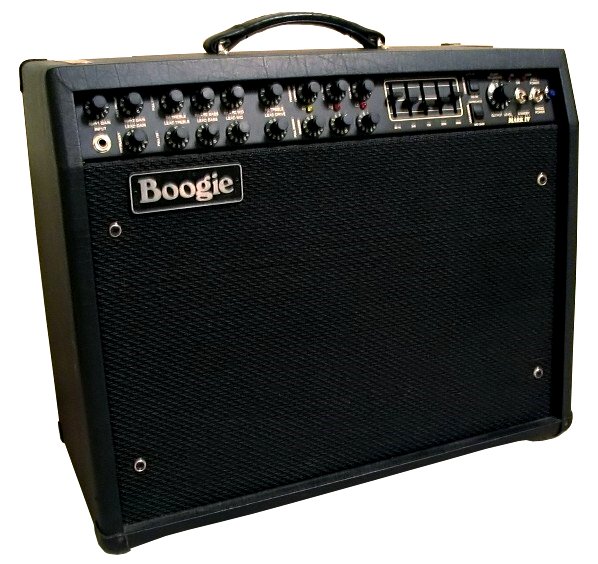
A combo amp contains the amplifier and one or more speakers in a single cabinet. In a head and speaker cabinet configuration, the amplifier and speaker each have their own cabinet. The amplifier (head) may drive one or more speaker cabinets.
In the 1920s, guitarists played through public address amplifiers, but by the 1940s this was uncommon.
Besides instrument inputs and speaker outputs (typically via 1/4" jacks), an amp may have other inputs and outputs. These can include an auxiliary input jack (sometimes with its own level control, for a drum machine), send and return jacks to create an effects loop,[further explanation needed] a line out jack, and an extension speaker jack. Practice amps sometimes have a 1/4" headphone jack, or stereo RCA or mini jacks for connecting a CD player, portable media player or other sound sources. Some guitar amps have an XLR input so that a microphone can be plugged in for singing. Guitar amps that include a mic input are in effect small, portable PA systems. Some amps, typically bass amps, have an XLR connector to provide a balanced output from the preamp section to a PA system or recording input.
Instrument amplifiers are available in a wide range of price, quality, and performance levels. Some are designed for beginners, such as small, low-wattage practice amps, which typically have a single 8" speaker and about 10 watts, or smaller combo amps with relatively low wattage (15 to 20 watts) and a single 10" speaker. Mid- to large-size combo amps with 30 to 50 watts and one 12" speaker or four 10" speakers are best for high-volume situations, such as band rehearsals and onstage performances. For large venues, such as outdoor music festivals, guitarists may use one or more 100 watts (or several hundred watts) heads with one or more 8x10” cabinets.
Vacuum tube
[edit]
Vacuum tubes (called valves in British English) were by far the dominant active electronic components in most instrument amplifier applications until the 1970s when solid-state semiconductors (transistors) started taking over. Transistor amplifiers are less expensive to build and maintain, reduce the weight and heat of an amplifier, and tend to be more reliable and more shock-resistant. Tubes are fragile and they must be replaced and maintained periodically. As well, serious problems with the tubes can render an amplifier inoperable until the issue is resolved.
While tube-based circuitry is technologically outdated, tube amps remain popular since many guitarists prefer their sound.[15] Tube enthusiasts believe that tube amps produce a warmer sound and a more natural "overdrive" sound.
Solid-state
[edit]Most inexpensive and mid-priced guitar amplifiers are based on transistor or semiconductor (solid-state) circuits, which are cheaper to produce and more reliable, and usually much lighter than tube amplifiers.[15] Solid-state amps are less fragile than tube amps.
High-end solid-state amplifiers are less common, since many professional guitarists favor vacuum tubes.[citation needed] Some[who?] jazz guitarists favor the cleaner sound of solid-state amplifiers. Only a few solid-state amps have enduring attraction, such as the Roland Jazz Chorus.[15][16][17] Solid-state amplifiers vary in output power, functionality, size, price, and sound quality in a wide range, from practice amplifiers to combos suitable for gigging to professional models intended for session musicians who do studio recording work.
Hybrid
[edit]A hybrid amplifier involves one of two combinations of tube and solid-state amplification. It may have a tube power amp fed by a solid-state pre-amp circuit, as in most of the original MusicMan amplifiers.
Alternatively, a tube preamplifier can feed a solid-state output stage, as in models from Kustom, Hartke, SWR, and Vox. This approach dispenses with the need for an output transformer and easily achieves modern power levels.[15]
Modeling
[edit]
Microprocessor technology allows the use of digital onboard effects in guitar amps to create numerous different sounds and tones that simulate the sound of a range of tube amplifiers and different sized speaker cabinets, all using the same amplifier and speaker. These are known as modeling amplifiers, and can be programmed with simulated characteristic tones of different existing amplifier models (and speaker cabinets—even microphone type or placement), or dialed in to the user's taste. Many amps of this type are also programmable by way of USB connection to a home computer or laptop.[15] Line 6 is generally credited with bringing modeling amplification to the market.[18][19] Modeling amplifiers and stompbox pedals, rackmount units, and software that models specific amplifiers, speakers cabinets, and microphones can provide a large number of sounds and tones. Players can get a reasonable facsimile of the sound of tube amplifiers, vintage combo amplifiers, and huge 8x10” speaker stacks without bringing all that heavy equipment to the studio or stage.
The use of full range, flat response (FRFR) amplification systems by electric guitarists has received an extra impetus from modeling amplifiers. Before widespread availability of modeling, guitarists did not commonly plug electric guitars straight into PA systems or powered speakers because most genres relied on the tonal coloration of a regular guitar amplifier setup—from the preamplifier, equalization filters, power amp, guitar speakers, and cabinet design. The FRFR approach assumes the tone is shaped by sound processors in the signal chain before the amplifier and speaker stage, so it strives to not add further coloration[20] or dedicated combo-style amplifiers with a broad frequency range.[21] Such processors can be traditional guitar effects, a modeling amplifier (without power amplifier), or a computer running tone-shaping software.[20] Using a modeling amp or a multi-effects pedal used with line level output, a guitarist can plug in the guitar into a flat response mic input or into a keyboard amplifier.
Acoustic
[edit]Acoustic amplifiers are intended for acoustic guitars and other acoustic instruments, especially for the way these instruments are used in relatively quiet genres such as folk and bluegrass. They are similar to keyboard amplifiers, in that they have a relatively flat frequency response with minimal coloration. To produce this relatively clean sound, these amplifiers often have powerful amplifiers (providing up to 800 watts RMS), to provide additional headroom and prevent unwanted distortion. Since an 800-watt amplifier built with standard Class AB technology is heavy, some acoustic amplifier manufacturers use lightweight Class D amplifiers, which are also called switching amplifiers.
Acoustic amplifiers produce an uncolored, acoustic sound when used with acoustic instruments with built-in transducers, pickups or microphones. The amplifiers often come with a simple mixer, so that the signals from a pickup and a condenser microphone can be blended. Since the early 2000s, it has become increasingly common for acoustic amplifiers to provide a range of digital effects, such as reverb and compression. As well, these amplifiers often contain feedback-suppressing devices, such as notch filters or parametric equalizers.
Stacks
[edit]
An amplifier stack consists of an amplifier head atop a speaker cabinet—a head on top of one cabinet is commonly called a half stack, a head atop two cabinets a full-stack. The cabinet that the head sits on often has an angled top in front, while the lower cabinet of a full stack has a straight front. The first version of the Marshall stack was an amp head on an 8×12 cabinet, meaning a single speaker cabinet containing eight 12" guitar speakers. After six of these cabinets were made, the cabinet arrangement was changed to an amp head on two 4×12 (four 12" speakers) cabinets to make the cabinets more transportable. Some touring metal and rock bands have used a large array of guitar speaker cabinets for their impressive appearance. Some of these arrangements include only the fronts of speaker cabinets mounted on a large frame.[22]
There are many varieties of speaker combinations used in guitar speaker cabinets, including one 12" speaker, one 15" speaker (this is more common for bass amplifiers than for electric guitar cabinets), two 10" speakers, four 10" speakers, four 12" speakers, or eight 10" speakers. Less commonly, guitar cabinets may contain different sizes of speakers in the same cabinet. Cabinets with eight 10" speakers are large and heavy, and they are often equipped with wheels and a towel bar-style handle for transport. Some cabinets use mixed speaker types, such as one 15" speaker and two 10" speakers.
Cabinet design
[edit]Combo guitar amplifier cabinets and guitar speaker cabinets use several different designs, including the open back cabinet, the closed back cabinet (a sealed box), and, less commonly, bass reflex designs, which use a closed back with a vent or port cut into the cabinet.[23] With guitar amps, most open back amp cabinets are not fully open; part of the back is enclosed with panels. Combo guitar amp cabinets and standalone speaker cabinets are often made of plywood. Some are made of MDF or particle board—especially in low-budget models.[23] Cabinet size and depth, material types, assembly methods, type and thickness of the baffle material (the wood panel that holds the speaker), and the way the baffle attaches to the cabinet all affect tone.[23]
When two or more speakers are used in the same cabinet, or when two cabinets are used together, the speakers can be wired in parallel or in series, or in a combination of the two (e.g., two 2x10" cabinets, with the two speakers wired in series, can be connected together in parallel). Whether speakers are wired in parallel or in series affects the impedance of the system. Two 8 ohm speakers wired in parallel have 4-ohm impedance. Guitarists who connect multiple cabinets to an amplifier must consider the amp's minimum impedance. Parallel vs. series also affects tone and sound. Speakers wired in parallel slightly dampen[s] and restrain[s] them, giving what some describe as tighter response and smoother breakup. Some describe speakers wired in series (usually no more than two) as sounding "...looser, giving a slightly more raw, open and edgy sound."[23]
Distortion, power, and volume
[edit]Power output
[edit]The relationship between power output in watts and perceived volume is not immediately obvious. The human ear perceives a 5-watt amplifier as half as loud as a 50-watt amplifier (a tenfold increase in power), and a half-watt amplifier is a quarter as loud as a 50-watt amp. Due to this logarithmic scale, doubling the output power of an amplifier results in a just noticeable increase in volume, so a 100-watt amplifier is only just noticeably louder than a 50-watt amplifier. Such generalizations are also subject to the human ear's tendency to behave as a natural compressor at high volumes.
Power attenuation can be used with either low-power or high-power amplifiers, resulting in variable-power amplifiers. A high-power amplifier with power attenuation can produce power-tube distortion through a range of listening volumes but with a decrease in high-power distortion. Other technologies, such as dual rectifiers and the sag circuit[jargon]—which should not be confused with attenuation—allow high-power amplifiers to produce low power volume while preserving high power distortion.[24]
Speaker efficiency is also a major factor affecting a tube amplifier's maximum volume.
For bass instruments, higher-power amplifiers are needed to reproduce low-frequency sounds. While an electric guitarist would be able to play at a small club with a 50-watt amplifier, a bass player performing in the same venue would probably need an amplifier with 200 or more watts.
Distortion and volume
[edit]
Distortion is a feature available on many guitar amplifiers that is not typically found on keyboard or bass guitar amplifiers. Tube guitar amplifiers can produce distortion through pre-distortion equalization, preamp tube distortion, post-distortion EQ, power-tube distortion, tube rectifier compression, output transformer distortion, guitar speaker distortion, and guitar speaker and cabinet frequency response. Because many factors beyond preamp distortion contribute to a particular guitarist's sound, recording engineers and PA system techs typically put a microphone in front of the guitar speaker, rather than only use the guitar amp's pre-amp out signal. A sound engineer or music producer may send the DI out signal from the pickups to a separate track at the same time, so they can re-amp the signal later. In contrast, it is fairly common to use a DI box with electric bass.
Distortion sound or "texture" from guitar amplifiers is further shaped or processed through the frequency response and distortion factors in the microphones (their response, placement, and multi-microphone comb filtering effects), microphone preamps, mixer channel equalization, and compression. Additionally, the basic sound produced by the guitar amplifier can be changed and shaped by adding distortion and/or equalization effect pedals before the amp's input jack, in the effects loop just before the tube power amp, or after the power tubes.
Power-tube distortion
[edit]Power-tube distortion is required for amp sounds in some genres. In a standard master-volume guitar amp, as the amp's final or master volume is increased beyond the full power of the amplifier, power-tube distortion is produced. The "power soak" approach places the attenuation between the power tubes and the guitar speaker. In the re-amped or "dummy load" approach, the tube power amp drives a mostly resistive dummy load while an additional low power amp drives the guitar speaker. In the isolation box approach, the guitar amplifier is used with a guitar speaker in a separate cabinet. A soundproofed isolation cabinet, isolation box, isolation booth, or isolation room can be used.
Volume controls
[edit].jpg)
A variety of labels are used for level attenuation potentiometers (knobs) in a guitar amplifier and other guitar equipment. Electric guitars and basses have a volume control on the instrument that attenuates the signal from selected pickups. There may be two volume controls on an electric guitar or bass, wired in parallel to mix the signal levels from the neck and bridge pickups. Rolling back the guitar's volume control also changes the pickup's equalization or frequency response, which can provide pre-distortion equalization.
The simplest guitar amplifiers, such as some vintage amps and modern practice amps, have only a single volume control. Most have two volume controls: a first volume control called "preamplifier" or "gain" and a master volume control. The preamp or gain control works differently on different guitar amp designs. On an amp designed for acoustic guitar, turning up the preamp knob pre-amplifies the signal—but even at its maximum setting, the preamp control is unlikely to produce much overdrive. However, with amps designed for electric guitarists playing blues, hard rock and heavy metal music, turning up the preamp or gain knob usually produces overdrive distortion. Some electric guitar amps have three controls in the volume section: pre-amplifier, distortion, and master control. Turning up the preamp and distortion knobs in varying combinations can create a range of overdrive tones, from a gentle, warm growling overdrive suitable for a traditional blues show or a rockabilly band to the extreme distortion used in hardcore punk and death metal. On some electric guitar amps, the "gain" knob is equivalent to the distortion control on a distortion pedal and similarly may have a side-effect of changing the proportion of bass and treble sent to the next stage.
A simple, inexpensive amplifier may have only two tone controls, a passive bass and treble control. In some better-quality amps, one or more midrange controls are provided. On the most expensive amps, there may be shelving equalizers for bass and treble, several mid-range controls (e.g., low mid, mid, and high mid), and a graphic equalizer or parametric equalizer. The amplifier's master volume control restricts the amount of signal permitted through to the driver stage and the power amplifier. When using a power attenuator with a tube amplifier, the master volume no longer acts as the master volume control. Instead, the power attenuator's attenuation control controls the power delivered to the speaker, and the amplifier's master volume control determines the amount of power-tube distortion. Power-supply-based power reduction is controlled by a knob on the tube power amp, variously labeled wattage, power, scale, power scale, or power dampening.
In popular culture
[edit]
Volume control gradations are typically numbered from zero to ten. In the 1984 film This Is Spinal Tap, guitarist Nigel Tufnel demonstrates an amplifier whose volume knobs are marked from zero to eleven, believing that this numbering increases the highest volume of the amp. He explains, "It's one louder, isn't it?" This misunderstanding of the underlying operating principles led to the idiom "Up to eleven", also phrased as "These go to eleven". As a consequence of the film, real bands and musicians started buying equipment whose knobs went up to eleven or twelve.
See also
[edit]References
[edit]- ^ a b c Teagle, John (September 5, 2002). "Antique Guitar Amps 1928-1934".
- ^ Timothy Miller, "Hawaiian Guitar", The Grove Dictionary of American Music, 2nd edition
- ^ Robert Palmer, "Church of the Sonic Guitar", pp. 13-38 in Anthony DeCurtis, Present Tense, Duke University Press, 1992, p. 19. ISBN 0-8223-1265-4.
- ^ DeCurtis, Anthony (1992). Present Tense: Rock & Roll and Culture (4. print. ed.). Durham, N.C.: Duke University Press. ISBN 0822312654.
His first venture, the Phillips label, issued only one known release, and it was one of the loudest, most overdriven, and distorted guitar stomps ever recorded, "Boogie in the Park" by Memphis one-man-band Joe Hill Louis, who cranked his guitar while sitting and banging at a rudimentary drum kit.
- ^ Miller, Jim (1980). The Rolling Stone illustrated history of rock & roll. New York: Rolling Stone. ISBN 0394513223. Retrieved 5 July 2012.
Black country bluesmen made raw, heavily amplified boogie records of their own, especially in Memphis, where guitarists like Joe Hill Louis, Willie Johnson (with the early Howlin' Wolf band) and Pat Hare (with Little Junior Parker) played driving rhythms and scorching, distorted solos that might be counted the distant ancestors of heavy metal.
- ^ John Morthland (2013), How Elmore James Invented Metal Archived 2016-03-04 at the Wayback Machine, Wondering Sound, eMusic
- ^ Shepard, John (2003). Continuum Encyclopedia of Popular Music of the World. Performance and Production. Vol. II. Continuum International. p. 286. ISBN 9780826463227.
- ^ a b Dave, Rubin (2007). Inside the Blues, 1942 to 1982. Hal Leonard. p. 61. ISBN 9781423416661.
- ^ Robert Palmer, "Church of the Sonic Guitar", pp. 13-38 in Anthony DeCurtis, Present Tense, Duke University Press, 1992, pp. 24-27. ISBN 0-8223-1265-4.
- ^ Aswell, Tom (2010). Louisiana Rocks! The True Genesis of Rock & Roll. Gretna, Louisiana: Pelican Publishing Company. pp. 61–5. ISBN 978-1589806771.
- ^ Collis, John (2002). Chuck Berry: The Biography. Aurum. p. 38. ISBN 9781854108739.
- ^ Hicks, Michael (2000). Sixties Rock: Garage, Psychedelic, and Other Satisfactions. University of Illinois Press. p. 17. ISBN 0-252-06915-3.
- ^ a b Huey, Steve. "Dick Dale". AllMusic. Retrieved 25 July 2012.
- ^ History, Dick Dale official website
- ^ a b c d e Gallagher, Mitch (2012). Guitar Tone: Pursuing the Ultimate Guitar Sound. Cengage Learning. pp. 85–86. ISBN 978-1-4354-5621-1.
- ^ Pinksterboer, Hugo (2009). Tipbook Amplifiers and Effects: The Complete Guide. Hal Leonard. p. 270. ISBN 978-1-4234-6277-4.
- ^ Madsen, Pete (2006). Funk Guitar and Bass: Know the Players, Play the Music. Hal Leonard. p. 81. ISBN 978-0-87930-894-0.
- ^ Chappell, Jon (2011). Blues Guitar For Dummies. John Wiley & Sons. p. 282. ISBN 978-1-118-05082-8.
- ^ Coelho, Victor (2003). The Cambridge Companion to the Guitar. Cambridge Companions to Music. Cambridge UP. p. 145. ISBN 978-0-521-00040-6.
- ^ a b Anderton, Craig (April 2014). "Is Full Range Flat Response Amplification In Your Future?". Guitar Player. p. 148.
- ^ Turner, Bryan (December 2014). "Mission Engineering Gemini 1". pp. 114–17.
- ^ Golijan, Rosa (22 September 2010). "The Concert Speakers Are A Lie". Gizmodo. Retrieved 16 January 2011.
- ^ a b c d "All About Speaker Cabinets | GuitarPlayer". Archived from the original on 2016-12-24. Retrieved 2016-12-24.
- ^ Guitar Player Magazine, March 2004, page 179
Further reading
[edit]- Fliegler, Ritchie. The Complete Guide to Guitar and Amp Maintenance. Hal Leonard Corporation, 1994.
- Fliegler, Ritchie and Eiche, Jon F. Amps!: The Other Half of Rock 'n' Roll. Hal Leonard Corporation, 1993.
- Hunter, Dave. Amped: The Illustrated History of the World's Greatest Amplifiers. Voyageur Press, 2012.
- Pittman, Aspen. The Tube Amp Book. Backbeat, 2003.
- Tarquin, Brian. Guitar Amplifier Encyclopedia. Skyhorse Publishing, Inc., 2016.
- Weber, Gerald, "A Desktop Reference of Hip Vintage Guitar Amps", Hal Leonard Corporation, 1994. ISBN 0-9641060-0-0
External links
[edit]
- Lenard Audio History of Guitar Amplifiers (non-profit educational website)
- Vintage Guitar magazine article on vintage amps
| Playing | |
|---|---|
| By type (six string) | |
| Additional strings | |
| Ancillary | |
| Related topics | |

| Music technology | |
|---|---|
| Sound recording | |
| Recording media | |
| Analog recording | |
| Playback transducers | |
| Digital audio | |
| Live music | |
| Electronic music | |
| Software | |
| Professions | |
| People and organizations | |
| Related topics | |

Guitar amplifier
View on GrokipediaHistory
Early inventions and precursors
The origins of guitar amplification trace back to efforts to make acoustic string instruments louder for ensemble playing, particularly in the early 20th century when louder brass and percussion dominated bands.[8] One key precursor was the adaptation of early microphone technology, such as carbon button pickups derived from telephone receivers, to capture string vibrations.[9] In 1923, Gibson acoustics engineer Lloyd Loar developed the first electric guitar pickup, an experimental device aimed at amplifying the guitar's volume to compete with other instruments.[8] This pickup used a carbon-granule diaphragm microphone coupled directly to the guitar's bridge saddle, converting mechanical vibrations into electrical signals that were then boosted by a battery-powered vacuum tube amplifier.[8] Although the system was rudimentary, humidity-sensitive, and produced weak output, it represented a pioneering attempt at electro-acoustic transduction for guitars; however, Gibson's board rejected commercialization, leading Loar to leave the company in 1924.[8] The first commercial guitar amplifier emerged in 1928 from the Stromberg-Voisinet company, which introduced a portable combo unit pairing an electrified guitar with a dedicated 6-watt vacuum tube amplifier and speaker.[9] This system employed a carbon button pickup mounted inside the guitar body to detect vibrations, marking the debut of a production-ready amplification package designed specifically for string instruments.[9] Advertised as the "Stromberg Electro," it targeted Hawaiian-style guitarists and vaudeville performers seeking louder projection without acoustic modifications.[9] Early guitar amp designs heavily drew from advancements in radio receivers and public address (PA) systems, which had popularized vacuum tube amplification since the 1910s.[10] These technologies provided the foundational circuitry for boosting weak audio signals, initially adapted from bulky, battery-powered radio units to more efficient AC-powered setups using electrolytic capacitors and rectifier tubes by the early 1930s.[10] Guitar innovators like George Beauchamp modified PA amplifiers by integrating instrument pickups in place of microphones, enabling louder, clearer string tones suitable for live performances.[10] In the late 1920s, young experimenter Lester Polsfuss (later known as Les Paul) began tinkering with amplified archtop guitars to achieve greater volume and sustain.[11] As a teenager, he repurposed telephone mouthpieces as makeshift pickups, attaching them to his acoustic guitar and connecting to a radio amplifier to create a louder, feedback-resistant setup for his early performances.[11] These homemade modifications highlighted the growing DIY interest in electric amplification among musicians. A milestone in production electric guitars came in 1931 with the Rickenbacker Electro A-22 "Frying Pan," a lap steel designed by George Beauchamp and Adolph Rickenbacker, often paired with matching amplifiers for enhanced output.[12] Featuring a cast aluminum body and innovative horseshoe-magnet pickup with strings passing beneath the poles, this instrument was the first commercially successful solid-bodied electric guitar, entering limited production in 1932 at a price of $175 for the guitar-amp set.[12] Its robust design addressed acoustic limitations, paving the way for broader adoption of amplified guitars in the 1930s.[12]20th-century evolution
Following World War II, the guitar amplifier market experienced a significant boom, driven by the rising popularity of electric guitars and the need for accessible amplification. Fender introduced the Tweed Champ in 1948 as an affordable, low-wattage practice amplifier, featuring a simple 4-watt design with a single 8-inch speaker that catered to hobbyists and beginners seeking compact, budget-friendly options.[13] This model evolved into more powerful iterations, culminating in the 1952 Bassman, a 40-watt amplifier initially designed for bass guitars but quickly adopted by guitarists for its ability to deliver louder volumes suitable for larger stages and early rock performances.[14] The 1950s rock 'n' roll era further propelled amplifier development, with models like the Gibson EH-185—originally introduced in the late 1930s but emblematic of the warm, versatile tones that influenced subsequent designs—gaining traction among performers seeking dynamic sound for the genre's energetic style.[15] Early Marshall amplifier concepts, developed in the late 1950s and early 1960s, drew direct inspiration from Fender circuits, adapting them for higher output to meet the demands of emerging British rock acts.[16] A pivotal moment came in 1963 with Fender's introduction of the Twin Reverb, an 85-watt blackface model renowned for its pristine, headroom-rich clean tones that became a benchmark for clarity and dynamic response in rock and beyond.[17] The 1960s British Invasion amplified this evolution, as Jim Marshall launched the JTM45 in 1962—a 45-watt head with a Plexiglas panel that introduced high-gain capabilities when stacked with cabinets, powering aggressive sounds for bands like The Who and defining the era's raw, overdriven aesthetic.[16] By the 1970s, a shift toward solid-state technology emerged, prioritizing reliability and durability for touring musicians in genres like jazz fusion and heavy metal. Ampeg's transistor-based amplifiers, such as the SS-70 series, offered consistent performance without the maintenance issues of tubes, while Roland's 1975 JC-120 Jazz Chorus provided ultra-clean tones with built-in stereo chorus, becoming a staple for fusion players like Pat Metheny and even metal acts seeking articulate cleans.[18][19] In the 1980s and 1990s, the Mesa/Boogie Mark series dominated metal amplification, with models like the Mark IIC+ (introduced in 1982) featuring innovative effects loops for seamless integration of pedals and processors, enabling complex, high-gain tones used by bands such as Metallica.[20] Tube amplifiers faced a decline during this period due to rising production costs and the appeal of cheaper, more reliable solid-state alternatives, but a resurgence occurred in the 1990s grunge scene, where artists like Kurt Cobain favored vintage tube sounds, spurring the rise of boutique builders such as Matchless and Rivera who handcrafted high-end recreations of classic circuits.[21][22]Modern developments since 2000
The early 2000s marked a significant shift toward digital modeling in guitar amplification, building on late-1990s innovations like the Line 6 POD, which debuted in 1998 and evolved with models such as the PODxt in 2002 to simulate dozens of classic amplifiers and effects using digital signal processing (DSP).[23][24] This approach allowed musicians to access versatile, portable tone options without the maintenance of multiple physical amps, revolutionizing studio and live setups. Similarly, Fractal Audio Systems entered the market in 2006 with the Axe-Fx Standard, a rack-mounted processor that advanced DSP-based amp simulation for high-fidelity replication of tube tones, setting a benchmark for professional-grade digital modelers.[25][26] In the 2010s, emphasis grew on portability and integration, exemplified by the Boss Katana series launched in 2016, which offered compact, pedalboard-friendly modeling amps with customizable voicings and effects for gigging musicians.[27] The Positive Grid Spark, introduced in 2019, further enhanced this trend with Bluetooth connectivity and seamless app integration, enabling real-time tone adjustments, auto-chord detection, and access to a vast library of presets via smartphone.[28] These developments catered to the rising demand for lightweight, multifunctional amps suitable for practice, recording, and small venues. The 2020s have seen integration of artificial intelligence (AI) and sustainability into amplifier design. The Neural DSP Quad Cortex, released in 2021, incorporates biomimetic AI to analyze and replicate the sonic characteristics of physical amplifiers and pedals, allowing users to capture and match tones from recordings with unprecedented accuracy.[29] Parallel to this, manufacturers have increasingly adopted sustainable practices, such as using recyclable plastics and components derived from electronic waste in amplifier construction, aligning with broader eco-friendly initiatives in music gear production.[30] At the NAMM Show 2025, notable advancements included the Boss Waza Tube Amp Expander Core, a hybrid load box that enhances tube amps with digital expansion for silent recording and effects integration while preserving analog feel.[31] EVH also updated its 5150 Iconic series with the 15W EL34 1x10 combo, offering refined tube tone in a more accessible, lower-wattage format for practice and performance.[32] A key milestone in 2023 was Fender's Tone Master Pro, a multi-effects workstation that digitally emulates vintage amplifier models with high precision, eliminating tube wear while delivering authentic dynamics and power for professional applications.[33]Principles of operation
Basic signal amplification
The basic signal amplification in a guitar amplifier begins with the weak electrical output from the guitar's magnetic pickups, which typically ranges from 100 mV to 1 V depending on the pickup design and string excitation.[34] This low-level audio signal is then boosted through successive stages of voltage amplification, where each stage multiplies the input voltage to produce a stronger output capable of driving the speaker cone with sufficient power for audible reproduction.[35] The process relies on active electronic components to achieve this gain while preserving the signal's waveform integrity. Effective signal transfer from the guitar to the amplifier requires careful impedance matching, as the guitar's pickup output presents a high impedance, often around 10 kΩ.[36] Guitar amplifiers address this by incorporating a high input impedance, typically 1 MΩ, which minimizes loading effects and maximizes voltage delivery according to Ohm's law, expressed as , where the higher resistance at the input reduces current draw and preserves the input voltage .[36] The frequency content of guitar signals features fundamental tones from approximately 82 Hz (low E string) to 1.2 kHz (highest fret on high E string in standard tuning), but includes harmonics extending up to 20 kHz that contribute to timbre and presence.[37] To accurately amplify these components, the circuit must provide a relatively flat frequency response across this range, with provisions for equalization to emphasize or attenuate specific bands without introducing phase shifts or roll-offs that could alter the tonal balance.[37] Feedback mechanisms play a crucial role in refining amplification quality. Negative feedback routes a sample of the output signal back to the input in antiphase, which linearizes the response, reduces harmonic distortion by up to several orders of magnitude, and improves stability across frequencies.[38] In contrast, positive feedback amplifies the input in phase and risks uncontrolled oscillation if not managed, potentially rendering the amplifier unusable.[39] The fundamental building block of these amplification stages is the active device, either a vacuum tube or transistor, which controls current flow to generate voltage gain and increase signal amplitude with minimal inherent noise addition. In transistor-based circuits, a common-emitter bipolar junction transistor configuration provides high voltage gain for audio frequencies by modulating collector current based on base input variations.[40] Vacuum tubes, such as triodes, achieve similar amplification through thermionic emission, where grid voltage modulates plate current to replicate and boost the input signal.[41]Guitar signal path and tone shaping
The guitar signal path begins with the electrical signal generated by the instrument's magnetic pickup, which captures string vibrations and converts them into a low-level alternating current typically in the millivolt range. This signal enters the amplifier via the input jack, where it is first processed in the preamplifier stage to boost its amplitude while preserving the instrument's dynamic response. From there, the signal passes through a tone stack—a network of frequency-selective filters allowing adjustment of bass, midrange, and treble frequencies—before reaching an optional effects loop for inserting external processors like delay or reverb. The conditioned signal then proceeds to the power amplifier for further gain, culminating in the speaker, which converts the electrical output back into acoustic sound waves. This chain is tailored to the guitar's high-impedance, low-output characteristics, ensuring tonal fidelity across the audible spectrum from approximately 82 Hz to 1.2 kHz for fundamentals, with harmonics up to 20 kHz.[42][43] Passive guitar pickups, such as high-output humbuckers, present impedance challenges due to their high output impedance (DC resistance typically 5–15 kΩ, but inductive impedance higher at audio frequencies), which can lead to loading effects when interfacing with the amplifier's input stage. Loading occurs when the amplifier's input impedance—often around 1 MΩ—is insufficiently high relative to the pickup, causing signal attenuation, especially in high frequencies, and resulting in a duller tone. To mitigate this, buffer circuits, such as emitter-follower transistor stages or unity-gain op-amp configurations, are employed early in the signal path to present a high input impedance (greater than 1 MΩ) while providing a low output impedance, thereby isolating the pickup from downstream components and preserving signal integrity without introducing significant phase shift or coloration.[44][45] Tone shaping in guitar amplifiers primarily relies on the tone stack, with passive RC networks exemplified by the Fender-style circuit offering a subtractive approach to equalization. This configuration uses resistors and capacitors in a bridged-T topology to create interdependent bass, midrange, and treble controls, where adjustments attenuate frequencies relative to a neutral midpoint, often resulting in a midrange scoop when bass and treble are boosted simultaneously. In contrast, active Baxandall equalizers employ op-amps or tube-based feedback loops to provide shelving filters that enable true boost and cut of low and high frequencies independently, with minimal interaction between controls and greater precision across a ±12 dB range, making them suitable for applications requiring broader tonal versatility.[46][47][48][49] Presence and bright switches further refine high-frequency response by introducing targeted boosts to counteract the natural roll-off of speakers, which typically attenuates frequencies above 5 kHz. The presence control, often implemented as a variable high-shelf filter in the power stage feedback loop, adds up to 10 dB of gain around 3–5 kHz, enhancing clarity and attack without harshness. Similarly, the bright switch bypasses volume pot attenuation for frequencies above 2 kHz via a capacitor network, delivering a fixed 6–8 dB treble boost to maintain sparkle at lower gain settings.[50][51] Hum and noise reduction is critical for single-coil pickups, which are prone to electromagnetic interference (EMI) from 50/60 Hz power lines and RF sources, manifesting as audible buzz. Ground lift switches interrupt ground loops between the guitar and amplifier by isolating the chassis ground, reducing induced hum in loop-prone setups. Shielding, achieved through copper or mu-metal foil lining the guitar cavities and pickup covers, forms a Faraday cage that blocks external magnetic fields while minimally affecting the pickup's magnetic field interaction with strings.[52][53][54]Internal components
Preamplifier and gain stages
The preamplifier stage in a guitar amplifier serves as the initial electronic section that boosts the relatively weak high-impedance signal from an electric guitar pickup to a level suitable for subsequent amplification and tone shaping. This first gain stage typically provides 10 to 50 dB of voltage gain, depending on the design and tube type used. In vacuum tube amplifiers, the 12AX7 (also known as ECC83) dual triode tube is the most common choice for this function, delivering high gain factors around 100 per triode section while imparting a warm, harmonically rich coloration due to its even-order distortion characteristics.[55] In solid-state amplifiers, operational amplifiers (op-amps) such as the TL072 are often utilized instead, offering precise, low-distortion amplification with greater clarity and headroom, which suits clean-toned applications by minimizing unwanted harmonic coloration.[56] Gain staging within the preamplifier involves cascading multiple triode sections to progressively increase the signal level, enabling controlled overdrive when the input exceeds the stage's linear range. For instance, high-gain amplifiers employ three or more cascaded triode stages from 12AX7 tubes to achieve saturation, where each stage clips the signal slightly, cumulatively producing the smooth, compressed distortion characteristic of modern overdriven tones.[57] To maintain signal integrity between stages, a cathode follower circuit—configured as a unity-gain buffer using another triode section—may be inserted, providing high input impedance (typically over 1 MΩ) and low output impedance (around 500 Ω) to prevent loading effects that could alter frequency response or reduce overall gain.[58] Equalization in the preamplifier is integrated early in the signal path to shape the boosted tone, with circuit designs varying by regional style. American amplifiers, exemplified by Fender models, often incorporate a "scooped mids" response in their tone stacks, attenuating midrange frequencies around 500-800 Hz by 3-6 dB relative to bass and treble, which creates a bright, open sound ideal for clean rhythms and chimey leads.[59] In contrast, British amplifiers like those from Marshall feature mid-forward EQ circuits that emphasize upper mids (around 1-2 kHz) with minimal scooping, resulting in a punchy, aggressive tone that cuts through dense mixes.[60] Many guitar amplifiers include an effects loop positioned immediately after the preamplifier, allowing external processors to be inserted in a serial manner before the power stage. This post-preamp placement ensures that time-based effects like delay and reverb are applied to the already gain-shaped signal without being compressed or distorted by the preamp's overdrive, preserving clarity and preventing a "muddy" sound.[61] The noise performance of the preamplifier is critical for maintaining a clean signal chain, with high-quality designs achieving a low noise floor (typically better than -100 dBu at the output under nominal gain settings for instrument signals), ensuring that subtle guitar nuances remain audible even at moderate gain settings and minimizing hiss and hum that could otherwise degrade the overall tone.[62]Power amplifier and output sections
The power amplifier section of a guitar amplifier receives the amplified signal from the preamplifier stage and boosts it to a level sufficient to drive the connected speakers, typically employing a push-pull Class AB configuration to balance efficiency and linearity. Preceding the output stage, a phase inverter circuit—often a long-tailed pair or cathodyne using a 12AX7 or 12AT7 tube—splits the input signal into two out-of-phase versions to drive the push-pull output devices.[63] This design uses pairs of output devices—such as vacuum tubes like the 6L6 or transistors in solid-state amps—operating in antiphase to handle positive and negative signal halves, minimizing distortion while delivering substantial power.[64][65] In tube-based power amplifiers, an output transformer is essential for interfacing the high-voltage, low-current output from the tubes to the low-impedance speakers, typically matching impedances in the range of 4 to 16 ohms. The transformer steps down the voltage and steps up the current, ensuring efficient power transfer while isolating the high plate voltages (often several hundred volts) from the speaker load to prevent damage. This component is particularly critical in tube amps, as it also shapes the overall frequency response and harmonic characteristics.[66][67] The damping factor quantifies the amplifier's ability to control the speaker cone's motion after the audio signal ceases, calculated as the ratio of the speaker's nominal impedance to the amplifier's output impedance. In guitar amplifiers, damping factors typically range from 10 to 50, with values above 20 providing good control over speaker motion for tighter bass response by effectively damping resonances and reducing overshoot in the speaker driver, which is especially noticeable in low-frequency reproduction. This control contributes to precise transient response and reduced "woofing" in the bass range.[68][69] Biasing in the power amplifier sets the quiescent operating point for the output devices, ensuring linear operation and minimizing crossover distortion where the push-pull pair transitions between conducting halves. In tube amplifiers, fixed bias applies a negative voltage directly to the control grids via an adjustable supply, allowing precise current setting for optimal performance and higher output capability, while cathode bias uses a resistor in the common cathode path for self-adjusting operation that enhances stability but may introduce more even-order harmonics. Proper biasing prevents thermal runaway and extends tube life, with fixed bias often preferred in high-power guitar designs for its adjustability.[70][71] Protection circuits safeguard the power amplifier against faults like short circuits or overheating, commonly incorporating fuses in the high-voltage B+ supply and mains input to interrupt current flow during overloads. Thermal shutdown mechanisms, such as sensors monitoring tube or transistor temperatures, automatically mute or power down the amp to prevent component failure, with resettable breakers or fuses allowing recovery after cooling. These features are vital in guitar amps to handle the rigors of live performance and impedance mismatches without catastrophic damage.[72][73]Types of amplifiers
Vacuum tube amplifiers
Vacuum tube amplifiers, also known as valve amplifiers, operate using thermionic emission, where a heated cathode in the vacuum tube releases electrons that flow to the anode under voltage control, enabling signal amplification with inherent nonlinearities that contribute to their distinctive tone.[74] This process results in soft clipping when the tube is overdriven, producing a gradual compression of the signal waveform rather than abrupt cutoff, which generates predominantly even-order harmonics that are perceived as warm and musical.[75] The signature sound of vacuum tube guitar amplifiers arises from their dynamic interaction with the input signal, including warm compression and power supply sag. Sag occurs when the high-voltage power supply voltage droops under heavy load from transient peaks, such as aggressive picking, due to the limitations of tube rectifiers or filter capacitors, creating a compressive effect that enhances sustain and responsiveness while reducing perceived harshness.[76] This sag, combined with the tube's natural compression, imparts a sense of "bloom" and touch sensitivity, allowing the amplifier to react organically to the guitarist's playing dynamics. Iconic examples of vacuum tube guitar amplifiers include the Fender Deluxe Reverb, introduced in 1963, renowned for its pristine clean tones characterized by sparkling highs and balanced midrange, making it a staple for genres like blues and country where clarity and headroom are essential.[77] The Marshall Plexi (referring to models like the 1959 Super Lead introduced in the late 1960s), is legendary for its rich, harmonically complex overdrive tones that became foundational for classic rock guitar sounds.[78] In contrast, the Marshall JCM800, launched in 1981, delivers high-gain crunch through its cascaded preamp stages and master volume circuit, enabling valve saturation and aggressive overdrive suitable for rock and hard rock applications.[79] Maintenance of vacuum tube amplifiers involves periodic biasing to optimize performance and longevity, typically required every 6-12 months or after tube replacement to ensure proper current draw and prevent overheating.[80] Tube life expectancy varies by type and usage, with power tubes generally lasting 1,000 to 5,000 hours under normal conditions, while preamp tubes can endure longer with conservative biasing.[81] Vacuum tube amplifiers offer advantages such as exceptional dynamic response to picking attack and volume swells, providing an expressive, organic feel that enhances musicality in live and recording settings.[82] However, they also present disadvantages including significant heat generation during operation, substantial weight from transformers and tubes, and fragility due to the delicate glass envelopes and high voltages involved.[83]Solid-state amplifiers
Solid-state guitar amplifiers employ transistors, primarily bipolar junction transistors (BJTs) and metal-oxide-semiconductor field-effect transistors (MOSFETs), to achieve linear signal amplification without the heat-induced sag characteristic of vacuum tube designs. BJTs, often configured in common emitter or emitter follower topologies, provide high voltage gain and low distortion through negative feedback loops, enabling stable operation across varying loads. MOSFETs, utilized in output stages for their high input impedance and thermal stability, facilitate efficient power delivery with softer clipping characteristics compared to BJTs. These semiconductor devices eliminate the power supply droop that causes dynamic compression in tube amps, resulting in consistent output and reduced thermal management needs.[84] The sound profile of solid-state amplifiers is typically punchy and hi-fi, delivering pristine clean tones with fast attack and high headroom that maintain clarity at elevated volumes. To emulate the gradual breakup of tube amplifiers, many designs incorporate diode clipping circuits in the preamplifier stages, where silicon or germanium diodes introduce controlled harmonic distortion mimicking tube overdrive without the associated warmth of vacuum tubes. This approach allows for versatile tonal shaping, though solid-state cleans often prioritize transparency over the organic compression found in tube circuits.[85][19] Iconic models include the Roland JC-120, introduced in 1975, renowned for its chorus-enhanced clean tones and 120 watts of solid-state power that defined studio and stage reliability for jazz and fusion players.[19] The Peavey Bandit series exemplifies budget versatility, offering TransTube circuitry for accessible clean and driven sounds in compact combo formats suitable for beginners and intermediates; used examples of the Peavey Bandit and other Transtube models remain popular for their headroom and reliability.[86] In online guitar communities such as Reddit's r/GuitarAmps and The Gear Page, frequently recommended analog solid-state amplifiers in the budget category include the Vox Pathfinder 15, praised for its excellent affordable classic tones; the Orange Crush series (e.g., Crush 35RT), lauded for British-style tones, analog design, reverb, and value; and the Blackstar Debut series (e.g., Debut 50R), noted for analog clean/crunch tones (with digital reverb in some cases), ISF voicing, and suitability for beginners and practice. These recommendations are subjective, with no single model emerging as the definitive best due to varying player preferences.[87][88] Advancements in Class D switching architectures have boosted efficiency to over 90%, far surpassing the approximately 50% of traditional tube amplifiers, thereby minimizing power consumption and heat generation for portable applications. This efficiency supports lightweight designs without sacrificing output. Solid-state amplifiers excel in practice and recording scenarios, where their unwavering consistency and low maintenance ensure repeatable tones, prioritizing precision over the tactile responsiveness of tube "feel."[89][90]Hybrid and modeling amplifiers
Hybrid amplifiers combine a vacuum tube preamplifier for tonal warmth and dynamic response with a solid-state power amplifier for efficiency and reduced maintenance costs compared to full-tube designs. This configuration captures the harmonic richness and touch sensitivity of tubes in the initial signal path while leveraging transistors for reliable, high-power output without the heat, fragility, or replacement needs of power tubes.[91] A representative example is the Orange Micro Dark, a 20-watt hybrid combo that employs a 12AX7 tube preamp stage paired with solid-state power amplification, delivering versatile clean and high-gain tones in a compact, portable enclosure suitable for practice and small gigs.[92] Similarly, Quilter Labs amplifiers, such as the Aviator series, can integrate tube preamp pedals with their solid-state power sections to emulate tube warmth at lower costs, offering lightweight solutions under 10 pounds for dynamic performance.[93] Modeling amplifiers utilize digital signal processing (DSP) algorithms to replicate the sonic characteristics of classic amplifiers, cabinets, and effects by analyzing and emulating their nonlinear behaviors, frequency responses, and impulse characteristics. The Kemper Profiler, launched in 2012, introduced groundbreaking profiling technology that captures an amplifier's full response through a series of automated tests, creating digital "profiles" that preserve the original's feel and tone across gain levels.[94] Other prominent modeling amplifiers include the Line 6 Helix, which uses advanced HX modeling to simulate a vast array of amplifiers, cabinets, and effects with high fidelity and multifunctionality including built-in effects processing, and the Boss Katana series, which employs Tube Logic technology to deliver realistic tube-like response and dynamics in a solid-state platform, both incorporating extensive built-in effects and versatile connectivity options for modern players.[95][96] High-quality multi-effects processors comparable to the Line 6 Helix include the Neural DSP Quad Cortex, often ranked as the best overall for its superior amp models and usability, the Kemper Profiler Stage, which excels in amp profiling and tone variety, and the Fractal Audio Axe-Fx series, known for advanced modeling and effects. These are top-tier competitors in professional amp modeling and multi-effects, frequently compared to the Helix for sound quality and features.[97][98] Key features include multi-amp simulations for instant access to emulations of diverse models like Fender Blackface or Marshall Plexi, impulse response (IR) loading to customize speaker cabinet responses, and wireless app control for preset management and editing via Bluetooth-enabled devices.[99] By 2025, innovations such as Neural DSP's TINA, a telemetric inductive nodal actuator that uses machine learning to collect data for training more accurate amp models, alongside BOSS's WAZA Tube Amp Expander Core, a compact reactive load box that blends analog tube enhancement with digital cabinet IRs and direct recording for seamless integration with existing amps.[100][101] Despite their versatility, modeling amplifiers and simulation pedals exhibit limitations such as reduced organic feel and dynamic response relative to traditional tube amps, difficulties in replicating live sound projection and stage interaction, increased setup complexity, and an ongoing debate among musicians regarding their authenticity versus convenience.[102] Modeling amplifiers can introduce processing latency, though modern DSP keeps it below 5 milliseconds—imperceptible to most players, as it mirrors the natural delay of sound traveling roughly 1.7 meters.[103] Their primary advantage lies in portability, with units like the Positive Grid Spark Go weighing just 0.76 pounds (346 grams), enabling battery-powered operation and easy transport for on-the-go musicians without sacrificing tonal options.[104]Acoustic and portable amplifiers
Acoustic guitar amplifiers are designed to faithfully reproduce the natural timbre of the instrument, emphasizing a flat frequency response typically spanning 50 Hz to 20 kHz to capture the full spectrum of harmonics without coloration.[105] This wide bandwidth ensures that low-end body resonance and high-end string overtones are preserved, distinguishing them from electric guitar amps that often prioritize midrange emphasis for tonal shaping. Compatibility with piezo pickups, common in acoustic guitars, is a key consideration, as these transducers can produce harsh highs; thus, acoustic amps incorporate EQ controls to tame piezo "quack" around 1–7 kHz while maintaining transparency.[106] Representative designs include the Fishman Loudbox series, which features anti-feedback notches and phase switches to combat stage howl, allowing clear amplification in live settings without unwanted resonance.[107] Similarly, the AER Compact Mobile offers a battery-powered solution with 60 watts of clean power, enabling 3–4 hours of unplugged operation while delivering the same sonic quality as its mains-powered counterparts.[108] These amps prioritize uncolored signal paths to avoid altering the guitar's organic sound. Portability has evolved in 2025 toward compact, pedalboard-friendly units like the Positive Grid Spark GO, a 5-watt battery-powered device with Bluetooth connectivity for seamless practice and app-based tone customization, including acoustic-specific models.[109] Such trends reflect a demand for lightweight gear under 5 pounds, ideal for travel or impromptu sessions, often integrating as Bluetooth speakers for backing tracks. Key features in these amplifiers include built-in reverb and direct injection (DI) outputs for stage integration, facilitating balanced signals to mixing consoles without additional boxes.[110] Power ratings are kept modest at 10–50 watts to prevent overdriving the amp's clean headroom, ensuring the delicate dynamics of acoustic playing remain intact without compression or breakup.[111] Unlike electric guitar amplifiers, acoustic models eschew intentional distortion circuits, instead focusing on high transparency and advanced feedback suppression to maintain clarity during performance.[112] This design philosophy underscores their role in enhancing rather than transforming the instrument's inherent voice.Design configurations
Combo amplifiers
A combo amplifier, or combo amp, integrates the preamplifier, power amplifier, and one or more loudspeakers into a single enclosed cabinet, providing a compact and self-contained solution for guitarists seeking simplicity in setup and operation.[113] These units typically feature 1 to 4 speakers, most commonly 12-inch models such as Celestion G12M Greenbacks, housed in a wooden cabinet designed for acoustic resonance and durability.[114] Power outputs generally range from 15 to 100 watts, balancing sufficient volume for practice or performance with manageable size and weight.[115] The primary advantages of combo amplifiers include enhanced portability, as the all-in-one design eliminates the need for separate speaker cabinets, allowing easy transport via built-in handles or optional wheels.[116] This integration also ensures phase coherence and optimized tone, since the amplifier circuitry is specifically tuned to the cabinet and speakers for consistent sound reproduction without impedance mismatches.[113] A classic example is the Vox AC15, introduced in 1958, which delivers a signature chimey tone characterized by bright, articulate cleans and harmonic sparkle through its 15-watt output and single 12-inch Celestion Alnico Blue speaker.[117] Despite these benefits, combo amplifiers have limitations, such as fixed speaker configurations that prevent easy swapping for different tonal profiles without modifications.[116] Additionally, in high-gain applications, particularly with tube-based models, they can suffer from overheating due to limited internal ventilation, potentially stressing components during extended use.[118] Modern combo amplifiers often incorporate digital modeling technology, expanding versatility beyond traditional analog designs. For instance, the Fender Mustang GT series features over 40 amp models and effects, editable via the Fender Tone app for real-time preset customization on mobile devices.[119] These units maintain the combo's core simplicity while offering Bluetooth connectivity and software updates for evolving sound options.[120] Combo amplifiers under 50 watts are ideal for home practice, rehearsals, or small-to-medium stage performances, where their balanced power and ease of transport via handles or wheels support musicians without requiring extensive setup.[121] Desktop and tabletop amplifiers represent a compact subset of combo configurations, typically with lower power outputs and specialized features such as headphone outputs and auxiliary inputs, making them particularly suited for quiet home practice and small-scale use. For applications demanding greater power, musicians may opt for separate head and cabinet configurations to allow scalability.[113]Head and cabinet setups
Head and cabinet setups represent a modular approach to guitar amplification, where the amplifier head—containing the preamplifier, power amplifier, and control circuitry—is separated from one or more speaker cabinets that house the drivers. This configuration allows musicians to customize their rig for specific tonal needs, portability, or stage requirements, contrasting with the integrated design of combo amplifiers. The head unit is typically a compact, rack-mountable or piggyback-style device that processes the guitar signal without built-in speakers, focusing solely on amplification and effects. For instance, many heads feature tube-based power sections for warmth and overdrive, with outputs designed to drive external cabinets at various wattage levels, such as 50 to 100 watts for professional use. Speaker cabinets vary in design to influence sound projection and dispersion; open-back cabinets, like those with a rear grille, provide a more ambient and spread-out tone due to air movement, while closed-back models deliver tighter, more focused bass response and higher volume efficiency. A common configuration is the 4x12-inch cabinet, exemplified by the Marshall 1960A, which uses four 12-inch speakers angled for stage monitoring and enhanced low-end reproduction suitable for rock and metal genres. Connecting the head to cabinets requires appropriate speaker cabling, with 14-gauge wire recommended as a minimum to minimize signal loss over distances up to 25 feet, ensuring efficient power transfer without excessive resistance. Multiple cabinets can be paralleled using a switch on the head or external load box, allowing for expanded coverage, such as linking two 8-ohm cabs to match a 4-ohm head output. One key benefit of this setup is the ability to swap cabinets or speakers for tonal customization; for example, pairing a Mesa Boogie Dual Rectifier head with a closed-back 4x12 cab yields aggressive high-gain tones, while switching to an open-back 2x12 alters the response for cleaner, more articulate sounds. This modularity facilitates experimentation and upgrades without replacing the entire amplifier. Safety considerations are paramount, particularly impedance matching between the head and cabinets to prevent damage to the output transformer; a mismatch, such as connecting a 4-ohm head to an 8-ohm cabinet, can halve the power output and overheat components, while the reverse risks excessive current draw. Always verify ratings and use ohm calculators or manufacturer guidelines to ensure compatibility.Stack and high-gain designs
Stack configurations in guitar amplification, often referred to as "stacks," typically involve multiple amplifier heads paired with large speaker cabinets to achieve substantial power projection, commonly exceeding 200 watts for arena-level performances. These setups expand upon basic head-and-cabinet modularity by incorporating two or more heads—such as dual 100-watt units—or stacking multiple cabinets, like two 4x12 enclosures beneath a single head, to drive larger speaker arrays and increase sound pressure. For instance, pairing a Marshall JCM800 head (100 watts) with additional units or cabinets can approach or surpass 200 watts, providing the volume and dispersion needed for large venues.[113][122] High-gain designs within stack configurations emphasize saturated distortion and sustain for lead tones, often featuring master volume controls to overdrive the preamp without requiring the power section to operate at full tilt. The Soldano SLO-100, introduced in 1987 by Mike Soldano, exemplifies this approach as one of the earliest high-gain heads, delivering 100 watts of tube-driven tone with a master volume that allows precise control over gain staging while maintaining clarity and harmonics. Its overdrive channel provides thick, responsive distortion suitable for rock and metal, influencing subsequent boutique amplifiers by prioritizing preamp saturation over power amp breakup.[123][124][125] On stage, stack setups enable advanced signal processing like wet/dry/wet rigs, where the guitar signal is split: a central "dry" amp handles the unaffected tone for clarity, while two flanking "wet" amps process stereo effects such as delay and reverb, creating immersive spatial depth without muddiness. To adapt these powerful stacks for lower-volume environments, such as home practice, attenuators are employed; these devices reduce output power while preserving tube saturation, allowing high-gain tones at bedroom levels— for example, models like the Universal Audio OX or Two Notes Torpedo can attenuate a 100-watt stack to whisper-quiet operation.[126][127] Iconic stack examples include MESA/Boogie configurations, particularly the Dual Rectifier series, which have defined metal tones since the 1990s through high-gain channels paired with oversized 4x12 cabinets for aggressive projection used by bands like Metallica and Lamb of God. In 2025, Marshall revived vintage stack aesthetics with the 1959HW Modified, a hand-wired 100-watt head featuring a new master volume, gain boost, and switchable bright cap to deliver Plexi-era crunch at manageable volumes, appealing to players seeking classic revival in modern touring rigs.[128][129] Despite their sonic advantages, large stacks present logistical challenges in backline transport, requiring specialized cases or dollies to move heavy components like 4x12 cabinets (often over 100 pounds each) without damaging tubes or speakers—best practices include keeping heads upright and cabinets face-down on padding during transit. Additionally, noise pollution regulations, such as OSHA occupational limits of 85 decibels for an 8-hour exposure or local ordinances typically ranging from 90 to 110 decibels, compel venues to mic stacks for PA reinforcement rather than direct projection, mitigating complaints in urban settings.[130][131][132]Performance characteristics
Power output and efficiency
Guitar amplifier power output is typically rated in watts using root mean square (RMS) continuous power, measured at a total harmonic distortion (THD) level of 1% into the specified load impedance, such as 8 ohms.[133] This standard provides a reliable benchmark for comparing amplifier performance under sustained operation, reflecting the amp's ability to deliver clean power without excessive distortion.[134] For instance, a 50-watt tube amplifier might be perceived as less loud than a 100-watt solid-state model at equivalent settings, as solid-state designs maintain cleaner output and greater headroom before clipping, resulting in higher effective volume in practice.[135] Efficiency in guitar amplifiers is calculated as the ratio of power output to input power, expressed as a percentage, which determines heat generation, size, and power consumption. Vacuum tube amplifiers, often operating in Class AB configurations, achieve around 50% efficiency due to inherent losses in tube operation and transformer design.[136] In contrast, Class D solid-state amplifiers exceed 90% efficiency by using pulse-width modulation to minimize energy waste as heat, making them ideal for compact, high-power applications.[89] Headroom refers to the amplifier's capacity to produce clean signal levels before the onset of clipping or distortion, crucial for maintaining tonal clarity at high volumes. High-headroom designs like the Fender Twin Reverb, with its 85-watt output, provide ample dynamic range for professional use.[137] Power scaling in guitar amplifiers follows acoustic principles where doubling the output wattage increases SPL by 3 dB, a perceptually modest gain equivalent to a slight perceived loudness boost.[138] In real-world scenarios, such as band performances on stage, amplifiers rated at 100 watts or higher are often necessary to cut through drums and other instruments, ensuring sufficient volume without relying on maximum gain.[135] Advancements in hybrid amplifier designs have enhanced efficiency in portable guitar models, combining the tonal warmth of Class AB pre-stages with the high efficiency of Class D output sections to reduce battery drain while preserving dynamic response.[139] These hybrids, featured in modern modeling amps, balance efficiency and performance for longer playtimes in battery-powered units.[140] As of November 2025, some modeling amps incorporate AI for enhanced tone emulation, improving versatility in digital signal processing.[99]Distortion mechanisms
Distortion in guitar amplifiers arises from nonlinear signal processing, intentionally exploited to create desirable tonal characteristics that enhance expressiveness and sustain. These mechanisms primarily occur in the preamplifier, power amplifier, and speaker stages, each contributing unique harmonic content and dynamic behaviors that define the "amp tone" sought by musicians. Unlike unintended distortion in high-fidelity audio, guitar amp distortion is often calibrated for musicality, with total harmonic distortion (THD) levels typically ranging from 1% to 10% considered beneficial for adding warmth and bite without excessive harshness.[141] Preamp distortion results from clipping in the high-gain stages, where the input signal exceeds the tube's voltage handling capacity, leading to asymmetrical waveform alteration that predominantly generates odd-order harmonics such as the third and fifth. This produces a sharper, more aggressive tone often described as "crunchy" or "fizzy," with increased compression that evens out dynamics and emphasizes midrange presence. Pedals like the Ibanez Tube Screamer exemplify this by providing a clean boost to drive the preamp into clipping, enhancing sustain while preserving note clarity through midrange EQ shaping.[142][143][144] In contrast, power tube distortion emerges from current limiting at the output stage, particularly in push-pull configurations, where grid voltage swings cause tube saturation and rectifier sag, yielding even-order harmonics like the second that impart a smoother, more compressed response with natural bloom and touch sensitivity. This mechanism adds a sense of depth and responsiveness, often evoking a "singing" quality, as the power amp's higher voltage handling delays clipping until louder volumes.[145][141] Speaker distortion contributes additional grit through cone breakup, where high-excursion movements exceed the cone's rigidity, causing flexing and partial wave cancellation that introduces complex overtones across the midrange and treble. Factors such as cone density, voice coil height, and top plate thickness determine the onset and character of this breakup, which integrates seamlessly with amp distortion to form the overall "cabinet sound," adding organic texture without overpowering the signal.[146] Distortion types in guitar amps are broadly categorized by clipping severity: overdrive employs soft clipping for subtle, tube-like saturation that retains dynamic nuance, while fuzz uses hard clipping to square the waveform, generating a wall-of-sound thickness with abundant harmonics. These are quantified via THD measurements, where desirable levels (1-10%) balance harmonic richness against muddiness, often favoring lower-order even and odd harmonics for euphonic results.[143][147][141] To isolate power tube distortion without excessive preamp saturation, a master volume control attenuates the signal post-preamp, allowing high gain at moderate overall levels while preserving the compression and even harmonics of the output stage. This design enables bedroom-friendly volumes with stage-like tone, though it may slightly reduce sag effects compared to full-crank operation.[142]Controls for volume and tone
Guitar amplifiers provide users with intuitive controls to adjust output levels and tonal characteristics, enabling precise sound shaping during performance or recording. Volume controls typically include per-channel knobs that set the input signal strength for each input, allowing independent balancing of multiple guitars or sources, while a master volume knob regulates the overall output to the speakers without altering the preamp drive.[148] Many designs incorporate a gain control distinct from volume, which boosts the preamp signal to introduce controlled overdrive or distortion, with channel volumes then fine-tuning the blend before the master stage takes over.[149] Pull-boost mechanisms on certain knobs, such as volume or gain, activate an additional gain stage when pulled, providing instant extra drive for solos without needing a separate footswitch.[150] The core of tonal adjustment lies in the tone stack, a set of interactive knobs for bass, middle, and treble that modify the frequency balance post-preamp. Bass controls emphasize low-end frequencies for added warmth and fullness, mids shape the core body and punch of the sound, and treble adjusts high-end sparkle and clarity, with their interactions creating interdependent effects where boosting one band can influence others.[149] Fender-style tone stacks focus on boosting lows and highs while mids provide balanced sculpting for articulate cleans, whereas VOX configurations often incorporate a tone cut control that reduces midrange to produce the brand's characteristic bright, jangly chime by emphasizing treble and bass.[151] Supplementary controls enhance fine-tuning: presence knobs boost upper-mid and treble frequencies in the power amp stage, adding liveliness and cut through dense mixes without harshness.[50] Depth controls, found on some models, amplify low frequencies for deeper resonance, particularly useful in bass-heavy genres.[149] Footswitchable channels allow seamless transitions between clean and crunch settings via a pedal, preserving set volumes and tones while switching gain structures.[152] Modern modeling amplifiers often include MIDI connectivity for integration with DAWs or external controllers to automate volume and tone changes.[99] Ergonomically, most controls are mounted on the front panel for quick access during live play, though some compact or rack units place them on the rear to optimize stage footprint; LED indicators on modern amps visually signal gain staging levels, helping users avoid unwanted clipping.[148]Troubleshooting
Guitar amplifiers that power on but produce no sound are a common issue encountered by players. These problems often stem from simple, external faults rather than major internal failures. Troubleshooting should begin with the most basic and accessible checks—such as cables, controls, and connections—before investigating potentially more complex internal components. Common causes include:- Faulty or disconnected instrument cable.
- Dirty or faulty input jack on the amp.
- Volume, gain, or master volume controls turned down to zero.
- Blown or disconnected speaker (check speaker cable or cone).
- In tube amplifiers: faulty preamp or power tubes (often among the first components to check).
- Standby switch not flipped to "on" (on some amplifiers).
- Effects loop cables missing or faulty if the effects loop is in use.
- Dirty potentiometers (pots) or switches causing intermittent or no signal.