Hubbry Logo
search
logo
Cutlet
Cutlet
current hub

Cutlet

logo
Community Hub0 Subscribers
Read side by side
from Wikipedia

In cuisine, cutlet (derived from French côtelette, côte, "rib"[1][2]) refers to:

  1. a thin slice of meat from the leg or ribs of mutton, veal,[2] pork, or chicken
  2. a dish made of such slice, often breaded (also known in various languages as a cotoletta, Kotelett, kotlet or kotleta)
  3. a croquette or cutlet-shaped patty made of ground meat
  4. a kind of fish cut where the fish is sliced perpendicular to the spine, rather than parallel (as with fillets); often synonymous with steak
  5. a prawn or shrimp with its head and outer shell removed, leaving only the flesh and tail
  6. a mash of vegetables (usually potatoes) fried with bread

American and Canadian cuisines

[edit]
A tray of Italian-American style chicken cutlets

From the late 1700s until about 1900, virtually all recipes for "cutlets" in English-language cookbooks referenced veal cutlets. Then pork cutlets began to appear. More recently,[when?] in American and Canadian cuisine, cutlets have also been made using chicken, although this was also imported from Europe. The cutlet is usually coated with flour, egg and bread crumbs, then fried in a pan with some oil.

Austrian cuisine

[edit]

Australian cuisine

[edit]

Australians eat lamb cutlets battered with egg yolk and breadcrumbs. Chicken cutlets are also very popular, but known as chicken schnitzel. Both lamb cutlets and chicken schnitzel are a staple of Australian children's cuisine. Amongst most Australians of Italian descent, the term schnitzel is replaced by the term cutlet. Cutlets amongst this population are usually veal or chicken.

British cuisine

[edit]

In British cuisine, a cutlet is usually unbreaded and can also be called a chop.[3] If referring to beef, more than one piece together would be generally called a rib of beef or a rib joint, whilst lamb ribs are called a rack, or rack of lamb. Lamb racks can also be tied into a circular shape before cooking, with the ribs on the outside, giving a crown shape, leading to the name "crown of lamb".

French cuisine

[edit]

In France, cutlets can be made with any of the Salpicons of poultry, game, fish and shellfish, mixed with the necessary amount of forcemeat in keeping with the main ingredient; the consistency should be adjusted with a little well-reduced sauce which should also be in keeping with the ingredients. These cutlets should be egg and crumbed and they should be shallow fried and coloured in clarified butter instead of being deep fried.[4]

Another kind of cutlet is the Côtelette Menon[5] or Côtelette révolution which is a veal cutlet covered in bread crumbs and fried in butter.

Hong Kong cuisine

[edit]

In Hong Kong, the cutlet was introduced during the period of British colonial occupation along with other cooking influences. It is seen as "sai chaan" or Western cuisine. Veal, pork and chicken are battered and deep fried for lunch. Seafood such as shrimp or scallop that is battered or breaded and deep fried can also be known as 'cutlet' in Hong Kong. It is usually served alongside rice or spaghetti noodles.

Indian cuisine

[edit]
Indian cutlet

In Indian cuisine, a cutlet specifically refers to mashed vegetables (potatoes, carrots, beans) or cooked meat (mutton, chicken, pork or fish) stuffing that is fried with a batter/covering. The meat itself is cooked with spices - onion, cardamom, cloves, cinnamon, coriander (cilantro), green chillies, lemon and salt. This is then dipped in an egg mix or corn starch and then in bread crumbs (also see breaded cutlet), and fried in ghee or vegetable oil. Chicken and mutton cutlets are popular snacks in the eastern part of India, especially in Kolkata.

The vegetarian version has no meat in it, instead the filling is a combination of mashed potatoes, onion, green chillies, spices and salt. This version is more popular with the vegetarian Indian population. This should not be confused with grilled patties such as aloo tikki. A cutlet is traditionally deep-fried.

Iranian cuisine

[edit]
Iranian cutlets

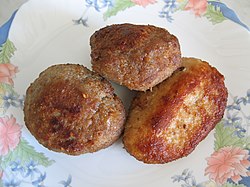
In Iran, cutlet (Persian: کُتلت) is a popular hamburger-like thin layered mixture of fried ground beef or lamb or sometimes chicken, mashed or grated potatoes, eggs, onions, spices, shaped like a flower leaf, with a thin layer of wheat flour for coating; which is deep fried, usually served with tomato, onion, parsley and bread.

Italian cuisine

[edit]

The use of the cutlet (cotoletta) is quite widespread in Italian cuisine in many different variations. The most famous variant is the Milanese cutlet (cotoletta alla milanese), a veal cutlet covered in bread crumbs and fried in butter. It should not be mistaken for the Wiener schnitzel (which should be referred as a scaloppina alla viennese, or as fettina impanata in Italian), which is a different cut of meat; the Milanese cutlet cut includes the bone, whereas the Wiener schnitzel does not. The dish has a French origin and was brought to Milan during the Napoleonic wars.[6]

Japanese cuisine

[edit]

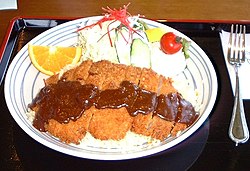
The cutlet was introduced to Japan during the late 19th century.[7] The Japanese pronunciation of cutlet is katsuretsu.[8] In Japanese cuisine, katsuretsu or shorter katsu is actually a breaded cutlet.[8] Dishes with katsu include tonkatsu (pork),[7] katsudon (simmered with beaten egg and poured over a bowl of rice)[9] and katsu curry.[10]

Polish cuisine

[edit]

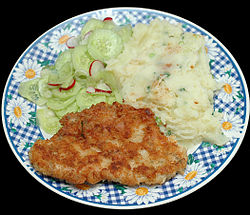
The Polish pork cutlet, kotlet schabowy, is a pork chop coated with breadcrumbs. Kotlet schabowy can be served with mashed potatoes, home fries, fried mushrooms, cooked vegetables (cabbage), with salads or with coleslaw. Kotlet z kurczaka is a chicken cutlet coated with breadcrumbs. Kotlet z indyka is a turkey cutlet coated with breadcrumbs.

Cuisines of Russia, Ukraine and other countries of former Soviet Union

[edit]

In modern Russian, the word kotleta (котлета) refers almost exclusively to pan-fried minced meat croquettes / cutlet-shaped patties. Bread soaked in milk, onions, garlic, and herbs is usually present in the recipe. When in a hurry, a "cutlet" can be eaten between bread slices like a hamburger, but this fast meal is rarely served in restaurants. It is usually served with pan-fried potatoes, mashed potatoes, pasta, etc.

In the middle of the 20th century, industrially produced, semi-processed ground meat cutlets were introduced in the USSR. Colloquially known as Mikoyan cutlets (named after Soviet politician Anastas Mikoyan, who served as a minister of the food industry from 1934 to 1938 he was responsible for introducing a lot of industrial-made products into the Soviet food chain), these were cheap pork or beef cutlet-shaped patties which resembled hamburger patties.[11]

In Ukrainian cuisine, a variety called sichenyk (Ukrainian: січеник) is made of minced meat or fish and vegetables and covered with bread crumbs.

A particular form of the Russian kotleta known as Pozharsky cutlet is an elaborated version of minced poultry kotleta covered with breadcrumbs or small croutons. A distinct feature of this cutlet is that butter is added to minced meat, which results in an especially juicy and tender consistency.

Another Russian version of a cutlet, called otbivnaya kotleta (отбивная котлета), meaning "beaten cutlet", is a fried slice of meat, usually pork or beef, beaten flat with a tenderizing hammer or knife handle and covered with beaten eggs, dough or breadcrumbs. The recipe is similar to those of escalopes, schnitzel, Polish, or American cutlets. Today, this dish is simply called otbivnaya, with the word kotleta reserved for minced meat patties.

Chicken Kiev is called kotleta po-kievski (котлета по-киевски) in Russian and similarly kotleta po-kyivski (котлета по-київськи) in Ukrainian, which means "Kiev-style cutlet".

Sri Lankan cuisine

[edit]

In Sri Lankan cuisine, cutlets almost always refer to fish (usually tuna or mackerel) and potato croquettes. Usually the fish and potatoes are mixed with spices, green chilies and onions and dipped in a batter made of flour and eggs before being crumbed and fried.

See also

[edit]

References

[edit]
Revisions and contributorsEdit on WikipediaRead on Wikipedia
from Grokipedia
A cutlet is a thin slice of meat, typically taken from the leg or ribs of veal, pork, chicken, mutton, or other animals, often prepared by coating in breadcrumbs and frying to create a crispy exterior.[1][2] The term can also refer to a flat croquette made from minced meat or fish, shaped and similarly breaded before cooking.[1] The word "cutlet" derives from the French côtelette, a diminutive of côte meaning "rib," which itself stems from the Latin costa for "rib," and first appeared in English around 1706 to describe a small piece of meat cut from the upper leg of veal or mutton.[3] In its most basic form, a cutlet emphasizes the cut of the meat rather than the preparation method, though it is commonly pounded thin, seasoned simply with salt, pepper, and lemon, or used in salads without breading.[2] Cutlets are a staple in various global cuisines, with breading typically involving flour, egg, and breadcrumbs (such as panko in Asian variations) before shallow-frying in oil or butter.[4] Notable variations include the Austrian Wiener Schnitzel, a veal cutlet fried in clarified butter and served with lemon; the Italian Cotoletta alla Milanese, a breadcrumb-coated veal chop fried in butter; Japan's Tonkatsu, a panko-crusted pork loin; Argentina's Milanesa, a breaded beef or pork slice often topped with sauce; and the Swiss Cordon Bleu, stuffed with ham and cheese before breading.[4] In Indian cuisine, influenced by British colonial adaptations, cutlets differ significantly as flattened patties made from spiced minced meat (keema) like mutton, chicken, fish, or vegetables, breaded and fried, reflecting local preferences for ground meat in warmer climates without refrigeration.[5] These diverse forms highlight the cutlet's versatility, from elegant European classics to hearty everyday dishes worldwide.[4]

Overview

Definition

A cutlet is a thin slice of meat, typically taken from the leg or ribs of animals such as veal, pork, chicken, or lamb, that is often breaded and fried to create a crispy exterior.[2][1] This preparation highlights the tenderness of the meat while providing a contrast in textures. The term derives from the French "côtelette," referring to a small rib cut, which underscores its historical association with bone-in portions from the rib section.[3][6] Variations of cutlets include boneless versions, where the meat is pounded thin to promote quick and uniform cooking, as seen in dishes featuring veal or chicken.[2][7] Unlike croquettes, which are usually cylindrical or irregularly shaped mixtures deep-fried for a uniform crust, or simple patties formed from ground meat without breading, a traditional cutlet emphasizes a distinct slice of intact muscle.[8][9] However, in broader usage, the term can extend to flattened patties molded from minced meat, such as ground chicken or lamb, maintaining the breaded and fried method but diverging from the sliced form.[9] In modern contexts, cutlets have adapted to include vegetarian and plant-based options, where ingredients like nuts, vegetables, soy, or seitan are pressed into thin, patty-like shapes, coated in breadcrumbs, and fried to replicate the savory profile of meat versions.[10][6] These innovations, such as seitan cutlets simulating chicken texture, cater to dietary preferences while preserving the core technique of breading and frying.[11]

Etymology

The word "cutlet" derives from the French term côtelette, first recorded in the 14th century as a diminutive of côte, meaning "rib," and ultimately tracing back to Latin costa for "rib," originally referring to a small bone-in slice of meat such as veal or mutton.[3] The French form, recorded from the 14th century, denotes a small rib cut used in culinary contexts for thin, rib-derived portions prepared for cooking.[1] In English, "cutlet" was adopted directly from French côtelette around 1706, reflecting the influence of French cuisine on British dining during the early 18th century, when such terms entered English cookbooks and menus to describe similar rib or leg slices.[3] The Italian variant cotoletta stems from the Milanese dialect cutelèta, a borrowing of French côtelette in the 18th century, adapted to refer to breaded veal chops, particularly in the renowned cotoletta alla milanese.[12] Related terms in other European languages highlight parallel evolutions: the German Schnitzel, meaning "little cut" or "slice," originates from the verb schneiden ("to cut"), dating to the 19th century and denoting thinly pounded, breaded meat without direct rib connotation, though it shares preparation similarities with cutlets.[13] Similarly, the Polish kotlet was borrowed from French côtelette in the 19th century, likely via German influences during partitions, evolving to encompass both bone-in chops and ground meat patties.[14] Beyond Europe, the term adapted in non-Western contexts during colonial and trade eras; in Japan, katsuretsu emerged in the late 19th century as a katakana transliteration of the English "cutlet," introduced via Western cuisine during the Meiji Restoration around 1860, later shortened to katsu for breaded pork or chicken fillets.[15] In Persian cuisine, kotlet entered the language in the 19th century as a loanword from French côtelette through European contact, transforming to describe flattened patties of ground meat and potatoes rather than bone-in cuts.[16]

History

European Origins

The origins of the cutlet in Europe trace back to 18th-century France, where the term côtelette initially referred to small rib chops of veal or mutton that were grilled or fried without breading.[3] French culinary practices incorporated breading techniques for these cuts as part of broader 19th-century developments, transforming them into a more structured dish that emphasized crisp exteriors and tender interiors, as evidenced in recipes from Parisian kitchens.[17] In Italy, the cotoletta alla milanese represents one of the earliest documented forms of a breaded cutlet, with references appearing in a 1134 manuscript describing a banquet at the Basilica of Sant'Ambrogio in Milan, where lombos cum panitio—breadcrumbed rib chops—were served as part of a multi-course meal.[18] Although this preparation existed in medieval times, it gained widespread popularity in the 19th century amid Austrian occupation of Lombardy during the Napoleonic era, when Habsburg culinary exchanges blended local traditions with Central European frying methods.[19] The Austrian Wiener Schnitzel emerged as a distinct veal adaptation in the 1830s, first appearing in written form in 1831 within a Viennese cookbook by Maria Anna Neudecker, which detailed a thin, breaded veal cutlet pan-fried in clarified butter.[20][21] Its techniques drew from earlier breaded frying practices with possible influences from Spanish Sephardic traditions or Ottoman cuisine, introduced via the Habsburg Empire's interactions with the Balkans and Mediterranean regions.[22] The cutlet's spread across Europe accelerated in the 19th century through the Habsburg Empire's vast territories and French culinary diplomacy, facilitating adaptations in Eastern regions. In Poland, the kotlet schabowy—a breaded pork cutlet—entered local cuisine around this period under French and Austrian influences, becoming a staple by mid-century.[23] Similarly, in Russia, early kotleta variations, such as the Pozharsky cutlet made from minced poultry, developed in the 1820s–1830s, reflecting French techniques adapted to noble households amid imperial exchanges.[24] A pivotal figure in standardizing these techniques was French chef Marie-Antoine Carême, whose early 19th-century cookbooks, including L'Art de la cuisine française (1833–1847), codified breading and saucing methods for côtelettes, elevating the dish within haute cuisine and influencing its dissemination across European courts.[25]

Global Dissemination

The cutlet concept reached North America in the 18th century through British and French settlers, who adapted European breading and frying techniques to local ingredients like veal and pork in colonial cookbooks and household preparations.[26] By the early 19th century, these methods appeared in American recipe collections, such as Mary Randolph's The Virginia House-Wife (1824), which included breaded meat cutlets influenced by French côtelette styles.[26] In the 20th century, the dish evolved significantly with the rise of chicken cutlets, driven by affordable poultry availability and Italian immigration, becoming a staple in fusion dishes like chicken parmigiana by the mid-century.[27] In Asia, the cutlet spread during the Meiji era in Japan, where Western influences prompted the creation of tonkatsu in 1899 at Renga-tei restaurant in Tokyo's Ginza district; this pork cutlet adapted French côtelette de veau by substituting beef with pork and using panko breadcrumbs for a lighter texture. Similarly, Indian versions emerged through Portuguese traders in the 16th century, who introduced frying techniques, and British colonialism from the 18th to 19th centuries, leading to minced meat adaptations like kabab or cutlet patties flavored with local spices for Anglo-Indian cuisine.[28] These minced forms facilitated portability and suited tropical climates, spreading via trade routes to Southeast Asia.[29] The dish's dissemination extended to the Middle East via European influences, where in Iran kotlet patties incorporated ground meat and potatoes. In Sri Lanka, cutlets derive from Portuguese bolinho croquettes, a deep-fried, breaded fish-and-potato dish adapted as a local snack.[30] Twentieth-century globalization accelerated through immigration and conflict; post-World War II Italian-American communities in the United States popularized thin-sliced chicken cutlets as a quick, freezer-friendly meal, blending Old World cotoletta with American abundance.[31] World wars further boosted popularity: in the Soviet bloc after 1945, kotleta became a rationed staple using ground meat for efficiency, while in Hong Kong, mid-19th-century colonial exchanges introduced cutlets as a budget-friendly dish, fusing with Indian-influenced minced versions in cha chaan teng diners.[28]

Preparation Methods

Basic Techniques

Cutlets can be prepared in their simplest form without breading by pounding thin, seasoning with salt, pepper, and lemon, then grilling, pan-searing, or incorporating into salads.[2] For breaded versions, the preparation begins with pounding the meat to a uniform thickness of about 1/4 inch (0.6 cm) using a meat mallet, which tenderizes the flesh and promotes even cooking throughout.[32][33] This step is typically performed by placing the cutlet between sheets of plastic wrap or parchment paper to prevent sticking and tearing, starting from the center and working outward with gentle, even strokes to avoid overworking the meat.[33] Once pounded, the cutlet undergoes a standard breading process to achieve a crispy exterior: it is first dredged in seasoned flour to create a base layer for adhesion, then dipped into beaten eggs or an egg wash to add moisture and binding, and finally coated in breadcrumbs—traditional fine breadcrumbs or coarser panko for added texture in some preparations—pressing firmly to ensure even coverage.[32][34] The breaded cutlet is then fried in oil or clarified butter heated to 350°F (175°C), cooking for 2 to 4 minutes per side until golden brown and crisp.[32][35] Frying can be adapted based on desired results: pan-frying uses about 1/4 inch of oil for shallow coverage, allowing for quick cooking with a balance of crispiness and retained moisture, while deep-frying submerges the cutlet fully in 2 to 3 inches of oil at the same temperature for a uniformly crunchy coating.[35][36] After frying, the cutlet rests on paper towels or a wire rack to drain excess oil, preventing sogginess.[32] For non-fried options, cutlets can be grilled over medium-high heat for 3 to 5 minutes per side to develop char and flavor while preserving juiciness,[37] or modern low-fat adaptations can be baked on a wire rack at 400°F (200°C) for 20 to 25 minutes, flipping halfway, to mimic frying's texture with minimal oil.[38] Food safety requires verifying the internal temperature reaches 165°F (74°C) for poultry cutlets or 145°F (63°C) with a 3-minute rest for pork or veal to eliminate harmful bacteria.[39][40] This applies to common meats like veal or pork used in cutlets, ensuring they are safe for consumption without overcooking.[39]

Common Ingredients

Cutlets are typically prepared using tender, lean cuts of meat that are easily sliced and pounded thin for even cooking. Common primary proteins include veal cutlets, derived from young calf meat for their mild flavor and tenderness; pork loin chops, selected for their lean profile and ability to remain juicy when breaded; and chicken breast, often butterflied and flattened to achieve a similar slim profile suitable for quick frying.[41][42][34] The breading process relies on a standard trio of staples to create a protective, crispy coating. All-purpose flour serves as the initial dredging layer, providing a base that helps the subsequent coatings adhere evenly. Eggs, typically beaten and sometimes diluted with a splash of milk or water to form a light batter, act as the binding agent, sealing the flour to the meat. Dry breadcrumbs, such as plain or panko varieties, or crushed crackers form the outer layer, delivering the signature crunch and texture upon frying.[34][41][42] Frying fats are chosen for their ability to reach high temperatures while imparting flavor and preventing sogginess. Clarified butter offers a rich, nutty taste traditional in European preparations, with a high smoke point that ensures even browning. Vegetable oil provides a neutral alternative for cleaner results, while lard adds depth and crispiness, particularly in classic recipes where animal fats enhance mouthfeel.[34][41][43] Basic seasonings keep the focus on the meat's natural qualities without overpowering it. Salt and freshly ground black pepper are essentials, applied to the meat before breading to enhance savoriness. Optional herbs like finely chopped parsley can be mixed into the breadcrumbs for subtle freshness, and lemon wedges are commonly served alongside to provide acidity that balances the richness of the fried cutlet.[34][42][41] Cutlets pair well with simple, generic accompaniments that complement their crisp exterior and tender interior. Boiled or mashed potatoes offer a starchy base to soak up any pan juices, while fresh green salads provide a light, refreshing contrast to the hearty protein.[34][42]

European Variations

French Côtlette

The French côtelette, known as côtelette in its native terminology, exemplifies the elegance and simplicity of classic French cookery, particularly through preparations of lamb (côtelette d'agneau) or veal (côtelette de veau). These are typically bone-in rib chops, lightly pounded to ensure even cooking and tenderness, seasoned simply with salt, pepper, and fresh herbs such as thyme, then pan-fried in clarified butter to achieve a golden exterior while preserving the meat's delicate flavor.[44][45] This method highlights the quality of the ingredients, allowing the natural richness of the meat to shine without overwhelming coatings or complex marinades. A notable variation is the côtelette à l'os, where the bone is retained for both structural integrity and dramatic presentation, often grilled over a wood fire in traditional bistro settings to impart a subtle smokiness that enhances the chop's succulence.[46][47] This approach, common in casual yet refined French eateries, underscores the dish's rustic sophistication, with the bone serving as a handle for diners to savor the tender meat directly. In the context of haute cuisine, the côtelette holds a prominent place, as evidenced by its inclusion in Auguste Escoffier's seminal 1903 work, Le Guide Culinaire, where recipes feature the chops paired with refined sauces such as poivrade—a peppery reduction ideal for gamey flavors—or béarnaise, an emulsified blend of egg yolks, butter, and tarragon that adds a velvety, herbaceous contrast.[48][49] These pairings elevated the côtelette from everyday fare to a staple of fine dining, emphasizing precision and balance in flavor profiles. Contemporary French interpretations often adapt the côtelette into deboned escalope versions for ease of eating, with some incorporating a stuffed filling of ham and cheese under the influence of the cordon bleu style, where thinly pounded veal is layered with these elements, rolled or folded, lightly breaded, and shallow-fried to create a crisp exterior encasing a molten center.[50] This modern twist maintains the dish's minimalist ethos while introducing subtle indulgence, reflecting evolving bistro menus that blend tradition with accessibility. Serving traditions for the French côtelette prioritize restraint, often pairing it with golden frites for a textural contrast or ratatouille—a Provençal stew of eggplant, zucchini, peppers, and tomatoes—to provide a vibrant, vegetable-forward accompaniment that complements the meat's purity without overpowering it.[51][52] This simplicity allows the côtelette to remain the focal point, embodying the French culinary principle of letting high-quality ingredients speak for themselves.

Italian Cotoletta

The cotoletta alla milanese is a classic Milanese dish featuring a thick, bone-in cutlet from milk-fed veal loin, typically weighing around 300 grams per serving. The cutlet is prepared by dredging it lightly in flour, dipping it in beaten eggs, and coating it with breadcrumbs often mixed with grated Parmesan cheese for added flavor, before frying it in clarified butter until golden and crisp on the outside. This double-breading technique ensures a crunchy exterior while keeping the meat tender.[53][19] The recipe's origins trace back to medieval times, with claims of its preparation documented in a 1134 manuscript describing a banquet at the Basilica of Sant'Ambrogio, where it was served as "lombolos cum panitio" (breaded loin chops) to honor Saint Ambrose; however, the modern standardized form, emphasizing the bone-in veal and butter frying, emerged in the 19th century amid Lombardy’s culinary traditions. Some historians note influences from Austrian occupation in the 18th-19th centuries, where the breading method may have been adapted into the Wiener schnitzel, though the Milanese version predates it.[19][54][18] In preparation, the cotoletta is fried for about 4-6 minutes per side over medium heat, aiming for a slightly pink, blushing interior at around 135-150°F (57-66°C) to preserve the veal's delicate tenderness, distinguishing it from fully cooked variations in other traditions. It is traditionally served with risotto alla milanese, whose saffron-infused rice complements the rich buttery flavors.[53][55][54] Culturally, the cotoletta alla milanese holds iconic status as a symbol of Milanese cuisine and a contender among Italy's most emblematic dishes, often featured in trattorias and home cooking to represent regional pride and simplicity.[56][18] Regional Italian adaptations include the cotoletta romana, a lighter-breaded version using beef or chicken cutlets with a simpler flour-egg-breadcrumb coating, pan-fried briefly for a less heavy result. In Sicily, particularly Palermo, versions like cotoletta alla palermitana incorporate toppings such as ham, cheese, and tomato, often paired with fried eggplant slices or caponata as sides to evoke local Mediterranean influences.[57]

Austrian Wiener Schnitzel

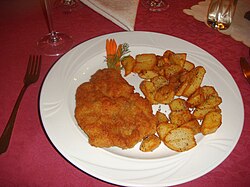
The Wiener Schnitzel is Austria's iconic national dish, featuring a boneless veal escalope that is meticulously prepared through pounding, breading, and frying to achieve a crisp, golden exterior while keeping the meat tender. The traditional recipe begins with a veal cutlet, typically weighing 150–180 grams, pounded to a uniform thickness of 2–4 millimeters (approximately 1/8 inch) to ensure even cooking. The meat is seasoned with salt and pepper, then triple-dipped: first in flour, followed by beaten eggs, and finally in fine breadcrumbs. It is shallow-fried in hot clarified butter (or lard or a butter-oil mixture) for 2–4 minutes per side until golden brown, resulting in a dish that emphasizes simplicity and quality ingredients.[58][59] The designation "Wiener Schnitzel" holds protected status under Austrian culinary law, mandating the exclusive use of veal to bear the name; this regulation was formalized to preserve authenticity, with the dish first documented in Vienna's court kitchens in 1831. Variations using pork or other meats must instead be specified as "Schnitzel Wiener Art" to comply with these standards, reflecting Austria's commitment to traditional recipes amid broader European influences. Historically, the dish draws from the Italian cotoletta, introduced during the Habsburg monarchy's rule over northern Italy, possibly via Field Marshal Joseph Radetzky in the mid-19th century.[60][58][59] As a symbol of Austrian identity, the Wiener Schnitzel embodies Viennese culinary heritage and is celebrated as one of the country's most emblematic foods, often featured in annual food festivals such as the Genuss Festival in Vienna's Prater. It is served in generous portions exceeding 200 grams including breading, traditionally accompanied by parsley potatoes and lingonberry preserve (Preiselbeeren), with garnishes like lemon wedges, capers, and anchovy butter enhancing its tangy profile. This presentation underscores the dish's role in everyday and festive Austrian dining, promoting a balance of hearty comfort and refined elegance.[60][59][61]

Polish Kotlet

The Polish kotlet, particularly the kotlet schabowy, is a breaded pork cutlet prepared from a thin slice of pork loin that is pounded to tenderize it, seasoned often with garlic for added flavor, then coated in flour, beaten egg, and breadcrumbs before being pan-fried in lard or oil until golden and crispy.[62][63] This preparation method yields a dish similar to the Austrian Wiener schnitzel but adapted with more accessible pork instead of veal, emphasizing affordability and everyday appeal in Polish cuisine.[62] Introduced in the 19th century under Austrian influence during the partitions of Poland, the kotlet schabowy gained prominence as a budget-friendly alternative to pricier veal versions, appearing in cookbooks by the 1860s.[62] It became a staple during the post-World War II communist era, when rationing and limited resources made pork a reliable protein source, transforming it into an iconic comfort food served in milk bars and homes as a symbol of simple, nourishing meals amid shortages.[23][62] Variations include kotlet de volaille, a breaded chicken cutlet stuffed with herb butter—often flavored with garlic and dill—rolled and fried, which originated in 19th-century Russia but became popular in interwar Poland.[64] Another common type is kotlet mielony, a minced meat patty made from ground pork or beef mixed with soaked bread, egg, and onions, shaped oval, breaded, and fried, serving as a versatile everyday option distinct from the pounded-slice schabowy.[64][65] Traditionally served with boiled or mashed potatoes, a fresh cabbage salad known as surówka, and a dollop of sour cream for creaminess, the kotlet schabowy is a contender for Poland's national dish due to its widespread popularity in family Sundays and festive meals.[23][62] In modern adaptations, health-conscious versions are baked in the oven rather than deep-fried to reduce fat content, though the classic pan-fried method remains favored for its authentic crunch and flavor.[66]

Russian and Ukrainian Kotleta

Kotleta po-kyivsky, known internationally as Chicken Kyiv, features a chicken breast stuffed with chilled compound butter (traditionally plain, though variations include garlic and herbs), breaded in egg and breadcrumbs, and deep-fried until golden and crisp. The traditional version uses a bone-in chicken breast (supreme) to seal the butter, though modern preparations often feature a deboned breast pounded thin and rolled.[67] This preparation creates a dramatic effect when cut, as the molten butter bursts forth. The origins of the dish are disputed between Russian and Ukrainian claims, but it likely evolved in the mid-19th century in Moscow from French-inspired côtelette de volaille techniques brought back by royal chefs trained in Paris, and was later adapted locally with chicken and popularized in Kyiv by the 1960s.[67] Ukrainian chefs emphasize plain butter for authenticity, rejecting additions like garlic or parsley found in some Russian or international variations.[67] Tefteli-style kotlety represent a molded minced meat variant prevalent in Russian home cooking, formed from ground beef and pork blended with precooked rice, finely chopped onions, and seasonings, then optionally coated in flour or breadcrumbs before being pan-fried, baked, or steamed.[68] The incorporation of rice, a technique dating to medieval Eastern Slavic traditions, absorbs excess moisture during cooking to yield exceptionally tender, juicy patties without drying out.[69] Often simmered in a creamy tomato sauce post-frying, tefteli highlight resourcefulness, utilizing leftovers like rice and vegetables for economical meals.[68] Soviet-era adaptations elevated dishes like the Pozharsky kotleta, which refined a 19th-century recipe from Torzhok using finely minced chicken thigh meat mixed with soaked white bread, cream, and butter for richness, shaped into oval patties, crumbed, and pan-fried to a crisp exterior while remaining succulent inside.[70] Influenced by French methods such as those in cutlets à la maréchale, this version gained prominence in the post-1917 period as a patriotic staple in upscale Soviet eateries, symbolizing accessible elegance amid scarcity.[70] In both Russian and Ukrainian contexts, kotlety hold a central place in everyday home cooking, particularly after the 1917 revolution, when they became versatile staples adaptable to limited ingredients and communal kitchens.[71] They are typically served with boiled buckwheat groats for heartiness, a generous spoonful of sour cream for creaminess, or a vibrant beet salad to add earthy contrast and color.[71] Ukrainian kotlety often incorporate spicier elements like abundant fresh dill and black pepper, lending a brighter, more aromatic flavor that sets them apart from the milder, bread-forward Russian styles.[72][73]

British and Commonwealth Variations

British Cutlet

The British cutlet encompasses a range of preparations emphasizing grilling or braising, with historical roots in 18th-century cookery. Traditional lamb cutlets consist of bone-in chops from the loin or rib, typically grilled or roasted to highlight the meat's tenderness and flavor. In Hannah Glasse's influential The Art of Cookery Made Plain and Easy (1747), a recipe for frying a loin of lamb involves cutting the meat into chops, coating in egg and breadcrumbs seasoned with salt, pepper, herbs, and lemon, and frying until browned, reflecting the era's preference for straightforward roasting or broiling methods.[74] These cutlets were valued for their quick preparation and suitability for middle-class meals, often sourced from local sheep breeds. Veal cutlets in British tradition drew French influence through breading and frying. 18th- and 19th-century texts describe frying methods using lard.[75] This adaptation suited Britain's cooler climate and emphasis on offal and variety meats, distinguishing it from lighter continental styles.[76] In modern contexts, chicken cutlets appear as thin, boneless fillets pan-fried in butter or oil, a common pub offering served with chips or vegetables for casual dining. During the Victorian era, cutlets featured prominently in banquets as refined entremets—small, savory portions like veal or lamb with herb forcemeat—symbolizing middle-class aspiration and French-inspired elegance at multi-course dinners.[77] Cutlets are typically served with complementary British accompaniments, such as mint sauce for lamb to cut richness, garden peas, or Yorkshire pudding for absorbing juices, underscoring a cultural emphasis on grilling or roasting to preserve texture over deep-frying. This approach spread colonially to regions like Australia, where local adaptations emerged.

Australian Cutlet

The Australian cutlet represents an adaptation of British culinary traditions brought by settlers in 1788, evolving to emphasize local meats like lamb and the iconic outdoor barbecue culture that defines social gatherings across the country.[78] This influence is evident in the preference for grilling over roasting, with cutlets often prepared on "barbies" to suit Australia's warm climate and communal lifestyle.[79] Lamb remains a cornerstone, reflecting the nation's strong sheep-farming heritage established shortly after colonization.[80] Lamb cutlets, typically frenched rib chops, are a quintessential Australian preparation, marinated in rosemary and garlic before grilling to medium-rare over high heat on a barbecue.[81] This method highlights the meat's tenderness and flavor, often served with simple seasonings to let the quality of Australian lamb shine, and has become a staple at backyard barbecues since the early 20th century when communal grilling gained popularity.[82] Veal or pork schnitzels offer another variation, breaded and fried in a style reminiscent of British escalopes but featuring larger portions suited to hearty Australian appetites, sometimes paired with native-inspired accompaniments like bush tomato chutney for a tangy, indigenous twist.[83] Chicken schnitzel, often referred to as a chicken cutlet, is a staple in Australian pubs and children's cuisine. These are commonly found in pubs and family meals, where the crisp exterior contrasts with tender meat, adapting European techniques to local tastes.[84] In modern fusions, chicken cutlets frequently appear in burgers, a trend that surged in 20th-century diners and pubs during economic hardships when affordable breading stretched ingredients further.[83] Vegetarian adaptations, such as breaded tofu cutlets mimicking the schnitzel texture, have emerged alongside innovative uses of native proteins like kangaroo in lean, grilled preparations, reflecting growing interest in sustainable and plant-based options.[85] Culturally, Australian cutlets hold a prominent role as barbecue essentials, fostering community during events like Australia Day gatherings, and are traditionally featured in commemorations with simple, grilled fare.[86] This outdoor emphasis underscores the dish's integration into national identity, where barbecues serve as informal rituals for family and friends.[87] Cutlets are served with accompaniments like potato salad, emphasizing the charred flavors from grill cooking. A modern variation includes a Vegemite glaze made by mixing the spread with honey and rosemary.[88]

North American Variations

American Cutlet

In the United States, the chicken cutlet emerged as a prominent variation, consisting of thinly sliced, breaded, and fried chicken breast that gained popularity in 20th-century Italian-American communities as an economical substitute for veal in the traditional cotoletta. Italian immigrants adapted the dish to local ingredients and tastes, transforming it into a household staple often featured in hero sandwiches layered with toppings like lettuce, tomato, and mayonnaise. This preparation became especially widespread in East Coast urban neighborhoods, where it symbolized comfort food in family meals and social gatherings. Pork cutlets, prepared from thin loin chops that are pounded, breaded, and fried or sometimes grilled, hold a strong presence in Midwestern cuisine, particularly in states like Indiana and Iowa, where the oversized breaded pork tenderloin sandwich exemplifies the style with its crunchy exterior and juicy interior. Veal cutlets, while occasionally used in upscale Italian-American recipes, remain uncommon in everyday American cooking due to their significantly higher cost—often exceeding $25 per pound—compared to chicken or pork alternatives. These pork versions highlight regional thriftiness, using affordable cuts to achieve a schnitzel-like tenderness without elaborate seasoning. Southern adaptations of the cutlet include chicken-fried steak, a breaded and pan-fried beef cutlet made from cube steak, smothered in creamy white gravy, which traces its roots to 19th-century German and Austrian immigrants in Texas who introduced schnitzel techniques to local beef preparations. This dish evolved amid post-Civil War ranching culture, blending European frying methods with Southern flour dredging for a hearty, affordable meal that underscores immigrant contributions to regional identity. The cultural significance of American cutlets intensified after World War II, coinciding with the expansion of Italian-American delis in cities like New York and Philadelphia, where chicken cutlets became a go-to item in sandwich shops amid suburban migration and economic prosperity. By the late 20th century, these breaded preparations influenced fast-food innovations, such as McDonald's introduction of Chicken Selects in 2002, broadening their appeal to mainstream consumers.[89] Typically served in sandwich form to emphasize portability, chicken cutlets pair with marinara sauce and provolone for an Italian-American twist, while Southern beef versions accompany collard greens or mashed potatoes for added regional flair.

Canadian Cutlet

The Canadian cutlet embodies a fusion of British, French, and Indigenous culinary traditions, adapted to local ingredients and regional tastes across the country's diverse landscapes. Influenced by French settlers in Quebec and British immigrants in the Maritimes and prairies, cutlets often feature breaded and fried preparations, while Indigenous adaptations incorporate game meats like bison and moose, introduced through European contact in the 17th century. These dishes highlight Canada's multicultural heritage, with variations served in homes, diners, and restaurants from coast to coast. In Quebec, veal cutlets are a staple, breaded and fried similar to French côtelette but frequently glazed with maple syrup for a distinctly Canadian sweetness. A popular preparation involves sautéing veal scallopini in butter and oil, then deglazing with maple syrup and lemon juice to create a caramelized sauce that balances the meat's tenderness. This adaptation reflects Quebec's status as Canada's leading veal producer and its renowned maple syrup production.[90] Pork schnitzel is widespread in the prairie provinces like Alberta, Saskatchewan, and Manitoba, where German settler influences prevail; it is typically breaded, pan-fried, and served with sauerkraut to add tangy contrast. Chicken schnitzel variants are also common, particularly when incorporated into poutine—fries topped with gravy and cheese curds—creating a hearty comfort dish that nods to Quebec's iconic cuisine while using prairie-raised poultry.[91] Indigenous communities have adapted cutlet-style preparations to native game, grilling bison or moose cutlets to highlight their lean, flavorful profiles; these methods trace back to European settlers introducing breading and frying techniques in the 1600s, blending with traditional roasting over open fires. Bison cutlets, often portioned and stuffed with vegetables for added moisture, appear in recipes blending European and Indigenous techniques, while moose steaks are grilled simply in western provinces to preserve natural juices.[92][93] Regionally, Atlantic provinces like Nova Scotia feature innovative takes such as chicken cutlets stuffed with local lobster, breaded and baked to combine seafood abundance with poultry familiarity, often enjoyed in coastal diners. In western Canada, beef cutlets appear in casual eateries, breaded and fried akin to schnitzel, drawing on ranching traditions for robust, diner-style meals. These cutlets are commonly paired with butter tarts for a sweet finish or wild rice pilafs, underscoring Canada's blend of European baking, Indigenous grains, and fusion dining.[94][95]

Asian and Middle Eastern Variations

Indian Cutlet

The Indian cutlet, a staple in South Asian cuisine, represents a fusion of indigenous flavors and colonial influences, typically featuring spiced minced meat or vegetables formed into patties, breaded, and fried to a crisp exterior. This adaptation emerged prominently in regions like Goa, where Portuguese settlers introduced croquette-like preparations in the 16th century, blending European frying techniques with local spices.[96][97] British colonial rule further shaped the dish through Anglo-Indian cuisine, incorporating minced meat patties inspired by European cutlets but enhanced with Indian masalas for everyday meals and snacks.[98][99] A quintessential example is the keema cutlet, made by mixing minced mutton or chicken (keema) with finely chopped onions, ginger, green chilies, and fresh coriander leaves, then shaping the mixture into flat patties. These are coated in breadcrumbs or beaten egg for crunch before being deep-fried until golden, resulting in a savory snack that balances tender filling with a crispy shell.[5] This preparation, rooted in Anglo-Indian households, draws from British meat patties but incorporates bold spices like cumin and black pepper for depth.[100] Vegetarian variants adapt the concept using boiled and mashed potatoes or lentils as the base, seasoned with garam masala, turmeric, and chili powder to evoke aromatic warmth. These patties, often mixed with peas or carrots for texture, are a favored street food option, providing an affordable, protein-rich bite without meat.[5] Their popularity stems from adaptability to local tastes, making them a versatile choice for vegetarian diets across urban markets. Regional twists highlight India's diversity; in Bengal, fish cutlets (macher chop) use flaked freshwater fish like bhetki, mashed with potatoes, onions, and a splash of pungent mustard oil for a tangy edge, then fried to highlight coastal flavors.[101] South Indian versions, such as Kerala-style chicken cutlets, incorporate curry leaves fried in coconut oil alongside minced chicken, ginger-garlic paste, and fennel for a fragrant, mildly spiced profile distinct from northern boldness.[102] Indian cutlets are commonly served as a tea-time snack or appetizer, paired with cooling mint chutney to cut through the richness, or wrapped in kathi rolls with onions and tamarind sauce for portable street eats.[103] This versatility underscores their role in social gatherings, from evening chai sessions to festive iftars.[104]

Japanese Tonkatsu

Tonkatsu is a Japanese dish consisting of a thick slice of pork loin, typically 2-3 cm thick, that is coated in flour, dipped in egg, and breaded with panko breadcrumbs before being deep-fried at approximately 340°F (170°C) until golden and crispy.[105] After frying, the cutlet is sliced crosswise into bite-sized pieces and served with a thick, tangy tonkatsu sauce made from ingredients like Worcestershire sauce, ketchup, and soy sauce, which complements the rich, juicy pork.[105] This preparation method ensures a tender interior with a shatteringly crisp exterior, distinguishing it from thinner Western cutlets. The dish originated during Japan's Meiji era (1868-1912) as part of the country's Westernization efforts, evolving from the French côtelette de veau—a breaded and fried veal cutlet—introduced through European influences.[106] In 1899, it debuted in Tokyo's Ginza district at Rengatei, a pioneering Western-style restaurant, initially under the name "katsuretsu" or simply "pork cutlet," marking the shift from veal or beef to more affordable pork.[106] Over time, adaptations like the use of panko—invented in the early 20th century for its airy texture—and double-frying techniques (initially at lower heat for cooking, followed by a brief high-heat fry for added crispness) refined tonkatsu into a distinctly Japanese staple, differing from the single-fry methods common in European styles.[107] Variations include hirekatsu, made from leaner pork tenderloin for a lighter texture, and chicken katsu, which substitutes poultry for pork while retaining the breading and frying process.[108] Tonkatsu also appears in dishes like katsu curry, where the sliced cutlet tops a bed of Japanese curry rice, or katsu sando, a sandwich version pressed between soft shokupan bread with additional sauce and cabbage.[109] In Japanese cuisine, tonkatsu holds a prominent cultural role as an accessible everyday meal, often enjoyed as a teishoku set with rice, miso soup, and pickles, reflecting its status as a beloved yōshoku (Western-influenced) comfort food.[110] High-quality pork, such as certified Kurobuta Berkshire breeds from regions like Kagoshima—which adhere to strict standards for breeding, feeding, and fat marbling—is preferred for premium versions to ensure superior flavor and tenderness.[111] It is traditionally paired with a generous portion of finely shredded raw cabbage, which provides a refreshing crunch and helps balance the dish's oiliness while aiding digestion.[108]

Iranian Kotlet

Iranian kotlet, also known as Persian cutlets, are oval-shaped patties made from a mixture of minced beef or lamb, grated or mashed potatoes, finely chopped onions, and eggs for binding, seasoned with turmeric, black pepper, and often advieh—a traditional Persian spice blend that includes cinnamon, cardamom, cumin, and dried rose petals. The mixture is pan-fried in vegetable oil until the exterior achieves a crispy, golden-brown crust while the interior remains soft and flavorful. This dish emphasizes a balance of textures and subtle Middle Eastern aromas from the spices, distinguishing it from plainer European versions.[16][112] The origins of kotlet trace back to the 19th century, coinciding with the introduction of potatoes to Iran in the early 1800s by a British ambassador to the royal family, which enabled the incorporation of this tuber into local cuisine. Influenced by European cutlet traditions—likely transmitted through Russia's shared border with Iran during the period of tsarist and later Soviet interactions—the dish was adapted into Persian cooking by infusing it with advieh and other regional flavors, transforming it into a staple of Iranian home cooking. By the late Qajar era, kotlet had become a beloved household preparation, reflecting broader culinary exchanges along the Caucasus and Central Asian trade routes.[113][16][114] Variations of kotlet include versions using ground chicken or fish fillets instead of red meat, particularly in coastal regions like the Persian Gulf, where the patties may incorporate local herbs or a tangy glaze of tamarind and date molasses for added depth. These patties are versatile, often served cold as an appetizer or meze-style dish at gatherings, and can be adapted into vegetarian forms by substituting lentils for the meat, maintaining the potato base and spices for cohesion. In Iranian culture, kotlet holds significance as a comforting family dish, frequently prepared for home meals and celebrations, paired with sides like mast-o-khiar (yogurt with cucumber and mint) or fresh sabzi (herbs) to complement its richness. It is commonly enjoyed in lavash sandwiches with pickles and tomatoes, making it ideal for picnics or everyday lunches.[114][115][16]

Sri Lankan Cutlet

The Sri Lankan cutlet, particularly the malu cutlet variant, is a beloved short eat featuring a crispy breadcrumb coating encasing a spiced filling primarily made from minced fish such as tuna or mackerel, combined with mashed potatoes, onions, green chilies, ginger, garlic, curry leaves, black pepper, and turmeric.[116][30] The dish highlights Sri Lanka's coastal seafood traditions and tropical flavors, often incorporating lime juice for tanginess and local spices to create a savory, mildly spicy profile.[116] Introduced during the colonial period, with roots in the Portuguese bolinho—a fried fish croquette—brought to the island in the 16th century and further adapted under Dutch rule in the 17th century through influences like breaded frying techniques, the cutlet evolved by blending European methods with indigenous Sinhalese elements such as aromatic spices.[117][30][118] This fusion incorporated island-specific ingredients like pandan leaves for subtle fragrance and maldive fish (dried, smoked tuna) for umami depth in some preparations, reflecting Sri Lanka's layered culinary heritage from European colonizers and local coastal communities.[119] Preparation begins by boiling or steaming the fish and potatoes to develop flavors, followed by sautéing onions, chilies, and spices in oil—often coconut oil for an authentic nutty aroma—before mixing into a cohesive paste that is shaped into balls or ovals.[116][30] The portions are then dipped in beaten egg and rolled in breadcrumbs for a crunchy exterior, then deep-fried until golden to seal in the moist, flavorful interior.[116] Variations extend beyond seafood to include beef cutlets using minced meat seasoned with curry powder or vegetable versions with lentils and spices, catering to diverse dietary preferences while maintaining the deep-fried format.[119] As a quintessential street food and party snack, Sri Lankan cutlets play a central role in social gatherings, tea-time rituals, and celebrations, often paired with seeni sambol—a sweet caramelized onion relish—to balance their heat and enhance the eating experience.[117][119]

Hong Kong Cutlet

The Hong Kong cutlet, particularly in the form of pork chop rice, features boneless pork chops marinated in a blend of soy sauce, Chinese five-spice powder, garlic, and sometimes Shaoxing wine or sugar for flavor enhancement, then lightly breaded with flour or cornstarch before being pan-fried or baked until golden and tender. This preparation draws from Cantonese techniques, emphasizing a light coating to retain juiciness, and is typically served atop a bed of egg-fried rice to absorb the savory juices.[120][121][122] The dish traces its origins to British colonial influence in Hong Kong starting in the 1840s, when Western culinary elements like breaded and fried cuts of meat were introduced and fused with local Cantonese stir-fry methods, such as preparing egg-fried rice. Pioneered by establishments like Tai Ping Koon, founded in Guangzhou in 1860 and expanding to Hong Kong in 1938, the cutlet evolved as a Cantonese-Western hybrid, incorporating sweet-tangy tomato-based sauces reminiscent of European casseroles but adapted with Asian seasonings. Following the post-1950s influx of refugees from mainland China, cha chaan teng diners proliferated, refining the dish into an accessible comfort food that balanced British-inspired frying with Cantonese marination for everyday appeal.[123][124][125] Variations extend beyond pork to include chicken chops, often marinated similarly and served with a bold black pepper sauce in cha chaan teng settings, or beef versions for a richer profile, reflecting the diner's Western-style adaptations. These alternatives maintain the core light breading and rice base but adjust proteins and sauces to suit diverse palates, such as adding oyster sauce for depth in chicken preparations.[126][127][128] Culturally, the Hong Kong cutlet embodies comfort food in cha chaan teng tea houses, where it serves as a nostalgic staple for locals, especially post-1950s generations adapting to urban life amid economic shifts. Often presented on tomato-infused rice or alongside a sunny-side-up fried egg, it highlights a signature sweet-salty balance through the interplay of marinated meat, tangy sauce, and melted cheese topping in baked iterations.[123][124][122]

References

User Avatar
No comments yet.