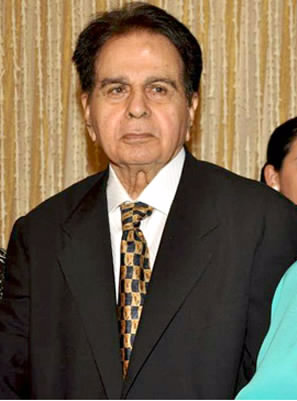

Dilip Kumar
View on Wikipedia
Muhammad Yusuf Khan (11 December 1922 – 7 July 2021), known professionally as Dilip Kumar, was an Indian actor and film producer best known for his work in Hindi cinema. Credited with pioneering method acting in cinema,[3] he dominated Hindi cinema from the 1950s throughout the 1960s and is widely regarded as one of the greatest actors in the history of Indian Cinema.
Key Information


In a career spanning over five decades, Kumar worked in 57 films.[4] He debuted as an actor in the film Jwar Bhata (1944), produced by Bombay Talkies. Following a series of unsuccessful ventures, he had his first box office hit in Jugnu (1947). He consistently starred in top–grossing Indian films from the late-1940s to the 1960s, such as Shaheed, Andaz, Babul, Deedar, Aan, Uran Khatola, Insaniyat, Azaad, Naya Daur, Madhumati, Paigham, Kohinoor, Mughal-E-Azam, Gunga Jumna and Ram Aur Shyam.[5] Some of his most acclaimed performances, include Nadiya Ke Paar, Shabnam, Jogan, Tarana, Daag, Sangdil, Shikast, Footpath, Amar, Devdas, Musafir, Yahudi, Leader, Aadmi and Sunghursh.[6]
The 1970s saw Kumar's career take a downturn, with only one major success, Gopi (1970).[5][7] In 1976, he went on a brief hiatus from film performances and returned with the revolutionary drama Kranti (1981), which was the highest-grossing Indian film of the year.[8] He continued to play leading roles in films such as Vidhaata (1982), Karma (1986), and Saudagar (1991). His last on-screen appearance was in the commercially unsuccessful Qila (1998), which saw him in a dual role. Kumar later served as a member of the Rajya Sabha, the upper house of India's parliament, from 2000 to 2006.
Kumar's personal life was the subject of much media attention, however, he himself had largely avoided media limelight and endorsements.[9] He was in a long-term relationship with actress and frequent co-star Madhubala that ended after the Naya Daur court case in 1957. He married actress Saira Banu in 1966 and resided in Bandra, a suburb of Mumbai, until his death in 2021. For his contributions to film, the Government of India awarded him with the Padma Bhushan in 1991 and the Padma Vibhushan in 2015, the country's third and second-highest civilian awards respectively. He was also awarded India's highest accolade in the field of cinema, the Dadasaheb Phalke Award in 1994. In 1998, the Government of Pakistan conferred Kumar with Nishan-e-Imtiaz, their highest civilian decoration, making him the only Indian to have received the honour. The house that Kumar grew up in, located in Peshawar, was declared a national heritage monument in 2014 by the Pakistani government.
Early life
[edit]Dilip Kumar was born Muhammad Yusuf Khan[10][11][12] on 11 December 1922, into an Awan Hindkowan family at his family home in the Qissa Khawani Bazaar neighbourhood of Peshawar, a city in the North-West Frontier Province of British India.[13][14] He was one of the twelve children of Lala Ghulam Sarwar Ali Khan (1890–1950) and his wife Ayesha Begum (1897–1948). His father was a fruit merchant.[15]
Khan studied at the Barnes School in Deolali (now in Maharashtra), where his father owned orchards.[16][13] He grew up in the same neighbourhood in Peshawar as Raj Kapoor, his childhood friend, and later his colleague in the film industry.[17] In 1940, he moved to Pune and set up a dry fruit supply shop and a canteen.[13] Despite hailing from Peshawar, Khan's family decided to remain in Bombay following the Partition of India in 1947.[18]
Khan never acted under his birth name, debuting in Jwar Bhata in 1944 under the stage name Dilip Kumar. In his autobiography, Dilip Kumar: The Substance and the Shadow, he wrote that the name was a suggestion from Devika Rani, who was one of the producers on Jwar Bhata.[19] In an interview in 1970, he said that he adopted this name out of fear of his father, who never approved of his acting career because of the general poor image of cinema back then.[20][21]
Career
[edit]1940s: First film roles and initial success
[edit]
Kumar's first film was Jwar Bhata in 1944, which went unnoticed. After two more unsuccessful films, it was his fourth film Jugnu (1947), in which he starred alongside Noor Jehan, that became his first major hit at the box office.[4][13][22] His next major hits were the 1948 films Shaheed and Mela.[23] Both Jugnu and Shaheed were the highest grossing Hindi films of their respective year of release.[22][24]
He got his breakthrough role as an actor in 1949 with Mehboob Khan's Andaz, in which he starred alongside Raj Kapoor and Nargis. At the time of its release, Andaz was the highest-grossing Indian film ever, until its record was broken by Kapoor's Barsaat that same year.[25] Shabnam was another box office hit that was also released in 1949.[22]
1950s and 1960s: Superstardom
[edit]The 1950s was Kumar's most successful and prolific decade with him playing leading roles in several box office hits such as Jogan (1950), Babul (1950), Deedar (1951), Tarana (1951), Daag (1952), Aan (1952), Uran Khatola (1955), Insaniyat (1955), Devdas (1955), Naya Daur (1957), Yahudi (1958), Madhumati (1958) and Paigham (1959).[26] He formed popular on-screen pairings with many of the top actresses at the time including Vyjayanthimala, Madhubala, Nargis, Nimmi, Meena Kumari and Kamini Kaushal.[27] Together with fellow contemporaries Raj Kapoor and Dev Anand, he dominated the 1950s which is considered a part of the golden era of Hindi cinema. Though the three did not appear in any one film together, Kumar did appear with Raj Kapoor in Andaz (1949) and Dev Anand in Insaniyat (1955).[28]
Several of his films established his screen image as the "Tragedy King".[29] Kumar briefly suffered from depression due to portraying many tragic roles and on the advice of his psychiatrist, he also took on light-hearted roles.[30] Mehboob Khan's big-budget 1952 swashbuckling musical Aan featured him in one of his first lighter roles[31] and marked his first film to be shot in technicolor. Aan was the first Indian film to have a wide release across Europe with a lavish premiere in London.[32] Aan was the highest-grossing Indian film ever at the time, domestically[33] and overseas.[34] He had further success with lighter roles as a thief in the hit comedy Azaad (1955). In 1957, he appeared in the third segment of the anthology film Musafir, which was the directorial debut of Hrishikesh Mukherjee. He also did playback singing for a song in the film with Lata Mangeshkar.[35]
By this time, he had developed his distinct, signature style of understated acting of mumbling his dialogues while giving myriad expressions and meanings to lines that his characters uttered.[36][37]
He was the first actor to win the Filmfare Best Actor Award (for Daag) and went on to win it a further seven times.[38][39] 9 of his 21 films in the 1950s were ranked in the Top 30 highest-grossing films of the decade.[40]
In the 1950s, Kumar became the first Indian actor to charge 1.5 lakh per film.(equal to 60 cr or above of 2024)[41]
In 1960, he portrayed Prince Salim in K. Asif's big-budget epic historical film Mughal-e-Azam, which was the highest-grossing film in Indian film history for 15 years until it was surpassed by the 1975 film Sholay.
Mughal-e-Azam was in the making for over a decade and was originally shot in black and white, with only two songs and the climax scenes shot in colour. 44 years after its original release, it was fully colourised and theatrically re-released in 2004 and was once again a box office success.[42][43] That same year he played another lighter role in the musical comedy Kohinoor which was also among the highest grossers of the year.[29]
In 1961, Kumar wrote, produced, and starred in the dacoit drama Ganga Jamuna opposite his brother Nasir Khan, playing the title roles. Kumar produced the film under his production company Citizen Films and despite it being the highest-grossing film of the year, it would be the only film he produced. Though the directing credit went to the veteran director Nitin Bose, it was rumoured that Kumar had ghost directed the film as well as being involved in every aspect of its production. He chose the shade of saree that his co-star Vyjayanthimala would wear in every scene. The film received the National Film Award for Second Best Feature Film in Hindi, the Paul Revere Silver Bowl at the Boston International Film Festival, the Special Honour Diploma from the Czechoslovak Academy of Arts in Prague, and the Special Prize at the Karlovy Vary International Film Festival.[44]
In 1962, British director David Lean offered him the role of "Sherif Ali" in his film Lawrence of Arabia (1962), but Kumar declined to perform in the movie.[45] The role eventually went to Omar Sharif, the Egyptian actor. Kumar commented in his much later released autobiography, "he thought Omar Sharif had played the role far better than he himself could have".[46] Kumar was also being considered for a leading role opposite Elizabeth Taylor in a film that Lean was working on called Taj Mahal, before the project was cancelled.[47]
After a three-year hiatus, he returned in 1964 with his next film Leader, which underperformed at the box office and ended up being only an average grosser. Kumar was also credited with writing the story of this film.[48] His next film Dil Diya Dard Liya (1966), opposite Waheeda Rehman was a box office flop. It was rumoured that he had ghost directed the film but the final credit was given to Abdul Rashid Kardar.[49]
That same year, he made his debut in Bengali cinema with a guest appearance in Paari, which starred Dharmendra in the lead role.[50] In 1967, Kumar played a dual role of twins separated at birth in the hit film Ram Aur Shyam.[51] In 1968, he starred alongside Manoj Kumar in Aadmi and opposite Sanjeev Kumar and Balraj Sahni in Sunghursh, which were both average grossers at the box office.[52][53]
1970s: Slump and hiatus
[edit]In 1970, Kumar played the title role in the Bengali film Sagina Mahato, which marked his first onscreen pairing with his wife Saira Banu.[54] In the same year, he starred alongside Banu again in Gopi, which was a box office success. In 1972, he once again played dual roles as twin brothers in Dastaan, which was a box office flop and began a decline in Kumar's career as a leading man. A Hindi remake of Sagina Mahato, simply titled Sagina was made in 1974 with both Kumar and Banu reprising their roles which also failed to do well at the box office. In 1976, he played triple roles as a father and twin sons in Bairaag. Though his performance in triple roles was acclaimed, the film was his third consecutive failure at the box office.[55][56] He personally regarded M. G. Ramachandran's performance in Enga Veettu Pillai better than his role in Ram Aur Shyam. He regards his performance in Bairaag much higher than that of Ram Aur Shyam. The rise of actors like Rajesh Khanna, Amitabh Bachchan and Sanjeev Kumar led to Kumar losing film offers from 1970 to 1980. He took a five-year hiatus from films from 1976 to 1981.[57]
1980s: Return to success
[edit]In 1981, he returned to films, reinventing himself in elderly character roles. His comeback film was the star-studded historical epic Kranti which was the biggest hit of the year.[58] Appearing alongside an ensemble cast including Manoj Kumar, Shashi Kapoor, Hema Malini and Shatrughan Sinha, he played the title role as revolutionary fighting for India's independence from British rule.[59] In the post-Kranti phase, Kumar reinvented himself to play the "Angry Old Man" [60] In 1982, he collaborated with director Subhash Ghai for the first time with Vidhaata, in which he starred alongside Sanjay Dutt, Sanjeev Kumar and Shammi Kapoor. Vidhaata was the highest-grossing film of the year. Later that year he starred alongside Amitabh Bachchan in Ramesh Sippy's Shakti, which was an average grosser at the box office, but won him critical acclaim and his eighth and final Filmfare Award for Best Actor.[61] In 1984, he starred in Yash Chopra's social crime drama Mashaal opposite Anil Kapoor, which failed at the box office, but his performance was critically acclaimed.[62] He also appeared alongside Rishi Kapoor in Duniya (1984) and Jeetendra in Dharm Adhikari (1986).[63][64]
His second collaboration with Subhash Ghai came with the 1986 ensemble action film Karma. Karma marked the first film which paired him opposite fellow veteran actress Nutan, although they were previously paired in an incomplete and unreleased film in the 1950s titled Shikwa.[59][65][66] He acted opposite Nutan again in the 1989 action film Kanoon Apna Apna which also reunited him with Sanjay Dutt.[67]
1990s: Directorial debut and final works
[edit]In 1990, he co-starred with Govinda in the action thriller Izzatdaar. In 1991, Kumar starred alongside fellow veteran actor Raaj Kumar in Saudagar, his third and last film with director Subhash Ghai. This was his second film with Raaj Kumar after 1959's Paigham. Saudagar was to be Kumar's penultimate film and last box office success.[68] In 1994, he won the Filmfare Lifetime Achievement Award for his contributions to the industry.[69]
In 1991, producer Sudhakar Bokade who had previously worked with Kumar in Izzatdaar announced a film titled Kalinga which would officially mark Kumar's directorial debut after he had allegedly previously ghost-directed Ganga Jamuna (1961) and Dil Diya Dard Liya (1967).[70] Kumar was also set to star in the title role with the cast including Raj Babbar, Raj Kiran, Amitoj Mann and Meenakshi Seshadri. After being delayed for several years, Kalinga was eventually shelved with only 70% filming completed.[71][72]
In 1998, Kumar made his last film appearance in the box office flop Qila, where he played dual roles as an evil landowner who is murdered and as his twin brother who tries to solve the mystery of his death.[73][74]
2000s–2021: Shelved projects and political career
[edit]In 2001, Kumar was set to appear in a film titled Asar – The Impact alongside Ajay Devgan and Priyanka Chopra, which was shelved due to Kumar's declining health.[75] He was also set to appear in Subhash Ghai's war film Mother Land, alongside Amitabh Bachchan and Shah Rukh Khan, but this film was shelved after Khan decided to leave the project.[76]
His classic films Mughal-e-Azam and Naya Daur were fully colourised and re-released in cinemas in 2004 and 2008 respectively.[77] An unreleased film he had shot and completed titled Aag Ka Dariya was set for a theatrical release in 2013 but has not been released to date.[78]
Kumar was a member of the Rajya Sabha, the upper house of India's parliament, from 2000 to 2006.[79] He was nominated by the Indian National Congress to represent Maharashtra.[80][81] Kumar utilised a significant portion of his MPLADS fund towards the construction and improvement of the Bandstand Promenade and the gardens at Bandra Fort at Lands End in Bandra.[82]
Personal life
[edit]
Kumar and Madhubala were drawn to each other during the shooting of Tarana (1951). They were in a relationship for seven years until the Naya Daur court case, during which Kumar testified against Madhubala and her father, ending their relationship.[83] They never worked together again after Mughal-e-Azam (1960).[84] Kumar later expressed in his autobiography, "Was I in love with Madhubala as the newspapers and magazines reported at that time? As an answer to this oft-repeated question straight from the horse's mouth, I must admit that I was attracted to her both as a fine co-star and as a person who had some of the attributes I hoped to find in a woman at that age and time...She, as I said earlier, was very sprightly and vivacious and, as such, she could draw me out of my shyness and reticence effortlessly."[85] However, Kumar shared in his biography that contrary to popular notion, Madhubala's father Ataullah Khan wasn't opposed to their match but instead, wanted to turn this marriage into a business venture which did not land well with him.[86]
In the late 1950s, Vyjayanthimala was linked by gossip magazines to Kumar, who has acted with her the most compared to any other actress, which resulted in great on-screen chemistry between them. While working for his home production Gunga Jumna (1961), Kumar reportedly handpicked the shade of sari that Vyjayanthimala would wear in every scene.[87]
In 1966, Kumar married actress Saira Banu, who was 22 years younger than him. He later married Hyderabad socialite Asma Rahman, taking her as a second wife in 1981.[88][89] That marriage ended in January 1983.[90] Banu and he lived in Bandra. They did not have any children. In his autobiography, Dilip Kumar: The Substance and the Shadow, he revealed that Banu had conceived in 1972, but developed complications in the pregnancy, leading to a miscarriage. Following this, they did not try to have children again, believing it to be God's will.[91][92]
Kumar was fluent in his native Hindko, in his later years aiming to establish a Hindko Academy in Peshawar in order to safeguard the language,[93] as well as Urdu, Hindi, English, Punjabi, Marathi, Pashto and Farsi. He was also a great music enthusiast and also learnt how to play the sitar for a film.[94] He loved cricket and played it often.[95] He led a cricket team against Raj Kapoor in a friendly cricket match held for charity.[96] Both growing up in Peshawar and in Bombay, Dilip Kumar and his family had a close relationship with the Kapoor family.[97]
His younger brother Nasir Khan (1924–1974) was also a noted film actor.[98] Two of his younger brothers, Aslam Khan (1932 - 2020) and Ehsan Khan (1930 - 2020), died after testing positive for COVID-19 in 2020, within a space of two weeks.[99][100]
Death
[edit]Kumar died at Hinduja Hospital, Mumbai, on 7 July 2021 at 7:30 am, aged 98,[101][102][103] after a prolonged illness. He had been suffering from several age-related issues and was diagnosed with pleural effusion.[104][105] The Government of Maharashtra approved his burial with state honours under COVID-19 restrictions at the Juhu Muslim Cemetery that same day.[106][107]
Expressing their condolences, Prime Minister Narendra Modi stated in a tweet that Kumar would be remembered as a cinematic legend, while the President, Ram Nath Kovind, stated that "he was loved across the subcontinent".[102] The Prime Minister of Pakistan, Imran Khan, also expressed condolences for his death and remembered his efforts in raising funds for the Shaukat Khanum Memorial Cancer Hospital in a tweet.[108] and the former President of Afghanistan, Hamid Karzai also expressed condolences to Kumar and his family.
Artistry and legacy
[edit]Kumar is widely considered one of the greatest and most influential actors in the history of Indian cinema,[109] and cinema in general.[110] Kumar was a pioneer of method acting, predating Hollywood method actors such as Marlon Brando. He inspired many great Indian cinema actors from contemporaries like Balraj Sahni to succeeding generations of artists, including Rajendra Kumar, Manoj Kumar, Dharmendra, Amitabh Bachchan, Shah Rukh Khan, Kamal Haasan, Mammootty, Aamir Khan and Naseeruddin Shah among others.[3] Kumar, who pioneered his own form of method acting without any acting school experience,[111] was described as "the ultimate method actor" by renowned filmmaker Satyajit Ray.[112]
A part of the "Trinity – The Golden Trio" (along with Raj Kapoor and Dev Anand),[113] Kumar was popularly referred to as "Abhinay Samrat" (Hindi for "Emperor of Acting") by the audience.[114] He was also dubbed in the media as "Tragedy King" because of the acclaimed dramatic roles he took early in his career and is also retrospectively known as "The First Khan" of Bollywood.[17] Other than these, of recent, he is often referred in the media as "The Kohinoor of Indian cinema".[115] Kumar was the biggest Indian star of the 1950s and 1960s era,[116][117] a national icon and the country's highest paid actor during this period.[118] His prolific period as a leading artist coincides with what retrospectively came to be known as the "Golden Age of Hindi cinema", with him playing a key role in its legacy.[119] Film historian Maithili Rao states, "He towered like a mountain in the middle of Hindi film history, obscuring his predecessors and dwarfing his contemporaries."[120]
He is retrospectively recognised as "The First Superstar of Indian cinema".[121] He became one of the earliest and most revered stars in the history of Indian cinema having legions of fans across the subcontinent and among the South Asian diaspora worldwide.[122] In 2013, on the occasion of the centenary of Indian cinema, he was declared the "Biggest superstar of all time" by Filmfare in its poll of the same title.[123]
As of 2020, he is by far, the most successful Bollywood star of all time with over 80% box-office successes and numerous gross records.[124] Kumar appeared in Box Office India's "Top Actors" list nineteen times from 1947 to 1965. He topped the list sixteen times (1948–1963).[125] Trade analysts have acknowledged that many of his films were commercially successful despite their heavy theme and non-commercial nature because the masses gathered in cinemas across India only to see him act, a unique feat as anything such hasn't happened with any other actor. This had been particularly apparent in the late 1940s and early 1950s, a period in which he got the title of "Tragedy King" in media outlets.[5] In the review of the last film of his initial phase, the 1976 musical Bairaag, The Hindu, remarked, "For more than 25 years Dilip Kumar was the king at the box office. His name was almost a guarantee of success not only at the time of the release of the film but even in re-runs his films made more money than fresh releases of many of his contemporaries."[126] Renowned director, Hrishikesh Mukherjee, called him "a phenomenon at the time", stating all his films had the hype, "he was absolutely a one-man industry".[127]
In the second phase of his career, which saw him playing mature roles that were the main leads of his films, often driving them to immense success, Box Office India notes, "This was the part of his illustrious career which sets him apart from all other actors as no one else has managed to such success as a character artist."[5] Renowned actor Irrfan Khan, remarked, "Till date, no other actor has had that kind of an impact on people's hearts. The kind of combination he brought along – of an actor and a star – was never seen before him. It started with him, and ended with him. His career, his working style, his personal lifestyle or his choice of films, nothing sets a wrong example. He is a true legend. These days, the word 'legend' is used loosely, but I strongly believe that he is the only one who deserves to be called the legend".[128]
Accolades
[edit]
Kumar, Raj Kapoor and Dev Anand together formed "the golden trio" of Indian cinema in the 1950s and 1960s, with the camaraderie between the three contemporary actors, all renowned for their own style.[129] Kumar was the biggest Indian star of this era,[116] a national icon, holding the status of a matinée idol. He was the country's highest-paid actor during this period.[118]
From the independence of India in 1947 to the late 2010s, Kumar held the record of performing in the highest number of highest-grossing films of the year (9 films), until his record was broken by Salman Khan, who performed in 10 such films. However, as per new reports from Box Office India, highest grossing Indian film in 1991 was Kumar's Saudagar (1991) instead of Khan's Saajan (1991), thus perhaps re-establishing his record.[130]
He is the only actor in India to have delivered at least one bonafide "hit" at the box office for 15 years straight, from 1947 to 1961.[131] He also did not give a single flop in a period of 15 years from 1952 to 1965.[4] According to many sources, he is the only Indian actor to have more than one film (3 or 4) among the top 10 highest-grossing films of Indian cinema when adjusted for ticket-price inflation. These films are Naya Daur (1957), Mughal-e-Azam (1960), Gunga Jumna (1961), and Kranti (1981).[132][133][134]
Over his career, Kumar received eight Filmfare Awards for Best Actor (with 19 total nominations), the most of any actor (and was also its inaugural recipient),[135] and a Filmfare Lifetime Achievement Award (1993).[136] He holds the record for most consecutive Filmfare award for Best Actor wins. He also received a Special Recognition Filmfare Award at the 50th Filmfare Awards for being one of the first recipients of Filmfare Awards along with Lata Mangeshkar and Naushad Ali.[69][137] and a cine icon for his enduring legacy at the 70th Filmfare Awards along with Bimal Roy, Nutan and Meena Kumari.[138]
Kumar was appointed Sheriff of Mumbai (an honorary position) in 1980.[139] The Government of India honoured Kumar with the Padma Bhushan in 1991, the Dadasaheb Phalke Award in 1994 and the Padma Vibhushan in 2015.[140] The Government of Andhra Pradesh honoured Kumar with NTR National Award in 1997. He was honoured with CNN-IBN's Lifetime Achievement Award in 2009.[141] The Government of Madhya Pradesh honoured Kumar with Rashtriya Kishore Kumar Samman in 2015.[142]
The Government of Pakistan conferred Kumar with the Nishan-e-Imtiaz, the highest civilian award in Pakistan, in 1998.[143][144] The ruling political party of Shiv Sena in Maharashtra, India, had objected to this award and questioned Kumar's patriotism. However, in 1999, in consultation with the then Prime Minister of India Atal Bihari Vajpayee, Kumar retained the award. Vajpayee declared, "There is no doubt about film star Dilip Kumar's patriotism and commitment to the nation."[145] Kumar later said in his autobiography that returning it "could have only soured relations further and produced bad vibes between India and Pakistan."[94] Many believe this incident prolonged his wait for Bharat Ratna.[146]
The House of Dilip Kumar in Peshawar, Pakistan, was declared a national heritage monument in 2014 by the then Pakistani Prime Minister Nawaz Sharif.[147]
Kumar was voted the "Greatest Indian Actor of All Time" in a Rediff Readers poll in 2011.[148] He holds the Guinness World Record for having received the most awards by an Indian actor.[149] He was honoured by the World Book of Records on his 97th birthday for his "matchless contribution to Indian cinema and promoting social causes".[150]
References
[edit]- ^ Smith, Lewis (26 May 2011). "Twitter chief hints he may have to divulge users' names". The Independent. UK. Retrieved 13 December 2011.
- ^ "Dilip Kumar laid to rest at Juhu Qabrastan". India Today. 7 July 2021. Archived from the original on 8 July 2021. Retrieved 9 July 2021.
- ^ a b Mazumder, Ranjib (11 December 2015). "Before Brando, There Was Dilip Kumar". TheQuint. Archived from the original on 26 July 2021. Retrieved 26 July 2021.
- Hegde, Rajul. "'Even actors of today have influences of Dilip Kumar'". Rediff. Archived from the original on 10 July 2021. Retrieved 26 July 2021.
- Kumar, Anuj (7 July 2021). "Dilip Kumar, the pole star of a golden age of Hindi cinema, no more". The Hindu. ISSN 0971-751X. Archived from the original on 7 July 2021. Retrieved 26 July 2021.
- "'Best actor this country has produced': Kamal Haasan remembers Dilip Kumar on his 93rd birthday". Firstpost. 11 December 2015. Archived from the original on 11 July 2021. Retrieved 26 July 2021.
- "Dulquer Salmaan shares why Dilip Kumar was Mammootty's absolute favourite person". India Today. 7 July 2021. Retrieved 16 November 2022.
- ^ a b c "Dilip Kumar Filmography, Movies List, Box Office Collection with HIT or Flop Verdict - Boxofficeindia, Box Office India, Box Office Collection, Bollywood Box Office, Bollywood Box Office". www.addatoday.com. 17 April 2020. Archived from the original on 22 October 2021. Retrieved 22 October 2021.
- ^ a b c d "Legend Dilip Kumar Passes Away At 98 - Box Office India". www.boxofficeindia.com. Retrieved 16 November 2022.
- ^ "Dilip Kumar's most memorable performances". 11 December 2017.
- ^ "Shahrukh Khan PASSES Where Amitabh Bachchan And Dilip Kumar Did Not". 15 February 2023.
- ^ Rewind - Forty Years Of Historic Blockbuster KRANTI, Box Office India, 13 February 2021
- ^ Lanba, Urmila (30 June 2019). The Thespian: Life and Films of Dilip Kumar. Vision Books. ISBN 978-93-86268-31-0.
- Pandya, Sonal. "Dilip Kumar once sold pickles!". Cinestaan. Retrieved 6 December 2022.
- ^ "'Dilip Kumar doing fine, he had severe backache': Saira Banu on actor's health". Hindustan Times. Press Trust of India. 13 March 2020. Archived from the original on 15 August 2020. Retrieved 7 July 2021.
- ^ "Here's why Dilip Kumar changed his name from Yusuf Khan". The Times of India. 29 March 2024. ISSN 0971-8257. Retrieved 29 June 2024.
- ^ "Here's Why Dilip Kumar Changed His Name From Muhammad Yusuf Khan | Filmfare.com". www.filmfare.com. Retrieved 29 June 2024.
- ^ a b c d "Dilip Kumar: The Grand Old Man Of Indian Cinema's Legendary Life". NDTV. Archived from the original on 7 July 2021. Retrieved 7 July 2021.
- ^ Web Team, WION (8 July 2021). "Pakistan mourns the loss of legendary Indian star Dilip Kumar, prayers offered outside ancestral home". WION. New Delhi, India. Archived from the original on 12 July 2021. Retrieved 13 July 2021.
For the uninitiated, Dilip Kumar, born as Muhammad Yusuf Khan was from an Awan family in Pakistan's Peshawar.
- ^ "Dilip Kumar, Bollywood's 'Tragedy King', dies aged 98". www.aljazeera.com. Archived from the original on 7 July 2021. Retrieved 7 July 2021.
- ^ Renuka Vyavahare (28 December 2011). "Here's why Dilip Kumar speaks Marathi fluently!". The Times of India. Archived from the original on 29 October 2013. Retrieved 28 September 2013.
- ^ a b "Happy Birthday Dilip Kumar: As Dilip Kumar turns 94, a look at his titanic reputation as India's finest method actor". Indianexpress.com. 11 December 2016. Archived from the original on 21 March 2019. Retrieved 21 March 2019.
- Bose, Mrityunjay (7 July 2021). "Dilip Kumar: The undisputed 'Tragedy King'". Deccan Herald. Archived from the original on 7 July 2021. Retrieved 7 July 2021.
- ^ Shukla, Vivek (14 August 2017). "And then there were Muslims who chose India". The Indian Tribune. Archived from the original on 19 July 2021. Retrieved 19 July 2021.
- ^ "This is why Dilip Kumar changed his name from Muhammad Yusuf Khan before movie debut". The Times of India. Archived from the original on 11 July 2021. Retrieved 9 July 2021.
- ^ "RIP Dilip Kumar: Here's why the legendary actor changed his name". Deccan Herald. 7 July 2021. Archived from the original on 9 July 2021. Retrieved 9 July 2021.
- ^ "BBC Asian Network - Ray Khan, Pyar, Ishq Aur Judai, Listen to Dilip Kumar's Interview from 1970". BBC. 7 March 2013. Archived from the original on 9 July 2021. Retrieved 9 July 2021.
- ^ a b c "BoxOffice India.com". 6 February 2009. Archived from the original on 6 February 2009. Retrieved 21 March 2019.
- ^ VERMA, SUKANYA. "25 Memorable Dilip Kumar Films". Rediff. Archived from the original on 8 July 2021. Retrieved 9 July 2021.
- ^ "BoxOffice India.com". 6 February 2009. Archived from the original on 6 February 2009. Retrieved 22 October 2021.
- ^ "Box Office 1949". Box Office India. 16 October 2013. Archived from the original on 16 October 2013. Retrieved 26 November 2019.
- ^ "Dilip Kumar's Top 25 Films". Rediff.com. Archived from the original on 11 October 2020. Retrieved 21 March 2019.
- ^ Pandya, Sonal. "Dilip Kumar and his leading ladies". Cinestaan.com. Archived from the original on 11 October 2020. Retrieved 21 March 2019.
- ^ "'The golden trio': As Dilip Kumar leaves for heavenly abode, netizens remember his contemporaries and friends Raj Kapoor and Dev Anand". The Free Press Journal. Mumbai. 7 July 2021.
- ^ a b "rediff.com, Movies: Tragedy King Dilip Kumar". Rediff.com. Archived from the original on 31 May 2011. Retrieved 6 August 2012.
- ^ "Dilip Kumar's autobiography reveals his journey from Peshawar to Bombay - The Indian Express". 28 March 2017. Archived from the original on 28 March 2017. Retrieved 21 March 2019.
- ^ "Dilip Kumar's most memorable performances". Filmfare.com. Archived from the original on 11 October 2020. Retrieved 21 March 2019.
- ^ "Mehboob's AAN (1952) – Indian Cinema's entry into Europe". Moviemahal.com. 11 January 2017. Archived from the original on 21 March 2019. Retrieved 21 March 2019.
- ^ "Top Earners 1950-1959 (Figures in Ind Rs)". Box Office India. 19 September 2012. Archived from the original on 19 September 2012. Retrieved 21 November 2019.
- ^ Rajinder, Dudrah; Jigna, Desai (2008). The Bollywood Reader. McGraw-Hill Education. p. 65. ISBN 9780335222124. Archived from the original on 27 July 2020. Retrieved 10 July 2021.
- ^ "Way before OTTs, Hrishikesh Mukherjee's Musafir starring Dilip Kumar was the gold standard of anthologies". 18 December 2021.
- ^ Vedam, V. (2022). The Puffin Book of 100 Extraordinary Indians. India: Penguin Random House India Private Limited. ISBN 9789354923616.
- ^ Sharda, Anjali (2021). Leadership Gotcha. Blue Rose Publishers. p. 7.
- ^ "Filmfare Best Actor Awards - History". Indicine.com. 4 March 2009. Archived from the original on 14 April 2015. Retrieved 9 April 2017.
- ^ "10 Bollywood Actors who Have Won the Highest Filmfare Awards". Foraywhile.com. 3 September 2013. Archived from the original on 11 June 2019. Retrieved 21 March 2019.
- ^ "Top Earners 1950-1959 (Figures in Ind Rs)". Box Office India. Archived from the original on 17 January 2008. Retrieved 17 January 2008.
- ^ "B-Town rewind: The tale of the first Bollywood crore". Mid-Day. 16 March 2014. Archived from the original on 16 March 2014. Retrieved 16 November 2017.
- ^ "Madhubala birthday: Madhubala's real story is as tragic as her iconic character, Mughal-E-Azam's Anarkali". The Indian Express. 14 February 2017. Archived from the original on 1 May 2021. Retrieved 9 July 2021.
- ^ "Epic movie Mughale-Azam returns in colour cinemascope, digital sound". India Today. 22 December 2011. Archived from the original on 24 June 2021. Retrieved 9 July 2021.
- ^ "The Last of the legends, goodbye Dilip saab". The Times of India. 7 July 2021. Archived from the original on 7 July 2021. Retrieved 7 July 2021.
- ^ "Dilip Kumar's Hollywood dis-connection". The Times Of India. Archived from the original on 10 August 2017. Retrieved 2 December 2010.
- ^ "Dilip of Arabia?". The Times of India. 19 July 2015. Archived from the original on 30 January 2016. Retrieved 21 December 2015.
- ^ "Idea of Dilip Kumar, Elizabeth Taylor pairing scared Saira". India Today. 13 December 2015. Archived from the original on 11 October 2020. Retrieved 15 January 2019.
- ^ "Box Office 1964". Box Office India. 31 July 2011. Archived from the original on 10 February 2012.
- ^ "Dilip Kumar's 100th birth anniversary: The films that he ghost-directed". The Times of India. 11 December 2022.
- ^ "When Dilip Kumar impressed in Bengali cinema". The Hindu. 7 July 2021.
- ^ Kotru, Nirupama (8 February 2017). "Films that are 50: A Dilip Kumar double treat in 'Ram Aur Shyam'". Scroll.in. Archived from the original on 13 July 2021. Retrieved 9 July 2021.
- ^ Mahaan, Deepak (18 March 2010). "Aadmi (1968)". The Hindu. ISSN 0971-751X. Archived from the original on 30 July 2021. Retrieved 9 July 2021.
- ^ Upadhyaya, Amit (7 October 2018). "Superstar Dilip Kumar was the 'Thug of Hindostan' in 1968 hit film Sunghursh". ThePrint. Archived from the original on 9 July 2021. Retrieved 9 July 2021.
- ^ "Dilip Kumar's Bengali film as a hero was a noble failure". 9 July 2021.
- ^ "Box Office 1972". Box Office India. Archived from the original on 10 June 2007.
- ^ "Box Office 1976". Box Office India. 31 July 2011. Archived from the original on 20 October 2013.
- ^ Meghnad Desai, Baron Desai (2004), Nehru's hero Dilip Kumar in the life of India, Lotus Collection, Roli Books, ISBN 978-81-7436-311-4.
- ^ "BoxOffice India.com". 1 February 2009. Archived from the original on 1 February 2009. Retrieved 21 March 2019.
- ^ a b Top Earners 1980–1989 (Figures in Ind Rs). Box Office India. Retrieved 31 July 2011.
- ^ Patel, Bhaichand (15 January 2016). Bollywood's Top 20: Superstars of Indian Cinema. Penguin UK. ISBN 978-81-8475-598-5. Archived from the original on 17 February 2022. Retrieved 16 November 2021.
- ^ "BoxOffice India.com". 1 February 2009. Archived from the original on 1 February 2009. Retrieved 21 March 2019.
- ^ "When thespian Dilip Kumar floored Yash Chopra with his performance!". Glamsham.com. Archived from the original on 11 October 2020. Retrieved 21 March 2019.
- ^ "Duniya > Film > Dilip Kumar | @kavi | MrOwl". www.mrowl.com. Archived from the original on 9 July 2021. Retrieved 9 July 2021.
- ^ "Dharm Adhikari (1986) - Review, Star Cast, News, Photos". Cinestaan. Archived from the original on 9 July 2021. Retrieved 9 July 2021.
- ^ Bali, Karan (16 September 2017). "Incomplete Films: Shikwa". Upperstall.com. Archived from the original on 11 October 2020. Retrieved 21 March 2019.
- ^ "rediff.com, Movies: Forever Nutan". Rediff.com. Archived from the original on 20 December 2016. Retrieved 9 April 2017.
- ^ "Kanoon Apna Apna (1989) - Review, Star Cast, News, Photos". Cinestaan. Archived from the original on 9 July 2021. Retrieved 9 July 2021.
- ^ Top grossers of 1991 (Figures in Ind Rs). Box Office India. Retrieved 31 July 2011.
- ^ a b "Filmfare Awards Winners From 1953 to 2020". filmfare.com. Archived from the original on 4 February 2018. Retrieved 7 July 2021.
- ^ "Revealing Dilip Kumar's unfulfilled dreams". Dailyo.in. Archived from the original on 11 October 2020. Retrieved 21 March 2019.
- ^ Agarwal, Amit (31 May 1993). "Movie preview: Vidhu Vinod Chopra's '1942 - A Love Story and Dilip Kumar's 'Kalinga'". India Today. Archived from the original on 11 October 2020. Retrieved 21 March 2019.
- ^ Asif Noorani (11 December 2012). "Dilip Kumar: 90 fruitful years | Entertainment". Dawn.com. Archived from the original on 30 December 2012. Retrieved 9 May 2013.
- ^ "Qila Movie: Showtimes, Review, Trailer, Posters, News & Videos | eTimes". The Times of India. Archived from the original on 11 July 2021. Retrieved 9 July 2021.
- ^ Suresh Kohli (8 January 2004). "Celebrating The Tragedy King". The Hindu. Delhi, India. Archived from the original on 22 January 2004. Retrieved 30 January 2012.
- ^ "Dilip Kumar in a new film". Mid-Day. Archived from the original on 14 December 2013. Retrieved 19 January 2013.
- ^ "When Shah Rukh Khan backed out of a film starring Dilip Kumar and Amitabh Bachchan!". The Times of India. 8 November 2017. Archived from the original on 11 October 2020. Retrieved 15 February 2020.
- ^ "The Sunday Tribune - Spectrum". Tribuneindia.com. Archived from the original on 11 October 2020. Retrieved 9 April 2017.
- ^ "Unreleased 23-year-old Dilip Kumar starrer set to hit theatres soon". Hindustantimes.com/. 26 December 2013. Archived from the original on 11 October 2020. Retrieved 21 March 2019.
- ^ "A look at Dilip Kumar's political career: Did you know, he was nominated as a member of the Rajya Sabha?". Free Press Journal. 7 July 2021. Archived from the original on 7 July 2021. Retrieved 7 July 2021.
- ^ "Veteran Hindi actor Dilip Kumar admitted in hospital". The New Indian Express. 5 September 2018. Archived from the original on 10 March 2021. Retrieved 3 January 2021.
- ^ "Alphabetical List Of Former Members Of Rajya Sabha Since 1952". rajyasabha.nic.in. Archived from the original on 19 July 2020. Retrieved 6 May 2021.
- ^ "BBRT - Information & Issues". Bbrtbandra.org. Archived from the original on 11 October 2020. Retrieved 21 March 2019.
- ^ "Flashback! When Dilip Kumar and Madhubala dragged each other to court". mid-day. 18 March 2016. Archived from the original on 19 February 2019. Retrieved 16 April 2020.
- ^ Mishra, Nivedita (14 February 2019). "Madhubala: A screen goddess who was unlucky in matters of the heart". Hindustan Times. Archived from the original on 14 March 2020. Retrieved 16 April 2020.
- ^ "When Dilip Kumar revealed his feelings for Madhubala in his autobiography: 'Must admit I was attracted to her'". Hindustan Times. 8 July 2021. Retrieved 17 November 2022.
- ^ "The triumph and tragedy of being Madhubala: How a nation's beloved icon died of a broken heart". The Indian Express. 14 February 2022. Retrieved 17 November 2022.
- ^ "Dilip Kumar, and his women". Rediff.com. 2 July 2008. Archived from the original on 9 July 2021. Retrieved 7 July 2021.
- ^ "Eyecatchers". Indiatoday.intoday.in. 18 October 2013. Archived from the original on 11 October 2020. Retrieved 3 August 2017.
- ^ "When Dilip Kumar Married Asma". Rediff. Archived from the original on 11 October 2020. Retrieved 3 August 2017.
- ^ Bhatia, Ritu (2 September 2012). "Don't mind the (age) gap". India Today. Archived from the original on 6 September 2013. Retrieved 16 September 2013.
- ^ Kumar, Dilip (2014). Dilip Kumar: The Substance and the Shadow. Hay House India. ISBN 9789381398869.
- ^ "Dilip Kumar Death: Why does the actor not have any children?". Free Press Journal. Archived from the original on 7 July 2021. Retrieved 7 July 2021.
- ^ Hussain, Dr. Sayed Amjad (16 July 2021). "Conversations with Dilip Kumar". The Friday Times. Archived from the original on 15 February 2025.
- ^ a b Rangan, Baradwaj (7 July 2021). "Dilip Kumar, Indian Film Star Who Brought Realism to Bollywood, Dies at 98". The New York Times. ISSN 0362-4331. Archived from the original on 7 July 2021. Retrieved 7 July 2021.
- ^ Debnath, Diganda (7 July 2021). "Throwback: When Bollywood legends Dilip Kumar and Raj Kapoor had a cricketing encounter!". TV9News. Archived from the original on 9 July 2021. Retrieved 7 July 2021.
- ^ Sharma, Priyanka (20 September 2020). "Throwback to ultimate Bollywood face-off: Dilip Kumar vs Raj Kapoor on cricket pitch". The Indian Express. Archived from the original on 12 July 2021. Retrieved 12 July 2021.
- ^ Ayaz, Shaikh (4 October 2020). "Bollywood's Pak Connection: Not just Dilip Kumar, many Hindi stars had their origins across the border". The Indian Express. Archived from the original on 12 July 2021. Retrieved 12 July 2021.
- ^ "Nasir Khan – Profile – Cineplot.com". Archived from the original on 3 September 2014. Retrieved 7 July 2021.
- ^ "Veteran actor Dilip Kumar's brother Aslam Khan, who tested positive for COVID-19, passes away". The Times of India. 21 August 2020. Archived from the original on 21 August 2020. Retrieved 7 July 2021.
- ^ "Dilip Kumar's younger brother Ehsan Khan dies at 90, had tested positive for Covid-19". Hindustan Times. 3 September 2020. Archived from the original on 3 September 2020. Retrieved 7 July 2021.
- ^ Rangan, Baradwaj (7 July 2021). "Dilip Kumar, Film Star Who Brought Realism to Bollywood, Dies at 98". The New York Times. Retrieved 24 August 2022.
- ^ a b "Film Legend Dilip Kumar Dies At 98". NDTV.com. Press Trust of India. 7 July 2021. Archived from the original on 7 July 2021. Retrieved 7 July 2021.
- ^ "Dilip Kumar (1922-2021): Life and Times of the 'Tragedy King'". News18. 7 July 2021. Archived from the original on 7 July 2021. Retrieved 7 July 2021.
- ^ "Legendary Actor Dilip Kumar Passes Away at 98 After Prolonged Illness; Funeral at 5pm Today in Mumbai". News18. 7 July 2021. Archived from the original on 26 July 2021. Retrieved 26 July 2021.
- ^ "Legendary actor Dilip Kumar dies at 98 due to prolonged illness". The Hindu. 7 July 2021. ISSN 0971-751X. Archived from the original on 26 July 2021. Retrieved 26 July 2021.
- ^ "Maharashtra approves state funeral for Dilip Kumar". The Indian Express. 7 July 2021. Archived from the original on 7 July 2021. Retrieved 7 July 2021.
- ^ "Dilip Kumar Funeral: Legendary Actor Buried at Juhu Kabristan; Bollywood Pays Tributes". News18. 7 July 2021. Archived from the original on 11 July 2021. Retrieved 11 July 2021.
- ^ "Imran Khan on Twitter". X (formerly Twitter). Archived from the original on 15 July 2021. Retrieved 8 July 2021.[non-primary source needed]
- ^ Sharma, Vishwamitra (2007). Famous Indians of the 21st Century. Pustak Mahal. p. 196. ISBN 978-81-223-0829-7.
- <Dawar, Ramesh (2006). Bollywood: yesterday, today, tomorrow. Star Publications. p. 8. ISBN 1-905863-01-2.
- "Dilip Kumar (1922-2021): The legend who inspired generations of artists, Entertainment News | wionews.com". www.wionews.com. 7 July 2021. Archived from the original on 26 July 2021. Retrieved 26 July 2021.
- ^ "Remembering Dilip Kumar: 7 evergreen classics that made him the 'Original King' of Hindi cinema". Deccan Herald. 7 July 2021. Archived from the original on 13 July 2021. Retrieved 13 July 2021.
- "Dilip Kumar: Legendary Indian actor dies at 98". BBC News. 7 July 2021. Archived from the original on 11 July 2021. Retrieved 11 July 2021.
- "Dilip Kumar was greatest actor on global scale, says biographer Lord Meghnad Desai | Entertainment". Devdiscourse. Archived from the original on 13 July 2021. Retrieved 13 July 2021.
- Ajaz, Mahwash. "Dilip Kumar was to India subcontinent, what Marlon Brando was to Hollywood: Humayun Saeed". Khaleej Times. Archived from the original on 26 July 2021. Retrieved 26 July 2021.
- ^ Kumar, Dilip (28 July 2014). Dilip Kumar: The Substance and the Shadow. Hay House, Inc. ISBN 978-93-81398-96-8. Archived from the original on 10 July 2021. Retrieved 10 July 2021.
- ^ "The Hindu : Arts / Magazine: Unmatched innings". The Hindu. 8 February 2012. Archived from the original on 8 February 2012. Retrieved 26 July 2021.
- ^ Basu, Nilanjana. ""Legendary Trio" Of Dilip Kumar, Raj Kapoor And Dev Anand Make A Comeback Via Karisma's Instagram". NDTV. Archived from the original on 17 February 2022. Retrieved 27 August 2021.
- ^ Nayar, Udaytara; Ranjan, Prabhat; Dhir, Yugank (1 February 2018). DILIP KUMAR: WAJOOD AUR PARCHHAIEN (in Hindi). Vāṇī Prakāśana. ISBN 978-93-86799-68-5. Archived from the original on 17 February 2022. Retrieved 16 November 2021.
- Padhye, Anitaa (2020). Ek tha Goldie (in Hindi). Manjul Publishing. ISBN 978-93-90085-26-2. Archived from the original on 17 February 2022. Retrieved 16 November 2021.
- "Condolences expressed on the death of Dilip Kumar". Punjab Kesari. Archived from the original on 8 July 2021.
- ^ "Dilip Kumar last rites: The Kohinoor of Indian cinema laid to rest". ETV Bharat News. 7 July 2021. Archived from the original on 22 October 2021. Retrieved 22 October 2021.
- ^ a b Bond, Ruskin (20 September 2016). Whispers in the Dark: A Book of Spooks. Penguin UK. ISBN 978-93-86057-96-9.
- Hussain, Shabir (9 December 2020). "How Bollywood legend Dilip Kumar became India's biggest star". Gulf News. Archived from the original on 16 October 2021. Retrieved 15 October 2021.
- An, Gautam (3 January 2019). "Here's the Full List of Best and Greatest Bollywood Actors of All Time". The Cinemaholic. Archived from the original on 16 October 2021. Retrieved 15 October 2021.
- ^ Desk, Wion Photo. "Remembering Dilip Kumar: The most iconic films of the megastar of Bollywood - Entertainment News". www.wionews.com. Retrieved 1 November 2022.
{{cite web}}:|last1=has generic name (help)- "Dilip Kumar: Bollywood legend who narrowed India-Pakistan divide". tribune.com.pk. 14 July 2021. Retrieved 6 December 2022.
- See Dilip Kumar section, Patel, Bhaichand (15 January 2016). Bollywood's Top 20: Superstars of Indian Cinema. Penguin UK. ISBN 978-81-8475-598-5.
- Kumar, Dilip (28 July 2014). Dilip Kumar: The Substance and the Shadow. Hay House, Inc. ISBN 978-93-81398-96-8.
- Bond, Ruskin (20 September 2016). Whispers in the Dark: A Book of Spooks. Penguin UK. ISBN 978-93-86057-96-9.
- ^ a b Data India. Press Institute of India. 2004. p. 119.
- "Five reasons why Dilip Kumar was the 'icon of icons'". Deccan Herald. 7 July 2021. Retrieved 16 November 2022.
- Britannica, Encyclopedia (2003). Encyclopaedia of Hindi Cinema. Popular Prakashan. p. 137. ISBN 978-81-7991-066-5.
- Menon, Nikhil (31 March 2022). Planning Democracy. Cambridge University Press. p. 153. ISBN 978-1-316-51733-8.
- ^ Kumar, Anuj (7 July 2021). "Dilip Kumar, the pole star of a golden age of Hindi cinema, no more". The Hindu. ISSN 0971-751X. Retrieved 16 November 2022.
- See Foreword section, U, Saiam Z. (2012). Houseful The Golden Years of Hindi Cinema. Om Books International. ISBN 978-93-80070-25-4.
- ^ Patel, Bhaichand (15 January 2016). Bollywood's Top 20: Superstars of Indian Cinema. Penguin UK. ISBN 978-81-8475-598-5.
- ^ "Dilip Kumar Filmography, Movies List, Box Office Collection with HIT or Flop Verdict - Boxofficeindia, Box Office India, Box Office Collection, Bollywood Box Office, Bollywood Box Office". www.addatoday.com. 17 April 2020. Retrieved 17 November 2022.
- Desk, Wion Photo. "Remembering Dilip Kumar: The most iconic films of the megastar of Bollywood - Entertainment News". www.wionews.com. Retrieved 16 November 2022.
{{cite web}}:|last1=has generic name (help) - "A Look At The Unparalleled Brilliance Of Dilip Kumar, The First Superstar Of Indian Film Industry". Scoopwhoop. 7 July 2021. Retrieved 16 November 2022.
- "Dilip Kumar: Bollywood star and 'tragedy king' dies aged 98". Sky News. Retrieved 16 November 2022.
- "Interview | Dilip Kumar: I don't believe in stardom". The Hindu. 7 July 2021. ISSN 0971-751X. Retrieved 17 November 2022.
- Desk, Wion Photo. "Remembering Dilip Kumar: The most iconic films of the megastar of Bollywood - Entertainment News". www.wionews.com. Retrieved 16 November 2022.
- ^ Nannar, Nina (7 July 2021). "South Asian diaspora grieve 'tragedy king' Dilip Kumar". ITV News. Retrieved 1 November 2022.
- "Dilip Kumar: An actor who rose to top by breaking conventions". Deccan Herald. 8 July 2021. Archived from the original on 26 July 2021. Retrieved 26 July 2021.
- Grater, Tom (7 July 2021). "Dilip Kumar Dies: Indian Megastar Was 98; Tributes From Amitabh Bachchan, Narendra Modi & More". Deadline. Archived from the original on 16 July 2021. Retrieved 26 July 2021.
- "Dilip Kumar: People across the subcontinent pay tributes to Bollywood icon". www.aljazeera.com. Archived from the original on 26 July 2021. Retrieved 26 July 2021.
- ^ "Poll: Biggest superstar of all time". filmfare.com. Retrieved 10 December 2022.
- ^ "The best box office record for a star(male or female) in Hindi films is held by the legendary Dilip Kumar." "Welcome to your web site". 3 June 2005. Archived from the original on 3 June 2005. Retrieved 15 November 2022.
- "Based on purely box office record Dilip Kumar stands way ahead as he is by far the best box office record with 80% of his films being successes and nearly 50% outright hits." "BoxOfficeIndia.Com-The complete Hindi film box office site". 14 October 2006. Archived from the original on 14 October 2006. Retrieved 15 November 2022.
- "Top Hit and Success Ratio of Bollywood Actors - All Time List - Boxofficeindia, Box Office India, Box Office Collection, Bollywood Box Office, Bollywood Box Office". www.addatoday.com. 18 May 2020. Retrieved 15 November 2022.
- ^ "Top Actors". Box Office India. Archived from the original on 19 February 2008. Retrieved 24 April 2020.
- ^ "Bairaag (1976)". The Hindu. 24 September 2015. ISSN 0971-751X. Retrieved 16 November 2022.
- ^ Divi (17 November 2022), Hrishikesh Mukherjee talks about his first directorial and the craze of Dilip Kumar ( 360 P)( 1), retrieved 17 November 2022 "all this films, you know, there was Devdas; he was absolutely a one-man industry"
- ^ "'Dilip Kumar was an acting institution'; when Anil Kapoor, Irrfan Khan honoured his talents". Hindustan Times. 7 July 2021. Retrieved 16 November 2022.
- ^ "Dilip Kumar (1922-2021): The legend who inspired generations of artists - Entertainment News". www.wionews.com. 7 July 2021. Retrieved 2 November 2022.
- "Dilip Kumar, Raj Kapoor, Dev Anand: Hindi cinema's golden trio - The Week". www.theweek.in. Retrieved 2 November 2022.
- ^ Thombare, Suparna (23 July 2019). "Which is the Highest Grossing Indian Film of All Time?". TheQuint. Archived from the original on 4 June 2021. Retrieved 4 June 2021.
- "The Top Actor Of 2020 - Box Office India". boxofficeindia.com. Retrieved 2 November 2022.
- ^ "Dilip Kumar death anniversary: The legend held THIS box office records for 15 years; beat SRK, Salman". Bollywood Life. 7 July 2022. Retrieved 17 November 2022.
- ^ Thombare, Suparna (23 July 2019). "Which is the Highest Grossing Indian Film of All Time?". TheQuint. Retrieved 6 December 2022.
- ^ Srivastava, Himani (9 March 2018). "Highest Grossing Films of Indian Cinema, Ever". IndianFilmInstitute. Retrieved 6 December 2022.
- ^ "Rewind - Forty Years Of Historic Blockbuster KRANTI - Box Office India". boxofficeindia.com. Retrieved 6 December 2022.
- ^ "Most best actor Filmfare awards". Guinness World Records. Archived from the original on 7 July 2021. Retrieved 7 July 2021.
- ^ "Things that u don't know about Filmfare Awards...(Part IV)". Sify Movies. 27 February 2007. Archived from the original on 18 February 2011. Retrieved 14 December 2010.
- ^ "Lifetime Achievement (Popular)". Filmfare Awards. Archived from the original on 12 February 2008. Retrieved 14 December 2010.
- ^ "CineIcon". Filmfare Awards. Retrieved 11 October 2025.
- ^ "Film star Dilip Kumar appointed Sheriff of Bombay by Maharashtra Governor Sadiq Ali". India Today. 30 November 1979. Archived from the original on 11 October 2020. Retrieved 2 March 2021.
- ^ "Padma Awards 2015". Press Information Bureau, Government of India. 25 January 2015. Archived from the original on 28 January 2015. Retrieved 26 January 2015.
- ^ "IOTY 2008: ISRO boss, team Chandrayaan". IBNLive. CNN IBN. 3 February 2009. Archived from the original on 2 January 2014. Retrieved 16 September 2013.
- ^ "Dilip Kumar, Sai Paranjpye to be honoured with National Kishore Kumar Award". The New Indian Express. 16 October 2015. Archived from the original on 10 December 2021.
- ^ Desai, Meghnad (17 September 2014). "Dilip Kumar's autobiography reveals his journey from Peshawar to Bombay". The Indian Express. p. 1. Archived from the original on 28 March 2017. Retrieved 28 March 2017.
- ^ "Indian media: Dilip Kumar's Pakistan home a heritage site". BBC News. India. 2014. p. 1. Archived from the original on 28 March 2017. Retrieved 28 March 2017.
- ^ "Dilip Kumar decides to retain Nishan-e-Imtiaz". Rediff.com. 11 July 1999. Archived from the original on 28 March 2014. Retrieved 16 September 2013.
- ^ Kumar, Anuj (7 July 2021). "Dilip Kumar, the pole star of a golden age of Hindi cinema, no more". The Hindu. ISSN 0971-751X. Retrieved 19 November 2022.
- ^ "Dilip Kumar's ancestral home in Pakistan declared national heritage". The Financial Express. PTI. 14 July 2014. Archived from the original on 12 July 2021. Retrieved 12 July 2021.
- ^ Sen, Raja (27 June 2011). "Readers Choice: The Greatest Indian actors of all time". Rediff. Mumbai. Archived from the original on 14 June 2021. Retrieved 26 July 2021.
- ^ "Obituary: Dilip Kumar". BBC News. 7 July 2021. Archived from the original on 26 July 2021. Retrieved 26 July 2021.
- ^ "Dilip Kumar honoured by World Book of Records, wife Saira Banu receives certificate on his behalf". India Today. Mumbai. Indo-Asian News Service. 14 December 2019. Archived from the original on 26 July 2021. Retrieved 26 July 2021.
External links
[edit]


| International | |
|---|---|
| National | |
| Artists | |
| People | |
| Other | |


