Hubbry Logo
Electric arcElectric arcMain
Open search
Electric arc
Community hub
Electric arc
logo
8 pages, 0 posts
0 subscribers
Be the first to start a discussion here.
Electric arc
Electric arc
from Wikipedia
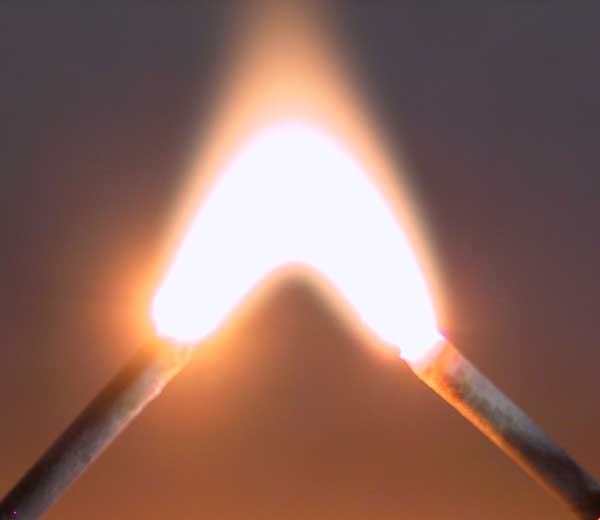
An electric arc between two nails

An electric arc (or arc discharge) is an electrical breakdown of a gas that produces a prolonged electrical discharge. The current through a normally nonconductive medium such as air produces a plasma, which may produce visible light. An arc discharge is initiated either by thermionic emission or by field emission.[1] After initiation, the arc relies on thermionic emission of electrons from the electrodes supporting the arc. An arc discharge is characterized by a lower voltage than a glow discharge. An archaic term is voltaic arc, as used in the phrase "voltaic arc lamp".

Techniques for arc suppression can be used to reduce the duration or likelihood of arc formation.

In the late 19th century, electric arc lighting was in wide use for public lighting. Some low-pressure electric arcs are used in many applications. For example, fluorescent tubes, mercury, sodium, and metal-halide lamps are used for lighting; xenon arc lamps have been used for movie projectors. Electric arcs can be utilized for manufacturing processes, such as electric arc welding, plasma cutting and electric arc furnaces for steel recycling.

History

[edit]
Natural lightning is now considered an electric spark, not an arc.

Sir Humphry Davy discovered the short-pulse electrical arc in 1800.[2] In 1801, he described the phenomenon in a paper published in William Nicholson's Journal of Natural Philosophy, Chemistry and the Arts.[3] According to modern science, Davy's description was a spark rather than an arc.[4] In the same year Davy publicly demonstrated the effect, before the Royal Society, by transmitting an electric current through two carbon rods that touched, and then pulling them a short distance apart. The demonstration produced a "feeble" arc, not readily distinguished from a sustained spark, between charcoal points. The Society subscribed for a more powerful battery of 1,000 plates, and in 1808 he demonstrated the large-scale arc.[5] He is credited with naming the arc.[6] He called it an arc because it assumes the shape of an upward bow when the distance between the electrodes is not small.[7] This is due to the buoyant force on the hot gas.

The first continuous arc was discovered independently in 1802 and described in 1803[8] as a "special fluid with electrical properties", by Vasily V. Petrov, a Russian scientist experimenting with a copper-zinc battery consisting of 4200 discs.[8][9]

In the late nineteenth century, electric arc lighting was in wide use for public lighting. The tendency of electric arcs to flicker and hiss was a major problem. In 1895, Hertha Marks Ayrton wrote a series of articles for the Electrician, explaining that these phenomena were the result of oxygen coming into contact with the carbon rods used to create the arc. In 1899, she was the first woman ever to read her own paper before the Institution of Electrical Engineers (IEE). Her paper was entitled "The Hissing of the Electric Arc". Shortly thereafter, Ayrton was elected the first female member of the IEE; the next woman to be admitted to the IEE was in 1958.[10] She petitioned to present a paper before the Royal Society, but she was not allowed because of her gender, and "The Mechanism of the Electric Arc" was read by John Perry in her stead in 1901.

Overview

[edit]
Electric arcs between the power line and pantographs of an electric train after catenary icing
Electricity arcs between the power rail and electrical pickup "shoe" on a London Underground train

An electric arc is the form of electric discharge with the highest current density. The maximum current through an arc is limited only by the external circuit, not by the arc itself.

An arc between two electrodes can be initiated by ionization and glow discharge, when the current through the electrodes is increased. The breakdown voltage of the electrode gap is a combined function of the pressure, distance between electrodes and type of gas surrounding the electrodes. When an arc starts, its terminal voltage is much less than a glow discharge, and current is higher. An arc in gases near atmospheric pressure is characterized by visible light emission, high current density, and high temperature. An arc is distinguished from a glow discharge partly by the similar temperatures of the electrons and the positive ions; in a glow discharge, the ions are much colder than the electrons.

A drawn arc can be initiated by two electrodes initially in contact and drawn apart; this can initiate an arc without the high-voltage glow discharge. This is the way a welder starts to weld a joint, momentarily touching the welding electrode against the workpiece then withdrawing it until a stable arc is formed. Another example is separation of electrical contacts in switches, relays or circuit breakers; in high-energy circuits arc suppression may be required to prevent damage to contacts.[11]

Electrical resistance along the continuous electric arc creates heat, which ionizes more gas molecules (where the degree of ionization is determined by temperature), and as per this sequence: solid-liquid-gas-plasma; the gas is gradually turned into a thermal plasma. A thermal plasma is in thermal equilibrium; the temperature is relatively homogeneous throughout the atoms, molecules, ions, and electrons. The energy given to electrons is dispersed rapidly to the heavier particles by elastic collisions, due to their great mobility and large numbers.

Current in the arc is sustained by thermionic emission and field emission of electrons at the cathode. The current may be concentrated in a very small hot spot on the cathode; current densities on the order of one million amperes per square centimeter can be found. Unlike a glow discharge, an arc has little discernible structure, since the positive column is quite bright and extends nearly to the electrodes on both ends. The cathode fall and anode fall of a few volts occur within a fraction of a millimeter of each electrode. The positive column has a lower voltage gradient and may be absent in very short arcs.[11]

A low-frequency (less than 100 Hz) alternating current arc resembles a direct current arc; on each cycle, the arc is initiated by breakdown, and the electrodes interchange roles, as anode or cathode, when current reverses. As the frequency of the current increases, there is not enough time for all ionization to disperse on each half cycle, and the breakdown is no longer needed to sustain the arc; the voltage vs. current characteristic becomes more nearly ohmic.[11]

Electric arc between strands of wire.

The various shapes of electric arcs are emergent properties of non-linear patterns of current and electric field. The arc occurs in the gas-filled space between two conductive electrodes (often made of tungsten or carbon) and it results in a very high temperature, capable of melting or vaporizing most materials. An electric arc is a continuous discharge, while the similar electric spark discharge is momentary. An electric arc may occur either in direct current (DC) circuits or in alternating current (AC) circuits. In the latter case, the arc may re-strike on each half cycle of the current. An electric arc differs from a glow discharge in that the current density is quite high, and the voltage drop within the arc is low; at the cathode, the current density can be as high as one megaampere per square centimeter.[11]

An electric arc has a non-linear relationship between current and voltage. Once the arc is established (either by progression from a glow discharge[12] or by momentarily touching the electrodes then separating them), increased current results in a lower voltage between the arc terminals. This negative resistance effect requires that some positive form of impedance (as an electrical ballast) be placed in the circuit to maintain a stable arc. This property is the reason uncontrolled electrical arcs in apparatus become so destructive, since once initiated an arc will draw more and more current from a fixed-voltage supply until the apparatus is destroyed.

There exists a form of moving electric arc known as a gliding arc discharge, initiated at the shortest gap between diverging electrodes placed in a fast gas flow (typically over 10 m/s). The discharge moves ("glides") progressively along the electrodes in the direction of gas flow until it breaks and extinguishes. This continual movement of the arc roots prevents electrode erosion and allows direct and efficient transfer of electrical energy into the flowing gas. Initially, the plasma formed is close to thermodynamic equilibrium but as the arc elongates, it rapidly transitions into a non-equilibrium, nonthermal plasma characterized by significant temperature differences between electrons and gas molecules.[13][14]

Uses

[edit]
An electric arc can melt calcium oxide

Industrially, electric arcs are used for welding, plasma cutting, for electrical discharge machining, as an arc lamp in movie projectors, and spotlights in stage lighting. Electric arc furnaces are used to produce steel and other substances. Calcium carbide is made in this way as it requires a large amount of energy to promote an endothermic reaction (at temperatures of 2500 °C).

Carbon arc lights were the first electric lights. They were used for street lights in the 19th century and for specialized applications such as searchlights until World War II. Today, electric arcs are used in many applications. For example, fluorescent tubes, mercury, sodium, and metal halide lamps are used for lighting; xenon arc lamps are used for movie projectors and theatrical spotlights.

Formation of an intense electric arc, similar to a small-scale arc flash, is the foundation of exploding-bridgewire detonators.

Electric arcs are used in arcjet, a form of electric propulsion of spacecraft.

They are used in the laboratory for spectroscopy to create spectral emissions by intense heating of a sample of matter.

Protection of electrical equipment

[edit]

Arcs are used in high voltage switchgear for protection of extra high voltage transmission networks. To protect a unit (e. g., a series capacitor in a transmission line) against overvoltage, an arc-inducing device, so called spark gap, is connected in parallel to the unit. Once the voltage reaches the air-breakdown threshold, an arc ignites across the spark plug and short-circuits the terminals of the unit, thus protecting the latter from the overvoltage. For the reinsertion of a unit, the arc needs to be extinguished, this can be achieved in multiple ways. For example, a spark gap can be fitted with arcing horns − two wires, approximately vertical but gradually diverging from each other towards the top in a narrow V shape. Once ignited, the arc will move upwards along the wires and will break down when the distance between the wires becomes too large. If the arc is extinguished and the original trigger condition no longer exists (a fault has been resolved or a bypass switch engaged), the arc will not reignite. The arc can be also broken by a blast of compressed air or another gas.

An undesirable arc can also occur when a high-voltage switch is opened and is extinguished in similar ways. Modern devices use sulphur hexafluoride at high pressure in a nozzle flow between separated electrodes within a pressurized vessel. The arc current is interrupted at the moment within an AC cycle when the current goes to zero and the highly electronegative SF6 ions quickly absorb free electrons from the decaying plasma. The SF6 technology mostly displaced the similar air-based one because many noisy air-blast units in series were required to prevent the arc inside the switch from re-igniting.

Visual entertainment

[edit]
A time exposure of a Jacob's ladder
A demonstration of Jacob's ladder
Jacob's ladder at work

A Jacob's ladder (more formally, a high voltage travelling arc) is a device for producing a continuous train of electric arcs that rise upwards. The device is named for the Jacob's Ladder leading to heaven as described in the Bible. Similarly to the arcing horns, the spark gap is formed by two wires diverging from the base to the top.

When high voltage is applied to the gap, a spark forms across the bottom of the wires where they are nearest each other, rapidly changing to an electric arc. Air breaks down at about 30 kV/cm,[15] depending on humidity, temperature, etc. Apart from the anode and cathode voltage drops, the arc behaves almost as a short circuit, drawing as much current as the electrical power supply can deliver, and the heavy load dramatically reduces the voltage across the gap.

The heated ionized air rises, carrying the current path with it. As the trail of ionization gets longer, it becomes more and more unstable, finally breaking. The voltage across the electrodes then rises and the spark re-forms at the bottom of the device.

This cycle leads to an exotic-looking display of electric white, yellow, blue or purple arcs, which is often seen in horror films and films about mad scientists. The device was a staple in schools and science fairs of the 1950s and 1960s, typically constructed out of a Model T spark coil or any other source of high voltage in the 10,000–30,000-volt range, such as a neon sign transformer (5–15 kV) or a television picture tube circuit (flyback transformer) (10–28 kV), and two coat hangers or rods built into a V shape. For larger ladders, microwave oven transformers connected in series, voltage multipliers[16][17] and utility pole transformers (pole pigs) run in reverse (step-up) are commonly used.

Media related to Jacob's ladder at Wikimedia Commons

Guiding the arc

[edit]

Scientists have discovered a method to control the path of an arc between two electrodes by firing laser beams at the gas between the electrodes. The gas becomes a plasma and guides the arc. By constructing the plasma path between the electrodes with different laser beams, the arc can be formed into curved and S-shaped paths. The arc could also hit an obstacle and reform on the other side of the obstacle. The laser-guided arc technology could be useful in applications to deliver a spark of electricity to a precise spot.[18][19]

Undesired arcing

[edit]
A burn in a plug caused by an electric arc during a short circuit.

Undesired or unintended electric arcing can have detrimental effects on electric power transmission, distribution systems and electronic equipment. Devices which may cause arcing include switches, circuit breakers, relay contacts, fuses and poor cable terminations. When an inductive circuit is switched off, the current cannot instantaneously jump to zero: a transient arc will be formed across the separating contacts. Switching devices susceptible to arcing are normally designed to contain and extinguish an arc, and snubber circuits can supply a path for transient currents, preventing arcing. If a circuit has enough current and voltage to sustain an arc formed outside of a switching device, the arc can cause damage to equipment such as melting of conductors, destruction of insulation, and fire. An arc flash describes an explosive electrical event that presents a hazard to people and equipment.

Undesired arcing in electrical contacts of contactors, relays and switches can be reduced by devices such as contact arc suppressors[20] and RC snubbers or through techniques including:

Arcing can also occur when a low resistance channel (foreign object, conductive dust, moisture...) forms between places with different voltage. The conductive channel then can facilitate formation of an electric arc. The ionized air has high electrical conductivity approaching that of metals, and it can conduct extremely high currents, causing a short circuit and tripping protective devices (fuses and circuit breakers). A similar situation may occur when a lightbulb burns out and the fragments of the filament pull an electric arc between the leads inside the bulb, leading to overcurrent that trips the breakers.

An electric arc over the surface of plastics causes their degradation. A conductive carbon-rich track tends to form in the arc path, called "carbon tracking", negatively influencing their insulation properties. The arc susceptibility, or "track resistance", is tested according to ASTM D495, by point electrodes and continuous and intermittent arcs; it is measured in seconds required to form a track that is conductive under high-voltage low-current conditions.[21] Some materials are less susceptible to degradation than others. For example, polytetrafluoroethylene has arc resistance of about 200 seconds (3.3 minutes). From thermosetting plastics, alkyds and melamine resins are better than phenolic resins. Polyethylenes have arc resistance of about 150 seconds; polystyrenes and polyvinyl chlorides have relatively low resistance of about 70 seconds. Plastics can be formulated to emit gases with arc-extinguishing properties; these are known as arc-extinguishing plastics.[22]

Arcing over some types of printed circuit boards, possibly due to cracks of the traces or the failure of a solder joint, renders the affected insulating layer conductive as the dielectric is combusted due to the high temperatures involved. This conductivity prolongs the arcing due to cascading failure of the surface.

Arc suppression

[edit]

Arc suppression is a method of attempting to reduce or eliminate an electrical arc. There are several possible areas of use of arc suppression methods, among them metal film deposition and sputtering, arc flash protection, electrostatic processes where electrical arcs are not desired (such as powder painting, air purification, PVDF film poling) and contact current arc suppression. In industrial, military and consumer electronic design, the latter method generally applies to devices such as electromechanical power switches, relays and contactors. In this context, arc suppression uses contact protection.

Part of the energy of an electrical arc forms new chemical compounds from the air surrounding the arc: these include oxides of nitrogen and ozone, the second of which can be detected by its distinctive sharp smell. These chemicals can be produced by high-power contacts in relays and motor commutators, and they are corrosive to nearby metal surfaces. Arcing also erodes the surfaces of the contacts, wearing them down and creating high contact resistance when closed.[23]

Health hazards

[edit]

Exposure to an arc-producing device can pose health hazards. An arc formed in air will ionize oxygen and nitrogen, which then can re-form into reactive molecules such as ozone and nitric oxide. These products can be damaging to the mucous membranes. Plants are also susceptible to ozone poisoning. These hazards are greatest when the arc is continuous and in an enclosed space such as a room. An arc that occurs outside is less of a hazard because the heated ionized gases will rise up into the air and dissipate into the atmosphere. Spark gaps which only intermittently produce short spark bursts are also minimally hazardous because the volume of ions generated is very small.

An electrician assists a fellow worker to suit up in special arc flash protection gear in preparation for an electrical inspection.

Arcs can also produce a broad spectrum of wavelengths spanning the visible light and the invisible ultraviolet and infrared spectrum. Very intense arcs generated by means such as arc welding can produce significant amounts of ultraviolet radiation which is damaging to the cornea of the observer and can cause sunburn. These arcs should only be observed through special dark filters such as a welding helmet which reduce the arc intensity and shield the observer's eyes from the ultraviolet rays, and exposed skin should be covered with clothing.

Arc flashes from high-current electrical equipment are very hazardous. They can violently eject plasma and molten metal, the intense radiation can rapidly ignite clothing and cause fatal burns even from some distance, and a high pressure blast can occur. Work in close proximity to equipment that can cause such an arc flash requires protective equipment that is rated to resist the amount of energy that could be released in the case of a fault.

See also

[edit]

References

[edit]
[edit]
Revisions and contributorsEdit on WikipediaRead on Wikipedia
from Grokipedia
An electric arc is a continuous, luminous discharge of high current density between two electrodes in a gas or vapor, characterized by a thermalized plasma sustained by thermionic emission from the cathode and producing intense heat and light. This phenomenon occurs when a sufficiently high voltage ionizes the medium between the electrodes, creating a conductive plasma channel with temperatures typically ranging from 3,000 to 30,000 °C, depending on the arc length, current, and gas composition. The arc maintains itself through a balance of electrical conductivity in the ionized gas and energy input, exhibiting properties such as low voltage drop across the arc column (often 10–50 V) and high currents (from milliamperes to thousands of amperes), which distinguish it from other discharges like glows or sparks. First observed in 1807 by British chemist using carbon electrodes connected to a large battery, the electric arc marked an early milestone in discharge physics and . Its development accelerated in the with improvements in power sources, leading to practical applications by the late 1800s, including arc lighting for streets and theaters, which relied on the arc's bright illumination before the dominance of incandescent bulbs. In modern industry, electric arcs are fundamental to processes like , where the heat from arcs typically around 6,000 °C (11,000 °F) melts metals for joining to form strong bonds. They also power electric arc furnaces for , melting scrap metal at temperatures over 1,800 °C using high currents often exceeding 40,000 A, enabling efficient recycling and production of hundreds of millions of tons annually. Additionally, controlled arcs find use in , material synthesis (such as carbon nanotubes), and circuit breakers, where their behavior informs designs to quench unwanted arcs safely.

Fundamentals

Definition and Formation

An electric arc is an of a gas that produces a prolonged plasma discharge, forming a conductive channel of ionized gas between two electrodes. This discharge is characterized by high electrical conductivity and elevated temperatures resulting from the plasma state, where free electrons and ions enable sustained current flow. The plasma arises from the of gas molecules, typically in air or other ambient gases, creating a luminous, high-energy pathway that differs from transient sparks by its stability once established. The formation of an electric arc begins with dielectric breakdown when the applied exceeds a critical threshold, ionizing gas molecules and initiating conductivity. According to , the breakdown voltage depends on the product of gas and separation distance; for air at , this threshold corresponds to an strength of approximately 3 kV/mm. This process requires a sufficiently to overcome the insulating properties of the gas, typically in the kilovolt range for common gaps of millimeters to centimeters, along with adequate current capacity in the circuit to maintain the discharge once initiated. Electrode separation must be close enough to allow the field to ionize the gas but not so distant as to prevent bridging by the plasma channel. The stages of arc formation progress from an initial Townsend , where free electrons accelerate under the , colliding with gas molecules to produce additional ionizing collisions and an exponential increase in charged particles. This avalanche evolves into a streamer—a fast-propagating filament of plasma that bridges the gap—followed by transition to a full arc through , where the heat from the discharge further ionizes the gas, sustaining the plasma column. becomes dominant as temperatures rise, ensuring the arc's self-maintenance without continuous external field strengthening. Electric arcs are distinguished by their power supply: direct current (DC) arcs maintain a constant polarity and unidirectional flow, providing stable, continuous operation suitable for processes requiring steady heat input, while alternating current (AC) arcs periodically reverse polarity, leading to cyclic variations in the discharge that can influence stability and behavior.

Physical Characteristics

An electric arc manifests as a plasma, a partially ionized gas composed of free electrons, positively charged ions, and neutral atoms or molecules. This composition enables high electrical conductivity, with the plasma maintaining quasi-neutrality, where the density of electrons roughly equals that of ions to preserve overall charge balance. The charged particles in the plasma respond collectively to external through Debye shielding, rearranging over a characteristic —typically on the order of micrometers in dense arcs—to screen perturbations and prevent long-range field penetration. The profile of a sustained arc is steeply gradient-dominated, with the core of the plasma column reaching temperatures between 5,000 and 30,000 due to ohmic heating and limited radiative losses. Radially, the temperature falls sharply from the axis, dropping to near-ambient levels within millimeters as dissipates via conduction to surrounding gas and if flow is present. Near the electrodes, localized and spots sustain temperatures around 4,000 , facilitating thermionic emission from the and recombination at the while preventing electrode melting in many materials. Optically, the arc emits a broad continuous from thermal and blackbody-like radiation at core temperatures, superimposed with discrete atomic and molecular lines from excited . In air, the visible appearance is often blue or purple, attributable to emissions from and oxygen . This spectral richness enables identification of plasma composition, with ultraviolet lines from and oxygen dominating in atmospheric arcs, while components arise from cooler boundary layers. Sustained arcs exhibit lengths ranging from 1 mm in compact devices to several meters in high-power setups, dictated by electrode separation and current magnitude. Stability depends on maintaining a balance between and recombination; short lengths near the minimum value (often ~1 mm at ) promote restrikes, where momentary extinction leads to rapid reignition, while longer arcs may wander, with the attachment points drifting across electrode surfaces due to thermal and magnetic forces. Arc behavior varies markedly with ambient gas and conditions: in air, reactive species like oxygen promote erosion and spectral complexity, whereas in —commonly used in —the arc column is more stable and hotter due to lower thermal conductivity and easier , yielding a whiter emission. Elevated constricts the arc radially, enhancing and , while humidity introduces dissociation, potentially increasing availability and altering the radial profile through additional hydroxyl radicals. Plasma diagnostics via optical emission provide critical insights into arc properties, measuring line intensities to infer electron temperatures (often 1–2 eV hotter than gas temperatures) and densities through Stark broadening, alongside species identification from line positions. This non-intrusive method, rooted in seminal works on arc spectrometry, reveals spatial variations and supports modeling of arc dynamics.

Electrical Properties

The voltage-current (V-I) characteristic of an electric arc is inherently nonlinear, often approximated by the relation V=V0+IRaV = V_0 + I R_a, where VV is the arc voltage, II is the current, V0V_0 represents the fixed voltage drop across the arc (typically 10–50 V, encompassing and falls), and RaR_a is the dynamic arc resistance that decreases with increasing current due to enhanced and plasma conductivity. This model captures the arc's behavior in certain regimes, where higher currents lead to a slight decrease in overall voltage, facilitating stable operation in applications like . Power dissipation in an electric arc follows P=VIP = V I, resulting in high for converting to , as most input power is released as within the plasma column. The arc's low impedance enables it to handle high currents (hundreds to thousands of amperes) while maintaining this , though minor losses occur via and electrode heating. The electrical conductivity of an arc plasma is exceptionally high, ranging from 10410^4 to 10610^6 S/m, owing to the ionized gas state that supports free electron movement. This conductivity is concentrated in the plasma column, with distinct cathode fall (typically 10–20 V over a few micrometers) and anode drop (5–10 V over similar distances) regions near the s, where steep voltage gradients accelerate charge carriers to sustain the discharge. Alternating current (AC) arcs differ markedly from (DC) arcs; in AC operation, the arc naturally extinguishes at each current zero-crossing due to insufficient to sustain the discharge, requiring re-ignition on the next half-cycle, which can lead to instability. In contrast, DC arcs remain stable without zero-crossings, providing consistent conductivity but potentially higher sustained heat at electrodes. The impedance of an electric arc is dominated by its low resistance (often milliohms), but longer arcs exhibit inductive effects from the plasma's interactions and current channel dynamics, contributing to voltage lags and nonlinear behavior in circuit models. Modern simulations of electric arc electrical properties increasingly employ magnetohydrodynamic (MHD) equations to model the coupled fluid, thermal, and electromagnetic behaviors, enabling accurate predictions of dynamic resistance and current distribution in complex geometries.

Historical Development

Early Observations and Experiments

The earliest documented observations of electric arc phenomena trace back to experiments with in the early . In 1705, English instrument maker and experimenter conducted trials using an evacuated glass tube charged with static electricity generated by friction, producing a faint glow that represented one of the first recorded instances of gas discharge or in rarefied air. These demonstrations, performed before the Royal Society, highlighted the luminous effects of electrical discharges in rarefied air but remained confined to transient sparks rather than sustained arcs due to the limitations of static generators. Advancements in continuous electrical power sources enabled more systematic studies in the early 19th century. Russian physicist , in 1802, constructed a massive comprising over 4,000 copper-zinc cells immersed in , which powered the first sustained electric arc between electrodes, producing a bright, continuous discharge that illuminated the surrounding area. Building on this, British chemist conducted pioneering experiments between 1800 and 1807 at the Royal Institution, employing large voltaic batteries to generate arcs across carbon electrodes; these produced an intensely bright light, far surpassing contemporary oil lamps, and allowed observations of the arc's spectral properties and thermal effects. Davy's setups, often involving hundreds of cells to overcome the high of early piles, demonstrated the arc's stability when sufficient current was available, marking a shift from sporadic sparks to controllable discharges. These investigations contributed to nascent theories of electrical discharges, framing the arc as a form of conduction through ionized gas analogous to metallic current flow. Early researchers noted parallels between arc behavior and electrolytic processes, a connection later formalized in Michael Faraday's work as Davy's laboratory assistant from 1813 onward, where discharge experiments informed his understanding of electrochemical equivalents. Prior to the 1830s, however, electric arcs remained laboratory curiosities, constrained by the cumbersome and inefficient nature of voltaic piles, which delivered low voltages and required frequent maintenance, preventing broader scientific or practical exploration.

Key Inventions and Advancements

In the early , advanced practical applications of the electric arc using carbon connected to a battery, producing a brilliant light in 1807 that built on Petrov's sustained arc. This carbon underwent significant improvements through the mid-century, with advancements in design and enabling more stable operation. By the 1840s, the development of early dynamos, such as those by , facilitated sustained arcs, paving the way for practical applications. A key milestone came in 1876 with Pavel Yablochkov's "candle" , the first commercially successful design without mechanical regulation, followed by Charles Brush's dynamo systems in the 1870s that powered arc street lighting. In 1858, the installation of the first dynamo-powered arc light at South Foreland Lighthouse in used Frederick Holmes's generator to drive carbon arcs, producing reliable maritime beacons and demonstrating arcs' scalability for outdoor lighting. The late 19th and early 20th centuries saw arcs integrated into industrial processes, notably through advancements in welding and metallurgy. In 1900, August Strohmenger introduced coated metal electrodes in Britain, which stabilized the arc and reduced spatter, enabling shielded metal arc welding as a viable technique for joining metals. Concurrently, electric arc furnaces (EAFs) emerged, with Paul Héroult's 1900 design using arcs to melt iron, though widespread adoption for steelmaking accelerated in the 1950s following post-World War II innovations like oxygen injection, which boosted efficiency and reduced energy use to around 400-500 kWh per ton of steel. Key contributors included Werner von Siemens, whose 1866 dynamo improvements powered early arc systems, and researchers like Robert Bunsen and Gustav Kirchhoff, who in the 1850s-1860s advanced arc spectroscopy for elemental analysis by exploiting arcs' high-temperature emission spectra. Post-World War II developments in revolutionized arc control, with the transition from mercury-arc rectifiers to silicon-controlled rectifiers (SCRs) in the 1950s enabling precise current regulation for arcs in and furnaces. By the late , high-intensity discharge (HID) lamps, evolving from early mercury arc designs, incorporated metal halides for efficient white light, achieving up to 100 lumens per watt in applications like street lighting. In the 21st century, plasma arc systems advanced waste treatment, with gliding arc reactors demonstrated in the 2010s for at temperatures exceeding 2000°C, converting materials into with minimal emissions. Fusion research integrated arc initiators to strike initial plasmas in tokamaks, as seen in the ARC reactor concept by , targeting net energy gain by the 2030s. Additionally, wire arc additive manufacturing (WAAM) emerged as a 21st-century innovation, using gas metal arc deposition to build large metal components layer-by-layer, reducing production times by up to 50% compared to traditional . In space propulsion, plasma-based systems like the VASIMR engine, under development since the 2000s, leverage arc-like plasma generation for high-specific-impulse thrust, with prototypes achieving 80 kW operation as of 2021.

Applications

Industrial Processes

Electric arcs play a pivotal role in various industrial manufacturing and material processing techniques, where controlled high-temperature plasmas enable precise heating, , and material alteration. These processes leverage the arc's intense , often exceeding 5,000 , to achieve efficient transformation of metals and other substances on an industrial scale. Power consumption in these applications ranges from kilowatts in localized operations like to megawatts in large-scale furnaces, highlighting the versatility and scalability of arc-based methods. Arc welding stands as one of the most widespread industrial applications of electric arcs, utilizing processes such as (GTAW) and (SMAW) to join metals by melting and fusing them. In GTAW, a non-consumable electrode generates a stable arc in an shield, allowing precise control over the melt pool dynamics, where the arc's heat input influences and weld bead geometry without electrode contamination. SMAW, conversely, employs a consumable electrode coated with , which melts into the weld pool while the arc provides the necessary heat; electrode consumption rates typically range from 1-2 kg per hour depending on current levels up to 500 A, contributing to formation that protects the molten metal from atmospheric oxidation. These processes are essential in industries like automotive and , with arc stability ensured through power sources delivering 10-400 A at 20-40 V. Electric arc furnaces (EAF) represent a cornerstone of modern , where arcs struck between electrodes and a metallic charge melt at temperatures around 1,800°C, enabling of up to 100% . The process typically uses three electrodes, each 500-700 mm in , with arc currents reaching 100 kA to sustain power inputs of 100-150 MW in furnaces holding 100-150 tons of charge. Energy efficiency in EAF has improved to approximately 500 kWh per metric ton of produced, aided by oxygen injection and foaming practices that enhance heat transfer and reduce electrode wear. This method accounts for about 30% of global production, offering a lower-carbon alternative to traditional blast furnaces when powered by renewable . Plasma arc cutting and drilling extend the utility of electric arcs by generating high-velocity plasma jets through constricted nozzles, achieving cutting speeds around 0.5 m/min for thicknesses up to 50 mm, with lower speeds for 100-150 mm in metals like and aluminum. In these processes, an arc ionizes a gas such as or , forming a plasma stream with temperatures over 20,000 K that erodes material via thermal and ; applications in include precision of blades, where kerf widths as narrow as 0.5 mm minimize heat-affected zones. Power requirements range from 20-400 kW, with transferred arc configurations for submerged cutting providing superior efficiency in underwater or high-precision tasks. Beyond core , electric arcs facilitate arc spraying for applying protective coatings and waste for material decomposition. Arc spraying involves twin-wire electrodes that melt upon arcing, propelling molten particles at 100-300 m/s onto surfaces to form corrosion-resistant layers up to 500 μm thick, commonly used in and bridge with deposition rates of 10-50 kg/h. In waste , arcs generate plasma torches that thermally decompose hazardous materials like at 1,000-1,500°C in oxygen-poor environments, converting them into and vitrified with minimal emissions; systems operate at 50-500 kW and achieve destruction efficiencies over 99.99% for organics. Emerging eco-friendly applications include arc plasma systems for , where high-temperature arcs (up to 10,000 K) vaporize and separate precious metals like and silver from circuit boards, recovering approximately 76% of valuables while immobilizing toxins in . These processes, scaling to 1-10 s per day with use around 1000-1500 kWh/, address growing e-waste volumes projected to reach 82 million tonnes annually by 2030 according to the 2024 Global E-waste Monitor, promoting principles in electronics manufacturing.

Lighting and Display Technologies

Electric arcs serve as foundational light sources in various illumination and visual display systems, leveraging the intense plasma emission between electrodes to generate bright, high-contrast light. These technologies exploit the arc's broad spectral output, which includes visible wavelengths from thermal radiation and atomic excitation, providing superior color rendering compared to many incandescent alternatives. Historically and in modern specialty uses, arc-based lighting has enabled applications requiring high lumen output in compact forms, though maintenance challenges like erosion have limited widespread adoption. Carbon arc lamps, among the earliest electric lighting devices, powered spotlights for theatrical stages and outdoor events in the late 19th and early 20th centuries. In these systems, a maintains an arc between two carbon , vaporizing material to form a luminous plasma bridge that emits up to 10,000 lumens, ideal for focused beams in limelights and searchlights. Their intense, directional output made them staples in early cinema and houses, though frequent electrode adjustments were required. Xenon short-arc lamps represent a refined , commonly employed in cinema projectors for their daylight-like spectrum and peak brightness exceeding 200,000 lumens. An electric arc ionizes gas at pressures up to 30 atmospheres between close-spaced electrodes, producing a compact, high-efficacy source with luminous efficiency around 30-50 lm/W and excellent rejection via dichroic filters. These lamps sustain continuous operation for 500-1,000 hours, delivering uniform illumination for large screens in digital and projection systems. High-intensity discharge (HID) lamps, including metal variants, utilize stabilized electric to excite metal salts within a or arc tube, achieving efficacies up to 100 lm/W for energy-efficient floodlighting and architectural applications. The arc, typically 5-10 mm long, vaporizes halides like sodium and , yielding a white light with color temperatures of 4,000-5,000 K and high color rendering indices above 80. metal halide designs enhance longevity to 10,000 hours while minimizing lumen depreciation, outperforming traditional mercury arcs in spectral quality. In entertainment, electric arcs create dramatic , such as simulated in theatrical productions or ignition sparks in pyrotechnic displays for and stage shows. Controlled arcs from discharges produce brief, high-voltage flashes mimicking electrical storms, often integrated into props for immersive experiences. further enable guiding of these arcs, bending plasma paths into curved or stabilized patterns for choreographed effects, as the deflects charged particles without physical contact. Contemporary display innovations draw on arc principles, with plasma displays employing micro-scale electrical discharges—analogous to brief arcs—in neon-xenon gas cells to excite phosphors for illumination. Each subpixel sustains a localized plasma via voltage pulses up to 400 V, generating RGB emissions for full-color video with viewing angles superior to LCDs, though production ceased around 2013 due to high power draw. Laser-induced arcs extend this to interactive spectacles, where femtosecond filaments precondition air into conductive channels, guiding subsequent electrical discharges over meters for safe, programmable effects in performances. Arc technologies have largely declined since the , supplanted by LEDs offering 150+ lm/W , instant startup, and 50,000-hour lifespans without mercury content. However, short-arc lamps endure in niche high-power roles, such as theaters, where 15 kW units provide unmatched screen of 60 foot-lamberts for immersive viewing. Their legacy persists in scenarios demanding peak intensity, like astronomical projectors and medical simulators, bridging historical innovation with specialized photonic needs.

Electrical Protection Devices

In electrical protection systems, electric arcs play a dual role: they are intentionally formed during fault interruption to safely dissipate energy and clear faults, while being rapidly managed to prevent damage to equipment or circuits. Devices such as fuses and circuit breakers rely on controlled arcing to interrupt high fault currents, where the arc's formation between separating contacts allows for current limitation before extinction. This process leverages the arc's inherent voltage drop, typically around 10-30 volts per centimeter in air, to maintain interruption while minimizing contact erosion. Fuses and circuit breakers are fundamental protective devices that utilize intentional arcs for fault clearing. In fuses, an overcurrent melts the fusible element, creating an arc across the gap that is quenched by surrounding materials like silica sand or air to interrupt the circuit rapidly, often within milliseconds for currents exceeding thousands of amperes. Circuit breakers, particularly molded-case and air-break types, generate an arc upon contact separation during fault conditions; this arc elongates under magnetic forces or thermal effects, enabling the device to handle prospective fault currents up to 200 kA while ensuring selective coordination in power distribution systems. The interruption process in these breakers involves de-ionizing the plasma to restore insulation, preventing re-ignition and safely isolating the faulted section. Arc chutes in switches enhance safe quenching by directing and cooling the arc formed during switching operations. These devices consist of parallel insulating plates or grids that split the arc into multiple shorter segments, increasing its resistance and promoting de-ionization through convective cooling and magnetic deflection. Magnetic blow-out systems, common in low- and medium-voltage switches, use coils to generate fields that force the arc upward into the chute, while gas-blown methods in high-voltage circuit breakers employ or SF6 gas to blast ionized particles away, extinguishing arcs in under 50 milliseconds for voltages up to 36 kV. This design minimizes wear on contacts and ensures reliable operation in industrial and utility environments. Surge protectors incorporate arc gaps to divert overvoltages from transient events like strikes. These spark gaps, often configured as triggered arc gaps (TAGs), maintain a fixed air that breaks down at a predetermined voltage threshold—typically 1-10 kV—forming a low-impedance path to ground and shunting surge currents up to 100 kA away from sensitive equipment. Once the transient passes, the arc self-extinguishes due to the gap's , restoring normal operation without needing replacement, though hybrid designs combine gaps with metal-oxide varistors for enhanced clamping and longevity in and applications. Arc fault circuit interrupters (AFCIs) detect and interrupt dangerous series or parallel arcs in residential and commercial wiring to prevent fires. Series arcs, occurring in damaged conductors with high resistance, produce erratic current waveforms with in the 5-100 kHz range, while parallel arcs form across line-ground faults, generating broadband high-frequency signatures; AFCIs use to identify these patterns and trip within 8 milliseconds, complying with UL standards. In power systems, arcs during faults are cleared by protective relays that trigger circuit breakers, with single-pole tripping for temporary faults allowing reclosing after arc extinction to minimize outages, though persistent arcs can distort voltages and require adaptive relaying for lines up to 500 kV. By 2025, advancements in smart AFCIs integrate for improved detection accuracy, particularly in photovoltaic systems where DC arcs pose fire risks. AI algorithms, trained on waveform datasets, enable real-time of subtle arc signatures, reducing false trips by up to 30% and supporting through IoT connectivity, as demonstrated in TÜV-certified devices from manufacturers like GoodWe. These systems analyze high-frequency components via models, enhancing reliability in distributed energy resources.

Undesired Arcing Phenomena

Causes and Consequences

Unintended electric arcs in electrical systems often arise from insulation failure, where damaged, cracked, or degraded insulation on wiring permits unintended contact between conductors, ionizing the air and initiating the arc. Contact erosion and poor high-resistance connections in equipment, such as bus bars or terminals, can generate localized overheating that vaporizes metal and sustains arcing. Overvoltage transients, triggered by switching operations, lightning strikes, or equipment malfunctions, exacerbate these issues by breaking down insulation integrity and promoting flashover. Arcs manifest in two primary forms: series and . Series arcs occur within a single conductor path, such as a gap from a broken wire or loose terminal, where the arc intermittently bridges the break while maintaining load current flow. In contrast, parallel arcs result from short circuits between phases, to ground, or across conductors, drawing high fault currents that rapidly escalate the event. Unlike bolted faults, which involve a solid low-impedance connection yielding maximum prospective current, arcing faults introduce air impedance, reducing current magnitude but prolonging duration and increasing thermal output. The consequences of these arcs include severe thermal damage, with temperatures exceeding 35,000°F (19,400°C) melting conductors, vaporizing metals, and igniting surrounding materials like insulation or clothing. An explosive generates a concussive wave from superheated air expansion, capable of generating peak spikes exceeding 700 psi within 30 of the fault in cases like a 480 V, 20 kA arc, propelling shrapnel and causing structural deformation or rupture. This can ignite fires, as the arc's energy sustains combustion in flammable environments, while system-wide effects include voltage dips from fault currents overloading protective devices, leading to equipment trips, blackouts, and cascading failures in power grids. Arc flash hazards are quantified using incident energy calculations per IEEE 1584, which models thermal exposure (in cal/cm²) based on fault current, clearing time, and distance to estimate risks. Practical examples include arcing in from insulation degradation or dust accumulation, resulting in internal explosions that damage enclosures and interrupt supply. In household wiring, faults like loose outlets or frayed cords produce series arcs that overheat and spark, potentially igniting nearby combustibles. In , DC arcs in solar inverters present elevated risks by 2025, as high-voltage PV strings sustain persistent faults without natural current zero-crossings, heightening fire ignition and system downtime in expanding installations.

Detection and Monitoring

Detection and monitoring of undesired electric arcs involve a range of sensing technologies designed to identify arcing events in real-time, enabling early intervention to prevent equipment damage or hazards. These methods target distinct physical signatures of arcs, such as , , and electrical disturbances, allowing for non-invasive assessment in electrical systems from low-voltage residential wiring to high-voltage . Sensing techniques for arc detection include acoustic, optical, and electrical approaches. Acoustic sensing utilizes detectors to capture the high-frequency hissing sounds produced by arcing, typically in the ultrasonic range above 20 kHz, which indicates partial discharges or tracking in insulators and connections. Optical methods employ UV and IR cameras or sensors to detect the intense ultraviolet and emissions from arcs, with UV wavelengths around 200-300 nm providing early warning of impending flashes before appears. Electrical sensing focuses on high-frequency generated by arcs, often using current transformers or sensors to monitor transient signals in the 5-100 kHz band, which distinguish arcing from normal load currents. Multi-sensor systems integrate these modalities for enhanced reliability, combining data from acoustic, optical, and electrical sources to reduce false positives in noisy environments. Arc-fault circuit interrupters (AFCIs) incorporate advanced algorithms for of arc signatures, continuously analyzing current waveforms to identify irregular patterns indicative of series or parallel faults. These algorithms process electrical signals to detect chaotic voltage drops or high-frequency bursts characteristic of arcs, typically triggering interruption within milliseconds upon confirmation. For instance, emissions in the 5-100 kHz range serve as key indicators, differentiated from household appliance noise through techniques like transforms or spectral analysis. In high-voltage equipment, (PD) detectors provide specialized monitoring by capturing localized electrical discharges that precede full arcs, using sensors such as high-frequency current transformers (HFCT) or transient earth voltage detectors to track PD activity in insulation systems. These systems enable in transformers and by quantifying discharge magnitude and location. In electrical panels, IoT-enabled sensors facilitate distributed monitoring, integrating acoustic and electrical detectors with networks for real-time data transmission and remote alerts. The UL 1699 standard establishes requirements for arc-fault circuit-interrupters, specifying performance tests for detection of various arc types, including series, parallel, and ground faults, to ensure reliable operation in residential and light commercial settings. Compliance with UL 1699 mandates sensitivity thresholds and immunity to nuisance tripping, promoting widespread adoption of AFCI technology. Recent advancements in the 2020s have introduced for predictive arc detection, where algorithms analyze historical to forecast potential arcing based on patterns in voltage fluctuations, , and spectra, achieving higher accuracy than traditional threshold-based methods. models, such as convolutional neural networks, process multi-sensor inputs to classify arc precursors with over 95% precision in simulated environments. By 2025, integration with technologies has enabled remote arc monitoring through IoT platforms and AI-driven analytics, allowing grid operators to detect and localize faults across distributed networks in real-time via cloud-based systems.

Arc Suppression Techniques

Methods for Extinguishing Arcs

Electric arcs in electrical systems are extinguished by disrupting the plasma column that sustains them, primarily through cooling, lengthening, or deionization to prevent re-ignition after current zero. Passive methods rely on mechanical or actions to weaken the arc without additional energy input, while active methods employ external forces or media for faster interruption. These techniques are critical in circuit breakers to minimize contact erosion and ensure reliable fault clearing. Passive methods include lengthening the arc path, which increases resistance and promotes cooling by exposing more surface area to ambient air or gas, facilitating natural deionization through recombination of ions. In air-blast systems, high-velocity compressed air (typically 20-30 bar) is directed axially or transversely across the arc to cool it rapidly and sweep ionized particles away, achieving extinction in air-insulated breakers rated up to 245 kV. Insulating barriers, such as arc chutes made of refractory materials like mica or ceramic, confine the arc and split it into shorter segments, enhancing cooling and preventing restrike by restoring dielectric strength. These approaches are effective for medium-voltage applications where simplicity and low maintenance are prioritized. Active methods utilize controlled media or fields for enhanced quenching. Sulfur hexafluoride (SF6) gas in puffer or rotary arc chambers provides superior insulation and cooling; during interruption, the gas expands adiabatically to absorb heat and dilute the plasma, with arc temperatures dropping from over 10,000 K to below 2,000 K in milliseconds. Vacuum interrupters extinguish arcs by operating in a high-vacuum environment (10^{-6} to 10^{-8} mbar), where the absence of gas limits metal vapor diffusion, leading to rapid condensation of electrode material and dielectric recovery in under 10 μs. Magnetic blowout fields, generated by coils carrying the load current, produce Lorentz forces that stretch the arc into cooler regions or onto splitter plates, elongating it up to several times the contact gap for effective quenching in low- to medium-voltage molded-case breakers. These methods support high interrupting capacities, often exceeding 50 kA. Chemical suppression techniques involve materials that react with the arc to produce quenching agents. Ablative polymers, such as polytetrafluoroethylene (PTFE) or , line arc chutes and vaporize under heat, releasing decomposition gases like or that cool the arc and increase pressure to blow it out, improving interruption by up to 2-3 times compared to non-ablative designs. Deionized sprays, used in specialized low-voltage water-break switches, create a fine mist that cools the arc while maintaining low conductivity (resistivity >10 MΩ·cm), preventing re-ignition in marine or hazardous environments. These methods are particularly useful where rapid energy dissipation is needed without gaseous media. For (DC) systems, lacking natural zero-crossings, forced zero-crossing via capacitors injects oscillatory currents to superimpose a high-frequency component on the DC fault current, creating artificial zeros for arc extinction within 1-5 ms. This commutation approach, often combined with parallel capacitors and inductors, is essential for HVDC breakers handling up to 500 kV and 10 kA. High-voltage (HV) breakers achieve interruption times under 10 ms for arcing duration, with total break times of 40-60 ms (3-5 cycles at 50/60 Hz), ensuring system stability during faults up to 63 kA. Due to SF6's high (GWP >23,000), environmental regulations like the F-gas rules have driven adoption of eco-alternatives by 2025, such as GE's g3 gas (a CO2, O2, and 3-6% fluoronitrile mixture) in 420 kV GIS breakers, offering 98% lower GWP while matching SF6's and interrupting performance.

Design Considerations in Equipment

In electrical equipment design, insulation coordination is essential to prevent arc formation by ensuring adequate separation between conductive parts. This involves specifying creepage distances, which measure the shortest path along the surface of an insulator, and clearance distances, the shortest path through air, based on the system's voltage and environmental factors. The (IEC) standard 60071 outlines procedures for determining these distances, recommending, for instance, minimum creepage distances of 20 mm/kV for medium pollution levels in high-voltage applications to mitigate surface tracking and risks. Material selection plays a critical role in enhancing arc resistance within enclosures and components. Arc-resistant polymers, such as melamine-based composites, are chosen for their ability to withstand high-voltage without carbonizing or conducting, as they maintain insulation integrity under prolonged exposure. Ceramics, including glazed varieties and arc-extinguishing formulations, provide superior stability and non-tracking , making them suitable for explosion-proof enclosures in harsh environments where arcs could ignite surrounding materials. Enclosure ratings are standardized to contain potential arc blasts and protect personnel. Arc-resistant switchgear, as defined by IEEE C37.20.7, undergoes rigorous testing to evaluate performance during internal arcing faults, with accessibility types 1 and 2 ensuring that flames, hot gases, and projectiles are directed away from operators within specified zones. This standard mandates tests at rated maximum voltage and short-circuit currents up to 40 kA, enabling equipment to survive arc durations of 0.5 seconds or more without compromising structural integrity. Effective thermal management is vital to avoid hotspots that could degrade insulation and initiate arcs. Proper ventilation systems in enclosures dissipate heat generated by normal operation, maintaining component temperatures below thresholds that promote dielectric breakdown, as excessive heat can accelerate aging in insulators. thermography inspections complement this by identifying uneven heating early, allowing design adjustments like forced-air cooling to enhance reliability in compact setups. Design scalability must account for differences between low-voltage (LV) and high-voltage (HV) systems, as well as integration with renewables. In LV applications, arcs pose greater risks due to higher fault currents and shorter clearing times, necessitating robust grounding and current-limiting devices to cap energy release, whereas HV designs prioritize extended creepage and clearance to handle dielectric stresses over larger distances. Renewable energy integration introduces challenges like variable DC outputs in solar and wind systems, which can sustain series arcs in inverters and battery storage, requiring specialized fault detection to prevent undetected faults in remote installations. As of 2025, (EV) charging stations highlight evolving design needs for arc prevention amid rapid infrastructure growth. High-power DC fast chargers face heightened arc risks from mechanical failures and improper connections, prompting standards like arc-fault circuit interrupters (AFCIs) in residential Level 2 setups and enhanced isolation monitoring in public stations to interrupt faults swiftly and limit energy exposure.

Health and Safety Hazards

Physiological Effects

Exposure to electric arcs can cause severe burns due to the intense radiant and convective heat emitted, which vaporizes surrounding materials and transfers energy to human tissue. The threshold for second-degree burns on bare is established at 1.2 cal/cm² (5 J/cm²) of incident energy, beyond which epidermal damage leads to blistering and potential deeper tissue injury. These burns often affect larger areas than direct contact injuries because heat radiates outward, igniting clothing and exacerbating the damage through sustained exposure. Arc flash events, characterized by releases of , produce blast trauma that results in blunt force injuries such as concussions, fractures, and internal contusions from shock waves. The generated can propel individuals or , causing shrapnel wounds, while the acoustic blast may rupture eardrums and lead to permanent . Optical hazards from electric arcs stem from the emission of ultraviolet (UV) and blue light, which can penetrate the eye and cause retinal burns or photochemical damage to the outer retina. Intense exposure may also induce flash blindness, a temporary loss of vision due to overload of the visual system. Chemical effects arise from the generation of toxic gases like ozone (O₃) and nitrogen oxides (NOx) during arc formation, as the high temperatures react with atmospheric oxygen and nitrogen. Inhalation irritates the eyes, nose, throat, and lungs, causing acute symptoms such as coughing, shortness of breath, and chest tightness; prolonged exposure may contribute to chronic respiratory conditions like bronchitis. Although arc flash primarily involves non-contact energy release, synergy with electrical shock occurs when the event prompts contact with live conductors, allowing current to flow through the body and compound injuries via neuromuscular disruption or cardiac effects. Updated standards highlight risks from low-energy arcs in , such as those in battery chargers or appliances, where incident energies below 1.2 cal/cm² can still ignite materials or cause localized burns without necessitating arc-rated PPE.

Mitigation and Standards

Mitigation of arc flash hazards relies on a combination of (PPE), procedural safeguards, and to minimize exposure risks for workers interacting with electrical systems. Arc-rated clothing, designed to protect against thermal energy from an , must meet specific performance criteria such as the Arc Thermal Performance Value (ATPV), which measures the incident energy in cal/cm² that the material can withstand before breaking open. According to , PPE selection is based on hazard risk category assessments or calculated incident energy, requiring arc-rated face shields and balaclavas for head protection when working within the arc flash boundary. Training programs and standardized procedures form the foundation of arc flash safety protocols, emphasizing de-energization whenever feasible. (LOTO) procedures, mandated by OSHA 1910.147, require isolating energy sources and applying devices to prevent unexpected re-energization during maintenance, significantly reducing arc initiation risks from inadvertent contact. For unavoidable energized work, OSHA 1910.333 and require an energized electrical work permit, documenting the justification, shock and arc flash risk assessments, and necessary precautions before proceeding. Key standards guide the implementation of these measures across industries. IEEE 1584 provides the methodology for calculating prospective arc flash incident energy and boundaries, enabling accurate labeling of equipment with hazard warnings, nominal voltage, and required PPE levels to inform workers of risks. For utility operations, OSHA 1910.269 specifies protections for , transmission, and distribution, including minimum approach distances and PPE for qualified employees exposed to live parts. Facility-level measures enhance by reducing the need for personnel proximity to equipment. Remote systems allow circuit to be inserted or withdrawn from cabinets without workers entering the boundary, thereby lowering exposure during maintenance tasks. thermographic inspections, conducted through viewing windows or remotely, detect overheating connections or insulation failures that could lead to arcs, enabling proactive repairs without panel openings. As of 2025, emerging technologies are integrating into arc safety practices to improve training efficacy and predictive capabilities. simulations immerse trainees in realistic arc flash scenarios, allowing practice of PPE donning, LOTO execution, and emergency responses in a controlled environment, which studies show enhances retention over traditional methods. -based hazard prediction uses to analyze system data, forecasting potential arc events by identifying patterns in voltage anomalies or equipment degradation, thus enabling preemptive interventions. Global standards harmonization efforts aim to align regional requirements for consistent arc protection. The (IEC) 62271 series, particularly the 2024 updates to Part 200 for AC metal-enclosed , incorporates internal arc classification testing to ensure equipment withstands fault energies, facilitating with IEEE and NFPA guidelines in multinational operations.

References

Add your contribution
Related Hubs
User Avatar
No comments yet.