


Community hub
Recent from talks
Contribute something
Nothing was collected or created yet.
English-speaking world
View on Wikipedia

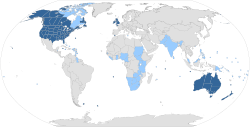
The English-speaking world comprises the 88 countries and territories in which English is an official, administrative, or cultural language. In the early 2000s, between one and two billion people spoke English,[1][2] making it the largest language by number of speakers, the third largest language by number of native speakers and the most widespread language geographically. The countries in which English is the native language of most people are sometimes termed the Anglosphere. Speakers of English are called Anglophones.
Early Medieval England was the birthplace of the English language; the modern form of the language has been spread around the world since the 17th century, first by the worldwide influence of England and later the United Kingdom, and then by that of the United States. Through all types of printed and electronic media of these countries, English has become the leading language of international discourse and the lingua franca in many regions and professional fields, such as science, navigation and law.[3]
The United States and India have the most total English speakers, with 306 million and 129 million,[4] respectively. These are followed by the United Kingdom (68 million), and Nigeria (60 million).[5] As of 2022, there were about 400 million native speakers of English.[6] Including people who speak English as a second language, estimates of the total number of Anglophones vary from 1.5 billion to 2 billion.[2] David Crystal calculated in 2003 that non-native speakers outnumbered native speakers by a ratio of three to one.[7]
Besides the major varieties of English—American, British, Canadian, Australian, Irish, New Zealand English—and their sub-varieties, countries such as South Africa, India, Nigeria, the Philippines, Singapore, Jamaica, and Trinidad and Tobago also have millions of native speakers of dialect continua ranging from English-based creole languages to Standard English. Other countries and territories, such as Ghana, also use English as their primary official language even though it is not the native language of most of the people. English holds official status in numerous countries within the Commonwealth of Nations.[8]
Majority English-speaking countries
[edit]
English is the primary natively spoken language in several countries and territories. Five of the largest of these are sometimes described as the "core Anglosphere";[9][10][11][12] they are the United Kingdom, the United States, Australia, Canada, and New Zealand.
The term "Anglosphere" can sometimes be extended to include other countries and territories where English or an English Creole language is also the primary native language and English is the primary language of government and education, such as Ireland, Gibraltar, and the Commonwealth Caribbean.[13]
While English is also spoken by a majority of people as a second language in a handful of countries such as Denmark, the Netherlands, Norway and Sweden, these countries are not considered part of the English-speaking world as the language is still viewed primarily as a foreign tongue and does not serve an important cultural role in society.[14]
Countries and territories
[edit]English is an official language (de facto or de jure) of the following countries and territories.[15]
- North America: Anguilla, Antigua and Barbuda, Bahamas, Barbados, Belize, Bermuda, British Virgin Islands, Canada, Cayman Islands, Curaçao, Dominica, Grenada, Jamaica, Montserrat, Puerto Rico, Saint Kitts and Nevis, Saint Lucia, Saint Vincent and the Grenadines, Trinidad and Tobago, Turks and Caicos Islands, United States, United States Virgin Islands
- South America: Falkland Islands, Guyana
- Europe: Akrotiri and Dhekelia, Gibraltar, Guernsey, Ireland, Isle of Man, Jersey, Malta, United Kingdom
- Africa: Botswana, Cameroon, Eswatini, Gambia, Ghana, Kenya, Lesotho, Liberia, Malawi, Mauritius, Namibia, Nigeria, Rwanda, Saint Helena, Ascension and Tristan da Cunha, Sierra Leone, South Africa, South Sudan, Sudan, Tanzania, Uganda, Zambia, Zimbabwe
- Asia: Christmas Island, Cocos (Keeling) Islands, Hong Kong, India, Pakistan, Philippines, Singapore
- Oceania: American Samoa, Australia, Cook Islands, Fiji, Guam, Kiribati, Marshall Islands, Micronesia, Nauru, New Zealand, Niue, Norfolk Island, Northern Mariana Islands, Palau, Papua New Guinea, Pitcairn Islands, Samoa, Solomon Islands, Tokelau, Tuvalu, Vanuatu
Although not official, English is also an important language in some former colonies and protectorates of the British Empire, where it is used as an administrative language. Examples are Brunei, Malaysia, Sri Lanka, and the United Arab Emirates.
English as a global language
[edit]Because English is so widely spoken, it has often been called a "world language", the lingua franca of the modern era,[16] and while it is not an official language in most countries, it is currently the language most often taught as a foreign language.[7][17] It is, by international treaty, the official language for aeronautical[18] and maritime[19] communications. English is one of the official languages of the United Nations and many other international organizations, including the International Olympic Committee. It is also one of two co-official languages for astronauts (besides the Russian language) serving on board the International Space Station.[citation needed]
The English language has a particular significance in the Commonwealth of Nations, which developed from the British Empire.[20] English is the medium of inter-Commonwealth relations.[21] The English language as used in the Commonwealth has sometimes been referred to as Commonwealth English, most often interchangeably with British English.[22]
English is studied most often in the European Union, and the perception of the usefulness of foreign languages among Europeans is 67% in favour of English, ahead of 17% for German and 16% for French (as of 2012[update]). In some of the non–English-speaking EU countries, the following percentages of adults claimed to be able to converse in English in 2012: 90% in the Netherlands; 89% in Malta; 86% in Sweden and Denmark; 73% in Cyprus, Croatia, and Austria; 70% in Finland; and over 50% in Greece, Belgium, Luxembourg, Slovenia, and Germany. In 2012, excluding native speakers, 38% of Europeans consider that they can speak English.[23]
Books, magazines, and newspapers written in English are available in many countries around the world; English is the most commonly used language in the sciences,[16] with Science Citation Index reporting as early as 1997 that 95% of its articles were written in English, even though only half of them came from authors in English-speaking countries.
In publishing, English literature predominates considerably, with 28% of all books published in the world [Leclerc 2011][full citation needed] and 30% of web content in 2011 (down from 50% in 2000).[17]
The increasing use of the English language globally has had a large impact on many other languages, leading to language shift and language death,[24] and to claims of linguistic imperialism.[citation needed] English itself has become more open to language shift as multiple regional varieties feed back into the language as a whole.[25]
References
[edit]- ^ Crystal, David (2004). The language revolution. John Wiley & Sons. ISBN 978-0-745-63313-8.
- ^ a b Crystal, David (2008). "Two thousand million?". English Today. 24: 3–6. doi:10.1017/S0266078408000023. S2CID 145597019.
- ^ The Routes of English.
- ^ "How many Indians can you talk to?". www.hindustantimes.com. Retrieved 27 July 2024.
- ^ English Archived 9 March 2023 at the Wayback Machine, Ethnologue, Dallas, Texas: SIL International., 2022.
- ^ "What are the top 200 most spoken languages?". Ethnologue. 2022. Archived from the original on 18 June 2023. Retrieved 13 May 2023.
- ^ a b Crystal, David (2003). English as a Global Language (2nd ed.). Cambridge University Press. p. 69. ISBN 978-0-521-53032-3. Archived from the original on 15 April 2023. Retrieved 19 March 2023.
- ^ Mufwene, Salikoko S. (14 March 2016). "English: the Empire is dead. Long live the Empire". The Conversation. Retrieved 12 June 2024.
- ^ Mycock, Andrew; Wellings, Ben (July 2019). "The UK after Brexit: Can and Will the Anglosphere Replace the EU?" (PDF). Cicero Foundation. Archived (PDF) from the original on 6 June 2020.
...the core Anglosphere states – the USA, the UK, Canada, Australia and New Zealand...
- ^ Vucetic, Srdjan (2011). The Anglosphere: A Genealogy of a Racialized Identity in International Relations. Stanford University Press. ISBN 9780804772242.
- ^ Gregg, Samuel (17 February 2020). "Getting Real About the Anglosphere". Law & Liberty. Archived from the original on 17 October 2022.
...from what might be called the "core" Anglosphere nations: Britain, Canada, New Zealand, Australia, and the United States;
- ^ Szczepański, Jarosław. "The anglosphere as non-contiguous region. Remarks on CANZUK". Australian Journal of International Affairs. 0 (0): 1–15. doi:10.1080/10357718.2025.2505070. ISSN 1035-7718.
- ^ Lloyd, John (2000). "The Anglosphere Project". New Statesman. Archived from the original on 13 December 2015. Retrieved 30 November 2012.
- ^ "The Anglosphere and its Others: The 'English-speaking Peoples' in a Changing World Order – British Academy". British Academy. Archived from the original on 22 April 2017. Retrieved 20 May 2023.
- ^ "Field Listing – Languages". The World Factbook. Central Intelligence Agency. Retrieved 16 July 2023.
- ^ a b David Graddol (1997). "The Future of English?" (PDF). The British Council. Archived from the original (PDF) on 19 February 2007. Retrieved 15 April 2007.
- ^ a b Northrup 2013.
- ^ "ICAO Promotes Aviation Safety by Endorsing English Language Testing". International Civil Aviation Organization. 13 October 2011. Archived from the original on 29 June 2014. Retrieved 16 June 2014.
- ^ "IMO Standard Marine Communication Phrases". International Maritime Organization. Archived from the original on 27 December 2003.
- ^ "About Us". The Commonwealth. Archived from the original on 10 September 2022. Retrieved 25 March 2024.
- ^ "Joining the Commonwealth". Commonwealth. Archived from the original on 7 March 2022. Retrieved 27 March 2022.
- ^ "Commonwealth English". Oxford English Dictionary. Retrieved 7 May 2024.
- ^ European Commission (June 2012). Special Eurobarometer 386: Europeans and Their Languages (PDF) (Report). Eurobarometer Special Surveys. Archived from the original (PDF) on 7 February 2015. Retrieved 12 February 2015.
- ^ David Crystal (2000) Language Death, Preface; viii, Cambridge University Press, Cambridge
- ^ Jambor, Paul Z. (April 2007). "English Language Imperialism: Points of View". Journal of English as an International Language. 2: 103–123. Archived from the original on 25 September 2013. Retrieved 16 June 2014.
Bibliography
[edit]- Australian Bureau of Statistics (28 March 2013). "2011 Census QuickStats: Australia". Archived from the original on 6 November 2015. Retrieved 25 March 2015.
- Afhan Meytiyev (26 September 2013). "English and diplomacy" (PDF). Scotland's Census 2011. Retrieved 25 March 2020.
- Bao, Z. (2006). "Variation in Nonnative Varieties of English". In Brown, Keith (ed.). Encyclopedia of language & linguistics. Elsevier. pp. 377–380. doi:10.1016/B0-08-044854-2/04257-7. ISBN 978-0-08-044299-0.
- Crystal, David (19 November 2004b). "Subcontinent Raises Its Voice". The Guardian. Retrieved 4 February 2015.
- Crystal, David (2006). "Chapter 9: English worldwide". In Denison, David; Hogg, Richard M. (eds.). A History of the English language. Cambridge University Press. pp. 420–439. ISBN 978-0-511-16893-2.
- National Records of Scotland (26 September 2013). "Census 2011: Release 2A". Scotland's Census 2011. Retrieved 25 March 2015.
- "The Routes of English". 1 August 2015.
- Northern Ireland Statistics and Research Agency (11 December 2012). "Census 2011: Key Statistics for Northern Ireland December 2012" (PDF). Statistics Bulletin. Table KS207NI: Main Language. Retrieved 16 December 2014.
- Northrup, David (20 March 2013). How English Became the Global Language. Palgrave Macmillan. ISBN 978-1-137-30306-6.
- Office for National Statistics (4 March 2013). "Language in England and Wales, 2011". 2011 Census Analysis. Retrieved 16 December 2014.
- Ryan, Camille (August 2013). "Language Use in the United States: 2011" (PDF). American Community Survey Reports. p. 1. Archived from the original (PDF) on 5 February 2016. Retrieved 16 December 2014.
- Statistics Canada (22 August 2014). "Population by mother tongue and age groups (total), 2011 counts, for Canada, provinces and territories". Archived from the original on 23 September 2015. Retrieved 25 March 2015.
- Statistics New Zealand (April 2014). "2013 QuickStats About Culture and Identity" (PDF). p. 23. Archived from the original (PDF) on 15 January 2015. Retrieved 25 March 2015.
- Census 2011: Census in brief (PDF). Pretoria: Statistics South Africa. 2012. Table 2.5 Population by first language spoken and province (number). ISBN 9780621413885. Archived (PDF) from the original on 13 May 2015.
- English and Diplomacy
Geographical distribution of languages | |||||
|---|---|---|---|---|---|
| Romance-speaking world |
| ||||
| Germanic-speaking world | |||||
| Slavic-speaking world | |||||
| Celtic-speaking world | |||||
| Other languages | |||||


.svg)


| Authority control databases: National |
|---|

English-speaking world
View on GrokipediaDefinition and Scope
Core Anglosphere Nations
The core Anglosphere nations consist of the United States, the United Kingdom, Canada, Australia, and New Zealand, where English serves as the primary language of government, law, education, and daily communication for the overwhelming majority of the population.[11] These countries share historical origins in British colonization and settlement, fostering common cultural, legal, and institutional frameworks rooted in English common law and parliamentary traditions, with the exception of the United States' presidential system adapted post-independence.[8] Their close ties are exemplified by the Five Eyes intelligence-sharing alliance, established during World War II and formalized in subsequent agreements, which enables seamless cooperation among their signals intelligence agencies.[12] As of mid-2025, the combined population of these nations totals approximately 486 million, predominantly native or highly proficient English speakers, underpinning their economic dominance and global influence.[13]| Country | Population Estimate (2025) |
|---|---|
| United States | 343,603,404 |
| United Kingdom | 69,551,332 |
| Canada | 41,651,653 |
| Australia | 27,536,874 |
| New Zealand | 5,324,700 |
Extended English-Speaking Countries and Territories
The extended English-speaking countries and territories comprise sovereign states and dependencies where English functions as an official language or key administrative medium, but constitutes a second language for the majority of the population, often serving as a lingua franca in multi-ethnic societies. These entities, largely former colonies of the British Empire or spheres of American influence, contrast with core Anglosphere nations by having lower native speaker percentages, typically under 20%, yet high institutional entrenchment in governance, law, and commerce. Prominent examples fall into the "Outer Circle" of World Englishes, characterized by nativized varieties and widespread second-language use.[6] In Africa, nations like Nigeria, Ghana, Kenya, and Liberia maintain English as the de jure official language, inherited from colonial administration to bridge indigenous linguistic divides. Nigeria, with a population of approximately 223 million as of 2024, exemplifies this role, employing English in federal institutions, media, and secondary education as a neutral connector among over 500 ethnic groups and languages. Proficiency is highest among the educated urban population, estimated at 50-60% functional speakers, though rural areas show lower adoption. Similar patterns prevail in East Africa, where Kenya's 2023 population of 55 million uses English alongside Swahili for official purposes, with English proficiency correlating to socioeconomic status.[6][19] Asia hosts major extended users including India, Pakistan, the Philippines, and Singapore. India, population nearing 1.43 billion in 2023, co-designates English with Hindi under its constitution for parliamentary and high court proceedings, aiding administration across 22 scheduled languages; around 10% of Indians are proficient, primarily in professional contexts. The Philippines, with 117 million residents, adopted English officially in 1987, integrating it into public schooling and yielding high literacy rates, with over 50% conversational proficiency. Singapore stands out for near-universal English competence, mandated as the working language since independence in 1965, despite four official tongues, fostering economic integration in a city-state of 5.9 million.[6][19] Caribbean and Pacific islands, such as Jamaica, Trinidad and Tobago, and Papua New Guinea, feature English as official amid creole variants and local tongues. Jamaica's 2.8 million people use English in formal settings, with Jamaican Patois dominant informally. Papua New Guinea, encompassing 10 million speakers of 800+ languages, relies on English and Tok Pisin for national cohesion. Territories augment this scope: the 14 British Overseas Territories, including Bermuda (population 64,000) and [Cayman Islands](/page/Cayman Islands) (68,000), conduct affairs in English de facto. U.S. territories like Guam and the U.S. Virgin Islands similarly prioritize English officially, though local languages persist. These extended domains collectively amplify English's global footprint, numbering over 50 sovereign states and numerous dependencies as of 2025.[20][21]Historical Development
Origins in England and Early Expansion
The English language traces its origins to the Germanic dialects spoken by Anglo-Saxon settlers who arrived in Britain during the mid-5th century AD, following the Roman withdrawal around 410 AD.[22][23] These tribes—the Angles from southern Denmark and northern Germany, the Saxons from northwest Germany, and the Jutes from Jutland—migrated in waves starting circa 450 AD, establishing footholds in eastern and southern Britain amid the decline of Romano-British society.[24][25] Archaeological evidence from cemeteries and settlements indicates a gradual influx rather than wholesale invasion, with migrants exploiting fertile lands and intermingling with or displacing Celtic-speaking Britons, whose Brythonic languages retreated to peripheral regions.[24] By the late 5th century, these settlers had formed distinct communities, evidenced by the earliest Old English runic inscriptions dating to 450–480 AD.[26] Old English, as the language of these Anglo-Saxon kingdoms (such as Kent, Sussex, Wessex, Essex, East Anglia, Mercia, and Northumbria), emerged by the 6th century as a cluster of West Germanic dialects with heavy inflectional morphology, synthetic grammar, and a core vocabulary derived from Proto-Germanic roots.[22][25] Literary records, including the epic Beowulf composed around the 8th–11th centuries and translations like those under King Alfred the Great (r. 871–899 AD), demonstrate its use in poetry, law, and administration across southern and central England.[22] External pressures shaped its early form: Scandinavian Viking raids and settlements from 793 AD onward introduced Norse loanwords (e.g., sky, window) into northern dialects, comprising up to 10% of modern English lexicon in affected areas.[25] The Norman Conquest of 1066 AD, led by William I, overlaid Anglo-Norman French as the elite language, reducing Latin's dominance and catalyzing the transition to Middle English by the 12th century, though the vernacular persisted among commoners.[27] Early expansion beyond England's core Anglo-Saxon territories involved gradual linguistic diffusion within the British Isles. In northern England and southern Scotland, Northumbrian dialects spread via the Kingdom of Northumbria's influence up to the 9th century, laying foundations for Scots—a Germanic offshoot that diverged by the 14th century and became the Lowlands' prestige variety.[25] Welsh border regions saw English encroachment through Mercian expansion and later Edward I's conquests (1277–1283 AD), but Brythonic Welsh endured as the majority tongue until the 19th century.[28] In Ireland, initial English contact occurred via Anglo-Norman incursions from 1169 AD, establishing Middle English-speaking enclaves in the Pale around Dublin, though Gaelic dominated until systematic Tudor plantations (e.g., Munster in the 1580s, Ulster from 1609 AD) imposed English as an administrative and settler language.[29] Transatlantic expansion began with exploratory ventures, but permanent English-speaking settlements materialized in the early 17th century. The Virginia Company's Jamestown colony, founded on May 14, 1607, in Chesapeake Bay, marked the first enduring English outpost in North America, with 104 initial settlers facing high mortality but establishing tobacco-based viability by 1612.[30][31] Subsequent foundations, including Plymouth in 1620 by Puritan separatists and the Massachusetts Bay Colony in 1630, rapidly grew English-speaking populations to approximately 75,000 by 1665, fostering dialects that retained Old English features amid minimal non-English influences.[30] These outposts, driven by joint-stock companies and religious dissenters, exported English legal traditions and Protestantism, seeding the demographic core of future Anglophone nations.[32]Imperial Era and Global Spread
The British Empire's imperial phase, accelerating from the late 18th century onward, propelled the global dissemination of the English language through systematic colonization, administrative imposition, and economic integration across continents. Following victories in the Seven Years' War (1756–1763), Britain consolidated control over vast territories, including Canada and parts of India, where English became the medium of governance and education, embedding it in legal and bureaucratic systems.[32][5] By the 19th century, the empire's expansion into Australia via the First Fleet in 1788 established English as the dominant tongue among settlers and convicts, fostering a distinct variant that persists today.[33] At its zenith around 1920–1922, the British Empire spanned approximately 35.5 million square kilometers, encompassing about 24% of the Earth's land surface and governing 412 to 458 million people, or roughly 23–25% of the global population.[34][33] This territorial dominance facilitated English's entrenchment in diverse regions: in India, the East India Company's presence from 1600 evolved into direct Crown rule after 1858, with English mandated in elite education via Macaulay's Minute of 1835, creating an anglicized class that sustained its post-independence role.[5][35] In Africa, acquisitions such as the Cape Colony (seized 1795, confirmed 1814) and later protectorates in Nigeria and Kenya introduced English through missionary schools and colonial administration, though adoption varied by local resistance and demographics.[32][36] The empire's maritime supremacy and trade networks further amplified English's reach, as ports like Singapore (founded 1819) and Hong Kong (ceded 1842) served as linguistic hubs linking Asia to Britain.[37] In settler colonies such as Canada (post-1763 Quebec Act accommodating but prioritizing English elites) and New Zealand (Treaty of Waitangi 1840), mass migration from Britain ensured English's nativization, with over 90% fluency in these dominions by the early 20th century.[5][38] This spread was not merely linguistic but cultural, reinforced by literature, law, and Protestant missions, though often coercive, prioritizing utility for imperial control over indigenous languages.[39] Post-World War I, decolonization accelerated after 1945, yet English endured as a lingua franca in former colonies due to its institutionalization in education, judiciary, and commerce—evident in the Commonwealth's 56 member states, where it remains official in over half.[40][35] This persistence underscores the empire's causal role in establishing English-speaking polities, from the independent United States (retaining English post-1776 despite separation) to modern nations like Nigeria and South Africa, where it bridges ethnic divides despite non-majority native use.[5][36] Empirical data from colonial censuses and post-independence surveys confirm that English proficiency correlated with access to imperial-era schooling, yielding lasting demographic imprints.Post-Colonial Consolidation
The Statute of Westminster, enacted by the UK Parliament on December 11, 1931, marked a pivotal step in the political consolidation of the self-governing Dominions by declaring them autonomous communities equal in status to Britain, thereby ending the UK Parliament's legislative authority over them unless requested otherwise.[41][42] This applied immediately to Canada, the Irish Free State, South Africa, and New Zealand, while Australia and Newfoundland adopted it later in 1942 and 1949, respectively, solidifying their sovereign legislative powers and extraterritorial law-making capabilities.[41] The measure preserved monarchical ties under the Crown but shifted the English-speaking Dominions toward independent nation-building, fostering shared yet distinct Westminster-style parliamentary systems rooted in common law traditions. Post-World War II decolonization accelerated the reconfiguration of the British Empire into the Commonwealth of Nations, with the London Declaration of April 1949 enabling republics like India to retain membership without allegiance to the British monarch, who became the symbolic Head of the Commonwealth.[43][44] This framework maintained English as the primary language of diplomacy, governance, and intra-member cooperation among 53 nations by 2023, many of which—such as Nigeria (independent 1960), Kenya (1963), and Singapore (1965)—retained it as an official language to unify multi-ethnic populations and facilitate administration amid ethnic diversity.[44] In core Anglosphere settler societies like Canada, Australia, and New Zealand, consolidation involved mass immigration policies post-1945 that prioritized English-speaking Europeans, boosting populations and labor forces; Australia's intake of over 2 million migrants by 1970, for instance, supported industrialization and suburban expansion.[45] Economically, the era saw robust growth in these nations, leveraging resource endowments and US-led global trade. Canada's GDP per capita rose from about $2,000 in 1945 to over $10,000 by 1970 (in constant dollars), driven by manufacturing, energy exports, and US investment under the Marshall Plan's indirect benefits.[46] Australia experienced a similar boom, with annual GDP growth averaging 4-5% from 1945-1972 through wool, minerals, and protected industries, though vulnerabilities to commodity cycles emerged later.[46] New Zealand's economy, reliant on agriculture, achieved high living standards via export-led growth to Britain until the 1970s UK market shift, prompting diversification.[47] The United States, already independent since 1776, emerged as the Anglosphere's economic and military hegemon post-1945, its $4.1 trillion GDP by 1950 (in 1990 dollars) dwarfing others and underpinning alliances like NATO (1949), which integrated UK, Canada, Australia, and New Zealand forces.[48] This leadership reinforced English as the global lingua franca, with intelligence-sharing via Five Eyes (formalized 1946) exemplifying institutional continuity.[48] Linguistic and cultural retention in extended English-speaking territories underscored consolidation, as English's administrative utility—evident in India's 1950 Constitution designating it for official use alongside Hindi—prevented fragmentation in linguistically diverse states.[49] Exceptions like Myanmar, which phased out English-medium education post-1962, highlight pragmatic choices favoring continuity for elite education, trade, and federal cohesion elsewhere.[50] Challenges included uneven development and identity tensions, such as Quebec's French revival in Canada (Quiet Revolution, 1960s), yet overall, post-colonial structures preserved English-dominant governance, enabling economic integration and collective security amid Cold War pressures.[41]Demographic Characteristics
Population Statistics and Native Speakers
The core English-speaking world, defined as nations where English serves as the primary native language for the majority of the population, encompasses approximately 490 million people as of 2025. This figure aggregates the populations of the United States (347 million), the United Kingdom (67 million), Canada (40 million), Australia (26 million), New Zealand (5 million), and Ireland (5 million).[13] [51] Native speakers of English total around 370 to 400 million worldwide, with over 95% residing in these core countries. In the United States, an estimated 297 million individuals speak English as their first language. Canada reports approximately 30 million native English speakers, comprising about 75% of its population, while the United Kingdom has roughly 60 million. Australia, New Zealand, and Ireland each exhibit native speaker majorities exceeding 90% of their respective populations.[52] [6] [53]| Country | Population (2025 est.) | Native English Speakers (est.) |
|---|---|---|
| United States | 347 million | 297 million |
| United Kingdom | 67 million | 60 million |
| Canada | 40 million | 30 million |
| Australia | 26 million | 23 million |
| New Zealand | 5 million | 4.5 million |
| Ireland | 5 million | 4.5 million |
| Total | 490 million | ~419 million |
Immigration Patterns and Ethnic Composition
The English-speaking world's demographic profile has been profoundly shaped by immigration, which has accelerated since the mid-20th century, contributing to population growth amid declining native fertility rates. In core Anglosphere nations, net international migration accounted for the majority of population increases in recent years; for instance, in Canada, immigration drove nearly all growth between 2016 and 2021, with immigrants comprising 23% of the population by 2021.[54] Similarly, in Australia, overseas-born residents rose to 27.6% by 2021, up from 26.3% in 2016, reflecting sustained inflows from Asia and Europe.[55] These patterns stem from policy shifts post-World War II, favoring skilled and family-based migration, though recent trends show rising numbers from non-Western sources, including India, China, and Nigeria, amid global mobility and economic pulls.[56] In the United States, immigration patterns have featured large-scale arrivals from Latin America and Asia since the 1965 Immigration and Nationality Act, with net migration adding over 1 million annually in peak years like 2022.[57] The foreign-born share reached 13.9% by 2023, concentrated in states like California and Texas. In the United Kingdom, post-EU accession inflows from Eastern Europe peaked in the 2000s, but non-EU migration from South Asia and Africa dominated after Brexit, with net migration hitting 764,000 in the year ending June 2023.[58] Australia and New Zealand emphasize points-based systems for skilled workers, yielding high per-capita inflows; Australia's net overseas migration exceeded 500,000 in 2022-2023, primarily from India and China.[59] New Zealand saw similar Asian-led growth, with immigrants from India and the Philippines prominent in 2018-2023 data.[60] These inflows have diversified ethnic compositions, reducing the European-descended majority in several nations. The table below summarizes self-reported ethnic or racial groups from recent censuses (noting variations in categorization and multiple-response allowances):| Country | Year | European/White (%) | Asian (%) | Black/African (%) | Hispanic/Latino (%) | Indigenous/Other (%) | Source |
|---|---|---|---|---|---|---|---|
| United States | 2023 | 58 (non-Hispanic White) | 6 | 13 | 20 | 3 (multiracial/other) | [61] [62] |
| Canada | 2021 | ~70 (European origins, incl. multiple) | ~20 (South/ East Asian) | ~4 | N/A | ~5 (Indigenous/visible minorities other) | [54] [63] |
| United Kingdom | 2021 | 81.7 (White) | 9.3 | 4 | N/A | 2.9 (mixed)/2.1 (other) | [64] [65] |
| Australia | 2021 | ~57 (Anglo-Celtic/European) | ~17 | ~1 | N/A | ~3 (Indigenous)/~25 (other overseas-born) | [66] [55] |
| New Zealand | 2018 | 70.2 | 15.1 | ~1 | N/A | 16.5 (Māori)/8.1 (Pacific) | [60] |
Language Variants and Proficiency Levels
The primary variants of English within the English-speaking world include American English, British English, Canadian English, Australian English, and New Zealand English, each shaped by historical settlement patterns, indigenous influences, and post-colonial developments. American English, spoken by over 300 million native speakers, standardized much of its orthography through Noah Webster's 1828 dictionary, introducing simplifications such as "color" instead of "colour" and "realize" over "realise." British English serves as the ancestral form, retaining older spellings and influencing Commonwealth variants, with approximately 67 million native speakers in the United Kingdom. Canadian English blends American and British elements, incorporating French loanwords in regions like Quebec and unique terms like "toque" for a winter hat, among its roughly 22 million native English speakers. Australian English, with 25 million native speakers, features distinct slang (e.g., "arvo" for afternoon) and a non-rhotic accent influenced by Irish and Cockney settlers, while New Zealand English, spoken natively by 4.8 million, integrates Māori borrowings like "whānau" for family and exhibits vowel shifts closer to Australian forms.[69][70][71] Pronunciation varies significantly across variants: American English is rhotic, fully articulating 'r' sounds (e.g., "car" as /kɑːr/), whereas British, Australian, and New Zealand English are predominantly non-rhotic, eliding 'r' after vowels unless followed by another vowel. Vocabulary divergences reflect local adaptations, such as "elevator" (American/Canadian) versus "lift" (British/Australian/New Zealand), "truck" versus "lorry," and "apartment" versus "flat." Australian and New Zealand variants often employ diminutives and abbreviations (e.g., "brekky" for breakfast) and broader vowel qualities in informal speech, distinguishing them from the more conservative Received Pronunciation of British English or the General American accent. These differences, while mutually intelligible, can lead to minor comprehension challenges in specialized contexts like legal or technical terminology.[72][73][70] Proficiency levels among native speakers in core Anglosphere nations remain exceptionally high, with adult literacy rates surpassing 99% in the United States, United Kingdom, Canada, Australia, and New Zealand as of 2023 data. Native fluency is near-universal, supported by compulsory education systems emphasizing English-medium instruction from early childhood; for instance, over 95% of school-aged children in these countries achieve advanced reading and writing proficiency by age 15, per standardized assessments like PISA. In extended English-speaking territories, such as Ireland (with 4.5 million native speakers) or Singapore (where English is the lingua franca for 83% of the population), proficiency is robust but varies by socioeconomic factors, with urban elites demonstrating near-native command while rural or minority-language groups exhibit intermediate levels. Metrics like the EF English Proficiency Index, though primarily for non-native contexts, underscore the baseline advantage: core nations' implicit scores exceed 600 (very high proficiency band), far above global averages.[6][74][69]| Country/Territory | Native English Speakers (millions, approx. 2025) | Key Proficiency Notes |
|---|---|---|
| United States | 300+ | Near-100% native fluency; rhotic accents dominant.[69] |
| United Kingdom | 67 | High literacy; regional dialects (e.g., Scots) coexist.[69] |
| Canada | 22 | Bilingual influences; 58% English as first language overall.[69][6] |
| Australia | 25 | Uniform native proficiency; unique Strine slang.[69] |
| New Zealand | 4.8 | 96% English speakers; Māori integration high.[69][6] |
Political and Legal Institutions
Shared Common Law Tradition
The common law tradition, which forms the bedrock of legal systems across the English-speaking world, originated in medieval England after the Norman Conquest of 1066, when centralized royal courts under kings like Henry II (r. 1154–1189) began applying uniform rules derived from judicial decisions rather than local customs or Roman-inspired codes.[75][76] These courts, including the Court of Exchequer established around 1170 and the Court of Common Pleas in 1178, issued writs to enforce royal justice, creating a body of precedent-based norms that evolved organically through case resolutions.[77] By the 13th century, this system had coalesced into a distinct "common" law applicable kingdom-wide, emphasizing remedies tailored to specific disputes over abstract principles.[78] Central to this tradition is the doctrine of stare decisis (Latin for "to stand by things decided"), which binds lower courts to precedents set by higher ones, ensuring legal stability and incremental adaptation based on empirical outcomes in litigation rather than legislative codification.[79] This judge-made law, supplemented by statutes, prioritizes adversarial proceedings where parties present evidence and arguments, with judges acting as neutral arbiters rather than investigators, a method rooted in 12th-century practices that values contestation for uncovering truth.[75] Equity jurisprudence, developed in parallel through the Court of Chancery from the 14th century, addressed common law's rigidities by providing discretionary remedies like injunctions, later merging with common law procedures in England via the Judicature Acts of 1873–1875.[80] British imperial expansion disseminated this framework to colonies starting in the 17th century, with settler jurisdictions adopting English common law as received at the time of settlement or via explicit reception statutes; for instance, the Carolinas enacted the first such colonial laws in the 1710s, affirming English law's force where applicable.[81] In the modern era, it persists as the primary system in England and Wales, the United States (in 49 states, excluding Louisiana's civil law heritage), Canada (outside Quebec), Australia, and New Zealand, covering jurisdictions with over 500 million people as of 2023.[82][83] These nations share procedural hallmarks, including oral advocacy, jury trials in serious criminal and certain civil matters (traced to the Assize of Clarendon in 1166), and protections like habeas corpus formalized in the Habeas Corpus Act 1679, which safeguard against unlawful detention.[84][76] This shared inheritance fosters interoperability in areas like contract enforcement and tort liability, evident in mutual recognition of judgments under frameworks such as the Hague Convention on Choice of Court Agreements (2005), ratified by Australia, the UK, and others.[85] While divergences exist—such as the U.S. Supreme Court's non-binding persuasive authority versus the UK Supreme Court's post-2009 role— the core reliance on precedent and unwritten constitutional principles, as in Australia's unwritten constitution derived from 1900 statutes and conventions, underscores a realist approach to law as evolving from practical dispute resolution rather than top-down imposition.[86][80] Empirical studies, including those analyzing case citation networks, confirm high doctrinal continuity, with U.S. courts frequently referencing English precedents from the 18th–19th centuries like Blackstone's Commentaries on the Laws of England (1765–1769).[85] This tradition's endurance reflects its causal efficacy in promoting predictable, rights-oriented governance, distinguishing English-speaking legal spheres from civil law systems dominant elsewhere.[87]Democratic Governance Models
The democratic governance models in the English-speaking world primarily consist of parliamentary systems derived from the Westminster tradition in the United Kingdom, Canada, Australia, and New Zealand, alongside the presidential republic in the United States. These systems emphasize representative democracy, with elected legislatures holding central authority and executives accountable through institutional mechanisms. Parliamentary variants feature the executive branch emerging from and remaining dependent on legislative confidence, enabling swift government formation or dissolution via no-confidence votes, while the U.S. model enforces rigid separation of powers to prevent concentration of authority.[88][89] In Westminster systems, the prime minister, as head of government, leads the cabinet composed of parliament members and must maintain majority support in the lower house to govern. The United Kingdom's unitary structure vests sovereignty in Parliament, comprising the elected House of Commons and appointed House of Lords, which scrutinizes and amends legislation before royal assent.[90] Canada's federal variant divides powers between the national Parliament—encompassing the Crown (represented by the governor general), Senate, and House of Commons—and provincial legislatures, with the prime minister accountable to the Commons for federal matters.[88] Australia and New Zealand adapt this further: Australia's federal constitution allocates enumerated powers to the Commonwealth Parliament while reserving residuals to states, and New Zealand's unicameral Parliament operates under a mixed-member proportional representation system since 1996, reducing first-past-the-post dominance.[91] These arrangements promote executive-legislative fusion, facilitating policy responsiveness but risking instability during minority governments or hung parliaments.[92] The U.S. presidential system diverges sharply, with the president elected every four years through the Electoral College for a fixed term, independent of Congress, which legislates and appropriates funds. This setup includes checks like presidential vetoes (overrideable by two-thirds congressional majorities), Senate confirmation of appointees, and impeachment powers, alongside an independent judiciary reviewing laws for constitutionality. Federalism layers state governments with their own executives, legislatures, and courts, mirroring national divisions. Such separation aims to mitigate tyranny but can yield gridlock, as evidenced by historical instances of divided government impeding legislation.[89][93] Across these models, shared traits include competitive multiparty elections, adherence to common law principles ensuring judicial independence, and constitutional safeguards for civil liberties, fostering empirical stability: the U.K. has sustained parliamentary rule without interruption since 1689, the U.S. Constitution remains operative since 1789 with 27 amendments, and Commonwealth nations have averaged peaceful power transitions over decades. Governance metrics underscore effectiveness, with Anglosphere countries consistently topping indices for prosperity and low corruption due to accountable institutions and rule-of-law enforcement.[90][89][94] Ireland's parliamentary republic, with a directly elected president and Taoiseach chosen by the Dáil Éireann, aligns closely with Westminster norms while embedding republicanism and proportional representation.[95]Key Alliances and Cooperative Frameworks
The Five Eyes intelligence alliance, consisting of the United States, United Kingdom, Canada, Australia, and New Zealand, enables comprehensive signals intelligence sharing derived from World War II-era cooperation.[96] Formed through the 1946 UKUSA Agreement between the US and UK, it expanded to include Canada in 1948, Australia and New Zealand in the early 1950s, creating a framework for joint surveillance operations and data exchange that persists as the world's most integrated intelligence partnership.[12] This alliance has coordinated efforts in counterterrorism, cyber defense, and monitoring adversarial activities, with annual ministerial meetings since 2013 to align oversight practices.[97] Its effectiveness stems from linguistic and institutional compatibility, allowing seamless interoperability absent in broader multilateral groups.[98] The AUKUS security pact, announced on September 15, 2021, unites Australia, the United Kingdom, and the United States in a trilateral technology-sharing arrangement focused on advanced capabilities for the Indo-Pacific region.[99] Pillar I commits to equipping Australia with nuclear-powered submarines, drawing on US Virginia-class and UK Astute-class designs, with the first Australian submarines projected for delivery in the early 2040s; Pillar II extends cooperation in cyber, AI, quantum technologies, and undersea systems.[100] Enabled by the 2022 Exchange of Naval Nuclear Propulsion Information Agreement, AUKUS enhances deterrence against regional threats without formal treaty obligations, building on pre-existing bilateral defense ties.[101] By 2025, it has spurred industrial investments exceeding $3 billion annually across partners, prioritizing strategic autonomy over multilateral dilution.[102] The Commonwealth of Nations serves as a voluntary cooperative framework linking 56 member states, including core English-speaking nations such as the UK, Canada, Australia, and New Zealand, with English functioning as the operational lingua franca for diplomacy and shared initiatives.[103] Evolving from the 1931 Statute of Westminster, which formalized dominion autonomy, it now facilitates collaboration in trade, development, and democratic standards through biennial heads-of-government meetings and specialized agencies like the Commonwealth Secretariat, established in 1965.[104] Representing 2.7 billion people as of 2023, the organization promotes economic partnerships via initiatives like the Commonwealth Advantage, which leverages preferential trade access among members, though participation varies due to diverse non-English-speaking inclusions.[105] While not a military alliance, it reinforces cultural and legal affinities that underpin security dialogues among Anglosphere participants.[106] These frameworks exemplify how shared English-language heritage and common-law traditions enable deeper integration than in linguistically fragmented alliances like NATO, where the US, UK, and Canada contribute disproportionately to operations.[107] Empirical analyses indicate that such ties yield higher compliance and efficiency in joint endeavors, with Five Eyes alone processing petabytes of shared data annually to inform policy decisions.[108]Economic Structures and Achievements
Dominant Economies and GDP Contributions
The economies of the core English-speaking countries—United States, United Kingdom, Canada, Australia, New Zealand, and Ireland—collectively account for approximately 33.8% of global nominal GDP, driven primarily by the United States' outsized role. This dominance stems from historical factors including early industrialization, resource endowments, and institutional frameworks favoring market-oriented policies and property rights, rather than centralized planning prevalent in other regions.[109] The United States alone represents over 26% of world GDP, underscoring its pivotal influence on global trade, finance, and innovation cycles. Nominal GDP figures from the International Monetary Fund's October 2025 World Economic Outlook illustrate the scale:| Country | Nominal GDP (USD billions, 2025 projection) |
|---|---|
| United States | 30,620 |
| United Kingdom | 3,960 |
| Canada | 2,280 |
| Australia | 1,830 |
| Ireland | 709 |
| New Zealand | 263 |
| Total | 39,662 |