


Community hub
Recent from talks
Contribute something
Nothing was collected or created yet.
Anne-Louis Girodet de Roussy-Trioson
View on WikipediaAnne-Louis Girodet de Roussy-Trioson (French pronunciation: [an lwi ʒiʁɔdɛ də ʁusi tʁijozɔ̃]; or de Roucy), also known as Anne-Louis Girodet-Trioson or simply Girodet (29 January 1767 – 9 December 1824),[1] was a French painter and pupil of Jacques-Louis David, who participated in the early Romantic movement by including elements of eroticism in his paintings. Girodet is remembered for his precise and clear style and for his paintings of members of the Napoleonic family.
Key Information


Early career
[edit]Girodet was born at Montargis. Both of his parents died when he was a young adult. The care of his inheritance and education fell to his guardian, a prominent physician named Benoît-François Trioson, "médecin-de-mesdames", who later adopted him. The two men remained close throughout their lives and Girodet took the surname Trioson in 1812.[1] In school he first studied architecture and pursued a military career.[2] He changed to the study of painting under a teacher named Luquin and then entered the school of Jacques-Louis David. At the age of 22 he successfully competed for the Prix de Rome with a painting of the Story of Joseph and his Brethren.[2][3] From 1789 to 1793 he lived in Italy and while in Rome he painted his Hippocrate refusant les presents d'Artaxerxes and Endymion-dormant (now in the Louvre), a work which gained him great acclaim at the Salon of 1793 and secured his reputation as a leading painter in the French school.


Once he returned to France, Girodet painted many portraits, including some of members of the Bonaparte family. In 1806, in competition with the Sabines of David, he exhibited his Scène du déluge (Louvre), which was awarded the decennial prize.[1] In 1808 he produced the Reddition de Vienne and Atala au tombeau, a work which won immense popularity, by its fortunate choice of subject – François-René de Chateaubriand's novel Atala, first published in 1801 – and its remarkable departure from the theatricality of Girodet's usual manner. He would return to his theatrical style in La Révolte du Caire (1810).[4]
Later life
[edit]

Girodet was a member of the Academy of Painting and of the Institut de France, a knight of the Order of Saint Michael, and officer of the Legion of Honour.[1] Among his pupils were Hyacinthe Aubry-Lecomte, Augustin Van den Berghe the Younger, François Edouard Bertin, Angélique Bouillet, Alexandre-Marie Colin, Marie Philippe Coupin de la Couperie, Henri Decaisne, Paul-Emile Destouches, Achille Devéria, Eugène Devéria, Savinien Edme Dubourjal, Joseph Ferdinand Lancrenon, Antonin Marie Moine, Jean Jacques François Monanteuil, Henry Bonaventure Monnier, Rosalie Renaudin, Johann Heinrich Richter, François Edme Ricois, Joseph Nicolas Robert-Fleury, and Philippe Jacques Van Brée.[5]
In his forties his powers began to fail, and his habit of working at night and other excesses weakened his constitution. In the Salon of 1812 he exhibited only a Tête de Vierge; in 1819 Pygmalion et Galatée showed a further decline of strength. In 1824, the year in which he produced his portraits of Cathelineau and Bonchamps, Girodet died on December 9 in Paris.[4] At a sale of his effects after his death, some of his drawings realized enormous prices.[1]

Posthumously published work
[edit]
Girodet produced a vast quantity of illustrations, amongst which may be cited those for the Didot editions of the works of Virgil (1798) and Racine (1801–1805). Fifty-four of his designs for the works of the ancient Greek poet Anacreon were engraved by M. Châtillon. Girodet used much of his time on literary composition. His poem Le Peintre (rather a string of commonplaces), together with poor imitations of classical poets, and essays on Le Génie and La Grâce, were published posthumously in 1829, with a biographical notice by his friend Coupin de la Couperie. Delecluze, in his Louis David et son temps, has also a brief life of Girodet.[4][1]
Girodet: Romantic Rebel was the first retrospective in the United States devoted to the works of Anne-Louis Girodet de Roussy-Trioson; the exhibition was initiated by the Cleveland Museum of Art and organized by the Musée du Louvre and the Réunion des Musées Nationaux, Paris, in collaboration with the Art Institute of Chicago, the Metropolitan Museum of Art, New York, and the Montreal Museum of Fine Arts, in cooperation with the Musée Girodet, Montargis. The exhibition assembled more than 100 seminal works (about 60 paintings and 40 drawings) that demonstrated the artist's range as a painter as well as a draftsman. The exhibit was shown at the Art Institute of Chicago[6] (February 11–April 30, 2006), Musée du Louvre (September 22, 2005–January 2, 2006), the Metropolitan Museum of Art[7] (May 24–August 27, 2006) and the Montreal Museum of Fine Arts (October 12, 2006–January 21, 2007).
Analysis of the works
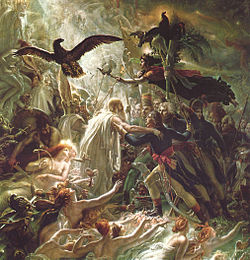
[edit]Girodet was trained in the neoclassical style of his teacher, Jacques-Louis David, seen in his treatment of the male nude body and his reference to models from the Renaissance and Classical antiquity. However, he also deviated from this style in several ways. The peculiarities which mark Girodet's position as the herald of the romantic movement are already evident in his Sleep of Endymion (1791, also called Effet de lune or "effect of the Moon").[4] Although the subject matter and pose are inspired by classical precedents, Girodet's diffuse lighting is more theatrical and atmospheric. The androgynous depiction of the sleeping shepherd Endymion is also noteworthy.[8] These early romantic effects were even more notable in his Ossian, exhibited in 1802. Girodet portrayed recently killed Napoleonic soldiers being welcomed into Valhalla by the fictional bard Ossian. The painting is striking for its inclusion of phosphorescent meteors, vaporous luminosity, and spectral protagonists.[9]
The same coupling of classic and romantic elements marks Girodet's Danae (1799) and his Quatre Saisons, executed for the king of Spain (repeated for Compiègne), and shows itself to a ludicrous extent in his Fingal (Leuchtenberg collection, St. Petersburg), executed for Napoleon in 1802. Girodet can be seen here combining aspects of his classical training and traditional education with new literary trends, popular scientific spectacles, and a consummate interest in the strange and the bizarre. In this way his work announces the rise of a romantic aesthetic which prizes individuality, expression, and imagination over an adherence to classical academic precedents.
Gallery
[edit]-
 Brutus condemns his sons to death (Brutus condamne ses fils à mort), 1785
 -
 The Oath of the Horatii (Le Serment des Horaces, copy after David's original), 1786, Toledo Museum of Art, Ohio
 -

-
 The Death of Tatius (La mort de Tatius), 1788, Musée des Beaux-Arts d'Angers
 -

-
 Portrait of a Youth (Portrait d'une jeunesse), c. 1795, Smith College Museum of Art, Northampton, Massachusetts
 -
 Portrait of Giuseppe Fravega (ministre of the Ligurian Republic in Paris), 1796, Musée des beaux-arts de Marseille
 -
 Benoît-Agnès Trioson regardant des figures dans un livre, 1797, Musée Girodet, Montargis
 -

-
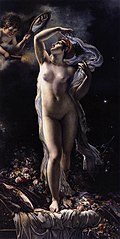 Mademoiselle Lange as Venus, 1798, Museum der bildenden Künste, Leipzig
 -
 Portrait of Mlle. Lange as Danae, 1799, Minneapolis Institute of Arts, Minnesota
 -

-
 Benoît-Agnes Trioson, 1800, Louvre, Paris
 -
-
 Napoleon Bonaparte, Premier Consul, Palais de l'Elysée
 -
 Portrait of Dominique-Jean Larrey (military surgeon in Napoleon's army), 1804, Louvre
 -
 Portrait of the Katchef Dahouth, Christian Mameluke, 1804, Art Institute of Chicago
 -

-
 Study for Portrait of an Indian, c. 1807, Metropolitan Museum of Art, New York
 -
 Madame Erneste Bioche de Misery, 1807, National Gallery of Canada, Ottawa
 -

-
![Portrait of Chateaubriand, 1809, Musée d'Histoire de la Ville et du Pays Malouin [fr], Saint-Malo](//upload.wikimedia.org/wikipedia/commons/thumb/c/cf/Anne-Louis_Girodet-Trioson_006.jpg/250px-Anne-Louis_Girodet-Trioson_006.jpg) Portrait of Chateaubriand, 1809, Musée d'Histoire de la Ville et du Pays Malouin, Saint-Malo
Portrait of Chateaubriand, 1809, Musée d'Histoire de la Ville et du Pays Malouin, Saint-Malo -
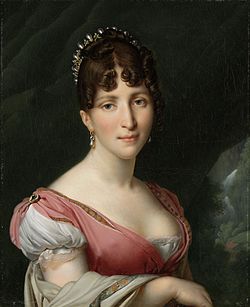 Portrait of Hortense de Beauharnais, Queen of Holland, wife of King Louis Napoleon, c. 1809, Rijksmuseum, Amsterdam
 -

-

-
 The Revolt of Cairo, 1810
 -
 Portrait of Charles-Louis Balzac, 1811, Dallas Museum of Art
 -
 Napoleon I in Coronation Robes (Napoléon en costume impérial), c. 1812, Bowes Museum, England
 -
 Portrait of Prosper de Barante, 1814, Musée d'art Roger-Quilliot, Clermont-Ferrand
 -
 Allegory of Victory, c. 1815, Château de Compiègne
 -
 Aurora, c. 1815, Château de Compiègne
 -
 Minerva between Apollo and Mercury, c. 1815, Château de Compiègne
 -
 Jacques Cathelineau, généralissime vendéen, 1816, Musée d'art et d'histoire de Cholet
 -
 Charles-Melchior Arthus, Marquis de Bonchamps, 1816, Musée d'art et d'histoire de Cholet
 -

-
 Head of a Woman in a Turban, c. 1820, Hermitage Museum, Saint Petersburg
 -
 Portrait de Madame Reizet assise, 1820
 -

-
 Portrait of Jacques-Joseph de Cathelineau (1787–1832), son of the généralissime
 -
 Capaneus, Leader of The Seven against Thebes (Tête du Blasphémateur), study for Les sept chefs devant Thèbes, Nationalmuseum, Stockholm
 -
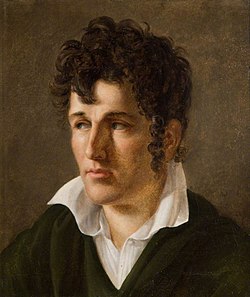 Undated portrait of François-René de Chateaubriand
 -
 Portrait du Docteur Trioson donnant une leçon de géographie à son fils, undated, Musée Girodet, Montargis
 -
 Portrait of Joachim Murat (?), Hermitage Museum


.jpg)


![Portrait of Chateaubriand, 1809, Musée d'Histoire de la Ville et du Pays Malouin [fr], Saint-Malo](https://en.wikipedia.org/wiki/File:Anne-Louis_Girodet-Trioson_006.jpg)

.jpg)
.jpg)

.jpg)
.jpg)


_MET_DP135222.jpg)


See also
[edit]References
[edit]- ^ a b c d e f Long, George. (1851) The Supplement to the Penny Cyclopædia of the Society for the Diffusion of Useful Knowledge, C. Knight.
- ^ a b Polet, Jean-Claude. (1992) Patrimoine littéraire européen, De Boeck Université. 730 pages. ISBN 2-8041-1526-7.
- ^ Heck, Johann Georg. (1860) Iconographic Encyclopaedia of Science, D. Appleton and company.
- ^ a b c d One or more of the preceding sentences incorporates text from a publication now in the public domain: Chisholm, Hugh, ed. (1911). "Girodet de Roussy, Anne Louis". Encyclopædia Britannica. Vol. 12 (11th ed.). Cambridge University Press. p. 48.
- ^ Anne Louis Girodet-Trioson in the RKD
- ^ "Girodet: Romantic Rebel". Art Institute of Chicago. Archived from the original on 23 July 2006. Retrieved 2006-07-19.
- ^ "Girodet". The Metropolitan Museum of Art. Retrieved 2025-08-24.
- ^ Smalls, James (1996). "Making Trouble for Art History: The Queer Case of Girodet". Art Journal. 55 (4): 20–27. doi:10.2307/777650. JSTOR 777650.
- ^ O'Rourke, Stephanie (2018). "Girodet's Galvanized Bodies". Art History. 41 (5): 868–893. doi:10.1111/1467-8365.12401. hdl:10023/21061. S2CID 192721947.

Further reading
[edit]- French painting 1774-1830: the Age of Revolution. New York; Detroit: The Metropolitan Museum of Art; The Detroit Institute of Arts. 1975. (see index)
External links
[edit]
- Miscellaneous works (Art Renewal Center)
- Three portraits by Girodet (Insecula encyclopedia)
- Works of Girodet at http://www.the-athenaeum.org
| Countries | |||||||||||||||||||||||||
|---|---|---|---|---|---|---|---|---|---|---|---|---|---|---|---|---|---|---|---|---|---|---|---|---|---|
| Movements | |||||||||||||||||||||||||
| Themes | |||||||||||||||||||||||||
| Writers |
| ||||||||||||||||||||||||
| Musicians |
| ||||||||||||||||||||||||
| Philosophers | |||||||||||||||||||||||||
| Visual artists |
| ||||||||||||||||||||||||
| Scholars | |||||||||||||||||||||||||
| Related topics |
| ||||||||||||||||||||||||


Anne-Louis Girodet de Roussy-Trioson
View on GrokipediaAnne-Louis Girodet de Roussy-Trioson (1767–1824) was a French painter whose career bridged Neoclassicism and the emerging Romantic movement, characterized by history paintings and portraits that incorporated dramatic lighting, emotional depth, and subtle eroticism.[1][2] Born in Montargis to parents who died during his youth, he was raised by a guardian who later adopted him in 1806, prompting the addition of "Trioson" to his name; this individual, Benoît-François Trioson, was likely his biological father and provided financial support that enabled his artistic pursuits.[3][4] Girodet entered the studio of Jacques-Louis David in 1784, quickly distinguishing himself as a talented pupil, and won the Prix de Rome in 1789, which funded five years of study in Italy where he developed his distinctive style influenced by classical antiquity yet infused with personal innovation.[1][5][6] His submission for the 1793 Salon, The Sleep of Endymion, marked his debut with a work blending David's rigor with sensual, dreamlike qualities that foreshadowed Romanticism.[2] Among his most significant achievements were large-scale commissions like Ossian Receiving the Ghosts of the French Heroes (c. 1801), painted for Napoleon's residence at Malmaison, and The Entombment of Atala (1808), which drew from Chateaubriand's novel and achieved widespread acclaim for its poignant depiction of grief and faith.[2][7] Girodet also excelled in portraiture, capturing notable figures of the Revolutionary and Napoleonic eras with psychological insight, though his later years shifted toward literary pursuits after inheriting wealth, reducing his output of major canvases.[1][8]
Early Life and Education
Birth and Family Circumstances
Anne-Louis Girodet de Roussy was born in 1767 in Montargis, a town in the Loiret department south of Paris.[1] His parents died during his early adulthood, leaving him orphaned; specific details on their identities and exact dates of death remain sparsely documented in primary records.[9] The management of Girodet's inheritance and his education fell to Benoît-François Trioson, a prominent local physician specializing in women's health, known as "médecin-de-mesdames." Trioson acted as his guardian from a young age and formally adopted him in 1806, prompting Girodet to append "Trioson" to his surname in honor of his benefactor. Some accounts suggest Trioson may have been Girodet's biological father, given the close familial ties and the physician's longstanding role in his upbringing.[3][10] This adoption solidified Trioson's influence, providing Girodet with stability amid personal losses and enabling his pursuit of artistic training.[3]Initial Training and Entry into David's Studio
Girodet began his formal artistic studies in 1783 at the Académie Royale in Paris under the architect Étienne-Louis Boullée, who recognized his talent and persuaded him to pursue painting rather than architecture.[11] Following the death of his guardian or adoptive father in 1784, Girodet, then aged 17, entered the studio of the leading Neoclassical painter Jacques-Louis David in late 1784.[1] [11] This transition marked his immersion into the rigorous apprenticeship system of the French art world, where students lived and worked in the master's atelier. In David's studio, Girodet underwent intensive training emphasizing the fundamentals of drawing, perspective, human anatomy, and the emulation of ancient Greek and Roman models central to Neoclassicism.[7] As one of David's most promising pupils among a competitive group, he assisted in major commissions and produced copies of his teacher's compositions to hone his skills, demonstrating rapid progress.[12] [11] This period laid the foundation for his later achievements, including his successful bid for the Prix de Rome in 1789 after initial attempts.[3]Prix de Rome Victory and Residence in Italy
In 1789, at the age of 22, Girodet secured the Prix de Rome on his third attempt with his history painting Joseph Recognized by His Brothers, illustrating the biblical narrative from Genesis 45 where Joseph reveals his identity to his siblings in Egypt.[12][13][14] The competition, organized by the Académie Royale de Peinture et de Sculpture, required competitors to produce a prescribed subject within a set timeframe, with the winner receiving a pension and residency at the French Academy in Rome for advanced study of antiquity and Renaissance masters.[13] The French Revolution's onset, marked by the storming of the Bastille on July 14, 1789, postponed Girodet's departure; he reached Rome in 1790.[13][14] His stay extended beyond the standard five years due to political instability, lasting until 1795.[14][3] In Rome, Girodet immersed himself in copying antique sculptures and studying works by artists such as Correggio and Leonardo da Vinci, gradually departing from the rigid neoclassicism of his teacher Jacques-Louis David toward a more sensual and atmospheric style.[1][10] Key productions included The Sleep of Endymion (1791–1793), sent to the 1793 Paris Salon, which featured soft lighting and erotic undertones inspired by Italian precedents.[1][14] He also executed Hippocrates Refusing the Gifts of Artaxerxes, reflecting his engagement with historical and moral themes during this period.[1] ![Girodet_-_Sommeil_Endymion.jpg][center] Rising anti-French sentiment culminated in a January 1793 attack on the French Academy in Rome by revolutionaries, prompting Girodet to flee southward to Naples, then travel through Venice and Genoa.[3] These itinerant experiences enriched his exposure to diverse Italian landscapes and art, including views of Mount Vesuvius, before his return to Paris in 1795 amid the Directory's stabilization.[3][13]Professional Career
Revolutionary Period and Early Independent Works
Following the upheavals of the French Revolution, which compelled French artists to evacuate Rome amid rising anti-French hostility, Girodet departed the Villa Medici in 1793, traveling through Naples, Florence, and Genoa before returning to Paris in 1795.[3][10] Upon his arrival, he transitioned from his apprenticeship under Jacques-Louis David to independent practice, sustaining himself via portraiture and illustrative drawings for publishers such as Pierre Didot.[1][11] Girodet's early independent commissions included portraits that navigated the era's political and social currents. In 1796, he painted the Portrait of Giuseppe Fravega, a minister of the Ligurian Republic stationed in Paris, capturing the diplomatic figures emerging from revolutionary reorganizations in Italy.[12] The following year, 1797, saw the creation of his Portrait of Jean-Baptiste Belley, former enslaved African and deputy to the National Convention from Saint-Domingue between 1794 and 1797; the oil on canvas depicts Belley in contemplative pose beside a bust of Abbé Raynal, whose Histoire des deux Indes advocated against slavery and influenced revolutionary abolitionism.[12] Exhibited at the 1798 Salon, this work embodied Directory-period reflections on emancipation and racial equality, aligning with the 1794 abolition decree while underscoring persistent tensions in colonial representation.[15] Parallel to these, Girodet produced allegorical portraits that hinted at his evolving sensuality beyond strict neoclassicism. In 1798, he depicted actress Anne Françoise Hippolyte Boulanger de Lange as Venus, in a full-length oil on canvas emphasizing mythological idealization amid the post-Thermidorean cultural thaw.[16] Disputed payment from the sitter prompted a satirical sequel, Portrait of Mlle. Lange as Danaë in 1799, where golden coins cascade upon the reclining figure, critiquing vanity through erotic mythology.[17] These pieces marked Girodet's initial forays into personal patronage and thematic innovation, distinct from David's historical severity, while securing his Salon presence during the Revolution's tail end.[1]Napoleonic Commissions and Salons
In 1801, Girodet received a commission from Napoleon Bonaparte to decorate the Château de Malmaison with Ossian Receiving the Ghosts of the French Heroes, a canvas blending Ossianic mythology with depictions of French generals slain in the Revolutionary Wars, such as Leclerc and Hoche, to evoke national mourning and heroism.[18] The work, measuring approximately 1.92 by 1.82 meters, was completed as one of two panels intended for the palace, highlighting Girodet's ability to fuse neoclassical form with emerging romantic themes under imperial patronage.[7] Girodet executed several portraits tied to the Napoleonic regime, including Napoleon Bonaparte, Premier Consul for the Palais de l'Elysée, portraying the leader in formal attire to symbolize consular authority.[19] Following Napoleon's 1804 coronation, he painted a posthumous portrait of Charles Marie Bonaparte, the emperor's father, commissioned directly by Napoleon as part of efforts to legitimize the Bonaparte dynasty through familial iconography.[19] Additional commissions included Portrait of Dominique-Jean Larrey, the chief military surgeon, in 1804, and Portrait of the Katchef Dahouth, a Christian Mameluke, also from 1804, reflecting Girodet's involvement in commemorating figures from Napoleon's campaigns.[1] A major commission arose from Napoleon's 1798 Egyptian expedition: The Revolt of Cairo, depicting the uprising against French forces on October 21, 1798, with preparatory studies like a pastel of a French dragoon drawn from life.[20] In 1810, Girodet won a state-sponsored competition for this subject, surpassing Jacques-Louis David's entry, resulting in a monumental canvas that provided a detailed, if dramatized, account of the massacre ordered by Napoleon.[1] [21] Girodet's Salon participation during this era sustained his reputation, with Scene from the Deluge exhibited in 1806 and again in 1814, earning acclaim for its dramatic intensity and contributing to his acquisition by the Louvre in 1818 alongside other works.[22] He also showed Napoleon Receiving the Keys of Vienna in 1808, a history painting celebrating the 1805 Austerlitz campaign's aftermath, underscoring his alignment with imperial propaganda through public exhibitions. Despite tensions with David's dominant influence, these commissions and Salon entries—totaling regular submissions from 1800 onward—affirmed Girodet's position in the Napoleonic artistic hierarchy.[1]Later Commissions and Personal Challenges
In the post-Napoleonic era, Girodet secured a significant private commission in 1812 from the Milanese banker Giovanni-Battista Sommariva for Pygmalion and Galatea, a monumental oil painting (253 × 202 cm) depicting the sculptor Pygmalion adoring his statue as it animates to life, which he completed and exhibited at the 1819 Salon.[23] This work, blending neoclassical form with romantic emotional intensity, marked one of his final major efforts in mythological subject matter and reflected his sustained interest in themes of creation and animation influenced by contemporary scientific ideas.[24] During the Bourbon Restoration, Girodet received commissions aligned with the regime's emphasis on counter-revolutionary heroes, producing portraits in 1824 of Vendéan leaders Jacques Cathelineau, the "Saint of Anjou," and Charles de Bonchamps, both posthumous representations of figures from the 1793 Chouannerie uprising against the Republic.[25] To achieve fidelity in the Cathelineau portrait, he first painted a bust-length study of the general's son, Jacques-Joseph Cathelineau (1785–1832), incorporating historical details like the subject's features and attire.[25] These works, executed amid shifting artistic patronage from imperial to monarchical, demonstrated Girodet's adaptability while earning acclaim for their precision and evocative quality. Girodet faced personal trials in his later years, including the emotional toll of earlier losses such as the 1808 death of his friend and mentor Pierre Jean Georges Cabanis, to whom he dedicated a poem mourning the physician's influence on his scientific and artistic pursuits.[26] Health deterioration culminated in his death on December 9, 1824, in Paris at age 57, shortly after completing the Vendéan portraits; the precise cause remains undocumented in primary accounts, though his productivity until the end suggests a sudden decline.[27] The subsequent auction of his estate yielded substantial sums for his drawings, affirming his financial stability and artistic legacy despite the era's political upheavals.[10]Artistic Style and Influences
Neoclassical Training and Techniques
Anne-Louis Girodet de Roussy-Trioson entered the studio of Jacques-Louis David in 1784, shortly after the death of his adoptive father, the surgeon Benoît-Agnès Trioson, whose influence had already introduced him to anatomical studies.[1] David's atelier, a hub for Neoclassical training, imposed a disciplined regimen prioritizing drawing proficiency, with students dedicating extensive hours—often up to six daily—to sketching plaster casts of antique sculptures and live models to internalize precise proportions and muscular structure.[28] This method, revolutionary for its emphasis on empirical observation and moral rigor in representation, aimed to distill heroic ideals from classical antiquity, eschewing Rococo ornamentation in favor of unadorned form and ethical narrative.[11] Girodet's instruction extended to emulating David's compositions, as evidenced by his 1786 copy of The Oath of the Horatii, which replicated the master's linear clarity, geometric balance, and stark tonal contrasts to convey stoic resolve.[7] Techniques honed included meticulous contour definition to outline idealized anatomy, subtle modeling through graded shading rather than vibrant color, and compositional symmetry drawing from Roman historical reliefs, all to achieve a timeless gravity in figure grouping.[7] These practices, rooted in David's advocacy for studying ancient art and literature, equipped Girodet to compete for the Prix de Rome, which he secured in 1789 with Joseph Recognized by His Brothers, a work showcasing anatomical precision and dramatic yet restrained posing.[29] Complementing studio exercises, Girodet's early exposure to surgical dissection via Trioson enhanced his command of internal anatomy, enabling lifelike yet idealized musculature in male nudes—a hallmark of Neoclassical virility—while avoiding the sensual excesses critiqued in pre-Revolutionary art.[26] David's interdisciplinary approach, integrating engravers and sculptors, further refined Girodet's versatility in preparatory sketches and multi-figure arrangements, techniques he applied in early independent efforts like Coriolanus Taking Leave of His Family (1786), where volumetric forms and ethical tension underscore Neoclassical priorities of form over fleeting emotion.[11]