Hubbry Logo
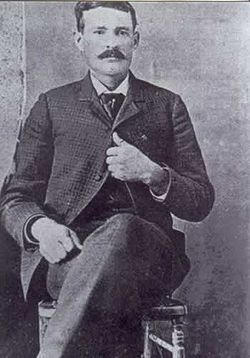
Tom KetchumTom KetchumMain
Open search
Tom Ketchum
Community hub
Tom Ketchum
logo
8 pages, 0 posts
0 subscribers
Be the first to start a discussion here.
Tom Ketchum
Tom Ketchum
from Wikipedia

Thomas Edward Ketchum (known as Black Jack; October 31, 1863 – April 26, 1901) was an American cowboy who later became an outlaw. He was executed in 1901 for attempted train robbery. The execution by hanging was botched; he was decapitated because the executioner used a rope that was too long.

Key Information

First train robberies and murders

[edit]

Tom Ketchum was born in San Saba County, Texas. He left Texas in 1890, possibly after committing a crime. He worked as a cowboy in the Pecos River Valley of New Mexico, where by 1894, his older brother, Sam Ketchum, had joined him.[1] Black Jack and a group of others were named as the robbers of an Atchison, Topeka and Santa Fe Railway train that was en route to Deming, New Mexico Territory, in 1892 with a large payroll aboard.

The gang supposedly robbed the train just outside Nutt, New Mexico Territory, a water station twenty miles (32 km) north of Deming. Black Jack and his gang would often visit the ranch of Herb Bassett, near Brown's Park, Colorado, who was known to have done business with several outlaws of the day, having supplied them with beef and fresh horses. Herb Bassett was the father of female outlaws Josie Bassett and Ann Bassett, who were girlfriends to several members of Butch Cassidy's Wild Bunch gang. One of Ann Bassett's boyfriends and future Wild Bunch gang member, Ben Kilpatrick, began riding with Black Jack's gang about that time. Outlaw "Bronco Bill" Walters, later noted for the legend of his "hidden loot" near Solomonville, Arizona, is also believed to have begun riding with the gang at this time.

The second major crime attributed to Tom was the murder of a neighbor, John N. "Jap" Powers, in Tom Green County, Texas, on December 12, 1895. However, information at the Sutton Historical Society in Texas, says that Will Carver and Sam Ketchum were the ones actually accused of killing Powers in Knickerbocker. Fearing the law, they closed their joint saloon and gambling venture in San Angelo, and hit the outlaw trail. Within six months, Mrs. Powers and her lover, J. E. Wright, were arrested for the murder, but it was too late for Carver and the Ketchums.

By late 1895, outlaw Harvey "Kid Curry" Logan and his brother Lonnie Curry were members of Black Jack's gang. However, in early 1896, a dispute concerning their share of robbery loot prompted the Currys to leave the gang.

It is alleged that Ketchum was involved with the February 1, 1896, disappearance and presumed murders of Albert Jennings Fountain and his son Henry Fountain of Las Cruces, New Mexico. In early June 1896, after working for the famed Bell Ranch in New Mexico, Tom and Sam Ketchum, and possibly others, robbed a combined store and post office at Liberty, New Mexico, northwest of present-day Tucumcari. According to contemporary accounts, the Ketchums rode into Liberty on June 12 and purchased supplies. That evening, a thunderstorm began, and they returned to the store, owned by Morris and Levi Herzstein, who invited them to take shelter.

Returning the next morning to open his store, Levi Herzstein found that both the store and post office had been burglarized. After gathering a posse, Herzstein set out on the outlaws' trail. The posse, composed of just four men, took the two outlaws by surprise in the Plaza Largo arroyo, where a shootout immediately began. Seconds later both Levi Herzstein and Hermenejildo Gallegos lay dead. Seeing his comrades fall, Anastacio Borgue turned his horse and rode out of the arroyo. Placido Gurulé, the fourth member of the posse, also survived to give an account. Gurulé said he had been struck by a .30-30 bullet that knocked him off his horse. He landed on the ground with a blow that knocked the wind out of him. He lay in a semiconscious state as Black Jack Ketchum emptied his rifle into the bodies of Levi Herzstein and Hermenejildo Gallegos. Tom and Sam Ketchum were never tried for the killings at the Plaza Largo arroyo, but Morris Herzstein reportedly was present to witness the hanging of Black Jack Ketchum in 1901.

Morris Herzstein moved to Clayton shortly after the killing in Liberty, and finally into the Texas Panhandle area. This is memorialized by the inscription on a shoe brush: "Herzstein's Clayton, New Mexico — Dalhart, Texas. If it's from Herzstein's it's correct." Morris was the father of Albert Herzstein, who became one of the founders of Big 3 Industries in Houston, and is the man who helped the museum in Clayton to become a reality years later.

Joining the Hole-In-The-Wall gang

[edit]

Following this event, Thomas Ketchum joined other outlaws of the Hole in the Wall Gang and continued a life of crime, focusing on train robberies, although when not robbing trains they worked for several ranches in New Mexico and Texas. Several other notable outlaws operated out of Hole In The Wall, which was a hideout for numerous outlaw gangs which operated separately. The famous Wild Bunch gang, led by Butch Cassidy and Elzy Lay, operated out of there. One Wild Bunch gang member, Kid Curry, along with his brother Lonny Curry, had previously ridden with Black Jack Ketchum and his gang. He and Ketchum did not like each other, and Ketchum avoided Curry as much as possible. Kid Curry would kill nine lawmen over the course of the next eight years.

During this time, Tom Ketchum was once identified mistakenly as "Black Jack" Christian, another outlaw, and that became his nickname as well. Three of the train robberies that the gang committed were near the same location, between Folsom and Des Moines, New Mexico Territory. This was at the point where the old Fort Union wagon road crossed the Colorado and Southern Rail Road tracks near Twin Mountain.

On September 3, 1897, they committed their first robbery at Twin Mountain. Then, on July 11, 1899, the gang, without Black Jack, robbed the train again at Twin Mountain. After the robbery, Sam and several unknown gang members, in addition to Wild Bunch gang members Will Carver and William Ellsworth "Elzy" Lay, headed for the mountains southwest of Raton, New Mexico Territory. The next day, a posse consisting of Sheriff Ed Farr of Huerfano County, Colorado, Special Agent W.H. Reno of the Colorado & Southern Railroad, and five deputies found their trail and tracked them into Turkey Creek Canyon near Cimarron, New Mexico. There, the posse engaged them in a gun battle. Sam Ketchum and two deputies were wounded seriously, and the gang escaped.[2]

Sam Ketchum's wounds slowed the intended escape, and they made it only a short distance from the initial shootout. Several members of the posse cornered the Ketchum gang a few days later, still in the same area of the Territory. Deputy W. H. Love[3] and Sheriff Ed Farr[4] engaged the outlaws in another gun battle, resulting in both Love and Farr being killed, while the posse wounded at least two unknown members of the gang. Sam Ketchum escaped, but was found a few days later by Special Agent Reno at the home of a rancher, where he was arrested.

Sam Ketchum was taken to the Santa Fe Territorial Prison, where he died from his gunshot wounds. He was buried in the Odd Fellows rest Cemetery, now the Fairview Cemetery on Cerrillos Rd. in Santa Fe.

"Elzy" or "Elza" (William Ellsworth) Lay was born November 25, 1868, Mount Pleasant, Ohio. Lay had come out west to Denver, and became an outlaw after mistakenly believing he had killed a man. Jailed for life after the killing of Sheriff Farr after the Folsom robbery, he was released in 1906. He returned to Alma, New Mexico Territory and lived there for two years. He stayed with Louis and Walter Jones, who in 1904 had built a large merchandise store at Alma. Elzy died aged 65 in Los Angeles, on November 10, 1934.

Capture and death

[edit]
Ketchum on the scaffold before hanging, April 26, 1901, Clayton, New Mexico
Sepia-tone photo from a contemporary postcard showing Tom Ketchum's decapitated body. Caption reads "Body of Black Jack after the hanging showing head snapped off."

On August 16, 1899, Tom Ketchum, supposedly knowing nothing of the July 11 hold-up which ended in the death of his brother Sam, single-handedly attempted to rob the same train again at the same place and in the same way that he and Sam and others had robbed it just a few weeks earlier. The train conductor, Frank Harrington, saw Tom approaching the moving train. He recognized him, grabbed a shotgun, and shot Tom in the arm, knocking him off his horse. The train continued, and the next day a posse came out and found Tom beside the tracks, badly wounded. He was transported to medical facilities at Trinidad, Colorado, and his right arm had to be amputated. He was nursed back to health and then sent to Clayton, New Mexico Territory, for trial.[citation needed]

At the trial, Ketchum was convicted of attempted train robbery and sentenced to death. He was the only person ever hanged in Union County, New Mexico Territory (now Union County, New Mexico). He was also the only person who suffered capital punishment for the offense of "felonious assault upon a railway train" in New Mexico Territory (which did not become a state until 1912). Later, the law was found to be unconstitutional.[citation needed]

Ketchum was executed by hanging in Clayton on April 26, 1901, but no one in the town had any experience with the procedure. The combination of too long a rope, Ketchum's significant weight gain while in jail, and the mass imbalance due to the amputation of his arm caused him to be decapitated when he fell through the trapdoor.[5] Ketchum's last words were "Good-bye. Please dig my grave very deep. All right; hurry up."[6]

An account of the event from Sheriff Salome Garcia detailed the scene:[7]

He walked firmly up the steps, saying as he went up, "Dig my grave deep, boys." Stepping upon the trap door he asked for the black cap, and it was placed over his head but [it] had to be removed to permit the rope to be placed on his neck, and while they delayed somewhat he became impatient and said, "Let her go boys." ... The sheriff cut the trigger rope with a hatchet, and his body shot down with all its 215 pounds [98 kg] of weight. Everyone within or without the stockade held their breath, and their hearts gave a great bound of horror when it was seen that his head had been severed from his body by the fall. His body alighted squarely upon its feet, stood for a moment, swayed and fell and then great streams of red, red blood spurted from his severed neck, as if to shame the very ground upon which it poured. The head rolled aside and the rope, released, bounded high and fell with a thud upon the scaffold from whence it came.

A popular postcard was made showing the body. Afterwards his head was sewn back onto the body for viewing, and he was interred at the Clayton Cemetery.

Media portrayals

[edit]

Western actor Jack Elam portrayed Ketchum in an episode of the 1954–55 syndicated television series Stories of the Century.[8]

Howard Duff played Ketchum in the 1957 American Western film Blackjack Ketchum, Desperado.

Rhodes Reason played Ketchum in a 1959 episode of the American Western television series Frontier Doctor.

Martin Kove played Ketchum in the 1994 TV movie "The Gambler V: Playing for Keeps".

See also

[edit]

References

[edit]
[edit]
Revisions and contributorsEdit on WikipediaRead on Wikipedia
from Grokipedia
Thomas Edward "Black Jack" Ketchum (October 31, 1863 – April 26, 1901) was an American turned , notorious for leading a gang that conducted multiple train robberies across and in the . Born in , as the youngest son of Green Berry and Temperance Katherine Ketchum, he grew up on a farm after his father's death when he was five and his mother's when he was ten, prompting him to work as a ranch hand in and . Ketchum's criminal career began around 1894 alongside his brother Samuel W. "Sam" Ketchum, escalating to high-profile heists such as the September 3, 1897, robbery of a Southern Railway train near Folsom, , where the gang netted several thousand dollars. The Ketchum Gang, which included associates like Will Carver, David Atkins, and others, targeted railroads amid the declining frontier, often clashing with in violent encounters, including the shooting of a postal clerk during an 1899 attempt. On August 16, 1899, Ketchum attempted a solo robbery of a Southern Railway train near Folsom, wounding a pursuer before being shot and captured the following day by a posse. Tried in , Ketchum was convicted of felony assault upon a railway train and sentenced to death on September 10, 1900; his execution by on April 26, 1901, became infamous when the drop—calculated at five feet nine inches—severed his head due to a misjudged rope length, marking one of the most gruesome public hangings in American history. His decapitated body was briefly displayed before burial in Clayton Cemetery, with the head sewn back on, solidifying Ketchum's legacy as a symbol of the violent end of the Wild West era.

Early Life

Birth and Family Background

Thomas Edward Ketchum, known later as "Black Jack," was born on October 31, 1863, in , to Green Berry Ketchum Sr. and Temperance Katherine Wydick Ketchum. He was the youngest of eight children in a farming family, with older siblings including brothers W. "Sam" Ketchum (born January 4, 1854), Green Berry Ketchum Jr. (born 1850), Ketchum (born circa 1860), and Nancy B. Ketchum (born circa 1860), as well as sisters Elizabeth (born 1848), and Louisa (born 1858); the two eldest brothers, James and Joseph, died young. The Ketchum family resided on a modest near the edge of the , where Green Berry Sr. worked as a farmer and stock raiser amid the challenges of post-Civil War reconstruction and frequent threats from Native American raids. Ketchum's early life was marked by profound loss and instability. His father died in 1868 at age 48, when Thomas was just five years old, leaving the family in financial straits on their isolated farm. Temperance Ketchum, who had become blind in the years prior, struggled to support the children and passed away in 1873, when Thomas was nine, rendering him an at a young age. With no immediate family able to fully care for all the siblings, the younger Ketchums, including Thomas and Sam, were dispersed among relatives; Thomas was primarily raised by his older brothers. This fragmented upbringing fostered a close bond between the brothers Thomas and Sam, though it was strained by shared resentments over their hardships, contributing to Thomas's early rebellious streak and aversion to authority. Formal education for Ketchum was minimal, limited to basic reading, writing, and arithmetic at a local one-room schoolhouse, as the demands of farm labor and family survival took precedence. By his early teens, following the ongoing struggles on the , he transitioned to working as a ranch hand, marking the end of his childhood and the beginning of his life in the .

Relocation to New Mexico and Cowboy Years

In 1890, at the age of 26 (turning 27 that year), Tom Ketchum departed from and relocated to the Pecos Valley in the , likely seeking ranching work amid the region's expanding cattle industry or possibly evading minor troubles in his home state. The family's ongoing poverty following his father's death in 1868 had left young Tom with limited prospects in , pushing him toward the frontier opportunities in the Southwest. Upon settling in the Pecos Valley, Ketchum secured employment as a for various outfits, including line-riding duties that demanded endurance and horsemanship in the vast, arid landscapes. He quickly gained a reputation as a capable and skilled hand, particularly noted for his exceptional marksmanship, which set him apart among fellow ranch workers. By the mid-1890s, after his brother Sam joined him in 1894, the siblings worked together at prominent operations such as the Bell Ranch near Tucumcari, where they handled demanding tasks like roundup and fence maintenance. The late 1880s in marked a turbulent period for open-range ranching, as explosive growth in herds—from approximately 158,000 in 1870 to over 1 million by 1886—led to severe that degraded pastures and heightened vulnerability to environmental stresses. This overstocking culminated in the devastating "Great Die-Up" winter of 1886–1887, when blizzards and extreme cold caused massive livestock losses, triggering an economic downturn that squeezed wages and destabilized the labor force. Ketchum's transient existence, moving between seasonal jobs and remote camps, exposed him to the hardships of low pay, isolation, and the rough camaraderie of itinerant workers in saloons and cow towns, fostering connections that later influenced his drift toward illicit activities.

Descent into Outlawry

Initial Crimes and the Liberty Murder

By the mid-1890s, economic pressures and the decline of open-range ranching in the American Southwest had diminished opportunities for like Tom and Sam Ketchum, leading them to petty and cattle rustling as means of survival. Their earlier associations with rough characters on ranches provided the initial contacts that eased their entry into minor criminal activities. On June 11, 1896, the brothers escalated their criminal endeavors by robbing the general store and owned by Levi and Morris Herzstein in , (now part of Folsom). Masked and armed, they burst into the establishment late at night, demanding cash and stamps from the post office safe while rifling through merchandise; the haul included roughly $100 in goods and currency. During the holdup, a confrontation ensued, leaving Morris Herzstein wounded in the arm but alive, as he managed to fire back at the intruders before they fled on horseback into the night. The robbery quickly turned deadly when Levi Herzstein, alerted to the crime, rallied a small posse including local hand Hermenegildo Gallegos and pursued the Ketchums for about 30 miles southwest of . In a fierce gun battle near Plaza Largo Arroyo, the Ketchums ambushed their pursuers, killing Levi Herzstein and Gallegos while the third member fled; the brothers then escaped eastward toward . This murder transformed the Ketchums from obscure rustlers into wanted killers, igniting widespread posses across and cementing their notoriety in the eyes of lawmen and newspapers as violent outlaws beyond redemption.

Formation of the Ketchum Gang

In the mid-1890s, prior to the Liberty incident, Tom Ketchum began assembling a loose network of outlaws in New Mexico's Pecos Valley. He joined forces with his older brother Sam Ketchum, along with longtime associates David Atkins and Will Carver, and later Benjamin Kilpatrick, drawing from a circle of former and ranch hands familiar with the Southwest terrain. This recruitment transformed isolated criminal acts into organized operations, with the group coalescing around the Ketchum brothers' leadership by 1894. The gang established operations in remote, rugged areas of and , leveraging isolated hideouts to evade while planning activities. Although occasional loose ties existed with broader outlaw networks, the Ketchum Gang remained primarily independent, countering common misconceptions of formal affiliation with groups like the based in . Under the brothers' direction, the structure emphasized fluidity and mobility, enabling quick assembly for jobs and rapid dispersal afterward through suited to the vast landscapes. Tom earned the moniker "Black Jack" during this period, likely through mistaken identity with another outlaw, Will "Black Jack" Christian, whose reputation he inadvertently inherited as lawmen and newspapers conflated the two. The gang's motivations stemmed from the economic desperation gripping the region in the , exacerbated by the silver market crash following the , which devastated mining communities and ranching economies, while expanding railroads presented tempting targets for quick gains amid widespread hardship.

Train Robbery Career

1897 Robberies in New Mexico

The Ketchum Gang initiated its train robbery operations in with the holdup of the and Southern Flyer on September 3, 1897, at Twin Mountains station between Folsom and Des Moines. Led by brothers Tom and Sam Ketchum, along with associates Will Carver and Dave Atkins, the outlaws flagged down the passenger train after dark in this remote area, boarded the with rifles drawn, and compelled the engineer to halt. They then focused on the express car, overpowering the messenger and using threats to access the safe, from which they extracted currency and other valuables estimated at $2,000 to $3,000, along with miscellaneous items such as silverware. Some historical accounts dispute these figures, suggesting a far larger take exceeding $100,000 in cash, though contemporary records support the lower amount. In late December 1897, the gang attempted another heist at Stein's Pass on the Southern Pacific Railroad near the New Mexico-Arizona border. The expanded group, including Tom and Sam Ketchum, Carver, Dave Atkins, Ed Cullen, and "Broncho Bill" , cut the telegraph wires to isolate the site and ignited bonfires on the tracks to signal the oncoming train to stop. However, the express car was guarded by armed agents who opened fire upon the robbers' approach, sparking a fierce exchange of gunfire lasting nearly 30 minutes. During the , gang member Ed Cullen was fatally wounded, and the outlaws were unable to breach the train cars; they settled for looting the nearby and railroad station of a mere $12.25 and a before fleeing into the night. These early efforts exemplified the gang's standard tactics: selecting isolated nighttime locations for ambushes, using red lanterns or fires to mimic emergency signals and halt trains, boarding swiftly with and revolvers to subdue crews and passengers, and prioritizing the express safes for their concentrated payloads of and . Overall hauls from the 1897 operations were modest and unevenly divided among participants, with successful shares going primarily to the Ketchum brothers and key accomplices after deducting expenses for horses, supplies, and hideouts.

Escalation and the Folsom Ambush

Following the profitable train robberies of 1897 in , which built the gang's confidence for riskier targets, the Ketchum outfit escalated its operations in 1898 amid growing law enforcement scrutiny across the Southwest borderlands. In July 1898, the gang targeted a Southern Pacific train near Stanton, , securing only a minimal haul of cash and goods from the express car, which prompted swift posse mobilization and heightened pressure on their movements into . The gang's ambitions peaked with the ambush of a Colorado Southern Railway train near Folsom, New Mexico, on July 11, 1899, led by Sam Ketchum, Will Carver, and Elzy Lay while Tom remained absent. The robbers halted the train at Twin Mountains, dynamited the express safe, and looted approximately $50,000 in cash from passengers and the messenger, a stark contrast to earlier windfalls. Although no crew member was killed during the holdup itself, the gang fired warning shots to subdue the train staff, escalating the operation's violence and marking a shift toward more desperate tactics. The meager take failed to offset the risks, as a pursuing posse engaged the fleeing robbers in a shootout near Cimarron, resulting in the death of Sheriff Edward J. Farr and wounds to Sam Ketchum and another gang member. The Folsom incident's bloodshed drew intense federal scrutiny, as fell under U.S. jurisdiction, prompting the involvement of Pinkerton National Detective Agency operatives in tracking the outlaws across states. This attention, combined with the robbery's poor yield, accelerated the gang's dispersal, with members scattering to evade capture. Internal strains had already mounted from the string of low-reward jobs and rising casualties, with Tom Ketchum advocating for even bolder strikes to recoup losses, further fracturing group cohesion and hastening the outfit's collapse.

Sam's Arrest and Death

On July 11, 1899, Sam Ketchum and several associates, including Will Carver and Elzy Lay, robbed a and Southern Railroad train near Folsom, , without his brother Tom present due to prior disagreements within the gang. A posse, tipped off by local sightings and an informant, tracked the robbers to their hideout in Turkey Creek Canyon west of Cimarron on July 16, 1899, leading to a fierce . During the exchange of gunfire, Sam Ketchum was severely wounded in the left arm below the shoulder, the bone shattered by a bullet, while Sheriff Edward J. Farr of , was killed and Deputy Henry Love mortally wounded. Unable to ride further due to his injury, Ketchum was abandoned by his companions at a nearby house near Ute Creek and captured shortly thereafter by members of the posse without further resistance. He was promptly transferred to the Territorial Penitentiary in Santa Fe for holding. There, Ketchum faced charges related to the Folsom train robbery and the murder of Sheriff Farr during the Turkey Creek ambush, but he died before trial. However, Ketchum's condition deteriorated rapidly in custody, as set in from his untreated arm wound—exacerbated by inadequate medical attention in the —causing excruciating and systemic . He died in agony on July 24, 1899, just eight days after his capture. News of Sam's death reached Tom Ketchum after his own failed solo attempt on August 16, 1899; unaware at the time of the attempt due to his isolation, Tom was filled with profound grief and rage upon learning of it, further isolating him. This loss effectively shattered the remnants of the Ketchum Gang, leaving Tom to operate without his brother's support or counsel.

Tom's Solo Attempt and Capture

Following the death of his brother Sam on July 24, 1899, from complications of wounds received during a botched the previous month, Tom Ketchum acted alone in a desperate bid to secure funds by targeting a familiar route, unaware of Sam's fate at the time. On August 16, 1899, he rode up on horseback to the & Southern Railway's No. 9 as it left Folsom, , and boarded the tender car behind the engine, intending to compel the crew to halt at a remote spot near Twin Mountains for looting the express car. As Ketchum moved toward the express car, conductor Frank Harrington—familiar with the outlaw from prior gang holdups on the same line—spotted him from the platform and armed himself with a . Harrington fired a single blast at close range, striking Ketchum's raised right arm and nearly severing it, the buckshot causing massive tissue damage that left the limb hanging by shreds. The severely wounded Ketchum leaped from the accelerating train, mounted his horse, and fled southward into rough terrain without securing any valuables, collapsing several miles away from blood loss and pain. A hastily assembled posse led by Union County Sheriff Saturnino Pinard pursued Ketchum through the night, tracking blood trails and his staggering horse. The following morning, , 1899, they located him at a remote water near the railroad tracks south of Folsom, where he lay delirious, feverish, and unable to resist arrest; Pinard and his men provided basic by bandaging the mangled arm to staunch the bleeding. Ketchum was then transported by wagon to , for emergency surgery, where physicians amputated the ruined limb above the elbow to prevent . Afterward, under heavy guard, he was conveyed by to the more secure jail in , arriving in critical but stable condition to await legal proceedings.

Trial and Sentencing

Following his capture on August 17, 1899, near Folsom, , Tom Ketchum was initially treated for his severe in , where his right arm was amputated above the elbow due to infection and irreparable damage. He was then transferred to the territorial prison in Santa Fe for security reasons before being extradited to Union County for proceedings related to the attempted . Ketchum's trial began on September 6, 1900, in , before J. Mills of the Fourth Judicial District. He was arraigned and charged with felonious assault upon a railroad train with intent to commit , a capital under Section 1151 of the Compiled Laws of (1897), stemming from his solo attempt to rob the Colorado and Southern Railway's Texas Express on August 16, 1899. Represented by defense attorneys B. Bunker and John R. Guyer, Ketchum entered a plea of not guilty. The prosecution presented from train personnel and posse members, along with linking Ketchum to the crime, which the found incriminating after brief deliberation. The defense challenged the severity of the penalty as cruel and unusual under the Eighth Amendment, arguing it was disproportionate for an attempted robbery where no fatalities occurred during the incident. On September 10, 1900, the convicted Ketchum on the felony charge. Sentencing occurred shortly thereafter on , 1900, with Mills imposing the mandatory death penalty by , initially set for , 1900, at the Union County courthouse in Clayton. Ketchum's attorneys filed appeals to the , which were denied; Justice Frank W. Parker ruled the punishment fitting for the offense, rejecting claims of excessiveness. Efforts for clemency, including a fraudulent telegram purporting to stay the execution, failed amid in Ketchum's physical debilitation and notoriety, though the charge's focus on rather than prior murders attributed to him sparked debate over . The execution was ultimately delayed by appeals until April 1901.

Execution and Aftermath

The Botched Hanging

On April 26, 1901, Thomas Edward "Black Jack" Ketchum, aged 37, was hanged in Clayton, Territory, before a estimated at 3,000 spectators. This execution marked him as the only individual in the territory put to death specifically for the crime of , a capital offense under New Mexico statutes at the time. The gallows, hastily constructed by inexperienced local officials, stood in a makeshift near the town square, with businesses closing to allow residents and visitors to attend the public spectacle. The procedure went disastrously wrong from the outset due to a critical miscalculation in the drop length. Executioners had tested the rope with a 200-pound but failed to account for Ketchum's greater mass of approximately 215 pounds or the added imbalance from his missing right arm, acquired during his capture. When the sprang open at around 1:15 p.m., the excessively long rope caused an excessive fall, severing Ketchum's head cleanly from his body upon impact with the ground below. His headless torso landed upright before collapsing and jerking violently for about a minute and a half, with death pronounced nearly 15 minutes later, horrifying onlookers and splattering blood on those nearest the platform. As he ascended the gallows steps, Ketchum delivered his final words with defiance, stating, "Good-bye. Please dig my very deep. All right; hurry up," while maintaining his innocence regarding any charges but acknowledging his role in robberies. Following the botched drop, a local physician reattached the head to the body using stitches to facilitate postmortem photographs, which were later circulated as postcards documenting the gruesome outcome. This rare instance of judicial in U.S. history— the only one by —drew widespread condemnation for its brutality, fueling contemporary debates and accelerating advocacy for more reliable and humane execution methods in .

Immediate Reactions and Burial

The botched execution of Tom Ketchum on April 26, 1901, which resulted in his decapitation due to an excessively long drop, provoked immediate horror among the approximately 150 witnesses inside the stockade enclosure in Clayton, New Mexico. A thrill of awful horror swept over the crowd as the head separated from the body and fell into the basket below, causing every face to turn pale as spectators turned away in shock. Newspapers sensationalized the gruesome outcome, with The New York Times likening the event to a guillotine execution rather than a traditional hanging, emphasizing the outlaw's notorious reputation and the Southwest's lawless era. The mishap prompted scrutiny of the procedure, with responsibility attributed to the inexperience of Union County Salome Garcia, who had no prior knowledge of mechanics and consulted inadequately on the gallows setup despite Ketchum's increased weight and physical imbalances from his lost arm. No formal official inquiry is recorded, but contemporary accounts highlighted the sheriff's lack of expertise as the primary cause, underscoring the improvised nature of in the . Following the execution, Ketchum's head was sewn back onto his body for viewing, after which the remains were placed in a plain white wooden coffin and transported to for burial without ceremony. The interment, funded by the state as per territorial custom for executed criminals, occurred in an on a hill north of town, reflecting the absence of any familial or public honors due to his status. The body remained undisturbed until 1933, when it was exhumed and relocated to the new cemetery section during municipal improvements.

Legacy

Historical Significance

Tom Ketchum's execution in 1901 epitomized the decline of , as he became the last individual hanged in for train robbery, a crime increasingly thwarted by bolstered railroad security measures such as armed guards and fortified express cars. This event unfolded during a transitional period for the territory, which achieved statehood in 1912 amid efforts to impose centralized law and order on the fading frontier. Ketchum's fate underscored the closing chapter of unchecked outlawry, as technological and institutional advancements curtailed the opportunities that had sustained gangs like his for over a decade. The economic hardships of the 1890s, exacerbated by the , played a pivotal role in Ketchum's trajectory from ranch hand to . The depression ravaged the cattle industry, collapsing markets and eliminating jobs for cowboys across the Southwest, compelling many—such as the Ketchum brothers, who had grown up working ranches—to resort to crime for livelihood. Ketchum's story illustrates the broader disillusionment of the era, where the promise of prosperity on the often devolved into desperation and lawlessness for displaced workers. Common misconceptions surround Ketchum's associations and identity within outlaw lore. He maintained only a loose affiliation with the , a Wyoming-based hideout used by various criminals, rather than being a dedicated core member as some accounts suggest. Similarly, his notorious "Black Jack" moniker originated from a case of with another , Will "Black Jack" Christian, though it endured due to Ketchum's prominent leadership in his own Southwestern gang. Ketchum's botched hanging, which decapitated him due to an improperly measured rope, glaringly revealed the barbarism and incompetence inherent in frontier justice.

Depictions in Media and Culture

Tom Ketchum, known as Black Jack, has been portrayed in early 20th-century Western literature and pulp magazines as a quintessential outlaw figure, often emphasizing the adventurous aspects of train robbery and frontier life amid the romanticized narratives of the closing Wild West. Contemporary accounts and fictionalized biographies following his 1901 execution contributed to this image, with stories appearing in periodicals that highlighted his gang's exploits without delving deeply into the violence. For instance, F. Stanley's 1958 biography No Tears for Black Jack Ketchum presented Ketchum's tale in the sensational style typical of dime novels, blending fact with embellished heroism. Later works, such as Jeff Burton's The Deadliest Outlaws: The Ketchum Gang and the Wild Bunch (2009), provide more historical detail on his criminal career while noting how popular media transformed him into a folk antihero. In film and television, Ketchum received direct portrayals that dramatized his conflicts with lawmen and cattle barons. The 1956 Western Blackjack Ketchum, Desperado, directed by Earl Bellamy and starring as Ketchum, depicts him as a weary gunslinger attempting to retire to ranch life but forced into violence by a ruthless landowner, capturing the moral ambiguity often ascribed to outlaws. Similarly, the 1954 episode "Black Jack Ketchum" from the Stories of the Century portrays him as a cunning leader of a cross-border evading capture, emphasizing high-stakes pursuits across the Southwest. His era's heists also inspired broader depictions, such as the robbery sequences in the 1969 film Butch Cassidy and the Sundance Kid, which drew on the tactics and notoriety of gangs like Ketchum's that overlapped with through associates like Will Carver. Modern media continues to explore Ketchum's legacy, particularly through true crime formats focusing on his botched execution, which has fueled sensational retellings. Podcasts such as Legends of the Old West (episode aired February 2023) recount his rise from cowboy to robber and the gruesome hanging details, framing it as a symbol of frontier justice's flaws. Likewise, The Wild West Extravaganza devoted an episode in January 2025 to his life, highlighting the gang's operations and the execution's macabre aftermath. A 2023 live episode of True Consequences - True Crime at Rio Bravo Brewing in Albuquerque specifically examined the hanging's mishandling as a case study in botched executions. In graphic novels, Brian Schirmer's Black Jack Ketchum (2016) reimagines him in a surreal Old West, grappling with mistaken identity and survival. Ketchum's story endures as a cultural symbol in , particularly in Clayton, where his execution occurred. In the early , the town hosted the Black Jack Ketchum Festival, featuring dances and events at the to celebrate its outlaw heritage, drawing visitors to the historic hanging site known locally as the "Last Hangin' Ground." The Herzstein Memorial Museum in Clayton includes dedicated exhibits on Ketchum, showcasing artifacts from the era and that contextualize his place in regional history. His narrative is incorporated into 's educational programs on territorial history, serving as an example of the violent transition from frontier lawlessness to statehood.

References

Add your contribution
Related Hubs
User Avatar
No comments yet.