


Community hub
Recent from talks
Contribute something
Nothing was collected or created yet.
Hohhot
View on Wikipedia
Key Information


.jpg)


.svg)


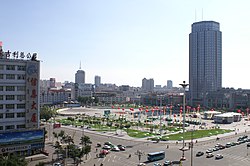
Hohhot,[a] formerly known as Kweisui,[b] is the capital and largest city of Inner Mongolia in the north of the People's Republic of China,[5][6] serving as the region's administrative, economic and cultural center.[7] Its population was 3,446,100 inhabitants as of the 2020 census, of whom 2,944,889 lived in the metropolitan area consisting of 4 urban districts (including Hohhot Economic and Development Zone) plus the Tumed Left Banner.[8]
The name of the city in Mongolian means "Blue City", although it is also wrongly referred to as the "Green City."[9] The color blue in Mongol culture is associated with the sky, eternity and purity. In Chinese, the name can be translated as Qīng Chéng (Chinese: 青城; lit. 'Blue/Green City')[10] The name has also been variously romanized as Kokotan, Kokutan, Kuku-hoton, Huhohaot'e, Huhehot, Huhhot, Huhot, or Köke qota.[6]
The city is a seat of the Inner Mongolia University, the largest regional comprehensive university and was the only 211 Project University in Inner Mongolia.
History
[edit]Early history
[edit]Yunzhong Commandery (Chinese: 雲中郡) was a historical commandery of China. Its territories were between the Great Wall and Yin Mountains, and correspond to part of modern-day Hohhot, Baotou and Ulanqab prefectures in Inner Mongolia. The central city of Yunzhong was in the suburbs of today's Hohhot.
The commandery was created during King Wuling of Zhao's reign after a successful campaign against the Linhu (林胡) and Loufan (樓煩) peoples.[11] After the establishment of Qin and Han dynasty, the commandery became the frontier between Han and the Xiongnu. In early Han dynasty, the region saw frequent Xiongnu raids. However, from Emperor Wu's reign onwards, it became an important base of military operations in the wars against the Xiongnu.[12] In 127 BC, it was from Yunzhong that General Wei Qing led a 40,000-men strong cavalry force and conquered the modern Hetao and Ordos regions.
In 2 AD, the commandery administered 11 counties, namely Yunzhong (雲中), Xianyang (咸陽), Taolin (陶林), Zhenling (楨陵), Duhe (犢和), Shaling (沙陵), Yuanyang (原陽), Shanan (沙南), Beiyu (北輿), Wuquan (武泉) and Yangshou (陽壽). The population totaled 38,303 households, or 173,270 people.[13] During Eastern Han, 3 counties were abolished, while 3 new counties were added from Dingxiang Commandery. In 140 AD, the population was 5,351 households, or a population of 26,430.[14] Toward the late Han dynasty, the area's population decreased sharply as residents fled from invading northern nomadic peoples, and the commandery was dissolved.[15]
The Tuoba chieftain Gui (called Tuoba Gui) was able to refound the Dai empire in 386, and later renamed his state to Wei. From his capital at Shengle (near modern Helingeer). His descendants would, step by step, conquer the north of China, divide the Later Yan realm into two parts, and subdue the Xia (407–431), the Later Qin (384–417) and the many Liang and Yan empires.[16]
Ming and Qing era
[edit]In 1557, the Tümed Mongol leader Altan Khan began building the Da Zhao Temple on the Tümed plain in order to convince the Ming dynasty (1368–1644) government of his leadership of the southern Mongol tribes.[17] The town that grew up around this temple was called the "Blue Town" (Kokegota in Mongolian). The Ming had been blockading the Mongols' access to Chinese iron, cotton, and crop seeds, in order to dissuade them from attacking the North China plain. In 1570, Altan Khan successfully negotiated the end of the blockade by establishing a vassal-tributary relationship with the Ming, who changed Kokegota's name to Guihua (traditional Chinese: 歸化; simplified Chinese: 归化; pinyin: Guīhuà; postal: Kweihua; lit. 'Return to Civilization') in 1575. The population of Guihua grew to over 150,000 in the early 1630s as local Mongol princes encouraged the settlement of Han Chinese merchants. There were occasional attacks on Guihua by Mongol armies, such as the total razing of the city by Ligdan Khan in 1631. Altan Khan and his successors constructed temples and fortresses in 1579, 1602 and 1727. The Tümed Mongols of the area had long since adopted a semiagricultural way of life. Hui merchants gathered north of the gate of the city's fortress, building a mosque in 1693.[18] Their descendants formed the nucleus of the modern Huimin district.
After the Manchus founded the Qing dynasty (1644–1912), the Kangxi Emperor (reigned 1661–1722) sent troops to control the region,[9] which was of interest to the Qing as a center of study of Tibetan Buddhism. Just 2 km northeast of Guihua the Qing built the strong garrison town of Suiyuan (traditional Chinese: 綏遠; simplified Chinese: 绥远; pinyin: PRC Standard Mandarin: Suíyuǎn, ROC Standard Mandarin: Suīyuǎn), from which they supervised the defense of southwestern Inner Mongolia against Mongol attacks from the north in 1735–39.[19]: 13 [20] Guihua and Suiyuan was merged into Shanxi province and became Guihua County (歸化縣; 归化县; Guīhuà Xiàn) of Qing China. French missionaries established a Catholic church in Guihua in 1874, but the Christians were forced to flee to Beijing during the antiforeign Boxer Rebellion of 1899–1901.
Republican era
[edit]In 1913, the government of the new Republic of China united the garrison town of Suiyuan and the old town of Guihua as Guisui (traditional Chinese: 歸綏; simplified Chinese: 归绥; pinyin: PRC Standard Mandarin: Guīsuí, ROC Standard Mandarin: Guīsuī; postal: Kweisui). Guisui town was the center of Guisui County (歸綏縣; 归绥县; PRC: Guīsuí Xiàn, ROC: Guīsuī Xiàn) and the capital of Suiyuan Province in northern China. A bubonic plague outbreak in 1917 and the connection of Guisui to railway links in Shanxi, Shaanxi, Hebei, and Beijing helped renew the economy of Guisui town by forming links with eastern China and western China's Xinjiang province.[19]: 15 In 1918, the American specialist on Inner Asia Owen Lattimore noted Guisui's ethnic composition as "a town purely Han Chinese except for the Lama monasteries ... the Tümeds are now practically nonexistent and the nearest Mongolians are to be sought at 50 or 60 miles [80 or 100 kilometres] distance on the plateau."[19]: 15 During the progressive Japanese invasion of China in the 1930s, the Japanese created the puppet state of Mengjiang headed by Prince De, who renamed Guisui "Blue City" Hohhot; (Chinese: 厚和市; pinyin: Hòuhé shì).[21] After the surrender of Japan in 1945, the Republic of China changed the name back to Guisui.[19]: 16 The Chinese Communist Party's forces drove out General Fu Zuoyi, the Republic's commander in Suiyuan, during the Chinese Civil War, and after the Chinese Communist Revolution in 1949, Guisui was renamed Hohhot.[19]: 16

People's Republic era
[edit]During the Civil War, seeking the support of separatist Mongols, the Communists established the Inner Mongolia Autonomous Region in Mongol-minority areas of the Republic's provinces of Suiyuan, Xing'an, Chahar, and Rehe. Guisui was chosen as the region's administrative centre in 1952, replacing Zhangjiakou. In 1954, after the establishment of the People's Republic of China, the city was renamed from Guisui to Hohhot, though with a different Chinese pronunciation of Huhehaote.[19]: 16
The city has seen significant development since China's reform and opening began. The city's far east side began development around 2000 and is now home to the municipal government, most of the Autonomous Region's administrative buildings,[22] an artificial lake called Ruyi He,[23] and a large number of condominiums, mostly built by the local real estate company Gold Horse International Inc. The Hohhot City Stadium, built on the city's north side, was finished in 2007.[24]
A city with a rich cultural background, Hohhot is known for its historical sites and temples and is one of the major tourist destinations of Inner Mongolia. It is also nationally known as the home of China's dairy giants Mengniu and Yili,[25][26] and was declared "Dairy Capital of China" by the China Dairy Industry Association and the Dairy Association of China in 2005.[27]

Geography
[edit]Located in the south central part of Inner Mongolia, Hohhot is encircled by the Daqing Shan (Chinese: 大青山; lit. 'Great blue Mountains') to the north and the Hetao Plateau to the south.[28]
The city's antipodal location is 22 kilometres (14 mi) from the village of Los Menucos in Río Negro Provence, Argentina.[29]
-
 Map including Hohhot (labeled as KUEI-SUI) (AMS, 1963)
 -
 Huhhot and vicinity, LandSat-5 satellite image, 2005-07-12


Climate
[edit]Hohhot features a cold semi-arid climate (Köppen BSk), marked by long, cold, and very dry winters; hot, somewhat humid summers; strong winds (especially in spring); and monsoonal influence. The coldest month is January, with a daily mean of −10.7 °C (12.7 °F), while July, the hottest month, averages 23.2 °C (73.8 °F). The annual mean temperature is 7.6 °C (45.7 °F), and the annual precipitation is 411 millimetres (16.2 in), with more than half of it falling in July and August alone. Variability can be very high, however: in 1965 Hohhot recorded as little as 155.1 mm (6.11 in) but six years before that, as much as 929.2 mm (36.58 in), of which over a third (338.6 mm (13.33 in)) only in July.[30]
Hohhot is a popular destination for tourists during the summer months because of the nearby Zhaohe grasslands. More recently, due to desertification, the city sees sandstorms on almost an annual basis. With monthly percent possible sunshine ranging from 54 percent in November to 66 percent in September, sunshine is abundant year-round, the city receives 2,680 hours of bright sunshine annually. Extreme temperatures have ranged from −32.8 °C (−27 °F) on 6 February 1951 to 38.9 °C (102 °F) on 30 July 2010, though unofficially a record low of −36.2 °C (−33 °F) was recorded in January 1930.[31][32]
| Climate data for Hohhot, elevation 1,154 m (3,786 ft), (1991–2020 normals, extremes 1951–present) | |||||||||||||
|---|---|---|---|---|---|---|---|---|---|---|---|---|---|
| Month | Jan | Feb | Mar | Apr | May | Jun | Jul | Aug | Sep | Oct | Nov | Dec | Year |
| Record high °C (°F) | 10.6 (51.1) |
17.0 (62.6) |
23.7 (74.7) |
33.4 (92.1) |
35.0 (95.0) |
36.7 (98.1) |
38.9 (102.0) |
36.8 (98.2) |
32.7 (90.9) |
26.5 (79.7) |
20.4 (68.7) |
11.6 (52.9) |
38.9 (102.0) |
| Mean daily maximum °C (°F) | −4.8 (23.4) |
0.8 (33.4) |
8.4 (47.1) |
17.1 (62.8) |
23.4 (74.1) |
27.8 (82.0) |
29.1 (84.4) |
27.2 (81.0) |
22.1 (71.8) |
14.5 (58.1) |
4.7 (40.5) |
−3.3 (26.1) |
13.9 (57.1) |
| Daily mean °C (°F) | −10.7 (12.7) |
−5.7 (21.7) |
1.7 (35.1) |
10.0 (50.0) |
16.6 (61.9) |
21.4 (70.5) |
23.2 (73.8) |
21.4 (70.5) |
15.6 (60.1) |
7.7 (45.9) |
−1.3 (29.7) |
−8.8 (16.2) |
7.6 (45.7) |
| Mean daily minimum °C (°F) | −15.3 (4.5) |
−11 (12) |
−4.2 (24.4) |
3.0 (37.4) |
9.2 (48.6) |
14.7 (58.5) |
17.4 (63.3) |
15.7 (60.3) |
9.7 (49.5) |
2.1 (35.8) |
−5.8 (21.6) |
−13.1 (8.4) |
1.9 (35.4) |
| Record low °C (°F) | −36.2 (−33.2) |
−32.8 (−27.0) |
−21.1 (−6.0) |
−12.2 (10.0) |
−4 (25) |
2.3 (36.1) |
8.3 (46.9) |
4.6 (40.3) |
−3.9 (25.0) |
−11.1 (12.0) |
−20.5 (−4.9) |
−29.1 (−20.4) |
−36.2 (−33.2) |
| Average precipitation mm (inches) | 2.2 (0.09) |
4.6 (0.18) |
9.8 (0.39) |
13.5 (0.53) |
33.3 (1.31) |
54.6 (2.15) |
115.2 (4.54) |
84.6 (3.33) |
61.0 (2.40) |
20.9 (0.82) |
8.3 (0.33) |
3.4 (0.13) |
411.4 (16.2) |
| Average precipitation days (≥ 0.1 mm) | 2.2 | 2.3 | 3.1 | 3.6 | 6.7 | 9.9 | 12.4 | 10.7 | 9.1 | 4.8 | 2.9 | 2.2 | 69.9 |
| Average snowy days | 3.4 | 3.6 | 3.7 | 1.4 | 0.2 | 0 | 0 | 0 | 0.1 | 0.6 | 3.4 | 3.8 | 20.2 |
| Average relative humidity (%) | 56 | 47 | 39 | 33 | 36 | 44 | 56 | 59 | 57 | 54 | 54 | 55 | 49 |
| Average dew point °C (°F) | −18 (0) |
−16 (3) |
−12 (10) |
−8 (18) |
−1 (30) |
7 (45) |
13 (55) |
12 (54) |
6 (43) |
−2 (28) |
−10 (14) |
−16 (3) |
−4 (25) |
| Mean monthly sunshine hours | 159.0 | 188.3 | 237.1 | 262.8 | 281.5 | 262.3 | 252.1 | 251.0 | 233.0 | 223.9 | 174.4 | 155.5 | 2,680.9 |
| Percentage possible sunshine | 53 | 62 | 64 | 65 | 63 | 58 | 55 | 63 | 66 | 59 | 54 | 60 | 60 |
| Source 1: China Meteorological Administration[33][34] | |||||||||||||
| Source 2: Weather China[35] all-time extreme temperature[36]
Source 3: Time and Date (dewpoints, 1985–2015),[37] Pogodaiklimat.ru (extremes)[38] | |||||||||||||
Administrative divisions
[edit]The city is administratively at the prefecture-level, meaning that it administers both its urban area and the rural regions in its vicinity. The administrative area includes 4 counties, 4 districts, and a county-level banner; they are further divided into 20 urban sub-districts, and 96 townships. The data here represented is in km2 and uses data from the 2010 Census.
| Map | |||||||
|---|---|---|---|---|---|---|---|
| English name | Mongolian | Simplified Chinese | Pinyin | Area | Population | Density | |
| City Proper | |||||||
| Huimin District (Hodong'arad District) |
ᠬᠣᠳᠣᠩ ᠠᠷᠠᠳ ᠤᠨ ᠲᠣᠭᠣᠷᠢᠭ (Qotoŋ Arad-un toɣoriɣ) |
回民区 | Huímín Qū | 194.4 | 394,555 | 2,030 | |
| Xincheng District (Xinhot District) |
ᠰᠢᠨᠡ ᠬᠣᠲᠠ ᠲᠣᠭᠣᠷᠢᠭ (Sin-e Qota toɣoriɣ) |
新城区 | Xīnchéng Qū | 660.6 | 567,255 | 859 | |
| Yuquan District | ᠢᠤᠢ ᠴᠢᠤᠸᠠᠨ ᠲᠣᠭᠣᠷᠢᠭ (Iui čiuvan toɣoriɣ) |
玉泉区 | Yùquán Qū | 207.2 | 383,365 | 1,850 | |
| Saihan District | ᠰᠠᠶᠢᠬᠠᠨ ᠲᠣᠭᠣᠷᠢᠭ (Sayiqan toɣoriɣ) |
赛罕区 | Sàihǎn Qū | 1,002.9 | 635,599 | 634 | |
| Rural | |||||||
| Togtoh County | ᠲᠣᠭᠲᠠᠬᠤ ᠰᠢᠶᠠᠨ (Toɣtaqu siyan) |
托克托县 | Tuōkètuō Xiàn | 1,407.8 | 200,840 | 143 | |
| Wuchuan County | ᠦᠴᠤᠸᠠᠨ ᠰᠢᠶᠠᠨ (Üčuvan siyan) |
武川县 | Wǔchuān Xiàn | 4,682.3 | 108,726 | 23 | |
| Horinger County | ᠬᠣᠷᠢᠨ ᠭᠡᠷ ᠰᠢᠶᠠᠨ (Qorin Ger siyan) |
和林格尔县 | Hélíngé'ěr Xiàn | 3,447.8 | 169,856 | 49 | |
| Qingshuihe County | ᠴᠢᠩ ᠱᠦᠢ ᠾᠧ ᠰᠢᠶᠠᠨ (Čiŋ šüi hė siyan) |
清水河县 | Qīngshuǐhé Xiàn | 2,859 | 93,887 | 33 | |
| Tumed Left Banner (Tumed Jun Banner) |
ᠲᠦᠮᠡᠳ ᠵᠡᠭᠦᠨ ᠬᠣᠰᠢᠭᠤ (Tümed Jegün qosiɣu) |
土默特左旗 | Tǔmòtè Zuǒ Qí | 2,765 | 312,532 | 113 | |

Demographics
[edit]| Year | Pop. | ±% |
|---|---|---|
| 1953 | 792,600 | — |
| 1964 | 1,118,600 | +41.1% |
| 1982 | 1,645,200 | +47.1% |
| 1990 | 1,911,600 | +16.2% |
| 2000 | 2,437,900 | +27.5% |
| 2010 | 2,866,600 | +17.6% |
| Population size may be affected by changes on administrative divisions. | ||
The urban population of Hohhot has increased rapidly since the 1990s. According to the 2010 Census, the population of Hohhot had reached 2,866,615 people, 428,717 more inhabitants than in 2000 (the average annual demographic growth for the period 2000–2010 was of 1.63 percent).[8][39] Its built-up (or metro) area is home to 1,980,774 inhabitants (4 urban districts).
The majority of the population of Hohhot are Han Chinese, representing 87.16 percent of the total population in 2010. Most Han in Hohhot, if their ancestry is traced several decades back, have ancestors from Shanxi, northeast China, or Hebei. Most Mongols in the city speak Chinese. A 1993 survey conducted by Inner Mongolia University found that only 8 percent of Tümed Mongols (the majority tribe in Hohhot) could speak the Mongolian language.[19]: 15 A significant portion of the population is of mixed ethnic origin. According to the anthropologist William Jankowiak, author of the book Sex, Death, and Hierarchy in a Chinese City (1993), there is "relatively little difference between minority culture and Han culture" in Hohhot, with differences concentrating around relatively minor attributes such as food and art, and similarities abounding over fundamental issues of ethics, status, life goals, and worldview.[19]: 5
Ethnic groups in Hohhot, according to the 2000 census, were:
| Ethnicity | Population | Percentage |
|---|---|---|
| Han Chinese | 2,115,888 | 88.42% |
| Mongol | 204,846 | 8.56% |
| Hui | 38,417 | 1.61% |
| Manchu | 26,439 | 1.10% |
| Daur | 2,663 | 0.11% |
| Korean | 1,246 | 0.05% |
| Miao | 443 | 0.02% |
Economy
[edit]Hohhot is a major industrial center within Inner Mongolia. Together with Baotou and Ordos, it accounts for more than 60 percent of the total industrial output of Inner Mongolia.[40] After Baotou and Ordos, it is the third-largest economy of the province, with GDP of RMB 247.56 billion in 2012, up 11.0 percent year on year.[41] Hohhot accounted for approximately 15.5 percent of the province's total GDP in 2012.[42] It is also the largest consumer center in the region, recording ¥102.2 billion retail sales of consumer goods in 2012, an increase of 14.9 percent from 2011.[41] The city has been a central developmental target for the China Western Development project being pursued by the Central Government. There are many famous enterprises located in Hohhot, including China's largest dairy producer by sales revenue, the Inner Mongolia Yili Industrial Group, and the China Mengniu Dairy Co.[43]
As the economic center of Inner Mongolia, Hohhot's urban area has expanded greatly since the 1990s. CBDs have grown rapidly in all the city's major districts. The completion of a new office tower for the Municipal Government in Eastern Hohhot marked a shift of the city center to the east. Hailiang Plaza (海亮广场), a 41-floor tower constructed in the city center, became one of the few notable department stores for luxury merchandise in the city.
Major development zones
[edit]- Hohhot Economic and Technological Development Zone
- Hohhot Export Processing Zone
Culture
[edit]
Due to its relatively diverse cultural make-up, and despite its characteristics as a mid-sized Chinese industrial city, the Hohhot street scene has no shortage of ethnic minority elements. Tongdao Road, a major street in the old town area, is decorated with Islamic and Mongol exterior designs on all its buildings. A series of government initiatives in recent years have emphasized Hohhot's identity with ethnic minority groups, especially in increasing Mongol-themed architecture around the city. By regulation, all street signs and public transportation announcements are in both Chinese and Mongolian.[44]
Dialect
[edit]Older Hohhot residents mostly tend to converse in the Hohhot dialect, a branch of the Jin language from neighbouring Shanxi province. This spoken form can be difficult to understand for speakers of other Mandarin Chinese dialects. The newer residents, mostly concentrated in Xincheng and Saihan Districts, speak Hohhot-based Mandarin, the majority also with a noticeable accent and some unique vocabulary.
Cuisine
[edit]Food specialty in the area is mostly focused on Mongol cuisine and dairy products. Commercially, Hohhot is known for being the base of the nationally renowned dairy giants Yili and Mengniu. The Mongol drink suutei tsai (Chinese: 奶茶; pinyin: nǎichá; lit. 'milk tea'), has become a typical breakfast selection for anyone living in or visiting the city.[45] The city also has rich traditions in the making of hot pot and shaomai, a type of traditional Chinese dumpling served as dim sum.[46]
Transportation
[edit]Airport
[edit]Hohhot's Baita International Airport (IATA:HET) is located about 14.3 km (8.9 mi) east of the city centre by car. It has direct flights to larger domestic cities including Beijing, Tianjin,[47] Shanghai, Shenzhen, Chengdu, and others. It also has flights to Taichung,[48] Hong Kong, and Ulaanbaatar, Mongolia.
Railway
[edit]Hohhot lies on the Jingbao Railway from Beijing to Baotou, and is served by two railway stations: Hohhot railway station and Hohhot East railway station.[49] The line began operation in 1921.[50] Trains to Beijing link to destinations to the south and the northeast. The most prominent rail link with Beijing is the overnight K90 train, which has served the Hohhot-Beijing line since the 1980s and is referred to colloquially as the "9-0". Westbound trains go through Baotou and Lanzhou. There are also rail links to most major Inner Mongolian cities and to Ulaanbaatar, Mongolia.
Because the quickest trip to Beijing takes around six and a half hours despite the relatively close proximity of the two cities, plans for high-speed rail were discussed extensively prior to the construction of a high-speed railway station beginning in 2008. The station was completed in 2011 and initially serviced only ordinary lines. In January 2015, CRH opened its first D-series (dongchezu) route in Inner Mongolia in the Baotou-Hohhot-Jining corridor, shortening travel time between Inner Mongolia's two largest cities to a mere 50 minutes.[51] This line reached a maximum speed of 200 km/h (124 mph) between Hohhot and Baotou. Another high-speed rail line linking Hohhot to Zhangjiakou and the planned Beijing-Zhangjiakou railway are due for completion in 2017, and are designed to operate at 250 km/h (155 mph). The section between Hohhot and Ulanqab (Jining) opened in August 2017; travel time between the two cities was shortened to 40 minutes.[52]
Expressways
[edit]An expressway built in 1997 (then known as the Hubao Expressway) links Hohhot with Baotou. In recent years this expressway has been expanded eastwards to Jining and Zhangjiakou, and on to Beijing as part of the G6 Beijing–Lhasa Expressway (Jingzang Expressway). The city is on the route of China National Highway 110, which runs from Yinchuan to Beijing. China National Highway 209 begins in Hohhot and carries traffic southbound towards southern China, with its terminus in Guangxi. Hohhot is connected to its northern counties by the Huwu Highway, which was completed in 2006. Previously, travel to the northern counties had required lengthy navigation through mountainous terrain.
Long-distance buses connect Hohhot to outlying counties, the cities of Baotou, Wuhai, and Ordos, and other areas in Inner Mongolia.
Public transport and roadways
[edit]Hohhot's major north–south thoroughfares are called roads (Lu) and its east–west thoroughfares are called streets (Jie). The largest elevated interchange is near the site of the city's Drum Tower (Gulou), after which it is named. Several major streets are named after Inner Mongolian leagues and cities; among these, Hulun Buir, Jurim (now Tongliao), Ulaanhad (Now Chifeng), Xilin Gol, and Xing'an run north–south, while Bayannur, Hailar, Ulaanqab, and Erdos run east–west.
The city's public transit system is composed of nearly one hundred bus routes and a large fleet of taxicabs, which are normally green or blue. Bus fare is 1 yuan; taxi fares begin at 8 yuan.
Metro
[edit]The Hohhot Metro is in operation. Line 1 opened on 29 December 2019.[53]
Education
[edit]Universities located in Hohhot include:
- Inner Mongolia University of Finance and Economics
- Inner Mongolia University, only 211 Project University in Inner Mongolia.[54]
- Inner Mongolia University of Agriculture
- Inner Mongolia Normal University
- Inner Mongolia University of Technology
- Inner Mongolia College of Medicine
- Inner Mongolia College of Finance and Economics
- Inner Mongolia Police Professional College
- Hohhot College of Education
- Honder College of Inner Mongolia Normal University
High Schools located in Hohhot include:
- Hohhot No.2 Middle School
- Affiliated Middle School to Inner Mongolia Normal University
- Hohhot experimental middle school
- Hohhot No.1 Middle School
Sports
[edit]Hohhot lacked a professional soccer team until Shenyang Dongjin F.C. relocated to Hohhot, changing their name to Hohhot Dongjin, in 2012.[55] They played at Hohhot City Stadium, which was newly built in 2007.[24] The club finished in the bottom of the league in the 2012 season and was and relegated to League Two. After playing half a season at Hohhot in 2013, the team relocated to Liaoning and chose Benxi City Stadium as their new home court.[56]
On 14 January 2015, Taiyuan Zhongyou Jiayi F.C. moved to Hohhot and changed their name to Nei Mongu Zhongyou F.C.[57] The team play in China League One and chose Hohhot City Stadium as their home in 2015. The team had been first established as Shanxi Jiayi F.C. on 8 October 2011.[58]
Notable landmarks
[edit]There were over 50 Ming and Qing Buddhist temples and towers in Guihua and Suiyuan.
- Zhaojun Tomb (昭君墓), located about nine kilometers south of the city center. It is said to be the tomb of Wang Zhaojun, a woman of the Han Empire who married a Xiongnu Chanyu (king).
- Baita Pagoda (白塔), located in the eastern rural area nearing the airport. It was constructed during the Liao Dynasty. The airport of Hohhot is named after Baita Pagoda.
- Da Zhao Temple (大召), located in the centre of Guihua town. It was constructed in the Northern Yuan Dynasty and is the oldest Buddhist lama monastery in the city.[59]
- Temple of the Five Pagodas (五塔寺), located in the eastern part of Guihua town. It was completed in the Qing Dynasty, with architecture very similar to that of Indian temples.[45] On its walls there are more than 1,500 figures of Buddha.
- Residence of Gurun Princess Kejing (固倫恪靖公主府), located at the foot of Yinshan Mountain. It was the mansion of Gurun Princess Kejing of the Qing Dynasty, who was married to a Mongol prince.
- Residence of the General (將軍衙署), located in the centre of Suiyuan town. It was the residence and office building of Suiyuan Generals of the Qing Dynasty.
- Great Mosque of Hohhot (清真大寺), located out of the northern gate of Guihua town. It was constructed during the Qing Dynasty.
- Inner Mongolia Museum (内蒙古博物院). Main exhibits include dinosaur fossils, historical artifacts of nomadic peoples, and the cultural life of modern nomadic peoples.
- Qingcheng Park (青城公园), formerly People's Park, in the city center[60]
-
 The sculpture of "Milk Capital" symbol
 -
 Great Mosque of Hohhot


See also
[edit]Notes
[edit]- ^ /hoʊˈhɒt/;[4] Mongolian: Classical: ᠬᠥᠬᠡᠬᠣᠲᠠ, Cyrillic: Хөх хот, Latin: Höh hot, Mongolian pronunciation: [ˈxɵx‿χɔʰt]; Chinese: 呼和浩特; pinyin: Hūhéhàotè; abbreviated 呼市; Hūshì
- ^ traditional Chinese: 歸綏; simplified Chinese: 归绥; pinyin: PRC Standard Mandarin: Guīsuí, ROC Standard Mandarin: Guīsuī
References
[edit]- ^ Ministry of Housing and Urban-Rural Development, ed. (2019). China Urban Construction Statistical Yearbook 2017. Beijing: China Statistics Press. p. 48. Archived from the original on 18 June 2019. Retrieved 11 January 2020.
- ^ "Nèi Mĕnggŭ / Inner Mongolia (China): Prefectural Division & Major Cities – Population Statistics, Maps, Charts, Weather and Web Information".
- ^ 内蒙古自治区统计局、国家统计局内蒙古调查总队 (2016). 《内蒙古统计年鉴-2016》. China Statistics Press. ISBN 978-7-5037-7901-5.
- ^ "Hohhot". Lexico UK English Dictionary. Oxford University Press. Archived from the original on 18 May 2021.
- ^ "Illuminating China's Provinces, Municipalities and Autonomous Regions". PRC Central Government Official Website. 2001. Retrieved 28 May 2014.
- ^ a b Solovʹev, Sergeĭ Mikhaĭlovich (1998), History of Russia, vol. 23, Academic International Press, p. 178, ISBN 9780875691930
- ^ The New Encyclopædia Britannica, 15th Edition (1977), Volume I, p. 275.
- ^ a b Wang, Tong (王彤). 呼和浩特市2010年第六次全国人口普查主要数据. 内蒙古日报 [Inner Mongolia Post]. Retrieved 13 July 2015 – via Inner Mongolia News.
- ^ a b Perkins (1999), p. 212.
- ^ Chinese "qing" has traditionally been a color between "blue" and "green" in English, leading some modern sources to translate Qing Cheng into English as "Green City" instead of "Blue City," including, for example, the official website of Hohhot Archived 15 May 2009 at the Wayback Machine.
- ^ Records of the Grand Historian, Chapter 50.
- ^ Book of Han, Chapter 64.
- ^ Book of Han, Chapter 28.
- ^ Book of Later Han, Chapter 113.
- ^ Book of Jin, Chapter 14.
- ^ "Northern Dynasties Period Event History)".
- ^ "Dazhao Temple". Travel China Guide. Retrieved 12 January 2013.
- ^ Zhang, Guanglin (2005). Islam in China. China Intercontinental Press. p. 75. ISBN 978-7-5085-0802-3.
- ^ a b c d e f g h Jankowiak, William R (1993). Sex, Death, and Hierarchy in a Chinese City: An Anthropological Account. Columbia University Press. pp. 5, 11–16.
- ^ Traditional dwellings and settlements review: journal of the International Association for the Study of Traditional Environments. International Association for the Study of Traditional Environments. 1998. p. 12.
- ^ Lin, Hsiao-ting (2010), Modern China's Ethnic Frontiers: A Journey to the West, Taylor and Francis, pp. 43, 49, ISBN 9780415582643
- ^ Wasserman, Adam. "Gold Horse International, Inc. Updates Status of Key Real Estate Development Projects for 2009". Gale, Cengage Learning. PR Newswire Association LLC. Archived from the original on 7 December 2017. Retrieved 20 July 2015.
- ^ "Guggenheim S&P High Income Infrastructure ETF". realpennies. Retrieved 20 July 2015.
- ^ a b 内蒙古新建呼和浩特市体育场落成 可容纳近6万人 – 新农村商网. Ministry of Commerce of the People's Republic of China. Archived from the original on 11 July 2012. Retrieved 27 May 2014.
- ^ "Background of Inner Mongolia Yili Industrial Group Co., Ltd". Archived from the original on 1 January 2007. Retrieved 20 July 2015.
- ^ "Profile of Inner Mongolia Yili Industrial Group Company Limited". Archived from the original on 26 June 2008. Retrieved 20 July 2015.
- ^ "World Dairy Industry Conference". regional.chinadaily.com.cn. Retrieved 27 August 2024.
- ^ Encyclopedia Americana. Grolier Incorporated. April 2001. p. 510. ISBN 978-0-7172-0134-1.
- ^ "Antipode of Hohhot, China – Geodatos". www.geodatos.net. Retrieved 20 January 2023.
- ^ Huhehaote rainfall
- ^ 中国气象科学数据共享服务网. China Meteorological Administration. Archived from the original on 2 March 2015. Retrieved 22 February 2014.
- ^ "中国各地城市的历史最低气温". weibo.com. Retrieved 9 September 2024.
- ^ 1991-2020 normals "Climate averages from 1991 to 2020". China Meteorological Administration. Archived from the original on 17 April 2023.
- ^ 1981-2010 extremes 中国气象数据网 – WeatherBk Data [China Meteorological Data Network - WeatherBk Data] (in Simplified Chinese). China Meteorological Administration. Retrieved 14 April 2023.
- ^ 呼和浩特城市介绍以及气候背景分析. Weather China (in Chinese (China)). Retrieved 27 July 2015.
- ^ "中国各地城市的历史最低气温". Retrieved 10 September 2024.
- ^ "Climate & Weather Averages at Hohhot weather station (53463)". Time and Date. Retrieved 6 February 2022.
- ^ "Climate Hohhot". Pogoda.ru.net. Retrieved 15 July 2023.
- ^ (in Chinese) Compilation by LianXin website. Data from the Sixth National Population Census of the People's Republic of China Archived 22 June 2011 at the Wayback Machine
- ^ 鄂尔多斯人均GDP超北京 房产业面临何种机遇 (in Chinese). Archived from the original on 17 December 2014. Retrieved 1 February 2014.
- ^ a b 呼和浩特市2012年国民经济和社会发展统计公报. Hohhot Municipal Bureau of Statistics (in Chinese). 1 April 2013. Archived from the original on 24 September 2015. Retrieved 17 July 2015.
- ^ "hktdc.com – Profiles of China Provinces, Cities and Industrial Parks". Tdctrade.com. Retrieved 1 February 2014.
- ^ "Programa Conjunto FAO/OMS Sobre Normas Alimentarias" (Archive). Food and Agriculture Organization. p. 30. Retrieved on 10 July 2014. "Inner Mongolia Yili Industrial Group Co. Ltd. No. 8, Jinsi Road, Jinchun Developing Zone 010080 Hohhot P.R. China"
- ^ 呼和浩特市社会市面蒙汉两种文字并用管理办法. National Ethnic Affairs Commission of the People's Republic of China. Archived from the original on 13 July 2015. Retrieved 13 July 2015.
- ^ a b Lonely Planet (June 2012). Níngxià and Inner Mongolia – Guidebook Chapter. Lonely Planet. p. 25. ISBN 978-1-74321-265-3.
- ^ Hsiung, Deh-Ta. Simonds, Nina. Lowe, Jason. [2005] (2005). The food of China: a journey for food lovers. Bay Books. ISBN 978-0-681-02584-4. p 38.
- ^ 春运开始后"天津-呼和浩特-阿拉善左旗"航线成为热点. 无锡物流 (in Simplified Chinese). 28 January 2014. Archived from the original on 2 May 2014. Retrieved 28 January 2014.
- ^ 台湾远东航空看好内蒙古下月开通呼和浩特航线. Sina News (in Chinese (China)). 28 April 2014. Retrieved 28 April 2014.
- ^ Zhongguo dui wai jing ji mao yi nian jian bian ji wei yuan hui (1993). Almanac of China's foreign economic relations and trade. 華潤貿易諮詢有限公司. p. 945.
- ^ 外观宏伟造型独特 呼和浩特东站完美初现. Xinhua News Inner Mongolia. 23 September 2008. Archived from the original on 3 March 2016. Retrieved 11 July 2015.(in Chinese)
- ^ 呼和浩特正式跨入"动车"时代. Inner Mongolia Xinhua. 9 January 2015. Archived from the original on 13 July 2015. Retrieved 13 July 2015.
- ^ 呼张客专开土动工,方便进京之路 (in Chinese). China Railways. Retrieved 12 November 2014.
- ^ 官宣!呼和浩特地铁1号线12月29日开始初期运营. Hohhot News. 27 December 2019. Archived from the original on 24 November 2022. Retrieved 30 December 2019.
- ^ "Inner Mongolia University: A survey of the university". Inner Mongolia University. Archived from the original on 26 February 2009. Retrieved 12 March 2009.
- ^ 东进更名主场落户呼和浩特 老总:只是换了个名字. 163.com Sports. 29 February 2012. Archived from the original on 20 March 2012. Retrieved 21 July 2014.
- ^ 呼和浩特东进终于返乡 未来中乙主场设辽宁本溪. 沈阳晚报. 25 July 2013. Retrieved 13 July 2015.
- ^ 关于太原中优嘉怡足球俱乐部有限公司工商迁移并更名的公示. fa.org.cn (in Simplified Chinese). 14 January 2015. Archived from the original on 7 November 2017. Retrieved 11 July 2015.
- ^ 山西嘉怡足球俱乐部在并成立. Shanxi News (in Simplified Chinese). Archived from the original on 4 November 2014. Retrieved 11 July 2015.
- ^ 大召寺. 97616.net (in Simplified Chinese).
- ^ 记忆中的呼市人民公园 [Hohhot People's Park] (in Chinese). Hohhot News. 24 February 2014. Archived from the original on 13 July 2015. Retrieved 2 May 2014.
Bibliography
[edit]- Perkins, Dorothy (1999). Encyclopedia of China: The Essential Reference to China, Its History and Culture. 1st paperback edition: 2000. New York: Roundtable Press Book. ISBN 0-8160-4374-4 (pbk).
External links
[edit]

- Hohhot government website (Archived 18 April 2005 at the Wayback Machine) (in Chinese)
- Hohhot government website (in Mongolian)
- China Daily news; Archived 9 August 2023 at the Wayback Machine
Inner Mongolia topics | |
|---|---|
| General | |
| Geography | |
| Education | |
| Culture | |
| Cuisine | |
| Visitor attractions | |

Notes: *Provincial capitals, ★Sub-provincial cities, ☆Sub-provincial autonomous prefecture *Sub prefectural-level divisions, ✧"Comparatively larger city" (较大的市) as approved by the State Council | |||||||||||||||||||||||||||||||||||||||||||||||||||||||||||||||||
| |||||||||||||||||||||||||||||||||||||||||||||||||||||||||||||||||
| |||||||||||||||||||||||||||||||||||||||||||||||||||||||||||||||||
Major cities along the Yellow River | ||
|---|---|---|
| Province-level subdivisions | Cities (from upper reaches to lower reaches) |  |
| Gansu | ||
| Ningxia | ||
| Inner Mongolia | ||
| Shanxi | ||
| Shaanxi | ||
| Henan | ||
| Shandong | ||
| International | |
|---|---|
| National | |
| Geographic | |
| Other | |

Hohhot
View on GrokipediaHohhot (Chinese: 呼和浩特; Mongolian: Хөх хот, Höh hot, lit. "Blue City") is the capital and largest city of the Inner Mongolia Autonomous Region in northern China, serving as its political, economic, and cultural hub.[1] Founded in the late 16th century by Altan Khan, a Tümed Mongol leader who established the city as Köke Khota to promote Tibetan Buddhism and consolidate regional power, Hohhot has evolved from a monastic center into a modern metropolis blending Mongol nomadic heritage with Han Chinese urban development.[2] Its administrative jurisdiction covers 17,200 square kilometers, including four urban districts and four counties, with a population of approximately 3.14 million.[1][3] The city's economy drives regional growth, recording a GDP of 410.71 billion yuan in 2024, fueled by industries such as dairy production, manufacturing, and services, with fixed-asset investment rising significantly amid national infrastructure initiatives.[1] Hohhot is nationally recognized as China's Dairy Capital, hosting major enterprises like Yili and Mengniu, which leverage the surrounding grasslands for breeding and processing innovations that account for a substantial share of the country's output.[4] This sector's prominence stems from empirical advantages in forage resources and technological advancements, positioning the city as a sci-tech leader in dairy globally.[5] Culturally, it preserves Mongol influences through sites like the Dazhao Temple, while accommodating Hui Muslim communities via historic mosques, reflecting historical migrations and trade that shaped its multi-ethnic fabric without enforced assimilation narratives common in state media.[6]
History
Pre-Imperial and Early Imperial Periods
![Tomb of Princess Zhaojun][float-right] The region encompassing modern Hohhot has yielded archaeological evidence of human activity dating back to the Paleolithic era, with traces of early hominid presence reported as early as 500,000 years ago.[7] Neolithic developments are attested by sites such as the Houchengzui stone ruins in Qingshuihe County, where excavations uncovered monumental stone structures indicative of organized prehistoric communities around 4,000 years ago.[8] Prior to the Qin unification in 221 BCE, the area was populated by semi-nomadic Rong and Di tribes, who engaged in pastoralism, rudimentary agriculture, and intermittent warfare with central Chinese states during the Warring States period.[9] These groups inhabited the Hetao plain and adjacent steppes, contributing to the cultural mosaic of northern frontiers.[10] Under the early Han dynasty (206 BCE–220 CE), the Hohhot region emerged as a strategic frontier against the Xiongnu nomadic confederation, suffering repeated raids, including a major incursion into Yunzhong territory in 179 BCE by Modu Chanyu.[11] In response, Emperor Wu (r. 141–87 BCE) initiated campaigns; General Wei Qing's victory in 127 BCE expelled Xiongnu forces, enabling the reestablishment of Yunzhong Commandery, which administered lands between the Great Wall and Yin Mountains, including areas near present-day Hohhot and Tokto County.[12] This commandery functioned as a military outpost for garrisons, agricultural colonies, and diplomatic efforts, exemplified by the dispatch of Wang Zhaojun from Yunzhong in 33 BCE as a peace bride to the Xiongnu chanyu Huhanye, whose tomb endures as a local landmark.[9] Following Han weakening, the region transitioned under Xianbei influence by the 4th century CE, with these proto-Mongolic nomads incorporating it into emerging polities like the Northern Wei.[13]Ming-Qing Dynasties and Mongol Influence
During the Ming dynasty, the Tümed Mongols under Altan Khan (1507–1582), a prominent leader who unified eastern Mongol tribes by 1543, established a settlement on the Tümed plain that evolved into the city of Kökäqota, or "Blue City," the precursor to modern Hohhot.[14] Altan Khan initiated construction of the Dazhao Temple around 1557 to bolster his authority and facilitate diplomacy with the Ming court, amid efforts to resume trade in iron and textiles halted by Ming restrictions on Mongol commerce.[15] This followed a 1571 settlement with the Ming emperor, allowing controlled markets and marking a shift from raiding to semi-agricultural and pastoral pursuits among the Tümed, who had long practiced mixed economies in the region.[16][17] Altan Khan's promotion of Tibetan Buddhism, including his 1578 meeting with the Third Dalai Lama Sonam Gyatso, further embedded Mongol cultural and religious influence, with subsequent temples and fortifications built by his successors in 1602, solidifying Kökäqota as a spiritual and political hub for Mongol confederations challenging Ming borders.[18] The city's growth attracted Hui Muslim merchants, fostering early multicultural trade networks despite ongoing Ming-Mongol tensions resolved through tribute and border markets rather than full subjugation.[17] Under the Qing dynasty, after the Manchu conquest subdued southern Mongol leagues through alliances, marriage policies, and the banner system, the city—renamed Guihua ("Reclaimed City")—was initially razed by Qing forces but rebuilt during the Kangxi Emperor's reign (1661–1722), with permanent garrisons established to oversee Tümed banners and prevent unrest.[19][9] By the 18th century, to consolidate control over southwestern Inner Mongolia, the Qing constructed the Suiyuan garrison town northeast of Guihua between 1735 and 1739, merging the areas into a dual-city complex serving as a military and administrative center for Mongol pacification.[20][21] Mongol influence endured via the retention of league and banner structures under Qing oversight, with Tümed elites granted titles and lands, though Han Chinese settlers and Hui traders increasingly dominated commerce, transforming Guihua-Suiyuan into a prosperous entrepôt for wool, hides, and tea by the 19th century.[19] This period saw sustained Buddhist patronage, including expansions to existing temples, balancing Mongol nomadic heritage with sedentary urban development under Manchu hegemony.[13]Republican Era and Japanese Occupation
In 1913, following the founding of the Republic of China, the Nationalist government merged the Suiyuan garrison town with the adjacent Guihua settlement to form Guisui (also spelled Kweisui), which became the administrative capital of Suiyuan Province.[17] This unification positioned Guisui as a key provincial hub for governance, military operations, and Han Chinese settlement in Inner Mongolia, amid ongoing tensions between sedentary Han populations and nomadic Mongol communities.[13] By 1928, Guisui was officially designated a city and served as Suiyuan's capital under warlord Yan Xishan's control, facilitating infrastructure development including railways that connected it to Beijing and enhanced its role in regional trade and defense.[21] The late Republican period saw escalating Japanese encroachment, culminating in the Suiyuan Campaign of 1936, where Chinese forces led by Fu Zuoyi decisively defeated Japanese-backed Inner Mongolian troops under Prince Demchugdongrub at the Battle of Bailingmiao on November 23, marking a rare early victory against expansionist incursions.[22] However, after the Marco Polo Bridge Incident ignited full-scale war in July 1937, Japanese Imperial Army units rapidly overran Suiyuan Province, occupying Guisui later that year and restoring its Mongolian name, Hohhot (Kökeqota), to appeal to local ethnic sentiments.[23] From 1937 to 1945, Hohhot fell under the Japanese puppet regime of Mengjiang, formally established on September 1, 1939, as a nominal autonomous government uniting Suiyuan, Chahar, and portions of other provinces under Demchugdongrub's figurehead leadership.[24] Headquartered in Zhangjiakou (Kalgan), Mengjiang functioned as a strategic buffer zone for Japanese forces, enabling resource extraction—particularly coal and livestock—and suppression of Chinese resistance through collaborationist Mongol militias, while nominally promoting pan-Mongol unity against Han dominance.[25] Japanese military oversight, including the Kwantung Army's influence, ensured tight control, with local administration exploiting ethnic divisions to maintain order amid guerrilla activity from Nationalist and Communist partisans. Following Japan's surrender in August 1945, Nationalist forces under Fu Zuoyi reoccupied the area, holding it until the Chinese Civil War concluded with Communist capture of Hohhot in September 1949.Establishment of the People's Republic and Early Socialist Period
The Inner Mongolia Autonomous Region, encompassing Hohhot, was formally incorporated into the People's Republic of China following its proclamation on October 1, 1949, building on the CCP-led autonomous government established on May 1, 1947. Hohhot, then known as Guisui, served as a key urban center in the former Suiyuan Province and was designated the administrative seat of the autonomous region's government in 1952, supplanting Zhangjiakou as the capital.[26][21] This shift centralized political authority in Hohhot, facilitating the implementation of national policies amid the consolidation of communist rule after the civil war victory.[27] Land reforms, initiated between 1947 and 1952 and labeled "democratic reforms" in pastoral regions, redistributed grazing lands from Mongol nobility and religious institutions to ordinary herders, aiming to dismantle feudal hierarchies and integrate the area into the socialist framework.[28] By the mid-1950s, collectivization efforts advanced, organizing herders into cooperatives and state farms, which imposed sedentary production models on nomadic practices and enabled centralized resource allocation.[29][30] These measures, part of broader socialist transformation from 1948 to 1956, expanded the region's territory westward while prioritizing agriculture over traditional herding.[30] Economic initiatives during the First Five-Year Plan (1953–1957) emphasized industrialization and infrastructure in Hohhot, establishing factories for light manufacturing and educational institutions to support urban growth.[2] Substantial Han Chinese migration bolstered the labor force, with 1,536,100 arrivals between 1950 and 1957, altering demographic patterns and fueling development projects.[31] Under Ulanhu's leadership, Inner Mongolia was promoted as a model for ethnic autonomy, highlighting policies of unity between Mongols and Han in socialist construction, though these masked underlying frictions from rapid socioeconomic changes.[32][33]Cultural Revolution and the Inner Mongolia Incident
The Inner Mongolia Incident, occurring primarily between late 1967 and 1969 amid the broader Cultural Revolution, involved a systematic purge in the Inner Mongolian Autonomous Region, with Hohhot as the administrative epicenter experiencing intense factional violence, mass arrests, and executions targeting ethnic Mongols accused of affiliation with the fabricated Inner Mongolian People's Revolutionary Party (IMPRP).[34] The campaign, initiated under the pretext of uncovering a separatist conspiracy linked to pre-1947 Mongolian independence efforts, escalated after the downfall of regional leader Ulanhu in January 1967, with military commander Teng Haiqing assuming control and directing "digging and eliminating" operations that emphasized ethnic betrayal over class struggle.[35] In Hohhot, these efforts manifested in public struggle sessions at venues like the city's squares and institutions, where officials, intellectuals, and ordinary Mongols faced beatings, scalpings symbolizing "barbarian" traits, and forced confessions, often framed as countering Soviet-influenced pan-Mongolism.[36] Persecution peaked in 1968, with Hohhot's University of Inner Mongolia serving as a focal point for purges; party secretary Yu Beichen and numerous Mongolian faculty were denounced, tortured, or killed, disrupting education and administration across the capital.[37] Regional estimates attribute approximately 16,000 deaths to the incident, alongside injuries and persecution affecting over 250,000 individuals, disproportionately ethnic Mongols comprising about one-third of the population but nearly all victims, reflecting an ethnic pogrom dynamic rather than purely ideological cleansing.[34] Hohhot's role amplified the toll, as provincial-level interrogations and Revolutionary Committees centralized operations there, leading to the detention of thousands in makeshift prisons and labor camps, with survivors later reporting widespread use of "jet planes" torture devices and cattle-prodding. The incident's resolution came with the purge's abatement by mid-1969, following central interventions amid national chaos, though rehabilitation of victims only accelerated after Mao's death in 1976, with official acknowledgments in the 1980s confirming the IMPRP's non-existence as a active threat.[35] In Hohhot, the events entrenched Han dominance in local CCP structures, contributing to long-term demographic shifts and lingering ethnic distrust, as documented in post-reform inquiries that highlighted the campaign's role in suppressing Mongolian cultural expression under the guise of anti-revisionism.[36]Geography
Location and Topography
Hohhot is situated in the south-central portion of China's Inner Mongolia Autonomous Region, at approximately 40°49′N latitude and 111°39′E longitude.[38][39] This positioning places it about 500 kilometers west of Beijing and serves as the region's primary political, economic, and cultural hub. The city occupies a plateau setting with an average elevation of 1,050 to 1,154 meters above sea level, characteristic of the broader Inner Mongolian inland plateau that generally exceeds 1,000 meters.[40][41] The topography of Hohhot features a diverse landscape shaped by surrounding geological formations. To the north, the city lies at the southern foothills of the Daqing Mountains (Daqingshan), which rise prominently and provide a mountainous barrier with peaks exceeding 2,000 meters.[42][21] In the southeast, the Manhan Mountains contribute additional elevated terrain, while the south and southwest extend into expansive plains suitable for agriculture and urban expansion. This varied relief influences local microclimates and drainage patterns, with the urban core nestled in a relatively flat basin flanked by these higher grounds.[42] Hydrologically, Hohhot is traversed by the Dahei River, a tributary of the Yellow River, along with branches such as the Kundulun River, forming a network totaling 1,075.8 kilometers in length within the municipality.[42] These waterways originate from the northern mountains and flow southward across the plains, supporting irrigation and historical settlement patterns while occasionally posing flood risks during seasonal monsoons.[43]Climate and Environmental Features
Hohhot experiences a cold semi-arid climate (Köppen BSk), characterized by significant seasonal temperature variations, low annual precipitation, and continental influences with dry winters and relatively wetter summers.[44][39] The average annual temperature is approximately 7°C, with precipitation totaling around 421 mm, most of which falls between June and August.[45] Winters are long and severe, with January averages near -10°C and frequent sub-zero conditions, while summers are warm, peaking at an average high of 28°C in July.[46][47] Record temperatures include a high of 39°C on July 30, 2010, and a low of -32.8°C in February 1951, with a recent extreme of -29.1°C in December 2023.[48][49][50] The surrounding environmental features include expansive steppe grasslands typical of the Mongolian Plateau, which support limited vegetation adapted to arid conditions but face ongoing degradation.[51] Soil types are predominantly chestnut and chernozem variants suited to semi-arid steppes, though wind erosion and drought exacerbate vulnerability.[52] Desertification affects regional grasslands due to factors like overgrazing, climate variability, and mining activities, with Hohhot's periphery contributing to broader Inner Mongolian land loss estimated at significant portions of the plateau's area.[53][54] Urban environmental challenges in Hohhot include wintertime air pollution from coal combustion and industrial emissions, leading to episodes of heavy PM2.5 and PM10 concentrations, though annual averages have declined—PM2.5 by about 25% and PM10 by 48% since 2013.[55][54] Ozone levels have risen in recent years, while overall air quality index (AQI) improved by 22.5% from 2014 to 2022, reflecting emission controls and meteorological factors.[56] Conservation efforts, including grassland restoration projects in the Yellow River Basin vicinity, aim to mitigate desertification through vegetation rehabilitation and reduced grazing pressure.[57][58]Government and Administration
Administrative Divisions
Hohhot, designated as a prefecture-level municipality, encompasses four urban districts, four counties, and one banner as its county-level administrative divisions. This structure integrates standard urban districts with counties focused on agriculture and pastoralism, alongside the traditional banner system rooted in Mongol governance practices.[59] The urban core consists of Xincheng District, Huimin District, Yuquan District, and Saihan District, which house the majority of the city's residents and economic activity. These districts, along with adjacent areas, form the built-up metropolitan region. Surrounding them are the rural counties of Tuoketuo County, Helinge'er County, Qingshuihe County, and Wuchuan County, as well as Tumed Left Banner, which maintains elements of autonomous Mongol administration.[59] As of the 2020 census, the municipality recorded a total population of 3,446,100 across its 17,143 km² territory, with urban areas accounting for the bulk of inhabitants while rural divisions predominate in land area. The banner and counties support extensive farming, livestock rearing, and resource extraction, complementing the districts' industrial and service sectors.[1]| Division Type | Names |
|---|---|
| Urban Districts | Xincheng, Huimin, Yuquan, Saihan |
| Counties | Tuoketuo, Helinge'er, Qingshuihe, Wuchuan |
| Banner | Tumed Left Banner |
Political Structure and CCP Dominance
Hohhot functions as a prefecture-level city within the Inner Mongolia Autonomous Region, adhering to China's unitary political framework where authority is vested in parallel party and state organs. The Hohhot Municipal People's Congress convenes as the nominal legislative authority, responsible for electing the municipal government and approving local legislation, though its sessions occur irregularly and under strict party guidance. Executive administration falls to the Hohhot Municipal People's Government, headed by a mayor who oversees departments handling public services, economic planning, and infrastructure, with the current mayor as of 2023 being He Haidong, a Han Chinese CCP member with a master's degree.[60] The structure mirrors national norms, ensuring centralized oversight from Beijing via the Inner Mongolia regional government.[61] Overarching these institutions is the Hohhot Municipal Committee of the Chinese Communist Party (CCP), which exercises de facto control through its standing committee, directing policy, cadre appointments, and ideological conformity. The municipal party secretary, as the committee's leader, ranks above the mayor and embodies the CCP's "core leadership" principle, managing all major decisions from security to development initiatives; for instance, recent secretaries like Bao Gang transitioned to regional roles in September 2025, illustrating cadre mobility under central directives. This setup enforces the party's monopoly, with over 90% of senior positions held by CCP members vetted through the nomenklatura system.[62][63] In Hohhot, CCP dominance is intensified by the region's ethnic autonomy facade, where nominal Mongol representation yields to Han-led party imperatives, including Sinicization campaigns that replaced Mongolian-language textbooks with Mandarin versions in 2020, sparking widespread protests quelled by arrests and surveillance.[64] Regional purges, such as the 2025 investigation of former chairwoman Wang Lixia for corruption, underscore the party's use of anti-graft drives to eliminate perceived disloyalty, maintaining alignment with Xi Jinping's centralization.[65] Autonomy provisions, enshrined in the 1954 constitution, remain subordinate to CCP statutes, prioritizing national unity over local ethnic governance.[66][67]Demographics
Population Growth and Urbanization
The population of Hohhot prefecture-level city has grown steadily since the late 20th century, reflecting broader economic and migratory trends in Inner Mongolia. Chinese census data record a total population of 2,392,895 in 2000, rising to 2,866,615 in 2010 and 3,446,100 in 2020. This equates to an average annual growth rate of 1.9% over the 2010–2020 decade.[68][69] Urbanization has accelerated this expansion, with the urban resident population increasing from 1,795,000 in 2010 to 2,909,300 in 2023. The metropolitan area, encompassing four urban districts, supported 2,944,889 residents in 2020, comprising over 85% of the prefecture's total population and underscoring high urban density. Metro area estimates indicate continued annual growth of 2–3% in recent years, driven by employment opportunities in industry and services.[70] This pattern mirrors Inner Mongolia's regional urbanization rate, which surpassed 60% by 2017 through state-led infrastructure and development initiatives concentrated in Hohhot as the capital. Population increases stem primarily from net in-migration from rural areas and other provinces, alongside modest natural growth, though urban expansion has intensified demands on housing, transportation, and public services.[71]Ethnic Composition and Migration Patterns
According to the 2020 Chinese national census, Hohhot's resident population totaled 3,446,100, with Han Chinese comprising 2,943,814 individuals or 85.42 percent.[72] Mongols numbered 398,688 or 11.57 percent, while other ethnic minorities totaled 103,598 or 3.01 percent, including notable Hui Muslim and Manchu communities.[72] These figures reflect self-reported ethnic identities under China's census methodology, which allows for official minority status conferring certain policy benefits, though intermarriage and cultural assimilation may blur boundaries over generations.[73]| Ethnicity | Population | Percentage |
|---|---|---|
| Han Chinese | 2,943,814 | 85.42% |
| Mongol | 398,688 | 11.57% |
| Other minorities | 103,598 | 3.01% |