


Community hub
Recent from talks
Contribute something
Nothing was collected or created yet.
Film speed
View on Wikipedia

Film speed is the measure of a photographic film's sensitivity to light, determined by sensitometry and measured on various numerical scales, the most recent being the ISO system introduced in 1974. A closely related system, also known as ISO, is used to describe the relationship between exposure and output image lightness in digital cameras. Prior to ISO, the most common systems were ASA in the United States and DIN in Europe.
The term speed comes from the early days of photography. Photographic emulsions that were more sensitive to light needed less time to generate an acceptable image and thus a complete exposure could be finished faster, with the subjects having to hold still for a shorter length of time. Emulsions that were less sensitive were deemed "slower" as the time to complete an exposure was much longer and often usable only for still life photography. Exposure times for photographic emulsions shortened from hours to fractions of a second by the late 19th century.
In both film and digital photography, choice of speed will almost always affect image quality. Higher sensitivities, which require shorter exposures, typically result in reduced image quality due to coarser film grain or increased digital image noise. Lower sensitivities, which require longer exposures, will retain more viable image data due to finer grain or less noise, and therefore more detail. Ultimately, sensitivity is limited by the quantum efficiency of the film or sensor.
To determine the exposure time needed for a given film, a light meter is typically used.
Film speed measurement systems
[edit]Emulsion speed rating criteria
[edit]Five criteria for the rating of emulsion speed have been used since the late 19th century, listed here by name and date, these criteria are: threshold (1880), inertia (1890), fixed density (1934), minimum useful gradient (1939) and fractional gradient (1939).[1]
Threshold
[edit]The threshold criterion is the point on the characteristic curve corresponding to just perceptible density above fog.
Inertia
[edit]The inertia speed point of an emulsion is determined on the Hurter and Driffield characteristic curve by the intercept between the gradient of the straight line part of the curve and the line representing the base + fog (B+F) on the density axis.
Fixed density
[edit]The fixed density speed point is determined by defining a fixed minimum density as the basis of the emulsion speed (e.g. 0.1 above B+F).
Minimum useful gradient
[edit]The minimum useful gradient criterion places the speed point where the gradient first reaches an agreed value (e.g. tan 𝜃 = 0.2).
Fractional gradient
[edit]The fractional gradient is defined as the speed point at which the slope of the characteristic curve first reaches a fixed fraction (e.g. 0.3) of the average gradient over a range (e.g. 1.5) of the characteristic curve.[2]
Historical systems
[edit]Warnerke
[edit]The first known practical sensitometer, which allowed measurements of the speed of photographic materials, was invented by the Polish engineer Leon Warnerke[3] – pseudonym of Władysław Małachowski (1837–1900) – in 1880, among the achievements for which he was awarded the Progress Medal of the Photographic Society of Great Britain in 1882.[4][5] It was commercialized since 1881.
The Warnerke Standard Sensitometer consisted of a frame holding an opaque screen with an array of typically 25 numbered, gradually pigmented squares brought into contact with the photographic plate during a timed test exposure under a phosphorescent tablet excited before by the light of a burning magnesium ribbon.[5] The speed of the emulsion was then expressed in 'degrees' Warnerke (sometimes seen as Warn. or °W.) corresponding with the last number visible on the exposed plate after development and fixation. Each number represented an increase of 1/3 in speed, typical plate speeds were between 10° and 25° Warnerke at the time.
His system saw some success but proved to be unreliable[3] due to its spectral sensitivity to light, the fading intensity of the light emitted by the phosphorescent tablet after its excitation as well as high built-tolerances.[5] The concept, however, was later built upon in 1900 by Henry Chapman Jones (1855–1932) in the development of his plate tester and modified speed system.[5][6]
Hurter & Driffield
[edit]Another early practical system for measuring the sensitivity of an emulsion was that of Hurter and Driffield (H&D), originally described in 1890, by the Swiss-born Ferdinand Hurter (1844–1898) and British Vero Charles Driffield (1848–1915). In their system, speed numbers were inversely proportional to the exposure required. For example, an emulsion rated at 250 H&D would require ten times the exposure of an emulsion rated at 2500 H&D.[7]
The methods to determine the sensitivity were later modified in 1925 (in regard to the light source used) and in 1928 (regarding light source, developer and proportional factor)—this later variant was sometimes called "H&D 10". The H&D system was officially[8] accepted as a standard in the former Soviet Union from 1928 until September 1951, when it was superseded by GOST 2817–50.
Scheiner
[edit]The Scheinergrade (Sch.) system was devised by the German astronomer Julius Scheiner (1858–1913) in 1894 originally as a method of comparing the speeds of plates used for astronomical photography. Scheiner's system rated the speed of a plate by the least exposure to produce a visible darkening upon development. Speed was expressed in degrees Scheiner, originally ranging from 1° to 20° Sch., with each increment of a degree corresponding to a multiplicative factor of increased light sensitivity. This multiplicative factor was determined by the constraint that an increment of 19° Sch. (from 1° to 20° Sch.) corresponded to a hundredfold increase in sensitivity. Thus emulsions that differed by 1° Sch. on the Scheiner scale were -fold more (or, less) sensitive to each other. An increment of 3° Sch. came close to a doubling of sensitivity[7][9] .
![{\displaystyle {\sqrt[{19}]{100}}=1.2742...}](https://wikimedia.org/api/rest_v1/media/math/render/svg/69c20d8e6d1a0bd169d745a5640fe572412e2497)
![{\displaystyle ({\sqrt[{19}]{100}})^{3}=2.06914...}](https://wikimedia.org/api/rest_v1/media/math/render/svg/b18ffa3323989087f0b1628b591248b3f6c52b69)
The system was later extended to cover larger ranges and some of its practical shortcomings were addressed by the Austrian scientist Josef Maria Eder (1855–1944)[3] and Flemish-born botanist Walter Hecht (1896–1960), (who, in 1919/1920, jointly developed their Eder–Hecht neutral wedge sensitometer measuring emulsion speeds in Eder–Hecht grades). It remained difficult for manufacturers to reliably determine film speeds, often only by comparing with competing products,[3] so that an increasing number of modified semi-Scheiner-based systems started to spread, which no longer followed Scheiner's original procedures and thereby defeated the idea of comparability.[3][10]
Scheiner's system was eventually abandoned in Germany, when the standardized DIN system was introduced in 1934. In various forms, it continued to be in widespread use in other countries for some time.
DIN
[edit]The DIN system, officially DIN standard 4512 by the Deutsches Institut für Normung (then known as the Deutscher Normenausschuß (DNA)), was published in January 1934. It grew out of drafts for a standardized method of sensitometry put forward by the Deutscher Normenausschuß für Phototechnik[10] as proposed by the committee for sensitometry of the Deutsche Gesellschaft für photographische Forschung[11] since 1930[12][13] and presented by Robert Luther[13][14] (1868–1945) and Emanuel Goldberg[14] (1881–1970) at the influential VIII. International Congress of Photography (German: Internationaler Kongreß für wissenschaftliche und angewandte Photographie) held in Dresden from 3 to 8 August 1931.[10][15]
The DIN system was inspired by Scheiner's system,[3] but the sensitivities were represented as the base 10 logarithm of the sensitivity multiplied by 10, similar to decibels. Thus an increase of 20° (and not 19° as in Scheiner's system) represented a hundredfold increase in sensitivity, and a difference of 3° was much closer to the base 10 logarithm of 2 (0.30103...):[9]
- .


As in the Scheiner system, speeds were expressed in 'degrees'. Originally the sensitivity was written as a fraction with 'tenths' (for example "18/10° DIN"),[16] where the resultant value 1.8 represented the relative base 10 logarithm of the speed. 'Tenths' were later abandoned with DIN 4512:1957-11, and the example above would be written as "18° DIN".[7] The degree symbol was finally dropped with DIN 4512:1961-10. This revision also saw significant changes in the definition of film speeds in order to accommodate then-recent changes in the American ASA PH2.5-1960 standard, so that film speeds of black-and-white negative film effectively would become doubled, that is, a film previously marked as "18° DIN" would now be labeled as "21 DIN" without emulsion changes.
Originally only meant for black-and-white negative film, the system was later extended and regrouped into nine parts, including DIN 4512-1:1971-04 for black-and-white negative film, DIN 4512-4:1977-06 for color reversal film and DIN 4512-5:1977-10 for color negative film.
On an international level the German DIN 4512 system has been effectively superseded in the 1980s by ISO 6:1974,[17] ISO 2240:1982,[18] and ISO 5800:1979[19] where the same sensitivity is written in linear and logarithmic form as "ISO 100/21°" (now again with degree symbol). These ISO standards were subsequently adopted by DIN as well. Finally, the latest DIN 4512 revisions were replaced by corresponding ISO standards, DIN 4512-1:1993-05 by DIN ISO 6:1996-02 in September 2000, DIN 4512-4:1985-08 by DIN ISO 2240:1998-06 and DIN 4512-5:1990-11 by DIN ISO 5800:1998-06 both in July 2002.
BSI
[edit]When BS 935:1941 was published during World War II, specifying exposure tables for negative materials, it employed the same fixed-density speed criterion used in the German DIN 4512:1934 system. The British Standard also used logarithmic speed numbers, following the example of Scheiner and DIN. When the American ASA Z38.2.1:1943 standard was published, it used a fractional gradient speed criterion and arithmetic speed numbers, for compatibility with Weston and GE.[20]
British standard BS 1380:1947 adopted the fractional gradient criterion of the American 1943 standard, and also included arithmetic speed numbers in addition to logarithmic numbers.[21] The logarithmic speed number proposed in the later BS 1380:1957 standard was almost identical to the DIN 4512:1957 standard, except that the BS number was +9 degrees greater than the corresponding DIN number; in 1971, the BS and DIN standards changed this to +10 degrees.[22]
Following an increasing effort to produce international standards, the British, American, and German standards became identical in ISO 6:1974, which corresponded to BS 1380:Part1:1973.[23]
Weston
[edit]

Before the advent of the ASA system, the system of Weston film speed ratings was introduced by Edward Faraday Weston (1878–1971) and his father, Edward Weston (1850–1936), a British-born electrical engineer, industrialist and founder of the US-based Weston Electrical Instrument Corporation,[24] with the Weston model 617, one of the earliest photo-electric exposure meters, in August 1932. The meter and film rating system were invented by William Nelson Goodwin, Jr.,[25][26] who worked for them[27] and later received a Howard N. Potts Medal for his contributions to engineering.
The company tested and frequently published speed ratings for most films of the time. Weston film speed ratings could since be found on most Weston exposure meters and were sometimes referred to by film manufacturers and third parties[28] in their exposure guidelines. Since manufacturers were sometimes creative about film speeds, the company went as far as to warn users about unauthorized uses of their film ratings in their "Weston film ratings" booklets.[29]
The Weston Cadet (model 852 introduced in 1949), Direct Reading (model 853 introduced in 1954) and Master III (models 737 and S141.3 introduced in 1956) were the first in their line of exposure meters to switch and utilize the meanwhile established ASA scale instead. Other models used the original Weston scale up until ca. 1955. The company continued to publish Weston film ratings after 1955,[30] but while their recommended values often differed slightly from the ASA film speeds found on film boxes, these newer Weston values were based on the ASA system and had to be converted for use with older Weston meters by subtracting 1/3 exposure stop as per Weston's recommendation.[30] Vice versa, "old" Weston film speed ratings could be converted into "new" Westons and the ASA scale by adding the same amount, that is, a film rating of 100 Weston (up to 1955) corresponded with 125 ASA (as per ASA PH2.5-1954 and before). This conversion was not necessary on Weston meters manufactured and Weston film ratings published since 1956 due to their inherent use of the ASA system; however, the changes of the ASA PH2.5-1960 revision may be taken into account when comparing with newer ASA or ISO values.
General Electric
[edit]Prior to the establishment of the ASA scale[31] and similar to Weston film speed ratings another manufacturer of photo-electric exposure meters, General Electric, developed its own rating system of so-called General Electric film values (often abbreviated as G-E or GE) around 1937.
Film speed values for use with their meters were published in regularly updated General Electric Film Values[32] leaflets and in the General Electric Photo Data Book.[33]
General Electric switched to use the ASA scale in 1946. Meters manufactured since February 1946 are equipped with the ASA scale (labeled "Exposure Index") already. For some of the older meters with scales in "Film Speed" or "Film Value" (e.g. models DW-48, DW-49 as well as early DW-58 and GW-68 variants), replaceable hoods with ASA scales were available from the manufacturer.[32][34] The company continued to publish recommended film values after that date, however, they were then aligned to the ASA scale.
ASA
[edit]Based on earlier research work by Loyd Ancile Jones (1884–1954) of Kodak and inspired by the systems of Weston film speed ratings[30] and General Electric film values,[32] the American Standards Association (now named ANSI) defined a new method to determine and specify film speeds of black-and-white negative films in 1943. ASA Z38.2.1–1943 was revised in 1946 and 1947 before the standard grew into ASA PH2.5-1954. Originally, ASA values were frequently referred to as American standard speed numbers or ASA exposure-index numbers. (See also: Exposure Index (EI).)
The ASA scale is a linear scale, that is, a film denoted as having a film speed of 200 ASA is twice as fast as a film with 100 ASA.
The ASA standard underwent a major revision in 1960 with ASA PH2.5-1960, when the method to determine film speed was refined and previously applied safety factors against under-exposure were abandoned, effectively doubling the nominal speed of many black-and-white negative films. For example, an Ilford HP3 that had been rated at 200 ASA before 1960 was labeled 400 ASA afterwards without any change to the emulsion. Similar changes were applied to the DIN system with DIN 4512:1961-10 and the BS system with BS 1380:1963 in the following years.
In addition to the established arithmetic speed scale, ASA PH2.5-1960 also introduced logarithmic ASA grades (100 ASA = 5° ASA), where a difference of 1° ASA represented a full exposure stop and therefore the doubling of a film speed. For some while, ASA grades were also printed on film boxes, and they saw life in the form of the APEX speed value Sv (without degree symbol) as well.
ASA PH2.5-1960 was revised as ANSI PH2.5-1979, without the logarithmic speeds, and later replaced by NAPM IT2.5–1986 of the National Association of Photographic Manufacturers, which represented the US adoption of the international standard ISO 6. The latest issue of ANSI/NAPM IT2.5 was published in 1993.
The standard for color negative film was introduced as ASA PH2.27-1965 and saw a string of revisions in 1971, 1976, 1979, and 1981, before it finally became ANSI IT2.27–1988 prior to its withdrawal.
Color reversal film speeds were defined in ANSI PH2.21-1983, which was revised in 1989 before it became ANSI/NAPM IT2.21 in 1994, the US adoption of the ISO 2240 standard.
On an international level, the ASA system was superseded by the ISO film speed system between 1982 and 1987, however, the arithmetic ASA speed scale continued to live on as the linear speed value of the ISO system.
GOST
[edit]
GOST (Cyrillic: ГОСТ) was an arithmetic film speed scale defined in GOST 2817-45 and GOST 2817–50.[35][36] It was used in the former Soviet Union since October 1951,[citation needed] replacing Hurter & Driffield (H&D, Cyrillic: ХиД) numbers,[35] which had been used since 1928.[citation needed]
GOST 2817-50 was similar to the ASA standard, having been based on a speed point at a density 0.2 above base plus fog, as opposed to the ASA's 0.1.[37] GOST markings are only found on pre-1987 photographic equipment (film, cameras, lightmeters, etc.) of Soviet Union manufacture.[38]
On 1 January 1987, the GOST scale was realigned to the ISO scale with GOST 10691–84,[39]
This evolved into multiple parts including GOST 10691.6–88[40] and GOST 10691.5–88,[41] which both became functional on 1 January 1991.
Current system: ISO
[edit]The ASA and DIN film speed standards have been combined into the ISO standards since 1974.
The current International Standard for measuring the speed of color negative film is ISO 5800:2001[19] (first published in 1979, revised in November 1987) from the International Organization for Standardization (ISO). Related standards ISO 6:1993[17] (first published in 1974) and ISO 2240:2003[18] (first published in July 1982, revised in September 1994 and corrected in October 2003) define scales for speeds of black-and-white negative film and color reversal film, respectively.
The determination of ISO speeds with digital still-cameras is described in ISO 12232:2019 (first published in August 1998, revised in April 2006, corrected in October 2006 and again revised in February 2019).[42][43]
The ISO system defines both an arithmetic and a logarithmic scale.[44] The arithmetic ISO scale corresponds to the arithmetic ASA system, where a doubling of film sensitivity is represented by a doubling of the numerical film speed value. In the logarithmic ISO scale, which corresponds to the DIN scale, adding 3° to the numerical value constitutes a doubling of sensitivity. For example, a film rated ISO 200/24° is twice as sensitive as one rated ISO 100/21°.[44]
Commonly, the logarithmic speed is omitted; for example, "ISO 100" denotes "ISO 100/21°",[45] while logarithmic ISO speeds are written as "ISO 21°" as per the standard.
| Preceded by ISO 5 |
Lists of ISOs ISO 6 |
Succeeded by ISO 7 |
Conversion between current scales
[edit]
Conversion from arithmetic speed S to logarithmic speed S° is given by[17]

and rounding to the nearest integer; the log is base 10. Conversion from logarithmic speed to arithmetic speed is given by[46]

and rounding to the nearest standard arithmetic speed in Table 1 below.
| APEX Sv | ISO arith/ |
Camera mfrs. | ASA arith |
DIN log |
GOST arith |
Example of film stock with this nominal speed |
|---|---|---|---|---|---|---|
| −2 | 0.8/0° |
0.8 | 0[48] | FPPBW Super Positive[49] | ||
| 1/1° | 1 | 1 | (1) | Svema Micrat-orto, Astrum Micrat-orto | ||
| 1.2/2° | 1.2 | 2 | (1) | |||
| −1 | 1.6/3° | 1.6 | 3 | 1.4 | ||
| 2/4° | 2 | 4 | (2) | |||
| 2.5/5° | 2.5 | 5 | (2) | |||
| 0 | 3/6° | 3 | 6 | 2.8 | Svema MZ-3, Astrum MZ-3 | |
| 4/7° | 4 | 7 | (4) | |||
| 5/8° | 5 | 8 | (4) | Original three-strip Technicolor | ||
| 1 | 6/9° | 6 | 9 | 5.5 | Original Kodachrome | |
| 8/10° | 8 | 10 | (8) | Polaroid PolaBlue | ||
| 10/11° | 10 | 11 | (8) | Kodachrome 8mm film | ||
| 2 | 12/12° | 12 | 12 | 11 | Gevacolor 8mm reversal film, later Agfa Dia-Direct | |
| 16/13° | 16 | 13 | (16) | Agfacolor 8mm reversal film | ||
| 20/14° | 20 | 14 | (16) | Adox CMS 20 | ||
| 3 | 25/15° | 25 | 15 | 22 | Old Agfacolor, KodachromeII and (later) Kodachrome 25, Efke 25 | |
| 32/16° | 32 | 16 | (32) | Kodak Panatomic-X | ||
| 40/17° | 40 | 17 | (32) | Kodachrome 40 (movie) | ||
| 4 | 50/18° | 50 | 18 | 45 | Fuji RVP (Velvia), Ilford Pan F Plus, Kodak Vision 250D 5201 (movie), AGFA CT18, Efke 50, Polaroid type 55 | |
| 64/19° | 64 | 19 | (65) | Kodachrome 64, Ektachrome-X, Polaroid type 64T | ||
| 80/20° | 80 | 20 | (65) | Ilford Commercial Ortho, Polaroid type669 | ||
| 5 | 100/21° | 100 | 21 | 90 | Kodak T-MAX 100 (TMX), Kodak Ektar, Fujichrome Provia 100F, Fujifilm Acros 100 II Efke 100, Fomapan/Arista 100, Kentmere Pan 100 | |
| 125/22° | 125 | 22 | (130) | Ilford FP4+, Kodak Plus-X Pan, Svema Color 125 | ||
| 160/23° | 160 | 23 | (130) | Fujicolor Pro 160C/S, Kodak High-Speed Ektachrome, Kodak Portra 160NC and 160VC | ||
| 6 | 200/24° | 200 | 24 | 180 | Kodak Gold 200, Fujicolor Superia 200, Agfa Scala 200x, Fomapan/Arista 200, Wittner Chrome 200D, Agfa Aviphot Chrome 200 PE1 | |
| 250/25° | 250 | 25 | (250) | Tasma Foto-250, Eastman Double-X | ||
| 320/26° | 320 | 26 | (250) | Kodak Tri-X Pan Professional (TXP) | ||
| 7 | 400/27° | 400 | 27 | 350 | Kodak T-Max400 (TMY), Kodak Tri-X 400, Kodak Portra 400, Ilford HP5+, Fujifilm Superia X-tra 400, Fujichrome Provia 400X, Fomapan/Arista 400, KentmerePan 400 | |
| 500/28° | 500 | 28 | (500) | Kodak Vision3500T5219 (movie) | ||
| 640/29° | 640 | 29 | (500) | Polaroid600 | ||
| 8 | 800/30° | 800 | 30 | 700 | Fuji Pro 800Z, Fuji Instax | |
| 1000/31° | 1000 | 31 | (1000) | Ilford Delta 3200, Kodak P3200 TMAX[50] Kodak Professional T-Max P3200[51] (see Marketing anomalies below) | ||
| 1250/32° | 1250 | 32 | (1000) | Kodak Royal-X Panchromatic | ||
| 9 | 1600/33° | 1600 | 33 | 1400 (1440) | Fujicolor 1600, Fuji Natura 1600 and Superia 1600, Neopan 1600 | |
| 2000/34° | 2000 | 34 | (2000) | |||
| 2500/35° | 2500 | 35 | (2000) | |||
| 10 | 3200/36° | 3200 | 36 | 2800 (2880) | Konica 3200, Polaroid type 667, Fujifilm FP-3000B, Kodak Tmax 3200 B&W^ | |
| 4000/37° | 37 | (4000) | ||||
| 5000/38° | 38 | (4000) | ||||
| 11 | 6400/39° | 6400 |
39 | 5600 | ||
| 8000/40° |
||||||
| 10000/41° |
||||||
| 12 | 12500/42° |
12800 |
12500 |
ISO speeds greater than 10000 have not been defined officially before ISO12232:2019.[42] | ||
| 16000/43° |
||||||
| 20000/44° |
Polaroid type 612[58] | |||||
| 13 | 25000/45° |
25600 |
||||
| 32000/46° |
||||||
| 40000/47° |
||||||
| 14 | 50000/48° |
51200 |
||||
| 64000/49° |
||||||
| 80000/50° |
||||||
| 15 | 100000 |
102400 |
51[48] | Nikon D3s and Canon EOS-1D Mark IV (2009) | ||
| 125000 |
||||||
| 160000 |
||||||
| 16 | 200000 |
204800 |
Canon EOS-1D X (2011), Nikon D4 (2012), Pentax 645Z (2014) | |||
| 250000 |
||||||
| 320000 |
||||||
| 17 | 400000 |
409600 |
Nikon D4s, Sony α ILCE-7S (2014), Canon EOS 1D X Mark II (2016) | |||
| 500000 |
||||||
| 640000 |
||||||
| 18 | 800000 |
|||||
| 1000000 |
||||||
| 1250000 |
||||||
| 19 | 1600000 |
|||||
| 2000000 |
||||||
| 2500000 |
||||||
| 20 | 3200000 |
3280000 | Nikon D5 (2016) | |||
| 4000000 |
4560000 | Canon ME20F-SH[64] (2015) |
Table notes:
- Speeds shown in bold under APEX, ISO, and ASA are values actually assigned in speed standards from the respective agencies; other values are calculated extensions to assigned speeds using the same progressions as for the assigned speeds.
- APEX Sv values 1 to 10 correspond with logarithmic ASA grades 1° to 10° found in ASA PH2.5-1960.
- ASA arithmetic speeds from 4 to 5 are taken from ANSI PH2.21-1979 (Table 1, p. 8).
- ASA arithmetic speeds from 6 to 3200 are taken from ANSI PH2.5-1979 (Table 1, p. 5) and ANSI PH2.27-1979.
- ISO arithmetic speeds from 4 to 3200 are taken from ISO 5800:1987 (Table "ISO speed scales", p. 4).
- ISO arithmetic speeds from 6 to 10000 are taken from ISO 12232:1998 (Table 1, p. 9).
- ISO 12232:1998 does not specify speeds greater than 10000. However, the upper limit for Snoise 10000 was given as 12500, suggesting that ISO may have envisioned a progression of 12500, 25000, 50000, and 100000, similar to that from 1250 to 10000. This was consistent with ASA PH2.12-1961.[52] For digital cameras, Nikon, Canon, Sony, Pentax, and Fujifilm chose to express the greater speeds in an exact power-of-2 progression from the highest previously realized speed (6400) rather than rounding to an extension of the existing progression. Speed ratings greater than 10000 have finally been defined in ISO 12232:2019.[42]
- Most of the modern 35 mm film SLRs support an automatic film speed range from ISO 25/15° to 5000/38° with DX-coded films, or ISO 6/9° to 6400/39° manually (without utilizing exposure compensation). The film speed range with support for TTL flash is smaller, typically ISO 12/12° to 3200/36° or less.
- The Booster[54] accessory for the Canon Pellix QL (1965) and Canon FT QL (1966) supported film speeds from 25 to 12800 ASA.
- The film speed dial of the Canon A-1 (1978) supported a speed range from 6 to 12800 ASA (but already called ISO film speeds in the manual).[55] On this camera exposure compensation and extreme film speeds were mutually exclusive.
- The Leica R8 (1996) and R9 (2002) officially supported film speeds of 8000/40°, 10000/41° and 12800/42° (in the case of the R8) or 12500/42° (in the case of the R9), and utilizing its ±3 EV exposure compensation the range could be extended from ISO 0.8/0° to ISO 100000/51° in half exposure steps.[47][48]
- Digital camera manufacturers' arithmetic speeds from 12800 to 409600 are from specifications by Nikon (12800, 25600, 51200, 102400 in 2009,[56] 204800 in 2012,[60] 409600 in 2014[62]), Canon (12800, 25600, 51200, 102400 in 2009,[57] 204800 in 2011,[59] 4000000 in 2015[64]), Sony (12800 in 2009,[65] 25600 in 2010,[66] 409600 in 2014[63]), Pentax (12800, 25600, 51200 in 2010,[67] 102400, 204800 in 2014[61]), and Fujifilm (12800 in 2011[68]).
Historic ASA and DIN conversion
[edit]

As discussed in the ASA and DIN sections, the definition of the ASA and DIN scales changed several times in the 1950s up into the early 1960s making it necessary to convert between the different scales. Since the ISO system combines the newer ASA and DIN definitions, this conversion is also necessary when comparing older ASA and DIN scales with the ISO scale.
The picture shows an ASA/DIN conversion in a 1952 photography book[69] in which 21/10° DIN was converted to ASA 80 instead of ASA 100.
Some classic camera's exposure guides show the old conversion as they were valid at the time of production, for example the exposure guide of the classic camera Tessina (since 1957), where 21/10° DIN is related to ASA 80, 18° DIN to ASA 40, etc. Users of classic cameras may become confused if they are not aware of the historic background of changing standards.
Determining film speed
[edit]

Film speed is found from a plot of optical density vs. log of exposure for the film, known as the D–log H curve or Hurter–Driffield curve. There typically are five regions in the curve: the base + fog, the toe, the linear region, the shoulder, and the overexposed region. For black-and-white negative film, the "speed point" m is the point on the curve where density exceeds the base + fog density by 0.1 when the negative is developed so that a point n where the log of exposure is 1.3 units greater than the exposure at point m has a density 0.8 greater than the density at point m. The exposure Hm, in lux-s, is that for point m when the specified contrast condition is satisfied. The ISO arithmetic speed is determined from:
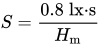
This value is then rounded to the nearest standard speed in Table 1 of ISO 6:1993.
Determining speed for color negative film is similar in concept but more complex because it involves separate curves for blue, green, and red. The film is processed according to the film manufacturer's recommendations rather than to a specified contrast. ISO speed for color reversal film is determined from the middle rather than the threshold of the curve; it again involves separate curves for blue, green, and red, and the film is processed according to the film manufacturer's recommendations.
Applying film speed
[edit]Film speed is used in the exposure equations to find the appropriate exposure parameters. Four variables are available to the photographer to obtain the desired effect: lighting, film speed, f-number (aperture size), and shutter speed (exposure time). The equation may be expressed as ratios, or, by taking the logarithm (base 2) of both sides, by addition, using the APEX system, in which every increment of 1 is a doubling of exposure; this increment is commonly known as a "stop". The effective f-number is proportional to the ratio between the lens focal length and aperture diameter, the diameter itself being proportional to the square root of the aperture area. Thus, a lens set to f/1.4 allows twice as much light to strike the focal plane as a lens set to f/2. Therefore, each f-number factor of the square root of two (approximately 1.4) is also a stop, so lenses are typically marked in that progression: f/1.4, 2, 2.8, 4, 5.6, 8, 11, 16, 22, 32, etc..
The ISO arithmetic speed has a useful property for photographers without the equipment for taking a metered light reading. Correct exposure will usually be achieved for a frontlighted scene in bright sun if the aperture of the lens is set to f/16 and the shutter speed is the reciprocal of the ISO film speed (e.g. 1/100 second for 100 ISO film). This known as the sunny 16 rule.
Exposure index
[edit]Exposure index, or EI, refers to speed rating assigned to a particular film and shooting situation in variance to the film's actual speed. It is used to compensate for equipment calibration inaccuracies or process variables, or to achieve certain effects. The exposure index may simply be called the speed setting, as compared to the speed rating.
For example, a photographer may rate an ISO 400 film at EI 800 and then use push processing to obtain printable negatives in low-light conditions. The film has been exposed at EI 800.
Another example occurs where a camera's shutter is miscalibrated and consistently overexposes or underexposes the film; similarly, a light meter may be inaccurate. One may adjust the EI setting accordingly in order to compensate for these defects and consistently produce correctly exposed negatives.
Reciprocity
[edit]Upon exposure, the amount of light energy that reaches the film determines the effect upon the emulsion. If the brightness of the light is multiplied by a factor and the exposure of the film decreased by the same factor by varying the camera's shutter speed and aperture, so that the energy received is the same, the film will be developed to the same density. This rule is called reciprocity. The systems for determining the sensitivity for an emulsion are possible because reciprocity holds over a wide range of customary conditions. In practice, reciprocity works reasonably well for normal photographic films for the range of exposures between 1/1000 second to 1/2 second. However, this relationship breaks down outside these limits, a phenomenon known as reciprocity failure.[70]
Film sensitivity and grain
[edit]
The size of silver halide grains in the emulsion affects film sensitivity, which is related to granularity because larger grains give film greater sensitivity to light. Fine-grain film, such as film designed for portraiture or copying original camera negatives, is relatively insensitive, or "slow", because it requires brighter light or a longer exposure than a "fast" film. Fast films, used for photographing in low light or capturing high-speed motion, produce comparatively grainy images.
Kodak has defined a "Print Grain Index" (PGI) to characterize film grain (color negative films only), based on perceptual just-noticeable difference of graininess in prints. They also define "granularity", a measurement of grain using an RMS measurement of density fluctuations in uniformly exposed film, measured with a microdensitometer with 48 micrometre aperture.[71] Granularity varies with exposure — underexposed film looks grainier than overexposed film.
Marketing anomalies
[edit]Some high-speed black-and-white films, such as Ilford Delta 3200, P3200 T-Max, and T-MAX P3200 are marketed with film speeds in excess of their true ISO speed as determined using the ISO testing method. According to the respective data sheets, the Ilford product is actually an ISO 1000 film,[72] while the Kodak film's speed is nominally 800 to 1000 ISO.[50][51] The manufacturers do not indicate that the 3200 number is an ISO rating on their packaging.[73] Kodak and Fuji also marketed E6 films designed for pushing (hence the "P" prefix), such as Ektachrome P800/1600 and Fujichrome P1600, both with a base speed of ISO 400. The DX codes on the film cartridges indicate the marketed film speed (i.e. 3200), not the ISO speed, in order to automate shooting and development.
Digital camera ISO speed and exposure index
[edit] |

In digital camera systems, an arbitrary relationship between exposure and sensor data values can be achieved by setting the signal gain of the sensor. The relationship between the sensor data values and the lightness of the finished image is also arbitrary, depending on the parameters chosen for the interpretation of the sensor data into an image color space such as sRGB.
For digital photo cameras ("digital still cameras"), an exposure index (EI) rating—commonly called ISO setting—is specified by the manufacturer such that the sRGB image files produced by the camera will have a lightness similar to what would be obtained with film of the same EI rating at the same exposure. The usual design is that the camera's parameters for interpreting the sensor data values into sRGB values are fixed, and a number of different EI choices are accommodated by varying the sensor's signal gain in the analog realm, prior to conversion to digital. Some camera designs provide at least some EI choices by adjusting the sensor's signal gain in the digital realm ("expanded ISO"). A few camera designs also provide EI adjustment through a choice of lightness parameters for the interpretation of sensor data values into sRGB; this variation allows different tradeoffs between the range of highlights that can be captured and the amount of noise introduced into the shadow areas of the photo.
Digital cameras have far surpassed film in terms of sensitivity to light, with ISO equivalent speeds of up to 4,560,000, a number that is unfathomable in the realm of conventional film photography. Faster microprocessors, as well as advances in software noise reduction techniques allow this type of processing to be executed the moment the photo is captured, allowing photographers to store images that have a higher level of refinement and would have been prohibitively time-consuming to process with earlier generations of digital camera hardware.
The ISO (International Organization of Standards) 12232:2019 standard
[edit]The ISO standard ISO 12232:2006[74] gave digital still camera manufacturers a choice of five different techniques for determining the exposure index rating at each sensitivity setting provided by a particular camera model. Three of the techniques in ISO 12232:2006 were carried over from the 1998 version of the standard, while two new techniques allowing for measurement of JPEG output files were introduced from CIPA DC-004.[75] Depending on the technique selected, the exposure index rating could depend on the sensor sensitivity, the sensor noise, and the appearance of the resulting image. The standard specified the measurement of light sensitivity of the entire digital camera system and not of individual components such as digital sensors, although Kodak has reported[76] using a variation to characterize the sensitivity of two of their sensors in 2001.
The Recommended Exposure Index (REI) technique, new in the 2006 version of the standard, allows the manufacturer to specify a camera model's EI choices arbitrarily. The choices are based solely on the manufacturer's opinion of what EI values produce well-exposed sRGB images at the various sensor sensitivity settings. This is the only technique available under the standard for output formats that are not in the sRGB color space. This is also the only technique available under the standard when multi-zone metering (also called pattern metering) is used.
The Standard Output Sensitivity (SOS) technique, also new in the 2006 version of the standard, effectively specifies that the average level in the sRGB image must be 18% gray plus or minus 1/3 stop when the exposure is controlled by an automatic exposure control system calibrated per ISO 2721 and set to the EI with no exposure compensation. Because the output level is measured in the sRGB output from the camera, it is only applicable to sRGB images—typically JPEG—and not to output files in raw image format. It is not applicable when multi-zone metering is used.
The CIPA DC-004 standard requires that Japanese manufacturers of digital still cameras use either the REI or SOS techniques, and DC-008[77] updates the Exif specification to differentiate between these values. Consequently, the three EI techniques carried over from ISO 12232:1998 are not widely used in recent camera models (approximately 2007 and later). As those earlier techniques did not allow for measurement from images produced with lossy compression, they cannot be used at all on cameras that produce images only in JPEG format.
The saturation-based (SAT or Ssat) technique is closely related to the SOS technique, with the sRGB output level being measured at 100% white rather than 18% gray. The SOS value is effectively 0.704 times the saturation-based value.[78] Because the output level is measured in the sRGB output from the camera, it is only applicable to sRGB images—typically TIFF—and not to output files in raw image format.[citation needed] It is not applicable when multi-zone metering is used.
The two noise-based techniques have rarely been used for consumer digital still cameras.[citation needed] These techniques specify the highest EI that can be used while still providing either an "excellent" picture or a "usable" picture depending on the technique chosen.[citation needed]
An update to this standard has been published as ISO 12232:2019, defining a wider range of ISO speeds.[42][43]
Measurements and calculations
[edit]ISO speed ratings of a digital camera are based on the properties of the sensor and the image processing done in the camera, and are expressed in terms of the luminous exposure H (in lux seconds) arriving at the sensor. For a typical camera lens with an effective focal length f that is much smaller than the distance between the camera and the photographed scene, H is given by
- ,

where L is the luminance of the scene (in candela per m²), t is the exposure time (in seconds), N is the aperture f-number, and
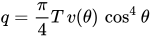
is a factor depending on the transmittance T of the lens, the vignetting factor v(θ), and the angle θ relative to the axis of the lens. A typical value is q = 0.65, based on θ = 10°, T = 0.9, and v = 0.98.[79]
Saturation-based speed
[edit]The saturation-based speed is defined as
- ,

where is the maximum possible exposure that does not lead to a clipped or bloomed camera output. Typically, the lower limit of the saturation speed is determined by the sensor itself, but with the gain of the amplifier between the sensor and the analog-to-digital converter, the saturation speed can be increased. The factor 78 is chosen such that exposure settings based on a standard light meter and an 18-percent reflective surface will result in an image with a grey level of 18%/√2 = 12.7% of saturation. The factor √2 indicates that there is half a stop of headroom to deal with specular reflections that would appear brighter than a 100% reflecting diffuse white surface.[74]

Noise-based speed
[edit]
The noise-based speed is defined as the exposure that will lead to a given signal-to-noise ratio on individual pixels. Two ratios are used, the 40:1 ("excellent image quality") and the 10:1 ("acceptable image quality") ratio. These ratios have been subjectively determined based on a resolution of 70 pixels per cm (178 DPI) when viewed at 25 cm (9.8 inch) distance. The noise is defined as the standard deviation of a weighted average of the luminance and color of individual pixels. The noise-based speed is mostly determined by the properties of the sensor and somewhat affected by the noise in the electronic gain and AD converter.[74]
Standard output sensitivity (SOS)
[edit]In addition to the above speed ratings, the standard also defines the standard output sensitivity (SOS), how the exposure is related to the digital pixel values in the output image. It is defined as

where is the exposure that will lead to values of 118 in 8-bit pixels, which is 18 percent of the saturation value in images encoded as sRGB or with gamma = 2.2.[74]

Discussion
[edit]The standard specifies how speed ratings should be reported by the camera. If the noise-based speed (40:1) is higher than the saturation-based speed, the noise-based speed should be reported, rounded downwards to a standard value (e.g. 200, 250, 320, or 400). The rationale is that exposure according to the lower saturation-based speed would not result in a visibly better image. In addition, an exposure latitude can be specified, ranging from the saturation-based speed to the 10:1 noise-based speed. If the noise-based speed (40:1) is lower than the saturation-based speed, or undefined because of high noise, the saturation-based speed is specified, rounded upwards to a standard value, because using the noise-based speed would lead to overexposed images. The camera may also report the SOS-based speed (explicitly as being an SOS speed), rounded to the nearest standard speed rating.[74]
For example, a camera sensor may have the following properties: , , and . According to the standard, the camera should report its sensitivity as


- ISO 100 (daylight)
- ISO speed latitude 50–1600
- ISO 100 (SOS, daylight).
The SOS rating could be user controlled. For a different camera with a noisier sensor, the properties might be , , and . In this case, the camera should report


- ISO 200 (daylight),
as well as a user-adjustable SOS value. In all cases, the camera should indicate for the white balance setting for which the speed rating applies, such as daylight or tungsten (incandescent light).[74]
Despite these detailed standard definitions, cameras typically do not clearly indicate whether the user "ISO" setting refers to the noise-based speed, saturation-based speed, or the specified output sensitivity, or even some made-up number for marketing purposes. Because the 1998 version of ISO 12232 did not permit measurement of camera output that had lossy compression, it was not possible to correctly apply any of those measurements to cameras that did not produce sRGB files in an uncompressed format such as TIFF. Following the publication of CIPA DC-004 in 2006, Japanese manufacturers of digital still cameras are required to specify whether a sensitivity rating is REI or SOS.[citation needed]
A greater SOS setting for a given sensor comes with some loss of image quality, just like with analog film. However, this loss is visible as image noise rather than grain. APS- and 35 mm-sized digital image sensors, both CMOS and CCD based, do not produce significant noise until about ISO 1600.[80]
See also
[edit]References
[edit]- ^ Allbright, G S (1991), "Emulsion Speed Rating Systems", The Journal of Photographic Science, 39 (2): 95–99, doi:10.1080/00223638.1991.11737126
- ^ Jacobson, Ralph E (1978), The Manual of Photography (Seventh Edition), Focal Press, p. 410
- ^ a b c d e f DIN 4512:1934-01. Photographische Sensitometrie, Bestimmung der optischen Dichte (in German). Deutscher Normenausschuß (DNA). 1934.
In the introduction to the standard, Warnerke's system is described as the first practical system used to measure emulsion speeds, but as being unreliable. In regard to Scheiner's system, it states: "Auch hier erwies sich nach einiger Zeit, daß das Meßverfahren trotz der von Eder vorgenommenen Abänderungen den Anforderungen der Praxis nicht vollständig Rechnung zu tragen vermag, so daß jeder Hersteller […] nach seinem eigenen System die Empfindlichkeit in Scheinergraden ermitteln muß, häufig in sehr primitiver Weise durch […] Vergleich mit Erzeugnissen anderer Hersteller. Die so ermittelten Gebrauchs-Scheinergrade haben mit dem ursprünglich […] ausgearbeiteten Meßverfahren nach Scheiner sachlich nichts mehr zu tun. […] Als Folge hiervon ist allmählich eine Inflation in Empfindlichkeitsgraden eingetreten, für die das Scheiner'sche Verfahren nichts mehr als den Namen hergibt."
- ^ Progress medal. Royal Photographic Society., and web-page listing people, who have received this award since 1878: "Progress medal". Archived from the original on 2012-08-22. Retrieved 2013-04-19.
Instituted in 1878, this medal is awarded in recognition of any invention, research, publication or other contribution which has resulted in an important advance in the scientific or technological development of photography or imaging in the widest sense. This award also carries with it an Honorary Fellowship of The Society. […] 1882 Leon Warnerke […] 1884 J. M. Eder […] 1898 Ferdinand Hurter and Vero C. Driffield […] 1910 Alfred Watkins […] 1912 H. Chapman Jones […] 1948 Loyd A. Jones […]
- ^ a b c d Jones, Bernhard Edward, ed. (1911). Cassell's cyclopaedia of photography. London, UK: Cassell. (Reprinted as Bunnell, Peter C.; Sobieszek, Robert A. (1974). introduction. Encyclopaedia of photography – With a New Picture Portfolio. By Jones, Bernhard Edward. New York, USA: Arno Press Inc. pp. 472–473. ISBN 0-405-04922-6.: 'Soon after the introduction of the gelatine dry plate, it was usual to express the speed of the emulsion as "x times", which meant that it was x times the speed of a wet collodion plate. This speed was no fixed quantity, and the expression consequently meant but little. Warnerke introduced a sensitometer, consisting of a series of numbered squares with increasing quantities of opaque pigment. The plate to be tested was placed in contact with this, and an exposure made to light emanating from a tablet of luminous paint, excited by burning magnesium ribbon. After development and fixation the last number visible was taken as the speed of the plate. The chief objections to this method were that practically no two numbered tablets agreed, that the pigment possessed selective spectral absorption, and that the luminosity of the tablet varied considerably with the lapse of time between its excitation and the exposure of the plate. […] Chapman Jones has introduced a modified Warnerke tablet containing a series of twenty-five graduated densities, a series of coloured squares, and a strip of neutral grey, all five being of approximately equal luminosity, and a series of four squares passing a definite portion of the spectrum; finally, there is a square of a line design, over which is superposed a half-tone negative. This "plate tester", […] is used with a standard candle as the source of light, and is useful for rough tests of both plates and printing papers.')
- ^ Hasluck, Paul Nooncree (1905). The Book of Photography: Practical, Theoretical and Applied.
THE CHAPMAN JONES PLATE TESTER. A convenient means of testing the colour rendering and other properties of a sensitive plate, or for ascertaining the effect of various colour screens, is afforded by the plate tester devised by Mr. Chapman Jones in 1900. This consists of a number of graduated squares by which the sensitiveness and range of gradation of the plate examined may be determined; a series of squares of different colours and mixtures of colours of equal visual intensity, which will indicate the colour sensitiveness; and a strip of uncoloured space for comparison purposes. It is simply necessary to expose the plate being tested, in contact with the screen, to the light of a standard candle. A suitable frame and stand are supplied for the purpose; any other light may, however, be used if desired. The plate is then developed, when an examination of the negative will yield the desired information. The idea of the coloured squares is based on that of the Abney Colour Sensitometer, where three or four squares of coloured and one of uncoloured glass are brought to an equal visual intensity by backing where necessary with squares of exposed celluloid film developed to suitable density.
- ^ a b c Lindsay, Arthur (1961). Sowerby, MacRae (ed.). Dictionary of Photography: A Reference Book for Amateur and Professional Photographers (19th ed.). London, UK: Iliffe Books Ltd. pp. 582–589.
- ^ Konovalov, Leonid (2007). Characteristic curve (PDF). Moscow: Всероссийский государственный институт кинематографии (ВГИК). p. 24. Retrieved 2012-11-09.
- ^ a b Riat, Martin (Spring 2006). Graphische Techniken – Eine Einführung in die verschiedenen Techniken und ihre Geschichte (PDF) (E-Book) (in German) (3rd German ed.)., based on a Spanish book: Riat, Martin (September 1983). Tecniques Grafiques: Una Introduccio a Les Diferents Tecniques I a La Seva Historia (in Spanish) (1st ed.). Aubert. ISBN 84-86243-00-9.
- ^ a b c Sheppard, Samuel Edward (February 1932). Harris, Sylvan (ed.). "Resumé of the Proceedings of the Dresden International Photographic Congress". Journal of the Society of Motion Picture Engineers. XVIII (2). Society of Motion Picture Engineers (SMPE): 232–242.
[…] The 8th International Congress of Photography was held at Dresden, Germany, from [3 to 8] August […] 1931, inclusive. […] In regard to sensitometric standardization, several important developments occurred. First, the other national committees on sensitometric standardization accepted the light source and filter proposed by the American Committee at Paris, 1925, and accepted by the British in 1928. In the meantime, no definite agreement had been reached, nor indeed had very definite proposals been made on the subjects of sensitometers or exposure meters, development, density measurement, and methods of expressing sensitometric results, although much discussion and controversy on this subject had taken place. At the present Congress, a body of recommendations for sensitometric standards was put forward by the Deutschen Normenausschusses [für] Phototechnik, which endeavored to cover the latter questions and bring the subject of sensitometric standardization into the industrial field. It was stated by the German committee that this action had been forced on them by difficulties arising from indiscriminate and uncontrolled placing of speed numbers on photographic sensitive goods, a situation which was summarized at the Congress by the term "Scheiner-inflation". The gist of these recommendations was as follows: (a) Acceptance of the light source and daylight filter as proposed by the American commission. (b) As exposure meter, a density step-wedge combined with a drop shutter accurate to 1/20 second. (c) Brush development in a tray with a prescribed solution of metol-hydroquinone according to a so-called "optimal" development. (d) Expression of the sensitivity by that illumination at which a density of 0.1 in excess of fog is reached. (e) Density measurement shall be carried out in diffused light according to details to be discussed later. These proposals aroused a very lively discussion. The American and the British delegations criticized the proposals both as a whole and in detail. As a whole they considered that the time was not ripe for application of sensitometric standards to industrial usage. In matters of detail they criticized the proposed employment of a step-wedge, and the particular sensitivity number proposed. The latter approaches very roughly the idea of an exposure for minimum gradient, but even such a number is not adequate for certain photographic uses of certain materials. The upshot of the discussion was that the German proposals in somewhat modified form are to be submitted simply as proposals of the German committee for sensitometric standardization to the various national committees for definite expression of opinion within six months of the expiration of the Congress. Further, in case of general approval of these recommendations by the other national committees, that a small International Committee on Sensitometric Standardization shall, within a further period of six months, work out a body of sensitometric practices for commercial usage.
- ^ Biltz, Martin (October 1933). "Über DIN-Grade, das neue deutsche Maß der photographischen Empfindlichkeit". Naturwissenschaften (in German). 21 (41). Springer: 734–736. Bibcode:1933NW.....21..734B. doi:10.1007/BF01504271. ISSN 0028-1042. S2CID 31974234.
[…] Im folgenden soll an Hand der seither gebräuchlichen sensitometrischen Systeme nach Scheiner […], nach Hurter und Driffield […] und nach Eder und Hecht […] kurz gezeigt werden, wie man bisher verfahren ist. Im Anschlusse daran wird das neue vom Deutschen Normenausschusse für Phototechnik auf Empfehlung des Ausschusses für Sensitometrie der Deutschen Gesellschaft für photographische Forschung vorgeschlagene System […] betrachtet werden. […]
- ^ Heisenberg, Erwin [in German] (December 1930). "Mitteilungen aus verschiedenen Gebieten – Bericht über die Gründung und erste Tagung der Deutschen Gesellschaft für photographische Forschung (23. bis 25. Mai 1930)". Naturwissenschaften (in German). 18 (52). Springer: 1130–1131. doi:10.1007/BF01492990. ISSN 0028-1042. S2CID 42242680.
[…] Weitere 3 Vorträge von Prof. Dr. R. Luther, Dresden, Prof. Dr. Lehmann, Berlin, Prof. Dr. Pirani, Berlin, behandelten die Normung der sensitometrischen Methoden. Zu normen sind: die Lichtquelle, die Art der Belichtung (zeitliche oder Intensitätsabstufung), die Entwicklung, die Auswertung. Auf den Internationalen Kongressen in Paris 1925 und London 1928 sind diese Fragen schon eingehend behandelt und in einzelnen Punkten genaue Vorschläge gemacht worden. Die Farbtemperatur der Lichtquelle soll 2360° betragen. Vor dieselbe soll ein Tageslichtfilter, welches vom Bureau of Standards ausgearbeitet worden ist, geschaltet werden. Herr Luther hat an der Filterflüssigkeit durch eigene Versuche gewisse Verbesserungen erzielt. Schwierigkeiten bereitet die Konstanthaltung der Farbtemperatur bei Nitralampen. Herr Pirani schlug deshalb in seinem Vortrag die Verwendung von Glimmlampen vor, deren Farbe von der Stromstärke weitgehend unabhängig ist. In der Frage: Zeit- oder Intensitätsskala befürworten die Herren Luther und Lehmann die Intensitätsskala. Herr Lehmann behandelte einige Fragen, die mit der Herstellung der Intensitätsskala zusammenhängen. Ausführlicher wurde noch die Auswertung (zahlenmäßige Angabe der Empfindlichkeit und Gradation) besprochen, die eine der wichtigsten Fragen der Sensitometrie darstellt. In der Diskussion wurde betont, daß es zunächst nicht so sehr auf eine wissenschaftlich erschöpfende Auswertung ankomme als darauf, daß die Empfindlichkeit der Materialien in möglichst einfacher, aber eindeutiger und für den Praktiker ausreichender Weise charakterisiert wird. […]
- ^ a b Voss, Waltraud (2002-03-12). "Robert Luther – der erste Ordinarius für Wissenschaftliche Photographie in Deutschland – Zur Geschichte der Naturwissenschaften an der TU Dresden (12)" (PDF). Dresdner UniversitätsJournal (in German). 13 (5): 7. Archived from the original (PDF) on 2011-09-17. Retrieved 2011-08-06.
Luther war Mitglied des Komitees zur Veranstaltung internationaler Kongresse für wissenschaftliche und angewandte Photographie; die Kongresse 1909 und 1931 in Dresden hat er wesentlich mit vorbereitet. 1930 gehörte er zu den Mitbegründern der Deutschen Gesellschaft für Photographische Forschung. Er gründete und leitete den Ausschuss für Sensitometrie der Gesellschaft, aus dessen Tätigkeit u.a. das DIN-Verfahren zur Bestimmung der Empfindlichkeit photographischer Materialien hervorging. […]
- ^ a b Buckland, Michael Keeble (2008). "The Kinamo movie camera, Emanuel Goldberg and Joris Ivens" (PDF). Film History. 20 (1) (Preprint ed.): 49–58. doi:10.2979/FIL.2008.20.1.49. S2CID 194951687.
Ivens returned to Dresden in August 1931 to attend the VIII International Congress of Photography, organised by Goldberg; John Eggert, head of research at the Agfa plant in Wolfen, near Leipzig; and Robert Luther, the founding Director of the Institute for Scientific Photography at the Technical University in Dresden and Goldberg's dissertation advisor. The proceedings were heavily technical and dominated by discussion of the measurement of film speeds. The Congress was noteworthy because a film speed standard proposed by Goldberg and Luther was approved and, in Germany, became DIN 4512, […]
- ^ Eggert, John Emil Max [in German]; von Biehler, Arpad, eds. (1932). "Bericht über den VIII. Internationalen Kongreß für wissenschaftliche und angewandte Photographie Dresden 1931" (in German). Leipzig: Johann Ambrosius Barth Verlag.
- ^ Benser, Walther (1957). Wir photographieren farbig (in German). Europäischer Buchklub. p. 10.
- ^ a b c ISO 6:1993: Photography – Black-and-white pictorial still camera negative film/process systems – Determination of ISO speed.
- ^ a b ISO 2240:2003: Photography – Colour reversal camera films – Determination of ISO speed.
- ^ a b ISO 5800:1987: Photography – Colour negative films for still photography – Determination of ISO speed.
- ^ Jacobson, Ralph E (1978), The Manual of Photography (Seventh Edition), Focal Press, p. 412
- ^ Jacobson, Ralph E (1978), The Manual of Photography (Seventh Edition), Focal Press, p. 412
- ^ Dunn, Jack F; Wakefield, George L (1981), Exposure Manual (Fourth Edition), Fountain Press, p. 22
- ^ Allbright, G S (1991), "Emulsion Speed Rating Systems", The Journal of Photographic Science, 39 (2): 95–99, doi:10.1080/00223638.1991.11737126
- ^ Mulhern, Charles J. (1990-06-15). Letter to John D. de Vries (Copyscript on John D. de Vries' web-site). Archived from the original on 2013-01-03.In 1931, Edward Faraday Weston applied for a U.S patent on the first Weston Exposure meter, which was granted patent No. 2016469[dead link] on [8] October 1935, also an improved version was applied for and granted U.S patent No. 2042665 Archived 2017-02-26 at the Wayback Machine on [7th} July 1936. From 1932 to around 1967, over 36 varieties of Weston Photographic Exposure Meters were produced in large quantities and sold throughout the world, mostly by Photographic dealers or agents, which also included the Weston film speed ratings, as there were no ASA or DIN data available at that time.
- ^ Goodwin, William Nelson Jr. (August 1938). "Weston emulsion speed ratings: What they are and how they are determined". American Photographer. (4 pages)
- ^ Roseborough, Everett (1996). "The Contributions of Edward W. Weston and his company". Photographic Canadiana. 22 (3).
- ^ Tipper, Martin. "Weston — The company and the man". www.westonmeter.org.uk, a web-page on Weston exposure meters.
[…] the Weston method of measuring film speeds. While it had some shortcomings it had the advantage of being based on a method which gave practical speeds for actual use and it was independent of any film manufacturer. Previous speed systems such as the H&D and early Scheiner speeds were both threshold speeds and capable of considerable manipulation by manufacturers. Weston's method measured the speed well up on the curve making it more nearly what one would get in actual practice. (This means that he was a bit less optimistic about film sensitivity than the manufacturers of the day who were notorious for pretending their films were more sensitive than they really were.) A certain Mr. W. N. Goodwin of Weston is usually credited with this system.
- ^ Hefley, Harold M. (1951). "A method of calculating exposures for photomicrographs" (PDF). Arkansas Academy of Science Journal (4). Fayetteville, USA: University of Arkansas. (NB. Research paper on an exposure system for micro-photography based on a variation of Weston film speed ratings.)
- ^ Weston film ratings — Weston system of emulsion ratings (Booklet, 16 pages). Newark, USA: Weston. 1946.
You cannot necessarily depend on Weston speed values from any other source unless they are marked "OFFICIAL WESTON SPEEDS BY AGREEMENT WITH THE WESTON ELECTRICAL INSTRUMENT CORPORATION"
- ^ a b c Weston ratings (Booklet, 20 pages). Enfield, UK: Sangamo Weston. 1956.
WESTON RATINGS—Correct exposure depends on two variables: (1) the available light and (2) its effect on the film in use. WESTON have always considered these two to be of equal importance and therefore introduced their own system of film ratings. Subsequently this system was found to be so successful that it was widely accepted in photographic circles and formed the basis for internationally agreed standards.
- ^ GW-68. Manual. USA: General Electric. GES-2810. (The manual states that ASA was working on standardized values, but none had been established at this time.)
- ^ a b c General Electric Film Values (Leaflet, 12 pages). USA: General Electric. 1947. General Electric publication code GED-744.
This General Electric Film Value Booklet contains the […] exposure-index numbers for […] photographic films in accordance with the new system for rating photographic films that has been devised by the American Standards Association. This system has been under development for several years and is the result of co-operative effort on the part of all the film manufacturers, meter manufacturers, the Optical Society of America, and the Bureau of Standards. It was used by all of the military services during the war. The new ASA exposure-index numbers provide the photographer with the most accurate film-rating information that has yet been devised. The G-E exposure meter uses the ASA exposure-index numbers, not only in the interest of standardization, but also because this system represents a real advancement in the field of measurement. The exposure-index number have been so arranged that all earlier model G-E meters can be used with this series of numbers. For some films the values are exactly the same; and where differences exist, the new ASA exposure-index value will cause but a slight increase in exposure. However […] a comparison of the new ASA exposure-index numbers and the G-E film values is shown […] A complete comparison of all systems of emulsion speed values can be found in the G-E Photo Data Book. […] All G-E meters manufactured after January, 1946, utilize the ASA exposure indexes. Although the new ASA values can be used with all previous model G-E meters, interchangeable calculator-hoods with ASA exposure indexes are available for Types DW-48, DW-49, and DW-58 meters.
- ^ General Electric Photo Data Book. General Electric. GET-I717.
- ^ General Electric (1946). "Attention exposure meter owners" (Advertisement).
Attention! Exposure meter owners! Modernizing Hood $3.50 […] Modernize your G-E meter (Type DW-48 or early DW-58) with a new G-E Hood. Makes it easy to use the new film-exposure ratings developed by the American Standards Association … now the only basis for data published by leading film makers. See your photo dealer and snap on a new G-E hood! General Electric Company, Schenectady 5, N.Y.
- ^ a b Gorokhovskiy, Yu. N. (1970). Fotograficheskaya metrologiya. Uspekhi Nauchnoy Fotografii (Advances in Scientific Photography) (in Russian). 15: 183–195. (English translation: Photographic Metrology (PDF) (NASA Technical Translation II F-13,921, National Aeronautics and Space Administration, Washington, D.C. 20546). November 1972.)
- ^ GOST 2817-50 Transparent sublayer photographic materials. Method of general sensitometric test. Archived from the original on 2011-10-11. Retrieved 2011-08-07. (GOST 2817-45 was replaced by GOST 2817-50, which in turn was replaced by GOST 10691.6–88, which defines black-and-white films, whereas GOST 10691.5–88 defines black-and-white films for aerial photography.)
- ^ Stroebel, Leslie D.; Zakia, Richard D. (1993). The Focal Encyclopedia of Photography (3rd ed.). Focal Press. p. 304. ISBN 978-0-240-51417-8.
- ^ завод [Zavod], Красногорский [Krasnogorskiy]. "Questions and answers: Film speeds" (in Russian). Retrieved 2011-08-06.
- ^ GOST 10691.0–84 Black-and-white photographic materials with transparent sublaver. Method of general sensitometric test. Archived from the original on 2012-01-12. Retrieved 2011-08-09.
- ^ GOST 10691.6–88 Black-and-white phototechnical films, films for scientific researches and industry. Method for determination of speed numbers. Archived from the original on 2012-01-12. Retrieved 2011-08-09.
- ^ GOST 10691.5–88 Black-and-white aerophotographic films. Method for determination of speed numbers. Archived from the original on 2012-01-12. Retrieved 2011-08-09.
- ^ a b c d "ISO 12232:2019 — Photography — Digital still cameras — Determination of exposure index, ISO speed ratings, standard output sensitivity, and recommended exposure index". International Organization for Standardization (ISO). February 2019.
- ^ a b Gasiorowski-Denis, Elizabeth (2019-03-07). "A better picture: International Standard gives photography a new exposure". International Organization for Standardization (ISO). Archived from the original on 2019-06-09. Retrieved 2019-06-09.
- ^ a b Jacobson, Ralph E.; Ray, Sidney F.; Attridge, Geoffrey G.; Axford, Norman R. (2000). The manual of photography (9th ed.). Focal Press. pp. 305–307. ISBN 978-0-240-51574-8.
- ^ Graves, Carson (1996). The zone system for 35mm photographers. Focal Press. p. 124. ISBN 978-0-240-80203-9.
- ^ "ISO 2721:1982. Photography — Cameras — Automatic controls of exposure" (paid download). Geneva: International Organization for Standardization (ISO). Archived from the original on 2008-08-07.
- ^ a b c d e f "Leica R9 Bedienungsanleitung / Instructions" (PDF) (in German and English). Solms, Germany: Leica Camera AG. 2002. p. 197. Leica publication 930 53 VII/03/GX/L. Archived from the original (PDF) on 2013-04-15. Retrieved 2011-07-30.
Film speed range: Manual setting from ISO 6/9° to ISO 12500/42° (with additional exposure compensation of up to ±3 EV, overall films from ISO 0.8/0° to ISO 100000/51° can be exposed), DX scanning from ISO 25/15° to ISO 5000/38°.
- ^ a b c d e f Leica Instructions – Leica R8. Solms, Germany: Leica Camera AG. 1996. pp. 16, 65.
The DX-setting for automatic speed scanning appears after the position "12800" […] Film speed range: Manual setting from ISO 6/9° to ISO 12,800/42° (With additional override of −3 EV to +3 EV, films from 0 DIN to 51 DIN can be exposed as well.) DX scanning from ISO 25/15° to ISO 5000/38°.
- ^ "35mm BW Film - FPP Super Positive Film (1 Roll)". Film Photography Project Store. Retrieved 2023-05-10.
- ^ a b "KODAK PROFESSIONAL T-MAX Films" (PDF). wwwuk.kodak.com. Kodak. Retrieved 2018-10-07.
- ^ a b "KODAK PROFESSIONAL T-MAX P3200 Black & White Negative Film" (PDF). imaging.kodakalaris.com. Kodak Alaris. Retrieved 2018-10-07.
- ^ a b c "Table 2". ASA PH2.12-1961. p. 9. (NB. Showed (but did not specify) a speed of 12500 as the next full step greater than 6400.)
- ^ a b c d e f g h i j "Boosting Sensitivity". Phantom/Ametek. Notes/Alerts. Wayne, NJ, USA: Vision Research. April 2016. Archived from the original on 2019-06-09. Retrieved 2019-06-09.
- ^ a b "Additional Information on: Canon FT QL Camera". Canon.
Acceptable film speed has been increased to a range of between ASA 25 and an incredible ASA 12,800 by the use of the CANON BOOSTER. The light-measuring range of the newly developed CANON FT QL has been extended from a low of EV −3.5, f/1.2 15 seconds to EV 18 with ASA 100 film. This is the first time a TTL camera has been capable of such astonishing performance.
- ^ a b Canon A-1 Instructions. Canon. 1978. pp. 28, 29, 46, 70, 98.
- ^ a b c d e "Nikon D3s". Nikon USA Web page. Archived from the original on 2012-04-06. Retrieved 2010-01-11.
- ^ a b c d e "Canon EOS-1D Mark IV". Canon USA Web page. Archived from the original on 2017-01-06. Retrieved 2010-01-11.
- ^ Manning, Jack (1983-11-27). "CAMERA; NEW DEVELOPMENTS IN INSTANT PHOTOGRAPHY". The New York Times. New York Times. p. 36. Retrieved 2024-02-05.
- ^ a b "Canon EOS-1D X". Canon USA Web page. Archived from the original on 2014-05-08. Retrieved 2011-10-01.
- ^ a b "Nikon D4". Nikon. Retrieved 2012-01-06.
- ^ a b "Ricoh Pentax 645Z specifications".
- ^ a b "Nikon D4s specifications". Archived from the original on 2014-03-02. Retrieved 2014-02-25.
- ^ a b "Sony α ILCE-7S specifications".
- ^ a b c "Unsichtbares wird sichtbar! Canon präsentiert die ME20F-SH für Full-HD Farbvideos bei extrem wenig Licht". Press release (in German). Canon Deutschland. 2015-07-30. Archived from the original on 2015-08-02. Retrieved 2015-07-30.
- ^ "DSLR-A500/DSLR-A550". Sony Europe Web page. 2009-08-27. Retrieved 2011-07-30.
Dramatically reduced picture noise now allows super-sensitive shooting at up to ISO 12800, allowing attractive results when shooting handheld in challenging situations like candlelit interiors.
- ^ "DSLR-A560/DSLR-A580". Sony Europe Web page. 2010-08-27. Archived from the original on 2010-08-30. Retrieved 2011-07-30.
Multi-frame Noise Reduction 'stacks' a high-speed burst of six frames, creating a single low-noise exposure that boosts effective sensitivity as high as ISO 25600.
- ^ "Pentax K-5". Pentax USA Web page. 2010. Archived from the original on 2010-12-06. Retrieved 2011-07-29.
ISO Sensitivity: ISO 100-12800 (1, 1/2, 1/3 steps), expandable to ISO 80–51200
- ^ "Fuji FinePix X100". Fujifilm Canada Web page. February 2011. Archived from the original on 2011-08-27. Retrieved 2011-07-30.
Extended output sensitivity equivalent ISO 100 or 12800
- ^ a b 戴淮清 《摄影入门》 (in Simplified Chinese). 1952.
- ^ Lambrecht, Ralph W.; Woodhouse, Chris (2003). Way Beyond Monochrome. Newpro UK Ltd. p. 113. ISBN 978-0-86343-354-2.
- ^ "Kodak Tech Pub E-58: Print Grain Index". Eastman Kodak, Professional Division. July 2000.
- ^ "Delta 3200 Professional – technical information". ilfordphoto.com. Harman Technology. May 2010. Retrieved 2018-05-03.
- ^ "Fact Sheet, Delta 3200 Professional" (PDF). Knutsford, U.K.: Ilford Photo. Archived from the original (PDF) on 2008-05-28. Retrieved 2008-05-18.
- ^ a b c d e f "ISO 12232:2006. Photography — Digital still cameras — Determination of exposure index, ISO speed ratings, standard output sensitivity, and recommended exposure index". Geneva: International Organization for Standardization (ISO). Archived from the original on 2008-08-07.
- ^ "CIPA DC-004. Sensitivity of digital cameras" (PDF). Tokyo: Camera & Imaging Products Association (CIPA). Archived from the original (PDF) on 2012-04-17. Retrieved 2008-06-15.
- ^ "Kodak Image Sensors – ISO Measurement" (PDF). Rochester, NY, USA: Eastman Kodak.
- ^ "Exchangeable image file format for digital still cameras: Exif Version 2.3" (PDF). CIPA. Retrieved 2014-12-05.
- ^ Kerr, Douglas A. (2007-08-30). "New Measures of the Sensitivity of a Digital Camera" (PDF).
- ^ ISO 12232:1998. Photography — Electronic still-picture cameras — Determination of ISO speed. p. 12.
- ^ "D200 Users manual" (PDF). Nikon. Retrieved 2015-09-20.
Further reading
[edit]- ISO 6:1974, ISO 6:1993 (1993-02). Photography — Black-and-white pictorial still camera negative film/process systems — Determination of ISO speed. Geneva: International Organization for Standardization.
- ISO 2240:1982 (1982-07), ISO 2240:1994 (1994-09), ISO 2240:2003 (2003–10). Photography — Colour reversal camera films — Determination of ISO speed. Geneva: International Organization for Standardization.
- ISO 2720:1974. General Purpose Photographic Exposure Meters (Photoelectric Type) — Guide to Product Specification. Geneva: International Organization for Standardization.
- ISO 5800:1979, ISO 5800:1987 (1987-11), ISO 5800:1987/Cor 1:2001 (2001-06). Photography — Colour negative films for still photography — Determination of ISO speed. Geneva: International Organization for Standardization.
- ISO 12232:1998 (1998-08), ISO 12232:2006 (2006-04-15), ISO 12232:2006 (2006-10-01), ISO 12232:2019 (2019-02-01). Photography — Digital still cameras — Determination of exposure index, ISO speed ratings, standard output sensitivity, and recommended exposure index. Geneva: International Organization for Standardization.
- ASA Z38.2.1-1943, ASA Z38.2.1-1946, ASA Z38.2.1-1947 (1947-07-15). American Standard Method for Determining Photographic Speed and Speed Number. New York: American Standards Association. Superseded by ASA PH2.5-1954.
- ASA PH2.5-1954, ASA PH2.5-1960. American Standard Method for Determining Speed of photographic Negative Materials (Monochrome, Continuous Tone). New York: United States of America Standards Institute (USASI). Superseded by ANSI PH2.5-1972.
- ANSI PH2.5-1972, ANSI PH2.5-1979 (1979-01-01), ANSI PH2.5-1979(R1986). Speed of photographic negative materials (monochrome, continuous tone, method for determining). New York: American National Standards Institute. Superseded by NAPM IT2.5-1986.
- NAPM IT2.5-1986, ANSI/ISO 6-1993 ANSI/NAPM IT2.5-1993 (1993-01-01). Photography — Black-and-White Pictorial Still Camera Negative Film/Process Systems — Determination of ISO Speed (same as ANSI/ISO 6-1993). National Association of Photographic Manufacturers. This represents the US adoption of ISO 6.
- ASA PH2.12-1957, ASA PH2.12-1961. American Standard, General-Purpose Photographic Exposure Meters (photoelectric type). New York: American Standards Association. Superseded by ANSI PH3.49-1971.
- ANSI PH2.21-1983 (1983-09-23), ANSI PH2.21-1983(R1989). Photography (Sensitometry) Color reversal camera films – Determination of ISO speed. New York: American Standards Association. Superseded by ANSI/ISO 2240-1994 ANSI/NAPM IT2.21-1994.
- ANSI/ISO 2240-1994 ANSI/NAPM IT2.21-1994. Photography – Colour reversal camera films – determination of ISO speed. New York: American National Standards Institute. This represents the US adoption of ISO 2240.
- ASA PH2.27-1965 (1965-07-06), ASA PH2.27-1971, ASA PH2.27-1976, ANSI PH2.27-1979, ANSI PH2.27-1981, ANSI PH2.27-1988 (1988-08-04). Photography – Colour negative films for still photography – Determination of ISO speed (withdrawn). New York: American Standards Association. Superseded by ANSI IT2.27-1988.
- ANSI IT2.27-1988 (1994-08/09?). Photography Color negative films for still photography – Determination of ISO speed. New York: American National Standards Institute. Withdrawn. This represented the US adoption of ISO 5800.
- ANSI PH3.49-1971, ANSI PH3.49-1971(R1987). American National Standard for general-purpose photographic exposure meters (photoelectric type). New York: American National Standards Institute. After several revisions, this standard was withdrawn in favor of ANSI/ISO 2720:1974.
- ANSI/ISO 2720:1974, ANSI/ISO 2720:1974(R1994) ANSI/NAPM IT3.302-1994. General Purpose Photographic Exposure Meters (Photoelectric Type) — Guide to Product Specification. New York: American National Standards Institute. This represents the US adoption of ISO 2720.
- BSI BS 1380:1947, BSI BS 1380:1963. Speed and exposure index. British Standards Institution. Superseded by BSI BS 1380-1:1973 (1973-12), BSI BS 1380-2:1984 (1984-09), BSI BS 1380-3:1980 (1980-04) and others.
- BSI BS 1380-1:1973 Archived 2011-10-09 at the Wayback Machine (1973-12-31). Speed of sensitized photographic materials: Negative monochrome material for still and cine photography. British Standards Institution. Replaced by BSI BS ISO 6:1993, superseded by BSI BS ISO 2240:1994.
- BSI BS 1380-2:1984 ISO 2240:1982 Archived 2011-10-09 at the Wayback Machine (1984-09-28). Speed of sensitized photographic materials. Method for determining the speed of colour reversal film for still and amateur cine photography. British Standards Institution. Superseded by BSI BS ISO 2240:1994.
- BSI BS 1380-3:1980 ISO 5800:1979 Archived 2011-10-09 at the Wayback Machine (1980-04-30). Speed of sensitized photographic materials. Colour negative film for still photography. British Standards Institution. Superseded by BSI BS ISO 5800:1987.
- BSI BS ISO 6:1993 Archived 2011-10-09 at the Wayback Machine (1995-03-15). Photography. Black-and-white pictorial still camera negative film/process systems. Determination of ISO speed. British Standards Institution. This represents the British adoption of ISO 6:1993.
- BSI BS ISO 2240:1994 Archived 2011-10-09 at the Wayback Machine (1993-03-15), BSI BS ISO 2240:2003 Archived 2011-10-09 at the Wayback Machine (2004-02-11). Photography. Colour reversal camera films. Determination of ISO speed. British Standards Institution. This represents the British adoption of ISO 2240:2003.
- BSI BS ISO 5800:1987 Archived 2011-10-09 at the Wayback Machine (1995-03-15). Photography. Colour negative films for still photography. Determination of ISO speed. British Standards Institution. This represents the British adoption of ISO 5800:1987.
- DIN 4512:1934-01, DIN 4512:1957-11 (Blatt 1), DIN 4512:1961-10 (Blatt 1). Photographische Sensitometrie, Bestimmung der optischen Dichte. Berlin: Deutscher Normenausschuß (DNA). Superseded by DIN 4512-1:1971-04, DIN 4512-4:1977-06, DIN 4512-5:1977-10 and others.
- DIN 4512-1:1971-04 Archived 2011-09-30 at the Wayback Machine, DIN 4512-1:1993-05 Archived 2011-09-30 at the Wayback Machine. Photographic sensitometry; systems of black and white negative films and their process for pictorial photography; determination of speed. Berlin: Deutsches Institut für Normung (before 1975: Deutscher Normenausschuß (DNA)). Superseded by DIN ISO 6:1996-02.
- DIN 4512-4:1977-06 Archived 2011-09-30 at the Wayback Machine, DIN 4512-4:1985-08 Archived 2011-09-30 at the Wayback Machine. Photographic sensitometry; determination of the speed of colour reversal films. Berlin: Deutsches Institut für Normung. Superseded by DIN ISO 2240:1998-06.
- DIN 4512-5:1977-10 Archived 2011-09-30 at the Wayback Machine, DIN 4512-5:1990-11 Archived 2011-09-30 at the Wayback Machine. Photographic sensitometry; determination of the speed of colour negative films. Berlin: Deutsches Institut für Normung. Superseded by DIN ISO 5800:1998-06.
- DIN ISO 6:1996-02 Archived 2011-09-30 at the Wayback Machine. Photography – Black-and-white pictorial still camera negative film/process systems – Determination of ISO speed (ISO 6:1993). Berlin: Deutsches Institut für Normung. This represents the German adoption of ISO 6:1993.
- DIN ISO 2240:1998-06 Archived 2011-09-20 at the Wayback Machine, DIN ISO 2240:2005-10 Archived 2011-09-30 at the Wayback Machine. Photography – Colour reversal camera films – Determination of ISO speed (ISO 2240:2003). Berlin: Deutsches Institut für Normung. This represents the German adoption of ISO 2240:2003.
- DIN ISO 5800:1998-06 Archived 2011-09-20 at the Wayback Machine, DIN ISO 5800:2003-11 Archived 2011-09-30 at the Wayback Machine. Photography – Colour negative films for still photography – Determination of ISO speed (ISO 5800:1987 + Corr. 1:2001). Berlin: Deutsches Institut für Normung. This represents the German adoption of ISO 5800:2001.
- Leslie B. Stroebel, John Compton, Ira Current, Richard B. Zakia. Basic Photographic Materials and Processes, second edition. Boston: Focal Press, 2000. ISBN 0-240-80405-8.
External links
[edit]
- What is the meaning of ISO for digital cameras? Digital Photography FAQ
- Signal-dependent noise modeling, estimation, and removal for digital imaging sensors
- "Handbook of Photography" by Henney and Dudley (1939) Spreadsheet Comparing Film Speed Systems

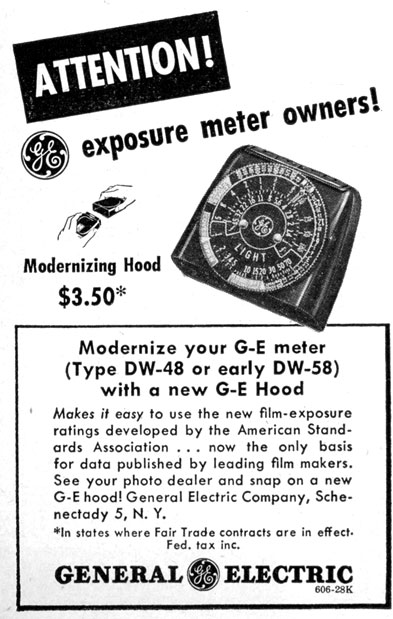
Film speed
View on GrokipediaMeasurement Systems
Historical Systems
The earliest practical system for measuring photographic emulsion speed was the Warnerke system, developed in the late 1880s by Polish inventor Leon Warnerke. This arithmetic scale quantified sensitivity based on the exposure time required to achieve a fixed optical density on the plate, with speeds expressed in Warnerke degrees; for instance, a higher degree indicated a shorter exposure time for the same density, reflecting greater sensitivity.[7] However, its reliance on empirical exposure tests and lack of standardization for density criteria made it unreliable for consistent comparisons across emulsions. In 1890, Swiss chemist Ferdinand Hurter and English chemist Vero Charles Driffield introduced the H&D system, marking a significant advance in sensitometry. Their logarithmic scale defined speed as the inertia—the reciprocal of the exposure (in lux-seconds) needed to produce a net density of 0.1 above the fog level—derived from the characteristic curve they pioneered, which plotted density against the logarithm of exposure to reveal emulsion behavior. This method emphasized scientific measurement over pure empiricism, but its focus on a low-density threshold often underestimated practical speeds for pictorial photography, as it prioritized the toe region of the curve rather than usable image gradients. The Scheiner system, proposed in 1894 by German astronomer Julius Scheiner, used an additive logarithmic scale where each degree represented a doubling of sensitivity. Speed was determined by the square of the aperture diameter (in millimeters) required to yield correct exposure in one second at a standard light intensity, effectively tying the rating to practical camera settings. Widely adopted in Europe, it facilitated exposure calculations but suffered from subjectivity in defining "correct exposure" and inconsistencies when applied to films with varying contrast, as the system assumed a uniform threshold without accounting for density specifics.[7] By the 1920s, national standards emerged to address these issues. In Germany, the DIN (Deutsches Institut für Normung) system, first proposed in 1928 and formalized in 1934 as DIN 4512, employed a logarithmic scale as a precursor to ISO, calculating speed as DIN = 10 × log₁₀(sensitivity), where sensitivity was the reciprocal of the exposure for a density of 0.1 above base plus fog. This approach improved precision for black-and-white films but was less suitable for color materials due to its monochrome-specific criteria. In the United Kingdom, the BSI (British Standards Institution) system, introduced in 1941, mirrored DIN's logarithmic structure and used the same density threshold of 0.1 above fog for the speed point.[7] In the United States, the Weston Universal system, developed in 1931 by electrical engineer Edward Faraday Weston, provided empirical, non-logarithmic speeds based on extensive practical exposure tests with tungsten illumination, aiming for optimal negative density in typical printing conditions.[8] A variant, the General Electric (GE) system from the mid-1930s, calibrated speeds similarly but adjusted for selenium cell meter responses, yielding values about 10-20% lower than Weston for the same films to account for manufacturing tolerances.[1] These U.S. systems prioritized usability over theoretical inertia, yet their empirical nature led to variations between batches and developers. The ASA (American Standards Association) system, established in the early 1940s (formally PH2.21-1943), evolved from the Weston scale as an arithmetic method based on the minimum useful gradient, requiring a specified contrast range for practical negatives.[9] In the Soviet Union, the GOST system, standardized in the 1950s under GOST 2817-50, adopted an arithmetic scale akin to ASA but with metric adjustments, such as exposures calibrated to candle-seconds per square centimeter, producing speeds approximately 10-25% higher than ASA for equivalent films.[10] These historical systems, while innovative, exhibited key limitations due to divergent criteria—such as threshold density, inertia, fixed exposure for density, or minimum gradient—which resulted in a single emulsion rating differently across methods (e.g., a film might be Scheiner 15° but H&D 200). This inconsistency fostered international confusion in exposure guidance and equipment calibration, ultimately prompting the unification under the ISO standard in 1974.Current ISO System
The current ISO system for film speed, established through the 1974 merger of the American Standards Association (ASA) arithmetic scale and the German Deutsches Institut für Normung (DIN) logarithmic scale, provides a unified international framework for measuring photographic film's sensitivity to light. This system, governed by International Organization for Standardization (ISO) standards, combines an arithmetic designation (e.g., ISO 100) with a logarithmic equivalent (e.g., 21° DIN) to express speed in a dual format that facilitates both intuitive numerical use and precise logarithmic scaling. The arithmetic speed is derived from the formula for black-and-white negative films, where represents the minimum exposure in lux-seconds required to achieve a specified density on the film's characteristic curve following standard processing. The logarithmic component is calculated as , allowing speeds to be expressed in degrees for compatibility with exposure metering systems.[1][11][12] For color negative films, the ISO 5800 standard adapts the arithmetic speed formula to , where is the exposure determined from an integral response across the film's red, green, and blue emulsion layers, specifically the geometric mean of the green layer's response with that of the slowest layer (red or blue) to account for the multilayered nature of color materials. Unlike black-and-white films, which rely on a single emulsion layer's response, color film speed ratings integrate the combined sensitivity of all layers to ensure balanced reproduction in printing or scanning, emphasizing the green channel due to its central role in luminance perception. This integral approach prevents over- or underestimation of overall film performance in multicolor systems.[13][14] Emulsion speed ratings under the ISO system primarily employ the fixed density method, which defines speed based on the exposure needed to produce a consistent density level above the base-plus-fog (minimum density). For black-and-white negative films per ISO 6:1993, this fixed density is 0.10 above fog, ensuring the speed reflects usable shadow detail in the resulting negative. Complementary criteria include the threshold, defined as the density just above fog level where image formation begins; inertia, the reciprocal of the threshold exposure used in early logarithmic systems but aligned here with fixed density points; minimum useful gradient, the slope of the characteristic curve at the onset of practical image density; and fractional gradient, typically 0.5 of the maximum gradient to capture mid-tone response. For color negative films under ISO 5800:1987, the fixed density is set at 0.15 above minimum density per layer, with the integral calculation adjusting for variations across color sensitivities to maintain print quality. These criteria ensure ratings prioritize negative materials' ability to produce densities suitable for enlargement or projection while minimizing fog interference.[11][12][13][14] The manufacturer's box speed, printed directly on the film packaging (e.g., ISO 100/21°), represents the rated speed determined through testing to these ISO criteria under controlled processing conditions, serving as the recommended exposure index for optimal results. This box speed may differ slightly from independently measured values due to proprietary emulsions or developer variations, but it aligns with the standard to guarantee consistency across global production. Post-1993 updates, including the 2001 technical corrigendum to ISO 5800, introduced minor clarifications for alignment with emerging digital imaging standards like ISO 12232, such as refined densitometry procedures, yet the core analog emulsion criteria and formulas remain unchanged as of 2025.[15]Conversions Between Scales
Conversions between film speed scales are approximate because historical systems employed varying criteria for measuring sensitivity, such as different minimum density thresholds for exposure determination, leading to logarithmic and arithmetic discrepancies that prevent exact equivalences.[10] Arithmetic scales like ASA and ISO double in value for each stop of increased sensitivity, while logarithmic scales like DIN increment by 3 for each doubling, necessitating mathematical mappings for interoperability in legacy equipment and documentation.[16] The conversion from historic ASA to DIN uses the formula DIN = 10 \log_{10}(ASA) + 1, reflecting the logarithmic relationship where each unit increase in DIN corresponds to a 26% increase in sensitivity.[10] For common values, ASA 25 approximates 14 DIN, ASA 100 approximates 21 DIN, ASA 200 approximates 24 DIN, and ASA 400 approximates 27 DIN, as derived from this formula and verified in period standards.[17] Since the modern ISO scale harmonizes ASA's arithmetic progression with DIN's logarithmic notation (e.g., ISO 100/21°), conversions from ISO to ASA are nearly 1:1 for films post-1960, when ASA was revised to align more closely with international norms.[10] For ISO to Scheiner, the formula is Scheiner (Sch) = 10 \log_{10}(ISO), as the Scheiner system served as the precursor to DIN without the +1 offset; thus, ISO 100 corresponds to 20 Sch, and ISO 400 to 26 Sch.[10] Weston ratings, used on some vintage meters, approximate ISO with a 1/3-stop downward shift post-1940s calibrations, such that ISO \approx Weston \times 1.25; for example, Weston 80 equates to ISO 100, and Weston 160 to ISO 200.[18] For Soviet-era GOST scales under GOST 8-79 and earlier standards, the arithmetic values approximate ISO via GOST \approx ISO \times 0.9 for pre-1987 films, accounting for slight differences in rounding and testing methods; a GOST 90 rating thus corresponds to ISO 100, while GOST 180 to ISO 200.[19] Post-1987 GOST alignments (e.g., GOST 10691-84) make values identical to ISO, eliminating the need for conversion in later contexts.[10] The table below summarizes approximate conversions for representative speeds across scales, based on standard formulas and historical alignments:| ISO/ASA | DIN | Scheiner | Weston | GOST (pre-1987) |
|---|---|---|---|---|
| 25 | 14 | 14 | 20 | 22 |
| 100 | 21 | 20 | 80 | 90 |
| 200 | 24 | 23 | 160 | 180 |
| 400 | 27 | 26 | 320 | 360 |