


Community hub
Recent from talks
Contribute something
Nothing was collected or created yet.
Kelp forest
View on Wikipedia
| Marine habitats |
|---|
| Coastal habitats |
| Ocean surface |
| Open ocean |
| Sea floor |
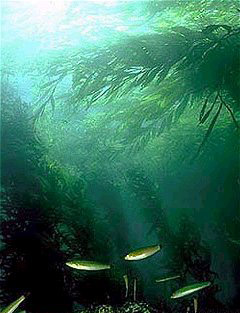
Kelp forests are underwater areas with a high density of kelp, which covers a large part of the world's coastlines. Smaller areas of anchored kelp are called kelp beds. They are recognized as one of the most productive and dynamic ecosystems on Earth.[1][2] Although algal kelp forest combined with coral reefs only cover 0.1% of Earth's total surface, they account for 0.9% of global primary productivity.[3] Kelp forests occur worldwide throughout temperate and polar coastal oceans.[1] In 2007, kelp forests were also discovered in tropical waters near Ecuador.[4]

"I can only compare these great aquatic forests ... with the terrestrial ones in the intertropical regions. Yet if in any country a forest was destroyed, I do not believe so nearly so many species of animals would perish as would here, from the destruction of kelp. Amidst the leaves of this plant numerous species of fish live, which nowhere else could find food or shelter; with their destruction the many cormorants and other fishing birds, the otters, seals and porpoise, would soon perish also; and lastly, the Fuegian[s] ... would ... decrease in numbers and perhaps cease to exist.

Physically formed by brown macroalgae, kelp forests provide a unique habitat for marine organisms[6] and are a source for understanding many ecological processes. Over the last century, they have been the focus of extensive research, particularly in trophic ecology, and continue to provoke important ideas that are relevant beyond this unique ecosystem. For example, kelp forests can influence coastal oceanographic patterns[7] and provide many ecosystem services.[8]
However, the influence of humans has often contributed to kelp forest degradation. Of particular concern are the effects of overfishing nearshore ecosystems, which can release herbivores from their normal population regulation and result in the overgrazing of kelp and other algae.[9] This can rapidly result in transitions to barren landscapes where relatively few species persist.[10][11] Already due to the combined effects of overfishing and climate change,[12] kelp forests have all but disappeared in many especially vulnerable places, such as Tasmania's east coast and the coast of Northern California.[13][14] The implementation of marine protected areas is one management strategy useful for addressing such issues, since it may limit the impacts of fishing and buffer the ecosystem from additive effects of other environmental stressors.
Kelp
[edit]The term kelp refers to marine algae belonging to the order Laminariales (phylum: Ochrophyta). Though not considered a taxonomically diverse order, kelps are highly diverse structurally and functionally.[8] The most widely recognized species are the giant kelps (Macrocystis spp.), although numerous other genera such as Laminaria, Ecklonia, Lessonia, Nereocystis, Alaria, and Eisenia are described.
A wide range of sea life uses kelp forests for protection or food, including fish. In the North Pacific kelp forests, particularly rockfish, and many invertebrates, such as amphipods, shrimp, marine snails, bristle worms, and brittle stars. Many marine mammals and birds are also found, including seals, sea lions, whales, sea otters, gulls, terns, snowy egrets, great blue herons, and cormorants, as well as some shore birds.[15]
Frequently considered an ecosystem engineer, kelp provides a physical substrate and habitat for kelp forest communities.[16] In algae (kingdom Protista), the body of an individual organism is known as a thallus rather than as a plant (kingdom Plantae). The morphological structure of a kelp thallus is defined by three basic structural units:[10]
- The holdfast is a root-like mass that anchors the thallus to the sea floor, though unlike true roots it is not responsible for absorbing and delivering nutrients to the rest of the thallus.
- The stipe is analogous to a plant stalk, extending vertically from the holdfast and providing a support framework for other morphological features.
- The fronds are leaf- or blade-like attachments extending from the stipe, sometimes along its full length, and are the sites of nutrient uptake and photosynthetic activity.
In addition, many kelp species have pneumatocysts, or gas-filled bladders, usually located at the base of fronds near the stipe. These structures provide the necessary buoyancy for kelp to maintain an upright position in the water column.
The environmental factors necessary for kelp to survive include hard substrate (usually rock or sand), high nutrients (e.g., nitrogen, phosphorus), and light (minimum annual irradiance dose > 50 E m−2[17]). Especially productive kelp forests tend to be associated with areas of significant oceanographic upwelling, a process that delivers cool, nutrient-rich water from depth to the ocean's mixed surface layer.[17] Water flow and turbulence facilitate nutrient assimilation across kelp fronds throughout the water column.[18] Water clarity affects the depth to which sufficient light can be transmitted. In ideal conditions, giant kelp (Macrocystis spp.) can grow as much as 30–60 cm vertically per day. Some species, such as Nereocystis, are annuals, while others such as Eisenia are perennials, living for more than 20 years.[19] In perennial kelp forests, maximum growth rates occur during upwelling months (typically spring and summer) and die-backs correspond to reduced nutrient availability, shorter photoperiods, and increased storm frequency.[10]
Kelps are primarily associated with temperate and arctic waters worldwide. Of the more dominant genera, Laminaria is mainly associated with both sides of the Atlantic Ocean and the coasts of China and Japan; Ecklonia is found in Australia, New Zealand, and South Africa; and Macrocystis occurs throughout the northeastern and southeastern Pacific Ocean, Southern Ocean archipelagos, and in patches around Australia, New Zealand, and South Africa.[10] The region with the greatest diversity of kelps (>20 species) is the northeastern Pacific, from north of San Francisco, California, to the Aleutian Islands, Alaska.
Although kelp forests are unknown in tropical surface waters, a few species of Laminaria have been known to occur exclusively in tropical deep waters.[20][21] This general absence of kelp from the tropics is believed to be mostly due to insufficient nutrient levels associated with warm, oligotrophic waters.[10] One recent study spatially overlaid the requisite physical parameters for kelp with mean oceanographic conditions and produced a model predicting the existence of subsurface kelps throughout the tropics worldwide to depths of 200 m (660 ft). For a hotspot in the Galapagos Islands, the local model was improved with fine-scale data and tested; the research team found thriving kelp forests in all eight of their sampled sites, all of which had been predicted by the model, thus validating their approach. This suggests that their global model might actually be fairly accurate, and if so, kelp forests would be prolific in tropical subsurface waters worldwide.[4] The importance of this contribution has been rapidly acknowledged within the scientific community and has prompted an entirely new trajectory of kelp forest research, highlighting the potential for kelp forests to provide marine organisms spatial refuge under climate change and providing possible explanations for evolutionary patterns of kelps worldwide.[22]
Ecosystem architecture
[edit]


The architecture of a kelp forest ecosystem is based on its physical structure, which influences the associated species that define its community structure. Structurally, the ecosystem includes three guilds of kelp and two guilds occupied by other algae:[10]
- Canopy kelps include the largest species and often constitute floating canopies that extend to the ocean surface (e.g., Macrocystis and Alaria).
- Stipitate kelps generally extend a few meters above the sea floor and can grow in dense aggregations (e.g., Eisenia and Ecklonia).
- Prostrate kelps lie near and along the sea floor (e.g., Laminaria).
- The benthic assemblage is composed of other algal species (e.g., filamentous and foliose functional groups, articulated corallines) and sessile organisms along the ocean bottom.
- Encrusting coralline algae directly and often extensively cover geologic substrate.
Multiple kelp species often co-exist within a forest; the term understory canopy refers to the stipitate and prostrate kelps. For example, a Macrocystis canopy may extend many meters above the seafloor towards the ocean surface, while an understory of the kelps Eisenia and Pterygophora reaches upward only a few meters. Beneath these kelps, a benthic assemblage of foliose red algae may occur. The dense vertical infrastructure with overlying canopy forms a system of microenvironments similar to those observed in a terrestrial forest, with a sunny canopy region, a partially shaded middle, and darkened seafloor.[10] Each guild has associated organisms, which vary in their levels of dependence on the habitat, and the assemblage of these organisms can vary with kelp morphologies.[23][24][25] For example, in California, Macrocystis pyrifera forests, the nudibranch Melibe leonina, and skeleton shrimp Caprella californica are closely associated with surface canopies; the kelp perch Brachyistius frenatus, rockfish Sebastes spp., and many other fishes are found within the stipitate understory; brittle stars and turban snails Tegula spp. are closely associated with the kelp holdfast, while various herbivores, such as sea urchins and abalone, live under the prostrate canopy; many seastars, hydroids, and benthic fishes live among the benthic assemblages; solitary corals, various gastropods, and echinoderms live over the encrusting coralline algae.[23] In addition, pelagic fishes and marine mammals are loosely associated with kelp forests, usually interacting near the edges as they visit to feed on resident organisms.
Trophic ecology
[edit]
.jpg)

Classic studies in kelp forest ecology have largely focused on trophic interactions (the relationships between organisms and their food webs), particularly the understanding and top-down trophic processes. Bottom-up processes are generally driven by the abiotic conditions required for primary producers to grow, such as availability of light and nutrients, and the subsequent transfer of energy to consumers at higher trophic levels. For example, the occurrence of kelp is frequently correlated with oceanographic upwelling zones, which provide unusually high concentrations of nutrients to the local environment.[26][27] This allows kelp to grow and subsequently support herbivores, which in turn support consumers at higher trophic levels.[28] By contrast, in top-down processes, predators limit the biomass of species at lower trophic levels through consumption. In the absence of predation, these lower-level species flourish because resources that support their energetic requirements are not limiting. In a well-studied example from Alaskan kelp forests,[29] sea otters (Enhydra lutris) control populations of herbivorous sea urchins through predation. When sea otters are removed from the ecosystem (for example, by human exploitation), urchin populations are released from predatory control and grow dramatically. This leads to increased herbivore pressure on local kelp stands. Deterioration of the kelp itself results in the loss of physical ecosystem structure and subsequently, the loss of other species associated with this habitat. In Alaskan kelp forest ecosystems, sea otters are the keystone species that mediates this trophic cascade. In Southern California, kelp forests persist without sea otters and the control of herbivorous urchins is instead mediated by a suite of predators including lobsters and large fishes, such as the California sheephead. The effect of removing one predatory species in this system differs from Alaska because redundancy exists in the trophic levels and other predatory species can continue to regulate urchins.[24] However, the removal of multiple predators can effectively release urchins from predator pressure and allow the system to follow trajectories towards kelp forest degradation.[30] Similar examples exist in Nova Scotia,[31] South Africa,[32] Australia,[33] and Chile.[34] The relative importance of top-down versus bottom-up control in kelp forest ecosystems and the strengths of trophic interactions continue to be the subject of considerable scientific investigation.[35][36][37]
The transition from macroalgal (i.e. kelp forest) to denuded landscapes dominated by sea urchins (or 'urchin barrens') is a widespread phenomenon,[8][38][39][40][41] often resulting from trophic cascades like those described above; the two phases are regarded as alternative stable states of the ecosystem.[42][43][44] The recovery of kelp forests from barren states has been documented following dramatic perturbations, such as urchin disease or large shifts in thermal conditions.[30][45][46] Recovery from intermediate states of deterioration is less predictable and depends on a combination of abiotic factors and biotic interactions in each case.
Though urchins are usually the dominant herbivores, others with significant interaction strengths include seastars, isopods, kelp crabs, and herbivorous fishes.[10][35] In many cases, these organisms feed on kelp that has been dislodged from substrate and drifts near the ocean floor rather than expend energy searching for intact thalli on which to feed. When sufficient drift kelp is available, herbivorous grazers do not exert pressure on attached thalli; when drift subsidies are unavailable, grazers directly impact the physical structure of the ecosystem.[47][48] Many studies in Southern California have demonstrated that the availability of drift kelp specifically influences the foraging behavior of sea urchins.[49][50] Drift kelp and kelp-derived particulate matter have also been important in subsidizing adjacent habitats, such as sandy beaches and the rocky intertidal.[51][52][53]
Patch dynamics
[edit]Another major area of kelp forest research has been directed at understanding the spatial-temporal patterns of kelp patches. Not only do such dynamics affect the physical landscape, but they also affect species that associate with kelp for refuge or foraging activities.[23][28] Large-scale environmental disturbances have offered important insights concerning mechanisms and ecosystem resilience. Examples of environmental disturbances include:
- Acute and chronic pollution events have been shown to impact southern California kelp forests, though the intensity of the impact seems to depend on both the nature of the contaminants and duration of exposure.[54][55][56][57][58] Pollution can include sediment deposition and eutrophication from sewage, industrial byproducts and contaminants like PCBs and heavy metals (for example, copper, zinc), runoff of organophosphates from agricultural areas, anti-fouling chemicals used in harbors and marinas (for example, TBT and creosote) and land-based pathogens like fecal coliform bacteria.
- Catastrophic storms can remove surface kelp canopies through wave activity, but usually leave understory kelps intact; they can also remove urchins when little spatial refuge is available.[42][48] Interspersed canopy clearings create a seascape mosaic where sunlight penetrates deeper into the kelp forest and species that are normally light-limited in the understory can flourish. Similarly, substrate cleared of kelp holdfasts can provide space for other sessile species to establish themselves and occupy the seafloor, sometimes directly competing with juvenile kelp and even inhibiting their settlement.[59]
- El Niño-Southern Oscillation (ENSO) events involve the depression of oceanographic thermoclines, severe reductions of nutrient input, and changes in storm patterns.[42][60] Stress due to warm water and nutrient depletion can increase the susceptibility of kelp to storm damage and herbivorous grazing, sometimes even prompting phase shifts to urchin-dominated landscapes.[46][49][61] In general, oceanographic conditions (that is, water temperature, currents) influence the recruitment success of kelp and its competitors, which clearly affect subsequent species interactions and kelp forest dynamics.[42][62]
- Overfishing higher trophic levels that naturally regulate herbivore populations is also recognized as an important stressor in kelp forests.[9][37][63] As described in the previous section, the drivers and outcomes of trophic cascades are important for understanding spatial-temporal patterns of kelp forests.[29][30][35]
In addition to ecological monitoring of kelp forests before, during, and after such disturbances, scientists try to tease apart the intricacies of kelp forest dynamics using experimental manipulations. By working on smaller spatial-temporal scales, they can control for the presence or absence of specific biotic and abiotic factors to discover the operative mechanisms. For example, in southern Australia, manipulations of kelp canopy types demonstrated that the relative amount of Ecklonia radiata in a canopy could be used to predict understory species assemblages; consequently, the proportion of E. radiata can be used as an indicator of other species occurring in the environment.[64]
Human use
[edit].jpg)
Kelp forests have been important to human existence for thousands of years.[65] Indeed, many now theorise that the first colonisation of the Americas was due to fishing communities following the Pacific kelp forests during the last ice age. One theory contends that the kelp forests that would have stretched from northeast Asia to the American Pacific coast would have provided many benefits to ancient boaters [66] The kelp forests would have provided many sustenance opportunities, as well as acting as a type of buffer from rough water. Besides these benefits, researchers believe that the kelp forests might have helped early boaters navigate, acting as a type of "kelp highway". Theorists also suggest that the kelp forests would have helped these ancient colonists by providing a stable way of life and preventing them from having to adapt to new ecosystems and develop new survival methods even as they traveled thousands of miles.[67]
Modern economies are based on fisheries of kelp-associated species such as lobster and rockfish. Humans can also harvest kelp directly to feed aquaculture species such as abalone and to extract the compound alginic acid, which is used in products like toothpaste and antacids.[68][69] Kelp forests are valued for recreational activities such as SCUBA diving and kayaking; the industries that support these sports represent one benefit related to the ecosystem and the enjoyment derived from these activities represents another. All of these are examples of ecosystem services provided specifically by kelp forests. The Monterey Bay aquarium was the first aquarium[70] to exhibit an alive kelp forest.
As carbon sequesters
[edit]Kelp forests grow in rocky places along the shore that are constantly eroding carrying material out to the deep sea. The kelp then sinks to the ocean floor and store the carbon where is it unlikely to be disturbed by human activity.[71] Researchers from the University of Western Australia estimated kelp forest around Australia sequestered 1.3-2.8 teragrams of carbon per year which is 27–34% of the total annual blue carbon sequestered in the Australian continent by tidal marshes, mangrove forests and seagrass beds.[72] Every year 200 million tons of carbon dioxide are being sequestered by macroalgae such as kelp.[73]
Threats and management
[edit]
Given the complexity of kelp forests – their variable structure, geography, and interactions – they pose a considerable challenge to environmental managers. Extrapolating even well-studied trends to the future is difficult because interactions within the ecosystem will change under variable conditions, not all relationships in the ecosystem are understood, and the nonlinear thresholds to transitions are not yet recognized.[74]
Major issues of concern include marine pollution and water quality, kelp harvesting and fisheries, invasive species,[8] and climate change.[75] The most pressing threat to kelp forest preservation may be the overfishing of coastal ecosystems, which by removing higher trophic levels facilitates their shift to depauperate urchin barrens.[9] The maintenance of biodiversity is recognized as a way of generally stabilizing ecosystems and their services through mechanisms such as functional compensation and reduced susceptibility to foreign species invasions.[76][77][78][79] More recently, the 2022 IPCC report states that kelp and other seaweeds in most regions are undergoing mass mortalities from high temperature extremes and range shifts from warming, as they are stationary and cannot adapt quick enough to deal with the rapidly increasing temperature of the Earth and thus, the ocean.[80]
In many places, managers have opted to regulate the harvest of kelp[27][81] and/or the taking of kelp forest species by fisheries.[8][63] While these may be effective in one sense, they do not necessarily protect the entirety of the ecosystem. Marine protected areas (MPAs) offer a unique solution that encompasses not only target species for harvesting, but also the interactions surrounding them and the local environment as a whole.[82][83] Direct benefits of MPAs to fisheries (for example, spillover effects) have been well documented around the world.[9][84][85][86] Indirect benefits have also been shown for several cases among species such as abalone and fishes in Central California.[87][88] Most importantly, MPAs can be effective at protecting existing kelp forest ecosystems and may also allow for the regeneration of those that have been affected.[42][89][90] A 2023 report by the United Nations Environment Programme noted that kelp forest restoration efforts have become more widespread in recent decades, and may provide economic benefits to nearby coastal communities.[91]
Kelp forest restoration in California
[edit]
In the 2010s, Northern California lost 95% of its kelp ecosystems due to marine heatwaves.[92][93][94][95]
Kelp bed recovery efforts in California are primarily focusing on sea urchin removal,[96] both by scuba divers,[97] and by sea otters, which are natural predators.[98][99][100][101][102]
A brown alga, Sargassum horneri, an invasive species first spotted in 2003, has also been a concern.[103][104]
The Sunflower sea star is an important keystone species which helps control sea urchin abundance, but an outbreak of Sea star wasting disease and a vulnerability to climate change has led to its critical endangerment.[105]
Researchers at the Bodega Marine Laboratory of UC Davis are developing replanting strategies, and volunteers of the Orange County Coastkeeper group are replanting giant kelp.[106][107] Humboldt State University began cultivating bull kelp in its research farm in 2021.[108]
Research efforts at the state level to prevent kelp forest collapse in California were announced in July 2020.[109]
At the federal level, H.R. 4458, the Keeping Ecosystems Living and Productive (KELP) Act, introduced July 29, 2021, seeks to establish a new grant program within NOAA for kelp forest restoration.[110]
Ocean Rainforest, a Faroe Islands-based company, secured $4.5 million in U.S. government funding to grow giant kelp on an 86-acre farm off the coast of Santa Barbara, California.[111]
See also
[edit]References
[edit]- ^ a b Mann, K. H. (1973-12-07). "Seaweeds: Their Productivity and Strategy for Growth: The role of large marine algae in coastal productivity is far more important than has been suspected". Science. 182 (4116): 975–981. doi:10.1126/science.182.4116.975. ISSN 0036-8075. PMID 17833778.
- ^ Pessarrodona, A; Assis, J; Filbee-Dexter, K; Burrows, M T; Gattuso, J-P; Duarte, C.M.; Krause-Jensen, D; Moore, P.J.; Smale, D.A.; Wernberg, T (23 July 2020). "Global Seaweed Productivity". Science Advances. 8 (37) eabn2465. doi:10.1126/sciadv.abn2465. hdl:10754/681467. PMC 9473579. PMID 36103524.
- ^ See Fig. 3 in Blakemore, Robert (2018). "Non-Flat Earth Recalibrated for Terrain and Topsoil". Soil Systems. 2 (4): 64. Bibcode:2018SoiSy...2...64B. doi:10.3390/soilsystems2040064.
- ^ a b Graham, Michael H.; Kinlan, Brian P.; Druehl, Louis D.; Garske, Lauren E.; Banks, Stuart (2007-10-16). "Deep-water kelp refugia as potential hotspots of tropical marine diversity and productivity". Proceedings of the National Academy of Sciences. 104 (42): 16576–16580. Bibcode:2007PNAS..10416576G. doi:10.1073/pnas.0704778104. ISSN 0027-8424. PMC 2034254. PMID 17913882.
- ^ the harvard classics: voyage of the beagle. P.F. Collier & Son Company. 1909.
- ^ Christie, Hartvig; Jørgensen, Nina Mari; Norderhaug, Kjell Magnus; Waage-Nielsen, Elisabeth (August 2003). "Species distribution and habitat exploitation of fauna associated with kelp ( Laminaria Hyperborea ) along the Norwegian Coast". Journal of the Marine Biological Association of the United Kingdom. 83 (4): 687–699. Bibcode:2003JMBUK..83..687C. doi:10.1017/S0025315403007653h. ISSN 0025-3154. Archived from the original on 2024-10-07. Retrieved 2024-10-05.
- ^ Jackson, George A.; Winant, Clinton D. (May 1983). "Effect of a kelp forest on coastal currents". Continental Shelf Research. 2 (1): 75–80. Bibcode:1983CSR.....2...75J. doi:10.1016/0278-4343(83)90023-7. Archived from the original on 2024-10-07. Retrieved 2024-10-05.
- ^ a b c d e Steneck, Robert S.; Graham, Michael H.; Bourque, Bruce J.; Corbett, Debbie; Erlandson, Jon M.; Estes, James A.; Tegner, Mia J. (December 2002). "Kelp forest ecosystems: biodiversity, stability, resilience and future". Environmental Conservation. 29 (4): 436–459. Bibcode:2002EnvCo..29..436S. doi:10.1017/S0376892902000322. ISSN 0376-8929. Archived from the original on 2024-10-07. Retrieved 2024-10-05.
- ^ a b c d Sala, E.; Boudouresque, C. F.; Harmelin-Vivien, M. (September 1998). "Fishing, Trophic Cascades, and the Structure of Algal Assemblages: Evaluation of an Old but Untested Paradigm". Oikos. 82 (3): 425. Bibcode:1998Oikos..82..425S. doi:10.2307/3546364. JSTOR 3546364.
- ^ a b c d e f g h Dayton, Paul K. (1985). "Ecology of Kelp Communities". Annual Review of Ecology and Systematics. 16 (1): 215–245. Bibcode:1985AnRES..16..215D. doi:10.1146/annurev.es.16.110185.001243. ISSN 0066-4162. JSTOR 2097048.
- ^ Norderhaug, Kjell Magnus; Christie, Hartvig C. (November 2009). "Sea urchin grazing and kelp re-vegetation in the NE Atlantic". Marine Biology Research. 5 (6): 515–528. Bibcode:2009MBioR...5..515N. doi:10.1080/17451000902932985. ISSN 1745-1000.
- ^ Filbee-Dexter, Karen; Feehan, Colette J.; Scheibling, Robert E. (2016-02-03). "Large-scale degradation of a kelp ecosystem in an ocean warming hotspot". Marine Ecology Progress Series. 543: 141–152. Bibcode:2016MEPS..543..141F. doi:10.3354/meps11554. ISSN 0171-8630. Archived from the original on 2024-03-31. Retrieved 2024-03-31.
- ^ Morton, Adam; Cordell, Marni; Fanner, David; Ball, Andy; Evershed, Nick (23 February 2020). "The dead sea: Tasmania's underwater forests disappearing in our lifetime". The Guardian. Archived from the original on 2020-10-22. Retrieved 2020-10-22.
- ^ Steinbauer, James. "What Will It Take to Bring Back the Kelp Forest? - Bay Nature Magazine". Bay Nature. Archived from the original on 2020-10-20. Retrieved 2020-10-22.
- ^ Kelp forests provide habitat for a variety of invertebrates, fish, marine mammals, and birds Archived 2017-09-09 at the Wayback Machine NOAA. Updated 11 January 2013. Retrieved 15 January 2014.
- ^ Jones, Clive G.; Lawton, John H.; Shachak, Moshe (October 1997). "Positive and Negative Effects of Organisms as Physical Ecosystem Engineers". Ecology. 78 (7): 1946–1957. doi:10.1890/0012-9658(1997)078[1946:PANEOO]2.0.CO;2. ISSN 0012-9658. Archived from the original on 2024-10-07. Retrieved 2024-10-05.
- ^ a b Lüning, Klaus; tom Dieck, Inka (1990). Garbary, David J.; South, G. Robin (eds.). The Distribution and Evolution of the Laminariales: North Pacific — Atlantic Relationships. Evolutionary Biogeography of the Marine Algae of the North Atlantic. Berlin, Heidelberg: Springer Berlin Heidelberg. pp. 187–204. doi:10.1007/978-3-642-75115-8_10. ISBN 978-3-642-75117-2. Archived from the original on 2024-10-07. Retrieved 2024-10-05.
- ^ Wheeler, W. N. (1980). "Effect of boundary layer transport on the fixation of carbon by the giant kelp Macrocystis pyrifera". Marine Biology. 56 (2): 103–110. Bibcode:1980MarBi..56..103W. doi:10.1007/BF00397128. ISSN 0025-3162. Archived from the original on 2024-10-07. Retrieved 2024-10-06.
- ^ Steneck, Robert S.; Dethier, Megan N. (April 1994). "A Functional Group Approach to the Structure of Algal-Dominated Communities". Oikos. 69 (3): 476. Bibcode:1994Oikos..69..476S. doi:10.2307/3545860. JSTOR 3545860. Archived from the original on 2020-02-14. Retrieved 2024-10-06.
- ^ Joly, Aylthon Brandão (1967). Two Brazilian Laminarias. Rio de Janeiro: Instituto de Pesquisas da Marinha. pp. 1–7. OL 4960200M.
- ^ Petrov, J.E., M.V. Suchovejeva and G.V. Avdejev. 1973. New species of the genus Laminaria from the Philippine Sea. Nov Sistem. Nizch. Rast. 10: 59–61.
- ^ Santelices, Bernabé (2007-12-04). "The discovery of kelp forests in deep-water habitats of tropical regions". Proceedings of the National Academy of Sciences. 104 (49): 19163–19164. Bibcode:2007PNAS..10419163S. doi:10.1073/pnas.0708963104. ISSN 0027-8424. PMC 2148260. PMID 18042707.
- ^ a b c Foster, M.S.; Schiel, D.R. (1985-05-01). The Ecology of Giant Kelp Forests in California: A Community Profile... Biological Report 85(7.2) (Report). Department of the Interior.
- ^ a b Graham, Michael H. (June 2004). "Effects of Local Deforestation on the Diversity and Structure of Southern California Giant Kelp Forest Food Webs". Ecosystems. 7 (4): 341. Bibcode:2004Ecosy...7..341G. doi:10.1007/s10021-003-0245-6. ISSN 1432-9840. Archived from the original on 2024-10-07. Retrieved 2024-10-06.
- ^ Fowler-Walker, Meegan J.; Gillanders, Bronwyn M.; Connell, Sean D.; Irving, Andrew D. (April 2005). "Patterns of association between canopy-morphology and understorey assemblages across temperate Australia". Estuarine, Coastal and Shelf Science. 63 (1–2): 133–141. Bibcode:2005ECSS...63..133F. doi:10.1016/j.ecss.2004.10.016. Archived from the original on 2024-07-16. Retrieved 2024-10-06.
- ^ Jackson, George A. (November 1977). "Nutrients and production of giant kelp, Macrocystis pyrifera, off southern California1". Limnology and Oceanography. 22 (6): 979–995. Bibcode:1977LimOc..22..979J. doi:10.4319/lo.1977.22.6.0979. ISSN 0024-3590. Archived from the original on 2024-10-07. Retrieved 2024-10-06.
- ^ a b Dayton, Paul K.; Tegner, Mia J.; Edwards, Peter B.; Riser, Kristin L. (May 1999). "Temporal and Spatial Scales of Kelp Demography: The Role of Oceanographic Climate". Ecological Monographs. 69 (2): 219. doi:10.2307/2657238. JSTOR 2657238.
- ^ a b Carr, Mark H. (July 1994). "Effects of Macroalgal Dynamics on Recruitment of a Temperate Reef Fish". Ecology. 75 (5): 1320–1333. Bibcode:1994Ecol...75.1320C. doi:10.2307/1937457. ISSN 0012-9658. JSTOR 1937457. Archived from the original on 2024-10-07. Retrieved 2024-10-06.
- ^ a b Estes, James A.; Duggins, David O. (February 1995). "Sea Otters and Kelp Forests in Alaska: Generality and Variation in a Community Ecological Paradigm". Ecological Monographs. 65 (1): 75–100. Bibcode:1995EcoM...65...75E. doi:10.2307/2937159. ISSN 0012-9615. JSTOR 2937159. Archived from the original on 2024-10-07. Retrieved 2024-10-06.
- ^ a b c Pearse, J. S.; Hines, A. H. (March 1979). "Expansion of a central California kelp forest following the mass mortality of sea urchins". Marine Biology. 51 (1): 83–91. Bibcode:1979MarBi..51...83P. doi:10.1007/BF00389034. ISSN 0025-3162. Archived from the original on 2024-10-07. Retrieved 2024-10-06.
- ^ Scheibling, Re; Hennigar, Aw (1997). "Recurrent outbreaks of disease in sea urchins Strongylocentrotus droebachiensis in Nova Scotia:evidence for a link with large-scale meteorologic and oceanographic events". Marine Ecology Progress Series. 152: 155–165. Bibcode:1997MEPS..152..155S. doi:10.3354/meps152155. ISSN 0171-8630. Archived from the original on 2024-10-07. Retrieved 2024-10-06.
- ^ Velimirov, B.; Field, J. G.; Griffiths, C. L.; Zoutendyk, P. (August 1977). "The ecology of kelp bed communities in the Benguela upwelling system: Analysis of biomass and spatial distribution". Helgoländer Wissenschaftliche Meeresuntersuchungen. 30 (1–4): 495–518. doi:10.1007/BF02207857. ISSN 0017-9957. Archived from the original on 2024-10-07. Retrieved 2024-10-06.
- ^ Andrew, N. L. (March 1993). "Spatial Heterogeneity, Sea Urchin Grazing, and Habitat Structure on Reefs in Temperate Australia". Ecology. 74 (2): 292–302. Bibcode:1993Ecol...74..292A. doi:10.2307/1939293. ISSN 0012-9658. JSTOR 1939293. Archived from the original on 2024-10-07. Retrieved 2024-10-06.
- ^ Dayton, Paul K. (December 1985). "The Structure and Regulation of Some South American Kelp Communities". Ecological Monographs. 55 (4): 447–468. Bibcode:1985EcoM...55..447D. doi:10.2307/2937131. ISSN 0012-9615. JSTOR 2937131. Archived from the original on 2024-10-07. Retrieved 2024-10-06.
- ^ a b c E, Sala; Mh, Graham (2002-03-19). "Community-wide distribution of predator-prey interaction strength in kelp forests". Proceedings of the National Academy of Sciences of the United States of America. 99 (6): 3678–3683. Bibcode:2002PNAS...99.3678S. doi:10.1073/pnas.052028499. ISSN 0027-8424. PMC 122583. PMID 11891292.
- ^ Byrnes, Jarrett; Stachowicz, John J.; Hultgren, Kristin M.; Randall Hughes, A.; Olyarnik, Suzanne V.; Thornber, Carol S. (January 2006). "Predator diversity strengthens trophic cascades in kelp forests by modifying herbivore behaviour". Ecology Letters. 9 (1): 61–71. Bibcode:2006EcolL...9...61B. doi:10.1111/j.1461-0248.2005.00842.x. ISSN 1461-023X. PMID 16958869. Archived from the original on 2022-07-29. Retrieved 2024-10-06.
- ^ a b Halpern, Benjamin S.; Cottenie, Karl; Broitman, Bernardo R. (2006-05-26). "Strong top-down control in southern California kelp forest ecosystems". Science. 312 (5777): 1230–1232. Bibcode:2006Sci...312.1230H. doi:10.1126/science.1128613. ISSN 1095-9203. PMID 16728644.
- ^ Lawrence, J.M. 1975. On the relationships between marine plants and sea urchins. Oceanography and Marine Biology, An Annual Review. 13: 213–286.
- ^ Hughes, T. P. (1994-09-09). "Catastrophes, phase shifts, and large-scale degradation of a Caribbean coral reef". Science. 265 (5178): 1547–1551. Bibcode:1994Sci...265.1547H. doi:10.1126/science.265.5178.1547. ISSN 0036-8075. PMID 17801530.
- ^ Sivertsen, Knut (2006-11-27). "Overgrazing of Kelp Beds Along the Coast of Norway". Journal of Applied Phycology. 18 (3–5): 599–610. Bibcode:2006JAPco..18..599S. doi:10.1007/s10811-006-9064-4. ISSN 0921-8971. Archived from the original on 2024-10-07. Retrieved 2024-10-06.
- ^ Filbee-Dexter, Karen; Scheibling, Robert E. (January 2017). "The present is the key to the past: linking regime shifts in kelp beds to the distribution of deep-living sea urchins". Ecology. 98 (1): 253–264. Bibcode:2017Ecol...98..253F. doi:10.1002/ecy.1638. ISSN 0012-9658. PMID 28052391. Archived from the original on 2024-10-07. Retrieved 2024-03-31.
- ^ a b c d e Dayton, Paul K.; Tegner, Mia J.; Parnell, Paul E.; Edwards, Peter B. (September 1992). "Temporal and Spatial Patterns of Disturbance and Recovery in a Kelp Forest Community". Ecological Monographs. 62 (3): 421–445. Bibcode:1992EcoM...62..421D. doi:10.2307/2937118. ISSN 0012-9615. JSTOR 2937118. Archived from the original on 2024-10-07. Retrieved 2024-10-06.
- ^ Pearse, John S. (2006-11-10). "Ecological role of purple sea urchins". Science. 314 (5801): 940–941. Bibcode:2006Sci...314..940P. doi:10.1126/science.1131888. ISSN 1095-9203. PMID 17095690.
- ^ Filbee-Dexter, Karen; Scheibling, Robert E. (2014-01-09). "Sea urchin barrens as alternative stable states of collapsed kelp ecosystems". Marine Ecology Progress Series. 495: 1–25. Bibcode:2014MEPS..495....1F. doi:10.3354/meps10573. ISSN 0171-8630. Archived from the original on 2024-10-07. Retrieved 2024-03-31.
- ^ Lafferty, Kevin D. (October 2004). "Fishing for lobsters indirectly increases epidemics in sea urchins". Ecological Applications. 14 (5): 1566–1573. Bibcode:2004EcoAp..14.1566L. doi:10.1890/03-5088. ISSN 1051-0761. Archived from the original on 2024-10-07. Retrieved 2024-10-06.
- ^ a b Vásquez, Julio A.; Vega, J. M. Alonso; Buschmann, Alejandro H. (2006-11-27). "Long Term Variability in the Structure of Kelp Communities in Northern Chile and the 1997–98 ENSO". Journal of Applied Phycology. 18 (3–5): 505–519. Bibcode:2006JAPco..18..505V. doi:10.1007/s10811-006-9056-4. hdl:10533/177654. ISSN 0921-8971. Archived from the original on 2024-10-07. Retrieved 2024-10-06.
- ^ Cowen, Robert K. (May 1983). "The effects of sheephead (Semicossyphus pulcher) predation on red sea urchin (Strongylocentrotus franciscanus) populations: an experimental analysis". Oecologia. 58 (2): 249–255. Bibcode:1983Oecol..58..249C. doi:10.1007/BF00399225. ISSN 0029-8549. PMID 28310586. Archived from the original on 2024-10-07. Retrieved 2024-10-06.
- ^ a b Ebeling, A. W.; Laur, D. R.; Rowley, R. J. (January 1985). "Severe storm disturbances and reversal of community structure in a southern California kelp forest". Marine Biology. 84 (3): 287–294. Bibcode:1985MarBi..84..287E. doi:10.1007/BF00392498. ISSN 0025-3162. Archived from the original on 2024-10-07. Retrieved 2024-10-06.
- ^ a b Dayton, Paul K.; Tegner, Mia J. (1984-04-20). "Catastrophic Storms, El Niño, and Patch Stability in a Southern California Kelp Community". Science. 224 (4646): 283–285. Bibcode:1984Sci...224..283D. doi:10.1126/science.224.4646.283. ISSN 0036-8075. PMID 17734914. Archived from the original on 2023-02-28. Retrieved 2024-10-06.
- ^ Harrold, Christopher; Reed, Daniel C. (August 1985). "Food Availability, Sea Urchin Grazing, and Kelp Forest Community Structure". Ecology. 66 (4): 1160–1169. Bibcode:1985Ecol...66.1160H. doi:10.2307/1939168. ISSN 0012-9658. JSTOR 1939168. Archived from the original on 2024-10-07. Retrieved 2024-10-06.
- ^ Koop, K; Newell, Rc; Lucas, Mi (1982). "Biodegradation and Carbon Flow Based on Kelp (Ecklonia maxima) Debris in a Sandy Beach Microcosm" (PDF). Marine Ecology Progress Series. 7: 315–326. Bibcode:1982MEPS....7..315K. doi:10.3354/meps007315. ISSN 0171-8630. Archived (PDF) from the original on 2024-10-07. Retrieved 2024-10-06.
- ^ Bustamante, R. H.; Branch, G. M.; Eekhout, S. (October 1995). "Maintenance of an Exceptional Intertidal Grazer Biomass in South Africa: Subsidy by Subtidal Kelps". Ecology. 76 (7): 2314–2329. Bibcode:1995Ecol...76.2314B. doi:10.2307/1941704. ISSN 0012-9658. JSTOR 1941704. Archived from the original on 2024-10-07. Retrieved 2024-10-06.
- ^ Kaehler, S; Pakhomov, Ea; Kalin, Rm; Davis, S (2006-07-03). "Trophic importance of kelp-derived suspended particulate matter in a through-flow sub-Antarctic system". Marine Ecology Progress Series. 316: 17–22. Bibcode:2006MEPS..316...17K. doi:10.3354/meps316017. ISSN 0171-8630. Archived from the original on 2024-10-07. Retrieved 2024-10-06.
- ^ Grigg, R.W. and R.S. Kiwala. 1970. Some ecological effects of discharged wastes on marine life. California Department of Fish and Game 56: 145–155.
- ^ Stull, J.K. (1989). "Contaminants In Sediments Near A Major Marine Outfall: History, Effects, And Future". Proceedings OCEANS (Report). Vol. 2. IEEE. pp. 481–484. doi:10.1109/OCEANS.1989.586780. Archived from the original on 2024-07-10. Retrieved 2024-10-06.
- ^ North, W. J.; James, D. E.; Jones, L. G. (June 1993). "History of kelp beds (Macrocystis) in Orange and San Diego Counties, California". Hydrobiologia. 260–261 (1): 277–283. Bibcode:1993HyBio.260..277N. doi:10.1007/BF00049029. ISSN 0018-8158. Archived from the original on 2024-10-07. Retrieved 2024-10-06.
- ^ Tegner, M.J.; Dayton, P.K.; Edwards, P.B.; Riser, K.L.; Chadwick, D.B.; Dean, T.A.; Deysher, L. (January 1995). "Effects of a large sewage spill on a kelp forest community: Catastrophe or disturbance?". Marine Environmental Research. 40 (2): 181–224. Bibcode:1995MarER..40..181T. doi:10.1016/0141-1136(94)00008-D. Archived from the original on 2024-07-11. Retrieved 2024-10-06.
- ^ Carpenter, S. R.; Caraco, N. F.; Correll, D. L.; Howarth, R. W.; Sharpley, A. N.; Smith, V. H. (August 1998). "Nonpoint Pollution of Surface Waters with Phosphorus and Nitrogen". Ecological Applications. 8 (3): 559–568. doi:10.1890/1051-0761(1998)008[0559:NPOSWW]2.0.CO;2. hdl:1808/16724. ISSN 1051-0761.
- ^ Kennelly, Steven J. (1987). "Physical disturbances in an Australian kelp community. I. Temporal effects". Marine Ecology Progress Series. 40 (1/2): 145–153. Bibcode:1987MEPS...40..145K. doi:10.3354/meps040145. ISSN 0171-8630. JSTOR 24825709.
- ^ McPhaden, M. J. (1999-02-12). "Genesis and evolution of the 1997-98 El Nino". Science. 283 (5404): 950–954. doi:10.1126/science.283.5404.950. ISSN 1095-9203. PMID 9974381.
- ^ Edwards, M. S.; Hernández-Carmona, G. (May 2005). "Delayed recovery of giant kelp near its southern range limit in the North Pacific following El Niño". Marine Biology. 147 (1): 273–279. Bibcode:2005MarBi.147..273E. doi:10.1007/s00227-004-1548-7. ISSN 0025-3162. Archived from the original on 2024-10-07. Retrieved 2024-10-06.
- ^ Duggins, David O.; Eckman, James E.; Sewell, Amy T. (October 1990). "Ecology of understory kelp environments. II. Effects of kelps on recruitment of benthic invertebrates". Journal of Experimental Marine Biology and Ecology. 143 (1–2): 27–45. Bibcode:1990JEMBE.143...27D. doi:10.1016/0022-0981(90)90109-P. Archived from the original on 2024-10-07. Retrieved 2024-10-06.
- ^ a b Jackson, Jeremy B. C.; Kirby, Michael X.; Berger, Wolfgang H.; Bjorndal, Karen A.; Botsford, Louis W.; Bourque, Bruce J.; Bradbury, Roger H.; Cooke, Richard; Erlandson, Jon; Estes, James A.; Hughes, Terence P.; Kidwell, Susan; Lange, Carina B.; Lenihan, Hunter S.; Pandolfi, John M. (2001-07-27). "Historical Overfishing and the Recent Collapse of Coastal Ecosystems". Science. 293 (5530): 629–637. Bibcode:2001Sci...293..629J. doi:10.1126/science.1059199. ISSN 0036-8075. PMID 11474098. Archived from the original on 2024-10-07. Retrieved 2024-10-06.
- ^ Irving, Andrew D.; Connell, Sean D. (June 2006). "Predicting understorey structure from the presence and composition of canopies: an assembly rule for marine algae". Oecologia. 148 (3): 491–502. Bibcode:2006Oecol.148..491I. doi:10.1007/s00442-006-0389-0. ISSN 0029-8549. PMID 16502000. Archived from the original on 2022-01-20. Retrieved 2024-10-06.
- ^ Simenstad, Charles A.; Estes, James A.; Kenyon, Karl W. (1978-04-28). "Aleuts, Sea Otters, and Alternate Stable-State Communities". Science. 200 (4340): 403–411. Bibcode:1978Sci...200..403S. doi:10.1126/science.200.4340.403. ISSN 0036-8075. PMID 17757287. Archived from the original on 2024-10-07. Retrieved 2024-10-06.
- ^ Erlandson, Jon M.; Graham, Michael H.; Bourque, Bruce J.; Corbett, Debra; Estes, James A.; Steneck, Robert S. (2007-10-30). "The Kelp Highway Hypothesis: Marine Ecology, the Coastal Migration Theory, and the Peopling of the Americas". The Journal of Island and Coastal Archaeology. 2 (2): 161–174. Bibcode:2007JICA....2..161E. doi:10.1080/15564890701628612. ISSN 1556-4894.
- ^ Erlandson, Jon M.; Braje, Todd J.; Gill, Kristina M.; Graham, Michael H. (2015-09-02). "Ecology of the Kelp Highway: Did Marine Resources Facilitate Human Dispersal From Northeast Asia to the Americas?". The Journal of Island and Coastal Archaeology. 10 (3): 392–411. doi:10.1080/15564894.2014.1001923. ISSN 1556-4894. Archived from the original on 2024-10-07. Retrieved 2024-10-06.
- ^ Gutierrez, Alfonso; Correa, Tomás; Muñoz, Verónica; Santibañez, Alejandro; Marcos, Roberto; Cáceres, Carlos; Buschmann, Alejandro H. (2006-11-27). "Farming of the Giant Kelp Macrocystis Pyrifera in Southern Chile for Development of Novel Food Products". Journal of Applied Phycology. 18 (3–5): 259–267. Bibcode:2006JAPco..18..259G. doi:10.1007/s10811-006-9025-y. ISSN 0921-8971. Archived from the original on 2024-10-07. Retrieved 2024-10-06.
- ^ Ortiz, Marco; Stotz, Wolfgang (January 2007). "Ecological and eco-social models for the introduction of the abalone Haliotis discus hannai into benthic systems of north-central Chile: sustainability assessment". Aquatic Conservation: Marine and Freshwater Ecosystems. 17 (1): 89–105. Bibcode:2007ACMFE..17...89O. doi:10.1002/aqc.791. hdl:10533/197663. ISSN 1052-7613. Archived from the original on 2024-10-07. Retrieved 2024-10-06.
- ^ Nielsen, Brittany (2021-10-21). "Monterey Bay Aquarium celebrates its 37th birthday". Archived from the original on 2022-12-02. Retrieved 2024-10-06.
- ^ Hurlimann, Sylvia (4 July 2019). "How Kelp Naturally Combats Global Climate Change". Science in the News. Archived from the original on 7 October 2024. Retrieved 21 June 2022.
- ^ Filbee-Dexter, Karen; Wernberg, Thomas (23 July 2020). "Substantial blue carbon in overlooked Australian kelp forests". Scientific Reports. 10 (1): 12341. Bibcode:2020NatSR..1012341F. doi:10.1038/s41598-020-69258-7. PMC 7378163. PMID 32703990.
- ^ Krause-Jensen, Dorte; M. Duarte, Carlos (12 September 2016). "Substantial role of macroalgae in marine carbon sequestration". Nature Geoscience. 9 (10): 737–742. Bibcode:2016NatGe...9..737K. doi:10.1038/ngeo2790. Archived from the original on 20 June 2022. Retrieved 21 June 2022.
- ^ Scheffer, Marten; Carpenter, Steve; Foley, Jonathan A.; Folke, Carl; Walker, Brian (October 2001). "Catastrophic shifts in ecosystems". Nature. 413 (6856): 591–596. Bibcode:2001Natur.413..591S. doi:10.1038/35098000. ISSN 0028-0836. PMID 11595939. Archived from the original on 2024-09-25. Retrieved 2024-10-06.
- ^ MacDonald, Lucy (2019-02-06). "95pc of Tasmania's giant kelp is gone, scientists are in a race to save what's left". ABC News. Archived from the original on 2024-10-07. Retrieved 2020-02-09.
- ^ Frost, Thomas M.; Carpenter, Stephen R.; Ives, Anthony R.; Kratz, Timothy K. (1995). Jones, Clive G.; Lawton, John H. (eds.). Species Compensation and Complementarity in Ecosystem Function. Boston, MA: Springer US. pp. 224–239. doi:10.1007/978-1-4615-1773-3_22. ISBN 978-1-4613-5714-8. Archived from the original on 2024-10-07. Retrieved 2024-10-06.
- ^ D, Tilman; Cl, Lehman; Ce, Bristow (Mar 1998). "Diversity-stability relationships: statistical inevitability or ecological consequence?". The American Naturalist. 151 (3): 277–282. Bibcode:1998ANat..151..277T. doi:10.1086/286118. ISSN 0003-0147. PMID 18811358.
- ^ Stachowicz, John J.; Whitlatch, Robert B.; Osman, Richard W. (1999-11-19). "Species Diversity and Invasion Resistance in a Marine Ecosystem". Science. 286 (5444): 1577–1579. doi:10.1126/science.286.5444.1577. ISSN 0036-8075. PMID 10567267. Archived from the original on 2024-10-07. Retrieved 2024-10-06.
- ^ Elmqvist, Thomas; Folke, Carl; Nyström, Magnus; Peterson, Garry; Bengtsson, Jan; Walker, Brian; Norberg, Jon (November 2003). "Response diversity, ecosystem change, and resilience". Frontiers in Ecology and the Environment. 1 (9): 488–494. doi:10.1890/1540-9295(2003)001[0488:RDECAR]2.0.CO;2. ISSN 1540-9295.
- ^ "Climate Change 2022: Impacts, Adaptation and Vulnerability". www.ipcc.ch. Archived from the original on 2022-02-28. Retrieved 2022-02-28.
- ^ Stekoll, M. S.; Deysher, L. E.; Hess, M. (2006-11-27). "A remote sensing approach to estimating harvestable kelp biomass". Journal of Applied Phycology. 18 (3–5): 323–334. Bibcode:2006JAPco..18..323S. doi:10.1007/s10811-006-9029-7. ISSN 0921-8971. Archived from the original on 2024-10-07. Retrieved 2024-10-06.
- ^ Allison, Gary W.; Lubchenco, Jane; Carr, Mark H. (February 1998). "Marine reserves are necessary but not sufficient for marine conservation". Ecological Applications. 8 (sp1): S79 – S92. doi:10.1890/1051-0761(1998)8[S79:MRANBN]2.0.CO;2. ISSN 1051-0761.
- ^ Airamé, Satie; Dugan, Jenifer E.; Lafferty, Kevin D.; Leslie, Heather; McArdle, Deborah A.; Warner, Robert R. (February 2003). "Applying Ecological Criteria to Marine Reserve Design: A Case Study from the California Channel Islands". Ecological Applications. 13 (sp1): 170–184. doi:10.1890/1051-0761(2003)013[0170:AECTMR]2.0.CO;2. ISSN 1051-0761.
- ^ Bohnsack, James A. (June 1998). "Application of marine reserves to reef fisheries management". Australian Journal of Ecology. 23 (3): 298–304. Bibcode:1998AusEc..23..298B. doi:10.1111/j.1442-9993.1998.tb00734.x. ISSN 0307-692X. Archived from the original on 2024-10-07. Retrieved 2024-10-06.
- ^ Gell, Fiona R; Roberts, Callum M (September 2003). "Benefits beyond boundaries: the fishery effects of marine reserves". Trends in Ecology & Evolution. 18 (9): 448–455. doi:10.1016/S0169-5347(03)00189-7. hdl:1834/546. Archived from the original on 2024-10-07. Retrieved 2024-10-06.
- ^ Willis, Trevor J.; Millar, Russell B.; Babcock, Russ C. (April 2003). "Protection of exploited fish in temperate regions: high density and biomass of snapper Pagrus auratus (Sparidae) in northern New Zealand marine reserves". Journal of Applied Ecology. 40 (2): 214–227. Bibcode:2003JApEc..40..214W. doi:10.1046/j.1365-2664.2003.00775.x. ISSN 0021-8901. Archived from the original on 2024-10-07. Retrieved 2024-10-06.
- ^ Paddack, Michelle J; Estes, James A (2000-06-01). "Kelp forest fish populations in marine reserves and adjacent exploited areas of central California". Ecological Applications. 10 (3): 855–870. doi:10.1890/1051-0761(2000)010[0855:kffpim]2.0.co;2. ISSN 1051-0761. Archived from the original on 2024-10-07. Retrieved 2024-10-06.
- ^ Rogers-Bennett, Laura; Pearse, John S. (2001-06-07). "Indirect Benefits of Marine Protected Areas for Juvenile Abalone". Conservation Biology. 15 (3): 642–647. Bibcode:2001ConBi..15..642R. doi:10.1046/j.1523-1739.2001.015003642.x. ISSN 0888-8892. Archived from the original on 2024-10-07. Retrieved 2024-10-06.
- ^ Babcock, Russell C.; Kelly, Shane; Shears, Nick T.; Walker, Jarrod W.; Willis, Trevor J. (1999). "Changes in community structure in temperate marine reserves". Marine Ecology Progress Series. 189: 125–134. Bibcode:1999MEPS..189..125B. doi:10.3354/meps189125. ISSN 0171-8630. JSTOR 24854571.
- ^ Halpern, Benjamin S.; Warner, Robert R. (May 2002). "Marine reserves have rapid and lasting effects". Ecology Letters. 5 (3): 361–366. Bibcode:2002EcolL...5..361H. doi:10.1046/j.1461-0248.2002.00326.x. ISSN 1461-023X. Archived from the original on 2024-02-01. Retrieved 2024-10-06.
- ^ Djampou, Angeline (April 2023). Into the Blue: Securing a Sustainable Future for Kelp Forests. United Nations Environment Programme. doi:10.59117/20.500.11822/42255. ISBN 978-92-807-4007-3. Archived from the original on 2024-10-07. Retrieved 2024-04-15.
- ^ "Hitting Rock Bottom: The Disappearance of California's Underwater Forests". The Bill Lane Center for the American West, Stanford University. 2021-03-18. Archived from the original on 2024-10-07. Retrieved 2021-08-11.
- ^ Kerlin, Kat (2019-10-21). "California's Crashing Kelp Forest". Science and Climate. Archived from the original on 2021-08-11. Retrieved 2021-08-11.
- ^ University of California Santa Cruz (2021-03-05). "The collapse of Northern California kelp forests will be hard to reverse". phys.org. Archived from the original on 2021-03-05. Retrieved 2021-08-11.
- ^ "5 Reasons to Protect Kelp, the West Coast's Powerhouse Marine Algae". Pew Research Center. 2020-05-27. Archived from the original on 2024-10-07. Retrieved 2021-08-11.
- ^ Foster, Michael S (2013). "Kelp Forests in California" (PDF). Smithsonian Contributions to the Marine Sciences. Archived from the original (PDF) on 2021-08-11.
- ^ Williams, Jonathan P.; Claisse, Jeremy T.; Ii, Daniel J. Pondella; Williams, Chelsea M.; Robart, Matthew J.; Scholz, Zoe; Jaco, Erin M.; Ford, Tom; Burdick, Heather; Witting, David (2021-04-15). "Sea urchin mass mortality rapidly restores kelp forest communities". Marine Ecology Progress Series. 664: 117–131. Bibcode:2021MEPS..664..117W. doi:10.3354/meps13680. ISSN 0171-8630. S2CID 234106934. Archived from the original on 2021-11-24. Retrieved 2021-11-24.
- ^ "New Findings on Kelp Forest Restoration". USC Sea Grant - USC Dana and David Dornsife College of Letters, Arts and Sciences. Archived from the original on 2021-08-11. Retrieved 2021-08-11.
- ^ "Saving California's kelp forests". CNN. Archived from the original on 2021-07-30. Retrieved 2021-08-11.
- ^ "New Study Finds Hope for Restoration of Kelp Beds and Commercial Fisheries". PolyCentric. 2021-06-21. Archived from the original on 2021-06-02. Retrieved 2021-08-11.
- ^ "Project: Palos Verdes". SeaTrees, by Sustainable Surf. 2021. Archived from the original on 2020-07-02. Retrieved 2021-08-11.
- ^ Hohman, R (2019). "Sonoma-Mendocino Bull Kelp Recovery Plan, for Greater Farallones National Marine Sanctuary and California Department of Fish & Wildlife" (PDF). Greater Farallones Association. Archived (PDF) from the original on 2020-05-01. Retrieved 2021-08-11.
- ^ "Marine Invasive Species - Channel Islands National Park". U.S. National Park Service. 2017-04-17. Archived from the original on 2017-06-02. Retrieved 2021-08-11.
- ^ Ritchie, Erika I (2020-09-08). "An Orange County marine biologist wants to weed the ocean to help kelp grow". Orange County Register. Archived from the original on 2020-09-11. Retrieved 2021-08-11.
- ^ "Sunflower Sea Star Proposed for Endangered Species Act Protection". Center for Biological Diversity. Archived from the original on 2024-10-07. Retrieved 2023-11-30.
- ^ "Kelp: California's Coastal Forests". Coastal and Marine Sciences Institute, UC Davis. 2021-01-12. Archived from the original on 2021-01-12. Retrieved 2021-08-11.
- ^ "Kelp Reforestation Program". Orange County Coastkeeper. Archived from the original on 2024-10-07. Retrieved 2021-08-11.
- ^ "Kelp is on the Way". Humboldt State Now. 2021-07-12. Archived from the original on 2021-07-12. Retrieved 2021-08-11.
- ^ Leitzell, Katherine (2020-07-06). "New research to address kelp forest crisis in California". California Sea Grant. Archived from the original on 2020-07-08. Retrieved 2021-08-11.
- ^ Bittenbender, Steve (2021-08-10). "Huffman-sponsored bill seeks grant funding to restore kelp forests". SeafoodSource. Archived from the original on 2021-08-11. Retrieved 2021-08-11.
- ^ "Ocean rainforest secures $4.5 m to ramp up Californian kelp production". The Fish Site. 2023-10-12. Archived from the original on 2024-10-07. Retrieved 2024-07-22.
External links
[edit]
- "Kelp Forest & Rocky Subtidal Habitats". noaa.gov. Archived from the original on 2007-03-22.
- "Kelp Watch". tas.gov.au. Tasmania, Australia: Department of Primary Industries, Water & Environment. Archived from the original on 2004-12-04. Excellent general information on kelp forests, as well as specific information on Tasmanian kelp forests.
- "Monterey Bay Aquarium Kelp Cam". mbayaq.org. Monterey Bay Aquarium. Archived from the original on 1999-11-28. Watch a live feed from the kelp forest exhibit.


| Authority control databases: National |
|---|
