


Community hub
Recent from talks
Contribute something
Nothing was collected or created yet.
Kenosha, Wisconsin
View on Wikipedia
Kenosha (/kəˈnoʊʃə/ ⓘ[10][11][12]) is a city in Kenosha County, Wisconsin, United States, and its county seat.[13] Situated on the southwestern shore of Lake Michigan, it is the fourth-most populous city in Wisconsin, with a population of 99,986 at the 2020 census.[14] The Kenosha metropolitan statistical area, consisting solely of Kenosha County, has roughly 169,000 residents.[15] Kenosha is a satellite city located roughly 32 miles (51 km) south of Milwaukee and 50 miles (80 km) north of Chicago via Interstate 94 and has significant cultural and economic connections to both cities.
Key Information


.jpg)


Kenosha was founded in 1835 and incorporated in 1850. Initially developed as a port and manufacturing center, it played a prominent role in the regional economy through the 20th century, particularly in the automotive and durable goods industries. While manufacturing remains a component of the local economy, recent decades have seen growth in healthcare, education, and logistics. The headquarters of Snap-on and Jockey International are in Kenosha.[16] The city is home to several higher education institutions, including the University of Wisconsin–Parkside and Carthage College. Cultural and recreational amenities include the Kenosha Public Museum, Civil War Museum, and access to waterfront parks, marinas, and a restored electric streetcar system that serves the downtown and lakefront areas.
History
[edit]The Potawatomi originally named the area Kenozia (also transcribed ginoozhe, kinoje) "place of the pike",[17] while the Menominee referred to the place as Kenūsīw, meaning "Northern Pike".[18] The early Ojibwa name is reported as Masu-kinoja "trout (pike) come all at once". These refer to the annual spawning of trout, in which thousands of fish entered the rivers from Lake Michigan, providing food for the coming months.
Sites of early human habitation have been discovered in the Kenosha vicinity. It remains unclear if any sites pre-date the Clovis culture[citation needed] but, if so, those sites would be contemporaneous with the Wisconsin glaciation.[19] Paleo-Indians settled in the area at least 13,500 years ago.[20]
The first European settlers, part of the Western Emigration Company, arrived in the early 1830s, from Hannibal and Troy, New York, led by John Bullen Jr., who sought to purchase enough land for a town. Thwarted in Milwaukee and Racine, the group arrived at Pike Creek on June 6, 1835, building log houses and later homes of frame, native stone, and brick. The first school and churches followed, with platting completed in 1836.[21] As more settlers arrived and the first post office was established, the village was known as Pike Creek, then renamed Southport in 1837, a name which lives on as a southeast-side neighborhood, park, and elementary school, and has been adopted by several businesses.[22]
The area became an important Great Lakes shipping port. In 1850, the village changed its name from Southport to Kenosha, which is its current name. The name Kenosha was adapted from the Chippewa word kinoje (pike or pickerel).[23]
20th century
[edit]From the beginning of the 20th century through the 1930s, Italian, Irish, Polish, and German immigrants, many of them skilled craftsmen, made their way to the city and contributed to the city's construction, culture, architecture, music, and literature.[24]
Kenosha was home to large automotive factories which fueled its economy during the 20th century.[25] Between 1902 and 1988, Kenosha produced millions of automobiles and trucks[26] including makes and models such as Jeffery, Rambler, Nash, Hudson, LaFayette, and American Motors Corporation (AMC). In May 1954, Nash acquired Detroit-based Hudson and the new firm was named American Motors Corporation. A 47-acre (190,000 m2) westside park and an elementary school are named for Charles W. Nash.[27] A prototype steam car was built in Kenosha by the Sullivan-Becker engineering firm in 1900. Two years later, the Thomas B. Jeffery Company, builders of the Sterling bicycle, began production of the Rambler runabout. In 1902, Rambler and Oldsmobile were the first cars to employ mass-production techniques. The 1903 Rambler was also the first US-built production automobile to use a steering wheel, rather than the then-common tiller-controlled steering. Auto executive Charles W. Nash purchased Jeffery in 1916 and the new company became Nash Motors.
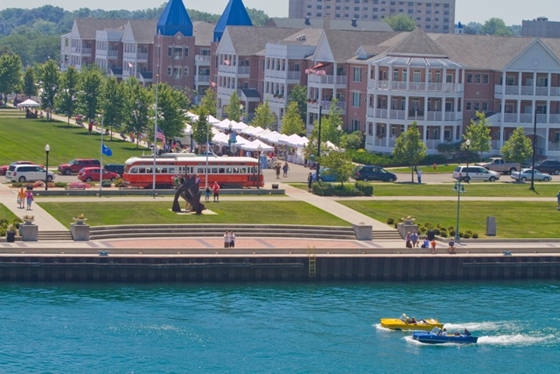
In partnership with French automaker Renault, AMC manufactured several models in Kenosha in the early 1980s, including the Alliance, which won the 1983 "Car of The Year" award from Motor Trend. Two decades earlier, AMC's 1963 Rambler Classic had also received the award. In 1987, Renault sold its controlling interest in AMC to Chrysler Corporation, which had already contracted with AMC for the production of its M-body midsized cars at the Kenosha plant. The AMC Lakefront plant (1960–1988), a smaller facility, was demolished in 1990 (a chimney-demolition ceremony that June drew 10,000 spectators) and was redeveloped into HarborPark.[28] The area now hosts lakeside condominiums, a large recreational marina, numerous parks and promenades, sculptures, fountains, the Kenosha Public Museum, and the Civil War Museum, all of which are connected by the Kenosha Electric Railway streetcar system.
Like other Rust Belt cities, Kenosha deindustrialized in the 1980s, causing it to gradually transition into a services-based economy.[29] In the 2010s, the city and surrounding county have benefited from an expanding economy and increased job growth.[30][31]
In 1973, residents in the Town of Pleasant Prairie sought to have territory annexed and rezoned to allow for the industrial development of agricultural property.[32] In the ensuing legal battle between Kenosha and Pleasant Prairie, the town accused the city of improperly coercing or bribing agricultural property owners to file for rezoning and annexation in order to obtain city water and electric services that could not be provided by the town. The town argued that industrial development would jeopardize the town's residential nature. The court found the annexation proper, with no illicit bribes or improper conduct by the city.
In June 1993, the city installed reproductions of the historic Sheridan LeGrande street lights that were specially designed for Kenosha by Westinghouse Electric in 1928; these can be seen on Sixth Avenue between 54th Street and 59th Place.
21st century
[edit]
The two-mile (3.2 km) downtown electric streetcar system was opened on June 17, 2000, and on September 22, 2014, the Kenosha city council approved a crosstown extension of the system incorporating the existing route between 48th and 61st Streets on both 6th and 8th Avenues.[33]
In the aftermath of the August 2020 police shooting of Jacob Blake, protests, riots, and civil unrest occurred in Kenosha. Demonstrations were marked by daily peaceful protesting followed by confrontations with law enforcement and rioting, looting, vandalism, and arson at night. A state of emergency was declared on August 23, and the National Guard was activated the following day. On August 25, a controversial shooting occurred during the unrest, leading to a polarized response.[34] Both then-President Donald Trump and then-Presidential candidate Joe Biden visited Kenosha.[35]
Protests continued daily through August 29 with approximately 2,000 members of the National Guard assisting the city in restoring order.[36][37][38][39] Damages exceeding $50 million occurred, with over 100 businesses affected.[39]
In November 2021, Kenosha once again became the subject of worldwide attention as the jury trial of Kyle Rittenhouse, the defendant in the 2020 unrest shooting, commenced.[40] As part of the city's emergency preparedness, over 500 members of the National Guard were activated ahead of the verdict.[41] Judge Bruce Schroeder dismissed Rittenhouse's unlawful possession charge and the curfew violation charge for being legally unsupported,[42][43] and a unanimous jury found Rittenhouse not guilty of the remaining charges.[44] Following the verdict on November 19, some protests occurred in Kenosha but remained peaceful.[45]
On December 7, 2021, "Carl the Kenosha Turkey", a turkey who had become a social media sensation and local icon, was hit by a vehicle and killed.[46] The turkey was named the city's unofficial mascot in 2020 and was seen by some as a source of positivity as Kenosha faced hardships in 2020–2021.[47]
Historic districts
[edit]Kenosha has 21 locations and four districts (Library Park Historic District, Third Avenue Historic District, Civic Center Historic District, and Pearl Street Historic District) listed on the National Register of Historic Places.[48] The city has a Kenosha Landmarks Commission, and among the many local city-designated landmarks are the 1929 YMCA, the Manor House, the John McCaffary House, the St. Matthew Episcopal Church, the Washington Park Clubhouse, the Ritacca Triplex, the Ritacca Service Station, and the Justin Weed House.
Geography
[edit]Kenosha is in southeastern Wisconsin, bordered by Lake Michigan to the east, the village of Somers to the north, the village of Bristol to the west, and the village of Pleasant Prairie to the south. Kenosha's passenger train station is the last stop on Chicago's Union Pacific North Metra Line. Kenosha is 32 miles south of Milwaukee and 49 miles north of Chicago.
According to the United States Census Bureau, the city has a total area of 27.03 square miles (70.01 km2), of which 26.93 square miles (69.75 km2) is land and 0.10 square miles (0.26 km2) is water.[49]
Neighborhoods
[edit]
Kenosha is home to a mixture of blue and white collar workers as well as students who attend the local universities. Kenosha consists of neighborhoods divided into three regions – Downtown, Uptown, and West of I-94 (referred to by locals at "West of the I" or simply "the county").[50] The city's northside is home to both the University of Wisconsin–Parkside and Carthage College.
Kenosha's downtown is located along the Lake Michigan shoreline and consists of government buildings, parks, beaches, restaurants, shops, museums, and entertainment venues. The neighborhood of HarborPark is both a residential and commercial area.[51] Directly south of the Downtown area is the neighborhood of Allendale.[52]
Uptown Kenosha consists of a largely blue-collar population and is a mixture of locally owned businesses and residential areas.[53] Prominent Uptown neighborhoods include Brass,[54] Lincoln Park,[55] and Wilson Heights.[56]
Climate
[edit]Kenosha has a humid continental climate (Köppen: Dfa, bordering on Dfb) with warm summers and cold winters. The record high is 105 °F (41 °C), set in July 2012. The record low is −31 °F (−35 °C), set in January 1985.[57]
| Climate data for Kenosha, Wisconsin (1991–2020 normals, extremes 1944–present) | |||||||||||||
|---|---|---|---|---|---|---|---|---|---|---|---|---|---|
| Month | Jan | Feb | Mar | Apr | May | Jun | Jul | Aug | Sep | Oct | Nov | Dec | Year |
| Record high °F (°C) | 65 (18) |
74 (23) |
83 (28) |
90 (32) |
94 (34) |
102 (39) |
105 (41) |
102 (39) |
100 (38) |
89 (32) |
81 (27) |
70 (21) |
105 (41) |
| Mean maximum °F (°C) | 51.4 (10.8) |
54.1 (12.3) |
66.7 (19.3) |
77.9 (25.5) |
84.7 (29.3) |
90.8 (32.7) |
94.1 (34.5) |
91.7 (33.2) |
87.9 (31.1) |
79.2 (26.2) |
66.3 (19.1) |
55.1 (12.8) |
95.5 (35.3) |
| Mean daily maximum °F (°C) | 30.8 (−0.7) |
34.1 (1.2) |
43.1 (6.2) |
52.7 (11.5) |
63.6 (17.6) |
73.3 (22.9) |
79.7 (26.5) |
78.5 (25.8) |
71.9 (22.2) |
60.3 (15.7) |
47.3 (8.5) |
35.9 (2.2) |
55.9 (13.3) |
| Daily mean °F (°C) | 24.0 (−4.4) |
27.1 (−2.7) |
35.8 (2.1) |
45.0 (7.2) |
55.1 (12.8) |
65.1 (18.4) |
71.9 (22.2) |
71.1 (21.7) |
64.0 (17.8) |
52.4 (11.3) |
40.1 (4.5) |
29.3 (−1.5) |
48.4 (9.1) |
| Mean daily minimum °F (°C) | 17.1 (−8.3) |
20.1 (−6.6) |
28.5 (−1.9) |
37.4 (3.0) |
46.7 (8.2) |
56.9 (13.8) |
64.1 (17.8) |
63.8 (17.7) |
56.1 (13.4) |
44.5 (6.9) |
32.9 (0.5) |
22.8 (−5.1) |
40.9 (4.9) |
| Mean minimum °F (°C) | −5.1 (−20.6) |
0.7 (−17.4) |
10.5 (−11.9) |
25.0 (−3.9) |
36.5 (2.5) |
45.9 (7.7) |
55.0 (12.8) |
55.1 (12.8) |
42.2 (5.7) |
30.1 (−1.1) |
17.2 (−8.2) |
2.5 (−16.4) |
−9.1 (−22.8) |
| Record low °F (°C) | −31 (−35) |
−23 (−31) |
−9 (−23) |
10 (−12) |
26 (−3) |
33 (1) |
41 (5) |
40 (4) |
30 (−1) |
20 (−7) |
−5 (−21) |
−29 (−34) |
−31 (−35) |
| Average precipitation inches (mm) | 1.92 (49) |
1.83 (46) |
2.67 (68) |
4.19 (106) |
4.12 (105) |
4.13 (105) |
3.41 (87) |
3.68 (93) |
3.53 (90) |
3.51 (89) |
2.42 (61) |
2.19 (56) |
37.60 (955) |
| Average snowfall inches (cm) | 11.3 (29) |
9.8 (25) |
5.7 (14) |
0.8 (2.0) |
0.0 (0.0) |
0.0 (0.0) |
0.0 (0.0) |
0.0 (0.0) |
0.0 (0.0) |
0.1 (0.25) |
1.5 (3.8) |
7.0 (18) |
36.2 (92) |
| Average precipitation days (≥ 0.01 in) | 10.3 | 8.5 | 9.7 | 12.2 | 12.3 | 10.6 | 9.0 | 9.6 | 8.6 | 9.8 | 9.5 | 9.5 | 119.6 |
| Average snowy days (≥ 0.1 in) | 6.6 | 5.2 | 2.7 | 0.5 | 0.0 | 0.0 | 0.0 | 0.0 | 0.0 | 0.0 | 1.2 | 4.1 | 20.3 |
| Source: NOAA[58][59] | |||||||||||||
| Climate data for Kenosha, Wisconsin (Kenosha Regional Airport), 1991–2020 normals, extremes 1997–present | |||||||||||||
|---|---|---|---|---|---|---|---|---|---|---|---|---|---|
| Month | Jan | Feb | Mar | Apr | May | Jun | Jul | Aug | Sep | Oct | Nov | Dec | Year |
| Record high °F (°C) | 64 (18) |
77 (25) |
85 (29) |
89 (32) |
94 (34) |
100 (38) |
106 (41) |
100 (38) |
96 (36) |
87 (31) |
77 (25) |
68 (20) |
106 (41) |
| Mean maximum °F (°C) | 50.9 (10.5) |
52.2 (11.2) |
69.1 (20.6) |
81.0 (27.2) |
87.7 (30.9) |
91.5 (33.1) |
93.4 (34.1) |
91.7 (33.2) |
89.4 (31.9) |
80.5 (26.9) |
67.1 (19.5) |
56.3 (13.5) |
95.2 (35.1) |
| Mean daily maximum °F (°C) | 31.3 (−0.4) |
34.8 (1.6) |
45.4 (7.4) |
57.3 (14.1) |
69.0 (20.6) |
78.8 (26.0) |
83.8 (28.8) |
81.7 (27.6) |
74.8 (23.8) |
62.5 (16.9) |
48.5 (9.2) |
36.6 (2.6) |
58.7 (14.9) |
| Daily mean °F (°C) | 23.8 (−4.6) |
26.8 (−2.9) |
36.6 (2.6) |
47.1 (8.4) |
58.1 (14.5) |
67.8 (19.9) |
72.7 (22.6) |
71.2 (21.8) |
63.9 (17.7) |
52.7 (11.5) |
40.1 (4.5) |
29.5 (−1.4) |
49.2 (9.5) |
| Mean daily minimum °F (°C) | 16.4 (−8.7) |
18.9 (−7.3) |
27.9 (−2.3) |
36.8 (2.7) |
47.1 (8.4) |
56.8 (13.8) |
61.7 (16.5) |
60.6 (15.9) |
53.1 (11.7) |
42.8 (6.0) |
31.6 (−0.2) |
22.4 (−5.3) |
39.7 (4.3) |
| Mean minimum °F (°C) | −7.0 (−21.7) |
−5.7 (−20.9) |
7.5 (−13.6) |
22.9 (−5.1) |
32.6 (0.3) |
43.5 (6.4) |
48.9 (9.4) |
48.0 (8.9) |
38.8 (3.8) |
25.9 (−3.4) |
13.5 (−10.3) |
1.2 (−17.1) |
−12.0 (−24.4) |
| Record low °F (°C) | −28 (−33) |
−15 (−26) |
−13 (−25) |
15 (−9) |
24 (−4) |
32 (0) |
41 (5) |
41 (5) |
32 (0) |
19 (−7) |
4 (−16) |
−16 (−27) |
−28 (−33) |
| Average precipitation inches (mm) | 1.19 (30) |
1.07 (27) |
2.03 (52) |
3.63 (92) |
3.52 (89) |
3.69 (94) |
3.35 (85) |
3.56 (90) |
3.36 (85) |
2.90 (74) |
2.05 (52) |
1.53 (39) |
31.88 (809) |
| Average precipitation days (≥ 0.01 in) | 8.3 | 7.2 | 9.8 | 12.5 | 13.7 | 12.4 | 10.3 | 13.1 | 12.3 | 11.4 | 9.4 | 8.8 | 129.2 |
| Source 1: NOAA[60] | |||||||||||||
| Source 2: National Weather Service (mean maxima/minima 2006–2020)[61] | |||||||||||||
Demographics
[edit]| Census | Pop. | Note | %± |
|---|---|---|---|
| 1850 | 3,455 | — | |
| 1860 | 3,990 | 15.5% | |
| 1870 | 4,309 | 8.0% | |
| 1880 | 5,039 | 16.9% | |
| 1890 | 6,532 | 29.6% | |
| 1900 | 11,606 | 77.7% | |
| 1910 | 21,371 | 84.1% | |
| 1920 | 40,472 | 89.4% | |
| 1930 | 50,262 | 24.2% | |
| 1940 | 48,765 | −3.0% | |
| 1950 | 54,368 | 11.5% | |
| 1960 | 67,899 | 24.9% | |
| 1970 | 78,805 | 16.1% | |
| 1980 | 77,685 | −1.4% | |
| 1990 | 80,352 | 3.4% | |
| 2000 | 90,352 | 12.4% | |
| 2010 | 99,218 | 9.8% | |
| 2020 | 99,986 | 0.8% | |
| 2024 (est.) | 99,578 | [62] | −0.4% |
| U.S. Decennial Census[63] 2010[64] 2020[65] | |||
| Race / Ethnicity (NH = Non-Hispanic) | Pop 2000[66] | Pop 2010[64] | Pop 2020[65] | % 2000 | % 2010 | 2020 |
|---|---|---|---|---|---|---|
| White alone (NH) | 71,686 | 68,967 | 62,835 | 79.34% | 69.51% | 62.84% |
| Black or African American alone (NH) | 6,810 | 9,540 | 10,279 | 7.54% | 9.62% | 10.28% |
| Native American or Alaska Native alone (NH) | 337 | 332 | 224 | 0.37% | 0.33% | 0.22% |
| Asian alone (NH) | 686 | 1,637 | 1,843 | 0.96% | 1.65% | 1.84% |
| Pacific Islander alone (NH) | 37 | 48 | 49 | 0.04% | 0.05% | 0.05% |
| Other race alone (NH) | 123 | 122 | 318 | 0.14% | 0.12% | 0.32% |
| Mixed race or Multiracial (NH) | 1,488 | 2,441 | 4,788 | 1.65% | 2.46% | 4.79% |
| Hispanic or Latino (any race) | 9,003 | 16,130 | 19,650 | 9.96% | 16.26% | 19.65% |
| Total | 90,352 | 99,218 | 99,986 | 100.00% | 100.00% | 100.00% |
2020 census
[edit]As of the census of 2020,[67] the population was 99,986. The population density was 3,529.6 inhabitants per square mile (1,362.8/km2). There were 41,641 housing units at an average density of 1,470.0 per square mile (567.6/km2). Ethnically, the population was 19.7% Hispanic or Latino of any race. When grouping both Hispanic and non-Hispanic people together by race, the city was 67.9% White, 10.8% Black or African American, 1.9% Asian, 0.5% Native American, 0.1% Pacific Islander, 7.3% from other races, and 11.5% from two or more races.
The 2020 census population of the city included 592 people incarcerated in adult correctional facilities and 1,790 people in student housing.[68]
24.6% of residents were under the age of 18, 13.3% were above of the age of 65, and the gender makeup was 48.7% male and 51.3% female. 9.0% of residents were foreign born. 88.4% of residents possessed a high school education and 25.7% had a bachelor's degree or higher. The medium household income was $56,113, with 15.6% of residents living below the poverty line.
2023 United States Census Bureau American Community Survey one-year estimates
[edit]|
Racial Makeup of Kenosha (2023)[69]
|
Racial Makeup of Kenosha treating Hispanics as a Racial Category (2023)[69]
NH=Non-Hispanic
|
Racial Makeup of Hispanics in Kenosha (2023)[69]
|
2010 census
[edit]As of the census[70] of 2010, there were 99,218 people, 37,376 households, and 24,090 families residing in the city. The population density was 3,684.3 inhabitants per square mile (1,422.5/km2). There were 40,643 housing units at an average density of 1,509.2 per square mile (582.7/km2). The racial makeup of the city was 77.1% White, 10.0% African American, 0.6% Native American, 1.7% Asian, 0.1% Pacific Islander, 6.8% from other races, and 3.8% from two or more races. Hispanic or Latino people of any race were 16.3% of the population.
There were 37,376 households, of which 36.8% had children under the age of 18 living with them, 42.9% were married couples living together, 15.9% had a female householder with no husband present, 5.7% had a male householder with no wife present, and 35.5% were non-families. 28.8% of all households were made up of individuals, and 9.7% had someone living alone who was 65 years of age or older. The average household size was 2.56 and the average family size was 3.17.
The median age in the city was 33.5 years. 26.8% of residents were under the age of 18; 10.9% were between the ages of 18 and 24; 28.3% were from 25 to 44; 23.2% were from 45 to 64; and 10.8% were 65 years of age or older. The gender makeup of the city was 49.1% male and 50.9% female.
The 2010 census reported that 51 percent of Kenosha residents moved in from other cities and states. The Chamber of Commerce attributed this to the city's museums, lakeshore attractions, cultural and work opportunities, its public-school system, transportation amenities, and relatively lower costs-of-living.[71]
The importance of manufacturing jobs in Kenosha continues to diminish with only 11.7 percent or 7,769 of the total workforce of 66,362 area residents involved, a decline of 22 percent since 1990 and much lower than the statewide percentage of 16.4 percent.[72]
The biggest surge in Kenosha employment by percentage has been in the white-collar workforce. From 1990 to 2017, the percentage of Kenosha's workforce in business and professional services grew nearly fivefold from 3.2% of the workforce to 11%, while statewide the trend was slightly more than double. The growth has been both to due new office developments in the city, but also due to new suburban developments as Illinois workers seek more affordable housing.[72]
2000 census
[edit]As of the census[8] of 2000, there were 90,352 people, 34,411 households, and 22,539 families residing in the city. The population density was 3,795.1 inhabitants per square mile (1,465.3/km2). There were 36,004 housing units at an average density of 1,512.3 per square mile (583.9/km2). The racial makeup of the city was 83.6% White, 7.7% African American, 0.4% Native American, 1.0% Asian, <0.1% Pacific Islander, 4.8% from other races and 2.4% from two or more races. 10.0% of the population were Hispanic of any race. 25.5% were of German, 11.5% Italian, 7.1% Irish and 6.6% Polish ancestry.
There were 34,411 households, out of which 34.1% had children under the age of 18 living with them: 47.1% were married couples living together, 13.9% had a female householder with no husband present and 34.5% were non-families. 28.4% of all households were made up of individuals, and 10.3% had someone living alone who was 65 years of age or older. The average household size was 2.54 and the average family size was 3.13.
In the city, the population included 27.2% under the age of 18, 10.1% from 18 to 24, 31.5% from 25 to 44, 19.0% from 45 to 64, and 12.2% who were 65 years of age or older. The median age was 34 years. For every 100 females, there were 96.7 males. For every 100 females age 18 and over, there were 93.2 males.
Crime
[edit]The city's violent crime rate for 2018 was 338.18 per 100,000 people, a 15.94% decline from 2017.[73] In 2019, there were 5 reported homicides and an overall 1,888 crimes per 100,000 people, 7.0% higher than the overall crime rate for Wisconsin but lower than the national average of 2,489 per 100,000 people.[74]
Kenosha saw a notable increase in its homicide rate in 2021, with 14 recorded; nearly triple the city's average.[75] The recorded homicide rate dropped in 2022, with 7 recorded that year.[76]
Economy
[edit]
Kenosha's economy is fueled by its position within the Chicago-Milwaukee corridor. Nearly half of Kenosha's workforce commutes outside of Kenosha County to their employers.[78] The Chicago-area commuter rail network Metra has a route between Downtown Chicago and Kenosha. A 2016 study found that Kenosha's "out-commuters most likely work for positions in healthcare, manufacturing, professional/scientific and technical services. The majority of occupations included management, business/financial, and office/administrative support position", and 73 percent of out-commuters have a bachelor's degree or a higher level of education.[79] Due to lower housing costs compared to other parts of the Chicago metropolitan area, Kenosha is a popular relocation area those wanting to benefit from high paying jobs and a lower cost of living.[80]
Snap-on Tools world headquarters and Jockey International corporate headquarters are in Kenosha. Kenosha has a number of light industrial and distribution companies in outlying business parks. Amazon, Rustoleum, Uline, Associated Wholesale Grocers, and others have warehouses and distribution centers located in Kenosha.[81][82][83][84][85] In 2022, Square Roots farm opened a fully indoor hydroponic facility within refurbished shipping containers in Kenosha. It is expected to be able to grow 2.4 million packages of fresh produce annually for distribution to the surrounding Chicago metro area and into the Milwaukee metro area.[86]
Tourists spent an estimated $196.6 million in Kenosha County in 2015, with the county ranking fourth in the state in tourist money generated.[87]
Downtown Kenosha sits along the Lake Michigan lakefront. In recent years, organizations such as Downtown Kenosha Inc. (DKI) manage the day-to-day economic development efforts, business support and promotional activities for the district.[88] In 2023, a $450 million development to the downtown area was approved by the city council. The development plan will include thousands of apartments, condominiums, office buildings, retail spaces, hotels, and government buildings all within a nine-block radius.[89]
Downtown Kenosha is home to the Kenosha HarborMarket, a European-style farmer's market held mid-May through mid-October on 2nd Ave bisected by the 56th Street boulevard streetcar line. It hosts stalls with local food products and artisan creations.[90] In addition, the downtown area has a collection of over 50 restaurants, bars, breweries, and shops of various kinds. Frank's Diner, which has been an attraction in downtown Kenosha since 1926, is the oldest diner in the United States and has been featured twice on Guy Fieri's Diners, Drive-Ins and Dives, once in 2007 and again in 2021.[91][92] Residential developments have also provided added condominiums and apartments.[93]
Near downtown, the Kenosha Public Museum System includes the main Kenosha Public Museum, the Dinosaur Discovery Museum in association with Carthage College and the Smithsonian, and the Kenosha Civil War Museum. On Simmons Island, the Kenosha History Center and adjacent Maritime Museum offer memorabilia from the city's nautical past.
In February 2020, Wisconsin Governor Tony Evers announced $10 million in state funding toward the proposed Kenosha STEM Innovation Center within the Kenosha Innovation Neighborhood (KIN), which is a currently planned 60,000 sq. ft. building to be constructed on the empty 107 acre site of the former Chrysler factory. It will serve as a multi-purpose building dedicated to education, workforce development, and entrepreneurial opportunities.[94] In December 2020, the city announced a plan for the KIN.[95] In July 2021, the federal government awarded Kenosha $4.9 million in federal CARES Act funds toward the neighborhood,[96] and in November, Mayor John Antaramian announced that Lakeview Technology Academy would relocate to the KIN.[97] In March 2022, Evers officially announced $15 million in funding toward the KIN, which is expected to take 8–10 years to be fully completed and will include the collaboration of UW-Parkside, Carthage College, Gateway Technical College, and Herzing University.[98]
Arts and culture
[edit]
Kenosha's four downtown museums, the Kenosha Public Museum, the Civil War Museum and the Dinosaur Discovery Museum, and the Kenosha Historical Center are Smithsonian Institution affiliates.[99]
Completed in 2001, the Kenosha Public Museum is on the Lake Michigan shoreline. Its main exhibit is a prehistoric woolly mammoth skeleton uncovered in western Kenosha in 1992. Cut-marks on its bones indicate that the animals were butchered by humans using stone tools. Carbon dating indicates their age to be 12,500 radiocarbon years old or 14,500 calendar years old, one thousand radiocarbon years earlier than the previously accepted presence of humans in the Americas. The museum also displays other ice age and fine art exhibits.[100] A second permanent exhibit on local ecosystems and the history of museums and science opened in 2019.[101][102]
The Kenosha History Center is adjacent to the 1917 city water treatment plant on Simmons Island adjoining the 1866 Kenosha Light Station. It showcases the history of Kenosha from the time of Native American settlements and the first European settlements to the present day. The 1906 Kenosha North Pier Light sits just east.
Kenosha's 59,000-square-foot (5,500 m2) Civil War Museum opened on June 13, 2008. The main exhibit, "The Fiery Trial", opened September 15, 2008. It is a 15,000-square-foot (1,400 m2) exhibit offering an interactive experience of the role of six Midwestern states before, during, and after the American Civil War.[103]
The Dinosaur Discovery Museum, designated a federal repository, opened in August 2006 in the historic Old Post Office adjoining the 56th Street streetcar line at Tenth Avenue, and includes an on-site paleontology laboratory operated through the Carthage College Institute of Paleontology.[104]
A maritime museum is located within the restored 1866 Southport Light and Lighthouse Keeper's cottage on Simmons Island.[105]
Cuisine
[edit].jpg)
Kenosha's cuisine mirrors common food culture throughout Wisconsin. It is home to a variety of restaurants including multiple supper clubs and German-American venues.[106] Additionally, the city is home to two award-winning drive-in burger stands, The Spot and Big Star.[107] Mars Cheese Castle, a "cheese landmark", is also located in Kenosha. The city has the highest concentration of Italian-Americans in Wisconsin, and as such is rife with Italian-American cuisine, including many pizza restaurants and perhaps the most well-known Italian grocery and delicatessen in Wisconsin, Tenuta's.[108][109]
In recent years, Kenosha became home to multiple craft breweries, and in 2021 hosted the Great Lakes Brew Fest.[110][111]
Music
[edit]Summer band performances have been performed by Kenosha Pops Concert Band at Kenosha's Sesquicentennial Bandshell in Pennoyer Park since 1988.[112]
The Music of the Stars radio program originated in Kenosha in 1992.[113]
The Kenosha Symphony Orchestra performs concerts in the Reuther Central Auditorium at Walter Reuther Central High School in downtown Kenosha.[114]
Since 2002, the outdoor Peanut Butter and Jam Concert Series has been held every Thursday in July and August at Veterans Memorial Park.[115]
Lincoln Park Live! concerts began in 2005 at Lincoln Park.[116] A number of outdoor jazz events are performed throughout the summer such as HarborPark Jazz.[117]
Bands that have originated in Kenosha include Electric Hellfire Club, Lazarus A.D., Jungle Rot, and Product of Hate.[citation needed]
Festivals
[edit]Kenosha is home to a number of summer festivals including the Outta Sight Kite Flight,[118] Taste of Wisconsin,[119] Pike River Rendezvous (a historical reenactment),[120] the Kenosha Classic Cruise-In Car Show,[121] Celebrate America (Fourth of July event),[122] Food Folks & Spokes (a cycling event),[123] Cheese-A-Palooza,[124] and the Border War Beer Fest (brewers from Wisconsin and Illinois competing for best beer).[125]
Since 2017, Kenosha has been the host of Tribute Island, a three-day music festival located at Simmons Island. It features many of the top tribute bands from the Midwest, over 50 bands in total performing on five stages.[126]
Libraries
[edit]The Kenosha Public Library, which is part of the Kenosha County Library System,[127] operates in five locations throughout the city: Kids@Uptown Lofts, Northside Neighborhood Library, Simmons Neighborhood Library, Southwest Neighborhood Library, and the Uptown Neighborhood Library. Daniel H. Burnham designed the 1900 Beaux-Arts Gilbert M. Simmons Memorial Library, which is listed on the National Register of Historic Places.[128]
Sports
[edit]The city's oldest sporting club, the Kenosha Yacht Club, was established in 1912.[129]
Kenosha was home to the short lived Kenosha Maroons NFL franchise in 1924. They folded after going 0–4–1.[130] It was also the home of the Kenosha Cardinals, a semi-professional football team between 1937 and 1941[131] which played at Lake Front Stadium at 58th Street and Third Avenue. Today, Kenosha is home to one semi-professional football team formed in 2007, the Kenosha Cougars.[132] They play in the Northern Lights Football League (NLFL).[133] The Bradford High School Red Devils won a state football championship in 2011.[134] The Tremper High School Trojans have won three state championships – in 1979, 1980, and 1991.
Several baseball teams have played at Simmons Field on the city's south side, including the Kenosha Comets, charter members of the All-American Girls Professional Baseball League who played in the league from 1943 to 1951. Kenosha was also home to the Frontier League's Kenosha Mammoths in 2003, and the Single-A Kenosha Twins from 1984 to 1992. It is currently home to the Kenosha Kingfish, a collegiate baseball team in the Northwoods League, which played its first game on May 31, 2014,[135] and in 2015 won their first championship.[136][137] In 2020, it was also home to the K-Town Bobbers, featured in a 26-game "Kenosha Series" against the Kenosha Kingfish in July 2020 as part of the NWL "Pod" system of play adopted for 2020.[138]
In 2022, Kenosha became the home of the Kenosha United F.C. Premier Arena Soccer League. They play their home games in nearby Sturtevant, Wisconsin.[139]
Parks and recreation
[edit]
Kenosha has 8 miles (13 km) of Lake Michigan shoreline frontage, nearly all of which is public. The city has 74 municipal parks, totaling 781.52 acres (3.1627 km2).[140]
Kenosha's Washington Park includes the oldest operating velodrome in the United States (opened in 1927) at Washington Bowl.[141] The Kenosha Velodrome Association sponsors American Track Cycling sanctioned races and training sessions at the "Bowl" throughout the summer. Races are held on Tuesday evenings from mid-May through August. Free seating is available on the inside of the track, and on important race days concessions are available.

Library Park is home to a statue of Abraham Lincoln by Charles Henry Niehaus as well as a veterans-memorial statue ("Winged Victory") by the Italian sculptor Decco.[142]
Petrifying Springs Park is located on the northside of Kenosha, with parts extending into the neighboring village of Somers.[143] Developed within a northern hardwood forest, the 350-acre park includes hiking trails, an 18-hole golf course,[144] and a Biergarten.[145][146]
Kenosha has been a Tree City USA since 1982.[147]
Beaches
[edit]- Simmons Island Park and Beach, 28 acres (11 ha)[148]
- Alford Park and Beach (three sections: North, East, and West), 57 acres (23 ha)[149]
- Eichelman Park and Beach, 11 acres (4.5 ha)[150]
- Pennoyer Park and Beach, 39 acres (16 ha)[151]
- Southport Park and Beach, 24 acres (9.7 ha)[152]
Golf
[edit]The Washington Park Golf Course was dedicated on February 18, 1922, and its 1937 English-cottage clubhouse is a city landmark.[153] Most recently, new private courses have opened, including The Club at Strawberry Creek.[154]
Cycling
[edit]Kenosha's Library Park is the home of Food Folks and Spokes, a festival with food booths, entertainment, and a bicycle race that is the first leg of the Tour of America's Dairyland.[155] It was formerly part of the International Cycling Classic's "Superweek". Kenosha is home to the Washington Park Velodrome, the longest-operating 333-meter track; it opened in 1927.
Government
[edit]Mayor
[edit]Kenosha has an elected mayor, who is the chief executive, and an appointed city administrator, who is the chief operating officer. The mayor is elected every four years. The city's Common Council consists of 17 aldermen from Kenosha's 17 districts (each district having several wards), elected for two-year terms in even-numbered years. The current mayor of Kenosha is David Bogdala, since 2024. He succeeded John Antaramian, the longest-serving chief executive in the city's history, who served as mayor from 1992 to 2008 and from 2016 until 2024.[156]
Politics
[edit]Kenosha is represented by Bryan Steil (R) in the United States House of Representatives, and by Ron Johnson (R) and Tammy Baldwin (D) in the United States Senate. Robert Wirch (D) represents Kenosha in the Wisconsin State Senate, and Tip McGuire (D) and Ben DeSmidt (D) represent Kenosha in the Wisconsin State Assembly.
Education
[edit].jpg)
Public schools
[edit]The Kenosha Unified School District operates 23 public elementary schools, five middle schools, seven charter schools, and six high schools:[157] Mary D. Bradford High School, George Nelson Tremper High School, Indian Trail High School and Academy, LakeView Technology Academy, Reuther Central High School, and Harborside Academy, the latter a research school that uses the Expeditionary Learning Outward Bound model; it was funded by the Bill and Melinda Gates Foundation.[158]
Private schools
[edit]Kenosha's private schools include St. Joseph Catholic Academy, All Saints Catholic School, Kenosha Lutheran Academy, Christ Lutheran Academy, Kenosha Montessori School, Shoreland Lutheran High School, and Christian Life School. At the beginning of the 2011–2012 school year, St. Mary's and Our Lady of the Holy Rosary of Pompeii schools became campuses of All Saints Catholic School. Both campuses operate as the same school with the same principal. St. Mark's and St. Joseph High School have also conjoined into Saint Joseph Catholic Academy.
Higher education
[edit]Kenosha is home to the University of Wisconsin-Parkside with over 4,000 students,[159] Carthage College with over 2,500 students,[160] and the Kenosha campus of Gateway Technical College.
Concordia University Wisconsin, Cardinal Stritch University, National-Louis University, and Herzing University maintain campuses in Kenosha. Journey Ministry College, a cohort of SUM Bible College and Seminary, was established in 2011.
Media
[edit]The primary newspaper of Kenosha County is the Kenosha News, a broadsheet with circulation of around 23,000 copies. Happenings Magazine is an ad-supported entertainment publication distributed at local businesses since 1978. They also publish The Smart Reader, Homes Plus, and other seasonal event-orientated magazines.
Kenosha is considered as part of the Milwaukee television market by A.C. Nielsen. However, due to the huge influx of commuters to Chicago, Charter Spectrum's Kenosha system carries both Chicago and Milwaukee. Arbitron classifies Kenosha as part of the Chicago radio market. Five major radio stations broadcast from Kenosha: WLIP (CBS Radio) 1050 AM, Gateway Technical College's WGTD (91.1 FM), a member station of the Wisconsin Public Radio News & Classical Music Network, rock WIIL (95.1 FM) and classic hits WWDV (96.9 FM), which simulcasts Chicago-based WDRV (97.1 FM). The Kenosha Convention and Visitors Bureau operates WPUR937 (1180 AM), a low-power tourist information station.[161]
WPXE (channel 55), the Ion Television owned-and-operated station for the Milwaukee market, is Kenosha's only locally-licensed television station, though in reality it only mentions Kenosha in its legal IDs. Its transmitter is located with the Milwaukee PBS tower on Milwaukee's north side, and its studios are based in suburban Glendale, thus it serves the entire Milwaukee television market. Kenosha is served by several Chicago-based television and radio stations.
Infrastructure
[edit]Transportation
[edit]
According to Walk Score, Kenosha is a largely "car dependent" city, with an overall walk score of 45/100, and has "minimal biking infrastructure", with an overall bike score of 49/100, though its downtown central business district has much higher scores, 84/100 and 72/100, respectively.[162]
Mass transit
[edit]
The Chicagoland commuter rail network Metra has a line between Downtown Chicago and Kenosha. The Metra Kenosha station has seen ridership increase as many in southeastern Wisconsin utilize the line to commute between southeastern Wisconsin and Chicago.
Although some Union Pacific North Line trains terminate and originate in Kenosha; most terminate at Waukegan, Illinois, to the south of Kenosha.[163]
Since June 2000, a 2-mile (3.2 km) streetcar line has served the downtown area and HarborPark, connecting the Metra station with downtown and several area parks. Kenosha is one of the smallest cities in America with any type of streetcar system today.[164]
In addition to its streetcar line, Kenosha has a city bus network with eight routes. Kenosha was the first city to color-code transit routes (with the Blue, Green, Red, and Orange Lines), and also the first city to use electric trolley buses in full transit service, both occurring on February 14, 1932.[165]
Major highways
[edit]

 I-41 / I-94 / US 41 – Milwaukee, Chicago
 WIS 50
 WIS 31 (Green Bay Road)
 WIS 32 (Sheridan Road)
 WIS 158
 WIS 165
Railroad
[edit]Kenosha has been served by rail service to and from Chicago since May 19, 1855,[166] when the predecessors to the Chicago and North Western Railway, the Milwaukee and Chicago Railway Company (originally the Illinois Parallel Railroad) and the original "Lake Shore Railroad" (later the Green Bay, Milwaukee and Chicago Railway) were officially joined with great ceremony just south of today's 52nd Street. Today, the former C&NW line is operated by the Union Pacific Railroad while the former Milwaukee Road line is operated by the Soo Line Railroad, a division of the Canadian Pacific Railway.
Airport
[edit]Kenosha Regional Airport (KENW) serves the city and surrounding communities. The city is located approximately 52 miles north of O'Hare International Airport in Chicago (one of the world's busiest airports) and approximately 32 miles south of General Mitchell International Airport in Milwaukee.
Health care
[edit]
Kenosha has two hospitals: the Froedtert South Kenosha Medical Center Campus downtown and the Aurora Medical Center at the extreme western edge of the city limits. Just outside of the city limits in neighboring Pleasant Prairie is the St. Catherine's Medical Center Campus, which opened in 2002 and has a heart institute named in honor of cardiac surgeon Michael E. DeBakey.[167]
Public safety
[edit]The Kenosha Police Department is responsible for the law enforcement in Kenosha since 1850, and is housed in the Kenosha Public Safety building.[168] The Kenosha County Courthouse and Jail were added to the National Register of Historic Places in 1982.[169] The jail and a separate facility, the Kenosha County Detention Center (KCDC), are operated by the sheriff's department. The Kenosha Correctional Center, a minimum security state prison, is also located in Kenosha and is under the operation of the Wisconsin Department of Corrections.
In August 2020, during the Kenosha unrest, a probation and parole building utilized by the Division of Community Corrections was burned down by rioters.[170]
Notable people
[edit]Sister cities
[edit]Kenosha's sister cities are:[171]
- Cosenza, Italy (since 1979)
- Douai, France (since 1981)
- Quezon City, Philippines (since 1986)
- Wolfenbüttel, Germany (since 1970)
See also
[edit]
References
[edit]- ^ Cusack, Liam (June 2011). "A Good Life in K-Town". chicago.cooperatornews.com. Cooperator News. Retrieved July 26, 2021.
- ^ "City of Kenosha". twitter.com. Retrieved February 23, 2021.
- ^ "Municipal Data System". Wisconsin Department of Administration Division of Intergovernmental Relations. 2024. Retrieved November 7, 2024.
- ^ Wisconsin (March 23, 2018). "Acts and Resolves Passed by the Legislature of Wisconsin". David T. Dickson, printer to the state – via Google Books.
- ^ Mathewson, Kevin (April 16, 2024). "David F. Bogdala Sworn In As Kenosha's 51st Mayor Tuesday Morning". Kenosha County Eye. Retrieved April 17, 2024.
- ^ City of Kenosha (2010), 'Mayor/Administration', accessed October 22 from http://www.kenosha.org/mayor/index.html
- ^ "2019 U.S. Gazetteer Files". United States Census Bureau. Retrieved August 7, 2020.
- ^ a b "U.S. Census website". United States Census Bureau. Retrieved January 31, 2008.
- ^ "US Board on Geographic Names". United States Geological Survey. October 25, 2007. Retrieved January 31, 2008.
- ^ "Kenosha". Merriam-Webster.com Dictionary. Merriam-Webster. Retrieved December 5, 2020.
- ^ "Kenosha". Lexico US English Dictionary. Oxford University Press. Archived from the original on August 26, 2022.
- ^ Merriam-Webster's Geographical Dictionary. Springfield, MA: Merriam-Webster. 1997. p. 582.
- ^ "Find a County". National Association of Counties. Archived from the original on May 31, 2011. Retrieved June 7, 2011.
- ^ "Kenosha city, Kenosha County, Wisconsin". United States Census Bureau. Retrieved April 30, 2022.
- ^ "Metropolitan and Micropolitan Statistical Areas Population Totals: 2020-2024". United States Census Bureau, Population Division. March 13, 2025. Retrieved March 13, 2025.
- ^ Dill, Molly (May 21, 2018). "Wisconsin has 9 companies on 2018 Fortune 500 list". biztimes.com. BizTimes Media. Retrieved May 21, 2021.
- ^
- Bright, William. 2004. Native American Placenames of the United States. Norman, OK: University of Oklahoma Press, p. 213.
- Vogel, Virgil J. 1991. Indian Names on Wisconsin's Map. Madison: Madison: University of Wisconsin Press, pp. 154, 266.
- Hosmanek, John J. 2006. Kenosha. Charleston, SC: Arcadia.
- Nestor, Sandy. 2004. Indian Placenames in America. Jefferson, NC: McFarland, p. 184.
- ^ The Menominee Clans Story, Sponsored by University of Wisconsin–Stevens Point, Menominee Place Names In Wisconsin, Menominee Place Names In Wisconsin
- ^ Wasion, David. "The Mammoth Hunter: David Wasion's Quest for Pre-Clovis People in North America" The Citizen Scientist, February 11, 2005. Accessed April 8, 2005.
- ^ Falk, Terrence. "Bones to Pick" Milwaukee Magazine, April 2004
- ^ "Genealogy and Family History Records". Rootsweb.ancestry.com. April 22, 2001. Retrieved August 2, 2011.
- ^ "Town of Southport No More". Kenosha Democrat. March 11, 1853. p. 3. Retrieved August 13, 2014 – via Newspapers.com.

- ^ "Origin of Kenosha, Wisconsin". Wisconsinhistory.org. June 2, 2017. Retrieved August 27, 2017.
- ^ "20th-Century Immigration Patterns in Wisconsin" (PDF). wcucc.org. Wisconsin Council of Churches. Retrieved February 2, 2021.
- ^ Kirk, Benny (November 20, 2021). "Looking Back at a Time When Kenosha, Wisconsin, Was a Mo-Town Satellite City". autoevolution.com. Retrieved December 10, 2021.
- ^ City's auto history reaches back more than 100 years[dead link]
- ^ "Kenosha Unified School District". Nash.kusd.edu. Archived from the original on July 19, 2011. Retrieved August 2, 2011.
- ^ "Harbor Park: a brief history". Kenoshakorner.com. August 11, 2008. Retrieved August 2, 2011.
- ^ Mashayekhi, Ray (September 5, 2020). "Kenosha's unusual economic evolution made it the perfect political flashpoint". fortune.com. Fortune. Retrieved December 8, 2020.
- ^ Thomas, Arthur (October 25, 2021). "Kenosha County's booming job growth hasn't translated to population growth". biztimes.com. Milwaukee Business News. Retrieved December 10, 2021.
- ^ "Major Rebuilding Project Proposed For Kenosha's Damaged Uptown". wgtd.org. WGTD. November 13, 2020. Retrieved December 10, 2021.
- ^ Town of Pleasant Prairie v. City of Kenosha, 75 Wis. 2d 322, 249 N.W.2d 581 (1977)
- ^ Kenosha News, September 23, 2014
- ^ Noor, Poppy (August 28, 2020). "Vigilante, volunteer, terrorist: how the US media covers Kyle Rittenhouse". The Guardian. Archived from the original on October 7, 2020. Retrieved October 8, 2020.
- ^ "Jacob Blake: Comparing Trump and Biden's Kenosha visits". bbc.com. BBC News. September 4, 2020. Retrieved May 21, 2021.
- ^ "55 arrested in connection to Kenosha riots following Jacob Blake shooting". WDJT-TV. March 26, 2021. Archived from the original on March 26, 2021. Retrieved May 11, 2021.
- ^ Sullivan, Becky; Schaper, David (September 2, 2020). "Kenosha Protests, Violence Expose Racial Disparities Among The Worst In The Country". National Public Radio. Archived from the original on May 9, 2021. Retrieved May 11, 2021.
- ^ Vielmetti, Bruce; Volpenhein, Sarah (September 4, 2020). "More than 250 arrests in Kenosha unrest; most have been from the surrounding area". Milwaukee Journal Sentinel. Retrieved May 11, 2021.
- ^ a b Flores, Terry. "Damage due to rioting, unrest in Kenosha tops $50 million; 2,000 Guard assisted here". Kenosha News. No. September 9, 2020. Archived from the original on April 29, 2021. Retrieved May 11, 2021.
- ^ "Kyle Rittenhouse verdict: Kenosha quiet after months in spotlight". WITI (TV). November 20, 2021. Archived from the original on November 21, 2021. Retrieved November 22, 2021.
- ^ "National Guard activated ahead of Rittenhouse verdict; Local police also prepare for announcement". Kenosha News. November 12, 2021. Retrieved November 22, 2021.
- ^ Levenson, Eric; Parks, Brad; Hassan, Carma (November 10, 2021). "Prosecution rests its case against Kyle Rittenhouse and judge dismisses curfew violation charge". CNN. Archived from the original on November 16, 2021. Retrieved November 16, 2021.
- ^ Richmond, Todd (November 15, 2021). "Explainer: Why did judge drop Rittenhouse gun charge?". Associated Press. Archived from the original on November 16, 2021. Retrieved November 16, 2021.
- ^ Vogt, Adrienne; Sangal, Aditi; Wagner, Meg; Macaya, Melissa; Mahtani, Melissa (November 19, 2021). "Rittenhouse jury reaches verdict". CNN. Archived from the original on November 19, 2021. Retrieved November 19, 2021.
- ^ Jeong, Andrew (November 20, 2021). "Kyle Rittenhouse acquittal sparks sporadic protests and Portland clashes — but Kenosha remains peaceful". The Washington Post. Retrieved November 22, 2021.
- ^ "Carl the Kenosha Turkey dead after being hit by a car, police say". WTMJ-TV. December 7, 2021. Retrieved December 7, 2021.
- ^ Truttshell, Dan (December 7, 2021). "Carl the Kenosha Turkey saga comes to a sad ending: Forest Park fixture killed after being hit by vehicle". kenoshanews.com. Kenosha News. Retrieved December 7, 2021.
- ^ "Kenosha's Historic Districts". kenoshahistorycenter.org. Retrieved February 11, 2021.
- ^ "US Gazetteer files 2010". United States Census Bureau. Archived from the original on January 25, 2012. Retrieved November 18, 2012.
- ^ "The Kenosha Community". visitkenosha.com. Retrieved August 3, 2021.
- ^ "HarborPark". visitkenosha.com. Retrieved August 3, 2021.
- ^ Marovich, Steve (March 20, 2021). "ONCE UPON A TIME, ALLENDALE WAS A DESTINATION FOR GOLFERS". kenosha.com. Retrieved August 3, 2021.
- ^ Truttschel, Dan (November 16, 2020). "Major retail/residential project proposed for Uptown". kenoshanews.com. Kenosha News. Retrieved August 3, 2021.
- ^ "About Us". uptownbrassvillage.com. Retrieved August 3, 2021.
- ^ "Uptown Kenosha cleanup planned for Saturday morning". kenoshanews.com. Kenosha News. June 18, 2021. Retrieved August 3, 2021.
- ^ Zampanti, Jeff (July 30, 2019). "City still searching for developer to take on Wilson Heights project". kenoshanews.com. Kenosha News. Retrieved August 3, 2021.
- ^ "XMACIS2". XMACIS2. National Weather Service. Retrieved February 4, 2017.
- ^ "NowData – NOAA Online Weather Data". National Oceanic and Atmospheric Administration. Archived from the original on May 8, 2021. Retrieved June 15, 2021.
- ^ "Station: Kenosha, WI". U.S. Climate Normals 2020: U.S. Monthly Climate Normals (1991–2020). National Oceanic and Atmospheric Administration. Retrieved June 15, 2021.
- ^ "U.S. Climate Normals Quick Access – Station: Kenosha RGNL AP, WI". National Oceanic and Atmospheric Administration. Retrieved February 25, 2024.
- ^ "NOAA Online Weather Data – NWS Milwaukee". National Weather Service. Retrieved February 25, 2024.
- ^ "U.S. Census Bureau QuickFacts: Kenosha city, Wisconsin; Wisconsin". United States Census Bureau. Retrieved May 23, 2025.
- ^ "Decennial Census of Population and Housing by Decades". US Census Bureau.
- ^ a b "P2 Hispanic or Latino, and Not Hispanic or Latino by Race – 2010: DEC Redistricting Data (PL 94-171) – Kenosha city, Wisconsin". United States Census Bureau.
- ^ a b "P2 Hispanic or Latino, and Not Hispanic or Latino by Race – 2020: DEC Redistricting Data (PL 94-171) – Kenosha city, Wisconsin". United States Census Bureau.
- ^ "P004 Hispanic or Latino, and Not Hispanic or Latino by Race – 2000: DEC Summary File 1 – Kenosha city, Wisconsin". United States Census Bureau.
- ^ "2020 Decennial Census: Kenosha city, Wisconsin". data.census.gov. U.S. Census Bureau. Retrieved October 10, 2022.
- ^ "Group Quarters Population, 2020 Census: Kenosha city, Wisconsin". data.census.gov. U.S. Census Bureau. Retrieved October 10, 2022.
- ^ a b c "B03002 Hispanic or Latino, and Not Hispanic or Latino by Race – Kenosha, Wisconsin – 2023 American Community Survey 1-Year Estimates". U.S. Census Bureau. July 1, 2023. Retrieved November 21, 2024.
- ^ "U.S. Census website". United States Census Bureau. Retrieved November 18, 2012.
- ^ Tichelaar, Melinda (April 26, 2012). "Kenosha Leads State in Non-Native Population". Kenosha News. Archived from the original on January 30, 2016. Retrieved May 30, 2016.
- ^ a b Wisconsin Department of Workforce Development figures, 2017 as quoted in the Kenosha News, "Factory town no more" by Deneen Smith, December 24, 2018
- ^ Kenosha WI Crime Rate 1999-2018. www.macrotrends.net. Retrieved December 8, 2020.
- ^ Stebbins, Samuel. "Crime in Kenosha, Wisconsin". 24wallst.com. Retrieved March 1, 2021.
- ^ Smith, Deenen (October 30, 2021). "Spike in Kenosha Homicides Has Families Looking for Answers". U.S. News. Associated Press. Retrieved November 2, 2021.
- ^ Holmes, Isiah (April 12, 2023). "Gunshot data raises awkward questions for Kenosha Innovation Neighborhood". wisconsinexaminer.com. Wisconsin Examiner. Retrieved April 17, 2023.
- ^ "Kenosha". wisconsinharbortowns.net. November 26, 2016. Retrieved May 21, 2021.
- ^ "Kenosha County, WI". Co.kenosha.wi.us. June 30, 2011. Retrieved August 2, 2011.
- ^ Kenosha Area Business Alliance www.kaba.org
- ^ Lawson, James (January 4, 2020). "Wisconsin becoming a new relocation target for Illinois residents". Kenosha News. Retrieved December 13, 2021.
- ^ Lawson, James (July 2, 2020). "Amazon facilities in Kenosha sold for $176 million, called a Chicago area industrial record". Kenosha News. Retrieved March 1, 2021.
- ^ Ryan, Sean (November 14, 2013). "Rust-Oleum plans $7 million expansion of Kenosha warehouse". Milwaukee Business Journal. Retrieved March 1, 2021.
- ^ Flores, Terry (March 29, 2020). "Uline expanding its footprint in Kenosha County". Kenosha News. Retrieved March 1, 2021.
- ^ "Kenosha, WI". awginc.com. Retrieved March 1, 2021.
- ^ Goldbeck, Madison (December 7, 2020). "Kroger to open facility in Kenosha County and plans to hire more than 700 people". WDJT-TV. CBS. Retrieved March 1, 2021.
- ^ Kirwan, Hope (January 27, 2022). "New indoor farm opens in Kenosha using refurbished shipping containers, hydroponics". wpr.org. Wisconsin Public Radio. Retrieved January 28, 2022.
- ^ "Tourism a consistent boost to local economy". Kenosha News, April 29, 2016.
- ^ "Our Story". downtownkenosha.org. Retrieved February 11, 2021.
- ^ Casey, Evan (May 16, 2023). "$450M development in Kenosha moves forward, could reshape downtown area". Wisconsin Public Radio. Retrieved May 30, 2023.
- ^ "About Our Market". Retrieved February 10, 2021.
- ^ "Frank's Diner, An American Tradition Since 1926". franksdinerkenosha.com. Retrieved February 10, 2021.
- ^ Snyder, Elizabeth (August 16, 2021). "Watch now: Kenosha diner to be featured again on Food Network on Friday night". KPVI-DT. Archived from the original on August 16, 2021. Retrieved August 16, 2021.
- ^ "Living Here". downtownkenosha.org. Retrieved February 11, 2021.
- ^ "State Funding Offer for Kenosha's Proposed Innovation Center". WGTD. February 22, 2021. Retrieved February 23, 2021.
- ^ "City of Kenosha moves forward with Kenosha Innovation Neighborhood" (PDF). kenosha.org. December 17, 2020. Retrieved February 23, 2021.
- ^ Flores, Terry (July 22, 2021). "Kenosha Innovation Neighborhood project awarded $4.9 million in federal stimulus funds for infrastructure". Kenosha News. Retrieved July 23, 2021.
- ^ Flores, Terry (November 10, 2021). "WATCH NOW: LakeView Technology Academy to make future home in city's proposed Innovation Neighborhood". Kenosha News. Retrieved December 7, 2021.
- ^ Quirmbach, Chuck (March 4, 2022). "$15 million awarded to help turn former Chrysler engine site into Kenosha Innovation Neighborhood". WUWM. Retrieved March 7, 2022.
- ^ "Smithsonian Affiliations". Smithsonian Affiliates. Archived from the original on March 21, 2009. Retrieved June 13, 2016.
- ^ "Kenosha Public Museum". Kenosha.org. April 30, 2011. Archived from the original on March 7, 2003. Retrieved August 2, 2011.
- ^ "Kenosha Public Museum Opens New Permanent Exhibit". AM 1050 WLIP. February 26, 2021. Retrieved December 7, 2021.
- ^ "Permanent Exhibits | Kenosha Public Museum". Retrieved December 7, 2021.
- ^ "Hearts Touched by Fire: Museum of the Civil War" Published by the Kenosha Public Museum Archived December 1, 2007, at the Wayback Machine
- ^ Gutsche, Robert Jr. "As Racine's Heritage Museum faces closure, Kenosha is a museum boomtown" The Journal Times, October 27, 2005. Accessed June 13, 2016.
- ^ "Southport Light Station Museum". Kenosha Area Convention and Visitor's Bureau. Retrieved June 13, 2016.
- ^ Reddel, Sue. "The Best Ever Kenosha Food". foodtravelist.com. Retrieved November 24, 2021.
- ^ "Kenosha Drive-ins". pbswisconsin.org. PBS.
- ^ Hansen, Kristine (October 20, 2018). "Wisconsin's Own Little Italy". Retrieved November 24, 2021.
- ^ DiRienzo, Daniella (April 26, 2020). "Wisconsin's Tenuta's Italian Grocery and Delicatessen Has Hundreds Of Imported Foods And Goods". onlyinyourstate.com. Retrieved November 24, 2021.
- ^ Noel, Josh (March 13, 2017). "Craft beer comes to life in Kenosha". Chicago Tribune. Retrieved November 24, 2021.
- ^ Flores, Terry (July 13, 2021). "Popular craft beer festival leaving Racine Zoo to bring celebration to Kenosha's lakefront". Kenosha News. Retrieved November 24, 2021.
- ^ "Kenosha Pops Concerts". kenosha.org. Retrieved March 4, 2021.
- ^ Official Music Of The Stars Facebook
- ^ "Kenosha Symphony Orchestra". kenoshasymphony.org. Retrieved March 4, 2021.
- ^ "happeningsmag.com – Tiny Content". Archived from the original on September 28, 2007. Retrieved July 30, 2007.
- ^ "Lincoln Park Live concert series opens Sept. 10". Kenosha News. October 21, 2019. Retrieved March 4, 2021.
- ^ "Mahone Fund cancels Lincoln Park Live and HarborPark Jazz, Rhythm and Blues". Kenosha News. June 12, 2020. Retrieved March 4, 2021.
- ^ Snyder, Liz (May 29, 2019). "Outta Sight Kite Flight returns to Kenosha for the 18th year". Kenosha News. Retrieved March 4, 2021.
- ^ "Taste of Wisconsin". tasteofwi.com.
- ^ "Pike River Rendezvous". kenosha.org. Retrieved March 4, 2021.
- ^ Trutschell, Brian (July 21, 2020). "Pandemic puts brakes on Labor Day weekend car show in Kenosha". Kenosha News. Retrieved March 4, 2021.
- ^ "Celebrate America on Kenosha's Lakefront". celebrateamerica.happeningsmag.com. Retrieved March 4, 2021.
- ^ Zampanti, Jeffrey (July 14, 2019). "Food, Folks & Spokes returns". Kenosha News. Retrieved March 4, 2021.
- ^ Zampanti, Jeffrey (August 31, 2019). "Cheese-A-Paloosa offers tasty bites, music; continues Sunday". Kenosha News. Retrieved March 4, 2021.
- ^ "Border War Beer Fest". borderwarbeerfest.com. Archived from the original on March 31, 2016.
- ^ "Tribute Island". tributeisland.com. Archived from the original on July 4, 2021. Retrieved March 4, 2021.
- ^ "Kenosha County Library System". Archived from the original on October 17, 2020. Retrieved October 10, 2019.
- ^ Kenosha Wi, National Register of Historic Places
- ^ "Kenosha Yacht Club History". kenoshayachtclub.com. Retrieved March 1, 2021.
- ^ Pro Football Reference. https://www.pro-football-reference.com/teams/ken/1924.htm Accessed January 31, 2018
- ^ "Kenosha Cardinals; Life on the Fringe" (PDF). Archived from the original (PDF) on November 27, 2010. Retrieved June 21, 2017.
- ^ "Kenosha Cougars". kenoshacougars.org. Archived from the original on February 26, 2021. Retrieved March 1, 2021.
- ^ "Teams". northernlightsfootball.com. Archived from the original on September 19, 2020. Retrieved March 1, 2021.
- ^ "Football – Bradford High School". Retrieved December 7, 2021.
- ^ "Kingfish Fall 11–7 In Extra Inning Home Opener". Northwoodsleague.com. June 1, 2014. Retrieved February 19, 2017.
- ^ Terry Flores (May 31, 2016). "Rings for the kings". Kenosha News. Archived from the original on March 5, 2017. Retrieved February 19, 2017.
- ^ Kenosha, Wisconsin Encyclopedia. Baseball Reference.com. Accessed January 31, 2018.
- ^ "K-Town Bobbers Aim to Catch Simmons Field Faithful in 2020". northwoodsleague.com. June 30, 2020. Retrieved February 10, 2021.
- ^ "Kenosha United FC to debut for 2022-23 Premier Arena Soccer League season". Kenosha News. March 25, 2022. Retrieved March 25, 2022.
- ^ "City of Kenosha website: Parks Department". Kenosha.org. May 16, 2011. Retrieved August 2, 2011.
- ^ Kenosha Spirit of Wisconsin. "Washington Park Velodrome". VisitKenosha.com. Retrieved February 19, 2017.
- ^ "Library Park Historic District" (PDF). Archived from the original (PDF) on July 13, 2011. Retrieved February 6, 2016.
- ^ "Petrifying Springs Park". visitkenosha.com. Retrieved August 2, 2021.
- ^ "Petrifying Springs Golf". petrifyingspringsgolf.com. Retrieved August 2, 2021.
- ^ "Petrifying Springs Park". kenoshacounty.org. Retrieved August 2, 2021.
- ^ "PETRIFYING SPRINGS PARK". travelwisconsin.com. Retrieved August 2, 2021.
- ^ "2014 Tree City USA Communities in Wisconsin". arborday.org. June 1, 2015. Retrieved May 29, 2016.
- ^ "Simmons Island Park and Beach". visitkenosha.com. Archived from the original on November 14, 2020. Retrieved March 3, 2021.
- ^ "Alford Park and Beach". visitkenosha.com. Retrieved March 3, 2021.
- ^ "Eichelman Park and Beach". visitkenosha.com. Retrieved March 3, 2021.
- ^ "Pennoyer Park and Beach". visitkenosha.com. Retrieved March 3, 2021.
- ^ "Southport Park and Beach". visitkenosha.com. Retrieved March 3, 2021.
- ^ Washington Park Golf Course on the City of Kenosha website
- ^ "Golf at Strawberry Creek". strawberrycreekclub.com. Retrieved March 1, 2021.
- ^ Lawson, James (May 3, 2017). "Food, Folks and Spokes returning to Library Park". Retrieved June 21, 2017.
- ^ Bill Guida. "Antaramian reclaims Kenosha mayor's office". Kenosha News, April 6, 2016.
- ^ "Kenosha Unified School District No. 1". Kusd.edu. July 1, 2011. Retrieved August 2, 2011.
- ^ "Harborside Academy". Harborside.kusd.edu. Archived from the original on July 19, 2011. Retrieved August 2, 2011.
- ^ "College Results Online". Collegeresults.org. Archived from the original on August 3, 2020. Retrieved February 19, 2017.
- ^ "College Results Online". Collegeresults.org. Archived from the original on August 2, 2020. Retrieved February 19, 2017.
- ^ "Radio Stations in Kenosha, Wisconsin". Radio-locator.com. Retrieved August 2, 2011.
- ^ "Living in Kenosha". walkscore.com. Walk Score. Retrieved March 1, 2021.
- ^ "Metrarail". Metrarail. Archived from the original on September 9, 2009. Retrieved August 2, 2011.
- ^ Diners, drive-in theater, streetcars and a tiki bar: Wisconsin city offers charm aplenty just 50 miles from Chicago[dead link]
- ^ Canfield, Joseph M. TM: The Milwaukee Electric Railway & Light Company, CERA Bulletin 112. Chicago: Central Electric Railfans' Assoc., 1972
- ^ "Bands of iron". Jsonline.com. February 4, 2007. Archived from the original on June 6, 2011. Retrieved August 2, 2011.
- ^ "History | UHS". Uhsi.org. Retrieved February 19, 2017.
- ^ "History of Department". kenosha.org. Retrieved March 1, 2021.
- ^ "Kenosha County Courthouse and Jail". Landmark Hunter.com. Retrieved February 24, 2012.
- ^ Smith, Deneen (August 25, 2020). "Residents wake to destruction in Uptown; 30 businesses destroyed or damaged". Kenosha News. Retrieved December 8, 2020.
Rioting broke out overnight ..., ... rioting spread into Uptown ...
- ^ "Sister Cities". kenosha.org. City of Kenosha. Retrieved October 16, 2020.

Further reading
[edit]- Dudley, Kathryn Marie (1994). The End of the Line: Lost Jobs, New Lives in Postindustrial America. Chicago: University of Chicago Press. ISBN 0-226-16908-1.
External links
[edit]

- Official website
- Visit Kenosha
- Kenosha Area Chamber of Commerce
- Sanborn fire insurance maps: 1886 1890 1894 1900 1905 1911 1918
- . . 1914.
| Major city |  | |
|---|---|---|
| Cities (over 30,000 in 2020) | ||
| Towns and villages (over 30,000 in 2020) |
| |
| Counties | ||
| Regions | ||
| Sub-regions | ||
Municipalities and communities of Kenosha County, Wisconsin, United States | ||
|---|---|---|
| City |  | |
| Villages | ||
| Towns | ||
| CDPs | ||
| Other communities | ||
| Former communities | ||
| Footnotes | ‡This populated place also has portions in an adjacent county or counties | |
Great Lakes megalopolis as defined by the RPA | ||
|---|---|---|
Includes all metropolitan areas that have a population of 150,000 or greater according to the most recent national census. | ||
| Great Lakes region cities |  | |
| Surrounding cities |
| |
| Cities of states south of region | ||
| Other metro-regions | ||
Places adjacent to Kenosha, Wisconsin | |
|---|---|


| International | |
|---|---|
| National | |
| Geographic | |
| Other | |

Kenosha, Wisconsin
View on GrokipediaHistory
Early Settlement and Incorporation
The settlement of what would become Kenosha began in 1835, when John Bullen, acting on behalf of the New York-based Western Emigration Company, established a frontier outpost at the mouth of Pike Creek (now the Pike River) along Lake Michigan's western shore.[3] This location appealed to pioneers due to its access to navigable water for shipping, surrounding fertile prairies suitable for agriculture, and proximity to Chicago, facilitating trade in lumber from nearby forests and grain from emerging farms.[3] Initial structures included log cabins and a tavern, with early inhabitants from New York and New England staking claims amid Potawatomi lands recently ceded to the United States via the 1833 Treaty of Chicago.[13] Originally known as Pike or Pike Creek, the village was renamed Southport by 1837 to reflect its position as the southernmost port on Lake Michigan relative to Milwaukee.[14] Growth accelerated through the late 1830s and 1840s, driven by steamship traffic exporting cordwood, wheat, and dairy products, alongside small-scale manufacturing of plows and wagons to support local farming.[3] By 1840, the population reached approximately 400, bolstered by immigrants and speculators drawn to the area's economic potential rather than gold rushes elsewhere.[15] On February 8, 1850, Southport was incorporated as the city of Kenosha, adopting a name derived from the Ojibwe term for northern pike, a fish abundant in local waters, coinciding with the creation of Kenosha County from Racine County on January 30 of that year.[16][17] The incorporation formalized municipal governance under a mayor-council system, with Michael Frank as the first mayor, enabling infrastructure like wharves and roads to sustain trade amid Wisconsin's transition to statehood in 1848.[3] This period marked the shift from unincorporated trading post to chartered city, setting the stage for further expansion without yet relying on rail connections, which arrived later via lines like the Chicago & North Western.[18]Industrial Expansion and Mid-20th Century Prosperity
Kenosha's industrial expansion accelerated in the early 20th century with the establishment of Nash Motors in 1916, when Charles W. Nash acquired the Thomas B. Jeffery Company and began producing automobiles at the former Rambler plant.[19] By 1926, Nash had become one of the top-selling car manufacturers nationally, employing thousands in assembly, body production, and related operations, which spurred local economic growth through job creation and supply chain demands.[19] This positioned Kenosha as a key player in the automobile sector, often dubbed the "Automobile Capital" due to innovations like early contributions to steering mechanisms and vehicle safety features developed in its factories.[4] Post-World War II, the 1954 merger of Nash-Kelvinator with Hudson Motor Car Company formed American Motors Corporation (AMC), which maintained major operations in Kenosha and peaked employment in the automotive sector during the 1950s and 1960s.[20] Manufacturing jobs, particularly at AMC, provided stable blue-collar employment for much of the workforce, with United Auto Workers Local 72 achieving near-100% unionization and securing strong contracts that enhanced wages and benefits, fostering widespread household prosperity.[20] Appliance production also contributed, as ancillary industries supported the auto boom, though automobiles dominated; by the 1970s, these sectors sustained high employment levels amid national demand for compact cars like the Rambler.[21] This industrial surge directly correlated with demographic expansion, as Kenosha County's population rose from 59,576 in 1940 to 117,917 in 1970, driven by in-migration for factory work and family-supporting incomes that enabled homeownership and community development.[22] Infrastructure adaptations, including harbor facilities on Lake Michigan, facilitated material imports and exports critical to the export-oriented auto economy, with proximity to rail lines and Chicago markets amplifying efficiency.[23] Union influence extended beyond wages, shaping local politics and labor standards, as evidenced by Local 72's role in negotiating against automation in the 1960s to preserve jobs.[20]Deindustrialization and Economic Challenges
Chrysler Corporation's 1987 acquisition of American Motors Corporation (AMC), which operated major assembly plants in Kenosha, initiated a period of acute deindustrialization. In January 1988, Chrysler announced the closure of its primary Kenosha assembly facility, idling approximately 5,500 workers by mid-year and ending passenger vehicle production by December 1988.[24][4] This direct loss represented roughly 10 percent of Kenosha County's total workforce, severely contracting the local manufacturing base that had anchored the economy since the mid-20th century.[25] The closures stemmed from post-acquisition rationalization, as Chrysler consolidated operations amid declining domestic auto demand and rising competition from imports. The ripple effects extended beyond direct employment, undermining supplier networks and high-wage union jobs that had supported middle-class stability. Kenosha's economy pivoted toward service industries, retail, and lighter manufacturing, but these sectors offered lower average compensation and fewer benefits, contributing to prolonged labor market adjustment.[25] Population growth stagnated relative to prior industrial booms; the city expanded modestly from 77,685 residents in 1980 to 90,352 in 2000, a period marked by out-migration of skilled workers and limited influx of replacement jobs.[26][27] Poverty indicators worsened into the 2000s, with the share of school-age children in low-income households in Kenosha County rising from 30.8 percent in 2000 to 40.0 percent by 2012, reflecting entrenched socioeconomic strain from manufacturing's decline.[28] Local government responded with targeted interventions to foster diversification, including tax increment financing districts and incentives to lure non-auto employers starting in the early 1990s. These measures, such as property tax abatements and state-aligned credits for manufacturing retention, sought to repurpose vacant industrial sites and stimulate job creation in emerging sectors like logistics and advanced materials.[29][30] While initial outcomes were mixed, yielding gradual employment shifts rather than rapid recovery, they laid groundwork for mitigating further erosion by broadening the economic base beyond heavy industry.[31]2020 Civil Unrest
On August 23, 2020, Kenosha police officers responded to a 911 call from a woman reporting that Jacob Blake, the father of her children and subject to an active restraining order, was at her residence and had taken her keys, preventing her from leaving with the children present.[32] Officers encountered Blake outside the home, where he resisted verbal commands and physical attempts to detain him, including a taser deployment that proved ineffective. During the struggle, Blake admitted to possessing a knife, which was later recovered from his vehicle after he moved toward the driver's side door despite officers' efforts to restrain him; he was then shot seven times in the back by Officer Rusten Sheskey.[33] [34] [35] Protests over the shooting began that evening in downtown Kenosha but quickly escalated into violence, with reports of vandalism and fires by late Sunday. On August 24, unrest intensified, including widespread looting and arson targeting businesses and vehicles; over 100 structures sustained damage, with at least 40 completely destroyed by fire, including a car dealership where dozens of vehicles were set ablaze.[9] The violence resulted in an estimated $50 million in total property damage across public and private assets, with city-owned infrastructure alone incurring nearly $2 million in losses from burned vehicles, damaged streetlights, and other public facilities.[36] [37] In response, Governor Tony Evers activated elements of the Wisconsin National Guard on August 24 to assist local law enforcement amid the fires and disorder. The following day, August 25, Evers formally declared a state of emergency for Kenosha County, authorizing an increase in National Guard deployment from 125 to 250 troops, later expanded to 500, to support first responders and enforce public safety amid ongoing curfews and civil disturbances.[38] [39]Geography
Location and Physical Features
Kenosha occupies the western shore of Lake Michigan in southeastern Wisconsin, United States, at approximate coordinates 42°35′N 87°49′W.[40] The city lies about 32 miles south of Milwaukee and roughly 50 miles north of Chicago, positioning it as part of the greater Chicago metropolitan area while remaining within Wisconsin's boundaries, approximately 6 to 10 miles north of the Illinois state line.[41][42] According to 2020 U.S. Census data, Kenosha encompasses a total area of 26.9 square miles, comprising 21.4 square miles of land and 5.5 square miles of water, primarily from Lake Michigan. The terrain features a flat topography typical of the region, with average elevations around 600 feet above sea level, resulting from glacial deposits left by the Wisconsin Glaciation, which ended approximately 11,000 years ago and shaped much of southeastern Wisconsin's landscape through till plains and outwash.[43][44] The city's physical layout includes industrial corridors concentrated along the lakefront, where harbors and breakwaters facilitate maritime activities, blending urban development with the natural shoreline while the inland areas exhibit a mix of developed and open rural land influenced by the post-glacial plain.[45]Climate and Weather Patterns
Kenosha features a humid continental climate (Köppen Dfa), marked by four distinct seasons with cold, snowy winters influenced by Lake Michigan's lake-effect and warm, humid summers. Winters typically span December through March, with average January temperatures around 25°F (highs near 30°F and lows near 20°F), frequent below-freezing conditions, and wind chills exacerbated by proximity to the lake. Summers, peaking in July, see average temperatures of about 70°F (highs up to 80°F and lows around 64°F), with occasional heat waves pushing highs above 90°F on roughly 5 days per year.[46][47] Annual precipitation averages 35 inches, distributed fairly evenly but with peaks in spring and summer thunderstorms; snowfall totals approximately 39 inches yearly, concentrated from November to March and augmented by lake-effect squalls that can deposit several inches in a single event. The snowiest month is typically January, averaging over 4 inches, though interannual variability is high due to variable Great Lakes ice cover and storm tracks. Extreme temperatures have ranged from -25°F in winter to 105°F in summer, based on historical records from nearby stations.[48][49][46] Notable weather events include the February 23-25, 2007, blizzard, which delivered 10-20 inches of snow across southeast Wisconsin, including Kenosha, with gale-force winds creating whiteout conditions and drifts up to 6 feet. Heavy rainfall events have triggered flooding, such as the July 2017 storms that caused flash and river flooding along the Pike River in Kenosha County, with over 5 inches falling in hours. These patterns reflect the region's exposure to mid-latitude cyclones and convective systems, per National Weather Service records.[50][51]Neighborhoods and Urban Layout
Kenosha's urban layout centers on a linear downtown core aligned along Lake Michigan's shoreline, extending southward to industrial harbor zones and northward into residential districts, with radial street patterns facilitating access to surrounding suburbs. The city's zoning framework, established through municipal ordinances, divides land into districts emphasizing single-family residential (R-1 to R-5), multi-family (R-6 to R-8), commercial (B-1 to B-6), and industrial (I-1 to I-3) uses, supporting a transition from compact urban density near the lake to lower-density development inland.[52][53] The downtown core features the Third Avenue Historic District, a prestigious early 20th-century enclave of period revival mansions and institutional structures built primarily between 1900 and the 1920s on elevated lots overlooking the lake, preserving architectural elements like Prairie School and Classical Revival styles amid commercial frontages.[54][55] Southward, the harbor area encompasses former industrial zones repurposed for mixed maritime and light manufacturing uses, with the Kenosha Harbor providing deep-draft facilities for barge traffic and supporting ancillary warehousing along Sheridan Road.[56][57] Residential neighborhoods dominate the northern and western quadrants, including the Library Park Historic District, which integrates green spaces and period homes adjacent to civic buildings, and Prairie Lake, a planned area with larger lots and open layouts designed for suburban-style single-family housing.[58][59] Recent zoning amendments, such as the B-4 Mixed-Use district and B-6 Kenosha Innovation Neighborhood standards, promote infill developments combining residential units with ground-floor retail in uptown and downtown fringes, as seen in projects like the Uptown IV redevelopment incorporating lofts over commercial spaces.[60]Demographics
Population Growth and Trends
Kenosha's population expanded rapidly in the mid-19th century following its incorporation as a city on May 7, 1850, with early records indicating around 3,500 residents by the 1850 census amid settlement along Lake Michigan.[61] Growth accelerated through industrialization, reaching 67,899 by the 1960 census and continuing to 78,805 in 1970.[62] The city attained its modern peak of 90,352 in the 2000 census, followed by further increases to 99,218 in 2010 and 99,986 in 2020. Post-2020 estimates reflect a modest reversal, with the population at 98,210 in recent Census Bureau-derived data, representing a net domestic out-migration offset partially by natural increase.[63] Net county-to-county migration flows for Kenosha County, encompassing the city, showed positive inflows averaging over 1,000 annually from 2017 to 2019, primarily from adjacent Illinois counties in the Chicago area.[64] These patterns indicate resilience against broader post-industrial outflows observed in prior decades, with cross-border commuters contributing to localized retention.[65] U.S. Census Bureau estimates project limited annual change for the city, with figures stabilizing near 99,000 through 2024 amid fluctuating migration. Longer-term forecasts from state demographic models anticipate 0.5% annual growth potential, though recent trends suggest variability dependent on regional economic ties.[66]| Decennial Census Year | Population |
|---|---|
| 1960 | 67,899 |
| 1970 | 78,805 |
| 1980 | 77,685 |
| 1990 | 80,352 |
| 2000 | 90,352 |
| 2010 | 99,218 |
| 2020 | 99,986 |
Racial, Ethnic, and Socioeconomic Composition
As of the 2020 United States Census, Kenosha's population of 99,986 residents exhibited a racial and ethnic composition marked by a majority non-Hispanic White population alongside growing minority groups. Non-Hispanic Whites accounted for 64.0% of the total, followed by Black or African Americans at 11.6% (non-Hispanic), Hispanics or Latinos of any race at 21.3%, Asians at 2.1% (non-Hispanic), and other groups including American Indians, Native Hawaiians, Pacific Islanders, and multiracial individuals comprising the remainder.[67]| Racial/Ethnic Group | Percentage (2020) |
|---|---|
| Non-Hispanic White | 64.0% |
| Hispanic or Latino (any race) | 21.3% |
| Black or African American (non-Hispanic) | 11.6% |
| Asian (non-Hispanic) | 2.1% |
| Other/multiracial (non-Hispanic) | 1.0% |
Income, Poverty, and Housing Data
In 2023, the median household income in Kenosha was $68,532, reflecting a 5.5% increase from $64,963 in 2022, though this figure remained below the Wisconsin state median of approximately $72,458.[68] This income level supports a labor force participation rate of about 65.8% as of 2022, with a notable portion of residents commuting across the state line to employment in Illinois, driven by proximity to the Chicago metropolitan area.[71] The poverty rate in Kenosha stood at 13.8% in 2023, down 6% from the prior year, exceeding the state average of 10.7% but lower than the national rate of 12.5%.[68] This rate disproportionately affects certain demographic groups, with higher incidences among households led by individuals under 18 or over 65.[67] Homeownership in Kenosha was approximately 55%, with the median value of owner-occupied housing units at $222,900 according to the latest available American Community Survey estimates.[72] Recent market data indicate median sale prices rising to around $268,000 by mid-2025, fueled by demand from Illinois buyers seeking affordability relative to Chicago, where housing costs are 47.6% higher.[73][74] Overall, Kenosha's housing remains more accessible, with median home prices near 275,000 compared to Chicago's elevated benchmarks, contributing to its appeal as a commuter suburb despite upward pressure on values.[75][76]| Metric | Value (2023 unless noted) | Comparison |
|---|---|---|
| Median Household Income | $68,532 | Below WI state median |
| Poverty Rate | 13.8% | Above WI (10.7%), below U.S. (12.5%) |
| Homeownership Rate | ~55% | N/A |
| Median Home Value | $222,900 (ACS est.) | Rising to ~$268K (2025) |