


Community hub
Recent from talks
Contribute something
Nothing was collected or created yet.
Kronstadt
View on Wikipedia
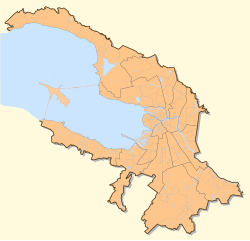
Kronstadt (Russian: Кроншта́дт, romanized: Kronshtadt, IPA: [krɐnˈʂtat]) is a Russian port city in Kronshtadtsky District of the federal city of Saint Petersburg, located on Kotlin Island, 30 km (19 mi) west of Saint Petersburg, near the head of the Gulf of Finland. It is linked to the former Russian capital by a combination levee-causeway-seagate, the St Petersburg Dam, part of the city's flood defences, which also acts as road access to Kotlin island from the mainland.
Key Information


.png)
.png)


Founded in the early 18th century by Peter the Great, it became an important international centre of commerce whose trade role was later eclipsed by its strategic significance as the primary maritime defence outpost of the former Russian capital.[4][5] The main base of the Russian Baltic Fleet was located in Kronstadt, guarding the approaches to Saint Petersburg. In March 1921, the island city was the site of the Kronstadt rebellion.
The historic centre of the city and its fortifications are part of the World Heritage Site that is Saint Petersburg and Related Groups of Monuments.
Kronstadt has been a place of pilgrimage for Orthodox Christians for many years due to the memory of Saint John of Kronstadt.
Name
[edit]The name of the city is alternatively spelled as Kronshtadt, Cronstadt or Kronštadt.[6] It is derived from German Kronstadt (lit. 'crown city').[7] The district is referred to as Kronshtadtsky District.
History
[edit]Foundation
[edit]


Kronstadt was founded by Peter the Great, whose Imperial Russian forces took the island of Kotlin from the Swedes during the Great Northern War in 1703.[8] The first fortifications were inaugurated on 18 May [O.S. 7 May] 1704. These fortifications, known as Kronshlot (Кроншлот), were constructed very quickly. During the winter, the Gulf of Finland freezes over completely. Under the command of Governor-general Alexander Danilovich Menshikov, workers used thousands of frames (caissons) made of logs from evergreen trees filled with stones which were moved by horses across the frozen sea, and placed in cuttings made in the ice. Thus, several new small islands were created, and forts were erected on them, virtually closing access to Saint-Petersburg by sea. Only two narrow navigable channels remained, with forts guarding them. On 8 July 1704, the fortress was attacked by a Swedish fleet led by Jacob de Prou.[9]
One of the first governors of Kronstadt was a veteran of the Royal Scots Navy, Admiral Thomas Gordon who was a refugee in Russia from the Scottish union with England and became chief commander of the port of Kronstadt from 1727 to 1741.
Just as Kronstadt became populated and fortified, it attracted merchants from maritime powers most notably, the Dutch, the British and the Germans through the old Hanse connections. The community of British merchants or "factors" came to be known as the English Factory, despite the fact that many of them were Scots. They settled both in Kronstadt and in St Petersburg itself and for a time dominated both inward and outward trade, especially in the reign of Catherine the Great. They became an integral part of British trade and foreign policy through the Board of Trade in London. A number of the British settlers became naturalised Russians.[4] The population by the 1840s was 44,000.[10] Trading alliances were sharply interrupted by the outbreak of the Crimean War (1854).
Kronstadt was thoroughly refortified in the 19th century. The old three-decker forts, five in number, which formerly constituted the principal defences and had resisted the Anglo-French fleets during the Crimean War, became of secondary importance. From the plans of Eduard Totleben a new fort, Fort Constantine, and four batteries were constructed (1856–1871) to defend the principal approach, and seven batteries to cover the shallower northern channel. All these fortifications were low and thickly armoured earthworks with heavy Krupp guns on their ramparts. The city is surrounded by an enceinte.[11]
In summer 1891, the French fleet was officially received in Kronstadt. It was a first step towards the forthcoming Franco-Russian Alliance.
Russian Civil War
[edit]During the Petrograd (now Saint Petersburg) riots of the February Revolution, the sailors of Petrograd joined the revolution and executed their officers, thus gaining a reputation as dedicated revolutionaries. After the October Revolution, the sailors allied with the Bolsheviks. They would remain supporters of the Bolsheviks until 1921.
Kronstadt with its supporting forts and minefields was key in protecting Petrograd from foreign forces. Despite this, the cruiser Oleg was torpedoed and sunk by a small motor boat after participating in the bombardment of Krasnaya Gorka fort that had revolted against the Bolsheviks.[12] This was followed on August 18, 1919, by a raid of seven Royal Navy Coastal Motor Boats inside the harbour of Kronstadt itself, damaging the Soviet battleships Petropavlovsk and Andrei Pervozvanny, and sinking a submarine supply ship, the Pamiat Azova.
Kronstadt Rebellion
[edit]In 1921, a group of naval officers and men, together with soldiers and civilian supporters, rebelled against the Bolshevik government in Soviet Kronstadt. The garrison had previously been a centre of major support for the Bolsheviks, and throughout the Civil War of 1917–1921, the naval forces at Kronstadt had been at the vanguard of the main Bolshevik attacks. Their demands included freedom of speech, the end of deportation to work camps, a change in Soviet war politics, and liberation of the soviets (workers' councils) from "party control".[13] After brief negotiations, Leon Trotsky (then the Minister of War in the Soviet Government, and the leader of the Red Army) responded by sending the army to Kronstadt, along with the Cheka. The uprising was thus suppressed following a massacre.
Interwar and World War II
[edit]In the late 1930s, the fortified city became the base of the Soviet Baltic Fleet. During that time it was an important training centre for the Soviet navy. The Kronstadt naval dockyard overhauled and repaired surface ships and submarines for the Baltic Fleet. All forts and batteries of the city were reconstructed.
At 23:37 on June 21, 1941, fleet operational readiness Number 1 was announced by Baltic Fleet Commander Vice Admiral V. Tributs on the order of the People's Commissar of the Navy Admiral N.G. Kuznetsov. Several hours later the first German aircraft began dropping mines into the canal outside Kronstadt. The duty officer, first lieutenant S. Kushnerev, ordered anti-aircraft batteries to open fire on enemy planes. Several aircraft were shot down or damaged. Twenty-seven German planes took part in the first attack, and three were destroyed by the anti-aircraft guns of the 1st Air Defence Regiment of the Baltic Fleet. This regiment was situated in the southern forts.


During World War II, Kronstadt was subject to several bombing raids by the Luftwaffe. In August 1941 the Luftwaffe began bombing Kronstadt repeatedly. The most notable bombing was Stuka ace Hans-Ulrich Rudel's sinking of the battleship Marat.
To prevent an enemy landing, 13 artillery batteries were established in Kronstadt with nine more batteries outside the city, on the island of Kotlin. The main lookout was located in the Naval Cathedral. Visual range reached 45 km (28 mi). The coastal defence forces of Kronstadt included two infantry regiments.
In late August, the Red Army in the Baltic States was in a critical situation. Tallinn, the main base of the fleet, was in danger and an order to relocate the fleet from Tallinn to Kronstadt was given. By the time the Soviets had decided on a maritime evacuation of Tallinn, over 200 Soviet civilian and military vessels had been assembled in Tallinn harbour.
After the evacuation of Tallinn, a submarine subdivision had been organized in Kronstadt. By the end of 1941, 82 naval operations had taken place. Hitler was enraged, because Soviet submarines frequently disrupted military supplies of strategic materials from Sweden to Germany. The Germans tried to block the exit completely from the Gulf of Finland with anti-submarine nets and mines. Despite these efforts, the Soviet submariners continued to attack German ships. In 1942, 29 German vessels were sunk. Submarines cooperated with reconnaissance aircraft in searching for military targets.
Soviet submarines had broken through the mine barrages in the Gulf of Finland in 1942. To keep the Soviet submarine force away from Baltic shipping stronger efforts were planned. The minefields would be larger and in addition a double submarine net would be laid from Porkkala to Naissaar in Operation Walross. The blockade of the Gulf of Finland turned out to be 100% effective. But in 1944, when Finland signed a peace treaty with the Soviet Union, one of the conditions was that the Soviets could locate one naval base in Finland at Porkkala. Submarine warfare in the Baltic Sea reached its final stage after peace was reached with Finland.
The Baltic Fleet sent more than 125,000 people to serve on shore at the front. Eighty-three thousand people fought directly on the Leningrad Front. For the protection of Leningrad 10 brigades of naval infantry, four regiments, and more than 40 separate battalions and companies were formed in Kronstadt.
The Luftwaffe and German artillery sent thousands of bombs and shells onto the naval dockyard and the Arsenal factory. The German air raids in September 1941, damaged ships of the Baltic Fleet and the infrastructure of the naval dockyard. Several sections of the yard were destroyed, the docks were heavily bombed causing the death of dozens of workers and engineers. Nevertheless, the naval yard continued its work. Despite the siege, the workers persevered with their work, often working 18–20 hours a day.
Thanks to the power of the Kronstadt Fortress the destruction of Leningrad, then the main industrial and cultural centre of the Soviet Union, was successfully prevented. The honorary status of "City of Military Glory" was conferred on it by the President of the Russian Federation Dmitriy Medvedev on April 27, 2009, citing the "courage, endurance and mass heroism, exhibited by defenders of the city in the struggle for the freedom and independence of the Motherland".
Population
[edit]With changing historical trends, the population saw peaks and troughs partly determined by the expansion and then decline of the naval base and dockyard.
| Year | Inhabitants |
|---|---|
| 1854 | 53,000 |
| 1897 | 59,525 |
| 1926 | 31,197 |
| 1939 | 38,071 |
| 1959 | 40,303 |
| 1970 | 39,477 |
| 1979 | 40,308 |
| 1989 | 45,053 |
| 2002 | 43,385 |
| 2010 | 43,005 |
Note Census data of 1897 includes military personnel
Recent population data indicate it has stabilised as follows: 43,385 (2002 census);[14] 43,005 (2010 census).[1]
Places of interest
[edit]

The city of Kronstadt is built on level ground on the island and is thus exposed to flooding, most notably in 1824. The port is icebound for 140–160 days in the year, from the beginning of December to April. A very large proportion of the inhabitants are sailors. On the south side of the city there are three harbours: the large western or merchant harbour, the western flank of which is formed by a great pier joining the fortifications which traverse the breadth of the island on one side. The middle harbour was used chiefly for fitting out and repairing vessels. The eastern or military harbour was used for docking vessels of the Russian Navy. The Peter and Catherine Canals connected with the merchant and middle harbours across the city. Between them stood the old Italian Palace of Prince Menshikov, whose site was later occupied by a school for pilots.[8] In the second half of the 18th century the building of the former Italian palace was used by various military training institutions. In 1771–1798 the Sea Cadet Corps was housed there before being transferred to St Petersburg. From 1798 to 1872 the Navigation School was situated in the former palace.

The Kronstadt tide gauge is situated near the former Italian palace. Sea level observations in Saint Petersburg began already in 1703. On Kotlin Island, the main naval fortress of the Russian Empire began observations in 1707. This monitoring was necessary because the water level of the Finnish Gulf could change considerably in a short time, creating problems for shipping. The annual flood also required close monitoring of the water level. The Kronstadt sea-gauge with the tide gauge pavilion is the zero level of the Baltic system of highs and lows. All depths and altitudes (even the heights of spacecraft) in Russia and some other countries of the former Russian Empire are measured according to the Kronstadt sea-gauge. Yuri Gagarin, the first man in space, said in 1967 that it was "the Hub of the Universe".
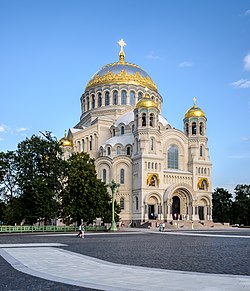
The modern city's most striking landmark is considered to be the enormous Naval Cathedral, dedicated to St Nicholas and built between 1908 and 1913 in Anchor Square which also contains many military memorials. The cathedral is regarded as the culmination of Russian Neo-Byzantine architecture. The Pyotrovsky Gardens is a park that surrounds the monument to Peter the Great who founded the city. There are a number of historic buildings, such as the Dutch Kitchen and the former Italian Palace, that recall the city's mercantile and military past.

Among other public buildings are the Naval Hospital, the British Seamen's Hospital (established in 1867), the Civic Hospital, the Admiralty (founded in 1785), the arsenal, dockyards and foundries, the School of Marine Engineering, and the English Church.[8]
The Kronstadt port was once considered the most fortified port in the world. It still retains some of its old "forts" on small fortified artificial islands. Originally, there were 22 such forts, situated in line with the southern and northern shores of the Gulf of Finland. Some fortifications were located inside the city itself and one was on the western shore of Kronslot Island, on the other side of the main navigational channel.
The construction of the Saint Petersburg Dam led to some of the forts being demolished. The dam, a levee-causeway-Seagate combination also enabled Kronstadt and some of the forts being reached by land. Among the most important surviving forts are:
- Fort Konstantin, the biggest in the Gulf of Finland
- Fort Rif on the western shore of the island; and the particularly well-preserved Fort Alexander I, "the Plague Fort"
- Fort Totleben, named after Eduard Totleben, the largest and the newest of the forts, built at the beginning of the 20th century.

There are daily bus and water tours to Kronstadt from Saint Petersburg.[15]
Devotion to St. John of Kronstadt
[edit]The now demolished older St Andrew Cathedral (1817), once a prominent Kronstadt landmark, was destroyed on Communist orders in 1932. St John of Kronstadt, one of the most venerated Russian saints, served there as priest from 1855 to 1908.[16]
Saint Petersburg Dam
[edit]The controversial dam that took 30 years to build (1980–2011) now links Kotlin island to the mainland from north and south, not only acts as part of the flood defences, but lets through shipping and completes the St Petersburg ring-road system, across the island. It is a feat of marine engineering consisting of a combination of levee-causeway and seagate. Its construction on the shoals of the Gulf of Finland involved the removal of some of the historic fortifications.
Twin towns – sister cities
[edit]Kronstadt is twinned with:[17]
 Asipovichy, Belarus
 Changli County, China
 Dax, France
 Demre, Turkey
 Feodosia, Ukraine[a]
 Ii, Finland
- Kotka, Finland
- Lushan City, China
 Marostica, Italy
- Messina, Italy
 Mühlhausen, Germany
 Nafplio, Greece
 Narva-Jõesuu, Estonia
 Nordborg (Sønderborg), Denmark
- Oulu, Finland
 Oxelösund, Sweden
- Pinghu, China
- Põhja-Tallinn (Tallinn), Estonia
- Pudasjärvi, Finland
 Sumoto, Japan
- Toulon, France
- Zhongshan County, China


Former twin towns
[edit]
On 1 March 2022, the Polish city of Piła suspended its partnership with Kronstadt as a reaction to the 2022 Russian invasion of Ukraine.[18]
Notable people
[edit]- Thomas Gordon (1658 -1741), admiral, governor, and commander-in-chief at Kronstadt from 1727 until his death in 1741. His granddaughter Anne Young married a Scot, Lt. Thomas MacKenzie (Foma Kalinovich Mekenzi, Фома Калинович Мекензи, son of Colin). Two years after their marriage in 1738 they had a son also called Thomas, (Foma Fomich Mekenzi (Фома Фомич Мекензи), son of Thomas), a Scottish-Russian rear admiral who founded the city of Sevastopol in the service of the Russian Empire in 1783.
- Domenico Trezzini (1670–1734), Swiss-Italian architect who worked on first design of Kronstadt
- William Tooke (1744–1820), chaplain (1772–75) to the English merchant community in Kronstadt, later moved to St. Petersburg
- Hippolyte de Capellis (1744–1813), French naval officer, emigrant after the French Revolution, became a rear admiral of the Imperial Navy and governor of Kronstadt (1799–1801)
- Agustín de Betancourt (1758–1824), Spanish engineer and town planner of Kronstadt
- Thomas Tooke (1774–1858), British economist and statistician, was born in Kronstadt on February 26, 1774
- Aleksey Greig (1775–1845), Admiral of the Imperial Russian Navy, son of Samuel Greig, a Scottish admiral in the service of Russia
- Otto Friedrich Theodor von Möller (1812–1874), painter of German descent
- Alexei Ivanovich Butakov (1816–1869), Admiral and explorer, brother of Admiral Grigory Butakov
- Mikhail Britnev (1822–1889), shipbuilder
- Saint John of Kronstadt (1829–1909), Kronstadt parish priest and revered as a saint after his death
- Nikolai Kulchitsky (1856–1925), histologist[19]
- Ivan Yendogurov (1861–1898), painter[20]
- Mikhail von Schulz (1862–1917), Vice-admiral of the Russian Imperial Navy
- Eino Rahja (1885–1936), Finnish-Russian Communist revolutionary
- Nikolay Gumilyov (1886–1921), influential poet and founder of Acmeist poetry, murdered by the Cheka
- Jukka Rahja (1887–1920), Finnish-Russian Communist revolutionary, born in the city
- Ivan Yevdokimov (1887–1941), writer
- Stepan Petrichenko (1892–1947), leader of the Kronstadt Mutiny (1921)
- Pyotr Sobennikov (1894–1960), Soviet lieutenant general[21]
- Pyotr Kapitsa (1894–1984), birthplace of co-recipient of the 1978 Nobel Prize in Physics.
- Cleo Nordi (1898–1983), Russo-Finnish ballerina, born in Kronstadt. She later taught in London
- Nikolay Dubinin (1907–1998), geneticist
- Boris Stark (1909–1996), missionary and priest
- Alexander Gomelsky (1928–2005), basketball player and coach
- Sergei Revyakin (born 1995), Russian football goalkeeper
Gallery
[edit]-
 Fort Alexander viewed from Kronstadt
 -
 St Nicolas Chapel
 -
 Fort Rif
 -
 Italian pond
 -
 Aerial view of Navigation Pass S-1 of Saint Petersburg Dam
 -
 Kronstadt the Blue bridge
 -
 The Dutch Kitchen, Kronstadt
 -
 Kronstadt street art
 -
 Leningradskaya Street
 -
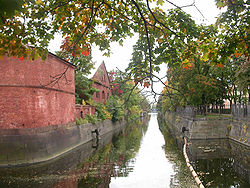 A Kronstadt canal


Notes
[edit]- ^ Disputed territory as at March 2024, due to the Russo-Ukrainian War
References
[edit]- ^ a b Russian Federal State Statistics Service (2011). Всероссийская перепись населения 2010 года. Том 1 [2010 All-Russian Population Census, vol. 1]. Всероссийская перепись населения 2010 года [2010 All-Russia Population Census] (in Russian). Federal State Statistics Service.
- ^ "Об исчислении времени". Официальный интернет-портал правовой информации (in Russian). June 3, 2011. Retrieved January 19, 2019.
- ^ Почта России. Информационно-вычислительный центр ОАСУ РПО. (Russian Post). Поиск объектов почтовой связи (Postal Objects Search) (in Russian)
- ^ a b Kaplan, 1995
- ^ Herbert H. Kaplan Russian Overseas Commerce with Great Britain During the Reign of Catherine II. Volume 218 of "American Philosophical Society": Memoirs of the American Philosophical Society, 1995. ISBN 978-087-1692-184
- ^ "Kronshtadt". britannica.com.
- ^ "Rebellion in a Naval Fortress". Russian Life. March 1, 2006.
- ^ a b c Kropotkin & Bealby 1911, p. 928.
- ^ Wolke 2025, p. 115.
- ^ The National Cyclopaedia of Useful Knowledge (First ed.). London: Charles Knight. 1848. p. Vol V, p.112.
- ^ Kropotkin & Bealby 1911, p. 927.
- ^ Ingrian nationalists, according to Operation Kronstadt
- ^ "The Kronstadt Rebellion, Feb 28 – Mar 18, 1921". Archived from the original on March 15, 2009. Retrieved March 8, 2009.
- ^ Federal State Statistics Service (May 21, 2004). Численность населения России, субъектов Российской Федерации в составе федеральных округов, районов, городских поселений, сельских населённых пунктов – районных центров и сельских населённых пунктов с населением 3 тысячи и более человек [Population of Russia, Its Federal Districts, Federal Subjects, Districts, Urban Localities, Rural Localities—Administrative Centers, and Rural Localities with Population of Over 3,000] (XLS). Всероссийская перепись населения 2002 года [All-Russia Population Census of 2002] (in Russian).
- ^ "Boat tour to Kronstadt". Archived from the original on January 6, 2013. Retrieved August 14, 2011.
- ^ Alla Selawry, Jean de Cronstadt, médiateur entre Dieu et les hommes, Éditions du Cerf, 2001
- ^ "Города-партнёры". visitkronshtadt.ru (in Russian). Visit Kronshtadt. Archived from the original on October 1, 2021. Retrieved February 5, 2020.
- ^ "Miasto Piła zawiesza współpracę z rosyjskimi miastami partnerskimi. Co na to poseł Marcin Porzucek?" (in Polish). March 2022. Archived from the original on March 5, 2022. Retrieved March 5, 2022.
- ^ Кульчицкий Николай Константинович Archived May 3, 2018, at the Wayback Machine, hrono.info (in Russian)
- ^ Ендогуров Иван Иванович Archived February 11, 2019, at the Wayback Machine, art-catalog.ru (in Russian)
- ^ Собенников Петр Петрович Archived March 6, 2019, at the Wayback Machine, encyclopedia.mil.ru (russisch)
- This article incorporates text from a publication now in the public domain: Kropotkin, Peter Alexeivitch; Bealby, John Thomas (1911). "Kronstadt". In Chisholm, Hugh (ed.). Encyclopædia Britannica. Vol. 15 (11th ed.). Cambridge University Press. pp. 927–928.

External links
[edit]

- Kronstadt history Archived November 6, 2011, at the Wayback Machine
- Kronstadt web site
- Map of Kronstadt Archived July 5, 2007, at the Wayback Machine
- Kronstadt: Virtual Excursion in Russian
- International Kronstadt Development Fund
- Kronstadt Fortress (city fortifications)
- Kronstadt sea forts: South part and North part
Works cited
[edit]- Wolke, Lars Ericson [in Swedish] (2025). Mot Sankt Petersburg! Den karolinska arméns desperata kamp 1708 [Towards Saint Petersburg! The desperate struggle of the Carolean army in 1708] (in Swedish). Carlssons.
Cities and towns under the jurisdiction of Saint Petersburg | |||
|---|---|---|---|
.svg) |  | ||


| Commander of fleet |  | |
|---|---|---|
| Divisions | ||
| Navy bases in Kaliningrad Oblast |
| |
| Navy base in Saint Petersburg and Oblast | ||
| Former naval bases | ||
| Military educational institutions |  | |
|---|---|---|
| Military research institutes and design offices | ||
| The military ship-building and ship-repair enterprises | ||
| Part of Leningrad Naval base | ||
| International | |
|---|---|
| National | |
| Geographic | |
| Other | |
Kronstadt
View on GrokipediaEtymology
Origin and Historical Naming
The name Kronstadt derives from the German terms Krone ("crown") and Stadt ("city"), literally meaning "Crown City," reflecting its intended status as a paramount imperial stronghold. This nomenclature echoes the earlier Kronshlot (or Kronslott), translating to "Crown Fortress" or "Crown Castle," which designated the initial wooden fortifications erected on Kotlin Island in 1704 to safeguard the nascent Russian Baltic Fleet.[5][9] Peter the Great formalized the name Kronstadt on October 7, 1723 (Julian calendar), during a ceremonial prayer service where he personally laid the foundation stone for the stone citadel, announcing the designation to Europe via cannon salvos. This act underscored the site's strategic primacy in defending Saint Petersburg from naval incursions, following initial construction ordered in late 1703 after Russia's capture of the island from Sweden in the Great Northern War. The Germanic etymology aligns with Peter's broader westernizing reforms, including adoption of European military and architectural nomenclature to project permanence and sovereignty in the Baltic region.[10][11] Prior to Russian control, Kotlin Island—site of Kronstadt—was inhabited by Finnic peoples and known as Retusaari ("sand island" or "rat island" in Finnish), ceded to Sweden in 1617 before its reconquest. The shift to Kronstadt thus marked not only a renaming but a symbolic assertion of Russian imperial dominion over a contested frontier.[5]Geography
Location and Physical Features
Kronstadt occupies Kotlin Island, a small landmass in the eastern Gulf of Finland approximately 30 kilometers west of Saint Petersburg at the Neva River's mouth.[11][12] The island, historically part of contested borderlands between Russia and Sweden from 1323 to 1617, features swampy soil and lacks natural freshwater sources, prompting the development of artificial water supply systems by 1804.[11][5] Originally heavily wooded, Kotlin Island spans an area of about 15 square kilometers and exhibits low-lying terrain prone to flooding, as evidenced by severe inundations reaching 4 meters above normal levels in 1824.[11] Its physical layout supports a compact urban structure with a rectangular street grid, intersected by canals initiated in 1719, including the Peter Canal, and harbors such as Srednaya and Voennaya constructed around 1720 for naval operations.[5][11] The island's defensive physical features include extensive fortifications, beginning with coastal batteries and the Kronslott fort in 1704, evolving into granite structures, armoured earthworks, and a network of dams and walls added between 1825 and 1840 under Nicholas I to counter advancing artillery capabilities.[5] These elements, combined with surrounding sea forts and channels like the Putilovsky sea channel from 1855, form a engineered barrier system enhancing the site's strategic impregnability against maritime threats.[11]
Climate and Environment
Kronstadt, situated on Kotlin Island in the eastern Gulf of Finland, features a humid continental climate (Köppen Dfb) with cold, snowy winters and mild, humid summers moderated by the Baltic Sea's influence.[13] Annual average temperatures hover around 5°C, with extremes ranging from lows of -9°C in winter to highs of 23°C in summer; temperatures rarely drop below -20°C or exceed 28°C.[14] Winters typically see persistent snow cover and ice formation on surrounding waters from December to March, while summers bring average highs of 18–20°C and increased precipitation, totaling about 660 mm annually, often as convective showers. The island's environment is dominated by its maritime setting in the brackish Gulf of Finland, where salinity levels average 3–5 ppt due to freshwater inflows from the Neva River, supporting a mix of Baltic and freshwater species but limiting marine biodiversity compared to oceanic waters.[15] Surface water temperatures vary from near 0°C in winter, when much of the gulf freezes, to 15–17°C in summer, influencing local fog, winds, and erosion patterns on artificial defenses like dikes and forts.[15] Anthropogenic pressures, including historical naval activities and urban runoff from nearby Saint Petersburg, have contributed to ecological degradation, such as eutrophication and elevated heavy metal concentrations (e.g., mercury and copper ions), altering aquatic ecosystems and reducing natural biodiversity.[16] Despite remedial efforts, the gulf's overall ecological condition remains strained by nutrient overloads and sediment disturbances from dredging.[17]History
Foundation and Imperial Era (1703–1917)
Kronstadt was established by Tsar Peter the Great in 1703 as a fortified naval base on Kotlin Island in the Gulf of Finland to safeguard the sea approaches to the newly founded Saint Petersburg.[5] Construction of the initial wooden fortress, initially called Kronslot, commenced late in 1703 on the southern shoals of the island under the direction of Prince Alexander Menshikov, who positioned a battery of cannons there.[5] [3] The fortress's official foundation occurred on May 7 (18), 1704, marking the completion of its initial two batteries and the beginning of the walled port city.[5] [3] Peter personally designed elements of the fortifications, emphasizing their role in defending against Swedish naval threats during the Great Northern War.[3] Early expansions in the 1710s and 1720s solidified Kronstadt's strategic position. In 1710, following Swedish advances, the northern coast was fortified using labor from captive Swedes and Russian soldiers.[5] By 1713, the first harbor facilities were constructed, accommodating 150–180 foreign merchant ships annually.[10] Canals and dockyards began in 1719, followed by war and merchant harbors in 1720, alongside urban development including streets and administrative buildings; the town was officially renamed Kronstadt on October 6, 1723.[5] [10] A wooden lighthouse was erected starting in 1719 after the grounding of the 54-gun ship London.[10] These developments established Kronstadt as the principal base of the Russian Baltic Fleet, serving as a hub for shipbuilding, training, and operations.[1] Throughout the 19th century, Kronstadt underwent significant refortification to counter advancing artillery technologies and potential invasions. Defenses were overhauled in 1807–1808 according to engineer Opperman's plan, with further rebuilding in 1824 following devastating inundations.[5] Under Emperor Nicholas I from 1825 to 1840, extensive works included western forts, defensive walls, dams, and military barracks, enhancing the ring of fortifications around the island.[5] In 1854, spit fortifications were added, later evolving into armored earthworks.[5] The era also saw naval innovations, such as the launch of Russia's first steamer in 1815 and the establishment of a steamboat plant in 1847.[10] Kronstadt hosted key figures like Admiral Fyodor Ushakov, Admiral Pavel Nakhimov, and explorer Fabian Bellingshausen (chief commander 1839–1852), underscoring its centrality to imperial naval power until 1917.[5] [10]World War I and the 1917 Revolutions
During World War I, Kronstadt functioned as the principal anchorage for the Imperial Russian Navy's Baltic Fleet, comprising several pre-dreadnought battleships, cruisers, destroyers, and submarines tasked with defending the Gulf of Finland against German incursions.[18] The fleet's activities emphasized defensive measures, including aggressive minelaying campaigns that created extensive barriers to deter enemy advances, alongside limited cruiser raids on German ore shipping routes to Sweden.[18] Lacking parity with the German High Seas Fleet, Russian naval commanders adopted a cautious posture, avoiding open-sea confrontations and prioritizing coastal protection amid resource shortages and logistical constraints that hampered offensive operations.[19] The outbreak of the February Revolution in Petrograd on February 23, 1917 (Julian calendar; March 8 Gregorian) rapidly influenced Kronstadt, where sailors—predominantly from peasant and working-class backgrounds and long resentful of aristocratic officers—mutinied on February 28 (March 13 Gregorian), arresting or summarily executing up to 14 senior commanders and seizing control of the fortress and ships.[6] This action, one of the earliest and most violent in the naval bases, established the Kronstadt Soviet of Workers' and Soldiers' Deputies, which pledged loyalty to the revolution's ideals of ending autocracy and war while rejecting the Provisional Government's authority in favor of soviet power.[6] The soviet's radical composition, influenced by socialist agitators and reflecting grievances over wartime hardships like food shortages and harsh discipline, positioned Kronstadt as a vanguard of anti-Tsarist sentiment.[20] As revolutionary tensions escalated, Kronstadt sailors actively intervened in Petrograd's politics, dispatching armed detachments during the April Crisis to demonstrate against the government's war policies and again in the July Days uprising of July 3–7 (July 16–20 Gregorian), where approximately 5,000 participated in protests that pressured the Provisional Government but led to Bolshevik suppression. By the October Revolution on October 25 (November 7 Gregorian), the Kronstadt Soviet, though ideologically diverse with strong anarchist and socialist-revolutionary elements alongside growing Bolshevik influence, overwhelmingly endorsed the Bolshevik seizure of power, with ships like the cruiser Aurora (temporarily based nearby) and detachments aiding in securing bridges and key sites against Provisional Government resistance.[21] This support underscored Kronstadt's evolution into a radical proletarian stronghold, though underlying tensions over soviet democracy foreshadowed future conflicts.[6]Russian Civil War (1918–1920)
During the Russian Civil War, Kronstadt served as the fortified naval base and headquarters of the Bolshevik-controlled Baltic Fleet, providing strategic defense for Petrograd against White forces and Allied interventions.[22] The fleet's ships, including dreadnoughts like Petropavlovsk (formerly Poltava) and Sevastopol, were concentrated there after the Brest-Litovsk Treaty of March 1918 exposed Russian naval positions to German occupation in the Baltic.[23] In February–May 1918, under Commander Alexey Schastny, the fleet executed the "Ice Cruise," relocating approximately 30 warships and auxiliaries from threatened ports like Helsinki through frozen Gulf of Finland waters to Kronstadt, preserving Bolshevik naval assets from capture by German or White forces.[22][24] This operation, involving over 10,000 personnel enduring harsh Arctic conditions, ensured Kronstadt remained a viable Red stronghold despite the fleet's limited offensive capabilities due to Entente naval superiority.[23] Kronstadt sailors, numbering around 15,000–20,000 at peak strength, actively supported Bolshevik military efforts, deploying detachments to suppress anti-Bolshevik uprisings and reinforce fronts.[8] Units from the base participated in quelling the Left SR revolt in Moscow in July 1918 and aided Red Army operations against Whites in Ukraine and the Urals, where their revolutionary zeal—rooted in 1917 experiences—bolstered morale but also imported grievances over Bolshevik centralization.[25] By April 1918, Kronstadt's soviet had passed resolutions criticizing Bolshevik suppression of opposition parties and press freedoms, signaling early frictions amid War Communism's grain requisitions and economic controls, though these did not escalate to open defiance.[25] Schastny, hailed as a hero for the Ice Cruise, was arrested and executed in June 1918 on Trotsky's orders for purported monarchist sympathies, reflecting Bolshevik purges of naval leadership to enforce party loyalty.[24] In 1919, Kronstadt played a pivotal defensive role during General Nikolai Yudenich's Northwest Army offensive toward Petrograd in October, with fleet artillery and sailor infantry reinforcing land defenses that halted the White advance at Pulkovo Heights on October 21.[8] The base withstood British Royal Navy raids, including the August 17–18 attacks by coastal motor boats that sank the cruiser Oleg (killing over 400 crew) and damaged the battleship Andrei Pervozvanny, yet Kronstadt's fortifications and anti-submarine measures limited further penetrations.[26] These actions underscored Kronstadt's causal importance in securing Bolshevik control of the northern theater, as its loss could have isolated Petrograd and enabled White-Allied coordination. By 1920, as White resistance collapsed—marked by Pyotr Wrangel's evacuation from Crimea in November—Kronstadt's garrison focused inward, enforcing requisitions amid famine and disease that claimed thousands of lives in the region, fostering latent discontent over policies prioritizing military needs.[23] Despite these strains, the base remained loyal to the regime through the war's end, with no recorded mutinies until post-war economic collapse.[27]The Kronstadt Rebellion
Background and Grievances
The Kronstadt naval base, situated on Kotlin Island in the Gulf of Finland about 20 miles from Petrograd, served as a strategic fortress housing the Baltic Fleet, with a population of roughly 50,000 by early 1921, including sailors who had been pivotal in the 1917 revolutions.[28] Following their initial support for the Bolsheviks during the October Revolution and Civil War, many sailors grew disillusioned amid the regime's shift toward centralized control and the implementation of War Communism from 1918 to 1921.[28] This policy, aimed at sustaining the Red Army through nationalization of industry, forced grain requisitions from peasants, and militarized labor, resulted in severe economic contraction: industrial production fell to 20% of 1913 levels, agricultural output halved, sown acreage dropped to 60% of prewar figures, and urban rations in Petrograd ranged from 200 to 800 grams of bread per day, exacerbating hunger and scurvy in the fleet.[28] Peasant resistance to requisitions, including uprisings like the Tambov rebellion from 1920 to 1921, further strained supplies, while demobilization after the defeat of White forces in late 1920 flooded cities with unemployed veterans, heightening social tensions.[28] Politically, grievances centered on the Bolsheviks' consolidation of power, which eroded the democratic structures of 1917 by dominating soviets, suppressing Mensheviks, Socialist Revolutionaries, and anarchists through arrests and Cheka operations, and imposing one-party rule.[28] Sailors resented the abolition of elected ship committees, the introduction of commissars and political departments in the military, and bureaucratic interference in the fleet, viewing these as betrayals of revolutionary ideals in favor of a new elite with privileges amid widespread poverty.[28] By January 1921, approximately 5,000 Baltic Fleet seamen had resigned from the Communist Party, reflecting internal dissent even as opposition to War Communism emerged within Bolshevik ranks from December 1920 onward.[28] Reports from furloughed sailors about peasant hardships under requisitions and urban factory closures fueled perceptions of a "new serfdom," alienating the once-loyal "red sailors" who positioned themselves as defenders of the Soviet cause against Communist authoritarianism.[28] The immediate catalyst was worker strikes in Petrograd in February 1921, such as at the Trubochny factory, prompting Kronstadt meetings on February 28, 1921, aboard the battleship Petropavlovsk, where delegates adopted a resolution articulating 15 demands for a "third revolution" to restore workers' and peasants' power.[28] [29] These included:- Immediate re-election of soviets by secret ballot with freedom for all parties and groups to agitate.[29]
- Freedom of speech, press, and assembly for workers, peasants, left socialists, and anarchists.[29]
- Liberation of political prisoners from socialist and nonparty labor movements.[29]
- Abolition of political bureaus in the army and navy, replacing them with elected cultural-educational commissions.[29]
- Equalization of rations for workers and peasants, ending official privileges, and freedom for peasant land use without hired labor or forced state farms.[29]
Key Events and Demands
The Kronstadt rebellion commenced on February 28, 1921, when crews aboard the battleships Petropavlovsk and Sevastopol convened an emergency meeting and unanimously approved (with two abstentions) a resolution outlining 15 demands, prompted by a delegation's reports of worker strikes in Petrograd and the Bolshevik authorities' harsh response, including arrests of protesters.[29][30] On March 1, 1921, a general assembly of approximately 15,000 to 16,000 sailors, soldiers, and civilians in Anchor (Yakornaia) Square ratified the resolution, after which a 30-member delegation dispatched to Petrograd to negotiate with Soviet leaders was arrested by Cheka forces.[30][31] The rebels then formed a Provisional Revolutionary Committee on March 2, comprising initially five members (later expanded to 15), led by Stepan Petrichenko, a Bolshevik sailor who had shifted allegiance; this body organized defenses on Kotlin Island, raised the red rebel flag inscribed with "Battle Battleship Petropavlovsk's crew," and issued Izvestiia bulletins proclaiming the uprising's goals.[30] Bolshevik commander Mikhail Tukhachevsky issued an ultimatum demanding surrender, which the committee rejected, leading to the fortification of positions and appeals for support from other military units.[30] The core demands, as articulated in the resolution signed by Petrichenko and secretaries Perepelkin and Vassiliev, emphasized restoring soviet democracy and civil liberties while critiquing Bolshevik centralization:- Immediate new elections to Soviets by secret ballot with freedom of agitation for all workers and peasants.[29][31]
- Freedom of speech and press for workers, peasants, left socialist parties, and anarchists.[29][31]
- Freedom of assembly for trade unions, peasant organizations, and other groups.[29][31]
- Convening of a non-party conference of workers, peasants, soldiers, and sailors no later than March 10, 1921.[29][31]
- Liberation of all political prisoners belonging to socialist parties and those imprisoned in connection with peasant and worker movements.[29][31]
- Election of a commission to review cases of those held in prisons and concentration camps.[29][31]
- Abolition of political departments in military units and replacement with elected cultural-educational commissions.[29]
- Immediate abolition of detachments combatting speculation and replacement with units elected by workers.[29]
- Equalization of rations for all workers, with exceptions only for those in hazardous occupations.[29][31]
- Abolition of Bolshevik combat detachments in the army, factories, and railroads; replacement with units elected by workers.[29][31]
- Full disposition of land and cattle to peasants, without use of hired labor.[29][31]
- Support for the resolution from frontline military units and cadets.[29]
- Wide publication of the demands in all print media.[29]
- Formation of a traveling commission for oversight and agitation.[29]
- Permission for free artisan production by individual labor.[29]
Bolshevik Suppression
The Bolshevik leadership, viewing the Kronstadt rebels as a counter-revolutionary threat amid the broader economic and social crises of War Communism, authorized a full military suppression under Leon Trotsky's direction as People's Commissar for War.[32] Trotsky issued a stern ultimatum on March 5, 1921, demanding the rebels lay down arms by 10 a.m. the following day or face being "shot like partridges" upon capture, framing the uprising as a White Guard plot despite the sailors' prior loyalty to the Bolsheviks during the Civil War.[33] This rhetoric justified mobilizing approximately 50,000 to 60,000 troops from the Red Army's Seventh Army, commanded by Mikhail Tukhachevsky, who coordinated the operation from Petrograd while incorporating artillery barrages and infantry assaults across the frozen Gulf of Finland.[34][35] Initial probes began on March 7, 1921, with artillery shelling from the mainland followed by small-scale infantry charges over the ice, but these met fierce resistance from the island's fortified positions, including machine-gun nests, coastal batteries, and minefields, resulting in heavy Bolshevik losses and a retreat.[35] A larger assault on March 8 fared no better, as troops bogged down in slushy ice and exposed terrain, suffering an estimated several hundred casualties in the failed push toward the northern forts.[36] Tukhachevsky adjusted tactics for the decisive offensive, launching it under cover of darkness on the night of March 16–17 amid a blinding snowstorm, with units in white camouflage advancing in waves from the north and east, supported by intensified naval and land artillery that pounded rebel defenses for hours.[35][34] By dawn on March 17, Bolshevik forces breached the outer lines, leading to urban combat in Kronstadt's streets where rebels, outnumbered and low on ammunition, fought house-to-house until the fortress flag was captured; full control was secured by March 18.[35] Casualties varied by account, with Bolshevik losses estimated at 1,000 to 2,000 killed and up to 4,000 wounded across the assaults, reflecting the high cost of human-wave tactics against entrenched positions, though some Soviet reports minimized figures to around 500 dead.[37] Rebel military deaths numbered approximately 600 to 1,000 during the fighting, with another 6,000 to 8,000 fleeing across the thawing ice to Finland; of the 2,000 to 6,000 captured, systematic trials ensued under the Cheka, culminating in 1,200 to 2,200 executions of participants deemed irredeemable, often conducted summarily in Petrograd-area forests.[37][35] Leaders like Stepan Petrichenko escaped to exile, but hundreds of sailors and civilians faced forced labor in Arctic camps, with survivors amnestied only years later under the New Economic Policy's concessions.[34] The suppression, while consolidating Bolshevik authority, exposed the regime's reliance on coercion over negotiation, accelerating internal debates that prompted Lenin's partial economic retreat.[32]Casualties and Immediate Aftermath
The Bolshevik assault on Kronstadt, culminating in the fortress's capture on March 18, 1921, inflicted severe losses on the attacking forces. Red Army casualties totaled approximately 10,000, with around 527 killed and 3,315 wounded in the final assault alone. Rebel defenders endured about 600 fatalities and over 1,000 wounded during the engagements.[28] Post-suppression repression was swift and extensive. At least 2,103 captured rebels faced execution, including hundreds shot immediately upon surrender in Kronstadt and further deaths among prisoners in Petrograd facilities over subsequent months; a secret trial of 13 ringleaders resulted in their sentencing and execution on March 20. More than 2,000 individuals were arrested, with many transferred to Cheka-run prisons or early concentration camps like Solovki. An estimated 8,000 rebels escaped across the Gulf of Finland's ice to refugee camps in Finland.[28][34] The immediate consequences encompassed purges of roughly 15,000 naval personnel, dispersal of participating Red Army units to prevent contagion of unrest, and intensified Bolshevik propaganda framing the uprising as petty-bourgeois counterrevolution. These measures reinforced regime control amid broader peasant and worker discontent, directly preceding policy shifts such as the adoption of the New Economic Policy.[28]Interpretations of the Kronstadt Rebellion
Bolshevik Perspective
The Bolshevik leadership, including Vladimir Lenin and Leon Trotsky, interpreted the Kronstadt rebellion of March 1921 as a counter-revolutionary mutiny orchestrated by petty-bourgeois elements and influenced by Mensheviks, Socialist Revolutionaries (SRs), and White émigrés, rather than a genuine proletarian uprising.[38] Lenin described the event as a "very petty incident" that posed no existential threat to the Soviet state but exemplified the "petty-bourgeois elemental forces" undermining the dictatorship of the proletariat, arguing that the rebels' demands for "Soviets without Bolsheviks" effectively sought to dissolve the Communist Party's leading role and invite capitalist restoration.[38] He emphasized a binary political reality in Russia—either Soviet power under Bolshevik guidance or a return to tsarist-like authoritarianism—dismissing any "third way" as illusory and doomed to empower reactionaries.[39] Trotsky, who directed the military suppression as commander of the Red Army, fully assumed responsibility for the operation, framing it as a defensive necessity to protect Petrograd's workers from a rebellion that had degenerated into anarcho-syndicalist chaos amid widespread famine and economic collapse.[32] He contended that Kronstadt's sailors, once revolutionary vanguard in 1917, had been corrupted by "sack-carriers" (petty speculators) and external agitators, transforming the fortress into a haven for social "blight" that threatened the regime's survival during the New Economic Policy's fragile implementation.[40] Bolshevik propaganda portrayed the rebels' 15 demands—including free elections to soviets and an end to Bolshevik dominance—as a facade for White Guard infiltration, citing captured documents and radio intercepts allegedly linking Kronstadt to anti-Soviet networks, though such claims were contested by opponents as unsubstantiated.[41] From the Bolshevik viewpoint, the rebellion's timing exacerbated the civil war's aftermath, coinciding with peasant uprisings and urban strikes that risked reigniting full-scale counter-revolution; suppression was thus a "tragic necessity" to consolidate proletarian power against opportunistic deviations, even at the cost of alienating former allies.[32] Lenin later reflected that Kronstadt illuminated the regime's internal contradictions more starkly than any other event, justifying the harsh response as essential to averting systemic collapse without viable alternatives to party-led soviets.[38] This rationale underpinned official narratives in Pravda and party congresses, which decried the rebels as traitors to the international revolution despite their prior contributions.Rebel and Anarchist Viewpoints
The rebels in Kronstadt, primarily sailors of the Baltic Fleet with a history of supporting the 1917 revolutions, positioned their 1921 uprising as a defense of the original socialist ideals against Bolshevik centralization and suppression of worker initiative. In the Petropavlovsk resolution adopted on March 1, 1921, following a mass meeting of over 15,000 participants, they demanded immediate reelection of soviets by secret ballot, freedom of speech and press for workers and peasants, the release of all socialist political prisoners, the abolition of the Cheka secret police, an end to peasant grain requisitions, and the granting of free soviets to trade unions and peasant organizations.[31] [29] These demands reflected grievances over War Communism policies, including forced labor and famine-inducing requisitions, which the sailors viewed as betraying the proletariat's self-governance in favor of party dictatorship.[42] From the rebels' perspective, their action represented continuity with the 1905 and 1917 uprisings where Kronstadt sailors had championed anti-tsarist and anti-provisional government causes, now extended to oppose Bolshevik bureaucratization that had eroded soviet democracy by 1921. They rejected Bolshevik accusations of White Guard influence, asserting in appeals that the uprising stemmed from direct worker and peasant suffering under policies like the 1920 labor militarization decrees, and called for a "third revolution" to restore power to non-party soviets.[43] [36] Anarchists, including figures like Alexander Berkman and Voline who had participated in the Russian Revolution, interpreted Kronstadt as irrefutable evidence of the Bolshevik regime's transformation into a state capitalist authoritarianism that crushed autonomous worker movements. Berkman described the rebels as embodying the "will of the people yearning for freedom," highlighting how the sailors—many influenced by anarchist ideas from the 1905 era and Makhnovist Ukraine—sought federated, non-hierarchical soviets free from vanguard party control.[42] Anarchist analyses emphasized the rebellion's spontaneity and ideological roots in anti-statism, countering Bolshevik claims of petty-bourgeois deviation by noting the rebels' proletarian composition and demands for economic decentralization, such as allowing peasants to manage production without state coercion.[44] [45] This viewpoint persisted in anarchist historiography, portraying the suppression—executions of at least 2,000 rebels and imprisonment of thousands more—as the pivotal moment when Bolsheviks prioritized party power over revolutionary internationalism, foreshadowing Stalinist purges while discrediting state socialism's compatibility with liberty.[46] Anarchists like Ida Mett argued that Kronstadt exposed the causal link between one-party rule and the erosion of workers' councils, drawing on firsthand émigré accounts and smuggled documents to substantiate claims of no significant counter-revolutionary infiltration among the rebels.[47]Long-Term Historical Assessments
The Kronstadt Rebellion of 1921 has been interpreted by historians as a critical juncture in the Russian Revolution, signifying the Bolshevik leadership's prioritization of centralized party control over decentralized soviet democracy and marking the effective end of widespread proletarian support for the regime's policies.[48] The event underscored the tensions arising from War Communism's economic failures, including severe food shortages and forced requisitions, which alienated even the revolutionary vanguard like the Kronstadt sailors who had been instrumental in the 1917 uprisings.[49] Western scholars such as Paul Avrich and Leonard Schapiro have characterized it as a harbinger of Soviet totalitarianism, arguing that the brutal suppression—resulting in an estimated 1,000 to 2,000 Bolshevik deaths and up to 10,000 rebel casualties, with thousands more executed or imprisoned—illustrated the regime's shift toward authoritarian consolidation rather than a mere defensive response to external threats.[50] From a Marxist-Leninist perspective, as articulated by Leon Trotsky and echoed in later analyses, the rebellion represented a "tragic necessity" amid the revolution's exhaustion from civil war, foreign intervention, and economic isolation, with rebel demands influenced by petty-bourgeois elements rather than genuine proletarian internationalism.[51] Trotsky maintained that alternatives to suppression would have invited White restoration, framing the sailors' initial support for the Bolsheviks in 1917 as eroded by post-war disillusionment but ultimately counter-productive to socialist construction.[52] This view posits the event as accelerating the New Economic Policy (NEP), introduced shortly after on March 21, 1921, as a pragmatic retreat to stabilize the economy without undermining the dictatorship of the proletariat.[53] Anarchist and libertarian socialist assessments, prominent in works from figures like Emma Goldman and modern critiques, portray the rebellion as the definitive betrayal of the October Revolution's egalitarian ideals, where Bolshevik forces under Tukhachevsky assaulted fortified positions across iced Gulf of Finland waters, employing chemical weapons and executing captives en masse.[54] These interpretations emphasize the rebels' 15-point program—calling for free soviets, end to political departments in the military, and liberation of political prisoners—as a authentic continuation of 1917's spontaneity, suppressed to preempt challenges to vanguard monopoly.[45] Such views highlight systemic biases in Soviet-era narratives, which minimized rebel agency and exaggerated foreign orchestration, while noting that post-1991 Russian historiography has partially rehabilitated the event as a symbol of resistance against one-party rule, though without fully endorsing its socialist credentials.[55] In broader historiographical debates, the rebellion's legacy influences evaluations of Leninism's causal trajectory toward Stalinism, with empirical evidence from declassified archives revealing no substantial White Guard infiltration—contradicting Bolshevik claims—but rather organic grievances from over 10,000 active sailors facing ration disparities and Cheka repression.[56] Revisionist analyses argue it catalyzed the regime's bureaucratic entrenchment, as surviving rebels were dispersed to Arctic labor camps with mortality rates exceeding 50% by 1923, eroding revolutionary legitimacy and paving the way for forced collectivization.[8] Contemporary assessments, balancing these perspectives, concur that while not a viable alternative government, the uprising exposed the fragility of Bolshevik rule, compelling economic concessions like NEP's market elements that temporarily alleviated famine risks but foreshadowed ideological rigidities in Soviet governance.[57]Soviet Period
Interwar Reconstruction (1921–1939)
Following the suppression of the Kronstadt Rebellion on March 18, 1921, Soviet authorities conducted extensive purges of the island's garrison and population, executing over 2,000 rebels and imprisoning thousands more in labor camps, thereby ensuring Bolshevik control and eliminating opposition elements.[28] Infrastructure damaged during the assault, including fortifications and naval facilities, underwent repairs prioritized for military utility, aligning with the New Economic Policy's limited allowances for recovery amid broader economic devastation from the Civil War. Kronstadt's role as a fortified naval outpost was reaffirmed, with emphasis on restoring ship repair yards and barracks to support the depleted Baltic Fleet, which had suffered personnel shortages exceeding 60% by late 1920.[58] In the cultural sphere, anti-religious campaigns intensified, culminating in the closure of the Naval Cathedral of Saint Nicholas on Kotlin Island in 1929, which was desecrated, stripped of icons, and repurposed first as a cinema and later as a House of Officers by 1939, reflecting the Bolshevik regime's systematic suppression of Orthodox institutions deemed counterrevolutionary.[59] [60] This closure, occurring amid widespread church demolitions across the USSR, symbolized the erasure of tsarist-era naval traditions tied to religious symbolism, with the cathedral's bronze memorial plaques to fallen sailors removed or destroyed. Economic activity remained subordinated to military needs, with limited civilian enterprise under NEP giving way to centralized planning by the late 1920s, focusing on provisioning the fleet rather than broad industrialization. By the late 1930s, Kronstadt had been reconstituted as the primary base for the Soviet Baltic Fleet, undergoing technical upgrades including enhanced coastal defenses and training infrastructure to prepare for potential European conflicts.[61] The fleet, reequipped with modernized vessels like the battleship Marat (formerly Petropavlovsk), participated in international reviews such as the 1937 Spithead event, signaling Soviet naval ambitions despite purges that decimated officer corps.[62] Fortifications, originally 19th-century constructs, received incremental modernizations for artillery and anti-aircraft roles, though comprehensive overhauls were constrained by resource allocation to land forces. Population dynamics shifted toward military personnel, with Kronstadt designated a closed city restricting civilian access, underscoring its strategic isolation in the Gulf of Finland.[63]World War II Role
During World War II, Kronstadt functioned as the principal anchorage for the Soviet Red Banner Baltic Fleet and became a linchpin in the defense of Leningrad amid the German siege that commenced on 8 September 1941.[1] The fortress island endured a 900-day land blockade while maintaining sea supply lines to the encircled city, delivering critical food and ammunition despite Axis interdiction efforts.[1] Its coastal artillery batteries and naval vessels furnished sustained fire support to Soviet ground forces, notably bolstering the Oranienbaum bridgehead—a vital perimeter position west of Leningrad—throughout the prolonged encirclement.[64] Kronstadt's garrison and sailors mobilized extensive marine infantry formations, including 10 brigades, four regiments, and over 40 separate battalions and companies, which reinforced Leningrad's perimeter defenses and participated in counteroffensives.[5] German long-range artillery began shelling the base on 9 September 1941, coinciding with the intensification of the Leningrad blockade, yet the fortified positions repelled ground assaults and absorbed repeated Luftwaffe raids.[65] Baltic Fleet ships, operating from Kronstadt harbors, delivered artillery barrages against advancing Wehrmacht units, particularly during September 1941 engagements, compensating for the fleet's entrapment by minefields and limited mobility.[66] The base incurred significant losses, exemplified by the sinking of the battleship Marat on 23 September 1941 under German aerial attack, which killed over 300 crew and crippled a key capital ship.[67] Despite such setbacks, Kronstadt's submarine and small craft operations persisted, with surviving assets contributing to the eventual relief of Leningrad in January 1944 via coordinated offensives that broke the siege after 872 days.[62] The fortress's resilience underscored its strategic value, preventing Axis capture of the Baltic Fleet's core and enabling sustained projection of naval power in the Gulf of Finland until war's end.[1]Post-War Era (1945–1991)
Kronstadt functioned as the primary base for the Soviet Baltic Fleet from 1945 onward, supporting the maintenance and operations of surface ships and submarines in the Baltic Sea. The Kronstadt Shiprepairing Plant, operational throughout the period, specialized in the overhaul and repair of these vessels, underscoring the town's enduring military priority amid post-war recovery efforts. Forts and batteries, vital to the fortress's defensive role, underwent reconstruction to modernize coastal artillery capabilities.[62] The Naval Cathedral of St. Nicholas, a prominent landmark, was repurposed during the 1950s as part of broader secularization and infrastructural adaptations. In 1953–1954, post-war reconstruction transformed it into a concert hall, reflecting the Soviet regime's suppression of religious sites in favor of cultural or utilitarian functions. By 1980, the structure had been converted into a naval museum, preserving maritime history while aligning with state propaganda on Soviet naval achievements.[60] In the late Soviet era, Kronstadt benefited from major engineering projects aimed at mitigating flood risks. Construction of the Saint Petersburg Flood Protection Barrier began in 1979, following approval by Soviet authorities that year for a 25.4 km western variant across the Gulf of Finland islands. This complex included a causeway linking Kronstadt to the mainland, ending the town's historical isolation as an island fortress and enhancing logistical access for military and civilian purposes. While completion extended beyond 1991, the initiative exemplified Soviet investment in strategic infrastructure to protect key assets like the [Baltic Fleet](/page/Baltic Fleet) base from environmental threats.[68][69] Throughout the Cold War, Kronstadt's strategic position bolstered the Baltic Fleet's defensive posture, emphasizing control over sea lanes vital to Soviet northwestern defenses against NATO. The base facilitated training, deployments, and exercises focused on containing potential adversaries in the enclosed Baltic theater, with Kronstadt serving as the operational hub rather than forward deployments elsewhere. This role persisted without major disruptions, maintaining Kronstadt as a restricted military enclave with limited civilian expansion.[61]Post-Soviet Developments
Transition and Modern Infrastructure
Following the Soviet Union's dissolution in 1991, Kronstadt began transitioning from a closed military settlement to one with limited civilian access, with full opening to Russian citizens and tourists achieved by 1996.[70][64] This shift enabled tourism to emerge as an economic complement to the dominant naval base, leveraging the town's historical fortifications and naval heritage amid broader post-Soviet economic challenges.[71] A pivotal infrastructural milestone occurred with the completion of the Saint Petersburg Dam in August 2011, establishing the first permanent road and rail connection between Kotlin Island and the mainland via a 25-kilometer complex featuring a six-lane highway and flood barriers.[72][73] Prior to this, access depended on ferries or seasonal ice roads, limiting development and connectivity.[74] The "Island of Forts" project, launched in the 2010s as a tourism and recreation cluster, has driven extensive modernization by restoring 19th-century forts into museums, parks, and public venues, with over 80 billion rubles invested by 2025 for 32 facilities including sports grounds, jogging tracks, beaches, and cultural spaces.[75][76] These enhancements, including polycentric public spaces, aim to reverse urban decline, boost employment, and integrate historical assets into contemporary infrastructure.[77][78] Despite persistent naval base constraints on real estate and expansion, these initiatives have improved resident quality of life and visitor access.[79]Recent Military and Geopolitical Role
Kronstadt has served as the primary homeport for Russia's Baltic Fleet since the Soviet era, maintaining its role as a key commissioning, training, and operational base for surface ships, submarines, and support vessels in the post-Soviet period. Following the 1991 dissolution of the USSR, the fleet underwent significant downsizing amid economic constraints, but Kronstadt retained strategic importance for defending the Gulf of Finland and approaches to Saint Petersburg, with infrastructure upgrades including dry docks and repair facilities to support modernization efforts.[80][81] In the 2010s and early 2020s, Russia prioritized revitalizing the Baltic Fleet through acquisitions such as Project 20380 corvettes and Kilo-class submarines, many of which are based or serviced at Kronstadt, enhancing capabilities for anti-surface and anti-submarine warfare amid heightened tensions with NATO after the 2014 annexation of Crimea. The base has hosted regular naval exercises, including Zapad drills simulating conflict scenarios in the Baltic region, underscoring its function as a deterrent against perceived encirclement by NATO members bordering the sea.[82][83] During Russia's full-scale invasion of Ukraine starting February 24, 2022, the Baltic Fleet's direct combat involvement remained limited compared to southern fleets, focusing instead on maritime patrols, escort duties for shadow fleet tankers evading sanctions, and hybrid operations like GPS jamming that have disrupted civilian shipping. However, Ukrainian forces have extended strikes to Baltic Fleet assets, including a reported missile attack on October 4, 2025, damaging a recently commissioned corvette on Lake Onega, over 1,000 kilometers from the frontline, highlighting vulnerabilities even in rear areas. Russian authorities scaled back public Navy Day events in Kronstadt on July 27, 2025, citing drone threats from Ukraine.[84][85][86] Geopolitically, Kronstadt's location amplifies Russia's concerns over NATO's expansion, particularly after Finland and Sweden's 2023-2024 accessions, positioning the base within striking distance of enhanced allied forces and prompting increased Russian aerial incursions—eight violations of Estonian airspace since 2022—and submarine activities that NATO views as provocative. Analysts note the fleet's integration into the Leningrad Military District enables rapid reinforcement from ground forces, but its outnumbered status against NATO's combined naval presence favors defensive postures over offensive projection, with Nordic-Baltic states advocating containment strategies to bottle up vessels at Kronstadt.[87][88][83]Demographics
Population Dynamics
Kronstadt's population underwent significant declines during periods of conflict and political upheaval, primarily due to its military character, which tied resident numbers closely to garrison sizes and naval personnel. The 1921 rebellion resulted in heavy casualties—Bolshevik forces reported over 1,000 killed on their side alone, with rebel losses estimated in the thousands—and subsequent deportations of up to 8,000 perceived unreliable elements, leading to a sharp post-rebellion contraction from pre-war levels of around 50,000 civilians plus military.[8][89] This purge dispersed much of the fleet and reduced the civilian base, setting a lower trajectory for recovery amid the New Economic Policy and interwar militarization. World War II further strained demographics, with the civilian population hovering at approximately 35,000 amid relentless German assaults during the Leningrad siege, as non-essential residents were limited and supplies rationed under fortified conditions.[62] Post-1945 reconstruction, bolstered by Soviet naval priorities, allowed modest rebound, though as a closed city, growth remained constrained by security protocols restricting influx. Soviet and post-Soviet censuses reflect stabilization around 40,000–45,000, with figures of 43,385 in 2002 and 43,005 in 2010, followed by a slight uptick to an estimated 44,515 by 2024, driven by limited civilian integration and ongoing military presence rather than broad urbanization.[90] These dynamics underscore Kronstadt's role as a specialized fortress settlement, where external migrations were minimal and changes stemmed mainly from internal policy shifts and wartime attrition.Ethnic and Social Composition
The ethnic composition of Kronstadt is overwhelmingly Russian, reflecting its status as a historically Russian naval settlement with limited immigration diversity. In the 2010 Russian census, ethnic Russians comprised 90.6% of the district's population, rendering it effectively monoethnic, with smaller groups including Ukrainians, Belarusians, Tatars, and Armenians making up the remainder.[91] The 2021 census did not publish granular district-level ethnic breakdowns, amid broader national trends where unspecified ethnicities rose significantly, potentially undercounting minorities but unlikely altering Kronstadt's dominant Russian majority given its military isolation and low migrant influx.[92] Socially, Kronstadt's approximately 44,353 residents (as of 2021) form a community shaped by its role as home to the Russian Navy's Baltic Fleet headquarters, with a substantial proportion consisting of active-duty sailors, officers, and their dependents.[91] Civilians, numbering the majority outside peak military rotations, are predominantly working-class, employed in ship repair, local manufacturing, fisheries, and tourism-related services, though many commute daily to Saint Petersburg for broader industrial and administrative jobs.[93] The gender ratio shows a slight female preponderance (52.9% women to 47.1% men in recent estimates), influenced by military demographics favoring male personnel and higher female civilian retention.[91] Retirees and families tied to naval traditions dominate the social fabric, fostering a culture of insularity and loyalty to defense institutions, with limited upward social mobility beyond military advancement.[94]Economy
Military and Defense Sector
The military and defense sector forms a foundational element of Kronstadt's economy, anchored in its longstanding function as a naval base for the Russian Navy's Baltic Fleet. Facilities in Kronstadt support ship stationing, maintenance, and operational logistics, employing active-duty personnel alongside civilian specialists in repair, supply chain management, and security protocols.[82] Coastal fortifications, originally constructed in the 18th and 19th centuries, continue to underpin defensive capabilities, with select sites integrated into contemporary systems for maritime surveillance and missile defense, sustaining specialized technical roles amid Russia's emphasis on Baltic Sea deterrence.[95] While the fleet's primary headquarters and largest berthing are in Baltiysk, Kaliningrad Oblast—accommodating over 5,000 personnel requiring infrastructure support—Kronstadt's strategic adjacency to Saint Petersburg enables auxiliary functions like training and rapid response deployments.[81][95] Annual naval events, including parades and fleet reviews, reinforce the sector's visibility and indirectly bolster related economic activity through preparatory logistics and infrastructure demands, as evidenced by high-level oversight of gatherings in Kronstadt's harbors.[96] However, post-Soviet shifts have diminished large-scale shipbuilding and munitions production at historical sites like the Kronstadt Marine Plant, redirecting emphasis toward operational sustainment rather than heavy industry expansion.[97] This evolution reflects broader Russian naval priorities, where Kronstadt contributes to a distributed network amid resource constraints and regional tensions.[82]Civilian Industries and Challenges
The civilian economy of Kronstadt centers on tourism, which has expanded significantly since the city's opening to visitors in 1996 following decades of military restrictions. In 2018, approximately 1.52 million tourists visited, drawn primarily to its forts, naval heritage sites, and maritime history.[98] By 2024, annual tourist numbers reached 4.5 million, reflecting investments in public infrastructure and coastal development to support visitor access and amenities.[99] Local efforts include creating public-business zones along the shoreline to bolster tourism-related services such as hospitality, guided tours, and retail catering to both domestic and limited international arrivals.[77] Supplementary civilian activities encompass small-scale services, including maintenance for the St. Petersburg Dam complex—which facilitates connectivity via road and rail—and basic port operations for non-military vessels. However, these remain subordinate to the dominant military sector, with limited evidence of independent manufacturing or fisheries; the Gulf of Finland's environmental conditions and historical pollution constrain viable fishing enterprises.[100] Key challenges include Kronstadt's geographic isolation on Kotlin Island, which historically impeded economic diversification until the 2011 completion of the protective dam and bypass canal, reducing flood risks but not fully offsetting transport dependencies on mainland Saint Petersburg.[71] The economy's heavy militarization perpetuates employment vulnerabilities, as civilian jobs comprise a minority amid a population of around 44,000, exacerbating seasonal fluctuations in tourism revenue and constraining broader industrial growth.[101] Ongoing Russian sanctions and geopolitical tensions further limit foreign investment and visitor inflows, though domestic tourism has partially compensated, highlighting structural reliance on state-driven military contracts over self-sustaining civilian sectors.[99]Strategic and Military Significance
Historical Defensive Role
Kronstadt was founded in May 1704 by Tsar Peter I on Kotlin Island in the eastern Gulf of Finland to fortify the maritime approaches to the newly established capital, Saint Petersburg.[102] The fortress served as the linchpin of Russia's Baltic defenses, primarily aimed at repelling Swedish naval incursions during the Great Northern War (1700–1721).[64] Its batteries provided critical fire support to Russian fleets, contributing to victories that secured Russian dominance in the region.[103] In July 1704, a Swedish squadron under Admiral Baron Carl Gustaf Rehnskiöld attempted to seize the nascent fortress but was thwarted by Russian artillery and troops, preventing an early threat to the Russian capital.[64] Over the 18th century, Kronstadt evolved into a complex of stone forts, including Kronshlot and smaller outlying batteries, designed to control sea lanes and deter amphibious assaults.[104] These fortifications underscored its role as the principal guardian against naval powers seeking to blockade or invade via the Baltic. The 19th century saw extensive refortification, with the addition of advanced bastions and artillery emplacements to counter steam-powered threats. During the Crimean War (1853–1856), Anglo-French fleets reconnoitered Kronstadt in 1854 and 1855 but aborted planned assaults, deterred by the island's layered defenses, including over 100 gunboats armed with heavy pivot guns and fortified positions like Forts Alexander and Constantine.[105] This standoff highlighted Kronstadt's effectiveness in preserving Saint Petersburg from direct naval attack, as Allied commanders deemed the risks prohibitive despite numerical superiority.[106] Kronstadt's defensive architecture, encompassing sea forts and coastal batteries, formed an integrated system that protected Russia's northwestern frontier for over two centuries, adapting to technological shifts from sail to steam while maintaining operational integrity against major European coalitions.[107]Contemporary Relevance
Kronstadt serves as the principal base for Russia's Baltic Fleet, anchoring naval operations in the Gulf of Finland and enabling defense of key maritime approaches to Saint Petersburg and the Kaliningrad exclave.[108] The fleet, headquartered there, maintains a mix of surface combatants, submarines, and support vessels, with recent enhancements including the commissioning of the Project 677 Lada-class diesel-electric submarine Kronstadt into service on January 24, 2024, bolstering anti-submarine and covert strike capabilities amid regional tensions.[109] In August 2025, Russian Defense Minister Andrei Belousov inspected upgraded military infrastructure and coastal defenses in the fleet, underscoring ongoing investments to expand operational readiness despite broader naval strains from the Ukraine conflict.[110] The base's strategic position has gained renewed prominence following NATO's 2023-2024 enlargement with Finland and Sweden, transforming the Baltic Sea into a contested domain where Russian forces conduct frequent drills to counter perceived encirclement.[111] In March 2025, Baltic Fleet warships rehearsed scenarios for securing the Kaliningrad corridor, with missile units placed on constant alert to safeguard sea lanes against potential NATO interdiction.[112] Major exercises in July 2025 involved Baltic Fleet elements alongside Pacific and Arctic forces, practicing anti-submarine warfare, air defense, and mine countermeasures in response to NATO's BALTOPS maneuvers.[113] These activities coincide with reported Russian incursions into NATO maritime zones, heightening hybrid threat perceptions in the region, which handles 15% of global trade and critical undersea infrastructure.[84] While historical fortifications like those on Kotlin Island have shifted toward tourism and partial restoration—such as planned reopenings of forts Kronshlot and Peter I by 2024-2025—Kronstadt's core military function persists in deterring aggression and projecting power eastward, though constrained by sanctions limiting new shipbuilding and maintenance.[71] Independent analyses note the fleet's focus on coastal defense over blue-water ambitions, prioritizing sovereignty assertion in a NATO-flanked Baltic amid escalating hybrid and conventional risks.[114][83]Cultural and Religious Heritage
Orthodox Traditions and St. John of Kronstadt
Kronstadt's Orthodox heritage reflects its foundational role as a naval stronghold, where churches served as spiritual anchors for sailors and fortifications alike. The earliest wooden church, constructed between 1728 and 1731, functioned as the primary place of worship for Russia's premier naval base, emphasizing devotion to saints protective of seafarers, particularly St. Nicholas, the patron of mariners. This tradition persisted through the 19th and early 20th centuries, culminating in the erection of the Naval Cathedral of St. Nicholas from 1903 to 1913, designed as the central ecclesiastical site for the Russian Navy and dedicated to sailors lost at sea, symbolizing the fusion of martial duty and pious observance.[115] Central to Kronstadt's religious life was St. Andrew's Cathedral, established in 1805–1817, which hosted extensive liturgical practices and community support amid the island's isolated, military-dominated populace. These institutions fostered rituals of communal prayer, memorial services for naval casualties, and charitable outreach, reinforcing Orthodox ethos amid harsh Baltic conditions and imperial service demands. Post-revolutionary suppression diminished overt practices until post-Soviet restoration, yet the enduring veneration of naval saints underscores Kronstadt's identity as a bastion of Russian Orthodoxy tied to defense and endurance.[116][117] Saint John of Kronstadt (Ivan Ilyich Sergiev, 1829–1908), a pivotal figure in this milieu, was ordained priest on December 12, 1855, and assigned to St. Andrew's Cathedral, where he ministered until his repose. Renowned for daily liturgies attended by thousands, he dispensed alms to the impoverished—often exhausting personal funds—and established the House of Labor in 1882 to aid the destitute, embodying active Christian philanthropy grounded in sacramental life.[118][117] His reputed gifts of healing, clairvoyance, and exorcism drew pilgrims nationwide, with accounts of instantaneous cures and prophetic counsel documented in contemporary testimonies, positioning him as a "priest for all Russia" who stressed repentance, eucharistic devotion, and resistance to secular ideologies.[119][120] John's writings, including My Life in Christ (compiled from diaries spanning 1850s–1900s), advocate unyielding fidelity to Orthodox dogma, critiquing rationalism and predicting societal upheavals from moral decay—views later echoed in his staunch monarchism and opposition to revolutionary fervor. Canonized by the Russian Orthodox Church Outside Russia in 1964 and by the Moscow Patriarchate in 1990, his legacy in Kronstadt endures through restored shrines and annual commemorations on January 2 (Old Style)/December 20 (New Style), affirming his role in sustaining traditions amid modernization pressures.[118][115][121]Key Monuments and Sites
The Naval Cathedral of Saint Nicholas, constructed from 1903 to 1913, functions as the primary church of the Russian Navy and honors fallen sailors through inscribed memorial plaques and naval iconography integrated into its architecture.[122][123] Dedicated to Saint Nicholas, the patron of mariners, it represents the zenith of Russian naval religious architecture in the early 20th century, with its restoration in the 2010s reviving its role as a symbol of maritime tradition.[124] The Monument to Peter the Great in Petrovsky Park, unveiled in 1841, depicts Tsar Peter I in a commanding stance atop a granite pedestal exceeding 10 meters in height, commemorating his establishment of Kronstadt as a naval stronghold in 1704.[125][126] Sculpted to evoke the founder's vision for Russian sea power, it anchors the park's landscape amid landscaped gardens that enhance Kronstadt's historical ambiance.[127] Saint Andrew's Cathedral, erected between 1805 and 1817 to designs by architect Andreyan Zakharov, served as Kronstadt's principal Orthodox cathedral until its replacement and hosted the ministry of Saint John of Kronstadt for over 50 years, drawing pilgrims to its site of spiritual significance.[128][129] Fort Konstantin, developed in the 19th century as one of Kronstadt's largest artillery fortifications, retains original batteries, barracks, and observation structures that underscore the island's role in defending Saint Petersburg's approaches via the Gulf of Finland.[130][131] Now repurposed for recreational and museum use, it exemplifies the engineering of the Russian Empire's coastal defenses, with upgrades including machine-gun casemates added during the early 20th century.[132]Notable People
Saint John of Kronstadt (Ivan Ilyich Sergiev, 1829–1908), a canonized Russian Orthodox priest renowned for his pastoral ministry, charitable works, and reputed miracles, served as rector of the Cathedral of St. Andrew in Kronstadt from 1855 until his death, earning his epithet "of Kronstadt." Born in the village of Sura near Arkhangelsk, he relocated to Kronstadt upon ordination and became a central figure in the local community, conducting daily liturgies attended by thousands and distributing aid to the poor from his personal funds.[118] His influence extended beyond the island, as he advised tsarist officials and opposed revolutionary ideologies, viewing them as threats to Orthodox faith and social order.[133] Pyotr Leonidovich Kapitsa (1894–1984), a Soviet physicist awarded the Nobel Prize in Physics in 1978 for discoveries in low-temperature physics including superfluidity of helium, was born in Kronstadt to a military engineer father. He studied at the Petrograd Polytechnical Institute and later conducted pioneering research at Cambridge before returning to the Soviet Union in 1934, where he directed the Institute for Physical Problems.[134] Nikolai Stepanovich Gumilev (1886–1921), a leading Acmeist poet and founder of the Guild of Poets, was born in Kronstadt to a naval physician father. His works, such as The Pillar of Fire (1921), emphasized exotic themes, heroism, and precise imagery, reflecting his African expeditions and literary travels; he was executed by Bolshevik authorities on unsubstantiated conspiracy charges.[135][136] Aleksey Samuilovich Greig (1775–1845), an admiral in the Imperial Russian Navy who commanded fleets during the Napoleonic Wars and served as chief commander of Kronstadt from 1825 to 1830, was born in Kronstadt as the son of Admiral Samuel Greig. He participated in key naval actions, including the bombardment of Algiers in 1816, and advanced Russian maritime capabilities through reforms in shipbuilding and fortifications.[137] Stepan Maximovich Petrichenko (1892–1947), a Bolshevik-turned-anarcho-syndicalist who led the 1921 Kronstadt Rebellion against Soviet authoritarianism, rose to prominence as a clerk on the battleship Petropavlovsk stationed in Kronstadt. He authored the rebels' demands for free soviets and worker control, fleeing to Finland after the uprising's suppression before his later arrest and death in a Soviet labor camp.[138]References
- https://en.wikivoyage.org/wiki/Kronstadt