


Community hub
Recent from talks
Contribute something
Nothing was collected or created yet.
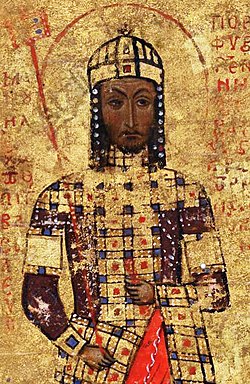
Manuel I Komnenos
View on Wikipedia
Manuel I Komnenos (Greek: Μανουήλ Κομνηνός, romanized: Manouḗl Komnēnós; 28 November 1118 – 24 September 1180), Latinized as Comnenus, also called Porphyrogenitus (Greek: Πορφυρογέννητος, romanized: Porphyrogénnētos; "born in the purple"), was a Byzantine emperor of the 12th century who reigned over a crucial turning point in the history of Byzantium and the Mediterranean. His reign saw the last flowering of the Komnenian restoration, during which the Byzantine Empire experienced a resurgence of military and economic power and enjoyed a cultural revival.
Key Information


Eager to restore his empire to its past glories as the great power of the Mediterranean world, Manuel pursued an energetic and ambitious foreign policy. In the process he made alliances with Pope Adrian IV and the resurgent West. He invaded the Norman Kingdom of Sicily, although unsuccessfully, being the last Eastern Roman emperor to attempt reconquests in the western Mediterranean. The passage of the potentially dangerous Second Crusade through his empire was adroitly managed. Manuel established a Byzantine protectorate over the Crusader states of Outremer. Facing Muslim advances in the Holy Land, he made common cause with the Kingdom of Jerusalem and participated in a combined invasion of Fatimid Egypt. Manuel reshaped the political maps of the Balkans and the eastern Mediterranean, placing the kingdoms of Hungary and Outremer under Byzantine hegemony and campaigning aggressively against his neighbours both in the west and in the east.
However, towards the end of his reign, Manuel's achievements in the east were compromised by a serious defeat at Myriokephalon, which in large part resulted from his arrogance in attacking a well-defended Seljuk position. Although the Byzantines recovered and Manuel concluded an advantageous peace with Sultan Kilij Arslan II, Myriokephalon proved to be the final, unsuccessful effort by the empire to recover the interior of Anatolia from the Turks.
Called ho Megas (ὁ Μέγας, translated as "the Great") by the Greeks[citation needed], Manuel is known to have inspired intense loyalty in those who served him. He also appears as the hero of a history written by his secretary, John Kinnamos, in which every virtue is attributed to him. Manuel, who was influenced by his contact with western Crusaders, enjoyed the reputation of "the most blessed emperor of Constantinople" in parts of the Latin world as well.[1] Some historians have been less enthusiastic about him, however, asserting that the great power he wielded was not his own personal achievement, but that of the Komnenos dynasty he represented. Further, it has also been argued that since Byzantine imperial power declined catastrophically after Manuel's death, it is only natural to look for the causes of this decline in his reign.[2]
Youth
[edit]Manuel Komnenos was born on 28 November 1118[3] in the Purple Chamber of the Great Palace of Constantinople.[4] He was the eighth child and fourth son of John II Komnenos, the newly-crowned emperor of the Byzantine Empire, and Irene of Hungary.[3] Manuel's eldest brother, Alexios, was crowned co-emperor, and Niketas Choniates narrates that in 1123 John raised Manuel and Manuel's other older brothers, Andronikos and Isaac, to the rank of sebastokratores.[5]
Manuel was raised alongside his cousin Andronikos, with whom he became close.[6] He did not receive a formal education,[7] and was trained to be a soldier.[8] He accompanied his father on military expeditions against the Anatolian Turks. On one occasion he led his personal attendants in a counterattack, which reversed the course of an engagement which was favouring the enemy. This occurred during the unsuccessful Siege of Neocaesarea (1140), against the Danishmendid Turks. Manuel favourably impressed his father by his courage and fortitude, John praising him as the 'Saviour of the Romans', though he also criticised his rashness.[9]
As part of his policy concerning the crusader states, John II groomed Manuel to marry Princess Constance of Antioch. John hoped that Manuel would become the master of a large domain, consisting of Attalia, Cyprus, Cilicia and Antioch. The Antiochenes, though ready to swear fealty to the Byzantine emperor, proved reluctant to accept any real level of Byzantine control.[10] Manuel's eldest brothers, Alexios and Andronikos, died in 1142.[11]
Accession
[edit]
In 1143 John II lay dying as a result of an infected wound; on his deathbed he chose Manuel as his successor, in preference to his elder surviving brother Isaac. John cited Manuel's courage and readiness to take advice, in contrast to Isaac's irascibility and unbending pride, as the reasons for his choice. After John died on 8 April 1143,[12] Manuel was acclaimed emperor by the armies.[13] Yet his succession was by no means assured: with his father's army in the wilds of Cilicia far from Constantinople, he recognised that it was vital he should return to the capital as soon as possible. He still had to take care of his father's funeral, and tradition demanded he organise the foundation of a monastery on the spot where his father died. Swiftly, he dispatched the megas domestikos John Axouch ahead of him, with orders to arrest his most dangerous potential rival, his brother Isaac, who was living in the Great Palace with instant access to the imperial treasure and regalia. Axouch arrived in the capital even before news of the emperor's death had reached it. He quickly secured the loyalty of the city, and when Manuel entered the capital in August 1143, he was crowned by the new patriarch, Michael II Kourkouas. A few days later, with nothing more to fear as his position as emperor was now secure, Manuel ordered the release of Isaac.[14] Then he ordered two golden pieces to be given to every householder in Constantinople and 200 pounds of gold (including 200 silver pieces annually) to be given to the Byzantine Church.[15]
The empire that Manuel inherited from his father was in a more stable position than it had been a century earlier. In the late 11th century, the Byzantine Empire had faced marked military and political decline, but this decline had been arrested and largely reversed by the leadership of Manuel's grandfather and father. Nevertheless, the empire continued to face formidable challenges. By 1071, the Normans of Sicily had removed southern Italy from the control of the Byzantine emperor. Following the Battle of Manzikert, also in 1071, the Seljuk Turks had done the same with most of Anatolia, retaining control of the central plateau thereafter. And in the Levant, a new force had appeared—the Crusader states—which presented the Byzantine Empire with new challenges. Now, more than at any time during the preceding centuries, the task facing the emperor was daunting indeed.[16]
Second Crusade and Raynald of Châtillon
[edit]Prince of Antioch
[edit]
The first test of Manuel's reign came in 1144, when he was faced with a demand by Raymond, Prince of Antioch, for the cession of Cilician territories. However, later that year the crusader County of Edessa was engulfed by the tide of a resurgent Islamic jihad under Imad ad-Din Zengi. Raymond realized that immediate help from the west was out of the question. With his eastern flank now dangerously exposed to this new threat, there seemed little option but for him to prepare for a humiliating visit to Constantinople. Swallowing his pride, he made the journey north to submit to Manuel and ask for protection. He was promised the support that he had requested, and his allegiance to Byzantium was secured.[17]
Expedition against Konya
[edit]In 1146 Manuel assembled his army at the military base Lopadion and set out on a punitive expedition against Mas'ud, the Sultan of Rûm, who had been repeatedly violating the frontiers of the Empire in western Anatolia and Cilicia.[18] There was no attempt at a systematic conquest of territory, but Manuel's army defeated the Turks at Acroënus, before capturing and destroying the fortified town of Philomelion, removing its remaining Christian population.[18] The Byzantine forces reached Masud's capital, Konya (Iconium), and ravaged the area around the city, but could not assault its walls. Among Manuel's motives for mounting this razzia there included a wish to be seen in the West as actively espousing the crusading ideal; Kinnamos also attributed to Manuel a desire to show off his martial prowess to his new bride.[19] While on this campaign Manuel received a letter from Louis VII of France announcing his intention of leading an army to the relief of the crusader states.[20]
Arrival of the Crusaders
[edit]
Manuel was prevented from capitalising on his conquests by events in the Balkans that urgently required his presence. In 1147 he granted a passage through his dominions to two armies of the Second Crusade under Conrad III of Germany and Louis VII of France. At this time, there were still members of the Byzantine court who remembered the passage of the First Crusade, a defining event in the collective memory of the age that had fascinated Manuel's aunt, Anna Komnene.[21]
Many Byzantines feared the Crusade, a view endorsed by the numerous acts of vandalism and theft practised by the unruly armies as they marched through Byzantine territory. Byzantine troops followed the Crusaders, attempting to police their behaviour, and further troops were assembled in Constantinople, ready to defend the capital against any acts of aggression. This cautious approach was well advised, but still the numerous incidents of covert and open hostility between the Franks and the Greeks on their line of march, for which it seems both sides were to blame, precipitated conflict between Manuel and his guests. Manuel took the precaution—which his grandfather had not taken—of making repairs to the city walls, and he pressed the two kings for guarantees concerning the security of his territories. Conrad's army was the first to enter the Byzantine territory in the summer of 1147, and it figures more prominently in the Byzantine sources, which imply that it was the more troublesome of the two.[a] Indeed, the contemporary Byzantine historian Kinnamos describes a full-scale clash between a Byzantine force and part of Conrad's army, outside the walls of Constantinople. The Byzantines defeated the Germans and, in Byzantine eyes, this reverse caused Conrad to agree to have his army speedily ferried across to Damalis on the Asian shore of the Bosphoros.[22][23]
After 1147, however, the relations between the two leaders became friendlier. By 1148 Manuel had seen the wisdom of securing an alliance with Conrad, whose sister-in-law Bertha of Sulzbach he had earlier married; he actually persuaded the German king to renew their alliance against Roger II of Sicily.[24] Unfortunately for the Byzantine emperor, Conrad died in 1152, and despite repeated attempts, Manuel could not reach an agreement with his successor, Frederick Barbarossa.[b]
Cyprus invaded
[edit]
Manuel's attention was again drawn to Antioch in 1156, when Raynald of Châtillon, the new Prince of Antioch, claimed that the Byzantine emperor had reneged on his promise to pay him a sum of money and vowed to attack the Byzantine province of Cyprus.[26] Raynald arrested the governor of the island, John Komnenos, who was a nephew of Manuel, and the general Michael Branas.[27] The Latin historian William of Tyre deplored this act of war against fellow Christians and described the atrocities committed by Raynald's men in considerable detail.[28] Having ransacked the island and plundered all its wealth, Raynald's army mutilated the survivors before forcing them to buy back their flocks at exorbitant prices with what little they had left. Thus enriched with enough booty to make Antioch wealthy for years, the invaders boarded their ships and set sail for home.[29] Raynald also sent some of the mutilated hostages to Constantinople as a vivid demonstration of his disobedience and his contempt for the Byzantine emperor.[27]
Manuel responded to this outrage in a characteristically energetic way. In the winter of 1158–59, he marched to Cilicia at the head of a huge army; the speed of his advance (Manuel had hurried on ahead of the main army with 500 cavalry) was such that he managed to surprise the Armenian Thoros of Cilicia, who had participated in the attack on Cyprus.[30] Thoros fled into the mountains, and Cilicia swiftly fell to Manuel.[31]
Manuel in Antioch
[edit]Meanwhile, news of the advance of the Byzantine army soon reached Antioch. Raynald knew that he had no hope of defeating the emperor, and in addition knew that he could not expect any aid from King Baldwin III of Jerusalem. Baldwin did not approve of Raynald's attack on Cyprus, and in any case had already made an agreement with Manuel. Thus isolated and abandoned by his allies, Raynald decided that abject submission was his only hope. He appeared dressed in a sack with a rope tied around his neck, and begged for forgiveness. Manuel at first ignored the prostrate Raynald, chatting with his courtiers; William of Tyre commented that this ignominious scene continued for so long that all present were "disgusted" by it.[32] Eventually, Manuel forgave Raynald on condition that he would become a vassal of the Empire, effectively surrendering the independence of Antioch to Byzantium.[33] Coming before Manuel as a supplicant Raynald limited the emperor's options for punishment, and by submitting to Byzantium, the increasing pressure on Antioch from Baldwin III was relieved.[34]

Peace having been restored, a grand ceremonial procession was staged on 12 April 1159 for the triumphant entry of the Byzantine army into the city, with Manuel riding through the streets on horseback, while the Prince of Antioch and the King of Jerusalem followed on foot. Manuel dispensed justice to the citizens and presided over games and tournaments for the crowd. In May, at the head of a united Christian army, he started on the road to Edessa, but he abandoned the campaign when he secured the release by Nur ad-Din, the ruler of Syria, of 6,000 Christian prisoners captured in various battles since the second Crusade.[37] Despite the glorious end of the expedition, modern scholars argue that Manuel ultimately achieved much less than he had desired in terms of imperial restoration.[c]
Upon hearing rumours of conspiracies, Manuel headed back to Constantinople at a rush. He attempted to negotiate passage through the Sultanate of Rum but this was denied by Kilij Arslan II. Manuel proceeded anyway and when the army was nearly back in Byzantine territory near Kotyaion, the army was attacked by Seljuk forces. Manuel's passage through Seljuk territory started the 1159-1160 Seljuk-Byzantine war, and may have been intended to force the relatively new sultan into a client relationship with the empire.[38]
Italian campaign
[edit]Roger II of Sicily
[edit]
In 1147 Manuel was faced with war by Roger II of Sicily, whose fleet had captured the Byzantine island of Corfu and plundered Thebes and Corinth. However, despite being distracted by a Cuman attack in the Balkans, in 1148 Manuel enlisted the alliance of Conrad III of Germany, and the help of the Venetians, who quickly defeated Roger with their powerful fleet. In 1149, Manuel recovered Corfu and prepared to take the offensive against the Normans, while Roger II sent George of Antioch with a fleet of 40 ships to pillage Constantinople's suburbs.[39] Manuel had already agreed with Conrad on a joint invasion and partition of southern Italy and Sicily. The renewal of the German alliance remained the principal orientation of Manuel's foreign policy for the rest of his reign, despite the gradual divergence of interests between the two empires after Conrad's death.[24]
Roger died in February 1154 and was succeeded by William I, who faced widespread rebellions against his rule in Sicily and Apulia, leading to the presence of Apulian refugees at the Byzantine court. Conrad's successor, Frederick Barbarossa, launched a campaign against the Normans, but his expedition stalled. These developments encouraged Manuel to take advantage of the multiple instabilities on the Italian peninsula.[40] He sent Michael Palaiologos and John Doukas, both of whom held the high imperial rank of sebastos, with Byzantine troops, ten ships and large quantities of gold to invade Apulia in 1155.[41] The two generals were instructed to enlist the support of Frederick, but he declined because his demoralised army longed to get back north of the Alps as soon as possible.[b] Nevertheless, with the help of disaffected local barons, including Count Robert of Loritello, Manuel's expedition achieved astonishingly rapid progress as the whole of southern Italy rose up in rebellion against the Sicilian Crown and the untried William I.[24] There followed a string of spectacular successes as numerous strongholds yielded either to force or the lure of gold.[37]
Papal-Byzantine alliance
[edit]The city of Bari, which had been the capital of the Byzantine Catapanate of Italy for centuries before the arrival of the Normans, opened its gates to the Emperor's army, and the overjoyed citizens tore down the Norman citadel. After the fall of Bari, the cities of Trani, Giovinazzo, Andria, Taranto and Brindisi were also captured. William arrived with his army, including 2,000 knights, but was heavily defeated.[42]
Encouraged by the success, Manuel dreamed of the restoration of the Roman Empire, at the cost of union between the Orthodox and the Catholic Church, a prospect which would frequently be offered to the Pope during negotiations and plans for alliance.[43] If there was ever a chance of reuniting the eastern and western churches, and coming to reconciliation with the Pope permanently, this was probably the most favourable moment. The Papacy was never on good terms with the Normans, except when under duress by the threat of direct military action. Having the "civilised" Byzantines on its southern border was infinitely preferable to the Papacy than having to constantly deal with the troublesome Normans of Sicily. It was in the interest of Pope Adrian IV to reach a deal if at all possible, since doing so would greatly increase his own influence over the entire Orthodox Christian population. Manuel offered a large sum of money to the Pope for the provision of troops, with the request that the Pope grant the Byzantine emperor lordship of three maritime cities in return for assistance in expelling William from Sicily. Manuel also promised to pay 5,000 pounds of gold to the Pope and the Curia.[44] Negotiations were hurriedly carried out, and an alliance was formed between Manuel and Hadrian.[40]
| "Alexios Komnenos and Doukas ... had become captive to the Normans' lord [and] again ruined matters. For as they had already pledged to the Sicilians many things not then desired by the emperor, they robbed the Romans of very great and noble achievements. [They] ... very likely deprived the Roman of the cities too soon." |
| John Cinnamus[45] |
At this point, just as the war seemed decided in his favour, events turned against Manuel. Byzantine commander Michael Palaiologos alienated allies with his attitude, stalling the campaign as Count Robert III of Loritello refused to speak to him. Although the two were reconciled, the campaign had lost some of its momentum: Michael was soon recalled to Constantinople, and his loss was a major blow to the campaign. The turning point was the Battle of Brindisi, where the Normans launched a major counter-attack by both land and sea. At the approach of the enemy, the mercenaries that had been hired with Manuel's gold demanded huge increases in their pay. When this was refused, they deserted. Even the local barons started to melt away, and soon John Doukas was left hopelessly outnumbered. The arrival of Alexios Komnenos Bryennios with some ships failed to retrieve the Byzantine position.[d] The naval battle was decided in favour of the Normans, while John Doukas and Alexios Bryennios (along with four Byzantine ships) were captured.[46] Manuel then sent Alexios Axouch to Ancona to raise another army, but by this time William had already retaken all of the Byzantine conquests in Apulia. The defeat at Brindisi put an end to the restored Byzantine reign in Italy; in 1158 the Byzantine army left Italy and never returned again.[47] Both Nicetas Choniates and Kinnamos, the major Byzantine historians of this period, agree, however, that the peace terms Axouch secured from William allowed Manuel to extricate himself from the war with dignity, despite a devastating raid by a Norman fleet of 164 ships (carrying 10,000 men) on Euboea and Almira in 1156.[48]
Failure of the Church union
[edit].png)
During the Italian campaign, and afterwards, during the struggle of the Papal Curia with Frederick, Manuel tried to sway the popes with hints of a possible union between the Eastern and Western churches. Although in 1155 Pope Adrian IV had expressed his eagerness to prompt the reunion of the churches,[e] hopes for a lasting Papal-Byzantine alliance came up against insuperable problems. Adrian IV and his successors demanded recognition of their religious authority over all Christians everywhere and sought superiority over the Byzantine emperor; they were not at all willing to fall into a state of dependence from one emperor to the other.[43] Manuel, on the other hand, wanted an official recognition of his secular authority over both East and West.[49] Such conditions would not be accepted by either side. Even if a pro-western emperor such as Manuel agreed, the Greek citizens of the empire would have rejected outright any union of this sort, as they did almost three hundred years later when the Orthodox and Catholic churches were briefly united under the pope. In spite of his friendliness towards the Roman Church and his cordial relations with all the popes, Manuel was never honoured with the title of augustus by the popes. And although he twice sent embassies to Pope Alexander III (in 1167 and 1169) offering to reunite the Greek and Latin churches, Alexander refused, under pretext of the troubles that would follow union.[50]
The final results of the Italian campaign were limited in terms of the advantages gained by the Empire. The city of Ancona became a Byzantine base in Italy, accepting Manuel as sovereign. The Normans of Sicily had been damaged and now came to terms with the Empire, ensuring peace for the rest of Manuel's reign. The Empire's ability to get involved in Italian affairs had been demonstrated. However, given the enormous quantities of gold which had been lavished on the project, it also demonstrated the limits of what money and diplomacy alone could achieve. The expense of Manuel's involvement in Italy must have cost the treasury a great deal (probably more than 2.16 million hyperpyra or 30,000 pounds of gold), and yet it produced only limited solid gains.[51][52]
Byzantine policy in Italy after 1158
[edit]
After 1158, under the new conditions, the aims of the Byzantine policy changed. Manuel now decided to oppose the objective of the Hohenstaufen dynasty to directly annex Italy, which Frederick believed should acknowledge his power. When the war between Frederick Barbarossa and the northern Italian communes started, Manuel actively supported the Lombard League with money subsidies, agents, and, occasionally, troops.[53] The walls of Milan, demolished by the Germans, were restored with Manuel's aid.[54] Ancona remained important as a centre of Byzantine influence in Italy. The Anconitans made a voluntary submission to Manuel, and the Byzantines maintained representatives in the city.[55] Frederick's defeat at the Battle of Legnano, on 29 May 1176, seemed rather to improve Manuel's position in Italy. According to Kinnamos, Cremona, Pavia and a number of other "Ligurian" cities went over to Manuel;[56] his relations were also particularly favourable in regard to Genoa and Pisa, but not to Venice. In March 1171 Manuel had suddenly broken with Venice, ordering all 20,000 Venetians on imperial territory to be arrested and their property confiscated.[57] Venice, incensed, sent a fleet of 120 ships against Byzantium. Due to an epidemic, and pursued by 150 Byzantine ships, the fleet was forced to return without great success.[58] In all probability, friendly relations between Byzantium and Venice were not restored in Manuel's lifetime.[43]
Balkan frontier
[edit]On his northern frontier Manuel expended considerable effort to preserve the conquests made by Basil II over one hundred years earlier and maintained, sometimes tenuously, ever since. Due to distraction from his neighbours on the Balkan frontier, Manuel was kept from his main objective, the subjugation of the Normans of Sicily. Relations had been good with the Serbs and Hungarians since 1129, so the Serb rebellion came as a shock. The Serbs of Rascia, being so induced by Roger II of Sicily, invaded Byzantine territory in 1149.[33]

Manuel forced the rebellious Serbs, and their leader, Uroš II, to vassalage (1150–1152).[59] He then made repeated attacks upon the Hungarians with a view to annexing their territory along the Sava. In the wars of 1151–1153 and 1163–1168 Manuel led his troops into Hungary and a spectacular raid deep into enemy territory yielded substantial war booty. In 1167, Manuel sent 15,000 men under the command of Andronikos Kontostephanos against the Hungarians,[60] scoring a decisive victory at the Battle of Sirmium and enabling the Empire to conclude a very advantageous peace with the Kingdom of Hungary by which Syrmia, Bosnia and Dalmatia were ceded. By 1168 nearly the whole of the eastern Adriatic coast lay in Manuel's hands.[61]
Efforts were also made towards a diplomatic annexation of Hungary. The Hungarian heir Béla, younger brother of the Hungarian king Stephen III, was sent to Constantinople to be educated in the emperor's court. Manuel intended the youth to marry his daughter, Maria, and to make him his heir, thus securing the union of Hungary with the Empire. At court Béla assumed the name Alexius and received the title of despot, which had previously been applied only to the emperor himself. However, two unforeseen dynastic events drastically altered the situation. In 1169, Manuel's young wife gave birth to a son, thus depriving Béla of his status as heir of the Byzantine throne (although Manuel would not renounce the Croatian lands he had taken from Hungary). Then, in 1172, Stephen died childless, and Béla went home to take his throne. Before leaving Constantinople, he swore a solemn oath to Manuel that he would always "keep in mind the interests of the emperor and of the Romans". Béla III kept his word: as long as Manuel lived, he made no attempt to retrieve his Croatian inheritance, which he only afterwards reincorporated into Hungary.[61]
Relations with Kievan Rus' (Russia)
[edit]Manuel Komnenos attempted to draw the Russian principalities into his net of diplomacy directed against Hungary, and to a lesser extent Norman Sicily. This polarised the Russian princes into pro- and anti-Byzantine camps. In the late 1140s three princes were competing for primacy in Russia: prince Iziaslav II of Kiev was related to Géza II of Hungary and was hostile to Byzantium; Prince Yuri Dolgoruki of Suzdal was Manuel's ally (symmachos), and Vladimirko of Galicia (Principality of Halych) is described as Manuel's vassal (hypospondos). Galicia was situated on the northern and north-eastern borders of Hungary and, therefore, was of great strategic importance in the Byzantine-Hungarian conflicts. Following the deaths of both Iziaslav and Vladimirko, the situation became reversed; when Yuri of Suzdal, Manuel's ally, took over Kiev and Yaroslav, the new ruler of Galicia, adopted a pro-Hungarian stance.[62]
In 1164–65 Manuel's cousin Andronikos, the future emperor, escaped from captivity in Byzantium and fled to the court of Yaroslav in Galicia. This situation, holding out the alarming prospect of Andronikos making a bid for Manuel's throne sponsored by both Galicia and Hungary, spurred the Byzantines into an unprecedented flurry of diplomacy. Manuel pardoned Andronikos and persuaded him to return to Constantinople in 1165. A mission to Kiev, then ruled by Prince Rostislav, resulted in a favourable treaty and a pledge to supply the Empire with auxiliary troops; Yaroslav of Galicia was also persuaded to renounce his Hungarian connections and return fully into the imperial fold. As late as 1200 the princes of Galicia were providing invaluable services against the enemies of the Empire, at that time the Cumans.[63]
The restoration of relations with Galicia had an immediate benefit for Manuel when, in 1166, he dispatched two armies to attack the eastern provinces of Hungary in a vast pincer movement. One army crossed the Walachian Plain and entered Hungary through the Transylvanian Alps (Southern Carpathians), while the other army made a wide circuit to Galicia and, with Galician aid, crossed the Carpathian Mountains. Since the Hungarians had most of their forces concentrated on the Sirmium and Belgrade frontier, they were caught off guard by the Byzantine invasion; this resulted in the Hungarian province of Transylvania being thoroughly ravaged by the Byzantine armies.[64]
Invasion of Egypt
[edit]Alliance with the Kingdom of Jerusalem
[edit]
Control of Egypt was a decades-old dream of the crusader Kingdom of Jerusalem, and its king Amalric I needed all the military and financial support he could get for his planned campaign.[65] Amalric also realised that if he were to pursue his ambitions in Egypt, he might have to leave Antioch to the hegemony of Manuel, who had paid 100,000 dinars for the release of Bohemond III.[66][67] In 1165, he sent envoys to the Byzantine court to negotiate a marriage alliance (Manuel had already married Amalric's cousin Maria of Antioch in 1161).[68] After a long interval of two years, Amalric married Manuel's grandniece Maria Komnene in 1167, and "swore all that his brother Baldwin had sworn before."[f] A formal alliance was negotiated in 1168, whereby the two rulers arranged for a conquest and partition of Egypt, with Manuel taking the coastal area, and Amalric the interior. In the autumn of 1169 Manuel sent a joint expedition with Amalric to Egypt: a Byzantine army and a naval force of 20 large warships, 150 galleys, and 60 transports, under the command of the megas doux Andronikos Kontostephanos, joined forces with Amalric at Ascalon.[68][69] William of Tyre, who negotiated the alliance, was impressed in particular by the large transport ships that were used to transport the cavalry forces of the army.[70]
Although such a long-range attack on a state far from the centre of the Empire may seem extraordinary (the last time the Empire had attempted anything on this scale was the failed invasion of Sicily over one hundred and twenty years earlier), it can be explained in terms of Manuel's foreign policy, which was to use the Latins to ensure the survival of the Empire. This focus on the bigger picture of the eastern Mediterranean and even further afield thus led Manuel to intervene in Egypt: it was believed that in the context of the wider struggle between the crusader states and the Islamic powers of the east, control of Egypt would be the deciding factor. It had become clear that the ailing Fatimid Caliphate of Egypt held the key to the fate of the crusader states. If Egypt came out of its isolation and joined forces with the Muslims under Nur ad-Din, the crusader cause was in trouble.[65]
A successful invasion of Egypt would have several further advantages for the Byzantine Empire. Egypt was a rich province, and in the days of the Roman Empire it had supplied much of the grain for Constantinople before it was lost to the Arabs in the 7th century. The revenues that the Empire could have expected to gain from the conquest of Egypt would have been considerable, even if these would have to be shared with the Crusaders. Furthermore, Manuel may have wanted to encourage Amalric's plans, not only to deflect the ambitions of the Latins away from Antioch, but also to create new opportunities for joint military ventures that would keep the King of Jerusalem in his debt, and would also allow the Empire to share in territorial gains.[65]
Failure of the expedition
[edit]
The joined forces of Manuel and Amalric laid siege to Damietta on 27 October 1169, but the siege was unsuccessful due to the failure of the Crusaders and the Byzantines to co-operate fully.[71] According to Byzantine forces, Amalric, not wanting to share the profits of victory, dragged out the operation until the emperor's men ran short of provisions and were particularly affected by famine; Amalric then launched an assault, which he promptly aborted by negotiating a truce with the defenders. On the other hand, William of Tyre remarked that the Greeks were not entirely blameless.[72] Whatever the truth of the allegations of both sides, when the rains came, both the Latin army and the Byzantine fleet returned home, although half of the Byzantine fleet was lost in a sudden storm.[73]
Despite the bad feelings generated at Damietta, Amalric still refused to abandon his dream of conquering Egypt, and he continued to seek good relations with the Byzantines in the hopes of another joined attack, which never took place.[74] In 1171 Amalric came to Constantinople in person, after Egypt had fallen to Saladin. Manuel was thus able to organise a grand ceremonial reception which both honoured Amalric and underlined his dependence: for the rest of Amalric's reign, Jerusalem was a Byzantine satellite, and Manuel was able to act as a protector of the Holy Places, exerting a growing influence in the Kingdom of Jerusalem.[75] In 1177, a fleet of 150 ships was sent by Manuel I to invade Egypt, but returned home after appearing off Acre due to the refusal of Count Philip of Flanders and many important nobles of the Kingdom of Jerusalem to help.[76]
Kilij Arslan II and the Seljuk Turks
[edit]
Manuel’s father John II Komnenos had kept the Sultanate of Rum in check and within the Byzantine orbit, although the sultan Mas’ud had become increasingly assertive in the second half of the 1130s.[77] Manuel had engaged in a punitive expedition against Konya in 1146 to secure his position as John's successor among the aristocrats and army.[78] The accession of Kilij Arslan II to the sultanate in 1156 did not technically change the state of Seljuk submission to the empire, although in practice the new sultan was untried and had yet to come to any agreement with Manuel. Conflict came in 1159. In 1158 Manuel had gone to Antioch. In spring 1159, news of conspiracies in the capital reached the emperor and he decided he had to return. Manuel either had to traverse mountainous Isauria to get back, or pass through the Sultanate. Manuel sought permission to bring his army back via the faster route through Turkish territory, but Kilij Arslan denied it.[79] Manuel’s army made the march anyway, intending to accomplish two goals at once: re-assert nominal lordship over the sultanate, and return to Constantinople via the faster, easier route. The Turks were taken by surprise, but by the time the army reached the border area around Kotyaion, they were prepared and attacked Manuel’s column.[80] The scale of the attack is impossible to determine, but it was at least significant enough that Manuel felt the need to avenge it. Kilij Arslan dispatched ambassadors to make peace but Manuel rebuffed them and personally led two raids against the Sultanate.[81] The sultan then escalated the conflict by sacking Laodikeia, a key communications hub in the upper Maender valley. Manuel prepared a major campaign to take Konya, and John Kontostephanos was dispatched to raise troops from Cilicia and a nominal contingent from the crusader states. Kontostephanos led these troops against the Sultanate from the south and won a victory. Preferring to leave a compliant Sultanate on the plateau rather than administer it directly, Manuel called off the campaign against Konya and in either 1160 or 1161 Kilij Arslan came to Constantinople to do homage and secure the peace.[82] Kilij Arslan II used the peace with Byzantium, and the power vacuum caused by the death in 1174 of Nur ad-Din Zangi the ruler of Syria, to expel the Danishmends from their Anatolian emirates. When the Seljuk sultan refused to cede some of the territory he had taken from the Danishmends to the Byzantines, as he was obliged to do as part of his treaty obligations, Manuel decided that it was time to deal with the Turks once and for all.[53][83][84] Therefore, he assembled the full imperial army and marched against the Seljuk capital, Iconium (Konya).[53] Manuel's strategy was to prepare the advanced bases of Dorylaeum and Sublaeum, and then to use them to strike as quickly as possible at Iconium.[85]
Yet Manuel's army of 35,000 men was large and unwieldy—according to a letter that Manuel sent to King Henry II of England, the advancing column was ten miles (16 km) long.[86] Manuel marched against Iconium via Laodicea, Chonae, Lampe, Celaenae, Choma and Antioch. Just outside the entrance to the pass at Myriokephalon, Manuel was met by Turkish ambassadors, who offered peace on generous terms. Most of Manuel's generals and experienced courtiers urged him to accept the offer. The younger and more aggressive members of the court urged Manuel to attack, however, and he took their advice and continued his advance.[37]
Manuel made serious tactical errors, such as failing to properly scout out the route ahead.[87] These failings caused him to lead his forces straight into a classic ambush. On 17 September 1176 Manuel was checked by Seljuk Sultan Kilij Arslan II at the Battle of Myriokephalon (in highlands near the Tzibritze pass), in which his army was ambushed while marching through the narrow mountain pass.[53][88] The Byzantines were hemmed in by the narrowness of the pass, which allowed the Seljuks to concentrate their attacks on part of the Byzantine army, especially the baggage and siege train, without the rest being able to intervene.[89] The army's siege equipment was quickly destroyed, and Manuel was forced to withdraw—without siege engines, the conquest of Iconium was impossible. According to Byzantine sources, Manuel lost his nerve both during and after the battle, fluctuating between extremes of self-delusion and self-abasement;[90] according to William of Tyre, he was never the same again.[91]
The terms by which Kilij Arslan II allowed Manuel and his army to leave were that he should remove his frontier forts and garrisons at Dorylaeum and Sublaeum. Since the Sultan had already failed to keep his side of the earlier treaty of 1162, however, Manuel only ordered the fortifications of Sublaeum to be dismantled, but not the fortifications of Dorylaeum.[92] Nevertheless, defeat at Myriokephalon was an embarrassment for both Manuel personally and also for his empire. The Komnenian emperors had worked hard since the Battle of Manzikert, over a century earlier, to restore the reputation of the empire. Yet because of his overconfidence, Manuel had demonstrated to the world that Byzantium still could not decisively defeat the Seljuks, despite the advances made during the past century. In Western opinion, Myriokephalon cut Manuel down to a humbler size: not that of Emperor of the Romans but that of King of the Greeks.[88]
The defeat at Myriokephalon has often been depicted as a catastrophe in which the entire Byzantine army was destroyed. Manuel himself compared the defeat to Manzikert; it seemed to him that the Byzantine defeat at Myriokephalon complemented the destruction at Manzikert. In reality, although a defeat, it was not particularly costly and did not significantly diminish the fighting ability of the Byzantine army.[88] Most of the casualties were borne by the right wing, largely composed of allied troops commanded by Baldwin of Antioch, and also by the baggage train, which was the main target of the Turkish ambush.[93]
The limited losses inflicted on native Byzantine troops were quickly recovered, and in the following year Manuel's forces defeated a force of "picked Turks".[85] John Komnenos Vatatzes, who was sent by the Emperor to repel the Turkish invasion, not only brought troops from the capital but also was able to gather an army along the way. Vatatzes caught the Turks in an ambush as they were crossing the Meander River; the subsequent Battle of Hyelion and Leimocheir effectively destroyed them as a fighting force. This is an indication that the Byzantine army remained strong and that the defensive program of western Asia Minor was still successful.[94] After the victory on the Meander, Manuel himself advanced with a small army to drive the Turks from Panasium, south of Cotyaeum.[92]
In 1178, however, a Byzantine army retreated after encountering a Turkish force at Charax, allowing the Turks to capture many livestock.[33] The city of Claudiopolis in Bithynia was besieged by the Turks in 1179, forcing Manuel to lead a small cavalry force to save the city, and then, even as late as 1180, the Byzantines succeeded in scoring a victory over the Turks.[33]
The continuous warfare had a serious effect upon Manuel's vitality; he declined in health and in 1180 succumbed to a slow fever. Furthermore, like Manzikert, the balance between the two powers began to gradually shift—Manuel never again attacked the Turks, and after his death they began to move further west, deeper into Byzantine territory.[95]
Doctrinal controversies (1156–1180)
[edit]
Three major theological controversies occurred during Manuel's reign. In 1156–1157 the question was raised whether Christ had offered Himself as a sacrifice for the sins of the world to the Father and to the Holy Spirit only, or also to the Logos (i.e., to Himself).[96] In the end a synod held at Constantinople in 1157 declared the doctrine of a single sacrifice to the Holy Trinity, producing a formula: "The precious blood of the Only Begotten was offered not only to the Father but also to the Son and the Holy Ghost, the one Godhead", despite the dissent of Patriarch of Antioch-elect Soterichos Panteugenos, who was subsequently dismissed.[97][98][33]
Ten years later, a controversy arose as to whether the saying of Christ, "My Father is greater than I", referred to his divine nature, to his human nature, or to the union of the two.[96] Demetrius of Lampe, a Byzantine diplomat recently returned from the West, ridiculed the way the verse was interpreted there, that Christ was inferior to his father in his humanity but equal in his divinity. Manuel, on the other hand, perhaps with an eye on the project for Church union, found that the formula made sense, and prevailed over a majority in a synod convened on 2 March 1166 to decide the issue, where he had the support of the patriarch Luke Chrysoberges[33] and later Patriarch Michael III.[99] Those who refused to submit to the synod's decisions had their property confiscated or were exiled.[g] The political dimensions of this controversy are apparent from the fact that a leading dissenter from the Emperor's doctrine was his nephew Alexios Kontostephanos.[100]
A third controversy sprung up in 1180, when Manuel objected to the formula of solemn abjuration, which was exacted from Muslim converts. One of the more striking anathemas of this abjuration was that directed against the deity worshipped by Muhammad and his followers:[101]
And before all, I anathematize the God of Muhammad about whom he [Muhammad] says, "He is God alone, God made of solid, hammer-beaten metal; He begets not and is not begotten, nor is there like unto Him any one."
The emperor ordered the deletion of this anathema from the Church's catechetical texts, a measure that provoked vehement opposition from both the patriarch and bishops.[101]
Chivalric narrations
[edit]Manuel is representative of a new kind of Byzantine ruler who was influenced by his contact with western Crusaders. He arranged jousting matches, even participating in them, an unusual and discomforting sight for the Byzantines. Endowed with a fine physique, Manuel has been the subject of exaggeration in the Byzantine sources of his era, where he is presented as a man of great personal courage. According to the story of his exploits, which appear as a model or a copy of the romances of chivalry, such was his strength and exercise in arms that Raymond of Antioch was incapable of wielding his lance and buckler. In a famous tournament, he is said to have entered the lists on a fiery courser, and to have overturned two of the stoutest Italian knights. In one day, he is said to have slain forty Turks with his own hand, and in a battle against the Hungarians he allegedly snatched a banner, and was the first, almost alone, who passed a bridge that separated his army from the enemy. On another occasion, he is said to have cut his way through a squadron of five hundred Turks, without receiving a wound; he had previously posted an ambuscade in a wood and was accompanied only by his brother and Axouch.[102]
Family
[edit]
Manuel had two wives. His first marriage, in 1146, was to Bertha of Sulzbach, a sister-in-law of Conrad III of Germany. She died in 1160.[103] Children:
- Maria Komnene (1152[104]–1182), wife of Renier of Montferrat.
- Anna Komnene[104] (1154–1158).
Manuel's second marriage was to Maria of Antioch (nicknamed Xene), a daughter of Raymond and Constance of Antioch, in 1161 or 1162.[105] By this marriage, Manuel had one son:
- Alexios II Komnenos, who succeeded as emperor in 1180.[106]
Manuel had several illegitimate children:
By Theodora Vatatzina:
- Alexios Komnenos (born in the early 1160s), who was recognised as the emperor's son, and indeed received a title (sebastokrator). He was briefly married to Eirene Komnene, illegitimate daughter of Andronikos I Komnenos, in 1183–1184, and was then blinded by his father-in-law. He lived until at least 1191 and was known personally to Choniates.[107]
By Maria Taronitissa, the wife of John Doukas Komnenos:
- Alexios Komnenos, a pinkernes ("cupbearer"), who fled Constantinople in 1184 and was a figurehead of the Norman invasion and the siege of Thessalonica in 1185.
By other lovers:
- A daughter whose name is unknown. She was born around 1150 and married Theodore Maurozomes before 1170. Her son was Manuel Maurozomes, whose daughter married Kaykhusraw I, the Seljuk Sultanate of Rûm, and her descendants ruled the sultanate from 1220 to 1246.[108]
- A daughter whose name is unknown, born around 1155. She was the maternal grandmother of the author Demetrios Tornikes.[109]
Assessments
[edit]Foreign and military affairs
[edit]As a young man, Manuel had been determined to restore by force of arms the predominance of the Byzantine Empire in the Mediterranean countries. By the time he died in 1180, 37 years had passed since that momentous day in 1143 when, amid the wilds of Cilicia, his father had proclaimed him emperor. These years had seen Manuel involved in conflict with his neighbours on all sides. Manuel's father and grandfather before him had worked patiently to undo the damage done by the battle of Manzikert and its aftermath. Thanks to their efforts, the empire Manuel inherited was stronger and better organised than at any time for a century. While it is clear that Manuel used these assets to the full, it is not so clear how much he added to them, and there is room for doubt as to whether he used them to best effect.[1]
| "The most singular feature in the character of Manuel is the contrast and vicissitude of labour and sloth, of hardiness and effeminacy. In war he seemed ignorant of peace, in peace he appeared incapable of war." |
| Edward Gibbon[110] |
Manuel had proven himself to be an energetic emperor who saw possibilities everywhere, and whose optimistic outlook had shaped his approach to foreign policy. However, in spite of his military prowess Manuel achieved but a slight degree of his object of restoring the Byzantine Empire. Retrospectively, some commentators have criticised some of Manuel's aims as unrealistic, in particular citing the expeditions he sent to Egypt as proof of dreams of grandeur on an unattainable scale. His greatest military campaign, his grand expedition against the Turkish Sultanate of Iconium, ended in humiliating defeat, and his greatest diplomatic effort apparently collapsed, when Pope Alexander III became reconciled to the German emperor Frederick Barbarossa at the Peace of Venice. Historian Mark C. Bartusis argues that Manuel (and his father as well) tried to rebuild a national army, but his reforms were adequate for neither his ambitions nor his needs; the defeat at Myriokephalon underscored the fundamental weakness of his policies.[111] According to Edward Gibbon, Manuel's victories were not productive of any permanent or useful conquest.[110]
His advisors on western church affairs included the Pisan scholar Hugh Eteriano.[112]
Internal affairs
[edit]Choniates criticised Manuel for raising taxes and pointed to Manuel's reign as a period of excess; according to Choniates, the money thus raised was spent lavishly at the cost of his citizens. Whether one reads the Greek encomiastic sources, or the Latin and oriental sources, the impression is consistent with Choniates' picture of an emperor who spent lavishly in all available ways, rarely economising in one sector in order to develop another.[113] Manuel spared no expense on the army, the navy, diplomacy, ceremonial, palace-building, the Komnenian family, and other seekers of patronage. A significant amount of this expenditure was pure financial loss to the Empire, like the subsidies poured into Italy and the crusader states, and the sums spent on the failed expeditions of 1155–1156, 1169 and 1176.[114]
The problems this created were counterbalanced to some extent by his successes, particularly in the Balkans; Manuel extended the frontiers of his Empire in the Balkan region, ensuring security for the whole of Greece and Bulgaria. Had he been more successful in all his ventures, he would have controlled not only the most productive farmland around the Eastern Mediterranean and Adriatic seas, but also the entire trading facilities of the area. Even if he did not achieve his ambitious goals, his wars against Hungary (1149–1155, 1162–1167) brought him control of the Dalmatian coast, the rich agricultural region of Sirmium, and the Danube trade route from Hungary to the Black Sea. His Balkan expeditions are said to have taken great booty in slaves and livestock;[115] Kinnamos was impressed by the amount of arms taken from the Hungarian dead after the battle of 1167.[116] And even if Manuel's wars against the Turks probably realised a net loss, his commanders took livestock and captives on at least two occasions.[115]
This allowed the Western provinces to flourish in an economic revival that had begun in the time of his grandfather Alexios I and continued till the close of the century. Indeed, it has been argued that Byzantium in the 12th century was richer and more prosperous than at any time since the Persian invasion during the reign of Herakleios, some five hundred years earlier. There is good evidence from this period of new construction and new churches, even in remote areas, strongly suggesting that wealth was widespread.[117] Trade was also flourishing; it has been estimated that the population of Constantinople, the biggest commercial centre of the Empire, was between half a million and one million during Manuel's reign, making it by far the largest city in Europe. A major source of Manuel's wealth was the kommerkion, a customs duty levied at Constantinople on all imports and exports.[118] The kommerkion was stated to have collected 20,000 hyperpyra each day.[119]
Furthermore, Constantinople was undergoing expansion. The cosmopolitan character of the city was being reinforced by the arrival of Italian merchants and Crusaders en route to the Holy Land. The Venetians, the Genoese, and others opened up the ports of the Aegean to commerce, shipping goods from the Crusader kingdoms of Outremer and Fatimid Egypt to the west and trading with Byzantium via Constantinople.[120] These maritime traders stimulated demand in the towns and cities of Greece, Macedonia, and the Greek Islands, generating new sources of wealth in a predominantly agrarian economy.[121] Thessalonica, the second city of the Empire, hosted a famous summer fair that attracted traders from across the Balkans and even further afield to its bustling market stalls. In Corinth, silk production fuelled a thriving economy. All this is a testament to the success of the Komnenian Emperors in securing a Pax Byzantina in these heartland territories.[117]
Legacy
[edit]
To the rhetors of his court, Manuel was the "divine emperor". A generation after his death, Choniates referred to him as "the most blessed among emperors", and a century later John Stavrakios described him as "great in fine deeds". John Phokas, a soldier who fought in Manuel's army, characterised him some years later as the "world saving" and glorious emperor.[123] Manuel would be remembered in France, Italy, and the Crusader states as the most powerful sovereign in the world.[33] A Genoese analyst noted that with the passing of "Lord Manuel of divine memory, the most blessed emperor of Constantinople ... all Christendom incurred great ruin and detriment."[124] William of Tyre called Manuel "a wise and discreet prince of great magnificence, worthy of praise in every respect", "a great-souled man of incomparable energy", whose "memory will ever be held in benediction." Manuel was further extolled by Robert of Clari as "a right worthy man, [...] and richest of all the Christians who ever were, and the most bountiful."[125]
A telling reminder of the influence that Manuel held in the Crusader states in particular can still be seen in the church of the Holy Nativity in Bethlehem. In the 1160s the nave was redecorated with mosaics showing the councils of the church.[126] Manuel was one of the patrons of the work. On the south wall, an inscription in Greek reads: "the present work was finished by Ephraim the monk, painter and mosaicist, in the reign of the great emperor Manuel Porphyrogennetos Komnenos and in the time of the great king of Jerusalem, Amalric." That Manuel's name was placed first was a symbolic, public recognition of Manuel's overlordship as leader of the Christian world. Manuel's role as protector of the Orthodox Christians and Christian holy places in general is also evident in his successful attempts to secure rights over the Holy Land. Manuel participated in the building and decorating of many of the basilicas and Greek monasteries in the Holy Land, including the church of the Holy Sepulchre in Jerusalem, where thanks to his efforts the Byzantine clergy were allowed to perform the Greek liturgy each day. All this reinforced his position as overlord of the Crusader states, with his hegemony over Antioch and Jerusalem secured by agreement with Raynald, Prince of Antioch, and Amalric, King of Jerusalem respectively. Manuel was also the last Byzantine emperor who, thanks to his military and diplomatic success in the Balkans, could call himself "ruler of Dalmatia, Bosnia, Croatia, Serbia, Bulgaria and Hungary".[127]
.jpg)
Manuel died on 24 September 1180,[128] having just celebrated the betrothal of his son Alexios II to the daughter of the king of France.[129] He was laid to rest alongside his father in the Pantokrator Monastery in Constantinople.[130] Thanks to the diplomacy and campaigning of Alexios, John and Manuel, the empire was a great power, economically prosperous, and secure on its frontiers; but there were serious problems as well. Internally, the Byzantine court required a strong leader to hold it together, and after Manuel's death stability was seriously endangered from within. Some of the foreign enemies of the Empire were lurking on the flanks, waiting for a chance to attack, in particular the Turks in Anatolia, whom Manuel had ultimately failed to defeat, and the Normans in Sicily, who had already tried but failed to invade the Empire on several occasions. Even the Venetians, the single most important western ally of Byzantium, were on bad terms with the empire at Manuel's death in 1180. Given this situation, it would have taken a strong emperor to secure the Empire against the foreign threats it now faced, and to rebuild the depleted imperial treasury. But Manuel's son was a minor, and his unpopular regency government was overthrown in a violent coup d'état. This troubled succession weakened the dynastic continuity and solidarity on which the strength of the Byzantine state had come to rely.[129]
Genealogy
[edit]| Manuel's paternal ancestors and collateral family (selective genealogy)[131] |
|---|
Notes
[edit]^ a: The mood that prevailed before the end of 1147 is best conveyed by a verse encomium to Manuel (one of the poems included in a list transmitted under the name of Theodore Prodromos in Codex Marcianus graecus XI.22 known as Manganeios Prodromos), which was probably an imperial commission, and must have been written shortly after the Germans had crossed the Bosporus. Here Conrad is accused of wanting to take Constantinople by force, and to install a Latin patriarch (Manganeios Prodromos, no 20.1).[132]
^ b: According to Paul Magdalino, one of Manuel's primary goals was a partition of Italy with the German empire, in which Byzantium would get the Adriatic coast. His unilateral pursuit, however, antagonized the new German emperor, Frederick Barbarossa, whose own plans for imperial restoration ruled out any partnership with Byzantium. Manuel was thus obliged to treat Frederick as his main enemy, and to form a web of relationships with other western powers, including the papacy, his old enemy, the Norman kingdom, Hungary, several magnates and cities throughout Italy, and, above all, the crusader states.[129]
^ c: Magdalino underscores that, whereas John had removed the Rupenid princes from power in Cilicia twenty years earlier, Manuel allowed Toros to hold most of his strongholds he had taken, and effectively restored only the coastal area to imperial rule. From Raynald, Manuel secured recognition of imperial suzerainty over Antioch, with the promise to hand over the citadel, to instal a patriarch sent from Constantinople (not actually implemented until 1165–66), and to provide troops for the emperor's service, but nothing seems to have been said about the reversion of Antioch to direct imperial rule. According to Magdalino, this suggests that Manuel had dropped this demand on which both his grandfather and father insisted.[30] For his part, historian Zachary Nugent Brooke believes that the victory of Christianity against Nur ad-Din was made impossible, since both Greeks and Latins were concerned primarily with their own interests. He characterises the policy of Manuel as "short-sighted", because "he lost a splendid opportunity of recovering the former possessions of the Empire, and by his departure threw away most of the actual fruits of his expedition".[133] According to Piers Paul Read, Manuel's deal with Nur ad-Din was for the Latins another expression of Greeks' perfidy.[27]
^ d: Alexios had been ordered to bring soldiers, but he merely brought his empty ships to Brindisi.[46]
^ e: In 1155 Hadrian sent legates to Manuel, with a letter for Basil, Archbishop of Thessaloniki, in which he exhorted that bishop to procure the reünion of the churches. Basil answered that there was no division between the Greeks and Latins, since they held the same faith and offered the same sacrifice. "As for the causes of scandal, weak in themselves, that have separated us from each other", he added, "your Holiness can cause them to cease, by your own extended authority and the help of the Emperor of the West."[134]
^ f: This probably meant that Amalric repeated Baldwin's assurances regarding the status of Antioch as an imperial fief.[68]
^ g: According to Michael Angold, after the controversy of 1166 Manuel took his responsibilities very seriously, and tightened his grip over the church. 1166 was also the year in which Manuel first referred in his legislation to his role as the disciplinarian of the church (epistemonarkhes).[135]
References
[edit]- ^ a b P. Magdalino, The Empire of Manuel I Komnenos, 3
- ^ P. Magdalino, The Empire of Manuel I Komnenos, 3–4
- ^ a b Lau 2023, p. 64.
- ^ Magdalino 1993, p. 434.
- ^ Lau 2023, p. 123.
- ^ Magdalino 1993, p. 197.
- ^ Magdalino 1993, p. 468.
- ^ Magdalino 1993, p. 436.
- ^ Kinnamos, pp. 25-26
- ^ Magdalino, pp. 39-41
- ^ Lau 2023, p. 261.
- ^ John Kinnamos (c. 1118) History I.10. Corpus Scriptorum Historiae Byzantinae XIII. "Ioannes post diebus moritus... octavo die mensis".
- ^ Gibbon, The decline and fall of the Roman Empire, 72
- ^ Gibbon, The decline and fall of the Roman Empire, 72
* J. H. Norwich, A short history of Byzantium
* A. Stone, Manuel I Comnenus - ^ J. Norwich, Byzantium: The Decline and Fall, 87–88
- ^ "Byzantium". Papyros-Larousse-Britannica. 2006.
- ^ J. Cinnamus, Deeds of John and Manuel Comnenus, 33–35
* P. Magdalino, The Empire of Manuel I Komnenos, 40 - ^ a b W. Treadgold, A History of the Byzantine State and Society, 640
- ^ J. Cinnamus, Deeds of John and Manuel Comnenus, 47
* P. Magdalino, The Empire of Manuel I Komnenos, 42 - ^ Magdalino, The Empire of Manuel I Komnenos, p. 42
- ^ A. Komnene, The Alexiad, 333
- ^ Kinnamos, pp. 65–67
- ^ Birkenmeier, p. 110
- ^ a b c P. Magdalino, The Byzantine Empire, 621
- ^ Letter by the Emperor Manuel I Komnenos Archived 2 February 2007 at the Wayback Machine, Vatican Secret Archives.
- ^ P. P. Read, The Templars, 238
- ^ a b c P. P. Read, The Templars, 239
- ^ William of Tyre, Historia, XVIII, 10
- ^ C. Hillenbrand, The Imprisonment of Raynald of Châtillon, 80
* T. F. Madden, The New Concise History of the Crusades, 65 - ^ a b P. Magdalino, The Empire of Manuel I Komnenos, 67
- ^ Jeffreys, Elizabeth; Jeffreys, Michael (2015) "A Constantinopolitan Poet Views Frankish Antioch". In: Chrissis, Nikolaos G.; Kedar, Benjamin Z.; Phillips, Jonathan (eds.) Crusades, Ashgate, ISBN 978-1-472-46841-3, vol. 14, p. 53
- ^ B. Hamilton, William of Tyre and the Byzantine Empire, 226
* William of Tyre, Historia, XVIII, 23 - ^ a b c d e f g A. Stone (2007) Manuel I Comnenus. DIR
- ^ Buck 2015, p. 109-15.
- ^ Muir 1963, p. 16.
- ^ a b Angold 1997, map 3.
- ^ a b c Z. N. Brooke, A History of Europe, from 911 to 1198, 482
* P. Magdalino, The Empire of Manuel I Komnenos, 67
* J. H. Norwich, A short history of Byzantium - ^ McMahon 2025, p. 47-66.
- ^ J. Norwich, Byzantium: The Decline and Fall, 98 and 103
- ^ a b J. Duggan, The Pope and the Princes, 122
- ^ J. W. Birkenmeier, The Development of the Komnenian Army, 114
* J. Norwich, Byzantium: The Decline and Fall, 112 - ^ J. Norwich, Byzantium: The Decline and Fall, 112–113
- ^ a b c A. A. Vasiliev, History of the Byzantine Empire, VII
- ^ William of Tyre, Historia, XVIII, 2
- ^ J. Cinnamus, Deeds of John and Manuel Comnenus, 172
- ^ a b J. W. Birkenmeier, The Development of the Komnenian Army, 115
* J. Norwich, Byzantium: The Decline and Fall, 115 - ^ J. W. Birkenmeier, The Development of the Komnenian Army, 115–116
* A. A. Vasiliev, History of the Byzantine Empire, VII - ^ J. Norwich, Byzantium: The Decline and Fall, 116
* P. Magdalino, The Empire of Manuel I Komnenos, 61 - ^ J. W. Birkenmeier, The Development of the Komnenian Army, 114
- ^ Abbé Guettée, The Papacy, Chapter VII
* J. W. Birkenmeier, The Development of the Komnenian Army, 114 - ^ J. Birkenmeier, The Development of the Komnenian Army, 116
- ^ W. Treadgold, A History of the Byzantine State and Society, 643
- ^ a b c d Rogers, Clifford J, The Oxford Encyclopedia of Medieval Warfare and Military Technology: Vol. 1., 290
- ^ P. Magdalino, The Empire of Manuel I Komnenos, 84
* A. A. Vasiliev, History of the Byzantine Empire, VII - ^ Abulafia, D. (1984) Ancona, Byzantium and the Adriatic, 1155–1173, Papers of the British School at Rome, Vol. 52, pp. 195–216, 211
- ^ J. Cinnamus, Deeds of John and Manuel Comnenus, 231
* P. Magdalino, The Empire of Manuel I Komnenos, 84 - ^ P. Magdalino, The Empire of Manuel I Komnenos, 93
- ^ J. Norwich, Byzantium: The Decline and Fall, 131
- ^ Curta, Southeastern Europe in the Middle Ages, xxiii
- ^ J. W. Birkenmeier, The Development of the Komnenian Army, 241
- ^ a b J. W. Sedlar, East Central Europe in the Middle Ages, 372
- ^ D. Obolensky, The Byzantine Commonwealth, 299–300.
- ^ D. Obolensky, The Byzantine Commonwealth, 300–302.
- ^ M. Angold, The Byzantine Empire, 1025–1204, 177.
- ^ a b c P. Magdalino, The Empire of Manuel I Komnenos, 73
- ^ J. Harris, Byzantium and The Crusades, 107
- ^ P. Magdalino, The Empire of Manuel I Komnenos, 73
* J. G. Rowe, Alexander III and the Jerusalem Crusade, 117 - ^ a b c P. Magdalino, The Empire of Manuel I Komnenos, 74
- ^ J. Phillips, The Fourth Crusade and the Sack of Constantinople, 158
- ^ William of Tyre, A History of Deeds Done Beyond the Sea
- ^ R. Rogers, Latin Siege Warfare in the Twelfth Century, 84–86
- ^ William of Tyre, Historia, XX 15–17
- ^ T. F. Madden, The New Concise History of the Crusades, 68
- ^ T. F. Madden, The New Concise History of the Crusades, 68–69
- ^ P. Magdalino, The Empire of Manuel I Komnenos, 75
* H. E. Mayer, The Latin East, 657 - ^ J. Harris, Byzantium and The Crusades, 109
- ^ Lau, Maximilian C.G. (2023). Emperor John II Komnenos: Rebuilding New Rome 1118-1143. Oxford: Oxford University Press. pp. 92–98, 127–34, 177–86, 248–55.
- ^ Magdalino 1993, p. 448-50.
- ^ McMahon 2025, p. 49-51.
- ^ McMahon 2025, p. 51-52.
- ^ McMahon 2025, p. 52-53.
- ^ McMahon 2025, p. 53-57.
- ^ Magdalino, pp. 78 and 95–96
- ^ K. Paparrigopoulos, History of the Greek Nation, Db, 140
- ^ a b J. W. Birkenmeier, The Development of the Komnenian Army, 128
- ^ Birkenmeier, p. 132.
- ^ J. Bradbury, Medieval Warfare, 176
- ^ a b c D. MacGillivray Nicol, Byzantium and Venice, 102
- ^ Haldon 2001, pp. 142–143
- ^ P. Magdalino, The Empire of Manuel I Komnenos, 98
- ^ Hillenbrand, Carole (2007). Turkish Myth and Muslim Symbol: The Battle of Manzikert. Edinburgh UP. p. 154. ISBN 9780748631155. Retrieved 15 December 2022.
- ^ a b W. Treadgold, A History of the Byzantine State and Society, 649
- ^ J. W. Birkenmeier, The Development of the Komnenian Army, 128
* K. Paparrigopoulos, History of the Greek Nation, Db, 141 - ^ J. W. Birkenmeier, The Development of the Komnenian Army, 196
- ^ Beihammer, Alexander (23 April 2020). Chapter 6: Patterns of Turkish Migration and Expansion in Byzantine Asia Minor in the 11th and 12th Centuries. Brill. doi:10.1163/9789004425613_007. ISBN 9789004425613. S2CID 218994025. Retrieved 15 December 2022.
- ^ a b J. H. Kurtz, History of the Christian Church to the Restoration, 265–266
- ^ Pavel Cheremukhin, "The Council of Constantinople, 1157, and Nicholas, Bishop of Methone". "At the beginning of Mai's presentation of the acts of the Council, both opinions on the main issue – subsequently recognized as heretical and Orthodox – are formulated as follows: "In the reign of Manuel Komnenos, the doctrine expressed in the words: "Thou art the Offeror, the Offered, and the One Who receives" was widely discussed. Some (The heretical party) claimed that the Sacrifice of the Cross was offered to one Father and Spirit, but by no means to the sacrificing Word Itself, saying that if the latter is allowed, then the One Son of God will be completely divided into two persons, which division was introduced by the empty-mouthed Nestorius.” Others (The Orthodox), in agreement with the words of the mentioned prayer, claimed that "the offering was also to the Son Himself, i.e., to the One and Indivisible Being of the Beginningless Trinity."" https://azbyka.ru/otechnik/Istorija_Tserkvi/konstantinopolskij-sobor-1157-goda-i-nikolaj-episkop-mefonskij/
- ^ Stone, D. (1909, reprinted 2006), pp. 163–164
- ^ P. Magdalino, p. 279.
- ^ P. Magdalino, The Empire of Manuel I Komnenos, 217
- ^ a b G. L. Hanson, Manuel I Komnenos and the "God of Muhammad", 55
- ^ Gibbon, The Decline and Fall of the Roman Empire, 73
* K. Paparrigopoulos, History of the Greek Nation, Db, 121 - ^ McMahon 2025, p.58-59
- ^ a b Garland & Stone.
- ^ McMahon 2025, p.59-63
- ^ K. Varzos, Genealogy of the Komnenian Dynasty, 155
- ^ Každan-Epstein, Change in Byzantine Culture, 102
- ^ C. M. Brand, The Turkish Element in Byzantium, 12
* P. Magdalino, The Empire of Manuel I Komnenos, 98 - ^ K. Varzos, Genealogy of the Komnenian Dynasty, 157a
- ^ a b Gibbon, The Decline and Fall of the Roman Empire, p. 74.
- ^ M. Bartusis, The Late Byzantine Army, 5–6
- ^ Hamilton, Bernard (2014). "The Latin Empire and Western Contacts in Asia" in Contact and Conflict in Frankish Greece and the Aegean. Ashgate. p. 220. ISBN 9781409439264. Retrieved 15 December 2022.
- ^ K. Paparrigopoulos, History of the Greek Nation, Db, 134
- ^ N. Choniates, O City of Byzantium, Annals of Niketas Choniates, 96–97
* P. Magdalino, The Empire of Manuel I Komnenos, 173 - ^ a b P. Magdalino, The Empire of Manuel I Komnenos, 174
- ^ J. Cinnamus, Deeds of John and Manuel Comnenus, 274
- ^ a b M. Angold, The Byzantine Empire, 1025–1204
- ^ J. Harris, Byzantium and the Crusades, 25
- ^ J. Harris, Byzantium and the Crusades, 26
- ^ G. W. Day, Manuel and the Genoese, 289–290
- ^ P. Magdalino, The Empire of Manuel I Komnenos, 143–144
- ^ Muir 1963, pp. 16, 18.
- ^ J. Harris, Byzantium and the Crusades
* P. Magdalino, The Empire of Manuel I Komnenos, 3 - ^ G. W. Day, Manuel and the Genoese, 289–290
* P. Magdalino, The Empire of Manuel I Komnenos, 3 - ^ Robert of Clari, "Account of the Fourth Crusade", 18 Archived 13 February 2005 at the Wayback Machine
- ^ B. Zeitler, Cross-cultural interpretations
- ^ J. W. Sedlar, East Central Europe in the Middle Ages, 372–373
- ^ Schreiner, Peter (1975). Die byzantinischen Kleinchroniken 1. Corpus Fontium Historiae Byzantinae XII(1). p. 146. Chronik 14, 80, 4: "κδ' [24] τού σεπτεμβρίου μηνός, τής ιδ' [14] ίνδικτίώvoς, ςχπθ' [6689] έτους".
- ^ a b c P. Magdalino, The Medieval Empire, 194
- ^ Melvani, N., (2018) 'The tombs of the Palaiologan emperors', Byzantine and Modern Greek Studies, 42 (2) pp.237-260
- ^ Magdalino 1993, Genealogical charts 2, 3, and 4.
- ^ Jeffreys-Jeffreys, The "Wild Beast from the West", 102
* P. Magdalino, The Empire of Manuel I Komnenos, 49 - ^ Z. N. Brooke, A History of Europe, from 911 to 1198, 482
- ^ Abbé Guettée, The Papacy, Chapter VII
- ^ M. Angold, Church and Society under the Komneni, 99
Sources
[edit]Primary sources
[edit]- Choniates, Nicetas (1984). O City of Byzantium, Annals of Niketas Choniatēs. Translated by Harry J. Magoulias. Detroit: Wayne State University Press. ISBN 0-8143-1764-2.
- Cinammus, John, Deeds of John and Manuel Comnenus, trans. Charles M. Brand. Columbia University Press, 1976.
- Komnene (Comnena), Anna; Edgar Robert Ashton Sewter (1969). "XLVIII: The First Crusade". The Alexiad of Anna Comnena translated by Edgar Robert Ashton Sewter. Penguin Classics. ISBN 0-14-044215-4.
- Robert of Clari (c. 1208). Account of the Fourth Crusade.
- William of Tyre, Historia Rerum in Partibus Transmarinis Gestarum (A History of Deeds Done Beyond the Sea), translated by E. A. Babock and A. C. Krey (Columbia University Press, 1943). See the original text in the Latin library.
Secondary sources
[edit]- Abbé Guettée (1866). "Chapter VII". The Papacy: Its Historic Origin and Primitive Relations with the Eastern Churches. Archived from the original on 27 October 2009.
- Angold, Michael (1995). "Church and Politics under Manuel I Komnenos". Church and Society in Byzantium Under the Comneni, 1081–1261. Cambridge University Press. ISBN 0-521-26432-4.
- Angold, Michael (1997). The Byzantine Empire, 1025–1204: A Political History (Second ed.). London and New York: Longman. ISBN 0-582-29468-1.
- Birkenmeier, John W. (2002). "The Campaigns of Manuel I Komnenos". The Development of the Komnenian Army: 1081–1180. Brill Academic Publishersf. ISBN 90-04-11710-5.
- Bradbury, Jim (2006). "Military events". The Routledge Companion to Medieval Warfare. Read Country Books. ISBN 1-84664-983-8.
- Brand, Charles M. (1989). "The Turkish Element in Byzantium, Eleventh-Twelfth Centuries". Dumbarton Oaks Papers. 43. Dumbarton Oaks, Trustees for Harvard University: 1–25. doi:10.2307/1291603. JSTOR 1291603.
- Brooke, Zachary Nugent (2004). "East and West: 1155–1198". A History of Europe, from 911 to 1198. Routledge (UK). ISBN 0-415-22126-9.
- Buck, Andrew (2015). "Between Byzantium and Jerusalem? The principality of Antioch, Renaud of Châtillon, and the penance of Mamistra in 1158". Mediterranean Historical Review. 30 (2): 107–124. doi:10.1080/09518967.2015.1117203.
- "Byzantium". Papyros-Larousse-Britannica (Volume XIII) (in Greek). 2006. ISBN 960-8322-84-7.
- Comnena, Anna (1969) [c. 1148], The Alexiad, translated by Sewter, E. R. A., Penguin Classics, ISBN 9780141904542
- Curta, Florin (2006). "Chronology". Southeastern Europe in the Middle Ages, 500–1250. Cambridge: Cambridge University Press. ISBN 978-0-521-81539-0.
- Day, Gerald. W. (June 1977). "Manuel and the Genoese: A Reappraisal of Byzantine Commercial Policy in the Late Twelfth Century". The Journal of Economic History. 37 (2): 289–301. doi:10.1017/S0022050700096947. S2CID 155065665.
- Duggan, Anne J. (2003). "The Pope and the Princes". Adrian IV, the English Pope, 1154–1159: Studies and Texts edited by Brenda Bolton and Anne J. Duggan. Ashgate Publishing, Ltd. ISBN 0-7546-0708-9.
- Garland, Lynda; Stone, Andrew. "Bertha-Irene of Sulzbach, first wife of Manuel I Comnenus". Online Encyclopedia of Roman Emperors. Archived from the original on 3 September 2017. Retrieved 5 February 2007.
- Gibbon, Edward (1995). "XLVIII: The Decline and Fall". The History of the Decline and Fall of the Roman Empire (Volume III). Penguin Classics. ISBN 0-14-043395-3.
- Haldon, John (2001), The Byzantine Wars, Stroud: Tempus, ISBN 0-7524-1777-0
- Hamilton, Bernard (2003). "William of Tyre and the Byzantine Empire". Porphyrogenita: : Essays on the History and Literature of Byzantium and the Latin East in Honor of Julian Chrysostomides, edited by Charalambos Dendrinos, Jonathan Harris, Eirene Harvalia-Crook and Judith Herrin. Ashgate Publishing, Ltd. ISBN 0-7546-3696-8.
- Hanson, Graig L. (2003). "Manuel I Komnenos and the "God of Muhammad": A Study in Byzantine Ecclesiastical Politics". Medieval Christian Perceptions of Islam: A Book of Essays edited by John Tolan. Routledge. ISBN 0-415-92892-3.
- Harris, Jonathan, Byzantium and the Crusades, Bloomsbury, 2nd ed., 2014. ISBN 978-1-78093-767-0
- Harris, Jonathan and Tolstoy, Dmitri, 'Alexander III and Byzantium', in Alexander III (1159–81: The Art of Survival, ed. P. Clarke and A. Duggan, Ashgate, 2012, pp. 301–13. ISBN 978 07546 6288 4
- Harris, Jonathan (2017). Constantinople: Capital of Byzantium. Bloomsbury Publishing. ISBN 978-1-4742-5467-0.
- Heath, Ian (1995). Byzantine Armies 1118–1461 AD (Illustrated by Angus McBride). Osprey Publishing. ISBN 1-85532-347-8.
- Hillenbrand, Carole (2003). "The Imprisonment of Raynald of Châtillon". Texts, Documents, and Artefacts: Islamic Studies in Honour of D. S. (Donald Sidney) Richards edited by Chase F. Robinson. Brill Academic Publishers. ISBN 90-04-10865-3.
- Jeffreys, Elizabeth; Jeffreys Michael (2001). "The "Wild Beast from the West": Immediate Literary Reactions in Byzantium to the Second Crusade" (PDF). In Angeliki E. Laiou; Roy Parviz Mottahedeh (eds.). The Crusades from the Perspective of Byzantium and the Muslim World. Dumbarton Oaks Research Library and Collection. ISBN 0-88402-277-3. Archived from the original (PDF) on 10 May 2017.
- Každan, Alexander P.; Epstein, Ann Wharton (1990). "Popular and Aristocratic Popular Trends". Change in Byzantine Culture in the Eleventh and Twelfth Centuries. University of California Press. ISBN 0-520-06962-5.
- Kristó, Gyula; Makk, Ferenc (1996). Az Árpád-ház uralkodói [=Rulers of the House of Árpád] (in Hungarian). I.P.C. Könyvek. ISBN 963-7930-97-3.
- Kurtz, Johann Heinrich (1860). "Dogmatic Controversies, 12th and 14th Centuries". History of the Christian Church to the Reformation. T. & T. Clark. ISBN 0-548-06187-4.
{{cite book}}: ISBN / Date incompatibility (help) - "Letter by the Emperor Manuel I Komnenos To Pope Eugene III on the Issue of the Crusades". Vatican Secret Archives. Archived from the original on 2 February 2007. Retrieved 5 February 2007.
- Madden, Thomas F. (2005). "The Decline of the Latin Kingdom of Jerusalem and the Third Crusade". The New Concise History of the Crusades. Rowman & Littlefield. ISBN 0-7425-3822-2.
- Magdalino, Paul (2004). "The Byzantine Empire (1118–1204)". In Luscombe, David; Riley-Smith, Jonathan (eds.). The New Cambridge Medieval History, Volume 4, c.1024–c.1198, Part 2. Cambridge: Cambridge University Press. pp. 611–643. ISBN 978-1-13905403-4.
- Magdalino, Paul (2002). "The Medieval Empire (780–1204)". In Cyril A. Mango (ed.). The Oxford History of Byzantium. Oxford University Press. ISBN 0-19-814098-3.
- Magdalino, Paul (2002) [1993]. The Empire of Manuel I Komnenos, 1143–1180. Cambridge: Cambridge University Press. ISBN 0-521-52653-1.
- Mayer, Hans (2004). "The Latin East, 1098–1205". In Luscombe, David; Riley-Smith, Jonathan (eds.). The New Cambridge Medieval History, Volume 4, c.1024–c.1198, Part 2. Cambridge: Cambridge University Press. pp. 644–674. ISBN 978-1-13905403-4.
- McMahon, Lucas (2025). "Manuel I Komnenos' policy towards the Sultanate of Rum and John Kontostephanos' embassies to Jerusalem, 1159–61". Crusades. 24 (1): 47–66. doi:10.1080/14765276.2024.2405810.
- Muir, Ramsay (1963). Muir's Historical Atlas (6 ed.). London: George Philip & Son.
- Nicol, Donald M. (1988). "The Parting of the Ways". Byzantium and Venice: A Study in Diplomatic and Cultural Relations. Cambridge: Cambridge University Press. ISBN 0-521-34157-4.
- Norwich, John Julius (1998). A Short History of Byzantium. Penguin. ISBN 0-14-025960-0.
- Norwich, John J. (1995). Byzantium: The Decline and Fall. Alfred A. Knopf, Inc. ISBN 0-679-41650-1.
- Obolensky, Dimitri (1971). The Byzantine Commonwealth: Eastern Europe 500–1453. London: Weidenfeld and Nicolson. ISBN 1-84212-019-0.
- Paparrigopoulos, Constantine; Karolidis, Pavlos (1925). History of the Hellenic Nation (in Greek). Vol. Db. Athens: Eleftheroudakis..
- Read, Piers Paul (2003) [1999]. The Templars (translated in Greek by G. Kousounelou). Enalios. ISBN 960-536-143-4.
- Rogers, Clifford J. (2010). The Oxford Encyclopedia of Medieval Warfare and Military Technology: Vol. 1. Oxford: Oxford University Press. ISBN 978-0195334036.
- Rogers, Randal (1997). "The Capture of the Palestinian Coast". Latin Siege Warfare in the Twelfth Century. Oxford University Press. ISBN 0-19-820689-5.
- Treadgold, Warren (1997). A History of the Byzantine State and Society. Stanford, California: Stanford University Press. ISBN 0-8047-2630-2.
- Sedlar, Jean W. (1994). "Foreign Affairs". East Central Europe in the Middle Ages, 1000–1500. University of Washington Press. ISBN 0-295-97290-4.
- Stone, Darwell, (1909) A History of the Doctrine of the Holy Eucharist, Vol. 1, Longmans, Green & Co., London (reprinted Wipf & Stock, Eugene, Oregon, 2006).
- Stone, Andrew. "Manuel I Comnenus (A.D. 1143–1180)". Online Encyclopedia of Roman Emperors. Retrieved 5 February 2007.
- Varzos, Konstantinos (1984). Η Γενεαλογία των Κομνηνών [The Genealogy of the Komnenoi] (PDF) (in Greek). Vol. A. Thessaloniki: Centre for Byzantine Studies, University of Thessaloniki. OCLC 834784634.
- Vasiliev, Alexander Alexandrovich (1928–1935). "Byzantium and the Crusades". History of the Byzantine Empire. ISBN 0-299-80925-0.
{{cite book}}: ISBN / Date incompatibility (help) - Zeitler, Barbara (1994). "Cross-cultural Interpretations of Imagery in the Middle Ages". The Art Bulletin. 76 (4): 680–694. doi:10.2307/3046063. JSTOR 3046063.
Further reading
[edit]- Haldon, John (2002). Byzantium – A History. Tempus. ISBN 0-7524-2343-6.
- Lilie, Ralph-Johannes (1988). Byzantium and the Crusader States, 1096–1204. Oxford University Press. ISBN 0-19-820407-8.
External links
[edit]

Manuel I Komnenos
View on GrokipediaEarly Life and Rise
Birth, Family Background, and Education
Manuel I Komnenos was born on 28 November 1118 in the porphyry birth chamber of Constantinople's imperial palace, a distinction that marked him as porphyrogennetos, signifying legitimacy through birth within the purple-draped confines reserved for royal offspring.[1] He was the fourth son of Emperor John II Komnenos, who had inherited the throne from his father Alexios I in 1118, and John II's wife Piroska, a daughter of Hungary's King Ladislaus I who adopted the Byzantine name Eirene upon her marriage in 1105.[1] [3] The Komnenos family traced its origins to the provincial aristocracy of Paphlagonia but had ascended to imperial power under Alexios I, who seized control in 1081 amid military defeats to the Seljuks and internal strife, thereby founding a dynasty that emphasized familial loyalty and military prowess to stabilize the empire.[1] Manuel's elder brothers included Alexios and Andronikos, both of whom predeceased him in youth, leaving Isaac as the primary surviving older sibling and initial heir apparent; three sisters—Anna, Maria, and Theodora—also survived into adulthood, reflecting the large progeny typical of Komnenian imperial marriages aimed at securing alliances.[1] As the youngest son, Manuel's prospects for succession appeared remote, with his father prioritizing elder heirs and dispatching him on campaigns rather than grooming him for the throne from childhood.[1] The family's Hungarian ties through Eirene facilitated diplomatic marriages and provided a reservoir of western European connections, which John II leveraged to counterbalance Norman and Seljuk threats. Details of Manuel's education are scant in primary accounts, but his upbringing in the imperial court exposed him to the standard curriculum for Byzantine nobility, encompassing grammar, rhetoric, philosophy, and theology drawn from classical Greek authors, alongside practical instruction in horsemanship, archery, and strategy.[4] From adolescence, he accompanied John II on eastern frontier expeditions, such as the 1139–1141 Anatolian campaign against the Danishmendids, where his impulsive valor in combat—charging Turkish foes ahead of the line—drew rebuke from his father, underscoring an early immersion in martial discipline over sedentary scholarship.[1] Chronicler John Kinnamos, Manuel's contemporary secretary, depicts him from youth as embodying imperial virtues like courage and piety, implying a formative environment that blended courtly refinement with frontline experience rather than isolated academic study.[5] This trajectory aligned with Komnenian priorities, where emperors trained sons as generals first and administrators second to sustain the dynasty's reconquest efforts.[1]Military Training and Early Campaigns
Manuel I Komnenos, born on 28 November 1118 as the fourth son of Emperor John II Komnenos, underwent military training typical of Komnenian imperial princes, which emphasized practical skills in warfare from adolescence. This included rigorous instruction in archery, javelin throwing, and especially mounted combat with lance and sword, reflecting the dynasty's reliance on heavily armored cavalry as the core of Byzantine forces. Such preparation was essential for leadership in the field armies, where princes often served under their fathers to gain experience in command and tactics.[1] Manuel entered active military service at a young age, accompanying John II on expeditions to reclaim territories in Anatolia from Turkish emirs during the late 1130s. In the 1139–1141 campaign against the Seljuks of Rum and Danishmendids, he participated in skirmishes and sieges, demonstrating personal courage but also youthful recklessness; during one battle, he impulsively charged Turkish lines ahead of his unit, endangering the imperial heir and drawing sharp criticism from his father for prioritizing glory over prudence. John II's rebuke, as recorded by contemporaries, underscored the need for strategic restraint in Byzantine warfare, where the emperor's survival was paramount to dynastic stability.[1] By 1140, Manuel had earned paternal approval for his conduct in assaults on Danishmendid fortifications in northern Anatolia, showcasing effective leadership in siege operations that contributed to John II's successes in securing the frontier. These engagements honed his understanding of combined arms tactics, integrating infantry, cavalry, and artillery against fortified positions held by nomadic Turkic forces. His presence in these campaigns positioned him as a seasoned subordinate commander, familiar with the logistical challenges of sustaining armies across rugged terrain.[1] In early 1143, as John II prepared a major offensive into Seljuk territory from western Anatolia, Manuel remained with the main field army near Lopadion and Cotyaeum. Following his father's death from a poisoned wound sustained in a hunting accident on 8 April 1143, the troops immediately proclaimed Manuel emperor, affirming his readiness forged through prior service. This acclamation by battle-hardened soldiers, rather than court intrigue alone, highlighted the credibility Manuel had built in military circles before ascending the throne.[1]Accession and Initial Consolidation
Succession from John II Komnenos
John II Komnenos sustained a fatal injury on or around 1 April 1143 while hunting a wild boar near the army's camp in Cilicia during preparations for a campaign against the Seljuk Sultanate of Rum; the emperor accidentally cut his hand on a poisoned arrow intended for the animal, leading to infection and his death on 8 April.[6] [7] Foreseeing his end, John explicitly designated his third surviving son, Manuel, as heir over the elder Isaac, emphasizing Manuel's repeated demonstrations of martial prowess during joint expeditions and his capacity for sound judgment under pressure, qualities John had personally observed since Manuel's early adulthood.[1] [8] This choice reflected John's long-term grooming of Manuel through frontline experience, including command roles in campaigns against the Pechenegs, Hungarians, and Seljuks, rather than primogeniture alone.[9] To secure the succession amid potential challenges from Isaac or court factions, John compelled his senior generals and officials—including the grand domestic John Axouch and protosebastos John Kantakouzenos—to swear oaths of fealty to Manuel on his deathbed, binding the military leadership to the designation.[10] Manuel, then 24 and commanding a detachment in Cilicia, was promptly acclaimed emperor by the assembled army on 5 April, leveraging the troops' loyalty forged through shared hardships.[1] He remained in the region for about a month to stabilize operations and dispatch Axouch to Constantinople with news of the transition, preventing any interim power vacuums.[10] Manuel's uncontested entry into Constantinople occurred in late August 1143, where he received formal coronation from the newly elected Patriarch Michael II Kourkouas, consolidating dynastic continuity without recorded opposition from Isaac, who accepted a sebastokrator title and provincial estates.[1] This rapid affirmation underscored the efficacy of John's precautionary measures and Manuel's strategic acumen in prioritizing military allegiance, averting the civil strife that had plagued prior Byzantine transitions.[8]Elimination of Rivals and Court Intrigues
Upon his acclamation as emperor by the army in Cilicia on 5 April 1143, Manuel I Komnenos faced immediate challenges in securing his throne against potential rivals, particularly his elder brother Isaac, whom their father John II had passed over due to Isaac's irascible temperament and pride.[1] To preempt any usurpation during his journey back to Constantinople, Manuel dispatched his trusted megas domestikos John Axouch ahead with orders to confine Isaac to the Pantokrator Monastery and safeguard the capital.[1] Axouch, a former Turkish hostage raised in the Byzantine court and loyal to the Komnenoi since John II's reign, successfully neutralized this threat without violence, ensuring Manuel's unopposed entry into the city around July 1143.[1] Court intrigues surfaced shortly after, including a plot by Caesar John Roger, the Norman husband of Manuel's sister Maria, which was exposed by Maria herself, leading to its swift suppression.[1] Manuel also addressed familial tensions by releasing his paternal uncle Isaac the Elder from prior confinement—stemming from earlier disloyalty under John II—and his brother Isaac the Younger, reconciling with both to integrate rather than eliminate Komnenian kin.[1] These measures reflected Manuel's preference for containment and co-optation over outright purges, drawing on primary accounts by historians John Cinnamus and Nicetas Choniates, who emphasize his strategic caution amid the dynasty's internal ambitions.[1] To consolidate administrative control, Manuel appointed loyalists to key posts: retaining Axouch as Grand Domestic for military oversight, elevating John of Poutze as chief tax procurator, and naming John Hagiotheodorites as chancellor (mesazon).[1] He further bolstered public support by distributing two gold nomismata per household in Constantinople and crowning himself in a ceremony (likely August or November 1143) under the new Patriarch Michael II Keralarios (Oxeites), signaling ecclesiastical alignment.[1] These actions quelled immediate dissent, allowing Manuel to shift focus from defensive intrigues to offensive policies, though latent Komnenian rivalries persisted, as evidenced by Isaac's later semi-autonomous status and occasional tensions.[1]Western Diplomacy and Italian Ventures
Alliances with the Papacy and Anti-Norman Strategy
Manuel I Komnenos pursued diplomatic alliances with the Papacy as a core element of his strategy to counter the Norman Kingdom of Sicily, which under Roger II had raided Byzantine territories, including the capture of Corfu in 1147 and plundering of Thebes and Corinth.[11] These incursions exploited the Second Crusade's diversion of Byzantine resources, prompting Manuel to prioritize western recovery after recapturing Corfu by 1149.[11] His approach combined proposals for ecclesiastical union with offers of military and financial aid to exploit papal-Norman antagonisms, as popes frequently faced Norman encroachments in central and southern Italy.[1] Initial overtures occurred under Pope Eugene III (1145–1153), where Manuel's envoys floated ideas of church reunion to secure papal backing against Norman expansion, though concrete terms remained exploratory.[1] Relations advanced significantly with Pope Adrian IV (1154–1159), amid Roger II's death and the succession of William I, whose consolidation threatened both papal and Byzantine interests. Manuel dispatched ambassadors promising large contingents of troops and ample funds—deemed sufficient to subdue all of Italy and restore it to papal obedience—in exchange for union of the churches and implicit recognition of Byzantine influence in the region.[12] This quid pro quo aimed to isolate the Normans diplomatically, leveraging papal spiritual authority to legitimize Byzantine military interventions while addressing long-standing schisms on Manuel's terms, such as maintaining imperial precedence in Constantinople.[11] The strategy reflected Manuel's broader vision of reasserting Roman imperial hegemony through pragmatic coalitions, viewing the Papacy as a subordinate partner against shared foes rather than an equal.[1] Preparatory efforts included subsidizing anti-Norman factions in Apulia and Bari with gold in 1155, yielding temporary adhesions like Bari's submission, though sustained papal coordination faltered due to Adrian's distractions with Frederick Barbarossa and internal Roman unrest.[11] Primary accounts, such as those by John Kinnamos and Niketas Choniates, underscore the opportunistic nature of these ties, driven by mutual utility rather than theological convergence, with no formal union achieved before priorities shifted eastward.[11]The 1155 Campaign against Roger II
Following the death of Roger II on 26 February 1154, Manuel I Komnenos initiated a campaign to reclaim Byzantine influence in southern Italy, targeting the Norman Kingdom of Sicily amid internal instability under Roger's successor, William I.[11] The expedition was coordinated with Pope Adrian IV, who shared Manuel's interest in curbing Norman expansion, and leveraged alliances with local rebels such as Robert of Bassunville.[5] Manuel dispatched high-ranking commanders Michael Palaiologos and John Doukas, both holding the title of sebastos, accompanied by Byzantine troops, a fleet including warships, and funds to support operations.[5] Byzantine forces landed in Apulia in late summer 1155, achieving initial successes through sieges, bribery, and alliances with disaffected Normans.[5] They captured key towns including Viesti, Flaviano, Bari (after a siege), Trani, Giovinazzo, Andria, Monopoli, Bitetto, and temporarily Brindisi by April 1156, establishing control over much of Apulia.[11] [5] Michael Palaiologos secured Bari and Trani via a mix of force and negotiation, while John Doukas employed siege engines and defeated Norman forces under Richard of Andria at Andria and Asclettin at Barletta.[5] A naval engagement at Brindisi resulted in heavy Norman losses, exceeding 2,000 casualties.[5] William I responded with a counteroffensive, rallying Norman loyalists and launching relief expeditions.[5] The turning point came at the Battle of Brindisi on 28 May 1156, where Norman land and sea forces overwhelmed the Byzantines, recapturing the citadel and forcing a retreat.[5] Michael Palaiologos was killed during the fighting, John Doukas and Alexios Komnenos were captured, and subsequent engagements around Mottola yielded mixed results before Byzantine withdrawal.[11] [5] The fleet, hampered by storms and achieving limited gains, returned to Constantinople without securing lasting territorial control.[5] The campaign's failure stemmed from overextended supply lines, Norman resilience, and diversion of resources to other fronts like the Balkans.[11] By 1158, Manuel negotiated a peace treaty with William I, securing the release of captives including Doukas and establishing a temporary alliance, though Byzantine ambitions in Italy remained unfulfilled.[5] Primary accounts, such as those by contemporary historian John Kinnamos, emphasize the initial victories but highlight the ultimate reversal due to William's determined counterattacks.[5]Attempts at Church Union and Their Breakdown
Manuel I Komnenos initiated efforts toward ecclesiastical union with the Roman Church primarily for strategic reasons, aiming to bolster Byzantine influence in Italy against Norman and German rivals. Following his 1155 campaign against the Normans, Manuel proposed reuniting the Eastern and Western churches to Pope Adrian IV, with discussions tied to mutual military support against common foes.[13] An alliance formed, envisioning union after Norman defeat, though envoys emphasized political alignment over deep theological resolution.[1] After Adrian IV's death in 1159 and the ensuing papal schism, Manuel backed Alexander III against the imperial antipope Victor IV, sending embassies to affirm support. In 1166, a synod in Constantinople addressed Christological issues, signaling preparation for broader reconciliation. By 1167, Manuel dispatched legates to Alexander III at Benevento, pledging submission of the Greek Church to Rome, alongside 5,000 pounds of gold, troops, and arms to counter Frederick Barbarossa, in exchange for recognition of Byzantine imperial hegemony in Italy.[13][1] Alexander rejected the overture, citing logistical complexities and ethical qualms over inciting war, with similar rebuffs in 1169.[13][11] Negotiations faltered due to entrenched doctrinal disputes, including papal primacy, the Filioque clause, and liturgical practices like unleavened bread, which Byzantine clergy vehemently opposed as heretical. Internal resistance from the Orthodox patriarchate and populace undermined Manuel's authority to concede on core tenets, despite his caesaropapist control over the church. Politically, Barbarossa's 1167 retreat from Rome due to plague diminished the pope's reliance on Byzantine aid, allowing Alexander to prioritize consolidating power independently.[11][1] Efforts lapsed without formal union by Manuel's death in 1180, reflecting the primacy of geopolitical maneuvering over genuine theological convergence.[1]Engagement with the Second Crusade
Coordination with Conrad III and Louis VII
In response to the advance of the Second Crusade armies toward Byzantine territory in 1147, Emperor Manuel I Komnenos sought to secure oaths of peaceful passage and friendly intent from the leaders, Conrad III of Germany and Louis VII of France, to affirm Byzantine suzerainty and mitigate potential threats to imperial control. Conrad's forces, numbering around 20,000, reached the vicinity of Constantinople on September 10, 1147, prompting Manuel to bolster defenses amid fears of an attack, though no major assault materialized. Manuel provided markets for supplies and ferried the German army across the Bosphorus from Selymbria, expediting their transit to Asia Minor while demanding homage akin to that extracted during the First Crusade.[1] Relations with the Germans were strained by mutual suspicions, exacerbated by Conrad's assertion of imperial rights over Byzantine lands, yet Manuel furnished logistical support including provisioning in towns along the route and military escorts, though crusader indiscipline led to looting incidents. Western chronicles, such as those by German participants, often depicted Byzantine hospitality as perfidious, accusing Manuel of collusion with Seljuk Turks following the crusaders' ambush at Dorylaeum on October 25, 1147, where Conrad's army suffered heavy losses; however, Byzantine accounts emphasize Manuel's efforts to guide the crusaders via safer coastal paths, which were disregarded. After the defeat, the remnants under Conrad returned to Constantinople for the winter of 1147–1148, where Manuel hosted him, concluded a treaty targeting the Normans of Sicily, and later provided ships for transport to the Holy Land.[1][11] Louis VII's French contingent arrived later, around October 9, 1147, coinciding with the feast of St. Denis, and received more favorable treatment, including displays of relics and lavish entertainment in Constantinople, reflecting Manuel's diplomatic overtures to cultivate better ties with the French king. Manuel similarly extracted oaths and offered alliance proposals against common foes, though these were rebuffed; provisioning was extended, but transport from Attaleia was limited by seasonal constraints, contributing to French hardships in the subsequent march. This differential handling underscores Manuel's strategy of harnessing Western military momentum while containing it to preserve Byzantine influence in the Levant, avoiding the empowerment of independent crusader principalities.[1][11]Joint Expedition against Konya (1147)
In the autumn of 1147, Emperor Manuel I Komnenos coordinated with Conrad III, king of Germany and leader of the Second Crusade's German contingent, for an advance into Anatolia targeting the Seljuk Sultanate of Rûm, whose capital was Iconium (modern Konya). This effort stemmed from a pre-existing Byzantine-German alliance renewed earlier that year, aimed at countering Seljuk raids and facilitating the crusaders' passage to the Holy Land via a land route through Turkish-held territory. Although some historians have characterized it as a joint expedition to impress Western observers, primary accounts indicate limited direct Byzantine combat involvement, with Manuel prioritizing logistical support over personal command of combined forces.[1] Manuel dispatched guides to escort Conrad's army, which numbered around 20,000 men upon crossing the Bosphorus in mid-September, and urged a safer coastal itinerary via Sestos and Abydos to evade the Anatolian plateau's hazards; Conrad opted instead for the more direct interior path toward Iconium, covering approximately 150 kilometers in the first week from Nicaea. Byzantine forces under commanders like Prosouch and Tzikandyles managed provisioning and restrained crusader indiscipline during the initial march through Thrace and Bithynia, but a spring 1147 truce Manuel negotiated with Sultan Mas'ud I of Rûm may have indirectly shaped Seljuk responses. The crusaders departed Nicaea around October 15, advancing through Lefke, Bozüyük, and the Bathys River before encountering intensified Turkish harassment near Dorylaeum.[1] Seljuk horse archers under Mas'ud employed feigned retreats and arrow volleys, inflicting attrition without committing to pitched battle; over ten days, the Germans suffered heavy losses from ambushes, starvation, and exposure in the barren terrain, prompting a retreat to Nicaea by October 26. Scholarly reassessments, drawing on sources like John Kinnamos and Niketas Choniates, attribute the failure less to a singular "Battle of Dorylaeum" than to cumulative logistical collapse, as the army's rejection of Byzantine advice exposed it to hit-and-run tactics for which heavy knights were ill-suited. Manuel did not lead troops in the field, though his forces later succored the battered crusaders at Nicaea with supplies, preventing total disintegration.[1] Conrad convalesced in Constantinople over the winter of 1147–1148, receiving further Byzantine aid including monetary gifts and naval transport options, while Manuel reinforced defenses and extracted oaths of loyalty to safeguard imperial interests. The episode underscored causal tensions in the alliance: crusader overconfidence in direct confrontation clashed with Byzantine realism about Anatolia's topography and Seljuk mobility, yielding no territorial gains against Rûm and diverting German remnants to join Louis VII's French army en route to the ultimately abortive Siege of Damascus in 1148. This limited coordination contrasted with Manuel's more decisive solo incursion near Iconium the prior year, highlighting his strategic caution amid multi-front pressures.[1]Handling Antioch, Raynald of Châtillon, and Cyprus Incursion
Following the Second Crusade's failure at Damascus in July 1148 and the subsequent return of western forces, Manuel I Komnenos moved to reimpose Byzantine suzerainty over the Principality of Antioch, which had lapsed into de facto independence under Raymond of Poitiers despite earlier nominal feudal ties established by Bohemond I's 1108 treaty with Alexios I. Raymond's death from wounds sustained at the Battle of Inab on June 29, 1149, left his young son Bohemond III as heir under the regency of his mother Constance, who in April 1153 married the French knight Reynald of Châtillon, elevating a figure known for personal ambition over diplomatic restraint.[14] Reynald's rule exacerbated tensions; tasked informally by Manuel to curb Armenian disruptions in Cilicia led by Thoros II, he instead exploited the opportunity for plunder, launching a brutal incursion into Byzantine Cyprus in 1156. Reynald's troops systematically ravaged coastal settlements, tortured and executed hundreds of Greek Orthodox inhabitants—including clergy whom they subjected to mockery by forcing liturgical vessels into degrading uses—and extracted a ransom of 100,000 gold pieces from the island's governor John Kantakouzenos, framing the attack as retaliation for insufficient imperial subsidies. This unprovoked aggression against fellow Christians under imperial protection directly challenged Manuel's authority, prompting preparations for a punitive expedition that underscored the emperor's commitment to enforcing overlordship through military deterrence.[15][16] In spring 1158, Manuel mobilized a combined force of approximately 10,000–20,000 troops, including western mercenaries, and a fleet, first targeting Cilician Armenia to neutralize Thoros II's raids; after initial clashes, Thoros surrendered in June, ceding territories and hostages, which secured Manuel's flank. Advancing toward Antioch with overwhelming numbers, the emperor compelled Reynald's capitulation without major battle; on December 20, 1158, Reynald approached barefoot, prostrated himself, and kissed Manuel's boots in ritual submission, publicly renewing vassal oaths and agreeing to tribute payments, military service, and cessation of independent diplomacy. Manuel's triumphal entry into Antioch on Christmas Day 1158, attended by Reynald and envoys from Jerusalem's Baldwin III—who also proffered homage—temporarily aligned the principality as a Byzantine protectorate, extracting annual tribute and integrating its forces into imperial campaigns while averting immediate reconquest.[17][11]Balkan and Northern Frontiers
Wars with Hungary and Serbia (1146–1160s)
In 1149, Serbian forces under Grand Župan Uroš II, incited by Norman Sicily's Roger II amid Manuel's preoccupation with the siege of Corfu, raided Byzantine territories in the theme of Thessalonica. Manuel responded with a punitive expedition that subdued key forts such as those in the Raška region, though Uroš's main army retreated to mountainous strongholds, limiting immediate full subjugation.[1][11] The Serbian unrest escalated in 1150 with Hungarian support from King Géza II, who dispatched contingents to bolster the rebels against Byzantine authority in the Balkans. Manuel, reinforced by general John Kantakouzenos, decisively defeated the combined Serbo-Hungarian forces near the Morava River, enabling a Byzantine advance into Sirmium and the imposition of terms that temporarily pacified Hungary and extracted tribute from Serbia, including a contingent of 2,000 Serbian troops for imperial service.[1][11] Tensions reignited in 1153–1154, triggered by intrigues involving Manuel's cousin Andronikos Komnenos allying with Géza II; Hungarian forces besieged Braničevo, but Manuel's march to the Danube forced an indecisive engagement and Géza's acceptance of peace, restoring nominal Byzantine suzerainty over Dalmatian and Bosnian borderlands.[1] Following Géza II's death in 1162, Manuel intervened in Hungary's succession crisis, initially backing Stephen III but shifting support to the young Béla (later Bela III) as heir apparent via a 1163 treaty that ceded Dalmatia and Croatia to Byzantine control in exchange for Béla's upbringing in Constantinople.[11] Hostilities resumed in 1164–1165 after Stephen III's perceived violations, including alliances with Serbia, Venice, and the Holy Roman Empire; Manuel's forces recaptured key Danube forts like Zemun and Srem, systematically dismantling the coalition.[11] The campaign peaked in 1167 with a major Byzantine army of approximately 15,000 under Andronikos Kontostephanos defeating Hungarian forces at the Battle of Sirmium, resulting in heavy casualties for Géza's successor Stephen IV, the annexation of Sirmium, and Hungary's effective vassalage, with Bela designated as future king under imperial oversight.[11][1] Serbian involvement persisted as a secondary front, with local župans allying opportunistically with Hungary; by 1166–1168, Manuel enforced submission from Župan Desa, who was compelled to visit Constantinople and affirm vassal status, providing hostages and tribute to secure the northern frontier. These victories stemmed from Manuel's strategy of combining military pressure with dynastic diplomacy to neutralize Balkan rivals, enabling focus on Anatolian and Italian fronts, though reliant on primary accounts like those of John Kinnamos and Niketas Choniates, which emphasize imperial prowess while potentially understating logistical strains.[11]Diplomatic Relations with Kievan Rus' and Commercial Benefits
Manuel I Komnenos pursued diplomatic engagement with the principalities of Kievan Rus' as part of a broader strategy to encircle Hungary during the Byzantine-Hungarian wars of the 1140s and 1150s.[1] He cultivated alliances with key Rus' princes, including Rostislav Mstislavich of Kiev and Yaroslav Osmomysl of Galicia, alongside figures like Primislav, to leverage their military potential against Hungarian forces.[1] These overtures occurred amid internal Rus' rivalries in the late 1140s, where competing princes vied for dominance, allowing Manuel to position Byzantium as a mediator and patron.[1] By the 1160s, Manuel dispatched envoys, including his nephew Manuel Komnenos (son of Andronikos I), to negotiate with Rostislav I of Kiev, reinforcing ties through promises of support and mutual interests.[11] This diplomacy extended to Galicia, where Yaroslav's principality served as a buffer against steppe nomads and facilitated Byzantine influence over Black Sea trade routes.[1] Such alliances aimed not only at geopolitical containment but also at securing Rus' participation in anti-Hungarian coalitions, though direct military coordination remained limited by distance and Rus' internal fragmentation. The diplomatic framework yielded commercial advantages by stabilizing maritime and overland exchanges between Constantinople and Rus' territories. Rus' merchants supplied essential northern commodities—furs, honey, wax, and slaves—via ports like Cherson on the Crimea, in return for Byzantine luxuries such as silks, spices, and religious artifacts, bolstering the empire's economy during Manuel's fiscal expansions.[1] Alliances reduced Rus' raiding incentives, as princes aligned with Byzantium gained preferential trade access and protection against Cumans, enhancing the flow of goods that underpinned Constantinople's role as a Eurasian entrepôt. These benefits aligned with Manuel's broader economic policies, which emphasized revenue from northern commerce to fund military endeavors.[11]Fortification and Stabilization Efforts
Manuel I Komnenos initiated a series of military campaigns to reassert Byzantine control over the northern frontiers, targeting Serbian revolts and Hungarian incursions that threatened the Danube region. In 1149, he defeated Serbian forces under Uroš II in Raška and advanced into Sirmium, repelling Hungarian armies led by Géza II. By 1150, Manuel repelled a combined Serbo-Hungarian assault, consolidating gains through further expeditions in 1153–1154 that extended Byzantine reach to the Danube frontier, wintering at Stara Zagora. These operations aimed to preserve the territorial achievements of Basil II from a century earlier, preventing fragmentation along the Balkan border.[1] Subsequent efforts in the 1160s focused on suppressing persistent Serbian uprisings, including those led by figures like Priislav and Desa, culminating in the decisive victory over Hungary at Sirmium on 8 July 1167. This battle shattered Hungarian power in the region, enabling Manuel to annex Sirmium—a key fortified Danube stronghold—and Dalmatia, along with other frontier territories, thereby bolstering defensive lines against nomadic incursions from the north. The control of such strategic points, historically vital for monitoring river crossings and raids, effectively stabilized the border without extensive new construction, relying instead on re-garrisoning existing defenses.[1][11] Diplomatic measures complemented these military stabilizations, including alliances with Russian princes such as Rostislav and Yaroslav in 1165 to counter Hungarian threats, and the strategic placement of pro-Byzantine rulers. Manuel installed László II and later Béla III on the Hungarian throne through marriage ties—Béla wed Manuel's niece Maria Komnene in 1161, receiving Sirmium and Dalmatia as appanage—while designating Desa as governor of Dalmatia and Sirmium to enforce tributary obligations from Serbia. These arrangements, enforced by the threat of renewed campaigns, maintained hegemony over Hungary and Serbia until the late 1170s, fostering a buffer of vassal states that reduced direct frontier vulnerabilities.[1]Eastern Campaigns and Seljuk Conflicts
Early Successes against Turkish Raiders
In the years immediately following his accession on September 14, 1143, Manuel I Komnenos addressed the chronic threat of Turkish raids into western Anatolia, primarily conducted by forces of the Seljuk Sultanate of Rûm under Sultan Mas'ud I (r. 1116–1152). These incursions, which included the seizure of the border fortress of Prakana and repeated violations of peace agreements, exploited Byzantine vulnerabilities in the region amid internal consolidation and distractions in the Balkans.[11] To counter nomadic Turkic groups and organized Seljuk detachments, Manuel prioritized frontier fortification, personally directing the rebuilding of Melangeia on the Sangarius River in Bithynia circa 1145–1146, which secured vital supply lines and deterred shallow penetrations into imperial territory.[1] The emperor's most direct response came in spring 1146 with a punitive expedition against Iconium (Konya), the Seljuk capital. Mobilizing a field army at the base of Lopadion, Manuel advanced deep into Anatolia, coordinating with provincial governors for supporting assaults on Turkish holdings. Byzantine forces decisively defeated Seljuk troops near Philomelium, razing the fortified town after intense fighting in which Manuel sustained an arrow wound to the shoulder but continued command. Pressing onward, the army reached the environs of Iconium, where troops despoiled graves and farmlands, disrupting Seljuk logistics and forcing Mas'ud to rally defenders within the city walls; no full siege ensued due to logistical strains and the need to address the impending Second Crusade.[1][11] Despite a harassed retreat—marked by Seljuk ambushes that inflicted casualties—the campaign achieved its objectives by inflicting material losses, compelling Seljuk withdrawal from exposed positions, and imposing a temporary truce that curtailed raids through 1147. Manuel augmented these gains by constructing the Pylae fortress to protect retreat routes and future operations, demonstrating strategic foresight in balancing offense with defensive infrastructure. Primary accounts by John Kinnamos, who served in Manuel's campaigns, portray the emperor's leadership as instrumental in these tactical victories, emphasizing his personal valor and the army's discipline against numerically fluid Turkish foes.[5] Niketas Choniates corroborates the expedition's role in restoring deterrence, though noting the challenges of Anatolia's terrain and the Seljuks' guerrilla tactics. These early efforts preserved Byzantine cohesion in Asia Minor, buying time amid multi-front pressures, even if they yielded no permanent territorial reclamation.[11]Alliance with Crusader States and Egypt Expedition (1160s)
Manuel I maintained a protective overlordship over the Crusader principalities in the Levant during the 1160s, extending the Byzantine influence established earlier in Antioch and Jerusalem. In 1161, Manuel strengthened ties with the Principality of Antioch through his marriage to Maria of Antioch, niece of the late Raymond of Poitiers and cousin to the ruling prince Bohemond III, which reinforced the Byzantine protectorate amid threats from Nur ad-Din of Syria.[1] Similarly, diplomatic exchanges with the Kingdom of Jerusalem under Baldwin III and later Amalric I fostered a strategic alliance aimed at countering Seljuk and Zengid expansions, with embassies exchanged between 1159 and 1161 to coordinate against common Muslim foes.[18] In 1164, Manuel intervened directly by paying a substantial ransom to secure the release of Bohemond III, who had been captured by Nur ad-Din, demonstrating practical commitment to the Crusader states' survival as buffers against Islamic forces encroaching on Byzantine Anatolia.[1] The alliance culminated in a joint military venture against Egypt in 1169, motivated by Amalric I's repeated incursions into the weakening Fatimid Caliphate since 1163 and the need to preempt Zengid consolidation under Shirkuh and Saladin. Amalric sought Byzantine naval support to besiege Damietta, a key port, envisioning partitioned control—Jerusalem gaining the city and Manuel establishing a protectorate over the Nile Delta to revive Byzantine economic interests and deny resources to Muslim rivals.[11] In autumn 1169, Manuel dispatched a fleet under admiral Andronikos Kontostephanos, comprising warships and transports carrying approximately 500 troops, which arrived to blockade the harbor while Crusader forces assaulted the walls starting 27 October.[1] The expedition faltered due to logistical failures, including inadequate supplies, poor coordination between land and sea forces, and resilient Fatimid defenses bolstered by internal reinforcements. After a month's siege marked by Crusader attrition from disease and starvation, Amalric lifted the assault on 11 November, prompting the Byzantine fleet to withdraw amid worsening weather; a subsequent storm devastated the armada, sinking many vessels and forcing survivors to retreat with minimal gains.[1] Despite the debacle, the campaign underscored Manuel's ambition to leverage Crusader alliances for peripheral conquests, though it strained resources without yielding territorial or strategic advantages, as Saladin soon solidified control over Egypt by 1171.[11] Primary accounts, such as those by William of Tyre and Niketas Choniates, attribute the failure to overambition and environmental factors rather than tactical incompetence, highlighting the inherent challenges of amphibious operations across distant theaters.[1]The 1176 Battle of Myriokephalon and Aftermath
In 1176, following the stabilization of the empire's western frontiers, Emperor Manuel I Komnenos launched a major offensive against the Sultanate of Rum to reclaim central Anatolia and besiege the Seljuk capital of Iconium (modern Konya). The Byzantine army, comprising multiple divisions under commanders such as John Doukas, Andronikos Angelos, and Baldwin of Antioch, advanced with a substantial siege train intended to breach the city's defenses.[19] This force entered a narrow defile known as Myriokephalon, approximately 40 km east of Konya, on September 17, 1176, where Sultan Kilij Arslan II had positioned Seljuk forces on the surrounding heights to exploit the terrain for ambush.[19][20] Manuel's tactical decisions contributed to the defeat: he detached the siege wagons from the main column for easier passage, and ordered the vanguard divisions to advance rapidly, fragmenting the army and exposing them to concentrated Seljuk arrow fire and assaults from elevated positions.[19] The Byzantines suffered heavy casualties as units were funneled into the ravine, with most of the army reportedly killed or scattered by nightfall, though Manuel and key remnants held a defensive hill.[19] Primary accounts, such as those by Niketas Choniates, emphasize the ambush's severity but have been critiqued for potential exaggeration due to the historian's post-defeat perspective on the Komnenian dynasty's decline.[20] The immediate aftermath saw Manuel negotiate a peace treaty with Kilij Arslan on September 18, 1176, conceding nominal terms such as the demolition of Byzantine fortresses at Dorylaeum and Sublaeum, though implementation was partial and delayed.[21] Seljuk raids resumed in 1177, prompting Manuel to intercept and nearly annihilate a retaliatory Seljuk army at the Battle of Hyelion and Leimocheir, demonstrating that the Myriokephalon losses had not crippled Byzantine field capabilities.[22] A renewed truce followed, lasting until around 1179, during which Manuel maintained control over western Anatolia's fortified themes and continued diplomatic maneuvering with the Crusader states.[21] While Myriokephalon inflicted a psychological blow on Manuel, eroding his earlier offensive momentum and prestige, it did not result in immediate territorial collapse or military impotence for the empire, as evidenced by subsequent victories and the retention of key Anatolian positions until after Manuel's death in 1180.[20] Modern analysis challenges traditional narratives of the battle as a fatal turning point, attributing greater long-term decline to internal succession issues and broader fiscal strains rather than this single engagement.[20] Manuel shifted toward defensive consolidation in Anatolia, fortifying passes and themes, but harbored plans for renewed offensives that were unrealized due to his failing health.[21]Internal Governance and Reforms
Administrative and Military Reorganizations
Manuel I Komnenos inherited a military framework largely shaped by his grandfather Alexios I and father John II, which emphasized a professional core of tagmata (elite standing units) based in Constantinople and strategic provinces, augmented by provincial levies and the expanding pronoia system. Under Manuel, the pronoia grants—allocations of fiscal revenues or land to individuals in return for military service—were systematically extended beyond the imperial family to broader elites, fostering loyalty while supplying mounted troops for campaigns. This approach decentralized some military obligations but maintained central oversight, enabling field armies of up to 25,000–30,000 men, as evidenced by mobilizations for expeditions like Myriokephalon in 1176.[2][23] Manuel further adapted the army by incorporating Western influences, including heavier cavalry formations inspired by Crusader knights and the widespread use of crossbows, which enhanced tactical flexibility against Turkish raiders. He relied increasingly on Latin mercenaries and allies, integrating them into mixed units to bolster numbers and expertise, though this drew criticism from contemporaries like Niketas Choniates for diluting traditional Byzantine cohesion. Fiscal support for these forces involved heightened taxation and reallocations, sustaining an effective but costly apparatus that secured frontiers until late-reign setbacks.[1] Administratively, Manuel perpetuated the streamlined bureaux (sekreta) reformed under Alexios I, coordinating fiscal collection, justice, and logistics through logothetes (department heads) in a more centralized manner than the pre-Komnenian era's fragmented themes. Provincial governance centered on doukes (dukes) wielding combined civil-military authority in key districts, positions often reserved for Komnenian kin to prevent usurpation, as seen in appointments like John Kontostephanos as doux of Thessalonica in 1162. This familial network, while ensuring reliability, intertwined administration with dynastic patronage, expanding pronoia into fiscal tools for rewarding service and managing paroikoi (dependent peasants). Enhanced tax yields funded these structures but strained provincial economies, per Choniates' accounts of imperial extravagance.[24][1][25]Economic Policies and Fiscal Management
Manuel I Komnenos maintained the monetary reforms initiated by his grandfather Alexios I, preserving the hyperpyron as the empire's standard gold coin, which ensured relative stability in Byzantine currency during his reign.[26] This coin, often likened to a "dollar of the Middle Ages" for its consistent weight and purity, facilitated trade and fiscal transactions amid ongoing military commitments.[26] To bolster revenues strained by extensive campaigns in the Balkans, Anatolia, and the Levant, Manuel pursued commercial policies that adjusted privileges granted to Italian merchants. Initially upholding Venetian trade concessions from prior emperors, he shifted focus by granting equivalent rights to Genoese traders in the 1160s and 1170s, a move deemed equitable and supportive of imperial economic health by fostering competition and diversifying revenue streams from customs duties.[27] In 1171, facing acute fiscal pressures from war costs, Manuel ordered the arrest of Venetian residents in Constantinople and the confiscation of their property across the empire, seizing substantial assets to alleviate immediate financial burdens without resorting to broad tax hikes.[28] Fiscal management under Manuel prioritized sustaining military expenditures through existing tax structures inherited from the Komnenian restoration, supplemented by ad hoc measures like confiscations rather than systemic overhauls. Annual revenues, estimated in the early phase of his rule around 1150 at approximately 5.6 million hyperpyra, supported ambitious diplomacy and conflicts, including subsidies to allies and ransoms such as the 100,000 dinars paid for Latin prisoners.[27] However, persistent high outlays for campaigns, such as the Egyptian expedition and Italian interventions, highlighted vulnerabilities in long-term fiscal sustainability, contributing to economic tensions by the late 1170s.[28]Justice System and Legal Enforcement
Manuel I Komnenos issued several legal novels that addressed procedural and substantive aspects of Byzantine justice, reflecting his direct intervention to refine judicial administration amid ongoing challenges like corruption and inconsistent enforcement. These edicts built on the Justinianic legal tradition, updating practices through imperial legislation rather than comprehensive codification.[29][30] Among his key contributions were four novels focused on court operations: the first regulated the issuance of rescripts, standardizing official judicial responses to petitions; the second reformed court procedures to streamline hearings and reduce delays; the third governed court recesses, limiting interruptions to maintain continuity in case resolution; and the fourth targeted murder cases, imposing stricter guidelines for investigation and punishment. These measures aimed to enhance efficiency in the central courts of Constantinople, where much imperial justice was dispensed, by curbing procedural abuses and ensuring accountability among judges.[29] A prominent example of Manuel's emphasis on rigorous enforcement was his 1166 edict on asylum rights for perpetrators of premeditated murder, which curtailed longstanding ecclesiastical privileges that had allowed killers to evade punishment by fleeing to churches like the Hagia Sophia. Previously, under regulations from Constantine VII and despite Justinian's prohibitions, asylum often involved temporary monastic tonsure or exile, but these were deemed too lenient, with many offenders returning unpunished due to lax oversight. Manuel's reform mandated life imprisonment for such criminals, abolished automatic tonsure as a sanctuary mechanism, and required judges and military commanders to actively apprehend violators, imposing exile to remote provinces or severe penalties for non-compliance.[30] These interventions underscored a causal link between procedural tightening and effective deterrence, prioritizing empirical correction of systemic loopholes over deference to tradition. Enforcement relied on imperial appointees, including provincial judges (kritai) and thematic officials, who operated under the emperor's oversight to apply the novels uniformly, though challenges persisted in remote areas due to limited central control. Overall, Manuel's approach reinforced the autocratic nature of Byzantine justice, where the emperor's personal legislative role sought to balance mercy with retributive severity.[29][30]Doctrinal and Religious Policies
Suppression of Bogomil Heresies
During the reign of Manuel I Komnenos (1143–1180), the Bogomil heresy—a dualist sect originating in 10th-century Bulgaria that rejected the Orthodox Church's sacraments, venerated the material world as evil, and promoted asceticism while secretly organizing in cells—remained a persistent challenge within Byzantine territories, particularly in Thrace, Macedonia, and urban centers like Constantinople. Despite earlier suppressions under Alexios I, including the execution of leader Basil the Physician around 1110, Bogomil networks endured, attracting converts from lower social strata disillusioned with imperial taxation and ecclesiastical corruption. Manuel viewed such doctrinal deviations as threats to imperial and ecclesiastical authority, prompting renewed inquisitorial efforts to identify and eliminate leaders (didaskaloi) through denunciations, interrogations, and trials coordinated with the patriarchate.[31] Around 1150, Manuel authorized repeated condemnations and persecutions, including public burnings of convicted Bogomils at the stake, as documented in contemporary ecclesiastical records; these measures aimed to deter propagation by targeting proselytizers and destroying heretical texts.[31] Executions occurred sporadically throughout his rule, with imperial officials enforcing edicts that mandated reporting of suspects and imposed severe penalties, such as confiscation of property and exile for recanters, while unrepentant adherents faced death to symbolize divine judgment on dualist rejection of Christ's incarnation.[32] However, these campaigns yielded limited long-term success, as underground cells persisted, and the heresy evaded full eradication by adapting to rural enclaves and disseminating ideas westward, influencing movements like the Cathars in Western Europe by the late 12th century.[31] Manuel's approach reflected a blend of theological orthodoxy and pragmatic state control, prioritizing stability over tolerance, though sources like patristic compilations note the resilience of Bogomil appeal amid socioeconomic strains.[33]Tensions with Orthodox Hierarchy and Western Influences
Manuel I Komnenos asserted imperial authority over the Orthodox Church through direct interventions in patriarchal elections and synodal decisions, reflecting longstanding Byzantine caesaropapism but straining relations with the hierarchy's traditional autonomy. In February 1147, he convened a synod that deposed Patriarch Kosmas II of Aegina, officially on charges of tolerating Bogomil heresies, though underlying motives included Kosmas's opposition to Manuel's policies and suspected intrigue with the emperor's brother Isaac Komnenos.[34] The emperor's personal theological acumen enabled him to dominate such proceedings, as seen in his orchestration of Nikolaos Muzalon's resignation from the patriarchal throne in 1151 amid synodal debates.[35] These actions prioritized political loyalty and doctrinal alignment with imperial goals over clerical independence, fostering resentment among bishops who viewed Manuel's oversight as overreach.[34] Manuel's affinity for Western customs and diplomacy intensified these frictions, as the Orthodox clergy harbored deep suspicions of Latin Christians stemming from Crusader depredations and doctrinal divergences. Influenced by interactions with Crusaders during the Second Crusade (1147–1149), he adopted chivalric practices, married Latin princesses like Bertha of Sulzbach (renamed Irene) in 1146 and Maria of Antioch in 1161, and pursued alliances that included deference to the Papacy, such as compelling Raymond of Antioch in 1159 to recognize the Greek patriarch's precedence over the Latin one.[34] [1] Efforts toward ecclesiastical union, including overtures to Pope Alexander III in the 1170s, were perceived by hardline clergy as concessions to schismatic heresies like the Filioque clause, undermining Orthodox exclusivity despite Manuel's insistence on Byzantine superiority.[34] Courtly tolerance of Latin knights and tournaments further alienated purists, who contrasted such "barbarian" influences with Eastern traditions.[1] A culminating doctrinal dispute erupted in the late 1170s over the abjuration formula for Muslim converts, exposing Manuel's rationalist theology against clerical conservatism. The traditional synodal tome included an anathema against "the God of Muhammad," but Manuel advocated its removal, arguing that Muslims worshiped the true God albeit in error, akin to Jews or pagans, to emphasize condemnation of Muhammad's doctrines instead.[1] [36] This "holosphyros" controversy, peaking around 1175–1180, provoked fierce opposition from the hierarchy, who feared it diluted anti-Islamic polemic and echoed perceived Western relativism in interfaith dealings.[37] Manuel ultimately prevailed by amending the formula, but the episode underscored broader tensions: his Western-oriented pragmatism clashed with the church's insular orthodoxy, prioritizing geopolitical utility over rigid confessional boundaries.[34]Promotion of Orthodox Doctrine against Latin Schisms
During the 1160s, Emperor Manuel I Komnenos actively engaged in theological debates concerning the Filioque clause, a key Latin addition to the Nicene Creed that asserted the Holy Spirit proceeds from both the Father and the Son, which Orthodox theologians viewed as an unauthorized innovation undermining the monarchy of the Father. To examine Western arguments, Manuel invited Latin scholars, including Hugo Eterianus, a Pisan theologian resident in Constantinople, to present defenses of the Filioque at court, fostering structured disputations that highlighted doctrinal divergences post-1054 Schism.[38] These encounters, rather than yielding concessions, prompted Manuel to commission Orthodox rebuttals, reinforcing the procession from the Father alone as per patristic tradition and conciliar definitions.[39] A pivotal response was the Sacred Arsenal (Hierotopion), composed by Andronikos Kamateros, a high-ranking official and theologian, at Manuel's direct behest around 1166–1175. This treatise systematically refutes the Filioque through scriptural, patristic, and logical arguments, portraying it as a theological novelty incompatible with Orthodox Trinitarianism, while also contesting papal primacy as an overreach beyond Petrine ministry.[40] The work opens with a dramatized dialogue depicting Manuel's confrontation with papal legates, where the emperor upholds Orthodox positions, emphasizing Constantinople's adherence to the original Creed and rejection of Roman alterations. Kamateros eulogizes Manuel as a defender of purity, akin to apostolic figures, underscoring the emperor's role in safeguarding doctrine amid Latin diplomatic pressures.[41] Manuel's diplomatic exchanges with popes, such as embassies to Alexander III in 1167 and 1169 amid conflicts with Frederick Barbarossa, involved proposals for ecclesiastical cooperation against common foes like the Normans, but these were framed without doctrinal capitulation. While some Latin accounts interpret Manuel's overtures as deference to papal authority, Byzantine sources and the emperor's patronage of anti-Filioque polemics indicate a strategy of political alliance preserving Orthodox integrity, rejecting supremacy claims that would subordinate Eastern sees.[11] This approach contrasted with earlier union attempts, prioritizing empirical fidelity to seventh-ecumenical-council norms over ecumenical compromise, even as Latin Crusader presences in Byzantine territories introduced ongoing ritual frictions, such as over unleavened bread. By 1180, amid health decline, Manuel's final controversies reaffirmed Orthodox formularies for converts, resisting perceived Latin-influenced leniency in abjurations.[1]Personal Life and Court Culture
Marriages, Family Dynamics, and Succession Planning
Manuel I Komnenos contracted his first marriage in January 1146 to Bertha of Sulzbach (known in Byzantium as Irene), a German noblewoman and sister-in-law of Emperor Conrad III of Germany, as part of a diplomatic alliance to counter Norman threats in Italy.[42] Bertha died on 28 September 1159 or 1160, having borne two daughters: Maria, born in March 1152 and later married to Renier of Montferrat in February 1180, and Anna, born in 1154 and deceased by 1158.[42] Following Bertha's death, Manuel married Maria of Antioch on 25 December 1161; she was the daughter of Raymond of Poitiers, Prince of Antioch, and this union reflected Manuel's affinity for Western alliances despite her Latin origins drawing criticism from the Orthodox nobility.[42] Maria gave birth to Alexios, born 10 September 1169, who was designated co-emperor and successor; a second child died in infancy.[42] The marriage produced no further surviving issue, but Maria's regency after Manuel's death amplified factional strife due to her foreign background and perceived favoritism toward Latin courtiers.[42] Manuel fathered several illegitimate children, indicative of his reputed numerous liaisons, which strained family loyalties amid the Komnenian clan's emphasis on dynastic cohesion.[42] These included Alexios (born circa 1152–1163) by his niece Theodora Komnene, who later plotted against the regime, and an unnamed daughter who married Konstantinos Tornikes and survived into the early 13th century.[42] Such extramarital offspring, alongside Manuel's reliance on extended kin like brothers Isaac and Andronikos, fostered rivalries, as Andronikos's ambitions and exile highlighted the precarious balance of imperial favor within the sprawling Komnenos network.[42] Lacking a legitimate male heir until 1169, Manuel pursued succession planning by designating Béla, son of King Géza II of Hungary, as heir apparent around 1150–1160; the youth was renamed Alexios, betrothed to daughter Maria, and elevated to high titles including despotes by 1162, grooming him for the throne amid Manuel's childless first marriage.[42] The birth of Alexios II prompted Béla's demotion and return to Hungary in 1163, where he ascended as Béla III, sowing seeds of future Hungarian-Byzantine tensions as Béla retained claims and matrimonial ties to the imperial family.[42] This shift prioritized porphyrogeniture—birth to a reigning emperor—but left the 11-year-old Alexios II vulnerable upon Manuel's death in 1180, with regency under Maria exacerbating noble discontent and enabling coups by relatives like Andronikos I.[42]Chivalric Influences, Patronage, and Intellectual Pursuits
Manuel I Komnenos exhibited a pronounced affinity for Western chivalric practices, shaped by his interactions with Crusader contingents during campaigns and diplomatic exchanges. He introduced jousting tournaments to Constantinople, participating personally in events circa 1159, where he demonstrated proficiency in lance-handling and equestrian maneuvers, as chronicled by contemporaries John Kinnamos and Niketas Choniates.[43] These spectacles, depicted in rhetorical ekphraseis such as that in Vatican Library Greek MS 1409, integrated Byzantine imperial symbolism with Latin martial displays, underscoring Manuel's adaptive courtly ethos rather than wholesale Western emulation.[43] His chivalric inclinations extended to personal feats, including a 1150 duel against Serb champion Bagin, reflecting a valor-oriented leadership style.[1] In patronage, Manuel fostered a literary and scholarly milieu dubbed the "Komnenian renaissance," lavishing resources on rhetoricians and poets who produced encomia, mythological works, and romances glorifying his reign. Key beneficiaries included Theodore Prodromus (also known as Manganeios Prodromus), Michael Italikos, Eustathius of Thessalonica—who delivered orations extolling Manuel's campaigns, such as those along the Maiandros River in 1177–1178—and Euthymius Malakes.[1][44] He revived the office of hypatos ton philosophōn (consul of the philosophers), signaling institutional support for intellectual endeavors, and commissioned translations of esoteric texts like the Kiranides in 1169.[1][45] This patronage extended to artists and astronomers, with court poets such as John Kammateros composing astrological verses under imperial aegis.[45] Manuel's intellectual pursuits encompassed philosophy, theology, medicine, and natural sciences, informed by a classical education and personal erudition. He engaged in discussions of Aristotelian texts with historian John Cinnamus and applied medical knowledge to treat ailments of foreign dignitaries, including King Conrad III of Germany and Baldwin III of Jerusalem.[1] In the 1170s, he authored a treatise defending astrology's legitimacy within Christian orthodoxy, positing celestial bodies as divine signs rather than deterministic causes, drawing on patristic authorities like Basil the Great and Origen, biblical precedents such as the Star of Bethlehem (Matthew 2:1–12), and natural analogies like tidal influences.[45] This work, addressed to monastic critics from the Pantokrator Monastery, provoked refutations from theologian Michael Glykas—previously imprisoned by Manuel circa 1159—highlighting tensions between imperial rationalism and ecclesiastical conservatism, though Manuel's arguments prioritized scriptural harmony over fatalism.[45] His theological arbitrations and pro-Western ecclesiastical dialogues, such as with Pope Alexander III in 1161, further evidenced a syncretic approach blending Byzantine doctrine with broader Hellenistic and Latin influences.[1]