


Community hub
Recent from talks
Contribute something
Nothing was collected or created yet.
Chevrotain
View on Wikipedia
| Chevrotain Temporal range:
| |
|---|---|

| |
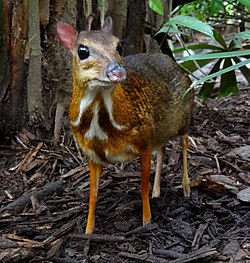
| Lesser mouse-deer (Tragulus kanchil) | |
Scientific classification 
| |
| Kingdom: | Animalia |
| Phylum: | Chordata |
| Class: | Mammalia |
| Order: | Artiodactyla |
| Suborder: | Ruminantia |
| Infraorder: | Tragulina |
| Family: | Tragulidae H. Milne-Edwards, 1864 |
| Type genus | |
| Tragulus Brisson, 1762
| |
| Genera | |
Chevrotains, or mouse-deer, are small, even-toed ungulates that make up the family Tragulidae, and are the only living members of the infraorder Tragulina. The 10 extant species are placed in three genera,[1][2] but several species also are known only from fossils.[3] The extant species are found in forests in South and Southeast Asia; a single species, the water chevrotain, is found in the rainforests of Central and West Africa.[4] In November 2019, conservation scientists announced that they had photographed silver-backed chevrotains (Tragulus versicolor) in a Vietnamese forest for the first time since the last confirmed sightings in 1990.[5][6][7]
They are solitary, or live in loose groupings or pairs, and feed almost exclusively on plant material.[4] Chevrotains are the smallest hoofed mammals in the world. The Asian species weigh between 1–4 kg (2–9 lb), while the African chevrotain is considerably larger, at 7–16 kg (15–35 lb).[8][9] With an average length of 45 cm (18 in) and an average height of 30 cm (12 in), the Java mouse-deer is the smallest surviving ungulate (hoofed) mammal, as well as the smallest artiodactyl (even-toed ungulate).[8] Despite their common name of "mouse-deer", they are not closely related to true deer, hence the orthographic distinction by means of the hyphen.
Etymology
[edit]The word "chevrotain" comes from the Middle French word chevrot (kid or fawn), derived from chèvre (goat).[10]
The single African species is consistently known as "chevrotain".[1][4][11] The names "chevrotain" and "mouse-deer" have been used interchangeably among the Asian species,[4][12][13][14] though recent authorities typically have preferred chevrotain for the species in the genus Moschiola and mouse-deer for the species in the genus Tragulus.[1] Consequently, all species with pale-spotted or -striped upper parts are known as "chevrotain" and without are known as "mouse-deer".
The Telugu name for the Indian spotted chevrotain is jarini pandi, which literally means "a deer and a pig".[citation needed] The Tamil term is சருகு மான் sarukumāṉ "leaf-pile deer". The Sinhala name meeminna roughly translates to "mouse-like deer". This was used in the scientific name of the Sri Lankan spotted chevrotain, M. meminna.
Biology
[edit]The family was widespread and successful from the Oligocene (34 million years ago) through the Miocene (about 5 million years ago), but has remained almost unchanged over that time and remains as an example of an archaic ruminant type. They have four-chambered stomachs to ferment tough plant foods, but the third chamber is poorly developed. Unlike other artiodactyls, they lack an carotid rete,[15] and so cannot heat exchange cool blood entering their brains, a thermoregulatory innovation that allows other artiodactyls to exploit hot arid habitats.[16] Though most species feed exclusively on plant material, the water chevrotain occasionally takes insects and crabs or scavenges meat and fish.[17] Like other ruminants, they lack upper incisors. They give birth to only a single young.
In other respects, however, they have primitive features, closer to nonruminants such as pigs. All species in the family lack antlers and horns, but both sexes have elongated canine teeth. These are especially prominent in males, where they project out on either side of the lower jaw, and are used in fights.[4] Their legs are short and thin, which leave them lacking in agility, but also helps to maintain a smaller profile to aid in running through the dense foliage of their environments. Other pig-like features include the presence of four toes on each foot, the absence of facial scent glands, premolars with sharp crowns,[18] and the form of their sexual behaviour and copulation.[19][18]
.JPG)
They are solitary or live in pairs.[4] The young are weaned at three months of age, and reach sexual maturity between 5 and 10 months, depending on species. Parental care is relatively limited. Although they lack the types of scent glands found in most other ruminants, they do possess a chin gland for marking each other as mates or antagonists, and, in the case of the water chevrotain, anal and preputial glands for marking territory. Their territories are relatively small, on the order of 13–24 hectares (32–59 acres), but neighbors generally ignore each other, rather than compete aggressively.[18]
Some of the species show a remarkable affinity with water, often remaining submerged for prolonged periods to evade predators or other unwelcome intrusions. This has also lent support to the idea that whales evolved from water-loving creatures that looked like small deer.[20][21]
Taxonomy
[edit]Tragulidae's placement within Artiodactyla can be represented in the following cladogram:[22][23][24][25][26]
| Artiodactyla |
| ||||||||||||||||||||||||||||||
.png)
_(white_background).jpg)
.jpg)

.jpg)
.jpg)
Traditionally, only four extant species were recognized in the family Tragulidae.[4] In 2004, T. nigricans and T. versicolor were split from T. napu, and T. kanchil and T. williamsoni were split from T. javanicus.[27] In 2005, M. indica and M. kathygre were split from M. meminna.[2] With these changes, the 10 extant species are:

.JPG)
- Family Tragulidae
- Genus Hyemoschus
- Water chevrotain, Hyemoschus aquaticus
- Genus Moschiola
- Indian spotted chevrotain, Moschiola indica
- Sri Lankan spotted chevrotain, Moschiola meminna
- Yellow-striped chevrotain, Moschiola kathygre
- Genus Tragulus
- Java mouse-deer, Tragulus javanicus
- Lesser mouse-deer or kanchil, Tragulus kanchil
- Greater mouse-deer, Tragulus napu
- Philippine mouse-deer, Tragulus nigricans
- Vietnam mouse-deer, Tragulus versicolor
- Williamson's mouse-deer, Tragulus williamsoni
- Genus Hyemoschus
Ancient chevrotains
[edit]
The Hypertragulidae were closely related to the Tragulidae.
The six extinct chevrotain genera[3] include:
- Genus Dorcatherium
- Dorcatherium minus from Pakistan
- Dorcatherium majus from Pakistan
- Dorcatherium naui, from Central Europe[28]
- Genus Dorcabune
- Genus Afrotragulus Sánchez, Quiralte, Morales and Pickford, 2010[29]
- Genus Siamotragulus
- Genus Yunnanotherium
- Genus Archaeotragulus[30]
Mythology
[edit]
According to the Malay Annals, King Parameswara, seeking a place to found a new city, came to a place where he saw a mouse-deer (kancil in Malay) kicking his hunting dog into the river. He thought this boded well, remarking, "This place is excellent. Even the mouse deer is formidable. It is best that we establish a kingdom here". This became the Malacca Sultanate and Malacca its capital.[35]: 51–52 In memory of this founding legend, the coat of arms of Malacca depicts two mouse-deer.
The mouse-deer or Sang Kancil is also a well-known trickster of Malay folklore.[36]: 61–66
Footnotes
[edit]- ^ Changing taxonomy in the genus Tragulus make exact species identification uncertain, but either T. javanicus or T. kanchil. Note also the contradicting English and scientific names on the sign on the photo.
References
[edit]- ^ a b c Wilson, D. E.; Reeder, D. M., eds. (2005). Mammal Species of the World: A Taxonomic and Geographic Reference (3rd ed.). Baltimore: Johns Hopkins University Press. ISBN 978-0-8018-8221-0. OCLC 62265494.
- ^ a b Groves, C.; Meijaard, E. (2005). "Intraspecific variation in Moschiola, the Indian chevrotain". The Raffles Bulletin of Zoology. Supplement 12: 413–421.
- ^ a b Farooq, U.; Khan, M.A.; Akhtar, M.; Khan, A.M. (2008). "Lower dentition of Dorcatherium majus (Tragulidae, Mammalia) in the Lower and Middle Siwaliks (Miocene) of Pakistan" (PDF). Tur. J. Zool. 32: 91–98. Archived from the original (PDF) on 28 September 2011.
- ^ a b c d e f g Nowak, R.M., ed. (1999). Walker's Mammals of the World (6th ed.). Baltimore, MD: Johns Hopkins University Press.
- ^ Chappell, Bill (11 November 2019). "Silver-Backed Chevrotain, with Fangs and Hooves, Photographed In Wild for First Time". NPR. NPR.org. Retrieved 12 November 2019.
- ^ Nguyen, An (11 November 2019). "Camera-trap evidence that the silver-backed chevrotain Tragulus versicolor remains in the wild in Vietnam". Nature.com. Retrieved 12 November 2019.
- ^ "Tiny deer-like animal spotted after 25 years" (Video). CNN. 11 Nov 2019.
- ^ a b Fukuta, K.; Kudo, H; Jalaludin, S. (1996). "Unique pits on the erythrocytes of the lesser mouse-deer, Tragulus javanicus". Journal of Anatomy. 189 (1): 211–213. PMC 1167845. PMID 8771414.
- ^ "Hyemoschus aquaticus". Ultimate Ungulate. Retrieved 12 October 2010.
- ^ "Chevrotain". Merriam-Webster.com Dictionary. Merriam-Webster. Retrieved 15 December 2019.
- ^ IUCN SSC Antelope Specialist Group (2016). "Hyemoschus aquaticus". IUCN Red List of Threatened Species. 2016 e.T10341A50188841. doi:10.2305/IUCN.UK.2016-1.RLTS.T10341A50188841.en. Retrieved 13 November 2021.
- ^ Duckworth, J.W.; Timmins, R. (2015). "Moschiola indica". IUCN Red List of Threatened Species. 2015 e.T136585A61979067. doi:10.2305/IUCN.UK.2015-2.RLTS.T136585A61979067.en. Retrieved 13 November 2021.
- ^ Duckworth, J.W.; Timmins, R. (2015). "Moschiola kathygre". IUCN Red List of Threatened Species. 2015 e.T136799A61979620. doi:10.2305/IUCN.UK.2015-2.RLTS.T136799A61979620.en. Retrieved 13 November 2021.
- ^ Duckworth, J.W.; Timmins, R. (2015). "Moschiola meminna". IUCN Red List of Threatened Species. 2015 e.T41779A73575223. doi:10.2305/IUCN.UK.2015-2.RLTS.T41779A73575223.en. Retrieved 13 November 2021.
- ^ Fukuta, Katsuhiro; Kudo, Hiroshi; Sasaki, Motoki; Kimura, Junpei; Ismail, Dahlan bin; Endo, Hideki (2007). "Absence of carotid rete mirabile in small tropical ruminants: implications for the evolution of the arterial system in artiodactyls". Journal of Anatomy. 210 (1): 112–116. doi:10.1111/j.1469-7580.2006.00667.x. ISSN 0021-8782. PMC 2100259. PMID 17229288.
- ^ Mitchell, G; Lust, A (2008-08-23). "The carotid rete and artiodactyl success". Biology Letters. 4 (4): 415–418. doi:10.1098/rsbl.2008.0138. ISSN 1744-9561. PMC 2610139. PMID 18426746.
- ^ Kingdon, J. (1997). The Kingdon Field Guide to African Mammals. Academic Press. ISBN 0-12-408355-2.
- ^ a b c Dubost, G. (1984). Macdonald, D. (ed.). The Encyclopedia of Mammals. New York: Facts on File. pp. 516–517. ISBN 978-0-87196-871-5.
- ^ Valerius Geist (1998). Deer of the World: Their Evolution, Behaviour, and Ecology. Stackpole Books. ISBN 978-0-8117-0496-0.
- ^ Walker, M. (7 July 2009). "Aquatic deer and ancient whales". BBC News. Retrieved 26 March 2010.
- ^ Meijaard, E.; Umilaela; de Silva Wijeyeratne, G. (September 2010). "Aquatic escape behaviour in mouse-deer provides insight into tragulid evolution". Mammalian Biology. 75 (5): 471–473. Bibcode:2010MamBi..75..471M. doi:10.1016/j.mambio.2009.05.007.
- ^ Beck, N.R. (2006). "A higher-level MRP supertree of placental mammals". BMC Evol Biol. 6: 93. doi:10.1186/1471-2148-6-93. PMC 1654192. PMID 17101039.
- ^ O'Leary, M.A.; Bloch, J.I.; Flynn, J.J.; Gaudin, T.J.; Giallombardo, A.; Giannini, N.P.; Goldberg, S.L.; Kraatz, B.P.; Luo, Z.-X.; Meng, J.; Ni, X.; Novacek, M.J.; Perini, F.A.; Randall, Z.S.; Rougier, G.W.; Sargis, E.J.; Silcox, M.T.; Simmons, N.B.; Spaulding, M.; Velazco, P.M.; Weksler, M.; Wible, J.R.; Cirranello, A.L. (2013). "The Placental Mammal Ancestor and the Post-K-Pg Radiation of Placentals". Science. 339 (6120): 662–667. Bibcode:2013Sci...339..662O. doi:10.1126/science.1229237. hdl:11336/7302. PMID 23393258. S2CID 206544776.
- ^ Song, S.; Liu, L.; Edwards, S.V.; Wu, S. (2012). "Resolving conflict in eutherian mammal phylogeny using phylogenomics and the multispecies coalescent model". Proceedings of the National Academy of Sciences. 109 (37): 14942–14947. Bibcode:2012PNAS..10914942S. doi:10.1073/pnas.1211733109. PMC 3443116. PMID 22930817.
- ^ dos Reis, M.; Inoue, J.; Hasegawa, M.; Asher, R.J.; Donoghue, P.C.J.; Yang, Z. (2012). "Phylogenomic datasets provide both precision and accuracy in estimating the timescale of placental mammal phylogeny". Proceedings of the Royal Society B: Biological Sciences. 279 (1742): 3491–3500. doi:10.1098/rspb.2012.0683. PMC 3396900. PMID 22628470.
- ^ Upham, N.S.; Esselstyn, J.A.; Jetz, W. (2019). "Inferring the mammal tree: Species-level sets of phylogenies for questions in ecology, evolution, and conservation". PLOS Biology. 17 (12) e3000494. doi:10.1371/journal.pbio.3000494. PMC 6892540. PMID 31800571.(see e.g. Fig S10)
- ^ Meijaard, I.; Groves, C.P. (2004). "A taxonomic revision of the Tragulus mouse-deer". Zoological Journal of the Linnean Society. 140: 63–102. doi:10.1111/j.1096-3642.2004.00091.x.
- ^ Thenius, E. (1950). "Über die Sichtung und Bearbeitung der jungtertiären Säugetierreste aus dem Hausruck und Kobernaußerwald (O.Ö.)". Verh. Geol. B.-A. 51 (2): 56.
- ^ Sánchez, Israel M.; Quiralte, Victoria; Morales, Jorge; Pickford, Martin (2010). "A new genus of tragulid ruminant from the early Miocene of Kenya" (PDF). Acta Palaeontologica Polonica. 55 (2): 177–187. doi:10.4202/app.2009.0087. S2CID 303897.
- ^ Métais, G.; Chaimanee, Y.; Jaeger, J.-J. & Ducrocq S. (2001). "New remains of primitive ruminants from Thailand: Evidence of the early evolution of the Ruminantia in Asia" (PDF). Zoologica Scripta. 30 (4): 231. doi:10.1046/j.0300-3256.2001.00071.x. S2CID 85647031. Archived from the original (PDF) on 22 July 2011.
- ^ Vaughan, Terry A.; Ryan, James M.; Czaplewski, Nicholas J. (21 April 2011). Mammalogy (5th ed.). Jones & Bartlett Learning. ISBN 978-0-7637-6299-5. Retrieved 4 April 2012.
- ^ Sánchez, Israel M.; Quiralte, Victoria; Morales, Jorge; Pickford, Martin (2010). "A new genus of Tragulid ruminant from the Early Miocene of Kenya". Acta Palaeontologica Polonica. 55 (2): 177. doi:10.4202/app.2009.0087.
- ^ "Krabitherium". Paleobiology Database (Paleodb.org). Retrieved 18 January 2013.
- ^ Mennecart, B., Wazir, W.A., Sehgal, R.K., Patnaik, R., Singh, N.P., Kumar, N. and Nanda, A.C., 2021. New remains of Nalamaeryx (Tragulidae, Mammalia) from the Ladakh Himalaya and their phylogenetical and palaeoenvironmental implications. Historical Biology, pp.1-9.https://doi.org/10.1080/08912963.2021.2014479
- ^ Brown, C. C. (October 1952). "The Malay Annals". Journal of the Malayan Branch of the Royal Asiatic Society. 25 (2/3 (159)): 5–276. JSTOR 41502950.
- ^ See Hoon Peow (2016). "A Comparative Study of Malay and Chinese Trickster Tales: Sang Kancil, The Rabbit and The Rat" (PDF). Kajian Malaysia. 34 (2): 59–73. doi:10.21315/km2016.34.2.3.
External links
[edit]
- Lydekker, Richard (1911). . Encyclopædia Britannica (11th ed.).
| National | |
|---|---|
| Other | |

Chevrotain
View on GrokipediaTaxonomy and evolution
Taxonomy
The family Tragulidae, commonly known as chevrotains or mouse-deer, represents the sole extant family within the infraorder Tragulina of the suborder Ruminantia in the order Artiodactyla. This family includes three genera and ten recognized species as of 2025.[6] Tragulids are considered basal ruminants, occupying a phylogenetic position as the sister group to the clade Pecora (which encompasses families such as Cervidae, Bovidae, and Giraffidae), a relationship supported by both molecular and morphological evidence from analyses of multiple ruminant lineages.[7] The genus Hyemoschus contains a single species, the water chevrotain (Hyemoschus aquaticus), which is distributed in Central and West Africa.[6] The genus Moschiola, comprising spotted chevrotains primarily in South Asia, includes three species: the Indian spotted chevrotain (Moschiola indica), the Sri Lankan spotted chevrotain (Moschiola meminna), and the yellow-striped chevrotain (Moschiola kathygre). This taxonomic division arose from a 2003 revision based on morphological and genetic differences distinguishing populations previously lumped under a single species.[8][6] The genus Tragulus, consisting of mouse-deer mainly in Southeast Asia, encompasses six species: the Balabac chevrotain (Tragulus nigricans), the greater mouse-deer (Tragulus napu), the Java mouse-deer (Tragulus javanicus), Kloss's mouse-deer (Tragulus klossii), the lesser mouse-deer (Tragulus kanchil), and the silver-backed chevrotain (Tragulus versicolor). These species were delineated through a comprehensive 2005 taxonomic revision that elevated subspecies to full species status using craniometric, pelage, and molecular data, resolving long-standing ambiguities in Southeast Asian populations.[9][6] Recent taxonomic revisions in the 2010s, driven by genetic studies, have further refined chevrotain classification by confirming distinctions among Tragulus lineages, such as the endemic Vietnamese T. versicolor, enhancing understanding of their evolutionary divergence within Ruminantia around 30–40 million years ago.[10]Fossil record
The fossil record of chevrotains, or tragulids, reveals an ancient lineage of basal ruminants originating in the Old World during the Paleogene. The earliest known tragulid fossils date to the late Eocene, approximately 37-34 million years ago, with primitive forms such as Archaeotragulus krabiensis discovered in the Krabi Basin of southern Thailand, indicating an early Asian presence for the family.[11] In Europe, remains of basal ruminants from Quercy phosphorites in France further document the initial diversification of tragulid-like taxa around 50-34 million years ago, characterized by simple, brachydont dentition adapted to forested environments. During the Miocene (23-5.3 million years ago), tragulids underwent significant diversification across Africa, Asia, and Europe, with genera such as Dorcatherium becoming widespread and exhibiting transitional features between primitive tragulids and more advanced ruminants, including elongated limbs and selenodont molars suited for browsing.[12] Gelocus, from Gelocidae (closely allied to Tragulidae), appears in Oligocene-Miocene deposits in Europe and Asia, showing primitive cranial morphology without horns or antlers, a trait retained in the tragulid lineage, and a three-chambered stomach indicative of less efficient fermentation compared to modern pecorans.[13] Key fossil sites include the Siwalik Hills of India and Pakistan, where Miocene Dorcatherium and Dorcabune species dominate assemblages from 18.7 to 5 million years ago, reflecting swampy, wooded habitats; in Africa, the East African Rift Valley yields early Miocene tragulids like Afrotragulus from Kenyan sites such as Napak and Rusinga, highlighting intercontinental dispersal.[14][15] By the Pliocene and Pleistocene (5.3 million to 11,700 years ago), the tragulid record shows a marked decline, with European lineages extinct by the early Pliocene due to cooling climates, habitat fragmentation, and competition from more advanced ruminants like bovids.[16] In East Africa, fossils such as Hyemoschus aquaticus from the 5.3-4.5 million-year-old Mabaget Formation in Kenya's Tugen Hills indicate persistence in rainforest refugia, though overall diversity waned as grasslands expanded.[17] This evolutionary trajectory underscores the tragulids' retention of primitive traits, including hornlessness and a simple digestive system, which limited adaptability amid Pleistocene environmental shifts. Post-2000 discoveries, including additional late Eocene material from Thailand's Bang Mark locality, reinforce Asian origins and early Eocene-Oligocene radiation of the group.[18]Physical characteristics
Morphology
Chevrotains are the smallest extant hoofed mammals, classified as even-toed ungulates (Artiodactyla) with body sizes varying across species but generally compact and lightweight. Head-body lengths range from 42 to 100 cm, with shoulder heights typically 20–40 cm and weights between 1.5 and 16 kg; for example, the Javan chevrotain (Tragulus javanicus) measures about 45–57 cm in length and weighs 1.6–2.5 kg, making it one of the tiniest representatives.[19][20] These animals possess four toes per foot, characteristic of even-toed ungulates, but primarily bear weight on the two central toes (digits III and IV) while the lateral toes remain vestigial and non-functional in locomotion.[6] They lack antlers or horns entirely, a primitive trait among ruminants.[6] The body form is stocky with a rounded, slightly arched back and slender, pencil-thin limbs suited to their diminutive stature. The coat is short and dense, usually reddish-brown to dark brown, often patterned with white spots, stripes, or throat patches for camouflage in forested environments; species like the Indian spotted chevrotain (Moschiola indica) exhibit distinct white spots along the sides, while the silver-backed chevrotain (Tragulus versicolor) features a grayish-silver dorsal stripe.[6][21] The head is small and triangular with a short, pointed snout, large eyes positioned for wide peripheral vision, slit-like nostrils, and medium-sized, rounded ears sparsely haired on the inner surfaces.[6] Unlike many deer, chevrotains lack prominent facial glands.[6] Sexual dimorphism is evident primarily in the dentition, with males possessing elongated upper canines that form downward-protruding tusks up to 3 cm long for display and defense, while females have much smaller, inconspicuous versions about 0.5 cm in length.[6] Slight differences in body size occur in some species, such as the water chevrotain (Hyemoschus aquaticus), where females are heavier than males by an average of 2 kg.[6] These tusks are briefly utilized in territorial interactions, as detailed further in behavioral accounts.[6]Adaptations
Chevrotains exhibit a predominantly nocturnal lifestyle, with species such as the water chevrotain (Hyemoschus aquaticus) actively foraging between 1800 and 0600 hours while resting in dense cover during daylight to avoid predators.[22] This temporal adaptation enhances survival in tropical forest understories where visibility is low. Their acute hearing is facilitated by mobile ears that swivel to detect subtle sounds, aiding in predator evasion amid dense vegetation.[23] The digestive system of chevrotains represents a primitive form of rumination, featuring a four-chambered stomach with a greatly reduced omasum—comprising a rumen, reticulum, omasum, and abomasum—that supports foregut fermentation of plant material.[1] This configuration allows efficient breakdown of fruits and leaves, which form the bulk of their diet (e.g., fruits comprising up to 68.7% by dry weight in H. aquaticus), enabling rapid nutrient extraction without full rumination.[22] The rumen features papillae for absorption, while the reticulum has honeycomb-like crests, positioning chevrotains as evolutionary precursors to advanced ruminants.[24] Camouflage is achieved through a spotted or dappled pelage that disrupts their outline against forest floors and leaf litter, as seen in the white-spotted reddish-brown coat of many species.[22] Their lightweight build, with slender legs and an arched back, facilitates agile navigation through thick undergrowth, allowing quick evasion of threats.[23] Sensory adaptations include well-developed olfactory glands, such as anal, preputial, and maxillary glands in males, used for scent-marking territories and signaling mates via urine, feces, or glandular secretions.[6] Facial vibrissae (whiskers) assist in tactile navigation through low-light undergrowth, supplementing vision and olfaction during foraging.[25] In the water chevrotain (H. aquaticus), semi-aquatic tendencies are evident through proficiency in swimming and diving to escape predators, often submerging near riverbanks where it resides within 250 meters of water bodies.[22] Thermoregulation in chevrotains benefits from their small body size (typically 1–10 kg), which promotes efficient heat dissipation in humid tropical climates, coupled with minimal body fat and high muscle content to maintain metabolic balance.[27][28]Distribution and habitat
Geographic range
Chevrotains are distributed across tropical regions of sub-Saharan Africa and South and Southeast Asia, with no overlap between the continental ranges of the African genus Hyemoschus and the Asian genera Moschiola and Tragulus.[6] The water chevrotain (Hyemoschus aquaticus) is the sole African representative, confined to West and Central Africa in a disjunct pattern spanning from Senegal and Guinea eastward to the Congo Basin, Uganda, and Angola, including countries such as Sierra Leone, Ghana, Nigeria, Cameroon, the Central African Republic, the Democratic Republic of the Congo, Equatorial Guinea, Gabon, and the Republic of the Congo.[6] In South Asia, the genus Moschiola encompasses three species with regional exclusivity: the Indian spotted chevrotain (Moschiola indica) occurs widely in peninsular India, including the Western Ghats, and possibly southern Nepal; the Sri Lankan spotted chevrotain (Moschiola meminna) is limited to the dry zone of Sri Lanka; and the yellow-striped chevrotain (Moschiola kathygre) inhabits the wet zone of Sri Lanka.[6] Southeast Asian distributions are dominated by the genus Tragulus, with six species ranging from southern Myanmar and southern China through the Malay Peninsula, Sumatra, Borneo, and Java to the Philippines and Vietnam; for instance, the greater Malayan chevrotain (Tragulus napu) spans the Thai-Malay Peninsula, Borneo, and Sumatra, while the Philippine mouse-deer (Tragulus nigricans) is endemic to the Balabac, Bugsuk, and Ramos Islands near Palawan in the Philippines.[6] Fossil records reveal a broader historical range during the Eocene and Miocene epochs, with chevrotain relatives documented across Laurasia in Europe, northern Pakistan, and parts of Africa such as Kenya, indicating an ancient expansion from Southeast Asian origins before the modern relictual distributions emerged.[6][29] Range contractions have occurred in recent decades due to habitat loss, exemplified by the silver-backed chevrotain (Tragulus versicolor), which was unseen after 1990s sightings in Vietnam until camera-trap rediscoveries in 2019, now restricted to isolated forest patches in southern Vietnam. Subsequent genetic analyses as of 2024 have confirmed its distinct evolutionary position within the genus Tragulus.[30][31]Habitat preferences
Chevrotains exhibit a strong preference for dense, humid tropical forest environments, particularly the understory layers of rainforests, swamps, and mangroves, where thick vegetation provides essential cover from predators. These small ungulates rely on the shaded, moist conditions of these habitats to maintain thermoregulation and avoid exposure, favoring areas with closed canopies and high precipitation levels.[32][19] In Africa, the water chevrotain (Hyemoschus aquaticus) is specifically adapted to riverine forests and lowland rainforests, rarely venturing more than 250 meters from freshwater sources, which serve as both drinking sites and escape routes during nocturnal activity. This species occupies microhabitats such as dense thickets and flooded areas along river valleys, utilizing ground-level vegetation and open riverbanks at night while resting in concealed spots during the day. In contrast, Asian species like those in the genus Moschiola, such as the Indian spotted chevrotain (M. indica), inhabit a broader range including dry deciduous forests, semi-evergreen woodlands, grasslands, and even agricultural areas like plantations and home gardens, always in proximity to water holes for hydration and refuge.[33][20][21][34] Species in the genus Tragulus, including the greater mouse-deer (T. napu) and Java mouse-deer (T. javanicus), predominantly favor primary and secondary rainforests with dense understory brush and vines, avoiding open grasslands and prioritizing undisturbed forests over degraded ones, though some tolerance for secondary growth exists. These chevrotains create narrow trails through leaf litter and thick foliage for movement, staying close to streams and rivers to facilitate quick escapes into water. Altitudinally, chevrotains range from sea level up to approximately 1,500 meters, with the Java mouse-deer recorded as high as 1,150–1,600 meters and the greater mouse-deer typically below 700 meters in Borneo. While adaptable to human-modified landscapes like coconut groves in some cases, all species thrive best in intact, humid microhabitats offering ample hiding cover and water access.[32][19][34]Behavior and ecology
Diet and foraging
Chevrotains are primarily herbivorous, functioning as selective browsers that consume fruits, seeds, leaves, and fungi while generally avoiding tough grasses. Their diet emphasizes fallen fruits such as figs, palm nuts, and breadfruit, along with succulent shoots and buds from understory vegetation. This selective feeding allows them to exploit nutrient-rich, easily digestible plant material in dense forest environments.[33][35] Dietary preferences vary across species. The African water chevrotain (Hyemoschus aquaticus) incorporates aquatic plants, leaves, and buds, supplemented occasionally by invertebrates like insects and crustaceans. In contrast, Asian species such as those in the genus Tragulus favor fallen fruits and young shoots, with minimal consumption of harder vegetation. These variations reflect adaptations to local forest resources, with Hyemoschus showing greater opportunism toward animal matter during foraging near water sources.[33][36][37] Foraging occurs nocturnally and solitarily on the forest floor, where chevrotains navigate leaf litter and undergrowth to locate food. Their high-fiber intake is processed through a four-chambered ruminant stomach with a reduced omasum, enabling microbial fermentation, which extracts energy from fibrous material. Water needs are largely met through moisture in vegetation, reducing reliance on direct drinking.[38][33] Seasonally, chevrotains shift toward leaves, buds, and shoots when fruits become scarce, maintaining nutritional balance amid fluctuating availability. Near human settlements, they opportunistically consume crops like young plants and fruits, adapting to altered landscapes. As seed dispersers, chevrotains play a key ecological role by ingesting fruits and depositing seeds via scat, promoting forest regeneration and plant diversity.[38][37][39]Reproduction and life cycle
Chevrotains exhibit a polygynous mating system, in which males defend territories that encompass the ranges of multiple females, using scent markings from preorbital and intermandibular glands as well as tusk displays for agonistic encounters. Females remain largely solitary outside of brief mating interactions. This territorial polygyny is evident in species like the lesser mouse-deer (Tragulus javanicus), where male core areas overlap with those of several females, facilitating multiple matings while same-sex individuals maintain separate ranges.[40] Breeding in chevrotains occurs year-round within their tropical habitats, though many species show peaks aligned with seasonal resource availability, such as rainy or post-monsoon periods that enhance forage. For instance, the Indian spotted chevrotain (Moschiola indica) breeds continuously but experiences higher birth rates from September to December following the monsoon. The water chevrotain (Hyemoschus aquaticus) similarly breeds without strict seasonality, with births peaking in dry seasons (January and July-August) linked to fruit abundance.[22][41] Gestation periods vary by species, typically lasting 4 to 9 months; examples include 132-145 days in the lesser Malayan chevrotain (Tragulus kanchil) and 188-272 days (average ~214 days) in the water chevrotain. Litters consist of 1-2 precocial young, which are born with eyes open, fully furred, and capable of standing and moving within 30 minutes to an hour of birth. Newborns weigh 375-1850 g, representing 5-8% of the mother's body mass, and are immediately able to hide from predators.[42][43][44] Sexual maturity is attained relatively early, at 4-10 months in most species—for example, 4.5 months in the greater mouse-deer (Tragulus napu)—though it extends to 9-26 months in the water chevrotain. Weaning occurs at 2-3 months, after which young disperse upon reaching maturity. In the wild, chevrotains have a lifespan of 5-10 years, with maximum recorded longevity up to 13 years in captivity. No evidence supports delayed implantation across the family.[32][22][6] Parental care is minimal and provided solely by the mother, who hides the fawn in dense vegetation immediately after birth and visits periodically for nursing in a standing posture, exposing mammary glands by raising a hind leg. Suckling lasts 2-6 months, during which the young remains concealed on the forest floor for protection; mothers do not guard or accompany fawns continuously. This strategy suits the precocial nature of the offspring and the species' solitary lifestyle.[6][33][41] The reproductive rate is high relative to body size, supporting population stability despite predation; for example, the water chevrotain averages 1.25 offspring per year, while species like the Indian spotted chevrotain can produce up to two litters annually due to year-round breeding and short gestations. This rapid turnover offsets mortality from predators such as birds of prey and felids, maintaining densities in suitable habitats.[33][41]Conservation
Threats
Chevrotain populations face significant threats from habitat destruction, primarily driven by deforestation for agricultural expansion and palm oil plantations in Southeast Asia, as well as commercial logging in African forests. In Southeast Asia, where most species occur, forest cover has declined by over 30 million hectares between 1990 and 2010 due to these activities, severely fragmenting the dense understory habitats essential for these elusive ungulates.[45] In Africa, selective logging disrupts the swampy and riverine forests preferred by the water chevrotain (Hyemoschus aquaticus), reducing cover and increasing vulnerability to other pressures. Hunting and poaching pose a direct and pervasive danger, with chevrotains targeted for bushmeat consumption and, in some cases, traditional medicine. Across their range, snares and traps intended for larger game often capture these small animals, contributing to population declines, particularly in accessible forest edges.[46] Male chevrotains' elongated canine tusks are occasionally harvested for ornamental purposes in local crafts, though this is less widespread than meat hunting.[21] Natural predation by leopards, pythons, and other carnivores affects chevrotains, but habitat fragmentation exacerbates this risk by creating more open edges where predators can more easily detect and access prey. In fragmented landscapes, reduced understory density limits escape options for these ground-dwelling species, potentially elevating predation rates beyond natural levels.[47] Species-specific threats vary, with the silver-backed chevrotain (Tragulus versicolor) having been hunted to near-extinction through intensive poaching, leading to its presumed disappearance from the wild for nearly three decades until rediscovery in 2019. The water chevrotain suffers additional impacts from artisanal gold mining in Central African forests, where mercury pollution contaminates waterways and degrades riparian habitats critical for foraging.[48] Climate change further compounds these pressures by altering rainfall patterns in tropical forests, which disrupts seasonal fruit availability—a key component of chevrotain diets—and potentially shifts breeding cycles in frugivorous populations. In Southeast Asia, projected changes in precipitation are expected to affect fruit production, indirectly impacting chevrotain nutrition and reproduction. The elusive nature of chevrotains hinders threat assessment, with three of the ten recognized species classified as Data Deficient by the IUCN due to insufficient ecological data on population sizes and trends.[49] This status underscores the urgent need for targeted research to inform conservation, as understudied threats may be accelerating declines across their range.Conservation efforts and status
Chevrotains face varying levels of threat across their range, with the International Union for Conservation of Nature (IUCN) classifying one species as Endangered—the Balabac chevrotain (Tragulus nigricans)—two as Vulnerable, three as Data Deficient, and the remainder as Least Concern or Near Threatened, as of 2025.[49] These assessments highlight the need for targeted conservation, as many species suffer from habitat fragmentation and limited population data. No chevrotain species are listed under the Convention on International Trade in Endangered Species of Wild Fauna and Flora (CITES), but several receive protection through national legislation, such as India's Wildlife Protection Act of 1972, which places the Indian spotted chevrotain (Moschiola indica) in Schedule I, prohibiting hunting and trade.[50][51] Key conservation efforts focus on habitat protection and monitoring within established reserves. In Indonesia, Gunung Leuser National Park safeguards populations of Tragulus species through anti-poaching patrols and ecosystem management, preserving critical rainforest habitats amid broader threats like logging.[52] Camera trap surveys have proven vital for rediscoveries, notably the 2019 confirmation of the silver-backed chevrotain (Tragulus versicolor) in southern Vietnam's coastal forests after nearly three decades without sightings, enabling updated distribution mapping and threat assessments.[53] Recent initiatives emphasize rediscovery and genetic research to bolster populations. The Global Wildlife Conservation's Search for Lost Species program spearheaded the silver-backed chevrotain's rediscovery and continues to support surveys and protection in Vietnam, aiming to prevent extinction of data-deficient taxa.[54] In June 2025, a world-first conservation breeding program for the silver-backed chevrotain was launched in Vietnam by the Southern Institute of Ecology and Rewild, addressing its Data Deficient status and threats from poaching.[5] Captive breeding programs offer supplementary support but face limitations. Zoos like Singapore Zoo have achieved modest success breeding greater mouse-deer (Tragulus napu), contributing to ex situ populations, though reintroduction remains challenging due to the species' specialized habitat requirements, such as dense undergrowth and proximity to water.[55] Future priorities include community-based strategies to address ongoing pressures. Educational campaigns in hunting-dependent regions promote alternatives to bushmeat consumption, reducing poaching of chevrotains through awareness of their ecological roles.[56] In Africa, restoration of swamp forests in the Congo Basin targets habitats for the water chevrotain (Hyemoschus aquaticus), involving reforestation and hydrological recovery to enhance resilience against degradation.[57]Cultural significance
Mythology and folklore
In Congolese folklore, the water chevrotain serves as a trickster figure, substituting for the hare in tales where hares are absent, using cunning to outwit larger animals and evade danger.[58] This role parallels broader West African trickster narratives, such as those involving Anansi the spider, emphasizing themes of evasion and intelligence in oral traditions among Bantu peoples.[58] In Southeast Asian mythology, particularly Malay folklore, the mouse-deer, known as kancil, is a prominent clever hero who outsmarts predators through wit rather than strength.[59] Iconic fables like "The Mouse Deer and the Tiger" depict the kancil tricking a tiger by feigning illness or using deceptive pleas, highlighting its resourcefulness in the face of superior foes.[60] These stories, rooted in animistic beliefs, portray the kancil as a symbol of humility and agility, representing the triumph of the small and unassuming over brute power.[60]Human interactions
Chevrotains have long been subject to subsistence hunting in rural communities across Southeast Asia and central Africa, where they are valued as a source of bushmeat due to their small size and availability in forested areas. In regions like Vietnam and Malaysian Borneo, local hunters target species such as the larger Malay mouse-deer (Tragulus napu) using snares and traps, often as part of opportunistic foraging that supplements protein needs in food-insecure households.[44][61] In central Africa, the water chevrotain (Hyemoschus aquaticus) is frequently hunted for bushmeat and appears in regional markets alongside other small ungulates, contributing to population declines in areas with high hunting pressure.[62] Additionally, chevrotains enter the exotic pet trade, particularly in Asia, where species like the larger Malay mouse-deer are captured and sold in urban markets for their novelty as diminutive, docile animals, exacerbating pressures on wild populations.[44] In agricultural landscapes, chevrotains occasionally conflict with human land use, particularly in oil palm plantations in Malaysia and Indonesia, where they may forage on understory vegetation or fallen fruits, prompting retaliatory killings by plantation workers to protect crops. For instance, lesser mouse-deer (Tragulus kanchil) have been documented in fragmented habitats near oil palm estates, leading to incidental snaring or shooting as farmers perceive them as pests despite their minimal impact compared to larger mammals.[61] Such interactions highlight the challenges of habitat overlap in converted forests, where chevrotains' elusive nature does not fully shield them from human encroachment. Scientific research on chevrotains has advanced through non-invasive methods like camera traps, which have captured rare sightings and informed studies on their behavior in reserves across Vietnam and Malaysia. The 2019 rediscovery of the silver-backed chevrotain (Tragulus versicolor) in southern Vietnam, using camera traps guided by local knowledge, exemplifies how collaborative efforts between scientists and communities enhance understanding of these secretive species.[63] These findings have indirectly supported wildlife tourism in protected areas, such as coastal forests near Nha Trang, where sightings of chevrotains draw eco-enthusiasts interested in biodiversity hotspots, fostering economic incentives for habitat stewardship without direct exploitation. In modern media, chevrotains symbolize elusive biodiversity and conservation success, prominently featured in documentaries and articles following the silver-backed chevrotain's rediscovery, which garnered global attention as a "lost species" story. Outlets like National Geographic and The New York Times highlighted their fanged, deer-like appearance and rarity, portraying them as emblems of Southeast Asia's vanishing forests and sparking public interest in tropical wildlife.[64][65] Historically, chevrotains were collected as curiosities during the colonial era, with specimens from Asia ending up in European museums and zoos by the 19th and early 20th centuries. For example, Javan chevrotains (Tragulus javanicus) were exhibited in institutions like the London Zoo, including a notable albino individual in 1926, reflecting European fascination with exotic ungulates as symbols of imperial exploration.[66] Early descriptions, such as the silver-backed chevrotain in 1910 based on Vietnamese specimens, underscore how colonial expeditions fueled scientific interest while depleting wild populations through targeted collection.[53]References
- https://www.[researchgate](/page/ResearchGate).net/publication/236898642_Aquatic_escape_behaviour_in_mouse-deer_provides_insight_into_tragulid_evolution