


Community hub
Recent from talks
Contribute something
Nothing was collected or created yet.
Nike, Inc.
View on Wikipedia
Nike, Inc.[note 1] (stylized as NIKE) is an American athletic footwear and apparel corporation headquartered near Beaverton, Oregon.[6] It is the world's largest supplier of athletic shoes and apparel and a major manufacturer of sports equipment, with revenue in excess of US$46 billion in its fiscal year 2022.[7][8]
Key Information


The company was founded on January 25, 1964, as "Blue Ribbon Sports", by Bill Bowerman and Phil Knight, and officially became Nike, Inc. on May 30, 1971. The company takes its name from Nike, the Greek goddess of victory.[9] Nike markets its products under its own brand, as well as Nike Golf, Nike Pro, Nike+, Nike Blazers, Air Force 1, Nike Dunk, Air Max, Foamposite, Nike Skateboarding and Nike CR7.[10] The company also sells products under its Air Jordan brand and its Converse subsidiary. Nike also owned Bauer Hockey from 1995 to 2008, and previously owned Cole Haan, Umbro, and Hurley International.[11] In addition to manufacturing sportswear and equipment, the company operates retail stores under the Niketown name. Nike sponsors many high-profile athletes and sports teams around the world, with the highly recognized trademarks of "Just Do It" and the Swoosh logo.
As of 2024,[update] it employed 83,700 people worldwide.[12] In 2020, the brand alone was valued in excess of $32 billion, making it the most valuable brand among sports businesses.[13] Previously, in 2017, the Nike brand was valued at $29.6 billion.[14] Nike ranked 89th in the 2018 Fortune 500 list of the largest United States corporations by total revenue.[15] The company ranked 239th in the Forbes Global 2000 companies in 2024.
History
[edit]
Nike, originally known as Blue Ribbon Sports (BRS), was founded by University of Oregon track athlete Phil Knight and his coach, Bill Bowerman, on January 25, 1964.[16] The company initially operated in Eugene, Oregon as a distributor for Japanese shoemaker Onitsuka Tiger, making most sales at track meets out of Knight's automobile.[16]
According to Otis Davis, a University of Oregon student-athlete coached by Bowerman and Olympic gold medalist at the 1960 Summer Olympics, his coach made the first pair of Nike shoes for him, contradicting a claim that they were made for Phil Knight. According to Davis, "I told Tom Brokaw that I was the first. I don't care what all the billionaires say. Bill Bowerman made the first pair of shoes for me. People don't believe me. In fact, I didn't like the way they felt on my feet. There was no support and they were too tight. But I saw Bowerman made them from the waffle iron, and they were mine".[17]
In its first year in business, BRS sold 1,300 pairs of Japanese running shoes, grossing $8,000.[18] By 1965, sales had reached $20,000. In 1966, BRS opened its first retail store at 3107 Pico Boulevard in Santa Monica, California. In 1967, due to increasing sales, BRS expanded retail and distribution operations on the East Coast, in Wellesley, Massachusetts.[19]
In 1971, Bowerman used his wife's waffle iron to experiment on rubber to create a new sole for track shoes that would grip but be lightweight and increase the runner's speed. Oregon's Hayward Field was transitioning to an artificial surface, and Bowerman wanted a sole which could grip to grass or bark dust without the use of spikes. Bowerman was talking to his wife about this puzzle over breakfast, when the waffle iron idea came into play.[20]
Bowerman's design led to the introduction of the "Moon Shoe" in 1972, so named because the waffle tread was said to resemble the footprints left by astronauts on the Moon. Further refinement resulted in the "Waffle Trainer" in 1974, which helped fuel the explosive growth of Blue Ribbon Sports/Nike.[21][22]
Tension between BRS and Onitsuka Tiger increased in 1971 as the latter attempted a takeover of BRS by extending an ultimatum proposal that would give the Japanese company 51 percent of BRS.[23] In 1972, the relationship between BRS and Onitsuka Tiger came to an end.[23] BRS prepared to launch its own line of footwear. The previous year, it was already able to place from two Japanese shoe manufacturers the company's first independent order for 20,000, which included 6,000 that had the Nike logo.[23] Runner Jeff Johnson was brought in to help market the new brand and was credited for coining the name “Nike”.[24] It would bear the Swoosh newly designed by Carolyn Davidson.[25][26] The Swoosh was first used by Nike on June 18, 1971,[27] and was registered with the U.S. Patent and Trademark Office on January 22, 1974.[28][29]
In 1976, the company hired John Brown and Partners, based in Seattle, as its first advertising agency.[30] The following year, the agency created the first "brand ad" for Nike, called "There is no finish line", in which no Nike product was shown.[30] By 1980, Nike had attained a 50% market share in the U.S. athletic shoe market, and the company went public in December of that year.[31]
Wieden+Kennedy, Nike's primary ad agency, has worked with Nike to create many print and television advertisements, and Wieden+Kennedy remains Nike's primary ad agency.[32] It was agency co-founder Dan Wieden who coined the now-famous slogan "Just Do It" for a 1988 Nike ad campaign,[33] which was chosen by Advertising Age as one of the top five ad slogans of the 20th century and enshrined in the Smithsonian Institution.[34] Walt Stack was featured in Nike's first "Just Do It" advertisement, which debuted on July 1, 1988.[35] Wieden credits the inspiration for the slogan to "Let's do it", the last words spoken by Gary Gilmore before he was executed.[36]
Nike manufactured its first uniforms for a professional sports team in 1979, when its jersey for the Portland Timbers of the North American Soccer League debuted.[37] Throughout the 1980s, Nike expanded its product line to encompass many sports and regions throughout the world.[38] In 1990, Nike moved into its eight-building World Headquarters campus in Beaverton, Oregon.[39] The first Nike retail store, dubbed Niketown, opened in downtown Portland in November of that year.[40]
Phil Knight announced in mid-2015 that he would step down as chairman of Nike in 2016.[41][42] He officially stepped down from all duties with the company on June 30, 2016.[43]
In a company public announcement on March 15, 2018, Nike CEO Mark Parker said Trevor Edwards, a top Nike executive who was seen as a potential successor to the chief executive, was relinquishing his position as Nike's brand president and would retire in August.[44]
In October 2019, John Donahoe was announced as the next CEO, and succeeded Parker on January 13, 2020.[45] In November 2019, the company stopped selling directly through Amazon, focusing more on direct relationships with customers.[46]
Acquisitions
[edit].jpg)
Nike has acquired and sold several apparel and footwear companies over the course of its history. Its first acquisition was the upscale footwear company Cole Haan in 1988,[47] followed by the purchase of Bauer Hockey in 1994.[48] In 2002, Nike bought surf apparel company Hurley International from founder Bob Hurley.[49] In 2003, Nike paid US$309 million to acquire sneaker company Converse.[50] The company acquired Starter in 2004[51] and soccer uniform maker Umbro in 2007.[52]
In order to refocus its business lines, Nike began divesting itself of some of its subsidiaries in the 2000s.[53] It sold Starter in 2007[51] and Bauer Hockey in 2008.[48] The company sold Umbro in 2012[54] and Cole Haan in 2013.[55] As of 2020, Nike owns only one subsidiary: Converse Inc.[citation needed]
Nike acquired Zodiac, a consumer data analytics company, in March 2018.[56] In August 2019, the company acquired Celect, a Boston-based predictive analytics company.[57] In December 2021, Nike purchased RTFKT Studios, a virtual shoe company that makes NFTs.[58]
In February 2021, Nike acquired Datalogue, a New York-based company focused on digital sales and machine learning technology.[59]
Finance
[edit]| Region | share |
|---|---|
| North America | 42.2% |
| Europe, Middle East and Africa | 26.2% |
| Greater China | 14.2% |
| Asia Pacific & Latin America | 12.6% |
| Global | 4.9% |
| Corporate | 0.1% |
Nike was made a member of the Dow Jones Industrial Average in 2013, when it replaced Alcoa.[61]
On December 19, 2013, Nike's quarterly profit rose due to a 13 percent increase in global orders for merchandise since April of that year.[62] Future orders of shoes or clothes for delivery between December and April, rose to $10.4 billion. Nike shares (NKE) rose 0.6 percent to $78.75 in extended trading.[63]
In November 2015, Nike announced it would initiate a $12 billion share buyback, as well as a two-for-one stock split, with shares to begin trading at the decreased price on December 24.[64] The split will be the seventh in company history.[citation needed]
In June 2018, Nike announced it would initiate a $15 billion share buyback over four years, to begin in 2019 upon completion of the previous buyback program.[65]
For the fiscal year 2018, Nike reported earnings of US$1.933 billion, with annual revenue of US$36.397 billion, an increase of 6.0% over the previous fiscal cycle. Nike's shares traded at over $72 per share, and its market capitalization was valued at over US$114.5 billion in October 2018.[66]
| Product | share |
|---|---|
| Footwear | 64.7% |
| Apparel | 27.0% |
| Converse | 4.7% |
| Equipment | 3.4% |
| Global Brand | 0.1% |
| Corporate | 0.1% |
In February 2020, the company said that roughly 75% of Nike stores in Greater China had closed due to the COVID-19 outbreak. In March 2020, Nike reported a 5% drop in Chinese sales associated with stores' closure.[67] It was the first decrease in six years. At the same time, the company's online sales grew by 36% during Q1 of 2020. Also, the sales of personal training apps grew by 80% in China.[68]
In June 2025, Nike warned that President Trump’s new tariffs on key trading partners could add around $1 billion to its costs this year, causing the company to shift some production out of China to reduce its exposure. Despite weaker quarterly revenue, Nike’s shares rose over 10% after a better-than-expected earnings forecast, while the US and China also reached a deal to ease trade tensions.[69]
The key trends of Nike are (as at the financial year ending May 31):[70][71][72]
| FY | Revenue in billion USD |
Net income in billion USD |
Total assets in billion USD |
Employees |
|---|---|---|---|---|
| 2005 | 13.7 | 1.2 | 8.7 | 26,000 |
| 2006 | 14.9 | 1.3 | 9.8 | 28,000 |
| 2007 | 16.3 | 1.4 | 10.6 | 30,200 |
| 2008 | 18.6 | 1.8 | 12.4 | 32,500 |
| 2009 | 19.1 | 1.4 | 13.2 | 34,300 |
| 2010 | 19.0 | 1.9 | 14.4 | 34,400 |
| 2011 | 20.1 | 2.1 | 14.9 | 38,000 |
| 2012 | 23.3 | 2.2 | 15.4 | 44,000 |
| 2013 | 25.3 | 2.4 | 17.5 | 48,000 |
| 2014 | 27.7 | 2.6 | 18.5 | 56,500 |
| 2015 | 30.6 | 3.2 | 21.5 | 62,600 |
| 2016 | 32.3 | 3.7 | 21.3 | 70,700 |
| 2017 | 34.3 | 4.2 | 23.2 | 74,400 |
| 2018 | 36.3 | 1.9 | 22.5 | 73,100 |
| 2019 | 39.1 | 4.0 | 23.7 | 76,700 |
| 2020 | 37.4 | 2.5 | 31.3 | 75,400 |
| 2021 | 44.5 | 5.7 | 37.7 | 73,300 |
| 2022 | 46.7 | 6.0 | 40.3 | 79,100 |
| 2023 | 51.2 | 5.0 | 37.5 | 83,700 |
| 2024 | 51.3 | 5.7 | 38.1 | 79,400 |
| 2025 | 46.3 | 3.2 | 36.5 | 77,800 |
Logo evolution
[edit]


- Notes
Products
[edit]Nike produces a wide range of sports equipment and apparel.
Sports apparel
[edit]

Nike's first apparel products were track running shoes. Nike Air Max is a line of shoes first released by Nike, Inc. in 1987. Additional product lines were introduced later, such as Air Huarache, which debuted in 1992. The most recent additions to their line are the Nike 6.0, Nike NYX, and Nike SB shoes, designed for skateboarding. Nike has recently introduced cricket shoes called Air Zoom Yorker, designed to be 30% lighter than their competitors'.[73] In 2008, Nike introduced the Air Jordan XX3, a high-performance basketball shoe designed with the environment in mind.
Nike's range of products include shoes, jerseys, shorts, cleats, baselayers, etc. for sports activities such as soccer,[74] basketball, track and field, combat sports, tennis, American football, athletics, golf, ice hockey, and cross training for men, women, and children. Nike also sells shoes for activities such as skateboarding, baseball, cycling, volleyball, wrestling, cheerleading, lacrosse, cricket, aquatic activities, auto racing, and other athletic and recreational uses. Nike partnered with Apple Inc. to produce the Nike+ product that monitors a runner's performance via a radio device in the shoe that links to the iPod nano. While the product generates useful statistics, it has been criticized by researchers who were able to identify users' RFID devices from 60 feet (18 m) away using small, concealable intelligence motes in a wireless sensor network.[75][76]
In 2004, Nike launched the SPARQ Training Program/Division.[77] Some of Nike's newest shoes contain Flywire and Lunarlite Foam to reduce weight.[78] The Air Zoom Vomero running shoe, introduced in 2006 and currently in its 11th generation, featured a combination of groundbreaking innovations including a full-length air cushioned sole,[79] an external heel counter, a crashpad in the heel for shock absorption, and Fit Frame technology for a stable fit.[80]
In 2023, Nike told ESPN that it would cease using kangaroo skins in its products by the end of that year and debut "a new Nike-only, proprietary synthetic upper, [with] a new material that is a better performance solution and replaces the use of kangaroo leather."[81]
Nike Vaporfly
[edit]
The Nike Vaporfly first came out in 2017 and their popularity, along with its performance, prompted a new series of running shoes.[82][83] The Vaporfly series has a new technological composition that has revolutionized long-distance running since studies have shown that these shoes can improve marathon race time up to 4.2%.[83] The composition of the sole contains a foamy material, Pebax, that Nike has altered and now calls it ZoomX (which can be found in other Nike products as well). Pebax foam can also be found in airplane insulation and is "squishier, bouncier, and lighter" than foams in typical running shoes.[83] In the middle of the ZoomX foam there is a full-length carbon fiber plate "designed to generate extra spring in every step".[83] At the time of this writing Nike had just released its newest product from the Vaporfly line, the Nike ZoomX Vaporfly NEXT%, which was marketed as "the fastest shoe we’ve ever made" using Nike's "two most innovative technologies, Nike ZoomX foam and VaporWeave material".[84]
Street fashions
[edit]


The Nike brand, with its distinctive "Swoosh" logo, quickly became regarded as a status symbol[85] in modern urban fashion and hip-hop fashion[86] due to its association with success in sport.[87] Beginning in the 1980s, various items of Nike clothing became staples of mainstream American youth fashion, especially tracksuits, shell suits, baseball caps, Air Jordans, Air Force 1's, and Air Max running shoes[88] with thick, air cushioned rubber soles and contrasting blue, yellow, green, white, or red trim.[89] Limited edition sneakers and prototypes with a regional early release were known as Quickstrikes,[90] and became highly desirable items[91] for teenage members of the sneakerhead subculture.[92]
By the 1990s and 2000s, American and European teenagers[93] associated with the preppy[94] or popular clique[95] began combining these sneakers,[96] leggings, sweatpants, crop tops,[97] and tracksuits with regular casual chic[98] street clothes[99] such as jeans, skirts, leg warmers, slouch socks, and bomber jackets. Particularly popular[100] were the unisex spandex Nike Tempo compression shorts[101] worn for cycling and running,[102] which had a mesh lining, waterproofing, and, later in the 2000s, a zip pocket for a Walkman or MP3 player.[103]
From the late 2000s into the 2010s, Nike Elite basketball socks began to be worn as everyday clothes by hip-hop fans and young children.[104] Originally plain white or black, these socks had special shock absorbing cushioning in the sole[105] plus a moisture wicking upper weave.[106] Later, Nike Elite socks became available in bright colors inspired by throwback basketball uniforms,[107] often with contrasting bold abstract designs, images of celebrities,[108] and freehand digital print[109] to capitalize upon the emerging nostalgia for 1990s fashion.
In 2015, a new self-lacing shoe was introduced. Called the Nike Mag, which are replicas of the shoes featured in Back to the Future Part II, it had a preliminary limited release, only available by auction with all proceeds going to the Michael J. Fox Foundation.[110] This was done again in 2016.[111]
Nike have introduced a premium line, focused more on streetwear than sports wear called NikeLab.[112][113]
In March 2017, Nike announced its launch of a plus-size clothing line,[114] which will feature new sizes 1X through 3X on more than 200 products.[115] Another significant development at this time was the Chuck Taylor All-Star Modern, an update of the classic basketball sneaker that incorporated the circular knit upper and cushioned foam sole of Nike's Air Jordans.[116]
Collectibles
[edit]On July 23, 2019, a pair of Nike Inc. running shoes sold for $437,500 at a Sotheby's auction. The so-called "Moon Shoes"[117] were designed by Nike co-founder and track coach Bill Bowerman for runners participating in the 1972 Olympics trials. The buyer was Miles Nadal, a Canadian investor and car collector, who had just paid $850,000 for a group of 99 rare of limited collection pairs of sport shoes. The purchase price was the highest for one pair of sneakers, the previous record being $190,373 in 2017 for a pair of signed Converse shoes in California, said to have been worn by Michael Jordan during the 1984 basketball final of the Olympics that year.[118]
Virtual
[edit]After acquiring RTFKT, Nike launched the Dunk Genesis Cryptokicks collection, which features over 20,000 NFTs.[119] One design by Takashi Murakami was sold for $134,000 in April 2022.[120]
Headquarters
[edit]
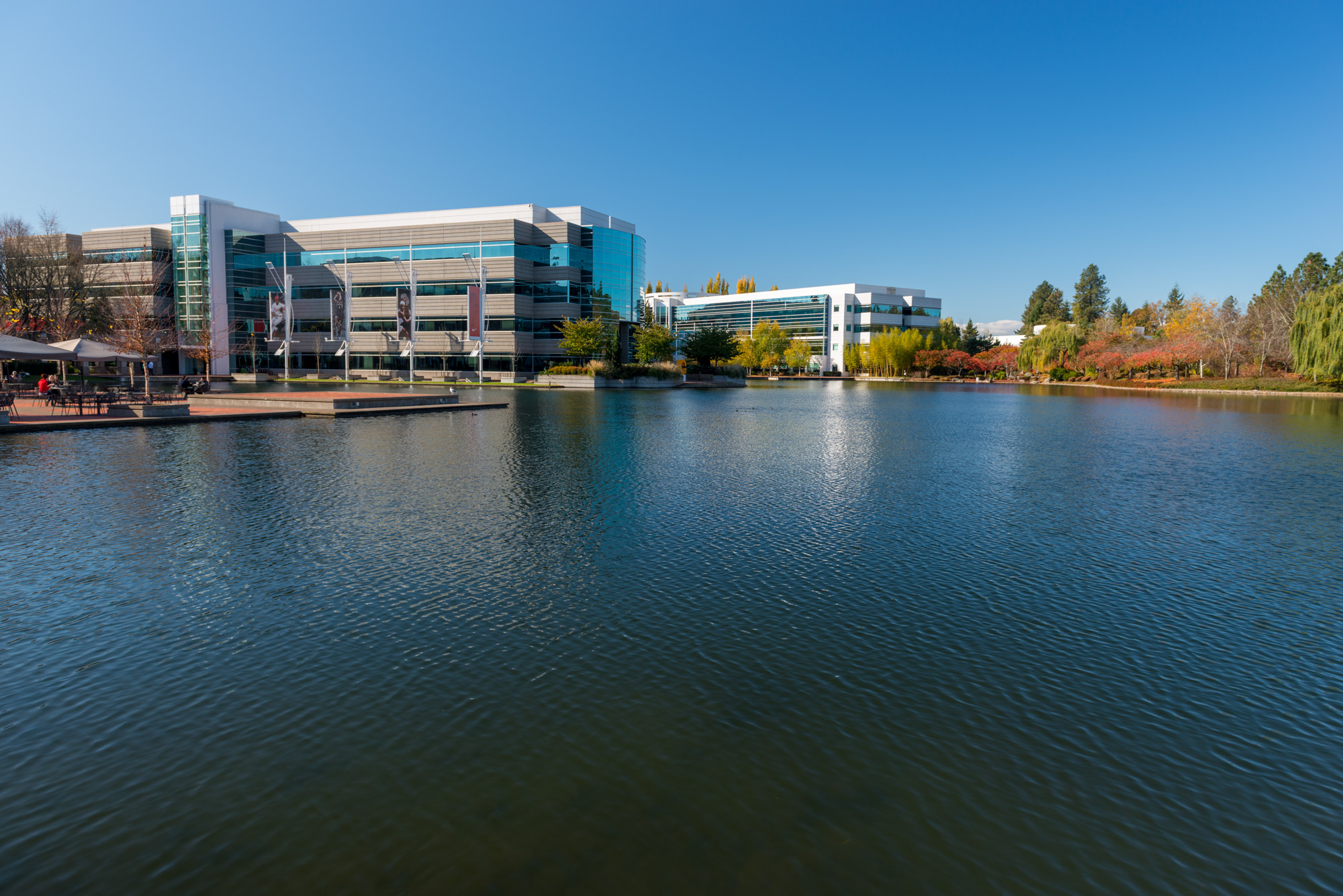
Nike's world headquarters are surrounded by the city of Beaverton but are within unincorporated Washington County. The city attempted to forcibly annex Nike's headquarters, which led to a lawsuit by Nike, and lobbying by the company that ultimately ended in Oregon Senate Bill 887 of 2005. Under that bill's terms, Beaverton is specifically barred from forcibly annexing the land that Nike and Columbia Sportswear occupy in Washington County for 35 years, while Electro Scientific Industries and Tektronix receive the same protection for 30 years.[121]
Nike is planning to build a 3.2 million square foot expansion to its World Headquarters in Beaverton.[122] The design will target LEED Platinum certification and will be highlighted by natural daylight, and a gray water treatment center.[122]
Ownership
[edit]Nike is mainly owned by institutional investors, who hold around 68% of all shares. The 10 largest shareholders of Nike in early 2024 were:[123]
- Phil Knight (17.4%)
- Vanguard (7.23%)
- BlackRock (5.93%)
- State Street Global Advisors (3.71%)
- Travis Knight (3.14%)
- Knight Foundation (1.95%)
- Capital Research and Management Company (1.94%)
- Geode Capital Management (1.57%)
- Wellington Management Company (1.48%)
- AllianceBernstein (1.32%)
Controversies
[edit]Nike has contracted with more than 700 shops around the world and has offices located in 45 countries outside the United States.[124] Most of the factories are located in Asia, including Indonesia, China, Taiwan, India,[125] Thailand, Vietnam, Pakistan, Philippines, and Malaysia.[126] Nike is hesitant to disclose information about the contract companies it works with. However, due to harsh criticism from some organizations like CorpWatch, Nike has disclosed information about its contract factories in its Corporate Governance Report.
Sweatshops
[edit]In the 1990s, Nike received criticism for its use of sweatshops.[127][128] Beginning in 1990, many protests occurred in big cities such as Los Angeles,[129] Washington, DC and Boston in order to show public outcry for Nike's use of child labor and sweatshops. Nike has been criticized for contracting with factories (known as Nike sweatshops) in countries such as China, Vietnam, Indonesia and Mexico. Vietnam Labor Watch, an activist group, has documented that factories contracted by Nike have violated minimum wage and overtime laws in Vietnam as late as 1996, although Nike claims that this practice has been stopped.[130]
As of July 2011, Nike stated that two-thirds of its factories producing Converse products still do not meet the company's standards for worker treatment. A July 2011 Associated Press article stated that employees at the company's plants in Indonesia reported constant abuse from supervisors.[131]
Child labor
[edit]During the 1990s, Nike faced criticism for the use of child labor in Cambodia and Pakistan in factories it contracted to manufacture soccer balls. Although Nike took action to curb or at least reduce the practice, they continue to contract their production to companies that operate in areas where inadequate regulation and monitoring make it hard to ensure that child labor is not being used.[132]
In 2001, a BBC documentary uncovered occurrences of child labor and poor working conditions in a Cambodian factory used by Nike.[133] The documentary focused on six girls, who all worked seven days a week, often 16 hours a day.
Strike in China factory
[edit]In April 2014, one of the biggest strikes in mainland China took place at the Yue Yuen Industrial Holdings Dongguan shoe factory, producing amongst others for Nike. Yue Yuen did underpay an employee by 250 yuan (40.82 US Dollars) per month. The average salary at Yue Yuen is 3000 yuan per month. The factory employs 70,000 people. This practice was in place for nearly 20 years.[134][135][136]
Paradise Papers
[edit]
On November 5, 2017, the Paradise Papers, a set of confidential electronic documents relating to offshore investment, revealed that Nike is among the corporations that used offshore companies to avoid taxes.[137][138][139]
Appleby documents detail how Nike boosted its after-tax profits by, among other maneuvers, transferring ownership of its Swoosh trademark to a Bermudan subsidiary, Nike International Ltd. This transfer allowed the subsidiary to charge royalties to its European headquarters in Hilversum, Netherlands, effectively converting taxable company profits to an account payable in tax-free Bermuda.[140] Although the subsidiary was effectively run by executives at Nike's main offices in Beaverton, Oregon—to the point where a duplicate of the Bermudan company's seal was needed—for tax purposes the subsidiary was treated as Bermuda. Its profits were not declared in Europe and came to light only because of a mostly unrelated case in US Tax Court, where papers filed by Nike briefly mention royalties in 2010, 2011 and 2012 totaling $3.86 billion.[140] Under an arrangement with Dutch authorities, the tax break was to expire in 2014, so another reorganization transferred the intellectual property from the Bermudan company to a Dutch commanditaire vennootschap or limited partnership, Nike Innovate CV. Dutch law treats income earned by a CV as if it had been earned by the principals, who owe no tax in the Netherlands if they do not reside there.[140]
Colin Kaepernick
[edit]In September 2018, Nike announced it had signed former American football quarterback Colin Kaepernick, noted for his controversial decision to kneel during the playing of the US national anthem, to a long-term advertising campaign.[141] According to Charles Robinson of Yahoo! Sports, Kaepernick and Nike agreed to a new contract despite the fact Kaepernick has been with the company since 2011 and said that "interest from other shoe companies" played a part in the new agreement. Robinson said the contract is a "wide endorsement" where Kaepernick will have his own branded line including shoes, shirts, jerseys and more.[142] In response, some people set fire to their own Nike-branded clothes and shoes or cut the Nike swoosh logo out of their clothes, and the Fraternal Order of Police called the advertisement an "insult";[143][144][145] others, such as LeBron James,[146] Serena Williams,[147] and the National Black Police Association,[145] praised Nike for its campaign. The College of the Ozarks removed Nike from all their athletic uniforms in response.[148]
During the following week, Nike's stock price fell 2.2%, even as online orders of Nike products rose 27% compared with the previous year.[149] In the following three months, Nike reported a rise in sales.[150]
In July 2019, Nike released a shoe featuring a Betsy Ross flag called the Air Max 1 Quick Strike Fourth of July trainers. The trainers were designed to celebrate Independence Day. The model was subsequently withdrawn after Colin Kaepernick told the brand he and others found the flag offensive because of its association with slavery.[151][152]
Nike's decision to withdraw the product drew criticism from Arizona's Republican Governor, Doug Ducey, and Texas's Republican Senator Ted Cruz.[153] Nike's decision was praised by others due to the use of the flag by white nationalists,[152] but the Anti-Defamation League's Center on Extremism has declined to add the flag to its database of "hate symbols."[154]
Hong Kong protests
[edit]
U.S. Vice President Mike Pence criticized Nike for "siding with the Chinese Communist Party and silencing free speech". He claimed that after Houston Rockets general manager Daryl Morey was criticized by the Chinese government for his tweet supporting the 2019 Hong Kong protests, Nike removed Rockets merchandise from its stores in China.[155]
On January 31, 2020, the World Athletics issued new guidelines concerning shoes to be used in the upcoming Tokyo 2020 Olympics.[156] These updates came in response to criticisms concerning technology in the Nike Vaporfly running shoes, which had been submitted beginning around 2017–2018.[157] These criticisms stated that the shoes provided athletes with an unfair advantage over their opponents and some critics considered it to be a form of technology doping.[83][158] According to Nike funded research, the shoes can improve efficiency by up to 4.2%[83] and runners who have tested the shoe are saying that it causes reduced soreness in the legs; sports technologist Bryce Dyer attributes this to the ZoomX and carbon fiber plate since it absorbs the energy and "spring[s] runners forward".[158] Some athletes, scientists, and fans have compared this to the 2008 LAZR swimsuit controversy.[159]
Some of the major changes in the guidelines that have come about as a result of these criticisms include that the "sole must be no thicker than 40mm" and that "the shoe must not contain more than one rigid embedded plate or blade (of any material) that runs either the full length or only part of the length of the shoe. The plate may be in more than one part but those parts must be located sequentially in one plane (not stacked or in parallel) and must not overlap". The components of the shoes are not the only thing that had major changes; starting April 30, 2020, "any shoe must have been available for purchase by any athlete on the open retail market (online or in store) for a period of four months before it can be used in competition".[156] Prior to these new guidelines World Athletics reviewed the Vaporfly shoes and "concluded that there is independent research that indicates that the new technology incorporated in the soles of road and spiked shoes may provide a performance advantage" and that it recommends further research to "establish the true impact of [the Vaporfly] technology."[156]
Forced Uyghur labor allegations
[edit]In December 2021, the European Center for Constitutional and Human Rights filed a criminal complaint in a Dutch court against Nike and other brands, alleging that they benefited from the use of forced Uyghur labor in Xinjiang.[160] In July 2023, the Canadian Ombudsperson for Responsible Enterprise opened an investigation into Nike to probe allegations of forced Uyghur labor in its supply chain.[161] Research of the social democratic party in the European Parliament, the Sheffield Hallam University and further groups accused Nike in 2023 of using forced labor camps exploiting Muslim Uyghurs in China provided by the Anhui Huamao Group Co., Ltd. for production.[162]
Welfare of animals used in sourcing
[edit]Following criticism from animal rights groups,[163] Nike declared its intent in 2023 to phase out the use of wool sourced from lambs that had been subjected to mulesing, a controversial practice involving the removal of skin from live lambs.[164][165]
Also in 2023, Nike pledged to eliminate the use of kangaroo leather in favor of a synthetic alternative, in response to animal activists' charge that the killing of kangaroos was unethical.[166]
Environmental record
[edit]| Part of a series on |
| Clothing and the environment |
|---|
 |
| Environmental impact of fashion |


In 2007, New England–based environmental organization Clean Air-Cool Planet ranked Nike among the top three companies (out of 56) in a survey of climate-friendly companies.[167]
Recycling
[edit]Nike has also been praised for its Nike Grind program, which closes the product lifecycle, by groups such as Climate Counts.[168]
Since 1993, Nike has worked on its Reuse-A-Shoe program.[169] This program is Nike's longest-running program that benefits both the environment and the community by collecting old athletic shoes of any type in order to process and recycle them. The material that is produced is then used to help create sports surfaces such as basketball courts, running tracks, and playgrounds.[169] Nike France made their Reuse-A-Shoe program available online so that they could make it easier for consumers to send in their old shoes.[170] In 2017, it was estimated that 28,000,000 shoes were collected since its start in 1993. Nike limited the mail-in option of the program because they are aware that the emissions from shipping would offset the good, they are trying to do. They work with the National Recycling Coalition to help limit transportation of recycled shoes. During transportation most of the vehicles that are used are using diesel or fuel oil.[171] Diesel oil emits 22.44 pounds of Carbon Dioxide per gallon.[172]
A campaign that Nike began for Earth Day 2008 was a commercial that featured basketball star Steve Nash wearing Nike's Trash Talk Shoe, which had been constructed in February 2008 from pieces of leather and synthetic leather waste from factory floors. The Trash Talk Shoe also featured a sole composed of ground-up rubber from a shoe recycling program. Nike claims this is the first performance basketball shoe that has been created from manufacturing waste, but it only produced 5,000 pairs for sale.[173]
Sulfur hexafluoride
[edit]Sulfur hexafluoride is an extremely potent and persistent greenhouse gas that was used to fill the cushion bags in all "Air"-branded shoes from 1992 to 2006.[174] 277 tons was used during the peak in 1997.[175]
Toxic chemicals
[edit]In 2008, a project through the University of North Carolina at Chapel Hill found workers were exposed to toxic isocyanates and other chemicals in footwear factories in Thailand. In addition to inhalation, dermal exposure was the biggest problem found. This could result in allergic reactions including asthmatic reactions.[176][177]
Water pollution
[edit]In July 2011, environmental group Greenpeace published a report regarding water pollution impacting the Yangtze River emitted from a major textile factory operated by Nike supplier Youngor Group.[178] Following the report, Nike, as well as Adidas, Puma, and a number of other brands included in the report announced an agreement to stop discharging hazardous chemicals by 2020.[179] However, in July 2016 Greenpeace released a follow-up report which found that Nike "does not take individual responsibility" for eliminating hazardous chemicals, stating that Nike had not made an explicit commitment to riding itself of perfluorinated compounds, and that "Nike does not ensure its suppliers report their hazardous chemical discharge data and has not made a commitment to do so".[180]
Back in 2016, Nike started to use water free dyeing materials so that they can help reduce their water use in their Southeast Asian factories.[181]
Carbon footprint
[edit]Nike reported Total CO2e emissions (Direct + Indirect) for the twelve months ending June 30, 2020 at 317 Kt (+12/+4% y-o-y)[182] and plans to reduce emissions 65% by 2030 from a 2015 base year.[183] This science-based target is aligned with Paris Agreement to limit global warming to 1.5 °C above pre-industrial levels.[184] According to a study done in 2017, Nike contributed 3,002,529 metric tons of Carbon Dioxide in 2017 combined from different sectors in the company like retail, manufacturing, management, and more.[171]
| Jun 2015 | Jun 2016 | Jun 2017 | Jun 2018 | Jun 2019 | Jun 2020 |
|---|---|---|---|---|---|
| 286[185] | 300[186] | 327[187] | 301[188] | 305[189] | 317[182] |
While emissions of Nike's two corporate jets represent less than 0.1% of its total emissions, they have increased by 20% from 2015 to 2023.[190]
Partnership with Newlight
In 2021, Nike announced they were working with Newlight Technologies to find more eco-friendly materials for their sneakers. They specifically mentioned Newlight's AirCarbon product which is a bioplastic that can be used to make shoes. The bioplastic is used as a replacement to leather, plastic, and other materials that are like that.[191] Newlight was reported saying that the goal is to reduce Nike's carbon footprint.[192]
Sustainability
[edit]Nike has taken steps to reduce its environmental impact. It has worked to reduce carbon emissions nearly 3% across its value chain from its FY11 baseline,[193] and sourced from fewer, higher-performing contract factories.[193]
In 2019, Nike began a program called "Move to Zero" in an effort to achieve zero waste and zero carbon in the organization's supply chain and product lifetime.[194] The men's and women's sections of the collection contain at least 60% organic and recycled materials, including sustainably sourced cotton.[194]
Marketing strategy
[edit]Nike promotes its products through sponsorship agreements with celebrity athletes, professional teams and college athletic teams. Nike has endorsement deals with many top sports players such as LeBron James, Kevin Durant, and Serena Williams.[195]
Advertising
[edit]
In 1982, Nike aired its first three national television ads, created by newly formed ad agency Wieden+Kennedy (W+K), during the broadcast of the New York Marathon.[196] The Cannes Advertising Festival has named Nike its Advertiser of the Year in 1994 and 2003, making it the first company to receive that honor twice.[197]
Nike also has earned the Emmy Award for best commercial in 2000 and 2002. The first was for "The Morning After," a satirical look at what a runner might face on the morning of January 1, 2000, if every dire prediction about the Y2K problem came to fruition.[198] The second was for a 2002 spot called "Move," which featured a series of famous and everyday athletes in a variety of athletic pursuits.[199]
Beatles song
[edit]Nike was criticized for its use of the Beatles song "Revolution" in a 1987 commercial against the wishes of Apple Records, the Beatles' recording company. Nike paid US$250,000 to Capitol Records Inc., which held the North American licensing rights to the recordings, for the right to use the Beatles' rendition for a year.[200]
That same year, Apple Records sued Nike Inc., Capitol Records Inc., EMI Records Inc. and Wieden+Kennedy for $15 million.[200] Capitol-EMI countered by saying the lawsuit was "groundless" because Capitol had licensed the use of "Revolution" with the "active support and encouragement of Yoko Ono, a shareholder and director of Apple Records."
Nike discontinued airing ads featuring "Revolution" in March 1988. Yoko Ono later gave permission to Nike to use John Lennon's "Instant Karma" in another advertisement.
New media marketing
[edit]Nike was an early adopter of internet marketing, email management technologies, and using broadcast and narrowcast communication technologies to create multimedia marketing campaigns.
Minor Threat advertisement
[edit]In late June 2005, Nike received criticism from Ian MacKaye, owner of Dischord Records, guitarist/vocalist for Fugazi and The Evens, and front man of the defunct punk band Minor Threat, for appropriating imagery and text from Minor Threat's 1981 self-titled album's cover art in a flyer promoting Nike Skateboarding's 2005 East Coast demo tour.[201]
On June 27, Nike Skateboarding's website issued an apology to Dischord, Minor Threat, and fans of both and announced that they have tried to remove and dispose of all flyers. They stated that the people who designed it were skateboarders and Minor Threat fans themselves who created the advertisement out of respect and appreciation for the band.[202] The dispute was eventually settled out of court between Nike and Minor Threat.

Nike 6.0
[edit]As part of the 6.0 campaign, Nike introduced a new line of T-shirts that include phrases such as "Dope", "Get High" and "Ride Pipe" – sports lingo that is also a double entendre for drug use. Boston Mayor Thomas Menino expressed his objection to the shirts after seeing them in a window display at the city's Niketown and asked the store to remove the display. "What we don't need is a major corporation like Nike, which tries to appeal to the younger generation, out there giving credence to the drug issue," Menino told The Boston Herald. A company official stated the shirts were meant to pay homage to extreme sports, and that Nike does not condone the illegal use of drugs.[203] Nike was forced to replace the shirt line.[204]
NBA uniform deal
[edit]In June 2015, Nike signed an 8-year deal with the NBA to become the official uniform supplier for the league, beginning with the 2017–18 season.[205] The brand took over for Adidas, who provided the uniforms for the league since 2006.[205] Unlike previous deals, Nike's logo appear on NBA jerseys – a first for the league.[205] Initially, the Charlotte Hornets, owned by longtime Nike endorser Michael Jordan, were the only team not to sport the Nike swoosh, instead wearing the Jumpman logo associated with Jordan-related merchandise.[206] However, beginning with the 2020–21 season, the Jumpman replaced the swoosh on the NBA's alternate "Statement" uniforms.[207] In October 2024, Nike announced a 12-year global extension of the partnership, retaining exclusive rights to design and manufacture uniforms for the NBA, WNBA and NBA G League through 2037.[208]
Sponsorship
[edit]
Nike sponsors top athletes in many sports to use their products and promote and advertise their technology and design. Nike's first professional athlete endorser was Romanian tennis player Ilie Năstase.[26] The first track endorser was distance runner Steve Prefontaine. Prefontaine was the prized pupil of the company's co-founder, Bill Bowerman, while he coached at the University of Oregon. Today, the Steve Prefontaine Building is named in his honor at Nike's corporate headquarters. Nike has only made one statue of its sponsored athletes and it is of Steve Prefontaine.[209]
Nike has also sponsored many other successful track and field athletes over the years, such as Sebastian Coe, Carl Lewis, Jackie Joyner-Kersee, Michael Johnson and Allyson Felix. The signing of basketball player Michael Jordan in 1984, with his subsequent promotion of Nike over the course of his career, with Spike Lee as Mars Blackmon, proved to be one of the biggest boosts to Nike's publicity and sales.[210]

Nike is a major sponsor of the athletic programs at Penn State University and named its first child care facility after Joe Paterno when it opened in 1990 at the company's headquarters. Nike originally announced it would not remove Paterno's name from the building in the wake of the Penn State sex abuse scandal. After the Freeh Report was released on July 12, 2012, Nike CEO Mark Parker announced the name Joe Paterno would be removed immediately from the child development center. A new name has yet to be announced.[213][214]

In the early 1990s, Nike made a strong push into the soccer business making endorsement deals with famous and charismatic players such as Romário, Eric Cantona or Edgar Davids. They continued the growth in the sport by signing more top players including: Ronaldo, Ronaldinho, Francesco Totti, Thierry Henry, Didier Drogba, Andrés Iniesta, Wayne Rooney and still have many of the sport's biggest stars under their name, with Cristiano Ronaldo, Zlatan Ibrahimović, Neymar, Harry Kane, Eden Hazard and Kylian Mbappé among others.[215] A Barcelona prodigy, Lionel Messi had been signed with Nike since age 14, but transferred to Adidas after they successfully challenged their rival's claim to his image rights in court.[216]
.jpg)
Nike has been the official ball supplier for the Premier League since the 2000–01 season.[217] In 2012, Nike carried a commercial partnership with the Asian Football Confederation.[218] In August 2014, Nike announced that they will not renew their kit supply deal with Manchester United after the 2014–15 season, citing rising costs.[219] Since the start of the 2015–16 season, Adidas has manufactured Manchester United's kit as part of a world-record 10-year deal worth a minimum of £750 million.[220]
.JPG)
Nike still has many of the top teams playing in their uniforms, including: FC Barcelona, Paris Saint-Germain and Liverpool (the latter from the 2020–21 season),[221] and the national teams of Brazil, France, England, Uruguay and the Netherlands among many others.
Nike has been the sponsor for many top ranked tennis players. Brand's commercial success in the sport went hand in hand with the endorsement deals signed with the biggest and the world's most charismatic stars and number one ranked players of the subsequent eras, including John McEnroe in the 1980s, Andre Agassi and Pete Sampras in the 1990s and Roger Federer, Rafael Nadal, Serena Williams and Maria Sharapova with the start of the 21st century.[222]
.jpg)
Nike sponsored Tiger Woods until 2024,[223] and remained on his side amid the controversies that shaped the golfer's career.[224] In January 2013, Nike signed Rory McIlroy, the then No 1 golfer in the world to a 10-year sponsorship deal worth $250 million.[225] Nike has also gone on to sign top players in golf including Scottie Scheffler, Brooks Koepka, Nelly Korda, Tommy Fleetwood, Tony Finau and Cam Davis. Nike’s 2016 decision to exit the golf equipment business–such as club manufacturing–due to an 8.2% decline sales in one year meant sponsored athletes exclusively wore Nike apparel.[226][227]
Nike was the official kit sponsor for the Indian cricket team from 2005 to 2020.[228][229] On February 21, 2013, Nike announced it suspended its contract with South African limbless athlete Oscar Pistorius, due to him being charged with premeditated murder.[230]
Nike consolidated its position in basketball in 2015 when it was announced that the company would sign an 8-year deal with the NBA, taking over from the league's previous uniform sponsor, Adidas. The deal required all franchise team members to wear jerseys and shorts with the Swoosh logo, beginning with the 2017/18 season.[231] After the success of partnership with Jordan, which resulted in the creation of the unique Air Jordan brand, Nike has continued to build partnership with the biggest names in basketball. LeBron James was given the Slogan "We are All Witnesses" when he signed with Nike. Similar to "Air Jordan", James' brand became massively popular.[232] Some have had signature shoes designed for them, including Kobe Bryant, Jason Kidd, Vince Carter and more recently, James and Kevin Durant, Giannis Antetokounmpo, Jayson Tatum, Paul George and Luka Dončić, among others.[233][234][235][236][237][238]
Nike recently made signature shoes for WNBA stars as well, as the leagues popularity takes off. Although a dozen women have received signature sneakers in the WNBA's 27-year history, it had been over a decade since a woman had received a signature sneaker. Nike's first signature shoe in the WNBA was with Sheryl Swoops, and since then they have made signature silhouettes for Lisa Leslie, Dawn Staley, Cynthia Cooper, and most recently for Sabrina Ionescu.[239] Caitlin Clark will also receive a signature shoe deal as part of her eight-year, 28 million dollar deal.[240]
A news report originating from CNN reported that Nike spent $11.5 billion, nearly a third of its sales, on marketing and endorsement contracts in the year 2018. Nike and its Jordan brand sponsored 85 men's and women's basketball teams in the NCAA tournament.[241]
Ties with the University of Oregon
[edit]Nike maintains strong ties, both directly and through partnerships with Phil Knight, with the University of Oregon.[242] Nike designs the University of Oregon football program's team attire.[243] New unique combinations are issued before every game day.[242] Tinker Hatfield, who also redesigned the university's logo, leads this effort.[244]
More recently, the corporation donated $13.5 million towards the renovation and expansion of Hayward Field.[245]
Phil Knight has invested substantial personal funds towards developing and maintaining the university's athletic apparatus.[246] His university projects often involve input from Nike designers and executives, such as Tinker Hatfield.[244]
Causes
[edit]In 2012, Nike is listed as a partner of the (PRODUCT)RED campaign together with other brands such as Girl, American Express, and Converse. The campaign's mission is to prevent the transmission of HIV from mother to child. The campaign's byline is "Fighting For An AIDS Free Generation". The company's goal is to raise and send funds, for education and medical assistance to those who live in areas heavily affected by AIDS.[247] In 2023, Nike became the presenting sponsor of Reviving Baseball in Inner Cities, which encourages youth in underserved communities to participate in baseball and softball.[248]
Program
[edit]The Nike Community Ambassador Program, allows Nike employees from around the world to go out and give to their community. Over 3,900 employees from various Nike stores have participated in teaching children to be active and healthy.[249]
Research
[edit]In 2016, a study done by RTG Consulting Group reflected that Nike was the 3rd most relevant brand for Gen-Z in China.[250][251]
Roth MKM's 2023 Millennial survey reported in March that millennials with health and wellness concerns in the aftermath of the pandemic ranked brands like Nike, Adidas and Lululemon[252] as their preferred brands for purchases.[252]
In January 2023, a study by Rakuten concluded that Nike was the most popular sportswear brand in the US, followed by Lululemon and Adidas.[253][254]
In July 2023, a study by Kantar found that Americans consider Nike as the Most Inclusive Brands (alongside other top brands like Amazon, and Disney).[255]
See also
[edit]- Bruce Brenn
- Dick Donahue
- Nike timeline
- Breaking2 – A project by Nike to break the 2 hour marathon barrier.
- List of companies based in Oregon


Notes
[edit]References
[edit]- ^ Pacheco, Inti (September 22, 2024). "Elliott Hill Loved Nike and Left It. Now He's Back as CEO". The Wall Street Journal. Retrieved October 5, 2024.
- ^ Kish, Matthew (November 15, 2023). "Nike shuffles top executives, names new heads of innovation, design, marketing and technology". The Oregonian. Retrieved March 1, 2024.
- ^ "US SEC: 2024 Form 10-K NIKE, Inc". U.S. Securities and Exchange Commission. July 25, 2024.
- ^ Hooton, Christopher (June 2, 2014). "Nike is pronounced Nikey, confirms guy who ought to know". The Independent. Archived from the original on June 21, 2022. Retrieved July 20, 2021.
- ^ Jefferies, Stuart (June 3, 2014). "It's official: Nike rhymes with spiky – and you're saying all these wrong too". the Guardian. Retrieved January 13, 2023.
- ^ "Contact Nike, Inc". Nike, Inc. Archived from the original on June 30, 2021. Retrieved June 29, 2021.
- ^ "Nike annual revenue worldwide 2022". Statista. Retrieved February 19, 2023.
- ^ Sage, Alexandria (June 26, 2008). "Nike profit up but shares tumble on U.S. concerns". Reuters. Retrieved July 10, 2008.
- ^ Levinson, Philip. "How Nike almost ended up with a very different name". Business Insider. Retrieved June 7, 2017.
- ^ "Nike CR7". Nike, Inc.
- ^ "Nike sells Bauer Hockey for $200 Million". The Sports Network. February 21, 2008. Archived from the original on February 25, 2008. Retrieved June 2, 2008.
- ^ "Nike (NKE)". Forbes. Retrieved June 30, 2024.
- ^ "Most Valuable Apparel Brand? Nike Just Does It Again". Brand Finance. Retrieved September 12, 2020.
- ^ "The World's Most Valuable Brands 2017: 16. Nike". Forbes. Retrieved September 27, 2017.
- ^ "Fortune 500 Companies 2018: Who Made the List". Fortune. Archived from the original on November 10, 2018. Retrieved November 10, 2018.
- ^ a b O'Reilly, Lara (November 4, 2014). "11 Things Hardly Anyone Knows About Nike". Business Insider. Retrieved January 26, 2020.
- ^ Hague, Jim (May 14, 2006). "Truant officer was Olympic hero Emerson High has gold medalist in midst". The Hudson Reporter. Archived from the original on May 4, 2012. Retrieved March 18, 2012.
- ^ Adele Hast; Thomson Gale (1992). International directory of company histories. Vol. 5. Detroit, MI: St. James Press. p. 372. ISBN 978-1-55862-646-1. OCLC 769042318.
- ^ "History of NIKE, Inc". FundingUniverse.
- ^ Peterson, Hayley. "The bizarre inspiration behind Nike's first pair of running shoes". Business Insider. Retrieved April 26, 2018.
- ^ Holt, Douglas; Cameron, Douglas (November 1, 2010). Cultural Strategy: Using Innovative Ideologies to Build Breakthrough Brands. Oxford University Press. pp. 41–. ISBN 978-0-19-958740-7. Retrieved November 1, 2011.
- ^ Scheerder, Jeroen (2010). Vlaanderen loopt! Sociaal-wetenschappelijk onderzoek naar de loopsportmarkt. Academia Press. pp. 75–. ISBN 978-90-382-1484-9. Retrieved November 1, 2011.
- ^ a b c Gereffi, Gary; Korzeniewicz, Miguel (1993). Commodity Chains and Global Capitalism. Westport, CT: Greenwood Publishing Group. p. 253. ISBN 0-275-94573-1.
- ^ Houze, Rebecca (2016). New Mythologies in Design and Culture: Reading Signs and Symbols in the Visual Landscape. London: Bloomsbury Publishing. ISBN 978-1-4725-1849-1.
- ^ "Logos that became legends: Icons from the world of advertising". The Independent. January 4, 2008. Retrieved February 11, 2010.
- ^ a b Meyer, Jack (August 14, 2019). "History of Nike: Timeline and Facts". TheStreet.com. Retrieved January 26, 2020.
- ^ Hunt, Joshua (2018). University of Nike: How Corporate Cash Bought American Higher Education. Brooklyn, NY: Melville House. p. 22. ISBN 978-1-61219-691-6.
- ^ Murphy, Cait (2016). A History of American Sports in 100 Objects. New York: Basic Books. p. 1973. ISBN 978-0-465-09775-3.
- ^ "Registration Number 72414177". TSDR. U.S. Patent & Trademark Office. Retrieved May 18, 2014.
- ^ a b "Nike Inc". adage.com. September 15, 2003. Retrieved January 26, 2020.
- ^ "Nike Inc". Encyclopedia.com. Retrieved January 26, 2020.
- ^ Cole, C. L. (February 2002). "Therapeutic Publicity". Journal of Sport and Social Issues. 26 (1): 3–5. doi:10.1177/0193723502261001. ISSN 0193-7235. S2CID 220320153.
- ^ Bella, Timothy (September 4, 2018). "'Just Do It': The surprising and morbid origin story of Nike's slogan". The Washington Post. Retrieved January 26, 2020.
- ^ "Ad Age Advertising Century: Top 10 Slogans". adage.com. March 29, 1999. Retrieved January 26, 2020.
- ^ "Nike's 'Just Do It' slogan celebrates 20 years". OregonLive.com. July 18, 2008. Retrieved March 4, 2010.
- ^ Peters, Jeremy W. (August 20, 2009). "The Birth of 'Just Do It' and Other Magic Words". The New York Times.
- ^ Bachman, Rachel (April 13, 2011). "The Bachscore: Portland Timbers history and the original 'Nike' uniforms". The Oregonian. Retrieved May 1, 2024.
- ^ "History of Nike". www.newitts.com. Retrieved January 26, 2020.
- ^ Brettman, Allan (February 2, 2013). "As Nike looks to expand, it already has a 22-building empire". The Oregonian. Retrieved February 6, 2013.
The first phase of the Nike World Headquarters campus opened in 1990 and included eight buildings. Now, there are 22 buildings.
- ^ Brettman, Allan (October 27, 2011). "NikeTown Portland to close forever [at its original location] on Friday". The Oregonian. Retrieved December 23, 2016.
- ^ Wightman-Stone, Danielle (July 1, 2015). "Nike chairman Phil Knight to step down in 2016". FashionUnited. Retrieved July 1, 2015.
- ^ Bain, Marc (June 30, 2015). "How Phil Knight turned the Nike brand into a global powerhouse". Quartz. Retrieved January 26, 2020.
- ^ Vinton, Kate (June 30, 2016). "Nike Cofounder And Chairman Phil Knight Officially Retires From The Board". FashionUnited. Retrieved February 17, 2018.
- ^ Hsu, Tiffany (March 16, 2018). "Nike Executive Resigns; C.E.O. Addresses Workplace Behavior Complaints". The New York Times.
- ^ Turner, Nick (October 22, 2019). "Nike Taps EBay Veteran John Donahoe to Succeed Parker as CEO". Bloomberg LP. Retrieved October 22, 2019.
- ^ Hanbury, Mary (November 13, 2019). "Nike confirms that it is no longer selling its products on Amazon". Business Insider. Retrieved January 26, 2020.
- ^ "COMPANY NEWS; Cole-Haan to Nike For $80 Million". The New York Times. April 26, 1988.
- ^ a b Austen, Ian (February 22, 2008). "Hockey Fan, and Investor, Buys Bauer From Nike". The New York Times.
- ^ Connelly, Laylan (January 22, 2013). "Bob Hurley: Success built on everyone's inner surfer". Orange County Register. Retrieved February 13, 2013.
- ^ Partlow, Joshua (July 2003). "Nike Drafts An All Star". The Washington Post. Archived from the original on June 29, 2011. Retrieved June 2, 2008.
- ^ a b "Nike unloads Starter for $60M". Portland Business Journal. November 15, 2007. Retrieved February 13, 2013.
- ^ Townsend, Matt (October 24, 2012). "Iconix Brand Buys Nike's Umbro Soccer Unit for $225 Million". BloombergBusinessweek. Archived from the original on October 25, 2012. Retrieved February 13, 2013.
- ^ Dezember, Ryan (October 24, 2012). "After Umbro, Nike Turns to Cole Haan Sale". The Wall Street Journal. Retrieved February 12, 2013.
- ^ Stevens, Suzanne (December 3, 2012). "Nike completes Umbro sale to Iconix". Portland Business Journal. Retrieved February 13, 2013.
- ^ "Nike completes Cole Haan sale". Portland Business Journal. February 4, 2013. Retrieved February 13, 2013.
- ^ "Nike's purchase of analytics firm Zodiac highlights focus on customer lifetime value". ZDNet. Retrieved June 22, 2022.
- ^ Thomas, Lauren (August 6, 2019). "Nike acquires A.I. platform Celect, hoping to better predict shopping behavior". CNBC. Retrieved June 22, 2022.
- ^ Lawler, Richard (December 13, 2021). "Nike just bought a virtual shoe company that makes NFTs and sneakers 'for the metaverse'". The Verge. Retrieved June 22, 2022.
- ^ Kish, Matthew (February 8, 2021). "Nike acquires Datalogue as part of continued digital shift". Portland Business Journal. Retrieved February 8, 2021.
- ^ a b "Nike, Inc.: Shareholders Board Members Managers and Company Profile | US6541061031 | MarketScreener". www.marketscreener.com. Retrieved March 9, 2024.
- ^ Goldwyn Blumenthal, Robin. "Alcoa's CEO Is Remaking the Industrial Giant". Barron's. Retrieved September 13, 2015.
- ^ "Nike profit rises, futures orders up 13 percent". Reuters. December 19, 2013. Retrieved July 21, 2023.
- ^ "Nike Fiscal 2nd-Quarter Profit Jumps 40 Percent". ABC News. December 19, 2013.
- ^ Scholer, Kristen (November 20, 2015). "What Nike's Two-For-One Stock Split Means for the Dow". The Wall Street Journal. Retrieved December 1, 2015.
- ^ "Nike surges after beating on earnings and announcing $15 billion in buybacks (NKE) | Markets Insider". markets.businessinsider.com. Retrieved September 27, 2018.
- ^ "NIKE Revenue 2006–2018 | NKE". www.macrotrends.net. Retrieved October 30, 2018.
- ^ Thomas, Lauren (March 24, 2020). "Nike sales beat analysts' estimates, but earnings fall, hurt by coronavirus pandemic". CNBC. Retrieved April 17, 2024.
- ^ Harper, Justin (March 25, 2020). "Nike turns to digital sales during China shutdown". BBC News. Retrieved March 25, 2020.
- ^ "Nike pledges to cut reliance on Chinese factories".
- ^ "Nike Fundamentals 2009-2016". www.boerse.de (in German). Archived from the original on June 12, 2017. Retrieved July 26, 2025.
- ^ "Nike Fundamentals 2017-2023". boerse.de (in German). Archived from the original on April 23, 2024. Retrieved July 26, 2025.
- ^ "Nike Fundamentalanalyse | KGV | Kennzahlen". boerse.de (in German). Retrieved July 26, 2025.
- ^ "Nike launches cricket shoe Air Zoom Yorker". The Hindu Business Line. September 2, 2006. Archived from the original on August 11, 2011. Retrieved June 2, 2008.
- ^ "Nike Air Zoom Control II FS Futsal Shoes at Soccer Pro". Soccerpro.com. Retrieved March 4, 2010.
- ^ T. Scott Saponas; Jonathan Lester; Carl Hartung; Tadayoshi Kohno. "Devices That Tell On You: The Nike+iPod Sport Kit" (PDF). Archived from the original (PDF) on September 7, 2012.
- ^ Tom Espiner (December 13, 2006). "Nike+iPod raises RFID privacy concerns". CNet. Archived from the original on September 4, 2012.
- ^ "SPARQ – Nike Performance Summitt". SPECTRUM, Inc. June 4, 2013. Retrieved April 13, 2017.
- ^ "Latest materials improve sportswear performance". ICIS Chemical Business. Retrieved October 14, 2008.
- ^ "Newest Nike Zoom Running Shoes | SneakerNews.com". June 8, 2015.
- ^ Verry, Peter (March 2, 2016). "Nike Air Zoom Vomero 11 Drops Tomorrow".
- ^ Dan Hajducky,"Nike, Puma to stop using kangaroo leather in soccer boots, all products," ESPN, 13 March 2023.
- ^ "Factbox: Nike's Vaporfly running shoes and tumbling records". Reuters. January 24, 2020. Retrieved March 10, 2020.
- ^ a b c d e f Bachman, Rachel; Safdar, Khadeeja (January 31, 2020). "Nike Vaporfly Shoes Won't Be Banned From Olympics". WSJ.
- ^ "Nike Vaporfly. Featuring the new Vaporfly NEXT%". Nike.com. Retrieved March 11, 2020.
- ^ McKee, Alan (April 15, 2008). Beautiful things in popular culture. Wiley. p. 106. ISBN 9781405178556. Retrieved April 2, 2016.
- ^ Goldman, Peter; Papson, Stephen (1998). Nike Culture: The Sign of the Swoosh. SAGE. pp. 88, 102. ISBN 9780761961499. Retrieved April 2, 2016.
- ^ Carbasho, Tracy (2010). Nike. ABC-CLIO. p. 17. ISBN 9781598843439. Retrieved April 2, 2016.
- ^ "Nike's High-Stepping Air Force". Popular Mechanics. Hearst Magazines. August 1987. p. 33. Retrieved April 2, 2016.
- ^ Media, Working Mother (August 1987). "Nike advert". Working Mother. p. 76. Retrieved April 2, 2016.
- ^ "Five Easy Steps to Re-Selling Your Sneakers on the Internet". GQ. September 29, 2015.
- ^ "New Nike Air Max Plus Colorways Are on the Way". Highsnobiety. November 2, 2021.
- ^ "Sneaker Watch". Archived from the original on January 7, 2019. Retrieved April 10, 2016.
- ^ Peterson, Hayley. "Here's How Teens Really Spend Money, What They Like, And Where They Shop". Business Insider.
- ^ Haig, Matt (July 12, 2005). Brand Failures: The Truth about the 100 Biggest Branding Mistakes of All Time. Kogan Page Publishers. ISBN 9780749444334 – via Google Books.
- ^ McWilliams, Tracy (March 1, 2012). Dress to Express: Seven Secrets to Overcoming Closet Trauma and Revealing Your Inner Beauty. New World Library. ISBN 9781608681495 – via Google Books.
- ^ "26 signs you're the absolute queen of basic bitches". hannahgale.co.uk. January 22, 2015. Archived from the original on January 24, 2015.
- ^ "7 Basic Fall Looks to Embrace Your Inner #Basic". Vogue. September 19, 2014.
- ^ "Nike could be J. Crew's toughest rival". Money Times. September 7, 2015.
- ^ "A comprehensive manual on becoming an EX4 basic betch". University of Exeter. October 21, 2015.
- ^ Adelson, Karen Iorio (September 20, 2017). "The On-Sale Running Shorts You Should Buy in Bulk". Racked. Retrieved August 6, 2023.
- ^ "Nike Tempo trend". Archived from the original on April 13, 2016. Retrieved April 2, 2016.
- ^ "10 Best Women's Running Shorts For Your New Year Fitness Regime". British Vogue. October 15, 2020. Retrieved August 6, 2023.
- ^ Running for beginners. Imagine. 2013. p. 240. ISBN 9781908955111. Retrieved April 2, 2016.
- ^ Fielders, Suzy (March 30, 2016). "The Young & the Stylish". Winston-Salem Journal.
- ^ "Introducing the Nike Elite". Archived from the original on February 27, 2021. Retrieved April 2, 2016.
- ^ "Colorful socks no longer a fad". Archived from the original on April 1, 2019. Retrieved April 2, 2016.
- ^ "Dr Jays". Archived from the original on April 16, 2016. Retrieved April 2, 2016.
- ^ "These Aaliyah, Nino Brown, and Eazy-E Nike Elite Socks Can't Be Real Life". Complex.
- ^ "Nike Elite Is Releasing Socks Using Its Digital Ink Printing Process in Limited Quantities". Complex.
- ^ "The 2015 Nike Mag". NIKE, Inc. Retrieved October 23, 2015.
- ^ Rooney, Kyle (October 21, 2016). "The Michael J. Fox Foundation does raffle with Nike to raise awareness for Parkinson's disease". Hotnewhiphop. Retrieved October 21, 2016.
- ^ "NikeLab". www.nike.com. Retrieved November 30, 2016.
- ^ Clarke, Khari (June 12, 2014). "Nike Will Launch "NikeLab" Stores Worldwide Tomorrow - The Source". Retrieved August 6, 2023.
- ^ "Nike Is FINALLY Launching a Plus-Size Collection". Teen Vogue. March 2, 2017. Retrieved August 6, 2023.
- ^ Lekach, Sasha (March 2017). "Nike finally releases plus-size clothing line for women". Mashable. Retrieved March 3, 2017.
- ^ Bracetti, Alex. "Converse Unveils All-Star Modern Sneakers". AskMen.
- ^ "Nike's $100,000 USD "Moon Shoe" Is a Piece of Sneaker History". Hypebeast. March 16, 2021. Retrieved August 6, 2023.
- ^ "Nike shoes race to $437,500 world record auction price for sneakers". Reuters. July 24, 2019. Retrieved October 3, 2019.
- ^ Williams, Alex (May 26, 2022). "Nike Sold an NFT Sneaker for $134,000". The New York Times.
- ^ Daniel Van Boom (April 28, 2022). "These Nike NFT 'Cryptokicks' Sneakers Sold For $130K". CNET. Retrieved January 7, 2023.
- ^ "Appellate court rejects Beaverton annexation | The Oregonian Extra". Blog.oregonlive.com. June 16, 2006. Retrieved March 4, 2010.
- ^ a b Siemers, Erik (January 20, 2016). "A first look at Nike's $380M-plus HQ expansion (Renderings)". American City Business Journals.
- ^ "NIKE, Inc. Insider Trading & Ownership Structure". Simply Wall St. Retrieved March 9, 2024.
- ^ "Corporate Responsibility". www.nike.com. Archived from the original on September 29, 2007.
- ^ "India's 50 most trusted brands". rediff.com. January 20, 2011.
- ^ "List of factories" (PDF). www.nike.com. Archived from the original (PDF) on June 20, 2007.
- ^ "Nike is facing a new wave of anti-sweatshop protests". Ресурсный центр по вопросам бизнеса и прав человека [Business & Human Rights Resource Centre]. August 1, 2017. Archived from the original on July 12, 2022. Retrieved July 12, 2022.
- ^ "Nike is facing a new wave of anti-sweatshop protests". MR Magazine. August 2, 2017. Retrieved July 12, 2022.
- ^ "Boycott of Shoe Company Is Burning Issue at Protest". Los Angeles Times. December 22, 1990.
- ^ "Nike Labor Practices in Vietnam". www.saigon.com. Archived from the original on April 18, 2001.
- ^ Associated Press, "Nike still dogged by worker abuses", Japan Times, July 15, 2011, p. 4.
- ^ "MIT" (PDF). Retrieved September 18, 2010.
- ^ Sun Thyda, 12 (October 15, 2000). "Programmes | Panorama | Archive | Gap and Nike: No Sweat? October 15, 2000". BBC News. Retrieved March 4, 2010.
{{cite news}}: CS1 maint: numeric names: authors list (link) - ^ More than ten thousand workers stage strike at massive Dongguan shoe factory, April 14, 2014
- ^ Yue Yuen shoe factory workers' strike at Dongguan plants continues, April 17, 2014.
- ^ Yue Yuen strikers vow to continue until benefit contribution deficit paid in full, South China Morning Post, April 18, 2013.
- ^ "'Paradise papers' expose tax evasion schemes of the global elite". Deutsche Welle. November 5, 2017.
- ^ "So lief die SZ-Recherche". Süddeutsche Zeitung. November 5, 2017.
- ^ "Offshore Trove Exposes Trump-Russia Links And Piggy Banks Of The Wealthiest 1 Percent". International Consortium of Investigative Journalists. November 5, 2017. Retrieved November 7, 2017.
- ^ a b c Simon Bowers (November 6, 2017). "How NikeStays One Step Ahead of the Regulators: When One Tax Loophole Closes, Another Opens". ICIJ. Retrieved November 6, 2017.
- ^ Einhorn, Bruce (September 4, 2018). "Nike Falls as Critics Fume on Social Media Over Kaepernick Deal". Bloomberg.
- ^ Daniels, Tim (September 3, 2018). "Colin Kaepernick Named Face of Nike's 30th Anniversary of 'Just Do It' Campaign". Bleacher Report.
- ^ "People Are Already Burning Their Nikes in Response to the Colin Kaepernick Ad". Esquire. September 4, 2018. Retrieved September 5, 2018.
- ^ "People are destroying their Nike shoes and socks to protest Nike's Colin Kaepernick ad campaign". Business Insider France (in French). Retrieved September 5, 2018.
- ^ a b Golding, Shenequa (September 6, 2018). "The National Black Police Association Is In Full Support Of Nike's Colin Kaepernick Ad". Vibe. Retrieved September 7, 2018.
- ^ Cancian, Dan (September 6, 2018). "LeBron 'Stands with Nike' in Support of Colin Kaepernick's Campaign". Newsweek. Retrieved September 7, 2018.
- ^ "Serena Williams supports Nike's decision to endorse Colin Kaepernick". Global News. Retrieved September 7, 2018.
- ^ Wheeler, Wyatt D. (September 5, 2018). "College of the Ozarks drops Nike, will 'choose country over company'". Springfield News-Leader. Retrieved September 7, 2018.
- ^ Novy-Williams, Eben (September 7, 2018). "Nike Orders Rose in Four-Day Period After Kaepernick Ad Debut". Bloomberg.com. Retrieved September 8, 2018.
- ^ "Nike hit by conservative backlash over 'racist trainer'". BBC. Retrieved July 3, 2019.
- ^ "Nike pulls Fourth of July trainers after Colin Kaepernick 'raises concerns'". The Independent. July 2, 2019. Archived from the original on June 21, 2022. Retrieved July 2, 2019.
- ^ a b "Nike 'pulls Betsy Ross flag trainer after Kaepernick complaint'". BBC News. July 2, 2019. Retrieved July 2, 2019.
- ^ "Nike Pulls 'Betsy Ross Flag' Sneakers After Kaepernick Complaint". July 2, 2019. Retrieved July 2, 2019.
- ^ Goldberg, Jonah (July 15, 2019). "Nike fans the flames of the culture war". Baltimore Sun. Retrieved August 12, 2019.
- ^ Alper, Alexandra; Spetalnick, Matt (October 24, 2019). "Pence backs Hong Kong protests in China speech, slams NBA and Nike". Reuters.
- ^ a b c "World Athletics modifies rules governing competition shoes for elite athletes". www.worldathletics.org. Retrieved March 26, 2020.
- ^ The Race for Brands to Match Nike's Vaporfly, retrieved March 26, 2020
- ^ a b "Nike Vaporfly Shoes Controversy". NPR.org. Retrieved March 26, 2020.
- ^ Kilgore, Adam. "Nike's Vaporfly shoes changed running, and the track and field world is still sifting through the fallout". Washington Post. Retrieved March 26, 2020.
- ^ Adegeest, Don-Alvin (December 6, 2021). "Nike, Patagonia named in European lawsuit as being complicit in 'forced labour' practices in Xinjiang, China". FashionUnited. Retrieved December 9, 2021.
- ^ Shakil, Ismail; Rajagopal, Divya; Rajagopal, Divya (July 11, 2023). "Canada probes Nike, Dynasty Gold over alleged use of forced labor in China". Reuters. Retrieved July 11, 2023.
- ^ "Tailoring Responsibility: Tracing Apparel Supply Chains from the Uyghur Region to Europe" (PDF). Uyghur Rights Monitor, the Helena Kennedy Centre for International Justice at Sheffield Hallam University. p. 17.
- ^ "Social campaign urged Nike to stop the cruel and painful practice of mulesing". June 16, 2022. Retrieved March 25, 2025.
- ^ Ndure, Isatou (June 22, 2023). "Nike joins Adidas and Puma in certified wool standard, higher animal welfare". Just Style. Retrieved March 25, 2025.
- ^ "New Zealand bans mulesing". www.farmonline.com.au. September 10, 2018. Retrieved March 25, 2025.
- ^ Touma, Rafqa (March 14, 2023). "Animal activists and commercial industry at odds after Nike halts use of kangaroo leather". The Guardian. ISSN 0261-3077. Retrieved March 25, 2025.
- ^ Zabarenko, Deborah (June 19, 2007). "Canon tops list of climate-friendly companies". Reuters. Retrieved September 18, 2010.
- ^ "Nike". ClimateCounts. Archived from the original on February 12, 2011. Retrieved September 18, 2010.
- ^ a b "Wicked Local". April 29, 2008. Archived from the original on July 25, 2008. Retrieved May 4, 2008.
- ^ EcoBahn (July 21, 2020). "Nike Reuse-A-Shoe: Digital Upcycling Shift". EcoBahn. Retrieved November 6, 2022.
- ^ a b Curtis, Alexander; Hansson, Amanda. "Examining the Viability of Corporate Recycling Initiatives and Their Overall Environmental Impact: The Case of Nike Grind and the Reuse-A-Shoe Program". Retrieved November 18, 2022.
- ^ Smoot, Grace (October 28, 2021). "What Is the Carbon Footprint of Diesel Fuel? A Life-Cycle Assessment". Impactful Ninja. Retrieved November 18, 2022.
- ^ [1] Archived May 5, 2008, at the Wayback Machine
- ^ Stanley Holmes (September 24, 2006). "Nike Goes For The Green". Bloomberg Business Week Magazine. Archived from the original on June 3, 2013. Retrieved December 14, 2013.
- ^ J. Harnisch and W. Schwarz (February 4, 2003). "Final report on the costs and the impact on emissions of potential regulatory framework for reducing emissions of hydrofluorocarbons, perfluorocarbons and sulphur hexafluoride" (PDF). Ecofys GmbH.
- ^ Todd, L. A.; Sitthichok, T. P.; Mottus, K.; Mihlan, G.; Wing, S. (2008). "Health Survey of Workers Exposed to Mixed Solvent and Ergonomic Hazards in Footwear and Equipment Factory Workers in Thailand". Annals of Occupational Hygiene. 52 (3): 195–205. doi:10.1093/annhyg/men003. PMID 18344534.
- ^ Todd, L. A.; Mottus, K.; Mihlan, G. J. (2008). "A Survey of Airborne and Skin Exposures to Chemicals in Footwear and Equipment Factories in Thailand". Journal of Occupational and Environmental Hygiene. 5 (3): 169–181. Bibcode:2008JOEH....5..169T. doi:10.1080/15459620701853342. PMID 18213531. S2CID 13571160.
- ^ Watts, Jonathan (July 13, 2011). "Greenpeace report links western firms to Chinese river polluters". The Guardian. Archived from the original on June 11, 2021. Retrieved August 11, 2021.
- ^ Brettman, Allan (November 19, 2011). "Nike, Adidas, Puma agree with Greenpeace to clean water in worldwide production by 2020". The Oregonian. Archived from the original on October 20, 2020. Retrieved August 11, 2021.
- ^ "THE DETOX CATWALK 2016". Greenpeace. 2016. Archived from the original on April 1, 2020. Retrieved August 10, 2021.
- ^ "Nike: A Poster Child for Climate Change?". Technology and Operations Management. Retrieved November 6, 2022.
- ^ a b "Nike's Sustainability Report for 2020Q2" (PDF). Archived from the original (PDF) on July 10, 2021. Alt URL
- ^ "Nike's Sustainability Report for 2021Q1". Archived from the original on November 11, 2021. Alternate URL
- ^ "Companies taking action". Science Based Targets.
- ^ "Nike's Sustainability Report for 2019Q2" (PDF). Archived from the original (PDF) on October 25, 2020. Alt URL
- ^ "Nike's Sustainability Report for 2019Q2" (PDF). Archived from the original (PDF) on October 25, 2020. Alt URL
- ^ "Nike's Sustainability Report for 2019Q2" (PDF). Archived from the original (PDF) on October 25, 2020. Alt URL
- ^ "Nike's Sustainability Report for 2019Q2" (PDF). Archived from the original (PDF) on October 25, 2020. Alt URL
- ^ "Nike's Sustainability Report for 2019Q2" (PDF). Archived from the original (PDF) on October 25, 2020. Alt URL
- ^ Kish, Rob Davis, Agnel Philip, Alex Mierjeski, Matthew (August 13, 2024). "After Nike Leaders Promised Climate Action, Their Corporate Jets Kept Flying — and Polluting". ProPublica. Retrieved August 24, 2024.
{{cite web}}: CS1 maint: multiple names: authors list (link) - ^ "Lexis® – Sign In | LexisNexis". signin.lexisnexis.com. Retrieved November 6, 2022.
- ^ "What the Tech? Microorganism-Harvested AirCarbon Will Make Your Next Pair of Nikes". HYPEBEAST. September 17, 2021. Retrieved November 6, 2022.
- ^ a b "FDRA | Nike's Sustainability Report Shows Environmental Impact Reductions". May 8, 2014. Retrieved April 10, 2023.
- ^ a b Hall, Christopher (February 12, 2020). "Nike's Move to Zero Collection Leaves Little Fabric Waste Behind". Sourcing Journal. ProQuest 2353833050.
- ^ "Athletes: North America". Nike.com. Retrieved December 12, 2023.
- ^ Nudd, Tim (March 25, 2014). "W+K Finds Its First Ads Ever, for Nike, on Dusty Old Tapes". Adweek. Retrieved April 9, 2017.
- ^ "Nike's Knight Is Advertiser of the Year". AllBusiness.com. Retrieved March 4, 2010.
- ^ Fass, Allison (August 31, 2000). "The Media Business: Advertising – Addenda; Nike Spot Wins An Emmy Award". The New York Times.
- ^ Rutenberg, Jim (September 20, 2002). "The Media Business: Advertising – Addenda; Nike Spot Wins An Emmy Award". The New York Times.
- ^ a b According to a July 28, 1987, article written by the Associated Press.
- ^ Levine, Robert (July 4, 2005). "A Nike Poster Upsets Fans of the Punk Rock Band Minor Threat in a Major Way". The New York Times.
- ^ "Skateboarding". Nike. Archived from the original on November 25, 2010. Retrieved September 18, 2010.
- ^ Brettman, Allan (June 22, 2011). "Nike courts controversy, publicity with drug-themed skater shirts". The Oregonian. Retrieved June 24, 2011.
- ^ "Nike Inc. (NYSE:NKE) Facing Slogan Backlash". stocksandshares.tv. June 24, 2011. Archived from the original on June 27, 2011.
- ^ a b c "Nike Signs 8-Year Deal With NBA". BallerStatus.com. June 11, 2015. Archived from the original on April 24, 2022. Retrieved June 11, 2015.
- ^ Dator, James (June 26, 2017). "The Hornets will be the only NBA team to have jerseys licensed by Jumpman". SB Nation. Retrieved July 6, 2017.
- ^ "Jumpman logo will appear on NBA Statement Edition uniforms for 2020–21 season". NBA.com. July 21, 2020. Retrieved June 18, 2022.
- ^ Vorkunov, Mike (April 11, 2025). "Nike to remain NBA's exclusive uniform, apparel provider on new 12-year contract extension". The Athletic. The New York Times. Retrieved October 14, 2025.
- ^ "Fire on the Track – The Steve Prefontaine Story – Part 1". YouTube. Retrieved June 4, 2019.[dead YouTube link]
- ^ Skidmore, Sarah. "23 years later, Air Jordans maintain mystique", The Seattle Times, January 10, 2008. Retrieved July 22, 2018.
- ^ Bailey, Ryan. "The 10 Most 'Bling' Boots in Football". Bleacher Report. Retrieved February 22, 2019.
- ^ "A Shortish History of Online Video". Vidyard. Retrieved February 22, 2019.
- ^ "Paterno's name off child care center". FOX Sports. July 12, 2012. Archived from the original on July 15, 2012. Retrieved July 12, 2012.
- ^ "Joe Paterno's Name Removed From Child Development Center at Nike Headquarters". NESN.com. July 12, 2012. Retrieved July 12, 2012.
- ^ "Jogadores de Futebol Patrocinados pela Nike". Nike Brasil. Archived from the original on April 19, 2013. Retrieved February 15, 2013.
- ^ Caioli, Luca (2012). Messi: The Inside Story of the Boy Who Became a Legend. Corinthian Books. p. 94.
- ^ Northcroft, Jonathan (October 4, 2009). "The Premier League's goal rush". The Sunday Times. Archived from the original on September 18, 2011. Retrieved December 2, 2021.
- ^ "Nike offers further backing for Asian soccer". Retrieved December 4, 2017.
- ^ "Premier League: Sportswear giants Nike to end Manchester United sponsorship". Sky Sports. London. August 7, 2014. Retrieved August 7, 2014.
- ^ Jackson, Jamie (July 14, 2014). "Manchester United sign record 10-year kit deal with Adidas worth £750m". The Guardian. London. Retrieved July 14, 2014.
- ^ "LFC announces multi-year partnership with Nike as official kit supplier from 2020–21" (Press release). Liverpool: Liverpool Football Club. Retrieved January 7, 2020.
- ^ "The History of Nike Tennis". Nike. August 20, 2015. Retrieved August 19, 2021.
- ^ "Tiger Woods and Nike end 27-year partnership". January 8, 2024.
- ^ Handley, Lucy (April 6, 2018). "Nike welcomes Tiger Woods back to the Masters with ad featuring his greatest hits". www.cnbc.com. Retrieved February 22, 2019.
- ^ Tom Fordyce (January 14, 2013). "Rory McIlroy, Nike and the $250m, 10-year sponsorship deal". BBC. Retrieved October 3, 2013.
- ^ Berr, Jonathan (August 4, 2016). "Callaway Golf shares score off Nike's market duff - CBS News". www.cbsnews.com. Retrieved June 24, 2025.
- ^ "Nike's timeline in golf". Golf Digest. Retrieved June 24, 2025.
- ^ "Team India's new NIKE ODI kit". Cricbuzz.com. October 2010. Retrieved October 3, 2013.
- ^ "Indian Cricket team's NIKE ODI kit". Cricketliveguide.com. September 29, 2010. Archived from the original on October 5, 2013. Retrieved October 3, 2013.
- ^ Scott, Roxanna (February 21, 2013). "Oscar Pistorius dropped by Nike". USA Today. Retrieved February 21, 2013.
- ^ "Sources: NBA, Nike have near-$1B apparel deal". ESPN.com. June 10, 2015. Retrieved May 29, 2019.
- ^ Fleetwood, Nicole R. (2015). On Racial Icons: Blackness and the Public Imagination (DGO - Digital original ed.). Rutgers University Press. ISBN 978-0-8135-6515-6. JSTOR j.ctt15sk7t3.
- ^ "Nike Zoom Kobe 4 Protro 'White/Del Sol' POP Returns May 24 On SNKRS". Lakers Nation. May 23, 2019. Retrieved May 29, 2019.
- ^ "Vince Carter Nike Shox BB4 Raptors PE | SneakerNews.com". Sneaker News. March 7, 2019. Retrieved May 29, 2019.
- ^ "Nike Unleashes "Hot Lava" LeBron 16s". HYPEBEAST. May 20, 2019. Retrieved May 29, 2019.
- ^ "Kevin Durant unveils Nike KD 12". SI.com. March 15, 2019. Retrieved May 29, 2019.
- ^ "Giannis Antetokounmpo re-signs with Nike for a 'long-term partnership'". November 7, 2017.
- ^ "The story behind Paul George's signature sneaker". SI.com. November 15, 2018. Retrieved May 29, 2019.
- ^ Vlahos, Nicholas (April 25, 2024). "Every WNBA Player Who's Had a Signature Sneaker". Sole Retriever. Retrieved May 31, 2024.
- ^ Vlahos, Nicholas (April 23, 2024). "Caitlin Clark Will Get a Signature Nike Sneaker". Sole Retriever. Retrieved May 31, 2024.
- ^ "Nike stocks fall after basketball prodigy touted as the 'next LeBron James' blows out his sneaker". nine.come. au. Retrieved February 21, 2019.
- ^ a b Alger, Tyson. "Oregon Ducks add orange to their Nike uniform repertoire for Colorado game". The Oregonian. Retrieved June 7, 2017.
- ^ Coaston, Jane (August 10, 2020). "The Big Ten and Pac-12 postponed the college football season. Here's how we got here". Vox. Retrieved August 31, 2020.
- ^ a b Peter, Josh. "Behind Oregon's (Phil) Knight in shining armor". USA Today. Retrieved June 7, 2017.
- ^ Germano, Sara. "Nike Pledges $13.5 Million to Help Renovate University of Oregon Track Facilities". The Wall Street Journal. Retrieved June 7, 2017.
- ^ Bishop, Greg (August 2, 2013). "Oregon Embraces 'University of Nike' Image". The New York Times.
- ^ "(RED) Partners". (RED). (RED), a division of The ONE Campaign. 2012. Retrieved October 13, 2012.
- ^ "Nike becomes presenting sponsor of RBI Program". MLB.com.
- ^ "Nike Community Ambassadors | Nike Global Community Impact". Nike Global Community Impact. Retrieved September 27, 2017.
- ^ "Top 10 brands most relevant to China's Gen-Z[1]- Chinadaily.com.cn". www.chinadaily.com.cn. Retrieved August 4, 2023.
- ^ Hall, Casey (August 19, 2016). "Apple, Nike and Adidas Win Over China's Generation Y and Z". WWD. Retrieved August 4, 2023.
- ^ a b "Report: Nike, Adidas And Lululemon Top Millennials' Favorite Athletic Brands | SGB Media Online". sgbonline.com. Retrieved August 4, 2023.
- ^ Lockwood, Lisa (January 9, 2023). "Nike Most Popular Sportswear Brand in the U.S., Followed by Lululemon and Adidas, Per Rakuten Study". WWD. Retrieved August 4, 2023.
- ^ Kevin, Brown (July 28, 2023). "Shark Week's top advertisers—and more from iSpot, Kantar, Amazon, Nike: Datacenter Weekly". Ad Age. Retrieved August 4, 2023.
- ^ "Kantar launches the Brand Inclusion Index and finds Americans consider Nike, Amazon, and Disney as the Most Inclusive Brands". www.kantar.com. Retrieved August 4, 2023.
Further reading
[edit]- Egan, Timothy (September 13, 1998). "The Swoon of the Swoosh". The New York Times.
External links
[edit]
- Official website

- Business data for Nike, Inc.:

| Subsidiaries |
|  | |||||||
|---|---|---|---|---|---|---|---|---|---|
| Brands | |||||||||
| Collaborations | |||||||||
| Products |
| ||||||||
| People | |||||||||
| Advertisement | |||||||||
| Original Run series | |||||||||
| Sponsorships | |||||||||
| Related | |||||||||

| International | |
|---|---|
| National | |
| Artists | |
| Other | |
Nike, Inc.
View on GrokipediaNike, Inc. is an American multinational corporation that designs, develops, manufactures, markets, and sells athletic footwear, apparel, equipment, accessories, and services worldwide.[1] Founded in 1964 as Blue Ribbon Sports by Phil Knight, a former middle-distance runner, and Bill Bowerman, his track coach at the University of Oregon, the company was renamed Nike, Inc. in 1971, drawing from the Greek goddess of victory.[2][3] Headquartered near Portland, Oregon, Nike has grown into the world's largest seller of athletic footwear and apparel through innovations like Bowerman's waffle trainer sole and aggressive athlete endorsements, though it has encountered labor practice scrutiny and recent revenue declines amid shifting consumer preferences and competition.[4][5] For fiscal year 2025, Nike reported revenues of $46.3 billion, a 10 percent decrease from the prior year, with a market capitalization of approximately $102 billion as of October 2025.[6][7] The company's defining characteristics include its Swoosh logo, introduced in 1971, and the "Just Do It" slogan launched in 1988, which have cemented its cultural impact in sports marketing. Nike's subsidiary brands, such as Jordan and Converse, have driven significant growth, particularly through basketball and lifestyle segments, while innovations in performance technologies like Air cushioning and Flyknit materials have maintained technological leadership.[1] However, Nike has faced internal challenges, including a 2018 employee revolt over workplace culture leading to executive departures, and more recently, merchandising missteps prompting a CEO transition in 2024 amid falling stock prices and sales pressures from rivals.[5][8] Despite these, Nike's emphasis on direct-to-consumer channels and sustainability initiatives underscores its adaptive strategy in a competitive industry.[4]
History
Founding and Initial Operations
![Phil Knight and Bill Bowerman]float-right Blue Ribbon Sports (BRS) was established on January 25, 1964, in Portland, Oregon, by Phil Knight, a former middle-distance runner, and Bill Bowerman, his coach at the University of Oregon.[9] [10] The partnership began as a distributor for Onitsuka Tiger running shoes, a Japanese brand Knight encountered during a 1962 business trip to Asia, where he secured U.S. distribution rights based on observations from his Stanford MBA thesis arguing that high-quality, low-cost Japanese athletic shoes could disrupt the U.S. market dominated by German brands like Adidas and Puma.[11] [2] Knight and Bowerman each contributed $500 toward an initial $1,000 order of 200 pairs, financed through personal savings and loans.[12] Initial operations were lean, with Knight handling sales directly from the trunk of his Plymouth Valiant at track meets, college campuses, and sports events across the West Coast, targeting runners who valued the lightweight, affordable Onitsuka models over heavier European competitors.[10] In its first year, BRS achieved $8,000 in revenue from 1,300 pairs sold, reflecting early demand among serious athletes despite limited marketing and no formal storefront.[13] By 1965, sales doubled to $20,000 as the company built a small inventory warehouse and recruited its first full-time employee, Jeff Johnson, who managed West Coast distribution and later suggested the Nike name. Operations emphasized quality control and athlete feedback, with Bowerman experimenting on shoe designs using university facilities to improve traction and comfort for training.[2] Tensions with Onitsuka over pricing and exclusivity led BRS to develop proprietary products, culminating in the company's reincorporation as Nike, Inc., on May 30, 1971, adopting the name from the Greek goddess of victory to signify a shift toward independent manufacturing.[10] The transition included the introduction of the Swoosh logo, designed by graphic student Carolyn Davidson for $35, and initial Nike-branded shoes like the waffle trainer, featuring Bowerman's innovative outsole created by pouring urethane into a modified waffle iron for better grip.[11] Early Nike operations retained the distributor model but pivoted to custom molds in Japan, enabling first U.S. Olympic team endorsements in 1972 and sales growth to over $3 million by fiscal 1973, though cash flow remained precarious due to reliance on bank loans and delayed supplier payments.[12]Expansion in the 1970s and 1980s
In 1971, the company formerly known as Blue Ribbon Sports incorporated as Nike, Inc. and introduced its signature Swoosh logo, while launching the Waffle Trainer as its first original running shoe, featuring a lightweight sole patterned after a waffle iron for enhanced grip and reduced weight.[14] This innovation, patented in 1974, capitalized on the growing U.S. jogging trend and helped differentiate Nike from competitors reliant on imported designs.[15] Nike secured its initial high-profile athlete endorsement with distance runner Steve Prefontaine starting in the early 1970s, whose visibility in track events elevated brand awareness among serious athletes despite his death in a 1975 car accident.[16] By fiscal year 1972, Nike's sales had reached $3 million, expanding to $25 million by 1977 and $149 million by 1979 through aggressive distribution to sporting goods retailers and innovations like improved nylon uppers.[17][18] The company began international sales in Canada and Europe in the mid-1970s, establishing subsidiaries to localize marketing amid rising global demand for performance footwear.[19] In 1979, Nike debuted its Air cushioning technology in the Tailwind running shoe, providing impact absorption via pressurized air units, and entered the apparel market with its first clothing line, broadening beyond footwear.[19][20] Nike's initial public offering on December 2, 1980, listed 2 million shares on the New York Stock Exchange, raising approximately $45 million in capital to fund manufacturing expansions and inventory growth, with shares closing above the $22 offering price.[21] The 1980s saw product diversification into basketball and other sports, exemplified by the 1982 Air Force 1 sneaker, which incorporated Air technology and became a cultural staple.[19] A pivotal 1984 endorsement deal with rookie basketball player Michael Jordan introduced the Air Jordan line, generating over $126 million in first-year sales and propelling Nike's basketball segment to dominate a market previously led by competitors like Converse and Adidas.[22] Sales climbed to $919 million by fiscal 1984 and $1.7 billion by 1989, supported by factory investments in the U.S. and Asia to meet surging demand.[17][19]Global Growth and Key Acquisitions
In the mid-1970s, Nike initiated its international expansion to diversify beyond the U.S. market, beginning with entry into Canada in 1972 and subsequent distribution agreements in Europe. By 1977, the company had opened markets in Asia, followed by South America in 1978, leveraging its growing product lines in athletic footwear to capitalize on emerging demand for performance gear. This period marked a shift from domestic reliance, with overseas manufacturing and sales establishing a foothold in regions like Australia by 1974.[20][23] To formalize and accelerate global operations amid slowing U.S. growth, Nike established Nike International, Ltd. in 1981 as a dedicated subsidiary for overseas expansion. This entity drove deeper penetration into Europe and Asia, including the opening of manufacturing facilities abroad and targeted marketing in high-potential markets like Japan. By the early 1990s, international sales had become a core revenue driver, contributing to total company revenues surpassing $3 billion in 1991 and supporting Nike's ascent to the world's largest sporting goods firm by 1989, with annual sales exceeding $1.1 billion.[23][19] Strategic acquisitions complemented organic growth by integrating established brands with international distribution networks. In 1988, Nike purchased Cole Haan for an undisclosed sum, gaining access to premium casual footwear markets in North America and Europe. The 1994 acquisition of Canstar Sports Inc., the Canadian maker of Bauer hockey equipment, for approximately $240 million, expanded Nike's presence in winter sports and equipment across North America and select European markets. In 2002, Nike acquired Hurley International, a surf apparel brand, for $185 million, enhancing its youth-oriented lifestyle offerings in coastal and global surf communities.[19][24] Further bolstering its global soccer footprint, Nike acquired Converse Inc. in 2003 for $305 million, adding a heritage brand with established sales in over 60 countries, and Umbro plc in 2007 for $439 million, targeting soccer markets in Europe and emerging regions like Africa and Asia. These moves diversified Nike's portfolio beyond core athletic wear, though subsequent divestitures—such as selling Umbro in 2012 and Cole Haan in 2013—reflected a strategic refocus on high-margin, brand-aligned assets amid integration challenges and market shifts. By fiscal 2007, key markets including the U.S., U.K., Japan, and China accounted for 61% of Nike brand revenues, underscoring the efficacy of combined expansion and acquisition tactics in achieving scale.[24][25]Challenges and Strategic Shifts in the 2010s and 2020s
In the 2010s, Nike faced intensifying competition from rivals such as Adidas and Under Armour, which eroded market share in key categories like running and basketball footwear, prompting investments in athlete endorsements and product innovation to maintain dominance.[26] Supply chain vulnerabilities, heavily reliant on Asian manufacturing, were highlighted during global disruptions, though the company navigated these with diversified sourcing. The 2018 Colin Kaepernick "Just Do It" campaign, featuring the former NFL quarterback known for anthem protests, generated polarized reactions but resulted in a short-term sales surge of 31% in U.S. online revenue and elevated stock prices, as measured by media exposure exceeding $43 million in the first day.[27] [28] [29] Entering the 2020s, Nike accelerated its "Consumer Direct Acceleration" strategy in June 2020, emphasizing direct-to-consumer (DTC) channels like its website and owned stores to capture higher margins—reaching 46% gross margins in fiscal 2022—while selectively reducing wholesale partnerships to control brand experience.[30] [31] This shift, however, exposed vulnerabilities during economic slowdowns and post-COVID demand normalization, as excess inventory built up without wholesale outlets to absorb it, contributing to gross margins falling to 43.5% in fiscal 2023.[32] Nike's fiscal 2025 revenue declined 10% to $46.3 billion, with fourth-quarter sales dropping 12% to $11.1 billion and net income plunging 86% to $0.2 billion, amid stagnant consumer demand and a 12% YoY fall in digital sales.[6] [33] U.S.-China trade tariffs imposed additional pressures, projecting a $1 billion cost increase in fiscal 2025—rising to $1.5 billion by mid-year—primarily affecting the 16% of footwear sourced from China, prompting Nike to accelerate manufacturing shifts to countries like Vietnam and Indonesia while considering price hikes.[34] [35] [36] Damaged retailer relationships from DTC prioritization and innovation lapses further compounded market share losses, leading to planned layoffs and a strategic pivot under new CEO Elliott Hill in October 2024 toward rebuilding wholesale ties and refocusing on core sports marketing.[37] [30] By mid-2025, this multi-channel realignment showed tentative signs of stabilization, with first-quarter revenue up 1% to $11.7 billion despite a 31% profit drop; operational changes included a 3% year-over-year global inventory reduction, liquidation of excess old stock through reduced production of legacy lines, and investments in technology and operational efficiencies for better inventory management, as Nike emphasized product freshness over broad lifestyle expansions.[38] [39][40]Corporate Governance and Operations
Ownership and Shareholder Structure
Nike, Inc. operates under a dual-class common stock structure, with Class A shares and Class B shares. Class B shares, publicly traded on the New York Stock Exchange (NYSE: NKE), carry one vote per share and entitle holders to elect three of the company's twelve board directors. Class A shares, which are not publicly traded and convertible to Class B on a one-for-one basis, grant holders the right to elect the remaining nine directors, concentrating voting power for board composition among a limited group.[41][42] As of the fiscal year ending May 31, 2025, Nike reported approximately 1.48 billion total shares outstanding. Co-founder Phil Knight and his family control over 97% of the Class A shares, enabling them to retain majority influence over the board despite holding an estimated 17-22% of total equity, much of it through entities like Swoosh LLC. This arrangement preserves founder-led governance amid diluted economic ownership. Knight's personal stake equates to about 3.3% of shares directly, with family holdings amplifying control via Class A voting provisions.[43][44][45][46] Institutional investors dominate ownership of the publicly traded Class B shares, comprising roughly 83-85% of the float as of late 2025. Leading holders include The Vanguard Group (approximately 9%), BlackRock, Inc. (around 7%), and State Street Corporation (about 4%), followed by Capital World Investors and others. These entities exert influence through economic stakes and collective voting on non-board matters, where Class A and B shares vote together as one class.[47][48][49] Non-family insider ownership stands at about 0.7%, primarily among executives and directors, underscoring reliance on the dual-class mechanism for alignment rather than broad executive equity. Public and retail investors hold the remainder, approximately 15-20% of Class B shares. This structure, common among legacy consumer brands, balances dispersed capital access with concentrated decision-making, though it has drawn scrutiny from governance advocates favoring one-share-one-vote equality.[50]Leadership and Executive Changes
Phil Knight served as Nike's chief executive officer from the company's founding as Blue Ribbon Sports in 1964 until November 2004, overseeing its transformation from a distributor of Japanese running shoes to a global athletic apparel giant.[51] In 2004, Knight appointed William D. Perez, formerly president and COO of S.C. Johnson & Son, as CEO, marking the first outsider in the role, but Perez resigned after 13 months amid reported strategic disagreements.[51] Mark Parker, a longtime Nike executive and former brand co-president, succeeded Perez as president and CEO in January 2006, leading the company through a period of innovation and expansion until his transition to executive chairman in October 2019, with Knight assuming the CEO role briefly before handing it to an external hire.[51] John Donahoe, previously CEO of eBay and a Nike board member since 2014, became president and CEO effective January 13, 2020, as the second non-Nike veteran in the position, with a mandate to accelerate digital transformation and direct-to-consumer sales amid e-commerce shifts.[51][52] Donahoe's tenure faced criticism for strategic missteps, including overemphasis on digital channels at the expense of wholesale partnerships and innovation lapses in core running and basketball categories, contributing to declining sales and a roughly 50% drop in stock value from peaks.[53] He retired from the CEO role and board on October 13, 2024.[52] Elliott Hill, a 32-year Nike veteran who had retired in 2020 after leading the consumer and marketplace division, returned as president and CEO effective October 14, 2024, in a board decision aimed at restoring brand focus on innovation and athlete-centric products amid competitive pressures from brands like On and Hoka.[54] Under Hill, Nike announced significant executive restructuring in May 2025 to streamline operations and execute a "Win Now" action plan, including the elimination of the president of consumer, product, and brand role held by Heidi O'Neill, a 26-year veteran, who departed after overseeing key categories like women's and lifestyle.[55][56] Amy Montagne, previously VP and GM of global women's, was promoted to president, Nike, responsible for consumer obsession across categories, while responsibilities for product and brand were split among other executives to enhance specialization.[55][57] In June 2025, Hill completed the C-suite overhaul by appointing a new head of communications from McDonald's, following multiple ousters and promotions tied to sales recovery efforts.[58]Headquarters, Facilities, and Supply Chain Management
Nike's global headquarters, the Nike World Headquarters (WHQ), is situated at One Bowerman Drive in Beaverton, Oregon, in an unincorporated area of Washington County.[59] The facility, also known as the Philip H. Knight Campus, opened in 1990 and covers more than 400 acres with over 75 buildings dedicated to design, research, and administrative functions.[60] Nike operates a network of over 50 distribution centers worldwide to manage logistics and product fulfillment. Key facilities include the North American hub in Memphis, Tennessee, and international sites such as Laakdal in Belgium for Europe, Taicang in China, Tomisato in Japan, and Incheon in South Korea.[61][62][63] These centers handle the distribution of finished goods from manufacturing partners to retail and direct-to-consumer channels, supporting Nike's global sales volume. Unlike vertically integrated competitors, Nike outsources nearly all manufacturing to independent contract factories, focusing internal operations on design, marketing, and branding. As of 2024, Nike's supply chain encompasses 541 factories across 37 countries, employing about 1.14 million workers, with production concentrated in Asia for cost efficiency.[64] Vietnam leads as the primary hub, producing approximately 50% of Nike's footwear, followed by Indonesia at 27% and China at 18%.[65] This model, refined since the 1970s shift from U.S.-based production, relies on 103 strategic suppliers responsible for 80% of output, enabling scalability but introducing vulnerabilities to regional disruptions, labor regulations, and trade policies such as tariffs.[66][67] To mitigate risks, Nike employs focus factories—25 key strategic contractors that account for the majority of finished goods—and conducts regular audits for compliance with labor and environmental standards.[68] Recent challenges, including 2024 supply chain interruptions from geopolitical tensions and port delays, have prompted diversification efforts, though Asia remains dominant due to established infrastructure and wage advantages.[69][70]Financial Performance
Historical Revenue and Profit Trends
Nike's revenue experienced exponential growth from its early years as a distributor of imported athletic footwear. In fiscal year 1972, shortly after rebranding from Blue Ribbon Sports, annual sales reached $3.2 million, primarily from waffle-soled running shoes inspired by co-founder Bill Bowerman's innovations.[71] By 1980, the year of its initial public offering, revenue had climbed to approximately $270 million, reflecting a compound annual growth rate exceeding 50% over the prior decade, fueled by domestic market penetration and early international distribution.[72] Net income data from this period remains sparse, but the company's focus on high-performance running products laid the foundation for profitability amid rising competition from brands like Adidas. The 1980s marked Nike's transition to a manufacturing powerhouse, with revenue surpassing $1 billion by 1985 through expanded product lines in basketball and tennis footwear.[73] By fiscal 1990, sales hit $2.2 billion, a 31% increase from the prior year, while net income reached $243 million, up 45%, driven by global supply chain efficiencies and endorsements from athletes like Michael Jordan.[74] Profits in 1989 stood at $167 million, underscoring consistent margin expansion from cost controls and premium pricing.[75] This era's growth averaged over 20% annually, correlating with Nike's capture of U.S. athletic footwear market share from 17% in 1980 to near 50% by decade's end, though early 1980s dips occurred due to inventory gluts and competition.| Fiscal Year | Revenue (in billions USD) | Net Income (in millions USD) | Year-over-Year Revenue Growth |
|---|---|---|---|
| 1997 | 9.81 | 1,380 | 25.9% |
| 1998 | 8.94 | 846 | -8.9% |
| 1999 | 8.91 | 950 | -0.3% |
| 2000 | 9.26 | 1,010 | 3.9% |
Recent Fiscal Results and Economic Pressures
In fiscal year 2024, ended May 31, 2024, Nike achieved revenue of $51.36 billion, marking a modest 0.28% increase from $51.22 billion in fiscal 2023, driven by growth in Nike Direct channels despite wholesale segment softness.[78] [81] However, fiscal 2025 saw a sharp reversal, with full-year revenue declining approximately 10% to $46.3 billion, reflecting broader demand weakness and strategic inventory adjustments.[82] Quarterly results underscored this trend: Q1 fiscal 2025 revenue fell 10% to $11.6 billion on a reported basis (9% currency-neutral), while Q2 revenue dropped 8% to $12.4 billion, with net income declining 26% to $1.2 billion amid elevated promotions and cost pressures.[83] [84] Into fiscal 2026, early indicators showed tentative stabilization, with Q1 (ended August 31, 2025) revenue rising 1% to $11.7 billion, though net income plunged 31% to $0.7 billion due to compressed margins from strategic investments and lingering clearance activities.[85] [86] Gross margins contracted across periods, influenced by higher product input costs, freight expenses, and discounting to manage elevated inventories, which had built up from prior over-optimism on consumer spending resilience.[87] Key economic pressures include sustained softness in Greater China, accounting for about 15% of total revenue, where sales declined for the fifth consecutive quarter through mid-2025 amid an economic slowdown and aggressive competition from domestic rivals like Anta and Li-Ning offering lower-priced alternatives.[36] [88] Globally, Nike faces intensified rivalry in performance footwear and running categories from brands such as Hoka and On Holding, eroding market share in lifestyle and innovation-driven segments.[89] Macro factors exacerbate these challenges: prospective U.S. tariffs on Asian imports threaten to raise costs by billions, prompting price hikes in apparel and footwear, while subdued discretionary consumer spending—tied to inflation and higher interest rates—has slowed direct-to-consumer growth and wholesale replenishment.[90] Supply chain vulnerabilities in Vietnam and China, amplified by geopolitical tensions, further strain logistics and contribute to margin erosion.[91]Investment Strategies and Shareholder Returns
Nike, Inc. allocates capital with a focus on balancing reinvestment in operations, such as product innovation and supply chain enhancements, with substantial returns to shareholders via dividends and share repurchases, reflecting a disciplined approach supported by strong free cash flow generation.[92] This strategy prioritizes financial flexibility, maintaining a conservative debt-to-equity ratio of 0.55 as of May 2024, which enables opportunistic buybacks during market dips while funding growth initiatives like distribution rebalancing toward wholesale channels.[93][94] Over the past decade, Nike has returned approximately $44 billion to shareholders through these mechanisms, underscoring a commitment to enhancing per-share value amid maturing revenue growth.[95] Dividends form a core component of Nike's shareholder returns, with quarterly payments initiated in 1985 and annual increases every year since 2004, demonstrating consistent payout growth tied to earnings performance.[96] The company declared an annual dividend of $1.60 per share for fiscal 2025, yielding approximately 2.3% based on prevailing stock prices, with the most recent ex-dividend date on September 2, 2025.[97] In fiscal 2024, dividends totaled part of the $6.4 billion returned to shareholders, alongside repurchases, representing a stable yield of around 2.06% that supports long-term holders despite recent earnings pressures.[98][99] Share repurchases have accelerated as a key lever for capital return, particularly as organic growth moderates, with Nike authorizing an $18 billion program in June 2022 for Class B common stock over four years.[100] By February 28, 2025, the company had repurchased 119.3 million shares under this program for $11.8 billion, reducing outstanding shares and bolstering earnings per share.[101] Quarterly buybacks varied, including $1.06 billion in the quarter ended November 30, 2024, and $126 million in the period ending August 31, 2025, often timed to capitalize on share price weakness.[102][103] This approach has historically amplified total shareholder returns, though fiscal 2025 saw a -32.8% TSR, driven primarily by a -35.1% share price decline offset slightly by dividends.[104]Products and Innovation
Core Product Categories
Nike, Inc.'s core product categories encompass athletic footwear, apparel, and equipment, which form the foundation of its NIKE Brand offerings designed for sports performance and lifestyle applications.[105] Footwear represents the largest segment, accounting for approximately 68% of NIKE Brand revenues in the third quarter of fiscal year 2024, followed by apparel at 28% and equipment at 4%.[106] Footwear includes performance-oriented shoes tailored for specific sports such as running, basketball, football (soccer), and training, alongside lifestyle variants like the Air Jordan line and casual sneakers. In fiscal year 2023, NIKE Brand footwear generated $33.13 billion in revenue, driven by innovations in cushioning and traction technologies.[107] Production emphasizes lightweight materials and durability, with major manufacturing concentrated in Vietnam (51%), Indonesia (24%), and China (21%) across 191 factories in 14 countries.[105] Apparel comprises athletic clothing including tops, bottoms, outerwear, and base layers for activities ranging from training to team sports, with sportswear comprising a significant portion for everyday wear. Apparel tags include RN 56323, the U.S. Federal Trade Commission-issued Registered Identification Number for manufacturers and importers, and CA 05553, the Canadian equivalent, to comply with labeling regulations and aid in authenticity verification.[108] For example, the Spring 2026 tennis collection includes a "Practice and Casual" category featuring versatile polos and shorts that blend athletic performance with everyday wear, utilizing Dri-FIT technology for moisture-wicking and suitable for both on-court training and off-court use.[109] Fiscal year 2023 revenues for this category reached $13.84 billion, supported by growth in unit sales and targeted designs for functionality like moisture-wicking fabrics.[107] Apparel is produced in 344 factories across 33 countries, led by Vietnam (30%) and China (19%).[105] Equipment covers accessories and gear such as bags, sport balls, socks, protective equipment, eyewear, and digital devices, catering to both performance needs and casual use. This segment yielded $1.73 billion in fiscal year 2023 revenues, representing a smaller but essential part of the portfolio with items manufactured domestically and abroad.[107][105] These categories are distributed through wholesale partners and NIKE Direct channels, emphasizing innovation in materials and design to meet athlete demands.[86]Technological Advancements in Footwear and Apparel
Nike's footwear innovations originated with the waffle-patterned outsole in the early 1970s, created by co-founder Bill Bowerman using a household waffle iron to produce a lightweight design offering enhanced traction on various surfaces.[110] This approach prioritized functionality through simple engineering, reducing weight while maintaining grip without excess rubber. In 1979, Nike patented the Air cushioning system, debuting it in the Tailwind running shoe with encapsulated air units in the midsole that provided superior shock absorption and energy return compared to conventional foam midsoles.[10] Building on this, the 1983 Pegasus incorporated an Air wedge in the heel, making visible air cushioning more accessible and versatile across running conditions.[110] Subsequent developments included the Shox technology in 2000, featuring spring-like rubber columns in the heel that compress to absorb impact and rebound to propel the wearer forward, derived from 16 years of research into energy return mechanics.[111] The Zoom Air unit, introduced in 1996 as a tensile air bag, offered responsive cushioning by allowing controlled compression for quicker energy feedback, influencing high-performance racing flats.[110] In 2012, Flyknit technology emerged as a digitally knitted upper construction, enabling seamless integration of support, stretch, and breathability while minimizing material waste through precise fiber placement.[112] The 2017 launch of the Vaporfly series integrated ZoomX foam—a supercritical foam with high energy return—and a full-length carbon fiber plate to reduce muscle fatigue, with independent testing confirming up to a 4% improvement in running economy.[113] In apparel, Nike's technological focus emphasized moisture management and adaptive performance. The 1979 Windrunner jacket utilized lightweight, weather-resistant nylon with raglan sleeves to facilitate unrestricted arm movement, setting a standard for functional outerwear during the running boom.[114] Dri-FIT technology, introduced in 1991 as part of the FIT apparel line, employed hydrophilic polyester yarns to draw sweat from the skin to the fabric's surface for rapid evaporation, revolutionizing comfort in prolonged physical exertion.[115] Later innovations extended Flyknit to apparel, such as the 2018 Flyknit sports bra, which leveraged knitted yarns for a 30% weight reduction, single-seam construction, and biomechanical optimization to minimize chafing and enhance sweat-wicking.[114] These advancements reflect Nike's iterative engineering, often validated through athlete testing and material science, prioritizing causal mechanisms like energy efficiency and thermoregulation over aesthetic trends.Brand Extensions and Collectibles
Nike has extended its brand into various sub-brands and through strategic acquisitions to diversify its product offerings beyond core athletic footwear, incorporating apparel, lifestyle products, and accessories while leveraging its athletic heritage.[116] The Jordan Brand, originating from Nike's 1985 endorsement deal with Michael Jordan and formalized as a distinct sub-brand in 1997, focuses on basketball footwear and apparel, generating over $5 billion in annual revenue by fiscal year 2022 through premium pricing and cultural appeal.[117] Similarly, the acquisition of Converse on July 9, 2003, expanded Nike's portfolio into casual canvas sneakers and lifestyle footwear, revitalizing the brand's market position after years of stagnation in low-end products.[116] Hurley International, acquired in 2002, targets surf and action sports apparel, further broadening Nike's reach into niche athletic segments.[118] These extensions have historically supported Nike's growth by entering adjacent categories, such as equipment and accessories, beginning in the late 1980s when the company shifted from footwear dominance to a more balanced product mix including training gear and bags.[119] By the early 2000s, acquisitions like Umbro (2007, later divested in 2012) temporarily added soccer-specific gear, though Nike refocused on core competencies after recognizing integration challenges.[116] This strategy aligns with Nike's emphasis on innovation within sports performance, as seen in extensions like Nike Golf apparel (retained after exiting equipment manufacturing in 2016) and performance training lines under Nike Pro.[117] Nike's approach to collectibles centers on limited-edition releases and retrospectives, particularly within the Air Jordan line, which has cultivated a secondary market valued in billions due to deliberate scarcity tactics that drive demand and resale premiums.[120] The SNKRS app, launched in 2017, facilitates exclusive drops of models like Air Jordan 1 Retro variants, often producing fewer than 10,000 pairs per colorway to enhance exclusivity.[121] Rare items, such as the 1972 Nike Waffle Racing "Moon Shoe" prototype, have sold at auction for $437,500 in 2019, reflecting collector interest in historical significance and low production volumes.[122] Collaborations with artists and brands, including player-exclusive Air Jordans from Michael Jordan's career, further fuel memorabilia demand, with sets like the "Dynasty Collection" fetching up to $2 million at auction due to provenance and cultural icon status.[123] This collectibles ecosystem, amplified by sneaker conventions and resale platforms, has transformed Nike products into investment assets, though it relies on hype cycles that can lead to market volatility independent of underlying product quality.[124]Marketing and Branding
Advertising Campaigns and Media Strategies
Nike's advertising efforts began modestly in the 1970s under its original name, Blue Ribbon Sports, focusing on localized print and trade publications to promote running shoes.[125] The company's breakthrough came in 1988 with the launch of the "Just Do It" campaign, developed by the agency Wieden+Kennedy, which marked Nike's first major television advertising push across running, walking, and cross-training categories.[126] The slogan, inspired by convicted murderer Gary Gilmore's final words "Let's do it," encapsulated a motivational ethos urging consumers to overcome inertia and pursue athletic endeavors.[127] This campaign propelled Nike's U.S. market share in athletic footwear from 18% in 1988 to 43% by 1998, coinciding with sales growth from $877 million to over $9 billion globally.[128] Subsequent campaigns built on this foundation, emphasizing celebrity endorsements and cultural relevance. The 1989 "Bo Knows" series featured baseball-football star Bo Jackson to highlight Nike's cross-training versatility, while Michael Jordan's ongoing ads, including the 1990s "Jordan Takes On" spots, reinforced basketball dominance and generated billions in Air Jordan revenue.[128] In 2001, the "Nike Freestyle" campaign showcased soccer freestyle artists, blending entertainment with product visibility, and the 2012 "Find Your Greatness" initiative spotlighted everyday athletes in overlooked locales to democratize aspiration.[129] These efforts prioritized emotional storytelling over direct selling, featuring real athletes rather than actors to foster authenticity.[130] Nike's media strategies evolved from traditional TV and print dominance to a digital-first approach, leveraging social platforms for interactive engagement. By the 2010s, the company shifted toward direct-to-consumer channels, using data-driven personalization and influencer partnerships to build communities around themes like resilience and innovation.[131] Social media campaigns, such as the 2020 "You Can't Stop Us," merged athlete footage into split-screen narratives to evoke unity amid pandemic disruptions, amplifying reach via platforms like Instagram and Twitter. Nike maintains a multi-network presence, posting user-generated content and athlete stories to drive emotional connections, with strategies balancing activism—such as purpose-driven messaging—against broad appeal.[132] A pivotal modern example was the 2018 "Dream Crazy" campaign, part of the "Just Do It" 30th anniversary, featuring Colin Kaepernick with the tagline "Believe in something. Even if it means sacrificing everything."[128] Despite initial backlash, including boycott calls and stock dips, empirical data indicated commercial success: online sales surged 31% over Labor Day weekend compared to 17% the prior year, and quarterly revenue rose 10% year-over-year, exceeding expectations.[133] [134] [135] This outcome underscored Nike's risk-tolerant strategy, where provocative ads prioritize long-term brand loyalty among core demographics over short-term universal approval. Nike sustains heavy investment in advertising, allocating $4.689 billion to demand creation in fiscal year 2025 (ended May 31), representing 10.1% of revenue and up 9.4% from the prior year.[136] U.S.-specific ad spend reached approximately $3 billion by 2019, reflecting a consistent emphasis on promotion to fuel growth amid competition.[137] This budgeting supports a hybrid media mix, with digital channels now comprising a majority of efforts, enabling real-time consumer interaction and measurable ROI through metrics like engagement rates and conversion tracking.[138] In 2026, Nike's activewear brand perception is strong globally but closely challenged by Adidas. YouGov's Best Brand Rankings place Adidas slightly ahead at 5th (Index 35.3) over Nike at 6th (Index 34.5), with Adidas leading in value, impression, and recommendation. Nike performs stronger in the US, particularly in quality (48.7 vs Adidas 41.9) and satisfaction. UBS surveys show Adidas with higher global apparel purchase intent (62% vs Nike 53%), while Nike leads in the US (57% for apparel) and footwear categories.[139][140]Sponsorships, Endorsements, and Partnerships
Nike has pursued extensive sponsorships, endorsements, and partnerships as core components of its marketing strategy, allocating significant resources to align with high-profile athletes, teams, and leagues to enhance brand visibility and product association. In fiscal year 2024, Nike's endorsement contract obligations due within one year reached $1.7 billion, reflecting a 31% increase from the prior year, underscoring the scale of these commitments.[141] These investments, which include lifetime-tier deals with elite performers, have historically driven revenue growth through authentic performance linkages, as evidenced by the transformative Michael Jordan partnership launched in 1984 that revolutionized sneaker marketing and spawned the Jordan brand.[142] In professional basketball, Nike holds exclusive rights as the official uniform and apparel supplier for the NBA, WNBA, and G League, with a 12-year extension announced on October 21, 2024, covering design, manufacturing, and fan apparel through approximately 2037.[143] Key athlete endorsements include LeBron James, whose lifetime deal signed in 2015 emphasizes performance innovation; Kevin Durant; Giannis Antetokounmpo; Devin Booker; Ja Morant; and Sabrina Ionescu, spanning NBA and WNBA stars as of 2025.[144] Similarly, in American football, Nike extended its NFL partnership on December 11, 2024, for 10 years through 2038, solidifying its role in equipment and apparel supply amid competitive bidding.[145] Beyond North America, Nike maintains substantial soccer-related sponsorships, supplying kits to prominent clubs such as FC Barcelona, Atlético Madrid, and Sevilla in Spain's La Liga as of 2021, alongside national teams and events.[146] Endorsements extend to global icons like Serena Williams, whose long-term partnership integrates Nike gear into training and competition, amplifying influence in tennis and women's sports.[147] These arrangements, projected to involve endorsement commitments exceeding several billion dollars through 2026, prioritize athletes demonstrating measurable performance and market draw to justify costs against return on investment.[148]Institutional Ties and Community Engagement
Nike maintains extensive institutional ties with educational institutions, particularly through apparel and equipment partnerships with universities. As of 2022, Nike served as the primary sponsor for athletic apparel and footwear at approximately 52.3% of 130 major U.S. universities analyzed, reflecting deep integration into collegiate sports ecosystems.[149] These relationships often extend beyond commercial agreements, exemplified by co-founder Phil Knight's philanthropic commitments; Knight and his wife Penny pledged $2 billion to the Oregon Health & Science University's Knight Cancer Institute in August 2025, marking the largest single donation to a U.S. university or affiliated institution to date.[150] [151] Knight has cumulatively donated over $1 billion to the University of Oregon by 2023, funding facilities, scholarships, and academic programs that bolster Nike's historical connections to the institution where the company originated.[152] Nike also collaborates with non-governmental organizations and industry groups on systemic issues, including memberships in the Sustainable Apparel Coalition and Fair Labor Association, which facilitate shared standards for labor and environmental practices across apparel manufacturing.[153] These ties support broader institutional frameworks rather than direct commercial endorsements. In community engagement, Nike allocates resources through employee-led initiatives and direct grants to foster youth development and social change. The Nike Community Impact Fund (NCIF), operational in 15 global cities as of fiscal year 2023, has distributed over $13 million via 1,379 grants to nonprofits and schools focused on underserved populations, with employees participating in grant selection to align investments with local needs.[154] In fiscal year 2024, Nike invested $133 million in community programs, targeting at least 2% of the prior year's pre-tax income for such efforts, including $1.4 million in disaster response donations.[155] Additional commitments include $8.9 million in 2023 through the Black Community Commitment to 53 organizations promoting equity via sport.[156] Programs like Give Your Best enable employee volunteering and matching donations, while youth sport initiatives emphasize accessibility and inclusion to expand participation among children.[157] [158] Nike further supports communities through product donations to schools and organizations, prioritizing sport-based interventions for social impact.[159]Labor Practices and Economic Contributions
Global Manufacturing and Wage Standards
Nike, Inc. operates a contract manufacturing model, outsourcing production to independent suppliers rather than owning factories, which enables cost efficiencies but places responsibility for labor compliance on those partners. As of fiscal year 2024, approximately 50% of Nike Brand footwear was produced in Vietnam, 27% in Indonesia, and 18% in China, with operations spanning 37 countries and involving 541 factories employing over 1.1 million workers.[160] [64] This concentration in Asia reflects lower labor costs and established supply chains in developing economies, where local wages align with prevailing market rates but often lag behind Western standards. Suppliers are required to comply with Nike's Code of Conduct, which mandates payment of at least the local minimum wage or prevailing industry wage—whichever is higher—along with overtime compensation, limits on working hours (typically 60 per week including overtime), and prohibitions on child labor or forced labor.[161] [162] Nike conducts regular audits and collaborates with third-party organizations to enforce these standards, reporting that strategic suppliers (covering a significant portion of production) provide average gross base pay equivalent to 1.9 times the local minimum wage, excluding overtime premiums.[163] In Vietnam, the primary manufacturing hub, factory workers earned an average of US$302 per month in 2024, exceeding the national minimum wage but representing a fraction of estimated living wage requirements in urban areas.[164] Despite these policies, independent assessments have documented variability in wage compliance across factories. For instance, a 2025 investigation into a Cambodian supplier found that only 1% of workers achieved the pay levels Nike publicly cites as typical (nearly double the minimum wage), with many earning closer to the legal floor amid high production pressures.[165] Nike attributes such discrepancies to supplier-level implementation challenges and emphasizes ongoing reforms, including strategic compensation programs aimed at aligning pay with productivity and local economic conditions rather than uniform global benchmarks. Critics, including labor advocacy groups, argue that these wages sustain poverty in host countries, though empirical data shows Nike factories often pay above local alternatives, contributing to job creation in regions with limited formal employment options.[163]Job Creation and Poverty Alleviation Effects
Nike employs approximately 79,400 people directly worldwide as of its fiscal year ending May 2024, with roles spanning design, marketing, retail, and distribution primarily in the United States and Europe.[166] However, the company's job creation extends significantly through its contract manufacturing network, which involves 532 suppliers employing nearly 1.2 million workers across more than 40 countries, predominantly in Asia.[167] These positions, often in footwear and apparel assembly, represent a substantial portion of formal employment in labor-intensive sectors of developing economies, where Nike shifted production starting in the 1970s to leverage lower costs and expand global output.[168] Vietnam serves as Nike's largest manufacturing hub, accounting for over 50% of its footwear production as of 2024, up from five factories employing 45,000 workers in 2000.[169][170] Since entering Vietnam in 1995, Nike has partnered with over 200 factories across 20 provinces, creating hundreds of thousands of jobs and integrating local businesses into its supply chain, as acknowledged by Vietnamese Prime Minister Phạm Minh Chính in 2022 for boosting exports and employment.[171] Similar patterns hold in Indonesia and other nations, where Nike's operations have spurred ancillary economic activity, including supplier networks and infrastructure development that support broader job growth.[172] These factories have contributed to poverty alleviation by offering wages typically above local agricultural or informal sector alternatives, enabling workers to achieve higher living standards amid rapid industrialization. In Vietnam, where poverty rates fell from 58% in 1993 to under 10% by the 2010s, Nike's export-oriented jobs have been part of an FDI-driven model yielding 6-7% annual GDP growth, with manufacturing exports equaling or exceeding GDP value.[173] Empirical analyses of sweatshop-like operations, including those akin to Nike's, indicate multinational factories pay premiums over domestic firms, facilitating savings, remittances, and skill acquisition that reduce household poverty over time, though short-term wages often hover near minimums and face criticism for insufficiency relative to living costs.[174][165] This dynamic underscores a causal link between such employment and upward mobility in low-income contexts, despite ongoing debates over wage adequacy and working conditions.[175]Responses to Labor Allegations and Reforms
In response to early allegations of poor working conditions in its contract factories, particularly in Indonesia and Vietnam during the mid-1990s, Nike implemented a Code of Conduct in 1992 that prohibited child labor, forced labor, and excessive overtime while mandating minimum age requirements and fair compensation aligned with local laws.[176] This was followed by the establishment of a dedicated corporate responsibility department in 1996 to oversee factory improvements and worker welfare initiatives amid reports of wages as low as 20 cents per hour and shifts exceeding 10 hours daily for six days a week.[177][178] Nike joined the Fair Labor Association (FLA) in 1999 as a founding member, committing to independent third-party audits of its supply chain factories for compliance with labor standards including health, safety, and freedom of association.[179] The company received its first FLA accreditation in 2005 after completing a three-year monitoring period, which involved disclosing audit results and addressing violations such as verbal abuse and inadequate facilities identified in hundreds of factories audited between 2003 and 2004.[180][181] Subsequent reaccreditations in 2008, 2019, and beyond affirmed ongoing programs like annual factory audits and six-month follow-ups under Nike's Factory Compliance Ownership initiative, with the 2019 review highlighting innovations in grievance mechanisms and worker training.[182][183] To enhance transparency and conditions, Nike began systematic occupational health and safety audits in 2002, expanding to include wage structures and overtime compliance, though audits occasionally revealed non-compliance such as factories failing to meet local wage laws as late as 2006.[184] By the 2010s, Nike reported average factory wages reaching 1.9 times local minimums (excluding overtime) in monitored sites, alongside policies requiring workers to be at least 16 years old or above compulsory schooling age, and caps on weekly hours at 60 including overtime.[161][165] Despite these measures, independent assessments have noted persistent challenges, such as reliance on third-party audits that critics argue overlook issues like excessive heat leading to worker fainting in Cambodian facilities as recently as 2025.[185] Nike maintains that its reforms, including supplier capacity-building and termination of non-compliant factories, have driven measurable improvements in verification rates for standards like no forced labor exceeding 90% in recent FLA assessments.[183]Controversies
Political Endorsements and Public Backlash
In September 2018, Nike launched its 30th anniversary "Just Do It" campaign featuring former NFL quarterback Colin Kaepernick, who had knelt during the national anthem to protest police brutality and racial injustice, positioning him as the face of the slogan "Believe in something. Even if it means sacrificing everything."[186] This endorsement, building on Kaepernick's existing Nike contract since 2011, provoked widespread conservative backlash for perceived anti-patriotism and disrespect toward the U.S. flag and military.[187] Social media hashtags #BoycottNike and #BurnYourNikes trended globally, with numerous videos posted of consumers incinerating or destroying Nike apparel and footwear in protest.[188] [189] The immediate financial impact included a roughly 3% drop in Nike's share price on September 4, 2018, the campaign's launch day, amid calls for boycotts from high-profile figures.[186] Arizona Governor Doug Ducey denounced the ad as "a reminder of the consequences of resorting to politics over product," threatening to rescind $1 million in state incentives for a planned Nike factory in the state.[190] Additional repercussions involved attempts by some local governments, schools, and municipalities—such as in Kenner, Louisiana, and certain Georgia colleges—to restrict or ban Nike products from public facilities and campus stores.[191] Despite this, Nike garnered support from liberal-leaning celebrities including LeBron James and Serena Williams, who endorsed the campaign's alignment with social justice advocacy.[192] U.S. online sales of Nike products reportedly surged 31% in the week following the ad's release, and shares recovered to set new highs by late September, suggesting the controversy ultimately boosted brand visibility and revenue among younger demographics.[192] In July 2019, Kaepernick's influence extended to Nike's decision to cancel a planned release of Fourth of July sneakers bearing the Betsy Ross flag, after he objected to its association with slavery and white supremacy by some historical interpretations.[190] This move reignited conservative outrage, with Ducey canceling a meeting with Nike executives and posting images of cut-up Nike shoes, while #BoycottNike trended anew.[190] Critics argued the pullback prioritized activist sensitivities over historical symbolism, further polarizing public perception of Nike's corporate stance. Nike has faced less intense backlash from endorsements of other politically vocal athletes, such as Megan Rapinoe, whose criticisms of then-President Trump aligned with the company's broader pattern of supporting progressive causes through athlete partnerships, though these have not matched the Kaepernick campaign's scale of division.[193] Overall, such endorsements reflect Nike's strategy of leveraging controversy for cultural relevance, often yielding net commercial gains despite alienating portions of its conservative customer base.[194]Supply Chain Ethics and Legal Challenges
Nike's supply chain has faced persistent allegations of unethical labor practices since the 1990s, particularly in contract factories across Asia, including excessive working hours, inadequate wages, and hazardous conditions that contributed to worker health incidents such as mass fainting. In Indonesia and Vietnam, factories producing Nike apparel were reported to enforce shifts exceeding 60 hours weekly, with verbal abuse and physical punishments documented in audits, prompting global protests and boycotts that pressured the company to adopt a supplier code of conduct in 1992. Child labor claims intensified after a 1996 Life magazine photograph depicted a 12-year-old Pakistani boy stitching a Nike soccer ball, revealing subcontracting to unregulated workshops despite Nike's policies prohibiting workers under 16 for non-hazardous roles or 18 for hazardous ones, which fell short of International Labour Organization standards for dangerous work.[195][196] Legal challenges emerged prominently in Kasky v. Nike, filed in April 1998 in California, where activist Marc Kasky accused the company of false advertising under state unfair competition laws for publicly denying sweatshop conditions in overseas factories while allegedly knowing of violations like low pay—often below local minimums adjusted for inflation—and poor ventilation leading to respiratory issues. The California Supreme Court ruled in 2002 that Nike's rebuttals constituted commercial speech subject to regulation, though the U.S. Supreme Court dismissed the case on procedural grounds in 2003 without addressing merits, leaving unresolved questions about corporate accountability for supply chain disclosures. Independent assessments, such as a 2006 Harvard study on Nike's monitoring, found that while factory compliance scores improved post-audits, deeper issues like wage suppression persisted, with average hourly earnings in Vietnamese suppliers at $0.20–$0.40 in the early 2000s, insufficient for basic needs amid rising productivity demands.[197][198][199] More recent ethical lapses include Nike's refusal since 2020 to compensate over 4,000 garment workers in Cambodian and Thai factories for $2.2 million in withheld wages and severance following COVID-19-related closures by suppliers like Hong Seng Knitting, where illegal deductions and unpaid overtime were reported despite Nike's remediation brand agreements requiring brands to cover shortfalls. At the Y&W factory in Cambodia, a key Nike supplier, audits revealed only 1% of workers earned wages approaching Nike's claimed supply chain average—nearly double the local minimum of about $200 monthly in 2024—while 99% received base pay plus minimal incentives, correlating with frequent fainting spells from malnutrition and heat, with two to three cases daily observed by employees as late as 2023. Nike's internal audits often cleared factories of major violations, yet worker interviews and advocacy reports highlighted discrepancies, such as ignored passport confiscations and coerced overtime, underscoring limitations in third-party verification where access is pre-arranged and retaliation fears suppress disclosures.[200][201][165]Corporate Culture and Internal Disputes
Nike's organizational culture has historically emphasized athleticism, innovation, and a competitive drive to "Just Do It," fostering an environment where employees are encouraged to push boundaries in product development and marketing.[202] This high-performance ethos, rooted in the company's origins under founders Phil Knight and Bill Bowerman, prioritizes speed, risk-taking, and merit-based advancement, often described by insiders as intense and results-oriented.[203] However, this culture has coexisted with reports of a male-dominated "boys' club" atmosphere, particularly in leadership ranks, where favoritism toward male executives and tolerance of aggressive interpersonal dynamics were alleged to hinder women's career progression.[204] A pivotal internal dispute emerged in late 2017 when a group of female employees anonymously emailed senior executives, including then-CEO Mark Parker, detailing widespread sexual harassment, gender-based pay disparities, and a toxic workplace where women faced bullying, exclusion from key meetings, and retaliation for complaints.[5] The letter, circulated among over 100 women, prompted Nike to launch an internal investigation by the law firm Arnold & Porter, which substantiated many claims and led to the resignation or demotion of high-profile male executives, including Nike Brand President Trevor Edwards on April 27, 2018, and several vice presidents.[5] Nike publicly acknowledged the issues, committing to cultural reforms such as enhanced leadership training, anonymous reporting channels, and a 2018 pay equity analysis that identified and addressed gender wage gaps across global operations.[205] The scandal escalated into class-action lawsuits filed in 2018 by former employees like Alana Cahill and Kelly Cahill, alleging systemic discrimination that devalued women through unequal promotions, performance evaluations biased toward male networks, and unchecked harassment by superiors.[204] Court documents unsealed in March 2025 named nearly two dozen current and former executives, including renowned designer Tinker Hatfield, in accusations ranging from inappropriate relationships with subordinates to fostering a fear-based environment where retaliation silenced dissent.[206][207] Nike settled the primary suit in April 2025 for an undisclosed amount, without admitting liability, while maintaining that post-2018 reforms had improved accountability and diversity metrics, such as increasing female representation in executive roles to over 40% by 2023.[205] Despite these changes, the protracted litigation highlighted persistent challenges in eradicating entrenched behaviors within a performance-driven culture, with employee surveys from the period revealing low trust in HR processes and ongoing perceptions of favoritism.[204] Subsequent internal tensions have included backlash to 2024 layoffs affecting 2% of the workforce, amid criticisms of opaque communication and disproportionate impacts on mid-level staff, exacerbating morale issues in a company already grappling with innovation stagnation.[208] These events underscore a tension between Nike's aspirational values of inclusivity and the causal realities of a hyper-competitive environment, where rapid scaling and global ambitions have sometimes amplified power imbalances rather than meritocratic ideals.[209]Environmental Impact and Sustainability
Resource Use and Pollution Metrics
Nike's operational Scope 1 and 2 greenhouse gas emissions decreased by 69% in absolute terms in fiscal year 2024 (FY24, ended May 31, 2024) compared to the FY20 baseline, reflecting efforts to transition facilities and fleets to low-carbon alternatives.[210] Scope 3 emissions, which constitute the majority of the company's footprint—primarily from materials (34%), manufacturing (43%), and transportation (7%)—declined by 36% from manufacturing and transportation categories versus FY20, with an overall 29% reduction since 2020; however, emissions data for footwear finished goods manufacturing draws from 95% primary supplier data, while apparel relies on only 41% primary data, indicating partial reliance on estimates for the latter.[210] [211] [68] The company sources 96% of its global operational electricity from renewables in FY24 and has reduced inbound air freight usage to under 1% of goods movement, contributing to an 80% drop in air freight volume since 2020.[210] [211] In water resource use, Nike achieved a 15% reduction in freshwater consumption for dyeing and finishing processes in FY24 relative to FY20, driven by supplier adoption of automation, wastewater recycling, and efficiency monitoring.[212] Material manufacturing suppliers collectively reduced freshwater use by 40% over the preceding decade, though 91% of Nike's overall freshwater footprint stems from supply chain activities like cotton cultivation, which accounts for 69% of that impact.[210] To mitigate pollution from effluents, 90% of strategic suppliers comply with Zero Discharge of Hazardous Chemicals (ZDHC) wastewater guidelines in FY24, alongside industry efforts to curb microfiber shedding.[212] Waste metrics show 100% diversion from landfills for operational waste among strategic finished goods suppliers in FY24, with over 60% directed to reuse or recycling streams.[210] These figures align with Nike's broader targets, including a 65% absolute cut in Scope 1 and 2 emissions by 2030 (from a 2015 baseline) and 30% for Scope 3, though progress depends on supplier alignment, with over 60% of production now from facilities holding science-based targets.[211] External assurance covers select metrics like Scope 1 and 2 energy and emissions, but comprehensive verification remains limited for supply chain data.[68]| Metric | FY24 Achievement | Baseline/Target | Scope |
|---|---|---|---|
| Scope 1 & 2 GHG Emissions Reduction | 69% absolute | vs. FY20 | Operations |
| Scope 3 GHG Emissions Reduction (Manufacturing & Transportation) | 36% absolute | vs. FY20 | Supply Chain |
| Freshwater Use Reduction (Dyeing & Finishing) | 15% | vs. FY20 | Manufacturing |
| Operational Waste Landfill Diversion | 100% | N/A | Operations & Suppliers |
| Renewable Electricity Sourcing | 96% | N/A | Operations |