


Community hub
Recent from talks
Contribute something
Nothing was collected or created yet.
Nokia
View on Wikipedia
Nokia Corporation[5][a] is a Finnish multinational telecommunications, information technology, and consumer electronics corporation, originally established as a pulp mill in 1865. Nokia's main headquarters are in Espoo, Finland, in the Helsinki metropolitan area,[3] but the company's actual roots are in the Tampere region of Pirkanmaa.[6] In 2020, Nokia employed approximately 92,000 people[7] across over 100 countries, did business in more than 130 countries, and reported annual revenues of around €23 billion.[4] Nokia is a public limited company listed on the Nasdaq Helsinki and New York Stock Exchange.[8] It was the world's 415th-largest company measured by 2016 revenues, according to the Fortune Global 500, having peaked at 85th place in 2009.[9] It is a component of the Euro Stoxx 50 stock market index.[10][11]
Key Information


The company has operated in various industries over the past 150 years. It was founded as a pulp mill and had long been associated with rubber and cables, but since the 1990s has focused on large-scale telecommunications infrastructure, technology development, and licensing.[12] Nokia made significant contributions to the mobile telephony industry, assisting in the development of the GSM, 3G, and LTE standards. For a decade beginning in 1998, Nokia was the largest worldwide vendor of mobile phones and smartphones. In the later 2000s, however, Nokia suffered from a series of poor management decisions and soon saw its share of the mobile phone market drop sharply.
After a partnership with Microsoft and Nokia's subsequent market struggles,[13][14][15] in 2014, Microsoft bought Nokia's mobile phone business,[16][17] incorporating it as Microsoft Mobile.[18] After the sale, Nokia began to focus more on its telecommunications infrastructure business and on Internet of things technologies, marked by the divestiture of its Here mapping division and the acquisition of Alcatel-Lucent, including its Bell Labs research organization.[19] The company also experimented with virtual reality and digital health, the latter through the purchase of Withings.[20][21][22][23] The Nokia brand returned to the mobile and smartphone market in 2016 through a licensing arrangement with HMD.[24] Nokia continues to be a major patent licensor for most large mobile phone vendors.[25] As of 2018,[update] Nokia is the world's third-largest network equipment manufacturer.[26]
The company was viewed with national pride by Finns, as its mobile phone business made it by far the largest worldwide company and brand from Finland.[27] At its peak in 2000, Nokia accounted for 4% of the country's GDP, 21% of total exports, and 70% of the Nasdaq Helsinki market capital.[28][29]60°13′30″N 24°45′22″E / 60.225°N 24.756°E
History
[edit]1865–1967
[edit]
Nokia's history dates from 1865, when mining engineer Fredrik Idestam established a pulp mill on the shores of the Tammerkoski rapids near the town of Tampere, Finland (then a Grand Duchy under Russian Empire's rule).[6] A second pulp mill was opened in 1868 near the neighboring town of Nokia, where there were better hydropower resources.[6] In 1871, Idestam, together with a friend Leo Mechelin, formed a shared company and called it Nokia Ab (in Swedish, Nokia Company being the English equivalent), after the site of the second pulp mill.
Idestam retired in 1896, making Mechelin the company's chairman; he expanded into electricity generation by 1902, which Idestam had opposed. In 1904, Suomen Gummitehdas (Finnish Rubber Works), a rubber business founded by Eduard Polón, established a factory near the town of Nokia and used its name.
In 1922, in the now independent Finland, Nokia Ab entered into a partnership with the Finnish Rubber Works and Kaapelitehdas (the Cable Factory), all now jointly under the leadership of Polón. The rubber company grew rapidly when it moved to the Nokia region in the 1930s to take advantage of the electricity supply, and the cable company soon did too.
Nokia at the time also made respirators for both civilian and military use, from the 1930s well into the early 1990s.[30]
1967–1988
[edit]
.jpg)
In 1967, the three companies – Nokia, Kaapelitehdas, and Finnish Rubber Works – merged to create a new Nokia Corporation, restructured into four major businesses: forestry, cable, rubber, and electronics. In the early 1970s, it entered the networking and radio industries. Nokia started making military equipment for Finland's defence forces (Puolustusvoimat), such as the Sanomalaite M/90 communicator in 1983, and the M61 gas mask first developed in the 1960s. Nokia was now also making professional mobile radios, telephone switches, capacitors and chemicals.
After Finland's trade agreement with the Soviet Union in the 1960s, Nokia expanded into the Soviet market. It soon widened trade, ranging from automatic telephone exchanges to robotics among others; by the late 1970s, the Soviet Union became a major market for Nokia, yielding high profits. The U.S. government became increasingly concerned of the possible export of items it deemed as high technology, such as digital telephone exchanges, to the Soviet Union in the 1980s. This led to Finland entering the Coordinating Committee for Multilateral Export Controls in 1987.[31] This was a demonstration of Finland balancing between both sides, as it was neutral during the Cold War.
In 1977, Kari Kairamo became CEO and transformed the company's businesses. By this time, Finland was becoming what has been called "Nordic Japan".[by whom?] Under his leadership, Nokia acquired many companies, including television maker Salora in 1984, followed by Swedish electronics and computer maker Luxor AB in 1985, and French television maker Oceanic in 1987. This made Nokia the third-largest television manufacturer of Europe (behind Philips and Thomson). The existing brands continued to be used until the end of the television business in 1996.
In 1979, in a joint venture with Salora Oy, Nokia established Mobira, a mobile radio telephone manufacturer that would go on to become the foundation of Nokia's mobile phone business.
In 1981, Mobira launched the Nordic Mobile Telephone (NMT) service, the world's first international cellular network and the first to allow international roaming. In 1982, Mobira launched the Mobira Senator car phone, Nokia's first mobile phone. At that time, the company had no interest in producing mobile phones, which the executive board regarded as akin to James Bond's gadgets: improbably futuristic and niche devices. [citation needed]
In 1984, Nokia acquired Mobira.


In 1987, Nokia acquired Schaub-Lorenz, the consumer operations of Germany's Standard Elektrik Lorenz (SEL), which included its "Schaub-Lorenz" and "Graetz" brands. It was originally part of American conglomerate International Telephone & Telegraph (ITT), and after the acquisition products were sold under the "ITT Nokia" brand, despite SEL's sale to Compagnie Générale d'Electricité (CGE), the predecessor of Alcatel, in 1986.
In 1987, Kaapelitehdas discontinued production of cables at its Helsinki factory after 44 years, effectively shutting down the sub-company.
On 1 April 1988, Nokia bought the Information Systems division of Ericsson,[32] which had originated as the Datasaab computer division of Swedish aircraft and car manufacturer Saab. Ericsson Information Systems made Alfaskop terminals, typewriters, minicomputers and Ericsson-branded IBM compatible PCs. The merger with Nokia's Information Systems division—which since 1981 had a line of personal computers called MikroMikko—resulted in the name Nokia Data.

After all these acquisitions, Nokia's revenue base became US$2.7 billion.
CEO Kairamo killed himself on 11 December 1988.
-
 Mobira 800-NDB non-directional beacon located in the Finnish Air Force signals museum
 -
 Nokia MAC 8532 laser rangefinder previously used by Finnish coastal artillery
 -
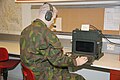 Hämeenlinna artillery museum display containing fire control officer with Nokia artillery calculator in Finnish artillery battalion command post
 -
 Late 1980s MikroMikko 4 TT m216 desktop computer in the Museum of Technology, Helsinki, Finland
 -
 ITT Nokia television with an ITT Nokia VCR (ITT/SEL)
 -
 A 1986 Mobira pager


1988–2010
[edit]

Following Simo Vuorilehto's appointment as CEO, a major restructuring was planned. With 11 groups within the company, Vuorilehto divested industrial units he deemed as un-strategic. Nokian Tyres (Nokian Renkaat), a tyre producer originally formed as a division of Finnish Rubber Works in 1932, split away from Nokia Corporation in 1988. Two years later, in 1990, Finnish Rubber Works followed suit. In 1991, Nokia sold its computer division, Nokia Data, to UK-based International Computers Limited (ICL), the precursor of Fujitsu Siemens. Investors thought of this as financial trouble and Nokia's stock price sank as a result. Finland was now also experiencing its worst recession in living memory, and the collapse of the Soviet Union, a major customer, made matters worse.
Vuorilehto quit in January 1992 and was replaced by Jorma Ollila, who had been the head of the mobile phone business from 1990 and advised against selling that division. Ollila decided to turn Nokia into a "telecom-oriented" company, and he eventually got rid of divisions like the power business. This strategy proved to be very successful, and the company grew rapidly in the following years. Nokia's operating profit went from negative in 1991 to $1 billion in 1995 and almost $4 billion by 1999.[33]
Nokia's first fully portable mobile phone after the Mobira Senator was the Mobira Cityman 900 in 1987. Nokia assisted in the development of the GSM mobile standard in the 1980s and developed the first GSM network with Siemens, the predecessor to Nokia Siemens Network. The world's first GSM call was made by Finnish prime minister Harri Holkeri on 1 July 1991, using Nokia equipment on the 900 MHz band network built by Nokia and operated by Radiolinja. In November 1992, the Nokia 1011 launched, making it the first commercially available GSM mobile phone.[34]
Salora Oy as a Nokia subsidiary ended in 1989 when the division was merged into Nokia-Mobira Oy. The brand continued to be used for televisions until 1995.
On 12 June 1996, Nokia announced the sale of its television business to Canada/Hong Kong-based Semi-Tech Corporation.[35] The television manufacturing plant in Germany closed down in September 1996. The sale included a factory in Turku and the rights to use the Nokia, Finlux, Luxor, Salora, Schaub-Lorenz, and Oceanic brands until the end of 1999.[36] Some of these brands were later sold to other companies.
Nokia was the first to launch digital satellite receivers in the UK, announced in March 1997.[37] In August 1997, Nokia introduced the first digital satellite receiver with Common Interface (CI) support.[38] In 1998, Nokia became the chosen supplier to produce the world's first digital terrestrial television set-top boxes by British Digital Broadcasting (BDB), which was eventually launched as ONdigital.[39]

In October 1998, Nokia overtook Motorola to become the best-selling mobile phone brand[40] and in December, manufactured its 100 millionth mobile phone.[41] A major reason why Nokia grew against its main competitors Motorola and Ericsson was that it managed to cater to the consumer youth market and fashion-oriented consumers, most significantly with the Nokia 5110 and 3210 handsets, which featured a large range of colourful and replaceable back covers called Xpress-on.[42][43] One of the earliest fashion phones in 1992, from Swiss watchmaker Swatch, was based on Nokia's 101 handset.[44] The company would also form the Vertu division, creating luxury mobile handsets.
In April 1996, Nokia claimed its 447Xav and 447K monitors to be the first with stereo speakers and a subwoofer.[45] In May 1999, Nokia introduced their first wireless LAN products.[46] In January 2000, ViewSonic acquired Nokia Display Products, the division making displays for personal computers.[47] On 26 April 2001, Nokia partnered with Telefónica to supply DSL modems and routers in Spain.[48]
In 1997, Nokia established a joint venture with Brazilian electronics firm Gradient where they were granted the license to manufacture variants of Nokia mobile phones locally under the Nokia and Gradient brand names.[49]
In 1998, Nokia cofounded Symbian Ltd., led by Psion, to create a new operating system for PDAs and smart mobile phones as a successor of EPOC32. They released the Nokia 9210 Communicator running Symbian OS in 2001 and later that year created the Symbian Series 60 platform, later introducing it with their first camera phone, the Nokia 7650. Both Nokia and Symbian eventually became the largest smartphone hardware and software maker, respectively, and in February 2004, Nokia became the largest shareholder of Symbian Ltd.[50] Nokia acquired the entire company in June 2008 and then formed the Symbian Foundation as its successor.[51]
In 1998 alone, the company had sales revenue of $20 billion, making $2.6 billion profit. By 2000, Nokia employed over 55,000 people[52] and had a market share of 30% in the mobile phone market, almost twice as large as its nearest competitor, Motorola.[53] The company was operating in 140 countries as of 1999. It was reported at the time that some people believed Nokia to be a Japanese company.[54] Between 1996 and 2001, Nokia's turnover increased fivefold, from €6.5 billion to €31 billion.[55] Meanwhile, a Reader's Digest survey held near end 2000 showed that Nokia was the "most trusted brand in Europe", ranking better than Sony, Canon, and Nivea.[56]


The company would then be known as a successful and innovative maker of camera phones. The Nokia 3600/3650 was the first camera phone on sale in North America in 2003. In April 2005, Nokia partnered with German camera optics maker Carl Zeiss AG.[57] That same month, Nokia introduced the Nseries, which would become its flagship line of smartphones for the next six years.[58] The Nokia N95 was introduced in September 2006, became highly successful, and was also awarded "best mobile imaging device" in Europe in 2007.[59] Its successor the N82 featured a xenon flash,[60] which helped it win the award of "best mobile imaging" device in Europe in 2008.[61] The N93 in 2006 was known for its specialized camcorder and the twistable design that switches between clamshell and a camcorder-like position.[62] They were also well known for the N8 with a high-resolution 12-megapixel sensor, in 2010; the 808 PureView with a 41-megapixel sensor, in 2012; and the Lumia 920 flagship, which implemented advanced PureView technologies, in 2012.[63]
Nokia was one of the pioneers of mobile gaming due to the popularity of Snake, which came preloaded on many products. In 2002, Nokia attempted to break into the handheld gaming market with the N-Gage.[64] Nokia's head of entertainment and media, Ilkka Raiskinen, once said, "Game Boy is for 10-year-olds",[65] stating that N-Gage is more suited to a mature audience. However, the device was a failure, unable to challenge the dominant market leader, Nintendo. Nokia attempted to revive N-Gage as a platform for their S60 smartphones, which eventually launched in 2008.[66]
In Q1 2004, Nokia's mobile phone handset market share steeply dropped to 28.9%, down from 34.6% a year earlier.[67] However, by 2006, the company was steadily gaining again[68][69] and in Q4 2007 reached its all-time high figure of 40.4%.[70] Its smartphone market share in that quarter was 51%.[71] Nokia was the largest vendor at the time in all regions bar North America.[72]
Nokia launched mobile TV trials in 2005 in Finland with content provided by public broadcaster Yle. The services are based on the DVB-H standard. It could be viewed with the widescreen Nokia 7710 smartphone with a special accessory enabling it to receive DVB-H signals.[73] Nokia partnered with Arqiva and O2 to launch trials in the UK in September 2005.[74]
In 2005, Nokia developed a Linux-based operating system called Maemo, which shipped that year on the Nokia 770 Internet Tablet.
On 1 June 2006, Jorma Ollila became the company's chairman and retired as CEO, replaced by Olli-Pekka Kallasvuo.[75]

In August 2007, Nokia introduced Ovi, an umbrella name for the company's new Internet services, which included the N-Gage platform and the Nokia Music Store.[76] The Ovi Store faced stiff competition from Apple's App Store when it was introduced in 2008.[77]

In October 2008, Nokia announced the Nokia 5800 XpressMusic, the first device to ship with the new touch-centric S60 5th Edition, also known as Symbian^1, the first iteration of the platform since the creation of the Symbian Foundation. In November 2008, Nokia announced it would end mobile phone sales in Japan because of low market share.[78] Nokia's global mobile phone market share peaked in 2008 at 38.6 percent.[79] The same year, Nokia announced the acquisition of Trolltech and its Qt software development.[80] Qt was a central part of Nokia's strategy until 2011, and it was eventually sold in 2012.[81]
Nokia briefly returned to the computer market with the Booklet 3G netbook in August 2009.
2010–2014
[edit].jpg)
In late 2009 and in 2010, the music-focused Xseries and consumer-focused Cseries were introduced respectively.[82] In April 2010, Nokia introduced its next flagship mobile device, the Nokia N8, which would be the first to run on Symbian^3.[83] However, it was delayed for many months which tarnished the company's image,[84] especially after the failure of its previous flagship N97 and tougher competition from Apple and the rising Google. On 10 September 2010, Olli-Pekka Kallasvuo was fired as CEO and it was announced that Stephen Elop from Microsoft would take Nokia's CEO position, becoming the first non-Finnish director in Nokia's history.[85] It was claimed that investors pressed Nokia's board to recruit an outsider to shake up management and break from the traditional "Nokia way".[86] Ollila had also announced that he would step down as Nokia chairman by 2012.[87] On 11 March 2011, Nokia announced that it had paid Elop a $6 million signing bonus as "compensation for lost income from his prior employer", on top of his $1.4 million annual salary.[88]

The old Symbian OS became completely open-source in February 2010.[89] However, in November 2010 it was announced that the Symbian Foundation was closing and that Nokia would take back control of the Symbian operating system under closed licensing.[90] By now, Nokia was the only remaining company using the platform, along with carrier NTT Docomo in Japan, after both Samsung and Sony Ericsson moved to Android. Meanwhile, in 2010 for Nokia's Linux ambitions, Nokia collaborated with Intel to form the MeeGo project, after the merger of Nokia's own Maemo and Intel's Moblin.
Nokia's Symbian platform that had been the leading smartphone platform in Europe and Asia for many years was quickly becoming outdated and difficult for developers after the advent of iOS and Android. To counter this, Nokia planned to make their MeeGo Linux operating system, under development, the company's flagship on smartphones. Shortly after Elop's CEO tenure began, the Nokia board green-lit him the ability to change the company's mobile phones strategy, including changing operating systems.[91] Veteran Anssi Vanjoki, head of the smartphones division, left the company around this time.[92] His final appearance was at Nokia World 2010 when the Nokia E7-00 and other Symbian^3 devices were introduced.[93]
On 11 February 2011, Nokia announced a "strategic partnership" with Microsoft, under which it would adopt Windows Phone 7 as its primary operating system on smartphones, and integrate its services and platforms with its own, including Bing as search engine, and integration of Nokia Maps data into Bing Maps. Elop stated that Nokia chose not to use Android because of an apparent inability to "differentiate" its offerings, with critics also noting that his past ties to Microsoft may have also influenced the decision.[94][95][96] Although the MeeGo "Harmattan"-based N9 was met with a highly positive reception in 2011, Nokia had already decided to end development on MeeGo and solely focus on its Microsoft partnership, although the CEO said that the N9's "innovations" will live on in the future,[97] which eventually made their way on the Asha platform in 2013.[98] After the announcement of the Microsoft partnership, Nokia's market share deteriorated; this was due to demand for Symbian dropping when consumers realized Nokia's focus and attention would be elsewhere.[99]
The company posted a large loss for the second quarter of 2011 – only their second quarterly loss in 19 years.[100] Nokia's first Windows Phone flagship was the Lumia 800, which arrived in November 2011. Falling sales in 2011, which were not being improved significantly with the Lumia line in 2012, led to consecutive quarters of huge losses. By mid-2012 the company's stock price fell below $2.[101][102] CEO Elop announced cost-cutting measures in June by shedding 10,000 employees by the end of the year and the closure of the Salo manufacturing plant.[103] The Finnish prime minister also announced that the government wouldn't subsidize the company from an emergency state fund.[104] Around this time, Nokia started a new project codenamed "Meltemi", a platform for low-end smartphones.[105] With the Microsoft alliance and under Elop's management, Nokia also had a renewed focus on the North American market where Nokia phones were, in stark contrast to the rest of the world, almost irrelevant for many years.[106][107] This strategy began in January 2012 with the introduction of the Nokia Lumia 900 smartphone in partnership with U.S. carrier AT&T.[108]
In March 2011, Nokia introduced a new corporate typeface called "Pure".[109] On 1 August 2011, Nokia announced that it would adopt a new three-digit naming system for mobile phone products and stop using letters, effectively ending the Nseries, Eseries, and short-lived Cseries. That same day, the Nokia 500 was introduced with the new system.[110] Nokia last used three-digit names on analogue phones in the 1990s.[82]
When the Lumia 920 was announced in September 2012, it was seen by the press as the first high-end Windows Phone that could challenge rivals due to its advanced feature set. Elop said that the positive reaction to it had created a sense of hope and optimism in the company.[111] The company was also making gains in developing countries with its Asha series, which were selling strongly.[112] Although Nokia's smartphone sales and market share greatly increased throughout 2013, including in the North American market,[113] it was still not enough to avoid financial losses.[114] Ollila stepped down as chairman on 4 May 2012 and was replaced by Risto Siilasmaa.[115]

In September 2013, Nokia announced the sale of its mobile and devices division to Microsoft. The sale was positive for Nokia to avoid further negative financial figures, as well as for Microsoft's CEO Steve Ballmer, who wanted Microsoft to produce more hardware and turn it into a devices and services company.[116] The Nokia chairperson, Risto Siilasmaa, described the deal as rationally correct (in the best interests of Nokia shareholders), but emotionally difficult[117] – experts agree that Nokia would have been in a cash crisis had it not sold the division to Microsoft.[118][117] Analysts believe that Ballmer pushed for the buyout because of fears that Nokia was close to adopting Android and abandoning their alliance with Microsoft.[119][120] Indeed, in January 2014 the Nokia X was introduced which ran on a customised version of Android. It was a surprising and somewhat odd launch coming just weeks away from the finalization of the Microsoft buyout.[121][122] Others, including Ballmer's successor Satya Nadella, felt that Microsoft thought merging their software teams with Nokia's hardware engineering and designs would "accelerate" growth of Windows Phone.[123] The sale was completed in April 2014, with Microsoft Mobile becoming the successor to Nokia's mobile devices division. Nokia also moved from its headquarters to another building complex located at Karaportti. At the time, Ballmer himself was retiring as Microsoft CEO and was replaced by Satya Nadella, who opposed the Nokia mobile phones purchase, along with chairman Bill Gates.[124] The purchased assets from Nokia were eventually written-off by Microsoft in 2015.[125]
By 2014, Nokia's global brand value according to Interbrand fell to 98th place,[126] a sharp slide from the 5th place it was in 2009.[127] Nokia's downfall in the mobile phone market has had different explanations from analysts, with many split about the CEO's decision to abandon its in-house operating system and adopting Windows Phone in 2011.[128] Many researchers have concluded that Nokia suffered from deep internal rivalries within the management.[118][129][130][131] Former employees claimed that the management became so swollen by the early success that they grew complacent over time.[132][133] Some from the Symbian developing team have claimed that the company's upper management rejected hundreds of potential innovations during the 2000s that they proposed, including entirely rewriting Symbian's code. One former Nokia employee claimed that the company was run as a "Soviet-style bureaucracy".[134]
.jpg)
.jpg)
In July 2013, Nokia bought Siemens' stake in the Nokia Siemens Networks joint venture for $2.2 billion, turning it into a wholly owned subsidiary called Nokia Solutions and Networks,[135] until being rebranded as Nokia Networks soon after.[136] During Nokia's financial struggles, its profitable networking division with Siemens provided much of its income; thus, the purchase proved to be positive, particularly after the sale of its mobile devices unit.[137]
2014–2016
[edit]After the sale of its mobile devices division, Nokia focused on network equipment through Nokia Networks.[138]
In October 2014, Nokia and China Mobile signed a US$970 million framework deal for delivery between 2014 and 2015.[139]
On 17 November 2014, Nokia Technologies head Ramzi Haidamus disclosed that the company planned to re-enter the consumer electronics business as an original design manufacturer, licensing in-house hardware designs and technologies to third-party manufacturers. Haidamus stated that the Nokia brand was "valuable" but "is diminishing in value, and that's why it is important that we reverse that trend very quickly, imminently".[140] The next day, Nokia unveiled the N1, an Android tablet manufactured by Foxconn, as its first product following the Microsoft sale.[141] Haidamus emphasized that devices released under these licensing agreements would be held to high standards in production quality, and would "look and feel just like Nokia built it".[12] Nokia CEO Rajeev Suri stated that the company planned to re-enter the mobile phone business in this manner in 2016, following the expiration of its non-compete clause with Microsoft.[142]
According to Robert Morlino, the spokesman of Nokia Technologies, Nokia planned to follow the brand-licensing model rather than direct marketing of mobile devices due to the sale of its mobile devices division to Microsoft.[143] The company took aggressive steps to revitalize itself, evident through its hiring of software experts, testing of new products and seeking of sales partners.[144] On 14 July 2015, CEO Rajeev Suri confirmed that the company would make a return to the mobile phones market in 2016.[145]
On 28 July 2015, Nokia announced OZO, a 360-degrees virtual reality camera, with eight 2K optical image sensors. The division behind the product, Nokia Technologies, claimed that OZO would be the most advanced VR film-making platform.[146] Nokia's press release stated that OZO would be "the first in a planned portfolio of digital media solutions," with more technological products expected in the future.[147] OZO was fully unveiled on 30 November in Los Angeles. The OZO, designed for professional use, was intended for retail for US$60,000;[148] however, its price was decreased by $15,000 prior to release,[149] and is listed on its official website as $40,000.[150]


On 14 April 2015, Nokia confirmed that it was in talks with the French telecommunications equipment company Alcatel-Lucent regarding a potential merger.[151] The next day, Nokia announced that it had agreed to purchase Alcatel-Lucent for €15.6 billion in an all-stock deal.[152] CEO Rajeev Suri felt that the purchase would give Nokia a strategic advantage in the development of 5G wireless technologies.[153][154] The acquisition created a stronger competitor to the rival firms Ericsson and Huawei,[155] whom Nokia and Alcatel-Lucent had surpassed in terms of total combined revenue in 2014. Nokia shareholders hold 66.5% of the new combined company, while Alcatel-Lucent shareholders hold 33.5%. The Bell Labs division was to be maintained, but the Alcatel-Lucent brand would be replaced by Nokia.[152][156] In October 2015, following approval of the deal by China's Ministry of Commerce, the merger awaited approval by French regulators.[157] Despite the initial intent of selling the submarine cable division separately, Alcatel-Lucent later declared that it would not.[158] The merger closed on 14 January 2016,[159] but was not complete until 3 November 2016. From the acquisition, Nokia is now also the owner of the Alcatel Mobile phone brand, which continues to be licensed to TCL.
On 3 August 2015, Nokia announced that it had reached a deal to sell its Here digital maps division to a consortium of BMW, Daimler AG and Volkswagen Group for €2.8 billion.[160] The deal closed on 3 December 2015.[161]
2016–2019
[edit]On 26 April 2016, Nokia announced its intent to acquire French connected health device maker Withings for US$191 million. The company was integrated into a new Digital Health unit of Nokia Technologies.[162][163] Nokia later wrote off the cost of the acquisition and in May 2018 the health unit was sold back to Éric Carreel, a Withings co-founder and former CEO.[164]

On 18 May 2016, Microsoft Mobile sold its Nokia-branded feature phone business to HMD Global, a new company founded by former Nokia executive Jean-Francois Baril, and an associated factory in Vietnam to Foxconn's FIH Mobile subsidiary. Nokia subsequently entered into a long-term licensing deal to make HMD the exclusive manufacturer of Nokia-branded phones and tablets outside Japan, operating in conjunction with Foxconn. The deal also granted HMD the right to essential patents and featurephone software. HMD subsequently announced the Android-based Nokia 6 smartphone in January 2017.[165][166] At Mobile World Congress, HMD additionally unveiled the Nokia 3 and Nokia 5 smartphones, as well as a re-imagining of Nokia's classic 3310 feature phone.[167][168] Nokia has direct investments in the company,[169] and they do have some input in the new devices.
On 28 June 2016, Nokia demonstrated for the first time a 5G-ready network.[170] In February 2017 Nokia carried out a 5G connection in Oulu, Finland using the 5GTF standard, backed by Verizon, on Intel architecture-based equipment.[171]
In July 2017, Nokia and Xiaomi announced that they have signed a business collaboration agreement and a multi-year patent agreement, including a cross-license to each company's cellular standard-essential patents.[172] In that year, Nokia's brand value was ranked 188th by Brand Finance, a jump of 147 places from 2016. Its rise was attributed to its health portfolio and new mobile phones developed by HMD Global.[173]
In January 2018, Nokia signed a deal with NTT Docomo, Japan's largest mobile operator, to provide 5G wireless radio base stations in the country by 2020.[174] Later that month, Nokia announced the ReefShark line of 5G chipsets, claiming that it triples bandwidth to 84 Gbit/s.[175] In March, Solidium, the investment arm of the Finnish Government, purchased a 3.3% stake in Nokia valued at €844 million.[176] In May, Nokia announced that it had acquired a California-based IoT startup, SpaceTime Insight.[177]
In January 2019, the Canadian government announced that it would provide $40 million to support Nokia's research on 5G technology.[178] A 2019 study revealed that Nokia phones performed far better than rivals Samsung, LG, Xiaomi, and Huawei in updating to the latest version of Android. The study, made by Counterpoint Research, found that 96 percent of Nokia phones were either sent with or updated to the latest Android version since Pie was released in 2018. Nokia's competitors were found to be all around roughly the 80 percent range.[179]
2020–present
[edit]On 2 March 2020, Nokia announced Pekka Lundmark as its new CEO.[180] Later that month, Nokia completed the acquisition of Elenion Technologies, a U.S.-based company focusing on silicon photonics technology to improve economics of advanced optical connectivity products.[181]
On 27 May 2020, Sari Baldauf succeeded Risto Siilasmaa as chairwoman of the board of directors, and Kari Stadigh was appointed vice chair. In June, Nokia won a 5G contract worth approximately $450 million[182] from Taiwan Mobile to build out the telecom operator's next-generation network as the sole supplier.[183] In October, Nokia announced a contract with NASA to build a 4G mobile network for astronaut usage on the moon. The $14.1 million contract, through subsidiary Bell Labs, was expected to begin in 2022.[184][185][186]
In 2020, Flipkart collaborated with Nokia to market Nokia-branded consumer products in India. These included televisions, a laptop and a range of air conditioners.[187]
In April 2022, Nokia announced that it would exit the Russian market following the country's invasion of Ukraine. The company stated that the decision would not affect its financial outlook as Russia accounted for less than 2% of Nokia's net sales in 2021.[188]
In February 2023, the company introduced a new logo for the first time in nearly 60 years[189] to change its brand identity as people still associated the previous logo with mobile phones.[190] The new logo was designed by Lippincott.[191]
In December 2023, Nokia acquired Fenix Group to strengthen its wireless offering in the defense segment for an undisclosed amount.[192] In the same month, Nokia announced a €185 million deal with Lumine Group to carve out its device management business (inherited from Alcatel-Lucent's purchase of Motive, Inc.) and its service management business (formerly Mformation). The deal completed in April 2024 and involved the transfer of around 500 Nokia employees.[193][194]
In February 2024, the company announced that it was accelerating its carbon neutrality target by 10 years to 2040 after having previously committed to cutting its carbon footprint across emissions scopes in half by 2030 from a 2019 baseline.[195]
In June 2024, Nokia acquired Infinera for $2.3 billion.[196]
On 10 February 2025, Nokia announced that Pekka Lundmark would step down as president and CEO on 31 March and be succeeded by Justin Hotard.[197][198]
Current operations
[edit]Nokia is a julkinen osakeyhtiö (public joint-stock company) listed on the Nasdaq Nordic/Helsinki and New York stock exchanges.[8] Nokia has played a very large role in the economy of Finland,[199][200] and it is an important employer in the country, working with multiple local partners and subcontractors.[201] Nokia contributed 1.6% to Finland's GDP and accounted for about 16% of the country's exports in 2006.[202]
Nokia comprises two business groups along with further subsidiaries and affiliated firms.
Nokia Networks
[edit]
Nokia Networks is Nokia Corporation's largest division. It is a multinational data networking and telecommunications equipment company headquartered in Espoo, Finland, and is the world's third-largest telecoms equipment manufacturer, measured by 2017 revenues (after Huawei and Cisco). In the USA it competes with Ericsson on building 5G networks for operators, while Huawei Technologies and ZTE Corporation were effectively banned.[203]
It has operations in around 150 countries.[204]
Nokia Networks provides wireless and fixed network infrastructure, communications and networks service platforms and professional services to operators and service providers.[205] It focuses on GSM, EDGE, 3G/W-CDMA, LTE and WiMAX radio access networks, supporting core networks with increasing IP and multiaccess capabilities and services.
The Nokia Siemens Networks (NSN) brand identity was launched at the 3GSM World Congress in Barcelona in February 2007 as a joint venture between Nokia (50.1%) and Siemens (49.9%),[206] although it is now wholly owned by Nokia. In July 2013, Nokia bought back all shares in Nokia Siemens Networks for a sum of US$2.21 billion and renamed it to Nokia Solutions and Networks, shortly thereafter changed to simply Nokia Networks.[207]
Nokia Technologies
[edit]
Nokia Technologies is a division of Nokia that develops consumer products and licenses technology including the Nokia brand.[208] Its focuses are imaging, sensing, wireless connectivity, power management and materials, and other areas such as the IP licensing program. It consists of three labs: Radio Systems Lab, in areas of radio access, wireless local connectivity and radio implementation; Media Technologies Lab, in areas of multimedia and interaction; and Sensor and Material Technologies Lab, in areas of advanced sensing solutions, interaction methods, nanotechnologies and quantum technologies. Nokia Technologies also provides public participation in its development through the Invent with Nokia program.[209] It was created in 2014 following a restructuring of Nokia Corporation.
In November 2014, Nokia Technologies launched its first product, the Nokia N1 tablet computer.[210] In July 2015, Nokia Technologies introduced a VR camera called OZO, designed for professional content creators and developed in Tampere, Finland. With its 8 synchronized shutter sensors and 8 microphones, the product can capture stereoscopic 3D video and spatial audio.[211][212] Production of the OZO camera was discontinued in 2017, but the immersive audio software technologies continue under the Nokia OZO brand, still keeping Nokia in the virtual reality market.[213]
On 31 August 2016, Ramzi Haidamus announced he would be stepping down from his position as president of Nokia Technologies.[214] Brad Rodrigues, previously head of strategy and business development, assumed the role of interim president.[215] On 30 June 2017, Gregory Lee, previously CEO of Samsung Electronics in North America, was appointed Nokia Technologies CEO and president.[216]
Nokia Bell Labs
[edit]Nokia Bell Labs is a research and scientific development company that was once the R&D arm of the American Bell System. It became a subsidiary of Nokia Corporation after the takeover of Alcatel-Lucent in 2016.
In December 2023, Nokia announced plans for a new research facility in New Brunswick, New Jersey. The relocation from the 80-year-old Bell Labs facility at Murray Hill, New Jersey is expected to occur before 2028. The Murray Hill laboratories produced important innovations for AT&T Corp., Lucent Technologies, Alcatel-Lucent, and Nokia.[217]
NGP Capital
[edit]NGP Capital (formerly Nokia Growth Partners) is a global venture capital firm, focusing on investments in the growth stage "Internet of things" (IoT) and mobile technology companies.[218] NGP holds investments throughout the U.S., Europe, China and India. Their portfolio consists of companies in mobile technology including the sectors Connected Enterprise, Digital Health, Consumer IoT, and Connected Car. Following a $350 million funding for IoT companies in 2016, NGP manages $1 billion worth of assets.[219]
Nokia had previously promoted innovation through venture sponsorships dating back to 1998 with Nokia Venture Partners, which was renamed BlueRun Ventures and spun off in 2005.[220] The China arm of BlueRun Ventures became independent in 2010 and would be rebranded to Lanchi Ventures.[221] Nokia Growth Partners (NGP) was founded in 2005 as a growth stage venture fund as a continuation of the early successes of Nokia Venture Partners. In 2017, the company was renamed to NGP Capital.[222]
NGP's largest exits include GanJi, UCWeb, Whistle, Rocket Fuel, Swype, Summit Microelectronics and Netmagic.
Nuage Networks
[edit]Nuage Networks is a venture providing software-defined networking solutions. It was formed by Alcatel-Lucent in 2013 to develop a software overlay for automating and orchestrating hybrid clouds.[223] It has been part of Nokia following their acquisition of Alcatel-Lucent in 2016.[224] Throughout 2017 Nuage sealed deals with Vodafone and Telefónica to provide its SD-WAN architecture to their servers.[225][226] BT had already been a client since 2016.[227] A deal with China Mobile in January 2017 also used Nuage's software-defined networking technology for 2,000 public cloud servers at existing data centers in China,[228] and another in October 2017 with China Pacific Insurance Company.[229]
The company is based in Mountain View, California and the CEO is Sunil Khandekar.[230]
Alcatel Mobile
[edit]Alcatel Mobile is a mobile phone brand owned by Nokia since 2016. It has been licensed since 2005 to Chinese company TCL when it was under the ownership of Alcatel (later Alcatel-Lucent) in a contract until 2024.
HMD Global
[edit]HMD Global is a mobile phone company based in Espoo, Finland. The Nokia brand has been licensed by former Nokia employees who founded HMD Global and introduced Nokia-branded Android-based devices to the market in 2017.[231] Initially, Nokia had no investment in the company but retained some input in the development of its devices.[232]
Nokia has 10.10% ownership in HMD Global after investing alongside Qualcomm and Google in 2020. In the 2020 financial report, FIH Mobile disclosed they have a 14.38% ownership in HMD Global. Finnish Nokia owns 10.10% of HMD Global, while other investors include Google, Qualcomm, and others with an undisclosed share in HMD.
Alcatel Submarine Networks
[edit]

Alcatel Submarine Networks (ASN) is a provider of turnkey undersea network solutions. The business unit develops technology and offers installation services for optical submarine cable network links across the world's oceans.[233][234]
Previously, Alcatel-Lucent Submarine Networks, also became part of Nokia in 2016. Nokia and ASN had added another cable ship to the fleet called, CS Ile d'Ouessant.[235] The CS Ile d’Ouessant was purchased in 2019 and was originally built in 2011 as the CS Toisa Warrior.[236] Additionally, in 2021, Nokia and ASN requested two cable ships for the fleet, the CS Ile d'Yeu and CS Ile de Molène.[237]


Here is a list of the cable-laying fleet from Alcatel (6), to Alcatel-Lucent (6[238] and 7), though Nokia (8):
- CS Ile d'Yeu (2001, 2021–Present) Built in 2001. Purchased in 2021 by Nokia ASN as two additional ships for a fleet of eight cable ships. (IMO 9230414)
- CS Ile d'Molène (2006, 2021–Present) Built in 2006. Purchased in 2021 by Nokia ASN two additional ships for a fleet of eight cable ships. (IMO 9329928)[237]
- CS Ile d’Ouessant (2011, 2019–Present) Built in 2011 as the CS Toisa Warrior. Purchased by Nokia ASN in 2019. (IMO 9427108)[239]
- CS Ile d'Aix (1992, 2011–Present) Built in 1992, as the cable ship, CS Gulmar Badaro. Purchased by Alcatel-Lucent in 2011, renaming the ship as CS Ile de AIX.[240]
- CS Ile d' Brehat (2002–Present) Built in 2002. North route main lay of 4400 km for 2003 APOLLO route. Route clearance in 2015 for GTT Express.
- CS Ile d' Sein (2001–Present) Built in 2001, Length: 140.36 m, Cable work in 2003 of routes Azores to Madeira and Madeira to Porto Santo.
- CS Ile d' Batz (2001–Present) Built in 2001, 2003 APOLLO: Widemouth Bay, Bude, England to Brookhaven, USA and Lannion, France to Manasquan, USA, 2008 worked on TPE (Trans Pacific Express)[241]
- CS Ile d' Re (1983–Present) Built in 1983, in 2006 worked on the APNG 2 cable route from Sydney, Australia to Port Moresby, Papua New Guinea. (OMS Group in August 2023 used MakaiLay software on ship, indication not part of ASN fleet.)[242]
- CS Stanelco 2 (1975, 2000-Unknown) Built in 1975, Constructed by Brattvag Skips. in Brattvag. Named coaster Siraholm. Renamed in 1982 by Standard Telefon og Kabelfabrik when converted to cable repair ship. Sold to Alcatel Contracting Norway A/S, Oslo in 2000. (IMO 7382469, MMSI 341082000) (NOT IN NOKIA FLEET COUNT AS OF 2021) (OMS Group in August 2023 used MakaiLay software on ship, indication not part of ASN fleet.)
- CS Peter Faber 3 (1981) Built in 1981, 2003, provided old cable recovery in the Atlantic with ile de Sein.[243] Optic Marine Services acquisition on 24 September 2019 of vessel continued ASN chartering the ship. (NOT IN NOKIA FLEET COUNT AS OF 2021) (Optic Marine Services Group in August 2023 used MakaiLay software on ship, indication not part of ASN fleet.)[242]
- CS Lodbrog (1985, 2000-Unknown) Built in 1985 as Spiegelberg and Tuzla. Later renamed in 1996 as Bolero. (IMO 8027808, MMSI: 354400000) Registered to Alcatel in 2000. (NOT IN NOKIA FLEET COUNT AS OF 2021) (OMS Group in August 2023 used MakaiLay software on ship, indication not part of ASN fleet.)[242]
- CS Heimdal (1983, 2000–2004) Built in 1983, 1988: Renamed FERRYMAR I. and reverted to MERCANDIAN ADMIRAL II. 2000: Converted to a repair and cable laying vessel and sold to Alcatel Submarine Networks Marine AS. 2003 performed repair of optical fiber in the Pacific Ocean, route between Japan and the United States, at almost 9,400 km deep.[244] 2004: Sold to SEACOR Smit Offshore (Worldwide) Ltd, (SEACOR Marine (Asia) Pte Ltd (IMO 8207393, MMSI: 538002126) (SOLD IN 2004, NOT IN ALCATEL-LUCENT FLEET AS OF 2015)
Corporate affairs
[edit]Business trends
[edit]The key trends for Nokia are (as of the financial year ending 31 December):[245][246][247]
| Revenue (€ bn) |
Net profit (€ bn) |
Total assets (€ bn) |
Employees | |
|---|---|---|---|---|
| 2007 | 51.0 | 7.2 | 37.5 | 112,000 |
| 2008 | 50.7 | 3.9 | 39.5 | 125,000 |
| 2009 | 40.9 | 0.89 | 35.7 | 123,000 |
| 2010 | 42.4 | 1.8 | 39.1 | 132,000 |
| 2011 | 38.6 | −1.1 | 36.2 | 130,000 |
| 2012 | 30.1 | −3.1 | 29.9 | 97,700 |
| 2013 | 12.7 | −0.61 | 25.1 | 86,400 |
| 2014 | 12.7 | 3.4 | 21.0 | 57,500 |
| 2015 | 12.4 | 2.4 | 20.9 | 56,000 |
| 2016 | 23.6 | −0.76 | 44.9 | 101,000 |
| 2017 | 23.1 | −1.4 | 41.0 | 101,000 |
| 2018 | 22.5 | −0.34 | 39.5 | 103,000 |
| 2019 | 23.3 | 0.007 | 39.1 | 98,300 |
| 2020 | 21.8 | −2.5 | 36.1 | 92,000 |
| 2021 | 22.2 | 1.6 | 40.0 | 87,900 |
| 2022 | 24.9 | 4.2 | 42.9 | 86,800 |
| 2023 | 22.2 | 0.66 | 39.8 | 86,600 |
| 2024 | 19.2 | 1.2 | 39.1 | 80,300 |
Corporate governance
[edit]The control and management of Nokia is divided among the shareholders at a general meeting and the Nokia Group Leadership Team (left),[248] under the direction of the board of directors (right).[249] The chairman and the rest of the Nokia Leadership Team members are appointed by the board of directors. Only the chairman of the Nokia Leadership Team can belong to both the board of directors and the Nokia Group Leadership Team. The Board of Directors' committees consist of the Audit Committee,[250] the Personnel Committee,[251] and the Corporate Governance and Nomination Committee.[252][253]
The operations of the company are managed within the framework set by the Finnish Companies Act,[254] Nokia's Articles of Association,[255] and Corporate Governance Guidelines,[256] supplemented by the board of directors' adopted charters. On 25 November 2019, Nokia announced that it would discontinue the role of Chief Operating Officer (COO) and distribute its functions to other company leaders. As a result, Chief Operating Officer Joerg Erlemeier decided to step down, effective 1 January 2020.[257]
Former corporate officers
[edit]| Name | Tenure |
|---|---|
| Björn Westerlund | 1967–1977 |
| Kari Kairamo | 1977–1988 |
| Simo Vuorilehto | 1988–1992 |
| Jorma Ollila | 1992–2006 |
| Olli-Pekka Kallasvuo | 2006–2010 |
| Stephen Elop | 2010–2014 |
| Rajeev Suri | 2014–2020 |
| Pekka Lundmark | 2020–2025 |
| Justin Hotard | 2025–current |
| Name | Tenure |
|---|---|
| Lauri J. Kivekäs | 1967–1977 |
| Björn Westerlund | 1977–1979 |
| Mika Tiivola | 1979–1986 |
| Kari Kairamo | 1986–1988 |
| Simo Vuorilehto | 1988–1990 |
| Mika Tiivola | 1990–1992 |
| Casimir Ehrnrooth | 1992–1999 |
| Jorma Ollila | 1999–2012 |
| Risto Siilasmaa | 2012–2020 |
| Sari Baldauf | 2020–current |
Stock
[edit]Nokia is a public limited liability company and is the oldest company listed under the same name on the Helsinki Stock Exchange, beginning in 1915.[259] Nokia has had a secondary listing on the New York Stock Exchange since 1994.[8][259] Nokia shares were delisted from the London Stock Exchange in 2003, the Paris Stock Exchange in 2004, the Stockholm Stock Exchange in 2007 and the Frankfurt Stock Exchange in 2012.[260] Due to the acquisition of Alcatel-Lucent in 2015, Nokia listed its shares again on the Paris Stock Exchange and was included in the CAC 40 index on 6 January 2016[261] but later removed on 18 September 2017.[262]
In 2007, Nokia had a market capitalization of €110 billion; by 17 July 2012 this had fallen to €6.28 billion, before increasing to €26.0 billion by 23 February 2015. Nokia's market cap at 2020 was 21.76 billion.
Corporate culture
[edit]Nokia's official corporate culture manifesto since the 1990s is called The Nokia Way.[263] It emphasizes the speed and flexibility of decision-making in a flat, networked organization.[264]
The official business language of Nokia is English. All documentation is written in English, and is used in official intra-company communication.
In 1992, Nokia adopted values that were defined with the key words respect, achievement, renewal and challenge.[265] In May 2007, the company redefined its values after initiating a series of discussion across its worldwide branches regarding what the new values of the company should be. Based on the employee suggestions, the new values were defined as: Engaging You, Achieving Together, Passion for Innovation and Very Human.[264] In August 2014, Nokia redefined its values again after the sale of its Devices business, using the original 1992 values again.
Headquarters
[edit]
Nokia are based at Karaportti in Espoo, Finland, just outside capital Helsinki. It has been their head office since 2014 after moving from the purpose-built Nokia House in Espoo as part of the sale of the mobile phone business to Microsoft.[266] The building in Karaportti was previously the headquarters of NSN (now Nokia Networks).[267]
Awards and recognition
[edit]In 2018, Nokia received the Leading Lights award for most innovative cable/video product[268] and was named to Ethisphere's 2018 world's most ethical companies list.[269]
Logo history
[edit]-
 Nokia Osakeyhtiö logo, 1865[270]
 -
 Nokia Osakeyhtiö logo, 1871[271]
 -
 Finnish Rubber Works (Suomen Kumitehdas) logo, 1965–1986
 -
 Nokia 'Arrows' logo, after merging with the Cable Factory (Kaapelitehdas) and Finnish Rubber Works (1966–1992). Used in advertising and products until c. 1997.
 -
![Nokia introduced its "Connecting People" advertising slogan in 1992, coined by Ove Strandberg.[272][273]](//upload.wikimedia.org/wikipedia/commons/thumb/7/7b/Nokia_Connecting_People.svg/120px-Nokia_Connecting_People.svg.png) Nokia introduced its "Connecting People" advertising slogan in 1992, coined by Ove Strandberg.[272][273]
Nokia introduced its "Connecting People" advertising slogan in 1992, coined by Ove Strandberg.[272][273] -
![New slogan typeface (Nokia Sans font) introduced in 2005. Nokia Sans had been used by Nokia in products since 2002.[274]](//upload.wikimedia.org/wikipedia/commons/thumb/c/c3/Nokia_-_2005_logo.svg/120px-Nokia_-_2005_logo.svg.png) New slogan typeface (Nokia Sans font) introduced in 2005. Nokia Sans had been used by Nokia in products since 2002.[274]
New slogan typeface (Nokia Sans font) introduced in 2005. Nokia Sans had been used by Nokia in products since 2002.[274] -
![The company stopped using a slogan within its logo in 2011. Logo used on Nokia-branded consumer devices including phones made by HMD Global.[275]](//upload.wikimedia.org/wikipedia/commons/thumb/0/02/Nokia_wordmark.svg/120px-Nokia_wordmark.svg.png) The company stopped using a slogan within its logo in 2011. Logo used on Nokia-branded consumer devices including phones made by HMD Global.[275]
The company stopped using a slogan within its logo in 2011. Logo used on Nokia-branded consumer devices including phones made by HMD Global.[275] -
 Current logo since 2023
 -
 History of Nokia's corporate typeface
.svg)

.svg)

![Nokia introduced its "Connecting People" advertising slogan in 1992, coined by Ove Strandberg.[272][273]](https://en.wikipedia.org/wiki/File:Nokia_Connecting_People.svg)
![New slogan typeface (Nokia Sans font) introduced in 2005. Nokia Sans had been used by Nokia in products since 2002.[274]](https://en.wikipedia.org/wiki/File:Nokia_-_2005_logo.svg)
![The company stopped using a slogan within its logo in 2011. Logo used on Nokia-branded consumer devices including phones made by HMD Global.[275]](https://en.wikipedia.org/wiki/File:Nokia_wordmark.svg)

Controversies
[edit]NSN's provision of intercept capability to Iran
[edit]In 2008, Nokia Siemens Networks, a joint venture between Nokia and Siemens AG, reportedly provided Iran's monopoly telecom company with technology that allowed it to intercept the Internet communications of its citizens.[276] The technology reportedly allowed Iran to use deep packet inspection to read and change the content of emails, social media, and online phone calls. The technology "enables authorities to not only block communication but to monitor it to gather information about individuals, as well as alter it for disinformation purposes".[277]
During the post-election protests in Iran in June 2009, Iran's Internet access was reported to have slowed to less than a tenth of its normal speeds, which experts suspected was due to using of deep packet inspection.[278]
In July 2009, Nokia began to experience a boycott of their products and services in Iran. The boycott was led by consumers sympathetic to the post-election protest movement and targeted companies deemed to be collaborating with the regime. Demand for handsets fell and users began shunning SMS messaging.[279]
Nokia Siemens Networks asserted in a press release that it provided Iran only with a "lawful intercept capability solely for monitoring of local voice calls" and that it "has not provided any deep packet inspection, web censorship, or Internet filtering capability to Iran".[280]
Nokia–Apple patent dispute
[edit]In October 2009, Nokia filed a lawsuit against Apple Inc. in the U.S. District Court of Delaware claiming that Apple infringed on 10 of its patents related to wireless communication including data transfer.[281] Apple was quick to respond with a countersuit filed in December 2009 accusing Nokia of 11 patent infringements. Apple's general counsel, Bruce Sewell went a step further by stating, "Other companies must compete with us by inventing their own technologies, not just by stealing ours." This resulted in a legal battle between the two telecom majors with Nokia filing another suit, this time with the U.S. International Trade Commission (ITC), alleging Apple had infringed its patents in "virtually all of its mobile phones, portable music players and computers".[282] Nokia went on to ask the court to ban all U.S. imports of the Apple products, including the iPhone, Macintosh and iPod. Apple countersued by filing a complaint with the ITC in January 2010.[281]
In June 2011, Apple settled with Nokia and agreed to an estimated one time payment of $600 million and royalties to Nokia.[283] The two companies also agreed on a cross-licensing patents for some of their patented technologies.[284][285]
Alleged tax evasion in India
[edit]Nokia's Indian subsidiary was charged in January 2013 with non-payment of Indian Tax Deducted at Source and transgressing transfer pricing norms in India.[286] The unpaid TDS of ₹30 billion, accrued during a course of six years, was due to royalty paid by the Indian subsidiary to its parent company.[287]
Nokia 7 Plus data breach
[edit]In March 2019, news broke that the company's Nokia 7 Plus phones were allegedly sending personal user data to China over several months. According to investigators, the gadget sent unencrypted data packages including geographical location, SIM card number, and the phone's serial number to an unidentified Chinese server every time that "the phone was turned on, the screen activated or unlocked."[288] The data was sufficient to follow the movements and actions of the phone in real time.[288]
Nokia brand owner HMD Global denied any such transfers had taken place, stating that it was instead the result of an error in the packing process of the phone's software.[289] The Finnish Office of the Data Protection Ombudsman launched an investigation into the matter on the assumption "that personal data has been transferred."[290]
Xinjiang region
[edit]In 2020, the Australian Strategic Policy Institute accused at least 82 major brands, including Nokia, of being connected to forced Uyghur labor in Xinjiang.[291]
Notes
[edit]References
[edit]- ^ "Contact us". Nokia. Retrieved 17 September 2019.
- ^ "Nokia Annual Report 2024 (Form 20-F)". U.S. Securities and Exchange Commission. 13 March 2025.
- ^ a b "Nokia" (in Finnish). YTJ.fi. Archived from the original on 10 May 2013. Retrieved 2 March 2013.
- ^ a b "Report for Q4 and Full Year 2018" (PDF). Nokia Corporation. 21 March 2019. Archived from the original (PDF) on 27 May 2019. Retrieved 28 May 2019.
- ^ "Articles of Association of Nokia Corporation" (PDF). Nokia Corporation. Retrieved 8 June 2023.
- ^ a b c HS: Nokian juuret ovat Tammerkosken rannalla (in Finnish)
- ^ Morris, Iain. "Nokia has cut 11,000 jobs in effort to boost profit". Light Reading.
- ^ a b c "Nokia – FAQ". Nokia Corporation. Archived from the original on 8 February 2009. Retrieved 16 March 2009.
- ^ "Fortune Global 500 (100) – 2009 (Fortune ) – Ranking The Brands". Rankingthebrands.com. Retrieved 28 March 2019.
- ^ "Global 500 2016". Fortune. 2017. Archived from the original on 10 May 2019. Retrieved 24 August 2017.
- ^ "Euro Stoxx 50". Boerse-frankfurt.de. Retrieved 24 August 2017.
- ^ a b "This is the new Nokia". The Verge. 18 November 2014. Retrieved 23 November 2014.
- ^ "Full Text: Nokia CEO Stephen Elop's 'Burning Platform' Memo". The Wall Street Journal. 9 February 2011. Archived from the original on 11 February 2011.
- ^ Sampsa Kurri (11 October 2012), The story of Nokia MeeGo, archived from the original on 16 October 2012
- ^ Thom Holwerda (11 October 2012). "The story of Nokia's Maemo and MeeGo". OS News.
- ^ "Microsoft buys Nokia's Devices and Services Unit, unites Windows Phone 8 and its hardware maker". The Verge. 2 September 2013. Retrieved 3 September 2013.
- ^ Ovide, Shira. "Microsoft in $7.17 Billion Deal for Nokia Cellphone Business". The Wall Street Journal. Retrieved 3 September 2013.
- ^ "Microsoft closes Nokia deal, pays more than expected". CNET.
- ^ Coupland, Douglas. "The Ghost of Invention: A Visit to Bell Labs". Wired.
- ^ "How Nokia reinvented itself". CNNMoney Switzerland. Archived from the original on 24 October 2018. Retrieved 28 March 2019.
- ^ "Nokia celebrates first day of combined operations with Alcatel-Lucent". Nokia. Archived from the original on 16 January 2016. Retrieved 15 January 2016.
- ^ "Nokia plans to acquire Withings to accelerate entry into Digital Health". 26 April 2016. Archived from the original on 19 May 2016. Retrieved 1 June 2016.
- ^ Best, Jo. "'Mobile phones are our history, not our future': Nokia on where next for hardware". ZDNet. Retrieved 28 March 2019.
- ^ Scott Barr, Chris (18 May 2016). "Microsoft sells Nokia brand use to Foxconn and HMD global". SlashGear. Retrieved 16 May 2017.
- ^ "Nokia's key to success: A strong portfolio combined with aggressive licensing – Filing Analytics". Filinganalytics.io. Retrieved 28 March 2019.
- ^ "Ericsson, Samsung gain share in network gear as ZTE slumps". Reuters.com. 23 August 2018. Archived from the original on 28 March 2019. Retrieved 28 March 2019.
- ^ Vilpponen, Antti (4 September 2013). "Nokia: Finland mourns the demise of its proud tech heritage". The Guardian.
- ^ Kelly, Gordon. "Finland and Nokia: an affair to remember". Wired UK.
- ^ Bloomberg (4 September 2013). "Finland mourns loss of national icon Nokia".
- ^ "Start01". Gasmasklexikon.com. Retrieved 23 November 2016.
- ^ "U.S. Threatened to Block Finnish Arms Deal Over High-Tech Exports in 1980's". Yle Uutiset. 3 January 2009.
- ^ "COMPANY NEWS; Nokia Oy Buys Stake in Ericsson". The New York Times. Reuters. 21 January 1988. ISSN 0362-4331. Retrieved 14 August 2017.
- ^ "Nokia's Secret Code Perhaps the least hierarchical big company in the world, Nokia has been winning big in wireless. But its Finnish recipe for innovation is about to be put to the test. – May 1, 2000". Fortune (magazine).
- ^ "Nokia´s Pioneering GSM Research and Development to be Awarded by Eduard Rhein Foundation". Nokia.
- ^ "Nokia Announces Heads of Agreement to Sell Its Remaining Television Business". Nokia.
- ^ "Nokia Announces Final Sale of its Television Manufacturing Business". Nokia.
- ^ "Nokia First to Launch Digital Satellite Receiver in The UK". Nokia.
- ^ "Nokia launches the World's first Digital IRD With 'Common Interface'". Nokia.
- ^ "Nokia is chosen supplier to British Digital Broadcasting". Nokia.
- ^ "Nokia to invest about FIM 1 billion in mobile phone production in Bochum, Germany". Nokia.
- ^ "Nokia manufactures its 100 millionth mobile phone". Nokia.
- ^ Oremus, Will (20 September 2016). "The 1999 Handset That Finally Made Cellphones Cool". Slate. Retrieved 28 March 2019.
- ^ "Mobile phone history". Mobilephonehistory.co.uk. Retrieved 28 March 2019.
- ^ "Nokia fashion phones". Mobilephonehistory.co.uk. Retrieved 28 March 2019.
- ^ "Nokia Builds on "Media-Ready" Monitor Series with New 21" Line". Nokia.
- ^ "Nokia to move wireless LAN products toward mass market". Nokia.
- ^ "ViewSonic Corporation Acquires Nokia Display Products' Branded Business". Nokia.
- ^ "Nokia to supply Telefónica with ADSL modems in Spain". Nokia.
- ^ "Nokia acquired Gradient's share in Brazilian manufacturing joint venture NGI". Retrieved 21 January 2021.
- ^ "Nokia to acquire Psion plc's shares in Symbian". Nokia.
- ^ "Nokia to acquire Symbian Limited to enable evolution of the leading open mobile platform". Nokia.
- ^ "Nokia supplies WAP technology to Thus in UK". Nokia.
- ^ "Nokia: 'Best is yet to come'". BBC News. 5 December 2000. Retrieved 28 March 2019.
- ^ Silberman, Steve (1 September 1999). "Just Say Nokia". Wired. Retrieved 28 March 2019.
- ^ Monaghan, Angela (3 September 2013). "Nokia: the rise and fall of a mobile phone giant". The Guardian. Retrieved 28 March 2019.
- ^ Hiscock, Jennifer (1 March 2001). "Most Trusted Brands: Winning the trust of consumers is the key to lasting brand success. Jennifer Hiscock takes a look at the UK's most respected brands". Campaign. Retrieved 14 August 2023.
- ^ "Nokia and Carl Zeiss join forces to offer enhanced imaging for camera phone users". Nokia.
- ^ "Nokia launches Nokia Nseries branded multimedia device range". Nokia.
- ^ "Nokia N95 Wins Prestigious TIPA Award 2007". Nokia.
- ^ "It's what cameras have become – the new Nokia N82". Nokia.
- ^ "Nokia N82 wins renowned TIPA 'Best Mobile Imaging Device in Europe' Award 2008". Nokia.
- ^ "Nokia Introduces the Next Story in Video with the Nokia N93". Nokia.
- ^ "New Nokia Lumia Range Delivers Latest PureView Camera Innovation, New Navigation Experiences and Wireless Charging on Windows Phone 8". Nokia.
- ^ "Nokia N-Gage (TM) mobile game deck – the revolutionary gaming experience". Nokia.
- ^ "Nokia's Ilkka slams Game Boy Advance". 12 June 2003.
- ^ "Get out and play – with N-Gage games in your Nokia device". Nokia.
- ^ Milner, Mark (17 April 2004). "Nokia losing market share". The Guardian. Retrieved 28 March 2019.
- ^ Schofield, Jack (27 November 2007). "Nokia increases market share in mobile phone business". The Guardian. Retrieved 28 March 2019.
- ^ "Nokia and Motorola gain market share as arena grows – Technology & Media – International Herald Tribune". The New York Times. 22 November 2006. Retrieved 28 March 2019.
- ^ Smith, Tony (24 January 2008). "Nokia grabs 40% of phone market for first time". The Register. Retrieved 28 March 2019.
- ^ "Report: Nokia's smartphone market share dropping". FierceWireless. 11 March 2009. Retrieved 28 March 2019.
- ^ Tofel, Kevin C. (11 March 2009). "Winners and Loser in the Smartphone Market: Q4 2008". devicehd.com. Retrieved 28 March 2019.
- ^ "Live Mobile TV broadcasts for the first time at an international sporting event". Nokia.
- ^ "Mobile TV trial goes live in UK". Nokia.
- ^ "Nokia moves forward with management succession plan". Nokia.
- ^ "Meet Ovi, the door to Nokia's Internet services". Nokia.
- ^ "84 percent of Nokia Ovi store app developers say Apple's store is better". VentureBeat.
- ^ "Nokia to end phone sales in Japan". BBC News. 27 November 2008.
- ^ Wood, David; West, Joel (11 June 2013). Evolving an Open Ecosystem: The Rise and Fall of the Symbian Platform. Emerald Group Publishing. p. 35. ISBN 978-1-78190-826-6.
- ^ Modine, Austin (31 October 2008). "Nokia's Trolltech Qt Software previews cross-platform IDE". The Register. Retrieved 28 March 2019.
- ^ Halliday, Josh; agencies (9 August 2012). "Nokia sells its Qt software business". The Guardian. Retrieved 28 March 2019.
- ^ a b Andrew, Orlowski (2 August 2011). "Nokia ditches letters for all-number names". The Register. Retrieved 28 March 2019.
- ^ "Nokia N8. Connect. Create. Entertain". Nokia.
- ^ "Nokia delays flagship N8 again". Reuters.com. 21 September 2010.
- ^ Wearden, Graeme (10 September 2010). "Nokia replaces Kallasvuo with Microsoft's Elop". The Guardian.
- ^ "Nokia's new chief commits to Finnish culture". Financial Times. 12 September 2010. Archived from the original on 10 December 2022. Retrieved 28 March 2019.
- ^ "Nokia Board Chair Jorma Ollila reveals plans to step down in 2012". SlashGear.com. 13 September 2010. Retrieved 28 March 2019.
- ^ "Nokia pays big bucks for Elop: Former Microsoft executive receives $6M signing bonus". GeekWire. 11 March 2011. Retrieved 11 March 2011.
- ^ "Symbian OS Now Fully Open Source". PC World. Archived from the original on 4 July 2017. Retrieved 21 July 2017.
- ^ "Nokia reaffirms commitment to Symbian platform". Nokia.
- ^ "Will Nokia build Windows phones?". Venturebeat.com. 23 September 2010. Retrieved 28 March 2019.
- ^ "Anssi Vanjoki on quitting Nokia: 'I didn't become the CEO. It is as simple as that'". Engadget. 23 September 2010. Retrieved 28 March 2019.
- ^ "Nokia World 2010 live coverage: Nokia E7, C7, C6, N8, C3". GSMArena.com. Retrieved 28 March 2019.
- ^ "Nokia and Microsoft form partnership". BBC News. 11 February 2011. Retrieved 16 December 2018.
- ^ Weintraub, Seth (8 February 2011). "Nokia's Elop drops bomb: the platform is on fire". CNN. Archived from the original on 27 June 2013. Retrieved 14 June 2013.
- ^ Latest Video (1 June 2011). "Nokia CEO Stephen Elop Chooses Microsoft Windows Phone OS Over Android – John Paczkowski – D9". AllThingsD. Retrieved 14 June 2013.
- ^ Technica, Ars (24 June 2011). "Why Nokia's N9 Smartphone Is Set Up for Failure". Wired. Retrieved 28 March 2019.
- ^ Savov, Vlad (9 May 2013). "Nokia hedges its commitment to Windows Phone with new Asha platform and $99 phone". The Verge. Retrieved 28 March 2019.
- ^ Cord, David J. (April 2014). The Decline and Fall of Nokia. Schildts & Söderströms. p. 217. ISBN 978-951-52-3320-2.
- ^ Andrew, Orlowski (21 July 2011). "Nokia posts massive loss, blames 'ambiguity'". The Register. Retrieved 28 March 2019.
- ^ Bofah, Kofi (9 July 2012). "Nokia Is Finnished: Prepare For Bankruptcy". Seekingalpha.com. Retrieved 1 June 2016.
- ^ "And Now Nokia Has A New Problem -- It Might Go Bankrupt". Business Insider. Retrieved 1 June 2016.
- ^ "Foundering Nokia pushes 10,000 bods, 3 veeps overboard". The Register.
- ^ "Finnish Government Hangs Up on Nokia". Wired.
- ^ Andrew, Orlowski (5 October 2011). "Meltemi is real – Nokia's skunkworks Linux". The Register. Retrieved 28 March 2019.
- ^ TechCrunch (30 October 2011). "Nokia: A Look At The Global Battle Over Mobile Advertising". Seeking Alpha. Retrieved 28 March 2019.
- ^ "Why Nokia can't crack the U.S. market – Sep. 16, 2010". CNN. Retrieved 28 March 2019.
- ^ "CES: Nokia looks to crack US market with Lumia 900 – V3". V3.co.uk. 10 January 2012. Retrieved 28 March 2019.
- ^ Koh, Damian. "Nokia unveils new typeface, Pure". CNET. Retrieved 28 March 2019.
- ^ H, Victor (August 2011). "Nokia changes its naming system again: goes back to pure numbers". Phone Arena. Retrieved 28 March 2019.
- ^ "Video: Stephen Elop interviewed by YLE on Positive Nokia Lumia 920 feedback". My Nokia Blog. 18 December 2012.
- ^ "Nokia Lumia Sales Strong, Asha Stronger". InformationWeek.
- ^ "Nokia Had A Stunning Q3 In North America, With Device Volume Up 367% From Last Year". TechCrunch. 29 October 2013. Retrieved 28 March 2019.
- ^ "Nokia shares fall after sales drop". BBC. 18 April 2013.
- ^ "Jorma Ollila resigns as Nokia chairman after 13 years". Bangkok Post. Retrieved 28 March 2019.
- ^ "The acquisition of Nokia: Steve Ballmer's last hurrah?". MicroscopeUK.
- ^ a b "Operation Elop". Asokan.org. Retrieved 28 March 2019.
- ^ a b "Jorma Ollila brought Nokia great success. But did he also bring the company down? The former phone giant's current chairman Risto Siilasmaa tells us what he witnessed". Helsingin Sanomat. 28 September 2018. Retrieved 28 March 2019.
- ^ "Why Microsoft really bought Nokia". BetaNews.com. 5 September 2013. Retrieved 28 March 2019.
- ^ Carlson, Nicholas. "Analysts: Microsoft Bought Nokia Because Nokia Was Going To Stop Making Windows Phones". Business Insider. Retrieved 28 March 2019.
- ^ Warren, Tom (25 February 2014). "Why is Nokia making Android phones?". The Verge. Retrieved 28 March 2019.
- ^ Warren, Tom (24 February 2014). "This is Nokia X: Android and Windows Phone collide". The Verge. Retrieved 28 March 2019.
- ^ Thurrottfeed (25 September 2017). "Satya Nadella Admits He Was Against Nokia Acquisition". Thurrott.com. Retrieved 28 March 2019.
- ^ "Gates and Nadella opposed Microsoft's Nokia acquisition". Alphr. Archived from the original on 28 March 2019. Retrieved 28 March 2019.
- ^ Weinberger, Matt. "Microsoft CEO Satya Nadella says he voted against Steve Ballmer's $7.6 billion Nokia mistake". Business Insider. Retrieved 28 March 2019.
- ^ "Best Global Brands – 2014 (Interbrand) – Ranking The Brands". Rankingthebrands.com.
- ^ "Best Global Brands – 2009 (Interbrand) – Ranking The Brands". Rankingthebrands.com.
- ^ Kim, Ryan (11 February 2011). "What the Web Is Saying: Nokia Partners With Microsoft". Gigaom.com. Archived from the original on 28 March 2019. Retrieved 28 March 2019.
- ^ Troianovski, Anton; Grundberg, Sven (19 July 2012). "Nokia's Bad Call on Smartphones". The Wall Street Journal. Retrieved 28 March 2019.
- ^ "Apple Vs. Nokia: The Smartphone Rivalry". Theglobalist.com. 9 August 2010. Retrieved 28 March 2019.
- ^ "The Strategic Decisions That Caused Nokia's Failure". INSEAD Knowledge. 23 November 2017. Retrieved 28 March 2019.
- ^ "Nokia Bureaucracy Stifled Innovation, Ex-Managers Say". HuffPost. 27 November 2010. Retrieved 28 March 2019.
- ^ "Inside Nokia: rebuilt from within". Financial Times. 13 April 2011. Archived from the original on 10 December 2022. Retrieved 28 March 2019.
- ^ "Nokia has a "Soviet-like" bureaucracy that stifles innovation". Geek.com. 28 September 2010. Archived from the original on 28 March 2019. Retrieved 28 March 2019.
- ^ "Nokia buys out, renames Nokia Siemens Networks". PC World. 7 August 2013. Retrieved 1 June 2016.
- ^ "Nokia renames NSN as Networks – TeleAnalysis". Teleanalysis.com. Archived from the original on 4 June 2016. Retrieved 1 June 2016.
- ^ Souppouris, Aaron (24 January 2013). "Nokia finally reports profit after six quarters of losses". The Verge. Retrieved 1 June 2016.
- ^ "Nokia To Focus On Here Maps And Network Equipment After Microsoft Sale". Techweekeurope.co.uk. 7 October 2013. Retrieved 1 June 2016.
- ^ "Nokia, China Mobile sign $970 million framework deal" (Press release). Reuters. 10 October 2014. Archived from the original on 24 September 2015. Retrieved 1 July 2017.
- ^ "Nokia looks to resurrect its valuable brand on future devices". The Verge. 17 November 2014. Retrieved 18 November 2014.
- ^ "Nokia's first device after Microsoft is an iPad mini clone that runs Android". The Verge. 18 November 2014. Retrieved 18 November 2014.
- ^ "Nokia CEO says the company will design and license phones again". Engadget. 19 June 2015. Retrieved 3 August 2015.
- ^ "Other statements". Nokia. Archived from the original on 2 June 2015. Retrieved 20 November 2015.
- ^ "Back to the future: Nokia prepares for mobile comeback". Reuters. 10 August 2015. Archived from the original on 21 November 2015. Retrieved 20 November 2015.
- ^ "Nokia: We'll return to the mobile phone market in 2016 – TheINQUIRER". Theinquirer.net. Archived from the original on 21 June 2015. Retrieved 1 June 2016.
- ^ Newton, Casey (29 July 2015). "Nokia reveals Ozo, a futuristic new camera for filming virtual reality". The Verge. Retrieved 1 June 2016.
- ^ "Nokia makes comeback with OZO virtual reality camera". Wired UK. Archived from the original on 13 March 2016. Retrieved 1 June 2016.
- ^ Schroeder, Stan (December 2015). "Nokia's $60,000 virtual reality camera is now available for pre-order". Mashable.com. Retrieved 1 June 2016.
- ^ "Nokia drops the price of its Ozo virtual reality camera by $15K". Digital Trends. 18 August 2016. Retrieved 22 May 2017.
- ^ "Nokia OZO | Buy OZO online from the official Nokia store". Nokia. Archived from the original on 18 March 2017. Retrieved 22 May 2017.
- ^ Schechner, Sam (14 April 2015). "Nokia Is in Talks to Buy Alcatel-Lucent". The Wall Street Journal. Retrieved 14 April 2015.(subscription required)
- ^ a b Byford, Sam (15 April 2015). "Nokia agrees to buy Alcatel-Lucent for $16.6 billion". The Verge. Retrieved 15 April 2015.
- ^ "Alcatel acquisition will boost 5G plans, says Nokia CEO". CNN-IBN. Archived from the original on 22 November 2015. Retrieved 20 November 2015.
- ^ Simnikiwe Mzekandaba, iTWeb. "Nokia, Alcatel-Lucent deal nears completion." 23 November 2015. 30 November 2015.
- ^ Editorial. "Ericsson reports fifth straight quarter in the red". Reuters U.K. Retrieved 31 January 2018.
The company faces mounting competition from China's Huawei and Finland's Nokia as well as weak emerging markets and falling spending by telecoms operators for which purchases of next-generation 5G technology are still years away.
[dead link] - ^ Simon Zekaria and Ryan Knutson, The Wall Street Journal. "Merger of Nokia With Alcatel-Lucent Could Put Pressure on Prices." 14 April 2015. Retrieved 29 January 2016.
- ^ Daniel Thomas, Financial Times. "Nokia-Alcatel Lucent deal wins approval of Chinese regulator." 19 October 2015. 19 October 2015.
- ^ "Alcatel's strategic undersea cables unit to be swallowed by Nokia". Reuters. 7 October 2015. Archived from the original on 21 November 2015. Retrieved 20 November 2015.
- ^ Peter Dinham, iTWire. "Nokia, Alcatel-Lucent acquisition closes." 18 January 2016. Retrieved 29 January 2016.
- ^ "Nokia sells Here maps business to carmakers Audi, BMW and Daimler". CNET. Retrieved 3 August 2015.
- ^ Lunden, Ingrid. "Nokia Closes Its $2.8B Sale Of Here To The Audi, BMW And Daimler Car Consortium". TechCrunch. Retrieved 1 June 2016.
- ^ By Matthias Verbergt and Sam Schechner, The Wall Street Journal. "Nokia Has Designs on a Healthier Future With Purchase of Fitness Gadgets Startup." 26 April 2016. Retrieved 27 April 2016.
- ^ Falcone, John (31 May 2015). "It's official: Nokia owns Withings". CNET. Retrieved 1 June 2016.
- ^ O'Brien, Chris (31 May 2018). "Withings co-founder Éric Carreel finalizes deal to regain control from Nokia". VentureBeat.com. Retrieved 23 October 2018.
- ^ "Microsoft sells Nokia feature phones business". BBC News. Retrieved 2 May 2017.
- ^ "Nokia 6 Announced: Qualcomm Snapdragon 430, 5.5-Inch Display Android 7". Anandtech. Archived from the original on 10 January 2017. Retrieved 2 May 2017.
- ^ "Report: HMD to resurrect legendary Nokia 3310 at Mobile World Congress". Ars Technica. 14 February 2017. Retrieved 2 May 2017.
- ^ James Titcomb (18 February 2017). "Nokia 3310 relaunch: Why we still love the phone that defined the Nokia era". The Telegraph. Archived from the original on 11 January 2022. Retrieved 8 March 2017.
- ^ "Nokia 2020 Annual Report reveals company's ownership interest in HMD Global, the maker of Nokia smartphones and more | Nokiamob". 6 March 2021. Retrieved 8 March 2023.
- ^ "Nokia demonstrates world's first 5G-ready network". Nokia.
- ^ "Nokia carries out 5G connection using 5GTF standards". 15 February 2017.
- ^ "Nokia and Xiaomi sign business cooperation and patent agreements". 5 July 2017. Retrieved 5 July 2017.
- ^ "Nokia jumps from 335th to 188th place on Brand Finance list for 2017". Nokiamob.net. 1 February 2018.
- ^ "Nokia signs its first official 5G equipment deal with NTT DoCoMo". Reuters.com. 19 January 2018.
- ^ Tung, Liam. "Nokia's new ReefShark chipset aims to deliver big 5G performance boost – ZDNet". ZDNet.
- ^ "Finnish government acquires stake in Nokia". TechRadar. Retrieved 24 March 2018.
- ^ Auchard, Eric. "Nokia acquires U.S. software supplier SpaceTime Insight". U.S. Retrieved 7 May 2018.
- ^ Blatchford, Andy (24 January 2019). "Canada strikes 5G wireless research deal with Nokia". The Globe and Mail. Retrieved 27 January 2019.
- ^ Kastrenakes, Jacob (2 September 2019). "Nokia is better than Samsung at timely Android updates, study says". The Verge. Retrieved 2 September 2019.
- ^ Toh, Michelle (2 March 2020). "Nokia names new CEO after missing 5G opportunity". CNN Business. Retrieved 2 March 2020.
- ^ "Nokia completes acquisition of Elenion Technologies" (25 March 2020). Nokia.com. Retrieved 9 June 2020.
- ^ "Comeback of Nokia – The Phoenix That Rose From Its Ashes". MarketsCombined. 3 November 2020. Archived from the original on 4 November 2020. Retrieved 6 November 2020.
- ^ Mukherjee, Supantha (29 June 2020). "Nokia wins Taiwan Mobile 5G contract worth $450 million". Platform Executive. Retrieved 29 June 2020.
- ^ Browne, Ryan (19 October 2020). "NASA is launching a 4G mobile network on the moon". CNBC. Retrieved 19 October 2020.
- ^ Goldman, David (19 October 2020). "NASA and Nokia are putting a 4G network on the moon". CNN. Retrieved 20 October 2020.
- ^ "Nokia to launch various phones with Android Go". Pro Magazine. 23 November 2020. Retrieved 23 November 2020.
- ^ "Flipkart partners with Nokia to launch new air conditioners in India". Hindustan Times. 21 December 2020. Retrieved 22 December 2020.
- ^ Mukherjee, Supantha (12 April 2022). "Nokia to stop doing business in Russia". Reuters. Retrieved 12 April 2022.
- ^ Mukherjee, Supantha (26 February 2023). "Nokia changes iconic logo to signal strategy shift". The Star.
- ^ Lindeberg, Rafaela (27 February 2023). "Nokia redesigns logo because people think it still makes mobile phones". The Star.
- ^ "Nokia Rebrand". Lippincott. Archived from the original on 27 February 2023. Retrieved 28 February 2023.
- ^ "Nokia to acquire Fenix Group, strengthening wireless offering in the Defense segment". Yahoo Finance. 12 December 2023. Retrieved 12 December 2023.
- ^ Sensi, Jasdip (21 December 2023). "Nokia sells device management business to Lumine for £160m". Mobile Marketing Magazine. Retrieved 21 April 2024.
- ^ "Lumine Group Completes the Purchase of the Device Management and Service Management Platform Businesses from Nokia". luminegroup.com. 1 April 2024. Retrieved 21 April 2024.[permanent dead link]
- ^ Chopping, Dominic (26 February 2024). "Nokia Brings Forward Net Zero Target by 10 Years to 2040". The Wall Street Journal. News Corp. Retrieved 27 February 2024.
- ^ "Nokia to buy networking company Infinera in US$2.3 billion deal". The Business Times. 28 June 2024. Retrieved 27 June 2024.
- ^ "Nokia appoint Justin Hotard as new CEO | Yle.fi". Yle.fi. Archived from the original on 20 March 2025. Retrieved 29 March 2025.
- ^ "Inside information: Nokia announces a leadership transition – Justin Hotard appointed as successor to Pekka Lundmark | Nokia.com". Nokia.com. Archived from the original on 23 March 2025. Retrieved 29 March 2025.
- ^ Kapanen, Ari (24 July 2007). "Ulkomaalaiset valtaavat pörssiyhtiöitä" (in Finnish). Taloussanomat. Retrieved 14 May 2008.
- ^ "Nokia is no longer Finland's most valuable company". phonearena.com. 4 April 2012.
- ^ Ali-Yrkkö, Jyrki (2001). "The role of Nokia in the Finnish Economy" (PDF). ETLA (The Research Institute of the Finnish Economy). Archived from the original (PDF) on 24 October 2007. Retrieved 21 March 2009.
- ^ Ali-Yrkkö, Jyrki (2010). "NOKIA AND FINLAND IN A SEA OF CHANGE" (PDF). ETLA – Research Institute of the Finnish Economy. Archived from the original (PDF) on 25 April 2012. Retrieved 12 November 2011.
- ^ "Trump team idea to nationalize 5G network to counter China is rejected". Reuters. 29 January 2018.
The rules for 5G networks are still being worked out by industry players. The work has been complicated by an effective ban in the United States on two of the largest firms, Chinese suppliers Huawei Technologies Co Ltd [HWT.UL] and ZTE Corp since a 2012 investigation over links to potential Chinese spying, something the companies have denied.
- ^ "Nokia Siemens Networks Fact Sheet" (PDF). Nokia Siemens Networks. Archived from the original (PDF) on 18 July 2007. Retrieved 9 July 2007.
- ^ "Structure". Nokia Corporation. 1 October 2009. Archived from the original on 8 October 2009. Retrieved 28 December 2009.
- ^ "The Wave of the Future". Brand New: Opinions on Corporate and Brand Identity Work. UnderConsideration LLC. 25 March 2007. Retrieved 14 May 2008.
"Reviews – 2007 – Nokia Siemens Networks". Identityworks. 2007. Archived from the original on 6 August 2013. Retrieved 14 May 2008. - ^ Juhana Rossi (1 July 2013). "Nokia Pays $2.21 Billion for Siemens Stake in NSN". The Wall Street Journal. Retrieved 18 December 2013.
- ^ "Our businesses". Nokia. Archived from the original on 16 April 2015. Retrieved 15 April 2015.[self-published source]
- ^ "Why invent with us?". Nokia. Retrieved 15 April 2015.[self-published source]
- ^ Tom Warren (18 November 2014). "Nokia's first device after Microsoft is an iPad mini clone that runs Android". The Verge. Retrieved 18 March 2015.
- ^ "Nokia OZO | Discover | For the best VR production experience". Nokia. Archived from the original on 10 June 2016. Retrieved 8 February 2017.
- ^ "Nokia OZO | Blog". Nokia. Retrieved 8 February 2017.
- ^ "Nokia updated OZO Player SDK to 1.4.0 | Nokiamob". 5 November 2017. Retrieved 7 August 2024.
- ^ Reuters. "Head of Technologies unit to leave Nokia." 31 August 2016. Retrieved 2 September 2016.
- ^ "Brad Rodrigues, Interim President of Nokia Technologies". Nokia. Retrieved 22 May 2017.
- ^ "The new President of Nokia Technologies is Gregory Lee, former CEO at Samsung". Phonearena.com. 30 June 2017.
- ^ "Nokia unveils plans for new state-of-the-art research and development facility for Nokia Bell Labs in New Brunswick, New Jersey technology hub". globenewswire.com (Press release). Nokia Oyj. 11 December 2023. Retrieved 11 December 2023.
- ^ Natasha Lomas (29 January 2013). "Nokia Growth Partners Launches Third Fund Backed By $250M From Nokia, Expands In China". Tech Crunch. Retrieved 22 October 2014.
- ^ "Nokia Growth Partners raises USD 350 million investment fund for investments in Internet of Things – Nokia". Nokia.com.
- ^ "Nokia Venture Partners Becomes Bluerun Ventures; Announces 1st Closing Of $350 Million Fund – Nokia". Nokia.com.
- ^ Shen, Xinmei (13 September 2023). "US VC firm BlueRun's China arm ditches Silicon Valley brand, following Sequoia". South China Morning Post. Retrieved 3 December 2024.
- ^ "Introducing NGP Capital". NGP Capital. Retrieved 2 December 2017.
- ^ Duffy, Jim (23 September 2015). "Is Nuage really key to Nokia?". Networkworld.com.
- ^ "Nuage Networks Gets Some Love From Nokia". Sdxcentral.com.
- ^ Scott, Bicheno (10 May 2017). "Nokia's Nuage Networks scores Telefónica SD-WAN win". Telecoms.com.
- ^ "Vodafone signs Nokia's Nuage Networks to boost SD-WAN efforts". Rcrwireless.com. 14 March 2017.
- ^ "Nuage Networks to Contribute Technology for BT's future SD-WAN Services – Nuage Networks". Nuagenetwroks.net. 10 November 2016. Archived from the original on 11 December 2017. Retrieved 10 December 2017.
- ^ "China Mobile Picks Nuage Networks SDN for Public Cloud". Sdxcentral.com.
- ^ "Nuage Networks Wins SDN Deal with Large Chinese Enterprise". Sdxcentral.com.
- ^ "Management Team – Nuage Networks". Nuagenetworks.net. Archived from the original on 11 December 2017. Retrieved 10 December 2017.
- ^ "Nokia's new Android smartphone has been unveiled". The Verge. Retrieved 13 March 2018.
- ^ "Meet HMD Global, the Team Bringing Nokia Phones Back". NDTV Gadgets360.com. Retrieved 13 March 2018.
- ^ "Ekinops acknowledges talks with Nokia on possible purchase of Alcatel Submarine Networks". Lightwaveonline.com. 22 October 2018. Retrieved 23 October 2018.
- ^ "Submarine Network Solutions". Nokia Networks. 27 January 2013. Archived from the original on 24 October 2018. Retrieved 23 October 2018.
- ^ "Who we are". web.asn.com. Alcatel Submarine Networks. 5 October 2023. Retrieved 2 December 2023.
- ^ "ALCATEL SUBMARINE NETWORKS REJUVENATES ITS FLEET BY ACQUIRING ILE D'OUESSANT, A NEW MAINTENANCE VESSEL". web.asn.com. Alcatel Submarine Networks. Archived from the original on 5 February 2024. Retrieved 2 December 2023.
- ^ a b "ASN Adds Two More Vessels To Their Fleet". subtelforum.com. Submarine Telecom Forum. 29 June 2021. Retrieved 2 December 2023.
- ^ "Who we are". web.asn.com. Alcatel Submarine Systems. 5 October 2023. Retrieved 2 December 2023.
- ^ Maillet, Jeremie. "ILE D'OUESSANT". web.asn.com. Alcatel Submarine Networks. Archived from the original on 28 March 2023. Retrieved 2 December 2023.
- ^ "GULMAR BADARO - IMO 9009310". shipspotting.com. Ship Spotting. Retrieved 2 December 2023.
- ^ Meyer, David. "Aboard an Alcatel-Lucent undersea cable ship (photos)". CNET. Retrieved 7 December 2023.
- ^ a b c Kugeler, Hermann (24 August 2023). "OMS Group Commissions Makai Software Across Their Installation and Repair Fleet". subtelforum.com. Submarine telecoms Forum. Retrieved 7 December 2023.
- ^ "Alcatel Completes Submarine Projects". lightreading.com. LightReading. Retrieved 2 December 2023.
- ^ "Alcatel breaks world record in deep-sea cable repairs in the Pacific Ocean". Lightwave. 23 June 2003. Retrieved 7 December 2023.
- ^ "Nokia Fundamentalanalyse | KGV | Kennzahlen". boerse.de (in German). Retrieved 22 July 2024.
- ^ "Nokia Key Figures 2007-2014". 4 January 2016. Archived from the original on 4 January 2016. Retrieved 22 July 2024.
- ^ "Nokia Key Figures 2013-2020". 27 June 2022. Archived from the original on 27 June 2022. Retrieved 22 July 2024.
- ^ "Nokia Group Leadership Team". Nokia Corporation. May 2015. Archived from the original on 1 May 2014. Retrieved 1 April 2015.
- ^ "Meet the Board". Nokia Corporation. 2015. Retrieved 29 May 2020.
- ^ "Audit Committee Charter at Nokia" (PDF). Nokia Corporation. 2007. Archived from the original (PDF) on 28 May 2008. Retrieved 14 May 2008.
- ^ "Personnel Committee Charter at Nokia" (PDF). Nokia Corporation. 2007. Archived from the original (PDF) on 28 May 2008. Retrieved 14 May 2008.
- ^ "Corporate Governance and Nomination Committee Charter at Nokia" (PDF). Nokia Corporation. 2008. Archived from the original (PDF) on 28 May 2008. Retrieved 14 May 2008.
- ^ "Committees of the Board". Nokia Corporation. May 2007. Retrieved 14 May 2008.
- ^ Virkkunen, Johannes (29 September 2006). "New Finnish Companies Act designed to increase Finland's competitiveness" (PDF). LMR Attorneys Ltd. (Luostarinen Mettälä Räikkönen). Archived from the original (PDF) on 3 March 2012. Retrieved 14 May 2008.
- ^ "Articles of Association of Nokia Corporation" (PDF). Nokia Corporation. Archived from the original (PDF) on 26 June 2015. Retrieved 26 June 2015.
- ^ "Corporate Governance Guidelines at Nokia" (PDF). Nokia Corporation. 2006. Archived from the original (PDF) on 28 May 2008. Retrieved 14 May 2008.
- ^ "Nokia to discontinue Chief Operating Officer role; current COO Joerg Erlemeier to leave company". Nokia.
- ^ "Suomalaisten yritysten ylin johto" (in Finnish). Archived from the original on 27 November 2016. Retrieved 29 May 2020.
- ^ a b c "Nokia – Towards Telecommunications" (PDF). Nokia Corporation. August 2000. Archived from the original (PDF) on 10 July 2009. Retrieved 5 June 2008.
- ^ "Nokia applies for delisting from the Frankfurt Stock Exchange". marketwired.com. 24 November 2011. Archived from the original on 1 December 2017. Retrieved 24 November 2017.
- ^ "Nokia announces settlement of its public exchange offer for Alcatel-Lucent securities, the registration of new shares and its inclusion in the CAC 40 index". Globenewswire.com (Press release). 7 January 2016. Retrieved 1 June 2016.
- ^ "Euronext to remove Nokia from CAC 40 index, include STMicroelectronics". Reuters.com. Reuters. 7 September 2017.
- ^ "Newsletter" (PDF). Faculty.fuqua.duke.edu. Archived from the original (PDF) on 6 December 2020. Retrieved 14 March 2018.
- ^ a b "Nokia Way and values". Nokia Corporation. Archived from the original on 13 May 2008. Retrieved 14 May 2008.
- ^ "New Old Nokia Values". 25 September 2014.
- ^ "Nokia House now has Microsoft Branding". UnleashThePhones. Archived from the original on 25 May 2014.
- ^ "Contact". Nokia. Archived from the original on 25 March 2015. Retrieved 18 March 2015.
- ^ "Leading Lights 2018: The Winners". Light Reading. Retrieved 30 May 2018.
- ^ "Ethisphere Institute Announces 135 Companies Honored as World's Most Ethical Companies". Ethisphere® Institute. Retrieved 30 May 2018.
- ^ "21 Logo Evolutions of the World's Well Known Logo Designs". BoredPanda. 4 December 2009. Retrieved 30 November 2015.
- ^ Bonsdorff, Lars G. von (1965). Nokia Osakeyhtiö 1865–1965. Nokia Osakeyhtiö – Nokia Aktiebolag.
- ^ "HS Archives". Helsingin Sanomat (in Finnish). 1 June 2003. Retrieved 14 May 2008.
- ^ "NOKIA |Connecting People 1992 Vector Logo (AI EPS)". HDicon.com. Retrieved 17 October 2010.
- ^ "NOKIA |Connecting People new Vector Logo (AI EPS)". HDicon.com. Retrieved 17 October 2010.
- ^ "Nokia unveils new "logo" & strategy, Classic logo for Nokia-branded phones & other devices". Nokiapoweruser. 27 February 2023.
- ^ Cellan-Jones, Rory (22 June 2009). "Hi-tech helps Iranian monitoring". BBC News. Retrieved 14 July 2009.
- ^ "Iran's Web Spying Aided By Western Technology". YaleGlobal Online. Archived from the original on 4 April 2019. Retrieved 22 May 2017.
- ^ Rhoads, Christopher; Chao, Loretta (22 June 2009). "Iran's Web Spying Aided By Western Technology". The Wall Street Journal. pp. A1. Retrieved 14 July 2009.
- ^ Kamali Dehghan, Saeed (14 July 2009). "Iranian consumers boycott Nokia for 'collaboration'". The Guardian. London. Retrieved 27 July 2009.
- ^ "Provision of Lawful Intercept capability in Iran" (Press release). Nokia Siemens Networks. 22 June 2009. Archived from the original on 25 June 2009. Retrieved 14 July 2009.
- ^ a b Virki, Tarmo (18 January 2010). "SCENARIOS-What lies ahead in Nokia vs Apple legal battle". Reuters. Retrieved 25 January 2010.
- ^ "The war of the Smartphones: Nokia's new patent suit against Apple". Smartphone Reviews. 6 January 2010. Archived from the original on 9 July 2015. Retrieved 25 January 2010.
- ^ "Nokia's Patent Settlement With Apple Won't Help Much". 14 June 2011. Retrieved 29 June 2011.
- ^ Smith, Catharine (14 June 2011). "Apple Settles With Nokia in Patent Lawsuit". HuffPost. Retrieved 29 June 2011.
- ^ ben-Aaron, Diana; Pohjanpalo, Kati (14 June 2011). "Nokia Wins Apple Patent-License Deal Cash, Settles Lawsuits". Bloomberg L.P. Retrieved 29 June 2011.
- ^ "Income Tax department asks Nokia to pay Rs 13,000 crore". The Economic Times. 31 January 2013. Retrieved 31 January 2013.
T. E. Raja Simhan (16 January 2013). "Nokia tax case: IT officials grill Price Waterhouse". Business Line. Chennai. Retrieved 31 January 2013. - ^ "Nokia suspected of flouting transfer pricing rules too". Business Line. Retrieved 31 January 2013.
- ^ a b "Norske telefoner sendte personopplysninger til Kina". NRKbeta. 21 March 2019. Retrieved 18 September 2020.
- ^ Ranosa, Ted (25 March 2019). "Nokia Says It Mistakenly Collected And Sent User Data To China". Tech Times. Retrieved 18 September 2020.
- ^ "Finland investigating Nokia for alleged GDPR violations". TechSpot. 21 March 2019. Retrieved 18 September 2020.
- ^ Xu, Vicky Xiuzhong; Cave, Danielle; Leibold, James; Munro, Kelsey; Ruser, Nathan (1 March 2020). "Uyghurs for Sale". Australian Strategic Policy Institute. Archived from the original on 24 August 2020. Retrieved 21 March 2022.
Further reading
[edit]- Lamberg, Juha-Antti, et al. "The curse of agility: The Nokia Corporation and the loss of market dominance in mobile phones, 2003–2013." Business History 63.4 (2021): 574–605. online
- David J. Cord (April 2014). The Decline and Fall of Nokia. Schildts & Söderströms. ISBN 978-951-52-3320-2.
- Yves Doz; Keeley Wilson (November 2017). Ringtone: Exploring the Rise and Fall of Nokia in Mobile Phones. Oxford University Press. ISBN 978-0-19-877719-9.
- Martti Häikiö (October 2002). Nokia: The Inside Story. FT / Prentice Hall. ISBN 0-273-65983-9.
- Michael Lattanzi; Antti Korhonen; Vishy Gopalakrishnan (January 2006). Work Goes Mobile: Nokia's Lessons from the Leading Edge. John Wiley & Sons. ISBN 0-470-02752-5.
- Christian Lindholm; Turkka Keinonen; Harri Kiljander (June 2003). Mobile Usability: How Nokia Changed the Face of the Mobile Phone. McGraw-Hill Companies. ISBN 0-07-138514-2.
- Trevor Merriden (February 2001). Business The Nokia Way: Secrets of the World's Fastest Moving Company. John Wiley & Sons. ISBN 1-84112-104-5.
- Dan Steinbock (April 2001). The Nokia Revolution: The Story of an Extraordinary Company That Transformed an Industry. AMACOM Books. ISBN 0-8144-0636-X.
- Dan Steinbock (May 2010). Winning Across Global Markets: How Nokia Creates Strategic Advantage in a Fast-Changing World. Jossey-Bass / Wiley. ISBN 978-0-470-33966-4.
- Carl-Gustav Lindén (April 2021). Kingdom of Nokia: How a Nation Served the Needs of One Company. Helsinki University Press. ISBN 978-952-369-032-5.
External links
[edit]


 Definitions from Wiktionary
 Media from Commons
 News from Wikinews
 Quotations from Wikiquote
 Texts from Wikisource
 Textbooks from Wikibooks
 Resources from Wikiversity


- Official website

- Business data for Nokia:



Nokia-branded mobile devices | |||
|---|---|---|---|
| 1000 series | |||
| 2000 series | |||
| 3000 series | |||
| 5000 series | |||
| 6000 series |
| ||
| 7000 series | |||
| 8000 series | |||
| 9000 series (Communicator) | |||
| 3-digit series (feature phone) | |||
| Asha series |
| ||
| Cseries | |||
| Eseries | |||
| Nseries |
| ||
| Xseries | |||
| 3-digit series (Symbian phone) | |||
| Lumia |
| ||
| Internet tablet | |||
| N-Gage | |||
| X family | |||
| Android smartphones2 | |||
| Originals2 | |||
| C series2 | |||
| G series2 | |||
| T series2 | |||
| X series2 | |||
| Other | |||


Nokia
View on GrokipediaNokia Oyj is a Finnish multinational corporation founded on May 12, 1865, by mining engineer Fredrik Idestam as a pulp mill in Tampere, Finland, initially focused on forestry products and later expanding through mergers into rubber manufacturing, cables, and electronics.[1][2] By the late 20th century, Nokia had become a dominant force in mobile telecommunications, pioneering early mobile phones like the Mobira series and achieving over 40% of the global mobile handset market share by 2007 through innovations in durable designs and features such as the Nokia 3310.[2][3] Its decline in consumer mobiles stemmed from delays in adapting to touchscreen smartphones and app ecosystems, leading to the 2014 sale of its handset business to Microsoft for €5.44 billion, after which Nokia refocused on B2B network infrastructure.[4] Today, Nokia leads in 5G and optical networking technologies, reporting €19.2 billion in net sales for 2024 and recent growth in AI-driven infrastructure demand, operating in approximately 130 countries with substantial R&D investments exceeding €150 billion since 2000.[5][6]
History
1865–1967: Foundations in Industrial Manufacturing
Nokia's origins trace to 1865, when Finnish mining engineer Fredrik Idestam established a groundwood pulp mill on the banks of the Tammerkoski rapids in Tampere, Finland, with operations commencing in 1866 to capitalize on the region's abundant hydroelectric power and timber resources for paper production.[7][1] In 1868, Idestam built a second mill near the village of Nokia, from which the company later derived its name, reflecting the strategic shift toward exploiting local waterfalls for energy-intensive pulping processes.[7] By 1871, Idestam partnered with Leo Mechelin to form Nokia Aktiebolag (Nokia Company Ltd), formalizing the enterprise as a joint-stock company focused on wood-pulp and paper manufacturing amid rising European demand for newsprint and packaging materials.[1] The paper operations expanded through the late 19th and early 20th centuries, incorporating electricity generation from mill dams by the 1890s to power machinery and local grids, while diversifying into cardboard and other wood-based products; Idestam retired in 1896, with Mechelin assuming leadership and steering the firm toward broader industrial applications.[1] Parallel developments included the 1898 founding of Suomen Gummitehdas Oy (Finnish Rubber Works) by Eduard Polón in Helsinki, which relocated production to a factory near Nokia in 1904, specializing in rubber galoshes, tires, and footwear leveraging imported latex and local vulcanization techniques.[8][9] In 1912, Arvid Wickström established Suomalainen Kaapelitehdas Oy (Finnish Cable Works) in Helsinki to produce electrical conductors and submarine cables, capitalizing on Finland's growing electrification and telegraph networks; by the 1920s, Nokia Aktiebolag had acquired stakes in both the Rubber Works (1916 onward) and Cable Works (1920s), fostering synergies in materials processing and infrastructure supply.[1] These entities collaborated through shared ownership and joint ventures, with the Rubber Works producing insulation for cables and the Cable Works utilizing paper from Nokia mills for core wrapping, enabling production of power lines, telephone wires, and early telecom equipment by the mid-20th century.[1] Industrial manufacturing foundations solidified via wartime adaptations during World War II, where the group supplied cables for military communications and rubber for vehicles, followed by postwar reconstruction emphasizing export-oriented heavy industry; employee numbers grew to over 20,000 across sites by the 1960s, with annual revenues exceeding 500 million Finnish markka from diversified outputs like boots, tires, and high-voltage cables.[1] This era culminated in the 1967 merger of Nokia Aktiebolag, Finnish Rubber Works, and Finnish Cable Works into Nokia Corporation, consolidating industrial capabilities under a unified structure to pursue technological diversification beyond traditional manufacturing.[1]1967–1990: Entry into Electronics and Telecommunications
In 1967, the Nokia Corporation was established through the merger of the Nokia Company (focused on pulp and paper), the Finnish Rubber Works, and the Finnish Cable Works, creating a diversified industrial entity with divisions in forest products, rubber, cables, and early electronics. This restructuring positioned Nokia to expand beyond traditional manufacturing into emerging technologies, leveraging the cable works' existing involvement in telecommunications infrastructure.[10][11] During the late 1960s and 1970s, Nokia intensified its entry into electronics via the cable works' electronics department, established in 1960, which developed telecommunications equipment including military and commercial mobile radio telephones. The company produced radio transmission systems for civil and defense applications, such as field telephones and shortwave radios, capitalizing on Finland's need for reliable communication networks amid Cold War tensions. By the mid-1970s, Nokia had invested in digital switching systems and contributed to Finland's telecommunications backbone, including submarine cables and transmission lines, marking a shift from industrial goods to high-tech components driven by government contracts and export demands.[12][13] In computing, Nokia began importing systems in the 1960s before launching its own line; the Nokia Data division introduced the MikroMikko series of personal computers in 1981, targeted at business users with models featuring Intel processors, ergonomic designs, and compatibility with MS-DOS, achieving notable market share in Scandinavia despite competition from IBM. Concurrently, Nokia entered consumer electronics through acquisitions: in 1984, it purchased Salora, Scandinavia's leading color television producer, enabling production of TVs under brands like Nokia and ITT Nokia, with output reaching millions of units annually by the late 1980s. These moves diversified revenue streams, though televisions faced profitability challenges from Japanese imports.[14][15][1] Nokia's telecommunications push accelerated with the 1979 formation of Mobira Oy, a joint venture with Salora merging radio-telephone operations, leading to the 1982 launch of the Mobira Senator, its first car-mounted mobile phone for the Nordic Mobile Telephone (NMT) standard. The NMT network debuted in 1981 across Nordic countries, with Nokia supplying base stations and handhelds like the 1984 Mobira Talkman portable unit, which weighed nearly 5 kg but enabled voice calls over analog cellular systems. By 1990, Mobira's innovations, including pagers and early handportables, positioned Nokia as a key player in mobile radio, though volumes remained limited to thousands due to high costs and infrastructure constraints.[16][10][17]1990–2007: Rise to Global Mobile Phone Leadership
In 1992, Jorma Ollila assumed the role of CEO at Nokia, steering the company toward a singular focus on telecommunications by divesting non-core businesses such as rubber, cables, and consumer electronics.[18] This strategic pivot capitalized on Nokia's early investments in digital mobile technology, particularly the Global System for Mobile Communications (GSM) standard, which Nokia helped develop and deploy. Nokia supplied the world's first GSM network to Finnish operator Radiolinja in 1989 and facilitated the inaugural GSM call on July 1, 1991, in Helsinki using its equipment.[2][19] Nokia launched its first mass-produced GSM handset, the Nokia 1011, in late 1992, marking the transition from analog to digital mobile phones and enabling global roaming compatibility.[19] Subsequent models like the Nokia 2110 in 1994 introduced features such as customizable ringtones and the Snake game, enhancing user appeal and driving sales.[20] By the mid-1990s, Nokia's emphasis on reliable, durable designs and heavy R&D investment in GSM infrastructure propelled its expansion; the company supplied systems to over 90 operators worldwide by the decade's end.[21] The late 1990s saw Nokia ascend to market leadership, overtaking competitors in 1998 with innovative products including the slider-style Nokia 8110 and the Nokia 9000 Communicator, which combined phone and PDA functionalities.[20][22] Nokia's turnover surged from 1996 to 2001, fueled by the explosive growth of mobile subscriptions in Europe and Asia.[22] Iconic handsets like the Nokia 3310, released in 2000, epitomized durability and became bestsellers, contributing to Nokia's global dominance in feature phones.[23] By 2007, Nokia held approximately 31% of the overall mobile phone market share and 49.4% in smartphones, underscoring its peak as the industry's leader through superior supply chain efficiency and product reliability.[24][25] This era's success stemmed from Ollila's decisions to prioritize digital standards and scale production aggressively, positioning Nokia as the architect of the mobile revolution before smartphone disruptions emerged.[4]2007–2013: Smartphone Transition Failures and Market Decline
In 2007, Nokia held a commanding 49.4% share of the global smartphone market, bolstered by its Symbian operating system and feature-rich devices with physical keyboards, but the launch of Apple's iPhone that year introduced a touchscreen-centric paradigm emphasizing intuitive user interfaces and app ecosystems, which Nokia initially dismissed as a niche threat.[24] The company's leadership under CEO Olli-Pekka Kallasvuo prioritized incremental improvements to Symbian rather than a full pivot to capacitive touchscreens and modern software architectures, leading to fragmented product lines like the Nseries and Eseries that failed to match the iPhone's seamless integration of hardware and software.[4] Symbian's core issues—its origins in embedded systems resulting in a complex C++ codebase prone to bugs, poor multitasking, and resistance to third-party developer adoption—contrasted sharply with iOS's polished experience and Android's open Java-based ecosystem, which attracted rapid app development and OEM partnerships. By late 2008, Nokia's overall mobile device market share began eroding for the first time in years, dropping from over 40% globally as Android devices from Samsung and others gained traction in emerging markets with customizable hardware and lower costs.[26] Internal dysfunction exacerbated the transition: a 2004 matrix organizational structure fostered silos between hardware, software, and marketing teams, delaying responses to consumer shifts toward media consumption and social connectivity over durable, battery-efficient feature phones.[4] Attempts at innovation, such as the 2009-2010 push for Symbian^3 and the Intel-collaborated MeeGo OS, were undermined by slow development cycles and abandonment of promising prototypes in favor of proprietary control, reflecting a cultural complacency rooted in prior dominance.[27] Nokia's smartphone market share fell to 33% in 2010 before halving to around 14-16% by 2011, as Apple and Samsung captured over 50% combined through superior supply chains and marketing.[28][29] The appointment of Stephen Elop as CEO in September 2010, recruited from Microsoft, marked a desperate strategic shift; in February 2011, Elop's internal "Burning Platform" memo likened Nokia to a man on an oil rig engulfed in flames, admitting Symbian's obsolescence and announcing exclusive adoption of Microsoft's Windows Phone OS to escape ecosystem isolation.[30][31] This pivot, however, alienated developers and consumers accustomed to Android's openness, while Windows Phone's late entry and limited app store struggled against iOS and Google dominance, accelerating losses—Nokia's smartphone share plummeted below 5% by 2013.[32] Cumulative device shipments dropped from 467 million units in 2007 to under 250 million by 2012, culminating in the September 2013 sale of Nokia's Devices and Services division to Microsoft for €5.44 billion, effectively ending its consumer mobile era.[24][4] The decline stemmed not merely from competitive pressure but from Nokia's failure to enforce accountability in R&D and adapt its engineering-focused culture to consumer-driven software innovation, as evidenced by persistent underinvestment in touch-optimized UIs until too late.[33][34]2013–2016: Pivot to Networks and Alcatel-Lucent Acquisition
In September 2013, Nokia agreed to sell substantially all of its Devices and Services business, encompassing mobile phones and related operations, to Microsoft for €5.44 billion ($7.2 billion) in cash, along with patent licensing and mapping service agreements.[35] The deal, announced on September 3, closed on April 25, 2014, yielding Nokia approximately $7.52 billion after adjustments and regulatory approvals, effectively divesting its struggling consumer handset division amid intensifying competition from Apple and Android devices.[36][37] This transaction enabled Nokia's strategic pivot to telecommunications networks and infrastructure, leveraging its existing Nokia Solutions and Networks (NSN) unit—formed from the 2013 full acquisition of Siemens' stake in their joint venture—which had already demonstrated profitability through cost reductions and focus on mobile broadband equipment.[38] On April 29, 2014, shortly after the Microsoft deal's completion, Nokia appointed Rajeev Suri, previously CEO of NSN since 2009, as its new president and CEO, succeeding Stephen Elop who transitioned to Microsoft.[39][40] Under Suri, Nokia outlined a strategy prioritizing steady growth in network infrastructure, capital structure optimization, and R&D in IP routing, optical transport, and fixed access technologies, positioning the company to capitalize on global demand for 4G expansions and future 5G preparations.[41] To accelerate this networks focus and challenge rivals like Huawei and Ericsson, Nokia pursued consolidation in the telecom equipment sector. On April 15, 2015, it announced an all-stock offer to acquire Alcatel-Lucent, valuing the French firm at €15.6 billion ($16.6 billion), with Nokia shareholders to own about two-thirds of the combined entity.[42][43] The move aimed to integrate Alcatel-Lucent's strengths in IP networks, optics, and fixed broadband—complementing Nokia's mobile radio expertise—while incorporating Bell Labs' research capabilities to drive innovations in software-defined networking and cloud services.[44] Regulatory hurdles, including EU and U.S. antitrust reviews, delayed completion, but combined operations began on January 14, 2016.[45] Nokia finalized the acquisition on November 3, 2016, retiring the Alcatel-Lucent brand and merging it into Nokia's networks division, resulting in a workforce of over 100,000 and annual R&D spend exceeding $5 billion to bolster competitiveness in a consolidating market.[46][47] This period's restructuring, funded partly by Microsoft proceeds, restored Nokia's financial stability, with networks revenue growing amid operator investments in capacity upgrades.[13]2016–Present: 5G Expansion, AI Integration, and Financial Recovery
In January 2016, Nokia completed its acquisition of Alcatel-Lucent, gaining control with nearly 80% ownership of the French firm's shares, and initiated combined operations on January 14.[48][49] This merger enhanced Nokia's capabilities in fixed, mobile, and IP networks, positioning it as a leading vendor in telecommunications infrastructure amid the transition from 4G to 5G.[42] The integration involved reorganizing into business groups focused on network infrastructure, enabling Nokia to leverage Alcatel-Lucent's R&D assets, including Bell Labs, for future innovations.[50] Nokia accelerated its 5G efforts post-acquisition, demonstrating the world's first end-to-end 5G-ready network in June 2016, incorporating sub-6 GHz and mmWave technologies.[13] By 2025, the company had declared over 7,000 patent families essential to 5G standards, bolstering its intellectual property portfolio.[51] Key deployments included a contract with Telecom Italia Mobile's Brazilian unit in August 2024 to expand 5G across 15 states starting January 2025, and contributions to 5G-Advanced standards, with Release 19 targeted for completion by the end of 2025 to support advanced features like extended reality and industrial automation.[52][53] Nokia's enterprise-focused 5G strategies emphasized private networks for sectors such as mining and gaming, with rapid rollouts exemplified by a nine-month deployment for Perfectum, aiming for 50% population coverage by late 2025.[54][55] AI integration gained momentum from 2019, when Nokia embedded AI and machine learning algorithms into network products for automation and optimization.[56] By 2025, the company advanced AI-native radio access networks (AI-RAN), partnering with entities like NVIDIA, SoftBank, and T-Mobile, and acquiring Hewlett Packard Enterprise's RAN Intelligent Controller to enable dynamic resource allocation via AI.[57][58] In September 2025, Nokia restructured to form a dedicated Technology and AI Organization, incorporating Bell Labs to drive AI leadership toward 6G readiness.[59] Nokia advocated for global AI standards in telecom to ensure interoperability and mitigate regulatory fragmentation, emphasizing responsible deployment in network planning and fault analysis.[60][61] Financially, Nokia experienced volatility post-2016, recording net losses in 2016 and 2020 amid integration costs and market competition, but achieved recovery signals by 2022 with positive net income.[62] Earnings grew at a compound annual rate of 28% over the five years to 2025, driven by network sales.[63] Under CEO Pekka Lundmark, appointed in September 2020, cost reductions and strategic focus on infrastructure contributed to resilience; Q2 2025 saw comparable net sales decline 1% year-over-year but generated over €800 million in free cash flow for the half-year.[64][65] Guidance was adjusted downward in July 2025 to €1.6–2.1 billion operating profit due to currency headwinds, but Q3 results on October 23 exceeded estimates, propelled by AI and cloud-driven optical network demand, with full-year outlook raised to €1.7–2.2 billion.[66][67][68]Technological Contributions
Development of Mobile Standards (GSM, 3G, LTE, 5G)
Nokia contributed significantly to the establishment of the Global System for Mobile Communications (GSM), the dominant second-generation (2G) digital cellular standard, through active participation in the European Telecommunications Standards Institute (ETSI). The standard's specifications were finalized in 1990, with Nokia playing a key role in its technical development and early implementation; the world's first commercial GSM call occurred on July 1, 1991, using Nokia equipment to connect Helsinki and Tampere, Finland.[19] In collaboration with Siemens, Nokia developed the initial GSM network infrastructure, enabling voice and basic data services that propelled global mobile adoption.[69] By 1991, Nokia had supplied equipment for Finland's national GSM network, Radiolinja, marking the first operational deployment of the standard.[2] For third-generation (3G) networks, Nokia advanced the Universal Mobile Telecommunications System (UMTS) and Wideband Code Division Multiple Access (WCDMA) technologies within the 3rd Generation Partnership Project (3GPP), a collaborative body including ETSI. The company achieved the first WCDMA voice call on a commercial 3GPP system in 2001, demonstrating practical viability ahead of widespread spectrum auctions and deployments.[13] Nokia's research contributions, including enhancements to UMTS for higher data rates and packet-switched services, influenced 3GPP Release 99 specifications ratified in 2000, supporting initial 3G rollouts with speeds up to 384 kbit/s.[70] As a founding organizational partner in 3GPP via ETSI, Nokia helped harmonize global 3G standards, countering fragmented regional approaches like cdma2000.[71] Nokia supported the evolution to fourth-generation (4G) Long-Term Evolution (LTE) through sustained 3GPP involvement, contributing to specifications that emphasized all-IP architectures and peak data rates exceeding 100 Mbit/s downlink. As one of the primary infrastructure vendors in 3GPP—alongside Ericsson and Huawei—Nokia influenced LTE-Advanced features in Releases 10–12 (2011–2015), enabling carrier aggregation and enhanced spectral efficiency for mobile broadband.[72] The firm's patents and proposals helped shift industry consensus toward LTE over alternatives like WiMAX, facilitating over 90% global 4G adoption by 2020.[73] In fifth-generation (5G) standardization, Nokia exerted leadership by driving 3GPP Release 15 completion in June 2018, which defined the non-standalone 5G New Radio (NR) interface for sub-6 GHz and millimeter-wave bands with latencies under 1 ms and peak speeds over 10 Gbit/s. Independent assessments rank Nokia first in 5G standard-essential patents, underscoring its technical contributions to massive MIMO, beamforming, and network slicing.[74][73] Nokia founded the 5G Automotive Association in 2016 and other alliances to align ecosystem development with 3GPP, while its role model approach to standardization—integrating internal R&D with external collaboration—accelerated Releases 16–17 (2019–2021) for industrial IoT and URLLC applications.[75][76]Innovations from Nokia Bell Labs
Nokia Bell Labs, Nokia's industrial research and scientific development organization formed through the 2016 acquisition of Alcatel-Lucent, builds on a century-long legacy of foundational telecommunications breakthroughs while advancing applied innovations in networking, computing, and sensing technologies.[77] Under Nokia, the labs have prioritized real-world deployable solutions, emphasizing AI integration, quantum-secure systems, and sustainable network architectures to support 5G evolution and 6G foundations.[78] This focus has yielded contributions to self-optimizing networks capable of predictive maintenance and dynamic scaling, reducing operational costs through machine learning algorithms that analyze traffic patterns in real time.[79] In wireless communications, Nokia Bell Labs researchers have driven key elements of 6G conceptualization, identifying six enabling technologies including AI-native air interfaces for adaptive spectrum use and cognitive networks that incorporate environmental sensing for energy-efficient operations.[80] These efforts extend to non-terrestrial networks, exemplified by the 2019 demonstration of the world's first LTE-based cellular connectivity on the lunar surface during Israel's Beresheet mission, where a Nokia payload enabled data transmission rates up to 5.5 Mbps over 384,400 km distances, proving viability for remote mission control and rover operations. Such innovations address causal challenges in extreme environments, like signal attenuation and power constraints, through robust protocol adaptations.[81] Quantum technologies represent another pillar, with Nokia Bell Labs developing hardware-agnostic quantum key distribution systems and error-corrected quantum processors to enhance network security against computational threats, achieving demonstrations of entanglement distribution over fiber optics exceeding 100 km by 2023.[82] Complementary work in optical communications has produced high-capacity transceivers supporting terabit-per-second data rates via spatial division multiplexing, directly informing Nokia's subsea cable and data center interconnect products.[83] Sensing innovations introduce a "sixth digital sense" via integrated photonics and AI, enabling networks to detect physical phenomena like structural vibrations or environmental changes, with prototypes deployed in industrial monitoring to preempt failures through causal inference models.[79] These developments, often validated through Nokia's Bell Labs Prize competition launched in 2017—which has awarded over €1 million to disruptive proposals in areas like sustainable computing—underscore a shift toward purpose-driven research with measurable societal impact, such as reducing global network energy consumption by up to 30% via AI-optimized resource allocation. While inheriting historical credibility from pre-acquisition achievements, Nokia-era outputs are empirically grounded in peer-reviewed prototypes and field trials, countering biases in academic sourcing by prioritizing deployable, vendor-agnostic standards contributions.[84]Software and Operating Systems (Symbian to Modern Licensing)
Nokia contributed significantly to Symbian OS, a mobile operating system derived from Psion's EPOC32 kernel developed in the 1990s for personal digital assistants. In 1998, Symbian Ltd. was formed as a consortium including Nokia, Ericsson, Motorola, and Psion to adapt the OS for advanced mobile phones, initially as a closed-source platform emphasizing low resource usage and multitasking capabilities.[85][86] Nokia licensed Symbian starting with early smartphones like the Nokia 9210 communicator in 2001, which ran Symbian OS version 6, and expanded its adoption through proprietary user interfaces such as Series 60 (S60), introduced in 2001 for touchscreen and keypad devices.[87] By the mid-2000s, Symbian powered the majority of Nokia's smartphones, achieving a 67% global smartphone market share in 2005, with Nokia shipping 77 million Symbian devices that year, highlighted by models like the Nokia 6600 and N95. However, Symbian's architecture suffered from inherent complexity, including kernel-level fragmentation across versions (e.g., Symbian OS 9.x releases from 2006 onward) and slow adaptation to capacitive touchscreens and app ecosystems, hindering developer adoption compared to emerging rivals like iOS and Android.[88] Nokia acquired full ownership of Symbian Ltd. in 2008 and donated the codebase to the Symbian Foundation for open-sourcing in February 2010, but development lagged with incremental updates like Symbian^3 in 2010, Nokia Anna in 2011, and Belle in late 2011.[89][86] Facing declining market share—from over 50% in 2007 to under 25% by 2010—Nokia CEO Stephen Elop announced on February 11, 2011, a partnership with Microsoft to adopt Windows Phone 7 as the primary platform for future smartphones, citing Symbian's inability to compete effectively and halting its long-term development.[90][91] Nokia released transitional Symbian devices like the Nokia 808 PureView in 2012 but phased out the OS entirely by 2013, briefly experimenting with MeeGo (a Linux-based OS co-developed with Intel) on the Nokia N9 in 2011 before canceling it in favor of Windows Phone exclusivity.[92] The Windows Phone era culminated in Microsoft acquiring Nokia's Devices and Services business in April 2014 for €5.44 billion, ending Nokia's direct consumer software development.[93] Post-divestiture, Nokia pivoted to licensing its intellectual property through Nokia Technologies, which manages a portfolio exceeding 20,000 patent families, including software innovations from Symbian such as multimedia codecs, user interfaces, and mobile data protocols.[94] This shift generated €1.05 billion in licensing revenue in 2023, bolstered by cross-license agreements avoiding litigation, such as the multi-year renewal with Apple in 2023 covering 5G-standard essential patents and software-related technologies.[95] Nokia's programs extend to proprietary software licensing for video services, audio standards, and consumer electronics, with recent deals including settlements with Amazon in March 2025 for streaming patents and Samsung in January 2025 for video technologies, reflecting ongoing monetization of historical mobile software IP amid a focus on network orchestration software rather than consumer operating systems.[96][97][98]Current Business Operations
Nokia Networks and Infrastructure
Nokia Networks encompasses the company's core telecommunications infrastructure business, delivering end-to-end solutions for mobile broadband, fixed access, IP routing, optical transport, and cloud-native networks. This division, which became central after Nokia's 2016 acquisition of Alcatel-Lucent, focuses on hardware, software, and services to support global operators in deploying high-capacity, secure, and sustainable networks. Key offerings include radio access network (RAN) equipment, core network stacks, and transport technologies, with a portfolio spanning 5G Advanced and preparations for 6G.[99][100] In mobile networks, Nokia provides comprehensive 5G solutions, including standalone (SA) core deployments used in approximately 70% of such networks outside China, serving over 125 communications service provider (CSP) customers with 54 live services as of Q2 2025. The company holds a leading position in portfolio competitiveness for core vendors, according to Omdia's 2025 Market Landscape report, emphasizing open architectures and cloud-native implementations. Nokia's RAN portfolio supports massive MIMO and beamforming for enhanced coverage and capacity, deployed in diverse markets from urban densification to rural extensions.[101][102] Network Infrastructure, Nokia's highest-revenue segment as of mid-2025, includes IP/MPLS routers for edge, core, and data centers; optical networks for high-speed, low-latency transport; and fixed broadband solutions like fiber-to-the-home (FTTH) and passive optical networks (PON). These products cater to surging demand from AI and cloud hyperscalers, driving innovations in automation, analytics, and security features such as zero-trust architectures. In Q3 2025, the segment contributed to overall comparable net sales growth of 9% year-over-year, with particular strength in optical and IP networks fueled by AI-related orders. In August 2024, Nokia launched its largest R&D facility for fixed networks in Chennai, Tamil Nadu, focusing on advanced technologies such as 10G/25G/50G/100G PON, Fixed Wireless Access, Wi-Fi, and multi-dwelling unit solutions, underscoring the company's commitment to fixed broadband innovation and leveraging India's talent pool.[103][104][6][105] Nokia integrates AI across its infrastructure for predictive maintenance, traffic optimization, and energy efficiency, aligning with sustainability goals like zero-emission mobile networks. Private wireless networks target industrial applications, offering edge computing and low-latency connectivity for sectors like manufacturing and logistics. Recent strategic shifts prioritize AI-centric growth, with Network Infrastructure expected to sustain expansion amid stabilizing mobile networks sales. The division supports global 5G rollout, projecting 605 million subscriptions in the Middle East and Africa by 2030, comprising 25% of mobile connections.[99][106][107]Nokia Technologies and Licensing
Nokia Technologies manages the company's extensive intellectual property portfolio, focusing on patent licensing and technology commercialization to generate revenue independent of device manufacturing. Established following the 2014 sale of Nokia's mobile phone business to Microsoft, the division retains ownership of patents accumulated during Nokia's dominance in mobile communications, emphasizing fair, reasonable, and non-discriminatory (FRAND) terms for standard-essential patents (SEPs) in areas such as wireless standards, video coding, and multimedia.[108][109] The portfolio encompasses over 33,000 active patents globally, with strengths in telecommunications, imaging, and software innovations derived from historical contributions to GSM, 3G, LTE, and early 5G development. Nokia Technologies licenses these assets to smartphone manufacturers, consumer electronics firms, and other industries, including automotive and digital health, often combining fixed payments with volume-based royalties. In 2022, this licensing activity yielded €1.6 billion in net sales and €1.2 billion in operating profit, accounting for a significant portion of Nokia's overall profitability despite representing a smaller share of group revenue.[110][111][112] Key licensing agreements underscore the division's commercial strategy. A multi-year cross-license renewal with Apple, signed in June 2023, covers Nokia's inventions in cellular standards and replaces an expiring deal, enabling Apple to access SEPs while Nokia receives royalties reinvested in R&D. Similarly, a January 2025 agreement with Samsung grants access to Nokia's video technologies, separate from prior 5G and cellular pacts, with Samsung paying royalties for standards compliance. Other notable deals include settlements with Vivo in February 2024 for 5G cross-licensing and Amazon in 2025 for video streaming patents, completing a smartphone renewal cycle that boosted annual run-rate revenues to approximately €1.3 billion by mid-2024.[109][113][114] Licensing revenues have shown resilience amid market challenges, with Q3 2025 sales reaching €391 million, up 11% year-over-year, driven by AI-related demand and resolved disputes. However, delays in renewals contributed to missed 2023 projections, highlighting dependencies on negotiation cycles with major licensees like Huawei and OPPO. Nokia Technologies adheres to ISO 9001-certified portfolio management, licensing over 3,400 patent families, and reinvests proceeds into emerging areas such as 6G research, AI-native networks, and quantum-era technologies to sustain long-term value.[115][116][94]Ventures, Including NGP Capital and Nuage Networks
Nokia maintains a portfolio of ventures aimed at fostering innovation in emerging technologies outside its primary networks and licensing businesses. These include strategic investments and internal initiatives focused on venture capital, software-defined networking, and collaborative R&D programs. In December 2023, Nokia established new venture partnerships and a venture studio to commercialize innovations from Nokia Bell Labs, emphasizing startups in strategic areas through collaborations with external venture partners.[117] NGP Capital, originally derived from Nokia Growth Partners, operates as an independent growth-stage venture capital firm with Nokia as a key limited partner. The firm invests in early-stage B2B companies from Series A onward, targeting sectors such as enterprise software, industrial technology, cybersecurity, edge cloud, and digital transformation in Europe and the United States.[118][119] In February 2022, Nokia committed $400 million to NGP Capital's Fund V, which focuses on promising growth-stage companies and brought the firm's total assets under management to $1.6 billion across its funds.[120][121] This investment reflects Nokia's strategy to support high-potential technologies while scaling back broader passive venture commitments, as announced in October 2025 amid a profit beat driven by AI and cloud demand.[67] Nuage Networks functions as a Nokia business unit dedicated to software-defined networking (SDN) and SD-WAN solutions, originating as an early commercialization effort in SDN technology for datacenter and cloud environments.[122] It enables enterprises and service providers to automate network operations, enhance flexibility for VPN customization, and integrate security functions like SASE for cloud migrations, thereby reducing IT overhead and costs at remote sites.[123][124] In April 2020, Nuage Networks launched SD-WAN 2.0, the industry's first managed connectivity solution tailored for desktop, mobile, and IoT devices, developed in partnership with Asavie to address remote working demands.[125] These offerings position Nuage as a key enabler of digital transformation by combining networking expertise with cloud-native automation.[126]Partnerships with HMD Global for Consumer Devices
In May 2016, Nokia Technologies signed an exclusive 10-year licensing agreement with HMD Global Oy, a newly formed Finnish company led by former Nokia executives, granting HMD rights to design, manufacture, and market Nokia-branded smartphones, feature phones, and tablets globally.[127][128] Under the deal, Nokia provided intellectual property, patents, and brand guidelines in exchange for royalties on device sales, while HMD handled all operational aspects including hardware development and distribution, allowing Nokia to focus on its core networks business without re-entering consumer hardware production.[127] This arrangement revived the Nokia brand in the consumer mobile market following its 2014 sale of the devices business to Microsoft.[128] HMD launched its first Nokia-branded devices in December 2016, starting with Android smartphones like the Nokia 3, 5, and 6, alongside feature phones targeting emerging markets, emphasizing affordability, durability, and stock Android experiences to differentiate from competitors.[129] The partnership enabled Nokia to generate steady royalty income—estimated in the tens of millions annually—without capital investment in manufacturing, while HMD leveraged Nokia's legacy reputation for reliability to capture niche segments, particularly in feature phones for developing regions where demand for basic, long-battery-life devices persists.[130] By 2020, HMD had released over 20 Nokia models, including mid-range 5G-capable smartphones like the Nokia 8 series, though global market share remained below 1% for smartphones amid dominance by Apple and Samsung.[131] As the original 10-year term approached its 2026 expiration, Nokia extended the agreement specifically for Nokia-branded feature phones by two to three years in September 2025, citing sustained demand in low-end markets but signaling a potential shift for smartphones.[131] Nokia began exploring new manufacturing partners for premium Nokia smartphones, aiming to diversify licensing amid HMD's challenges, including a U.S. market exit announced in July 2025 where no new Nokia devices would be sold, reflecting limited traction in high-end segments.[133][134] This evolution underscores Nokia's strategy of monetizing its brand through passive licensing rather than direct involvement, prioritizing royalty stability over consumer hardware risks in a saturated market.[130]Strategic Transformations and Lessons
Key Management Decisions and Restructuring
In the late 1980s, Nokia faced a crisis from its diversified operations in paper, rubber, and electronics, prompting management under CEO Kari Lehtinen to initiate organizational restructuring aimed at complexity reduction and a shift toward telecommunications as the core business. This involved divesting non-core units and consolidating focus on mobile and network technologies, enabling survival and growth into the 1990s.[135] Olli-Pekka Kallasvuo, who became CEO in 2006, oversaw continued expansion in mobile devices amid Symbian's dominance but encountered challenges from rising competition in smartphones, leading to his replacement on September 10, 2010.[136] Stephen Elop, previously head of Microsoft's Business Division, assumed the CEO role that month and issued the "Burning Platform" memorandum on February 9, 2011, critiquing Nokia's outdated Symbian OS and internal dysfunctions as existential threats.[137] Elop's key decision was to abandon Symbian and MeeGo development in favor of partnering with Microsoft on Windows Phone, announced February 11, 2011, which aimed to leverage an external ecosystem but resulted in delayed market entry and minimal global adoption below 3% share by 2013.[4] Facing persistent losses in devices—€1.3 billion net loss in Q4 2012—Elop negotiated the sale of Nokia's Devices and Services business to Microsoft, announced September 3, 2013, for €5.44 billion ($7.2 billion), with the deal closing April 25, 2014.[35][36] This divestment allowed Nokia to retain patents, mapping (HERE, later sold), and networks while shedding a unit consuming 90% of operating costs but generating declining revenue. Post-sale, Nokia restructured around three pillars: Nokia Networks (infrastructure), HERE, and Technologies (licensing), with Elop returning to Microsoft as part of the transaction.[138] Rajeev Suri succeeded Elop as CEO on April 29, 2014, accelerating the networks pivot by acquiring the remaining 50% of Nokia Siemens Networks from Siemens for €1.7 billion on July 1, 2013 (renamed Nokia Solutions and Networks), followed by the $16.6 billion acquisition of Alcatel-Lucent announced April 15, 2015, and closed January 4, 2016, to consolidate radio access and IP routing capabilities against Ericsson and Huawei.[13] These moves expanded Nokia's telecom infrastructure market share to approximately 25% by 2016, though integration challenges and regulatory scrutiny in China delayed full synergies. Suri's tenure included cost-cutting, reducing headcount from 114,000 in 2013 to 102,000 by 2019, and divestitures like HERE to a German consortium for €2.8 billion in December 2015.[138] Pekka Lundmark took over as CEO on August 1, 2020, amid slowing 5G momentum and competition, implementing further restructuring including 10,000 job cuts announced August 2020 (saving €600 million annually by 2022) and divestment of the submarine networks business to Infinera for $2.3 billion in September 2021. Lundmark refocused R&D on 5G core and cloud-native architectures, achieving €800 million in annual synergies from Alcatel-Lucent by 2023, though Nokia reported a €339 million operating loss in Q3 2023 due to subdued demand.[139] These decisions emphasized operational efficiency and long-term positioning in networks over consumer devices, reflecting causal links between earlier software ecosystem failures and the imperative for infrastructure specialization.[4]Factors in Mobile Phone Dominance and Loss
Nokia achieved dominance in the mobile phone market during the 1990s and 2000s through superior hardware engineering, early adoption of digital standards like GSM, and effective supply chain management that enabled rapid scaling. By the early 2000s, the company was selling over 100 million units annually, capturing approximately 40% of the global market share, driven by durable designs, long battery life, and features like the Snake game that enhanced user engagement.[140][4] Its in-house operating system, initially robust for feature phones, supported reliable performance in a hardware-centric era where voice and basic messaging dominated consumer needs.[141] The company's peak market share reached 38.6% in 2008, reflecting its leadership from 1998 to 2012 as the world's largest mobile manufacturer, bolstered by visionary decisions that prioritized innovation in 2G technologies and global distribution.[4] Nokia's organizational structure, while agile in responding to feature phone demands, fostered overconfidence rooted in prior successes, including economic and cognitive factors that aligned with market realities of the time.[142] Nokia's decline accelerated after the 2007 launch of Apple's iPhone, which introduced a touchscreen interface and app ecosystem that redefined smartphones, exposing Symbian's limitations in usability and developer accessibility. Symbian's code complexity led to protracted development cycles, with each new phone requiring extensive recoding and testing, delaying launches and hindering competitiveness against iOS's seamless integration and Android's open-source scalability.[4][26] Management's strategic inertia, including reluctance to abandon Symbian despite internal warnings, compounded by dysfunctional silos and a failure to forecast the shift to software platforms, prevented timely pivots to touch interfaces or robust app stores.[4][143] By 2011, Nokia's smartphone share had fallen from 33% to 14%, trailing Apple and Samsung, as Symbian's incompatibility with emerging apps and poor user experience alienated developers and consumers favoring ecosystem-driven devices.[28] Market share in mobile phones overall plummeted from over 40% at its height to 3% by mid-2013, attributable to inadequate adaptation to the mobile internet era, where hardware commoditization elevated software and services.[24] The 2011 alliance with Microsoft for Windows Phone came too late, lacking the ecosystem momentum of rivals, underscoring how Nokia's legacy strengths in hardware became liabilities in a paradigm shift prioritizing integrated platforms over standalone devices.[24][26]Post-2013 Reinvention and Adaptation to AI Era
Following the sale of its Devices and Services business to Microsoft, completed on April 25, 2014, Nokia pivoted to become a telecommunications infrastructure provider, retaining its patents, mapping services, and Nokia Networks division.[36] Under CEO Rajeev Suri, who assumed leadership in 2014, the company pursued growth through the €15.6 billion acquisition of Alcatel-Lucent on January 14, 2016, which expanded its radio access network (RAN) capabilities and positioned it as a key player in 5G development.[144] This reinvention emphasized B2B networks over consumer devices, with Nokia securing over 140 5G commercial contracts by 2020, though it trailed competitors Ericsson and Huawei in market share due to slower R&D scaling.[145] Pekka Lundmark succeeded Suri as CEO on September 1, 2020, amid pressure to accelerate 5G competitiveness and address €700 million in cost overruns from RAN investments.[146] Lundmark's strategy focused on "transformation, refinement, and improvement," including a 2023 restructuring that cut 14,000 jobs to streamline operations and prioritize high-margin areas like IP routing and optical networks.[147] By 2025, Nokia had deployed 5G equipment in over 400 networks globally, emphasizing energy-efficient radio adaptations and AI/ML enablers to bridge toward 6G.[148] In adapting to the AI era, Nokia has integrated artificial intelligence into network operations for automation and optimization, launching the Autonomous Networks Fabric on June 18, 2025—a suite of telco-trained AI models, security features, and applications designed to enable zero-touch provisioning and predictive maintenance.[149] This builds on AI-native 6G research, including collaborations with NTT DoCoMo for AI-powered air interfaces that improved spectral efficiency by up to 18% in trials, and partnerships like the October 2025 agreement with Hewlett Packard Enterprise to enhance autonomous networking for 6G transitions.[150] [151] Nokia's Oulu Smart Factory, opened in 2025, incorporates AI for 5G/6G manufacturing and testing, supporting intent-based networks that dynamically adapt to traffic demands and hardware constraints.[152] The company holds leading patents in AI-driven 6G innovations, advocating for global standards to ensure interoperability while addressing regulatory hurdles in AI deployment.[153] [60]Corporate Governance and Financials
Leadership and Organizational Changes
Jorma Ollila led Nokia as president and CEO from January 1992 to June 2006, overseeing the company's transformation from a diversified conglomerate into a global leader in mobile phones and telecommunications equipment.[154] Under his tenure, Nokia's market capitalization grew significantly, driven by innovations in GSM technology and feature phones.[155] Ollila was succeeded by Olli-Pekka Kallasvuo, who assumed the CEO role in June 2006 amid early challenges from emerging smartphones.[156] By 2010, Nokia's smartphone market share had eroded due to competition from Apple's iPhone and Android devices, prompting the board to dismiss Kallasvuo and appoint Stephen Elop as CEO effective September 21, 2010.[157] Elop, previously head of Microsoft's Business Division, issued the "burning platform" memo in February 2011, criticizing Nokia's Symbian and MeeGo platforms and advocating a pivot to Microsoft's Windows Phone ecosystem.[158] This strategy led to the April 25, 2014, completion of the Devices and Services business sale to Microsoft for €5.44 billion, allowing Nokia to retain its network infrastructure unit and HERE mapping service.[36] Following the divestiture, Nokia restructured around telecommunications networks, renaming Nokia Siemens Networks to Nokia Solutions and Networks. Rajeev Suri, who had led the networks division, was appointed president and CEO effective May 1, 2014.[159] Suri's leadership emphasized acquisitions, including the €15.6 billion purchase of Alcatel-Lucent announced April 15, 2015, and completed January 2016, which expanded Nokia's portfolio in IP routing, optics, and fixed access while integrating Nokia executives into dominant roles in the combined leadership team.[42][160] Suri departed August 31, 2020, after 25 years at Nokia, succeeded by Pekka Lundmark, who started August 1, 2020.[146][161] Lundmark introduced a new operating model in 2020 to streamline operations, cut 10,000 jobs, and prioritize 5G leadership, aiming to reverse market share losses to competitors like Huawei and Ericsson.[162] In a February 10, 2025, announcement, Nokia's board appointed Justin Hotard, former head of Intel's data center group, as CEO effective April 1, 2025, succeeding Lundmark to accelerate focus on AI, cloud, and data center technologies amid slowing 5G growth.[163] Concurrent organizational changes included September 2025 formations of a Technology and AI Organization led by Pallavi Mahajan and a Corporate Development Organization under Konstanty Owczarek, alongside the planned December 2025 retirement of Network Infrastructure president Federico Guillén.[59][164]Stock Performance and Economic Metrics
Nokia Corporation's shares are listed on the Nasdaq Helsinki as NOKIA.HE and as American Depositary Receipts (ADRs) on the New York Stock Exchange under the ticker NOK, with each ADR representing one ordinary share.[165] The company's stock reached its all-time closing high of $29.39 per share (split-adjusted) on June 19, 2000, amid the dot-com boom and Nokia's dominance in mobile phones, reflecting a market capitalization peak exceeding $250 billion at the time.[166] Following the 2001 telecom bust and intensified competition from smartphones, the share price plummeted, dropping over 90% by 2002 as revenue growth stalled and operating margins eroded due to oversupply in network equipment and failure to adapt quickly to touchscreen interfaces.[166][167] The 2013 sale of Nokia's mobile phone business to Microsoft for €5.44 billion marked a strategic pivot to networks, initially pressuring the stock to lows around €3 per share in 2012-2013, but subsequent recovery followed the 2015-2016 acquisition of Alcatel-Lucent for €15.6 billion, which expanded Nokia's optical and IP routing capabilities and drove share price gains of over 50% in 2016 amid 5G anticipation.[168] However, execution challenges, including customer losses to Huawei and delays in 5G deployments, led to stagnation from 2015 onward, with the stock trading below €5 for much of the late 2010s despite dividend payouts.[167] The announcement of the $2.3 billion acquisition of Infinera on June 27, 2024, at $6.65 per share, boosted investor confidence in Nokia's optical networking for AI data centers, contributing to a 33% share price increase over the following year and a year-to-date gain of approximately 25% as of October 2025.[169][170]| Year | Revenue (USD billions) | Net Profit (EUR millions) | Market Cap (USD billions, year-end) |
|---|---|---|---|
| 2022 | 25.20 | 3,076 | 24.31 |
| 2023 | 23.59 | 1,818 | 17.48 |
| 2024 | 20.63 | 945 | 23.38 |
| 2025 (TTM as of Q3) | 21.15 | N/A | 29.86 (as of Oct 24) |
Headquarters and Global Operations
Nokia's global headquarters is located at Karakaari 7, 02610 Espoo, Finland, serving as the central hub for strategic decision-making, research and development, and executive functions.[178] The Espoo campus, situated in the Helsinki metropolitan area, employs approximately 2,850 personnel, with a primary emphasis on pioneering technologies in telecommunications and networking.[179] This facility also hosts Nokia Bell Labs' Espoo site, one of the company's largest R&D centers, and features the Executive Experience Center for customer demonstrations of advanced network solutions.[180][181] In March 2023, Nokia refreshed the headquarters' design to align with its reenergized brand strategy, incorporating modern aesthetics to support collaborative innovation.[182] The company's operations extend across approximately 130 countries, structured around seven key regions: North America, Latin America, Europe, the Middle East and Africa, Asia-Pacific, India, and Greater China.[183][184] As of December 31, 2024, Nokia employed 78,434 people globally, reflecting a 9.52% reduction from the prior year amid ongoing cost optimizations and shifts toward high-margin network infrastructure.[185] Nokia Networks maintains activities in around 120 countries, focusing on deployment, maintenance, and sales of mobile and fixed network equipment.[186] Research and development form a cornerstone of Nokia's global footprint, with over €150 billion invested since 2000 to drive advancements in 5G, 6G, and AI-integrated networks.[183] Key R&D hubs include the newly opened state-of-the-art campus in Oulu, Finland, inaugurated on September 5, 2025, which spans roughly 59,000 square feet and integrates manufacturing for next-generation radio technologies tailored to AI workloads.[187] Additional facilities are distributed across Europe, North America, Asia, and other regions to leverage local talent and proximity to major markets, supporting Nokia's pivot from consumer devices to enterprise-grade telecommunications infrastructure.[188] Manufacturing operations, increasingly automated and localized, emphasize supply chain resilience, with sites like Oulu enabling rapid prototyping and production scaling for radio access networks.[189]Brand and Corporate Identity
Logo and Design Evolution
Nokia's earliest logo dates to 1865, coinciding with the founding of the Nokia Company as a wood-pulp mill on the banks of the Nokianvirta river in Tampere, Finland; this initial design incorporated symbolic elements such as a fish, reflecting the river's name and the mill's location.[190][191] In 1965, following the formation of Nokia Corporation and its expansion into electronics production, the company adopted a simpler emblem: a black circular badge enclosing the word "NOKIA" in white capital letters with modern typography.[191][192] By the late 1960s, Nokia introduced its iconic blue rectangular wordmark featuring white block-letter "NOKIA" text, which gained widespread recognition during the company's diversification into telecommunications and consumer electronics.[193][194] This design was refined in 1978 to a darker blue inscription without the enclosing rectangle, establishing a minimalist wordmark that persisted for over four decades and became emblematic of Nokia's dominance in mobile phones during the 1990s and 2000s.[191] On February 26, 2023, Nokia announced a comprehensive rebrand—including a new logo—for the first time in nearly 60 years, developed by the agency Lippincott to align with its strategic pivot toward B2B networking, 5G infrastructure, and enterprise solutions rather than consumer devices.[195][196][197] The updated logo employs a sleeker, sans-serif typeface where the letters "NOKIA" are constructed from five distinct geometric shapes, paired with a vibrant blue hue and white accents to convey innovation and connectivity; this visual identity overhaul extends to refreshed guidelines for digital assets, emphasizing modularity and adaptability across platforms.[196][198] The legacy 1978 logo remains in use for licensed consumer products, such as smartphones produced by HMD Global, preserving brand continuity in those segments.[199]Marketing Strategies and Cultural Impact
Nokia's marketing efforts during its mobile phone dominance emphasized reliability, innovation, and human connectivity, with the "Connecting People" slogan, coined by Ove Strandberg and launched in 1992, becoming a cornerstone of its global branding. This tagline, later refined in campaigns from 1994 onward, positioned Nokia devices as tools for bridging distances, aligning with the expansion of cellular networks in the 1990s.[200][201] Advertising campaigns highlighted product durability and user-friendly features, such as color screens and customizable covers in models like the Nokia 7250, marketed as fashion accessories to appeal to younger demographics.[202] Nokia supplemented these with slogans like "Voice Goes Mobile" in 1995 and "Life Goes Mobile" in 2004, underscoring the shift from voice calls to multimedia lifestyles.[201] Following the 2013 divestiture of its handset business to Microsoft, Nokia licensed its brand to HMD Global in 2016, pivoting to nostalgia-driven marketing for feature phone revivals. The 2017 relaunch of the Nokia 3310 targeted sentimentality, featuring updated hardware while retaining classic elements like extended battery life and the Snake game, which sold over 126 million units of the original model from 2000 to 2005.[203][204] This strategy leveraged the brand's heritage to recapture market share in emerging markets, where demand for affordable, robust devices persisted amid smartphone saturation.[205] Culturally, Nokia profoundly influenced early mobile adoption, with its monophonic ringtones—most notably the Gran Turismo-inspired default tune—becoming ubiquitous soundscapes of the late 1990s and 2000s, even infiltrating media like The Clash's remix of "Rock the Casbah" as a commentary on technology's dual uses.[206] The Snake game, debuting in 1997 on the Nokia 6110, pioneered mobile gaming by engaging users during idle moments, amassing billions of plays and symbolizing the transition to interactive pocket devices.[207] Nokia's 3310 model cemented a reputation for exceptional durability, inspiring internet memes and even an informal "extreme sports" variant of smashing tests, which reinforced perceptions of Finnish engineering resilience amid fragile competitors.[208][202] These elements fostered a nostalgic legacy, evoking pre-smartphone simplicity and accessibility in global popular culture.[204]Achievements and Recognitions
Industry Milestones and Patents
Nokia played a pivotal role in the development of global mobile telecommunications standards, particularly through its contributions to the GSM (Global System for Mobile Communications) protocol. On July 1, 1991, Nokia facilitated the world's first commercial GSM call between Helsinki and Stockholm, marking the inception of second-generation (2G) digital mobile networks and enabling widespread adoption of cellular technology across Europe and beyond.[2] This achievement stemmed from Nokia's early investments in digital radio systems during the 1980s, including the deployment of the first GSM base stations, which laid the groundwork for interoperable mobile networks that prioritized voice quality and network capacity over analog predecessors.[13] Subsequent milestones included the launch of the Nokia 1011 in 1992, recognized as the first handheld GSM mobile phone available to consumers, which featured a monochrome display and supported basic calling and SMS functionalities, solidifying Nokia's position in the burgeoning mobile device market.[2] By the mid-1990s, Nokia had expanded into third-generation (3G) research, contributing to WCDMA (Wideband Code Division Multiple Access) standards, and in 2002, it powered the first commercial 3G video call, advancing multimedia capabilities in mobile networks.[209] In the 2010s, Nokia's acquisition of Alcatel-Lucent in 2016 integrated Bell Labs' legacy, enhancing advancements in 4G LTE and paving the way for 5G deployments, including the rollout of end-to-end 5G networks in Finland in 2019.[77] ![Mobira Cityman 450.JPG][float-right] Nokia maintains one of the largest patent portfolios in the telecommunications sector, with 56,945 patents filed globally as of recent analyses, of which 26,281 have been granted and over 59% remain active, covering core technologies from radio access to network architecture.[110] The company has declared more than 7,000 patent families as essential to 5G standards as of January 2025, encompassing innovations in radio protocol design, security enhancements, and interface technologies that enable massive connectivity, low-latency applications, and spectrum efficiency critical for industrial IoT and autonomous systems.[210] Earlier patents include foundational work on GSM-era signal processing and, through licensing, technologies like downloadable ringtones and customizable phone interfaces from the 1990s, which influenced consumer device personalization.[211] Nokia's patent strategy emphasizes defensive licensing, generating significant revenue—over €1 billion annually in recent years—while asserting rights in disputes to protect investments in R&D exceeding €4 billion per year.[94] These assets extend to emerging fields such as AI-driven network optimization, immersive audio services, and Wi-Fi enhancements, positioning Nokia as a key innovator in 5G-Advanced and future 6G ecosystems.[212]Awards for Technology and Business Resilience
Nokia Bell Labs, a core research arm of Nokia since its 2016 acquisition, has garnered significant recognition for technological innovation, including 10 Nobel Prizes and 5 Turing Awards across fields such as physics, chemistry, and computer science, underscoring enduring contributions to foundational technologies like the transistor and information theory that bolster long-term business adaptability in telecommunications.[213] In 2022, Nokia received Technology & Engineering Emmy Awards for its pivotal role in developing the Versatile Video Coding (VVC) standard, enabling efficient compression for high-resolution video streaming and reflecting resilience in adapting to evolving media demands post-mobile division divestiture.[214] For 5G advancements, Nokia earned the TeckNexus 2024 Award for Excellence in Private 5G/LTE Networks, honoring its solutions that enhance industrial connectivity and operational reliability amid supply chain disruptions.[215] In 2025, Nokia secured a $45 million grant from the U.S. National Telecommunications and Information Administration's Public Wireless Supply Chain Innovation Fund to advance open RAN technologies, affirming its capacity to innovate securely and diversify supply chains following geopolitical tensions affecting competitors.[216] [217] On the business resilience front, Nokia has been named one of the World's Most Ethical Companies by the Ethisphere Institute for multiple consecutive years, including 2021, 2022, and 2025, with evaluations emphasizing strong governance, compliance, and risk management that supported its pivot from consumer devices to enterprise networks after 2013.[218] [219] [220] Corporate Knights ranked Nokia as the world's most sustainable telecoms company in its 2025 Global 100 list, placing it in the overall Top 50 for metrics like clean revenue and sustainable supply chains, which have fortified operational continuity amid economic volatility.[221] Additionally, in the 2025 SAP Innovation Awards, Nokia was commended for deploying SAP Commerce Cloud and Business Technology Platform to centralize global order orchestration, streamlining processes and enhancing agility in a post-pandemic supply environment.[222]Controversies and Criticisms
NSN's Intercept Capabilities in Iran
In 2008, Nokia Siemens Networks (NSN), a joint venture between Nokia and Siemens, sold a monitoring center to the Telecommunication Company of Iran (TCI), a state-controlled entity, equipped with lawful intercept software enabling the interception and recording of voice calls, mobile communications, and internet traffic on TCI's networks.[223][224] The system allowed Iranian authorities to monitor targeted individuals' communications in real time, including location data from mobile phones, as part of standard "lawful intercept" capabilities designed to comply with national legal requirements for surveillance.[225] NSN maintained that the technology was not intended for mass surveillance or censorship but for authorized law enforcement use, denying provision of deep packet inspection or internet filtering tools.[226] The equipment drew international scrutiny following Iran's 2009 presidential election protests, when reports emerged that it facilitated the tracking, arrest, and persecution of dissidents by enabling authorities to identify protesters via intercepted calls and texts.[227][228] Iranian activist Isa Saharkhiz filed a lawsuit against NSN in U.S. federal court in 2010, alleging that the monitoring center directly contributed to his 2009 arrest and torture, as it allowed the regime to intercept his communications and locate him through cell tower data.[228][229] Human rights organizations, including the Electronic Frontier Foundation, criticized NSN for enabling repressive surveillance in a regime known for suppressing opposition, arguing that "lawful intercept" features predictably aided political crackdowns despite corporate disclaimers.[229][230] In response to the backlash, NSN divested its global monitoring center business in March 2009, halting sales, service, and support for such systems in Iran and committing not to provide them to any country thereafter.[231][232] Company executives later expressed regret, acknowledging in statements to the European Parliament and publicly that they should have anticipated potential misuse, though they emphasized the technology's compliance with international standards for lawful access.[227][233] The incident highlighted broader concerns over Western telecom firms exporting dual-use surveillance tools to authoritarian states, prompting calls for stricter export controls, though NSN continued limited operations in Iran for non-intercept network equipment.[234][235]Patent Disputes, Including with Apple
Nokia possesses an extensive patent portfolio comprising approximately 20,000 active patents, primarily in wireless communications, video coding, and multimedia technologies, bolstered by over €140 billion in R&D investment since 2000.[236] The company has pursued enforcement through litigation to secure fair licensing revenues, particularly for standard-essential patents (SEPs) subject to fair, reasonable, and non-discriminatory (FRAND) terms, achieving settlements in nearly all major campaigns.[237] The dispute with Apple originated on October 22, 2009, when Nokia filed suit in the U.S. District Court in Delaware, alleging infringement of 10 patents essential to GSM, UMTS, and WLAN standards, covering technologies such as wireless data, speech coding, and antenna enhancements used in iPhones.[238] Apple countersued on December 11, 2009, claiming infringement of 13 of its own patents related to user interfaces and chip designs.[238] Nokia escalated with additional filings, including a second U.S. lawsuit on December 29, 2009, and sought injunctions in Germany and the UK, leading to temporary sales bans on certain Apple products in those markets.[239] The initial conflict resolved on June 14, 2011, with a settlement under which Apple agreed to a multiyear cross-license for certain patents and paid Nokia an undisclosed lump sum plus ongoing royalties estimated to generate hundreds of millions annually for Nokia.[239] Tensions reemerged in 2016 after Apple terminated payments, prompting Nokia to sue again in Germany and initiate arbitration; this culminated in a comprehensive 2017 agreement settling all pending litigation worldwide, including a multiyear patent license covering Nokia's technologies for Apple's devices and a business collaboration on telecommunications equipment.[240] Beyond Apple, Nokia has litigated against numerous entities to enforce its intellectual property. In the smartphone era, it sued HTC and ViewSonic in 2012-2013 over wireless patents, securing settlements.[237] More recently, disputes with Chinese manufacturers like Oppo and Vivo over 4G/5G SEPs, ongoing since 2021, resulted in a cross-license with Oppo in January 2024, though litigation persists with Vivo in China.[241] In 2023-2025, Nokia targeted Amazon in multiple jurisdictions (U.S., UK, Germany, India, EU) for unauthorized use of multimedia patents, settling in early 2025.[242] Ongoing actions include suits against Acer, Asus, and Hisense (filed April 2025 in Germany and the EU) for video coding infringements in PCs and smart TVs. In January 2026, the Munich Regional Court ruled in Nokia's favor against Acer and ASUS over infringement of HEVC (H.265) video codec patents, issuing cease-and-desist orders that banned sales of their PCs and laptops in Germany pending licensing agreements.[243][244] and against Paramount (August 2025 in the U.S., extended to Europe) over streaming technologies.[245][246] Nokia also initiated proceedings against Geely in July 2025 at the Unified Patent Court and Munich for connected car patents.[247] These efforts underscore Nokia's strategy of leveraging its portfolio for revenue amid shifts from device manufacturing to licensing.Allegations of Tax Evasion in India
In 2013, Indian income tax authorities alleged that Nokia's Indian subsidiary failed to withhold and remit taxes on royalty payments made to its Finnish parent company for software embedded in imported mobile handsets, claiming these constituted taxable royalties under Indian tax law.[248] The authorities assessed a tax demand of approximately Rs 2,500 crore (about $430 million at the time) for fiscal years spanning 2008 to 2012, later revised downward to Rs 1,600 crore after rectification, primarily due to the subsidiary's alleged evasion of tax deducted at source (TDS) at a 10% rate on such payments.[249][250] Further allegations involved Nokia's creation of a permanent establishment (PE) in India through local software development and marketing activities, justifying attribution of a portion of global profits to Indian operations under the India-Finland double taxation avoidance agreement.[251] Tax officials contended that up to 30% of revenues from equipment sales should be taxed as royalties for embedded software, with additional scrutiny on unreported software exports from the Indian unit to the parent, potentially inflating the total claim to over Rs 21,000 crore in preliminary estimates before appeals.[252] In January 2013, raids on Nokia's Chennai office uncovered suspected TDS shortfalls of up to Rs 3,000 crore related to these transactions.[253] Nokia contested the demands, arguing that the payments were for imported goods rather than pure royalties, no PE existed under treaty terms, and the assessments violated principles of profit attribution.[254] The Delhi High Court stayed the Rs 2,000 crore demand in March 2013 pending appeal, requiring Nokia to deposit Rs 700 crore as security, which the company paid in installments.[255] Assets including a key manufacturing plant in Chennai were temporarily seized in December 2013 over the dispute but released by court order to facilitate Nokia's asset sale to Microsoft.[256] The matter concluded in April 2018 with Nokia agreeing to a settlement payment of €202 million (approximately Rs 1,600 crore) to the Indian tax authorities, resolving all outstanding demands without admission of liability.[249] This outcome followed prolonged litigation, highlighting tensions in India's aggressive transfer pricing enforcement against multinational tech firms, though Nokia maintained compliance with applicable laws throughout.[257]Data Breaches and Privacy Issues
In November 2024, the threat actor known as IntelBroker claimed to have breached Nokia via a compromised third-party vendor, allegedly stealing internal data including source code, SSH keys, and credentials, which was offered for sale on cybercrime forums for $20,000.[258] Nokia confirmed it was investigating a potential cybersecurity incident at a third-party provider but reported no evidence of unauthorized access to its own systems, stating that critical assets like source code, corporate software, and encryption keys remained secure, with overall impact deemed very limited.[259] [260] In July 2025, another actor, Tsar0Byte, asserted access to Nokia's internal network through a vulnerable third-party contractor link, claiming exposure of sensitive data from over 94,500 employee records, including personal identifiers.[261] [262] Nokia has not publicly confirmed the breach's validity or scope, and no details on remediation or affected individuals' notifications have been disclosed, though the claims surfaced on hacking forums without independent verification of data authenticity.[263] These incidents primarily involved alleged internal and employee data rather than customer information, with no confirmed leaks of subscriber or end-user personal data attributed directly to Nokia's core operations.[264] Nokia's own threat intelligence analyses have noted rising risks to telecom infrastructures, including potential subscriber data exposure from lawful interception systems, but these refer to sector-wide vulnerabilities rather than company-specific failures.[265] No regulatory fines or class-action lawsuits related to privacy violations have been reported in connection with these events, though third-party dependencies highlight ongoing supply chain risks in Nokia's ecosystem.[266]Operations in Xinjiang and Ethical Supply Chain Concerns
Nokia operates an office in Urumqi, the capital of China's Xinjiang Uyghur Autonomous Region, as part of its broader Greater China footprint, which includes facilities to support telecom equipment sales, network deployments, and regional partnerships.[267] This presence facilitates Nokia's involvement in China's telecommunications infrastructure, though the company has faced increasing restrictions from Beijing, with reports in 2025 indicating curbs on Nokia's equipment in domestic networks amid geopolitical tensions.[268] Nokia's executive leadership has acknowledged potential exclusion from the Chinese market, projecting losses from reduced sales in the region, which accounted for approximately 6% of revenues prior to recent shifts.[269][270] Ethical supply chain concerns for Nokia in China stem primarily from subcontractor labor practices rather than direct operations in Xinjiang. Investigations into Nokia's Chinese joint ventures and suppliers, such as Foxconn and BYD, have highlighted issues including inadequate benefits for contract workers and discriminatory hiring, as evidenced by a 2007 lawsuit where a job applicant successfully challenged Nokia's Hepatitis B virus screening policy as discriminatory under Chinese law.[271][272] Independent analyses from 2013 to 2015 documented systemic disregard for workers' rights in Nokia's varying China strategies, including excessive overtime and weak enforcement of benefits, though these findings predate intensified global scrutiny on Xinjiang-specific abuses.[273] No major reports have directly linked Nokia's supply chain to forced labor involving Uyghurs or other ethnic minorities transferred from Xinjiang under China's "Xinjiang Aid" programs, which have implicated over 80 companies in electronics and apparel sectors since 2017.[274][275] Nokia was not named among the 83 brands flagged in 2020 analyses of interprovincial labor transfers, nor in subsequent updates tying global brands to Xinjiang cotton, solar panels, or apparel.[276] In response to broader human rights risks, Nokia's 2024 Modern Slavery Statement details proactive measures, including annual supplier audits, training on ethical standards, and remediation for identified violations, with a focus on high-risk regions like China to align with international norms such as the UN Guiding Principles on Business and Human Rights.[277] Critics, including human rights organizations, argue that foreign telecom vendors like Nokia indirectly enable state surveillance through network infrastructure sales, as Chinese law mandates lawful intercept capabilities akin to Russia's SORM system, where Nokia equipment has been implicated in enabling government monitoring.[278] Nokia has denied direct involvement in installing or servicing such systems, emphasizing compliance with local regulations while asserting no control over customer-operated intercept functions.[279] In Xinjiang, where extensive digital surveillance targets Uyghur populations via phone checks and multimedia flagging, Nokia's regional operations raise questions about complicity, though evidence ties such tools more directly to domestic firms like Huawei rather than foreign suppliers.[280] Nokia's approach prioritizes legal adherence and risk mitigation over withdrawal, contrasting with divestments by peers amid U.S. Uyghur Forced Labor Prevention Act enforcement since 2022.[281]References
- https://m.economictimes.com/industry/cons-products/[electronics](/page/Electronics)/nokia-hmd-global-extend-licence-deal-over-sale-of-nokia-branded-feature-phones/articleshow/123905461.cms