

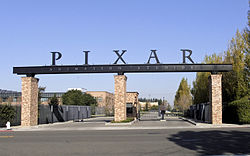

Pixar
View on Wikipedia
Pixar[a] (/ˈpɪksɑːr/), doing business as Pixar Animation Studios, is an American animation studio based in Emeryville, California, known for its critically and commercially successful computer-animated feature films. Pixar is a subsidiary of Walt Disney Studios, a division of the Disney Entertainment segment of the Walt Disney Company.
Key Information


Pixar started in 1979 as part of the Lucasfilm computer division. It was known as the Graphics Group before its spin-off as a corporation in 1986, with funding from Apple co-founder Steve Jobs, who became its majority shareholder.[2] Disney announced its acquisition of Pixar in January 2006, and completed it in May 2006.[6][7][8] Pixar is best known for its feature films, technologically powered by RenderMan, the company's own implementation of the industry-standard RenderMan Interface Specification image-rendering API. The studio's mascot is Luxo Jr., a desk lamp from the studio's 1986 short film of the same name.
Pixar has produced 29 feature films, with its first film being Toy Story (1995), which is also the first fully computer-animated feature film, and its most recent film was Elio (2025). The studio also produced many short films. As of July 2023[update], its feature films have earned over $15 billion at the worldwide box office with an average gross of $589 million per film.[9] Toy Story 3 (2010), Finding Dory (2016), Incredibles 2 (2018), Toy Story 4 (2019) and Inside Out 2 (2024) all grossed over $1 billion and are among the 50 highest-grossing films of all time. Moreover, 13 of Pixar's films are in the 50 highest-grossing animated films of all time. As of August 2025[update], Inside Out 2 was the second highest-grossing animated film of all time.[10]
Pixar has earned 23 Academy Awards, 10 Golden Globe Awards, and 11 Grammy Awards, along with numerous other awards and acknowledgments. Since its inauguration in 2001, eleven Pixar films have won the Academy Award for Best Animated Feature, including Finding Nemo (2003), The Incredibles (2004), Ratatouille (2007), WALL-E (2008), Up (2009), Toy Story 3 and Toy Story 4, Brave (2012), Inside Out (2015), Coco (2017), and Soul (2020). Toy Story 3 and Up were also nominated for the Academy Award for Best Picture.
In February 2009, Pixar executives John Lasseter, Brad Bird, Pete Docter, Andrew Stanton, and Lee Unkrich were presented with the Golden Lion for Lifetime Achievement by the Venice Film Festival. The physical award was ceremoniously handed to Lucasfilm's founder, George Lucas.
History
[edit]Early history
[edit]
Pixar got its start in 1974, when New York Institute of Technology's (NYIT) founder, Alexander Schure, who was also the owner of a traditional animation studio, established the Computer Graphics Lab (CGL) and recruited computer scientists who shared his ambitions about creating the world's first computer-animated film.[citation needed] Edwin Catmull and Malcolm Blanchard were the first to be hired and were soon joined by Alvy Ray Smith and David DiFrancesco some months later, who were the four original members of the Computer Graphics Lab, located in a converted two-story garage acquired from the former Vanderbilt-Whitney estate.[11][12] Schure invested significant funds into the computer graphics lab, approximately $15 million, providing the resources the group needed but contributing to NYIT's financial difficulties.[13] Eventually, the group realized they needed to work in a real film studio to reach their goal. Francis Ford Coppola then invited Smith to his house for a three-day media conference, where Coppola and George Lucas shared their visions for the future of digital moviemaking.[14]
When Lucas approached the group and offered them jobs at his studio, six employees moved to Lucasfilm. During the following months, they gradually resigned from CGL, found temporary jobs for about a year to avoid making Schure suspicious, and joined the Graphics Group at Lucasfilm.[15][16] The Graphics Group, which was one-third of the Computer Division of Lucasfilm, opened in 1979 with the hiring of Catmull from NYIT,[17] where he was in charge of the Computer Graphics Lab. He was then reunited with Smith, who also made the journey from NYIT to Lucasfilm, and was made the director of the Graphics Group. At NYIT, the researchers pioneered many of the CG foundation techniques — in particular, the invention of the alpha channel by Catmull and Smith.[18] Over the next several years, the CGL would produce a few frames of an experimental film called The Works. After moving to Lucasfilm, the team worked on creating the precursor to RenderMan, called REYES (for "renders everything you ever saw"), and developed several critical technologies for CG — including particle effects and various animation tools.[19]
John Lasseter was hired to the Lucasfilm team for a week in late 1983 with the title "interface designer"; he animated the short film The Adventures of André & Wally B.[20] In the next few years, a designer suggested naming a new digital compositing computer the "Picture Maker". Smith suggested that the laser-based device have a catchier name, and came up with "Pixer", which after a meeting was changed to "Pixar".[21] According to Michael Rubin, the author of Droidmaker: George Lucas and the Digital Revolution, Smith and three other employees came up with the name during a restaurant visit in 1981, but when interviewing them he got four different versions about the origin of the name.[22]
In 1982, the Pixar team began working on special-effects film sequences with Industrial Light & Magic. After years of research, and key milestones such as the Genesis Effect in Star Trek II: The Wrath of Khan and the Stained Glass Knight in Young Sherlock Holmes,[17] the group, which then numbered 40 individuals, was spun out as a corporation in February 1986 by Catmull and Smith. Among the 38 remaining employees were Malcolm Blanchard, David DiFrancesco, Ralph Guggenheim, and Bill Reeves, who had been part of the team since the days of NYIT. Tom Duff, also an NYIT member, would later join Pixar after its formation.[2] With Lucas's 1983 divorce, which coincided with the sudden dropoff in revenues from Star Wars licenses following the release of Return of the Jedi, they knew he would most likely sell the whole Graphics Group. Worried that the employees would be lost to them if that happened, which would prevent the creation of the first computer-animated movie, they concluded that the best way to keep the team together was to turn the group into an independent company. But Moore's Law also suggested that sufficient computing power for the first film was still some years away, and they needed to focus on a proper product until then. Eventually, they decided they should be a hardware company in the meantime, with their Pixar Image Computer as the core product, a system primarily sold to governmental, scientific, and medical markets.[2][13][23] They also used SGI computers.[24]
In 1983, Nolan Bushnell founded a new computer-guided animation studio called Kadabrascope as a subsidiary of his Chuck E. Cheese's Pizza Time Theatres company (PTT), which was founded in 1977. Only one major project was made out of the new studio, an animated Christmas special for NBC starring Chuck E. Cheese and other PTT mascots; known as "Chuck E. Cheese: The Christmas That Almost Wasn't". The animation movement would be made using tweening instead of traditional cel animation. After the video game crash of 1983, Bushnell started selling some subsidiaries of PTT to keep the business afloat. Sente Technologies (another division, was founded to have games distributed in PTT stores) was sold to Bally Games and Kadabrascope was sold to Lucasfilm. The Kadabrascope assets were combined with the Computer Division of Lucasfilm.[25] Coincidentally, one of Steve Jobs's first jobs was under Bushnell in 1973 as a technician at his other company Atari, which Bushnell sold to Warner Communications in 1976 to focus on PTT.[26] PTT would later go bankrupt in 1984 and be acquired by ShowBiz Pizza Place.[27]
Independent company (1986–1999)
[edit]
In 1986, the newly independent Pixar was headed by President Edwin Catmull and Executive Vice President Alvy Ray Smith. Lucas's search for investors led to an offer from Steve Jobs, which Lucas initially found too low. He eventually accepted after determining it impossible to find other investors. At that point, Smith and Catmull had been declined by 35 venture capitalists and ten large corporations,[28] including a deal with General Motors which fell through three days before signing the contracts.[29] Jobs, who had been edged out of Apple in 1985,[2] was now founder and CEO of the new computer company NeXT. On February 3, 1986, he paid $5 million of his own money to George Lucas for technology rights and invested $5 million cash as capital into the company, joining the board of directors as chairman.[2][30]
In 1985 while still at Lucasfilm, they had made a deal with the Japanese publisher Shogakukan to make a computer-animated movie called Monkey, based on the Monkey King. The project continued sometime after they became a separate company in 1986, but it became clear that the technology was not sufficiently advanced. The computers were not powerful enough and the budget would be too high. As a result, they focused on the computer hardware business for years until a computer-animated feature became feasible according to Moore's law.[31][32]
At the time, Walt Disney Studios made the decision to develop more efficient ways of producing animation. They reached out to Graphics Group at Lucasfilm and to Digital Productions. Because of the Graphics Group's deeper understanding of animation, and Smith's experience with paint programs at NYIT, it convinced Disney they were the right choice. In May 1986 Pixar signed a contract with Disney, who eventually bought and used the Pixar Image Computer and custom software written by Pixar as part of its Computer Animation Production System (CAPS) project, to migrate the laborious ink and paint part of the 2D animation process to a more automated method.[33] The company's first feature film to be released using this new animation method was The Rescuers Down Under (1990).[34][35]
In a bid to drive sales of the system and increase the company's capital, Jobs suggested releasing the product to the mainstream market. Pixar employee John Lasseter, who had long been working on not-for-profit short demonstration animations, such as Luxo Jr. (1986) to show off the device's capabilities, premiered his creations to great fanfare at SIGGRAPH, the computer graphics industry's largest convention.[36]
However, the Image Computer had inadequate sales[36] which threatened to end the company as financial losses grew. Jobs increased investment in exchange for an increased stake, reducing the proportion of management and employee ownership until eventually, his total investment of $50 million gave him control of the entire company. In 1989, Lasseter's growing animation department which was originally composed of just four people (Lasseter, Bill Reeves, Eben Ostby, and Sam Leffler), was turned into a division that produced computer-animated commercials for outside companies.[1][37][38] In April 1990, Pixar sold its hardware division, including all proprietary hardware technology and imaging software, to Vicom Systems, and transferred 18 of Pixar's approximately 100 employees. In the same year Pixar moved from San Rafael to Richmond, California.[39] Pixar released some of its software tools on the open market for Macintosh and Windows systems. RenderMan is one of the leading 3D packages of the early 1990s, and Typestry is a special-purpose 3D text renderer that competed with RayDream.[citation needed]
During this period of time, Pixar continued its successful relationship with Walt Disney Feature Animation, a studio whose corporate parent would ultimately become its most important partner. As 1991 began, however, the layoff of 30 employees in the company's computer hardware department (including the company's president, Chuck Kolstad[40]), reduced the total number of employees to just 42, approximately its original number.[41] On March 6, 1991, Steve Jobs bought the company from its employees and became the full owner. He contemplated folding it into NeXT, but the NeXT's co-founders refused.[29] A few months later Pixar made a historic $26 million deal with Disney to produce three computer-animated feature films, the first of which was Toy Story (1995), the product of the technological limitations that challenged CGI.[42] By then the software programmers working on RenderMan and IceMan, and Lasseter's animation department, which made television commercials (and four Luxo Jr. shorts for Sesame Street the same year), were all that remained of Pixar.[43]
Despite the income from these projects, the company still continued to lose money and Steve Jobs, as chairman of the board and now owner, often considered selling it. As late as 1994, Jobs contemplated selling Pixar to other companies such as Hallmark Cards, Microsoft co-founder Paul Allen, and Oracle CEO and co-founder Larry Ellison.[44] After learning from New York critics that Toy Story would probably be a hit, and confirming that Disney would distribute it for the 1995 Christmas season, he decided to give Pixar another chance.[45][46] Also for the first time, he took an active leadership role in the company and made himself CEO.[47] Toy Story grossed more than $373 million worldwide[48] and, when Pixar held its initial public offering on November 29, 1995, trading as "PIXR" on NASDAQ, it exceeded Netscape's as the biggest IPO of the year. In its first half-hour of trading, Pixar stock shot from $22 to $45, delaying trading because of unmatched buy orders. Shares climbed to US$49 and closed the day at $39.[49]
The company continued to make the television commercials during the production of Toy Story, which came to an end on July 9, 1996, when Pixar announced they would shut down its television commercial unit, which counted 18 employees, to focus on longer projects and interactive entertainment.[50][51]
During the 1990s and 2000s, Pixar gradually developed the "Pixar Braintrust", the studio's primary creative development process, in which all of its directors, writers, and lead storyboard artists regularly examine each other's projects and give very candid "notes", the industry term for constructive criticism.[52] The Braintrust operates under a philosophy of a "filmmaker-driven studio", in which creatives help each other move their films forward through a process somewhat like peer review, as opposed to the traditional Hollywood approach of an "executive-driven studio" in which directors are micromanaged through "mandatory notes" from development executives outranking the producers.[53][54] According to Catmull, it evolved out of the working relationship between Lasseter, Andrew Stanton, Pete Docter, Lee Unkrich, and Joe Ranft on Toy Story.[52]
As a result of the success of Toy Story, Pixar built a new studio at the Emeryville campus which was designed by PWP Landscape Architecture and opened in November 2000.[citation needed]
Collaboration with Disney (1999–2006)
[edit]Pixar and Disney had disagreements over the production of Toy Story 2. Originally intended as a direct-to-video release (and thus not part of Pixar's three-picture deal), the film was eventually upgraded to a theatrical release during production. Pixar demanded that the film then be counted toward the three-picture agreement, but Disney refused.[55] Though profitable for both, Pixar later complained that the arrangement was not equitable. Pixar was responsible for creation and production, while Disney handled marketing and distribution. Profits and production costs were split equally, but Disney exclusively owned all story, character, and sequel rights and also collected a 10%-15% distribution fee.[56]
The two companies attempted to reach a new agreement for ten months and failed on January 26, 2001, July 26, 2002, April 22, 2003, January 16, 2004, July 22, 2004, and January 14, 2005. The proposed distribution deal meant Pixar would control production and own the resulting story, character, and sequel rights, while Disney would own the right of first refusal to distribute any sequels. Pixar also wanted to finance its own films and collect 100% profit, paying Disney the 10%-15% distribution fee.[57] In addition, as part of any distribution agreement with Disney, Pixar demanded control over films already in production under the old agreement, including The Incredibles (2004) and Cars (2006). Disney considered these conditions unacceptable, but Pixar would not concede.[citation needed]
Disagreements between Steve Jobs and Disney chairman and CEO Michael Eisner caused the negotiations to cease in 2004, with Disney forming Circle Seven Animation and Jobs declaring that Pixar was actively seeking partners other than Disney.[58] Despite this announcement and several talks with Warner Bros., Sony Pictures, and 20th Century Fox, Pixar did not enter negotiations with other distributors,[59] although a Warner Bros. spokesperson told CNN, "We would love to be in business with Pixar. They are a great company."[57] After a lengthy hiatus, negotiations between the two companies resumed following the departure of Eisner from Disney in September 2005. In preparation for potential fallout between Pixar and Disney, Jobs announced in late 2004 that Pixar would no longer release movies at the Disney-dictated November time frame, but during the more lucrative early summer months. This would also allow Pixar to release DVDs for its major releases during the Christmas shopping season. An added benefit of delaying Cars from November 4, 2005, to June 9, 2006, was to extend the time frame remaining on the Pixar-Disney contract, to see how things would play out between the two companies.[59]
Pending the Disney acquisition of Pixar, the two companies created a distribution deal for the intended 2007 release of Ratatouille, to ensure that if the acquisition failed, this one film would be released through Disney's distribution channels. In contrast to the earlier Pixar deal, Ratatouille was meant to remain a Pixar property and Disney would have received a distribution fee. The completion of Disney's Pixar acquisition, however, nullified this distribution arrangement.[60]
Walt Disney Studios subsidiary (2006–present)
[edit]After extended negotiations, Disney ultimately agreed on January 24, 2006, to buy Pixar for approximately $7.4 billion in an all-stock deal.[61] Following Pixar shareholder approval, the acquisition was completed on May 5, 2006. The transaction catapulted Jobs, who owned 49.65% of total share interest in Pixar, to Disney's largest individual shareholder with 7%, valued at $3.9 billion, and a new seat on its board of directors.[8][62] Jobs' new Disney holdings exceeded holdings belonging to Eisner, the previous top shareholder, who still held 1.7%; and Disney Director Emeritus Roy E. Disney, who held almost 1% of the corporation's shares. Pixar shareholders received 2.3 shares of Disney common stock for each share of Pixar common stock redeemed.[63]
As part of the deal, John Lasseter, by then Executive Vice President, became Chief Creative Officer (reporting directly to president and CEO Bob Iger and consulting with Disney Director Roy E. Disney) of both Pixar and Walt Disney Animation Studios (including its division Disneytoon Studios), as well as the Principal Creative Adviser at Walt Disney Imagineering, which designs and builds the company's theme parks.[62] Catmull retained his position as President of Pixar, while also becoming President of Walt Disney Animation Studios, reporting to Iger and Dick Cook, chairman of the Walt Disney Studios. Jobs's position as Pixar's chairman and chief executive officer was abolished, and instead, he took a place on the Disney board of directors.[64]
After the deal closed in May 2006, Lasseter revealed that Iger had felt that Disney needed to buy Pixar while watching a parade at the opening of Hong Kong Disneyland in September 2005.[65] Iger noticed that of all the Disney characters in the parade, none were characters that Disney had created within the last ten years since all the newer ones had been created by Pixar.[65] Upon returning to Burbank, Iger commissioned a financial analysis that confirmed that Disney had actually lost money on animation for the past decade, then presented that information to the board of directors at his first board meeting after being promoted from COO to CEO, and the board, in turn, authorized him to explore the possibility of a deal with Pixar.[66] Lasseter and Catmull were wary when the topic of Disney buying Pixar first came up, but Jobs asked them to give Iger a chance (based on his own experience negotiating with Iger in summer 2005 for the rights to ABC shows for the fifth-generation iPod Classic),[67] and in turn, Iger convinced them of the sincerity of his feeling that Disney needed to re-focus on animation.[65]

Lasseter and Catmull's oversight of both the Disney Feature Animation and Pixar studios did not mean that the two studios were merging, however. In fact, additional conditions were laid out as part of the deal to ensure that Pixar remained a separate entity, a concern that analysts had expressed about the Disney deal.[68][page needed] Some of those conditions were that Pixar HR policies would remain intact, including the lack of employment contracts. Also, the Pixar name was guaranteed to continue, and the studio would remain in its current Emeryville, California, location with the "Pixar" sign. Finally, branding of films made post-merger would be "Disney•Pixar" (beginning with Cars).[69]
Jim Morris, producer of WALL-E (2008), became general manager of Pixar. In this new position, Morris took charge of the day-to-day running of the studio facilities and products.[70]
After a few years, Lasseter and Catmull were able to successfully transfer the basic principles of the Pixar Braintrust to Disney Animation, although meetings of the Disney Story Trust are reportedly "more polite" than those of the Pixar Braintrust.[71] Catmull later explained that after the merger, to maintain the studios' separate identities and cultures (notwithstanding the fact of common ownership and common senior management), he and Lasseter "drew a hard line" that each studio was solely responsible for its own projects and would not be allowed to borrow personnel from or lend tasks out to the other.[72][73] The rule ensures that each studio maintains "local ownership" of projects and can be proud of its own work.[72][73] Thus for example, when Pixar had issues with Ratatouille and Disney Animation had issues with Bolt (2008), "nobody bailed them out" and each studio was required "to solve the problem on its own" despite knowing that there were personnel at the other studio who theoretically could have helped.[72][73]
Expansion and John Lasseter's exit (2010–2018)
[edit]On April 20, 2010, Pixar opened Pixar Canada in the downtown area of Vancouver, British Columbia, Canada.[74] The roughly 2,000 square meters studio produced seven short films based on Toy Story and Cars characters. In October 2013, the studio was closed down to refocus Pixar's efforts at its main headquarters.[75]
In November 2014, Morris was promoted to president of Pixar, while his counterpart at Disney Animation, general manager Andrew Millstein, was also promoted to president of that studio.[76] Both continued to report to Catmull, who retained the title of president of both Disney Animation and Pixar.[76]
On November 21, 2017, Lasseter announced that he was taking a six-month leave of absence after acknowledging what he called "missteps" in his behavior with employees in a memo to staff. According to The Hollywood Reporter and The Washington Post, Lasseter had a history of alleged sexual misconduct towards employees.[77][78][79] On June 8, 2018, it was announced that Lasseter would leave Disney Animation and Pixar at the end of the year, but would take on a consulting role until then.[80] Pete Docter was announced as Lasseter's replacement as chief creative officer of Pixar on June 19, 2018.[81]
Sequels and financial success (2018–2019)
[edit]On June 15, 2018, Incredibles 2 was released, setting a record for widest opening weekend worldwide and domestic for an animated film.[82] The film would eventually gross $1.2 billion worldwide.[83] On October 23, 2018, it was announced that Catmull would be retiring. He stayed in an adviser role until July 2019.[84] On January 18, 2019, it was announced that Lee Unkrich would be leaving Pixar after 25 years although he would return to the studio a few years later.[85][86] On June 21, 2019, Toy Story 4 was released, surpassing the widest opening worldwide weekend record that Incredibles 2 set.[87] The film would make over $1 billion and win the Academy Award for Best Animated Feature.[88][89] During the 2019 D23 Expo, Pixar announced that their next film, Soul, would release in 2020.[90] Ahead of the launch of Disney+, Pixar debuted SparkShorts, experimental shorts done by Pixar staff.[91]
COVID-19, Disney+ releases, and some financial struggles (2020–present)
[edit]Pixar released Onward on March 6, 2020. However, due to the start of the COVID-19 pandemic, the film underperformed at the box office and was released onto rental digital services on March 20, and later on Disney+ on April 3.[92] Due to the pandemic, Soul was moved to November 2020, and ultimately released on December 25, 2020, on Disney+ at no additional cost to subscribers, and later became the first animated streaming film to win the Academy Award for Best Animated Feature.[93] Pixar's next two features, Luca and Turning Red, were also released free on Disney+ in June 2021 and March 2022, respectively.[94][95] In 2021, several Pixar employees anonymously criticized Disney's decision to release their films direct to Disney+.[96]
Lightyear, Pixar's first movie to return to theaters, was released in June 2022. The film became a box-office failure with Deadline Hollywood calculating the film lost the studio $106 million, when factoring together all expenses and revenues.[97] In September 2022, Jonas Rivera was promoted to Executive VP of Film Production at Pixar overseeing all film and streaming production.[98] In December 2022, Disney CEO Bob Iger noted that they would rely more on the Pixar brand.[99] In June 2023, Disney laid off 75 employees including the director of Lightyear Angus MacLane, and the film's producer Galyn Susman.[100]
During that same month, Elemental was released. During the film's opening weekend, Docter stated that Pixar "trained audiences that these films will be available for you on Disney+".[101] Despite opening below projections, Elemental ultimately made a box office comeback by early August 2023, crossing $400 million at the worldwide box office. Disney's EVP of Theatrical Distribution Tony Chambers stated "After a disappointing opening weekend, we're really pleased that audiences have discovered what a great movie it is."[102] That same month, Morris said "at the box office we're looking at now, [the film] should do better than break even theatrically. And then we have revenue from streaming, theme parks and consumer products. This will certainly be a profitable film for the Disney company."[103] In December 2023, it was announced that Soul, Turning Red and Luca would be released in theaters in the United States in the first quarter of 2024.[104]
In January 2024, it was reported that Pixar's staff would face imminent layoffs by 20 percent, reducing the studio's workforce to less than 1,000 employees.[105][106] However, the layoffs were then delayed and did not occur, reportedly because of production schedules.[107] In May 2024, the studio proceeded with slightly smaller layoffs: 175 employees or approximately 14 percent of the studio's workforce of over 1,300 employees.[107][108] The layoffs occurred as the studio began to rely less on direct-to-streaming series and more on feature films intended primarily for theatrical exhibition.[107][108]
On June 14 of the same year, Inside Out 2 was released and became financially successful. The film had a domestic opening of $154 million, the third highest for an animated film, and the biggest global opening for an animated movie with $294 million. Since then, Inside Out 2 broke multiple box office records. It had the highest second weekend gross for an animated film with $100 million, being the first to reach the six-digit second opening weekend. It became the fastest animated movie to reach $1 billion at the global box office, reaching the milestone in 17 days. It also out-grossed Incredibles 2 to become the highest grossing Pixar film. Inside Out 2 became the highest-grossing animated film, and the 8th-highest grossing film of all time at the end of its theatrical run.[109] Dream Productions, an Inside Out spin off series set between the first and second film, was released on December 11, 2024 on Disney+.[110]
In June 2025, Pixar released their next film Elio. The film had the lowest box office opening for a Pixar film to date, earning $21 million,[111] and an all-time low global opening of $35 million.[112] In an op-ed, Rebecca Rubin for Variety noted that Elio faced stiff box office competition against the 2025 live-action remakes of How to Train Your Dragon and Disney's Lilo & Stitch. Shawn Robbins for Fandango observed, "Competition from family audiences was difficult to overcome. It makes you wonder how Elio would have performed in the spring, or even a week or two later."[113] Rubin wrote that similar to Elemental, Elio could have steady box office longevity thanks to favorable reviews and positive word-of-mouth.[113] However, Elio underperformed at the box office, earning $154 million worldwide.[114][115] On September 17, 2025, Elio began streaming on Disney+ and became one of the top-streaming titles for that week.[116]
Campus
[edit]

When Steve Jobs, chief executive officer of Apple Inc. and Pixar, and John Lasseter, executive vice president of Pixar, decided to move their studios from a leased space in Point Richmond, California, to larger quarters of their own, they chose a 20-acre site in Emeryville, California,[117] formerly occupied by Del Monte Foods, Inc. The first of several buildings, the high-tech structure designed by Bohlin Cywinski Jackson[118] has special foundations and electricity generators to ensure continued film production, even through major earthquakes. The character of the building is intended to abstractly recall Emeryville's industrial past. The two-story steel-and-masonry building is a collaborative space with many pathways.[119]
The digital revolution in filmmaking was driven by applied mathematics, including computational physics and geometry.[120] In 2008, this led Pixar senior scientist Tony DeRose to offer to host the second Julia Robinson Mathematics Festival at the Emeryville campus.[121]
Filmography
[edit]Traditions
[edit]| 1995 | Toy Story |
|---|---|
| 1996 | |
| 1997 | |
| 1998 | A Bug's Life |
| 1999 | Toy Story 2 |
| 2000 | |
| 2001 | Monsters, Inc. |
| 2002 | |
| 2003 | Finding Nemo |
| 2004 | The Incredibles |
| 2005 | |
| 2006 | Cars |
| 2007 | Ratatouille |
| 2008 | WALL-E |
| 2009 | Up |
| 2010 | Toy Story 3 |
| 2011 | Cars 2 |
| 2012 | Brave |
| 2013 | Monsters University |
| 2014 | |
| 2015 | Inside Out |
| The Good Dinosaur | |
| 2016 | Finding Dory |
| 2017 | Cars 3 |
| Coco | |
| 2018 | Incredibles 2 |
| 2019 | Toy Story 4 |
| 2020 | Onward |
| Soul | |
| 2021 | Luca |
| 2022 | Turning Red |
| Lightyear | |
| 2023 | Elemental |
| 2024 | Inside Out 2 |
| 2025 | Elio |
| 2026 | Hoppers |
| Toy Story 5 | |
| 2027 | Gatto |
| 2028 | Incredibles 3 |
Some of Pixar's first animators were former cel animators including John Lasseter, and others came from computer animation or were fresh college graduates.[122] A large number of animators that make up its animation department had been hired around the releases of A Bug's Life (1998), Monsters, Inc. (2001), and Finding Nemo (2003). The success of Toy Story (1995) made Pixar the first major computer-animation studio to successfully produce theatrical feature films. The majority of the animation industry was (and still is) located in Los Angeles, and Pixar is located 350 miles (560 km) north in the San Francisco Bay Area. Traditional hand-drawn animation was still the dominant medium for feature animated films.[citation needed]
With the scarcity of Los Angeles-based animators willing to move their families so far north to give up traditional animation and try computer animation, Pixar's new hires at this time either came directly from college or had worked outside feature animation. For those who had traditional animation skills, the Pixar animation software Marionette was designed so that traditional animators would require a minimum amount of training before becoming productive.[122]
In a 2007 interview with PBS talk show host Tavis Smiley,[123] Lasseter said that Pixar's films follow the same theme of self-improvement as the company itself has: with the help of friends or family, a character ventures out into the real world and learns to appreciate his friends and family. At the core, Lasseter said, "it's gotta be about the growth of the main character and how he changes."[123]
Actor John Ratzenberger, who had previously starred in the television series Cheers (1982–1993), has voiced a character in every Pixar feature film from Toy Story through Onward (2020). A non-speaking background character in Soul (2020) bears his likeness. Pixar paid tribute to Ratzenberger in the end credits of Cars (2006) by parodying scenes from three of its earlier films (Toy Story, Monsters, Inc., and A Bug's Life), replacing all of the characters with motor vehicle versions of them and giving each film an automotive-based title. After the third scene, Mack (his character in Cars) realizes that the same actor has been voicing characters in every film.[citation needed]
Due to the traditions that have occurred within the films and shorts such as anthropomorphic creatures and objects, and easter egg crossovers between films and shorts that have been spotted by Pixar fans, a blog post titled The Pixar Theory was published in 2013 by Jon Negroni, and popularized by the YouTube channel Super Carlin Brothers,[124] proposing that all of the characters within the Pixar universe were related, surrounding Boo from Monsters Inc. and the Witch from Brave (2012).[125][126][127]
Additionally, Pixar is known for their films having expensive budgets, ranging from $150–200 million. Some of these films include Ratatouille (2007), Toy Story 3 (2010), Toy Story 4 (2019), Incredibles 2 (2018), Inside Out (2015), Inside Out 2 (2024), The Good Dinosaur (2015), Onward and Soul, Turning Red, Lightyear (both 2022), and Elemental (2023). In a 2023 interview, Pixar's president Jim Morris stated that one of the reasons why their films have expensive budgets is because they are produced entirely in the U.S. with all of the artists under one roof, while almost all of their competitors keep costs down by doing work offshore.[103]
Sequels and prequels
[edit]As of March 2025, seven Pixar films have received or will receive sequels or prequels. These films are Toy Story, Cars, Monsters, Inc., Finding Nemo, The Incredibles, Inside Out, and Coco.[citation needed]
Toy Story 2 was originally commissioned by Disney as a 60-minute direct-to-video film. Expressing doubts about the strength of the material, John Lasseter convinced the Pixar team to start from scratch and make the sequel their third full-length feature film.[citation needed]
Following the release of Toy Story 2 in 1999, Pixar and Disney had a gentlemen's agreement that Disney would not make any sequels without Pixar's involvement though retaining a right to do so. After the two companies were unable to agree on a new deal, Disney announced in 2004 they would plan to move forward on sequels with or without Pixar and put Toy Story 3 into pre-production at Disney's then-new CGI division Circle Seven Animation. However, when Lasseter was placed in charge of all Disney and Pixar animation following Disney's acquisition of Pixar in 2006, he put all sequels on hold and Toy Story 3 was canceled. In May 2006, it was announced that Toy Story 3 was back in pre-production with a new plot and under Pixar's control. The film was released on June 18, 2010, as Pixar's eleventh feature film.[citation needed]
Shortly after announcing the resurrection of Toy Story 3, Lasseter stated, "If we have a great story, we'll do a sequel."[128] Cars 2, Pixar's first non-Toy Story sequel, was officially announced in April 2008 and released on June 24, 2011, as their twelfth. Monsters University, a prequel to Monsters, Inc. (2001), was announced in April 2010 and initially set for release in November 2012;[129] the release date was pushed to June 21, 2013, due to Pixar's past success with summer releases, according to a Disney executive.[130]
In June 2011, Tom Hanks, who voiced Woody in the Toy Story series, implied that Toy Story 4 was "in the works", although it had not yet been confirmed by the studio.[131][132] In April 2013, Finding Dory, a sequel to Finding Nemo, was announced for a June 17, 2016, release.[133] In March 2014, Incredibles 2 and Cars 3 were announced as films in development.[134] In November 2014, Toy Story 4 was confirmed to be in development with Lasseter serving as director.[135] However, in July 2017, Lasseter announced that he had stepped down, leaving Josh Cooley as sole director.[136] Released in June 2019, Toy Story 4 ranks among the 40 top-grossing films in American cinema.[137]
On July 3, 2016, Pixar president Jim Morris announced that the studio might be moving away from sequels after Toy Story 4.[138] This was affirmed by producer Mark Nielsen in May 2019.[139] Shortly after its release, Pixar's chief creative officer Pete Docter confirmed that the studio would take a break from sequels and focus on original projects. However, in a later interview, Docter said the studio would have to return to making sequels at some point for its "financial safety".[140] In September 2022, during the D23 Expo, Docter and Amy Poehler (voice of Joy in Inside Out) confirmed that Inside Out 2 was in development, with the film being released on June 14, 2024.[141] In February 2023, Disney CEO Bob Iger announced that Toy Story 5 was in development, aiming for a 2026 release.[142][143] In August 2024, during the D23 Expo, Docter announced that Incredibles 3 is in development, with Brad Bird returning to develop.[144]
That same month, on the subject of making a sequel, Docter stated "I want to make it because we have something new to say with these characters. And there's been a number of films that we would love to have a sequel to, that we couldn't find something."[145]
In March 2025, Iger announced that Coco 2 is in development. Lee Unkrich and Adrian Molina are returning as director and co-director respectively while Mark Nielsen is producing.[146]
Adaptation to television
[edit]Toy Story is the first Pixar film to be adapted for television as a Buzz Lightyear of Star Command film and TV series on the UPN television network, now The CW. Cars became the second with the help of Cars Toons, a series of 3-to-5-minute short films running between regular Disney Channel show intervals and featuring Mater from Cars.[147] Between 2013 and 2014, Pixar released its first two television specials, Toy Story of Terror![148] and Toy Story That Time Forgot. Monsters at Work, a television series spin-off of Monsters, Inc. produced by Disney Television Animation, premiered in July 2021 on Disney+.[149][150]
On December 10, 2020, it was announced that three series would be released on Disney+. The first Dug Days (featuring Dug from Up (2009)), which premiered on September 1, 2021.[151] The second, a Cars show titled Cars on the Road, which follows Mater and Lightning McQueen as they go on a road trip.[151][152] It premiered on Disney+ on September 8, 2022.[153] An original show entitled Win or Lose, which follows a middle school softball team the week leading up to the big championship game where each episode is from a different perspective, premiered on Disney+ on February 19, 2025.[151][154][110]
A TV series based on Inside Out was announced to be in development for Disney+ in June 2023, with Soul co-writer Mike Jones hired as developer.[155] The series, titled Dream Productions, premiered on Disney+ on December 11, 2024.[110]
On August 8, 2025, it was announced that a series is being developed as the third series in the Cars franchise, titled Cars: Lightning Racers. It is set to be released on Disney Jr. in 2027.[156]
2D animation and live-action
[edit]The Pixar filmography to date has been computer-animated features. So far, WALL-E (2008) has been the only Pixar film not to be completely animated as it features a small amount of live-action, including footage from the 1969 film Hello, Dolly! while the short films Your Friend the Rat (2007), Day & Night (2010), Kitbull (2019), Burrow (2020), and Twenty Something (2021) feature 2D animation. 1906, the live-action film by Brad Bird based on a screenplay and novel by James Dalessandro about the 1906 earthquake, was in development but has since been abandoned by Bird and Pixar. Bird has stated that he was "interested in moving into the live-action realm with some projects" while "staying at Pixar [because] it's a very comfortable environment for me to work in". In June 2018, Bird mentioned the possibility of adapting the novel as a TV series, and the earthquake sequence as a live-action feature film.[157]
The Toy Story Toons short Hawaiian Vacation (2011) also includes the fish and shark as live-action.[citation needed]
Jim Morris, president of Pixar, produced Disney's John Carter (2012) which Andrew Stanton co-wrote and directed.[158]
Pixar's creative heads were consulted to fine tune the script for the 2011 live-action film The Muppets.[159] Similarly, Pixar assisted in the story development of Disney's The Jungle Book (2016) as well as providing suggestions for the film's end credits sequence.[160] Both Pixar and Mark Andrews were given a "Special Thanks" credit in the film's credits.[161] Additionally, many Pixar animators, both former and current, were recruited for a traditional hand-drawn animated sequence for the 2018 film Mary Poppins Returns.[162]
Pixar representatives have also assisted in the English localization of several Studio Ghibli films, mainly those from Hayao Miyazaki.[163]
In 2019, Pixar developed a live-action hidden camera reality show, titled Pixar in Real Life, for Disney+.[164]
Upcoming films
[edit]Five upcoming films have been announced. Films with release dates are Hoppers, directed by Daniel Chong and scheduled to be released on March 6, 2026,[165][166][167][168] Toy Story 5, directed by Andrew Stanton and scheduled to be released on June 19, 2026,[143][169] and Gatto, directed by Enrico Casarosa and scheduled to be released on June 18, 2027.[170] Currently in development are Incredibles 3, directed by Peter Sohn,[171][144] and Coco 2, with director Lee Unkrich and co-director Adrian Molina returning in their respective roles.[172][173][174]
Franchises
[edit]This does not include the Cars spinoffs produced by Disneytoon Studios.
| Titles | Films | Short films | TV seasons | Release date |
|---|---|---|---|---|
| Toy Story | 7 | 7 | 4 | 1995–present |
| Monsters, Inc. | 2 | 2 | 2 | 2001–present |
| Finding Nemo | 2 | 4 | 0 | 2003–present |
| The Incredibles | 3 | 5 | 0 | 2004–present |
| Cars | 3 | 4 | 2 | 2006–present |
| Inside Out | 2 | 1 | 1 | 2015–present |
| Coco | 2 | 2 | 0 | 2017–present |
Highest-grossing films
[edit]- † Indicates films playing in theaters in the week commencing 21 November 2025.
| Rank | Title | Year | Gross |
|---|---|---|---|
| 1 | Inside Out 2 | 2024 | $652,980,194 |
| 2 | Incredibles 2 | 2018 | $608,581,744 |
| 3 | Finding Dory | 2016 | $486,295,561 |
| 4 | Toy Story 4 | 2019 | $434,038,008 |
| 5 | Toy Story 3 | 2010 | $415,004,880 |
| 6 | Finding Nemo‡ | 2003 | $380,843,261 |
| 7 | Inside Out | 2015 | $356,921,711 |
| 8 | Up | 2009 | $293,004,164 |
| 9 | Monsters University | 2013 | $268,492,764 |
| 10 | The Incredibles | 2004 | $261,441,092 |
| 11 | Monsters, Inc.‡ | 2001 | $255,873,250 |
| 12 | Toy Story 2‡ | 1999 | $245,852,179 |
| 13 | Cars | 2006 | $244,082,982 |
| 14 | Brave | 2012 | $237,283,207 |
| 15 | Toy Story‡ | 1995 | $229,947,062 |
| 16 | WALL-E | 2008 | $223,808,164 |
| 17 | Coco | 2017 | $210,460,015 |
| 18 | Ratatouille | 2007 | $206,445,654 |
| 19 | Cars 2 | 2011 | $191,452,396 |
| 20 | A Bug's Life | 1998 | $162,798,565 |
| 21 | Elemental | 2023 | $154,426,697 |
| 22 | Cars 3 | 2017 | $152,901,115 |
| 23 | The Good Dinosaur | 2015 | $123,087,120 |
| 24 | Lightyear | 2022 | $118,307,188 |
| 25 | Elio | 2025 | $72,987,454 |
| Rank | Title | Year | Gross |
|---|---|---|---|
| 1 | Inside Out 2 | 2024 | $1,698,863,816 |
| 2 | Incredibles 2 | 2018 | $1,243,225,667 |
| 3 | Toy Story 4 | 2019 | $1,073,394,593 |
| 4 | Toy Story 3 | 2010 | $1,066,969,703 |
| 5 | Finding Dory | 2016 | $1,028,570,889 |
| 6 | Finding Nemo‡ | 2003 | $941,637,960 |
| 7 | Inside Out | 2015 | $857,611,174 |
| 8 | Coco | 2017 | $807,816,196 |
| 9 | Monsters University | 2013 | $743,559,607 |
| 10 | Up | 2009 | $735,099,082 |
| 11 | The Incredibles | 2004 | $631,688,498 |
| 12 | Ratatouille | 2007 | $623,726,085 |
| 13 | Cars 2 | 2011 | $559,852,396 |
| 14 | Brave | 2012 | $538,983,207 |
| 15 | Monsters, Inc.‡ | 2001 | $528,773,250 |
| 16 | WALL-E | 2008 | $521,311,860 |
| 17 | Toy Story 2‡ | 1999 | $511,358,276 |
| 18 | Elemental | 2023 | $496,444,308 |
| 19 | Cars | 2006 | $461,983,149 |
| 20 | Toy Story‡ | 1995 | $401,157,969 |
| 21 | Cars 3 | 2017 | $383,930,656 |
| 22 | A Bug's Life | 1998 | $363,258,859 |
| 23 | The Good Dinosaur | 2015 | $332,207,671 |
| 24 | Lightyear | 2022 | $226,425,420 |
| 25 | Elio | 2025 | $154,291,182 |
‡—Includes theatrical reissue(s).
Co-op Program
[edit]The Pixar Co-op Program, a part of the Pixar University professional development program, allows their animators to use Pixar resources to produce independent films.[175][176] The first 3D project accepted to the program was Borrowed Time (2016); all previously accepted films were live-action.[177]
See also
[edit].svg)


- The Walt Disney Company
- Disney's Nine Old Men
- 12 basic principles of animation
- Disney Animation: The Illusion of Life
- Modern animation in the United States: Disney
- Animation studios owned by the Walt Disney Company
- Walt Disney Animation Studios
- Disneytoon Studios
- Circle Seven Animation
- Blue Sky Studios
- 20th Century Animation
- List of animation studios
- List of Disney theatrical animated feature films
Notes
[edit]References
[edit]- ^ a b "COMPANY FAQS". Pixar. Archived from the original on July 2, 2006.
{{cite web}}: CS1 maint: bot: original URL status unknown (link) - ^ a b c d e f Smith, Alvy Ray. "Pixar Founding Documents". Alvy Ray Smith Homepage. Archived from the original on April 27, 2005. Retrieved January 11, 2011.
- ^ Smith, Alvy Ray. "Proof of Pixar Cofounders" (PDF). Archived (PDF) from the original on March 4, 2016. Retrieved December 23, 2015.
- ^ Pixar (March 5, 2025). "Statement of Information - Corporation". bizfile online. California Secretary of State.
- ^ See Harold Marsh, Jr., R. Roy Finkle, Larry W. Sonsini, and Ann Yvonne Walker, Marsh's California Corporation Law, 4th ed., vol. 1 (New York: Aspen Publishers, 2004), 5–15 — 5–16.
- ^ "Joint Press Release". www.sec.gov. Retrieved January 20, 2024.
- ^ "Walt Disney Company, Form 8-K, Current Report, Filing Date Jan 26, 2006" (PDF). secdatabase.com. Archived (PDF) from the original on May 13, 2018. Retrieved May 12, 2018.
- ^ a b "Walt Disney Company, Form 8-K, Current Report, Filing Date May 8, 2006". secdatabase.com. Archived from the original on May 13, 2018. Retrieved May 12, 2018.
- ^ "Box Office History for Disney-Pixar Movies". The-Numbers. Archived from the original on May 6, 2021. Retrieved July 17, 2019.
- ^ Mallik, Esita (September 1, 2024). "Inside Out 2 Box Office (North America): Riley & Her Emotions Are Less Than $6 Million Away From Beating Chris Pratt-Led Jurassic World's $650 Million+ Domestic Haul". Koimoi. Retrieved January 22, 2025.
- ^ "Brief History of the New York Institute of Technology Computer Graphics Lab". Carnegie Mellon University. Archived from the original on March 3, 2016. Retrieved January 1, 2016.
- ^ "Loonshots: How to Nurture the Crazy Ideas That Win Wars, Cure Diseases, and Transform Industries". Archived from the original on October 31, 2020. Retrieved October 27, 2020.
- ^ a b "The Story Behind Pixar – with Alvy Ray Smith". mixergy.com. Archived from the original on December 26, 2015. Retrieved December 25, 2015.
- ^ Sito, Tom (2013). Moving Innovation: A History of Computer Animation. MIT Press. p. 137. ISBN 978-0-262-01909-5. Archived from the original on March 24, 2021. Retrieved October 3, 2020.
- ^ "CGI Story: The Development of Computer Generated Imaging". lowendmac.com. June 8, 2014. Archived from the original on November 25, 2015. Retrieved October 23, 2015.
- ^ "ID 797 – History of Computer Graphics and Animation". Ohio State University. Archived from the original on January 10, 2016. Retrieved October 23, 2015.
- ^ a b Hormby, Thomas (January 22, 2007). "The Pixar Story: Fallon Forbes, Dick Shoup, Alex Schure, George Lucas and Disney". Low End Mac. Archived from the original on August 14, 2013. Retrieved March 1, 2007.
- ^ Smith, Alvy Ray (August 15, 1995). "Alpha and the History of Digital Compositing" (PDF). Princeton University—Department of Computer Science. Archived (PDF) from the original on August 10, 2017. Retrieved December 22, 2013.
- ^ "Everything You Ever Saw | Computer Graphics World". www.cgw.com. 32. February 2009. Archived from the original on September 23, 2023. Retrieved February 13, 2022.
- ^ "What will Pixar's John Lasseter do at Disney – May. 17, 2006". archive.fortune.com. Archived from the original on September 29, 2019. Retrieved September 29, 2019.
- ^ Jones, Brian Jay (2016). George Lucas: A Life. New York City: Little, Brown and Company. pp. 289–90. ISBN 978-0-316-25744-2.
- ^ "The Birth of Pixar – M. H. Rubin – Medium". November 26, 2020. Archived from the original on September 23, 2023. Retrieved September 9, 2023.
- ^ "Alvy Pixar Myth 3". alvyray.com. Archived from the original on October 22, 2015. Retrieved December 25, 2015.
- ^ "Pixar Selects Silicon Graphics Octane2 Workstations". HPCwire. July 28, 2000. Archived from the original on September 23, 2023. Retrieved November 11, 2021.
- ^ Coll, Steve (October 1, 1984). "When The Magic Goes". Inc. Archived from the original on June 30, 2017. Retrieved March 5, 2017.
- ^ "An exclusive interview with Daniel Kottke". India Today. September 13, 2011. Archived from the original on May 6, 2012. Retrieved October 27, 2011.
- ^ Oates, Sarah (July 15, 1985). "Chuck E. Cheese Gets New Lease on Life". Washington Post. ISSN 0190-8286. Archived from the original on March 27, 2021. Retrieved January 1, 2022.
- ^ Kieron Johnson (April 28, 2017). "Pixar's Co-Founders Heard 'No' 45 Times Before Steve Jobs Said 'Yes'". Entrepreneur.com. Archived from the original on October 23, 2020. Retrieved April 11, 2018.
- ^ a b "The Real Story of Pixar".
- ^ Paik 2015, p. 52.
- ^ Smith, Alvy Ray (April 17, 2013). "How Pixar Used Moore's Law to Predict the Future". Wired. ISSN 1059-1028. Archived from the original on June 26, 2019. Retrieved February 13, 2019.
- ^ Price, David A. (November 22, 2008). "Pixar's film that never was: "Monkey"". The Pixar Touch. Archived from the original on February 14, 2019. Retrieved February 13, 2019.
- ^ Disney Stories: Getting to Digital
- ^ "First fully digital feature film". Guinness World Records. Guinness World Records Limited. Archived from the original on September 23, 2023. Retrieved October 30, 2021.
- ^ Taylor, Drew (December 16, 2020). "'The Rescuers Down Under': The Untold Story of How the Sequel Changed Disney Forever". Collider. Archived from the original on September 23, 2022. Retrieved October 30, 2021.
- ^ a b "Pixar Animation Studios". Ohio State University. Archived from the original on July 3, 2017. Retrieved April 22, 2008.
- ^ Paik, Karen (November 3, 2015). To Infinity and Beyond!: The Story of Pixar Animation Studios. Chronicle Books. p. 58. ISBN 978-1-4521-4765-9. Archived from the original on March 24, 2021. Retrieved August 18, 2017 – via Google Books.
- ^ "Toy Stories and Other Tales". University of Saskatchewan. Archived from the original on August 7, 2017. Retrieved August 18, 2017.
- ^ "Pixar Animation Studios—Company History". Fundinguniverse.com. Archived from the original on March 4, 2012. Retrieved July 8, 2011.
- ^ "History of Computer Graphics: 1990–99". Hem.passagen.se. Archived from the original on April 18, 2005. Retrieved July 8, 2011.
- ^ Fisher, Lawrence M. (April 2, 1991). "Hard Times For Innovator in Graphics". The New York Times. Archived from the original on November 15, 2018. Retrieved July 8, 2011.
- ^ "The Illusion and Emotion Behind 'Toy Story 4' – Newsweek". Newsweek. July 5, 2019. Archived from the original on July 19, 2019. Retrieved July 20, 2019.
- ^ Calonius, Erik (March 31, 2011). Ten Steps Ahead: What Smart Business People Know That You Don't. Headline. p. 68. ISBN 978-0-7553-6236-3. Archived from the original on March 24, 2021. Retrieved August 18, 2017 – via Google Books.
- ^ Price, David A. (2008). The Pixar Touch: The making of a Company (1st ed.). New York: Alfred A. Knopf. p. 137. ISBN 978-0-307-26575-3.
- ^ Schlender, Brent (September 18, 1995). "Steve Jobs' Amazing Movie Adventure Disney Is Betting on Computerdom's Ex-Boy Wonder to Deliver This Year's Animated Christmas Blockbuster. Can He Do for Hollywood What He Did for Silicon Valley?". CNNMoney. Archived from the original on March 21, 2019. Retrieved August 3, 2020.
- ^ Nevius, C.W. (August 23, 2005). "Pixar tells story behind 'Toy Story'". San Francisco Chronicle. Archived from the original on March 15, 2012. Retrieved April 22, 2008.
- ^ Apple Confidential 2.0 ("Jobs jumped in with both feet")
- ^ "Toy Story" Archived August 12, 2019, at the Wayback Machine. Box Office Mojo. Retrieved June 10, 2010.
- ^ <Steve Jobs by Walter Isaacson, page 291> "Company FAQ's". Pixar. Retrieved March 29, 2015.
- ^ THE MEDIA BUSINESS;Pixar Plans End To Commercials
- ^ `Toy Story' Maker Did Well In 2nd Quarter – SFGATE
- ^ a b Catmull, Ed (March 12, 2014). "Inside The Pixar Braintrust". Fast Company. Mansueto Ventures, LLC. Archived from the original on February 3, 2017. Retrieved September 28, 2014.
- ^ Wloszczyna, Susan (October 31, 2012). "'Wreck-It Ralph' is a Disney animation game-changer". USA Today. Archived from the original on June 28, 2014. Retrieved April 5, 2014.
- ^ Pond, Steve (February 21, 2014). "Why Disney Fired John Lasseter—And How He Came Back to Heal the Studio". The Wrap. Archived from the original on April 7, 2014. Retrieved April 5, 2014.
- ^ Hartl, John (July 31, 2000). "Sequels to 'Toy Story,' 'Tail,' 'Dragonheart' go straight to video". The Seattle Times. Archived from the original on September 28, 2012. Retrieved April 22, 2008.
- ^ "Pixar dumps Disney". CNN. January 29, 2004. Retrieved April 22, 2008.
- ^ a b "Pixar dumps Disney". CNNMoney. January 29, 2004. Archived from the original on May 12, 2019. Retrieved July 26, 2015.
- ^ "Pixar Says 'So Long' to Disney". Wired. January 29, 2004. Archived from the original on May 2, 2008. Retrieved April 22, 2008.
- ^ a b Grover, Ronald (December 9, 2004). "Steve Jobs's Sharp Turn with Cars". Business Week. Archived from the original on March 11, 2007. Retrieved February 23, 2007.
- ^ "Pixar Perfectionists Cook Up 'Ratatouille' As Latest Animated Concoction". Star Pulse. Archived from the original on October 27, 2007. Retrieved April 22, 2008.
- ^ La Monica, Paul R. (January 24, 2006). "Disney buys Pixar". CNN. Archived from the original on March 3, 2020. Retrieved August 3, 2020.
- ^ a b Holson, Laura M. (January 25, 2006). "Disney Agrees to Acquire Pixar in a $7.4 Billion Deal". The New York Times. Archived from the original on May 12, 2011. Retrieved April 22, 2008.
- ^ Holson, Laura M. (January 25, 2006). "Disney Agrees to Acquire Pixar in a $7.4 Billion Deal". The New York Times. Archived from the original on February 26, 2024. Retrieved June 17, 2024.
- ^ La Monica, Paul R. (January 24, 2006). "Disney buys Pixar". CNN. Archived from the original on March 3, 2020. Retrieved April 22, 2008.
- ^ a b c Schlender, Brent (May 17, 2006). "Pixar's magic man". CNN. Archived from the original on July 15, 2012. Retrieved April 20, 2012.
- ^ Issacson, Walter (2013). Steve Jobs (1st paperback ed.). New York: Simon and Schuster. p. 439. ISBN 978-1-4516-4854-6.
- ^ Issacson, Walter (2013). Steve Jobs (1st paperback ed.). New York: Simon and Schuster. p. 438. ISBN 978-1-4516-4854-6.
- ^ "Agreement and Plan of Merger by and among The Walt Disney Company, Lux Acquisition Corp. and Pixar". Securities and Exchange Commission. January 24, 2006. Archived from the original on April 14, 2010. Retrieved April 25, 2007.
- ^ Bunk, Matthew (January 21, 2006). "Sale unlikely to change Pixar culture". Inside Bay Area. Archived from the original on May 14, 2011. Retrieved April 22, 2008.
- ^ Graser, Marc (September 10, 2008). "Morris and Millstein named manager of Disney studios". Variety. Archived from the original on September 14, 2008. Retrieved September 10, 2008.
- ^ Kilday, Gregg (December 4, 2013). "Pixar vs. Disney Animation: John Lasseter's Tricky Tug-of-War". The Hollywood Reporter. Archived from the original on February 10, 2020. Retrieved December 4, 2013.
- ^ a b c Bell, Chris (April 5, 2014). "Pixar's Ed Catmull: interview". The Daily Telegraph. Archived from the original on April 6, 2014. Retrieved April 5, 2014.
- ^ a b c Zahed, Ramin (April 2, 2012). "An Interview with Disney/Pixar President Dr. Ed Catmull". Animation Magazine. Archived from the original on April 7, 2014. Retrieved April 5, 2014.
- ^ "Pixar Canada sets up home base in Vancouver, looks to expand". The Vancouver Sun. Canada. Archived from the original on April 22, 2010. Retrieved April 20, 2010.
- ^ "Pixar Canada shuts its doors in Vancouver". The Province. October 8, 2013. Archived from the original on April 24, 2014. Retrieved October 8, 2013.
- ^ a b Graser, Marc (November 18, 2014). "Walt Disney Animation, Pixar Promote Andrew Millstein, Jim Morris to President". Variety. Penske Business Media. Archived from the original on November 21, 2014. Retrieved November 18, 2014.
- ^ Masters, Kim (November 21, 2017). "John Lasseter's Pattern of Alleged Misconduct Detailed by Disney/Pixar Insiders". The Hollywood Reporter. Archived from the original on November 21, 2017. Retrieved November 24, 2017.
- ^ Zeitchik, Steven (November 21, 2017). "Disney animation guru John Lasseter takes leave after sexual misconduct allegations". The Washington Post. Archived from the original on June 12, 2018. Retrieved November 21, 2017.
- ^ Masters, Kim (April 25, 2018). "He Who Must Not Be Named": Can John Lasseter Ever Return to Disney?". The Hollywood Reporter. Archived from the original on May 3, 2018. Retrieved May 1, 2018.
- ^ Barnes, Brooks (June 8, 2018). "Pixar Co-Founder to Leave Disney After 'Missteps'". The Hollywood Reporter. Archived from the original on June 9, 2018. Retrieved June 8, 2018.
- ^ Kit, Borys (June 19, 2018). "Pete Docter, Jennifer Lee to Lead Pixar, Disney Animation". The Hollywood Reporter. Archived from the original on August 16, 2018. Retrieved June 19, 2018.
- ^ D'Alessandro, Anthony (June 18, 2018). "'Incredibles 2' Record $183M Beats 'Captain America: Civil War' Opening & Lifetime Totals Of 'Cars 3', 'A Bug's Life'". Deadline. Archived from the original on March 6, 2023. Retrieved June 17, 2023.
- ^ "Incredibles 2 (2018) – Financial Information". The Numbers. Archived from the original on March 16, 2023. Retrieved June 17, 2023.
- ^ Kit, Borys (October 23, 2018). "Pixar Co-Founder Ed Catmull to Retire". The Hollywood Reporter. Archived from the original on October 24, 2018. Retrieved October 24, 2018.
- ^ Kit, Borys (January 18, 2019). "'Toy Story 3,' 'Coco' Director Lee Unkrich Leaving Pixar After 25 Years (Exclusive)". The Hollywood Reporter. Archived from the original on January 19, 2019. Retrieved January 18, 2019.
- ^ Huston, Caitlin (March 20, 2025). "'Coco 2' Set For 2029 Release In Theaters". The Hollywood Reporter. Archived from the original on March 20, 2025. Retrieved March 20, 2025.
- ^ Rubin, Rebecca (June 23, 2019). "Box Office: 'Toy Story 4' Dominates With $118 Million Debut". Variety. Archived from the original on April 4, 2023. Retrieved June 17, 2023.
- ^ "Toy Story 4 (2019) – Financial Information". The Numbers. Archived from the original on June 17, 2023. Retrieved June 17, 2023.
- ^ Whitten, Sarah (February 10, 2020). "'Toy Story 4' wins best animated feature Oscar at 92nd Academy Awards". CNBC. Archived from the original on December 7, 2022. Retrieved June 17, 2023.
- ^ Radulovic, Petrana; Patches, Matt (August 24, 2019). "Pixar's latest film Soul is a metaphysical comedy with the studio's first black lead". Polygon. Archived from the original on June 17, 2023. Retrieved June 17, 2023.
- ^ Schellong, Megan (April 17, 2019). "Pixar's SparkShorts Set Out To Ignite More Diversity in Animation". Archived from the original on March 30, 2023. Retrieved June 16, 2023.
- ^ Gemmill, Allie (March 20, 2020). "Onward: Pixar's Animated Fantasy Coming to Disney+ and Digital Early". Collider. Archived from the original on February 14, 2021. Retrieved June 17, 2023.
- ^ McClintock, Pamela (October 8, 2020). "Pixar's 'Soul' Bypasses Theaters, Sets Disney+ Christmas Debut". The Hollywood Reporter. Archived from the original on October 11, 2020. Retrieved June 17, 2023.
- ^ D'Alessandro, Anthony (March 23, 2021). "Disney Shifts 'Black Widow' & 'Cruella' To Day & Date Release In Theaters And Disney+, Jarring Summer Box Office". Deadline. Archived from the original on March 23, 2021. Retrieved June 17, 2023.
- ^ D'Alessandro, Anthony (January 7, 2022). "Pixar's 'Turning Red' Skips Theaters & Heads To Disney+". Deadline. Archived from the original on January 8, 2022. Retrieved June 17, 2023.
- ^ Sharf, Zack (April 28, 2021). "Pixar Staff Speaks Out Against Disney Moving Its Films to Streaming Only: 'It's Hard to Grasp'". IndieWire. Archived from the original on June 17, 2023. Retrieved June 17, 2023.
- ^ D'Alessandro, Anthony (April 14, 2023). "The Biggest Box Office Bombs Of 2022: Deadline's Most Valuable Blockbuster Tournament". Deadline. Archived from the original on May 20, 2023. Retrieved June 17, 2023.
- ^ Kit, Borys (September 15, 2022). "Jonas Rivera, Producer of 'Inside Out' and 'Toy Story 4,' Promoted to Executive VP Film Production at Pixar (Exclusive)". The Hollywood Reporter. Archived from the original on September 24, 2022. Retrieved June 17, 2023.
- ^ "CNBC Exclusive: CNBC Transcript: Disney CEO Bob Iger Speaks with CNBC's David Faber on "Squawk on the Street" Today". CNBC. February 9, 2023. Retrieved June 11, 2024.
- ^ Chmielewski, Dawn (June 4, 2023). "Exclusive: Walt Disney's Pixar targets 'Lightyear' execs among 75 job cuts". Reuters. Archived from the original on June 11, 2023. Retrieved June 17, 2023.
- ^ Tangcay, Jazz (June 16, 2023). "Pixar Boss Pete Docter Says the Studio 'Trained' Families to Expect Disney+ Debuts, 'Elemental' Buzz at Cannes Was 'Confusing'". Variety. Archived from the original on June 17, 2023. Retrieved June 17, 2023.
- ^ "How Pixar's 'Elemental' Kept Its Fire Burning at the Box Office". The Walt Disney Company. August 7, 2023. Archived from the original on August 25, 2023. Retrieved August 8, 2023.
- ^ a b Rubin, Rebecca (August 9, 2023). "Pixar President on 'Elemental's' Unlikely Box Office Rebound: 'This Will Certainly Be a Profitable Film'". Variety. Archived from the original on August 25, 2023. Retrieved August 9, 2023.
- ^ Moreau, Jordan (December 5, 2023). "Pixar's 'Soul,' 'Turning Red' and 'Luca' Coming to Theaters After Disney+ Debuts During Pandemic". Variety. Retrieved December 5, 2023.
- ^ Perez, Sarah (January 11, 2024). "As Disney pushes toward streaming profitability, Pixar to undergo layoffs in 2024". TechCrunch. Archived from the original on January 11, 2024. Retrieved January 13, 2024.
- ^ Maas, Jennifer (January 12, 2024). "Pixar Expects to Make Layoffs in Second Half of 2024". Variety. Archived from the original on January 12, 2024. Retrieved January 14, 2024.
- ^ a b c McClintock, Pamela (May 21, 2024). "Major Pixar Layoffs, Long-Expected, Now Underway In Restructuring (Exclusive)". The Hollywood Reporter. Retrieved May 21, 2024.
- ^ a b Chmielewski, Dawn (May 21, 2024). "Disney's Pixar Animation to lay off about 14% of workforce". Reuters. Retrieved May 21, 2024.
- ^ McClintock, Pamela (July 10, 2024). "Box Office Milestone: 'Inside Out 2' Becomes Pixar's Top-Grossing Movie of All Time Globally". The Hollywood Reporter. Retrieved July 15, 2024.
- ^ a b c Shanfeld, Ethan (September 24, 2024). "'Inside Out' Spinoff Series 'Dream Productions' and Pixar's 'Win or Lose' Set Disney+ Release Dates and Unveil New Footage". Variety. Retrieved September 24, 2024.
- ^ Rubin, Rebecca (June 22, 2025). "Box Office: '28 Years Later' Scares Up $30 Million Start, 'Elio' Lands Worst Debut in Pixar History With $21 Million". Variety. Archived from the original on June 22, 2025. Retrieved October 18, 2025.
- ^ Tartaglione, Nancy (June 28, 2025). "'28 Years Later' Rages To $60M Global Bow; 'Elio' Misses Liftoff With $35M; 'How To Train Your Dragon' Flies To $358M & 'Lilo & Stitch' Tops $910M WW – International Box Office". Deadline Hollywood. Archived from the original on June 22, 2025. Retrieved October 18, 2025.
- ^ a b Rubin, Rebecca (June 23, 2025). "'Elio' Box Office Flop: Why Can't Pixar Launch Original Films?". Variety. Archived from the original on June 23, 2025. Retrieved October 18, 2025.
- ^ Rubin, Rebecca (August 24, 2025). "Summer Box Office Won't Reach $4 Billion Milestone After All". Variety. Archived from the original on August 24, 2025. Retrieved October 18, 2025.
- ^ McClintock, Pamela (August 21, 2025). "The Summer Box Office Is Quickly Turning South". The Hollywood Reporter. Archived from the original on August 21, 2025. Retrieved October 18, 2025.
- ^ Evans, Sophie (September 18, 2025). "Elio Becomes The No.1 Movie On Disney+". ScreenRant. Archived from the original on September 18, 2025. Retrieved October 18, 2025.
- ^ Pimentel, Benjamin (August 28, 2000). "Lucasfilm Unit Looking at Move To Richmond / Pixar shifting to Emeryville". San Francisco Chronicle. Archived from the original on February 2, 2015.
- ^ "Bohlin Cywinski Jackson | Pixar Animation Studios". Bohlin Cywinski Jackson. Archived from the original on August 30, 2014. Retrieved January 21, 2015.
- ^ "Pixar Animation Studios, The Steve Jobs Building". Auerbach Consultants. Archived from the original on February 5, 2022. Retrieved February 5, 2022.
- ^ OpenEdition: Hollywood and the Digital Revolution Archived May 11, 2018, at the Wayback Machine by Alejandro Pardo [in French]
- ^ Julia Robinson Mathematics Festival 2008 Archived May 11, 2018, at the Wayback Machine Mathematical Sciences Research Institute
- ^ a b Hormby, Thomas (January 22, 2007). "The Pixar Story: Fallon Forbes, Dick Shoup, Alex Schure, George Lucas and Disney". Low End Mac. Archived from the original on August 14, 2013. Retrieved March 1, 2007.
- ^ a b Smiley, Tavis (January 24, 2007). "Tavis Smiley". PBS. Archived from the original on November 24, 2007. Retrieved March 1, 2007.
- ^ "JonNegroni : The Pixar Theory Debate, Featuring SuperCarlinBros". June 27, 2016. Archived from the original on December 1, 2020. Retrieved March 18, 2021.
- ^ Dunn, Gaby (July 12, 2013). ""Pixar Theory" connects all your favorite movies in 1 universe". The Daily Dot. Archived from the original on August 20, 2013. Retrieved July 13, 2013.
- ^ Whitney, Erin (July 12, 2013). "The (Mind-Blowing) Pixar Theory: Are All the Films Connected?". Moviefone. Archived from the original on July 15, 2013. Retrieved July 13, 2013.
- ^ McFarland, Kevin (July 12, 2013). "Read This: A grand unified theory connects all Pixar films in one timeline". The A.V. Club. Archived from the original on July 15, 2013. Retrieved July 13, 2013.
- ^ Douglas, Edwards (June 3, 2006). "Pixar Mastermind John Lasseter". comingsoon.net. Archived from the original on March 24, 2021. Retrieved March 1, 2007.
- ^ "Disney announce Monsters Inc sequel". BBC News. April 23, 2010. Archived from the original on September 13, 2019. Retrieved April 23, 2010.
- ^ "Monsters University Pushed to 2013". movieweb.com. April 4, 2011. Archived from the original on October 14, 2013. Retrieved April 4, 2011.
- ^ "Tom Hanks reveals Toy Story 4". Digital Spy. June 27, 2011. Archived from the original on June 29, 2011. Retrieved June 27, 2007.
- ^ Access Hollywood June 27, 2011
- ^ Keegan, Rebecca (September 18, 2013). "'The Good Dinosaur' moved to 2015, leaving Pixar with no 2014 film". Los Angeles Times. Archived from the original on September 19, 2013. Retrieved September 18, 2013.
- ^ Vejvoda, Jim (March 18, 2014). "Disney Officially Announces The Incredibles 2 and Cars 3 Are in the Works". IGN. Archived from the original on March 24, 2021. Retrieved March 18, 2014.
- ^ Ford, Rebecca (November 6, 2014). "John Lasseter to Direct Fourth 'Toy Story' Film". The Hollywood Reporter. Archived from the original on March 24, 2021. Retrieved November 6, 2014.
- ^ Khatchatourian, Maane (July 14, 2017). "'Toy Story 4': Josh Cooley Becomes Sole Director as John Lasseter Steps Down". Variety. Archived from the original on July 15, 2017. Retrieved July 15, 2017.
- ^ "U.S. Box Office: 'Toy Story 4' Among 40 Top-Grossing Movies Ever". Forbes. Archived from the original on July 24, 2019. Retrieved July 24, 2019.
- ^ Snetiker, Marc (July 1, 2016). "Pixar: No sequels for Ratatouille, WALL-E, or Inside Out anytime soon". Entertainment Weekly. Retrieved July 2, 2016.
- ^ "'Toy Story 4': Rashida Jones, John Lasseter Among 8 Who Will Share "Story By" Credits". The Hollywood Reporter. May 13, 2019. Retrieved March 15, 2020.
- ^ "Pixar's Pete Docter Reminds Us Sequels Help Keep the Lights on". January 6, 2021. Archived from the original on September 14, 2022. Retrieved September 14, 2022.
- ^ Grobar, Matt (September 10, 2022). "'Inside Out' Sequel Plans Confirmed By Pixar At D23". Deadline. Archived from the original on September 13, 2022. Retrieved September 15, 2022.
- ^ D'Alessandro, Anthony (February 8, 2023). "'Frozen', 'Toy Story' & 'Zootopia' Sequels In The Works, Disney CEO Bob Iger Says". Deadline Hollywood. Archived from the original on February 8, 2023. Retrieved April 5, 2023.
- ^ a b "Disney sets release dates for Frozen 3, Toy Story 5, Moana 2, Zootopia 2". Fox 19. February 8, 2024. Archived from the original on March 22, 2024. Retrieved February 28, 2024.
- ^ a b Taylor, Drew (August 10, 2024). "Incredibles 3 in the Works at Pixar". TheWrap. Archived from the original on August 10, 2024. Retrieved December 7, 2024.
- ^ Maldonado, Ryder (August 14, 2024). "Pete Docter reveals details on upcoming Pixar projects". abc7.com. Retrieved August 28, 2024.
- ^ "'Coco 2' in Development at Pixar". TheWaltDisneyCompany.com. March 20, 2025. Retrieved June 21, 2025.
- ^ "Cars Toons Coming in October To Disney Channel". AnimationWorldNetwork. September 26, 2008. Retrieved December 4, 2008.
- ^ Cheney, Alexandra (October 13, 2013). "Watch A Clip from Pixar's First TV Special 'Toy Story OF TERROR!'". The Wall Street Journal. Archived from the original on February 26, 2014. Retrieved February 24, 2014.
- ^ Littleton, Cynthia (November 9, 2017). "New 'Star Wars' Trilogy in Works With Rian Johnson, TV Series Also Coming to Disney Streaming Service". Archived from the original on November 10, 2017. Retrieved December 11, 2017.
- ^ Goldberg, Lesley (April 9, 2019). "'Monsters, Inc.' Voice Cast to Return for Disney+ Series (Exclusive)". The Hollywood Reporter. Archived from the original on April 9, 2019. Retrieved April 9, 2019.
- ^ a b c "Three New Pixar Series Coming to Disney+, Including the Very Adorable 'Up' Spin-Off 'Dug Days'". /Film. December 11, 2020. Archived from the original on January 26, 2021. Retrieved January 18, 2021.
- ^ Del Rosario, Alexandra (November 12, 2021). "Disney+'s 'Cars' Series Gets Title, 'Tiana' Enlists Stella Meghie As Writer/Director; First-Look Images Released". Deadline Hollywood. Retrieved November 14, 2021.
- ^ Behzadi, Sofia (August 1, 2022). "'Cars On The Road' Pixar Series Gets Premiere Date On Disney+, First-Look Trailer". Deadline. Archived from the original on August 12, 2022. Retrieved August 1, 2022.
- ^ Taylor, Drew (November 15, 2023). "Pixar's First Long-Form Original Streaming Series 'Win or Lose' Bumped to 2024". TheWrap. Retrieved November 15, 2023.
- ^ Belloni, Matthew (June 16, 2023). "The Troubling Pixar Paradox". Puck News. Archived from the original on July 17, 2023. Retrieved September 7, 2023.
- ^ McPherson, Chris (August 8, 2025). "8 Years Later, Owen Wilson Sets Lightning McQueen Comeback With New Spin-Off Series". Collider. Retrieved August 12, 2025.
- ^ Adam Chitwood (June 18, 2018). "Brad Bird Says '1906' May Get Made as an "Amalgam" of a TV and Film Project". Collider. Archived from the original on June 18, 2018. Retrieved June 18, 2018.
- ^ Jagernauth, Kevin (February 16, 2012). "'John Carter' Producer Jim Morris Confirms Sequel 'John Carter: The Gods Of Mars' Already In The Works". The Playlist. Indiewire.com. Archived from the original on January 22, 2015. Retrieved January 22, 2015.
- ^ Kit, Borys (October 14, 2010). "Disney Picks Pixar Brains for Muppets Movie". The Hollywood Reporter. Archived from the original on February 25, 2011. Retrieved June 27, 2011.
- ^ Taylor, Drew. "9 Things Disney Fans Need to Know About The Jungle Book, According to Jon Favreau". Disney Insider. The Walt Disney Company. Archived from the original on May 7, 2016. Retrieved April 16, 2016.
- ^ "The Jungle Book: Press Kit" (PDF). wdsmediafile.com. The Walt Disney Studios. Archived from the original (PDF) on June 26, 2019. Retrieved March 29, 2016.
- ^ "Mary Poppins Returns – Press Kit" (PDF). wdsmediafile.com. Walt Disney Studios. Retrieved November 29, 2018. [permanent dead link]
- ^ TURAN, KENNETH (September 20, 2002). "Under the Spell of 'Spirited Away'". Los Angeles Times. ISSN 0458-3035. Archived from the original on June 19, 2012. Retrieved April 20, 2017.
- ^ Palmer, Roger (August 27, 2019). "'Pixar in Real Life' Coming Soon To Disney+". What's On Disney Plus. Archived from the original on November 2, 2019. Retrieved November 3, 2019.
- ^ D'Alessandro, Anthony (August 10, 2024). "Pixar Unveils New Film At D23: Hoppers With Jon Hamm & Bobby Moynihan". Deadline Hollywood. Retrieved August 10, 2024.
- ^ Moreau, Jordan (August 10, 2024). "Pixar Reveals Hoppers, a Beaver Body-Swap Movie Starring Jon Hamm, Bobby Moynihan, Piper Curda". Variety. Retrieved August 10, 2024.
- ^ Taylor, Drew (August 10, 2024). "Pixar Reveals New Original Film Hoppers Featuring Jon Hamm and Robotic Beavers". thewrap.com. The Wrap. Retrieved August 10, 2024.
- ^ D'Alessandro, Anthony (August 13, 2024). "Frozen 3 Gets Official Thanksgiving 2027 Release; Pixar's Hoppers Sets Spring 2026". Deadline Hollywood. Archived from the original on August 13, 2024. Retrieved August 13, 2024.
- ^ @DiscussingFilm (April 5, 2024). "TOY STORY 5 will release on June 19, 2026 in theaters" (Tweet). Archived from the original on May 21, 2024 – via Twitter.
- ^ Giruad, Kevin (June 13, 2025). "Pixar Announces All New Original Film 'Gatto,' Sneaks Joan Cusack's 'Toy Story 5' Return and Presents 'Hoppers' Exclusive Footage at Annecy". Variety. Archived from the original on June 13, 2025. Retrieved June 13, 2025.
- ^ Verhoeven, Beatrice (June 10, 2025). "'Incredibles 3' Finds Its Director (Exclusive)". The Hollywood Reporter. Archived from the original on June 10, 2025. Retrieved June 20, 2025.
- ^ "'Coco 2' in Development at Pixar". X. March 20, 2025. Retrieved June 21, 2025.
- ^ Dalton, Ben (June 13, 2025). "Pixar announces feature film 'Gatto' about a cat in Venice, teases 'Toy Story 5'". ScreenDaily. Retrieved June 21, 2025.
In showing the Pixar release schedule at the end of the presentation, Docter also confirmed that The Incredibles 3 and Coco 2 are set for release in "2028 and beyond".
- ^ Rubin, Rebecca (March 20, 2025). "'Coco 2' Set for 2029 Release From Disney and Pixar". Variety. Retrieved March 20, 2025.
- ^ Hill, Libby (October 17, 2016). "Two Pixar animators explore the depths of grief and guilt in 'Borrowed Time'". LA Times. Archived from the original on February 2, 2017. Retrieved February 2, 2017.
- ^ Desowitz, Bill (October 24, 2016). "'Borrowed Time': How Two Pixar Animators Made a Daring, Off-Brand Western Short". Indiewire. Archived from the original on February 2, 2017. Retrieved February 2, 2017.
- ^ Failes, Ian (July 29, 2016). "How Andrew Coats and Lou Hamou-Lhadj Made The Independent Short 'Borrowed Time' Inside Pixar". Cartoon Brew. Archived from the original on February 2, 2017. Retrieved February 2, 2017.
External links
[edit] Media from Commons
 News from Wikinews
 Quotations from Wikiquote
 Data from Wikidata


- Official website

- Pixar's channel on YouTube
- Pixar Animation Studios at The Big Cartoon DataBase
- List of the 40 founding employees of Pixar


| ||||||||||||||||||||||||||||||||||||||||||||||||||||||||||||||||||||||||||||||||||||||||||||||||||||||||||||||||||||||||||||||||||||||||||||||||||||||||||||||||||||||||||||


Pixar
View on GrokipediaHistory
Founding and Early Innovations (1979–1986)
Pixar's technological foundations trace back to 1974, when Alexander Schure, founder of the New York Institute of Technology (NYIT) and owner of a traditional animation studio, established the Computer Graphics Laboratory (CGL) with the ambition of producing the world's first computer-animated feature film.[10] Schure recruited Edwin Catmull as the first director, followed by Malcolm Blanchard, with Alvy Ray Smith and David DiFrancesco joining soon after to form the core team.[2] The lab was located in converted facilities within NYIT's historic estates. Schure invested approximately $15 million, providing essential resources but contributing to NYIT's financial strains.[11] The CGL team eventually realized the need to integrate with a major film studio to achieve their goals. Connections formed through a media conference hosted by Francis Ford Coppola, attended by George Lucas, highlighted shared visions for digital filmmaking. Lucas subsequently invited key personnel to Lucasfilm, leading to the formation of the Graphics Group in 1979 under Catmull's leadership, who had been director of the NYIT Computer Graphics Lab, with several core members transitioning gradually.[2] In 1979, George Lucas established the Graphics Group as part of Lucasfilm's Computer Division to advance computer graphics applications in filmmaking, recruiting Ed Catmull from the New York Institute of Technology to lead the effort.[1] Alvy Ray Smith soon joined as director of computer graphics research, bringing expertise in digital imaging and compositing techniques.[1] The group focused on developing hardware and software for high-resolution image processing, including early work on pixel-based rendering systems.[2] The Graphics Group achieved several milestones in computer-generated imagery during the early 1980s. In 1982, it produced the "Genesis Effect" sequence for Star Trek II: The Wrath of Khan, marking the first fully computer-animated scene in a feature film.[1] [2] By 1984, John Lasseter was hired full-time after freelancing, contributing to the short film The Adventures of André & Wally B., which demonstrated advanced motion blur and character animation challenges.[1] In 1985, the team created the Stained Glass Knight sequence for Young Sherlock Holmes, the first computer-generated character to appear in a live-action film.[1] Concurrently, the group developed the Pixar Image Computer, a specialized workstation for medical imaging and visual effects rendering.[2] On February 3, 1986, Steve Jobs acquired the Computer Division from Lucasfilm for $5 million and invested an additional $5 million, incorporating it as an independent company named Pixar with approximately 40 employees.[1] [2] [12] Jobs held about 70% ownership, while Catmull and Smith led as president and executive vice president, respectively.[2] That year, Pixar premiered Luxo Jr., a short film by Lasseter that showcased expressive lamp characters and became a landmark in computer animation for its personality-driven storytelling.[1]Independence and Technological Breakthroughs (1986–1995)
In February 1986, Steve Jobs acquired Lucasfilm's Computer Division from George Lucas for $5 million, providing an additional $5 million in capital to establish it as the independent company Pixar.[13][1] Jobs assumed the role of chairman, with Ed Catmull serving as president and CEO, shifting the focus from research under Lucasfilm to commercial hardware and software sales, including the Pixar Image Computer designed for medical imaging and visual effects.[1][14] However, sales of the high-cost workstations proved disappointing, generating insufficient revenue amid competition and limited market adoption, leading to ongoing financial losses that consumed over $50 million in investments by the early 1990s.[15][2] To demonstrate technological capabilities and attract clients, Pixar produced groundbreaking computer-animated short films starting with Luxo Jr. in August 1986, directed by John Lasseter, which featured two anthropomorphic desk lamps interacting in a manner that emphasized believable physics and emotional storytelling through subtle movements like squash-and-stretch deformation.[16] This was followed by Red's Dream in 1987, depicting a bicycle shop scene with rain-slicked surfaces; Tin Toy in 1988, portraying a toy musician evading a destructive baby, which earned Pixar its first Academy Award for Best Animated Short Film in 1989; and Knick Knack in 1989, involving a snowman attempting to escape a snow globe.[17] These shorts, rendered using proprietary algorithms, showcased innovations in character animation, lighting, and texture mapping, proving computer graphics could convey narrative depth without traditional hand-drawn elements.[18] A pivotal technological advancement was the development of RenderMan, a rendering software based on the REYES (Renders Everything Really Easy System) algorithm initially pioneered in the early 1980s and commercialized by Pixar in 1988.[19][20] RenderMan enabled photorealistic image synthesis through micropolygon scanning, shading languages, and support for effects like motion blur and depth of field, facilitating efficient production of high-quality visuals that were licensed to film studios for visual effects in live-action movies.[20] By the early 1990s, amid hardware sales failures that nearly bankrupted the company—prompting Jobs to inject further personal funds—Pixar pivoted toward feature-length animation, securing a 1991 distribution deal with Disney for three films, culminating in the completion of Toy Story, the world's first fully computer-animated feature film, released in November 1995 after four years of development involving over 100,000 storyboards and 114,240 rendered frames.[2][21] This period's innovations laid the groundwork for scalable CG pipelines, though financial viability remained precarious until the film's success.[15]Rise to Prominence and Disney Partnership (1995–2006)
Pixar achieved breakthrough success with the release of Toy Story on November 22, 1995, the world's first feature-length computer-animated film, co-produced and distributed by Disney under a 1991 agreement that allocated Pixar 12.5% of ticket sales after costs. Directed by John Lasseter, the film grossed $191.8 million domestically against a $30 million budget, topping the 1995 box office and earning a Special Achievement Academy Award for innovative storytelling through CGI.[22][23][24] This triumph validated Pixar's technological and narrative capabilities, prompting a renegotiated deal with Disney for improved profit sharing on future films.[25] Building on this momentum, Pixar released A Bug's Life in 1998, directed by Lasseter, which earned $363 million worldwide, followed by Toy Story 2 in 1999, directed by Ash Brannon, Lasseter, and Lee Unkrich, grossing over $487 million domestically and internationally after a rushed production to meet deadlines. Monsters, Inc. (2001), directed by Pete Docter, David Silverman, and Lee Unkrich, opened with $115 million and totaled $528 million globally, nominated for Best Animated Feature in the category's inaugural Oscars. These hits established Pixar as a commercial powerhouse, with cumulative box office exceeding $2 billion by mid-decade, while critical acclaim highlighted advancements in character animation and emotional depth.[26][27] The partnership evolved amid growing tensions over creative control and merchandising rights under Disney's shifting leadership, culminating in Finding Nemo (2003, directed by Andrew Stanton, $940 million worldwide, Best Animated Feature Oscar) and The Incredibles (2004, directed by Brad Bird, $631 million, Best Animated Feature Oscar). Cars (2006, directed by Lasseter, $462 million) marked the final film under the original distribution model. In January 2006, Disney acquired Pixar for $7.4 billion in stock, integrating it as a subsidiary while preserving operational independence; Pixar CEO Steve Jobs, holding majority stake, became Disney's largest individual shareholder with 7% and joined its board.[26][27][6][28] This merger resolved disputes, leveraging Pixar's innovation to revitalize Disney Animation.[29]Integration into Disney and Expansion (2006–2018)
![John Lasseter-Up-66th Mostra.jpg][float-right] The Walt Disney Company completed its acquisition of Pixar Animation Studios on May 8, 2006, after announcing the $7.4 billion all-stock deal on January 24, 2006, which positioned Pixar as a wholly owned subsidiary while allowing it to operate with significant creative independence.[6][30][29] Steve Jobs, Pixar's majority shareholder and chairman, became Disney's largest individual shareholder with approximately 7% ownership and joined the board of directors, influencing strategic decisions until his death on October 5, 2011.[31][32] John Lasseter assumed the role of chief creative officer for both Pixar and Walt Disney Animation Studios, overseeing creative direction across the combined animation divisions, while Ed Catmull served as president of the two studios to integrate operations without diluting Pixar's distinctive culture.[1][33] This leadership arrangement facilitated knowledge sharing, such as Pixar's story development techniques influencing Disney's revival with films like Bolt (2008) and Tangled (2010), though Pixar maintained its focus on computer-animated features.[34] Pixar expanded its production pipeline under Disney, releasing a mix of original stories and sequels that achieved substantial commercial success, contributing to Disney's studio entertainment revenue growth. The studio's films from this era grossed over $10 billion worldwide collectively, with several surpassing $1 billion in box office earnings, demonstrating expanded market dominance.[26] Key releases included:| Film | Release Date | Worldwide Gross (USD) |
|---|---|---|
| Cars | June 9, 2006 | $462 million |
| Ratatouille | June 29, 2007 | $623 million |
| WALL-E | June 27, 2008 | $533 million |
| Up | May 29, 2009 | $735 million |
| Toy Story 3 | June 18, 2010 | $1.06 billion |
| Cars 2 | June 24, 2011 | $562 million |
| Brave | June 22, 2012 | $539 million |
| Monsters University | June 21, 2013 | $744 million |
| Inside Out | June 19, 2015 | $857 million |
| The Good Dinosaur | November 25, 2015 | $333 million |
| Finding Dory | June 17, 2016 | $1.02 billion |
| Cars 3 | June 16, 2017 | $383 million |
| Coco | November 22, 2017 | $807 million |
| Incredibles 2 | June 15, 2018 | $1.24 billion |
Leadership Transitions and Strategic Shifts (2018–present)
In June 2018, John Lasseter, then chief creative officer of both Pixar and Walt Disney Animation Studios, departed the company at the end of the year following a six-month leave of absence initiated in November 2017 for "missteps" that made colleagues uncomfortable, amid allegations of unwanted physical contact and other inappropriate behavior.[38][39] Pete Docter, director of films including Up and Inside Out, succeeded Lasseter as Pixar's chief creative officer, a role he has held since.[40][41] Ed Catmull, Pixar's co-founder and president of both Pixar and Walt Disney Animation Studios, announced his retirement in October 2018 after 40 years in the industry, stepping down at the end of 2018 while remaining as an advisor until July 2019; Jim Morris assumed the role of Pixar president.[42][43] Under Docter, Pixar navigated strategic adjustments amid Disney's expansion of Disney+ launched in November 2019, producing original series like Monsters at Work and shifting select feature films to streaming-only releases during the COVID-19 pandemic, including Soul (2020), Luca (2021), and Turning Red (2022), bypassing theatrical distribution.[44] The return to theaters with Lightyear (2022) resulted in underperformance, prompting the elimination of 75 positions in June 2023, including executives associated with the film.[45] Elemental (2023) achieved modest box office returns, leading Docter to emphasize evolving Pixar's storytelling approach.[46] In May 2024, Pixar laid off approximately 175 employees, representing 14% of its workforce, as part of Disney's broader cost reductions and a pivot away from Disney+ original series toward focusing exclusively on theatrical feature films.[47][48] This restructuring aligned with the commercial success of Inside Out 2 (2024), which grossed over $1.6 billion worldwide, validating the emphasis on sequels and big-screen releases.[49] Through 2025, Pixar has maintained this refocused strategy under Docter's leadership, prioritizing feature film production amid ongoing industry challenges.[50] In March 2026, Chief Creative Officer Pete Docter publicly stated that Pixar would prioritize films that "appeal to everybody" over sociopolitical messaging, remarking, “We’re making a movie, not hundreds of millions of dollars of therapy.” This reflected a broader creative directive following underperformance in projects perceived as emphasizing ideological elements. Specific changes included the removal of prominent LGBTQ+ plot elements from the 2025 film Elio, originally featuring a queer-coded lead character under director Adrian Molina (who departed citing creative differences). Docter approved excising these aspects due to parental concerns and test audience feedback. Similarly, a transgender/gender identity storyline was cut from the Disney+ series Win or Lose (released 2025), with Disney citing parents' preference to discuss such topics independently. These adjustments aligned with Disney's wider 2025 DEI policy restructuring, reducing emphasis on standalone diversity programs in favor of business-integrated strategies, amid financial pressures and audience preferences for entertainment-focused content.Technology and Production Techniques
Proprietary Software and Rendering Innovations
Pixar developed the Reyes rendering architecture in the mid-1980s at its Lucasfilm origins, introducing a pipeline that processes complex scenes by transforming primitives into micropolygons for efficient, high-quality rendering.[51] This architecture, detailed in a 1987 ACM SIGGRAPH paper by Robert L. Cook, Loren Carpenter, and Edwin Catmull, emphasized bounding, splitting, dicing, shading, and sampling stages to handle animated sequences with photorealistic detail, reducing objects to common geometric entities called micropolygons.[52] Reyes enabled scalable rendering of intricate environments, forming the foundation for subsequent Pixar productions by prioritizing computational efficiency over brute-force ray tracing.[53] RenderMan, Pixar's proprietary implementation of the Reyes algorithm, debuted in 1988 and served as the studio's core rendering engine for over three decades, powering films starting with the short Tin Toy.[54] Initially tied to the Pixar Image Computer hardware, RenderMan incorporated innovations like shading languages and stochastic antialiasing, allowing procedural surface descriptions and noise reduction for smoother images.[55] By licensing RenderMan commercially, Pixar influenced industry-wide standards, though its in-house use focused on custom extensions for animation-specific challenges, such as volumetric effects in Toy Story (1995).[56] Key rendering advancements included subsurface scattering (SSS), first prominently applied in Monsters, Inc. (2001) to simulate light diffusion through skin and translucent materials, enhancing realism for characters like Sulley by modeling multiple scattering events beneath surfaces.[57] This technique, built into RenderMan shaders, addressed limitations in earlier surface-only models, enabling believable organic textures without excessive computation. In 2014, Pixar introduced RenderMan RIS (Rendering Integrator System), shifting toward hybrid path-traced rendering while retaining Reyes micropolygon efficiency, supporting physically-based integrators for global illumination and caustics in films like Finding Dory (2016).[58] Pixar also maintains proprietary animation tools, evolving from Marionette to Presto by 2012 for Brave, which streamlined keyframe posing, rigging, and simulation integration in a unified interface to accelerate animator workflows on complex rigs.[59] These tools, coded primarily in C++, interface seamlessly with RenderMan, ensuring proprietary control over the end-to-end pipeline from modeling to final output.[60] Such innovations stem from causal necessities in feature-length production, where empirical testing of render times and artifact reduction—often validated through farm-scale simulations—prioritized output quality over open-source alternatives.Animation Pipeline and Computational Advances
Pixar's animation pipeline encompasses a series of interconnected stages designed to translate conceptual stories into photorealistic 3D films, beginning with story development and proceeding through modeling, rigging, animation, simulation, lighting, and final rendering. In the modeling phase, artists construct 3D geometry for characters, props, and environments using digital sculpting tools, followed by rigging, where skeletal structures and controls are added to enable deformation and posing. Animation then involves keyframing character movements, often leveraging physics-based simulations for elements like hair, cloth, water, and crowds to achieve realistic dynamics. Lighting and shading artists apply materials and illumination setups, culminating in rendering, which computes pixel-level details through ray tracing and global illumination algorithms. This pipeline emphasizes iteration, with feedback loops facilitated by the Brain Trust review process, ensuring technical feasibility aligns with narrative goals.[61][62] Central to the pipeline is Pixar's proprietary animation system, Presto, introduced in 2012 for the production of Brave, which superseded earlier tools like Marionette for rigging and supports complex character deformation through modular controls and procedural animations. Presto integrates with Universal Scene Description (USD), a framework Pixar developed internally over approximately 25 years and open-sourced in 2016, enabling non-destructive, layered scene assembly that allows departments to collaborate without linear dependencies, reducing data duplication and versioning conflicts across modeling, animation, and rendering stages. USD's variant system permits efficient management of asset iterations, such as multiple character poses or environmental configurations, streamlining workflows for feature-length films that can involve billions of polygons and terabytes of simulation data.[63][64][65] Computational advances have been driven by RenderMan, Pixar's rendering engine, first deployed internally in 1988 for the short film Tin Toy and commercially released the following year, implementing a standardized interface for shading languages that pioneered photorealistic output by solving large-scale systems of light transport equations—often exceeding 10 million variables per frame—to simulate physically accurate reflections, refractions, and subsurface scattering. Subsequent iterations introduced subdivision surfaces in the 1990s for smooth character topology, as seen in Toy Story (1995), and later physically-based rendering in RenderMan 21 (2015), which enhanced energy conservation and material fidelity for films like Inside Out (2015). By 2024, RenderMan XPU extended hybrid CPU-GPU acceleration, achieving near-linear scaling on render farms comprising thousands of nodes to process frames that once took hours, now in minutes, supporting the computational intensity of simulations involving fluid dynamics and volumetric effects in productions such as Elemental (2023). These innovations, grounded in advances in numerical solvers and parallel processing, have enabled Pixar to maintain leadership in visual complexity without compromising artistic control.[1][20][66][67] Pixar's emphasis on technical innovation and realism distinguishes its animation style from competitors like DreamWorks Animation. Pixar pioneered CGI techniques, such as realistic water simulation in Finding Nemo and detailed hair rendering in Monsters, Inc., yielding highly detailed, lifelike visuals and subtle, emotionally expressive animations that support sophisticated narratives. The studio upholds a consistent, polished house style with meticulous attention to detail and realism. In comparison, DreamWorks employs varied styles across films, often with bolder, exaggerated character designs, vibrant colors, and dynamic visuals suited to comedic or action-oriented stories, focusing on entertainment and stylistic variety through high-quality but more conventional technical approaches rather than boundary-pushing innovations.Facilities and Operations
Emeryville Campus and Infrastructure
Pixar Animation Studios established its primary headquarters in Emeryville, California, with the opening of the Steve Jobs Building in 2000, following construction that began in 1998 after two years of design planning starting in 1996.[68] The 218,000-square-foot, two-story structure, designed by Steve Jobs in collaboration with Bohlin Cywinski Jackson Architects and engineered by Rutherford + Chekene, incorporates steel, glass, brick, and wood elements, including a central atrium intended to foster employee interaction and creativity by centralizing pathways and common areas.[69] [70] The building features three screening theaters, conference facilities, offices, a café, lounge spaces, Italian marble countertops, German hardware, a photo science room, a 150-seat theater, and two 50-seat screening rooms.[71] [72] The campus infrastructure emphasizes collaborative environments, with the Steve Jobs Building anchoring the complex and including base isolation for seismic resilience.[69] Exterior amenities comprise a 600-seat outdoor amphitheater, soccer field, organic vegetable garden supplying on-site chefs, flower gardens, and landscaped areas redesigned in 2008 by PWP Landscape Architecture to include densely planted palm trees and live oaks.[73] [74] Internal facilities support animation production, such as a renovated main data center and render farm for computational rendering tasks.[75] Expansions have progressively enlarged the 15-acre site, including two buildings added in 2008 and a 2004-approved 20-year, $325 million phase II plan adding three new buildings totaling 544,000 square feet, a six-story parking garage for over 800 vehicles, new roadways, and infrastructure rehabilitation.[76] [77] [78] In 2023, Pixar initiated a $3.6 million renovation of the adjacent 1201 Park Avenue building to accommodate further office expansion.[79] These developments reflect ongoing investments in physical infrastructure to support growing staff and production demands while maintaining Emeryville as the core operational hub.[80]Talent Development and Co-op Program
Pixar Animation Studios emphasizes internal talent development through Pixar University, an in-house educational program designed to train and cross-train employees across departments, fostering versatility and creative growth. Launched as a core element of the studio's culture, it offers a wide array of courses, including technical skills training, leadership development, artistic classes such as drawing and screenwriting, and even non-job-related offerings like improvisation to encourage broad personal and professional exploration.[81][82] The initiative adapts dynamically to evolving employee needs and studio priorities, promoting a culture of continuous learning that supports innovation by enabling staff to acquire skills outside their primary roles, such as animators learning software engineering or technicians exploring storytelling.[82][83] This internal focus complements Pixar's approach to external talent pipelines, prioritizing the recruitment of rare high-potential individuals who are then nurtured over time rather than seeking immediate perfection.[81] The studio maintains that talent scarcity necessitates long-term investment, with Pixar University facilitating this by building interdisciplinary capabilities essential for collaborative animation projects.[81][84] Pixar's co-op and internship programs serve as primary entry points for emerging talent, offering paid, hands-on opportunities in production (focused on filmmaking processes), technology (emphasizing software and computational tools), and studio operations. These typically 12-week summer residencies target students and recent graduates from animation, computer science, and related fields, requiring strong portfolios and academic credentials for competitive selection—applications for the 2025 cycle closed on February 2.[85][86] The programs immerse participants in real-world Pixar workflows, functioning as a selective talent scouting mechanism that has historically led to full-time hires by providing direct exposure to the studio's proprietary pipeline and collaborative environment.[85][87] Specific co-op collaborations extend this model to academic partnerships, exemplified by the 2025 initiative with Miami Dade College's MAGIC program, where students under faculty guidance contributed artistic elements to the Pixar short film "The Other Side," blending educational training with professional production.[88] Such efforts underscore Pixar's strategy of developing raw talent through structured, experiential immersion, prioritizing empirical skill-building over theoretical preparation to align with the demands of high-fidelity computer animation.[89]Creative Process and Culture
Story Development and Brain Trust Model
Pixar's story development process relies on iterative prototyping through story reels, which compile storyboards with provisional dialogue, sound effects, and music to simulate the film's pacing and emotional arcs. This technique allows early identification of narrative flaws, often requiring multiple revisions before advancing to full animation. Directors pitch initial concepts to studio leadership, after which a development team refines scripts and visuals in cycles of review and overhaul, a method honed since the studio's early features to prioritize emotional authenticity over rigid plotting.[81][90] The Brain Trust serves as the cornerstone of this feedback system, comprising a rotating cadre of 8 to 12 senior directors, writers, and story artists who convene periodically to dissect in-progress films. Formed organically during the 1995 production of Toy Story amid a narrative crisis, the group—initially including John Lasseter, Andrew Stanton, Pete Docter, Joe Ranft, and Lee Unkrich—evolved into a formalized mechanism for delivering unvarnished critiques without hierarchical authority or personal agendas.[81][91] Members focus exclusively on the material's merits, offering "notes" that highlight problems and solutions while prohibiting deference to the director's ego or title; the director retains final decision-making but must address substantive issues to proceed. In Braintrust meetings, directors present in-progress films, and peers provide candid but additive suggestions known as "plussing" to improve the work, contributing to transforming rough cuts into emotional triumphs such as Toy Story and Inside Out.[81][92][93] This model's efficacy stems from enforced candor and detachment from production pressures, enabling interventions like the near-total story rewrite of Toy Story 2 in 1998, when Brain Trust input exposed a disjointed plot just months before release, averting potential failure. Ed Catmull, Pixar's co-founder and former president, emphasized that the process counters creative complacency by treating feedback as a tool for collective improvement rather than individual validation, a principle applied across all features to sustain high standards amid escalating budgets and timelines.[81][91] Membership evolves with promotions and project needs, ensuring fresh perspectives while preserving core expertise, though post-2018 leadership changes under Pete Docter introduced minor adaptations to accommodate remote collaboration during production halts like those from the COVID-19 pandemic.[81][34]Artistic Traditions and Internal Practices
Pixar's artistic traditions derive from the foundational principles of character animation developed at Disney Studios during the 1930s, such as squash and stretch for conveying weight and flexibility, anticipation to prepare audiences for action, and follow-through for natural momentum in motion. These techniques, originally formulated for two-dimensional hand-drawn animation, were adapted by Pixar to three-dimensional computer-generated imagery starting with Toy Story in 1995, enabling characters to exhibit believable physics while preserving emotional nuance and appeal.[94][95] This continuity with classical methods, rather than a wholesale rejection of them, allowed Pixar to prioritize expressive storytelling over mere technological novelty, as evidenced in the fluid, personality-driven movements of characters across films like Toy Story and subsequent releases.[94] Complementing these traditions, Pixar emphasizes internal asset creation, with stories, worlds, and characters developed exclusively by its artist community without reliance on external licensing, fostering originality rooted in iterative refinement over years.[81] Artists integrate principles like staging and arcs to ensure actions read clearly on screen, often simulating cinematic camera techniques through software to mimic live-action depth while adhering to "truth to materials"—respecting the inherent properties of digital models to avoid unnatural distortions.[96][97] Internally, Pixar's practices revolve around daily dailies sessions, typically held in the mornings, where animators present incomplete shots—ideally 25% to 75% finished—to the full production team of 200 to 250 members for open critique, guided by directors but open to input from all to identify issues early and encourage risk-taking without fear of final judgment.[81][98][99] This feedback loop, conducted in dedicated screening rooms, promotes cross-departmental collaboration, with notes shared via email to leads, ensuring iterative adjustments align with the director's vision while minimizing silos.[100][101] Daily routines for artists involve a mix of digital sculpting, rigging, lighting tests, and manual sketching to prototype designs, interspersed with meetings and reviews that vary by production phase, often extending into extended hours during crunch periods as seen in the seven-day workweeks reported for Inside Out 2 (2024) to meet deadlines.[102][103] Pixar University supplements these with cross-training courses in animation fundamentals and non-technical skills, reinforcing traditions through practical application and reducing hierarchical barriers to idea flow.[100] Such practices, drawn from co-founder Ed Catmull's emphasis on post-mortems and open problem-solving, sustain a culture where technical innovation serves artistic goals without compromising core animation tenets.[81]Filmography
Feature Films Overview
Pixar Animation Studios has produced 29 feature-length films since its debut release, Toy Story, on November 22, 1995, which pioneered the use of computer-generated imagery for an entire narrative motion picture.[104] Distributed exclusively by Walt Disney Studios Motion Pictures, these films encompass original concepts alongside sequels and spin-offs, emphasizing character-driven stories, innovative visuals, and technical advancements in rendering and simulation. Early successes like Finding Nemo (2003) and The Incredibles (2004) established Pixar's reputation for blending humor, emotion, and spectacle, often achieving both critical acclaim and commercial dominance, with several entries surpassing $1 billion in worldwide box office earnings.[26] The studio's feature film portfolio reflects evolving production strategies, including a post-2010 emphasis on franchises amid Disney's 2006 acquisition, which integrated Pixar's output into broader multimedia ecosystems. While pre-2020 releases frequently topped annual box office charts—such as Toy Story 3 (2010) earning $1.07 billion globally—pandemic-era titles like Onward (2020) faced theatrical limitations, shifting focus to Disney+ premieres before a rebound with Inside Out 2 (2024), the highest-grossing animated film ever at over $1.6 billion.[35] [105] This trajectory underscores Pixar's adaptability, though reliance on sequels has drawn scrutiny for potentially diluting originality compared to its inaugural decade's streak of standalone hits.[27]| Film Title | Release Year |
|---|---|
| Toy Story | 1995 |
| A Bug's Life | 1998 |
| Toy Story 2 | 1999 |
| Monsters, Inc. | 2001 |
| Finding Nemo | 2003 |
| The Incredibles | 2004 |
| Cars | 2006 |
| Ratatouille | 2007 |
| WALL-E | 2008 |
| Up | 2009 |
| Toy Story 3 | 2010 |
| Cars 2 | 2011 |
| Brave | 2012 |
| Monsters University | 2013 |
| Inside Out | 2015 |
| The Good Dinosaur | 2015 |
| Finding Dory | 2016 |
| Cars 3 | 2017 |
| Coco | 2017 |
| Incredibles 2 | 2018 |
| Toy Story 4 | 2019 |
| Onward | 2020 |
| Soul | 2020 |
| Luca | 2021 |
| Turning Red | 2022 |
| Lightyear | 2022 |
| Elemental | 2023 |
| Inside Out 2 | 2024 |
| Elio | 2025 |
Original Feature Films
Pixar Animation Studios has produced 18 original feature films from 1995 to 2023, establishing benchmarks in computer animation through standalone narratives emphasizing character-driven stories, emotional depth, and technical innovation. These films, excluding sequels, prequels, and spin-offs, have collectively grossed approximately $8.5 billion worldwide, demonstrating consistent commercial viability despite varying critical and audience responses. Unlike franchise extensions, originals often explore novel premises, from anthropomorphic toys to existential explorations of the human mind, with production costs typically ranging from $100 million to $200 million per film.[27][26] The following table enumerates Pixar's original feature films in release order, including directors and worldwide box office grosses (unadjusted for inflation).| Title | Release Date | Director(s) | Worldwide Gross |
|---|---|---|---|
| Toy Story | November 22, 1995 | John Lasseter | $374 million |
| A Bug's Life | November 25, 1998 | John Lasseter | $363 million |
| Monsters, Inc. | November 2, 2001 | Pete Docter | $577 million |
| Finding Nemo | May 30, 2003 | Andrew Stanton | $941 million |
| The Incredibles | November 5, 2004 | Brad Bird | $632 million |
| Cars | June 9, 2006 | John Lasseter | $463 million |
| Ratatouille | June 29, 2007 | Brad Bird | $624 million |
| WALL-E | June 27, 2008 | Andrew Stanton | $534 million |
| Up | May 29, 2009 | Pete Docter | $735 million |
| Brave | June 22, 2012 | Mark Andrews, Brenda Chapman | $539 million |
| Inside Out | June 19, 2015 | Pete Docter | $858 million |
| The Good Dinosaur | November 25, 2015 | Peter Sohn | $333 million |
| Coco | November 22, 2017 | Lee Unkrich | $807 million |
| Onward | March 6, 2020 | Dan Scanlon | $142 million |
| Soul | December 25, 2020 | Pete Docter, Kemp Powers | $122 million |
| Luca | June 18, 2021 | Enrico Casarosa | $50 million |
| Turning Red | March 11, 2022 | Domee Shi | N/A (theatrical day-and-date with Disney+) |
| Elemental | June 16, 2023 | Peter Sohn | $496 million |
Sequels, Prequels, and Spin-offs
Pixar's first sequel, Toy Story 2, was released on November 24, 1999, following the original Toy Story from 1995 and initially conceived as a direct-to-video project before being upgraded to theatrical release due to its expanded narrative scope.[27] This marked the studio's entry into franchise extensions, driven by demand for continued stories involving popular characters like Woody and Buzz Lightyear. Subsequent sequels built on successful originals, with the Toy Story series expanding to include Toy Story 3 (2010) and Toy Story 4 (2019), the latter concluding the Andy-era storyline while introducing new dynamics among the toys.[107] The Cars franchise received two sequels: Cars 2 (2011), which shifted focus to international espionage involving Lightning McQueen and Mater, and Cars 3 (2017), returning to racing themes with emphasis on mentorship and legacy.[108] Other direct sequels include Finding Dory (2016), reuniting characters from Finding Nemo (2003) in a quest for Dory's origins; Incredibles 2 (2018), continuing the superhero family's adventures with role reversals; and Inside Out 2 (2024), introducing new emotions amid Riley's teenage years following the 2015 original.[108][109] Pixar also produced one prequel, Monsters University (2013), which depicts the college origins of Mike Wazowski and James P. Sullivan from Monsters, Inc. (2001), exploring their rivalry-to-friendship arc in a university setting.[108] For spin-offs, Lightyear (2022) served as an origin story for the Buzz Lightyear toy's inspiration, depicting a sci-fi human astronaut rather than the plaything version, distinct from the main Toy Story continuity.[110][108]| Film | Type | Parent Franchise | Release Year |
|---|---|---|---|
| Toy Story 2 | Sequel | Toy Story | 1999 |
| Toy Story 3 | Sequel | Toy Story | 2010 |
| Cars 2 | Sequel | Cars | 2011 |
| Monsters University | Prequel | Monsters, Inc. | 2013 |
| Finding Dory | Sequel | Finding Nemo | 2016 |
| Cars 3 | Sequel | Cars | 2017 |
| Incredibles 2 | Sequel | The Incredibles | 2018 |
| Toy Story 4 | Sequel | Toy Story | 2019 |
| Lightyear | Spin-off | Toy Story | 2022 |
| Inside Out 2 | Sequel | Inside Out | 2024 |
Short Films and Non-Feature Output
Pixar Animation Studios initiated its short film production in 1984 with André and Wally B., an experimental piece demonstrating advanced computer graphics techniques such as motion blur, though it encountered technical difficulties during rendering. The following year, Luxo Jr. (1986), directed by John Lasseter, introduced the iconic desk lamp characters and applied traditional animation principles like anticipation and follow-through to CGI, establishing a foundation for Pixar's character-driven storytelling.[112] Early subsequent shorts included Red's Dream (1987), depicting a unicycle dreaming of circus glory; Tin Toy (1988), which earned the Academy Award for Best Animated Short Film and influenced the development of Toy Story; and Knick Knack (1989), featuring a snowman attempting to escape a snow globe.[113] These pre-feature efforts primarily served to showcase Pixar's RenderMan software and hardware capabilities to potential clients like Lucasfilm and advertisers.[114] Beginning with Toy Story (1995), Pixar adopted the practice of releasing an original short ahead of each theatrical feature, a tradition that continued through the 2010s and highlighted technical innovations alongside narrative depth. Notable examples include Geri's Game (1997), the first Pixar short to feature a human character and winner of the Academy Award for Best Animated Short; For the Birds (2001), which satirized bullying among birds and secured another Oscar; Partly Cloudy (2009), exploring cloud-based creature creation; and Piper (2016), a photorealistic depiction of a sandpiper learning to forage, also an Oscar recipient.[113] By 2016, Pixar had produced approximately 20 original standalone shorts, many compiled in DVD collections like Pixar Short Films Collection, Volume 1 (2007), which bundled 13 early works for home viewing.[115] In the Disney+ streaming era, Pixar's non-feature output expanded to include experimental series fostering emerging talent and franchise extensions. The SparkShorts program, announced in 2018, allocates resources to small, independent teams for original stories, resulting in releases such as Float (2019), addressing autism through a father's perspective; Kitbull (2019), a wordless tale of animal companionship; and Out (2020), featuring the studio's first LGBTQ+ lead character in a narrative about self-acceptance. These approximately 3-7 minute films prioritize diverse voices and rapid production cycles distinct from feature-length pipelines. Complementing this, Pixar Popcorn (2021) comprises ten mini-shorts, largely silent and under 2 minutes each, reusing characters from films like Toy Story and The Incredibles in whimsical scenarios, designed for quick consumption on streaming platforms.[116] Franchise-specific shorts, such as Cars Toons: Mater's Tall Tales (2008–2012), Toy Story Toons (2011–2012), and Forky Asks a Question (2019–2020), further extended universes through episodic humor, often bridging theatrical and television formats.[115] As of 2025, this output underscores Pixar's shift toward agile, character-focused content amid evolving distribution models.Adaptations to Television and Streaming
Pixar first ventured into television adaptations with Buzz Lightyear of Star Command, a 65-episode animated series that reimagines the Toy Story character as a genuine space ranger defending the galaxy from Emperor Zurg, airing from October 2, 2000, to January 13, 2001, on UPN and ABC.[117] The series, produced in collaboration with Walt Disney Television Animation, followed a direct-to-video pilot film released August 8, 2000, which introduced the core team including Booster and XR.[117] Subsequent broadcast efforts included Cars Toons: Mater's Tall Tales, a collection of 11 short episodes (each 2.5 to 5 minutes) broadcast on Disney Channel and Toon Disney from October 27, 2008, to March 12, 2012.[118] In these, the character Mater narrates exaggerated, self-aggrandizing stories from his past to Lightning McQueen, such as competing in a monster truck rally or drifting in Tokyo, blending humor with episodic adventures tied to the Cars universe.[119] The launch of Disney+ in November 2019 enabled Pixar to produce extended streaming content adapting film properties, often in mini-series or limited formats to explore character backstories and side narratives. Monsters at Work, a 24-episode series set six months after Monsters, Inc., depicts the factory's shift to laughter-based energy and follows recent graduate Tylor Tuskmon navigating corporate life; season 1 debuted July 7, 2021, with weekly episodes, while season 2 premiered May 5, 2024.[120] Similarly, Dug Days (2021) comprises five self-contained episodes expanding on the dog from Up, focusing on his suburban life with Carl Fredricksen.[121] Cars on the Road (2022) features nine episodes of Lightning McQueen and Mater on a cross-country RV trip, incorporating musical elements and guest cameos.[122] Pixar also released anthology-style streaming shorts adapting multiple universes, such as Pixar Popcorn (2021), a set of 10 brief originals revisiting characters from The Incredibles, Toy Story, and others in lighthearted vignettes.[122] In the Monsters, Inc. extended lore, Dream Productions (2024), a four-episode limited series, examines the mechanics of human dream creation monitored by monsters, premiering December 11, 2024.[123] These adaptations prioritize character-driven extensions over theatrical-scale narratives, leveraging streaming's episodic flexibility while maintaining Pixar's emphasis on emotional depth and visual innovation.[122]| Series | Premiere Date | Platform | Episodes | Film Universe |
|---|---|---|---|---|
| Buzz Lightyear of Star Command | October 2, 2000 | UPN/ABC | 65 | Toy Story |
| Cars Toons: Mater's Tall Tales | October 27, 2008 | Disney Channel | 11 shorts | Cars |
| Monsters at Work | July 7, 2021 | Disney+ | 24 (2 seasons) | Monsters, Inc. |
| Dug Days | September 1, 2021 | Disney+ | 5 | Up |
| Cars on the Road | September 6, 2022 | Disney+ | 9 | Cars |
| Dream Productions | December 11, 2024 | Disney+ | 4 | Monsters, Inc. |
Upcoming Projects as of 2025
Hoppers, an original animated feature film, is slated for theatrical release on March 6, 2026. The story follows a young girl who is shrunk to the size of an insect and must navigate a world of bugs to find her way back home, directed by Pixar veteran Domee Shi.[124][125] Following that, Toy Story 5 is scheduled to arrive in theaters on June 19, 2026. Directed by Andrew Stanton, the sequel continues the adventures of Woody, Buzz Lightyear, and the toy ensemble, with production emphasizing new challenges in a tech-integrated world for the playthings.[126][125] Pixar has also confirmed development of additional sequels, including Coco 2 and The Incredibles 3, as part of its pipeline extending through 2028, though specific release dates for these projects remain unannounced as of October 2025.[125]Business and Financial Performance
Box Office and Revenue Analysis
Pixar Animation Studios' feature films have generated approximately $17 billion in cumulative worldwide box office revenue as of October 2025, across 29 releases since 1995, yielding an average gross of over $586 million per film.[127][128] This figure reflects strong historical performance driven by family-oriented storytelling and technical innovation, though recent outputs show increased variability influenced by market shifts toward streaming and sequel dependency. Pre-Disney acquisition in 2006, Pixar's six films amassed around $2.8 billion globally, establishing profitability with hits like Finding Nemo ($940 million).[26] Post-acquisition, the studio's 23 films have exceeded $14 billion, benefiting from Disney's global distribution infrastructure, which amplified marketing reach and international earnings—evident in films like Incredibles 2 (2018), which grossed $1.24 billion partly due to expanded overseas markets.[129]| Rank | Film | Worldwide Gross (USD) | Release Year | Budget (USD) |
|---|---|---|---|---|
| 1 | Inside Out 2 | $1.698 billion | 2024 | $200 million |
| 2 | Incredibles 2 | $1.243 billion | 2018 | $200 million |
| 3 | Toy Story 4 | $1.073 billion | 2019 | $200 million |
| 4 | Toy Story 3 | $1.067 billion | 2010 | $200 million |
| 5 | Finding Dory | $1.029 billion | 2016 | $200 million |