Hubbry Logo
Pope Gregory XIVPope Gregory XIVMain
Open search
Pope Gregory XIV
Community hub
Pope Gregory XIV
logo
8 pages, 0 posts
0 subscribers
Be the first to start a discussion here.
Contribute something
Pope Gregory XIV
Pope Gregory XIV
from Wikipedia

Key Information

Papal styles of
Pope Gregory XIV
Reference styleHis Holiness
Spoken styleYour Holiness
Religious styleHoly Father
Posthumous styleNone

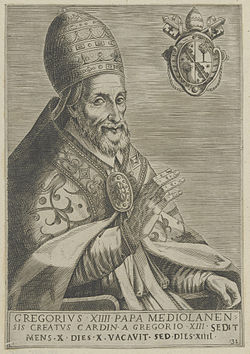
Pope Gregory XIV (Latin: Gregorius XIV; Italian: Gregorio XIV; 11 February 1535 – 16 October 1591), born Niccolò Sfondrato[1] or Sfondrati,[2] was head of the Catholic Church and ruler of the Papal States from 5 December 1590 to his death, in October 1591.

Early career

[edit]

Niccolò Sfondrati was born on 11 February 1535 at Somma Lombardo, then part of the Duchy of Milan, in the highest stratum of Milanese society. His mother, Anna of the House of Visconti, died in childbirth. His father Francesco Sfondrati, a senator of the ancient comune of Milan, after the death of his wife in 1538 entered in the ecclesiastic state and was created cardinal-priest by Pope Paul III in 1544.[3] As soon as appointed bishop of Cremona, Niccolò's father died in 1550.[4]

Niccolò in his youth was known for his modest lifestyle and stringent piety. He studied law at Perugia and he graduated in utroque iure at the University of Padua on 2 March 1555. He replaced his father as Commendatory abbot of the Abbey of Civate: differently from the uses of most commendatory abbots at that time, Niccolò with religious fervour took care of the buildings and reformed the religious life of the abbey.[4] In June 1552 he was appointed by Philip II of Spain a senator in Milan, and the Spanish government urged the Pope to appoint him Bishop of Cremona in 1557. That appointment occurred on 13 March 1560 with the election of Pope Pius IV, a Lombard as were the Sfondrati.[4] Niccolò Sfondrati was consecrated bishop in Milan on next 19 May by the auxiliary bishop of Milan Melchiorre Crivelli who acted in the name of Cardinal Charles Borromeo.[5][6]

He participated in the sessions of the Council of Trent from 1561 to 1563 where he took a position in favour of the divine origin of the residence of bishops in their diocese, a position not well seen by Rome. Returned in his diocese, he applied the reforms of the Council of Trent under the supervision of his Metropolitan Archbishop, Cardinal Charles Borromeo, to whom he was related.[4] Pope Gregory XIII made him a Cardinal-Priest of Santa Cecilia in Trastevere on 12 December 1583. When the Cardinal Borromeo died, Niccolò Sfondrati celebrated the Requiem Mass for Borromeo on 7 November 1584.[7] Sfondrati was an intimate friend and a great admirer of Philip Neri, an Italian priest who died in 1595 and was canonised in 1622.

Papal election

[edit]

After the death of Pope Urban VII on 27 September 1590, the Spanish ambassador Olivares presented the conclave a list of the seven cardinals who would be acceptable to his master Philip II of Spain. On 5 December 1590, after two months of deadlock, Sfondrati, one of Philip II's seven candidates but who had not aspired to the office, was elected pope. Cardinal Alessandro Peretti di Montalto came to Sfondrati's cell to inform him that the Sacred College had agreed on his election and found him kneeling in prayer before a crucifix.[8]

On the day after he was elected Pope, Gregory XIV burst into tears and said to the cardinals: "God forgive you! What have you done?"[8] In his bull of 21 March 1591, Cogit nos, he forbade under pain of excommunication all betting concerning the election of a Pope, the duration of a pontificate, or the creation of new cardinals.

Papacy

[edit]

Gregory XIV's brief pontificate was marked by vigorous intervention in favour of the Catholic party in the French Wars of Religion. Instigated by the king of Spain and the duke of Mayenne, he excommunicated Henry IV of France on 1 March 1591, reiterating the 1585 declaration of Pope Sixtus V that as a heretic (Protestant) Henry was ineligible to succeed to the throne of Catholic France and ordered the clergy, nobles, judicial functionaries, and the Third Estate of France to renounce him.[8]

Gregory XIV levied an army for the invasion of France, and dispatched his nephew Ercole Sfondrati to France at its head. He also sent a monthly subsidy of 15,000 scudi to Paris to reinforce the Catholic League. By coming down solidly on the side of Spanish interests, in part because Gregory XIV was elected due to the influence of the Spanish cardinals, the recent Papal policy of trying to maintain a balance between Spain and France was abandoned.

Gregory XIV created five cardinals in two consistories, among whom was his nephew Paolo Emilio Sfondrati, his Secretary of State. He attempted to convince Philip Neri, a long-time friend, to accept the post of Cardinal,[8] but Neri refused, saying that there were many more deserving of the honour than him.

In a decree dated 18 April 1591 (Bulla Cum Sicuti), Gregory XIV ordered reparations to be made by Catholics in the Philippines to the natives, who had been forced into slavery by Europeans, and he commanded under pain of excommunication of the owners that all native slaves in the islands be set free.[8]

The biographers mention that Pope Gregory XIV had a nervous tendency to laughter, which occasionally became irresistible and even manifested itself at his coronation. Gregory XIV, who was in poor health before his election to the papacy, died due to a large gallstone and was succeeded by Innocent IX.

See also

[edit]

References

[edit]
[edit]
Revisions and contributorsEdit on WikipediaRead on Wikipedia
from Grokipedia
Pope (Niccolò Sfondrati; 11 1535 – 16 1591) was from 5 1590 until his the following , succeeding Urban VII after a prolonged conclave and ruling amid intensifying European religious conflicts. Born near into a noble —his a senator in the Milanese senate—Sfondrati pursued ecclesiastical studies at Perugia and Padua, entered holy orders, and was appointed of Cremona in 1560 by Pius IV, a fellow Lombard; he attended the closing sessions of the Council of Trent as a young bishop. Elevated to cardinal-priest by Gregory XIII in 1583, he took the name Gregory XIV upon election at age 55, despite frail health marked by recurrent gout and urinary calculi that would soon prove fatal. His brief tenure prioritized bolstering Catholic resistance to Protestant advances, particularly by subsidizing Philip II of Spain's campaigns and the Catholic League in France to thwart Henry of Navarre's claim to the throne, reflecting a staunch commitment to confessional supremacy over pragmatic diplomacy. Domestically, he promulgated the constitution Sedes a Christo, initially mandating denial of sacraments to those evading tithes but rescinding its severity under pressure; he also eased Sixtus V's uniform excommunication for all abortions, distinguishing penalties by fetal development stage to align with traditional theological distinctions on ensoulment. Afflicted by stone and dropsy, Gregory XIV died intestate in the Quirinal Palace after less than ten months, bequeathing a papacy remembered for pious zeal but limited by physical incapacity and entanglement in foreign wars that drained papal finances without decisive gains.

Early Life and Education

Birth and Family Background

Niccolò Sfondrati, who later became Pope Gregory XIV, was born on 11 February 1535 in Somma Lombardo, a town near in the Duchy of . He was the son of Francesco Sfondrati, a senator in the ancient commune of , and Anna Visconti, who died during childbirth. The Sfondrati family belonged to the Milanese nobility, with origins tracing back to Cremona, and occupied a prominent position in the region's patrician class during the 16th century. Francesco Sfondrati, widowed after Anna's death, was elevated to the cardinalate by Pope Paul III in 1544, reflecting the family's ecclesiastical connections and influence.

Formation and Early Influences

Niccolò Sfondrati pursued advanced studies in law at the universities of Perugia and Padua, where he earned doctorates in both canon and civil law. After completing his education, Sfondrati entered the priesthood through ordination and assumed ecclesiastical responsibilities, including succeeding his father as commendatory abbot of the Benedictine Abbey of Civate near Lake Como. In this role, he departed from the common practice of absentee commendatory abbots by personally overseeing reforms to enforce stricter monastic observance and repair the abbey's dilapidated structures. His formation was deeply shaped by the Counter-Reformation milieu of northern Italy, particularly the rigorous pastoral and disciplinary initiatives of Charles Borromeo, Archbishop of Milan from 1564, with whom Sfondrati developed a close association that reinforced his emphasis on clerical austerity and episcopal governance.

Ecclesiastical Career

Bishopric of Cremona

Niccolò Sfondrati was appointed Bishop of Cremona on 13 March 1560 by Pope Pius IV, at the age of 25. He received priestly ordination on 8 April 1560 and was consecrated as bishop in Milan by auxiliary bishop Melchiorre Crivelli acting on behalf of Cardinal Charles Borromeo. The appointment followed family influence, as Sfondrati's father had served as a senator in Milan under Spanish rule, and the Spanish government had advocated for his elevation as early as 1557, though it materialized only under the Lombard pope Pius IV. During his episcopate, Sfondrati participated in the third and final period of the Council of Trent (1561–1563), contributing to the implementation of its decrees on doctrinal and disciplinary reforms amid the Counter-Reformation. As bishop, he emphasized rigorous pastoral oversight, living austerely and focusing on clerical discipline, seminaries, and the education of the faithful in line with Tridentine standards. His administration aligned with the reformist zeal of his contemporary, Archbishop Charles Borromeo of Milan, under whose metropolitan authority the Diocese of Cremona fell as a suffragan see; Sfondrati collaborated with Borromeo on regional ecclesiastical renewal, including visitations and enforcement of celibacy and liturgical uniformity. Sfondrati retained the bishopric after his elevation to the cardinalate by on 12 1583, continuing remote administration through vicars while residing primarily in . His tenure, spanning over years until his papal election on 5 1590, marked a period of stabilization for the , which had faced prior administrative challenges under absentee or politically entangled prelates. The see was then provisionally governed by apostolic administrators during his brief papacy.

Rise to the Cardinalate

Niccolò Sfondrati, having been appointed Bishop of Cremona on 13 March 1560 by Pope Pius IV despite his initial reluctance to enter the ecclesiastical career, consecrated on 19 May 1560 and ordained priest shortly before on 8 April, focused his episcopate on implementing the reforms decreed by the Council of Trent, in which he actively participated during its final sessions from 1561 to 1563. His tenure emphasized clerical discipline, catechetical instruction, and suppression of abuses, aligning with the Counter-Reformation's emphasis on doctrinal purity and pastoral renewal, though his austere approach occasionally met resistance from local nobility and clergy accustomed to lax practices. Influenced by his early companionship with the reform-minded Cardinal Charles Borromeo, Archbishop of Milan, Sfondrati modeled his governance on Borromeo's rigorous standards, fostering seminaries and visitations to enforce Tridentine standards. Sfondrati's reputation for piety and administrative competence grew through frequent visits to Rome and his association with figures like St. Philip Neri, whose spiritual rigor he emulated, earning him favor in curial circles. On 12 December 1583, Pope Gregory XIII elevated him to the cardinalate in recognition of his effective service as bishop, assigning him the title of Cardinal-Priest of Santi Quattro Coronati initially, before transferring him to Santa Cecilia in Trastevere in 1585. This promotion, part of Gregory XIII's consistory that expanded the college to bolster Counter-Reformation leadership, reflected Sfondrati's demonstrated loyalty and implementation of papal directives in northern Italy, positioning him among the more conservative, reform-oriented prelates. He retained his see in Cremona until his papal election, continuing reforms while balancing diocesan duties with curial engagements.

Papal Election

Context of the 1590 Conclave

The death of Pope Sixtus V on August 27, 1590, from complications of malarial fever, initiated a period of instability in the papacy, compounded by a subsequent rapid turnover. A conclave convened on September 7 with 54 cardinals participating, resulting in the election of Cardinal Giovanni Battista Castagna as Pope Urban VII on September 15; however, Urban VII succumbed to malaria on September 27 after a mere 12-day reign, leaving the Holy See vacant once more. This brief pontificate, marked by unfulfilled plans for administrative reforms and anti-usury measures, heightened urgency for a stable successor amid ongoing European religious conflicts. The conclave to elect Urban VII's successor began on October 8, 1590, but extended over two months until December 5 due to deep divisions within the College of Cardinals. Primary factions included the Spanish party, aligned with King Philip II's interests and led by figures like Cardinal Pedro de Deza (Olivares); the Sistine faction, comprising appointees of Sixtus V under the influence of his grandnephew Cardinal Alessandro Peretti di Montalto; and remnants of supporters from prior popes like Gregory XIII. Deadlocks arose as candidates such as Cardinals Sanseverino and Colonna gained traction but failed to secure consensus, exacerbated by external pressures that prioritized geopolitical alignment over internal Church unity. A pivotal external factor was Philip II's unprecedented interference, driven by the intensifying French Wars of Religion, where the Protestant Henry of Navarre (later Henry IV) was consolidating power against the Catholic League backed by Spain. Philip circulated a list of seven acceptable candidates, implicitly threatening to challenge any election outside it, thereby asserting an informal veto to ensure papal support for Spanish efforts to preserve Catholic dominance in France. This reflected broader European dynamics of the Counter-Reformation era, with Spain at its imperial zenith exerting influence over the papacy to counter Protestant advances, while French instability threatened papal subsidies and alliances. The prolonged negotiations ultimately yielded Niccolò Sfondrati, a Milanese cardinal seen as a neutral compromise favorable to Spanish aims, though cardinals resented the overt foreign meddling that delayed resolution.

Election and Initial Challenges

Following the death of Pope Urban VII on 27 September 1590, a papal conclave convened but extended over two months due to deep divisions among the cardinals, exacerbated by resentment toward Spanish interference under King Philip II, who sought a pope aligned against the Protestant Henry of Navarre's claim to the French throne. The Spanish ambassador had presented a list of preferred candidates, intensifying factional tensions between pro-Spanish and other groups wary of foreign dominance in papal elections. Niccolò Sfondrati, created cardinal in 1583 and known for his piety rather than political ambition, emerged as a compromise figure and was elected on 5 December 1590, taking the name Gregory XIV. Upon notification of his election, Sfondrati, found in prayer, expressed reluctance, reportedly tearfully questioning the cardinals' decision, reflecting his self-perceived unworthiness for the office. Assuming the papacy amid these circumstances, Gregory XIV faced immediate challenges from his frail health—long plagued by gallstones and a weakened constitution—which limited his physical capacity to govern. Politically, he inherited the volatile European landscape, particularly the French Wars of Religion, where the Catholic League opposed Henry's succession. Determined to bolster Catholic forces, Gregory swiftly recommitted to the League, renewing Henry's excommunication on 1 March 1591 and allocating 15,000 scudi monthly to Paris while dispatching his nephew Ercole Sfondrati with papal troops to support the anti-Huguenot effort. These actions, driven by alignment with Spanish interests to prevent a Protestant king in France, strained the papal treasury and risked overextension, as the League's military prospects faltered despite initial zeal. His short pontificate, ending with death on 16 October 1591, underscored how these early foreign policy demands compounded personal health vulnerabilities, hindering broader administrative stability.

Papacy

Foreign Policy and Counter-Reformation Efforts

Gregory XIV's foreign policy was predominantly oriented toward bolstering Catholic forces in France amid the ongoing Wars of Religion, aligning closely with Spanish interests under Philip II. Elected on December 5, 1590, the pope prioritized intervention against the Protestant claimant Henry of Navarre, who had ascended as Henry IV following the death of Henry III in August 1589. This stance reflected a commitment to preserving Catholic monarchy in France, viewing Henry's Huguenot background as a direct threat to the realm's traditional faith. In early 1591, Gregory XIV escalated support for the Catholic League, a coalition of French Catholic nobles and cities opposed to Henry's succession. On March 1, 1591, he issued a bull renewing Henry's excommunication—previously declared by Sixtus V—and formally deposing him, while absolving his subjects from oaths of allegiance to enable armed resistance. To finance the League's military campaigns, the pope imposed a special tax on clerical benefices: one-half of their annual revenues for the first year and one-ninth thereafter, channeling funds toward subsidies including a monthly payment of 15,000 scudi dispatched to Paris. Additionally, he sent his nephew, Cardinal Ercole Sfondrati, to France at the head of papal troops to reinforce League efforts. These initiatives formed a key facet of Gregory XIV's Counter-Reformation agenda, which sought to counteract Protestant gains in Europe by enforcing doctrinal orthodoxy through geopolitical leverage. By framing the conflict as a holy war against heresy, the pope aimed to prevent the entrenchment of Calvinism in France, a major Catholic power, thereby safeguarding the broader Catholic resurgence post-Trent. This approach echoed prior papal strategies but was curtailed by the pontiff's frail health and death on October 16, 1591, after which his successor, Innocent IX, briefly continued subsidies before Clement VIII shifted toward accommodation with Henry.

Domestic Administration and Reforms

Gregory XIV's domestic administration of the Papal States was constrained by his frail health and brief tenure, lasting from his election on December 5, 1590, to his death on October 16, 1591. He delegated significant authority to his nephew, Cardinal Paolo Emilio Sfondrati, whose influence extended to financial and administrative matters, fostering perceptions of nepotism that alienated the Roman curia and provoked public discontent through perceived rapacity and exactions. This favoritism undermined efforts at broader governance, as Sfondrati's role amplified familial control over state resources amid ongoing economic strains, including food shortages in Rome that the pope failed to mitigate effectively. Despite these limitations, Gregory XIV pursued targeted internal reforms aimed at ecclesiastical discipline and procedure. On March 21, 1591, he promulgated the bull Cogit nos, which imposed excommunication on those engaging in bets related to papal elections or pontifical duration, seeking to curb speculative corruption within the Church hierarchy. Later, on May 24, 1591, he issued a constitution regulating the right of sanctuary, suspending prior enactments to standardize its application and limit abuses in ecclesiastical asylum practices. These measures aligned with ongoing Counter-Reformation efforts to address clerical misconduct, though their enforcement was hampered by the pope's weakening condition and resistance from entrenched interests. Administrative initiatives included appointing commissions for liturgical standardization: on February 7, 1591, a body to revise the Sixtine Vulgate Bible, and on April 21, 1591, another to emend the Pian Breviary, reflecting continuity with predecessors' pushes for textual and ritual purity. However, no sweeping structural changes to the curia or Papal States bureaucracy materialized, as resources and attention prioritized external commitments, leaving domestic stability precarious and reform efforts fragmentary.

Pastoral and Doctrinal Initiatives

One of Pope Gregory XIV's notable doctrinal contributions was the papal constitution Sedes apostolicae issued in 1591, which adjusted the Church's penal framework for abortion following the stringent measures of Sixtus V's Effraenatam (1588). The earlier bull had equated all abortions with homicide, subjecting perpetrators to automatic excommunication regardless of fetal development stage. Gregory XIV, however, reinstated a distinction based on the traditional theory of delayed ensoulment, decreeing that only the procurement of abortion after the fetus was "animated" (ensouled, typically at 40 days for males and 80 days for females) constituted homicide punishable by excommunication; abortions prior to animation remained grave sins but without that latae sententiae penalty. This clarification mitigated the universal severity of Sixtus V's approach, aligning with Aristotelian-Thomistic views on hominization while upholding abortion as intrinsically evil at any stage. In pastoral outreach to colonial missions, Gregory XIV addressed the enslavement of indigenous peoples through a bull dated 18 April 1591, which condemned the subjugation of native Filipinos by European settlers and mandated their emancipation along with restitution payments to victims or heirs. Perpetrators faced excommunication if they failed to comply within 15 days, reflecting the pontiff's emphasis on justice and humane treatment in evangelization efforts amid reports of exploitation in the Spanish Philippines. This measure extended Church protection to vulnerable converts, prioritizing moral rectification over unchecked colonial gains. Gregory XIV further advanced pastoral ministry by elevating the Clerici Regulares Ministrantes Infirmis—focused on ministering to the sick and dying—to full religious order status on 21 September 1591, formalizing their role in spiritual care for the afflicted. Doctrinally, his bull Cogit nos of 21 March 1591 prohibited betting on papal elections, pontifical durations, or cardinal promotions under excommunication, preserving the sanctity of curial proceedings. He also convened commissions on 7 February and 21 April 1591 to emend the Sixtine Vulgate Bible and Pius V's breviary, respectively, fostering liturgical and scriptural precision in line with Tridentine reforms.

Health Decline and Death

Pope Gregory XIV entered his papacy in 1590 already afflicted by chronic poor , including recurrent severe illnesses that had previously threatened his multiple times. His ascetic and longstanding ailments, such as calculi causing , contributed to his frailty, limiting his capacity for active from the outset. Throughout 1591, his condition worsened progressively; medical attendants despaired of his life on three separate occasions, administering the sacrament of Extreme Unction four times in response. A final acute episode began approximately 23 days before his death, marked by unrelenting suffering that confined him to bed and prompted the reception of Holy Communion and Extreme Unction on October 5. Gregory XIV succumbed in the night between October 15 and 16, 1591, at age 56, after a pontificate lasting 10 months and 11 days. The immediate cause was complications from calculi; contemporary reports and postmortem findings identified a large stone—reputedly weighing 70 grams in some accounts, located in the biliary or urinary tract—that precipitated fatal organ distress. He died in the papal apartments, exhibiting signs of a pious end, and was interred in the Gregorian Chapel of St. Peter's Basilica.

Historical Assessment

Achievements in Catholic Defense

Upon ascending to the papacy on , 1590, Gregory XIV prioritized bolstering the Catholic League in to counter the posed by Henry of , the Protestant to the French following the of Henry III on , 1589. Viewing a Huguenot as an existential to Catholic dominance in , he committed substantial papal resources, including a monthly subsidy of 15,000 scudi dispatched to Paris to sustain the League's military operations against Henry's forces. He further reinforced this effort by sending his nephew, Cardinal Ercole Sfondrati, to at the head of a papal contingent of troops and funds, aiming to coordinate with Spanish allies under Philip II and the Guise faction leading the League. In a pastoral letter dated March 1, 1591, addressed to the Council of Paris, Gregory renewed the excommunication of Henry of Navarre, declaring him ineligible for the crown and absolving French subjects from allegiance to him, thereby framing resistance as a moral imperative for Catholics. Complementing this, he proclaimed a crusade against Henry in March 1591, granting plenary indulgences to participants who fought under the League's banner, which served to spiritually motivate recruits and legitimize the conflict as a holy war against Protestant encroachment. These measures temporarily stiffened League resolve amid sieges like Paris in 1590, preserving Catholic strongholds and delaying Henry's consolidation of power until his pragmatic conversion in 1593. Gregory's alignment with Spanish Habsburg interests extended Catholic defensive beyond , as his subsidies indirectly supported II's broader campaigns against Protestant powers, including naval preparations against . By prioritizing fiscal and diplomatic over internal Roman reforms during his brief tenure, he exemplified papal interventionism in secular conflicts to safeguard doctrinal , though fiscal strains on the Vatican limited long-term .

Criticisms and Limitations

Gregory XIV's pontificate was constrained by his longstanding poor , exacerbated by a and possible epileptic tendencies, which restricted his administrative capacity and led to his from a obstruction on October 16, 1591, after only 10 months and 10 days in . This brevity limited the of his reformist intentions, as contemporaries noted his physical frailty prevented sustained . A notable criticism was his nepotism, exemplified by the prompt elevation of his nephew Paolo Emilio Sfondrati to the cardinalate on December 20, 1590, alongside four other appointments that favored family interests, which alienated segments of the College of Cardinals accustomed to curbing such practices post-Renaissance excesses. He further dispatched another nephew, Ercole Sfondrati, to lead papal troops in support of the Catholic League in France, prioritizing familial involvement in military endeavors over broader merit-based selections. In foreign policy, Gregory XIV's unwavering commitment to the Catholic League against proved ineffective; on , 1591, he renewed Henry's excommunication and allocated a monthly subsidy of 15,000 scudi to alongside troop deployments, yet these measures failed to prevent Henry's 1593 conversion to Catholicism and subsequent consolidation of power, rendering the papal intervention fiscally burdensome without strategic gain. This pro-Habsburg and anti-Huguenot stance, while aligned with goals, drew implicit rebuke for overextending Vatican resources amid domestic Roman unrest, including food shortages and lawlessness during his tenure. Gregory XIV also harbored suspicions toward the Society of Jesus, contemplating alterations to its constitution due to perceived overreach in privileges, though his premature death halted any reforms, allowing his successor Innocent IX to reaffirm the order's status quo. Such hesitancy reflected broader tensions with militant Counter-Reformation orders but underscored a limitation in decisively harnessing their organizational strengths.

Long-Term Impact

Gregory XIV's most enduring doctrinal contribution was the 1591 constitution Sedes apostolicae, which moderated penalties for procuring abortions of non-animated fetuses, distinguishing between early-stage pregnancies (before ensoulment) and those involving a formed fetus. This reversed the stricter universal excommunication under Sixtus V's Effraenatam (1588), aligning with longstanding Thomistic views on delayed animation derived from Aristotle, where the soul infuses the body at quickening (around 40-80 days). The policy reduced automatic excommunication and perpetual infamy for early abortions to lesser censures, influencing Catholic moral theology and confessional practice for nearly three centuries until Pius IX's Apostolicae sedis (1869) eliminated the animated-unanimated distinction, treating all direct abortions as grave moral evils equivalent to homicide. In foreign policy, Gregory's excommunication of Henry of Navarre (March 1, 1591) and pledge of Jubilee indulgence revenues to fund the Catholic League against a potential Protestant French monarchy underscored papal commitment to confessional absolutism during the Counter-Reformation. Encouraged by Philip II of Spain, this intervention prolonged the French Wars of Religion but ultimately faltered after Gregory's death; his successor Clement VIII recognized Henry IV post-abjuration (1593), securing France's Catholic identity through pragmatic conversion rather than exclusion. The episode highlighted the limits of papal influence over secular crowns, contributing to a gradual shift toward Gallicanism and reduced temporal meddling in European monarchies. Overall, the brevity of Gregory's 10-month constrained broader legacies, with his ascetic personal and minor administrative decrees on clerical (e.g., prohibiting cardinals from ) overshadowed by successors' implementations. His exemplified the era's tensions between doctrinal rigor and practical , but without transformative reforms like those of V or Sixtus V, it left no paradigm-shifting imprint on Church or European .
Add your contribution
Related Hubs
Contribute something
User Avatar
No comments yet.