Hubbry Logo
Book of WisdomBook of WisdomMain
Open search
Book of Wisdom
Community hub
Book of Wisdom
logo
8 pages, 0 posts
0 subscribers
Be the first to start a discussion here.
Book of Wisdom
Book of Wisdom
from Wikipedia
Start of the Book of Wisdom in the Codex Gigas

The Book of Wisdom, also known as the Wisdom of Solomon, is a book in some Christian biblical canons. It is one of the seven sapiential—or wisdom—books in the Septuagint, the others being the Psalms, the Book of Proverbs, the book of Ecclesiastes, Song of Songs (Song of Solomon), the Book of Job, and the Wisdom of Sirach. It is one of the deuterocanonical books (i.e., it is included in the canons of the Catholic Church and the Eastern Orthodox Church; most forms of Protestantism consider it part of the biblical apocrypha). It is not included in the Jewish canon or among the other texts of Judaism. While not included in the Hebrew Bible, it found early reception in the Septuagint and Old Latin tradition and was known to some of the early Christian New Testament writers.[1] It was composed in Greek by an Alexandrian Jewish author. Most scholars date it to the first century BC on the basis of its themes and concerns,[2][3] though a minority have proposed dates spanning from the reign of Solomon to that of Caligula.[4][5][6]

The central theme of the work is "wisdom" itself, appearing under two principal aspects. The first aspect is, in its relation to mankind, wisdom is the perfection of knowledge of the righteous as a gift from God showing itself in action. The second aspect is, in direct relation to God, wisdom is with God from all eternity.[7]

Structure, genre and content

[edit]

The 19 chapters of the work can be grouped into three sections.[8][9][10] Lester Grabbe organises these as follows:

  1. Book of Eschatology
    • exhortation to justice
    • speech of the impious, contrasts of the wicked and the just
    • exhortation to wisdom
  2. Book of Wisdom
    • Solomon's speech concerning wisdom, wealth, power and prayer
  3. Book of History
    • introduction, followed by diptychs of plagues
    • digression on God's power and mercy
    • digression on false worship and further plagues
    • recapitulation and concluding doxology.[9]

The book is addressed to the rulers of the earth (verse 1:1), urging them to love righteousness and seek wisdom; the wicked think that all is chance and that they should enjoy each day, but they are deluded.[11] In the second section Solomon (not explicitly named, but strongly implied) tells of his search for wisdom.

The Wisdom of Solomon can be linked to several forms of ancient literature, both Jewish and non-Jewish, but it clearly belongs with biblical Wisdom books such as the Book of Job, one of only five such books among ancient Jewish literature.[12] In terms of classical genre it has been identified as an encomium and with the Greek genre of the "exhortatory discourse", by which a teacher attempts to persuade others to a certain course of action.[13]

Canonicity

[edit]

Origen in the 2nd century AD refers to uncertainty about the Book of Wisdom.[14] Melito of Sardis[15] (possibly) in the 2nd century AD, Augustine[16] (c. 397) and Pope Innocent I (405)[17][18] considered Wisdom of Solomon as part of the Old Testament. Athanasius writes that the Book of Wisdom along with three other deuterocanonical books, while not being part of the Canon, "were appointed by the Fathers to be read".[19] Epiphanius of Salamis (c. 385) mentions that the Wisdom of Solomon was of disputed canonicity.[20] According to the monk Rufinus of Aquileia (c. 400 AD) the Book of Wisdom was categorized as "ecclesiastical" rather than "canonical".[21]

The Book of Wisdom was listed as canonical by the Council of Rome (382),[22] the Synod of Hippo (393),[23] the Council of Carthage (397) and the Council of Carthage (419),[24][25] the Quinisext Council (692),[26] the Council of Florence (in 1442)[27] and the Council of Trent (in 1546).[28]

According to John of Damascus in his Exposition of the Orthodox Faith (c. 730) the Book of Wisdom is not in the ark: "There are also the Panaretus, that is the Wisdom of Solomon, and the Wisdom of Jesus, which was published in Hebrew by the father of Sirach, and afterwards translated into Greek by his grandson, Jesus, the Son of Sirach. These are virtuous and noble, but are not counted nor were they placed in the ark."[29]

Composition

[edit]
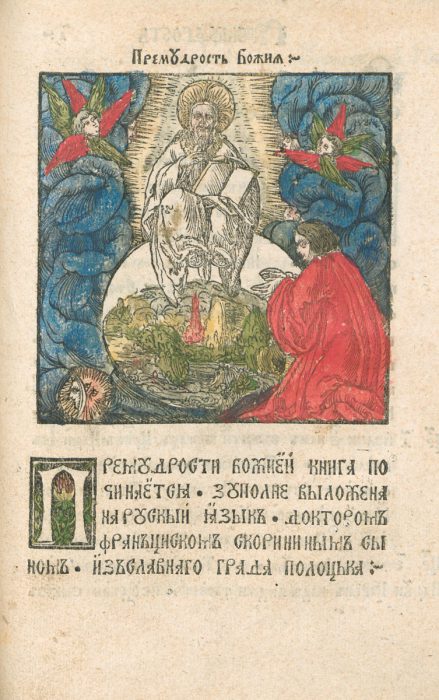
Image from "Book of Wisdom" of Francysk Skaryna 1518 (Belarusian)

There is a general consensus among scholars[which?] (with only a few dissenting voices) that the Wisdom of Solomon was written in Greek in Alexandria around the turn of the era: late first century BC to early first century AD. Alexandria is where the Greek Bible was translated and assembled. What is known of the Jewish community there accords with what can be deduced from the text about the audience for which it was written. It shares an outlook similar to that of other texts such as 4 Maccabees, Letter of Aristeas, and the works of Philo, which all came from this community. One specific indication of Egyptian origin is the author's use of Egyptian imagery of the goddess Isis to describe personified Wisdom as a divine female figure. Another is the very clear interest in Egypt revealed in the book's third section (chapters 10–19). Chapter 10 begins a review of Israel's history but never gets beyond the Exodus story, where the text indulges in a sharp polemic against idolatry in its particular Egyptian manifestation—that is, the animal cult (see 12:24; 15:18–19). There are no clear allusions to contemporary historical events in the book, so one can suggest only an approximate date for it. Since the author quotes from most parts of the LXX version of the Hebrew Bible, he cannot have been writing much before the middle of the second century BC.

Winston 1979: 20-25[citation needed] argues that the earliest date for the book can be more precisely fixed as sometime after the Roman conquest of Egypt in 30 BC on the grounds that 14:16–20 alludes to the emperor cult begun under Augustus. He confirms this conclusion by analyzing the thirty-five Greek words in the Wisdom of Solomon that were not attested in other Greek literature before the first century AD. Larcher 1983: 1:141-61[citation needed] argues that the book was composed between 31 and 10 BC. The latest possible date for the work is more difficult to fix than the earliest. Most scholars feel that Wisdom predates Philo and was also used by some New Testament authors, particularly Paul and the author of the Epistle to the Hebrews. This would make it no later than the early first century AD. Winston dates it precisely to the reign of Caligula (AD 37–41) when the Alexandrian Jewish community underwent a particularly severe crisis, which he feels is reflected in the harsh anti-Gentile tone of the book. Larcher is not convinced of this later dating. It is safest to say that the Wisdom of Solomon was probably written about thirty years on either side of the turn of the era.[citation needed]

It is uncertain whether the book has a single author or comes from a school of writers: it is said to be "written by the friends of Solomon in his honour" in the Muratorian fragment,[30] but more recent scholarship has favoured regarding it as a unified work.[31] In either case, its blend of Greek and Jewish features suggests a learned Hellenistic background. The authors' primary literary source was the Septuagint, in particular the Wisdom literature and the Book of Isaiah, and he or they were familiar with late Jewish works such as the Book of Enoch, and with Greek philosophical literature.[32] Despite the address to the "rulers of the world", the actual audience was probably members of the authors' own community who were tempted to give up their Jewishness in the face of the temptations of Greek culture and the hostile conditions facing Jews in the Greek world.[7]

Themes

[edit]

The book opens with the opposed pairs righteousness/unrighteousness and death/immortality: those who do not follow righteousness will fall into "senseless reasoning" and will not be open to wisdom; wisdom is not an inherent human quality nor one that can be taught, but comes from outside, and only to those who are prepared through righteousness.[33] The suffering of the righteous will be rewarded with immortality, while the wicked will end miserably.[34] The unrighteous are doomed because they do not know God's purpose, but the righteous will judge the unrighteous in God's presence.[35] Lady Wisdom, first referred to as "she" in Wisdom 6:12, dominates the middle section of the book (chapters 6-9), in which Solomon speaks.[35] She existed from the Creation, and God is her source and guide.[35] She is to be loved and desired, and kings seek her: Solomon himself preferred wisdom to wealth, health, and all other things.[36] She in turn has always come to the aid of the righteous, from Adam to the Exodus.[7] The final section, chapters 10-19, takes up the theme of the rescue of the righteous, taking the Exodus as its focus: "You (God) have not neglected to help (your people the Jews) at all times and in all places." (Wisdom 19:22).[7]

Influences

[edit]

Influences shaping the Book of Wisdom

[edit]

The New American Bible Revised Edition notes that Wisdom 9:15, "for the corruptible body burdens the soul and the earthly tent weighs down the mind with its many concerns",[37] "draws on the language of Plato concerning the human condition, [but] the conclusion is very biblical: God remains a mystery".[38]

Nineteenth-century American author Herman Melville marked his copy of the Wisdom of Solomon heavily. Without knowledge of biblical criticism, he managed to note the interplay of Hellenistic Platonism and Jewish philosophy, writing, "this admirable book seems partly Mosaic & partly Platonic in its tone. Who wrote it I know not. Someone to whom both Plato and Moses stood for godfather."[39] The interplay of multiple philosophies is exemplified in many of Melville's works, specifically Moby-Dick and Clarel, wherein religious and philosophical interplay represent the struggle for certainty in the 19th century.

Influence on the New Testament

[edit]

Although the Book of Wisdom is not quoted directly, there are some apparent references to it in the New Testament.:

  • In Matthew 27:43, the chief priests, with the scribes and ancients say: "He trusted in God; let him now deliver him if he will have him; for he said: I am the Son of God." whereas Wisdom has: "For if he be the true son of God, he will defend him, and will deliver him from the hands of his enemies." (Wisdom 2:18)
  • Hebrews 1:3 reads "Who being the brightness of his glory, and the figure of his substance, and upholding all things by the word of his power, making purgation of sins, sitteth on the right hand of the majesty on high", whereas Wisdom 7 states "For she is the brightness of eternal light, and the unspotted mirror of God's majesty, and the image of his goodness." (Wisdom 7:26)

Influences on Christian life and practice

[edit]

According to Easton's Bible Dictionary, the term fall of man, which does not appear in the Hebrew Bible, probably originates from the Book of Wisdom.[how?][40][41]

A considerable portion of the Wisdom of Solomon, starting with Chapter 2, was read at a memorial service in Concord, Massachusetts, on December 2, 1859, the day of the execution of the abolitionist John Brown.[42]

References

[edit]

Works cited

[edit]
[edit]
Revisions and contributorsEdit on WikipediaRead on Wikipedia
from Grokipedia
The Book of Wisdom, also known as the Wisdom of , is a pseudepigraphal text of composed in Greek by an anonymous Alexandrian Jew during the late first century BCE, falsely attributed to King to lend authority. It forms part of the and is included as a deuterocanonical book in Catholic and Eastern Orthodox Christian canons, though excluded from the Jewish Tanakh and Protestant due to its late composition and doctrinal divergences from earlier Hebrew scriptures. The work divides into three main sections: an exhortation to rulers on seeking and (chapters 1–6), a discourse on the nature of as an attribute of and its role in creation and human affairs (chapters 6–9), and historical reflections praising the righteous and condemning through retellings of biblical events like (chapters 10–19). It integrates Jewish piety with Greek rhetorical style and philosophical ideas, such as the pre-existence of souls and of the righteous, to affirm the superiority of Jewish amid Hellenistic cultural pressures. Scholars note its influence on New Testament writings, including parallels in Romans and James, and its appeal to early Christian thinkers for doctrines like divine wisdom personified and eschatological reward. The book's pseudepigraphic authorship reflects common ancient literary practices but raises questions of authenticity, contributing to ongoing debates over its inspirational status in traditions that prioritize apostolic or prophetic origins.

Historical Context

Origins in Hellenistic Judaism

The Book of Wisdom arose in the community of , , during the late 2nd to mid-1st century BCE, amid a environment where Jews numbered perhaps a third of the city's population and interacted intensively with Greek intellectual traditions. This synthesis occurred in a hub of Hellenism established after the Great's conquests, with 's Jewish quarter supporting Greek-speaking scholars who translated the and engaged Ptolemaic and Roman rulers. The text's composition in , employing rhetorical forms like protrepsis, reflects this milieu's causal demands: bolstering fidelity to against cultural assimilation in a polytheistic empire. Pressures from sporadic persecutions, such as those under (c. 221–204 BCE) or the Seleucid (r. 175–164 BCE), lingered in diaspora memory, prompting apologetic literature to vindicate the righteous sufferer and affirm Jewish superiority over idolaters. The author drew on empirical historical echoes of these events to argue providential justice, using the pseudonym of to evoke authoritative wisdom traditions while addressing contemporary threats to monotheistic practice. This response was not reactive but rooted in the of urban Jewish life, where economic ties to Greco-Roman elites heightened risks of . Greek philosophy intersected Jewish theology through selective adaptation: Platonic notions of soul immortality (Wisdom 3:1–4) and Stoic elemental cycles (Wisdom 7:17–20; 19:18–21) appear, yet subordinated to Yahweh's transcendent unity, rejecting Epicurean materialism and polytheistic cosmogonies. Unlike of Alexandria's later allegorical harmonizations (c. 20 BCE–50 CE), the Book prioritizes scriptural over systematic metaphysics, preserving causal realism in divine intervention without diluting Jewish particularism. Such integration served to equip Jews empirically, countering Hellenistic allure by demonstrating wisdom's rational coherence and moral efficacy.

Connections to Earlier Wisdom Literature

The Book of Wisdom draws textual parallels with Proverbs in its of as a preexistent divine attribute active in creation and human affairs. Specifically, Wisdom 7:22–8:1 describes as an emanation of God's glory and a craftsman beside the Creator, mirroring Proverbs 8:22–31, where is established from everlasting and delights in humanity's habitation. This shared motif underscores 's role as a of divine order, with both texts employing feminine imagery to exhort pursuit of ethical discernment over . Ethical exhortations in Wisdom 1–6, emphasizing amid adversity, likewise echo Proverbs' antithetical structure contrasting the wise and wicked paths, as in Proverbs 10:1–22:16. Connections to Job appear in thematic treatments of the righteous sufferer's vindication, though Wisdom resolves the tension through eschatological hope rather than Job's emphasis on divine inscrutability. Wisdom 2:12–20 depicts the wicked persecuting the "" figure, anticipating ultimate judgment, akin to Job's dialogues on undeserved affliction (Job 9–10; 21), yet without Job's poetic over mortality's finality. Parallels with are evident in reflections on life's transience and the pursuit of meaning, but Wisdom counters Ecclesiastes' "" (Eccl 1:2) with wisdom's promise of immortality for the just (Wis 3:1–4), framing ethical conduct as causal pathway to eternal reward rather than resigned . In contrast to contemporaries Sirach and Baruch, the Book of Wisdom avoids explicit equation of wisdom with Torah observance, preserving a broader cosmic agency. Sirach 24:1–34 portrays wisdom descending to dwell in and "flowing" as from divine heights, while Baruch 3:9–4:4 similarly identifies wisdom with ancestral instruction and law-keeping for national restoration. Manuscript evidence from codices, such as (4th century CE), attests continuity in Greek versions of these texts, reflecting shared pseudepigraphic styles but distinct emphases—Sirach's proverbial collections versus Wisdom's rhetorical prayers. Transmission of such motifs in relied on scribal practices preserving Hebrew archetypes and Greek adaptations, as seen in wisdom fragments like 4QInstruction (ca. 100–50 BCE), which echo Proverbs' mystery motifs without Hellenistic innovations. This evidences empirical continuity via copied scrolls in temple and sectarian libraries, prioritizing motifs of divine wisdom's accessibility over novel compositions.

Composition

Authorship and Pseudepigraphy

The Book of Wisdom attributes its composition to King Solomon through first-person narration in chapters 7–9, where the speaker recounts a mortal birth akin to Solomon's biblical origins and a divine granting of wisdom (Wis 7:1–6). This self-presentation, however, employs stylized imitation rather than autobiographical detail, incorporating Hellenistic rhetorical flourishes and philosophical motifs—such as the soul's and personified as a divine intermediary—absent from authentic Solomonic-era texts like Proverbs or . Scholarly analysis identifies these anachronisms, alongside the work's original Greek composition and allusions to post-exilic concerns, as evidence of by an anonymous Hellenistic Jewish author seeking to channel Solomonic authority for exhortation against and assimilation. Pseudepigraphy functioned as a conventional literary strategy in to confer antiquity and prestige, enabling anonymous writers to address pressing theological and ethical issues under the guise of venerable figures whose legacies embodied or . Comparable to the Enochic , where antediluvian visions critique contemporary corruption while invoking Enoch's patriarchal stature, the Solomonic mask in amplified its persuasive force amid Greco-Roman cultural pressures, without the intent of historical deception prevalent in modern forgery but aligned with ancient attribution practices that prioritized didactic impact. Patristic interpreters, including and , cited the book extensively as Solomonic wisdom scripture, integrating its themes of divine justice and into without disputing the attribution's nominal nature. This reception stemmed from the text's substantive harmony with canonical wisdom traditions and perceived pneumatic inspiration, where early readers evaluated works by doctrinal coherence and communal edification rather than forensic authorship verification, a criterion less emphasized in pre-critical . Such defenses persist in traditions affirming inspiration despite pseudonymity, arguing that the convention honored Solomon's without undermining the message's causal in fostering .

Date and Location of Writing

Scholars generally date the composition of the Book of to between approximately 50 BCE and 50 CE, based on linguistic features such as the use of approximately thirty-five rare Greek words unattested in earlier texts and the presence of Hellenistic philosophical influences without direct references to events after the temple's destruction in 70 CE. This range aligns with allusions to royal authority in passages like Wisdom 6:1-11, which describe kings deriving power from rather than conquest, reflecting a possibly aimed at Hellenistic or early Roman rulers without explicit mention of imperial figures like . The text's references to temple practices and priestly roles, such as in Wisdom 3:7-9 implying ongoing sacrificial worship, further support a pre-70 CE date, as no over Jerusalem's fall appears despite the author's familiarity with Jewish cultic traditions. The provenance is widely attributed to in , evidenced by the book's original composition in idiomatic suited to the Hellenistic , rather than a Semitic original, and themes addressing prevalent in Egyptian , as critiqued in Wisdom 15 with scorn for worship of animals like crocodiles and ibises. motifs, including exhortations to fidelity amid Gentile pressures (e.g., Wisdom 2:12-20), mirror the experiences of 's large Jewish community under Ptolemaic and subsequent Roman administration. Post-Dead Sea Scrolls scholarship has refined this dating by noting the absence of the text among manuscripts, which primarily preserve Palestinian Hebrew and works up to circa 68 CE, suggesting an Egyptian Hellenistic origin outside Essene circles and reinforcing compositional unity over theories of later . While some propose an earlier terminus around 100 BCE due to stylistic parallels with of , the consensus favors the narrower 50 BCE-50 CE window to account for Roman-era undertones without post-Flavian anachronisms.

Textual History

Manuscripts and Early Versions

The Book of Wisdom survives primarily through Greek manuscripts of the , with the earliest complete copies found in the and , both produced in the fourth century CE. These uncial codices, written on in a majuscule script, include the text as Sophia Salomonos and form the foundational witnesses for modern critical editions due to their antiquity and relative textual consistency. The , dating to the fifth century CE, provides an additional early attestation, preserving the book in a similar Greek form despite minor variants from the fourth-century exemplars. Early translations into other languages attest to the book's circulation beyond Greek-speaking communities. The Latin , Jerome's revision completed around 405 CE, renders it as Sapientia Salomonis and draws directly from Greek sources rather than positing a Hebrew intermediary. The Syriac version, likely translated in the fifth century CE or earlier, titles it The Book of the Great Wisdom of Solomon and shows fidelity to the base text. Coptic and Armenian renditions, emerging around the same period, further evidence its adaptation in Eastern Christian traditions, with the Coptic fragments confirming Greek origins through linguistic traces. No Hebrew manuscripts of the Book of Wisdom have been identified, and its absence from the Dead Sea Scrolls—discovered between 1947 and 1956 and comprising over 900 documents from the third century BCE to the first century CE—aligns with scholarly consensus on its original composition in Greek during the . This lack of Hebrew evidence, coupled with the text's philosophical style and vocabulary unattested in pre-Hellenistic , indicates transmission solely through Greek versions rather than Palestinian Hebrew prototypes.

Original Language and Translation Challenges

The Book of Wisdom was originally composed in , as demonstrated by linguistic features such as paronomasia—wordplays that function only in Greek—and the absence of Hebrew or source manuscripts. This Greek text incorporates Hebraisms, including Semitic syntactic patterns like verbless clauses and parallelism, reflecting the Jewish author's familiarity with Hebrew scriptural traditions, yet these are embedded in idiomatic Hellenistic Greek rather than a from Semitic originals. The vocabulary draws from the but extends into broader Hellenistic usage, evident in terms like , which evokes Stoic and Platonic notions of cosmic reason alongside Jewish concepts of divine word or . Translating the book's Semitic undertones into other languages poses challenges, particularly with the personified sophia (wisdom), which parallels Hebrew hokmah from Proverbs but expands into a hypostatic entity with attributes blending Torah wisdom and Greek philosophical intermediaries, such as emanations or daimons. For instance, in Wisdom 7:22–27, sophia is described with 21 descriptors that fuse empirical (e.g., "intelligent, holy, unique") and metaphysical qualities (e.g., "mobile, penetrating everywhere"), creating interpretive disputes over whether these reflect causal divine agency or allegorical rhetoric; English renderings like "spirit" or "power" often dilute the causal realism of sophia as an active, preexistent principle ordering creation, leading to variants in emphasis across translations such as the Vulgate's sapientia versus modern attempts to retain ambiguity. These ambiguities arise from the text's hybrid etiology, where Jewish causal chains (e.g., wisdom as Torah's source) intersect Hellenistic logos speculation, requiring translators to preserve philological fidelity without imposing later doctrinal glosses. Early transmission in uncial manuscripts like and (4th century) shows textual stability, with the Greek base preserved against later adaptations, though Byzantine-era copies occasionally exhibit omissions of rhetorical flourishes, such as shortened lists in 11–19, attributable to scribal rather than intentional alteration. Such variants, verifiable in collations of minuscules against uncials, underscore fidelity issues where Hellenistic elaborations risk excision in more literal recensions, complicating reconstructions of the author's intent in blending Semitic moral causality with Greek dialectical forms.

Structure and Genre

Literary Divisions

The Book of Wisdom exhibits a tripartite literary structure delineated by distinct shifts in address, perspective, and narrative focus: chapters 1–6 form an exhortation directed at earthly rulers to embrace as the path to (e.g., Wis 1:1–15 initiating the call to "love righteousness, you who judge the earth"); chapters 7–9 shift to a first-person attributed to extolling the nature and pursuit of divine wisdom (beginning at Wis 7:1 with "I too am a mortal man, like everyone else"); and chapters 10–19 transition to a selective retelling of salvation history from through , exemplifying wisdom's protective interventions (commencing at Wis 10:1 with "She protected the first-formed father of the world, when he alone had been created"). This division aligns with rhetorical markers, including direct apostrophes and hypothetical dialogues in the opening exhortation, which evoke the style of Hellenistic oratory—characterized by vivid address to an implied and refutation of —contrasting with the terse, proverbial couplets dominant in Proverbs. The concluding historical section employs midrashic exegesis, wherein biblical events are interpretively expanded through typological links to wisdom's agency, such as paralleling plagues with Egyptian (Wis 11–16). Stylistic unity across these divisions is evidenced by consistent Hellenistic Greek prose featuring rhythmic clausulae, Semitizing constructions, and recurring motifs like the "spirit of ," which underpin arguments for single authorship against 19th-century fragmentation hypotheses positing interpolated sections. Recent analyses affirm this coherence through lexical patterns and thematic threading, such as the motif of linking the exhortative and historical portions.

Genre as Hellenistic Wisdom Treatise

The Book of Wisdom manifests as a Hellenistic wisdom treatise through its synthesis of Jewish sapiential motifs—such as the personification of as a divine intermediary—with Greek philosophical structures, including extended monologues and cosmological reflections that echo Platonic notions of an eternal, ordering principle. This observable hybridity distinguishes it from canonical Jewish wisdom texts like Proverbs or Sirach, which prioritize proverbial instruction, by incorporating Hellenistic : rhythmic prose, antithetical arguments, and an ontological portrayal of as "a breath of the power of God" (Wis 7:25), integrating empirical traits of Greek concepts without direct prophetic . A key empirical marker is the prosopopoeia in chapters 6–9, where Wisdom narrates her own origins and role ("I loved her and sought her from my youth," Wis 8:2), a device common in Hellenistic didactic works to personify abstract virtues for persuasive effect, rather than the divine impersonation typical of prophetic genres. This form underscores an apologetic intent, framing Jewish monotheism and immortality doctrines as rationally superior to pagan idolatry, thereby resisting cultural assimilation in a diaspora context without resorting to narrative historiography or oracle-style predictions. Comparative analysis with Philo's treatises reveals parallels in allegorizing Jewish concepts through philosophical dialogue, yet the Book of Wisdom remains distinct in its pseudepigraphic attribution to Solomon for authoritative sapiential voice, aligning with ancient genre distinctions in patristic catalogs that grouped it among exhortatory wisdom texts separate from prophetic or historical corpora.

Content Overview

Summary of Chapters 1-5

The Book of Wisdom opens with a direct address to the rulers of the , urging them to love , think of the in uprightness, and seek him with sincerity of heart, as he is found by those who test him not and manifests himself to those who do not disbelieve. It emphasizes that the of discipline flees deceit, cannot be deceived, and will convict the ungodly of their thoughts, words, and deeds, while the righteous are tested like gold in a furnace but ultimately protected and exalted by . Chapter 2 presents the internal of the wicked, who view human life as a brief shadow and as inevitable dissolution, prompting them to seize pleasures, oppress the poor, and indulge in lawless acts without fear of judgment. They specifically target the righteous man, described as claiming to be God's son and relying on divine friendship for , resolving to test him with insults, tortures, and condemnation to as a false claimant, thereby proving their own power and disregarding his claims. Chapters 3 through 5 delineate the contrasting outcomes for the righteous and wicked under . of the righteous remain in God's hand, unharmed amid chastisements, and they will govern nations, judge peoples, and shine with undimmed glory, their barrenness yielding spiritual progeny through covenant fidelity, while the ungodly face shortened lives, futile labors, and offspring cut off. The truly wise flourish eternally like a cedar in or palm in the court, outlasting the mighty but ungodly who wither like tamarisk or fade like leaves in autumn. In chapter 5, the wicked behold the righteous exalted in splendor and eternal repose, prompting their bitter over past insolence, misplaced trust in corruptible things, and failure to recognize divine paths, as their own power has vanished like a shadow.

Summary of Chapters 6-9

Chapter 6 addresses earthly rulers, exhorting them to seek through and justice, as divine authority demands accountability and those who fail will face stringent judgment without favoritism. is depicted as radiant and pervasive, accessible to diligent seekers who love her, fostering discipline, incorruptibility, and intimacy with , ultimately conferring and an everlasting kingdom. In chapter 7, the narrative shifts to a first-person account attributed to Solomon, who describes his human origins—from infant helplessness to kingship—and his deliberate prayer for insight over scepter, wealth, health, or beauty, receiving wisdom as a superior gift that encompasses all virtues and cosmic knowledge. Wisdom is extolled as an inexhaustible treasure securing divine favor, enabling discernment of creation's elements, cycles, and structures; it is enumerated with twenty-one attributes, including intelligence, holiness, uniqueness, subtlety, agility, clarity, unerring certainty, benevolence, firmness, tranquility, omnipotence, and omniscience, manifesting as a pure emanation of divine power, a mirror of eternal light, and an unerring image of God's goodness surpassing all else. Chapter 8 personifies wisdom further as an omnipresent, ordering force that governs creation harmoniously, entering holy souls to make them and prophets, while serving as an intimate companion offering prudent , , and renown. She imparts self-control, circumspection, , fortitude, and experiential riches, shielding from anxieties and preserving incorruptibility; Solomon expresses desire for her as a marital partner to ensure sound , domestic , and perpetual remembrance, emphasizing her role in guiding souls toward via with the divine. Chapter 9 comprises Solomon's direct to the omnipotent Creator, confessing mortal limitations in comprehending or governing without aid, and imploring wisdom's indwelling for just judgment and holy deeds among a people bound by covenant. is invoked as the artisan of creation, co-present with God's word to form the world from formless , imposing measure, number, and on elements, and directing providence through subtle counsel that mortals cannot unaided; the underscores her virtues of penetrating all intellects, reforming flawed natures, and enabling discernment of divine judgments and works.

Summary of Chapters 10-19

Chapters 10–19 of the Book of Wisdom present a selective retelling of salvation history from to , framing biblical events as exemplars of divine 's protective role in delivering the righteous from peril while condemning the impious to judgment. This section employs a synkrisis, or comparative structure, contrasting Israel's with the ' downfall, underscoring how righteousness, guided by Wisdom, prevails over tyranny and folly. Chapter 10 serves as a prologue, portraying Wisdom as the active agent in preserving key righteous figures: she safeguards the "first-formed father" (Adam) from his fall and grants him dominion; rescues a righteous man from a deluge (alluding to Noah); guides a fugitive from a wicked city (Lot from Sodom); directs a brother-fleeing righteous man through trials (Jacob); empowers one sold into slavery to interpret dreams and rule (Joseph); and ultimately liberates a nation from oppression, prefiguring the Exodus. This chain illustrates Wisdom's consistent intervention, linking primordial origins to patriarchal and national salvation. Chapters 11–12 transition to the narrative, emphasizing God's merciful providence: receives life-sustaining water from rock, while suffer thirst as retribution for persecuting the righteous; spares the repentant but destroys Canaanite idolaters gradually due to their abominations, reflecting measured rather than caprice. A vignette in 11:15–16 highlights causal restraint in punishment—"for you hate nothing you have made... but you spare all because they are yours"—portraying tyranny's defeat not through indiscriminate but through opportunities for , though invites escalation. An interlude in chapters 13–15 indicts idolatry's as the root of Egyptian (and ) error: fools deify visible creation (, , ) or craft perishable idols from wood or stone, which prove powerless against decay or invaders, contrasting with the immutable Creator evident in nature's order. Wooden effigies, born of artisan , symbolize moral corruption, unable to aid worshippers amid plagues or war. Chapters 16–19 climax with the Egyptian plagues as divine , inverting Israel's trials: destructive animals plague Egypt while harmless to Israel (ch. 16); locusts and darkness terrify oppressors but instruct the (chs. 16–17); the slaying of firstborn fulfills justice against infanticide, evoking protection (ch. 18); and the Red Sea's engulfing waters drown Pharaoh's host while parting for Israel, affirming Wisdom's guidance over chaos. This sequence causally ties idolatry's blindness to self-inflicted ruin, with righteousness's triumph manifesting through historical reversals.

Core Themes

Divine Wisdom and Human Pursuit

In the Book of Wisdom, divine wisdom is portrayed as an emanation from God, intrinsically linked to His power and glory, serving as a medium through which moral discernment becomes accessible to humanity. Specifically, it is described as "a breath of the power of God, and a pure emanation of the glory of the Almighty; therefore nothing defiled gains entrance into her. For she is a reflection of eternal light, a spotless mirror of the working of God, and an image of his goodness" (Wis. 7:25-26). This characterization positions wisdom not as an independent entity but as a derivative attribute that reflects divine causality, enabling the righteous to perceive and align with God's order amid worldly chaos. Human pursuit of this divine wisdom requires active agency through righteousness and supplication, exemplified by the attributed figure of . In a detailed , Solomon acknowledges his limitations and beseeches God: "O God of my ancestors and Lord of mercy, who have made all things by your word and by your have formed humankind to have over the creatures you have made" (Wis. 9:1). He prioritizes over scepters, thrones, , , and even light, stating, "I preferred her to scepters and thrones, and I accounted as nothing in comparison with her" (Wis. 7:8). This pursuit underscores a causal pathway where humble entreaty and ethical conduct invite wisdom's indwelling, fostering and aligned with divine intent. The text contrasts wisdom's pursuit with folly, emphasizing observable outcomes that validate its efficacy, such as deliverance from perils for those who adhere to it. Wisdom is credited with shielding early figures like , , and others from trials, as in "Wisdom protected the father of the world, when he alone had been created; she delivered him from his own fault" (Wis. 10:1). In opposition, folly manifests in the rejection of divine order, leading to self-inflicted vulnerabilities without such protections, as the ungodly invite ruin through their disdain for (Wis. 2:1-20). These narratives prioritize practical results—preservation amid adversity—as evidence of wisdom's superior causal role over 's destructive tendencies.

Righteousness, Immortality, and Judgment

The Book of Wisdom presents as inherently immortal, positing a causal connection between virtuous living and eternal protection by , distinct from the temporal consequences emphasized in earlier Israelite wisdom traditions like Proverbs. In Wisdom 1:15, itself is described as undying, serving as the foundation for human through alignment with divine order. This extends Proverbs' this-worldly rewards for —such as prolonged life (Proverbs 10:27)—to an afterlife dimension, where virtue ensures vindication beyond . Central to this eschatology is the fate of the righteous soul post-mortem, shielded in God's hand from torment, even if death appears as affliction to the unwise observer. Wisdom 3:1-4 states: "But the souls of the righteous are in the hand of God, and no torment will ever touch them. In the eyes of the foolish they seemed to have died... but they are at peace," with their hope fulfilled in immortality through divine discipline akin to refining . This contrasts sharply with the wicked, whose souls face inevitable judgment and anguish, as their godless pursuits yield eternal retribution rather than fleeting gains. The text frames this as , where barren righteousness outlasts fertile —exemplified in Wisdom 4:1-6, where the righteous, though childless, receive an honored legacy, while the ungodly's progeny perishes in divine verdict. Such views advance Jewish thought on rewards, predating or paralleling intensified Pharisaic emphases on bodily evident in texts like Daniel 12 (ca. 165 BCE), by prioritizing immortality amid Hellenistic exposure in around the late 1st century BCE. While rooted in Israelite causal realism—that moral actions align with or defy God's eternal nature—the book's formulation incorporates Platonic echoes of endurance, yet grounds not in innate human essence but in relational fidelity to the creator, countering claims of wholesale Greek importation by evidencing organic evolution from Proverbs' life-death dichotomies. Final judgment in Wisdom 5 underscores this retribution, with the righteous condemning nations and reigning eternally, their causally securing over former oppressors.

Condemnation of Idolatry and Tyranny

The Book of Wisdom presents a sharp critique of in chapters 13–15, portraying it as a fundamental folly arising from humanity's failure to discern the Creator from creation. Ignorant of the true , idolaters mistakenly deify natural elements like fire, wind, stars, or animals, which the text argues cannot possess divine attributes such as or over the . This error progresses to crafting lifeless images from wood, stone, or metal, which are inert artifacts dependent on human craftsmanship yet treated as gods capable of conferring benefits or averting harm. The links this practice causally to moral corruption, asserting that the invention of idols marked the onset of spiritual fornication and life's degradation, fostering vices like , deceit, and ethical blindness because worshipers imitate the mute, powerless objects they venerate. This polemic extends to the hubris of tyrants, depicted as archetypal ungodly figures whose rejection of divine order mirrors idolatrous delusion. In chapter 2, the wicked—embodying tyrannical rulers—boast in their power, deny afterlife accountability, and oppress the righteous poor, reasoning that might makes right and providence is illusory, thus justifying exploitation and violence. Chapter 6 addresses kings directly, exhorting them to pursue wisdom to avoid the downfall that befalls unjust rulers, whose thrones are overturned by their own evildoing and failure to recognize divine sovereignty. The text frames tyranny as self-destructive hubris, where rulers who idolize their own authority invite retribution, contrasting with the stability of righteous governance aligned with eternal law. The historical plagues of Exodus serve as empirical vindication of these condemnations, retold in chapters 11–19 as targeted judgments on Egypt's idolatrous tyranny. Pharaoh's oppression of , rooted in deification of self and nation, provoked divine plagues that systematically exposed the impotence of Egyptian gods—frogs from the (god Hapi), darkness over sun-god , and death of —while sparing the faithful, demonstrating causal consequences of and spiritual . This underscores the book's causal realism: and tyranny erode societal , leading to inevitable downfall, as evidenced by Egypt's historical humiliation, while monotheistic preserves amid assimilation pressures. Though some modern interpreters critique the text's assertions of ethical superiority as intolerant, its warnings align with observable patterns of decay in polytheistic regimes, prioritizing to verifiable historical precedents over pluralistic accommodation.

Canonicity Debates

Inclusion in Catholic and Orthodox Bibles

The Book of Wisdom is included in the Catholic Old Testament canon as one of the seven , affirmed through early ecclesiastical synods and later dogmatic councils. Local councils in the late fourth century, such as the Synod of Rome in 382 AD under , the Council of Hippo in 393 AD, and the in 397 and 419 AD, enumerated it among the sacred books of Scripture, reflecting widespread liturgical and patristic usage in the Western church. These decisions aligned with citations by early , including St. Augustine, who referenced Wisdom as authoritative in works like City of God (c. 413–426 AD). The in 1546 provided dogmatic confirmation, explicitly listing "Wisdom" in the Vulgate's canonical inventory alongside protocanonical prophets and other deuterocanonical texts like Judith and Sirach, responding to challenges while upholding traditions rooted in the . Eastern Orthodox churches incorporate the Book of Wisdom into their Old Testament canon without the Catholic distinction of "deuterocanonical," viewing it as fully inspired based on the Septuagint's authority in apostolic tradition. It appears in standard Orthodox listings of wisdom literature, following Proverbs and preceding Sirach, and is used in divine services across traditions like Greek, Russian, and Antiochian Orthodoxy. Synods such as Jerusalem in 1672 ratified a canon inclusive of Wisdom, emphasizing continuity with patristic acceptance by figures like Clement of Alexandria (c. 150–215 AD), who quoted it extensively in Stromata. Unlike Protestant exclusions tied to Hebrew canon criteria post-70 AD, Orthodox inclusion prioritizes Hellenistic Jewish scriptures employed by the Apostles and early liturgy, with no formal rejection in ecumenical councils. Variations exist in Oriental Orthodox canons, such as the Ethiopian, where wisdom texts are grouped broadly but encompass Solomon-attributed works like Wisdom.

Exclusion from Protestant and Jewish Canons

The Book of Wisdom, composed in Greek during the late 1st century BCE in Alexandria, was excluded from the Jewish canon due to its linguistic and cultural divergence from the Hebrew scriptural tradition. The Hebrew Bible, or Tanakh, comprises 24 books transmitted in Hebrew and Aramaic, with its core canon effectively fixed by the 2nd century BCE among Palestinian Jews, as evidenced by the absence of Wisdom among the over 900 manuscripts from Qumran (Dead Sea Scrolls, ca. 250 BCE–68 CE). No fragments of Wisdom appear in these scrolls, unlike limited evidence for other apocryphal texts such as Tobit and Sirach, underscoring its non-circulation in pre-Christian Jewish communities centered on Torah observance. The Masoretic Text, the authoritative Hebrew codex standardized between the 7th and 10th centuries CE but reflecting earlier traditions, similarly omits it, prioritizing texts with demonstrable Hebrew provenance and alignment with prophetic and Mosaic authority. Post-70 CE, rabbinic discussions at Yavneh (Jamnia) implicitly reinforced this exclusion by affirming a canon limited to Hebrew originals, rejecting works infused with , such as Wisdom's Platonic notions of an inherently immortal separable from the body—a concept foreign to earlier Hebrew views of and collective . This Hellenistic orientation, including Stoic and Middle Platonic influences evident in passages like Wisdom 3:1–4 ("the of the righteous are in the , and no torment will ever touch them"), marked it as an innovative composition rather than a continuation of Torah-centric , where human fate emphasizes covenantal fidelity over individual migration. Jewish tradition thus privileged empirical continuity with pre-exilic prophets, viewing Greek-diaspora texts as secondary at best, unfit for sacred status amid efforts to preserve Pharisaic orthodoxy after the Temple's destruction. Protestant reformers echoed this Hebrew primacy during the 16th-century Reformation, applying sola scriptura to exclude Wisdom and other deuterocanonicals from the canon, deeming them useful for edification but lacking apostolic endorsement or internal harmony with the 39-book Old Testament. Martin Luther included Wisdom in his 1534 German Bible translation but segregated it in an "Apocrypha" appendix, stating it was "not held equal to the Holy Scriptures, but is profitable and good to read," due to its late authorship, pseudonymity under Solomon's name, and absence of New Testament quotation. John Calvin similarly rejected the deuterocanonicals outright as non-inspired, arguing in his Institutes (1536) that true Scripture self-authenticates through divine majesty and doctrinal purity, criteria Wisdom failed by introducing errors like prayers implying postmortem purification (e.g., Wisdom 3:4 debated as akin to purgatorial intercession) and deviating from Old Testament silence on personal immortality. These critiques prioritized causal consistency—tracing revelation from Mosaic origins without later philosophical accretions—over ecclesiastical tradition, aligning Protestant Bibles with the Jewish canon to avoid doctrines unsupported by Hebrew antecedents.

Influence

Echoes in the New Testament

The passage in Wisdom 2:12-20 depicts the wicked plotting against a "righteous one" who reproves their lawlessness, boasts of his special relationship with as a child, and is subjected to mocking , including claims that he trusts in to deliver him, paralleling elements in the passion narratives such as the chief priests' taunts in Matthew 27:43 ("He trusts in ; let deliver him now, if he desires him") and the suffering servant imagery applied to in :32-35. These correspondences include verbal similarities in the adversaries' derision of the righteous figure's piety and divine sonship, though scholars debate whether they indicate direct literary dependence or shared motifs from Jewish wisdom and prophetic traditions. Wisdom 1:7 portrays the "spirit of the Lord" as filling the entire world and possessing of all things, while Wisdom 7:22-25 describes divine as a "pure emanation of the glory of the Almighty," a "reflection of eternal light," and a "breath of the power of " that permeates all things, echoing the Johannine prologue's depiction of the as eternally with , the agent of creation (John 1:1-3), and the life-giving Word that enlightens every person (John 1:4-9). Similarly, 1 Corinthians 1:24 identifies Christ as "the power of and the of ," with chapter 2 emphasizing the Spirit's role in revealing divine mysteries (1 Cor 2:10-12), reflecting the pervasive, discerning quality of Wisdom's spirit in the earlier text without explicit quotation. Scholarly analysis of wisdom Christology highlights these as instances where New Testament authors adapted Jewish wisdom motifs to articulate Christ's preexistent role, as seen in the identification of with divine in passages like 1 Corinthians 1:30, but direct causal influence remains inferred from thematic and linguistic overlaps rather than verbatim citations in the texts themselves. Such parallels underscore the Book of Wisdom's circulation in Hellenistic Jewish circles that informed early , though they do not establish dependency over independent development from broader scriptural traditions.

Reception in Early Church Fathers and Later Traditions

Clement of Alexandria (c. 150–215 CE) frequently quoted the Book of Wisdom, referring to it as "the divine Wisdom" in his Stromata (Book 4, Chapter 16), integrating its teachings on righteousness and divine knowledge into his theological framework as authoritative scriptural insight. Origen of Alexandria (c. 185–254 CE) similarly treated the text as scripture, citing passages in works such as Contra Celsum and De Principiis to support arguments on creation, immortality, and God's transformative wisdom, viewing it as part of the inspired canon alongside protocanonical books. These citations reflect the book's early acceptance in Alexandrian Christianity, where it aided in harmonizing Jewish wisdom traditions with emerging Christian doctrine, though Origen noted its pseudepigraphic attribution to Solomon without rejecting its value. In medieval , (1225–1274) extensively referenced the Book of Wisdom in his , drawing on its themes of divine 's role in governance and human beatitude over 20 times, such as in discussions of providence (e.g., Wisdom 8:1 on wisdom ordering all things) to synthesize Aristotelian philosophy with biblical revelation. The text influenced ethical teachings and personifications of in art, appearing as a figure in medieval alongside and , often depicted in manuscripts and cathedrals to symbolize intellectual and moral order derived from Proverbs and Wisdom traditions. Liturgically, the book held prominence in both Eastern Orthodox and Western Catholic traditions; Orthodox lectionaries include its readings for feasts emphasizing and , while Catholic usage features passages like Wisdom 3:1–9 in Masses for the dead and vigils, underscoring themes of righteous souls' endurance. This integration persisted through the into the Tridentine rite, shaping devotional practices on seeking amid persecution. Post-Reformation, Protestant traditions largely sidelined the book due to its absence from the Hebrew canon, with reformers like Luther classifying it as apocryphal and excluding it from authoritative scripture, leading to diminished citation in confessional writings. In Catholic and Orthodox spheres, however, it retained canonical status, with occasional 19th-century apologetic defenses invoking its patristic endorsements against Protestant critiques of deuterocanonical inspiration.

Controversies and Criticisms

Challenges from Pseudepigraphy to Inspiration

The Book of Wisdom, also known as the Wisdom of Solomon, presents itself in the voice of (Wisdom 7–9), yet scholarly consensus dates its composition to the mid-first century BCE, approximately 50 BCE, in , , by an anonymous Hellenistic Jewish author writing in Greek. Linguistic reveals no Hebrew original, with the text exhibiting syntax, Platonic influences, and post-exilic theological developments absent from Solomonic-era writings, confirming its pseudepigraphic nature as a deliberate attribution to enhance authority rather than genuine authorship. This late dating, over 900 years after 's reign (circa 970–931 BCE), underscores a compositional strategy common in intertestamental , where pseudonymity served rhetorical purposes without implying deceit in the ancient context. Protestant reformers, emphasizing and the self-authenticating nature of Scripture per 2 Timothy 3:16, rejected the Book of Wisdom's inspiration partly due to its evident pseudonymity and absence from the Hebrew canon finalized by Jewish rabbis around the first century CE. Figures like deemed "good to read" but non-inspired, arguing that forged attributions undermine claims of divine origin, as true inspiration would not rely on deceptive human pretense to mimic prophetic authority. This view aligns with of the book's Hellenistic provenance, lacking the apostolic or prophetic attestation required for canonicity in Protestant criteria, which prioritize the ' earlier manuscript evidence and Jewish acceptance. In response, Catholic and Orthodox traditions maintain that pseudonymity does not preclude inspiration, viewing it as a literary convention akin to parabolic attributions in Scripture, with divine authorship overriding stylistic choices; church councils such as Hippo (393 CE), (397 CE), and Trent (1546 CE) affirmed the book's place through ecclesial discernment rather than authorship verification. Proponents argue that content alignment with revealed truth, not historical authorship, determines inspiration, dismissing pseudepigraphy critiques as anachronistic impositions of modern on ancient genres. However, this defense relies on post-compositional tradition, potentially influenced by institutional authority over , whereas verifiable historical and linguistic data—such as the absence of Wisdom in or early rabbinic lists—favor prioritizing empirical origins, revealing it as a pious but elaboration rather than equivalently inspired to the protocanonical texts' attested antiquity.

Doctrinal Tensions with Hellenistic Influences

The Book of Wisdom articulates a of the 's immortality in passages such as Wisdom 3:1–4, stating that "the souls of the righteous are in , and no torment will ever touch them," which posits an eternal, conscious existence for the individual post-mortem. This represents a departure from the Hebrew Bible's predominant depiction of as a neutral, shadowy abode for the dead—encompassing both righteous and wicked in a diminished state without explicit eternal differentiation or Platonic-style separation of from body, as seen in texts like Psalm 88:3–5 or 9:5–10. Scholars attribute this innovation to Hellenistic influences, particularly Platonic ideas of the as inherently immortal and divine in essence, evident in parallels to Plato's , where the 's indestructibility is argued through its simplicity and affinity to the eternal forms. Composed likely in Alexandria between 50 BCE and 50 CE amid intensifying Hellenistic cultural dominance post-Exile, the text reflects a causal evolution in Jewish thought under Greek philosophical pressures, where diaspora Jews encountered via academies and literature. Analyses of Wisdom 8:19–20 and 9:15 highlight Platonic motifs, such as the soul's and , integrated into a wisdom framework but diverging from proto-rabbinic or prophetic emphases on bodily (e.g., Daniel 12:2) or Sheol's finality. This has drawn criticism for importing pagan dualism, potentially undermining biblical causal realism of holistic human mortality awaiting , as critiques note the doctrine's alignment with Middle Platonic developments rather than unadulterated . Yet, some scholars defend it as an adaptive Jewish response, preserving monotheistic while countering Epicurean . The book's anti-idolatry polemic in Wisdom 13–15 condemns Hellenistic and Egyptian cults, decrying idols as "futile" inventions from corruptible matter (13:10–15) and contrasting them with the Creator's evident design in nature. However, its employs Greek philosophical tools, including a from cosmic order and beauty—echoing Stoic and Platonic critiques of anthropomorphic gods—to expose idolatry's irrationality, as in 13:1–5's charge of failing to discern the artisan from artifacts. This borrowing from Hellenistic ethos, including rhetorical forms like and prosopopoeia, has prompted assimilation critiques: while effectively defending Yahweh's uniqueness against pagan pressures, it risks diluting Torah's particularistic covenantal warnings (e.g., Deuteronomy 4:15–19) by universalizing arguments accessible to Greek audiences, thus reflecting causal cultural fusion rather than isolated fidelity. Proponents highlight achievements in monotheistic , but empirical parallels underscore how ignoring these pagan influxes overlooks the text's Hellenistic matrix, as evidenced by its Alexandrian and linguistic base.

References

Add your contribution
Related Hubs
User Avatar
No comments yet.