


Community hub
Recent from talks
Contribute something
Nothing was collected or created yet.
Transmitter
View on Wikipedia | This article includes a list of general references, but it lacks sufficient corresponding inline citations. (October 2022) |

In electronics and telecommunications, a radio transmitter or just transmitter (often abbreviated as XMTR or TX in technical documents) is an electronic device which produces radio waves with an antenna with the purpose of signal transmission to a radio receiver. The transmitter itself generates a radio frequency alternating current, which is applied to the antenna. When excited by this alternating current, the antenna radiates radio waves.
Transmitters are necessary component parts of all electronic devices that communicate by radio, such as radio (audio) and television broadcasting stations, cell phones, walkie-talkies, wireless computer networks, Bluetooth enabled devices, garage door openers, two-way radios in aircraft, ships, spacecraft, radar sets and navigational beacons. The term transmitter is usually limited to equipment that generates radio waves for communication purposes; or radiolocation, such as radar and navigational transmitters. Generators of radio waves for heating or industrial purposes, such as microwave ovens or diathermy equipment, are not usually called transmitters, even though they often have similar circuits.
The term is popularly used more specifically to refer to a broadcast transmitter, a transmitter used in broadcasting, as in FM radio transmitter or television transmitter. This usage typically includes both the transmitter proper, the antenna, and often the building it is housed in.
Description
[edit]
A transmitter can be a separate piece of electronic equipment, or an electrical circuit within another electronic device. A transmitter and a receiver combined in one unit is called a transceiver. The purpose of most transmitters is radio communication of information over a distance. The information is provided to the transmitter in the form of an electronic signal called the modulation signal, such as an audio (sound) signal from a microphone, a video (TV) signal from a video camera, or in wireless networking devices, a digital signal from a computer. The transmitter generates a radio frequency signal which when applied to the antenna produces the radio waves, called the carrier signal. It combines the carrier with the modulation signal, a process called modulation. The information can be added to the carrier in several different ways, in different types of transmitters. In an amplitude modulation (AM) transmitter, the information is added to the radio signal by varying its amplitude. In a frequency modulation (FM) transmitter, it is added by varying the radio signal's frequency slightly. Many other types of modulation are also used.
The radio signal from the transmitter is applied to the antenna, which radiates the energy as radio waves. The antenna may be enclosed inside the case or attached to the outside of the transmitter, as in portable devices such as cell phones, walkie-talkies, and garage door openers. In more powerful transmitters, the antenna may be located on top of a building or on a separate tower, and connected to the transmitter by a feed line, that is a transmission line.


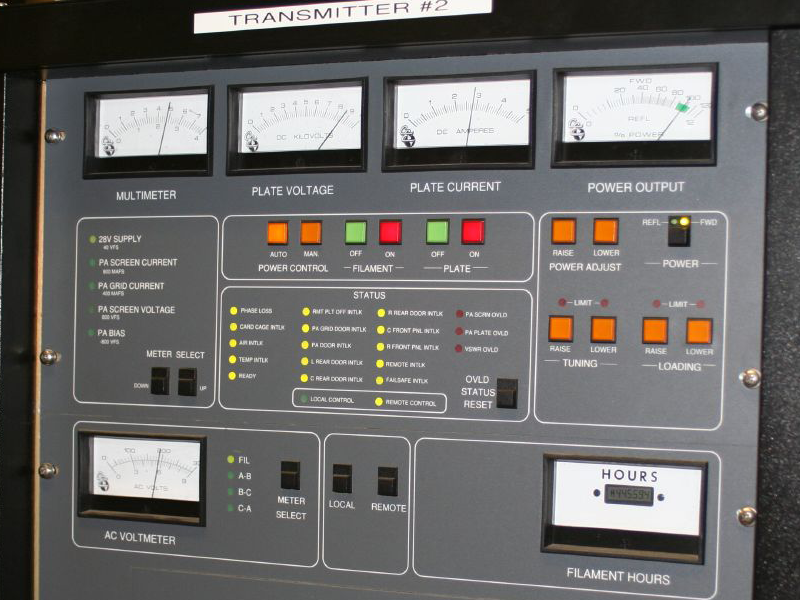
.jpg)


.JPG)
Operation
[edit]
Electromagnetic waves are radiated by electric charges when they are accelerated.[1][2] Radio waves, electromagnetic waves of radio frequency, are generated by time-varying electric currents, consisting of electrons flowing through a metal conductor called an antenna which are changing their velocity and thus accelerating.[3][2] An alternating current flowing back and forth in an antenna will create an oscillating magnetic field around the conductor. The alternating voltage will also charge the ends of the conductor alternately positive and negative, creating an oscillating electric field around the conductor. If the frequency of the oscillations is high enough, in the radio frequency range above about 20 kHz, the oscillating coupled electric and magnetic fields will radiate away from the antenna into space as an electromagnetic wave, a radio wave.
A radio transmitter is an electronic circuit which transforms electric power from a power source, a battery or mains power, into a radio frequency alternating current to apply to the antenna, and the antenna radiates the energy from this current as radio waves.[4] The transmitter also encodes information such as an audio or video signal into the radio frequency current to be carried by the radio waves. When they strike the antenna of a radio receiver, the waves excite similar (but less powerful) radio frequency currents in it. The radio receiver extracts the information from the received waves.
Components
[edit]A practical radio transmitter mainly consists of the following parts:
- In high power transmitters, a power supply circuit to transform the input electrical power to the higher voltages needed to produce the required power output.
- An electronic oscillator circuit to generate the radio frequency signal. This usually generates a sine wave of constant amplitude, called the carrier wave because it produces the radio waves which "carry" the information through space. In most modern transmitters, this is a crystal oscillator in which the frequency is precisely controlled by the vibrations of a quartz crystal. The frequency of the carrier wave is considered the frequency of the transmitter.
- A modulator circuit to add the information to be transmitted to the carrier wave produced by the oscillator. This is done by varying some aspect of the carrier wave. The information is provided to the transmitter as an electronic signal called the modulation signal. The modulation signal may be an audio signal, which represents sound, a video signal which represents moving images, or for data in the form of a binary digital signal which represents a sequence of bits, a bitstream. Different types of transmitters use different modulation methods to transmit information:
- In an AM (amplitude modulation) transmitter the amplitude (strength) of the carrier wave is varied in proportion to the modulation signal.
- In an FM (frequency modulation) transmitter the frequency of the carrier is varied by the modulation signal.
- In an FSK (frequency-shift keying) transmitter, which transmits digital data, the frequency of the carrier is shifted between two frequencies which represent the two binary digits, 0 and 1.
- OFDM (orthogonal frequency-division multiplexing) is a family of complicated digital modulation methods very widely used in high bandwidth systems such as Wi-Fi networks, cellphones, digital television broadcasting, and digital audio broadcasting (DAB) to transmit digital data using a minimum of radio spectrum bandwidth. OFDM has higher spectral efficiency and more resistance to fading than AM or FM. In OFDM multiple radio carrier waves closely spaced in frequency are transmitted within the radio channel, with each carrier modulated with bits from the incoming bitstream so multiple bits are being sent simultaneously, in parallel. At the receiver the carriers are demodulated and the bits are combined in the proper order into one bitstream.
- Many other types of modulation are also used. In large transmitters the oscillator and modulator together are often referred to as the exciter.
- A radio frequency (RF) amplifier to increase the power of the signal, to increase the range of the radio waves.
- An impedance matching (antenna tuner) circuit to transform the output impedance of the transmitter to match the impedance of the antenna (or the transmission line to the antenna), to transfer power efficiently to the antenna. If these impedances are not equal, it causes a condition called standing waves, in which the power is reflected back from the antenna toward the transmitter, wasting power and sometimes overheating the transmitter.
In higher frequency transmitters, in the UHF and microwave range, free running oscillators are unstable at the output frequency. Older designs used an oscillator at a lower frequency, which was multiplied by frequency multipliers to get a signal at the desired frequency. Modern designs more commonly use an oscillator at the operating frequency which is stabilized by phase locking to a very stable lower frequency reference, usually a crystal oscillator.
Regulation
[edit]Two radio transmitters in the same area that attempt to transmit on the same frequency will interfere with each other, causing garbled reception, so neither transmission may be received clearly. Interference with radio transmissions can not only have a large economic cost, it can be life-threatening (for example, in the case of interference with emergency communications or air traffic control).
For this reason, in most countries, use of transmitters is strictly controlled by law. Transmitters must be licensed by governments, under a variety of license classes depending on use such as broadcast, marine radio, Airband, Amateur and are restricted to certain frequencies and power levels. A body called the International Telecommunication Union (ITU) allocates the frequency bands in the radio spectrum to various classes of users. In some classes, each transmitter is given a unique call sign consisting of a string of letters and numbers which must be used as an identifier in transmissions. The operator of the transmitter usually must hold a government license, such as a general radiotelephone operator license, which is obtained by passing a test demonstrating adequate technical and legal knowledge of safe radio operation.
Exceptions to the above regulations allow the unlicensed use of low-power short-range transmitters in consumer products such as cell phones, cordless telephones, wireless microphones, walkie-talkies, Wi-Fi and Bluetooth devices, garage door openers, and baby monitors. In the US, these fall under Part 15 of the Federal Communications Commission (FCC) regulations. Although they can be operated without a license, these devices still generally must be type-approved before sale.
History
[edit]
The first primitive radio transmitters (called spark gap transmitters) were built by German physicist Heinrich Hertz in 1887 during his pioneering investigations of radio waves. These generated radio waves by a high voltage spark between two conductors. Beginning in 1895, Guglielmo Marconi developed the first practical radio communication systems using these transmitters, and radio began to be used commercially around 1900. Spark transmitters could not transmit audio (sound) and instead transmitted information by radiotelegraphy: the operator tapped on a telegraph key which turned the transmitter on-and-off to produce radio wave pulses spelling out text messages in telegraphic code, usually Morse code. At the receiver, these pulses were sometimes directly recorded on paper tapes, but more common was audible reception. The pulses were audible as beeps in the receiver's earphones, which were translated back to text by an operator who knew Morse code. These spark-gap transmitters were used during the first three decades of radio (1887–1917), called the wireless telegraphy or "spark" era. Because they generated damped waves, spark transmitters were electrically "noisy". Their energy was spread over a broad band of frequencies, creating radio noise which interfered with other transmitters. Damped wave emissions were banned by international law in 1934.
Two short-lived competing transmitter technologies came into use after the turn of the century, which were the first continuous wave transmitters: the arc converter (Poulsen arc) in 1904 and the Alexanderson alternator around 1910, which were used into the 1920s.
All these early technologies were replaced by vacuum tube transmitters in the 1920s, which used the feedback oscillator invented by Edwin Armstrong and Alexander Meissner around 1912, based on the Audion (triode) vacuum tube invented by Lee De Forest in 1906. Vacuum tube transmitters were inexpensive and produced continuous waves, and could be easily modulated to transmit audio (sound) using amplitude modulation (AM). This made AM radio broadcasting possible, which began in about 1920. Practical frequency modulation (FM) transmission was invented by Edwin Armstrong in 1933, who showed that it was less vulnerable to noise and static than AM. The first FM radio station was licensed in 1937. Experimental television transmission had been conducted by radio stations since the late 1920s, but practical television broadcasting didn't begin until the late 1930s. The development of radar during World War II motivated the evolution of high frequency transmitters in the UHF and microwave ranges, using new active devices such as the magnetron, klystron, and traveling wave tube.
The invention of the transistor allowed the development in the 1960s of small portable transmitters such as wireless microphones, garage door openers and walkie-talkies. The development of the integrated circuit (IC) in the 1970s made possible the current proliferation of wireless devices, such as cell phones and Wi-Fi networks, in which integrated digital transmitters and receivers (wireless modems) in portable devices operate automatically, in the background, to exchange data with wireless networks.
The need to conserve bandwidth in the increasingly congested radio spectrum is driving the development of new types of transmitters such as spread spectrum, trunked radio systems and cognitive radio. A related trend has been an ongoing transition from analog to digital radio transmission methods. Digital modulation can have greater spectral efficiency than analog modulation; that is it can often transmit more information (data rate) in a given bandwidth than analog, using data compression algorithms. Other advantages of digital transmission are increased noise immunity, and greater flexibility and processing power of digital signal processing integrated circuits.
-
 Spark oscillator similar to Hertz's, 1902. Visible are antenna consisting of 2 wires ending in metal plates (E), spark gap (D), induction coil (A), auto battery (B), and telegraph key (C).
 -
 Guglielmo Marconi's spark gap transmitter, with which he performed the first experiments in practical Morse code radiotelegraphy communication in 1895–1897
 -
 High power spark gap radiotelegraphy transmitter in Australia around 1910.
 -
 1 MW US Navy Poulsen arc transmitter which generated continuous waves using an electric arc in a magnetic field, a technology used for a brief period from 1903 until vacuum tubes took over in the 20s
 -
 An Alexanderson alternator, a huge rotating machine used as a radio transmitter at very low frequency from about 1910 until World War 2
 -
 One of the first vacuum tube AM radio transmitters, built by Lee De Forest in 1914. The early Audion (triode) tube is visible at right.
 -
 One of the BBC's first broadcast transmitters, early 1920s, London. The 4 triode tubes, connected in parallel to form an oscillator, each produced around 4 kilowatts with 12 thousand volts on their anodes.
 -
 Armstrong's first experimental FM broadcast transmitter W2XDG, in the Empire State Building, New York City, used for secret tests 1934–1935. It transmitted on 41 MHz at a power of 2 kW.
 -
 Transmitter assembly of a 20 kW, 9.375 GHz air traffic control radar, 1947. The magnetron tube mounted between two magnets (right) produces microwaves which pass from the aperture (left) into a waveguide which conducts them to the dish antenna.


See also
[edit]- List of transmission sites
- List of radios – List of specific models of radios
- Radio transmitter design
- Repeater
- Transmitter station
- Transposer
- Television transmitter
References
[edit]- ^ Serway, Raymond; Faughn, Jerry; Vuille, Chris (2008). College Physics, 8th Ed. Cengage Learning. p. 714. ISBN 978-0495386933.
- ^ a b Ellingson, Steven W. (2016). Radio Systems Engineering. Cambridge University Press. pp. 16–17. ISBN 978-1316785164.
- ^ Balanis, Constantine A. (2005). Antenna theory: Analysis and Design, 3rd Ed. John Wiley and Sons. pp. 10. ISBN 9781118585733.
- ^ Brain, Marshall (2000-12-07). "How Radio Works". HowStuffWorks.com. Retrieved 2009-09-11.
External links
[edit]
- International Telecommunication Union
- Jim Hawkins' Radio and Broadcast Technology Page
- WCOV-TV's Transmitter Technical Website
Planning section.]
- Build/ Your Own Grenade AM Transmitter Circuit: A Complete Guide
- Details of UK digital television transmitters


| Authority control databases: National |
|---|

Transmitter
View on GrokipediaOverview
Definition
A transmitter is an electronic device that generates and amplifies radio-frequency (RF) signals modulated with information, such as audio, video, or data, enabling their propagation through free space via an antenna for wireless communication purposes.[10] For example, in the U.S. Federal Communications Commission's rules for personal radio services (47 CFR § 95.303), a transmitter is defined as a device that supplies radio frequency electrical energy to an antenna, either directly or through a feedline, intended to radiate signals for communication.[11] This process allows the transmission of intelligence over distances without physical connections, forming the outbound component in wireless systems. The core function of a transmitter involves encoding low-frequency baseband signals—such as voice waveforms or digital bit streams—onto a high-frequency carrier wave through modulation techniques like amplitude modulation (AM), frequency modulation (FM), or phase-shift keying (PSK).[10] This modulation impresses the information onto the carrier, which is then amplified to sufficient power levels for effective radiation, ensuring the signal can travel to a distant receiver while minimizing distortion and interference.[10] At a high level, the operational flow of a transmitter can be represented by a basic block diagram: the input signal enters the system, undergoes modulation to combine with the carrier, is amplified for power, and is output to the antenna for transmission. This structured progression transforms raw information into a suitable electromagnetic form for propagation. In distinction to receivers, which detect and demodulate incoming RF signals to recover the original information, transmitters actively generate and radiate signals outward to initiate communication.[10]Role in Communication Systems
Transmitters play a central role in communication systems by converting and broadcasting information signals to enable reliable data transfer across various architectures. In point-to-point systems, such as microwave relay links used in telecommunications backhaul, the transmitter directs a focused signal to a single or limited number of receivers over a dedicated path, ensuring efficient, high-capacity connections between specific locations. Broadcast systems, conversely, employ transmitters to radiate signals omnidirectionally for reception by numerous users, as seen in commercial radio stations that deliver audio content to widespread audiences without targeted addressing. Two-way systems integrate transmitters within transceivers for bidirectional exchange, facilitating applications like cellular networks where mobile devices transmit voice and data to base stations, and satellite communication links that support global connectivity for telephony and internet services.[12][13][14] A key function of transmitters is to support both one-way and two-way communication modes, which dictate the system's interactivity and scalability. One-way broadcasting, prevalent in public radio and television, allows a single transmitter to disseminate information unidirectionally to passive receivers, optimizing for mass dissemination with minimal infrastructure. In contrast, two-way duplex systems enable simultaneous transmission and reception, often through frequency division or time division techniques, as in half-duplex walkie-talkies or full-duplex cellular phones, where the transmitter alternates or shares channels to maintain conversation flow and adapt to network demands. This duality enhances system versatility, from unidirectional content delivery to interactive networking.[12][15] Transmitters profoundly influence data rates, range, and reliability by determining signal strength and propagation characteristics. Power output is a critical factor, as higher wattage amplifies signal amplitude to overcome path loss, extending coverage; for example, typical FM radio transmitters with 50 kW effective radiated power can achieve line-of-sight ranges of 50-100 km in rural areas, depending on antenna height and terrain. This directly affects reliability by improving signal-to-noise ratios, which supports higher data rates in bandwidth-limited channels, though excessive power may increase interference. Effective transmission also presupposes matched receivers capable of demodulating the signal at the correct frequency and suitable propagation media, such as the ionosphere for long-distance radio or free space for satellite uplinks, to minimize attenuation and multipath effects.[16][14]Operating Principles
Signal Generation
Signal generation in transmitters begins with the creation of a stable carrier signal, which serves as the foundation for encoding information. Electromagnetic waves, the basis of radio transmission, are characterized by their frequency and wavelength , related by the equation , where is the speed of light in vacuum, approximately m/s. This relation determines the propagation characteristics of the signal, with higher frequencies corresponding to shorter wavelengths suitable for specific communication bands.[17] The core of signal generation relies on oscillation principles to produce stable sinusoidal carrier waves at desired frequencies. Basic oscillators, such as LC circuits, achieve this through the resonance of an inductor (L) and capacitor (C), where energy oscillates between magnetic and electric fields. The resonant frequency is given by This formula derives from the differential equation governing the circuit, ensuring periodic voltage or current variations that form the sinusoidal waveform.[18] For higher stability, crystal oscillators employ the piezoelectric effect in quartz crystals, vibrating at a precise mechanical resonant frequency—typically in the MHz range—converted to an electrical signal via inverse piezoelectricity. These oscillators generate highly stable sinusoids with quality factors (Q) exceeding 10,000, minimizing frequency drift essential for reliable transmission.[19] Precise frequency control is often implemented through frequency synthesis techniques, notably phase-locked loops (PLLs). A PLL synchronizes an internal voltage-controlled oscillator (VCO) to a stable reference frequency, typically from a crystal oscillator, using a phase detector, loop filter, and feedback divider. The output frequency is , where is an integer multiplier, allowing synthesis of frequencies from a low-frequency reference with fine resolution and low jitter.[20] This method ensures the carrier aligns accurately with allocated spectrum bands in transmitters. Maintaining signal integrity requires addressing stability factors such as temperature variations and phase noise. Temperature compensation techniques, including thermistors or digitally controlled adjustments in the oscillator circuit, counteract frequency shifts caused by thermal expansion in components like crystals, achieving stability better than 1 ppm over wide temperature ranges. Phase noise, representing random fluctuations in the signal's phase, is minimized through high-Q resonators and low-noise amplifiers to prevent distortion and interference in the transmitted signal; for instance, crystal-based designs can achieve phase noise floors below -150 dBc/Hz at 10 kHz offset. These measures ensure the generated carrier remains a clean, undistorted waveform ready for subsequent encoding.Modulation and Amplification
In radio transmission, modulation encodes the information-bearing message signal onto a high-frequency carrier wave generated by the oscillator, enabling efficient propagation through the channel. Common analog modulation techniques include amplitude modulation (AM), where the carrier amplitude varies proportionally with the message signal m(t); frequency modulation (FM), where the carrier frequency deviates based on m(t); and phase modulation (PM), where the carrier phase shifts with m(t). Digital variants, such as quadrature amplitude modulation (QAM), combine amplitude and phase shifts to represent multiple bits per symbol, achieving higher spectral efficiency in modern systems. For FM, the process involves varying the instantaneous carrier frequency around a center frequency , with the deviation directly proportional to the message signal. The instantaneous frequency deviation is given by , where is the frequency deviation constant (in Hz per unit of m(t)) and m(t) is the modulating signal. This results in a modulated signal , preserving the carrier amplitude while embedding the information in frequency variations.[21] Bandwidth considerations are critical for avoiding interference. In AM, the modulated signal produces upper and lower sidebands, each mirroring the baseband bandwidth B, yielding a total bandwidth of 2B centered at .[22] For FM, Carson's bandwidth rule approximates the required bandwidth as , where is the peak deviation; this rule, derived from early analysis of FM spectra, captures 98% of the signal power for modulation indices greater than one. Following modulation, amplification boosts the signal power for transmission while maintaining fidelity. Amplifiers are classified by conduction angle and linearity: linear amplifiers (e.g., Class A and B) conduct over the full or half cycle, offering low distortion for amplitude-sensitive modulations like AM and QAM but with efficiencies of 20-50%; nonlinear amplifiers (e.g., Class C) conduct less than half the cycle, achieving up to 80% efficiency for constant-envelope signals like FM or continuous-wave (CW) but introducing distortion unsuitable for linear modulations without predistortion.[23] Class AB hybrids balance these, with efficiencies around 50-60% and moderate linearity.[24] A key trade-off in amplification arises between efficiency and distortion: higher-efficiency nonlinear operation reduces power consumption but compresses the signal, generating intermodulation distortion that degrades adjacent-channel performance, particularly for multi-tone or high-peak-to-average-power-ratio (PAPR) modulations like QAM; linear amplification preserves waveform integrity but dissipates more heat, limiting battery life in portable transmitters.[25] Techniques like digital predistortion mitigate this by pre-compensating nonlinearities, allowing efficient Class C or AB use in linear systems with minimal spectral regrowth.[26]Key Components
Oscillator and Modulator
In transmitters, the oscillator generates a stable carrier signal that serves as the foundation for modulation, while the modulator encodes the information signal onto this carrier. Crystal oscillators, utilizing quartz crystals, provide exceptional frequency stability, typically achieving ±10 ppm at room temperature, making them ideal for applications requiring precise carrier frequencies such as broadcast radio.[27] This stability arises from the piezoelectric properties of quartz, which vibrate at a resonant frequency when electrically excited, minimizing drift due to environmental factors. LC oscillators, employing inductors and capacitors in resonant circuits like Colpitts or Hartley configurations, offer tunable frequencies and good phase noise performance, suitable for variable-frequency transmitters in amateur radio setups.[28] Voltage-controlled oscillators (VCOs) extend this by allowing frequency adjustment via an input voltage, essential for dynamic tuning in frequency synthesis and phase-locked loops within modern transceivers.[29] Modulator designs vary by modulation type to ensure signal fidelity and carrier suppression where needed. Balanced modulators, often using diode ring or transistor pairs, effectively suppress the carrier in amplitude modulation (AM) schemes like double-sideband suppressed carrier (DSB-SC), achieving over 40 dB suppression to reduce spectral inefficiency and interference.[30] For frequency modulation (FM), varactor diode modulators exploit the voltage-dependent capacitance of reverse-biased diodes to vary the oscillator's resonant frequency in response to the modulating signal, enabling linear frequency deviation for audio broadcasting.[31] A simple diode modulator for basic AM operates on the square-law characteristic of a biased diode, mixing the carrier and modulating signal in a resistive network to produce sidebands with minimal carrier leakage, commonly used in low-power educational transmitters.[32] Integration of the oscillator and modulator requires careful design to maintain signal integrity. The oscillator output typically feeds into the modulator through a buffer amplifier stage, such as an emitter follower or source follower, which isolates the oscillator from the modulator's loading effects, preventing frequency pulling or instability.[33] This buffering ensures the carrier remains stable while the modulator imposes the information signal without feedback-induced distortion. Modern enhancements incorporate digital signal processing (DSP) for hybrid modulation schemes, where baseband signals are digitally generated and upconverted to analog carriers via DACs and mixers, improving linearity and flexibility in software-defined transmitters.[34] DSP enables adaptive modulation, such as combining AM and FM elements, while reducing analog component count for better noise performance in wireless systems.[35]Power Amplifier and Antenna
The power amplifier stage in a transmitter boosts the low-level modulated signal to a level suitable for transmission, typically delivering several watts to kilowatts of RF power while maintaining signal integrity. This stage is critical for achieving the required output power and efficiency, as it directly impacts the overall system performance and energy consumption. Common amplifier configurations are classified based on their conduction angle and operating mode, with each class offering trade-offs between linearity, efficiency, and suitability for RF applications. Power amplifiers are categorized into several classes, each defined by the portion of the input cycle during which the active devices conduct current.[36] Class A amplifiers conduct over the full 360° cycle, providing high linearity but low efficiency, with a theoretical maximum of 50% given by the formula , where is the supply voltage and is the saturation voltage (often approaching 50% when is minimal, though practical values are around 25-30% due to losses).[36] Class B amplifiers conduct for 180° of the cycle, offering better efficiency up to 78.5% theoretically, but they suffer from crossover distortion unless push-pull configurations are used.[36] Class AB combines aspects of A and B, conducting slightly more than 180° to reduce distortion while achieving efficiencies of 50-70%, making it suitable for linear amplification in transmitters requiring moderate fidelity.[36]| Class | Conduction Angle | Theoretical Max Efficiency | Key Characteristics | RF Suitability |
|---|---|---|---|---|
| A | 360° | 50% | High linearity, low distortion | Low-power, linear apps; inefficient for high power |
| B | 180° | 78.5% | Balanced linearity/efficiency; crossover distortion | Push-pull RF stages |
| AB | >180° | 50-70% | Reduced distortion vs. B; good linearity | Broadcast transmitters needing fidelity |
| C | <180° | >80% | High efficiency, nonlinear | Tuned RF circuits; FM/constant envelope signals |
| D | Switching (PWM) | >90% | High efficiency via switching; requires filtering | High-power digital transmitters |
| E | Switching (ZVS) | ~90-95% | Zero-voltage switching minimizes losses | High-efficiency RF PAs for mobile/base stations |
| F | Switching (waveform shaping) | ~90% | Harmonics shaped for efficiency; good bandwidth | Broadband RF transmitters |