Hubbry Logo
Poiana (genus)Poiana (genus)Main
Open search
Poiana (genus)
Community hub
Poiana (genus)
logo
8 pages, 0 posts
0 subscribers
Be the first to start a discussion here.
Poiana (genus)
Poiana (genus)
from Wikipedia

Poiana
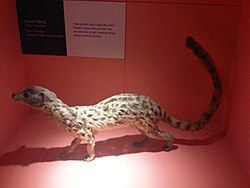
Central African oyan (Poiana richardsonii)
Scientific classification Edit this classification
Kingdom: Animalia
Phylum: Chordata
Class: Mammalia
Order: Carnivora
Family: Viverridae
Subfamily: Genettinae
Genus: Poiana
Gray, 1865[1][2]
Type species
Genetta richardsonii[3]
Species

The genus Poiana consists of two species native to West and Central Africa, the West African oyan (P. leightoni) and the Central African oyan (P. richardsonii).

Taxonomy

[edit]

The genus Poiana was proposed by John Edward Gray in 1864 and published the following year.[1][4] In accordance with Article 8 of the International Code of Zoological Nomenclature, the correct author citation is "Gray, 1865".[2][5]

Both linsang genera Poiana and Prionodon were formerly placed in the subfamily Viverrinae of the Viverridae, along with several other genera, but recent research suggests that their actual relationships may be somewhat different; a 2020 checklist places them instead in the subfamily Genettinae.[2] The linsangs are remarkable for their morphological resemblance to the family Felidae, which is greater than in the other viverrids. As the relationship between linsangs and felids was thought to be rather distant, this was considered an example of convergent evolution. However, DNA analysis indicates that while the African linsangs (Poiana) are true viverrids closely related to the genets, the Asiatic linsangs (Prionodon) are not and may instead be the closest living relatives of the Felidae.[6]

References

[edit]
Revisions and contributorsEdit on WikipediaRead on Wikipedia
from Grokipedia
Poiana is a genus of small carnivoran mammals belonging to the subfamily within the family , commonly referred to as African linsangs or oyans. It comprises two allopatric species native to the tropical rainforests of West and , characterized by their slender, genet-like builds adapted for arboreal life. These elusive animals are nocturnal and omnivorous, playing a role in ecosystems through their varied diet and secretive behaviors. The genus Poiana was established by in 1864, with the Genetta richardsonii described by Thomas Thomson in 1842. Taxonomically, it falls under the order and suborder , distinguishing it from the Asian linsangs in the genus Prionodon. The two recognized species are Poiana richardsonii (Central African oyan) and Poiana leightoni (West African oyan), with the former sometimes divided into such as P. r. richardsonii and P. r. ochracea. Their distributions are widely separated by approximately 1,600 km, reflecting limited and distinct regional adaptations. Physically, species in Poiana exhibit a head-and-body length of 30–38 cm, a tail measuring 35–40 cm with 10–14 dark rings, and a weight of 500–700 g. Their pelage ranges from pale yellow to reddish-brown, adorned with small, irregular black spots on the body, while the underparts are lighter and often spot-free. Adapted for life in the canopy at elevations of 300–950 m, they possess rounded ears, a pointed muzzle, and agile limbs suited for climbing and leaping among branches. Behaviorally, they are primarily solitary or occur in pairs, constructing simple nests about 2 m above the ground and nocturnally for , small vertebrates, young birds, fruits, and nuts. Records of Poiana species are scarce, highlighting their rarity and the challenges in studying them in dense habitats from to the for P. richardsonii and from [Ivory Coast](/page/Ivory Coast) to for P. leightoni (with uncertain records in and ). Conservation assessments vary by species: P. richardsonii is classified as Least Concern due to its relatively wide range, though it faces potential threats from habitat degradation, while P. leightoni is rated Vulnerable owing to severe fragmentation and ongoing in its limited Upper Guinean forest . Further field research is essential to better understand their and mitigate risks from and hunting.

Taxonomy

Etymology

The genus Poiana was established by British zoologist in 1864 to accommodate small, arboreal viverrids previously classified under Genetta, with Genetta richardsonii Thomson, 1842, designated as the . The name Poiana is derived from Fernando Po (present-day Island, ), the locality from which the type species was first collected. The species P. richardsonii was originally described as Genetta richardsonii by Scottish surgeon and naturalist Thomas Thomson in 1842, based on specimens obtained during the Expedition; the honors Sir John Richardson (1787–1865), a prominent British naval surgeon, Arctic explorer, and naturalist known for his contributions to during Franklin's expeditions. This species was subsequently transferred to Poiana by Gray in his 1864 revision of viverrine genera. The species P. leightoni originated as the subspecies Poiana richardsonii leightoni, proposed by British zoologist in 1908 from specimens collected in ; the subspecific name commemorates Leonard Leighton, the collector who supplied the material analyzed in Pocock's report on Liberian mammals, exemplifying the practice of eponymy in early 20th-century to recognize field contributors. Common names for species in Poiana include "oyan," a term from indigenous West and Central African languages denoting small, elusive carnivores, and "linsang" or "African linsang," borrowed from the Malay word (also appearing in Javanese as wlinsang), originally applied to analogous arboreal viverrids in but extended to these African taxa due to morphological similarities.

Classification history

The Central African oyan, Poiana richardsonii, was initially described in 1842 by T. R. H. Thomson as Genetta richardsonii based on a specimen from Fernando Po (now Island, [Equatorial Guinea](/page/Equatorial Guinea)). In 1864, John Edward Gray erected the genus Poiana to accommodate this species, distinguishing it from Genetta on the basis of cranial morphology, including a shorter muzzle and specialized dental features adapted for a carnivorous diet. In 1908, described Poiana richardsonii leightoni as a subspecies based on specimens from . In 1974, Donovan Reginald Rosevear elevated it to full status, Poiana leightoni, separated from P. richardsonii by differences in pelage coloration (paler tones and distinct spotting patterns) and proportions (narrower postorbital constriction). The genus Poiana has been consistently placed within the subfamily of the family (order ), reflecting its shared viverrine traits such as semi-retractile claws and arboreal adaptations. Throughout the , taxonomic debates centered on the of African linsangs (Poiana) with Asian linsangs (Prionodon), based on morphological similarities like elongated bodies and ; however, molecular studies in the early resolved this by confirming Poiana as a distinct African lineage within , sister to Genetta, with Prionodon forming a separate family Prionodontidae. Gaubert and Cordeiro-Estrela () supported this phylogeny through a incorporating morphological and molecular from over 1600 variable characters, highlighting in linsang-like forms. Gaubert and Veron (2003/2004) provided molecular corroboration using cytochrome b and 12S rRNA sequences from limited Poiana tissue samples, affirming its inclusion in . The current classification, as detailed in (3rd edition, 2005), recognizes two allopatric species in Poiana: P. richardsonii () and P. leightoni (), separated by approximately 1600 km with no overlap in distributions. No subspecies are recognized for P. leightoni, while P. richardsonii includes two: the nominate P. r. richardsonii (widespread in ) and P. r. ochracea (paler form from the Cameroon-Nigeria border region).

Description

Morphology

Members of the genus Poiana exhibit a slender, elongated body build adapted for , with a head-body length ranging from 30 to 38 cm, a length of 35 to 40 cm that is nearly equal to the body length, and a weight of 0.5 to 0.7 kg. This weasel-like form contrasts with the stockier builds of related viverrids such as genets, facilitating agility in forested canopies. The pelage is characteristically golden-yellow to ochre, marked by bold black spots arranged in 4–5 irregular rows that may merge into transverse bands on the body and limbs; a darker dorsal stripe extends from the head to the tail tip, while the underparts are paler with sparser spotting. The tail features 9–14 alternating black rings, aiding in balance during climbing. Cranially, Poiana species possess a short, pointed muzzle, large eyes suited for nocturnal vision, and rounded, mobile ear pinnae that enhance acute hearing. The dentition comprises 38 teeth with carnassial adaptations for shearing meat, following the dental formula I 3/3, C 1/1, P 4/4, M 1/2; the slender canines and sharp-cusped premolars support a carnivorous diet. The limbs are short with semi-retractable, somewhat curved claws and hairy soles (except on digit pads), promoting grip on bark; flexible ankles and a long, cylindrical tail provide stability and balance in the canopy. Sensory capabilities include well-developed smell via prominent anal glands and for low-light hunting, complemented by the wide orbits.

Intraspecific variation

The genus Poiana exhibits notable intraspecific variation primarily between its two recognized species, P. richardsonii and P. leightoni, as well as within P. r. richardsonii across its subspecies. In P. richardsonii, the pelage is generally more uniform golden-yellow to orange-brown dorsally, marked by distinct black banding on the tail (10–14 rings) and larger, irregular spots on the flanks arranged in 4–5 rows, which may merge into stripes in some individuals. This species displays two subspecies: the nominate P. r. richardsonii, found in central populations and characterized by darker, more contrasted coloration, and P. r. ochracea, restricted to Island (), which is paler overall with reduced intensity in spotting and banding due to its isolated island habitat. In contrast, P. leightoni presents a paler overall pelage, described as soft and dense pale yellowish with a subtle brownish wash dorsally, featuring reduced spotting that forms only three rows of smaller blackish spots on the back and flanks, along with narrower black bands on the tail (10–12 rings). This species has head-body length measuring approximately 30–38 cm, tail 35–40 cm, and weight 500–700 g, and no are currently recognized owing to the scarcity of specimens (fewer than a dozen known). Descriptions of P. leightoni are based on very few specimens, limiting detailed comparisons. Comparative morphological differences between the species include a less pronounced dorsal crest in P. leightoni, contributing to its more streamlined appearance adapted to dense forest understory. Cranial variation shows P. richardsonii with a broader skull and larger teeth, potentially linked to subtle dietary differences in prey processing, though sample sizes limit definitive conclusions. There is no sexual dimorphism in size or pelage across the genus. Age-related changes include juveniles possessing softer, less contrasted fur with subdued spotting that intensifies with maturity, while adults exhibit claw wear from arboreal locomotion.

Distribution and habitat

Geographic range

The genus Poiana is endemic to tropical regions of West and Central Africa, with its overall distribution spanning fragmented forest blocks from Liberia in the west to the northern Democratic Republic of the Congo in the east. The genus's range covers primarily lowland and montane tropical forests, though this area is highly discontinuous due to historical and ongoing habitat fragmentation. No records exist for Poiana species outside continental Africa. Poiana richardsonii (Central African oyan) has the broader distribution within the genus, occurring in southern Cameroon, southern , (including Island), , , and (extending east to the ). Recent records include (2018) and (2024). The two species in the genus are allopatric, separated by approximately 1,600 km across the Dahomey Gap, a savanna corridor that divides West African forests from Central African ones. The species inhabits elevations from to 1,500 m, primarily in lowland and montane rainforests, with no major range contractions documented historically, though current trends remain uncertain due to limited field data. It co-occurs sympatrically with other viverrids, such as genets (Genetta spp.), in shared forest habitats. In contrast, Poiana leightoni (West African oyan) has a much more restricted range, confined to the Upper Guinean forests of southwestern Côte d'Ivoire and eastern , with possible but unconfirmed occurrence in southwestern (e.g., Kounounkan Massif); records from are lacking. Its extent of occurrence is estimated at approximately 224,000 km² (as of 2016), making it one of the most range-limited viverrids in . The species is known primarily from fewer than 12 historical museum specimens, with the last confirmed records from 1988 in , suggesting potential local extirpations in parts of its range due to data deficiency and habitat loss, though no definitive evidence of widespread contraction exists. There is no overlap in distribution between P. leightoni and P. richardsonii.

Habitat preferences

The genus Poiana is primarily associated with lowland tropical rainforests, favoring primary or mature secondary forests characterized by dense canopies. Poiana richardsonii occurs from to 1,500 m, while P. leightoni is typically found below approximately 1,000 m. These linsangs exhibit a strong arboreal , preferring the upper canopy layers at heights of 10-30 m, where lianas and epiphytes provide essential cover and support for movement; they rarely descend to the ground and use fallen logs only transiently for short periods. Poiana richardsonii inhabits humid forests, while P. leightoni occurs in forests along drier forest edges; neither is recorded in savannas or flooded areas, reflecting their dependence on closed-canopy environments. Poiana demonstrate some adaptability to selective provided the canopy remains largely intact, but they are highly sensitive to complete forest clearance; there are no confirmed records from plantations or edges, underscoring their reliance on relatively undisturbed forest structures.

Ecology and behavior

Diet and foraging

Species in the genus Poiana are omnivorous, with diets comprising a mix of animal and plant matter. For Poiana richardsonii, the Central African oyan, the diet includes , young birds, small vertebrates such as , and materials like cola nuts, fruits, leaves, and seeds. Similarly, Poiana leightoni, the West African oyan, consumes fruits, seeds, leaves, , birds, and small mammals. Foraging occurs primarily at night in the forest canopy, where these solitary animals use their to navigate branches and locate . Poiana species likely employ acute senses to capture small prey like , birds, and . Prey items are generally small, and there is no evidence of pack hunting. Limited observations suggest seasonal variations in diet, with potential increased consumption of fruits and plant matter during dry periods. Ecological knowledge for Poiana remains limited, with most data derived from studies prior to 2000. Recent records, such as in (2018) and (2024), confirm the presence of P. richardsonii but provide no additional behavioral insights.

Reproduction and social structure

The genus Poiana comprises two species of African linsangs, P. richardsonii and P. leightoni, both of which exhibit limited documented reproductive behaviors due to their elusive, arboreal lifestyles in dense rainforests. Adults are primarily solitary outside of breeding periods, with interactions limited to encounters. Breeding occurs one to two times annually, though the exact season remains unknown; a lactating female P. richardsonii was recorded in , suggesting possible year-round reproduction with potential peaks aligned to environmental cues like rainfall. likely involves vocalizations and scent marking from anal glands, common in viverrids, though specific observations for Poiana are lacking. The is presumed polygynous, consistent with the solitary nature of adults in related viverrid genera. Gestation in Poiana is estimated at 60–70 days, inferred from patterns in other small viverrids such as genets. Litters typically consist of 1–3 , born in arboreal nests constructed from leaves and moss approximately 2 meters above the ground to provide protection from predators. Kits are altricial, born blind and helpless, requiring intensive maternal care in these secure dens. Wild lifespan is undocumented but estimated at 5–8 years based on captive records, where individuals have survived up to 5 years and 4 months; no data exist on maximum in the wild. Social structure in Poiana is predominantly solitary, with individuals maintaining exclusive territories marked by , though transient pairs or mother-kit groups are occasionally observed during breeding or early rearing phases. For P. richardsonii, has been recorded at 1 individual per km² in primary forest. Aggression is rare outside of rivalries, contributing to the species' low detectability in field studies. No evidence of exists within the genus. Parental care is exclusively maternal, with females providing , grooming, and in the nest; males play no role in rearing and remain uninvolved post-mating. This unisexual investment aligns with the solitary , ensuring female allocation prioritizes offspring survival in predator-rich environments.

Conservation

IUCN status

The genus Poiana comprises two recognized , each assessed separately under the criteria. Poiana richardsonii (Central African oyan) is classified as Least Concern, with its assessment unchanged since 2015. This status reflects its wide distribution across , including southern , , , , , (east to the Rift Valley), and Island, where it occupies relatively intact lowland and montane forest habitats. Although population trends are unknown due to data deficiencies, the species is considered common in suitable areas, with no evidence of significant global decline; localized threats from and exist but do not meet threat thresholds. Density estimates suggest at least one individual per km² in primary forests, implying a total mature population well exceeding 10,000 individuals across its extensive range, and it benefits from occurrence in multiple protected areas. In contrast, Poiana leightoni (West African oyan) is listed as Vulnerable under criterion C1, with a decreasing population trend, also unchanged since the 2015 assessment. Endemic to the Upper Guinean forests of West Africa, it has a restricted extent of occurrence of approximately 50,000 km², confirmed primarily in southwestern Côte d'Ivoire and eastern Liberia, where habitat loss from deforestation and incidental hunting have driven an inferred decline of at least 10% over the past three generations (12 years, based on a generation length of 4 years). The estimated mature population size is 6,700–10,000 individuals, qualifying it under C1 for a small, declining population; exact numbers remain data-deficient due to the species' rarity and elusive arboreal habits in rainforest canopies. No dedicated monitoring studies exist for either species, with both assessments relying on expert review of historical records and habitat modeling by Gaubert and Do Linh San (2015), and no updates reported as of 2025. At the genus level, Poiana is not considered globally threatened, as P. richardsonii predominates in stable habitats, though the Vulnerable status of P. leightoni highlights localized conservation concerns within the Upper Guinean biodiversity hotspot.

Threats and conservation measures

The genus Poiana faces primary threats from habitat destruction driven by deforestation for logging and agricultural expansion, particularly in the Upper Guinean forests where P. leightoni occurs. These forests have undergone substantial loss, reduced to approximately 15% of their original extent due to human activities since the mid-20th century, with ongoing degradation exacerbating fragmentation. Incidental bushmeat hunting, often targeting larger species but capturing viverrids like Poiana, poses an additional risk, though no targeted trade in the genus is documented. Species-specific threats vary by range. P. leightoni is highly vulnerable to these pressures in its restricted West African distribution across Côte d'Ivoire and , where ongoing habitat conversion limits its arboreal lifestyle. In contrast, P. richardsonii experiences less overall impact in the more intact forests but faces localized declines from road development causing . may indirectly affect both species through forest drying and shifts in prey availability, potentially reducing suitable canopy habitats, though specific impacts remain understudied. Conservation efforts include inclusion of Poiana species within protected areas, such as in Côte d'Ivoire for P. leightoni, where the park's intact rainforests support its persistence as a priority species. Similarly, Sapo National Park in provides refuge for P. leightoni, with camera-trap surveys confirming its presence amid broader anti-poaching initiatives. Recommended measures emphasize strengthened enforcement against and , alongside the creation of corridors to mitigate fragmentation in both species' ranges. Further research is essential, including expanded camera-trap studies to estimate population sizes and monitor trends, particularly for the data-deficient P. leightoni. Successes are evident in stable populations of P. richardsonii within Central African reserves, demonstrating the effectiveness of management and viverrid restrictions in maintaining viability.

References

Add your contribution
Related Hubs
User Avatar
No comments yet.